
opposites Crossword Puzzles
Opposites - Write the Opposite of each clue in Spanish. 2021-01-20

Across
- feo
- bueno
- gordo
- alto
- pequeño
- organizado
- estúpido
- débil
Down
- serio
- viejo
- hombre
- aburrido
- chica
- perezoso
- impaciente
- tímido
16 Clues: feo • alto • serio • bueno • gordo • viejo • chica • débil • hombre • tímido • pequeño • aburrido • perezoso • estúpido • organizado • impaciente
Opposites created by adding im, in, ir, il, or dis 2025-05-02

Across
- Active
- Perfect
- Honest
- Logical
- Credible
- Mobile
- Regular
- Legible
- Possible
- Relevant
Down
- Mature
- Visible
- Legal
- Accurate
- Patient
- Correct
- Polite
- Secure
- Moral
- Balanced
20 Clues: Legal • Moral • Active • Mature • Honest • Mobile • Polite • Secure • Perfect • Visible • Logical • Patient • Correct • Regular • Legible • Credible • Accurate • Possible • Relevant • Balanced
Puzzle 1 2021-07-31

Across
- – denoted by a number or variable in the superscript place of the base, which designates how many times the base will be multiplied by itself if it is positive or by its inverse if it is negative.
- notation – a representation of a real number, not including counting (natural) numbers, which uses a decimal point to show place values that are less than one, such as tenths and hundredths (e.g., 0.023, etc.)
- Numbers- the set of decimals that do not terminate or repeat
- – the set of natural numbers, their opposites, and zero {–n, …, –3, –2, –1, 0, 1, 2, 3, ..., n}.
- numbers – the set of numbers that are decimals that either terminate or repeat and fractions.
Down
- numbers – the set of natural numbers and zero {0, 1, 2, 3, ..., n}
- numbers – the set of positive numbers that begins at one and increases by increments of one each time {1, 2, 3, ..., n}
- root- a number that when multiplied by itself equals a specified number
- value – the value of a digit as determined by its location in a number such as ones, tens, hundreds, one thousands, ten thousands, etc.
- numbers – to arrange a set of numbers based on their numerical value
- notation – a representation of a number by using a method to write very large or very small numbers using powers of ten that is written as a decimal with exactly one nonzero digit to the left of the decimal point, multiplied by a power of ten (e.g., 2.3 × 10⁻², etc.)
11 Clues: Numbers- the set of decimals that do not terminate or repeat • numbers – the set of natural numbers and zero {0, 1, 2, 3, ..., n} • numbers – to arrange a set of numbers based on their numerical value • root- a number that when multiplied by itself equals a specified number • ...
Opposites created by adding im, in, ir, il, or dis 2025-05-02

Across
- Active
- Perfect
- Honest
- Logical
- Credible
- Mobile
- Regular
- Legible
- Possible
- Relevant
Down
- Mature
- Visible
- Legal
- Accurate
- Patient
- Correct
- Polite
- Secure
- Moral
- Balanced
20 Clues: Legal • Moral • Active • Mature • Honest • Mobile • Polite • Secure • Perfect • Visible • Logical • Patient • Correct • Regular • Legible • Credible • Accurate • Possible • Relevant • Balanced
Literary Terms & Devices Review 2025-12-04

Across
- A kind of language that uses words or expressions with a meaning that is different from the literal interpretation. It goes beyond the literal meaning to create a special effect or insight. (This is a broad category that includes many literary devices includin
- The object or concept used to do the describing in a metaphor or figurative comparison.
- A comparison between two unlike things using "like" or "as".
- The subject being described in a metaphor or figurative comparison.
- An object, person, place, or action that has its own meaning but also stands for something larger than itself, such as a quality, an attitude, a belief, or a value.
- A direct comparison between two unlike things without using "like" or "as," stating that one thing is another.
- The central idea, message, or insight into life that the poem conveys; the “so what?” of the poem. A theme is the poem's statement about the subject.
- opposites, ex: light and dark, love and hate
Down
- The topic of the poem; what the poem is about in a literal sense.
- The repetition of the same initial consonant sound in a series of words.
- This word is the VEHICLE of the following comparison: "Like a stalker, [nature] is in the back seat of the car."
- The overall feeling or atmosphere that a poem creates for the reader. The reader's feeling.
- Giving human qualities, feelings, actions, or characteristics to inanimate objects, animals, or ideas.
- The purposeful reiteration of words, phrases, or stanzas in a poem for emphasis or effect.
- Descriptive language that appeals to one or more of the five senses (sight, sound, smell, taste, touch), creating a mental picture for the reader.
- The poet's or speaker's attitude toward the subject, the reader, or themselves. How the author feels about what they're writing about.
- A contrast between what is said and what is meant, or between what is expected to happen and what actually happens. Think: A poem about disliking poetry.
17 Clues: opposites, ex: light and dark, love and hate • A comparison between two unlike things using "like" or "as". • The topic of the poem; what the poem is about in a literal sense. • The subject being described in a metaphor or figurative comparison. • The repetition of the same initial consonant sound in a series of words. • ...
Crossword #1 2021-07-31

Across
- The value of a digit as determined by its location in a number such as ones, tens, hundreds, one thousands, ten thousands, etc.
- A number that when multiplied by itself equals a specified number
- – A representation of a real number, not including counting (natural) numbers, which uses a decimal point to show place values that are less than one, such as tenths and hundredths (e.g., 0.023, etc.)
- The set of natural numbers, their opposites, and zero {–n, …, –3, –2, –1, 0, 1, 2, 3, ..., n}.
- A representation of a number by using a method to write very large or very small numbers using powers of ten that is written as a decimal with exactly one nonzero digit to the left of the decimal point, multiplied by a power of ten (e.g., 2.3 × 10⁻², etc.)
- The set of natural numbers and zero {0, 1, 2, 3, ..., n}
Down
- The set of decimals that do not terminate or repeat
- The set of positive numbers that begins at one and increases by increments of one each time {1, 2, 3, ..., n}
- Denoted by a number or variable in the superscript place of the base, which designates how many times the base will be multiplied by itself if it is positive or by its inverse if it is negative.
- The set of numbers that are decimals that either terminate or repeat and fractions.
- To arrange a set of numbers based on their numerical value
11 Clues: The set of decimals that do not terminate or repeat • The set of natural numbers and zero {0, 1, 2, 3, ..., n} • To arrange a set of numbers based on their numerical value • A number that when multiplied by itself equals a specified number • The set of numbers that are decimals that either terminate or repeat and fractions. • ...
Crossword #1 2021-07-31

Across
- – denoted by a number or variable in the superscript place of the base, which designates how many times the base will be multiplied by itself if it is positive or by its inverse if it is negative.
- notation – a representation of a real number, not including counting (natural) numbers, which uses a decimal point to show place values that are less than one, such as tenths and hundredths (e.g., 0.023, etc.)
- Numbers- the set of decimals that do not terminate or repeat
- – the set of natural numbers, their opposites, and zero {–n, …, –3, –2, –1, 0, 1, 2, 3, ..., n}.
- numbers – the set of numbers that are decimals that either terminate or repeat and fractions.
Down
- numbers – the set of natural numbers and zero {0, 1, 2, 3, ..., n}
- numbers – the set of positive numbers that begins at one and increases by increments of one each time {1, 2, 3, ..., n}
- root- a number that when multiplied by itself equals a specified number
- value – the value of a digit as determined by its location in a number such as ones, tens, hundreds, one thousands, ten thousands, etc.
- numbers – to arrange a set of numbers based on their numerical value
- notation – a representation of a number by using a method to write very large or very small numbers using powers of ten that is written as a decimal with exactly one nonzero digit to the left of the decimal point, multiplied by a power of ten (e.g., 2.3 × 10⁻², etc.)
11 Clues: Numbers- the set of decimals that do not terminate or repeat • numbers – the set of natural numbers and zero {0, 1, 2, 3, ..., n} • numbers – to arrange a set of numbers based on their numerical value • root- a number that when multiplied by itself equals a specified number • ...
Elements Of Fiction 2014-09-17

Across
- a deliberate contrast between 2 levels of meaning
- physical and social location of the study
- lifelike,three dimensional quality
- the act of repeating
- gives human qualities to animals, things, or concepts
- struggle of characters
- the way in which the author brings the character to life
- moment of clarity
- words that make sounds when you say them
- stereotype, nature that is immediately known
- the feeling of a certain place at a certain time
- character not the main character but still important to the plot and the main characters development
- questions question asked to no one in particular
- interrupts the chronological order of the storyline by moving into the past and in order to tell the past
- hour,date,season,historical era in which the story occurs
- character changes in the personality,integrity or outlook
- author's attitude towards the subjection which he or she writes
- an overarching theme/motif
- force that struggles against protagonist
- prepares us for later events
- regional accents and diction
- the repletion of words,phrases,sentences that have the same grammatical structure, or restate the similar idea
- the story's insight into life, the moral or lesson to be learned
- highest point of action
Down
- an exaggeration or an overstatement
- the main character
- to identity of the narrative voice
- a noun or phrase that describes or equates with a near noun or pronouns restates an idea, adds emphasis or clarity
- opposite of the protagonist in nature and disposition
- a play on words
- placing opposites together
- one dimensional aspect
- word choice
- saying less than what is really meant
- the end
- rule only 1 reader per paragraph
- the use of techniques and favorite themes
- a list of some kind
- pause in thought
- convey hesitation, builds suspense, develop characters
- a story written on 2 levels of meaning
- repeating a sequence of words at the beginning of the neighboring clauses
- sentence structure
- character does not change
44 Clues: the end • word choice • a play on words • pause in thought • moment of clarity • the main character • sentence structure • a list of some kind • the act of repeating • struggle of characters • one dimensional aspect • highest point of action • character does not change • placing opposites together • an overarching theme/motif • prepares us for later events • regional accents and diction • ...
Elements Of Fiction 2014-09-17

Across
- repeating a sequence of words at the beginning of the neighboring clauses
- character changes in the personality,integrity or outlook
- moment of clarity
- a story written on 2 levels of meaning
- saying less than what is really meant
- regional accents and diction
- the use of techniques and favorite themes
- an exaggeration or an overstatement
- words that make sounds when you say them
- sentence structure
- highest point of action
- to identity of the narrative voice
- the main character
- a list of some kind
- lifelike,three dimensional quality
- one dimensional aspect
- placing opposites together
- a noun or phrase that describes or equates with a near noun or pronouns restates an idea, adds emphasis or clarity
- rule only 1 reader per paragraph
- struggle of characters
Down
- the feeling of a certain place at a certain time
- physical and social location of the study
- the repletion of words,phrases,sentences that have the same grammatical structure, or restate the similar idea
- an overarching theme/motif
- the act of repeating
- the story's insight into life, the moral or lesson to be learned
- interrupts the chronological order of the storyline by moving into the past and in order to tell the past
- gives human qualities to animals, things, or concepts
- convey hesitation, builds suspense, develop characters
- the end
- author's attitude towards the subjection which he or she writes
- character does not change
- opposite of the protagonist in nature and disposition
- the way in which the author brings the character to life
- conversation of characters
- stereotype, nature that is immediately known
- character not the main character but still important to the plot and the main characters development
- force that struggles against protagonist
- a deliberate contrast between 2 levels of meaning
- prepares us for later events
- questions question asked to no one in particular
- a play on words
- pause in thought
- word choice
- hour,date,season,historical era in which the story occurs
45 Clues: the end • word choice • a play on words • pause in thought • moment of clarity • sentence structure • the main character • a list of some kind • the act of repeating • one dimensional aspect • struggle of characters • highest point of action • character does not change • an overarching theme/motif • conversation of characters • placing opposites together • regional accents and diction • ...
MOOOOOOOOORE OF DA JKPOPSICLEEEEEEEEEEEEHEHEHEHE 2014-05-14

Across
- PROBABLY NEXT ACE...
- I DON'T EVEN... SHE'S SO CUTE!!!!!!!!!!! KYAAAAA!!!!!
- YOU WILL TYPE IN THE WRONG NAME FOR HER!!! SHE WAS ACTUALLY LEAD OF A SONG...
- UE KARA, SADISTIC TROLL MUHAHAHAHAHA
- AKB48'S SUPPOSED RIVAL, EVEN THOUGH THEY DON'T COMPARE
- HE LIKES TO SHOW OFF HIS ABS
- HIS REAL NAME BTW AND HE'S SUPPOSEDLY BUFF... HAHA NO
- THE ORIGINAL SINGERS OF THE SONG THAT DONGHO PERFORMED DRESSED AS A GIRL
- AMERICAN SHIP, EVEN THOUGH THEY'RE OPPOSITES
- SHOW THAT RUINS AKB48'S IDOL IMAGES... NUFF SAID
- THIS IS UKISS'S DEBUT SONG, NO KISEOPPIE IN HERE BUT HE WAS IN THE MV, ACTUALLY
- I LOOOOVE THIS SONG, IT'S FUN TO DANCE TO...
- HE WROTE ALL THE RAP PARTS OF 0330
- HOW SHE SO PRETY WITHOUT PLASTIC SURGERY EVEN THO DA PPL THOUGHT SHE HAD IT
- A GROUP THAT UKISS LOST TO IN STAR DANCE BATTLES WHEN THEY HAD THAT FRANCE GUY
- I DON'T KNOW WHY SHE'S SO PERVY... MOST OF THE AKB48 MEMBERS HAVE FLAT CHESTS
- IS THIS AN ECCHI SHIP...? PROBABLY...
Down
- UH UH UH UH.... HE EATS CANDY WHEN HE'S ANGRY
- ALL BOW TO THE QUEEN OF GIRAFFES
- THIS IS A CANON TEAM B SHIP, JUST SAYIN
- THE ONLY PERSON TO BE ELIMINATED FROM ACE CANDIDATES BECAUSE OF HER TEST SCORES...
- 148.5 CM
- THIS GUY IS MAKNAE YAY HI KRISTINE AND CARA HIHIHIHI
- SHOW THAT IS USED TO PUSH BAKAEI, OWADA NANA, AND JURI
- IT'S A SHOW ABOUT BLOOD TYPES... HAHA YAAAAY
- OH THIS GUY IS SERIOUSLY GAY
- THE GUY WHO CHALLENGED DONGHO AND DANCED GEE WEIRDLY
- A SONG THAT KEVIN, XANDER, DONGHO, AND KISEOP PERFORMED... GAAAAAY
- DUDE... HE'S SURPRISINGLY GOOD AT TROT
- HE WAS BORN IN THE WRONG BODY
- PERSONALLY, I THINK SHE'S MORE CLINGY THAN ME
- PROBABLY WILL BE NEXT TAKAMINA...
- DUDE... SHE IS PEDO, SERIOUSLY... AND SHE HAS LOTS OF SHIPS
- THIS IS A SEGMENT ON AKBINGO AND MAYU AS A DOCTOR...
- MOST GAY SHIP BESIDES KPOP SHIPS
- GRACIE LIKES, I LIKES, I DUNNO WHAII BUT HE FUNNY AND AEGYO SOMETIMES
36 Clues: 148.5 CM • PROBABLY NEXT ACE... • OH THIS GUY IS SERIOUSLY GAY • HE LIKES TO SHOW OFF HIS ABS • HE WAS BORN IN THE WRONG BODY • ALL BOW TO THE QUEEN OF GIRAFFES • MOST GAY SHIP BESIDES KPOP SHIPS • PROBABLY WILL BE NEXT TAKAMINA... • HE WROTE ALL THE RAP PARTS OF 0330 • UE KARA, SADISTIC TROLL MUHAHAHAHAHA • IS THIS AN ECCHI SHIP...? PROBABLY... • ...
Unit 1: Tools of Mathematics: Vocabulary 2013-09-23

Across
- a Variable Expression/ To do this you replace it with an equivalent expression having as few terms as possible.
- Expressions/A combination of numbers, variables, & operations
- Common Factor (GCF)/The greatest number that two numbers have as a factor
- The power of a number shows you how many times you use the number in a multiplication problem
- Single number, a variable, numbers and variables multiplied together
- that have the same absolute value, but are on different sides of the number line
- Reasoning/When you apply a general rule to a specific example
- Form/When you’ve reduced a fraction until you can’t anymore
- Numbers/ Numbers that are close in value to the actual numbers and easy to add, subtract, multiply, or divide mentally
- number that is being raised to a power
- letter substituted for a number
- Fractions/Fractions that can be converted into each other
- Identity/The property that allows you to add 0 to any number and keep the sum the same as the first number
Down
- Value/ The distance from zero to the number
- solve a mathematical equation
- number or quantity that when multiplied with another produces a given number or expression
- Can be evenly divided
- group of numbers that include whole numbers and negative numbers (no fractions or decimals)
- number that indicates how many variables there are in an expression
- of Operations/The order of which mathematical operations must be preformed in
- Number/A number that has factors other than one and itself
- Factorization/The process of which you break down a number, ending in a multiplication problem with all prime numbers
- is a number that says how many times to use that number in a multiplication problem
- Identity/The property that allows you to multiply anything by 1 and still have the product as the first number
- number that stands alone without any variables
- Terms/Terms whose variables are the same
26 Clues: Can be evenly divided • solve a mathematical equation • letter substituted for a number • number that is being raised to a power • Terms/Terms whose variables are the same • Value/ The distance from zero to the number • number that stands alone without any variables • Fractions/Fractions that can be converted into each other • ...
Unit 1: Tools of Mathematics: Vocabulary 2013-09-23

Across
- a Variable Expression/ To do this you replace it with an equivalent expression having as few terms as possible.
- Numbers/ Numbers that are close in value to the actual numbers and easy to add, subtract, multiply, or divide mentally
- that have the same absolute value, but are on different sides of the number line
- Factorization/The process of which you break down a number, ending in a multiplication problem with all prime numbers
- group of numbers that include whole numbers and negative numbers (no fractions or decimals)
- number that is being raised to a power
- Number/A number that has factors other than one and itself
- solve a mathematical equation
- Value/ The distance from zero to the number
- Identity/The property that allows you to add 0 to any number and keep the sum the same as the first number
- Single number, a variable, numbers and variables multiplied together
Down
- Reasoning/When you apply a general rule to a specific example
- is a number that says how many times to use that number in a multiplication problem
- Expressions/A combination of numbers, variables, & operations
- The power of a number shows you how many times you use the number in a multiplication problem
- Identity/The property that allows you to multiply anything by 1 and still have the product as the first number
- of Operations/The order of which mathematical operations must be preformed in
- Common Factor (GCF)/The greatest number that two numbers have as a factor
- number that indicates how many variables there are in an expression
- Can be evenly divided
- Form/When you’ve reduced a fraction until you can’t anymore
- Terms/Terms whose variables are the same
- number or quantity that when multiplied with another produces a given number or expression
- letter substituted for a number
- number that stands alone without any variables
- Fractions/Fractions that can be converted into each other
26 Clues: Can be evenly divided • solve a mathematical equation • letter substituted for a number • number that is being raised to a power • Terms/Terms whose variables are the same • Value/ The distance from zero to the number • number that stands alone without any variables • Fractions/Fractions that can be converted into each other • ...
Unit 1: Tools of Mathematics: Vocabulary 2013-09-23

Across
- Identity/The property that allows you to add 0 to any number and keep the sum the same as the first number
- group of numbers that include whole numbers and negative numbers (no fractions or decimals)
- that have the same absolute value, but are on different sides of the number line
- Numbers/ Numbers that are close in value to the actual numbers and easy to add, subtract, multiply, or divide mentally
- Reasoning/When you apply a general rule to a specific example
- letter substituted for a number
- Identity/The property that allows you to multiply anything by 1 and still have the product as the first number
- Number/A number that has factors other than one and itself
- is a number that says how many times to use that number in a multiplication problem
- Single number, a variable, numbers and variables multiplied together
- Fractions/Fractions that can be converted into each other
- Factorization/The process of which you break down a number, ending in a multiplication problem with all prime numbers
- number or quantity that when multiplied with another produces a given number or expression
Down
- Form/When you’ve reduced a fraction until you can’t anymore
- Expressions/A combination of numbers, variables, & operations
- a Variable Expression/ To do this you replace it with an equivalent expression having as few terms as possible.
- Terms/Terms whose variables are the same
- Can be evenly divided
- number that indicates how many variables there are in an expression
- solve a mathematical equation
- Common Factor (GCF)/The greatest number that two numbers have as a factor
- Value/ The distance from zero to the number
- number that stands alone without any variables
- The power of a number shows you how many times you use the number in a multiplication problem
- of Operations/The order of which mathematical operations must be preformed in
- number that is being raised to a power
26 Clues: Can be evenly divided • solve a mathematical equation • letter substituted for a number • number that is being raised to a power • Terms/Terms whose variables are the same • Value/ The distance from zero to the number • number that stands alone without any variables • Fractions/Fractions that can be converted into each other • ...
Omnishambles 2013-09-15

Across
- One of the things lipids become after digestion
- Located below the femur
- Carries deoxygenated blood to the heart
- Microscopic hairs used by the intestines to increase surface area
- Lipids turn into this and glycerol after digestion
- The number of teeth in a set of milk teeth
- The number of bones an adult has
- Another name for a bone cell
- A type of bone, also half the diameter
- After digestion is turned to glucose. Can also be used to make pancakes
- Where DNA is stored
- Located at the front of the mouth.
- A term coined by the foul-mouthed Malcolm Tucker to describe a situation which is seen as shambolic from all possible perspectives
- Opposites, also the name of two categories of bones
- The main artery
- Relating to the lung
- Like a sheel to protect the brain, eyes etc.
- Located between the canine and the molars.
- The vital organs that filter the blood.
- Starch is turned into this after digestion
- Its function is to pump blood throughout the body
Down
- Carries oxygenated blood to the rest of the body
- The number of teeth in a set of adult teeth
- A process used to correct the rythmic beating of the heart
- The powerhouse of a cell.
- Located next to the incisors.
- The number of bones a newborn has
- Colloquially called the "funny bone"
- The longest bone in the body.
- Millions of these exist in animals. These can be harmful and beneficial.
- Colloquilly called the "windpipe"
- Proteins are turned into this after digestion
- Manufacturer of blood, also a delicacy in some cultures
- A strict progression of cause to effect, also referred to as a big ball of wibbly wobbly, timey wimey stuff.
- Acts like a cage securing the heart and lungs
- Located furthest from the mouth.
- The number of blood types, rhesus factor taken into account
- Invertebrates do not have this.
38 Clues: The main artery • Where DNA is stored • Relating to the lung • Located below the femur • The powerhouse of a cell. • Another name for a bone cell • Located next to the incisors. • The longest bone in the body. • Invertebrates do not have this. • The number of bones an adult has • Located furthest from the mouth. • The number of bones a newborn has • Colloquilly called the "windpipe" • ...
!!Persepolis Crossword !! 2017-05-08

Across
- the Shi'ites) a title in the religious hierarchy achieved by scholars who have demonstrated highly advanced knowledge of Islamic law and religion
- form of government in which god or a deity is recognized as the supreme civil ruler, the god's or deity's laws being interpreted by the ecclesiastical authorities
- pertaining to or connected with religion
- d'etat:A sudden decisive exercise of force in politics; especially: the violent overthrow or alteration of an existing government by a small group
- sentence to punishment; to pronounce to be guilty
- urn with a spigot at its based used especially in Russia to boil water for tea
- act or process of falling into an inferior condition or state; deterioration;
- of human form or nature
- Islamic countries) a title of respect for a person who is learned in, teaches, or expounds the sacred law
- study of divine things or religious truths; divinity
- :a piece of fine material worn by women to protect or conceal the face.
Down
- a complex that’s home to the president and tsarist treasures in the Armoury
- large cloth worn as a combination head covering, veil, and shawl usually by Muslim women especially in Iran
- beyond ordinary or common experience, thought, or belief; supernatural
- person exercising absolute power, especially a ruler who has absolute, unrestricted control in a government without hereditary succession
- religious faith of Muslims, based on the words and religious systems founded by the prophet Muhammad and taught by the Koran
- acts or things (characterized by a lack of seriousness or sense)
- class of wage earners, esp. those who earn their living by manual labor or who are dependent for support on daily or casual employment; the working class
- in Iran) king
- title for a Muslim religious leader or chief
- Materialism:The Marxian interpretation of reality that views matter as the sole subject of change as the product of constant conflict between opposites arising from the internal contradictions inherent in all events, ideas, and movements
21 Clues: in Iran) king • of human form or nature • pertaining to or connected with religion • title for a Muslim religious leader or chief • sentence to punishment; to pronounce to be guilty • study of divine things or religious truths; divinity • acts or things (characterized by a lack of seriousness or sense) • ...
Persepolis 2017-05-09

Across
- (formerly in Iran) king
- a large cloth worn as a combination head covering, veil, and shawl usually by Muslim women especially in Iran
- a form of government in which god or a deity is recognized as the supreme civil ruler, the god's or deity's laws being interpreted by the ecclesiastical authorities
- any creative group active in the innovation and application of new concepts and techniques in a given field (especially the arts)
- a person exercising absolute power, especially a ruler who has absolute, unrestricted control in a government without hereditary succession
- the class of wage earners, esp. those who earn their living by manual labor or who are dependent for support on daily or casual employment; the working class
- to sentence to punishment; to pronounce to be guilty
- recovering readily from illness, depression, adversity, or the like; buyout
- the title for a Muslim religious leader or chief
- (among the Shi'ites) a title in the religious hierarchy achieved by scholars who have demonstrated highly advanced knowledge of Islamic law and religion
- (in the Islamic countries) a title of respect for a person who is learned in, teaches, or expounds the sacred law
Down
- the study of divine things or religious truths; divinity
- being beyond ordinary or common experience, thought, or belief; supernatural
- assumption of human form or nature
- frivolous acts or things (characterized by a lack of seriousness or sense)
- Materialism/The Marxian interpretation of reality that views matter as the sole subject of change as the product of constant conflict between opposites arising from the internal contradictions inherent in all events, ideas, and movements
- not pertaining to or connected with religion
- the religious faith of Muslims, based on the words and religious systems founded by the prophet Muhammad and taught by the Koran
- an urn with a spigot at its based used especially in Russia to boil water for tea
- d'etat/A sudden decisive exercise of force in politics; especially: the violent overthrow or alteration of an existing government by a small group
20 Clues: (formerly in Iran) king • assumption of human form or nature • not pertaining to or connected with religion • the title for a Muslim religious leader or chief • to sentence to punishment; to pronounce to be guilty • the study of divine things or religious truths; divinity • frivolous acts or things (characterized by a lack of seriousness or sense) • ...
Cycles of Matter 2017-04-11

Across
- warming / One type of human impact on the carbon cycle, raising the overall temperature of the Earth.
- / Every living things needs __________.
- cycle / The _______________________ is the process by which carbon moves within and between organisms and their physical environment.
- / Nitrogen fixation is done by these organisms.
- / Nearly all living things obtain energy either directly or indirectly from the energy of __________ .
- / The main pigment used for photosynthesis.
- cycle / The processes of evaporation, condensation, and precipitation make up the _______________.
- / Cellular ____________ is the process by which cells obtain energy from glucose.
- / An organism that cannot make its own food / must eat to survive.
- / Green is an example of a _____________, or colored chemical compound that absorbs light.
- / Where in the cell the second stage of cellular respiration occurs.
- / "Together these two processes form a cycle that keeps the levels of oxygen and carbon dioxide fairly ____________"
- / The process by which a cell captures energy in sunlight and uses it to make food.
- / The processes by which carbon and oxygen are recycled are _______________.
- / A _______________ is a group of parts that work together to perform a function.
- / Another word for "respiration".
- / The ______________ in the photosynthesis formula means "yields".
Down
- / C6 H12 06 is the chemical compound for ______________.
- / An organism that makes its own food / does NOT need to eat to survive.
- / The process by which liquid water turns into a gas.
- / Organelle in plant cells where photosynthesis occurs.
- / An energy releasing process that does not require oxygen.
- / When water vapor cools and turns back into liquid.
- / Rain, snow, sleet, and hail are all examples of ___________________.
- / "According to the ___________ laws, the total amount of matter and energy in the Earth system stays constant.
- / A waste product of photosynthesis.
- / Cellular respiration and photosynthesis can be considered _____________ processes.
- / A community of organisms that live in a particular areas, along with their non-living environment.
- / Number of stages in both cellular respiration AND photosynthesis.
- / During photosynthesis, sunlight is used to convert carbon dioxide and water into _______ and oxygen.
30 Clues: / Another word for "respiration". • / A waste product of photosynthesis. • / Every living things needs __________. • / The main pigment used for photosynthesis. • / Nitrogen fixation is done by these organisms. • / When water vapor cools and turns back into liquid. • / The process by which liquid water turns into a gas. • ...
Cycles of Matter 2017-04-11

Across
- / A waste product of photosynthesis.
- / During photosynthesis, sunlight is used to convert carbon dioxide and water into _______ and oxygen.
- / The main pigment used for photosynthesis.
- cycle / The processes of evaporation, condensation, and precipitation make up the _______________.
- / "Together these two processes form a cycle that keeps the levels of oxygen and carbon dioxide fairly ____________"
- / "According to the ___________ laws, the total amount of matter and energy in the Earth system stays constant.
- / An organism that cannot make its own food / must eat to survive.
- / Cellular respiration and photosynthesis can be considered _____________ processes.
- / The processes by which carbon and oxygen are recycled are _______________.
- / Nearly all living things obtain energy either directly or indirectly from the energy of __________ .
- / An energy releasing process that does not require oxygen.
- / The ______________ in the photosynthesis formula means "yields".
- / The process by which a cell captures energy in sunlight and uses it to make food.
- / Where in the cell the second stage of cellular respiration occurs.
- / Green is an example of a _____________, or colored chemical compound that absorbs light.
Down
- / Every living things needs __________.
- / Organelle in plant cells where photosynthesis occurs.
- / C6 H12 06 is the chemical compound for ______________.
- / An organism that makes its own food / does NOT need to eat to survive.
- / Rain, snow, sleet, and hail are all examples of ___________________.
- cycle / The _______________________ is the process by which carbon moves within and between organisms and their physical environment.
- / Nitrogen fixation is done by these organisms.
- / A community of organisms that live in a particular areas, along with their non-living environment.
- / When water vapor cools and turns back into liquid.
- / Cellular ____________ is the process by which cells obtain energy from glucose.
- / A _______________ is a group of parts that work together to perform a function.
- / Another word for "respiration".
- / The process by which liquid water turns into a gas.
- warming / One type of human impact on the carbon cycle, raising the overall temperature of the Earth.
- / Number of stages in both cellular respiration AND photosynthesis.
30 Clues: / Another word for "respiration". • / A waste product of photosynthesis. • / Every living things needs __________. • / The main pigment used for photosynthesis. • / Nitrogen fixation is done by these organisms. • / When water vapor cools and turns back into liquid. • / The process by which liquid water turns into a gas. • ...
6th Grade PSSA Review 2017-01-25

Across
- a number that tells how many times a number is multiplied to itself
- the median of the lower half of data
- used to solve algebraic equations
- a rate in which the second measurement is out of 1 unit
- a type of bar graph that involves intervals and bars are connected
- the bottom face of a 3-dimensional object, names prism and pyramids
- measurement of a 2-dimensional object found by multiplying lenth and width
- a number that is much greater or less than other numbers in a set of data
- the variable whose value affects the value of another variable
- a quadrilateral with 2 sets of parallel sides
- any letter or symbol used to represent a number
- an equation that contains numbers and variables
- the area on a solid figure
- the distance a number is from zero
- the middle value of a set of data
- any number less than 0
- another name for a graph
- the difference between the upper and lower quartiles
- the numerical factor of a term containing a variable
- a 3-dimensional shape with more triangles than any other shape
- the number the same distance from zero on the other side
- the 4 sections on a coordinate plane
Down
- the median of the upper half of a set of data
- compares a number out of 100
- the variable whose value is affected by another variable
- the sum of the numbers in a data divided by how many numbers there are
- a number or variable in an expression
- any number that can be written as a fraction
- the number that appears most often
- a mathematical statement that uses >,<,=
- is the average distance numbers are from the mean of the data
- a flat surface on a solid figure
- any positive or negative whole numbers
- the amount a container can hold
- the difference between the greatest and least value in a set of data
- when you flip a fraction
- a flat drawing of a 3-dimensional shape
37 Clues: any number less than 0 • another name for a graph • when you flip a fraction • the area on a solid figure • compares a number out of 100 • the amount a container can hold • a flat surface on a solid figure • used to solve algebraic equations • the middle value of a set of data • the number that appears most often • the distance a number is from zero • ...
math crossword 2016-05-09

Across
- point six millimeters per second, find the rate of change growing 22.4 mm in 14s
- lines, two lines in the same plane that never intersect. Parallel lines have the same slope.
- any set of ordered pairs
- to find the mean of a set of numbers, find the sum of the numbers and divide the sum by the number of items.
- rule, an equation that describes a function
- whole numbers and their opposites
- six plus eight divided by two minus three
- a mathematical sentence that compares the values of two expressions using an inequality symbol
- the data item that occurs the greatest number of times in a data set. A data set may have no mode, one mode, or more than one mode
- the base and the exponent of an expression of the form a^n
- hundred and thirty five, 2.35 times 10^2
- A term that has no variable factor
- for the values given, a and b are legs of a right triangle find the length of the hypotenuse a=6 and b=8
- find the constant of variation k y=10 when ex=7
- and two, ex^2 + 4x = 2x^2 - x + 6
- terms, terms with exactly the same variable factors in a variable expression
Down
- the difference between the greatest and the least data values for a set of data
- variable, a variable that provides the output values of a function
- h-4=10
- the middle value in an ordered set of numbers
- A polynomial of two terms
- The numerical factor when a term has a variable
- variable, A variable that provides the input values of a function
- a mathematical sentence that uses an equal sign
- equals six and y equals thirteen, x+y=19
- a number that is the same distance from zero on the number line as a given number, but lies in the opposite direction
- is greater than negative three, -8w < 24
- four and negative ten, find the second and fifth terms in the sequence A(n) = -2 + (n - 1)(-2)
- percent increase, find the percent of change for $4.50 to $5.00
29 Clues: h-4=10 • any set of ordered pairs • A polynomial of two terms • whole numbers and their opposites • and two, ex^2 + 4x = 2x^2 - x + 6 • A term that has no variable factor • equals six and y equals thirteen, x+y=19 • hundred and thirty five, 2.35 times 10^2 • is greater than negative three, -8w < 24 • six plus eight divided by two minus three • ...
7th Grade Mathematics Benchmark 1 Vocabulary 2016-09-25

Across
- 2/3 is 3/2)
- does not change the result
- (equation) true
- the bottom number in a fraction that tells how many total
- separately and then adding the products
- equation
- a number that has the denominator and numerator are
- one of the set of whole numbers and their opposites
- a mathematical statement that says two expressions are not
- the grouping of numbers undergoing the
- the property in addition and multiplication that
- expressions that simplify to an equal value
- the top number in a fraction that tells how many equal parts out of total parts in a fraction
- the order in which two terms are added or multiplied does not
- to draw a representation of a given mathematical function
- a fraction in which the numerator is greater than the
- the answer to a division problem
- so that when multiplied, equals 1 (for example, the reciprocal
Down
- a mathematical sentence in which equivalent values are
- to find the value(s) of a variable(s) that makes a mathematical
- all the values that make an equation or inequality true
- by an equal sign
- results
- numbers are substituted for the variables of the expression
- the answer to a multiplication problem
- - the sequence in which operations are
- a place value number system based on groupings by powers of ten
- the multiplication of a sum by multiplying each
- the answer to a subtraction problem
- in a fraction
- and Division, Addition and Subtraction
- the product of 1 and any number is that number, and
- a related but opposite process
- a letter used to represent a number value in an expression or
- a number than can be expressed as a ratio which includes integers, fractions, and decimals.
- a number that includes a whole number and a fraction or decimal
- the answer to an addition problem
- when evaluating an expression: Parenthesis, Exponents,
- a number in the form a/b, where b is not zero
- sum of any number and 0 is that number
40 Clues: results • equation • 2/3 is 3/2) • in a fraction • (equation) true • by an equal sign • does not change the result • a related but opposite process • the answer to a division problem • the answer to an addition problem • the answer to a subtraction problem • the answer to a multiplication problem • - the sequence in which operations are • and Division, Addition and Subtraction • ...
We are Mathing! 2024-04-29

Across
- Making a shape bigger or smaller
- These come first in the order of operations
- Finding how many groups of something you have
- The top number in a fraction
- The bottom number in a fraction
- Whole numbers and their opposites
- An expression, rule, or law that defines the relationships between variables
- This is done in the same step as subtraction in the order of operations
- The units for area are always this
- The value being multiplied by itself in exponential form
- When we add or subtract equations to remove a variable it is called this
- The units for volume are always this
- A polygon with four sides
- What we use to find missing sides of a right triangle (2 words)
- These always add up to 180 in a triangle
- Sliding a figure on a coordinate plane
- Used when numbers are really big or really small (2 words)
- When we replace a variable with an algebraic expression to remove that variable it is called this
Down
- y=mx+b is in this form (2 words)
- The amount of space a shape takes up
- The opposite of an exponent; can be called a root
- The rate of change of a line
- We use relative frequencies to determine this
- Any number that can be put into fraction form
- These numbers start at 1 and count up by 1's
- When two polygons are this they have corresponding angles and proportionate sides
- A number that cannot be put into fraction form
- How many times a number or variable is multiplied by itself
- The b value is also called this (2 words)
- x or y
- When two polygons are this they have corresponding angles and corresponding sides
- Making a mirror image
- (0,0)
- Finding how many groups of a certain number you can make from your whole
- A set of two or more equations that can be use to find a solution
35 Clues: (0,0) • x or y • Making a mirror image • A polygon with four sides • The rate of change of a line • The top number in a fraction • The bottom number in a fraction • y=mx+b is in this form (2 words) • Making a shape bigger or smaller • Whole numbers and their opposites • The units for area are always this • The amount of space a shape takes up • The units for volume are always this • ...
50 songs 2024-06-04

Across
- Most babies do this before they walk.
- Son of God who's my best friend
- The opposite of light.
- 3 rings of fun.
- The opposite of death.
- It's been said that this type of music can soothe the soul
- Joan Jett's emotional connection to rock'n'roll
- The first day of the weekend, hey!
- The opposite of less - yeah, yeah, yeah, yeah
- Pick up the phone and ____ me
- Synonym for having possession of.
- A proper noun to call someone
- It's the shades of a kaleidoscope
- Not the same but we're _____
- The good doctors name who is with the bad mister.
- Action that shows manners or regard for another.
- They get a new tour bus filled with electric guitars
- The opposite of life
- When something has been ripped.
- Present or coming end of the day.
- Very nearly but not exactly
- Not dead but ______.
- To give assistance
- The opposite of slavery
- The person who betrayed Jesus
- The city that Motley Crue started in (2 words).
- It's not a want... it's a ____
Down
- Not big. Type of town I grew up in
- Used to illuminate an area
- Break into many pieces
- First name of Michael Jackson's girl
- The Periodic table of _____
- In baseball, when you're not safe you're called this.
- What you travel on
- To put your hand out to grasp something higher
- Opposite of win.
- The darkest color
- Synonym for Insane
- Presently regenerating a new life
- Sometime's you're between this & a hard place
- 10,9,8,7...
- KISS' favorite city
- To give up something.
- A square has 4 of these. A triangle has 3
- Someone who is shell-shocked could be said to be this.
- A round shape.
- Synonym for looking good
- Reese Witherspoon & Lynard Skynard have this state in common
- A gut reaction or an emotion.
- State Atlanta is.
- Sugar is _____
51 Clues: 10,9,8,7... • A round shape. • Sugar is _____ • 3 rings of fun. • Opposite of win. • The darkest color • State Atlanta is. • What you travel on • Synonym for Insane • To give assistance • KISS' favorite city • The opposite of life • Not dead but ______. • To give up something. • Break into many pieces • The opposite of light. • The opposite of death. • The opposite of slavery • ...
Hudson and Aidan's Crossword Puzzle 2023-06-07

Across
- to find the value of a numerical or algebraic expression
- A mathematical sentence that shows the relationship between quantities that are not equal
- a number line with marks or dots that show frequency
- ratios that name the same comparison
- the input of a function; a variable whose value determines the value of an output or dependent variable
- the horizontal axis on a coordinate plane
- a value much greater than the or much less than the others in the data set.
- an element of the set of whole numbers and their opposites
- a number that is a factor of two or more numbers
- used to compare two or more numbers
- a number that reflects the chance or likelihood that a particular event will occur
- graph a graph that uses vertical or horizontal bars to display data.
- the difference between highest and lowest numbers
- the distance of a number from zero on a number line; shown by I I
- the least common multiple of two or more denominators
Down
- a letter or symbol used to represent a quantity that can change
- as the space occupied within the boundaries of any three-dimensional solid
- a bar graph whose bars represent the frequency of numeric data within equal intervals
- the vertical axis on a coordinate plane
- a rate in which the second quantity in the comparison is a unit
- the output of a function; a variable whose value depends on the value of the input, or independent variable
- a ratio comparing a number to 100
- the number in the middle of a data set
- ratios that name the same comparison.
- a quantity representing the power to which a given number or expression is to be raised
- the most frequent number
- the numbers of an ordered pair that locate points on a coordinate graph
- The number of times a data value occurs
- an arrangement of two-dimensional figures that can be folded to form a solid figure
- the sum of all values divided by the total number of values
30 Clues: the most frequent number • a ratio comparing a number to 100 • used to compare two or more numbers • ratios that name the same comparison • ratios that name the same comparison. • the number in the middle of a data set • the vertical axis on a coordinate plane • The number of times a data value occurs • the horizontal axis on a coordinate plane • ...
Stylisti 2024-12-15

Across
- A word or phrase used to avoid direct mention of something unpleasant
- The deliberate exaggeration of a quality or quantity
- A stylistic device that uses the interaction of logical and contextual meanings
- A stylistic device in which one thing is said but another is meant
- The type of stylistics focused on interpreting the author's intended message
- A combination of two or more meanings in a word for humorous effect
- A figure of speech based on association, replacing one term with another closely related
- A unique combination of language units characteristic of a particular writer
- The study of linguistic style and the expressive means of language
- The use of language to influence public opinion or convey persuasive arguments
- A new word or expression
- A stylistic device relying on a pattern of rising intensity or importance
- Words and phrases used by specific social or professional groups
- A stylistic device emphasizing opposites for effect
- The system of language means intended to fulfill a specific communicative function
- The stylistic device of understatement, often by expressing a positive meaning through negation
- A type of stylistics focusing on norms and correct language usage
Down
- The stylistic use of a part to represent a whole or vice versa
- A branch of stylistics dealing with decoding the message's meaning
- A combination of phonetic and stylistic devices to create a specific effect
- Words borrowed from other languages but not fully assimilated
- A longer phrase used instead of a simpler one to provide an individual perspective
- The functional style aimed at aesthetic impact, often found in poetry and prose
- The interaction of logical and emotive meaning in an attributive word or phrase
- The repetition of the same initial consonant sound in neighboring words
- The method of comparing two things using "like" or "as"
- A figure of speech where two contradictory terms are combined (e.g., "bittersweet")
- Words or phrases considered informal and often used in casual conversation
- The substitution of a descriptive phrase for a proper name or vice versa
- Words no longer in common use, often found in historical texts
30 Clues: A new word or expression • A stylistic device emphasizing opposites for effect • The deliberate exaggeration of a quality or quantity • The method of comparing two things using "like" or "as" • Words borrowed from other languages but not fully assimilated • The stylistic use of a part to represent a whole or vice versa • ...
Cycles of Matter 2025-04-28

Across
- / A _______________ is a group of parts that work together to perform a function.
- / The main pigment used for photosynthesis.
- cycle / The _______________________ is the process by which carbon moves within and between organisms and their physical environment.
- / Nitrogen fixation is done by these organisms.
- / When water vapor cools and turns back into liquid.
- / The process by which liquid water turns into a gas.
- / Every living things needs __________.
- / Green is an example of a _____________, or colored chemical compound that absorbs light.
- / Rain, snow, sleet, and hail are all examples of ___________________.
- / "According to the ___________ laws, the total amount of matter and energy in the Earth system stays constant.
- / The ______________ in the photosynthesis formula means "yields".
- / Cellular respiration and photosynthesis can be considered _____________ processes.
- warming / One type of human impact on the carbon cycle, raising the overall temperature of the Earth.
- / A waste product of photosynthesis.
Down
- / During photosynthesis, sunlight is used to convert carbon dioxide and water into _______ and oxygen.
- / An energy releasing process that does not require oxygen.
- / Organelle in plant cells where photosynthesis occurs.
- / Cellular ____________ is the process by which cells obtain energy from glucose.
- / The process by which a cell captures energy in sunlight and uses it to make food.
- / "Together these two processes form a cycle that keeps the levels of oxygen and carbon dioxide fairly ____________"
- / Where in the cell the second stage of cellular respiration occurs.
- cycle / The processes of evaporation, condensation, and precipitation make up the _______________.
- / The processes by which carbon and oxygen are recycled are _______________.
- / An organism that cannot make its own food / must eat to survive.
- / An organism that makes its own food / does NOT need to eat to survive.
- / A community of organisms that live in a particular areas, along with their non-living environment.
- / Another word for "respiration".
- / Nearly all living things obtain energy either directly or indirectly from the energy of __________ .
- / Number of stages in both cellular respiration AND photosynthesis.
- / C6 H12 06 is the chemical compound for ______________.
30 Clues: / Another word for "respiration". • / A waste product of photosynthesis. • / Every living things needs __________. • / The main pigment used for photosynthesis. • / Nitrogen fixation is done by these organisms. • / When water vapor cools and turns back into liquid. • / The process by which liquid water turns into a gas. • ...
science review 2025-05-12

Across
- an electromotive force or potential difference expressed in volts.
- the branch of physics that studies the interactions between electrically charged particles and their associated fields
- a device comprised of a coil of wire, the housing and a moveable plunger (armature)
- the area around a magnet, magnetic object, or an electric charge in which magnetic force is exerted
- force a force that affects subatomic particles and other objects that contain electrical charge
- refers to the opposition that a material or component offers to the flow of electrical current
- the interaction between two electrically charged objects
- a type of magnet in which the magnetic field is produced by an electric curren
- a material that resists the flow of electricity, heat, or sound
- all circuit elements arranged in a single path, meaning the same current flows through all of them
- a device that converts electrical energy into mechanical energy, typically in the form of rotational motion.
- a container consisting of one or more cells, in which chemical energy is converted into electricity and used as a source of power
- the flow of electrons, which are negatively charged particles, from one place to another
Down
- a device that transfers electric energy from one alternating-current circuit to one or more other circuits
- attraction or repulsion that arises between electrically charged particles because of their motion
- two or more paths for current to flow through
- north and south poles opposites attract
- the flow of electricity in an electronic circuit, and to the amount of electricity flowing through a circuit
- a red-brown metal, the chemical element of atomic number 29.
- the force or weight being acted upon by something else, like lifting or moving an object
- a machine that converts one form of energy into another
- a system where output information is fed back as input, creating a cycle
- metal drawn out into the form of a thin flexible thread or rod.
- the force exerted by magnets when they attract or repel each other
- a substance or material that allows electricity to flow through it
25 Clues: north and south poles opposites attract • two or more paths for current to flow through • a machine that converts one form of energy into another • the interaction between two electrically charged objects • a red-brown metal, the chemical element of atomic number 29. • metal drawn out into the form of a thin flexible thread or rod. • ...
Chapter 1-6 Terms 2025-11-07

Across
- when all possibilities are considered, but only one is true
- (2 words) y=mx+b
- quadrilateral, four equal sides and four right angles
- three concurrent perpendicular bisectors
- intersection of three medians
- triangles with three congruent sides
- quadrilateral, four right angles, opposites sides are parallel and congruent
- a triangle that has at least two congruent sides.
- part of a line
- a location has no size undefined
- intersects a segment at its midpoint
- form 90-degree angles
- all four sides have equal lengths
- lie on the same plane & do not intersect
- the common endpoint of two rays
- angles that have a common side and a common vertex
- the set of points the figures have in common
- measure of an angle
- four-sided, two pairs of opposite sides are parallel and congruent
- part of the line that consists of one endpoint and one endpoint that extends indefinitely
- ratio of its vertical change in the coordinate plane to the corresponding horizontal change
Down
- a line that intersects two or more lines at distinct points
- an accepted statement of fact
- three concurrent angle bisectors
- same distance
- the side opposite the right angle
- (2 words) form of a non-vertical line with slope m and through point (x, y)
- figures in the same plane
- the point that divides the segment into two congruent segments
- two rays with the same endpoints
- quadrilateral, two pairs of equal length adjacent sides
- from the vertex perpendicular to the opposite side
- a straight path that extends in two opposite directions
- touches each vertex of a triangle without crossing any sides
- congruent interior angles
- quadrilateral with one pair of parallel sides
- three concurrent altitudes
- equal
- vertex to the midpoint
- four-sided, both opposite sides are parallel and congruent
- the two congruent sides of an isosceles triangle
- three or more intersecting lines
- a polygon with equal side lengths and equal interior angles
- lie on the same line
44 Clues: equal • same distance • part of a line • (2 words) y=mx+b • measure of an angle • lie on the same line • form 90-degree angles • vertex to the midpoint • figures in the same plane • congruent interior angles • three concurrent altitudes • an accepted statement of fact • intersection of three medians • the common endpoint of two rays • three concurrent angle bisectors • ...
Review of Co, Com, Contra, Counter 2025-12-04

Across
- to live together without any problems; to be together in the same time or space
- being the opposite of real; fake or artificial
- to bring together
- a weight used to balance an opposite weight
- an argument that opposes another
- to relate with
- to fuse or come together
- joined with or together
- an attack made in response to or from another "party"
- in the direction that is opposite of the direction the hands on the clock move
- to go against rules and laws
- to cancel or reverse an order
- to act opposite to something
- to put two things together
- goes against your gut feeling or common sense
- to make an opposing bid or offer
Down
- the act of talking with someone and discussing something together
- a place where people live together
- an example used to support a claim or statement that is the opposite of another claim or statement
- to look at different things to see how they are opposites or not related
- a person who works with other people
- to feel sorry for someone, something, or a situation; to feel pity; to get together with someone to feel sadness
- to link or join together
- a person who thinks differently from other people; a person who does the opposite of what is expected
- to work together well
- able to live together and get along; things that can go together without problems
- a group of people who meet together to discuss a topic
- to work together on a goal or project
- sticking together
- a sequence of events happening together that although accidental seems to have been planned or arranged
- to indicate or to show or point out against
- the place where walls (or other things) meet together
- anything that is against the law to buy or sell
- to press or squeeze together
- completely different; opposite in nature, opinion, or action
- to express the opposite
- to put things together to see how they are the same
37 Clues: to relate with • to bring together • sticking together • to work together well • joined with or together • to express the opposite • to link or join together • to fuse or come together • to put two things together • to go against rules and laws • to press or squeeze together • to act opposite to something • to cancel or reverse an order • an argument that opposes another • ...
Introduction (ASE 4e) 2025-08-27

Across
- The struggle between groups that have different interests and needs.
- A lack of morals or social expectations to guide behavior.
- Feeling of being disconnected from others, from work, and even from one’s own sense of humanity.
- The rapid development in the late 1700s and throughout the 1800s of manufacturing and industry, enabled by technological changes in machinery and power sources.
- Sociological perspective that sees individuals as defined by their relationships to others and to institutions such as the economy.
- Perspective that individuals should be at the center of any study of society.
- A society’s use of rules to monitor members’ actions
- The study of how societies are organized and how the organization of a society influences the behavior of people living in it. Sociology overlaps with other disciplines, such as political science, psychology, and economics.
- Present in simple societies, where everyone is connected and the society is highly cohesive
Down
- Perspective that focuses on the meaning that people make of their actions.
- Perspective in which we think about our own personal experience in relation to a larger set of social forces that influence every aspect of our lives.
- How tied you are to others in your community.
- Behaviors that produce social structures.
- According to Weber, the values people hold that guide their behavior.
- Economic arrangement in which workers, and even entire communities, specialize in particular tasks or products, rather than producing everything they need themselves.
- Present in complex societies, where many members are not connected to each other personally but depend on others due to the division of labor.
- A group of people with similar positions in the economy and similar needs and interests (for example, workers).
- An ongoing struggle between opposites.
- When many people suddenly buy unusually large amounts of food and other necessities, usually out of fear of a weather event, natural disaster, or disease.
- How goods and resources are owned and distributed.
- Expectations for behavior.
- Compensation for one’s labor.
- The ability to do work.
- Social forces that impact individual behavior and are produced by that behavior.
- Patterns of connections between people in a society
25 Clues: The ability to do work. • Expectations for behavior. • Compensation for one’s labor. • An ongoing struggle between opposites. • Behaviors that produce social structures. • How tied you are to others in your community. • How goods and resources are owned and distributed. • Patterns of connections between people in a society • ...
Novel Introduction 2025-09-23

Across
- a literary example of a doppelganger
- type of narrator who tells most of the story
- where Stevenson was born
- a type of novel with an investigator, clues, hypotheses, and rational explanations
- something wild, untamed or primitive
- Stevenson’s other most well known novel
- something that is abnormal and unexpected
- the theory that criminals could be identified by their physical traits and appearances
- evil double released by the potion
- the contrast between two things that are total opposites
- a warmer country where Stevenson tried to improve his health
- an indirect reference, typically to the Bible or classical mythology
- an indication that an event will occur later in the story
- obeying manners and standards
- author of the Origin of Species, caused many people to fear scientific developments
- to subdue or restrain something or someone
- a setting that conveys the theme of the double
Down
- a reputable doctor who tells part of the story
- a common character type who possesses traits typical of their role
- a respectable member of Edinburgh’s society who led a secret degenerate life
- Jekyll's friend whom the story follows
- coined by J. P. Richter, meaning 'the people who see themselves'
- criticizing people or society, typically through irony and humor
- novel theme related to the good and evil present in society and in humanity
- someone or something that is devoted to religion
- non-human, apelike appearance
- man is divided into two parts, a good one and an evil one
- a type of novel that involves dark gloomy settings, isolation, mystery, and horror
- descriptions of Jekyll and Hyde have a deeper-than-physical meaning
- how Stevenson lived, in conflict with Victorian society
- island where Stevenson died
- like Faustus and Frankenstein, Jekyll is punished for wanting to go beyond human limits
- friend and distant cousin of Mr. Utterson
- deceitful, two-faced
- Stevenson as a child
- a person who claims to have moral standards or beliefs but doesn’t follow them
- Stevenson’s university degree
- a doctor who creates a potion, trying to help humanity
38 Clues: deceitful, two-faced • Stevenson as a child • where Stevenson was born • island where Stevenson died • non-human, apelike appearance • obeying manners and standards • Stevenson’s university degree • evil double released by the potion • a literary example of a doppelganger • something wild, untamed or primitive • Jekyll's friend whom the story follows • ...
Unit 1 Vocabulary 2019-01-29

Across
- a letter or symbol used to represent a number
- an expression made up of a radical symbol and a radicand
- an algebraic expression with two unlike terms
- the distance around a circle
- the numbers that are multiplied together to create the product
- a quantity that does not change; a term that has no variable
- a number multiplied by a variable
- the form of a polynomial that places the terms in descending exponent order
- the branch of mathematics that deals with relationships between numbers, utilizing letters and other symbols to represent specific sets of numbers, or to describe a pattern of relationships between numbers
- a number that cannot be written as the ratio or quotient of two integers. Irrational numbers in decimal form are non-terminating and non-repeating.
- the sum of the side lengths of a polygon
Down
- an algebraic expression with one term
- a mathematical phrase involving at least one variable and sometimes numbers and operation symbols
- the amount of space occupied by an object
- a monomial or the sum or difference of two or more monomials where the coefficients are real numbers
- the number underneath the root symbol; in ba, the a is the radicand
- uses the symbol f(x) to replace y in the equation
- an algebraic expression with three unlike terms
- a real number that can be written as a ratio or quotient of two integers. Rational numbers in decimal form are terminating or repeating.
- the set of numbers …,-3, -2, -1, 0, 1, 2, 3, and so forth; whole numbers and their opposites
- a number, a variable, or the product or quotient of numbers and variables
- in any right triangle, the sum of the squares of the lengths of the legs is equal to the square of the hypotenuse: a2 + b2 = c2
- the numbers 0, 1, 2, 3, and so forth; the nonnegative integers
- the greatest volume that a container can hold
- the set of rational and irrational numbers
25 Clues: the distance around a circle • a number multiplied by a variable • an algebraic expression with one term • the sum of the side lengths of a polygon • the amount of space occupied by an object • the set of rational and irrational numbers • a letter or symbol used to represent a number • an algebraic expression with two unlike terms • ...
NUMBERS 2018-02-13
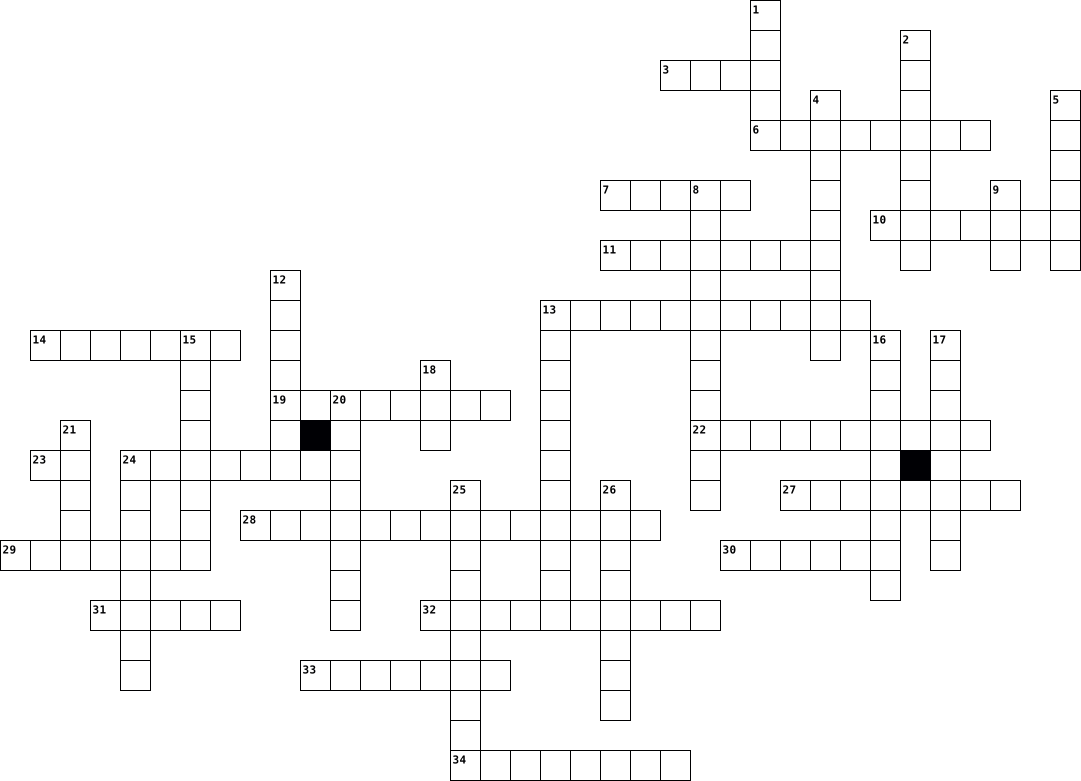
Across
- Rational numbers and irrational numbers.
- The number of times a number or expression (called base) is used as a factor of repeated multiplication. Also called the power.
- Numbers we can add together to get another number.
- The result of multiplying one number from another.
- The result of dividing one number from another.
- One of two equal factors of a given number.
- Numbers we can multiply together to get another number.
- Something similar to parentheses .
- Real numbers that cannot be written as a simple fraction.
- The ratio of a circumference of a circle to its diameter, an irrational number approximately equal to 3.14159...
- 1000.
- Operation 27 :3 =9.
- Operation 6x3=18.
- Counting numbers {1, 2, 3, ...}.
- 12.
- The square root of forty-nine.
- A statement of the exact meaning of a word, especially in a dictionary.
- 100.
- A mathematical sentence that contains an equals sign.
Down
- Find an answer to, explanation for, or means of effectively dealing with (a problem or mystery).
- Natural numbers and their negatives {... −3, −2, −1, 0, 1, 2, 3, ...}.
- The most common are add, subtract, multiply and divide (+, −, ×, ÷).
- 2 to the power of four plus four.
- The abstract science of number, quantity, and space, either as abstract concepts.
- The result of adding one number from another.
- A branch of mathematics that uses symbols or letters to represent variables, values or numbers, which can then be used to express operations and relationships and to solve equations.
- Operation 34-5=29.
- The ratios of integers, also called fractions, such as 1/2 = 0.5 or 1/3 = 0.333...
- Two numbers that are the same distance from 0 on the number line.
- The state of being equal. Having the same amount or value.
- A collection of objects or things.
- Operation 3+8=11.
- 2 to the power of three.
- The unluckiest number.
- The result of subtracting one number from another.
- A number (or ordered pair of numbers, or set of numbers) that produces a true statement when substituted for the variable(s) in an equation or inequality.
36 Clues: 12. • 100. • 1000. • Operation 3+8=11. • Operation 6x3=18. • Operation 34-5=29. • Operation 27 :3 =9. • The unluckiest number. • 2 to the power of three. • The square root of forty-nine. • Counting numbers {1, 2, 3, ...}. • 2 to the power of four plus four. • A collection of objects or things. • Something similar to parentheses . • Rational numbers and irrational numbers. • ...
NUMBERS 2018-02-13
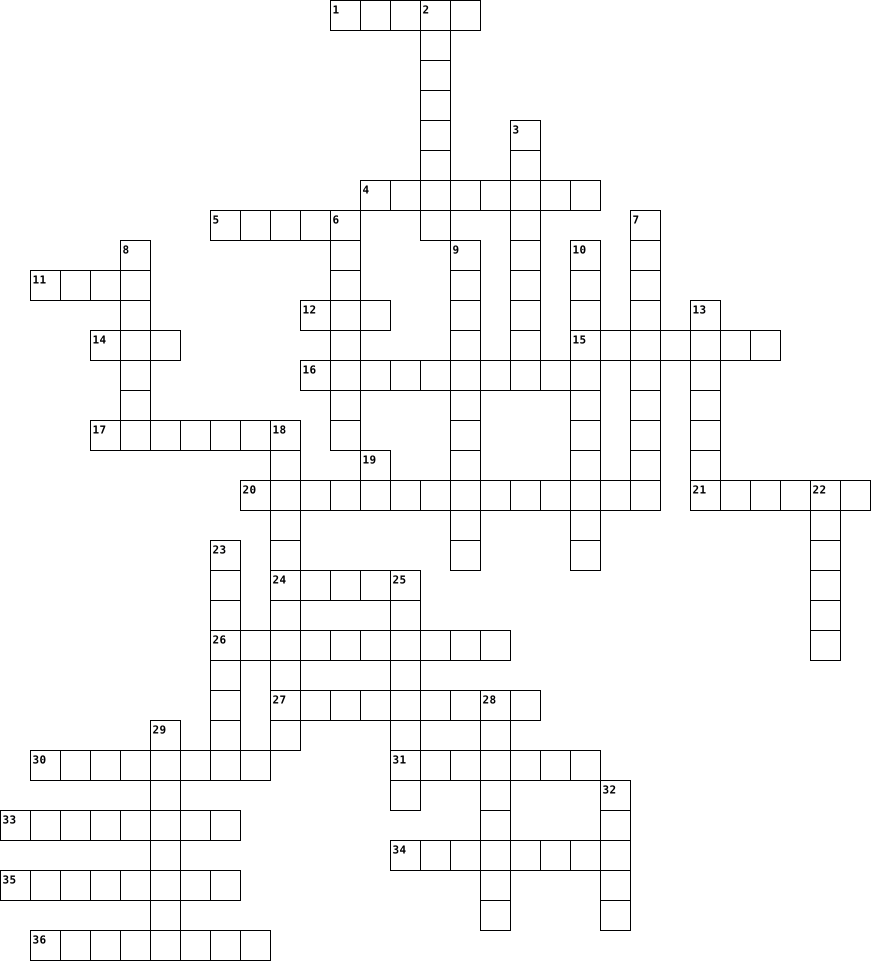
Across
- The square root of forty-nine.
- The result of dividing one number from another.
- Numbers we can add together to get another number.
- Rational numbers and irrational numbers.
- The result of adding one number from another.
- A collection of objects or things.
- 100.
- The result of subtracting one number from another.
- Numbers we can multiply together to get another number.
- Operation 6x3=18.
- 2 to the power of four plus four.
- 2 to the power of three.
- Real numbers that cannot be written as a simple fraction.
- Two numbers that are the same distance from 0 on the number line.
- The number of times a number or expression (called base) is used as a factor of repeated multiplication. Also called the power.
- Counting numbers {1, 2, 3, ...}.
- Something similar to parentheses .
- The ratios of integers, also called fractions, such as 1/2 = 0.5 or 1/3 = 0.333...
- The unluckiest number.
- Operation 27 :3 =9.
Down
- A mathematical sentence that contains an equals sign.
- The most common are add, subtract, multiply and divide (+, −, ×, ÷).
- A number (or ordered pair of numbers, or set of numbers) that produces a true statement when substituted for the variable(s) in an equation or inequality.
- A statement of the exact meaning of a word, especially in a dictionary.
- A branch of mathematics that uses symbols or letters to represent variables, values or numbers, which can then be used to express operations and relationships and to solve equations.
- Operation 34-5=29.
- The abstract science of number, quantity, and space, either as abstract concepts.
- The result of multiplying one number from another.
- One of two equal factors of a given number.
- The ratio of a circumference of a circle to its diameter, an irrational number approximately equal to 3.14159...
- 12.
- Operation 3+8=11.
- 1000.
- The state of being equal. Having the same amount or value.
- Natural numbers and their negatives {... −3, −2, −1, 0, 1, 2, 3, ...}.
- Find an answer to, explanation for, or means of effectively dealing with (a problem or mystery).
36 Clues: 12. • 100. • 1000. • Operation 6x3=18. • Operation 3+8=11. • Operation 34-5=29. • Operation 27 :3 =9. • The unluckiest number. • 2 to the power of three. • The square root of forty-nine. • Counting numbers {1, 2, 3, ...}. • 2 to the power of four plus four. • A collection of objects or things. • Something similar to parentheses . • Rational numbers and irrational numbers. • ...
Unit 1 Vocabulary 2013-09-22

Across
- This means that the remainder is 0 when you divide one integer by another.
- To replace each variable with a number, and then follow the order of operations.
- Also referred to as an exponent
- Two or more numbers is the greatest factor that the number have in common.
- To replace it with an equivalent expression having as few terms as possible.
- The sum equals the the original number.
- Numbers that are close in value to the numbers that you want to add, subtract, multiply, or divide, and for which the operation is easy to perform mentally.
- A number that multiplies a variable.
- Work inside grouping symbols, simplify and terms with exponents, multiply and divide in order form left to right, and then add and subtract in order from left to right.
- An integer greater than 1 with only 2 positive factors. 1 and itself.
- Terms with the same variables, raised to the same power.
- An integer greater than 1 with more than 2 positive factors.
- numbers that are the same distance from zero on the number line but in the opposite direction.
- A number, variable, or the product of a number and a variable.
Down
- Fractions that describe the same part of a whole.
- A mathematical phase that uses variables, numbers, and operation symbols.
- The form in which the only common factor of the numerator and denominator is 1.
- For any number a, the product of a and is 1 a.
- An integer that divides the nonzero integer with remainder zero.
- A letter that stands for a number.
- The integer are the whole number and their opposite.
- The expression of the number as the product or its prime factors.
- The distance of a number from zero on the number line.
- A number that shows how many times a base is used as a factor.
- The repeated factor of a number written in exponential form.
- A term with no variable
26 Clues: A term with no variable • Also referred to as an exponent • A letter that stands for a number. • A number that multiplies a variable. • The sum equals the the original number. • For any number a, the product of a and is 1 a. • Fractions that describe the same part of a whole. • The integer are the whole number and their opposite. • ...
Unit 1: Tools of Mathematics: Vocabulary 2013-09-23

Across
- a Variable Expression/ To do this you replace it with an equivalent expression having as few terms as possible.
- Numbers/ Numbers that are close in value to the actual numbers and easy to add, subtract, multiply, or divide mentally
- that have the same absolute value, but are on different sides of the number line
- Factorization/The process of which you break down a number, ending in a multiplication problem with all prime numbers
- group of numbers that include whole numbers and negative numbers (no fractions or decimals)
- number that is being raised to a power
- Number/A number that has factors other than one and itself
- solve a mathematical equation
- Value/ The distance from zero to the number
- Identity/The property that allows you to add 0 to any number and keep the sum the same as the first number
- Single number, a variable, numbers and variables multiplied together
Down
- Reasoning/When you apply a general rule to a specific example
- is a number that says how many times to use that number in a multiplication problem
- Expressions/A combination of numbers, variables, & operations
- The power of a number shows you how many times you use the number in a multiplication problem
- Identity/The property that allows you to multiply anything by 1 and still have the product as the first number
- of Operations/The order of which mathematical operations must be preformed in
- Common Factor (GCF)/The greatest number that two numbers have as a factor
- number that indicates how many variables there are in an expression
- Can be evenly divided
- Form/When you’ve reduced a fraction until you can’t anymore
- Terms/Terms whose variables are the same
- number or quantity that when multiplied with another produces a given number or expression
- letter substituted for a number
- number that stands alone without any variables
- Fractions/Fractions that can be converted into each other
26 Clues: Can be evenly divided • solve a mathematical equation • letter substituted for a number • number that is being raised to a power • Terms/Terms whose variables are the same • Value/ The distance from zero to the number • number that stands alone without any variables • Fractions/Fractions that can be converted into each other • ...
Algebra II EC 2012-12-13

Across
- The set of all possible input values of x for a relation or function.
- The shape of the graph of a quadratic function, has a symmetric u-shape.
- Variation A relationship among three variables that can be written in the form y=kxz, where k is a nonzero function.
- A number or product of numbers and variables and whole number exponents; a polynomial with only one term.
- Common Denominator The least common multiple of two or more given denominators.
- A measure of the strength and direction of the relationship between two variables or data sets.
- The sum of all the values in a data set divided by the number of data values; also called the average.
- A transformation that pushes the points of a graph horizontally toward the y axis or vertically toward the x-axis.
- Can be found by solving adjacent divided by hypotenuse.
- Point on a graph where a line crosses an axis.
- A real number associated with a square matrix. Solved by multiplying across, then bottom minus top.
Down
- A member of the set of whole numbers and their opposites.
- Can be found by solving hypotenuse divided by opposite
- The side opposite the right angle in a right triangle.
- System A system of equations containing only linear equations.
- Binomials of the form a+b and a-b; the terms are the same; the signs before b are opposite.
- A line that a graph approaches as the value of a variable becomes extremely large or small.
- Point on the graph where the x and y axis meet.
- Function A function whose graph is an unbroken line or curve with no gaps or breaks.
- A possible result of a probability experiment.
- of Best Fit The line that comes closest to all the points in a data set.
- A number multiplied by a variable.
- Fraction A fraction that contains one or more fractions in the numerator, the denominator, or both.
- Variation A linear relationship between two variables, x and y, that can be written in the form "y=kx" where k is a nonzero constant.
- A rectangular array of numbers.
25 Clues: A rectangular array of numbers. • A number multiplied by a variable. • A possible result of a probability experiment. • Point on a graph where a line crosses an axis. • Point on the graph where the x and y axis meet. • Can be found by solving hypotenuse divided by opposite • The side opposite the right angle in a right triangle. • ...
Cell Transport 2013-03-17

Across
- type of embedded protein that provides a tunnel-like opening in the plasma membrane through which particles can diffuse
- the separation of smaller particles from larger particles by diffusion through a semi-permeable membrane
- the process by which some cells surround and take in materials
- a difference in concentration of particles on opposites sides of a membrane
- Particle movement from an area of higher concentration to an area of lower concentration, includes diffusion and osmosis
- a solution in which the concentration of dissolved substances is the same as the concentration inside a cell
- a form of endocytosis in which the cell takes in fluids ("cell drinking")
- the passive movement of particles along a concentration gradient until they are evenly distributed (like a lump of sugar that dissolves in a beaker of water)
- a form of endocytosis in which the cell takes in solid particles ("cell eating")
Down
- what happens to a cell placed in a hypotonic solution
- a solution in which the concentration of dissolved substances is higher than the concentration inside a cell
- movement of materials that requires energy because it moves materials against the concentration gradient
- process by which cells remove materials from the cell by a vacuole that never really passes through the membrane
- the tendancy of a cell or an organism to attempt to maintain a constant environment
- protein that changes shape when a particle binds with it, involved in facilitated diffusion
- form of passive transport that uses a carrier protein
- the diffusion of water
- when the concentration of substances on opposite sides of a membrane are the same
- when a solution is created, the substance into which particles dissolve
- type of protein that is involved in active transport
- when a solution is created, the particles that are dissolved in the solvent
- a solution in which the concentration of dissolved substances is lower than the concentration inside a cell
- what happens to a cell placed in a hypertonic solution
- is used during active transport but not passive transport
24 Clues: the diffusion of water • type of protein that is involved in active transport • what happens to a cell placed in a hypotonic solution • form of passive transport that uses a carrier protein • what happens to a cell placed in a hypertonic solution • is used during active transport but not passive transport • ...
Cell Transport 2013-03-17

Across
- a solution in which the concentration of dissolved substances is higher than the concentration inside a cell
- a difference in concentration of particles on opposites sides of a membrane
- Particle movement from an area of higher concentration to an area of lower concentration, includes diffusion and osmosis
- type of embedded protein that provides a tunnel-like opening in the plasma membrane through which particles can diffuse
- what happens to a cell placed in a hypertonic solution
- the separation of smaller particles from larger particles by diffusion through a semi-permeable membrane
- protein that changes shape when a particle binds with it, involved in facilitated diffusion
- when the concentration of substances on opposite sides of a membrane are the same
- process by which cells remove materials from the cell by a vacuole that never really passes through the membrane
- a form of endocytosis in which the cell takes in fluids ("cell drinking")
- movement of materials that requires energy because it moves materials against the concentration gradient
Down
- a form of endocytosis in which the cell takes in solid particles ("cell eating")
- the passive movement of particles along a concentration gradient until they are evenly distributed (like a lump of sugar that dissolves in a beaker of water)
- a solution in which the concentration of dissolved substances is the same as the concentration inside a cell
- when a solution is created, the substance into which particles dissolve
- a solution in which the concentration of dissolved substances is lower than the concentration inside a cell
- form of passive transport that uses a carrier protein
- the diffusion of water
- the process by which some cells surround and take in materials
- is used during active transport but not passive transport
- the tendancy of a cell or an organism to attempt to maintain a constant environment
- type of protein that is involved in active transport
- when a solution is created, the particles that are dissolved in the solvent
- what happens to a cell placed in a hypotonic solution
24 Clues: the diffusion of water • type of protein that is involved in active transport • form of passive transport that uses a carrier protein • what happens to a cell placed in a hypotonic solution • what happens to a cell placed in a hypertonic solution • is used during active transport but not passive transport • ...
Personality Chapter 12 2015-02-11

Across
- psychologist who emphasized sexual desires in most of his opinions of personalities
- portion of the mind you are aware of
- part of the mind that opposes the desires of the id by enforcing moral restrictions
- pushing of unpleasant information to the unconscious without being aware
- tendency to be friendly and open
- reinforcing and punishing our own behavior
- used by the id to obtain immediate pleasure and no pain
- being capable of achieving your goals
- tendency to be shy and focused on yourself
- psychologist who felt the most important parts of our behavior are learned from others in society
- basing the way we think, act, and feel on others who are successful
- subjective perception of who we are
- the person one wishes one were
- process of substituting a more acceptable goal for a selfish motive; directing bad feelings towards something safe
- psychologist who believed that the most important traits are those related to our values
- traits such as Neuroticism, Extraversion, Openness, Agreeableness, and
- psychologist who focused on who we are and what we are like
- sum total of all the ways of acting, thinking, and feeling
Down
- psychologist who thought most personalities were the results of their childhood experiences
- Freud's belief in development, based on how infants have sexual feelings and needs as they age
- portion of the mind that can be easily retrieved
- theory of personality that explains why people develop their unique patterns of typical behavior
- psychologist who focused on inferiority, then social interest and goals
- formed because the mind has to find realistic ways of meeting its needs
- part of the mind that houses the instincts and other primary processes
- what Freud compares the mind to
- psychologist who thought personalities were based on opposites in the mind
- where primitive instinctual motives are held in the mind
- socially desirable goal substituted for a harmful one
- the moral gauge of the mind
- patterns of behavior that are usually enduring
- associated with creating the inkblot personality tests
32 Clues: the moral gauge of the mind • the person one wishes one were • what Freud compares the mind to • tendency to be friendly and open • subjective perception of who we are • portion of the mind you are aware of • being capable of achieving your goals • reinforcing and punishing our own behavior • tendency to be shy and focused on yourself • ...
CROSSWORD IN MATH 2014-10-12

Across
- f -1(x) is said to be the inverse of f(x) if f(f -1(x)) = f -1(f(x)) = x. It is obtained by interchanging the variables x and y of the function.
- In a right angled triangle the square of the hypotenuse is equal to the sum of the squares of the other two sides.
- Equation An equation where the highest exponent of the variable (usually "x") is a square (2).It is usually written ax2+bx+c = 0.
- Two integers are opposites if they are each the same distance away from zero, but on opposite sides of the number line.
- The line on a graph that runs horizontally (left-right) through zero.
- An exact location. It has no size, only position.
- A symbol for a number we don't know yet. It is usually a letter like x or y.
- Pair A pair of numbers used to locate a point on a coordinate plane is called an ordered pair.An ordered pair is written in the form (x, y) where x is the x-coordinate and y is the y-coordinate.
- An obtuse angle is one which is more than 90° but less than 180°.
Down
- Root The square root of a number is a value that, when multiplied by itself, gives the number.
- A 2-dimensional shape made by drawing a curve that is always the same distance from a center.
- A triangle that has a right angle (90°)
- Axis The line on a graph that runs vertically (up-down) through zero.
- The Father of Geometry.
- The starting point.On a number line it is 0.
- A ratio shows the relative sizes of two or more values.
- The longest side of a right triangle. The side opposite the right angle.
- A 3-sided polygon (a flat shape with straight sides).
- An expression that can have constants, variables and exponents, but no division by a variable.
- A circle is the length of the line through the center and touching two points on its edge.
20 Clues: The Father of Geometry. • A triangle that has a right angle (90°) • The starting point.On a number line it is 0. • An exact location. It has no size, only position. • A 3-sided polygon (a flat shape with straight sides). • A ratio shows the relative sizes of two or more values. • An obtuse angle is one which is more than 90° but less than 180°. • ...
Art Vocabulary Puzzle 2022-04-18

Across
- Red, Orange, and Yellow are this color temperature
- Blue + Red = _________
- Adding White to a color is a ___________.
- The relative sizes of parts in a whole. How parts in an image refer to other parts.
- Yellow + Blue =
- Technique of shading using tiny, squiggly, circular lines - sort of like "controlled scribbling"
- Purple, Green, and Blue are this color temperature
- Colors that are made by mixing one primary with a secondary color is a...
- Technique of shading using dots.
- The surface quality of an object; can be actual or implied.
- Created by light and has 3 properties: Hue, Value, and Intensity
- Another word for color
- Three to five colors that are next to each other on the color wheel and are closely related are called...
- The equal visual distribution of weight in a design.
- Flat, enclosed area that are 2 dimensional. They have length and width. They can be geometric or organic.
- Adding Black to a color is a ___________.
Down
- Repeated use of a shape, color, or other element of art
- Consisting of only a single color or hue; and will include its shades and tints is ___________.
- Colors that are made by mixing two primary colors are...
- These are 3 dimensional having length, width, and height. They take up space AND volume.
- Red + Yellow =
- Colors that are opposites on the color wheel and intensify each other by creating contrast.
- Gray, Black, White, and brown are these types of colors
- Technique of shading with criss-crossing lines all facing the same direction.
- The path of a moving point. It defines form, describes contour, and suggests direction.
- Technique of shading with a series of fine parallel lines all facing the same direction.
- The degree of lightness or darkness of a color or neutral.
- Red, Yellow, and Blue are these types of colors
- The area above, around, and within objects. It is used to create the illusion of depth. It can be positive or negative.
29 Clues: Red + Yellow = • Yellow + Blue = • Blue + Red = _________ • Another word for color • Technique of shading using dots. • Adding White to a color is a ___________. • Adding Black to a color is a ___________. • Red, Yellow, and Blue are these types of colors • Red, Orange, and Yellow are this color temperature • Purple, Green, and Blue are this color temperature • ...
Lighthouse 9 2023-04-18

Across
- Changing your language can impact your ___
- There are ___ signs of Win-Win
- A ___ statement is like a compass for your life
- The main goal is to say ___ to Q3 and Q4
- ___ is getting the results you want and continuing to get them
- Effective leaders make sure their ___ are leaning against the right wall
- Think Win-WIn or No Deal comes from the ___ mentality
- Habit ___ applies not only to creating mission statements and setting life goals, but to most everything you do in life
- It is important that a ___ creation precedes the actual physical work of creation.
- A habit is something you do ___
- Everything people do fits into one of four ___
- Highly effective people exhibit ___ habits
- Highly effective people proactively design ___ into each day
- Multiple factors go into making competition ___
- ___ people often suffer from “victimitis”
- Leaders recognize that the ___ victory precedes the public victory
- Integrity means being ___ to your words
- Honest people often live with ___
- ___ is like a puzzle. It comes together best when you can see the big picture
- You win the victory over self by mastering the first ___ habits
Down
- ___ people take responsibility for their choices
- After being effective you need to be ___
- Four quadrants make up the ___ Matrix
- Things that you cannot control or influence are in your Circle of ___
- Choose your mood/emotions
- An Emotional Bank Account is based on ___ instead of money
- Your life is a collection of ___
- It takes ___ to say yes to leaving your comfort zone
- ___ composed much of his music in his head
- Think Win-Win means that no one has to ___
- ___ leaders do things in ways that yield lasting positive results.
- There are three main ___ with habit 3
- Things that you can control or influence are in your Circle of ___
- There are so many difficult ___ crossroads to choose from in life.
- Ineffective leaders may get ___-term results
- Reactive people talk about how ___ they are
- You can change your reactive language to ___
- The opposite of the abundance mentality is the ___ mentality
- Highly ___ people live life based on the opposites
- There are ___ paradigms of human interaction
40 Clues: Choose your mood/emotions • There are ___ signs of Win-Win • A habit is something you do ___ • Your life is a collection of ___ • Honest people often live with ___ • Four quadrants make up the ___ Matrix • There are three main ___ with habit 3 • Integrity means being ___ to your words • After being effective you need to be ___ • The main goal is to say ___ to Q3 and Q4 • ...
Beach Volleyball 2023-04-26
Across
- When teams switch sides after a set
- The amount of points needed to win a set
- A video of plays that a team can watch to see how their opponents play
- Official ball used during game
- Deflecting the opposing teams spike/serve
- The amount of people needed to play beach volleyball
- The number of metals the U.S. has all together
- Hitting the ball over for first point
- Olympic Medalist, Partners with April Ross
- A very powerful serve/when the serve hits the net and tips over resulting in a very hard ball to save
- When the serve is hits the other teams side without them touching it
- When the the team opposites the other teams hit by preventing it/ Middles usually do it
- When that hitter/attacker hits the ball down the side of the court
- The card when a player gets disqualified for doing something
Down
- When two players go head to head at the net to get the ball over the net
- A block that makes the ball go straight down
- The opposite side to outside
- A hard serve that is very powerful when mastered
- When a player smoothly pushes the ball into the other teams court/usually done by setters or middles
- The original name of volleyball
- The place beach-volleyball was first played
- A light pass over the net/Easy ball to receive
- When the player makes a play using the tips of their fingers
- Olympic Medalist, One of the best Female Players
- Hitting the ball down to gain a point
- When the player hits the ball gently making the gently shoot into the players forearms/like a tip but a hit
- When a player sets the ball and seems to move the ball more than it should resulting in this
- When the player passing the ball makes the ball fly out of bounds
- The place where they play the game
- When the player who hits gets the point immediate
- When the player does something that's against the rules or talks back to the referee
31 Clues: The opposite side to outside • Official ball used during game • The original name of volleyball • The place where they play the game • When teams switch sides after a set • Hitting the ball down to gain a point • Hitting the ball over for first point • The amount of points needed to win a set • Deflecting the opposing teams spike/serve • ...
Cycles of Matter 2017-04-11

Across
- / A _______________ is a group of parts that work together to perform a function.
- / The main pigment used for photosynthesis.
- cycle / The _______________________ is the process by which carbon moves within and between organisms and their physical environment.
- / Nitrogen fixation is done by these organisms.
- / When water vapor cools and turns back into liquid.
- / The process by which liquid water turns into a gas.
- / Every living things needs __________.
- / Green is an example of a _____________, or colored chemical compound that absorbs light.
- / Rain, snow, sleet, and hail are all examples of ___________________.
- / "According to the ___________ laws, the total amount of matter and energy in the Earth system stays constant.
- / The ______________ in the photosynthesis formula means "yields".
- / Cellular respiration and photosynthesis can be considered _____________ processes.
- warming / One type of human impact on the carbon cycle, raising the overall temperature of the Earth.
- / A waste product of photosynthesis.
Down
- / During photosynthesis, sunlight is used to convert carbon dioxide and water into _______ and oxygen.
- / An energy releasing process that does not require oxygen.
- / Organelle in plant cells where photosynthesis occurs.
- / Cellular ____________ is the process by which cells obtain energy from glucose.
- / The process by which a cell captures energy in sunlight and uses it to make food.
- / "Together these two processes form a cycle that keeps the levels of oxygen and carbon dioxide fairly ____________"
- / Where in the cell the second stage of cellular respiration occurs.
- cycle / The processes of evaporation, condensation, and precipitation make up the _______________.
- / The processes by which carbon and oxygen are recycled are _______________.
- / An organism that cannot make its own food / must eat to survive.
- / An organism that makes its own food / does NOT need to eat to survive.
- / A community of organisms that live in a particular areas, along with their non-living environment.
- / Another word for "respiration".
- / Nearly all living things obtain energy either directly or indirectly from the energy of __________ .
- / Number of stages in both cellular respiration AND photosynthesis.
- / C6 H12 06 is the chemical compound for ______________.
30 Clues: / Another word for "respiration". • / A waste product of photosynthesis. • / Every living things needs __________. • / The main pigment used for photosynthesis. • / Nitrogen fixation is done by these organisms. • / When water vapor cools and turns back into liquid. • / The process by which liquid water turns into a gas. • ...
Cycles of Matter 2017-04-11

Across
- / Green is an example of a _____________, or colored chemical compound that absorbs light.
- / An organism that makes its own food / does NOT need to eat to survive.
- / A community of organisms that live in a particular areas, along with their non-living environment.
- / The process by which liquid water turns into a gas.
- / Number of stages in both cellular respiration AND photosynthesis.
- / Organelle in plant cells where photosynthesis occurs.
- / The process by which a cell captures energy in sunlight and uses it to make food.
- / A waste product of photosynthesis.
- / "According to the ___________ laws, the total amount of matter and energy in the Earth system stays constant.
- / "Together these two processes form a cycle that keeps the levels of oxygen and carbon dioxide fairly ____________"
- / An energy releasing process that does not require oxygen.
- / The main pigment used for photosynthesis.
- / Nearly all living things obtain energy either directly or indirectly from the energy of __________ .
- / When water vapor cools and turns back into liquid.
- / The ______________ in the photosynthesis formula means "yields".
- / Every living things needs __________.
Down
- / Nitrogen fixation is done by these organisms.
- / C6 H12 06 is the chemical compound for ______________.
- / An organism that cannot make its own food / must eat to survive.
- / Cellular ____________ is the process by which cells obtain energy from glucose.
- / Cellular respiration and photosynthesis can be considered _____________ processes.
- / Rain, snow, sleet, and hail are all examples of ___________________.
- warming / One type of human impact on the carbon cycle, raising the overall temperature of the Earth.
- / The processes by which carbon and oxygen are recycled are _______________.
- / Where in the cell the second stage of cellular respiration occurs.
- / A _______________ is a group of parts that work together to perform a function.
- / During photosynthesis, sunlight is used to convert carbon dioxide and water into _______ and oxygen.
- / Another word for "respiration".
- cycle / The _______________________ is the process by which carbon moves within and between organisms and their physical environment.
- cycle / The processes of evaporation, condensation, and precipitation make up the _______________.
30 Clues: / Another word for "respiration". • / A waste product of photosynthesis. • / Every living things needs __________. • / The main pigment used for photosynthesis. • / Nitrogen fixation is done by these organisms. • / When water vapor cools and turns back into liquid. • / The process by which liquid water turns into a gas. • ...
Cycles of Matter 2017-04-12

Across
- The _______________________ is the process by which carbon moves within and between organisms and their physical environment.
- The processes of evaporation, condensation, and precipitation make up the _______________.
- "According to the ___________ laws, the total amount of matter and energy in the Earth system stays constant.
- An organism that cannot make its own food / must eat to survive.
- An organism that makes its own food / does NOT need to eat to survive.
- Nitrogen fixation is done by these organisms.
- Number of stages in both cellular respiration AND photosynthesis.
- Organelle in plant cells where photosynthesis occurs.
- Cellular ____________ is the process by which cells obtain energy from glucose.
- Another word for "respiration".
- Where in the cell the second stage of cellular respiration occurs.
- A _______________ is a group of parts that work together to perform a function.
- The process by which a cell captures energy in sunlight and uses it to make food.
- An energy releasing process that does not require oxygen.
- One type of human impact on the carbon cycle, raising the overall temperature of the Earth.
Down
- Cellular respiration and photosynthesis can be considered _____________ processes.
- The ______________ in the photosynthesis formula means "yields".
- During photosynthesis, sunlight is used to convert carbon dioxide and water into _______ and oxygen.
- A waste product of photosynthesis.
- Every living things needs __________.
- The main pigment used for photosynthesis.
- When water vapor cools and turns back into liquid.
- The process by which liquid water turns into a gas.
- "Together these two processes form a cycle that keeps the levels of oxygen and carbon dioxide fairly ____________"
- C6 H12 06 is the chemical compound for ______________.
- A community of organisms that live in a particular areas, along with their non-living environment.
- The processes by which carbon and oxygen are recycled are _______________.
- Rain, snow, sleet, and hail are all examples of ___________________.
- Nearly all living things obtain energy either directly or indirectly from the energy of __________ .
- Green is an example of a _____________, or colored chemical compound that absorbs light.
30 Clues: Another word for "respiration". • A waste product of photosynthesis. • Every living things needs __________. • The main pigment used for photosynthesis. • Nitrogen fixation is done by these organisms. • When water vapor cools and turns back into liquid. • The process by which liquid water turns into a gas. • Organelle in plant cells where photosynthesis occurs. • ...
Cycles of Matter 2017-04-12

Across
- Rain, snow, sleet, and hail are all examples of ___________________.
- C6 H12 06 is the chemical compound for ______________.
- An organism that makes its own food / does NOT need to eat to survive.
- When water vapor cools and turns back into liquid.
- Number of stages in both cellular respiration AND photosynthesis.
- The processes of evaporation, condensation, and precipitation make up the _______________.
- The ______________ in the photosynthesis formula means "yields".
- Cellular ____________ is the process by which cells obtain energy from glucose.
- The main pigment used for photosynthesis.
- A _______________ is a group of parts that work together to perform a function.
- Nitrogen fixation is done by these organisms.
- A community of organisms that live in a particular areas, along with their non-living environment.
- Green is an example of a _____________, or colored chemical compound that absorbs light.
- Nearly all living things obtain energy either directly or indirectly from the energy of __________ .
- A waste product of photosynthesis.
Down
- Organelle in plant cells where photosynthesis occurs.
- An energy releasing process that does not require oxygen.
- The process by which liquid water turns into a gas.
- Where in the cell the second stage of cellular respiration occurs.
- The process by which a cell captures energy in sunlight and uses it to make food.
- An organism that cannot make its own food / must eat to survive.
- One type of human impact on the carbon cycle, raising the overall temperature of the Earth.
- "According to the ___________ laws, the total amount of matter and energy in the Earth system stays constant.
- The _______________________ is the process by which carbon moves within and between organisms and their physical environment.
- Every living things needs __________.
- "Together these two processes form a cycle that keeps the levels of oxygen and carbon dioxide fairly ____________"
- Cellular respiration and photosynthesis can be considered _____________ processes.
- During photosynthesis, sunlight is used to convert carbon dioxide and water into _______ and oxygen.
- Another word for "respiration".
- The processes by which carbon and oxygen are recycled are _______________.
30 Clues: Another word for "respiration". • A waste product of photosynthesis. • Every living things needs __________. • The main pigment used for photosynthesis. • Nitrogen fixation is done by these organisms. • When water vapor cools and turns back into liquid. • The process by which liquid water turns into a gas. • Organelle in plant cells where photosynthesis occurs. • ...
ANATOMY CHAPTER 3 AND 4 2020-04-27

Across
- largest known living mammal
- this is monophyletic group
- series of separate bones or cartilage
- image focused in front of retina
- where acting forces are unbalanced, we are dealing with that part of mechanics
- where the flow is non-chaotic
- the mechanics of this mean that output force and output speed are opposites
- the physiologist argued that the vertebrae kidney worked well to rid the body of any osmotic influx of excess water
- some fossil agnathans
- it is reduced and flapping of the pectoral fins provides propulsion
- study of size and its consequence
- this are not concept but conventions
- anterior clustering of specialized sensory organs
- all of this are belong to the batoidea
- protects the organs
- also known as lepisosteiformes
- the rate of change in an object’s position
- concept of the flow of events
- a network of internet wining vessels
- enclosing the spinal cord
- the smallest adult vertebrae
- exerts an important force on a large mass
- measure of force
Down
- solid cylindrical body that often encloses the notochord
- early vertebrae fossils that appreared to be freshwater or delta desposits
- today largest flying bird
- carry this history of jawless vertebrates into the present
- folded respiratory organs on the pharyngeal bars constructed of highly specialized capillary beds that rim these slits
- one type of conodonts that has thin bars with or without a bent shift which commonly branched
- beneath the skin release mucus through surface pores
- this is a concept of inertia
- four footed vertebrates
- composite structure of bone with cartilage that support sensory organs
- this is resisted by the limbs
- is a linear measurement
- it is certainly thinner and less viscous than water but it is a fluid nonetheless
- formed by a single tooth or denticle
- designed to crush prey
- image falls behind the retina
- the resisting force, may arise from various physical phenomena
- the rate at which work gets done
41 Clues: measure of force • protects the organs • some fossil agnathans • designed to crush prey • four footed vertebrates • is a linear measurement • today largest flying bird • enclosing the spinal cord • this is monophyletic group • largest known living mammal • the smallest adult vertebrae • this is a concept of inertia • where the flow is non-chaotic • this is resisted by the limbs • ...
Review - Sophomore Vocab Final (B) 2024-05-14

Across
- an examination of one's own thoughts and feelings
- to take back, withdraw
- irritable; tending to cause trouble
- a phrase or opinion that is overused and betrays a lack of original thought
- to assume an air of superiority
- a recurring theme or symbol
- a driving force
- disrespectful; insulting; belittling
- a book; especially a large or scholarly book
- regard with disgust and hatred
- done in a quiet or secretive way
- to brag or boast
- affected by strong feelings of love
- to anticipate and prevent or make unnecessary
- very sheer and light; nearly transparent
- a person lacking refinement or sophistication
- the path or progression of a moving object
- to remove; to cut out of
- to delegate to another
- respect due a superior or an elder
- present but not active
- negligent in the performance of work or duty
- respected and impressive
- ill will or resentment tending toward active hostility
- the customers of a shop, bar, or place of entertainment
- very low in spirit or hope
- something that causes a person to act
- a strong dislike or distaste
Down
- to prolong in time or space
- looking back over a period of time
- anxiety arising from awareness of guilt
- depressed
- determine by reasoning or deduction
- to rapidly increase in number
- not easily managed or directed
- incapable of being conquered, overcome, or subdued
- a division or contrast between two things that are considered to be opposites
- one sent as a representative of another
- to throw in between or among other things
- a servile self-seeking flatterer
- having an air of easy unconcern or indifference
- tending to cause delay
- an object that is fired, thrown, or self-propelled
- a typical or ideal example
- a sudden spontaneous desire toward action
- the physical or mental capacity to sustain prolonged effort or activity
- tending to cause or bring about
- not capable of being damaged or harmed
- straight to the point; free from all elaboration
49 Clues: depressed • a driving force • to brag or boast • to take back, withdraw • tending to cause delay • to delegate to another • present but not active • to remove; to cut out of • respected and impressive • a typical or ideal example • very low in spirit or hope • to prolong in time or space • a recurring theme or symbol • a strong dislike or distaste • to rapidly increase in number • ...
Vocabulary Review Ch 1-4.4 2024-03-15

Across
- A pair of numbers that give the location of a point on a x and y grid ( (3, 2) )
- value The distance a number is from zero on a number line
- the output of a function
- An expression that contains only numbers and operations
- terms that contain the same variables raised to the same powers.
- graph made up of connected lines or curves
- the parts of an expression that are added or subtracted.
- a relation in which each element of the domain is paired with exactly one element of the range
- An expression that describes the relationship between each input and output.
- an equation in the form of 'f(x)=' to show the output value of a function, f, for an input value x
- the input of a function
- A value that does not change
- a graph made up of unconnected points
- overlapping region; numbers that are solutions to both inequalities of a compound inequality
Down
- Two or more inequalities joined together by "and" or "or"
- the number used as a factor in a power
- A combination of variables, numbers, and at least one operation.
- Values substituted for x.
- find its value
- letter or symbol used to represent a value that can change.
- a value of the variable that makes the equation true
- the order in which operations in an expression to be evaluated are carried out. 1. parentheses 2. exponents 3. multiplication and division 4. addition and subtraction
- A mathematical statement that two expressions are equal.
- the set of all x-values
- A statement that compares two quantities using <, >, ≤,≥, or ≠
- A mathematical notation indicating the number of times a quantity is multiplied by itself.
- combined regions; numbers that are solutions to either part of the compound inequality.
- A number multiplied by a variable in an algebraic expression.
- expression written with a base and an exponent
- any set of ordered pairs
- Value generated for y.
- set of all y values
- two numbers that have the same absolute value but have different signs; sum is 0
33 Clues: find its value • set of all y values • Value generated for y. • the set of all x-values • the input of a function • the output of a function • any set of ordered pairs • Values substituted for x. • A value that does not change • a graph made up of unconnected points • the number used as a factor in a power • graph made up of connected lines or curves • ...
Chapter 1-6 2025-11-07

Across
- a location has no size undefined
- quadrilateral, four equal sides and four right angles
- the two congruent sides of an isosceles triangle
- quadrilateral, four right angles, opposites sides are parallel and congruent
- three concurrent perpendicular bisectors
- two rays with the same endpoints
- all four sides have equal lengths
- quadrilateral, two pairs of equal length adjacent sides
- four-sided, both opposite sides are parallel and congruent
- angles that have a common side and a common vertex
- three or more intersecting lines
- part of a line
- touches each vertex of a triangle without crossing any sides
- intersects a segment at its midpoint
- equal
- an accepted statement of fact
- (2 words) form of a non-vertical line with slope m and through point (x, y)
- lie on the same plane & do not intersect
- figures in the same plane
- a triangle that has at least two congruent sides.
- measure of an angle
- same distance
- triangles with three congruent sides
Down
- three concurrent altitudes
- the side opposite the right angle
- form 90-degree angles
- (2 words) y=mx+b
- intersection of three medians
- congruent interior angles
- angles whose sides form two pairs of opposite rays
- ratio of its vertical change in the coordinate plane to the corresponding horizontal change
- the set of points the figures have in common
- part of the line that consists of one endpoint and one endpoint that extends indefinitely
- three concurrent angle bisectors
- from the vertex perpendicular to the opposite side
- a straight path that extends in two opposite directions
- the common endpoint of two rays
- a polygon with equal side lengths and equal interior angles
- a line that intersects two or more lines at distinct points
- lie on the same line
- the point that divides the segment into two congruent segments
- quadrilateral with one pair of parallel sides
- vertex to the midpoint
43 Clues: equal • same distance • part of a line • (2 words) y=mx+b • measure of an angle • lie on the same line • form 90-degree angles • vertex to the midpoint • congruent interior angles • figures in the same plane • three concurrent altitudes • intersection of three medians • an accepted statement of fact • the common endpoint of two rays • a location has no size undefined • ...
Forces Crossword 2025-01-15

Across
- Imaginary lines that show the direction and strength of a magnetic or electric field; closer lines mean a stronger field.
- A tiny, positively charged particle found in the nucleus of an atom.
- A subatomic particle found in the nucleus of an atom that has no electric charge.
- An object that can attract certain metals like iron.
- When two lines or directions meet at a right angle (90 degrees).
- The force experienced by a moving electric charge in a magnetic field.
- A temporary magnet created when electric current flows through a wire wrapped around a metal core.
- A tiny, negatively charged particle that orbits around the nucleus of an atom.
- When a material becomes a magnet because it's close to another magnet.
Down
- A temporary, invisible particle that acts as a messenger to carry the electromagnetic force between charged particles. Not directly observable, but plays a crucial role in interactions like the repulsion or attraction between electric charges.
- The invisible area around a magnet where it can pull or push certain metals (B-field).
- The flow of electric charges through a material, like electricity moving through a wire.
- The speed of something in a specific direction.
- A quantity that has both size and direction, like an arrow showing how strong a force is and where it's going.
- (North and South) The two ends of a magnet where the magnetic force is the strongest; opposites attract, and like repel.
- A material, like iron, that is strongly attracted to a magnet and can easily be magnetized.
- A state of balance where opposing forces acting on an object cancel each other out, resulting in no net change or movement.
- A method using your right hand to determine the direction of magnetic force: point your thumb in the direction of current, and your fingers show the direction of the magnetic field.
- A force that acts on an object without physical contact, like gravity or magnetism.
- The push or pull that a magnet applies to certain metals or other magnets.
20 Clues: The speed of something in a specific direction. • An object that can attract certain metals like iron. • When two lines or directions meet at a right angle (90 degrees). • A tiny, positively charged particle found in the nucleus of an atom. • The force experienced by a moving electric charge in a magnetic field. • ...
Review 2023-12-05

Across
- porous good in and bad out pourous material
- a change that makes a new substance
- by hand, tweezers, magnet, water, filters and sisters
- made from wire, iron core, and battery
- provided power to a circuit
- gel like material found inside cells.
- warm blooded have feathers
- vibrates in place definite volume and shape
- particles slow down
- born knowing how to do it
- cold blooded live only in water
- makes particles move around more
- liquid to solid
- allows electricity to flow freely
- outer layer for plant cells gives support and structure
- flow of electricity
- area around a magnet
- feed their young milk
- what opposites do
- slimy and hopy amphibian
- green jelly beans that feed the cell. sunlight to food
- electricity that humans control
- uses the energy in a circuit
- nothing new is made only changes size,shape, density
Down
- something you do from learning through experience
- way to make electromagnet stronger
- electricity that is just sitting until it jumps
- square or rectangular cell that has a cell wall and chloroplast
- contains the DNA of the cells and is the control center
- a circuit that will not work
- your height, eye color, lip shape
- part of a circuit that transports electricity
- escapes container no shape or volume
- does not allow electricity to freely flow
- microorganisms that can lead to death and disease
- solid to liquid
- what sames do
- allows a circuit to be open and closed
- takes shape of container definite volume but not shape
- have dry and scaly skin breathe with lungs
- strongest part of a magnet
- two or more physically combined substances
- broken bones and scars
- rounded cell that does not have a cell wall
- microorganisms in things such as cheese and yogurt
- early life in water adult life on land
46 Clues: what sames do • solid to liquid • liquid to solid • what opposites do • particles slow down • flow of electricity • area around a magnet • feed their young milk • broken bones and scars • slimy and hopy amphibian • born knowing how to do it • warm blooded have feathers • strongest part of a magnet • provided power to a circuit • a circuit that will not work • uses the energy in a circuit • ...
Chemistry #1 2025-07-06

Across
- if an atom has five protons, then the identity of the atom is the element ________
- If a hydrogen atom has one neutron, how many "u" does the atom have?
- mass is the amount of "______" in an object
- In order to find the amount of "u" that an atom has, you _____ up the number of protons and number of electrons
- a pure substance that can't be chemically broken into smaller parts
- if an atom has three protons, then the identity of the atom is the element ________
- In order for an atom to be neutral, it must have an ______ amount of protons and electrons
- atoms that have the same amount of protons but different amounts of neutrons
- In the ______ foil experiment, particles were shot at a strip of foil
- particles that are smaller than an atom are called ___atomic particles
- How many neutrons does Oxygen-17 have?
- the gold foil experiment showed that most of an atom is composed of ______ space
- your sister's name
- How many neutrons does Lithium-7 have?
- How many neutrons does Carbon-12 have?
- if an atom has eleven protons, then the identity of the atom is the element ________
- How many neutrons does Oxygen-18 have?
Down
- a proton has a charge of ______ one
- when it comes to electrical charge, opposites ______
- How many protons does an oxygen atom have?
- protons and neutrons are found in the _______ of an atom
- the identity of an atom is determined by its number of ______
- Your birthday is in the month of _______ (I think)
- the gold foil experiment showed that most of an atom's _____ is in the nucleus
- the smallest unit of an element that can still be identified as that element
- In order for a lithium atom to be neutral, it must have _____ electrons
- subatomic particles that are NOT found in the nucleus
- an electron as a charge of ______ one
- Next year, you will be a _______ in high school
- Does a neutron have a charge?
30 Clues: your sister's name • Does a neutron have a charge? • a proton has a charge of ______ one • an electron as a charge of ______ one • How many neutrons does Oxygen-17 have? • How many neutrons does Lithium-7 have? • How many neutrons does Carbon-12 have? • How many neutrons does Oxygen-18 have? • How many protons does an oxygen atom have? • ...
End of Year Math 2026-04-27

Across
- in the equation y = mx + b, what is m?
- what it's called when a shape rotates around a specific point on the coordinate plane
- what it's called when you flip a shape over an axis on the coordinate plane
- in the equation y = mx + b, what is b?
- This concept uses powers of 10 to write very large or very small numbers
- these type of numbers can always be written as fractions using integers, as long as the denominator is never 0
- an equation that graphs as a straight line on the coordinate plane is called a "what" equation?
- < and > are called "what" signs?
- the x axis is in a "what" position?
- The math of angles, lines and shapes
- when converting a base 10 number into a smaller base, what math do you use?
- a number that is multiplied by itself to make a larger number is called a what?
- Two algebra equations that are solved by substitution or elimination are called "what" of equations?
- when converting a smaller base number into base 10, which types of math do you use?
- Our number system is called a "what" Ten system?
Down
- algebra problems with only variables are called "what" equations?
- a squared + b squared = c squared
- this(-5, 12)is a what?
- the proper math term for point (0,0) on the coordinate plane
- 14 boys for every 18 girls would be an example of a "what"?
- what it's called when you slide a shape on the coordinate planes to a new position
- a number that is multiplied by itself 3 times to make a larger number is called the what?
- y = mx + b
- this is the order of the numbers in an ordered pair
- a non-terminating, non-repeating decimal is an example of this kind of number
- you graph and label points on this
- all positive counting numbers, their opposites and zero
- the y axis is in a "what" position?
- We use Fahrenheit. What does the rest of the world use?
- Our standard unit of weight is the pound. What is the metric system's?
30 Clues: y = mx + b • this(-5, 12)is a what? • < and > are called "what" signs? • a squared + b squared = c squared • you graph and label points on this • the x axis is in a "what" position? • the y axis is in a "what" position? • The math of angles, lines and shapes • in the equation y = mx + b, what is m? • in the equation y = mx + b, what is b? • ...
Asia vocabulary (No spaces) 2022-11-14

Across
- the Confucian virtue of honoring elders in your family
- the buddhist teaching of the means of attaing Nirvana through rightness of belief, resolve, speech, action, livelihood, effort, thought, and meditation
- a region in south asia containing India, Afghanistan, Pakistan, Nepal, Bangladesh, Sri Lanka, and Bhutan
- a pattern of the rise and fall of dynasties in china
- the belief that after biological death, a person begins a new life in an organism
- the universal self, identical with the eternal core of the personality that after death either transmigrates to a new life or attains release from the bonds of existance
- The most ancient Hindu scripture
- a loose deposit of yellowish silt-sized dust
- someone who travels to foreign countries to perform charitable work
- the ethical principle of not causing harm to other living things
- a wall in northern china running west-to-east as a defense against Mongolia and Manchuria
Down
- the idea that a ruler must be just to keep the approval of the gods
- the truth of suffering, the truth of the cause of suffering, the truth of the end of suffering, and the truth of the path that leads to the end of suffering
- one of the oldest monotheistic religions, having orginated in ancient Persia
- the extinction of desire, hatred, and ignorance and, ultimately, of suffering and rebirth
- the ultimate unchanging reality
- a collection of the religion, culture, and philosophy of ancient india
- liberation from the cycle of death and rebirth
- the universal casual law by which good or bad actions determine the future modes of an individual's existance
- an individual's duty fulfilled by observance of custom or law
- the people speaking indo-europeon language who invaded northern india
- an ancient Chinese belief that instructs believers on how to exist in harmony with the universe
- the body of government officials who are employed in civil occupations that are neither political nor judicial
- each of the hereditary classes of hindu society
- all things exist as inseparable and contradictory opposites
- a dynasty of Brahman kings of northern India of the 4th to 7th centuries
26 Clues: the ultimate unchanging reality • The most ancient Hindu scripture • a loose deposit of yellowish silt-sized dust • liberation from the cycle of death and rebirth • each of the hereditary classes of hindu society • a pattern of the rise and fall of dynasties in china • the Confucian virtue of honoring elders in your family • ...
Cycles of Matter 2017-04-11

Across
- / A _______________ is a group of parts that work together to perform a function.
- / The main pigment used for photosynthesis.
- / "According to the ___________ laws, the total amount of matter and energy in the Earth system stays constant.
- cycle / The processes of evaporation, condensation, and precipitation make up the _______________.
- warming / One type of human impact on the carbon cycle, raising the overall temperature of the Earth.
- / Another word for "respiration".
- / Green is an example of a _____________, or colored chemical compound that absorbs light.
- / The process by which liquid water turns into a gas.
- / The process by which a cell captures energy in sunlight and uses it to make food.
- / "Together these two processes form a cycle that keeps the levels of oxygen and carbon dioxide fairly ____________"
- / The processes by which carbon and oxygen are recycled are _______________.
- / An organism that makes its own food / does NOT need to eat to survive.
- / During photosynthesis, sunlight is used to convert carbon dioxide and water into _______ and oxygen.
- / Cellular respiration and photosynthesis can be considered _____________ processes.
- / Organelle in plant cells where photosynthesis occurs.
- / A waste product of photosynthesis.
Down
- / Nitrogen fixation is done by these organisms.
- / Cellular ____________ is the process by which cells obtain energy from glucose.
- / Nearly all living things obtain energy either directly or indirectly from the energy of __________ .
- / An energy releasing process that does not require oxygen.
- / Where in the cell the second stage of cellular respiration occurs.
- / Rain, snow, sleet, and hail are all examples of ___________________.
- / An organism that cannot make its own food / must eat to survive.
- cycle / The _______________________ is the process by which carbon moves within and between organisms and their physical environment.
- / C6 H12 06 is the chemical compound for ______________.
- / When water vapor cools and turns back into liquid.
- / Number of stages in both cellular respiration AND photosynthesis.
- / Every living things needs __________.
- / A community of organisms that live in a particular areas, along with their non-living environment.
- / The ______________ in the photosynthesis formula means "yields".
30 Clues: / Another word for "respiration". • / A waste product of photosynthesis. • / Every living things needs __________. • / The main pigment used for photosynthesis. • / Nitrogen fixation is done by these organisms. • / When water vapor cools and turns back into liquid. • / The process by which liquid water turns into a gas. • ...
Cycles of Matter 2017-04-11

Across
- / The processes by which carbon and oxygen are recycled are _______________.
- / A waste product of photosynthesis.
- / A community of organisms that live in a particular areas, along with their non-living environment.
- / "Together these two processes form a cycle that keeps the levels of oxygen and carbon dioxide fairly ____________"
- / Another word for "respiration".
- / Green is an example of a _____________, or colored chemical compound that absorbs light.
- / The ______________ in the photosynthesis formula means "yields".
- / Cellular ____________ is the process by which cells obtain energy from glucose.
- / A _______________ is a group of parts that work together to perform a function.
- / "According to the ___________ laws, the total amount of matter and energy in the Earth system stays constant.
- / Rain, snow, sleet, and hail are all examples of ___________________.
- / The main pigment used for photosynthesis.
- / Number of stages in both cellular respiration AND photosynthesis.
- / Nitrogen fixation is done by these organisms.
Down
- / C6 H12 06 is the chemical compound for ______________.
- / Every living things needs __________.
- / An organism that cannot make its own food / must eat to survive.
- / When water vapor cools and turns back into liquid.
- cycle / The processes of evaporation, condensation, and precipitation make up the _______________.
- / An energy releasing process that does not require oxygen.
- / The process by which liquid water turns into a gas.
- cycle / The _______________________ is the process by which carbon moves within and between organisms and their physical environment.
- / Where in the cell the second stage of cellular respiration occurs.
- / Nearly all living things obtain energy either directly or indirectly from the energy of __________ .
- / An organism that makes its own food / does NOT need to eat to survive.
- / Cellular respiration and photosynthesis can be considered _____________ processes.
- / The process by which a cell captures energy in sunlight and uses it to make food.
- / Organelle in plant cells where photosynthesis occurs.
- warming / One type of human impact on the carbon cycle, raising the overall temperature of the Earth.
- / During photosynthesis, sunlight is used to convert carbon dioxide and water into _______ and oxygen.
30 Clues: / Another word for "respiration". • / A waste product of photosynthesis. • / Every living things needs __________. • / The main pigment used for photosynthesis. • / Nitrogen fixation is done by these organisms. • / When water vapor cools and turns back into liquid. • / The process by which liquid water turns into a gas. • ...
Vocab 2021-09-09

Across
- has failed to _____ itself to me, even after 4 years of taking the class.
- you see something frightening you _____.
- _____ of my girlfriend and I was very unlikely and surprising, as we are polar opposites.
- irritated your speech may be ____.
- would _____ their swords to intimidate their enemies.
- old phone was _____ at work one day.
- can be _____ when they dont get their way.
- school many students will _____ while waiting for their bus.
- try to be _____ when I can but sometimes people get the better of me.
- the American Revolution the colonies _____(ed) to overthrow the British dictatorship.
- can usually tell when a relationship will begin as their friendship will begin to _____.
- house was _____ before we renovated it.
- politicians are _____ and have no humility.
Down
- have _____ concern about starting my new job.
- in my family jokingly say that my parents _____(ed) the family name by going to college rather than farming.
- Null told us at lunch that he hates when people are _____ in school with their significant other.
- all our fields is a long and _____ process due to our old equipment, and lack of tractor trailer drivers.
- roads are usually a more _____ route than the interstate.
- dad _____ my curfew to 10 PM after he found out about me sneaking out.
- an election, voters will sometimes come to a general _____.
- grandfather was very _____ when he pushed the majority of produce farmers out of the area.
- am not an _____ person.
- had to get my dads _____ to go to the football game this week.
- convinced my friend to _____ my story to my parents.
- people become _____ when they get told their wrong.
- farm houses are usually very large and _____.
- mild mannered and polite is against _____ in my family.
- rude is no way to _____ your social status.
- made a _____ of groceries before I left for the store.
29 Clues: am not an _____ person. • irritated your speech may be ____. • old phone was _____ at work one day. • house was _____ before we renovated it. • you see something frightening you _____. • can be _____ when they dont get their way. • rude is no way to _____ your social status. • politicians are _____ and have no humility. • have _____ concern about starting my new job. • ...
Milestone Review 2021-04-05

Across
- The longest side in a right triangle
- The original figure in a transformation
- A transformation of a figure that flips the figure across a line
- The sum of a set of data divided by the number of items in the data set
- The number in front of the variable in an algebraic expression
- The number of cubic units needed to fill a given space
- A pair of numbers that can be used to locate a point on a coordinate plane (Two Words)
- The set of numbers that include rational and irrational numbers
- An angle whose measure is greater than 90 degrees but less than 180 degrees
- The set of whole numbers and their opposites
- The unit of measure for angles or temperature
- Having the same size and shape
- A transformation in which a figure is turned on a point
- The description of the relationship between data sets
- A transformation in which a figure is moved along a straight line
- A transformation that enlarges or reduces a figure
Down
- A pair of opposite congruent angles formed by intersecting lines
- Two angles whose measures add up to 180 degrees
- The distance around a circle
- A line segment that passes through the center and has endpoints on the circle
- A set of two or more equations with two or more variables
- Shapes that are the same shape but different sizes
- Two angles whose measures add up to 90 degrees
- The distance of a number from zero on a number line (Two words)
- A pair of angles that lie on the same side of the transversal and on the same side of the other two lines
- The point where the x- axis and the y- axis intersect on a coordinate plane
- a measure of the steepness of a line on a graph
- A number that cannot be expressed as a ratio of two integers or as a repeating/terminating decimal
- When one set of data values increases while the other decreases (Two Words)
- A relationship that has exactly one output (y) for each input (x)
30 Clues: The distance around a circle • Having the same size and shape • The longest side in a right triangle • The original figure in a transformation • The set of whole numbers and their opposites • The unit of measure for angles or temperature • Two angles whose measures add up to 90 degrees • Two angles whose measures add up to 180 degrees • ...
Stowe Rhetoric Terms #2 2023-03-22

Across
- is trying to persuade using emotions and ethics as well as logical
- when a writer or speaker argues against an opposing argument
- trying to persuade using logic
- something that is typical of the group that it is a member of or that can be used to represent it
- Word contains implications beyond the meanings of words
- the juxtaposition of contrasting ideas for emphasis. involves opposites
- the main part of a speech or text in which logical arguments in support of a position (or claim) are elaborated
- attempts to engage the audience, preparing them for the message to come
- (emotional appeal)-Draws on the reader’s emotions so they will be sympathetic;
- is using the same word or group of words
- are a sudden cry or remark, especially expressing surprise, anger, or pain.
- a short, informal reference to a significant person, place, event or idea.
- The art of speaking or writing effectively with the intent to persuade
- Numerical facts
- (logical appeal)-Offers the reader logical ideas and develops the ideas with appropriate reasoning, examples and/or details
Down
- the conclusion
- is a special type of rhetorical question whereby a question is asked and then answered by the speaker
- repeating an idea in a different way
- a thought-provoking question asked merely for effect with no answer expected.
- are ideas that can be proven true
- are the positions being taken in the argument – the thesis
- (ethical appeal) Offers the reader evidence that he or she is credible or ethical
- comparison using like or as
- the repetition of word(s) at the beginning of successive clauses)
- the part of an argument in which a speaker or writer provides a narrative account of what has happened
- a view or judgment formed about something, not necessarily based on fact or knowledge
- direct comparison not using like or as
- is an act or instance of placing two elements close together or side by side.
28 Clues: the conclusion • Numerical facts • comparison using like or as • trying to persuade using logic • are ideas that can be proven true • repeating an idea in a different way • direct comparison not using like or as • is using the same word or group of words • Word contains implications beyond the meanings of words • are the positions being taken in the argument – the thesis • ...
Vocabulary Words English 1 Advanced 2023-04-26

Across
- to force someone to leave a position of power, job, place, or competition.
- An award or privilege granted as a special honor or as acknowledgement of merit.
- a dilemma, or state of not being able to decide what to do about a situation Intrepid fearless, adventurous
- A heated quarrel; a noisy argument or disagreement, especially in public
- A complete or sudden and embarrassing failure; a fiasco
- a wrong or inaccurate name or designation
- To take the place of something as through force, scheming, strategy or the like
- Eager or quick to argue or fight aggressively defiant
- to urge or persuade to act in a violent or unlawful way.
- A general agreement among everyone.
- very attentive to and concerned about accuracy and detail.
- make easy or easier
- skill or expertise in a particular activity of field
Down
- something perceptible by touch
- two concepts or objects next to each other, that are opposites which highlights their differences and similarities.
- having or showing an ability to accurately assess situations or people and turn this to one's advantage. Ex: Mark Zuckerberg is often considered "an astute businessman".
- depressed gloomy state of mind that lasts for a long period of time
- a statement that seems to go against common sense but may still be true, a false statement that at first seems true.
- increasing again, or becoming popular again
- an outcast from society, often used metaphorically.
- offense or annoyance; a feeling of resentment at some often fancied slight or insult
- to pass into or through every part of
- to trouble or to threaten persistently; to surround and harass
- the power of choosing or determining
- sly dishonest behavior often used to deceive someone
- to exclude from or leave out of society, friendship, conversation, privileges Ex: After Joey was caught stealing at school, his friends ostracized him and would no longer talk to him.
- the appearance of something, a form or style of dress, COSTUME
27 Clues: make easy or easier • something perceptible by touch • A general agreement among everyone. • the power of choosing or determining • to pass into or through every part of • a wrong or inaccurate name or designation • increasing again, or becoming popular again • an outcast from society, often used metaphorically. • sly dishonest behavior often used to deceive someone • ...
Algebra II EC 2012-12-13

Across
- The set of all possible input values of x for a relation or function.
- Variation A linear relationship between two variables, x and y, that can be written in the form "y=kx" where k is a nonzero constant.
- A measure of the strength and direction of the relationship between two variables or data sets.
- The shape of the graph of a quadratic function, has a symmetric u-shape.
- A real number associated with a square matrix. Solved by multiplying across, then bottom minus top.
- Can be found by solving hypotenuse divided by opposite
- A transformation that pushes the points of a graph horizontally toward the y axis or vertically toward the x-axis.
- Point on the graph where the x and y axis meet.
- A possible result of a probability experiment.
- A number or product of numbers and variables and whole number exponents; a polynomial with only one term.
- of Best Fit The line that comes closest to all the points in a data set.
- The sum of all the values in a data set divided by the number of data values; also called the average.
Down
- Can be found by solving adjacent divided by hypotenuse.
- A member of the set of whole numbers and their opposites.
- Point on a graph where a line crosses an axis.
- A number multiplied by a variable.
- The side opposite the right angle in a right triangle.
- Common Denominator The least common multiple of two or more given denominators.
- Binomials of the form a+b and a-b; the terms are the same; the signs before b are opposite.
- A line that a graph approaches as the value of a variable becomes extremely large or small.
- Function A function whose graph is an unbroken line or curve with no gaps or breaks.
- Variation A relationship among three variables that can be written in the form y=kxz, where k is a nonzero function.
- A rectangular array of numbers.
- Fraction A fraction that contains one or more fractions in the numerator, the denominator, or both.
- System A system of equations containing only linear equations.
25 Clues: A rectangular array of numbers. • A number multiplied by a variable. • Point on a graph where a line crosses an axis. • A possible result of a probability experiment. • Point on the graph where the x and y axis meet. • The side opposite the right angle in a right triangle. • Can be found by solving hypotenuse divided by opposite • ...
Unit 1: Tools of Mathematics: Vocabulary 2013-09-23

Across
- Identity/The property that allows you to add 0 to any number and keep the sum the same as the first number
- group of numbers that include whole numbers and negative numbers (no fractions or decimals)
- that have the same absolute value, but are on different sides of the number line
- Numbers/ Numbers that are close in value to the actual numbers and easy to add, subtract, multiply, or divide mentally
- Reasoning/When you apply a general rule to a specific example
- letter substituted for a number
- Identity/The property that allows you to multiply anything by 1 and still have the product as the first number
- Number/A number that has factors other than one and itself
- is a number that says how many times to use that number in a multiplication problem
- Single number, a variable, numbers and variables multiplied together
- Fractions/Fractions that can be converted into each other
- Factorization/The process of which you break down a number, ending in a multiplication problem with all prime numbers
- number or quantity that when multiplied with another produces a given number or expression
Down
- Form/When you’ve reduced a fraction until you can’t anymore
- Expressions/A combination of numbers, variables, & operations
- a Variable Expression/ To do this you replace it with an equivalent expression having as few terms as possible.
- Terms/Terms whose variables are the same
- Can be evenly divided
- number that indicates how many variables there are in an expression
- solve a mathematical equation
- Common Factor (GCF)/The greatest number that two numbers have as a factor
- Value/ The distance from zero to the number
- number that stands alone without any variables
- The power of a number shows you how many times you use the number in a multiplication problem
- of Operations/The order of which mathematical operations must be preformed in
- number that is being raised to a power
26 Clues: Can be evenly divided • solve a mathematical equation • letter substituted for a number • number that is being raised to a power • Terms/Terms whose variables are the same • Value/ The distance from zero to the number • number that stands alone without any variables • Fractions/Fractions that can be converted into each other • ...
CROSSWORD IN MATH 2014-10-12

Across
- The line on a graph that runs horizontally (left-right) through zero.
- A ratio shows the relative sizes of two or more values.
- In a right angled triangle the square of the hypotenuse is equal to the sum of the squares of the other two sides.
- A 3-sided polygon (a flat shape with straight sides).
- A symbol for a number we don't know yet. It is usually a letter like x or y.
- The starting point.On a number line it is 0.
- Pair A pair of numbers used to locate a point on a coordinate plane is called an ordered pair.An ordered pair is written in the form (x, y) where x is the x-coordinate and y is the y-coordinate.
- f -1(x) is said to be the inverse of f(x) if f(f -1(x)) = f -1(f(x)) = x. It is obtained by interchanging the variables x and y of the function.
- The Father of Geometry.
- A 2-dimensional shape made by drawing a curve that is always the same distance from a center.
Down
- Two integers are opposites if they are each the same distance away from zero, but on opposite sides of the number line.
- Equation An equation where the highest exponent of the variable (usually "x") is a square (2).It is usually written ax2+bx+c = 0.
- A circle is the length of the line through the center and touching two points on its edge.
- A triangle that has a right angle (90°)
- An exact location. It has no size, only position.
- Axis The line on a graph that runs vertically (up-down) through zero.
- An obtuse angle is one which is more than 90° but less than 180°.
- The longest side of a right triangle. The side opposite the right angle.
- An expression that can have constants, variables and exponents, but no division by a variable.
- Root The square root of a number is a value that, when multiplied by itself, gives the number.
20 Clues: The Father of Geometry. • A triangle that has a right angle (90°) • The starting point.On a number line it is 0. • An exact location. It has no size, only position. • A 3-sided polygon (a flat shape with straight sides). • A ratio shows the relative sizes of two or more values. • An obtuse angle is one which is more than 90° but less than 180°. • ...
Personality Chapter 12 2015-02-11

Across
- the person one wishes one were
- portion of the mind that can be easily retrieved
- where primitive instinctual motives are held in the mind
- the moral gauge of the mind
- socially desirable goal substituted for a harmful one
- what Freud compares the mind to
- psychologist who felt the most important parts of our behavior are learned from others in society
- subjective perception of who we are
- psychologist who focused on who we are and what we are like
- used by the id to obtain immediate pleasure and no pain
- part of the mind that houses the instincts and other primary processes
- psychologist who believed that the most important traits are those related to our values
- tendency to be shy and focused on yourself
- psychologist who focused on inferiority, then social interest and goals
- patterns of behavior that are usually enduring
Down
- traits such as Neuroticism, Extraversion, Openness, Agreeableness, and
- formed because the mind has to find realistic ways of meeting its needs
- theory of personality that explains why people develop their unique patterns of typical behavior
- psychologist who thought personalities were based on opposites in the mind
- basing the way we think, act, and feel on others who are successful
- Freud's belief in development, based on how infants have sexual feelings and needs as they age
- process of substituting a more acceptable goal for a selfish motive; directing bad feelings towards something safe
- pushing of unpleasant information to the unconscious without being aware
- tendency to be friendly and open
- psychologist who emphasized sexual desires in most of his opinions of personalities
- reinforcing and punishing our own behavior
- sum total of all the ways of acting, thinking, and feeling
- being capable of achieving your goals
- portion of the mind you are aware of
- part of the mind that opposes the desires of the id by enforcing moral restrictions
- psychologist who thought most personalities were the results of their childhood experiences
- associated with creating the inkblot personality tests
32 Clues: the moral gauge of the mind • the person one wishes one were • what Freud compares the mind to • tendency to be friendly and open • subjective perception of who we are • portion of the mind you are aware of • being capable of achieving your goals • reinforcing and punishing our own behavior • tendency to be shy and focused on yourself • ...
Math Vocabulary 2014-12-01

Across
- answer to a division problem
- a mathematical sentence with an equal sign
- a comparison of two units
- tells how many equal factors there are
- two numbers whose product is one
- the sum of all the sides/distance around the figure
- the middle number in a a set of data already in numerical order
- move an object in any direction without rotating it
- the answer to a multiplication problem
- a letter/symbol that takes the place of an unknown number
- the sum of a set of numbers divided by the number of items in the set
- the number on the bottom of a fraction
- an answer to an addition problem
- whole numbers and their opposites together with zero
- a mirror view over any given line
- a number multiplied by itself, and by itself again
- a number that divides without a remainder into another number
- a comparison of two numbers or measures
- difference between the largest and the smallest numbers in a set of data
- a method to check reasonability of solutions
Down
- a quarter of a plane divided by the x and y axis
- equal
- number of cubic units needed to fill the space inside a #D shape
- a number multiplied by itself
- answer to a subtraction problem
- the top number of a fraction
- a system of measurement used in the US, the system includes units for measuring length, capacity, weight, and temperature
- distance around the circle
- two ratios or rates that are equal to each other
- the number used as a factor in exponential form
- distance from the edge of the circle through the center to the other edge
- distance from the edge of the circle to the center
- the number that occurs the most often in a set of data
- a system of measurement which units are based on tens
- the number of square units inside a figure
- to turn an object around a fixed point
- a mathematical phrase containing numbers and operation symbols
37 Clues: equal • a comparison of two units • distance around the circle • answer to a division problem • the top number of a fraction • a number multiplied by itself • answer to a subtraction problem • two numbers whose product is one • an answer to an addition problem • a mirror view over any given line • tells how many equal factors there are • the answer to a multiplication problem • ...
Persepolis 2017-05-09

Across
- any creative group active in the innovation and application of new concepts and techniques in a given field (especially the arts)
- not pertaining to or connected with religion
- (among the Shi'ites) a title in the religious hierarchy achieved by scholars who have demonstrated highly advanced knowledge of Islamic law and religion
- frivolous acts or things (characterized by a lack of seriousness or sense)
- an urn with a spigot at its based used especially in Russia to boil water for tea
- d'etat/A sudden decisive exercise of force in politics; especially: the violent overthrow or alteration of an existing government by a small group
- a person exercising absolute power, especially a ruler who has absolute, unrestricted control in a government without hereditary succession
- the religious faith of Muslims, based on the words and religious systems founded by the prophet Muhammad and taught by the Koran
Down
- the study of divine things or religious truths; divinity
- assumption of human form or nature
- a form of government in which god or a deity is recognized as the supreme civil ruler, the god's or deity's laws being interpreted by the ecclesiastical authorities
- (in the Islamic countries) a title of respect for a person who is learned in, teaches, or expounds the sacred law
- being beyond ordinary or common experience, thought, or belief; supernatural
- to sentence to punishment; to pronounce to be guilty
- recovering readily from illness, depression, adversity, or the like; buyout
- the class of wage earners, esp. those who earn their living by manual labor or who are dependent for support on daily or casual employment; the working class
- Materialism/The Marxian interpretation of reality that views matter as the sole subject of change as the product of constant conflict between opposites arising from the internal contradictions inherent in all events, ideas, and movements
- a large cloth worn as a combination head covering, veil, and shawl usually by Muslim women especially in Iran
- the title for a Muslim religious leader or chief
- (formerly in Iran) king
20 Clues: (formerly in Iran) king • assumption of human form or nature • not pertaining to or connected with religion • the title for a Muslim religious leader or chief • to sentence to punishment; to pronounce to be guilty • the study of divine things or religious truths; divinity • frivolous acts or things (characterized by a lack of seriousness or sense) • ...
Unit 1 Vocab 2017-02-05

Across
- an expression made up of a radical symbol and a radicand
- the set of numbers …,-3, -2, -1, 0, 1, 2, 3, and so forth; whole numbers and their opposites
- the form of a polynomial that places the terms in descending exponent order
- a mathematical phrase involving at least one variable and sometimes numbers and operation symbols
- uses the symbol f(x) to replace y in the equation
- an algebraic expression with two unlike terms
- a number that cannot be written as the ratio or quotient of two integers. Irrational numbers in decimal form are nonterminating and nonrepeating.
- the greatest volume that a container can hold
- the number underneath the root symbol; in ba, the a is the radicand
- a number, a variable, or the product or quotient of numbers and variables
- a letter or symbol used to represent a number
- the distance around a circle
- term a quantity that does not change; a term that has no variable
- the numbers 0, 1, 2, 3, and so forth; the nonnegative integers
- the sum of the side lengths of a polygon
Down
- an algebraic expression with three unlike terms
- in any right triangle, the sum of the squares of the lengths of the legs is equal to the square of the hypotenuse: a2 + b2 = c2
- the amount of space occupied by an object
- a real number that can be written as a ratio or quotient of two integers. Rational numbers in decimal form are terminating or repeating.
- a monomial or the sum or difference of two or more monomials where the coefficients are real numbers
- an algebraic expression with one term
- a number multiplied by a variable
- the numbers that are multiplied together to create the product
- the branch of mathematics that deals with relationships between numbers, utilizing letters and other symbols to represent specific sets of numbers, or to describe a pattern of relationships between numbers
- set of rational and irrational numbers
25 Clues: the distance around a circle • a number multiplied by a variable • an algebraic expression with one term • set of rational and irrational numbers • the sum of the side lengths of a polygon • the amount of space occupied by an object • an algebraic expression with two unlike terms • the greatest volume that a container can hold • ...
Vocab #3 Crossword 2023-11-03

Across
- major world religion originating on the indian subcontinent
- the rebirth o the aspect of an individual that persists in a new life
- a pattern of the rise and fall of dynasties in China
- a way of life that arose in eastern china in the 6th century bce
- from the cycle of death and rebirth
- an extensive bulwark built across the historical northern china border as protection against various nomadic groups
- he landmass south of the Himalayan Mountains and bordered by the Indian Ocean
- the eternal core of the personality after death either transmigrates to a new life or is realized from existence
- a sedimentary deposit composed largely of silty yellowish brown material by the wind
- the buddhist teaching of the means of attaining nirvana through rightness of the four noble truths
- monotheistic faith with a ruler who treated his captured people kindly
- the supreme existence or absolute reality
Down
- the religious and moral law governing individual conduct
- the body of government officials who are employed in civil occupations neither political nor judicial
- it identifies the unsatisfactory nature of existence
- a place of perfect peace and happiness like heaven
- a confucian concept derived from chinese culture which advocates a set of moral norms, values, and practices of respect and caring for one’s parents
- a collection of poems or hymns composed in archaic sanskrit by Indo-european-speaking peoples who lived in north west india
- the ethical principle of not causing harm to other living things
- the universal law by which good or bad actions determine the individual's future
- the idea that there could be only one legitimate ruler of China at a time and that this ruler had the blessing of the gods
- an ancient Indian empire with a dynasty of brahman kings
- a division of society based on differences of wealth, rank, priviledge, etc.
- a name for people who were said to speak an archaic indo-european language
- all things exist as inseparable and contradictory opposites
- one sent to spread a religious faith among unbelievers
26 Clues: from the cycle of death and rebirth • the supreme existence or absolute reality • a place of perfect peace and happiness like heaven • it identifies the unsatisfactory nature of existence • a pattern of the rise and fall of dynasties in China • one sent to spread a religious faith among unbelievers • the religious and moral law governing individual conduct • ...
8th grade science final review 2025-05-13

Across
- this variable goes on the x-axis of a graph
- in terms of magnetic force, _________ attract
- type of heat transfer in Earth's mantle that causes tectonic plate movement
- features such as geysers and hot springs that form due to volcanic activity
- term that describes friction in any fluid, including air and water
- movement of broken down rock & sediment
- forms when a river empties into a larger body of water
- these alleles only show when two are inherited
- location in Wyoming where most of the world's hydrothermal features are located
- last name of the scientist who published the continental drift hypothesis
- island chain in the Pacific Ocean that has formed due to a hot spot
- plastic-like part of Earth's mantle
- this cell division helps replace damaged skin cells when you get a cut
- fault line that runs through most of California
- force that opposes motion
- all objects with mass have this type of attractive force
- Earth's most active volcano
Down
- type of boundary where mid-ocean ridges form
- liquid layer of Earth's interior
- laying down of sediment that has been eroded
- pieces of this layer are broken up into tectonic plates
- scientists in Antarctica study these to determine past climate on Earth
- area surrounding the Pacific Ocean where 90% of Earth's volcanoes are located
- glacial material that gets pushed in front of a glacier and left behind after retreat
- slope of a hill; can determine erosion rates
- large sheet of ice formed from layers of snowfall
- lake that forms from a meander that has been cut off from a river
- property that created Earth's layers
- type of reproduction that involves one parent making an exact copy of itself
- different forms of a gene
- occurs when organisms that are most suited for an environment survive and reproduce
- breaking down of rock on Earth's surface
- fastest seismic body waves
- type of cell division that results in 4 unique cells
- type of tectonic plate boundary where trenches and subduction zones form
- last name of the scientist who mapped Earth's mid-ocean ridges
36 Clues: different forms of a gene • force that opposes motion • fastest seismic body waves • Earth's most active volcano • liquid layer of Earth's interior • plastic-like part of Earth's mantle • property that created Earth's layers • movement of broken down rock & sediment • breaking down of rock on Earth's surface • this variable goes on the x-axis of a graph • ...
Math Vocabulary 2025-07-22

Across
- A part of a whole. It has a top and bottom number (like ½).
- All whole numbers and their opposites (…–3, –2, –1, 0, 1, 2, 3…).
- A shape with 3 sides and 3 angles.
- The number in front of a variable. In 4x, the coefficient is 4.
- Repeated addition. Example: 3 × 4 means 3 + 3 + 3 + 3 = 12.
- The bottom number in a fraction; it shows how many equal parts the whole is divided into. In ¾, the denominator is 4.
- Letters or symbols that stand for a number. Example: x or y.
- The distance around the edge of a shape. Add all the sides together.
- A number on its own with no variable. Example: In 3x + 5, the 5 is the constant.
- A math sentence that shows two things are equal. Example: 6 + 2 = 8.
- Putting numbers together to find the total. Example: 5 + 3 = 8.
- A number that includes a dot (.) to show parts of a whole. Example: 2.5.
- The top number in a fraction; it shows how many parts you have. In ¾, the numerator is 3.
Down
- Numbers greater than zero. Example: 3, 10, 100.
- A shape with 4 sides and 4 right angles; opposite sides are equal.
- Taking one number away from another. Example: 9 − 4 = 5.
- A round shape with no corners or edges; every point on the edge is the same distance from the center.
- A math phrase that has numbers, symbols, and/or letters but no equal sign. Example: 3x + 2.
- The amount of space a shape covers. It's found by multiplying length × width for rectangles and squares.
- Splitting a number into equal parts. Example: 12 ÷ 3 = 4.
- A tool used to do math quickly and correctly.
- The study of numbers, shapes, patterns, and solving problems.
- A rectangle with all sides equal in length.
- Numbers less than zero. They have a minus sign (–). Example: –5.
- The final amount after adding. Example: The total of 4 + 6 is 10.
25 Clues: A shape with 3 sides and 3 angles. • A rectangle with all sides equal in length. • A tool used to do math quickly and correctly. • Numbers greater than zero. Example: 3, 10, 100. • Taking one number away from another. Example: 9 − 4 = 5. • Splitting a number into equal parts. Example: 12 ÷ 3 = 4. • A part of a whole. It has a top and bottom number (like ½). • ...
Aubrey M 2024-05-07

Across
- touch both sides of the circumference
- A decimal number with a digit (or group of digits) that repeats forever.
- questions that have the same solution
- one number by another
- the distance around a circle
- comes to an end and doesn't go on forever
- the distance from the center of a circle to its circumference.
- A 2-dimensional system in which the coordinates of a point are its distances from two intersecting, usually perpendicular, straight lines called axes.
- In Algebra a term is either a single number or variable, or numbers and variables multiplied together
- To calculate the value of
- The distance around a two-dimensional shape.
- of other shapes
- A number used to multiply a variable.
- the result when two numbers are multiplied
- and algebraic expression with the highest exponent of a variable being 1
- The operation that reverses the effect of another operation
- decimals and terminating decimals
- as lxl
- a straight line passing through the center of a circle
- how many parts of a whole
- the number resulting from
- An equation says that two things are equal.
- a number with no fractional part
Down
- a decimal which has a finite number of digits, that is,
- shape composed of a
- Parts per 100
- rational numbers are all integers, fractions,
- the distance the number is from zero on the number line
- a decimal which has repeating digits or
- one of two numbers whose product is 1, n x 1/n = 1
- A decimal number that has digits that end
- the difference between two quantities or values involves subtraction
- the size a surface takes up
- two numbers having the same numeral but different signs
- In Algebra, a constant is a number on its own, or sometimes a letter such as a, b or c to stand for a fixed number.
- Terms whose variables (such as x or y) with their exponents (such as the 2 in x2) are the same.
- a mathematical phrase containing numbers and/or variables.
37 Clues: as lxl • Parts per 100 • of other shapes • shape composed of a • one number by another • To calculate the value of • how many parts of a whole • the number resulting from • the size a surface takes up • the distance around a circle • a number with no fractional part • decimals and terminating decimals • touch both sides of the circumference • questions that have the same solution • ...
SCIENCE VOCAB: Ecoystems, WaterCycle, Magnetism & Static Electircity! 2024-06-23

Across
- New inventions and building methods that can help reduce the effects of extreme weather.
- A series of repeating events.
- An object that produces a magnetic field.
- Can be either positive or negative. Opposites attract and the same charges repel.
- The invisible space where a magnet can exert its force on another object.
- An extended period of extremely hot weather.
- When magnets with different charges come together we say they "attract" or come together.
- Purifying a liquid by heating it until it boils and makes a gas, and then cooling the gas back down into a liquid.
- When magnets with the same charges come together we say they "repel" or push each other apart.
- A device that creates a large amount of static electricity by rubbing two materials together very quickly.
- A large rotating storm with high wind speeds that forms over warm waters.
- When a liquid turns into a gas.
- A type of magnet that can be turned on and off using electricity.
- Water in gas form.
Down
- Tiny droplets of condensed water vapor floating high above the ground.
- A type of roof in which ALL sides slope down.
- A type of electricity that can be used to push and pull things at a distance. It is typically made by friction and causes things like dust to be attracted to you.
- Any weather that falls outside the realm of normal patterns.
- A black liquid made up of ultra tiny pieces of iron mixed in oil. It changes shape in the presence of a magnetic field.
- Condensation found on the ground, usually on grass.
- A metal rod mounted on or near a building that protects it against electrical surges. It redirects the electrical energy into the ground.
- Water that falls to the ground. Comes in 3 main forms: rain, snow, and hail.
- The cycle of the water evaporating and condensing on earth.
- A type of roof in which two sides form an "A" shape.
- When a gas turns into a liquid.
25 Clues: Water in gas form. • A series of repeating events. • When a gas turns into a liquid. • When a liquid turns into a gas. • An object that produces a magnetic field. • An extended period of extremely hot weather. • A type of roof in which ALL sides slope down. • Condensation found on the ground, usually on grass. • A type of roof in which two sides form an "A" shape. • ...
Unit 3 Vocabulary 2024-11-06

Across
- When dissolved in water, their molecules break apart and release hydroxide ions
- A calculation we use to find the number of moles of solute per liter of solution. Enables us to prepare solutions of a specific concentrations.
- A bond formed by the attractive force between any molecule in which hydrogen is covalently bound to a highly electronegative element. What allows water to be cohesive, adhesive, have high surface tension, and be the universal solvent.
- What state of matter is the least dense for water?
- A chemical reaction in which hydrogen ions from an acid react with hydroxide ions from a base to produce water molecules
- The _____ point is the temperature at which a liquids vapor pressure equals the air pressure.
- A bond caused by the sharing of electrons and between two nonmetals. Holds the hydrogens and oxygen of water together in water.
- When dissolved in water, their molecules break apart and release hydrogen ions
- A type of heat that is required to create a phase change without a change in temperature.
- Surface ____ is an inward force or pull that tends to minimize the surface area of a liquid.
- The process of forming ions in water
Down
- The ____ point is the temperature at which a substance changes from a solid to a liquid.
- A type of change the is not easily reversable and results in a new substance
- A change that does not affect the chemical makeup. Changes size, shape, or texture.
- Are molecules with a clear division of electrical charges. Opposites attract!
- A substance's mass per unit of volume
- The measure of the amount of a substance in a given unit of volume. We can test this for an acid through titration.
- A type of heat needed to change 1 gram of a substance from a solid to a liquid.
- a phase change from a solid to a gas. ex: dry ice.
- The changing of the characteristics of proteins by changing the molecular shape. Done with heat, acids, or by mixing.
- A type of heat required to change 1 gram of a substance from a liquid to a gas.
21 Clues: The process of forming ions in water • A substance's mass per unit of volume • What state of matter is the least dense for water? • a phase change from a solid to a gas. ex: dry ice. • A type of change the is not easily reversable and results in a new substance • Are molecules with a clear division of electrical charges. Opposites attract! • ...
Unit 1 Vocabulary 2017-01-31

Across
- A monomial or the sum or difference of two or more monomials where the coefficients are real numbers
- A number multiplied by a variable
- Set of rational and irrational numbers
- The form of a polynomial that places the terms in descending exponent order
- Uses the symbol f(x) to replace y in the equation
- In any right triangle the sum of the squares of the lengths of the legs is equal to the square of the hypotenuse: a^2 + b^2 = c^2
- The amount of space occupied by an object
- The sum of the side lengths of a polygon
- The distance around a circle
- An expression made up of a radical symbol and a radicand
- A letter or symbol used to represent a number
- The numbers that are multiplied together to create the product
- A number- a variable or the product or quotient of numbers and variables
Down
- The numbers 0 1 2 3 and so forth; the nonnegative integers
- A mathematical phrase involving at least one variable and sometimes numbers and operation symbols
- A number that cannot be written as the ratio or quotient of two integers. __________ in decimal form are nonterminating and nonrepeating.
- An algebraic expression with two unlike terms
- An algebraic expression with one term
- A quantity that does not change; a term that has no variable
- A real number that can be written as a ratio or quotient of two integers. ___________ in decimal form are terminating or repeating.
- The greatest volume that a container can hold
- The branch of mathematics that deals with relationships between numbers utilizing letters and other symbols to represent specific sets of numbers; or to describe a pattern of relationships between numbers
- The number underneath the root symbol; in b square root of a the a is the radicand
- An algebraic expression with three unlike terms
- The set of numbers 3 2 1 0 1 2 3 and so forth; whole numbers and their opposites
25 Clues: The distance around a circle • A number multiplied by a variable • An algebraic expression with one term • Set of rational and irrational numbers • The sum of the side lengths of a polygon • The amount of space occupied by an object • An algebraic expression with two unlike terms • The greatest volume that a container can hold • ...
Math Crossword Puzzle 2017-02-03

Across
- form of a polynomial the form of a polynomial that places the terms in descending exponent order
- the amount of space occupied by an object
- Theorem in any right triangle the sum of the squares of the lengths of the legs is equal to the square of the hypotenuse: a2 + b2 = c2
- the number underneath the root symbol; in ba the a is the radicand
- a number multiplied by a variable
- numbers the numbers 0 1 2 3 and so forth; the nonnegative integers
- an expression made up of a radical symbol and a radicand
- a mathematical phrase involving at least one variable and sometimes numbers and operation symbols
- the sum of the side lengths of a polygon
- the branch of mathematics that deals with relationships between numbers utilizing letters and other symbols to represent specific sets of numbers or to describe a pattern of relationships between numbers
- a monomial or the sum or difference of two or more monomials where the coefficients are real numbers
- term a quantity that does not change; a term that has no variable
- expression an algebraic expression with two unlike terms
Down
- a letter or symbol used to represent a number
- an algebraic expression with three unlike terms
- notation uses the symbol f(x) to replace y in the equation
- the distance around a circle
- the greatest volume that a container can hold
- number a real number that can be written as a ratio or quotient of two integers. Rational numbers in decimal form are terminating or repeating.
- the numbers that are multiplied together to create the product
- the set of numbers … 3 2 1 0 1 2 3 and so forth; whole numbers and their opposites
- expression an algebraic expression with one term
- number a number that cannot be written as the ratio or quotient of two integers. Irrational numbers in decimal form are nonterminating and nonrepeating.
- numbers set of rational and irrational numbers
- a number a variable or the product or quotient of numbers and variables
25 Clues: the distance around a circle • a number multiplied by a variable • the sum of the side lengths of a polygon • the amount of space occupied by an object • a letter or symbol used to represent a number • the greatest volume that a container can hold • an algebraic expression with three unlike terms • numbers set of rational and irrational numbers • ...
Romeo and Juliet Vocabulary Kallen Lieurance 2017-02-08

Across
- a poem of fourteen lines using any of a number of formula rhyme schemes
- a fanciful expression in writing or speech
- irony that is inherent in speeches or a situation of a drama and is understood by the audience but not grouped by the character in the play
- figure of speech in which apparently contradictory terms appear in a conjunction
- in which a word or phrase is applied to an object or action to which it is not literally applicable
- when a characters dialogue is spoke but not heard by other actors
- self consciously suffering and has given himself up to his mistress
- a figure of speech involving the comparison of one thing with another thing of a different kind using like or as
- poem in the FOS or narrative by an imagined person in which the speaker inadvertently reveals aspects of their character
- verse without rhyme especially that which uses iambic perimeter
- a conversation between two or more people as a feature of a book play or movie
Down
- two opposing forces
- branch of drama that treats in a serious or dignified style the terrible events encountered or caused by an individual
- a line of verse with five metrical feet of each consisting of one short syllable followed by one long syllable
- the peanut gallert that sang danced and made comments about the action on stage
- love that is not openly reciprocated or understood as such by the beloved
- two lines of verse
- the ordered pattern of rhymes at the ends of the lines of a poem or verse
- rhyming of the ends of two or more lines of verse
- characters who function as opposites to show the strength and flaws in the other
- a particular setting or venue of activity
- a word for a sound
- a separate introductory section of a literary or musical work
- a future event
- an act of speaking ones thoughts aloud when by oneself
- making a joke exploiting the different possible meanings of a word
26 Clues: a future event • two lines of verse • a word for a sound • two opposing forces • a particular setting or venue of activity • a fanciful expression in writing or speech • rhyming of the ends of two or more lines of verse • an act of speaking ones thoughts aloud when by oneself • a separate introductory section of a literary or musical work • ...
Cell Transport 2013-03-17

Across
- is used during active transport but not passive transport
- the diffusion of water
- Particle movement from an area of higher concentration to an area of lower concentration, includes diffusion and osmosis
- the separation of smaller particles from larger particles by diffusion through a semi-permeable membrane
- what happens to a cell placed in a hypotonic solution
- when a solution is created, the substance into which particles dissolve
- a solution in which the concentration of dissolved substances is the same as the concentration inside a cell
- form of passive transport that uses a carrier protein
- what happens to a cell placed in a hypertonic solution
- process by which cells remove materials from the cell by a vacuole that never really passes through the membrane
- type of embedded protein that provides a tunnel-like opening in the plasma membrane through which particles can diffuse
Down
- a solution in which the concentration of dissolved substances is higher than the concentration inside a cell
- type of protein that is involved in active transport
- a difference in concentration of particles on opposites sides of a membrane
- when the concentration of substances on opposite sides of a membrane are the same
- the tendancy of a cell or an organism to attempt to maintain a constant environment
- movement of materials that requires energy because it moves materials against the concentration gradient
- when a solution is created, the particles that are dissolved in the solvent
- the process by which some cells surround and take in materials
- a form of endocytosis in which the cell takes in solid particles ("cell eating")
- a form of endocytosis in which the cell takes in fluids ("cell drinking")
- the passive movement of particles along a concentration gradient until they are evenly distributed (like a lump of sugar that dissolves in a beaker of water)
- protein that changes shape when a particle binds with it, involved in facilitated diffusion
- a solution in which the concentration of dissolved substances is lower than the concentration inside a cell
24 Clues: the diffusion of water • type of protein that is involved in active transport • what happens to a cell placed in a hypotonic solution • form of passive transport that uses a carrier protein • what happens to a cell placed in a hypertonic solution • is used during active transport but not passive transport • ...
Unit 1: Tools of Mathematics: Vocabulary 2013-09-23

Across
- Identity/The property that allows you to add 0 to any number and keep the sum the same as the first number
- group of numbers that include whole numbers and negative numbers (no fractions or decimals)
- that have the same absolute value, but are on different sides of the number line
- Numbers/ Numbers that are close in value to the actual numbers and easy to add, subtract, multiply, or divide mentally
- Reasoning/When you apply a general rule to a specific example
- letter substituted for a number
- Identity/The property that allows you to multiply anything by 1 and still have the product as the first number
- Number/A number that has factors other than one and itself
- is a number that says how many times to use that number in a multiplication problem
- Single number, a variable, numbers and variables multiplied together
- Fractions/Fractions that can be converted into each other
- Factorization/The process of which you break down a number, ending in a multiplication problem with all prime numbers
- number or quantity that when multiplied with another produces a given number or expression
Down
- Form/When you’ve reduced a fraction until you can’t anymore
- Expressions/A combination of numbers, variables, & operations
- a Variable Expression/ To do this you replace it with an equivalent expression having as few terms as possible.
- Terms/Terms whose variables are the same
- Can be evenly divided
- number that indicates how many variables there are in an expression
- solve a mathematical equation
- Common Factor (GCF)/The greatest number that two numbers have as a factor
- Value/ The distance from zero to the number
- number that stands alone without any variables
- The power of a number shows you how many times you use the number in a multiplication problem
- of Operations/The order of which mathematical operations must be preformed in
- number that is being raised to a power
26 Clues: Can be evenly divided • solve a mathematical equation • letter substituted for a number • number that is being raised to a power • Terms/Terms whose variables are the same • Value/ The distance from zero to the number • number that stands alone without any variables • Fractions/Fractions that can be converted into each other • ...
Unit 1: Tools of Mathematics: Vocabulary 2013-09-23

Across
- number or quantity that when multiplied with another produces a given number or expression
- Numbers/ Numbers that are close in value to the actual numbers and easy to add, subtract, multiply, or divide mentally
- solve a mathematical equation
- group of numbers that include whole numbers and negative numbers (no fractions or decimals)
- Can be evenly divided
- Single number, a variable, numbers and variables multiplied together
- Value/ The distance from zero to the number
- The power of a number shows you how many times you use the number in a multiplication problem
- a Variable Expression/ To do this you replace it with an equivalent expression having as few terms as possible.
- number that stands alone without any variables
- Reasoning/When you apply a general rule to a specific example
- Fractions/Fractions that can be converted into each other
- Identity/The property that allows you to add 0 to any number and keep the sum the same as the first number
- number that is being raised to a power
- of Operations/The order of which mathematical operations must be preformed in
Down
- Common Factor (GCF)/The greatest number that two numbers have as a factor
- number that indicates how many variables there are in an expression
- that have the same absolute value, but are on different sides of the number line
- Terms/Terms whose variables are the same
- letter substituted for a number
- Form/When you’ve reduced a fraction until you can’t anymore
- is a number that says how many times to use that number in a multiplication problem
- Identity/The property that allows you to multiply anything by 1 and still have the product as the first number
- Number/A number that has factors other than one and itself
- Expressions/A combination of numbers, variables, & operations
- Factorization/The process of which you break down a number, ending in a multiplication problem with all prime numbers
26 Clues: Can be evenly divided • solve a mathematical equation • letter substituted for a number • number that is being raised to a power • Terms/Terms whose variables are the same • Value/ The distance from zero to the number • number that stands alone without any variables • Fractions/Fractions that can be converted into each other • ...
CROSSWORD IN MATH 2014-10-12

Across
- The line on a graph that runs vertically (up-down) through zero.
- Root The square root of a number is a value that, when multiplied by itself, gives the number.
- The Father of Geometry.
- Two integers are opposites if they are each the same distance away from zero, but on opposite sides of the number line.
- The longest side of a right triangle. The side opposite the right angle.
- A 2-dimensional shape made by drawing a curve that is always the same distance from a center.
- A ratio shows the relative sizes of two or more values.
- A triangle that has a right angle (90°)
- A symbol for a number we don't know yet. It is usually a letter like x or y.
- A circle is the length of the line through the center and touching two points on its edge.
- An expression that can have constants, variables and exponents, but no division by a variable.
Down
- In a right angled triangle the square of the hypotenuse is equal to the sum of the squares of the other two sides.
- Equation An equation where the highest exponent of the variable (usually "x") is a square (2).It is usually written ax2+bx+c = 0.
- An exact location. It has no size, only position.
- An obtuse angle is one which is more than 90° but less than 180°.
- A 3-sided polygon (a flat shape with straight sides).
- The line on a graph that runs horizontally (left-right) through zero.
- f -1(x) is said to be the inverse of f(x) if f(f -1(x)) = f -1(f(x)) = x. It is obtained by interchanging the variables x and y of the function.
- Pair A pair of numbers used to locate a point on a coordinate plane is called an ordered pair.An ordered pair is written in the form (x, y) where x is the x-coordinate and y is the y-coordinate.
- The starting point.On a number line it is 0.
20 Clues: The Father of Geometry. • A triangle that has a right angle (90°) • The starting point.On a number line it is 0. • An exact location. It has no size, only position. • A 3-sided polygon (a flat shape with straight sides). • A ratio shows the relative sizes of two or more values. • The line on a graph that runs vertically (up-down) through zero. • ...
CROSSWORD IN MATH 2014-10-12

Across
- An exact location. It has no size, only position.
- A 3-sided polygon (a flat shape with straight sides).
- An obtuse angle is one which is more than 90° but less than 180°.
- A ratio shows the relative sizes of two or more values.
- The longest side of a right triangle. The side opposite the right angle.
- A triangle that has a right angle (90°)
- A symbol for a number we don't know yet. It is usually a letter like x or y.
- A pair of numbers used to locate a point on a coordinate plane is called an ordered pair.An ordered pair is written in the form (x, y) where x is the x-coordinate and y is the y-coordinate.
- The Father of Geometry.
- A 2-dimensional shape made by drawing a curve that is always the same distance from a center.
- The line on a graph that runs horizontally (left-right) through zero.
- Root The square root of a number is a value that, when multiplied by itself, gives the number.
Down
- An expression that can have constants, variables and exponents, but no division by a variable.
- In a right angled triangle the square of the hypotenuse is equal to the sum of the squares of the other two sides.
- An equation where the highest exponent of the variable (usually "x") is a square (2).It is usually written ax2+bx+c = 0.
- Two integers are opposites if they are each the same distance away from zero, but on opposite sides of the number line.
- f -1(x) is said to be the inverse of f(x) if f(f -1(x)) = f -1(f(x)) = x. It is obtained by interchanging the variables x and y of the function.
- A circle is the length of the line through the center and touching two points on its edge.
- The starting point.On a number line it is 0.
- The line on a graph that runs vertically (up-down) through zero.
20 Clues: The Father of Geometry. • A triangle that has a right angle (90°) • The starting point.On a number line it is 0. • An exact location. It has no size, only position. • A 3-sided polygon (a flat shape with straight sides). • A ratio shows the relative sizes of two or more values. • The line on a graph that runs vertically (up-down) through zero. • ...
CROSSWORD IN MATH 2014-10-13

Across
- study of the relationships between the angles and the sides of a right triangle.
- The line on a graph that runs horizontally (left-right) through zero.
- The longest side of a right triangle. The side opposite the right angle.
- An obtuse angle is one which is more than 90° but less than 180°.
- An equation where the highest exponent of the variable (usually "x") is a square (2).It is usually written ax2+bx+c = 0.
- Root The square root of a number is a value that, when multiplied by itself, gives the number.
- Two integers are opposites if they are each the same distance away from zero, but on opposite sides of the number line.
- A 3-sided polygon (a flat shape with straight sides).
- The starting point.On a number line it is 0.
- A pair of numbers used to locate a point on a coordinate plane is called an ordered pair.An ordered pair is written in the form (x, y) where x is the x-coordinate and y is the y-coordinate.
Down
- A triangle that has a right angle (90°).
- The line on a graph that runs vertically (up-down) through zero.
- An expression that can have constants, variables and exponents, but no division by a variable.
- f -1(x) is said to be the inverse of f(x) if f(f -1(x)) = f -1(f(x)) = x. It is obtained by interchanging the variables x and y of the function.
- A circle is the length of the line through the center and touching two points on its edge.
- A 2-dimensional shape made by drawing a curve that is always the same distance from a center.
- ratio shows the relative sizes of two or more values.
- A symbol for a number we don't know yet. It is usually a letter like x or y.
- The Father of Geometry.
- An exact location. It has no size, only position.
20 Clues: The Father of Geometry. • A triangle that has a right angle (90°). • The starting point.On a number line it is 0. • An exact location. It has no size, only position. • ratio shows the relative sizes of two or more values. • A 3-sided polygon (a flat shape with straight sides). • The line on a graph that runs vertically (up-down) through zero. • ...
Crossword 2014-10-17

Across
- The line on a graph that runs horizontally (left-right) through zero.
- A symbol for a number we don't know yet. It is usually a letter like x or y.
- The Father of Geometry
- A 3-sided polygon (a flat shape with straight sides).
- PAIR A pair of numbers used to locate a point on a coordinate plane is called an ordered pair.An ordered pair is written in the form (x, y) where x is the x-coordinate and y is the y-coordinate.
- A triangle that has a right angle (90°).
- The longest side of a right triangle. The side opposite the right angle.
- An exact location. It has no size, only position.
- The line on a graph that runs vertically (up-down) through zero.
- Two integers are opposites if they are each the same distance away from zero, but on opposite sides of the number line.
- ratio shows the relative sizes of two or more values.
Down
- An equation where the highest exponent of the variable (usually "x") is a square (2).It is usually written ax2+bx+c = 0.
- f -1(x) is said to be the inverse of f(x) if f(f -1(x)) = f -1(f(x)) = x. It is obtained by interchanging the variables x and y of the function.
- An obtuse angle is one which is more than 90° but less than 180°.
- study of the relationships between the angles and the sides of a right triangle.
- A circle is the length of the line through the center and touching two points on its edge.
- A 2-dimensional shape made by drawing a curve that is always the same distance from a center.
- The starting point.On a number line it is 0.
- An expression that can have constants, variables and exponents, but no division by a variable.
- Root The square root of a number is a value that, when multiplied by itself, gives the number.
20 Clues: The Father of Geometry • A triangle that has a right angle (90°). • The starting point.On a number line it is 0. • An exact location. It has no size, only position. • A 3-sided polygon (a flat shape with straight sides). • ratio shows the relative sizes of two or more values. • The line on a graph that runs vertically (up-down) through zero. • ...
Personality Chapter 12 2015-02-11

Across
- what Freud compares the mind to
- socially desirable goal substituted for a harmful one
- associated with creating the inkblot personality tests
- used by the id to obtain immediate pleasure and no pain
- reinforcing and punishing our own behavior
- basing the way we think, act, and feel on others who are successful
- Freud's belief in development, based on how infants have sexual feelings and needs as they age
- psychologist who believed that the most important traits are those related to our values
- psychologist who thought most personalities were the results of their childhood experiences
- psychologist who focused on inferiority, then social interest and goals
- the person one wishes one were
- patterns of behavior that are usually enduring
- the moral gauge of the mind
- portion of the mind you are aware of
- psychologist who focused on who we are and what we are like
- part of the mind that opposes the desires of the id by enforcing moral restrictions
Down
- where primitive instinctual motives are held in the mind
- psychologist who emphasized sexual desires in most of his opinions of personalities
- psychologist who thought personalities were based on opposites in the mind
- theory of personality that explains why people develop their unique patterns of typical behavior
- tendency to be shy and focused on yourself
- portion of the mind that can be easily retrieved
- being capable of achieving your goals
- psychologist who felt the most important parts of our behavior are learned from others in society
- traits such as Neuroticism, Extraversion, Openness, Agreeableness, and
- sum total of all the ways of acting, thinking, and feeling
- part of the mind that houses the instincts and other primary processes
- tendency to be friendly and open
- process of substituting a more acceptable goal for a selfish motive; directing bad feelings towards something safe
- subjective perception of who we are
- formed because the mind has to find realistic ways of meeting its needs
- pushing of unpleasant information to the unconscious without being aware
32 Clues: the moral gauge of the mind • the person one wishes one were • what Freud compares the mind to • tendency to be friendly and open • subjective perception of who we are • portion of the mind you are aware of • being capable of achieving your goals • tendency to be shy and focused on yourself • reinforcing and punishing our own behavior • ...
Cell Transport 2021-02-10

Across
- type of embedded protein that provides a tunnel-like opening in the plasma membrane through which particles can diffuse
- the separation of smaller particles from larger particles by diffusion through a semi-permeable membrane
- the process by which some cells surround and take in materials
- a difference in concentration of particles on opposites sides of a membrane
- Particle movement from an area of higher concentration to an area of lower concentration, includes diffusion and osmosis
- a solution in which the concentration of dissolved substances is the same as the concentration inside a cell
- a form of endocytosis in which the cell takes in fluids ("cell drinking")
- the passive movement of particles along a concentration gradient until they are evenly distributed (like a lump of sugar that dissolves in a beaker of water)
- a form of endocytosis in which the cell takes in solid particles ("cell eating")
Down
- what happens to a cell placed in a hypotonic solution
- a solution in which the concentration of dissolved substances is higher than the concentration inside a cell
- movement of materials that requires energy because it moves materials against the concentration gradient
- process by which cells remove materials from the cell by a vacuole that never really passes through the membrane
- the tendancy of a cell or an organism to attempt to maintain a constant environment
- protein that changes shape when a particle binds with it, involved in facilitated diffusion
- form of passive transport that uses a carrier protein
- the diffusion of water
- when the concentration of substances on opposite sides of a membrane are the same
- when a solution is created, the substance into which particles dissolve
- type of protein that is involved in active transport
- when a solution is created, the particles that are dissolved in the solvent
- a solution in which the concentration of dissolved substances is lower than the concentration inside a cell
- what happens to a cell placed in a hypertonic solution
- is used during active transport but not passive transport
24 Clues: the diffusion of water • type of protein that is involved in active transport • what happens to a cell placed in a hypotonic solution • form of passive transport that uses a carrier protein • what happens to a cell placed in a hypertonic solution • is used during active transport but not passive transport • ...
OSCILLATION - ANGELINE SHARON - MERLION SCHOOL SURABAYA 2021-08-14

Across
- A vector quantity indicating how fast moving thing
- The opposing force on the object that arises result of action
- Stress is proportional to the cross-sectional area
- If the tensile force applied to a spring is not exceeds the elastic limit of the material, the increase in length spring is directly proportional or proportional to the tensile force is the sound of law
- The force that appears when 2 objects touch and its direction opposite is style
- The centripetal force is proportional to the mass
- how stiff is the spring is the meaning of … spring
- Changes in speed in a certain time unit
- quotient of force by cross-sectional area
- The product of the period by the time is the sum
- The force possessed by all objects on the surface of the earth
- In the spring force if the spring constant is reduced then the spring force will increase
- Non-negative scalar measurement of the magnitude of the oscillation a wave
Down
- Opposite of centripetal force
- The distance between the position of the vibrating object from equilibrium position
- Friction between two solid objects that are not moving relative to each other is the frictional force
- The time it takes for an object to do one full vibration/turn
- When two objects are moving relative to each other and rub against each other there is friction
- The force that causes an object to move in a circle is style
- The force caused by the associated gravity with a certain mass of an object is called a force
- The frictional force between the surfaces of a moving solid in fluid will be proportional to the relative velocity of motion the object to its "fluid is the sound of law"
- The force produced by the work of an elastic object is style
- Centripetal force occurs on objects that are moving
- The physical properties of an object used to describes the behaviour of the observed object
- Interactions that can cause an object mass changes objects
- An object maintains a certain state called
- unit of spring force
- The centripetal force is the product of the velocity squared in times … in the fingers
28 Clues: unit of spring force • Opposite of centripetal force • Changes in speed in a certain time unit • quotient of force by cross-sectional area • An object maintains a certain state called • The product of the period by the time is the sum • The centripetal force is proportional to the mass • A vector quantity indicating how fast moving thing • ...
Personality Vocab List A 2022-02-14

Across
- provides standards for judgment (the conscience) and for future aspirations
- the most widely used and researched clinical assessment tool used by mental health professionals to help diagnose mental health disorders.
- a person's essential being that distinguishes them from others, especially considered as the object of introspection or reflexive action.
- a sub-topic of social psychology that focuses on how people process, store, and apply information about other people and social situations
- the combination of characteristics or qualities that form an individual's distinctive character
- offers self-justifying explanations in place of the real, more threatening, unconscious reasons for one’s actions.
- a projective test in which people express their inner feelings and interests through the stories they make up about ambiguous scenes.
- causes the ego to unconsciously switch unacceptable impulses into their opposites
Down
- the degree to which people believe that they, as opposed to external forces, have control over the outcome of events in their lives
- an individual's belief about the degree that he or she can bring about good events and avoid bad events
- a system of psychological theory and therapy which aims to treat mental disorders by investigating the interaction of conscious and unconscious elements in the mind and bringing repressed fears and conflicts into the conscious mind by techniques such as dream interpretation and free association
- refers to a boy’s sexual desires toward his mother and feelings of jealousy and hatred for the rival father
- Where archetypes are (Understanding and awareness of Persona and Shadow by all human beings)
- a theory of death related anxiety
- an attitude of acceptance of others amidst their failings.
- Channel impulses into acceptable behavior. Often uses humor.
- banishes anxiety-arousing thoughts, feelings, and memories from consciousness
- the tendency to act, think, and feel in a certain way
- confidence in one's own worth or abilities; self-respect.
- unconsciously strives to satisfy basic sexual and aggressive drives, demanding immediate gratification
- a social or cultural tradition, ideology, or personal outlook that emphasizes the individual and his or her rights, independence, and relationships with other individuals
- an obsessive interest in or feeling about someone or something
22 Clues: a theory of death related anxiety • the tendency to act, think, and feel in a certain way • confidence in one's own worth or abilities; self-respect. • an attitude of acceptance of others amidst their failings. • Channel impulses into acceptable behavior. Often uses humor. • an obsessive interest in or feeling about someone or something • ...
MAT121 2021-04-06

Across
- the number resulting from addition
- inverse operation for addition
- how many things in a set
- set of all elements that are from 2 or more sets
- exactly 2 factors, the number itself and one
- singular, characters used to represent numbers
- if every member of set A is assigned to a unique member of set B and every member of set B is used
- include whole numbers and their opposites
- when there is a 1-1 correspondence between the elements of both sets
- a number that divides another number evenly
- common members between 2 sets
- the number resulting from multiplication
- sequence set of digits used to identify something such as a phone number
- repeated addition
- the universe is a rectangle and closed loops inside the universe correspond to sets
- set that has no element
- limitless
- all the members of the universe not in set A
- set of options allowed to use
- the number resulting from subtraction
- no common members in 2 or more sets
- include positive integers without 0
- the distance from zero to a number
Down
- if a and b are any two whole numbers, then a+b=b+a
- describes where an object is in a sequence
- has a limit, the number ends
- product result of one number multiplied by another
- an operation in which two whole numbers are combined to form another whole number
- If a is any whole number, then a+0=0+a=a
- amount left over after division
- includes integers, fractions with integer numerators and denominators, and decimals that terminate or repeat
- if a,b,c are any three whole numbers, then a+(b+c)=(a+b)+c
- counting numbers
- non-terminating and non-repeating decimals
- has more than 2 factors
- repeated subtraction
- number(s) from an existing set
- a group of distinct objects
- an object that belongs to a set
39 Clues: limitless • counting numbers • repeated addition • repeated subtraction • has more than 2 factors • set that has no element • how many things in a set • a group of distinct objects • has a limit, the number ends • common members between 2 sets • set of options allowed to use • inverse operation for addition • number(s) from an existing set • amount left over after division • ...
Math vocabulary Crossword 2 2024-05-15

Across
- To find the value of an expression, you ___ the given numbers or variables.
- A polynomial with only one term is called a ___.
- Numbers that are the same distance from zero on a number line but in opposite directions are called ___.
- The reciprocal of a number is also known as its ___.
- A mathematical statement that two ratios are equal is called a ___.
- A solid geometric figure with two congruent and parallel faces, and all other faces are rectangles, is called a ___.
- When two quantities do not have a constant ratio, they are said to be ___.
- To break down a number or expression into its prime components, you ___ it.
- To perform calculations involving multiple operations, you follow the ___.
- What does GCF stand for?
- A whole number, its opposite, and zero are all examples of ___.
- The likelihood of an event happening is called ___.
- When a number is multiplied by its reciprocal, the result is always ___.
- An increase in the original price of an item is called a ___.
Down
- A reduction of the original price of an item is called a ___.
- The money paid regularly at a particular rate for the use of money lent, or for delaying the repayment of a debt is called ___.
- When solving equations, you can multiply both sides by the same number without changing the equality, which is known as the ___.
- A triangle with at least two sides of equal length is called an ___.
- To find how much a quantity has increased or decreased in percentage, you calculate the ___.
- When adding or subtracting fractions with different denominators, you find the ___.
- Another term for a tip given to a server is ___.
- The ratio of the circumference of a circle to its diameter is represented by the Greek letter ___.
- A mathematical statement that shows the relationship between two quantities and uses symbols such as <, >, or ≠ is called an ___.
- To find the average distance between each data point and the mean of the data set, you calculate the ___.
- A closed figure formed by straight lines is called a ___.
25 Clues: What does GCF stand for? • A polynomial with only one term is called a ___. • Another term for a tip given to a server is ___. • The likelihood of an event happening is called ___. • The reciprocal of a number is also known as its ___. • A closed figure formed by straight lines is called a ___. • A reduction of the original price of an item is called a ___. • ...
Aubrey M 2024-05-02

Across
- questions that have the same solution
- the number resulting from
- Parts per 100
- The operation that reverses the effect of another operation
- a number with no fractional part
- The distance around a two-dimensional shape.
- Terms whose variables (such as x or y) with their exponents (such as the 2 in x2) are the same.
- the difference between two quantities or values involves subtraction
- a decimal which has a finite number of digits, that is,
- rational numbers are all integers, fractions,
- a straight line passing through the center of a circle
- decimals and terminating decimals
- the distance around a circle
- In Algebra, a constant is a number on its own, or sometimes a letter such as a, b or c to stand for a fixed number.
- the result when two numbers are multiplied
- comes to an end and doesn't go on forever
- one of two numbers whose product is 1, n x 1/n = 1
- FIGURE shape composed of a
- the distance the number is from zero on the number line
Down
- DECIMAL A decimal number with a digit (or group of digits) that repeats forever.
- and algebraic expression with the highest exponent of a variable being 1
- the distance from the center of a circle to its circumference.
- one number by another
- as lxl
- a decimal which has repeating digits or
- touch both sides of the circumference
- A 2-dimensional system in which the coordinates of a point are its distances from two intersecting, usually perpendicular, straight lines called axes.
- the size a surface takes up
- To calculate the value of
- In Algebra a term is either a single number or variable, or numbers and variables multiplied together
- A number used to multiply a variable
- EXPRESSION a mathematical phrase combining numbers and/or variables.
- DECIMAL A decimal number that has digits that end
- of other shapes
- An equation says that two things are equal.
- how many parts of a whole
- two numbers having the same numeral but different signs
37 Clues: as lxl • Parts per 100 • of other shapes • one number by another • the number resulting from • To calculate the value of • how many parts of a whole • FIGURE shape composed of a • the size a surface takes up • the distance around a circle • a number with no fractional part • decimals and terminating decimals • A number used to multiply a variable • questions that have the same solution • ...
Aubrey M 2024-05-07

Across
- touch both sides of the circumference
- A decimal number with a digit (or group of digits) that repeats forever.
- questions that have the same solution
- one number by another
- the distance around a circle
- comes to an end and doesn't go on forever
- the distance from the center of a circle to its circumference.
- A 2-dimensional system in which the coordinates of a point are its distances from two intersecting, usually perpendicular, straight lines called axes.
- In Algebra a term is either a single number or variable, or numbers and variables multiplied together
- To calculate the value of
- The distance around a two-dimensional shape.
- of other shapes
- A number used to multiply a variable.
- the result when two numbers are multiplied
- and algebraic expression with the highest exponent of a variable being 1
- The operation that reverses the effect of another operation
- decimals and terminating decimals
- as lxl
- a straight line passing through the center of a circle
- how many parts of a whole
- the number resulting from
- An equation says that two things are equal.
- a number with no fractional part
Down
- a decimal which has a finite number of digits, that is,
- shape composed of a
- Parts per 100
- rational numbers are all integers, fractions,
- the distance the number is from zero on the number line
- a decimal which has repeating digits or
- one of two numbers whose product is 1, n x 1/n = 1
- A decimal number that has digits that end
- the difference between two quantities or values involves subtraction
- the size a surface takes up
- two numbers having the same numeral but different signs
- In Algebra, a constant is a number on its own, or sometimes a letter such as a, b or c to stand for a fixed number.
- Terms whose variables (such as x or y) with their exponents (such as the 2 in x2) are the same.
- a mathematical phrase containing numbers and/or variables.
37 Clues: as lxl • Parts per 100 • of other shapes • shape composed of a • one number by another • To calculate the value of • how many parts of a whole • the number resulting from • the size a surface takes up • the distance around a circle • a number with no fractional part • decimals and terminating decimals • touch both sides of the circumference • questions that have the same solution • ...
Aubrey M 2024-05-07

Across
- touch both sides of the circumference
- A decimal number with a digit (or group of digits) that repeats forever.
- questions that have the same solution
- one number by another
- the distance around a circle
- comes to an end and doesn't go on forever
- the distance from the center of a circle to its circumference.
- A 2-dimensional system in which the coordinates of a point are its distances from two intersecting, usually perpendicular, straight lines called axes.
- In Algebra a term is either a single number or variable, or numbers and variables multiplied together
- To calculate the value of
- The distance around a two-dimensional shape.
- of other shapes
- A number used to multiply a variable.
- the result when two numbers are multiplied
- and algebraic expression with the highest exponent of a variable being 1
- The operation that reverses the effect of another operation
- decimals and terminating decimals
- as lxl
- a straight line passing through the center of a circle
- how many parts of a whole
- the number resulting from
- An equation says that two things are equal.
- a number with no fractional part
Down
- a decimal which has a finite number of digits, that is,
- shape composed of a
- Parts per 100
- rational numbers are all integers, fractions,
- the distance the number is from zero on the number line
- a decimal which has repeating digits or
- one of two numbers whose product is 1, n x 1/n = 1
- A decimal number that has digits that end
- the difference between two quantities or values involves subtraction
- the size a surface takes up
- two numbers having the same numeral but different signs
- In Algebra, a constant is a number on its own, or sometimes a letter such as a, b or c to stand for a fixed number.
- Terms whose variables (such as x or y) with their exponents (such as the 2 in x2) are the same.
- a mathematical phrase containing numbers and/or variables.
37 Clues: as lxl • Parts per 100 • of other shapes • shape composed of a • one number by another • To calculate the value of • how many parts of a whole • the number resulting from • the size a surface takes up • the distance around a circle • a number with no fractional part • decimals and terminating decimals • touch both sides of the circumference • questions that have the same solution • ...
Hudson and Aidan's Crossword Puzzle 2023-06-07

Across
- Variable the input of a function; a variable whose value determines the value of an output or dependent variable
- the sum of all values divided by the total number of values
- a value much greater than the or much less than the others in the data set.
- graph a graph that uses vertical or horizontal bars to display data.
- the number in the middle of a data set.
- to find the value of a numerical or algebraic expression
- the vertical axis on a coordinate plane
- Plot a number line with marks or dots that show frequency.
- The number of times a data value occurs.
- an arrangement of two-dimensional figures that can be folded to form a solid figure
- value the distance of a number from zero on a number line; shown by I I
- Rate a rate in which the second quantity in the comparison is a unit.
- a quantity representing the power to which a given number or expression is to be raised
- the numbers of an ordered pair that locate points on a coordinate graph.
- the horizontal axis on a coordinate plane
- Variable the output of a function; a variable whose value depends on the value of the input, or independent variable.
- a bar graph whose bars represent the frequency of numeric data within equal intervals
Down
- a letter or symbol used to represent a quantity that can change
- as the space occupied within the boundaries of any three-dimensional solid.
- a number that reflects the chance or likelihood that a particular event will occur.
- factor a number that is a factor of two or more numbers
- A mathematical sentence that shows the relationship between quantities that are not equal.
- the most frequent number
- a ratio comparing a number to 100
- ratios ratios that name the same comparison.
- used to compare two or more numbers
- the difference between highest and lowest numbers
- common denominator the least common multiple of two or more denominators
- Ratios ratios that name the same comparison
- an element of the set of whole numbers and their opposites.
30 Clues: the most frequent number • a ratio comparing a number to 100 • used to compare two or more numbers • the number in the middle of a data set. • the vertical axis on a coordinate plane • The number of times a data value occurs. • the horizontal axis on a coordinate plane • Ratios ratios that name the same comparison • ratios ratios that name the same comparison. • ...
math final 2024-12-17

Across
- a symbol usally a letter that represents the value of a ___
- when you times a number
- a rate with a denominator of 1 unit is a ____
- The ______ of a nonzero real number of the form a/b is b/a
- the expressioun under the radical symbol is called _____
- anything that can be measured or counted
- a _____ is a term that has no variable
- a _____ number is any number that you can write in the form a/b where a and b are integers
- tells you how many times to use the base as a factor
- A____ is a well defined collection of objects
- two algebraic expressions are ___________ if they have the same value for all values of the varibles
- The ________ of a number is its distance from 0 on a number line
- when there is a number on top of another number
- adding to another number
- A ________ is a numerical factor of a term
Down
- you_____ an algerbraic expression by replacing each varible with a given number
- together the radical symbol and radicand for a_____
- taking away from another number
- an _____ is a mathmatical sentence that compares the value of two expressions using an inequality symbol
- a___ of a set consists of elements from the given set
- reasoning is the process of reasoning logically from given facts to a conclusion
- You ___ a numerical expression when you replace it with its single numerical value
- an example showing that a stament is false is a ____
- has two parts a base and exponent
- A ration that compares quantities measuered in different units is called a ____
- A _____ is a number a varible or product of a number and one or more vairables
- two numbers that are the same distance from 0 on a number line but lie in opposite directions are ____
- A_______ is an equation that states that two ratios are equal
- A______ compares two numbers by division
- like ______ have the same variable factors
30 Clues: when you times a number • adding to another number • taking away from another number • has two parts a base and exponent • a _____ is a term that has no variable • anything that can be measured or counted • A______ compares two numbers by division • like ______ have the same variable factors • A ________ is a numerical factor of a term • ...
Vertex To Standard Form 2023-05-10

Across
- terms with exactly the same variable factors in a variable expression
- a constant number that serves as a measure of some property.
- a symbol (like x or y) that is used in mathematical or logical expressions to represent a variable quantity
- to write an expression in a simpler form
- substituting a given number for each variable
- A statement that compares two quantities using <, >, ≤,≥, or ≠
- finacial transactions at a brokerage.
- an average of n numbers computed by adding some function of the numbers and dividing by some function of n
- The set of numbers 1, 2, 3, 4, ... Also called counting numbers.
- the property of something that is great in magnitude.
- Whole numbers and their opposites
- the set of numbers that includes rational and irrational numbers.
- a quantity that does not vary
- a number, a variable, or the product of a number and a variable
- numbers that cannot be expressed in the form a/b, where a and b are integers and b =0.
Down
- a mathematical statement that two expressions are the same.
- a mathematical function that is the sum of a number of terms.
- An equation that is true for every value of the variable
- A plane formed by the intersection of a horizontal number line called the x-axis and a vertical number line called the y-axis
- two numbers whose product is 1
- operations that undo each other
- a mathematical notation indicating the number of times a quantity is multiplied by itself
- resulting from bringing ideas together in the imagination
- The distance that a number is from zero on the number line.
- the four regions into which the x-axis and the y-axis that seperate the coordinate plane.
- a statement that solves a problem or explains how to solve the problem
- a punctuation mark used to enclose textual material.
- the resolution of an entity into factors such that when multiplied together they give the original entity.
- a number that has no factor but itself and 1
29 Clues: a quantity that does not vary • two numbers whose product is 1 • operations that undo each other • Whole numbers and their opposites • finacial transactions at a brokerage. • to write an expression in a simpler form • a number that has no factor but itself and 1 • substituting a given number for each variable • a punctuation mark used to enclose textual material. • ...
Unit 7 - Part 2 2023-03-16

Across
- Caring attitude that helps people develop self acceptance
- Shared inherited reservoir of memory traces from our species’ history
- theories Theory focuses on unconscious and childhood experiences
- Interacting influences of behavior, internal cognition, and environment
- Is Used to treat disorders by interpreting unconscious tensions
- Protective methods of reducing anxiety
- A characteristic pattern of behavior
- The process by which children incorporate parents’ values into their developing superegos
- Test used to identify emotional disorders by truthfulness
- Unresolved conflicts emerge in adulthood
- Defense mechanism that banishes from consciousness anxiety
- The ‘executive’ part of personality that desires in ways that seek long term pleasure
- Redirecting threatening impulses on others
- Seeks to identify interpretation of blots
- Transferring unacceptable impulses to socially valued motives
- Reservoir of unacceptable, thoughts, and memories that we are unaware we have
- Giving priority to personal goals rather than group goals
- switching unacceptable impulses to their opposites
- shifting aggressive impulses to non threatening thing
- One's sense of competence and effectiveness
- Theory of death related anxiety
- Triggers projection of inner dynamics
- retreating to earlier psychosexual stage
- Childhood stages of development
Down
- Viewing personality with a focus on healthy personal growth
- Giving priority to goals of one's group over individual goals
- Characteristics of thinking, feeling, acting
- justifying explanations in place of real actions
- All our feelings about ourselves
- Refusing to accept reality
- Behavior is influenced by interaction between traits and social context
- Striving for identity, meaning, and purpose
- A boys sexual desire for her mother and hatred toward father
- Overestimating that others are evaluating our appearance
- A readiness to perceive oneself favorably
- Motivation to fulfill one's potential
- Part of personality that provides judgment for future aspirations
- In psychoanalysis, where person lays down and talks to reveal the unconscious
- A questionnaire used to asses selected personality traits
- Ones feelings of high or low self worth
- The ‘please principal’ part of the unconscious that demands immediate gratification
- People express their inner feeling through stories
- Center of personality, organizer of thoughts, feelings, and actions
43 Clues: Refusing to accept reality • Theory of death related anxiety • Childhood stages of development • All our feelings about ourselves • A characteristic pattern of behavior • Motivation to fulfill one's potential • Triggers projection of inner dynamics • Protective methods of reducing anxiety • Ones feelings of high or low self worth • Unresolved conflicts emerge in adulthood • ...
College Algebra Crossword Puzzle 2025-10-30

Across
- y-y1=R(x-x1) form of linear function
- calculated the price per item
- a function f is invertible if and only if it is one-to-one and passes the horiz.line test
- the thing under the square root symbol of the quadratic formula
- change in y/change in x
- a function f is one-to-one and only if no horizontal line intersects the graph of f more than once
- a set of points in the plane represents y as a function of x if and only if no two points lie on the same vertical line
- defined by the formula g(f(x))
- f(x)= a(x-h)^2 +k
- the set of the x-values of the points of F
- a set of points in the plane
- y=mx+tb form of linear function
- describe the end behavior of a function as x approaches positive or negative infinity
- any numbers that can be expressed as the ratio of two whole numbers
- a polynomial function divided by another polynomial function, such as r(x)= p(x)/q(x) , where p(x) and q(x) are polynomials
Down
- the natural numbers, their opposites, and zero
- the set of the y-values of the points of F
- used to convert a quadratic from general term to standard form
- the number of times that its associated factor (x-c), is in the polynomial
- calculated the total money collected by selling x items at price p(x)
- When p(x) is divided by (x-c), the remainder is p(c)
- each input x is matched with only one output y=f(x)
- y2-y1/x2-x1
- are numbers that cannot be expressed as the ratio of two whole numbers
- the solutions to the equation f(x)=0
- coefficient with the largest absolute value divided by the absolute value of the leading coefficient
- f(x)= ax^2+bx+c
- calculates the cost to produce x items
- the natural number n in a polynomial function
- when a formula is given without a stated domain
30 Clues: y2-y1/x2-x1 • f(x)= ax^2+bx+c • f(x)= a(x-h)^2 +k • change in y/change in x • a set of points in the plane • calculated the price per item • defined by the formula g(f(x)) • y=mx+tb form of linear function • y-y1=R(x-x1) form of linear function • the solutions to the equation f(x)=0 • calculates the cost to produce x items • the set of the y-values of the points of F • ...