opposites Crossword Puzzles

Essential Vocabulary 2024-04-08

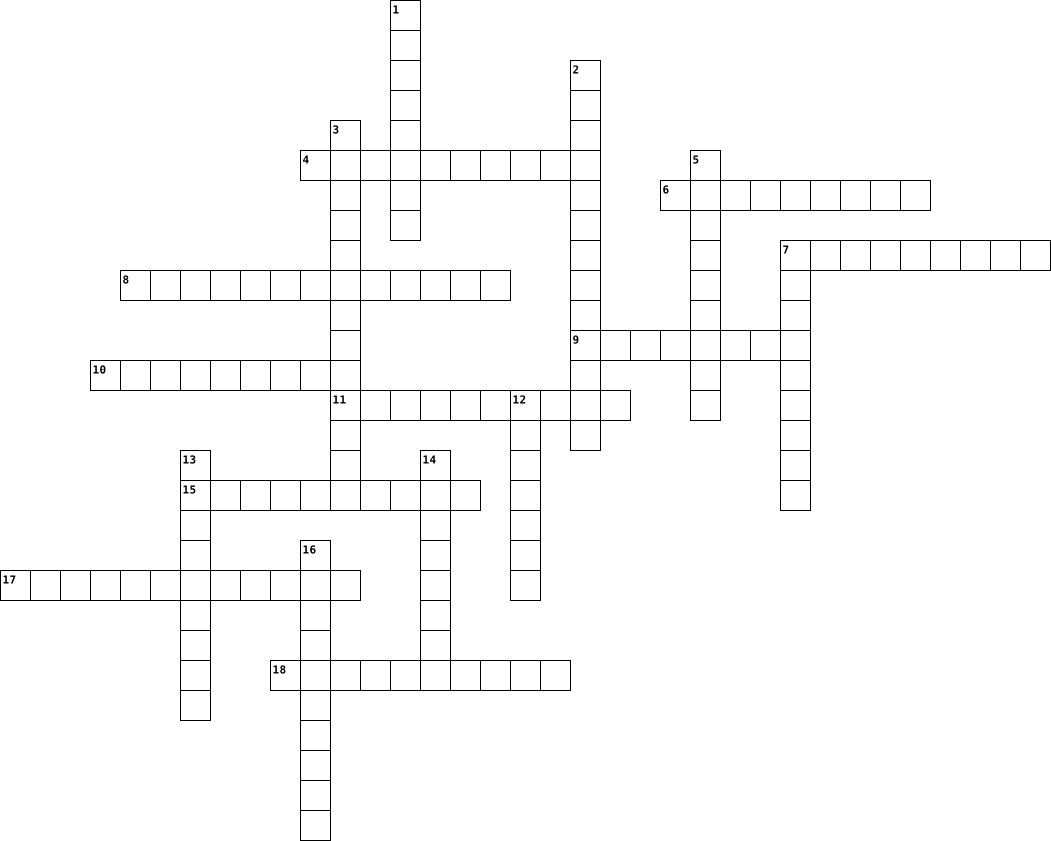
Essential Vocabulary crossword puzzle
Across
  1. A short personal narrative detailing particulars of an interesting episode/event
  2. Omitting conjunctions (FANBOYS) between words, phrases, or clauses.
  3. A type of amplification that lists or details the parts of something. The subject is further distributed into components or parts.
  4. Repeats a word or phrase at the end of a clause or phrase and then again at the beginning of the next clauses or phrases
  5. metaphor where something being compared is referred to something closely associated with it.
  6. Repeats a word or phrase in successive phrases or clauses on purpose for effect.
  7. Antithesis puts two contrasting ideas together. Antithesis requires parallel structure and exact opposites, unlike juxtaposition.
  8. Series of conjunctions not normally found in successive words, words, phrases, or clauses
  9. A word or a phrase is repeated at the end of successive clauses
  10. A grammatical term. The use of words or phrases with a similar structure.
  11. Any combination of repeated vowel sounds in quick succession at the beginning, middle, and/or end of words.
  12. A question whose answer is obvious or implied.
  13. comparison by directly relating one thing to another unrelated thing.
  14. The use of regional dialect or informal language in writing or speaking.
  15. comparison using “like” or “as”
  16. Compares two different things that have similar characteristics along multiple lines, meaning you break the concept down into parts and compare the parts.
  17. Used to embellish a sentence or statement by adding further information.
  18. The same word or phrase occurs on either side of an intervening word or phrase
  19. any minimization of something & is used for humorous purposes, to comfort people, to be humble, and many other purposes.
Down
  1. Figures of speech that play with and shift the expected and literal meaning of words.
  2. Grammatical term: how words function in a sentence. Phrases and clauses are meaningful, grammatical entities that can combine to make up sentences.
  3. A situation or statement characterized by a significant difference between what is expected or understood and what actually happens or is meant.
  4. A two word paradox.
  5. Personification is an act of giving human characteristics to animals or objects to create imagery.
  6. Any combination of repeated consonant sounds in quick succession at the beginning, middle, and/or end of words.
  7. A more agreeable or less offensive substitute for a generally unpleasant word or concept.
  8. Repeats a word or phrase for emphasis in succession.
  9. words, commonly in a humorous way, that sound similar but have different meanings.
  10. Excessive exaggeration
  11. a word that modifies two or more words in different ways
  12. Two successive phrases/clauses are parallel in syntax, but reverse the order of the same words.
  13. Open to or having more than one possible meaning or interpretation.
  14. An inverted grammatical structure using synonymous or antithetical terms, but not the same words.
  15. The repetition of initial sounds in the first stressed syllable of words in close proximity
  16. A statement that seems contradictory, but is actually true.
  17. Technique to expose and criticize foolishness and corruption of an individual or a society by using humor, irony, exaggeration, or ridicule.
  18. One or more questions is/are asked and then answered, often at length.
  19. literary device that sets the overall tempo or pace of a literary work.
  20. Prevailing atmosphere or emotional aura of a work
  21. A word standing for part of something is used for the whole of that thing or vice versa
  22. A reference to a famous event, work of art, person, or idea
  23. Any kind of work which mimics a familiar style (of artist, genre, or work) to invoke humour.

42 Clues: A two word paradox.Excessive exaggerationcomparison using “like” or “as”A question whose answer is obvious or implied.Prevailing atmosphere or emotional aura of a workRepeats a word or phrase for emphasis in succession.a word that modifies two or more words in different waysA statement that seems contradictory, but is actually true....

LITERARY TERMS- FOUNDATIONS UNIT Crossword Puzzle 2022-05-12

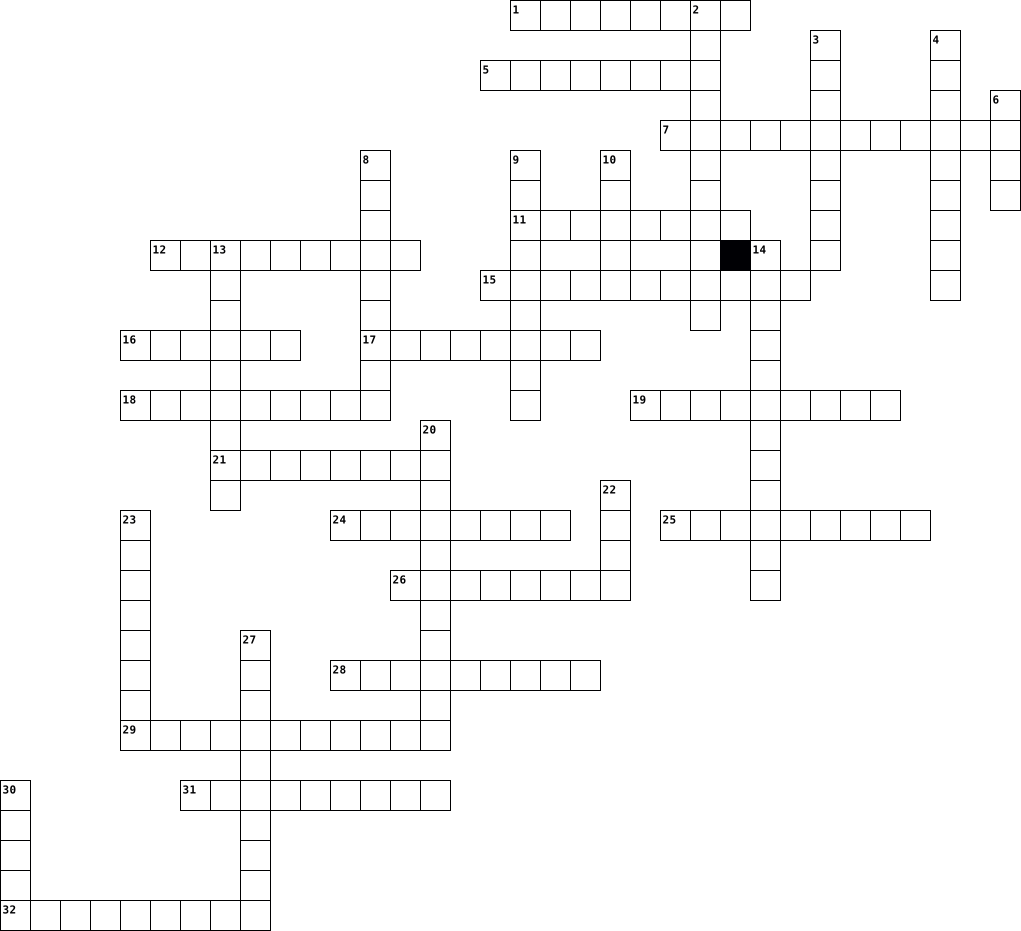
LITERARY TERMS- FOUNDATIONS UNIT Crossword Puzzle crossword puzzle
Across
  1. Characters, and settings are introduced.
  2. INCIDENT, First event that starts the conflict.
  3. A character who experiences character growth and change throughout the story
  4. A phrase that includes two opposite ideas that present a seeming impossibility yet on closer examination they seem to make a kind of sense.
  5. The use of this literary device uses hints or clues to suggest what will happen later in the story.
  6. When the exact opposite of what is expected to happen occurs.
  7. When a character whose personality, thoughts, etc., do not change throughout the story.
  8. Man vs man is an ______conflict.
  9. The central character in the story.
  10. The main idea of a story, including the “big idea” and what the author says about it is called the ______.
  11. The narrator is an outsider who can report only what he or she sees and hears. This point of view is called Third Person _____.
  12. The type of irony in which the exact opposite of what we would expect to happen to a character or in a situation happens.
  13. A comparison between 2 unlike objects or ideas using the words "like" or "as".
  14. ACTION, The part of the plot when conflicts are resolved, the story is ending.
  15. An object or idea that really means a lot more than what it looks like on the surface.
  16. A figure of speech that is an exaggeration or overstatement.
  17. The events that make up a story is called the ______.
  18. _____ person point of view uses the "I" and "we" pronouns.
  19. A character who is not fully described.
  20. Third-person point of view called this_____ is when the reader has a “god-like” point of view. The reader can see the thoughts and actions of every character in the story.
Down
  1. A figure of speech in which the author gives human traits, characteristics, emotions, or actions to something that is not human.
  2. Man vs ________ the character is in conflict with the values, beliefs, or laws of the _________.
  3. Whatever or whoever is opposing the main character in the conflict.
  4. The author’s feelings toward a character shown through diction and word choice is called the ______.
  5. The final turning point where the most intense moment of the conflict is reached.
  6. A character who contrasts with another character (usually the protagonist) in order to highlight particular qualities in the 1st character.
  7. Third-person _______ is the point of view where the reader can see into only one character’s mind from the narrator’s standpoint.
  8. Describes a character whose background, motives, and other features are fully described or explained.
  9. The type of conflict that is Man vs self.
  10. The type of irony in which the audience knows something that the characters do not.
  11. Conflict concludes and the loose ends of a fictional text are all resolved.
  12. Man vs ____ is when the character is in conflict with natural elements or animals.
  13. A figure of speech in which the author refers to a piece of famous art, literature, or an important historical person or even.
  14. The type of irony in which a character says something opposite of what he/she means.
  15. When 2 words that are opposites are right next to each other in a sentence.
  16. A comparison between two different ideas or objects.
  17. How the reader feels after reading the story.
  18. ACTION, Central conflict begins and the minor conflicts that lead up to the climax happens is called the ______ _____.
  19. Language that is described to appeal to one of the 5 senses.

39 Clues: Man vs man is an ______conflict.The central character in the story.A character who is not fully described.Characters, and settings are introduced.The type of conflict that is Man vs self.How the reader feels after reading the story.INCIDENT, First event that starts the conflict.A comparison between two different ideas or objects....

LITERARY TERMS- FOUNDATIONS UNIT Crossword Puzzle 2022-05-12

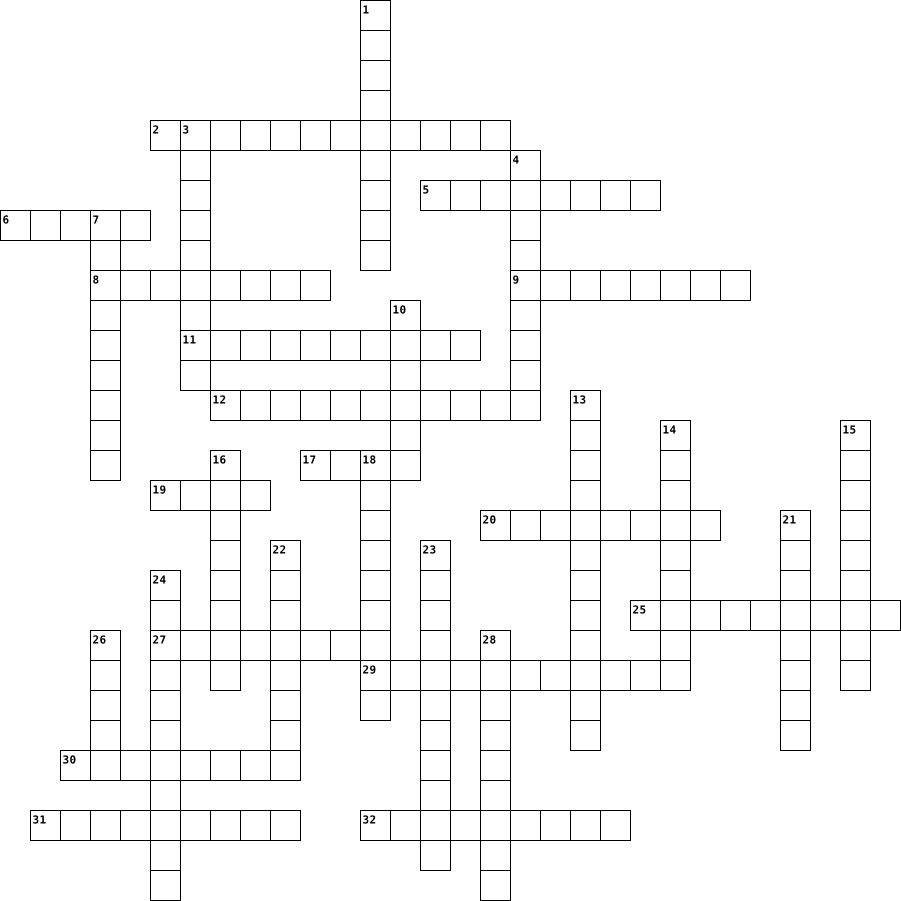
LITERARY TERMS- FOUNDATIONS UNIT Crossword Puzzle crossword puzzle
Across
  1. The type of irony in which a character says something opposite of what he/she means.
  2. Whatever or whoever is opposing the main character in the conflict.
  3. When a character whose personality, thoughts, etc., do not change throughout the story.
  4. Third-person _______ is the point of view where the reader can see into only one character’s mind from the narrator’s standpoint.
  5. The final turning point where the most intense moment of the conflict is reached.
  6. A character who is not fully described.
  7. Man vs ________ the character is in conflict with the values, beliefs, or laws of the _________.
  8. Describes a character whose background, motives, and other features are fully described or explained.
  9. _____ person point of view uses the "I" and "we" pronouns.
  10. The narrator is an outsider who can report only what he or she sees and hears. This point of view is called Third Person _____.
  11. ACTION, Central conflict begins and the minor conflicts that lead up to the climax happens is called the ______ _____.
  12. A figure of speech in which the author gives human traits, characteristics, emotions, or actions to something that is not human.
  13. A character who contrasts with another character (usually the protagonist) in order to highlight particular qualities in the 1st character.
  14. The type of irony in which the audience knows something that the characters do not.
  15. A character who experiences character growth and change throughout the story
  16. Man vs man is an ______conflict.
  17. A phrase that includes two opposite ideas that present a seeming impossibility yet on closer examination they seem to make a kind of sense.
  18. The central character in the story.
  19. Characters, and settings are introduced.
  20. An object or idea that really means a lot more than what it looks like on the surface.
  21. Language that is described to appeal to one of the 5 senses.
  22. A figure of speech that is an exaggeration or overstatement.
Down
  1. The events that make up a story is called the ______.
  2. The type of conflict that is Man vs self.
  3. The main idea of a story, including the “big idea” and what the author says about it is called the ______.
  4. Man vs ____ is when the character is in conflict with natural elements or animals.
  5. A comparison between 2 unlike objects or ideas using the words "like" or "as".
  6. INCIDENT, First event that starts the conflict.
  7. Conflict concludes and the loose ends of a fictional text are all resolved.
  8. Third-person point of view called this_____ is when the reader has a “god-like” point of view. The reader can see the thoughts and actions of every character in the story.
  9. A figure of speech in which the author refers to a piece of famous art, literature, or an important historical person or even.
  10. A comparison between two different ideas or objects.
  11. The use of this literary device uses hints or clues to suggest what will happen later in the story.
  12. How the reader feels after reading the story.
  13. When the exact opposite of what is expected to happen occurs.
  14. ACTION, The part of the plot when conflicts are resolved, the story is ending.
  15. The author’s feelings toward a character shown through diction and word choice is called the ______.
  16. When 2 words that are opposites are right next to each other in a sentence.
  17. The type of irony in which the exact opposite of what we would expect to happen to a character or in a situation happens.

39 Clues: Man vs man is an ______conflict.The central character in the story.A character who is not fully described.Characters, and settings are introduced.The type of conflict that is Man vs self.How the reader feels after reading the story.INCIDENT, First event that starts the conflict.A comparison between two different ideas or objects....

Rhetorical Analysis 2025-01-15

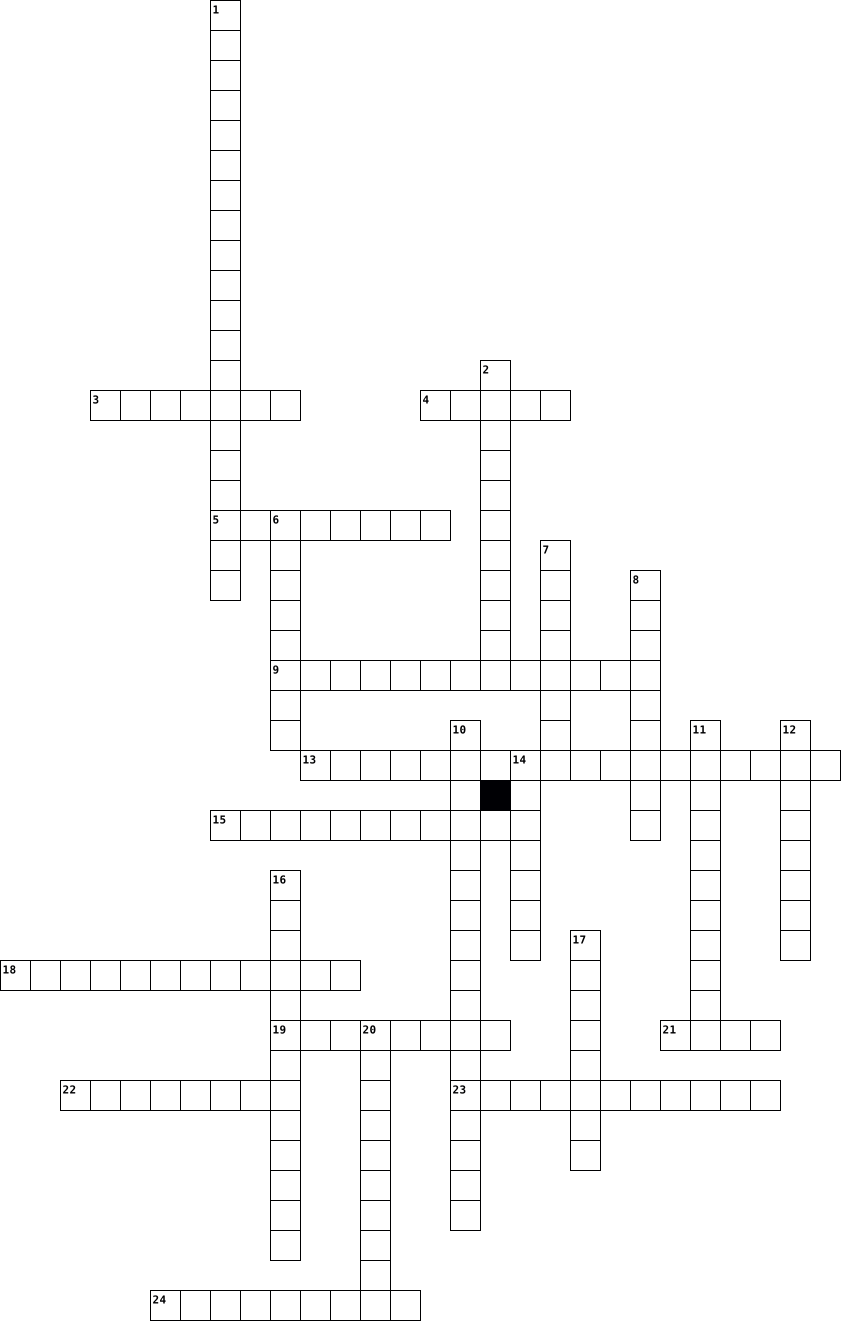
Rhetorical Analysis crossword puzzle
Across
  1. The reason or intent behind a piece of writing, speech, or work, often aimed at informing, persuading, entertaining, or inspiring the audience.
  2. A figure of speech that compares two unlike things using the words "like" or "as" to highlight similarities (e.g., "Her smile was as bright as the sun").
  3. An appeal to credibility or ethics in rhetoric, where the speaker or writer establishes their authority, trustworthiness, and character to persuade the audience.
  4. A persuasive technique that draws on the audience's sense of pride, loyalty, and devotion to their country or national identity to support a cause, idea, or action.
  5. A figure of speech that compares two unlike things by stating that one is the other, without using "like" or "as." It is used to suggest a deeper or symbolic meaning (e.g., "Time is a thief").
  6. An appeal to the emotions of the audience, aimed at eliciting feelings such as sympathy, anger, joy, or fear to persuade them effectively.
  7. A rhetorical device where words, phrases, or ideas are repeated to emphasize their significance, reinforce a point, or create rhythm and impact.
  8. A brief and indirect reference to a person, place, event, or literary work, often from history, culture, or mythology, to enrich meaning or provide context.
  9. The repetition of the same initial consonant sounds in a series of words or phrases, often used to create rhythm or draw attention to a particular idea (e.g., "Peter Piper picked a peck of pickled peppers").
  10. A comparison between two things, often used to explain or clarify a concept by showing how it is similar to something more familiar. Analogies highlight relationships or parallels between two ideas.
  11. A metaphor that is developed in detail over the course of a sentence, paragraph, or entire work. It draws multiple parallels between the metaphor's subject and its comparison to elaborate on a concept or theme.
  12. The main argument or thesis of a text, which is supported by evidence and reasoning throughout the work.
Down
  1. A rhetorical or literary technique where contrasting ideas or terms are presented to highlight differences, create tension, or emphasize a point (e.g., "light and dark" or "freedom and oppression").
  2. A rhetorical strategy that argues something is good, right, or ideal because it is natural or aligns with the natural world.
  3. Descriptive or figurative language used to create vivid mental pictures or sensory experiences for the reader. It appeals to the five senses (sight, sound, smell, taste, and touch) to deepen understanding and evoke emotions.
  4. A rhetorical strategy where the speaker or writer directly addresses the audience to create a connection, establish relevance, or appeal to their values, beliefs, or interests.
  5. A rhetorical or grammatical device where parts of a sentence or multiple sentences are structured in a similar way to create balance, rhythm, or emphasis (e.g., "I came, I saw, I conquered").
  6. A change in tone, perspective, or focus within a text, often signaling a transition from one argument, theme, or concept to another to guide the reader or audience.
  7. A statement or prompt designed to encourage an audience to take a specific action, such as clicking a link, making a purchase, signing up for a service, or engaging in an activity. In persuasive writing or advertising, a call to action typically uses clear and urgent language to inspire immediate action (e.g., "Sign up now," "Learn more," or "Donate today").
  8. An appeal to logic and reason in rhetoric, where the speaker or writer uses facts, statistics, evidence, and logical arguments to persuade the audience. It focuses on presenting a clear, rational, and well-structured case to support a claim or idea.

20 Clues: The main argument or thesis of a text, which is supported by evidence and reasoning throughout the work.A rhetorical strategy that argues something is good, right, or ideal because it is natural or aligns with the natural world....

Write the opposites of these words. 2021-02-19

Write the opposites of these words. crossword puzzle
Across
  1. minority
Down
  1. leave
  2. maximum

3 Clues: leavemaximumminority

Personality: Complete the crossword puzzle using the opposites of these adjectives 2021-04-18

Personality: Complete the crossword puzzle using the opposites of these adjectives crossword puzzle
Across
  1. hostile
  2. secure
  3. reserved
Down
  1. timid
  2. impulsive
  3. indifferent
  4. dull

7 Clues: dulltimidsecurehostilereservedimpulsiveindifferent

¿Cómo son? (Using opposites) *Use "es" or "tiene" in your responses, no spaces between words 2022-01-07

¿Cómo son? (Using opposites) *Use "es" or "tiene" in your responses, no spaces between words crossword puzzle
Across
  1. Nieves no es perezosa.
  2. Michelle Obama no es rubia.
  3. Inés no tiene pelo largo.
  4. Soraya no tiene pelo lacio.
  5. Héctor no es feo.
  6. Juan no es bajo.
  7. Teresa no es gorda.
Down
  1. Marcos no es débil.
  2. Tito no es tímido.
  3. Yolanda no es antipática.
  4. Pedro no es serio.
  5. Erica no es activa.
  6. El Sr. Morales no es joven.

13 Clues: Juan no es bajo.Héctor no es feo.Tito no es tímido.Pedro no es serio.Marcos no es débil.Erica no es activa.Teresa no es gorda.Nieves no es perezosa.Yolanda no es antipática.Inés no tiene pelo largo.Michelle Obama no es rubia.Soraya no tiene pelo lacio.El Sr. Morales no es joven.

Solve the crossword with the help of opposites of the given adjectives: 2021-07-26

Solve the crossword with the help of opposites of the given adjectives: crossword puzzle
Across
  1. empty
  2. heavy
  3. hot
  4. dry
Down
  1. thin
  2. tall
  3. young
  4. beautiful

8 Clues: hotdrythintallemptyyoungheavybeautiful

Complete the sentences with the opposites of these adjectives. 2023-11-27

Complete the sentences with the opposites of these adjectives. crossword puzzle
Across
  1. SOMEONE WHO DOESN´T FOLLOW RULES IS
  2. SOMEONE WHO TAKES A LONG TIME TO CHOOSE SOMETHING
Down
  1. SOMETHING THAT CAN´T BE DONE IS
  2. SOMETHING THAT ISN´T VERY NICE IS
  3. SOMETHING THAT DOESN´T MAKE SENSE IS

5 Clues: SOMETHING THAT CAN´T BE DONE ISSOMETHING THAT ISN´T VERY NICE ISSOMEONE WHO DOESN´T FOLLOW RULES ISSOMETHING THAT DOESN´T MAKE SENSE ISSOMEONE WHO TAKES A LONG TIME TO CHOOSE SOMETHING

Crossword – Opposites Find the opposites of the following words. Use your dictionary or www.leo.org if you don’t know the meaning. Write your answers in the crossword puzzle. Finde die Gegenteile der folgenden Wörter. Benutze dein Wörterbuch oder www.leo. 2025-09-24

Crossword – Opposites Find the opposites of the following words. Use your dictionary or www.leo.org if you don’t know the meaning. Write your answers in the crossword puzzle. Finde die Gegenteile der folgenden Wörter. Benutze dein Wörterbuch oder www.leo. crossword puzzle
Across
  1. dirty
  2. empty
  3. tall
  4. poor
  5. boring
  6. difficult
  7. safe
  8. light
  9. far
  10. sad
  11. short
  12. slow
  13. young
  14. thin
  15. dry
  16. quiet
Down
  1. stupid
  2. late
  3. unfriendly
  4. low
  5. expensive
  6. old
  7. small
  8. weak
  9. old
  10. ugly
  11. cold
  12. soft
  13. closed
  14. false

30 Clues: lowoldoldfarsaddrylatetallpoorweaksafeuglycoldsoftslowthindirtyemptysmalllightshortyoungfalsequietstupidboringclosedexpensivedifficultunfriendly

Ap language 2016-10-24

Ap language crossword puzzle
Across
  1. exaggerated statements or claims not meant to be taken literally
  2. the action of inverting something or the state of being inverted
  3. a comparison between two things, typically on the basis of their structure and for the purpose of explanation or clarification.
  4. uncertainty or inexactness of meaning in language
  5. a mistaken belief, especially one based on unsound argument.
  6. the action or state of being involved in something
  7. the presentation of something as being smaller, worse, or less important than it actually is
  8. a reason or set of reasons given with the aim of persuading others that an action or idea is right or wrong
  9. inclined to lay down principles as incontrovertibly true
  10. an appeal to ethics, and it is a means of convincing someone of the character or credibility of the persuader.
  11. the revision and publication of one or more of a company's previous financial statements; it is necessary when it is determined a previous statement contains a material inaccuracy.
  12. a figure of speech in which a contrast of ideas is expressed by parallelism of words that are the opposites of, or strongly contrasted with, each other, such as “hatred stirs up strife, but love covers all sins”
  13. is an appeal to logic, and is a way of persuading an audience by reason
  14. an expression designed to call something to mind without mentioning it explicitly
  15. the action of repeating something that has already been said or written
  16. a formal written defense of one's opinions or conduct
  17. the substitution of the name of an attribute or adjunct for that of the thing meant, for example suit for business executive, or the track for horse racing.
  18. the art of effective or persuasive speaking or writing, especially the use of figures of speech and other compositional techniques.
  19. a statement or theory that is put forward as a premise to be maintained or proved
Down
  1. is an appeal to emotion, and is a way of convincing an audience of an argument by creating an emotional response
  2. intended to teach, particularly in having moral instruction as an ulterior motive
  3. ironical understatement in which an affirmative is expressed by the negative of its contrary e.g., you won't be sorry, meaning you'll be glad
  4. the fact of two things being seen or placed close together with contrasting effect
  5. the organization of the different elements of a complex body or activity so as to enable them to work together effectively.
  6. the act of calling upon or summoning a spirit, demon, god or other supernatural agent,
  7. an idea or feeling that a word invokes in addition to its literal or primary meaning
  8. the use of a word referring to or replacing a word used earlier in a sentence, to avoid repetition, such as do in I like it and so do they
  9. a mild or indirect word or expression substituted for one considered to be too harsh or blunt when referring to something unpleasant or embarrassing.
  10. a rhetorical or literary figure in which words, grammatical constructions, or concepts are repeated in reverse order, in the same or a modified form
  11. the action or state of subordinating or of being subordinate
  12. the general character or attitude of a place, piece of writing, situation
  13. figure of speech in which a word or phrase is applied to an object or action to which it is not literally applicable.
  14. the arrangement of and relations between the parts or elements of something complex
  15. a figure of speech in which a part is made to represent the whole or vice versa
  16. a short poem, especially a satirical one, having a witty or ingenious ending.
  17. the assembled spectators or listeners at a public event, such as a play, movie, concert, or meeting
  18. express (something) in words.
  19. the use of humor, irony, exaggeration, or ridicule to expose and criticize people's stupidity

38 Clues: express (something) in words.uncertainty or inexactness of meaning in languagethe action or state of being involved in somethinga formal written defense of one's opinions or conductinclined to lay down principles as incontrovertibly truea mistaken belief, especially one based on unsound argument....

traydens crosswords 2024-05-22

traydens crosswords crossword puzzle
Across
  1. The reciprocal of a number is also known as its ___.
  2. When solving equations, to isolate the variable, you use the ___ to divide both sides by the same number.
  3. Used to represent a repeating decimal, called a _____ notation.
  4. Numbers that are the same distance from zero on a number line but in opposite directions are called ___.
  5. An equation that uses an abundance of words and letters for variables, known as an algebraic ________.
  6. To find the distance across a circle through its center, you measure the ___?
  7. To find the average distance between each data point and the mean of the data set, you calculate the ___.
  8. When solving equations, you can multiply both sides by the same number without changing the equality, which is known as the ___.
  9. To find the value of an expression, you ___ the given numbers or variables.
  10. ________ value is the non-negative value of x without regard to its sign.
  11. An increase in the original price of an item is called a ___.
  12. To perform calculations involving multiple operations, you follow the ___.
  13. Having the same measurement is __________
  14. The total count of digits used to express numbers in a number system
  15. A solid geometric figure with two congruent and parallel faces, and all other faces are rectangles, is called a ___.
  16. The money paid regularly at a particular rate for the use of money lent, or for delaying the repayment of a debt is called ___.
  17. In mathematics, a statement that two expressions are equal is called an ___.
  18. A mathematical statement that shows the relationship between two quantities and uses symbols such as <, >, or ≠ is called an ___.
  19. When a number is multiplied by its reciprocal, the result is always ___.
  20. Two angles are complementary if the sum of their measure is 90 degrees
  21. When two quantities do not have a constant ratio, they are said to be ___.
  22. A mathematical statement that two ratios are equal is called a ___.
Down
  1. Mainly based off of a triangle, it is 3d, and has a flat base and sharp end. Famous for holding a frozen treat.
  2. To find how much a quantity has increased or decreased in percentage, you calculate the ___.
  3. an equation that does NOT have a variable.
  4. The likelihood of an event happening is called ___.
  5. To break down a number or expression into its prime components, you ___ it.
  6. A whole number, its opposite, and zero are all examples of ___s.
  7. When someone helps sell an item they usually receive ___________
  8. When the same quantity is added to both sides of an equation, the equation does not change. Additional property of _________.
  9. A constant ratio or unit rate of two variable quantities. It is also called the constant of variation.
  10. Another term for a tip given to a server is ___.
  11. Equations that have the same solution set are called ___.
  12. What does GCF stand for?
  13. 3D picture that has two parallel congruent bases connected by a curved surface.
  14. When adding or subtracting fractions with different denominators, you find the ___.
  15. To simplify expressions like 3(x + 2), you use the ___ of multiplication over addition.
  16. To find the _______ of a shape you need to use length times width.
  17. changing the sign of the number and adding it to the original number to get an answer equal to 0. Additive ________ property.’
  18. A closed figure formed by straight lines is called a ___.
  19. The ratio of the circumference of a circle to its diameter is represented by the Greek letter ___.
  20. A triangle with at least two sides of equal length is called an ___.
  21. When you are the same distance from each wall, you are in the ________
  22. A polynomial with only one term is called a ___.
  23. a figure that is made up of more figures.
  24. Angles that have the same vertex, share a common side, and do not overlap are called a(n) _________ angles.
  25. A reduction of the original price of an item is called a ___.
  26. The distance around a certain shape that has an area of pi. This is the _________________
  27. an angle somewhere between 0-90 degrees.

49 Clues: What does GCF stand for?an angle somewhere between 0-90 degrees.Having the same measurement is __________a figure that is made up of more figures.an equation that does NOT have a variable.Another term for a tip given to a server is ___.A polynomial with only one term is called a ___.The likelihood of an event happening is called ___....

Voices of War 2023-05-02

Voices of War crossword puzzle
Across
  1. A contradiction in terms (e.g. cold fire)
  2. Reference to matters outside of literary work. For example, people, events, myths, legends, biblical, historical, Shakespearean, contemporary references.
  3. The feeling or mood in a text; for example, an atmosphere of tension or danger in a thriller. Atmosphere is created by a combination of actions, characters and words or images used in a text.
  4. Language which describes something in detail, using words to substitute for and create sensory stimulation, including visual imagery and sound imagery.
  5. The use of specific objects or images to represent abstract ideas.
  6. Where inanimate objects or abstract concepts are given human qualities
  7. The running on of the thought from one line, couplet, or stanza to the next without a syntactical break (full stop, comma).
  8. The special atmosphere or mood created by a particular environment: "The noir ambience is dominated by low- key lighting . . . and deep shadows, creating feelings of disorientation, loneliness and entrapment" .
  9. Where future events in a story, or perhaps the outcome, are suggested by the author before they happen.
  10. The repetition of vowel sounds in nearby words for emphasis, e.g. ‘asleep in the deep’.
  11. A recurring important idea or image. A motif differs from a theme in that it can be expressed as a single word or fragmentary phrase, while a theme usually must be expressed as a complete sentence.
  12. Is the ordinary, everyday speech of a particular place and time period. It is informal, casual and conversational.
  13. Question A question asked that is not meant the be answered. It is not to gain information but to have the audience think about something more deeply.
Down
  1. Irony implies the opposite of what is said. The intention is for the opposite to be understood. It is the tone which tempers or conveys this meaning. For example: “I can’t wait for my detention on Friday afternoon.”
  2. language Words used deliberately to create an emotional impact or response. Emotive language is particularly common in poetry, in which language is at its most condensed and evocative.
  3. Where sounds are spelled out as words; or, when words describing sounds actually sound like the sounds they describe.
  4. Specialist language of a particular trade, sport, pastime or area of study, for example, medical jargon.
  5. Theme is a pervading idea/message or focus that a text explores.
  6. Where a specific word, phrase, or structure is repeated several times, usually in close proximity, to emphasize a particular idea.
  7. Is an over-exaggeration not meant to be taken literally. It aims to create humour or to emphasise a point (e.g. She prepared enough food to feed an army.)
  8. language Any use of language where the intended meaning differs from the actual literal meaning of the words themselves. There are many techniques which can rightly be called figurative language, including metaphor, simile, hyperbole, personification, onomatopoeia, verbal irony, and oxymoron.
  9. A term used to describe a tendency or preference towards a particular perspective, ideology or result, when the tendency interferes with the ability to be impartial, without prejudice or objective. Bias is generally seen as a 'one-sided' perspective or prejudice.
  10. The repetition of consonant sounds within close proximity, usually in consecutive words within the same sentence or line.
  11. Simile is a comparison where one thing or idea is described as being similar to another. Similes usually contain the words “like” or “as”.
  12. The “voice” of a poem; not to be confused with the poet him/herself.
  13. Mocking, cutting type humour that is personal in intent and aims to humiliate.
  14. The placing of two things side by side so that similarities or differences between the two texts are made obvious.
  15. poet makes extensive use of figurative language, presenting the speaker’s feelings as colours, sounds and flavours.
  16. A metaphor is a comparison without the use of “like” or “as”. A direct relationship where one thing or idea substitutes for another.
  17. The apparent emotional state, or “attitude,” of the piece as conveyed through the language.
  18. An overused expression or idea, e.g. ‘to die for’; ‘as thick as a plank’.
  19. Compare by observing differences or opposites.

32 Clues: A contradiction in terms (e.g. cold fire)Compare by observing differences or opposites.Theme is a pervading idea/message or focus that a text explores.The use of specific objects or images to represent abstract ideas.The “voice” of a poem; not to be confused with the poet him/herself....

Math Vocabulary 2025-05-19

Math Vocabulary crossword puzzle
Across
  1. a rule that shows a relationship between two or more quantities (2)
  2. a number's distance from zero is its _____ value (1)
  3. a solid with two bases that are parallel, congruent (matching) circles (8)
  4. a ratio that compares quantities measured in different units (4)
  5. a mathematical phrase that uses numbers, variables, and operation symbols is called an algebraic _____ (1)
  6. the amount added to the store's cost for an item to get to the selling price (5)
  7. get a variable alone on one side (1)
  8. mathematical sentence with an equal sign (1)
  9. the amount by which the price of an item is reduced to get to the sale price (5)
  10. an ordered _____ gives the coordinates of the location of a point (3)
  11. a solid with two parallel bases that are congruent (matching) polygons and with lateral faces that are parallelograms (usually rectangles) (8)
  12. abbreviation for the least multiple that is common to both numbers (2)
  13. a transformation that turns a figure about a fixed point (3)
  14. abbreviation for the greatest number that is a factor of both numbers you have (2)
  15. a symbol that stands for one or more numbers (1)
  16. the number of cubic units needed to fill a solid (8)
  17. an expression using a base and an exponent (2)
  18. the sum of the areas of all of a solid's surfaces (8)
  19. a rate equal to 1 is called a _____ factor (4)
  20. a grid formed by the intersection of two number lines is a coordinate _____ (3)
  21. the set of whole numbers and their opposites (negatives) (1)
  22. the percent a quantity increases or decreases from its original amount is the percent of _____ (5)
  23. a mathematical sentence that contains , , , , or (6)
  24. a ratio that compares a number to 100 (5)
  25. _____ notation is a number written as a factor between 1 and 10 multiplied by a power of 10 (i.e., 1.54 x 10^7) (2)
  26. the original amount deposited or borrowed (5)
  27. terms that have exactly the same variable factors (i.e., -5 and 8, 2x and 3x) (6)
Down
  1. an equation stating that two ratios are equal (4)
  2. a type of number whose decimal part does not terminate or repeat (3)
  3. the ratio of the length of the model to the corresponding length of the actual object (4)
  4. a type of polygon with all equal sides and equal angles (7)
  5. a composite number written as a product of prime numbers is the prime _____ (2)
  6. a comparison of two quantities by division (4)
  7. the height of a pyramid's lateral faces is called the _____ height (8)
  8. a type of triangle with three equal sides (7)
  9. the figure you get after a transformation (3)
  10. the _____ of an event is the number of favorable outcomes divided by the number of total possible outcomes (5)
  11. a whole number greater than 1 with exactly two factors, 1 and the number itself (2)
  12. the _____ of a number is another number when multiplied by itself is the given number; the symbol looks like (3)
  13. the principal plus the interest (5)
  14. a type of triangle with one angle greater than 90 degrees (7)
  15. a whole number greater than 1 with more than two factors (2)
  16. this point (1, -4) would be located in _____ IV (3)
  17. the line that divides a figure into mirror images is called the line of _____ (3)
  18. the amount of money paid for the use of money (5)
  19. a solid with one circular base and one vertex (point) (8)
  20. a solid with one base (usually a square) and lateral faces that are triangles (8)
  21. the set of numbers including both rational and irrational numbers (3)
  22. a transformation that flips a figure over a line (3)
  23. a transformation that moves each point of a figure the same distance and in the same direction (3)

50 Clues: the principal plus the interest (5)get a variable alone on one side (1)a ratio that compares a number to 100 (5)mathematical sentence with an equal sign (1)a type of triangle with three equal sides (7)the figure you get after a transformation (3)the original amount deposited or borrowed (5)a comparison of two quantities by division (4)...

Psychobiology 2014-11-10

Psychobiology crossword puzzle
Across
  1. a condition that may result from damage to the inferior temporal cortex
  2. perceived by the otoliths falling onto hair cells in the direction that the body is tilted
  3. failure of the bones of the middle ear to transmit sound waves property to the cochlea
  4. a drug that has no pharmacological effects, but often relieves pain due to the power of believe
  5. auditory receptor cells
  6. 3 types of cones and each respond to certain wavelengths
  7. abundant in the periphery of the retina
  8. respond to light touch
  9. what covers the taste receptors
  10. expectation of harm actually causes a person feelings of pain, discomfort, or sickness
  11. a condition where they cannot identify faces
  12. where visual information is processed
  13. the combination of taste and smell
  14. where auditory information is processed
  15. savory taste associated with the amino acid gluatamate
  16. found primarily in the fovea
  17. when receptors of a sensory system respond to a wide range of stimuli and contribute to the perception of each of them
  18. top of the nasal cavity
  19. damage to the cochlea, hair cells, or auditory nerve that causes a permanent impairment in hearing in one to all ranges of frequencies
  20. sense of smell
  21. perceived by the jelly-like substance in the semicircular canals pushing against hair cells
  22. where the optic nerve sends information from the right eye to the left hemisphere and info from the left eye to the right hemisphere
  23. when certain pitches are perceived because the entire basilar membrane vibrates in synchrony with a sound
  24. for low frequency sounds the apex of the basilar membrane vibrates in synchrony with the sound wave
  25. includes the pinna
  26. detects the direction of tilt and amount of acceleration of the head
  27. respond to temperature and pain
  28. respond to stretching of the skin
  29. frequent or constant ringing in the ear
  30. eardrum
  31. an opening in the center of the eye in which light enters
  32. a reduced response to one stimulus because of exposure to another
  33. opiates that reduce pain by inhibiting substance p, self-created
  34. contains three fluid-filled tunnels
  35. what vibrates after the hammer, anvil, and stirrup are vibrating
  36. number of compressions per second of a sound, measured in hertz
  37. structures located within the grooves of the papillae
Down
  1. chemicals released by an animal that affect the behavior of other members of the same species, especially sexually
  2. whatever excites a particular type of nerve generates a special energy unique to that nerve
  3. drugs such as morphine that block dull, prolonged pain
  4. rear surface of the eye, which is lined with visual receptor cells
  5. perception of the intensity of a sound wave
  6. a set of receptors located near, but separate from, the olfactory receptors
  7. a band of tissue that gives eyes their color
  8. a blurring of vision for lines in one direction
  9. intensity of a sound wave
  10. a limited area of the body where each sensory spinal nerve connects to
  11. structure that exists within the cochlea
  12. respond to movement of hairs
  13. when each receptor responds to only a small range of stimuli
  14. we perceive color in terms of pair opposites
  15. detects sudden displacements or high frequency vibrations
  16. perception of the frequency of a sound wave
  17. compression of air, water, or another medium
  18. decreased respone to a stimulus as a result of recent exposure to it
  19. the cortex compares the responses from different parts of the retina to determine the brightness of color
  20. primary taste cortex
  21. when the spinal cord receives messages from pain receptors, but also input touch receptors and axons descending from the brain
  22. when each area along the basilar membrane of the cochlea can only respond to a specific frequency
  23. coolest taste test ever
  24. the point at which the optic nerve leaves the eye, because it has no visual receptors
  25. tone deafness, a person cannot detect small changes in frequency
  26. a structure of flesh and cartilage attached to the side of the head

63 Clues: eardrumsense of smellincludes the pinnaprimary taste cortexrespond to light touchauditory receptor cellstop of the nasal cavitycoolest taste test everintensity of a sound waverespond to movement of hairsfound primarily in the foveawhat covers the taste receptorsrespond to temperature and painrespond to stretching of the skin...

voices of the war 2023-05-01

voices of the war crossword puzzle
Across
  1. A contradiction in terms (e.g. cold fire)
  2. Reference to matters outside of literary work. For example, people, events, myths, legends, biblical, historical, Shakespearean, contemporary references.
  3. The feeling or mood in a text; for example, an atmosphere of tension or danger in a thriller. Atmosphere is created by a combination of actions, characters and words or images used in a text.
  4. Language which describes something in detail, using words to substitute for and create sensory stimulation, including visual imagery and sound imagery.
  5. The use of specific objects or images to represent abstract ideas.
  6. Where inanimate objects or abstract concepts are given human qualities
  7. The running on of the thought from one line, couplet, or stanza to the next without a syntactical break (full stop, comma).
  8. The special atmosphere or mood created by a particular environment: "The noir ambience is dominated by low- key lighting . . . and deep shadows, creating feelings of disorientation, loneliness and entrapment" .
  9. Where future events in a story, or perhaps the outcome, are suggested by the author before they happen.
  10. The repetition of vowel sounds in nearby words for emphasis, e.g. ‘asleep in the deep’.
  11. A recurring important idea or image. A motif differs from a theme in that it can be expressed as a single word or fragmentary phrase, while a theme usually must be expressed as a complete sentence.
  12. Is the ordinary, everyday speech of a particular place and time period. It is informal, casual and conversational.
  13. Question A question asked that is not meant the be answered. It is not to gain information but to have the audience think about something more deeply.
Down
  1. Irony implies the opposite of what is said. The intention is for the opposite to be understood. It is the tone which tempers or conveys this meaning. For example: “I can’t wait for my detention on Friday afternoon.”
  2. language Words used deliberately to create an emotional impact or response. Emotive language is particularly common in poetry, in which language is at its most condensed and evocative.
  3. Where sounds are spelled out as words; or, when words describing sounds actually sound like the sounds they describe.
  4. Specialist language of a particular trade, sport, pastime or area of study, for example, medical jargon.
  5. Theme is a pervading idea/message or focus that a text explores.
  6. Where a specific word, phrase, or structure is repeated several times, usually in close proximity, to emphasize a particular idea.
  7. Is an over-exaggeration not meant to be taken literally. It aims to create humour or to emphasise a point (e.g. She prepared enough food to feed an army.)
  8. language Any use of language where the intended meaning differs from the actual literal meaning of the words themselves. There are many techniques which can rightly be called figurative language, including metaphor, simile, hyperbole, personification, onomatopoeia, verbal irony, and oxymoron.
  9. A term used to describe a tendency or preference towards a particular perspective, ideology or result, when the tendency interferes with the ability to be impartial, without prejudice or objective. Bias is generally seen as a 'one-sided' perspective or prejudice.
  10. The repetition of consonant sounds within close proximity, usually in consecutive words within the same sentence or line.
  11. Simile is a comparison where one thing or idea is described as being similar to another. Similes usually contain the words “like” or “as”.
  12. The “voice” of a poem; not to be confused with the poet him/herself.
  13. Mocking, cutting type humour that is personal in intent and aims to humiliate.
  14. The placing of two things side by side so that similarities or differences between the two texts are made obvious.
  15. poet makes extensive use of figurative language, presenting the speaker’s feelings as colours, sounds and flavours.
  16. A metaphor is a comparison without the use of “like” or “as”. A direct relationship where one thing or idea substitutes for another.
  17. The apparent emotional state, or “attitude,” of the piece as conveyed through the language.
  18. An overused expression or idea, e.g. ‘to die for’; ‘as thick as a plank’.
  19. Compare by observing differences or opposites.

32 Clues: A contradiction in terms (e.g. cold fire)Compare by observing differences or opposites.Theme is a pervading idea/message or focus that a text explores.The use of specific objects or images to represent abstract ideas.The “voice” of a poem; not to be confused with the poet him/herself....

Glossary of Literary and Poetic Terms 2022-05-24

Glossary of Literary and Poetic Terms crossword puzzle
Across
  1. a figure of speech in which the natural world (or some part of it) is treated as though it has human emotions
  2. a figure of speech where non-living objects are described to seem like people; it gives human traits and qualities, such as emotions, desires, sensations, gestures and speech, often by way of a metaphor.
  3. A figure of speech in which a word, usually a verb or an adjective, applies to more than one noun.
  4. the formation of a word from a sound associated with what is named
  5. a literary device where one thing takes the name of another item or an idea that is closely related to it
  6. a speech or address to a person who is not present or to a personified object
  7. a line of verse containing four poetic feet, containing 8 total syllables
  8. hetorical or literary device in which words, concepts, or grammatical contractions are repeated in reverse order, in the same modified form; an inverted parallelism.
  9. a statement that contradicts itself, or that must be both true and untrue at the same time
  10. an exaggerated statement or claim that can’t be taken literally
  11. the occurrence of the same letter or sound at the beginning of adjacent or closely connected words.
  12. a figure of speech in which an opposition or contrast of ideas is expressed by parallelism of words that are the opposites of, or strongly contrasted with, each other
  13. an expression that calls something to mind without mentioning it explicitly; an indirect or passing reference.
  14. A figure of speech in which two dissimilar objects or concepts are compared using “like” or “as”.
  15. a literary device that is the comparison of two unlike things without using “like or “as”
  16. (in verse) the continuation of a sentence (or a clause or phrase) without a pause beyond the end of a line, couplet, or stanza; a run-on line; the lack of punctuation at the end a line of poetry
  17. a pause in the middle of a line marked by punctuation
  18. a figure of speech in which apparently contradictory terms appear in conjunction; a compressed paradox
Down
  1. A trochee is one foot of poetic meter which is made up of a stressed then unstressed syllable.
  2. Raising an issue by claiming not to mention it.
  3. repetition of the same word or words at the beginning of successive sentences, phrases, or clauses.
  4. understatement for emphasis (sometimes ironic) where a positive is conveyed through the understatement or through the negative of the contrary.
  5. a line of verse consisting of five metrical feet
  6. a figure of speech in which a part of something is used to signify the whole, or vice-versa (where the larger whole stands in for a smaller component of something).
  7. the repetition of the sound of a vowel or diphthong in nonrhyming stressed syllables near enough to each other for the echo to be discernible
  8. a figure of speech that creates a comparison between two different things that illustrates a larger equivalence or correspondence due to common features
  9. The use of two words linked by a conjunction (“and”) instead of the one modifying the other
  10. A consonantal sound involving letters such as 'p', 'b', 't', in the formation of which the passage of air is completely blocked, The blockage can be made in a variety of places
  11. repetition of a word or expression at the end of successive phrases, clauses, sentences, or verses especially for rhetorical or poetic effect
  12. omission of conjunctions that ordinarily join coordinate words or clauses
  13. A literary device that is also known as a “play on words.” Puns involve words with similar or identical sounds but with different meanings. They are often meant to be humorous, but also have a serious purpose.
  14. The repetition of multiple conjunctions, usually where they are not necessary
  15. An iamb is one foot of poetic meter which consist of a unstressed, stressed syllable.

33 Clues: Raising an issue by claiming not to mention it.a line of verse consisting of five metrical feeta pause in the middle of a line marked by punctuationan exaggerated statement or claim that can’t be taken literallythe formation of a word from a sound associated with what is nameda line of verse containing four poetic feet, containing 8 total syllables...

Poetic techniques 2025-04-28

Poetic techniques crossword puzzle
Across
  1. Specialist language of a particular trade, sport, pastime or area of study, for example, medical jargon.
  2. The placing of two things side by side so that similarities or differences between the two texts are made obvious.
  3. A metaphor is a comparison without the use of “like” or “as”. A direct relationship where one thing or idea substitutes for another.
  4. The special atmosphere or mood created by a particular environment: "The noir ambience is dominated by low- key lighting . . . and deep shadows, creating feelings of disorientation, loneliness and entrapment" .
  5. The repetition of vowel sounds in nearby words for emphasis, e.g. ‘asleep in the deep’.
  6. A contradiction in terms (e.g. cold fire)
  7. Theme is a pervading idea/message or focus that a text explores.
  8. Simile is a comparison where one thing or idea is described as being similar to another. Similes usually contain the words “like” or “as”.
  9. The “voice” of a poem; not to be confused with the poet him/herself.
  10. The repetition of consonant sounds within close proximity, usually in consecutive words within the same sentence or line.
  11. Mocking, cutting type humour that is personal in intent and aims to humiliate.
  12. Where sounds are spelled out as words; or, when words describing sounds actually sound like the sounds they describe.
  13. The feeling or mood in a text; for example, an atmosphere of tension or danger in a thriller. Atmosphere is created by a combination of actions, characters and words or images used in a text.
  14. Question A question asked that is not meant the be answered. It is not to gain information but to have the audience think about something more deeply.
  15. Is the ordinary, everyday speech of a particular place and time period. It is informal, casual and conversational.
  16. Compare by observing differences or opposites.
Down
  1. Where inanimate objects or abstract concepts are given human qualities
  2. A term used to describe a tendency or preference towards a particular perspective, ideology or result, when the tendency interferes with the ability to be impartial, without prejudice or objective. Bias is generally seen as a 'one-sided' perspective or prejudice.
  3. language Any use of language where the intended meaning differs from the actual literal meaning of the words themselves. There are many techniques which can rightly be called figurative language, including metaphor, simile, hyperbole, personification, onomatopoeia, verbal irony, and oxymoron.
  4. Is an over-exaggeration not meant to be taken literally. It aims to create humour or to emphasise a point (e.g. She prepared enough food to feed an army.)
  5. The use of specific objects or images to represent abstract ideas.
  6. The running on of the thought from one line, couplet, or stanza to the next without a syntactical break (full stop, comma).
  7. A recurring important idea or image. A motif differs from a theme in that it can be expressed as a single word or fragmentary phrase, while a theme usually must be expressed as a complete sentence.
  8. Where a specific word, phrase, or structure is repeated several times, usually in close proximity, to emphasize a particular idea.
  9. Where future events in a story, or perhaps the outcome, are suggested by the author before they happen.
  10. Reference to matters outside of literary work. For example, people, events, myths, legends, biblical, historical, Shakespearean, contemporary references.
  11. Irony implies the opposite of what is said. The intention is for the opposite to be understood. It is the tone which tempers or conveys this meaning. For example: “I can’t wait for my detention on Friday afternoon.”
  12. An overused expression or idea, e.g. ‘to die for’; ‘as thick as a plank’.
  13. language Words used deliberately to create an emotional impact or response. Emotive language is particularly common in poetry, in which language is at its most condensed and evocative.
  14. Language which describes something in detail, using words to substitute for and create sensory stimulation, including visual imagery and sound imagery.
  15. The apparent emotional state, or “attitude,” of the piece as conveyed through the language.

31 Clues: A contradiction in terms (e.g. cold fire)Compare by observing differences or opposites.Theme is a pervading idea/message or focus that a text explores.The use of specific objects or images to represent abstract ideas.The “voice” of a poem; not to be confused with the poet him/herself....

Mega! 2017-03-30

Mega! crossword puzzle
Across
  1. A set of ideas or beliefs which are held to be acceptable by the creators of the media text, maybe in line with those of the dominant ruling social groups in society, or alternative ideologies such as feminist ideology.
  2. factors that influence whether a story will be picked for coverage.
  3. Traditionally this describes the predominance of one social class over another, in media terms this is how the controllers of the media may on the one hand use the media to pursue their own political interest, but on the other hand the media is a place where people who are critical of the establishment can air their views.
  4. The structural, systematic and historical domination and exploitation of women.
  5. the way ruling classes use the mass media to control or alter the attitudes of others.
  6. nothing to do with trains, this refers to the different ways that media content is delivered, mainly via TV, laptop, tablet, smartphone, cinema, video/computer game, printed page etc. for instance the BBC delivers content via TV, laptop and mobile device, and also through printed publications. Most media organisations deliver their content via a multitude of platforms.
  7. A question in a text that is not immediately answered and creates interest for the audience – a puzzle that the audience has to solve.
  8. literally ‘what’s in the shot’ everything that appears on the screen in a single frame and how this helps the audience to decode what’s going on.
  9. the idea that violent and and sexual content in media texts serves the function of releasing ‘pent up’ tension aggression/desire in audiences.
  10. computer technology that allows text, sound, graphic and video images to be combined into one programme.
  11. the interpretation of a media product that was intended by the maker or which is dictated by the ideology of the society in which it is viewed. Oppositional Reading – an interpretation of a text by a reader whose social position puts them into direct conflict with its preferred reading. Negotiated Reading – the ‘compromise’ that is reached between the preferred reading offered by a text and the reader’s own assumptions and interpretations
  12. time, place or mindset in which we consume media products.
  13. The way a media product ‘speaks’ to it’s audience. In order to communicate, a producer of any text must make some assumptions about an intended audience; reflections of such assumptions may be discerned in the text (advertisements offer particularly clear examples of this).
  14. communication between people other than by speech.
  15. the way opposites are used to create interest in media texts, such as good/bad, coward/hero, youth/age, black/white. By Barthes and Levi-Strauss who also noticed another important feature of these ‘binary opposites’: that one side of the binary pair is always seen by a particular society or culture as more valued over the other.
  16. the type or category of a media text, according to its form, style and content.
  17. a sign which has a direct relationship with something it signifies, such as smoke signifies fire.
  18. special effects or devices to create visual illusions.
  19. Anything that challenges the traditional way of doing things, rejecting boundaries between high and low forms of art, rejecting rigid genre distinctions, emphasizing pastiche, parody, intertextuality, irony, and playfulness. Postmodernism favours reflexivity and self-consciousness, fragmentation and discontinuity (especially in narrative structures), ambiguity, simultaneity, and an emphasis on the destructured, decentered, dehumanized subjects! This is tricky!
  20. The way in which the media ‘re-presents’ the world around us in the form of signs and codes for audiences to read.
  21. the everyday or common sense meaning of a sign. Connotation – the secondary meaning that a sign carries in addition to it’s everyday meaning.
  22. the struggle by women to obtain equal rights in society
  23. single image taken by a camera.
  24. purchaser, listener, viewer or reader of media products.
  25. the idea that ideas flow from mass media to opinion leaders, and from them to a wider population.
  26. putting together of visual images to form a sequence. Made famous by Russian film maker Eisenstein in his famous film Battleship Potemkin.
  27. The way in which technologies and institutions come together in order to create something new. Cinema is the result of the convergence of photography, moving pictures (the kinetoscope, zoetrope etc), and sound. The iPad represents the convergence of books, TV, maps, the internet and the mobile phone.
  28. Factual characteristics of a population sample, e.g. age, gender, race, nationality, income, disability, education
  29. Control over the content of a media text – sometimes by the government, but usually by a regulatory body like the British Board of Film censors.
Down
  1. A universal type or model of character that is found in many different texts, e.g. ingenue, anti-hero, wise old woman, hero-as-lover, hero-as-warrior, shadow trickster, mentor, loyal friend, temptress
  2. a genre within a genre.
  3. bodies whose job it is to see that media texts are not seen by the wrong audience (eg British Board of Film Censors) or are fair and honest (EG Advertising Standards Association)
  4. a member of the audience, someone who is actively responding to the text.
  5. the ‘thing’ that conveys the meaning, and the meaning conveyed. EG a red rose is a signifier, the signified is love (or the Labour Party!)
  6. is the intensity of feeling stirred up by the media about an issue that appears to threaten the social order, such as against Muslims after 9/11, or against immigrants, or against ‘video nasties’ following the Jamie Bulger murder.
  7. a sign or convention through which the media communicates meaning to us because we have learned to read it. Technical codes – all to do with the way a text is technically constructed – camera angles, framing, typography, lighting etc. Visual codes – codes that are decoded on a mainly connotational level – things that draw on our experience and understanding of other media texts, this includes Iconography – which is concerned with the use of visual images and how they trigger the audiences expectations of a particular genre, such as a knife in slasher horror films.
  8. a complex idea by Roland Barthes that myth is a second order signifying system ie when a sign becomes the signifier of a new sign - Y13 really but bet you can work it out ;-)
  9. ideas about how people use the media and what gratification they get from it. It assumes that members of the audience are not passive but take an active role in interpreting and integrating media into their own lives.
  10. the study of cultural artefacts of the mass media such as cinema, TV, advertising.
  11. static image.
  12. the idea that the way we look at something, and the way somebody looks at you, is structured by the way we view the world. Feminist Laura Mulvey suggests that looking involves power, specifically the look of men at women, implying that men have power over women.
  13. The organisations which produce and control media texts such as the BBC, AOL Time Warner, News International.
  14. a word or image that is used to represent an object or idea.
  15. Sound whose source is visible on the screen Non Diegetic sound – Sound effects, music or narration which is added afterwards
  16. the idea that the media can ‘inject’ ideas and messages straight into the passive audience. This passive audience is immediately affected by these messages. Used in advertising and propoganda, led to moral panics about effect of violent video and computer games.
  17. a visual representation of something.
  18. the means by which the media communicates to us and the forms and conventions by which it does so.
  19. the idea that within popular culture producers borrow other texts to create interest to the audience who like to share the ‘in’ joke. Used a lot in the Simpsons.
  20. viewers, listeners and readers of a media text. A lot of media studies is concerned with how audience use texts and the effects a text may have on them. Also identified in demographic socio-economic categories.
  21. the widely recognised way of doing things in particular genre.
  22. who produces and distributes the media texts – and whose interest it is.
  23. The way a story is put together within a text, traditionally equilibrium- disequilibrium, new equilibrium, but some text are fractured or non liner, eg Pulp Fiction.
  24. representation of people or groups of people by a few characteristics eg hoodies, blondes
  25. additional sounds other than dialogue or music, designed to add realism or atmosphere.
  26. a text that has been designed to be consumed by an audience. E.G a film, radio show, newspaper etc.
  27. how meaning is fixed, as in how a caption fixes the meaning of a picture
  28. Computer Generated Imagary, Refers to the (usually) 3-D effects that enhance all kinds of still and moving images, from text effects, to digital snow or fire, to the generation of entire landscapes

57 Clues: static image.a genre within a genre.single image taken by a camera.a visual representation of something.communication between people other than by speech.special effects or devices to create visual illusions.the struggle by women to obtain equal rights in societypurchaser, listener, viewer or reader of media products....

Mega! 2017-03-30

Mega! crossword puzzle
Across
  1. how meaning is fixed, as in how a caption fixes the meaning of a picture
  2. nothing to do with trains, this refers to the different ways that media content is delivered, mainly via TV, laptop, tablet, smartphone, cinema, video/computer game, printed page etc. for instance the BBC delivers content via TV, laptop and mobile device, and also through printed publications. Most media organisations deliver their content via a multitude of platforms.
  3. the struggle by women to obtain equal rights in society
  4. a sign or convention through which the media communicates meaning to us because we have learned to read it. Technical codes – all to do with the way a text is technically constructed – camera angles, framing, typography, lighting etc. Visual codes – codes that are decoded on a mainly connotational level – things that draw on our experience and understanding of other media texts, this includes Iconography – which is concerned with the use of visual images and how they trigger the audiences expectations of a particular genre, such as a knife in slasher horror films.
  5. Traditionally this describes the predominance of one social class over another, in media terms this is how the controllers of the media may on the one hand use the media to pursue their own political interest, but on the other hand the media is a place where people who are critical of the establishment can air their views.
  6. the widely recognised way of doing things in particular genre.
  7. bodies whose job it is to see that media texts are not seen by the wrong audience (eg British Board of Film Censors) or are fair and honest (EG Advertising Standards Association)
  8. the idea that violent and and sexual content in media texts serves the function of releasing ‘pent up’ tension aggression/desire in audiences.
  9. the idea that within popular culture producers borrow other texts to create interest to the audience who like to share the ‘in’ joke. Used a lot in the Simpsons.
  10. A question in a text that is not immediately answered and creates interest for the audience – a puzzle that the audience has to solve.
  11. putting together of visual images to form a sequence. Made famous by Russian film maker Eisenstein in his famous film Battleship Potemkin.
  12. the type or category of a media text, according to its form, style and content.
  13. viewers, listeners and readers of a media text. A lot of media studies is concerned with how audience use texts and the effects a text may have on them. Also identified in demographic socio-economic categories.
  14. ideas about how people use the media and what gratification they get from it. It assumes that members of the audience are not passive but take an active role in interpreting and integrating media into their own lives.
  15. representation of people or groups of people by a few characteristics eg hoodies, blondes
  16. special effects or devices to create visual illusions.
  17. see above. N.B Text usually means a piece of writing
  18. the means by which the media communicates to us and the forms and conventions by which it does so.
  19. time, place or mindset in which we consume media products.
  20. The way a media product ‘speaks’ to it’s audience. In order to communicate, a producer of any text must make some assumptions about an intended audience; reflections of such assumptions may be discerned in the text (advertisements offer particularly clear examples of this).
  21. the way ruling classes use the mass media to control or alter the attitudes of others.
  22. The structural, systematic and historical domination and exploitation of women.
  23. a sign which has a direct relationship with something it signifies, such as smoke signifies fire.
  24. The organisations which produce and control media texts such as the BBC, AOL Time Warner, News International.
  25. the idea that ideas flow from mass media to opinion leaders, and from them to a wider population.
Down
  1. single image taken by a camera.
  2. The way in which technologies and institutions come together in order to create something new. Cinema is the result of the convergence of photography, moving pictures (the kinetoscope, zoetrope etc), and sound. The iPad represents the convergence of books, TV, maps, the internet and the mobile phone.
  3. the everyday or common sense meaning of a sign. Connotation – the secondary meaning that a sign carries in addition to it’s everyday meaning.
  4. literally ‘what’s in the shot’ everything that appears on the screen in a single frame and how this helps the audience to decode what’s going on.
  5. the study of cultural artefacts of the mass media such as cinema, TV, advertising.
  6. additional sounds other than dialogue or music, designed to add realism or atmosphere.
  7. a member of the audience, someone who is actively responding to the text.
  8. communication between people other than by speech.
  9. Control over the content of a media text – sometimes by the government, but usually by a regulatory body like the British Board of Film censors.
  10. the ‘thing’ that conveys the meaning, and the meaning conveyed. EG a red rose is a signifier, the signified is love (or the Labour Party!)
  11. a visual representation of something.
  12. a genre within a genre.
  13. purchaser, listener, viewer or reader of media products.
  14. Computer Generated Imagary, Refers to the (usually) 3-D effects that enhance all kinds of still and moving images, from text effects, to digital snow or fire, to the generation of entire landscapes
  15. the way opposites are used to create interest in media texts, such as good/bad, coward/hero, youth/age, black/white. By Barthes and Levi-Strauss who also noticed another important feature of these ‘binary opposites’: that one side of the binary pair is always seen by a particular society or culture as more valued over the other.
  16. the interpretation of a media product that was intended by the maker or which is dictated by the ideology of the society in which it is viewed. Oppositional Reading – an interpretation of a text by a reader whose social position puts them into direct conflict with its preferred reading. Negotiated Reading – the ‘compromise’ that is reached between the preferred reading offered by a text and the reader’s own assumptions and interpretations
  17. Anything that challenges the traditional way of doing things, rejecting boundaries between high and low forms of art, rejecting rigid genre distinctions, emphasizing pastiche, parody, intertextuality, irony, and playfulness. Postmodernism favours reflexivity and self-consciousness, fragmentation and discontinuity (especially in narrative structures), ambiguity, simultaneity, and an emphasis on the destructured, decentered, dehumanized subjects! This is tricky!
  18. A universal type or model of character that is found in many different texts, e.g. ingenue, anti-hero, wise old woman, hero-as-lover, hero-as-warrior, shadow trickster, mentor, loyal friend, temptress
  19. the idea that the media can ‘inject’ ideas and messages straight into the passive audience. This passive audience is immediately affected by these messages. Used in advertising and propoganda, led to moral panics about effect of violent video and computer games.
  20. The way in which the media ‘re-presents’ the world around us in the form of signs and codes for audiences to read.
  21. The way a story is put together within a text, traditionally equilibrium- disequilibrium, new equilibrium, but some text are fractured or non liner, eg Pulp Fiction.
  22. a text that has been designed to be consumed by an audience. E.G a film, radio show, newspaper etc.
  23. computer technology that allows text, sound, graphic and video images to be combined into one programme.
  24. who produces and distributes the media texts – and whose interest it is.
  25. factors that influence whether a story will be picked for coverage.
  26. Sound whose source is visible on the screen Non Diegetic sound – Sound effects, music or narration which is added afterwards
  27. is the intensity of feeling stirred up by the media about an issue that appears to threaten the social order, such as against Muslims after 9/11, or against immigrants, or against ‘video nasties’ following the Jamie Bulger murder.
  28. Factual characteristics of a population sample, e.g. age, gender, race, nationality, income, disability, education
  29. the idea that the way we look at something, and the way somebody looks at you, is structured by the way we view the world. Feminist Laura Mulvey suggests that looking involves power, specifically the look of men at women, implying that men have power over women.
  30. A set of ideas or beliefs which are held to be acceptable by the creators of the media text, maybe in line with those of the dominant ruling social groups in society, or alternative ideologies such as feminist ideology.
  31. static image.
  32. a complex idea by Roland Barthes that myth is a second order signifying system ie when a sign becomes the signifier of a new sign - Y13 really but bet you can work it out ;-)
  33. a word or image that is used to represent an object or idea.

58 Clues: static image.a genre within a genre.single image taken by a camera.a visual representation of something.communication between people other than by speech.see above. N.B Text usually means a piece of writingspecial effects or devices to create visual illusions.the struggle by women to obtain equal rights in society...

Mega! 2017-03-30

Mega! crossword puzzle
Across
  1. the struggle by women to obtain equal rights in society
  2. A set of ideas or beliefs which are held to be acceptable by the creators of the media text, maybe in line with those of the dominant ruling social groups in society, or alternative ideologies such as feminist ideology.
  3. the idea that the way we look at something, and the way somebody looks at you, is structured by the way we view the world. Feminist Laura Mulvey suggests that looking involves power, specifically the look of men at women, implying that men have power over women.
  4. the means by which the media communicates to us and the forms and conventions by which it does so.
  5. The organisations which produce and control media texts such as the BBC, AOL Time Warner, News International.
  6. the widely recognised way of doing things in particular genre.
  7. time, place or mindset in which we consume media products.
  8. a text that has been designed to be consumed by an audience. E.G a film, radio show, newspaper etc.
  9. The way a story is put together within a text, traditionally equilibrium- disequilibrium, new equilibrium, but some text are fractured or non liner, eg Pulp Fiction.
  10. a word or image that is used to represent an object or idea.
  11. A universal type or model of character that is found in many different texts, e.g. ingenue, anti-hero, wise old woman, hero-as-lover, hero-as-warrior, shadow trickster, mentor, loyal friend, temptress
  12. The way a media product ‘speaks’ to it’s audience. In order to communicate, a producer of any text must make some assumptions about an intended audience; reflections of such assumptions may be discerned in the text (advertisements offer particularly clear examples of this).
  13. the idea that violent and and sexual content in media texts serves the function of releasing ‘pent up’ tension aggression/desire in audiences.
  14. computer technology that allows text, sound, graphic and video images to be combined into one programme.
  15. the type or category of a media text, according to its form, style and content.
  16. the way opposites are used to create interest in media texts, such as good/bad, coward/hero, youth/age, black/white. By Barthes and Levi-Strauss who also noticed another important feature of these ‘binary opposites’: that one side of the binary pair is always seen by a particular society or culture as more valued over the other.
  17. The way in which technologies and institutions come together in order to create something new. Cinema is the result of the convergence of photography, moving pictures (the kinetoscope, zoetrope etc), and sound. The iPad represents the convergence of books, TV, maps, the internet and the mobile phone.
  18. Control over the content of a media text – sometimes by the government, but usually by a regulatory body like the British Board of Film censors.
  19. The structural, systematic and historical domination and exploitation of women.
  20. communication between people other than by speech.
  21. a sign or convention through which the media communicates meaning to us because we have learned to read it. Technical codes – all to do with the way a text is technically constructed – camera angles, framing, typography, lighting etc. Visual codes – codes that are decoded on a mainly connotational level – things that draw on our experience and understanding of other media texts, this includes Iconography – which is concerned with the use of visual images and how they trigger the audiences expectations of a particular genre, such as a knife in slasher horror films.
  22. is the intensity of feeling stirred up by the media about an issue that appears to threaten the social order, such as against Muslims after 9/11, or against immigrants, or against ‘video nasties’ following the Jamie Bulger murder.
  23. The way in which the media ‘re-presents’ the world around us in the form of signs and codes for audiences to read.
  24. Anything that challenges the traditional way of doing things, rejecting boundaries between high and low forms of art, rejecting rigid genre distinctions, emphasizing pastiche, parody, intertextuality, irony, and playfulness. Postmodernism favours reflexivity and self-consciousness, fragmentation and discontinuity (especially in narrative structures), ambiguity, simultaneity, and an emphasis on the destructured, decentered, dehumanized subjects! This is tricky!
  25. Traditionally this describes the predominance of one social class over another, in media terms this is how the controllers of the media may on the one hand use the media to pursue their own political interest, but on the other hand the media is a place where people who are critical of the establishment can air their views.
  26. purchaser, listener, viewer or reader of media products.
  27. viewers, listeners and readers of a media text. A lot of media studies is concerned with how audience use texts and the effects a text may have on them. Also identified in demographic socio-economic categories.
Down
  1. a genre within a genre.
  2. special effects or devices to create visual illusions.
  3. see above. N.B Text usually means a piece of writing
  4. the idea that the media can ‘inject’ ideas and messages straight into the passive audience. This passive audience is immediately affected by these messages. Used in advertising and propoganda, led to moral panics about effect of violent video and computer games.
  5. additional sounds other than dialogue or music, designed to add realism or atmosphere.
  6. factors that influence whether a story will be picked for coverage.
  7. the everyday or common sense meaning of a sign. Connotation – the secondary meaning that a sign carries in addition to it’s everyday meaning.
  8. nothing to do with trains, this refers to the different ways that media content is delivered, mainly via TV, laptop, tablet, smartphone, cinema, video/computer game, printed page etc. for instance the BBC delivers content via TV, laptop and mobile device, and also through printed publications. Most media organisations deliver their content via a multitude of platforms.
  9. A question in a text that is not immediately answered and creates interest for the audience – a puzzle that the audience has to solve.
  10. a complex idea by Roland Barthes that myth is a second order signifying system ie when a sign becomes the signifier of a new sign - Y13 really but bet you can work it out ;-)
  11. ideas about how people use the media and what gratification they get from it. It assumes that members of the audience are not passive but take an active role in interpreting and integrating media into their own lives.
  12. a sign which has a direct relationship with something it signifies, such as smoke signifies fire.
  13. the idea that ideas flow from mass media to opinion leaders, and from them to a wider population.
  14. Factual characteristics of a population sample, e.g. age, gender, race, nationality, income, disability, education
  15. who produces and distributes the media texts – and whose interest it is.
  16. Sound whose source is visible on the screen Non Diegetic sound – Sound effects, music or narration which is added afterwards
  17. putting together of visual images to form a sequence. Made famous by Russian film maker Eisenstein in his famous film Battleship Potemkin.
  18. bodies whose job it is to see that media texts are not seen by the wrong audience (eg British Board of Film Censors) or are fair and honest (EG Advertising Standards Association)
  19. a visual representation of something.
  20. the interpretation of a media product that was intended by the maker or which is dictated by the ideology of the society in which it is viewed. Oppositional Reading – an interpretation of a text by a reader whose social position puts them into direct conflict with its preferred reading. Negotiated Reading – the ‘compromise’ that is reached between the preferred reading offered by a text and the reader’s own assumptions and interpretations
  21. static image.
  22. representation of people or groups of people by a few characteristics eg hoodies, blondes
  23. the idea that within popular culture producers borrow other texts to create interest to the audience who like to share the ‘in’ joke. Used a lot in the Simpsons.
  24. the study of cultural artefacts of the mass media such as cinema, TV, advertising.
  25. how meaning is fixed, as in how a caption fixes the meaning of a picture
  26. literally ‘what’s in the shot’ everything that appears on the screen in a single frame and how this helps the audience to decode what’s going on.
  27. Computer Generated Imagary, Refers to the (usually) 3-D effects that enhance all kinds of still and moving images, from text effects, to digital snow or fire, to the generation of entire landscapes
  28. the ‘thing’ that conveys the meaning, and the meaning conveyed. EG a red rose is a signifier, the signified is love (or the Labour Party!)
  29. single image taken by a camera.
  30. the way ruling classes use the mass media to control or alter the attitudes of others.
  31. a member of the audience, someone who is actively responding to the text.

58 Clues: static image.a genre within a genre.single image taken by a camera.a visual representation of something.communication between people other than by speech.see above. N.B Text usually means a piece of writingspecial effects or devices to create visual illusions.the struggle by women to obtain equal rights in society...

Mega! 2017-03-30

Mega! crossword puzzle
Across
  1. time, place or mindset in which we consume media products.
  2. Computer Generated Imagary, Refers to the (usually) 3-D effects that enhance all kinds of still and moving images, from text effects, to digital snow or fire, to the generation of entire landscapes
  3. a word or image that is used to represent an object or idea.
  4. a genre within a genre.
  5. viewers, listeners and readers of a media text. A lot of media studies is concerned with how audience use texts and the effects a text may have on them. Also identified in demographic socio-economic categories.
  6. static image.
  7. the means by which the media communicates to us and the forms and conventions by which it does so.
  8. additional sounds other than dialogue or music, designed to add realism or atmosphere.
  9. The way a story is put together within a text, traditionally equilibrium- disequilibrium, new equilibrium, but some text are fractured or non liner, eg Pulp Fiction.
  10. who produces and distributes the media texts – and whose interest it is.
  11. the way ruling classes use the mass media to control or alter the attitudes of others.
  12. ideas about how people use the media and what gratification they get from it. It assumes that members of the audience are not passive but take an active role in interpreting and integrating media into their own lives.
  13. The structural, systematic and historical domination and exploitation of women.
  14. A universal type or model of character that is found in many different texts, e.g. ingenue, anti-hero, wise old woman, hero-as-lover, hero-as-warrior, shadow trickster, mentor, loyal friend, temptress
  15. The way in which technologies and institutions come together in order to create something new. Cinema is the result of the convergence of photography, moving pictures (the kinetoscope, zoetrope etc), and sound. The iPad represents the convergence of books, TV, maps, the internet and the mobile phone.
  16. the idea that ideas flow from mass media to opinion leaders, and from them to a wider population.
  17. the idea that the media can ‘inject’ ideas and messages straight into the passive audience. This passive audience is immediately affected by these messages. Used in advertising and propoganda, led to moral panics about effect of violent video and computer games.
  18. a visual representation of something.
  19. the interpretation of a media product that was intended by the maker or which is dictated by the ideology of the society in which it is viewed. Oppositional Reading – an interpretation of a text by a reader whose social position puts them into direct conflict with its preferred reading. Negotiated Reading – the ‘compromise’ that is reached between the preferred reading offered by a text and the reader’s own assumptions and interpretations
  20. see above. N.B Text usually means a piece of writing
  21. the struggle by women to obtain equal rights in society
  22. computer technology that allows text, sound, graphic and video images to be combined into one programme.
  23. the way opposites are used to create interest in media texts, such as good/bad, coward/hero, youth/age, black/white. By Barthes and Levi-Strauss who also noticed another important feature of these ‘binary opposites’: that one side of the binary pair is always seen by a particular society or culture as more valued over the other.
  24. a sign or convention through which the media communicates meaning to us because we have learned to read it. Technical codes – all to do with the way a text is technically constructed – camera angles, framing, typography, lighting etc. Visual codes – codes that are decoded on a mainly connotational level – things that draw on our experience and understanding of other media texts, this includes Iconography – which is concerned with the use of visual images and how they trigger the audiences expectations of a particular genre, such as a knife in slasher horror films.
  25. The way in which the media ‘re-presents’ the world around us in the form of signs and codes for audiences to read.
  26. how meaning is fixed, as in how a caption fixes the meaning of a picture
  27. Control over the content of a media text – sometimes by the government, but usually by a regulatory body like the British Board of Film censors.
  28. single image taken by a camera.
  29. literally ‘what’s in the shot’ everything that appears on the screen in a single frame and how this helps the audience to decode what’s going on.
  30. the idea that violent and and sexual content in media texts serves the function of releasing ‘pent up’ tension aggression/desire in audiences.
Down
  1. A question in a text that is not immediately answered and creates interest for the audience – a puzzle that the audience has to solve.
  2. the everyday or common sense meaning of a sign. Connotation – the secondary meaning that a sign carries in addition to it’s everyday meaning.
  3. putting together of visual images to form a sequence. Made famous by Russian film maker Eisenstein in his famous film Battleship Potemkin.
  4. a sign which has a direct relationship with something it signifies, such as smoke signifies fire.
  5. the widely recognised way of doing things in particular genre.
  6. the ‘thing’ that conveys the meaning, and the meaning conveyed. EG a red rose is a signifier, the signified is love (or the Labour Party!)
  7. The organisations which produce and control media texts such as the BBC, AOL Time Warner, News International.
  8. Factual characteristics of a population sample, e.g. age, gender, race, nationality, income, disability, education
  9. Traditionally this describes the predominance of one social class over another, in media terms this is how the controllers of the media may on the one hand use the media to pursue their own political interest, but on the other hand the media is a place where people who are critical of the establishment can air their views.
  10. purchaser, listener, viewer or reader of media products.
  11. communication between people other than by speech.
  12. bodies whose job it is to see that media texts are not seen by the wrong audience (eg British Board of Film Censors) or are fair and honest (EG Advertising Standards Association)
  13. the idea that within popular culture producers borrow other texts to create interest to the audience who like to share the ‘in’ joke. Used a lot in the Simpsons.
  14. the study of cultural artefacts of the mass media such as cinema, TV, advertising.
  15. a text that has been designed to be consumed by an audience. E.G a film, radio show, newspaper etc.
  16. is the intensity of feeling stirred up by the media about an issue that appears to threaten the social order, such as against Muslims after 9/11, or against immigrants, or against ‘video nasties’ following the Jamie Bulger murder.
  17. the type or category of a media text, according to its form, style and content.
  18. A set of ideas or beliefs which are held to be acceptable by the creators of the media text, maybe in line with those of the dominant ruling social groups in society, or alternative ideologies such as feminist ideology.
  19. nothing to do with trains, this refers to the different ways that media content is delivered, mainly via TV, laptop, tablet, smartphone, cinema, video/computer game, printed page etc. for instance the BBC delivers content via TV, laptop and mobile device, and also through printed publications. Most media organisations deliver their content via a multitude of platforms.
  20. factors that influence whether a story will be picked for coverage.
  21. Sound whose source is visible on the screen Non Diegetic sound – Sound effects, music or narration which is added afterwards
  22. representation of people or groups of people by a few characteristics eg hoodies, blondes
  23. The way a media product ‘speaks’ to it’s audience. In order to communicate, a producer of any text must make some assumptions about an intended audience; reflections of such assumptions may be discerned in the text (advertisements offer particularly clear examples of this).
  24. a complex idea by Roland Barthes that myth is a second order signifying system ie when a sign becomes the signifier of a new sign - Y13 really but bet you can work it out ;-)
  25. Anything that challenges the traditional way of doing things, rejecting boundaries between high and low forms of art, rejecting rigid genre distinctions, emphasizing pastiche, parody, intertextuality, irony, and playfulness. Postmodernism favours reflexivity and self-consciousness, fragmentation and discontinuity (especially in narrative structures), ambiguity, simultaneity, and an emphasis on the destructured, decentered, dehumanized subjects! This is tricky!
  26. the idea that the way we look at something, and the way somebody looks at you, is structured by the way we view the world. Feminist Laura Mulvey suggests that looking involves power, specifically the look of men at women, implying that men have power over women.
  27. a member of the audience, someone who is actively responding to the text.
  28. special effects or devices to create visual illusions.

58 Clues: static image.a genre within a genre.single image taken by a camera.a visual representation of something.communication between people other than by speech.see above. N.B Text usually means a piece of writingspecial effects or devices to create visual illusions.the struggle by women to obtain equal rights in society...

Fill in the blanks with opposites and complete the crossword and complete 2020-05-05

Fill in the blanks with opposites and complete the crossword and complete crossword puzzle
Across
  1. The trunk is heavy, the bag is ______(5)
  2. The boy is young , the man is _____(3)
Down
  1. Stone is hard, cotton is ______(4)
  2. Milk is hot, ice-cream is _______(4)
  3. The hare is fast, the tortise is slow(4)
  4. The boy is sad, the girl is ________(5)

6 Clues: Stone is hard, cotton is ______(4)Milk is hot, ice-cream is _______(4)The boy is young , the man is _____(3)The boy is sad, the girl is ________(5)The hare is fast, the tortise is slow(4)The trunk is heavy, the bag is ______(5)

4.Fill in the crossword with the opposites of the words given below. 2023-07-12

4.Fill in the crossword with the opposites of the words given below. crossword puzzle
Across
  1. outside
  2. low
  3. alive
Down
  1. fail
  2. dark
  3. dry
  4. cruel

7 Clues: drylowfaildarkcruelaliveoutside

CSE 1.3 Vocabulary Crossword 2016-11-02

CSE 1.3 Vocabulary Crossword crossword puzzle
Across
  1. An encapsulated collection of one or more related classes, each with its own methods and attributes.
  2. A property of collections that are used to provide elements one at a time and in sequence.
  3. The grammar of a programming language, defining what specific sequences of characters are allowed, what they mean, and how they can be put together.
  4. The values that the programmer provides in the function call.
  5. To determine the result of an expression.
  6. A very tiny part of the processor microchip that stores bits of data, typically 32 or 64 bits in modern computers.
  7. A variable or value with several elements such as a string, tuple, or list.
  8. Zeros and ones that represent simple instructions executed by a processor.
  9. A special comment located at the beginning of a program or the beginning of a function that is used to automatically create help documentation.
  10. Not able to be changed after creation.
  11. A collection of modules.
  12. A graphic organizer that can be used to show the procedural pathways within a program.
  13. A computer program created to read an entire program and convert it into a lower-level language and ultimately to assembly language used by the processor.
  14. Python allows a programmer to specify the value for an argument if the function is called without that actual argument.
  15. Code telling the interpreter or compiler to execute a function or method defined elsewhere, replacing the call with a return value if applicable.
  16. Selecting a portion of a collection.
  17. A conditional with one or more logical operators used to incorporate several logical expressions.
  18. In Python import is a key word for using one module of code from inside another module.
  19. A unique identifier given to the function when it is defined and used again whenever the function is called.
  20. A software development process in which developers first create a test suite and then create the code to satisfy the test suite, e.g., Xtreme Programming.
  21. The digital representation of an instruction that will be fetched, decoded, retrieved, and executed by the CPU.
  22. An error or other message raised by the interpreter or compiler to indicate a special circumstance that should be handled by an exception handler. If an exception is not handled, the program will stop and report the error.
Down
  1. An object that is able to be changed after its creation.
  2. Any single typeset unit, including uppercase and lowercase letters, digits, punctuation marks, international characters like letters with Ümläüts, and special characters like tabs and carriage returns.
  3. A string that contains no characters.
  4. The ‘=’ character causes the compiler or interpreter to evaluate to the expression on its right and store the result in the variable(s) on its left.
  5. Ensure that the values stored in variables are of the correct type and/or within appropriate value ranges.
  6. Any value that a method or function gives back to the statement command from which the function or method is called.
  7. A list of code that was executed just before an exception stopped the program.
  8. Denoted by either ‘’’, or “”” these can generate docstrings and allow the programmer to leave notes in code that span several lines without having to type ‘#’ at the beginning of each line.
  9. A native type representing the integers, which are positive whole numbers and their opposites.
  10. The portion of a program that knows about a variable and can access its value. In Python a variable has a local scope (the variable can only be used in a function definition) or global scope (the variable can be used anywhere in the source file of code).
  11. The directory in the file system you are currently "in".
  12. Converting data from one type to another, e.g., from string to int, potentially losing information.
  13. The set of functions available to the programmer without the need to use any “import” or “include” statements.
  14. A native type in Python representing a sequence of characters. Strings are both iterable and immutable.
  15. A native type in Python that can store a collection but cannot assign new values to individual elements.
  16. A single object or variable/value in a collection.
  17. A native type representing rational numbers to limited precision.
  18. Algorithmic structure for performing the instructions multiple times, with each pass through the loop called an iteration. Usually controlled by a condition evaluated with each iteration.

40 Clues: A collection of modules.Selecting a portion of a collection.A string that contains no characters.Not able to be changed after creation.To determine the result of an expression.A single object or variable/value in a collection.An object that is able to be changed after its creation.The directory in the file system you are currently "in"....

Linkin crossword puzzles 2024-05-16

Linkin crossword puzzles crossword puzzle
Across
  1. a __________________ is if you subtract the same number from each side of inequality, the inequality stays the same.
  2. When you divide each side of an inequality by a negative number, the inequality symbol has to be reversed for the inequality to remain true.
  3. ___ is two or more equations with the same solution.
  4. Example 2*5=10
  5. A can of soup can be a ______.
  6. The greatest monomial is a factor of both monomials.
  7. A ______ is an angle that has the same measure.
  8. A number,variable or product of a number and one or more variables.
  9. A ratio of a unit rate of two variables.
  10. The radius of a circle is 7 cm. This means the _____ is 7*2.
  11. 45+-5=0
  12. example 60 and -60
  13. ____ is a numerical factor that contains a variable of a payment equal to a percent of an employee.
  14. L*W finds what.
  15. the least common multiple.
  16. To find the value of an expression.
  17. the distance from the center of a circle.
  18. A __________ is a symbol, usually letters, used to represent a number in a numerical expression or sentence.
  19. a decimal that is repeating.
  20. Elexa borrows 1,000 from the bank. The _____ of the loan is 1,000.
  21. the rules to follow when more than one operation is used in a numerical expression.
  22. examples if you roll a dice a ____ could be 4.
  23. example y=3x+1 and y=4x-2.
  24. the ____ of rolling a 1 on a die is ⅙.
  25. an inequality that contains two operations.
  26. example 12=x+7 is 5
  27. _____ is a relationship that is not constant.
  28. the value of ___ is 3.1415926
  29. A pyramid with a circular cross section.
  30. 1=1/1 1=1/1
  31. example an angle that has a 90 degree angle
  32. A ____ is an expression in its simplest form.
  33. a decimal that has a repeating digit of 0.
Down
  1. ____ is an angle that is bigger than 0 and less than 90 degrees
  2. Example 60 > 10
  3. _____ is an example of a measure of center in a set of numerical data.
  4. An example is 1+1=2
  5. The property states that if you add the same number to each side of an equation, the two sides remain equal.
  6. A ratio that compares the change in a quantity to the original amount.
  7. A polyhedron with two parallel congruent faces called bases.
  8. _____ is if you multiply each side of an equation the same nonzero number, the two sides will remain the same.
  9. A figure that is made up of two figures.
  10. example ⅔ ⅔ is 3/2 3/2
  11. a figure formed by three or more straight line segments.
  12. It is a special kind or ratio.
  13. A _____ with an equilateral triangle or a square as a base.
  14. _______is also known as a tip
  15. The distance around the circle
  16. _____ is the distance from zero on a number line.
  17. ____ is when all points of a circle that is the same distance
  18. 2(5+3)=(2*3)
  19. example angle that is 130 and angle that is 50 degrees.
  20. All whole numbers positive and negative are ___________.
  21. A term that does not contain a variable.
  22. angle angle that is measure at 180 degrees
  23. triangle ______ is a triangle that has at least two congruent sides.
  24. a ___ is a number or value of numbers,and variables.
  25. terms that contain the same variable.
  26. The amount paid or earned for the use of the principal.
  27. _____________is a variable,number, and at least one operation
  28. an area that is on a surface.
  29. example 8+9+6+5+7=35/5=7
  30. example 5x+10=8
  31. An opposite of a negative number is a positive.
  32. example: there are 20 men and 80 women altogether there are 100 people. The percentage that the woman has is %80 or 80/100.
  33. An angle that has the same vertex.
  34. if you run 70 yards in 10 seconds. That 7 yards in 1 second.
  35. One of the parallel congruent faces of a prism.
  36. a multiplicative inverse of a number.
  37. Two angles are complementary of the sum of their measure is?
  38. example 10/100=1/10
  39. 2.632.63 63 is a _____ repeating decimal.
  40. example , a rectangular bathtub that is 1 foot tall, 2 feet wide, and 4 feet long will have a volume of 8 cubic feet.
  41. A ____ is a comparison between two quantities.

74 Clues: 45+-5=01=1/1 1=1/12(5+3)=(2*3)Example 2*5=10Example 60 > 10L*W finds what.example 5x+10=8example 60 and -60An example is 1+1=2example 10/100=1/10example 12=x+7 is 5example ⅔ ⅔ is 3/2 3/2example 8+9+6+5+7=35/5=7the least common multiple.example y=3x+1 and y=4x-2.a decimal that is repeating._______is also known as a tipan area that is on a surface....

math 2024-05-21

math crossword puzzle
Across
  1. : an algebraic equation that takes you two steps to solve
  2. : given, felt, or done in return
  3. : the line above a repeating decimal
  4. : P.E.M.D.A.S.
  5. : not consistent or having a fixed pattern; liable to change
  6. : if you divide each side of an equation by the same number it will stay the same
  7. : if the top and bottom have no common factors other than 1
  8. : something that you put icecream in
  9. : a polynomial that contains only a single non-zero term
  10. : the middle of something
  11. : a way say to place
  12. : inequalities that have no exponents on the variable that require two steps to solve
  13. : the opposite of nice
  14. : plural of opposite
  15. : a piston chamber in a steam or internal combustion engine.
  16. : two thing that share similar attributes
  17. : a tax imposed on the sale of goods and services
  18. : the middle number in a sorted list of numbers
  19. : a closed figure made up of line segments in a two-dimensional plane.
  20. : form an idea of the amount, number, or value of; assess
  21. : something that has an = showing that two things are equal
  22. : a word or phrase used to describe a thing or to express a concept, especially in a particular kind of language or branch of study Terminating decimal : decimals that have a finite number of decimal places
  23. : equal in value, amount, function, meaning
  24. : the quantitative relation between two amounts showing the number of times one value contains or is contained within the other.
  25. : the product of a number and its multiplicative inverse is 1
  26. : something that is identical to something else
  27. : if you add the same number to each side of of an equation it will be equal
  28. : the state of wanting to know or learn about something or someone
  29. : a unit of linear measurement of magnifying power.
  30. : a combination of numbers with an operation
  31. : to bring something new into working condition.
  32. : A ratio that compares the change in a quantity to the original number
  33. : a book forming part of a work or series
  34. : an algebraic statement where each term is either a constant or a variable raised to the first power
  35. : The bottom of a tower
  36. : an angle of 180°
  37. : a decimal fraction in which a figure or group of figures is repeated indefinitely
Down
  1. : if both the sides of an equation are multiplied by the same number, the expressions on the both sides of the equation remain equal
  2. : those angles that sum up to 180 degrees
  3. : first in importance
  4. : multiplying numbers in a parenthesis separately
  5. : a means of solving a problem or dealing with a difficult situation
  6. : factor that measures some property
  7. : subtracting the same number from both sides of an equation does not affect the equality
  8. : a constant ratio of 2 variables
  9. : An Isosceles triangle is a triangle that has two equal sides.
  10. : an angle of 90°
  11. : two angles that add to 90 degrees
  12. : corresponding in size or amount to something else.
  13. : The multiplicative inverse of a number is defined as a number which when multiplied by the original number gives the product as 1.
  14. : angel bigger than 90 degrees
  15. : angels that that don’t overlap
  16. : the smallest number divisible by all denominators of the given set of fractions
  17. : the distance a number is from 0
  18. : describes the ratio of two different units for the quantity of one
  19. : a thing complete in itself
  20. : plural of factors
  21. : a part, share, or number considered in comparative relation to a whole.
  22. : lack of equality
  23. : distance around a circle
  24. : an interest charge that borrowers pay lenders for a loan
  25. : 2 ratios with an inconsistent rate or ratio
  26. : paying of debt
  27. : any number that can be written as a fraction
  28. : a fixed price paid or charged for something, especially goods or services
  29. : a tool in the fields of general mathematics, probability, and statistics that helps calculate the number of possible outcomes
  30. : a sum of money customarily given by a customer to certain service sector workers
  31. : The area occupied by a three-dimensional object by its outer surface
  32. : the thicker and shorter of the two bones in the human forearm
  33. : something that repeatedly happens
  34. : the chance that a given event will occur
  35. : 3.1415926
  36. : a polyhedron with two polygonal faces lying in parallel planes and with the other faces parallelograms

73 Clues: : 3.1415926: P.E.M.D.A.S.: paying of debt: an angle of 90°: lack of equality: an angle of 180°: a way say to place: plural of opposite: first in importance: the opposite of nice: The bottom of a tower: the middle of something: distance around a circle: a thing complete in itself: angel bigger than 90 degrees: given, felt, or done in return...

Psychobiology's Best Crossword Puzzle Ever 2013-11-15

Psychobiology's Best Crossword Puzzle Ever crossword puzzle
Across
  1. specialized cells in the eye that send inhibitory messages, which stop the retina from sending messages to the brain that are unnecessary at a given moment
  2. is the ability to respond in some way to visual information after extensive damage to area V1.
  3. Touch pressure cold/warm pain tickle
  4. when people look at a face, they can describe whether the person is old or young, male or female, but they cannot identify the person
  5. originates from V1 and extends to the temporal lobe, the “what” pathway, it recognizes and identifies objects.
  6. The primary auditory cortex, certain cells respond only to certain tones
  7. are found primarily in the fovea; they are involved in both visual activity and color vision
  8. the perception of intensity of a sound wave, loudness is determined by number of firing cells
  9. have small receptive fields, they respond best to visual details and color, they are located in or near the fovea
  10. Are abundant in the periphery of the retina, they are involved in both peripheral and night vision
  11. we perceive color in terms of paired opposites
  12. the intensity of a sound wave
  13. Where auditory information is ultimately processed in the primary auditory cortex of the temporal lobe
  14. the small area on the retina that aids in detailed vision processing
  15. the three are filled with a jelly like substance and are lined with hair cells acceleration of the head causes this substance to push against hair cells which in turn causes action potentials from the vestibular systems to travel to the brain stream and cerebellum
  16. nerve or inner ear deafness: damage to the cochlea hair cells or auditory nerve that causes a permanent impairment in hearing in one to all ranges or frequency
  17. nerve sends information from the right eye to the left hemisphere and information from the left eye to the right hemisphere.
  18. a window of the inner ear
  19. opening in the center of the iris
  20. structure of clash and cartilage attached to the side of the head the pinna helps us locate the source of a sound by altering reflections of sound waves
Down
  1. a process that sharpens contrasts to emphasize the borders of objects
  2. cochlea
  3. are not nerves but actually modified skin cells that last only about 10-14 days before being replaced they are sensory cells
  4. frequent or constant ringing in the ear often produced by nerve deafness
  5. neurons enable you to distinguish between the result of eye movements and the result of object movements.
  6. the perception of the frequency of a sound wave, the pitch of a sound is identified by how frequency nerves fire
  7. detects the direction of tilt and amount of acceleration of the head
  8. we perceive certain pitches when the entire basilar membrane vibrates in synchrony with a sound, causing the axons of the auditory nerve to produce action potential at the same frequency. 50 HZ = 50 action potentials
  9. the location of the “what” pathway that helps us detect certain sounds
  10. for low frequency sounds ( below 100 HZ) the apex of the basilar membrane vibrates in synchrony with the sound wave, in accordance with Frequency theory
  11. each receptor responds to only a small range of stimuli the meaning of the sensory message depends on which specific receptor cells were activated
  12. have larger receptive fields, they respond best to moving stimuli, they are evenly dispersed throughout the retina
  13. Each sound frequency activates specific hair cells at only one place on the membrane
  14. provide 70% of the input to the brain
  15. or middle-ear deafness, failure of the bones to the middle ear to transmit sound waves properly to the cochlea
  16. small, but are found throughout the retina, some color sensitive, some are not, they respond to many types of stimuli.
  17. there are three types of cones and each respond to certain wavelengths
  18. eardrum
  19. : rear surface of the eye, which is lined with visual receptors
  20. measure in hertz
  21. Bone of the middle ear
  22. structures on the tongue that contain receptor cells
  23. a condition that may result from damage to the inferior temporal cortex
  24. With damage to this area you still have color vision, but can loose color constancy
  25. important for complex processing and refine information that is sent to the ganglion cells
  26. respond when the whole scene expands, contracts, or rotates.
  27. the auditory receptor cells
  28. the point at which the optic nerve leaves the eye

48 Clues: cochleaeardrummeasure in hertzBone of the middle eara window of the inner earthe auditory receptor cellsthe intensity of a sound waveopening in the center of the irisTouch pressure cold/warm pain tickleprovide 70% of the input to the brainwe perceive color in terms of paired oppositesthe point at which the optic nerve leaves the eye...

Psychobiology's Best Crossword Puzzle Ever 2013-11-15

Psychobiology's Best Crossword Puzzle Ever crossword puzzle
Across
  1. the small area on the retina that aids in detailed vision processing
  2. for low frequency sounds ( below 100 HZ) the apex of the basilar membrane vibrates in synchrony with the sound wave, in accordance with Frequency theory
  3. measure in hertz
  4. have larger receptive fields, they respond best to moving stimuli, they are evenly dispersed throughout the retina
  5. eardrum
  6. respond when the whole scene expands, contracts, or rotates.
  7. : rear surface of the eye, which is lined with visual receptors
  8. small, but are found throughout the retina, some color sensitive, some are not, they respond to many types of stimuli.
  9. detects the direction of tilt and amount of acceleration of the head
  10. have small receptive fields, they respond best to visual details and color, they are located in or near the fovea
  11. specialized cells in the eye that send inhibitory messages, which stop the retina from sending messages to the brain that are unnecessary at a given moment
  12. nerve sends information from the right eye to the left hemisphere and information from the left eye to the right hemisphere.
  13. each receptor responds to only a small range of stimuli the meaning of the sensory message depends on which specific receptor cells were activated
  14. we perceive color in terms of paired opposites
  15. originates from V1 and extends to the temporal lobe, the “what” pathway, it recognizes and identifies objects.
  16. neurons enable you to distinguish between the result of eye movements and the result of object movements.
  17. opening in the center of the iris
  18. or middle-ear deafness, failure of the bones to the middle ear to transmit sound waves properly to the cochlea
  19. structures on the tongue that contain receptor cells
  20. structure of clash and cartilage attached to the side of the head the pinna helps us locate the source of a sound by altering reflections of sound waves
  21. Touch pressure cold/warm pain tickle
  22. a process that sharpens contrasts to emphasize the borders of objects
  23. the point at which the optic nerve leaves the eye
  24. is the ability to respond in some way to visual information after extensive damage to area V1.
  25. we perceive certain pitches when the entire basilar membrane vibrates in synchrony with a sound, causing the axons of the auditory nerve to produce action potential at the same frequency. 50 HZ = 50 action potentials
  26. cochlea
  27. are not nerves but actually modified skin cells that last only about 10-14 days before being replaced they are sensory cells
  28. important for complex processing and refine information that is sent to the ganglion cells
  29. Each sound frequency activates specific hair cells at only one place on the membrane
Down
  1. Bone of the middle ear
  2. With damage to this area you still have color vision, but can loose color constancy
  3. nerve or inner ear deafness: damage to the cochlea hair cells or auditory nerve that causes a permanent impairment in hearing in one to all ranges or frequency
  4. frequent or constant ringing in the ear often produced by nerve deafness
  5. the location of the “what” pathway that helps us detect certain sounds
  6. the perception of intensity of a sound wave, loudness is determined by number of firing cells
  7. the three are filled with a jelly like substance and are lined with hair cells acceleration of the head causes this substance to push against hair cells which in turn causes action potentials from the vestibular systems to travel to the brain stream and cerebellum
  8. Where auditory information is ultimately processed in the primary auditory cortex of the temporal lobe
  9. there are three types of cones and each respond to certain wavelengths
  10. provide 70% of the input to the brain
  11. when people look at a face, they can describe whether the person is old or young, male or female, but they cannot identify the person
  12. are found primarily in the fovea; they are involved in both visual activity and color vision
  13. a window of the inner ear
  14. the auditory receptor cells
  15. a condition that may result from damage to the inferior temporal cortex
  16. The primary auditory cortex, certain cells respond only to certain tones
  17. the intensity of a sound wave
  18. the perception of the frequency of a sound wave, the pitch of a sound is identified by how frequency nerves fire
  19. Are abundant in the periphery of the retina, they are involved in both peripheral and night vision

48 Clues: eardrumcochleameasure in hertzBone of the middle eara window of the inner earthe auditory receptor cellsthe intensity of a sound waveopening in the center of the irisTouch pressure cold/warm pain tickleprovide 70% of the input to the brainwe perceive color in terms of paired oppositesthe point at which the optic nerve leaves the eye...

1.3 Vocabulary Crossword 2016-11-02

1.3 Vocabulary Crossword crossword puzzle
Across
  1. A graphic organizer that can be used to show the procedural pathways within a program.
  2. A single object or variable/value in a collection.
  3. A list of code that was executed just before an exception stopped the program.
  4. Zeros and ones that represent simple instructions executed by a processor.
  5. Any value that a method or function gives back to the statement command from which the function or method is called.
  6. The directory in the file system you are currently "in".
  7. A native type representing rational numbers to limited precision.
  8. Converting data from one type to another, e.g., from string to int, potentially losing information.
  9. A software development process in which developers first create a test suite and then create the code to satisfy the test suite, e.g., Xtreme Programming.
  10. An encapsulated collection of one or more related classes, each with its own methods and attributes.
  11. The ‘=’ character causes the compiler or interpreter to evaluate to the expression on its right and store the result in the variable(s) on its left.
  12. Denoted by either ‘’’, or “”” these can generate docstrings and allow the programmer to leave notes in code that span several lines without having to type ‘#’ at the beginning of each line.
  13. Algorithmic structure for performing the instructions multiple times, with each pass through the loop called an iteration. Usually controlled by a condition evaluated with each iteration.
  14. Code telling the interpreter or compiler to execute a function or method defined elsewhere, replacing the call with a return value if applicable.
  15. The set of functions available to the programmer without the need to use any “import” or “include” statements.
  16. Selecting a portion of a collection.
  17. In Python import is a key word for using one module of code from inside another module.
  18. Any single typeset unit, including uppercase and lowercase letters, digits, punctuation marks, international characters like letters with Ümläüts, and special characters like tabs and carriage returns.
  19. A very tiny part of the processor microchip that stores bits of data, typically 32 or 64 bits in modern computers.
Down
  1. An error or other message raised by the interpreter or compiler to indicate a special circumstance that should be handled by an exception handler. If an exception is not handled, the program will stop and report the error.
  2. A special comment located at the beginning of a program or the beginning of a function that is used to automatically create help documentation.
  3. A native type in Python that can store a collection but cannot assign new values to individual elements.
  4. A unique identifier given to the function when it is defined and used again whenever the function is called.
  5. The portion of a program that knows about a variable and can access its value. In Python a variable has a local scope (the variable can only be used in a function definition) or global scope (the variable can be used anywhere in the source file of code).
  6. Python allows a programmer to specify the value for an argument if the function is called without that actual argument.
  7. The values that the programmer provides in the function call.
  8. A computer program created to read an entire program and convert it into a lower-level language and ultimately to assembly language used by the processor.
  9. A conditional with one or more logical operators used to incorporate several logical expressions.
  10. A string that contains no characters.
  11. A variable or value with several elements such as a string, tuple, or list.
  12. An object that is able to be changed after its creation.
  13. A collection of modules.
  14. The grammar of a programming language, defining what specific sequences of characters are allowed, what they mean, and how they can be put together.
  15. Not able to be changed after creation.
  16. Ensure that the values stored in variables are of the correct type and/or within appropriate value ranges.
  17. The digital representation of an instruction that will be fetched, decoded, retrieved, and executed by the CPU.
  18. To determine the result of an expression.
  19. A native type in Python representing a sequence of characters. Strings are both iterable and immutable.
  20. A native type representing the integers, which are positive whole numbers and their opposites.

39 Clues: A collection of modules.Selecting a portion of a collection.A string that contains no characters.Not able to be changed after creation.To determine the result of an expression.A single object or variable/value in a collection.The directory in the file system you are currently "in".An object that is able to be changed after its creation....

Linkin crossword puzzles 2024-05-16

Linkin crossword puzzles crossword puzzle
Across
  1. a __________________ is if you subtract the same number from each side of inequality, the inequality stays the same.
  2. When you divide each side of an inequality by a negative number, the inequality symbol has to be reversed for the inequality to remain true.
  3. ___ is two or more equations with the same solution.
  4. Example 2*5=10
  5. A can of soup can be a ______.
  6. The greatest monomial is a factor of both monomials.
  7. A ______ is an angle that has the same measure.
  8. A number,variable or product of a number and one or more variables.
  9. A ratio of a unit rate of two variables.
  10. The radius of a circle is 7 cm. This means the _____ is 7*2.
  11. 45+-5=0
  12. example 60 and -60
  13. ____ is a numerical factor that contains a variable of a payment equal to a percent of an employee.
  14. L*W finds what.
  15. the least common multiple.
  16. To find the value of an expression.
  17. the distance from the center of a circle.
  18. A __________ is a symbol, usually letters, used to represent a number in a numerical expression or sentence.
  19. a decimal that is repeating.
  20. Elexa borrows 1,000 from the bank. The _____ of the loan is 1,000.
  21. the rules to follow when more than one operation is used in a numerical expression.
  22. examples if you roll a dice a ____ could be 4.
  23. example y=3x+1 and y=4x-2.
  24. the ____ of rolling a 1 on a die is ⅙.
  25. an inequality that contains two operations.
  26. example 12=x+7 is 5
  27. _____ is a relationship that is not constant.
  28. the value of ___ is 3.1415926
  29. A pyramid with a circular cross section.
  30. 1=1/1 1=1/1
  31. example an angle that has a 90 degree angle
  32. A ____ is an expression in its simplest form.
  33. a decimal that has a repeating digit of 0.
Down
  1. ____ is an angle that is bigger than 0 and less than 90 degrees
  2. Example 60 > 10
  3. _____ is an example of a measure of center in a set of numerical data.
  4. An example is 1+1=2
  5. The property states that if you add the same number to each side of an equation, the two sides remain equal.
  6. A ratio that compares the change in a quantity to the original amount.
  7. A polyhedron with two parallel congruent faces called bases.
  8. _____ is if you multiply each side of an equation the same nonzero number, the two sides will remain the same.
  9. A figure that is made up of two figures.
  10. example ⅔ ⅔ is 3/2 3/2
  11. a figure formed by three or more straight line segments.
  12. It is a special kind or ratio.
  13. A _____ with an equilateral triangle or a square as a base.
  14. _______is also known as a tip
  15. The distance around the circle
  16. _____ is the distance from zero on a number line.
  17. ____ is when all points of a circle that is the same distance
  18. 2(5+3)=(2*3)
  19. example angle that is 130 and angle that is 50 degrees.
  20. All whole numbers positive and negative are ___________.
  21. A term that does not contain a variable.
  22. angle angle that is measure at 180 degrees
  23. triangle ______ is a triangle that has at least two congruent sides.
  24. a ___ is a number or value of numbers,and variables.
  25. terms that contain the same variable.
  26. The amount paid or earned for the use of the principal.
  27. _____________is a variable,number, and at least one operation
  28. an area that is on a surface.
  29. example 8+9+6+5+7=35/5=7
  30. example 5x+10=8
  31. An opposite of a negative number is a positive.
  32. example: there are 20 men and 80 women altogether there are 100 people. The percentage that the woman has is %80 or 80/100.
  33. An angle that has the same vertex.
  34. if you run 70 yards in 10 seconds. That 7 yards in 1 second.
  35. One of the parallel congruent faces of a prism.
  36. a multiplicative inverse of a number.
  37. Two angles are complementary of the sum of their measure is?
  38. example 10/100=1/10
  39. 2.632.63 63 is a _____ repeating decimal.
  40. example , a rectangular bathtub that is 1 foot tall, 2 feet wide, and 4 feet long will have a volume of 8 cubic feet.
  41. A ____ is a comparison between two quantities.

74 Clues: 45+-5=01=1/1 1=1/12(5+3)=(2*3)Example 2*5=10Example 60 > 10L*W finds what.example 5x+10=8example 60 and -60An example is 1+1=2example 10/100=1/10example 12=x+7 is 5example ⅔ ⅔ is 3/2 3/2example 8+9+6+5+7=35/5=7the least common multiple.example y=3x+1 and y=4x-2.a decimal that is repeating._______is also known as a tipan area that is on a surface....

Personality Crossword 2022-02-17

Personality Crossword crossword puzzle
Across
  1. according to Freud, a reservoir of mostly unacceptable thoughts, wishes, feelings, and memories. According to contemporary psychologists, information processing of which we are unaware
  2. according to Maslow, one of the ultimate psychological needs that arises after basic physical and psychological needs are met and self-esteem is achieved
  3. in contemporary psychology, assumed to be the center of personality, the oranizer of our thoughts, feelings, and actions
  4. the process by which, according to Freud, children incorporate their parent's values into their developing superegos
  5. the scientific study of optimal human functioning; aims to discover and promote strengths and virtues that enable individuals and communities to thrive
  6. a characteristic pattern of behavior or a disposition to feel and act, as assessed by self-report inventories and peer reports
  7. psychoanalytic defense mechanism that offers self-justifying explanations in place of the real, more threatening unconscious reasons for one's actions
  8. psychoanalytic defense mechanism by which the ego unconsciously switches unacceptable impulses into their opposites
  9. according to freud a boy's sexual desire toward his mother and feelings of jealousy and hatred for the rival father
  10. a psychoanalytic theory the basic defence mechanism that banishes anxiety arousing thoughts and feelings and memories from consciousness
  11. in psychoanalytic theory, the ego's protective methods of reducing anxiety by unconsciously distorting reality
  12. psychoanalytic defense mechanism that shifts sexual or aggressive impulses toward a more acceptable or less threatening object or person, as when redirecting anger toward a safer outlet
  13. a personality test, such as the Rorschach or TAT, that provides ambiguous stimuli designed to trigger projection of one's inner dynamics
  14. psychoanalytic defense mechanism in which an individual faced with anxiety retreats to a more infantile psychosexual stage, where some psychic energy remains fixated
  15. freud's feeling of personality and therapeutic technique that attributes thoughts and actions to unconscious motives and conflicts
  16. the largely conscious, "executie" part of personality that, according to Freud, mediates among the demands of the id, superego, and reality
  17. giving priority to goals of one's group and defining one's identity accordingly
  18. Carl Jung's concept of a shared, inherited reservoir of memory traces from our species' history
  19. all our thoughts and feelings about ourselves, in answer to the question "Who am I?"
  20. psychoanalytic defense mechanism by which people re-channel their unacceptable impulses into socially approved activities
  21. the process of forming a stable personality
  22. the perception that chance r outside forces beyond your personal control determine your fate
Down
  1. the childhood stages of development during which, according to Freud, the id's pleasure-seeking energies focus on distinct erogenous zones
  2. a test developed by testing a pool of items and then selecting those that discriminate between groups
  3. the inability to see a problem from a new perspective by empowering a different mental set
  4. views behavior as influenced by interaction between people's traits (including their thinking) and their social context
  5. a readiness to perceive oneself favorably
  6. a well-researched and respected test designed to help mental health professionals diagnose mental health disorders and conditions
  7. a caring, accepting, nonjudgmental attitude, which Carl Rogers believed wold help clients to develop self-awareness and self-acceptance
  8. the interacting infl
  9. in psychoanalysis, a method of exploring the unconscious in which the person relaxes and says whatever comes to mind, no matter how trivial or embarrassing
  10. the perception that you control your own fate
  11. a theory of death-related anxiety; explores people's emotional and behavioral responses to reminders of their impending death
  12. a widely used projective test for the assignment of children and adults
  13. a questionnaire on which people respond to items designed to gauge a wide range of feelings and behaviors
  14. psychoanalytic defense mechanism by which people disguise their own threatening impulses by attributing them to others
  15. psychoanalytic defense mechanism by which people refuse to believe or even to perceive painful realities
  16. one's feelings of high or low self-worth
  17. an individual's characteristic pattern of thinking, feeling, and acting
  18. of behavior internal cognition, and environment
  19. the most widely used projective test, a set of 10 inkblots, designed by Hermann Rorschach; seeks to identify people's inner feelings by analyzing their interpretations of the blots
  20. overestimating others; noticing and evaluating our appearance, performance, and blunders
  21. the part of personality that according to freud represents internalized ideas and provides standards for judgement and for future aspirations
  22. the extent to which people perceive control over their environment rather than feeling helpless
  23. a reservoir of unconscious psychic energy that according to freud strives to satisfy basic sexual and aggressive drives

45 Clues: the interacting inflone's feelings of high or low self-wortha readiness to perceive oneself favorablythe process of forming a stable personalitythe perception that you control your own fateof behavior internal cognition, and environmenta widely used projective test for the assignment of children and adults...

vocab q2 2022-12-09

vocab q2 crossword puzzle
Across
  1. a distinctive type or category of literary composition, such as the epic, tragedy, comedy, novel, and short story
  2. the use of humor, irony, exaggeration, or ridicule to expose and criticize people's stupidity or vices, particularly in the context of contemporary politics and other topical issues.
  3. the quality of being open to more than one interpretation; inexactness.
  4. It asserts that a proposition is true because it has not yet been proven as false.
  5. describe the repetition of the same word or phrase at the end of successive clauses or sentences
  6. balance within one or more sentences of similar phrases or clauses that have the same grammatical structure.
  7. intended to teach, particularly in having moral instruction as an ulterior motive.
  8. a figure of speech in which an opposition or contrast of ideas is expressed by parallelism of words that are the opposites of, or strongly contrasted with, each other
  9. A figure of speech and form of verbal irony in which understatement is used to emphasize a point by stating a negative to further affirm a positive, often incorporating double negatives for effect.
  10. (of language) used in ordinary or familiar conversation; not formal or literary.
  11. a speech or writing in praise of a person or persons, especially one who recently died or retired, or as a term of endearment.
  12. figure of speech in which a part represents the whole
  13. a speech or piece of writing that praises someone or something highly.
  14. a figure of speech in which a word applies to two others in different senses
  15. the expression of one's meaning by using language that normally signifies the opposite, typically for humorous or emphatic effect.
  16. state, affirm, or assert (something) about the subject of a sentence or an argument of a proposition.
  17. the omission or absence of a conjunction between parts of a sentence.
  18. an imitation of the style of a particular writer, artist, or genre with deliberate exaggeration for comic effect.
  19. are “controversial” because not everyone agrees with them, so they cannot be effective without evidence.
  20. proposition that when investigated or explained may prove to be well founded or a true but seemingly absurd or self-contradictory statement that goes against itself.
  21. figure of speech in which a concept is referred to by the name of something closely associated with that thing or concept.
  22. repetition of vowels without repetition of consonants (as in stony and holy) used as an alternative to rhyme in verse.
Down
  1. identifying one idea as less important than another.
  2. a thing or event that existed before or logically precedes another.
  3. is a speech or address to a person who is not present or to a personified object
  4. a figure of speech in which a word or phrase is applied to an object or action to which it is not literally applicable.
  5. A short poem intended for (or imagined as) an inscription on a tombstone and often serving as a brief elegy.
  6. a figure of speech in which apparently contradictory terms appear in conjunction
  7. a particular form of a language which is peculiar to a specific region or social group.
  8. common errors in reasoning that will undermine the logic of your argument.
  9. the action of proving a statement or theory to be wrong or false.
  10. encompasses the use of literal or figurative language to add symbolism and enable the reader to imagine the world of the piece of literature
  11. mental and moral qualities distinctive to an individual.
  12. a deductive scheme of a formal argument consisting of a major and a minor premise and a conclusion
  13. a rhetorical or literary figure in which words, grammatical constructions, or concepts are repeated in reverse order, in the same or a modified form
  14. an expression designed to call something to mind without mentioning it explicitly; an indirect or passing reference.
  15. special words or expressions that are used by a particular profession or group and are difficult for others to understand.
  16. A statement that is made to create or prove an argument.
  17. the act of bringing forward or adducing something
  18. a word or phrase that softens an uncomfortable topic. It uses figurative language to refer to a situation without having to confront it.
  19. a story, poem, or picture that can be interpreted to reveal a hidden meaning, typically a moral or political one.
  20. the use of irony to mock or convey contempt.
  21. the repetition of a word or phrase at the beginning of successive clauses.

43 Clues: the use of irony to mock or convey contempt.the act of bringing forward or adducing somethingidentifying one idea as less important than another.figure of speech in which a part represents the wholemental and moral qualities distinctive to an individual.A statement that is made to create or prove an argument....

Learn Your A.P. Terms | Crossword Puzzle 2022-03-09

Learn Your A.P. Terms | Crossword Puzzle crossword puzzle
Across
  1. An exaggerated statement that emphasizes the significance of the statements actual meaning.
  2. A novel, play, or poem that is ______ aims to teach us something. These words often have to impart or are written to teach us something about religion, philosophy, history, or politics.
  3. The use of a word to modify or govern syntactically two or more words with only one of which formally agrees in gender.
  4. Places two or more dissimilar characters, themes, concepts, etc. side by side, and the profound contrast highlights their differences.
  5. A writing style where conjunctions are omitted in a series of words, phrases, or clauses. It is used to shorten a sentence and focus on its meaning.
  6. Saying something is like something else to make some sort of explanatory point.
  7. The wage of a part to represent the whole. That is rather than an object or title that merely associated with the larger concept it must actually be attached in some way either to the name or the whole itself.
  8. Describes a series of words in quick succession that all start with the same letter or sound. It lends a pleasing cadence to prose and poetry both.
  9. A character has a ______ when they experience a sudden insight or realization that changes their understanding.
  10. A figure of speech employed by writers or speakers to intentionally make a situation seem less important than it is.
  11. When the author hints at events yet to come in a story.
  12. Is a figure of speech that juxtaposes two contrasting or opposing ideas usually within parallel grammatical structures.
  13. Is an indirect, polite way of describing something to inappropriate or awkward to address directly. However, most people will still understand the truth about what's happening.
  14. A salient abstract idea that emerges from the treatment of the subject matter.
  15. A figure of speech that means something different than a literal translation of the words would lead one to believe.
  16. When a sentence or short paragraph represents a word or phrase, experiencing the same idea twice.
  17. Is the signature literary device of the double negative. It is to express certain sentiments through their opposites by saying the opposite is not the case.
Down
  1. An author's blending of human senses to describe an object.
  2. A literary device that describes a person, place, or object by accompanying or replacing it with a descriptive word or phrase.
  3. Uses characters and plot to depict abstract ideas and themes. In these kinds of stories, things represent more than they appear to on the surface.
  4. It is similar to symbolism but different. It doesn't just symbolize something else, it comes to serve as a synonym for that thing or things, typically a single object embodies an entire institution.
  5. Is the repetition of a word or phrase at the beginning of a series of clauses or sentences. It's often seen in poetry and speeches, intended to provoke an emotional response in its audience.
  6. Something that stands for or suggests something else.
  7. A play on words. Involves words with similar or identical sounds but with different meanings.
  8. Refers to the overall mood and message of your book. it's established through a variety of means. It sets the feelings you want your reader to take away from the story.
  9. Uses several conjunctions in succession for a dramatic effect.
  10. A figure of speech that compares two dissimilar things.
  11. It's a statement that asks people to think outside the box by providing seemingly illogical yet actually true premises.
  12. Is a passing or indirect descriptive reference to something. You ______ to things all the time in everyday speech.
  13. Creates a contrast between how things seem and how they really are.
  14. The use of a word to suggest a different association than its literal meaning which is known as denotation.
  15. Refers to words that sound like the thing that they're referring.
  16. When phrases in a sentence have similar or the same grammatical structure.
  17. Uses human traits to describe non-human things.
  18. Two contradictory words that describe one thing.
  19. Is an omission of words or events that allow readers to fill the gaps in the sentence or narrative.
  20. A speech in honor of someone generally a deceased person.
  21. Is when two or more parallel clauses are inverted.
  22. When a character in a literary work speaks to an object and idea or someone who doesn't exist as if it is a living person.
  23. Compares two similar things by saying that one of them is the other.

40 Clues: Uses human traits to describe non-human things.Two contradictory words that describe one thing.Is when two or more parallel clauses are inverted.Something that stands for or suggests something else.A figure of speech that compares two dissimilar things.When the author hints at events yet to come in a story....

AP Termz 2022-03-09

AP Termz crossword puzzle
Across
  1. a figure of speech in which a word is applied to two others in different senses
  2. a comparison between two things, typically for the purpose of explanation or clarification
  3. the subject of a talk, a piece of writing, a person's thoughts, or an exhibition; a topic
  4. a figure of speech in which apparently contradictory terms appear in conjunction
  5. the general character or attitude of a place, piece of writing, situation
  6. a figure of speech in which a word or phrase is applied to an object or action to which it is not literally applicable
  7. a story, poem, or picture that can be interpreted to reveal a hidden meaning, typically a moral or political one
  8. the fact of two things being seen or placed close together with contrasting effect
  9. the use of successive verbal constructions in poetry or prose which correspond in grammatical structure, sound, meter, meaning
  10. the use of a word referring to or replacing a word used earlier in a sentence, to avoid repetition
  11. a figure of speech in which a part is made onomatopoeia to represent the whole or vice versa the formation of a word from a sound associated with what is named
  12. ironic understatement in which an affirmative is expressed by the negative of its contrary
  13. a state of affairs or an event that seems deliberately contrary to what one expects and is often amusing as a result
  14. intended to teach, particularly in having moral instruction as an ulterior motive
  15. an adjective or descriptive phrase expressing a quality characteristic of the person or thing mentioned
  16. the attribution of a personal nature or human characteristics to something nonhuman, or the representation of an abstract quality in human form
  17. a poetic phrase or speech made by a character that is addressed to a subject that is not literally present in the literary work
Down
  1. a rhetorical device that describes or associates one sense in terms of another, most often in the form of a simile
  2. an expression designed to call something to mind without mentioning it explicitly; an indirect or passing reference
  3. the omission from speech or writing of a word or words that are superfluous or able to be understood from contextual clues
  4. a mild or indirect word or expression substituted for one considered to be too harsh or blunt when referring to something unpleasant or embarrassing
  5. the occurrence of the same letter or sound at the beginning of adjacent or closely connected words
  6. the saying of the same thing twice in different words, generally considered to be a fault of style
  7. exaggerated statements or claims not meant to be taken literally
  8. a literary device in which a writer gives an advance hint of what is to come later in the story
  9. a phrase or expression that typically presents a figurative, non-literal meaning attached to the phrase
  10. the omission or absence of a conjunction between parts of a sentence
  11. the substitution of the name of an attribute or adjunct for that of the thing meant
  12. make a joke exploiting the different possible meanings of a word
  13. a figure of speech involving the comparison of one thing with another thing of a different kind, used to make a description more emphatic or vivid
  14. a sudden moment of understanding that causes a character to change or to act in a certain way
  15. a statement or proposition that, despite sound (or apparently sound) reasoning from acceptable premises, leads to a conclusion that seems senseless, logically unacceptable, or self-contradictory
  16. the presentation of something as being smaller, worse, or less important than it actually is
  17. a list or series of words, phrases, or clauses that is connected with the repeated use of the same conjunction
  18. a rhetorical or literary figure in which words, grammatical constructions, or concepts are repeated in reverse order, in the same or a modified form
  19. a thing that represents or stands for something else, especially a material object representing something abstract
  20. a speech or piece of writing that praises someone or something highly, typically someone who has just died
  21. an idea or feeling that a word invokes in addition to its literal or primary meaning
  22. a figure of speech in which an opposition or contrast of ideas is expressed by parallelism of words that are the opposites of, or strongly contrasted with, each other

39 Clues: exaggerated statements or claims not meant to be taken literallymake a joke exploiting the different possible meanings of a wordthe omission or absence of a conjunction between parts of a sentencethe general character or attitude of a place, piece of writing, situationa figure of speech in which a word is applied to two others in different senses...

Psychobiology's Best Crossword Puzzle Ever 2013-11-15

Psychobiology's Best Crossword Puzzle Ever crossword puzzle
Across
  1. specialized cells in the eye that send inhibitory messages, which stop the retina from sending messages to the brain that are unnecessary at a given moment
  2. is the ability to respond in some way to visual information after extensive damage to area V1.
  3. Touch pressure cold/warm pain tickle
  4. when people look at a face, they can describe whether the person is old or young, male or female, but they cannot identify the person
  5. originates from V1 and extends to the temporal lobe, the “what” pathway, it recognizes and identifies objects.
  6. The primary auditory cortex, certain cells respond only to certain tones
  7. are found primarily in the fovea; they are involved in both visual activity and color vision
  8. the perception of intensity of a sound wave, loudness is determined by number of firing cells
  9. have small receptive fields, they respond best to visual details and color, they are located in or near the fovea
  10. Are abundant in the periphery of the retina, they are involved in both peripheral and night vision
  11. we perceive color in terms of paired opposites
  12. the intensity of a sound wave
  13. Where auditory information is ultimately processed in the primary auditory cortex of the temporal lobe
  14. the small area on the retina that aids in detailed vision processing
  15. the three are filled with a jelly like substance and are lined with hair cells acceleration of the head causes this substance to push against hair cells which in turn causes action potentials from the vestibular systems to travel to the brain stream and cerebellum
  16. nerve or inner ear deafness: damage to the cochlea hair cells or auditory nerve that causes a permanent impairment in hearing in one to all ranges or frequency
  17. nerve sends information from the right eye to the left hemisphere and information from the left eye to the right hemisphere.
  18. a window of the inner ear
  19. opening in the center of the iris
  20. structure of clash and cartilage attached to the side of the head the pinna helps us locate the source of a sound by altering reflections of sound waves
Down
  1. a process that sharpens contrasts to emphasize the borders of objects
  2. cochlea
  3. are not nerves but actually modified skin cells that last only about 10-14 days before being replaced they are sensory cells
  4. frequent or constant ringing in the ear often produced by nerve deafness
  5. neurons enable you to distinguish between the result of eye movements and the result of object movements.
  6. the perception of the frequency of a sound wave, the pitch of a sound is identified by how frequency nerves fire
  7. detects the direction of tilt and amount of acceleration of the head
  8. we perceive certain pitches when the entire basilar membrane vibrates in synchrony with a sound, causing the axons of the auditory nerve to produce action potential at the same frequency. 50 HZ = 50 action potentials
  9. the location of the “what” pathway that helps us detect certain sounds
  10. for low frequency sounds ( below 100 HZ) the apex of the basilar membrane vibrates in synchrony with the sound wave, in accordance with Frequency theory
  11. each receptor responds to only a small range of stimuli the meaning of the sensory message depends on which specific receptor cells were activated
  12. have larger receptive fields, they respond best to moving stimuli, they are evenly dispersed throughout the retina
  13. Each sound frequency activates specific hair cells at only one place on the membrane
  14. provide 70% of the input to the brain
  15. or middle-ear deafness, failure of the bones to the middle ear to transmit sound waves properly to the cochlea
  16. small, but are found throughout the retina, some color sensitive, some are not, they respond to many types of stimuli.
  17. there are three types of cones and each respond to certain wavelengths
  18. eardrum
  19. : rear surface of the eye, which is lined with visual receptors
  20. measure in hertz
  21. Bone of the middle ear
  22. structures on the tongue that contain receptor cells
  23. a condition that may result from damage to the inferior temporal cortex
  24. With damage to this area you still have color vision, but can loose color constancy
  25. important for complex processing and refine information that is sent to the ganglion cells
  26. respond when the whole scene expands, contracts, or rotates.
  27. the auditory receptor cells
  28. the point at which the optic nerve leaves the eye

48 Clues: cochleaeardrummeasure in hertzBone of the middle eara window of the inner earthe auditory receptor cellsthe intensity of a sound waveopening in the center of the irisTouch pressure cold/warm pain tickleprovide 70% of the input to the brainwe perceive color in terms of paired oppositesthe point at which the optic nerve leaves the eye...

Psychobiology Exam II Crossword 2014-11-11

Psychobiology Exam II Crossword crossword puzzle
Across
  1. Principle that states the receptors of the sensory system respond only to a small range of stimuli
  2. Anatomy of the eye in which light enters
  3. Perception of amplitude determined by the number of firing cells
  4. Anatomy of the eye that is lined with rods and cones
  5. Idea that states it is possible to flood the spinal cord with sensory information to decrease the perception of pain
  6. Respond to temperature and pain
  7. Inability to recognize people’s faces
  8. Theory that states each area along the basilar membrane of the cochlea only respond to a specific frequency
  9. Perception of the frequency of a sound wave related to how frequently nerves fire
  10. Expectation of harm that actually causes feelings of pain, discomfort, or sickness
  11. Made up of axons of ganglion cells joining together
  12. “What” pathway that helps detect certain sounds
  13. Structure of the auditory system of flesh and cartilage attached to the side of the head
  14. Holds receptors that are specialized to respond only to pheromones
  15. Area where the optic nerve sends information from the right eye to the left hemisphere and vice versa
  16. Receptor cells within the taste buds
  17. Chemicals released by an animal that affect the behavior of other members of the same species, especially sexually
  18. Provides 70% of the input to the brain
  19. Middle ear deafness
  20. Power of belief that relieves pain when given a drug with no pharmacological effects
  21. Number of compressions per second of sound measured in Hertz
  22. “Where” pathway that helps determine where sounds originate
  23. Type of neuron in the retina that receives input directly from the receptor
  24. Receptor cells that are involved with peripheral and night vision
  25. Neurotransmitter released after mild pain
  26. Respond to the stretching of the skin
  27. The point at which the optic nerve leaves the eye because it has no visual receptors
  28. Respond to light touch
  29. intensity of a sound wave
  30. Responsible for detecting the direction of tilt and amount of acceleration of the head
  31. The “where” pathway for vision that originates from V2 and extends to the parietal lobe
  32. Inability to recognize or see the whole form of objects despite otherwise satisfactory vision
  33. Protein substance that causes inflammation, which also magnifies response to nearby heat and pain receptors
Down
  1. Frequent/constant ringing in the ear often produced by nerve deafness
  2. Inner ear deafness
  3. Neuropeptide released after strong pain
  4. Sharpens contrasts to emphasize the borders of objects
  5. Eardrum, vibrates at the same frequency as the sound waves that strike it
  6. Theory that states we perceive color in terms of paired opposites
  7. Area of the retina that aids in detailed vision processing
  8. Theory used to explain how the retina determines the brightness of color
  9. Neurons with small receptive fields in or near the fovea that best respond to visual details and color
  10. A nerve excited by a particular type of energy generates a specific energy unique to that nerve
  11. The “what” pathway for vision that originates from V2 and extends to the temporal lobe
  12. Adjustable anatomy of the eye that helps the pupil focus on objects of various distances
  13. Rapid eye movements that detect subtle changes from millisecond to millisecond
  14. Principle that states the receptors of the sensory system respond to a wide range of stimuli and contribute to the perception of each of them
  15. Anatomy of the eye that helps the pupil focus that is not adjustable
  16. One of the bones attached to the eardrum which transmits vibrations to the oval window
  17. Neurons with larger receptive fields evenly dispersed through the retina that best respond to moving stimuli
  18. Theory that states there are three types of cones that respond to certain wavelengths
  19. Able to see objects but impaired at seeing whether they are moving
  20. Send inhibitory messages which stop the retina from sending unnecessary messages to the brain
  21. Chemical that releases energy when struck by light
  22. Highest sensitivity to all tastes due to large number of papillae near the tip of the tongue
  23. Damage to the primary visual cortex can lead to this
  24. Tone deafness
  25. Receptor cells that are involved with visual detail and color vision

58 Clues: Tone deafnessInner ear deafnessMiddle ear deafnessRespond to light touchintensity of a sound waveRespond to temperature and painReceptor cells within the taste budsInability to recognize people’s facesRespond to the stretching of the skinProvides 70% of the input to the brainNeuropeptide released after strong pain...

art study guide 2022-05-10

art study guide crossword puzzle
Across
  1. an artwork that is non objective
  2. If there is a drawing with two boxes that are the same size and in the same vertical placement, but one is red and one is purple. What technique is the artist using to show space?
  3. Texture that you can feel
  4. The use of showing three dimensional space on a flat picture plane using one vanishing point
  5. A plan for selecting colors for a composition
  6. Secondary colors are obtained by mixing two ___________ colors
  7. what is the last step of a formal art critique
  8. The first step in an art critique is
  9. The area within, around, above, below, or in-between objects
  10. a tint is a ____ value of a color
  11. colors that go with all color schemes
  12. texture you can appear to feel
  13. If there is a drawing with two boxes that are the same size; but we can't see the corner of one of them. What technique is the artist using to show space?
  14. the focal point of an artwork
  15. a color scheme that uses three or four color next to each other on the color wheel
  16. What is the third step of an art critique
  17. a drawing of objects that cannot move
  18. the color that an object appears to be
  19. Colors obtained by mixing secondary colors and primary colors.
  20. a shading method that uses short lines drawn side by and go the same direction is
  21. Repeated use of an element, such as shape or color, in a particular way is
  22. what does the word media mean in art
  23. a continuous mark on a surface
  24. The intentional arrangement of objects to create a focal area, visual movement and unity
  25. A three dimensional area defined by height, width, and depth
  26. the second step of a formal art critique is
  27. the way a viewer's eye moves around a piece
  28. TYPE OF BALANCE: left, right, top and bottom all mirror each others
  29. The circular chart used to remember color relationship
  30. shapes that come from nature
  31. what are the primary colors
  32. the use of showing three dimensional space on a flat picture plane by altering the colors of objects in the distance.
Down
  1. the way elements of art are arranged in a composition to give a sense of stability
  2. red orange and yellow are __ colors
  3. the surface quality or feel of an object is_____
  4. what are the secondary colors
  5. the amount of different styles of an element
  6. art that is objective
  7. the use of showing three dimensional space on a flat picture plane by using two vanishing points.
  8. How materials are used, methods and processes for creating art
  9. a tone is a ____ value of a color
  10. A TYPE OF BALANCE: left and right side are the same
  11. a color scheme that uses two colors opposite of each other on the color wheel
  12. extreme difference in a given element
  13. a color scheme that uses lights and darks of one color is
  14. shapes that are man made
  15. a shade is a ____ value of a color
  16. a shading method that uses short lines drawn side by side and go in different directions so they overlap is called
  17. If there is a drawing with two boxes that are the same size; one is placed at the top of the paper and one at the bottom. What technique is the artist using to show space?
  18. A TYPE OF BALANCE: the left and right are different
  19. a shading method that uses small dots, all the same size, but the amount of dots and the space in between create different values is called
  20. a color scheme that uses three colors that are almost opposites
  21. when you can see all the way around a piece of art
  22. an artwork has a visual beat
  23. blue purple and green are __ colors
  24. lines that define the edges of objects
  25. A two dimensional area that is defined by height and width
  26. a color scheme that uses three colors that make a triangle on the color wheel
  27. If there is a drawing with two boxes that are the in the same vertical placement on the paper, but are one is small and one is large. What technique is the artist using to show space?
  28. Oneness, Wholeness, the feeling of being complete
  29. the lightest to darkest of any color is called____.
  30. a drawing that includes people and faces

62 Clues: art that is objectiveshapes that are man madeTexture that you can feelwhat are the primary colorsan artwork has a visual beatshapes that come from naturewhat are the secondary colorsthe focal point of an artworktexture you can appear to feela continuous mark on a surfacean artwork that is non objectivea tone is a ____ value of a color...

CSE Puzzle 2016-11-02

CSE Puzzle crossword puzzle
Across
  1. Value Python allows a programmer to specify the value for an argument if the function is called without that actual argument.
  2. The portion of a program that knows about a variable and can access its value. In Python a variable has a local scope (the variable can only be used in a function definition) or global scope (the variable can be used anywhere in the source file of code).
  3. In Python import is a key word for using one module of code from inside another module.
  4. A list of code that was executed just before an exception stopped the program.
  5. telling the interpreter or compiler to execute a function or method defined elsewhere, replacing the call with a return value if applicable.
  6. To determine the result of an expression.
  7. A special comment located at the beginning of a program or the beginning of a function that is used to automatically create help documentation.
  8. A native type representing the integers, which are positive whole numbers and their opposites.
  9. Design A software development process in which developers first create a test suite and then create the code to satisfy the test suite, e.g., Xtreme Programming.
  10. An error or other message raised by the interpreter or compiler to indicate a special circumstance that should be handled by an exception handler. If an exception is not handled, the program will stop and report the error.
  11. A native type representing rational numbers to limited precision.
  12. Converting data from one type to another, e.g., from string to int, potentially losing information.
  13. Value Any value that a method or function gives back to the statement command from which the function or method is called.
  14. A native type in Python that can store a collection but cannot assign new values to individual elements.
  15. A property of collections that are used to provide elements one at a time and in sequence.
  16. that the values stored in variables are of the correct type and/or within appropriate value ranges.
  17. Comment Denoted by either ‘’’, or “”” these can generate docstrings and allow the programmer to leave notes in code that span several lines without having to type ‘#’ at the beginning of each line.
  18. A computer program created to read an entire program and convert it into a lower-level language and ultimately to assembly language used by the processor.
  19. Operator The ‘=’ character causes the compiler or interpreter to evaluate to the expression on its right and store the result in the variable(s) on its left.
  20. Code Zeros and ones that represent simple instructions executed by a processor.
  21. Name A unique identifier given to the function when it is defined and used again whenever the function is called.
  22. A graphic organizer that can be used to show the procedural pathways within a program.
Down
  1. A single object or variable/value in a collection.
  2. The digital representation of an instruction that will be fetched, decoded, retrieved, and executed by the CPU.
  3. Any single typeset unit, including uppercase and lowercase letters, digits, punctuation marks, international characters like letters with Ümläüts, and special characters like tabs and carriage returns.
  4. A native type in Python representing a sequence of characters. Strings are both iterable and immutable.
  5. An object that is able to be changed after its creation.
  6. A very tiny part of the processor microchip that stores bits of data, typically 32 or 64 bits in modern computers.
  7. The values that the programmer provides in the function call.
  8. A string that contains no characters.
  9. Selecting a portion of a collection.
  10. Conditional A conditional with one or more logical operators used to incorporate several logical expressions.
  11. The directory in the file system you are currently "in".
  12. Algorithmic structure for performing the instructions multiple times, with each pass through the loop called an iteration. Usually controlled by a condition evaluated with each iteration.
  13. An encapsulated collection of one or more related classes, each with its own methods and attributes.
  14. A variable or value with several elements such as a string, tuple, or list.
  15. A collection of modules.
  16. Not able to be changed after creation.
  17. Function The set of functions available to the programmer without the need to use any “import” or “include” statements.
  18. The grammar of a programming language, defining what specific sequences of characters are allowed, what they mean, and how they can be put together.

40 Clues: A collection of modules.Selecting a portion of a collection.A string that contains no characters.Not able to be changed after creation.To determine the result of an expression.A single object or variable/value in a collection.An object that is able to be changed after its creation.The directory in the file system you are currently "in"....

CSE Vocab 2016-11-02

CSE Vocab crossword puzzle
Across
  1. The portion of a program that knows about a variable and can access its value. In Python a variable has a local scope (the variable can only be used in a function definition) or global scope (the variable can be used anywhere in the source file of code).
  2. A list of code that was executed just before an exception stopped the program.
  3. An encapsulated collection of one or more related classes, each with its own methods and attributes.
  4. A special comment located at the beginning of a program or the beginning of a function that is used to automatically create help documentation.
  5. A native type in Python representing a sequence of characters. Strings are both iterable and immutable.
  6. A computer program created to read an entire program and convert it into a lower-level language and ultimately to assembly language used by the processor.
  7. The ‘=’ character causes the compiler or interpreter to evaluate to the expression on its right and store the result in the variable(s) on its left.
  8. Converts a program written in a higher level language into a lower level language and executes it, beginning execution before converting the entire program.
  9. A graphic organizer that can be used to show the procedural pathways within a program.
  10. To determine the result of an expression.
  11. A software development process in which developers first create a test suite and then create the code to satisfy the test suite, e.g., Xtreme Programming.
  12. Selecting a portion of a collection.
  13. A native type representing the integers, which are positive whole numbers and their opposites.
  14. Code telling the interpreter or compiler to execute a function or method defined elsewhere, replacing the call with a return value if applicable.
  15. The values that the programmer provides in the function call.
  16. Any single typeset unit, including uppercase and lowercase letters, digits, punctuation marks, international characters like letters with Ümläüts, and special characters like tabs and carriage returns.
  17. Denoted by either ‘’’, or “”” these can generate docstrings and allow the programmer to leave notes in code that span several lines without having to type ‘#’ at the beginning of each line.
  18. Algorithmic structure for performing the instructions multiple times, with each pass through the loop called an iteration. Usually controlled by a condition evaluated with each iteration.
  19. A native type representing rational numbers to limited precision.
  20. Converting data from one type to another, e.g., from string to int, potentially losing information.
  21. Without duplicates; a unique set of numbers is a group of numbers such that no number appears twice.
  22. A single object or variable/value in a collection.
  23. A string that contains no characters.
Down
  1. An error or other message raised by the interpreter or compiler to indicate a special circumstance that should be handled by an exception handler. If an exception is not handled, the program will stop and report the error.
  2. The digital representation of an instruction that will be fetched, decoded, retrieved, and executed by the CPU.
  3. Zeros and ones that represent simple instructions executed by a processor.
  4. The directory in the file system you are currently "in".
  5. A collection of modules.
  6. In Python import is a key word for using one module of code from inside another module.
  7. The set of functions available to the programmer without the need to use any “import” or “include” statements.
  8. A conditional with one or more logical operators used to incorporate several logical expressions.
  9. The grammar of a programming language, defining what specific sequences of characters are allowed, what they mean, and how they can be put together.
  10. Ensure that the values stored in variables are of the correct type and/or within appropriate value ranges.
  11. A very tiny part of the processor microchip that stores bits of data, typically 32 or 64 bits in modern computers.
  12. Python allows a programmer to specify the value for an argument if the function is called without that actual argument.
  13. A variable or value with several elements such as a string, tuple, or list.
  14. A unique identifier given to the function when it is defined and used again whenever the function is called.
  15. Not able to be changed after creation.
  16. A native type in Python that can store a collection but cannot assign new values to individual elements.
  17. Any value that a method or function gives back to the statement command from which the function or method is called.

40 Clues: A collection of modules.Selecting a portion of a collection.A string that contains no characters.Not able to be changed after creation.To determine the result of an expression.A single object or variable/value in a collection.The directory in the file system you are currently "in".The values that the programmer provides in the function call....

1.3 Vocab 2016-11-02

1.3 Vocab crossword puzzle
Across
  1. Ensure that the values stored in variables are of the correct type and/or within appropriate value ranges.
  2. Any single typeset unit, including uppercase and lowercase letters, digits, punctuation marks, international characters like letters with Ümläüts, and special characters like tabs and carriage returns.
  3. The digital representation of an instruction that will be fetched, decoded, retrieved, and executed by the CPU.
  4. Any value that a method or function gives back to the statement command from which the function or method is called.
  5. Value Python allows a programmer to specify the value for an argument if the function is called without that actual argument.
  6. Not able to be changed after creation.
  7. The directory in the file system you are currently "in".
  8. A special comment located at the beginning of a program or the beginning of a function that is used to automatically create help documentation.
  9. A single object or variable/value in a collection.
  10. A computer program created to read an entire program and convert it into a lower-level language and ultimately to assembly language used by the processor.
  11. An encapsulated collection of one or more related classes, each with its own methods and attributes.
  12. A very tiny part of the processor microchip that stores bits of data, typically 32 or 64 bits in modern computers.
  13. A graphic organizer that can be used to show the procedural pathways within a program.
  14. The set of functions available to the programmer without the need to use any “import” or “include” statements.
  15. To determine the result of an expression.
  16. A native type representing the integers, which are positive whole numbers and their opposites.
  17. Operator The ‘=’ character causes the compiler or interpreter to evaluate to the expression on its right and store the result in the variable(s) on its left.
  18. A native type in Python that can store a collection but cannot assign new values to individual elements.
  19. A variable or value with several elements such as a string, tuple, or list.
  20. The grammar of a programming language, defining what specific sequences of characters are allowed, what they mean, and how they can be put together.
  21. A native type in Python representing a sequence of characters. Strings are both iterable and immutable.
Down
  1. Zeros and ones that represent simple instructions executed by a processor.
  2. A conditional with one or more logical operators used to incorporate several logical expressions.
  3. Code telling the interpreter or compiler to execute a function or method defined elsewhere, replacing the call with a return value if applicable.
  4. Denoted by either ‘’’, or “”” these can generate docstrings and allow the programmer to leave notes in code that span several lines without having to type ‘#’ at the beginning of each line.
  5. A list of code that was executed just before an exception stopped the program.
  6. A software development process in which developers first create a test suite and then create the code to satisfy the test suite, e.g., Xtreme Programming.
  7. A collection of modules.
  8. Algorithmic structure for performing the instructions multiple times, with each pass through the loop called an iteration. Usually controlled by a condition evaluated with each iteration.
  9. An error or other message raised by the interpreter or compiler to indicate a special circumstance that should be handled by an exception handler. If an exception is not handled, the program will stop and report the error.
  10. A string that contains no characters.
  11. A unique identifier given to the function when it is defined and used again whenever the function is called.
  12. A property of collections that are used to provide elements one at a time and in sequence.
  13. A native type representing rational numbers to limited precision.
  14. The values that the programmer provides in the function call.
  15. In Python import is a key word for using one module of code from inside another module.
  16. casting Converting data from one type to another, e.g., from string to int, potentially losing information.
  17. An object that is able to be changed after its creation.
  18. Selecting a portion of a collection.
  19. The portion of a program that knows about a variable and can access its value. In Python a variable has a local scope (the variable can only be used in a function definition) or global scope (the variable can be used anywhere in the source file of code).

40 Clues: A collection of modules.Selecting a portion of a collection.A string that contains no characters.Not able to be changed after creation.To determine the result of an expression.A single object or variable/value in a collection.The directory in the file system you are currently "in".An object that is able to be changed after its creation....

1.3 Vocabulary Crossword 2016-11-02

1.3 Vocabulary Crossword crossword puzzle
Across
  1. A single object or variable/value in a collection.
  2. To determine the result of an expression.
  3. The digital representation of an instruction that will be fetched, decoded, retrieved, and executed by the CPU.
  4. The grammar of a programming language, defining what specific sequences of characters are allowed, what they mean, and how they can be put together.
  5. The set of functions available to the programmer without the need to use any “import” or “include” statements.
  6. A native type in Python that can store a collection but cannot assign new values to individual elements.
  7. A computer program created to read an entire program and convert it into a lower-level language and ultimately to assembly language used by the processor.
  8. Converting data from one type to another, e.g., from string to int, potentially losing information.
  9. A unique identifier given to the function when it is defined and used again whenever the function is called.
  10. Zeros and ones that represent simple instructions executed by a processor.
  11. A collection of modules.
  12. A software development process in which developers first create a test suite and then create the code to satisfy the test suite, e.g., Xtreme Programming.
  13. A graphic organizer that can be used to show the procedural pathways within a program.
  14. Denoted by either ‘’’, or “”” these can generate docstrings and allow the programmer to leave notes in code that span several lines without having to type ‘#’ at the beginning of each line.
  15. Code telling the interpreter or compiler to execute a function or method defined elsewhere, replacing the call with a return value if applicable.
  16. The ‘=’ character causes the compiler or interpreter to evaluate to the expression on its right and store the result in the variable(s) on its left.
  17. A string that contains no characters.
  18. Ensure that the values stored in variables are of the correct type and/or within appropriate value ranges.
  19. A native type in Python representing a sequence of characters. Strings are both iterable and immutable.
  20. A special comment located at the beginning of a program or the beginning of a function that is used to automatically create help documentation.
  21. An error or other message raised by the interpreter or compiler to indicate a special circumstance that should be handled by an exception handler. If an exception is not handled, the program will stop and report the error.
  22. The portion of a program that knows about a variable and can access its value. In Python a variable has a local scope (the variable can only be used in a function definition) or global scope (the variable can be used anywhere in the source file of code).
Down
  1. A very tiny part of the processor microchip that stores bits of data, typically 32 or 64 bits in modern computers.
  2. An object that is able to be changed after its creation.
  3. Python allows a programmer to specify the value for an argument if the function is called without that actual argument.
  4. The directory in the file system you are currently "in".
  5. In Python import is a key word for using one module of code from inside another module.
  6. Not able to be changed after creation.
  7. Algorithmic structure for performing the instructions multiple times, with each pass through the loop called an iteration. Usually controlled by a condition evaluated with each iteration.
  8. A variable or value with several elements such as a string, tuple, or list.
  9. A conditional with one or more logical operators used to incorporate several logical expressions.
  10. Any value that a method or function gives back to the statement command from which the function or method is called.
  11. A list of code that was executed just before an exception stopped the program.
  12. A native type representing rational numbers to limited precision.
  13. Selecting a portion of a collection.
  14. The values that the programmer provides in the function call.
  15. A native type representing the integers, which are positive whole numbers and their opposites.
  16. Any single typeset unit, including uppercase and lowercase letters, digits, punctuation marks, international characters like letters with Ümläüts, and special characters like tabs and carriage returns.
  17. An encapsulated collection of one or more related classes, each with its own methods and attributes.

39 Clues: A collection of modules.Selecting a portion of a collection.A string that contains no characters.Not able to be changed after creation.To determine the result of an expression.A single object or variable/value in a collection.An object that is able to be changed after its creation.The directory in the file system you are currently "in"....

Garrett Summerfield Python Crossword 2016-11-02

Garrett Summerfield Python Crossword crossword puzzle
Across
  1. A collection of modules.
  2. Selecting a portion of a collection.
  3. Not able to be changed after creation.
  4. A unique identifier given to the function when it is defined and used again whenever the function is called.
  5. A native type in Python that can store a collection but cannot assign new values to individual elements.
  6. A native type in Python representing a sequence of characters. Strings are both iterable and immutable.
  7. The set of functions available to the programmer without the need to use any “import” or “include” statements.
  8. The digital representation of an instruction that will be fetched, decoded, retrieved, and executed by the CPU.
  9. Zeros and ones that represent simple instructions executed by a processor.
  10. The ‘=’ character causes the compiler or interpreter to evaluate to the expression on its right and store the result in the variable(s) on its left.
  11. A variable or value with several elements such as a string, tuple, or list.
  12. A string that contains no characters.
  13. Python allows a programmer to specify the value for an argument if the function is called without that actual argument.
  14. To determine the result of an expression.
  15. Converting data from one type to another, e.g., from string to int, potentially losing information.
  16. The portion of a program that knows about a variable and can access its value. In Python a variable has a local scope (the variable can only be used in a function definition) or global scope (the variable can be used anywhere in the source file of code).
  17. A property of collections that are used to provide elements one at a time and in sequence.
  18. Ensure that the values stored in variables are of the correct type and/or within appropriate value ranges.
  19. A software development process in which developers first create a test suite and then create the code to satisfy the test suite, e.g., Xtreme Programming.
Down
  1. An object that is able to be changed after its creation.
  2. A native type representing the integers, which are positive whole numbers and their opposites.
  3. An error or other message raised by the interpreter or compiler to indicate a special circumstance that should be handled by an exception handler. If an exception is not handled, the program will stop and report the error.
  4. A conditional with one or more logical operators used to incorporate several logical expressions.
  5. A native type representing rational numbers to limited precision.
  6. An encapsulated collection of one or more related classes, each with its own methods and attributes.
  7. Code telling the interpreter or compiler to execute a function or method defined elsewhere, replacing the call with a return value if applicable.
  8. The grammar of a programming language, defining what specific sequences of characters are allowed, what they mean, and how they can be put together.
  9. A computer program created to read an entire program and convert it into a lower-level language and ultimately to assembly language used by the processor.
  10. Any value that a method or function gives back to the statement command from which the function or method is called.
  11. Denoted by either ‘’’, or “”” these can generate docstrings and allow the programmer to leave notes in code that span several lines without having to type ‘#’ at the beginning of each line.
  12. Any single typeset unit, including uppercase and lowercase letters, digits, punctuation marks, international characters like letters with Ümläüts, and special characters like tabs and carriage returns.
  13. A special comment located at the beginning of a program or the beginning of a function that is used to automatically create help documentation.
  14. A graphic organizer that can be used to show the procedural pathways within a program.
  15. A single object or variable/value in a collection.
  16. The values that the programmer provides in the function call.
  17. Algorithmic structure for performing the instructions multiple times, with each pass through the loop called an iteration. Usually controlled by a condition evaluated with each iteration.
  18. Directory The directory in the file system you are currently "in"
  19. A very tiny part of the processor microchip that stores bits of data, typically 32 or 64 bits in modern computers.
  20. A list of code that was executed just before an exception stopped the program.
  21. In Python import is a key word for using one module of code from inside another module.

40 Clues: A collection of modules.Selecting a portion of a collection.A string that contains no characters.Not able to be changed after creation.To determine the result of an expression.A single object or variable/value in a collection.An object that is able to be changed after its creation.The values that the programmer provides in the function call....

Linkin crossword puzzles 2024-05-16

Linkin crossword puzzles crossword puzzle
Across
  1. a __________________ is if you subtract the same number from each side of inequality, the inequality stays the same.
  2. When you divide each side of an inequality by a negative number, the inequality symbol has to be reversed for the inequality to remain true.
  3. ___ is two or more equations with the same solution.
  4. Example 2*5=10
  5. A can of soup can be a ______.
  6. The greatest monomial is a factor of both monomials.
  7. A ______ is an angle that has the same measure.
  8. A number,variable or product of a number and one or more variables.
  9. A ratio of a unit rate of two variables.
  10. The radius of a circle is 7 cm. This means the _____ is 7*2.
  11. 45+-5=0
  12. example 60 and -60
  13. ____ is a numerical factor that contains a variable of a payment equal to a percent of an employee.
  14. L*W finds what.
  15. the least common multiple.
  16. To find the value of an expression.
  17. the distance from the center of a circle.
  18. A __________ is a symbol, usually letters, used to represent a number in a numerical expression or sentence.
  19. a decimal that is repeating.
  20. Elexa borrows 1,000 from the bank. The _____ of the loan is 1,000.
  21. the rules to follow when more than one operation is used in a numerical expression.
  22. examples if you roll a dice a ____ could be 4.
  23. example y=3x+1 and y=4x-2.
  24. the ____ of rolling a 1 on a die is ⅙.
  25. an inequality that contains two operations.
  26. example 12=x+7 is 5
  27. _____ is a relationship that is not constant.
  28. the value of ___ is 3.1415926
  29. A pyramid with a circular cross section.
  30. 1=1/1 1=1/1
  31. example an angle that has a 90 degree angle
  32. A ____ is an expression in its simplest form.
  33. a decimal that has a repeating digit of 0.
Down
  1. ____ is an angle that is bigger than 0 and less than 90 degrees
  2. Example 60 > 10
  3. _____ is an example of a measure of center in a set of numerical data.
  4. An example is 1+1=2
  5. The property states that if you add the same number to each side of an equation, the two sides remain equal.
  6. A ratio that compares the change in a quantity to the original amount.
  7. A polyhedron with two parallel congruent faces called bases.
  8. _____ is if you multiply each side of an equation the same nonzero number, the two sides will remain the same.
  9. A figure that is made up of two figures.
  10. example ⅔ ⅔ is 3/2 3/2
  11. a figure formed by three or more straight line segments.
  12. It is a special kind or ratio.
  13. A _____ with an equilateral triangle or a square as a base.
  14. _______is also known as a tip
  15. The distance around the circle
  16. _____ is the distance from zero on a number line.
  17. ____ is when all points of a circle that is the same distance
  18. 2(5+3)=(2*3)
  19. example angle that is 130 and angle that is 50 degrees.
  20. All whole numbers positive and negative are ___________.
  21. A term that does not contain a variable.
  22. angle angle that is measure at 180 degrees
  23. triangle ______ is a triangle that has at least two congruent sides.
  24. a ___ is a number or value of numbers,and variables.
  25. terms that contain the same variable.
  26. The amount paid or earned for the use of the principal.
  27. _____________is a variable,number, and at least one operation
  28. an area that is on a surface.
  29. example 8+9+6+5+7=35/5=7
  30. example 5x+10=8
  31. An opposite of a negative number is a positive.
  32. example: there are 20 men and 80 women altogether there are 100 people. The percentage that the woman has is %80 or 80/100.
  33. An angle that has the same vertex.
  34. if you run 70 yards in 10 seconds. That 7 yards in 1 second.
  35. One of the parallel congruent faces of a prism.
  36. a multiplicative inverse of a number.
  37. Two angles are complementary of the sum of their measure is?
  38. example 10/100=1/10
  39. 2.632.63 63 is a _____ repeating decimal.
  40. example , a rectangular bathtub that is 1 foot tall, 2 feet wide, and 4 feet long will have a volume of 8 cubic feet.
  41. A ____ is a comparison between two quantities.

74 Clues: 45+-5=01=1/1 1=1/12(5+3)=(2*3)Example 2*5=10Example 60 > 10L*W finds what.example 5x+10=8example 60 and -60An example is 1+1=2example 10/100=1/10example 12=x+7 is 5example ⅔ ⅔ is 3/2 3/2example 8+9+6+5+7=35/5=7the least common multiple.example y=3x+1 and y=4x-2.a decimal that is repeating._______is also known as a tipan area that is on a surface....

Linkin crossword puzzles 2024-05-16

Linkin crossword puzzles crossword puzzle
Across
  1. a __________________ is if you subtract the same number from each side of inequality, the inequality stays the same.
  2. When you divide each side of an inequality by a negative number, the inequality symbol has to be reversed for the inequality to remain true.
  3. ___ is two or more equations with the same solution.
  4. Example 2*5=10
  5. A can of soup can be a ______.
  6. The greatest monomial is a factor of both monomials.
  7. A ______ is an angle that has the same measure.
  8. A number,variable or product of a number and one or more variables.
  9. A ratio of a unit rate of two variables.
  10. The radius of a circle is 7 cm. This means the _____ is 7*2.
  11. 45+-5=0
  12. example 60 and -60
  13. ____ is a numerical factor that contains a variable of a payment equal to a percent of an employee.
  14. L*W finds what.
  15. the least common multiple.
  16. To find the value of an expression.
  17. the distance from the center of a circle.
  18. A __________ is a symbol, usually letters, used to represent a number in a numerical expression or sentence.
  19. a decimal that is repeating.
  20. Elexa borrows 1,000 from the bank. The _____ of the loan is 1,000.
  21. the rules to follow when more than one operation is used in a numerical expression.
  22. examples if you roll a dice a ____ could be 4.
  23. example y=3x+1 and y=4x-2.
  24. the ____ of rolling a 1 on a die is ⅙.
  25. an inequality that contains two operations.
  26. example 12=x+7 is 5
  27. _____ is a relationship that is not constant.
  28. the value of ___ is 3.1415926
  29. A pyramid with a circular cross section.
  30. 1=1/1 1=1/1
  31. example an angle that has a 90 degree angle
  32. A ____ is an expression in its simplest form.
  33. a decimal that has a repeating digit of 0.
Down
  1. ____ is an angle that is bigger than 0 and less than 90 degrees
  2. Example 60 > 10
  3. _____ is an example of a measure of center in a set of numerical data.
  4. An example is 1+1=2
  5. The property states that if you add the same number to each side of an equation, the two sides remain equal.
  6. A ratio that compares the change in a quantity to the original amount.
  7. A polyhedron with two parallel congruent faces called bases.
  8. _____ is if you multiply each side of an equation the same nonzero number, the two sides will remain the same.
  9. A figure that is made up of two figures.
  10. example ⅔ ⅔ is 3/2 3/2
  11. a figure formed by three or more straight line segments.
  12. It is a special kind or ratio.
  13. A _____ with an equilateral triangle or a square as a base.
  14. _______is also known as a tip
  15. The distance around the circle
  16. _____ is the distance from zero on a number line.
  17. ____ is when all points of a circle that is the same distance
  18. 2(5+3)=(2*3)
  19. example angle that is 130 and angle that is 50 degrees.
  20. All whole numbers positive and negative are ___________.
  21. A term that does not contain a variable.
  22. angle angle that is measure at 180 degrees
  23. triangle ______ is a triangle that has at least two congruent sides.
  24. a ___ is a number or value of numbers,and variables.
  25. terms that contain the same variable.
  26. The amount paid or earned for the use of the principal.
  27. _____________is a variable,number, and at least one operation
  28. an area that is on a surface.
  29. example 8+9+6+5+7=35/5=7
  30. example 5x+10=8
  31. An opposite of a negative number is a positive.
  32. example: there are 20 men and 80 women altogether there are 100 people. The percentage that the woman has is %80 or 80/100.
  33. An angle that has the same vertex.
  34. if you run 70 yards in 10 seconds. That 7 yards in 1 second.
  35. One of the parallel congruent faces of a prism.
  36. a multiplicative inverse of a number.
  37. Two angles are complementary of the sum of their measure is?
  38. example 10/100=1/10
  39. 2.632.63 63 is a _____ repeating decimal.
  40. example , a rectangular bathtub that is 1 foot tall, 2 feet wide, and 4 feet long will have a volume of 8 cubic feet.
  41. A ____ is a comparison between two quantities.

74 Clues: 45+-5=01=1/1 1=1/12(5+3)=(2*3)Example 2*5=10Example 60 > 10L*W finds what.example 5x+10=8example 60 and -60An example is 1+1=2example 10/100=1/10example 12=x+7 is 5example ⅔ ⅔ is 3/2 3/2example 8+9+6+5+7=35/5=7the least common multiple.example y=3x+1 and y=4x-2.a decimal that is repeating._______is also known as a tipan area that is on a surface....

PLTW Crossword Puzzle 2016-11-02

PLTW Crossword Puzzle crossword puzzle
Across
  1. A native type in Python that can store a collection but cannot assign new values to individual elements.
  2. Code telling the interpreter or compiler to execute a function or method defined elsewhere, replacing the call with a return value if applicable.
  3. Not able to be changed after creation.
  4. To determine the result of an expression.
  5. the directory in the file system you are currently "in".
  6. A native type representing rational numbers to limited precision.
  7. The set of functions available to the programmer without the need to use any “import” or “include” statements.
  8. In Python import is a key word for using one module of code from inside another module.
  9. Python allows a programmer to specify the value for an argument if the function is called without that actual argument.
  10. A computer program created to read an entire program and convert it into a lower-level language and ultimately to assembly language used by the processor.
  11. The values that the programmer provides in the function call.
  12. Denoted by either ‘’’, or “”” these can generate docstrings and allow the programmer to leave notes in code that span several lines without having to type ‘#’ at the beginning of each line.
  13. The grammar of a programming language, defining what specific sequences of characters are allowed, what they mean, and how they can be put together.
  14. The ‘=’ character causes the compiler or interpreter to evaluate to the expression on its right and store the result in the variable(s) on its left.
  15. The digital representation of an instruction that will be fetched, decoded, retrieved, and executed by the CPU.
  16. Any value that a method or function gives back to the statement command from which the function or method is called.
  17. A property of collections that are used to provide elements one at a time and in sequence.
  18. Converting data from one type to another, e.g., from string to int, potentially losing information.
  19. A special comment located at the beginning of a program or the beginning of a function that is used to automatically create help documentation.
  20. A single object or variable/value in a collection.
  21. Ensure that the values stored in variables are of the correct type and/or within appropriate value ranges.
Down
  1. Selecting a portion of a collection.
  2. An object that is able to be changed after its creation.
  3. A software development process in which developers first create a test suite and then create the code to satisfy the test suite, e.g., Xtreme Programming.
  4. A conditional with one or more logical operators used to incorporate several logical expressions.
  5. A variable or value with several elements such as a string, tuple, or list.
  6. A string that contains no characters.
  7. An error or other message raised by the interpreter or compiler to indicate a special circumstance that should be handled by an exception handler. If an exception is not handled, the program will stop and report the error.
  8. A graphic organizer that can be used to show the procedural pathways within a program.
  9. An encapsulated collection of one or more related classes, each with its own methods and attributes.
  10. Any single typeset unit, including uppercase and lowercase letters, digits, punctuation marks, international characters like letters with Ümläüts, and special characters like tabs and carriage returns.
  11. The portion of a program that knows about a variable and can access its value. In Python a variable has a local scope (the variable can only be used in a function definition) or global scope (the variable can be used anywhere in the source file of code).
  12. A collection of modules.
  13. A unique identifier given to the function when it is defined and used again whenever the function is called.
  14. A native type representing the integers, which are positive whole numbers and their opposites.
  15. Zeros and ones that represent simple instructions executed by a processor.
  16. A very tiny part of the processor microchip that stores bits of data, typically 32 or 64 bits in modern computers.
  17. A list of code that was executed just before an exception stopped the program.
  18. Algorithmic structure for performing the instructions multiple times, with each pass through the loop called an iteration. Usually controlled by a condition evaluated with each iteration.

39 Clues: A collection of modules.Selecting a portion of a collection.A string that contains no characters.Not able to be changed after creation.To determine the result of an expression.A single object or variable/value in a collection.An object that is able to be changed after its creation.the directory in the file system you are currently "in"....

1.3 Vocab 2016-11-02

1.3 Vocab crossword puzzle
Across
  1. Ensure that the values stored in variables are of the correct type and/or within appropriate value ranges.
  2. A computer program created to read an entire program and convert it into a lower-level language and ultimately to assembly language used by the processor.
  3. To determine the result of an expression.
  4. A graphic organizer that can be used to show the procedural pathways within a program.
  5. A string that contains no characters.
  6. A single object or variable/value in a collection.
  7. The values that the programmer provides in the function call.
  8. Python allows a programmer to specify the value for an argument if the function is called without that actual argument.
  9. A very tiny part of the processor microchip that stores bits of data, typically 32 or 64 bits in modern computers.
  10. A conditional with one or more logical operators used to incorporate several logical expressions.
  11. Converting data from one type to another, e.g., from string to int, potentially losing information.
  12. A native type in Python representing a sequence of characters. Strings are both iterable and immutable.
  13. The directory in the file system you are currently "in".
  14. A collection of modules.
  15. A native type in Python that can store a collection but cannot assign new values to individual elements.
  16. A list of code that was executed just before an exception stopped the program.
  17. Not able to be changed after creation.
  18. The set of functions available to the programmer without the need to use any “import” or “include” statements.
  19. The digital representation of an instruction that will be fetched, decoded, retrieved, and executed by the CPU.
  20. A special comment located at the beginning of a program or the beginning of a function that is used to automatically create help documentation.
  21. A variable or value with several elements such as a string, tuple, or list.
Down
  1. The grammar of a programming language, defining what specific sequences of characters are allowed, what they mean, and how they can be put together.
  2. The ‘=’ character causes the compiler or interpreter to evaluate to the expression on its right and store the result in the variable(s) on its left.
  3. Denoted by either ‘’’, or “”” these can generate docstrings and allow the programmer to leave notes in code that span several lines without having to type ‘#’ at the beginning of each line.
  4. Code telling the interpreter or compiler to execute a function or method defined elsewhere, replacing the call with a return value if applicable.
  5. A unique identifier given to the function when it is defined and used again whenever the function is called.
  6. The portion of a program that knows about a variable and can access its value. In Python a variable has a local scope (the variable can only be used in a function definition) or global scope (the variable can be used anywhere in the source file of code).
  7. Algorithmic structure for performing the instructions multiple times, with each pass through the loop called an iteration. Usually controlled by a condition evaluated with each iteration.
  8. A native type representing rational numbers to limited precision.
  9. An encapsulated collection of one or more related classes, each with its own methods and attributes.
  10. A software development process in which developers first create a test suite and then create the code to satisfy the test suite, e.g., Xtreme Programming.
  11. Any value that a method or function gives back to the statement command from which the function or method is called.
  12. An error or other message raised by the interpreter or compiler to indicate a special circumstance that should be handled by an exception handler. If an exception is not handled, the program will stop and report the error.
  13. A property of collections that are used to provide elements one at a time and in sequence.
  14. Any single typeset unit, including uppercase and lowercase letters, digits, punctuation marks, international characters like letters with Ümläüts, and special characters like tabs and carriage returns.
  15. In Python import is a key word for using one module of code from inside another module.
  16. A native type representing the integers, which are positive whole numbers and their opposites.
  17. Zeros and ones that represent simple instructions executed by a processor.
  18. Selecting a portion of a collection.
  19. An object that is able to be changed after its creation.

40 Clues: A collection of modules.Selecting a portion of a collection.A string that contains no characters.Not able to be changed after creation.To determine the result of an expression.A single object or variable/value in a collection.The directory in the file system you are currently "in".An object that is able to be changed after its creation....

vocab CSE 2016-11-08

vocab CSE crossword puzzle
Across
  1. The digital representation of an instruction that will be fetched, decoded, retrieved, and executed by the CPU.
  2. An object that is able to be changed after its creation.
  3. String A string that contains no characters.
  4. encapsulated collection of one or more related classes, each with its own methods and attributes.
  5. Ensure that the values stored in variables are of the correct type and/or within appropriate value ranges.
  6. Name A unique identifier given to the function when it is defined and used again whenever the function is called.
  7. A list of code that was executed just before an exception stopped the program.
  8. A property of collections that are used to provide elements one at a time and in sequence.
  9. A computer program created to read an entire program and convert it into a lower-level language and ultimately to assembly language used by the processor.
  10. Value Any value that a method or function gives back to the statement command from which the function or method is called.
  11. In Python import is a key word for using one module of code from inside another module.
  12. A software development process in which developers first create a test suite and then create the code to satisfy the test suite, e.g., Xtreme Programming.
  13. Code Zeros and ones that represent simple instructions executed by a processor. Module
  14. A native type representing the integers, which are positive whole numbers and their opposites.
  15. A variable or value with several elements such as a string, tuple, or list.
  16. A collection of modules.
  17. An error or other message raised by the interpreter or compiler to indicate a special circumstance that should be handled by an exception handler. If an exception is not handled, the program will stop and report the error.
  18. A single object or variable/value in a collection.
  19. A native type in Python representing a sequence of characters. Strings are both iterable and immutable.
  20. Algorithmic structure for performing the instructions multiple times, with each pass through the loop called an iteration. Usually controlled by a condition evaluated with each iteration.
Down
  1. Code telling the interpreter or compiler to execute a function or method defined elsewhere, replacing the call with a return value if applicable.
  2. Conditional A conditional with one or more logical operators used to incorporate several logical expressions.
  3. To determine the result of an expression.
  4. A native type representing rational numbers to limited precision.
  5. Not able to be changed after creation.
  6. The grammar of a programming language, defining what specific sequences of characters are allowed, what they mean, and how they can be put together.
  7. The values that the programmer provides in the function call.
  8. The set of functions available to the programmer without the need to use any “import” or “include” statements.
  9. A special comment located at the beginning of a program or the beginning of a function that is used to automatically create help documentation.
  10. Selecting a portion of a collection.
  11. Comment Denoted by either ‘’’, or “”” these can generate docstrings and allow the programmer to leave notes in code that span several lines without having to type ‘#’ at the beginning of each line.
  12. The portion of a program that knows about a variable and can access its value. In Python a variable has a local scope (the variable can only be used in a function definition) or global scope (the variable can be used anywhere in the source file of code).
  13. Operator The ‘=’ character causes the compiler or interpreter to evaluate to the expression on its right and store the result in the variable(s) on its left.
  14. Converting data from one type to another, e.g., from string to int, potentially losing information.
  15. Value Python allows a programmer to specify the value for an argument if the function is called without that actual argument.
  16. Any single typeset unit, including uppercase and lowercase letters, digits, punctuation marks, international characters like letters with Ümläüts, and special characters like tabs and carriage returns.
  17. Chart A graphic organizer that can be used to show the procedural pathways within a program.
  18. A very tiny part of the processor microchip that stores bits of data, typically 32 or 64 bits in modern computers.
  19. A native type in Python that can store a collection but cannot assign new values to individual elements.

39 Clues: A collection of modules.Selecting a portion of a collection.Not able to be changed after creation.To determine the result of an expression.String A string that contains no characters.A single object or variable/value in a collection.An object that is able to be changed after its creation.The values that the programmer provides in the function call....

Clothes + colors 2023-12-03

Clothes + colors crossword puzzle
Across
  1. A device for giving light, typically consisting of a bulb or a tube that emits light when connected to an electrical source.
  2. A color resembling the sky on a clear day; often associated with calmness, depth, and stability.
  3. Open-toed footwear with straps or thongs, often worn in warmer weather.
  4. A one-piece garment covering the torso and legs, typically with shoulder straps, worn for warmth or as casual wear.
  5. The color of grass and foliage; symbolizes nature, growth, and freshness.
  6. A loose-fitting, typically feminine garment worn on the upper body, often with a collar and buttons.
  7. Coverings for the hands, often fingered and extending to various lengths.
  8. The color of pure light, the absence of color pigment; often associated with purity or innocence.
  9. A portable timepiece worn on the wrist or carried in a pocket.
  10. A small, typically handleless container for drinking liquids.
  11. A light, pale shade of red; often associated with femininity, romance, and sweetness.
  12. A strip of material worn around the waist to secure or decorate clothing.
  13. A device that converts electrical signals into sound, used for audio output.
  14. A piece of furniture designed for one person to sit on, typically with a back and four legs.
  15. A close-fitting head covering with a visor, often worn for sports or casual occasions.
  16. A living organism with leaves, roots, and stems that typically grows in soil.
  17. A flat, round dish used for serving food.
  18. A comfortable, casual garment made of thick cotton, often with long sleeves, and designed for warmth.
  19. A versatile material typically made of woven fibers, used for various garments and household items.
  20. A long, narrow strip of fabric worn around the neck, often as a formal accessory.
  21. A long outer garment worn for warmth or protection, often extending below the hips.
  22. A garment worn by women, extending from the waist and covering part or all of the legs.
  23. A device for measuring and indicating time, usually with hands or numbers on a dial.
  24. A length of fabric worn around the neck for warmth or fashion.
  25. A vivid color at the end of the visible spectrum; often associated with passion, intensity, or danger.
  26. A pale, sandy color; neutral and often associated with simplicity and warmth.
Down
  1. A transparent or translucent container for holding and drinking liquids.
  2. A one-piece garment for women, typically covering the body from the shoulders to the hem.
  3. A pair of lenses set in a frame worn on the face to correct vision or protect the eyes.
  4. A shorter outer garment, usually with sleeves, worn over other clothing for warmth or style.
  5. A color combining blue and red; associated with royalty, luxury, and creativity.
  6. A bright and warm color between red and yellow; associated with energy, enthusiasm, and creativity.
  7. A general term for a garment worn on the upper body, often with a collar and sleeves, and typically buttoned down the front.
  8. Footwear made to cover and warm the feet, usually knitted or woven.
  9. A casual short-sleeved garment typically made of cotton, often featuring a round neckline.
  10. A head covering, often brimmed, worn for protection, fashion, or ceremonial purposes.
  11. The color of sunshine; often associated with joy, happiness, and energy.
  12. A color resembling that of wood or earth; associated with stability, reliability, and warmth.
  13. The amount of money needed to buy something
  14. A neutral color between black and white; can signify ambiguity, dullness, or a blending of opposites.
  15. Comfortable indoor footwear, typically soft-soled and designed for relaxation.
  16. A bag with shoulder straps, carried on the back and typically used for carrying personal belongings.
  17. A coordinated set of clothing, typically consisting of a jacket and trousers or a jacket and skirt.
  18. Footwear that covers the entire foot and typically fastens with laces or straps.
  19. Outer garments that cover the body from the waist to the ankles, typically with separate sections for each leg.
  20. A visual representation or image, often displayed on paper or canvas.
  21. The absence of light; often associated with darkness, mystery, and sophistication.
  22. A rectangular container with a handle, used for carrying clothes and personal belongings while traveling.
  23. A flexible container with an opening at the top, used for carrying items.
  24. A stringed musical instrument played by plucking or strumming.

50 Clues: A flat, round dish used for serving food.The amount of money needed to buy somethingA small, typically handleless container for drinking liquids.A portable timepiece worn on the wrist or carried in a pocket.A length of fabric worn around the neck for warmth or fashion.A stringed musical instrument played by plucking or strumming....

Elements & Principles Review 2023-09-11

Elements & Principles Review crossword puzzle
Across
  1. 50% of your grade and includes tests, projects, etc.
  2. 50% of your grade and includes quizzes, classwork, etc.
  3. Your fearless leader and sherpa guide to the top of Mount Design Genius
  4. an area that is defined space having length and width and is 2-Dimensional.
  5. Gives the feeling that the artwork was planned, is complete and everything belongs together. The quality of wholeness or oneness that is achieved through the effective use of the elements and principles of design.
  6. dimensional element defined by other elements of design size relative to art or its surroundings. The relationship of two or more elements in a design and how they compare with one another. Is the size of an element as it relates to its usual physical size.
  7. Organization or planning of the principles in a given art work
  8. The foundation of any work of art or design
  9. name of a color (red, blue, yellow)
  10. Alternating or organized movement in a work of art. Artists create visual rhythm by repeating elements and undulating lines. It makes you think of dancing or music.
  11. Made by combining 2 primary colors. Green, Violet, Orange
  12. Are concepts that use the art elements to create a composition or other work of art. Arrangement of the foundations in a work of art.
  13. These colors recede
  14. is lights and darks and refers to how much light a surface reflects
  15. A color + black (Low Key)
  16. Various different elements that are arranged together (Many). Combining visual elements to achieve intricate and complex relationships.
  17. Pulls the viewer’s eyes to a certain area or point. Develops points of interest. Creates importance or focus on a certain element or elements.
  18. Made by combining a primary & secondary color. RO, RV, YG, YO, BV, BG
  19. These colors advance
  20. the software company you will use and received an email from to install its creative cloud
  21. Difference or opposites in color, values, textures, shapes or other elements that creates interest or excitement in a work of art.
  22. design radiates out from a central point in the artwork or is balanced when cut through the center in any direction.
Down
  1. the 1st class you can take before taking DI 2 & 3, Video Production 1 & 2 or AP Studio 2-D Design (Photography)
  2. Organization or arrangement of the elements of art in a given work.
  3. both sides are different but are visually balanced.
  4. Type of space which includes the area around a subject
  5. elements that repeat consistently in various or different ways. Enforces continuity and consistency.
  6. Type of space which includes the subject
  7. A color + white & +black
  8. a vector editing software we will be using
  9. is how something feels or appears to feel or refers to the surface quality of an object
  10. These cannot be made by combining any other colors together. Blue, Red, Yellow
  11. Combines elements that direct the viewer's eyes in a certain direction. Can be directed along lines, edges, shapes or colors with a work of art. The path the viewer’s eye takes through the artwork, often to a focal area.
  12. a photo editing software we will be using
  13. Is 4-Dimensional and has length, width, depth & space/time. It is the emptiness or area between, around, above, below or within objects.
  14. A color + white (High Key)
  15. brightness or dullness of a color or purity of a color
  16. One color plus its tints and shades
  17. Is the spectrum which is only visible to the human eye with light. It is reflected light.
  18. Elements that repeat in the same or similar way. Elements repeating in a recurring and regular arrangement. The repeating of an object or symbol throughout the artwork creates a pattern. The repetition may be organized or random.
  19. Colors opposite each other on the color wheel.
  20. Both sides are the same or nearly the same. If you were to draw a line down the middle each half would match
  21. A feeling of stability in a work of art. The equalizing visual forces or elements
  22. adding value creates a 3 dimensional object having length, width, and depth and occupying space.
  23. a mark made by a pointed tool, often defined as a moving dot and by length.

45 Clues: These colors recedeThese colors advanceA color + white & +blackA color + black (Low Key)A color + white (High Key)name of a color (red, blue, yellow)One color plus its tints and shadesType of space which includes the subjecta photo editing software we will be usinga vector editing software we will be usingThe foundation of any work of art or design...

AP Literature vocab 2022-12-06

AP Literature vocab crossword puzzle
Across
  1. to experience a sudden vivid memory of an event from the past.
  2. in which an object or circumstance from unrelated context is referred to covertly or indirectly.
  3. a point yielded to an opposing perspective during an argument.
  4. the repetition of vowel sounds across a line of text or poetry
  5. the part of a sentence or clause containing a verb and stating something about the subject (e.g., went home in John went home ).
  6. form of written or spoken language that follows the natural flow of speech, uses a language's ordinary grammatical structures, or follows the conventions of formal academic writing.
  7. the repetition of a word or phrase at the beginning of successive clauses.
  8. a form of a language in which an author writes their dialogue
  9. logical fallacy in which the reasoner begins with what they are trying to end with.
  10. the art of effective or persuasive speaking or writing, especially the use of figures of speech and other compositional techniques.
  11. Words that describe a person place or thing
  12. a group of words that contains a subject and a verb that have a relationship.
  13. a figure of speech in which a part is made to represent the whole or vice versa, as in Cleveland won by six runs (meaning “Cleveland's baseball team”)
  14. the formation of a word from a sound associated with what is named (e.g. cuckoo, sizzle ).
  15. special words or expressions that are used by a particular profession or group and are difficult for others to understand.
  16. the point at which the highest level of interest and emotional response is achieved.
  17. A story, poem or piece of art that use symbols in order to convey or let the ready interpret a hidden meaning that is usually political or moral
  18. designed or intended to teach people something
  19. a mild of indirect word or expression used in place of something considered harsh or blunt.
  20. is a short statement expressing general truths or opinions.
  21. an instance of a form of reasoning in which a conclusion is drawn (whether validly or not) from two given or assumed propositions (premises), each of which shares a term with the conclusion, and shares a common or middle term not present in the conclusion
  22. a seemingly absurd or self-contradictory statement or proposition that when investigated or explained may prove to be well founded or true.
  23. a rhetorical or literary figure in which words, grammatical constructions, or concepts are repeated in reverse order, in the same or a modified form
Down
  1. insulting, abusive, or highly critical language.
  2. the presentation of something as being smaller, worse, or less important than it actually is.
  3. a literary device that excludes conjunctions
  4. the use of a word to suggest a different association than its literal meaning,
  5. a comparison between two things, typically for the purpose of explanation or clarification
  6. a figure of speech in which a word or phrase is applied to an object or action to which it is not literally applicable.
  7. This fallacy occurs when you argue that your conclusion must be true, because there is no evidence against it.
  8. placement in a lower class, rank, or position : the act or process of subordinating someone or something or the state of being subordinated.
  9. phrase or form of words written of someone in memory who died, typically on a tombstone.
  10. choice of words, especially with regard to correctness, clearness, or effectiveness
  11. a figure of speech in which a word applies to two others in different senses (e.g., John and his license expired last week ) or to two others of which it semantically suits only one (e.g., with weeping eyes and hearts )
  12. version of a metaphor that extends over the course of multiple lines, paragraphs, or stanzas of a prose or poetry.
  13. exaggerated statements or claims not meant to take literally.
  14. the action of proving a statement or theory to be wrong or false.
  15. a prose or poetic work in which a person, thing, or abstract idea is glorified.
  16. a literary device that utilizes informal words or phrases
  17. a figure of speech in which apparently contradictory terms appear in conjunction (e.g. faith unfaithful kept him falsely true).
  18. a figure of speech in which an opposition or contrast of ideas is expressed by parallelism of words that are the opposites
  19. a greek term used to describe repetition of a same work or phrase.

42 Clues: Words that describe a person place or thinga literary device that excludes conjunctionsdesigned or intended to teach people somethinginsulting, abusive, or highly critical language.a literary device that utilizes informal words or phrasesis a short statement expressing general truths or opinions....

AP Lang Vocab Final 2022-12-06

AP Lang Vocab Final crossword puzzle
Across
  1. to experience a sudden vivid memory of an event from the past.
  2. in which an object or circumstance from unrelated context is referred to covertly or indirectly.
  3. a point yielded to an opposing perspective during an argument.
  4. the repetition of vowel sounds across a line of text or poetry
  5. the part of a sentence or clause containing a verb and stating something about the subject (e.g., went home in John went home ).
  6. form of written or spoken language that follows the natural flow of speech, uses a language's ordinary grammatical structures, or follows the conventions of formal academic writing.
  7. the repetition of a word or phrase at the beginning of successive clauses.
  8. a form of a language in which an author writes their dialogue
  9. logical fallacy in which the reasoner begins with what they are trying to end with.
  10. the art of effective or persuasive speaking or writing, especially the use of figures of speech and other compositional techniques.
  11. Words that describe a person place or thing
  12. a group of words that contains a subject and a verb that have a relationship.
  13. a figure of speech in which a part is made to represent the whole or vice versa, as in Cleveland won by six runs (meaning “Cleveland's baseball team”)
  14. the formation of a word from a sound associated with what is named (e.g. cuckoo, sizzle ).
  15. special words or expressions that are used by a particular profession or group and are difficult for others to understand.
  16. the point at which the highest level of interest and emotional response is achieved.
  17. A story, poem or piece of art that use symbols in order to convey or let the ready interpret a hidden meaning that is usually political or moral
  18. designed or intended to teach people something
  19. a mild of indirect word or expression used in place of something considered harsh or blunt.
  20. is a short statement expressing general truths or opinions.
  21. an instance of a form of reasoning in which a conclusion is drawn (whether validly or not) from two given or assumed propositions (premises), each of which shares a term with the conclusion, and shares a common or middle term not present in the conclusion
  22. a seemingly absurd or self-contradictory statement or proposition that when investigated or explained may prove to be well founded or true.
  23. a rhetorical or literary figure in which words, grammatical constructions, or concepts are repeated in reverse order, in the same or a modified form
Down
  1. insulting, abusive, or highly critical language.
  2. the presentation of something as being smaller, worse, or less important than it actually is.
  3. a literary device that excludes conjunctions
  4. the use of a word to suggest a different association than its literal meaning,
  5. a comparison between two things, typically for the purpose of explanation or clarification
  6. a figure of speech in which a word or phrase is applied to an object or action to which it is not literally applicable.
  7. This fallacy occurs when you argue that your conclusion must be true, because there is no evidence against it.
  8. placement in a lower class, rank, or position : the act or process of subordinating someone or something or the state of being subordinated.
  9. phrase or form of words written of someone in memory who died, typically on a tombstone.
  10. choice of words, especially with regard to correctness, clearness, or effectiveness
  11. a figure of speech in which a word applies to two others in different senses (e.g., John and his license expired last week ) or to two others of which it semantically suits only one (e.g., with weeping eyes and hearts )
  12. version of a metaphor that extends over the course of multiple lines, paragraphs, or stanzas of a prose or poetry.
  13. exaggerated statements or claims not meant to take literally.
  14. the action of proving a statement or theory to be wrong or false.
  15. a prose or poetic work in which a person, thing, or abstract idea is glorified.
  16. a literary device that utilizes informal words or phrases
  17. a figure of speech in which apparently contradictory terms appear in conjunction (e.g. faith unfaithful kept him falsely true).
  18. a figure of speech in which an opposition or contrast of ideas is expressed by parallelism of words that are the opposites
  19. a greek term used to describe repetition of a same work or phrase.

42 Clues: Words that describe a person place or thinga literary device that excludes conjunctionsdesigned or intended to teach people somethinginsulting, abusive, or highly critical language.a literary device that utilizes informal words or phrasesis a short statement expressing general truths or opinions....

Poetry Techniques 2025-04-28

Poetry Techniques crossword puzzle
Across
  1. Reference to matters outside of literary work. For example, people, events, myths, legends, biblical, historical, Shakespearean, contemporary references.
  2. Simile is a comparison where one thing or idea is described as being similar to another. Similes usually contain the words “like” or “as”.
  3. Theme is a pervading idea/message or focus that a text explores.
  4. Where sounds are spelled out as words; or, when words describing sounds actually sound like the sounds they describe.
  5. language Words used deliberately to create an emotional impact or response. Emotive language is particularly common in poetry, in which language is at its most condensed and evocative.
  6. A contradiction in terms (e.g. cold fire)
  7. Language which describes something in detail, using words to substitute for and create sensory stimulation, including visual imagery and sound imagery.
  8. poet makes extensive use of figurative language, presenting the speaker’s feelings as colours, sounds and flavours.
  9. An overused expression or idea, e.g. ‘to die for’; ‘as thick as a plank’.
  10. Where a word or phrase is repeated at the beginning of successive clauses or sentences.
  11. The placing of two things side by side so that similarities or differences between the two texts are made obvious.
  12. The apparent emotional state, or “attitude,” of the piece as conveyed through the language.
  13. Where inanimate objects or abstract concepts are given human qualities
  14. The running on of the thought from one line, couplet, or stanza to the next without a syntactical break (full stop, comma).
  15. The special atmosphere or mood created by a particular environment: "The noir ambience is dominated by low- key lighting . . . and deep shadows, creating feelings of disorientation, loneliness and entrapment" .
  16. Mocking, cutting type humour that is personal in intent and aims to humiliate.
Down
  1. The repetition of consonant sounds within close proximity, usually in consecutive words within the same sentence or line.
  2. A word or phrase that is not formal or literary and is used in ordinary or familiar conversation.
  3. The use of specific objects or images to represent abstract ideas.
  4. Specialist language of a particular trade, sport, pastime or area of study, for example, medical jargon.
  5. A recurring important idea or image. A motif differs from a theme in that it can be expressed as a single word or fragmentary phrase, while a theme usually must be expressed as a complete sentence.
  6. language Any use of language where the intended meaning differs from the actual literal meaning of the words themselves. There are many techniques which can rightly be called figurative language, including metaphor, simile, hyperbole, personification, onomatopoeia, verbal irony, and oxymoron.
  7. Is an over-exaggeration not meant to be taken literally. It aims to create humour or to emphasise a point (e.g. She prepared enough food to feed an army.)
  8. A pause near the middle of a line.
  9. Question A question asked that is not meant the be answered. It is not to gain information but to have the audience think about something more deeply.
  10. A metaphor is a comparison without the use of “like” or “as”. A direct relationship where one thing or idea substitutes for another.
  11. Where future events in a story, or perhaps the outcome, are suggested by the author before they happen.
  12. Is the ordinary, everyday speech of a particular place and time period. It is informal, casual and conversational.
  13. Where a specific word, phrase, or structure is repeated several times, usually in close proximity, to emphasize a particular idea.
  14. The feeling or mood in a text; for example, an atmosphere of tension or danger in a thriller. Atmosphere is created by a combination of actions, characters and words or images used in a text.
  15. The “voice” of a poem; not to be confused with the poet him/herself.
  16. Compare by observing differences or opposites.
  17. The repetition of vowel sounds in nearby words for emphasis, e.g. ‘asleep in the deep’.
  18. Irony implies the opposite of what is said. The intention is for the opposite to be understood. It is the tone which tempers or conveys this meaning. For example: “I can’t wait for my detention on Friday afternoon.”
  19. A term used to describe a tendency or preference towards a particular perspective, ideology or result, when the tendency interferes with the ability to be impartial, without prejudice or objective. Bias is generally seen as a 'one-sided' perspective or prejudice.

35 Clues: A pause near the middle of a line.A contradiction in terms (e.g. cold fire)Compare by observing differences or opposites.Theme is a pervading idea/message or focus that a text explores.The use of specific objects or images to represent abstract ideas.The “voice” of a poem; not to be confused with the poet him/herself....

vocab 2016-11-02

vocab crossword puzzle
Across
  1. The grammar of a programming language, defining what specific sequences of characters are allowed, what they mean, and how they can be put together.
  2. A native type in Python that can store a collection but cannot assign new values to individual elements.
  3. Python allows a programmer to specify the value for an argument if the function is called without that actual argument.
  4. Converting data from one type to another, e.g., from string to int, potentially losing information.
  5. A software development process in which developers first create a test suite and then create the code to satisfy the test suite, e.g., Xtreme Programming.
  6. A very tiny part of the processor microchip that stores bits of data, typically 32 or 64 bits in modern computers.
  7. The set of functions available to the programmer without the need to use any “import” or “include” statements.
  8. A single object or variable/value in a collection.
  9. The portion of a program that knows about a variable and can access its value. In Python a variable has a local scope (the variable can only be used in a function definition) or global scope (the variable can be used anywhere in the source file of code).
  10. A conditional with one or more logical operators used to incorporate several logical expressions.
  11. A computer program created to read an entire program and convert it into a lower-level language and ultimately to assembly language used by the processor.
  12. String A string that contains no characters.
  13. Value Any value that a method or function gives back to the statement command from which the function or method is called.
  14. A variable or value with several elements such as a string, tuple, or list.
  15. In Python import is a key word for using one module of code from inside another module.
  16. A unique identifier given to the function when it is defined and used again whenever the function is called.
  17. A list of code that was executed just before an exception stopped the program.
  18. Chart A graphic organizer that can be used to show the procedural pathways within a program.
Down
  1. Ensure that the values stored in variables are of the correct type and/or within appropriate value ranges.
  2. A property of collections that are used to provide elements one at a time and in sequence.
  3. A native type representing rational numbers to limited precision.
  4. The ‘=’ character causes the compiler or interpreter to evaluate to the expression on its right and store the result in the variable(s) on its left.
  5. A special comment located at the beginning of a program or the beginning of a function that is used to automatically create help documentation.
  6. To determine the result of an expression.
  7. A native type representing the integers, which are positive whole numbers and their opposites.
  8. Zeros and ones that represent simple instructions executed by a processor.
  9. Denoted by either ‘’’, or “”” these can generate docstrings and allow the programmer to leave notes in code that span several lines without having to type ‘#’ at the beginning of each line.
  10. An error or other message raised by the interpreter or compiler to indicate a special circumstance that should be handled by an exception handler. If an exception is not handled, the program will stop and report the error.
  11. A native type in Python representing a sequence of characters. Strings are both iterable and immutable.
  12. Code The digital representation of an instruction that will be fetched, decoded, retrieved, and executed by the CPU.
  13. The directory in the file system you are currently "in".
  14. An object that is able to be changed after its creation.
  15. Any single typeset unit, including uppercase and lowercase letters, digits, punctuation marks, international characters like letters with Ümläüts, and special characters like tabs and carriage returns.
  16. Algorithmic structure for performing the instructions multiple times, with each pass through the loop called an iteration. Usually controlled by a condition evaluated with each iteration.
  17. An encapsulated collection of one or more related classes, each with its own methods and attributes.
  18. A collection of modules.
  19. Selecting a portion of a collection.
  20. Not able to be changed after creation.
  21. The values that the programmer provides in the function call.
  22. Code telling the interpreter or compiler to execute a function or method defined elsewhere, replacing the call with a return value if applicable.

40 Clues: A collection of modules.Selecting a portion of a collection.Not able to be changed after creation.To determine the result of an expression.String A string that contains no characters.A single object or variable/value in a collection.The directory in the file system you are currently "in".An object that is able to be changed after its creation....

Romeo and Juliet 2025-04-01

Romeo and Juliet crossword puzzle
Across
  1. Romeo’s close friend, known for his wit and hot-headed nature; his death is a turning point in the play.
  2. The struggle or clash between opposing forces, central to the tension in the play, particularly between the families.
  3. The potential for the Montagues and Capulets to end their feud, which is only achieved after the deaths of Romeo and Juliet.
  4. Juliet’s cousin, known for his aggression and hatred of the Montagues; he is killed by Romeo.
  5. The hidden nature of Romeo and Juliet’s love and their marriage, kept secret from both families.
  6. The concept of opposites, such as love vs. hate, youth vs. age, and life vs. death, which are central themes in the play.
  7. The faithfulness characters feel towards their families, friends, and romantic partners, such as Juliet’s loyalty to Romeo.
  8. Juliet’s confidante and caretaker, who helps facilitate the secret romance between Romeo and Juliet.
  9. The union between Romeo and Juliet, which becomes the key to their love and the tragedy of the story.
  10. A social unit, particularly referring to the Montague and Capulet families, whose conflict drives much of the story.
  11. A weapon of violence used throughout the play, symbolizing the constant threat of death in the feud.
  12. A dramatic speech where a character speaks their thoughts aloud, such as Romeo’s reflections on love and Juliet’s soliloquy before taking the potion.
  13. The failure of the characters to properly communicate, especially the mix-up with Juliet’s fake death, which leads to the tragic ending.
  14. A religious symbol, especially in the context of Romeo and Juliet’s secret marriage, which takes place at Friar Laurence's altar.
  15. Exile The punishment imposed on Romeo after he kills Tybalt, which separates him from Juliet and sets the stage for the tragedy.
  16. A symbol of secrecy and danger, especially as Romeo and Juliet meet and marry in secret during the night.
  17. Intense emotions, often associated with the deep and overwhelming love between Romeo and Juliet.
  18. Refers to the love between Romeo and Juliet, which is prohibited by their families’ feud.
  19. The end of life, a major theme in the play, symbolizing both tragic loss and the ultimate consequence of the feud.
  20. A genre of drama characterized by sorrowful or disastrous events, culminating in a catastrophe, as seen in the deaths of Romeo and Juliet.
  21. The male protagonist of the play, a Montague who falls in love with Juliet.
Down
  1. A key aspect of the play, where characters like Romeo and Juliet defy parental authority and societal expectations.
  2. The punishment given to Romeo by the Prince after he kills Tybalt; it drives the plot toward its tragic conclusion.
  3. The female protagonist, a Capulet, who falls in love with Romeo and ultimately chooses to end her life rather than live without him.
  4. The idea that the events of the play are predetermined, with Romeo and Juliet’s tragic end seemingly fated.
  5. A deep, intense feeling of affection and attachment between characters, especially Romeo and Juliet.
  6. The bravery exhibited by the characters, especially Romeo and Juliet, as they defy their families and choose to be together.
  7. –A prolonged, bitter conflict between two groups, in this case, the Montagues and Capulets.
  8. The substance Romeo takes to end his life after believing Juliet has died.
  9. The belief that events are predetermined and out of the control of the characters, often leading to tragedy.
  10. A central theme, as Romeo and Juliet fall deeply in love at their first meeting.
  11. The Capulet party where Romeo and Juliet first meet, symbolizing the false appearances and hidden identities they must maintain.
  12. Laurence A priest who secretly marries Romeo and Juliet, hoping their union will end the feud, but his plans ultimately fail.
  13. The age of the protagonists, Romeo and Juliet, whose youthful impulsiveness leads to both passionate love and tragedy.
  14. The reputation and social standing of characters, often influencing decisions, such as the family honor tied to the feud.
  15. The tragic act taken by both Romeo and Juliet in their final moments, believing they cannot live without each other.
  16. The act of seeking retaliation, exemplified by Tybalt's desire for vengeance against Romeo.
  17. Juliet's family, the opposing faction in the feud against the Montagues.
  18. Romeo's family, one of the two feuding families in the play.
  19. The sorrow experienced by characters, especially after the deaths of Mercutio, Tybalt, and the lovers themselves.

40 Clues: Romeo's family, one of the two feuding families in the play.Juliet's family, the opposing faction in the feud against the Montagues.The substance Romeo takes to end his life after believing Juliet has died.The male protagonist of the play, a Montague who falls in love with Juliet....

Write the opposites of the following words to complete the crossword 2016-09-02

Write the opposites of the following words to complete the crossword crossword puzzle
Across
  1. Similar
  2. Alive
Down
  1. Modern
  2. Impure
  3. Unofficial

5 Clues: AliveModernImpureSimilarUnofficial

Write the opposites of the following words to complete the crossword: 2016-08-31

Write the opposites of the following words to complete the crossword: crossword puzzle
Across
  1. alive
  2. unofficial
  3. old
Down
  1. impure
  2. similar

5 Clues: oldaliveimpuresimilarunofficial

Que Underline the adjectives in these sentences. Complete the crossword with the opposites of the adjectives underlined. 2022-08-07

Que Underline the adjectives in these sentences. Complete the crossword with the opposites of the adjectives underlined. crossword puzzle
Across
  1. The king of the country was a foolish ruler.
  2. The room looks beautiful with those curtains.
  3. The driver drove the jeep slowly on the rough road.
  4. I have some bad news for you.
  5. The crocodile swam slowly in the deep waters.
  6. I saw a huge dinosaur in the museum.
Down
  1. The church is to the North of the hotel.
  2. The roof is too high for me.
  3. Would you like some cold coffee?
  4. Pranav is a quiet child.
  5. Paul is a fast runner.

11 Clues: Paul is a fast runner.Pranav is a quiet child.The roof is too high for me.I have some bad news for you.Would you like some cold coffee?I saw a huge dinosaur in the museum.The church is to the North of the hotel.The king of the country was a foolish ruler.The room looks beautiful with those curtains.The crocodile swam slowly in the deep waters....

4.Fill in the given crossword with the opposites of the words given below. 2023-07-12

4.Fill in the given crossword with the opposites of the words given below. crossword puzzle
Across
  1. outside
  2. low
  3. alive
Down
  1. fail
  2. dark
  3. dry
  4. cruel

7 Clues: drylowfaildarkcruelaliveoutside

AP Lang Terms 2015-05-19

AP Lang Terms crossword puzzle
Across
  1. The central idea or message of a work, the insight it offers into life. May be directly stated, especially in expository or argumentative writing.
  2. The telling of a story or an account of an event or series of events.
  3. From the Latin meaning "to or against the person," an argument that appeals to emotion rather than reason, to feeling rather than intellect.
  4. A more acceptable and usually more pleasant way of saying something that might be inappropriate or uncomfortable.
  5. The feelings or emotions associated with a word, beyond its literal meaning
  6. A reasoning from general ideas and principles to particular, detailed facts.
  7. multiple meaning, intentional or unintentional, of a word, phrase, sentence, or passage; or the sense of uncertanity that the work presents
  8. reference to a person, place or something that happened
  9. Anything that represents something else. Usually an object, action, character, or event that implies an abstract idea.
  10. The emotional context or atmosphere that a writer creates for the reader. Also called atmosphere.
  11. sentence or group of sentences that directly opposes or states the complete opposites of a given opinon
  12. The techniques and rules for using language effectively, eloquently, and persuasively.
  13. From the Greek words for "reckoning together," a form of deductive argument which presents two premises, major and minor, followed by a conclusion
  14. figure of speech in which a speaker answers his or her own question
  15. that attempts to prove the validity of a point of view or an idea by presenting reasoned arguments
  16. A manner of expression that is characteristic of a particular person or time period.
  17. Placing two elements side-by-side to present a comparison or contrast.
  18. presenting 2 alternatives that are not necessarily mutually exclusive as if they were often ignoring other alternatives
  19. Attitudes and presuppositions of the author that are revealed by their linguistic choices
  20. A phrase that is repeated throughout a work.
  21. The personality of a character as seen through their narration
  22. A type of irony in which facts or events are unknown to a character in a play or a piece of fiction but known to the reader, audience, or other characters in the work.
  23. A type of irony in which events turn out the opposite of what was expected.
  24. The opposite of exaggeration. It is a technique for developing irony and/or humor where one writes or says less than intended.
  25. The style of narration: first person, second person, third person limited, or third person omniscient.
  26. a figure of speech in which an affirmation is made indirectly by denying its opposite
  27. An author's reason for writing; what the author is attempting to achieve by writing.
  28. Slang in writing, used often to create local color and to provide an informal tone.
  29. Repetition of a consonant sound within two or more words in close proximity
  30. A direct or indirect reference to something that is assumed to be commonly known.
  31. The repetition of vowel sounds in successive words.
Down
  1. the literal or dictionary meaning of a word
  2. Repetition of a word, phrase, or clause at the beginning of two or more sentences in a row.
  3. The exact or approximate duplication of any element of language, such as word, phrase, sentence, or structure.
  4. The word, phrase, or clause that a pronoun refers to.
  5. the literal or dictionary meaning of a word
  6. a logical fallacy in which the asserted conclusion is based on a prior question that is only presumed settled
  7. a mistake in a verbal reasoning that may seem to be sound
  8. Drawing a comparison to another situation that applies to the original circumstance in order to show a similarity in some respect.
  9. A comparison introduced and then further developed throughout a literary work.
  10. absence of conjunctions when separating a series of words or clauses
  11. The repetition of consonant sounds at the beginning of words.
  12. a device used to produce figurative language
  13. The author's choice of words in creating tone, attitude, and style, as well as meaning.
  14. Deliberate exaggeration or overstatement.
  15. Similarity in structure and syntax in a series of related words, phrases, clauses, sentences, or paragraphs that develops balance.
  16. Reasoning from detailed facts to general principles.
  17. A question which does not need or expect an answer.
  18. a device in literature where the connection between an object and an idea is developed or recurring throughout a literary work
  19. descriptive language that appeals to the senses
  20. A type of irony in which the words literally state the opposite of the writer's true meaning.
  21. The grammatical structure of prose and poetry.
  22. writing that intends to explain and analyze information by presenting an idea
  23. A work that functions on a symbolic level, a type of extended symbolism.
  24. The literary genre that is written in ordinary language and most closely resembles everyday speech; any writing that is not poetry.

55 Clues: Deliberate exaggeration or overstatement.the literal or dictionary meaning of a wordthe literal or dictionary meaning of a worda device used to produce figurative languageA phrase that is repeated throughout a work.The grammatical structure of prose and poetry.descriptive language that appeals to the senses...

Semester 1 Vocab 2014-01-24

Semester 1 Vocab crossword puzzle
Across
  1. to go or to proceed
  2. inconsistent
  3. existing or present on all sides
  4. worthy of praise
  5. readiness and willingness to believe on the basis of little evidence
  6. an inscription on a grave or tomb in memory of the one buried there
  7. to give in to a request or demand
  8. having to do with sound; having to do with the speed of sound in air
  9. subnormal temperature of the body
  10. lasting a day only; lasting a very short time
  11. having or exhibiting balanced proportions or the beauty that results from such balance
  12. a demand or request made with proper authority
  13. clashing or discordant, especially in music; incompatible or disagreeing
  14. around
  15. an exclusive right of inheritance belonging to the eldest son of a single set of parents
  16. warm
  17. bearing a first offspring; having borne only one previous offspring
  18. the perimeter or boundary of a circle; the outer boundary or surface of a shape or object
  19. the portion of the earth's surface directly over the focus of the earthquake
  20. to spread widely as if by sowing seeds
  21. a person unduly concerned with the heath and often suffering from delusions of physical disease
  22. original or primitive; first in importance
  23. first
  24. having a circular or winding course; not forthright or direct in action
  25. a questioning or examining that is often severe
  26. straying or differing from the right, normal, or natural type
  27. a preceding event, state, or cause
  28. a device used to measure speed of rotation
  29. eager to acquire; greedy
  30. a pretending to be what one is not or to feel what one does not really feel
  31. doubtful or uncertain especially from being obscure or indistinct; unclear in meaning because of being understandable in more than one way
  32. sound
  33. first created or developed; existing in or from the beginning
  34. apart or to do the opposite of
  35. a descriptive word or phrase occurring with or in place of the name of a person or thing; an insulting or demeaning word or phrase
  36. a chemical compound formed by a reaction in which two or more molecules combine to form larger molecules with repeating structural units
  37. a statement of the basic beliefs of a religious faith; a set of guiding principles or beliefs
  38. one that goes before and indicated the coming of another
Down
  1. happening or operating at the same time
  2. to believe
  3. a continuing or echoing of sound; a richness and variety in the depth and quality of sound
  4. on both sides or around
  5. a privilege or profit that is provided in addition to one's base salary; something claimed as an exclusive possession or right
  6. passing from one topic to another
  7. to make a circuit around; to manage to get around, especially by clever means
  8. relating to or based on the metric system
  9. a device for measuring temperature that makes use of the way different metals respond to heat
  10. of or relating to the changes in the nucleus of atoms with low atomic weight that require a very high temperature to begin
  11. under, beneath, down, or below normal
  12. to run
  13. careful to consider all circumstances and possible consequences; cautious
  14. an instrument used to measure distance traveled
  15. showing a variety of a change in colors; multicolored
  16. the region in the body of water that divides the warmer, oxygen-rich surface layer from the colder, oxygen-poor deep water
  17. to seek or obtain
  18. many
  19. to wander or to stray
  20. disagreement in opinion
  21. measure
  22. holding opposite feelings and attitudes at the same time toward someone or something; continually wavering between opposites or alternate courses of action
  23. involving an assumption made for the sake of argument or for further study or investigation; imagined for purposes of example
  24. the deprive a person or organization of a privilege, immunity, or legal right
  25. an oval or circular building with an open area ringed by rising tiers of seats; a large modern theater or stadium
  26. wandering or moving about aimlessly
  27. the use of sound vibrations above the limits of human hearing to produce images with which to diagnose internal bodily conditions
  28. mistaken, incorrect
  29. the yielding of a point or privilege, often unwillingly; an acknowledgement or admission
  30. one who can speak or write several languages
  31. mental acceptance of something as true or real; belief
  32. of, relating to, or caused by heat; designed to insulate in order to retain body heat
  33. upon, besides, attached to, over, outer, or after
  34. music consisting of two or more independent but harmonious melodies
  35. something done or said that may be an example or rule to guide later acts of a similar kind
  36. to cause to spread out to the point of vanishing; disperse
  37. hastily and often carelessly done

75 Clues: warmmanyfirstsoundaroundto runmeasureto believeinconsistentworthy of praiseto seek or obtainto go or to proceedmistaken, incorrectto wander or to strayon both sides or arounddisagreement in opinioneager to acquire; greedyapart or to do the opposite ofexisting or present on all sidespassing from one topic to anotherto give in to a request or demand...

Art Terms 2021-11-15

Art Terms crossword puzzle
Across
  1. Principle of design concerned with the size relationships of one part to the whole and one part to another.
  2. (or negative space): is the element of sculpture, which refers to emptiness or areas between, around, above, below or within objects.
  3. A principle of art and design concerned with the arrangement of one or more elements in a work of art so that they appear symmetrical (identical compositional units on either side of an axis) or asymmetrical (not identical) in design and proportion.
  4. Use of opposites near or beside one another (light and dark, rough and smooth).
  5. Increasing or enlarging an object or figure or one of its parts to communicate ideas and feelings.
  6. The arrangement of one or more of the elements used to create a feeling of completeness. Everything in the work seems to belong and contribute to the overall picture.
  7. the Principle of design concerned that stresses one element or area in a work of art to make it attract the viewer’s attention first.
  8. Light or dark; the variations of light and dark on the surface of an object. The lightness or darkness of a color.
  9. An artist uses form as a vehicle for rendering a particular type of subject matter. The formal elements of a work consist of the groupings and combinations of shapes.
  10. space, The illusion of space, whether three- or two-dimensional, created by an artist on the two-dimensional surface of the canvas or paper.
  11. Unit repeated in visual rhythm. Units in a motif may or may not be an exact duplicate of the first unit.
  12. light values of a color (adding white)
  13. The difference in importance of one aspect in relation to all other aspects of design. What stands out most in a work of art.
  14. Element of art derived from reflected light. The sensation of color is aroused in the brain by response of the eyes to different wavelengths of light. Color has three properties: hue, value, and intensity.
  15. A balance achieved through the use of unequal parts or elements.
  16. colors, red, orange, yellow.
  17. The name of a color – red, blue, yellow, etc.
  18. Geometric shapes look as though they were made with a straight edge or drawing tool; square, circle, triangle and oval. Organic shapes are also called free form. These shapes are not regular or even. Their edges are curved and angular or a combination of both.
Down
  1. A work of art is usually discussed in terms of its subject matter, form and content. Content refers to the intellectual, psychological, spiritual, narrative or aesthetic aspect of the work.
  2. refers to the way things feel or look as though they might feel if they were touched.
  3. Principle of design concerned with difference or contrast.
  4. drawing, An outline that shows only the edge and not the volume or mass of an object. Sometimes called blind contour if the artists are not looking at their paper, only at their subject.
  5. The specific material used by an artist, such as oil and brush; also, the vehicle used, such as sculpture, painting, or photography.
  6. Brightness of a color.
  7. point, The center of interest of an artwork; the part you look at first.
  8. matter, The topic of interest or the primary theme of an artwork.
  9. The arrangement of forms in a work of art.
  10. Pigments ground in water and mixed with gum to form opaque watercolor. Gouache resembles school tempera paint or poster paint.
  11. print, Printing technique that makes use of a squeegee to force ink directly onto a piece of paper or canvas through a stencil containing the image. (The process is also called silk-screen or serigraphy.)
  12. colors, mostly green, blue, violet (purple).
  13. Principal of design that repeats elements to create the illusion of movement. Visual rhythm is perceived through the eyes, and is created by repeating positive spaces separated by negative spaces. Alternating rhythm is when the visual rhythm set up by repeating motifs but changing position or content of motifs or spaces between them. Flowing rhythm is created by repetition of wavy lines. Progressive rhythm is a visual rhythm that changes a motif each time it is repeated. Random rhythm is a repetition in no apparent order with no regular spaces. Regular rhythm is achieved through repeating identical motifs using the same intervals of space between them.
  14. Arts Project, Government program established during the Depression to create jobs for American artists.
  15. An identifiable path of a point moving in space. It can vary in width, direction, and length. Horizontal lines tend to create a sense of calm in a picture. Vertical lines tend to create a feeling of stability. Diagonal lines tend to create a feeling of dynamic movement.
  16. Two-dimensional decorative visual repetition. A pattern has no movement and may or may not have rhythm.
  17. The dark values of a color (adding black).

35 Clues: Brightness of a color.colors, red, orange, yellow.light values of a color (adding white)The arrangement of forms in a work of art.The dark values of a color (adding black).colors, mostly green, blue, violet (purple).The name of a color – red, blue, yellow, etc.Principle of design concerned with difference or contrast....

Rhetorical Terms and Vocab Cross word 2024-11-18

Rhetorical Terms and Vocab Cross word crossword puzzle
Across
  1. made up of two opposite things and seems impossible or untrue but is actually possible or true.
  2. unfolds gradually, so that the thought contained in the subject/verb group only emerges at the sentence's conclusion.
  3. Refers to using similar words, clauses, phrases, sentence structure, or other grammatical elements to emphasize similar ideas in a sentence. It makes the sentence concise, clear, and easy to read. It can add pleasing rhythm to speech that makes it seem more eloquent, can help to highlight or emphasize ideas, and through its use of repetition can make a speech more persuasive.
  4. a figure of speech in which an opposition or contrast of ideas is expressed by parallelism of words that are the opposites of, or strongly contrasted with, each other,
  5. is the stylistic scheme in which words derived from the same root are repeated
  6. a blend of unharmonious sounds. t's used often in poetry, usually to emphasize disorder, harshness, or violence
  7. refers simply to any phrase or sentence that is regularly repeated. It is meant to catch the reader's ear
  8. a literary device often used by authors as a way to convey personality and authenticity to characters.
  9. uses an extended metaphor to compare two things that are very different, often in an unexpected or surprising way
  10. the substitution of a less offensive or agreeable expression for an expression that may offend or suggest something unpleasant
  11. a literary technique that consists of a repeated element that has symbolic significance to a literary work
  12. using one word to modify two other words, in two different ways.
  13. In rhetoric, it refers to varying forms of increase: hyperbole (overstatement): intentionally overstating a point, its importance, or its significance. climax (ascending series): a series of clauses of increasing force.
  14. a rhetorical device that uses understatement to convey meaning
  15. a device in which the last word or phrase of one clause, sentence, or line is repeated at the beginning of the next.
  16. the substitution of the name of an attribute or adjunct for that of the thing meant
  17. coordinating conjunctions are added for effect between words or phrases
  18. a type of deductive reasoning that presents a major premise and a minor premise to guide the reader towards a valid conclusion.
  19. emphasize the symbolic importance of a specific part of a whole.
  20. a brief story, usually told from one person or character to another, that illustrates a point in a way that provides greater insight for the reader.
  21. concerned with what is actually the case rather than interpretations of or reactions to it.
  22. a short quote included at the beginning of a piece of writing
Down
  1. The repetition of a word or phrase at the beginning of successive clauses.is repetition at the beginning of a sentence to create emphasis.
  2. a kind of ellipsis in which one word (usually a verb) is understood differently in relation to two or more other words, which it modifies or governs
  3. a literary device in which conjunctions—such as and, but, and or—between words, phrases, or clauses are intentionally omitted while maintaining proper grammar. They are used to add emphasis to what's being said, underline themes or emotions, and speed up the rhythm
  4. The fact of two things being seen or placed close together with contrasting effect. It is the implied comparison of distinct ideas, creating space for the reader to understand and interpret the text.
  5. a rhetorical or literary figure in which words, grammatical constructions, or concepts are repeated in reverse order, in the same or a modified form;
  6. omitting a portion of the sequence of events, allowing the reader to fill in the narrative gaps.
  7. a literary device where the author or speaker uses a negative, offensive, or insensitive word instead of a normal, neutral, or positive word with a similar meaning.
  8. a successive group of phrases, clauses, or sentences with relatively equal length and corresponding structure.
  9. the speaker addresses either an absent person or a non-human object, idea, or being and is commonly found in plays and poems
  10. the substitution of the name of an attribute or adjunct for that of the thing meant
  11. an independent clause followed by one or more modifiers.
  12. It refers to instances where a sentence, literary work, or piece of media can have multiple possible interpretations
  13. harsh or corrosive in tone.
  14. is the repetition of the final element of a structure. This could be the repetition of a single word or an entire clause or sentence.
  15. Repetition of consonant sounds two or more times in short succession within a sentence or phrase
  16. Figure of emphasis in which a single word or short phrase, usually interrupting normal speech, is used to lend emphasis to the words on either side
  17. igure of emphasis in which the same word or words both begin(s) and end(s) a phrase, clause, or sentence; beginning and ending a phrase or clause with the same word or words
  18. to be amusing in a dry, understated, drawling sort of way.

40 Clues: harsh or corrosive in tone.an independent clause followed by one or more modifiers.to be amusing in a dry, understated, drawling sort of way.a short quote included at the beginning of a piece of writinga rhetorical device that uses understatement to convey meaningusing one word to modify two other words, in two different ways....

Math CrossWord Project 2024-05-17

Math CrossWord Project crossword puzzle
Across
  1. An angle that measures exactly 180.
  2. A rate in which the first quantity is compared to 1 unit of second quantity
  3. SPOE stands for ___________.
  4. of equality 4The property states that if you add the same number to each side of an equality, the two sides remain equal.
  5. A payment equal to a percent of the goods or services that an employee sells for the company
  6. What does GCF stand for.
  7. The distance around a circle.
  8. If you add the same number to each side of an inequality, the inequality remains true.
  9. .What is The head of a school?
  10. The product of a number and its multiplicative inverse is 1.
  11. Two angles are complementary if the sum of their measures is 90.
  12. I will ___________ go swimming.
  13. of inequality If you divide each side of an equation by the same nonzero number, the two sides remain equal
  14. Two or more numbers that are multiplied together to form a product.
  15. A three-dimensional figure with two parallel congruent circular bases connected by a curved surface.
  16. A mathematical sentence that contains an equals sign stating that two quantities are equal.
  17. A term that does not contain a variable.
  18. A polyhedron with two parallel congruent faces called bases.
  19. To multiply a number by a addends in parentheses, multiply each addend in the parentheses by the Cylinder
  20. This is the order of __________.
  21. Two things that are completely different are _________.
  22. the number of cubic units needed to fill the space occupied by a solid.
  23. A repeating decimal which has a repeating digit of zero.
  24. The value of ___ is 3.14159265359.
  25. The distance from the center of a circle to any point on the circle.
  26. The distance across a circle through its center.
  27. How banks make money.
  28. In repeating decimals, the line or bar is placed over the digits that repeat.
  29. The formula for ______ _____ is I=prt.
  30. The numerical factor of a term that contains a variable.
  31. To find the value of an expression.
  32. An alphabet or term that represents an unknown number or unknown value or unknown
  33. the sum of the areas of all the surfaces of a three-dimensional figure.
  34. An open sentence that uses more than, the same , less than to compare two quantities.
  35. In a polygon, all of the sides are congruent.
  36. the intersection of a solid and plane
  37. Are numbers that can be written in the form pq, where p and q are integers and q≠0
Down
  1. A decimal that is _________.
  2. .Two or more equations with the same solution.
  3. A comparison between two quantities.
  4. Because I am the older sibling I get the bigger __________.
  5. A triangle having at least two congruent sides.
  6. stepinequality .An non-equal that contains two operations.
  7. An angle with a measure greater than 0 and less than 90.
  8. It is also called the constant of variation.
  9. The ________ to a problem is the answer.
  10. A different word for tip.
  11. A special kind of ratio in which the units are different.
  12. A number, a variable, or a product of numbers and variables.
  13. A quadrilateral with one pair of parallel sides.
  14. A combination of variables, numbers, and at least one operation
  15. What does LCD mean?
  16. The measure of the interior surface of a two-dimensional figure
  17. A ratio that compares the change in a quantity to the original amount.
  18. The relationship between two ratios with a rate or ratio that is not constant.
  19. An equation having two different operations.
  20. The relationship between two ratios with a constant rate or ratio.
  21. two angles are supplementary if the sum or their measures is 180.
  22. The point from which all points on a circle are the same distance.
  23. Having the same measure.
  24. a different word for tip
  25. .A figure that is made up of two or more figures.
  26. number outside parentheses.
  27. A angle that measures exactly 90.
  28. A simple closed figure formed by three or more straight line segments.
  29. The sum of any number and its additive inverse is zero.
  30. The multiplicative inverse of a number.
  31. Any number from the set (...-4 -3 -2 -1 0 1 2 3 4…) where means continues without end.
  32. the most reduced or simplified representation of a fraction
  33. The distance a number is from zero on a number line.
  34. Angles that have the same vertex, share a common side, and do not overlap.
  35. .A three-dimensional shape in geometry that narrows smoothly from a flat base usually circle
  36. the idaho ____ ___ is 6%
  37. One of the two parallel congruent faces of a prism.
  38. A ratio in which the fist is compared to every 1 unit of second quantity.

75 Clues: What does LCD mean?How banks make money.What does GCF stand for.Having the same measure.a different word for tipthe idaho ____ ___ is 6%A different word for tip.number outside parentheses.A decimal that is _________.SPOE stands for ___________.The distance around a circle..What is The head of a school?I will ___________ go swimming....

Math CrossWord Project 2024-05-17

Math CrossWord Project crossword puzzle
Across
  1. An angle that measures exactly 180.
  2. A rate in which the first quantity is compared to 1 unit of second quantity
  3. SPOE stands for ___________.
  4. of equality 4The property states that if you add the same number to each side of an equality, the two sides remain equal.
  5. A payment equal to a percent of the goods or services that an employee sells for the company
  6. What does GCF stand for.
  7. The distance around a circle.
  8. If you add the same number to each side of an inequality, the inequality remains true.
  9. .What is The head of a school?
  10. The product of a number and its multiplicative inverse is 1.
  11. Two angles are complementary if the sum of their measures is 90.
  12. I will ___________ go swimming.
  13. of inequality If you divide each side of an equation by the same nonzero number, the two sides remain equal
  14. Two or more numbers that are multiplied together to form a product.
  15. A three-dimensional figure with two parallel congruent circular bases connected by a curved surface.
  16. A mathematical sentence that contains an equals sign stating that two quantities are equal.
  17. A term that does not contain a variable.
  18. A polyhedron with two parallel congruent faces called bases.
  19. To multiply a number by a addends in parentheses, multiply each addend in the parentheses by the Cylinder
  20. This is the order of __________.
  21. Two things that are completely different are _________.
  22. the number of cubic units needed to fill the space occupied by a solid.
  23. A repeating decimal which has a repeating digit of zero.
  24. The value of ___ is 3.14159265359.
  25. The distance from the center of a circle to any point on the circle.
  26. The distance across a circle through its center.
  27. How banks make money.
  28. In repeating decimals, the line or bar is placed over the digits that repeat.
  29. The formula for ______ _____ is I=prt.
  30. The numerical factor of a term that contains a variable.
  31. To find the value of an expression.
  32. An alphabet or term that represents an unknown number or unknown value or unknown
  33. the sum of the areas of all the surfaces of a three-dimensional figure.
  34. An open sentence that uses more than, the same , less than to compare two quantities.
  35. In a polygon, all of the sides are congruent.
  36. the intersection of a solid and plane
  37. Are numbers that can be written in the form pq, where p and q are integers and q≠0
Down
  1. A decimal that is _________.
  2. .Two or more equations with the same solution.
  3. A comparison between two quantities.
  4. Because I am the older sibling I get the bigger __________.
  5. A triangle having at least two congruent sides.
  6. stepinequality .An non-equal that contains two operations.
  7. An angle with a measure greater than 0 and less than 90.
  8. It is also called the constant of variation.
  9. The ________ to a problem is the answer.
  10. A different word for tip.
  11. A special kind of ratio in which the units are different.
  12. A number, a variable, or a product of numbers and variables.
  13. A quadrilateral with one pair of parallel sides.
  14. A combination of variables, numbers, and at least one operation
  15. What does LCD mean?
  16. The measure of the interior surface of a two-dimensional figure
  17. A ratio that compares the change in a quantity to the original amount.
  18. The relationship between two ratios with a rate or ratio that is not constant.
  19. An equation having two different operations.
  20. The relationship between two ratios with a constant rate or ratio.
  21. two angles are supplementary if the sum or their measures is 180.
  22. The point from which all points on a circle are the same distance.
  23. Having the same measure.
  24. a different word for tip
  25. .A figure that is made up of two or more figures.
  26. number outside parentheses.
  27. A angle that measures exactly 90.
  28. A simple closed figure formed by three or more straight line segments.
  29. The sum of any number and its additive inverse is zero.
  30. The multiplicative inverse of a number.
  31. Any number from the set (...-4 -3 -2 -1 0 1 2 3 4…) where means continues without end.
  32. the most reduced or simplified representation of a fraction
  33. The distance a number is from zero on a number line.
  34. Angles that have the same vertex, share a common side, and do not overlap.
  35. .A three-dimensional shape in geometry that narrows smoothly from a flat base usually circle
  36. the idaho ____ ___ is 6%
  37. One of the two parallel congruent faces of a prism.
  38. A ratio in which the fist is compared to every 1 unit of second quantity.

75 Clues: What does LCD mean?How banks make money.What does GCF stand for.Having the same measure.a different word for tipthe idaho ____ ___ is 6%A different word for tip.number outside parentheses.A decimal that is _________.SPOE stands for ___________.The distance around a circle..What is The head of a school?I will ___________ go swimming....

UNDERSTANDING MOVIES GLOSSARY 2024-07-23

UNDERSTANDING MOVIES GLOSSARY crossword puzzle
Across
  1. An implied comparison between two otherwise unlike elements, meaningful in a figurative rather than literal sense.
  2. Extra shots of a scene that can be used to bridge transitions in case the planned footage fails to edit as planned. Usually long shots that preserve the overall continuity of a scene.
  3. An analytical methodology, derived from G. W. Friedrich Hegel and Karl Marx, that juxtaposes pairs of opposites—a thesis and antithesis—to arrive at a synthesis of ideas.
  4. A figurative device in which an object, event, or cinematic technique has significance beyond its literal meaning. It is always determined by the dramatic context.
  5. An original model or type after which similar things are patterned. They can be well-known story patterns, universal experiences, or personality types. Myths, fairy tales, genres, and cultural heroes are generally this type of model, as are the basic cycles of life and nature.
  6. A style of filmmaking characterized by austerity and restraint, in which cinematic elements are reduced to the barest minimum of information.
  7. The dividing line between the edges of the screen image and the enclosing darkness of the theater. Can also refer to a single photograph from the filmstrip.
  8. A visual style emphasizing sharply defined lines rather than colors or textures. Deep focus lenses are generally used to produce this hard-edged style, which tends to be objective, matter-of-fact, and antiromantic.
  9. A previsualization technique in which shots are sketched in advance and in sequence, like a comic strip, thus allowing the filmmaker to outline the mise en scene, and construct the editing continuity before production begins.
  10. Any unobtrusive technique, object, or thematic idea that’s systematically repeated throughout a film.
  11. From the French, “work.” The complete works of an artist, viewed as a whole.
  12. The position of the camera and lights for a specific shot.
  13. The use of a well-known cultural symbol or complex of symbols in an artistic representation. In movies, it can involve a star’s persona, the preestablished conventions of a genre, the use of archetypal characters and situations, and such stylistic features as lighting, settings, costuming, props, and so on.
  14. A style of filmmaking emphasizing extreme distortion, lyricism, and artistic self-expression at the expense of objectivity.
  15. A symbolic technique in which stylized characters and situations represent rather obvious ideas, such as Justice, Death, Religion, Society, and so on.
Down
  1. A type of film music that is purely descriptive and attempts to mimic the visual action with musical equivalents. Often used in cartoons.
  2. A style of filmmaking that attempts to duplicate the look of objective reality as it’s commonly perceived, with emphasis on authentic locations and details, long shots, lengthy takes, and a minimum of distorting techniques.
  3. From the French, meaning “in the front ranks.” Those minority artists whose works are characterized by an unconventional daring and by obscure, controversial, or highly personal ideas.
  4. A direct or indirect reference within a movie to another movie, filmmaker, or cinematic style. A respectful and affectionate tribute.
  5. A variation of a specific shot. The final shot is often selected from a number of possible ideas.
  6. An editing technique that suggests the interruption of the present by a shot or series of shots representing the past.
  7. A stylistic exuberance and subjectivity, emphasizing the sensuous beauty of the medium and producing an intense outpouring of emotion.
  8. A nonsynchronous spoken commentary in a movie, often sued to convey a character’s thoughts or memories.
  9. A term used in drama and film to signify the dramatic implications beneath the language of a play or movie. Often, it concerns ideas and emotions that are totally independent of the language of a text.
  10. A visual style emphasizing soft edges, lush colors, and a radiantly illuminated environment, all producing a romantic lyricism.
  11. From the Latin, “mask.” An actor’s public image, based on his/her/their previous roles, and often incorporating elements form their actual personalities as well.
  12. A vague but convenient term used to designate the style of mainstream fiction films produced in America, roughly from the mid-1910s until the late 1960s. This paradigm is a movie strong in story, star, and production values, with a high level of technical achievement, and editing according to conventions of classical cutting. The visual style is functional and rarely distracts from the characters in action. Movies in this form are structured narratively, with a clearly defined conflict, complications that intensify to a rising climax, and a resolution that emphasizes formal closure.
  13. Techniques of filmmaking that depend on the element of chance. Images are not planned out in advance but must be composed on the spot by the camera operator. Usually used in documentary situations.

28 Clues: The position of the camera and lights for a specific shot.From the French, “work.” The complete works of an artist, viewed as a whole.A variation of a specific shot. The final shot is often selected from a number of possible ideas.Any unobtrusive technique, object, or thematic idea that’s systematically repeated throughout a film....

Retro Reels Crossword 2025-07-14

Retro Reels Crossword crossword puzzle
Across
  1. A couple who participated in a potent medical experiment gain telepathic ability and then have a child who is pyrokinetic. (2,11)
  2. The story of Lady Jane Grey, who was Queen of England for only nine days. (2)
  3. The new owner of the Cleveland Indians puts together a purposely horrible team so they'll lose and she can move the team. But when the plot is uncovered, they start winning just to spite her. (2)
  4. Framed by their ruthless arch-nemesis, a pair of mismatched LAPD officers must put their differences aside to get even with the brutal crime baron who sent them to rot in a maximum-security prison. (3,12)
  5. Biographical story of the rise from nowhere of early rock and roll singer Ritchie Valens who died at age 17 in a plane crash with Buddy Holly and The Big Bopper. (2,7)
  6. Four teenagers must prove their mettle as they begin their journey at the New York High School of Performing Arts. They must navigate through heartbreak, school work, adolescence and challenges. (1,4)
  7. In Tulsa, Oklahoma in 1964, the rivalry between two gangs, the poor Greasers and the rich Socs, heats up when one gang member accidentally kills a member of the other. (2)
  8. Military cadets take extreme measures to ensure the future of their academy when its existence is threatened by local condo developers. (1)
  9. A talented New York City bartender takes a job at a bar in Jamaica and falls in love. (1,8)
  10. A young artist, searching for his vocation, makes a mannequin so perfect he falls in love with it. Finding the mannequin in a store window, he gets a job there and his creation comes to life. (1,9)
  11. A group of young gunmen, led by Billy the Kid, become deputies to avenge the murder of the rancher who became their benefactor. But when Billy takes their authority too far, they become the hunted. (2)
  12. Aliens help a feisty old New York couple in their battle against the ruthless land developer who's out to evict them. (3,20)
  13. A poor girl must choose between the affections of dating her childhood sweetheart or a rich but sensitive playboy. (3,12)
  14. A young man finds a back door into a military central computer in which reality is confused with game-playing, possibly starting World War III. (2,8)
  15. To help his discouraged son get through college, a funloving and obnoxious rich businessman decides to enter the school as a student himself. (3,12)
  16. Two high-school nerds use a computer program to literally create the perfect woman, who promptly turns their lives upside-down. (2,12)
Down
  1. It is the dawn of World War III. In the western mountains of America, a group of teenagers band together to defend their town, and their country, from invading Soviet forces. (2)
  2. A man who can enter and manipulate people's dreams is recruited by a government agency to help cure the President of the United States of his nightmares about nuclear war but stumbles upon an assassination plot. (1,10)
  3. An impatient young stockbroker is willing to do anything to get to the top, including trading on illegal inside information taken through a ruthless, greedy corporate raider who takes the youth under his wing. (2)
  4. A broken-down, middle-aged country singer gets a new wife, reaches out to his long-lost daughter, and tries to put his troubled life back together. (2)
  5. A big city teenager moves to a small town where Rock and Roll music and dancing have been banned by backward local parents and his rebellious spirit shakes up the populace. (1,9)
  6. The story of Jaime Escalante, a high school teacher who successfully inspired his dropout-prone students to learn calculus. (3,15)
  7. A civilian diving team is enlisted to search for a lost nuclear submarine and faces danger while encountering an alien aquatic species. (2)
  8. The troubled life and career of jazz musician Charlie Parker. (1,4)
  9. Two newly paired cops who are complete opposites must put aside their differences in order to catch a gang of drug smugglers. (2,13)
  10. A girl's "sweet" sixteenth birthday is anything but special: her family forgets about it, and she suffers from every embarrassment possible. (2,14)
  11. A young Southern California woman, who has just caught her fiancé cheating on her, befriends three humanoid aliens after their spaceship lands in her swimming pool. (4,17)
  12. An aspiring teenage cartoonist and his friends come to the aid of a singer trying to save her family property from developers. (3,14)
  13. A young man buys a computer that accidentally becomes sentient and begins to turn its affections toward the man's attractive female neighbour. (2,14)
  14. Kurt Sloane must learn the ancient kick boxing art of Muay Thai in order to avenge his brother. (1)
  15. A research team in Antarctica is hunted by a shape-shifting alien that assumes the appearance of its victims. (2,8)

31 Clues: The troubled life and career of jazz musician Charlie Parker. (1,4)The story of Lady Jane Grey, who was Queen of England for only nine days. (2)A talented New York City bartender takes a job at a bar in Jamaica and falls in love. (1,8)Kurt Sloane must learn the ancient kick boxing art of Muay Thai in order to avenge his brother. (1)...

PSSA Go-Math Vocab Letters A-L 2015-01-21

PSSA Go-Math Vocab Letters A-L crossword puzzle
Across
  1. Sides that are in the same position in different plane figures
  2. To divide into two congruent parts.
  3. The property that states that when you add zero to a number the result is that number
  4. A rate in which two quantities are equal, but use different units
  5. The property that states that if the order of the addends or factors is changed, the sum or product stays the same
  6. An event made of two or more simple events
  7. Events for which the outcome of the first event does not affect the possible outcomes of the second event
  8. The horizontal number line and the vertical number line on the coordinate plane.
  9. Angles that are in the same relative position in congruent figures
  10. A pair of interior angles on opposite sides of the transversal.
  11. A graph that shows how far apart and how evenly data are distributed
  12. The set of all points a given distance from a point called the center
  13. The median of the lower half of a set of data
  14. A triangle with three congruent side
  15. A table representing totals for individual categories or groups
  16. A polygon with 10 sides
  17. The smallest number, other than zero, that is a common multiple of two or more numbers
  18. The sum of the areas of the lateral faces of a solid figure
  19. A graph that shows frequency of data along a number line
  20. The property that states that the product of any number and 1 is that number
  21. The set of whole numbers and their opposites
  22. that are side by side and have a common vertex and ray
  23. A mathematical phrase that combines operations, numbers, and/or variables to name a number
  24. An equation, that when graphed, forms a straight line.
  25. Two angles whose measures have a sum of 90°
  26. A plane formed by a horizontal line that intersects a vertical line
  27. The amount a container can hold
  28. The property that states that whatever way addends are grouped or factors are grouped does not change the sum or the product
  29. Lines that cross
  30. A line across which a figure is symmetric
  31. A selection of different items in which the order is not important
  32. The greatest factor that two or more numbers have in common
  33. Operations that undo each other, like addition and subtraction or multiplication and division.
  34. A variable whose value determines the value of another quantity
  35. A bar graph that shows the number of times data occur in certain ranges or intervals.
  36. A relationship between two quantities in which one quantity depends uniquely on the other
  37. A statement that shows that two quantities are equal
  38. A triangle with exactly two congruent sides
  39. A graph that shows the frequency of data along a number line
  40. The closeness of a given measurement to the actual measurement of an object
  41. A triangle with all angles less than 90 degrees
Down
  1. A graph that lets you compare parts to the whole and to other parts
  2. A polygon with 7 sides
  3. Events for which the outcome of the first event affects the possible outcomes of the second event
  4. The property that states that if you add the same number to both sides of an equation the sides remain equal
  5. Numbers that are easy to compute mentally.
  6. A line segment that connects two non-adjacent vertices of a polygon.
  7. A variable whose value determines the value of another quantity
  8. A whole number greater than 1 that has more than two whole-number factors
  9. The number which when added to the given number equals zero
  10. One of the polygons of a solid figure
  11. An expression that includes at least one variable
  12. The property that states that multiplying a sum by a number is the same as multiplying each addend by the number and then adding the products
  13. A figure formed by two rays with a common endpoint
  14. A graph that shows how data are distributed using the median, quartiles, least value, and greatest value
  15. A number that is multiplied by another number to find a product
  16. A graph that displays countable data with horizontal or vertical bars.
  17. A number that is multiplied by a varible
  18. An angle whose measure is greater than 0 degrees and less than 90 degrees
  19. The difference between the upper quartile and the lower quartile of a set of data
  20. A pair of exterior angles on opposite sides of the transversal.
  21. A number used as a repeated factor
  22. A polygon with 6 sides
  23. The number of square units needed to cover a given surface
  24. The distance around a circle
  25. A number that cannot be expressed as a repeating or terminating decimal
  26. Numbers that are added in an addition problem
  27. The distance of an integer from zero.
  28. Having the same size and shape
  29. The number of times an event occurs
  30. The line segment where two faces of a solid figure meet
  31. A number that tells how many times a base is used as a factor
  32. A line segment that passes through the center of a circle and has its endpoints on the circle
  33. A line segment with its endpoints on a circle

74 Clues: Lines that crossA polygon with 7 sidesA polygon with 6 sidesA polygon with 10 sidesThe distance around a circleHaving the same size and shapeThe amount a container can holdA number used as a repeated factorTo divide into two congruent parts.The number of times an event occursA triangle with three congruent sideOne of the polygons of a solid figure...

Mathi Define Grid 2015-04-04

Mathi Define Grid crossword puzzle
Across
  1. to multiply the height by the parentheses of the first base plus the second base divide by 2
  2. the 4 square on the grid
  3. another name for reciprocal, is when you multiply a number by its inverse you get 1
  4. when you want to get away with the coefficient and divide by the coefficient and get what the variable is
  5. multiply or divide directly, but when multiply count how many places are there in able to place the decimal point, divide place the decimal straight up
  6. however you switch the number it still get the same answer
  7. numerator in denominator out, use to divide fraction
  8. the formula is 2(width*height+length*width+length*height)
  9. when you divide you multiply to find the variables' value, when you multiply you divide to find the variables' value
  10. solving a equation when there are more than one operation and solve it using the opposite operation
  11. means to combined numbers and coefficient together with least amount of operation and number
  12. the formula is 1/3 base power 2 multiply by height
  13. a comparison of one thing to another
  14. when 2 expression's result are equal
  15. of rectangle on a grid is the size of the rectangle's surface
  16. a number that is combined with variable
  17. to multiply the side by the side is the area
  18. when you subtract you add to find the variables' value, when you add you subtract to find the variables' value
  19. is the power to a number
  20. value means the distance a number is from zero
  21. Common Denominator: is the least common factor that can be used for 2 denominator
  22. a part of something, usually part of 100
  23. numbers or variables, including coefficient that is separated by operation or other signs
  24. the line that is on the horizontal line of the graph
  25. a box-shaped object that has 6 square faces
  26. pair usually written in parenthesis to represent the points on a graph
  27. when one ratio is increase or decrease the other one increase or decrease by the same amount
  28. numbers that are the same distance from zero but in opposite directions
  29. is when you add to get 0
  30. usually a letter to replace a missing value
Down
  1. to multiply base times height divide by 2
  2. when you divide decimals and keep adding zero but doesn't repeat
  3. the line that is on the vertical line on the graph
  4. over the x or y axis is the point or shape that is the flip from its original spot
  5. a way to add,subtract,multiply,and divide,when there is more than 1 or 2 operation to solve in order
  6. IV means it need to know the other in able to know itself on the grid it is on the x-axis,DV means it is by it own, it is on the y-axis
  7. when you multiply and add numbers or coefficient separately or in parts
  8. to multiply any number by 1 to stay the same or add zero to any number to stay same
  9. when a expression only contains number
  10. when there is one operation and solve it using the opposite operation to find the missing value or the value of a variable
  11. integers on the left side of 0 negative number
  12. you divide first using nido then multiply by 100 then add a percent symbol
  13. when the number after the decimal keep repeating
  14. is to multiply all the faces' area of a prism and then add then add them together
  15. expression having symbols such as greater than,less than,less than or equal to,and greater than or equal to
  16. to find LCD then subtract or add the numerator
  17. when expression is written in common way
  18. rate a rate that you can find the amount of something per quantity
  19. the answer to multiply 2 numbers
  20. is to find the space inside a prism, formula is length*width*height
  21. converting fraction to percent
  22. when a expression only contains variables and operations no numbers
  23. to multiply straight across, or side to side
  24. when you add the coefficients with same variables
  25. add or subtract directly and drop decimal point straight down
  26. to split a expression as far as you can
  27. between 2 points is the amount of cubic units between points
  28. is when however you order it, it still have the same answer, when you multiply or add
  29. when a ratio is its simplest form or being multiply or divide by the same number for the denominator and numerator
  30. when you solve any equation it equals 0
  31. the name of the 2 number that is being multiplying by
  32. to change the order of the top and bottom of a fraction
  33. and fractions on a number line rational numbers

63 Clues: the 4 square on the gridis the power to a numberis when you add to get 0converting fraction to percentthe answer to multiply 2 numbersa comparison of one thing to anotherwhen 2 expression's result are equalwhen a expression only contains numbera number that is combined with variableto split a expression as far as you can...

Drawing Crossword #2 2020-12-03

Drawing Crossword #2 crossword puzzle
Across
  1. consist of compressed charcoal enclosed in a jacket of wood. They are often used for fine and crisp detailed drawings, while keeping the user's hand from being marked.
  2. Seeking ideas and gathering information about a concept, unit, theme, or challenge to make artwork about.
  3. Drawing pencils are made of this.
  4. Thinking deeply about the artwork I have created through writing an artist statement.
  5. is 3D, basic forms include: Cubes, Cylinders, Cones and Spheres
  6. a shading technique using smooth gradual application of an increasingly dark value, pencil lines can be blended
  7. artists create the illusion of form by shading to create this
  8. include: Cubes, Cylinders, Cones, Spheres
  9. is not used to copy from or trace, used to get ideas from for technique, process and style
  10. is shown when the artwork is the same on each side
  11. Name for where the light is coming from in a drawing.
  12. A color mixed with gray.
  13. is created in a work of art by using elements that are different from each other.
  14. A value range of one color using shades, tints and tones of that color
  15. is created by artists can be Real (how something actually feels), Invented (made up) and Simulated (created using lines)
  16. the lightness or darkness of a color, used to create the illusion of form, includes highlights and cast shadows on form
  17. A skill builder is practicing and learning how to use media, tools or techniques. Skill builders can be used at any time you need to know how to use a material or technique.
  18. black, white, brown and gray
  19. is the path of a moving point and can move your eye through a work of art. It can be a contour or outline. It can also be parallel, perpendicular, weighted,
  20. A tool used to blend graphite and can be used to draw with if loaded with graphite
  21. Name for bright directional light that will cast a sharp, dark shadow.
  22. is another name for color
  23. Red, Yellow, Blue, These colors can be mixed to create all colors.
  24. planning what you will create based on what inspired you.
  25. A shading technique used in both drawing and painting, where tone is built up through a series of scribbled marks that are more or less together to show value.
  26. The surface of the drawing
  27. A line above or below the center of the artwork that makes a still life look like it is not floating mid-air.
  28. is created in a work of art by using elements that are similar to each other
  29. A color mixed with white.
  30. A shading technique used in both drawing and painting, where tone is built up through a series of thin strokes or lines that are more or less together to show value
  31. In a work of art the positive is the object or subject and the negative is empty
Down
  1. A color mixed with black.
  2. Orange, Green, Violet are the 3 that are created by mixing 2 primary colors.
  3. Colors are opposites on the color wheel: Red & Green Blue & Orange Yellow & Violet
  4. is created in a work of art by making an element larger, by using bright colors or by placing an element in the middle
  5. A shading technique used in both drawing and painting, where tone is built up through a series of intersecting lines that are more or less together to show value.
  6. Planning what you will create based on what inspires you.
  7. A tool used to lift graphite.
  8. are pure powdered pigment, mixed with a small amount of binder. This makes them softer than chalk and much more versatile. They range in colour from soft shades to very bright and are brilliant for creating large or small drawings, inside or outside.
  9. is achieved when the artwork shoots out from a central point
  10. a positive shape, also a human form in a work of art
  11. have a core of colored pigment and protective casing made of wood. While standard pencils have a core of graphite and clay. Most are made of wax, pigments, additives, and binding agents.
  12. quick drawings of an idea to figure out what the final design might look like.
  13. is created when the design is different of each side
  14. is 2D. Organic/Free Form or Geometric
  15. What can you do to make fixing mistakes easier in your artwork?
  16. a technique used to drawing buildings correctly and accurately
  17. consist of compressed graphite enclosed in a jacket of wood.
  18. in a drawing is created by repeating lines and shapes.
  19. Blue-green, Blue-Violet, Red-Orange, Red-Violet, & Yellow-Orange, Yellow-Green
  20. a collection of art artists work
  21. and Repetition are created in a work of art by:using a pattern or repeating elements, repeating line and shape, repeating color and texture
  22. Name for even distribution of light that will cast a soft fuzzy shadow.
  23. A shading technique used in both drawing and painting, where tone is built up through a series of dots that are more or less together to show value.
  24. are planning aids for deciding on composition and design.
  25. is the element of art derived from reflected light.
  26. written by an artist to explain how and why they make their artwork
  27. is a Principle of Design that is used to:show size relationships in a work of art and to draw portraits or facial features and the human body.

58 Clues: A color mixed with gray.A color mixed with black.is another name for colorA color mixed with white.The surface of the drawingblack, white, brown and grayA tool used to lift graphite.a collection of art artists workDrawing pencils are made of this.is 2D. Organic/Free Form or Geometricinclude: Cubes, Cylinders, Cones, Spheres...

Mathi Define Grid 2015-04-04

Mathi Define Grid crossword puzzle
Across
  1. means to combined numbers and coefficient together with least amount of operation and number
  2. value means the distance a number is from zero
  3. the name of the 2 number that is being multiplying by
  4. numerator in denominator out, use to divide fraction
  5. to multiply straight across, or side to side
  6. when a expression only contains variables and operations no numbers
  7. converting fraction to percent
  8. is the power to a number
  9. to multiply any number by 1 to stay the same or add zero to any number to stay same
  10. rate a rate that you can find the amount of something per quantity
  11. the line that is on the vertical line on the graph
  12. a way to add,subtract,multiply,and divide,when there is more than 1 or 2 operation to solve in order
  13. to multiply the side by the side is the area
  14. expression having symbols such as greater than,less than,less than or equal to,and greater than or equal to
  15. to find LCD then subtract or add the numerator
  16. is when however you order it, it still have the same answer, when you multiply or add
  17. numbers or variables, including coefficient that is separated by operation or other signs
  18. the formula is 2(width*height+length*width+length*height)
  19. when you add the coefficients with same variables
  20. when expression is written in common way
  21. when you multiply and add numbers or coefficient separately or in parts
  22. multiply or divide directly, but when multiply count how many places are there in able to place the decimal point, divide place the decimal straight up
  23. however you switch the number it still get the same answer
  24. when the number after the decimal keep repeating
  25. the 4 square on the grid
  26. between 2 points is the amount of cubic units between points
  27. add or subtract directly and drop decimal point straight down
  28. a box-shaped object that has 6 square faces
  29. solving a equation when there are more than one operation and solve it using the opposite operation
  30. when one ratio is increase or decrease the other one increase or decrease by the same amount
  31. when you subtract you add to find the variables' value, when you add you subtract to find the variables' value
  32. usually a letter to replace a missing value
  33. to change the order of the top and bottom of a fraction
  34. when you divide decimals and keep adding zero but doesn't repeat
Down
  1. integers on the left side of 0 negative number
  2. pair usually written in parenthesis to represent the points on a graph
  3. Common Denominator: is the least common factor that can be used for 2 denominator
  4. a number that is combined with variable
  5. IV means it need to know the other in able to know itself on the grid it is on the x-axis,DV means it is by it own, it is on the y-axis
  6. is to multiply all the faces' area of a prism and then add then add them together
  7. you divide first using nido then multiply by 100 then add a percent symbol
  8. when you solve any equation it equals 0
  9. when you want to get away with the coefficient and divide by the coefficient and get what the variable is
  10. is when you add to get 0
  11. when there is one operation and solve it using the opposite operation to find the missing value or the value of a variable
  12. when a expression only contains number
  13. the line that is on the horizontal line of the graph
  14. a comparison of one thing to another
  15. when you divide you multiply to find the variables' value, when you multiply you divide to find the variables' value
  16. of rectangle on a grid is the size of the rectangle's surface
  17. when 2 expression's result are equal
  18. the formula is 1/3 base power 2 multiply by height
  19. numbers that are the same distance from zero but in opposite directions
  20. a part of something, usually part of 100
  21. over the x or y axis is the point or shape that is the flip from its original spot
  22. to split a expression as far as you can
  23. another name for reciprocal, is when you multiply a number by its inverse you get 1
  24. when a ratio is its simplest form or being multiply or divide by the same number for the denominator and numerator
  25. to multiply the height by the parentheses of the first base plus the second base divide by 2
  26. to multiply base times height divide by 2
  27. the answer to multiply 2 numbers
  28. and fractions on a number line rational numbers
  29. is to find the space inside a prism, formula is length*width*height

63 Clues: is when you add to get 0is the power to a numberthe 4 square on the gridconverting fraction to percentthe answer to multiply 2 numbersa comparison of one thing to anotherwhen 2 expression's result are equalwhen a expression only contains numbera number that is combined with variablewhen you solve any equation it equals 0...

GOT7 CROSSWORD PUZZLE 2022-05-05

GOT7 CROSSWORD PUZZLE crossword puzzle
Across
  1. This member was the executive produces for a song that I’m 100% sure made all of us cry.
  2. A place of one of their mvs. Lot’s of spares in there. A member composed the song.
  3. We all love this song. Especially Marah. What you are looking for is smth that is cute and we all identify with it. Also look where it is placed
  4. Got7 sounds so much better.
  5. A sweet song fro the colder season. Their vocals are like a warm blanket. Think of what one of the members gives someone in the mv.
  6. The theme of my fav song. The mv is really amazing and so different from their previous ones. Just go watch it!
  7. The song and mv where inspired by this very well known figure of history. So the aesthetic in the mv is refined, classic with a touch of …poetry?
  8. It’s an item repeatedly appearing in the mv. One of the members wrote the song, which soon marked a closing door in their lives, but opened so many more.
  9. The song’s message is a very positive one. The mv is fun and quirky. You should look closely at a member that wore green. This was probably his first … ever. Clue:just look at your keyboard
  10. a small white ball of cuteness. Originally it had 2 parents, nowadays only one.
  11. From a Japanese song. It’s smth a member wore. It’s not necessary I’d say but very chic. P.s. add the member’s name too
  12. What do all members have in common in Girls Girls Girls?
  13. From a song I have been obsessed with lately thanks to the bracket. Specifically it’s a place appearing in the mv. Have fun searching!😉
  14. Ahh we got blessed with this one! They came back after a while and DELIVERED! The word is a constant feature in the story of the mv.
  15. One of the youngest members looooves saying this. It’s become his ? trademark? recognition point? Thinking about it it does kinda sound like the sound his emoji does🤔
  16. My poor man got trapped in it😭 The mv it’s in, or more like the song is one of those you either like it or not so like it😅
  17. This is more like a hashtag line without the #. Why it’s always him? Why is he always drowning? Like Come on! Clue: the name of the song rimes with itself.
Down
  1. THEY LOVE MAKING THE MEMBERS DO THIS!! I believe it became a thing only in the last few years. Idols do this all the time but Got7 brought it to another level😆
  2. One of the most questionable styling choices. It happened very early on in one of the oldest members’s career. He is the other half on another.
  3. The union of two opposites. It’s the name of one of their songs.
  4. Okay so this happened in one of their (older?) reality shows. One of the younger members got kinda traumatized by it. They all played him. The poor boy was crying afterwards. Clue: it’s the item that “caused it all” that you need to find out.
  5. This was just sad!😭 If I remember correctly JK was so embarrassed about it, he kept hiding them. Truly an atrocity. Thank god after 2 or so mv the situation drastically improved. Clue: we all have these, some of us on the discord are known to be creative with them.
  6. LOL how do I even describe this? It happened on a weekly idol game. The result was smth red flashing on camera. Clue: it involves Jackson and poor Mark. 2 words, second word is smth we all have in our wardrobes.
  7. I’d say we all love this song. It’s very …astronomical? Look at the hair in the mv. It might chance here and there, but the member looked pretty cute with it.
  8. The mv gave us so much of it. Uhhh all wore it🔥🔥🔥. It’s one of the best edited mvs specifically because of the lighting used.
  9. The mv of the song is really fun! We see all of them in different realities? Clue: 2 words, look at the lyrics
  10. How it all started
  11. Possibly one of the best worn … by one of the oldest members. I think we all love it?! It suited him so much. He wore it in different lengths/cuts. Some people it suits, others should stay away from it. I’d say a rather bold cut.
  12. When he’s angry it shown. He gets/got teased a lot about it😂 It particularly can be seen in a mv that features some …teenage agreession?🤔
  13. The location of one of the mv. It’s the birthplace of one of them. The song is beautiful and was composed or made by one of the oldest members.
  14. One of the iconic lines in An early MV
  15. Yougyeom’s birthday is November 17. This comes in 12 different versions.
  16. Smth one member most of the time says when it’s his turn in a song. It’s fun and cool.
  17. LOL the other did not let him live with this one😂😂🤣 What 5 years passed and they still tease him about it! How to describe it: it sounds like a seagull cry ft. Mark? Clue: check out the lyrics.

34 Clues: How it all startedGot7 sounds so much better.One of the iconic lines in An early MVWhat do all members have in common in Girls Girls Girls?The union of two opposites. It’s the name of one of their songs.Yougyeom’s birthday is November 17. This comes in 12 different versions....

title 2025-12-03

title crossword puzzle
Across
  1. inner sense of what is morally right or wrong in one's actions
  2. a rhetorical appeal which uses logic
  3. conflict A struggle between opposing needs, desires, or emotions within a single character
  4. a figure of speech in which two or more elements of a sentence (or series of sentences) have the same grammatical structure.
  5. the use of hints and clues to suggest what will happen later in a plot
  6. an implied or indirect reference to a person, event, or thing or to a part of another text.​
  7. Irony An outcome that turns out to be very different from what was expected
  8. a comparison between two things, typically for the purpose of explanation or clarification.
  9. Action Events after the climax, leading to the resolution
  10. something that is carried with difficulty or obligation
  11. guilt or blame that is deserved; blameworthiness
  12. involving extreme danger or disaster; driven to action by a loss of hope
  13. a rhetorical appeal which uses authority
  14. a lifting up
  15. A narrative device, often used at the beginning of a work that provides necessary background information about the characters and their circumstances.
  16. to say, to convey, to reveal
  17. to break up, disturb
  18. living by capturing and feeding on other animals
  19. extreme, drastic
  20. a figure of speech in which a word or phrase is applied to an object or action to which it is not literally applicable.
  21. active supporter of a cause
  22. collection; sum of many parts
  23. person point of view narrator is NOT involved in the story; uses "he," "she," "they
  24. (adj.) holding or sticking together; making a logical whole
  25. End of the story where loose ends are tied up
  26. opponent; enemy
  27. build; state definitely; develop
  28. Irony A figure of speech in which what is said is the opposite of what is meant. An example is: character stepping out into a hurricane and saying, "What nice weather we're having!"
  29. changing in color when seen from different angles
  30. ​characterization​ When the character is revealed through indirect ways - how they talk, what they wear, etc.
  31. person point of view The narrator is a character in the story. ( I, me, my, we, our )
  32. a scene in a movie, novel, etc., set in a time earlier than the main story.
  33. characters Characters that develop and grow throughout the course of a story.
  34. the repetition of beginning sounds
  35. great trouble or suffering
  36. person point of view when the narrator refers to one of the characters (or the reader) as "You"
  37. an exaggeration
  38. in a state of wonder or amazement
  39. shining; radiating light
  40. delay
  41. confused completely
  42. conflict A struggle between a character and an outside force
  43. given to extended thought
  44. giving non-living things human qualities or characteristics
  45. facts or details that support a position or claim
  46. characterized by empathy, the ability to identify with the feelings or thoughts of others
Down
  1. when an object is used to represent an idea, meaning, or quality
  2. feeling that something bad will happen
  3. belief that the soul reappears after death in another bodily form
  4. based on reason or sound judgment
  5. Question A question
  6. impossible to resolve or settle
  7. strong desire; longing
  8. absolute; complete; utter
  9. not giving in; stubborn
  10. grown weak; lived under distressing conditions
  11. certain; positive; perfectly whole
  12. well-founded; sound; effective
  13. when opposites are used for rhetorical effect
  14. holy, sacred
  15. good fortune; success
  16. Sequence of events in a story
  17. deep sense of regret for having done wrong
  18. the problem in the story
  19. Most exciting moment of the story; turning point
  20. state of unthinking or satisfied acceptance
  21. going around and around in a whirling motion
  22. all functions and activities of living things and their parts
  23. serving to deliver from sorrow, make amends, or pay back
  24. when two unlike terms are put side-by-side for emphasis
  25. believable; reliable
  26. Irony when a reader is aware of something that a character isn't
  27. the act of creating and developing a character
  28. characters Characters that remain the same throughout the story.
  29. speaking or writing in favor of a cause or person
  30. characters More fully developed, realistic characters who are multi-dimensional people
  31. characterization Author directly describes character
  32. cruel or unjust treatment
  33. brief note added to a text to explain, elaborate, remind, etc.
  34. condition of being sure to die sometime
  35. characters One-dimensional, stereotypical characters who are typically minor characters in a story
  36. certain; positive; perfectly whole
  37. moving unsteadily ; making a mistake through stupidity or carelessness
  38. elevated
  39. Action Events leading up to the climax
  40. a rhetorical appeal which plays to the audience's emotions
  41. shaking because of fear, excitement, or weakness, etc
  42. lazily; without taking action
  43. something perceived that has no reality
  44. state of being inactive and not moving or changing
  45. person who changes the words of one language into another for the benefit of listeners
  46. language Loaded words and phrases have significant emotional implications and involve strongly positive or negative reactions beyond their literal meaning
  47. given the responsibility of doing something or caring for someone or something
  48. a mild phrase that has been substituted in place of a more brutal one
  49. intense; deep

95 Clues: delayelevatedholy, sacreda lifting upintense; deepopponent; enemyan exaggerationextreme, drasticQuestion A questionconfused completelybelievable; reliableto break up, disturbgood fortune; successstrong desire; longingnot giving in; stubbornthe problem in the storyshining; radiating lightabsolute; complete; uttercruel or unjust treatment...

GOT7 CROSSWORD PUZZLE 2022-05-05

GOT7 CROSSWORD PUZZLE crossword puzzle
Across
  1. LOL the other did not let him live with this one😂😂🤣 What 5 years passed and they still tease him about it! How to describe it: it sounds like a seagull cry ft. Mark? Clue: check out the lyrics.
  2. My poor man got trapped in it😭 The mv it’s in, or more like the song is one of those you either like it or not so like it😅
  3. This is more like a hashtag line without the #. Why it’s always him? Why is he always drowning? Like Come on! Clue: the name of the song rimes with itself.
  4. It’s an item repeatedly appearing in the mv. One of the members wrote the song, which soon marked a closing door in their lives, but opened so many more.
  5. I’d say we all love this song. It’s very …astronomical? Look at the hair in the mv. It might chance here and there, but the member looked pretty cute with it.
  6. This was just sad!😭 If I remember correctly JK was so embarrassed about it, he kept hiding them. Truly an atrocity. Thank god after 2 or so mv the situation drastically improved. Clue: we all have these, some of us on the discord are known to be creative with them.
  7. THEY LOVE MAKING THE MEMBERS DO THIS!! I believe it became a thing only in the last few years. Idols do this all the time but Got7 brought it to another level😆
  8. LOL how do I even describe this? It happened on a weekly idol game. The result was smth red flashing on camera. Clue: it involves Jackson and poor Mark. 2 words, second word is smth we all have in our wardrobes.
  9. The mv gave us so much of it. Uhhh all wore it🔥🔥🔥. It’s one of the best edited mvs specifically because of the lighting used.
  10. Okay so this happened in one of their (older?) reality shows. One of the younger members got kinda traumatized by it. They all played him. The poor boy was crying afterwards. Clue: it’s the item that “caused it all” that you need to find out.
  11. What do all members have in common in Girls Girls Girls?
  12. Possibly one of the best worn … by one of the oldest members. I think we all love it?! It suited him so much. He wore it in different lengths/cuts. Some people it suits, others should stay away from it. I’d say a rather bold cut.
  13. Yougyeom’s birthday is November 17. This comes in 12 different versions.
  14. The location of one of the mv. It’s the birthplace of one of them. The song is beautiful and was composed or made by one of the oldest members.
  15. The song and mv where inspired by this very well known figure of history. So the aesthetic in the mv is refined, classic with a touch of …poetry?
  16. When he’s angry it shown. He gets/got teased a lot about it😂 It particularly can be seen in a mv that features some …teenage agreession?🤔
Down
  1. The song’s message is a very positive one. The mv is fun and quirky. You should look closely at a member that wore green. This was probably his first … ever. Clue:just look at your keyboard
  2. From a song I have been obsessed with lately thanks to the bracket. Specifically it’s a place appearing in the mv. Have fun searching!😉
  3. The union of two opposites. It’s the name of one of their songs.
  4. A place of one of their mvs. Lot’s of spares in there. A member composed the song.
  5. How it all started
  6. One of the iconic lines in An early MV
  7. From a Japanese song. It’s smth a member wore. It’s not necessary I’d say but very chic. P.s. add the member’s name too
  8. A sweet song fro the colder season. Their vocals are like a warm blanket. Think of what one of the members gives someone in the mv.
  9. The mv of the song is really fun! We see all of them in different realities? Clue: 2 words, look at the lyrics
  10. a small white ball of cuteness. Originally it had 2 parents, nowadays only one.
  11. The theme of my fav song. The mv is really amazing and so different from their previous ones. Just go watch it!
  12. One of the youngest members looooves saying this. It’s become his ? trademark? recognition point? Thinking about it it does kinda sound like the sound his emoji does🤔
  13. One of the most questionable styling choices. It happened very early on in one of the oldest members’s career. He is the other half on another.
  14. Ahh we got blessed with this one! They came back after a while and DELIVERED! The word is a constant feature in the story of the mv.
  15. This member was the executive produces for a song that I’m 100% sure made all of us cry.
  16. We all love this song. Especially Marah. What you are looking for is smth that is cute and we all identify with it. Also look where it is placed
  17. Smth one member most of the time says when it’s his turn in a song. It’s fun and cool.
  18. Got7 sounds so much better.

34 Clues: How it all startedGot7 sounds so much better.One of the iconic lines in An early MVWhat do all members have in common in Girls Girls Girls?The union of two opposites. It’s the name of one of their songs.Yougyeom’s birthday is November 17. This comes in 12 different versions....

Opposites Security Jetty Combine Stupid Apologise Pavilion Pretend Weird Wading Trapped Streaming Straighten 2025-05-27

Opposites Security Jetty Combine Stupid Apologise Pavilion Pretend Weird Wading Trapped Streaming Straighten crossword puzzle
Across
  1. Large marsupial
  2. Likes to chase mice
Down
  1. Has a trunk
  2. Flying mammal
  3. Man's best friend

5 Clues: Has a trunkFlying mammalLarge marsupialMan's best friendLikes to chase mice

opposites same distence put on opposite directions on the number line from zero. 2021-11-03

opposites                      same distence put on opposite directions on the number line from zero. crossword puzzle
Across
  1. Large marsupial
  2. Likes to chase mice
Down
  1. Has a trunk
  2. Flying mammal
  3. Man's best friend

5 Clues: Has a trunkFlying mammalLarge marsupialMan's best friendLikes to chase mice

ADJECTIVES AND OPPOSITES 2021-05-10

ADJECTIVES AND OPPOSITES crossword puzzle
Across
  1. HAPPY WEAK STRONG DIRTY CLEAN FAST SLOW HUNGRY THIRSTY FUNNY BORING SAFE DANGEROUS NEAR FAR
Down

    1 Clue: HAPPY WEAK STRONG DIRTY CLEAN FAST SLOW HUNGRY THIRSTY FUNNY BORING SAFE DANGEROUS NEAR FAR

    OPPOSITES OF ADJECTIVES 2020-06-01

    OPPOSITES OF ADJECTIVES crossword puzzle
    Across
    1. EASY
    Down

      1 Clue: EASY

      OPPOSITES OF ADJECTIVES 2020-06-01

      OPPOSITES OF ADJECTIVES crossword puzzle
      Across
      1. EASY
      Down

        1 Clue: EASY

        cross word puzzle math 2024-05-14

        cross word puzzle math crossword puzzle
        Across
        1. An side that gets 90 percent
        2. A contact ratio in a direct variation
        3. If you divide each side of an equation by the same nonzero number the two sides remain equal .
        4. Having the same measure
        5. Also known as a tip.
        6. The space from the middle of a circle to a point on a circle
        7. The relationship between two ratios with a constant rate or ratio
        8. The multiplication inverse of a number
        9. A special kind of ratio in which the units are not the same
        10. The sum of the data divided by the number of items in the data set.
        11. Any number from set -4, -3, -2 -1, 0 1, 2, 3, 4, where means continues without end
        12. The product of a number and its multiplicative inverse of the sample
        13. The point from which all points on a circle are the same distance.
        14. A three dimensional figure with one circular base connected by a curved surface to a single point.
        15. A combination of variable numbers and at least one operation.
        16. The amount given or gets used for money
        17. Another amount of money charged items that people buy.
        18. An open sentence that uses <, > to compare two quantities.
        19. One of the two parallel congruent faces of a prism.
        20. The distance across a circle through its center.
        21. Angels that have the same vertex share a common side and do not overlap.
        22. The set of numbers that can be written in the form a/b where a and bare integers and b 0
        23. An expression used in simplest from when its is replaced by an equivalent expression having no like terms or parentheses
        24. A variable or a product of a number or more variables
        25. Two terms that have the same variable and the same power
        26. A mathematical sentence that contains an equal sign standing that two quantities are equal
        27. A polyhedron with two parallel congruent faces called base.
        28. A easy closed figure formed by three or more even lines
        29. A symbol is usually a letter used to represent a number in mathematical expression or sentences.
        30. To multiply a number by addends in parentheses multiply each added in the parentheses by the number outside the parentheses.
        31. Two integers are different if they are represented on the number line
        32. The chance that a random event will happen
        33. A new value for the variable in a open sentence.
        34. A figure that is made up of two or more figures
        35. A payment equal to a percent of the amount of goods or services that an employee sells for the company
        36. If you get rid of the same number from each side of and inequality the inequality remains true
        37. To write a number as a product of its factors
        38. Two angles are supplementary if the sum of their measures is 180
        39. The decimal from of a rational number
        40. the relationship between two numbers with a rate that is not constant
        41. Two angles are complementary if the sum of their measures is 90
        42. A rate in which the first quantity is compared to 1 unit of the second quantity.
        Down
        1. Two number with a 1
        2. The property stating that if you add the same number to each side of an inequality the inequality rhymes true
        3. An angle that is exactly 180
        4. An angle that is exactly 180
        5. The greatest monomial is a factor of both monomials.
        6. A ratio that compares the difference in a quality for the first amount
        7. A repeating decimal which has a repeating digit of zero
        8. The amount paid or earned for the use of the principle
        9. A triangle having at least two congruent sides.
        10. The ratio of the circumference of a circle hits its diameter
        11. The amount of money taken or given
        12. An equation having two different operations
        13. The property starting then when you multiple both sides of a ineuailty by a negative to the two sides resin equal
        14. The least common multiple of the denominators of two or more fractions.
        15. where variables are raised to the first power and variables s are not multiplied or divided
        16. Equal two or same as
        17. evaluate to find the value of an expression
        18. angle with a measure greater then 0 and less than 90
        19. A number, a variable or a product or a quotient of numbers and variables.
        20. Two numbers with a sum of zero
        21. same between to quantities in which for every units of one quantity there is a b unites of another quantity
        22. An inequality that contains two operations
        23. A problem starting that two ratios or rates are the same
        24. The distance a number is from zero on a number line
        25. In decimals the line or bar placed over the digits that repeat
        26. Rules to follow when more than one operation is used in a numerical equation
        27. The numerical factor of a term that contains a variable
        28. A three dimensional figure with two parallel congruent circular bases connected by a curved surface.
        29. A sample which involves only those who want to participate in the sampling.
        30. The distance around a circle
        31. The measure of the interior surface of a two dimensional figure.
        32. A term that does not contain a variable A term that does not contain a variable
        33. A measure of the middle in a set of numerical data

        75 Clues: Two number with a 1Also known as a tip.Equal two or same asHaving the same measureAn angle that is exactly 180An angle that is exactly 180The distance around a circleAn side that gets 90 percentTwo numbers with a sum of zeroThe amount of money taken or givenA contact ratio in a direct variationThe decimal from of a rational number...

        Sophomore Vocabulary 2025-05-20

        Sophomore Vocabulary crossword puzzle
        Across
        1. n. -excessive or slavish admiration or flattery
        2. adj. -to act in advance of or in exclusion of opposition
        3. v. -to foreshadow vaguely
        4. adj. -representing the most perfect or typical example of a quality or class
        5. n. -a false, superficial, or artificial appearance or effect
        6. v. -to evade the point of an argument by caviling about wordsAdmonitory adj. -expressing reproof; warning
        7. v. -to cause to become less harsh or hostile
        8. n. -a general agreement
        9. v. -to enroll into service by compulsion
        10. n. -prevailing tendency, mood, or inclination
        11. n. -the process of growth or enlargement by a gradual buildup
        12. adj. -not influenced by strong feeling; not affected by personal or emotional
        13. n. -a means of achieving a particular end
        14. v. -to make more acute or intense
        15. adj. -of a mild type or character that does not threaten health or life
        16. adj. -of, relating to, or being the outer part
        17. adj. -gray or white with or as if with age
        18. adj. -markedly distinct in quality or character
        19. adj. -resembling (as in seclusion or ascetic simplicity) life in a monastery
        20. n. -the voluntary violation of an oath or vow
        21. n. -a peculiar trait
        22. n. -one knowledgeable and appreciative of a usually fervently pursued interest or
        23. v. -to indicate duties or obligations to
        24. time
        25. v. -to make an assumption for the sake of argument
        26. adj. -characterized by routine or superficiality
        27. v. -to soothe in temper or disposition
        28. v. -to produce, especially as an effect or outgrowth
        29. v. -to extinguish the guilt incurred by or make amends for
        30. v. -to lead by deception
        31. adj. -made dull, apathetic, or cynical by experience or by surfeit
        32. adj. -happening, existing, living, or coming into being during the same period
        33. adj. -obvious to the eye or mind
        34. v. -to deprive of a franchise, of a legal right, or of some privilege or immunity
        35. n. -a massive structure
        36. v. -to destroy completely
        37. adj. -characterized by sympathetic understanding or insight
        38. adj related to theory, speculation, or imagination, rather than to what is known to be true or real (doesn’t necessarily need to be true)
        39. n. -an identifying and often superficial characteristic or device
        40. adj. -traveling from place to place
        41. adj. -related to or in accordance with a philosophical concept by which a new entity is produced from two opposites
        42. n. -deed or act; especially a notable or heroic act
        43. v. -besiege; trouble, harass
        44. adj. -nimble
        45. v. -to hide under a false appearance
        46. adj. -not having the mind or feelings engaged; not interested
        47. n. -stubborn resistance to authority
        48. adj. -deliberately affected; theatrical
        Down
        1. adj. -pleasant or amiable in person; attractive
        2. v. -to claim or seize without justification
        3. v. -to offer as example, reason, or proof in discussion or analysis
        4. n. -one who hates women
        5. adj. -having an inflexible or ultraconservative character
        6. v. -to deal shrewdly or fraudulently with
        7. adj. -favoring or inclined to start quarrels or wars
        8. n. -keenness of perception
        9. rasa n. -something existing in its original pristine state
        10. adj. -lacking in candor; giving a false appearance of simple frankness
        11. v. -to go stealthily; to evade the performance of an obligation
        12. v. -to approve and sanction formally
        13. v. -to give a false impression of
        14. adj. -involving, imposing, or constituting a burden
        15. adj. -inclined to or exhibiting assertiveness, hostility, or combativeness
        16. n. -the state of remaining the same throughout
        17. n. -a fortified area or position
        18. adj. -blameless, impeccable
        19. n. -extravagant exaggeration
        20. adj. -moving from topic to topic without order
        21. adj. - of, relating to, or involving the measurement of quantity or amount
        22. adj. -impossible to refute, break, or alter
        23. n. -a small portion; a limited quantity
        24. n. -a theory that involves a radical reappraisal of modern assumptions about culture, identity, history, or language
        25. n. -a confused unintelligible language
        26. v. -to cause to last indefinitely
        27. adj. -feeling or showing sorrow and remorse for a sin or shortcoming
        28. n. -an assistant to the clergy in a liturgical service who performs minor duties
        29. adj. -placing a moderate estimate on one’s abilities or worth
        30. adj. -habitually complaining; whining
        31. adj. -occurring every day
        32. n. -the quality of acute mental vision or discernment
        33. n. -a state of mental and motor inactivity with partial or total insensibility
        34. n. -a vigorous or rapid outpouring or projection of many things at once
        35. adj. -affected with or as if with yellowish pigmentation of the skin; exhibiting or influenced by envy, distaste, or hostility
        36. n. -amazement or dismay that hinders or throws into confusion
        37. v. -to determine, express, or measure the quantity of
        38. n. -a configuration of stars
        39. v. -to change from a fluid to a solid state; to make viscid or curdled
        40. adj. -not possible to take back; unalterable
        41. v. -to develop the implications of; analyze logically
        42. adj. -highly injurious or destructive; deadly
        43. n. -a setting forth of the meaning or purpose
        44. adj. -not forming an essential or vital part
        45. v. -to predict by projecting past experience or known data
        46. adj. -likely but not certain to happen; dependent or conditioned by something else
        47. adj. -involving or accomplished with careful perseverance
        48. v. -to expose to danger or risk
        49. v. -to reason earnestly with a person for purposes of dissuasion or remonstrance
        50. adj. -holding unorthodox opinions or doctrines
        51. v. -to speak slightingly of; disparage
        52. n. -a technique of improving the memory

        100 Clues: timeadj. -nimblen. -a peculiar traitn. -one who hates womenn. -a general agreementn. -a massive structurev. -to lead by deceptionv. -to foreshadow vaguelyadj. -occurring every dayv. -to destroy completelyn. -keenness of perceptionadj. -blameless, impeccablen. -extravagant exaggerationn. -a configuration of starsv. -besiege; trouble, harass...

        crossword puzzle- logic 2014-03-25

        crossword puzzle- logic crossword puzzle
        Across
        1. Refers to all the basic constitutive notes of the subject
        2. delves into the morality of moral acts
        3. A definition which try to lift ambiguity or to increase ones vocabulary of a term which has already been use.
        4. a concept tat expresses a form and a subject
        5. if they have partly the same and partly diff. meanings in at least 2 occurrences
        6. affirmative and negative proposition having different quantities
        7. Is the supposition which uses a word in its first intention
        8. horse shoe means
        9. The second mental operation
        10. qualities are not necessary to the subject
        11. if and _____ if
        12. concept that signifies the existence or possession of something
        13. A premise usually a principle or general fact
        14. philosophy that study the relation between the man and the family, church and estates
        15. the reasoning or argument which are valid but actually invalid
        16. This function of language is most easily seen in commands and request.
        17. A supposition which uses a word for qualities necessary to the subject
        18. Is the third act of the mind and the highest level in the mental operation.
        19. Arrives at a conclusion but with less certainty in deductive logic
        20. the conclusion is not the logical conclusion
        21. disjunctive which one member or more than one member may be true
        22. the symbol “~p” is called a _______ statement form
        23. One of the Greek word which means love of wisdom
        24. The second mental operation
        25. one which states a fact
        26. mother of all sciences
        27. one which ask a questions
        28. diagram, a clearer presentation of categorical statements
        29. The logic first concern
        30. Is a logic concern with the aspect of subject, matter or content or truth
        31. latin name which means enclose within limits
        32. terms wherein one affirms what the other denies
        33. logical relation between the antecedent and consequent
        34. One of the term in special rule figure no.1
        35. father of logic
        36. ____ propositions which one clause asserts
        37. Stands for a single definite individual or group
        38. The study of beautiful
        39. This is defined as the mental operation through which the mind arrives a new judgement
        40. theory of knowledge
        41. premises flow with logical necessity
        42. one which expresses a strong feeling
        43. if p and q are both true, “p.q” is ___
        44. He says that may provide some evidence of the truth
        45. categorical syllogism and hypothetical syllogism are ______ inference
        46. sequence come from the form of the argument
        47. result of two premises
        48. Is the definition which gives the simple meaning of a term without going into the nature of its thing
        49. The philosophy of being
        50. sum total of individual subjects present to the mind at the moment of discourse
        Down
        1. This is the previously known judgement
        2. supposition that uses a word for the subject containing the essence signified by the word.
        3. kinds of proposition
        4. the symbol ‘dot’ means ___
        5. word or a group of word
        6. example of immediate inference
        7. Signifies the meaning of a complete substance endowed with its independent reality
        8. disjunctive which only one member is true and other is false
        9. Has come to stand for a systematized body of truths acquired through observation and experimentation
        10. These are the opposites with the same quantity but differ in a quality
        11. qualifier of the proposition
        12. Have different meaning in at least two occurrences
        13. logic that uses a lot of symbol
        14. refer to the classification of two premises and conclusions as A,E,I,O
        15. heart of logic
        16. This means study, reason or discourse.
        17. Is a necessary characteristic of the subject
        18. Is the opposite of obversion for it uses contradictory of the original subject.
        19. an act of the mind as a representative of thing
        20. Stands for every subject signified
        21. that which tells something about the subject which is either an affirmation or denial
        22. Is the science and art of correct thinking
        23. This function is illustrated in poetry when emotions and attitudes expresses beautifully
        24. Is the definition that states the cause instead of the specific differences
        25. This is the most common function a tested to by textbook and all other books on history, literature, philosophy science etc.
        26. Is a concept which has form only
        27. ______two alternative cannot be true
        28. one which makes a request
        29. Expression in which for certain things which have been laid down
        30. like a debate, one is affirmative and the other one is negative
        31. two or more alternative, one is true called _____ proposition
        32. conlusion is termed
        33. a term tat stands for infinite individual or group
        34. Is restating the truth of the proposition by interchanging the subject and the predicate of the original proposition
        35. _____ proposition contains a proposed or tentative explanation
        36. ___ means not
        37. Is that which gives the genus and a description in lieu of the specific difference.
        38. These are the opposites with the same quantity but differ in a quality
        39. Refers only to sum of constitutive
        40. Is a method of re expressing truth by changing the quality of the copula
        41. Is an argument usually considered as a set of proposition containing premises and a conclusion
        42. what is talked about in the sentence
        43. Is a cause which gives the procedure or operation out of which a thing results
        44. the proposition is either affirmative or
        45. study of life
        46. One of the way in nominal definition
        47. premises are also termed _______
        48. study of inanimate beings such as universe
        49. that which receives the form
        50. general fact. ____ premise

        100 Clues: ___ means notstudy of lifeheart of logicif and _____ iffather of logichorse shoe meansconlusion is termedtheory of knowledgekinds of propositionmother of all sciencesThe study of beautifulresult of two premisesword or a group of wordone which states a factThe logic first concernThe philosophy of beingone which makes a request...

        Language Terms 2023-11-16

        Language Terms crossword puzzle
        Across
        1. a rhetorical or literary figure in which words, grammatical constructions, or concepts are repeated in reverse order, in the same or a modified form
        2. a seemingly absurd or self-contradictory statement or proposition that when investigated or explained may prove to be well-founded or true
        3. a category of literary work
        4. the part of the argument in which the writer or speaker counters the opposing views
        5. a group of words established by usage as having a meaning not deductible from those of the original words
        6. (also referred to as epiphora) the repetition of a word or phrase at the end of several successive sentences or clauses
        7. coming full circle; in writing, creating a balanced, yet rhetorical effect- a text structure that begins and ends in the same place
        8. a developed comparison between two separate ideas
        9. the repetition of a word or phrase at the beginning of successive clauses
        10. the arrangement of words in a sentence
        11. (of language) used in ordinary or familiar conversation, not formal or literary
        12. relates to opposites.
        13. descriptive language that appeals to any of the senses
        14. a word used to describe an action, state, or occurrence, and forming the main part of the predicate of a sentence, such as hear, become, happen
        15. an idea or feeling that a word invokes in addition to its literal or primary meaning
        16. a person, place, action, or thing that represents something else
        17. a word used to identify any class of people, places, or things
        18. an instance of using a word or phrase more than once in a short passage
        19. a word or phrase that modifies or qualifies an adjective, verb, or other adverb or a word group, expressing a relation of place, time, circumstance, manner, cause, degree, etc.
        20. (also referred as connective) a word used to connect clauses or sentences or to coordinate words in the same clause
        21. words such as “better”, “greater”, “less”, “more”
        22. an expression designed to call something to mind without mentioning it explicitly; an indirect or passing reference
        23. exaggerated statements or claims not meant to be taken literally
        24. a word governing, and usually preceding, a noun or pronoun and expressing a relation to another word or element in the clause, as in “the man on the platform”, “she arrived after dinner”, “what did you do it for?”.
        25. a mocking, often ironic or satirical remark
        26. a figure of speech in which a writer intentionally makes a situation seem less important
        27. a particular form of a language that is peculiar to a specific region or social group
        28. the use of words to convey the opposite of their literal meaning; a statement or situation where the meaning is directly contradicted by the appearance or presentation of the idea
        29. a mild or indirect word or expression substituted for one considered to be too harsh or blunt when referring to something unpleasant or embarrassing
        Down
        1. a figure of speech in which an inanimate object or abstraction is endowed with human qualities or abilities
        2. the techniques used by the writer to present their characters
        3. the specialized language of a professional, occupational, or other group, often meaningless to outsiders
        4. a word used in two senses, typically for comedic effect
        5. the fact of two things being seen or placed close together with contrasting effect
        6. a figure of speech in which two unlike things are compared using “like” or “as”
        7. the literal or primary meaning of a word
        8. usually an adverb added to an adjective (e.g. totally unique)- can have an informal tone
        9. the occurrence of the same letter sound at the beginning of adjacent or closely connected words
        10. a writer’s attitude towards the subject and audience
        11. a figure of speech in which a word or phrase is applied to an object or action to which it is not literally applicable
        12. words such as “best”, “greatest”, “fewest”, “most”
        13. an imitation of the style of a particular writer, artist, or genre with deliberate exaggeration for comic effect
        14. an abrupt remark, made especially as an aside or interruption
        15. a brief, concise account of a funny or interesting moment in someone’s life
        16. the way in which the text is organized
        17. a word that can function by itself as a noun phrase and that refers either to the participants in the discourse (e.g. I, you) or to someone or something mentioned elsewhere in the discourse
        18. a forceful and bitter verbal attack against someone or something
        19. the repetition of a pattern of similar vowel sounds within a sentence
        20. repetition of similar consonant sounds in words in close proximity to each other in a sentence
        21. how a writer decides to express whatever he wants to say; the word choice, sentence structure, syntax, language, etc.
        22. the complete vocabulary of a language
        23. a category covering indications either of a kind of speech act (e.g. declarative, imperative, etc.) or of the degree of certainty of an action or state
        24. the word choice and use of words and phrases in speech or writing
        25. a device in which the last word of one clause or sentence is repeated at the beginning of the next.
        26. a newly invented word (e.g. meme)
        27. appeals to the audience’s emotions
        28. a text that uses irony, derision, or wit to attack human vice or stupidity
        29. the particular language and grammar usage appropriate to a group of people, role, or situation.
        30. a word or phrase naming an attribute, added to or grammatically related to a noun to modify or describe it

        59 Clues: relates to opposites.a category of literary worka newly invented word (e.g. meme)appeals to the audience’s emotionsthe complete vocabulary of a languagethe arrangement of words in a sentencethe way in which the text is organizedthe literal or primary meaning of a worda mocking, often ironic or satirical remark...

        Drama Techniques 2025-08-02

        Drama Techniques crossword puzzle
        Across
        1. The power dynamic between two characters.
        2. irony The audience know more than the characters on stage.
        3. The character portrayed by an actor in a drama.
        4. Brechtian technique in which a gesture represents a social or political attitude rather than an emotion.
        5. The opponent or adversary of the hero or main character of a drama.
        6. The group of performers who sang and danced between episodes, narrated off-stage action, and commented on events.
        7. The internal or external struggle between opposing forces, ideas, or interests that creates dramatic tension.
        8. A feeling of uncertainty as to the outcome, used to build interest and excitement on the part of the audience.
        9. Change in pitch of the voice, specifically the way the voice rises and falls.
        10. Variations in levels of energy, physical movement, pace or emotional intensity in a scene.
        11. Dynamic use of opposites or significant differences to create dramatic effect.
        12. The movement or development of the plot or story in a play.
        13. The tempo, pace or regular pattern of the work.
        14. The way in which an actor uses body language to convey character and intention.
        15. A speech in which an actor speaks the inner thoughts of his/her character aloud for the audience to share.
        16. A style of drama that developed in the late nineteenth century as a way to portray reality on stage.
        17. A person portrayed in a scripted or devised play, novel, or other artistic piece.
        18. irony A discrepancy between what is expected and what actually happens.
        19. ex machina A person, object or event that appears suddenly and without prior introduction at the play’s climax and saves the situation, often implausibly.
        20. The way that scenery, décor, lighting, sound, props, costume, etc. have been deployed in the playing area to tell the story.
        21. elements A general term to refer to props, costume, set, lighting and sound.
        22. Theatre that draws attention to its own theatricality in any way.
        23. The actor’s focus.
        24. In theatre, a focus on the very simplest use of design with as few elements as possible.
        25. The reason(s) for a character’s behaviour; an incentive or inducement for further action for a character.
        26. Clarity or distinctness of speech.
        27. The person responsible for deciding the artistic interpretation of a performance of a play
        Down
        1. The main character or hero in a play or other literary work.
        2. The time during which something continues.
        3. The action or relationship between two or more characters.
        4. Drama influenced by the theory and practice of the twentieth century German theatre practitioner Bertolt Brecht.
        5. The particular level (high or low) of a voice.
        6. The physical distances between actors on a stage that communicates the relationship between different characters.
        7. A traditional term used to describe the path traced by an actor’s movement on stage, including entrances and exits.
        8. A general term for the choices made by directors and actors about using or adapting performance spaces
        9. The part of a play that introduces the theme, main characters and current situation in the story.
        10. effects Visual or sound effects used to enhance a theatrical performance.
        11. relief A break in the tension of a play provided by a comic character, a comic episode, or even a comic line.
        12. Movement, passage or change from one act, scene, section, position, state, concept, etc., to another.
        13. Lines spoken by an actor to the audience that are not supposed to be overheard by other characters on stage.
        14. One aspect of Aristotle’s theory of tragedy, which attempts to describe the feeling of release felt by the audience at the end of a tragedy.
        15. The height or the positioning of a character compared to others.
        16. What a character is really thinking or feeling when they say particular words.
        17. In a non-linear plot, to go back in time to a previous event.
        18. Any element of the drama that is used repeatedly to convey symbolic meaning.
        19. irony A writer or speaker says one thing and means something else
        20. A visual clue that conveys a particular meaning to an audience. E.g. luggage to show travel
        21. Rate of movement or speed of action, or the vocal delivery of the text.
        22. An approach to theatre-making that focuses on the combined output of all the members of a group of performers working together.
        23. Any article used as part of a dramatic production that is not costume or set.
        24. A flat surface, the width of the stage, on which a scenic design is painted or projected.
        25. A long speech made by one actor.
        26. The point of greatest intensity in a series or progression of events in a play, often forming the turning point of the plot and leading to some kind of resolution.
        27. Physical alignment of a performer’s body, or a physical stance taken by a performer.
        28. A peculiarity of speech or behaviour.
        29. wall The illusion of an invisible wall of a set through which the audience sees the action of the play.
        30. A play that has been created using material from another artistic medium such as a novel, short story or poem.
        31. effect Theatrical techniques designed to remind the audience that they are watching a play, and so distance them from identifying emotionally with the characters and events depicted.
        32. expression How an actor uses his or her voice to convey character.
        33. A self-contained unit within a play, with its own structure.
        34. The atmosphere or feeling of a performance.

        61 Clues: The actor’s focus.A long speech made by one actor.Clarity or distinctness of speech.A peculiarity of speech or behaviour.The power dynamic between two characters.The time during which something continues.The atmosphere or feeling of a performance.The particular level (high or low) of a voice.The character portrayed by an actor in a drama....

        Literary Terms 2016-04-25

        Literary Terms crossword puzzle
        Across
        1. Type of character: represents a larger idea.
        2. Type of character: remains the same throughout a story or novel.
        3. A reference to a well-known person, place, event, literary work, or work of art
        4. A pair of rhyming lines in poetry, usually the same length
        5. Words that suggest the opposite of what is meant
        6. The ordinary form of written language. Most writing is prose with the exception of poetry, drama, and songs
        7. The voice in a poem. NOT always the author.
        8. The third part of the PLOT that offers the highest point of action; this is the moment the reader has been waiting for
        9. A fourteen-line lyric poem, usually written in a rhymed iambic pentameter
        10. The use of clues that suggest events that have yet to occur
        11. A conversation between characters
        12. The dictionary meaning of a word
        13. A comparison of two unlike things using like or as
        14. Sound words (pop, ring, sizzle)
        15. The repetition of consonants (or consonant patterns) especially at the ends of words. This often appears with alliteration, assonance, and internal rhyme.
        16. This occurs when a writer gives human characteristics to non-human objects
        17. The process through which an author reveals the personality of a character.
        18. A comparison of two unlike things NOT using like or as, My love is a rose . . .
        19. Two plots within a work that are usually linked
        20. Type of character: not highly developed.
        21. A character who provides a contrast to another character, the characters seem to be opposites
        22. A regular patter of rhyme
        23. Language that appeals to any of the five senses. Because of the way something is described, a reader can see it, or hear it, or feel it, etc.
        24. A play on words
        25. Notes included in a drama to describe how the work is to be performed
        26. A character or force in conflict with a main character or protagonist
        27. This is the part of plot that leads up to the climax
        28. The repeated use of any element of language including a sound, word, phrase, etc.
        29. Explains ideas about real people, places, ideas or events
        30. The rhythmical pattern of a poem that is formed with stressed and unstressed syllables
        31. A brief work of fiction
        32. Type of character: makes a significant change in a story or novel.
        33. the author's choice of words
        34. Extreme exaggeration
        Down
        1. An expression that is characteristic of a language, region, community, or class of people. The literal meaning and figurative meaning are very different. Ex: Got up on the wrong side of the bed, break a leg, etc.
        2. Writing that tells about imaginary characters and events
        3. A person, animal, or entity in a literary work
        4. The sequence of events in a story. The plot includes the exposition, rising action, climax, falling action, and resolution
        5. Poetry not written in a regular patter of meter or rhyme
        6. A short speech delivered by a character in a play in order to express his or her true thoughts and feelings. Aside are presumed unheard by other actors.
        7. A statement that seems contradictory but actually may be true, an unexpected insight
        8. The repetition of initial consonant sounds (she sells sea shells)
        9. The feeling an author intends to create in the reader
        10. A combination of words that contradict each other, controlled chaos or killing with kindness are examples
        11. A comparison of two different things that are similar in some way. (You have seen these often on your vocabulary homework)
        12. A central idea of a work of literature that is evident from actions and events in it. Often a life lesson, moral, truth, or big idea.
        13. Ideas or tone associated with a word. Calling someone a dog has a negative connotation associated with that person's appearance
        14. Writing or speech not meant to be interpreted as literal
        15. The final part of the plot that brings the story to a close
        16. The repetition of sounds at the ends of lines
        17. a conflict with a person, animal, natural disaster, or an item
        18. When and/or where and/or the circumstances in which a story takes place
        19. Type of character: complex and highly developed.
        20. A speech by one character that, unlike a soliloquy, is addressed to another character or characters
        21. Rhyme that occurs within the line of poetry
        22. A technique that is used to interrupt a serious part of a literary work by introducing a humorous character or situation
        23. A group of lines in a poem that acts like a paragraph in a poem
        24. A struggle between opposing forces in a literary work. Internal Conflict- a conflict with him or herself (within a character).
        25. The form of language spoken in a particular region or group that may involve changes in pronunciation
        26. A story written to be performed on stage, a play
        27. The main character in a literary work
        28. This occurs when the reader or viewer knows something a character does not know
        29. The first part of the plot that introduces the characters, basic situations, and setting
        30. This occurs when a reader expects something and gets the opposite or says something and means the opposite
        31. The writer's attitude towards his or her work. Readers can recognize the tone by examining the word choice
        32. A fiction, nonfiction, poetic, or dramatic STORY
        33. The repetition of vowel sounds followed by different consonants in two or more stressed syllables (the wide slide would not glide)
        34. A means by which an author presents material that occurred earlier than the present tense of the narrative
        35. A long speech expressing the thoughts of a character alone on stage
        36. The pattern of beats or stresses
        37. Anything that stands for something else, especially a large idea or concept

        71 Clues: A play on wordsExtreme exaggerationA brief work of fictionA regular patter of rhymethe author's choice of wordsSound words (pop, ring, sizzle)The dictionary meaning of a wordThe pattern of beats or stressesA conversation between charactersThe main character in a literary workType of character: not highly developed....

        Client Centered Design review 2025-01-08

        Client Centered Design review crossword puzzle
        Across
        1. There are _____ common face shapes: oval, round, square, oblong(rectangle), pear(trapezoid), diamond and heart(triangle).
        2. Which level of observation includes gathering information from the basic and detail levels of observation to view the object in a more conceptual and less literal, concrete way.
        3. ______ face shapes are long, narrow and angular; jawline is wide and almost horizontal.
        4. The _________ Axis is a symbol used to identify straight and curved lines, angles and directions.
        5. A body type characterized by rectangle-shaped, athletic and muscular build.
        6. ________ as a designer refers to practicing all aspects of hair design to build your expertise and performing hair design procedures with focus and precision to produce predictable results; one of the four cornerstones of design.
        7. The _______ service essential is is a strategy used during a client consultation to analyze client wants and needs, visualize the end result, organize the plan for follow through and obtain client agreement.
        8. A strategy used during a client consultation to help establish rapport and build credibility with each client is the _______ service essential.
        9. The visual perception of the reflection of light.
        10. _____ face shape are long and angular; chin area is sometimes elongated and pointed, while forehead is wide.
        11. The state of equilibrium existing between contrasting, opposite or interacting elements; two types, symmetrical and asymmetrical.
        12. Trapezoid, or ____, face shapes are most often elongated, with a forehead that is narrow and a jaw that is the widest area of the face.
        13. Outline of an object from the side, especially the side view of the face and head.
        14. Identifies what a product will do, such as: adds shine, reduces frizz, strengthens, protects and relaxes.
        15. Clients with a(n) _______ style wear clothes and materials that are found in nature & prefer low-maintenance hair designs.
        16. A body type characterized by a short, sturdy, soft and round frame.
        17. __________ lines are parallel to the horizon or to the floor; give the impression of stability, weight and calmness.
        18. Clients with clothing, hair and lifestyle choices based on anything out of the ordinary are considered to have a ________ style; they want to draw attention and make heads turn.
        19. Design principle in which all units are similar yet gradually change proportionately in an ascending or descending scale; leads the eye rhythmically within a design.
        20. ____ types fall into three main categories; ectomorph, mesomorph and endomorph.
        21. The ________ service essential is a strategy used during a client consultation to review the service experience and client satisfaction, offer product recommendations, express appreciation and provide follow-up.
        22. Observe the textures and/or color characteristics of an object, along with any ornamental effects during the ______ level of observation.
        23. A client who has a ______ style usually chooses clothing, hair and lifestyle choices based on comfort and/or low maintenance.
        24. A body type characterized by a tall and lanky, narrow frame.
        25. An off-center arrangement created when weight is positioned unequally from a center axis has ____________ balance.
        26. A(n) ________ triangle body shape has a bottom half smaller than the top and a straight & squared shoulder line.
        Down
        1. Design principle in which a desirable relationship of opposites occurs; creates variety and stimulates interest within a design.
        2. Arrangement of shapes, lines and ornamental effects to create an artistic whole.
        3. Observing the silhouette or three-dimensional form of an object is done during the _____ level of observation.
        4. The side view of a client’s face with a(n) _______ profile has an inward curve, which is most often the result of a dominant, protruding forehead and chin or a small nose.
        5. ________ as a designer refers to composing and personalizing hair designs to meet your client’s individual needs & is one of the four cornerstones of design.
        6. Clients with a(n) ______ style are fashion-oriented and enjoy wearing the latest looks.
        7. Factors in a person’s life such as job/career, hobbies, family, time willing to spend on hair, skill or ability to care for hair, and the money the client is willing to invest in hair maintenance.
        8. A process that helps a professional understand exactly what clients expect from their visit to the salon.
        9. A closed, curved geometric shape with equal radii from a center point of origin.
        10. A strategy used during a client consultation to produce functional, predictable and pleasing results is the ______ service essential.
        11. A curved shape that is a derivative of a circle.
        12. ____ colors communicate a strong, edgy or confident quality.
        13. Design __________ are artistic arrangement patterns for the design elements to follow; repetition, alternation, progression and contrast.
        14. Lines that fall between horizontal and vertical; energetic and imply motion.
        15. A(n) _______ face shape is elongated and angular; its widest area is at the cheekbones, while the forehead and chin are narrow.
        16. Three-dimensional representation of shape; consists of length, width and depth.
        17. ____ face shapes are rounded, long and narrow rather than wide and short; no dominant areas.
        18. Design ________ include form, texture and color; major components of an artistic whole form, or a part of the artistic whole.
        19. A client with a(n) _________ body shape has a rounded bottom and thighs, small waist and full bust.
        20. Design principle that is a sequential repetition in which two or more units occur in a repeating pattern; can break up the surface of an object and create interest.
        21. The side view of a client’s face with a(n) ______ profile has a strong or exaggerated outward curvature resulting from either a protruding nose or a sloping forehead or chin.
        22. The characteristics of a product such as: natural bristles, vitamin E and almond oil.
        23. A client with a _______ style makes traditional clothing, hair and lifestyle choices. They wear a coordinated wardrobe and classic colors such as navy, black, white, cream, beige, brown & gray.
        24. A(n) _____ body shape refers to rounded shoulder lines, average to big bust and fullness around the middle.

        50 Clues: A curved shape that is a derivative of a circle.The visual perception of the reflection of light.____ colors communicate a strong, edgy or confident quality.A body type characterized by a tall and lanky, narrow frame.A body type characterized by a short, sturdy, soft and round frame....

        Blake's match cross word 2024-05-16

        Blake's match cross word crossword puzzle
        Across
        1. The product of a number and its multiplicative inverse is 1 is what property?
        2. An equation having two different operations is called a _________.
        3. A ___ does not have a variable. It is also called the Constant of Variation.
        4. The ____ is having the same measure.
        5. _____ is the property stating that when you divide each side of an inequality by a negative number, the inequality symbol must be reversed for the inequality to remain true.
        6. __________ is an additional amount of money charged on items that people buy.
        7. Two or more numbers that are multiplied together to form a product are _______.
        8. What is an angle with a measure greater than 0 and less than 90
        9. What is the distance around a circle
        10. The sum of the areas of all the surfaces of a three dimensional figure is called ____________.
        11. A repeating decimal which has a repeating digit of zero is called what?
        12. ______ is the amount paid or earned for the use of principal.
        13. What is made up of two or more figures?
        14. The ___________ of 12=x+7 is 5.
        15. Any number from the set {…-4,-3,-2,-1,0,1,2,3,4,…}, where …means continues without end is called an ______.
        16. A ______ is a polyhedron with two parallel congruent faces called bases.
        17. Approximations for ____ are 3.14 and 22/7.
        18. _________is an equation stating that two ratios or rates are equivalent.
        19. A ___ does not have a variable
        20. A _______ is a symbol, usually a letter, used to represent a number in mathematical expressions or sentences.
        21. What is two parreled congruent faces of a prism
        22. Two angles are ____________ angles if the sum of their measures is 180 degree.
        23. Which angle measures exactly 180 degrees?
        24. _______ is also known as a tip.
        25. The relationship between two ratios with a rate of ratio that is not constant is ____________?
        26. An expression is in ___________ when it is replaced by an equivalent expression having no like terms or parenthesis.
        27. What is the line or bar placed over the digits that repeat
        28. A _________ is a diagram used to show the sample space.
        29. 2(5+3)=(2x5)+(2x3) is an example of what property?
        30. A special kind of ratio in which the units are different is _______?
        31. An algebraic expression in which the variable is raised to the first power, and variables are neither multiplied nor divided is called an _____________.
        32. The property stating that if you add the same number to each side of an inequality, the remains true
        33. The numerical factor of a term that contains a variable is called
        34. The rules to follow when more than one operation is used in a numerical expression is called _________?
        35. 1=1
        36. To find the value of an expression is to ______.
        37. The decimal form of a rational number is_______-
        Down
        1. The amount of money deposited or borrowed is ________.
        2. A rate in which the first quantity is compared to 1 unit of the second quantity is called the _________.
        3. ______ is a number, variable, product or quotient of numbers and variables.
        4. The greatest monomial that is a factor of both monomials is the ______.
        5. Angles that have the same vertex, share a commonside, and do not overlap is called
        6. When two sides remain equal by multiplying each side of an equation by the same nonzero number, the property is called ________________?
        7. is a combination of variables, numbers,and at least one operation.
        8. __________ are terms that contain the same variable(s) raised to the same power.
        9. A number, variable, or product of a number and one or more variables is called what?
        10. What are two angles that have a sum of 90 degrees?
        11. The amount paid or earned for the use of money is called _________?
        12. ___________ is a ratio that compares the change in a quantity to the original amount.
        13. _________ is a mathematical sentence that contains an = sign, stating that two quantities are equal.
        14. A ________ is a two-dimensional flat surface that extends in all directions.
        15. A payment equal to a percent of the amount of goods or services that an employee sells for the company is called
        16. The ________ Property of Equality is when you subtract the same number from each side of an equation and the two sides remain equal.
        17. The _______is the distance from the center of a circle to any point in the circle.
        18. A 90 degree angle is called a ________.
        19. A ________ is the multiplicative inverse of a number.
        20. An _______ is an open sentence that uses <,>,= to compare two quantities.
        21. What is the plural of vertex?
        22. An ________ triangle has at least two congruent sides.
        23. A three dimensional figure with two parallel congruent circular bases connected by a curved surface is called what?
        24. What inverse describes two numbers with a product of 1?
        25. The LCD or _______________ is the least common multiple of the denominators or two or more fractions.
        26. What is a surface of a two-dimensional figure
        27. 2 numbers with a sum of 0
        28. ___________ is a measure of center in a set of numerical data.
        29. A ____ is a circular base connected by a surface to a single point?
        30. The chance that some event will happen is called _______?
        31. What is the distance a number is from zero on a number line:
        32. What is the sum of the data divided by the number of items in the data?
        33. _____ is the distance across a circle through its center.
        34. The number of cubic units needed to fill the space occupied by a solid is _________.
        35. The relationship between two ratios with a constant rate or ratio is ____________.
        36. What is the point from which all points on a circle are the same distance
        37. 1=1/1, 2/9,-⅔=-23/10 are all ________.
        38. The sum of two __________ is zero.

        75 Clues: 1=12 numbers with a sum of 0What is the plural of vertex?A ___ does not have a variableThe ___________ of 12=x+7 is 5._______ is also known as a tip.The sum of two __________ is zero.The ____ is having the same measure.What is the distance around a circle1=1/1, 2/9,-⅔=-23/10 are all ________.What is made up of two or more figures?...

        Math Questions 2024-05-17

        Math Questions crossword puzzle
        Across
        1. What do you call two angles that have a sum that measures to 90°?
        2. When you simplify an expression, what is the new equivalent expression called?
        3. An inequality that contains two operations is called a what?
        4. The amount of money deposited or borrowed is called what?
        5. What's the middle of an object called?
        6. What is the opposite of proportional?
        7. What is another name for “The Constant of Variation”?
        8. What do you call a three dimensional figure with two parallel congruent circular bases connected by a curved surface?
        9. What type of triangle has at least two congruent sides?
        10. A _______ angle is an angle that measures exactly 180 degrees. What is the blanked word?
        11. Length multiplied by width is what?
        12. What is PEMDAS?
        13. What is another name for a tip?
        14. A symbol, usually a letter, used to represent numbers in mathematical expressions or sentences, is also known as what?
        15. What do you call two or more numbers that are multiplied together to form a product?
        16. The number of cubic units needed to fill the space occupied by a solid is also called what?
        17. A ratio that compares the inaccuracy of an estimate is called a what?
        18. A __________ is an open sentence that uses the symbols <, >, =, ≄, or a > < with an underscore to compare two quantities. What is the blanked word?
        19. Mean, ______, mode, and range all are used to calculate the averages of data sets using different methods. What is the blanked word?
        20. What is the distance a number is from zero on a number line called?
        21. What are two numbers with a product of one called?
        22. A rate in which the first quantity is compared to 1 unit of the second quantity is called a ____. What is the blanked word?
        23. The multiplicative inverse of a number is called a what?
        24. What is the numerical factor of a term that contains a variable?
        25. What do you call a special kind of ratio in which the units are different?
        26. A simple closed figure formed by three or more straight line segments is called a what?
        27. What is the distance around a circle referred to?
        28. What is the name of the distance from the center of a circle to any point on said circle?
        29. What is the distance across a circle through its center?
        30. What do you call the symbol placed over digits that repeat in a repeating decimal?
        31. This type of decimal is a repeating decimal which has a repeating digit of zero. What type of decimal is it?
        32. What is the property that says “If you add the same number to each side of an equation, the two sides remain equal.”?
        33. A ____ is a number, variable, or a product or quotient of numbers and variables. What is the blanked word?
        34. _____________ angles are supplementary if the sum of their measures is 180 degrees. What is the blanked word?
        35. What do you call an angle that measures exactly 90 degrees?
        36. An _____ ________ is a triangle having three acute angles. What are the blank words?
        37. A __________ is a payment equal to a percent of the amount of goods or services that an employee sells for a company. What is the blanked word?
        38. The name of an equation with two steps is what?
        Down
        1. What does LCD mean?
        2. The opposite of non proportional is what?
        3. A replacement value for the variable in an open sentence is called a what?
        4. What property states that the product of a number and its multiplicative inverse is one?
        5. What do you call angles that share a common side, do not overlap, and have the same vertex?
        6. What are -5 and 5 called?
        7. What do you call a number, variable, or product of a number and one or more variables?
        8. What can you call any whole number on a number line that starts with an I?
        9. What is an algebraic expression in which the variable is raised to the first power, and variables are neither multiplied nor divided?
        10. What do you call a term that has no variable?
        11. What is an equation that states that two ratios or rates are equivalent?
        12. The plural version of vertex is what?
        13. A ______________ is a quadrilateral with opposite sides parallel and opposite sides congruent. What is the blanked word?
        14. The opposite of irrational numbers is what?
        15. What is the amount paid or earned for the use of the principal called?
        16. What is the opposite of the Division Property of Inequality?
        17. What do you call two numbers with a sum of zero?
        18. What do you call a mathematical sentence that contains an equal sign?
        19. What does GCF stand for?
        20. The opposite of the Subtraction Property of Inequality is what?
        21. What is one of the two parallel congruent faces of a prism called?
        22. What is a combination of numbers, variables, and at least one order of operation?
        23. The chance that an event will happen is called what?
        24. What do you call the sum of data divided by the number of items in a data set?
        25. What is the opposite of the Multiplication Property of Inequality?
        26. 2(5+3)=(25)+(23) is an example of what property?
        27. What do you call a decimal that contains a … or ⎺ ?
        28. What word means “Having the same measure”?
        29. What is a figure that is made up of two or more figures?
        30. The formula I=prt is for what?
        31. The sum of the areas of all the surfaces of a three dimensional figure is called what?
        32. What word means “To find the value of an expression”?
        33. The name for a comparison between two quantities where for every A unit, there are B units of another quantity?
        34. A ____ is a three dimensional figure with one circular base connected by a curved surface to a single point. What is the blanked word?
        35. What is a certain type of tax that is charged on items that people buy?
        36. What are terms that contain the same variable(s) raised to the same power called?
        37. What does π mean?
        38. What do you call a polyhedron with two parallel congruent faces?

        76 Clues: What is PEMDAS?What does π mean?What does LCD mean?What does GCF stand for?What are -5 and 5 called?The formula I=prt is for what?What is another name for a tip?Length multiplied by width is what?What is the opposite of proportional?The plural version of vertex is what?What's the middle of an object called?The opposite of non proportional is what?...

        You asked for it... 2025-05-26

        You asked for it... crossword puzzle
        Across
        1. Women picked long strands of this during the spaghetti harvest
        2. The perimeter of a circle
        3. Strongest muscle in the body
        4. Hundreds of people gathered in Washington, DC to watch the fall of 100,00 of these colorful blocks
        5. The word that describes animals who are active at night
        6. The answer to a subtraction problem
        7. To find the area of this shape, you can take half its base multiplied by its height
        8. These are classified into categories 1 through 5 based on their sustained wind speed
        9. This eight-limbed mollusk has three hearts
        10. This color smoke tells everyone that a new pope has been chosen
        11. Top number of a fraction
        12. State where the Iditarod takes place
        13. Cuttlefish are a master of this
        14. The flower 51% of people buy for their loved ones
        15. The only continent in all four hemispheres
        16. The first ten amendments to the US Constitution
        17. A fraction is called this when its top number is larger than its bottom number
        18. UE’s class pet
        19. The most common eye color
        20. An animal that primarily eats plants
        21. A person’s arm span is about equal to their ______
        22. The smallest state in the United States
        23. Moo Deng, a pygmy one of these, was known for her fun social media videos
        24. The only letter that doesn’t appear in any US state name
        25. It’s not a dinosaur! It’s a collection of words and their synonyms.
        26. Baby Zombie riding on a chicken
        27. This was known as “The Ship of Dreams”
        28. The sun rises in this direction
        29. The bottom-dwelling fish known as the sea robin uses its legs for walking and doing this to the sea floor in search for buried prey
        30. Dia de los Muertos
        31. Ms. Mindi and Ms. Lauren share this middle name
        32. The sun sets in this direction
        33. This is the national animal of Scotland
        34. In this country, chocolate bunnies have been replaced by chocolate bilbies
        35. The only planet to spin clockwise
        36. Term for when the Moon transforms into an orangish-red color
        37. Celebrated on November 11th and celebrates all American soldiers – both living and deceased
        38. OK Go’s first hit video featured a routine on these
        39. The World Marathon Challenge has runners racing across this many continents
        40. The running of these animals takes place during Alaska’s Fur Rondy Festival
        41. Women “attack” men with these stick during “Stick” Holi
        42. He, Ne, Ar, Kr, Xe, Rn, and Og
        43. 1, 1, 2, 3, 5, 8, 13, etc…
        44. 2025 is the year of this animal
        45. Not just a breathing exercise, these are the two types of vascular tissues in plants that transport water and nutrients
        46. Bennett, Gabriel, Peter, and Oliver are the members of this “band”
        47. Branch of government the President belongs to
        48. Most meteor shows originate from these
        49. Another word for the drivers of sled dog teams
        Down
        1. New “supergiant” isopod species was named after him
        2. Forget the mayo! This is what you get on your Chocolate Whopper instead
        3. A new study found that Florida carpenter ants performed this to save other ants in their nest
        4. You are correct. Also, a 90 degree angle.
        5. This blimp turns a century old this June
        6. Name of the civil rights activist who was arrested for refusing to give up her bus seat to a white man
        7. Another name for Lunar New Year
        8. Today most of the world’s jaguars live here
        9. Ms. Mindi’s preferred leafy green
        10. Around 70 million pounds of these are eaten on “The Fifth of May” in the US
        11. The first genre we read for literature
        12. A person, place, or thing
        13. This holiday celebrates the resurrection of Jesus Christ
        14. Pesto, a baby king one of these, gained attention for being unusually large
        15. Orb-weaver spiders copied the mating signals of these insects to catch more prey
        16. The body’s largest organ
        17. Term used to describe when an iceberg breaks off from a glacier
        18. Earth’s highest peak
        19. The number of sides to a quadrilateral
        20. The Fifth of May
        21. The House of Representatives and the Senate make up this
        22. Opposites sides of a traditional die will always equal this number
        23. Last day of school
        24. The shape of our moon’s orbit
        25. In Germany, this animal is considered lucky.
        26. AI
        27. Triskaidekaphobia is a fear of this number
        28. Though this animal appears white, its skin is actually black, which helps them absorb more heat from the sun
        29. Cardinals gather for this to elect a successor to the Pope
        30. Fastest animal in the world
        31. Bottom number of a fraction
        32. Answer to a division problem
        33. The only flying mammals
        34. Commemorates US soldiers who died in war
        35. The Jewish festival of lights
        36. A week of festivities honoring African American culture and heritage
        37. Have you seen this? What do you mean, no?! Why is everyone running?
        38. In geometry, shapes are this if they have the same shape but different sizes
        39. Number of children Ms. Lauren has
        40. The name of MLK Jr’s most memorable speech
        41. The largest river in the world
        42. Gender of all four endangered tortoise hatchlings
        43. For centuries, the world beneath the thick ice shelves of this continent remained one of Earth’s greatest unknowns
        44. These are formed when carbon atoms are squeezed together under high-pressure deep underground
        45. If you live above the Arctic Circle, there will be a day every year when the last one of these happens for the rest of the winter
        46. On the last Monday in May, a competition in England has people racing down a steep hill to catch a big rolling wheel of this
        47. Your favorite gym teacher celebrates his birthday during this month
        48. What a whale’s tale is called. Also an unlikely occurrence or surprising piece of luck.
        49. Winners drink this after they win the Indy 500
        50. Be like Elsa
        51. The hardest bone in the human body

        100 Clues: AIBe like ElsaUE’s class petThe Fifth of MayLast day of schoolDia de los MuertosEarth’s highest peakThe only flying mammalsTop number of a fractionThe body’s largest organThe perimeter of a circleA person, place, or thingThe most common eye color1, 1, 2, 3, 5, 8, 13, etc…Fastest animal in the worldBottom number of a fraction...

        Psychobio Exam II 2014-11-12

        Psychobio Exam II crossword puzzle
        Across
        1. They can describe whether the person is old or young, male or female, but they cannot identify the person
        2. “What” pathway for the eye
        3. Are abundant in the periphery of the retina; they are involved in both peripheral and night vision
        4. theory We perceive certain pitches when the entire basilar membrane vibrates in synchrony with a sound causing the axons of the auditory nerve to produce action potentials at the same time
        5. Focuses the pupil, not adjustable by the lens
        6. theory Like keys on a piano, each area along the basilar membrane of the cochlea can only respond to a specific frequency
        7. A drug that has no pharmacological effects, but often relieves pain due to the power of belief
        8. cells Send inhibitory messages, which stop the retina from sending messages to the brain that are unnecessary at a given moment
        9. Belief that there are three types of cones and each respond to certain wavelengths
        10. spot The point at which the optic nerve leaves the eye, because it has no visual receptors
        11. Is determined by how frequently nerves fire
        12. Is a condition that may result from damage to the inferior temporal cortex, involves an inability to recognize objects
        13. “where” pathway for the eye
        14. chiasm Optic nerve sends information from the right eye to the left hemisphere and vice versa
        15. A disorder where individuals are seriously impaired at detecting small changes in frequency
        16. The sensation of the body and its movements, it is not one sense but many includes: touch, pressure, cold/warmth, pain, tickle
        17. MST Neurons fire when an object moves relative to its background
        18. A protein substance that causes inflammation
        19. deafness Failure of the bones of the middle ear to transmit sound waves properly to the cochlea, caused by diseases, infections, can be corrected by hearing aids
        20. Is a type of Vitamin A that activates second messengers within the cell used to communicate color to the brain
        21. Helps us identify faces
        22. Contains three fluid tunnels
        23. Get information from bipolar cells and send it to other bipolar cells
        24. Responds to how the light in a particular area compares to the surrounding cortex (retinex theory)
        25. cells Send messages to ganglion cells, located even closer to the center of the eye, are inhibited by horizontal cells
        26. detects the direction of tilt and amount of acceleration of the head
        27. Pupil is focused by the ____(adjustable) Helps you focus on objects in various distances
        28. Are found primarily in the fovea; they are involved in both visual activity and color vision
        29. Auditory cortex of the temporal lobe, auditory information is processed here, responds to the base of the basilar membrane, specific tones excite specific neurons
        30. Expectation of harm actually causes feelings of pain, discomfort, or sickness
        31. Are small, but are found throughout the retina, some are color sensitive, some are not, they respond best to many types of stimuli
        32. "where" pathway for the eye
        33. rear surface of the eye, which is lined with visual receptor cells (rods and cones)
        34. Rapid eye movements that detect subtle changes from millisecond to millisecond, impaired to motion blindness
        35. MT Detect speed, acceleration, and deceleration
        36. Is the intensity of a sound wave
        Down
        1. Have small receptive fields, they respond best to visual details & color, located in or near the fovea
        2. Ganglion cells They are very small and respond only to one single cone; allowing for precise vision
        3. Characterized by the inability to perceive color differences as most people do
        4. pain Causes the release of both glutamate and Substance P a neuropeptide
        5. process We perceive color in terms of paired opposites, perceive color on a continuum of red to green, from yellow to blue, and from white to black. Negative afterimages explained and result from fatiguing bipolar cells
        6. A blurring of vision for lines in one direction, this disorder is caused by an asymmetric curvature of the eyes
        7. Whatever excites a particular type of nerve generates a special energy unique to that nerve
        8. A band of tissue that gives eyes their color
        9. theory For low frequency sounds, the apex of the basilar membrane vibrates in synchrony with the sound wave in accordance with frequency theory
        10. "what" pathway for the ear
        11. pain Causes the release of the neurotransmitter glutamate in the spinal cord
        12. buds Structure on the tongue that contain receptor cells, taste is a result, are located within the grooves of the papillae
        13. An opening in the center of the eye in which light enters, focused by the lens
        14. A process that sharpens contrasts to emphasize the borders of objects
        15. Tympanic membrane (eardrum), hammer, anvil, and stirrup
        16. There is a small area on the retina that aids in detailed vision processing
        17. Is determined by the number of firing cells
        18. Have larger receptive fields, they respond best to moving stimuli, evenly dispersed throughout the retina
        19. theory The cortex compares the responses from different parts of the retina to determine the brightness of color
        20. They are able to see objects but impaired at seeing whether they are moving or if so which direction and how fast
        21. line Each receptor responds to only a small range of stimuli (similar to place theory)
        22. Chemicals released by an animal that affect the behavior of other members of the same species, especially sexually
        23. A structure of flesh and cartilage attached to the side of the head; helps us locate the source of a sound by altering reflections of sound waves
        24. The ability to respond to stimuli but will report that they cannot see it, able to correctly point to an object, identify its shape/direction of movement but they cannot consciously see it.
        25. Have small receptive fields, they respond best to visual details & color, located in or near the fovea
        26. endings respond to stretching of the skin
        27. MST Respond when the whole visual scene expands, contracts, or rotates

        63 Clues: Helps us identify faces“What” pathway for the eye"what" pathway for the ear“where” pathway for the eye"where" pathway for the eyeContains three fluid tunnelsIs the intensity of a sound waveendings respond to stretching of the skinIs determined by how frequently nerves fireIs determined by the number of firing cells...

        Psychobiology Test 2 2013-11-14

        Psychobiology Test 2 crossword puzzle
        Across
        1. the pain signal ascends the spinal cord to the...
        2. primary taste cortex and the somatosensory cortex, which is responsible for the sense of touch on the tongue
        3. the auditory receptor cells
        4. a condition that may result from damage to the inferior temporal cortex
        5. loses intensity as the messages spread
        6. axons of the ganglion join together and form...
        7. detects the direction of tilt and amount of acceleration of the head; important for maintaining balance
        8. stimulus that is necessary for resetting the circadian rhythm
        9. detects sudden displacements or high-frequency vibrations on the skin
        10. respond to temperature and pain
        11. rear surfaces of the eye which is lines with visual receptors
        12. whatever excites a particular type of nerve generated a special energy unique to the nerve
        13. hair cells excite the...
        14. a structure that extends from the medulla into the forebrain
        15. used for color and detailed vision
        16. failure of the bones of the middle ear to transmit sound waves properly to the cochlea
        17. a drug that has no pharmacological effects, yet reduces the emotional response to pain
        18. important area associated with motion
        19. the ability to respond in some way to visual information after extensive damage to area V1; respond to stimuli but cannot see it
        20. used for peripheral and night vision
        21. the spinal cord received messages from the pain receptors, but also input from touch receptors and from axons descending from the brain
        22. internal rhythms that last about a day that govern sleep and wakefulness; within 24 hours a complete cycle of sleep and wakefulness occur
        23. each bump on the tongue
        24. ganglion cells in the fovea
        25. a response to slow gradual changes in light so it wont be released when you look at bright lights momentarily or if you walk into a dark room
        26. a disruption of our biological rhythms due to crossing time zones
        27. in the primary auditory cortex, certain cells respond only to certain tones
        28. neurons enable you to distinguish the result of eye movements and the result of object movements
        29. there are three types of cones, and each respond to certain wavelengths
        30. a blurring of vision for lines in one direction; this disorder is caused by an asymmetric curvate of the eyes
        31. each receptor responds to only a small range of stimuli
        32. pupil focused by the
        33. endogenous morphines that reduce pain by inhibiting substance P a neuropeptide associated with pain
        34. theory the cortex compares the responses from different parts of the retina to determine the brightness of color
        35. small but found throughout the retina
        36. strong pain causes the release of both glutamate and...
        37. originated from V1 and extends to the temporal lobe
        38. typical of a relaxed state of consciousness
        Down
        1. contains the cochlea which contains three-fluid filled tunnels
        2. the combination of taste and smell
        3. frequent or constant ringing in the ear produced by nerve deafness
        4. an opening in the center of the iris
        5. each eare along the basilar membrane of the cochlea can only respond to a specific frequency
        6. an extended period of unconsciousness caused by head trauma, stoke, or disease
        7. located inside taste buds, which are located in papillae; receptor cells of the tongue
        8. the perception of the frequency of a sound wave
        9. taste and smell are referred as the...
        10. a process that sharpens contrasts to emphasize the borders of objects produced by horizontal cells
        11. the location of the "what" pathway that helps us detect certain sounds
        12. the optic nerve sends information from the right eye to the left hemisphere and information from the left eye to the right hemisphere
        13. when experiences have a particularly strong and enduring influence
        14. the inability to perceive color differences as most people do
        15. negative images result from...
        16. a person is sometimes aware of their surroundings and shows occasional, brief period of purposeful actions and limited speech comprehension
        17. from the receptor cells the taste message travels to...
        18. respond to movement of hairs
        19. are of the cortex that is responsible for the first stage of visual processing
        20. receptors of a sensory system respond to a wide range of stimuli and contribute to the perception of each of them
        21. perceives color in terms of paired opposites
        22. an unconscious state that the brain actively produces, characterized by decreased response to stimuli
        23. an internal calendar that prepares a species for annual seasonal changes
        24. used to measure different sleep stages
        25. moves when an object moves
        26. biological clock works because of an area of your hypothalamus called the...
        27. characterized by high brain activity and eye movement but complete muscle relaxation
        28. combines EEG waves with eye moment records
        29. the intensity of a sound wave
        30. a reduced response to one taste because of exposure to another
        31. response when the whole scene expands, contracts, or rotates
        32. have larger receptive fields and respond best to moving stimuli
        33. chemicals released by the brain to dull prolonged pain
        34. when the tympanic membrane strikes it causes three tiny bones to vibrate the...
        35. includes hearing, touch, pain and the vestibular sensation
        36. sounds waves enter the auditory canal and strike the...
        37. no sign of brain activity and no response to stimulation
        38. a place on the retina with no rods or cones
        39. includes touch, pressure, cold/warmth, pain, and tickle; anything you feel on your skin
        40. have small receptive fields only responding to small things; respond best to visual details and color, located in or near the fovea
        41. perceived certain pitches when the entire basilar membrane vibrates in synchrony with a sound, causing the axons of the auditory nerve to produce action potentials at the same frequency
        42. get information from bipolar cells and send it to other bipolar cells other amacrine cells, or ganglion cells
        43. originates from V1 and extends to the parietal lobe; made up of mostly magnocellular input
        44. damage to the cochlea, hair cells, or auditory nerve that causes a permanent impairment in hearing in one to all ranges of frequency
        45. sends inhibitory messages which stop the retina from sending messages to the brain that are unnecessary at a given moment
        46. when people are able to see objects but impaired at seeing whether they are moving, or, if so, which direction and how fast
        47. a person alternated between periods of sleep and moderate arousal, although they show no awareness of their surroundings
        48. disorder where people are impaired at detecting small changes in frequency
        49. an inhibitory neurotransmitter, which is also released by the basil forebrain
        50. conveyed over thin, slow unmyelinated axons
        51. a savory taste associated with amino acid glutamate, occurs in meat, fish, and vegetables

        89 Clues: pupil focused by theeach bump on the tonguehair cells excite the...moves when an object movesthe auditory receptor cellsganglion cells in the fovearespond to movement of hairsthe intensity of a sound wavenegative images result from...respond to temperature and painthe combination of taste and smellused for color and detailed vision...

        EQG 2020-06-22

        EQG crossword puzzle
        Across
        1. Year EQG started
        2. Strips of fabric used to separate or set off block designs
        3. The sewing machine part that holds thread and pulls it up as the stitch is being made
        4. A type of Japanese embroidery traditionally using a thick white thread on layered indigo-color fabric to create geometric patterns
        5. Basic sewing kit
        6. Multiple lines that follow the outline of an appliqué or other design element
        7. EQG Secretary
        8. Technique of stabilizing fabric over a paper template
        9. A process of stitching thick threads ribbons beads and other items to a quilt surface
        10. Sewing patchwork pieces in a continuous chain from edge to edge without backstitching
        11. A device to protect finger pads from needle pricks
        12. A rectangular shape created with a large 90° triangle in the center and two small 90° triangles on each side
        13. EQG Community Education Liaison
        14. Surface used for rotary cutting that protects the tabletop and keeps the fabric from shifting while cutting
        15. A quilt in which each block is a different pattern
        16. EQG Founder
        17. The number of threads woven into a fabric
        18. EQG Membership
        19. A 1/4-yard fabric cut approximately 18×22"
        20. The differences between fabric values which are described as light medium or dark
        21. An unfinished fabric edge
        22. The process of leaving the needle in the fabric and turning the fabric
        23. A chalk bag that can be patted over a stencil to transfer a pattern to fabric
        24. Measuring and if necessary trimming a block to ensure that it is the correct size
        25. The framing on a quilt that serves to visually hold in the design and give the eye a stopping point
        26. EQG Vice-president
        27. A loosely woven fabric resembling a net, used to contain fibers in some types of batting
        28. A sewing machine presser foot that feeds the fabric from the top and bottom
        29. Rotary-cutter blade or scissors with edges that cut a zigzag pattern in fabric
        30. The appearance of batting on the quilt surface
        31. EQG Treasurer
        32. The sawtooth-edge machine component that rests under the throat plate and aids in moving fabric beneath the presser foot
        33. An appliqué method in which the seam allowances are turned under with the needle tip just ahead of the section being stitched
        34. EQG Communications
        35. EQG Webmaster
        36. A technique in which individual motifs are cut from one fabric and applied to another fabric foundation
        37. Winding thick decorative threads that won't fit through the machine needle onto the bobbin
        38. The thickness of the batting
        39. Adding fabric motifs by hand or machine to a foundation fabric
        40. A pattern created when Log Cabin blocks are placed so the lights and darks radiate from the quilt center
        41. A traditional quilt design created entirely from joining hexagon shapes
        42. Recreations of fabrics from different time periods such as the Civil War era or the 1930s
        43. The process of working in extra fabric where two pieces do not align precisely
        44. Distance between the fabric raw edge and the seam line
        45. Reference to the lengthwise or crosswise threads in a woven fabric
        46. A block or unit comprised of nine squares of fabric sewn together in three horizontal rows
        47. Any diagonal line between the crosswise or lengthwise grain line in woven fabric
        48. Folded fabric triangles used as a quilt border or embellishment
        49. The layer of fabric on the back of a quilt
        Down
        1. The three parts of a quilt layered together-the quilt top batting and backing
        2. A block or unit comprised of four equal-size squares
        3. Device used to see the relationships of primary secondary and tertiary colors and the tints and shades of each
        4. EQG Loving Touch
        5. Washing and drying of fabric by the quilter or manufacturer to remove finishes and shrink fabric before it is cut and sewn
        6. The process of stitching just next to the seams on the quilt surface
        7. The removable machine accessory that holds fabric in place against the machine bed
        8. HST
        9. A block assembled in a numerical sequence with strips beginning at the center of the block and working in a clockwise direction around a square center
        10. Contained fabric designs that run lengthwise on the fabric bolt
        11. The front of a quilt prior to layering and quilting
        12. Name of building where we meet
        13. A type of quilting popularized in Victorian times Identified by odd-shape pieces of fabric
        14. A method of adding raised texture to quilts by stuffing design areas
        15. Neighbors on the color wheel
        16. Opposites on the color wheel which appear brighter when they are used together
        17. The threads running parallel to the selvage in a woven fabric
        18. Tool with a sharp round blade attached to a handle that is used to cut fabric
        19. White or off-white fabric with images embroidered in red embroidery floss
        20. EQG President
        21. The lengthwise edge of woven fabric
        22. Quilt blocks that are positioned on the diagonal
        23. The process of pressing a small seam using a finger and pressure
        24. A large loose stitch used to hold together layers of fabric or fabric and batting
        25. EQG Hospitality
        26. Three-dimensional gathered fabric circles that may be sewn into quilt tops or used for decorative embellishments
        27. Long points that extend beyond the seam allowance
        28. EQG Programs
        29. A sharp curved-tip tool used to lift and break thread when removing a seam
        30. The portion of the sewing machine that holds the bobbin
        31. A 100% cotton fabric that has a brushed napped surface
        32. Cutting out a specific motif from a piece of fabric
        33. Short fine needles used for hand piecing
        34. The material used between the quilt top and quilt backing
        35. A quilting machine in which the quilt layers are held taut on a frame
        36. Squares of fabric pieced within sashing that align at the block corners
        37. The transfer of color from one fabric to another caused by the friction of fabrics rubbing against one another
        38. When the lengthwise and crosswise grains of fabric don't intersect at a perfect right angle
        39. A pattern made from paper cardboard plastic acrylic or other sturdy material used to cut pieces for patchwork or appliqué
        40. The top part of the needle that is held by the machine
        41. The basic unit usually square and often repeated from which many quilts are composed

        90 Clues: HSTEQG FounderEQG ProgramsEQG SecretaryEQG PresidentEQG TreasurerEQG WebmasterEQG MembershipEQG HospitalityYear EQG startedBasic sewing kitEQG Loving TouchEQG Vice-presidentEQG CommunicationsAn unfinished fabric edgeNeighbors on the color wheelThe thickness of the battingName of building where we meetEQG Community Education Liaison...

        Rhetorical Devices, Logical Fallacies, and ORT 2025-01-15

        Rhetorical Devices, Logical Fallacies, and ORT crossword puzzle
        Across
        1. The tendency for people to selectively find and warp existing evidence and information to fit their current opinions and viewpoints.
        2. A figure of speech where the speaker lifts an objection (disagreement against the topic) and immediately answers the disagreement in order to avoid any counter arguments
        3. The occurrence of the same letter or sound at the beginning of adjacent or closely connected words
        4. When the main premise is incorrect or the premises do not guarantee the accuracy of the conclusion.
        5. Compounds words or phrases that have equivalent meanings so as to create a definite pattern
        6. A kind of ad hominem (an argument that attacks the source rather than their stance) that claims not to mention something by (backhandly) doing just that.
        7. Explaining not simply why a topic matters generally, but why it should matter specifically at this time and place and for one's intended readership.
        8. An expression designed to call something to mind without mentioning it explicitly; an indirect or passing reference
        9. A link purposely made to look enticing in order to have the audience click on it because of interest.
        10. A proposition /declarative sentence that may or may not be true. Based on a premise, the reader is able to infer the outcome or conclusion of another sentence.
        11. A self-contradictory statement or proposition that when investigated or explained may prove to be well founded or true.
        12. A question that prompts or encourages the desired answer.
        13. A phrase that promotes positive feelings instead of providing direct information (commonly used in advertising).
        14. A figure of speech in which one word is substituted for another word that it is closely associated with.
        15. Anaphora is the repetition of certain words and expressions in the beginning of successive sentences, phrases, and clauses.
        16. A series of actions that will result in terribly bad consequences that were not intended before.
        17. The repetition of conjunctions in close successions
        18. In poetry, the repetition of a vowels without the repetition of consonants.
        19. An argument that opposes the idea or theory developed in a claim.
        20. Where you interpret or believe something to be true without having any real evidence to prove this often leading the assumption to be incorrect.
        21. An environment where certain beliefs are repeated according to someone’s existing perspectives such that they are only exposed to the same beliefs as their own.
        Down
        1. The fallacy refers to a man with a gun but who has no shooting skills, who shoots a bunch of bullet holes in a wall.
        2. A technique of projecting positive or negative qualities.
        3. A rhetorical figure in which words or concepts are repeated in reverse order, in the same or a modified form.
        4. The absence of conjunctions between parts of a sentence
        5. The momentum a person possesses or establishes in order to achieve a certain goal. Additionally, directional motivation may also be seen as an individual’s willing to cost themselves and exert effort.
        6. An argument that is practically just a weaker argument of another person's argument which can be easily refuted, which means that it can be easily proved false. So, in shorter words, it's a weak argument that you took from your opponent. A strawman is considered very disrespectful, because if you say it, you usually mean it in a rude way, but if you do it by mistake, it is okay, because accidents happen.
        7. When words or phrases are used multiple times in order to emphasize an idea.
        8. When an argument, remark, or attack is made against a person’s being instead of their claim or position they hold in a debate.
        9. Word repetition of the same word at the beginning or ending of a phrase, clause, or sentence.
        10. A logical fallacy where the conclusion is the beginning and end of an argument, making the argument intrinsically flawed due to the lack of external evidence
        11. Ordinary people
        12. When there are multiple points of views on something that is opposite or don’t agree with one another. It can often be tense and heated as people try to convince the other people to agree with their opinions and values.
        13. A situation in which an internet user encounters only information and opinions that conform to and reinforce their own beliefs, caused by algorithms that personalize an individual’s online experience.
        14. Repetition of the final words of a sentence or line at the beginning of the next.
        15. When a sentence arranges words as it slowly increases by importance.
        16. An inversion of the usual order of words and/or clauses.
        17. The repetition of a word at the end of successive clauses or sentences.
        18. A type of propaganda that basically means that you are stacking the cards in your favor. For example, if a brand of snack food is loaded with sugar (and calories), a company may say that they have low fat, which might sway the people into thinking that they have low calories, even though that is completely not true.
        19. A figure of speech in which an opposition or contrast of ideas is expressed by parallelism of words that are opposites, or highly contrasted. Contrasting two opposing ideas in a sentence or a phrase.
        20. A written declaration or formal statement certifying to a person's character, conduct, or qualifications, or to the value, excellence, etc.,
        21. When a person supports two contradicting ideas, or when their behaviors contradict each belief.
        22. The desire to do something that everyone else does or is popular.
        23. If the premises of an argument are true, the conclusion is guaranteed to be true as well.
        24. When the base of an argument or the proposition somebody upholds is either false or will lead to an incorrect conclusion.
        25. The recurrence of similar sounds.
        26. A technique used in order to emphasize certain parts of texts with detail and other literary devices.
        27. News that is intentionally altered or completely crafted (usually to discredit someone or something) to be emotionally charged but presented as fact like truthful news.
        28. States what you are trying to prove.
        29. A figure of speech in which a part is made to represent the whole or vice versa
        30. A failure in reasoning which renders and argument invalid
        31. language A rhetoric or words and phrases with strong connotations that are used to influence an audience by triggering a strong emotional response.

        52 Clues: Ordinary peopleThe recurrence of similar sounds.States what you are trying to prove.The repetition of conjunctions in close successionsThe absence of conjunctions between parts of a sentenceAn inversion of the usual order of words and/or clauses.A technique of projecting positive or negative qualities....

        1st Semester Crossword 2024-12-18

        1st Semester Crossword crossword puzzle
        Across
        1. Any writing system that uses pictures to represent words or ideas (Chinese and Hieroglyphics are examples)
        2. Extra food from farming
        3. Greek poet known for the Iliad and the Odyssey
        4. Invaders who came to India through a mountain pass in the Hindu Kush and brought the Vedas and the caste system
        5. One family that rules for several generations
        6. Dividing government responsibilities among different state officials, such as the satraps in Persia.
        7. The Hindu and Buddhist belief that a person’s soul is reborn into another person after they die
        8. Old Stone Age when humans invented simple tools, fire, hunting/gathering, and oral language
        9. A government ruled by a few or a small group. Sparta had one.
        10. Persian king who ended the Jewish Exile
        11. A man-made object from the past
        12. King of the Gods
        13. The Hindu and Buddhist belief that good and bad deeds have future consequences
        14. Egyptian paper made from reeds in the Nile delta
        15. The ultimate goal of Hinduism that is the end of the caste system and reincarnation
        16. Macedonian king who conquered Greece after the Peloponnesian war. Alexander's father.
        17. Goddess of the Hunt and the Moon.
        18. Rich soil that is left behind after a river floods
        19. An archaeological site in England that started in the Neolithic Age and ended in the Bronze Age
        20. A Greek city-state known for its militaristic society, located on the Peloponnesus Peninsula.
        21. Greek god of the Sun
        22. Belief in one god
        23. Period when metal was first used by humans and writing was invented, ending “Prehistory”
        24. Chinese belief in humility, a simple life, and harmony with nature
        25. Chinese navigational invention that told people which way was North
        26. Religion started by Siddhartha Gautama that teaches the 4 Noble Truths and 8-fold path
        27. Greek mathematician best known for his geometric theorem for right triangles
        28. Pyramid-shaped Sumerian temple
        29. Greek city-state, located on the Balkan Peninsula, known for its focus on literature and education.
        30. The pattern of rise and fall of one ruling family after another in China
        31. Mauryan Emperor who spread Buddhism, built roads, and created free hospitals and veterinary clinics
        32. Culture created by Alexander the Great which included a blend of Greek culture with Persian and Asian elements.
        33. Spartan slaves who did all of the farming
        34. The tombs of the Old Kingdom pharaohs in Egypt
        35. The area of rich farmland that includes Mesopotamia, the Jordan Valley, and the Nile Valley
        36. Queen of the Gods and Zues' wife. Known for her jealousy.
        37. Philosopher credited with the Scientific Method and for tutoring Alexander the Great. His teacher was Plato.
        38. Only method of getting food in the Paleolithic Era
        39. New Stone Age when human invented agriculture, domestication, weaving and pottery
        40. Hebrew leader who received the Ten Commandments, and led the Hebrews out of slavery in Egypt
        41. The belief in many gods
        42. Persian religion that had a good god and an evil god.
        43. Athens and Sparta fought against each other, Sparta won, but they were both weakened.
        44. A chain of islands, such as Japan
        45. Greek scientist and father of medicine. Doctors today take an oath named after him.
        46. Father of the Hebrew people. Considered the founder of Judaism.
        47. Time before writing
        48. Undefeated general who conquered Persia and spread Greek culture. Conquered the Persian Empire
        49. Polytheistic religion that started in India and is still India’s #1 religion
        50. The world’s first written law code. Written in cuneiform and includes “and eye for an eye”
        51. Farming
        52. Built by Qin Shi Huangdi to defend against invaders from the north
        53. Moral and religious law code of the Hebrews that was given to Moses
        54. Government in which the rich people rule.
        Down
        1. Alliance formed between Sparta and other city-states
        2. Government ruled by one person
        3. Philosopher who was known for asking questions and who drank poison after being condemned for corrupting the youth of Greece.
        4. The idea that Chinese kings were given the right to rule by the gods
        5. A King in ancient Egypt
        6. Requiring people to pass an exam to qualify for jobs in the government bureaucracy
        7. Founded Buddhism and became known as the Buddha
        8. Remains of something that used to be living
        9. The practice of passing leadership down through a family (usually father to son)
        10. Egyptian writing system
        11. Athens and its allied city-states
        12. Teachings of Buddhism: 1.Life is suffering 2. Suffering is caused by desire 3.To end suffering, end desire 4. To end desire, follow the 8-fold path
        13. Famous temple in Greece, located on the acropolis in Athens with a statue of Athena inside.
        14. a group of nations under one government or ruler
        15. Trade routes that carried silk, porcelain, and paper from China all the way to Rome
        16. The area between the Tigris and Euphrates Rivers
        17. World’s oldest work of literature. Written in cuneiform.
        18. Scientist who studies past cultures by analyzing artifacts and fossils
        19. Indian epic poem about Aryan invasions written during the Gupta Empire
        20. Chinese belief that included ancestor worship, education, and a code of politeness
        21. Followers of Judaism
        22. An independent city that rules itself like a country
        23. Holy writings of Judaism
        24. The earliest Hindu holy writings, brought by Aryans
        25. Metal made of tin and copper. It ended the Stone Age and began the Bronze Age
        26. Greek ruler known for extending democracy in Athens and building the Parthenon during Greece’s golden age
        27. Chinese invention that used wooden stamps and ink to copy words onto cloth or paper
        28. Government where the person in charge obtained power illegally, usually with the support of the poor, leadership is not hereditary.
        29. Symbol that represents opposites in balance for Confucianism and Taoism
        30. Battle in the Persian war where Athens won and Pheidippides ran news of victory approximately 26 miles to Athens.
        31. Japanese ethnic religion that included worship of nature spirits, ancestors, and the Japanese Emperor
        32. Type of government in Athens in which all citizens voted on the laws and major government decisions.
        33. Athens and Sparta were allies against a common enemy for control of the Aegean Sea. Greece won.
        34. The wedge-shaped writing of the Sumerians
        35. Greek sculptor who sculpted the statute of Athena inside the Parthenon.
        36. Rigid social system of in Hinduism that determined a person’s occupation
        37. A system of ditches that brings water from a river to fields of crops
        38. Scientific name for humans that means “wise man”
        39. The monotheistic religion of the Hebrew people
        40. Philosopher who was tutored by Socrates and who wrote the Republic (which described a perfect government).
        41. The list of things Buddha said a person must have “right” to end suffering and reach enlightenment
        42. The Persian War was fought partly over control of this sea
        43. The ultimate goal of Buddhism that is the end of desire and reincarnation
        44. Greek goddess of love and beauty
        45. Government rule by religious leader(s)
        46. Goddess of wisdom.
        47. Free adult males in Greek city states. In Athens they could vote.
        48. Person who moves in search of food
        49. Invented by the Phoenicians and used symbols to represent sounds
        50. Greek culture

        104 Clues: FarmingGreek cultureKing of the GodsBelief in one godGoddess of wisdom.Time before writingGreek god of the SunFollowers of JudaismExtra food from farmingA King in ancient EgyptEgyptian writing systemThe belief in many godsHoly writings of JudaismGovernment ruled by one personPyramid-shaped Sumerian templeA man-made object from the past...

        Unit 8 Vocab Practice 2018-02-21

        Unit 8 Vocab Practice crossword puzzle
        Across
        1. Neo-Freudian / psychodynamic theorist. Studied inferiority complexes, self-confidence, sibling rivalry
        2. Neo-Freudian / psychodynamic; criticized Freud (too male-centric);studied parent/child relationships; applied Adler's theories to women
        3. All our thoughts and feelings about ourselves, in answer to the question, "Who am I?"
        4. one of Carl Rogers's three requirements for a growth-promoting environment: when people are open with their own feelings
        5. studied internal and external locus of control
        6. Defense mechanism in which an individual faced with anxiety retreats to a more infantile stage - thumb-sucking, bed-wetting, tantrums, etc
        7. Multiphasic Personality Inventory (MMPI) The most widely researched and clinically see of all personality tests. Originally developed to identify emotional disorders (still considered its most appropriate use), this test is now used for many other screening purposes.
        8. In psychoanalysis, a method of exploring the unconscious in which the person relaxes and says whatever comes to mind, no matter how trivial or embarrassing.
        9. In psychoanalytic theory, the basic defense mechanism that removes anxiety-arousing thoughts, feelings, and memories from consciousness.
        10. Contains a reservoir of unconscious psychic energy, that, according to Freud, strives to satisfy basic sexual and aggressive drives. operates on the pleasure principle, demanding immediate gratification.
        11. The perception that chance or outside forces beyond one's personal control determine one's fate.
        12. style the way of interpreting events - pessimism vs. optimism
        13. Overestimating other's noticing and evaluating our appearance, performance, and blunders (as if we presume a spotlight shines on us).
        14. transforming a sexual or aggressive desire into something socially acceptable. Ex: Aggressions that come out when playing sports instead of toward a friend, boss, etc
        15. a person's belief that they control their own destiny; people with this tend to lead more stable & productive lives, be happier
        16. Views behavior as influence by the interaction between persons (and their thinking) and their social context.
        17. (MBTI) Personality inventory based on Carl Jung's personality types
        18. Freud's theory of personality that attributes our thoughts and actions to unconscious motives and conflicts; the techniques used in treating psychological disorders by seeking to expose and interpret unconscious tensions.
        19. According to Freud, a reservoir of mostly unacceptable thoughts, wishes, feelings, and memories. According to contemporary psychologists, information processing of whih we are unaware.
        20. In psychoanalytic theory, the ego's protective methods of reducing anxiety by unconsciously distorting reality.
        21. Big Five Trait Energy, positive emotions, surgency, assertiveness, sociability and the tendency to seek stimulation in the company of others, and talkativeness.
        22. The interacting influences between past behaviors, personal preferences, and environmental factors when influencing a person's personality
        23. One's feelings of high or low self-worth.
        24. Inventory A questionnaire (Often with true-false or agree-disagree items) on which people respond to items designed to gauge a wide range of feelings and behaviors; used to assess selected personality traits.
        25. Used factor analysis to cluster many traits together; using this data, said that all traits can be categorized as introvert/extravert and stable/unstable concerns about validity of personality tests people may answer questions in a way that makes themselves sound better
        26. Came up with the "Big Five" theory of personality - measures traits of Openness, Conscientiousness, Extraversion, Agreeableness, & Neuroticism
        27. Giving priority to the goals of one's group (often one's extended family or work group) and defining one's identity accordingly.
        28. Model of personality that seeks to identify the basic traits necessary to describe personality 1. how prominent and extreme traits are in a person dictate their behavior.
        29. Founder of Positive Psychology; studied learned helplessness
        Down
        1. 1875-1961; Field: neo-Freudian, analytic psychology; archetypes; collective unconscious; 1.people had conscious and unconscious awareness 2.libido is all types of energy, not just sexual;
        2. a defense mechanism that conceals your undesirable shortcomings by exaggerating desirable behaviors
        3. Derived Test A test (such as the MMPI) developed by testing a pool of items and then selecting those that discriminate between groups.
        4. one of Carl Rogers's three requirements for a growth-promoting environment: come-as-you-are attitude; "unconditional positive regard"
        5. Big Five Trait The tendency to experience unpleasant emotions easily, such as anger, anxiety, depression, and vulnerability.
        6. The most widely used projective test, a set of 10 inkblots, designed by Hermann Rorschach; seeks to identify people's inner feelings by analyzing their interpretations of the blots.
        7. People (and dogs) who face repeated trauma / lack of control start to feel helpless and hopeless
        8. Carl Jung's concept of a shared, inherited reservoir of memory traces from our species' history.
        9. Humanistic psychologist; emphasized importance of a positive "self-concept"; said people with rich and productive lives are often self-aware, open, loving and caring, and have often been moved by a "peak experience"
        10. Defense mechanism that offers self-justifying explanations in place of the real (more threatening) unconscious reasons for one's actions. "I don't have a drinking problem; I just like going out with my friends"
        11. Giving priority to one's own goals over group goals, and defining one's identity in terms of personal attributes rather than group identifications.
        12. people tend to see themselves positively
        13. Psychoanalytic defense mechanism where the ego unconsciously switches unacceptable impulses into their opposites. Acting overly nice when you really don't like someone
        14. one of Carl Rogers's three requirements for a growth-promoting environment: share and mirror other's feelings
        15. Father of Psychoanalysis
        16. The part of personality that, according to Freud, represents internalized ideals and provides standards for judgement (the conscience) and for future aspirations.
        17. Psychoanalytic defense mechanism by which people disguise their own threatening impulses by attributing them to others. "Ugh, she wants so much attention"
        18. (TAT) A projection test in which people explores their inner feelings and interests through the stories they make up about ambiguous scenes.
        19. According to Rogers, an attitude of valuing people even knowing their failings; essential for "acceptance"
        20. A personality test, such as the Rorschach or TAT, that provides ambiguous stimuli designed to trigger proaction of one's inner dynamics.
        21. According to Maslow, the ultimate psychological need that arises after basic physical and psychological needs are met and self-esteem is achieved; the motivation to fulfill one's potential.
        22. inflated sense of self; increasing since the 1980s
        23. Defense mechanism where one refuses to accept reality or fact, even when presented with evidence
        24. Big Five Trait tendency to be organized and dependable, show self-discipline, act dutifully, aim for achievement, and prefer planned rather than spontaneous behavior.
        25. Big Five Trait for the appreciation for art, emotion, adventure, unusual ideas, curiosity, and acceptance of variety of experience.
        26. Psychoanalytic defense mechanism that shifts sexual or aggressive impulses toward a more acceptable or less threatening object or person. Ex: mad at your teacher but yell at your little sister
        27. brings information overload and a greater likelihood that we will feel regret over some of the unchosen options
        28. A characteristic pattern of behavior or a disposition to feel and act, as assessed by self-report inventories and peer reports.
        29. Big Five Trait tendency to be compassionate and cooperative rather than suspicious and antagonistic towards others.
        30. Albert Bandura's idea: an individual's confidence in his/her ability to control their own motivation, behavior, and environment
        31. The largely conscious, "executive" part of personality that, according to Freud, mediates among the demands of the id, superego, and reality. The ego operates on the Reality Principle, satisfying the id's desires in ways that will realistically bring pleasure rather than pain.

        60 Clues: Father of Psychoanalysispeople tend to see themselves positivelyOne's feelings of high or low self-worth.studied internal and external locus of controlinflated sense of self; increasing since the 1980sFounder of Positive Psychology; studied learned helplessnessstyle the way of interpreting events - pessimism vs. optimism...

        Color Class Review 2024-10-08

        Color Class Review crossword puzzle
        Across
        1. An oxidizing agent, most frequently hydrogen peroxide, at an acidic pH level that is mixed with oxidative hair colors and lighteners to decolorize hair, increase porosity and develop color molecules.
        2. Color that contains very little or no ammonia and deposits color or adds tone to the hair; uses a low-volume peroxide to develop the color molecules and aids in the color processing; also referred to as long-lasting semi-permanent hair color.
        3. A test used to see if a client has a negative or positive allergic reaction to a chemical product is called a _____ or predisposition test; required 24-48 hours prior to aniline derivative tints.
        4. Dimensional color technique that lightens only the ends of the hair.
        5. In hair coloring, the predominant tone that identifies the warmth or coolness of a color is called the ____ color.
        6. Yellow, red & blue are _______ colors; cannot be created by mixing together any other colors; pure colors.
        7. Hair color that adds pigment but does not lighten the existing hair color is known as ____________ color.
        8. A Preliminary ______ Test is a process used to determine proper color formulation.
        9. Coloring the hair back to its natural color is called a ____ back.
        10. The visual perception of the reflection of light.
        11. Nonoxidative hair color; non-reactive, direct dyes also known as color rinses used to create temporary changes; lasts from shampoo to shampoo; no chemicals are needed to develop them.
        12. Strong alkaline solution that enables an oxidative color product to decolorize hair pigment and develop new color.
        13. Products used to decolorize, remove or diffuse pigment; utilizes ingredients, such as ammonia and peroxide, to facilitate the oxidation process.
        14. A protein that accounts for 97% of the makeup of hair.
        15. Pigment that gives skin and hair their color.
        16. Also known as value or depth; the degree of lightness or darkness of a hair color relative to itself and others.
        17. Type of melanin(red/yellow pigment); a dense concentration produces red hair.
        18. The Virgin _______ Technique is a midstrand-to-ends-then-base application used to lighten existing hair color.
        19. Technique using the tail comb to weave out selected strands in an alternating pattern; the resulting woven strand can be classified as fine, medium or thick.
        20. A Line of ___________ is an obvious difference between two colors along the hairstrand; can be a result of new growth or overlapping product onto previously colortreated hair.
        21. Bundles of melanocytes that rest near the hair bulb’s nourishment center, the dermal papilla.
        22. Design principle in which all units are similar but gradually change in an ascending or descending scale; leads the eye rhythmically within a design; a gradual change in color in an ascending or descending scale.
        23. Product that provides an even base color by filling in porous, damaged or abused areas with materials, such as protein or polymers; equalizes the porosity of the hair and deposits a base color in one application.
        24. Central core of the hair shaft; often absent in fine or very fine hair.
        25. The addition of color pigment to darken or add tone to the hair.
        26. Either the client’s naturally present melanin, or a combination of this melanin, and any previously applied artificial color remaining on the hair is referred to as the ____________ pigment.
        27. A ____-____ tint is a color with the ability to lift natural melanin 3-5 levels and deposit delicate tones; single-process color with a higher egret of lightening action and minimum amount of color deposit.
        28. A technique by which selected woven or sliced strands of hair are lightened.
        29. Design principle in which desirable relationships of opposites occur; creates a variety and stimulates interest in a design; colors that are either warm or cool or at least three levels apart.
        30. A color_____ is a tool in which the 12 colors are positioned in a circle, allowing any mixed color to be described in relation to the primary colors.
        31. A light pastel color used to add warmth or coolness to prelightened hair; used to deposit color and neutralize unwanted pigment, such as brassy golds or yellows.
        32. Implement used to measure the strength (volume) of hydrogen peroxide.
        33. The ability of the hair to absorb and hold moisture, liquids and chemicals; can be classified as average, resistant, extreme or uneven.
        Down
        1. The process whereby cells change their shape, dry out and form keratin protein.
        2. Degree of coarseness or fineness in the hair fiber and whether the hair strand is straight, wavy, curly or tightly curled; Hair’s surface appearance can be unactivated (smooth) or activated (rough).
        3. Technique used to isolate straight partings to be treated with color or lightener.
        4. Hair color that deposits color and cannot lighten the hair; direct-dye color that needs no mixing; generally last through several shampoos, depending on the porosity of the hair.
        5. Process of lightening the hair’s natural pigment.
        6. Undiluted color that can be added to any oxidative or nonoxidative color to enrich, or intensify, or occasionally tone down a color.
        7. Colors that contain all three primary colors are considered _______; neither warm nor cool tones are exhibited.
        8. A term used to describe colors with an absence of warmth.
        9. Infection control method that kills certain but not all microbes.
        10. A method of highlighting or lowlighting, using foil to isolate the strands of hair to be lightened, colored or protected with conditioner.
        11. Most common vegetable dye; natural color product that produces reddish hues and highlights in the hair.
        12. A _______ cream is used to avoid staining and to protect the client’s skin; also used to protect hair to remain untreated.
        13. ___________ coloring involves the positioning of highlights and/or lowlights on the surface of the hair or to selected strands to create special effects.
        14. Outer covering of the hair shaft.
        15. Design principle that is a sequential repetition where two or more units occur in a repeating pattern; can break up the surface of an object and create interest.
        16. The two-step hair color process that involves lightening(decolorizing) the hair first and then adding color (recolorizing) the hair to achieve desired results is called a ______-_______ Blonde Technique.
        17. Hair colors that need to be mixed with developers (oxidants) are called _________ colors; deposit color, or lift (lighten) and deposit color in a single-color process.
        18. Colors found opposite one another on the color wheel; they neutralize or cancel out one another when mixed together.
        19. The second layer of the hair fiber consisting of unique protein structures; gives hair most of its pigment and strength (elasticity).
        20. Type of melanin (black pigment); a dense concentration will produce very dark hair; a small concentration will produce light (blonde) hair.
        21. The Virgin ______ Technique is a base-to-ends color application used to add tone to or darken the existing color along the hairstrand.
        22. Design principle in which all units are identical except for positions; creates a feeling of uniformity; one color repeated within a given area or throughout.
        23. Subdivide the head into multiple areas, called _____, to create a color design with a combination of colors.
        24. ________ dyes are a combination of metallic and vegetable dyes.
        25. Pigment-producing cells that exist among the dividing cells within the hair bulb.
        26. Color design step that divides the hair into workable areas for control and color placement.
        27. Hair color that penetrates the cuticle and cortex and remains on the hair until removed by chemical means, or hair grows out and is cut off.
        28. A _______ application is an application of color or lightener to the new growth of hair only to match the existing color.
        29. Color process used when the amount of desired lift is not possible with a single-process color.
        30. Colors created by mixing primary colors with their neighboring secondary color in varying proportions.
        31. A technique by which selected woven or sliced strands of hair are darkened.
        32. Colors that result when primary colors are mixed in varying proportions.
        33. A type of on-the-scalp lightener that contains conditioners to make it more gentle.
        34. Refers to the vividness, brightness or saturation of a color within its own level; strength of the tone.
        35. ________ painting is a technique in which a brush is used to strategically position color or lightener on parts of the hair; also known as freehand painting.

        68 Clues: Outer covering of the hair shaft.Pigment that gives skin and hair their color.Process of lightening the hair’s natural pigment.The visual perception of the reflection of light.A protein that accounts for 97% of the makeup of hair.A term used to describe colors with an absence of warmth.________ dyes are a combination of metallic and vegetable dyes....

        Color Class Review 2024-10-08

        Color Class Review crossword puzzle
        Across
        1. Also known as value or depth; the degree of lightness or darkness of a hair color relative to itself and others.
        2. Degree of coarseness or fineness in the hair fiber and whether the hair strand is straight, wavy, curly or tightly curled; Hair’s surface appearance can be unactivated (smooth) or activated (rough).
        3. A method of highlighting or lowlighting, using foil to isolate the strands of hair to be lightened, colored or protected with conditioner.
        4. Type of melanin (black pigment); a dense concentration will produce very dark hair; a small concentration will produce light (blonde) hair.
        5. Nonoxidative hair color; non-reactive, direct dyes also known as color rinses used to create temporary changes; lasts from shampoo to shampoo; no chemicals are needed to develop them.
        6. The portion of hair that is inside the hair follicle under the skin’s surface is called the hair _____.
        7. A Preliminary ______ Test is a process used to determine proper color formulation.
        8. The process whereby cells change their shape, dry out and form keratin protein.
        9. Design principle in which desirable relationships of opposites occur; creates a variety and stimulates interest in a design; colors that are either warm or cool or at least three levels apart.
        10. Design principle that is a sequential repetition where two or more units occur in a repeating pattern; can break up the surface of an object and create interest.
        11. Central core of the hair shaft; often absent in fine or very fine hair.
        12. Hair color that penetrates the cuticle and cortex and remains on the hair until removed by chemical means, or hair grows out and is cut off.
        13. A term used to describe colors with an absence of warmth.
        14. Most common vegetable dye; natural color product that produces reddish hues and highlights in the hair.
        15. The second layer of the hair fiber consisting of unique protein structures; gives hair most of its pigment and strength (elasticity).
        16. The two-step hair color process that involves lightening(decolorizing) the hair first and then adding color (recolorizing) the hair to achieve desired results is called a ______-_______ Blonde Technique.
        17. Coloring the hair back to its natural color is called a ____ back.
        18. Pigment-producing cells that exist among the dividing cells within the hair bulb.
        19. Hair color that adds pigment but does not lighten the existing hair color is known as ____________ color.
        20. ________ dyes are a combination of metallic and vegetable dyes.
        21. Either the client’s naturally present melanin, or a combination of this melanin, and any previously applied artificial color remaining on the hair is referred to as the ____________ pigment.
        22. ________ painting is a technique in which a brush is used to strategically position color or lightener on parts of the hair; also known as freehand painting.
        23. Subdivide the head into multiple areas, called _____, to create a color design with a combination of colors.
        24. ___________ coloring involves the positioning of highlights and/or lowlights on the surface of the hair or to selected strands to create special effects.
        25. The number of active hair follicles per square inch on the scalp.
        26. The visual perception of the reflection of light.
        27. A technique by which selected woven or sliced strands of hair are darkened.
        28. The area of the hair bulb where cell division (mitosis) takes place is called the ________ matrix.
        29. A Line of ___________ is an obvious difference between two colors along the hairstrand; can be a result of new growth or overlapping product onto previously colortreated hair.
        30. Hair colors that need to be mixed with developers (oxidants) are called _________ colors; deposit color, or lift (lighten) and deposit color in a single-color process.
        31. Colors that contain all three primary colors are considered _______; neither warm nor cool tones are exhibited.
        32. A type of on-the-scalp lightener that contains conditioners to make it more gentle.
        33. Colors created by mixing primary colors with their neighboring secondary color in varying proportions.
        34. Undiluted color that can be added to any oxidative or nonoxidative color to enrich, or intensify, or occasionally tone down a color.
        35. _________ bonds are the most important side bonds containing sulfur; formed when two sulfur-type side chains join together; directly affected by chemical services.
        Down
        1. Pigment that gives skin and hair their color.
        2. Dimensional color technique that lightens only the ends of the hair.
        3. A light pastel color used to add warmth or coolness to prelightened hair; used to deposit color and neutralize unwanted pigment, such as brassy golds or yellows.
        4. A technique by which selected woven or sliced strands of hair are lightened.
        5. The Virgin _______ Technique is a midstrand-to-ends-then-base application used to lighten existing hair color.
        6. Design principle in which all units are similar but gradually change in an ascending or descending scale; leads the eye rhythmically within a design; a gradual change in color in an ascending or descending scale.
        7. A protein that accounts for 97% of the makeup of hair.
        8. Colors found opposite one another on the color wheel; they neutralize or cancel out one another when mixed together.
        9. Type of melanin(red/yellow pigment); a dense concentration produces red hair.
        10. Products used to decolorize, remove or diffuse pigment; utilizes ingredients, such as ammonia and peroxide, to facilitate the oxidation process.
        11. The Virgin ______ Technique is a base-to-ends color application used to add tone to or darken the existing color along the hairstrand.
        12. Refers to the vividness, brightness or saturation of a color within its own level; strength of the tone.
        13. Process of lightening the hair’s natural pigment.
        14. Product that provides an even base color by filling in porous, damaged or abused areas with materials, such as protein or polymers; equalizes the porosity of the hair and deposits a base color in one application.
        15. The ability of the hair to absorb and hold moisture, liquids and chemicals; can be classified as average, resistant, extreme or uneven.
        16. Design principle in which all units are identical except for positions; creates a feeling of uniformity; one color repeated within a given area or throughout.
        17. Bundles of melanocytes that rest near the hair bulb’s nourishment center, the dermal papilla.
        18. Outer covering of the hair shaft.
        19. Colors that result when primary colors are mixed in varying proportions.
        20. A test used to see if a client has a negative or positive allergic reaction to a chemical product is called a _____ or predisposition test; required 24-48 hours prior to aniline derivative tints.
        21. Color design step that divides the hair into workable areas for control and color placement.
        22. An oxidizing agent, most frequently hydrogen peroxide, at an acidic pH level that is mixed with oxidative hair colors and lighteners to decolorize hair, increase porosity and develop color molecules.
        23. Ability of hair to stretch and return to its original shape without breaking.
        24. Color that contains very little or no ammonia and deposits color or adds tone to the hair; uses a low-volume peroxide to develop the color molecules and aids in the color processing; also referred to as long-lasting semi-permanent hair color.
        25. A ____-____ tint is a color with the ability to lift natural melanin 3-5 levels and deposit delicate tones; single-process color with a higher egret of lightening action and minimum amount of color deposit.
        26. Hair color that deposits color and cannot lighten the hair; direct-dye color that needs no mixing; generally last through several shampoos, depending on the porosity of the hair.
        27. Congenital failure of the skin to produce melanin pigment.
        28. Infection control method that kills certain but not all microbes.
        29. Implement used to measure the strength (volume) of hydrogen peroxide.
        30. In hair coloring, the predominant tone that identifies the warmth or coolness of a color is called the ____ color.
        31. A _______ application is an application of color or lightener to the new growth of hair only to match the existing color.

        66 Clues: Outer covering of the hair shaft.Pigment that gives skin and hair their color.Process of lightening the hair’s natural pigment.The visual perception of the reflection of light.A protein that accounts for 97% of the makeup of hair.A term used to describe colors with an absence of warmth.Congenital failure of the skin to produce melanin pigment....

        Chemistry Final Exam Review 2018-05-28

        Chemistry Final Exam Review crossword puzzle
        Across
        1. Molecule with a partial charge due to sharing electrons unequally
        2. When an electron pair is shared by two atoms
        3. massless packet of energy, which behaves like both a wave and a particle
        4. Substances initially present in a chemical reaction
        5. energy required for a reaction to occur and can be lowered by a catalyst
        6. the central part of an atom that contains the protons and neutrons. Plural=nuclei
        7. the pressure exerted by a certain gas in a mixture
        8. strong type of intermolecular dipole-dipole attraction. Occurs between hydrogen and F, O or N
        9. The study of the relationships between amounts of products and reactants
        10. The electrons in the outermost shell of an atom
        11. common units for measuring pressure
        12. intermolecular forces that exist between polar molecules. Active only when the molecules are close together. The strengths of intermolecular attractions increase when polarity increases
        13. In Lewis structures, the goal is to make almost all atoms have this structure. This means they will have access to (8) electrons regularly, even if they do have to share some of them
        14. number representing the number of molecules in (1) mole: 6.02 * 10 to the 23 power
        15. when substances combine with oxygen and release energy
        16. Particle found in a nucleus with a positive charge. Number of these gives the atomic number
        17. Solid, liquid, gas and plasma. Plasma is a "soup" of disassociated nuclei and electrons, normally found only in stellar objects
        18. type of reaction where a single element breaks a part a compound to form a new single element and compound
        19. the number of protons and neutrons in an atom
        20. The study of temperature, pressure, volume and energy flow in chemical reactions
        21. The SI unit of temperature. It is temperature in degrees Celsius plus 273.15
        22. Substance containing an element which decays
        23. value that expresses how far the reaction proceeds before reaching equilibrium. A small number means that equilibrium is towards the reactants side while a large number means that the equilibrium is towards the product side
        24. The relative size of two quantities expressed as the quotient of one divided by the other; a:b or a/b
        25. complete range of wavelengths which light can have. These include infrared, ultraviolet and all other types of radiation as well as visible light
        26. an object that does not have a positive or negative charge
        27. change of an element into a different element, usually with some other particle(s) of energy emitted
        28. Standard Temperature and Pressure. 0 degrees Celsius and 1 atm
        29. the amount of time it takes for half an initial amount to disintegrate
        30. Set of numbers used to completely describe an electron
        31. compound that gives off H+ ions in solution
        32. grouping of the known elements by their number of protons. There are many other trends such as size of elements and electronegativity that are easily expressed in terms of the periodic table
        33. shape of a molecule, based on the relative position of the atoms
        34. shows the number of atoms of each element present in a molecule
        35. properties of a solution that depend only on the number of particles dissolved in it, not the properties of the particles themselves. The main ones are boiling point elevation and freezing point depression.
        36. On a periodic curve, the length between two consecutive troughs (low points) or peaks (high points)
        37. measures the acidity of a solution. It is the negative log of the concentration of the hydrogen ions in a substance
        38. The process used to take a solution of unknown concentration with a solution of a known concentration for the purpose of finding out more about the unknown solution
        39. the number of moles of solute (the material dissolved) per liter of solution. used to express the concentration of a solution
        40. when an atom is bonded to another atom by two sets of electron pairs
        41. type of reaction that breaks down the reactant into 2 or more products
        42. process that gives off heat to the environment
        43. the combined mass (as given on the periodic table) of all the elements in a compound
        44. Substances capable of donating hydrogen but do not completely ionize in solution
        45. more solute can be added and it will dissolve
        46. processes or events that have altered the fundamental structure of something
        47. a collection of 6.022 * 10 to the 23 power number of objects. Usually used to mean molecules
        48. removing or adding electrons to an atom creates an ... (a charged object very similar to an attom)
        49. measure of the disorder of a system
        50. when the reactants and products are in a constant ratio. The forward reaction and the reverse reactions occur at the same rate when a system is in this state
        Down
        1. energy required to remove an electron from a specific atom
        2. He made significant contributions to the atom. He understood the line spectra--the reason why only certain wavelengths are emitted when atoms jump down levels
        3. two or more atoms joined together chemically, with covalent or ionic bonds
        4. The amount of heat it takes for a substance to be raised by one degree Celsius
        5. have properties of both metals and nonmetals
        6. breaking down of a compound into its components to form ions from an ionic substance
        7. Measures the size of an object using length measurements in three dimensions
        8. The compounds that are formed when a reaction goes to completion
        9. two or more atoms chemically combined
        10. describes an object's ability to repel or attract other objects. Protons have a positive ...while electrons have a negative... Like ...repel each other, while opposites attract.
        11. elements with the same number of protons but have different numbers of neutrons, and thus different masses
        12. forces between molecules
        13. the amount of a substance in a specified space
        14. on the left of the periodic table, good conductors, high melting points, and malleable
        15. the principle states that it is not possible to know a particle's location and momentum precisely at any time
        16. measure of a substance's ability to attract electrons
        17. Measures the basicity of a solution. It is the negative log of the concentration of the hydroxide ions
        18. an energy state in the atomic model which describes where an element’s electron will likely be (s, p, d, f)
        19. Ionic compounds that can be formed by replacing one or more of the hydrogen ions of an acid with another positive ion
        20. Mixture of a solid and a liquid where the solid never settles out, for example, saltwater
        21. mass per unit volume of a substance
        22. formula showing the simplest ratio of elements in a compound
        23. states that a system at equilibrium will oppose any change in the equilibrium conditions
        24. use this law to calculate the number of moles or mass of a gas at certain temperatures, pressures, and volumes
        25. The number related to the amount of energy an electron has and therefore describing which shell the electron is in
        26. that absorbs heat from its surroundings as the reaction proceeds
        27. substances that speed up a chemical process by lowering the activation energy
        28. Energy in the form of photons
        29. a particle found in the nucleus of an atom. It is almost identical in mass to a proton, but carries no electrical charge
        30. tells you the amounts of each element in a compound based on percentages
        31. when two atoms share at least one pair of electrons
        32. weakest type for nuclear radiation and resembles a helium nucleus
        33. Liquid in which something is dissolved, for example the water in saltwater
        34. substance consisting of only one type of atom
        35. number of protons in an element
        36. number of events in a given unit of time. When describing a moving wave, means the number of peaks which would pass a stationary point in a given amount of time
        37. when two oppositely charged atoms transfer electrons to form this type of bond
        38. ions with a negative charge
        39. The substance (solid, liquid or gas) dissolved in a solution, for example, the salt in saltwater
        40. ion with positive charge
        41. substance which gives off hydroxide ions (OH-) in solution
        42. the smallest object that retains properties of an element

        92 Clues: forces between moleculesion with positive chargeions with a negative chargeEnergy in the form of photonsnumber of protons in an elementcommon units for measuring pressuremass per unit volume of a substancemeasure of the disorder of a systemtwo or more atoms chemically combinedcompound that gives off H+ ions in solution...

        Color Class Review 2024-10-08

        Color Class Review crossword puzzle
        Across
        1. A protein that accounts for 97% of the makeup of hair.
        2. Design principle that is a sequential repetition where two or more units occur in a repeating pattern; can break up the surface of an object and create interest.
        3. A term used to describe colors with an absence of warmth.
        4. Refers to the vividness, brightness or saturation of a color within its own level; strength of the tone.
        5. ________ painting is a technique in which a brush is used to strategically position color or lightener on parts of the hair; also known as freehand painting.
        6. Product that provides an even base color by filling in porous, damaged or abused areas with materials, such as protein or polymers; equalizes the porosity of the hair and deposits a base color in one application.
        7. Most common vegetable dye; natural color product that produces reddish hues and highlights in the hair.
        8. In hair coloring, the predominant tone that identifies the warmth or coolness of a color is called the ____ color.
        9. A _______ application is an application of color or lightener to the new growth of hair only to match the existing color.
        10. Pigment that gives skin and hair their color.
        11. The visual perception of the reflection of light.
        12. A Line of ___________ is an obvious difference between two colors along the hairstrand; can be a result of new growth or overlapping product onto previously colortreated hair.
        13. Design principle in which all units are identical except for positions; creates a feeling of uniformity; one color repeated within a given area or throughout.
        14. The Virgin _______ Technique is a midstrand-to-ends-then-base application used to lighten existing hair color.
        15. Degree of coarseness or fineness in the hair fiber and whether the hair strand is straight, wavy, curly or tightly curled; Hair’s surface appearance can be unactivated (smooth) or activated (rough).
        16. Type of melanin (black pigment); a dense concentration will produce very dark hair; a small concentration will produce light (blonde) hair.
        17. The second layer of the hair fiber consisting of unique protein structures; gives hair most of its pigment and strength (elasticity).
        18. A Preliminary ______ Test is a process used to determine proper color formulation.
        19. Colors that result when primary colors are mixed in varying proportions.
        20. Technique using the tail comb to weave out selected strands in an alternating pattern; the resulting woven strand can be classified as fine, medium or thick.
        21. Infection control method that kills certain but not all microbes.
        22. Either the client’s naturally present melanin, or a combination of this melanin, and any previously applied artificial color remaining on the hair is referred to as the ____________ pigment.
        23. A technique by which selected woven or sliced strands of hair are darkened.
        24. A technique by which selected woven or sliced strands of hair are lightened.
        25. Bundles of melanocytes that rest near the hair bulb’s nourishment center, the dermal papilla.
        26. Yellow, red & blue are _______ colors; cannot be created by mixing together any other colors; pure colors.
        27. The addition of color pigment to darken or add tone to the hair.
        28. Colors created by mixing primary colors with their neighboring secondary color in varying proportions.
        29. Nonoxidative hair color; non-reactive, direct dyes also known as color rinses used to create temporary changes; lasts from shampoo to shampoo; no chemicals are needed to develop them.
        30. Hair color that adds pigment but does not lighten the existing hair color is known as ____________ color.
        Down
        1. Implement used to measure the strength (volume) of hydrogen peroxide.
        2. A test used to see if a client has a negative or positive allergic reaction to a chemical product is called a _____ or predisposition test; required 24-48 hours prior to aniline derivative tints.
        3. Design principle in which all units are similar but gradually change in an ascending or descending scale; leads the eye rhythmically within a design; a gradual change in color in an ascending or descending scale.
        4. ___________ coloring involves the positioning of highlights and/or lowlights on the surface of the hair or to selected strands to create special effects.
        5. Colors found opposite one another on the color wheel; they neutralize or cancel out one another when mixed together.
        6. Subdivide the head into multiple areas, called _____, to create a color design with a combination of colors.
        7. Technique used to isolate straight partings to be treated with color or lightener.
        8. A type of on-the-scalp lightener that contains conditioners to make it more gentle.
        9. Type of melanin(red/yellow pigment); a dense concentration produces red hair.
        10. An oxidizing agent, most frequently hydrogen peroxide, at an acidic pH level that is mixed with oxidative hair colors and lighteners to decolorize hair, increase porosity and develop color molecules.
        11. Central core of the hair shaft; often absent in fine or very fine hair.
        12. A color_____ is a tool in which the 12 colors are positioned in a circle, allowing any mixed color to be described in relation to the primary colors.
        13. Strong alkaline solution that enables an oxidative color product to decolorize hair pigment and develop new color.
        14. Outer covering of the hair shaft.
        15. Colors that contain all three primary colors are considered _______; neither warm nor cool tones are exhibited.
        16. A _______ cream is used to avoid staining and to protect the client’s skin; also used to protect hair to remain untreated.
        17. The Virgin ______ Technique is a base-to-ends color application used to add tone to or darken the existing color along the hairstrand.
        18. Hair color that deposits color and cannot lighten the hair; direct-dye color that needs no mixing; generally last through several shampoos, depending on the porosity of the hair.
        19. Also known as value or depth; the degree of lightness or darkness of a hair color relative to itself and others.
        20. Coloring the hair back to its natural color is called a ____ back.
        21. Hair color that penetrates the cuticle and cortex and remains on the hair until removed by chemical means, or hair grows out and is cut off.
        22. Process of lightening the hair’s natural pigment.
        23. The ability of the hair to absorb and hold moisture, liquids and chemicals; can be classified as average, resistant, extreme or uneven.
        24. Dimensional color technique that lightens only the ends of the hair.
        25. The process whereby cells change their shape, dry out and form keratin protein.
        26. ________ dyes are a combination of metallic and vegetable dyes.
        27. A light pastel color used to add warmth or coolness to prelightened hair; used to deposit color and neutralize unwanted pigment, such as brassy golds or yellows.
        28. Color design step that divides the hair into workable areas for control and color placement.
        29. A method of highlighting or lowlighting, using foil to isolate the strands of hair to be lightened, colored or protected with conditioner.
        30. A ____-____ tint is a color with the ability to lift natural melanin 3-5 levels and deposit delicate tones; single-process color with a higher egret of lightening action and minimum amount of color deposit.
        31. Pigment-producing cells that exist among the dividing cells within the hair bulb.
        32. The two-step hair color process that involves lightening(decolorizing) the hair first and then adding color (recolorizing) the hair to achieve desired results is called a ______-_______ Blonde Technique.
        33. Undiluted color that can be added to any oxidative or nonoxidative color to enrich, or intensify, or occasionally tone down a color.
        34. Color process used when the amount of desired lift is not possible with a single-process color.
        35. Color that contains very little or no ammonia and deposits color or adds tone to the hair; uses a low-volume peroxide to develop the color molecules and aids in the color processing; also referred to as long-lasting semi-permanent hair color.
        36. Products used to decolorize, remove or diffuse pigment; utilizes ingredients, such as ammonia and peroxide, to facilitate the oxidation process.
        37. Design principle in which desirable relationships of opposites occur; creates a variety and stimulates interest in a design; colors that are either warm or cool or at least three levels apart.
        38. Hair colors that need to be mixed with developers (oxidants) are called _________ colors; deposit color, or lift (lighten) and deposit color in a single-color process.

        68 Clues: Outer covering of the hair shaft.Pigment that gives skin and hair their color.The visual perception of the reflection of light.Process of lightening the hair’s natural pigment.A protein that accounts for 97% of the makeup of hair.A term used to describe colors with an absence of warmth.________ dyes are a combination of metallic and vegetable dyes....

        Poem 2022-09-27

        Poem crossword puzzle
        Across
        1. Images related to religion and race
        2. A reference to allusion regarding things that happened in the past
        3. The person who creates the poem
        4. The time, place, physical environment, and circumstances in which a story takes place. How the setting of a text is described influences the atmosphere
        5. Expresses the single main idea of a body paragraph
        6. A pause (represented by "II") that occurs within a line of poetry, usually marked by punctuation. This is where the reader pauses naturally, allowing for him/her to reflect upon the contents of the line
        7. Images that could be used using our five senses
        8. Used to support the point
        9. Images that has a very strong feel on you
        10. The way a poem is being written
        11. A play on words on which a writer uses either a homonym or homophones
        12. Demonstrated how the evidence quoted is important to the point
        13. Repetition of sounds b, p, t, d, k and g
        14. Words which sound the same but have different spellings
        15. A group of related images in a text. Images may be categorised by topic, effect or sense
        16. An element tension creates
        17. A central idea that emerges in a text. The theme may be an obvious or implied comment on human values, an interpretation of life, an issue, or an observation by the writer.
        18. We use this punctuation mark when quoting
        19. What is special about the language used in the poem? What vivid images are created?
        20. A reference to allusion regarding location
        21. Sense from our eyes
        22. A reference to allusion regarding politics
        23. The pattern of rhyme at the end of lines. The letters of the alphabet are used to note this.
        24. Occurs when there is a mismatch between the expected and read outcomes of a situation.
        25. Groups of images
        26. Another word for poem
        27. A reference to allusion regarding items
        28. Sense from our tongue
        29. The manner in which a speaker/narrator speaks in a text. The tone of a speaker's/narrator's voice reveals his attitude toward the subject at hand. Tone is created by the speaker's/narrator's choice of words (diction) and the images these words convey
        30. The range of suggested associations and feelings that a word implies. Words often have both connotative and denotative meanings
        31. When contrasting images/objects/concepts are placed together to highlight their differences
        32. A line in poetry that finishes with a pause at the end of the line (commonly indicated by a comma, colon, semi-colon, or full stop.)
        33. The aural effect produced by matching sounds at the end of two (or more) different words
        34. What emotional effect does the use of such a technique/device have on readers of the text? What are readers made to feel or understand?
        35. The writer of the poem
        36. How does the poem sound when read aloud?
        37. Images that we can see
        38. One type of verbal irony
        39. A type of figurative language where a person, pace, object, animal, word, action, or image is used to represent a larger, more significant idea, issue, or value. The reader usually has to infer what the symbol used stands for.
        40. Another word of speaker
        41. Punctuation indicating smaller break
        42. Images that we can hear
        43. Repetition of sounds l
        44. The division between lines in poetry. Where line breaks are positioned determines the visual shape of a poem. A line break that occurs mid-clause/sentence creates enjambment. The "/" is used to represent each line break when quoting lines of poetry in writing
        45. What purpose do you think the technique/device serves in the text? Why do you think the writer used this technique/device?
        46. Describe an action
        47. Non-literal words/phrases used to create an image, association, or implied meaning in a text. Hyperbole, metaphors, personification, puns, similes and symbols are examples of figurative language.
        48. The person who reads the poem
        49. What does the poem look like? How is it structured?
        50. When rhyming words are found at the ends of different lines.
        51. Images that create violence on you
        Down
        1. Images with flowers
        2. A reference to allusion regarding things that related to culture
        3. Sense from our hands
        4. Images that we can smell
        5. Images that we can taste
        6. The pattern created through the arrangement of stressed (represented by "/") and unstressed "U" syllables. Stressed syllables are pronounced longer, louder, and at a higher pitch than the surrounding (unstressed) syllables.
        7. A reference to a person, place, thing or idea of historical, cultural, literary or political significance. Allusions are usually not explained in detail in the text; the writer expects the reader to possess enough knowledge to spot the allusion and grasp its importance in a text.
        8. A type of figurative language used to show comparison between one quality of an object and that of another, by stating that Object A is as ... as/like Object B
        9. A reference to allusion regarding things that are known using stories
        10. Occurs when there is a contrast between what the characters/readers/audience expects and what actually happens in reality. Irony can be used to create humour, or to emphasise the tragedy of a particular situation. Types of irony include situational irony and verbal irony
        11. The repetition of initial consonant sounds in words next to or close to each other. It contributes to the sound quality of the poem, drawing attention to those specific words and their meanings
        12. The speaker's / narrator's perspective and feelings about an issue. The speaker's/narrator's attitude is conveyed through his/her tone in a text.
        13. We use this punctuation to end a sentence
        14. A question that requires no answer because the answer is obvious and need not be stated. It is usually asked for effect.
        15. Intense emotion (e.g. excitement, fear, anxiety) on the reader's part in the text. Tension may accordingly create an element of suspense in the story. Tension may also refer to the quality of having conflicting opposites in a text (e.g. light vs. dark, good vs. evil)
        16. Sense from our nose
        17. The emotional quality of a scene conveyed through descriptions of its setting. The atmosphere of a text contributes to its mood and emotional impact on the reader/audience.
        18. A mental picture or impression created through the language used in a text that appeals to one or more of the reader's five senses. This helps to add depth and richness to a text. Many types of figurative language, including metaphors, personification, similes and symbols, make use of an image
        19. Relates point back to the question
        20. Repetition of sounds m and n
        21. Effects of images
        22. The overall emotional quality of a text and its impact on the reader/audience. The mood of a text often arises from its atmosphere/tone.
        23. Good words in a text
        24. When rhyming words are found within the same line
        25. Another word for pun
        26. Separation of two independent clauses
        27. The voice adopted by the poet in the poem
        28. A writer's choice of words/phrases and punctuation used. It is important to examine the connotations of a writer's choice of words in a text, which influence its meaning
        29. A type of figurative language which gives human qualities (e.g. speech, feelings, action) to non-human things (objects, animals, or even abstract ideas).
        30. Occurs when a clause/sentence in a poem is split ("runs on") across different lines, rather than being contained within a single line
        31. Repetition of sounds f, v, th and h
        32. A word's literal meaning. Words often have both denotative and connotative meanings
        33. Exaggerated language that is used to describe something as more extreme than it actually is. Hyperbole can serve to emphasise the depth of the speaker's feelings
        34. What technique/device do you observe being used in the text?
        35. Repetition of sounds s, sh and z
        36. A group of lines or paragraphs in the poetry
        37. Poems are usually read this way
        38. Images that we can touch
        39. Pronounced longer, louder and at a higher pitch than the surrounding syllables
        40. A word that has double meaning
        41. A reference to allusion regarding people
        42. A type of figurative language used to show comparison between one object and another by stating that Object A is Object B. In other words, Object A identifies with all the qualities of B.
        43. A piece of literature typically writen in verse form
        44. The recurrence of particular words/lines/images/ideas in a text, typically to emphasise a key idea, issue, or feeling
        45. The use of words that resemble the sounds that they refer to. They are usually used to bring the scene to life for the reader/listener
        46. Produced when a speaker deliberately says the opposite of what he really means. Sarcasm is a type of verbal irony
        47. Poetry that is free from the limitations of traditional poetry - it does not rhyme or have a regular rhythm. In this way, the poet can give his own shape to a poem however he/she desires
        48. Sense from our ears
        49. Effect of an action

        100 Clues: Groups of imagesEffects of imagesDescribe an actionImages with flowersSense from our noseSense from our eyesSense from our earsEffect of an actionSense from our handsGood words in a textAnother word for punAnother word for poemSense from our tongueThe writer of the poemImages that we can seeRepetition of sounds lAnother word of speaker...