
opposites Crossword Puzzles
Crossword Puzzle Literary Devices 2025-09-09

Across
- Is a statement that appears self contradictory but reveals a kind of truth.
- Is the use of a word whose sound imitates or suggests its meaning.
- Is a figure of speech that makes an explicit comparison between two unlike things using one of the following words: like, as, than, or resembles.
- Is a scene that interrupts the normal chronological sequence of events in a story to show something that happened at an earlier time.
- Uses an incredible exaggeration, or an over statement, for effect.
- Is the repetition of similar vowel sounds followed by different consonant sounds, especially in words that are close together.
- Is a pattern of rhyming lines in a poem.
- Is a partial or imperfect rhyme, often using assonance or consonance only.
- Is a rhyme that occurs at the end of two lines.
- Is a song or a poem that tells a story.
- Is a writer's attitude toward the subject and audience.
- Is the choice or use of words in speech or writing.
- Is the discrepancy between appearances and reality; when the unexpected happens.
- Is a figure of speech that combines the opposites or contradictory terms in a sentence.
Down
- Is the feeling that a literary work conveys to readers. It is created through the Use of plot, characters, and the author's descriptions, etc.
- Is a reference to someone or something that is known from history, literature Religion, politics, sports, science, or some other branch of culture.
- Is the repetition of the same or similar consonant sounds in words that are close together.
- Occurs within a line of poetry.
- Is a word or phrase that describes one thing in term of something else and that isn't meant to be taken literally.
- Is the language to evoke a picture, image, or a concrete visual of a person, a thing, a place.
- Is when an object or animal is given human feelings, thoughts, or attitudes.
- Is the presentation in a work of literature which provides hints, or Clues that tip the reader off as to what is to come later in the work.
- Is a person, place, thing, or an event that has meaning in itself and that also stands for something more than itself.
- Is the insight about human life that is revealed in a literary work.
- Makes a comparison between two unlike things without the use of such specific words
25 Clues: Occurs within a line of poetry. • Is a song or a poem that tells a story. • Is a pattern of rhyming lines in a poem. • Is a rhyme that occurs at the end of two lines. • Is the choice or use of words in speech or writing. • Is a writer's attitude toward the subject and audience. • Is the use of a word whose sound imitates or suggests its meaning. • ...
Stuffy Stuff 2022-02-11

Across
- Carl Jung's concept of a shared. inherited reservoir of memory traces from our species' history.
- the extent to which people perceive control over their environment rather than feeling helpless.
- giving priority to one's own goals over group goals and defining one's identity in terms of personal attributes rather than group identifications.
- the part of personality that. according to Freud, represents internalized ideals and provides standards for judgment (the conscience) and for future aspirations.
- in psychoanalytic theory. the basic defense mechanism that banishes anxiety-arousing thoughts. feelings, and memories from consciousness.
- he most widely researched and clinically used of all per-sonality tests. Originally developed to identify emotional disorders (still con-sidered its most appropriate use), this test is now used for many other screen-ing purposes.
- one's feelings of high or low self-worth.
- a projective test in which people express their inner feelings and interests through the stories they make up about ambiguous scenes.
- views behavior as influenced by the interaction between people's traits (including their thinking) and their social context.
- in contemporary psychology, assumed to be the center of personality, the organizer of our thoughts, feelings, and actions.
- the perception that you control your own fate.
- according to Rogers, an attitude of total acceptance toward another person.
- a theory of death-related anxiety; explores people's emotional and behavioral responses to reminders of their impending death.
Down
- psychoanalytic defense mechanism by which people re-channel their unacceptable impulses into socially approved activities.
- Freud's theory of personality that attributes thoughts and actions to unconscious motives and conflicts; the techniques used in treating psychological disorders by seeking to expose and interpret unconscious tensions.
- according to Freud. a boy's sexual desires toward his mother and feelings of jealousy and hatred for the rival father.
- a reservoir of unconscious psychic energy that, according to Freud, strives to satisfy basic sexual and aggressive drives. The id operates on the pleasure principle, demanding Immediate gratification.
- according to Freud. a lingering focus of pleasure-seeking energies at an earlier psycho sexual stage, in which conflicts were unresolved.
- an individual's characteristic pattern of thinking, feeling, and acting.
- psychoanalytic defense mechanism by which the ego unconsciously switches unacceptable impulses into their opposites. Thus. people may express feelings that are the opposite of their anxiety-arousing unconscious feelings.
- a characteristic pattern of behav-ior or a disposition to feel and act, as assessed by self-report inventories and peer reports.
21 Clues: one's feelings of high or low self-worth. • the perception that you control your own fate. • an individual's characteristic pattern of thinking, feeling, and acting. • according to Rogers, an attitude of total acceptance toward another person. • Carl Jung's concept of a shared. inherited reservoir of memory traces from our species' history. • ...
Literary Terms Crossword Puzzle 2015-06-14

Across
- Making a comparison using LIKE or AS in order to describe an unknown person or situation.
- When an author describes something in such a way that it connects to one of the reader's five senses.
- The description of a person: appearance, actions, thoughts, etc.
- The struggle between two or more people or situations.
- The attitude of a writer towards his story.
- When the audience knows more information than certain characters.
- Purposely under-exaggerating a situation for affect.
- Two things or situations that can't possibly co-exist but actually do.
- Putting two opposites next to each other in order to make some element in one even more noticeable.
- To give the reader or audience a hint of events that will occur sometime in the future of the story.
- The feeling of a story.
- Purposely withholding information, while delivering just enough to keep the audience questioning but still not able to solve the mystery.
- The part after the story ends that provides a further explanation.
- Some object, person, idea, or situation that carries meaning beyond it literal definition.
- The various sentence structures, sentence lengths, word choices, and word placement choices that creates the "personality" of a character.
Down
- Looking back on events that happened in the past in order to better understanding the events occurring in the present.
- When a fictional situation, person, or thing represent something very close to reality.
- When the opposite of what you expect is going to happen actual happens.
- Sarcastic speech or phrases spoken by a character.
- The description of an unknown or unclear person or situation by stating that it "is" some other person or situation for the understanding of the reader.
- Giving non-human items or situations human actions and emotions.
- A repeatedly appearing message or lesson of a story.
- When the definition of a word is defined by culture or one's personal feelings rather than its dictionary definition.
- The person or thing that stands to defeat some other person or thing.
- The "polite" and "softer" version of words that relieve the situation of the more "negative" truth.
- A deliberate overstatement that affects the reader so they can better understand an idea.
- Something or someone that stops the main character from achieving their goal.
- The negative event or situation that can be traced to a flaw in a character who suffers for it.
- Deliberate over-wording in order to show the mood of a character or story.
29 Clues: The feeling of a story. • The attitude of a writer towards his story. • Sarcastic speech or phrases spoken by a character. • A repeatedly appearing message or lesson of a story. • Purposely under-exaggerating a situation for affect. • The struggle between two or more people or situations. • Giving non-human items or situations human actions and emotions. • ...
STAAR VOC. 1-25 2016-03-26

Across
- place assertion/ a statement that many people assume to be true/ though it may or may not actually be true (Example/ crop circles are created by aliens)
- and contrast/ signal words include / like; unlike; but; in contrast; on the other hand; however; both; also; too; as well as; although; yet; nevertheless; as opposed to; whereas
- a character trait used to describe someone who feels good about him/ herself.
- small text found near a picture that provides important information about the picture
- and effect/ problem and solution/ signal words include/ therefore; consequently; so; this led to; as a result; because; if...then; since; so that; thus; for this reason;
- a word relationship that compares two dissimilar things (pen / writer / hammer / carpenter (make a bridge sentence with the first set--a pen is used by a writer just like a hammer is used by a carpenter)
- order/ in the time order in which events happened (sequence or time order)
- words that are opposites (happy and sad)
- a succinct statement of a philosophy or principle; often quoted (a penny saved is a penny earned)
- clues/ Clues in surrounding text that help the reader determine the meaning of an unknown word (look above/ in/ below/ and all around the text of the unfamiliar word)
Down
- the struggle or problem in the story that a character must resolve
- a set of letters attached to the beginning or the end of a root word that changes the words meaning
- To feel excited and nervous at the same time.
- the repetition of consonant SOUNDS at the beginning of words. For example/ Sally sells seashells by the sea shore.
- Who the piece of text was originally written for. Example/ in a letter/ look at who the letter is addressed to (Dear Mom)
- the turning point in the action of a story--the problem is solved (highest point of action)
- the story of a persons life written by that person in first person point of view
- purpose/ The reason the author has for writing. (Inform/ persuade/ express/ explain & entertain)
- an exaggerated/ overly simplified version of an opposing point of view (features of a person enlarged--frequently used in cartoons--Example/ President Obama with large ears or huge teeth)
- emotional meaning of a word--how it makes you feel (can be positive or negative--Example/ hes a big guy OR hes SO fat!)
20 Clues: words that are opposites (happy and sad) • To feel excited and nervous at the same time. • the struggle or problem in the story that a character must resolve • order/ in the time order in which events happened (sequence or time order) • a character trait used to describe someone who feels good about him/ herself. • ...
STAAR VOC. 1-25 2016-03-26

Across
- the turning point in the action of a story--the problem is solved (highest point of action)
- Who the piece of text was originally written for. Example/ in a letter/ look at who the letter is addressed to (Dear Mom)
- emotional meaning of a word--how it makes you feel (can be positive or negative--Example/ hes a big guy OR hes SO fat!)
- a succinct statement of a philosophy or principle; often quoted (a penny saved is a penny earned)
- the story of a persons life written by that person in first person point of view
- an exaggerated/ overly simplified version of an opposing point of view (features of a person enlarged--frequently used in cartoons--Example/ President Obama with large ears or huge teeth)
- To feel excited and nervous at the same time.
- place assertion/ a statement that many people assume to be true/ though it may or may not actually be true (Example/ crop circles are created by aliens)
- the repetition of consonant SOUNDS at the beginning of words. For example/ Sally sells seashells by the sea shore.
- the struggle or problem in the story that a character must resolve
Down
- words that are opposites (happy and sad)
- a character trait used to describe someone who feels good about him/ herself.
- a set of letters attached to the beginning or the end of a root word that changes the words meaning
- and contrast/ signal words include / like; unlike; but; in contrast; on the other hand; however; both; also; too; as well as; although; yet; nevertheless; as opposed to; whereas
- order/ in the time order in which events happened (sequence or time order)
- purpose/ The reason the author has for writing. (Inform/ persuade/ express/ explain & entertain)
- and effect/ problem and solution/ signal words include/ therefore; consequently; so; this led to; as a result; because; if...then; since; so that; thus; for this reason;
- small text found near a picture that provides important information about the picture
- clues/ Clues in surrounding text that help the reader determine the meaning of an unknown word (look above/ in/ below/ and all around the text of the unfamiliar word)
- a word relationship that compares two dissimilar things (pen / writer / hammer / carpenter (make a bridge sentence with the first set--a pen is used by a writer just like a hammer is used by a carpenter)
20 Clues: words that are opposites (happy and sad) • To feel excited and nervous at the same time. • the struggle or problem in the story that a character must resolve • order/ in the time order in which events happened (sequence or time order) • a character trait used to describe someone who feels good about him/ herself. • ...
STAAR VOC. 1-25 2016-03-26

Across
- a succinct statement of a philosophy or principle; often quoted (a penny saved is a penny earned)
- place assertion/ a statement that many people assume to be true/ though it may or may not actually be true (Example/ crop circles are created by aliens)
- the story of a persons life written by that person in first person point of view
- a character trait used to describe someone who feels good about him/ herself.
- an exaggerated/ overly simplified version of an opposing point of view (features of a person enlarged--frequently used in cartoons--Example/ President Obama with large ears or huge teeth)
- the repetition of consonant SOUNDS at the beginning of words. For example/ Sally sells seashells by the sea shore.
- words that are opposites (happy and sad)
- the turning point in the action of a story--the problem is solved (highest point of action)
Down
- To feel excited and nervous at the same time.
- purpose/ The reason the author has for writing. (Inform/ persuade/ express/ explain & entertain)
- order/ in the time order in which events happened (sequence or time order)
- and contrast/ signal words include / like; unlike; but; in contrast; on the other hand; however; both; also; too; as well as; although; yet; nevertheless; as opposed to; whereas
- a word relationship that compares two dissimilar things (pen / writer / hammer / carpenter (make a bridge sentence with the first set--a pen is used by a writer just like a hammer is used by a carpenter)
- emotional meaning of a word--how it makes you feel (can be positive or negative--Example/ hes a big guy OR hes SO fat!)
- clues/ Clues in surrounding text that help the reader determine the meaning of an unknown word (look above/ in/ below/ and all around the text of the unfamiliar word)
- a set of letters attached to the beginning or the end of a root word that changes the words meaning
- Who the piece of text was originally written for. Example/ in a letter/ look at who the letter is addressed to (Dear Mom)
- small text found near a picture that provides important information about the picture
- the struggle or problem in the story that a character must resolve
- and effect/ problem and solution/ signal words include/ therefore; consequently; so; this led to; as a result; because; if...then; since; so that; thus; for this reason;
20 Clues: words that are opposites (happy and sad) • To feel excited and nervous at the same time. • the struggle or problem in the story that a character must resolve • order/ in the time order in which events happened (sequence or time order) • a character trait used to describe someone who feels good about him/ herself. • ...
Ancient China 2022-12-12

Across
- The three most important art forms of Ancient China: painting, poetry, and calligraphy
- Opposites that are balanced throughout nature; like "light and dark" "hot and cold" "male and female"
- It is the color of heaven and was the favorite color of the first emperor of China
- Was often considered a punishment and was sometimes used for prisoners
- Unlucky number because in Chinese it sounds like "death"; elevators don't have any levels with this number
- A type of ceramic invented by the Chinese; it is thin, strong, and beautiful; it is often called "china" in the west.
- Born in Venice, Italy; game named after him
- A type of baked clay ceramic; life-size soldiers were made out of this
- It would guard Shihuangdi when he died
- Another warrior took up the role as khan and kicked Temujin and his family from the tribe
- A trade route that ran from northern China to Europe
- A style of writing that was considered an art form using brushes to paint the characters
Down
- Lucky number in China; considered one of the most unlucky number in the USA
- She placed spies everywhere; loyal people were rewarded and enemies were killed
- The Shang King
- She led some armies
- A type of Chinese sailboat
- An important invention that was used for fireworks and weapons such as bombs and guns
- Stands for immortality
- A religion or philosophy based on the teaching of Confucius
- Not considered a lucky color; was the color worn while mourning
- A fast growing grass that grows very tall and with hollow stems like a tube
- Unlucky number because in Chinese it sounds like "wants to die"
- The Shang Dynasty is here
- If you are the smartest person in the room, then you are in the wrong room
- It symbolizes good luck and happiness
- The Chinese have a saying "Good things come in pairs"
- An ancient Chinese treatment for healing that uses needles placed in various areas of the skin
- Most people wore their hair like this; even men because this was a sign of respect toward their parents
- Said at weddings because it sounds like the Chinese word "long life"
- Only the emperor could wear this color
31 Clues: The Shang King • She led some armies • Stands for immortality • The Shang Dynasty is here • A type of Chinese sailboat • It symbolizes good luck and happiness • It would guard Shihuangdi when he died • Only the emperor could wear this color • Born in Venice, Italy; game named after him • A trade route that ran from northern China to Europe • ...
Documentary: aesthetic features and stylistic devices 2024-01-31

Across
- A stereotypical representation of a subject through selection of footage and editing. Archetypes are universal, recognisable 'characters' we associate certain traits with: the villain; the hero; the jester, the sage, etc.
- An object or image in the film that represents something abstract and significant. If it occurs repeatedly throughout the text, it becomes a motif.
- The size of the frame when filming a subject. Each has a distinct purposes and effect.
- The title and subtitle of the documentary, including any stated premise, which reflects the film's themes and thesis
- Documentaries are still stories, and use narrative structures to sequence their content for maximum persuasive effect, such as the traditional three-act structure.
- Broad term to encompass all elements of filming: shot sizes, camera angles, camera movement, lighting, colour, and composition.
- The movement of the camera when filming a subject. Each movement has a distinct purpose and effect.
- Pre-existing film footage used by the director for particular purposes.
- Everything in a soundtrack (music, sound effects, silence) that encourages a particular response in the audience.
- Interviews with experts and references to research throughout the documentary.
Down
- A specific setting or group of people who are used to represent a larger section of society (or entire society).
- Relevant people who are guided by specific questions to, ostensibly, answer truthfully.
- Visuals used to deliberately elicit a particular emotion in the audience
- When a film creates a particular atmosphere through the use of colour over camera lens, or through post-production editing.
- The use of visual elements, such as camera angles, lighting, or editing, to create a comparison or analogy between two different things.
- Digital elements created and added to film to simulate real-world phenomena that cannot be feasibly captured through live-action filming
- The visual landscape of the shot: the individual elements of a scene and how they come together to create meaning
- A voice heard throughout the entire film, providing a scripted 'journey' for the audience.
- A visual presentation of a progression of some kind, often accompanied by a voice-over or music.
- A strong visual contrast made between opposites. E.g. wealthy vs poor; truth vs deception; freedom vs constraint, city vs country, etc.
- Unseen voice/s that are heard to accompany footage. Not necessarily the same voice throughout the film.
- Graphical illustration of facts, graphs, charts, statistics and data comparisons.
- The camera angle used when filming a subject, all of which have distinct purposes and effects on audiences.
23 Clues: Pre-existing film footage used by the director for particular purposes. • Visuals used to deliberately elicit a particular emotion in the audience • Interviews with experts and references to research throughout the documentary. • Graphical illustration of facts, graphs, charts, statistics and data comparisons. • ...
LC #3 2024-11-17

Across
- The path to liberation from Samarsa. (Buddhism)
- An ancient religion which is still alive now. and mostly in India and Nepal. Polytheistic.
- People who were said to speak in archaic Indo-European language. Thought to have settled in ancient Iran and northern India subcontinent.
- A religion developed in ancient Iran. Tells everyone that there is a continuous fights between good and bad gods.
- A person from a religious group going to other areas to promote and pursue people into their religion.
- An ancient symbol of balanced. It means "dark and light"; "Moon and Sun"; and much more "opposites". (China)
- A long set of walls and towers to defend China from the North. Mainly 14th to 17th century.
- A member of the highest class in Hinduism.
- Type of brown or grayish soil with small pieces of quartz and clay that was blown by the wind.
- The basic doctrines of Buddhism Saying that life is gonna always lead up to suffering.
- Rulers of the Magadha state in Northeastern India. (Now Bihar)
- The state of freedom and no pain. Final goal of Buddhists.
- Emphasizes a simple and natural life. (China)
Down
- A religious belief that a dead person's Spirt returns to another body/life. Hinduism and Buddhists.
- The attitude of respect should be given to parents, ancestors, and elders. Give honor too.
- The universes law which is when a persons good or bad actions determine their future. Mostly in India.
- Liberation from cycle of death and rebirth. It means freedom from Samsara.
- An individuals duty fulfilled by custom or law.
- The cycle to explain the rise and falls of dynasties in China.
- Government departments or branches responsible for putting main government plans to action.
- The inner self of a person; A persons soul.
- The belief that China's ruler had to be one at a time and that they had the blessings of the gods to be ruler. They had to follow certain terms to not get punished.
- Subregion of Asia, consisting India, Pakistan, Bangladesh. It could also include Afghanistan, Bhutan, and Nepal.
- Hindu and Buddhist rule of not causing harm to other living organisms.
- Division of people based occupation or "reputation". Mainly in Southern Asia. Like hagiarchy.
- Are religious texts that inform information about Hinduism.
26 Clues: A member of the highest class in Hinduism. • The inner self of a person; A persons soul. • Emphasizes a simple and natural life. (China) • An individuals duty fulfilled by custom or law. • The path to liberation from Samarsa. (Buddhism) • The state of freedom and no pain. Final goal of Buddhists. • Are religious texts that inform information about Hinduism. • ...
Paddock AP Psychology 4.4-4.5 Crossword 2025-03-23

Across
- Defense mechanism that offers self-justifying explanations in place of the real, more threatening, unconscious reasons for one's actions.
- One's sense of competence and effectiveness.
- A questionnaire (often with true-false or agree-disagree items) on which people respond to items designed to gauge a wide range of feelings and behaviors; used to assess selected personality traits.
- Defense mechanism in which an individual faced with anxiety retreats to a more infantile psychosexual stage.
- Defense mechanism by which people disguise their own threatening impulses by attributing them to others.
- A view that explains personality in terms of conscious and unconscious forces, such as unconscious desires and beliefs.
- One of the five factors; energy, positive emotions, and the tendency to seek stimulation and the company of others.
- One's feelings of high or low self-worth.
- Defense mechanism by which anxiety-provoking thoughts and feelings are forced to the unconscious.
- One of the five factors; a tendency to be compassionate and cooperative rather than suspicious and antagonistic towards others.
- The interacting influences of behavior, internal cognition, and environment.
- Views behavior as influenced by the interaction between people's traits (including their thinking) and their social context.
- An attitude of total acceptance toward another person.
- All our thoughts and feelings about ourselves, in answer to the question, 'Who am I?'
- The level of consciousness that is not currently in focal awareness.
Down
- Defense mechanism by which the ego unconsciously switches unacceptable impulses into their opposites.
- One of the five factors; a tendency to show self-discipline, act dutifully, and aim for achievement.
- Theories that endeavor to describe the characteristics that make up human personality in an effort to predict future behavior.
- One of the five factors; willingness to try new things and be open to new experiences.
- The theory that there are five basic personality traits: openness, conscientiousness, extraversion, agreeableness, and neuroticism (emotional stability).
- Psychoanalytic defense mechanism by which people refuse to believe or even to perceive painful realities.
- Defense mechanism that shifts sexual or aggressive impulses toward a more acceptable or less threatening object or person.
- A historically significant perspective that emphasized the growth potential of healthy people.
- The human motive toward realizing our inner potential.
- A reservoir of mostly unacceptable thoughts, wishes, feelings, and memories.
- A statistical procedure that identifies clusters of related items (called factors) on a test; used to identify different dimensions of performance that underlie one's total score.
- Defense mechanism by which people re-channel their unacceptable impulses into socially approved activities.
27 Clues: One's feelings of high or low self-worth. • One's sense of competence and effectiveness. • The human motive toward realizing our inner potential. • An attitude of total acceptance toward another person. • The level of consciousness that is not currently in focal awareness. • The interacting influences of behavior, internal cognition, and environment. • ...
10/12 18th Sunday after Pentecost @Reformation 2025-10-09

Across
- – The one who scatters resources God provides for increase.
- – The man God commanded to leave the ark after the flood.
- – One of the opposites in God’s promise of continuing seasons.
- – The result experienced as the men went on their way.
- – Symbol for resources God supplies to the sower.
- – The vessel that had preserved life through God’s judgment.
- – Those to whom Jesus sent the men for official cleansing confirmation.
- – How God makes believers in every way to promote generosity.
- – Its alternating season, never to fail.
- – What rises to God because of the believers’ generosity.
- – The public acknowledgment of the gospel that inspires giving.
- – The realm that would remain stable after the flood.
- – What the healed man did with a loud voice when he turned back.
- – The one among the ten who returned to thank Jesus.
- – The Lord did this action toward Noah’s sacrifice before speaking.
- – One of the natural cycles God vowed would never cease.
- – God’s indescribable gift celebrated at the letter’s close.
- – What Jesus said had made the grateful man well.
- – The fellowship in resources that joins giver and receiver.
- – The kind of gratitude produced by generous sharing.
Down
- – What came to the Lord from the altar.
- – Those who came out of the ark with Noah.
- – What believers show in response to the confession of the gospel.
- – The ultimate response that glorifies God through giving.
- – The kind of animal selected for Noah’s sacrifice to the Lord.
- – What the Lord thought of Noah’s offering.
- – What God promised not to bring upon the ground again.
- – Balanced counterpart to “cold” in the divine assurance.
- – The harvest God causes to grow through generosity.
- – What God enlarges—the result of righteousness.
- – One element of time promised not to cease.
- – Season God pledged would persist as long as the earth endures.
- – God noted that every inclination of this was evil from youth.
- – The immediate concern that giving fulfills for God’s people.
- – Paul’s word for the greatness of God’s gift.
- – Paired with seedtime as part of creation’s enduring rhythm.
- – The ministry of supplying needs that also leads to praise.
- – The first thing Noah built upon leaving the ark.
- – The action the man took that set him apart from the others.
- – The condition afflicting ten men who called out to Jesus.
- – The number of men who begged for mercy as Jesus traveled to Jerusalem.
- – The kind of sacrifice Noah made in gratitude to God.
42 Clues: – What came to the Lord from the altar. • – Its alternating season, never to fail. • – Those who came out of the ark with Noah. • – What the Lord thought of Noah’s offering. • – One element of time promised not to cease. • – Paul’s word for the greatness of God’s gift. • – What God enlarges—the result of righteousness. • ...
Shots and Elements of Art CC Puzzle 2019-09-17

Across
- when all the parts equal a whole.
- Digital images are made up of these.
- 2-dimensional contained area.
- a level of equipment designed for the mass market. Has a cheaper price tag.
- Black and White and all the grays in between. In Color, it is all the hues from light to dark and all the colors in between.
- Type of camera that is very expensive and very high quality. Requires a pedestal mount
- 3-dimensional contained area.
- How an object feels, or how it looks like it feels.
- adds excitement to your work by showing action
- Digital Single Lens_____ Camera
- A type of wide shot that lets the audience know where the action is taking place.
- Where the sky meets the ground. In art, it is the eye level.
- CCD and CMOS are a type of image _______.
- a sense of stability in the body of work
- _______ Length is a number that is used to determine how wide or narrow the angle of the lens is. Is usually expressed in millimeters
Down
- The area used or unused
- Determines the clarity of the video
- The rule of _______. A composition in which an image is divided evenly into thirds, both horizontally and vertically and the subject of the image is placed on the intersection of the lines or on the lines.
- _______ room is left in front of the subjects face by positioning them to one side of the frame.
- a level of equipment that is a hybrid of professional and consumer level equipment
- _______ room is left above the subjects head.
- The top tier level of equipment used for large budget feature and television work
- How bright or dark and image is.
- An element that occurs over and over again in a composition.
- refers to the opposites and differences in the work.
- A type of shot which is taken from a long way away showing the surroundings and the actor(s).
- a type of shot that shows someone from their waist to just above their head.
- pull the viewer's eye to important parts of the body of the work.
- A type of shot that is closer than a wide shot. You can see the person from head to toe, but you can still see what's around them.
- Artistic term is HUE
- A mark made by a moving point. Has greater length than width.
31 Clues: Artistic term is HUE • The area used or unused • 2-dimensional contained area. • 3-dimensional contained area. • Digital Single Lens_____ Camera • How bright or dark and image is. • when all the parts equal a whole. • Determines the clarity of the video • Digital images are made up of these. • CCD and CMOS are a type of image _______. • ...
Unit 3: Trees 2021-04-15

Across
- when a concentration of particles within a solution is high
- the processes of photosynthesis and cellular respiration use the same components, just in a reversed order, so they are said to be exact ____________ of each other
- type of energy required for photosynthesis to occur
- the acronym for the main elements found in DNA
- holes in leaves that allow for gas exchange
- storage of excess glucose
- vascular tissue of a plan the transports glucose to various parts of the tree
- specific type of cell respiration that requires the presense of oxygen; takes place within the mitochondria
- type of complex sugar that makes up dietary fiber and provides strength to the stem/stalk/trunk of a plant/tree; also found in cell walls
- the energy molecule created by cell respiration
- the uptake of water by diffusing into cells
- nitrogen, phosphorus, and potassium taken in by the tree with water
- when a concentration of particles within a solution is low
- an additional layer in plant cells that provide strength and rigidity
- used in the cell division of plants only
Down
- the building blocks of protein that are made up of C, O, H, and N
- process of dividing the DNA in cell division; used to make identical copies of cells for growth and repair
- gas released by animals and taken in by plants
- when a concentration of particles within a solution in equal both inside and outside of the cell/solution
- the process used by plants to make glucose
- a fungus which grows in association with the roots of a plant in a symbiotic relationship
- the process that converts glucose into energy in the mitochondria of cells
- specific type of cell respiration that occurs with oxygen is NOT available; occurs outside of the mitochondria in the cytoplasm
- organelle in plant leaves that is the location for photosynthesis
- a sugar molecule made up of carbon, oxygen and hydrogen
- organelle in both plants and animals that is the location of cellular respiration
- a simple sugar made by photosynthesis with the molecular formula of C6H12O6
- vacular tissue of a plant that transports water and minerals from the roots to the leaves
- the result of increased levels of atmospheric carbon dioxide produced by the use of fossil fuels
- gas released by plants and taken in by animals
30 Clues: storage of excess glucose • used in the cell division of plants only • the process used by plants to make glucose • holes in leaves that allow for gas exchange • the uptake of water by diffusing into cells • gas released by animals and taken in by plants • the acronym for the main elements found in DNA • gas released by plants and taken in by animals • ...
Algebra 1B: Terms (Final Exam Review) 2023-05-23

Across
- The middle number of a data set.
- The method used to factor: x^2 - 25
- a polynomial with a degree of 2
- The largest value that divides into all the given numbers.
- A statistical display that uses dots to represent the frequency of data.
- Classify: 4x + 6y
- A graph used to show percentages of a whole.
- whole numbers and their opposites.
- A number with a _______ exponent should be put to the denominator, and vice versa.
- ___ property: 3(2x+ 4) = 6x + 12
- Classify: 4x
- The degree of a _____ is the greatest degree of its terms.
- To divide each term by the greatest value the terms have in common.
- 1-4-9-16-25-36-49-64-81-100
- _____ numbers cannot be expressed as a ratio.
- The most common number in a data set.
- Uses bars to represent the frequency of numerical data that's organized in intervals or "bins".
- A way to arrange and represent data to see how frequently various data values occur.
- The _____ _____ of a number is that factor of a number which when multiplied by itself gives the original number.
- A handy way to remember how to multiply two binomials.
- The union of rational and irrational numbers.
- A ____ exponent means take the nth root.
Down
- _____ numbers are the same as counting numbers.
- ____ ____ have the same variables raised to the same degree.
- The 3 in 4x + 6y + 3
- The 4 or the 6 in 4x + 6y + 3
- The degree of a ______ is the sum of the exponents of the variables.
- algebraic expressions that consist of variables and coefficients.
- A measure of where the “middle fifty” is in a data set
- To ___ polynomials simply combine like terms.
- Any number* to the ______ power equals one.
- Dividing the sum of all values in a data set by the number of values to find the average.
- A curve which is mirror-symmetrical and is approximately U-shaped.
- When dividing powers that have the same base ______ the exponents.
- a polynomial to the first degree
- Classify: 4x + 6y + 3
- The ___ Rule of Exponents: When multiplying powers with the same base add the exponents.
- _____ numbers are zero and counting numbers.
- When raising a power to a power _____ the exponents.
- _____ numbers can be expressed as a ratio.
- The largest number minus the smallest number in a data set.
- This form of a polynomial is expressed by writing the highest degree of terms first then the next degree and so on.
- A way of visually displaying data through their quartiles.
43 Clues: Classify: 4x • Classify: 4x + 6y • The 3 in 4x + 6y + 3 • Classify: 4x + 6y + 3 • 1-4-9-16-25-36-49-64-81-100 • The 4 or the 6 in 4x + 6y + 3 • a polynomial with a degree of 2 • The middle number of a data set. • ___ property: 3(2x+ 4) = 6x + 12 • a polynomial to the first degree • whole numbers and their opposites. • The method used to factor: x^2 - 25 • ...
Algebra 1 vocabulary puzzle 2013-05-31

Across
- the likelihood of an event happening
- The highest point of a parabola
- the lowest point of a parabola
- any set of ordered pairs
- a mathematical sentence that uses an inequality symbol to compare 2 numbers
- the number in the data set that is much higher or lower from the rest of the numbers
- the number that occurs the most often in a data set
- An equation that describes a function
- A number that shows repeated multiplication
- terms with exactly the same variable in a variable expression
- How likely an event is to happen
- the time in which interest is calculated
- The result of a single trial in a probability experiment
- A relation with one x value to every y value
- an item in a matrix
- A number pattern
- (y-y1)= mx(x-x1)
- PEMDAS
- a number that is multiplied repeatedly
- the numbers that make an ordered pair
- a rectangular arrangement of numbers
- An "if, then" statement
- the opposite of a number
- the graph of a quadratic function
- dividing the sum of the data by the number of data items
- each of the signs that form a right angle
- A momimial with 2 or more monomials
- the possible outcomes in a stituation involving probability
- a polynomial with one term
Down
- to make a number as small as possible
- A comparison of 2 numbers by division
- the four parts a grid id divided into
- the middle value in a set of numbers
- an equation that is true for any equation
- The number to a variable
- operations that undo each other
- the longest side of a triangle
- A ratio of a to b where a and b represent 2 quantities measured in different units
- rise over run
- an equation that contains one or more variables
- sides of a shape
- six to the second ______ is 36
- something that proves a statement false
- A mathematical sentence that uses an equal sign
- An equation that says two ratios are equal
- the distance a number is from zero
- x values
- A number with no variable
- Whole numbers and their opposites
- the biggest number divided by the smallest number
- polynomial of 2 terms
- (0,0) on a graph
52 Clues: PEMDAS • x values • rise over run • sides of a shape • A number pattern • (y-y1)= mx(x-x1) • (0,0) on a graph • an item in a matrix • polynomial of 2 terms • An "if, then" statement • any set of ordered pairs • The number to a variable • the opposite of a number • A number with no variable • a polynomial with one term • the lowest point of a parabola • the longest side of a triangle • ...
Algebra 1 Crossword Puzzle 2013-06-05

Across
- the distance a number is from zero
- the number recorded most often
- an equation involving two or more variables
- a set that has no elements
- expression that contains a radical
- the middle number
- the set of elements that are common to two or more sets
- four parts of a coordinate plane
- the expression under the radical sign
- the numerical factor when a term has a variable
- an equation that describes a function
- two inequalities joined together by and or or
- a rate with a denominator of 1
- an equation that has a variable in a radicand
- the graph of a quadratic function
- terms with exactly the same variable factors in a variable expression
- pemdas
- the opposite of a number
- the result of a single trial in a probability experiment
- how likely an event will occur
- an item in a matrix
- the counting numbers
- the y-coordinate of the vertex of a parabola that opens downward
Down
- an equation containing rational expressions
- each of the sides that form the right angle of a right triangle
- a polynomial of two terms
- a number multiplied repeatedly
- the simplest form of a linear function
- two numbers that identify the location of a point
- a mathematical statement with an equal sign
- a comparison of two numbers by division
- there does not appear to be a relationship between two sets of data
- all possible outcomes of an event
- an equation whose graph forms a straight line
- a^2+b^2=c^2
- an equation that is true for every value
- a number that shows repeated multiplication
- operations that undo one another
- a graph composed of endpoints and segments
- who numbers and their opposites
- a sequence of edges from one vertex to another in a network
- an equation that states that two ratios are equal
- the fixed number used to find the terms in a geometric sequence
- a number pattern
- interest paid only on the principal
- the base and the exponent of an expression of the form a^n
- numbers whose square roots are integers
- the side opposite a right angle
- highest minus the lowest
- the y-coordinate of the vertex of a parabola that opens upward
50 Clues: pemdas • a^2+b^2=c^2 • a number pattern • the middle number • an item in a matrix • the counting numbers • the opposite of a number • highest minus the lowest • a polynomial of two terms • a set that has no elements • the number recorded most often • a number multiplied repeatedly • a rate with a denominator of 1 • how likely an event will occur • who numbers and their opposites • ...
Vision 2013-11-15

Across
- damage to this area leads to loss in color constancy
- cells that get information from bipolar cells; various types refine the input to ganglion cells
- prefix for small ganglion cells that occur throughout the retina
- an opening in the center of the iris where light enters
- ganglion cells located in the fovea of humans and other primates
- prefix for large cell bodies with large receptive fields that are distributed evenly throughout the retina
- inability to perceive color differences
- primary visual cortex
- statement that whatever excites a particular nerve always sends the same kind of information to the brain
- type of retinal receptor that contributes to color perception
- type of neuron in the retina that receives input directly from the receptors
- the ability to respond in limited ways to visual information without perceiving it consciously
- theory that the cortex compares information from various parts of the retina to determine the brightness and color for each area
- visual path in the parietal cortex that helps the motor system locate objects; the “where” path
- prefix for small cell bodies with small receptive fields in or near the fovea
- an impaired ability to perceive movement
Down
- non-adjustable part of the eye that focuses light
- inability to recognize objects despite otherwise satisfactory vision
- thalamic nucleus that receives incoming visual information
- ganglion cell axons that exit through the back of the eye and continue to the brain
- colored area of eye
- area where axons from each eye cross to the opposite side of the brain
- type of retinal receptors that detect brightness of light
- theory that color is perceived through the relative rates of response by three kinds of cones, each on maximally sensitive to a different set of wavelengths; also called Young-Helmholtz theory
- the inability to recognize faces due to damage of several brain areas
- visual paths in the temporal cortex that are specialized for identifying and recognizing objects; the “what” path
- the reduction in activity in one neuron by activity in neighboring neurons
- theory suggesting we perceive color in terms of opposites
- type of neuron in the retina that receives input from the bipolar cells
- type of cell that receives input from receptors and delivers inhibitory input to bipolar cells
- the rear surface of the eye which is lined with visual receptors
- adjustable part of the eye that focuses light
32 Clues: colored area of eye • primary visual cortex • inability to perceive color differences • an impaired ability to perceive movement • adjustable part of the eye that focuses light • non-adjustable part of the eye that focuses light • damage to this area leads to loss in color constancy • an opening in the center of the iris where light enters • ...
MP.4 Graded Assignment 2016-05-14

Across
- A relation where each number in the domain is paired with exactly one number in the range
- A comparison of two numbers by division
- Whole numbers and their opposites
- An equation is this when its terms are written in descending order of exponents from left to right
- Numbers such as -4 and 2
- Trend line that shows the relationship between two sets of data
- An equation that states that two ratios are equal
- (3+9)+8=3+(9+8)
- The numerical factor when a term has a variable
- The distance that a number is from zero on the number line
- A v-shaped graph that points upward or downward
- A ratio that compares two quantities measured in different units
- The expression b^2-4ac under the radical sign of the quadratic formula is known as…
- Y values
- 1+r in the equation y=a(1+r)^t is called...
- An expression that has only one term
- A quantity that does not vary
- Mathematical notation indicating the number of time a quantity is multiplied by itself
Down
- The set of first coordinates of the ordered pairs of a relation
- The set of numbers that includes rational and irrational numbers
- The input value in an equation (x)
- An expression involving variables
- Tells you how closely the equation models the data
- An equation of the form y= kx
- An equation written in words
- A graph used to determine whether there is a relationship between paired data.
- A formula that gives the solutions of any quadratic equation
- Center of the graph (0,0)
- When y tends to increase as x increases
- Two algebraic expressions are _____ if they have the same value for all values of their variable(s)
- Two radical expressions that have the same index and the same radicand are...
- A shift of a graph horizontally, vertically, or both
- A____ of a system of linear equations in two variables is an ordered pair (x,y) that satisfies each equation
- A statement that compares two quantities using <, >, ≤,≥, or ≠
- Numbers that cannot be expressed in fractions (a/b), where a and b are integers and b=0
- Multiplicative inverse
- A type of bar graph in which data is grouped into intervals of equal width
- A statement such as 7x+4x=11x that equates two equivalent expressions
- The steepness of a line
- A set of ordered pairs
40 Clues: Y values • (3+9)+8=3+(9+8) • Multiplicative inverse • A set of ordered pairs • The steepness of a line • Numbers such as -4 and 2 • Center of the graph (0,0) • An equation written in words • An equation of the form y= kx • A quantity that does not vary • An expression involving variables • Whole numbers and their opposites • The input value in an equation (x) • ...
Personality 2017-04-23

Across
- One's feelings of high or low self-worth
- Freud's theory of personality and therapeutic technique that attributes thoughts and actions to unconscious motives and conflicts
- A reservoir of mostly unacceptable thoughts, wishes, feelings, and memories
- The extent to which people perceive control over their environment rather than feeling helpless
- A reservoir of unconscious psychic energy that strives to satisfy basic sexual and aggressive drives
- The basic defense mechanism that banishes anxiety-arousing thoughts, feelings, and memories from consciousness
- A readiness to perceive oneself favorably
- The largely conscious, "executive" part of personality that mediates among the demands of the id, superego, and reality
- A defense mechanism by which people disguise their own threatening impulses by attributing them to others
- A defense mechanism that offers self-justifying explanations in place of the real, more threatening, unconscious reasons for one's actions
- The interacting influences of behavior, internal cognition, and environment
- The part of personality that represents internalized ideals and provides standards for judgment and for future aspirations
Down
- The center of personality, the organizer of our thoughts, feelings, and actions
- A method of exploring the unconscious in which the person relaxes and says whatever comes to mind, no matter how trivial or embarrassing
- A defense mechanism that shifts sexual or aggressive impulses toward a more acceptable or less threatening object or person, as when redirecting anger toward a safer outlet
- A questionnaire (often with true-false or agree-disagree items) on which people respond to items designed to gauge a wide range of feelings and behaviors; used to assess selected personality traits
- All our thoughts and feelings about ourselves, in answer to the question "Who am I?"
- formation A defense mechanism by which the ego unconsciously switches unacceptable impulses into their opposites
- A defense mechanism in which an individual faced with anxiety retreats to a more infantile psychosexual stage, where some psychic energy remains fixated
- An individual's characteristic pattern of thinking, feeling, and acting
- One of the ultimate psychological needs that arises after basic physical and psychological needs are met and self-esteem is achieved
- Giving priority to one's own goals over group goals and defining one's identity in terms of personal attributes rather than group identifications
- Giving priority to goals of one's group and defining one's identity accordingly
- A characteristic pattern of behavior or a disposition to feel and act, as assessed by self-report inventories and peer reports
24 Clues: One's feelings of high or low self-worth • A readiness to perceive oneself favorably • An individual's characteristic pattern of thinking, feeling, and acting • A reservoir of mostly unacceptable thoughts, wishes, feelings, and memories • The interacting influences of behavior, internal cognition, and environment • ...
6th Grade Staar Vocabulary II 2022-04-05

Across
- a card that allows you to pay the balance over a period of time subject to interest
- numbers can be added or multiplied in any order
- numbers can be added or multiplied by moving the parentheses (grouping)
- a loan set up in order to help college students pay for situation pay for tuition books and living expenses
- the covering of a two-dimensional shape
- a mathematical phrase with numbers variables and operators
- a three-dimensional object with two rectangular bases
- a quadrilateral with one set of parallel sides
- describes the type of graph including symmetric and skewed
- the amount of money paid on a loan or an investment
- a three-sided polygon with a sum of 180° in the angle measures
- a graph that displays the data into ranges
- an addition of money into a bank account
- a plot that splits a number into a leaf and displays multiple values in a concise form
- the range of data
- a sum of money that is awarded on merit to help offset the cost of college
- a financial aid program in which a college student works to pay money towards their tuition
Down
- moving money from one account to another
- equal
- a quadrilateral with opposites sides parallel and opposite sides congruent
- removal of money from a bank account
- a plot that is used to compare frequency
- a form of financial aid based on need provided by the government that does not have to be repaid
- a statistical measure of data often the mean or median
- a card that immediately deducts funds from your checking account
- a number that only has a factor of 1 and itself
- a four-sided polygon
- a statement in which two mathematical expressions are equivalent
- having the same shape and same size
- a number that has factors other than 1 and itself
- the sum of a number and zero is the number the produce of a number and zero
- a measure of variability the difference between the first and the third quartiles
- terms within an expression can be expanded to form an equivalent expression
- the amount of space a three-dimensional objects occupies
- a measure of center found by ordering the values from least to greatest and determining the middle number
- a graph that measures the spread of the data including the minimum the first quartile the median the this quartile and the maxim
36 Clues: equal • the range of data • a four-sided polygon • having the same shape and same size • removal of money from a bank account • the covering of a two-dimensional shape • moving money from one account to another • a plot that is used to compare frequency • an addition of money into a bank account • a graph that displays the data into ranges • ...
7th Grade Math Terms 2024-05-10

Across
- A special ratio that compares a number to 100 using the % symbol
- the distance of a number from zero on a number line-always positive
- A statement that shows two mathematical expressions are equal
- Something given voluntarily beyond the cost-also known as a tip
- A quanity that changes or can have different values
- A three-dimensional shape with six square faces
- Two angles that add up to 90 degrees
- A tool used to measure and draw angles
- The number(s) that occur the most in a set of data
- A combination of variables, numbers, and symbols that represents a mathematical relationship
- A selection that is chosen randomly-purely by chance
- The result of the division of one quantity by another
- Add up all of the pieces of data and then divide by how many pieces
- The science of collecting, organizing, representing and interpreting data
- The set of whole numbers and their opposites
- Two angles that have a sum of 180 degrees
- The total area of the faces and bases of a solid figure
- An ordered pair of numbers that identify a point on the coordinate plane
- A ratio comparing two different units
- The chance that a particular outcome will occur
- Two angles that share a vertex and a common side
Down
- Two angles that share the same vertex and are opposite of each other
- The number of times an event occurs within a specific time period
- The middle value in a set of data
- The intersection of the x and y axes on the coordinate plane
- In a set of data, the largest piece minus the smallest
- A number that is the same distance from zero on a number line, but in the opposite direction
- The number of cubic units it takes to fill a figure
- The set of all possible outcomes of an experiment
- A fee charged on a product, income, or activity
- The amount by which a price is reduced
- Property that has parentheses and requires multiplication
- A quick method for calculating the interest charge on a loan
- A numerical factor in a term of an algebraic expression
- An integer that divides evenly into another
- The distance around a circle
- A mathematical sentence that compares two unequal expressions
- To find the value of a mathematical expression
- The replacement of the letters in an algebraic expression with known values
- An equation showing that two ratios are equivalent
40 Clues: The distance around a circle • The middle value in a set of data • Two angles that add up to 90 degrees • A ratio comparing two different units • A tool used to measure and draw angles • The amount by which a price is reduced • Two angles that have a sum of 180 degrees • An integer that divides evenly into another • The set of whole numbers and their opposites • ...
Photo 1 Terms 2024-05-08

Across
- this part of the camera 'sees' the image
- This principle of design is described "where you eye should go in any good image"
- hue is another name for this compositional element
- This is how you save your project when you are NOT finished with it
- this is the angle looking down when photographing
- this is a 3-legged device to hold your camera steady
- the relationship between larger and smaller subjects in a photo
- this color is a cool color
- This Key command "De-selects" a selection in Photoshop
- this compositional element looks how it would feel
- this term is where you see movement on a photo due to slow shutter speeds
- Term that says never place your focal point in the center
- this is the program we use to manipulate photos on the computer
- this is a compositional technique where lines lead your eye to the back of the photograph
- the lightness or darkness of a color or all the gray tones in between black and white
- this term refers to the blur effect on a photo due to slow shutter speeds and no tripod
Down
- the image's quality
- . this is the angle looking up when photographing
- This key command lets you make things larger or smaller on a Canvas
- this tool allows you to fill in color in certain areas of a Photoshop canvas
- this lens allow you to have variable focal lengths
- this part on the camera goes around your neck to help you NOT drop it
- the area above, below and around objects
- This principle of design shoes a "ONENESS" in the image, it all comes together and makes sense
- - this element of design is described as seeing more than ONE side to the object
- This Principle of design show how an image carries equal weight
- This is what you do before you take the image, not blurry
- this compositional element is described as being long, short, wide, narrow, bold, etc
- this tool in Photoshop allows you to trace around a subject
- This principle of design show exact opposites in color of Black against white
- a line that meets itself creates this, can be geometric or organic
- This the file format you do to your project when it is finished
- this part on the camera makes burst of light to make the image brighter
- this color is a warm color
34 Clues: the image's quality • this color is a cool color • this color is a warm color • this part of the camera 'sees' the image • the area above, below and around objects • . this is the angle looking up when photographing • this is the angle looking down when photographing • hue is another name for this compositional element • this lens allow you to have variable focal lengths • ...
Romeo and Juliet Vocabulary Lexie 2017-02-08

Across
- poem of fourteen lines using any of a number of formal rhyme schemes in English typically having 10 syllables per line
- Remark or passage by a character in a play that is intended to be heard by the audience but unheard by the other characters in the play.
- Irony that in inheritance in speeches or a situation of drama and is understood by the audience but no grasped by the characters in the play
- Fanciful expression in writing or speech an elaborate metaphor
- of a group of people say the same thing at the same time
- Formation of a word from a sound associated with what is named
- Joke exploiting the different possible meanings of a word or the fact that there are words that sound alike but have different meanings
- Conversation between two or more people as a feature of a book play or movie.
- a line of a verse with 5 metrical feet each consisting of one short (or unstressed) syllable followed by one long (or stressed) syllable for example 2 households both alike in dignity.
- Rhyme of the terminal syllables of lines of poetry
- A serious disagreement or argument typically a protracted one
- ordered pattern of rhymes at the ends of the lines of a poem or verse
- Two lines of verse, usually in the same meter and joined by rhyme that form a unit
- An event causing great suffering
Down
- to show or indicate beforehand
- the subject of a talk
- Verse without rhyme especially that which uses iambic pentameter
- A poem in form of a speech or narrative by an imagined person in which the speaker inadvertently reveals aspects of their character while describing a particular situation or series of events.
- Characters who work as opposites to show strengths and flaws in the other
- Figure of speech involving the comparison of one thing with another
- Of a feeling especially love. Not returned or rewarded
- Separate introductory section of a literary or musical work
- Figure of speech in which a word or phrase is applied to an object or action to which it is not literally applicable
- Melodramatic self consciously suffering and has given himself up to the power of his mistress
- A figure of speech in which apparently contradictory terms appear in conjunction
- act of speaking ones thoughts aloud regardless of any hearers
26 Clues: the subject of a talk • to show or indicate beforehand • An event causing great suffering • Rhyme of the terminal syllables of lines of poetry • Of a feeling especially love. Not returned or rewarded • of a group of people say the same thing at the same time • Separate introductory section of a literary or musical work • ...
math 2017-05-19

Across
- events An event made up two or more simple events 9
- imaginary number See imaginary number 36
- Factor The base 1 - r in an exponential expression 11
- The distance around a circle 8
- system of equations A system in which at least one of the equations is not linear 29
- The point that divides a segment into two congruent segments 26
- number A counting number 28
- A measure of the steepness of surfaces, expressed as percent 18
- A comparison of two quantities by division 40
- The discriminant of the quadratic equation ax^2+bx+c=0 is b^2-4ac 12
- A survey of an entire population 7
- The expression under a radical sign 39
- An indicated root of a quantity 38
- of variation A measure that describe the spread of a data set 25
- A member of the set of whole numbers and their opposites 20
- angle An angle that measure greater than 0 and less then 90 3
- square A number whose positive square root is whole number 31
Down
- The sum of all the values in a data set divided by that describes the center of a data set24
- A monomial or a sum or difference of monomials 33
- A compound statement that uses the word or 13
- A possible result of a probability experiment 30
- An equation that has no solutions 10
- model A quadratic function used to represent a set of data 37
- A polynomial with two terms 5
- The set of all possible input values of a relation or function 14
- -Value Function A function whose rule contains absolute- value expressions 1
- A statement that two ratios are equal a/b=c/d 35
- Each value in a matrix also called an element 17
- of a hyperbola One of the two symmetrical parts of the hyperbola 6
- set- A set with an unlimited, or infinite number of element 22
- The closeness of a given measurement 2
- sample A sample that does not fairly represent the population 4
- of a set- An item in a set 15
- factor- The base 1+r in an exponential expression 19
- A rectangular array of numbers 23
- shift A horizontal translation of a periodic function 32
- set- A set with no elements 16
37 Clues: number A counting number 28 • A polynomial with two terms 5 • of a set- An item in a set 15 • The distance around a circle 8 • set- A set with no elements 16 • A rectangular array of numbers 23 • A survey of an entire population 7 • An indicated root of a quantity 38 • An equation that has no solutions 10 • The expression under a radical sign 39 • ...
Vision 2013-11-15

Across
- the reduction in activity in one neuron by activity in neighboring neurons
- theory suggesting we perceive color in terms of opposites
- an impaired ability to perceive movement
- type of neuron in the retina that receives input directly from the receptors
- non-adjustable part of the eye that focuses light
- inability to perceive color differences
- type of neuron in the retina that receives input from the bipolar cells
- inability to recognize objects despite otherwise satisfactory vision
- adjustable part of the eye that focuses light
- primary visual cortex
- damage to this area leads to loss in color constancy
- visual path in the parietal cortex that helps the motor system locate objects; the “where” path
- theory that color is perceived through the relative rates of response by three kinds of cones, each on maximally sensitive to a different set of wavelengths; also called Young-Helmholtz theory
- type of retinal receptor that contributes to color perception
- the rear surface of the eye which is lined with visual receptors
Down
- statement that whatever excites a particular nerve always sends the same kind of information to the brain
- prefix for large cell bodies with large receptive fields that are distributed evenly throughout the retina
- type of retinal receptors that detect brightness of light
- colored area of eye
- the inability to recognize faces due to damage of several brain areas
- type of cell that receives input from receptors and delivers inhibitory input to bipolar cells
- ganglion cells located in the fovea of humans and other primates
- area where axons from each eye cross to the opposite side of the brain
- ganglion cell axons that exit through the back of the eye and continue to the brain
- visual paths in the temporal cortex that are specialized for identifying and recognizing objects; the “what” path
- an opening in the center of the iris where light enters
- geniculate nucleus that receives incoming visual information
- the ability to respond in limited ways to visual information without perceiving it consciously
- prefix for small cell bodies with small receptive fields in or near the fovea
- theory that the cortex compares information from various parts of the retina to determine the brightness and color for each area
- cells that get information from bipolar cells; various types refine the input to ganglion cells
- prefix for small ganglion cells that occur throughout the retina
32 Clues: colored area of eye • primary visual cortex • inability to perceive color differences • an impaired ability to perceive movement • adjustable part of the eye that focuses light • non-adjustable part of the eye that focuses light • damage to this area leads to loss in color constancy • an opening in the center of the iris where light enters • ...
Literary Terms Crossword Puzzle 2015-06-14

Across
- The struggle between two or more people or situations.
- When the definition of a word is defined by culture or one's personal feelings rather than its dictionary definition.
- Looking back on events that happened in the past in order to better understanding the events occurring in the present.
- The feeling of a story.
- Deliberate over-wording in order to show the mood of a character or story.
- When the opposite of what you expect is going to happen actual happens.
- Giving non-human items or situations human actions and emotions.
- Purposely under-exaggerating a situation for affect.
- Putting two opposites next to each other in order to make some element in one even more noticeable.
- Making a comparison using LIKE or AS in order to describe an unknown person or situation.
- A deliberate overstatement that affects the reader so they can better understand an idea.
- The person or thing that stands to defeat some other person or thing.
- Something or someone that stops the main character from achieving their goal.
- When an author describes something in such a way that it connects to one of the reader's five senses.
- The negative event or situation that can be traced to a flaw in a character who suffers for it.
Down
- Sarcastic speech or phrases spoken by a character.
- Two things or situations that can't possibly co-exist but actually do.
- A repeatedly appearing message or lesson of a story.
- The attitude of a writer towards his story.
- The description of a person: appearance, actions, thoughts, etc.
- Purposely withholding information, while delivering just enough to keep the audience questioning but still not able to solve the mystery.
- The description of an unknown or unclear person or situation by stating that it "is" some other person or situation for the understanding of the reader.
- Some object, person, idea, or situation that carries meaning beyond it literal definition.
- The various sentence structures, sentence lengths, word choices, and word placement choices that creates the "personality" of a character.
- When a fictional situation, person, or thing represent something very close to reality.
- To give the reader or audience a hint of events that will occur sometime in the future of the story.
- When the audience knows more information than certain characters.
- The "polite" and "softer" version of words that relieve the situation of the more "negative" truth.
- The part after the story ends that provides a further explanation.
29 Clues: The feeling of a story. • The attitude of a writer towards his story. • Sarcastic speech or phrases spoken by a character. • A repeatedly appearing message or lesson of a story. • Purposely under-exaggerating a situation for affect. • The struggle between two or more people or situations. • The description of a person: appearance, actions, thoughts, etc. • ...
Clever Girls Do Crosswords 2 2022-06-19

Across
- A reference book that lists words in alphabetical order, with entries about what words mean & how to pronounce them.
- Doubting; unwilling or unable to believe.
- A word or group of words that shows direction, location, or time, or introduces an object.
- In which type of reference would you find a word or phrase that means the same thing as the word "somber?"
- The root word meaning "believe."
- An understanding of words at their most basic sense.
- A number that multiplies a variable.
- A close examination of the parts or structure of something; usually as a basis for understanding, discussing, and interpreting it.
- When we refer to something without mentioning it directly; like describing someone who isn't a generous person as a "Scrooge."
- Refers to the side length of an object or shape.
- The written list of all the books used in a report or book.
- Believable or reliable.
- Compares two things that are similar in some important way.
- Granting approval or belief in a school.
- A person's purpose, objective, or plan.
- This root word refers to writing.
- When we say the opposite of what we mean.
- A word that identifies a person, place, or thing.
- To write down or record; to translate.
- Which word doesn't belong: skeletal, muscular, circulatory, temperature.
- A conclusion we draw based evidence and reason.
Down
- A word written the same way as another word but having a different meaning.
- Writing about a person's life written by that person.
- A word that takes the place of a noun.
- Which word doesn't belong: oxygen, hydrogen, calcium, helium.
- A figure of speech that pretends that something that isn't human has human qualities.
- Which word doesn't belong: central, stratus, cirrus, cumulus.
- A word that modifies or describes the quality of a noun.
- Like a dictionary, but this only has some words relating to a specific topic.
- The capital city or Oregon.
- Compares two things that are similar in some important way.
- Two figures are _____ if they are the same size & shape regardless of their orientation.
- To make partial or minor changes to something.
- The set of whole numbers and their opposites.
- Someone who writes something down.
- A symbol, usually a letter of the alphabet, that stands for an unknown number or quantity.
- Facts or information that prove something.
- A _____ of a number represents repeated multiplication of the number by itself.
38 Clues: Believable or reliable. • The capital city or Oregon. • The root word meaning "believe." • This root word refers to writing. • Someone who writes something down. • A number that multiplies a variable. • A word that takes the place of a noun. • To write down or record; to translate. • A person's purpose, objective, or plan. • Granting approval or belief in a school. • ...
Psychology 2022-02-17

Across
- a characteristic pattern of behavior or a disposition to feel and act, as assessed by self-report inventories and peer reports
- involves becoming stuck at a particular point in psychosexual development.
- psychoanalytic defense mechanism by which the ego unconsciously switches unacceptable impulses into their opposites. Thus, people may express feelings that are the opposite of their anxiety-arousing unconscious feelings
- Carl Jung’s concept of a shared, inherited reservoir of memory traces from our species’ history
- a caring, accepting, nonjudgmental attitude, which Carl Rogers believed would help clients to develop self awareness and self acceptance
- an individual’s characteristic pattern of thinking, feeling, and acting
- a projective test in which people express their inner feelings and interests through the stories they make up about ambiguous scenes
- according to Freud, a boy’s sexual desires toward his mother and feelings of jealousy and hatred for the rival father
- in psychoanalytic theory, the basic defense mechanism that banishes anxiety-arousing thoughts, feelings, and memories from consciousness
- in contemporary psychology, assumed to be the center of personality, the organizer of our thoughts, feelings, and actions
Down
- Freud’s theory of personality and therapeutic technique that attributes thoughts and actions to unconscious motives and conflicts. Freud believed the patient’s free associations, resistances, dreams, and transferences- and the therapist’s interpretations of them-released previously repressed feelings, allowing the patient to gain self-insight
- psychoanalytic defense mechanism that offers self-justifying explanations in place of the real, more threatening, unconscious reasons for one’s actions
- giving priority to one’s own goals over group goals and defining one’s identity in terms of personal attributes rather than group identifications
- a theory of death-related anxiety; explores people’s emotional and behavioral response to reminders of their impending death
- the extent to which people perceive control over their environment rather than feeling helpless
- how people process, store, and apply information about other people and social situations
- he perception that you control your own fate
- one’s feelings of high or low self-worth
- a part of a person's unconscious mind that relates to basic needs and desires
- the part of personality that, according to Freud, represents internalized ideals and provides standards for judgment (the conscience) and for future aspirations
- a well-researched and respected test designed to help mental health professionals diagnose mental health disorders and conditions
- a mature type of defense mechanism, in which socially unacceptable impulses or idealizations are transformed into socially acceptable actions or behavior, possibly resulting in a long-term conversion of the initial impulse.
22 Clues: one’s feelings of high or low self-worth • he perception that you control your own fate • an individual’s characteristic pattern of thinking, feeling, and acting • involves becoming stuck at a particular point in psychosexual development. • a part of a person's unconscious mind that relates to basic needs and desires • ...
Psychology 2022-02-17

Across
- giving priority to one’s own goals over group goals and defining one’s identity in terms of personal attributes rather than group identifications
- Freud’s theory of personality and therapeutic technique that attributes thoughts and actions to unconscious motives and conflicts. Freud believed the patient’s free associations, resistances, dreams, and transferences- and the therapist’s interpretations of them-released previously repressed feelings, allowing the patient to gain self-insight
- how people process, store, and apply information about other people and social situations
- a well-researched and respected test designed to help mental health professionals diagnose mental health disorders and conditions
- a characteristic pattern of behavior or a disposition to feel and act, as assessed by self-report inventories and peer reports
- the part of personality that, according to Freud, represents internalized ideals and provides standards for judgment (the conscience) and for future aspirations
- he perception that you control your own fate
- psychoanalytic defense mechanism by which the ego unconsciously switches unacceptable impulses into their opposites. Thus, people may express feelings that are the opposite of their anxiety-arousing unconscious feelings
- according to Freud, a boy’s sexual desires toward his mother and feelings of jealousy and hatred for the rival father
- one’s feelings of high or low self-worth
- in psychoanalytic theory, the basic defense mechanism that banishes anxiety-arousing thoughts, feelings, and memories from consciousness
Down
- Carl Jung’s concept of a shared, inherited reservoir of memory traces from our species’ history
- psychoanalytic defense mechanism that offers self-justifying explanations in place of the real, more threatening, unconscious reasons for one’s actions
- a caring, accepting, nonjudgmental attitude, which Carl Rogers believed would help clients to develop self awareness and self acceptance
- in contemporary psychology, assumed to be the center of personality, the organizer of our thoughts, feelings, and actions
- the extent to which people perceive control over their environment rather than feeling helpless
- involves becoming stuck at a particular point in psychosexual development.
- a theory of death-related anxiety; explores people’s emotional and behavioral response to reminders of their impending death
- a projective test in which people express their inner feelings and interests through the stories they make up about ambiguous scenes
- a part of a person's unconscious mind that relates to basic needs and desires
- an individual’s characteristic pattern of thinking, feeling, and acting
- a mature type of defense mechanism, in which socially unacceptable impulses or idealizations are transformed into socially acceptable actions or behavior, possibly resulting in a long-term conversion of the initial impulse.
22 Clues: one’s feelings of high or low self-worth • he perception that you control your own fate • an individual’s characteristic pattern of thinking, feeling, and acting • involves becoming stuck at a particular point in psychosexual development. • a part of a person's unconscious mind that relates to basic needs and desires • ...
LETS TALK MATH! 2021-06-29

Across
- Percents % can be turned into a ________ with the bottom number being 100.
- This number 4,555 shown as 4,000+ 500+ 50+ 5 is considered to be written in the ________ form.
- When two different sets have a common element it is considered an _____________.
- Integers are whole numbers and _______________.
- whole numbers are natural numbers including________.
- Given the number 8,345, what place value does the 5 holds?
- When the values of the numbers are the same on each side (23+1 ______ 1+23) it would be < > or = to one another.
- Numeric operations are rules that must be solved in a specific ___________.
- When presented with the number 9,872, what place value is the number 9 in?
- A _________ can be both a factor and multiple of itself.
- When a problem is seen as 7x8=8x7 it is an example of the _________ property.
- What animal's mouth is usually related to the "greater than symbol"?
- When you multiply a negative and a positive it will equal a _________.
- ___________ are things we multiply together to get a product.
- ______________ is way of writing repeated multiplication.
- Natural numbers are whole numbers, integers, and ___________ numbers.
- Given the number 4,379, what place value is the number 3 in?
- You can change any integer ________ problem to an integer addition problem.
- _________ are all whole numbers and their opposites.
Down
- Two sets are ________ if they have no common members in common.
- Rational numbers are integers and ____________.
- A _________ is a collection of objects called elements.
- A ____________diagram which will sometimes be displayed with 2-3 circles intersecting to show a relationship.
- In the Base 10, the symbols that are used are called _______.
- A common denominator for 4 and six would be ______ in written form.
- "R" is a symbol for _________ numbers.
- The _________ is the number listed on the top/above the fraction line.
- Numbers that will not keep repeating are _______.
- The ________ is the number listed on the bottom of a fraction.
- When finding the equation of 5x7, the answer is odd or even?
- Any number multiplied by one is considered the ________ property.
- Symbols are also considered _________.
- LCM is the abbreviation for the least common _________.
- What is the number 81 rounded to the nearest ten in word form?
- The ___________ of a number and its opposite equals zero.
- This number (4,555) is written in the ________ form.
- A set that has no elements is called a ______ set.
- LCD is the abbreviation for the least common _________.
- Sets can be ________ or infinite.
- In multiplication, the numbers 5 and 3 are a ________ of 15.
40 Clues: Sets can be ________ or infinite. • "R" is a symbol for _________ numbers. • Symbols are also considered _________. • Rational numbers are integers and ____________. • Integers are whole numbers and _______________. • Numbers that will not keep repeating are _______. • A set that has no elements is called a ______ set. • ...
Algebra Vocabulary Review 2021-08-12

Across
- The expression that is under the radical sign.
- A function with a graph that is not a straight line.
- The vertical line containing the vertex of a parabola. (3 words)
- A system of equations with exactly 1 solution.
- The set of whole numbers and their opposites.
- A number with a square root that is a rational number.
- The maximum or minimum point of a parabola.
- A pair of numbers used to locate any point on a coordinate plane.
- A sequence that increases or decreases at a constant rate.
- A way to check if a graph is a function. (3 words)
- The x-values of a relation.
- The point where the axes of a graph intersect.
- The name for "k" in a direct variation. (3 words)
- The plane containing the x- and y-axes.
- The expression under the radical sign in the Quadratic Formula.
- A function with points that are not connected.
- Another name for the x-intercept or solution of a function.
- A line that a graph approaches.
- A system of equations with no solution.
- The form of a linear equation y - y1 = m(x - x1).
- A polynomial with 2 terms.
- The point where a graph crosses the x-axis.
Down
- A relation in which each input has exactly one output.
- Lines with the same slopes but different y-intercepts.
- A way to write really big and really small numbers.
- The y-values of a relation.
- A linear equation that runs through the origin.
- Lines with slopes that are opposite-reciprocals.
- The graph of a quadratic function.
- A sequence in which each team is found by multiplying the previous term by a common ratio.
- A system of equations that has an infinite number of solutions is consistent and ______________.
- A common method for multiplying 2 binomials.
- Another name for "slope." (3 words)
- The form of a linear equation y = mx + b.
- A function with points that can be connected by a line or smooth curve.
- A polynomial with 3 terms.
- A system of equations with at least 1 solution.
- A set of equations that have the same variables.
- The form of a linear equation Ax + By = C.
- The simplest functions in a function family.
- Data with 2 variables.
41 Clues: Data with 2 variables. • A polynomial with 3 terms. • A polynomial with 2 terms. • The y-values of a relation. • The x-values of a relation. • A line that a graph approaches. • The graph of a quadratic function. • Another name for "slope." (3 words) • The plane containing the x- and y-axes. • A system of equations with no solution. • The form of a linear equation y = mx + b. • ...
Unit 3: Trees 2021-04-15

Across
- vacular tissue of a plant that transports water and minerals from the roots to the leaves
- specific type of cell respiration that occurs with oxygen is NOT available; occurs outside of the mitochondria in the cytoplasm
- the acronym for the main elements found in DNA
- type of complex sugar that makes up dietary fiber and provides strength to the stem/stalk/trunk of a plant/tree; also found in cell walls
- the process that converts glucose into energy in the mitochondria of cells
- organelle in both plants and animals that is the location of cellular respiration
- sugar molecules made up of carbon, oxygen and hydrogen
- organelle in plant leaves that is the location for photosynthesis
- gas released by animals and taken in by plants
- the uptake of water by diffusing into cells
- the process used by plants to make glucose
- the energy molecule created by cell respiration
- gas released by plants and taken in by animals
- type of energy required for photosynthesis to occur
- process of dividing the DNA in cell division; used to make identical copies of cells for growth and repair
Down
- the building blocks of protein that are made up of C, O, H, and N
- vascular tissue of a plant the transports glucose to various parts of the tree
- used in the cell division of plants only
- specific type of cell respiration that requires the presense of oxygen; takes place within the mitochondria
- nitrogen, phosphorus, and potassium taken in by the tree with water
- storage of excess glucose
- a fungus which grows in association with the roots of a plant in a symbiotic relationship
- when a concentration of particles within a solution is high
- the result of increased levels of atmospheric carbon dioxide produced by the use of fossil fuels
- a simple sugar made by photosynthesis with the molecular formula of C6H12O6
- the processes of photosynthesis and cellular respiration use the same components, just in a reversed order, so they are said to be exact ____________ of each other
- an additional layer in plant cells that provide strength and rigidity
- holes in leaves that allow for gas exchange
- when a concentration of particles within a solution is low
- when a concentration of particles within a solution in equal both inside and outside of the cell/solution
30 Clues: storage of excess glucose • used in the cell division of plants only • the process used by plants to make glucose • the uptake of water by diffusing into cells • holes in leaves that allow for gas exchange • the acronym for the main elements found in DNA • gas released by animals and taken in by plants • gas released by plants and taken in by animals • ...
English Reviewer 2019-03-16

Across
- Is a word or phrase used in two different senses. It is usually used in plays where one word has two different meanings, and is used to create humor.
- A literary device in which part of something represents the whole or it may use a whole to represent a part.
- When something about a poem doesn't fit our expectations.
- The repetition of same vowel sounds.
- The act of directly comparing two unique (but linked) things.
- Uses "as" or "like".
- A figure of speech in which abstract ideas and principles are described in terms of characters, figures, and events. It preaches some kind of a moral lesson.
- Something's that has its own meaning but which also has another meaning.
- Irony "The water vendor died of dehydration."
- a word pair made of opposites that contradict each other
- The author's feeling about a character or event, created by the choice if words, sounds, images, etc.
- The use of words that means the opposite of what you want to say.
- When writing makes non-human things act human.
- The use of words to create pictures in your imagination.
- A brief and indirect reference to a person, place, thing or idea of historical, cultural, literary or political significance.
- It is a figure of speech that replaces the name of a thing with the name of something else with which it is closely associated.
Down
- From Greek word "paradoxon" meaning contrary to expectations, existing belief or perceived opinion. It is often used to make a reader think over an idea in an innovative way.
- Continuing a sentence over several poetry lines.
- Any element (action, object, color, etc.) which is repeated in a text
- Consonant-vowel pairs.
- Repetition of the consonant sounds.
- It is a arrangement of words in order if decreasing importance. Commonly used in ridiculing something.
- Is a figure of speech which rises in steps like a ladder from simple to more important.
- Repetition of sounds at the start of the word.
- Purposely exaggerating appearance or qualities for emphasis.
- Two or more lines that together doe a division of the poem.
- Words whose sound shows the meaning of the word.
- Double/dual view of things
- a specific word, phrase, or structure is repeated several times, to emphasize a particular idea.
- One word or idea is set
- Combining words with the same sound.
31 Clues: Uses "as" or "like". • Consonant-vowel pairs. • One word or idea is set • Double/dual view of things • Repetition of the consonant sounds. • The repetition of same vowel sounds. • Combining words with the same sound. • Irony "The water vendor died of dehydration." • Repetition of sounds at the start of the word. • When writing makes non-human things act human. • ...
Rhetorical Devices Puzzle 2024-03-28

Across
- comparing one idea, object, or image directly another dissimilar one without using like or as.
- the repetition of a word at the beginning of successive clauses or sentences
- the repetition of a phrase, question, or plea for emphasis - to dwell on an important point.
- a figure of speech in which a part is made to represent the whole or a whole is made to represent the sum of its parts.
- a figure of speech in which an opposition or contrast of ideas is expressed by parallelism of words that are the opposites of, or strongly contrasted with, each other.
- also known as a conceit or sustained metaphor, is an author's exploitation of a single metaphor or analogy at length through multiple sentences or lines in a story or poem.
- the omission or absence of a conjunction between parts of a sentence
- two opposing things (ideas, images, colors, etc.) placed close together with contrasting effect.
- a seemingly absurd or contradictory statement or proposition that, when investigated or explained, may prove to be well founded or true.
- – embellishing a word or phrase by adding more information to it to increase its worth and understandability.
- a form of repetition in which the last word of one clause or sentence is repeated as the first word of the following clause or sentence.
Down
- a stylistic device in which several coordinating conjunctions are used in succession to achieve an artistic effect.
- the attribution of a personal nature or human characteristics to something nonhuman
- an exaggeration used for emphasis.
- a mild or indirect word or expression substituted for one considered to be too harsh or blunt when referring to something unpleasant or embarrassing.
- a usually short narrative of an interesting, amusing, or biographical incident
- using concrete objects, images, or characters to represent a larger, more universal idea.
- which words, phrases, or clauses are arranged in order of increasing importance.
- a situation, an event, or an explanation that seems deliberately contrary to what one expects.
- the use of successive verbal constructions in poetry or prose that correspond in grammatical structure, sound, meter, meaning, etc.
- comparing one idea, object, or image another dissimilar one by using like or as.
- a short, often commonly known saying that expresses a truth in a memorable way.
- the repetition of a word at the end of successive clauses or sentences
- an expression designed to call something to mind without mentioning it explicitly; an indirect or passing reference.
24 Clues: an exaggeration used for emphasis. • the omission or absence of a conjunction between parts of a sentence • the repetition of a word at the end of successive clauses or sentences • the repetition of a word at the beginning of successive clauses or sentences • a usually short narrative of an interesting, amusing, or biographical incident • ...
Vision 2025-01-28

Across
- damage to this area leads to loss in color constancy
- cells that get information from bipolar cells; various types refine the input to ganglion cells
- prefix for small ganglion cells that occur throughout the retina
- an opening in the center of the iris where light enters
- ganglion cells located in the fovea of humans and other primates
- prefix for large cell bodies with large receptive fields that are distributed evenly throughout the retina
- inability to perceive color differences
- primary visual cortex
- statement that whatever excites a particular nerve always sends the same kind of information to the brain
- type of retinal receptor that contributes to color perception
- type of neuron in the retina that receives input directly from the receptors
- the ability to respond in limited ways to visual information without perceiving it consciously
- theory that the cortex compares information from various parts of the retina to determine the brightness and color for each area
- visual path in the parietal cortex that helps the motor system locate objects; the “where” path
- prefix for small cell bodies with small receptive fields in or near the fovea
- an impaired ability to perceive movement
Down
- non-adjustable part of the eye that focuses light
- inability to recognize objects despite otherwise satisfactory vision
- thalamic nucleus that receives incoming visual information
- ganglion cell axons that exit through the back of the eye and continue to the brain
- colored area of eye
- area where axons from each eye cross to the opposite side of the brain
- type of retinal receptors that detect brightness of light
- theory that color is perceived through the relative rates of response by three kinds of cones, each on maximally sensitive to a different set of wavelengths; also called Young-Helmholtz theory
- the inability to recognize faces due to damage of several brain areas
- visual paths in the temporal cortex that are specialized for identifying and recognizing objects; the “what” path
- the reduction in activity in one neuron by activity in neighboring neurons
- theory suggesting we perceive color in terms of opposites
- type of neuron in the retina that receives input from the bipolar cells
- type of cell that receives input from receptors and delivers inhibitory input to bipolar cells
- the rear surface of the eye which is lined with visual receptors
- adjustable part of the eye that focuses light
32 Clues: colored area of eye • primary visual cortex • inability to perceive color differences • an impaired ability to perceive movement • adjustable part of the eye that focuses light • non-adjustable part of the eye that focuses light • damage to this area leads to loss in color constancy • an opening in the center of the iris where light enters • ...
How well does Parth know Parth's brain? Movie & TV Show Edition 2022-12-03
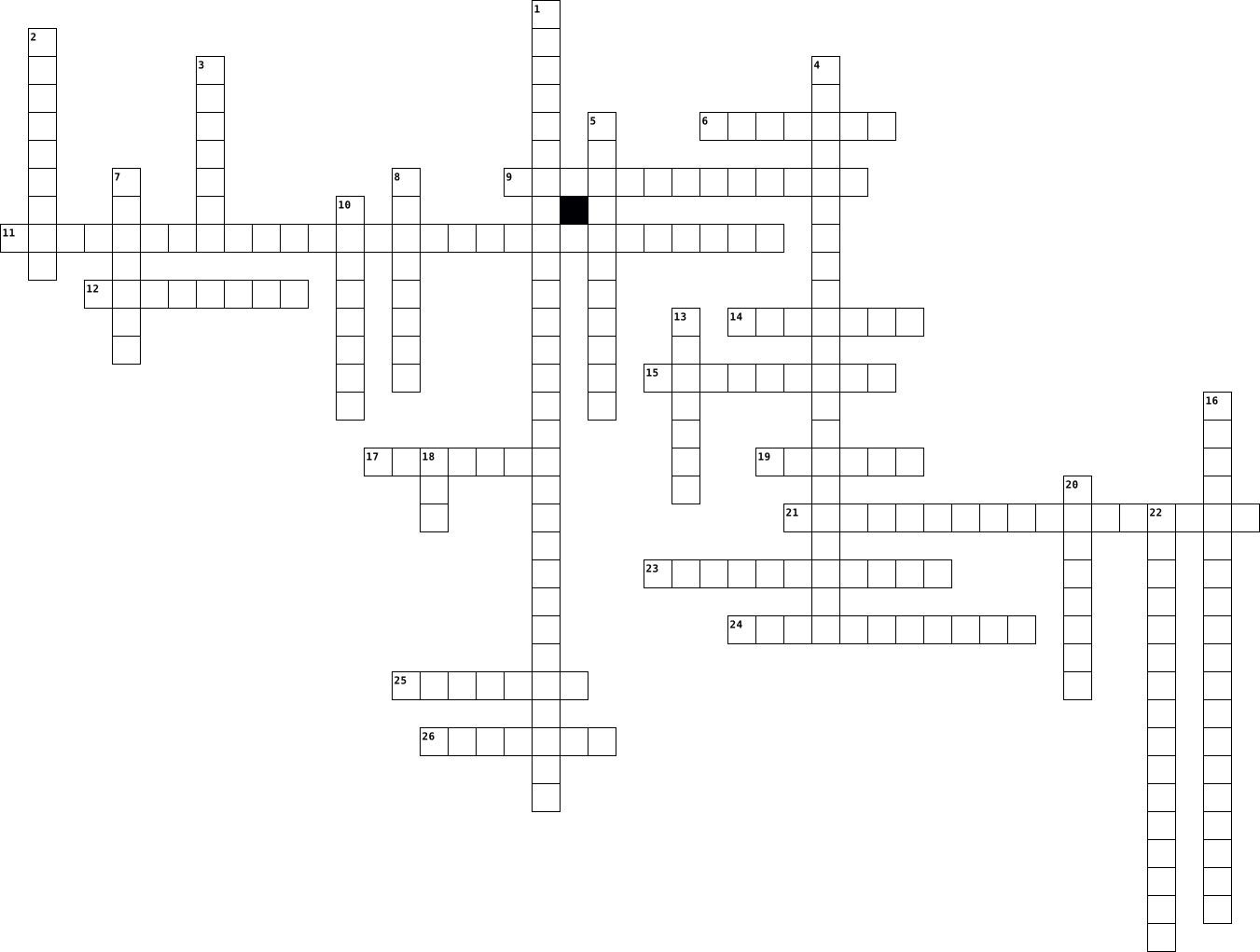
Across
- English TV Show | Initial names considered were 'Insomnia Cafe' and 'Six of One'
- Japanese TV Show | One of the MC's forms is based on a Japanese MMA fighter; another character's form is based on Brock Lesner
- English TV Show | Longest-running live-action sitcom in television history
- South Korean Movie | 1st non-English film to win the Academy Award for 'Best Picture'
- Indian Movie | Name loosely translates to 'fun' in English
- English Movie | The 2 MCs actually learned how to make soap
- Indian Movie | Features 3 MCs; Filmed partially in IIM Bangalore
- Hindi Movie | Last film of the Shakespearian Tragedy Trilogy Adaptation
- English TV Show | One of the lead actors is a trained magician, just like his character in the show
- Indian Movie | Humerous adaptation of 1992 American film 'Once Upon a Crime'; Set in Goa yet not filmed there; Guest appearance by PC
- English TV Show | Entered the Guinness World Records in 2013 as the most critically acclaimed TV show of all time
- Hindi Movie | Fardeen Khan's biggest hit
- Indian Movie | Lead actor's name (Rajiv) is also the same as the MC's name; Last screen appearance of Feroz Khan
Down
- Japanese TV Show | MC voiced by a female despite being a male; MC is teased for being short
- Japanese TV Show | Soundtrack uses many Greek references; The 2 MCs are both considered geniuses, yet depicted as polar opposites to each other
- Indian Movie |Lead actor plays a double role; Set against the backdrop of the Mumbai underworld
- Indian Movie | Filmed in Egypt, UK, Spain, India; Initial name was 'Running with the Bulls'
- Indian Movie | Inspired by a win at the 2002 Commonwealth Games
- Indian Movie | The 1st letters of the 4 MCs' names make up the title of the movie; Only 3 MCs return for the sequels
- English TV Show |Features 4 MCs; The group of MCs frequently visit a coffee shop
- Japanese TV Show | MC voiced by a female despite being a male; Based on the best-selling manga series
- Japanese TV Show | MC is teased for being short; Based on one of the best-selling manga series
- English TV Show | Features 4 MCs; Originated as a radio show
- Indian Movie | Remake of the 1978 film of the same name; Filmed primarily in Malaysia
- Indian Movie Remake of the 2nd highest-grossing Malayalam film of the same name
- English TV Show | MC's favourite number is 73, which coincides with the respective actor's birthyear 1973
26 Clues: Hindi Movie | Fardeen Khan's biggest hit • Indian Movie | Name loosely translates to 'fun' in English • English Movie | The 2 MCs actually learned how to make soap • English TV Show | Features 4 MCs; Originated as a radio show • Indian Movie | Inspired by a win at the 2002 Commonwealth Games • Indian Movie | Features 3 MCs; Filmed partially in IIM Bangalore • ...
tiger 2026-04-23

Across
- A metaphor is a comparison without the use of “like” or “as”. A direct relationship where one thing or idea substitutes for another.
- The placing of two things side by side so that similarities or differences between the two texts are made obvious.
- The use of specific objects or images to represent abstract ideas.
- The feeling or mood in a text; for example, an atmosphere of tension or danger in a thriller. Atmosphere is created by a combination of actions, characters and words or images used in a text.
- The repetition of consonant sounds within close proximity, usually in consecutive words within the same sentence or line.
- is a comparison where one thing or idea is described as being similar to another. Similes usually contain the words “like” or “as”.
- Compare by observing differences or opposites.
- The repetition of vowel sounds in nearby words for emphasis, e.g. ‘asleep in the deep’.
- implies the opposite of what is said. The intention is for the opposite to be understood. It is the tone which tempers or conveys this meaning. For example: “I can’t wait for my detention on Friday afternoon.”
- humour or to emphasise a point (e.g. She prepared enough food to feed an army.)
- is a pervading idea/message or focus that a text explores.
Down
- The “voice” of a poem; not to be confused with the poet him/herself.
- Specialist language of a particular trade, sport, pastime or area of study, for example, medical jargon.
- Where a specific word, phrase, or structure is repeated several times, usually in close proximity, to emphasize a particular idea.
- A recurring important idea or image. A motif differs from a theme in that it can be expressed as a single word or fragmentary phrase, while a theme usually must be expressed as a complete sentence.
- Mocking, cutting type humour that is personal in intent and aims to humiliate.
- Where future events in a story, or perhaps the outcome, are suggested by the author before they happen.
- A term used to describe a tendency or preference towards a particular perspective, ideology or result, when the tendency interferes with the ability to be impartial, without prejudice or objective. Bias is generally seen as a 'one-sided' perspective or prejudice.
- The running on of the thought from one line, couplet, or stanza to the next without a syntactical break (full stop, comma).
- A contradiction in terms (e.g. cold fire)
20 Clues: A contradiction in terms (e.g. cold fire) • Compare by observing differences or opposites. • is a pervading idea/message or focus that a text explores. • The use of specific objects or images to represent abstract ideas. • The “voice” of a poem; not to be confused with the poet him/herself. • ...
Things I Love About You: Identify the Opposites of the Listed Traits 2025-04-15

Across
- Weak
- Unreliable
- Unimaginative
- Disfavored
- Dull
- Unmagical
- Tranquilized
- Ordinary
- Boastful
- Ruthless
- Undeserving
- Churlish
- Repugnant
- Heedless
- Nondescript
- Boring
- Abrasive
- Humdrum
- Flavorless
- Idle
- Wavering
- Middling
- Objectionable
- Unifaceted
- Uncaring
Down
- Unremarkable
- Perfidious
- Mean
- Underwhelming
- Frosty
- Shifty
- Timid
- Apathetic
- Wavering
- Parsimonious
- Careless
- Impatient
- Knuckleheaded
- Reckless
- Irrational
- Flawed
- Languid
- Unfeeling
- Lackadaisical
- Inconsiderate
- Subdued
- Ordinary
- Disorganized
- Ordinary
- Repellent
50 Clues: Mean • Weak • Dull • Idle • Timid • Frosty • Shifty • Flawed • Boring • Languid • Subdued • Humdrum • Wavering • Careless • Ordinary • Reckless • Boastful • Ruthless • Churlish • Heedless • Ordinary • Abrasive • Ordinary • Wavering • Middling • Uncaring • Apathetic • Unmagical • Impatient • Unfeeling • Repugnant • Repellent • Perfidious • Unreliable • Disfavored • Irrational • Flavorless • Unifaceted • Undeserving • Nondescript • Unremarkable • Parsimonious • Tranquilized • ...
6th grade crossword 2020-12-11
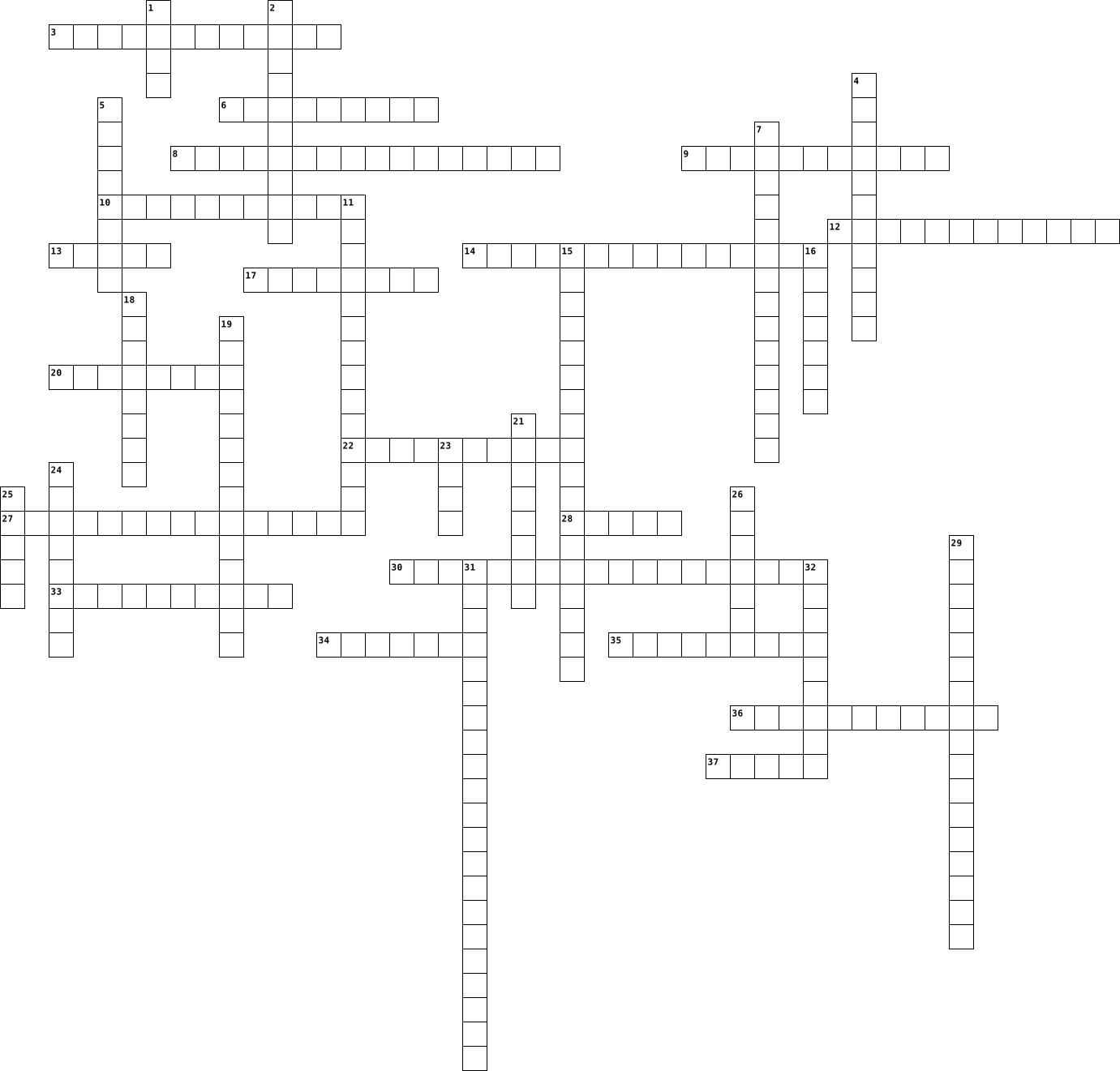
Across
- natural numbers and zero; they introduce zero (2 words, no space)
- decimals that repeat the same set of numbers
- a number whose numerator is bigger than its denominator (2 words, no space)
- a number that includes a whole number and a fraction (2 words, no space)
- the bottom part of a fraction
- shortcut used to find both the gcf AND the lcm for 2 or more numbers (2words, no space)
- adding zeros as place holders in a decimal expression
- a shortcut used to add and subtract fractions (2 words, no space)
- multiplication in disguise
- the result of a division problem
- the result of a division expression that has a denominator of zero (2 words, no space)
- ratios that compare two integers; they are written as fractions and include terminating and repeating decimals (2 words, no space)
- the direction a decimal moves when a number is multiplied by a power of 10
- the process of using a factor tree to find the prime factors of a composite number
- having the same value
- the result of multiplication
- a number that has more than 2 factors
- used to find the gcf for 2 or more numbers (2 words, no space)
- when converting fractions to decimals, the denominator must be a _____ of 10
Down
- the result of a division expression that has a numerator of zero
- multiplicative inverse
- decimals that end without repeating
- the top part of a fraction
- shortcut used to divide fractions (3 words, no spaces)
- doing math operations to whole number estimates of numbers to see if your answer makes sense
- the result of multiplying/dividing the numerator AND the denominator by the same number
- the bottom part of a fraction
- the result of multiplying a factor by a whole number
- the counting numbers; these are the first numbers learned, and they introduce positive numbers (2 words, no space)
- to reduce a fraction to its lowest terms by removing all common factors from the numerator and denominator
- the direction a decimal moves when a number is divided by a power of 10
- natural numbers, their opposites, and zero; these are the numbers on the number line, and they introduce negative numbers
- a number that has only 2 factors, 1 and itself
- numbers that are multiplied together to get a product
- when adding and subtracting fractions, the fractions must have a _____ (2 words, no space)
- reciprocal (2 words, no space)
- the top part of a fraction
37 Clues: having the same value • multiplicative inverse • the top part of a fraction • multiplication in disguise • the top part of a fraction • the result of multiplication • the bottom part of a fraction • the bottom part of a fraction • reciprocal (2 words, no space) • the result of a division problem • decimals that end without repeating • a number that has more than 2 factors • ...
6th Grade Staar Vocabulary II 2022-04-05

Across
- a graph that measures the spread of the data, including the minimum the first quartile the median the this quartile and the maxim
- and leaf, a plot that splits a number into a leaf and displays multiple values in a concise form
- a quadrilateral with one set of parallel sides
- a card that allows you to pay the balance over a period of time subject to interest
- a graph that displays the data into ranges
- the amount of money paid on a loan or an investment
- the sum of a number and zero is the number the produce of a number and zero
- a loan set up in order to help college students pay for situation pay for tuition books and living expenses
- a form of financial aid based on need provided by the government that does not have to be repaid
- the removal of money from a bank account
- a mathematical phrase with numbers variables and operators
- the amount of space a three-dimensional objects occupies
- moving money from one account to another
- numbers can be added or multiplied by moving the parentheses (grouping)
- an addition of money into a bank account
- the range of data
- the covering of a two-dimensional shape
- a number that has factors other than 1 and itself
- a measure of variability the difference between the first and the third quartiles
- a three-sided polygon with a sum of 180° in the angle measures
Down
- numbers can be added or multiplied in any order
- having the same shape and same size
- a statement in which two mathematical expressions are equivalent
- a three-dimensional object with two rectangular bases
- a four-sided polygon
- terms within an expression can be expanded to form an equivalent expression
- a card that immediately deducts funds from your checking account
- a measure of center found by ordering the values from least to greatest and determining the middle number
- describes the type of graph including symmetric and skewed
- a quadrilateral with opposites sides parallel and opposite sides congruent
- a financial aid program in which a college student works to pay money towards their tuition
- equal
- a plot that is used to compare frequency
- a sum of money that is awarded on merit to help offset the cost of college
- a statistical measure of data often the mean or median
- a number that only has a factor of 1 and itself
36 Clues: equal • the range of data • a four-sided polygon • having the same shape and same size • the covering of a two-dimensional shape • the removal of money from a bank account • moving money from one account to another • a plot that is used to compare frequency • an addition of money into a bank account • a graph that displays the data into ranges • ...
math 2017-05-19

Across
- Each value in a matrix also called an element 17
- A rectangular array of numbers 23
- -Value Function A function whose rule contains absolute- value expressions 1
- An equation that has no solutions 10
- angle An angle that measure greater than 0 and less then 90 3
- The point that divides a segment into two congruent segments 26
- A monomial or a sum or difference of monomials 33
- system of equations A system in which at least one of the equations is not linear 29
- set- A set with no elements 16
- A statement that two ratios are equal a/b=c/d 35
- An indicated root of a quantity 38
- of variation A measure that describe the spread of a data set 25
- sample A sample that does not fairly represent the population 4
- The closeness of a given measurement 2
- square A number whose positive square root is whole number 31
- The sum of all the values in a data set divided by that describes the center of a data set24
- A survey of an entire population 7
Down
- of a set- An item in a set 15
- model A quadratic function used to represent a set of data 37
- number A counting number 28
- A compound statement that uses the word or 13
- factor- The base 1+r in an exponential expression 19
- imaginary number See imaginary number 36
- A polynomial with two terms 5
- The discriminant of the quadratic equation ax^2+bx+c=0 is b^2-4ac 12
- events An event made up two or more simple events 9
- A member of the set of whole numbers and their opposites 20
- The distance around a circle 8
- set- A set with an unlimited, or infinite number of element 22
- Factor The base 1 - r in an exponential expression 11
- The expression under a radical sign 39
- The set of all possible input values of a relation or function 14
- A measure of the steepness of surfaces, expressed as percent 18
- of a hyperbola One of the two symmetrical parts of the hyperbola 6
- A possible result of a probability experiment 30
- shift A horizontal translation of a periodic function 32
- A comparison of two quantities by division 40
37 Clues: number A counting number 28 • of a set- An item in a set 15 • A polynomial with two terms 5 • The distance around a circle 8 • set- A set with no elements 16 • A rectangular array of numbers 23 • An indicated root of a quantity 38 • A survey of an entire population 7 • An equation that has no solutions 10 • The expression under a radical sign 39 • ...
Literary Terms Crossword Puzzle 2015-06-14

Across
- Looking back on events that happened in the past in order to better understanding the events occurring in the present.
- The part after the story ends that provides a further explanation.
- The various sentence structures, sentence lengths, word choices, and word placement choices that creates the "personality" of a character.
- When a fictional situation, person, or thing represent something very close to reality.
- A deliberate overstatement that affects the reader so they can better understand an idea.
- When the definition of a word is defined by culture or one's personal feelings rather than its dictionary definition.
- The attitude of a writer towards his story.
- Making a comparison using LIKE or AS in order to describe an unknown person or situation.
- The description of a person: appearance, actions, thoughts, etc.
- Something or someone that stops the main character from achieving their goal.
- The feeling of a story.
Down
- Putting two opposites next to each other in order to make some element in one even more noticeable.
- The struggle between two or more people or situations.
- Some object, person, idea, or situation that carries meaning beyond it literal definition.
- Purposely withholding information, while delivering just enough to keep the audience questioning but still not able to solve the mystery.
- A repeatedly appearing message or lesson of a story.
- Purposely under-exaggerating a situation for affect.
- Giving non-human items or situations human actions and emotions.
- The negative event or situation that can be traced to a flaw in a character who suffers for it.
- When an author describes something in such a way that it connects to one of the reader's five senses.
- The description of an unknown or unclear person or situation by stating that it "is" some other person or situation for the understanding of the reader.
- Deliberate over-wording in order to show the mood of a character or story.
- To give the reader or audience a hint of events that will occur sometime in the future of the story.
- Two things or situations that can't possibly co-exist but actually do.
- The "polite" and "softer" version of words that relieve the situation of the more "negative" truth.
- When the opposite of what you expect is going to happen actual happens.
- The person or thing that stands to defeat some other person or thing.
27 Clues: The feeling of a story. • The attitude of a writer towards his story. • A repeatedly appearing message or lesson of a story. • Purposely under-exaggerating a situation for affect. • The struggle between two or more people or situations. • Giving non-human items or situations human actions and emotions. • ...
Literary Terms Crossword Puzzle 2015-06-14

Across
- Something or someone that stops the main character from achieving their goal.
- The description of an unknown or unclear person or situation by stating that it "is" some other person or situation for the understanding of the reader.
- Looking back on events that happened in the past in order to better understanding the events occurring in the present.
- The "polite" and "softer" version of words that relieve the situation of the more "negative" truth.
- The struggle between two or more people or situations.
- Giving non-human items or situations human actions and emotions.
- Deliberate over-wording in order to show the mood of a character or story.
- The feeling of a story.
- A repeatedly appearing message or lesson of a story.
- The part after the story ends that provides a further explanation.
- Putting two opposites next to each other in order to make some element in one even more noticeable.
- When the definition of a word is defined by culture or one's personal feelings rather than its dictionary definition.
- The person or thing that stands to defeat some other person or thing.
Down
- A deliberate overstatement that affects the reader so they can better understand an idea.
- Making a comparison using LIKE or AS in order to describe an unknown person or situation.
- When a fictional situation, person, or thing represent something very close to reality.
- To give the reader or audience a hint of events that will occur sometime in the future of the story.
- The description of a person: appearance, actions, thoughts, etc.
- Purposely under-exaggerating a situation for affect.
- When the opposite of what you expect is going to happen actual happens.
- When an author describes something in such a way that it connects to one of the reader's five senses.
- The negative event or situation that can be traced to a flaw in a character who suffers for it.
- Two things or situations that can't possibly co-exist but actually do.
- Purposely withholding information, while delivering just enough to keep the audience questioning but still not able to solve the mystery.
- The attitude of a writer towards his story.
- The various sentence structures, sentence lengths, word choices, and word placement choices that creates the "personality" of a character.
- Some object, person, idea, or situation that carries meaning beyond it literal definition.
27 Clues: The feeling of a story. • The attitude of a writer towards his story. • Purposely under-exaggerating a situation for affect. • A repeatedly appearing message or lesson of a story. • The struggle between two or more people or situations. • The description of a person: appearance, actions, thoughts, etc. • ...
STAAR VOC. 1-25 2016-03-26

Across
- and contrast/ signal words include / like; unlike; but; in contrast; on the other hand; however; both; also; too; as well as; although; yet; nevertheless; as opposed to; whereas
- the turning point in the action of a story--the problem is solved (highest point of action)
- place assertion/ a statement that many people assume to be true/ though it may or may not actually be true (Example/ crop circles are created by aliens)
- words that are opposites (happy and sad)
- a succinct statement of a philosophy or principle; often quoted (a penny saved is a penny earned)
- the story of a persons life written by that person in first person point of view
- emotional meaning of a word--how it makes you feel (can be positive or negative--Example/ hes a big guy OR hes SO fat!)
- the repetition of consonant SOUNDS at the beginning of words. For example/ Sally sells seashells by the sea shore.
- clues/ Clues in surrounding text that help the reader determine the meaning of an unknown word (look above/ in/ below/ and all around the text of the unfamiliar word)
Down
- a set of letters attached to the beginning or the end of a root word that changes the words meaning
- To feel excited and nervous at the same time.
- a word relationship that compares two dissimilar things (pen / writer / hammer / carpenter (make a bridge sentence with the first set--a pen is used by a writer just like a hammer is used by a carpenter)
- small text found near a picture that provides important information about the picture
- the struggle or problem in the story that a character must resolve
- purpose/ The reason the author has for writing. (Inform/ persuade/ express/ explain & entertain)
- a character trait used to describe someone who feels good about him/ herself.
- order/ in the time order in which events happened (sequence or time order)
- Who the piece of text was originally written for. Example/ in a letter/ look at who the letter is addressed to (Dear Mom)
- an exaggerated/ overly simplified version of an opposing point of view (features of a person enlarged--frequently used in cartoons--Example/ President Obama with large ears or huge teeth)
- and effect/ problem and solution/ signal words include/ therefore; consequently; so; this led to; as a result; because; if...then; since; so that; thus; for this reason;
20 Clues: words that are opposites (happy and sad) • To feel excited and nervous at the same time. • the struggle or problem in the story that a character must resolve • order/ in the time order in which events happened (sequence or time order) • a character trait used to describe someone who feels good about him/ herself. • ...
Algebra Readiness 2016-05-19

Across
- A rate that has a denominator of 1 unit
- A number or expression using a base and an exponent
- A change in position or size
- A transformation that shrinks or stretches a figure
- Natural numbers, their opposites and "0"
- Pair of angles immediately next to each other with one side in common
- Two numbers whose product is 1
- Pair of angles directly opposite of each other formed by the intersection of straight lines
- Answer when you divide
- The answer when you add
- The result when you actually toss a coin 100 times is called
- Number of favorable outcomes divided by the total of all possible outcomes
- One part of an expression that includes a number, a variable, or product of both
- The distance from zero on the number line
- A letter used to represent a number in equations or expression
- Distance from the center of the circle to the edge
- Two angles whose sum is 180◦
- A ratio of 2 measures that have different units
- Two angles whose sum is 90◦
- Grouping Symbols, Exponents, Multiply & Divide, Add & Subtract
- The answer when you subtract
- A mirror view
Down
- Same size and shape
- An exchange from one unit of measure to another
- The mathematically calculated chances of a specific event occurring
- Tells how many times a number is used as a factor
- Total area of the surface of a 3D object
- Uses numbers, variables, and operation symbol
- Comparison of two numbers or expressions using >, <, ≤, ≥, or ≠
- The constant value of the ratio of 2 proportional quantities (x & y)
- Any natural number and "0"
- a(b + c) = ab + ac shows
- The answer when you multiply
- Distance around a circle
- Total area of the surface of a 3D object excluding the bases
- A ratio of 2 integers where the denominator ≠ "0"
- An angle that measures 180◦
- The number or expression in a power that is multiplied by itself
- To move a figure in any direction without rotation
- A comparison of numbers or variables that can be written in fraction form
- A ratio of corresponding side lengths are proportional
- An equation stating 2 ratios are equal
- Distance across the circle passing through the center
43 Clues: A mirror view • Same size and shape • Answer when you divide • The answer when you add • a(b + c) = ab + ac shows • Distance around a circle • Any natural number and "0" • An angle that measures 180◦ • Two angles whose sum is 90◦ • A change in position or size • The answer when you multiply • Two angles whose sum is 180◦ • The answer when you subtract • Two numbers whose product is 1 • ...
Language Devices 2024-01-12

Across
- Where one thing is used to represent something else: a rose to represent love.
- The general feeling created by the poem.
- Words with the same sound pattern: gloom and room.
- 10 syllable heart-beat-like rhythm: da DUM, da DUM, da DUM, da DUM, da DUM.
- The feelings of the poet or speaker towards the presented topic: tragic, harmonious, hopeless, intriguing.
- Saying something is something else.
- A question asked in order to create a dramatic effect or to make a point rather than to get an answer.
- The occurrence of the same letter or sound at the beginning of closely connected words.
- The repetition of vowel sounds in closely connected words.
- A list where all the items are separated with ‘and’.
- The feelings of the reader towards the presented topic: nostalgic, optimistic, joyful, sympathetic.
- The literal meaning of a word.
- Giving emotions to things that are not human, often using weather to create atmosphere.
- Paragraph or section in poetry.
- Visually descriptive or figurative language.
- Words that all link to one particular topic.
- The repetition of consonant sounds in closely connected words.
- Speaking directly to the reader using the pronoun ‘you’.
- The repetition of the ‘s’, ‘sh’, ‘z’ sounds in closely connected words.
Down
- Two things being seen or placed close together with a contrasting effect: light next to dark.
- Saying something is like something else.
- Contradictory terms appear together to create one overall meaning: He was falsely true.
- The main idea or story that the poet intends to convey.
- A punctuated pause in the middle of a line of poetry: : ; - .
- Offering hints at future events.
- Giving animal-like features, actions to non-human things.
- One line or stanza flows to the next without any punctuation at the end of the line.
- Giving human-like features and feelings to non-human things.
- The thoughts, feelings, meanings we associate with a word.
- A list where there is no conjunction (and).
- The length of sentences or the way sentences are formed.
- Language and descriptions using the five senses
- Three phrases in succession.
- The voice of the poem, like a narrator. Sometimes this is the poet, other times not.
- Words that mimic the sound they represent.
- Opposites placed close or across a text to highlight differences or change.
36 Clues: Three phrases in succession. • The literal meaning of a word. • Paragraph or section in poetry. • Offering hints at future events. • Saying something is something else. • Saying something is like something else. • The general feeling created by the poem. • Words that mimic the sound they represent. • A list where there is no conjunction (and). • ...
Unit 1 Chapters 1-4 2023-12-12

Across
- The dynasty known for gaining control of china and unifying it.
- The way a new item or idea is spread from culture to culture.
- Introduced the first pyramid.
- The "Cradle of civilizations"
- Ancient Iranian people.
- An Assyrian king that tried to invade Jerusalem.
- The sponsor of one of Egypt's most successful trading expeditions.
- Made the first organized library
- A Nubian kingdom
- Brings together several people, nations, or previously independent states under one ruler.
- Manufactured advanced iron goods
- One of the most famous pharaoh's known for his military strength.
- Movement from one place to another
- A series of rulers from a single family
- A Chinese ethical system.
- book from Confucius about Taoism.
- The people who lived in eastern Europe and central Asia thousands of years ago.
- A kingdom in Egypt ran by pharaohs.
- The "advocation of humility and religious piety".
- A Chinese influential scholar
- The forth letter of the Greek alphabet.
- The act of respecting parents
- "The creator" in Hinduism
Down
- An ancient Egyptian pharaoh of the early dynastic periods.
- A group that captured the Jews as a manifestation of the wrath of God.
- The belief in multiple gods.
- Writing consisting of hieroglyphs(images)
- A city that with its surrounding territory forms an independent state.
- Longest reigning king in the Babylonian dynasty.
- The ruler in Buddhism.
- A ruler in ancient Egyptian times.
- "asia minor"
- Emperor of the Qin Dynasty.
- 4 collections of prayers, magical spells, and instructions for performing magical spells.
- A system of government in which priests rule in the name of God or gods.
- A writing surface used in ancient times from the stem of a papyrus plant.
- The process used in preserving bodies as a mummy.
- The Balance of two opposites working in harmony.
- Known for conquering all of Syria.
- Known for its rich deposit of gold along the Nile River.
- The capital of the Assyrian empire.
- A way of dividing society up.
- Area close to the red sea.
- The "Birthplace of writing"
- An ancient civilization that God punished for being to prideful and arrogant.
- "rulers of foreign land".
- A 3 dimensional shape that ancient Egyptians used in their architecture.
- a former Babylon ruler known for his rules.
- A single person who holds all the power for the whole country.
49 Clues: "asia minor" • A Nubian kingdom • The ruler in Buddhism. • Ancient Iranian people. • A Chinese ethical system. • "rulers of foreign land". • "The creator" in Hinduism • Area close to the red sea. • Emperor of the Qin Dynasty. • The "Birthplace of writing" • The belief in multiple gods. • Introduced the first pyramid. • The "Cradle of civilizations" • A way of dividing society up. • ...
VOCAB 2023-12-12

Across
- We were complete opposites, and the project became a battle due to our clashing ideas.
- He was everyone's role model, efficient, kind, charming, everything we aspired to be.
- I was offended by the prospect of learning at my age, but I obliged and signed up for the class, hoping to meet more people.
- She keeps misusing WTF, I wonder if she knows what it stands for.
- She was shockingly obedient, a sort of submission I'd never seen from her until we spoke to her mother
- Her teaching was dogmatic and left me nearly falling asleep in the pews.
- We began our plan, holding secret meetings to get on the same page.
- She was always asking more questions than necessary, but I had gotten used to her paranoia.
- He scanned her coat, searching for messy stains, but was impressed to see it was pristine.
- I was tired of the nerdy student's nagging, as she'd interrupt me when I tried to speak to my friend, but the teacher thought she was a perfect role model.
- She said it'd be weird to put flowers into the cake instead of on it, and I laughed, explaining that I meant flour, not flowers.
- He wrote a tremendous paper to push his new studies on Bigfin Squids.
Down
- The intern felt his job wasn't good enough; he wanted to be an actual employee.
- Go, grow, and glow groceries are sold by the road.
- She's been improving; I believe she's finally exiting that dark place she's been stuck in.
- He couldn't stand her, and often told her to shut up because of her "grating voice"
- She claimed I was embarrassing her because my attire didn't fit with the fancy party.
- I couldn't believe the quality of the cake; having spent 200 dollars on it, I was adamant about a refund.
- I was always charmed by the excitement he conveyed when coming to class.
- Maybe we'll eat Asian, but I'm okay with Mexican as well!
- I used to be a big fan of Doctor Who, I loved how jarringly out of place the Doctor looked in the different universes.
- A plan made for a teacher, "Man, Hartmann's ___ has been difficult this semester!"
- This semester has had an effect on my mood as a whole.
- The way sales skyrocketed was terrific, said our manager.
- We loved Tupac's music and were shocked to hear that there was new music under his name despite his recent death.
25 Clues: Go, grow, and glow groceries are sold by the road. • This semester has had an effect on my mood as a whole. • Maybe we'll eat Asian, but I'm okay with Mexican as well! • The way sales skyrocketed was terrific, said our manager. • She keeps misusing WTF, I wonder if she knows what it stands for. • We began our plan, holding secret meetings to get on the same page. • ...
World of Make Believe 2023-06-20

Across
- someone, often a woman, involved in the practice of black magic with the help of a familiar
- creature in Greek mythology that was part fire-breathing lion, part goat, and part snake
- these tiny creatures are similar to fairies but do not have wings
- believed in medieval times to change other metals into gold
- this legendary monster is often depicted as a large, grotesque creature that feeds on infants & children
- in Swiss mythology, these are earth creatures often depicted as old men guarding mines & treasures
- the soul or spirit of one who is deceased
- a short story often personifying animals and teaching a particular moral
- the magical ability to discern information about a person or place through ESP
- a supernatural entity whose purpose is to protect and assist witches
- a priest/priestess who offers guidance by communing with the gods
- aka a magician, or someone whose magic derives from arcane sources
- in Greek mythology, these beings were born of a love affair between Uranus & Gaia
- in Germanic folklore, this humanoid creature is a small, mischievous fairy
- solitary humanoid beings in Norse mythology who live in caves
Down
- popular legendary creature described as a beast like a horse with a single, spiraling horn upon its head
- in mythology, this creature is a person who changes into a wolf during full moons
- a mythical creature who feeds on the blood of the living
- a mischievous fairy in Irish folklore often depicted as a small bearded man
- a type of magic involving communing with and resurrected the dead, often to be used in spell-work
- mythical fire-breathing reptilian monster, often depicted with wings
- a magical entity who puts people to sleep with a magical sand
- used by soothsayers to see the future
- these creatures are the evil opposites of other fairy types, and often live in grottoes
- in folklore, this creature is a type of fairy that lives in mountains and mines
- in pagan folklore, these beings are often considered to be nature spirits
- a creature from folklore, believed to be a fairy left in the place of an abducted child
- another term for someone who can foresee the future
- short for extrasensory perception, a 6th sense that gleans information perceived through the mind
- in Germanic folklore, these small creatures are attendants of the Devil
30 Clues: used by soothsayers to see the future • the soul or spirit of one who is deceased • another term for someone who can foresee the future • a mythical creature who feeds on the blood of the living • believed in medieval times to change other metals into gold • a magical entity who puts people to sleep with a magical sand • ...
Ancient China 2022-12-12

Across
- A site you can go on to help you with this; the site where I got this information
- A style of writing that was considered an art form using brushes to paint the characters
- Another warrior took up the role as khan and kicked Temujin and his family from the tribe
- A type of baked clay ceramic; life-size soldiers were made out of this
- Unlucky number because in Chinese it sounds like "wants to die"
- It symbolizes good luck and happiness
- Born in Venice, Italy; game named after him
- Lucky number in China; considered one of the most unlucky number in the USA
- The Shang Dynasty is here
- The Chinese have a saying "Good things come in pairs"
- Opposites that are balanced throughout nature; like "light and dark" "hot and cold" "male and female"
- An important invention that was used for fireworks and weapons such as bombs and guns
- A type of ceramic invented by the Chinese; it is thin, strong, and beautiful; it is often called "china" in the west.
- An ancient Chinese treatment for healing that uses needles placed in various areas of the skin
- The three most important art forms of Ancient China: painting, poetry, and calligraphy
Down
- It would guard Shihuangdi when he died
- Most people wore their hair like this; even men because this was a sign of respect toward their parents
- Stands for immortality
- A fast growing grass that grows very tall and with hollow stems like a tube
- She placed spies everywhere; loyal people were rewarded and enemies were killed
- If you are the smartest person in the room, then you are in the wrong room
- Said at weddings because it sounds like the Chinese word "long life"
- She led some armies
- Only the emperor could wear this color
- A trade route that ran from northern China to Europe
- Not considered a lucky color; was the color worn while mourning
- The Shang King
- A type of Chinese sailboat
- It is the color of heaven and was the favorite color of the first emperor of China
- A religion or philosophy based on the teaching of Confucius
- Was often considered a punishment and was sometimes used for prisoners
- Unlucky number because in Chinese it sounds like "death"; elevators don't have any levels with this number
32 Clues: The Shang King • She led some armies • Stands for immortality • The Shang Dynasty is here • A type of Chinese sailboat • It symbolizes good luck and happiness • It would guard Shihuangdi when he died • Only the emperor could wear this color • Born in Venice, Italy; game named after him • A trade route that ran from northern China to Europe • ...
Midterm Vocab 2022-12-13

Across
- Enlargement or reduction of a figure.
- A number times the same number three times
- Any number that can be made with a fraction
- A line that intersects two or more parallel lines at different points.
- The number in which should equal it’s first number. For instance, 7 x 7 = 49. 49/7 = 7.
- The amount of space in a cone.
- All the positive numbers that are counting numbers plus zero.
- line When an image reflects through a line.
- a number that is not a fraction.
- A method used to express long and small numbers much easier.
- The amount of space in a cylinder.
- Two adjacent angles that form a straight line.
- Anytime you move, shrink, or enlarge a figure you make a transformation.
- When two different problems are identical to each other.
- The amount of space in a sphere.
- The 2 numbers that should equal to the right triangle hypotenuse.
- Flipping a shape or figure
- Congruent alternate interior angles that are opposites of the side of the transversal between two lines.
- Congruent opposite angles that share the same vertex directly across each other.
- The longest side of a right triangle.
- A ratio of a figure that is in its simplest form.
- The number a point represents
Down
- A straight line that appears in a circle
- When all 3 integers are positive.
- Numbers that are inside an angle that are on the same side.
- Numbers that are outside an angle that are on the same side.
- Congruent opposite sides of a transversal outside the lines. Has an exterior, different size, and looks alike.
- Two angles that occupy corresponding positions. They match up in location. They are also congruent.
- The side length
- all of the counting numbers.
- number that is the volume of a cube.
- A two-dimensional plane formed by an intersection of 2 number lines.
- When a point of a figure slides to the same distance and same direction.
- An expression that uses a root. Roots like Square and Cube root.
- When a point on a figure is turned around to another point.
- When the sides of a shape represent the same amount with different letters.
- Any number
- Numbers that cannot be writing as a fraction
- A number times the same number two times
- A symbol that indicates a number times a number
- equal size and shape
41 Clues: Any number • The side length • equal size and shape • Flipping a shape or figure • all of the counting numbers. • The number a point represents • The amount of space in a cone. • a number that is not a fraction. • The amount of space in a sphere. • When all 3 integers are positive. • The amount of space in a cylinder. • number that is the volume of a cube. • ...
Rational Numbers and Operations Vocabulary 2023-08-28

Across
- the number the dividend is being divided by
- a number in the form where a and b are whole numbers and b is not equal to zero. A fraction can be used to name part of an object, part of a set of objects, to compare two quantities, or to represent division
- a quantity that is used to multiply by a given quantity which results in the product of one
- a number in the form where a and b are whole numbers and a < b where b is not equal to zero
- efficient application of procedures with accuracy
- the total when two or more factors are multiplied
- a decimal number that has digits that end
- a number being added or joined together with another number(s)
- the part of a fraction written below the fraction bar that tells the total number of equal parts in a whole or set
- the part of a fraction written above the fraction bar that tells the number of fractional parts specified or being considered
- a number in the base-10 place value system used to represent a quantity that may include part of a whole and is recorded with a decimal point separating the whole from the part
- the set of counting (natural numbers), their opposites, and zero {–n, …, –3, –2, –1, 0, 1, 2, 3, ..., n}. The set of integers is denoted by the symbol Z.
Down
- d ecimal number with a digit (or group of digits) that repeats forever
- the number that is being divided
- the remaining amount after the subtrahend has been subtracted from the minuend
- the mathematical ability to reason, apply, understand, compute, and engage in meaningful mathematics
- the size or measure of each group or the number of groups when the dividend is divided by the divisor
- a number multiplied by another number to find a product
- a number in the form where a and b are whole numbers and a > b where b is not equal to zero
- the total when two or more addends are joined
- a number that is composed of a whole number and a fraction
- the set of numbers that can be expressed as a fraction , where a and b are integers and b is not equal to zero
- the set of counting (natural) numbers and zero {0, 1, 2, 3, ..., n}
23 Clues: the number that is being divided • a decimal number that has digits that end • the number the dividend is being divided by • the total when two or more addends are joined • efficient application of procedures with accuracy • the total when two or more factors are multiplied • a number multiplied by another number to find a product • ...
Rings and Metals 2023-09-22

Across
- Two-line torch that allows for adjustment of the proportion of fuel to oxygen
- Two-dimensional object
- Inexpensive yellow metal made from the combination of copper and zinc
- Mark with direction and length
- A word that means "combination" of metals
- Organized repetition of elements in an artwork
- the smoothest grit sandpaper
- Tool used to create a complex curve "like a cupping form"
- Red elemental metal that is soft and flexible
- Measures the thickness of a wire or sheet metal
- Grey elemental metal, used in alloys to lower the melting temperature
- General term for an object containing height, width, and depth
- Steel surface used forging or reshaping meal
- Desired balance of fuel to air in a flame
- Solder that contains the most zinc and therefore has the lowest melting temperature
- Insulated steel rod used in soldering
- With a variety of profiles, used to remove execs s Cone-shaped
- Principle of opposites used in artwork
- Flame with proportionately more fuel (loose yellow flame)
- Paste made of borax and water used to draw oxygen and aid the flow of solder
- Grittier compound used for buffing
- Machine used to even out the ends of metal in preparation for connecting in the “D position”
- Surface quality of an object perceived through touch
Down
- Finishing touches and neatness of a work of art
- Collection of increasing metal loops used to measure the circumference of fingers
- Heat-resistant tool to hold metal while soldering
- Flame with proportionately more air (aggressive blue, dirty flame)
- Has the highest melting temperature of all the solders
- Versatile tool for sanding the inside of rings, grinding, drilling, etc.
- Combination of fine silver and copper that melts at 1640 degrees
- Cone-shaped tool used for rounding out a ring and measuring the circumference
- The roughest grit sandpaper used to remove deep file marks
- Creamier compound for polishing
- Element of art that describes light falling on an object, or the range from light to dark
- Process of heating metal and exciting the molecules
- A hand-held tool used to "impress" a design on the surface of metal
- Hard, silver colored metal made from a combination of copper, nickel and zinc
- Tank of compressed gas used to produce a small consistent flame
- Wooden tool clamped to a working surface to support metal while filing or sawing
- Mild acid solution to remove oxidation after soldering
40 Clues: Two-dimensional object • the smoothest grit sandpaper • Mark with direction and length • Creamier compound for polishing • Grittier compound used for buffing • Insulated steel rod used in soldering • Principle of opposites used in artwork • A word that means "combination" of metals • Desired balance of fuel to air in a flame • Steel surface used forging or reshaping meal • ...
Literary Terms -- Examples 2025-03-25

Across
- “I think so,” said Professor McGonagall dryly, “we teachers are rather good at magic, you know.”
- “Speech is silver, but silence is gold.” The two opposites, speech and silence, are compared to one another by using the stratified value of silver and gold.
- nature and fire in Frankenstein; the green light, eyes, and cars in The Great Gatsby
- When the Iliad begins, the Trojan War has already been going on for seven years.
- “His temper was his Achilles’ heel,” “You are my kryptonite”
- Romeo compares Juliet’s body to a boat in a storm, her eyes to a sea, her tears to a storm, and her sighs to the stormy winds.
- In Fahrenheit 451, Montag realized that Captain Beatty had wanted to die rather than live in their society after he had killed him.
- In the Odyssey, Odysseus tells King Alcinous about his encounter with the Cylcops.
- "The sun shone on the field, as bright as a thousand candles" – The Great Gatsby
- night and day, good and evil
- “Less is more,” “The only constant is change,” “The more you give, the more you get”
- Tom to Gatsby, Banquo and Macduff to Macbeth
- “All the world’s a stage, and all the men and women merely players” (As You Like It).
Down
- “I am alone I want to be the two of us I want the join I come out of blue water after the bottoms of my feet swim away from me I come up I need to find a place to be the air is heavy I am not dead I am not” – Beloved, Toni Morrison
- When the audience knows that Juliet is alive, but Romeo does not.
- In Of Mice and Men, Lennie’s accidental killing of the mouse in his pocket hints at the accidental death of Curley’s wife.
- When Mark Antony refers to Caesar’s assassin as “an honorable man” in Shakespeare’s Julius Caesar.
- “The wind whispers through the trees.”
- “It’s so fluffy I’m gonna die!” – Despicable Me
- American Airlines, Best Buy, Coca-Cola
- Hamlet’s famous “To be or not to be” speech, performed alone onstage
- a fire station burns down; a pilot has a fear of heights
- Victor Frankenstein evolves from an ambitious, naive scientist to a guilt-ridden, disillusioned man consumed by the consequences of his actions.
- “No pain, no gain,” “I came, I saw, I conquered”
- “The woods are lovely, dark and deep” (Robert Frost). Note the comma, marking a significant pause in the middle of the line.
25 Clues: night and day, good and evil • “The wind whispers through the trees.” • American Airlines, Best Buy, Coca-Cola • Tom to Gatsby, Banquo and Macduff to Macbeth • “It’s so fluffy I’m gonna die!” – Despicable Me • “No pain, no gain,” “I came, I saw, I conquered” • a fire station burns down; a pilot has a fear of heights • ...
POETRY terms to PWN 2025-03-26

Across
- opposing ideas are placed in sharp juxtaposition (near each other)
- the same conjunction is used repeatedly (and, but, or…)
- an extreme exaggeration
- words that mimic the sound described
- statement that seems to be contradictory but may still be true
- language that appeals to senses: sight, sound, touch, smell, taste
- giving a human personality to animals or non-human things
- continuation of a sentence from one line of poetry to the next
- a self-contradicting word or phrase; opposites near each other
- a poem that's typically 14 lines long and uses a specific rhyme scheme and meter
- poem in which the first letter of each line spells out a word
- reference to historical text/ person/ event (often biblical)
- one word applies to two others in different senses
- a pair of successive rhyming lines, usually of the same length
- unrhyming iambic pentameter, also called heroic verse
- a short, three-line poem with a 5-7-5 syllable structure
- the formal definition of a word
- 2+ elements of a sentence have the same grammatical structure
- an often unconventional, logically complex, or surprising metaphor
- the implied or associated meanings a word carries beyond its literal definition
- repetition of words/phrases in clauses, sentences or poetic lines
- the use of detailed description of a work of visual art as a literary device
- making a situation seem less important or serious than it is
Down
- poetry that does not rhyme or have a regular meter
- rhyming words that fall in the middle of a line of poetry
- comparison using “like” or “as”
- the rhythmical pattern of stressed and unstressed syllables in verse
- words/ phrases that are stated, then repeated in reverse order
- polite, indirect expressions that soften an uncomfortable topic
- repetition of vowel sounds in syllables near each other
- two words that sound the same, but have different meanings
- briefly assigning human traits to something non-human
- repetition of similar consonant (non vowel) sounds
- direct comparison between two unlike things
- the ordered pattern of rhymes at the ends of the lines of a poem or verse
- a 19-line poem with a specific structure
- repeating first letter (sound) of words in a line, phrase, sentence
- word choice
- speaker addresses an object, idea, or someone who isn't alive
39 Clues: word choice • an extreme exaggeration • comparison using “like” or “as” • the formal definition of a word • words that mimic the sound described • a 19-line poem with a specific structure • direct comparison between two unlike things • poetry that does not rhyme or have a regular meter • repetition of similar consonant (non vowel) sounds • ...
Vocab #3 2025-11-24

Across
- A member of a people speaking and Indo-European language.
- The sum of a person's actions in this and previous states of existence, viewed as deciding their fate in future existences.
- Each of the hereditary classes of Hindu society.
- Spiritual life principle of the universe, especially when regarded as inherent in the real self of the individual.
- The eternal and inherent nature of reality, regarded in Hinduism as a cosmic low underlying right behavior.
- Major religious and cultural tradition of South Asia, developed from Vedic religion.
- Confucian virtue of honoring, respecting, and caring for one's parents and elders.
- 1.The Truth of Suffering 2.The Truth of the Cause of Suffering 3.The Truth of the End of Suffering 4.The Truth of the Path that Leads to the End of Suffering
- The most ancient Hindu structures written in early Sanskrit and contains hymns.
- Monotheistic religion in ancient Persia founded by the ancient Zoroaster in the 6th century BC.
- Geographic region of Asia that includes countries like India, Pakistan, and Nepal.
- A person sent on a religious mission.
- Respect for all living things and avoidance of violence towards others.
- A member of the highest Hindu caste. The ultimate reality underlying all phenomena.
- The rebirth of a soul in a new body.
Down
- Dynasty that ruled northern India from the 4th to 6th centuries CE.
- Built to protect Chinese states from invasions and raids.
- State where there is no suffering, desire, or sense of self and are released from affects of karma and cycle of death and rebirth.
- Two opposites, yet complimentary. Universal forces that are interconnected and exist in a state of dynamic balance.
- Political and religious concept used in ancient China to justify the rule of an Emperor.
- Chinese philosophy and religion that emphasizes living in harmony with the Daos, which in the natural, cosmic order of the universe.
- Release from the cycle of rebirth impelled by the law of karma.
- Permanent professional branches of a government's administration, excluding military, judicial branches, and elected officials.
- Path to Nirvana. Has 8 aspects in which an aspirant must become practical.
- Political theory used to explain the rise and fall of ruling families, based on the concept of the Mandate of Heaven.
- Loosely compacted yellowish-gray deposit of windblown sediment of which extensive deposits occur.
26 Clues: The rebirth of a soul in a new body. • A person sent on a religious mission. • Each of the hereditary classes of Hindu society. • Built to protect Chinese states from invasions and raids. • A member of a people speaking and Indo-European language. • Release from the cycle of rebirth impelled by the law of karma. • ...
Adjectives p. 94: Write the OPPOSITES. Use the masculine forms. 2026-05-07

Across
- No soy nervioso y no soy hiperactivo. Soy...
- No soy grande. Soy...
- No soy lento. Soy...
- No soy impaciente. Soy...
- No soy distante. Soy...
Down
- No soy malo (evil). Soy...
- No soy estúpido. Soy...
- No soy aburrido. Soy...
- No soy feo. Soy...
- No soy trabajador. Soy...
- No soy un mentiroso (liar). Soy...
- No soy infiel (unfaithful). Soy...
- No soy dependiente. Soy...
13 Clues: No soy feo. Soy... • No soy lento. Soy... • No soy grande. Soy... • No soy estúpido. Soy... • No soy aburrido. Soy... • No soy distante. Soy... • No soy trabajador. Soy... • No soy impaciente. Soy... • No soy malo (evil). Soy... • No soy dependiente. Soy... • No soy un mentiroso (liar). Soy... • No soy infiel (unfaithful). Soy... • No soy nervioso y no soy hiperactivo. Soy...
Unit 2 AOS2 Crossword 2024-08-28

Across
- those that result in a profit or financial gain for an individual or group as a result of utilising the natural environment.
- balancing of the needs of pets with the needs of the environment in which the pets exist (e.g. keeping cats from roaming, keeping dogs on a lead in nature reserves and bushland, and horse riding only in designated areas)
- the impacts of technology on an environment caused by the action itself
- the number of people living in a given area
- a system of farming principles and practices that seeks to rehabilitate and enhance the entire ecosystem of the farm by placing a heavy premium on soil health, with attention also paid to water management, fertiliser use, carbon sequestration and more
- habitat that is divided or broken down into smaller habitats (e.g. when a road is constructed in a swamp and the swamp is separated into two)
- small patches of native plants that remain after conversion of landscapes to agricultural or other use
- the rapid expansion of the geographic extent of cities and towns, often characterised by low-density residential housing and increased reliance on private vehicles for transportation
Down
- the impacts of technology on an environment caused by the production or disposal of the technology itself; it can be immediate (e.g. pollution) or delayed (e.g. climate change from greenhouse gas emissions)
- two things that appear as opposites, or strikingly different from each other
- the application of scientific knowledge for practical purposes to extend our human abilities and to manipulate nature to satisfy our wants and needs
- a group of people who share a common interest in a local environment and work together to develop plans and goals to protect it
- occurring and unique groups of plants and animals; their presence can be determined by factors such as soil type, position in the landscape, climate and water availability
- the significance of a natural environment, habitat or species, based on its contribution to biodiversity, ecosystem services, scientific research, cultural heritage or aesthetic value
- the preservation, protection, management or restoration of the natural environment, inclusive of ecosystems, vegetation, wildlife and natural resources, such as soil and water
- an activity for enjoyment, amusement or pleasure. Activities are undertaken during leisure or free time.
- a resource that does not renew itself at a sufficient rate for sustainable economic extraction in meaningful human time frames
- the development and physical growth of towns and cities, including residential areas, as people move to these locations
18 Clues: the number of people living in a given area • the impacts of technology on an environment caused by the action itself • two things that appear as opposites, or strikingly different from each other • small patches of native plants that remain after conversion of landscapes to agricultural or other use • ...
Personal qualities - Find the opposites of the adjectives below 2024-05-02

Across
- friendly
- sociable
- honest
- tolerant
Down
- kind
- reliable
- responsible
- patient
- loyal
- mature
10 Clues: kind • loyal • mature • honest • patient • reliable • friendly • sociable • tolerant • responsible
Fill in the crossword with opposites of the given adjectives: 2024-06-13

Across
- dirty
- barren
- sad
- noisy
- guilty
- enormous
Down
- new
- lethargic
- stale
- dull
- slow
- difficult
12 Clues: new • sad • dull • slow • dirty • stale • noisy • barren • guilty • enormous • lethargic • difficult
poetic techniques 2025-04-28

Across
- The special atmosphere or mood created by a particular environment: "The noir ambience is dominated by low- key lighting . . . and deep shadows, creating feelings of disorientation, loneliness and entrapment" .
- The running on of the thought from one line, couplet, or stanza to the next without a syntactical break (full stop, comma).
- Compare by observing differences or opposites.
- The repetition of consonant sounds within close proximity, usually in consecutive words within the same sentence or line.
- The repetition of vowel sounds in nearby words for emphasis, e.g. ‘asleep in the deep’.
- Reference to matters outside of literary work. For example, people, events, myths, legends, biblical, historical, Shakespearean, contemporary references.
- Where future events in a story, or perhaps the outcome, are suggested by the author before they happen.
- An overused expression or idea, e.g. ‘to die for’; ‘as thick as a plank’.
- Where inanimate objects or abstract concepts are given human qualities
Down
- Is an over-exaggeration not meant to be taken literally. It aims to create humour or to emphasise a point (e.g. She prepared enough food to feed an army.)
- Any use of language where the intended meaning differs from the actual literal meaning of the words themselves. There are many techniques which can rightly be called figurative language, including metaphor, simile, hyperbole, personification, onomatopoeia, verbal irony, and oxymoron.The poet makes extensive use of figurative language, presenting the speaker’s feelings as colours, sounds and flavours.
- language Words used deliberately to create an emotional impact or response. Emotive language is particularly common in poetry, in which language is at its most condensed and evocative.
- Simile is a comparison where one thing or idea is described as being similar to another. Similes usually contain the words “like” or “as”.
- Is the ordinary, everyday speech of a particular place and time period. It is informal, casual and conversational.
- The feeling or mood in a text; for example, an atmosphere of tension or danger in a thriller. Atmosphere is created by a combination of actions, characters and words or images used in a text.
- A term used to describe a tendency or preference towards a particular perspective, ideology or result, when the tendency interferes with the ability to be impartial, without prejudice or objective. Bias is generally seen as a 'one-sided' perspective or prejudice.
- Mocking, cutting type humour that is personal in intent and aims to humiliate.
17 Clues: Compare by observing differences or opposites. • Where inanimate objects or abstract concepts are given human qualities • An overused expression or idea, e.g. ‘to die for’; ‘as thick as a plank’. • Mocking, cutting type humour that is personal in intent and aims to humiliate. • ...
AP English 2013-12-11

Across
- to restrict or limit in meaning
- the precise, explicit meaning
- a form of reasoning in which two statements are made and a conclusion is drawn from them
- a story in which the people, things, and events have another extended, frequently abstract, meaning
- the background of a story
- a figure of speech utilizing indirection to avoid offensive bluntness, such as "deceased" for "dead"
- a figurative use of language that endows the nonhuman (ideas, inanimate objects, animals, abstractions) with human characteristics
- the inclusion of material unrelated to the actual subject of a work
- the specialized language of a profession or group
- the disposition toward or opinion of a subject by a speaker, author, or character
- the theme, meaning, or position that a writer endeavors to prove or support
- a conventional pattern, expression, character, or idea
- a figurative use of language in which a comparison is expressed without the use of a comparative term like "as," "like," or "than"
- a reference in a work of literature to something outside the work, especially to a well-known historical or literary event, person, or work
- a line containing 6 feet
- Sentence a sentence that becomes grammatically complete only at the end
- deliberate exaggeration, overstatement
- a repeated grouping of 3 or more lines, usually with the same meter and rhyme scheme
Down
- something that is simultaneous itself and also a sign of something else
- the repetition of similar or identical consonant sounds, normally at the beginning of words
- the use of words whose very sound suggest their actual meaning; ex: buzz, hiss, and honk
- characterized by distortions or incongruities
- a combination or juxtaposition of opposites; a union of contradictory terms
- a group of words containing a subject and its verb that may or may not form a complete sentence
- the structure of a sentence; the arrangement of words in a sentence
- a line of 4 feet
- a quality of some fictional narrators in whose word the reader can place his trust
- a pithy saying, often employing contrast
- the main thought expressed by a work
- a line containing 5 feet
- the images created by a literary work
- a poem written in iambic pentameter, normally composed of 14 lines
- the individual items or parts that make up a larger picture or story
- the arrangement of materials within a work; the relationship of the parts of a work to the whole
- word choice
- multiple meanings that a literary work may communicate, especially when two meanings are incompatible
- a story designed to suggest a principle, to illustrate a moral, or to answer a question
37 Clues: word choice • a line of 4 feet • a line containing 5 feet • a line containing 6 feet • the background of a story • the precise, explicit meaning • to restrict or limit in meaning • the main thought expressed by a work • the images created by a literary work • deliberate exaggeration, overstatement • a pithy saying, often employing contrast • ...
STAAR 2016-03-26

Across
- a character trait used to describe someone who feels good about him/ herself.
- clues/ Clues in surrounding text that help the reader determine the meaning of an unknown word (look above/ in/ below/ and all around the text of the unfamiliar word)
- small text found near a picture that provides important information about the picture
- the turning point in the action of a story--the problem is solved (highest point of action)
- an exaggerated/ overly simplified version of an opposing point of view (features of a person enlarged--frequently used in cartoons--Example/ President Obama with large ears or huge teeth)
- shows how two things are alike/ different or how one is better than the other
- To feel excited and nervous at the same time.
- a succinct statement of a philosophy or principle; often quoted (a penny saved is a penny earned)
- the repetition of consonant SOUNDS at the beginning of words. For example/ Sally sells seashells by the sea shore.
- order/ in the time order in which events happened (sequence or time order)
- Who the piece of text was originally written for. Example/ in a letter/ look at who the letter is addressed to (Dear Mom)
- a word relationship that compares two dissimilar things (pen / writer / hammer / carpenter (make a bridge sentence with the first set--a pen is used by a writer just like a hammer is used by a carpenter)
- The reason why something happens
- a set of letters attached to the beginning or the end of a root word that changes the words meaning
Down
- words that are opposites (happy and sad)
- and contrast/ signal words include / like; unlike; but; in contrast; on the other hand; however; both; also; too; as well as; although; yet; nevertheless; as opposed to; whereas
- the dictionary meaning (remember the D is for dictionary)
- and effect/ problem and solution/ signal words include/ therefore; consequently; so; this led to; as a result; because; if...then; since; so that; thus; for this reason;
- the story of a persons life written by that person in first person point of view
- emotional meaning of a word--how it makes you feel (can be positive or negative--Example/ hes a big guy OR hes SO fat!)
- the struggle or problem in the story that a character must resolve
- purpose/ The reason an author writes the text--to persuade/ inform/ explain and entertain
- place assertion/ a statement that many people assume to be true/ though it may or may not actually be true (Example/ crop circles are created by aliens)
23 Clues: The reason why something happens • words that are opposites (happy and sad) • To feel excited and nervous at the same time. • the dictionary meaning (remember the D is for dictionary) • the struggle or problem in the story that a character must resolve • order/ in the time order in which events happened (sequence or time order) • ...
Unit 1 Vocabulary 2023-08-11

Across
- where the graph intersects an axis (either x or y)
- an algebraic expression containing one or more terms
- y=ax^2+bx+c
- a trinomial that can be written as a binomial squared
- the smallest value
- polynomial with two terms
- y=a(x-h)^2 +k
- solutions to an equation where its graph doesn't intersect the x-axis
- where a function equals zero
- sliding, or moving a shape without rotating or flipping it
- the value inside the radical symbol
- the largest value
- where a parabola makes its sharpest turn, highest or lowest point
- the symbol above the radicand that means to take a root
- says that multiplying a value by a group of values added together is the same as doing each multiplication separately and then adding them
- where an equation equals zero
- used to solve a quadratic equation for x
- polynomial with three terms
- side to side direction, parallel to the horizon
- a strategy that results in a binomial squared with a constant
- "i"; the result of taking the square root of a negative number
Down
- binomial whose sign in the middle of the two terms has been changed; multiplying these results in squares
- also known as counting numbers (1, 2, 3, 4, etc.)
- (noun) a value that divides another value evenly; (verb) to find what evenly multiples to get a value
- the total area of the surface of a three-dimensional object
- polynomial with just one term
- "U" shaped curve graph of a quadratic
- a value that is the product of a number and itself
- the set of natural numbers with zero
- can be written as a ratio of two integers
- up and down direction
- solutions to an equation where its graph intersects the x-axis
- the basic equation where the graph is free from any transformations
- y=(x-p)(a-q)
- line through the parabola so that each side is a mirror image
- b^ - 4ac; used when solving quadratic equations and determines the number and type of solutions
- parent function is y=x^2
- "a+bi"; a combination of a real number and an imaginary number
- a value that can be put in place of a variable to make a true statement
- includes whole, rational, and irrational numbers
- a value that, when multiplied by itself, gives the number
- the small number written to the left of the root symbol
- to move a root from the denominator to the numerator
- square root, cube root, etc.
- the set of whole numbers and their opposites
45 Clues: y=ax^2+bx+c • y=(x-p)(a-q) • y=a(x-h)^2 +k • the largest value • the smallest value • up and down direction • parent function is y=x^2 • polynomial with two terms • polynomial with three terms • where a function equals zero • square root, cube root, etc. • polynomial with just one term • where an equation equals zero • the value inside the radical symbol • ...
TTS PSIKOLOGI KEPRIBADIAN 2022-05-16

Across
- toko teori psikologi individual adalah
- interaction of opposites yang sehat pada kanak-kanak awal menciptakan basic streght yaitu
- inferioritas ditentukan oleh fator
- salah satu cara Erikson membangun teori psikososialnya
- fungsi yang mempresepsi melalui proses-proses di bawah ambang kesadaran
- anak dianggap tidak punyak kendali diri merupakan salah satu ciri-ciri
- remaja semakin paham who they are and who they are not, what they want to be and what they want to believe adalah pengertian dari
- cara individu secara sadar dalam menampakan diri keluar ke dunia di sekitarnya
- basic streght pada masa dewasa tengah
- "gejala dorongan" disebut
- salah satu pendekatan dalam sense of identity yaitu ketika cenderung mengikat diri ke kelompok/orang yang lebih kuat. menurut fromm pendekatan ini termaksud kedalam bentuk pendekatan
- dalam teori jung Psyche adalah
- salah satu pendekeatan transendence yaitu aktif dan peduli dengan kemampuan kita untuk menciptakan sesuatu, hal ini disebut juga dengan
- fungsi yang memiliki fungsi evaluasi dan menilai
- salah satu pendekatan negatif dalam relatednedd ialah hanya mengikuti keinginan kelompok hal ini disebut juga dengan
- Adler lahir di...
- dalam teori jung, jiwa terdiri dari...alam
Down
- mengenali diri sendiri salah satunya dengan mengetahui...diri
- Adler mempunyai pendapat bahwa perbedaan individu orang dewasa terletak pada
- menurut tipe kepribadian yang terbentuk dari gaya hidup yang berharap mendapat sesuatu dari orang lain dan tergantung pada orang lain adalah tipe
- dorongan yang membuat manusia bertindak untuk mengabdi kepada dirinya sendiri disebut
- basic streght pada masa dewasa akhir
- bentuk pendekatan positif dalam rootedness disebut juga dengan
- psikologi individual menitikberatkan kepandangan sepenuhnya pada konsep
- interaksi syntonic (harmonis) pada masa dewasa akhir
- salah satu pendekatan positif dalam fram of orientation adalah
- perasaan yang muncul akibat adanya dorongan kekurangan psikologi atau sosial yang dirasakan secara subjektif maupun akibat kelemahan atau cacat ialah
- dalam teori fromm terdapat struktur kepribadian yang berarti kebutuhan untuk mencapai pemaknaan akan kebebasan yaitu
- konflik antara sence of industry dan inferiority yang tidak sehat pada masa anak akhir
- tahapan perkembangan psikososial paling awal
- ketidak sadaran yang di dalamnya terdapat mimpi, fantasi dan khayalan
- dalam teori fromm terdapat struktur kepribadian yang berarti kebutuhan untuk menjalin hubungan dengan orang lain yaitu
- ketidak sadaran memiliki dua struktur yaitu ketidak sadaran kolektif dan ketidaksadaran...
- interaksi dystronic (destruktif)
- winwin solution dalam teori fromm bertujuan untuk memunculkan sifat
- bentuk pendapat instinktif terhadap suatu situasi tertentu yang terjadi diluar kesadaran
- penyesuaian terhadap dunia luar
- dalam teori Adler berdasarkan urutan kelahiran bahwa anak yang ambisius, kompetitif, pemberontak dan iri merupakan ciri khas yang dimiliki oleh anak
- pada mulanya Adler mengemukakan bahwa tujuan akhir hidup manusia adalah
- salah satu pendekatan negatif dalam transcendence adalah
40 Clues: Adler lahir di... • "gejala dorongan" disebut • dalam teori jung Psyche adalah • penyesuaian terhadap dunia luar • interaksi dystronic (destruktif) • inferioritas ditentukan oleh fator • basic streght pada masa dewasa akhir • basic streght pada masa dewasa tengah • toko teori psikologi individual adalah • dalam teori jung, jiwa terdiri dari...alam • ...
Vocab #3 2024-11-18

Across
- the cause and effect between people's actions and consequences, usually in cycles of death and rebirth
- extensive bulwark erected in ancient China, one of the largest building-construction projects ever undertaken
- the oldest texts of Hinduism
- one of the world's oldest monotheistic religions, having originated in ancient Persia
- focuses on the ability of ordinary people to relate to the basic cosmic forces
- member of a religious group who is sent into an area in order to promote its faith
- consists of eight practices: right view, right resolve, right speech, right conduct, right livelihood, right effort, right mindfulness, and right samadhi
- a world religious tradition that combines the beliefs, cultural practices, and philosophy of ancient and modern India
- a political theory that explains the rise and fall of dynasties in dynastic China
- the belief that the soul, upon death of the body, comes back to earth in another body or form
- the explanation of a ritual by a learned priest
- an empire set up in Northern India
Down
- all things exist as inseparable and contradictory opposites
- all appointive positions in the executive, judicial, and legislative branches of the Government of the United States, except positions in the uniformed services
- the idea that there could be only one legitimate ruler of China at a time, and that this ruler had the blessing of the gods
- the truth of suffering, the truth of the cause of suffering, the truth of the end of suffering, and the truth of the path that leads to the end of suffering
- cosmic law, the rules that created the universe from chaos, as well as rituals
- a division of society based on differences of wealth, inherited rank or privilege, profession, occupation, or race
- an unstratified, geologically recent deposit of silty or loamy material that is usually buff or yellowish brown in color and is chiefly deposited by the wind
- real Self" of the individual, innermost essence
- is the landmass south of the towering Himalayan Mountains and bordered by the Indian Ocean
- the freedom from the eternal cycle of life, death, and rebirth
- an ancient spiritual concept that began in India and centers around avoiding all forms of violence and respecting all living things
- a place of perfect peace and happiness, like heaven
- Aryan, name originally given to a people who were said to speak an archaic Indo-European language and who were thought to have settled in prehistoric times in ancient Iran and the northern Indian subcontinent
- the virtue of exhibiting love and respect for one's parents, elders, and ancestors
26 Clues: the oldest texts of Hinduism • an empire set up in Northern India • real Self" of the individual, innermost essence • the explanation of a ritual by a learned priest • a place of perfect peace and happiness, like heaven • all things exist as inseparable and contradictory opposites • the freedom from the eternal cycle of life, death, and rebirth • ...
GCSE History Famous Health People 2024-04-06

Across
- Discovered that infecting someone with cow pox could make them immune to small pox by chance but didn’t know why, leading to mass government vaccination in 1850s
- Social reformer wrote a report about poverty leading to 1848 public health act
- Discovered carbolic spray could be used as an antisceptic which reduced death rates in mid 19th C
- Accidentally discovered penicillin the first antibiotic in 1928
- 19th C French chemist who discovered germ theory - by proving microbes caused cause and were not the result of it. This theory had a big impact on medicine eg snow/cholera, lister/antiscepts/ 1875 Health act
- Introduced the NHS in 1948 so treatment was free for all people
- discovered blood groups so blood transfusions could be done
- social reformer who wrote a report suggesting the creation of a welfare state and social security from ‘;cradle to grave’
- 19th C German scientist who linked specific diseases to the specific microbe that caused them eg anthrax, tb cholera. He used new scientific techniques dyes to stain bacteria, photography, his work encouraged other microbe hunters
- doctor who dissected criminals and wrote many books in 1540s which were printed and widely distributed in Europe, Helped point out Galen’s mistakes (eg no holes in septum)
- social reformer in later 19thC who wrote a report stating 1/3 Londoners lived in severe poverty
Down
- doctor who Developed Hippocrates’ ideas of the 4 humours into a theory of opposites. Only doctor supported by Catholic church
- first plastic surgeon for army during ww1
- nurse in 1850s during Crimean war. Improved standards or care through cleanliness, professionalism and order so death rates fell by nearly half
- British doctor in renaissance who observed animal hearts and discovered that blood must circulate
- chemist who used laughing gas as anaesthetic but was ignored
- helped purify penicillin with Chain and took to America where government paid for mass production
- professor of midwifery who used chloroform as a successful anaesthetic
- Developed mobile X-ray units to be used in WW1
- 18th century surgeon and scientist known for encouraging scientific habitats in surgery like experiementing, testing and elarning
- discovered the first silver bullet in 1889 a cure for anthrax 0 ie first medicine that killed specific bacteria in a live human.
- French army surgeon working in war which helped him develop medical techniques eg ligatures salves
- ……….george introduced liberal reforms to combat poverty just before ww1 eg free school meals national insurance pensions and after the war ‘homes for heros’
- Linked cholera to water supply in 19thC
24 Clues: Linked cholera to water supply in 19thC • first plastic surgeon for army during ww1 • Developed mobile X-ray units to be used in WW1 • discovered blood groups so blood transfusions could be done • chemist who used laughing gas as anaesthetic but was ignored • Accidentally discovered penicillin the first antibiotic in 1928 • ...
CampbellMartin's Bible 30 2013-11-13

Across
- Love of Enemies
- The King of Babylon
- Defeat and death of Nicanor
- Victory of the Jews
- _______34:1 'Then Moses went up from the plains of Moab to Mount Nebo, the headland of Pisgah which faces Jericho, and The Lord showed him all the land-Gailead, and as far as Dan,'
- Worship of Baal of Peor
- ____12:1-3 'Then Job replied and said: No doubt you are the intelligent folk, and with you wisdom shall die! But I have intelligence as well as you; for those who does not know such things as these?'
- The Vision: God on the Cherubim
- ____1:12 Edom 'I will send fire upon Teman, and it will devour the castles of Bozrah.'
- After the book,Philippians
- After the book Philemon
- ____2:1 'Blow the trumpet of Zion, sound the alarm on my holy mountain! Let all who dwell in the land tremble for the day of The Lord is coming
- _______22:3 'He dispatched his servants to summon the invited guests to the feast, but they refused to come.'
- The Creation Story
- Divine Majesty and Human Dignity
Down
- The second book of both the Bible and the Old Testament
- 11:1 'Be imitators of me, as I am in Christ.
- The book before Nahum in the Old Testament
- Infidelity of Israel
- Arrival at Ptolemais and Caesarea
- The Parable of the Sower
- A Woman Caught in Adultery
- ____2:40-42 'The Levites: sons of Jeshua, Kadmiel, Binnui, and Hodaviah, seventy-four. The singers: sons of Asaph, on hundred and twenty-eight. The gatekeepers: son of Shobai, one hundred and thirty-nine.'
- 6:2 In their perversity they have sunk into wickedness, and I am rejected by them all.
- _____16:7 'For truly the potter, laboriously working the soft earth, molds for our service each several article: Both the vessels that serve for clean purposes and their opposites, all alike; As to what shall be the use of each vessel of either class the worker in clay is the judge.'
- comes before second Kings
- Justification Apart from the Law
- The last book of both the Bible and the New Testament
- 'You are as beautiful as Tirzah, my beloved, as lovely as Jerusalem, as awe-inspiring as bannered troops.
- the third book of both the Old Testament and the Bible
- _______11:1 Repeopling of Jerusalem, 'The leaders of the people took up residence in Jerusalem, and the rest of the people cast lots to bring one man in ten to reside in Jerusalem, the holy city, while the other nine would remain in the other cities.'
31 Clues: Love of Enemies • The Creation Story • The King of Babylon • Victory of the Jews • Infidelity of Israel • Worship of Baal of Peor • After the book Philemon • The Parable of the Sower • comes before second Kings • A Woman Caught in Adultery • After the book,Philippians • Defeat and death of Nicanor • The Vision: God on the Cherubim • Justification Apart from the Law • ...
Hearing Seeiology! 2015-11-17

Across
- EAR; ear the flesh and cartilage attached,
- can't recall, can't identiy the person.
- neurons have larger receptors needvisual agnosit inability to despite trf mark\
- different taste, a savory taste
- are opiates that reduce pain by inhibiting substance p
- theory, cortex compares responses to determine brightness
- ARE FOR COLOR
- vitamin A that activates messengers within the cell
- IS IN THE OBJECT, NO
- THE SENSE OF SMELL
- blurring lines in goes in one nation,
- PROCESS perceive colors in opposites, fatigue the color
- line one taste receptor transmits info to a single sensory neuron
- the quality of complexity of a tone.
- REFINES LIGHT BUT IT DOESN'T ADJUST IT
- each sensory spinal nerve connects to an area of the body
- A PROTEIN SUBSTANCE THAT CAUSES INFLAMMATION, AND ITCHING SENSATION
- LIGHT ENTERS, OPENING IN THE EYE
- RELEIVE PAIN DUE TO THE POWER OF BELIEF, A DRUG THAT HAS NO EFFECTS
- number of compressions per second of a sound.
- experience evoked by a harmful stimulus, attention towards danger
- SPOT OPTIC NERVE LEAVES THE EYE
- senses taste and smell
- perception of the intensity of a sound wave
- combination of smell and taste
- REAR SURFACE OF THE EYE LINED WITH VISUAL RECEPTORS
- THEORY PROBLEM PARTS OF THE BASILAR MEMBRANE ARE BOUND TOGETHER TOO TIGHTLY
Down
- LIGHT ADJUSTMENT AT VARIOUS DISTANCE
- blocks the release of substance p and decreased prolonged pain
- ceeletationis perceoved like subcircular ostrins
- buds structures located within the grooves of the papillae
- CHEMICALS RELEASED BY AN ANIMAL THAT AFFECT BEHAVIOR SEXUALLY
- SENSE detects head tilt, mainatains balance
- adaptation a reduced response to one taste after exposure to a different taste
- GIVES EYES THEIR COLOR, CONTROLS THE OPENING OF THE PUPIL
- pain release of both glutamate and substance p.
- pain release of the neurotransmitter glutamate in spinal cord
- ability to respond to visual info after damage to area
- Intensity of a sound wave
- THEORY SPINAL CORD AREAS THAT RECEIVE PAIN MESSAGES ALSO RECEIVE INPUT FROM TOUCH RECEPTORS
- THEORY THREE TYPES OF CONES, CERTAIN WAVELENGTHS
- decreased response to a taste as a result of recent to the same taste
- NERVE MADE UP OF GANGLION CELLS
- perception of the frequency of a sound wave. sounds like
- ear sound waves strike the timpanist membrane; sound vibrates
- lazy eye. eyes do not point tin the same direction.
- the surface of the tongue, small rounded projections.
- inner ear contains it, vibration of the oval window, varies
- TO SEE DIM LIGHT
- DETAILED VISION, RECEPTORS ARE PACKED TIGHTLY HERE
50 Clues: ARE FOR COLOR • TO SEE DIM LIGHT • THE SENSE OF SMELL • IS IN THE OBJECT, NO • senses taste and smell • Intensity of a sound wave • combination of smell and taste • different taste, a savory taste • NERVE MADE UP OF GANGLION CELLS • SPOT OPTIC NERVE LEAVES THE EYE • LIGHT ENTERS, OPENING IN THE EYE • LIGHT ADJUSTMENT AT VARIOUS DISTANCE • the quality of complexity of a tone. • ...
Harder Crossword for Math 2024-08-22

Across
- A rectangular array of numbers or variables.
- A reference line in a graph, like x or y.
- A number with a point to separate whole and fractional parts.
- The number that appears most frequently in a data set.
- Lines that never intersect.
- A diagram showing the relation between variables.
- The result of adding numbers.
- A number with only two factors, 1 and itself.
- A three-sided polygon.
- The amount of space inside a three-dimensional object.
- A part per hundred, often represented by %.
- The steepness of a line on a graph.
- A mathematical sentence that compares expressions.
- The space between two intersecting lines, measured in degrees.
- The ratio of a circle’s circumference to its diameter, approximately 3.14159.
- A number that divides another without a remainder.
- A number with more than two factors.
- A symbol for a number we don't know yet.
- Basic branch of mathematics involving variables.
- The longest side of a right triangle.
- The distance around the edge of a circle.
- A four-sided polygon with opposite sides equal.
- The result of multiplying numbers.
- A part of a whole, written with a numerator and denominator.
- The value that, when multiplied by itself, gives the original number.
- One of the four sections of a coordinate plane.
- A shape with three or more straight sides.
- The average of a set of numbers.
Down
- The highest or lowest point of a parabola.
- A rectangle with all sides equal.
- A line that passes through the center of a circle, touching both sides.
- The distance a number is from zero on a number line.
- The difference between the highest and lowest numbers.
- Lines that intersect at 90 degrees.
- The shape of the graph of a quadratic function.
- The distance from the center of a circle to any point on it.
- A statement that can be proven based on accepted truths.
- The result of subtracting numbers.
- The result of dividing one number by another.
- The likelihood of an event occurring.
- Whole numbers and their opposites.
- A round shape with all points equidistant from the center.
- A type of relationship that forms a straight line.
- The middle value in a list of numbers.
- A set of values that show an exact position on a graph.
- The amount of space inside a shape.
- The distance around a shape.
- A relation where each input has one output.
- A number that shows how many times a base is multiplied by itself.
- A mathematical statement that two expressions are equal.
50 Clues: A three-sided polygon. • Lines that never intersect. • The distance around a shape. • The result of adding numbers. • The average of a set of numbers. • A rectangle with all sides equal. • The result of subtracting numbers. • Whole numbers and their opposites. • The result of multiplying numbers. • Lines that intersect at 90 degrees. • The steepness of a line on a graph. • ...
Chapter 4 2024-10-21

Across
- Jewish God of the Old Testament
- Greek historian that wrote about Greco-Persian Wars
- the first place where Christianity was adopted as the state religion
- divine Jewish teachings; "law"; "teachings"; "instruction"; first 5 books of OT
- Hindu protector and preserver of creation associated with mercy and goodness
- son of Isaac who moved Hebrews to Egypt to escape famine; Israel
- universal day of prayer, study, and rest every seventh day
- Mazda god of Zoroastrianism
- non-Jewish people
- concerned with ethics and government; wrote The Republic
- individual human soul
- enlightenment achieved by those who followed the Buddha's path
- collected writings and teachings of Confucius
- Hindu sacred text consisting of poems, hymns, prayers, and rituals
- dynasty dropped Legalism for Confucianism
- adopted by Qin dynasty to unify China; consited of clear laws and harsh punishments
- philosophy that sought a non-religious explanation of the material world
- postulated that the body was composed of four fluids/humors
- founding father of Judaism
- philosophy concerned with human relationships, effective government, social harmony
- formulated the idea of "atoms" which colided to form visible matter
- focus on physical and martial achievements
- the language Jesus spoke
Down
- spiritually developed people who postponed their own entry into nirvana to assist others
- piety honoring of ancestors
- Roman emperor who enforced a ban on all polytheistic rituals and practices
- dispersal of Jews to other parts of the world
- believed that mathematics lay beneath the chaos and complexity of world
- prophet or messiah in Christianity
- the union with Brahman; the final goal of humankind
- the Buddha
- a belief in the unity of opposites
- Hindu god representing the Divine and its destructive aspect
- historical founder of Daoism
- Paul an early convert and proponent of Christianity
- arts language, literature, history, philosophy, and ethics
- text that sought to understand the inner meaning of sacrifices in the Vedas
- book entitled The Way and Its Power by Laozi
- prophet that recast traditional Persian polytheism into a vision of a sinlge unique god
- refined qualtities of rationality, scholarship, with literary and artistic abilities
- system distinct and ranked social order in India; became a register of spiritual progress
- the Way; an elusive notion that refers to the way of nature and its governing principle
- "the World Soul"
- Hindu priest
- means "study"; standard collection of Jewish traditions
- cycle of rebirth and reincarnation
- where the earliest Christian building is located
- suffering of which the Buddha mentioned
- belief that human souls migrated from body to body over many lifetimes
49 Clues: the Buddha • Hindu priest • "the World Soul" • non-Jewish people • individual human soul • the language Jesus spoke • founding father of Judaism • historical founder of Daoism • piety honoring of ancestors • Mazda god of Zoroastrianism • Jewish God of the Old Testament • prophet or messiah in Christianity • a belief in the unity of opposites • cycle of rebirth and reincarnation • ...
Year 13 English and Media Studies Vocab 2025-01-30

Across
- look for similarities (also implies evaluation or conclusion of preference).
- the art or practice of criticism.
- (in the context of critical literacy): the underlying intentions or motives of a particular person or group.
- brief, short, terse - to the point.
- show a level of sophistication, insight and/or originality.
- analyse, interpret, or summarize information from primary sources.
- Consider a range of evidence relating to an event to prioritise and make conclusions.
- to have a deep/clear understanding of a topic, idea or concept and its relevance beyond that context.
- a place, person, or thing from which something originates or can be obtained.
- the development of ideas and links between them.
- inclination or prejudice for or against one person or group, especially in a way considered to be unfair.
- investigate or examine an argument, debate. Provide reasons for and against but also examine the implications of the topic (evaluation/judgement); this is the 'extent' aspect. Reach an evaluative conclusion.
- to combine two or more ideas and explain how they work together.
- the state of being withdrawn or isolated from the objective world, through indifference or disaffection.
- the act or art of analyzing and evaluating or judging the quality of a text
Down
- assesses the importance of an event to peoples’ lives at the time and after the event.
- original documents, artifacts, or recordings.
- the power or right to give orders, make decisions, and enforce obedience.
- This is a phrase referring to a purported national ethos of the United States: that every person has the freedom and opportunity to succeed and attain a better life.
- control or influence (a person or situation) cleverly or unscrupulously.
- In critical theory, a binary opposition (also binary system) is a pair of related terms or concepts that are opposite in meaning. Binary opposition is the system by which, in language and thought, two theoretical opposites are strictly defined and set off against one another.[1]
- a particular attitude towards or way of regarding something; a point of view.
- consistently good in quality or performance; able to be trusted.
- able to be believed; convincing.
- an act or instance of placing close together or side by side, especially for comparison or contrast.
- the great world or universe; the universe considered as a whole (opposed to microcosm ).
- involving skillful judgment as to truth, merit, etc.; judicial: a critical analysis; providing textual variants.
- analysis: break something down into its parts and explain the relationship between the parts. 'Close' requires detailed evidence from the raw material.
- the body of doctrine, myth, belief, etc., that guides an individual, social movement, institution, class,or large group.
- a little world; a world in miniature (opposed to macrocosm ).
30 Clues: able to be believed; convincing. • the art or practice of criticism. • brief, short, terse - to the point. • original documents, artifacts, or recordings. • the development of ideas and links between them. • show a level of sophistication, insight and/or originality. • a little world; a world in miniature (opposed to macrocosm ). • ...
Happy Birthday Natalia 2020-10-21

Across
- Where we got hitched
- Nat's favorite animal
- They took speed racer
- Nat's favorite drink
- Keeps you up at night
- Fills the driveway
- Brings sentences together
- Sail length of the seas on the _____ ______
- We traveled, best food
- Your sister
- They grow
- Our street
- Your dad
- How much I love you
- Brand: Shoes
- Giver of Flame pans
- a former president or two
- Tap back of your hand with one finger
- Tully's favorite game
- Tamatoa can be found here
- Tap head with one finger
- Nat's dream job
- Beef is ___ bbq
- Where we had our first date
- Never Tired of Puns
- We traveled, EQF's first trip
- Natalia's relationship with Missouri
- Best dog in the world
- Where we ate dinner on session night
- We traveled, your birthday
- Your favorite thing/possession
- Best food in at
- We traveled, post wedding
- Your other school
- Lives in the window
- Tap elbow with one finger
- Our street
- Slightly better than home depot
- Ignored by Alphabetizers
- Animal house
- Brand: Dairy Free Milk
- Tully's favorite team
- Eleanor's favorite food
- Ashley Oliver ____
- Tap mouth with one finger
- Tap cheeks with both hands
- We traveled, most times
- Your brother
Down
- Where your step father worked
- Tired of puns
- Our street
- How much you love me
- Curly haired non-princess
- Where Tully was last week
- Your favorite food
- Get ready
- To get
- Your Car
- Sage of the sage
- Not-oatmeal day
- Brand: Phones
- Where we first met
- Where Tully was last weekend
- Mighty
- We traveled, both masters
- Brand: Laptops
- Your age
- Three feet
- NYC (# ) on corner of wall St. & ____ St.
- Brand: Packs
- Tully's favorite dessert
- Your school
- Skurge's two favorite things
- Eleanor's first word
- Another way to say sum
- 2 words, opposites of us & out
- In excel, the 2068th column
- Your favorite movie trilogy
- Appropriate temperature for sleeping
- back breaker
- We traveled, 3 years apart
- 22nd letter of the alphabet
- Tap mouth with your hand
- We traveled, the edge of the world
- Tully's car
- Your mom
- Tap hand with one finger
- Tap cheek with one hand
- Dictator-tot
- Sail length of the seas on the _____ ______
- Helen
- Tully's favorite band
- Controls the back yard
- The 21st letter of the alphabet
- Your other brother
- Pillow
- SPC choir director
- Is left handed
- ___ Girl
99 Clues: Helen • To get • Mighty • Pillow • Your Car • Your dad • Your age • Your mom • ___ Girl • Get ready • They grow • Our street • Our street • Three feet • Our street • Your sister • Your school • Tully's car • Brand: Shoes • Brand: Packs • back breaker • Dictator-tot • Animal house • Your brother • Tired of puns • Brand: Phones • Brand: Laptops • Is left handed • Not-oatmeal day • Nat's dream job • Beef is ___ bbq • Best food in at • ...
Myra crossword 2 2022-04-04

Across
- The set of all points in a plane such that the sum of the distances (focal radii) from two given points (foci) is constant.
- A relation in which each element of the domain is paired with exactly one element of the range.
- The horizontal axis.
- The set of all points in a plane such that the distance (radius) from a given point (center of the circle) is constant.
- Matrices with either one row or one column.
- Two binomials of the form (a + Nt/b) and (a - N/b). where a and b are rational numbers.
- A number or a polynomial of degree 0
- The number that occurs most often in a set of numbers.
- If there is no real number that is the value of an infinite series, the series diverges.
- If there is a real number that is the value of the infinite series, the series converges.
- A real number represented by a square array of numbers.
- decimal A decimal in which a digit or a group of digits repeats forever, e.g. 0.66666 ... or 0.846846846 ... .
- A measure of how closely a set of data are clustered about the mean.
- The expression b2 - 4ac of the quadratic formula that determines several characteristics of the roots of a quadratic equation.
- A polynomial function whose graph is smooth without "jumps".
- The graph of a periodic function through one fundamental period.
Down
- A line used in the definition of a conic section.
- The sum of two vector.
- The vertical axis.
- A set of ordered pairs.
- The result of an experiment
- The number associated with a particular point on a number line.
- The set of possible values for the variables for which an expression is real, or for which it is defined.
- A ratio used in some definitions of conic sections.
- A constant (a number), a variable, or a product of constants and/or variables.
- The portion of a repeating decimal that repeats.
- A symbol, usually a letter, that \represents, and may be replaced by, any number from a particular set of numbers.
- Two numbers whose sum is zero. Also called additive inverses.
- The set of all points in a plane that are the same distance from a point (focus) as they are from a given line (directrix). it is the graph of a quadratic function having a U shape.
- formula
- A symbol indicating that the pattern-continues in a sequence.
- A set of numbers is closed under an operation if combining any two elements in the set by that operation yields a number in the set.
32 Clues: formula • The vertical axis. • The horizontal axis. • The sum of two vector. • A set of ordered pairs. • The result of an experiment • A number or a polynomial of degree 0 • Matrices with either one row or one column. • The portion of a repeating decimal that repeats. • A line used in the definition of a conic section. • A ratio used in some definitions of conic sections. • ...
Some Figurative Devices 2024-09-04

Across
- the repetition of a word at the end of successive clauses or sentences
- the repetition of a word at the beginning of successive clauses or sentences
- also known as a conceit or sustained metaphor, is an author's exploitation of a single metaphor or analogy at length through multiple sentences or lines in a story or poem
- embellishing a word or phrase by adding more information to it in order toincrease its worth and understandability.
- comparing one idea, object, or image the another dissimilar one by using like or as.
- the omission or absence of a conjunction between parts of a sentence
- a form of repetition in which the last word of one clause or sentence is repeated as the first word of the following clause or sentence
- a figure of speech in which an opposition or contrast of ideas is expressed by parallelism of words that are the opposites of, or strongly contrasted with, each other
- a stylistic device in which several coordinating conjunctions are used in succession in order to achieve an artistic effect
- comparing one idea, object, or image directly the another dissimilar one without usinglike or as.
- a mild or indirect word or expression substituted for one considered to be too harsh or blunt when referring to something unpleasant or embarrassing
Down
- the use of successive verbal constructions in poetry or prose that correspond in grammatical structure, sound, meter, meaning, etc.
- a question asked in order to create a dramatic effect or to make a point rather than to get an answer
- an exaggeration used for emphasis
- the repetition of a phrase, question, or plea for emphasis - to dwell on an important point.
- the attribution of a personal nature or human characteristics to something nonhuman
- an expression designed to call something to mind without mentioning it explicitly; an indirect or passing reference
- a usually short narrative of an interesting, amusing, or biographical incident
- using concrete objects, images, or characters to represent a larger, more universal idea
- a short, often commonly known saying that expresses a truth in a memorable way
- two opposing things (ideas, images, colors, etc.) placed close together with contrasting effect
- a state of affairs, an event, or an explanation that seems deliberately contrary to what one expects
- a figure of speech in which a part is made to represent the whole or a whole is made to represent the sum of its parts
- which words, phrases, or clauses are arranged in order of increasing importance
- a seemingly absurd or contradictory statement or proposition that, when investigated orexplained, may prove to be well founded or true.
25 Clues: an exaggeration used for emphasis • the omission or absence of a conjunction between parts of a sentence • the repetition of a word at the end of successive clauses or sentences • the repetition of a word at the beginning of successive clauses or sentences • a usually short narrative of an interesting, amusing, or biographical incident • ...
Math project 2017-05-11

Across
- The result when 2 or more numbers are added together because they love each other a lot.
- The number that doesn't fit in. It much greater or much less.
- A ratio of 2 quantities using different units.
- The result of a division problem.
- A quadrilateral with exactly 1 pair of parallel sides.
- A bunch of numbers that are all in a group together.
- The amount of surface covered by a figure, Usually measured by square feet or square meters.
- A jump between 2 or more numbers.
- The amount of space a 3 dimensional figure occupies, usually measured in cubic feet or cubic meters.
- The science of collecting, organizing and analyzing data.
- A quadrilateral with 2 pairs of parallel sides.
- Use the order of operations to find the value of a numerical expression.
- A number greater then 1 and has 2 or more factors.
- A graph using data and putting it over a line to find the mean, median, mode and range.
- A 2 dimensional representation of a solid.
- A number with only 2 factors 1 and itself.
- A way to graph data using dots.
- A line that whose points are associated with numbers that increase from left to right.
Down
- Facts and statistics collected together for reference or analysis.
- Compares 1 quantity to another.
- The sum of the areas of all the faces of a solid.
- When numbers other than 0 are multiplied together, each number is a factor of the product
- The 4 space/blocks on the coordinate plane.
- The exponent of a power indicates the number of time the base is used as a factor.
- The result when 2 or more numbers are multiplied together.
- A parallelogram With 4 equal sides.
- Any number greater than 0.
- The middle number in a data line.
- A symbol that represents one or more numbers.
- Any number less than 0.
- A mathematical sentence using the = to show that to numbers are equal.
- 2 numbers that are the same distance from 0 but on the opposite side.
- A parallelogram with 4 right angles.
- A block with a horizontal and vertical line and in the middle they touch.
- A mathematical sentence that involves an equal sign.
- The number in the data that occurs most often.
- A part to whole where the ratio whole is 100
- The answer to any math problem.
- The Sum of the data divided by the number of data values.,
- can be part to part,whole to whole and whole to part.
40 Clues: Any number less than 0. • Any number greater than 0. • Compares 1 quantity to another. • The answer to any math problem. • A way to graph data using dots. • The middle number in a data line. • The result of a division problem. • A jump between 2 or more numbers. • A parallelogram With 4 equal sides. • A parallelogram with 4 right angles. • ...
TTS PSIKOLOGI KEPRIBADIAN 2022-05-16

Across
- toko teori psikologi individual adalah
- interaction of opposites yang sehat pada kanak-kanak awal menciptakan basic streght yaitu
- inferioritas ditentukan oleh fator
- salah satu cara Erikson membangun teori psikososialnya
- fungsi yang mempresepsi melalui proses-proses di bawah ambang kesadaran
- anak dianggap tidak punyak kendali diri merupakan salah satu ciri-ciri
- remaja semakin paham who they are and who they are not, what they want to be and what they want to believe adalah pengertian dari
- cara individu secara sadar dalam menampakan diri keluar ke dunia di sekitarnya
- basic streght pada masa dewasa tengah
- "gejala dorongan" disebut
- salah satu pendekatan dalam sense of identity yaitu ketika cenderung mengikat diri ke kelompok/orang yang lebih kuat. menurut fromm pendekatan ini termaksud kedalam bentuk pendekatan
- dalam teori jung Psyche adalah
- salah satu pendekeatan transendence yaitu aktif dan peduli dengan kemampuan kita untuk menciptakan sesuatu, hal ini disebut juga dengan
- fungsi yang memiliki fungsi evaluasi dan menilai
- salah satu pendekatan negatif dalam relatednedd ialah hanya mengikuti keinginan kelompok hal ini disebut juga dengan
- Adler lahir di...
- dalam teori jung, jiwa terdiri dari...alam
Down
- mengenali diri sendiri salah satunya dengan mengetahui...diri
- Adler mempunyai pendapat bahwa perbedaan individu orang dewasa terletak pada
- menurut tipe kepribadian yang terbentuk dari gaya hidup yang berharap mendapat sesuatu dari orang lain dan tergantung pada orang lain adalah tipe
- dorongan yang membuat manusia bertindak untuk mengabdi kepada dirinya sendiri disebut
- basic streght pada masa dewasa akhir
- bentuk pendekatan positif dalam rootedness disebut juga dengan
- psikologi individual menitikberatkan kepandangan sepenuhnya pada konsep
- interaksi syntonic (harmonis) pada masa dewasa akhir
- salah satu pendekatan positif dalam fram of orientation adalah
- perasaan yang muncul akibat adanya dorongan kekurangan psikologi atau sosial yang dirasakan secara subjektif maupun akibat kelemahan atau cacat ialah
- dalam teori fromm terdapat struktur kepribadian yang berarti kebutuhan untuk mencapai pemaknaan akan kebebasan yaitu
- konflik antara sence of industry dan inferiority yang tidak sehat pada masa anak akhir
- tahapan perkembangan psikososial paling awal
- ketidak sadaran yang di dalamnya terdapat mimpi, fantasi dan khayalan
- dalam teori fromm terdapat struktur kepribadian yang berarti kebutuhan untuk menjalin hubungan dengan orang lain yaitu
- ketidak sadaran memiliki dua struktur yaitu ketidak sadaran kolektif dan ketidaksadaran...
- interaksi dystronic (destruktif)
- winwin solution dalam teori fromm bertujuan untuk memunculkan sifat
- bentuk pendapat instinktif terhadap suatu situasi tertentu yang terjadi diluar kesadaran
- penyesuaian terhadap dunia luar
- dalam teori Adler berdasarkan urutan kelahiran bahwa anak yang ambisius, kompetitif, pemberontak dan iri merupakan ciri khas yang dimiliki oleh anak
- pada mulanya Adler mengemukakan bahwa tujuan akhir hidup manusia adalah
- salah satu pendekatan negatif dalam transcendence adalah
40 Clues: Adler lahir di... • "gejala dorongan" disebut • dalam teori jung Psyche adalah • penyesuaian terhadap dunia luar • interaksi dystronic (destruktif) • inferioritas ditentukan oleh fator • basic streght pada masa dewasa akhir • basic streght pada masa dewasa tengah • toko teori psikologi individual adalah • dalam teori jung, jiwa terdiri dari...alam • ...
Happy Birthday Natalia 2020-10-21

Across
- Tap cheeks with both hands
- ___ Girl
- Best food in at
- Brand: Phones
- Where we first met
- Your Car
- We traveled, the edge of the world
- Tired of puns
- We traveled, both masters
- Your favorite thing/possession
- Ignored by Alphabetizers
- How much I love you
- Nat's favorite animal
- How much you love me
- Where Tully was last weekend
- Where we had our first date
- Not-oatmeal day
- Tully's favorite band
- Tap mouth with one finger
- Eleanor's first word
- The 21st letter of the alphabet
- Tap hand with one finger
- Ashley Oliver ____
- Your favorite food
- We traveled, 3 years apart
- Your other school
- Your favorite movie trilogy
- Tully's favorite dessert
- Where we got hitched
- Our street
- Brand: Packs
- Controls the back yard
- Eleanor's favorite food
- NYC (# ) on corner of wall St. & ____ St.
- back breaker
- Giver of Flame pans
- Your mom
- Sail length of the seas on the _____ ______
- In excel, the 2068th column
- Curly haired non-princess
- They took speed racer
- Slightly better than home depot
- Lives in the window
- Where we ate dinner on session night
- Another way to say sum
- They grow
- Beef is ___ bbq
- Nat's dream job
- Is left handed
Down
- Dictator-tot
- Where Tully was last week
- Your school
- Your dad
- Get ready
- Natalia's relationship with Missouri
- We traveled, your birthday
- a former president or two
- Pillow
- Nat's favorite drink
- Mighty
- Tap head with one finger
- We traveled, EQF's first trip
- Brand: Shoes
- To get
- Sage of the sage
- Appropriate temperature for sleeping
- Tap cheek with one hand
- We traveled, best food
- Your other brother
- Tamatoa can be found here
- Keeps you up at night
- Tap back of your hand with one finger
- 2 words, opposites of us & out
- We traveled, post wedding
- Tully's favorite team
- Our street
- We traveled, most times
- Animal house
- Brings sentences together
- Tap elbow with one finger
- Three feet
- Sail length of the seas on the _____ ______
- Your age
- Tully's car
- Never Tired of Puns
- Tully's favorite game
- Brand: Laptops
- Our street
- Your sister
- Where your step father worked
- Your brother
- Skurge's two favorite things
- Brand: Dairy Free Milk
- Helen
- Best dog in the world
- Fills the driveway
- SPC choir director
- Tap mouth with your hand
- 22nd letter of the alphabet
99 Clues: Helen • Pillow • Mighty • To get • ___ Girl • Your dad • Your Car • Your age • Your mom • Get ready • They grow • Our street • Our street • Three feet • Our street • Your school • Tully's car • Your sister • Dictator-tot • Brand: Shoes • Animal house • Brand: Packs • back breaker • Your brother • Brand: Phones • Tired of puns • Brand: Laptops • Is left handed • Best food in at • Not-oatmeal day • Beef is ___ bbq • Nat's dream job • ...
oxymoron brief opposites that contradict eachother 2025-02-05

Across
- Large marsupial
- Likes to chase mice
Down
- Has a trunk
- Flying mammal
- Man's best friend
5 Clues: Has a trunk • Flying mammal • Large marsupial • Man's best friend • Likes to chase mice
Osterhoudt-Energy 2020-07-07

Across
- He was the first to flow electricity through a fine platinum wire inside a glass chamber evacuated of air, producing sustained electric light.
- His law states that opposites attract. The unit of electric charge is named after him.
- The units of electrical conductance are named in his honor.
- A former employee of Thomas Edison, he later feuded with with Edison over the superiority of AC vs DC power distribution.
- This professor of childbirth postulated that brains generated "animal electricity". His name is associated with a zinc coating used on steel to prevent corrosion.
- Shorten this scientist's name by removing the last "a" to get a unit of measure of electromotive force
- Once a professor of mathematics and natural philosophy at the Albany Academy, his experiments focused on coil winding methods led to the creation of the most powerful electromagnets of his time. The unit of measure of inductance is named after him.
- One time apprenticed as a shoemaker and employed as bootmaker, he preferred military service and is credited with the invention of the first electromagnet and contributor to the development of the magneto.
- We use the term "Amp" to denote a measure of current because of this man.
- He received a Nobel Prize in physics in the year 2000 for his 1958 contribution towards creating the first integrated circuit at Texas Instruments.
Down
- He said, "That as we enjoy great Advantages from the Inventions of others, we should be glad of an Opportunity to serve others by any Invention of ours, and this we should do freely and generously." He also flew kites.
- This pharmacist discovered electromagnetism.
- His law states that the current in a circuit is directly proportional to the applied voltage.
- This man was eventually forced out of the company that bears his name by J.P. Morgan. After he left the company switched to AC power distribution which he had fought against.
- Dubbed the Wizard of Schenectady, this man once sent Ford an itemized bill listing, $1 for a chalk mark and $9,999 for knowing where to put it.
- This man will keep you cool during hot summers.
- Originally apprenticed to a bookmaker, he introduced the terms "electrolyte" and "electrodes". Take away the "ay" from his name and you have the units of capacitance.
- Originally apprenticed to a physician, he later discovered the anesthetic effect of nitrous oxide, and used electricity to isolate the elements potassium, sodium, barium, calcium, strontium, magnesium, and silicon. He also developed the miner's safety lamp, which was not an electrical invention.
- The inventor of the dimmer switch (and numerous other electrical devices) he holds over 400 patents.
- The units of frequency are named in his honor.
20 Clues: This pharmacist discovered electromagnetism. • The units of frequency are named in his honor. • This man will keep you cool during hot summers. • The units of electrical conductance are named in his honor. • We use the term "Amp" to denote a measure of current because of this man. • ...
Romeo and Juliet 2014-05-12

Across
- A character who early in the play threatens to kill if the Capulets and the Montagues fight again.
- The type of irony when a character says one thing but means another
- In Act III Scene 2, how many people die in the fight in the street?
- The day that Capulet originally planned for Paris and Juliet to be married.
- A character who was killed in the street in Verona by Tybalt.
- Romeo swears by this, but it makes Juliet mad because it changes often.
- A character in the play who wants to marry Juliet but never gets too.
- The town where Romeo and Juliet takes place.
- In the beginning the name that the chorus gives Romeo and Juliet.
- In Act III Scene 5 after Romeo and Juliets wedding night she says that it looks like Romeo is descending into his?
- Something that hints to an upcoming event
- Romeo compares Juliet to this when he sees her on the balcony?
- The age of Juliet throughout the play
- Romeo’s cousin and close friend.
- A main character in the play who married Romeo and Juliet and who came up with plans to keep Romeo and Juliet happily married.
- pentameter When someone writes with 5 stressed and 5 unstressed beats.
- A long speech or a written expression or thought
- Act II Scene 2 takes place where?
- A hot-tempered Capulet that starts lots of fights, and he ends up dying because of it.
Down
- Romeo, Mercutio, and Benvolio all attend this type of a ball.
- A character or a force that works against the protagonist
- The place where Romeo went to live after he was banished from Verona.
- A character who Juliet trusted and was a messenger between Romeo and Juliet.
- The contrast of opposites
- A main character of the play who gets married to Romeo and then dies.
- The type of irony when the audience knows something that the characters don’t know.
- When a character uses a play on words.
- The type of irony that occurs when the opposite of what you expect to have happen happens.
- When you give human like qualities to something that is not human.
- A person in the play who sold Romeo the poison.
- A character who set up Juliet and Paris’s wedding and was very adamant that it happened quickly.
- The lady that Romeo is originally in love with at the beginning of the play
- A main character of the play who gets married to Juliet and then dies.
- A comparison between two dissimilar items
- The object that Juliet kills herself with?
35 Clues: The contrast of opposites • Romeo’s cousin and close friend. • Act II Scene 2 takes place where? • The age of Juliet throughout the play • When a character uses a play on words. • Something that hints to an upcoming event • A comparison between two dissimilar items • The object that Juliet kills herself with? • The town where Romeo and Juliet takes place. • ...
Nuclear WOW 2022-12-02

Across
- Symbols Used in Nuclear Chemistry Reference Table
- how to recognize natural transmutation
- but in chemistry, OPPOSITES ATTRACT!
- conditions needed to force 2 positively charged nuclei together in fusion
- BOMBARDING one element with a high energy Table O particle, causing it to turn into another element; (not by itself)
- ms; unit of time for half-life
- a radioactive atom that emits a beta particle (B-)
- t/T; tells you when to stop cutting in half; will always be a whole number (1, 2, 3, 4 or 5)
- must equal charge after (numbers on bottom on the left MUST equal numbers on bottom on the right); refer to atomic numbers
- elements found in the sun where fusion occurs
- mass of 0; +1 charge; (B+); not to be confused with a beta particle
- must equal mass after (numbers on top on the left MUST equal numbers on top on the right)
- how to recognize artificial transmutation
- a radioactive atom that decays by itself; natural transmutation; (See Table N)
- mass of 1, +1 charge; (p)
- clues that usually indicate a fission reaction
- Selected Radioisotopes Reference Table; has info on radioactive elements
- E = mc^2; where nuclear energy comes from
- one element turns into another element by nuclear decay
- = ending mass; not the starting or original mass; double the mass instead of cutting in half
- T; usually found in Table N
- more energy efficient, cheaper, can be local
- cancer, meltdowns, long term storage of wastes, wars
Down
- a radioactive atom that emits an alpha particle
- aka an electron; mass of 0, - 1 charge (B-); faster = greater penetrating power
- a radioactive atom that emits a positron (B+)
- amount of time needed to get half as much; constant; unaffected by temperature or pressure
- helps detect thyroid disorders
- if greater than 1.4, an atom is radioactive (unstable nucleus)
- neutrons try to act like these in the nucleus to prevent positive protons from "fighting"
- mass of 1; no charge; (n)
- mass of 4, charge of +2; (a); heavy & slow = weak penetrating power
- no mass, no charge; (Y); fastest = greatest penetrating power
- t; the total time that goes by; usually after the word "after"
- to connect the masses given in the question
- 1/2^t/T; will only ever be: 1/2, 1/4, 1/8, 1/16. 1/32
- a radioactive isotope whose pathway can be followed in reactions
- 2 nuclei unite to form a heavier nucleus
- geological dating of non-living things like Earth
- carbon dating of once living things like fossils
- used for chemotherapy
- if greater than 82, element is radioactive
- splitting an atom
43 Clues: splitting an atom • used for chemotherapy • mass of 1; no charge; (n) • mass of 1, +1 charge; (p) • T; usually found in Table N • helps detect thyroid disorders • ms; unit of time for half-life • but in chemistry, OPPOSITES ATTRACT! • how to recognize natural transmutation • 2 nuclei unite to form a heavier nucleus • how to recognize artificial transmutation • ...
Chapter 4 Vocabulary 2024-10-22

Across
- the Buddha (2)
- the language Jesus spoke
- "the World Soul"
- means "study"; standard collection of Jewish traditions
- non-Jewish people
- Jewish God of the Old Testament
- believed that mathematics lay beneath the chaos and complexity of world
- distinct and ranked social order in India; became a register of spiritual progress (2)
- honoring of ancestors (2)
- Hindu sacred text consisting of poems, hymns, prayers, and rituals
- historical founder of Daoism
- Hindu protector and preserver of creation associated with mercy and goodness
- individual human soul
- focus on physical and martial achievements
- philosophy concerned with human relationships, effective government, social harmony
- prophet or messiah in Christianity
- language, literature, history, philosophy, and ethics (2)
- founding father of Judaism
- the Way; an elusive notion that refers to the way of nature and its governing principle
- philosophy that sought a non-religious explanation of the material world (2)
- divine Jewish teachings; "law"; "teachings"; "instruction"; first 5 books of OT
Down
- cycle of rebirth and reincarnation
- book entitled The Way and Its Power by Laozi
- dynasty dropped Legalism for Confucianism
- collected writings and teachings of Confucius
- concerned with ethics and government; wrote The Republic
- the first place where Christianity was adopted as the state religion
- enlightenment achieved by those who followed the Buddha's path
- where the earliest Christian building is located
- prophet that recast traditional Persian polytheism into a vision of a sinlge unique god
- an early convert and proponent of Christianity
- Greek historian that wrote about Greco-Persian Wars
- Hindu priest
- a belief in the unity of opposites (2)
- Roman emperor who enforced a ban on all polytheistic rituals and practices
- universal day of prayer, study, and rest every seventh day
- refined qualtities of rationality, scholarship, with literary and artistic abilities
- postulated that the body was composed of four fluids/humors
- god of Zoroastrianism (2)
- Hindu god representing the Divine and its destructive aspect
- text that sought to understand the inner meaning of sacrifices in the Vedas
- formulated the idea of "atoms" which colided to form visible matter
- spiritually developed people who postponed their own entry into nirvana to assist others
- the union with Brahman; the final goal of humankind
- suffering of which the Buddha mentioned
- dispersal of Jews to other parts of the world
- belief that human souls migrated from body to body over many lifetimes
- son of Isaac who moved Hebrews to Egypt to escape famine; Israel
- adopted by Qin dynasty to unify China; consited of clear laws and harsh punishments
49 Clues: Hindu priest • the Buddha (2) • "the World Soul" • non-Jewish people • individual human soul • the language Jesus spoke • honoring of ancestors (2) • god of Zoroastrianism (2) • founding father of Judaism • historical founder of Daoism • Jewish God of the Old Testament • cycle of rebirth and reincarnation • prophet or messiah in Christianity • a belief in the unity of opposites (2) • ...
Rhetorical Devices 2025-11-17

Across
- the use of successive verbal constructions in poetry or prose that correspond in grammatical structure, sound, meter, meaning, etc.
- a short, often commonly known saying that expresses a truth in a memorable way
- a seemingly absurd or contradictory statement or proposition that, when investigates or explained, may prove to be well founded or true
- which words, phrases, or clauses are arranged in order of increasing importance
- an exaggeration used for emphasis
- the repetition of a phrase, question, or plea for emphasis - to dwell on an important point
- a figure of speech in which a part is made to represent the whole or a whole is made to represent the sum of its parts
- a usually short narrative (or story) of an interesting, amusing, or biographical incident
- a figure of speech in which an opposition or contrast of ideas is expressed by parallelism of words that are the opposites of, or strongly contrasted with, each other
- using concrete objects, images, or characters to represent a larger, more universal idea
- the repetition of a word at the end of successive clauses or sentences
- a state of affairs, an event, or an explanation that seems deliberately contrary to what one expects
Down
- a question asked in order to create a dramatic effect or to make a point rather than to get an answer
- the attribution of a personal nature or human characteristics to something nonhuman
- two opposing things (ideas, images, colors, etc.) placed close together with contrasting effect
- an expression designed to call something to mind without mentioning it explicitly; an indirect or passing reference
- the repetition of a word at the beginning of successive clauses or sentences
- the omission or absence of a conjunction between parts of a sentence
- a stylistic device in which several coordinating conjunctions are used in succession in order to achieve an artistic effect
- comparing one idea, object, or image directly to another dissimilar one without using like or as
- embellishing a word or phrase by adding more information to it in order to increase its worth and understandability
- a mild or indirect word or expression substituted for one considered to bee too harsh or blunt when referring to something unpleasant or embarrassing
- a form of repetition in which the last word of one clause or sentence is repeated as the first word of the following clause or sentence
- also known as a conceit or sustained metaphor, is an author's exploitation of a single metaphor or analogy at length through multiple sentences or lines in a story or poem
- comparing one idea, object, or image to another dissimilar one using like or as
25 Clues: an exaggeration used for emphasis • the omission or absence of a conjunction between parts of a sentence • the repetition of a word at the end of successive clauses or sentences • the repetition of a word at the beginning of successive clauses or sentences • a short, often commonly known saying that expresses a truth in a memorable way • ...
War Poetry Words 2026-04-23

Across
- The “voice” of a poem; not to be confused with the poet him/herself.
- The feeling or mood in a text; for example, an atmosphere of tension or danger in a thriller. Atmosphere is created by a combination of actions, characters and words or images used in a text.
- A question asked that is not meant the be answered. It is not to gain information but to have the audience think about something more deeply.
- A recurring important idea or image. A motif differs from a theme in that it can be expressed as a single word or fragmentary phrase, while a theme usually must be expressed as a complete sentence.
- Is an over-exaggeration not meant to be taken literally. It aims to create humour or to emphasise a point (e.g. She prepared enough food to feed an army.)
- A term used to describe a tendency or preference towards a particular perspective, ideology or result, when the tendency interferes with the ability to be impartial, without prejudice or objective. Bias is generally seen as a 'one-sided' perspective or prejudice.
- language Words used deliberately to create an emotional impact or response. Emotive language is particularly common in poetry, in which language is at its most condensed and evocative.
- Irony implies the opposite of what is said. The intention is for the opposite to be understood. It is the tone which tempers or conveys this meaning. For example: “I can’t wait for my detention on Friday afternoon.”
- The apparent emotional state, or “attitude,” of the piece as conveyed through the language.
- Where inanimate objects or abstract concepts are given human qualities
- Simile is a comparison where one thing or idea is described as being similar to another. Similes usually contain the words “like” or “as”.
Down
- A contradiction in terms (e.g. cold fire)
- A metaphor is a comparison without the use of “like” or “as”. A direct relationship where one thing or idea substitutes for another.
- Theme is a pervading idea/message or focus that a text explores.
- Where a specific word, phrase, or structure is repeated several times, usually in close proximity, to emphasize a particular idea.
- An overused expression or idea, e.g. ‘to die for’; ‘as thick as a plank’.
- Mocking, cutting type humour that is personal in intent and aims to humiliate.
- The repetition of consonant sounds within close proximity, usually in consecutive words within the same sentence or line.
- Where future events in a story, or perhaps the outcome, are suggested by the author before they happen.
- Compare by observing differences or opposites.
20 Clues: A contradiction in terms (e.g. cold fire) • Compare by observing differences or opposites. • Theme is a pervading idea/message or focus that a text explores. • The “voice” of a poem; not to be confused with the poet him/herself. • Where inanimate objects or abstract concepts are given human qualities • ...
english 2026-04-23

Across
- An overused expression or idea, e.g. ‘to die for’; ‘as thick as a plank’
- A metaphor is a comparison without the use of “like” or “as”. A direct relationship where one thing or idea substitutes for another.
- Compare by observing differences or opposites.
- The placing of two things side by side so that similarities or differences between the two texts are made obvious.
- A contradiction in terms (e.g. cold fire)
- The repetition of vowel sounds in nearby words for emphasis, e.g. ‘asleep in the deep’.
- A term used to describe a tendency or preference towards a particular perspective, ideology or result, when the tendency interferes with the ability to be impartial, without prejudice or objective. Bias is generally seen as a 'one-sided' perspective or prejudice.
- Language which describes something in detail, using words to substitute for and create sensory stimulation, including visual imagery and sound imagery.
- A recurring important idea or image. A motif differs from a theme in that it can be expressed as a single word or fragmentary phrase, while a theme usually must be expressed as a complete sentence.
Down
- The repetition of consonant sounds within close proximity, usually in consecutive words within the same sentence or line.
- Specialist language of a particular trade, sport, pastime or area of study, for example, medical jargon.
- Where sounds are spelled out as words; or, when words describing sounds actually sound like the sounds they describe.
- Is an over-exaggeration not meant to be taken literally. It aims to create humour or to emphasise a point (e.g. She prepared enough food to feed an army.)
- The special atmosphere or mood created by a particular environment: "The noir ambience is dominated by low- key lighting . . . and deep shadows, creating feelings of disorientation, loneliness and entrapment" .
- Irony implies the opposite of what is said. The intention is for the opposite to be understood. It is the tone which tempers or conveys this meaning. For example: “I can’t wait for my detention on Friday afternoon.”
- The feeling or mood in a text; for example, an atmosphere of tension or danger in a thriller. Atmosphere is created by a combination of actions, characters and words or images used in a text
- Where future events in a story, or perhaps the outcome, are suggested by the author before they happen.
- The running on of the thought from one line, couplet, or stanza to the next without a syntactical break (full stop, comma).
- Reference to matters outside of literary work. For example, people, events, myths, legends, biblical, historical, Shakespearean, contemporary references.
- Is the ordinary, everyday speech of a particular place and time period. It is informal, casual and conversational.
20 Clues: A contradiction in terms (e.g. cold fire) • Compare by observing differences or opposites. • An overused expression or idea, e.g. ‘to die for’; ‘as thick as a plank’ • The repetition of vowel sounds in nearby words for emphasis, e.g. ‘asleep in the deep’. • Where future events in a story, or perhaps the outcome, are suggested by the author before they happen. • ...
Math vocabulary 2024-05-17

Across
- What is the property stating that the product of any number 0 is 0
- What is a value to find an expression
- What are angles that have the same measure
- What is the set of numbers that can be written Inform where A and B are integers and b = 0
- If you divide each side of an equation what is the non-zero number between the two equal sides
- What are a ratio that compares the change in a quantity to the original amount
- What is a rate in which the first quantity is compared to one unit second quantity
- What is a figure that is made up of two or more figures
- What are the amount paid or earn for the use of a principle
- What is the distance from essential or Circle to any point of the circle
- What Are two angles that are complementary and give some of their measures is 90
- What is the decimal form of a rational number
- What is the relationship between true ratios with a constant rate or ratio
- What is a mathematical sentence that contains equal signs and starts with two quantities that are equal
- What is a special kind of ratio in which units are different
- What is a term that does not contain a variable
- what is Having the same measure
- What is a number from the set{...,-4,-3,-2,-1,0,1,2,3,4,..,} that means to continue Without End
- What are two or more numbers that are multiplied together to form a product
- What is a repeating decimal which has repeating digit of zero
- What is a comparison between two quantities and which for every a units of quantity
- What is one of the two parallel congruent faces on a prism
- What is an equation having two different operations
- What is an open sentence that uses <,>, to compete or compare two quantities
- What are two integers are opposites if they represented on the number line my points that same distance from zero but opposite sides from zero
- What is the ratio of circumference of the circle to its diameter
- What Is the sum of areas of all the surfaces of a three-dimensional figure
- What is the numerical factor of a term that contains variable
- What is a way for parentheses to be removed from an expression
- What is a simple closed figure formed by three more straight line segments
- What is a payment for service it can be a fixed amount or a percent of charge or both
- What is the point from All points on a circle on the same distance
- What is the least common multiple of denominators or two more Fractions
- What is the distance around a circle
- What are the rules to follow when more than one operation is used in numerical expressions
- What is also known as a tip or a small amount of money in return for servic
- If you subtract the same number from each side of an equation And the two sides remain equal what is it
- What is a measure of center a set of numerical data
- What Is a constant Ratio or unit rate of two variable quantities
- What is the product of a number and it's multiplicative and inversus is 1
Down
- What is an angle that is greater than 0 and less than 90
- What is the distance a number is from zero on the number line
- What is an algebraic expression in which the variable is raised to the first Power and variables are neither multiplied or divided
- What is the multiplicative inverse of a number
- What is the Greatest monomials that is a factor or both monomials
- What is a payment equal to a percent of goods or services
- What is the sum of data divided by the number of items in the data set
- What are two angles that are supplementary some of their measures is 180 Degrees
- What is the distance across the circle through the center
- What is a number of cubic units need to fill the space occupied by a solid
- What is the repeating decimals on a line or bar
- What is the amount paid or earned for the use of money
- What is the height of each lateral face
- What is the relationship between two ratios of the rate of ratio that is not constant
- What is inequality that contains two operations
- What is a polyhedron with two parallel congruent faces called bases
- What is a number, a variable, or product or quotient of numbers and variables
- What is a symbol usually a letter Used to Represent a number in mathematical expressions or sentences
- What has two or more equations with the same solution and expressions that same value and two ratios that have the same value
- What is a diagram used to show the sample space
- What is a triangle having at least two congruent sides
- What is A three-dimensional figure with two parallel congruent bases connected by a curved surface
- What is the amount of money deposited or borrowed
- What are two numbers with the sum of zero The sum of an integer in the additive inverses is zero
- What is an equation stating that two ratios or rates equivalent
- What is a number,variable,or product of a number and one or more variables
- What are sides with the same length
67 Clues: what is Having the same measure • What are sides with the same length • What is the distance around a circle • What is a value to find an expression • What is the height of each lateral face • What are angles that have the same measure • What is the decimal form of a rational number • What is the multiplicative inverse of a number • ...
B05 Complete the crossword with opposites or the correct adjective 2024-11-15

Across
- I got a ___ (high) score in the English test.
- We have ___ weather in June, it's very nice.
- There's ___ (light) traffic during the rush hour.
- Gina has a ___ Italian accent.
- James is a ___ worker, he is the last to leave the office.
- Peter and I are very ___ friends.
Down
- There was a ___ storm that destroyed a lot of houses.
- There are ___ (strong) winds in August.
- I love to drink ___ (weak) coffee.
- The temperature is ___ (low) in the summer.
- My sister is a ___ (light) sleeper, she sleeps like a log.
11 Clues: Gina has a ___ Italian accent. • Peter and I are very ___ friends. • I love to drink ___ (weak) coffee. • There are ___ (strong) winds in August. • The temperature is ___ (low) in the summer. • We have ___ weather in June, it's very nice. • I got a ___ (high) score in the English test. • There's ___ (light) traffic during the rush hour. • ...
Opposites prepared by GPV for 9th class 2024-12-06

Across
- following
- normal
- inferiority
Down
- inept
- identical
- professional
6 Clues: inept • normal • identical • following • inferiority • professional
Contranym Crossword: words with conradictionary meanings, acting as their own opposites 2026-04-07

Across
- To repair, or to castrate
- Add or remove particles
- To endure or wear away
- A common practice, or a special treatment
- To show or to obfuscate
- To supervise, or to neglect
Down
- Moving quickly or firmly fixed
- To approve or to condemn
- Split or stick together
- To act, or refuse to
- A journey, or a stumble
- Run away or secure in place
- To attach something or to cut off
13 Clues: To act, or refuse to • To endure or wear away • Split or stick together • Add or remove particles • A journey, or a stumble • To show or to obfuscate • To approve or to condemn • To repair, or to castrate • Run away or secure in place • To supervise, or to neglect • Moving quickly or firmly fixed • To attach something or to cut off • A common practice, or a special treatment
Contranym Crossword: words with conradictionary meanings, acting as their own opposites 2026-04-07

Across
- To repair, or to castrate
- Add or remove particles
- To endure or wear away
- A common practice, or a special treatment
- To show or to obfuscate
- To supervise, or to neglect
Down
- Moving quickly or firmly fixed
- To approve or to condemn
- Split or stick together
- To act, or refuse to
- A journey, or a stumble
- Run away or secure in place
- To attach something or to cut off
13 Clues: To act, or refuse to • To endure or wear away • Split or stick together • Add or remove particles • A journey, or a stumble • To show or to obfuscate • To approve or to condemn • To repair, or to castrate • Run away or secure in place • To supervise, or to neglect • Moving quickly or firmly fixed • To attach something or to cut off • A common practice, or a special treatment
Berchtold Family Christmas Crossword Puzzle 2022 2022-12-04

Across
- Gram's profession
- Calls Papa by his childhood nick name "Skip"
- Worked for Blackhawk Foundry years ago
- Papa's Mom's first name
- Marty's favorite color
- where papa goes most days to exercise
- best newspaper carrier and the child who purchased the 10-speed bike Papa currently rides
- Grandchild who knows what George Washington told his men before they crossed the Delaware River
- Dessert Frannie made every Christmas
- Gram's mom's first name
- Will officially join the family in 2023
- second great granddaughter
- Grandchild who gave Papa a Christmas gift that he still uses every day (sweat towel).
- Papa's favorite bird
- first name initials of Brian & Dalila's daughters (in birth order)
- Papa's Dad's first name and Papa's middle name
- Town where Papa was born
- Grandchild who usually makes a trip to the Secret Lake in Wisconsin each summer
- state where Papa's parents spent many winters
- Berchtold child who had largest party ever on W. 37th St.
- Papa's sister's name
- Papa's profession
- Gram's favorite card game in Wisconsin
- Grandchild born during time Papa was working at Monsanto
- Papa's mom's maiden name
- Name of black dog that was Christmas present in 1968
- Gram's middle name
- Grandchild who asked Papa once for a Sharpie and Papa said "What's a Sharpie?"
- Grandchild who spent most time IN the lake as a child each summer in WI
Down
- Grandchild who once said to Papa "We are opposites. You are old and I am young."
- Second grandchild to go to Florida State
- Grandchild & St. Ambrose Graduate
- name of stream that flows through park by Gram & Papa's house
- hair cut sported by MN great grandsons
- card game Gram plays a lot
- child who played on an adult softball team named "Murphy's Law"
- worked for a chocolate company but never sampled product
- Town Gram grew up in
- First name of our cousin who was in the movie Sweet Home Alabama
- Frequently asks "How You Doing?"
- Gram's highest ever rating of a book
- month Papa and Gram were married
- Major River that flows through Davenport
- Where Gram's Grandma immigrated to US from
- Child who worked at the Boy Scout Camp at Minnesota Boundry Waters
- Nickname Gram's dad went by
- logic game Papa enjoys
- College where Tony and Julie met
- Grandchild who asked for Papa's help with their Pinewood Derby car
- great grandson who is lefty like Papa
- age Papa was when he got indoor plumbing
- Gram's mom's maiden name
- restaurant where Tim, Karen & Julie worked in high school
- Name of Gram's brother born 10 years after her
- College student in North Dakota
55 Clues: Gram's profession • Papa's profession • Gram's middle name • Town Gram grew up in • Papa's favorite bird • Papa's sister's name • Marty's favorite color • logic game Papa enjoys • Papa's Mom's first name • Gram's mom's first name • Town where Papa was born • Gram's mom's maiden name • Papa's mom's maiden name • card game Gram plays a lot • second great granddaughter • ...
Psychobiology Exam II Crossword 2014-11-11

Across
- Anatomy of the eye in which light enters
- Inability to recognize or see the whole form of objects despite otherwise satisfactory vision
- Protein substance that causes inflammation, which also magnifies response to nearby heat and pain receptors
- Highest sensitivity to all tastes due to large number of papillae near the tip of the tongue
- The point at which the optic nerve leaves the eye because it has no visual receptors
- Sharpens contrasts to emphasize the borders of objects
- Expectation of harm that actually causes feelings of pain, discomfort, or sickness
- Frequent/constant ringing in the ear often produced by nerve deafness
- Receptor cells that are involved with peripheral and night vision
- Perception of the frequency of a sound wave related to how frequently nerves fire
- Principle that states the receptors of the sensory system respond only to a small range of stimuli
- Theory that states we perceive color in terms of paired opposites
- Principle that states the receptors of the sensory system respond to a wide range of stimuli and contribute to the perception of each of them
- Structure of the auditory system of flesh and cartilage attached to the side of the head
- The “where” pathway for vision that originates from V2 and extends to the parietal lobe
- Made up of axons of ganglion cells joining together
- Chemicals released by an animal that affect the behavior of other members of the same species, especially sexually
- The “what” pathway for vision that originates from V2 and extends to the temporal lobe
- intensity of a sound wave
Down
- Perception of amplitude determined by the number of firing cells
- Theory that states each area along the basilar membrane of the cochlea only respond to a specific frequency
- Neurons with larger receptive fields evenly dispersed through the retina that best respond to moving stimuli
- Tone deafness
- Anatomy of the eye that helps the pupil focus that is not adjustable
- Send inhibitory messages which stop the retina from sending unnecessary messages to the brain
- Number of compressions per second of sound measured in Hertz
- Inability to recognize people’s faces
- One of the bones attached to the eardrum which transmits vibrations to the oval window
- Idea that states it is possible to flood the spinal cord with sensory information to decrease the perception of pain
- Holds receptors that are specialized to respond only to pheromones
- Receptor cells that are involved with visual detail and color vision
- Area of the retina that aids in detailed vision processing
- Responsible for detecting the direction of tilt and amount of acceleration of the head
- Neuropeptide released after strong pain
- Neurotransmitter released after mild pain
- Adjustable anatomy of the eye that helps the pupil focus on objects of various distances
36 Clues: Tone deafness • intensity of a sound wave • Inability to recognize people’s faces • Neuropeptide released after strong pain • Anatomy of the eye in which light enters • Neurotransmitter released after mild pain • Made up of axons of ganglion cells joining together • Sharpens contrasts to emphasize the borders of objects • ...
Psychobiology Exam II Crossword 2014-11-12

Across
- Expectation of harm that actually causes feelings of pain, discomfort, or sickness
- Tone deafness
- Principle that states the receptors of the sensory system respond to a wide range of stimuli and contribute to the perception of each of them
- Area of the retina that aids in detailed vision processing
- The “what” pathway for vision that originates from V2 and extends to the temporal lobe
- Theory that states we perceive color in terms of paired opposites
- Inability to recognize people’s faces
- Holds receptors that are specialized to respond only to pheromones
- Structure of the auditory system of flesh and cartilage attached to the side of the head
- Adjustable anatomy of the eye that helps the pupil focus on objects of various distances
- Sharpens contrasts to emphasize the borders of objects
- Number of compressions per second of sound measured in Hertz
- Protein substance that causes inflammation, which also magnifies response to nearby heat and pain receptors
- Neurotransmitter released after mild pain
- Perception of amplitude determined by the number of firing cells
- Theory that states each area along the basilar membrane of the cochlea only respond to a specific frequency
- Neuropeptide released after strong pain
Down
- Highest sensitivity to all tastes due to large number of papillae near the tip of the tongue
- Inability to recognize or see the whole form of objects despite otherwise satisfactory vision
- The “where” pathway for vision that originates from V2 and extends to the parietal lobe
- Neurons with larger receptive fields evenly dispersed through the retina that best respond to moving stimuli
- Frequent/constant ringing in the ear often produced by nerve deafness
- Receptor cells that are involved with visual detail and color vision
- The point at which the optic nerve leaves the eye because it has no visual receptors
- Chemicals released by an animal that affect the behavior of other members of the same species, especially sexually
- Idea that states it is possible to flood the spinal cord with sensory information to decrease the perception of pain
- Receptor cells that are involved with peripheral and night vision
- Made up of axons of ganglion cells joining together
- Responsible for detecting the direction of tilt and amount of acceleration of the head
- Send inhibitory messages which stop the retina from sending unnecessary messages to the brain
- Principle that states the receptors of the sensory system respond only to a small range of stimuli
- intensity of a sound wave
- One of the bones attached to the eardrum which transmits vibrations to the oval window
- Anatomy of the eye in which light enters
- Anatomy of the eye that helps the pupil focus that is not adjustable
- Perception of the frequency of a sound wave related to how frequently nerves fire
36 Clues: Tone deafness • intensity of a sound wave • Inability to recognize people’s faces • Neuropeptide released after strong pain • Anatomy of the eye in which light enters • Neurotransmitter released after mild pain • Made up of axons of ganglion cells joining together • Sharpens contrasts to emphasize the borders of objects • ...
Psychobiology Exam II Crossword 2014-11-12

Across
- Number of compressions per second of sound measured in Hertz
- Inability to recognize people’s faces
- Theory that states each area along the basilar membrane of the cochlea only respond to a specific frequency
- The “what” pathway for vision that originates from V2 and extends to the temporal lobe
- Protein substance that causes inflammation, which also magnifies response to nearby heat and pain receptors
- Receptor cells that are involved with visual detail and color vision
- Receptor cells that are involved with peripheral and night vision
- Sharpens contrasts to emphasize the borders of objects
- Expectation of harm that actually causes feelings of pain, discomfort, or sickness
- Theory that states we perceive color in terms of paired opposites
- Inability to recognize or see the whole form of objects despite otherwise satisfactory vision
- Perception of the frequency of a sound wave related to how frequently nerves fire
- Principle that states the receptors of the sensory system respond to a wide range of stimuli and contribute to the perception of each of them
- Anatomy of the eye in which light enters
- Adjustable anatomy of the eye that helps the pupil focus on objects of various distances
- Area of the retina that aids in detailed vision processing
- The “where” pathway for vision that originates from V2 and extends to the parietal lobe
- Neuropeptide released after strong pain
- Neurotransmitter released after mild pain
- Tone deafness
- Perception of amplitude determined by the number of firing cells
Down
- One of the bones attached to the eardrum which transmits vibrations to the oval window
- Responsible for detecting the direction of tilt and amount of acceleration of the head
- Structure of the auditory system of flesh and cartilage attached to the side of the head
- Idea that states it is possible to flood the spinal cord with sensory information to decrease the perception of pain
- Chemicals released by an animal that affect the behavior of other members of the same species, especially sexually
- Made up of axons of ganglion cells joining together
- Neurons with larger receptive fields evenly dispersed through the retina that best respond to moving stimuli
- Holds receptors that are specialized to respond only to pheromones
- Principle that states the receptors of the sensory system respond only to a small range of stimuli
- Send inhibitory messages which stop the retina from sending unnecessary messages to the brain
- Highest sensitivity to all tastes due to large number of papillae near the tip of the tongue
- intensity of a sound wave
- The point at which the optic nerve leaves the eye because it has no visual receptors
- Anatomy of the eye that helps the pupil focus that is not adjustable
- Frequent/constant ringing in the ear often produced by nerve deafness
36 Clues: Tone deafness • intensity of a sound wave • Inability to recognize people’s faces • Neuropeptide released after strong pain • Anatomy of the eye in which light enters • Neurotransmitter released after mild pain • Made up of axons of ganglion cells joining together • Sharpens contrasts to emphasize the borders of objects • ...
Happy Birthday Natalia 2020-10-21

Across
- Where Tully was last weekend
- Your brother
- Dictator-tot
- NYC (# ) on corner of wall St. & ____ St.
- Our street
- Your dad
- Tamatoa can be found here
- Eleanor's favorite thing to read
- Tully's favorite musical artist
- Not-oatmeal day
- Clock watcher
- Sail length of the seas on the _____ ______
- To get
- 22nd letter of the alphabet
- Controls the back yard
- Tap cheeks with both hands
- Another way to say sum
- Giver of Flame pans
- Tap hand with one finger
- Nat's favorite drink
- Where we ate dinner on session night
- Sail length of the seas on the _____ ______
- They took speed racer
- Pillow
- Animal house
- Tap mouth with your hand
- 2 words, opposites of us & out
- Your favorite thing/possession
- In excel, the 2068th column
- We traveled, both masters
- We traveled, most times
- Eleanor's first word
- Beef is ___ bbq
- The 21st letter of the alphabet
- Tully's favorite team
- Curly haired non-princess
- Tully's car
- Gas station
- Your age
- We traveled, 3 years apart
- Brand: Shoes
- We traveled, your birthday
- Brand: Laptops
- We traveled, best food
- Never Tired of Puns
- Where your step father worked
- They grow
- Appropriate temperature for sleeping
- Tired of puns
- Lives in the window
- Tap head with one finger
- Spec choir director
- Is left handed
- TSS
- Natalia's relationship with Missouri
- a former president or two
- Where we first met
Down
- Tap cheek with one hand
- Your other school
- Tap back of your hand with one finger
- Brings sentences together
- Nat's dream job
- Nat's favorite animal
- How much you love me
- Where we got hitched
- Your favorite movie trilogy
- We traveled, EQF's first trip
- Your favorite food
- You spent much time here
- Brand: Dairy Free Milk
- Tap mouth with one finger
- Nat likes Tully's hair to be ____
- Where Tully was last week
- Your mom
- Skurge's two favorite things
- We traveled, post wedding
- Our street
- Sage of the sage
- Ashley Oliver ____
- Tully's favorite band
- Keeps you up at night
- Brand: Phones
- We traveled, the edge of the world
- ___ Girl
- TV show you shouldn't watch after dark
- Fills the driveway
- Tully's favorite dessert
- Your school
- Your Car
- How much I love you
- Three feet
- Tully's favorite game
- Where we had our first date
- Mighty
- Best dog in the world
- Your sister
- Eleanor's favorite food
- Our street
- Get ready
- Brand: Packs
- Best food in at
- Ignored by Alphabetizers
- Helen
- back breaker
- Slightly better than home depot
- Your other brother
- Tap elbow with one finger
107 Clues: TSS • Helen • To get • Pillow • Mighty • Your dad • Your mom • ___ Girl • Your Car • Your age • Get ready • They grow • Our street • Our street • Three feet • Our street • Your school • Tully's car • Gas station • Your sister • Your brother • Dictator-tot • Animal house • Brand: Shoes • Brand: Packs • back breaker • Clock watcher • Brand: Phones • Tired of puns • Brand: Laptops • Is left handed • Nat's dream job • Not-oatmeal day • ...
Cosmology Crossword Quiz 2021-03-06

Across
- This saturn moon known for have a big crater.
- In 2006 he was demoted to dwarf planets.
- The closest star system to our solar system - ----- --------, they also most popular triple star system.
- Holes that eat the stars, even the light can't escape then, no one know what going on center, maybe the singularity, or what? This no one knows, so this things are most weirdest on the universe.
- This satelite known for discovering the most darkest planet, ---- 2b.
- One of fundamental blocks in our universe.
- The most volcanic moon in the solar system.
- This star system with an 6 stars! 2 of them are massive stars, and 4 of them is red dwarfs.
- The most darkest moon in the Uranus system, and also discovered same time as Ariel, and with with familar names.
- Hole that eat object and then from its other side ejects object into other side.
- This satelite known for discovering so many planets, that no one or other satelite didn't reach that number.
- Only a dwarf planet that has rings.
- The most brightest moon in Uranus system, also discovered in the same time as Umbriel, and with the familar names.
- This satelite known for discovring a planet that in 10 million years will be engulfed by his host star.
- Only moon with atmoshpere.
- The most largest moon in solar system.
- Binary brown dwarf system, they are closest-known brown dwarfs to Sun.
- In future this mars moon will collide with mars giving a rings to mars.
Down
- Star that have planet that actually not exists, in 2020 was found that --------- b don't exists, it was just two comets colliding and that light reached Earth.
- This saturn moon hypothested that she has rings.
- The most luminous, biggest, and brightest stars in our universe.
- This planet over 4.5 billon years ago collided with Earth, forming the moon.
- This moon dominates almost all neptune's moons.
- 55 ------ e, the fake diamond planet.
- This is a nova but bigger, this happening cause a red supergiant stars exhausting hydrogen in their core, of that that can form a neutron star or a black hole.
- The most coldest planet in the solar system, also used for funny joke name.
- This dwarf a failed star that a very dissapointing to their moms (stars).
- This moon is a most youngest moon in our solar system.
- In 1969 this spaceship landed in the moon, the moon of the Earth.
- A smallest inner neptune moon.
- Hypothetical sisters and counterparts/opposites of black holes, objects can't fly into it, but when black holes eat objects, objects are getting ejected from this hole, if this theory real, that's mean that there's no singularity and black holes are not killers.
- This planet is covered with just an water, that explains why its named Water World.
32 Clues: Only moon with atmoshpere. • A smallest inner neptune moon. • Only a dwarf planet that has rings. • 55 ------ e, the fake diamond planet. • The most largest moon in solar system. • In 2006 he was demoted to dwarf planets. • One of fundamental blocks in our universe. • The most volcanic moon in the solar system. • This saturn moon known for have a big crater. • ...
LITERARY TERMS 2025-01-27

Across
- Words that sound like the things they describe.
- field: a group of words that are linked thematically
- a word showing action, movement, or being.
- the repetition of the "S" sound.
- question: a question which does not expect an answer and therefore used for effect.
- An idea or feeling that a word invokes for a person in addition to its literal or primary meaning.
- (or persona): The ‘voice’ of a piece of writing, particularly a poem
- a category or type of writing - e.g. horror stories or love stories.
- the sounds A,E,I,O,U.
- open to two or more interpretations.
- patterns of similar sounds.
- a poem which tells a story.
- in story form.
- A stop or pause within a line of poetry
- a two-word phrase which brings together two opposites - eg. ‘feather of lead’
- the repetition of vowel sounds.
- a comparison where something is said to be something else.
- non-human things are described as if they were human.
- a series of words all containing, or beginning with the same consonant.
- a word which gives us more information about a verb.
Down
- language: phrasing which creates a strong emotional response in the reader.
- an eight line stanza of poetry, often featured as the first part of a Petrarchan sonnet
- verse: Unrhymed verse, where each line has ten syllables.
- a six line stanza of poetry, often featured as the second half of a Petrarchan sonnet
- intentional exaggeration to create an effect.
- a formally structured poem with 14 lines.
- fallacy: giving emotional human characteristics to non-animated objects – often used with weather - e.g a storm on the night of a scary story
- a situation where something is said but the reader can see a different meaning.
- a play on words
- any collection of poems or other writing.
- a comparison using "like" or "as".
- a word which gives us more information about a noun.
- the pattern of beats in speech or a line of verse.
- couplet: two lines of poetry together that rhyme
- running one line of poetry into another without stopping.
- a specific type of repetition in which a word or phrase is repeated at the beginning of successive clauses or verses.
- a four line stanza – a Shakespearean sonnet is comprised of three quatrains and a rhyming couplet
- the act of positioning close together (or side by side) two often contrasting images, ideas etc for effect
- ‘turning point’ - a change in thought and/or emotion. Can be seen in any poem, but look out for this in the first line of the sestet in a Petrarchan sonnet
- all the sounds of the alphabet apart from the vowel sounds.
40 Clues: in story form. • a play on words • the sounds A,E,I,O,U. • patterns of similar sounds. • a poem which tells a story. • the repetition of vowel sounds. • the repetition of the "S" sound. • a comparison using "like" or "as". • open to two or more interpretations. • A stop or pause within a line of poetry • a formally structured poem with 14 lines. • ...
Friday Review 2025-10-08

Across
- A sheltered area of water where ships can anchor safely
- The social science that deals with the production, distribution, and consumption of goods and services
- Confucianists believe the ____ is the head of a Chinese household and they should lead by example
- An area of land completely surrounded by water
- The _____________ River is often called the "cradle of Chinese civilization." (color)
- Division of society by rank or class (2wds)
- Authority of the parents (Father)
- Country just to the north of China
- A waterway dug across land through which ships can pass
- A part of a map that shows north, south, east and west
- Weather over a long period of time
- The study of the Earth’s physical and cultural features
- A large stream of water that flows into a lake or ocean or other body of water
- Which ocean is between Asia and the west coast of North America.
- The process of changing plants or animals to make them more useful to people
- A broad and flat or gently rolling area usually low in elevation
- Day of the week the Letter Project is due.
- Land surrounded by water on all sides but one
- Oracle bones were 1st during this Chinese Dynasty
Down
- A landform with high elevation and a pointed or rounded top higher than a hill
- What do the initials C.E. next to a date mean? (2wds)
- Which famous Chinese Philosopher said "Be not ashamed of mistakes and thus make them crimes"?
- Clay like soldiers made by Shi Huangdi for his after life
- Han Leader that rose for peasant to emperor of China
- Philosophy followed by Shi Huangdi
- _______ greatly influenced the Han Dynasty
- The system of leadership and promotion based on ability, not birth
- A series of rulers from the same family
- Part of ocean or lake extending into land and usually smaller than a gulf
- Legalism believed people are born bad by __ and need to be controlled
- A low land between hills or mountains
- A dry barren region that may be sandy and without trees
- The exchange of goods and services
- A narrow waterway connecting two large bodies of water
- The most lenient or laid back of the three Chinese philosophies we studied
- The shortest Chinese Dynasty we have studied: ____ Dynasty
- The part of the river where its waters flow into another body of water
- Daoism believes life is a balance of ______: like light and dark.
- Conquered areas of Vietnam and Korean during the Han Dynasty
- Peasants were the 2nd highest social hierarchy group during this Chinese Dynasty
- a person from a rich and powerful family
- A triangular deposit of sand and soil that collects at the mouth of some rivers
- The 2 major deserts touching China are the Taklimakan and ___ deserts
43 Clues: Authority of the parents (Father) • Philosophy followed by Shi Huangdi • Country just to the north of China • Weather over a long period of time • The exchange of goods and services • A low land between hills or mountains • A series of rulers from the same family • a person from a rich and powerful family • _______ greatly influenced the Han Dynasty • ...
EQG 2020-06-20

Across
- A 1/4-yard fabric cut approximately 18×22"
- A large loose stitch used to hold together layers of fabric or fabric and batting
- Sewing patchwork pieces in a continuous chain from edge to edge without backstitching
- Short fine needles used for hand piecing
- Squares of fabric pieced within sashing that align at the block corners
- EQG Loving Touch
- EQG Treasurer
- Multiple lines that follow the outline of an appliqué or other design element
- The sawtooth-edge machine component that rests under the throat plate and aids in moving fabric beneath the presser foot
- EQG Programs
- The appearance of batting on the quilt surface
- Opposites on the color wheel which appear brighter when they are used together
- EQG Vice-president
- A process of stitching thick threads ribbons beads and other items to a quilt surface
- Any diagonal line between the crosswise or lengthwise grain line in woven fabric
- Surface used for rotary cutting that protects the tabletop and keeps the fabric from shifting while cutting
- Adding fabric motifs by hand or machine to a foundation fabric
- EQG President
- The differences between fabric values which are described as light medium or dark
- The layer of fabric on the back of a quilt
- Device used to see the relationships of primary secondary and tertiary colors and the tints and shades of each
- The portion of the sewing machine that holds the bobbin
- The framing on a quilt that serves to visually hold in the design and give the eye a stopping point
Down
- The material used between the quilt top and quilt backing
- EQG Communications
- A pattern created when Log Cabin blocks are placed so the lights and darks radiate from the quilt center
- Technique of stabilizing fabric over a paper template
- Basic sewing kit
- The process of working in extra fabric where two pieces do not align precisely
- Long points that extend beyond the seam allowance
- Winding thick decorative threads that won't fit through the machine needle onto the bobbin
- EQG Hospitality
- Name of building where we meet
- EQG Community Education Liaison
- Year EQG started
- The basic unit usually square and often repeated from which many quilts are composed
- EQG Webmaster
- A technique in which individual motifs are cut from one fabric and applied to another fabric foundation
- The transfer of color from one fabric to another caused by the friction of fabrics rubbing against one another
- EQG Founder
- EQG Membership
- A type of quilting popularized in Victorian times Identified by odd-shape pieces of fabric
- EQG Secretary
- Contained fabric designs that run lengthwise on the fabric bolt
- Neighbors on the color wheel
45 Clues: EQG Founder • EQG Programs • EQG Treasurer • EQG Webmaster • EQG Secretary • EQG President • EQG Membership • EQG Hospitality • Basic sewing kit • EQG Loving Touch • Year EQG started • EQG Communications • EQG Vice-president • Neighbors on the color wheel • Name of building where we meet • EQG Community Education Liaison • Short fine needles used for hand piecing • ...