
periodic table Crossword Puzzles
Periodic Table 2023-01-09

Across
- Ba
- Zr
- In
- Sc
- Rb
- Mo
- Pb
- Os
Down
- Ca
- Ti
- Be
- Si
- F
- Hg
- Na
- He
- Ni
- Nb
18 Clues: F • Ca • Ti • Be • Ba • Si • Zr • In • Hg • Sc • Na • He • Ni • Nb • Rb • Mo • Pb • Os
Periodic Table 2023-01-06

Across
- H is this type of element?
- group 18 has a __ valence shell
- liquid metal
- decreases across a period
- groups 3-12
- transition metals form __ solutions
- highly reactive metal group
- liquid nonmetal
- size of an atom
Down
- energy needed to remove electron
- highly reactive nonmetal group
- attraction for electrons
- __ charge = lose electrons
- properties of both metals and nonmetals
- negative charge = __ electrons
- electrons in the outer orbital
- unreactive group
- reactivity __ down group 1
- reactivity __ down group 17
- Ge is this type of element?
20 Clues: groups 3-12 • liquid metal • liquid nonmetal • size of an atom • unreactive group • attraction for electrons • decreases across a period • __ charge = lose electrons • H is this type of element? • reactivity __ down group 1 • reactivity __ down group 17 • highly reactive metal group • Ge is this type of element? • highly reactive nonmetal group • negative charge = __ electrons • ...
periodic table 2026-02-02

Across
- N
- Ar
- C
- Ti
- He
- Na
- Ho
- Li
- O
- Ni
Down
- K
- Be
- Nd
- Br
- Ra
- H
- Cl
- Uuu
18 Clues: K • N • C • H • O • Be • Nd • Br • Ar • Ra • Ti • He • Na • Cl • Ho • Li • Ni • Uuu
Periodic table 2025-10-10

Across
- Repeating patterns of properties across periods.
- Group 2 metals; reactive; form +2 ions.
- Weighted average mass of an element’s atoms.
- Negatively charged ion (gain of electrons).
- Horizontal row; properties change across as shells fill.
- Atom or group of atoms with a net charge.
- Pure substance made of only one kind of atom.
- Group 18 gases; very unreactive and stable.
- Atoms of the same element with different numbers of neutrons.
Down
- Outermost electrons that drive bonding and reactivity.
- Element with mixed metal and non-metal characteristics.
- Central block metals; good conductors; typical metallic properties.
- Group 1 metals; very reactive; form +1 ions.
- Number of protons; defines the element.
- Group 17 nonmetals; very reactive; form −1 ions.
- Positively charged ion (loss of electrons).
- Vertical column; elements share similar properties.
- Smallest unit of matter that retains an element’s identity.
18 Clues: Group 2 metals; reactive; form +2 ions. • Number of protons; defines the element. • Atom or group of atoms with a net charge. • Negatively charged ion (gain of electrons). • Positively charged ion (loss of electrons). • Group 18 gases; very unreactive and stable. • Group 1 metals; very reactive; form +1 ions. • Weighted average mass of an element’s atoms. • ...
Basic Periodic Table Vocab 2017-08-01

Across
- elements that tend to gain electrons in chemical reactions; found at the upper right side of the periodic table
- one of two or more atoms with the same number of protons but different numbers of neutrons
- the group 7A or 17 elements, which are very reactive nonmetals
- an arrangement of the elements in which atomic number increases from left to right and elements with similar properties fall in columns called families or groups
- the elements in columns designated with B or in columns 3-12 of the periodic table
- the group 2A elements, which are fairly reactive metals
- elements that have similar outer electron configurations and therefore similar properties
- the group 1A elements, which are highly reactive metals
- elements that tend to lose electrons in chemical reactions; found on the left side and in the center of the periodic table
- the energetic particles emitted from the nucleus of an atom when it is undergoing a nuclear process
- a group of elements that have similar
Down
- the group 8A or 18 elements, which are chemically unreactive
- a positively charged ion
- groups 1A thru 8A on the periodic table
- a negatively charged ion
- the percentage amount of each isotope of an element in a naturally occurring sample of the element
- a weighted average of the masses of each naturally occurring isotope of an element
- a compound or element exhibiting intermediate electrical conductivity that can be changed and controlled
- describes a substance that emits tiny, invisible, energetic particles from the nuclei of its component atoms
- a law that states that when the elements are arranged in order of increasing relative mass, certain sets of properties recur periodically
- the sum of the number of neutrons and protons in an atom
- the elements in the middle of the periodic table whose properties tend to be less predictable based simply on their position in the periodic table
- those elements that fall along the boundary between the metal and the nonmetal in the periodic table
- an atom or group of atoms that has gained or lost one or more electrons, so that it has an electric charge
24 Clues: a positively charged ion • a negatively charged ion • a group of elements that have similar • groups 1A thru 8A on the periodic table • the group 2A elements, which are fairly reactive metals • the group 1A elements, which are highly reactive metals • the sum of the number of neutrons and protons in an atom • the group 8A or 18 elements, which are chemically unreactive • ...
Atomic Structure and Isotopes 2023-02-15

Across
- the Russian chemist who published the first periodic table
- are found on the right side of the periodic table and tend to gain electrons
- vertical columns on the periodic table
- the sum of the number of protons and neutrons
- the charge of a neutron
Down
- subatomic particle that is negatively charged
- the elements of the periodic table were organized by Mendeleev in order of increasing __________
- alkali metals tend to ______ lose electrons, forming positive ions
- group 18 elements are known to be _______ or non-reactive
- the number of horizontal rows on the periodic table
- the center of an atom
- the atomic number is equal to the number of protons
- same elements with different numbers of neutrons
13 Clues: the center of an atom • the charge of a neutron • vertical columns on the periodic table • subatomic particle that is negatively charged • the sum of the number of protons and neutrons • same elements with different numbers of neutrons • the number of horizontal rows on the periodic table • the atomic number is equal to the number of protons • ...
Anish's crossword puzzle 2020-10-02

Across
- used for jewelry and is yellow and shiny
- symbol Y
- lack of this causes a deficiency disease called Goitre in human beings
- number three in the periodic table
- Symbol Mg
- symbol ca
- group 2 in the periodic table, atomic number 4
Down
- Number one in the periodic table
- when plants lack this, they get yellow leaves with dead spots
- symbol hg
- symbol sn
- number 23 in the periodic table
- somehow dangerous to human beings and makes us dizzy
13 Clues: symbol Y • symbol hg • symbol sn • Symbol Mg • symbol ca • number 23 in the periodic table • Number one in the periodic table • number three in the periodic table • used for jewelry and is yellow and shiny • group 2 in the periodic table, atomic number 4 • somehow dangerous to human beings and makes us dizzy • when plants lack this, they get yellow leaves with dead spots • ...
Element Crossword 2021-10-10

Across
- Which period of the periodic table corresponds with Lithium (Li)
- The elements that touch the zigzag line (staircase) of the periodic table
- Number of groups on the periodic table corresponds with Halogens
- B
Down
- Li
- Atom with different number of electrons
- Group seven
- The element with 5 protons
- Ag
- Number of periods on the periodic table
- Atomic mass of Neon
- Democriticus coined this word
12 Clues: B • Li • Ag • Group seven • Atomic mass of Neon • The element with 5 protons • Democriticus coined this word • Atom with different number of electrons • Number of periods on the periodic table • Which period of the periodic table corresponds with Lithium (Li) • Number of groups on the periodic table corresponds with Halogens • ...
Element Crossword 2021-10-11

Across
- Li
- Number of groups on the periodic table
- Which period of the periodic table corresponds with Lithium (Li)
- B
- The elements that touch the zigzag line (staircase) of the periodic table
- The atomic mass of Neon
Down
- Ag
- Group seven
- Democriticus coined this word
- The element with 6 protons
- Atom with different number of electrons
- Number of periods on the periodic table
12 Clues: B • Ag • Li • Group seven • The atomic mass of Neon • The element with 6 protons • Democriticus coined this word • Number of groups on the periodic table • Atom with different number of electrons • Number of periods on the periodic table • Which period of the periodic table corresponds with Lithium (Li) • The elements that touch the zigzag line (staircase) of the periodic table
Element Crossword 2021-10-11

Across
- Number of periods on the periodic table
- J.J. Thomson discovered this
- Group eleven
- The element with 6 protons
Down
- Atom with different number of electrons
- Number of groups on the periodic table
- The atomic mass of Beryllium
- Which period of the periodic table corresponds with Calcium (Ca)
- The elements that touch the zigzag line (staircase) of the periodic table
- Ni
- Ac
- As
12 Clues: Ni • Ac • As • Group eleven • The element with 6 protons • The atomic mass of Beryllium • J.J. Thomson discovered this • Number of groups on the periodic table • Atom with different number of electrons • Number of periods on the periodic table • Which period of the periodic table corresponds with Calcium (Ca) • ...
Science 2018-12-20

Across
- used to detect the heat of something
- the separation of dissolved substances by running a solvent along absorbent paper
- how many groups on the periodic table
- were are non-metals found on the period table
- group 1 on the periodic table
- the attraction of + metal ions
- Br2+2KCl=
- why mendeleev left gaps on the periodic table
- a cell that defends against pathogens
Down
- fluornie
- had the first ideas about atoms
- can detect illegal drugs
- number of protons
- the smallest part of an element that can still be recognised as that element
- separation of a liquid from a mixture
- produced by a type of white blood cell that attaches to pathogens
- the boiling point of ethanol
- a type of shape memory alloy made from nickel and titanium
- a substance that dissolves to make a solution
- a substance made up of only one type of atom
20 Clues: fluornie • Br2+2KCl= • number of protons • can detect illegal drugs • the boiling point of ethanol • group 1 on the periodic table • the attraction of + metal ions • had the first ideas about atoms • used to detect the heat of something • how many groups on the periodic table • separation of a liquid from a mixture • a cell that defends against pathogens • ...
Science 2018-12-20

Across
- how many groups on the periodic table
- group 1 on the periodic table
- the boiling point of ethanol
- produced by a type of white blood cell that attaches to pathogens
- the attraction of + metal ions
- can detect illegal drugs
- a substance that dissolves to make a solution
- were are non-metals found on the period table
- fluornie
- separation of a liquid from a mixture
Down
- used to detect the heat of something
- a substance made up of only one type of atom
- the separation of dissolved substances by running a solvent along absorbent paper
- Br2+2KCl=
- the smallest part of an element that can still be recognised as that element
- had the first ideas about atoms
- a cell that defends against pathogens
- why mendeleev left gaps on the periodic table
- number of protons
- a type of shape memory alloy made from nickel and titanium
20 Clues: fluornie • Br2+2KCl= • number of protons • can detect illegal drugs • the boiling point of ethanol • group 1 on the periodic table • the attraction of + metal ions • had the first ideas about atoms • used to detect the heat of something • how many groups on the periodic table • a cell that defends against pathogens • separation of a liquid from a mixture • ...
chemistry vocabulary 2013-10-10

Across
- the number of positive charges of protons in the nucleus of an atom of a given element
- any of two or more forms of a chemical element
- any element in group 2 of the periodic table
- an ionic bond is a chemical link between two atoms caused by an electrostatic force
- samples of a pure compound always contain the same elements
- any of the set of metallic elements in groups 4-12 of the periodic table
- molecules composed only of two metals
- any element in group 17 of the periodic table
- a positively charged elementary that is a fundamental constituent of all atomic nuclei
Down
- an element whose properties are intermediate between metals and solid non metals
- an ionic species having a negative charge
- a representation of a substance using symbols for its constituent elements
- theory that matter consists of of invisible particles called atoms
- a table of chemical elements arranged in order of atomic number
- any of the elements in group ia 1 of the periodic table
- an atom or molecule with a net electric charge due to the loss or gain of one or more electrons
- a positively charged ion
- any of the gases in group O (18) of the periodic table
- a fundamental group of atoms in a molecule serving as a base
- the integer number nearest in value to the atomic weight of an atom and equal to the number of nucleons
- an elementary particle that is a fundamental constituent of matter
21 Clues: a positively charged ion • molecules composed only of two metals • an ionic species having a negative charge • any element in group 2 of the periodic table • any element in group 17 of the periodic table • any of two or more forms of a chemical element • any of the gases in group O (18) of the periodic table • any of the elements in group ia 1 of the periodic table • ...
Periodic Table and Trends 2022-10-27

Across
- The number of protons in one atom of an element.
- A type of subatomic particle with a positive charge. Protons are bound together in an atom's nucleus as a result of the strong nuclear force.
- An ion that has a positive charge.
- Element that has properties of both metals and no metals, located along the "stair-step" of the periodic table.
- when the atom loses or gains electrons to become negatively charged (anions) or positively charged (cations) ions.
- Group 7A, 7 valence electrons in it's outermost energy level. Very reactive. Gain 1 electron to form negative ions.
- Elements in group 8A of the periodic table and don't have a charge.
- The energy needed to remove an electron from a negative ion to form a neutral atom or molecule.
- Group 2A, 2 valence electrons in outer level. Lose 2 electrons to form positive ions.
- The distance between the center of identical atoms.
- An ion that has a negative charge.
- A stable subatomic particle with a charge of negative electricity.
- Atoms that have more electrons in their outer energy level and more protons in their nucleus.
Down
- A subatomic particle of about the same mass as a proton but without an electric charge, present in all atomic nuclei.
- Is a chemical rule of thumb that reflects the theory, elements tend to bond in such a way that each atom has eight electrons being the same as a noble gas.
- the relative capacity of an atom, molecule, to undergo a chemical reaction with another atom, molecule, or compound.
- The procces of adding or removing electrons.
- A vertical column of elements in the periodic table; elements in a group share chemical properties.
- Group B of the periodic table, they are placed in the middle of the periodic table.
- A horizontal row of elements in the periodic table.
- a measure of the ability of an atom in a chemical compound to attract electrons.
- An electron that is found in the outermost shell of an atom.
- Element solid at room temperature, is not a malleable or ductile, is a poor conductor of heat and electricity. Located on right side of periodic table.
- The energy required to remove an electron from an atom or ion.
- Group 1A, 1 valence electron in outer level, very reactive, shiny, low density.
- Elements that are solid at room temperature; shiny, malleable, ductile; left side of the periodic table; conduct heat and electricity.
26 Clues: An ion that has a positive charge. • An ion that has a negative charge. • The procces of adding or removing electrons. • The number of protons in one atom of an element. • A horizontal row of elements in the periodic table. • The distance between the center of identical atoms. • An electron that is found in the outermost shell of an atom. • ...
Periodic Table 2020-11-12

Across
- chemical from cigarette smoke that makes lungs black
- many air sacs
- makes up less than 0.04% of the air
- one air sac
- when blood swaps carbon dioxide for oxygen
- gas that makes up most of the air
- large tube entering a lung
- sheet of muscle moves downwards to breathe in
Down
- rings of this keep the trachea open
- is an addictive ingredient in cigarettes
- small branching tubes
- means to breathe in, to take one breath
- small blood vessels surround the alveoli
- small hairs that sweep mucus up & out of the lungs
- makes up 21% of the air we breathe in
- traps bacteria and dust that we breathe in
- causes lung tumours or lung cancer
- carries air to and from the lungs
- when the lungs are ventilated with air
19 Clues: one air sac • many air sacs • small branching tubes • large tube entering a lung • carries air to and from the lungs • gas that makes up most of the air • causes lung tumours or lung cancer • rings of this keep the trachea open • makes up less than 0.04% of the air • makes up 21% of the air we breathe in • when the lungs are ventilated with air • ...
Periodic Table 2020-11-20

Across
- B
- P
- N
- Sn
- Ti
- Al
- Hg
- Zn
Down
- S
- Cu
- O
- Sr
- Na
- C
- K
- Pb
- He
- Fe
18 Clues: S • B • O • P • C • K • N • Cu • Sr • Na • Pb • Sn • Ti • He • Al • Fe • Hg • Zn
Periodic Table 2021-11-30

Across
- groups 3-12
- Staircase
- First Metaloid
- right of staircase
- Positively charged electron
- 109 protons
- The most special element
Down
- 1st period
- left of staircase
- a subatomic particle of about the same mass as a proton but without an electric charge
- Number of protons
- Protons and neutrons
- charged electron
- gives element its atomic mass
- Row 3 group 2
- How many electrons does energy level 2 hold
- bonds attraction between oppositely charged ions
- Negatively charged electron
18 Clues: Staircase • 1st period • groups 3-12 • 109 protons • Row 3 group 2 • First Metaloid • charged electron • left of staircase • Number of protons • right of staircase • Protons and neutrons • The most special element • Positively charged electron • Negatively charged electron • gives element its atomic mass • How many electrons does energy level 2 hold • ...
Periodic Table 2023-12-01

Across
- Unusually for metals, lithium, sodium and potassium do this on water
- Argon, krypton and xenon are used in these bright things
- These metals in the middle part of the periodic table usually form coloured compounds
- The charge on halide ions such as chloride ions
- Are you sure? Chlorine forms at this electrode during the electrolysis of concentrated sodium chloride solution
- Chlorine does this to damp litmus paper
- Alkaline metal compounds formed when group 1 elements react with water
Down
- The common name for group 1
- Chlorine is used to kill bacteria in these watery things
- Salt-formers found in a group
- Flammable gas produced when sodium reacts with water
- Group7 elements are non-
- A common name for concentrated sodium chloride solution
- The group 0 gases are described as this because they are inert
- The melting points of transition metals are this
- The type of bonding in compounds of group 1 and group 7 elements
- The physical state of bromine at room temperature
- The colour of iodine vapour
18 Clues: Group7 elements are non- • The common name for group 1 • The colour of iodine vapour • Salt-formers found in a group • Chlorine does this to damp litmus paper • The charge on halide ions such as chloride ions • The melting points of transition metals are this • The physical state of bromine at room temperature • Flammable gas produced when sodium reacts with water • ...
periodic table 2026-01-07

Across
- how much "stuff" (mass) is packed into a certain amount of space (volume)
- the amount of force exerted per unit area of a surface
- a group of atoms that are held together by chemical forces; a molecule is the smallest unit of a compound that keeps all the properties of that compound
- a form of matter that does not have a definite volume or shape
- a measure of the amount of matter in an object
- anything that has mass and takes up space
- the total kinetic energy of a substance's particles
- the state of matter that has a definite volume but not a definite shape
- a substance made up of atoms of two or more different elements joined by chemical bonds
- the smallest unit of an element that maintains the properties of that element
Down
- a sample of matter, either a single element or a single compound, that has definite chemical and physical properties
- the change of a substance from one physical state to another
- a substance that cannot be separated or broken down into simpler substances by chemical means
- a system for arranging the chemical elements
- the amount of space that an object takes up, or occupies
- a measure of how hot (or cold) something is; specifically, a measure of the average kinetic energy of the particles in an object
- the attractive force that holds atoms, ions, or molecules together, formed by the redistribution of valence electrons (outer shell electrons) to achieve a more stable, lower-energy state
- a state of matter that holds a definite shape and volume
18 Clues: anything that has mass and takes up space • a system for arranging the chemical elements • a measure of the amount of matter in an object • the total kinetic energy of a substance's particles • the amount of force exerted per unit area of a surface • the amount of space that an object takes up, or occupies • a state of matter that holds a definite shape and volume • ...
Periodic table 2026-01-08

Across
- a chart organizing all known chemical elements by increasing atomic numbers
- lasting attractions between atoms or ions
- a measure of how hot or cold something is
- a group of atoms held together by a chemical force
- a measure of the amount of information on a storage medium
- anything that has mass and takes up space
- the state of matter in which the volume and shape of a substance are fixed
- the change of a substance from one physical to another
Down
- a sample of matter, either a single element or a single compound
- the amount of force exerted per unit area of a surface
- the amount of space that an object takes up or occupies
- a substance made up of atoms of two or more different elements joined by chemical bonds
- a measure of the amount of matter in an object
- a substance that cannot be separated or broken down into simpler substances
- the smallest unit of an element that maintains the properties of that element
- the state of matter that has a definite volume but not a definite shape
- the total energy of a substances perticals
- a form of matter that does not have a definite volume or shape
18 Clues: lasting attractions between atoms or ions • a measure of how hot or cold something is • anything that has mass and takes up space • the total energy of a substances perticals • a measure of the amount of matter in an object • a group of atoms held together by a chemical force • the amount of force exerted per unit area of a surface • ...
Periodic Table 2025-11-17

Across
- Atoms of the same element with different numbers of neutrons.
- The smallest unit of matter that retains the properties of an element.
- A horizontal row in the periodic table indicating energy levels.
- A neutral particle located in the nucleus of an atom.
- An element in Group 17, highly reactive nonmetals.
- The outermost electrons involved in chemical bonding.
- The arrangement of electrons in an atom’s orbitals.
- Elements in Groups 312, metals with variable oxidation states.
Down
- A vertical column in the periodic table that shares similar properties.
- An element that is brittle and a poor conductor of heat and electricity.
- Refers to noble gases in Group 18, which are inert and stable.
- A pure substance consisting of only one type of atom.
- An element with properties of both metals and nonmetals.
- A positively charged particle found in the nucleus of an atom.
- Elements in Group 1, highly reactive metals.
- A negatively charged particle that orbits the nucleus of an atom.
- An element that is shiny, malleable, and a good conductor of heat and electricity.
- Elements in Group 2, reactive metals but less than alkali metals.
18 Clues: Elements in Group 1, highly reactive metals. • An element in Group 17, highly reactive nonmetals. • The arrangement of electrons in an atom’s orbitals. • A pure substance consisting of only one type of atom. • A neutral particle located in the nucleus of an atom. • The outermost electrons involved in chemical bonding. • ...
Periodic Table 2023-10-04

Across
- the material made from the chemical equation NaCl
- a particle with a negative charge
- arranges elements into groups and periods
- a particle with a positive charge
- equal to the number of protons and neutrons
- the horizontal (left to right) sections on the periodic table
- the amount of matter in something
Down
- the law of conservation of mass states matter cannot be...
- the building blocks of life
- particles with no charge
- the vertical (up and down) sections on the periodic table
- the number in front of a chemical formula
- the basic units of elements and matter
- represented on the periodic table by symbols
- number 79 on the periodic table
15 Clues: particles with no charge • the building blocks of life • number 79 on the periodic table • a particle with a negative charge • a particle with a positive charge • the amount of matter in something • the basic units of elements and matter • the number in front of a chemical formula • arranges elements into groups and periods • equal to the number of protons and neutrons • ...
Element Crossword 2021-10-11

Across
- The elements that touch the zigzag line (staircase) of the periodic table
- Number of groups on the periodic table
- Which period of the periodic table corresponds with Calcium (Ca)
- Atom with different number of electrons
- Group eleven
- Ni
Down
- J.J. Thomson discovered this
- Number of periods on the periodic table
- The atomic mass of Beryllium
- Ac
- As
- The element with 6 protons
12 Clues: Ac • As • Ni • Group eleven • The element with 6 protons • J.J. Thomson discovered this • The atomic mass of Beryllium • Number of groups on the periodic table • Number of periods on the periodic table • Atom with different number of electrons • Which period of the periodic table corresponds with Calcium (Ca) • ...
Atoms and Periodic Table 2022-12-07

Across
- not likely to give away
- a positive electric charge, in the nucleus of the atom
- A simple substance that cannot be broken down into smaller parts or changed into another substance
- a group of electrons circulating around a nucleus or molecule
- the number of protons in the nucleus of the atom
- emitting or relating to the emission of ionizing radiation or particles
- something that isnt metal
- an atom or molecule with a net electric charge due to the loss or gain of one or more electrons
- the fixed amount of energy that something has
- any of the elements in group 0 of the periodic table
- a substance made by mixing other substances together
- elements in group 2 of the periodic table
- the small dense region consisting of protons and neutrons at the center of an atom
- any of the elements occupying group 17 on the periodic table
- an element whose properties are between metal and nonmetals
- a unit mass used to express atomic and molecular weights
- a table of chemical elements arranged in order of atomic number
- a column in the periodic table
Down
- the total number of protons and neutrons in a nucleus
- the horizontal rows of the periodic table
- the theoretical basis of modern physics that explains the nature and behavior of matter and energy on the atomic level
- elements in groups 3-12 on the periodic table
- an electron in the outer shell,associated with an atom
- the property of subatomic particles that cause it to experience a force when placed in an electric and magnetic field
- the recurrence of properties of the elements
- no electric charge, in the nucleus of the atom
- a negative electric charge, around the nucleus of the atom
- any of the metals in group 1 of the periodic table
- each of two or more forms of the same element that contain equal number of protons but different number of neutrons in the nuclei
- a solid material that is typically hard, shiny, malleable, fusible, and ductile
- the minimum charge possible, which charge of an electron
- the basic unit of a chemical element
- a substance formed from two or more elements
33 Clues: not likely to give away • something that isnt metal • a column in the periodic table • the basic unit of a chemical element • the horizontal rows of the periodic table • elements in group 2 of the periodic table • the recurrence of properties of the elements • a substance formed from two or more elements • elements in groups 3-12 on the periodic table • ...
science crosswords 2023-12-05

Across
- can be bent or hammered flat
- can be drawn into a wire
- they live in groups 1-16
- one evidence of a chemical reaction
- everything featured on the periodic table
- goes across on the periodic table
- an object in motion remains in motion
- speed with a direction
- no charge
- they live in groups 14-18
- they go up and down on the periodic table
- they live in groups 13-16
- for every action, there is an equal and opposite reaction.
- how to calculate for speed
Down
- M/S2
- how fast an object is moving
- reflects light when polished
- Positively charged
- negative charge
- the less the mass, the greater the acceleration
20 Clues: M/S2 • no charge • negative charge • Positively charged • speed with a direction • can be drawn into a wire • they live in groups 1-16 • they live in groups 14-18 • they live in groups 13-16 • how to calculate for speed • can be bent or hammered flat • how fast an object is moving • reflects light when polished • goes across on the periodic table • one evidence of a chemical reaction • ...
The Periodic Table 2020-12-22

Across
- when condensed it forms a blue liquid
- many are gases at room temperature
- organized on the periodic table
- can be made from ductile metals
- a component of sand and computer chips
- copper has this property but water does not
- the ability to be hammered, pressed, or rolled into thin sheets
- made the first periodic table
- most abundant element in the universe
- shininess
- a property of elements in group 2 but not group 17
- radioactive gas formed from the nuclear decay of uranium
Down
- side of the periodic table where nonmetals are found
- family of chlorine and fluorine
- chemical symbol Na
- shiny and good conductors
- some properties of metals and some of nonmetals
- used to make drinking water safe
- physical property of solid nonmetals
- a metal that is liquid at room temperature
- a noble gas used in lasers and lights
- group of elements in the periodic table that contains only noble gases
- a dense, malleable metal that is resistant to corrosion
- atomic number 7
24 Clues: shininess • atomic number 7 • chemical symbol Na • shiny and good conductors • made the first periodic table • family of chlorine and fluorine • organized on the periodic table • can be made from ductile metals • used to make drinking water safe • many are gases at room temperature • physical property of solid nonmetals • when condensed it forms a blue liquid • ...
Chemistry Crossword : Sarah T and Hannah 2018-11-14

Across
- substance elements or compounds
- what happens when two substances interact
- a thing that is composed of two or more separate elements
- two substances combined
- each of more than one hundred substances that cannot be chemically interconverted or broken down into simpler substances and are primary constituents of matter
- an atom with a negative charge
- Gases elements on the periodic table that we're long believed to be unreactive to anything
- absorbs heat
- Table the most common way to organise learn the elements
- Democritus’ version of the atom
Down
- Atom with a positive charge
- the most reactive nonmetal elements on the periodic table
- physical substance in general (what everything is made of)
- a group of atoms bonded together
- releases heat
- Metals the most reactive elements on the periodic table
- the basic unit of a chemical element.
- not a nonmetal, but not a metal
- characteristics of a substance
- Mass how many atoms are in an element
- a compound or substance that has been purified or prepared, especially artificially
21 Clues: absorbs heat • releases heat • two substances combined • Atom with a positive charge • an atom with a negative charge • characteristics of a substance • substance elements or compounds • not a nonmetal, but not a metal • Democritus’ version of the atom • a group of atoms bonded together • the basic unit of a chemical element. • Mass how many atoms are in an element • ...
Periodic Table 2023-10-04

Across
- a particle with a positive charge
- the building blocks of life
- the law of conservation of mass states matter cannot be...
- the vertical (up and down) sections on the periodic table
- a particle with a negative charge
- equal to the number of protons and neutrons
- the basic units of elements and matter
Down
- the number in front of a chemical formula
- arranges elements into groups and periods
- the horizontal (left to right) sections on the periodic table
- particles with no charge
- the amount of matter in something
- represented on the periodic table by symbols
- number 79 on the periodic table
- the material made from the chemical equation NaCl
15 Clues: particles with no charge • the building blocks of life • number 79 on the periodic table • a particle with a positive charge • the amount of matter in something • a particle with a negative charge • the basic units of elements and matter • the number in front of a chemical formula • arranges elements into groups and periods • equal to the number of protons and neutrons • ...
The Atmosphere 2026-05-20

Across
- the lower atmosphere
- a gas that is He on the periodic table
- the top layer of the atmosphere
- a gas that is N2 on the periodic table
- something we need to breath
- a gas that is H2 on the periodic table
- transfer the movement of thermal energy
- where planes fly
Down
- t has very few atmospheric molecules
- the transfer of heat or electrical energy through direct physical contact
- layer absorbing the sun's ultraviolet radiation
- the transfer of heat through the movement of fluids
- something surrounding the earth
- line roughly marking the altitude where traditional aircraft can no longer fly
- Dioxide a gas that is CO2 on the periodic table
15 Clues: where planes fly • the lower atmosphere • something we need to breath • the top layer of the atmosphere • something surrounding the earth • t has very few atmospheric molecules • a gas that is He on the periodic table • a gas that is N2 on the periodic table • a gas that is H2 on the periodic table • transfer the movement of thermal energy • ...
Chemistry 2021-01-29

Across
- A class of elements characterized by physical properties.
- An element in group 1 of the periodic table.
- A horizontal row of elements in the periodic table.
- An element in group 18 of the periodic table.
- Negatively charged particle that moves around the outside of and atom.
- An element that lacks most of the properties of a metal.
Down
- An element in group 2 of the periodic table.
- An element that has some characteristics of both metals and nonmetals.
- One of the elements in groups 3 through 12 of the periodic table.
- A region of an atom in which electrons of the same energy are likely to be found.
- A small particle in the nucleus of the atom, with no electral charge.
- Elements in the same vertical column of the periodic table.
- An element found in group 17 of the periodic table.
- Positively charged particles that are found in the nucleus of and atom.
14 Clues: An element in group 2 of the periodic table. • An element in group 1 of the periodic table. • An element in group 18 of the periodic table. • A horizontal row of elements in the periodic table. • An element found in group 17 of the periodic table. • An element that lacks most of the properties of a metal. • A class of elements characterized by physical properties. • ...
The Periodic Table 2021-03-24

Across
- Chemical symbol Cu. Used in wires.
- Chemical symbol Na.
- Chemical symbol H.
- Chemical symbol C. Found in the form of coal or even diamonds.
- The least common state of matter (at room temp) in the table.
- Chemical symbol Ca.
- Chemical symbol Mg.
- The most common state of matter (at room temp) in the table.
- Chemical symbol Hg. One of the few elements that is liquid at room temperature.
- Column in a periodic table.
Down
- Chemical symbol Br. One of the few elements that is liquid at room temperature.
- Chemical symbol Cl.
- Chemical symbol K. Bananas are a good source.
- Used in party balloons and is a noble gas.
- The element we breathe in.
- Chemical symbol Au. It is extremely valuable.
- Row in a periodic table.
- One type of atom. Periodic tables are include them.
- Chemical symbol Ag. Silvery white metal.
- the second most common state of matter (at room temp) in the table.
- Chemical symbol Fe.
21 Clues: Chemical symbol H. • Chemical symbol Na. • Chemical symbol Cl. • Chemical symbol Ca. • Chemical symbol Mg. • Chemical symbol Fe. • Row in a periodic table. • The element we breathe in. • Column in a periodic table. • Chemical symbol Cu. Used in wires. • Chemical symbol Ag. Silvery white metal. • Used in party balloons and is a noble gas. • ...
1-20 Elements of Periodic Table 2022-11-30

Across
- The fifth element of the periodic table
- The thirteenth element of the periodic table
- The fourteenth element of the periodic table
- The first element of the periodic table
Down
- The ninth element of the periodic table
- The twentieth element of the periodic table
- The eleventh element of the periodic table
- The sixth element of the periodic table
- The seventeenth element of the periodic table
9 Clues: The ninth element of the periodic table • The fifth element of the periodic table • The sixth element of the periodic table • The first element of the periodic table • The eleventh element of the periodic table • The twentieth element of the periodic table • The thirteenth element of the periodic table • The fourteenth element of the periodic table • ...
Science Puzzle 2023-12-11

Across
- Absorption of heat
- The change of texture or shape
- Compactness of a substance
- you can find all the elements here
- One element replaces another compound
- Undergoes a change in a reaction
- No electric charge
- Positive electric charge
- two of the same element,same amount of protons
Down
- The process of rotting/decaying
- Has a net electric charge
- Heat and energy are produced
- Two Ionic compounds are exchanged
- The making of at least one new substance
- The result of an action or process
- Found on the left side of the periodic table
- Two mathematical expressions
- Release of heat
- Negative Electric charge
- Found on the right side of the periodic table
20 Clues: Release of heat • Absorption of heat • No electric charge • Negative Electric charge • Positive electric charge • Has a net electric charge • Compactness of a substance • Heat and energy are produced • Two mathematical expressions • The change of texture or shape • The process of rotting/decaying • Undergoes a change in a reaction • Two Ionic compounds are exchanged • ...
periodic crossword ja 2022-05-04

Across
- particle with a positive charge
- label on the periodic table is H
- group 17 on the periodic table is called what
- particle with a neutral charge
- a atom with 2 neutrons and 1 proton
- most nonmetals are _____
- number of electrons that have been lost or gained
- these elements are found right of the periodic staristep
- these elements conduct electricity well
- nonmetals are ____ conductors
- when nonmetals bond with metals it has a _____ bond
Down
- when 2 nonmetals bond it is a ______ bond
- nonmetals found in group 18 are _____ gases
- a atom with 6 protons and 8 neutrons
- what element has the atomic number of 8
- most metals are _____
- when 2 metals combine it forms a ______ bond
- label on the periodic table is He
- the number of protons is the ______ number
19 Clues: most metals are _____ • most nonmetals are _____ • nonmetals are ____ conductors • particle with a neutral charge • particle with a positive charge • label on the periodic table is H • label on the periodic table is He • a atom with 2 neutrons and 1 proton • a atom with 6 protons and 8 neutrons • what element has the atomic number of 8 • these elements conduct electricity well • ...
AM Chem Mini Vocab Crossword 2022-05-24

Across
- Valence Shell Electron Pair Repulsion
- Ion with a negative charge
- Band of colors in rainbow order
- Person that created the periodic table
- Number of Wave Cycles in a set of time
- A solution with a pH of 8-14
- A solution with a pH of 1-6
- High luster or high conductivity
- Ion with a positive charge
Down
- neutral group of atoms bonded by covalent bonds
- SI unit of frequency
- Molecule with 2 poles
- High conductivity and high luster
- Atom or group of atoms with a charge
- Low conductivity and low luster
- SI unit for Substance
- Row in the periodic table
- Lowers Activation Energy
- Column in the periodic table
19 Clues: SI unit of frequency • Molecule with 2 poles • SI unit for Substance • Lowers Activation Energy • Row in the periodic table • Ion with a negative charge • Ion with a positive charge • A solution with a pH of 1-6 • A solution with a pH of 8-14 • Column in the periodic table • Low conductivity and low luster • Band of colors in rainbow order • High luster or high conductivity • ...
science 2023-12-11

Across
- nonmetal and nonmetal
- cannot be undone
- before the yield symbol
- negative charge
- neutral charge
- ms servant and her friend at prom with dates
- not a permanent change
- reaction that has water and gas as a product
Down
- table of elements
- ms serventi and tom holland
- after the yield symbol
- right side of periodic table
- positive charge
- absorbs heat
- metal and nonmetal
- releases heat
- how compact something is
- middle and left side of periodic table
- undoes a synthesis reaction
- reverse decomposition reaction
20 Clues: absorbs heat • releases heat • neutral charge • positive charge • negative charge • cannot be undone • table of elements • metal and nonmetal • nonmetal and nonmetal • after the yield symbol • not a permanent change • before the yield symbol • how compact something is • ms serventi and tom holland • undoes a synthesis reaction • right side of periodic table • reverse decomposition reaction • ...
GEN CHEM 2020-05-26

Across
- is a chemical substance composed of many identical molecules
- a chemical operation that separates solid matter and fluid from a mixture with a filter medium
- the meaning of Xe in the periodic table
- the chemistry of carbon compounds
- a property that does not depend on the size of matter.
- it is a measure of the "hotness" or "coldness" of a substance.
- it is a material made up of two or more different substances which are physically combined.
- state of matter that atoms are close together.
- 5th element in the periodic table
- is a measure of how readily a substance undergoes a chemical reaction.
- makes your voice change when inhaled and it is a noble gas.
- branch of science that explores living organism
- 57th in the periodic table
- chemistry that studies the structure of matter.
- is a mixture in which the components of the mixture are not uniform
- property that does depend on the size of matter
- change of state from solid to gas
- humans inhale this gas.
- an effect is light scattering by particles in a colloid or in a very fine suspension
- the meaning of Rb in the periodic table
- a mixture that has a small diameter yet are still uniformly distributed in a solution
- the most abundant element in the universe
- 4th element in the periodic table
- is the ratio between the activity of your sample of interest.
- it is a substance whose atoms all have the same number of protons
- it is the relationship between the mass of the substance and how much space it takes up
Down
- change of state from solid to liquid
- change of state from liquid to gas
- the element Ca in the periodic table
- is the process by which an atom or a molecule acquires a negative or positive
- the meaning of Cl in the periodic table
- it is a measure of how easily a substance burst into flames
- it is a special type of homogeneous mixture composed of two or more substances
- the technique of heating a liquid to create vapor which is collected when cooled separate from the original liquid
- change of state from liquid to solid
- change of state from gas to solid
- Substance substances that are made of only one type of atom
- state of matter where atoms are not to far from each other
- it is a heterogeneous mixture that contains solid particles sufficiently large for sedimentation
- it is a mixture in which the molecules that make up the mixture are uniformly distributed.
- a laboratory technique for the separation of a mixture.
- it is a measure of the amount of matter in an object
- chemistry that deals with inorganic compounds
- state of matter where atoms are far apart.
- what is Ti stands for in period table.
- the 18th element in the periodic table
- the chemistry that study the behavior of matter
- it is the quantity of space occupied by a liquid, solid, or gas.
- is the degree to which a chemical substance or a particular mixture of substances can damage an organism
- it’s the meaning of Au in the periodic table
- what is Fr stands for in periodic table
- in science it means when the properties of the substance is unchanging
52 Clues: humans inhale this gas. • 57th in the periodic table • the chemistry of carbon compounds • change of state from gas to solid • 5th element in the periodic table • change of state from solid to gas • 4th element in the periodic table • change of state from liquid to gas • change of state from solid to liquid • the element Ca in the periodic table • ...
GEN CHEM 2020-05-26

Across
- change of state from liquid to gas
- the technique of heating a liquid to create vapor which is collected when cooled separate from the original liquid
- a chemical operation that separates solid matter and fluid from a mixture with a filter medium
- is the process by which an atom or a molecule acquires a negative or positive
- it’s the meaning of Au in the periodic table
- branch of science that explores living organism
- 5th element in the periodic table
- what is Ti stands for in period table.
- the meaning of Cl in the periodic table
- it is a measure of how easily a substance burst into flames
- humans inhale this gas.
- it is the quantity of space occupied by a liquid, solid, or gas.
- it is a measure of the "hotness" or "coldness" of a substance.
- change of state from gas to solid
- is a measure of how readily a substance undergoes a chemical reaction.
- the chemistry that study the behavior of matter
- state of matter where atoms are far apart.
- it is the relationship between the mass of the substance and how much space it takes up
- a property that does not depend on the size of matter.
- what is Fr stands for in periodic table
- change of state from solid to liquid
Down
- is a mixture in which the components of the mixture are not uniform
- is a chemical substance composed of many identical molecules
- the 18th element in the periodic table
- the meaning of Xe in the periodic table
- in science it means when the properties of the substance is unchanging
- is the degree to which a chemical substance or a particular mixture of substances can damage an organism
- the most abundant element in the universe
- property that does depend on the size of matter
- the chemistry of carbon compounds
- chemistry that deals with inorganic compounds
- chemistry that studies the structure of matter.
- a laboratory technique for the separation of a mixture.
- state of matter that atoms are close together.
- the element Ca in the periodic table
- state of matter where atoms are not to far from each other
- it is a substance whose atoms all have the same number of protons
- 57th in the periodic table
- a mixture that has a small diameter yet are still uniformly distributed in a solution
- change of state from solid to gas
- is the ratio between the activity of your sample of interest.
- Substance substances that are made of only one type of atom
- makes your voice change when inhaled and it is a noble gas.
- it is a mixture in which the molecules that make up the mixture are uniformly distributed.
- it is a heterogeneous mixture that contains solid particles sufficiently large for sedimentation
- 4th element in the periodic table
- an effect is light scattering by particles in a colloid or in a very fine suspension
- it is a special type of homogeneous mixture composed of two or more substances
- the meaning of Rb in the periodic table
- it is a material made up of two or more different substances which are physically combined.
- change of state from liquid to solid
- it is a measure of the amount of matter in an object
52 Clues: humans inhale this gas. • 57th in the periodic table • the chemistry of carbon compounds • 5th element in the periodic table • change of state from solid to gas • 4th element in the periodic table • change of state from gas to solid • change of state from liquid to gas • the element Ca in the periodic table • change of state from liquid to solid • ...
Metals, Nonmetals, and Metalloids 2021-09-24

Across
- On the left of the periodic table
- The column of the periodic table
- The positive charge
- On the staircase of the periodic table
- No charge
Down
- The negative charge
- Which ever row the atom is on, it has this many...
- The row of the periodic table
- The center of the atom
- On the right of the periodic table
- Which ever period the atom is on, it has this many...
11 Clues: No charge • The negative charge • The positive charge • The center of the atom • The row of the periodic table • The column of the periodic table • On the left of the periodic table • On the right of the periodic table • On the staircase of the periodic table • Which ever row the atom is on, it has this many... • Which ever period the atom is on, it has this many...
Dempsey's crossword 2021-03-04

Across
- the name given to the vertical columns on the periodic table
- this element has a mass number of 63.5
- what element can be found in group 7, period 2
- this represents the number of protons in an atoms nucleus
- what element can be found in group 0, period 1
- the chemical formula Lithium Hydroxide
- the smallest part of a chemical element
- the solution with the formula 'HCL'
Down
- this element has an atomic number of 78
- the elements on the right-hand side of the table are all...
- a substance containing only one type of atom and listed on the periodic table
- this element has an atomic number of 5
- the elements on the periodic table are organised by this
- this element has a mass number of 56
- the name given to the horizontal rows on the periodic table
- two or more atoms chemically joined together
16 Clues: the solution with the formula 'HCL' • this element has a mass number of 56 • this element has a mass number of 63.5 • this element has an atomic number of 5 • the chemical formula Lithium Hydroxide • this element has an atomic number of 78 • the smallest part of a chemical element • two or more atoms chemically joined together • ...
Periodic Table Crossword 2024-05-13

Across
- a positively charged subatomic particle in the nucleus of an atom
- ion with negetive charge
- Left side of periodic table
- symbol for atomic mass unit
- group 1 or 1A
- weight of the element
- The amount of Protons and Electrons in an element
- any atoms having the same number of protons but a different number of neutrons
Down
- a vertical column of elements in the periodic table
- Right Side of periodic table
- an element that has properties of both a metal and nonmetal
- a neutral subatomic particle in the nucleus of an atom
- group 2 or 2A
- a negatively charged subatomic particle found in the energy level of an atom
- ion with positive charge
- a horizontal row of elements in the periodic table
16 Clues: group 2 or 2A • group 1 or 1A • weight of the element • ion with negetive charge • ion with positive charge • Left side of periodic table • symbol for atomic mass unit • Right Side of periodic table • The amount of Protons and Electrons in an element • a horizontal row of elements in the periodic table • a vertical column of elements in the periodic table • ...
Periodic table 2020-06-10

Across
- K
- Mn
- Ti
- Cr
- Mg
- P
- Sc
- Cu
Down
- Br
- Si
- Fe
- Al
- S
- Ca
- Zn
- Ar
- Na
- Cl
18 Clues: K • S • P • Br • Si • Fe • Mn • Al • Ca • Zn • Ti • Ar • Cr • Mg • Na • Cl • Sc • Cu
Periodic table 2017-05-20

Across
- This element in period 3 forms a negative ion with a 3- charge.
- The number of protons that this element in Group 1, Period 4 has.
- This element in period 1 typically has no neutrons.
- Name of the element in Group 1, Period 3.
- The number of protons that aluminium (Al) has.
- This is the number of neutrons that the second element in Period 3 has.
- This is the second last element in Group 2.
Down
- This is the second last element in Period 2.
- The number of electrons that the negative ions in Period 3 always have.
- As ions, metals have _____ electrons than protons.
- The type of charge that this element in Group 2, Period 4 has as an ion.
- The type of charge that nonmetals have.
- The type of molecule that the second last Group of elements in the periodic table exist as naturally.
- This Group 1 element has four neutrons.
- This is the atomic mass of the last element in Period 2.
- All elements in Group 1 react with this substance strongly.
- As a neutral atom, the number of protons that an element has _____ the number of electrons.
- The number of electrons that a neutral atom of oxygen has.
18 Clues: The type of charge that nonmetals have. • This Group 1 element has four neutrons. • Name of the element in Group 1, Period 3. • This is the second last element in Group 2. • This is the second last element in Period 2. • The number of protons that aluminium (Al) has. • As ions, metals have _____ electrons than protons. • ...
Periodic table 2017-05-20

Across
- This is the number of neutrons that the second element in Period 3 has.
- This Group 1 element has four neutrons.
- The number of protons that aluminium (Al) has.
- The type of charge that this element in Group 2, Period 4 has as an ion.
- This is the second last element in Period 2.
- This is the second last element in Group 2.
- The number of electrons that the negative ions in Period 3 always have.
- This element in period 1 typically has no neutrons.
- As ions, metals have _____ electrons than protons.
Down
- The number of electrons that a neutral atom of oxygen has.
- Name of the element in Group 1, Period 3.
- All elements in Group 1 react with this substance strongly.
- This is the atomic mass of the last element in Period 2.
- The type of molecule that the second last Group of elements in the periodic table exist as naturally.
- The type of charge that nonmetals have.
- This element in period 3 forms a negative ion with a 3- charge.
- As a neutral atom, the number of protons that an element has _____ the number of electrons.
- The number of protons that this element in Group 1, Period 4 has.
18 Clues: This Group 1 element has four neutrons. • The type of charge that nonmetals have. • Name of the element in Group 1, Period 3. • This is the second last element in Group 2. • This is the second last element in Period 2. • The number of protons that aluminium (Al) has. • As ions, metals have _____ electrons than protons. • ...
Periodic table 2021-07-18

Across
- 16oxygen
- 4 titanium
- 1 hydrogen
- 11coper
- 6 chromium
- 10nicckel
- 8 iron
- 12zinc
- 3 yttrium
Down
- 13boron
- 2 berillium
- 17fluorine
- 5 vanadium
- 9 cobalt
- 18argon
- 7 technetium
- 15nitroen
- 14carbon
18 Clues: 8 iron • 12zinc • 13boron • 11coper • 18argon • 16oxygen • 9 cobalt • 14carbon • 10nicckel • 15nitroen • 3 yttrium • 17fluorine • 4 titanium • 5 vanadium • 1 hydrogen • 6 chromium • 2 berillium • 7 technetium
Periodic table 2023-08-28

Across
- In the 1800s fewer than ______ elements were discovered
- Found on the upper left side of the periodic table
- Most elements are ______
- Each element is represented by one ______
- What makes the periodic table so invaluable is its useas a _____ tool
- On a square above the chemical symbol is the ______
- The ______ is the most powerful tool chemist have for organizing chemical information.
- Below the symbol are the full name of the element and its _______
- A one or two letter chemical ______
Down
- The elements in a gruop that have similar chemical______
- A verticle column of elements is a _______
- They have similar valence ______ configurations
- Moseley reorganized the elements in the periodic table listing them in increasing order of _____ instead of atomic mass
- ______ are found on the upper right of the periodic table
- Most metals are found of the ______
- Not good _____ of heat and electricity
- You can predict a lot about the chemical ______
- Each element has a unique atomic number . Thats the number of ______
- Seven horizontal rows are called ______
- Atoms are listed on the periodic table of increasing _____
20 Clues: Most elements are ______ • Most metals are found of the ______ • A one or two letter chemical ______ • Not good _____ of heat and electricity • Seven horizontal rows are called ______ • Each element is represented by one ______ • A verticle column of elements is a _______ • They have similar valence ______ configurations • You can predict a lot about the chemical ______ • ...
Periodic Table 2023-09-04

Across
- dry boxes are filled with this
- in cylinders to make MoO2Cl2
- five cents
- other half of top selling product
- atomic number 68
- dry boxes are filled with this
- basement gas
- chemical symbol Yb
- atomic number 77
- noble gas
- first name of periodic table creator
Down
- atomic weight 126.90447
- half of second most selling product
- half of top selling product
- precious metal name and color
- symbol Rb
- Hindenburg gas
- beer can material
- needed for life
19 Clues: symbol Rb • noble gas • five cents • basement gas • Hindenburg gas • needed for life • atomic number 68 • atomic number 77 • beer can material • chemical symbol Yb • atomic weight 126.90447 • half of top selling product • in cylinders to make MoO2Cl2 • precious metal name and color • dry boxes are filled with this • dry boxes are filled with this • other half of top selling product • ...
Periodic Table 2025-02-23

Across
- Period5Group17
- Group14Period5
- Period4Group8
- Group1Period1
- Group15Period4
- Group2Period6
- Group13Period3
- Period1Group18
Down
- Group14Period6
- Period2Group15
- Group11Period6
- Period18Group2
- Group1Period4
- Period7Group2
- Period4Group16
- Period3Group1
- Group2Period4
- Period5Group11
18 Clues: Period4Group8 • Group1Period4 • Group1Period1 • Period7Group2 • Period3Group1 • Group2Period4 • Group2Period6 • Group14Period6 • Period5Group17 • Period2Group15 • Group11Period6 • Group14Period5 • Period18Group2 • Period4Group16 • Group15Period4 • Period5Group11 • Group13Period3 • Period1Group18
Periodic Table 2025-05-05

Across
- Good conductor for electricity
- Metal used for cans
- Atomic mass 127
- Metal that is liquid room temp
- Atomic number 90
- Atomic number 27
- Gas used in balloons
- Atomic mass 20
- Atomic number 5
- Atomic symbol is Fe
Down
- Atomic mass is 45
- Atomic Symbol is S
- Used in rat poison
- Atomic Symbol Na
- More mass He less than Be
- Atomic number is 35
- What we breathe
- More mass than B less than N
18 Clues: Atomic mass 20 • Atomic mass 127 • What we breathe • Atomic number 5 • Atomic Symbol Na • Atomic number 90 • Atomic number 27 • Atomic mass is 45 • Atomic Symbol is S • Used in rat poison • Metal used for cans • Atomic number is 35 • Atomic symbol is Fe • Gas used in balloons • More mass He less than Be • More mass than B less than N • Good conductor for electricity • Metal that is liquid room temp
Periodic table 2025-10-23

Across
- Scientist who created the first periodic table
- Elements on the left side of the table; good conductors
- The smallest unit of matter
- Group 18 elements known for being unreactive
- Negatively charged particle found outside the nucleus
- Vertical columns on the periodic table
- Horizontal rows on the periodic table
Down
- Elements on the right side of the table; poor conductors
- Table that organizes all known elements
- Elements with properties of both metals and nonmetals
- Number of protons in an atom; defines the element
- Group 1 elements that are very reactive metals
- Neutral particle in the nucleus
- Positively charged particle in the nucleus
- Center of an atom containing protons and neutrons
15 Clues: The smallest unit of matter • Neutral particle in the nucleus • Horizontal rows on the periodic table • Vertical columns on the periodic table • Table that organizes all known elements • Positively charged particle in the nucleus • Group 18 elements known for being unreactive • Scientist who created the first periodic table • Group 1 elements that are very reactive metals • ...
Periodic Table Crossword 2013-04-21

Across
- element in period 4 group 9
- atomic number is 1
- symbol is Ni
- elements between alkali metals and transition metals
- valence levels are full
- element in period 2 group 13
- atomic number is 2
- element symbol is N
- element in the bottom left corner of the periodic table
- element symbol is Au
- element in period 4 group 1
Down
- elements on the far left side of the periodic table
- element symbol is o
- elements between transition metals and noble gasses
- element under hydrogen
- elements between alkali earth metals and halogens
- atomic number is 10
- element is the bottom right corner of the periodic table
- element symbol is Fe
- element in the nonmetal elements
20 Clues: symbol is Ni • atomic number is 1 • atomic number is 2 • element symbol is o • atomic number is 10 • element symbol is N • element symbol is Fe • element symbol is Au • element under hydrogen • valence levels are full • element in period 4 group 9 • element in period 4 group 1 • element in period 2 group 13 • element in the nonmetal elements • ...
Periodic Table Crossword 2013-04-21

Across
- element symbol is Au
- element in period 2 group 13
- elements between alkali earth metals and halogens
- element symbol is o
- element in the bottom left corner of the periodic table
- valence levels are full
- symbol is Ni
- element is the bottom right corner of the periodic table
- atomic number is 10
Down
- elements between alkali metals and transition metals
- elements on the far left side of the periodic table
- elements between transition metals and noble gasses
- atomic number is 2
- element in period 4 group 9
- element in period 4 group 1
- element symbol is Fe
- element under hydrogen
- element symbol is N
- atomic number is 1
- element in the nonmetal elements
20 Clues: symbol is Ni • atomic number is 2 • atomic number is 1 • element symbol is o • element symbol is N • atomic number is 10 • element symbol is Au • element symbol is Fe • element under hydrogen • valence levels are full • element in period 4 group 9 • element in period 4 group 1 • element in period 2 group 13 • element in the nonmetal elements • ...
Periodic Table Crossword 2025-02-23

Across
- element in period 4 group 9
- atomic number is 1
- symbol is Ni
- elements between alkali metals and transition metals
- valence levels are full
- element in period 2 group 13
- atomic number is 2
- element symbol is N
- element in the bottom left corner of the periodic table
- element symbol is Au
- element in period 4 group 1
Down
- elements on the far left side of the periodic table
- element symbol is o
- elements between transition metals and noble gasses
- element under hydrogen
- elements between alkali earth metals and halogens
- atomic number is 10
- element is the bottom right corner of the periodic table
- element symbol is Fe
- element in the nonmetal elements
20 Clues: symbol is Ni • atomic number is 1 • atomic number is 2 • element symbol is o • atomic number is 10 • element symbol is N • element symbol is Fe • element symbol is Au • element under hydrogen • valence levels are full • element in period 4 group 9 • element in period 4 group 1 • element in period 2 group 13 • element in the nonmetal elements • ...
chemistry puzzle 2026-02-09

Across
- periodic table
- periodic table is organized by it
- up and down on periodic table
- before arrow in equation
- law of conservation
Down
- unit in class
- side to side on periodic table
- against the law of conservation
- staircase
- determines if balanced or not
- what is in the equation
11 Clues: staircase • unit in class • periodic table • law of conservation • what is in the equation • before arrow in equation • up and down on periodic table • determines if balanced or not • side to side on periodic table • against the law of conservation • periodic table is organized by it
Organization of the Periodic Table 2021-11-19

Across
- a negatively charged ion
- when a valence electron does not feel the full attractive force of the nucleus due to core electrons
- the element with the smallest atoms on the periodic table
- ________________ metals can form more than one kind of cation
- the last stable element
- Main Group VII
- a positively charged ion
- the father of the periodic table
- a nonmetal that is a liquid at room temperature and pressure
Down
- these 7 elements belong to this special group: hydrogen, oxygen, nitrogen, chlorine, bromine, iodine and fluorine
- these elements have properties of both metals and non metals
- most of the elements are this kind of element
- the ______________ gases are Main Group VIII and do not react with other elements.
- Main Group I
- the periodic table is organized by increasing atomic ________________.
- divides the metals from the nonmetals
- a row on the periodic table
17 Clues: Main Group I • Main Group VII • the last stable element • a negatively charged ion • a positively charged ion • a row on the periodic table • the father of the periodic table • divides the metals from the nonmetals • most of the elements are this kind of element • the element with the smallest atoms on the periodic table • ...
Chemistry Crossword 2016-02-10

Across
- clump of protons and neutrons, in the middle of an atom
- mix between metal and non-metal
- substance made of 2+ different kinds of atoms
- energy is released, heat
- a neutral charge
- outer circle of of electrons
- what comes out of a chemical reaction
- on the periodic table, vertical column down
- number of protons and neutrons in the nucleus
- the smallest component of a chemical
- energy is absorbed, cool
- combination of atoms together
- made the first periodic table
- mass of an element
- reaction when a layer of metal is bonded to another substance, typically another metal
- the two letters to represent the element
Down
- does not mix with other elements, neon & helium are examples
- an isolated system is neither created nor destroyed by chemical reactions
- what you out into a chemical reaction
- brittle, not malleable, not a good conductor of electricity
- a positive charge
- circle of electrons around the nucleus (2,8,8,2)
- good conductor of electricity, malleable
- a negative charge
- pure subastance, periodic table
- on the periodic table, horizontal rows across
26 Clues: a neutral charge • a positive charge • a negative charge • mass of an element • energy is released, heat • energy is absorbed, cool • outer circle of of electrons • combination of atoms together • made the first periodic table • mix between metal and non-metal • pure subastance, periodic table • the smallest component of a chemical • what you out into a chemical reaction • ...
Periodic Table Crossword 2023-04-29

Across
- The number of protons in an atom's nucleus is __________ to its atomic number.
- Matter made up of one kind of atom.
- Positively charged subatomic particles.
- Negatively charged subatomic particles.
- Any of the six chemical elements that make up Group 1 of the periodic table.
- The electrons on the outer orbital.
- Subatomic particles with no charge.
- An element whose properties are intermediate between those of metals and nonmetals.
- Atoms of the same element that have a different number of neutrons.
Down
- Bond between nonmetals.
- Anything that has a mass and takes up space.
- Elements that are dull, brittle, and often a gas at room temperature.
- A small nucleus positively charged surrounded by negative electrons moving around the nucleus in orbits.
- Bond between a metal and nonmetal.
- Chemical element that forms a salt when it reacts with metal.
- An atom with a charge.
- Elements that are shiny, good conductors, and found on the left on the Periodic Table.
- The smallest particle of an element that retains the element's properties.
- Columns (up/down) on the Periodic Table.
- Rows (across) on the Periodic Table.
20 Clues: An atom with a charge. • Bond between nonmetals. • Bond between a metal and nonmetal. • Matter made up of one kind of atom. • The electrons on the outer orbital. • Subatomic particles with no charge. • Rows (across) on the Periodic Table. • Positively charged subatomic particles. • Negatively charged subatomic particles. • Columns (up/down) on the Periodic Table. • ...
Matter Vocabulary 2017-06-09

Across
- the center of the atom
- the substances on the right side of the periodic table are _________
- a solution
- have properties of metals and nonmetals
- a solid that forms when 2 liquids react
- part of the atom without a charge
- is made of 1 type of particle
- the more _____________ particles have the faster they move
- 2 atoms bonded together
- the substances on the left of the periodic table are _______
Down
- noble gases do not _______________
- the type of change that changes the identity of a substance
- the number of protons in the element
- the substances that go into a chemical reaction
- a mixture that is the same throughout
- matter cannot be created or ________
- a positively charged part of the atom
- negatively charged part of the atom
- is anything that has mass and takes up space
- organized on the periodic table
- mass/volume=__________
- the___________ on the periodic table share the same properties
- the substances that come out of a chemical reaction
- is made of Protons Neutrons and Electrons
24 Clues: a solution • the center of the atom • mass/volume=__________ • 2 atoms bonded together • is made of 1 type of particle • organized on the periodic table • part of the atom without a charge • noble gases do not _______________ • negatively charged part of the atom • the number of protons in the element • matter cannot be created or ________ • a mixture that is the same throughout • ...
Science 2022-12-07

Across
- The distance an object moves divided by the time it takes to move that distance
- Speed + Direction
- How much an atom weighs
- The number of the atom on the periodic table
- The symbol of an atom on the periodic table
- The theorey of pangaea that the continents drifted away from eachother
Down
- M/S Squared
- How hot or cold something is
- They go from left to right on the periodic table
- The table that shows all the elements
- When water precipitates, it turns into this
- They run up and down on the periodic table
- The different reflections of white
- a glowstick provides this when you crack it
14 Clues: M/S Squared • Speed + Direction • How much an atom weighs • How hot or cold something is • The different reflections of white • The table that shows all the elements • They run up and down on the periodic table • When water precipitates, it turns into this • The symbol of an atom on the periodic table • a glowstick provides this when you crack it • ...
Periodic Table Project 2023-02-23

Across
- are killed by halogens
- represents the number of valence electrons
- metals are in the middle of the table
- has the largest element on the periodic table
- is an example of a noble gas
- only need 1 electrons to have a full valence shell
- has an atomic number of 8
- get more reactive as you go down the column
- gases are nonreactive
Down
- is the measure of whether or not atoms will trade electrons with other atoms
- is the pattern of change
- is the most reactive halogen
- is the first element in the periodic table
- was discovered in the USA and is the most recent discovered element
- represents the number of shells
- has the heaviest mass in noble gasses
- invented the periodic table
- metals are located in column 2
- move left to right
- electrons are on the outermost shell of the atom
20 Clues: move left to right • gases are nonreactive • are killed by halogens • is the pattern of change • has an atomic number of 8 • invented the periodic table • is the most reactive halogen • is an example of a noble gas • metals are located in column 2 • represents the number of shells • metals are in the middle of the table • has the heaviest mass in noble gasses • ...
The periodic table word search 2022-05-17

Across
- The rows in the periodic table were called.
- Describes how likely an element is to form bonds with other elements.
- This is the heaviest metal.
- These make up elements.
- The first element founded was.
- This is the lightest metal.
- I would make a joke but the best ones ______.
- A pure substance consisting of only atoms.
- Vertical column of elements.
- This gas is used in light up signs.
- We breath it in.
Down
- This element is used for balloons.
- Most elements on the table are.
- An element that has gained or lost one or more electrons.
- Weight The periodic table is in order by.
- This is the rarest metal.
- If you don't get enough you get cramps.
- This type of metal has a low melting point.
- He created the modern periodic table.
- We mine this metal.
20 Clues: We breath it in. • We mine this metal. • These make up elements. • This is the rarest metal. • This is the heaviest metal. • This is the lightest metal. • Vertical column of elements. • The first element founded was. • Most elements on the table are. • This element is used for balloons. • This gas is used in light up signs. • He created the modern periodic table. • ...
nullscapes 2025-12-03

Across
- – Elements that are dull and poor conductors.
- – Elements that are shiny, flexible, and good conductors.
- – Groups used to classify elements.
- – A pure substance made of only one kind of atom.
- – Rare-earth metals found in the first bottom row.
- – Very stable gases in Group 18.
- – Patterns that repeat across the table
- – A horizontal row on the periodic table.
- – How easily an element reacts with others.
- – One or two letters that represent an element.
- – A vertical column on the periodic table.
- – The electrons in the outermost shell of an atom.
Down
- – Metals in the center of the periodic table.
- – Highly reactive nonmetals in Group 17.
- – The number of protons in an atom.
- – Radioactive metals found in the second bottom row.
- – Elements with properties of both metals and nonmetals.
- – Characteristics used to describe an element.
- – The energy levels where electrons are found.
- – Atoms of the same element with different neutrons.
20 Clues: – Very stable gases in Group 18. • – The number of protons in an atom. • – Groups used to classify elements. • – Patterns that repeat across the table • – Highly reactive nonmetals in Group 17. • – A horizontal row on the periodic table. • – A vertical column on the periodic table. • – How easily an element reacts with others. • ...
Chemistry 2024-08-09

Across
- Risk or ______
- Neutral Charge
- Water
- When a new substance has been created
- Foung in Bananas and Avocados
- 2nd Element in the periodic table
- Solids have a ____ ____ ___
- Group 18 on the periodic table
- Water
Down
- When no new Substances have been created
- France
- On the left of the periodic table
- The process of which a solid becomes a liquid
- Poison
- Noble Gases are ________
15 Clues: Water • Water • France • Poison • Risk or ______ • Neutral Charge • Noble Gases are ________ • Solids have a ____ ____ ___ • Foung in Bananas and Avocados • Group 18 on the periodic table • On the left of the periodic table • 2nd Element in the periodic table • When a new substance has been created • When no new Substances have been created • The process of which a solid becomes a liquid
Chemistry 2020-08-15
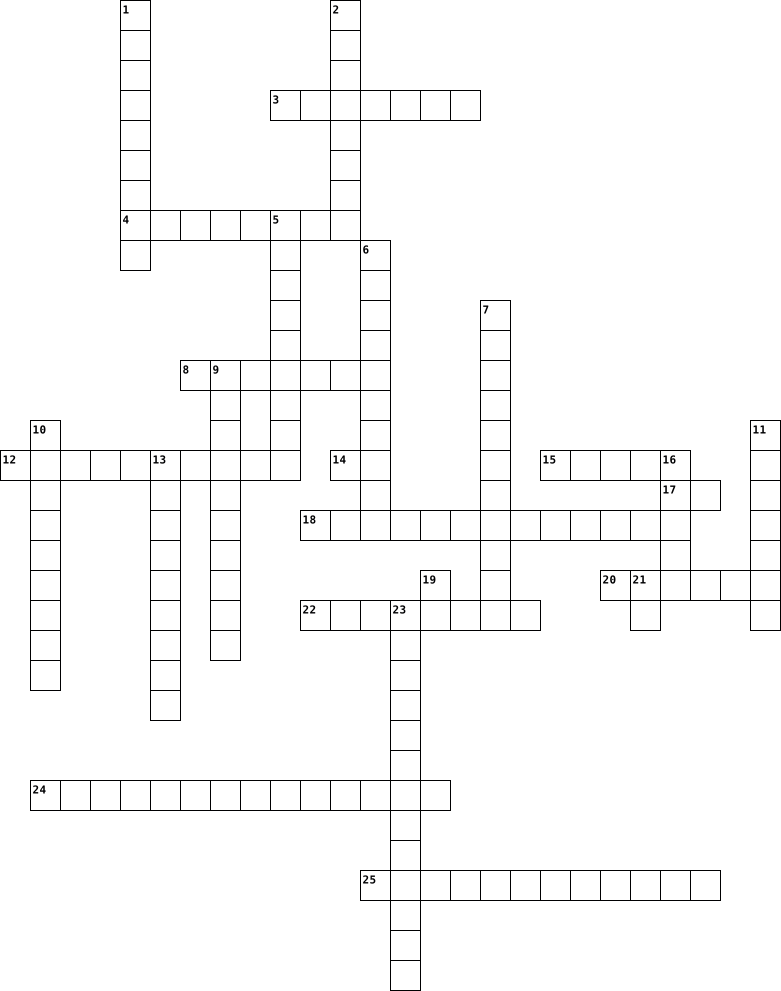
Across
- The name of the Russian Chemist who started the development of the periodic table
- Found in the nucleus and have a neutral charge
- What is the atomic number for Sulphur written as a word
- The burning of a substance in oxygen
- What is the name for Lead on the periodic table?
- Word that means indivisible
- What is the name for Mercury on the periodic table?
- The name of a table that arranges elements based on their properties
- First person to propose the issues behind Modern Atomic Theory in 1800s
- An example of a chemical element starting with H
- Reaction that occurs when acid is added to a base forming water and at least one substance
- defines the characteristics of each element and how many protons are present
Down
- Negative sub-atomic particle
- Atoms have the same unique amount of protons
- An example of this is Corrosion and rusting
- The number of protons and neutrons is equal to this in an atom
- English term for something that cannot be further divided
- Chemicals that will change colour when added to an acid or base
- When elements combine together chemically, they produce compounds
- Positive sub-atomic particle
- Two or more substances combine to produce a single new substance
- Each one of these has a maximum number of electrons
- What is the name of the element Polonium on the periodic table
- What is the name for Arsenic on the periodic table?
- A single compound breaks down into two or more simpler products
25 Clues: Word that means indivisible • Negative sub-atomic particle • Positive sub-atomic particle • The burning of a substance in oxygen • An example of this is Corrosion and rusting • Atoms have the same unique amount of protons • Found in the nucleus and have a neutral charge • What is the name for Lead on the periodic table? • An example of a chemical element starting with H • ...
chemistry vocab 2013-10-10

Across
- any element in group 2 of the periodic table
- any of the set of metallic elements in groups 4-12 of the periodic table
- samples of a pure compound always contain the same elements
- molecules composed only of two metals
- a table of chemical elements arranged in order of atomic number
- a positively charged elementary that is a fundamental constituent of all atomic nuclei
- a positively charged ion
- any of the gases in group O (18) of the periodic table
Down
- any of the elements in group ia 1 of the periodic table
- theory that matter consists of of invisible particles called atoms
- the number of positive charges of protons in the nucleus of an atom of a given element
- an atom or molecule with a net electric charge due to the loss or gain of one or more electrons
- an ionic species having a negative charge
- a representation of a substance using symbols for its constituent elements
- an element whose properties are intermediate between metals and solid non metals
- any of two or more forms of a chemical element
- an ionic bond is a chemical link between two atoms caused by an electrostatic force
- the integer number nearest in value to the atomic weight of an atom and equal to the number of nucleons
- an elementary particle that is a fundamental constituent of matter
- element in group 17 of the periodic table
- a fundamental group of atoms in a molecule serving as a base
21 Clues: a positively charged ion • molecules composed only of two metals • an ionic species having a negative charge • element in group 17 of the periodic table • any element in group 2 of the periodic table • any of two or more forms of a chemical element • any of the gases in group O (18) of the periodic table • any of the elements in group ia 1 of the periodic table • ...
FURIOUS MAGAZINE MONTHLY CROSSWORD 2022-06-06

Across
- True or false: there are 108 elements on the periodic table currently.
- What chemical compound makes a light green flame when lit?
- Gay-Lussac discovered which element?
- Newnham College is in _________, UK.
- True or false: there are 118 elements on the periodic table currently.
- As pressure increases, temperature _________.
- L.I.G.O. stands for _____ Interferometer Gravitational-Wave Observatory.
- Mendeleev is responsible for organizing the ________ table of elements.
- What is the heaviest substance out of the four from our 'Seven Layer Density' lab?
Down
- ______ names 2019 the International Year of the Periodic Table.
- _______ could be covered in diamond dust.
- Mendeleev was born in ______, Russia.
- Rosalind Franklin studied _________ in college.
- The first international conference of chemistry took place in ________, Germany.
- A ship called _________ was found by robots.
- Robots called ___________ found an underwater ship.
16 Clues: Gay-Lussac discovered which element? • Newnham College is in _________, UK. • Mendeleev was born in ______, Russia. • _______ could be covered in diamond dust. • A ship called _________ was found by robots. • As pressure increases, temperature _________. • Rosalind Franklin studied _________ in college. • Robots called ___________ found an underwater ship. • ...
BLACW-Periodic Table 2026-05-13

Across
- The naturally occurring form for 7 specific elements consisting of paired atoms bonded together state (so called "BrINClHOF" elements).
- A vertical column in the periodic table; elements here typically share similar chemical properties.
- Highly reactive Group 1 elements, including lithium and sodium, that lose their one valence electron to form ions with a +1 charge..
- A one, or two, letter shorthand abbreviation used to identify an element, such as "O" for oxygen or "Au" for gold.
- Elements found in the center of the periodic table including common metals like copper, gold, silver, iron, and chromium.
- Synonym for a "group" in the periodic table.
- Elements with properties intermediate between metals and nonmetals, found along the "staircase" line in the periodic table.
- Another name for the noble gases.
- A pure substance consisting of only one type of atom that cannot be broken down by chemical means.
- Elements found on the far right side of the periodic table that typically gain electrons to form negative ions or share electrons to bond covalently with each other.
Down
- A horizontal row in the periodic table representing the highest energy level of valence electrons in the included atoms.
- Odorless, colorless Group 18 elements that are mostly unreactive due to a full valence shell of electrons.
- The weighted mean of the masses of an element's isotopes.
- An alternative name for Semi-metals.
- Highly reactive Group 17 nonmetals, such as fluorine and chlorine, that tend to form anions with a -1 charge or bond covalently with other nonmetals.
- Elements found on the left side of the periodic table that tend to form cations when reacted.
- Group 2 elements that are somewhat reactive and form +2 cations.
- The whole number value indicating the number of protons found in the nucleus and the elemental identity of an atom.
18 Clues: Another name for the noble gases. • An alternative name for Semi-metals. • Synonym for a "group" in the periodic table. • The weighted mean of the masses of an element's isotopes. • Group 2 elements that are somewhat reactive and form +2 cations. • Elements found on the left side of the periodic table that tend to form cations when reacted. • ...
periodic table 2025-01-24

Across
- types of elements found in groups 17
- elements found in groups 3-12
- metals on the periodic table are mostly on which side?
- something elements in the same group have in common
- metals found in group 2
Down
- number of known elements
- what order the periodic table is arranged in
- number found below the element name on the periodic
- Created the periodic table
- lanthanides and actinides are located where on the periodic table
- metals found in group 1
- elements in group 18 are all...
12 Clues: metals found in group 1 • metals found in group 2 • number of known elements • Created the periodic table • elements found in groups 3-12 • elements in group 18 are all... • types of elements found in groups 17 • what order the periodic table is arranged in • number found below the element name on the periodic • something elements in the same group have in common • ...
Holly's Crossword 2026-02-27

Across
- What is Na?
- Outermost shell is named in (1 word)
- What is Ca?
- Minus in atoms
- Iron + oxygen
- Plus in atoms
- The first letter has to be what in the periodic table
- Good conductor of heat, Shiny, & Malleable
- The group that is in group 0 in periodic table
Down
- ? is iron oxide a reddish brown substance
- Iron & sulfur?
- How tightly they are packed
- Starts with an O & is in periodic table
- What is K?
- Appearance of metal
- Metals melting point
- Substances in apple called ?, react with oxygen to form an brown pigment called melanin
- How many atoms can fit in first shell
18 Clues: What is K? • What is Na? • What is Ca? • Iron + oxygen • Plus in atoms • Iron & sulfur? • Minus in atoms • Appearance of metal • Metals melting point • How tightly they are packed • Outermost shell is named in (1 word) • How many atoms can fit in first shell • Starts with an O & is in periodic table • ? is iron oxide a reddish brown substance • Good conductor of heat, Shiny, & Malleable • ...
Very Super Easy Biology Crossword 2025-10-15

Across
- The appearance of something
- Composed of many cells
- large organic molecules
- Bonds when nonmetallic atoms share electrons
- The things on a periodic table
- made of two hydrogen atoms and one oxygen atom
- does the dissolving
Down
- The advancement of knowledge
- breaks big polymers into smaller monomers
- Composed of a single cell
- The columns on a periodic table
- The basic unit of life
- specialized structures within the cell that work together
- particles that make up an element
- anything with mass and occupies space
- uniform mixture of two or more substances
- The rows on a periodic table
- what gets dissolved
18 Clues: what gets dissolved • does the dissolving • The basic unit of life • Composed of many cells • large organic molecules • Composed of a single cell • The appearance of something • The advancement of knowledge • The rows on a periodic table • The things on a periodic table • The columns on a periodic table • particles that make up an element • anything with mass and occupies space • ...
Periodic Table Crossword 2017-12-05

Across
- He arranged the elements in the periodic table
- Elements in a ____________, or family, of the periodic table have similar characteristics.
- in stars more massive than the sun, fusion continues until the core is almost all _________
- elements in the same column in the periodic table have similar ___________
- the periodic table is organized by ___________ _____________
- An element's ______________is its row in the periodic table
Down
- the average mass of all the isotopes of that element
- a state of matter that consists of a gas like mixture of free electrons
- You can use an element's position in the periodic table to predict its _______________
- A one or two letter representation of an element is called a
- the process in which two atomic nuclei combine to form a larger nucleus, releasing huge amount of energy
- a regular repeated pattern
12 Clues: a regular repeated pattern • He arranged the elements in the periodic table • the average mass of all the isotopes of that element • An element's ______________is its row in the periodic table • A one or two letter representation of an element is called a • the periodic table is organized by ___________ _____________ • ...
periodic table by maggie 2012-12-15

Across
- property- property of matter that can be observed with out changing the composition of identity of matter.
- any of a class of elementary substances as gold,silver or copper, all of which are crystalline.
- a nonmetal that in combination with a metal forms an alloy.
- element that gives off high energy rays or perticles.
- table-a chart where all elements are organized into periods and groups according to there properties.
- mass- in the average mass of an atom of that element.
- each row of elements in the periodic table.
- an element not having the character of a metals as carbon or nitrogen.
- –amount of mass in a given volume of a substance or object found by dividing the mass of the object by its volume.
- going up and down the periodic table.
Down
- each column in the periodic table.
- gases- group of elements in the periodic table that generally do not react with other elements.
- something to do with noble gases.
- the large number 3 in front of the H.
- a mixture of two or more elements.
- simplest form of matter.
- reaction- Takes place when one or more substances changes to form one.
17 Clues: simplest form of matter. • something to do with noble gases. • each column in the periodic table. • a mixture of two or more elements. • the large number 3 in front of the H. • going up and down the periodic table. • each row of elements in the periodic table. • element that gives off high energy rays or perticles. • mass- in the average mass of an atom of that element. • ...
Periodic Table Crossword - Onamika Rahman 2021-05-26

Across
- What is made up of the most reactive metal
- Its vertical on the periodic table
- The atomic number gives you the protons and...
- The periodic table is made out of...
- Made up of the most unreactive metals
- Most of the periodic table is made out of...
- You get the number of protons and electrons from the...
- It Conducts heat and electricity better than Nonmetals but not as well as Metals
- You find the protons and neutrons in the...
- Deterioration of a metal due to a chemical reaction
- To find the number of neutrons you need to subtract the atomic number and the...
Down
- Are poor conductors of heat and electricity
- the smallest component of an element
- Can be Pounded into sheets
- One or two-letter abbreviation for an element
- The atomic number gives you the electrons and...
- Shiny and reflective
- Its horizontal on the periodic table
- You have to subtract the atomic number from the atomic mass to get the...
- Can be stretched into wires
20 Clues: Shiny and reflective • Can be Pounded into sheets • Can be stretched into wires • Its vertical on the periodic table • the smallest component of an element • The periodic table is made out of... • Its horizontal on the periodic table • Made up of the most unreactive metals • What is made up of the most reactive metal • Are poor conductors of heat and electricity • ...
chemestry crossword 2015-11-17

Across
- table a diagram to display all of the elements of the periodic table of elements
- most reactive elements
- middle of non-metals and metals
- not a good conductor
- affects the rate of reaction
- system when not all the reactants are accounted for
- change when the reactants have a reaction to change colour, odour or temperature
- system when all the chemicals are accounted for
- substances that help a reaction proceed faster
- area can increase the rate of reaction
- rows on periodic table of elements
- sometimes Latin, sometimes first two letters
- mass number at the bottom of element tile
- columns on periodic table of elements
- charge the amount of electrons in a cell
Down
- an organic based catalyst
- rate how fast two reactants react
- causes a faster reaction
- number number on the top left of element tile
- two metals or two non-metals
- gases least reactive elements
- formula NaHCO3
- change when the reactants change state in reaction
- typically hard, shiny and a solid
- the center of a cell that carries protons
- compound a compound with a metal and non-metal
26 Clues: formula NaHCO3 • not a good conductor • most reactive elements • causes a faster reaction • an organic based catalyst • affects the rate of reaction • two metals or two non-metals • middle of non-metals and metals • gases least reactive elements • typically hard, shiny and a solid • rate how fast two reactants react • rows on periodic table of elements • ...
Periodic Table Creator 2023-10-19

Across
- These elements surround the “staircase” of the periodic table
- The ______ number is the same as the number of protons
- All elements in a group contain the same number of what electron?
- What does Rb stand for?
- On the periodic table, what are the columns called?
- _________ are negatively charged
- The name of the metals in the middle of the periodic table
- _____ gasses are to the right of the “staircase”
- The letter in the middle of element boxes represents the element ______
Down
- What is an ion called if it’s positively charged?
- The “principle energy number” is also known as the _________ number?
- What is an ion called if it’s negatively charged?
- protons and neutrons equal what?
- __________ Table of the Elements
- s, d, p, and f are all names for what?
- The ______ rule says that all elements in order to become energetically stable, desire 8 valence electrons
- _______ are positively charged
- What does Co stand for?
- The mass number found in element boxes is the _______ atomic mass
- Na represents what element?
20 Clues: What does Rb stand for? • What does Co stand for? • Na represents what element? • _______ are positively charged • protons and neutrons equal what? • __________ Table of the Elements • _________ are negatively charged • s, d, p, and f are all names for what? • _____ gasses are to the right of the “staircase” • What is an ion called if it’s positively charged? • ...
Families on the PTE 2024-09-10

Across
- Towards the bottom of the periodic table and are often synthetic or man made
- Equal to the number of protons in the element
- Number of valence electrons in alkali metals
- Located in the outermost shell of an atom and are involved in bonding
- Horizontal row on the Periodic table
- one or two letter representation of an element
- Total mass of protons and neutrons in the atom
- A sunstance that can not be broken down into simpler substances
- Poor conductor of heat and electricity
- Has properties of metals and no-metals
Down
- A negatively charged particle found orbiting the nucleus
- Smallest particle of an element
- The center of an atom
- A positively charged particle found in the nucleus
- A column on the periodic table that has similar chemical and physical properties
- The imaginary line that divides metals and non-metals
- good conductor of heat/electricity
- A column on the periodic table
- metals Reacts violently with water and 1 valence electron
- A neutrally charged particle found in the nucleus
20 Clues: The center of an atom • A column on the periodic table • Smallest particle of an element • good conductor of heat/electricity • Horizontal row on the Periodic table • Poor conductor of heat and electricity • Has properties of metals and no-metals • Number of valence electrons in alkali metals • Equal to the number of protons in the element • ...
Matter 2022-05-04

Across
- Is written as Fe on the periodic table.
- Close together but unorganised.
- Is written as H on the periodic table.
- Close together and organised.
- Is the chemical combination of H20.
Down
- Is written as C on the periodic table.
- Is written as N on the periodic table.
- is written as He on the periodic table.
- Not close together and not organised.
- is written as O on the periodic table
10 Clues: Close together and organised. • Close together but unorganised. • Is the chemical combination of H20. • Not close together and not organised. • is written as O on the periodic table • Is written as C on the periodic table. • Is written as N on the periodic table. • Is written as H on the periodic table. • Is written as Fe on the periodic table. • ...
Matter 2022-05-04

Across
- Close together but unorganised.
- is written as He on the periodic table.
- Close together and organised.
- Is the chemical combination of H20.
- Not close together and not organised.
- is written as O on the periodic table
Down
- Is written as N on the periodic table.
- Is written as Fe on the periodic table.
- Is written as H on the periodic table.
- Is written as C on the periodic table.
10 Clues: Close together and organised. • Close together but unorganised. • Is the chemical combination of H20. • Not close together and not organised. • is written as O on the periodic table • Is written as N on the periodic table. • Is written as H on the periodic table. • Is written as C on the periodic table. • Is written as Fe on the periodic table. • ...
Revision and Periodic Table Group Crossword 2019-11-04

Across
- Unreactive nonmetals. (5)
- at room temperature, most metals are _______. (6)
- particle with no charge in nucleus of atom. (7)
- Table salt is also called sodium _______. (8)
- metals Elements in Groups 3-12.
- _______ indicates that seven of an element is present in a molecular compound. (5)
- The name of the elements found in Group 17 of the Periodic Table. You can find flourine and chlorine in this group. (7)
- Elements in the horizontal rows of the Periodic Table are called _______. (6)
Down
- Element in the 17th column and 4th row. (7)
- The only nonmetal on the left side of the periodic table. (8)
- This element has 12 protons in its atom. (9)
- tetra-chloride has _______ chlroine atoms in the molecular compound. (4)
- Irreversible change is a characteristic of _______ change. (8)
- Electrons are _______ charged. (10)
- Elements with metallic and nonmetallic properties. (9)
- _______ metals are the metals listed in Group 1 of the Periodic Table. (6)
- Element with the symbol Pb.(4)
17 Clues: Unreactive nonmetals. (5) • Element with the symbol Pb.(4) • metals Elements in Groups 3-12. • Electrons are _______ charged. (10) • Element in the 17th column and 4th row. (7) • This element has 12 protons in its atom. (9) • Table salt is also called sodium _______. (8) • particle with no charge in nucleus of atom. (7) • at room temperature, most metals are _______. (6) • ...
science 2023-12-11

Across
- undoes a synthesis reaction
- ms serventi and tom holland
- nonmetal and nonmetal
- absorbs heat
- releases heat
- table of elements
- metal and nonmetal
- positive charge
- middle and left side of periodic table
Down
- ms servant and her friend at prom with dates
- not a permanent change
- reaction that has water and gas as a product
- before the yield symbol
- neutral charge
- reverse decomposition reaction
- right side of periodic table
- how compact something is
- negative charge
- cannot be undone
- after the yield symbol
20 Clues: absorbs heat • releases heat • neutral charge • negative charge • positive charge • cannot be undone • table of elements • metal and nonmetal • nonmetal and nonmetal • not a permanent change • after the yield symbol • before the yield symbol • how compact something is • undoes a synthesis reaction • ms serventi and tom holland • right side of periodic table • reverse decomposition reaction • ...
chemistry vocabulary 2013-10-10

Across
- any of the gases in group O (18) of the periodic table
- samples of a pure compound always contain the same elements
- a table of chemical elements arranged in order of atomic number
- an elementary particle that is a fundamental constituent of matter
- the integer number nearest in value to the atomic weight of an atom and equal to the number of nucleons
- molecules composed only of two metals
- any element in group 2 of the periodic table
- a positively charged ion
- any element in group 17 of the periodic table
- an ionic species having a negative charge
Down
- an ionic bond is a chemical link between two atoms caused by an electrostatic force
- theory that matter consists of of invisible particles called atoms
- any of two or more forms of a chemical element
- a fundamental group of atoms in a molecule serving as a base
- a positively charged elementary that is a fundamental constituent of all atomic nuclei
- an element whose properties are intermediate between metals and solid non metals
- a representation of a substance using symbols for its constituent elements
- any of the elements in group ia 1 of the periodic table
- the number of positive charges of protons in the nucleus of an atom of a given element
- an atom or molecule with a net electric charge due to the loss or gain of one or more electrons
- any of the set of metallic elements in groups 4-12 of the periodic table
21 Clues: a positively charged ion • molecules composed only of two metals • an ionic species having a negative charge • any element in group 2 of the periodic table • any element in group 17 of the periodic table • any of two or more forms of a chemical element • any of the gases in group O (18) of the periodic table • any of the elements in group ia 1 of the periodic table • ...
Chemistry Crossword Puzzle 2020-11-04

Across
- The element with 22 protons
- How many groups there are on the periodic table
- Which element has 79 protons?
- How many periods there are on the periodic table
- The first element on the periodic table
- The element with 48 protons
- The element with the atomic symbol I
- Chadwick, The man who found the Neutron
- Ions that form by losing electrons
- which element has 66 protons?
- The element with 31 protons
- The final element on the periodic table
- When did Dmitri Mendeleev publish a table of the elements organized by increasing atomic mass?
- Which element has the atomic symbol Pb?
- diverse in character or content
Down
- of the same kind; alike
- If it CAN be separated by physical means it is a _______
- Atoms that have an unequal number of electrons and protons
- What test is used to ID some metals in compounds?
- pure substances that are the unions of two or more elements
- How many protons does Radon have?
- Theory that states Atoms are building blocks of elements
- Atoms with the same number of electrons and protons
- What are bundles of light energy that is emitted by electrons as they go from higher energy levels to lower levels?
- The element with the atomic symbol as Sb
- Law, The law that was named after Robert Boyle
- substance, If it CAN'T be separated by physical means it is a ____ _________
- A substance made of all the same kind of particle
- The shape of an atom
- The amount of elements on the Periodic Table
30 Clues: The shape of an atom • of the same kind; alike • The element with 22 protons • The element with 48 protons • The element with 31 protons • Which element has 79 protons? • which element has 66 protons? • diverse in character or content • How many protons does Radon have? • Ions that form by losing electrons • The element with the atomic symbol I • ...
Crossword Puzzle 2023-04-05

Across
- what solids and liquids definitely have
- chemical equations must be
- Model of elements
- what makes up metals, nonmetals, and metalloids
- number of location on periodic table
- what is on the periodic table
- have a definite shape
- do not have a definite shape
Down
- a table of elements
- must be balanced
- chemical symbol is C
- not a liquid or solid
- a combination of elements
- a type of metal
- what we breathe
15 Clues: a type of metal • what we breathe • must be balanced • Model of elements • a table of elements • chemical symbol is C • not a liquid or solid • have a definite shape • a combination of elements • chemical equations must be • do not have a definite shape • what is on the periodic table • number of location on periodic table • what solids and liquids definitely have • ...
Element Crossword 2021-10-10

Across
- Democriticus coined this word
- Group five
- Which group of the periodic table corresponds with Halogens
- The elements that touch the zigzag line (staircase) of the periodic table
- K
- Atomic mass of Carbon
Down
- Elements to the right of the periodic table
- The element with 6 protons
- Ti
- Ra
- Atom with different number of Neutrons
- Which period of the periodic table corresponds with Lithium (Li)
12 Clues: K • Ti • Ra • Group five • Atomic mass of Carbon • The element with 6 protons • Democriticus coined this word • Atom with different number of Neutrons • Elements to the right of the periodic table • Which group of the periodic table corresponds with Halogens • Which period of the periodic table corresponds with Lithium (Li) • ...
Periodic Table Crossword Puzzle 2012-11-13

Across
- on the Periodic Table this color is magenta and represents a state of matter
- a row of elements
- the chemical symbol for Flourine
- an atomic mass of 10.8
- shiny, conductor of heat, and brittle
- the atomic mass of Phosphorus
- a subatomic particle that has a positive charge
- on the Periodic Table this color is blue and represents a state of matter
- the symbol for magnesium
- number the number of protons in the element
- another name for a group
Down
- an atomic mass of 32.1
- a column of elements
- Name the name of an element
- that atomic number of Beryllium
- the smallest unit of an element
- dull, poor conductor of heat, and not malleable
- semi-shiny, fair conductor of heat, and semi-malleable
- on the Periodic Table this color is green and represents a state of matter
19 Clues: a row of elements • a column of elements • an atomic mass of 32.1 • an atomic mass of 10.8 • the symbol for magnesium • another name for a group • Name the name of an element • the atomic mass of Phosphorus • that atomic number of Beryllium • the smallest unit of an element • the chemical symbol for Flourine • shiny, conductor of heat, and brittle • ...
Atoms and Periodic Table 2022-12-07

Across
- not likely to give away
- a positive electric charge, in the nucleus of the atom
- A simple substance that cannot be broken down into smaller parts or changed into another substance
- a group of electrons circulating around a nucleus or molecule
- the number of protons in the nucleus of the atom
- emitting or relating to the emission of ionizing radiation or particles
- something that isnt metal
- an atom or molecule with a net electric charge due to the loss or gain of one or more electrons
- the fixed amount of energy that something has
- any of the elements in group 0 of the periodic table
- a substance made by mixing other substances together
- elements in group 2 of the periodic table
- the small dense region consisting of protons and neutrons at the center of an atom
- any of the elements occupying group 17 on the periodic table
- an element whose properties are between metal and nonmetals
- a unit mass used to express atomic and molecular weights
- a table of chemical elements arranged in order of atomic number
- a column in the periodic table
Down
- the total number of protons and neutrons in a nucleus
- the horizontal rows of the periodic table
- the theoretical basis of modern physics that explains the nature and behavior of matter and energy on the atomic level
- elements in groups 3-12 on the periodic table
- an electron in the outer shell,associated with an atom
- the property of subatomic particles that cause it to experience a force when placed in an electric and magnetic field
- the recurrence of properties of the elements
- no electric charge, in the nucleus of the atom
- a negative electric charge, around the nucleus of the atom
- any of the metals in group 1 of the periodic table
- each of two or more forms of the same element that contain equal number of protons but different number of neutrons in the nuclei
- a solid material that is typically hard, shiny, malleable, fusible, and ductile
- the minimum charge possible, which charge of an electron
- the basic unit of a chemical element
- a substance formed from two or more elements
33 Clues: not likely to give away • something that isnt metal • a column in the periodic table • the basic unit of a chemical element • the horizontal rows of the periodic table • elements in group 2 of the periodic table • the recurrence of properties of the elements • a substance formed from two or more elements • elements in groups 3-12 on the periodic table • ...
Periodic Table Project 2023-02-23

Across
- are killed by halogens
- represents the number of valence electrons
- metals are in the middle of the table
- has the largest element on the periodic table
- is an example of a noble gas
- only need 1 electrons to have a full valence shell
- has an atomic number of 8
- get more reactive as you go down the column
- gases are nonreactive
Down
- is the measure of whether or not atoms will trade electrons with other atoms
- is the pattern of change
- is the most reactive halogen
- is the first element in the periodic table
- was discovered in the USA and is the most recent discovered element
- represents the number of shells
- has the heaviest mass in noble gasses
- invented the periodic table
- metals are located in column 2
- move left to right
- electrons are on the outermost shell of the atom
20 Clues: move left to right • gases are nonreactive • are killed by halogens • is the pattern of change • has an atomic number of 8 • invented the periodic table • is the most reactive halogen • is an example of a noble gas • metals are located in column 2 • represents the number of shells • metals are in the middle of the table • has the heaviest mass in noble gasses • ...
Periodic Table and Bonding 2025-12-05

Across
- Space where electron exists
- Electron energy level
- Atom with extra or missing electrons
- Lightweight particle like electron
- Noble gas with two protons
- Mass of protons/neutrons unit
- Displays all known elements
- Neutral particle in nucleus
- Force holding nucleus together
- Column in periodic table
- Electron gains energy level
- Positive charge particle
- Combining nuclei to form one
Down
- Energy source at sun’s center
- Bond sharing electrons
- Electrons in outer shell
- Bond transferring electrons
- Number of protons only
- Contains protons and neutrons
- Equal positive and negative charges
- Negative charge particle
- Element with one proton
- Sum of protons and neutrons
- Rule of eight electrons for stability
- Periodic table organizer
- Breaking an atom’s nucleus
- Smallest unit of an element
- Symbol representing element
- Row in periodic table
- Arrangement of electrons
- Electron’s path around nucleus
31 Clues: Electron energy level • Row in periodic table • Bond sharing electrons • Number of protons only • Element with one proton • Electrons in outer shell • Negative charge particle • Periodic table organizer • Column in periodic table • Arrangement of electrons • Positive charge particle • Noble gas with two protons • Breaking an atom’s nucleus • Space where electron exists • ...
Periodic Table and Bonding 2025-12-05

Across
- Space where electron exists
- Electron energy level
- Atom with extra or missing electrons
- Lightweight particle like electron
- Noble gas with two protons
- Mass of protons/neutrons unit
- Displays all known elements
- Neutral particle in nucleus
- Force holding nucleus together
- Column in periodic table
- Electron gains energy level
- Positive charge particle
- Combining nuclei to form one
Down
- Energy source at sun’s center
- Bond sharing electrons
- Electrons in outer shell
- Bond transferring electrons
- Number of protons only
- Contains protons and neutrons
- Equal positive and negative charges
- Negative charge particle
- Element with one proton
- Sum of protons and neutrons
- Rule of eight electrons for stability
- Periodic table organizer
- Breaking an atom’s nucleus
- Smallest unit of an element
- Symbol representing element
- Row in periodic table
- Arrangement of electrons
- Electron’s path around nucleus
31 Clues: Electron energy level • Row in periodic table • Bond sharing electrons • Number of protons only • Element with one proton • Electrons in outer shell • Negative charge particle • Periodic table organizer • Column in periodic table • Arrangement of electrons • Positive charge particle • Noble gas with two protons • Breaking an atom’s nucleus • Space where electron exists • ...
chemistry vocabulary 2013-10-10

Across
- a positively charged elementary that is a fundamental constituent of all atomic nuclei
- a representation of a substance using symbols for its constituent elements
- an atom or molecule with a net electric charge due to the loss or gain of one or more electrons
- samples of a pure compound always contain the same elements
- any element in group 2 of the periodic table
- molecules composed only of two metals
- an elementary particle that is a fundamental constituent of matter
- any of the gases in group O (18) of the periodic table
- the number of positive charges of protons in the nucleus of an atom of a given element
Down
- theory that matter consists of of invisible particles called atoms
- a table of chemical elements arranged in order of atomic number
- any of the elements in group ia 1 of the periodic table
- an element whose properties are intermediate between metals and solid non metals
- any element in group 17 of the periodic table
- any of the set of metallic elements in groups 4-12 of the periodic table
- the integer number nearest in value to the atomic weight of an atom and equal to the number of nucleons
- an ionic species having a negative charge
- an ionic bond is a chemical link between two atoms caused by an electrostatic force
- a positively charged ion
- a fundamental group of atoms in a molecule serving as a base
- any of two or more forms of a chemical element
21 Clues: a positively charged ion • molecules composed only of two metals • an ionic species having a negative charge • any element in group 2 of the periodic table • any element in group 17 of the periodic table • any of two or more forms of a chemical element • any of the gases in group O (18) of the periodic table • any of the elements in group ia 1 of the periodic table • ...
Elemental Enigmas: Periodic Table Crossword 2023-07-27

Across
- A group of elements in the f-block with atomic numbers 57 to 71, known as rare earth elements.
- The principle that the properties of elements recur periodically when arranged by increasing atomic number.
- Element with atomic number 17, used in table salt.
- ,A noble gas with atomic number 2.
- ,the number of protons in an atom's nucleus and used to identify elements in the periodic table.
- English physicist who determined the concept of atomic number in 1913.
- this element has an atomic number of 26 and is essential for blood health.
- A horizontal row in the periodic table that represents the number of electron shells an atom possesses.
- Group 1 elements known for their reactivity and tendency to form alkaline solutions.
- Group 18 elements characterized by their low reactivity and stable electronic configurations.
- English chemist who proposed the law of octaves in 1864, a precursor to the modern periodic table.
- the element with atomic number 79, known for its use in jewelry.
Down
- A vertical column in the periodic table representing elements with similar properties.
- Atomic number of the lightest and most abundant element in the universe.
- Elements found in Groups 3 to 12 known for their variable oxidation states and catalytic properties.
- Element with atomic number 8, a vital gas for respiration.
- The only noble gas with a single-digit atomic number.
- Russian chemist credited with creating the first widely recognized periodic table in 1869.
- Group 17 elements known for their high reactivity and tendency to form salts.
- Atomic number of the first alkali metal.
20 Clues: ,A noble gas with atomic number 2. • Atomic number of the first alkali metal. • Element with atomic number 17, used in table salt. • The only noble gas with a single-digit atomic number. • Element with atomic number 8, a vital gas for respiration. • the element with atomic number 79, known for its use in jewelry. • ...
Science extra credit marking period 3 2022-02-28

Across
- a substance only made of one element
- C on the periodic table
- a substance mixed together with two or more subtances
- the number of protons and neutrons in an atom
- particles that make up protons, Neutrons, and electrons
- atom with a negative charge
- atoms with the same amount of protons but a different amount of neutrons
- part of an atom with electrons
- o on the periodic table
- an atom made up of more than 1 element
- part of an atom with protons and neutrons
Down
- a table that lists all element
- Positively charged particle
- mass of an atom
- Model of an atom Named after the person who made it.
- Particle with no charge
- Particle with negative charge
- h on the periodic table
- an atom only made of itself
19 Clues: mass of an atom • C on the periodic table • Particle with no charge • h on the periodic table • o on the periodic table • Positively charged particle • atom with a negative charge • an atom only made of itself • Particle with negative charge • a table that lists all element • part of an atom with electrons • a substance only made of one element • ...
Science extra credit marking period 3 2022-02-28

Across
- Model of an atom Named after the person who made it.
- an atom only made of itself
- o on the periodic table
- Positively charged particle
- atom with a negative charge
- a table that lists all element
- Particle with no charge
- a substance mixed together with two or more subtances
- part of an atom with protons and neutrons
- mass of an atom
- C on the periodic table
Down
- a substance only made of one element
- part of an atom with electrons
- atoms with the same amount of protons but a different amount of neutrons
- h on the periodic table
- the number of protons and neutrons in an atom
- Particle with negative charge
- particles that make up protons, Neutrons, and electrons
- an atom made up of more than 1 element
19 Clues: mass of an atom • o on the periodic table • h on the periodic table • Particle with no charge • C on the periodic table • an atom only made of itself • Positively charged particle • atom with a negative charge • Particle with negative charge • part of an atom with electrons • a table that lists all element • a substance only made of one element • ...
The Periodic Table and its Trends 2024-05-02

Across
- Top to bottom
- On the left side of the periodic table
- On the staircase
- On the right side of the periodic table
- Increases as you go further left on the periodic table
- Metals First group on the periodic table
Down
- Left to right
- Gases Last group on the periodic table
- Metals In the middle of the periodic table
- electrons The outer shell of an atom
10 Clues: Left to right • Top to bottom • On the staircase • electrons The outer shell of an atom • Gases Last group on the periodic table • On the left side of the periodic table • On the right side of the periodic table • Metals First group on the periodic table • Metals In the middle of the periodic table • Increases as you go further left on the periodic table
periodic crossword ja 2022-05-04

Across
- what element has the atomic number of 8
- when 2 nonmetals bond it is a ______ bond
- when nonmetals bond with metals it has a _____ bond
- particle with a positive charge
- when 2 metals combine it forms a ______ bond
- nonmetals found in group 18 are _____ gases
- number of electrons that have been lost or gained
- label on the periodic table is H
Down
- most nonmetals are _____
- particle with a neutral charge
- these elements are found right of the periodic staristep
- nonmetals are ____ conductors
- label on the periodic table is He
- these elements conduct electricity well
- most metals are _____
- the number of protons is the ______ number
- group 17 on the periodic table is called what
17 Clues: most metals are _____ • most nonmetals are _____ • nonmetals are ____ conductors • particle with a neutral charge • particle with a positive charge • label on the periodic table is H • label on the periodic table is He • what element has the atomic number of 8 • these elements conduct electricity well • when 2 nonmetals bond it is a ______ bond • ...
Chemistry Crossword 2017-11-28

Across
- - anything that has mass and occupies space
- metals - group 1 elements in the periodic table, not including hydrogen; the most reactive of the metals
- of matter - refers to the three common states in which matter can exist
- mass - mass of one atom of an element calculated from the total number of protons, neutrons, and electrons of that atom; measured in amu
- property - description of how a substance interacts with other substances, such as acids; chemical properties are observable only when a chemical change occurs
- - group 17 elements in the periodic table, the most reactive non-metals
- - pure substance that cannot be broken down into other substances; substances made up of only one type of atom
- - positively charged particle in the nucleus of an atom
- table - a table in which are organized by their physical and chemical properties
- un it - measure of atomic mass; 1 amu equals to 1 twelfth the mass of a carbon 12 atom
- - horizontal row of elements in the periodic table
- - ability of a substance to conduct electricity or heat
- - positively charged centre of an atom; contains protons and neutrons
Down
- - shiny, malleable, ductile element that conducts electricity
- - change of state from solid to liquid
- - neutral particle in the nucleus of an atom
- - substance that reacts with another substance or substances in a chemical reaction to create new substances with different properties
- - vertical column of elements of elements in the periodic table
- property - property that describes the physical appearance and composition of a substance
- metals - group 2 elements in the periodic table their reactivity is not as strong as alkali metals
- reaction - chemical reaction that releases energy
- reaction - chemical reaction that absorbs energy
- shell - orbits of electrons around the nucleus of an atom
- solution - a solution in which water is the solvent
- number - the sum of a number of protons and neutrons in an atom
- - chemical combination of two or more elements in a specific ratio
- gases - group 18 elements in the period table; the most stable and most unreactive elements
27 Clues: - change of state from solid to liquid • - anything that has mass and occupies space • - neutral particle in the nucleus of an atom • reaction - chemical reaction that absorbs energy • reaction - chemical reaction that releases energy • - horizontal row of elements in the periodic table • solution - a solution in which water is the solvent • ...
The periodic table and its trend 2025-05-05

Across
- Negatively charged particles that orbit an atom's nucleus.
- A column in the periodic table with similar chemical properties.
- The process of an atom gaining or losing electrons to form ions.
- A horizontal row in the periodic table, with elements sharing the same electron shell count.
- The effect where inner electrons reduce the attraction of the nucleus on outer electrons.
- Elements that are shiny, malleable, and good conductors of heat and electricity.
- Gases in Group 18, chemically inert due to full electron shells.
Down
- The ability of an atom to attract electrons in a bond.
- Reactive metals in Group 1, like sodium and potassium.
- Metals in the center of the periodic table, with varying oxidation states.
- Reactive elements in Group 17, like chlorine and fluorine.
- A predictable pattern in element properties across the periodic table.
- The mass per unit volume of a substance.
- The size of an atom, measured from the nucleus to the outermost electron.
- Creator of the periodic table, organized elements by atomic mass.
15 Clues: The mass per unit volume of a substance. • The ability of an atom to attract electrons in a bond. • Reactive metals in Group 1, like sodium and potassium. • Negatively charged particles that orbit an atom's nucleus. • Reactive elements in Group 17, like chlorine and fluorine. • A column in the periodic table with similar chemical properties. • ...
Chemisty Crossing Crossword 2025-05-23

Across
- GASES Element family with full outer shells
- Vertical column in periodic table
- Measure of matter in object
- Charge an atom obtains by losing/gaining electrons
- Simplest particle retaining chemical properties
- Electrically neutral particle
- Horizontal row in the periodic table
- NUMBER Number of particles in a mole
- Ability to attract bonding electrons
- BONDING Bond between metal and nonmetal
- Smallest part of an element
- Atomic number equals number of these
Down
- Elements that conduct heat and electricity
- Substance made of two or more elements
- Element with 11 protons
- Group 17 elements
- RADIUS Distance from nucleus to valence shell
- BOND Bond where electrons are shared unequally
- Type of matter with uniform composition
- TABLE Table that classifies chemical elements
- Cloud-like region where electrons are found
- Attraction between ions of opposite charge
- Formed when electrons are transferred
23 Clues: Group 17 elements • Element with 11 protons • Measure of matter in object • Smallest part of an element • Electrically neutral particle • Vertical column in periodic table • Horizontal row in the periodic table • NUMBER Number of particles in a mole • Ability to attract bonding electrons • Atomic number equals number of these • Formed when electrons are transferred • ...
MODERN PERIODIC TABLE 2021-02-19

Across
- states that the physical and chemical properties of the elements recur in a systematic and predictable way when the elements are arranged in order of increasing atomic number
- trends specific patterns that are present in the periodic table that illustrate different aspects of a certain element, including its size and its electronic properties
- process by which an atom or a molecule acquires a negative or positive charge by gaining or losing electrons
- vertical columns on the periodic table
- name for the six nonmetallic elements that constitute Group 17 (Group VIIa) of the periodic table and considered as most reactive nonmetals
- an element that has properties that are intermediate between those of metals and nonmetals
- measure of the ability of an atom in a chemical compound to attract electrons from another atom in the compound
- energy required to remove an electron from a neutral atom of an element
Down
- formulated the Periodic Law and created a farsighted version of the periodic table of elements
- horizontal rows on the periodic table
- a substance that contains atoms of two or more different elements, and these atoms are chemically joined together
- energy change that occurs when an electron is acquired by a neutral atom
- a positively charged ion
- an outer shell electron that can participate in the formation of a chemical bond
- a negatively charged ion
- a pure substance that cannot be further broken down by any chemical reaction
- defined as one - half the distance between the nuclei of identical atoms that are bonded together
- a particle, atom or molecule with a net electrical charge.
18 Clues: a positively charged ion • a negatively charged ion • horizontal rows on the periodic table • vertical columns on the periodic table • a particle, atom or molecule with a net electrical charge. • energy required to remove an electron from a neutral atom of an element • energy change that occurs when an electron is acquired by a neutral atom • ...
Chemistry Crossword Puzzle 2020-11-04

Across
- The element with 22 protons
- The element with the atomic symbol I
- Which element has the atomic symbol Pb?
- A substance made of all the same kind of particle
- Law, The law that was named after Robert Boyle
- If it CAN be separated by physical means it is a _______
- How many periods there are on the periodic table
- The element with 48 protons
- The element with the atomic symbol as Sb
- Chadwick, The man who found the Neutron
- pure substances that are the unions of two or more elements
- Atoms that have an unequal number of electrons and protons
- How many protons does Radon have?
- When did Dmitri Mendeleev publish a table of the elements organized by increasing atomic mass?
Down
- How many groups there are on the periodic table
- Germanium has what Atomic symbol?
- The element with 31 protons
- diverse in character or content
- substance, If it CAN'T be separated by physical means it is a ____ _________
- of the same kind; alike
- What test is used to ID some metals in compounds?
- The first element on the periodic table
- Atoms with the same number of electrons and protons
- Theory that states Atoms are building blocks of elements
- The final element on the periodic table
- Ions that form by losing electrons
- What are bundles of light energy that is emitted by electrons as they go from higher energy levels to lower levels?
- The shape of an atom
- Which element has 79 protons?
- The amount of elements on the Periodic Table
30 Clues: The shape of an atom • of the same kind; alike • The element with 31 protons • The element with 22 protons • The element with 48 protons • Which element has 79 protons? • diverse in character or content • Germanium has what Atomic symbol? • How many protons does Radon have? • Ions that form by losing electrons • The element with the atomic symbol I • ...