
periodic table Crossword Puzzles
Periodic Table Crossword 2017-02-22

Across
- described by atomic number
- element in group 7 and period 4
- rows of elements in the periodic table
- element with atomic number 89
- first element in group 13
- have similar properties
- first element in group 4
- abbreviation of element on the periodic square
- element in group 10 and period 6
- element in group 16 and period 6
- element with atomic number 57
- A system that organizes the elements
- columns of elements in the periodic table
Down
- first element in period 6
- first element in group 16
- contains information for each element
- first element in period 4
- first element in period 2
- how elements are arranged
- element in group 2 and period 5
- element with chemical symbol Sn
- first element in period 3
- element with chemical symbol Hg
- first element in group 18
- element with chemical symbol Au
25 Clues: have similar properties • first element in group 4 • first element in period 6 • first element in group 16 • first element in period 4 • first element in period 2 • how elements are arranged • first element in group 13 • first element in period 3 • first element in group 18 • described by atomic number • element with atomic number 89 • element with atomic number 57 • ...
Periodic Table 2021-09-01

Across
- elements not shiny, not malleable, and poor conductors
- a row of elements
- rearranged the elements in the periodic table by atomic number
- named after royalty, these elements are very non-reactive and rare
- elements that have some properties of metals and nonmetals
- makes up 20% of air and is necessary for substances to burn
Down
- metals from period 7 that are all radioactive
- are soft and are very reactive
- makes up 80% of air
- elements that are shiny, malleable, and good conductors
- a column of elements
- stands apart on the periodic table because its properties do not match other types of elements
- metals from period 6 that are often used to make steel
13 Clues: a row of elements • makes up 80% of air • a column of elements • are soft and are very reactive • metals from period 7 that are all radioactive • elements not shiny, not malleable, and poor conductors • metals from period 6 that are often used to make steel • elements that are shiny, malleable, and good conductors • ...
Periodic Table 2021-09-27

Across
- smallest particle of an element
- This element forms amphoteric oxide
- block of element that has 17 protons
- horizontal row in period table determined by valence electron
- The minimum energy required to remove one mole electron from outermost orbital in one mole of neutral gaseous atom
- This distance between an atom's nucleus and outer electron shell
- forms acidic oxide with electronic configuration [Ne] 3s² 3p²
Down
- another name for group 1 element
- the elements in periodic table arranged according to this
- this element is in pencils
- forms basic oxide with proton number 11
- alternative name for group 18 elements
- vertical row in periodic table determined by principle quantum number
13 Clues: this element is in pencils • smallest particle of an element • another name for group 1 element • This element forms amphoteric oxide • block of element that has 17 protons • alternative name for group 18 elements • forms basic oxide with proton number 11 • the elements in periodic table arranged according to this • ...
Periodic Table 2021-08-26

Across
- I am a member of the halogen family with an atomic number of 53.
- I am a transition metal with 30 electrons useful in making paint.
- I have 20 neutrons and am found in your teeth and bones.
- I am a gas with 8 protons and 8 neutrons.
- My atomic mass is 35.453.
- I am a transition metal with 25 electrons
Down
- I am a gas with a mass number of 19.
- I am the first element in the fourth period used in making fertilizer.
- My atomic number is 47 and I am used to make photographic film.
- Group 1, period 3.
- I am a noble gas with 2 electrons.
- I am a metal with 28 electrons.
- I am in the fifth period and same group as carbon.
13 Clues: Group 1, period 3. • My atomic mass is 35.453. • I am a metal with 28 electrons. • I am a noble gas with 2 electrons. • I am a gas with a mass number of 19. • I am a gas with 8 protons and 8 neutrons. • I am a transition metal with 25 electrons • I am in the fifth period and same group as carbon. • I have 20 neutrons and am found in your teeth and bones. • ...
PERIODIC TABLE 2021-08-10

Across
- A POISONOUS GAS THAT IS USED TO SERILISE TOWN WATER AND SWIMMING POOL WATER.
- ELEMENTS THAT ARE MALLEABLE, DUCTILE , CONDUCT ELECTRICITY & ALL BUT ONE ARE SOLIDS AT ROOM TEMPERATURE.
- AN INERT GAS THAT IS USED IN PARTY BALLONS AND BLIMPS.
- A METAL ELEMENT WHICH BURNS WHEN LIT AND GIVES OFF HYDROGEN WHEN REACTED WITH HYDROCHLORIC ACID.
- AN INERT GAS USED IN FLASHING ADVERTISING SIGNS.
- A WORD THAT MEANS THAT AN ELEMENT DOES NOT REACT WITH OTHER SUBSTANCES.
Down
- AN INERT GAS THAT IS UASED IN WELDING METALS.
- VERTICAL ROWS IN THE PERIODIC TABLE.
- A METAL ELEMENT THAT REACTS WITH COLD WATER TO GIVE OFF HYDROGEN.
- HORIZONTAL ROWS OF ELEMENTS IN THE PERIODIC TABLE.
- A NON METAL ELEMENT THAT CONDUCTS ELECTRICITY.
- A METAL ELEMENT THAT IS A DENSE LIQUID AT ROOM TEMPERATURE.
- A RUSSIAN SCIENTIST THAT WAS RESPONSIBLE FOR ORGANISING ELEMENTS INTO A PERIODIC TABLE.
13 Clues: VERTICAL ROWS IN THE PERIODIC TABLE. • AN INERT GAS THAT IS UASED IN WELDING METALS. • A NON METAL ELEMENT THAT CONDUCTS ELECTRICITY. • AN INERT GAS USED IN FLASHING ADVERTISING SIGNS. • HORIZONTAL ROWS OF ELEMENTS IN THE PERIODIC TABLE. • AN INERT GAS THAT IS USED IN PARTY BALLONS AND BLIMPS. • A METAL ELEMENT THAT IS A DENSE LIQUID AT ROOM TEMPERATURE. • ...
PERIODIC TABLE 2021-08-10

Across
- A POISONOUS GAS THAT IS USED TO SERILISE TOWN WATER AND SWIMMING POOL WATER.
- ELEMENTS THAT ARE MALLEABLE, DUCTILE , CONDUCT ELECTRICITY & ALL BUT ONE ARE SOLIDS AT ROOM TEMPERATURE.
- AN INERT GAS THAT IS USED IN PARTY BALLONS AND BLIMPS.
- A METAL ELEMENT WHICH BURNS WHEN LIT AND GIVES OFF HYDROGEN WHEN REACTED WITH HYDROCHLORIC ACID.
- AN INERT GAS USED IN FLASHING ADVERTISING SIGNS.
- A WORD THAT MEANS THAT AN ELEMENT DOES NOT REACT WITH OTHER SUBSTANCES.
Down
- AN INERT GAS THAT IS USED IN WELDING METALS.
- VERTICAL ROWS IN THE PERIODIC TABLE.
- A METAL ELEMENT THAT REACTS WITH COLD WATER TO GIVE OFF HYDROGEN.
- HORIZONTAL ROWS OF ELEMENTS IN THE PERIODIC TABLE.
- A NON METAL ELEMENT THAT CONDUCTS ELECTRICITY.
- A METAL ELEMENT THAT IS A DENSE LIQUID AT ROOM TEMPERATURE.
- A RUSSIAN SCIENTIST THAT WAS RESPONSIBLE FOR ORGANISING ELEMENTS INTO A PERIODIC TABLE.
13 Clues: VERTICAL ROWS IN THE PERIODIC TABLE. • AN INERT GAS THAT IS USED IN WELDING METALS. • A NON METAL ELEMENT THAT CONDUCTS ELECTRICITY. • AN INERT GAS USED IN FLASHING ADVERTISING SIGNS. • HORIZONTAL ROWS OF ELEMENTS IN THE PERIODIC TABLE. • AN INERT GAS THAT IS USED IN PARTY BALLONS AND BLIMPS. • A METAL ELEMENT THAT IS A DENSE LIQUID AT ROOM TEMPERATURE. • ...
Periodic Table 2023-09-08

Across
- oxygen and sulfur are in the same
- used to describe an atom's ability to chemically bond with another atom
- mostly found on the right side of the periodic table
- cannot be broken down into a simpler substance and have the same chemical properties
- a graphic organizer of all the known elements in the universe
- share characteristics of both metals and non-metals
Down
- group ______ are the most stable elements
- ________ electrons are in the outermost energy shell of an atom
- have the same number of energy levels or energy shells
- mostly found on the left side of the periodic table
- group ____ are the most reactive elements on the periodic table
- sodium and magnesium are in the same _____
- the basic unit of a chemical element
13 Clues: oxygen and sulfur are in the same • the basic unit of a chemical element • group ______ are the most stable elements • sodium and magnesium are in the same _____ • mostly found on the left side of the periodic table • share characteristics of both metals and non-metals • mostly found on the right side of the periodic table • ...
periodic table 2024-02-27

Across
- A chemical bond formed when atoms share one pair of electrons
- A chemical bond formed when atoms share three pairs of electrons
- Created in an atom when it has more protons than electrons
- The smallest part of an element
- A pure substance made of only one kind of atom
- Electrons on the outermost energy level of an atom
Down
- Created in an atom when it has more electrons than protons
- A chemical bond formed when atom share two pairs of electrons
- Positively charged particles located in the nucleus of an atom
- A chemical bond formed when atoms share electron
- A charged atom due to loss or gain of negative electrons
- The number of protons in the nucleus of an atom
- The average mass of all the isotopes of an element
13 Clues: The smallest part of an element • A pure substance made of only one kind of atom • The number of protons in the nucleus of an atom • A chemical bond formed when atoms share electron • Electrons on the outermost energy level of an atom • The average mass of all the isotopes of an element • A charged atom due to loss or gain of negative electrons • ...
Periodic Table 2024-03-19

Across
- He grouped the elements into 4 lists
- group 18 name
- the second group name
- group 17 name
- The maker of the modern periodic table
- the first group name
Down
- bottom two periods
- The maker of the first periodic table
- group 16 name
- groups 3-12 name
- The modern pt is arranged by this
- He says the element's properties repeat every 8
- the first pt is arranged by this number
13 Clues: group 18 name • group 16 name • group 17 name • groups 3-12 name • bottom two periods • the first group name • the second group name • The modern pt is arranged by this • He grouped the elements into 4 lists • The maker of the first periodic table • The maker of the modern periodic table • the first pt is arranged by this number • He says the element's properties repeat every 8
Periodic Table 2024-04-30

Across
- Need to breath
- Left of the stair step line
- Cleans your pools
- Only metal that's liquid at room temp
- Common name for NaCl
- Symbol is Fe
- In Bananas
Down
- Right of the stair step line
- Used in foil
- common name for H2O
- Is in Milk
- One proton
- Symbol is Na
13 Clues: Is in Milk • One proton • In Bananas • Used in foil • Symbol is Na • Symbol is Fe • Need to breath • Cleans your pools • common name for H2O • Common name for NaCl • Left of the stair step line • Right of the stair step line • Only metal that's liquid at room temp
periodic table 2025-04-11

Across
- colorless noble gas
- atomic number three
- named after albert einstein
- atomic number one
- its a hard brittle crystalline
- belongs to the halogen family
- its known for its pink color
- silvery white metal
Down
- very lo melting point
- highly reactive and never found in nature
- atomic number 88
- its a rare earth element
- atomic number 13
13 Clues: atomic number 88 • atomic number 13 • atomic number one • colorless noble gas • atomic number three • silvery white metal • very lo melting point • its a rare earth element • named after albert einstein • its known for its pink color • belongs to the halogen family • its a hard brittle crystalline • highly reactive and never found in nature
periodic table 2024-09-06

Across
- This element is used in batteries.
- Element with atomic number 79.
- Group 17 element known as a disinfectant.
- The only metal that is liquid at room temperature.
- This element is used to disinfect water.
- A transition metal that is magnetic.
- The most abundant metal in the Earth's crust.
Down
- Element named after the creator of the periodic table.
- The lightest element.
- An element essential for strong bones.
- Group 1 element that is the most reactive metal.
- Group 18 gas used in balloons.
- This element’s name means "water-former" in Greek.
- A non-metal used in pencils.
- A noble gas used in neon signs.
15 Clues: The lightest element. • A non-metal used in pencils. • Group 18 gas used in balloons. • A noble gas used in neon signs. • Element with atomic number 79. • This element is used in batteries. • A transition metal that is magnetic. • An element essential for strong bones. • This element is used to disinfect water. • Group 17 element known as a disinfectant. • ...
Periodic Table 2025-05-12

Across
- What is the symbol for the element with atomic mass approximately 40?
- Which element in period 3 is in group 14?
- What is the name of the electrons in the outershell?
- What element has 2 valence electrons and is in group 2?
- What element is located in period 3, group 18?
- What is the element with atomic mass approximately 1?
- What element has an atomic number of 2?
- Which element in period 2 has 5 valence electrons?
- What element has the symbol S?
Down
- Which element has an atomic number of 17?
- Which element is in period 2, group 14?
- Which element is located in group 2, period 2?
- How many valence electrons does the element with the symbol Ne have?
- Which element has an atomic number of 12?
- Which element in period 4 has 7 valence electrons?
15 Clues: What element has the symbol S? • Which element is in period 2, group 14? • What element has an atomic number of 2? • Which element has an atomic number of 17? • Which element in period 3 is in group 14? • Which element has an atomic number of 12? • Which element is located in group 2, period 2? • What element is located in period 3, group 18? • ...
periodic table 2025-08-19

Across
- the first halogen which is toxic and yellow
- the element which is in both graphite and diamonds
- element 5
- the element which is used in balloons and is in the sun it is noble gas
- the second noble gas which glows orange when it is put through electricity
- Mg
- the element used in mental health treatment and batteries
Down
- the element which is in the sun and is the mostcommon element in the universe
- the element which triple bonds with itself and is in the air. it is used for freezing
- Al
- the element which humans breathe in and need to survive
- one of the components of salt (NaCl)
- the element which is toxic and is in emeralds
13 Clues: Al • Mg • element 5 • one of the components of salt (NaCl) • the first halogen which is toxic and yellow • the element which is toxic and is in emeralds • the element which is in both graphite and diamonds • the element which humans breathe in and need to survive • the element used in mental health treatment and batteries • ...
Periodic Table of Elements Crossword 2013-04-24

Across
- C
- In general, period number indicates the number of electron _________ in neutral atoms of the elements in that period.
- Li
- How elements are DISPLAYED on the periodic table: _________ symbols.
- Al
- Be
- Na
- K
- The group of elements that share properties associated with metals and nonmetals.
- Cl
- O
- For metals, reactivity __________ as you go from left to right across a period.
- Ne
- He
- F
- In general, group number indicates the number of ________ electrons in the neutral atoms of elements belonging to that group.
- Group 1: ________ metals
- Ar
- A row in the periodic table.
Down
- Group 18 elements: _________ gases; these elements are very stable and do not react easily.
- A column in the periodic table; also referred to as a group.
- To calculate the number of ________ in an atom for an element, subtract the atomic number from the atomic mass.
- Elements in the same group have __________ physical and chemical properties.
- Ca
- Group 17 elements, which are very reactive and dangerous.
- Mg
- The units for atomic mass.
- H
- P
- For non-metals, reactivity __________ as you go from left to right across a period.
- For a neutral atom of an element, the atomic number and number of protons also equals the number of ________.
- For a neutral atom of an element, the atomic number equals the number of ________.
- Groups 3 through 12: _________ metals
- Si
- N
- S
- Group 2: __________ earth metals
- B
- Elements in the periodic table are arranged in order of increasing ________ number.
39 Clues: C • H • K • P • N • O • S • F • B • Li • Ca • Mg • Al • Be • Na • Si • Cl • Ne • He • Ar • Group 1: ________ metals • The units for atomic mass. • A row in the periodic table. • Group 2: __________ earth metals • Groups 3 through 12: _________ metals • Group 17 elements, which are very reactive and dangerous. • A column in the periodic table; also referred to as a group. • ...
C2 The periodic table 2020-12-14

Across
- The centre of an atom
- The maximum number of electrons that can occupy the third electron shell
- A product formed when sodium reacts with water (6,9).
- we have full outer electron shells, we are unreactive (5,5).
- I have a mass number of 12 and an atomic number of 6, how many neutrons do I have?
- Elements in Group 1 of the periodic table
- The maximum number of electrons that can occupy the first electron shell
- A flammable gas produced when an alkali metal reacts with water.
- I have a mass number of 12 and an atomic number of 6, what element am I?
- Horizontal row of elements on the periodic table that have the same number of electrons shells.
- A product formed when lithium reacts with water (7,9).
- The elements found in Group 7 of the periodic table (6,6)
Down
- I have four electrons in my outermost shell what group do I belong to?
- Scientist who arranged the elements by atomic weight and chemical properties. He also left gaps for undiscovered elements.
- A product formed when potassium reacts with water (6,9).
- I have five electrons in my outermost shell what group do I belong to?
- A column of elements in the periodic table which have similar chemical properties
- Smallest unit of matter that has the characteristic properties of a chemical element
- I have two electron shells what period do I belong to?
- I'm in group 1 and period 4
- I'm in group 7 and period 3
- The maximum number of electrons that can occupy the second electron shell
- I have three electron shells what period do I belong to?
- A particle, atom or molecule with a net electrical charge
- I have two electrons in my outermost shell what group do I belong to?
25 Clues: The centre of an atom • I'm in group 1 and period 4 • I'm in group 7 and period 3 • Elements in Group 1 of the periodic table • A product formed when sodium reacts with water (6,9). • I have two electron shells what period do I belong to? • A product formed when lithium reacts with water (7,9). • A product formed when potassium reacts with water (6,9). • ...
Chemistry Crossword 2017-11-13

Across
- system of easy-to-see warning symbols on hazardous materials
- neutral particle in the nucleus of an atom
- metals group 1 elements in the periodic table, not including hydrogen; the most reactive of the metals
- mixture mixture in which the different substances that make up the mixture are visible
- substance that reacts with another substance
- change of state from a solid to a liquid
- change of state from a solid to a gas or from a gas to a solid
- number number of protons in the nucleus of one atom of an element
- neutral particle made up of a nucleus containing protons and neutrons
- pure substance that cannot be broken down into other substances
- horizontal row of elements in the periodic table
Down
- anything that has mass and occupies space
- cloudy mixture in which tiny particles of one substance are held within another and particles cannot be separated
- gases group 18 elements in the periodic table
- homogeneous mixture
- mass of a substance that can dissolve in a given amount of solvent to
- dull, brittle element that does not conduct electricity
- element that has both metallic and non-metallic properties
- change change that results when two or more substances react to create a different substance or substances
- amount of mass in a given volume of a substance
- solution solution in which water is the solvent
- positively charged particle in the nucleus of an atom
- vertical column of elements in the periodic table
- substance substance made of only one kind of matter
24 Clues: homogeneous mixture • change of state from a solid to a liquid • anything that has mass and occupies space • neutral particle in the nucleus of an atom • substance that reacts with another substance • gases group 18 elements in the periodic table • amount of mass in a given volume of a substance • solution solution in which water is the solvent • ...
the biosphere 2022-10-19

Across
- 15th on the periodic table
- living things
- the air
- the soil
- 7th on the periodic table
Down
- Dynamic system of organisms interacting with each other and their environment
- 6th on the periodic table
- Earths life support system.
- The water
9 Clues: the air • the soil • The water • living things • 6th on the periodic table • 7th on the periodic table • 15th on the periodic table • Earths life support system. • Dynamic system of organisms interacting with each other and their environment
Unit 2 Vocabulary 2023-10-11

Across
- The sum of the protons and neutrons of an atom
- A model that uses the chemical symbol of an element surrounded by dots indicating the number of valence electrons.
- An element that is generally gaseous or a dull, brittle solid that is a poor conductor of heat and electricity
- An electron in an atoms outermost energy level, involved in chemical bonding
- A neutral subatomic particle found in the nucleus of an atom
- States that properties of elements repeat with increasing atomic number
- Atoms of the same element with a different number of neutrons
- A notation of one or two letters representing a chemical element
- Elements in the same column of the periodic table, having the same number of valence electrons
- Groups of elements in the periodic table that are designated with a B
- A positively charges subatomic particle located in the nucleus of an atom
- The number of protons in an atom
Down
- An element that has the physical appearance and properties of a metal but behaves chemically like a nonmetal
- Group of elements in the periodic table that are designated with an A
- The smallest particle of matter that represents a particular element
- The arrangement of electrons in an atom.
- Fixed distances from the nucleus of an atom where electrons may be found.
- An element that is a solid at room temperature and a good conductor of heat and electricity
- Elements in the same row of the periodic table, having the same number of energy levels
- A measure of the ability of an atom to attract electrons
- The extremely small, positively charged, dense center of an atom, made of protons and neutrons
- A negatively charged subatomic particle outside the nucleus of an atom
- One-half the distance between the nuclei of two atoms of the same element when the atoms are side by side.
- An atom, or group of atoms, that have an electrical charge, due to the loss or gain of electrons
- The weighted average mass of all the isotopes of that element
- A group of elements on the periodic table that share common properties
26 Clues: The number of protons in an atom • The arrangement of electrons in an atom. • The sum of the protons and neutrons of an atom • A measure of the ability of an atom to attract electrons • A neutral subatomic particle found in the nucleus of an atom • Atoms of the same element with a different number of neutrons • ...
End of Year Vocabulary 2026-05-12

Across
- organization of elements
- gas law including the amount of moles
- what you create in a chemical reaction
- type of change such as cutting paper
- definite shape and definite volume
- number of protons in an atom
- bond between metal and nonmetal
- sum of all the masses of a compound
- positive subatomic particle
- measurement of concentration (mol/L)
- the substance being dissolved in a solution
- gas law comparing volume and temperature
- positive ion
- most reactive nonmetals
- electrons in outside energy level
- equipment used to measure volume
- theory that states particles are in constant random motion
- composed of only one type of atom (ex. gold)
- center of atom
- the reactant that runs out first and determines the amount of product that can be formed
- group of atoms that have their own charge (ex. phosphate)
- definite volume but no definite shape
- unit of temperature
- gas nonreactive elements
Down
- type of reaction where a larger compound breaks down
- type of change such as burning or rusting
- bond between two nonmetals
- educated guess in an experiment
- horizontal row on the periodic table
- elements that form the stairstep on the periodic table
- vertical column on the periodic table
- group1 metals on the periodic table
- outer shell of atom
- type of reaction where elements join to form a compound
- gas law comparing pressure and volume
- good conductors of heat and electricity
- the beginning of a chemical reaction
- model that resembles an atom and its parts
- mixture where you can see the different substances mixed together
- shows the element and how many (ex. CO2)
- negative subatomic particle
- poor conductors of heat and electricity
- the dissolving medium in a solution
- unit of measurement
- groups of metals that form the bridge on the periodic table
- a homogeneous mixture
- number used to balance a chemical equation
- amount of matter per volume
- negative ion
- no definite volume or shape
50 Clues: positive ion • negative ion • center of atom • outer shell of atom • unit of measurement • unit of temperature • a homogeneous mixture • most reactive nonmetals • organization of elements • gas nonreactive elements • bond between two nonmetals • positive subatomic particle • negative subatomic particle • amount of matter per volume • no definite volume or shape • number of protons in an atom • ...
Ms Phillimore is the best 2021-02-25

Across
- The rows on the periodic table
- What electrons in metals form
- a trans metal
- How much something reacts
- Liquid feaces
- the elections in the outer shell
- A Positively charged part of an atom
Down
- A Negatively charged part of an atom
- Not a metal or metalloid
- an organized table of elements
- A neutrally charged part of an atom
- Not a non-metal or metalloid
- The collums on the periodic table
13 Clues: a trans metal • Liquid feaces • Not a metal or metalloid • How much something reacts • Not a non-metal or metalloid • What electrons in metals form • The rows on the periodic table • an organized table of elements • the elections in the outer shell • The collums on the periodic table • A neutrally charged part of an atom • A Negatively charged part of an atom • ...
Chemistry Midterm Study Guide Vocab Chapter 3 2026-01-05

Across
- – A series of 14 elements from atomic numbers 57–71, often called rare earth elements, located in the f-block
- Gas – An element in Group 18 that is very unreactive due to having a full valence electron shell
- – The repeating pattern of chemical and physical properties of elements across periods and groups in the periodic table
- Law – The law stating that the properties of elements are a periodic function of their atomic numbers
- – An element that is generally not shiny, brittle, and a poor conductor of heat and electricity
- – An element that is typically shiny, malleable, ductile, and a good conductor of heat and electricity
- – A substance that can conduct electricity under some conditions but not others, often a metalloid
Down
- – A series of 14 elements from atomic numbers 89–103, mostly radioactive, located in the f-block
- Element – An element in the d-block of the periodic table, often exhibiting multiple oxidation states and forming colored compounds
- – A horizontal row in the periodic table
- – A vertical column in the periodic table
- – An element that has properties of both metals and nonmetals
12 Clues: – A horizontal row in the periodic table • – A vertical column in the periodic table • – An element that has properties of both metals and nonmetals • – An element that is generally not shiny, brittle, and a poor conductor of heat and electricity • – A series of 14 elements from atomic numbers 89–103, mostly radioactive, located in the f-block • ...
Periodic Table and Atomic Structure of Matter - Unit 4 2025-04-30

Across
- a positive ion
- any substance composed of identical molecules that consist of atoms of at least two elements
- a negative ion
- a group of two or more atoms bonded together
- the positively charged subatomic particle
- discovered nucleus using alpha particles and gold foil
- the name of the force that is felt between two charged particles
- rare earth metal that is needed for electric cars
- the name of the rare earth metals from atomic number 57-71
- a pure substance that cannot be broken down into simpler substances by chemical processes
- the negatively charged subatomic particle
- the number of groups in the periodic table
- where electrons are found in an atom
- where the mass of an atom is concentrated
Down
- the naturally occurring element with the highest atomic number
- the name of the 16th group of elements
- the name of the group 17 elements
- a substance formed by physically combining two or more different elements or compounds where each component retains its own chemical identity
- the subatomic particle with no charge
- an element in the fifth period and 15th group
- a row in the periodic table
- discovered the neutron
- a column in the periodic table
- the element whose cation form is a single proton
- atoms of an element that have different numbers of neutrons
- the first person to name the basic building block of matter "atom"
- the country with the greatest capacity for mining rare earth metals
- the number of rows in the periodic table
28 Clues: a positive ion • a negative ion • discovered the neutron • a row in the periodic table • a column in the periodic table • the name of the group 17 elements • where electrons are found in an atom • the subatomic particle with no charge • the name of the 16th group of elements • the number of rows in the periodic table • the positively charged subatomic particle • ...
Periodic Table Puzzle 2020-05-24

Across
- The only one liquid state metal at room temperature.
- The element with the symbol : Fr
- Vertical columns of periodic table called...
- First element in the periodic table.
- The most abundant gas in the air.
Down
- An element which in 1A group of 2nd period.
- An element which in 8A group of 3rd period.
- A diamond is composed of.....element
- An alkaline earth metal element in 4th period.
- Latin name of Sodium which has a symbol (Na)
- Horizontal rows of periodic table called....
- An element with the symbol : Au
12 Clues: An element with the symbol : Au • The element with the symbol : Fr • The most abundant gas in the air. • A diamond is composed of.....element • First element in the periodic table. • An element which in 1A group of 2nd period. • An element which in 8A group of 3rd period. • Latin name of Sodium which has a symbol (Na) • Vertical columns of periodic table called... • ...
Periodic Table Puzzle 2020-05-25

Across
- An alkaline earth metal element in 4th period.
- Latin name of Sodium which has a symbol (Na)
- Horizontal rows of periodic table called....
- The element with the symbol : Fr
- The only one liquid state metal at room temperature.
- An element which in 8A group of 3rd period.
- Vertical columns of periodic table called...
Down
- The most abundant gas in the air.
- An element which in 1A group of 2nd period.
- First element in the periodic table.
- A diamond is composed of.....element
- An element with the symbol : Au
12 Clues: An element with the symbol : Au • The element with the symbol : Fr • The most abundant gas in the air. • First element in the periodic table. • A diamond is composed of.....element • An element which in 1A group of 2nd period. • An element which in 8A group of 3rd period. • Latin name of Sodium which has a symbol (Na) • Horizontal rows of periodic table called.... • ...
Miss Phillimore is the best 2021-02-25

Across
- The rows on the periodic table
- What electrons in metals form
- a trans metal
- How much something reacts
- Liquid feaces
- the elections in the outer shell
- A Positively charged part of an atom
Down
- A Negatively charged part of an atom
- Not a metal or metalloid
- an organized table of elements
- A neutrally charged part of an atom
- Not a non-metal or metalloid
- The collums on the periodic table
13 Clues: a trans metal • Liquid feaces • Not a metal or metalloid • How much something reacts • Not a non-metal or metalloid • What electrons in metals form • The rows on the periodic table • an organized table of elements • the elections in the outer shell • The collums on the periodic table • A neutrally charged part of an atom • A Negatively charged part of an atom • ...
Atoms and the periodic table 2016-04-11

Across
- The scientific name for columns in the periodic table
- The number of electrons in chlorine's OUTER shell
- The positively charged particle in an atom
- Another name for group seven elements
- Formed when an element gains an electron
- The scientist who's periodic table we still use
- Where we find electrons in an atom
Down
- The element with the relative atomic mass of 16
- The scientific name for rows in the periodic table
- What we make when we remove an electron from an element
- The element which contains 6 protons and 6 neutrons
- The number of electrons allowed in the first shell
- The name for the group of protons and neutrons
- The element with the chemical symbol Hg
- The element with the chemical symbol Pb
15 Clues: Where we find electrons in an atom • Another name for group seven elements • The element with the chemical symbol Hg • The element with the chemical symbol Pb • Formed when an element gains an electron • The positively charged particle in an atom • The name for the group of protons and neutrons • The element with the relative atomic mass of 16 • ...
Science chemistry vocabulary crossword 2022-12-08

Across
- a basic part of a whole.
- an element with the atomic number of four and is a metal.
- cloud the system of electrons surrounding the nucleus of an atom.
- an element or substance that is not a metal
- an element with the atomic number of eighty-eight and is a metal.
- charge a charge that exists in a body that has fewer electrons than protons.
- a subatomic particle found in the nucleus of every atom.
- a column in the periodic table of the chemical elements.
- the basic unit of a chemical element.
- mass the quantity of matter contained in an atom of an element.
- electrons the electrons in the outermost shell, or energy level, of an atom.
Down
- levels the fixed distances of electrons from the nucleus of an atom.
- an element with the atomic number of twenty and is a metal.
- a subatomic particle found in the nucleus of every atom except that of simple hydrogen.
- the horizontal rows of the periodic table.
- charge a charge that has a greater number of electrons than protons.
- a negatively charged subatomic particle.
- the structure in a cell that contains the chromosomes.
- table organizes all discovered chemical elements in rows and columns according to increasing atomic number.
- charge the total electric charge of the atom is therefore zero.
- number the number of a chemical element in the periodic system.
21 Clues: a basic part of a whole. • the basic unit of a chemical element. • a negatively charged subatomic particle. • the horizontal rows of the periodic table. • an element or substance that is not a metal • the structure in a cell that contains the chromosomes. • a subatomic particle found in the nucleus of every atom. • ...
Hunting The Elements Crossword 2024-11-06

Across
- the symbols of the six most common elements in living things
- number of these particles identifies an element
- semiconductor element found in glass
- center of the atom
- lightest element in the universe
- about 70% of the elements are classified as
- stable elements that do not react with other elements
Down
- element found in matches and urine
- process of converting hydrogen into helium in stars
- the elements located in Group 17 of the periodic table
- the name of the elements in the first column of the periodic table
- invented the periodic table
- a chemical compound made up of sodium and chlorine
13 Clues: center of the atom • invented the periodic table • lightest element in the universe • element found in matches and urine • semiconductor element found in glass • about 70% of the elements are classified as • number of these particles identifies an element • a chemical compound made up of sodium and chlorine • process of converting hydrogen into helium in stars • ...
Chemistry Crossword 2017-11-09

Across
- any subject of importance about which people have strong, conflicting points of view
- group 17 elements in the periodic table; the most reactive non-metals
- substance substance made of only one kind of matter, which has a unique set of properties
- horizontal row of elements in the periodic table
- system an experiment in which one or more products of a chemical reaction can escape
- the basic unit of a chemical element
- energy stored in chemicals and released when chemicals react
- mass of a substance that can dissolve in a given amount of solvent to form a saturated solution at a given temperature
- element that has both metallic and non- metallic properties
- homogeneous mixture; mixture of two or more pure substances that looks like one substance
- anything that has mass and occupies space
- table a table in which the elements are organized by their physical and chemical properties
- neutral particle in the nucleus of an atom
- cloudy mixture in which tiny particles of one substance are held within another and particles cannot be separated out from the other substance
Down
- each of more than one hundred substances that cannot be chemically interconverted or broken down into simpler substances and are primary constituents of matter. Each element is distinguished by its atomic number, i.e., the number of protons in the nuclei of its atoms
- vertical column of elements in the periodic table; elements in a family all have similar chemical properties; also called a family
- Workplace Hazardous Materials Information System; a system of easy-to-see warning symbols on hazardous materials
- cloudy mixture in which tiny particles of one substance are held within another, and the particles can be separated out p
- positively charged particle in the nucleus of an atom
- amount of mass in a given volume of a substance
- change that results when two or more substances react to create a different substance or substances
- ability of a substance to conduct electricity or heat
- gases group 18 elements in the periodic table; the most stable and unreactive elements
- chemical combination of two or more elements in a specific ratio
- shiny, malleable, ductile element that conducts electricity
25 Clues: the basic unit of a chemical element • anything that has mass and occupies space • neutral particle in the nucleus of an atom • amount of mass in a given volume of a substance • horizontal row of elements in the periodic table • positively charged particle in the nucleus of an atom • ability of a substance to conduct electricity or heat • ...
the periodic table:) 2022-09-25

Across
- n
- j
- c
- o
- g
- k
- q
- h
- b
- i
Down
- d
- p
- m
- l
- Table r
- s
- a
- t
- e
- f
20 Clues: d • n • p • m • j • l • c • o • s • a • g • t • k • e • q • h • f • b • i • Table r
ChemTestCh2 2021-09-22

Across
- trend the gradual change of properties across a period
- homogen mix with components in different phases
- a mixture where the the comp is consistent
- a notation used to indicate the comp of a compound. incl atomic symbols and subscripts indicating ratio
- an element that is shiny, opaque, conductive
- any phys attribute of a substance. Ex: color, density, hardness
- groups 3-12
- an abbrev for an element/atom
- salt-forming elements
- chart that has all known elements organized by properties
- innertrans group 6
- upper right of periodic table. Ex: S,O,F
- properties of both metals and nonmetals
Down
- the 2 subgroups of trans group
- a combo of 2+ substances in which they retain their indiv properties
- homogen mix where all components in same phase
- group 2 elements
- a material with atoms of different elements bonded together
- the state of a material that only has 1 type of atom
- a mixture where components can be seen indiv
- a fundamental material consisting of only 1 type of atom
- = chemical change
- a change in which a substance's phys properties w/o changing its chem ID
- a type of property that characterizes the ability of a substance to change its chem ID
- unreactive/very stable elements
- group 1 elements
- type of change where atoms are rearranged, resulting in new chem ID
- vertical column of periodic table
- innertrans group 7
- horiz row of periodic table
30 Clues: groups 3-12 • group 2 elements • group 1 elements • = chemical change • innertrans group 7 • innertrans group 6 • salt-forming elements • horiz row of periodic table • an abbrev for an element/atom • the 2 subgroups of trans group • unreactive/very stable elements • vertical column of periodic table • properties of both metals and nonmetals • upper right of periodic table. Ex: S,O,F • ...
8th Science Lesson 2 2024-08-29

Across
- These types of metals are good conductors of heat and electricity
- The temperature at which a solid becomes a liquid is the ______ point
- A type of property that describes how a substance undergoes a reaction
- Most reactive nonmetal group
- If an element has a high likelihood to go through a chemical reaction, it is very ___
- A type of property that describes how a substance behaves without being changed chemically
- at extremely high temperatures, almost any element can be a ____
- If an elements' atoms are really compact (close together), they are ____
- Group 2: ___ earth metals
- Characteristics about elements that may be either chemical or physical
- Potassium, Rhodium, and lead are all examples of this
- Carbon, Iodine, and Argon are all examples of this
- Element with the simplest atoms
Down
- The kind of energy that may change a solid to a liquid or a liquid to a gas
- atomic mass is an ____ of the masses of all isotopes of that element
- Scientist that first started sorting the elements into a periodic table
- A repeated pattern
- A column in the periodic table may also be called this
- Most stable group
- A row in the periodic table may also be called this
- The most reactive group of metals
- Have similarities to both metals and nonmetals
22 Clues: Most stable group • A repeated pattern • Group 2: ___ earth metals • Most reactive nonmetal group • Element with the simplest atoms • The most reactive group of metals • Have similarities to both metals and nonmetals • Carbon, Iodine, and Argon are all examples of this • A row in the periodic table may also be called this • ...
Periodic Table 2018-12-17

Across
- rows on the periodic table
- an element that lacks most properties of a metal.
- Group 18, contains He, Ne
- the metals of group one, from Li to Fr
- alone in the upper left corner with 1 proton/no neutrons
- have some properties of metals and some of nonmetals
- solar system model. Made by Neils Bohr
- atoms with same number of protons but different numbers of neutrons
Down
- the elements of a column form this. known as families
- group 17, contains F, C, and iodine
- one of the two rows of elements placed below the table
- a one or two letter name for an element
- Russian scientist created first version of the periodic table
- one of the two rows of elements placed below the table
14 Clues: Group 18, contains He, Ne • rows on the periodic table • group 17, contains F, C, and iodine • the metals of group one, from Li to Fr • solar system model. Made by Neils Bohr • a one or two letter name for an element • an element that lacks most properties of a metal. • have some properties of metals and some of nonmetals • ...
Periodic Table 2021-12-03

Across
- This element has an atomic mass of 32.06
- νέον is how you say this element in greek
- The chief ore of this element is bauxite
- This element has the lowest boiling point on the periodic table
- This element was discovered by johan august arfwedson
- This element was discovered in 1669
- This element costs $230 per pound
- This element is the lightest element on the periodic table
Down
- This elements heat of vaporization is 340 kj
- This element has a atomic number of 9
- This elements symbol is Si
- this element has a melting point of 336.7 K
- This element is a girls best friend
13 Clues: This elements symbol is Si • This element costs $230 per pound • This element is a girls best friend • This element was discovered in 1669 • This element has a atomic number of 9 • This element has an atomic mass of 32.06 • The chief ore of this element is bauxite • νέον is how you say this element in greek • this element has a melting point of 336.7 K • ...
Periodic Table 2022-12-02

Across
- these gases are unreactive
- discovered a pattern to the elements
- also known as semiconductors
- positive charged particle
- negative charged particle
- a vertical column of elements
Down
- most reactive nonmetals
- on right side of periodic table
- describes something that repeats at regular intervals
- metals in group 1
- these metals are in group 2
- most elements are
- a horizontal row
13 Clues: a horizontal row • metals in group 1 • most elements are • most reactive nonmetals • positive charged particle • negative charged particle • these gases are unreactive • these metals are in group 2 • also known as semiconductors • a vertical column of elements • on right side of periodic table • discovered a pattern to the elements • ...
Periodic table 2021-09-14

Across
- provides an inert atmosphere
- sky is dark
- is one of the most useful elements
- really cool math teacher
- makes cars go fast
- is used for something with high voltage
Down
- is the life of earth
- makes the higher-pitched tone
- you breath it
- protects your cells
- is wet
- is dry
- cream godly
13 Clues: is wet • is dry • sky is dark • cream godly • you breath it • makes cars go fast • protects your cells • is the life of earth • really cool math teacher • provides an inert atmosphere • makes the higher-pitched tone • is one of the most useful elements • is used for something with high voltage
Periodic table 2019-05-14

Across
- ... is the term used to describe a substances ability to bend without breaking.
- Water is an example of a ..... . is can be chemically decomposed.
- A Metalloid is an element which shares both metallic and non-metallic properties.
- ... is the process in which heat loss causes a gas to change into a liquid.
- The name given to a substance which contains all of the same atoms is an
- A substance which can be separated physically is a m...
- The three states of matter are: solid, liquid and ...
Down
- ... is is the process in which heat loss causes a liquid to change into a solid.
- A lustrous and malleable element which conducts electricity is most likely a ...
- Atoms are made up of:neutrons, electrons and ....
- The element with 15 protons is ...
- Be is the chemical symbol for ...
- Heat is a form of ...
13 Clues: Heat is a form of ... • Be is the chemical symbol for ... • The element with 15 protons is ... • Atoms are made up of:neutrons, electrons and .... • The three states of matter are: solid, liquid and ... • A substance which can be separated physically is a m... • Water is an example of a ..... . is can be chemically decomposed. • ...
periodic table 2023-05-11

Across
- have a positive charge.
- the number of protons in the nucleus of an atom, which determines the chemical properties of an element and its place in the periodic table.
- shiny, conduct electricity, and bendable.
- gas, no conduct electricity, and brittle.
- all have the same energy cloud
- have no charge
- a temporary name that is based on the atomic number
- all have the same reactivity and valence electron
Down
- a code to identify an specific element in the Periodic Table of Elements.
- defines a chemical element
- has a dim conduct of electricity.
- have a negative charge.
- negative charge surrounding an atomic nucleus that is associated with an atomic orbital.
13 Clues: have no charge • have a positive charge. • have a negative charge. • defines a chemical element • all have the same energy cloud • has a dim conduct of electricity. • shiny, conduct electricity, and bendable. • gas, no conduct electricity, and brittle. • all have the same reactivity and valence electron • a temporary name that is based on the atomic number • ...
Vocab 2020-10-12

Across
- elements that have similar chemical and physical properties
- any substance made up of only 1 type of atom.
- unreactive group of elements
- All found naturally on Earth;Also called Rare Earth Metals
- Vertical columns on the Periodic Table
Down
- many are man made elements
- Horizontal rows
- Metals like to combine most often with Halogens
- most reactive element on periodic table
- not as reactive as group 1, 2 valence electrons
- middle block of periodic table
11 Clues: Horizontal rows • many are man made elements • unreactive group of elements • middle block of periodic table • Vertical columns on the Periodic Table • most reactive element on periodic table • any substance made up of only 1 type of atom. • Metals like to combine most often with Halogens • not as reactive as group 1, 2 valence electrons • ...
Periodic Table Crossword 2013-10-31

Across
- good conductor, shiny, ductile, malleable
- semi-conductors, has some metal and nonmetal properties
- the smallest particle in which an element can be broken down into
- not malleable, not shiny, poor conductors, not ductile
- groups 3-12
- the columns in the Periodic Table
- (H) (C) (O) (He) (Ne)
- (H), one valance electrons
- having a regular, repeated pattern
- the rows in the Periodic Table
- seventeenth group
- number of protons and neutrons in an atom
- (B) three valance electrons
Down
- elements Actinium- Lawrencium
- (N) five valance electrons
- second group
- first group
- the electrons in the outermost energy level of an atom
- number of protons in an atom's nucleus
- eighteenth group
- composed of two or more elements
- elements Lanthanum- Lutetium
- (He) two valance electrons
- (O), six valance electrons
- (C) four valance electrons
25 Clues: first group • groups 3-12 • second group • eighteenth group • seventeenth group • (H) (C) (O) (He) (Ne) • (N) five valance electrons • (H), one valance electrons • (He) two valance electrons • (O), six valance electrons • (C) four valance electrons • (B) three valance electrons • elements Lanthanum- Lutetium • elements Actinium- Lawrencium • the rows in the Periodic Table • ...
Science Puzzle 2022-01-24

Across
- Inside a body
- _____ Drink
- laws, Issac Newtons ___
- Periodic table items
- energy, solar fuel
- opposite of metal
- opposite of decomposes
Down
- First Newton Law
- plants hybernation
- table, Helium, HYdrodren etc.
- energy, Hot and cold energy
11 Clues: _____ Drink • Inside a body • First Newton Law • opposite of metal • plants hybernation • Periodic table items • opposite of decomposes • energy, solar fuel • laws, Issac Newtons ___ • energy, Hot and cold energy • table, Helium, HYdrodren etc.
C2 The periodic table 2020-12-14

Across
- smallest unit of matter that has the characteristic properties of a chemical element
- I'm in group 7 and period 3
- the maximum number of electrons that can occupy the third electron shell
- the maximum number of electrons that can occupy the second electron shell
- horizontal row of elements on the periodic table that have the number of electrons shells
- the centre of an atom
- I'm in group 1 and period 4
Down
- the elements found in Group 7 of the periodic table
- elements in Group 1 of the periodic table
- the maximum number of electrons that can occupy the first electron shell
- a column of elements in the periodic table which have similar chemical properties
- a particle, atom or molecule with a net electrical charge
12 Clues: the centre of an atom • I'm in group 7 and period 3 • I'm in group 1 and period 4 • elements in Group 1 of the periodic table • the elements found in Group 7 of the periodic table • a particle, atom or molecule with a net electrical charge • the maximum number of electrons that can occupy the third electron shell • ...
General Chem 2022-03-10

Across
- Carboxylic acid functional group
- coating with zinc to protect
- bond making is .. thermic
- bleaches damp blue litmus paper
- diamond structure
- no of moles /volume
Down
- turns damp red litmus paper blue
- loss of electrons
- vertical lines in periodic table
- negatively charged electrode
- ethyl ethanoate structural formula
- horizontal line in periodic table
- phenolphthalein colour in alkali
13 Clues: loss of electrons • diamond structure • no of moles /volume • bond making is .. thermic • negatively charged electrode • coating with zinc to protect • bleaches damp blue litmus paper • turns damp red litmus paper blue • Carboxylic acid functional group • vertical lines in periodic table • phenolphthalein colour in alkali • horizontal line in periodic table • ...
Periodic Table, Electron Configuration, History and Atom Structure 2020-12-11

Across
- Groups in the periodic table that describes similar chemical properties with other elements (ex: Halogens)
- Thomson: 1904, he discovered negative charges within the atom’s and made the Plumm pudding model
- 1910, he claimed that atoms have a mass consisting of Protons and Neutrons, created Rutherford model
- Radius: The length from the center of the nucleus to the outermost electron shell
- 1913, he stated and created the Bohr model where electrons were in electron rings with specific number of electrons in each ring
- The energy required to move electrons from the electron shell
- Principle: Principle states start at the lowest energy on the Aufbau diagram
- Organizes the periodic table Downwards
- Organizes the periodic table Across
- Contains two electrons, used for electron configuration
- The tendency to attract electrons to form a full electron shell
Down
- Rule: Rule declares electrons must fill up other orbitals before pairing them up
- Particle located outside the nucleus in shells with a negative charge
- Dalton: 1803, stated atoms can't be created nor destroyed
- Particle in the nucleus that has a positive charge, and determines atomic number
- electrons: Electrons located on the outermost layer of the electron shell, can describe reactivity and for bonding.
- Particle in the nucleus with a neutral charge, varies with isotopes
- A Greek who discovered the atoms existence, states it makes up all matter
- Exclusion Principle: A principle states each orbital holds 3 electrons with opposite spins
- Term used where directions Ionization, Electronegativity and Atomic Radius follow on the periodic table.
20 Clues: Organizes the periodic table Across • Organizes the periodic table Downwards • Contains two electrons, used for electron configuration • Dalton: 1803, stated atoms can't be created nor destroyed • The energy required to move electrons from the electron shell • The tendency to attract electrons to form a full electron shell • ...
Euka Science G10T2W10 2022-07-28

Across
- The abbreviation for "potential of hydrogen"
- A reaction that occurs when an acid is added to a base.
- An example of oxidation.
- When water is split apart, the result is oxygen and...?
- What kind of ions do acids release?
- The person who made the periodic table
- The group that has elements that are shiny, soft and can be cut with a knife in the periodic table is called ... metals.
- In the periodic table, a row is called a?
- The element symbol of an atom with 26 protons
- They have their own characteristics and they are pure substances.
- When conducting an experiment, what should we always prioritize?
- An element with an atomic number of 41 and the symbol Nb.
- The ability of something to conduct electricity.
Down
- Group 3-12 in the periodic table is called the ... metals.
- The scale that is most commonly used to measure electronegativity.
- The electrons in the outermost shell that are the most active.
- When 2 or more substances combine and form a new substance.
- When an element loses or gains a neutron
- Subatomic particle that has a negative charge
- When elements or compounds rearrange themselves in an equation.
- The mass number shows the number of protons &?
- These types of atoms are unstable and change over time.
- Helium and neon are in the same group and they are called ... gases.
- The smallest part of any thing
- The speed of a reaction that can be dangerous and even cause an explosion.
- Oxygen has an atomic number of 8, so how many electrons are in the outermost shell?
26 Clues: An example of oxidation. • The smallest part of any thing • What kind of ions do acids release? • The person who made the periodic table • When an element loses or gains a neutron • In the periodic table, a row is called a? • The abbreviation for "potential of hydrogen" • Subatomic particle that has a negative charge • The element symbol of an atom with 26 protons • ...
Grade 7 2026-03-13

Across
- – A movement that transfers energy through matter or space.
- Factor – A condition that restricts the growth of a population.
- – The loose top layer of Earth where plants grow.
- – When a liquid changes into a gas slowly at the surface.
- – A pure substance made of only one type of atom.
- – A close relationship between two different species living together.
- – The force that pulls objects toward each other.
- (Periodic Table) – A horizontal row of elements on the periodic table.
- – A symbiotic relationship where both organisms benefit.
- – All the different populations living in the same area.
- – The hot, dense center layer of the Earth.
- Energy – Energy related to the heat of an object.
Down
- – An organism that makes its own food, usually using sunlight.
- Metals – Very reactive metals found in the first column of the periodic table.
- Energy – Energy an object has because it is moving.
- Energy – Energy produced by vibrating objects and heard as sound.
- – When a solid changes directly into a gas without becoming liquid.
- Energy – Energy released from the nucleus of an atom.
- – An organism that gets energy by eating other organisms.
- – A mathematical statement showing that two expressions are equal.
- Table – A chart that organizes elements based on their properties.
- – A community of living organisms interacting with their environment.
- – The smallest unit of an element that keeps its properties.
- – Two or more atoms chemically joined together.
- Energy – Stored energy based on position or condition.
- Gas – An element that is very stable and rarely reacts with other elements.
26 Clues: – The hot, dense center layer of the Earth. • – Two or more atoms chemically joined together. • – The loose top layer of Earth where plants grow. • – A pure substance made of only one type of atom. • – The force that pulls objects toward each other. • Energy – Energy related to the heat of an object. • Energy – Energy an object has because it is moving. • ...
science vocab 2016-01-26

Across
- anything that has mass and takes up space
- border the zigzag line
- allows heat and energy to flow through
- charge of an ion
- energy due to an objects motion
- all of an objects kinetic energy
- smallest particle of an element
- vertical columns on the periodic table
- energy of and object due to its height or position
- exact opposite of metals
- the ability to do work
- distance from nucleus to the outermost layer of electrons
- horizontal row on the periodic table
- force exerted through a distance
Down
- smallest breakdown of a substance
- kinetic and potential energy
- -273 Celsius
- atoms gain or lose electrons
- to gently wave fumes
- blocks the flow of heat
- measurement of temperature
- organization of elements
- energy from changes in the nucleus of an atom
- electrons transferred between atoms
- occurs or repeats in regular intervals
25 Clues: -273 Celsius • charge of an ion • to gently wave fumes • border the zigzag line • the ability to do work • blocks the flow of heat • organization of elements • exact opposite of metals • measurement of temperature • kinetic and potential energy • atoms gain or lose electrons • energy due to an objects motion • smallest particle of an element • all of an objects kinetic energy • ...
Periodic classification Of Elements 2020-09-13

Across
- Newland divided elements into horizontal rows of eight element reach State True or False.
- other name of group 18th elements.
- most stable element in the third row.
- non- metallic character _________across a period.
- Group 17 elements are called.
- on moving from left to right in a periodic table _____ character decreases.
- The basis of modern Periodic table is.
Down
- What happens to the electropositive character of elements on moving from left to right in a periodic table.
- According to Newland’s law of octave ______________is similar to oxygen.
- number of shells in strontium.
- An element ‘x’ belongs to groups 2. Find its valency.
- most reactive element of group seventeenth.
- elements has two shells and both are completely filled.
- tendency to_______ electrons decreases down the group.
- predict whether "K" is metal or non- metal.
- nature of the oxide of element with atomic number 12.
16 Clues: Group 17 elements are called. • number of shells in strontium. • other name of group 18th elements. • most stable element in the third row. • The basis of modern Periodic table is. • most reactive element of group seventeenth. • predict whether "K" is metal or non- metal. • non- metallic character _________across a period. • ...
Periodic Table and Bonding 2025-12-05

Across
- Periodic table founder
- Force linking atoms
- Building block of matter
- Elementary light particle
- Neutral particle in nucleus
- Negative charge carrier
- NO. Total nucleons in atom
- Nuclear splitting process
- Shared electron bond
- Nearly massless particle
- Force acting on charged particles
- Charged atom or molecule
- FORCE Holds nucleus together
- Atomic mass measurement
- TABLE Chart listing all elements
- Electron energy level ring
Down
- Emits particles or energy
- Horizontal rows in table
- Outer shell electrons
- Positively charged particle
- Electron’s probable location
- Same element, different neutrons
- CHARGE Balanced positive and negative
- Electron transfer bond
- Nuclear joining process
- Noble gas with two protons
- Elements in vertical columns
- Dense center of atom
- NO. Number of protons in atom
- Electron at higher energy
30 Clues: Force linking atoms • Shared electron bond • Dense center of atom • Outer shell electrons • Periodic table founder • Electron transfer bond • Negative charge carrier • Nuclear joining process • Atomic mass measurement • Horizontal rows in table • Building block of matter • Nearly massless particle • Charged atom or molecule • Emits particles or energy • Elementary light particle • ...
Periodic Table Crossword Puzzle 2023-01-09

Across
- A periodic table family with elements that contain seven valence electrons.
- Ionization energy is a _______ property.
- Horizontal rows in the periodic table
- Ionization energy ______ across a period.
- Atomic radius is measured in what unit?
- The least reactive family
- The ability of an atom to accept an electron.
Down
- Half the distance between two atoms.
- The amount of energy required to remove one or more electrons from the atom to form a positive ion.
- Atomic radius _______ across a period.
- How likely an atom is to react with other substances.
- Vertical columns in the periodic table
- The ability of an atom to attract or bind with electrons.
13 Clues: The least reactive family • Half the distance between two atoms. • Horizontal rows in the periodic table • Atomic radius _______ across a period. • Vertical columns in the periodic table • Atomic radius is measured in what unit? • Ionization energy is a _______ property. • Ionization energy ______ across a period. • The ability of an atom to accept an electron. • ...
Science unit b cross words 2014-11-06

Across
- neutral subatomic particle
- anything that has mass and occupies space
- change where two substances that react and create new substances
- the center of the atom
- positive subatomic particle
- change in appearance and or states
- number of protons in a nucleus
- the smallest form of matter that is unbreakable
- negative subatomic particle
Down
- characteristics that can be used to describe a substance
- measure of atomic mass
- categories where element belong to
- material that can't be broken down into any simpler substance
- matter that has only one element
- vertical row in the periodic table
- a table that organizes the elements based on there properties
- matter that has two or more elements
- horizontal row in the periodic table
18 Clues: measure of atomic mass • the center of the atom • neutral subatomic particle • positive subatomic particle • negative subatomic particle • number of protons in a nucleus • matter that has only one element • categories where element belong to • vertical row in the periodic table • change in appearance and or states • matter that has two or more elements • ...
Atoms 2023-04-23

Across
- The Atomic _____ is the same as the number of protons and electrons
- Electrical charge of a proton
- Electrical charge of an electron
- Electrical charge of a neutron
- All elements and their information is on the _____ Table
- These are the horizontal rows on the Periodic Table
Down
- These are the vertical columns on the Periodic Table
- the electrons in the outer shell of an atom
- protons added to neutrons equal the Atomic _____
- Use the atoms symbol and number of valence electrons to make a _____ diagram
- Elements are grouped as either metal, nonmetal, synthetic or _____
- This is where you find the protons and neutrons
- Atom of the same element with a different number of neutrons
- Electrons are located in the Electron _____
14 Clues: Electrical charge of a proton • Electrical charge of a neutron • Electrical charge of an electron • the electrons in the outer shell of an atom • Electrons are located in the Electron _____ • This is where you find the protons and neutrons • protons added to neutrons equal the Atomic _____ • These are the horizontal rows on the Periodic Table • ...
chemical 2022-04-24

Across
- Length, width, height, and volume it takes up
- Any numerical information
- a bond making metallic substance
- Some non numerical information
- The physical look of a shape, sometimes doesnt change other times changes with container
- The product that comes from 2 physically mixed chemicals
- of matter A solid liquid or gas
- The letter(s) representing an element on the periodic table
- a bond between atleast one metal element
- number The number on the top left of an element on the periodic table
Down
- A substance class with a high conduction rate is generally seen as shiny
- One of many unique combinations of protons, neutrons and electrons
- Something that will change regardless of what type of change it is
- a bond with 2 non metals
- something that shares both a metals and non metals characteristics
- A substance made when 2 chemicals are added together
- Changes that do impact the chemical makeup of an element
- Changes that do not impact the chemical makeup of an element
- mass The number on the bottom of an element on the periodic table
- metals elements on the far right of the periodic table
20 Clues: a bond with 2 non metals • Any numerical information • Some non numerical information • of matter A solid liquid or gas • a bond making metallic substance • a bond between atleast one metal element • Length, width, height, and volume it takes up • A substance made when 2 chemicals are added together • metals elements on the far right of the periodic table • ...
Elements of a Periodic table 2022-10-03

Across
- this element is a type of metal that is used to build parts of nuclear bombs, missiles, and rockets.
- this element is used for cooling dried ice.
- human bones rely on this element.
- 53rd element in a periodic table.
- this element has the same name as a specific type of color group.
- this element has the same name as a certain USA cent.
- 1st element in the periodic table.
- this element is used to make molds.
- this element is used as a type of food flavoring (salty).
Down
- this element is used for making jewelry (cheaper than gold).
- 30th element in the periodic table.
- this element has the symbol Na.
- this element is used to build kitchen cabinets as well as doors.
- this element is a good energy transporter.
- this element can be put in balloons.
- this element is a primary source in a human breathing life cycle.
- this element has the name of a planet in our solar system.
- this element has the symbol Li.
- this element can be put in mechanical pencils.
- many Emirati women wear this type of jewelry during national celebrations, Ramadan, and weddings.
20 Clues: this element has the symbol Na. • this element has the symbol Li. • human bones rely on this element. • 53rd element in a periodic table. • 1st element in the periodic table. • 30th element in the periodic table. • this element is used to make molds. • this element can be put in balloons. • this element is a good energy transporter. • ...
Elements of a Periodic table 2022-10-03

Across
- this element is a type of metal that is used to build parts of nuclear bombs, missiles, and rockets.
- this element is used for cooling dried ice.
- human bones rely on this element.
- 53rd element in a periodic table.
- this element has the same name as a specific type of color group.
- this element has the same name as a certain USA cent.
- 1st element in the periodic table.
- this element is used to make molds.
- this element is used as a type of food flavoring (salty).
Down
- this element is used for making jewelry (cheaper than gold).
- 30th element in the periodic table.
- this element has the symbol Na.
- this element is used to build kitchen cabinets as well as doors.
- this element is a good energy transporter.
- this element can be put in balloons.
- this element is a primary source in a human breathing life cycle.
- this element has the name of a planet in our solar system.
- this element has the symbol Li.
- this element can be put in mechanical pencils.
- many Emirati women wear this type of jewelry during national celebrations, Ramadan, and weddings.
20 Clues: this element has the symbol Na. • this element has the symbol Li. • human bones rely on this element. • 53rd element in a periodic table. • 1st element in the periodic table. • 30th element in the periodic table. • this element is used to make molds. • this element can be put in balloons. • this element is a good energy transporter. • ...
Science Crossowrd 2023-03-29

Across
- particles are weakest in this form
- when matter heats up, these move slower
- this can affect the way molecule move
- the temperature at which H20 becomes a solid
- the 49th element on the periodic table
- these can be found on the periodic table
- the form in which particles are further apart
- the form in which particles are closest together
Down
- all of this is made up of tiny moving particles
- these are attracted to each other
- are very close together in a solid form
- particles are always moving because they have this kind of energy
- this form of heat is not considered matter
- The table where elements are found
14 Clues: these are attracted to each other • particles are weakest in this form • The table where elements are found • this can affect the way molecule move • the 49th element on the periodic table • when matter heats up, these move slower • are very close together in a solid form • these can be found on the periodic table • this form of heat is not considered matter • ...
Mole Day Crossword 2022-10-21

Across
- Central part of an atom
- Positively charged
- Animal that is brown and furry
- Metal's ability to be shaped or formed
- Brittle, luster, semiconductor, all solids
- Shiny, malleable, conductors of heat, mostly solid
- Horizontal rows on the Periodic Table
- Month of mole day
Down
- The way an object's surface reflects the light
- Measure of matter
- When metals can be pulled into wires
- Brittle, dull, insulators, all states of matter
- No charge
- Measurement of mass per unit of volume
- Clump of atoms together
- Our chemistry teacher
- Negatively charged
- Vertical columns on the Periodic Table
18 Clues: No charge • Measure of matter • Month of mole day • Positively charged • Negatively charged • Our chemistry teacher • Central part of an atom • Clump of atoms together • Animal that is brown and furry • When metals can be pulled into wires • Horizontal rows on the Periodic Table • Measurement of mass per unit of volume • Metal's ability to be shaped or formed • ...
History of the Atom & Periodic Table Crossword 2017-09-16

Across
- Mendeleev overcome some of the problems with earlier periodic tables by leaving what?
- Who is said to be the 'father of the modern day periodic table'?
- What was used to order the periodic table before the discovery of sub-atomic particles?
- Who discovered the proton (second name only)?
- The name of the model of the atom put forward by J J Thompson.
- what did Ernest Rutherford measure in the Gold Leaf experiment?
Down
- The name of an element that Mendeleev correctly predicted the properties of?
- Which scientist, with a first name of John, was involved in both the development of the periodic table and the development of the atom?
- Who discovered the neutron (full name)?
- Who modified Rutherford's theory of the atom to put the electrons in fixed shells?
- The side of the periodic table that the metals are found on.
11 Clues: Who discovered the neutron (full name)? • Who discovered the proton (second name only)? • The side of the periodic table that the metals are found on. • The name of the model of the atom put forward by J J Thompson. • what did Ernest Rutherford measure in the Gold Leaf experiment? • Who is said to be the 'father of the modern day periodic table'? • ...
Periodic Trends Vocab 1 2018-11-01

Across
- The physical and chemical properties of the elements recur in a systematic and predictable way when the elements are arranged in order of increasing atomic number.
- A substance that does not exhibit such characteristic properties of metals.
- Elements that feature atoms that have an incomplete d sub-shell.
- Belong to Group 2 elements of the periodic table and are made up of radium, barium, strontium, calcium, magnesium, and beryllium.
- Chemical elements that are best defined by two criteria (Silicon, boron, germanium, tellurium, antimony, and arsenic).
- Include elements 57-71 (lanthanides) and 89-103 (actinides), Have three incomplete outermost electron shells and are all metals.
- Five non-metallic elements found in group 17 of the periodic table (Have 7 electrons in their outer shells, giving them an oxidation number of -1).
Down
- All elements in the s and p blocks of the periodic table, The most abundant elements in the periodic table.
- Any chemical element that is an effective conductor of electricity and heat.
- A group of metals that you can find on the periodic table, known as the Group 1 elements.
- Full valence orbitals, Any of the gaseous elements helium, neon, argon, krypton, xenon, and radon, occupying Group 0 (18) of the periodic table.
11 Clues: Elements that feature atoms that have an incomplete d sub-shell. • A substance that does not exhibit such characteristic properties of metals. • Any chemical element that is an effective conductor of electricity and heat. • A group of metals that you can find on the periodic table, known as the Group 1 elements. • ...
chemistry 2022-12-06

Across
- energy level rings
- can be bent or hammered into a sheet
- can be pulled into a wire
- located in the center
- electricity and heat passes through it
- smallest part of an element
- on the left side of the periodic table
- shatter easily
- not shiny
- 1 made of 2 electrons max
- negative charge
- neutral charge
Down
- properties of both touching the zigzag line.
- 3 holds up to 18 electrons
- electricity heat does not pass through it.
- reflects light
- right side of periodic table
- 2 holds up to 8 electrons
- cloud on the outside made of electrons
- positive charge
20 Clues: not shiny • reflects light • shatter easily • neutral charge • positive charge • negative charge • energy level rings • located in the center • can be pulled into a wire • 2 holds up to 8 electrons • 3 holds up to 18 electrons • 1 made of 2 electrons max • smallest part of an element • right side of periodic table • can be bent or hammered into a sheet • ...
Periodic Table and Bonding 2025-12-05

Across
- FORCE Holds nucleus together
- Nuclear joining process
- NO. Total nucleons in atom
- Neutral particle in nucleus
- Periodic table founder
- Dense center of atom
- TABLE Chart listing all elements
- Emits particles or energy
- Positively charged particle
- NO. Number of protons in atom
- Force linking atoms
- Elements in vertical columns
- Shared electron bond
- Electron’s probable location
- Force acting on charged particles
Down
- Nuclear splitting process
- Charged atom or molecule
- Nearly massless particle
- Outer shell electrons
- Building block of matter
- CHARGE Balanced positive and negative
- Negative charge carrier
- Electron energy level ring
- Horizontal rows in table
- Noble gas with two protons
- Electron at higher energy
- Same element, different neutrons
- Elementary light particle
- Electron transfer bond
- Atomic mass measurement
30 Clues: Force linking atoms • Dense center of atom • Shared electron bond • Outer shell electrons • Periodic table founder • Electron transfer bond • Nuclear joining process • Negative charge carrier • Atomic mass measurement • Charged atom or molecule • Nearly massless particle • Building block of matter • Horizontal rows in table • Nuclear splitting process • Electron at higher energy • ...
Periodic Table and Bonding 2025-12-05

Across
- FORCE Holds nucleus together
- NO. Total nucleons in atom
- Noble gas with two protons
- Shared electron bond
- Electron transfer bond
- Atomic mass measurement
- Elementary light particle
- Force acting on charged particles
- TABLE Chart listing all elements
- Same element, different neutrons
- Neutral particle in nucleus
- Charged atom or molecule
- NO. Number of protons in atom
- Nuclear joining process
- Outer shell electrons
Down
- Electron’s probable location
- Emits particles or energy
- Periodic table founder
- Force linking atoms
- Nearly massless particle
- Elements in vertical columns
- Negative charge carrier
- Horizontal rows in table
- Building block of matter
- CHARGE Balanced positive and negative
- Electron at higher energy
- Electron energy level ring
- Positively charged particle
- Nuclear splitting process
- Dense center of atom
30 Clues: Force linking atoms • Shared electron bond • Dense center of atom • Outer shell electrons • Periodic table founder • Electron transfer bond • Atomic mass measurement • Negative charge carrier • Nuclear joining process • Nearly massless particle • Horizontal rows in table • Building block of matter • Charged atom or molecule • Emits particles or energy • Elementary light particle • ...
Standard 3 Crossword 2016-08-23

Across
- the number of valence electrons will predict how ________ an element is
- a substance with an orderly three-dimensional arrangement of particles
- most of the mass of an atom is found in the ___________
- another word for a column on the periodic table
- a type of solid that does not have an orderly arrangement of its particles
- unit of measurement used for the mass of subatomic particles
- if a train were a polymer, each train car would be a __________
- information on the periodic table that tells you how many protons can be found in one atom of an element
- element with 6 valence electrons and 6 electron energy levels
- type of bond that holds water molecules together
- particle found in a cloud outside the nucleus
- subatomic particle without an electrical charge
- type of bond formed between metals and non-metals
- particle formed when two or more atoms chemically bond together
- atoms are always electrically ____________
- a long chain of molecules combined into a larger molecule
Down
- chemical symbol for germanium
- a chemical symbol on the periodic table is a(n) __________ for the element's name
- a material that is made of a single type of particle
- characteristics of a substance
- element on the periodic table with the lowest mass
- rubber is an example of a _________ polymer
- the particles found in the nucleus of an atom are neutrons and __________
- the smallest amount of an element
- an ion always has a(n) __________ number of protons and neutrons
- substance formed when two or more elements combine
- the most massive element with only one valence electron
- the first 92 elements are ________ occurring
- the number on the periodic table that shows how energy levels an atom will have
- has the symbol Ar
- outermost electrons on an atom
- element with only 6 protons in its nucleus
- a pure substance that cannot be broken down by physical or chemical means
- name of a combination of two or more substances physically combined
34 Clues: has the symbol Ar • chemical symbol for germanium • characteristics of a substance • outermost electrons on an atom • the smallest amount of an element • element with only 6 protons in its nucleus • atoms are always electrically ____________ • rubber is an example of a _________ polymer • the first 92 elements are ________ occurring • ...
Grade 7 Science : Matter and Energy 2024-12-12

Across
- The path electrons follow around the nucleus of an atom.
- Negatively charged particles that orbit the nucleus of an atom.
- A state of matter with widely spaced particles moving freely and quickly.
- The process where a gas cools and changes into a liquid.
- The process where a solid absorbs heat and changes into a liquid.
- The process where a liquid changes into a gas, often by heating.
- Positively charged particles found in the nucleus of an atom.
- The basic units of matter, consisting of a nucleus surrounded by electrons.
- The process where a liquid loses heat and changes into a solid.
- A state of matter where particles are close together but can flow past one another.
- A group of reactive nonmetals in Group 17 of the periodic table.
- The process where a solid changes directly into a gas without becoming a liquid.
- Elements that are poor conductors of heat and electricity, often brittle when solid.
Down
- Anything that has mass and takes up space.
- Gases Elements in Group 18 of the periodic table, known for their lack of reactivity.
- Metals A group of metals located in the center of the periodic table, known for their conductivity and malleability.
- The capacity to do work or cause change, present in many forms like kinetic and thermal.
- Metals Highly reactive metals found in Group 1 of the periodic table.
- The process where a gas changes directly into a solid without becoming a liquid.
- Neutral particles found in the nucleus of an atom.
- Zero The theoretical temperature at which all particle motion stops, 0 Kelvin.
- A form of energy transfer between substances due to a temperature difference.
- The small units of matter, including atoms, molecules, and ions.
- A state of matter with particles tightly packed in a fixed structure.
- Elements with properties of both metals and nonmetals, often found along the "stair-step" line on the periodic table.
- Elements that are good conductors of heat and electricity, often malleable and ductile.
26 Clues: Anything that has mass and takes up space. • Neutral particles found in the nucleus of an atom. • The path electrons follow around the nucleus of an atom. • The process where a gas cools and changes into a liquid. • Positively charged particles found in the nucleus of an atom. • Negatively charged particles that orbit the nucleus of an atom. • ...
ChemTest 2021-05-07

Across
- A liquid metal
- Used to blow up balloons
- Added to salt
- Common element in the rotten egg nebula
- The Periodic Table is a resource in this topic
- Most of the atmosphere
- Found in milk, bones, and chalk
- A metalloid used in computer chips
Down
- Superman's weakness
- Most abundant metal in Earth's crust
- Atoms are made of these
- Created the Periodic Table
- Used to make super strong magnets
- The lightest element
- A person who does chemistry
- Element with atomic number 79
16 Clues: Added to salt • A liquid metal • Superman's weakness • The lightest element • Most of the atmosphere • Atoms are made of these • Used to blow up balloons • Created the Periodic Table • A person who does chemistry • Element with atomic number 79 • Found in milk, bones, and chalk • Used to make super strong magnets • A metalloid used in computer chips • ...
kaitlyn louzada 2019-06-12

Across
- ammonium chloride
- an atom or molecule with a net electric charge due to the loss or gain of one or more
- He,C,Na,Ar
- 0---0---0
- N2+3H2----> 2NH3
- CH4+O2-------CO2+H2O
- a carbon based compound reacts with oxygen to form carbon dioxide and water
- Ab---> A+B
- H-O-H
- not a metal
Down
- Solid, liquid, or gas
- B- E-
- Form of symbols and formulas
- outer electrons
- AB--->A+B
- any of the elements iodine, and astatine, on the periodic table.
- P1V1=P2V2
- table salt
- Nitrate No3
- (aq)
- it takes up most of the periodic table
- NH4
- between 2 non-metals
- A substance that takes part in and undergoes a reaction
- a group of atoms bonded together
25 Clues: NH4 • (aq) • B- E- • H-O-H • AB--->A+B • P1V1=P2V2 • 0---0---0 • table salt • He,C,Na,Ar • Ab---> A+B • Nitrate No3 • not a metal • outer electrons • N2+3H2----> 2NH3 • ammonium chloride • CH4+O2-------CO2+H2O • between 2 non-metals • Solid, liquid, or gas • Form of symbols and formulas • a group of atoms bonded together • it takes up most of the periodic table • ...
CHEMISTRY 2025-04-28

Across
- 2
- 7
- 9
- 3
- 1
- 12
- 18
- 14
- 16
- 20
Down
- 5
- 15
- 17
- 13
- 6
- 10
- 4
- 8
- 11
- 19
20 Clues: 5 • 2 • 7 • 6 • 4 • 9 • 8 • 3 • 1 • 15 • 17 • 13 • 10 • 11 • 12 • 18 • 14 • 16 • 19 • 20
CHEMISTRY 2025-04-28

Across
- 20
- 19
- 3
- 4
- 9
- 18
- 16
- 10
- 11
Down
- 5
- 6
- 12
- 2
- 13
- 15
- 8
- 1
- 7
- 17
- 14
20 Clues: 5 • 6 • 2 • 3 • 8 • 4 • 1 • 9 • 7 • 12 • 20 • 13 • 19 • 15 • 18 • 16 • 17 • 14 • 10 • 11
structure of matter 2021-09-21

Across
- table of elements all the chemicals and elements
- structure of all matter
- is a horizontal row of the periodic table
- a group of atoms bonded together
- is a proton without electrical charge
Down
- is a particle in a atom that has no electrical charge
- is a positive elective charge
- two more separated elements
- made of only of atoms with the same protons
- number is the number of protons an a nucleus
- a column of the periodic table
11 Clues: structure of all matter • two more separated elements • is a positive elective charge • a column of the periodic table • a group of atoms bonded together • is a proton without electrical charge • is a horizontal row of the periodic table • made of only of atoms with the same protons • number is the number of protons an a nucleus • ...
Vocabulary is not scary (numbers are in some clues) 2022-09-16

Across
- a combination of elements that aren't chemically bonded
- The formula for hydrogen peroxide
- The best 8th grade science teacher in peak charter academy
- a combination of protons, electrons, and neutrons
- Silicon is in this section of the periodic table
- the 26th element on the periodic table
Down
- the element thats atomic weight is 183.84
- the first element on the periodic table
- you ______
- building block of everything
- a combination of elements that are chemically bonded
11 Clues: you ______ • building block of everything • The formula for hydrogen peroxide • the 26th element on the periodic table • the first element on the periodic table • the element thats atomic weight is 183.84 • Silicon is in this section of the periodic table • a combination of protons, electrons, and neutrons • a combination of elements that are chemically bonded • ...
Atoms and the Periodic Table 2017-01-18

Across
- the tiny extremely dense, positively charged region in the center of an atom; made up of protons and neutrons
- a column of elements on the periodic table
- a pure substance composed of two or more elements that are chemically combined
- the element in Group 2 of the periodic table; they are reactive than alkali metals; there atoms have to electrons in their outer level
- the number of protons in the nucleus of an atom
- the particles of the nucleus that have no charge
- elements that are dull and are poor conductors of thermal energy and electric current
- the weighted average of the masses of all the naturally occurring isotopes of an element
- elements in Group 1 of the periodic table;they are the most reactive metals;their atoms have one electron in there outer level
- the positively charged particles of the nucleus; the number of protons in a nucleus is the atomic number that determines the identity of an element
Down
- the law that states that the chemical and physical properties of elements are perodic functions of their atomic number
- the sum of the protons and neutrons in an atom
- atoms that have the same number of protons but have different number of neutrons
- a pure substance that can't be separated or broken down into simpler substances by physical or chemical
- the regions inside an atom where electrons are likely to be found
- smallest particle into which an element can be divided and still be the same substance
- elements that are shiny and are good conductors of thermal energy and electric current; most metals are malleable and ductile
- elements that have properties of both metals and nonmetals;sometimes referred to as semiconductors
- the negatively charged particles found in all atoms; electrons are involved in the formation of chemical bonds
- a horizontal row of elements on the periodic table
20 Clues: a column of elements on the periodic table • the sum of the protons and neutrons in an atom • the number of protons in the nucleus of an atom • the particles of the nucleus that have no charge • a horizontal row of elements on the periodic table • the regions inside an atom where electrons are likely to be found • ...
The Periodic Table and It's Components 2021-05-11

Across
- When the elements are arranged in order of increasing atomic number, there is a periodic repetition of their physical and chemical properties
- Nonmetals of group 7A
- The energy requires to to overcome the attraction of the nuclear charge and remove an electron from a gaseous atom
- An electron in the highest occupied energy level of an atom
- The horizontal rows of the periodic table
- The tendency for the atoms of the element ti attract electrons when they are chemically combined with atoms of another element
- Elements that are ductile and malleable
- A notation that depicts valence electrons as dots around the atomic symbol of the element
- Appear below the main body of the periodic table and often called the rare-earth elements
- Examples include; copper, silver, gold, and iron
- Group 1A elements
- An arrangement of the elements according to similarities in their properties
Down
- Group 2A elements
- One-half of the distance between nuclei of two like atoms in a diatomic molecule
- Elements that are generally non-lustrous and that are generally poor conductors of electricity
- Group A elements
- Atoms react by gaining or losing electrons in order to obtain the stable electron structure of a noble gas
- The vertical columns of the periodic table
- Elements with properties that are intermediate between those of metals and nonmetals
- Nonmetals of group 0
20 Clues: Group A elements • Group 2A elements • Group 1A elements • Nonmetals of group 0 • Nonmetals of group 7A • Elements that are ductile and malleable • The horizontal rows of the periodic table • The vertical columns of the periodic table • Examples include; copper, silver, gold, and iron • An electron in the highest occupied energy level of an atom • ...
Periodic Table and its Trends 2024-05-03

Across
- What is the noble gas that is located on the 6th row
- What is a row on the periodic table called
- family What is the family to the left of the Noble gasses
- What are the elements of the left side of the Periodic table called
- earth metal What is the name of the family to the right of the Alkali metals
- What is the Element in the Alkali metals family on the 3rd row
Down
- What is the element at the top of the staircase
- What is the Element that has the symbol Rb
- What is a column called on the periodic
- What is the Metal that creates the Ionic Bond KCl
- What nonmetal has a mass of 35.45
- What is the only Metal that is a liquid
- What are the elements located on the right side of the Periodic Table called
- What is the element that has 3 protons
- What are the elements located on the staircase called
15 Clues: What nonmetal has a mass of 35.45 • What is the element that has 3 protons • What is a column called on the periodic • What is the only Metal that is a liquid • What is the Element that has the symbol Rb • What is a row on the periodic table called • What is the element at the top of the staircase • What is the Metal that creates the Ionic Bond KCl • ...
Chemistry study guide review 2016-02-10

Across
- what outer covering is typically metal
- on pt this is called a group on which table
- : this is in the center of an atom
- this is a substance that can not be broken down into simpler substances
- this is a reaction in which heat is absorbed
- this is the smallest particle of a chemical element
- Meatal this is not Malleable
- this is a good conductor of electricity
- this is where an electron is likely to be found
- mass this is the average mass of atoms in an element
- mendeleveve he created the periodic table
- this is the result of joining two or more substances chemicals together
- this is formed from a reaction
Down
- this is abreveation for a element on the periodic table
- electron this is a electron in the outer edge of an atom
- on pt this is horizontal rows on which table
- atomic particles carry no electric charge
- this is part of a chemical reaction
- atomic particles that move around the nucleus have negative electric charge
- this is a reaction in which heat is realized
- this has characteristics of a metal and non metal
- gasses this is group on the periodic table
- of conservation of mass which law states that mass is neither created nor destroyed during a chemical reaction
- this is found in the nucleus of an atom
- : this is the smallest part of an element
25 Clues: Meatal this is not Malleable • this is formed from a reaction • : this is in the center of an atom • this is part of a chemical reaction • what outer covering is typically metal • atomic particles carry no electric charge • this is a good conductor of electricity • this is found in the nucleus of an atom • : this is the smallest part of an element • ...
Science Puzzle 2012-02-20

Across
- bond / formed when atoms share two pairs of electrons
- / an idea to help the people to understand a concept that they cannot observe directly
- / move around outside the nucleus of an atom
- / elements in the same vertical column of the periodic table
- bond / an attraction between a positive metal ion and the electrons surrounding it
- / the center core of the atom
- bond / the force that holds atoms together
- ion / is made of more than one atom
- / elements in the same horizontal row of the periodic table
- / two or more substances that are mixed together but not chemical combined
- bond / electrons are share unequally
- / an neutral particle made of two or more atoms joined by covalent bonds
- / tells you the ratio of elements in the compound
- bond / share three pairs of electrons
- bond / formed when two atoms share electrons
- electrons / they are in the highest energy level
- / the smallest particle of an element
- / cannot be broken down into any other substance by chemical or physical means
Down
- / is called family
- / material that can be pulled out into a long wire
- / used to describe a material that can be hammered or rolled into shape
- compound / compound that is composed of molecules
- metal / element belonging to group 1 of the periodic table
- bond / electrons are shared equally
- / occupies space
- theory / explains and connects wide range of observations
- compound / consist of a positive and negative ions
- gas / is found in the group 18 in the periodic table
- / has the properties of a metal
- / particles that are found in the nucleus of an atom
- / used to identify an element
- / an orderly three dimensional pattern of ions or atoms share electrons
- / an atom or group of atoms that has become electrically charged
- / an element belonging to group 17of the periodic table
- number / protons in the nucleus of an atom
- level / a region of an atom in which electrons of the same energy are likely to be found
36 Clues: / occupies space • / is called family • / the center core of the atom • / used to identify an element • / has the properties of a metal • bond / electrons are shared equally • ion / is made of more than one atom • bond / electrons are share unequally • bond / share three pairs of electrons • / the smallest particle of an element • bond / the force that holds atoms together • ...
Chemistry crossword 2013-07-21

Across
- amount of material contained in a body
- is an ion that is negatively charged, and is attracted to the cathode (negative electrode) in electrolysis
- Table/ systematic arrangement of known elements based on increasing atomic number
- smallest estimated value from the device
- German who contributed in the development of the periodic table in 1829
- it a non-metal that behaves like a metal
- measure of the pull of gravity of Earth
- a process of comparing something with a standard (devices) to see how many times as big it is with a standard
- element that is best for conducting heat and electricity
- Gravity/ ratio of the weight of a substance to the weight of equal volume of water
- English man who contributed the Law of Octave in 1865
- property of metals wherein they're able to be drawn to wire or sheets
- Latin name for Ag
- group of the horizontal rows int he periodic table
- the ratio of the mass of a substance per unit volume
Down
- he focused on the chemical properties of the elements and his contribution to the periodic table is superior
- Number/ it is the identity of the element; refers to the # protons and electrons
- Molecular Theory/ this theory stated that when the volume increases the density becomes smaller
- phenomenon wherein a substance can behave as acid or base at the same time
- composition is variable; easily separated
- refers to the hotness or coldness of a substance
- property of metals that can be hammered into thin sheets
- smallest exact digit or line which is taken directly from the instrument or device
- simplest form of substance
- metals/ group of metals where Silver, Gold and copper can be made to coins or jewelries
- is anything that has mass and volume
- group of the vertical rows in the periodic table
- French man who contributed the Helix in 1889
- is an ion, which has a net positive charge, is attracted to the anode (positive electrode) in electrolysis
- consisting of 2 or more elements but in a definite ratio
- substance/ single component; constant composition
31 Clues: Latin name for Ag • simplest form of substance • is anything that has mass and volume • amount of material contained in a body • measure of the pull of gravity of Earth • smallest estimated value from the device • it a non-metal that behaves like a metal • composition is variable; easily separated • French man who contributed the Helix in 1889 • ...
Matter 2021-02-16
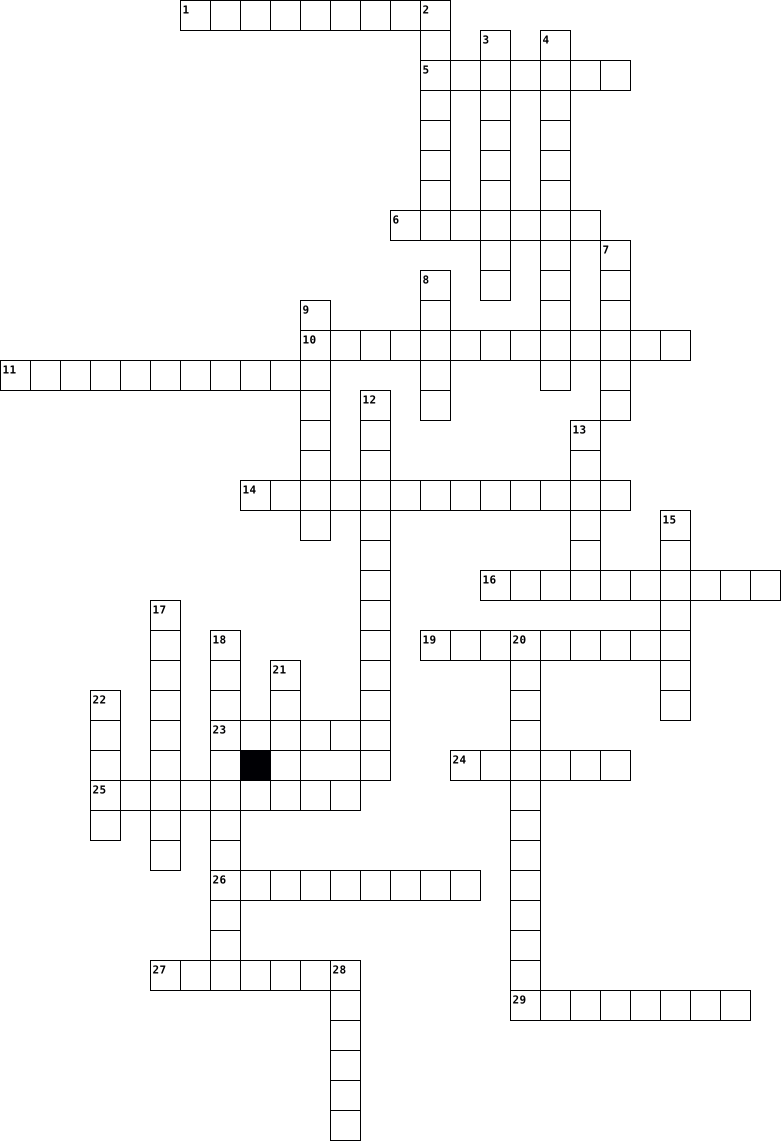
Across
- the act of spreading or allowing to spread freely
- subatomic particl that is constituent of every atomic nucleus except ordinary hydrogen
- a substance consisting only of atoms that all have the same numbers of protons in their atomic nuclei
- six chemical elements in group 2 of the periodic table
- any of the 6 chemical element that make up group 1 of the periodic table
- the amount of substance in a defined space
- the sum of the numbers of protons in the nucleus of an atom
- a substance formed when two or more chemical elements are chemically bonded together
- a substance that has mass and can take up space
- a stable subatomic particle that has a positive charge
- an electrical neutral group of atoms joined together by chemical bonds
- a nonmetal that in combination with a metal forms an alloy
- the horizantal row on the periodic table
- the negatively charged particles of an atom
Down
- a chemical element that mostly lacks the characteristics of a metal
- a particle smaller than an atom
- the number of protons found in the nucleus of every atom of that element
- the capacity of doing work
- a metallic substances composed of two or more elements,as either a compound or a solution
- the group in the periodic table consisting of five chemically related elements
- a fundamental theory of matter that explains physical properties in terms of the motion of atoms and molecules
- a column in the periodic table of the chemical elements
- the movement of a solvent(e.g water)through a semipermeable membrane(e.g a living cell)from a less concentrated solution into a more concentrated one
- a small portion of matter
- the number of protons in the nucleus of an atom
- an organised array of all the chemical elements in order of increasing atomic number
- an element that readily forms positive icons and has metallic bonds
- the smallest unit of ordinary matter that forms a chemical element
- a notation of one or two letters representing a chemical element
29 Clues: a small portion of matter • the capacity of doing work • a particle smaller than an atom • the horizantal row on the periodic table • the amount of substance in a defined space • the negatively charged particles of an atom • the number of protons in the nucleus of an atom • a substance that has mass and can take up space • the act of spreading or allowing to spread freely • ...
Chemistry crossword 2017-11-13

Across
- (in chemistry) vertical column of elements in the periodic table; elements in a family all have similar chemical properties; also called a group.
- change of state from a solid to a liquid.
- group 18 elements in the periodic table;the most stable and unreactive elements.
- change that results when two or more substances react to create a different substance or substances; the new substances have completely different properties from the original ones.
- group 1 elements in the periodic table, not including hydrogen; the most reactive of the metals.
- mass of one atom of an element calculated from the total number of protons,neutrons, and electrons of that atom; measured in atomic mass units .
- amount of mass in a given volume of a substance.
- vertical column of elements in the periodic table; elements in a family all have similarchemical properties; also called a family.
- a material that electric charge can move through easily.
- compound that dissolves in water to form a solution with a pH lower than 7.
Down
- group 17 elements in the periodic table;the most reactive non-metals.
- ability of a substance to conduct electricity or heat.
- energy stored in chemicals and released when chemicals react; a form of potential or stored energy .
- shiny, malleable, ductile element thatconducts electricity.
- colourless, odourless gas;produced by incomplete combustion of chemicals containing carbon (e.g. hydrocarbons); major source: motor vehicles.
- conductor through which electric current enters or leaves a device or material.
- chemical reaction that occurs when oxygen reacts with a substance to form a new substance and give off energy.
- the sum of the number of protonsand neutrons in an atom.
- element that has both metallic and non-metallic properties.
- positively charged centre of an atom;contains protons and neutrons.
- chemical combination of two or more elements in a specific ratio.
- pure substance that cannot be broken down into other substances; substance made up of only one type of atom.
- neutral particle in the nucleus of an atom.
23 Clues: change of state from a solid to a liquid. • neutral particle in the nucleus of an atom. • amount of mass in a given volume of a substance. • ability of a substance to conduct electricity or heat. • the sum of the number of protonsand neutrons in an atom. • a material that electric charge can move through easily. • ...
Standard 3 Crossword 2016-08-23

Across
- element with only 6 protons in its nucleus
- a substance with an orderly three-dimensional arrangement of particles
- element with 6 valence electrons and 6 electron energy levels
- the number of valence electrons will predict how ________ an element is
- a type of solid that does not have an orderly arrangement of its particles
- type of bond formed between metals and non-metals
- a material that is made of a single type of particle
- name of a combination of two or more substances physically combined
- if a train were a polymer, each train car would be a __________
- substance formed when two or more elements combine
- the first 92 elements are ________ occurring
- particle found in a cloud outside the nucleus
- chemical symbol for germanium
- subatomic particle without an electrical charge
Down
- the particles found in the nucleus of an atom are neutrons and __________
- a pure substance that cannot be broken down by physical or chemical means
- the smallest amount of an element
- unit of measurement used for the mass of subatomic particles
- another word for a column on the periodic table
- outermost electrons on an atom
- atoms are always electrically ____________
- the most massive element with only one valence electron
- rubber is an example of a _________ polymer
- characteristics of a substance
- a chemical symbol on the periodic table is a(n) __________ for the element's name
- information on the periodic table that tells you how many protons can be found in one atom of an element
- an ion always has a(n) __________ number of protons and neutrons
- most of the mass of an atom is found in the ___________
- type of bond that holds water molecules together
- a long chain of molecules combined into a larger molecule
- the number on the periodic table that shows how energy levels an atom will have
- particle formed when two or more atoms chemically bond together
- element on the periodic table with the lowest mass
- has the symbol Ar
34 Clues: has the symbol Ar • chemical symbol for germanium • outermost electrons on an atom • characteristics of a substance • the smallest amount of an element • element with only 6 protons in its nucleus • atoms are always electrically ____________ • rubber is an example of a _________ polymer • the first 92 elements are ________ occurring • ...
Chemistry A Final Exam review 2025-01-15

Across
- Looking at a periodic table, which element would be most reactive? (Sulfur, Nitrogen, Fluorine, Bromine)
- Scientific Knowledge can change when scientists conduct _____.
- This state, in which the particles are at extremely high temperatures, rarely found on Earth
- The 3 _______ particles of an atom are protons, neutrons, and electrons
- A ____ substance is made of either an element or a compound
- Chemical equations always have an ____ number of an element on both sides of the equation
- ______ bonds share electrons between two atoms at the same time.
- An atom that has a positive or negative charge
- A measurement of time
- When a chemical compound is exposed to a catalyst and breaks down into separate elements and/or different compounds, this is called a ______ reaction.
- _____ Compounds have a metal and a nonmetal.
- ____ bonds form because electrons can move freely between the atoms
- The electron dot ______ shows how many valence electrons an element has
- Scientific Knowledge established through direct observation
- An educated guess
Down
- Something that can be test/proven true or false.
- The chemical symbol K is what element?
- A small yellow ball that represents the Sun is an example of a ___ model.
- The last column of the Periodic Table is called the ____ gases.
- ____ are on the left side of a chemical equation
- Orbit the nucleus and have a negative charge
- Particles move freely but do not separate from neighboring particles
- A statement that is generally an opinion or belief and is not testable.
- Can be found on the Periodic Table
- The _____ of an element increases on the Periodic Table as it goes to the right and down.
- Salt dissolving in water is an example of a ______ change
- Rust is an example of a _____ change
- It retains its shape regardless of the shape of the container
- The number of valence electrons an element has can be determined by what ______ it is in on the Periodic Table
- _____ are on the right side of a chemical equation
- It expands to fill the volume of the container
- A measurement of length
32 Clues: An educated guess • A measurement of time • A measurement of length • Can be found on the Periodic Table • Rust is an example of a _____ change • The chemical symbol K is what element? • Orbit the nucleus and have a negative charge • _____ Compounds have a metal and a nonmetal. • An atom that has a positive or negative charge • It expands to fill the volume of the container • ...
Unit 7 - Periodic Table 2026-01-28

Across
- A scientist who created the first periodic table and predicted the existence of undiscovered elements
- Elements found in the middle of the periodic table that often have multiple charges and are good conductors
- Atoms of the same element with different numbers of neutrons
- A chart that organizes all known elements by increasing atomic number and similar properties
- A vertical column on the periodic table; elements in the same group have similar properties
- Very reactive nonmetals found in group 17 of the periodic table
- The number of protons in an atom’s nucleus; it identifies which element the atom is
- Negative particle outside of the nucleus in the electron cloud
- – Positive particle in the nucleus
- How easily an element reacts with other substances
- Elements in Group 1 of the periodic table that are very reactive metals
- – The center of an atom that contains protons and neutrons and has most of the atom’s mass
Down
- Elements that have properties of both metals and nonmetals; they are often used in electronics
- The total number of protons and neutrons in an atom’s nucleus
- Elements that are made in laboratories and do not occur naturally on Earth
- An atom that has gained or lost electrons and now has a positive or negative charge
- A one or two letter abbreviation used to represent an element
- – Neutral particle in the nucleus with protons
- Simple diagrams that show the atomic structure of an atom
- Elements that are usually shiny, conduct heat and electricity well, and can be bent or shaped
- The idea that when elements are arranged by increasing atomic number, their properties repeat a pattern
- Cloud – The area around the nucleus where electrons move; it shows where electrons are likely to be found
- Elements in Group 18 that are very unreactive because their outer electron shells are full
- – The smallest particle of an element that still has the properties of that element
- Elements that are usually dull, do not conduct heat or electricity well, and may be gases or brittle solids
25 Clues: – Positive particle in the nucleus • – Neutral particle in the nucleus with protons • How easily an element reacts with other substances • Simple diagrams that show the atomic structure of an atom • Atoms of the same element with different numbers of neutrons • The total number of protons and neutrons in an atom’s nucleus • ...
Chapter 5 Vocab IPS 2023-11-13

Across
- any of the set of metallic elements occupying a central block (Groups IVB–VIII, IB, and IIB, or 4–12) in the periodic table, e.g., iron, manganese, chromium, and copper. Chemically they show variable valence and a strong tendency to form coordination compounds, and many of their compounds are colored.
- a law stating that the elements, when listed in order of their atomic numbers (originally, atomic weights), fall into recurring groups, so that elements with similar properties occur at regular intervals.
- In chemistry and physics, valence electrons are electrons in the outermost shell of an atom, and that can participate in the formation of a chemical bond if the outermost shell is not closed.
- any of the elements fluorine, chlorine, bromine, iodine, and astatine, occupying group VIIA (17) of the periodic table. They are reactive nonmetallic elements that form strongly acidic compounds with hydrogen from which simple salts can be made.
- an element (e.g. arsenic, antimony, or tin) whose properties are intermediate between those of metals and solid nonmetals or semiconductors.
- any of the gaseous elements helium, neon, argon, krypton, xenon, and radon, occupying Group 0 (18) of the periodic table. They were long believed to be totally unreactive but compounds of xenon, krypton, and radon are now known.
- any of the elements lithium, sodium, potassium, rubidium, cesium, and francium, occupying Group IA (1) of the periodic table. They are very reactive, electropositive, monovalent metals forming strongly alkaline hydroxides.
Down
- the organized array of all the chemical elements in order of increasing atomic number
- a substance characterized by high electrical and thermal conductivity
- any of the elements beryllium, magnesium, calcium, strontium, barium, and radium, occupying Group IIA (2) of the periodic table. They are reactive, electropositive, divalent metals, and form basic oxides which react with water to form comparatively insoluble hydroxides.
- a column in the periodic table of elements
- an element or substance that is not a metal
- horizontal rows of the periodic table
- a unit of mass used to express atomic and molecular weights, equal to one-twelfth of the mass of an atom of carbon-12. It is equal to approximately 1.66 x 10⁻²⁷ kg.
14 Clues: horizontal rows of the periodic table • a column in the periodic table of elements • an element or substance that is not a metal • a substance characterized by high electrical and thermal conductivity • the organized array of all the chemical elements in order of increasing atomic number • ...
Chemistry - The periodic table 2023-04-25

Across
- the smallest number next to an element
- Copper and Iron are these
- nonmetal and nonmetal bond
- same number as element's group no
- these elements are fully stable
- Carbon 12 Is this
- metals make these
Down
- the number of protons + neutrons
- same numbers as element's period no
- nonmetals make these
- react with Na
- the elements on the left
- the rows of the periodic table
- the elements to the right
- nonmetals and metals bonding
- the columns of the periodic table
16 Clues: react with Na • Carbon 12 Is this • metals make these • nonmetals make these • the elements on the left • Copper and Iron are these • the elements to the right • nonmetal and nonmetal bond • nonmetals and metals bonding • the rows of the periodic table • these elements are fully stable • the number of protons + neutrons • same number as element's group no • ...
The Periodic Table 2026-05-06

Across
- An electron that is in the highest occupied energy level of an atom.
- a value that depends on the distribution of an element’s isotopes.
- Arrangement of elements in columns and rows.
- Elements that are good conductors of electric current and heat .
Down
- The elements in Group 8A of the periodic table.
- A row in a periodic table of elements.
- Elements that are poor conductors of heat and electrical current
- The elements in group 1a of the periodic table, not including hydrogen.
- Each column on the periodic table is called a _
- Elements with properties that fall between those of metals and non metals.
10 Clues: A row in a periodic table of elements. • Arrangement of elements in columns and rows. • The elements in Group 8A of the periodic table. • Each column on the periodic table is called a _ • Elements that are poor conductors of heat and electrical current • Elements that are good conductors of electric current and heat . • ...
1B Vocab for Science 2025-05-07

Across
- To resist scratching
- earth metal a group of 17 metallic elements found in the periodic table
- Chemical elements which fall in metal
- To be able to conduct electricity
- A substance that contains only one type of atom
- The ability to be stretched
Down
- Easily broken
- table A table of science chemicals and properties
- The way a material reflects light
- easily shaped by force
- When two things with metal are attracted to touch
- A hard silver type of rock
- Property Moving
- Lack of shine
- Chemical elements which don't fall in metal.
- The amount of density and volume in something
16 Clues: Easily broken • Lack of shine • Property Moving • To resist scratching • easily shaped by force • A hard silver type of rock • The ability to be stretched • The way a material reflects light • To be able to conduct electricity • Chemical elements which fall in metal • Chemical elements which don't fall in metal. • The amount of density and volume in something • ...
science crossword puzzle 2024-01-28

Across
- its a table that has all the elements
- it is the 8/0 group in the PERIODIC TABLE
- a particle of matter
- it has a negative charge
Down
- it is the 7th group in the PERIODIC TABLE
- it has a positive charge
- how dense an object is
- it is the first group in the PERIODIC TABLE
- how heavy an object is
- he amount of space occupied by any three-dimensional solid
10 Clues: a particle of matter • how dense an object is • how heavy an object is • it has a positive charge • it has a negative charge • its a table that has all the elements • it is the 7th group in the PERIODIC TABLE • it is the 8/0 group in the PERIODIC TABLE • it is the first group in the PERIODIC TABLE • he amount of space occupied by any three-dimensional solid
Atomic Structure and The periodic Table 2021-08-10

Across
- ability of an element to be plastically deformed
- ability of an element to be disfigured
- vertical lines on periodic tables
- atoms with same number and position of periodic table but with different masses and physicalp
- number of protons and neutrons in an atom
- basic unit of a chemical element
- gas, liquid, or brittle solid
Down
- elements that have characteristics of metals
- element that has metallic bonds
- horizontal lines on periodic table
- subatomic particle with a positive charge
- subatomic particle with negative charge
- number of protons in nucleus of an atom
- subatomic particle with no charge
- positively charged center of an atom
15 Clues: gas, liquid, or brittle solid • element that has metallic bonds • basic unit of a chemical element • vertical lines on periodic tables • subatomic particle with no charge • horizontal lines on periodic table • positively charged center of an atom • ability of an element to be disfigured • subatomic particle with negative charge • number of protons in nucleus of an atom • ...
Periodic Table and Bonding 2025-12-05

Across
- Dense center of atom
- Negative charge carrier
- Elementary light particle
- Neutral particle in nucleus
- Atomic mass measurement
- Noble gas with two protons
- Horizontal rows in table
- CHARGE Balanced positive and negative
- TABLE Chart listing all elements
- Building block of matter
- Charged atom or molecule
- Emits particles or energy
- Elements in vertical columns
Down
- Shared electron bond
- NO. Total nucleons in atom
- Electron energy level ring
- Nearly massless particle
- Force acting on charged particles
- Force linking atoms
- Positively charged particle
- Electron at higher energy
- Nuclear joining process
- Outer shell electrons
- Periodic table founder
- Nuclear splitting process
- Electron’s probable location
- NO. Number of protons in atom
- FORCE Holds nucleus together
- Electron transfer bond
- Same element, different neutrons
30 Clues: Force linking atoms • Shared electron bond • Dense center of atom • Outer shell electrons • Periodic table founder • Electron transfer bond • Negative charge carrier • Nuclear joining process • Atomic mass measurement • Nearly massless particle • Horizontal rows in table • Building block of matter • Charged atom or molecule • Elementary light particle • Electron at higher energy • ...
anderdingus deleted it 2025-12-12

Across
- state of matter with no definite shape or volume
- subatomic particles that dictates an atoms isotope
- a table of elements organized by energy levels and number of protons and electrons
- positively charged subatomic particles that dictate element
- vertical column of the periodic table
- state of matter with definite shape and volume
- the mass of an atom
- horizontal rows of the periodic table
- anything that takes up space
- purest form of matter
- outermost electron(s)
Down
- liquid turning into gas
- negatively charged subatomic particles with little to no mass
- the smallest form of matter
- state of matter with definite volume and no definite shape
- how many protons are in an atom
- gas turning into a liquid
- solid turning into a liquid
- liquid turning into solid
- high temperature gas
20 Clues: the mass of an atom • high temperature gas • purest form of matter • outermost electron(s) • liquid turning into gas • gas turning into a liquid • liquid turning into solid • the smallest form of matter • solid turning into a liquid • anything that takes up space • how many protons are in an atom • vertical column of the periodic table • horizontal rows of the periodic table • ...
Periodic classification of elements 2020-09-01

Across
- most stable element in the third row.
- What happens to the electropositive character of elements on moving from left to right in a periodic table.
- An element ‘x’ belongs to groups 2. Find its valency.
- other name of group 18th elements.
- elements has two shells and both are completely filled.
- most reactive element of group seventeenth.
- According to Newland’s law of octave ______________is similar to oxygen.
- predict whether "K" is metal or non- metal.
Down
- The basis of modern Periodic table is.
- nature of the oxide of element with atomic number 12.
- number of shells in strontium.
- on moving from left to right in a periodic table _____ character decreases.
- Group 17 elements are called.
- non- metallic character _________across a period.
- tendency to_______ electrons decreases down the group.
- Newland divided elements into horizontal rows of eight element reach State True or False.
16 Clues: Group 17 elements are called. • number of shells in strontium. • other name of group 18th elements. • most stable element in the third row. • The basis of modern Periodic table is. • most reactive element of group seventeenth. • predict whether "K" is metal or non- metal. • non- metallic character _________across a period. • ...
PERIODIC TABLE PUZZLE! 2021-09-25

Across
- UNIT OF ATOMIC RADIUS AND IONIC RADIUS.
- BERYLLIUM HAS 2 AS ITS ELECTRONIC CONFIGURATION IS 1s²,2s².
- KNOWN AS BLEACHING AGENT.
- WHAT TYPES OF ION IS BIGGER THAN ITS NEUTRAL ATOM?
- THE FATHER OF PERIODIC TABLE.
- THE OUTERMOST SHELL IN AN ATOM IS _________________ SHELL.
- THE GREATER NUCLEAR ATTRACTION BETWEEN ELECTRONS AND NUCLEUS SHRINKS ELECTRON _____________.
- ELECTRO_________________ INCREASES FROM PHOSPHORUS TO SULPHUR TO CHLORINE.
Down
- I'M THE GROUP WHERE CHLORINE, ASTATINE AND TENNESSINE ARE LOCATED.
- THE MAIN COMPONENT OF MILK IS ACTUALLY AN ALKALINE EARTH METAL!
- THE ELEMENTS THAT TRAVEL ACROSS ME WILL EVENTUALLY DECREASE IN SIZE.
- ALKALINE EARTH METAL ARE LOCATED IN GROUP _____________.
- A GROUP IS _______________ ORDER OF A PERIODIC TABLE.
- THE BOND OF SULPHUR.
- A STATE WHERE THE ELEMENTS NEITHER REACT NOR CHEMICALLY ACTIVE.
- I'M LIKE A LAMP POST IN THE STREET KNOWN AS A PERIODIC TABLE
16 Clues: THE BOND OF SULPHUR. • KNOWN AS BLEACHING AGENT. • THE FATHER OF PERIODIC TABLE. • UNIT OF ATOMIC RADIUS AND IONIC RADIUS. • WHAT TYPES OF ION IS BIGGER THAN ITS NEUTRAL ATOM? • A GROUP IS _______________ ORDER OF A PERIODIC TABLE. • ALKALINE EARTH METAL ARE LOCATED IN GROUP _____________. • THE OUTERMOST SHELL IN AN ATOM IS _________________ SHELL. • ...
Chemistry 2023-09-29

Across
- when two or more substances are combined but not chemically
- makes up everything in the world
- positive atoms that can also determine the number of electrons and the atomic number of an element
- pure substance that can't be broken down into simpler substances physically
- when two things that are combined are the same
- rings/shells around nucleus
- neutral atoms that have no charge
- rows left to right on the Periodic Table
- columns up to down on the Periodic Table
- negative atoms that can also determine number of protons and group for elements
- the unit we're learning
Down
- chart of elements ranked by characteristics
- electrons in the outer most shell of a energy level of a nucleus
- when atoms of 2 or more are chemically combined
- when two things are combined are different
- number on the Periodic Table that ranks the element
16 Clues: the unit we're learning • rings/shells around nucleus • makes up everything in the world • neutral atoms that have no charge • rows left to right on the Periodic Table • columns up to down on the Periodic Table • when two things are combined are different • chart of elements ranked by characteristics • when two things that are combined are the same • ...
Chemistry Crossword 2024-09-11

Across
- the energy required to remove an electron from an atom
- the principle which gives the increasing order of energies of atomic orbitals
- the principle which states that no more than two electrons can be present in a single orbital
- the particle in an atom without any charge
- the scientist who created the first periodic table
- geometry of CCL4
- substance made up of two or more elements in a fixed ratio
- the vertical columns of the periodic table
- the bond formed involving the sharing of electrons
- the horizontal rows of the periodic table
Down
- the bond formed involving the donation of electrons
- the region around the nucleus where an electron is most likely to be found
- the central part of an atom
- the negatively charged particle in an atom
- the measure of an atom’s ability to attract electrons
- the measure of the amount of substance
16 Clues: geometry of CCL4 • the central part of an atom • the measure of the amount of substance • the horizontal rows of the periodic table • the particle in an atom without any charge • the negatively charged particle in an atom • the vertical columns of the periodic table • the scientist who created the first periodic table • the bond formed involving the sharing of electrons • ...
Periodic Trends 2025-11-19

Across
- – Effective nuclear charge felt by valence electrons.
- – Elements in the d-block with partially filled d-orbitals.
- – Vertical column in the periodic table with similar properties.
- – Reduction of nuclear attraction on outer electrons due to inner electrons.
- – Energy change when an atom gains an electron.
- – Radioactive elements in the f-block (atomic numbers 89–103).
- – Rare earth metals in the f-block (atomic numbers 57–71).
- – Electrons in the outermost shell involved in bonding.
- – Energy required to remove an electron from an atom.
Down
- – Ability of an atom to attract electrons in a bond.
- – Repeating pattern of properties across the periodic table.
- – Highly reactive nonmetals in Group 17.
- – Degree to which an element exhibits metallic properties.
- – Degree to which an element exhibits nonmetallic properties.
- – Distance from the nucleus to the outermost electron.
- – Horizontal row in the periodic table.
16 Clues: – Horizontal row in the periodic table. • – Highly reactive nonmetals in Group 17. • – Energy change when an atom gains an electron. • – Ability of an atom to attract electrons in a bond. • – Effective nuclear charge felt by valence electrons. • – Energy required to remove an electron from an atom. • – Distance from the nucleus to the outermost electron. • ...
Marc Cruz Camacho B2 02/25/21 Periodic Table of Elements 2021-02-26

Across
- properties that becomes clear during or after a chemical reaction.
- helps indicate elemenets
- Periodic table of
- help scientists to make stuff such as vaccines
- scientist trained the study of chemistry
- vertical column
Down
- chemical reacting
- person who developed the PTOE
- chemical groups
- uses periodic table of elements
- horizontal row
- number of protons in the nucleus
- a abbreviation
- Protons and Neutrons
14 Clues: horizontal row • a abbreviation • chemical groups • vertical column • chemical reacting • Periodic table of • Protons and Neutrons • helps indicate elemenets • person who developed the PTOE • uses periodic table of elements • number of protons in the nucleus • scientist trained the study of chemistry • help scientists to make stuff such as vaccines • ...
The best Crossword 2023-05-25

Across
- replaced by x/y
- has many plugins
- two lives create another life
- word you use to ask for the reason
- person who run in competition
- left side of the periodic table
- base x height
- person who recites and sings stories
- eating problem
- add all sides
Down
- calulable forms
- the meat contributes...
- electronic utensil to do work
- right side of the periodic table
- is the person who commits illegal acts
- it is the most important verb in English
- reduce the normal price of a product
17 Clues: base x height • add all sides • eating problem • calulable forms • replaced by x/y • has many plugins • the meat contributes... • electronic utensil to do work • two lives create another life • person who run in competition • left side of the periodic table • right side of the periodic table • word you use to ask for the reason • reduce the normal price of a product • ...
Standard 3 Crossword 2016-08-23

Across
- a pure substance that cannot be broken down by physical or chemical means
- the particles found in the nucleus of an atom are neutrons and __________
- if a train were a polymer, each train car would be a __________
- outermost electrons on an atom
- a material that is made of a single type of particle
- a type of solid that does not have an orderly arrangement of its particles
- particle found in a cloud outside the nucleus
- the number of valence electrons will predict how ________ an element is
- the smallest amount of an element
- the first 92 elements are ________ occurring
- the number on the periodic table that shows how energy levels an atom will have
- name of a combination of two or more substances physically combined
- rubber is an example of a _________ polymer
- an ion always has a(n) __________ number of protons and neutrons
- a substance with an orderly three-dimensional arrangement of particles
- most of the mass of an atom is found in the ___________
Down
- element with only 6 protons in its nucleus
- unit of measurement used for the mass of subatomic particles
- chemical symbol for germanium
- information on the periodic table that tells you how many protons can be found in one atom of an element
- a chemical symbol on the periodic table is a(n) __________ for the element's name
- a long chain of molecules combined into a larger molecule
- particle formed when two or more atoms chemically bond together
- element on the periodic table with the lowest mass
- type of bond that holds water molecules together
- atoms are always electrically ____________
- the most massive element with only one valence electron
- characteristics of a substance
- type of bond formed between metals and non-metals
- element with 6 valence electrons and 6 electron energy levels
- substance formed when two or more elements combine
- has the symbol Ar
- another word for a column on the periodic table
- subatomic particle without an electrical charge
34 Clues: has the symbol Ar • chemical symbol for germanium • outermost electrons on an atom • characteristics of a substance • the smallest amount of an element • element with only 6 protons in its nucleus • atoms are always electrically ____________ • rubber is an example of a _________ polymer • the first 92 elements are ________ occurring • ...
Science Vocab Review 2022-11-18

Across
- When using the triangle method to calculate density, volume or mass if the numbers are next to each other you have to _________.
- Two or more DIFFERENT elements joined together is called a ________.
- If the atoms are compact, then the object/liquid will __________.
- All elements that share similar properties or react the same are located in the same _________.
- A pure substance made up of only one type of atom.
- Hammered into thin sheets like a gold bracelet or chain.
- Located to the right of the staircase on the periodic table.
- True or False When sugar dissolve in water, it is a chemical change.
- This vocabulary word means really tight or close together.
- How many metalloids are on the periodic table? (Bring Some Grapes And Sale The Plates)
- True or False: The best way to remember the definition of ductile is how you stretch out duct tape.
- Breaks Easily
- It is located on all of your charging cables and anything you have to plug into the wall to prevent you from being shocked by electricity.
- A new substance is formed when mixing two or more things together is called a __________ change.
- When using the triangle method to calculate density, volume or mass if the numbers are on top of each other you have to _________.
Down
- No new substance is formed is called a ___________ change.
- The only element that is a nonmetal but is located with all of the other metals on the periodic table.
- Takes up majority of the periodic table.
- All elements begin with a capital letter called a _______.
- If the atoms are spread out, then the object/liquid will __________.
- Anything that has mass and takes up space.
- A bigger word for "okay" conductor
- What number ALWAYS go in the calculator first when using the triangle method to solve for density?
- Can have a High Luster and be Brittle at the same time.
- They go left to right on the periodic table.
- Tells you how compacted atoms are in an object
- Metals stretch into wire this vocabulary word is called _____________
- A gentle movement of air towards the nose.
28 Clues: Breaks Easily • A bigger word for "okay" conductor • Takes up majority of the periodic table. • Anything that has mass and takes up space. • A gentle movement of air towards the nose. • They go left to right on the periodic table. • Tells you how compacted atoms are in an object • A pure substance made up of only one type of atom. • ...
Unit 3 CCA Crossword 2023-10-04

Across
- type of bond that involved transfer of electrons, often between metal and nonmetal
- subatomic particle, found in nucleus, no charge
- energy level or shell of an atom, contains electrons
- average kinetic energy of molecules, increases solubility of a solute
- a solution that can dissolve more solute
- the basic building block of matter
- a mixture of solvent and solute
- material that dissolves the solute (often a liquid)
- subatomic particle, found in nucleus, positive charge
- how many molecules of solute are exposed to solvent due to structure, allows for more solubility
- number of protons and electrons (if neutral, smaller number on periodic table
- a solution with the maximum amount of solute
- rows on the periodic table, contain elements with same number of orbitals
- distribution of charge in a molecule, can be polar or nonpolar
Down
- how readily a solute dissolves in a solvent
- organizes elements based on their atomic properties
- columns on the periodic table, contain families of elements with same number of valence electrons
- the center of an atom, majority of its mass, contains protons and electrons
- family of elements (column 18, group VIIIA), 8 valence electrons, stable, doesn't bond
- stirring or shaking that increases the solubility of a solute
- type of bond that involves sharing of electrons, often between nonmetals
- organized on the periodic table, has unique number of protons, neutrons, and electrons
- combination of protons and neutrons of an element, bigger number on periodic table
- outermost orbital/shell, electrons found here form bonds
- metals, family of elements (column 2, group IIA), 2 valence electrons, bonds with VIA
- material that dissolves in solvent (often a solid)
- family of elements (column 17, group VIIA) has 7 valence electrons, readily bonds with alkali metals
- metals, family of elements (column 1, group IA), 1 valence electron, reactive, bonds with halogens
- tiny subatomic particle, negative charge, involved in bonding
- a solution with more solute than usual due to heating and slowly cooling
30 Clues: a mixture of solvent and solute • the basic building block of matter • a solution that can dissolve more solute • how readily a solute dissolves in a solvent • a solution with the maximum amount of solute • subatomic particle, found in nucleus, no charge • material that dissolves in solvent (often a solid) • organizes elements based on their atomic properties • ...