
periodic table Crossword Puzzles
Chemistry 2018-10-29

Across
- many of the non metals and hydrogen
- elements ______ be broken down into simpler type of matter
- ________ consist of only kind of atom
- the most reactive non-metals are the __________
- compounds always contain the same ratio of __________
- the heaviest metal on the periodic table
- matter is made up of....
- element's ________ is an abbreviation for the element
- only _______ and bromine can be found as liquid on the periodic table
- where are protons and neutrons found
- energy rings contain what
- lightest non-metal
- pure substances composed of two or more different elements that are chemically joined are called
- electrons the electrons int the outermost shell of any element are called
- only shows the elements symbol and it's outer most electron shell
- what do neutrons have none of
- how many electrons can the 3rd energy ring hold up too.
- is a list of all the elements that can build matter
- what are a good conductors of heat and electricity
- what state of matter does iron appear at room temprature
- what kind of a bond occurs between a non metal and a metal
- adding a neutron makes an _________ of that atom
Down
- anything that takes up space and has mass
- what kind of metals are the most reactive metals
- what kind of gases are stable and do not react with anything
- electrons live in something called shells or _________________
- the ________ & neutrons are found in the center of the area
- The periodic table is a little like the alphabet of.......
- what shows all of the particles in the atom
- isotope is an _______ version of that atom
- how many elements are known at the present time
- number is the number of protons and neutrons
- electrons have _________ charge
- what is it called when there ia a number beside the element's symbol?
- most of the elements on the periodic table occur as ______ at room tempertaure.
- atomic mass is the number of protons and ______
- there are seven elements that form _______ consisting of two atoms
- metals another name for group 5
- determines the number of vaance electrons
- a horizontal row on a period table
- the lightest metal on the periodic table
- what kind of elements are more stable when joined in a pair
42 Clues: lightest non-metal • matter is made up of.... • energy rings contain what • what do neutrons have none of • electrons have _________ charge • metals another name for group 5 • a horizontal row on a period table • many of the non metals and hydrogen • where are protons and neutrons found • ________ consist of only kind of atom • the heaviest metal on the periodic table • ...
chemistry 2024-04-23
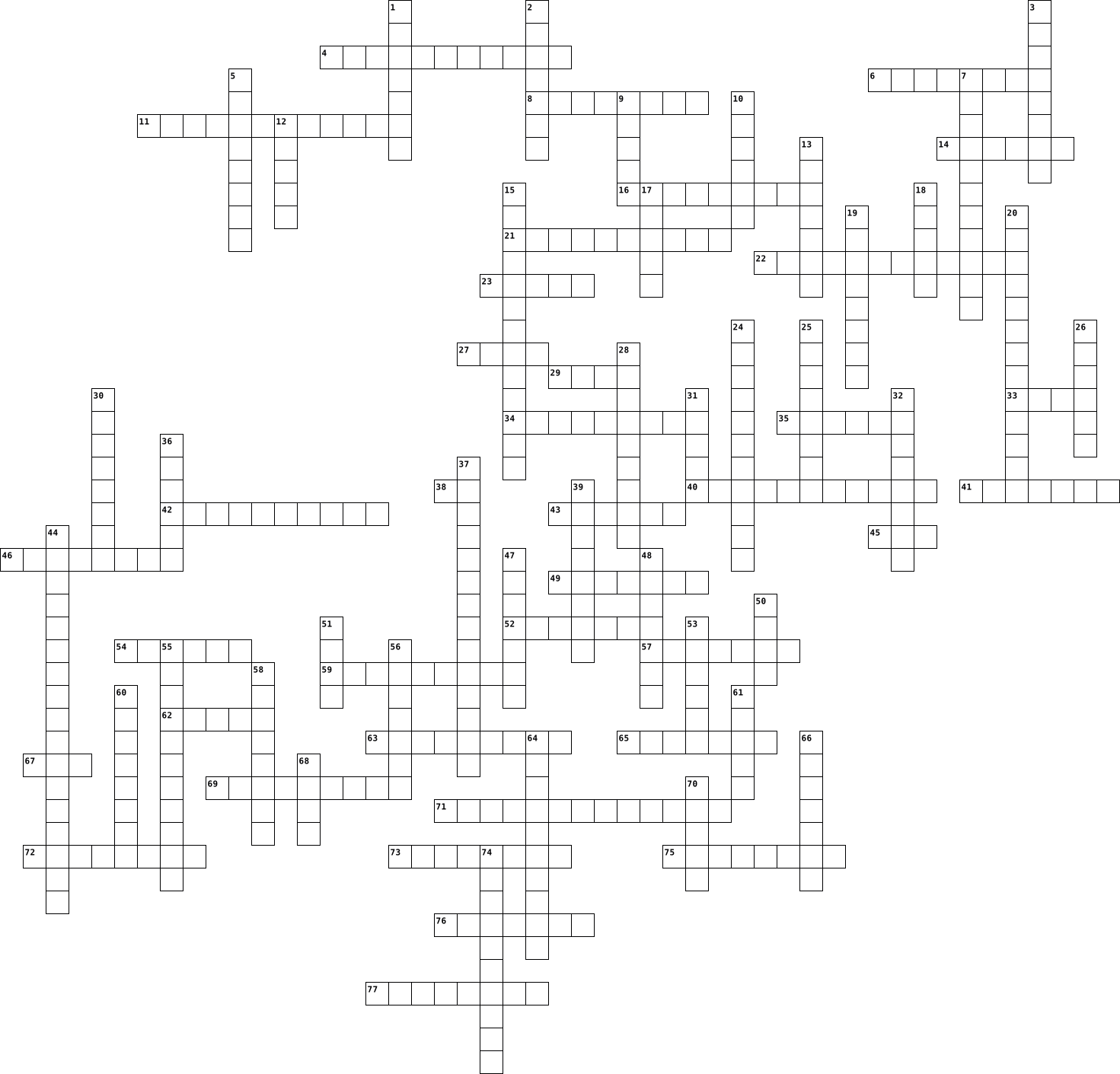
Across
- State in which forward and reverse reactions are balanced
- Force exerted by a substance per unit area
- Substance present at the start of a chemical reaction
- Principle stating that mass and energy are conserved in a system
- Group 1 elements in the periodic table
- Formula showing the simplest ratio of elements in a compound
- Process of changing directly from gas to solid
- Process of changing from gas to liquid
- Group 18 elements in the periodic table
- Speed at which a chemical reaction occurs
- Substance with a bitter taste and pH greater than 7
- Basic unit of matter
- Substance used to show the presence of another substance
- Substance dissolved in a solvent
- Measure of acidity or alkalinity
- Repeating pattern in the properties of elements
- Process of joining atoms together
- Elements in the middle of the periodic table
- Horizontal row in the periodic table
- Electrically charged atom or molecule
- Homogeneous mixture of two or more substances
- Expression representing a chemical compound
- Region of space where an electron is likely to be found
- Capacity to do work or produce heat
- Substance made of only one type of atom
- Molecule upon which an enzyme acts
- State of matter
- Relating to molecules
- Process of changing from solid to liquid
- State of matter with no fixed shape or volume
- Arrangement of atoms in a molecule
- Mixing of atomic orbitals
- Process of reducing the concentration of a solution
- Element that lacks metallic properties
- Study of reaction rates
- Measure of disorder in a system
- Characteristic of a substance
Down
- Process of changing from liquid to gas
- Neutral subatomic particle found in the nucleus
- Group of atoms bonded together
- Substance with distinct properties and composition
- Process of changing directly from solid to gas
- Chart displaying chemical elements
- State of matter with a fixed volume but no fixed shape
- Gaseous state of a substance
- Substance capable of dissolving other substances
- Spontaneous emission of radiation from an unstable nucleus
- Element that is typically shiny and conducts electricity
- Perfect or theoretical
- Process of changing from liquid to solid
- Amount of solute in a solvent
- Chemical reaction absorbing heat
- Substance composed of two or more elements
- Relating to atoms
- Element with properties of both metals and nonmetals
- Type of bond formed by sharing electrons
- Vertical column in the periodic table
- Process that involves the transformation of substances
- Positively charged subatomic particle
- Study of energy changes in chemical reactions
- Table organizing elements by atomic number
- Measure of an atom's ability to attract electrons
- Group 17 elements in the periodic table
- Central part of an atom containing protons and neutrons
- Force holding atoms together in a molecule
- Amount of matter in an object
- Force exerted on an object due to gravity
- Process of changing from liquid to gas
- Atoms of the same element with different numbers of neutrons
- Negatively charged subatomic particle
- Substance that increases the rate of a chemical reaction
- Bond formed by the transfer of electrons
- Energy required to initiate a chemical reaction
- Substance formed as a result of a chemical reaction
- Substance with a sour taste and pH less than 7
- State of matter with a fixed shape and volume
- Chemical reaction releasing heat
77 Clues: State of matter • Relating to atoms • Basic unit of matter • Relating to molecules • Perfect or theoretical • Study of reaction rates • Mixing of atomic orbitals • Gaseous state of a substance • Amount of solute in a solvent • Amount of matter in an object • Characteristic of a substance • Group of atoms bonded together • Measure of disorder in a system • ...
periodic table elements 2025-12-15

Across
- og
- rb
- hg
- fe
- k
- kr
- cs
Down
- rn
- ca
- fr
- au
- cu
- he
- li
- ar
- ag
- h
- xe
- na
- table
20 Clues: h • k • rn • ca • fr • au • cu • he • og • li • ar • ag • rb • xe • hg • na • fe • kr • cs • table
unit 6 & 7 2021-04-25

Across
- cations are ...
- a continuous spectrum has ... gaps between colors
- neutrons and protons are located in the ...
- the name of the ionic compound for Na and F will be ...
- a line spectrum has ... gaps between colors
- anions are ...
Down
- electrons located in the ... region
- on the periodic table ... are located in the second to last group to the right
- valence electrons are important because they determine how ... an element will be
- on the periodic table a ... goes from side to side
- a flame test is done and the color of the fire is violet, what is the element tested
- an ... is a positive or negatively charged particle
- ... are a single neutral particle
- on the periodic table a ... goes up and down
14 Clues: anions are ... • cations are ... • ... are a single neutral particle • electrons located in the ... region • neutrons and protons are located in the ... • a line spectrum has ... gaps between colors • on the periodic table a ... goes up and down • a continuous spectrum has ... gaps between colors • on the periodic table a ... goes from side to side • ...
Chemical composition 2022-04-18

Across
- the total number of groups found in the Periodic Table
- sodium potassium and lithium can be found in group number _______
- an element found in NH3 besides hydrogen
- ________ composition of a compound is unique to each substance
Down
- first element in the periodic table
- last element in group I
- chemical symbol for iron
- the first element in group VI
- the periodic table is divided into non metal and ________
- Ni is the chemical symbol
- Chemical symbol for copper
11 Clues: last element in group I • chemical symbol for iron • Ni is the chemical symbol • Chemical symbol for copper • the first element in group VI • first element in the periodic table • an element found in NH3 besides hydrogen • the total number of groups found in the Periodic Table • the periodic table is divided into non metal and ________ • ...
Chapter 12 Puzzle 2014-10-07

Across
- in chemistry, a horizontal row of elements in the periodic table
- one of the elements of group 2 of the periodic table
- one of the elements of group 17 of the periodic table
Down
- law that states that the repeating chemical and physical properties of elements change periodically with the atomic number of the elements
- one of the elements of group 18 of the periodic table
- a vertical column of elements in the periodic table; elements in a group share chemical properties
- describes something that occurs or repeats at regular intervals
- one of the elements of group 1 of the periodic table
8 Clues: one of the elements of group 2 of the periodic table • one of the elements of group 1 of the periodic table • one of the elements of group 18 of the periodic table • one of the elements of group 17 of the periodic table • describes something that occurs or repeats at regular intervals • in chemistry, a horizontal row of elements in the periodic table • ...
mercedes-may connor 2020-12-10
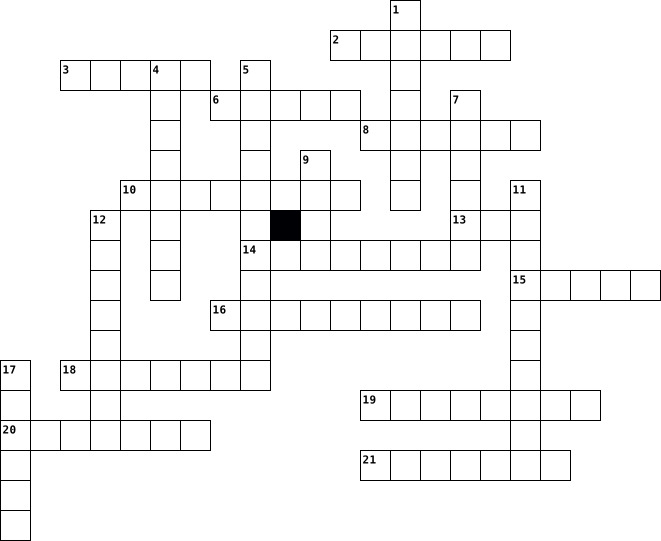
Across
- bursting
- flowing
- buds
- growing
- table
- flying
- reactions
- solids
- mass
- lab
- colour
- objects
- again
Down
- rising
- mixing
- signs
- cell
- burning
- glasses
- change
- training
21 Clues: lab • buds • cell • mass • signs • table • again • rising • mixing • change • flying • solids • colour • flowing • growing • burning • glasses • objects • bursting • training • reactions
Matter and more 2021-02-15

Across
- the amount of particular substances contained within a solution/mixture or in a particular volume/space
- the positively charged central region of an atom
- the total number of protons and neutrons in an atomic nucleus
- an element that has properties that are intermediate between those of metals and nonmetals
- a stable subatomic particle with a charge of negative electricity, found in all atoms and acting as the primary carrier of electricity in solids
- any of the elements lithium, sodium, potassium, rubidium, caesium, and francium, occupying Group IA (1) of the periodic table
- a table of the chemical elements arranged in order of atomic number
- the body of theory which explains the physical properties of matter in terms of the motions of its constituent particles
- process by which particles spread
- a notation of one or two letters representing a chemical element
- a group of atoms held together by covalent bonds
- a chemical element that mostly lacks the characteristics of a metal
- the movement of water molecules from a solution with a high concentration of water molecules to a solution with a lower concentration of water molecules
- a vertical column in the Periodic Table
- the smallest unit into which matter can be divided without the release of electrically charged particles
Down
- a small portion of matter
- smaller than or occurring within an atom.
- an element that readily forms positive ions
- any of the six chemical elements that comprise Group 2 (IIa) of the periodic table
- the fundamental materials of which all matter is composed
- an admixture of metals
- the name given to a horizontal row of the periodic table
- any substance that has mass and takes up space by having volume
- the capacity for doing work
- a substance that contains atoms of two or more different elements that are chemically joined together
- a group in the periodic table consisting of five chemically related elements
- a subatomic particle of about the same mass as a proton but without an electric charge
- a stable subatomic particle occurring in all atomic nuclei, with a positive electric charge equal in magnitude to that of an electron
28 Clues: an admixture of metals • a small portion of matter • the capacity for doing work • process by which particles spread • a vertical column in the Periodic Table • smaller than or occurring within an atom. • an element that readily forms positive ions • the positively charged central region of an atom • a group of atoms held together by covalent bonds • ...
Periodic Table 2021-04-19

Across
- gases has 8 valence electrons in this family
- stretched into wires
- positively charged
- has both metallic and nonmetallic properties
- rows in the periodic table
- electrons outer most atoms
Down
- hammered into sheets
- poor conductors
- columns in the periodic table
- good conductors
- negatively charged
- no charge
12 Clues: no charge • poor conductors • good conductors • positively charged • negatively charged • hammered into sheets • stretched into wires • rows in the periodic table • electrons outer most atoms • columns in the periodic table • gases has 8 valence electrons in this family • has both metallic and nonmetallic properties
Elements and its properties 2023-11-09

Across
- most common chemical
- columns in the periodic table
- symbol is O.
- rarest chemical element with symbol At
- rows in the periodic table
- electronic configuration 2,8,2
Down
- symbol K
- a radioactive gas
- most reactive of all non-metal.
- 78% of the earth's atmosphere is
- atomic number is 32
- Na
12 Clues: Na • symbol K • symbol is O. • a radioactive gas • atomic number is 32 • most common chemical • rows in the periodic table • columns in the periodic table • electronic configuration 2,8,2 • most reactive of all non-metal. • 78% of the earth's atmosphere is • rarest chemical element with symbol At
Periodic Table 2021-08-25

Across
- An element named after a US state which happens to have the largest amount of overseas Vietnamese.
- A column in the Periodic Table.
- The first element listed in the Periodic Table.
- Usually solid at room temperature.
- Common characteristic of non-metals.
Down
- A positively charged subatomic particle.
- A row in the Periodic Table.
- A subatomic particle with no charge.
- An element with six protons.
- A negatively charged subatomic particle.
- Holds electrons. Also known as an orbital.
11 Clues: A row in the Periodic Table. • An element with six protons. • A column in the Periodic Table. • Usually solid at room temperature. • A subatomic particle with no charge. • Common characteristic of non-metals. • A positively charged subatomic particle. • A negatively charged subatomic particle. • Holds electrons. Also known as an orbital. • ...
Year 11 Chemistry 2 2022-04-28

Across
- Positive subatomic particle.
- Group 7 in the periodic table, more reactive at the top of the group.
- A molecule made up of two atoms.
- Negative subatomic particle.
- Two or more different atoms chemically bonded.
- gases Group 0 in the periodic table, very unreactive.
- Made up of only one type of atom.
Down
- Group 1 in the periodic table, very reactive.
- Regular arrangement of closely packed oppositely charged ions.
- Two or more atoms chemically bonded.
- Neutral subatomic particle.
11 Clues: Neutral subatomic particle. • Positive subatomic particle. • Negative subatomic particle. • A molecule made up of two atoms. • Made up of only one type of atom. • Two or more atoms chemically bonded. • Group 1 in the periodic table, very reactive. • Two or more different atoms chemically bonded. • gases Group 0 in the periodic table, very unreactive. • ...
Chemical Bonding Vocabulary 2020-05-01

Across
- form when elements react chemically
- group of elements found largely on the right side of the periodic table
- group of elements in the same column of the periodic table
- a type of bond that occurs when valence electrons are shared
- group of elements found in the same row of the periodic table
- group of elements found largely on the left side of the periodic table
Down
- a representation of how many atoms of each element make up a compound using symbols
- what atoms become after they gain,lose, or share electrons
- what is made when atoms gain or lose electrons
- a type of bond that occurs when valence electrons are transferred
- what is made when atoms gain or lose a neutron
- group of elements found on the "stair-steps" between the nonmetals and the metals
12 Clues: form when elements react chemically • what is made when atoms gain or lose electrons • what is made when atoms gain or lose a neutron • what atoms become after they gain,lose, or share electrons • group of elements in the same column of the periodic table • a type of bond that occurs when valence electrons are shared • ...
Science Puzzle 2012-02-20

Across
- bond / formed when atoms share two pairs of electrons
- / an idea to help the people to understand a concept that they cannot observe directly
- / move around outside the nucleus of an atom
- / elements in the same vertical column of the periodic table
- bond / an attraction between a positive metal ion and the electrons surrounding it
- / the center core of the atom
- bond / the force that holds atoms together
- ion / is made of more than one atom
- / elements in the same horizontal row of the periodic table
- / two or more substances that are mixed together but not chemical combined
- bond / electrons are share unequally
- / an neutral particle made of two or more atoms joined by covalent bonds
- / tells you the ratio of elements in the compound
- bond / share three pairs of electrons
- bond / formed when two atoms share electrons
- electrons / they are in the highest energy level
- / the smallest particle of an element
- / cannot be broken down into any other substance by chemical or physical means
Down
- / is called family
- / material that can be pulled out into a long wire
- / used to describe a material that can be hammered or rolled into shape
- compound / compound that is composed of molecules
- metal / element belonging to group 1 of the periodic table
- bond / electrons are shared equally
- / occupies space
- theory / explains and connects wide range of observations
- compound / consist of a positive and negative ions
- gas / is found in the group 18 in the periodic table
- / has the properties of a metal
- / particles that are found in the nucleus of an atom
- / used to identify an element
- / an orderly three dimensional pattern of ions or atoms share electrons
- / an atom or group of atoms that has become electrically charged
- / an element belonging to group 17of the periodic table
- number / protons in the nucleus of an atom
- level / a region of an atom in which electrons of the same energy are likely to be found
36 Clues: / occupies space • / is called family • / the center core of the atom • / used to identify an element • / has the properties of a metal • bond / electrons are shared equally • ion / is made of more than one atom • bond / electrons are share unequally • bond / share three pairs of electrons • / the smallest particle of an element • bond / the force that holds atoms together • ...
chemistry crossword 2015-12-02

Across
- chemical combination of two or more elements in a specific ratio
- a material that electric change can move through easily
- change of state from a gas to a liquid
- element that has both metallic and non-metallic properties
- pure substance formed when at least one metal and one non-metal combine
- invisible negatively charged particle that orbits the nucleus of an atom
- a reaction that takes place when two or more substances react to form new substances
- atom that has become electrically charged because it has lost or gained electrons
- an experiment in which one or more products of a chemical reaction can escape
- group 2 elements in the periodic table
- group 17 elements in the periodic table;the most reactive non-metals
Down
- ability of a substance to conduct electricity or heat
- horizontal row of elements in the periodic table
- pure substance that cannot be broken down into other substances
- sum of the number of protons and neutrons in an atom
- results when two or more substances react to create a different substance or substances, the new substances have completely different properties from the original ones
- change of state from a gas to a solid
- results when two or more substance react to create a different substance or substances
- description of how a substance interacts with other substances
- amount of protons in the nucleus of one atom of an element
- principle that matter is not created or destroyed in a chemical reaction
- description of a substance that can be pounded or rolled into sheets
- an experiment in which all reactants and all products of a chemical reaction are accounted for
- dull brittle element that does not conduct electrons
- mass of one atom of an element calculated from the total number of protons
- group 1 elements in the periodic table
- the smallest part of an element that is representative of that element
- group 18 in the periodic table the most stable and nonreactive elements
28 Clues: change of state from a gas to a solid • change of state from a gas to a liquid • group 2 elements in the periodic table • group 1 elements in the periodic table • horizontal row of elements in the periodic table • sum of the number of protons and neutrons in an atom • dull brittle element that does not conduct electrons • ...
Standard 3 Crossword 2016-08-23

Across
- a type of solid that does not have an orderly arrangement of its particles
- element with 6 valence electrons and 6 electron energy levels
- most of the mass of an atom is found in the ___________
- a long chain of molecules combined into a larger molecule
- the number of valence electrons will predict how ________ an element is
- a chemical symbol on the periodic table is a(n) __________ for the element's name
- unit of measurement used for the mass of subatomic particles
- type of bond that holds water molecules together
- atoms are always electrically ____________
- information on the periodic table that tells you how many protons can be found in one atom of an element
- particle found in a cloud outside the nucleus
- element with only 6 protons in its nucleus
- particle formed when two or more atoms chemically bond together
- name of a combination of two or more substances physically combined
- the most massive element with only one valence electron
- element on the periodic table with the lowest mass
- an ion always has a(n) __________ number of protons and neutrons
Down
- the particles found in the nucleus of an atom are neutrons and __________
- type of bond formed between metals and non-metals
- characteristics of a substance
- if a train were a polymer, each train car would be a __________
- rubber is an example of a _________ polymer
- a material that is made of a single type of particle
- another word for a column on the periodic table
- subatomic particle without an electrical charge
- the first 92 elements are ________ occurring
- outermost electrons on an atom
- the number on the periodic table that shows how energy levels an atom will have
- substance formed when two or more elements combine
- has the symbol Ar
- a substance with an orderly three-dimensional arrangement of particles
- a pure substance that cannot be broken down by physical or chemical means
- chemical symbol for germanium
- the smallest amount of an element
34 Clues: has the symbol Ar • chemical symbol for germanium • characteristics of a substance • outermost electrons on an atom • the smallest amount of an element • atoms are always electrically ____________ • element with only 6 protons in its nucleus • rubber is an example of a _________ polymer • the first 92 elements are ________ occurring • ...
Periodic Trends Vocab 2024-10-11

Across
- An atom or molecule that has gained or lost one or more electrons, resulting in a positive (cation) or negative (anion) charge.
- Metals lose electrons and form this type of ion
- Property of Noble Gasses, a full valence shell of 8 valence electrons and the reason they do NOT bond
- Elements that are usually poor conductors of heat and electricity, brittle in solid form, and found on the right side of the periodic table
- Type of Electrons in the outermost shell of an atom that determine its chemical behavior and bonding characteristics.
- A combination of two or more substances that retain their individual properties and can be separated by physical means
- The distance from the nucleus of an atom to the outermost shell of electrons
- Which element has a great ionization energy: Chromium or Tin?
- The number of protons in the nucleus of an atom, which defines the element.
- Which element has a greater electronegativity: Cesium or Hydrogen?
- A vertical column in the periodic table that contains elements with similar chemical properties.
Down
- A measure of an atom's ability to attract and hold onto electrons in a chemical bond
- Energy The energy required to remove electrons from gaseous atoms.
- Elements that have properties intermediate between metals and nonmetals; they are located along the staircase line on the periodic table
- Two different forms of the same element with different crystal structure and different properties.
- Nonmetals gain electrons and form this type of ion
- Elements that are typically shiny, good conductors of heat and electricity, malleable, and ductile; found on the left side of the periodic table.
- A pure substance that cannot be broken down into simpler substances by chemical means; represented on the periodic table
- A substance formed when two or more elements chemically bond together in fixed proportions.
- The element that is a metal and a liquid at STP
- The smallest unit of an element that retains the properties of that element.
- Metal with the largest atomic radius
22 Clues: Metal with the largest atomic radius • Metals lose electrons and form this type of ion • The element that is a metal and a liquid at STP • Nonmetals gain electrons and form this type of ion • Which element has a great ionization energy: Chromium or Tin? • Which element has a greater electronegativity: Cesium or Hydrogen? • ...
Periodic Table Puzzle By: Aliza Hall 2013-09-22

Across
- columns on the periodic table are called?
- a state of matter that has definite shape and volume.
- they are located in the nucleus and have a neutral charge.
- Symbol the symbol scientists use to represent which element it is
- a state of matter that has no definite shape or volume.
- it is a substance that is made up of one type on atom
- they are located in the middle of the atom and have a positive charge
- Particles 1.protons 2.electrons 3.neutrons.
- a state of matter that definite volume but no definite shape
Down
- rows on the periodic table are called?
- the measure of the amount of matter in an object.
- it is anything that has mass and takes up space.
- a physical property that describes the amount of space that matter occupies.
- they are on the orbitals of the atom. Nucleus/ the middle of the atom.
- Table the table that has all the elements.
- they make up everything.
- a measure of the force of gravity on an object. mass x gravity=?
- Number the number of protons in an atom of that element
18 Clues: they make up everything. • rows on the periodic table are called? • columns on the periodic table are called? • Table the table that has all the elements. • Particles 1.protons 2.electrons 3.neutrons. • it is anything that has mass and takes up space. • the measure of the amount of matter in an object. • a state of matter that has definite shape and volume. • ...
Chemical Bonding 2020-09-01

Across
- Newland divided elements into horizontal rows of eight element reach State True or False.
- other name of group 18th elements.
- most stable element in the third row.
- non- metallic character _________across a period.
- Group 17 elements are called.
- on moving from left to right in a periodic table _____ character decreases.
- The basis of modern Periodic table is.
Down
- What happens to the electropositive character of elements on moving from left to right in a periodic table.
- According to Newland’s law of octave ______________is similar to oxygen.
- number of shells in strontium.
- An element ‘x’ belongs to groups 2. Find its valency.
- most reactive element of group seventeenth.
- elements has two shells and both are completely filled.
- tendency to_______ electrons decreases down the group.
- predict whether "K" is metal or non- metal.
- nature of the oxide of element with atomic number 12.
16 Clues: Group 17 elements are called. • number of shells in strontium. • other name of group 18th elements. • most stable element in the third row. • The basis of modern Periodic table is. • most reactive element of group seventeenth. • predict whether "K" is metal or non- metal. • non- metallic character _________across a period. • ...
Daiwikh's Crossword Puzzle 2026-02-27

Across
- A substance that speeds up a reaction while not taking part in it
- The compound formed when nickel reacts with iodine
- the group in the Periodic Table with full outermost electron shells
- The most reactive metal
- The element with it's atomic symbol of K
- The scientific name for the outermost electron shell
- The only metal capable of being a gas at room temp
- The gas that iron reacts to to form rust
Down
- The metal used in light bulbs
- The only non-metal that has several properties of metals
- The name for elements that have properties of both metals and non-metals
- The charge of a proton
- The only gas that belongs in group one in the Periodic Table
- A varient of an element with the same amount of protons but not neutrons
- The amount of groups in The Periodic Table
- The gas that the air is mostly made of
16 Clues: The charge of a proton • The most reactive metal • The metal used in light bulbs • The gas that the air is mostly made of • The element with it's atomic symbol of K • The gas that iron reacts to to form rust • The amount of groups in The Periodic Table • The compound formed when nickel reacts with iodine • The only metal capable of being a gas at room temp • ...
Ch.16 Vocab 2022-02-15

Across
- the thing at the center of an atom
- table the has all the elements on it
- the number of protons in an element
- vertical columns on the periodic table
- smaller particles that make up protons and neutrons
- negatively charged particles
- same element different neutrons
- the smallest piece of matter, makes up everything
- the sum of the protons and neutrons
Down
- area around the nucleus where electrons are
- positively charged particles
- neutrally charged particles
- diagram that uses dots and the element
- the weight average of mix isotopes
- horizontal columns on the periodic table
15 Clues: neutrally charged particles • positively charged particles • negatively charged particles • same element different neutrons • the thing at the center of an atom • the weight average of mix isotopes • the number of protons in an element • the sum of the protons and neutrons • table the has all the elements on it • diagram that uses dots and the element • ...
Year 9 Science 2023-11-07

Across
- A change in which atoms are rearranged to create a new substance
- Type of circuit where each component is connected on its own branch
- A chemical .... shows how many atoms of each elements are in a compound
- One or two letter code used to identify the elements on the periodic table
- The closed path through which the electrical charge can flow
- The product in this reaction: carbon + oxygen = ....
- Type of circuit where the components are connected in a line
- There are more than a hundred substances shown in the periodic table, which cannot be broken into any smaller parts
- Group 8 of the periodic table- unreactive gases, which include helium and krypton
- The amount of mass in a given volume
- A chemical reaction with oxygen that gives out light and heat
- You would use this piece of equipment when leaving things out to dry or evaporate
- When pouring substances into narrow openings, you would use this piece of equipment
- The least reactive metal on the reactivity series
- When all the connections in a circuit are joined and the flow of charge is not interrupted, the circuit is ....
- Similar to a spoon, this item is used to scoop, scrape and transfer substances
- A change which transfers energy to the surroundings
- Two or more connected cells in an electrical circuit
- Group 1 of the periodic table- reactive metals, which include lithium and rubidium
- The name given to the horizontal rows on the periodic ta The elements on the periodic table are organised depending on this
- The resulting substances in a chemical reaction
- Type of reaction where one metal takes the position of another
- When a chemical reaction occurs, .... is transferred to or from the surroundings
- Group 7 of the periodic table- reactive non-metals, which include fluorine and iodine
- The smallest part of a chemical element
- This is required within an electrical circuit to move the charge and create a current
- Named after the German chemist Robert Bunsen
- A possible source of danger (something you check before conducting an experiment)
- This narrow tube is commonly used in practical work in science. It can hold small amounts of substances
- A reaction which transfers energy from the surroundings
Down
- Method of separating a solution to recover the dissolved substance
- The elements on the periodic table are organised depending on this
- This shallow, transparent dish is often used to grow cell cultures such as bacteria and fungi
- Use this piece of equipment to measure the volume of a liquid
- Equipment used to measure voltage
- The number on the periodic table that represents the number of protons in an atom’s nucleus
- A material that will reduce electrical energy passing through it
- A single battery in an electrical circuit
- Method of separating dissolved and not dissolved substances in a solution
- A device or part of a circuit
- When measuring temperature, you would use a ....
- Unit of measurement for voltage
- A nutrient that is used by the body for growth and repair
- Something that can be used to complete or break a circuit connection
- This specialised paper helps separate substances such as sand and water
- A nutrient that is used by the body as the main source of energy
- When observing a chemical reaction, you might feel the chemicals change in
- The starting substances in a chemical reaction
- The name given to the vertical columns on the periodic table
- A type of flask with a triangular shape
- This piece of electronic equipment measures mass
- Equipment used to measure the flow of electrons in a circuit
- The flow of electric charge in a circuit
- Unit of measurement for current
- A substance made of two or more atoms chemically joined together
- This piece of equipment is a three-legged stand
- A substance that does not take part in chemical reactions
- A material that will allow energy (heat or electrical) to pass through it easily.
- The solution used to test for starch
- Protective equipment worn in a lab
- To stir substances, you would use a ....
- The elements on the right-hand side of the table are all ....
- This safety equipment is used to protect your eyes during practical work
- This piece of equipment comes in different sizes and is used to transport liquid.
64 Clues: A device or part of a circuit • Unit of measurement for voltage • Unit of measurement for current • Equipment used to measure voltage • Protective equipment worn in a lab • The amount of mass in a given volume • The solution used to test for starch • A type of flask with a triangular shape • The smallest part of a chemical element • The flow of electric charge in a circuit • ...
Measurements and Atoms and Elements 2016-12-21

Across
- The densest part of the atom; Always positive
- The elements in the two leftmost columns and six rightmost columns of the periodic table are known as _______ elements
- An atom that became charged by losing or gaining some electrons
- Two ___________ of the same element are identical in every way except the number of neutrons in the nucleus
- The _________ number is used to distinguish between elements. It counts the number of protons in the atom
- The periodic table is dominated by ______. They tend to lose electrons in chemical reactions
Down
- Members of group 7A
- These elements (e.g., helium and neon)on the right edge of the periodic table are "too comfortable on their own" so they don't make compounds. They are known as _______ gases
- All the numbers of the measurement, estimated digit included, are known as ____________ figures
- Horizontal collection of elements in the periodic table
- The weighted average mass of an atom of the element (two words)
- Mass divided by volume
- The ___________ number counts the protons and neutrons in the atom
13 Clues: Members of group 7A • Mass divided by volume • The densest part of the atom; Always positive • Horizontal collection of elements in the periodic table • The weighted average mass of an atom of the element (two words) • An atom that became charged by losing or gaining some electrons • The ___________ number counts the protons and neutrons in the atom • ...
pertains vocab 2024-01-23

Across
- group 2 elements not as reactive as group 1
- the smallest unit of an element that maintains the properties of that element
- Positively charged particle in the nucleus of an atom
- Number The total number of protons and neutrons in an atom's nucleus
- table A chart of all chemical elements currently known, orga- nized by their properties.
- pure substance that consists entirely of one type of atom
Down
- Found along the 'staircase'. Have properties of both met- als and nonmetals
- brittle , dull, poor conductors of heat and electricity; located on the right side of the periodic table
- Metals Group 1 elements (except Hydrogen) - most reactive met- als on the periodic table
- groups 3-12 located in the middle of the periodic table
- Number The number of protons in the nucleus of an atom of an element
- A subatomic particle that is neutral and that is found in the nucleus of an atom
- A tiny, negatively charged particle that moves around the nucleus of an atom.
13 Clues: group 2 elements not as reactive as group 1 • Positively charged particle in the nucleus of an atom • groups 3-12 located in the middle of the periodic table • pure substance that consists entirely of one type of atom • Number The number of protons in the nucleus of an atom of an element • Number The total number of protons and neutrons in an atom's nucleus • ...
Periodic Table 2023-08-25

Across
- Free electrons Nonmetals generally are not good ____ _________ of heat and electricity
- Configuration Predicting a lot about the chemical ________ _____________ if you know where it is on the periodic table
- Elements Elements are __________ you can find them on the ________
- Each row corresponds to a different _______.
- Symbol Element is represented by one ________ on the periodic table, one or two-letter chemical ______
Down
- Elements found on either side are often called __________
- Hydrogen is on the upper left
- Shell The elements in a group have similar chemical _______ _____.
- Table A powerful tool chemists have for organizing chemical information is the ________ _____
- Every so often, and _____ gas appears.
- size In order of increasing ______ ____ as you read the periodic table from left to right top to bottom.
11 Clues: Hydrogen is on the upper left • Every so often, and _____ gas appears. • Each row corresponds to a different _______. • Elements found on either side are often called __________ • Shell The elements in a group have similar chemical _______ _____. • Elements Elements are __________ you can find them on the ________ • ...
Ch 4.3 and 5.1-3 Crossword 2022-10-13

Across
- Elements that are poor conductors of heat and electric current
- A law stating that the elements when listed in order of their atomic numbers fall into recurring groups
- Electron that is in the highest occupied energy level of an atom
- Unit measured as one twelfth the mass of a carbon-12 atom
- Fixed distances of electrons from the nucleus of an atom
- Visual model of where electrons are likely to be
- Group of metals with two valence electrons
- Electrons in an atom have the lowest possible energies
Down
- Chart of every single element
- Elements that are good conductors of electric current and heat
- Arrangement of electrons in the orbitals of an atom
- Region of space around the nucleus where an electron is likely to be found
- Elements that form a bridge between the elements on the left and right sides of the table
- Column of elements on the periodic table
- Extremely reactive metals with one valence electron
- Group of 4 non metals and 1 metalloid with seven valence electrons
- Elements with properties that fall between those of metals and nonmetals
- Group of gases on the periodic table with eight valence electrons (except helium)
- Horizontal row of the periodic table
19 Clues: Chart of every single element • Horizontal row of the periodic table • Column of elements on the periodic table • Group of metals with two valence electrons • Visual model of where electrons are likely to be • Arrangement of electrons in the orbitals of an atom • Extremely reactive metals with one valence electron • ...
Chemistry Crossword 2017-11-09

Across
- anything that has mass and occupies space
- chemical combination of two or more elements in a specific ratio
- any subject of importance about which people have strong, conflicting points of view
- horizontal row of elements in the periodic table
- Workplace Hazardous Materials Information System; a system of easy-to-see warning symbols on hazardous materials
- mass of a substance that can dissolve in a given amount of solvent to form a saturated solution at a given temperature
- energy stored in chemicals and released when chemicals react
- cloudy mixture in which tiny particles of one substance are held within another and particles cannot be separated out from the other substance
- group 17 elements in the periodic table; the most reactive non-metals
- ability of a substance to conduct electricity or heat
- each of more than one hundred substances that cannot be chemically interconverted or broken down into simpler substances and are primary constituents of matter. Each element is distinguished by its atomic number, i.e., the number of protons in the nuclei of its atoms
- vertical column of elements in the periodic table; elements in a family all have similar chemical properties; also called a family
- amount of mass in a given volume of a substance
- gases group 18 elements in the periodic table; the most stable and unreactive elements
- positively charged particle in the nucleus of an atom
Down
- neutral particle in the nucleus of an atom
- table a table in which the elements are organized by their physical and chemical properties
- the basic unit of a chemical element
- change that results when two or more substances react to create a different substance or substances
- cloudy mixture in which tiny particles of one substance are held within another, and the particles can be separated out p
- element that has both metallic and non- metallic properties
- system an experiment in which one or more products of a chemical reaction can escape
- substance substance made of only one kind of matter, which has a unique set of properties
- homogeneous mixture; mixture of two or more pure substances that looks like one substance
- shiny, malleable, ductile element that conducts electricity
25 Clues: the basic unit of a chemical element • anything that has mass and occupies space • neutral particle in the nucleus of an atom • amount of mass in a given volume of a substance • horizontal row of elements in the periodic table • ability of a substance to conduct electricity or heat • positively charged particle in the nucleus of an atom • ...
CHEMISTRY 2025-04-28

Across
- 20
- 19
- 3
- 4
- 9
- 18
- 16
- 10
- 11
Down
- 5
- 6
- 12
- 2
- 13
- 15
- 8
- 1
- 7
- 17
- 14
20 Clues: 5 • 6 • 2 • 3 • 8 • 4 • 1 • 9 • 7 • 12 • 20 • 13 • 19 • 15 • 18 • 16 • 17 • 14 • 10 • 11
The Atom 2025-10-12

Across
- this is a row on the periodic table
- this is a charged atom
- opposite charges ______ each other
- the smallest unit of an element that still retains its properties
- the sum of the protons and neutrons in an atom
- a region of negative charge in which there is a high probability of finding an electron
- this can also be referred to as a family and are the columns of the periodic table
- atoms of the same element with different masses
- the subatomic particle with almost no mass
Down
- the weighted average of all the different isotopes of an element
- this is a positive subatomic particle
- the periodic table is arranged by this number
- this is a neutral subatomic particle
- like charges _______ each other
14 Clues: this is a charged atom • like charges _______ each other • opposite charges ______ each other • this is a row on the periodic table • this is a neutral subatomic particle • this is a positive subatomic particle • the subatomic particle with almost no mass • the periodic table is arranged by this number • the sum of the protons and neutrons in an atom • ...
Periodic Table Crossword Puzzle 2022-11-18

Across
- this person arranged the periodic table in 1914
- this person created the periodic table
- a decent conductor of electricity
- a poor conductor of electricity
- a chart that organizes information about all of the known elements according to their properties
- the periodic table was arranged by increasing ______ ____
Down
- a substance that cannot be broken down into a simpler substance by ordinary chemical means
- the law that states the properties are in order of increasing atomic mass
- a good conductor of heat and electricity
- A regular repeating pattern
10 Clues: A regular repeating pattern • a poor conductor of electricity • a decent conductor of electricity • this person created the periodic table • a good conductor of heat and electricity • this person arranged the periodic table in 1914 • the periodic table was arranged by increasing ______ ____ • the law that states the properties are in order of increasing atomic mass • ...
Atomic Structure and Periodic Table Vocab Study Guide 2016-10-11

Across
- Vertical column of elements on the periodic table
- Total number of protons and neutrons in the nucleus
- Atom with a charge (has lost or gained electrons)
- One of the first to organize the periodic table
- 8 electrons in the valence shell
- A negatively charged subatomic particle
- Extremely reactive group of elements (one valence)
- A positively charged subatomic particle
- The number of protons in the nucleus of an atom of an element
- Outer-most electrons (determine bonding and element characteristics)
- Amount of energy needed to remove an electron from an atom
Down
- Central core of an atom (houses protons and neutrons)
- Horizontal row of elements on the periodic table
- Group of nonreactive elements (have full valence shells)
- The smallest particle of an element that retains its identity in a chemical reaction
- ½ the distance between nuclei of two atoms
- Atom’s ability to attract electrons
- Atoms of the same element with different atomic masses due to different numbers of neutrons
- Found in the nucleus of an atom. Has no net charge.
19 Clues: 8 electrons in the valence shell • Atom’s ability to attract electrons • A negatively charged subatomic particle • A positively charged subatomic particle • ½ the distance between nuclei of two atoms • One of the first to organize the periodic table • Horizontal row of elements on the periodic table • Vertical column of elements on the periodic table • ...
APT Crossword Puzzle Review 2020-11-17

Across
- Poor conductors of heat and electricity; often dull and brittle
- Located on the left side of the periodic table
- The number of protons, always the same number for the same element
- The small, dense center of an atom that has a positive charge
- The electrons in the outermost energy level that are involved with bonding
- Smallest particle into which an element can be divided and maintain its properties
- The number of protons and neutrons
- A charged particle
- The subatomic particles of an atom with no charge
- The rows of the periodic table
- The bond that would occur between Potassium and Oxygen
Down
- Mendeleev’s arrangement of the elements
- The energy levels around the nucleus that the electrons move around in
- The negatively charged subatomic particles of the atom
- The bond that would occur between Chlorine and Fluorine
- Has properties of both metals and nonmetals
- The bond that would occur between Magnesium and Manganese
- The positively charged subatomic particles of an atom
- The columns of the periodic table
19 Clues: A charged particle • The rows of the periodic table • The columns of the periodic table • The number of protons and neutrons • Mendeleev’s arrangement of the elements • Has properties of both metals and nonmetals • Located on the left side of the periodic table • The subatomic particles of an atom with no charge • The positively charged subatomic particles of an atom • ...
CW-PT Qz Def 2024-11-12

Across
- # of Protons; determines element’s identity (2 Words)
- Smallest building block of matter
- Column on periodic table
- Layers of electron orbital paths around nucleus (2 Words)
- Calculate mass-atomic #
- Similar Valence electrons results in similar properties in a periodic table column
- Most reactive Metals due to 1 Valence electron (2 Words)
- Non reactive because of a full shell of valence electrons
- Arranged the elements by the atomic mass and their properties.
- Liquid or gas, low melting & boiling point, good insulator; does not conduct well
- Row on periodic table; determines # orbital rings
Down
- Metal that can be hammered into sheets; Ex. Aluminum Foil
- Most reactive Nonmetal due to the lack of 1 Valence electron
- “Inert”; nonreactive due to full layer of valence e- (2 Words)
- Describes the difficulty to scratch or crush a material
- Solid, hard, high melting & boiling point, conducts heat & electricity well, shiny
- Metal that can be pulled into wire; Ex. Copper
- Electrons in outermost shell; determines reactivity & bonding (2 Words)
- “Metalloids”; Weak properties of metal & nonmetals
19 Clues: Calculate mass-atomic # • Column on periodic table • Smallest building block of matter • Metal that can be pulled into wire; Ex. Copper • Row on periodic table; determines # orbital rings • “Metalloids”; Weak properties of metal & nonmetals • # of Protons; determines element’s identity (2 Words) • Describes the difficulty to scratch or crush a material • ...
Unit 6 & 7: Pieces, Patterns, and Interactions 2021-04-25

Across
- Cations are ...
- A continuous spectrum has ... gaps between colors
- Neutrons and protons are located in the ...
- The name of the ionic compound for Na and F will be ...
- A line spectrum has ... gaps between colors
- Anions are ...
Down
- Electrons located in the ... region
- On the periodic table ... are located in the second to last group to the right
- Valence electrons are important because they determine how ... an element will be
- On the periodic table a ... goes from side to side
- A flame test is done and the color of the fire is violet, what is the element tested
- An ... is a positive or negatively charged particle
- ... Are a single neutral particle
- On the periodic table a ... goes up and down
14 Clues: Anions are ... • Cations are ... • ... Are a single neutral particle • Electrons located in the ... region • Neutrons and protons are located in the ... • A line spectrum has ... gaps between colors • On the periodic table a ... goes up and down • A continuous spectrum has ... gaps between colors • On the periodic table a ... goes from side to side • ...
unit 6 & 7 2021-04-25

Across
- cations are ...
- a continuous spectrum has ... gaps between colors
- neutrons and protons are located in the ...
- the name of the ionic compound for Na and F will be ...
- a line spectrum has ... gaps between colors
- anions are ...
Down
- electrons located in the ... region
- on the periodic table ... are located in the second to last group to the right
- valence electrons are important because they determine how ... an element will be
- on the periodic table a ... goes from side to side
- a flame test is done and the color of the fire is violet, what is the element tested
- an ... is a positive or negatively charged particle
- ... are a single neutral particle
- on the periodic table a ... goes up and down
14 Clues: anions are ... • cations are ... • ... are a single neutral particle • electrons located in the ... region • neutrons and protons are located in the ... • a line spectrum has ... gaps between colors • on the periodic table a ... goes up and down • a continuous spectrum has ... gaps between colors • on the periodic table a ... goes from side to side • ...
atomic structure 2024-09-08

Across
- Electrons are located in different energy shells around the nucleus.
- The particles in the nucleus with no charge.
- The simplest atom with one proton and one electron.
- Number This number tells you the number of protons in an atom.
- The negatively charged particle in an atom.
- The particle in an atom that has a positive charge.
Down
- The center of an atom.
- Number The number of protons and neutrons in an atom.
- Horizontal rows on the periodic table are called periods.
- A table chart organizing elements by increasing atomic number.
- Elements in the same column on the periodic table are in the same group.
- The particles that make up everything.
- The smallest unit of an element.
- The total charge of an atom.
14 Clues: The center of an atom. • The total charge of an atom. • The smallest unit of an element. • The particles that make up everything. • The negatively charged particle in an atom. • The particles in the nucleus with no charge. • The simplest atom with one proton and one electron. • The particle in an atom that has a positive charge. • ...
Matter 2021-02-15
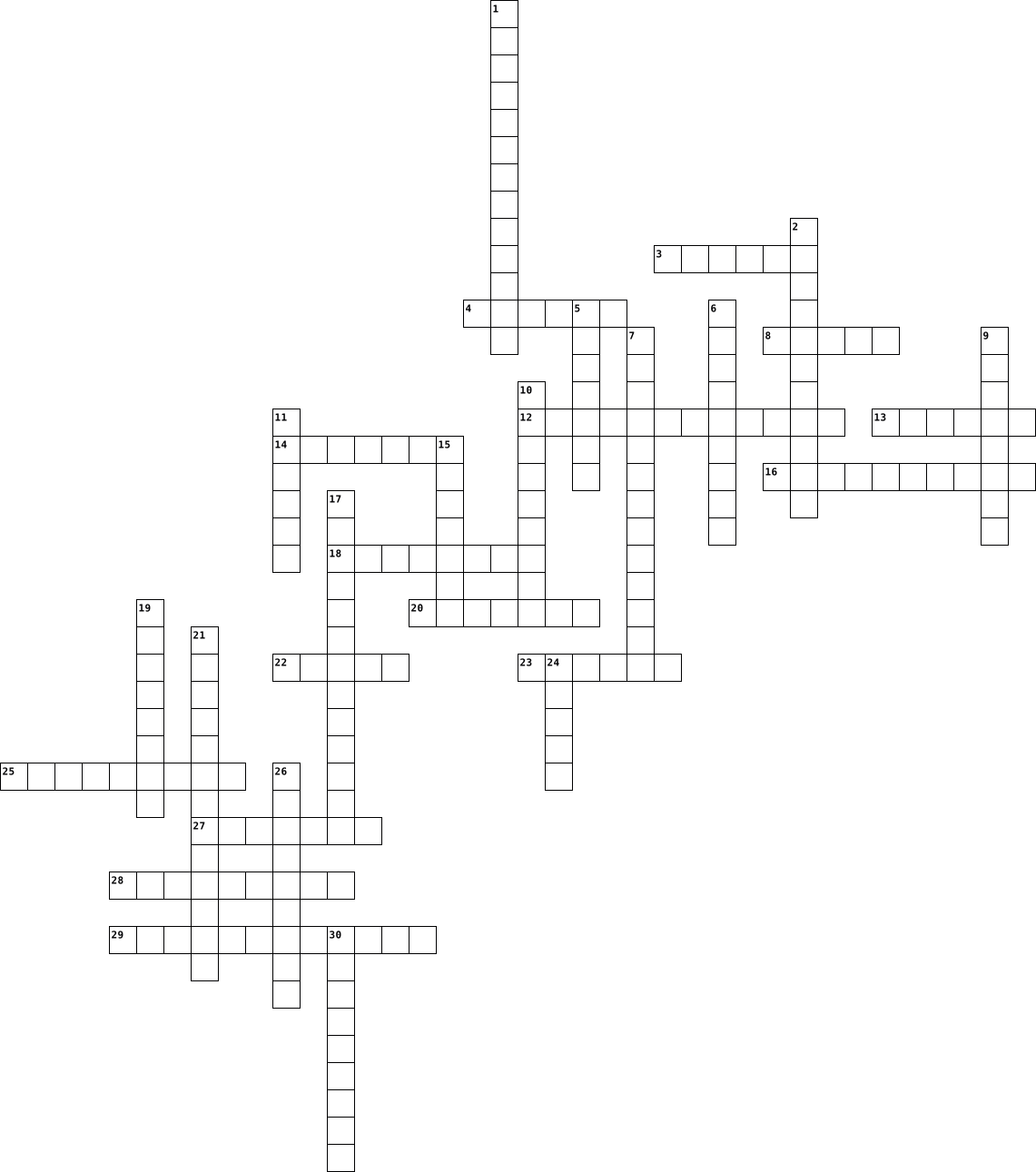
Across
- notation of one or two letters representing a chemical element
- a column in the periodic table of the chemical elements
- a metallic substance composed of two or more elements
- the number of a chemical element in the periodic system
- a positively charged particle that resides in the nucleus of an atom
- an uncharged elementary particle that has a mass nearly equal to a proton
- sum of the numbers of proton and neutrons
- a chemical element that mostly lacks the characteristics of a metal
- the spontaneous passage or diffusion of water or other solvents through a semipermeable membrane
- an element that readily forms positive ions
- substance that has mass and takes up space by volume
- of or relating to the inside of the atom
- any substance that cannot be decomposed into simpler substances
- a chemical element that exhibits some properties of metals and nonmetals
- alternative title for atomic number
Down
- a fundamental theory of matter that explains physical properties in terms of the motion of atoms and molecules
- any of the six chemical elements that make up group one on the periodic table
- rows of the periodic table
- the act of spreading or allowing to spread freely
- a tabular display of the chemical elements
- a chemical element that forms a salt when it reacts with metal
- a tiny bit of matter that makes up everything in the universe
- the capacity for doing work
- the most prominent organelle in a cell
- how much of a substance is mixed with another substance
- a negatively charged subatomic particle
- six chemical elements in group 2 of the periodic table
- smallest unit into which matter can be divided without the release of electrically charged particles
- a substance formed when two or more chemical elements are chemically bonded together
- a group of atoms bounded together
30 Clues: rows of the periodic table • the capacity for doing work • a group of atoms bounded together • alternative title for atomic number • the most prominent organelle in a cell • a negatively charged subatomic particle • of or relating to the inside of the atom • sum of the numbers of proton and neutrons • a tabular display of the chemical elements • ...
Elements & More 2024-05-31

Across
- Atomic Mass 83.79
- Ancient Greek who thought of "Atomos"
- Brought back the ATOMIC THEORY
- Group 10, period 4
- 59 Protons
- Between Metal and Nonmetal
Down
- The Majority of the Periodic table
- 1 Proton
- Atomic Symbol K
- Created the Framework for the Periodic Table
- Period 5, Group 14
- Group 7, Period 4
- Oxygen, Carbon, Fluorine, Iodine
13 Clues: 1 Proton • 59 Protons • Atomic Symbol K • Atomic Mass 83.79 • Group 7, Period 4 • Period 5, Group 14 • Group 10, period 4 • Between Metal and Nonmetal • Brought back the ATOMIC THEORY • Oxygen, Carbon, Fluorine, Iodine • The Majority of the Periodic table • Ancient Greek who thought of "Atomos" • Created the Framework for the Periodic Table
Semester 1 Vocabulary 2025-01-13

Across
- solution made out of metals
- ion with a positive charge
- smallest unit of matter
- elements found in group 17
- separate mixtures based on boiling point
- even throughout
- two or more phases
- horizontal row found in the periodic table
- amount of matter in an object
- ion with a negative charge
Down
- SI unit of mass
- separate mixtures based on particle size
- same element with different mass number
- mass divided by volume
- SI unit of length
- vertical column in the periodic table
- space occupied by matter
- tendency to attract electrons
18 Clues: SI unit of mass • even throughout • SI unit of length • two or more phases • mass divided by volume • smallest unit of matter • space occupied by matter • ion with a positive charge • elements found in group 17 • ion with a negative charge • solution made out of metals • tendency to attract electrons • amount of matter in an object • vertical column in the periodic table • ...
Periodic table Crossword 2022-02-21

Across
- created the periodic table
- first element on the periodic table
- the total number of protons an nuetrons
Down
- a display of chemical elements
- the number of protons in the nucleus
- positively charged central core of atom
- horizontal rows in the periodic table
- subatomic particle with a negative charge
- vertical columns labeled 1 through 18
- one of two or more species of atoms
10 Clues: created the periodic table • a display of chemical elements • first element on the periodic table • one of two or more species of atoms • the number of protons in the nucleus • horizontal rows in the periodic table • vertical columns labeled 1 through 18 • positively charged central core of atom • the total number of protons an nuetrons • ...
PERIODIC CLASSIFICATION OF ELEMENTS 2022-01-18

Across
- Number of elements that were classified by newland
- Element with six electrons in it's M shell.
- Doberneer Made group of three elements showing similar properties and called them ______.
- Upto which element, the Law of Octaves was found applicable?
- The elements present in 17th group of modern periodic table
- the element whose position posed a problem in Mendeleev's periodic table
Down
- Gasses placed in the last (Group 18th)of the modern periodic table
- Name the element present in 3rd period 16th group of periodic table
- Name the element which was called aka aluminum by Mendeleev
- The combining capacity of an element.
10 Clues: The combining capacity of an element. • Element with six electrons in it's M shell. • Number of elements that were classified by newland • Name the element which was called aka aluminum by Mendeleev • The elements present in 17th group of modern periodic table • Upto which element, the Law of Octaves was found applicable? • ...
the periodic table of the elements 2024-12-27

Across
- an element that forms basic gas on combining with hydrogen
- the elements in the 17th group in the periodic table
- the modern periodic table was created by ___.
- the most electronegative element in the periodic table
- an element that burns brick-red
Down
- these elements do not react with any element or compound
- an element that reacts violently with cold water and can be cut with a knife
- the number of shells in an atom increases down a ____.
- an amphoteric element that belongs to the 13th group of the periodic table
- the electronegativity of elements increases across a _____.
10 Clues: an element that burns brick-red • the modern periodic table was created by ___. • the elements in the 17th group in the periodic table • the number of shells in an atom increases down a ____. • the most electronegative element in the periodic table • these elements do not react with any element or compound • an element that forms basic gas on combining with hydrogen • ...
Atoms and Ions 2022-09-13

Across
- Element with the atomic number 79
- Charge on a metal ion.
- The columns of the periodic table are known as...
- Type of bond formed between a metal and a non-metal.
- Electrons fill these starting from two in the first, then eight in the second and eight in the third.
- Neutrally charged sub-atomic particles.
- Type of bond formed between two metals.
- Element who's electron configuration is the same as a sodium ion.
Down
- Russian chemist who derived the periodic table.
- The rows of the periodic table are known as...
- Sub-atomic particles who's number determines the element.
- These types of elements tend to gain electrons to get a full outer shell.
- Atoms of the same element with different numbers of neutrons.
- These elements have one electron in their outer shell.
- An atom or group of atoms with a positive or negative charge.
- Type of bond formed between two non-metals.
16 Clues: Charge on a metal ion. • Element with the atomic number 79 • Neutrally charged sub-atomic particles. • Type of bond formed between two metals. • Type of bond formed between two non-metals. • The rows of the periodic table are known as... • Russian chemist who derived the periodic table. • The columns of the periodic table are known as... • ...
C1&2 Revision 2021-10-13

Across
- the process whereby dissolved substances are separated by running a solvent along a material such as absorbent paper.
- the name for the columns in the periodic table
- Metals found in Group 1
- atoms that have the same number of protons but different a number of neutrons
- a dense particle found in the nucleus with a neutral charge.
- A substance made as a result of a reaction
- Metals in the middle of the periodic table
- a charged particle produced by gaining or losing electron(s).
- A substance used in a reaction
Down
- The specific distances electrons orbit the nucleus
- Horizontal rows in the periodic table.
- a substance made up of only one type of atom
- a substance where two or more elements are chemically bonded.
- tiny negatively charged particle that orbits the nucleus of an atom
- Group 7 elements
- Very unreactive gases found in Group 0
16 Clues: Group 7 elements • Metals found in Group 1 • A substance used in a reaction • Horizontal rows in the periodic table. • Very unreactive gases found in Group 0 • A substance made as a result of a reaction • Metals in the middle of the periodic table • a substance made up of only one type of atom • the name for the columns in the periodic table • ...
Chemistry Crossword 2022-05-09

Across
- The part of the atom with all of the mass
- This group of metals is the most reactive on the periodic table
- The smallest thing that can still be considered an element
- subatomic particle with no charge located in the nucleus
- Positively charged subatomic particle
- Any two or more atoms bonded together
- What is being dissolved in a solution
- This group is the only nonreactive group
- This type of mixture has visibly different parts and are easy to separate
Down
- Followed by the word Earth, this group of metals is the second most reactive
- This type of mixture all looks the same, but is still able to be separated
- This is group 17 on the periodic table
- Any two or more different atoms bonded together
- Negatively charged subatomic particle
- What is dissolving another a substance in a solution
- The vertical columns on a periodic table that share similar chemical properties
16 Clues: Negatively charged subatomic particle • Positively charged subatomic particle • Any two or more atoms bonded together • What is being dissolved in a solution • This is group 17 on the periodic table • This group is the only nonreactive group • The part of the atom with all of the mass • Any two or more different atoms bonded together • ...
The Periodic Table 2019-09-19

Across
- elements that are poor conductors of heat and electricity; grouped on the right side of the periodic table
- the metals which are found in the middle of the periodic table
- arrangement of elements into families and rows
- horizontal row of elements in the period table, atomic number and mass increases across the row
Down
- the number of protons plus the number of neutrons in an atom
- elements that are shiny and conduct heat and electricity; grouped on the left and middle of the periodic table
- abbreviation for an element's name
- the number of protons in an atom's nucleus
- elements that have some properties of metals and some properties of nonmetals; grouped around the stair step line on the right side of the periodic table
- vertical column in the periodic table also known as a family; elements in this column have similar physical and chemical properties
10 Clues: abbreviation for an element's name • the number of protons in an atom's nucleus • arrangement of elements into families and rows • the number of protons plus the number of neutrons in an atom • the metals which are found in the middle of the periodic table • horizontal row of elements in the period table, atomic number and mass increases across the row • ...
CHEMICAL BONDING 2024-10-14

Across
- NEGATIVELY CHARGE SUBATOMIC PARTICLES
- POSITIVELY CHARGE SUBATOMIC PARTICLES
- MOST ELEMENTS IN THE PERIODIC TABLE
- COMPOSED OF TWO OR MORE ELEMENTS
- ROWS IN THE PERIODIC TABLE
Down
- FOUND IN THE PERIODIC TABLE
- CAN BE POSITIVE OR NEGATIVE
- BASIC UNIT OF A MATTER
- CHARGE ATOMS
9 Clues: CHARGE ATOMS • BASIC UNIT OF A MATTER • ROWS IN THE PERIODIC TABLE • FOUND IN THE PERIODIC TABLE • CAN BE POSITIVE OR NEGATIVE • COMPOSED OF TWO OR MORE ELEMENTS • MOST ELEMENTS IN THE PERIODIC TABLE • NEGATIVELY CHARGE SUBATOMIC PARTICLES • POSITIVELY CHARGE SUBATOMIC PARTICLES
Chemistry Unit One Vocabulary 2026-03-24

Across
- Definite Volume no Definite Shape
- Horizontal Rows of the Periodic Table
- Smallest Component
- A reaction in which one or more substances are converted into different substances
- Substances that react in a chemical change
- Substance
- Substances formed by the chemical change
Down
- Substance's Ability to Undergo Changes
- Definite Volume and Shape
- Pure Substance
- Amount of Matter
- Anything with Mass
- Vertical Columns of the Periodic Table
- Neither Definite Volume or Definite Shape
- Topic
15 Clues: Topic • Substance • Pure Substance • Amount of Matter • Smallest Component • Anything with Mass • Definite Volume and Shape • Definite Volume no Definite Shape • Horizontal Rows of the Periodic Table • Substance's Ability to Undergo Changes • Vertical Columns of the Periodic Table • Substances formed by the chemical change • Neither Definite Volume or Definite Shape • ...
Test Vocab Review #3 2016-03-14

Across
- Special name for Group 2 elements.
- Second largest major section or category of elements on the periodic table.
- Able to be drawn into a wire; property of metals.
- Largest major section or category of elements on the periodic table.
- Easy to break.
- Can be represented using chemical formula.
- An atom’s outermost electrons.
- Smallest major section or category of elements on the periodic table.
- A bond characterized by transfer of valence electrons between atoms in the bond.
- A non-neutral atom.
- Special name for Group 17 elements.
Down
- The force that causes atoms to attract and bond with each other.
- Any group of atoms joined together by bonds.
- Special name for Group 18 elements.
- Metals tend to form these in reactions with nonmetals.
- A bond characterized by sharing of valence electrons between atoms in the bond.
- A compound formed from ionic bonding of cations of a single element with anions of only one other element.
- Able to be pressed or hammered into a shape; property of metals.
- Nonmetals tend to form these in reactions with metals.
19 Clues: Easy to break. • A non-neutral atom. • An atom’s outermost electrons. • Special name for Group 2 elements. • Special name for Group 18 elements. • Special name for Group 17 elements. • Can be represented using chemical formula. • Any group of atoms joined together by bonds. • Able to be drawn into a wire; property of metals. • ...
chemical 2022-04-24

Across
- The physical look of a shape, sometimes doesnt change other times changes with container
- Length, width, height, and volume it takes up
- number The number on the top left of an element on the periodic table
- mass The number on the bottom of an element on the periodic table
- something that shares both a metals and non metals characteristics
- The letter(s) representing an element on the periodic table
- a bond making metallic substance
- metals elements on the far right of the periodic table
- Some non numerical information
- a bond with 2 non metals
Down
- One of many unique combinations of protons, neutrons and electrons
- Changes that do not impact the chemical makeup of an element
- Any numerical information
- Something that will change regardless of what type of change it is
- Changes that do impact the chemical makeup of an element
- A substance class with a high conduction rate is generally seen as shiny
- A substance made when 2 chemicals are added together
- The product that comes from 2 physically mixed chemicals
- of matter A solid liquid or gas
- a bond between atleast one metal element
20 Clues: a bond with 2 non metals • Any numerical information • Some non numerical information • of matter A solid liquid or gas • a bond making metallic substance • a bond between atleast one metal element • Length, width, height, and volume it takes up • A substance made when 2 chemicals are added together • metals elements on the far right of the periodic table • ...
Periodic Table Trends 2024-11-13

Across
- Spherical energy levels around an atom in which electrons reside.
- The energy required to remove an electron from an atom in the gas phase.
- An element with only three shells and three valence electrons
- The most electronegative atom on the periodic table.
- Energy _____ as you move farther from the nucleus.
- The strength with which an atom pulls on electrons in a bond or on a nearby atom.
- An ion with a negative charge.
- A measure of the atom's size.
Down
- A Noble Gas with four electron shells
- Electrons in the outermost energy level of an atom.
- Number of valence electrons carbon has.
- Radius decreases moving right due to increase in number of ______.
- An atom that has gained or lost electrons.
- An element family with atoms that have seven valence electrons
- An ion with a positive charge.
- The atom on the periodic table with the highest ionization energy.
- The radioactive atom with the largest atomic radius on the periodic table.
- Number of valence electrons Noble Gasses have.
- Elements that form 1+ ions
19 Clues: Elements that form 1+ ions • A measure of the atom's size. • An ion with a positive charge. • An ion with a negative charge. • A Noble Gas with four electron shells • Number of valence electrons carbon has. • An atom that has gained or lost electrons. • Number of valence electrons Noble Gasses have. • Energy _____ as you move farther from the nucleus. • ...
Periodic Table Elements 2013-01-10

Across
- My atomic number is 50
- What pennys are made out of
- My atomic number is 5
- I have 92 protons
- Liquid and starts with a b
- You get me if you get first place
- Atomic mass is 55.847
- Atomic number is 1
- This is what is in ballons
- My atomic number is 86
Down
- The Element that has 30 protons
- The element that scars superman
- Known as a version of colors very bright colors
- Atomic mass is 14.007
- I am not a metal and I am solid my atomic number 6
- A liquid and starts with a m
- My symbol is an I
- I am a gas and my atomic number is 8
- Number 27
- This is what is or was in our pencils
20 Clues: Number 27 • I have 92 protons • My symbol is an I • Atomic number is 1 • My atomic number is 5 • Atomic mass is 14.007 • Atomic mass is 55.847 • My atomic number is 50 • My atomic number is 86 • Liquid and starts with a b • This is what is in ballons • What pennys are made out of • A liquid and starts with a m • The Element that has 30 protons • The element that scars superman • ...
Periodic Table Review 2013-05-03

Across
- I am a gas with the element symbol Rn
- The name given to the group of elements located in group 17
- I have two valance electrons and am in period 3
- The maximum number of electrons that can fill the outer shell of an atom
- I have 26 protons
- The type of bond formed in NO
- I have an atomic mass of 201
- I have an atomic number of 82
- I am a alkaline earth metal with an atomic mass of 137
- The type of elements that based on electronegativty values has the greatest attraction for electrons in a bond
- I am in group 14 and period 5
- The number of orbitals in the s sublevel
- The number of electrons possible in the p sublevel
Down
- the smallest particle of matter with unique properties
- The name of electrons given to those found in the outer shell
- A negatively charged ion
- I am a noble gas used in Open signs
- I am a precious metal with the element symbol Pt
- I am in group 13 and am used to make soda cans
- the name given to group 1 on the periodic table
- The type of bond formed in sodium bromide (NaBr)
- I have an atomic weight of 23
- I have 5 electrons
- My element symbol is C
- the basic building blocks of all matter
- I am located in the nucleus and have a positive charge
26 Clues: I have 26 protons • I have 5 electrons • My element symbol is C • A negatively charged ion • I have an atomic mass of 201 • The type of bond formed in NO • I have an atomic weight of 23 • I have an atomic number of 82 • I am in group 14 and period 5 • I am a noble gas used in Open signs • I am a gas with the element symbol Rn • the basic building blocks of all matter • ...
Periodic Table Extra 2012-12-18

Across
- The metal is fairly stable in air and does not oxidise as rapidly as some of the other rare-earth metals.
- Is required in small amounts for life and is the only metal found in vitamins.
- It oxidises rapidly in moist air and at elevated temperatures. The metal has unusual magnetic properties.
- Has a bright silver lustre and is reasonably stable in air. It ignites in air at 150°C. It is a rare earth metal.
- Is a shiny, white, soft, and ductile metal, and takes on a bluish tinge when exposed to air at room temperatures for a long time. The metal starts to oxidize in air at high temperatures.
- It is very hard and brittle, making it very hard to machine, form, or work. It is the most corrosion resistant metal known.
- Is a beautiful silvery-white metal, when pure, and is malleable and ductile.
- Is somewhat rare and expensive, although not as expensive as gold
- Great care is required while handling promethium as a consequence of its radioactivity.
- It is not acted on by air at room temperature, but burns brilliantly when heated with the formation of white fumes. It is a poor conductor of heat and electricity.
- Is a p-type semiconductor, and shows varying conductivity with crystal alignment. Its conductivity increases slightly with exposure to light.
- Named after Alfred Nobel who discovered dynamite.
- Occurs in some soils in amounts sufficient to produce serious effects on animals feeding on plants such as locoweed (an American plant) grown in such soils.
- A much more abundant element in the sun and certain stars than on earth.
- Is a synthetic element that is not present in the environment at all. It has no uses.
Down
- Chemical properties are largely unknown. Is a radioactive rare earth metal.
- The metal is characterised by a spectrum containing two bright lines in the blue (accounting for its name). It is silvery gold, soft, and ductile.
- Has a higher melting point and lower density than platinum. It has a high reflectance and is hard and durable.
- Is a metallic element, soft, and when pure is silvery white like lead. The metal oxidises very easily and it reacts with water or alcohol.
- Dangerously radioactive.
- Can be liquid at ambient temperature, but only on a hot day given that its melting point is about 40°C. It is a soft, silvery-white metallic element of the alkali metals group (Group 1).
- Is one of the rarest and most expensive naturally occurring elements. The element is an α-emitter and is a radiological hazard similar to polonium.
- Soft enough to be cut with a knife. It is one of the most reactive of the rare-earth metals. It oxidises rapidly when exposed to air.
- Is a radioactive rare earth metal which must be handled with care to avoid contact, since it is a heavy α and γ emitter. It is named after America.
- Is widely distributed throughout the animal kingdom. It is an important trace element and may be essential for utilisation of vitamin B.
- Has more isotopes than any other element, all of which are radioactive.
- Is almost completely immune to chemical attack at temperatures below 150°C, and is attacked only by hydrofluoric acid, acidic solutions containing the fluoride ion, and free sulphur trioxide.
- Poor conductor of electricity. It is very resistant to corrosion but tarnishes upon exposure to air.
- Its density is exceeded only by that of platinum, iridium, and osmium, and its melting point is exceeded only by that of tungsten and carbon. It is expensive but useful as a trace alloying agent.
- Is an essential constituent of leaves, bones, teeth, and shells. The fifth most abundant element in the earth's crust and makes up more than 3% of the crust.
30 Clues: Dangerously radioactive. • Named after Alfred Nobel who discovered dynamite. • Is somewhat rare and expensive, although not as expensive as gold • Has more isotopes than any other element, all of which are radioactive. • A much more abundant element in the sun and certain stars than on earth. • ...
The Periodic Table 2013-05-16

Across
- This is used in fluoride toothpaste
- People use this in their OPEN signs at the store
- This is used on some watches
- This is superman's home planet
- This highly poisonous
- This is used in many pencils
- This killed soldiers in WWI
- We spend this at the store
- This is what we use every day
- This what many people like and is used in some rings
Down
- This used in keys and some expensive pens
- This is used in photographic flashes
- This what we use to make balloons float
- Is incredibly useful in industry for wiring, heat sinks and coins
- This gas makes up 78% of the atmosphere
- By weight, 75% of the visible universe is this
- This is what we breath in
- We use this in some bracelet
- This is an invisible, radioactive gas
- This is used in horseshoes
20 Clues: This highly poisonous • This is what we breath in • We spend this at the store • This is used in horseshoes • This killed soldiers in WWI • This is used on some watches • We use this in some bracelet • This is used in many pencils • This is what we use every day • This is superman's home planet • This is used in fluoride toothpaste • This is used in photographic flashes • ...
Periodic Table Crossword 2014-01-09

Across
- N
- Ho
- Au
- Ac
- Rh
- Hf
- Ne
- Mn
- Rn
- Ra
- Li
- Na
- Pr
- Ag
- Cs
- La
- Hg
- Sn
- Ge
- I
- Bk
- Gd
- Kr
- Ga
- Mo
- Fm
- Nb
- Re
- Tl
- Br
- Ar
- Tm
- Er
Down
- Ta
- F
- Sb
- Pb
- W
- Nd
- In
- U
- Sm
- Fe
- Po
- Md
- Cu
- Dy
- Co
- Ru
- Ir
- O
- Ce
- B
- Al
- Eu
- Th
- At
- Xe
58 Clues: F • N • W • U • I • O • B • Ta • Sb • Ho • Au • Pb • Ac • Rh • Hf • Ne • Nd • In • Mn • Rn • Ra • Li • Na • Sm • Fe • Pr • Po • Md • Ag • Cs • Cu • La • Dy • Hg • Co • Ru • Sn • Ge • Bk • Ir • Gd • Kr • Ce • Ga • Al • Mo • Eu • Fm • Nb • Re • Tl • Th • At • Xe • Br • Ar • Tm • Er
The Periodic Table 2013-11-19

Across
- I'm found in salt and I belong to the Halogens.
- We are solid at room temperature.
- I made the periodic table.
- We are the elements in group 13 and boron is found in this group.
- We are unreactive nonmetals.
- I am the number of protons and neutrons in the nucleus of an atom.
- I am also called a semiconductor.
- I am necessary for you to breath.
- We are the 1st group in the periodic table and we are reactive metals.
- I'm not ductile are malleable.
Down
- I am the abbreviation of an element.
- I am the only element in my family.
- We are the elements in groups 3-12.
- I state that the repeating chemical and physical properties of elements change periodically with the elements’ atomic numbers.
- I am found in neon signs.
- Some of the elements in my group are chlorine and fluorine.
- I am shiny and a great conductor.
- We are radioactive, or unstable
- My chemical symbol is He.
- I make up about 80% of the air in our atmosphere.
20 Clues: I am found in neon signs. • My chemical symbol is He. • I made the periodic table. • We are unreactive nonmetals. • I'm not ductile are malleable. • We are radioactive, or unstable • We are solid at room temperature. • I am also called a semiconductor. • I am shiny and a great conductor. • I am necessary for you to breath. • I am the only element in my family. • ...
The Periodic Table 2015-01-08

Across
- used in salt
- used to make pennies
- 5 cent coin
- nirvana song
- planet, something found in thermometers
- 3rd most common gas
- in spanish it's origin is translated to little silver
- a shade of blue
- atomic number is 54
- yellow substance, smells bad
- 60-70% is used in the electronic industry
- highest melting point of all elements
- used in sunscreen
- a rubbery material often used in plastic surgery
- named after a state where Sacramento is the capital
- in bananas
- foods that are high in fiber contain this
- color is pure white, when it is exposed to air it becomes black
- second place medal
- found in California, Finder would usually yell "eureka!" after discovering it
Down
- has only 1 naturally occurring isotope, one of the rarest and most valuable metal in the platinum group
- a poison
- found in milk, makes your bones strong
- in fluorescents lamps, supermans weakness +ite
- in Greek it means violet or purple, primarily used in nutrition
- atomic number 87
- substitute for platinum, named after a Greek hero
- atomic number of 31
- found in pools and bleach
- in ceramics, fiberglass
- in Greek it means smell
- one directions 4th album is the atomic number of this element
- A song by David Guetta featuring Sia
- lightest gas
- used to make lacrosse shafts, considered a rare earth element
- found in pencils
- the element named after the scientist who studied at cal-tech and Princeton after marrying his cousin
- 11th letter in the alphabet is this elements symbol
- foil used to wrap foods
- a radioactive noble gas, one of the most dense substances that remains a gas
- something that causes you to have a high-pitched voice when inhaled
41 Clues: a poison • in bananas • 5 cent coin • used in salt • nirvana song • lightest gas • a shade of blue • atomic number 87 • found in pencils • used in sunscreen • second place medal • 3rd most common gas • atomic number of 31 • atomic number is 54 • used to make pennies • in ceramics, fiberglass • in Greek it means smell • foil used to wrap foods • found in pools and bleach • yellow substance, smells bad • ...
The Periodic Table 2015-01-08

Across
- yellow substance, smells bad
- in ceramics, fiberglass
- nirvana song
- atomic number is 54
- found in pools and bleach
- substitute for platinum, named after a Greek hero
- 60-70% is used in the electronic industry
- one directions 4th album is the atomic number of this element
- named after a state where Sacramento is the capital
- planet, something found in thermometers
- lightest gas
- in bananas
- found in pencils
- foods that are high in fiber contain this
- a poison
- highest melting point of all elements
- found in milk, makes your bones strong
- in fluorescents lamps, supermans weakness +ite
- used in salt
- color is pure white, when it is exposed to air it becomes black
- something that causes you to have a high-pitched voice when inhaled
Down
- in Greek it means smell
- a radioactive noble gas, one of the most dense substances that remains a gas
- in spanish it's origin is translated to little silver
- has only 1 naturally occurring isotope, one of the rarest and most valuable metal in the platinum group
- 5 cent coin
- found in California, Finder would usually yell "eureka!" after discovering it
- A song by David Guetta featuring Sia
- atomic number of 31
- a rubbery material often used in plastic surgery
- the element named after the scientist who studied at cal-tech and Princeton after marrying his cousin
- a shade of blue
- 3rd most common gas
- used in sunscreen
- foil used to wrap foods
- atomic number 87
- second place medal
- used to make pennies
- used to make lacrosse shafts, considered a rare earth element
- in Greek it means violet or purple, primarily used in nutrition
40 Clues: a poison • in bananas • 5 cent coin • nirvana song • lightest gas • used in salt • a shade of blue • found in pencils • atomic number 87 • used in sunscreen • second place medal • atomic number is 54 • atomic number of 31 • 3rd most common gas • used to make pennies • in Greek it means smell • in ceramics, fiberglass • foil used to wrap foods • found in pools and bleach • yellow substance, smells bad • ...
Periodic table puzzle 2021-02-01

Across
- My atomic number is 47 and I am used to make photographic film
- I am a member of the nitrogen family with 16 neutrons
- I am a member of the halogens with an atomic number 53
- I make up 78%of the air and am found in the 15th group
- I am a member of the alkaline earth metals used to make fireworks and medicines.
- I am a noble gas with 2 electrons
- My atomic mass is 35.453
- I am a member of the carbon family often mistaken for the end of your pencil.
- I am a metal that is liquid at room temperature
- I am the first element in the fourth period used in making fertilizer.
- You can find me in the carbon family in the fifth period.
- I am a member of the boron family and am the most abundant metal in the earth's crust
Down
- I am at the top of group 14 and known as the "basis of life"
- I am a gas with a mass number of 19
- I am not really an alkali metal, but since I have only 1 electron I behave like them
- I am a transition metal with 25 electrons.
- I am a transition metal with 30 electrons useful in making paint
- I am the second most abundant element in the earth's crust and have 14 neutrons
- My atomic number is 79
- I have 20 neutrons and am found in your teeth and bones
- I have 26 protons
- I am a gas with 8 protons and 8 neutrons
- I am the only element in the halogens that is a liquid
- I am a silvery white metal found in table salt
- I have 2 electrons in the first shell, 8 in the second shell, and 6 in the third shell.
25 Clues: I have 26 protons • My atomic number is 79 • My atomic mass is 35.453 • I am a noble gas with 2 electrons • I am a gas with a mass number of 19 • I am a gas with 8 protons and 8 neutrons • I am a transition metal with 25 electrons. • I am a silvery white metal found in table salt • I am a metal that is liquid at room temperature • ...
Periodic Table Crossword 2021-09-10

Across
- Makes up around 21% of the Earth's atmosphere.
- A bright yellow element, known in the Bible as "brimstone."
- This element does not oxidize
- The most reflective metal.
- Was the first metal to be worked by man, along with gold and meteoritic iron.
- Has 92 protons and 92 electrons
- It's Twice as Strong as Aluminum.
- The thirteenth most abundant element in the earth's crust
- Name comes from the Latin word carbo, which means "coal."
- Symbol is Fe.
- Atomic number: 31.
- Is the third most abundant element in the Earth's oceans.
Down
- The second lightest (least dense) metal after lithium.
- The only element that can exist without neurons.
- Comes from the Spanish word, platina, which means “little silver”.
- Has the smallest temperature range
- Named after Albert Einstein
- Keeps food fresh.
- Named after the Greek word nitron, for "native soda," and genes for "forming."
- The most abundant noble gas
20 Clues: Symbol is Fe. • Keeps food fresh. • Atomic number: 31. • The most reflective metal. • Named after Albert Einstein • The most abundant noble gas • This element does not oxidize • Has 92 protons and 92 electrons • It's Twice as Strong as Aluminum. • Has the smallest temperature range • Makes up around 21% of the Earth's atmosphere. • The only element that can exist without neurons. • ...
Periodic Table Puzzle 2022-03-29

Across
- Core building material in the Statue of Liberty
- Makes your bones strong and is abundantly found in milk
- Used in EV batteries
- The process of separating 2 atoms
- Chemical used in pools to kill germs
- Most common element in the universe
- The process in which 2 atoms fuse together
- Who founded the periodic table?
- Most commonly used in coins, has a coin named after it
- Commonly found in Bananas
- The most abundant gas in our atmosphere
Down
- Part of a compound that is used in cooking everywhere, salty.
- Used to fuel Nuclear Power Plants
- Is most commonly known in its foil form, usually used to wrap food
- The gas used in balloons to make them float
- Easily bendable metal, and extremely valuable
- The most reflective metal, and very valuable
- Extremely durable metal, used in machinery and electronics
- Most common element on Earth
- The only element in diamonds
- Toxic liquid metal, used for thermometers, shares the name with planet
- A core element of in the making of gunpowder
- Used for bullets and radiation protection, extremely toxic if ingested
23 Clues: Used in EV batteries • Commonly found in Bananas • Most common element on Earth • The only element in diamonds • Who founded the periodic table? • Used to fuel Nuclear Power Plants • The process of separating 2 atoms • Most common element in the universe • Chemical used in pools to kill germs • The most abundant gas in our atmosphere • The process in which 2 atoms fuse together • ...
4 | Periodic Table 2022-01-02

Across
- 1 fewer proton than He
- 1 more proton than Na
- 6 electrons orbiting its nucleus
- 6 neutrons (usually)
- 8 more protons than B
- 2 more electrons than Mg
- 2 fewer electrons than Be
- 3 fewer protons than Ar
- 20 electrons
- 10 electrons
- 9 protons
Down
- its chemical symbol is K
- 2 fewer electrons than Al
- 6 more electrons than He
- atomic mass number of 40
- 3 fewer protons than Ne
- 3 protons
- 4 fewer protons than O
- 3 fewer electrons than Ca
- 16 protons
20 Clues: 3 protons • 9 protons • 16 protons • 20 electrons • 10 electrons • 6 neutrons (usually) • 1 more proton than Na • 8 more protons than B • 1 fewer proton than He • 4 fewer protons than O • 3 fewer protons than Ne • 3 fewer protons than Ar • its chemical symbol is K • 6 more electrons than He • atomic mass number of 40 • 2 more electrons than Mg • 2 fewer electrons than Al • 2 fewer electrons than Be • ...
Periodic Table Letters 2022-02-24

Across
- Ts
- B
- Yb
- Ti
- Au
- Hg
- S
- Mo
- W
- Ce
- U
- Al
- Tm
Down
- Zr
- Hf
- Bk
- Rh
- Po
- Th
- Ge
- Zr
- Rn
- Li
- K
- Y
- Sc
- Ba
- He
28 Clues: B • S • K • Y • W • U • Zr • Hf • Bk • Rh • Ts • Yb • Po • Ti • Th • Au • Ge • Zr • Hg • Rn • Mo • Li • Sc • Ba • He • Ce • Al • Tm
periodic table crossword 2022-03-17

Across
- The stronger the nuclear charge the ___ it pulls on electrons.
- gases, Unreactive elements that have 8 valence electrons.
- The innermost ring can only hold this amount of electrons.
- This element is in row 4, column 3A or 13.
- This element is in row 2, column 8A or 18.
- Pattern of change.
- a measure of whether or not atoms trade electrons with other atoms.
- radius, References the physical size of an atom
- Halogens are ___ physically.
- Another name for a row
- atom is seeking _____ valence electrons.
Down
- Units for mass.
- element in row 3 column 5A or 15.
- In order to meet the octet rule, column 1A needs to add how many electrons?
- Related to Effective Nuclear Charge
- Metals, These metals are located in column ___.
- affinity, How strong the atom pulls on electrons
- a halogen in column 3A
- electrons, Electrons on the outer-most shell.
- When referring to the radius of an atom, bigger atoms are located on the ____ side of the periodic table.
- Another name for Valence electrons.
21 Clues: Units for mass. • Pattern of change. • a halogen in column 3A • Another name for a row • Halogens are ___ physically. • element in row 3 column 5A or 15. • Related to Effective Nuclear Charge • Another name for Valence electrons. • atom is seeking _____ valence electrons. • This element is in row 4, column 3A or 13. • This element is in row 2, column 8A or 18. • ...
Periodic Table Crossword! 2022-05-02

Across
- This metal group is the most reactive and 1valence electron.
- It is a stable subatomic particle with a charge of negative electricity.
- This metal group has 2 valence electrons and is not found in element form in nature.
- Sodium and Chlorine make this
- Sulfur, Oxygen, Helium, and Nitrogen are all an example of this.
- Non-metal gases that are very useful because of their stability.
- This element is the only non-metal that is a liquid at room temperature.
- This element is Natrium in English.
- All the elements have the same valence electrons in this.
Down
- This element is used for batteries bipolar disease.
- This element is has 20 protons.
- It is the same number at the atomic number and gives off a positive electric charge.
- These are elements that are shiny, good conductors, malleable, ductile, and solid.
- A non-metal group that is extremely reactive in element form.
- This element is used in medicine to diagnose digestive disorders.
- H2O is the chemical formula for this
- These elements are gases at room temperature, dull, and brittle.
- This element is radioactive and is used in cancer therapies.
- It is the horizontal rows on the periodic table.
- This element at room temperature is yellow and solid.
20 Clues: Sodium and Chlorine make this • This element is has 20 protons. • This element is Natrium in English. • H2O is the chemical formula for this • It is the horizontal rows on the periodic table. • This element is used for batteries bipolar disease. • This element at room temperature is yellow and solid. • All the elements have the same valence electrons in this. • ...
Periodic Table Crossword 2022-09-01

Across
- elements or compounds that when you put together are unable to bond chemically
- the number above the symbol
- describes how likely an element bonds with other elements
- a chart that organizes information about all the known elements according to atomic number
- word under the symbol
- an element that conducts electricity
- symbol for this element is Fe
- the attraction a nucleus has for electrons in a chemical bond
- group 18 elements
- a substance that cannot be broken down
Down
- the charge of an atoms nucleus resulting from its number of protons
- a element that has some metal properties and some non metal properties
- represented by a capital letter
- a vertical column on the periodic table
- an atom that has gained or loss one or more electrons
- a horizontal row on the periodic table
- a group of atoms located at the very right side of the table
- the number of protons and nuetrons in the nucleus
- the smallest unit of an element
- number 1 on the table
20 Clues: group 18 elements • word under the symbol • number 1 on the table • the number above the symbol • symbol for this element is Fe • represented by a capital letter • the smallest unit of an element • an element that conducts electricity • a horizontal row on the periodic table • a substance that cannot be broken down • a vertical column on the periodic table • ...
Periodic Table Puzzle 2022-09-14

Across
- ใช้ทำสบู่ ปุ๋ย ดินประสิวหรือดินปืน
- ทำเครื่องประดับ เป็นส่วนประกอบของอุปกรณ์การแพทย์
- ใช้ในกระบวนไฮโดรจีเนชั่นซึ่งใช้ในอุตสาหกรรมอาหาร ในสถานะของเหลวใช้เป็นเชื้อเพลิงจรวด
- ใช้ผสมในยาสีฟันเพื่อป้องกันฟันผุ ใช้ทำเทฟลอนสำหรับเคลือบกระทะ
- ใช้ในอุปกรณ์เหล็กกล้า ทำถ่านไฟฉาย ทำสี
- ใช้ชุบโลหะป้องกันการเกิดสนิม
- ใช้เป็นสารเร่งปฏิกิริยา ในการผลิตยางรถยนต์ ทำเป็นขั้วไฟฟ้าของถ่านไฟฉาย
- เป็นแก๊สช่วยในการสันดาป มนุษย์ต้องหายใจเอาแก๊สนี้เพื่อใช้ในการเผาผลาญสารอาหารให้เป็นพลังงาน
- ใช้ในกระบวนการปรับปรุงคุณภาพน้ำยาพารา เป็นส่วนผสมของไม้ขีดไฟ ดินปืน และดอกไม้ไฟ
- เป็นธาตุองค์ประกอบของสิ่งมีชีวิต เป็นองค์ประกอบสำคัญของซากดึกดำบรรพ์
Down
- ใช้เป็นตัวทำละลาย ใช้ในการดับเพลิง ใช้ในอุตสากรรมย้อมและฟอกสี
- เป็นตัวกลางในการแลกเปลี่ยนความร้อน เป็นสารหล่อเย็นในปฏิกรณ์นิวเคลียสร์ นำไปทำหลอดไฟเพื่อให้แสงสว่างตามท้องถนน
- นำมาเคลือบโลหะใช้เป็นฟิวส์ตัดวงจรไฟฟ้า
- นำไปทำสารกึ่งตัวนำ ทำเซลล์สุริยะ นำไปผลิตซิลิโคน
- ใช้ทำเส้นลวดไฟฟ้า ใช้ในอุตสาหกรรมก่อสร้าง
- นำมาใช้บรรจุบอลลูนและเรือเหาะ นำไปผสมกับออกซิเจนเพื่อใช้เป็นอากาศสำหรับหายใจของนักประดาน้ำ
- ใช้เป็นโครงสร้างในการสร้างบ้าน อาคาร ใช้ทำรางรถไฟ
- ใชทำแบตเตอรี่ ทำหัวกระสุน ทำอุปกรณ์ป้องกันรังสี ใช้หุ้มสายเคเบิลสายไฟฟ้าและสายโทรศัพท์
- นำไปทำอุปกรณ์ไฟฟ้า เครื่องครัวเครื่องใช้ห่ออาหาร เป็นส่วนประกอบของเครื่องบิน
- ใช้ในอุตสาหกรรมฟอกสีกระดาษ ใช้ฆ่าเชื้อโรคในน้ำประปาและสระว่ายน้ำ
20 Clues: ใช้ชุบโลหะป้องกันการเกิดสนิม • ใช้ทำสบู่ ปุ๋ย ดินประสิวหรือดินปืน • นำมาเคลือบโลหะใช้เป็นฟิวส์ตัดวงจรไฟฟ้า • ใช้ในอุปกรณ์เหล็กกล้า ทำถ่านไฟฉาย ทำสี • ใช้ทำเส้นลวดไฟฟ้า ใช้ในอุตสาหกรรมก่อสร้าง • ทำเครื่องประดับ เป็นส่วนประกอบของอุปกรณ์การแพทย์ • นำไปทำสารกึ่งตัวนำ ทำเซลล์สุริยะ นำไปผลิตซิลิโคน • ใช้เป็นโครงสร้างในการสร้างบ้าน อาคาร ใช้ทำรางรถไฟ • ...
Periodic Table Puzzle 2022-09-14

Across
- ใช้ในกระบวนการปรับปรุงคุณภาพน้ำยาพารา เป็นส่วนผสมของไม้ขีดไฟ ดินปืน และดอกไม้ไฟ
- ใช้ชุบโลหะป้องกันการเกิดสนิม
- เป็นธาตุองค์ประกอบของสิ่งมีชีวิต เป็นองค์ประกอบสำคัญของซากดึกดำบรรพ์
- นำมาเคลือบโลหะใช้เป็นฟิวส์ตัดวงจรไฟฟ้า
- ใช้เป็นโครงสร้างในการสร้างบ้าน อาคาร ใช้ทำรางรถไฟ
- ใชทำแบตเตอรี่ ทำหัวกระสุน ทำอุปกรณ์ป้องกันรังสี ใช้หุ้มสายเคเบิลสายไฟฟ้าและสายโทรศัพท์
- นำมาใช้บรรจุบอลลูนและเรือเหาะ นำไปผสมกับออกซิเจนเพื่อใช้เป็นอากาศสำหรับหายใจของนักประดาน้ำ
- เป็นตัวกลางในการแลกเปลี่ยนความร้อน เป็นสารหล่อเย็นในปฏิกรณ์นิวเคลียสร์ นำไปทำหลอดไฟเพื่อให้แสงสว่างตามท้องถนน
- ใช้ผสมในยาสีฟันเพื่อป้องกันฟันผุ ใช้ทำเทฟลอนสำหรับเคลือบกระทะ
Down
- ทำเครื่องประดับ เป็นส่วนประกอบของอุปกรณ์การแพทย์
- ใช้ทำเส้นลวดไฟฟ้า ใช้ในอุตสาหกรรมก่อสร้าง
- นำไปทำสารกึ่งตัวนำ ทำเซลล์สุริยะ นำไปผลิตซิลิโคน
- ใช้เป็นตัวทำละลาย ใช้ในการดับเพลิง ใช้ในอุตสากรรมย้อมและฟอกสี
- ใช้ในอุตสาหกรรมฟอกสีกระดาษ ใช้ฆ่าเชื้อโรคในน้ำประปาและสระว่ายน้ำ
- ใช้เป็นสารเร่งปฏิกิริยา ในการผลิตยางรถยนต์ ทำเป็นขั้วไฟฟ้าของถ่านไฟฉาย
- ใช้ในกระบวนไฮโดรจีเนชั่นซึ่งใช้ในอุตสาหกรรมอาหาร ในสถานะของเหลวใช้เป็นเชื้อเพลิงจรวด
- ใช้ทำสบู่ ปุ๋ย ดินประสิวหรือดินปืน
- นำไปทำอุปกรณ์ไฟฟ้า เครื่องครัวเครื่องใช้ห่ออาหาร เป็นส่วนประกอบของเครื่องบิน
- ใช้ในอุปกรณ์เหล็กกล้า ทำถ่านไฟฉาย ทำสี
- เป็นแก๊สช่วยในการสันดาป มนุษย์ต้องหายใจเอาแก๊สนี้เพื่อใช้ในการเผาผลาญสารอาหารให้เป็นพลังงาน
20 Clues: ใช้ชุบโลหะป้องกันการเกิดสนิม • ใช้ทำสบู่ ปุ๋ย ดินประสิวหรือดินปืน • นำมาเคลือบโลหะใช้เป็นฟิวส์ตัดวงจรไฟฟ้า • ใช้ในอุปกรณ์เหล็กกล้า ทำถ่านไฟฉาย ทำสี • ใช้ทำเส้นลวดไฟฟ้า ใช้ในอุตสาหกรรมก่อสร้าง • ทำเครื่องประดับ เป็นส่วนประกอบของอุปกรณ์การแพทย์ • นำไปทำสารกึ่งตัวนำ ทำเซลล์สุริยะ นำไปผลิตซิลิโคน • ใช้เป็นโครงสร้างในการสร้างบ้าน อาคาร ใช้ทำรางรถไฟ • ...
Periodic Table Terms 2022-11-02

Across
- a chart that shows the elements arranged in order of atomic number, along with chemical symbol and the average atomic mass (in atomic mass units) for that particular element.
- Columns on the periodic table of elements. these are ordered according to the numbers of valence electrons in the outer shells of the atoms for the elements represented.
- a negatively charged particle in an atom. The configurations of valence electrons define specific groups on the periodic table of elements, while the principal energy levels of those valence electrons define periods on the table.
- the number of protons in the nucleus of an atom. Since this number is different for each element, elements are listed on the periodic table of elements in order of atomic number.
- the center of an atom, a region where protons and neutrons are located. The nucleus accounts for the vast majority of the average atomic mass.
- an atom or atoms that has lost or gained one or more electrons, thus acquiring a net electric charge.
- a substance made of two or more elements that have bonded chemically. These atoms are usually, but not always, joined in molecules.
- the smallest particle of an element that retains all the chemical and physical properties of the element.
- another term for chemical symbol.
- atoms that have an equal number of protons, and hence are of the same element, but differ in their number of neutrons. This results in a difference ofmass. Isotopes may be either stable or unstable. The latter type, known as radioisotopes, are radioactive.
Down
- rows of the periodic table of elements. These represent successive principal energy levels for the valence electrons in the atoms of the elements involved.
- the length of time it takes a substance to diminish to one-half its initialamount.
- a positively charged particle in an atom. The number of protons in the nucleus of an atom is the atomic number of an element.
- a one-or two-letter abbreviation for the name of an element.
- a group of atoms, usually but not always representing more than one element, joined by chemical bonds. Compounds are typically made of up molecules.
- a figure used by chemists to specify the mass—in atomic mass units—of the average atom in a large sample.
- a figure, named after Italian physicist Amedeo Avogadro (1776-1856), equal to 6.022137 × 10 23 . Avogadro's number indicates the number of atoms or molecules in a mole.
- a pattern of probabilities regarding the regions that an electron can occupy within an atom in a particular energy state. The higher the principal energy level, the more complex the pattern of orbitals.
- a substance made up of only one kind of atom, which cannot be chemically broken into other substances.
- a subatomic particle that has no electric charge. Neutrons, together with protons, account for the majority of average atomic mass. When atoms have the same number of protons—and hence are the same element—but differ in their number of neutrons, they are called isotopes.
20 Clues: another term for chemical symbol. • a one-or two-letter abbreviation for the name of an element. • the length of time it takes a substance to diminish to one-half its initialamount. • an atom or atoms that has lost or gained one or more electrons, thus acquiring a net electric charge. • ...
Game Periodic Table 2021-03-24

Across
- Symbol: P Atomic Number: 15 Atomic Mass: 30.973761 Protons: 15 Neutrons: 16 Classification: Non-metal Electron Configuration: 2,8,5
- Symbol: Be Atomic number: 4 Atomic mass: 9.012182 Protons: 4 Neutrons: 5 Classification: Alkaline earth metal Electron Configuration: 2,2
- Symbol: C Atomic number: 6 Atomic mass: 12.0107 Protons: 6 Neutrons: 6 Classification: Non-metal Electron Configuration: 2,4
- Symbol: O Atomic Number: 8 Atomic Mass: 15.9994 Protons: 8 Neutrons: 8 Classification: Non-metal Electron Configuration: 2,6
- Symbol: Ar Atomic Number: 18 Atomic Mass: 39.948 Protons: 18 Neutrons: 22 Classification: Noble gas Electron configuration: 2,8,8
- Symbol: Mg Atomic Number: 12 Atomic Mass: 24.305 Protons: 12 Neutrons: 12 Classification: Alkaline earth metal Electron Configuration: 2,8,2
- Symbol: Cl Atomic Number: 17 Atomic Mass: 35.453 Protons: 17 Neutrons: 18 Classification: Halogen Electron configuration: 2,8,7
- Symbol: B Atomic number: 5 Atomic mass: 10.811 Protons: 5 Neutrons: 6 Classification: Metalloid Electron Configuration: 2,3
- Symbol: Ca Atomic Number: 20 Atomic Mass: 40.078 Protons: 20 Neutrons: 20 Classification: Alkaline earth metal Electron configuration: 2,8,8,2
Down
- Symbol: K Atomic Number: 19 Atomic Mass: 39.0983 Protons: 19 Neutrons: 20 Classification: Alkali metal Electron configuration: 2,8,8,1
- Symbol: H Atomic number: 1 Atomic mass: 1.00794 Protons: 1 Neutrons: 0 Classification: Non-metal Electron Configuration: 1
- Symbol: He Atomic number: 2 Atomic mass: 4.002602 Protons: 2 Neutrons: 2 Classification: Noble gas Electron Configuration: 2
- Symbol: Na Atomic number: 11 Atomic mass: 22.98977 Protons: 11 Neutrons: 12 Classification: Alkaline metal Electron Configuration: 2,8,1
- Symbol: Li Atomic number: 3 Atomic mass: 6.941 Protons: 3 Neutrons: 4 Classification: Alkali metal Electron Configuration: 2, 1
- Symbol: F Atomic Number: 9 Atomic Mass: 18.9984032 Protons: 9 Neutrons: 10 Classification: Halogen Electron Configuration: 2,7
- Symbol: Al Atomic Number: 13 Atomic Mass: 26.981538 Protons: 13 Neutrons: 14 Classification: Other metal Electron Configuration: 2,8,3
- Symbol: Ne Atomic Number: 10 Atomic Mass: 20.1797 Protons: 10 Neutrons: 10 Classification: Noble gas Electron Configuration: 2,8
- Symbol: Si Atomic Number: 14 Atomic Mass: 28.0855 Protons: 14 Neutrons: 14 Classification: Metalloid Electron Configuration: 2,8,4
- Symbol: S Atomic Number: 16 Atomic Mass: 32.065 Protons: 16 Neutrons: 16 Classification: Non-metal Electron configuration: 2,8,6
- Symbol: N Atomic number: 7 Atomic mass: 14.0067 Protons: 7 Neutrons: 7 Classification: Non-metal Electron Configuration: 2,5
20 Clues: Symbol: H Atomic number: 1 Atomic mass: 1.00794 Protons: 1 Neutrons: 0 Classification: Non-metal Electron Configuration: 1 • Symbol: B Atomic number: 5 Atomic mass: 10.811 Protons: 5 Neutrons: 6 Classification: Metalloid Electron Configuration: 2,3 • ...
Periodic Table Crossword 2020-11-15

Across
- Ca
- P
- I
- Ag
- Mg
- F
- K
- Au
- Cu
- Cl
- H
- Fe
Down
- Si
- He
- Ti
- Al
- Ne
- Pb
- O
- Hg
- Zn
- S
- C
- Na
- Ni
25 Clues: P • I • F • K • O • S • C • H • Si • Ca • He • Ag • Ti • Mg • Al • Ne • Pb • Hg • Zn • Au • Cu • Cl • Na • Ni • Fe
Periodic Table Fun 2023-12-15

Across
- Cl
- Mg
- P
- Na
- Li
- Si
- F
- Ca
- Hg
- Ar
- H
- Be
Down
- Ir
- K
- Pb
- N
- Ne
- Al
- Ag
- He
- S
- B
- C
- O
- Au
25 Clues: K • N • P • S • F • B • C • O • H • Ir • Cl • Pb • Mg • Ne • Al • Na • Ag • Li • He • Si • Ca • Hg • Ar • Au • Be
The Periodic Table 2023-12-17

Across
- What element has the symbol of Pb?
- What element has the symbol of Li?
- What element has the symbol of Rb?
- What element has the symbol of C?
- What element has the symbol of Ca?
- What element has the symbol of Ne?
- What element has the symbol of Sr?
- What element has the symbol of Ar?
- What element has the symbol of K?
- What element has the symbol of He?
- What element has the symbol of Na?
- What element has the symbol of Fr?
- What element has the symbol of Xe?
- What element has the symbol of Rn?
Down
- What element has the symbol of Cl?
- What element has the symbol of Ag?
- What element has the symbol of P?
- What element has the symbol of S?
- What element has the symbol of Ba?
- What element has the symbol of Be?
- What element has the symbol of Si?
- What element has the symbol of Cr?
- What element has the symbol of Kr?
- What element has the symbol of Fe?
- What element has the symbol of Al?
- What element has the symbol of H?
- What element has the symbol of I?
- What element has the symbol of Ra?
28 Clues: What element has the symbol of P? • What element has the symbol of S? • What element has the symbol of C? • What element has the symbol of K? • What element has the symbol of H? • What element has the symbol of I? • What element has the symbol of Cl? • What element has the symbol of Ag? • What element has the symbol of Ba? • What element has the symbol of Pb? • ...
Periodic Table Project 2023-12-01

Across
- Sulfur is what kind of metal?
- How many transition metals are there?
- When metals and nonmetals chemically ____ together ions are formed.
- Metals donate (lose) ________.
- Alkali earth metals have a ____ white luster when cut?
- Who is credited for designing the first periodic table?
- Elements in Groups 1,2, and 13-18 have a consistent ion ____________.
- Oxygen is a what type of metal?
- Sodium:eleven protons + ten electrons = ___
- Metals become positive ions (+), called _______.
- Alkali metals react with _____ to make strong bases.
- Nonmetals become negative ions (-), called ______.
- Metals become positive ____ called cations.
Down
- Boron is what kind of metal?
- Lanthanides have a ____melting and boiling points.
- Alkali metals have what consistency (like cream cheese)?
- How is the the modern periodic table organized?
- Name an element in the actinides group.
- Noble gasses are what color?
- Witch group is all radioactive.
- Witch metal group has high metallic lusters (metals, nonmetals, metalloids).
- What group contains all three states matter?
- What group is bromine in?
- Witch metal is brittle (metals, nonmetals, metalloids).
- Have high melting points (metal, nonmetals, metalloids).
- Mendeleev organized the elements in order of increasing atomic ____.
- Name an element in the alkali metals.
- what group has good conductors of heat and electricity?
- This group reacts violently with most nonmetals.
- How many alkali earth metals are there?
30 Clues: What group is bromine in? • Boron is what kind of metal? • Noble gasses are what color? • Sulfur is what kind of metal? • Metals donate (lose) ________. • Witch group is all radioactive. • Oxygen is a what type of metal? • How many transition metals are there? • Name an element in the alkali metals. • Name an element in the actinides group. • ...
The Periodic Table 2023-10-24

Across
- I am a silvery-white metal used to make salt.
- I am a metal with 28 electrons.
- My atomic mass is 35.45.
- I am the head of the Carbon family, & organic chemistry is all about me.
- I am a metal with 4 neutrons.
- I am the 2nd most abundant element in Earth's crust & have 14 neutrons.
- You see me used to make a lot of signs that glow bright, I am a noble gas in the 18th group (column).
- I am a gas that smells like rotten eggs & is a part of the Oxygen family (column).
- I am not a metal, but since I only have 1 electron, I behave like one.
- I am a transition metal with 30 electrons & good to take when you feel sick.
- I am the first element in the 4th period (row) & am abundant in bananas.
- You can find me in the Carbon family (column) and the 5th period (row).
Down
- My atomic number is 79.
- I have 99 protons & am named after a famous scientist.
- My atomic number is 47 & I am used to make photo film.
- I make up 78% of the air & am located in the 15th group (column).
- I am a member of the Nitrogen family (column) with 16 neutrons.
- I am a gas with an atomic mass of 19.
- I have 20 neutrons & am found in your teeth & bones.
- I am a metal with 25 electrons.
- I am a member of the Carbon family (column), can be found in old paints, & am often mistaken as the element in the tip of your pencil.
- I am a gas that often combines with Hydrogen to make water.
- I am in the Boron family (column) & am the most abundant metal in the Earth's crust.
- I am a noble gas that has 2 electrons.
- I have 26 protons.
- I am a member of the halide family with an atomic number of 53.
26 Clues: I have 26 protons. • My atomic number is 79. • My atomic mass is 35.45. • I am a metal with 4 neutrons. • I am a metal with 28 electrons. • I am a metal with 25 electrons. • I am a gas with an atomic mass of 19. • I am a noble gas that has 2 electrons. • I am a silvery-white metal used to make salt. • I have 20 neutrons & am found in your teeth & bones. • ...
Chem periodic table 2023-10-20

Across
- good conductors of heat
- Horizontal
- 8 valance electrons
- Positive charge
- what is in the air
- After metals
- Who created the periodic table
- Negative charged ion
- neutron charge
- Gaseous chemical
- A atom with a charge
Down
- outer shell
- First part of water
- from one to another
- the nuber of protons in the nucleus
- positive charged ion
- Negative charge
- 5 protons
- Found in groups1A
- Cells control center
- 18 columns of elements
21 Clues: 5 protons • Horizontal • outer shell • After metals • neutron charge • Negative charge • Positive charge • Gaseous chemical • Found in groups1A • what is in the air • First part of water • from one to another • 8 valance electrons • positive charged ion • Negative charged ion • Cells control center • A atom with a charge • 18 columns of elements • good conductors of heat • Who created the periodic table • ...
Periodic table crossword 2023-11-02

Across
- is a chemical element with an atomic number of 8
- .
- a yellow precious metal, the chemical element of atomic number 79
- metallic elements that have valence electrons in two shells instead of only one
- a common reddish metallic element that is ductile and malleable
- a chemical element with the symbol Pb (from the Latin plumbum) and atomic number 82.
- A whole number that represents the ability of an atom or a group of atoms to combine with other atoms or groups of atoms.
- nonmetallic element of Group 15 [Va] of the periodic table.
- metallic element used in alloy steels for hardness and corrosion resistance
- chemical element of the alkali metal group (Group 1 [Ia]) of the periodic table.
- the chemical element of atomic number 2, an inert gas which is the lightest member of the noble gas series.
Down
- A nonmetallic element that exists in its free form
- a precious shiny grayish-white metal, the chemical element of atomic number 47.
- a colorless and non-flammable gas at normal temperature and pressure.
- any of the six chemical elements that make up Group 1 (Ia) of the periodic table
- a light strong grey lustrous corrosion-resistant metallic element used in strong lightweight alloys
- a mineral that your body needs to work properly.
- the chemical element of atomic number 3, a soft silver-white metal. It is the lightest of the alkali metals.
- chemical element of atomic number 16, a yellow combustible nonmetal.
- a very hard almost colourless crystalline metalloid element that in impure form exists as a brown amorphous powder.
- the chemical element of atomic number 20, a soft gray metal.
21 Clues: . • is a chemical element with an atomic number of 8 • a mineral that your body needs to work properly. • A nonmetallic element that exists in its free form • nonmetallic element of Group 15 [Va] of the periodic table. • the chemical element of atomic number 20, a soft gray metal. • a common reddish metallic element that is ductile and malleable • ...
PERIODIC TABLE PUZZLE 2023-11-01

Across
- have 20 neutrons and am found in your teeth and bones.
- - I am the only element in the halide family that is a liquid.
- am a member of the carbon family often mistaken for the end of your pencil.
- am a noble gas with 2 electrons.
- am a silvery white metal used to make salt.
- - I am a member of the nitrogen family with 16 neutrons.
- - I am a gas with 8 protons and 8 neutrons.
- - I am a member of the halide family with an atomic number of 53.
- - I am the head of the carbon family known as the "basis of life".
- - I am a member of the alkaline earth metals used to make fireworks and
- am the 2nd most abundant element in the Earth's crust and have 14 neutrons.
- I am a transition metal with 25 electrons.
Down
- - I am the first element in the fourth period used in making fertilizer. 22. TIN - You can find me in the carbon family in the fifth period.
- - I am a transition metal with 30 electrons useful in making paint.
- - My atomic mass is 35.453.
- have 2 electrons in the first shell, 8 in the second shell, and 6 in the third shell.
- am a metal with 28 electrons.
- I am a gas with a mass number of 19.
- - I am not really an alkali metal, but since I have only 1 electron I behave like them.
- - I am a member of the boron family and am the most abundant metal in the Earth's crust.
- atomic number is 79.
- - I am a metal that is liquid at room temperature.
- have 26 protons.
- make up 78% of the air and am found in the 15th group.
- - My atomic number is 47 and I am used to make photographic film.
25 Clues: have 26 protons. • atomic number is 79. • - My atomic mass is 35.453. • am a metal with 28 electrons. • am a noble gas with 2 electrons. • I am a gas with a mass number of 19. • I am a transition metal with 25 electrons. • am a silvery white metal used to make salt. • - I am a gas with 8 protons and 8 neutrons. • - I am a metal that is liquid at room temperature. • ...
Periodic Table Crossword 2023-10-19

Across
- what is the number in the top left corner?
- All elements in order to become energetically stable Desire 8 valence electrons
- What is the number at the very bottom of the box?
- what is the 2nd element down in the noble gasses?
- What is the block called on the last two periods?
- what is group number 1 called?
- what has the Atomic Mass Number of 6.941?
- What has the Atomic Mass of 131.294?
- What is group 17 called?
- What element has the Atomic Number of 29?
Down
- what has the Atomic Number of 17?
- What element has the Atomic Number 47?
- What follows the staircase?
- What element is in the very top left?
- What has the element symbol of Na?
- What is the word called underneath the symbol?
- Are organized based on which energy level an element places its valence electron
- what is the top element in the column with 6 Valence Electrons?
- What is the name of the element with the symbol CO?
- what are the letters that represent the element called?
- what has the Atomic Number of 50?
21 Clues: What is group 17 called? • What follows the staircase? • what is group number 1 called? • what has the Atomic Number of 17? • what has the Atomic Number of 50? • What has the element symbol of Na? • What has the Atomic Mass of 131.294? • What element is in the very top left? • What element has the Atomic Number 47? • what has the Atomic Mass Number of 6.941? • ...
Periodic Table Workout 2023-11-28

Across
- I have seven energy levels (shells) and only 1 valence electron
- I have 17 protons & electrons and usually 18 neutrons
- I am named after Germany and have 4 energy levels
- I do not react with other elements naturally and am in the 5th energy level
- I am named after the person who created the first periodic table and have 101 protons
- I am a halide (halogen) atom with 4 energy levels
- I am an inner transition metal with 95 electrons
- I am a member of the NITROGEN family with 16 Neutrons
- I am a metalloid in the second energy level
Down
- i am a transition metal with 91 protons and electrons
- I have 3 electron shells (on the 3rd row) and have 2 valence electrons
- I am a transition metal with 4 energy levels and an atomic mass of 48
- I am a NOBLE GAS with 4 energy levels (on the 4th row)
- I am good for your bones and have a rounded average mass of 40
- I am a metalloid in the Nitrogen family in the 5th period
- I am a semi-precious metal that has 78 protons
- I am a metalloid in the oxygen family with five energy levels
- I am a famous radioactive element in the inner transition metals with 92 electrons
- I am a liquid metal with 80 electrons
- I have 26 protons, 26 electrons and 30 neutrons
20 Clues: I am a liquid metal with 80 electrons • I am a metalloid in the second energy level • I am a semi-precious metal that has 78 protons • I have 26 protons, 26 electrons and 30 neutrons • I am an inner transition metal with 95 electrons • I am named after Germany and have 4 energy levels • I am a halide (halogen) atom with 4 energy levels • ...
Periodic Table Elements 2019-06-13

Across
- floating balloons are filled with this
- symbol is B and atomic number 5
- is the lightest halogen
- symbol is At
- symbol is Ge and atomic number is 32
- symbol is H
- was discovered in 1811 by Bernard Courtois
- atomic number is 30
- discovered by Joseph Black in 1755
- has an atomic weight of 114.818
Down
- atomic number is 18
- hydrargyrum
- symbol is Br
- atomic number is 116
- it appears between fluorine and bromine in the periodic table
- has an atomic weight of 6.94
- has an atomic weight of 74.9216
- salty
- atomic number is 45
- used glow lamps
20 Clues: salty • hydrargyrum • symbol is H • symbol is Br • symbol is At • used glow lamps • atomic number is 18 • atomic number is 45 • atomic number is 30 • atomic number is 116 • is the lightest halogen • has an atomic weight of 6.94 • symbol is B and atomic number 5 • has an atomic weight of 74.9216 • has an atomic weight of 114.818 • discovered by Joseph Black in 1755 • ...
Periodic Table Elements 2020-03-19

Across
- discovered by marie curie and is a alkaline earth metal
- atomic number is 2
- is a metalliod and the atomic number is 85
- atomic number is 24
- atomic weight is 162.50
- the symbol is Au
- the symbol is Cu
- is a noble gas with an atomic weight of 20.180
- the symbol is Ru
- is a actinoid metal and the symbol is Bk
Down
- is a other nonmetal and atomic number is 35
- the atomic number is 16 and the atomic weight is 32.06
- atomic weight is 204.38 and is an post-transition metal
- is an alkaline earth metal and atomic weight is 24.305
- also discovered by marie curie and atomic number is 84
- atomic weight is 207.2
- the atomic weight is 95.95
- is a lanthanoid and the atomic weight is 144.24
- is a transition metal and the atomic weight is 186.21
- the symbol is Rh
20 Clues: the symbol is Au • the symbol is Cu • the symbol is Ru • the symbol is Rh • atomic number is 2 • atomic number is 24 • atomic weight is 207.2 • atomic weight is 162.50 • the atomic weight is 95.95 • is a actinoid metal and the symbol is Bk • is a metalliod and the atomic number is 85 • is a other nonmetal and atomic number is 35 • is a noble gas with an atomic weight of 20.180 • ...
Periodic Table Crossword 2020-03-27

Across
- It's element symbol is also a prefix that means "two".
- A metalloid commonly found in rat poison.
- Element symbol of Ga.
- Element symbol of Cl.
- Element symbol of Cd.
- A noble gas that shares a name with Superman's home planet.
- 39 protons.
- This is the last element on the periodic table.
- 30 protons.
- This alkali metal is one of two elements in salt.
Down
- Element symbol of K.
- This nonmetal makes up 78% of the earth's atmosphere.
- The alkaline earth metal with the biggest atomic number.
- Shares a name with the planet closest to the sun.
- This is the first element on the periodic table.
- 53 protons.
- This transition metal is also a shade of blue.
- The post-transition metal with the least protons.
- 14 protons.
- 89 protons.
20 Clues: 53 protons. • 39 protons. • 14 protons. • 89 protons. • 30 protons. • Element symbol of K. • Element symbol of Ga. • Element symbol of Cl. • Element symbol of Cd. • A metalloid commonly found in rat poison. • This transition metal is also a shade of blue. • This is the last element on the periodic table. • This is the first element on the periodic table. • ...
Periodic Table Puzzle 2020-04-07

Across
- I am a silvery white metal used to make salt.
- I am a transition metal with 30 electrons useful in making paint.
- I am a member of the nitrogen family with 16 neutrons meaning phosphorus rich.
- I am a member of the halogen family with an atomic number of 53
- I am the 2nd most abundant element in the Earth’s crust and have 14 neutrons.
- I am a member of the alkaline earth metals used to make bright white light in fireworks.
- I am a member of the carbon family often mistaken for the end of your pencil.
- My atomic number is 79.
- I make up 78% of the air and am found in the 15th group. (In Gr. 9 we say 5th group or column 5)
- I am a noble gas with 2 electrons.
- My atomic mass is 35.453.
- You can find me in the carbon family in the fifth period.
- I am a gas with a mass number of 40.
- I am a member of the boron family and am the most abundant metal in the Earth’s crust.
Down
- I am the first element in the fourth period used in making fertilizer.
- I am a metal with 28 electrons
- I am the head of the carbon family known as the “basis of life”.
- I have 2 electrons in the first shell, 8 in the second shell, and 6 in the third shell.
- I am a transition metal with 25 electrons.
- I am the only element in the halogen family that is a liquid.
- I have 20 neutrons and am found in your teeth and bones.
- I am not really an alkali metal, but since I have only 1 electron, I behave like them.
- My atomic number is 47 and I am used in making photographic films.
- I am a gas with 8 protons and 8 neutrons.
- I have 26 protons.
25 Clues: I have 26 protons. • My atomic number is 79. • My atomic mass is 35.453. • I am a metal with 28 electrons • I am a noble gas with 2 electrons. • I am a gas with a mass number of 40. • I am a gas with 8 protons and 8 neutrons. • I am a transition metal with 25 electrons. • I am a silvery white metal used to make salt. • I have 20 neutrons and am found in your teeth and bones. • ...
Periodic Table Puzzle 2020-11-18

Across
- I am the first element in the fourth period used in making fertilizer.
- I am a metal with 28 electrons.
- I am a gas with 8 protons and 8 neutrons.
- I have 2 electrons in the first shell, 8 in the second shell, and 6 in the third shell.
- my atomic mass is 35.453
- I have 20 neutrons and am found in your teeth and bones.
- I am a gas with a mass number of 19.
- I am a member of the nitrogen family with 16 neutrons.
- my atomic number is 47 and I am used to make photographic film.
- I am a member of the alkaline earth metals used to make fireworks and medicines.
Down
- I am the only element in the halide family that is a liquid.
- I have 26 protons.
- I am a transition metal with 25 electrons.
- I am a member of the boron family and am the most abundant metal in the Earth's crust.
- I am a transition metal with 30 electrons useful in making paint.
- I am a member of the halide family with an atomic number of 53.
- I am a metal that is a liquid at room temperature.
- I am not really an alkali metal, but since I have only 1 electron I behave like them.
- I am a silvery white metal used to make salt.
- I am a member of the carbon family often mistaken for the end of your pencil.
- you can find me in the carbon family in the fifth period.
21 Clues: I have 26 protons. • my atomic mass is 35.453 • I am a metal with 28 electrons. • I am a gas with a mass number of 19. • I am a gas with 8 protons and 8 neutrons. • I am a transition metal with 25 electrons. • I am a silvery white metal used to make salt. • I am a metal that is a liquid at room temperature. • I am a member of the nitrogen family with 16 neutrons. • ...
Elements & Periodic Table 2020-10-01

Across
- The symbol for arsenic.
- The symbol for element 77 in the periodic table.
- The symbol for gadolinium
- The symbol for manganese.
- Can be used to inflate balloons.
- This element has the symbol B
- A well known planet
- A light, silvery metal used to make window frames
- A soft, grey malleable metal used in plumbing and fishing.
- Cane be used to make electricity.
Down
- helps fight against osteoporosis.
- more expensive than gold.
- Superman came from here.
- 4th column from the left.
- This element is very common in sea water.
- As bright as a _________ light.
- The element 42 in the periodic table.
- Cars in the future will be fueled by this.
- The symbol for argon.
- The opposite of non-metal.
20 Clues: A well known planet • The symbol for argon. • The symbol for arsenic. • Superman came from here. • more expensive than gold. • 4th column from the left. • The symbol for gadolinium • The symbol for manganese. • The opposite of non-metal. • This element has the symbol B • As bright as a _________ light. • Can be used to inflate balloons. • helps fight against osteoporosis. • ...
Periodic Table Crossword 2024-09-13

Across
- How likely an element is to form bonds with other elements
- A form of matter that has mass but no definite shape
- A chemical that forms a salt when it reacts with metal
- One or two letter abbreviation for an element
- Subatomic particle with a positive charge
- An ion with a positive charge
- Elements with metal and nonmetal properties
- Symbol for atomic mass unit
- A vertical column of elements
- A horizontal column of elements
- Anything that has mass or volume
- Region surrounding the nucleus where the electrons are located
- The number of protons and neutrons in an atom
- Another name for period
- Substance that cant be broken down into a simpler substance by ordinary chemical means
- A measure of a solution's ability to conduct electricity
- Basic particles of the chemical elements
Down
- Subatomic particle with a negative charge
- Another name for a group
- An electron in the outermost energy level
- An atom that has a positive/negative electric charge
- The number of protons in an atom
- Smallest unit of a compound that has all of its properties
- An atom that has a different number of neutrons than another atom of the same element
- Elements that are good conductors of electricity and heat
- Region consisting of protons and neutrons in the center
- The process of adding or removing electrons from an atom
- Elements that are poor conductors of electricity and heat
- Subatomic particle with a neutral charge
- An ion with a negative change
30 Clues: Another name for period • Another name for a group • Symbol for atomic mass unit • An ion with a positive charge • A vertical column of elements • An ion with a negative change • A horizontal column of elements • The number of protons in an atom • Anything that has mass or volume • Subatomic particle with a neutral charge • Basic particles of the chemical elements • ...
Periodic Table Elements 2024-06-05

Across
- (Hs)
- (Lr)
- (Cf)
- (Os)
- (Rn)
- (Ho)
- (Sb)
- (As)
- (Ac)
- (S)
- (Nb)
- (Ni)
- (Co)
- (Rg)
- (K)
- (Th)
- (W)
- (Mt)
- (Cu)
- (Ts)
- (Ne)
- (Tl)
- (H)
- (Ru)
- (Bk)
- (Eu)
- (Ga)
- (Mg)
- (Rh)
- (Sr)
- (Rb)
- (Au)
- (He)
- (La)
- (B)
- (Sn)
- (Nh)
- (Pt)
- (I)
- (Ti)
- (V)
- (Zr)
- (Am)
- (Cn)
- (Tb)
- (U)
- (Fe)
- (Na)
- (Rf)
- (Lv)
- (Br)
- (Og)
- (Pr)
- (Po)
- (Ce)
- (Se)
- (Db)
- (P)
- (Lu)
- (Md)
Down
- (Gd)
- (Xe)
- (Zn)
- (Bh)
- (Fr)
- (F)
- (Ca)
- (Ar)
- (Ds)
- (Al)
- (Hf)
- (Bi)
- (Cl)
- (Pb)
- (Np)
- (Yb)
- (Hg)
- (Cd)
- (Pd)
- (Ra)
- (Tc)
- (Cr)
- (Pa)
- (Es)
- (Er)
- (Te)
- (Pu)
- (Cs)
- (Pm)
- (Y)
- (Nd)
- (Si)
- (Mo)
- (Li)
- (Tm)
- (In)
- (Ir)
- (Re)
- (No)
- (Sc)
- (Kr)
- (Sm)
- (N)
- (Ta)
- (Cm)
- (At)
- (C)
- (Ge)
- (Fl)
- (Sg)
- (Ag)
- (Fm)
- (Mc)
- (Mn)
- (Ba)
- (Be)
- (O)
- (Dy)
118 Clues: (F) • (S) • (K) • (W) • (H) • (Y) • (B) • (I) • (V) • (N) • (C) • (U) • (O) • (P) • (Gd) • (Xe) • (Zn) • (Hs) • (Lr) • (Bh) • (Fr) • (Cf) • (Os) • (Rn) • (Ho) • (Ca) • (Sb) • (Ar) • (Ds) • (As) • (Ac) • (Al) • (Hf) • (Nb) • (Bi) • (Ni) • (Cl) • (Pb) • (Co) • (Rg) • (Np) • (Yb) • (Th) • (Hg) • (Cd) • (Pd) • (Mt) • (Ra) • (Tc) • (Cr) • (Pa) • (Cu) • (Ts) • (Ne) • (Es) • (Er) • (Tl) • (Ru) • (Te) • (Bk) • (Eu) • (Pu) • (Cs) • (Ga) • (Mg) • (Pm) • (Rh) • (Sr) • (Nd) • (Si) • (Mo) • (Li) • (Tm) • (Rb) • (In) • (Au) • (He) • (Ir) • (Re) • (La) • (No) • (Sn) • (Nh) • (Sc) • (Pt) • (Kr) • (Sm) • (Ti) • (Ta) • (Zr) • (Cm) • ...
The Periodic Table 2024-09-26

Across
- Ar A noble gas, non-reactive and used in lighting.
- Be This element is often found in gemstones
- F Most reactive nonmetal, used in toothpaste.
- Mn Element used in steel production, essential for industrial processes.
- K This alkali metal is found in bananas.
- Cl Greenish-yellow gas used in disinfectants.
- B A metalloid used in glass and ceramics
- Cr Used in stainless steel, gives it corrosion resistance
- Ne A noble gas, often found in neon signs
- S Nonmetal essential for life; commonly found in water.
- Na Common table salt contains this element
- Ti Strong metal used in armor and aircraft
Down
- C Fundamental to life; organic chemistry’s backbone
- Al Light metal used in aircraft and cans
- He Second lightest element; a gas at room temperature
- N Makes up the majority of the Earth’s atmosphere.
- V Transition metal known for its variable oxidation states
- Li Used in batteries; a soft, silvery metal.
- P Important for DNA; found in fertilizers.
- Si Major component of sand; used in glass.
- Ca This alkali metal is found in bananas.
- H Lightest element, essential for water
- Mg Found in chlorophyll; crucial for photosynthesis
- Sc Transition metal used in aerospace materials
24 Clues: Al Light metal used in aircraft and cans • K This alkali metal is found in bananas. • H Lightest element, essential for water • B A metalloid used in glass and ceramics • Ca This alkali metal is found in bananas. • Ne A noble gas, often found in neon signs • P Important for DNA; found in fertilizers. • Si Major component of sand; used in glass. • ...
The Periodic Table 2023-03-07

Across
- What kind of ice cream did Thompson's theory say that an atom looks like?
- Are rows that tell us how many energy shells (rings) and element has
- Metals are good __________of heat and electricity.
- This element is an example of a nonmetal
- Are columns that tell us how many valence electrons an element has
- This scientists theory says that an atom looked like a pool ball
- What is something else that the alkali and alkaline earth metals have in common?
- How many electrons does sodium (Na) have?
- These metals are good conductors of electricity
- The metals in the middle of the periodic table are called...
- These elements are nonreactive
- What can you say about the theory of the how the atom developed over time?
- Has an atomic number 18
- Hydrogen, helium, oxygen, neon, and krypton are some of the most abundant elements found in the
- Properties of both metals and nonmetals
- These elements are dull, brittle, and poor conductors
- The energy level where the valence electrons are
- How many energy shells does Radon (Rn) have?
- The noble gases are unstable
Down
- Hydrogen, oxygen, potassium, and calcium are some of the most abundant elements found in the
- This group of elements are salt forming
- This scientists theory stated that the atom looked like moons orbiting a planet
- What element caused the Hindenburg to explode?
- Hydrogen, magnesium, titanium, and aluminum are some of the most abundant elements found in the
- A chart showing all of the elements arranged in a repeating patters
- This group or family is an example of a metalloid
- Indicates the amount of protons in the nucleus
- This element is a metal
- This element is a metalloid
- All elements have 2 electrons in the first shell (ring) except for
- How many main groups is the periodic table categorized?
- What is something that the alkali and alkaline earth metals have in common?
- The element airships are now filled with.
- The scientist that discovered the periodic table
- Building blocks of elements
- The atomic number can also be the number of electrons in an atom
- Have properties of both metals and non-metals
- How many protons does Platinum (Pt) have?
- How many electrons does Germanium (Ge) have?
- A characteristic that allows an element to be turned into thin sheets by hammering
- Silicon has how many valence electrons?
- A substance that can sometimes conduct electricity.
42 Clues: This element is a metal • Has an atomic number 18 • This element is a metalloid • Building blocks of elements • The noble gases are unstable • These elements are nonreactive • This group of elements are salt forming • Silicon has how many valence electrons? • Properties of both metals and nonmetals • This element is an example of a nonmetal • ...
The Periodic Table 2023-02-22

Across
- An atom found in Coke cans
- Has the chemical symbol Fe
- Has the chemical symbol Zn
- Made up of protons and neutrons
- Has the chemical symbol Pb
- A substance made up of one atom only
- Has the chemical symbol Au
- Has a negative charge
- Has the chemical symbol Ag
- Has the chemical symbol He
- A column in the Periodic Table
- A very valuable metal with the chemical symbol Pt
- The element found in all living things
Down
- mass The number of protons and neutrons in an atom
- An essential element for strong bones
- Formed when an atom gains or loses electrons
- number The number of protons in an atom
- Has the chemical symbol Mn
- Has no charge
- Has the chemical symbol Li
- Electrons are arranged in these in the atom
- Has the chemical symbol Cu
- A row in the Periodic Table
- Has a positive charge
- Has the chemical symbol Hg
25 Clues: Has no charge • Has a negative charge • Has a positive charge • An atom found in Coke cans • Has the chemical symbol Mn • Has the chemical symbol Fe • Has the chemical symbol Zn • Has the chemical symbol Pb • Has the chemical symbol Au • Has the chemical symbol Li • Has the chemical symbol Cu • Has the chemical symbol Ag • Has the chemical symbol He • Has the chemical symbol Hg • ...
Periodic Table Crossword 2023-04-27

Across
- I have 22 protons
- I have 20 neutrons in group 2
- Pu
- Atomic number 27, a byproduct of copper and nickel
- W
- Group 8 Period 6
- Bh
- Ga
- Group 14 Period 6
- Fr
- I have 45 neutrons in group 17
- Hg
Down
- At
- My atomic number is 68
- Atomic number 50, low melting point, is used to package food.
- Group 16 Period 6
- I have 20 neutrons in group 1
- I have 4 neutrons in group 1
- Atomic number 10, colorless, odorless, gas. Second lightest noble gas.
- I have 76 electrons
- Group 2 Period 6
- Og
- My atomic number is 68
- Used in pools to kill bacteria
24 Clues: W • At • Pu • Bh • Og • Ga • Fr • Hg • Group 8 Period 6 • Group 2 Period 6 • I have 22 protons • Group 16 Period 6 • Group 14 Period 6 • I have 76 electrons • My atomic number is 68 • My atomic number is 68 • I have 4 neutrons in group 1 • I have 20 neutrons in group 2 • I have 20 neutrons in group 1 • I have 45 neutrons in group 17 • Used in pools to kill bacteria • ...
Periodic Table Crossword 2023-04-27

Across
- Group 16 Period 6
- Og
- I have 20 neutrons in group 1
- Group 2 Period 6
- I have 4 neutrons in group 1
- At
- I have 22 protons
- Used in pools to kill bacteria
- Ga
- Atomic number 27, a byproduct of copper and nickel
- Group 14 Period 6
- Hg
Down
- I have 76 electrons
- Pu
- Fr
- Group 8 Period 6
- Bh
- Atomic number 50, low melting point, is used to package food.
- I have 45 neutrons in group 17
- W
- I have 20 neutrons in group 2
- Atomic number 10, colorless, odorless, gas. Second lightest noble gas.
- My atomic number is 68
- My atomic number is 68
24 Clues: W • Pu • Fr • Og • Bh • At • Ga • Hg • Group 8 Period 6 • Group 2 Period 6 • Group 16 Period 6 • I have 22 protons • Group 14 Period 6 • I have 76 electrons • My atomic number is 68 • My atomic number is 68 • I have 4 neutrons in group 1 • I have 20 neutrons in group 1 • I have 20 neutrons in group 2 • I have 45 neutrons in group 17 • Used in pools to kill bacteria • ...
Periodic Table Elements 2025-02-07

Across
- the symbol is ‘Si’
- used to give food flavor
- electronic shell: 2,8,5
- what we breathe in
- electronic shell: 2,8,3
- its atomic number is seven (7)
- its atomic number is twelve (12)
- found in pools to purify the water
Down
- its atomic number of one (1)
- the symbol is ‘C’
- is most abundant in strawberries
- the symbol is ‘Be’
- is used in dental products like mouthwash and toothpaste
- electronic shell: 2,3
- the symbol is ‘He’
- its atomic number is eighteen (18)
- its atomic number is twenty (20)
- electronic shell: 2,8,6
- the symbol is ‘Li’
- electronic shell: 2,8
20 Clues: the symbol is ‘C’ • the symbol is ‘Si’ • the symbol is ‘Be’ • the symbol is ‘He’ • what we breathe in • the symbol is ‘Li’ • electronic shell: 2,3 • electronic shell: 2,8 • electronic shell: 2,8,5 • electronic shell: 2,8,6 • electronic shell: 2,8,3 • used to give food flavor • its atomic number of one (1) • its atomic number is seven (7) • is most abundant in strawberries • ...
Periodic Table 2025 2025-01-28

Across
- Rule that says most atoms want 8 valence electrons
- Nonmetals are _________ compared to metals which are malleable.
- Nonmetals get more reactive as you go _______.
- Most abundant metal in earth's crust
- Metals get more reactive as you go ________.
- Electrons in the outer shell (layer)
- Atomic Mass Unit
- Type of metals in group 2
- Type of metals in the f-block
- Nonmetal in group 4A
- Elements in group 7A (or 17)
- Au
- Elements with the same # of valence electrons have similar ___________.
- A row on the table that represent energy levels
- Metals __________ electricity and heat.
- Weighted average of all an elements isotopes
- Halogen in the 4th period
- Alkaline earth metal that is important to bones
- Group of nonreactive elements in group 8A (or 18)
Down
- Organized the table by atomic mass
- Only metal that is a liquid at room temperature
- Most abundant element in Earth's crust
- Alkali metal in the 3rd period
- Type of metals in the d-block
- Elements on the right side
- Elements on the left side
- Elements on the stairstep
- Metalloid in group 3A
- Type of metals in group 1
- Metal with 82 protons
- Atoms of the same element with a different mass
- Non-metal with only one valence electron
- A column on the table with similar properties
- Number of protons
- A unique type of atom with the same # of protons
- Lightest Noble Gas
- Sum of protons and neutrons
37 Clues: Au • Atomic Mass Unit • Number of protons • Lightest Noble Gas • Nonmetal in group 4A • Metalloid in group 3A • Metal with 82 protons • Elements on the left side • Elements on the stairstep • Type of metals in group 2 • Type of metals in group 1 • Halogen in the 4th period • Elements on the right side • Sum of protons and neutrons • Elements in group 7A (or 17) • Type of metals in the d-block • ...
The Periodic Table 2025-03-09

Across
- has a mass of 262
- has an atomic number of 111
- has an atomic number of 108
- has 112 protons
- has 98 electrons
- has 94 protons
- has 104 protons
- has a mass of 293
- has a mass of 281
- has 115 protons
- has 109 protons
- has an atomic number of 93
- has an atomic number of 105
- has 97 protons
Down
- has 106 protons
- has a mass of 252
- has a mass of 243
- has 102 protons
- has a mass of 238
- has an atomic number of 82
- has an atomic number of 96
- has an atomic number of 114
- has an atomic number of 101
- has 90 protons
- has a mass of 270
- has a mass of 286
26 Clues: has 94 protons • has 90 protons • has 97 protons • has 106 protons • has 112 protons • has 102 protons • has 104 protons • has 115 protons • has 109 protons • has 98 electrons • has a mass of 262 • has a mass of 252 • has a mass of 243 • has a mass of 238 • has a mass of 293 • has a mass of 281 • has a mass of 270 • has a mass of 286 • has an atomic number of 82 • has an atomic number of 96 • ...
Periodic Table Crossword 2025-04-29

Across
- element H20
- particles in the nucleus with a positive charge of 1+
- number the number of protons an atom has
- the positively charged center of the atom
- particles with a negative charge of a 1- that occupy the space around the nucleus
- element H
- element K
- the "columns" on the periodic table
- element C
- atoms of the same element that have different numbers of nuetrons
Down
- the "rows" on the periodic table
- number sum of the portions and the number of neutrons
- the most popular model for an atom
- element NaCl
- atoms are mostly____space
- particles in the nucleus that are electrically neutral
- element Ca
- element Na
- cloud area around the nucleus of an atom where electrons are most likely to be found.
- the smallest particle of an element
20 Clues: element H • element K • element C • element Ca • element Na • element H20 • element NaCl • atoms are mostly____space • the "rows" on the periodic table • the most popular model for an atom • the "columns" on the periodic table • the smallest particle of an element • number the number of protons an atom has • the positively charged center of the atom • ...
Periodic Table Crossword 2025-04-30

Across
- element Au, used in jewelry
- element O, we need it to live
- grows your bones
- element Mg
- along the stair step line
- smallest particle of an element that retains the elements properties
- particles in the nucleus that with a positive charge of 1+
- columns on the periodic table that go up and down
- element He, used in balloons
Down
- right of stair step line (+hydrogen)
- commonly known as salt
- particles with a negative charge
- particles in the nucleus that are electrically neutral
- left of stair step line (except hydrogen)
- rows on the periodic table that stretch from left to right
- element Zn
- element Cu
- commonly found in bananas, The chemical symbol is K
- element Ag, used in jewelry
- commonly known as water
20 Clues: element Mg • element Zn • element Cu • grows your bones • commonly known as salt • commonly known as water • along the stair step line • element Au, used in jewelry • element Ag, used in jewelry • element He, used in balloons • element O, we need it to live • particles with a negative charge • right of stair step line (+hydrogen) • left of stair step line (except hydrogen) • ...
Periodic Table Crossword 2025-04-30

Across
- only non-metal to the left of the stairstep-line
- commonly found in salt
- element 10, known for being bright\colorful
- along the stairstep-line
- also known as a common Ford package
- the rows the elements are arranged in
- to the left of the staristep-line
- commonly found in bananas
- commonly found in milk
- the only metal that is liquid at room temperature
- we cannot live without it
Down
- commonly known for it's stench
- columns that share chemical properties
- element 27 on the periodic table
- starts below boron
- to the right of the stairstep-line
- commonly used for jewelry
- a very lightweight, common metal
- used for cleaning and sterilization
- used instead of gold because it's cheaper
- commonly used for utensils
- the gas that we exhale
22 Clues: starts below boron • commonly found in salt • the gas that we exhale • commonly found in milk • along the stairstep-line • commonly used for jewelry • commonly found in bananas • we cannot live without it • commonly used for utensils • commonly known for it's stench • element 27 on the periodic table • a very lightweight, common metal • to the left of the staristep-line • ...