
periodic table Crossword Puzzles
PERIODIC TABLE CROSSWORD 2025-12-09

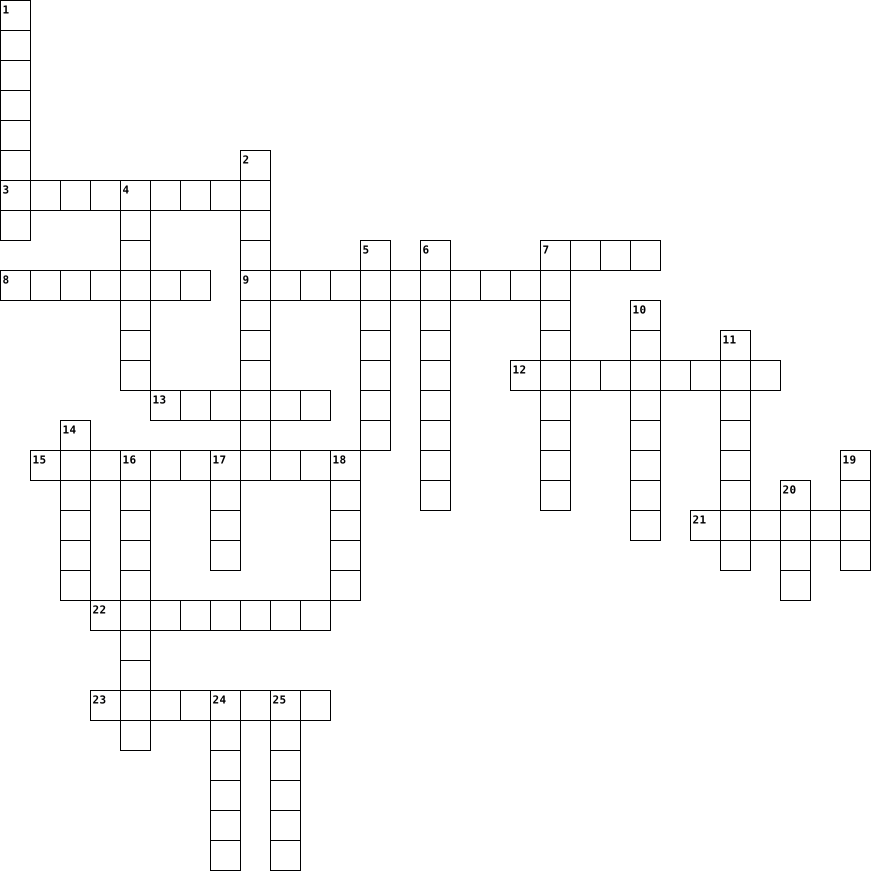
Across
- Ag
- F
- He
- Ca
- Cl
- Cu
- Na
- Fe
- Au
- Ne
Down
- H
- Li
- As
- I
- N
- K
- C
- O
- Al
19 Clues: H • F • I • N • K • C • O • Li • Ag • As • He • Ca • Cl • Cu • Na • Fe • Al • Au • Ne
ATOM AND ELEMENTS 2026-03-28

Across
- a reactive gas found in the atmosphere
- a green gas that smells like bleach
- element with the symbol Ca
- ---- number;the sum of the protons and neutrons
- name of the group7 elements
- ------ chloride aka common salt
- name an element beginning with the letter l
- element with atomic number 8
Down
- element that has only one proton
- elements on the left of the periodic table
- positively charged sub atomic particle
- where the protons and neutrons are found
- the only liquid metal
- charge on an electron
- charge on a neutron
- element with symbol Cu
- the symbol is Fe
- just below oxygen in the periodic table
- the number of liquid elements
19 Clues: the symbol is Fe • charge on a neutron • the only liquid metal • charge on an electron • element with symbol Cu • element with the symbol Ca • name of the group7 elements • element with atomic number 8 • the number of liquid elements • ------ chloride aka common salt • element that has only one proton • a green gas that smells like bleach • positively charged sub atomic particle • ...
Unit 7 Enrichment Project 2024-02-16

Across
- a change that does not alter the properties of a substance
- The basic unit of a chemical element
- nonreactive family of nonmetals with 8 valence electrons
- has six protons, and 4 valence electrons
- has an atomic mass of 39.098, its periodic symbol is K
- in family 4, its periodic symbol is Ti
- tranistion metal, its periodic symbol is Au
- in family 10, has an atomic mass of 58.693
- in family 11, has 29 protons
- an electron in the outermost shell, which can be transferred or shared with another atom
- family with 6 valence electrons
- an element that has some characteristics of both metals and nonmetals
- a class of elements characterized by physical properties that include shininess, malleability, ductility, and conductivity
- a substance at the end of a chemical reaction
- in family 8, has 26 protons
- families 3-12 on the periodic table
- is named after California, its periodic symbol is Cf
- discovered by marie curie,has 2 valence electrons
- nonmetal with 16 protons
- discovered by Marie Curie, named after Poland
- named after a planet, in family 12
- a substance that is present at the start of a chemical reaction
- bond formed from the transfer of an electron or electrons
- the heaviest element, has 116 protons
- family with 3 valence electrons
Down
- in family 18, has 10 protons
- a symbolic representation showing the kind and amount of the starting materials and products of a reaction
- metalloid in family 14
- a chemical bond formed when two atoms share electrons
- metalloid with 3 Valence electrons
- Noble gas that doesn't have 8 valence electrons
- metals found in group 2 of the periodic table
- the principle that the total amount of matter is neither created nor destroyed during any chemical or physical change
- nonmetals with 7 valence electrons in its outermost shell
- family with 4 valence electrons
- First element on the periodic table
- the most reactice group of metals
- named after America, its atomic mass is 243.061
- a substance made of two or more elements chemically combined in a specific ratio, or proportion
- a change that results in new products with new properties
- combines with chlorine to make salt
- an element that lacks most of the properties of a metal
- named after Pluto, its atomic mass is 244.064
- has 36 protons, doesn't react to anything
- element named after Albert Einstein
- the most reactive element on the periodic table
- in family 11, its periodic symbol is Ag
- a neutral group of two or more atoms held together by covalent bonds
- named after the planet Neptune,has 93 protons
- family with 5 valence electrons
50 Clues: metalloid in family 14 • nonmetal with 16 protons • in family 8, has 26 protons • in family 18, has 10 protons • in family 11, has 29 protons • family with 4 valence electrons • family with 6 valence electrons • family with 5 valence electrons • family with 3 valence electrons • the most reactice group of metals • metalloid with 3 Valence electrons • ...
Chemistry Vocab (no spaces between words) 2021-04-23

Across
- negatively charged particle
- the table that contains an arrangement of all known elements
- number of protons and electrons
- average mass of all isotopes of that element
- particle with no charge
- diagram mental picture mathematical statement or an object that helps explain a concept
Down
- one or two letter abbreviation for each element
- very small center core of an atom
- positive charged particle
- sum of the protons and neutrons
- the smallest unit of matter
- horizontal rows in the periodic table
- vertical columns in the periodic table
- makes up everything in the universe
14 Clues: particle with no charge • positive charged particle • negatively charged particle • the smallest unit of matter • number of protons and electrons • sum of the protons and neutrons • very small center core of an atom • makes up everything in the universe • horizontal rows in the periodic table • vertical columns in the periodic table • ...
Match 1 2022-06-25

Across
- separating pure water from salt water
- Most electronegative element
- First noble gas in the periodic table.
- Apparatus can measure exactly 25cm3 of solution
- Horizontal row of elements in the period table
- Least reactive elements in Halogen group
Down
- Process in which solid change to gas
- Element used to make batteries of electric cars
- A gas turns damp red litmus paper blue
- evaporation takes place at
- gas relights a glowing splint
- process by which a liquid turns into a solid
- What is the center of an atom called
- Seventh element in periodic table
14 Clues: evaporation takes place at • Most electronegative element • gas relights a glowing splint • Seventh element in periodic table • Process in which solid change to gas • What is the center of an atom called • separating pure water from salt water • A gas turns damp red litmus paper blue • First noble gas in the periodic table. • Least reactive elements in Halogen group • ...
vocab 2022-11-08

Across
- a unit of mass used to express atomic and molecular weights
- six nonmetals
- an element whose properties are intermediate between those of metals and solid nonmetals
- a deductible and malleable material that can be shiny
- an element or substance that is not a metal.
- electrons that located in the outermost electron shell of an atom
- a collection of elements that are similar
- a law stating that the elements, when listed in order of their atomic numbers fall into recurring groups
- any of various chemical elements that have valence electrons
Down
- six chemical elements that make up Group 1 (Ia) of the periodic table
- a table of elements
- strongly basic metals
- elements with little to no reaction rates
- left-hand column of numbers
14 Clues: six nonmetals • a table of elements • strongly basic metals • left-hand column of numbers • elements with little to no reaction rates • a collection of elements that are similar • an element or substance that is not a metal. • a deductible and malleable material that can be shiny • a unit of mass used to express atomic and molecular weights • ...
Metals, Metalloids, and Non-Metals 2022-11-16

Across
- Arsenic (As) is a Metalloid what side is it located on The Periodic Table
- located ON the zigzag line
- Scandium (Sc) is located on what side of The Periodic Table if it is a Metal
- metals are malleable while non-metals are
- to be shiny or dull
- what element is a non-metal but is located on the left side of the zigzag
- to be able to transfer electricity
- Iron (Fe) is a
Down
- Krypton (Kr) is a
- not able to transfer electricity
- the ability to be hammered into sheets
- Polonium (Po) and Silicon (Si) are both metalloids what do they both have in common, they are both
- Oxygen (O) is a Non-metal what side is it located on The Periodic Table
- the ability to be stretched into wire
14 Clues: Iron (Fe) is a • Krypton (Kr) is a • to be shiny or dull • located ON the zigzag line • not able to transfer electricity • to be able to transfer electricity • the ability to be stretched into wire • the ability to be hammered into sheets • metals are malleable while non-metals are • Oxygen (O) is a Non-metal what side is it located on The Periodic Table • ...
Metals, Metalloids, and Non-Metals 2022-11-16

Across
- Arsenic (As) is a Metalloid what side is it located on The Periodic Table
- located ON the zigzag line
- Scandium (Sc) is located on what side of The Periodic Table if it is a Metal
- metals are malleable while non-metals are
- to be shiny or dull
- what element is a non-metal but is located on the left side of the zigzag
- to be able to transfer electricity
- Iron (Fe) is a
Down
- Krypton (Kr) is a
- not able to transfer electricity
- the ability to be hammered into sheets
- Polonium (Po) and Silicon (Si) are both metalloids what do they both have in common, they are both
- Oxygen (O) is a Non-metal what side is it located on The Periodic Table
- the ability to be stretched into wire
14 Clues: Iron (Fe) is a • Krypton (Kr) is a • to be shiny or dull • located ON the zigzag line • not able to transfer electricity • to be able to transfer electricity • the ability to be stretched into wire • the ability to be hammered into sheets • metals are malleable while non-metals are • Oxygen (O) is a Non-metal what side is it located on The Periodic Table • ...
periodic table IN&OUT 2013-01-08

Across
- the elements in group 18
- the group of elements that contain common metals like copper.
- the gradually wearing of metal.
- a type of element that lack the most properties
- Its a representation of an element on the Periodic table containing usually one or two letters
- this is also known as a family
Down
- a molecule that contains more than two atoms
- they conduct heat and energy
- a series of different from left to right on the periodic table
- these types of metals react by loosing one electrons.
- the section on the periodic table were elements are solid at room temp.
- salt forming
12 Clues: salt forming • the elements in group 18 • they conduct heat and energy • this is also known as a family • the gradually wearing of metal. • a molecule that contains more than two atoms • a type of element that lack the most properties • these types of metals react by loosing one electrons. • the group of elements that contain common metals like copper. • ...
Unit 2 vocab 2024-02-13

Across
- period or energy level
- chemical element that lacks characteristics of metal
- same element with different number of neutrons
- element whose properties are between metal and non-metal
Down
- region on the periodic table
- element with high thermal and electric conductivity
- column on the periodic table
- rings on which electrons lie
- row on the periodic table
9 Clues: period or energy level • row on the periodic table • region on the periodic table • column on the periodic table • rings on which electrons lie • same element with different number of neutrons • element with high thermal and electric conductivity • chemical element that lacks characteristics of metal • element whose properties are between metal and non-metal
GAMS Atoms and the Periodic Table Review 2019-04-19

Across
- A charged particle that forms when an atom or group of atoms gains or loses one or more electrons.
- An interaction that holds atoms or ions together.
- The region around the nucleus of an atom where electrons are likely to be found.
- The law that states that mass cannot be created or destroyed in ordinary chemical and physical changes.
- The smallest unit of an element that maintains the properties of that element.
- A atom's central region, which is made up of protons and neutrons.
- The law that states that the repeating chemical and physical properties of elements change periodically with the atomic numbers of the elements.
- A vertical column of elements on the periodic table; elements in a group share chemical properties.
- The mass of an atom expressed in atomic mass units.
- A subatomic particle that has no charge and that is found in the nucleus of an atom.
- The combining of atoms to form molecules or ionic compounds.
- A substance or molecule that participates in a chemical reaction.
- The number of protons in the nucleus of an atom; the atomic number is the same for all atoms of an element.
- An atom that has the same number of protons (atomic number) as other atoms of the same element do but that has a different number of neutrons, and thus a different atomic mass.
- One of the elements of Group 18 of the periodic table; elements of Group 18 are nonreactive due to a full outer energy level. (He, Ne, Ar, Kr, Xe Rn)
- A subatomic particle that has a positive charge and that is found in the nucleus of an atom.
Down
- In chemistry, a horizontal row of elements on the periodic table.
- A bond that forms when electrons are transferred from one atom to another, which results in a positive ion and a negative ion.
- An electron that is found in the outermost shell of an atom and that determines the atom's chemical properties.
- Describes something that occurs or repeats at regular intervals.
- A subatomic particle that has a negative charge.
- Bond - A bond formed when atoms share one or more pairs of electrons.
- One of the elements of Group 1 of the periodic table. (Li, Na, K, Rb, Cs, Fr)
- The sum of the numbers of protons and neutrons in the nucleus of an atom.
- One of the elements of Group 2 of the periodic table. (Be, Mg, Ca, Sr, Ba, Ra)
- The substance that forms in a chemical reaction.
- The process by which one or more substances change to produce one or more different substances.
- A unit of mass that describes the mass of an atom or molecule.
- The smallest unit of a substance that keeps all of the physical and chemical properties of that substance.
- One of the elements of Group 17 of the periodic table, combines with most metals to form salts. (F, Cl, Br, I, At)
30 Clues: A subatomic particle that has a negative charge. • The substance that forms in a chemical reaction. • An interaction that holds atoms or ions together. • The mass of an atom expressed in atomic mass units. • The combining of atoms to form molecules or ionic compounds. • A unit of mass that describes the mass of an atom or molecule. • ...
Unit 3 Vocabulary 2025-09-26

Across
- the smallest particle of an element that retains the chemical identity of the element; made up of positively charged protons, negatively charged electrons, and neutrons
- the electrode at which oxidation occurs; it is the positively charged electrode within a cathode ray tube
- the weighted average of the masses of the existing isotopes of an element; the sum of the masses of an element’s isotopes each multiplied by its natural abundance
- elements that typically have a low melting point,a dull surface, breaks easily, and is a poor conductor of heat and electricity
- an atom that has the same number of protons as another, identical atom, but with differing numbers of neutrons
- an arrangement of the elements by their atomic numbers so that elements are periodic functions of their atomic numbers
- gases elements in Group 8A (18); they do not readily react with other elements due to a satisfied octet; they are inert
- the number of protons in the nucleus of an atom
- the attractive force among the particles in the nucleus of an atom; in a stable atom, it overcomes the forces of repulsion among protons
- elements in Group 2A of the periodic table; the ions of the elements in this group have 2+ charge
- electrons in the outermost energy level of an atom
- a stream of electrons produced at the negative electrode (cathode) of a tube containing a gas at low pressure
Down
- a positively charged particle within the nucleus of an atom; it has a mass of 1.00720 amu
- an electron that has absorbed energy and, therefore, exists at a higher energy level
- the percentage of an isotope that occurs in nature
- elements in Group 7A (17); they are the most reactive nonmetals
- a horizontal row on the periodic table; the elements within the same period have the same number of energy levels
- an element that typically has a high melting point, is ductile, malleable, and shiny, and a good conductor of heat and electricity
- elements found on the stair-step line of the periodic table with properties of metals and nonmetals
- elements that exist as diatomic molecules in nature; they include oxygen, hydrogen, nitrogen, fluorine, chlorine, iodine, and bromine
- the normal state of an electron or atom; at this state the electron or atom has the lowest possible energy
- elements found in the middle column of the periodic table; they have multiple oxidation states
- the electrode at which reduction occurs; it is the negatively charged electrode within a cathode ray tube
- elements in Group 1A of the periodic table; the ions of the elements in this group have a 1+ charge
- number the sum of the number of protons and neutrons in the nucleus of an atom
- a neutral particle within the nucleus of an atom; it has a mass of 1.00867 amu
- a vertical column on the periodic table with similar electron configurations, chemical properties, and the same number of valence electrons
- a negatively charged particle within an atom; it has a mass of 0.000549 amu
28 Clues: the number of protons in the nucleus of an atom • the percentage of an isotope that occurs in nature • electrons in the outermost energy level of an atom • elements in Group 7A (17); they are the most reactive nonmetals • a negatively charged particle within an atom; it has a mass of 0.000549 amu • ...
The Periodic Table 2023-10-25

Across
- group of metals with 2 valence electrons
- An electron that is in the highest occupied energy level of an atom
- Elements with properties that fall between those of metals andnonmetals
- Elements that are good conductors of heat and electric current
- rows in the periodic table
- An arrangement of elements in columns based on a set of propertiesthat repeat from row to row
Down
- Elements that form a bridge between the elements on the left andright sides of the periodic table
- columns in the periodic table
- Colorless, odorless, and extremely unreactive gases
- extremely reactive metals
- Elements that are poor conductors of heat and electric current
- A pattern of repeating properties that occurs when atomic numbersare used to arrange elements into groups
- highly reactive nonmetals
13 Clues: extremely reactive metals • highly reactive nonmetals • rows in the periodic table • columns in the periodic table • group of metals with 2 valence electrons • Colorless, odorless, and extremely unreactive gases • Elements that are poor conductors of heat and electric current • Elements that are good conductors of heat and electric current • ...
Periodic Table 2023-03-07

Across
- 1 to 2 letter for name.
- what element has the atomic number of 8
- in order
- average mass of elements and isotopes.
- number of protons in a elements atom
- Who made the first periodic table?
Down
- Process of representing.
- discovered 63 elements
- how did Mendeleev order the periodic table
- Shows elements in order
10 Clues: in order • discovered 63 elements • 1 to 2 letter for name. • Shows elements in order • Process of representing. • Who made the first periodic table? • number of protons in a elements atom • average mass of elements and isotopes. • what element has the atomic number of 8 • how did Mendeleev order the periodic table
Ian S. Sidney - Crossword Puzzle - Science 8B/Relevance 2021-10-12

Across
- Negatively charged outside nucleus
- Matter is composed of one type of atom
- Has a definite shape and volume, with molecules vibrating in place with normal pattern
- Electrons traveling in specific energy levels around the nucleus
- Neutral charged in nucleus
- Composed mostly of protons and neutrons ( subtract to get number of neutrons)
- Has no definite shape of volume, molecules are very far apart and move quickly
Down
- The number of protons and electrons in an atom
- A group of atoms bonded together
- All matter is made up of this
- A table were element are organized by an increasing atomic number
- This person is best remembered for formulating the Periodic Law and creating a farsighted version of the periodic table of elements.
- Located in the center of any atom
- Positively charged in nucleus
- Atoms of two or more elements combined
- The mass per unit of volume
- a Danish physicist who made foundational contributions to understanding atomic structure and quantum theory
- A definite volume with no definite shape, molecules loosely packed and slip past on another
- a property of a physical body and a measure of its resistance to acceleration when a net force is applied
19 Clues: Neutral charged in nucleus • The mass per unit of volume • All matter is made up of this • Positively charged in nucleus • A group of atoms bonded together • Located in the center of any atom • Negatively charged outside nucleus • Matter is composed of one type of atom • Atoms of two or more elements combined • The number of protons and electrons in an atom • ...
Chapter 4 Terms 2023-02-09

Across
- 7 valance electrons highly reactive
- 2 valence electrons
- a row on the periodic table
- a table of the chemical elements arranged in a way that displays their periodic properties in real relationship atomic number
- 4 or more valence electrons don't exhibit general property of metals, exists as a gas, poorly conductive, and reactivity varies
- another name for a family
- characteristics between metals and non-metals, called semiconductors, brittle solid, conductive, and reactivity varies
- 2 valance metals, less reactive,
Down
- 8 valance electrons, inert
- electron electrons in the outermost energy level of a neutral atom
- consists of the element's chemical system surrounded by the atom's valence electrons
- 80% of electrons, few valence electrons, dense, conductive, and reactive
- set of elements in the same column on the periodic table
- the distance from the center of an atom's nucleus to the electrons in its outermost energy level
- 1 or 2 valance electrons, used in alloys
- contains metals, nonmetals, and metalloids
- measure of an element's ability to attract and hold electrons when bonded to other atoms
- 1 valance electron, reactive, Group 1, parts of compounds
- the properties of an element vary periodically with their atomic numbers
19 Clues: 2 valence electrons • another name for a family • 8 valance electrons, inert • a row on the periodic table • 2 valance metals, less reactive, • 7 valance electrons highly reactive • 1 or 2 valance electrons, used in alloys • contains metals, nonmetals, and metalloids • set of elements in the same column on the periodic table • ...
Aguilar's Challenge 2022-05-26

Across
- 5th planet from the sun
- A letter that takes the place of a number
- Mr. Aguilar's favorite travel spot
- Another name for slope
- First Avenger
- President on $20 bill
- Also known as zeros, roots, solutions
- Matt Murdock's alter ego in Marvel
- Periodic table element represent by Co
Down
- Video game,you explore, build structures
- Supreme Union General during Civil War
- Disney princess who lives in Louisiana
- Anime where Tanjiro is a main character
- Border state east of Texas
- Border country north of United States
- Border state west of Texas
- Periodic table element represented by Au
- "Trailer" for a book or novel
- Functions that have minimum/maximum
19 Clues: First Avenger • President on $20 bill • Another name for slope • 5th planet from the sun • Border state east of Texas • Border state west of Texas • "Trailer" for a book or novel • Mr. Aguilar's favorite travel spot • Matt Murdock's alter ego in Marvel • Functions that have minimum/maximum • Border country north of United States • Also known as zeros, roots, solutions • ...
Physical Science Crossword Puzzle 2017-10-12

Across
- Two or more elements combined
- All things are made of this
- Protons tell you this
- the "glue" that keeps atoms together
- Pure substance that cannot be changed
- Left side of a chemical equation
- Protons+neutrons
- Second column of the periodic table
- Holds all the weight of an atom
- Two or more substances that can be separated
Down
- The right side of the chemical equation
- The big or first number in a chemical equation
- Negatively charged particle
- Neutrally charged particle
- Short way to show reactions using symbols
- Positively charged particle
- Smallest particle of matter
- First column of the periodic table
- The smaller number in a chemical equation
19 Clues: Protons+neutrons • Protons tell you this • Neutrally charged particle • Negatively charged particle • All things are made of this • Positively charged particle • Smallest particle of matter • Two or more elements combined • Holds all the weight of an atom • Left side of a chemical equation • First column of the periodic table • Second column of the periodic table • ...
Elements and Compounds 2022-03-04

Across
- found on the zig zag line
- able to pound into shape without breaking
- made of two or more types of atoms
- columns on the periodic table
- able to make into wire
- found on the right side of zig zag line
- found on the left side of the zig zag line
- not shiny
- positively charged subatomic particle
- neutrally charged subatomic particle
Down
- breaks easily
- the outermost shell with an electron
- negatively charged subatomic particle
- a group of atoms bonded together
- a pure substance made of one type of atom
- an organized chart of the elements
- shiny
- rows on the periodic table
- smallest unit of mass
19 Clues: shiny • not shiny • breaks easily • smallest unit of mass • able to make into wire • found on the zig zag line • rows on the periodic table • columns on the periodic table • a group of atoms bonded together • made of two or more types of atoms • an organized chart of the elements • the outermost shell with an electron • neutrally charged subatomic particle • ...
Science Terms 2021-10-04

Across
- The first element listed on the Periodic Table
- the amount of matter in an object
- makes up everything
- The smallest unit of a compound
- A substance containing 2 atoms from 2 different elements
- the law that states that matter cannot be destroyed nor created
Down
- part of an atom with positive charge, determines the type of element
- The table that has all of the elements
- also called a group
- The smallest unit of an element
- the neutral charge inside an atom
- also called family
- part of an atom with a negative charge
- The rows on the periodic table
14 Clues: also called family • also called a group • makes up everything • The rows on the periodic table • The smallest unit of an element • The smallest unit of a compound • the amount of matter in an object • the neutral charge inside an atom • The table that has all of the elements • part of an atom with a negative charge • The first element listed on the Periodic Table • ...
Chemistry 2013-11-07
Across
- Method of preparing medicinal mixture
- A triple beam balance measures
- Ratio of mass to volume
- Average kinetic energy of the gas particle
- A model of the atom proposed by Niels Bohr
- Number of element that is represented by Z
- Cn is the symbol of this element
- Sub-atomic particle discovered by Eugene Goldstein
- A tabular arrangement of the chemical elements
- Basic unit of mass in the Metric System
Down
- Homogeneous mixtures consisting of two different parts
- A reaction wherein heat is absorbed
- Positively charged ions
- The row of the Periodic Table
- Invented by Evangelista Torricelli, it measures atmospheric measure
- neither metal nor non-metal
- Negatively charged particle of atom
- Force exerted by gas molecules in a given area
- Space occupied by the gas particles
- Heat is released in a form of radiant
- Element that prevents anemia
- Best conductor of heat
- Charged elements
- Basic unit of matter
- The columns if the Periodic Table
- Negatively charged ions
26 Clues: Charged elements • Basic unit of matter • Best conductor of heat • Positively charged ions • Ratio of mass to volume • Negatively charged ions • neither metal nor non-metal • Element that prevents anemia • The row of the Periodic Table • A triple beam balance measures • Cn is the symbol of this element • The columns if the Periodic Table • A reaction wherein heat is absorbed • ...
Atoms and the Periodic Table 2025-11-11

Across
- The smaller particles that make up protons and neutrons.
- Positively charged particles.
- Negatively charged particles.
- The horizontal rows on the periodic table.
- Elements that share number of protons, but have a different number of neutrons.
- When we add the number of protons and neutrons, we get the ______ number.
- Our current atomic model is called the electron _________ model.
Down
- Energy ___________ the further away from the nucleus electrons get. (Increases or decreases)
- The center of the atom that holds protons and neutrons.
- Particles that do not have a charge.
- The vertical columns on the periodic table.
- The number of electrons that fit on the first ring around the nucleus.
- The number of protons is shown on the periodic table with the _________ number.
13 Clues: Positively charged particles. • Negatively charged particles. • Particles that do not have a charge. • The horizontal rows on the periodic table. • The vertical columns on the periodic table. • The center of the atom that holds protons and neutrons. • The smaller particles that make up protons and neutrons. • ...
periodic table 2022-12-02

Across
- anything that has weight and takes up space
- something that is like melted slime station
- periodic -BLANK-
- the amount of space an object takes up
- something that is hard
- as we move down a group the atom gains a -BLANK-
Down
- there are so many -BLANK- on the periodic table
- a table used in science
- a measurement of how much matter is in an object
- the measure force of gravity on an object
10 Clues: periodic -BLANK- • something that is hard • a table used in science • the amount of space an object takes up • the measure force of gravity on an object • anything that has weight and takes up space • something that is like melted slime station • there are so many -BLANK- on the periodic table • a measurement of how much matter is in an object • ...
Physical science Study Guide 2022-01-13

Across
- neutral particle
- a type if metals that are good conductors
- a different version of an element
- horizontal row in the periodic table
- reactive to air
- when an atom loses an electron
- more neutrons than protons
- the probability of particle being somewhere
Down
- form all gasses
- terrible conductors of electricity
- when there is an extra or less particle
- the unit of measurement in the atomic mass
- negatively charged particle
- rare earth metals
- positively charged particle
- vertical row in the periodic table
- center of an atom
- gasses found in the atmosphere
- more electrons than protons
- has no color
- the number of protons in an atom
- great conductors of electricity
22 Clues: has no color • form all gasses • reactive to air • neutral particle • rare earth metals • center of an atom • more neutrons than protons • negatively charged particle • positively charged particle • more electrons than protons • gasses found in the atmosphere • when an atom loses an electron • great conductors of electricity • the number of protons in an atom • ...
Elements Crosswords 2012-09-10

Across
- The first metaloid in the periodic table
- The lightest halogen
- It is used to kill bugs
- What has the symbol Na
- A soft silver white metal
- The fourth element on the periodic table
- The most common metal found in the earths crust
- Its in the pool
- It is colorless, odorless and tasteless
- Gives a reddish orange glow
Down
- The most common gas in the worlds atmosphere
- What is in rocks and stones
- What are bananas full of
- Its in your bones
- Is used for plastic surgery
- It is in fire works
- Diamonds are made out of it
- Makes your voice high pitched
- The lightest element
- You are breathing it right now
20 Clues: Its in the pool • Its in your bones • It is in fire works • The lightest halogen • The lightest element • What has the symbol Na • It is used to kill bugs • What are bananas full of • A soft silver white metal • What is in rocks and stones • Is used for plastic surgery • Diamonds are made out of it • Gives a reddish orange glow • Makes your voice high pitched • ...
Periodic Table of Elements 2015-04-17

Across
- zero charged particle
- a charged atom
- easily combined
- positively charged particle
- the sum of the numbers of protons and neutrons in the nucleus of an atom
- non-metal+non-metal
- a unit of mass that describes the mass of an atom or molecule
- metal+metal
- around the nucleus
- metal+non-metal
Down
- in the middle of an atom
- an atom that has the same number of protons
- tiny piece of everything
- created the Periodic Table
- makes up everything in the universe
- number of protons of an atom
- the mass of an atom expressed in atomic mass units
- holds quarks together
- negatively charged particle
- the number of groups in the Periodic Table
20 Clues: metal+metal • a charged atom • easily combined • metal+non-metal • around the nucleus • non-metal+non-metal • zero charged particle • holds quarks together • in the middle of an atom • tiny piece of everything • created the Periodic Table • positively charged particle • negatively charged particle • number of protons of an atom • makes up everything in the universe • ...
Tanish's Crossword About Atoms 2015-10-01

Across
- positive charge
- element number 20
- symbol of the element Silver
- horizontal rows
- the basic unit of an element
- element number 19
- no charge
- symbol of element number 3
- something with indefinite volume
- negative charge
- large body of matter with no definite shape
- vertical columns
- symbol of the element Gold
- Element number 8
Down
- middle of an atom
- the first element on the periodic table
- anything that takes up space
- something that has shape and volume
- the second element on the periodic table
- element number 7
- colorless fluid part of blood
- an airlike substance
- a thing that represents something else
- the strength required for something physical or mental
- element number 10
25 Clues: no charge • positive charge • horizontal rows • negative charge • element number 7 • vertical columns • Element number 8 • middle of an atom • element number 20 • element number 19 • element number 10 • an airlike substance • symbol of element number 3 • symbol of the element Gold • anything that takes up space • symbol of the element Silver • the basic unit of an element • ...
Atoms/Periodic Table Vocabulary 2023-01-03

Across
- each of more than one hundred substances that cannot be interconverted or broken down into simpler substances and are primary constituents of matter. Each element is distinguished by its atomic number i.e the number of protons in the nuclei of its atoms.
- emitting or relating to the emission of ionizing radiation or particles.
- an element whose properties are intermediate between those of metal and solid nonmetals.
- A stable subatomic particle with a charge of negative electricity, found in all atoms and
- A solid material that is typically hard, shiny, malleable, fusible, and ductile, with good electrical and thermal conductivity.
- the basic unit of a chemical element.
- not liable to undergo chemical decomposition, radioactive decay, or other physical change.
- A thing that is composed of two or more separate elements; a mixture
- Any of the set of metallic elements occupying a central block in the periodic table.
- a set of elements occupying an entire horizontal row in the periodic table.
- in all atomic nuclei except those of ordinary hydrogen.
- a table of the chemical elements arranged in order of atomic number, usually in rows, so that elements with similar atomic structure appear in vertical columns.
- an atom or molecule with a net electric charge due to the loss or gain of one or more electrons.
- that form strongly acidic compounds with hydrogen from which simple salts can be made.
- a set of elements occupying a column in the periodic table and having broadly similar properties
- a stable subatomic particle occurring in all atomic nuclei, with a positive electric charge
- in magnitude to that of an electron, but of opposite sign.
- of an atom of carbon-12. It is approximately equal to 1.66 x 10^-27 kg.
- a subatomic particle of about the same mass as a proton but without an electric charge
- the sum of the numbers of protons and neutrons in the nucleus of an atom.
- Any of the gaseous elements occupying group 18 of the periodic table.
- Any of the elements occupying group 17 of the periodic table. They are reactive nonmetallic
Down
- A substance made by mixing other substances together.
- property of subatomic particles that causes it to experience a force when placed in an electric and magnetic field.
- each of two or more forms of the same element that contain equal numbers of protons but different numbers of neutrons in their nuclei, and hence differ in relative atomic mass but not in chemical properties; in particular, a radioactive form of an element.
- the quality or character of being periodic; the tendency to recur at intervals.
- a single electron or one of two or more electrons in the outer shell of an atom that is
- a unit of mass used to express atomic and molecular weights, equal to one-twelfth of the
- a fundamental constant that is the smallest known quantity of electricity. Has a value (+or-) of 1.602176634x10^-19 coulombs.
- small, dense region consisting of protons and neutrons at the center of an atom.
- An element or substance that is not a metal.
- for the chemical properties of an atom.
- the system of electrons surrounding the nucleus of an atom.
- as the primary carrier of electricity in solids.
- Any of the reactive elements occupying group 2 of the periodic table.
- Any of the reactive elements occupying group 1 of the periodic table.
- they show variable valence, and a strong tendency to form coordination compounds.
- a theory of matter and energy based on the concept of quanta, especially quantum
- the fixed amount of energy that a system described by quantum mechanics, such as a molecule, an atom, electron, or nucleus, can have.
- the number of a chemical element in the periodic system, whereby the elements are arranged in order of increasing number of protons in the nucleus.
- from their electronic structure.
41 Clues: from their electronic structure. • the basic unit of a chemical element. • for the chemical properties of an atom. • An element or substance that is not a metal. • as the primary carrier of electricity in solids. • A substance made by mixing other substances together. • in all atomic nuclei except those of ordinary hydrogen. • ...
Periodic Table Review 2025-11-21

Across
- Nonmetals are ____ conductors
- Can be shiny or dull
- Metalloids tend to border this
- He created the modern periodic table
Down
- Carbon is this type of element, located on the right of the periodic table
- How many elemenets did the first published periodic contain
- He created the first periodic table
- These will corrode
8 Clues: These will corrode • Can be shiny or dull • Nonmetals are ____ conductors • Metalloids tend to border this • He created the first periodic table • He created the modern periodic table • How many elemenets did the first published periodic contain • Carbon is this type of element, located on the right of the periodic table
Chemistry 2021-09-21

Across
- something not metal
- to attract a bonding pair of electrons
- the distance between the nuclei
- shell of the atom
- the elements when arranged in the order of
- atoms or molecules are converted to
- a column of elements in the
- a measure of the tendency of an
- a positively charged ion
- carbon, nitrogen, oxygen, and fluorine
- hydrogen (H), lithium(li),sodium
- the successive occupation of the orbitals in a
- helium, lithium, beryllium,
- fluorine, chlorine, bromine, iodine, and
- xenon, and radon
Down
- and gold
- invented periodic table
- element whose properties are intermediate
- conductivity
- those of metals and solid nonmetals or
- atomic numbers show a periodic variation of
- charged atoms
- table of the chemical elements
- structure and of most of their properties
- titanium, copper, nickel, silver,
- substances characterized by high electrical and
- two identical atoms bonded together
- a negatively charged ion
- molecule with a net electric charge
- any process by which electrically
- helium, neon, argon,
31 Clues: and gold • conductivity • charged atoms • xenon, and radon • shell of the atom • something not metal • helium, neon, argon, • invented periodic table • a negatively charged ion • a positively charged ion • a column of elements in the • helium, lithium, beryllium, • table of the chemical elements • the distance between the nuclei • a measure of the tendency of an • ...
Chemical Bonds Vocab 2023-12-11

Across
- Share valence electrons
- Used to identify substances
- Group of atoms
- Eight electrons in the valence shell
- Electrons in the outermost shell
Down
- Na+Cl
- H+O
- Right of staircase on Periodic Table
- Contains 3 basic particles
- Left of staircase on Periodic Table
- Transfer valence electrons
11 Clues: H+O • Na+Cl • Group of atoms • Share valence electrons • Contains 3 basic particles • Transfer valence electrons • Used to identify substances • Electrons in the outermost shell • Left of staircase on Periodic Table • Right of staircase on Periodic Table • Eight electrons in the valence shell
Periodic Table Crossword 2024-05-07

Across
- Noble gas found in the first period containing transition metals
- Contains all reactive metals
- Calcium and Barium fit into this category
- Only noble gas with 2 valence electrons
- Largest category on the periodic table
- Only nonmetal on the left side of the periodic table
- Ions creates 2- charges
Down
- This element’s ions have a 3- charge and it is in the first period where 8 electrons can be in the valence shell.
- First created by Dmitri Mendeleev
- This family contains solids, liquids, and gases at room temperature
- Create ions with a plus one charge
- The elements in this group are unreactive
- Don’t fit into either of the periodic table’s two main categories.
- Halogen in period 3
- Most reactive nonmetal
- Form positive ions
16 Clues: Form positive ions • Halogen in period 3 • Most reactive nonmetal • Ions creates 2- charges • Contains all reactive metals • First created by Dmitri Mendeleev • Create ions with a plus one charge • Largest category on the periodic table • Only noble gas with 2 valence electrons • The elements in this group are unreactive • Calcium and Barium fit into this category • ...
The Periodic table 2025-06-12

Across
- The number of _____ surrounding the nucleus is equal to the number of protons.
- The columns in the Periodic Table are called _____.
- An __________ is a substance made up of only one type of atom.
- The gases that do not react are called the _____ gases.
Down
- The _____ number is the total number of protons and neutrons in the nucleus.
- _____ have a neutral charge and are located in the nucleus.
- The Periodic Table is a chart that contains information about the _____ that make up matter.
- This person is credited for the development of the Modern Periodic Table.
- The atomic number of an atom is the number of _____ in the atom.
- The rows in the Periodic Table are called _____.
10 Clues: The rows in the Periodic Table are called _____. • The columns in the Periodic Table are called _____. • The gases that do not react are called the _____ gases. • _____ have a neutral charge and are located in the nucleus. • An __________ is a substance made up of only one type of atom. • The atomic number of an atom is the number of _____ in the atom. • ...
Periodic Table Of Elements; Crossword Puzzle 2023-05-09

Across
- Has 9 protons
- Has an average atomic mass of 30.9737
- Has an average atomic mass of 101.07
- Has 25 protons
- What element is in group 17 and in period 4
- The horizontal line's on the periodic table
- Group 4 period 5
- has 14 protons
- Group 18 period 3
Down
- Has 5 protons
- Has 3 protons
- What the element "K" stands for
- Group 1 period 3
- period 18
- What element is in group 14 and also in period 2
- What does the element "Mg" stand for
- Has 31 protons
- Has and average atomic mass of about 16
- The vertical lines on the periodic table
- Has 30 protons
- Has an average mass of about 45
21 Clues: period 18 • Has 5 protons • Has 9 protons • Has 3 protons • Has 31 protons • Has 25 protons • Has 30 protons • has 14 protons • Group 1 period 3 • Group 4 period 5 • Group 18 period 3 • What the element "K" stands for • Has an average mass of about 45 • Has an average atomic mass of 101.07 • What does the element "Mg" stand for • Has an average atomic mass of 30.9737 • ...
Aguilar's Challenge 2022-05-26

Across
- Matt Murdock's alter ego in Marvel
- Border state east of Texas
- Periodic table element represented by Au
- Anime where Tanjiro is a main character
- Border country north of United States
- "Trailer" for a book or novel
- President on $20 bill
- Functions that have minimum/maximum
- A letter that takes the place of a number
- 5th planet from the sun
- Another name for slope
- Video game,you explore, build structures
Down
- Border state west of Texas
- Mr. Aguilar's favorite travel spot
- Disney princess who lives in Louisiana
- First Avenger
- Also known as zeros, roots, solutions
- Supreme Union General during Civil War
- Eastlake High Mascot
- Periodic table element represent by Co
20 Clues: First Avenger • Eastlake High Mascot • President on $20 bill • Another name for slope • 5th planet from the sun • Border state west of Texas • Border state east of Texas • "Trailer" for a book or novel • Matt Murdock's alter ego in Marvel • Mr. Aguilar's favorite travel spot • Functions that have minimum/maximum • Border country north of United States • ...
Story Periodic Table Crossword 2022-10-03

Across
- what we call the columns on Periodic Table
- atom with same protons and electrons
- All of the elements organized on this
- element with atomic mass of 15.999
- combination of two or more different atoms
- element with atomic number of 23
- neutral charged particle
- negatively charged particle
- any combination of two or more atoms
Down
- variation of an element with more neutrons
- element after potassium
- Number of protons in an element
- what we call rows on Periodic Table
- element with 1 proton
- electrons on the outer shell
- electrons are located in these
- the center of an atom
- atom with more protons than electrons
- positively charged particle
- the 2nd element in the 18th group
20 Clues: element with 1 proton • the center of an atom • element after potassium • neutral charged particle • positively charged particle • negatively charged particle • electrons on the outer shell • electrons are located in these • Number of protons in an element • element with atomic number of 23 • the 2nd element in the 18th group • element with atomic mass of 15.999 • ...
3 2025-11-24

Across
- Slows down a reaction
- Substance formed in reaction
- Matter cannot be created or destroyed
- Absorbs heat
- Rule based on repeated experiments
- Releases heat
- Scientific test
- Chemical representation of a substance
- Element with mixed properties
- Testable prediction
- Starting material in reaction
- Collected information
- Element that lacks metallic properties
- Well-supported scientific explanation
Down
- Symbolic expression of a reaction
- Column in periodic table
- Unit for counting atoms or molecules
- Constant in an experiment
- Factor that changes in an experiment
- Path of electron around nucleus
- Speeds up a reaction
- Row in periodic table
- Using senses to gather information
- Scientist known for gas law constant
- Element that conducts electricity
25 Clues: Absorbs heat • Releases heat • Scientific test • Testable prediction • Speeds up a reaction • Slows down a reaction • Row in periodic table • Collected information • Column in periodic table • Constant in an experiment • Substance formed in reaction • Element with mixed properties • Starting material in reaction • Path of electron around nucleus • Symbolic expression of a reaction • ...
Phys Science Periodic Table 1 2022-01-19

Across
- Carcinogenic metal Cd
- Diatomic Gas (red on the classroom Periodic Table) used to kill soldiers in WW1 as it turns your lungs to liquid
- metal found in bones and shells
- Metal used to make Bepto Bismol for diarhea
- Used inside of pennies as solid copper would make a penny worth more than a penny
- The white form of this metal is for false teeth and the transparent form is used for fake diamonds
- latin name is plumbum from which we get plumber
- Heaviest Gas (look at red number called “Atomic Mass” under a red symbol on the classroom Periodic Table)
- Diatomic Gas we need to live (red on the classroom periodic table)
Down
- Metal that gives a blue color to glass
- Metal used for ball sockets for humans as never rusts and very strong
- Used in rat poison
- Most abundant metal in earth’s crust
- Metal used to make steel
- Metal used to make the shell of pennies
- Latin name for stannum and used for roofing
- Latin name for argentum from which the French get Argent = money
- Noble gas used in Las Vegas lights to make blue light
- Metal with the latin name aurum
19 Clues: Used in rat poison • Carcinogenic metal Cd • Metal used to make steel • metal found in bones and shells • Metal with the latin name aurum • Most abundant metal in earth’s crust • Metal that gives a blue color to glass • Metal used to make the shell of pennies • Metal used to make Bepto Bismol for diarhea • Latin name for stannum and used for roofing • ...
Classifying Matter 2024-09-02

Across
- State of matter with a definite (fixed) shape and volume. The particles are close together and vibrate in place.
- The ability to be shaped or hammered thin
- Where nonmetals are located on the Periodic Table
- State of matter with a definite (fixed) volume but takes the shape of its container. The particles flow past one another.
- Allows heat and electricity to pass through
- Breaks easily
- Where metalloids are located on the Periodic Table
Down
- Not shiny
- State of matter with no definite shape or volume. The particles move freely.
- Conducts at high temperatures and insulates at low temperatures.
- A mixture where all of the particles are evenly spread out. You can't see the different parts.
- A mixture where all of the particles are NOT evenly spread out. You can see the different parts.
- The ability to be drawn into thin wires
- Does NOT allow for heat and electricity to pass through
- Where metals are located on the Periodic Table
- The ability to shine!
16 Clues: Not shiny • Breaks easily • The ability to shine! • The ability to be drawn into thin wires • The ability to be shaped or hammered thin • Allows heat and electricity to pass through • Where metals are located on the Periodic Table • Where nonmetals are located on the Periodic Table • Where metalloids are located on the Periodic Table • ...
Element crossword 2023-05-09

Across
- The Russian Chemist who created the periodic table (two words).
- an element (e.g. arsenic, antimony, or tin) whose properties are intermediate between those of metals and solid nonmetals or semiconductors.
- The metals from group 2-12 that are not very reactive. (2 words)
- the state or power of being reactive or the degree to which a thing is reactive.
- opaque, lustrous elements that are good conductors of heat and electricity
- The name of the 17th group in the periodic table and is extremely reactive.
- an element or substance that is not a metal.
- Number The number of protons and electrons in an atom, determines the element (2 words).
- The name of the last group in the periodic table, which are not in the slightest reactive (2 words).
Down
- The name of the elements in group 2. Ex: Be, Mg and Ca (3 words)
- The name of the elements in group 1 excluding hydrogen, which are extremely reactive (2 words).
- the mass of an atom of a chemical element expressed in AMU. (2 words)
- The horizontal rows of the periodic table.
13 Clues: The horizontal rows of the periodic table. • an element or substance that is not a metal. • The Russian Chemist who created the periodic table (two words). • The name of the elements in group 2. Ex: Be, Mg and Ca (3 words) • The metals from group 2-12 that are not very reactive. (2 words) • the mass of an atom of a chemical element expressed in AMU. (2 words) • ...
Unit 2 Vocabulary Crossword 2024-10-07

Across
- the approximate size of an atom’s charged ion measured in a variety of different ways
- these electrons are found in the highest unfilled energy level, responsible for making chemical bonds
- a class of elements that have electrical properties between those of metals and non-metals. This group includes boron, silicon, germanium, arsenic, antimony, tellurium and polonium.
- a value between 0 and 4 that describes the relative pull of an element for electrons from other atoms, with higher numbers meaning stronger attraction for electrons.
- any of the gaseous elements helium, neon, argon, krypton, xenon and radon occupying group 18 of the periodic table; generally described as being non-reactive.
- a negatively charged ion formed when an atom gains valence electrons
- group 17 elements, including chlorine, fluorine and bromine
- the area around an atom’s nucleus where the electrons are most likely to be found
- radius – the distance from the center of an atom to its outer edge
- shows how electrons are spread among the s, p, d and f orbitals.
Down
- a group of six chemical elements located in the first group of the periodic table; these metals are known for their reactivity, soft texture and silvery color
- the energy required to completely remove an electron from an atom
- groups 3-12 of the periodic table which include elements with 1 to 10 electrons in d orbitals
- a class of elements which typically are electrical insulators, including oxygen, carbon, nitrogen, neon, fluorine and elements to the right of the periodic table.
- a graphical chart of information on the elements that groups the elements in rows and columns according to their chemical properties.
- any of a class of elementary substances, as gold, silver, or copper, all of which are crystalline when solid and which are good conductors of electricity and heat.
- a positively charged ion formed by losing valence electrons, including metals and the ammonium ion
- the set of quantum states for an electron in an atom that have approximately the same energy
- a groups of six elements in group 2 of the periodic table that are known for being shiny, silvery-white and somewhat reactive.
- group of quantum states that have similar spatial shapes, labeled as s, p, d and f.
20 Clues: group 17 elements, including chlorine, fluorine and bromine • shows how electrons are spread among the s, p, d and f orbitals. • the energy required to completely remove an electron from an atom • radius – the distance from the center of an atom to its outer edge • a negatively charged ion formed when an atom gains valence electrons • ...
Vocab 2020-10-13

Across
- electrons in the outermost shell, or energy level, of an atom.
- a column of elements in the periodic table of the chemical elements. There are 18 numbered groups in the periodic table; the f-block columns (between groups 3 and 4) are not numbered.
- a compound that consists of only two elements
- the number of protons in the nucleus of an atom, which determines the chemical properties of an element and its place in the periodic table.
- a positively charged ion.
- table of elements, is a tabular display of the chemical elements, which are arranged by atomic number, electron configuration, and recurring chemical properties.
- a chemical bond formed when atoms share electrons
- a physically distinctive form of matter, such as a solid, liquid, gas, or plasma
- the total number of protons and neutrons in a nucleus.
- one of two or more species of atoms of a chemical element with the same atomic number and position in the periodic table and nearly identical chemical behavior but with different atomic masses and physical properties.
- a stable subatomic particle with a charge of negative electricity, found in all atoms and acting as the primary carrier of electricity in solids.
- The joining together of atoms that results from forces of attraction
- an element that readily forms positive ions and has metallic bonds
- a column of elements in the periodic table of the chemical elements
- an atom that has lost electrons, resulting in an overall positive charge.
- a group of atoms that are joined together with covalent bonds
- the elements in groups 14-16 of the periodic table, not able to conduct electricity or heat very well, very brittle, and cannot be rolled into wires or pounded into sheets.
Down
- a compound that consists of only two elements: a metal and a nonmetal it forms when electrons are transferred from one atom to the other, causing the atoms to develop opposite charges.
- The organization of electrons in energy levels
- the group of elements whose lightest members are represented by helium, lithium, beryllium, boron, carbon, nitrogen, oxygen, and fluorine as arranged in the periodic table
- a shorthand notation used to identify a compound
- a negatively charged ion.
- specific patterns in the properties of chemical elements that are revealed in the periodic table of elements
- the basic units of matter and the defining structure of elements.
- an atom or molecule with a net electric charge due to the loss or gain of one or more electrons.
- the system of electrons surrounding the nucleus of an atom.
- in a chemical formula is a small number placed below the Baseline that tells how many atoms of an element are in each molecule or compound
- a pure substance composed of two or more elements that are chemically combined in a fixed portion
- a row of chemical elements
- an atom that has gained electrons, thereby taking on a negative charge.
- a chemical bond formed when atoms gain or lose electrons
- the positively charged central core of an atom, consisting of protons and neutrons and containing nearly all its mass.
- an imprecise term used to describe a chemical element that forms a simple substance having properties intermediate between those of a typical metal and a typical nonmetal.
- the mass of an atom of a chemical element expressed in atomic mass units. It i approximately equivalent to the number of protons and neutrons in the atom (the mass number) or to the average number allowing for the relative abundances of different isotopes.
- a subatomic particle of about the same mass as a proton but without an electric charge, present in all atomic nuclei except those of ordinary hydrogen.
- a stable subatomic particle occurring in all atomic nuclei, with a positive electric charge equal in magnitude to that of an electron, but of opposite sign.
36 Clues: a negatively charged ion. • a positively charged ion. • a row of chemical elements • a compound that consists of only two elements • The organization of electrons in energy levels • a shorthand notation used to identify a compound • a chemical bond formed when atoms share electrons • the total number of protons and neutrons in a nucleus. • ...
Metals, Metalloids, and Non-Metals 2022-11-16

Across
- Arsenic (As) is a Metalloid what side is it located on The Periodic Table
- located ON the zigzag line
- Scandium (Sc) is located on what side of The Periodic Table if it is a Metal
- metals are malleable while non-metals are
- to be shiny or dull
- what element is a non-metal but is located on the left side of the zigzag
- to be able to transfer electricity
- Iron (Fe) is a
Down
- Krypton (Kr) is a
- not able to transfer electricity
- the ability to be hammered into sheets
- Polonium (Po) and Silicon (Si) are both metalloids what do they both have in common, they are both
- Oxygen (O) is a Non-metal what side is it located on The Periodic Table
- the ability to be stretched into wire
14 Clues: Iron (Fe) is a • Krypton (Kr) is a • to be shiny or dull • located ON the zigzag line • not able to transfer electricity • to be able to transfer electricity • the ability to be stretched into wire • the ability to be hammered into sheets • metals are malleable while non-metals are • Oxygen (O) is a Non-metal what side is it located on The Periodic Table • ...
Science Vocab 2023-09-28

Across
- pH of less than 7
- constructed from the symbols of the elements composing the substance.
- one or two letter abbreviation derived from the element's name.
- The ability of a material to conduct electricity or heat
- ability to dissolve in a liquid
- elements with similar properties found on the left side of the “staircase” on the periodic table
Down
- a solid substance formed when two solutions are chemically combined.
- a quick reference for associating the name and symbol of an element.
- substance that increases the rate of a chemical reaction
- elements with similar properties that create a “staircase” on the periodic table
- elements with similar properties found on the right side of the “staircase” on the periodic table
- The tendency of a substance to undergo chemical changes
- pH of more than 7
- scale used to classify solutions
14 Clues: pH of more than 7 • pH of less than 7 • ability to dissolve in a liquid • scale used to classify solutions • The tendency of a substance to undergo chemical changes • substance that increases the rate of a chemical reaction • The ability of a material to conduct electricity or heat • one or two letter abbreviation derived from the element's name. • ...
Chemistry Review 2021-12-08

Across
- Has properties of both metals and non-metals
- How many electrons are on the 3rd ring
- means shiny
- Means can be put in a wire
- How many electrons are on the first ring
- Means doesn´t let electricty pass through
- Can be found on right side of periodic table
- No charge
Down
- Has the protons and nuetrons in it
- means breaks easily
- How many electrons are on the second ring
- means not shiny
- Measure atoms mass
- means Can be changed into a sheet
- negative charge
- left side of periodic table
- Positive charge
- How much mass each proton and nuetron is
- Has the electrons in it
- How many rings can a atom have
20 Clues: No charge • means shiny • means not shiny • negative charge • Positive charge • Measure atoms mass • means breaks easily • Has the electrons in it • Means can be put in a wire • left side of periodic table • How many rings can a atom have • means Can be changed into a sheet • Has the protons and nuetrons in it • How many electrons are on the 3rd ring • ...
Tanish's Crossword About Atoms 2015-10-01

Across
- an airlike substance
- the strength required for something physical or mental
- the first element on the periodic table
- middle of an atom
- element number 20
- element number 7
- anything that takes up space
- symbol of the element Gold
- positive charge
- a thing that represents something else
- something that has shape and volume
- the basic unit of an element
Down
- Element number 8
- element number 10
- element number 19
- vertical columns
- no charge
- negative charge
- the second element on the periodic table
- horizontal rows
- something with indefinite volume
- large body of matter with no definite shape
- colorless fluid part of blood
- symbol of element number 3
- symbol of the element Silver
25 Clues: no charge • negative charge • horizontal rows • positive charge • Element number 8 • vertical columns • element number 7 • element number 10 • element number 19 • middle of an atom • element number 20 • an airlike substance • symbol of the element Gold • symbol of element number 3 • anything that takes up space • the basic unit of an element • symbol of the element Silver • ...
Atom Chem 2021-10-18

Across
- Name of horizontal rows on periodic table
- Particle with a positive charge
- mass divided by volume
- affect of gravity on matter
- Type of chemical change
- Element with 10 protons
- going from Liquid to gas
- Particle with a neutral charge
- Determined by valance electrons
- substance changed at surface level
- substance changes at atomic level
Down
- Name of columns on the periodic table
- going from gas to Liquid
- Element with 80 protons
- Going from liquid to solid
- Smallest unit of matter
- Quantity of matter
- Mass divided by density
- Particle with a negative charge
- Stored energy
- Element with 1 proton
- motion energy
- Going from Solid to Liquid
- Volume times density
- Type of physical change
25 Clues: Stored energy • motion energy • Quantity of matter • Volume times density • Element with 1 proton • mass divided by volume • Element with 80 protons • Smallest unit of matter • Mass divided by density • Type of chemical change • Element with 10 protons • Type of physical change • going from gas to Liquid • going from Liquid to gas • Going from liquid to solid • Going from Solid to Liquid • ...
Atom Chem 2021-10-18

Across
- affect of gravity on matter
- Element with 10 protons
- Quantity of matter
- Mass divided by density
- substance changed at surface level
- Particle with a positive charge
- Element with 80 protons
- Type of physical change
- motion energy
- Particle with a negative charge
- Particle with a neutral charge
- Going from liquid to solid
- Going from Solid to Liquid
Down
- Name of columns on the periodic table
- going from Liquid to gas
- Type of chemical change
- Volume times density
- mass divided by volume
- going from gas to Liquid
- Determined by valance electrons
- Name of horizontal rows on periodic table
- substance changes at atomic level
- Stored energy
- Element with 1 proton
- Smallest unit of matter
25 Clues: Stored energy • motion energy • Quantity of matter • Volume times density • Element with 1 proton • mass divided by volume • Element with 10 protons • Type of chemical change • Mass divided by density • Element with 80 protons • Type of physical change • Smallest unit of matter • going from Liquid to gas • going from gas to Liquid • Going from liquid to solid • Going from Solid to Liquid • ...
Chem Menu Unit 4 2023-11-11

Across
- Number of orbitals in "s"
- Unit of measurement for wavelength
- As wavelength increases, frequency _______
- The two rows of elements on the bottom of the periodic table are called ______ metals
- Sulfur's family
- Number of orbitals in "d"
- Which has the higher energy, violet light or red light?
- Unit of measurement for energy
- Number of orbitals in "p"
Down
- As wavelength decreases, energy _______
- Number of orbitals in "f"
- Unit of measurement for frequency
- Electrons farthest away from the nucleus
- Bursts of energy?
- Element found at 3d^2
- Groups/Families on the Periodic Table
- Electrons farthest from the nucleus have the ____ energy
- What h times v equals
- Element found at 4f^2
- How many unpaired electrons does Silicon have?
20 Clues: Sulfur's family • Bursts of energy? • Element found at 3d^2 • What h times v equals • Element found at 4f^2 • Number of orbitals in "s" • Number of orbitals in "f" • Number of orbitals in "d" • Number of orbitals in "p" • Unit of measurement for energy • Unit of measurement for frequency • Unit of measurement for wavelength • Groups/Families on the Periodic Table • ...
Chem Menu Unit 4 2023-11-11

Across
- The two rows of elements on the bottom of the periodic table are called ______ metals
- Unit of measurement for energy
- What h times v equals
- Electrons farthest away from the nucleus
- Number of orbitals in "d"
- Unit of measurement for wavelength
- Bursts of energy?
- Which has the higher energy, violet light or red light?
- Electrons farthest from the nucleus have the ____ energy
Down
- Sulfur's family
- How many unpaired electrons does Silicon have?
- As wavelength decreases, energy _______
- As wavelength increases, frequency _______
- Element found at 3d^2
- Number of orbitals in "p"
- Number of orbitals in "s"
- Number of orbitals in "f"
- Element found at 4f^2
- Unit of measurement for frequency
- Groups/Families on the Periodic Table
20 Clues: Sulfur's family • Bursts of energy? • Element found at 3d^2 • What h times v equals • Element found at 4f^2 • Number of orbitals in "p" • Number of orbitals in "s" • Number of orbitals in "f" • Number of orbitals in "d" • Unit of measurement for energy • Unit of measurement for frequency • Unit of measurement for wavelength • Groups/Families on the Periodic Table • ...
Periodic Table Vocab Crossword 2025-11-21

Across
- energy needed to remove an electron
- contains properties of metals and nonmetals
- an atom that gain electrons
- ordered the periodic table by atomic mass
- group eighteen
- outermost electrons
- elements that are shiny, able to be shaped
- attraction of an atom to its electrons
- a row
- group two
- something that can be pulled into a wire
Down
- group 17
- unreactive
- something that can be flatten into sheets
- changes in response to gaining or losing electrons
- a column
- elements that are dull, brittle
- one half the distance of identical atoms bonded together
- ordered the periodic table by atomic number
- likelihood of losing electrons
- an atom that loses electrons
- group one
22 Clues: a row • group 17 • a column • group one • group two • unreactive • group eighteen • outermost electrons • an atom that gain electrons • an atom that loses electrons • likelihood of losing electrons • elements that are dull, brittle • energy needed to remove an electron • attraction of an atom to its electrons • something that can be pulled into a wire • ...
f75 2025-11-22

Across
- Slows down a reaction
- Substance formed in reaction
- Matter cannot be created or destroyed
- Absorbs heat
- Rule based on repeated experiments
- Releases heat
- Scientific test
- Chemical representation of a substance
- Element with mixed properties
- Testable prediction
- Starting material in reaction
- Collected information
- Element that lacks metallic properties
- Well-supported scientific explanation
Down
- Symbolic expression of a reaction
- Column in periodic table
- Unit for counting atoms or molecules
- Constant in an experiment
- Factor that changes in an experiment
- Path of electron around nucleus
- Speeds up a reaction
- Row in periodic table
- Using senses to gather information
- Scientist known for gas law constant
- Element that conducts electricity
25 Clues: Absorbs heat • Releases heat • Scientific test • Testable prediction • Speeds up a reaction • Slows down a reaction • Row in periodic table • Collected information • Column in periodic table • Constant in an experiment • Substance formed in reaction • Element with mixed properties • Starting material in reaction • Path of electron around nucleus • Symbolic expression of a reaction • ...
Final review 2025-12-16

Across
- gained an electron
- horizontal on periodic table
- a bond with transferred electrons
- a sharing bond
- 2 atoms become 1
- a little bit
- vertical on periodic table
- Easily reacts with another chemical
- To give something away
- 1 atom becomes 2
- Between
- put together
- minus sign
- To have less
Down
- side to side
- take apart
- A molecule with a plus and minus side
- up and down
- The time taken for half of sample to decay
- electricity flows
- A molecule without plus and minus sides
- Intermolecular force
- To get more
- Break down
- using it together
- lost an electron
- plus sign
- Size of an atom
28 Clues: Between • plus sign • take apart • Break down • minus sign • up and down • To get more • side to side • a little bit • put together • To have less • a sharing bond • Size of an atom • 2 atoms become 1 • lost an electron • 1 atom becomes 2 • electricity flows • using it together • gained an electron • Intermolecular force • To give something away • vertical on periodic table • horizontal on periodic table • ...
Master Level Crossword 2025-04-07

Across
- Clown (6)
- Part of a polynomial (11)
- "______ Eisenhower", the 34th US president (6)
- The 103rd element in the periodic table (10)
- A polynomial with two terms (8)
- Poker term for "four of a kind" (5)
- A common breakfast meal with maple syrup (7)
- Commonly found in pencils (8)
- Scene of a time earlier than the original story (9)
- Yellow spice that is commonly found in Indian food (8)
- Prefix to describe something yellow (6)
Down
- The 48th element in the periodic table (6)
- A fertile spot (5)
- Kudos (9)
- Toy (9)
- Ctrl in keyboard
- A karaoke machine with video (7)
- A very popular cocktail (9)
- Question (7)
- Nonsense (9)
- Brownish-red (6)
21 Clues: Toy (9) • Clown (6) • Kudos (9) • Question (7) • Nonsense (9) • Ctrl in keyboard • Brownish-red (6) • A fertile spot (5) • Part of a polynomial (11) • A very popular cocktail (9) • Commonly found in pencils (8) • A polynomial with two terms (8) • A karaoke machine with video (7) • Poker term for "four of a kind" (5) • Prefix to describe something yellow (6) • ...
perfect 10 2023-12-12

Across
- Element characterized by shininess, malleability, ductility, and conductivity
- Row of the Periodic Table (There are 7)
- Property describing the ability to transfer heat or electricity to another object
- Mass Average mass of all atoms of an element
- table Chart of elements showing repeating pattern of properties
Down
- Property describing a material that can be pounded into shapes
- number Number of protons in an atom, determines arrangement on Periodic Table
- Column of elements with similar properties on the Periodic Table (There are 18)
- Element characterized by dullness, brittleness, and poor conductivity
- Property describing a material that can be drawn into a long wire
10 Clues: Row of the Periodic Table (There are 7) • Mass Average mass of all atoms of an element • Property describing a material that can be pounded into shapes • table Chart of elements showing repeating pattern of properties • Property describing a material that can be drawn into a long wire • Element characterized by dullness, brittleness, and poor conductivity • ...
Chemical reactions 2023-03-06

Across
- what is the left side of the periodic table classified as?
- what is a row on the periodic table called?
- when heat is absorb from surroundings
- a reaction in which fuel reacts with oxygen to release energy and light energy
- what is the right side of the periodic table classified as
- when the temperature decreases it is a ______ reaction
Down
- when heat is released out to the surroundings
- when the temperature increases it is a ______ reaction
- what is the reaction of which is product is almost always carbon dioxide +water
- what is a column called on the periodic table?
- when a more reactive metal displaces a less reactive metal
- what happens to the atomic number when we fo from one elect to another?
12 Clues: when heat is absorb from surroundings • what is a row on the periodic table called? • when heat is released out to the surroundings • what is a column called on the periodic table? • when the temperature increases it is a ______ reaction • when the temperature decreases it is a ______ reaction • what is the left side of the periodic table classified as? • ...
Chemistry 2018-02-05

Across
- / more than one atom
- / no shape fills container
- property / observable can be measured
- electrons / the electrons on the last energy level
- / flows and takes shape of a container
- / keeps shape
- / columns on the periodic table
- / all the substances are the same throughout
- / rows on the periodic table
Down
- property / potential to change. ability to react
- / electrons separate from atoms
- / visibly different substance throughout
- / more than one type of atom
- / only one type of atom
14 Clues: / keeps shape • / more than one atom • / only one type of atom • / no shape fills container • / more than one type of atom • / rows on the periodic table • / electrons separate from atoms • / columns on the periodic table • property / observable can be measured • / flows and takes shape of a container • / visibly different substance throughout • ...
Science Crossword For 6th Grade 2023-02-22

Across
- Fixed shape and volume
- solid to liquid
- Made up of only one type of a thing on the periodic table
- solid to gas
- No fixed volume or shape
- liquid or solid going to a gas
- Smallest unit on the periodic table
- Gas to solid
- liquid to gas very hot
Down
- 2 or more atoms stuck together
- gas to liquid
- liquid to solid
- Fixed volume but not a fixed shape
- What state requires the most energy
- what state of matter uses the least amount of energy
- What state of matter requires the middle amount of energy
- liquid to gas
17 Clues: solid to gas • Gas to solid • gas to liquid • liquid to gas • liquid to solid • solid to liquid • Fixed shape and volume • liquid to gas very hot • No fixed volume or shape • 2 or more atoms stuck together • liquid or solid going to a gas • Fixed volume but not a fixed shape • What state requires the most energy • Smallest unit on the periodic table • ...
Science-Chemistry 2021-03-09

Across
- substance containing two or more different elements
- abbreviations for chemical elements
- the amount of space occupied by a substance
- a column of elements in the periodic table
- number of protons and neutrons in an atomic nucleus
- a small glass tube used for experiments in science
- the number of protons in the nucleus of an atom
- a table of chemical elements
- anything that occupies space and has mass
Down
- the smallest particle of an element
- a small gas burner used as lab equipment
- a scientific procedure to test something
- a small portion of matter
- two or more atoms chemically joined
- substance containing only one type of atom
- a row of elements in the periodic table
16 Clues: a small portion of matter • a table of chemical elements • the smallest particle of an element • abbreviations for chemical elements • two or more atoms chemically joined • a row of elements in the periodic table • a small gas burner used as lab equipment • a scientific procedure to test something • anything that occupies space and has mass • ...
CHAPTER 5 CROSSWORD 2022-11-10

Across
- are the 14 elements with atomic numbers from 90 (thorium, Th) to 103 (lawrencium, Lr).
- What group is Bromine in?
- Is the arrangement of the elements with similar properties fall in the same column or group
- who's work led to finding atomic mass on the periodic table?
- what group is Alkaline-earth metals in
Down
- how many metalloids are on the periodic table
- Who dicoverd the perodic law
- what does Cu stand for on the periodic table
- The physical and chemical properties of the elements are periodic functions of their atomic number
- what element has the atomic number of 109?
10 Clues: What group is Bromine in? • Who dicoverd the perodic law • what group is Alkaline-earth metals in • what element has the atomic number of 109? • what does Cu stand for on the periodic table • how many metalloids are on the periodic table • who's work led to finding atomic mass on the periodic table? • ...
Crossword Puzzle Assignment 2020-05-27

Across
- brain
- lots of people
- parents
- everypeople
- nucleus
- a mixture
- people
- living
- eyes
- plant
- DNA
Down
- muscles
- compressed pounds
- burning
- plant food
- bigger
- belly
- breathing
- genes
- periodic table
20 Clues: DNA • eyes • brain • belly • genes • plant • bigger • people • living • muscles • burning • parents • nucleus • breathing • a mixture • plant food • everypeople • lots of people • periodic table • compressed pounds
Lessons 5-7 Quiz Review 2024-10-17

Across
- An atom or molecule with a net electric charge due to the loss or gain of one or more electrons.
- Highly reactive nonmetals found in Group 17 of the periodic table (e.g., fluorine, chlorine).
- Electrons in the outermost shell of an atom, involved in forming bonds.
- A compound made up of ions bonded together by ionic bonds.
- Elements with properties that are intermediate between metals and nonmetals (e.g., silicon, arsenic).
- Elements that are usually poor conductors of heat and electricity, often found as gases or brittle solids (e.g., oxygen, sulfur).
- The energy levels where electrons are located around an atom's nucleus.
- A model of the atom that shows electrons orbiting the nucleus in defined energy levels.
- Inert gases found in Group 18 of the periodic table, very stable and unreactive (e.g., helium, neon).
Down
- Highly reactive metals found in Group 1 of the periodic table (e.g., sodium, potassium).
- A type of chemical bond formed between two ions with opposite charges.
- Elements in Group 2 of the periodic table, reactive but less so than alkali metals (e.g., calcium, magnesium).
- A charicteristic of water that describes its partial positive charge on one side and a partial negative charge on the other.
- A positively charged ion (e.g., Na⁺).
- A negatively charged ion (e.g., Cl⁻).
- Elements that are typically solid, shiny, good conductors of electricity, and malleable (e.g., iron, copper).
- A diagram that shows the bonding between atoms and the lone pairs of electrons.
- A type of chemical bond where atoms share electron pairs.
- The principle that atoms tend to bond in such a way that they have eight electrons in their valence shell.
19 Clues: A positively charged ion (e.g., Na⁺). • A negatively charged ion (e.g., Cl⁻). • A type of chemical bond where atoms share electron pairs. • A compound made up of ions bonded together by ionic bonds. • A type of chemical bond formed between two ions with opposite charges. • Electrons in the outermost shell of an atom, involved in forming bonds. • ...
Science Vocab 2024-05-03

Across
- smallest compenent of an element
- the outside electrons
- an element that does not conduct electricity
- column that determines the amount of valence electrons a element has
- a part or aspect of something abstract, especially one that is essential or characteristic.
- makes up most of the perodic table
- neutral charged subatomic particles
- negative charged subatomic particles
- positive charged subatomic particles
- any element in period 4 that aren't halogens, metals, or nonmetals
- a positively charged ion
Down
- the region surrounding the nucleus of an atom
- the number of protons an neutrons in the nucleus of one atom of the element
- elements that are made by scientists in a lab and don't exist in nature
- any element occupying group VIIA (17) of the periodic table.
- columns of the periodic table where the elements are arranged vertically due to their similarities of properties.
- the center of an element
- an atom that has lost or gained one or more electrons
- Makes up small amount of the perodic table
- negatively charged particle
20 Clues: the outside electrons • the center of an element • a positively charged ion • negatively charged particle • smallest compenent of an element • makes up most of the perodic table • neutral charged subatomic particles • negative charged subatomic particles • positive charged subatomic particles • Makes up small amount of the perodic table • ...
Chapter 9 Crossword by Katie Hoffman 2020-09-21

Across
- _______ number indicates the valance electrons
- The designer of the periodic table of elements
- Indicates the number of energy levels
- Most abundant metal in earth’s crust
Down
- Added to toothpaste and drinking water to protect tooth enamel from decay
- Group 7A on the periodic table
- The number of non metal elements on the periodic table of elements
- Found widely in nature- rocks, coral reefs
- Can be found in quartz crystal, sand, and glass
- Used in blimps, airships, and balloons
10 Clues: Group 7A on the periodic table • Most abundant metal in earth’s crust • Indicates the number of energy levels • Used in blimps, airships, and balloons • Found widely in nature- rocks, coral reefs • _______ number indicates the valance electrons • The designer of the periodic table of elements • Can be found in quartz crystal, sand, and glass • ...
Element 2023-05-18

Across
- negatively charged particle
- positively charged center of an atom
- comes from the Greek word which means indivisible
- Two or more different elements that combine by a chemical change
- combination of two or more materials that are NOT chemically combined
Down
- the building blocks of Matter
- positively charged particle
- located on the left side of the periodic table
- Table A tool used by chemist to help arrange element
- located on the right side of the periodic table
10 Clues: positively charged particle • negatively charged particle • the building blocks of Matter • positively charged center of an atom • located on the left side of the periodic table • located on the right side of the periodic table • comes from the Greek word which means indivisible • Table A tool used by chemist to help arrange element • ...
Element 2023-05-18

Across
- negatively charged particle
- positively charged center of an atom
- comes from the Greek word which means indivisible
- Two or more different elements that combine by a chemical change
- combination of two or more materials that are NOT chemically combined
Down
- the building blocks of Matter
- positively charged particle
- located on the left side of the periodic table
- Table A tool used by chemist to help arrange element
- located on the right side of the periodic table
10 Clues: positively charged particle • negatively charged particle • the building blocks of Matter • positively charged center of an atom • located on the left side of the periodic table • located on the right side of the periodic table • comes from the Greek word which means indivisible • Table A tool used by chemist to help arrange element • ...
science crossword 2025-06-13

Across
- in side the nucleaus starts with P
- someone who studies science
- living things
- au on the periodic table
Down
- is copper an insulator or conductor
- non living thing
- Unit with periodic table
- in the electron cloud
- S_i__ce
- unit about life
- Edison invented the light bulb
11 Clues: S_i__ce • living things • unit about life • non living thing • in the electron cloud • Unit with periodic table • au on the periodic table • someone who studies science • Edison invented the light bulb • in side the nucleaus starts with P • is copper an insulator or conductor
Atomic Structure Crossword Puzzle 2022-09-09

Across
- c=3.00 x 10^8 m/s
- the d section of the period table starts in this row
- higher frequency, shorter _________
- valence electrons are normally at the _____ _____
- color with the lowest frequency
- protons, electrons, and neutrons.
- arrangement of chemical elements according to atomic number
- the noble gas in the second row of the periodic table
- composite particles consisting of two protons and two neutrons tightly bound together
- should be practiced in class during experiments at all times
- the element Kr in the periodic table
- the 69th element in the periodic table
- number of protons and neutrons in an atom.
- atoms with an ion charge
- this element makes your bones stronger and helps you grow
- atoms absorb _____ and become excited
- color with the highest frequency
- known as the father of nuclear physics and was recognized for the experiment with gold foil
- bonus! miss tran's username in call of duty
- minimum amount of energy that can be gained or lost by an atom
Down
- has a positive charge; center of the atom; contains protons and neutrons
- list of colors in order of frequency
- negatively charged subatomic particle found outside of the nucleus in energy levels
- smallest part of matter
- number of protons in the nucleus of an atom.
- neutrally charged subatomic particle. Found inside the nucleus of the atom.
- energy equals (______constant)(frequency)
- an atom that has an equal number of protons and electrons
- the america element
- each elements ___ is unique and can be used to identify it
- the visible spectrum spans the wavelength region from 400 to 700 _________
- the element in the periodic table that shares the same initials as Louis Vuitton
- an atom that has an unequal number of protons and electrons is called an ___
- the element named after a university in california
- the amount of energy exerted when a force of one newton is applied over a displacement of one meter
- all of the atoms that have a given number of protons
- an element used to inflate balloons
- the element that says yes in spanish
- the potato element
- the thirteenth element in the periodic table
- the electromagnetic ________
- this element's initials support LGBTQ+
- the element named after the state we live in
- unit of frequency at one cycle per second
- positively charged subatomic particle found in the nucleus of the atom.
- the average weight of all of an element's isotopes' mass numbers, usually a decimal
46 Clues: c=3.00 x 10^8 m/s • the potato element • the america element • smallest part of matter • atoms with an ion charge • the electromagnetic ________ • color with the lowest frequency • color with the highest frequency • protons, electrons, and neutrons. • higher frequency, shorter _________ • an element used to inflate balloons • list of colors in order of frequency • ...
Matter 2021-02-16
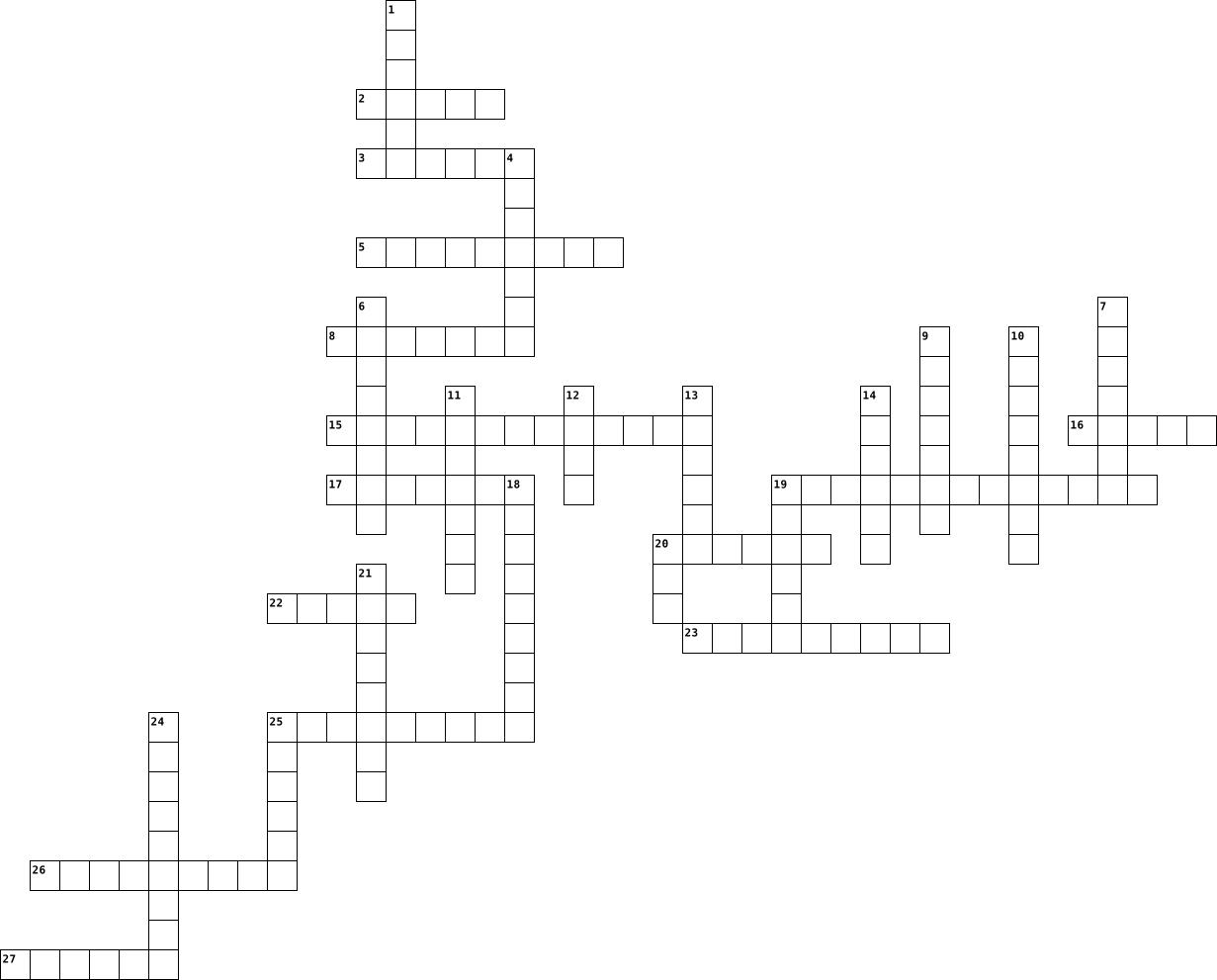
Across
- the smallest particle of a chemical element that can exist.
- a stable subatomic particle occurring in all atomic nuclei.
- an imprecise term used to describe a chemical element that forms a simple substance having properties intermediate between those of a typical metal and a typical nonmetal.
- the horizontal rows of the periodic table.
- a measure of how crowded solute particles are.
- an element that readily forms positive icons and has metallic bonds.
- theory a thermodynamics behavior of gases with which many. principal concepts of thermodynamics were established.
- six chemical elements in group 2 of the periodic table.
- a notation of one or two letters representing a chemical element.
- metallic substance composed of two or more elements as either a compound or a solution.
- a stable subatomic particle with a charge of negative electricity.
- any subatomic constituents of the physical world that interact with each other.
- the net movement of anything from a region of lower concentration.
- a column in the periodic table of the chemical elements.
Down
- a substance that has mass and takes up space
- a membrane-bound organelle that contains cell's chromosomes.
- table a table of chemical elements arranged in order of atomic number, usually in rows, so that elements with similar atomic structure appear in vertical columns.
- each of more than one hundred substances that cannot be chemically interconverted or broken down into simpler substances and are primary constituents of matter.
- the process by which molecules of a solvent tend to pass through a semipermeable membrane.
- any of the elements fluorine, chlorine, bromine, iodine and astatine.
- a subatomic particle of about the same mass as a proton but without an electric charge.
- number the total number of protons and neutrons in a nucleus.
- the strength and vitality required for sustained physical or mental activity.
- metal any elements of lithium, sodium, potassium, rubidium, caesium and francium.
- a substance made up of different elements joined together by a chemical bond.
- number the number of protons in the nucleus of an atom which is characteristics of a chemical element and determines its place in the periodic table.
- atomic any various self contained units of matter or energy that are the fundamental constituents of all matter.
- a chemical element that mostly lacks the characteristics of metal.
- a group of atoms bonded together.
- number the number of protons found in the nucleus of every atom of that element.
30 Clues: a group of atoms bonded together. • the horizontal rows of the periodic table. • a substance that has mass and takes up space • a measure of how crowded solute particles are. • six chemical elements in group 2 of the periodic table. • a column in the periodic table of the chemical elements. • the smallest particle of a chemical element that can exist. • ...
Chemisrty 2021-03-24

Across
- positive charge
- negative charge
- small particles
- a non metal
Down
- a group of atoms bonded together
- It is an charged atom
- neutral charge
- this comes from the Periodic Table
- table Shows different elements
- a chemical element
10 Clues: a non metal • neutral charge • positive charge • negative charge • small particles • a chemical element • It is an charged atom • table Shows different elements • a group of atoms bonded together • this comes from the Periodic Table
Chemistry #1 2022-12-13

Across
- Chemistry of living organisms
- vertical columns
- positive subatomic particle
- study of the composition of matter
- horizontal rows
- metals in group 1A
- neutral subatomic particle
- bond between ions
- Negative subatomic particle
- property that can be observed
- property that depends on the type of matter
- property of substances that involves change
Down
- property property that depends on the amount
- two or more elements combined
- homogenous mixture
- table that list elements
- compound formed by covalent bonds
- solid formed when two liquids react
- method that involves testing
- number of periods on the periodic table
- Chemicals that contain carbon
- letter representation of an element
- Group 7A
- chemicals the do not contain carbon
- simplest form of matter
25 Clues: Group 7A • horizontal rows • vertical columns • bond between ions • homogenous mixture • metals in group 1A • simplest form of matter • table that list elements • neutral subatomic particle • positive subatomic particle • Negative subatomic particle • method that involves testing • Chemistry of living organisms • two or more elements combined • Chemicals that contain carbon • ...
Kritika's crossword puzzle 2013-04-30

Across
- 7 of them in the periodic table (used to seperate the elements)
- good conductor of electricity.
- has three proton
- atomic symbol Rn
- has a negative charge
- has 80
- atomic number 1
- has a positive charge
- number/ number of proton in the element
- 18 of them in the periodic table (how the elements are seperated)
- atomic symbol of Ag
Down
- atomic number of 2
- atomic mass of 32.06
- one of a class of substances that cannot be separated into simpler substances by chemical means.
- is neutral
- is made up of two elements
- letter that represents the element
- has 8 proton
- has 29 proton
- atomic symbol Au
- atomis mass of 65.39
21 Clues: has 80 • is neutral • has 8 proton • has 29 proton • atomic number 1 • has three proton • atomic symbol Rn • atomic symbol Au • atomic number of 2 • atomic symbol of Ag • atomic mass of 32.06 • atomis mass of 65.39 • has a negative charge • has a positive charge • is made up of two elements • good conductor of electricity. • letter that represents the element • ...
Kritika's crossword puzzle 2013-04-30

Across
- has a positive charge
- one of a class of substances that cannot be separated into simpler substances by chemical means.
- is made up of two elements
- has three proton
- atomic symbol Rn
- 18 of them in the periodic table (how the elements are seperated)
- has 29 proton
- atomis mass of 65.39
Down
- 7 of them in the periodic table (used to seperate the elements)
- is neutral
- letter that represents the element
- atomic number 1
- has a negative charge
- atomic number of 2
- has 80
- has 8 proton
- atomic mass of 32.06
- atomic symbol of Ag
- good conductor of electricity.
- atomic symbol Au
- number/ number of proton in the element
21 Clues: has 80 • is neutral • has 8 proton • has 29 proton • atomic number 1 • has three proton • atomic symbol Au • atomic symbol Rn • atomic number of 2 • atomic symbol of Ag • atomic mass of 32.06 • atomis mass of 65.39 • has a positive charge • has a negative charge • is made up of two elements • good conductor of electricity. • letter that represents the element • ...
Scientists 2023-12-14

Across
- Made the Modern Periodic Table
- Investigated what happens when electricity is passed through gases
- Cannot be split into simpler substances by chemical means
- Orbitals, Dumbbell shaped
- Named the electron
- Proposed a Theory about Atoms in 1808
- Measured the size of the charge of the electron
- Triads
- Discovered many elements
- Discovered the Neutron
- Made the Original Periodic Table
Down
- Performed a very important experiment that led to the discovery of the nucleus
- Defined the Element
- Studied the arrangement of electrons in the nucleus
- Credited with discovery of the electron
- Probability of finding an electron
- Built the Mass Spectrometer
- Uncertainty Principle
- Broglie, Suggested that all moving particles have a wave motion
- Law of Octaves
20 Clues: Triads • Law of Octaves • Named the electron • Defined the Element • Uncertainty Principle • Discovered the Neutron • Discovered many elements • Orbitals, Dumbbell shaped • Built the Mass Spectrometer • Made the Modern Periodic Table • Made the Original Periodic Table • Probability of finding an electron • Proposed a Theory about Atoms in 1808 • Credited with discovery of the electron • ...
Master Level Crossword 2025-04-07

Across
- Kudos (9)
- Prefix to describe something yellow (6)
- Yellow spice that is commonly found in Indian food (8)
- A karaoke machine with video (7)
- Commonly found in pencils (8)
- A polynomial with two terms (8)
- The 48th element in the periodic table (6)
- Poker term for "four of a kind" (5)
- A common breakfast meal with maple syrup (7)
Down
- Clown (6)
- Question (7)
- Toy (9)
- Part of a polynomial (11)
- A fertile spot (5)
- Brownish-red (6)
- "______ Eisenhower", the 34th US president (6)
- Nonsense (9)
- Ctrl in keyboard
- Scene of a time earlier than the original story (9)
- The 103rd element in the periodic table (10)
- A very popular cocktail (9)
21 Clues: Toy (9) • Clown (6) • Kudos (9) • Question (7) • Nonsense (9) • Brownish-red (6) • Ctrl in keyboard • A fertile spot (5) • Part of a polynomial (11) • A very popular cocktail (9) • Commonly found in pencils (8) • A polynomial with two terms (8) • A karaoke machine with video (7) • Poker term for "four of a kind" (5) • Prefix to describe something yellow (6) • ...
Emmetts electromagnetic crossword 2025-01-21

Across
- shiny metal Co on periodic table
- a field that magnets have
- long piece of metal that is sharp
- a thing that attracts to other of that thing
- a way to measure the amount of electricity running through a current
- not geographical north
- magnet that can only run on electricity
- the way power is going
- highly conductive metal
- opposite of south
- the particles in magnets
Down
- may be where santa lives
- backup power if there's an apocalypse
- fe on periodic table
- you use them in flashlights
- 5 cents
- powers almost everything
- stringy thing to connect batteries and magnets
- measure of power
- powers your car
- device to see directions
- opposite of north
22 Clues: 5 cents • powers your car • measure of power • opposite of south • opposite of north • fe on periodic table • not geographical north • the way power is going • highly conductive metal • may be where santa lives • powers almost everything • device to see directions • the particles in magnets • a field that magnets have • you use them in flashlights • shiny metal Co on periodic table • ...
75 2025-11-13

Across
- Slows down a reaction
- Substance formed in reaction
- Matter cannot be created or destroyed
- Absorbs heat
- Rule based on repeated experiments
- Releases heat
- Scientific test
- Chemical representation of a substance
- Element with mixed properties
- Testable prediction
- Starting material in reaction
- Collected information
- Element that lacks metallic properties
- Well-supported scientific explanation
Down
- Symbolic expression of a reaction
- Column in periodic table
- Unit for counting atoms or molecules
- Constant in an experiment
- Factor that changes in an experiment
- Path of electron around nucleus
- Speeds up a reaction
- Row in periodic table
- Using senses to gather information
- Scientist known for gas law constant
- Element that conducts electricity
25 Clues: Absorbs heat • Releases heat • Scientific test • Testable prediction • Speeds up a reaction • Slows down a reaction • Row in periodic table • Collected information • Column in periodic table • Constant in an experiment • Substance formed in reaction • Element with mixed properties • Starting material in reaction • Path of electron around nucleus • Symbolic expression of a reaction • ...
Periodic Table - Test your Skills! 2014-12-16

Across
- I am a noble gas with 2 electrons
- It is a well known radioactive element used in atomic power plant
- I am kept immersed in kerosene as I am very reactive
- First column metals are known as _____ metals
- I am the first element in the fourth period used in making fertilizer
- Group 18 elements are known as _____ gases
- Second column metals are known as _____ metals
- My atomic number is 79
- I am non metal but conduct electricity!
- These elements forms staircase pattern in periodic table
- The total number of rows in modern periodic table
- They are uncharged particles inside a nucleus but has mass
- I am a metal that is liquid at room temperature
- He was the first one to give the present structure of modern periodic table
- I am a light weight metal
- They are negatively charged subatomic particles inside an atom
- I am a form of carbon, girls love me! :)
- I am a gas with 8 protons and 8 neutrons
- I am not really an alkali metal, but since I have only 1 electron I behave like them
- My atomic number is 47 and I am used to make photographic film
- He gave the law of octaves
Down
- Horizontal rows are known as _____
- I am a metal with 28 electrons
- _____ relationship is found in Li-Mg, Be-Al, B-Si, etc.
- He was the first one to classify certain elements into groups called triads
- Vertical columns are known as _____
- I am found in your bones and teeth
- I am a transition metal with 25 electrons
- Group 17 elements are known as _____
- You can find me in the carbon family in the fifth period
- Elements of group 3-12 are known as _____ elements
- Elements 57-71 forms _____ series
- I am the longest period in the periodic table
- I am used to make mobile covers
- I am another name of group which contains noble gases
- Elements 89-103 forms _____ series
- They are positively charged subatomic particles inside a nucleus
- I created the Modern Periodic Table
- I have 26 protons. Who am I?
39 Clues: My atomic number is 79 • I am a light weight metal • He gave the law of octaves • I have 26 protons. Who am I? • I am a metal with 28 electrons • I am used to make mobile covers • I am a noble gas with 2 electrons • Elements 57-71 forms _____ series • Horizontal rows are known as _____ • I am found in your bones and teeth • Elements 89-103 forms _____ series • ...
Table of Elements 2021-10-18

Across
- It was first isolated from potash, the ashes of plants, from which its name derives.
- it is the lightest metal and the lightest solid element.
- It is nonmetallic and tetravalent—making four electrons available to form covalent chemical bonds.
- It is a member of the chalcogen group in the periodic table, a highly reactive nonmetal, and an oxidizing agent that readily forms oxides with most elements as well as with other compounds.
- It is a colorless, odorless, tasteless, non-toxic, inert, monatomic gas, the first in the noble gas group in the periodic table.
- It is a steel-gray, strong, lightweight and brittle alkaline earth metal.
- the chemical element with the symbol H and atomic number 1.
- a chemical element with the symbol B and atomic number 5.
- It has a great affinity towards oxygen, and forms a protective layer of oxide on the surface when exposed to air.
- It was first discovered and isolated by Scottish physician Daniel Rutherford in 1772.
- It is abundant, multivalent and nonmetallic.
Down
- It is a soft, silvery-white, highly reactive metal.
- It is a hard, brittle crystalline solid with a blue-grey metallic lustre, and is a tetravalent metalloid and semiconductor.
- It is the fifth most abundant element in Earth's crust, and the third most abundant metal, after iron and aluminum.
- It is a shiny gray solid which bears a close physical resemblance to the other five elements in the second column (group 2, or alkaline earth metals) of the periodic table: all group 2 elements have the same electron configuration in the outer electron shell and a similar crystal structure.
- It is in group 18 of the periodic table and is a noble gas.
- It is the lightest halogen and exists at standard conditions as a highly toxic, pale yellow diatomic gas.
- it appears between fluorine and bromine in the periodic table and its properties are mostly intermediate between them.
- It has a concentration in the Earth's crust of about one gram per kilogram (compare copper at about 0.06 grams).
- It is a noble gas.[10] Neon is a colorless, odorless, inert monatomic gas under standard conditions, with about two-thirds the density of air.
20 Clues: It is abundant, multivalent and nonmetallic. • It is a soft, silvery-white, highly reactive metal. • it is the lightest metal and the lightest solid element. • a chemical element with the symbol B and atomic number 5. • It is in group 18 of the periodic table and is a noble gas. • the chemical element with the symbol H and atomic number 1. • ...
m 2023-05-09

Across
- e
- model u
- table i
- a
- d
- blah
- number r
- metals j
- b
- o
- number w
Down
- q
- c
- f
- p
- s
- y
- gases m
- electrons t
19 Clues: q • e • c • f • p • a • d • s • b • y • o • blah • model u • table i • gases m • number r • metals j • number w • electrons t
Atoms 2025-05-21

Across
- An atom with a different number of neutrons
- The building blocks of matter
- Elements in the same column on the periodic table
- Area around the nucleus where electrons are likely to be found
- Smallest unit of an element
- Particles that orbit the nucleus
- Neutral particle found in the nucleus
- Number of protons in an atom
- Total number of protons and neutrons
Down
- Negatively charged particle
- Charge of the neutron
- Table that organizes all known elements
- Force that holds protons and neutrons together
- Outermost energy level of an atom
- The total negative charge of atom is equal to the number of
- The number of energy levels an atom has shown by its ___ on the periodic table
- Positively charged particle in the nucleus
- The center of an atom
- The scientist who proposed the planetary model of the atom
- Electrons in the outer shell
20 Clues: Charge of the neutron • The center of an atom • Negatively charged particle • Smallest unit of an element • Electrons in the outer shell • Number of protons in an atom • The building blocks of matter • Particles that orbit the nucleus • Outermost energy level of an atom • Total number of protons and neutrons • Neutral particle found in the nucleus • ...
Made Of Metal 2013-01-24

Across
- conductivity the ability of an object to transfer a electric current
- table an arrangement of elements showing the repeating pattern of their properties .
- an element that lacks most of the properties of a metal .
- mass the average mass of all the isotopes of an element .
- have some properties of metals but also have properties that are typical of nonmetals.
- the ease and the speed with which a substance reacts with other substances .
Down
- mean "salt forming" .
- the gradual wearing away of a metal due to a chemical reaction .
- semimetals are examples .
- the periodic table is organized in horizontal rows .
- conductivity the ability of an object to transfer heat .
- the vertical columns of the periodic table
- metals The metals in group 1 , from lithium to francium .
- the change in state from a solid to a liquid .
- symbol a representation of an element usually consisting of one or two letters .
- another property of liquids .
16 Clues: mean "salt forming" . • semimetals are examples . • another property of liquids . • the vertical columns of the periodic table • the change in state from a solid to a liquid . • the periodic table is organized in horizontal rows . • conductivity the ability of an object to transfer heat . • an element that lacks most of the properties of a metal . • ...
Metals, Metalloids, and Non-Metals 2022-11-16

Across
- Arsenic (As) is a Metalloid what side is it located on The Periodic Table
- located ON the zigzag line
- Scandium (Sc) is located on what side of The Periodic Table if it is a Metal
- metals are malleable while non-metals are
- to be shiny or dull
- what element is a non-metal but is located on the left side of the zigzag
- to be able to transfer electricity
- Iron (Fe) is a
Down
- Krypton (Kr) is a
- not able to transfer electricity
- the ability to be hammered into sheets
- Polonium (Po) and Silicon (Si) are both metalloids what do they both have in common, they are both
- Oxygen (O) is a Non-metal what side is it located on The Periodic Table
- the ability to be stretched into wire
14 Clues: Iron (Fe) is a • Krypton (Kr) is a • to be shiny or dull • located ON the zigzag line • not able to transfer electricity • to be able to transfer electricity • the ability to be stretched into wire • the ability to be hammered into sheets • metals are malleable while non-metals are • Oxygen (O) is a Non-metal what side is it located on The Periodic Table • ...
Metals, Metalloids, and Non-Metals 2022-11-16

Across
- Arsenic (As) is a Metalloid what side is it located on The Periodic Table
- located ON the zigzag line
- Scandium (Sc) is located on what side of The Periodic Table if it is a Metal
- metals are malleable while non-metals are
- to be shiny or dull
- what element is a non-metal but is located on the left side of the zigzag
- to be able to transfer electricity
- Iron (Fe) is a
Down
- Krypton (Kr) is a
- not able to transfer electricity
- the ability to be hammered into sheets
- Polonium (Po) and Silicon (Si) are both metalloids what do they both have in common, they are both
- Oxygen (O) is a Non-metal what side is it located on The Periodic Table
- the ability to be stretched into wire
14 Clues: Iron (Fe) is a • Krypton (Kr) is a • to be shiny or dull • located ON the zigzag line • not able to transfer electricity • to be able to transfer electricity • the ability to be stretched into wire • the ability to be hammered into sheets • metals are malleable while non-metals are • Oxygen (O) is a Non-metal what side is it located on The Periodic Table • ...
Ocean Fun Facts 2024-01-26

Across
- Jack and Rose; iceburg
- main thing a sponge does
- calm and quiet; relaxing
- these erupt with lava
- a place that holds artifacts
- homophone for "see"
Down
- Mississippi, Nile, Amazon, Euphrates
- large body of water on the west coast
- represented as "Au" on the Periodic Table
- the color of the sky
- number of fingers on your hand
- Erie, Michigan, Ontario, Superior, Huron
- represented as "O" on the Periodic Table
- Niel Armstrong visited this planet
14 Clues: homophone for "see" • the color of the sky • these erupt with lava • Jack and Rose; iceburg • main thing a sponge does • calm and quiet; relaxing • a place that holds artifacts • number of fingers on your hand • Niel Armstrong visited this planet • Mississippi, Nile, Amazon, Euphrates • large body of water on the west coast • Erie, Michigan, Ontario, Superior, Huron • ...
Bonding 2022-02-06

Across
- oxygen has this kind of covalent bonding
- compound with giant covalent bonding(7-7)
- uses all 4 electrons in bonding...
- means one atom
- a regular repeating pattern
- the form of carbon that conducts
Down
- another word for outer electron
- symbol Sn
- a row in the periodic table
- has symbol Na
- all metals do this
- a column in the periodic table
- means not just in one place
- means an endlessly repeating structure
14 Clues: symbol Sn • has symbol Na • means one atom • all metals do this • a row in the periodic table • means not just in one place • a regular repeating pattern • a column in the periodic table • another word for outer electron • the form of carbon that conducts • uses all 4 electrons in bonding... • means an endlessly repeating structure • oxygen has this kind of covalent bonding • ...
Find the Element 2026-01-13

Across
- a metal with 30 protons
- a nonmetal with the highest electronegativity value (4.0)
- a nonmetal in the second row on the periodic table with 6 valence electrons
- a nonmetal with a common ion of -1 charge in row 5 on the periodic table
- a metal in row 3 with a common ion of +2
Down
- a metalloid with 14 protons
- a metal with two valence electrons in the 4th row of the periodic table
- a noble gas in the third row of the periodic table
- a metal with 3 electrons in the neutral atom
9 Clues: a metal with 30 protons • a metalloid with 14 protons • a metal in row 3 with a common ion of +2 • a metal with 3 electrons in the neutral atom • a noble gas in the third row of the periodic table • a nonmetal with the highest electronegativity value (4.0) • a metal with two valence electrons in the 4th row of the periodic table • ...
Chemistry Crossword 2019-06-09

Across
- group 17 elements in the periodic table; the most reactive non-metals
- group of atoms joined by covalent bonds
- number of protons in the nucleus of one atom of an element
- substance made of only one kind of matter, which has a unique set of properties
- chemical combination of two or more elements in a specific ratio
- chemical reaction that absorbs energy
- pure substance that cannot be broken down into other substances; substance made up of only one type of atom
- combination of symbols that represent a compound; the formula identifies the elements in the compound and the amount of each element
- vertical column of elements in the periodic table; elements in a family all have similar chemical properties; also called a family
- mass of one atom of an element calculated from the total number of protons, neutrons, and electrons of that atom; measured in atomic mass units (amu)
- chemical reaction that occurs when oxygen reacts with a substance to form a new substance and give off energy
- new substance produced in a chemical reaction between reactant
Down
- substance that reacts with another substance or substances in a chemical reaction to create new substances with different properties
- change that results when two or more substances react to create a different substance or substances; the new substances have completely different properties from the original ones
- element that has both metallic and non-metallic properties
- shiny, malleable, ductile element that conducts electricity
- the smallest part of an element that is representative of that element; a neutral particle made up of a nucleus containing protons and neutrons, and in which the number of electrons equals the number of protons
- pure substance formed when at least one metal and one non-metal combine
- group 18 elements in the periodic table; the most stable and unreactive elements
- heterogeneous mixture; mixture in which the different substances that make up the mixture are visible
- horizontal row of elements in the periodic table
- combination of pure substances; unlike a compound, the components of a mixture do not combine chemically and are not always in the same ratio
- vertical column of elements in the periodic table; elements in a family all have similar chemical properties; also called a group
- slow chemical change that occurs when oxygen in the air reacts with a metal
24 Clues: chemical reaction that absorbs energy • group of atoms joined by covalent bonds • horizontal row of elements in the periodic table • number of protons in the nucleus of one atom of an element • element that has both metallic and non-metallic properties • shiny, malleable, ductile element that conducts electricity • ...
Year 7 Review 2024-07-16

Across
- Specialized structure within a cell
- Two or more substances that are not chemically combined
- Fourth state of matter, found in stars
- Person trained to travel in a spacecraft
- Icy body that develops a tail when near the Sun
- Letter(s) representing an element
- Path of one object around another in space
- Building block of all known life
- Powerhouse of the cell
- Negatively charged particle orbiting the nucleus
- Storage sac in a cell
- Mixture of a metal with other elements
- Natural satellite of a planet
- A large celestial body orbiting a star
- Plant cell organelle that captures sunlight
- State of matter with a fixed shape
- Instrument used to observe distant objects in space
- The first element on the periodic table
- Cloud of gas and dust in space
- State of matter that expands to fill its container
- Organelle that packages and distributes proteins
- Unreactive group of elements on the right side of the periodic table
- Rocky object smaller than a planet
- Substance made of two or more elements chemically combined
Down
- Element essential for breathing
- The control center of a cell
- Elements that conduct electricity well
- Natural or artificial object orbiting a planet
- Number of protons in an atom's nucleus
- Vehicle that can travel into space
- Cell structure where proteins are made
- Material that forms chromosomes
- Force that attracts objects towards each other
- Glowing ball of gas held together by gravity
- Describes the table organizing chemical elements
- Two or more atoms bonded together
- Vertical column in the periodic table
- Bowl-shaped depression on a celestial body
- Smallest unit of an element
- Particle in the nucleus with no electric charge
- Pattern of stars in the night sky
- Jelly-like substance inside a cell
- A vast collection of stars, gas, and dust
- Chemical process where substances change into new substances
- Barrier surrounding the cell
- Horizontal row in the periodic table
- Pure substance made of only one type of atom
- State of matter that flows and takes the shape of its container
- Atoms of the same element with different numbers of neutrons
- Positively charged particle in an atom's nucleus
50 Clues: Storage sac in a cell • Powerhouse of the cell • Smallest unit of an element • The control center of a cell • Barrier surrounding the cell • Natural satellite of a planet • Cloud of gas and dust in space • Element essential for breathing • Material that forms chromosomes • Building block of all known life • Letter(s) representing an element • Two or more atoms bonded together • ...
Matter Review 26 2026-03-03

Across
- Matter changing from liquid to solid
- Matter changing from solid to gas
- A state of matter that has a definite shape and volume
- Matter that fills the entire volume of a container. The atoms move freely and collide randomly with each other.
- Group 17, most reactive nonmetals on the periodic table
- Horizontal rows on the periodic table
- A substance that is only composed of one type of molecule(element or compound)
- Matter with definite volume but it takes the shape of a container. The atoms have just enough energy to slide past each other.
- Matter changing from gas to liquid
- Basic unit of matter that can join together to form all objects
- The symbol used to show a chemical reaction has taken place
- Group 1, most reactive metals on the periodic table
- Vertical columns on the periodic table
- Matter changing from liquid to gas
- Group 18, least reactive group on the periodic table
- Matter changing from gas to solid
- Matter changing from solid to liquid
- A combination of two or more substances that are not chemically united
- the number of protons plus the number of neutrons
- A subatomic particle with a negative charge, that is found outside of an atom's nucleus.
- Ending materials created in a chemical reaction.
Down
- Does not impact the composition of a substance, and does not form a new substance
- A state of matter that has a definite volume but no definite shape.
- One or more substances are changed into a new substance that has different and new properties
- The smallest particle that an element or compound can be split into without changing its chemical and physical properties
- A pure substance that can not be broken down into other substances by chemical or physical means, made of one type of atom
- positively or negatively charged atoms
- A subatomic particle with no charge, that is found in an atom's nucleus.
- the number of protons in the nucleus of an atom
- Matter with definite shape and volume. The atoms have limited energy.
- A starting material in a chemical reaction
- A pure substance that is two or more elements chemically combined
- Number of electrons in the outermost shell of an atom
- Anything that has mass and takes up space
- A state of matter with no definite shape or volume
- A subatomic particle with a positive charge, that is found in an atom's nucleus.
36 Clues: Matter changing from solid to gas • Matter changing from gas to solid • Matter changing from gas to liquid • Matter changing from liquid to gas • Matter changing from liquid to solid • Matter changing from solid to liquid • Horizontal rows on the periodic table • positively or negatively charged atoms • Vertical columns on the periodic table • ...
Chem Semester 1 terms 2025-12-15

Across
- positive ion
- rule that states each atom wants 8 electrons
- unstable isotopes are this
- found by multiplying percent composition and mass and adding together
- a helium nucleus
- element that always comes in pairs
- an element or compound is in this category
- compound that includes one metal and one nonmetal
- row on the periodic table
- particle absorbed by electron. When released, we see color in the flame test
- size of an atom; increase as you go down a column and decreases as you go across a row
- reaction that happens between two compounds in whichw elements switch places
- elements on the stair steps of periodic table
- a mixture that has a dissimilar distribution
- column on the periodic table
- column 17 (7A) on the periodic table
- nuclear reaction that creates a lighter element
- electron configuration of 1s2 2s2 2p6 3s1
- must be done to separate a compound into its elements
- elements in the D block of periodic table
Down
- elements that react in water; column 1
- outermost electrons
- particle the same size as an electron
- compound that starts with an H
- 2 or more elements chemically bonded together
- order as to how sublevels fill
- most penetrating form of radiation
- separating a mixture is a
- number of protons an element has
- number of electrons that can fit in one orbital
- reaction that occurs with a metal and a compound
- an elements ability to attract and hold another element in a chemical bond
- a type of homogenous mixture that is typically created when one mixes a compound in water
- charged atom
- a mixture that has a uniform distribution
- empty bus seat rule
- occurs between a hydrocarbon and oxygen gas
- variation of an element; same protons different neutrons
- elements that do not react with other elements
- the mass to volume ratio of a substance
- two nonmetals form this type of bond
- subatomic particle not in the nucleus of that atom
- negative ion
- atoms bonded together that act as one ion
- found by adding protons and neutrons of an isotope
45 Clues: positive ion • charged atom • negative ion • a helium nucleus • outermost electrons • empty bus seat rule • separating a mixture is a • row on the periodic table • unstable isotopes are this • column on the periodic table • compound that starts with an H • order as to how sublevels fill • number of protons an element has • most penetrating form of radiation • ...
Metals, Metalloids, and Non-Metals 2022-11-16

Across
- Arsenic (As) is a Metalloid what side is it located on The Periodic Table
- located ON the zigzag line
- Scandium (Sc) is located on what side of The Periodic Table if it is a Metal
- metals are malleable while non-metals are
- to be shiny or dull
- what element is a non-metal but is located on the left side of the zigzag
- to be able to transfer electricity
- Iron (Fe) is a
Down
- Krypton (Kr) is a
- not able to transfer electricity
- the ability to be hammered into sheets
- Polonium (Po) and Silicon (Si) are both metalloids what do they both have in common, they are both
- Oxygen (O) is a Non-metal what side is it located on The Periodic Table
- the ability to be stretched into wire
14 Clues: Iron (Fe) is a • Krypton (Kr) is a • to be shiny or dull • located ON the zigzag line • not able to transfer electricity • to be able to transfer electricity • the ability to be stretched into wire • the ability to be hammered into sheets • metals are malleable while non-metals are • Oxygen (O) is a Non-metal what side is it located on The Periodic Table • ...
Periodic Table Crossword Challenge 2015-12-21

Across
- My family is made up of gases. We are royal. We are in group 18.
- My atomic number is 79 and I make bling bling happen.
- ________ have a negative charge.
- The Atomic number ________ from left to right across a period.
- I'm between Strontium and Zirconium on the periodic table. HINT: My name starts with a “Y.”
- I'm the only element with a 3 letter name. Also, I'm used to make cans.
- There are ________ groups on the periodic table. (spell out the number)
- These are found outside of the nucleus in the orbitals.
- I'm very bright and I have 10 electrons.
- I am a gas with 8 protons. You breath me to live!
- Protons have a ________ charge.
- The atomic _______ equals the number of protons and electrons found in an element
Down
- I am a table of the chemical elements arranged in order of atomic number.
- I am the first element in the fourth period and am found in bananas.
- I am a gas with a mass number of 18.9984032 and am found in toothpaste.
- The atomic mass increases from left to ______ across a period.
- I am a silvery white metal used to make salt. My symbol is Na.
- There are ________ periods on the periodic table. (periods of elements occur naturally on Earth)
- The Atomic number increases from top to bottom down a ___________.
- My atomic mass is 35.453 and I help keep swimming pools clean.
- _______ have a neutral charge.
- I am a metal with 28 electrons. I'm also worth 5 cents.
22 Clues: _______ have a neutral charge. • Protons have a ________ charge. • ________ have a negative charge. • I'm very bright and I have 10 electrons. • I am a gas with 8 protons. You breath me to live! • My atomic number is 79 and I make bling bling happen. • These are found outside of the nucleus in the orbitals. • I am a metal with 28 electrons. I'm also worth 5 cents. • ...
Chemistry 2014-09-07

Across
- the smallest indivisible part of matter
- this table contains a list of all known elements
- a subatomic particle with a neutral charge
- a group of elements in the periodic table that are good conductors of heat and electricity
- the general name given to the substances at the start of a chemical reaction
- a group of elements in the periodic table that are poor conductors of electricity and heat
- the general name given to a substance that results from a chemical reaction
- a substance containing two or more elements chemically bonded
- the centre of an atom containing protons and neutrons
- a pure substance made of only one type of atom
Down
- a subatomic particle with a positive charge
- anything that takes up space or has mass
- a subatomic particle with a negative charge
- this is characterised by a temperature or colour change, or light
- elements with the characteristics of both metals and non-metals
- a combination of two or more substances that are not chemically bonded
- a group of atoms bonded together of the same or different elements
17 Clues: the smallest indivisible part of matter • anything that takes up space or has mass • a subatomic particle with a neutral charge • a subatomic particle with a positive charge • a subatomic particle with a negative charge • a pure substance made of only one type of atom • this table contains a list of all known elements • ...
Table of Elements 2021-10-18

Across
- a chemical element with the symbol B and atomic number 5.
- the chemical element with the symbol H and atomic number 1.
- It is abundant, multivalent and nonmetallic.
- It was first isolated from potash, the ashes of plants, from which its name derives.
- It is nonmetallic and tetravalent—making four electrons available to form covalent chemical bonds.
- It is a noble gas.[10] Neon is a colorless, odorless, inert monatomic gas under standard conditions, with about two-thirds the density of air.
- It is a shiny gray solid which bears a close physical resemblance to the other five elements in the second column (group 2, or alkaline earth metals) of the periodic table: all group 2 elements have the same electron configuration in the outer electron shell and a similar crystal structure.
- It is a colorless, odorless, tasteless, non-toxic, inert, monatomic gas, the first in the noble gas group in the periodic table.
- It was first discovered and isolated by Scottish physician Daniel Rutherford in 1772.
- It is a steel-gray, strong, lightweight and brittle alkaline earth metal.
- It is the fifth most abundant element in Earth's crust, and the third most abundant metal, after iron and aluminum.
Down
- It has a concentration in the Earth's crust of about one gram per kilogram (compare copper at about 0.06 grams).
- It is the lightest halogen and exists at standard conditions as a highly toxic, pale yellow diatomic gas.
- It is a member of the chalcogen group in the periodic table, a highly reactive nonmetal, and an oxidizing agent that readily forms oxides with most elements as well as with other compounds.
- It is in group 18 of the periodic table and is a noble gas.
- It is a soft, silvery-white, highly reactive metal.
- it appears between fluorine and bromine in the periodic table and its properties are mostly intermediate between them.
- it is the lightest metal and the lightest solid element.
- It is a hard, brittle crystalline solid with a blue-grey metallic lustre, and is a tetravalent metalloid and semiconductor.
- It has a great affinity towards oxygen, and forms a protective layer of oxide on the surface when exposed to air.
20 Clues: It is abundant, multivalent and nonmetallic. • It is a soft, silvery-white, highly reactive metal. • it is the lightest metal and the lightest solid element. • a chemical element with the symbol B and atomic number 5. • the chemical element with the symbol H and atomic number 1. • It is in group 18 of the periodic table and is a noble gas. • ...
Table of Elements 2021-10-18

Across
- It is the fifth most abundant element in Earth's crust, and the third most abundant metal, after iron and aluminum.
- a chemical element with the symbol B and atomic number 5.
- It is a shiny gray solid which bears a close physical resemblance to the other five elements in the second column (group 2, or alkaline earth metals) of the periodic table: all group 2 elements have the same electron configuration in the outer electron shell and a similar crystal structure.
- It is in group 18 of the periodic table and is a noble gas.
- It was first discovered and isolated by Scottish physician Daniel Rutherford in 1772.
- it appears between fluorine and bromine in the periodic table and its properties are mostly intermediate between them.
- It is a member of the chalcogen group in the periodic table, a highly reactive nonmetal, and an oxidizing agent that readily forms oxides with most elements as well as with other compounds.
- It is nonmetallic and tetravalent—making four electrons available to form covalent chemical bonds.
- it is the lightest metal and the lightest solid element.
- It is a steel-gray, strong, lightweight and brittle alkaline earth metal.
- It is a soft, silvery-white, highly reactive metal.
Down
- It has a concentration in the Earth's crust of about one gram per kilogram (compare copper at about 0.06 grams).
- It is the lightest halogen and exists at standard conditions as a highly toxic, pale yellow diatomic gas.
- It has a great affinity towards oxygen, and forms a protective layer of oxide on the surface when exposed to air.
- It is a hard, brittle crystalline solid with a blue-grey metallic lustre, and is a tetravalent metalloid and semiconductor.
- the chemical element with the symbol H and atomic number 1.
- It was first isolated from potash, the ashes of plants, from which its name derives.
- It is a noble gas.[10] Neon is a colorless, odorless, inert monatomic gas under standard conditions, with about two-thirds the density of air.
- It is abundant, multivalent and nonmetallic.
- It is a colorless, odorless, tasteless, non-toxic, inert, monatomic gas, the first in the noble gas group in the periodic table.
20 Clues: It is abundant, multivalent and nonmetallic. • It is a soft, silvery-white, highly reactive metal. • it is the lightest metal and the lightest solid element. • a chemical element with the symbol B and atomic number 5. • the chemical element with the symbol H and atomic number 1. • It is in group 18 of the periodic table and is a noble gas. • ...
Chemistry 2023-02-24

Across
- able to pass heat or electricity through
- Property Describes and element. Can be observed without changing the element
- Ability to be dissolved in a liquid
- Ability to reflect light (shiny or dull)
- anything that has mass and volume
- The positive part of an atom.
- Electron Electrons in the outermost energy level
- Two or more different kinds of atoms. (2 or more elements)
- The amount of matter in a given amount of space
- A shiny, malleable, ductile, and conductive material on the left side of the periodic table.
- Property "Potential" to go through a chemical change. Can be seen in a chemical reaction.
- Has properties of both metals and nonmetals and is along the zig-zag line on the periodic table
- Ability to be set on fire
- A pure substance containing only one type of atom
- Formula Chemical symbols that represent a compound
- Displacement How to find the volume of irregular shaped objects using a volume of water in a graduated cylinder.
- Easily broken into small pieces
- Change Changes in the States of Matter. Change the phase or shape but not the substance.
Down
- The number of atom of an element in a chemical formula
- blocks heat or electricity from passing through
- Change Elements that combine for form a new substance
- Number of Molecules in a chemical formula.
- State of being thick, sticky, semi-fluid
- The part of an atom that does not have a charge
- Center of an atom with a positive charge
- How something interacts with something else
- Level The rings around the nucleus of an atom
- a group of atom chemically combine. (2 or more atoms)
- Goes Up and Down on the Periodic Table, Tells how reactive an element is and similar
- the amount of space an object takes up
- Determines whether something is an acid or a base.
- Ability to be pulled into wire
- A brittle, dull, and insulator material that is on the right side of the periodic table.
- Goes from Side to Side on the Periodic Table and tells the number of energy levels.
- to be flattened into sheets
- Number The number of protons in an atom
- of Matter Distinct form of matter such as solid, liquid, or gas.
- The negative part of an atom
- the amount of matter in an object
- Smallest unit of matter
40 Clues: Smallest unit of matter • Ability to be set on fire • to be flattened into sheets • The negative part of an atom • The positive part of an atom. • Ability to be pulled into wire • Easily broken into small pieces • anything that has mass and volume • the amount of matter in an object • Ability to be dissolved in a liquid • the amount of space an object takes up • ...
Chemistry crossword 2017-11-07

Across
- combination of pure substances; unlike acompound, the components of a mixture do not combine chemically and are not always in the same ratio
- vertical column of elements in the periodic table; of elements in a family all have similar chemical properties; also called a family
- positively charged centre of an atom contains protons and neutrons
- change from liquid to soild
- an experiment in which one or more products of a chemical reaction can escape
- elements and compounds that organisms need for living, growing, and reproducing
- compound made up of units calledamino acids; protein molecules contain atoms ofnitrogen, hydrogen, oxygen, and carbon
- substance that helps a chemical reaction to proceed
- group 1 elements in the periodic table, not including hydrogen; the most reactive of the metals
- group 18 elements in the periodic table;the most stable and unreactive elements
Down
- amount of mass in a given voilume of a substance
- that describes a particularsubstance (e.g., colour, lustre, melting point,crystal shape, solubility, density)
- atom that has become electrically charged because it has lost or gained electrons; a positiveion is an atom that has lost one or more electrons;a negative ion is an atom that has gained one ormore electrons
- new substance produced in a chemical reactants between reactents
- catalyst involved in a chemical reaction in living things
- substance that reacts with another substance or substances in a chemical reaction to create new substances with different propertier
- homogeneous mixture; mixture of two or more pure substances that looks like one substance
- mass of a substance that can dissolve in a given amount of solvent to form a saturated solution at a given temperature
- positively charged particle in the nucleus of an atom
- substance made of only one kind of matter, which has a unique set of properties
- group 17 elements in the periodic table;the most reactive non-metals
- number of protons in the nucleus of one atoms
- (SO2(g))forms when sulfur combines swith oxygen in the air; major air pollutant that forms both smog and acid rain; major source:industrial processes
- chemistry) vertical column of elements in the periodic table; elements in a family all have similar chemical properties; also called a group
- group of atoms joined by covalent bond
25 Clues: change from liquid to soild • group of atoms joined by covalent bond • number of protons in the nucleus of one atoms • amount of mass in a given voilume of a substance • substance that helps a chemical reaction to proceed • positively charged particle in the nucleus of an atom • catalyst involved in a chemical reaction in living things • ...
Ch 2 Review 8th Grade Science 2023-11-30

Across
- The subatomic particle that is indicated by the atomic number of that element.
- The name for the forces of attraction between molecules.
- The type of bond formed when positive ions are attracted to negative ions.
- The most reactive halogen.
- The term for the combined total of protons and neutrons in the nucleus of an atom.
- This is how many electrons an atom of sodium has available for forming bonds.
- The term for a particle that has an unequal number of protons and electrons.
- Diamond and graphite are examples of this type of covalent structure.
- The name used to describe giant structures whose particles are arranged in a regular repeated pattern.
- The subatomic particle involved in forming bonds between atoms.
- Atoms form bonds with each other in order to become more ________.
- The name for the forces that keep the electrons from flying off and away from the nucleus.
- The name given to a substance containing atoms of two or more different elements that are bonded together.
- This is the maximum number of electrons the first energy shell can hold.
- This is the maximum number of electrons the third energy shell can hold.
Down
- This type of bond tends to form between two nonmetal atoms when they share electrons.
- On a square of the periodic table, the number at the top of the box is known as the _____ number.
- Calcium atoms have electrons in __________ energy levels.
- Atoms of this element have the electron structure 2,8,6.
- This is the name for a row on the periodic table.
- This type of bond is due to the attraction of positive ions and negative ions.
- The group on the periodic table that are stable and don't thus don't form compounds.
- The overall charge of an ion with more protons than electrons.
- The overall charge of the particle formed when an atom gains electrons.
- Oxygen, carbon dioxide, and water are all examples of ______, which are simply particles formed when atoms covalently bond with each other.
- This is found in the center of an atom and contains pretty much all of the atom's mass.
- The name for a positive ion.
- This is the name for a column on the periodic table.
- This is the name for the group on the periodic table that contains the most reactive metals.
- The name for a negative ion.
30 Clues: The most reactive halogen. • The name for a positive ion. • The name for a negative ion. • This is the name for a row on the periodic table. • This is the name for a column on the periodic table. • Atoms of this element have the electron structure 2,8,6. • The name for the forces of attraction between molecules. • ...
Physical Science Chapter 4 Vocab 2025-10-24

Across
- He led to reorganizing the period table on the basis of atomic number. He used a new technique called X-ray spectroscopy to determine the number the atomic number for each element.
- Characteristics between those of metals and nonmetals. State: exist as a brittle solid with metallic luster. Conductivity: are fairly conductive increasingly so as temperature rises. Reactivity: varies
- He used letters used to represent each element and superscripts to represent number of atoms.
- A table of the chemical elements arranged in a way that displays their periodic properties in relationship to their atomic numbers.
- Set of elements in the same column on the periodic table. Also known as a group.
- He first recognized groups of three elements with similar properties and called them triads.
- The properties of elements vary in a periodic way with their atomic numbers.
- A row on the periodic table.
- He organized elements with similar characteristics in columns like the modern periodic table
Down
- typically have 4 or more valence electrons and do not exhibit the general properties of metals. State: exist as a gas, liquid, or dull brittle solid. Conductivity: are poorly conductive, electrically and thermally. Reactivity: varies
- He demonstrated that combustion requires the presence of oxygen.
- Groups 13-16 and contain metals, nonmetals, and metalloids.
- Electrons in the outermost energy level of a neutral atom.
- Every element in this family has one valence electron (Group 1). Very reactive and always found in parts of compounds
- Repeated pattern when elements are arranged in order by increasing atomic mass.
- The measure of an atoms ability to attract and hold electrons when bonded to other atoms.
- These elements make up Group 2 and have 2 valence electrons.
- This notation consists of the elements physical symbols surrounded by the atoms valence electrons.
- He developed the law of octaves through arranging elements by atomic mass.
- He was an alchemist who believe that it was possible to change one element into another. In 1661, he published the Skeptical Chemist, in which he called for the experimentation to be the basis of science.
- 80% of all elements. State: exist as a dense, ductile, malleable, lustrous solid. Conductivity: are highly conductive, electrically and thermally. Reactivity: are reactive, especially with nonmetals.
21 Clues: A row on the periodic table. • Electrons in the outermost energy level of a neutral atom. • Groups 13-16 and contain metals, nonmetals, and metalloids. • These elements make up Group 2 and have 2 valence electrons. • He demonstrated that combustion requires the presence of oxygen. • He developed the law of octaves through arranging elements by atomic mass. • ...