
periodic table Crossword Puzzles
chemistry passport 2024-02-21

Across
- A structural representation of a molecule.
- Six gases in the periodic table that don't usually have a chemical reaction with other elements.
- A connection between atoms.
- Number of protons in the nucleus of the element.
- A vertical column in the periodic table
- Sum of protons, neutrons, and electrons in an atom of an element
- A process in which the reactant(s) are converted into the product(s)
Down
- The end product of a chemical reaction.
- A horizontal line in the periodic table
- The electron(s) that is/ are in the outer shell.
- The starting material in a chemical reaction.
- The little number next to an element. They indicate the number of atoms immediately before it.
- An abbreviation for the element.
- The number in front of a chemical formula. They multiply the whole formula.
14 Clues: A connection between atoms. • An abbreviation for the element. • The end product of a chemical reaction. • A horizontal line in the periodic table • A vertical column in the periodic table • A structural representation of a molecule. • The starting material in a chemical reaction. • The electron(s) that is/ are in the outer shell. • ...
8th Grade Science 2023-08-17

Across
- state of matter
- first element on periodic table
- basic unit of chemical element
- atomic symbol for gold
- found on periodic table
- your favorite class
- what we use to protect our eyes in class
Down
- anything that takes space and has mass
- amount of space that a substance or object occupies
- your science teacher's name
- amount of matter in an object
- negatively charged particle of atom
- moving energy
- sound and light travel in ____
14 Clues: moving energy • state of matter • your favorite class • atomic symbol for gold • found on periodic table • your science teacher's name • amount of matter in an object • basic unit of chemical element • sound and light travel in ____ • first element on periodic table • negatively charged particle of atom • anything that takes space and has mass • ...
The periodic Table 2013-12-09

Across
- Who made the periodic table
- A vertical column of elements
- tend to be very shiny and conduct thermal energy
- The name of a row of elements
- Very reactive non-metals
- is the smallest on the periodic table
- A streak that is on all metals
Down
- Which is labeled "N" on the table
- Which element has the smallest atomic number
- classifies all types of elements
- can be soft enough to cut with a knife
- Are hard, shiny, and brittle
- Which has an atomic mass of 26
13 Clues: Very reactive non-metals • Who made the periodic table • Are hard, shiny, and brittle • A vertical column of elements • The name of a row of elements • Which has an atomic mass of 26 • A streak that is on all metals • classifies all types of elements • Which is labeled "N" on the table • is the smallest on the periodic table • can be soft enough to cut with a knife • ...
modern periodic table 2020-12-10

Across
- The element which can be placed in group 1 as well as group 17
- Group 1 consist of _______ metals
- The vertical columns in the periodic table are known as
- a zig-zag line separates metals from________
- horizontal rows in the periodic table are known as
Down
- Number of _____ remains same across periods
- it has electronic configuration of 2,8,7
- _______ remains same across groups
- It has electronic configuration of 2,6
- The person who created modern periodic table
10 Clues: Group 1 consist of _______ metals • _______ remains same across groups • It has electronic configuration of 2,6 • it has electronic configuration of 2,8,7 • Number of _____ remains same across periods • The person who created modern periodic table • a zig-zag line separates metals from________ • horizontal rows in the periodic table are known as • ...
Atoms and Elements 2023-03-29

Across
- The smallest particle
- The name to describe when a solid turns into a liquid
- negative charge particle inside an atom
- The number of periods on the periodic table
- Most metals are found in this state of matter
Down
- The first element on the periodic table
- The number of groups on the periodic table
- The element we need to breath
- Most non metals are found in this state of matter
- When two or more atoms are chemically bonded together
10 Clues: The smallest particle • The element we need to breath • The first element on the periodic table • negative charge particle inside an atom • The number of groups on the periodic table • The number of periods on the periodic table • Most metals are found in this state of matter • Most non metals are found in this state of matter • ...
Chemistry unit study guide 2016-02-11

Across
- a reaction that takes in energy
- the substance of the result of a chemical reaction
- a name given to a horizontal row of elements on the periodic table
- a example is helium
- a potential pattern of electron density that are formed in an atom
- a Russian chemist they created a periodic table and predicted the discovery of seven new elements
- a thin layer of this put on another piece of metal
- a substance made of of atom that all have the same number of protons
- states that mass is neither destroyed or created during a reaction
- a two lettered short way to say an element
- a subatomic particle with a negative charge
- the positive charge in an atom
Down
- a element in between a metal and a nonmetal
- the number of protons in a nucleus in the atom
- the core of an atom
- the outer shell of an atom
- mass of a atom in a chemical element
- a "family" of element in the periodic table
- the smallest constituent unit of ordinary matter
- a reaction that releases energy
- a chemical element that lacks metallic attributes
- a group of atoms bonded together
- a good conductor of electricity
- a subatomic particle that has no net electric charge
24 Clues: the core of an atom • a example is helium • the outer shell of an atom • the positive charge in an atom • a reaction that takes in energy • a reaction that releases energy • a good conductor of electricity • a group of atoms bonded together • mass of a atom in a chemical element • a two lettered short way to say an element • a element in between a metal and a nonmetal • ...
Chapter 11: Periodic Table and the Trends 2016-01-09

Across
- Center of an atom.
- Row of elements on Periodic Table.
- What happens to atomic size as the atomic radius increases.
- Decently malleable and a decent con ductor of electricity.
- Ability of an atom to attract electrons from a bonded atom (2W).
- The size of an atom (2W).
- Distance between the outermost electron, and the nucleus (2W).
- Element without electronegativity (2W).
- Column of elements on Periodic Table.
- Not malleable and not a good conductor of electricity.
- Electrons in the outer most shell.
- Energy required to remove an electron from an atom.
- When two elements cling together.
- Make up the periodic table.
Down
- What happens to atomic radius as you go down a family.
- Energy level electrons are stored on (2W).
- Positively charged subatomic particle.
- What happens to atomic radius as you go across a period.
- Models that show bonding between atoms (2W).
- Force of attraction between positive and negative charges (2W).
- Rules that almost all elements follow.
- System for organizing elements (2W).
- Negatively charged subatomic particle.
- Change in the energy of an atom when an electron is added (2W).
- Tendency of a substance to undergo a chemical change.
- Basic unit of an element.
- Malleable and a good conductor of electricity.
27 Clues: Center of an atom. • The size of an atom (2W). • Basic unit of an element. • Make up the periodic table. • When two elements cling together. • Row of elements on Periodic Table. • Electrons in the outer most shell. • System for organizing elements (2W). • Column of elements on Periodic Table. • Positively charged subatomic particle. • Rules that almost all elements follow. • ...
Group 7 2017-06-02

Across
- group seven is on the _____ side of the periodic table
- group seven elements are all very r________, like group one elements.
- iodine + potassium chloride --> potassium iodide + chlorine, true or false?
- iodine is this at room temperature.
- is in period two, group seven of the periodic table.
- elements near the top of group 7 _______ elements below them from their compound during reactions.
- the melting point of bromine is _____.
- elements in group one are increasingly reactive down their group, but group seven is the _________.
- this is when one element replaces another during a chemical reaction.
- halogens are on the right of the stepped line, this makes them __________.
- chlorine + potassium bromide --> potassium chloride + _________
Down
- chlorine + sodium iodide --> sodium chloride + ___________
- is in period three, group seven of the periodic table.
- iron + iodine --> iron _________
- iron + chlorine --> iron _________
- chlorine is in this state at room temperature.
- the melting point of group seven elements _______ down the group
- elements in group seven get _______ reactive down the group.
- when iron reacts with chlorine you can see a _____ ______.
- halogens are ____________ of electricity.
- iron + bromine --> iron _________
- another name for the elements in group seven.
- the melting point of group seven elements is ____, like other non-metals
23 Clues: iron + iodine --> iron _________ • iron + bromine --> iron _________ • iron + chlorine --> iron _________ • iodine is this at room temperature. • the melting point of bromine is _____. • halogens are ____________ of electricity. • another name for the elements in group seven. • chlorine is in this state at room temperature. • ...
Element Property Trends 2015-01-23

Across
- The units of electronegativity are ___.
- Negative ions are aka ___.
- The negative values for electron affinity mean that energy is ___ from the atom during the process of adding an electron.
- A high electronegativity or ___ value tells you an element has a stronger attraction for electrons.
- Positive ions are aka ___.
- This is used to help predict the kind of bond two elements will form.
- Metals tend to be ___ and ductile.
- Nonmetallic characteristics tend to increase as you travel to the ___ across the periodic table.
- Shield Effect explains why these electrons do not experience the full attraction of the nucleus.
- An electron is ___ to an atom during the process described by the definition of electron affinity.
- The units of ionization energy are ___.
Down
- Metallic characteristics tend to increase as you travel ___ the periodic table.
- When ___ energy is added to an atom, a positive ion is the result.
- Atoms and molecules are ___ in chemistry.
- Ionization energy tends to decrease as atomic radius increases because of ___.
- Joules are units of ___.
- Nonmetals tend to be ___ conductors.
- The units of atomic radius are ___.
- Nonmetals tend to form ___ ions.
- Metals tend to form ___ ions.
- ___ tends to increase down the periodic table.
- 6.022x10e23 is the number of fundamental units in 1 ___.
- Nonmetals tend to have ___ melting points.
23 Clues: Joules are units of ___. • Negative ions are aka ___. • Positive ions are aka ___. • Metals tend to form ___ ions. • Nonmetals tend to form ___ ions. • Metals tend to be ___ and ductile. • The units of atomic radius are ___. • Nonmetals tend to be ___ conductors. • The units of electronegativity are ___. • The units of ionization energy are ___. • ...
Element Property Trends 2015-01-23

Across
- 6.022x10e23 is the number of fundamental units in 1 ___.
- Metals tend to be ___ and ductile.
- The negative values for electron affinity mean that energy is ___ from the atom during the process of adding an electron.
- Ionization energy tends to decrease as atomic radius increases because of ___.
- Shield Effect explains why these electrons do not experience the full attraction of the nucleus.
- Nonmetals tend to form ___ ions.
- Atoms and molecules are ___ in chemistry.
- When ___ energy is added to an atom, a positive ion is the result.
- A high electronegativity or ___ value tells you an element has a stronger attraction for electrons.
- The units of atomic radius are ___.
- Negative ions are aka ___.
Down
- The units of electronegativity are ___.
- This is used to help predict the kind of bond two elements will form.
- Metals tend to form ___ ions.
- Nonmetals tend to have ___ melting points.
- Positive ions are aka ___.
- Metallic characteristics tend to increase as you travel ___ the periodic table.
- Nonmetals tend to be ___ conductors.
- Joules are units of ___.
- An electron is ___ to an atom during the process described by the definition of electron affinity.
- The units of ionization energy are ___.
- ___ tends to increase down the periodic table.
- Nonmetallic characteristics tend to increase as you travel to the ___ across the periodic table.
23 Clues: Joules are units of ___. • Positive ions are aka ___. • Negative ions are aka ___. • Metals tend to form ___ ions. • Nonmetals tend to form ___ ions. • Metals tend to be ___ and ductile. • The units of atomic radius are ___. • Nonmetals tend to be ___ conductors. • The units of electronegativity are ___. • The units of ionization energy are ___. • ...
Atoms and the Periodic Table 2023-11-21

Across
- level Fixed amount of energy
- A basic unit of a chemical element
- cloud A region of negative charge surrounding an atomic nucleus
- column of the periodic table
- Lowest energy state
- Electrons electrons on the outer shell of an atom
- low thermal and electrical conductivity
- Number total number of protons and neutrons
- emitting ionizing radiation or particles
- Metals soft and shiny, low melting point
- subatomic particle with electric charge
- Subatomic particle with a negative change
- Theory Basis of modern physics
- stable subatomic particle
- Metals two shells of valence electrons
- A substance made by mixing other substances togethe
- properties intermediate with metals and non metals
- Number number of protons or neutrons in an atom
- change Positive or negative
- atoms with the same number of protons but different numbers of neutrons
Down
- Substance that cant be broken by chemical means
- nonmetallic yet contain acidic compounds
- something composed of two or more elements
- an atom or molecule with a net electric charge due to a loss or gain of electric charge
- high thermal and electrical conductivity
- Gases seven chemical elements of group 18
- Mass Unit unit for expressing atomic mass
- change A Change in elements
- repeating after a fixed interval
- table array of all chemical elements
- horizontal rows of the periodic table
- Earth Metals good conductors, electropositive
- of Atom contains protons and neutrons
33 Clues: Lowest energy state • stable subatomic particle • change A Change in elements • change Positive or negative • level Fixed amount of energy • column of the periodic table • Theory Basis of modern physics • repeating after a fixed interval • A basic unit of a chemical element • table array of all chemical elements • horizontal rows of the periodic table • ...
The periodic table crossword 2019-09-16

Across
- / horizontal rows in the periodic table
- / substance that is made with one atom
- / substance that is made with 2 or more elements chemically bonded together
- exclusion Principle / orbitals have only 2 electrons that have opposite spins
- mixture / mixture that can see the elements
- / smallest part of an element
- / nonmetallic element on group 17
- / vertical columns in the periodic table
- number / integer that equals to the number of protons and neutrons
- electron / outer shell electron that can be used for transferring or sharing with another atom
- Principle / electrons fills up from the lowest orbital
Down
- / element that can conduct electricity and heat
- / positive charged particle
- / elements that doesn't have any properties of a metal
- mixture / mixture that cannot be separated by elements
- configuration / The arrangement of electrons in an atom
- rule / every orbital in a sub-shell is singly occupied with one electron before any one orbital is doubly occupied
- / elements that have properties of both metals and nonmetals
- mass / average mass of the atoms in the nucleus
- earth metals / element that is on group 2 on the periodic table
- / contains both protons and neutrons
- gases / element on group 18 that have a very low reactivity
22 Clues: / positive charged particle • / smallest part of an element • / nonmetallic element on group 17 • / contains both protons and neutrons • / substance that is made with one atom • / horizontal rows in the periodic table • / vertical columns in the periodic table • mixture / mixture that can see the elements • / element that can conduct electricity and heat • ...
Lost Artefacts Crossword 2024-03-20

Across
- Property used to desribe a material that does not break after a sudden blow.
- The word used to describe 2 or more metals combined.
- A tool used in D&T to hold a piece of work in place, which is attached to the desks.
- What will happen to ferrous metals in the exposed to moisture for a long time?
- A chemical cleaning agent used in the soldering process.
- Property of metal used to describe the ability of a material to conduct electricity.
- Al on the periodic table.
- A quadrilaterals that has two parallel sides and two non-parallel sides.
- A metal that does not contain iron.
- Property to describe ability of a material to be reshaped in all directions without cracking.
Down
- Hand tool used to clean the edges of metals, woods and plastics.
- A pattern decorated with regular lines and shapes.
- Brass is an alloy made up of zinc and what other metal?
- Process used to join 2 metal surfaces together.
- Fe on the periodic table.
- A pair of clippers for cutting sheet metal, such as copper.
- A 6 sided shape.
- A 3 sided polygon.
- Fe on the periodic table stands for?
- A metal we are using in this project.
20 Clues: A 6 sided shape. • A 3 sided polygon. • Fe on the periodic table. • Al on the periodic table. • A metal that does not contain iron. • Fe on the periodic table stands for? • A metal we are using in this project. • Process used to join 2 metal surfaces together. • A pattern decorated with regular lines and shapes. • The word used to describe 2 or more metals combined. • ...
Matter & Chemistry 2023-02-20

Across
- most abundant nonmetal gases in the atmosphere
- Mendeleev constructed the periodic table of elements
- hardest of all known substances
- simplest kind of atom
- tiny group of 2 or more atoms that are bonded tightly together
- anything that takes up space and has mass
- the tiny particles that matter is composed of
- study of what substances are made of and how one substance can be changed into another
- metals metals in first far left column of periodic table
Down
- substances composed of more than one type of atom bonded together
- type of chemical reaction that occurs whenever a substance reacts rapidly with oxygen
- densest of everyday metals
- substance that is made up of only one type of atom
- amount of matter in one unit of volume
- tiny particles that swarm at tremendous speed around nucleus of an atom
- tiny extremely dense core at the center of an atom
- number name for the number of protons in an atom
- reaction process in which atoms of elements or compounds are rearranged to form new substances
- only metal that is liquid at room temperature
- elements toward left side of periodic table that tend to have lustrous silvery color and good conductors of heat/electricity
20 Clues: simplest kind of atom • densest of everyday metals • hardest of all known substances • amount of matter in one unit of volume • anything that takes up space and has mass • only metal that is liquid at room temperature • the tiny particles that matter is composed of • most abundant nonmetal gases in the atmosphere • number name for the number of protons in an atom • ...
Chemistry Vocabulary Crossword 2025-05-19

Across
- Element that is typically shiny, malleable, and conducts electricity.
- Term often associated with atomic number (number of protons).
- The smallest unit of an element that retains the properties of that element.
- Type of bond formed between oppositely charged ions.
- Energy level where electrons are found around the nucleus.
- Element that lacks the characteristics of metals and is more likely to gain electrons.
- An atom or molecule with a net electric charge due to the loss or gain of electrons.
- Type of bond where atoms share electrons.
- Relating to the table that organizes elements by increasing atomic number.
- A column on the periodic table; elements share similar properties.
Down
- Negatively charged particle orbiting the nucleus of an atom.
- Force that holds atoms together in compounds.
- How easily an element undergoes chemical reactions.
- The amount of matter in an object; often measured in atomic mass units for atoms.
- A row on the periodic table; indicates energy levels of electrons.
- Electrons in the outermost shell of an atom that are involved in bonding.
- Neutral particle found in the nucleus of an atom.
- The central part of an atom containing protons and neutrons.
- Element with properties in between metals and nonmetals.
- Positively charged particle in an atom's nucleus.
20 Clues: Type of bond where atoms share electrons. • Force that holds atoms together in compounds. • Neutral particle found in the nucleus of an atom. • Positively charged particle in an atom's nucleus. • How easily an element undergoes chemical reactions. • Type of bond formed between oppositely charged ions. • Element with properties in between metals and nonmetals. • ...
Science 2025-12-05

Across
- A particle in the nucleus with no charge
- Two or more atoms chemically bonded
- Electrons in the outermost shell
- The center of an atom
- A shiny, conductive, malleable element
- Same element but different number of neutrons
- Gas Elements that are stable and non-reactive
- The process of forming new substances
- The smallest unit of matter
- A vertical column on the periodic table
- A positively charged particle
- Level Levels where electrons move around the nucleus
- A bond formed by sharing electrons
- Number The number of protons in an atom
- Bond A bond formed by transferring electrons
- How easily an element reacts with others
Down
- Region where an electron is most likely found
- Mass The mass of an atom based on protons and neutrons
- A mixture of metals
- A pure substance made of one kind of atom
- How strongly an atom attracts electrons
- Uneven sharing of electrons causing partial charges
- A negatively charged particle
- The first element on the periodic table
- A horizontal row on the periodic table
- When a molecule has a positive and negative side
- Another name for an electron level
- A dull, brittle, non-conductive element
- Angle Angle between bonded atoms in a molecule
- Number Total number of protons and neutrons
30 Clues: A mixture of metals • The center of an atom • The smallest unit of matter • A negatively charged particle • A positively charged particle • Electrons in the outermost shell • Another name for an electron level • A bond formed by sharing electrons • Two or more atoms chemically bonded • The process of forming new substances • A shiny, conductive, malleable element • ...
Chemisrty 2021-03-24

Across
- Positive charge
- Negative charge
- Small particles
- A non metal
Down
- A group of atoms bonded together
- It is an charged atom
- Neutral charge
- this comes from the Periodic Table
- table Shows different elements
- A chemical element
10 Clues: A non metal • Neutral charge • Positive charge • Negative charge • Small particles • A chemical element • It is an charged atom • table Shows different elements • A group of atoms bonded together • this comes from the Periodic Table
Structure of Matter 2021-09-21

Across
- neutral part of a atom
- different type of atoms bonded together
- how many protons are in the atom
- negative part of a atom
Down
- A table with elements and have periods and groups
- Structure of Matter
- goes vertical in the periodic table
- atoms that are not bonded together
- same type of atoms bonded together
- positive part of a atom
- goes horizontal in the periodic table
11 Clues: Structure of Matter • neutral part of a atom • positive part of a atom • negative part of a atom • how many protons are in the atom • atoms that are not bonded together • same type of atoms bonded together • goes vertical in the periodic table • goes horizontal in the periodic table • different type of atoms bonded together • A table with elements and have periods and groups
Element crossword 2023-05-09

Across
- The horizontal rows of the periodic table
- The name of the 17th group in the periodic table and is extremely reactive.
- The name of the elements in group 2. Ex: Be, Mg and Ca (3 words)
- Number The number of protons and electrons in an atom, determines the element (2 words).
- The Russian Chemist who created the periodic table (two words)
- The name of the elements in group 17, which are reactive.
- The name of the elements in group 1 excluding hydrogen, which are extremely reactive (2 words)
Down
- The metals from group 2-12 that are not very reactive. (2 words)
- an element or substance that is not a metal.
- opaque, lustrous elements that are good conductors of heat and electricity
- The name of the last group in the periodic table, which are not in the slightest reactive (2 words).
- an element (e.g. arsenic, antimony, or tin) whose properties are intermediate between those of metals and solid nonmetals or semiconductors.
- the mass of an atom of a chemical element expressed in AMU. (2 words)
13 Clues: The horizontal rows of the periodic table • an element or substance that is not a metal. • The name of the elements in group 17, which are reactive. • The Russian Chemist who created the periodic table (two words) • The name of the elements in group 2. Ex: Be, Mg and Ca (3 words) • The metals from group 2-12 that are not very reactive. (2 words) • ...
Thursday Wk 4 Crossword 2022-04-14

Across
- when water vapor turns to liquid
- Pressure vs Volume: ______'s law
- average kinetic energy of molecules
- reaction of a fuel with oxygen
- "Where's my supersuit"
- metals are on this side of the periodic table
- "To ________ and Beyond!" -Toy Story
Down
- volume and temp have a ______ relationship
- pressure = _______ / area
- when we inhale, our lungs ________
- if temp decreases, pressure will ______
- the bear in The Jungle Book
- what day is chic fil a closed
- second halogen on the periodic table
- add 273 to celsius to get ________
- _______ gas makes up 21% of air
16 Clues: "Where's my supersuit" • pressure = _______ / area • the bear in The Jungle Book • what day is chic fil a closed • reaction of a fuel with oxygen • _______ gas makes up 21% of air • when water vapor turns to liquid • Pressure vs Volume: ______'s law • when we inhale, our lungs ________ • add 273 to celsius to get ________ • average kinetic energy of molecules • ...
Elements Review DMS 2025 2025-09-23

Across
- most nonmetals are this at room temperature
- the most abundant element in the Universe, Symbol is N
- the element that is most essential to our planet and living, we breathe it
- the first metal on the Periodic Table
- most metals are this at room temperature
- Element the Statue of Liberty is made of. Symbol is Cu
Down
- the first element on the Periodic Table
- a metal that is liquid at room temperature, also a name for the first planet
- the area between metals and nonmetals where the metalloids are located
- What side of the Periodic Table are nonmetals on?
- 80% of the elements are ___________
- metalloid that is a semiconductor and used in computers, Symbol is Si
12 Clues: 80% of the elements are ___________ • the first metal on the Periodic Table • the first element on the Periodic Table • most metals are this at room temperature • most nonmetals are this at room temperature • What side of the Periodic Table are nonmetals on? • the most abundant element in the Universe, Symbol is N • ...
Science-Chemistry 2021-03-09

Across
- a small gas burner used as lab equipment
- the smallest particle of an element
- a small portion of matter
- anything that occupies space and has mass
- abbreviations for chemical elements
- a table of chemical elements
- a small glass tube used for experiments in science
Down
- the amount of space occupied by a substance
- substance containing only one type of atom
- substance containing two or more different elements
- a scientific procedure to test something
- the number of protons in the nucleus of an atom
- a row of elements in the periodic table
- a column of elements in the periodic table
- number of protons and neutrons in an atomic nucleus
- two or more atoms chemically joined
16 Clues: a small portion of matter • a table of chemical elements • the smallest particle of an element • abbreviations for chemical elements • two or more atoms chemically joined • a row of elements in the periodic table • a small gas burner used as lab equipment • a scientific procedure to test something • anything that occupies space and has mass • ...
Crossword Puzzle- Periodic Table 2026-04-17

Across
- Elements in Group 1 are called ______ metals
- The center of an atom
- Scientist who proposed the modern periodic law
- Elements present in Group 17
- Vertical columns in the periodic table
Down
- Elements that lose electrons easily
- Negatively charged particles in an atom
- Property of elements to attract electrons
- Group of elements with full valence shell
- Elements with properties of both metals and non-metals
- Horizontal rows in the periodic table
11 Clues: The center of an atom • Elements present in Group 17 • Elements that lose electrons easily • Horizontal rows in the periodic table • Vertical columns in the periodic table • Negatively charged particles in an atom • Property of elements to attract electrons • Group of elements with full valence shell • Elements in Group 1 are called ______ metals • ...
Crossword thingy megigy 2022-09-21

Across
- substance that is dissolved
- far right of the periodic table
- number of moles of solute per liter
- Touching the "staircase" on the periodic table
Down
- substance that does the dissolving
- amount of solute that will dissolve per volume
- Left side of the periodic table
- number of moles of solute per kilogram
- percent mass of solute/mass of solute *100%
9 Clues: substance that is dissolved • Left side of the periodic table • far right of the periodic table • substance that does the dissolving • number of moles of solute per liter • number of moles of solute per kilogram • percent mass of solute/mass of solute *100% • amount of solute that will dissolve per volume • Touching the "staircase" on the periodic table
Chapter 12; Lucy Serna 2020-02-04

Across
- number 2 on the periodic table
- how bounds are arranged in a compound
- number 3 on the periodic table of elements
- 2 atoms share one or more pairs of outer shell electrons
- atoms tend to gain, lose, or share electrons to have 8 electrons
- number 1 on the periodic table
Down
- elements have different _____________.
- measure of atom's attraction for the electrons it shares
- the attractive force that holds atoms and ions together
- bond formed between 2 ions
10 Clues: bond formed between 2 ions • number 2 on the periodic table • number 1 on the periodic table • how bounds are arranged in a compound • elements have different _____________. • number 3 on the periodic table of elements • the attractive force that holds atoms and ions together • measure of atom's attraction for the electrons it shares • ...
Chapter 9 Crossword by Katie Hoffman 2020-09-21

Across
- _______ number indicates the valance electrons
- The designer of the periodic table of elements
- Indicates the number of energy levels
- Most abundant metal in earth’s crust
Down
- Added to toothpaste and drinking water to protect tooth enamel from decay
- Group 7A on the periodic table
- The number of non metal elements on the periodic table of elements
- Found widely in nature-rocks, coral reefs
- Can be found in quartz crystal, sand, and glass
- Used in blimps, airships, and balloons
10 Clues: Group 7A on the periodic table • Most abundant metal in earth’s crust • Indicates the number of energy levels • Used in blimps, airships, and balloons • Found widely in nature-rocks, coral reefs • _______ number indicates the valance electrons • The designer of the periodic table of elements • Can be found in quartz crystal, sand, and glass • ...
Chapter 9 Crossword by Katie Hoffman 2020-09-21

Across
- Group 7A on the periodic table
- Can be found in quartz crystal, sand, and glass
- Added to toothpaste and drinking water to protect tooth enamel from decay
- The designer of the periodic table of elements
- _______ number indicates the valance electrons
Down
- Found widely in nature- rocks, coral reefs
- Most abundant metal in earth’s crust
- Indicates the number of energy levels
- The number of non metal elements on the periodic table of elements
- Used in blimps, airships, and balloons
10 Clues: Group 7A on the periodic table • Most abundant metal in earth’s crust • Indicates the number of energy levels • Used in blimps, airships, and balloons • Found widely in nature- rocks, coral reefs • The designer of the periodic table of elements • _______ number indicates the valance electrons • Can be found in quartz crystal, sand, and glass • ...
Sean Rafferty Ch. 9 Atoms 2021-10-13

Across
- neutrally charged subatomic particle
- formed when an element doesn't have the same amount of protons and electrons
- elements with completely filled outer orbitals
- positively charged subatomic particle
- another name for columns in the Periodic Table
Down
- designer of the Periodic Table
- another name for rows in the Periodic Table
- multiple forms of the same element that have the same amount of protons, but different a number of neutrons
- negatively charged subatomic particle
- contains the protons and neutrons
10 Clues: designer of the Periodic Table • contains the protons and neutrons • neutrally charged subatomic particle • negatively charged subatomic particle • positively charged subatomic particle • another name for rows in the Periodic Table • elements with completely filled outer orbitals • another name for columns in the Periodic Table • ...
Periodic Table Vocabulary 2024-01-22

Across
- pure substance only containing one atom
- The smallest unit of an element
- group 3-12 elements
- group 1 elements; most reactive element group
- group 2 elements; less reactive than group 1
Down
- a chart of all the known elements on earth
- rows on the periodic table; organized by element energy levels
- columns on the periodic table; organized by valence electrons
- Created one of the first periodic table; organized by atomic mass
- able to be pulled into long things
10 Clues: group 3-12 elements • The smallest unit of an element • able to be pulled into long things • pure substance only containing one atom • a chart of all the known elements on earth • group 2 elements; less reactive than group 1 • group 1 elements; most reactive element group • columns on the periodic table; organized by valence electrons • ...
BELLO 2025-06-20

Across
- A PLACE WHERE WE CHECK OUT BOOKS
- THE LARGEST NUMBER FOUND THE FIRST ELEMENT IN THE PERIODIC TABLE
- THE MOST POPULAR SPORT
- WHAT WE BREATH
- A GIRL THAT IS A SIBLING
- YOU DRIVE IN IT
- LIKES TO CHASE MICE
Down
- THE FIRST ELEMENT IN THE PERIODIC TABLE
- FLYING ELEPHANT
- FLYING MAMMAL
- A BOY THAT IS A SIBLING
- HAS A TRUNK
12 Clues: HAS A TRUNK • FLYING MAMMAL • WHAT WE BREATH • FLYING ELEPHANT • YOU DRIVE IN IT • LIKES TO CHASE MICE • THE MOST POPULAR SPORT • A BOY THAT IS A SIBLING • A GIRL THAT IS A SIBLING • A PLACE WHERE WE CHECK OUT BOOKS • THE FIRST ELEMENT IN THE PERIODIC TABLE • THE LARGEST NUMBER FOUND THE FIRST ELEMENT IN THE PERIODIC TABLE
Physical Science Chapter 5 2021-11-03

Across
- a negatively charged particle
- a row on the Periodic Table
- shiny solids that can be stretched and shaped
- a negatively charged ion
- share properties of both metals and nonmetals
- metals found in group 2
- elements found in group 17
- a positively charged particle
Down
- a positively charged ion
- dull, brittle, poor conductors of heat
- elements found in group 18
- metals found in group 1
- a neutrally charged particle
- an atom that has gained/lost an electron
- A column on the Periodic Table
15 Clues: metals found in group 1 • metals found in group 2 • a positively charged ion • a negatively charged ion • elements found in group 18 • elements found in group 17 • a row on the Periodic Table • a neutrally charged particle • a negatively charged particle • a positively charged particle • A column on the Periodic Table • dull, brittle, poor conductors of heat • ...
Chapter 16 crossword 2022-02-15

Across
- contains the protons and neutrons
- arranged by increasing atomic number and by changes in physical and chemical properties
- the number of protons in the element
- vertical columns in the periodic table
- even smaller particles
- negative 1 charge
- the same element that have different numbers of neutrons
- the smallest piece of matter
- sum of the protons and the neutrons
Down
- where electrons hang around the nucleus
- positive 1 charge
- 0 charge
- represent the electrons in the outer energy level
- weighted-average mass
- horizontal rows in the periodic table
15 Clues: 0 charge • positive 1 charge • negative 1 charge • weighted-average mass • even smaller particles • the smallest piece of matter • contains the protons and neutrons • sum of the protons and the neutrons • the number of protons in the element • horizontal rows in the periodic table • vertical columns in the periodic table • where electrons hang around the nucleus • ...
Surely not a revision crossword for different school subjects 2024-04-23

Across
- 9,5 Billion km
- 1 millionth of a meter
- hardest material on earth
- 82nd element of the periodic table
- State of matter that barely or doesn't move
- State of matter where the substance takes the shape of the container
- 1 hundrendth of a liter
Down
- 3.1415926
- 1st step of the scientific procedure
- H2O
- has 3 sides
- Half of the diameter
- 1st element of the periodic table
- combination of atoms
- parallelogram with opposite equal acute angles, opposite equal obtuse angles, and four equal sides
15 Clues: H2O • 3.1415926 • has 3 sides • 9,5 Billion km • Half of the diameter • combination of atoms • 1 millionth of a meter • 1 hundrendth of a liter • hardest material on earth • 1st element of the periodic table • 82nd element of the periodic table • 1st step of the scientific procedure • State of matter that barely or doesn't move • ...
cemistry puzzle 2023-10-04

Across
- table
- solution
- behavior
- partner
- dot
- sodium
- oxygen
Down
- beryllium
- lithium
- element
- atom
- collid
- dioxide
- word
- diagram
15 Clues: dot • atom • word • table • collid • sodium • oxygen • lithium • element • dioxide • partner • diagram • solution • behavior • beryllium
Science Crossword 2023-02-22

Across
- liquid to gas
- gas to liquid
- fixed volume but NOT a fixed shape
- smallest particle on the periodic table
- solid to liquid
- liquid to gas, but very hot
- gas to solid
Down
- solid to gas
- NO fixed volume or shape
- liquid to solid
- liquid or solid going to a gas
- made up of only one type of a thing on the periodic table
- fixed shape and volume
13 Clues: solid to gas • gas to solid • liquid to gas • gas to liquid • liquid to solid • solid to liquid • fixed shape and volume • NO fixed volume or shape • liquid to gas, but very hot • liquid or solid going to a gas • fixed volume but NOT a fixed shape • smallest particle on the periodic table • made up of only one type of a thing on the periodic table
Science-Chemistry 2021-03-09

Across
- two or more atoms chemically joined
- a table of chemical elements
- a row of elements in the periodic table
- a small gas burner used as lab equipment
- a small portion of matter
- anything that occupies space and has mass
Down
- the number of protons in the nucleus of an atom
- number of protons and neutrons in an atomic nucleus
- abbreviations for chemical elements
- a small glass tube used for experiments in science
- substance containing only one type of atom
- a scientific procedure to test something
- the amount of space occupied by a substance
- a column of elements in the periodic table
- the smallest particle of an element
- substance containing two or more different elements
16 Clues: a small portion of matter • a table of chemical elements • abbreviations for chemical elements • two or more atoms chemically joined • the smallest particle of an element • a row of elements in the periodic table • a scientific procedure to test something • a small gas burner used as lab equipment • anything that occupies space and has mass • ...
Periodic Table Crossword 2013-08-10

Across
- METALS Any of the group of univalent metals including potassium, sodium, lithium, rubidium, cesium and francium, whose hydroxides are alkalis.
- A light, ductile, silver-white, metallic elements that burns with a dazzling white light.
- Chloride + __________ = salt.
- An elementary particle with no charge.
- A heavy, silver-white , highly, toxic metallic element, the only that is liquid at room temperature.
- A precious yellow metallic element, highly malleable and ductile.
- GASES Any of the chemically inert gaseous elements including helium, neon, argon, krypton, xenon and radium.
- SHELL A grouping of electrons surrounding the nucleus of an atom.
Down
- Used in pool water.
- Has an atomic number of three.
- One of two elements that are radioactive.
- An element when put in food products, makes bones and teeth strong.
- An element that does not belong to any group of the Periodic Table.
- An elementary particle with a positive charge.
- The result of the combination of two oxygen atoms.
- TEMPERATURE A comfortable temperature range indoors, usually considered to be 20-25 Degrees Celsius.
- A malleable, ductile, metallic element that is a reddish-brown colour
- The positively charged mass within an atom, made up of neutrons and protons.
18 Clues: Used in pool water. • Chloride + __________ = salt. • Has an atomic number of three. • An elementary particle with no charge. • One of two elements that are radioactive. • An elementary particle with a positive charge. • The result of the combination of two oxygen atoms. • A precious yellow metallic element, highly malleable and ductile. • ...
The Periodic Table 2014-03-15

Across
- A small particle that makes up elements.
- A group of metals that change the amount of electrons in its outer shell.
- A gas that goes around in pairs in the air.
- One of the eight vertical columns in the periodic table
- A substance with more than one type of atom joined together.
- A substance that cannot be broken down into anything simpler.
- A metal that is made with specific properties of other metals
- A metal that can be magnetized.
- A sub-atomic particle with a positive charge and a relative mass of one.
Down
- Group one metal.
- A substance where the particles are free to move.
- A member of group seven.
- A group of atoms joined together.
- A material/substance that contains more than one substance.
- Charged particles.
- A material that is usually solid and shiny, some are magnetic.
- One of the seven horizontal rows in the periodic table
- An element named after a planet.
18 Clues: Group one metal. • Charged particles. • A member of group seven. • A metal that can be magnetized. • An element named after a planet. • A group of atoms joined together. • A small particle that makes up elements. • A gas that goes around in pairs in the air. • A substance where the particles are free to move. • One of the seven horizontal rows in the periodic table • ...
periodic table elements 2022-11-13

Across
- Ar
- B
- Li
- Cl
- He
- S
- Ne
- O
- Be
Down
- Al
- Mg
- N
- P
- H
- C
- Si
- Na
- F
18 Clues: N • P • B • H • C • S • F • O • Al • Mg • Ar • Li • Cl • Si • He • Na • Ne • Be
Periodic Table Vocab 2024-03-11

Across
- the process of adding or removing electrons from an atom or molecule, which gives the atom or molecule a net charge
- one of the elements of Group 17
- one of the elements of Group 1 of the periodic table
- an element in the s-block or p-block of the periodic table
- an atom, radical, or molecule that has gained or lost one or more electrons and has a negative or positive charge
- a member of the rare earth series of elements that range from 58 to 71
- the energy required to remove an electron from an atom or ion
Down
- an ion that has a positive charge
- an arrangement of elements in order of their atomic number
- the energy needed to remove an electron from a negative ion to form a neutral atom or molecule
- one of the elements of Group 2 of the periodic table
- one of the metals that can use the inner shell before using the outer shell to bond
- an electron that is found in the outermost shell of an atom and that determine the atom’s chemical properties
- a measure of the ability of an atom in a chemical compound to attract electrons
- one-half of the distance between the center of identical atoms that are not bonded together
- any of the series of heavy radioactive elements that range from 90 to 103
- the law that states the repeating chemical and physical properties of element change.
- an ion that has a negative charge
18 Clues: one of the elements of Group 17 • an ion that has a positive charge • an ion that has a negative charge • one of the elements of Group 2 of the periodic table • one of the elements of Group 1 of the periodic table • an arrangement of elements in order of their atomic number • an element in the s-block or p-block of the periodic table • ...
Periodic table trends 2024-10-02

Across
- the amount of electrons in the p sublevel
- a negative ion
- scientist to notice repeating patterns in elements
- a row left to right across the periodic table
- the amount of electrons in the s sublevel
- a positive ion
- the number of particles in the nucleus
- the amount of electrons in the d sublevel
- made of two elctrons
- an atom with a positive or negative charge that has gained or lost an electron
Down
- the amount of electrons in the f sublevel
- the energy needed to pull electrons away from an atom
- measure of an atom's ability to take electrons from other atoms
- the outermost electrons that are lost in bonding
- the number of protons in an atom
- a vertical column on the periodic table
- the size or distance across an atom
- an atom of an element with a different mass number
18 Clues: a negative ion • a positive ion • made of two elctrons • the number of protons in an atom • the size or distance across an atom • the number of particles in the nucleus • a vertical column on the periodic table • the amount of electrons in the f sublevel • the amount of electrons in the p sublevel • the amount of electrons in the s sublevel • ...
Periodic Table Facts 2022-12-16

Across
- Period 2 element found in all living organisms
- transition metal so important to toolmaking that an Age is named for it.
- transition metal used in coins, pipes, and wiring
- The ion form of this alkali metal powers your smartphone
- most elements exist in this phase on Earth
- noble gas used in balloons
- noble gas in the second period
- smelly non-metal found in the oxygen group
- poisonous halogen used as a chemical warfare agent in WWI
- highly flammable alkaline earth metal
Down
- Period 3 metal holding your favorite soda
- only Group 1 element that isn't a metal
- Bananas are rich in this alkali metal
- a liquid halogen
- transition metal used in hip implants and body piercings
- Superman's noble gas?
- metalloid found in computer chips that has similar reactivity to carbon
- highly reactive halogen found as an ion in toothpaste
18 Clues: a liquid halogen • Superman's noble gas? • noble gas used in balloons • noble gas in the second period • Bananas are rich in this alkali metal • highly flammable alkaline earth metal • only Group 1 element that isn't a metal • Period 3 metal holding your favorite soda • most elements exist in this phase on Earth • smelly non-metal found in the oxygen group • ...
Periodic Table Crossword 2024-11-12

Across
- has a mass of 14.045✕ 2
- has one valence electron in row one
- 8 valence electrons in row three
- first discovered in space before being found on Earth, has 2 fewer protons than beryllium, has the highest ionization energy
- has 6 neutrons, and has higher electron negativity than Helium, in the carbon group
- Nobel gas with an atomic number of ten
- Nonmetal With 17 electrons
- has 3 more electrons than Hydrogen
Down
- mass of 24.31 in period 2
- has 3 valence electrons, has a smaller atomic radius than Sodium
- 13 neutrons and protons and is infinitely recyclable
- group one with the largest atomic radius, alaki metal thats lighter then water.
- has seven protons and neutrons and makes up about 78.1% of the Earth's atmosphere
- nonmetal with nine protons
- charge of -3
- commonly found in batteries, element is a cation with a neutral parent atom with ionic radium that is smaller.
- six valence electrons in period two
- ends on 3p4
18 Clues: ends on 3p4 • charge of -3 • has a mass of 14.045✕ 2 • mass of 24.31 in period 2 • nonmetal with nine protons • Nonmetal With 17 electrons • 8 valence electrons in row three • has 3 more electrons than Hydrogen • has one valence electron in row one • six valence electrons in period two • Nobel gas with an atomic number of ten • 13 neutrons and protons and is infinitely recyclable • ...
Periodic table crossword 2024-11-13

Across
- halogen with 17 protons and high electronegativity
- has the smallest atomic radius and highest ionization energy
- metal, +1 charge, is combined with chlorine to make salt
- 5 valence electrons, non-metal, -3 charge, 7n
- has the highest electronegativity
- 4 valence electrons, mass of approximately 27 amu
- -3 charge located in the 3rd energy level, large ionic radius
Down
- atomic mass of 32 amu (non-metal)
- this element has a full shell of valence electrons and has 22n
- can be used for highspeed aircraft, has 4 protons
- a metal, greyish type color, has 3 protons
- has only 1 valence electron and has +1 charge
- +2 charge, metal, 3rd energy level
- metalloid found in foil located in the 3rd energy level
- found on most super cars, has +4/-4 charge, is located in the 2nd energy level
- 0 charge, is dright colors
- used in rockets and fireworks, has 5 protons
- -2 charge, 6 valence electrons, 8n
18 Clues: 0 charge, is dright colors • atomic mass of 32 amu (non-metal) • has the highest electronegativity • +2 charge, metal, 3rd energy level • -2 charge, 6 valence electrons, 8n • a metal, greyish type color, has 3 protons • used in rockets and fireworks, has 5 protons • has only 1 valence electron and has +1 charge • 5 valence electrons, non-metal, -3 charge, 7n • ...
The Periodic Table 2025-03-09

Across
- has 125 neutrons and a mass of 209
- has a mass of 10
- has a mass of 73 and 41 neutrons
- the first element on the periodic table
- has 36 electrons
- has an atomic number of 118
- has 32 neutrons and a mass of 59
Down
- has a mass of 14
- has 42 electrons
- has 100 protons
- has an atomic number of 8
- has 26 protons
- has the symbol W
- has the symbol Rn
- has the symbol Sn
- has the symbol Au
- has 14 protons and 14 neutrons
- has a mass of 209 and 126 neutrons
18 Clues: has 26 protons • has 100 protons • has a mass of 14 • has 42 electrons • has a mass of 10 • has the symbol W • has 36 electrons • has the symbol Rn • has the symbol Sn • has the symbol Au • has an atomic number of 8 • has an atomic number of 118 • has 14 protons and 14 neutrons • has a mass of 73 and 41 neutrons • has 32 neutrons and a mass of 59 • has 125 neutrons and a mass of 209 • ...
Unit 2 Vocabulary 2024-10-28

Across
- a group 1A element
- atom with the same number of protons but a different number of neutrons than another atom
- lines of colored light obtained by passing the light emitted by an element through a prism
- the way in which electrons are arranged around the nucleus of an atom
- the smallest particle of an element that retains its identity in a chemical reaction
- a region around a nucleus where there is a high probability of finding an electron
- the number of protons in the nucleus of an atom
- the region around a nucleus where electrons are likely to be moving
- the total number of protons and neutrons in an atom
- the modern description of electrons in an atom
- the unit used to measure the relative masses of atoms
- the portion of the weighted atomic mass that each isotope composes
- an element found on the right side of the periodic table that does not have characteristics of a metal
- a horizontal row of the periodic table
- a vertical column of the periodic table
Down
- the tendency of an atom to attract electrons
- an element found along the zigzag line in the periodic table
- periodic trend that decreases across periods but increases down groups
- the weighted average mass of the atoms in a naturally-occurring sample of an element
- a subatomic particle with no charge
- a negatively-charged ion
- a charged atom
- a group 2A element
- the amount of energy required to move an electron from one energy level to the next higher energy level
- a negatively-charged subatomic particle
- a positively-charged subatomic particle
- the energy required to remove an electron from an atom
- the one or two letter abbreviation of an element
- an element that conducts electricity well, has high luster, and is malleable and ductile
- a group 7A (or 17) element
- a positively-charged ion
- an element in which the highest occupied orbitals are full
32 Clues: a charged atom • a group 1A element • a group 2A element • a negatively-charged ion • a positively-charged ion • a group 7A (or 17) element • a subatomic particle with no charge • a horizontal row of the periodic table • a negatively-charged subatomic particle • a positively-charged subatomic particle • a vertical column of the periodic table • ...
Big Bang Theory 2025-03-21

Across
- The universe is always _
- The _ of galaxies
- Subatomic _
- _ Spectrum
- element 1 on periodic table
Down
- Red and Blue _
- Big _ Theory
- Made up of all matter and space that exists
- Element 2 on periodic table
- Cosmic _ background radiation
10 Clues: _ Spectrum • Subatomic _ • Big _ Theory • Red and Blue _ • The _ of galaxies • The universe is always _ • Element 2 on periodic table • element 1 on periodic table • Cosmic _ background radiation • Made up of all matter and space that exists
Chapter 9 Crossword by Katie Hoffman 2020-09-21

Across
- _______ number indicates the valance electrons
- The designer of the periodic table of elements
- Indicates the number of energy levels
- Most abundant metal in earth’s crust
Down
- Added to toothpaste and drinking water to protect tooth enamel from decay
- Group 7A on the periodic table
- The number of non metal elements on the periodic table of elements
- Found widely in nature- rocks, coral reefs
- Can be found in quartz crystal, sand, and glass
- Used in blimps, airships, and balloons
10 Clues: Group 7A on the periodic table • Most abundant metal in earth’s crust • Indicates the number of energy levels • Used in blimps, airships, and balloons • Found widely in nature- rocks, coral reefs • _______ number indicates the valance electrons • The designer of the periodic table of elements • Can be found in quartz crystal, sand, and glass • ...
8 - Periodic Table v2021-03-26 2021-03-26

Across
- Last group on the Periodic Table
- Chemical name for common salt.
- Elements on the left hand side of the Periodic Table
- Name of group 1, from lithium to francium.
- Smallest particle that can be obtained in a chemical reaction
Down
- Single atom
- A description of how a substance reacts with other substances.
- A way of writing out what happens in a chemical reaction.
- Horizontal row on the Periodic Table
- Name of group 7, from fluorine to astatine.
10 Clues: Single atom • Chemical name for common salt. • Last group on the Periodic Table • Horizontal row on the Periodic Table • Name of group 1, from lithium to francium. • Name of group 7, from fluorine to astatine. • Elements on the left hand side of the Periodic Table • A way of writing out what happens in a chemical reaction. • ...
Atoms and Elements 2023-03-29

Across
- The smallest particle
- The name to describe when a solid turns into a liquid
- negative charge particle inside an atom
- The number of periods on the periodic table
- Most metals are found in this state of matter
Down
- The first element on the periodic table
- The number of groups on the periodic table
- The element we need to breath
- Most non metals are found in this state of matter
- When two or more atoms are chemically bonded together
10 Clues: The smallest particle • The element we need to breath • The first element on the periodic table • negative charge particle inside an atom • The number of groups on the periodic table • The number of periods on the periodic table • Most metals are found in this state of matter • Most non metals are found in this state of matter • ...
Element 2023-05-18

Across
- negatively charged particle
- positively charged center of an atom
- comes from the Greek word which means indivisible
- Two or more different elements that combine by a chemical change
- combination of two or more materials that are NOT chemically combined
Down
- the building blocks of Matter
- positively charged particle
- located on the left side of the periodic table
- Table A tool used by chemist to help arrange element
- located on the right side of the periodic table
10 Clues: positively charged particle • negatively charged particle • the building blocks of Matter • positively charged center of an atom • located on the left side of the periodic table • located on the right side of the periodic table • comes from the Greek word which means indivisible • Table A tool used by chemist to help arrange element • ...
THS and Year 10 Chem 2026-02-25

Across
- The colour of Mr Sahely's bike
- The first element on the periodic table
- The street which the school address is on
- The first name of the THS principal
- The second element on the periodic table
- The table that organises the elements
- The name for one of our school weeks
- The spelling of Mr Sahely's first name
- The negative particle in an atom
Down
- the neutral particle in an atom
- The name for one of our school weeks
- The name of the street where the 552 bus departs from
- The name of the street nearest the senior school block
- Mr Mameghan's first name
- The name of the Science and Art building
- The positive particle in an atom
16 Clues: Mr Mameghan's first name • The colour of Mr Sahely's bike • the neutral particle in an atom • The positive particle in an atom • The negative particle in an atom • The first name of the THS principal • The name for one of our school weeks • The name for one of our school weeks • The table that organises the elements • The spelling of Mr Sahely's first name • ...
The Periodic Table 2012-01-28

Across
- A vital element for teeth and bones.
- A gas that is used in red glowing signs.
- Name of the group in the periodic table that contains gases that don't react with anything.
- An metal that is liquid at room temperature.
- Name of the group in the periodic table that contains highly reactive metals.
- The group of non-metals in the periodic table that are highly toxic and smells of swimming pools.
- Argon is a better _______ than air.
- The most common element in the universe.
- This non-metal is used in toothpaste to prevent decay.
Down
- A form of Carbon that is so hard it cuts through almost anything.
- A metal that creates a bright shining light when burnt.
- A vital compund that contains Hydrogen and Oxygen.
- A vital compound that contains Carbon and Oxygen.
- A non-metal that's the most common element in the Earth's atmosphere.
- An element all living things contain.
- A shiny dark-grey solid that is also a form of Carbon.
- Dioxide The name of the product of Silicon and Oxygen.
17 Clues: Argon is a better _______ than air. • A vital element for teeth and bones. • An element all living things contain. • A gas that is used in red glowing signs. • The most common element in the universe. • An metal that is liquid at room temperature. • A vital compound that contains Carbon and Oxygen. • A vital compund that contains Hydrogen and Oxygen. • ...
Matter Vocabulary 2 2014-10-08

Across
- A row on the periodic table.
- The process of changing directly from a solid to a gas.
- that has no definite volume or shape.
- The change in state from liquid to gas.
- The process of going directly from a gas to solid.
Down
- A measurement of a liquids resistance to flow.
- A change in the state from liquid to gas.
- The change in state from gas to liquid.
- of molecules that move freely among themselves but don't separate like those in gas.
- An element with both metallic and nonmetallic properties.
- A column on the periodic table.
- firm, hard, or compact substance.
- An element that is generally shiny and easily hammered into thin strips, and sheets. Also is a good collector of electricity.
- gas state of a substance that is normally a solid or liquid.
- An element with no metallic properties.
- Table A chart of elements arranged in rows depending on physical and chemical properties.
- Tension The uneven forces acting on the surface of a liquid.
17 Clues: A row on the periodic table. • A column on the periodic table. • firm, hard, or compact substance. • that has no definite volume or shape. • The change in state from gas to liquid. • The change in state from liquid to gas. • An element with no metallic properties. • A change in the state from liquid to gas. • A measurement of a liquids resistance to flow. • ...
Chemistry Vocabulary 1 2023-09-13

Across
- ability to dissolve in a liquid
- - scale used to classify solutions
- elements with similar properties that create a “staircase” on the periodic table
- constructed from the symbols of the elements composing the substance.
- - pH of less than 7
- The tendency of a substance to undergo chemical changes
- - do not change the composition of a substance, only the physical
- elements with similar properties found on the left side of the “staircase” on the periodic table
Down
- The ability of a material to conduct electricity or heat
- - can be observed and measured without changing the kind of matter being studied.
- one or two letter abbreviation derived from the element's name.
- - pH of more than
- elements with similar properties found on the right side of the “staircase” on the periodic table
- - substance that increases the rate of a chemical reaction
- change - result in the formation of one or more new substances with new chemical and physical properties
- a quick reference for associating the name and symbol of an element.
- properties - be recognized only when substances react or do not react chemically with one another, that is, when they undergo a change in composition.
- - a solid substance formed when two solutions are chemically combined.
18 Clues: - pH of more than • - pH of less than 7 • ability to dissolve in a liquid • - scale used to classify solutions • The tendency of a substance to undergo chemical changes • The ability of a material to conduct electricity or heat • - substance that increases the rate of a chemical reaction • one or two letter abbreviation derived from the element's name. • ...
Chemistry Vocabulary 1 2023-09-13

Across
- ability to dissolve in a liquid
- - scale used to classify solutions
- elements with similar properties that create a “staircase” on the periodic table
- constructed from the symbols of the elements composing the substance.
- - pH of less than 7
- The tendency of a substance to undergo chemical changes
- - do not change the composition of a substance, only the physical
- elements with similar properties found on the left side of the “staircase” on the periodic table
Down
- The ability of a material to conduct electricity or heat
- - can be observed and measured without changing the kind of matter being studied.
- one or two letter abbreviation derived from the element's name.
- - pH of more than
- elements with similar properties found on the right side of the “staircase” on the periodic table
- - substance that increases the rate of a chemical reaction
- change - result in the formation of one or more new substances with new chemical and physical properties
- a quick reference for associating the name and symbol of an element.
- properties - be recognized only when substances react or do not react chemically with one another, that is, when they undergo a change in composition.
- - a solid substance formed when two solutions are chemically combined.
18 Clues: - pH of more than • - pH of less than 7 • ability to dissolve in a liquid • - scale used to classify solutions • The tendency of a substance to undergo chemical changes • The ability of a material to conduct electricity or heat • - substance that increases the rate of a chemical reaction • one or two letter abbreviation derived from the element's name. • ...
Atomic Structure crossword 2023-02-02

Across
- mass The sum of the number of protons and neutrons in the nucleus of the atom.
- table The elements are arranged by increasing atomic numbers and by changes in physical and chemical properties.
- protons and neutrons are found in a small, positively charged center of the atom that is surrounded by a cloud containing electrons.
- is normally colorless, odorless, and tastless.
- Is shinney at room temp and turns gray when exposed to air.
- The horizontal line of elements on the periodic table.
- Atoms of the same elements that have different numbers of neutrons.
- A building block of subatomic particles.
Down
- number The number of protons in an atom is equal to a number.
- The salt form of a liquid or gas element.
- Particles with an electric charge of 1-.
- The vertical columns in the periodic table.
- The smallest piece of matter that still retains the property of the elements.
- Is made up of heium and oxygen fused together.
- are Natural particles that do not have an electric charge.
- Particles with an electric charge of 1+.
- Cloud The area around the nucleus of an atom where its electrons are most likely found.
- 1oz can be stretched into a thread 5 miles long.
- is the second most abundant element.
19 Clues: is the second most abundant element. • Particles with an electric charge of 1-. • Particles with an electric charge of 1+. • A building block of subatomic particles. • The salt form of a liquid or gas element. • The vertical columns in the periodic table. • is normally colorless, odorless, and tastless. • Is made up of heium and oxygen fused together. • ...
science periodic table crossword 2022-10-04

Across
- a neutral charged particle
- a table of all the basic elements
- a place around particles where there is nothing
- a positivly charged particle
- the first element on the periodic table
- has an atomic number of 6
Down
- there is an _______ on the periodic table
- number indicating the amount of
- a form of matter where the particles are moving very slow.
- a negativly charged particle
- a form of matter where the particles are moving but not very very fast.
- small particle
12 Clues: small particle • has an atomic number of 6 • a neutral charged particle • a negativly charged particle • a positivly charged particle • number indicating the amount of • a table of all the basic elements • the first element on the periodic table • there is an _______ on the periodic table • a place around particles where there is nothing • ...
The periodic table crossword 2019-09-16

Across
- Principle / electrons fills up from the lowest orbital
- / horizontal rows in the periodic table
- mass / average mass of the atoms in the nucleus
- / smallest part of an element
- configuration / The arrangement of electrons in an atom
- earth metals / element that is on group 2 on the periodic table
- / nonmetallic element on group 17
- mixture / mixture that can see the elements
- number / integer that equals to the number of protons and neutrons
- / elements that doesn't have any properties of a metal
- / substance that is made with 2 or more elements chemically bonded together
- rule / every orbital in a sub-shell is singly occupied with one electron before any one orbital is doubly occupied
Down
- electron / outer shell electron that can be used for transferring or sharing with another atom
- / vertical columns in the periodic table
- / element that can conduct electricity and heat
- / elements that have properties of both metals and nonmetals
- / substance that is made with one atom
- / contains both protons and neutrons
- gases / element on group 18 that have a very low reactivity
- mixture / mixture that cannot be separated by elements
- / positive charged particle
- exclusion Principle / orbitals have only 2 electrons that have opposite spins
22 Clues: / positive charged particle • / smallest part of an element • / nonmetallic element on group 17 • / contains both protons and neutrons • / substance that is made with one atom • / horizontal rows in the periodic table • / vertical columns in the periodic table • mixture / mixture that can see the elements • / element that can conduct electricity and heat • ...
Chemistry Crossword 2015-11-19

Across
- Shiny, malleable, ductile element that conducts electricity
- a material that electric charge can move through easily
- New substance is produced in a chemical reaction between reactants
- two hydrogen, 1 oxygen
- a reaction takes place when 2 or more substances react to form new substance
- ability of a substance to conduct electricity or heat
- makes your voice high pitched
- columns on the periodic table
- Description of a substance that can be pounded or rolled into sheets
- symbol for sodium
- in an atom there is a neurons, protons and _______
- 1 metal and 1 non-metal
- The first element on the Periodic table of elements
Down
- Horizontal row on the periodic table
- 2 non-metal combined
- Chemical combination of two or more elements in a specific ratio
- combination of symbols that represent a compound
- energy stored in chemicals and released when chemicals react
- number of protons in the nucleus of one atom of an element
- we breath it
- element that has both metallic and non- metallic properties
- makes up every thing that is around us, contains protons, neutrons, electrons
- substance that helps a chemical reaction to proceed more quickly
- anything that has mass and occupies space
- Description of a solid that can be stretched into a long wire
25 Clues: we breath it • symbol for sodium • 2 non-metal combined • two hydrogen, 1 oxygen • 1 metal and 1 non-metal • makes your voice high pitched • columns on the periodic table • Horizontal row on the periodic table • anything that has mass and occupies space • combination of symbols that represent a compound • in an atom there is a neurons, protons and _______ • ...
Unit 4: The Periodic Table of Elements 2022-06-07

Across
- a bond that contains 4 shared electrons
- a compound made up of only nonmetals
- _____ rule that states the atoms are the most stable with eight valence electrons
- a bond that contains 6 shared electrons
- part of a Lewis Structure that represents two shared electrons
- the energy required to remove one electron from an atom
- elements found in the lower detached row of the periodic table
- a solution that a pH less than 7
- an ion made up of multiple atoms
- group 7
- atomic ______ is how large an atom of a given element is
Down
- ___ gases are found in group 8
- a solution that a pH greater than 7
- the attraction an atom has for a shared electron
- elements found in the upper detached row of the periodic table
- how likely a substance is to react with another substance
- a negative ion
- a compound made up of metals and nonmetals
- metals found in the center chunk of the periodic table
- an atom or group of atoms with a charge due to gaining or losing electrons
- a positive ion
- a ____ pair is a pair of electrons on an atom that are not part of a bond
- metals found in group 1
23 Clues: group 7 • a negative ion • a positive ion • metals found in group 1 • ___ gases are found in group 8 • a solution that a pH less than 7 • an ion made up of multiple atoms • a solution that a pH greater than 7 • a compound made up of only nonmetals • a bond that contains 4 shared electrons • a bond that contains 6 shared electrons • a compound made up of metals and nonmetals • ...
Unit 1: Periodic Table 2024-04-16

Across
- electrons located on the outermost orbital
- the size of the element's atoms
- the ability for an element to gain or lose an electron in order to each stability
- the likelihood of an element gaining an electron
- center of the atom, containing majority of the mass with protons & neutrons
- areas around the nucleus where electrons are arranged
- atoms with a charge
- more likely to lose an electron; common properties include shiny, hard, conductive
- the rows of the periodic table; has the same orbital
- the amount of energy needed to remove an electron
Down
- a neutral charged particle with mass inside the atom
- can lose or gain electrons; located on the "stairway" of the periodic table
- a negatively charged particle with barely any mass inside the atom
- the rule where elements react in order to achieve an outer shell of 8 valence electrons
- a positively charged particle with mass inside the atom
- located below the symbol of the element, is the averaged mass across all isotopes
- the exception to the octet rule where elements react to achieve an outer shell of 2 valence electrons
- atoms with different mass values
- more likely to gain an electron; common properties include dull, soft, insulative
- the columns of the periodic table; has the same valence electrons
20 Clues: atoms with a charge • the size of the element's atoms • atoms with different mass values • electrons located on the outermost orbital • the likelihood of an element gaining an electron • the amount of energy needed to remove an electron • a neutral charged particle with mass inside the atom • the rows of the periodic table; has the same orbital • ...
Elements & Atoms 2022-11-03

Across
- proton & neutron are found in the center of the atom, a place called the ___.
- Matter is anything that takes up space and has ___.
- All ___ is composed of atoms
- The father of the Periodic Table.
- The vertical columns are called ____ are labeled from 1 to 18.
- The horizontal rows are called ______ and are labeled from 1 to 7.
- To make ___, you must have elements.
- While the atoms may have different ___ and organization, they are all built in the same way.
- The modern atomic thought began with ___ in 1803.
- This part of the atom has no charge.
- The word Atom comes from the ___ word atomos meaning indivisible.
- A Proton has this type of charge.
- An atom has ___ parts
Down
- Devised an experiment to investigate the structure of positive and negative charges in the atom.
- Elements are made of ___.
- Elements are made of ___.
- Atoms are the building ___ of matter, sort of how bricks are the building blocks of houses.
- The ___ table is a list of all of the elements that can build matter. It’s a little like the alphabet of chemistry.
- The ___ orbit the nucleus.
- The periodic table is the most useful ___ to a chemist.
- An Electron has this type of charge.
- Atoms are the smallest particle of an ___.
22 Clues: An atom has ___ parts • Elements are made of ___. • Elements are made of ___. • The ___ orbit the nucleus. • All ___ is composed of atoms • The father of the Periodic Table. • A Proton has this type of charge. • To make ___, you must have elements. • An Electron has this type of charge. • This part of the atom has no charge. • Atoms are the smallest particle of an ___. • ...
Science Midterm 2022-12-07

Across
- System used to arrange elements.
- A type of boundary in which the plates slide past each other.
- distance traveled over a period of time.
- Basic unit of a chemical element.
- A process in which broken down rocks are carried away.
- Negative subatomic particle that orbits the nucleus.
- A boundary which borders Tectonic Plates.
- The use of Contour lines and elevation to make a map of the Earth.
- A type of boundary in which the plates move away from each other.
- Small region that contains Protons and Neutrons.
- Positive subatomic particle.
Down
- A change in speed or direction.
- a change in which a substances atoms are rearranged.
- A process in which sediment builds up to make land.
- Speed + direction.
- Breaking down of rocks by weather.
- Neutral subatomic particle.
- Element that is a good conductor of heat and electricity, is on the left staircase of the periodic table.
- A type of boundary in which the plates push against each other.
- A change in a substance that only affects its size, shape, or state of matter.
- Element that Does not conduct heat nor electricity, found on the right of the periodic table (gases, liquids).
- Element with mixed properties with metals and non-metals, in the staircase of the periodic table.
22 Clues: Speed + direction. • Neutral subatomic particle. • Positive subatomic particle. • A change in speed or direction. • System used to arrange elements. • Basic unit of a chemical element. • Breaking down of rocks by weather. • distance traveled over a period of time. • A boundary which borders Tectonic Plates. • Small region that contains Protons and Neutrons. • ...
Chemisty 2025-05-19

Across
- Mass per unit volume; determines whether an object sinks or floats.
- A positively charged ion formed by losing electrons.
- Elements found in the center of the periodic table with variable oxidation states.
- A vertical column in the periodic table with similar chemical properties.
- The physical forms in which substances exist: solid, liquid, gas, and plasma.
- A negatively charged particle that orbits the nucleus.
- The central part of an atom, containing protons and neutrons.
- The amount of space an object or substance occupies.
Down
- An electron in the outermost shell of an atom, important for bonding.
- A change that affects the form of a substance, but not its chemical composition.
- A positively charged particle found in the nucleus of an atom.
- Nonreactive elements in Group 18, including helium and neon.
- A substance formed from the electrostatic attraction between oppositely charged ions.
- The weighted average mass of all isotopes of an element.
- A type of matter with a uniform and definite composition.
- A horizontal row in the periodic table that indicates energy levels.
- The number of protons in an atom’s nucleus.
- A region of space where electrons are likely to be found in an atom.
- A negatively charged ion formed by gaining electrons.
- A particle in the nucleus with no electric charge.
20 Clues: The number of protons in an atom’s nucleus. • A particle in the nucleus with no electric charge. • A positively charged ion formed by losing electrons. • The amount of space an object or substance occupies. • A negatively charged ion formed by gaining electrons. • A negatively charged particle that orbits the nucleus. • ...
Chemistry Crossword Challenge 2025-12-19

Across
- the time that it takes for half the atoms in a given sample to decay
- 6.02 x 10^23
- the basic unit of matter
- a large nucleus splits into two smaller nuclei
- element with only one proton in the nucleus
- water is a ________ molecule
- small number used to state the ratio of elements in a chemical formula
- a nuclear emission containing two protons and two neutrons
- a nuclear emission with no mass and a negative charge
- the highest energy electron shell
- a negative subatomic particle discovered by Thomson
- horizontal arrangement of elements in the periodic table
- Mrs. Torres' favorite compound
- Ar
- from gas to liquid
Down
- two or more elements chemically combined
- symbol for iron
- combines two light nuclei to form a heavier nucleus
- element number 79
- neutral particle inside the nucleus of an atom
- contains protons and neutrons
- vertical columns on the periodic table
- substance shown before the arrow in a chemical equation
- nuclear emission with the greatest penetration power
- letters that represent an element in the Periodic Table
- from liquid to solid
- it goes up as the temperature goes up
- positive particle inside the nucleus of an atom
- substance shown after the arrow in a chemical equation
- symbol for silver
30 Clues: Ar • 6.02 x 10^23 • symbol for iron • element number 79 • symbol for silver • from gas to liquid • from liquid to solid • the basic unit of matter • water is a ________ molecule • contains protons and neutrons • Mrs. Torres' favorite compound • the highest energy electron shell • it goes up as the temperature goes up • vertical columns on the periodic table • ...
Atomic Structure 2025-12-09

Across
- subatomic particle without a charge
- atoms of the same element with different masses
- center of an atom
- the number unique to each element on the periodic table, tells you protons
- color of light with large wavelength
- color of light with small wavelength
- atom with a charge
- charge of an anion
- electrons involved in bonding (outer electrons)
- total number of protons and neutrons
- negatively charged subatomic particle
- he used the gold foil experiment to find that atoms were mostly empty space
- number of neutrons in an atom with 9 protons and a mass of 16
- letters for the elements on the periodic table
Down
- type of radiation with low energy
- average atomic mass of naturally occurring isotopes
- mass number of an atom with 7protons, 7 electrons, and 8 neutrons
- positively charged subatomic particle
- charge of a cation
- if the protons and electrons are uneven, you have this
- type of radiation with high energy
- atomic number of fluorine
- 1-7, notated by the period numbers
- smallest form of matter that retains the properties of an element
- substances that make up the periodic table
- not negative or positive
- his atomic model showed electrons on rings around the nucleus
27 Clues: center of an atom • charge of a cation • atom with a charge • charge of an anion • not negative or positive • atomic number of fluorine • type of radiation with low energy • type of radiation with high energy • 1-7, notated by the period numbers • subatomic particle without a charge • color of light with large wavelength • color of light with small wavelength • ...
Science Cross-Word 2023-12-11

Across
- The positive and negative ions in two switch places
- two or more ions come together and are held together by charge differences.
- A subatomic particle with no electrical charge
- The table where all elements are found
- A subatomic particle with a positive electrical charge
- A change that can be undone
- A compound containing carbon and hydrogen (sometimes oxygen) produces carbon dioxide and water.
- A compound is made from simpler materials
- Found on the right side of the periodic table
- One element that starts out by itself replaces another element in a compound,Kicking it out
- A subatomic particle with a negative electrical charge
- Atoms with with the same number of protons but different number of neutrons
Down
- A change that cannot be undone
- How much space an object takes up
- The end result of an experiment is the ____
- A compound is broken down into a simpler compound,or all the way down to the elements that make it up.
- The chemical that changes in a experiment is the _____
- Found on the left side of the periodic table
- Numbers added together are called an ____
- How easily two products react to each other
- temperature of the immediate surroundings to rise
- absorbs heat and cools the surroundings
- sharing of electrons between two or more atoms
- a chemical species which holds a positive or negative charge of some magnitude.
24 Clues: A change that can be undone • A change that cannot be undone • How much space an object takes up • The table where all elements are found • absorbs heat and cools the surroundings • Numbers added together are called an ____ • A compound is made from simpler materials • The end result of an experiment is the ____ • How easily two products react to each other • ...
Science Cross-Word 2023-12-11

Across
- The positive and negative ions in two switch places
- two or more ions come together and are held together by charge differences.
- A subatomic particle with no electrical charge
- The table where all elements are found
- A subatomic particle with a positive electrical charge
- A change that can be undone
- A compound containing carbon and hydrogen (sometimes oxygen)produce carbon dioxide and water.
- A compound is made from simpler materials
- Found on the right side of the periodic table
- One element that starts out by itself replaces another element in a compound,Kicking it out
- A subatomic particle with a negative electrical charge
- Atoms with with the same number of protons but different number of neutrons
Down
- A change that cannot be undone
- How much space an object takes up
- The end result of an experiment is the ____
- A compound is broken down into a simpler compound,or all the way down to the elements that make it up.
- The chemical that changes in a experiment is the _____
- Found on the left side of the periodic table
- Numbers added together are called an ____
- How easily two products react to each other
- temperature of the immediate surroundings to rise
- absorbs heat and cools the surroundings
- sharing of electrons between two or more atoms
- a chemical species which holds a positive or negative charge of some magnitude.
24 Clues: A change that can be undone • A change that cannot be undone • How much space an object takes up • The table where all elements are found • absorbs heat and cools the surroundings • Numbers added together are called an ____ • A compound is made from simpler materials • The end result of an experiment is the ____ • How easily two products react to each other • ...
Earth & Space PRD 11 2021-09-16

Across
- Number 1 on the periodic table
- The best teacher ever
- Where the sun gets it's energy
- The star collapse, dies and explodes at the moment you create ________ at the core
Down
- What formed elements 1,2,3 (Hydrogen, helium and lithium)
- The E in E=mc2
- The M in E=mc2
- Number 2 on periodic table
- Number 5 on periodic table
9 Clues: The E in E=mc2 • The M in E=mc2 • The best teacher ever • Number 2 on periodic table • Number 5 on periodic table • Number 1 on the periodic table • Where the sun gets it's energy • What formed elements 1,2,3 (Hydrogen, helium and lithium) • The star collapse, dies and explodes at the moment you create ________ at the core
Earth & Space PRD 11 2021-09-16

Across
- Number 2 on periodic table
- The best teacher ever
- Where the sun gets it's energy
- The E in E=mc2
Down
- The star collapse, dies and explodes at the moment you create ________ at the core
- What formed elements 1,2,3 (Hydrogen, helium and lithium)
- The M in E=mc2
- Number 5 on periodic table
- Number 1 on the periodic table
9 Clues: The M in E=mc2 • The E in E=mc2 • The best teacher ever • Number 2 on periodic table • Number 5 on periodic table • Number 1 on the periodic table • Where the sun gets it's energy • What formed elements 1,2,3 (Hydrogen, helium and lithium) • The star collapse, dies and explodes at the moment you create ________ at the core
Atoms Crossword Puzzle 2022-09-13

Across
- ____ have a positive charge
- how an individual seeks to be a scientist
- how easily valence electrons interact with other atoms
- electrons, electrons that are located in the outermost energy level
- energy ____ arrange electrons
- mass, Number of protons in the nucleus
Down
- ____ have no electrical charge
- table, organized array of all chemical elements
- a division of geologic time
- being reshaped or deformed is called
- properties, A property of matter
- law, a law in chemistry
- a column in the periodic table
- bond, interactions of atoms
- charged atoms are called
15 Clues: law, a law in chemistry • charged atoms are called • ____ have a positive charge • a division of geologic time • bond, interactions of atoms • energy ____ arrange electrons • ____ have no electrical charge • a column in the periodic table • properties, A property of matter • being reshaped or deformed is called • mass, Number of protons in the nucleus • ...
Atoms 2022-08-23

Across
- building blocks of ordinary matter
- inside the nucleus
- has no electrical charge
- located outside the nucleus
- surrounds the nucleus
- table all diffrent types of matter on earth
Down
- the middle of the atom
- protons plus neutron
- mass number of 1 on the periodic table
- mass number of 7 on the periotic table
10 Clues: inside the nucleus • protons plus neutron • surrounds the nucleus • the middle of the atom • has no electrical charge • located outside the nucleus • building blocks of ordinary matter • mass number of 1 on the periodic table • mass number of 7 on the periotic table • table all diffrent types of matter on earth
Chapter 7: Elements and the Periodica Table 2023-09-21

Across
- a material that allows electricity to flow through easily
- elements in the first group of the periodic table
- characteristics of matter that can be seen through direct observation
- elements that are typically shiny and good conductors of heat and electricity
- elements in this group include: fluorine and chlorine
- a material that slows down or stops the flow of either heat or electricity
Down
- a row of the periodic table
- elements in this group include: helium and neon
- characteristics of matter that can only be observed when one substance changes into a different substance
- the repeating pattern of chemical and physical properties of the elements
- a column of the periodic table
- the average mass of all the known isotopes of an element
- a unit of mass equal to 1.66 x 10^-24 grams
- a chart that organizes the elements by their chemical properties and increasing atomic number
- elements that are poor conductors of heat and electricity
- a material that allows heat to flow easily
- an alloy of iron and carbon
17 Clues: a row of the periodic table • an alloy of iron and carbon • a column of the periodic table • a material that allows heat to flow easily • a unit of mass equal to 1.66 x 10^-24 grams • elements in this group include: helium and neon • elements in the first group of the periodic table • elements in this group include: fluorine and chlorine • ...
Periodic Table Practice 2021-01-05

Across
- This element typically has 8 neutrons
- This element has 14 protons
- Number of electrons in Lithium
- Number of neutrons in Fluorine
- This element typically has 2 neutrons
- This element has 7 protons
- This element has an atomic mass of 40.08
- Neon is a member of this group
- This element has the symbol Mg
- Element that has the symbol Na
Down
- The elements on the right side of the periodic table are this type
- This element has an atomic mass of 1.008
- Number of protons in phosphorus
- The elements on the far left side of the periodic table are this type
- This element has the symbol Br
- This element has 17 protons
- This element has the atomic number 13
- This element has 16 electrons
18 Clues: This element has 7 protons • This element has 14 protons • This element has 17 protons • This element has 16 electrons • Number of electrons in Lithium • Number of neutrons in Fluorine • This element has the symbol Br • This element has the symbol Mg • Element that has the symbol Na • Number of protons in phosphorus • Neon is a member of this group • ...
Periodic Table Review 2020-09-02

Across
- anything that has mass and takes up space
- the central part of an atom that holds the majority of its mass
- Basically hybrids that can have properties of metals or nonmetals
- Metals have a metallic or shiny ___.
- amount of force acting on an object
- Located on the upper-right side of the Periodic Table
- Created his periodic chart in 1869
- neutrally charged subatomic particle
- can be hammered into sheets
Down
- smallest unit of matter that can individually retain the physical/chemical properties of an element
- Located along the "staircase" of the Periodic Table
- can be drawn into wire
- the amount of matter in an object
- The ______ mass is appx. the number of protons and neutrons in an atom
- negatively charged subatomic particle
- positively charged subatomic particle
- the quantity of 3D space occupied by a solid, liquid, or gas
- good conductors of heat and electricity
- Located on the left side of the Periodic Table
- Poor conductors of heat and electricity
- The atomic ______ is the number of protons in an atom of an element
21 Clues: can be drawn into wire • can be hammered into sheets • the amount of matter in an object • Created his periodic chart in 1869 • amount of force acting on an object • Metals have a metallic or shiny ___. • neutrally charged subatomic particle • negatively charged subatomic particle • positively charged subatomic particle • good conductors of heat and electricity • ...
The Periodic Table 2021-06-25

Across
- How many electrons will fit in the 3rd shell?
- What are the outer shells electrons called?
- Elements are the building blocks of all _____
- Which electron shell is most important in determining how an element will react?
- Atomic ____ is the number on the bottom of the element
- O is the symbol for which element?
- What are the horizontal rows on the PT called?
- What are the different materials on the table referred to as?
- If an atom has 5p+ in the nucleus, then its atomic number is...
Down
- n0 is the symbol for what?
- e- is the symbol for what?
- What are the vertical columns on the PT called?
- Mass number minus the ____ number equals the number of neutrons
- True or false: electrons can move about between different atoms.
- Who was the famous scientist who first put the periodic table together?
- True or false: none of the elements are harmful.
- How many sub-atomic particles are there?
- p+ is the symbol for what?
18 Clues: n0 is the symbol for what? • e- is the symbol for what? • p+ is the symbol for what? • O is the symbol for which element? • How many sub-atomic particles are there? • What are the outer shells electrons called? • How many electrons will fit in the 3rd shell? • Elements are the building blocks of all _____ • What are the horizontal rows on the PT called? • ...
The Periodic Table 2014-04-29

Across
- Cl
- Li
- Zn
- Na
- Al
- O
Down
- Ni
- K
- N
- H
- Ca
- S
- Sn
- C
- Ag
- Fe
- Cu
- Au
18 Clues: K • N • H • S • C • O • Ni • Cl • Ca • Li • Zn • Sn • Na • Ag • Al • Fe • Cu • Au
Periodic Table I 2022-11-02

Across
- decays into radioactive polonium and alpha particles and can be used in cancer therapy
- properties include: dull, low melting points, low density, brittle
- determine the atomic number
- used as the gas to fill filament light bulbs because it does not react with metals
- this element is the only liquid transition metal
- name for the horizontal rows on the periodic table
- second group
- first group
- name for the vertical columns on the periodic table
Down
- used as a filling gas for energy saving fluorescent lights and flash lamps
- this element is the only liquid halogen
- electrons in the outermost shell
- all the noble gases have full __________
- the number of noble gases
- properties include: good insulator, shiny, high density, high melting point
- colorless, odorless, and tasteless non-toxic gas that is used in balloons
- 18th group
- colorless and odorless, used to make high-voltage indicators, lightning arresters, diving equipment, and lasers
18 Clues: 18th group • first group • second group • the number of noble gases • determine the atomic number • electrons in the outermost shell • this element is the only liquid halogen • all the noble gases have full __________ • this element is the only liquid transition metal • name for the horizontal rows on the periodic table • name for the vertical columns on the periodic table • ...
The Periodic Table 2022-09-15

Across
- Electrons in the outermost energy level
- always smaller than the parent atom for cations and always larger than the parent atom for anions.
- the energy required to remove an electron.
- elements, when listed in order of their atomic numbers, fall into recurring groups , so that elements with similar properties occur at regular intervals.
- the ability of an atom to attract an electron when the atom is in a compound
- Very reactive non-metals (Group 17 or 7A)
- ½ the distance between the nuclei of 2 atoms of the same element
- an atom with a ‘permanent’ elementary charge
Down
- an element with properties in between those of metals and non-metals. These are usually solids at room temp. There are 7 on the periodic table.
- Non-reactive non-metals (Group 18 or 8A)
- atom with a positive charge
- reactive metals (Group 2 or 2A)
- Horizontal rows representing the energy level of the outer most (valence) electrons.
- an element that lacks metallic attributes, highly volatile (goes into the gas state easily), have low elasticity, and are good insulators of heat and electricity. They are mostly gases. There are 17 on the periodic table.
- atom with a negative charge
- Vertical rows (columns) representing the number of outer most (valence) electrons.
- An element that is typically hard, opaque, shiny, and has good electrical and heat conductivity, malleable (pounded into a thin sheet), fusible and ductile (made into wires). They are mostly solids at room temp.
- Very reactive metals (Group 1 or 1A)
18 Clues: atom with a positive charge • atom with a negative charge • reactive metals (Group 2 or 2A) • Very reactive metals (Group 1 or 1A) • Electrons in the outermost energy level • Non-reactive non-metals (Group 18 or 8A) • Very reactive non-metals (Group 17 or 7A) • the energy required to remove an electron. • an atom with a ‘permanent’ elementary charge • ...
Periodic Table Review 2026-03-18

Across
- a material that allows electricity (flow of electrons) to move through it easily
- a material that has electrical conductivity between that of a conductor and an insulator; conductivity can be controlled
- the energy required to remove an electron from a gaseous atom or ion
- elements in Group 1 of the periodic table that are highly reactive, have one valence electron, and form +1 ions
- elements in Group 2 of the periodic table that are reactive, have two valence electrons, and form +2 ions
- half the distance between the nuclei of two identical bonded atoms; a measure of atom size
- elements in Group 18 that are very unreactive due to having full valence electron shells
- an atom or molecule that has gained or lost one or more electrons and carries a charge
- atoms tend to gain, lose, or share electrons to achieve a full valence shell of eight electrons
- arrangement of electrons in an atom’s orbitals (energy levels and sublevels)
Down
- characteristics of a substance that describe its ability to undergo chemical changes and form new substances
- a negatively charged ion formed when an atom gains electrons
- elements with properties intermediate between metals and nonmetals; often semiconductors
- elements in Group 17 that are highly reactive nonmetals with seven valence electrons and form −1 ions
- the ability of an atom to attract electrons in a chemical bond
- describes how readily a substance undergoes chemical change or reacts with other substances
- a positively charged ion formed when an atom loses electrons
- electrons in the outermost energy level of an atom that are involved in bonding
18 Clues: a negatively charged ion formed when an atom gains electrons • a positively charged ion formed when an atom loses electrons • the ability of an atom to attract electrons in a chemical bond • the energy required to remove an electron from a gaseous atom or ion • arrangement of electrons in an atom’s orbitals (energy levels and sublevels) • ...
Word Search Chemistry Fun! 2020-12-15

Across
- The process of transmission of energy in waves through a material or open space
- A device that uses heat is used to control a nuclear chain reaction
- A subatomic particle with negative charge
- Table of chemical elements
- Weighted average mass of atoms from the same element
- Two or more versions of a chemical element with the same atomic number, but different mass numbers
- Mass divided by volume equals _____.
- Amount of time taken for half of a radioactive element to decay into something else
- A force stronger than the repulsion of protons
- Collectively, protons and neutrons are known as ______
Down
- A subatomic particle with no/neutral charge
- A charged subatomic particle
- Rows in a periodic table (shows # of electron shells)
- Total number of protons and neutrons in an element’s nucleus
- Number of protons in the nucleus that also determines which element it is
- Pure energy and has no mass
- Happens when a neutron in the nucleus transforms itself into a proton and electrons, then ejects the electrons
- A substance that cannot be simpler and are shown on a periodic table
- Unit used for radiation
- A subatomic particle with positive charge
- Occurs when a DNA gene is destroyed/damaged that changes the initial outcome of the gene
- Contains protons and neutrons
- Happens when the nucleus ejects 2 protons and 2 neutrons
- Tiny bit of matter that makes up everything
- Columns in a periodic table (# of valence electrons)
25 Clues: Unit used for radiation • Table of chemical elements • Pure energy and has no mass • A charged subatomic particle • Contains protons and neutrons • Mass divided by volume equals _____. • A subatomic particle with negative charge • A subatomic particle with positive charge • A subatomic particle with no/neutral charge • Tiny bit of matter that makes up everything • ...
Week 2 Vocabulary Physical Science 2021-08-09

Across
- elements located on the RIGHT of the ZIG-ZAG line on the periodic table, having characteristics of dull (NOT Shiny), rigid, poor conductors, low melting and boiling points
- a unique substance on the periodic table
- elements located on the LEFT of the ZIG-ZAG line on the periodic table, having characteristics of luster (Shiny), mallabelity (shapeable) and ductility (stretching it out like gum), good conductors, high melting and boiling points
- MUST A type of bond that must have both a metal and nonmetal element, held together by charge
Down
- A type of bond that MUST have TWO nonmetal elements forming molecules
- has the same number of protons and electrons as an element BUT a different number of neutrons (kind of like cousins)
- one or more atoms in a combined unit (ex: Au, CO2)
- positively or negatively charged elements
- Table-a graphic organizer for the currently known elements arranging them in order based on the atomic number
- those elements on the periodic table touching the ZIG-ZAG line, with properties between metals and nonmetals
10 Clues: a unique substance on the periodic table • positively or negatively charged elements • one or more atoms in a combined unit (ex: Au, CO2) • A type of bond that MUST have TWO nonmetal elements forming molecules • MUST A type of bond that must have both a metal and nonmetal element, held together by charge • ...
periodic table by kamryn olson 2013-12-10

Across
- another word for group
- property any property used to characterize matter and energy and their interactions
- the number of protons in the nucleus.
- property a property used to characterize materials in reactions that change their identity
- an object that is highly conductive
- a __ has a positive charge
- an invisible, negatively charged particle that travels around the nucleus of an atom
- metal the elements that are usually poor conductors of heat and electricity
- a horizontal row of elements in the periodic table.
- shininess
Down
- the __ is the letter used for a specific element
- column of elements in the periodic table
- a substance, body, or device that readily conducts heat
- table a tabular arrangement of chemical elements
- an element that has properties of both a metal and nonmetal.
- Able to be hammered out into a thin sheet.
- an uncharged particle located in the nucleus of an atom
- a substance made by chemically combining two or more elements, so that the bond cannot be broken by physical means
- substance type of substance made of one kind of material, has definite properties, and is the same throughout; often occurs naturally
- a class of substances that cannot be separated into simpler substances by chemical means.
20 Clues: shininess • another word for group • a __ has a positive charge • an object that is highly conductive • the number of protons in the nucleus. • column of elements in the periodic table • Able to be hammered out into a thin sheet. • the __ is the letter used for a specific element • table a tabular arrangement of chemical elements • ...
Chapter 11: Periodic Table and the Trends 2016-01-09

Across
- Force of attraction between positive and negative charges (2W).
- Basic unit of an element.
- System for organizing elements (2W).
- Malleable and a good conductor of electricity.
- Distance between the outermost electron, and the nucleus (2W).
- Make up the periodic table.
- Energy required to remove an electron from an atom.
- Decently malleable and a decent con ductor of electricity.
- Tendency of a substance to undergo a chemical change.
- Row of elements on Periodic Table.
- Energy level electrons are stored on (2W).
- What happens to atomic size as the atomic radius increases.
- Element without electronegativity (2W).
Down
- When two elements cling together.
- Ability of an atom to attract electrons from a bonded atom (2W).
- Electrons in the outer most shell.
- Rules that almost all elements follow.
- What happens to atomic radius as you go down a family.
- Not malleable and not a good conductor of electricity.
- What happens to atomic radius as you go across a period.
- Positively charged subatomic particle.
- The size of an atom (2W).
- Column of elements on Periodic Table.
- Models that show bonding between atoms (2W).
- Negatively charged subatomic particle.
- Change in the energy of an atom when an electron is added (2W).
- Center of an atom.
27 Clues: Center of an atom. • Basic unit of an element. • The size of an atom (2W). • Make up the periodic table. • When two elements cling together. • Electrons in the outer most shell. • Row of elements on Periodic Table. • System for organizing elements (2W). • Column of elements on Periodic Table. • Rules that almost all elements follow. • Positively charged subatomic particle. • ...
chemisrty extra credit 2020-12-19

Across
- it has two subsance and bonded with oxygen what is the last name
- what are the 94 elements
- what is the real name of Al
- what is the real name of Na
- what is the name of the columns in the periodic table
- two or more atom bonded together
- what is the name of rows in periodic table
- what is the real name of p
- what is the real name of Hg
- the meaning is. cannot be divided
- on the compound which should the substance should be on the first name
- how many elements are in this world
Down
- what is the real name of K
- which element has the least element on earth
- how many parts are there in periodic table
- a two elements that are not chemically bonded
- the name of compound
- is water an element
- two or more substance that are chemically bonded
- what is the short name for this argon
- which element has the most element on the earth
- what is the real name of the Si
- 24 elements what are they
- made of just one kind of atom
- what is the real name of He
- can liquid and liquid chemically bond and make solid
26 Clues: is water an element • the name of compound • what are the 94 elements • 24 elements what are they • what is the real name of K • what is the real name of p • what is the real name of Al • what is the real name of Na • what is the real name of Hg • what is the real name of He • made of just one kind of atom • what is the real name of the Si • two or more atom bonded together • ...
Chemistry Semester 1 Review 2016-12-15

Across
- element with atomic number 32
- element with atomic mass 40
- element with the highest ionization energy
- family that will lose an electron to become a +1 ion
- protection from provided by lead
- used to clean out glassware
- Place to put broken glass
- family with 7 valence electrons
- as the distance between protons and electrons decreases, the force of attraction will ____________
- baking cookies is an example of ______________
- electronegativity increases going to the _________ across the periodic table
- element with the highest reactivity
- most important lab safety item
- subatomic particle with no charge
- used to heat chemicals in the lab
- family with full outer shells; nonreactive
- positively charged subatomic particles
Down
- moving from left to right on the periodic table, the atomic radius will ______________
- decay that decreases the atomic mass by 4
- cutting your hair is an example of _____________
- used to exactly measure a liquid
- process used in nuclear power plants
- family that takes up the most room on the periodic table
- calculated by adding the atomic number to the number of neutrons
- same as the number of protons
- element with the highest electronegativity
- always produces an electron
- discovered the nucleus through the Gold Foil Experiment
- process that joins two smaller atoms
29 Clues: Place to put broken glass • element with atomic mass 40 • used to clean out glassware • always produces an electron • element with atomic number 32 • same as the number of protons • most important lab safety item • family with 7 valence electrons • used to exactly measure a liquid • protection from provided by lead • subatomic particle with no charge • ...
Topic: Periodic Table of Elements 2018-01-19

Across
- Element N is colourless. Element N is __________ (Ne).
- Li is a symbol of __________.
- Group 1 elements is good __________ agent.
- __________ oxide not soluble in sodium hydroxide solution.
- Alkaline solutions turn the __________ indicator red.
- Silicon (V) oxide and phosphorus (V) oxide dissolve in sodium hydroxide because they have __________ properties.
- Elements that have high densities, high tensile strength and high boiling points.
- Group 17 elements has the ability to __________ electrons to achieve stability.
- The modern Periodic Table consists of vertical __________ called groups.
- Helium
- Symbol of Radon is __________.
Down
- All the elements in the modern Periodic Table are arranged in groups and __________.
- Element P is placed in Group 1. Element P is __________ (Fr).
- Measure of the strength of an atom of an element to attract electrons towards its nucleus.
- The basic principle used in the arrangement of elements in the Periodic Table is __________ proton numbers.
- All elements in Group 18 do not react with other elements or compound because they exist as __________.
- Vanadium (V) oxide V2O2 is used as a catalyst in the production of __________ acid.
- The excess of __________ have to be absorbed by soda lime as it is poisonous.
- I.
- In going down the group, the mass of the elements increases and leads to __________ van der Waals forces between the molecules.
20 Clues: I. • Helium • Li is a symbol of __________. • Symbol of Radon is __________. • Group 1 elements is good __________ agent. • Alkaline solutions turn the __________ indicator red. • Element N is colourless. Element N is __________ (Ne). • __________ oxide not soluble in sodium hydroxide solution. • Element P is placed in Group 1. Element P is __________ (Fr). • ...
Unit 5 - Atoms And Periodic Table 2018-12-14

Across
- the basic unit of a chemical element.
- a positively charged ion
- mass total mass of protons and neutrons in an individual atom
- boron (B), silicon (Si), germanium (Ge), arsenic (As), antimony (Sb),tellurium (Te), polonium (Po) and astatine (At)
- a negatively charged ion
- negative electric charge
- symbol a notation of one or two letters representing a chemical element.
- a substance that cannot be broken down into simpler components
- an uncharged particle
- positive electric charge
- a column of elements in the periodic table
Down
- a column of elements in the periodic table of the chemical elements.
- -an element that forms positive ions
- regions of space around the nucleus of an atom where an electron is likely to be found.
- - a chemical element that lacks the characteristics of a metal
- atom with a net electric charge due to the loss or gain of one or more electrons.
- bond a chemical bond that involves the sharing of electron pairs between atoms
- the central part of most cells that contains protons and neutrons
- horizontal row of the periodic table.
- a form of a chemical element whose atomic nucleus contains a specific number of neutron
- bond when a positively charged ion forms a bond with a negatively charged ions and one atom transfers electrons to another.
21 Clues: an uncharged particle • a positively charged ion • a negatively charged ion • negative electric charge • positive electric charge • -an element that forms positive ions • the basic unit of a chemical element. • horizontal row of the periodic table. • a column of elements in the periodic table • - a chemical element that lacks the characteristics of a metal • ...
Chemical Reactions 2023-03-10

Across
- The charge Aluminum forms when it makes a compound.
- The type of compound we represent as "CxHy"
- The charge oxygen forms when it becomes "oxide"
- True or False: Al2 + S3 --> Al2S3
- The diatomic element in Group 16.
- Complete the reaction: CH4 + O2 -->
- Na3P-->
- The group of decompositoin exceptions that decomposes into a metal oxide and water.
- The diatomic element in period 5 of the Periodic Table
- The charge Barium forms when it makes a compound.
- Complete the reaction: Al + O2 -->
- The diatomic element in period 3 of the Periodic Table
- CH3OH + O2 -->
- N2 + Cl2 -->
Down
- Sr + N2 -->
- True or False: BaCO3 --> BaO + CO2
- The group of decomposition exceptions that decomposes into a metal oxide and carbon dioxide.
- The anacronym to remember the 7 diatomic elements.
- Complete the reaction: KOH-->
- K + F2 -->
- The only liquid diatomic element.
- True or False: K3P --> K3 + P
- Both combustion reactions and carbonate decompositions have this compound in their products.
- RbI-->
- Complete the reaction: BaO-->
- The only diatomic element on the left side of the Periodic Table
- The diatomic element in Group 15.
- Both combustion reactions and hydroxide decompositions have this compound in their products.
- CH2O + O2 -->
- The charge nitrogen forms when it becomes "nitride"
30 Clues: RbI--> • Na3P--> • K + F2 --> • Sr + N2 --> • N2 + Cl2 --> • CH2O + O2 --> • CH3OH + O2 --> • Complete the reaction: BaO--> • Complete the reaction: KOH--> • True or False: K3P --> K3 + P • The only liquid diatomic element. • The diatomic element in Group 16. • The diatomic element in Group 15. • True or False: Al2 + S3 --> Al2S3 • Complete the reaction: CH4 + O2 --> • ...
Chemistry 2023-05-18

Across
- A substance that contains only one kind of atom
- Formed by the atom losing valence electrons
- Anything that has mass and takes up space
- An atom that has a different number of neutrons from the element seen on the Periodic Table
- The ability of an atom in a molecule to attract electrons towards itself
- Horizontal columns on the Periodic Table
- A substance that has two or more types of atoms that are chemically combined
- An atom or group of atoms that has a positive or negative charge
- Is a state of matter that has a definite shape and volume
Down
- A combination of two or more substances
- Formed by the atom gaining valence electrons to have a valence of 8
- Is the state of matter that has NO definite shape or volume
- A substance breaks down into two or more simpler substances
- Has no fixed shape or volume, is less dense than solids or liquids
- Vertical columns on the Periodic Table
- The substance you start with
- Two substances combine to form a single new substance
- Smallest particle of an element
- The substance you end up with
- Has a definite volume but takes the shape of its container
20 Clues: The substance you start with • The substance you end up with • Smallest particle of an element • Vertical columns on the Periodic Table • A combination of two or more substances • Horizontal columns on the Periodic Table • Anything that has mass and takes up space • Formed by the atom losing valence electrons • A substance that contains only one kind of atom • ...
Stile: Elements and Compounds 2025-01-16

Across
- without breaking
- A substance made up of only one type of atom
- A symbol that shows the chemical composition of a substance
- Able to be hammered or pressed into
- An element that is highly non-reactive
- Easily broken
- An element that typically does not conduct heat or electricity
- A grid arrangement of all known chemical elements
- One or two letters used to represent an element
- A substance made up of two or more types of atoms bonded together
Down
- The temperature at which a substance changes from solid to liquid
- attractive force that holds two atoms together
- The number by which elements are ordered in the periodic table
- A shiny element that conducts heat and electricity
- Tending to chemically interact with other substances
- A column in the periodic table
- temperature which a substance changes from liquid to gas
- The smallest particle of an element
- No atoms can be created or destroyed during a chemical reaction.
- A single substance without anything mixed in
- The re-arrangement of atoms to form one or more new substances
- Tending not to chemically interact with other substances
- A row in the periodic table
- A group of atoms bonded together
- A repeating arrangement of atoms in a solid
25 Clues: Easily broken • without breaking • A row in the periodic table • A column in the periodic table • A group of atoms bonded together • The smallest particle of an element • Able to be hammered or pressed into • An element that is highly non-reactive • A repeating arrangement of atoms in a solid • A substance made up of only one type of atom • ...
Chemistry 2023-12-05

Across
- Smallest particle of an element
- A horizontal row of elements in the periodic table
- Compound A chemical compound that results from the sharing of electrons.
- Metal One of the elements in Groups 3 through 12 of the periodic table. Can have more than one type of charge.
- A positively charged ion (Lose electrons)
- Anything that has mass and takes up space
- The ability of an atom to attract a pair of electrons
- A combination of two or more substances that are not chemically combined
- A substance made up of atoms of two or more different elements joined by chemical bonds
- A negatively charged ion (Gain electrons)
- the amount of matter in an object
Down
- A column on the periodic table
- Compound A compound that consists of positive and negative ions, a complete transfer of ions.
- An element that has properties of both metals and nonmetals
- Electron Electrons on the outermost energy level of an atom
- Elements that are good conductors of heat and electric current.
- Ion Groups of atoms that stay together and have an overall charge and one name
- an element that conducts heat and electricity poorly
- A pure substance made of only one kind of atom
- Atoms or groups of atoms that have a positive or negative charge
20 Clues: A column on the periodic table • Smallest particle of an element • the amount of matter in an object • A positively charged ion (Lose electrons) • Anything that has mass and takes up space • A negatively charged ion (Gain electrons) • A pure substance made of only one kind of atom • A horizontal row of elements in the periodic table • ...
Crossword Puzzle 10 points 2025-05-22

Across
- Basic unit of chemical element
- The mass of a single atom
- Atom with the same number of protons but different number of neutrons
- The number of protons in the nucleus of it's atoms
- A subatomic particle with a negative electric charge that is found in all atoms
- A horizontal row of elements in the periodic table
- An atom or group of atoms that have a positive or negative charge
- A pure substance made up of only one type of atom
- A negatively charged ion
- Positively charged subatomic particle found in nucleus of an atom
- A subatomic particle found within the nucleus of an atom
Down
- State of matter which particles have no fixed shape or volume
- Chemical element that exhibits some metal and some non-metal properties
- Specific patterns that are present in the periodic table
- A letter or pair of letters used to represent a chemical element
- Gas, extremely low reactivity
- A form of matter that takes the shape of it's container
- An ion with a positive charge
- Lustrous, good conductors of heat and electricity
- Substance that maintains it's own shape and volume
- Anything that has mass and takes up space
- A column in the periodic table
22 Clues: A negatively charged ion • The mass of a single atom • Gas, extremely low reactivity • An ion with a positive charge • Basic unit of chemical element • A column in the periodic table • Anything that has mass and takes up space • Lustrous, good conductors of heat and electricity • A pure substance made up of only one type of atom • ...
Atoms Joining Together 2021-04-17

Across
- metals tend to do this with electrons
- Li and F bond together because they are a
- area on periodic table where non-metals are
- charge a metal ion has when it becomes an ion
Down
- on periodic table between metals & non-metals
- charge non-metal has when it becomes an ion
- type of compound formed between metal & non-metal
- area on periodic table where metals are
- 2 or more atoms bonded together
- non-metals tend to do this with electrons
10 Clues: 2 or more atoms bonded together • metals tend to do this with electrons • area on periodic table where metals are • Li and F bond together because they are a • non-metals tend to do this with electrons • charge non-metal has when it becomes an ion • area on periodic table where non-metals are • on periodic table between metals & non-metals • ...
Periodic table crosswords 2024-06-24

Across
- Horizontal row in the periodic table
- What group 7 elements are refered to as
- What group 1 elements are refered to as
- Ductile, Malleable and present in Group 1 and more
Down
- What group 0 elements are refered to as
- Dull,Brittle in solid form,Lower densities and Melting points
- Vertical column in the periodic table
- Predictible patterns in a group from top to bottom or bottom to top
- Most reactive element in group 1
- Rarest element in the periodic table, located in group 7
10 Clues: Most reactive element in group 1 • Horizontal row in the periodic table • Vertical column in the periodic table • What group 0 elements are refered to as • What group 1 elements are refered to as • What group 7 elements are refered to as • Ductile, Malleable and present in Group 1 and more • Rarest element in the periodic table, located in group 7 • ...
Periodic Table 2026-05-04

Across
- — A horizontal row in the periodic table.
- — A positively charged particle in the nucleus.
- — The tiny building block that makes up all matter.
- number — The number of protons in an atom.
- — A negatively charged particle that moves around the nucleus.
Down
- — A vertical column in the periodic table.
- table — The chart that organises all the elements.
- — A particle in the nucleus with no charge.
- — Two or more atoms bonded together.
- — A pure substance made of only one type of atom.
10 Clues: — Two or more atoms bonded together. • — A horizontal row in the periodic table. • — A vertical column in the periodic table. • number — The number of protons in an atom. • — A particle in the nucleus with no charge. • — A positively charged particle in the nucleus. • — A pure substance made of only one type of atom. • table — The chart that organises all the elements. • ...
Periodic Table 2026-05-04

Across
- — A horizontal row in the periodic table.
- — A positively charged particle in the nucleus.
- — The tiny building block that makes up all matter.
- number — The number of protons in an atom.
- — A negatively charged particle that moves around the nucleus.
Down
- — A vertical column in the periodic table.
- table — The chart that organises all the elements.
- — A particle in the nucleus with no charge.
- — Two or more atoms bonded together.
- — A pure substance made of only one type of atom.
10 Clues: — Two or more atoms bonded together. • — A horizontal row in the periodic table. • — A vertical column in the periodic table. • number — The number of protons in an atom. • — A particle in the nucleus with no charge. • — A positively charged particle in the nucleus. • — A pure substance made of only one type of atom. • table — The chart that organises all the elements. • ...
Matter 2021-02-16
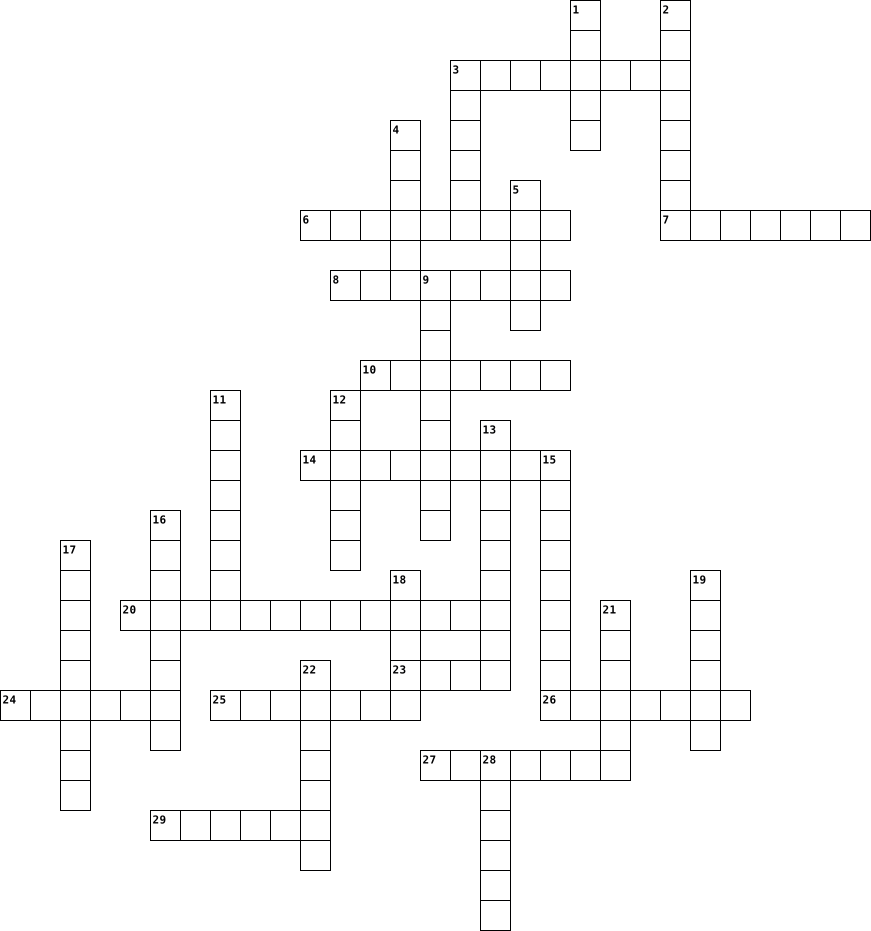
Across
- earth Any of the six chemical elements that comprise Group 2 (IIa) of the periodic table.
- A tiny bit of matter that makes up everything in the universe.
- The information centre of the cell.
- A chemical element that forms a salt when it reacts with metal.
- A substance whose atoms all have the same number of protons.
- A chemical element that forms a simple substance having properties intermediate between those of a typical metal and a typical nonmetal.
- The amount of a substance in a defined space.
- number The sum of the number of nucleons in an atom.
- An elementary particle that is identical with the nucleus of the hydrogen atom.
- A row of chemical elements.
- An uncharged elementary particle that has a mass nearly equal to that of the proton.
- The spontaneous net movement of solvent molecules through a selectively permeable membrane into a region of higher solute concentration.
- metal Any of the six chemical elements that make up Group 1 (Ia) of the periodic table.
Down
- A chemical element that forms a simple substance having properties intermediate between those of a typical metal and a typical nonmetal.
- The negatively charged particles of atoms.
- number The number of a chemical element in the periodic system.
- number The number of protons found in the nucleus of every atom of that element.
- Lattice of positive ions surrounded by a cloud of delocalized electrons.
- A group of two or more atoms that form the smallest identifiable unit.
- table A tabular array of the chemical elements organized by atomic number.
- The ability to do work.
- A material formed by chemically bonding two or more chemical elements.
- The movement of a substance from an area of high concentration to an area of low concentration.
- A chemical element that forms a salt when it reacts with metal.
- Any of various self-contained units of matter or energy that are the fundamental constituents of all matter.
- Smallest unit into which matter can be divided without the release of electrically charged particles.
- A chemical notation of one or two letters representing a chemical element.
- A vertical column in the Periodic Table.
- theory A fundamental theory of matter that explains physical properties in terms of the motion of atoms and molecules.
- Anything that has mass and volume.
30 Clues: The ability to do work. • A row of chemical elements. • Anything that has mass and volume. • The information centre of the cell. • A vertical column in the Periodic Table. • The negatively charged particles of atoms. • The amount of a substance in a defined space. • number The sum of the number of nucleons in an atom. • ...
Metals and Alloys 2024-02-03

Across
- appear to the left of the periodic table
- produces a ringing sound when hit
- alloy of iron and carbon
- metals can be hammered into sheets
- alloy of copper and tin
- the softest mineral
- metals can be drawn into wire
- it is the mass per unit volume
Down
- the hardest mineral
- ability of material to withstand scratching
- alloy of copper and zinc
- has the properties of both metals and nonmetals
- shiny
- appear to the right of the periodic table
- the only liquid metal at room temperature
15 Clues: shiny • the hardest mineral • the softest mineral • alloy of copper and tin • alloy of copper and zinc • alloy of iron and carbon • metals can be drawn into wire • it is the mass per unit volume • produces a ringing sound when hit • metals can be hammered into sheets • appear to the left of the periodic table • appear to the right of the periodic table • ...