
periodic table Crossword Puzzles
mewing streak in chemistry 2024-08-09

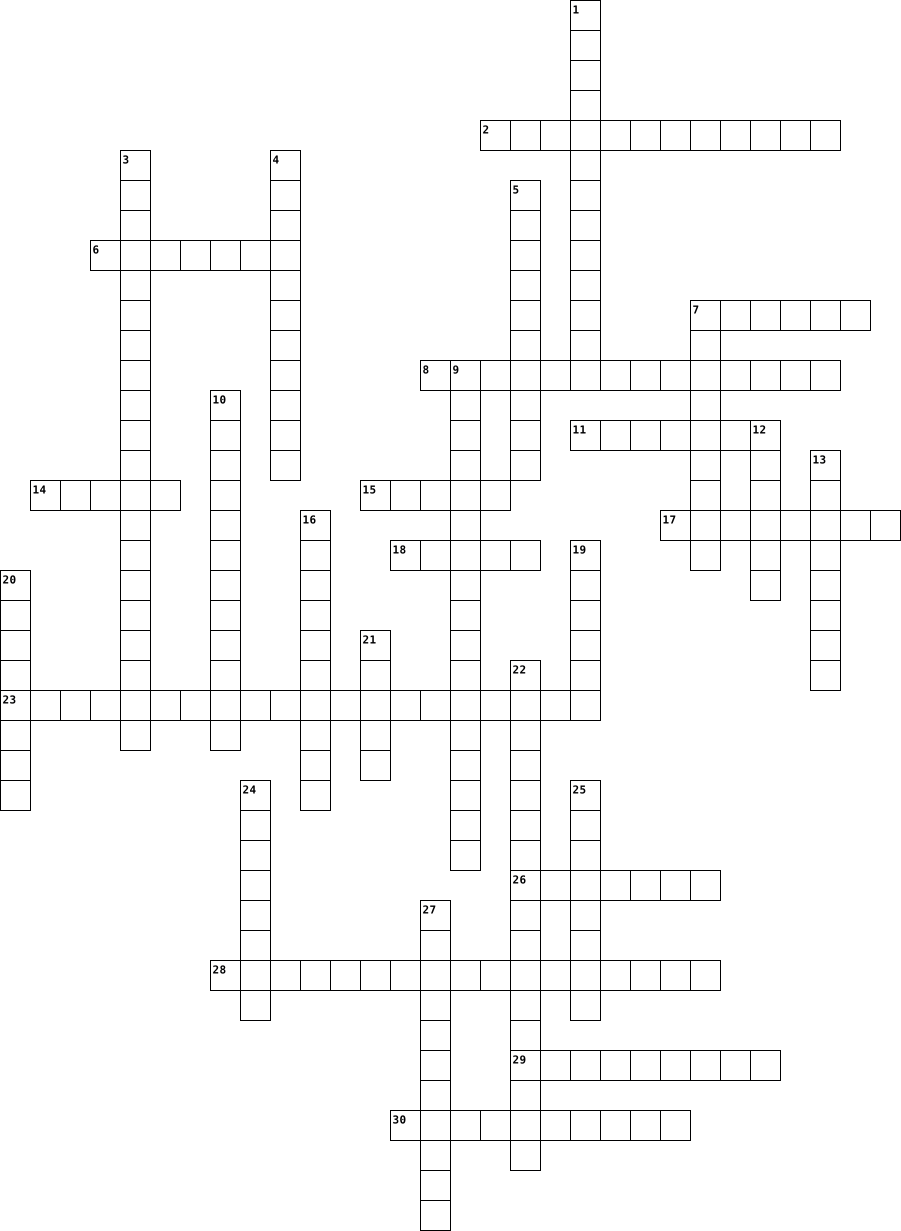
Across
- A carboxylic acid is an organic molecule containing a -COOH group. An example of a carboxylic acid is acetic acid
- is an ionic compound that dissolves in water to produce ions, which can conduct electricity
- relating to elements in periodic table
- the dominant male animal in a particular group
- the contour of the lower edge of a person's jaw
- is an organic molecule that only contains single carbon-carbon bonds
- is the movement of particles from an area of higher concentration to one of lower concentration
- the process of becoming smaller.
- table of periodic elements
- a type of change where the physical properties of matter change
- gases any of the chemically inert gaseous elements of the helium group in the periodic table
Down
- A chemical that can dissolve in water, combine with acids to form salts, and make acids less acidic
- dominant leader, lone wolf, cool and popular
- is a chemical element; it has symbol He and atomic number 2.
- a colourless, odourless reactive gas, the chemical element of atomic number 8 and the life-supporting component of the air.
- a change of materials into another, new materials with different properties and one or more than one new substances are formed
- is one made up of two elements
- a chemical element; it has symbol N and atomic number 7.
- hand and feet actions
- a substance made by mixing other substances together.
- the action of becoming larger or more extensive.
21 Clues: hand and feet actions • table of periodic elements • is one made up of two elements • the process of becoming smaller. • relating to elements in periodic table • dominant leader, lone wolf, cool and popular • the dominant male animal in a particular group • the contour of the lower edge of a person's jaw • the action of becoming larger or more extensive. • ...
mewing streak in chemistry 2024-08-09

Across
- A carboxylic acid is an organic molecule containing a -COOH group. An example of a carboxylic acid is acetic acid
- is an ionic compound that dissolves in water to produce ions, which can conduct electricity
- relating to elements in periodic table
- the dominant male animal in a particular group
- the contour of the lower edge of a person's jaw
- is an organic molecule that only contains single carbon-carbon bonds
- is the movement of particles from an area of higher concentration to one of lower concentration
- the process of becoming smaller.
- table of periodic elements
- a type of change where the physical properties of matter change
- gases any of the chemically inert gaseous elements of the helium group in the periodic table
Down
- A chemical that can dissolve in water, combine with acids to form salts, and make acids less acidic
- dominant leader, lone wolf, cool and popular
- is a chemical element; it has symbol He and atomic number 2.
- a colourless, odourless reactive gas, the chemical element of atomic number 8 and the life-supporting component of the air.
- a change of materials into another, new materials with different properties and one or more than one new substances are formed
- is one made up of two elements
- a chemical element; it has symbol N and atomic number 7.
- hand and feet actions
- a substance made by mixing other substances together.
- the action of becoming larger or more extensive.
21 Clues: hand and feet actions • table of periodic elements • is one made up of two elements • the process of becoming smaller. • relating to elements in periodic table • dominant leader, lone wolf, cool and popular • the dominant male animal in a particular group • the contour of the lower edge of a person's jaw • the action of becoming larger or more extensive. • ...
Physical Science Vocabulary Review 2024-10-15

Across
- A table of all known elements arranged by atomic number
- Horizontal rows in the periodic table
- The smallest particle of an element that has all the characteristics of that element
- The variable that is being tested (effect)
- Made up of all of the same types of atoms
- Two or more elements that are chemically combined
- A heterogeneous mixture, particles don't dissolve
- Formed from the chemical reaction between an acid and a base
- Two or more substances that are combined physically
- A substance with a pH greater than 7
- Has a definite shape and a definite volume
- The amount of a substance in a defined space
- Located outside the nucleus and has a negative charge
- A chemical reaction between an acid and a base
Down
- The variable that the experimenter changes (cause)
- The amount of space an object takes up
- Positively charged particle located within the nucleus
- A scale (0-14) to classify substances as acids or bases
- Compounds that have a pH less than 7
- A different ratio of substances throughout
- The same ratio of substances throughout
- Also known as family, vertical column in periodic table
- The center of an atom
- Has to do with motion, related to motion
- Has a definite volume but not a definite shape
- The ability to do work
- Particle located in the nucleus with no charge
- Has an indefinite shape and an indefinite volume
28 Clues: The center of an atom • The ability to do work • Compounds that have a pH less than 7 • A substance with a pH greater than 7 • Horizontal rows in the periodic table • The amount of space an object takes up • The same ratio of substances throughout • Has to do with motion, related to motion • Made up of all of the same types of atoms • ...
Chemistry So Far 2025-04-08

Across
- Horizontal rows on the periodic table.
- Elements that are brittle, dule, and poor conductors of electricity.
- Elements that are hard, shiny, and good conductors of electricity.
- A change that does not change a substance's chemical composition.
- Properties that can only be observed by changing the chemical composition of the substance.
- A substance made of two or more different types of elements.
- A moderately reactive group of metals.
- Is not matter, but can cause a change in matter.
- A change that does change a substance's chemical composition.
- Vertical columns on the periodic table.
- A nonreactive group of nonmetals.
- A positively charged subatomic particle that is found in the nucleus of an atom.
- A pure substance that cannot be broken down into simpler substances.
- The small, dense, centre of an atom.
Down
- Average weight of an atom.
- The special element.
- The electrons in the outermost energy shell.
- A negatively charged subatomic particle that orbits the nucleus of an atom.
- Is equal to the number of protons and electrons.
- Elements that have properties of both metals and nonmetals.
- A highly reactive group of metals.
- A highly reactive group of nonmetals.
- Mr. McPhee's favourite element.
- Properties that can be observed without chemically changing the substance.
- The outermost energy shell in a Bohr model.
- A neutral subatomic particle found in the nucleus of an atom.
- The father of the periodic table.
27 Clues: The special element. • Average weight of an atom. • Mr. McPhee's favourite element. • A nonreactive group of nonmetals. • The father of the periodic table. • A highly reactive group of metals. • The small, dense, centre of an atom. • A highly reactive group of nonmetals. • Horizontal rows on the periodic table. • A moderately reactive group of metals. • ...
Chemistry ALL UNITS REVIEW 2025-05-16

Across
- - the spreading of gases in an available space is known as this
- - the process of separating colored mixture by using a filter paper.
- - when we combine two or more things, it is known as this chemical reaction.
- - this element is used to create nuclear energy
- - when a metal transfers electricity it is known to be this.
- - the process of filtering water but collecting the condensation for clean water.
- - a state of matter that has tightly packed atoms that do not move freely.
- - when a solid turns to a gas skipping the liquid phase, it is known as this.
- - when something can stretch and return to its original position it is known to be ____________.
- - a category on the periodic table that is not solid, is most abundant, and has no melting points.
- - a row on the periodic table is called a _________.
Down
- - the process of separating a mixture of light weight substances with the wind.
- - a state of matter that is charged and moves freely at high speeds
- - water is known as the universal ___________ because it will dissolve anything dissolves.
- - 3D structure of a crystal.
- - a reaction in which oxygen is added
- - these metals are the most reactive on the periodic table and are on the very left.
- - the smallest level of matter
- - valency is determined by how many electrons are on the outer _______ of an atom.
- - a combination of two or more elements.
20 Clues: - 3D structure of a crystal. • - the smallest level of matter • - a reaction in which oxygen is added • - a combination of two or more elements. • - this element is used to create nuclear energy • - a row on the periodic table is called a _________. • - when a metal transfers electricity it is known to be this. • ...
Science, Physics and Math Crossword 8th Grade 2025-09-30

Across
- - SI unit of pressure.
- - Substance that dissolves another.
- - Smallest unit of matter.
- - Neutral particle in nucleus.
- - Combination of substances not chemically combined.
- - Atom with same protons but different neutrons.
- - Vertical column in periodic table.
- - SI unit of force.
- - Substance made of only one kind of atom.
- - Amount of matter in an object.
- - Distance traveled per unit of time.
- - Amount of space an object occupies.
- - Tendency of an object to resist change in motion.
- - Speed in a given direction.
- - Number of wave cycles per second.
- - SI unit of energy.
- - Bouncing back of waves from a surface.
- - Force pulling objects to Earth.
- - Distance between consecutive wave crests.
Down
- - Negatively charged particle orbiting nucleus.
- - Homogeneous mixture of solute and solvent.
- - Substance being dissolved.
- - Substance formed by two or more elements.
- - Positively charged particle in nucleus.
- - Rate of change of velocity.
- - Resistance between two surfaces in contact.
- - Force applied over a distance.
- - Force exerted per unit area.
- - Ability to cause change or do work.
- - Referring to repeating patterns in the table of elements.
- - Rate of doing work.
- - Horizontal row in periodic table.
- - Disturbance that transfers energy.
- - Bending of waves when changing medium.
- - Mass per unit volume.
- - Mass times velocity.
- - Push or pull on an object.
- - Two or more atoms bonded together.
- - Atom with electric charge from losing or gaining electrons.
- - Maximum displacement of a wave.
40 Clues: - SI unit of force. • - SI unit of energy. • - Rate of doing work. • - SI unit of pressure. • - Mass times velocity. • - Mass per unit volume. • - Smallest unit of matter. • - Substance being dissolved. • - Push or pull on an object. • - Rate of change of velocity. • - Speed in a given direction. • - Neutral particle in nucleus. • - Force exerted per unit area. • ...
Chemistry 2022-05-19
Across
- states that the physical and chemical properties of the elements are periodic functions of their atomic numbers.
- electron of one atom and proton of the other atom _______ one another.
- The elements of Group 1 of the
- is an arrangement of the elements in order of their atomic numbers so that elements with similar properties fall in the same column, or group.
- In the periodic table, the f-block elements are wedged between Groups 3 and 4 in the sixth and ______ periods.
- has just three valence electrons, which tends to form bonds in which it is surrounded by six electrons.
- The elements of Group 2 of the periodic table are called the alkaline-_____ metals.
- table are known as the _____ metals.
- All matter is composed of extremely small particles called?
- a chemical compound containing elements in exactly the same proportions by mass regardless of the size or source of the compound.
- Cationic and _______ radii decrease across a period.
- The energy change that occurs when an electron is acquired by a neutral atom is called the atom’s ___________.
- A chemical compound whose simplest units are molecules is called a _________ compound.
- All six of the __________ are also in the p block.
Down
- the attraction between two or more atoms that allows them to be able to form a stable chemical compound.
- if two or more different compounds are composed of the same two elements, then the ratio of the masses of the second element combined with a certain mass of the first element is always a ratio of small whole numbers.
- The first row of the f block are known as?
- Atoms cannot be __________, created, or destroyed.
- The second row of the f block are known as?
- is a measure of the ability of an atom in a chemical compound to attract electrons from another atom in the compound.
- ______ is used to form chemical compounds.
- the p block includes all of the nonmetals except hydrogen and ______.
- is a unique element.
- The p-block elements together with the s-block elements are called the __________ elements.
- Red Atoms of different elements combine are known as?
- A ________ formula indicates the relative numbers of atoms of each kind in a chemical compound by using atomic symbols and numerical subscripts.
- two nuclei and two electrons _____ each other.
- A ________ shows the types and numbers of atoms combined in a single molecule of a molecular compound.
- A ________ is a neutral group of atoms that are held together by covalent bonds.
- Repeating patterns are referred to as ________.
- is the energy required to break a chemical bond and form neutral isolated atoms.
31 Clues: is a unique element. • The elements of Group 1 of the • table are known as the _____ metals. • The first row of the f block are known as? • ______ is used to form chemical compounds. • The second row of the f block are known as? • two nuclei and two electrons _____ each other. • Repeating patterns are referred to as ________. • ...
Chemistry Puzzle 2024-06-06

Across
- A chemical reaction in which an acid and a base react to produce salt and water
- The force exerted per unit area on a surface
- An incredibly small, negatively charged subatomic particle
- A positively charged subatomic particle
- The first column (Group 1) elements in the periodic table. They are very reactive metals that easily lose one electron to become positively charged ions
- A set of four numbers (n, l, ml, and ms) that define the energy level, orbital shape, and spin of an electron within an atom
- Letters used in chemical equations to show the physical state of a substance (s - solid, l - liquid, g - gas, aq - aqueous)
- Whole numbers in a chemical equation that represent the relative quantities of reactants and products involved in the reaction
- The relative amount of a specific isotope found within a sample of a particular element
- A concentration unit indicating the number of moles of a solute dissolved in one liter of solution
- Difference of electronegativity within a molecule. This arises because some atoms attract electrons more strongly than others
Down
- The subatomic particles occupying the outermost energy level of an atom. These are primarily responsible for chemical bonding with other atoms
- The specific arrangement of electrons in the various energy levels and orbitals of an atom
- The amount of solute (dissolved substance) present in a given amount of solvent or solution
- The unreactive elements in Group 18 of the periodic table
- The elements in Group 17 of the periodic table
- A positively charged ion created when an atom loses one or more electrons
- The amount of three-dimensional space occupied by a substance
- A chart that organizes elements based on their atomic number (number of protons), electron configuration, and repeating chemical properties
- Variations of an element with the same number of protons but a different number of neutrons in their nucleus
- A charged ion formed by the covalent bonding of two or more different atoms
- A horizontal row in the periodic table
- The unit of temperature on the thermodynamic temperature scale
- The fundamental unit of matter
24 Clues: The fundamental unit of matter • A horizontal row in the periodic table • A positively charged subatomic particle • The force exerted per unit area on a surface • The elements in Group 17 of the periodic table • The unreactive elements in Group 18 of the periodic table • An incredibly small, negatively charged subatomic particle • ...
Periodicity Test Review 2023-10-31

Across
- organized the first periodic table
- organized the table by atomic number
- hybrid properties and are semiconductors
- states unpaired electrons occupy empty orbitals first with parallel spin
- used to organize elements by physical and chemical characteristics
- what ions are with the nearest noble gas
Down
- how strongly an atom attracts electrons to its own nucleus
- the size of an atom
- group 8A on the periodic table
- the change in positive nuclear charge
10 Clues: the size of an atom • group 8A on the periodic table • organized the first periodic table • organized the table by atomic number • the change in positive nuclear charge • hybrid properties and are semiconductors • what ions are with the nearest noble gas • how strongly an atom attracts electrons to its own nucleus • ...
christina herron week 6 vocab 2023-09-26

Across
- a vertical row of the periodic table.
- a horizontal row of the periodic table.
- commonly cited in distinguishing among the isotopes of an element
- the number of a chemical element in the periodic system and on the periodic table
- a subatomic particle that has negative charge
Down
- arranged in order of atomic number.
- the smallest unit of an element that maintains the property of the element.
- a subatomic particle that has a positive charge and that is located in the nucleus of an atom; the number of protons in the nucleus is the atomic number, which determines the identity of an element
- a substance that can not be separated or broken down into simpler substances.
- a subatomic particle that has no charge and that is located in the nucleus of an atom
10 Clues: arranged in order of atomic number. • a vertical row of the periodic table. • a horizontal row of the periodic table. • a subatomic particle that has negative charge • commonly cited in distinguishing among the isotopes of an element • the smallest unit of an element that maintains the property of the element. • ...
Periodic table 2024-10-18

Across
- A column in the peridic table
- Made up from one type of atom only
- Represents an element in the periodic table
- A row in the periodic table
Down
- Which side are non-metals found in the periodic table
- Has metallic and non-metallic properties
- Element at the top of group 2
7 Clues: A row in the periodic table • A column in the peridic table • Element at the top of group 2 • Made up from one type of atom only • Has metallic and non-metallic properties • Represents an element in the periodic table • Which side are non-metals found in the periodic table
Chemistry 2023-11-09

Across
- letters and numbers that create a formula
- group of atoms held together with chemical bonds
- right of the periodic table
- atoms with fewer or more than 8 electrons in the outermost shell
- transfer electrons
Down
- when chemical bonds are formed or broken
- particle that contains protons, neutrons, and electrons
- distributed electrons
- left of the periodic table
- share electrons
- links between atoms in a substance that determines its identity
11 Clues: share electrons • transfer electrons • distributed electrons • left of the periodic table • right of the periodic table • when chemical bonds are formed or broken • letters and numbers that create a formula • group of atoms held together with chemical bonds • particle that contains protons, neutrons, and electrons • ...
Science Review Game (Basic Chemistry Vocab) 2021-12-08

Across
- "Matter is neither created nor destroyed"- Used to describe chemical equations.
- The type of element that can be have luster, cam be a conductor, and can be brittle
- another word for shiny (generally used to describe elements)
- The unit of measurement to measure the mass of subatomic particles.
- The name for the outermost particles of an atom.
- The changing of chemical composition
- to not be shiny
- A new solid being formed (Chemical Reactions)
- This refers to what certain subatomic particles sort themselves into (these subatomic particles have almost no mass).
- Anything of something that is of one unit or one subatomic particle.
Down
- This word refers to the characteristics, traits or ________ of atoms.
- The word on the Periodic Table that signifies an assortment/organization of elements in vertical fashion.
- The parts or elements before their reaction in a chemical equation.
- This guarantees/proves that a chemical reaction has taken place.
- The visual representation of showing an element's structure.
- the side of which (on the Periodic Table) that contains elements with more Valence Electrons.
- One of the two parts of an atom, this part has the most variety of subatomic particles.
- This word changes depending on the amount of outermost subatomic particles.
- the side of which all metals (on the Periodic Table) are located.
- This subatomic particle determines most of the mass in an atom, and does not have a positive charge
20 Clues: to not be shiny • The changing of chemical composition • A new solid being formed (Chemical Reactions) • The name for the outermost particles of an atom. • The visual representation of showing an element's structure. • another word for shiny (generally used to describe elements) • This guarantees/proves that a chemical reaction has taken place. • ...
Atomic Structure and the Periodic Table 2022-02-16

Across
- weakest fundamental force
- If there are more protons than electrons, you would have a positive __________.
- large number of elements found to the left and center of the periodic table
- This researcher discovered the positively-charged nucleus during his gold foil experiment.
- This force holds together the nucleus.
- Greek philosopher who came up with the idea of atoms
- This is where we find neutrons and protons.
- Horizontal rows on the periodic table
- gases that are nonreactive and found to the far right of the periodic table
- Electrons have a much smaller ______ than protons or neutrons.
- This scientist discovered neutrons.
- This researcher came up with the plum pudding atomic model.
Down
- Atomic __________ is the total of protons and neutrons.
- Researcher who created a model of the atom with electrons circling the nucleus in fixed orbitals like planets
- In order for an atom to have no charge, it must have an equal number of protons and these negatively-charged subatomic particles.
- The atomic number is the number of these positively charged particles in one atom of the element.
- As you get further from the nucleus the energy level of electrons gets ______________.
- different forms of the same element that differ in the number of neutrons
- Researcher who proposed that atoms combine in given ratios to form compounds
- The only form of nuclear decay/radiation that does not create a different element
- Schrodinger helped develop our idea of an electron ___________.
- Most of an atom's ______________ is made up of empty space.
22 Clues: weakest fundamental force • This scientist discovered neutrons. • Horizontal rows on the periodic table • This force holds together the nucleus. • This is where we find neutrons and protons. • Greek philosopher who came up with the idea of atoms • Atomic __________ is the total of protons and neutrons. • Most of an atom's ______________ is made up of empty space. • ...
Matter and Chemical Change 2013-06-17

Across
- Solids at room temperature, shiny, malleable, and a good conductor of energy.
- Substance that can be broken down into component parts.
- A substance that can be pounded into sheets.
- Negative charge that orbits or energy levels.
- The ability of a substance to conduct electricity.
- The horizontal rows in the Periodic Table.
- The total mass of the protons and neutrons (3 Words).
- Cannot be broken down into a simpler substance (2 words).
- Substances composed of 2 or more substances.
- Positive charge in the nucleus.
- When metals and non-metals come together because opposite charges attract (2 Words).
- Releases heat.
- The vertical rows in the Periodic Table.
- No charge in the nucleus.
- The amount of mass in a given volume of a substance.
Down
- Workplace Hazardous Materials Information System.
- The ability of a substance to be dissolved in another.
- Have both metallic and non-metallic properties.
- Can be a solid or gas at room temperature, are dull, and act as insulators.
- Formed when atoms share electrons (2 Words).
- The number of protons found in the nucleus (2 Words).
- Absorbs heat.
- A cloudy mixture.
- Located on the extreme right of the Periodic Table and are non-reactive and stable (2 Words).
- Substances composed of only one kind of atom.
- A cloudy mixture which cannot be easily separated.
- Any solid that can be stretched into a long wire.
27 Clues: Absorbs heat. • Releases heat. • A cloudy mixture. • No charge in the nucleus. • Positive charge in the nucleus. • The vertical rows in the Periodic Table. • The horizontal rows in the Periodic Table. • A substance that can be pounded into sheets. • Formed when atoms share electrons (2 Words). • Substances composed of 2 or more substances. • ...
Physical & Chemical Changes 2018-05-30

Across
- another scientific word for evaporate is ____________
- molecule with or more different atoms bonded
- you can speed this up by adding heat energy
- gas to solid or solid to gas
- when a metal gets damaged by its environment it is known as ___________
- a product is made by 2 or more ___________
- made of sub-atomic particles
- children refer fire water air and earth as ________
- 1 atom is known as a __________________
- gaseous form of a substance that is generally solid or liquid at room temperature
- a substance that speeds up chemical changes
- gas to liquid is known as ___________
- group of two or more atoms that are bonded together
- water does this at 100 degrees
- vertical columns in the periodic table
Down
- opposite of a molecular compound
- reactant + reactant = __________________
- when substances react, they come in contact and this is known as the
- the dead sea has a high ____________ of salt
- the _____________ has 118 elements
- chain of molecules
- pungent gas that is dangerous to breathe in
- if two atoms are attracted, they are
- when ice-cream is in the sun for a long time it starts to ______
- things that easily turn into gas are ___________
- molecule with two atoms
- pineapple's __________ is known as bromelain
- substance that has two or more different types of atoms that are bonded
- horizontal rows in the periodic table
- 3 dimensional arrangement of particles in a regular pattern
30 Clues: chain of molecules • molecule with two atoms • gas to solid or solid to gas • made of sub-atomic particles • water does this at 100 degrees • opposite of a molecular compound • the _____________ has 118 elements • if two atoms are attracted, they are • horizontal rows in the periodic table • gas to liquid is known as ___________ • vertical columns in the periodic table • ...
mewing streak in chemistry 2024-08-09

Across
- A carboxylic acid is an organic molecule containing a -COOH group. An example of a carboxylic acid is acetic acid
- is an ionic compound that dissolves in water to produce ions, which can conduct electricity
- relating to elements in periodic table
- the dominant male animal in a particular group
- the contour of the lower edge of a person's jaw
- is an organic molecule that only contains single carbon-carbon bonds
- is the movement of particles from an area of higher concentration to one of lower concentration
- the process of becoming smaller.
- table of periodic elements
- a type of change where the physical properties of matter change
- gases any of the chemically inert gaseous elements of the helium group in the periodic table
Down
- A chemical that can dissolve in water, combine with acids to form salts, and make acids less acidic
- dominant leader, lone wolf, cool and popular
- is a chemical element; it has symbol He and atomic number 2.
- a colourless, odourless reactive gas, the chemical element of atomic number 8 and the life-supporting component of the air.
- a change of materials into another, new materials with different properties and one or more than one new substances are formed
- is one made up of two elements
- a chemical element; it has symbol N and atomic number 7.
- hand and feet actions
- a substance made by mixing other substances together.
- the action of becoming larger or more extensive.
21 Clues: hand and feet actions • table of periodic elements • is one made up of two elements • the process of becoming smaller. • relating to elements in periodic table • dominant leader, lone wolf, cool and popular • the dominant male animal in a particular group • the contour of the lower edge of a person's jaw • the action of becoming larger or more extensive. • ...
Conservation of Mass 2016-01-13

Across
- Is part of the 8 group in the periodic table.
- Is part of the 12 group in the periodic table.
- Substance that is formed as the result of a chemical reaction.
- He was the first Russian Scientist of natural importance
- Substances initially present in a chemical reaction that are consumed during the reaction to make products.
Down
- He is widely considered in popular literature as the "father of modern chemistry"
- Is part of the 11 group in the periodic table.
- An action in a reverse direction or manner.
- The downward force caused by gravity on an object.
- A measure of how much matter is in an object.
10 Clues: An action in a reverse direction or manner. • Is part of the 8 group in the periodic table. • A measure of how much matter is in an object. • Is part of the 11 group in the periodic table. • Is part of the 12 group in the periodic table. • The downward force caused by gravity on an object. • He was the first Russian Scientist of natural importance • ...
Daily Puzzle 2026-04-19

Across
- A flavourful cake and aroma used in baking
- Pop star and actor born February 1
- a very viscous substance that bees make in and a substitute of sugar
- "This 2016 animated film about a rabbit cop and a fox con artist solving a mystery in a city of anthropomorphic animals won Best Animated Feature."
- Our _____ on earth was through
- The second final element of the periodic table, also has a protective bubble around it
- Singer known for “bad guy,” born December 18
- station on the old Line 3, another reference to Scarborough’s transit system
- Singer and actress born July 22
- Singer and actress born May 11
- The heroine who played as Auli’i Cravalho
- The fourth final element of the periodic table, also has a protective bubble around it and can transition into another element using test tubes
- The app that incorrectly credited the song “What Was I Made For?” to Billie Eilish.
- Put on the ground in Lola Young’s Messy
- Living in your ________ house, I’m outside
- Music artist born in June 25, 2002
- A shade of purple
- 1 ____ 7 Days Drop it Like It’s Hot
- The third final element of the periodic table, also has a protective bubble around it
- A sport that involves a birdie and racquet
- Octane Deo, Get _________
Down
- The object Rosie threw during her final outburst
- Paint my nails _________ red
- An upcoming movie that stars and direct by Tate McRae and Olivia Rodrigo, and co produced by SK Productions, Paarvathaa Entertainments, Jenna Filmworks and Cake Entertainment
- Final element of the periodic table, has a protective bubble around it
- Station serving a popular science attraction
- Jack + 8 Spades + 9 Clubs + 9 Clubs + Ace is a Girl Name
- Moonbeam _____ ________
- A Canadian singer who is born on Canada Day
- You cling to your papers and ____
- A hardest substance found in earth
- Stop leading toward downtown
- Actress and rapper known for Crazy Rich Asians and The Farewell
- But you wrote a ____ and I just take the page out
- Breakout Music Artist which won in the KCA 2022
- This street runs through the heart of Scarborough, connecting the east and west sides.
- Gonna be gonna be ____en
- Music Artist born September 28
- Soft skin and I ___________d it for ya
- _______ Powerhouse (2026 film)
- Discovered in 1982 by German Artists
- I’m doing lonely ____________
- The fifth final element of the periodic table, also has a protective bubble around it and can transition into another element using test tubes
43 Clues: A shade of purple • Moonbeam _____ ________ • Gonna be gonna be ____en • Octane Deo, Get _________ • Paint my nails _________ red • Stop leading toward downtown • I’m doing lonely ____________ • Our _____ on earth was through • Singer and actress born May 11 • Music Artist born September 28 • _______ Powerhouse (2026 film) • Singer and actress born July 22 • ...
Chemistry 2023-04-25

Across
- A pure substance made of two or more atoms
- The name for electrons in the outer shell
- The protons and neutrons added together.
- A pure substance made of one type of atom
- A horizontal row on the periodic table
Down
- A vertical column on the periodic table
- Acidity, reactivity, and combustibility are examples of
- How elements are arranged on the periodic table
8 Clues: A horizontal row on the periodic table • A vertical column on the periodic table • The protons and neutrons added together. • The name for electrons in the outer shell • A pure substance made of one type of atom • A pure substance made of two or more atoms • How elements are arranged on the periodic table • Acidity, reactivity, and combustibility are examples of
Periodic Table 2018-05-06

Across
- This is the first element on the periodic table
- This element is what you breathe out
- This element is another word for coins
- This element is what you'll find in milk
Down
- This element is what you breathe in
- This element's symbol is Au
- This element has 17 Protons
- This element is what you'll find in potatoes
- This element has a mass number of 14
- This element is what you would find in a balloon
10 Clues: This element's symbol is Au • This element has 17 Protons • This element is what you breathe in • This element has a mass number of 14 • This element is what you breathe out • This element is another word for coins • This element is what you'll find in milk • This element is what you'll find in potatoes • This is the first element on the periodic table • ...
periodic table 2022-03-07

Across
- a group of atoms bonded togethe
- protons in the nucleus of an atom,
- surrounding the nucleus of an atom.
- mass of an atom
- charge of negative electricity
Down
- essential or characteristic.
- positive electric charge
- wo or more forms of the same element
- same mass as a proton
- the basic unit of a chemical element.
10 Clues: mass of an atom • same mass as a proton • positive electric charge • essential or characteristic. • charge of negative electricity • a group of atoms bonded togethe • protons in the nucleus of an atom, • surrounding the nucleus of an atom. • wo or more forms of the same element • the basic unit of a chemical element.
periodic table 2022-02-23

Across
- Is a natural element.
- The 5th element on the periodic table.
- A metal that can be harmful to humans.
- Atomic number is 30
- Its atomic number is 55.
Down
- P is their chemical symbol.
- Has atomic weight of 131.
- It is found n foods such as milk and cheese.
- When freshly cut it is grey then turns blue.
- It is colorless,order-less,tasteless,and non toxic.
10 Clues: Atomic number is 30 • Is a natural element. • Its atomic number is 55. • Has atomic weight of 131. • P is their chemical symbol. • The 5th element on the periodic table. • A metal that can be harmful to humans. • It is found n foods such as milk and cheese. • When freshly cut it is grey then turns blue. • It is colorless,order-less,tasteless,and non toxic.
periodic table 2022-02-25

Across
- - What is H?
- - What is Ag?
- - What is Og?
- - What is Pd?
- - What is Mn?
- - What is sn?
Down
- - What is Rg?
- - What is Fe?
- -What is Md?
- - What is Au?
10 Clues: - What is H? • - What is Rg? • - What is Ag? • - What is Fe? • -What is Md? • - What is Og? • - What is Au? • - What is Pd? • - What is Mn? • - What is sn?
Periodic Table 2015-11-06

Across
- He
- W
- Os
Down
- Cs
- H
- Pb
- O
- Li
- Au
- F
10 Clues: H • O • W • F • Cs • He • Pb • Li • Au • Os
Periodic Table 2023-03-07

Across
- Sum of protons and neutrons
- Smallest particle that can be considered an element
- Scientist who created the first periodic table
- Dense center of an atom
- A particle with no electrical charge
Down
- Same # of protons and different # of neutrons
- Positive charged particle in atoms
- The number of protons in a nucleus
- An idea or thought
- Negative charged particle in atoms
10 Clues: An idea or thought • Dense center of an atom • Sum of protons and neutrons • Positive charged particle in atoms • The number of protons in a nucleus • Negative charged particle in atoms • A particle with no electrical charge • Same # of protons and different # of neutrons • Scientist who created the first periodic table • Smallest particle that can be considered an element
Periodic Table 2023-03-07

Across
- particles that exist in the nucleus of atoms
- the sum of the protons and neutrons in the atom
- atoms with the same number of protons and different numbers of neutrons
- the smallest particle that still can be considered an element.
- the number of protons in the nucleus of an atom
Down
- a positively-charged particle in an atom's nucleus
- the average mass of all the isotopes of that element
- a dense positive charge in the center of an atom
- one-or two-letter abbreviation for the element
- a chart showing all of the elements arranged according to the repeating pattern of their properties.
10 Clues: particles that exist in the nucleus of atoms • one-or two-letter abbreviation for the element • the sum of the protons and neutrons in the atom • the number of protons in the nucleus of an atom • a dense positive charge in the center of an atom • a positively-charged particle in an atom's nucleus • the average mass of all the isotopes of that element • ...
Periodic Table 2022-04-13

Across
- basic chemical unit
- the vertical elements on the table
- easy to break
- between the metals and non-metals
- mass all of the protons, neutrons, and electrons added up
- inner core of the electron cloud
Down
- right of the scientific equation
- the letter(s) of the element
- left of the scientific equation
- the horizontal group along the table
10 Clues: easy to break • basic chemical unit • the letter(s) of the element • left of the scientific equation • right of the scientific equation • inner core of the electron cloud • between the metals and non-metals • the vertical elements on the table • the horizontal group along the table • mass all of the protons, neutrons, and electrons added up
Periodic Table 2022-12-21

Across
- hard but liable to break
- able to be hammered
- an element that is not metal
- able to be drawn out into a thin wire
- a solid material
Down
- a number of people together
- the mass of an atom
- a length of time
- the number of a chemical element
- a table of chemical elements
10 Clues: a length of time • a solid material • the mass of an atom • able to be hammered • hard but liable to break • a number of people together • a table of chemical elements • an element that is not metal • the number of a chemical element • able to be drawn out into a thin wire
Periodic Table 2023-01-30

Across
- The first metalloid in Modern Periodic Table whose fibres are used in making bullet-proof vests
- An element with atomic number 12
- A radioactive element which is the last member of halogen family.
- An element whose thin oxide layer is used to make other elements corrosion resistant by the process of “anodizing”
- Metal which is an important constituent of steel and forms rust when exposed to moist air
Down
- Highly reactive and soft metal which imparts yellow colour when subjected to flame and is kept in kerosene.
- The first element of second Period
- An element which is used in making fluorescent bulbs and is second member of Group 18 in the Modern Periodic Table
- Metal used in making cans and member of Group 14
- A lustrous non-metal which has 7 electrons in its outermost shell
10 Clues: An element with atomic number 12 • The first element of second Period • Metal used in making cans and member of Group 14 • A radioactive element which is the last member of halogen family. • A lustrous non-metal which has 7 electrons in its outermost shell • Metal which is an important constituent of steel and forms rust when exposed to moist air • ...
Periodic Table 2023-01-19

Across
- organization of elements
- when atoms stick together sharing electrons
- pure substance that can be broke down to an atom
- 1 or 2 letters representing an element
- smallest particle a substance can be broken into
- particle with zero charge in the nucleus
Down
- tiny negatively charged particle of an atom
- an average mass of an atom of an element
- the number of protons an atom has
- positively charged particle in the nucleus
10 Clues: organization of elements • the number of protons an atom has • 1 or 2 letters representing an element • an average mass of an atom of an element • particle with zero charge in the nucleus • positively charged particle in the nucleus • tiny negatively charged particle of an atom • when atoms stick together sharing electrons • ...
periodic table 2023-01-18

Across
- element 83
- column
- also known as boron
- when an electron switches energy levels
- determine the atomic mass and half-life
- average mass number of an element
Down
- silicon's atomic number
- valence electrons are in the ___ energy level
- row
- not reactive
10 Clues: row • column • element 83 • not reactive • also known as boron • silicon's atomic number • average mass number of an element • when an electron switches energy levels • determine the atomic mass and half-life • valence electrons are in the ___ energy level
Periodic Table 2023-02-26

Across
- Thin layer applied to a surface for protection or decoration
- Group of non-metal elements that occupy Group 17 of the periodic table.
- Mixture of metals with other elements
- Reddish-brown coating on iron caused by oxidation
- Sedimentary rock composed mostly of calcium carbonate
Down
- Ability to be stretched into a wire
- Copper and zinc alloy
- Gradual destruction of a material by chemical reactions
- Compounds formed from the reaction of metals with oxygen and water
- Mineral from which metal can be extracted
10 Clues: Copper and zinc alloy • Ability to be stretched into a wire • Mixture of metals with other elements • Mineral from which metal can be extracted • Reddish-brown coating on iron caused by oxidation • Sedimentary rock composed mostly of calcium carbonate • Gradual destruction of a material by chemical reactions • ...
Periodic Table 2023-02-09

Across
- The number of protons in an atom
- An atom of an element that has an electric charge
- The mass of an atom; equal to protons plus neutrons
- The electrons found in the outermost shell
- The name of the element
Down
- A string of element symbols that tell what a molecule is made of
- A group of two or more elements bonded together
- The letter or pair of letters that stand(s) for an element
- Made up of only one type of atom
- The smallest particle of any element that retains the properties of the element
10 Clues: The name of the element • Made up of only one type of atom • The number of protons in an atom • The electrons found in the outermost shell • A group of two or more elements bonded together • An atom of an element that has an electric charge • The mass of an atom; equal to protons plus neutrons • The letter or pair of letters that stand(s) for an element • ...
Periodic table 2020-12-14

Across
- I have 17 protons
- I created the periodic table
- I have 8 protons and 8 neutrons
- I am a metal liquid at room temperature
Down
- I have 20 neutrons, and I am found in teeth and bones
- I recreated the Periodic Table
- I am found in group 17
- My chemical symbol is Au
- I have 4 energy Levels and in group 15
- I am a transition metal with 26 electrons
10 Clues: I have 17 protons • I am found in group 17 • My chemical symbol is Au • I created the periodic table • I recreated the Periodic Table • I have 8 protons and 8 neutrons • I have 4 energy Levels and in group 15 • I am a metal liquid at room temperature • I am a transition metal with 26 electrons • I have 20 neutrons, and I am found in teeth and bones
PERIODIC TABLE 2021-09-26

Across
- Across period 3, which element has the highest electronegativity except for Ar?
- what will increase across the periodic table?
- Carbon atom is classified as what?
- Na and K is classified as what in a periodic table?
- Across a period metallic character will?
- Down Grp 15, which element is nonmetal?
Down
- Across period 3, which element has the biggest atomic size?
- Down a group metallic character will?
- Down group 15, which element has the smaller atomic radius?
- which element has the least ionisation energy across period 4?
10 Clues: Carbon atom is classified as what? • Down a group metallic character will? • Down Grp 15, which element is nonmetal? • Across a period metallic character will? • what will increase across the periodic table? • Na and K is classified as what in a periodic table? • Across period 3, which element has the biggest atomic size? • ...
PERIODIC TABLE 2021-09-25

Across
- has 73 atomic number
- Rubidium is in what element group?
- Fe stands for what element?
- Has 63.546 atomic weight
- Who is the creator of periodic table?
Down
- 14 atomic mass
- Helium has two
- How many element group are there?
- Au stands for what element?
- Most abundant element in the universe
10 Clues: 14 atomic mass • Helium has two • has 73 atomic number • Has 63.546 atomic weight • Au stands for what element? • Fe stands for what element? • How many element group are there? • Rubidium is in what element group? • Most abundant element in the universe • Who is the creator of periodic table?
Periodic Table 2021-07-21

Across
- Symbol for atom is Ag
- Can only form positive ions
- We need this to live
- The atomic weight is 12
- Highly toxic metalloid
Down
- Atomic mass is 14
- This atom glows red
- The atomic number is 12
- The most stable nucleus
- Elements that are somewhere between metals and non metals
10 Clues: Atomic mass is 14 • This atom glows red • We need this to live • Symbol for atom is Ag • Highly toxic metalloid • The atomic number is 12 • The atomic weight is 12 • The most stable nucleus • Can only form positive ions • Elements that are somewhere between metals and non metals
Periodic table 2021-08-29

Across
- -- what is the electron affinity of 18 group elements
- -- common name of d-block element is ---- element
- - How does size of an atom vary down the group
- -- how many groups are there
- Number of blocks in the modern periodic table
Down
- -- are s block elements metals or non metals
- -- how many periods are there
- -- which group shows maximum inert pair effect
- -- first element of any group does not resembles with other elements of its group due to -- behaviour
- -- Number of shells tell the group or period
10 Clues: -- how many groups are there • -- how many periods are there • -- are s block elements metals or non metals • -- Number of shells tell the group or period • Number of blocks in the modern periodic table • -- which group shows maximum inert pair effect • - How does size of an atom vary down the group • -- common name of d-block element is ---- element • ...
periodic table 2022-11-14

Across
- has a symbol of Au on the table
- in bananas
- element named after an american state
- best used in an in ground pool
- the best element for conducting electricity
Down
- used in flashy bright lights
- in salt
- named after a continent
- element with an atomic number of 6
- you wont survive without it
10 Clues: in salt • in bananas • named after a continent • you wont survive without it • used in flashy bright lights • best used in an in ground pool • has a symbol of Au on the table • element with an atomic number of 6 • element named after an american state • the best element for conducting electricity
Periodic table 2022-11-29

Across
- has only one energy level
- Electrons per shell: 2, 8, 14, 2
- silvery-white metal
- atomic mass of 75
- attic number 18
Down
- atomic number 107
- atomic weight of 127
- very hard, and very resistant to heat
- has 14 neutrons
- Electron Configurations 1s2 2s2 2p6 3s2 3p6 4s2 3d10 4p6
10 Clues: has 14 neutrons • attic number 18 • atomic number 107 • atomic mass of 75 • silvery-white metal • atomic weight of 127 • has only one energy level • Electrons per shell: 2, 8, 14, 2 • very hard, and very resistant to heat • Electron Configurations 1s2 2s2 2p6 3s2 3p6 4s2 3d10 4p6
Periodic table 2016-09-09

Across
- starbucks
- Dessigner
- quelque chose orange
- Triangle
Down
- Ocean
- cru, lautre cauter du monde
- Smurf
- Beaucoup de mots
- l'eau
- Meow
10 Clues: Meow • Ocean • Smurf • l'eau • Triangle • starbucks • Dessigner • Beaucoup de mots • quelque chose orange • cru, lautre cauter du monde
Periodic table 2018-07-11

Across
- to form 4 atoms in one unit
- half filled configuration
- halogen
- loss electrons
- diatomic molecule with triplebond
Down
- has several allotopes
- methaloid
- group VI has 6 valence electrons
- element in group 1 and period 3
- group IA in periodic table
10 Clues: halogen • methaloid • loss electrons • has several allotopes • half filled configuration • group IA in periodic table • to form 4 atoms in one unit • element in group 1 and period 3 • group VI has 6 valence electrons • diatomic molecule with triplebond
Periodic table 2019-09-09

Across
- Symbol: Cl and it is a yellow gas at room temperature
- US five cent coin is 75% copper and 25% nickel
- Atomic number is at 10 and it is found in digital devices
- Its symbol is Na and it is highly reactive
- It makes up 1.28% of Earth's atmosphere
Down
- Symbol: C and it is non-metallic
- Its symbol is "Cu"
- Atomic number is 22
- Has 20 protons, neutrons and electrons
- We breath it in and out everyday of our lives
10 Clues: Its symbol is "Cu" • Atomic number is 22 • Symbol: C and it is non-metallic • Has 20 protons, neutrons and electrons • It makes up 1.28% of Earth's atmosphere • Its symbol is Na and it is highly reactive • We breath it in and out everyday of our lives • US five cent coin is 75% copper and 25% nickel • Symbol: Cl and it is a yellow gas at room temperature • ...
Periodic Table! 2023-07-25

Across
- Zr
- C
- I
- Ti
Down
- Xe
- Rh
- O
- Kr
- Na
- Sn
10 Clues: C • O • I • Xe • Zr • Rh • Kr • Na • Ti • Sn
Periodic Table 2024-11-23

Across
- (244.1)
- 1.008
- N
- Na
- 107.9
Down
- 16.00
- U
- He
- Ra
- Au
10 Clues: U • N • He • Ra • Au • Na • 16.00 • 1.008 • 107.9 • (244.1)
Periodic table 2024-12-14

Across
- The smallest unit of matter, consisting of protons, neutrons, and electrons.
- The central part of an atom containing protons and neutrons.
- The maximum number of electrons in the third shell of an atom (before the next shell starts filling).
- Elements in the same vertical column of the periodic table are in the same __________.
- The negatively charged particle that orbits the nucleus of an atom.
- The number of protons in an atom’s nucleus is also called its __________ number.
Down
- The subatomic particle with no charge, found in the nucleus.
- The maximum number of electrons in the second shell of an atom.
- The maximum number of electrons in the first shell of an atom.
- A row in the periodic table is called a __________.
10 Clues: A row in the periodic table is called a __________. • The subatomic particle with no charge, found in the nucleus. • The central part of an atom containing protons and neutrons. • The maximum number of electrons in the first shell of an atom. • The maximum number of electrons in the second shell of an atom. • ...
Periodic Table 2025-03-02

Across
- The element found in diamonds and graphite.
- A gas at room temperature essential for respiration.
- A Group 1 element that reacts violently with water.
- A Group 1 element found in bananas that helps muscles function.
- An element used in balloons because it is lighter than air.
Down
- A Group 7 element used in disinfectants.
- A Group 2 element used in fireworks to produce a bright white flame.
- An element essential for making bones strong.
- The element that makes up most of the air we breathe.
- A yellow non-metal used in fireworks and proteins.
10 Clues: A Group 7 element used in disinfectants. • The element found in diamonds and graphite. • An element essential for making bones strong. • A yellow non-metal used in fireworks and proteins. • A Group 1 element that reacts violently with water. • A gas at room temperature essential for respiration. • The element that makes up most of the air we breathe. • ...
PERIODIC TABLE 2025-01-19

Across
- An element in group 16 and period 3
- neutral gas that belongs in group 16
- Group 17 is also known as
- Element represented by "sb"
Down
- An yellowish - green element in group 17
- An amphoteric metal that belongs to group 13
- A noble gas with atomic number 18
- An element that has the lowest density
- An alkaline earth metal with atomic number 20
- A element in group 14 and period 3 which is metalloid
10 Clues: Group 17 is also known as • Element represented by "sb" • A noble gas with atomic number 18 • An element in group 16 and period 3 • neutral gas that belongs in group 16 • An element that has the lowest density • An yellowish - green element in group 17 • An amphoteric metal that belongs to group 13 • An alkaline earth metal with atomic number 20 • ...
Periodic table 2025-01-12

Across
- element with highest E.A
- A radioactive element
- element with highest electronegativity
- atomic size ____ down the group
Down
- non-metals are ______ agents
- E.A _____ down the group.
- gas group with zero E.A
- element with highest I.P
- elements period 3 elements are known as___ elements.
- element with lowest electronegativity
10 Clues: A radioactive element • gas group with zero E.A • element with highest I.P • element with highest E.A • E.A _____ down the group. • non-metals are ______ agents • atomic size ____ down the group • element with lowest electronegativity • element with highest electronegativity • elements period 3 elements are known as___ elements.
Periodic Table 2025-03-24

Across
- 35 Br
- 27 Co
- 6 C
- 20 Ca
- 1 H
Down
- 5 B
- 22 Ti
- 30 Z
- 29 Cu
- 2 He
10 Clues: 5 B • 6 C • 1 H • 30 Z • 2 He • 22 Ti • 35 Br • 27 Co • 20 Ca • 29 Cu
Chemistry Crossword 2017-11-08

Across
- atom that has become electrically charged because it has lost or gained electrons; a positive ion is an atom that has lost one or more electrons;a negative ion is an atom that has gained one or more electrons
- positively charged particle in the nucleus of an atom
- Substance that help a reaction speed faster
- An experiment in which all reactants and all products of a chemical reaction are accounted for
- substance made of only one kind of matter, which has a unique set of properties
- When two or substances react to make a new substance
- smallest part of an element that is representative of that element; a neutral particle made up of a nucleus containing protons and neutrons, and in which the number of electrons equals the number of protons
- chemical reaction that occurs when oxygen reacts with a substance to form a new substance and give off energy
- group 1 elements in the periodic table, not including hydrogen; the most reactive of the metals
- new substance produced in a chemical reaction between reactants
- neutral particle in the nucleus of an atom
- shiny, malleable, ductile element that conducts electricity
Down
- slow chemical change that occurs when oxygen in the air reacts with a metal
- pure substance formed when at least one metal and one non-metal combine
- An experiment in which one or more products of a chemical reaction can escape
- dull, brittle element that does not conduct electricity
- group 18 elements in the periodic table;the most stable and nonreactive elements
- When a substance state changes, but can be changed back
- group 2 elements in the periodic table; their reactivity is not as strong as that of the alkali metals
- Releases heat energy
- element that has both metallic and non-metallic properties
- positively charged center of an atom;contains protons and neutrons
- Absorbs heat energy
- group 17 elements in the periodic table;the most reactive non-metals
- catalyst involved in chemical reactions in living things
25 Clues: Absorbs heat energy • Releases heat energy • neutral particle in the nucleus of an atom • Substance that help a reaction speed faster • When two or substances react to make a new substance • positively charged particle in the nucleus of an atom • dull, brittle element that does not conduct electricity • When a substance state changes, but can be changed back • ...
PS Review Semester 1 - 2021 2021-12-08

Across
- Carbon dioxide and water are usually the products in this type of reaction
- one sign of a chemical reaction taking place
- the amount of time it takes for one half of a sample to decay
- electrons have this charge
- displacement AB + C → AC + B
- the bonding where electrons are shared
- these gases do not react because they are completely stable on their own
- anything that takes up space and has mass
- adding protons and neutrons
- when a chemical reaction takes in heat
- a charged particle
- neutrons have this charge
- this element radioactively decays into Lead
- protons have this charge
- adding this to a reaction can speed it up
- number of protons
- orbit the nucleus
Down
- AB → A + B
- A + B → AB
- number of electrons the 2nd energy level can hold
- another name for electron energy levels
- center of an atom
- displacement AB + CD → AD + BC
- happens in nuclear energy when one reaction sets off another and another
- the spontaneous process in which an atomic nucleus emits radiation
- the bonding where electrons are transferred
- father of the Periodic Table of Elements
- Column 1 of the periodic table are these types of metals
- the middle part of the periodic table, which we colored red, are these metals
- chemicals listed to the right of the arrow in a chemical reaction
- chemicals listed to the left of the arrow in a chemical reaction
- when a chemical reaction releases energy
- outer electrons can be called this
- the reason atoms combine with each other
- the conservation of ______ says that matter cannot be created or destroyed
- ability of an atom to attract electrons to itself
- number of electron energy levels and also the number of rows in the periodic table
- atoms with the same number of protons but different number of neutrons
- when an electron gains energy, it moves from a grounded state to this state
39 Clues: AB → A + B • A + B → AB • center of an atom • number of protons • orbit the nucleus • a charged particle • protons have this charge • neutrons have this charge • electrons have this charge • adding protons and neutrons • displacement AB + C → AC + B • displacement AB + CD → AD + BC • outer electrons can be called this • the bonding where electrons are shared • ...
Physical Science (periodic table) 2021-02-01

Across
- have a positive charge
- have a negative electrical charge
- vertical sections of the periodic table
- the total of protons and neutrons
- made first semi-accurate model of atomic structure
Down
- often used to scale things too small/big
- have no electrical charge
- atom that carries an electrical charge
- horizontal sections of the periodic table
- protons verses electrons
10 Clues: have a positive charge • protons verses electrons • have no electrical charge • have a negative electrical charge • the total of protons and neutrons • atom that carries an electrical charge • vertical sections of the periodic table • often used to scale things too small/big • horizontal sections of the periodic table • made first semi-accurate model of atomic structure
Chemistry Unit Vocabulary Review 2025-02-11

Across
- found in nucleus, positive charge
- conductive, shiny, easily shaped
- The vertical columns that contain elements on the periodic table; have similar chemical properties
- Electrons found in the outer energy level of the electron cloud, responsible for chemical properties
- One or two letter combination that represents an element.
- A solid separated from a solution
- Ability to pass heat or electricity
- "energy levels" where electrons orbit at specific distances from the nucleus
- Center of an atom that has the protons and neutrons
- found in nucleus, no charge
- found outside nucleus, negative charge
- Ability to be pulled into a wire
- State of matter composed of freely moving molecules capable of indefinite expansion
- Chemical reaction that releases heat-gets warmer during the reaction
- Basic substance that cannot be broken down into smaller parts
- The smallest unit of an element (building block of all matter!)
- has properties of both metals and non metals
- The atoms or molecules on the right side of a chemical equation; the new substance that is formed
- A mixture that is uniform throughout (salt water)
- The large number in front of a chemical symbol in a chemical formula
- first group on periodic table most reactive, one valance electron
- Allows portion of the gases or atoms to escape during an experiment. (no lid) Reactants may be heaver than product due to some escapeing as a gas.
- 7th group on the periodic table 7 valance electrons
- The horizontal rows that contain elements on the periodic table; arranged by atomic number
- Color, harness, boiling point, state of matter, anything that can be observed without changing it.
Down
- Protons Positive Neutrons Neutral and Electrons negative
- Group 18 on the periodic table, non reactive
- Protons plus the neutrons
- Shininess
- Chemical reaction that absorbs heat-gets colder during the reaction
- State of matter composed of tightly packed molecules
- Keeps all the atoms in a closed container, the reactants will always equal product
- The principle states that matter cannot be created or destroyed in a closed system (atoms may be rearranged)
- When a chemical change occurs and forms a new substance
- The atoms or molecules on the left side of a chemical equation that you begin a chemical reaction with
- A mixture that is not uniform throughout (sand)
- Ability to be hammered, pressed, or rolled into a shape
- Number of protons in an atom; determines the type of element
- not conductive, gas at room temperature (usually)
- State of matter composed of freely moving molecules that do not usually separate
- the small number on the bottom right side of a chemical symbol. (acts like an exponent)
- second group on the periodic table very reactive
- A symbolic representation of one set of compounds reacting together to form a new set of compounds
- Characteristic that is observed during a chemical reaction.
- A chemical substance composed of two or more atoms of different elements
- A compound that includes carbon and is essential for any living thing
- A chart illustrating chemical elements that compose all physical matter; listed by atomic number and related groups
- How much a chemical reaction can produce, shown by an arrow
- A group of atoms bonded together, often representing the smallest unit of a compound
49 Clues: Shininess • Protons plus the neutrons • found in nucleus, no charge • conductive, shiny, easily shaped • Ability to be pulled into a wire • found in nucleus, positive charge • A solid separated from a solution • Ability to pass heat or electricity • found outside nucleus, negative charge • Group 18 on the periodic table, non reactive • ...
Atoms Vocab 2022-06-09

Across
- type of bonding where atoms share electrons
- properties of both metals and nonmetals
- elements that are malleable, lose electrons easily, good conductors of heat or electricity and typically appear reflective
- interactions that require the association of atoms
- positively charged subatomic particle that is found in the center of an atom
- atoms with same number of protons and electrons by varying neutrons
- set of chemical properties associated with elements that are metals
- elements that lack metallic properties and can be solid liquid or gaseous
- Scientist that created atomic theory
- #6 on the periodic table
- vertical column on the periodic table
- metals are considered this if they can be made into wire
- electrons in the outermost shell
- scientist that proposed electrons move in discrete quanta
- used a gold foil experiment to further understand structure of an atom
Down
- subatomic particles that has a negative charge
- subatomic particle that has mass but no charge
- horizontal rows on the periodic table
- type of bonding where an electron is donated or gained
- early model of an atom that has electrons and protons mixed together evenly
- amount of matter in an object
- abbreviation for the mass unit that describes atoms
- smallest unit of matter
- dense center of an atom
- organic compounds consisting entirely of hydrogen and carbon
- process of removing/gaining electrons in which an atom now possesses a charge
26 Clues: smallest unit of matter • dense center of an atom • #6 on the periodic table • amount of matter in an object • electrons in the outermost shell • Scientist that created atomic theory • horizontal rows on the periodic table • vertical column on the periodic table • properties of both metals and nonmetals • type of bonding where atoms share electrons • ...
Vocabulary Terms to Know 2020-10-13

Across
- the elements present in a compound.
- the primary carrier of electricity in solids.
- oppositely charged ions in an ionic compound.
- column of elements in the periodic table.
- number of protons and neutrons in a nucleus.
- the basic unit of a chemical element.
- number of protons in the nucleus.
- horizontal row in the periodic table.
- this type of ion is called an anion.
- the positively charged central core of an atom.
- an outer shell electron,
- equal to the number of protons and neutrons.
- is a poor conductor of heat and electricity.
- the lose or gain of one or more electrons.
- particle of about the same mass as a proton.
- a radioactive form of an element.
- two or more elements chemically united.
- results from sharing of valence electrons
Down
- a distinct and homogeneous form of matter.
- vertical column in the periodic table.
- a figure or symbol.
- is composed of two elements.
- spread of electrons of an atom.
- a stable subatomic particle.
- made of two different ions elements
- organized list of all known elements.
- this type of ion is called an cation.
- specific patterns in the properties.
- a group of atoms bonded together.
- shares properties with metals and nonmetals.
- attraction between atoms and ions.
- a positively charged ion.
- a negatively charged ion.
- element that typically is hard, shiny solid.
- non-metals, alkali metals, metals,
- electrons surrounding the nucleus.
36 Clues: a figure or symbol. • an outer shell electron, • a positively charged ion. • a negatively charged ion. • is composed of two elements. • a stable subatomic particle. • spread of electrons of an atom. • number of protons in the nucleus. • a group of atoms bonded together. • a radioactive form of an element. • attraction between atoms and ions. • non-metals, alkali metals, metals, • ...
Key Terms Quiz Review 2020-02-16

Across
- An element, usually a gas or a dull powdery solid, that is not conductive
- The point at which a solid tuns into a liquid
- The trend that increases as you move down a group of metal
- The name of the earth metals in group 2
- An element that has properties of both metals and non-metals
- The name of the group that contains H, Li, and Na
- A positively charged particle in the atom's nucleus
- The point at which a liquid turns into a solid
- The part of the atom that contains most of the mass
- The name for the rows in the periodic table
- The location of the electrons
- The name of the gases that have a full outer electron orbit
Down
- The smallest unit of an element
- The name of the diagrams we draw to represent atoms
- A negativly charged particle in an atom
- The point at which a liquid turns into a gas
- The type of change that makes a new substance
- A pure substance that cannot be broken down into a simpler substance
- The name of the group that contains F, Cl, and Br.
- The outer most electrons in an atom
- The name for the columns in the periodic table
- The table that houses all the elements
- A particle in the atom's nucleus that has no charge
- An element that is lustrous, malleable, ductile, and conductive
24 Clues: The location of the electrons • The smallest unit of an element • The outer most electrons in an atom • The table that houses all the elements • A negativly charged particle in an atom • The name of the earth metals in group 2 • The name for the rows in the periodic table • The point at which a liquid turns into a gas • The point at which a solid tuns into a liquid • ...
Science Year 10 Term 2 Patrick 2021-11-11

Across
- The sum of protons and neutrons in the nucleus
- The salt of carbonic acid
- Ca(OH)2 --> CaO + H2O Synthesis or decomposition?
- The salt of hydrochloric acid
- The type of radioactivity that couldn't go through walls but was the largest of its kind
- The man that studied with bohr during his electron shell discovery
- Elements are the building blocks of all ____.
- If an element has a mass number of 12, how many electrons does it have?
- Type of displacement reaction of ZnCl + Na --> NaCl + Zn
- The man that discovered the electron shell.
- The most abundant element in the air
- The maximum number of electrons if the element has 3 shells
Down
- The salt of nitric acid
- Which electron shell was the most important when determining how it would react
- A way of finding an element in the periodic table in the vertical plain
- The man who discovered the neutrons
- The person to make the periodic table
- Greek philosopher who first thought of the existence of tiny invisible particles
- BaO + H2O --> Ba(OH)2 Synthesis or decomposition reaction?
- a way to find an element in the periodic table in the horizontal plain
- The amount of protons in an element
- Type of radioactivity that was harmful to humans
- Na2S + AgNO3 --> NaNO3 + Ag2S Single displacement or double displacement?
- The maximum number of electron if the element has 2 shells
- If you had 7 electrons, how many would go in the second shell?
25 Clues: The salt of nitric acid • The salt of carbonic acid • The salt of hydrochloric acid • The man who discovered the neutrons • The amount of protons in an element • The most abundant element in the air • The person to make the periodic table • The man that discovered the electron shell. • Elements are the building blocks of all ____. • ...
The Elements 2014-07-15

Across
- Graphite and diamond are both made from this element
- The ________, the posh term for group 7
- The maximum number of electrons that can be held by the second electron shell
- I am the most reactive of the halogens
- I bond with 2 hydrogen atoms covalently to make water
- A neutral sub-atomic structure
- Properties of both metal and non-metals
- The vertical columns of the periodic table are called
- In this type of bond atoms share electrons
- My atomic number is 84
- I burn in oxygen to give a bright white light
- This metal ion burns with a lilac flame
- The horizontal rows of the periodic table are called
Down
- An excellent conductor of electricity, often used to make wires
- This group in the periodic table is unreactive
- A positive sub-atomic structure
- I have a mass number of 1
- A negative sub-atomic structure
- The name given to an atom that has a different number of neutrons
- My symbol is Xe
- When two or more elements chemically combine
- My symbol is Zr
- This type of metals have very colourful compounds
- I am the most reactive of the alkali metals
- Used in party balloons to make them float
- The _______ metals, the posh term for group 1
- Yellow non-metal, burns in oxygen to produce an acidic choking gas
- A metal often used in jewellery
- In this type of bond atoms gain or lose electrons
29 Clues: My symbol is Xe • My symbol is Zr • My atomic number is 84 • I have a mass number of 1 • A neutral sub-atomic structure • A positive sub-atomic structure • A negative sub-atomic structure • A metal often used in jewellery • I am the most reactive of the halogens • The ________, the posh term for group 7 • Properties of both metal and non-metals • ...
Physical Science 2.1 2023-10-23

Across
- most common transition metal in the earth's core
- transition metal used in human prosthetics
- slow wearing away of a metal as a result of chemical reaction
- substance that speeds up a reaction
- number of valence electrons in alkaline-earth metals
- series of elements with atomic numbers 57 through 71
- process of removing a mineral from an ore using high heat
- capable of being flattened into sheets by hammering or extreme pressure
- process of converting an ore to a free, uncombined metal
- naturally occurring rock from which a useful metal or mineral is recovered
- series of elements with atomic numbers 89 through 103
- type of elements that only exist in a laboratory setting
- process of removing useful minerals from the ground
Down
- type of bond between two nonmetals
- type of bond between a metal and a nonmetal
- type of metal found in Group 1 of the periodic table
- when a transition metal is strongly attracted to an external magnetic field
- type of metal found in Group 2 of the periodic table
- most conductive element
- only metal found in liquid form at room temperature
- most rare and radioactive alkali metal
- substance made when two or more metals or a metal and nonmetal are combined
- number of valence electrons in alkali metals
- type of metal found in groups 3-12 on the periodic table
- capable of being drawn out into a thin wire
- type of bond between two metals
26 Clues: most conductive element • type of bond between two metals • type of bond between two nonmetals • substance that speeds up a reaction • most rare and radioactive alkali metal • transition metal used in human prosthetics • type of bond between a metal and a nonmetal • capable of being drawn out into a thin wire • number of valence electrons in alkali metals • ...
Grade 8 Unit 2 Review 2025-02-25

Across
- A negatively charged particle that orbits the nucleus of an atom.
- Elements that are good conductors of heat and electricity and are malleable.
- A positively charged particle found in the nucleus of an atom.
- The ability of an atom to attract electrons in a chemical bond.
- metals Elements found in the middle of the periodic table with variable oxidation states.
- number The number of protons in an atom, which determines the element.
- A vertical column in the periodic table.
- A negatively charged ion formed when an atom gains electrons.
Down
- gases Elements in Group 18 that are unreactive due to having full outer shells.
- covalent structure A structure where atoms are bonded in a continuous network, such as diamond or graphite.
- The tendency of an element to undergo chemical reactions.
- table A chart that organizes elements based on their properties.
- bond A type of bond where atoms share electrons.
- The central part of an atom that contains protons and neutrons.
- A particle in the nucleus of an atom that has no charge.
- A charged particle formed when an atom gains or loses electrons.
- A positively charged ion formed when an atom loses electrons.
- Elements in Group 17 that are highly reactive non-metals.
- metals Elements in Group 1 that are highly reactive and form alkaline solutions.
- bond A type of bond formed when electrons are transferred from one atom to another.
20 Clues: A vertical column in the periodic table. • bond A type of bond where atoms share electrons. • A particle in the nucleus of an atom that has no charge. • The tendency of an element to undergo chemical reactions. • Elements in Group 17 that are highly reactive non-metals. • A positively charged ion formed when an atom loses electrons. • ...
Periodic Table of Elements 2023-05-16

Across
- Atomic number 2, represented by He
- Atomic number 1, represented by H
- Atomic number 11, represented by Na
- Atomic number 12, represented by Mg
- Atomic number 19, represented by K
- Atomic number 17, represented by Cl
Down
- Atomic number 13, represented by Al
- The name for the horizontal rows on the Periodic Table.
- The name for the vertical columns on the Periodic Table.
- Atomic number 16, represented by S
- Atomic number 53, represented by I
- Atomic number 6, represented by C
- Atomic number 8, represented by O
13 Clues: Atomic number 1, represented by H • Atomic number 6, represented by C • Atomic number 8, represented by O • Atomic number 2, represented by He • Atomic number 16, represented by S • Atomic number 53, represented by I • Atomic number 19, represented by K • Atomic number 13, represented by Al • Atomic number 11, represented by Na • Atomic number 12, represented by Mg • ...
Chemistry Crossword 2023-04-11

Across
- The arrow in a cheical reaction between the reactants and products
- the elements on the right side of the equation
- A table of all of the elements in science
- the elements on the left side of the equation
- The horizontal rows of elements numbered on the side of the periodic table
- two compounds swaps metals
- a negatively charged ion
Down
- The products always yield to carbon dioxide and water
- element replaces metal in a compound
- The vertical rows of elements numbered on the top of the periodic table
- A compound splitting to make two elements
- a positively charged ion
- two elements combining to make 1 compound
- an atom or molecule with a net electric charge due to the loss or gain of one or more electrons.
- in all nuclei,has a positive electric charge
15 Clues: a positively charged ion • a negatively charged ion • two compounds swaps metals • element replaces metal in a compound • A compound splitting to make two elements • A table of all of the elements in science • two elements combining to make 1 compound • in all nuclei,has a positive electric charge • the elements on the left side of the equation • ...
CHAPTER 6 2019-11-24

Across
- Transition Metal- They are normally shown in two rows below all the other elements
- Any of the five elements fluorine, chlorine, bromine, iodine, and astatine that form part of group VIIA of the periodic table and exist in the free state normally as diatomic molecules
- Gas- The very last Group on the right
- Series- A series of heavy radioactive metallic elements of increasing atomic number
- Law- a law in chemistry: the elements when arranged in the order of their atomic numbers show a periodic variation of atomic structure and of most of their properties
- Energy- The energy required to remove an electron from a gaseous atom or ion
- the staircase that starts B and ends with Po
- elements right of the metalloid staircase
- An atom or group of atoms that carries a positive or negative electric charge as a result of having lost or gained one or more electrons
- Element- The elements within the first two families (Groups I and II on the far left)
Down
- All elements to the left of the metalloid staircase
- Metal- Any of various metallic elements (such as chromium, iron, and nickel) that have valence electrons in two shells instead of only one
- Rule- Is a chemical rule of thumb that reflects observation that elements tend to bond in such a way that each atom has eight electrons in its valence shell, giving it the same electronic configuration as a noble gas.
- having a tendency to attract electrons
- The elements from top to bottom
- Metal- Any of the monovalent mostly basic metals of group I of the periodic table comprising lithium, sodium, potassium, rubidium, cesium, and francium
- Series- The group of rare-earth metals
- Earth Metal- Any of the divalent strongly basic metals of group II of the periodic table comprising beryllium, magnesium, calcium, strontium, barium, and radium
- Element- Any of various metallic elements (such as chromium, iron, and nickel) that have valence electrons in two shells instead of only one
- The elements left to right
20 Clues: The elements left to right • The elements from top to bottom • Gas- The very last Group on the right • having a tendency to attract electrons • Series- The group of rare-earth metals • elements right of the metalloid staircase • the staircase that starts B and ends with Po • All elements to the left of the metalloid staircase • ...
Chemistry crossword 2013-07-21

Across
- the ratio of the mass of a substance per unit volume
- composition is variable; easily separated
- property of metals wherein they're able to be drawn to wire or sheets
- amount of material contained in a body
- a process of comparing something with a standard (devices) to see how many times as big it is with a standard
- substance single component; constant composition
- refers to the hotness or coldness of a substance
- element that is best for conducting heat and electricity
- smallest exact digit or line which is taken directly from the instrument or device
- it a non-metal that behaves like a metal
- group of the horizontal rows in the periodic table
- ratio of the weight of a substance to the weight of equal volume of water
- number it is the identity of the element; equal to the # protons and electrons
- measure of the pull of gravity of Earth
- French man who contributed the Helix in 1889
Down
- is an ion that is negatively charged, and is attracted to the cathode (negative electrode) in electrolysis
- is an ion, which has a net positive charge, is attracted to the anode (positive electrode) in electrolysis
- English man who contributed the Law of Octave in 1865
- German who contributed in the development of the periodic table in 1829
- is anything that has mass and volume
- this theory stated that when the volume increases the density becomes smaller
- he focused on the chemical properties of the elements and his contribution to the periodic table is superior
- simplest form of substance
- Latin name for Ag
- property of metals that can be hammered into thin sheets
- phenomenon wherein a substance can behave as acid or base at the same time
- consisting of 2 or more elements but in a definite ratio
- smallest estimated value from the device
- systematic arrangement of known elements based on increasing atomic number
- group of the vertical rows in the periodic table
30 Clues: Latin name for Ag • simplest form of substance • is anything that has mass and volume • amount of material contained in a body • measure of the pull of gravity of Earth • it a non-metal that behaves like a metal • smallest estimated value from the device • composition is variable; easily separated • French man who contributed the Helix in 1889 • ...
Science Crossword 2014-11-06

Across
- positively charged particle in the nucleus of an atom
- change of state from liquid to gas
- anything that has mass and takes up space
- an experiment in which all reactants and all products of a chemical reaction are accounted for
- shiny, malleable ductile element that conducts electricity
- combination of symbols that represent a compound;the formula identifies the element in the compound and the amount of each element
- substance that reacts with another substance or substances in a chemical reaction to create new substances with different properties
- slow chemical change that occurs when oxygen in the air reacts with metal
- the smallest part of an element that is representative of the element; a neutral particle made up of a nucleus containing protons and neutrons; and in which the number of electrons equals the number of protons
- group of atoms acting as one
- neutral particle in the nucleus of an atom
- horizontal row of elements in the periodic table
- group 18 element in the periodic table; the most stable and unreactive elements
- catalyst involved in chemical reactions in living things
Down
- new substance produced in a chemical reaction between reactants
- pure substance formed when non-metals combine
- number of protons in the nucleus of one atom of an element
- vertical column of elements in the periodic table; elements in a family all have similar chemical properties; also called a family
- invisible negatively charged particle that orbits the nucleus of an atom
- chemical reaction that occurs when oxygen reacts with a substance to form a new substance and give off energy
- substance that helps a chemical reaction to proceed more quickly
- cloudy mixture in which tiny particles of one substance are held within another and particles cannot seperate
- mass of one atom of an element calculated from the total number of protons, neutrons, and electrons of that atom; measured in atomic mass units
- group 17 elements in the periodic table; the most reactive non-metals
- element that has both metallic and non-metallic properties
25 Clues: group of atoms acting as one • change of state from liquid to gas • anything that has mass and takes up space • neutral particle in the nucleus of an atom • pure substance formed when non-metals combine • horizontal row of elements in the periodic table • positively charged particle in the nucleus of an atom • catalyst involved in chemical reactions in living things • ...
Atomic Structure + Waves Crossword Puzzle 2024-09-06

Across
- Represented as “v” in the Quantum Formula, “E = hv”.
- Electron Configuration: 1s²2s²2p⁶3s¹
- Represented as “λ” in the Wave Formula, “c = λv”.
- The height of an electron wave.
- Electron Configuration: 1s²2s²2p⁶3s²3p⁶4s²3d¹⁰4p⁶5s²
- Represented as “E” in the Quantum Formula, “E = hv”.
- Chemical Symbol: K
- Below a certain frequency, no electrons will eject no matter the ___ of the light.
- Energy that is released as electromagnetic waves.
- The periodic table contains chemical ___.
- Noble Gas configuration: [Ar]4s²3d⁸
- A unit of measurement represented as “Hz”.
- Contains characteristics, such as wavelength, amplitude, trough, and crest.
- Electron Configuration: 1s²2s²2p⁴
- The arrangement of electrons.
- Chemical Symbol: S
- Represented as “c” in the Wave Formula, “c = λv”.
- An arrangement of chemical elements in rows and columns.
- The “building block” of all matter.
- The minimum amount of energy which could be gained or lost by an atom.
- Chemical Symbol: As
- Noble Gas Configuration: [Ar]4s²3d¹⁰
Down
- Noble Gas Configuration: [He]2s²
- A unit of measurement represented as “J”.
- When the forces of electrons and protons in atoms are balanced.
- 17 is the ___ of Chlorine.
- The range of all types of electromagnetic radiation.
- Electron configuration: 1s²2s²2p⁶3s²3p⁶4s²3d⁵
- S, P, D, and F represent the four ___ on the periodic table.
- An electron will emit ___ as it goes from its excited state to its ground state.
- Chemical symbol: Si
- Certain electrons in the outermost orbital of an atom.
- The atomic number of an element on the periodic table represents the number of ___.
- The ___ of an atom contains protons and neutrons.
- All gases in column 8A on the periodic table.
- A subatomic particle with a negative charge.
- ___ must contain two electrons.
- The highest point of an electron wave.
- A ___ always has a neutral charge.
- The lowest point of an electron wave.
- The two electrons in an orbital must have opposite ___.
41 Clues: Chemical Symbol: K • Chemical Symbol: S • Chemical symbol: Si • Chemical Symbol: As • 17 is the ___ of Chlorine. • The arrangement of electrons. • The height of an electron wave. • ___ must contain two electrons. • Noble Gas Configuration: [He]2s² • Electron Configuration: 1s²2s²2p⁴ • A ___ always has a neutral charge. • Noble Gas configuration: [Ar]4s²3d⁸ • ...
Christmas Chemistry Retrieval 2024-12-17

Across
- the name for a liquid that a substance dissolves into
- the day exactly one week after Christmas day
- season in Australia when it is Christmas
- scientist with a big beard and known as the 'father' of the modern Periodic Table
- most reactive element in group 7
- the element found in all acids
- Santa's third reindeer
- a vegetable served with Christmas dinner that is named after the capital of Belgium
- type of solution if the number of days of Christmas were a pH number
- Group 0 element and Superman's home planet
- an element brought by one of the 'Three Wise Men'
- total number of presents given in 12 Days of Christmas Hint: not quite a year in days
- sub-atomic particle with a negative charge
- a process to separate liquids with different boiling points
- sub-atomic particle with a positive charge
Down
- metal element which was found in Argentina (Hint: use periodic table symbols that are close to those in Argentina)
- reaction when a molecule loses oxygen
- a type of calendar usually with twenty-four doors
- an early model of the atom which was similar to a Christmas pudding
- the only metal element which is a liquid at room temperature - also a planet
- in 'OILRIG', what does the 'O' stand for?
- gas formed from burning fossil fuels that causes acid rain
- a column in the Periodic Table
- Scandanavian country that gives a massive Christmas tree to the UK every year as thanks for the help given in Second World War
- another name for the elements found in Group O
- Santa will get covered by this sooty element when he goes down a chimney
- water cooled glass tube which converts gas to liquid in distillation
- number of ghosts that visit Scrooge in 'A Christmas Carol'
- a row in the Periodic Table
- maximum number of electrons that can go in the second or third shell
- another name for Father Christmas
31 Clues: Santa's third reindeer • a row in the Periodic Table • a column in the Periodic Table • the element found in all acids • most reactive element in group 7 • another name for Father Christmas • reaction when a molecule loses oxygen • season in Australia when it is Christmas • in 'OILRIG', what does the 'O' stand for? • Group 0 element and Superman's home planet • ...
Metals and Nonmetals 2017-05-16

Across
- an element is used in electric wires copper
- a metal in position 3 in the periodic table
- a nonmetal gas used in bought birthday balloons
- a solid nonmetal found in all living things
- the only liquid diatomic molecule element
- an expensive metal
- a metal used to build bridges
Down
- the only liquid metal
- a metal in position 11 in the periodic table
- a nonmetal gas produced in this experiment
- a metal in location 30
- a nonmetal gas that we breathe in
12 Clues: an expensive metal • the only liquid metal • a metal in location 30 • a metal used to build bridges • a nonmetal gas that we breathe in • the only liquid diatomic molecule element • an element is used in electric wires copper • a nonmetal gas produced in this experiment • a solid nonmetal found in all living things • a metal in position 11 in the periodic table • ...
Review Your Chem! 2021-01-15

Across
- horizontal row of elements in the periodic table
- the noble gas used in light bulbs
- an alkali metal with 19 electrons
- the only metal which is liquid at room temp
- atoms of the same element with different mass numbers
- the positively charged particle in an atom
Down
- an element with no neutrons
- reactions that give out alot of heat
- the other name for group 7
- vertical row of elements in the periodic table
- where electrons are found in an atom
- a fossil fuel
12 Clues: a fossil fuel • the other name for group 7 • an element with no neutrons • the noble gas used in light bulbs • an alkali metal with 19 electrons • reactions that give out alot of heat • where electrons are found in an atom • the positively charged particle in an atom • the only metal which is liquid at room temp • vertical row of elements in the periodic table • ...
Loreto's crossword 2021-01-29

Across
- This metal is liquid at room temperature
- It’s the last group of the periodic table
- It's used in catalytic converters
- The study of this element made Marie Curie die
- With it, we grow strong
- Some religious ancient structures are made with it
Down
- We can find this element all through the air
- The most radioactive element
- It conducts electricity and it is used in wiring
- It’s the first group in the periodic table
- It is used to illuminate some panels
- It’s the heaviest metal
12 Clues: With it, we grow strong • It’s the heaviest metal • The most radioactive element • It's used in catalytic converters • It is used to illuminate some panels • This metal is liquid at room temperature • It’s the last group of the periodic table • It’s the first group in the periodic table • We can find this element all through the air • ...
Chemistry Elements and the periodic table 2023-03-20

Across
- An element commonly used for electrical wiring
- the smallest element
- The state of matter of most non metals at RT
- Particles of matter
- Graphite and diamond are forms of this element
- Element with the symbol K
- There is one atom of this element in water
Down
- Description of metals in Group 1
- Rows in the periodic table
- a halogen in period 3
- The only metal element liquid at room temperature
- Elements in the same column of the periodic table
12 Clues: Particles of matter • the smallest element • a halogen in period 3 • Element with the symbol K • Rows in the periodic table • Description of metals in Group 1 • There is one atom of this element in water • The state of matter of most non metals at RT • An element commonly used for electrical wiring • Graphite and diamond are forms of this element • ...
GMS Crossword 1 2023-05-08

Across
- what is the power house of the cell
- the study of living organisms
- person who is study the natural or physical sciences
- mascot of franklin college
- study of the human mind
- one of franklin colleges school colours
- amount of atoms that are exactly 12 grams of carbon
Down
- first women scientist
- First element on periodic table
- what part of the brain is in charge of voluntary movement
- number 6 on the periodic table
- rotational analogue of linear force
- one of franklin colleges school colours
13 Clues: first women scientist • study of the human mind • mascot of franklin college • the study of living organisms • number 6 on the periodic table • First element on periodic table • what is the power house of the cell • rotational analogue of linear force • one of franklin colleges school colours • one of franklin colleges school colours • ...
Honors Chemistry Chapter 6 Vocabulary 2023-02-21

Across
- The elements that appear below the main body of the periodic table.
- One half the distance between The nuclei of two atoms of the same element when the atoms are joined.
- The elements in Group 2A.
- Group B elements that are usually displayed in the main body of a periodic table.
- An ion with a positive charge.
- An ion with a negative charge.
- An atom or group of atoms that has a positive or negative charge.
- The elements in Group 8A.
- When the elements are arranged in order of increasing atomic number, there is a periodic repetition of their physical and chemical properties.
- Has properties that are similar to those of metals and nonmetals.
Down
- The elements from Groups 1A to 7A.
- The elements in Group 1A.
- The energy required to remove an electron from an atom.
- The nonmetals in Group 7A.
- The ability of an atom of an element to attract electrons when the atom is in a compound.
15 Clues: The elements in Group 2A. • The elements in Group 1A. • The elements in Group 8A. • The nonmetals in Group 7A. • An ion with a positive charge. • An ion with a negative charge. • The elements from Groups 1A to 7A. • The energy required to remove an electron from an atom. • An atom or group of atoms that has a positive or negative charge. • ...
Chemistry Key Terms 2024-01-05

Across
- The measurement of the size of an atom.
- Negatively charged subatomic particle located outside the nucleus of an atom in the electron cloud.
- A subatomic particle in the nucleus of an atom that has no charge.
- Breaks or shatters easily.
- Column on the periodic table located in a vertical position.
Down
- Number of protons/electrons in an atom.
- Substances produced from a chemical reaction.
- Ability to be hammered.
- Elements in group 3-12, also include elements below the periodic table. True metals that are hard, dense, and malleable.
- A row on the periodic table reads from left to right horizontally. Also known as a family.
10 Clues: Ability to be hammered. • Breaks or shatters easily. • Number of protons/electrons in an atom. • The measurement of the size of an atom. • Substances produced from a chemical reaction. • Column on the periodic table located in a vertical position. • A subatomic particle in the nucleus of an atom that has no charge. • ...
Chemistry Review 2013-12-09

Across
- When 2 or more elements come together and bind chemically.
- Has an atomic mass of 12.011.
- Published the first periodic table in which the elements are arranged by atomic.
- Used gold foil experiment to determine that most of an atom's mass is in the nucleus.
- Property that can be observed by the 5 senses.
- An amount equal to 6.02 x 10^23.
- Type of physical property that does not depend on the amount of mass of a substance.
- Type of mixture that cannot be easily separated such as Kool-aid, generally a solution.
- Variations of an element with different numbers of neutrons.
- Dull, brittle, most are gases, poor conductors of heat and electricity.
- Horizontal rows of elements on the periodic table.
- 2 or more molecules or elements chemically bound to each other and can only be changed by a chemical reaction.
- Change that results in new compounds.
- Slightly compressible, atoms slide past one another--no fixed shape, but does have a fixed volume.
- A group of elements with the same number of valence electrons, and similar characterics including reactivity.
- Establishes identity of the element.
- The densely packed middle of an atom.
- Has the atomic symbol Xe.
Down
- Hypothesized that electrons traveled in discrete orbits around the nucleus.
- A physical property defined at mass/volume and has units of g/ml org/cm^2.
- Negative particle of an atom.
- Family with 3 valence electrons.
- Type of mixture that can be easily separated such as chunky peanut butter, or stew.
- Many data points that are closely grouped together.
- The combination of 2 or more substances that does not result in a chemical change.
- Good conductor of heat and electricity, malleable, shiny.
- Family with an oxidation number of -3.
- Type of physical property that depends on the amount of mass of a substance.
- Compressible, atoms move quickly and have a large amount of space between them--no fixed shape or volume.
- Not compressible, atoms are closely packed and only move slightly--has a fixed shape and volume.
- What goes into a chemical reaction.
- Found on the periodic table and cannot be separated out to a more pure form.
- Attaining the intended target.
- Has an atomic number of 17.
- A positive ion.
- The result of a chemical reaction.
- An element that has lost or gained electrons.
- Vertical columns of elements on the periodic table.
- Has the atomic symbol Na.
- Discovered the modern periodic table.
- A negative ion.
41 Clues: A positive ion. • A negative ion. • Has the atomic symbol Na. • Has the atomic symbol Xe. • Has an atomic number of 17. • Negative particle of an atom. • Has an atomic mass of 12.011. • Attaining the intended target. • Family with 3 valence electrons. • An amount equal to 6.02 x 10^23. • The result of a chemical reaction. • What goes into a chemical reaction. • ...
Science Crossword 2023-05-25

Across
- Radiation Detected by human eye
- Elements weight
- Unit of measurement for power
- Periodic #1
- _________spectrum
- Neutron, proton and ______
- Result of charged particles
- 3rd law, not push but ___
- Type of energy that comes from the sun
- Ability to do work
Down
- 118 of these
- Ability to rust is a ______ property
- Created Laws of Motion
- Science branch about natures fundamental structure
- Nucleus + electron Cloud
- Newtons #1 law
- Mother of radioactivity
- Last name of electron model inventor
- Energy form used when a bike rides on flat ground
- Type of table?
20 Clues: Periodic #1 • 118 of these • Newtons #1 law • Type of table? • Elements weight • _________spectrum • Ability to do work • Created Laws of Motion • Mother of radioactivity • Nucleus + electron Cloud • 3rd law, not push but ___ • Neutron, proton and ______ • Result of charged particles • Unit of measurement for power • Radiation Detected by human eye • Ability to rust is a ______ property • ...
huwhwuwa 2020-05-20

Across
- reaction is a chemical reaction that releases energy through light or heat.
- is examining materials by separating them into their components
- horizontal row of the periodic table.
- five non-metallic elements found in group 17 of the periodic table.
Down
- reaction or process accompanied by or requiring the absorption of heat.
- the vertical columns on the periodic table
- the branch of science that explores the chemical processes within and related to living organisms.
- a substance that an enzyme acts on to produce a chemical reaction
- this group is also known as the oxygen family.
- is an atom or molecule that has a net electrical charge
10 Clues: horizontal row of the periodic table. • the vertical columns on the periodic table • this group is also known as the oxygen family. • is an atom or molecule that has a net electrical charge • is examining materials by separating them into their components • a substance that an enzyme acts on to produce a chemical reaction • ...
Conservation of Mass 2016-01-13

Across
- An action in a reverse direction or manner.
- Substances initially present in a chemical reaction that are consumed during the reaction to make products.
- Is part of the 11 group in the periodic table.
- Substance that is formed as the result of a chemical reaction.
- He is widely considered in popular literature as the "father of modern chemistry"
Down
- Is part of the 8 group in the periodic table.
- He was the first Russian Scientist of natural importance
- The downward force caused by gravity on an object.
- A measure of how much matter is in an object.
- Is part of the 12 group in the periodic table.
10 Clues: An action in a reverse direction or manner. • Is part of the 8 group in the periodic table. • A measure of how much matter is in an object. • Is part of the 11 group in the periodic table. • Is part of the 12 group in the periodic table. • The downward force caused by gravity on an object. • He was the first Russian Scientist of natural importance • ...
metals and nonmetals 2021-03-12

Across
- Aluminum can e made into foil and cans because it is ___________.
- is the only nonmetal on the left side of the periodic table
- The elements in Group 18 are commonly known as the _____________.
- Copper is useful as wire in a lamp because it conducts electricity and is _________.
- two atoms of the same element, when bonded form a(n) _______ molecule
- is the only liquid nonmetal
Down
- Fluorine, chlorine, bromine and iodine are ____.
- is the most chemically reactive element.
- What category of elements is found on the right side of the periodic table?
- metals in Groups 3-12 of the periodic table are called ____ elements
10 Clues: is the only liquid nonmetal • is the most chemically reactive element. • Fluorine, chlorine, bromine and iodine are ____. • is the only nonmetal on the left side of the periodic table • Aluminum can e made into foil and cans because it is ___________. • The elements in Group 18 are commonly known as the _____________. • ...
Atoms and elements 2024-01-18

Across
- found along staircase have properties of metals and nonmentls
- poor conductors of heat and electricity:on the left side of the periodic table
- positivley charged particle in the nucleus of an atom
- A tiny, negatively charged particle that moves around the nucleus of an atom.
Down
- shiny, malleable, ductile and good conductors
- the smallest unit of an element that maintains the properties of that element
- horizontal rows on the periodic table
- vertical columns on the periodic table that have common properties. Also known as families
- A subatomic particle that is neutral and that is found in the nucleus of an atom
- pure substance that consists entirely of one type of atom
10 Clues: horizontal rows on the periodic table • shiny, malleable, ductile and good conductors • positivley charged particle in the nucleus of an atom • pure substance that consists entirely of one type of atom • found along staircase have properties of metals and nonmentls • the smallest unit of an element that maintains the properties of that element • ...
Periodic table Vocab 2024-01-24

Across
- able to be hammered into thin sheets
- Positively charged particle in the nucleus of an atom
- Found along the 'staircase'. Have properties of both metals and nonmetals
- the smallest unit of an element that maintains the properties of that element
- shiny, malleable, ductile and good conductors
- A subatomic particle that is neutral and that is found in the nucleus of an atom
Down
- horizontal rows on the periodic table
- brittle , dull, poor conductors of heat and electricity; located on the right side of the periodic table
- pure substance that consists entirely of one type of atom
- vertical columns on the periodic table that have common properties. Also known as families
10 Clues: able to be hammered into thin sheets • horizontal rows on the periodic table • shiny, malleable, ductile and good conductors • Positively charged particle in the nucleus of an atom • pure substance that consists entirely of one type of atom • Found along the 'staircase'. Have properties of both metals and nonmetals • ...
Chemistry Crossword 2023-01-14

Across
- compound, a pure substance formed from two or more non-metals
- bond, the simultaneous strong attraction of positive and negative ions in an ionic compound
- the breakdown of a metal resulting from reactions with chemicals in its environment
- displacement, a reaction that occurs when elements in different compounds displace each other or exchange places producing two new compounds
- a pure substance composed of two or more elements in a fixed ratio
- a compound that separates into ions when it dissolves in water- producing a solution that conducts electricity
- ion, an ion made up of more than one atom that acts as a single particle
- a column of elements in the periodic table with similar properties alkali metals the elements (except hydrogen) in the first column of the periodic table (Group 1)
- a row of elements in the periodic table
- a chemical present at the start of a chemical reaction, that is used up during the reaction
- a negatively charged ion
- equation, a way of describing a chemical reaction using the chemical formulas of the reactants and products
- a reaction in which two reactants combine to make a larger or more complex product; general pattern: A + B -> AB
- gases, the elements in the eighteenth column of the periodic table (Group 18)
- a charged particle that results when an atom gains or loses one or more electrons
- equation, a way of describing a chemical reaction using the names of the reactants and products
- reaction, a process in which substances interact causing the formation of new substances with new properties
- steel, steel that has been coated with a protective layer of zinc which forms a hard and insoluble oxide
- bond, a bond that results from the sharing of outer electrons between non-metal atoms
- the elements in the seventeenth column of the periodic table (Group 17)
- a pure substance that cannot be broken down into simpler substances
Down
- a chemical that is produced during a chemical reaction
- a description of a substance that does not involve forming a new substance; for example colour- texture- density- smell- solubility- taste- melting point and physical state
- Hazardous Materials Information System, provides Canadian workers with information on the safe use of hazardous products in their workplace.
- earth metals, the elements in the second column of the periodic table (Group 2)
- the rapid reaction of a substance with oxygen to produce oxides and energy; burning
- a particle in which atoms are joined by covalent bonds
- a reaction in which a large or more complex molecule breaks down to form two (or more) simpler products; general pattern: AB -> A + B
- a positively charged ion
- diagram, a model representing the arrangement of electrons in orbits around the nucleus of an atom
- molecule, a molecule consisting of only two atoms of either the same or different elements
- compound, a compound made up of one or more positive metal ions (cations) and one or more negative non-metal ions (anions)
- displacement, a reaction in which an element displaces another element in a compound producing a new compound and a new element
- combustion, a combustion reaction of hydrocarbons that may produce carbon monoxide- carbon- carbon dioxide- soot, water and energy; occurs when the oxygen supply is limited
- combustion, a combustion reaction of hydrocarbons that uses all the available fuel and produces only carbon dioxide- water and energy; occurs when the supply of oxygen is plentiful
- of conservation of mass, the statement that in any given chemical reaction the total mass of the reactants equals the total mass of the products
- property, a description of what a substance does as it changes into one or more new substances
37 Clues: a positively charged ion • a negatively charged ion • a row of elements in the periodic table • a chemical that is produced during a chemical reaction • a particle in which atoms are joined by covalent bonds • compound, a pure substance formed from two or more non-metals • a pure substance composed of two or more elements in a fixed ratio • ...
Daily Puzzle 2026-04-19

Across
- A flavourful cake and aroma used in baking
- Pop star and actor born February 1
- a very viscous substance that bees make in and a substitute of sugar
- "This 2016 animated film about a rabbit cop and a fox con artist solving a mystery in a city of anthropomorphic animals won Best Animated Feature."
- Our _____ on earth was through
- The second final element of the periodic table, also has a protective bubble around it
- Singer known for “bad guy,” born December 18
- station on the old Line 3, another reference to Scarborough’s transit system
- Singer and actress born July 22
- Singer and actress born May 11
- The heroine who played as Auli’i Cravalho
- The fourth final element of the periodic table, also has a protective bubble around it and can transition into another element using test tubes
- The app that incorrectly credited the song “What Was I Made For?” to Billie Eilish.
- Put on the ground in Lola Young’s Messy
- Living in your ________ house, I’m outside
- Music artist born in June 25, 2002
- A shade of purple
- 1 ____ 7 Days Drop it Like It’s Hot
- The third final element of the periodic table, also has a protective bubble around it
- A sport that involves a birdie and racquet
- Octane Deo, Get _________
Down
- The object Rosie threw during her final outburst
- Paint my nails _________ red
- An upcoming movie that stars and direct by Tate McRae and Olivia Rodrigo, and co produced by SK Productions, Paarvathaa Entertainments, Jenna Filmworks and Cake Entertainment
- Final element of the periodic table, has a protective bubble around it
- Station serving a popular science attraction
- Jack + 8 Spades + 9 Clubs + 9 Clubs + Ace is a Girl Name
- Moonbeam _____ ________
- A Canadian singer who is born on Canada Day
- You cling to your papers and ____
- A hardest substance found in earth
- Stop leading toward downtown
- Actress and rapper known for Crazy Rich Asians and The Farewell
- But you wrote a ____ and I just take the page out
- Breakout Music Artist which won in the KCA 2022
- This street runs through the heart of Scarborough, connecting the east and west sides.
- Gonna be gonna be ____en
- Music Artist born September 28
- Soft skin and I ___________d it for ya
- _______ Powerhouse (2026 film)
- Discovered in 1982 by German Artists
- I’m doing lonely ____________
- The fifth final element of the periodic table, also has a protective bubble around it and can transition into another element using test tubes
43 Clues: A shade of purple • Moonbeam _____ ________ • Gonna be gonna be ____en • Octane Deo, Get _________ • Paint my nails _________ red • Stop leading toward downtown • I’m doing lonely ____________ • Our _____ on earth was through • Singer and actress born May 11 • Music Artist born September 28 • _______ Powerhouse (2026 film) • Singer and actress born July 22 • ...
Science Vocab Richna Krishnan 2020-10-13

Across
- A different type of atom of a chemical element, atomic number is the same but masses are different.
- These are neutral compounds,contain positively/negatively charged ions,cations,contain two types of elements.
- When an atom loses electrons, it has a positive charge,more protons than electrons.
- A written way to show the amount of atoms in each element in a compound/substance.
- This shows how much of each molecule is in a compound.
- A subatomic particle with a negative charge.
- A horizontal row of elements on the periodic table.
- A small area in the center of an atom, with neutrons and protons.
- This type of bond forms when one or more electrons are exchanged/transferred from one atom to the other.
- number A number that shows how many protons are in an atom.
- The basic units of matter that make elements.
- A combination of 2 or more atoms that form a unit, it can be divided and have the same properties as before.
- An ion that is negatively charged.
- mass An average of all the isotopes in an element.
Down
- The type of bond that shares electron pairs between the atoms.
- When an atom gains electrons, it has a negative charge more electrons than protons.
- An area of electrons around the nucleus of an atom.
- The way electrons are arranged in their shells.
- number The amount of protons and neutrons combined.
- A display of chemical elements arranged by various different properties.
- This is a material/substances that are made of separate elements, different elements.
- Specific patterns in properties of chemical elements on the periodic table of elements.
- When two elements are held together by sharing/attracting electrons.
- A charged particle that has less/more electrons than protons.
- A subatomic particle with no electric charge.
- A subatomic particle with a positive charge.
- This is a substance that is made up of only two different elements. They cannot be simplified further.
- elements that share different particular characteristics.
- An ion that is positively charged.
- A vertical column of elements on the periodic table.
30 Clues: An ion that is positively charged. • An ion that is negatively charged. • A subatomic particle with a negative charge. • A subatomic particle with a positive charge. • A subatomic particle with no electric charge. • The basic units of matter that make elements. • The way electrons are arranged in their shells. • mass An average of all the isotopes in an element. • ...
PS Semester 1 Review 2021-12-04

Across
- Carbon dioxide and water are usually the products in this type of reaction
- one sign of a chemical reaction taking place
- the amount of time it takes for one half of a sample to decay
- electrons have this charge
- displacement AB + C → AC + B
- the bonding where electrons are shared
- these gases do not react because they are completely stable on their own
- anything that takes up space and has mass
- adding protons and neutrons
- when a chemical reaction takes in heat
- a charged particle
- neutrons have this charge
- this element radioactively decays into Lead
- protons have this charge
- adding this to a reaction can speed it up
- number of protons
- orbit the nucleus
Down
- AB → A + B
- A + B → AB
- number of electrons the 2nd energy level can hold
- another name for electron energy levels
- center of an atom
- displacement AB + CD → AD + BC
- happens in nuclear energy when one reaction sets off another and another
- the spontaneous process in which an atomic nucleus emits radiation
- the bonding where electrons are transferred
- father of the Periodic Table of Elements
- Column 1 of the periodic table are these types of metals
- the middle part of the periodic table, which we colored red, are these metals
- chemicals listed to the right of the arrow in a chemical reaction
- chemicals listed to the left of the arrow in a chemical reaction
- when a chemical reaction releases energy
- outer electrons can be called this
- the reason atoms combine with each other
- the conservation of ______ says that matter cannot be created or destroyed
- ability of an atom to attract electrons to itself
- number of electron energy levels and also the number of rows in the periodic table
- atoms with the same number of protons but different number of neutrons
- when an electron gains energy, it moves from a grounded state to this state
39 Clues: AB → A + B • A + B → AB • center of an atom • number of protons • orbit the nucleus • a charged particle • protons have this charge • neutrons have this charge • electrons have this charge • adding protons and neutrons • displacement AB + C → AC + B • displacement AB + CD → AD + BC • outer electrons can be called this • the bonding where electrons are shared • ...
Unit 5 Vocabulary by Mason Wood 2016-11-13

Across
- a vertical column of elements in the periodic table arranged in order of increasing atomic number; also called a family
- a measure of the tendency of an atom to accept an electron
- a highly reactive group 17 element
- in the periodic table, the f-block elements from period 7 that follow the element actinide
- the SI unit for frequency (one cycle per second)
Down
- a horizontal row of elements in the modern periodic table
- an element that has physical an chemical properties of both metals and nonmetals
- the lowest allowable energy state of an atom
- an elevation in energy level above an arbitrary baseline
- an extremely unreactive group 18 element
10 Clues: a highly reactive group 17 element • an extremely unreactive group 18 element • the lowest allowable energy state of an atom • the SI unit for frequency (one cycle per second) • an elevation in energy level above an arbitrary baseline • a horizontal row of elements in the modern periodic table • a measure of the tendency of an atom to accept an electron • ...
Science Vocab 2020-10-13

Across
- composed of ions of two different elements one of which is a metal, and the other a nonmetal.
- region of space,throughout which all physical properties of a material are essentially uniform
- a positively charged ion
- A type of lettering form written lower than the thing around it
- group of elements whose lightest members are represented by helium, lithium, beryllium, boron, carbon, nitrogen, oxygen, and fluorine as arranged in the periodic table of the elements.
- complete transfer of valence electron between atoms. It is a type of chemical bond that generates two oppositely charged ions.
- surrounding the nucleus have a negative charge
- smallest particle of a element
- an electrically charged atom or group of atoms formed by the loss of one or more electrons.
- the distribution of electrons of an atom or molecule in atomic or molecular orbitals.
- small molecules that have gained a positive charge.
- is a lasting attraction between atoms, ions or molecules that enables the formation of chemical compounds.
- charged particle that has more or fewer electrons than protons
- outer shell electron that is associated with an atom
- sum of the number of protons and neutrons in an atom's nucleus
Down
- chemical element that mostly lacks the characteristics of a metal
- a column of the periodic table
- chemical element which has a preponderance of properties in between, or that are a mixture of, those of metals and nonmetals.
- specific patterns of the periodic table
- display of all the elements
- of proteins in an atom's nucleus
- a group of atoms bonded together.
- atom's of the same element that have different numbers of neutrons
- area around the nucleus where electrons are found
- particle in the nucleus that has positive charge
- the 5 families of the periodic table are Alkaline earth metals, Alkali metals, ransition metals. Halogens, and Noble gases.
- A substance with high electrical conductivity, luster, and malleability, which readily loses electrons to form positive ions.
- a chemical bond that involves the sharing of electron pairs between atoms
- a row in a periodic table
- a substance composed of exactly two different elements, which are substances that cannot be simplified further by chemical means
- indicate the simple numbers of each type of atom in a molecule, with no information on structure.
- the average of all known isotopes of a element
- positive charged center of the atom that had neutrons and protons
- natural particle, inside the nucleus
- a negatively charged ion
- is a substance formed when two or more chemical elements are chemically bonded together.
36 Clues: a positively charged ion • a negatively charged ion • a row in a periodic table • display of all the elements • a column of the periodic table • smallest particle of a element • of proteins in an atom's nucleus • a group of atoms bonded together. • natural particle, inside the nucleus • specific patterns of the periodic table • surrounding the nucleus have a negative charge • ...
Quarter 3 Exam Review 2018-03-11

Across
- One of the seven horizontal rows in the periodic table. Every element in a row has the same number of electron levels.
- The electrons are located in the _____ of the atom.
- Negatively charged particles in an atom that are located outside of the nucleus.
- all are radioactive and can be man made, have 7 energy levels
- The ability of a substance to burn or ignite, causing fire or combustion.
- Name of group 1 in periodic table, 1 valence electron and very reactive
- Any change that affects the physical properties of a substance.
- When a substance releases energy making it hot
- Created the First periodic table, arranged it by increasing atomic mass
- The temperature at which a liquid turns into a solid when cooled.
- Same number of protons and neutrons as original element but different number of electrons.
- Same number of protons and electrons as the original element but different number of neutrons
- An object’s ability to dissolve
- an insoluble solid that emerges from a liquid solution.
- the number of protons in the nucleus of an atom, which determines the chemical properties of an element and its place in the periodic table.
- Group 18, full outer shell, inert
- The mass of an atom, on the periodic table
- Negatively charged particles in the outermost electron shell of an atom. These electrons are those lost, gained or shared in bonding.
- The measure of how much matter an object contains.
- can be found naturally on Earth. Only on element in the series is radioactive, has 6 energy levels
- the smallest piece of matter, can not be broken into smaller pieces, consists of a nucleus with protons and neutrons with electrons orbiting its nucleus.
- How good electrons or heat moves through a substance
- the physical combination of two or more substances
- Group 17, 7 valence electrons very reactive
Down
- Has no charge, found in the nucleus of an atom
- The amount of space that matter takes up.
- reorganized the Periodic Table in the early 1900’s according to increasing atomic number so now the elements within a period change in a predictable way
- Any change that affects the chemical properties of substance.
- The measure of the amount of matter in a given volume.
- How shiny an objects is (how much light it can reflect)
- Have some characteristics of metals and some of nonmetals, so hey are semiconductors, form a criss-cross pattern on the periodic table
- used mathematical equations to describe the likelihood of finding an electron in a certain position. This atomic model is known as the quantum mechanical model of the atom.
- an abbreviation or short representation of a chemical element
- Groups 2-12 3-5 valence electrons, less reactive
- Rings around the nucleus of an atom in which specific electrons are most likely located.
- The temperature at which a liquid boils and turns to vapor.
- Positively charged particles in the nucleus of an atom.
- A state of matter where the molecules are a little bit spaced out able to move a little freely.
- A state of matter where the molecules are very spaced out and able to move around freely.
- The temperature at which a given solid will melt.
- Group 2, 2 valence electrons, very reactive
- has a pH level of more than 7, a chemical species that donates electrons or hydroxide ions or that accepts protons.
- The 18 vertical columns in the periodic table. Each element in a group has the same number of electrons in its outer shell.
- a substance whose atoms all have the same number of protons
- a substance formed when two or more chemical elements are chemically bonded together.
- repeating chemical and physical properties of elements change periodically with the atomic number of the elements
- Any substance that has mass and takes up space by having volume.
- A state of matter where the molecules are packed closely together and vibrating.
- a substance that increases the rate of a chemical reaction without itself undergoing any permanent chemical change.
- When a substance absorbs energy making it cold
- has a pH level of less than 7, molecule or other entity that can donate a proton or accept an electron pair in reactions
51 Clues: An object’s ability to dissolve • Group 18, full outer shell, inert • The amount of space that matter takes up. • The mass of an atom, on the periodic table • Group 2, 2 valence electrons, very reactive • Group 17, 7 valence electrons very reactive • Has no charge, found in the nucleus of an atom • When a substance releases energy making it hot • ...
Elements, Compounds and Mixtures LSS 2022-03-29

Across
- the elements present in magnesium oxide are magnesium and ___
- ____ substances dissolve to different extents in the same solvent
- metals are ___ which means they can be hammered into thin sheets
- metals have high ____ e.g. lead is used to make fishing weights
- the ____ of a solute refers to the maximum mass of solute that can dissolve in a given volume of solvent at a given temperature
- sodium chloride is a compound made up of two elements, sodium and ___
- ___ are stronger and harder than pure metals
- a solution that contains the maximum mass of dissolved solute in a fixed volume of solvent at a fixed temperature
- a pure substance that cannot be broken down into two or more simpler substances by chemical methods
- calcium nitrate is made up of calcium, oxygen and ___
- elements in the same group have ___ chemical properties hence undergo similar chemical reactions
- solubility of substances generally ____ with temperature_drop_
- ___ or light is involved in the formation of a compound
- a compound has properties ___ from those of its constituent elements
- metals are ___ which means they can be pulled into long, thin wires
- solid non-metals are ___ and break easily when a force is applied
- a solution that contains a small mass of solute in a large volume of solvent
- the only liquid metal at room temperature
- a solution formed when water is the solvent used to make the solution
- seawater is a mixture made up mainly of ___, sodium chloride and dissolved gases
- a metal that is used to make cooking pots and foil to wrap food
- a mixture that is made up of a metal and other metals or non-metals
- element in Group 4 and Period 2 of the Periodic Table
- a mixture in which small particles present in a liquid prevent light from passing through easily
- a mixture ___ the properties of its constituents
- a black non-metal that conducts electricity
- elements can be classified into ____ and non-metals
- iron and sulfur when heated together in the correct compositions by mass forms iron(II) ____
Down
- a solution that contains a large mass of solute in a given volume of solvent
- non-metals are ____ conductors of heat and electricity
- sodium chloride can be obtained from seawater by a physical method of separation called ___
- the only liquid non-metallic element at room temperature
- potassium chloride can be separated into potassium and chlorine by ___ methods e.g. electrolysis
- the Periodic Table comprises metallic and non-metallic ___
- a substance that contains elements and/or compounds physically mixed together in variable proportions
- a yellow non-metal
- a compound containing hydrogen particles and oxygen particles present in the ratio of 2:1
- steel is used to make utensils and surgical instruments
- the ___ of dissolving measures how fast a solute dissolves in a solvent
- element in Group 1 and Period 3 of the Periodic Table
- metals have ___ melting and boiling points
- a pure substance that is made up of two or more elements chemically combined in a fixed composition by mass
- metals are usually shiny and ____
- elements in the Periodic Table are arranged in order of increasing ___ numbers
- a horizontal row in the Periodic Table
- a solution can be coloured but is ______ i.e clear
- a vertical column in the Periodic Table
- a mixture made up of 78% nitrogen, 21% oxygen, carbon dioxide, noble gases and variable amounts of water vapour
- a metal that is used to make electrical wiring
- ___ steel is used to make car bodies and girders for bridges
50 Clues: a yellow non-metal • metals are usually shiny and ____ • a horizontal row in the Periodic Table • a vertical column in the Periodic Table • the only liquid metal at room temperature • metals have ___ melting and boiling points • a black non-metal that conducts electricity • ___ are stronger and harder than pure metals • a metal that is used to make electrical wiring • ...
chemistry - 9th grade 2023-01-30

Across
- common salt also called as
- group of different type of atoms
- supporter for combustion
- total of protons and neutrons in atom
Down
- first element in periodic table
- vertical columns in periodic table
- solid form of water
- place where protons and neutrons are together
- point where solid turns into liquid
- negatively charged particle in an atom
10 Clues: solid form of water • supporter for combustion • common salt also called as • first element in periodic table • group of different type of atoms • vertical columns in periodic table • point where solid turns into liquid • total of protons and neutrons in atom • negatively charged particle in an atom • place where protons and neutrons are together
Chemical Formulas 2023-09-27

Across
- composed of molecules
- a group of atoms bonded together
- particles that have negative charges
- particles that have positive charges
Down
- makes up periodic table
- tiny numbers next to elements
- large numbers located in front of elements
- everything in the world is made out of it
- table all elements are located here
- particles that have neutral charges
10 Clues: composed of molecules • makes up periodic table • tiny numbers next to elements • a group of atoms bonded together • table all elements are located here • particles that have neutral charges • particles that have negative charges • particles that have positive charges • everything in the world is made out of it • large numbers located in front of elements
Tharun Balaji. D 2024-10-15

Across
- it has 1 oxygen and 2 hydrogen
- 1st element in periodic table
- reacts with base
- most toxic element
- most used element in the world
Down
- it mixed with gold to make jewel
- rarest element
- expansive element
- 1st nobel gas in periodic table
9 Clues: rarest element • reacts with base • expansive element • most toxic element • 1st element in periodic table • it has 1 oxygen and 2 hydrogen • most used element in the world • 1st nobel gas in periodic table • it mixed with gold to make jewel
Science! - Surya Theunis 2022-06-23

Across
- Hottest planet
- Its symbol on the periodic table is Zn
- reaction of salt mixed in water
- Hot or cold
- The largest organ in the human body
Down
- An animal that only eats plants
- State of matter where the molecules are tightly packed togeher
- A living organisms home
- Its symbol on the periodic table is Na
- An animal that only eats meat
- Solid to a gas process
11 Clues: Hot or cold • Hottest planet • Solid to a gas process • A living organisms home • An animal that only eats meat • An animal that only eats plants • reaction of salt mixed in water • The largest organ in the human body • Its symbol on the periodic table is Zn • Its symbol on the periodic table is Na • State of matter where the molecules are tightly packed togeher
Austin's CrossWord Puzzle 2013-09-25

Across
- The columns on a periodic table that arrange the elements by select characteristics.
- The number of protons (positive charges) in an atomic nucleus.
- Water is made up of the elements hydrogen and oxygen.
- Only a small number of different elements comprise the majority of matter found in Earth's systems.
- The rows in a periodic table that classify the elements by select characteristics.
- A shorthand notation that uses chemical symbols and numbers as subscripts to represent the type of atoms and number of atoms that are present in the smallest unit of the substance.
- The process by which one or more substances change to produce one or more different substances.
- Cells from living matter are made of carbon bonded to other elements, such as hydrogen, oxygen, phosphorus, nitrogen, calcium, or sulfur.
- Matter that is composed of two or more elements that are chemically combined.
- A pure substance that cannot be separated into simpler substances by physical or chemical means.
- Matter that is made up of the same particles throughout.
- Anything that has volume and mass.
Down
- Those characteristics that can be observed without changing the identity of the substance such as size, shape, luster, conductivity, malleability, and magnetic attraction.
- Oxygen and silicon are the main elements of matter that make up the rock and minerals of Earth's crust.
- The symbol that represents each element on the periodic table.
- An arrangement of the elements according to their atomic numbers and periodic trends of physical and chemical properties.
- The smallest unit of an element that has all of the properties of that element.
- A mixture of mainly nitrogen and oxygen, with small amounts of other gases that surround Earth.
18 Clues: Anything that has volume and mass. • Water is made up of the elements hydrogen and oxygen. • Matter that is made up of the same particles throughout. • The number of protons (positive charges) in an atomic nucleus. • The symbol that represents each element on the periodic table. • Matter that is composed of two or more elements that are chemically combined. • ...
Metals and Nonmetals 2017-05-16

Across
- the only liquid diatomic molecule element
- a metal in location 30
- a metal in location 3 in the periodic table
- an element is used in electric wires copper
- a metal used to build bridges
- an expensive metal
- a nonmetal gas that we breathe in
Down
- a gas used in store bought birthday balloons
- the only liquid metal
- a gas produced in this experiment
- a solid nonmetal found in all living things
- a metal in location 11 in the periodic table
12 Clues: an expensive metal • the only liquid metal • a metal in location 30 • a metal used to build bridges • a nonmetal gas that we breathe in • a gas produced in this experiment • the only liquid diatomic molecule element • an element is used in electric wires copper • a solid nonmetal found in all living things • a gas used in store bought birthday balloons • ...
Science 2023-03-06

Across
- Represented by the abbreviation O.
- 1 or 2 letter abbreviation for the element.
- What element has the atomic mass of 30.974?
- Who discovered a set of patterns that applies to all the elements?
- Chart showing all of the elements arranged according to their properties.
Down
- Mendeleev created the first periodic table.
- Color coded regions on the periodic table represent different classes of _______.
- Modern periodic tables are arranged in order of increasing ________.
- To show what something means.
- Number of isotopes in an element.
10 Clues: To show what something means. • Number of isotopes in an element. • Represented by the abbreviation O. • Mendeleev created the first periodic table. • 1 or 2 letter abbreviation for the element. • What element has the atomic mass of 30.974? • Who discovered a set of patterns that applies to all the elements? • ...
Parts of a Periodic Table Review 2024-02-06

Across
- The negatively charged particles in an atom.
- The element name with the symbol, He.
- These are found to the right of the table. They are brittle and poor conductors of heat and electricity.
- A horizontal row of elements (from left to right) on the periodic table
- The average mass of all the isotopes of that element. Also, tells us the number of protons plus the the number of neutrons.
Down
- The positively charged particles of the nucleus of an atom.
- The particles of the nucleus that have no charge.
- These are the elements that border the zigzag line of the periodic table. They have the properties of both metals and nonmetals. There are only 7 of them.
- These are found to the left of the table. They are shiny, malleable, ductile, and good conductors of heat and electricity.
- A column of elements (from top to bottom) on the periodic table
10 Clues: The element name with the symbol, He. • The negatively charged particles in an atom. • The particles of the nucleus that have no charge. • The positively charged particles of the nucleus of an atom. • A column of elements (from top to bottom) on the periodic table • A horizontal row of elements (from left to right) on the periodic table • ...
Chapter 4 Vocab 2025-09-30

Across
- mass the total mass of matter in a single atom
- ray A stream of electrons emitted from the cathode in a vacuum tube
- A particle in the nucleus of an atom with no electric charge
- Atoms of the same element that have different numbers of neutron
- number he total number of protons and neutrons in an atom’s nucleus
- A tiny negatively charged particle found in atoms
Down
- number The number of protons found in the nucleus of an atom
- atomic theory A theory that states all matter is made of tiny particles called atoms, which are indivisible and combine in fixed ratios to form compounds
- The small, dense center of an atom that contains protons and neutrons
- A positively charged particle found in the nucleus of an atom
- table A chart that organizes all known elements by their atomic number and properties
- the basic building block of all matter
- A horizontal row in the periodic table; elements in a period have increasing atomic numbers
- mass unit a unit of mass used for atoms and molecules
- A vertical column in the periodic table; elements in a group have similar chemical properties
15 Clues: the basic building block of all matter • mass the total mass of matter in a single atom • A tiny negatively charged particle found in atoms • mass unit a unit of mass used for atoms and molecules • number The number of protons found in the nucleus of an atom • A particle in the nucleus of an atom with no electric charge • ...