
periodic table Crossword Puzzles
Chemistry Vocabulary Crossword 2024-04-12

Across
- the rings or shells where electrons revolve
- the positive subatomic particle found in the nucleus
- the number of protons in an atom
- the center of an atom with protons and neutrons
- the table of elements arranged by atomic number
- a substance made of the same atoms; a substance with atoms with the same number of protons
- the building block for all matter
- classified as having a dull luster and poor conductivity
- the measure of how easily an element reacts to another element or compound
Down
- the columns found on the periodic table
- the total amount of protons and neutrons in an atom
- the subatomic particle with no charge found in the nucleus
- the unit used to quantify the amount of matter contained in an atom
- the area around an atom's nucleus
- the rows found on the periodic table
- the outermost orbit or shell for electrons
- the negative subatomic particle found outside the nucleus
- classified as having a shiny luster and good conductivity
- classified as having properties of both metals and nonmetals
19 Clues: the number of protons in an atom • the area around an atom's nucleus • the building block for all matter • the rows found on the periodic table • the columns found on the periodic table • the outermost orbit or shell for electrons • the rings or shells where electrons revolve • the center of an atom with protons and neutrons • ...
Samantha Murphy 2024-12-06

Across
- Most elements are ________
- Verticle columns are called
- Element with 10 neutrons
- Where nonmetals are found on the periodic table
- Can be drawn out into wire
Down
- Found in between metals and nonmetals
- Group 17 on the periodic table
- Same # of protons but a different # of neutrons
- Particle smaller than an atom
- Element with 16 protons
10 Clues: Element with 16 protons • Element with 10 neutrons • Most elements are ________ • Can be drawn out into wire • Verticle columns are called • Particle smaller than an atom • Group 17 on the periodic table • Found in between metals and nonmetals • Same # of protons but a different # of neutrons • Where nonmetals are found on the periodic table
Exploration Chemical Bonds Stations 2023-02-10

Across
- compound or substance that has been prepared
- a group of atoms bonded together
- 2 or more separate elements
- basic unit of life
- chemical bonds formed by sharing electrons between atoms
- Na on periodic table
Down
- more than 100 substances that cannot be chemically interconverted
- relating or resembling metals
- Cl on the periodic table
- using ions
10 Clues: using ions • basic unit of life • Na on periodic table • Cl on the periodic table • 2 or more separate elements • relating or resembling metals • a group of atoms bonded together • compound or substance that has been prepared • chemical bonds formed by sharing electrons between atoms • more than 100 substances that cannot be chemically interconverted
Chemistry revision 2015-02-09

Across
- This is made up of only one type of atom.
- To separate solids from liquids we used this paper.
- Two or more elements chemically bonded together.
- To separate the ink from the water we used a technique called....
- Most of the periodic table is made up of....
- Mg is the symbol for...
- When a liquid changes into a solid.
Down
- Fe is the symbol for...
- This table contains all the known elements.
- When a solid is heated, it will....
- This kind of change cannot be undone.
- This kind of change can be undone.
- When a liquid changes into a gas.
- O is the symbol for...
- When a solid changes into a liquid.
- Au is the symbol for...
16 Clues: O is the symbol for... • Fe is the symbol for... • Mg is the symbol for... • Au is the symbol for... • When a liquid changes into a gas. • This kind of change can be undone. • When a solid is heated, it will.... • When a solid changes into a liquid. • When a liquid changes into a solid. • This kind of change cannot be undone. • This is made up of only one type of atom. • ...
Matter 2021-09-23
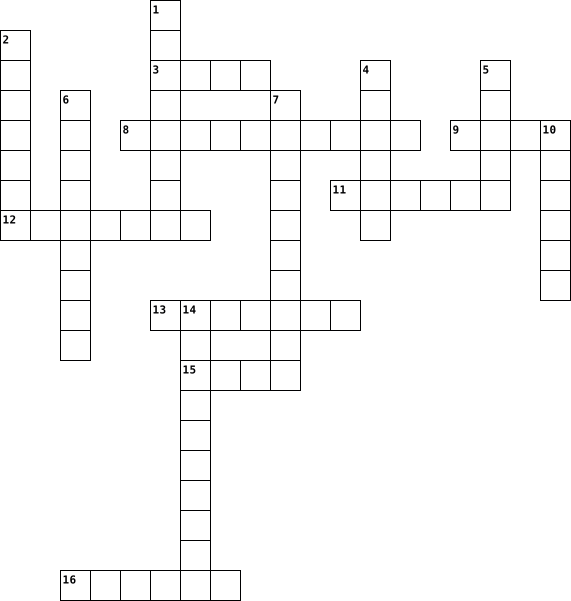
Across
- The opposite site of shiny.
- Are not good conductors of electricity.
- smallest particle of an element
- Another word for shinny.
- pure substance
- This element is known as Hs.
- a measure of how much matter is present in a substance
- We need it to breathe.(element)
Down
- The first element
- Means to break apart easily.
- The 16th element on the periodic table.
- This compound has 2 hydrogen and one oxygen
- When you can flatten an element into a sheet it is considered what?
- Have properties of both metals and non-metals
- The largest group on the Periodic Table of Elements is called.
- the layers of gas surrounding a planet that is held in place by gravity.
16 Clues: pure substance • The first element • Another word for shinny. • The opposite site of shiny. • Means to break apart easily. • This element is known as Hs. • smallest particle of an element • We need it to breathe.(element) • The 16th element on the periodic table. • Are not good conductors of electricity. • This compound has 2 hydrogen and one oxygen • ...
Everyday Chemistry 2022-04-11

Across
- ______ Curie first discovered the radioactive elements polonium and radium
- electron configuration for this element is
- Negatively charged particles
- Smallest particle of an element
- Positively charged particles
- Made of 2 or more elements that are chemically combines
- The study ofthe behavior of matter and its charges and how it interacts with other matter and energy
- _______ is a strong acid that is used in car batteries
Down
- Fe
- _____ rule states when several orbitals are available in a subshell, each orbital gets one electron before the electrons pair up
- Vertical columns in the periodic table, where elements contain similar chemical properties
- useful in batteries since it will release electrons
- Ti
- Ni
- Horizontal rows in the periodic table
- Nuclear particle with no charge
16 Clues: Fe • Ti • Ni • Negatively charged particles • Positively charged particles • Smallest particle of an element • Nuclear particle with no charge • Horizontal rows in the periodic table • electron configuration for this element is • useful in batteries since it will release electrons • _______ is a strong acid that is used in car batteries • ...
Chemistry of Life 2024-11-14

Across
- ____ label shows consumers what nutrients are in the foods you eat
- negatively charged subatomic particle
- _____ action helps water flow against gravity
- water has a lower ____ when in the solid form than n the liquid form
- two or more atoms bonded together
- positively charged subatomic particle
- an example of a fossil fuel
- the term universal _____ means that water will dissolve many different molecules
Down
- the sticking together of like molecules
- the _____ table shows all of the known atoms
- molecule with C-C and C-H bonds
- molecule found in non-living things
- in the nucleus of the atom with the proton
- the first atom found on the periodic table
- the sticking together of different molecules
- smallest unit of matter
16 Clues: smallest unit of matter • an example of a fossil fuel • molecule with C-C and C-H bonds • two or more atoms bonded together • molecule found in non-living things • negatively charged subatomic particle • positively charged subatomic particle • the sticking together of like molecules • in the nucleus of the atom with the proton • the first atom found on the periodic table • ...
Element Crossword 2015-11-17

Across
- Au
- Li
- C
- Fe
- Kr
- a substance that cannot be separated or broken down into simpler substances by chemical means
- Am
- Ag
- Ge
- H
Down
- O
- Pt
- Cl
- Ni
- Cu
- Ne
- Sn
- Hg
- Es
- The person that originally made the periodic table.
- He
21 Clues: O • C • H • Au • Pt • Li • Cl • Ni • Cu • Fe • Ne • Kr • Sn • Hg • Es • Am • Ag • Ge • He • The person that originally made the periodic table. • a substance that cannot be separated or broken down into simpler substances by chemical means
Semiconductor Basics 1 2018-01-01

Across
- The dual of electron.
- An early elemental semiconductor.
- Charge on p-type material.
- A semiconductor made by adding controlled quantities of impurities
- What is generated when a photon with enough energy interacts with a semiconductor.
- Reverse bias _______ current.
- A subatomic particle that is more mobile that its dual.
- Semiconductor made from different elements.
- A semiconductor diode, but not pn-junction.
- Highest energy band.
Down
- Not negative.
- Region of a pn-junction without mobile carriers.
- Undoped, single-crystal semiconductor.
- Element from Group III in the periodic table.
- What is generated when a hole and electron combines in direct semiconductor material.
- An element from Group V in the periodic table.
- An elemental semiconductor and part of the nickname for the valley south of San Francisco Bay area.
- Not pure.
18 Clues: Not pure. • Not negative. • Highest energy band. • The dual of electron. • Charge on p-type material. • Reverse bias _______ current. • An early elemental semiconductor. • Undoped, single-crystal semiconductor. • Semiconductor made from different elements. • A semiconductor diode, but not pn-junction. • Element from Group III in the periodic table. • ...
Atoms 2022-04-04

Across
- To find the atomic mass, ______ the number of protons and neutrons
- Ancient Greek scientist who first studied atoms about 2,000 years ago
- Neutrally charged particle
- Negatively charged particle
- Electron is located ________ the nucleus
- studied atoms after Democritus
- Democritus determined that matter was made of
Down
- Protons and neutrons are located _______ the nucleus
- The scientist who organized the periodic table by atomic number
- The atomic number is the same as the number of ____.
- Smallest part of an element that is still that element
- Positively charged particle
- The center of the atom
- The overall charge of the atom is ______
- Chemical reactions _______ produce new atoms
- Electrons ______ contribue to the mass
- The periodic table lists all of the ________ in the world
- Dalton and Democritus both believed that atoms ________ be split apart
18 Clues: The center of the atom • Neutrally charged particle • Positively charged particle • Negatively charged particle • studied atoms after Democritus • Electrons ______ contribue to the mass • The overall charge of the atom is ______ • Electron is located ________ the nucleus • Chemical reactions _______ produce new atoms • Democritus determined that matter was made of • ...
Chemistry Revison 2024-03-25

Across
- the name for group 17 elements
- the name for group 18 elements
- decreasing this slows down a reaction
- the name of Isaac's older brother
- adding this to a reaction will increase the rate
- when tasting an acid, it should taste ________
- an element that has 18 electrons
- the name of Mr Sahely's dog
Down
- the reactivity of metals ______ down a group
- increasing this speeds up the rate of a reaction
- the street to the south of the college
- a substance that turns universal indicator green
- the name for group 1 metals
- a substance with a pH >7
- the name for the horizontal row on the Periodic Table
- an element that has 6 protons and 6 neutrons
- a group 1 metal in the third period
- the name of the vertical columns on the Periodic Table
18 Clues: a substance with a pH >7 • the name for group 1 metals • the name of Mr Sahely's dog • the name for group 17 elements • the name for group 18 elements • an element that has 18 electrons • the name of Isaac's older brother • a group 1 metal in the third period • decreasing this slows down a reaction • the street to the south of the college • ...
Balancing Equations 2022-12-20

Across
- Gases are what?
- The right side of the periodic table.
- The left side of the periodic table.
- How big something is, is there?
- The right side of the equation?
Down
- What includes reactants and products?
- What do equations need to be?
- The left side of the equation?
- What do elements have?
- What separates the reactants and products?
10 Clues: Gases are what? • What do elements have? • What do equations need to be? • The left side of the equation? • How big something is, is there? • The right side of the equation? • The left side of the periodic table. • What includes reactants and products? • The right side of the periodic table. • What separates the reactants and products?
Elements and that 2021-02-10

Across
- number of atoms in an element
- A long molecule
- The first word in Group zero's nickname
- least reactive group one metal
- lithium + ? --> lithium hydroxide + hydrogen
- most reactive halogen
Down
- The columns in the periodic table
- The rows in the periodic table
- Number of hydrogen atoms in methane
- same number of these in an atom as the protons
10 Clues: A long molecule • most reactive halogen • number of atoms in an element • The rows in the periodic table • least reactive group one metal • The columns in the periodic table • Number of hydrogen atoms in methane • The first word in Group zero's nickname • lithium + ? --> lithium hydroxide + hydrogen • same number of these in an atom as the protons
Ionic Bonding 5 2025-08-16

Across
- A reaction involving both oxidation and reduction
- Substance present at the start of a reaction
- Capacity to do work or cause change
- Substance formed in a chemical reaction
- Horizontal row in the periodic table
Down
- Loss of electrons
- Group 17 elements that form -1 ions
- Gain of electrons
- Process of chemical change
- Vertical column in the periodic table
10 Clues: Loss of electrons • Gain of electrons • Process of chemical change • Group 17 elements that form -1 ions • Capacity to do work or cause change • Horizontal row in the periodic table • Vertical column in the periodic table • Substance formed in a chemical reaction • Substance present at the start of a reaction • A reaction involving both oxidation and reduction
Chemistry Vocab 2020-04-15

Across
- A liquid mixture made of a solute and a solvent
- Anything that takes up space
- The base of all matter
- Everthingon the periodic table is a
- A group that can easily be split apart
- A fraction of a compond
Down
- A substance made of two or more things on the periodic table
- A substance that cannot be separated
- The addition and combination of atoms
- The part inside an atom
- The smallest part of an element
- Electrons on the outside of the atom
12 Clues: The base of all matter • The part inside an atom • A fraction of a compond • Anything that takes up space • The smallest part of an element • Everthingon the periodic table is a • A substance that cannot be separated • Electrons on the outside of the atom • The addition and combination of atoms • A group that can easily be split apart • ...
Efrain - Chemistry 2019-10-17

Across
- substance that is formed as the result of a chemical reaction
- mass- mass of one atom
- property-a substance that is observed when its in a chemical reaction
- A thing that is composed into two or separate elements
- a wide glass container with a flat bottom and an edge for pouring, used in science laboratories
- of definite properties-Chemicals combining in specific amounts
- A substance that can be in solid form from a solution
- rope-one of many forms of a chemical element, for example, coal and graphite
- reactants are the starting materials in a chemical reaction
- a solution is a homogeneous mixture of two or more substances
Down
- Is the particle in the atomic nucleus with a mass
- property-Material does not change
- Mixture that is the same
- Famous for making the periodic table
- A part or aspect of something abstract
- a stable subatomic particle with a charge of negative electricity
- basic -building blocks of ordinary matter
- a stable subatomic particle occurring in all atomic nuclei
- Table-A table of the chemical elements arranged in order of atomic number
19 Clues: mass- mass of one atom • Mixture that is the same • property-Material does not change • Famous for making the periodic table • A part or aspect of something abstract • basic -building blocks of ordinary matter • Is the particle in the atomic nucleus with a mass • A substance that can be in solid form from a solution • A thing that is composed into two or separate elements • ...
The periodic table 2015-10-04

Across
- Potassium
- Titainium
- Iron
- Iridium
- Silver
- Flourine
- Oxygen
Down
- Nitrogen
- Tantalium
- Copper
- Hydrogen
- Gold
- Tin
- Hassium
- Carbon
15 Clues: Tin • Iron • Gold • Copper • Silver • Oxygen • Carbon • Iridium • Hassium • Nitrogen • Hydrogen • Flourine • Potassium • Tantalium • Titainium
RoShiya Periodic Table 2016-12-20

Across
- This is the only nonmetal in group 14.
- This element is close to gold and has the symbol Ag.
- This is the first element in period 2.
- This is the only metalloid in group 13.
- The first element in the periodic table.
- This is the only metalloid in Group 17.
- This element’s symbol is Cu.
Down
- This is the 10th element in the periodic table.
- This is the 82nd element.
- This element is in group 10 and has the symbol Ni.
- This is the only metalloid in Period 3.
- This element has an atomic mass of 35.453.
- This element has the symbol Kr.
- This has the symbol I.
- This element has the atomic mass of 196.97.
15 Clues: This has the symbol I. • This is the 82nd element. • This element’s symbol is Cu. • This element has the symbol Kr. • This is the only nonmetal in group 14. • This is the first element in period 2. • This is the only metalloid in Period 3. • This is the only metalloid in group 13. • This is the only metalloid in Group 17. • The first element in the periodic table. • ...
The Periodic Table 2013-04-01

Across
- used in neon lights
- the only radioactive noble gas that has been named
- used in nuclear power plants (hint: oh no a neutron!)
- used in balloons
- light and strong and is used in airplanes
- we breath ______
Down
- the first element in the boron group
- used in rechargeable batteries
- one of the only two liquids
- the first one
- named by Marie Curie
- used in table salt
- PB is it's symbol
- a deadly liquid that can be found in shark fins
- a shiny, yellowish, expensive metal
15 Clues: the first one • used in balloons • we breath ______ • PB is it's symbol • used in table salt • used in neon lights • named by Marie Curie • one of the only two liquids • used in rechargeable batteries • a shiny, yellowish, expensive metal • the first element in the boron group • light and strong and is used in airplanes • a deadly liquid that can be found in shark fins • ...
Element Periodic Table 2022-05-06

Across
- Bonds that are created by valence electrons
- 3 protons
- a pair of electrons shared by 2 atoms
- the name of the element
- the electrical attraction between a negative ion and a positive ion
- the unequal sharing of electrons between atoms that gives rise to negative and positive regions of electrical charge
- average amount of protons/neutrons
Down
- 12 protons
- the abbreviated letter/s of the element
- the electrons involved in chemical bonds with other elements
- 1 electron
- 7 protons
- chemicals that are made of only carbon and hydrogen
- the amount of protons and electrons
- 2 neutrons
15 Clues: 3 protons • 7 protons • 12 protons • 1 electron • 2 neutrons • the name of the element • average amount of protons/neutrons • the amount of protons and electrons • a pair of electrons shared by 2 atoms • the abbreviated letter/s of the element • Bonds that are created by valence electrons • chemicals that are made of only carbon and hydrogen • ...
The Periodic Table 2022-08-26

Across
- the element in group 6, period 4
- the shorthand of an element's name
- an element with atomic number 6
- a vertical column on the periodic table
- the number of protons in an atom
- the big group of metals in the middle
- an atom that has lost or gained electrons
- this element's symbol is Pb
Down
- this element is a liquid at room temperature
- the elements in group 17 are known as ________
- this element is in group 2, period 5
- a horizontal row on the periodic table
- the name given the the gases in group 18
- this element has an electron configuration of 2,3
- this element is shiny and valueable
15 Clues: this element's symbol is Pb • an element with atomic number 6 • the element in group 6, period 4 • the number of protons in an atom • the shorthand of an element's name • this element is shiny and valueable • this element is in group 2, period 5 • the big group of metals in the middle • a horizontal row on the periodic table • a vertical column on the periodic table • ...
Periodic Table CWP 2023-09-27

Across
- The number the chemical was assigned
- A atom that pairs with the proton
- H2O
- The current type of mass
- Usually a gas and not ductile
- A letter used to identify elements
Down
- Sensitive
- A gas
- Non-sensitive
- Chemicals arranged into groups and rows
- The mass of a element
- Center of a atom
- 2 on the cloud
- A atom that pairs with the neutron
- A solid that is malleable and ductile
15 Clues: H2O • A gas • Sensitive • Non-sensitive • 2 on the cloud • Center of a atom • The mass of a element • The current type of mass • Usually a gas and not ductile • A atom that pairs with the proton • A atom that pairs with the neutron • A letter used to identify elements • The number the chemical was assigned • A solid that is malleable and ductile • Chemicals arranged into groups and rows
Periodic Elements Table 2019-10-28

Across
- Ca
- K
- Ni
- Hg
- H
- Al
- Cu
Down
- C
- Mn
- Zn
- Li
- Pt
- O
- Na
- Fe
15 Clues: C • K • O • H • Mn • Ca • Zn • Li • Pt • Ni • Na • Hg • Al • Fe • Cu
The Periodic Table 2024-05-15

Across
- the sum of the number of neutrons and protons in an atomic nucleus
- an elementary particle with negative charge
- the property of transmitting heat,electricity, or sound
- a chemical element or alloy that is usually a shiny solid
- quantity of protons in the nucleus of an atom of an element
- deterioration in metals from oxidation or chemical action
- capable of being shaped or bent
Down
- atom with same atomic number, different number of neutrons
- the property of an atom that causes it to have weight
- a subatomic particle with zero charge
- the smallest component of an element
- of chemical elements according to atomic number
- a stable particle with positive charge
- the positively charged dense center of an atom
- a representation of something, often on a smaller scale
15 Clues: capable of being shaped or bent • the smallest component of an element • a subatomic particle with zero charge • a stable particle with positive charge • an elementary particle with negative charge • the positively charged dense center of an atom • of chemical elements according to atomic number • the property of an atom that causes it to have weight • ...
The Periodic Table 2024-05-02

Across
- li
- ca
- o
- fe
- c
- p
- s
- ne
- he
Down
- si
- ar
- b
- k
- n
- na
15 Clues: b • k • o • n • c • p • s • si • li • ar • ca • fe • na • ne • he
Periodic Table Crossword 2024-10-07

Across
- Has valence values +4 and +2 and is a transition metal
- Is the heaviest element
- Has atomic number 6
- Has atomic mass 88.906
- Is a diatomic with mass 35.453
- Has atomic symbol Au
- Has symbol TC
Down
- has atomic number 99
- Has valence charges +7, +4, and +2
- Is the first metalloid element.
- Has atomic number 37
- Is the fourth Noble Gas
- Is the start of the Lanthanide series
- Has atomic number 1
- Has atomic mass 15.999
15 Clues: Has symbol TC • Has atomic number 6 • Has atomic number 1 • has atomic number 99 • Has atomic number 37 • Has atomic symbol Au • Has atomic mass 88.906 • Has atomic mass 15.999 • Is the heaviest element • Is the fourth Noble Gas • Is a diatomic with mass 35.453 • Is the first metalloid element. • Has valence charges +7, +4, and +2 • Is the start of the Lanthanide series • ...
The Periodic Table 2025-04-28

Across
- the center particles of an atom
- elements that are usually solid and good conductors of heat and electricity
- a kind of matter made up of a combination of 2 or more elements
- the smallest part of an element that has the same properties of the element
- one or two letters that identifies the name of an element
- each row of the Periodic Table
- also known as Metalloids are elements that have properties of both metals and nonmetals
- the positive particles inside an atom nucleus
- the negative particles inside an atom nucleus
Down
- a pure substance that cannot be separated into a simpler substance
- the columns of a Periodic Table
- elements that are usually poor conductors of heat and electricity
- the number of protons in the nucleus of an atom
- these particles surround the atom nucleus
- a combination of different materials but do not chemically combine to make a new compound
15 Clues: each row of the Periodic Table • the center particles of an atom • the columns of a Periodic Table • these particles surround the atom nucleus • the positive particles inside an atom nucleus • the negative particles inside an atom nucleus • the number of protons in the nucleus of an atom • one or two letters that identifies the name of an element • ...
Periodic Table Crossword 2026-01-12

Across
- element with symbol of K
- element with symbol of Ag
- element with symbol of W
- element with atomic number of 22
- element with atomic number 26
- element with atomic number of 102.906
- element with atomic number of 79
Down
- element with atomic number of 7
- element with symbol of Co
- element with atomic number 3
- element with atomic mass of 118.711
- element with atomic mass of 28.086
- element with atomic mass of 247
- element with atomic mass of 200.59
- element with atomic number 29
15 Clues: element with symbol of K • element with symbol of W • element with symbol of Co • element with symbol of Ag • element with atomic number 3 • element with atomic number 29 • element with atomic number 26 • element with atomic number of 7 • element with atomic mass of 247 • element with atomic number of 22 • element with atomic number of 79 • element with atomic mass of 28.086 • ...
The Periodic Table 2026-04-03

Across
- This element is a nutrient that is commonly obtained through bananas.
- This element is commonly used in the production of wires due to its high conductivity.
- This element is the main one used in fission reactions.
- This element is used to create a very common type of cooking foil.
- This element is combined with oxygen to form water.
- This element was mined very heavily in California.
- This element is a nutrient used to strengthen bones.
Down
- This element is used in the creation of grey-toned jewelry.
- This element is yellow in color and smells like rotten eggs.
- This element is used in the creation of table salt.
- This element is used in the development of pencils.
- This element is a nutrient that a person is missing when they are determined to be anemic.
- This element is a liquid at room temperature.
- This element is what makes balloons rise.
- This element is necessary for humans and animals to be able to breathe.
15 Clues: This element is what makes balloons rise. • This element is a liquid at room temperature. • This element was mined very heavily in California. • This element is used in the creation of table salt. • This element is used in the development of pencils. • This element is combined with oxygen to form water. • This element is a nutrient used to strengthen bones. • ...
Metals & Non-metals 2018-08-27

Across
- a metal in location 30
- an element used in electric wires
- a metal in location 3 in the Periodic Table
- a nonmetal gas that we breathe in
- a metal used to build bridges
- the gas produced in this experiment
Down
- a metal in location 11 in the Periodic Table
- a gas used in store bought birthday balloons
- a solid nonmetal found in all living things
- the only liquid metals
- the only liquid diatomic molecule
- an expensive metal
12 Clues: an expensive metal • a metal in location 30 • the only liquid metals • a metal used to build bridges • an element used in electric wires • the only liquid diatomic molecule • a nonmetal gas that we breathe in • the gas produced in this experiment • a solid nonmetal found in all living things • a metal in location 3 in the Periodic Table • ...
Science Review 2021-10-21

Across
- are very reactive
- whose properties are intermediate between those of metals and solid nonmetals or semiconductors.
- are Neutral
- are a malleability, ductility, and high reflectivity of light.
- are reactive nonmetallic elements that form strongly acidic compounds with hydrogen from which simple salts can be made.
- are any of the gaseous elements helium
Down
- are only change the appearance of a substance, not its chemical composition.
- are a horizontal line in the periodic table
- are when one chemical substance is transformed into one or more different substances
- is a chemical elements arranged in order of atomic number usually in rows so that elements with similar atomic structure
- are each of more than one hundred substances that cannot be chemically interconverted or broken down into simpler substances and are primary constituents of matter.
- are a column in the periodic
- are negative
- are positive
- are an element/substance that is not element
- are very reactive metals
16 Clues: are Neutral • are negative • are positive • are very reactive • are very reactive metals • are a column in the periodic • are any of the gaseous elements helium • are a horizontal line in the periodic table • are an element/substance that is not element • are a malleability, ductility, and high reflectivity of light. • ...
Crossword 2021-02-22

Across
- It is a symbolic representation of all the elements present in a compound.
- It is the smallest unit of matter.
- It is the percentage of an element present in a compound.
- It is a pure substance.
- The measuring system that uses inches, quartz,feet, etc.
- It is a table of all the elements, arranged by their atomic number.
Down
- It is the total atomic mass present in a compound.
- 6.022x10^23
- He is the scientist who made "6.022x10^23"
- One unit of this is equal to Avogadro's number.
- It is the average mass of an atom found in the periodic table.
- It is the first element in the periodic table.
- It is a substance composed of two or more chemical elements.
- It is the simplest whole number ratio of a compound.
- The measuring system that uses meters, grams, liters, etc.
- It is a method of converting a unit to another unit in an organized manner.
- It is the simplest whole-number multiple of a compound
17 Clues: 6.022x10^23 • It is a pure substance. • It is the smallest unit of matter. • He is the scientist who made "6.022x10^23" • It is the first element in the periodic table. • One unit of this is equal to Avogadro's number. • It is the total atomic mass present in a compound. • It is the simplest whole number ratio of a compound. • ...
atoms 2023-09-21

Across
- What is matter made of
- ---------- is made up atoms
- negatively charged sub-atomic particles
- how many proterons does number 7 on the periodic table
- atoms are the -------- unit of matter
- anything that has ---- takes up space
Down
- positively charged sub-atomic particles
- there are ----- parts to an atom
- non-charged sub-atomic particles
- the periodic table has 118 --------
10 Clues: What is matter made of • ---------- is made up atoms • there are ----- parts to an atom • non-charged sub-atomic particles • the periodic table has 118 -------- • atoms are the -------- unit of matter • anything that has ---- takes up space • positively charged sub-atomic particles • negatively charged sub-atomic particles • ...
mine heheehehhehh 2025-10-29

Across
- he is britsh
- it is a colliod
- its white it could be a ghoul
- _____seven
- one in spanish
Down
- there are some on the wall
- a dwarve in the hobbit kinda sounds like TH o the periodic table
- bonds things together comes from a chicken
- RA an the periodic table
- there are two z"s in this word
10 Clues: _____seven • he is britsh • one in spanish • it is a colliod • RA an the periodic table • there are some on the wall • its white it could be a ghoul • there are two z"s in this word • bonds things together comes from a chicken • a dwarve in the hobbit kinda sounds like TH o the periodic table
Physics Assignment 2017-10-22

Across
- The isotope of hydrogen that starts with a 't'
- Smallest particle to exist
- First element on periodic table
- An isotope of hydrogen that starts with a 'd'
- A particle in the nucleus that has a neutral charge
- Power derived from heat or a reaction
- A sphere of plasma help by its own gravity
Down
- Another word for splitting
- When particles come together to form something is called
- Emission of energy waves or particles
- The time taken for radioactivity to half itself
- A particle in the nucleus that has a negative charge
- To Decompose
- Second element on periodic table
- A particle in the nucleus that has a postitive charge
15 Clues: To Decompose • Another word for splitting • Smallest particle to exist • First element on periodic table • Second element on periodic table • Emission of energy waves or particles • Power derived from heat or a reaction • A sphere of plasma help by its own gravity • An isotope of hydrogen that starts with a 'd' • The isotope of hydrogen that starts with a 't' • ...
MS - PHS - Review 1 2022-10-28

Across
- number of protons and neutrons in an atom
- positive charged subatomic particle
- added or taken away during a phase change
- type of change where bonds break and new form
- number of electrons the first energy shell holds
- stuff(atoms) an object is made of
Down
- mass per unit volume of a substance
- vertical columns of the periodic table
- electrons in the outer shell of atom
- bond formed by atoms sharing electrons
- phase of matter with no fixed volume or shape
- compound from one or more elements sharing e-
- bond formed between atoms by gaining or losing e-
- horizontal rows of the periodic table
- ability to be hammered into thin sheets
15 Clues: stuff(atoms) an object is made of • mass per unit volume of a substance • positive charged subatomic particle • electrons in the outer shell of atom • horizontal rows of the periodic table • vertical columns of the periodic table • bond formed by atoms sharing electrons • ability to be hammered into thin sheets • number of protons and neutrons in an atom • ...
science 2020-11-27

Across
- the temperature at which the element changes states due to heat
- the things that make elements different, also relates to real state
- the element that we inhale
- its not liquid, its not solid, its _____
- when two things are put together its a _______
- the thing that matter is made of
- its not a liquid, or a gas, its ______
Down
- the element that is B
- the thing that all things are made of
- the ______ table
- the things on the periodic table
- the element that has a part in ______ monoxide
- this thing sits on the shell of the atom
- the family of elements called other _____
- its not solid, its not gases, its ________
15 Clues: the ______ table • the element that is B • the element that we inhale • the things on the periodic table • the thing that matter is made of • the thing that all things are made of • its not a liquid, or a gas, its ______ • this thing sits on the shell of the atom • its not liquid, its not solid, its _____ • the family of elements called other _____ • ...
Yeah, Science 2025-05-22

Across
- The highest waves on the EM spectrum
- Return something without absorbing any of it
- The short version is called Au on the Periodic table
- The sticking together of the same substance
- The lowest waves on the EM spectrum
- A celestial object composed of dust, ice, etc
- The final stage of an average star
Down
- The way heat moves through liquids and gases
- The first element on the periodic table
- The brain of the cell
- The only visible waves that humans can see
- The power house of the cell
- A single molecule of DNA that carries the genetic info
- The organelle that produces proteins
- The sack of the cell
15 Clues: The sack of the cell • The brain of the cell • The power house of the cell • The final stage of an average star • The lowest waves on the EM spectrum • The highest waves on the EM spectrum • The organelle that produces proteins • The first element on the periodic table • The only visible waves that humans can see • The sticking together of the same substance • ...
Chemistry Final Project 2020-12-13

Across
- ______ change: Changes to the chemical makeup of something
- Nuclear _____: when a particle splits and causes a release of energy
- Nuclear _____: when particles combine and cause a release of energy
- type of decay that emits a beta particle
- ____ number: sum of protons and neutrons
- ______ change: Changes to something we can tell with our senses
- type of decay that emits an alpha particle
- Different versions of atoms in an element
- State of matter that has a definite volume but no shape
Down
- Ni on periodic table
- Particle with negative charge
- State of matter that has a definite shape and volume
- State of matter that doesn’t have volume or shape
- Columns on a periodic table
- 1 or 2 letters that represents the element
- type of decay that emits gamma radiation
- Particle with positive charge
- ____ Number: number of protons in an element
- Particle with neutral charge
19 Clues: Ni on periodic table • Columns on a periodic table • Particle with neutral charge • Particle with negative charge • Particle with positive charge • type of decay that emits gamma radiation • type of decay that emits a beta particle • ____ number: sum of protons and neutrons • Different versions of atoms in an element • 1 or 2 letters that represents the element • ...
semester review 2018-12-17

Across
- atoms that are in the same ________ will behave similarly
- a tendency to do nothing or remain unchanged (1st law)
- electron determines the atoms reactivity
- an object that is acted on by unbalanced forces will ___________________________.
- _________= distance / time
- _________= mass / volume
- particle with no charge
- gasses this group on the periodic table has a full outer shell
- for every action, there is an equal and opposite reaction. Newtons __________ law.
Down
- positively charged particle
- H2O is an example of a chemical ____________
- the speed of something in a given direction
- this group on the periodic table has 7 valence electrons
- warmer air rises because it is _______ dense than cooler air
- negatively charged particle that orbits the nucleus
- color change is an example of a _____________ reaction
- Newtons __________ law. F=ma
- a push or a pull on an object
- warm ocean currents originate here
19 Clues: particle with no charge • _________= mass / volume • _________= distance / time • positively charged particle • Newtons __________ law. F=ma • a push or a pull on an object • warm ocean currents originate here • electron determines the atoms reactivity • the speed of something in a given direction • H2O is an example of a chemical ____________ • ...
#1 2024-10-01

Across
- __________ number that represents the amount of protons in an atom
- the sharing of valence electrons
- when an electron “jumps” and falls back towards the nucleus it gives off _______
- the size of an atom ______________ as you go from left to right
- the scientist who created the periodic table (he has element 101 named after him!)
- a negative subatomic particle
- a neutral subatomic particle
- 78% of the elements on the periodic table
- the simplest form of matter that represents an element
- the ability for an element to attract an electron
Down
- the first ring holds ______ electrons
- electrons on the outermost ring
- another word for shiny
- there are 118 total
- the center of the atom that holds protons and neutrons
- a positive subatomic particle
- elements that can act both like a metal or nonmetal
- when two or more atoms bond
- the scientist who uses rings (energy levels) to model his atom
19 Clues: there are 118 total • another word for shiny • when two or more atoms bond • a neutral subatomic particle • a positive subatomic particle • a negative subatomic particle • electrons on the outermost ring • the sharing of valence electrons • the first ring holds ______ electrons • 78% of the elements on the periodic table • the ability for an element to attract an electron • ...
Periodic Table Crossword Puzzle 2021-05-03

Across
- metal
- helium
- iron
- weight
- positive charge
- number of protons
- who created the periodic table?
- sodium
- collection of protons
- baking soda
- electric charge
Down
- group of atoms bonded together
- poles
- gasses
- a bunch of elements
- neutral charge
- team
- building blocks of matter
- Sn
- negative charge
20 Clues: Sn • iron • team • metal • poles • gasses • helium • weight • sodium • baking soda • neutral charge • positive charge • negative charge • electric charge • number of protons • a bunch of elements • collection of protons • building blocks of matter • group of atoms bonded together • who created the periodic table?
Elements and the periodic table 2024-10-14

Across
- Elements in the same group have similar ____
- chart of elements arranged according to their properties
- the number of protons in the nucleus of each atom's nucleus
- a row in the periodic table
- the letter you find in the periodic table, indicates the element's ____
Down
- a column in the periodic table
- what identifies the atomic number of an element
- shows chemical symbol, atomic number, and atomic mass
8 Clues: a row in the periodic table • a column in the periodic table • Elements in the same group have similar ____ • what identifies the atomic number of an element • shows chemical symbol, atomic number, and atomic mass • chart of elements arranged according to their properties • the number of protons in the nucleus of each atom's nucleus • ...
Starter - Macromolecules WS Lesson 3 2018-09-20

Across
- means 'building up/on' in German [6]
- Russian chemist who arranged the Periodic table [8]
- becomes rust if mixed with oxygen and water [4]
- Pauli's _______ principle [9]
Down
- all matter is made from this [4]
- we used 'Inorganic Tofu' to solve the electron arrangement [anag][13]
- negative charged fundamental particle [8]
- row in the periodic table [6]
- something in the sAga shone [cryptic] [6]
- element found in molecular form in table salt, chemical symbol Na [6]
10 Clues: row in the periodic table [6] • Pauli's _______ principle [9] • all matter is made from this [4] • means 'building up/on' in German [6] • negative charged fundamental particle [8] • something in the sAga shone [cryptic] [6] • becomes rust if mixed with oxygen and water [4] • Russian chemist who arranged the Periodic table [8] • ...
Physical Science Crossword: Sections 4A, 4B and 4C Gayeon Kim/Nov 14, 2024/PS 211 B 2024-11-15

Across
- The elements in Group 1 and they have one valence electron
- Groups 13–16 contain metals, nonmetals, and metalloids.
- Consists of elements from Group 17 and these elements each have seven valence electrons.
- These elements typically have four or more valence electrons and do not exhibit the general properties of metals.
- Set of elements in the same column on the periodic table
- A table of the chemical elements arranged in a way that displays their periodic properties in relationship to their atomic numbers.
Down
- These elements have characteristics between those of metals and nonmetals and located along the stairstep line and are also called semiconductors.
- The electrons in the outermost energy level of a neutral atom.
- The two rows of elements shown below the main body on most periodic tables
- A row on the periodic table
10 Clues: A row on the periodic table • Groups 13–16 contain metals, nonmetals, and metalloids. • Set of elements in the same column on the periodic table • The elements in Group 1 and they have one valence electron • The electrons in the outermost energy level of a neutral atom. • The two rows of elements shown below the main body on most periodic tables • ...
Atoms and Elements 2025-07-09

Across
- Scientific name heard in chemistry class
- Sunblock metal
- Pb, in chemistry
- Table entry?
- Nonreactive
- Tiny negative particle
- Neutral particle in an atom
- Radioactive gas
- Molecule part
Down
- Metal that gave its name to a shade of blue
- Outer electron count
- Atomic variant
- Fe on the periodic table
- Gas in a dinner sign
- Noble gas in bulbs
- Sn, to a chemist
- Positive particle in the nucleus
- Type of metal group
18 Clues: Nonreactive • Table entry? • Molecule part • Atomic variant • Sunblock metal • Radioactive gas • Pb, in chemistry • Sn, to a chemist • Noble gas in bulbs • Type of metal group • Outer electron count • Gas in a dinner sign • Tiny negative particle • Fe on the periodic table • Neutral particle in an atom • Positive particle in the nucleus • Scientific name heard in chemistry class • ...
PS 3 and 4 Vocabulary 2022-10-06

Across
- found on left side of stairstep on periodic table
- indicates number of protons in an atom
- letters that represent elements
- negatively charged particles around the nucleus
- indicates elements with same # of valence electrons
Down
- indicates total number of protons/neutrons
- positively charged particle in an atom's nucleus
- found on right side of stairstep on PT
- horizontal row on the periodic table
- same # of protons and different # of neutrons
- found along the stairstep line of PT
- neutral particle in the nucleus of an atom
12 Clues: letters that represent elements • horizontal row on the periodic table • found along the stairstep line of PT • found on right side of stairstep on PT • indicates number of protons in an atom • indicates total number of protons/neutrons • neutral particle in the nucleus of an atom • same # of protons and different # of neutrons • ...
Jordan Lipscomb-Physical Science 2019-10-22

Across
- water droplets get bigger and bigger
- the number under the element symbol; total of protons and neutrons in a element nucleus
- a bunch of stuff put together
- smallest thing
- something that changes because of a chemical change
Down
- a substance found on the periodic table
- something we can observe with our 5 senses
- the result or end of a process
- the same kind
- the person who made the periodic table
- what is made by mixing things together
- substance that changes
12 Clues: the same kind • smallest thing • substance that changes • a bunch of stuff put together • the result or end of a process • water droplets get bigger and bigger • the person who made the periodic table • what is made by mixing things together • a substance found on the periodic table • something we can observe with our 5 senses • ...
chemistry vocabulary 2021-04-20

Across
- number of protons and neutrons in the atom
- tells us the number of protons in the atom
- horizontal rows on the Periodic Table
- describes a material that is bendable
- atoms of the same element with different neutrons
- an element used in electrical circuits
- electrons in the outermost shell
- category of atoms with the same atomicnumber
Down
- identifies which element the atom is
- contains protons and neutrons and electrons
- the mass of the atom
- smallest unit of matter
- vertical columns on the Periodic Table
- area around where electrons orbits
- anything that has mass and takes up space
15 Clues: the mass of the atom • smallest unit of matter • electrons in the outermost shell • area around where electrons orbits • identifies which element the atom is • horizontal rows on the Periodic Table • describes a material that is bendable • vertical columns on the Periodic Table • an element used in electrical circuits • anything that has mass and takes up space • ...
Dinah & Aubry 2024-02-14

Across
- all the know elements called the ____
- energy stor3d between the bonds between atoms of matter
- energy that has to do with motion or position
- energy carried by light waves
- the ability to do work
- found on the right side of the periodic table
Down
- energy carried by sound waves
- energy associated with temperature of an object
- energy stored within the nucleus of an atom
- are found in a group 18 of the periodic table
- a type of atom
- a base building block of matter
12 Clues: a type of atom • the ability to do work • energy carried by sound waves • energy carried by light waves • a base building block of matter • all the know elements called the ____ • energy stored within the nucleus of an atom • energy that has to do with motion or position • are found in a group 18 of the periodic table • found on the right side of the periodic table • ...
Dinah & Aubry 2024-02-14

Across
- all the know elements called the ____
- energy stor3d between the bonds between atoms of matter
- energy that has to do with motion or position
- energy carried by light waves
- the ability to do work
- found on the right side of the periodic table
Down
- energy carried by sound waves
- energy associated with temperature of an object
- energy stored within the nucleus of an atom
- are found in a group 18 of the periodic table
- a type of atom
- a base building block of matter
12 Clues: a type of atom • the ability to do work • energy carried by sound waves • energy carried by light waves • a base building block of matter • all the know elements called the ____ • energy stored within the nucleus of an atom • energy that has to do with motion or position • are found in a group 18 of the periodic table • found on the right side of the periodic table • ...
Layers of the earth 2025-12-09

Across
- Name Nickel on he periodic table.
- The reason the cTectonic plates to the center.
- this plate type is the least dense and has granite.
- S-waves can't travel through this layer.
- this type of plate is denser and has basalt.
- The name for iron on the periodic table.
- these waves can't travel through liquid.
Down
- the densest layer, and in the center.
- these waves can travel through anything.
- What makes earthquakes.
- thickist layer and is semi-molten.
- least dense layer and on the outside.
12 Clues: What makes earthquakes. • Name Nickel on he periodic table. • thickist layer and is semi-molten. • the densest layer, and in the center. • least dense layer and on the outside. • these waves can travel through anything. • S-waves can't travel through this layer. • The name for iron on the periodic table. • these waves can't travel through liquid. • ...
THE PERIODIC TABLE 2020-04-22

Across
- A________ m______ is other name for Group 1 elements.
- The other name for the Group 8 gases is N_____ g______.
- A_______ m_____ n_______ is the total number of protons and neutrons.
- M_______ can be found on the left-hand side of the Periodic table.
- These is referring to the vertical columns that show how many outer electrons each atom has.
- N____ m_____ can be found on the right-hand side of the Periodic table.
- M__________ are elements which lies between the metals and the non-metals which display some properties of both.
- configuration, E_______ c________ is the arrangement of electrons into shells for an atom.
- P__________ n_____ is the other name for atomic number.
Down
- The Group 7 elements are also known as H_______.
- The other name for Group 2 elements is a_______ e____ m____.
- N________ n_______ is also known as atomic mass number.
- The number of electrons in the last shell is known as v_________ e_________.
- A______ n_______ is the number of protons found in the nucleus of every atom of that element.
- P________ is referring to the horizontal rows that show the number of shells of electrons an atom has.
15 Clues: The Group 7 elements are also known as H_______. • A________ m______ is other name for Group 1 elements. • The other name for the Group 8 gases is N_____ g______. • N________ n_______ is also known as atomic mass number. • P__________ n_____ is the other name for atomic number. • The other name for Group 2 elements is a_______ e____ m____. • ...
Periodic Table Puzzle 2021-10-01

Across
- atomic mass 107.868
- symbol is Fe
- atomic number 3
- atomic number 11
- symbol is Au
- atomic number 54
Down
- atomic number 5
- atomic number 29
- atomic mass 54.938
- atomic mass 47.867
- symbol is Si
- atomic number 1
- symbol is Mg
- symbol is Sn
- atomic mass 15.999
15 Clues: symbol is Si • symbol is Fe • symbol is Mg • symbol is Au • symbol is Sn • atomic number 5 • atomic number 1 • atomic number 3 • atomic number 29 • atomic number 11 • atomic number 54 • atomic mass 54.938 • atomic mass 47.867 • atomic mass 15.999 • atomic mass 107.868
Periodic Table Review 2022-02-23

Across
- the nonmetal in period two that prefers to become a -2 ion
- the alkaline earth metal in period three
- has six valence electrons and three electron shells
- the element with the largest atomic radius
- the transition metal with two more protons than calcium
- the only nonmetal on the left side of the periodic table
- the only metalloid in period two
- the alkali metal in row five
Down
- the element with an atomic number two less than scandium
- the transition metal in period five, family 11
- the most electronegative element
- has very similar reactivity to carbon and has three electron shells
- the element with two electron orbitals that has similar reactivity to phosphorous
- the noble gas with 36 protons
- the element with two electron shells that prefers to become a +2 ion
15 Clues: the alkali metal in row five • the noble gas with 36 protons • the most electronegative element • the only metalloid in period two • the alkaline earth metal in period three • the element with the largest atomic radius • the transition metal in period five, family 11 • has six valence electrons and three electron shells • ...
The Periodic Table 2013-01-13

Across
- Forty-seven
- One
- Sixteen
- Seventy-five
- Nineteen
- Seventy-four
- Thirty-five
- Eighty-two
- Fifty-three
Down
- Eighty
- Three
- Twelve
- Six
- Twenty-two
- Thirty-three
15 Clues: Six • One • Three • Eighty • Twelve • Sixteen • Nineteen • Twenty-two • Eighty-two • Forty-seven • Thirty-five • Fifty-three • Seventy-five • Seventy-four • Thirty-three
THE PERIODIC TABLE 2013-05-06

Across
- I have 20 protons.
- used in advertising sign boards
- am not really an metal, but since I have only 1 electron I behave like them.
- I make up 78% of the air and am found in the 5th group.
- the reactivity of metals _____________ as we go down the group
- I am the first element in the fourth period used in making fertilizer.
- I am the only element in the halide family that is a liquid.
- metals _______ electrons to become stable
Down
- metals The name given for group 1
- I am a noble gas with 2 electrons.
- the most reactive halogen
- I am a gas with 8 protons and 8 neutrons.
- Reactivity ___________ as we go down the group 7
- noble gases have _______ electrons in their outer shell except for helium
- I am the head of the carbon family known as the “basis of life”.with atomic number of 6
15 Clues: I have 20 protons. • the most reactive halogen • used in advertising sign boards • metals The name given for group 1 • I am a noble gas with 2 electrons. • I am a gas with 8 protons and 8 neutrons. • metals _______ electrons to become stable • Reactivity ___________ as we go down the group 7 • I make up 78% of the air and am found in the 5th group. • ...
Periodic Table Crossword 2015-09-23

Across
- My Atomic Mass is 6.941
- My symbol is "Na"
- I was discovered by Daniel Rutherford
- My nickname is "The Element of Life
- My atomic mass is 18.998
- I am used to fill up balloons
- I was discovered in 1755
- The first element in the periodic table
- My symbol is "B"
Down
- I am the 3rd most abundant element in the Earth's crust
- My Atomic number is 14
- I was discovered in 1898
- I am used to make spacecraft, missiles, aircraft
- I am what you breathe
- My Atomic number is 15
15 Clues: My symbol is "B" • My symbol is "Na" • I am what you breathe • My Atomic number is 14 • My Atomic number is 15 • My Atomic Mass is 6.941 • I was discovered in 1898 • My atomic mass is 18.998 • I was discovered in 1755 • I am used to fill up balloons • My nickname is "The Element of Life • I was discovered by Daniel Rutherford • The first element in the periodic table • ...
The Periodic Table 2023-02-24

Across
- I am a Noble Gas with 2 valence electrons
- Not good conductors, low density, dull
- Elements in the same ________ have the same amount of valence electrons
- This group has 2 valence electrons
- The ______ number corresponds to the amount of orbitals (energy levels) an element has
- _________ are organized into rows
- Groups are also called _______
Down
- I am a Noble Gas in the 5th period
- Have properties of both metals and nonmetals
- This group has the maximum amount of valence electrons
- This group has 1 valence electron
- _________ are organized into columns
- Elements in the same _______ behave similarly
- I am in the 1st group and the 3rd period
- This group has 7 valence electrons
- Good conductors, shiny, dense
16 Clues: Good conductors, shiny, dense • Groups are also called _______ • This group has 1 valence electron • _________ are organized into rows • I am a Noble Gas in the 5th period • This group has 2 valence electrons • This group has 7 valence electrons • _________ are organized into columns • Not good conductors, low density, dull • I am in the 1st group and the 3rd period • ...
The Periodic Table 2022-08-26

Across
- the element in group 6, period 4
- the shorthand of an element's name
- an element with atomic number 6
- a vertical column on the periodic table
- the number of protons in an atom
- the big group of metals in the middle
- an atom that has lost or gained electrons
- this element's symbol is Pb
Down
- this element is a liquid at room temperature
- the elements in group 17 are known as ______
- this element is in group 2, period 5
- a horizontal row on the periodic table
- the name given the the gases in group 18
- this element's electron configuration is 2,3
- this element is shiny and valueable
15 Clues: this element's symbol is Pb • an element with atomic number 6 • the element in group 6, period 4 • the number of protons in an atom • the shorthand of an element's name • this element is shiny and valueable • this element is in group 2, period 5 • the big group of metals in the middle • a horizontal row on the periodic table • a vertical column on the periodic table • ...
The Periodic Table 2022-08-18

Across
- the degree to which an element tends to gain electrons and form negative ions in chemical reactions
- rows of the elements
- columns of the elements
- representations expressed by symbols
- a well known chemical elements best used as semiconductor
- the series of the 15 metal and radioactive elements starting from actinium to lawrencium
- orbital set surrounding the atom's core
- a mark or character used as a conventional representation of something
Down
- an arrangement of parts or elements in a particular form
- the quantity of matter which a body contains
- non-reactive gas chemical often used in fluorescence lights
- most reactive groups of metals
- attribute, quality, or characteristic
- elements that sit between metals and nonmetals
- the positively charged central core
15 Clues: rows of the elements • columns of the elements • most reactive groups of metals • the positively charged central core • representations expressed by symbols • attribute, quality, or characteristic • orbital set surrounding the atom's core • the quantity of matter which a body contains • elements that sit between metals and nonmetals • ...
Periodic Table Crossword 2023-05-02

Across
- The name of the element with the atomic number 20.
- The name of the element with the atomic number 3.
- The larger two sub-atomic particles (they are positively charged and neutral).
- Matter made up of only one type of atom.
- The quantity of matter contained in an element (it's weight).
- The table that classifies elements.
- Elements in the same group have these in common.
Down
- The smallest of the sub-atomic particles (determines which group its in).
- The symbol for this element is "Ar".
- The name of columns on the periodic table.
- The far right hand group that contains the special, non-reactive elements.
- The name for the two letter code each element has.
- The name of the element with the atomic number 6.
- The name of rows on the periodic table.
- The symbol for this element is "Si".
15 Clues: The table that classifies elements. • The symbol for this element is "Ar". • The symbol for this element is "Si". • The name of rows on the periodic table. • Matter made up of only one type of atom. • The name of columns on the periodic table. • Elements in the same group have these in common. • The name of the element with the atomic number 3. • ...
Periodic table crossword 2025-03-21

Across
- Chemical symbol of "He"
- Chemical symbol of "O"
- Heavy metal with the symbol "Pb"
- A yellow element used in jewelry
- Chemical symbol of "C"
- Chemical symbol of "Na"
- The gas that makes up most of the atmosphere
- Chemical symbol of "Fe"
- The element with the symbol "Hg"
Down
- Chemical symbol of "Ag"
- A noble gas with the symbol "Ne"
- Chemical symbol of "Cl"
- Most abundant element in Earth's crust
- The symbol "Al" represents this metal
- The first element in the Periodic Table
15 Clues: Chemical symbol of "O" • Chemical symbol of "C" • Chemical symbol of "Ag" • Chemical symbol of "He" • Chemical symbol of "Cl" • Chemical symbol of "Na" • Chemical symbol of "Fe" • A noble gas with the symbol "Ne" • Heavy metal with the symbol "Pb" • A yellow element used in jewelry • The element with the symbol "Hg" • The symbol "Al" represents this metal • ...
Periodic Table Crossword 2026-04-05

Across
- Backbone for organic life
- Mineral that is highly concentrated in bananas
- Atomic number 50
- Halogen often used as an antiseptic
- Used in thermometers
- Most abundant element in the universe
- Smells like rotten eggs
- Often used as a dietary supplement and is one of the lightest metals
Down
- Highly toxic metalloid commonly used in rat poison
- Extremely lightweight and malleable
- Makes up 2/3 of human body
- used in lighting and lasers
- Used in nuclear fission
- Lightest Noble gas
- Highly valued, malleable, and primarily used in jewelry
15 Clues: Atomic number 50 • Lightest Noble gas • Used in thermometers • Used in nuclear fission • Smells like rotten eggs • Backbone for organic life • Makes up 2/3 of human body • used in lighting and lasers • Extremely lightweight and malleable • Halogen often used as an antiseptic • Most abundant element in the universe • Mineral that is highly concentrated in bananas • ...
Bonds, Elements & Periodic Table by Parys Smith 2022-05-26

Across
- Radiation- Radio waves, microwaves, infrared waves, visible light, ultraviolet waves, x-rays, and gamma rays
- ions- Consists of a single atom with a charge resulting from the loss or gain of one or more valence electrons
- ions- Compounds of more than one atom, acts as a unit, and carries a charge
- Bonds- Compounds that are held together by the sharing of electrons
- -a mix of metal and non-metal
- Covalent- A covalent bond between atoms in which the electrons are shared unequally
- Theory - The repulsion between electron pairs causes molecular shapes to adjust so that valence electron pairs stay as far as possible
- Gases- Group 8A Also called inert gases because they rarely take part in reactions
- Bonds- The forces of attraction between the free floating valence electrons an the positively charged metal ions; These bonds hold metals together
Down
- - the vertical rows on the periodic table
- - The ability of atoms of an element to attract electrons when the atoms is in a compound
- -a column of elements in the periodic table of the chemical elements (vertical column)
- Covalent Bonds- Two atoms held together by sharing three pairs of electrons
- -bad conductors of heat and electricity; Brittle; low luster (Dull)
- Covalent Bond- One in which one atom contributes both electrons
- Metals - Group IA
- Numbers- The number of ions of opposite charge that surround the ion in a crystal
- - horizontal Rows
- Earth Metals- Six chemical elements in group 2 of the periodic table
- Molecule- Are attracted to another
20 Clues: Metals - Group IA • - horizontal Rows • Molecule- Are attracted to another • -a mix of metal and non-metal • - the vertical rows on the periodic table • Covalent Bond- One in which one atom contributes both electrons • Bonds- Compounds that are held together by the sharing of electrons • ...
Science Review 2021-10-21

Across
- are very reactive
- whose properties are intermediate between those of metals and solid nonmetals or semiconductors.
- are Neutral
- are a malleability, ductility, and high reflectivity of light.
- are reactive nonmetallic elements that form strongly acidic compounds with hydrogen from which simple salts can be made.
- are any of the gaseous elements helium
Down
- are only change the appearance of a substance, not its chemical composition.
- are a horizontal line in the periodic table
- are when one chemical substance is transformed into one or more different substances
- is a chemical elements arranged in order of atomic number usually in rows so that elements with similar atomic structure
- are each of more than one hundred substances that cannot be chemically interconverted or broken down into simpler substances and are primary constituents of matter.
- are a column in the periodic
- are negative
- are positive
- are an element/substance that is not element
- are very reactive metals
16 Clues: are Neutral • are negative • are positive • are very reactive • are very reactive metals • are a column in the periodic • are any of the gaseous elements helium • are a horizontal line in the periodic table • are an element/substance that is not element • are a malleability, ductility, and high reflectivity of light. • ...
Periodic Table Crossword 2022-05-27

Across
- is an alkali metal located in the first group or column of the periodic table.
- is a non-metal element that is a gas at room temperature.
- chemical element, a low-melting metal of Group 12 of the periodic table.
- is a lightweight silvery-white metal of main Group 13 of the periodic table.
Down
- is a clean fuel that produces only water when consumed in a fuel cell.
- is a colorless gaseous chemical element found in tiny amounts in the air and used in electric lights.
- is a chemical element like hydrogen-oxygen lead or any of the others in the periodic table.
- is a salt of hydriodic acid
8 Clues: is a salt of hydriodic acid • is a non-metal element that is a gas at room temperature. • is a clean fuel that produces only water when consumed in a fuel cell. • chemical element, a low-melting metal of Group 12 of the periodic table. • is a lightweight silvery-white metal of main Group 13 of the periodic table. • ...
Week 6 Vocab Aiden Y 2022-09-19

Across
- weighted average of the masses of the occurring isotopes
- A set of elements on increasing atomic mass
Down
- elements that have some line on the periodic table
- An Abbreviation for the element's name
- elements that are shiny and conduct heat and electricity well
- poor conductors of heat and electricity
- A vertical column of elements on the periodic table
- Each horizontal row of elements on the periodic table
8 Clues: An Abbreviation for the element's name • poor conductors of heat and electricity • A set of elements on increasing atomic mass • elements that have some line on the periodic table • A vertical column of elements on the periodic table • Each horizontal row of elements on the periodic table • weighted average of the masses of the occurring isotopes • ...
Periodic Table 2020-11-06

Across
- Has a trunk
- Likes to chase mice
- 3rd element of the periodic table
- Man's best friend
Down
- Large marsupial
- Needed to fill a
- Flying mammal
- 1st Element of the periodic table
8 Clues: Has a trunk • Flying mammal • Large marsupial • Needed to fill a • Man's best friend • Likes to chase mice • 3rd element of the periodic table • 1st Element of the periodic table
Periodic Table 2023-02-16

Across
- Used to make colorful lights
- Diamond in the rough
- You can't live without it
- under Oxygen
- Over Barium
Down
- under Radon
- 84th number on periodic table
- 19th on the periodic table
8 Clues: under Radon • Over Barium • under Oxygen • Diamond in the rough • You can't live without it • 19th on the periodic table • Used to make colorful lights • 84th number on periodic table
Unit 2 Crossword 2021-10-29

Across
- holds the nucleus together
- Shiny, malleable and ductile elements
- Type of elements that aren't metals nor nonmetals
- The number of protons is equal to the atomic ___
- found outside of the nucleus
- the columns of the periodic table
- Type of elements that are bad conductors
Down
- Electrons in their normal place are at the ___ state
- the rows of the periodic table
- positively charged subatomic particle
- the electrons found on the outer shell
- All atoms of the same ____ have the same number of protons
- Same number of protons, different number of neutrons
- Electrons in a higher energy level are ___
- made up of protons and neutrons
- The atomic ___ is equal to the number of protons and neutrons
16 Clues: holds the nucleus together • found outside of the nucleus • the rows of the periodic table • made up of protons and neutrons • the columns of the periodic table • positively charged subatomic particle • Shiny, malleable and ductile elements • the electrons found on the outer shell • Type of elements that are bad conductors • Electrons in a higher energy level are ___ • ...
Everyday Chemistry 2022-04-11

Across
- electron configuration for this element is
- useful in batteries since it will release electrons
- Made of 2 or more elements that are chemically combines
- _______ is a strong acid that is used in car batteries
- Negatively charged particles
- Positively charged particles
- Smallest particle of an element
- Nuclear particle with no charge
Down
- Horizontal rows in the periodic table
- _____ rule states when several orbitals are available in a subshell, each orbital gets one electron before the electrons pair up
- The study ofthe behavior of matter and its charges and how it interacts with other matter and energy
- Ni
- Vertical columns in the periodic table, where elements contain similar chemical properties
- ______ Curie first discovered the radioactive elements polonium and radium
- Fe
- Ti
16 Clues: Ni • Fe • Ti • Negatively charged particles • Positively charged particles • Smallest particle of an element • Nuclear particle with no charge • Horizontal rows in the periodic table • electron configuration for this element is • useful in batteries since it will release electrons • _______ is a strong acid that is used in car batteries • ...
Trends 2025-02-24

Across
- Used to pump up balloons. Non-Metal.
- The name of a coin we use.
- It is the heaviest of stable halogens.
- A non-metal in the third period. (Used in eggs)
- A non-metal you inhale and exhale.
- It is the most common element on earth by mass (fe)
- Alkali metal with an atomic number of 3.
- One of the softest elements. Is a metal on the periodic table.
Down
- Atomic number of 25. Gray-white metal.
- A non-metal in group 17.
- Used in Pencils (Metal)
- A metal in the 8th group.
- Highly radioactive number 105 on the periodic table.
- A 4-letter element.
- Lightest member of group 15.
- Has a symbol of Ir. Chemical Element.
16 Clues: A 4-letter element. • Used in Pencils (Metal) • A non-metal in group 17. • A metal in the 8th group. • The name of a coin we use. • Lightest member of group 15. • A non-metal you inhale and exhale. • Used to pump up balloons. Non-Metal. • Has a symbol of Ir. Chemical Element. • Atomic number of 25. Gray-white metal. • It is the heaviest of stable halogens. • ...
Science Vocab. Unit 1 2021-08-18

Across
- the horizontal rows on the Periodic Table
- The number of protons in the nucleus of an atom; used to determine an element's position in the Periodic Table
- cloud the negatively charged space containing electrons that surrounds the atomic nucleus
- (families)the vertical columns on the Periodic Table
- property of matter that can be observed without changing the composition or identity of the matter
- A characteristic of a substance that describes how it combines with other substances to form new ones
- Average mass number of all atoms of an element (from particles in the nucleus)
Down
- a property of a subatomic particle; positive (protons), negative (electrons), or neutral (neutrons)
- a particle smaller than an atom, such as a proton, neutron, or electron
- Smallest particle of an element that maintains the properties of that element
- a negatively charged particle in the electron cloud surrounding the atomic nucleus
- conceptual model in which the elements are organized according to their properties; often displayed as a chart
- electron(s) located in outer energy level (electron shell)
- tendency of a substance to undergo chemical changes in a system
- number – total number of protons and neutrons in a specific atom
- a positively charged particle within the atomic nucleus; used to identify an element
- a (neutral) particle with no electrical charge within the atomic nucleus
- the positively charged center of an atom containing the protons and neutrons
- a pure substance that cannot be broken down chemically into simpler substances
19 Clues: the horizontal rows on the Periodic Table • (families)the vertical columns on the Periodic Table • electron(s) located in outer energy level (electron shell) • tendency of a substance to undergo chemical changes in a system • number – total number of protons and neutrons in a specific atom • a particle smaller than an atom, such as a proton, neutron, or electron • ...
Como Science Crossword 2024-02-23

Across
- The surname of the head of HASS
- Another name for group 1 metals
- the negative particle in an atom
- Mr Mercers first name
- The building in which woodwork is run
- the neutral particle in an atom
- the number of weeks in term 2
Down
- The topic we are studying next term
- The name for what happens when chemical mix and cause a permanent change
- Chloe's older brother's name
- The building where the HASS office is
- An arrangement of atoms based on reactivity and number of protons
- Substances on the periodic table that are shiny and conduct electricity
- the positive particle in an atom
- The first element on the periodic table
- Ms Bradley's first name
- The surname of the head of Maths
- The surname of the youngest Science teacher
18 Clues: Mr Mercers first name • Ms Bradley's first name • Chloe's older brother's name • the number of weeks in term 2 • The surname of the head of HASS • Another name for group 1 metals • the neutral particle in an atom • the negative particle in an atom • the positive particle in an atom • The surname of the head of Maths • The topic we are studying next term • ...
Crossword 2013-09-25

Across
- Those characteristics that can be observed without changing the identity of the substance such as size, shape, luster, conductivity, malleability, and magnetic attraction.
- The process by which one or more substances change to produce one or more different substances.
- The number of protons (positive charges) in an atomic nucleus.
- Only a small number of different elements comprise the majority of matter found in Earth's systems.
- Cells from living matter are made of carbon bonded to other elements, such as hydrogen, oxygen, phosphorus, nitrogen, calcium, or sulfur.
- Matter that is made up of the same particles throughout.
- Anything that has volume and mass.
- The columns on a periodic table that arrange the elements by select characteristics.
- Water is made up of the elements hydrogen and oxygen.
Down
- A pure substance that cannot be separated into simpler substances by physical or chemical means.
- An arrangement of the elements according to their atomic numbers and periodic trends of physical and chemical properties.
- The rows in a periodic table that classify the elements by select characteristics.
- Oxygen and silicon are the main elements of matter that make up the rock and minerals of Earth's crust.
- The symbol that represents each element on the periodic table.
- Matter that is composed of two or more elements that are chemically combined.
- A shorthand notation that uses chemical symbols and numbers as subscripts to represent the type of atoms and number of atoms that are present in the smallest unit of the substance.
- The smallest unit of an element that has all of the properties of that element.
- A mixture of mainly nitrogen and oxygen, with small amounts of other gases that surround Earth.
18 Clues: Anything that has volume and mass. • Water is made up of the elements hydrogen and oxygen. • Matter that is made up of the same particles throughout. • The symbol that represents each element on the periodic table. • The number of protons (positive charges) in an atomic nucleus. • Matter that is composed of two or more elements that are chemically combined. • ...
Starter - Macromolecules WS Lesson 3 2018-09-20

Across
- becomes rust if mixed with oxygen and water [4]
- Pauli's _______ principle [9]
- Russian chemist who arranged the Periodic table [8]
- all matter is made from this [4]
Down
- we used 'Inorganic Tofu' to solve the electron arrangement [13]
- element found in molecular form in table salt, chemical symbol Na [6]
- negative charged fundamental particle [8]
- something in the sAga shone [cryptic] [6]
- row in the periodic table [6]
- means 'building up/on' in German [6]
10 Clues: Pauli's _______ principle [9] • row in the periodic table [6] • all matter is made from this [4] • means 'building up/on' in German [6] • negative charged fundamental particle [8] • something in the sAga shone [cryptic] [6] • becomes rust if mixed with oxygen and water [4] • Russian chemist who arranged the Periodic table [8] • ...
Kaylee John 2024-12-06

Across
- A positively charged atom
- A negatively charged atom
- The metric system is based off of what number
- Atomic number 11 on the periodic table
Down
- Atomic number 1 on the periodic table
- Atomic number 6 on the periodic table
- A neutral charge
7 Clues: A neutral charge • A positively charged atom • A negatively charged atom • Atomic number 1 on the periodic table • Atomic number 6 on the periodic table • Atomic number 11 on the periodic table • The metric system is based off of what number
7D Piper Ruby chemistry 2024-11-04

Across
- a solute and a solvent?
- a mixtue made of elements.
- what group is zinc in?
- a state of matter that takes shape of the container?
- the process of a solid to a liquid?
- how many electrons can sit on the second shell?
- what is not chemically combined and can be physically separated
- the process of a liquid turning into a gas?
- how easy a solute dissolves.
- What is number 11 on the periodic table?
Down
- what is number 59 on the periodic table?
- what has Definite chemicals and physical property’s
- what charge do neutrons have?
- a state of matter that cannot be separated?
- Which element has a atomic mass of 10.81?
- The process of a gas Turing to a solid?
- which group is silicon in?
17 Clues: what group is zinc in? • a solute and a solvent? • a mixtue made of elements. • which group is silicon in? • how easy a solute dissolves. • what charge do neutrons have? • the process of a solid to a liquid? • The process of a gas Turing to a solid? • what is number 59 on the periodic table? • What is number 11 on the periodic table? • Which element has a atomic mass of 10.81? • ...
CHEM BISH 2024-11-12

Across
- CO
- B
- Within gases
Down
- Scale/tests
- ___ and non-____
- Minecraft effects
- _____table
- "Beaker is hot"
- Numbers on periodic table
9 Clues: B • CO • _____table • Scale/tests • Within gases • "Beaker is hot" • ___ and non-____ • Minecraft effects • Numbers on periodic table
Periodic Table Crossword Puzzle(Zatone Fraser II) 2021-10-12

Across
- a substance is its mass per unit volume.
- table-a table of the chemical elements arranged in order of atomic number
- basic unit of a chemical element
- number-number of protons in the nucleus
- Danish physicist who investigated atomic structure and radiation.
- positively charged central core of an atom, consisting of protons and neutrons and containing nearly all its mass.
- charge
- a substance or matter in a state in which it will expand freely to fill the whole of a container
- large body of matter with no definite shape.
- Russian chemist who developed a periodic table of the chemical elements
Down
- packed together and contain the least amount of kinetic energy
- positive electric charge
- charge
- substance that flows freely but is of constant volume
- mass-the mass of an atom
- cloud-the system of electrons surrounding the nucleus of an atom.
- group of atoms bonded together
- thing that is composed of two or more separate elements
- be chemically interconverted or broken down into simpler substances
19 Clues: charge • charge • positive electric charge • mass-the mass of an atom • group of atoms bonded together • basic unit of a chemical element • number-number of protons in the nucleus • a substance is its mass per unit volume. • large body of matter with no definite shape. • substance that flows freely but is of constant volume • ...
Chemistry Regents Vocab 2022-06-03

Across
- Basic building block of chemistry
- Increasing number on Periodic Table
- Left side of reaction
- Split of nuclei
- Negatively charged ion
- Reduction site
- Releases energy
- Breaking down of compounds
- Increase in oxidation level
- Equal rates of forward and reverse reactions
- Amount of time for half of nuclei to decompose
Down
- Changing of nuclei
- Solid to Gas
- Multiple Molecules
- Dissolvable in water
- Electrons with no additional energy
- Positively charged ion
- Subatomic particle that defines an elements
- Absorbs energy
- Dissolves solvent
- Table A
- Oxidation site
22 Clues: Table A • Solid to Gas • Reduction site • Absorbs energy • Oxidation site • Split of nuclei • Releases energy • Dissolves solvent • Changing of nuclei • Multiple Molecules • Dissolvable in water • Left side of reaction • Negatively charged ion • Positively charged ion • Breaking down of compounds • Increase in oxidation level • Basic building block of chemistry • Increasing number on Periodic Table • ...
Periodic Table crossword 2014-01-25

Across
- A small particle in the nucleus of an atom with no charge.
- vertical columns
- the smallest particle of an element.
- group 3 period 6
- horizontal rows
- group number 2
- A tinny negatively charged particle that moves around the nucleus of an atom.
- groups 13-17 found along the Zigzag
Down
- mass of the Nucleus
- the number of Protons and Electrons
- a chart of elements showing the repeating patterns of their properties.
- group 3 period 7
- the ease and speed with which an element or compound combines with other elements and compounds.
- A small positively charged particle in the nucleus of an atom.
- group 1 just Hydrogen
15 Clues: group number 2 • horizontal rows • vertical columns • group 3 period 6 • group 3 period 7 • mass of the Nucleus • group 1 just Hydrogen • the number of Protons and Electrons • groups 13-17 found along the Zigzag • the smallest particle of an element. • A small particle in the nucleus of an atom with no charge. • A small positively charged particle in the nucleus of an atom. • ...
Periodic Table Crossword 2014-01-25

Across
- mass of the Nucleus
- group 3 period 7
- the ease and speed with which an element or compound combines with other elements and compounds.
- a chart of elements showing the repeating patterns of their properties.
- group 1 just Hydrogen
- A small positively charged particle in the nucleus of an atom.
- A small particle in the nucleus of an atom with no charge.
- horizontal rows
Down
- groups 13-17 found along the Zigzag
- group number 2
- the number of Protons and Electrons
- A tinny negatively charged particle that moves around the nucleus of an atom.
- group 3 period 6
- vertical columns
- the smallest particle of an element.
15 Clues: group number 2 • horizontal rows • group 3 period 7 • group 3 period 6 • vertical columns • mass of the Nucleus • group 1 just Hydrogen • groups 13-17 found along the Zigzag • the number of Protons and Electrons • the smallest particle of an element. • A small particle in the nucleus of an atom with no charge. • A small positively charged particle in the nucleus of an atom. • ...
The Periodic Table 2021-02-01

Across
- Group 2 elements
- The horizontal rows are called ______.
- A metalloid
- Vertical columns
- Electrons on the outermost shell.
Down
- Elements in the middle of the periodic table are the ____ metals.
- Most active nonmetals
- Most of the elements are ____.
- Nonmetals occur in pairs called_____ molecules.
- Inactive gases.
- The sum of the protons and neutrons is the_____ number.
- The elements are arranged by _____ number
- Group 1 elements
- The atomic number is the number of_______.
- Liquid nonmetal
15 Clues: A metalloid • Inactive gases. • Liquid nonmetal • Group 2 elements • Group 1 elements • Vertical columns • Most active nonmetals • Most of the elements are ____. • Electrons on the outermost shell. • The horizontal rows are called ______. • The elements are arranged by _____ number • The atomic number is the number of_______. • Nonmetals occur in pairs called_____ molecules. • ...
Periodic table trends 2020-11-10

Across
- What do you look at first when trying to find the ionic radius, Who has the higher _____?
- What trend measures an atom's ability to attract or gain electrons?
- What is the trend that as it increases you have a lower nuclear charge?
- What is the most reactive and the most electronegative element?
- Does ionization energy and electronegativity increase or decrease as you move from bottom to top of the periodic table?
- What type of elements do we ignore when looking at electronegativity?
Down
- What trend is the energy required to remove the first electron from the outermost energy level
- The nuclear pull from protons felt by the electrons is, what?
- What is it called when inner electrons block outer electrons from the pull of the protons
- What do you look at third when trying to find the ionic radius, the atom with more _____ is bigger
- Is the effective nuclear charge high or low when there is a high pull on electrons?
- Does atomic & ionic radius increase or decrease as you go from left to right of the periodic table?
- What trend is how the radius of an atom changes when it becomes an ion?
- For ionization energy, is the energy high or low when it is hard to remove an electron?
- What do you look at second when trying to find the ionic radius, the atom with more _____ is smaller
15 Clues: The nuclear pull from protons felt by the electrons is, what? • What is the most reactive and the most electronegative element? • What trend measures an atom's ability to attract or gain electrons? • What type of elements do we ignore when looking at electronegativity? • What is the trend that as it increases you have a lower nuclear charge? • ...
Science periodic table 2024-12-18

Across
- atomic number of gallium followed by # of protons
- protons in bromine
- Protons in gold
- what is the 1st element
- atomic number of magnesium followed by # of protons
- Name a noble gas
- What is the 39th element
- What is the 20th element
Down
- protons in Arsenic
- protons in Platinum
- Number of protons in Selenium
- atomic number of einsteinium followed by # of protons
- atomic number of hafnium followed by # of protons
- what is the 21st element
- what is the 48th element
15 Clues: Protons in gold • Name a noble gas • protons in Arsenic • protons in bromine • protons in Platinum • what is the 1st element • what is the 21st element • What is the 39th element • what is the 48th element • What is the 20th element • Number of protons in Selenium • atomic number of gallium followed by # of protons • atomic number of hafnium followed by # of protons • ...
Periodic table crossword 2025-12-22

Across
- the number of PROTONS in this element is 21
- This element is a metal
- the number of NEUTRONS in this element is 6
- Located in Period 5
- This element is an alkali metal in group one
- This elements family name is Non metals
- This element is located in the lanthanide series
- The number of ELECTRONS in this element is 7
Down
- Located in group 12
- Has the atomic Mass of 163
- this element is located in group 3
- This elements number of PROTONS is 13
- Has the atomic number of 67
- This elements family name is noble gases
- This element is located in period 5
15 Clues: Located in group 12 • Located in Period 5 • This element is a metal • Has the atomic Mass of 163 • Has the atomic number of 67 • this element is located in group 3 • This element is located in period 5 • This elements number of PROTONS is 13 • This elements family name is Non metals • This elements family name is noble gases • the number of PROTONS in this element is 21 • ...
Periodic Table Crossword 2026-05-01

Across
- Symbol is “Al”
- Atomic mass is 12
- Atomic number is 79
- Symbol is “Zn”
- Atomic number is 8
- Atomic number is 2
- Atomic mass is 108
- Atomic number is 15
Down
- Atomic number is 16
- Symbol is “N”
- Symbol is “Mg”
- Atomic number is 3
- Symbol is “K”
- Symbol is “Cu”
- Approximate atomic mass is 40
15 Clues: Symbol is “N” • Symbol is “K” • Symbol is “Al” • Symbol is “Mg” • Symbol is “Zn” • Symbol is “Cu” • Atomic mass is 12 • Atomic number is 3 • Atomic number is 8 • Atomic number is 2 • Atomic mass is 108 • Atomic number is 16 • Atomic number is 79 • Atomic number is 15 • Approximate atomic mass is 40
Science Atoms Reveiw 2021-11-28

Across
- The electrons found in the outermost level of an atom
- A negatively charged atomic particle
- Elements that conduct heat and electricity well
- This model is an electron cloud
- The horizontal columns on the periodic table
- Smallest particle of matter
- A bond formed by atoms sharing electrons
Down
- This model first showed the electrons
- A positively charged atomic particle
- A force that brings oppositely charged atoms together
- This model showed the nucleus and electrons only
- A group of atoms bonded together
- Conduct heat and electricity poorly
- Made up of one or more of the same kind of atoms
- The verticle column on the periodic table
- Forms when an Atoms gains or loses an Electron
16 Clues: Smallest particle of matter • This model is an electron cloud • A group of atoms bonded together • Conduct heat and electricity poorly • A positively charged atomic particle • A negatively charged atomic particle • This model first showed the electrons • A bond formed by atoms sharing electrons • The verticle column on the periodic table • ...
matter and energy: atoms, protone, electrons, and the periodic table 2023-05-04

Across
- how many hydrogen atoms are in h2o
- what element has 84 electrons
- what is the symbol of erbium
- how many protons are there in the element mercury
- how many electrons does astatine have
- how many atoms are in c2h4o2
- what element is represented by Au
- what is the symbol of the second element on the periodic table
- how many protons does calcium have
Down
- what element has the symbol Ag
- how many atoms are in Co2
- how many protons and electrons does bismuth have
- what is the first element on the periodic table
- how many atoms are in hydronium
14 Clues: how many atoms are in Co2 • what is the symbol of erbium • how many atoms are in c2h4o2 • what element has 84 electrons • what element has the symbol Ag • how many atoms are in hydronium • what element is represented by Au • how many hydrogen atoms are in h2o • how many protons does calcium have • how many electrons does astatine have • ...
Physical Science 2022-01-03

Across
- Lose electrons to form a positive bond
- Electrons surrounding the exterior of atom
- No neutron element
- Bond through transfer
- Different Electron count
- Property of elements that allow electricity to pass through
- Gain electrons to form a negative bond
- Least reactive element group
- Size of particles that make elements
- group 3 period 6
- Horizontal lines on periiodic table
- Different neutron count
Down
- Bond through sharing
- Most reactive metals on table
- Negative ion
- Vertical lines on periodic table
- Rule that bonds will try to reach 8
- You know the element from counting these
- Positive ion
- Property of elements which aren't rigid in form
- The negative particle
21 Clues: Negative ion • Positive ion • group 3 period 6 • No neutron element • Bond through sharing • Bond through transfer • The negative particle • Different neutron count • Different Electron count • Least reactive element group • Most reactive metals on table • Vertical lines on periodic table • Rule that bonds will try to reach 8 • Horizontal lines on periiodic table • ...
Atomic Theory 2025-01-29

Across
- Table, organized chart of all naturally occurring and man-made elements
- negatively charged particle, outside the nucleus
- discovered the neutron
- criticized Democritus's theory
- having no charge, equal number of positive and negative charges
- proposed the idea that electrons were in a fixed orbit around the nucleus
- abbreviation for an element
- number, another name of the number of protons
- first proposed the idea that matter was made of atoms
- neutral particle in the nucleus
- developed the Plum Pudding Model, and is credited with discovering the electron
Down
- his Gold Foil Experiment led to the discovery of the nucleus
- the three particles that make up an atom
- positively charged particle in the nucleus
- all matter is composed of __________
- developed the 5 points of the Modern Atomic Theory
- substance composed of only one type of atom
- number, protons and neutrons added together
- number of elements on the periodic table
- Mass, the average masses of all isotopes of an element
20 Clues: discovered the neutron • abbreviation for an element • criticized Democritus's theory • neutral particle in the nucleus • all matter is composed of __________ • the three particles that make up an atom • number of elements on the periodic table • positively charged particle in the nucleus • substance composed of only one type of atom • ...
Group/Family 2022-10-07

Across
- Alkali ______ can be cut through easier than other metals.
- ______ is not found in nature.
- All the members of a family of elements have the same number of valence __________.
Down
- _______ arranged the modern periodic table.
- Alkaline earth metals react with ______ and water to form salts.
- Alkaline Earth metals have a mostly ______ color.
- The _______ columns on the periodic table are called groups or families.
- There are ______ groups on the periodic table.
8 Clues: ______ is not found in nature. • _______ arranged the modern periodic table. • There are ______ groups on the periodic table. • Alkaline Earth metals have a mostly ______ color. • Alkali ______ can be cut through easier than other metals. • Alkaline earth metals react with ______ and water to form salts. • ...
INTRODUCTION TO CHEMISTRY 2021-11-22

Across
- and Tetracycline are Antibiotics .
- of the pencil is made of a non toxic mineral called Graphite.
- created the periodic table
- periodic table has been updated to include 92 naturally occuring elements and 26 synthezised elements .
- are substances that contain sulphates of compound .
- acid is used in cheese as a presertative .
Down
- help to increase the production of food.
- was the first fibre created .
- Laurent Lavoisier identified and named Oxygen in 1778 .
- iron pillar is made of alloy and hight quality of iron .
- Dalton proposed the atomic theory .
- is neither loss nor created .
- Nairne created eraser in 1770 .
- is the main component of Talcum powder .
- was formed in 1941 .
15 Clues: was formed in 1941 . • created the periodic table • was the first fibre created . • is neither loss nor created . • Nairne created eraser in 1770 . • and Tetracycline are Antibiotics . • Dalton proposed the atomic theory . • help to increase the production of food. • is the main component of Talcum powder . • acid is used in cheese as a presertative . • ...
Chemistry Crossword 2021-12-06

Across
- name for columns on the periodic table
- 2 words; outer most electrons
- two or more of different atom elements
- two or more of the same element atoms
- tells you how many compounds there are
- pure substance of only one type of atom
- subatomic charge with no particle
Down
- negatively charged subatomic particles
- positively charged subatomic particle
- cannot be broken down into anything smaller; makes up everything
- tells you how many of each atom are in a compound
- what results after a chemical reaction
- home for protons and neutrons
- name for the rows on the periodic table
- the two or more substances that are going to be part of a reaction
15 Clues: 2 words; outer most electrons • home for protons and neutrons • subatomic charge with no particle • positively charged subatomic particle • two or more of the same element atoms • negatively charged subatomic particles • name for columns on the periodic table • what results after a chemical reaction • two or more of different atom elements • ...
Chapter 2 Crossword 2014-03-02

Across
- made up of one type of atom
- column in the periodic table
- a positive charge
- a negative charge
- of an atom
- electrons/atoms of elements in the same group have the same number of electrons in their outer shell
- number/ Number of protons plus the neutrons
- bonds/ Different types of atoms joined together
Down
- A substance measured in grams per centimeter cubed
- Gases/ Group 0 elements
- row in the Periodic Table
- name to protons and neutrons
- with the same number of protons but different numbers of neutron
- configuration/ Arrangement of the electrons in shells
- Contains two or more elements that are NOT chemically bonded
15 Clues: of an atom • a positive charge • a negative charge • Gases/ Group 0 elements • row in the Periodic Table • made up of one type of atom • name to protons and neutrons • column in the periodic table • number/ Number of protons plus the neutrons • bonds/ Different types of atoms joined together • A substance measured in grams per centimeter cubed • ...
Unit 2 Part 1 Chemistry Terms 2024-01-12

Across
- Type of compound that contains non-metals only
- Horizontal rows of the periodic table
- Element in Period 4, Group 17
- Workplace Hazardous Materials Information System
- Anything that has mass and takes up space
- Type of compound that contains a metal and a non-metal
- Equal to the number of protons + neutrons in an atom
- Metal ions that can form more than one charge
- Element in Period 3, Group 14
Down
- Vertical columns of the periodic table
- The basic building block of all matter
- The study of matter, its properties, and its changes.
- Equal to the number of protons in an atom
- Ion with a negative charge
- Ion with a positive charge
15 Clues: Ion with a negative charge • Ion with a positive charge • Element in Period 4, Group 17 • Element in Period 3, Group 14 • Horizontal rows of the periodic table • Vertical columns of the periodic table • The basic building block of all matter • Equal to the number of protons in an atom • Anything that has mass and takes up space • Metal ions that can form more than one charge • ...
Metals and Acids 2023-03-07

Across
- Term for a responsive substance
- Term for an unresponsive substance
- Reactant in the relevant topic (5 letters)
- The core part of an atom containing its mass
- Subatomic particle
- Gas produced in reaction
- Most reactive metals
- A product of this reaction
Down
- Metal which is a liquid at room temp
- What happens to magnesium when reacting with an acid
- One of the least reactive metals of the periodic table (9 letters)
- What happens to potassium when reacting with an acid
- Reactant in the relevant topic (6 letters)
- What happens to copper when reacting with an acid
- One of the least reactive metals of the periodic table (4 letters)
15 Clues: Subatomic particle • Most reactive metals • Gas produced in reaction • A product of this reaction • Term for a responsive substance • Term for an unresponsive substance • Metal which is a liquid at room temp • Reactant in the relevant topic (5 letters) • Reactant in the relevant topic (6 letters) • The core part of an atom containing its mass • ...
Chemistry Crossword Practice 2023-08-20

Across
- the _________ of an element are always the same
- the vertical rows of the periodic table are called
- _________ earth metals
- the subatomic particle involves in chemical reactions
- the most reactive metal
- the most reactive group of non-metals
- the _______ number tells you the number of protons and neutrons in an atom
Down
- the atomic number for an atom tell you the number of ________ in the nucleus
- number of electrons in the first shell
- the charge of an electron
- the lightest element
- a full electron shell usually has how many electrons
- type of chemistry involving carbon
- noble gases have a ________ valence shell
- the _______ shell is the outermost group of electrons in an atom
- the horizontal rows of the periodic table are called
16 Clues: the lightest element • _________ earth metals • the most reactive metal • the charge of an electron • type of chemistry involving carbon • the most reactive group of non-metals • number of electrons in the first shell • noble gases have a ________ valence shell • the _________ of an element are always the same • the vertical rows of the periodic table are called • ...