
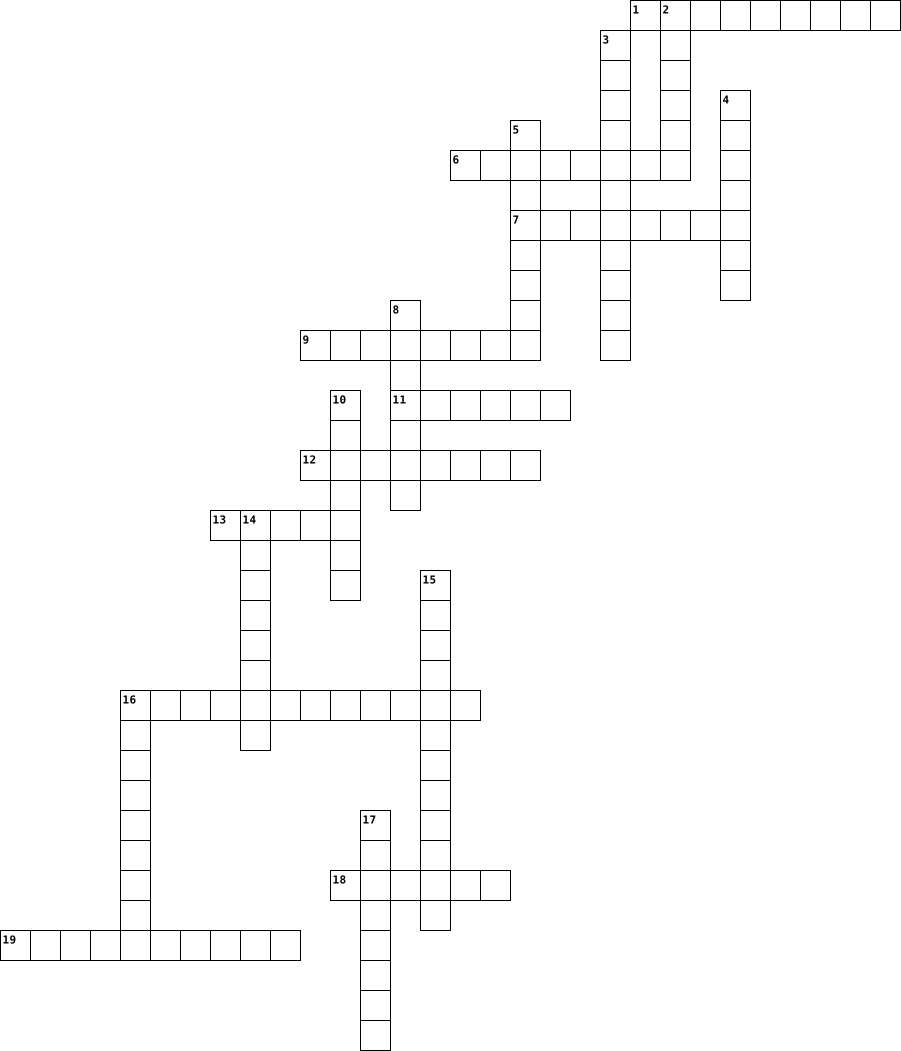
periodic table Crossword Puzzles
Elements, Compounds, Mixtures 2024-12-09

Across
- When no more solute can be dissolved in a solution it is said to be _______.
- This element combines with two parts Hydrogen to create this mixture.
- These elements are often used to make signs because they glow when an electric current moves through them.
- This is the process of boiling in order to separate the components of
- When two or more elements participate in a chemical reaction and a chemical bond is formed.
- There are 118 of these on The Periodic Table
- The Periodic Table was developed by a Russian: Botonist, Scientist, or Chemist?
- A substance formed when two or more elements or compounds are physically combined. No chemical changes take place.
- solutions.
- Elements in the same column of the periodic table constitute a group. Each column of elements have similar properties.
Down
- When a liquid is mixed with a solid the particles do not dissolve; they are “suspended” throughout the liquid, and you can see them
- The substance in which the other substance dissolves is called this.
- The substance that is dissolved in a solution.
- In this mixture the substances being combined are distributed evenly throughout.
- When one substance dissolves completely into another substance.
- This method of separating a mixture uses filters to remove impurities.
- When particles are too fine to be filtered, this machine can be used.
- Elements can be either a solid, gas, or this state of matter.
18 Clues: solutions. • There are 118 of these on The Periodic Table • The substance that is dissolved in a solution. • Elements can be either a solid, gas, or this state of matter. • When one substance dissolves completely into another substance. • The substance in which the other substance dissolves is called this. • ...
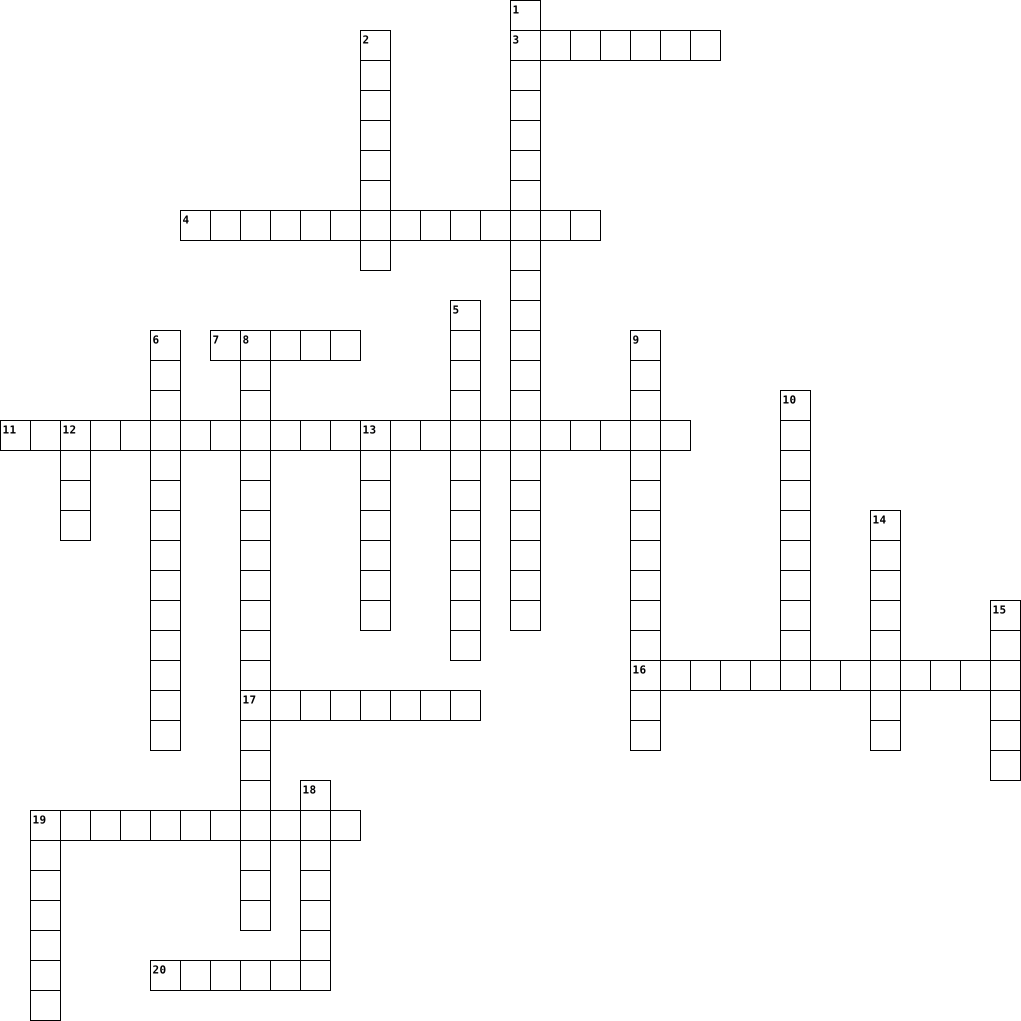
Chemistry Vocabulary 2020-12-14

Across
- the basic unit of a chemical element
- an extremely tiny particle with a positive charge; is in the center of the atom and makes up the nucleus
- the mass of an atom of a chemical element expressed in atomic mass units
- a heterogenous mixture in which some of the particles settle out of the mixture upon standing
- a energy level defined by quantum theory
- a diagram that represents the variation of a variable
- where electrons are likely to be found
- a combination of two or more substances
- a variable that depends on other factors
- a pure substance that is made up of two or more different elements combined by chemical bonds
- a simple way of writing down the locations of all the electrons in an atom
- in the center of the atom with the protons making up the nucleus
- the number of digits in a value
- the energy required to remove an electron from an atom
- electrons in the outermost shell
- a physical substance
- the tendency of an atom to attract an electron to itself
- any of two or more forms of a chemical element
Down
- a positively charged ion
- a model presented by niels bohr and ernest rutherford in 1913
- a row of elements in the periodic table
- a variable that stands alone
- a negatively charged ion
- a process for experimentation that is used to explore observations and answer questions
- the number of protons in the nucleus of an atom
- a type of matter that has definite chemical and physical properties
- a group of atoms bonded together
- physically combined; can be separated
- a negative charge that surrounds the nucleus
- objects, events, ideas, feelings, time periods, or any other types of categories that you are trying to measure
- heterogenous, even though it looks homogenous
- a pure substance that contains of only one kind of atom
- a way of representing atoms or molecules as dots surrounding the element symbols
- a table of chemical elements arranged in order of atomic number
- the central part of the atom; contains protons and neutrons
- fixed distances from the nucleus of an atom where electrons may be found
- the size of a neutral atom
- specific patterns that are presented in the periodic table
- the number of protons minus the number of electrons
- a column of elements in the periodic table
- the chemical element in group 18 of the periodic table
41 Clues: a physical substance • a positively charged ion • a negatively charged ion • the size of a neutral atom • a variable that stands alone • the number of digits in a value • a group of atoms bonded together • electrons in the outermost shell • the basic unit of a chemical element • physically combined; can be separated • where electrons are likely to be found • ...
Crossword 2013-09-25

Across
- Property/Those characteristics that can be observed without changing the identity of the substance such as size, shape, luster, conductivity, malleability, and magnetic attraction.
- is made up of the elements hydrogen and oxygen.
- of the Systems/Only a small number of different elements comprise the majority of matter found in Earth's systems.
- Formula/A shorthand notation that uses chemical symbols and numbers as subscripts to represent the type of atoms and number of atoms that are present in the smallest unit of the substance.
- Table of Elements/An arrangement of the elements according to their atomic numbers and periodic trends of physical and chemical properties.
- that has volume and mass.
- pure substance that cannot be separated into simpler substances by physical or chemical means.
Down
- columns on a periodic table that arrange the elements by select characteristics.
- Earth/Oxygen and silicon are the main elements of matter that make up the rock and minerals of Earth's crust.
- Matter/Cells from living matter are made of carbon bonded to other elements, such as hydrogen, oxygen, phosphorus, nitrogen, calcium, or sulfur.
- rows in a periodic table that classify the elements by select characteristics.
- that is composed of two or more elements that are chemically combined.
- Substance/Matter that is made up of the same particles throughout.
- mixture of mainly nitrogen and oxygen, with small amounts of other gases that surround Earth.
- smallest unit of an element that has all of the properties of that element.
- Number/The number of protons (positive charges) in an atomic nucleus.
16 Clues: that has volume and mass. • is made up of the elements hydrogen and oxygen. • Substance/Matter that is made up of the same particles throughout. • Number/The number of protons (positive charges) in an atomic nucleus. • that is composed of two or more elements that are chemically combined. • ...
Top 10 rappers Eminem was afraid to diss 2021-02-25

Across
- Columns within a periodic table
- Bonding of electrons that involve transferring electrons
- An imaginary space in which electrons orbit the nucleus
- The centre of an atom that is responsible for its growth and movement
- A negatively charged particle
- A positively charged particle
Down
- Rows within a periodic table
- particle so small that it cannot be further broken down
- The outermost shell of an atom
- Bonding of elements that involve sharing electrons
- A particle with no charge
11 Clues: A particle with no charge • Rows within a periodic table • A negatively charged particle • A positively charged particle • The outermost shell of an atom • Columns within a periodic table • Bonding of elements that involve sharing electrons • particle so small that it cannot be further broken down • An imaginary space in which electrons orbit the nucleus • ...
Periodic Table by Khalese Alexander 2016-12-07

Across
- This is the 82nd element.
- This is the first element in period 2.
- This is the only nonmetal in group 14.
- This element has an atomic mass of 35.453.
- This is the only metalloid in Group 17.
- This is the 10th element in the periodic table.
- This element has the symbol Kr.
- This element is in group 10 and has the symbol Ni.
Down
- This element is close to gold and has the symbol Ag.
- This element has the atomic mass of 196.97.
- The first element in the periodic table.
- This is the only metalloid in Period 3.
- This has the symbol I.
- This is the only metalloid in group 13.
- This element’s symbol is Cu.
15 Clues: This has the symbol I. • This is the 82nd element. • This element’s symbol is Cu. • This element has the symbol Kr. • This is the first element in period 2. • This is the only nonmetal in group 14. • This is the only metalloid in Group 17. • This is the only metalloid in Period 3. • This is the only metalloid in group 13. • The first element in the periodic table. • ...
Crossword Puzzle 2020-01-13

Across
- A transformation from Liquid to Gas
- Is an abbreviation for a chemical element
- A transformation from Gas to Liquid
- A transformation from Solid to Gas
- Are also called Semiconductors or Semi-Metals
- Can be defined as heterogenous or homogenous
Down
- a thing that is composed of two or more separate elements
- Are able to be drawn out into a thin wire
- A transformation from Gas to Solid
- Are organized in a periodic table
- Anything with mass and volume
- The measure of the amount of matter in an object
- The person who organized the periodic table
- The amount of space a substance takes up
- substances Are made of only one type of atom or only one type of molecule
15 Clues: Anything with mass and volume • Are organized in a periodic table • A transformation from Gas to Solid • A transformation from Solid to Gas • A transformation from Liquid to Gas • A transformation from Gas to Liquid • The amount of space a substance takes up • Are able to be drawn out into a thin wire • Is an abbreviation for a chemical element • ...
chemistry 2020-05-26

Across
- tell us the number of atoms of each element in a compound.
- goes across the periodic table
- a table of the chemical elements
- the first letter of an element
- an element that readily forms positive ions and has metallic bonds
- a particle made up of two or more atoms that are chemically bonded together
Down
- an element that doesn't have the characteristics of metal including
- goes down the periodic table
- the second letter of an element
- a substance whose atoms all have the same number of protons
- the smallest particle of a chemical element that can exist.
- a substance formed when two or more chemical elements are chemically bonded together
12 Clues: goes down the periodic table • goes across the periodic table • the first letter of an element • the second letter of an element • a table of the chemical elements • tell us the number of atoms of each element in a compound. • a substance whose atoms all have the same number of protons • the smallest particle of a chemical element that can exist. • ...
Metals, Nonmetals, Metaloids 2024-07-29

Across
- Metalloid used in semiconductors
- Metal found in group 1 of the periodic table
- Metalloid used in transistors and electronic chips
- Non-metal essential for life found in the air
- Precious metal known for its luster and use in jewelry
Down
- Metal that is liquid at room temperature
- Yellow and brittle non-metal
- Highly reactive metal with water
- Non-metal known for its ability to form diamonds
- Metalloid found in group 13 of the periodic table
- Non-metal used in water disinfection
- Metal that is the main component of soda cans
12 Clues: Yellow and brittle non-metal • Highly reactive metal with water • Metalloid used in semiconductors • Non-metal used in water disinfection • Metal that is liquid at room temperature • Metal found in group 1 of the periodic table • Metal that is the main component of soda cans • Non-metal essential for life found in the air • Non-metal known for its ability to form diamonds • ...
The Atomic Theory Date: ___/____/2022 2022-07-21

Across
- Elements can be combined to make them.
- Anything of this table is called an element.
- Protons make it up.
- They carry no charge.
- The space between the atomic nucleus and and electrons is .......
Down
- They are negatively charged.
- They are positively charged.
- Electrons do this when moving around the nucleus at high speed.
- The main field in science that studies atoms and molecules is called....
- Anything on the periodic table is called.....
- It has a mass and takes up space.
- Protons and neutrons are found here.
12 Clues: Protons make it up. • They carry no charge. • They are negatively charged. • They are positively charged. • It has a mass and takes up space. • Protons and neutrons are found here. • Elements can be combined to make them. • Anything of this table is called an element. • Anything on the periodic table is called..... • ...
Do it Yourself Science 2022-12-05

Across
- something we do all the time and everywhere we go
- a good science experiment is ________
- the letter H in H2O
- when plants take in carbon dioxide and release oxygen
- to take in
- sunlight, water, and soil are needed for ______ to grow
Down
- a chemical that plants need to grow, N on the periodic table
- another name for H2O
- the letter C on the periodic table
- what humans need to breathe
- what is happening to our oceans because of CO2
- when animals take in oxygen and release carbon dioxide
12 Clues: to take in • the letter H in H2O • another name for H2O • what humans need to breathe • the letter C on the periodic table • a good science experiment is ________ • what is happening to our oceans because of CO2 • something we do all the time and everywhere we go • when plants take in carbon dioxide and release oxygen • when animals take in oxygen and release carbon dioxide • ...
Year 8 Revision 2025-06-09

Across
- Used to separate insoluble solids from liquids
- A starting material for a reaction
- A substance containing the same type of atom
- 2 or more elements chemically joined
- 2 or more elements/compounds not chemically joined
Down
- Used to separate a mixture of different sized solids
- What is made in a reaction
- Found on right side of Periodic Table
- A sign of a chemical reaction, also known as bubbles.
- Used to separate dyes in ink
- This is a magnetic metal, found in cereal
- Found on the left side of Periodic Table
12 Clues: What is made in a reaction • Used to separate dyes in ink • A starting material for a reaction • 2 or more elements chemically joined • Found on right side of Periodic Table • Found on the left side of Periodic Table • This is a magnetic metal, found in cereal • A substance containing the same type of atom • Used to separate insoluble solids from liquids • ...
Exam Review 2018-05-16

Across
- WHAT DO GROUPS OF CELLS FORM?
- ANIMALS CELLS DO NOT HAVE A _____________.
- ENERGY THAT COMES OUT OF A BATTERY.
- ELEMENTS ON THE PERIODIC TABLE ARE ARRANGED BY _______ NUMBER.
- ELEMENTS THAT ARE FOUND ALONG THE ZIGZAG.
- ELEMENTS IN THE SAME _____ HAVE SIMILAR CHEMICAL PROPERTIES.
- MULTIPLE TRIALS ARE PERFORMED IN AN EXPERIMENT
- SCIENTIFIC THEORIES CAN CHANGE WHEN NEW _______ IS FOUND.
- A LIQUID WITH A PH LESS THAN 7.
Down
- FORM OF ENERGY STORED INSIDE A BATTERY.
- ELEMENTS, COMPOUNDS AND MIXTURES ARE ALL MADE OF _______.
- A LIQUID WITH A PH GREATER THAN 7.
- WHAT TYPE OF CHANGE IS ICE MELTING?
- WHEN ONE SCIENTIST DUPLICATES ANOTHER SCIENTISTS WORK.
- A MOTOR SPINNING IS AN EXAMPLE OF _______ ENERGY.
- THE AVERAGE TEMPERATURE IN ALASKA IS 20 DEGREES
- WHICHIS MORE ACIDIC A PH OF TWO OR SIX?
- WHICH IS MORE BASIC A PH OF ELEVEN OR THIRTEEN?
- ELEMENTS THAT ARE SHINY AND CAN BE BENT.
- ELEMENTS INA ROW ON THE PERIODIC TABLE.
20 Clues: WHAT DO GROUPS OF CELLS FORM? • A LIQUID WITH A PH LESS THAN 7. • A LIQUID WITH A PH GREATER THAN 7. • WHAT TYPE OF CHANGE IS ICE MELTING? • ENERGY THAT COMES OUT OF A BATTERY. • FORM OF ENERGY STORED INSIDE A BATTERY. • WHICHIS MORE ACIDIC A PH OF TWO OR SIX? • ELEMENTS INA ROW ON THE PERIODIC TABLE. • ELEMENTS THAT ARE SHINY AND CAN BE BENT. • ...
C4 Crossword 2015-03-06

Across
- Charged particles which were originally an atom, that has either lost of gained an electron
- Same amount as the Electrons
- The place in which the Protons and Neutrons lie
- The top number
- Materials that conduct electricity with little or no resistance
- The horizontal rows in the periodic table
- R.A.M
- Large solids are allowed to settle at the bottom of the tank
- Group 7 elements are called....
- The gaining of electrons is called...
- The part of the atom in which the electrons lie
Down
- A bond formed between metal and non-metals
- A test which confirms a metal
- Adding chlorine
- Filtered through sand and gravel
- The bottom number
- Same number of protons, different number of neutrons
- Negatively charged
- The loss of electrons are known as...
- A bond formed between a non-metal and a non-metal
- Water is stored up to allow oxygen to mix with it
- Neutrally charged
- The vertical columns in the periodic table
23 Clues: R.A.M • The top number • Adding chlorine • The bottom number • Neutrally charged • Negatively charged • Same amount as the Electrons • A test which confirms a metal • Group 7 elements are called.... • Filtered through sand and gravel • The loss of electrons are known as... • The gaining of electrons is called... • The horizontal rows in the periodic table • ...
General Science 2022-01-30
Across
- something that allows heat or electricity to pass though easily
- formed when a solute and a solvent is combined
- type of bond formed when atoms share electrons
- the first element in the periodic table
- the 6th element in the periodic table
- this is the force of a moving object
- a push or a pull
- another name for high blood pressure
- the positively charged part of an atom
- when sand and water are mixed
Down
- this is transported by red blood cells
- the process in which energy is released from food
- the type of energy in moving objects
- the negatively charged part of an atom
- proper name for the windpipe
- type of food that is used to build and repair tissue
- an animal that eats both plants and animals
- type of food that provides energy
- an animal that eats plants only
- type of circuit that has multiple paths for electricity to flow
20 Clues: a push or a pull • proper name for the windpipe • when sand and water are mixed • an animal that eats plants only • type of food that provides energy • the type of energy in moving objects • this is the force of a moving object • another name for high blood pressure • the 6th element in the periodic table • this is transported by red blood cells • ...
Matter and Periodic Table 2022-01-23

Across
- element with 14 electrons
- element with 80 electrons
- element with atomic number of 8
- element with symbol W
- element with 11 electrons
- number on periodic table that that tells us the number of protons
- element with atomic mass of 47.867
- current model of the atoms
- element with the atomic number of 17
- element with atomic mass of 40.078
- element with 78 protons
- The smallest form of matter
- the center of the atom containing protons and elctrons
Down
- element with symbol Ag
- element with 6 electrons
- element with 29 protons
- negative charged particle of the atom
- element with atomic mass of 4.003
- element with symbol Fe
- anything that has mass and volume
- element with symbol K
- neutral particle of the atom
- number on periodic table that tells you the atoms weight
- element with 13 protons
- positive charged particle of the atom
- element with symbol Pb
26 Clues: element with symbol W • element with symbol K • element with symbol Ag • element with symbol Fe • element with symbol Pb • element with 29 protons • element with 13 protons • element with 78 protons • element with 6 electrons • element with 14 electrons • element with 80 electrons • element with 11 electrons • current model of the atoms • The smallest form of matter • ...
ATOMS 2023-10-18

Across
- Transferring this can change the phase of matter.
- Characteristics of matter that describe how matter reacts.
- A group of the same atoms chemically bonded together.
- Capitol and Lowercase letters that signify what element is on the periodic table.
- Center of the Atom.
- Particle with no charge.
- Elements are divided into these
- Outermost ring of electrons in an Atom
- A group of compounds, Elements, or Atoms not physically bonded together.
- Positively charged particle in an Atom.
Down
- A mixture that is not evenly distributed.
- A group of different types of atoms bonded together.
- How much physical space an object takes up.
- How much stuff makes up an object.
- Mass divided by volume
- The amount of Electrons/Protons in an Atom
- A mixture that is the same throughout.
- Table with every element categorized by properties.
- Negatively charged particles in an Atom.
- Characteristics of matter that you can observe.
- All elements are made of these.
21 Clues: Center of the Atom. • Mass divided by volume • Particle with no charge. • Elements are divided into these • All elements are made of these. • How much stuff makes up an object. • A mixture that is the same throughout. • Outermost ring of electrons in an Atom • Positively charged particle in an Atom. • Negatively charged particles in an Atom. • ...
Crossword Puzzle-Bubba 2018-12-09

Across
- atomic number of 16
- copper
- series located along the bottom of the periodic table
- physical and chemical properties of both metals and nonmetals
- columns/ families on the periodic table
- smallest part of an atom
- metals the d block
- elements that are generally gases or brittle solids
- what element has 8 protons?
- good conductors of heat and/or electricity
- atomic mass of 1.008
- elements groups 1, 2, & 13-18
- transition metal the f block
Down
- metals group 1 elements except for hydrogen
- radon
- where protons & neutrons are located
- group 17
- what element has an atomic mass of 14.007
- series 2 sets of inter transition metals
- atomic number of 99
- cloud where the electrons are
- silicon is what?
- what is helium
- capable of transmitting electricity
- what element is a metalloid?
- what element is a solid?
- atomic mass of 107.868
- gases group 18
- lead
29 Clues: lead • radon • copper • group 17 • what is helium • gases group 18 • silicon is what? • metals the d block • atomic number of 16 • atomic number of 99 • atomic mass of 1.008 • atomic mass of 107.868 • smallest part of an atom • what element is a solid? • what element has 8 protons? • what element is a metalloid? • transition metal the f block • cloud where the electrons are • ...
4th Nine Weeks Bonus Crossword Puzzle 2024-05-08

Across
- A microscopic particle that makes up all matter.
- Number 1 on the periodic table.
- The atoms on the 18th column of the periodic table.
- Substance with a pH greater than 7
- The time required for a certain amount of atoms to decay by half the amount originally present.
- A temperature measuring instrument.
- Substance with a pH less than 7
- A combination of 2 or more substances
- A positively charged ion.
- KHDUDCM
Down
- A positively charged particle.
- A negatively charged ion.
- A particle with no charge.
- A substance's mass per unit of volume (Water's is 1 gram per millimeter.)
- Light particle.
- A negatively charged particle.
- The phase state of H2O when it is ice
- Rings around atoms that hold electrons.
- the outermost electrons of an atom.
- One measurement of this is 6.02 x 10^23 units of a substance.
- The phase state of H2O when it is vapor
- The center of an atom.
22 Clues: KHDUDCM • Light particle. • The center of an atom. • A negatively charged ion. • A positively charged ion. • A particle with no charge. • A positively charged particle. • A negatively charged particle. • Number 1 on the periodic table. • Substance with a pH less than 7 • Substance with a pH greater than 7 • A temperature measuring instrument. • the outermost electrons of an atom. • ...
Atoms & Elements 2024-06-10

Across
- Name for A Molecule with Two or More Different Atoms
- Another Word for H2O
- Element That Corresponds with Mg
- What Are Atoms Mostly Comprised of?
- Reacts to Create Combustion
- Protons in Hydrogen
- Which Subatomic Particle Orbits The Nucleus?
- Greek Word for Atom
- Scientific Name for Rusting or Corrosion
- A Double Rearrangement in A Formula
- Name for A Compound Being Split into Simpler Products
- Proton's Charge
Down
- What the Current Periodic Table Is Arranged By
- What Are the Electrons in The Outermost Ring Called?
- Smallest Known Piece of Matter
- John Dalton's Theory
- Periods on The Periodic Table
- Proton, Electron & ____
- What Is Located on The Right Side of a Chemical Equation
- What Type of Gases Are Non-reactive and Have Very Low Boiling Points?
- Atomic Number of Boron
- Name for Two Elements Combining to Create Something New
- What Substance is Aluminium?
- Element That Corresponds with Au
- Maximum Electrons of The Second Electron Shell
25 Clues: Proton's Charge • Protons in Hydrogen • Greek Word for Atom • Another Word for H2O • John Dalton's Theory • Atomic Number of Boron • Proton, Electron & ____ • Reacts to Create Combustion • What Substance is Aluminium? • Periods on The Periodic Table • Smallest Known Piece of Matter • Element That Corresponds with Mg • Element That Corresponds with Au • ...
Science Vocab 2023-02-08

Across
- Two or more covalently bonded atoms
- Columns going up and down the periodic table
- Move toward one another
- When the nucleus of the atoms attract the outer electrons of the other atom
- The average mass of the atoms in an element
- In regions surrounding nucleus; negative charge
- The area surrounding the nucleus where the electron is most likely to be
- Atoms of the same element with different number of neutrons
- The bond when electrons from both atoms are shared by both atoms
- the region surrounding the nucleus
Down
- Rows going across the periodic table
- The number of protons in the nucleus of the atoms
- Electrons in the outermost energy level
- In nucleus of the atom; no charge
- When oppositely charged ions attract each other, common in sodium chloride
- Formed from atoms
- Short-hand abbreviation for the element name
- Overall charge
- In nucleus on the atom; positive charge
- To push away from one another
- Is made up of protons, neutrons, and electrons
21 Clues: Overall charge • Formed from atoms • Move toward one another • To push away from one another • In nucleus of the atom; no charge • the region surrounding the nucleus • Two or more covalently bonded atoms • Rows going across the periodic table • Electrons in the outermost energy level • In nucleus on the atom; positive charge • The average mass of the atoms in an element • ...
Y10 PPE Disciplinary Literacy Crossword 2023-06-07

Across
- Bacterial disease spread through water
- The outer layer of a plant cell
- Particle with a negative charge
- Disease spread by mosquitos
- Type of drug that kills bacteria
- Process of cell division that makes 2 new cells
- Cell that carries electrical signals in the body
- Uncharged particle in the nucleus of an atom
- Theory proposed by Charles Darwin
- A row in the periodic table
- Allotrope of carbon that is very valuable
Down
- Type of bond between non-metals
- The maximum number of electrons in the second shell of an atom
- Added to a microscope specimen to make it easier to see
- State change from solid to liquid
- The part of a microscope that you look though
- What happens to an enzyme when it gets too hot
- A biological catalyst
- A column in the periodic table
- The junction between neurones
- The genetic information stored in the nucleus
- Virus that affects the immune system
- Type of bond between a metal and non-metal
23 Clues: A biological catalyst • Disease spread by mosquitos • A row in the periodic table • The junction between neurones • A column in the periodic table • Type of bond between non-metals • The outer layer of a plant cell • Particle with a negative charge • Type of drug that kills bacteria • State change from solid to liquid • Theory proposed by Charles Darwin • ...
Unit 5 Vocabulary by Oscar R. 2023-03-30

Across
- Equals Mass/volume
- Place object in cylinder containing water to see
- Same amount of protons and neutrons
- Place object on balance to find
- electrons in the outermost shell
- negative charge
- any atom or group of atoms that bears one or more positive or negative electrical charges
- shows the atom as a central nucleus containing protons and neutrons with the electrons in circular orbitals
- same mass as a proton but without an electric charge
- consisting of protons and neutrons at the center of an atom
- Vertical Columns on periodic table
Down
- The state of the lowest energy for an electron
- (%abundance x mass)+ (%abundance x mass)
- valence electrons of an atom that uses dots around the symbol of the element
- positive charge
- ? = L x W x h
- Number of Protons in Nucleus
- Same number of protons but different mass
- horizontal row of the periodic table
- Atom is more stable when it has 8 valence electons
20 Clues: ? = L x W x h • positive charge • negative charge • Equals Mass/volume • Number of Protons in Nucleus • Place object on balance to find • electrons in the outermost shell • Vertical Columns on periodic table • Same amount of protons and neutrons • horizontal row of the periodic table • (%abundance x mass)+ (%abundance x mass) • Same number of protons but different mass • ...
Y8 Science crossword :] 2023-05-03
![Y8 Science crossword :] crossword puzzle](/image/10390150.svg?size=30&stroke_width=1)
Across
- connecting lines in a temperature map
- light energy travels in_____
- has a negative charge
- can radiate through empty space
- movement of air from area of high temperature and low temperature
- outer layer of the earth
- a push or pull
- two or more atoms that are bonded
- has a positive charge
- temperature decreases, breaks bonds
- collection of space debris, result of a star's death
- visualizes forces acting on an object
- mechanical waves need this to move
Down
- measurement from one crest to another
- particles travel in direction of wave velocity
- any area affected by force
- charge is measured in________
- 7th element of the periodic table
- clouds dont stop collecting___________
- generally called kinetic energy
- an echo is a _________ sound wave
- has neutral charge
- when warm/cold air moves to an area of different temperature
- circuit
- temprature increases, makes bonds
- 10th element of the periodic table
26 Clues: circuit • a push or pull • has neutral charge • has a negative charge • has a positive charge • outer layer of the earth • any area affected by force • light energy travels in_____ • charge is measured in________ • can radiate through empty space • generally called kinetic energy • 7th element of the periodic table • an echo is a _________ sound wave • two or more atoms that are bonded • ...
Year 8 science crosswords for scientists 2025-03-14

Across
- allows the flow of electricity
- can be shaped or soft
- smallest unit of matter
- a tool which is used for house hold tasks
- consists of one atom
- able to see through
- how an element is labeled in the periodic table
- is not a metal
- A material which is typically shiny, lustre and is typically a good conductor
- does not allow electricity to flow freely
- a combination of different elements
Down
- chemical substance composed of many identical molecules
- hard but liable to break easily
- Colour of a minerals powder
- Free from any contaminants
- Device or implement used to do a particular task
- a quality or characteristic of an element
- On the periodic table
- a representation of something
- Able to become a wire
- Property that allows things to shine
- a tool used for hunting or warfare
- unable to see through
- holds atoms together
- a group of atoms bonded together
25 Clues: is not a metal • able to see through • consists of one atom • holds atoms together • On the periodic table • can be shaped or soft • Able to become a wire • unable to see through • smallest unit of matter • Free from any contaminants • Colour of a minerals powder • a representation of something • allows the flow of electricity • hard but liable to break easily • ...
Chemistry Crossword Puzzle 2025-05-02

Across
- properties that change the identity of a substance
- properties that are independent of amount
- substance in a solution that is present in largest amount
- element that have properties of both metals and nonmetals
- common name given to an element in group 17
- atom of same element but with different mass
- ion with a positive charge
- number that is the sum of protons and neutrons
- game given to atoms of the same group on periodic table
Down
- the number of d orbitals present at the n=3 level
- combination of two or more pure substances
- word given to metals in d block on periodic table
- Type of electrons in outermost energy level
- the process by which a liquid is converted to a gas
- subatomic particle with a positive charge
- concentration term in moles/liter
- reactant not used up completely in a reaction
- ion with a negative charge
- the best field of chemistry to study
- state of matter with indefinite shape and volume
20 Clues: ion with a negative charge • ion with a positive charge • concentration term in moles/liter • the best field of chemistry to study • properties that are independent of amount • subatomic particle with a positive charge • combination of two or more pure substances • Type of electrons in outermost energy level • common name given to an element in group 17 • ...
Science Semester Review 2024-12-08

Across
- Positive part of an atom
- Vertical columns on the Periodic Table
- Draws water toward it
- This term means to "make ones own food"
- Digestive system breaks down ___________
- One type of atom
- This type of cell has a cell wall, chloroplast, and no lysosomes
- This allows things to go in and out of the cell
- Conduct electricity
- Horizontal parts of the Periodic Table
- A synonym for "living" that you learned in 6th Grade
- Two or more substances physically combined
- Cytoplasm is a _______-like substance
Down
- Two or more different atoms chemically combined
- Major organ of the circulatory system
- Homeostasis means ________________
- Heterogeneous mixture is ______________ throughout
- Eukaryotic cells have membrane-bound _____________.
- H2O is the science nerd term for:
- DNA is contained here; control center
- Cell that has DNA blobs and not contained
- Basic unit of LIFE
- Similar cells working together
- This type of cell is a heterotroph
- Homogeneous mixture is the _________ throughout
25 Clues: One type of atom • Basic unit of LIFE • Conduct electricity • Draws water toward it • Positive part of an atom • Similar cells working together • H2O is the science nerd term for: • Homeostasis means ________________ • This type of cell is a heterotroph • Major organ of the circulatory system • DNA is contained here; control center • Cytoplasm is a _______-like substance • ...
Grade 10 Chemistry Review 2025-08-25

Across
- sharing of electrons between atoms (2words)
- group of elements with 7 valence electrons
- elements between metals and nonmetals on periodic table
- group of stable elements (2words)
- reaction which breaks down a substance
- number of protons atom has (2words)
- end result of a reaction
- reaction in which an element replaces another element in compund (2words)
- reaction between acids and bases
- burning of substance using oxygen gas
- substances that undergo change in a reaction
Down
- atom that has gained electrons (2words)
- law of ___________ of mass
- where electrons are found
- chemical name of NaCl (2words)
- name of diagram that uses dots
- 2 reactants produce 1 product
- feel slippery
- taste sour
- solution that conducts electricity
- 2 or more atoms bonded together
- force of attraction between ions of opposite charge (2words)
- horizontal row on periodic table
- outermost electrons in an atom
- measures the strength of acids and bases
- protons plus neutrons (2words)
- location of protons in an atom
27 Clues: taste sour • feel slippery • end result of a reaction • where electrons are found • law of ___________ of mass • 2 reactants produce 1 product • chemical name of NaCl (2words) • name of diagram that uses dots • outermost electrons in an atom • protons plus neutrons (2words) • location of protons in an atom • 2 or more atoms bonded together • horizontal row on periodic table • ...
Periodic Table of Elements 2025-09-04

Across
- Which element is labeled as the 15th element on the periodic table?
- What element rhymes with bargain?
- Which element has a symbol of Ar?
- Which element’s symbol is Mg?
- Which element is used to make toothpaste?
- Which element comes from sand?
- What element is in bananas?
- Which is the first element of group 15 on the periodic table of elements?
- Which element has three electrons?
- Which element is used to make the case of an iphone?
Down
- Which element has an atomic mass of 1.00794?
- What element rhymes with medium?
- What element is used as a powerful disinfectant in pools?
- Which element has an atomic mass of 32.06?
- Which element is on the 2nd group of the 2nd row?
- Which element has an atomic number of ten?
- What is an element that is essential to our existence?
- Which element is used as food seasoning?
- Which element is in dairy products?
- Which element has an atomic mass of 10.81?
20 Clues: What element is in bananas? • Which element’s symbol is Mg? • Which element comes from sand? • What element rhymes with medium? • What element rhymes with bargain? • Which element has a symbol of Ar? • Which element has three electrons? • Which element is in dairy products? • Which element is used as food seasoning? • Which element is used to make toothpaste? • ...
U2 Xword 2025-12-04

Across
- Positively charged ion
- Element that is dull and a poor conductor
- Electrons in the outermost shell
- Bond formed by electron transfer
- Two or more atoms bonded together
- Repeating ionic crystal structure
- Horizontal row on the periodic table
- Smallest unit of an element
- Element with properties of metals and nonmetals
- Weak force caused by temporary electron shifts
- Shiny element that conducts electricity
- Bond with equal sharing of electrons
- Ability of an atom to attract electrons
Down
- Weighted average of all isotopes
- Rule stating atoms want eight valence electrons
- Negatively charged ion
- Vertical column on the periodic table
- Model used to predict molecular shapes
- Bond formed by sharing electrons
- Pure substance made of one type of atom
- Bond with unequal sharing of electrons
- Number of protons in an atom
- Atom or group with a charge
- One- or two-letter abbreviation for an element
- Strong attraction involving H and N/O/F
25 Clues: Positively charged ion • Negatively charged ion • Smallest unit of an element • Atom or group with a charge • Number of protons in an atom • Weighted average of all isotopes • Electrons in the outermost shell • Bond formed by electron transfer • Bond formed by sharing electrons • Two or more atoms bonded together • Repeating ionic crystal structure • ...
Chemistry: The Periodic Table 2023-09-19

Across
- Scientist who put together the first version of the Periodic Table
- The total number of protons and neutrons in an atom
- Salt produced when Calcium reacts with Nitric Acid
- Metal that is not solid at room temperature
- The most abundant gas in air
Down
- Another name for Group 0/8
- Element in Group 5
- A horizontal row in the Periodic Table
- This increases as you go down Group 1
- Cu is the symbol for which element?
- Another name for Group 1
- A pale yellow gas at room temperature
12 Clues: Element in Group 5 • Another name for Group 1 • Another name for Group 0/8 • The most abundant gas in air • Cu is the symbol for which element? • This increases as you go down Group 1 • A pale yellow gas at room temperature • A horizontal row in the Periodic Table • Metal that is not solid at room temperature • Salt produced when Calcium reacts with Nitric Acid • ...
Final Review #3 2024-05-17

Across
- Force holding atoms together in a compound
- Atoms seek eight electrons in their valence shell, a rule
- Bond formed by sharing electrons
- Atoms of the same element with different numbers of neutrons
- Weighted average mass of an element's isotopes
- Representation of a substance using symbols for its elements
Down
- Bond formed by the transfer of electrons
- Charged particles formed when atoms gain or lose electrons
- Charge assigned to an atom in a compound
- Vertical columns in the periodic table
- Horizontal rows in the periodic table
- Group of atoms bonded together
12 Clues: Group of atoms bonded together • Bond formed by sharing electrons • Horizontal rows in the periodic table • Vertical columns in the periodic table • Bond formed by the transfer of electrons • Charge assigned to an atom in a compound • Force holding atoms together in a compound • Weighted average mass of an element's isotopes • ...
Atoms and the Periodic Table 2025-01-16

Across
- - An alkali metal.
- - Each Element is shown by one of these on the Periodic Table.
- - A substance made of only one type of atom.
- - A substance made of two or more substances.
- - The solute and the solvent together.
- - The substance the solute dissolves into.
Down
- - The process where the dyes in a colour of ink are separated
- - The process where dirty water can be made clean.
- - Different substances mixed together.
- - This happens when you put an alkali metal into water.
- - The substance that dissolves into a liquid.
- - Designed the modern Periodic table.
12 Clues: - An alkali metal. • - Designed the modern Periodic table. • - Different substances mixed together. • - The solute and the solvent together. • - The substance the solute dissolves into. • - A substance made of only one type of atom. • - The substance that dissolves into a liquid. • - A substance made of two or more substances. • ...
Simple periodic table recap 2024-11-09

Across
- K
- Group 0, period 3
- A substance made up of one or more atoms chemically bonded together.
- Fe
- A substance that is only made up of one type of atom.
- The horizontal rows of the periodic table.
Down
- The vertical columns of the periodic table.
- A one or two letter representation of an element.
- Group 4, period 1
- The smallest particle of matter that makes up all substances.
- Group 1, period 3
- A substance that has more than one type of atom. Can be an element or a compound.
12 Clues: K • Fe • Group 4, period 1 • Group 1, period 3 • Group 0, period 3 • The horizontal rows of the periodic table. • The vertical columns of the periodic table. • A one or two letter representation of an element. • A substance that is only made up of one type of atom. • The smallest particle of matter that makes up all substances. • ...
Elements 2026-05-04

Across
- they share.
- The 18 vertical (up/down) columns of elements in the periodic table.
- The building blocks of matter.
- A negatively charged particle.
- The 7 horizontal (across) rows of elements in the periodic table.
Down
- The combined number of protons and neutrons found in the
- A neutrally charged particle.
- The smallest form of matter
- A positively charged particle.
- The number of protons found in an atom's nucleus.
- A tool used by chemists to help arrange the elements based on certain
- The positively charged center of an atom that contains protons and neutrons.
12 Clues: they share. • The smallest form of matter • A neutrally charged particle. • A positively charged particle. • The building blocks of matter. • A negatively charged particle. • The number of protons found in an atom's nucleus. • The combined number of protons and neutrons found in the • The 7 horizontal (across) rows of elements in the periodic table. • ...
crossword puzzle 2021-09-21

Across
- a positive electric charge equal in magnitude to that of an electron, but of opposite sign.
- electrically neutral group of two or more atoms held together by chemical bonds.
- table of elements It is widely used in chemistry, physics, and other sciences.
- the same mass as a proton but without an electric charge.
Down
- Every atom will have the same number of
- a group is a column of elements in the periodic table.
- The basic unit of a chemical element.
- a part or aspect of something abstract, especially one that is essential or characteristic.
- molecules composed of atoms from more than one element held together by chemical bonds.
- number proton number of a chemical element is the number of protons found in the nucleus of every atom of that element.
- Periodic table is a row of chemical elements.
11 Clues: The basic unit of a chemical element. • Every atom will have the same number of • Periodic table is a row of chemical elements. • a group is a column of elements in the periodic table. • the same mass as a proton but without an electric charge. • table of elements It is widely used in chemistry, physics, and other sciences. • ...
Science 2022-04-03

Across
- used in party balloons, airships, etc
- number 11 of the periodic table
- when non-metals or metal react with oXygen forms?
- the process when a gas turns into a solid
- to make rubber harder for use as tyres
- when a liquid turns into a solid
- is the process by which large particles settle at the bottom of a container
- The person who made this
Down
- color for cesium
- A liquid that does not dissolve in a solvent is?
- has a definite mass and a definite shape
- one of the elements in the periodic table from 10-20
- patina
- different from Dissolving
- the reactants are at the left of a word equation and on the right is?
- one way to speed up rusting
16 Clues: patina • color for cesium • The person who made this • different from Dissolving • one way to speed up rusting • number 11 of the periodic table • when a liquid turns into a solid • used in party balloons, airships, etc • to make rubber harder for use as tyres • has a definite mass and a definite shape • the process when a gas turns into a solid • ...
Periodic Table Crossword Puzzle 2023-01-10

Across
- The atomic symbol of it is Li
- Has the atomic mass of 55.845
- The second element on the periodic table.
- The atomic symbol of it is Al
- Has the atomic mass of 22.990
Down
- Has the atomic mass of 87
- The first element on the periodic table.
- the atomic mass of 6.94
- It has the atomic number of 114
- The atomic symbol of it is Y
- The atomic symbol of it is Xe.
11 Clues: the atomic mass of 6.94 • Has the atomic mass of 87 • The atomic symbol of it is Y • The atomic symbol of it is Li • Has the atomic mass of 55.845 • The atomic symbol of it is Al • Has the atomic mass of 22.990 • The atomic symbol of it is Xe. • It has the atomic number of 114 • The first element on the periodic table. • The second element on the periodic table.
Chemistry Puzzle 2022-04-13

Across
- the amounts of ring in an electron cloud
- a negative charge in an atom
- the center of an atom
- a positive charge in an atom
- a neutral charge in an atom
- the vertical columns in the periodic table
Down
- electron that can be used in other atoms
- multiple atoms together
- a small particle that makes up every matter
- the horizontal rows in the periodic table
10 Clues: the center of an atom • multiple atoms together • a neutral charge in an atom • a negative charge in an atom • a positive charge in an atom • the amounts of ring in an electron cloud • electron that can be used in other atoms • the horizontal rows in the periodic table • the vertical columns in the periodic table • a small particle that makes up every matter
Chemistry Puzzle 2022-04-13

Across
- the amounts of ring in an electron cloud
- a negative charge in an atom
- the center of an atom
- a positive charge in an atom
- a neutral charge in an atom
- the vertical columns in the periodic table
Down
- electron that can be used in other atoms
- multiple atoms together
- a small particle that makes up every matter
- the horizontal rows in the periodic table
10 Clues: the center of an atom • multiple atoms together • a neutral charge in an atom • a negative charge in an atom • a positive charge in an atom • the amounts of ring in an electron cloud • electron that can be used in other atoms • the horizontal rows in the periodic table • the vertical columns in the periodic table • a small particle that makes up every matter
Molecules & Bonding 2025-07-09

Across
- Table entry?
- NaCl, familiarly
- Tiny negative particle
- Two or more elements joined
- Suffix with chlor-
- Chemist’s counting unit
Down
- Atom with extra neutrons
- Atomic variant
- Outer electron count
- Group of atoms bonded together
- Outer electron count
- It has mass and occupies space
- What holds atoms together
- Building block of the periodic table
- Particle with a charge
15 Clues: Table entry? • Atomic variant • NaCl, familiarly • Suffix with chlor- • Outer electron count • Outer electron count • Tiny negative particle • Particle with a charge • Chemist’s counting unit • Atom with extra neutrons • What holds atoms together • Two or more elements joined • Group of atoms bonded together • It has mass and occupies space • Building block of the periodic table
Chemistry 2017-02-17

Across
- how the elements are organized
- number of protons in a nucleus atom
- element or material that is not a metal
- observation of atoms of main group
- horizontal rows on periodic table
Down
- a solid material usually shiny and hard and malleable
- electron associated with an atom
- mass of a chemical element
- a group of atoms bonded together
- vertical columns on periodic table
10 Clues: mass of a chemical element • how the elements are organized • electron associated with an atom • a group of atoms bonded together • horizontal rows on periodic table • vertical columns on periodic table • observation of atoms of main group • number of protons in a nucleus atom • element or material that is not a metal • a solid material usually shiny and hard and malleable
Ch. 5 Sec. 2 Quiz Review 2023-03-08

Across
- Group 1 elements
- the first row of the f block; they are shiny metals
- metallic elements located in the d-block
- columns on the periodic table that share similar chemical properties
- Group 17 elements
- the second row of the f block; they are all radioactive
Down
- Group 18 elements
- Group 2 elements
- rows of the periodic table
- p-block and s-block elements
10 Clues: Group 2 elements • Group 1 elements • Group 18 elements • Group 17 elements • rows of the periodic table • p-block and s-block elements • metallic elements located in the d-block • the first row of the f block; they are shiny metals • the second row of the f block; they are all radioactive • columns on the periodic table that share similar chemical properties
Room 2 Ayia , Katherine and Jordana 2020-10-02

Across
- its chemical symbol is Ca
- the atomic number is 2
- it is the lightest element in the periodic table
- it is the eight on the periodic table of elements
- its chemical symbol is Na
Down
- its atomic number is 90
- its chemical symbol is Si
- its chemical symbol is Li
- its atomic number is 12
- it has a balanced number of electrons and protons
10 Clues: the atomic number is 2 • its atomic number is 90 • its atomic number is 12 • its chemical symbol is Si • its chemical symbol is Li • its chemical symbol is Ca • its chemical symbol is Na • it is the lightest element in the periodic table • it is the eight on the periodic table of elements • it has a balanced number of electrons and protons
cemestre 2023-11-21

Across
- The H element on the periodic table
- 2 or more elements combined
- the C element on the periodic table
- smallest known matter
Down
- water
- hydrogen and a carbon
- molecule with a specific ratio that is always the same
- salts atomic formula
- the number in front of a variable
- an atom with a specific amount of protons and can't be broken down beyond the singular atom
10 Clues: water • salts atomic formula • hydrogen and a carbon • smallest known matter • 2 or more elements combined • the number in front of a variable • The H element on the periodic table • the C element on the periodic table • molecule with a specific ratio that is always the same • an atom with a specific amount of protons and can't be broken down beyond the singular atom
Atomic Structure & Periodic Table 2025-03-20

Across
- Noble gas used in balloons
- Element in Group 7
- Element with atomic number 12
- Russian scientist who created the periodic table
- Vertical columns in the periodic table
Down
- Atoms of the same element with different neutron numbers
- Group 1 metals
- Total number of protons and neutrons
- Subatomic particle with a negative charge
9 Clues: Group 1 metals • Element in Group 7 • Noble gas used in balloons • Element with atomic number 12 • Total number of protons and neutrons • Vertical columns in the periodic table • Subatomic particle with a negative charge • Russian scientist who created the periodic table • Atoms of the same element with different neutron numbers
Periodic Table Crossword 2025-01-15

Across
- Period 3 and Group 15
- A element which follows octet rule in Period 2
- The person who named the Periodic Table
- They are electronegative in nature
Down
- Lowest Ionization Potential
- Period 2 and Group 14
- Zero Electron Affinity
- Lightest element in periodic table
- What is the most abundant element in the human body (by weight)?
9 Clues: Period 2 and Group 14 • Period 3 and Group 15 • Zero Electron Affinity • Lowest Ionization Potential • Lightest element in periodic table • They are electronegative in nature • The person who named the Periodic Table • A element which follows octet rule in Period 2 • What is the most abundant element in the human body (by weight)?
Crossword: Some Exam Review... 2017-06-06

Across
- a guide for the imagination which describes a theory
- subatomic particles having a positive charge
- a question is this if it contains both independent and dependent variables
- the study of matter (anything that has a mass and takes up space)
- the metric prefix which means "ten times"
- the "responding" variable
- the metric prefix which means "one thousandth"
- change of state from a gas to a liquid
- type of bond where one "atom" transfers electrons to another
- Li, Na, and K are this type of "group I" metal
- type of "foil" used by Ernest Rutherford in his famous experiment which identified the "nucleus" of the atom
- A "solution" is also known as a ____ mixture.
- Group VII non-metals (e.g. Cl) are also known as ____
- type of bond where atoms "share" electrons
- You're making an ____ if the "water rushing down the window" is interpreted as "rain".
- metal which is a good conductor of electricity and commonly used for electrical wiring
- the act of seeking an answer to a question or a solution to a problem
- opposite of "expansion"
- the "starting materials" in a chemical change that eventually become the "products"
- ____ and pestle
- the last section of a lab report
- variables kept "constant" to keep the experiment "fair"
- Water, having both O and H atoms, is classified as this type of pure substance.
- part of a Bunsen burner: gas ____ screw
- (Material) Safety _____ Sheet
- "Pb" on the Periodic Table
Down
- Oxygen, containing only O atoms, is classified as this type of pure substance.
- mass, volume and density are ____ properties of matter
- "W" on the Periodic Table
- neither metals nor non-metals on the Periodic Table
- an "educated guess"
- "All I did on Monday was wash and ____ the clothes!", she complained.
- DESCA: data, ____, substitute, calculate, answer
- _____ Hazardous Materials Information System (WHMIS))
- change of colour, formation of a precipitate, etc. are clues of this type of change
- the "state" having particles with both vibrational and translational motion energy and a "medium" amount of motion energy, overall
- type of gas present when a "flaming" splint "pops"
- another term for "freezing"
- Al2O3 is called aluminum ____
- can be quantitative or qualitative
- "atoms" which have lost or gained electrons to become "charged"
- curved surface of liquid in a graduated cylinder
- rows of the Periodic Table
- columns of the Periodic Table
- type of variable manipulated by the experimenter
- part of Bunsen burner adjusted to convert orange flame to blue
- lightest of the subatomic particles
- type of subatomic particle found along with protons (in the nucleus)
- "state" in which particles have the greatest attraction for one another
- sets electronic mass balance to "zero"
50 Clues: ____ and pestle • an "educated guess" • opposite of "expansion" • "W" on the Periodic Table • the "responding" variable • rows of the Periodic Table • "Pb" on the Periodic Table • another term for "freezing" • Al2O3 is called aluminum ____ • columns of the Periodic Table • (Material) Safety _____ Sheet • the last section of a lab report • can be quantitative or qualitative • ...
Alvin's Chemistry Crossword 2024-09-06

Across
- What box’s subshell on the periodic table can only hold 3 up to orbitals?
- What does the equation: 6.626 x 10^-34 Js represent?
- Lowest Point on a wave
- The Lower the Frequency, The _______ the wavelength
- Write True or False: Sulfur [S] is a Noble Gas
- Lowest energy orbitals are filled _____
- Write True or False: Light at a certain frequency causes metals to eject their electrons, but below a certain frequency, no electrons will eject no matter the brightness of the light
- Minimum amount of energy that can be gained or lost by an atom
- What color has the most amount of energy in the Visible Light Spectrum?
- What color has the least amount of energy in the Visible Light Spectrum?
- Atoms become ______ when they absorb energy
- Shorthand way of writing an element's electron configuration by using the symbol of the preceding noble gas in brackets to represent the core electrons
- What are the electrons in the outermost energy level called?
- What unit is used to measure Energy?
- What unit is used to measure frequency?
- What box’s subshell on the periodic table can only hold 7 up to orbitals?
- Type of electromagnetic radiation that is present in sunlight
- A space where an electron is most likely to be found within an atom
- What does the equation: 3.00 x 10^8 m/s represent?
- What unit is used to measure wavelengths?
- The way in which electrons are arranged in various orbitals around the nuclei of atoms are called ________ __________ (Ex: 1s2 2s2 2p6)
Down
- What acronym is used to show the lowest to highest energy on the visible light spectrum?
- The distance from the center line to the top of the Crest of a Wave
- Highest point on a wave
- What box’s subshell on the periodic table can only hold 1 orbital?
- What does the λ in the Wave formula represent?
- Write Yes or No: Is Neon [Ne] a Noble Gas
- The last group of elements in the periodic table with full subshells
- ______ light can be seen by the human eye and falls in between Infrared and Ultraviolet on the electromagnetic spectrum
- A tiny particle that comprises waves of electromagnetic radiation
- What are the electrons in the inner, or lower energy shells called?
- How many electrons are allowed to be in one orbital?
- Highest energy orbitals are filled ____
- What box’s subshell on the periodic table can only hold up to 5 orbitals?
- Electrons tend to ____ when next to each other
- Electrons must spin ________ from each other to occupy the same orbital
- What does the E in E=hv represent?
- What does the v in the Wave formula represent?
- The Higher the Frequency, The _______ the wavelength
- Type of electromagnetic radiation that is invisible to the human eye but can be detected as heat
40 Clues: Lowest Point on a wave • Highest point on a wave • What does the E in E=hv represent? • What unit is used to measure Energy? • Lowest energy orbitals are filled _____ • Highest energy orbitals are filled ____ • What unit is used to measure frequency? • Write Yes or No: Is Neon [Ne] a Noble Gas • What unit is used to measure wavelengths? • ...
Chemistry Crossword 2017-11-07

Across
- group 17 elements in the periodic table;the most reactive non-metals
- cloudy mixture in which tiny particles of one substance are held within another, and the particles can be separated out
- positively charged particle in the nucleus of an atom
- an experiment in which one or more products of a chemical reaction can escape
- chemical reaction that absorbs energy
- group 18 elements in the periodic table;the most stable and unreactive elements
- chemical reaction that occurs when oxygen reacts with a substance to form a new substance and give off energy
- change in the appearance or state of a substance that does not change the composition
- change that results when two or more substances react to create a different substance or substances
- pure substance formed when non-metals combine
- combination of pure substances
Down
- description of a substance that can be pounded or rolled into sheets
- substance that helps a chemical reaction to proceed more quickly
- substance that strongly resists the flow of electricity
- catalyst involved in chemical reactions in living things
- chemical reaction that releases energy
- pure substance formed when at least one metal and one non-metal combine
- neutral particle in the nucleus of an atom
- a table in which the elements are organized by their physical and chemical properties
- heterogeneous mixture;mixture in which the different substances that make up the mixture are visible
- vertical column of elements in the periodic table
- substance made of only one kind of matter, which has a unique set of properties
- element that has both metallic and non-metallic properties
- substance that reacts with another substance or substances in a chemical reaction to create new substances with different properties
- cloudy mixture in which tiny particles of one substance are held within another and particles cannot be separated out from the other substance
25 Clues: combination of pure substances • chemical reaction that absorbs energy • chemical reaction that releases energy • neutral particle in the nucleus of an atom • pure substance formed when non-metals combine • vertical column of elements in the periodic table • positively charged particle in the nucleus of an atom • substance that strongly resists the flow of electricity • ...
chemistry crossword 2017-11-07

Across
- positively charged particle in the nucleus of an atom
- system an experiment in which all reactants and all products of a chemical reaction are accounted for
- reactions reaction that takes place when two or more substances react to form new substances
- reaction that occurs when oxygen reacts with a substance to form a new substance and give off energy
- compound pure substance formed when at least one metal and one non-metal combine
- substance that helps a chemical reaction to proceed more quickly
- element that has both metallic and non-metallic properties
- atom that has become electrically charged because it has lost or gained electrons; a positive ion is an atom that has lost one or more electrons;a negative ion is an atom that has gained one or more electrons
- catalyst involved in chemical reactions in living things
- neutral particle in the nucleus of an atom
- number the sum of the number of protons and neutrons in an atom
- number number of protons in the nucleus of one atom of an element
Down
- the smallest part of an element that is representative of that element; a neutral particle made up of a nucleus containing protons and neutrons, and in which the number of electrons equals the number of protons
- ability of a substance to conduct electricity or heat
- compound pure substance formed when non-metals combine
- table table in which the elements are organized by their physical and chemical properties
- dull, brittle element that does not conduct electricity
- group 17 elements in the periodic table;the most reactive non-metals
- metals group 1 elements in the periodic table, not including hydrogen; the most reactive of the metals
- system an experiment in which one or more products of a chemical reaction can escape
- monoxide (CO(g))colourless, odourless gas;produced by incomplete combustion of chemicals containing carbon (e.g. hydrocarbons); major source: motor vehicles
21 Clues: neutral particle in the nucleus of an atom • ability of a substance to conduct electricity or heat • positively charged particle in the nucleus of an atom • compound pure substance formed when non-metals combine • dull, brittle element that does not conduct electricity • catalyst involved in chemical reactions in living things • ...
Chemistry Revision 2013-07-15

Across
- The term used to describe electrons in the outer-most shell
- A model that was previously used to describe the structure of an atom (2)
- A common compound made up of Phosphorus and Oxygen atoms
- A type of reaction that involves acids and bases
- Most elements in the periodic table are found in this physical state
- The name used to describe each of the Group VII elements
- The term used to describe a substance that cannot be dissolved
- The scientist who carried out the gold-foil experiment
- A substance that exhibits properties of metals and non-metals
- A particle with no charge found in the nucleus of an atom
- The name given to each element in Group VIII (2)
- Group I elements are knowns as this type of metal
- The name of the scientist who developed the theory of electron shells
- The term that describes an element with the same atomic number but different mass number
Down
- The element that has the atomic number 56
- Non-metals tend to form compounds with this type of bond
- The term that describes the attraction between two atoms as a result of sharing or transferring electrons
- The shorthand way of writing the name of a compound
- A type of indicator
- A type of reaction where compounds breakdown into simpler compounds or elements
- A substance made up of two or more element chemically combined
- A physical property of metals
- The name given to the rows in the periodic table
- An example of this type of substance is soil
- The element with the symbol Zn
- A positively charged species
- The compound, table salt, is formed by this type of bond
- A physical property of non-metals
- The name given to the columns in the periodic table
- The shorthand way of writing the name of an element
30 Clues: A type of indicator • A positively charged species • A physical property of metals • The element with the symbol Zn • A physical property of non-metals • The element that has the atomic number 56 • An example of this type of substance is soil • The name given to the rows in the periodic table • A type of reaction that involves acids and bases • ...
Chemistry 2014-05-16
Across
- A substance composed of one type of atom only
- An energy level representing the distance of an electron from the nucleus of an atom.
- Vertical column of elements in the periodic table
- Separation of a mixture into fractions that differ in boiling points
- The number of protons in the nucleus of an atom
- Two or more different atoms held together by chemical bonds
- The sum of the numbers of protons and neutrons in the nucleus of an atom
- A subatomic particle that has a positive charge and that is found in the nucleus of an atom
Down
- Sum of the atomic masses of elements in a compound expressed in grams
- Negatively charged particle; located outside the atomic nucleus
- The process of purifying a liquid by boiling it and condensing its vapors
- A table that shows the elements, their atomic number, symbol, and average atomic mass; elements with similar chemical properties are grouped together
- The weighted mean mass of an atom of an element compared with one-twelfth of the mass of an atom of carbon-12; average mass of atoms of an element
- a technique that separates the components of a mixture on the basis of the tendency of each to travel or be drawn across the surface of another material
- A process that separates materials based on the size of their particles
- Smallest particle of an element
- One of two or more atoms with the same atomic number but with different numbers of neutrons
- A substance made up of atoms of two or more different elements joined by chemical bonds
- A horizontal row of elements in the periodic table
- A subatomic particle that has no charge and that is found in the nucleus of an atom
- A substance consisting of two or more substances mixed together but not chemically bonded together
21 Clues: Smallest particle of an element • A substance composed of one type of atom only • The number of protons in the nucleus of an atom • Vertical column of elements in the periodic table • A horizontal row of elements in the periodic table • Two or more different atoms held together by chemical bonds • Negatively charged particle; located outside the atomic nucleus • ...
Mrs.Weavers Crossword 2023-11-17

Across
- atoms come together
- are usually made with these kinds of beams to help the building from fires
- everyone has unless you're in an orphanage.
- the 1-2 letters that show up what each element is
- table, where we can find all the elements in one place
- everything is made of
Down
- elements that aren't metals
- placement of exponent
- what h2o makes
- number,how elements are placed on the periodic table
- something we can see,touch,and move around
- are usually powered by this
12 Clues: what h2o makes • atoms come together • placement of exponent • everything is made of • elements that aren't metals • are usually powered by this • something we can see,touch,and move around • everyone has unless you're in an orphanage. • the 1-2 letters that show up what each element is • number,how elements are placed on the periodic table • ...
chemistry element questions 2021-03-04

Across
- an acid when mixed with an alkali forms a salt that ends in sulphate.
- the element symbol is Pt.
- which metal has the symbol Au?
- which element has the atomic number 73?
- which particle has a positive charge?
- the process of removing suspended solids from a liquid.
- what is an element made out of?
- in which state are atoms arranged in a rigid regular tight pattern?
Down
- what is the common name of hydrated iron oxide?
- what is combined with carbon to make carbon monoxide?
- what is something with a PH of 7 called?
- The first element on the periodic table.
- when elements are physically connected.
- when elements are chemically connected.
- another word for shiny.
- what type of elements make up 3/4 of the periodic table?
- another word for H2O.
17 Clues: another word for H2O. • another word for shiny. • the element symbol is Pt. • which metal has the symbol Au? • what is an element made out of? • which particle has a positive charge? • when elements are physically connected. • when elements are chemically connected. • which element has the atomic number 73? • what is something with a PH of 7 called? • ...
Periodic Table Elements 2025-02-07

Across
- electronic shell: 2,8,6
- is most abundant in strawberries
- its atomic number is twenty (20)
- is used in dental products like mouthwash and toothpaste
- found in pools to purify the water
- the symbol is ‘Be’
- what we breathe in
- the symbol is ‘He’
Down
- the symbol is ‘Li’
- electronic shell:
- its atomic number is seven (7)
- its atomic number is eighteen (18)
- used to give food flavor
- its atomic number of one (1)
14 Clues: electronic shell: • the symbol is ‘Li’ • the symbol is ‘Be’ • what we breathe in • the symbol is ‘He’ • electronic shell: 2,8,6 • used to give food flavor • its atomic number of one (1) • its atomic number is seven (7) • is most abundant in strawberries • its atomic number is twenty (20) • its atomic number is eighteen (18) • found in pools to purify the water • ...
section 5.3 2022-05-27

Across
- one of the metals that can use the inner shell before using the outer shell to bond
- one of the elements of Group 1 of the periodic table
Down
- one of the elements of Group 2 of the periodic table
- one of the elements of Group 18 of the periodic table
- All elements with atomic numbers greater than 92 are [...], or made in a laboratory.
- one of the elements of Group 17 of the periodic table
- what is the only metal that is liquid in room temperature?
7 Clues: one of the elements of Group 2 of the periodic table • one of the elements of Group 1 of the periodic table • one of the elements of Group 18 of the periodic table • one of the elements of Group 17 of the periodic table • what is the only metal that is liquid in room temperature? • ...
Chapter 6 Vocab 2022-02-22

Across
- element elements in groups 1A through 7A
- radius one half of the distance between the nuclei of 2 atoms of the same element when the atoms are joined
- earth metal the elements in group 2A
- gas the elements of group 8A
- metal the elements in group 1A
- an atom with a negative charge
- energy the energy required to move an electron from an atom
Down
- the ability of an atom of an element to attract electrons when the atom is in a compound
- metal the group B elements that are usually displayed in the main body of the periodic table
- the nonmetals of group 7A
- an atom or group of atoms that have a positive or negative charge
- law the pattern of properties within within a period repeats as you move from one period to the next
- generally has properties that are similar to those of metals and nonmetals
- an atom with a positive charge
- transition metal the elements that appear beneath the main body of the periodic table
15 Clues: the nonmetals of group 7A • gas the elements of group 8A • an atom with a positive charge • metal the elements in group 1A • an atom with a negative charge • earth metal the elements in group 2A • element elements in groups 1A through 7A • energy the energy required to move an electron from an atom • an atom or group of atoms that have a positive or negative charge • ...
GROUP 2 ELEMENTS 2021-02-07

Across
- Name is given to the vertical in the periodic table
- name is given for CO32-
- red colour in flame tes
- name is given to the horizontal in the periodic table
- only react with hot water
Down
- the fastest element react with water
- it is synonim with calcium hydroxide
- insoluble sulfate
- product between group 2 oxides react with acid
- group 2 burn with oxygen
10 Clues: insoluble sulfate • name is given for CO32- • red colour in flame tes • group 2 burn with oxygen • only react with hot water • the fastest element react with water • it is synonim with calcium hydroxide • product between group 2 oxides react with acid • Name is given to the vertical in the periodic table • name is given to the horizontal in the periodic table
Science crossword 2025-05-20

Across
- Alkali metals have ___ melting points
- What determines the order of elements in the periodic table
- The group 7 elements are all ________ non-metals
- The amount of valence electrons in group 5
Down
- Halogens are ____ conductors of heat
- Atomic number is 9
- Noble gases are ________
- The maximum electrons in shell 1
- Atomic number is 20
- What is the atomic number of oxygen in the periodic table
10 Clues: Atomic number is 9 • Atomic number is 20 • Noble gases are ________ • The maximum electrons in shell 1 • Halogens are ____ conductors of heat • Alkali metals have ___ melting points • The amount of valence electrons in group 5 • The group 7 elements are all ________ non-metals • What is the atomic number of oxygen in the periodic table • ...
Big Bang Crossword 2025-03-26

Across
- One of two of the most abundant elements. #2 on the periodic table.
- One of the two most abundant elements. #1 on the periodic table
- The range of radiation
- Small portion of matter
Down
- From longer to shorter wavelengths
- The theory that started the universe
- Subatomic particles carrying an electric charge
- Attraction between objects
- All of space, matter, and energy
- From shorter to longer wavelengths
10 Clues: The range of radiation • Small portion of matter • Attraction between objects • All of space, matter, and energy • From longer to shorter wavelengths • From shorter to longer wavelengths • The theory that started the universe • Subatomic particles carrying an electric charge • One of the two most abundant elements. #1 on the periodic table • ...
Elements of the Periodic Table 2022-04-04

Across
- One of the uses of Cesium.
- One of the uses of Strontium.
- Radioactive element that belongs to the Alkali metals.
- People used to make skin lotions and make-up with this element.
- Group of the periodic table that reacts with water.
- Element used to create purple fireworks.
- This element is found in the U.S "5 cent" coin.
- Element used to create gunpowder.
Down
- Portland cement is one of the uses of this element.
- Element used to create artificial teeth.
- Element found in Spinach.
- Element used to create spark plugs.
- Group of the periodic table that reacts with hot water.
- Only alkaline earth metal that does not react with water.
- Photochromatic glasses are one of the uses of this element.
- Element used to create Plaster cast.
- Element used in mummification.
- The statue of Liberty is made of this element.
18 Clues: Element found in Spinach. • One of the uses of Cesium. • One of the uses of Strontium. • Element used in mummification. • Element used to create gunpowder. • Element used to create spark plugs. • Element used to create Plaster cast. • Element used to create artificial teeth. • Element used to create purple fireworks. • The statue of Liberty is made of this element. • ...
Chemistry Crossword 2021-07-20

Across
- The chemical symbol for this element is Au
- The building blocks of matter
- The element with 6 protons
- A neutrally charged particle found in the nucleus
- how heavy an element is, the ______ mass
- A negatively charged ion
- A negatively charged particle that orbits the nucleus
- These go around the nucleus and electrons move around in them
- Similar to atoms BUT have a different number of electrons
- The periodic table of _________
- When an atom _______ electrons this makes an anion
Down
- The first element in the periodic table
- A positively charged particle found in the nucleus
- A positively charged ion
- The centre of an atom that contains protons and electrons
- When an atom ______ electrons this makes a cation
- The element that has 20 electrons
- The name of the diagrams which show what an atom or ion looks like
- Number shows how many protons and electrons an atom has
19 Clues: A positively charged ion • A negatively charged ion • The element with 6 protons • The building blocks of matter • The periodic table of _________ • The element that has 20 electrons • The first element in the periodic table • how heavy an element is, the ______ mass • The chemical symbol for this element is Au • When an atom ______ electrons this makes a cation • ...
perf 10 2022-12-22

Across
- a column of elements with similar properties on the periodic table
- the number of protons in an atom, determines arrangement of elements in the periodic table
- a row of the periodic table
- the average mass of all the atoms of an element
Down
- the chart of elements showing the repeating pattern of their properties
- a property used to describe a material that can be drawn into long wires
- an element characterized by physical properties that include dull, brittle, and poor conductivity
- a property used to describe a metal that can be pounded into shapes
- a property used to describe the ability to transfer heat or electricity to another object
- an element characterized by physical properties like shininess, malleability ductility, and conductivity
10 Clues: a row of the periodic table • the average mass of all the atoms of an element • a column of elements with similar properties on the periodic table • a property used to describe a metal that can be pounded into shapes • the chart of elements showing the repeating pattern of their properties • a property used to describe a material that can be drawn into long wires • ...
Periodic Table- Khalese Alexander 2016-12-20

Across
- This is the only nonmetal in group 14.
- This element is close to gold and has the symbol Ag.
- This is the only metalloid in Period 3.
- The first element in the periodic table.
- This element has the symbol Kr.
- This has the symbol I.
Down
- This is the 82nd element.
- This element has an atomic mass of 35.453.
- This is the only metalloid in group 13.
- This is the only metalloid in Group 17.
- This is the first element in period 2.
- This element has the atomic mass of 196.97.
- This element is in group 10 and has the symbol Ni.
- This element’s symbol is Cu.
- This is the 10th element in the periodic table.
15 Clues: This has the symbol I. • This is the 82nd element. • This element’s symbol is Cu. • This element has the symbol Kr. • This is the only nonmetal in group 14. • This is the first element in period 2. • This is the only metalloid in group 13. • This is the only metalloid in Group 17. • This is the only metalloid in Period 3. • The first element in the periodic table. • ...
periodic table and radioactivity crossword 2021-10-28

Across
- have some properties of metals and some of nonmetals
- when nonmetals react with metals they generally
- 2 protons and 2 neutrons given off during decay
- fast moving, negatively charged particle given off during decay
- only conduct electricity under certain conditions
Down
- group 18, nonreactive
- the amount of time it takes for half of the radioactive atoms in an object to decay
- found on right side of periodic table, except hydrogen
- most penetrating form of radiation
- only nonmetal on left of periodic table
- a diamond is pure __________
- group 17, the most reactive nonmetals
- the process through which bacteria convert atmospheric nitrogen to forms plants can use
- when isotopes are unstable, this happens
14 Clues: group 18, nonreactive • a diamond is pure __________ • most penetrating form of radiation • group 17, the most reactive nonmetals • only nonmetal on left of periodic table • when isotopes are unstable, this happens • when nonmetals react with metals they generally • 2 protons and 2 neutrons given off during decay • only conduct electricity under certain conditions • ...
Chemistry Crossword 3 2017-10-15

Across
- Property A property that is observed and can not be measured with a numerical result.
- Number The number of protons in the nucleus of an atom.
- Metal Found in Group IA of the periodic table.
- The state or power of being reactive.
- The state of being thick.
- An element that doesn't have the characteristic of metal.
- A group of five nonmetallic elements with similar properties.
Down
- Table A table of the chemical elements.
- How easily a substance will set on fire.
- Property Any property that is measurable
- The change of state from a liquid to a gas.
- Any chemical element which has properties in between those of metals and nonmetal.
- Property A substance that may be observed when it undergoes a chemical change.
13 Clues: The state of being thick. • The state or power of being reactive. • Table A table of the chemical elements. • How easily a substance will set on fire. • Property Any property that is measurable • The change of state from a liquid to a gas. • Metal Found in Group IA of the periodic table. • Number The number of protons in the nucleus of an atom. • ...
Matters 2021-02-15

Across
- the substance is the quantity of solution present in a given quantity of solution
- the central and most important part of an object movement,or group forming the basic for its activity and growth
- a table of the chemical elements arranged in order of atomic number, usually in rows, so that elements with similar atomic structure (and hence similar chemical properties) appear in vertical columns
- the number of a chemical element in the periodic system, whereby the elements are arranged in order of increasing number of protons in the nucleus.
- are sub-atomic particles with no electrical charger
- a column in the periodic table of the chemical elements.
- is a notation of one or two letter represents chemical element
- is a chemical element that mostly lacks the characteristics of a
- metallic substance composed of two or more elements, as either a compound or a solution.
- The horizontal rows of the periodic table are called.
- the smallest particle of a chemical element that can exist
- the number of a chemical element in the periodic system, whereby the elements are arranged in order of increasing number of protons in the nucleus.
- any of the divalent strongly basic metals of group II of the periodic table comprising beryllium, magnesium, calcium, strontium, barium, and radium.
- a stable subatomic particle that has a positive charger equal in magnitude to a unit
Down
- is the net movement of anything from a region of higher concentration to a region of lower concentration
- a group of atoms bonded together,representing the smallest fundamental unit a chemical compound that can take part in a chemical reaction.
- whose properties are intermediate between those of metals and solid non-metals or semiconductors.
- in physics, the capacity for doing work. It may exist in potential, kinetic, thermal, electrical, chemical, nuclear, or other various forms.
- a solid material which is typically hard, shiny, malleable, fusible, and ductile, with good electrical and thermal conductivity
- a stable subatomic particle with a charger of negative electricity
- energy which a body possesses by virtue of being in motion
- any of the six nonmetallic elements that constitute Group 17
- nuclear physics, the sum of the numbers of protons and neutrons present in the nucleus of an atom.
- any substance compose of identical molecules consisting of atoms of two or more chemical elements.
- metals are six chemical elements in group 2 of the periodic table. They are beryllium, magnesium, calcium, strontium, barium, and radium. The elements have very similar properties: they are all shiny, silvery-white, somewhat reactive metals at standard temperature and pressure.
- a small localization object to which can be ascribed several physical or chemical properties as volume
- any that which occupies space and possesses rest mass
- is any substance that cannot be decomposed into simpler sustances by ordinary chemical processes.
- The term________ particle refers both to the true elementary particles, such as quarks and electrons, and to the larger particles that quarks form.
29 Clues: are sub-atomic particles with no electrical charger • any that which occupies space and possesses rest mass • The horizontal rows of the periodic table are called. • a column in the periodic table of the chemical elements. • energy which a body possesses by virtue of being in motion • the smallest particle of a chemical element that can exist • ...
MNDs and Main Families 2021-04-12

Across
- destroy or wear away gradually by chemical action
- located to the right of the staircase
- easy to shape, mold, or flatten
- a material's ability to allow heat or electricity to pass through it
- highly reactive; pungent
- lacking luster; absorbs light
- rows on the periodic table
- fragile; not strong; easily damaged
- highly reactive; very soft
- part of the element square that shows the number of protons and electrons an element has
Down
- part of the element square that shows the sum of protons and neutrons an element has
- stable; odorless and colorless; found in our atmosphere
- has the conductivity between a conductor and an insulator; property of metalloids
- reactive; found in nature, but not "freely"
- capable of being pulled or drawn into a wire
- located to the left of the staircase
- strong odor; smells bad
- how well light reflects off a surface
- columns on the periodic table
- located along the staircase
20 Clues: strong odor; smells bad • highly reactive; pungent • rows on the periodic table • highly reactive; very soft • located along the staircase • lacking luster; absorbs light • columns on the periodic table • easy to shape, mold, or flatten • fragile; not strong; easily damaged • located to the left of the staircase • located to the right of the staircase • ...
Science Crossword 2021-11-24

Across
- atomic symbol = Fe
- The maintenance of a constant internal environment, despite a changing external environment.
- The back of the eye.
- Electrical force, measured using a Voltmeter.
- The best conductor of electricity.
- Materials that heat/electricity can pass through easily.
- Chemical messengers in the body.
- Known as the 'love hormone'.
- a long and slender projection of a nerve cell
Down
- A bundle of nerve fibres enclosed within a protective sheath.
- A unit of electrical resistance.
- Atoms that have the same number of protons, but a different number of neutrons.
- The fifth element in the periodic table.
- Atoms with a positive charge.
- a form of energy/ the flow of electrons.
- The only metal that isn't a solid at room temperature.
- Found to the left of the zigzag line on the periodic table.
- The atom that orbits the nucleus.
- Atoms with no charge.
- A charged particle that is the result of a loss/gain of electrons.
20 Clues: atomic symbol = Fe • The back of the eye. • Atoms with no charge. • Known as the 'love hormone'. • Atoms with a positive charge. • A unit of electrical resistance. • Chemical messengers in the body. • The atom that orbits the nucleus. • The best conductor of electricity. • The fifth element in the periodic table. • a form of energy/ the flow of electrons. • ...
6CHEM practice puzzle 2021-11-23

Across
- solid, liquid, gas and _____
- molecules are closely packed and mostly still
- element with 4 energy levels and 1 valence electron
- gases elements with completely filled valence shells
- atom with the same number of protons but a different number of neutrons
- element with 3 energy levels and 2 valence electrons
- phase change from gas to solid
- the fifth element
- gases like nitrogen, hydrogen and oxygen
- element with the highest mass number
- element with 6 valence electrons and mass 16
- shiny and good conductors, are on the left side of the periodic table
- the smallest element
Down
- most reactive group on the periodic table
- element with 13 protons
- phase change from solid to gas
- SI unit for mass
- subatomic particle with no charge
- GHS symbol with skull bones
- ventilated cabinet for working with fumes
- subatomic particle with a positive charge
- not valence electrons but the other type
- element with 77 protons
- when you breath in a chemical
24 Clues: SI unit for mass • the fifth element • the smallest element • element with 13 protons • element with 77 protons • GHS symbol with skull bones • solid, liquid, gas and _____ • when you breath in a chemical • phase change from solid to gas • phase change from gas to solid • subatomic particle with no charge • element with the highest mass number • ...
ChemistryUnit2 2022-01-28

Across
- part of lab equipment that protects eyes
- positively charged particle in the nucleus
- one row in the periodic table
- reaction of burning fuel
- negatively charged particle in atomic layer
- bond in which electrons are transferred from metal to nonmetal
- reaction in which complex compound is broken down
- liquid
- substance with pH under 7
- lab equipment used for measuring and transferring smaller volumes of liquid
- neutral particle in the nucleus
- lab equipment used for measuring mass
- a kind of matter change
- bond based on sharing electrons between atoms
- CuSO4
- CH3COOH
Down
- one column in the periodic table
- combination reaction
- complex clear substance
- input of a reaction
- reaction in which the atoms from two compounds change place
- substance with pH over 7
- reaction between an acid and base
- counting unit
- C2H5OH
- number of particles in one mol
- mass of one mall of the substance
- simplest clear substance
28 Clues: CuSO4 • C2H5OH • liquid • CH3COOH • counting unit • input of a reaction • combination reaction • complex clear substance • a kind of matter change • reaction of burning fuel • substance with pH over 7 • simplest clear substance • substance with pH under 7 • one row in the periodic table • number of particles in one mol • neutral particle in the nucleus • one column in the periodic table • ...
The Fundamentals of Chemistry 2022-01-12

Across
- a rare earth element.
- less reactive than alkali metals.
- when an atom loses an electron.
- negatively charged, circle around the nucleus.
- shows all possible locations of electrons
- atomic mass unit
- when an atom gains or loses one or more electrons.
- the vertical rows on the periodic table.
- have dull surfaces and cannot be shaped.
- when an atom gains an electron.
- almost never react, found in atmosphere.
- very reactive, important for life.
- a positively charged particle.
Down
- the center of an atom, has protons and neutrons
- very reactive,used to kill microorganisms.
- when radiation decays something ?
- an uncharged (neutral) particle.
- when atoms have different numbers of neutrons.
- in groups 3 and 12, copper,gold,etc.
- elements that have a shiny look and conduct heat.
- the number of protons within an element.
- when atoms produce energy and particles.
- have properties of metals and nonmetals.
- the horizontal rows on the periodic table.
- series 90-103
25 Clues: series 90-103 • atomic mass unit • a rare earth element. • a positively charged particle. • when an atom loses an electron. • when an atom gains an electron. • an uncharged (neutral) particle. • when radiation decays something ? • less reactive than alkali metals. • very reactive, important for life. • in groups 3 and 12, copper,gold,etc. • the number of protons within an element. • ...
Semiconductor Basics 1 2018-01-01

Across
- Undoped, single-crystal semiconductor.
- Not pure.
- The dual of electron.
- Region of a pn-junction without mobile carriers.
- An element from Group V in the periodic table.
- An early elemental semiconductor.
- Charge on p-type material.
- A semiconductor made by adding controlled quantities of impurities.
- A common donor element.
- Semiconductor made from different elements.
- An elemental semiconductor and part of the nickname for the valley south of San Francisco Bay area.
- What is generated when a hole and electron combines in direct semiconductor material.
Down
- A common acceptor element
- Highest energy band.
- Not negative.
- Type of diode, not to be confused with a heavy metal.
- Reverse bias _______ current.
- Movement from high- to low concentration.
- A subatomic particle that is more mobile that its dual.
- Element from Group III in the periodic table.
- What is generated when a photon with enough energy interacts with a semiconductor.
- A semiconductor diode, but not pn-junction.
22 Clues: Not pure. • Not negative. • Highest energy band. • The dual of electron. • A common donor element. • A common acceptor element • Charge on p-type material. • Reverse bias _______ current. • An early elemental semiconductor. • Undoped, single-crystal semiconductor. • Movement from high- to low concentration. • A semiconductor diode, but not pn-junction. • ...
Chemistry Review 2017-06-13

Across
- An alkali metal.
- Bonding where electrons are shared.
- A Noble gas.
- This gas re-lights a glowing splint.
- More than 1 phase.
- A change from gas directly to a solid.
- Bonding where electrons are transferred.
- Can be found in all 3 states at room temperature.
- A negatively charged ion.
- A horizontal row on the periodic table.
- The prefix for the number five.
Down
- Only has 1 phase.
- The special name given to the outer shell electrons.
- A vertical column on the periodic table.
- A negatively charged particle.
- A positive particle.
- A positively charged ion.
- A change where no new substance is formed.
- A change where a new substance is formed.
- A neutral particle.
- This is a characteristic property.
- This diagram only shows the outer shell electrons
- A negatively charged atom.
- Most elements are this type of element.
- Most atoms want this number of electrons in the outer shell.
25 Clues: A Noble gas. • An alkali metal. • Only has 1 phase. • More than 1 phase. • A neutral particle. • A positive particle. • A positively charged ion. • A negatively charged ion. • A negatively charged atom. • A negatively charged particle. • The prefix for the number five. • This is a characteristic property. • Bonding where electrons are shared. • This gas re-lights a glowing splint. • ...
U4E2 Cross Word for Choice Board 2014-03-26

Across
- Costs a lot of money.
- Where them on your fingers.
- Periodic Table symbol is Ag.
- We do this every night.
- Put your money in this.
- What you eat in the afternoon.
- Second word in a Hannah Montana song title Nobody's...
- Periodic Table symbol is Au.
- Put drinks in here.
- Where this around your waist.
- Not expensive but...
- Give this to someone for there birthday.
Down
- What you use to pay for things.
- Another word for how good something is.
- A place to go shopping.
- Where this around your neck.
- The name for the amount of something.
- You can make these from hand.
- What you can put your stuff in when you go out.
- Something you can use to pay for something (paper form).
- Were them on your feet.
- What you do when you want to buy something.
- Not apart but...
- You need to have your ears pierced to were these.
- You can cook in this.
25 Clues: Not apart but... • Put drinks in here. • Not expensive but... • Costs a lot of money. • You can cook in this. • A place to go shopping. • We do this every night. • Put your money in this. • Were them on your feet. • Where them on your fingers. • Where this around your neck. • Periodic Table symbol is Ag. • Periodic Table symbol is Au. • You can make these from hand. • ...
Science Crossword 2024-09-09

Across
- this is something all life does
- a state of matter when molecules are in the air
- moss that is dormant needs this to become alive again
- a device used to look at things up close
- this is when life can be nearly dead but is not actually dead
- this element is number 14 on the periodic table
- this is the third planet from the sun
- Taylor Swift fans are often called:
- this element has an atomic mass of 126.9
- the fourth state of matter
- the old mascot of Chippewa, being retired this year
Down
- anything that is living
- the liquid section of the inside of Earth
- this is the closest planet to the sun
- the iron center of Earth
- some species of this animal live forever
- the genetic code of all life
- a streaming platform where people often stream videogames
- the lightest element on the periodic table
- the smallest unit of life
20 Clues: anything that is living • the iron center of Earth • the smallest unit of life • the fourth state of matter • the genetic code of all life • this is something all life does • Taylor Swift fans are often called: • this is the closest planet to the sun • this is the third planet from the sun • a device used to look at things up close • some species of this animal live forever • ...
AP Chem Review 2022-09-12

Across
- F=q1q2/r^2
- atoms with the same number of electrons
- lose cation=smaller radius gain anion= larger radius
- columns on the periodic table
- PES
- 2 or more elements/compounds
- measure of an atom's tendency to attract free electrons
- the total mass in grams of an atom to make up a molecule per mole
- mass of one mole in an atom
- exist in energy levels
- BE
Down
- 6.022x10^23
- two elements combine to form compounds
- added energy causing an electron jump a level
- 2 electron per orbital fill in one at a time
- electron with a positive charge
- increases down a group and left in a period
- an atom's tendency to attract bonding electrons
- cant be separated physically
- inner level shield the attractive force
- separated by boiling point
- equal to 6.022x10^23
- energy required to remove an electron
- attraction to polarity
- effective nuclear charge
- electron with a negative charge
- rows on the periodic table
27 Clues: BE • PES • F=q1q2/r^2 • 6.022x10^23 • equal to 6.022x10^23 • attraction to polarity • exist in energy levels • effective nuclear charge • separated by boiling point • rows on the periodic table • mass of one mole in an atom • cant be separated physically • 2 or more elements/compounds • columns on the periodic table • electron with a positive charge • electron with a negative charge • ...
Dombrowski's Classifying Matter Crossword 2023-09-11

Across
- subatomic particle with a negative charge
- the particles that makes up everything
- pure substances have definite chemical and physical ______.
- mixture where particles are spread throughout but don't settle like in a suspension
- a mixture that is evenly mixed
- a mixture that is unevenly mixed
- the part of the atom that contains the protons and neutrons
- solution where a substance is dissolved in metal
Down
- heterogeneous mixture where the particles can settle on the bottom of the container
- made of different types of atoms, chemically combined
- the one or two letters that represent an element on the periodic table
- anything that has mass and takes up space
- homogeneous mixture where one substance is dissolved in another
- found on the Periodic Table
- subatomic particle with a positive charge
- subatomic particle with no charge
- the compound example given in the notes
- 2 or more atoms held together by a chemical bond
- mixtures are combined ________, not chemically
- Element 79
20 Clues: Element 79 • found on the Periodic Table • a mixture that is evenly mixed • a mixture that is unevenly mixed • subatomic particle with no charge • the particles that makes up everything • the compound example given in the notes • subatomic particle with a negative charge • anything that has mass and takes up space • subatomic particle with a positive charge • ...
Booty 2023-09-20

Across
- something you could hang up
- what you use to wash hands
- everything right of the periodic table stairs
- city so nice they named it twice
- Father of famous fictional characters
- famous comedian
- yankee with no ____
- college worse than KU
- type of electronic commonly used
- hardest sport to play
- triangle shaped chip
- beautiful voice newer female singer
- will ferrell famous movie
- famous type of shoe
- element K on the periodic table
- events hosted every 4 years
Down
- homeroom teacher
- something said after an accomplishment
- worst team in the mlb
- joes last name
- subject in school
- something that happens at a football game
- typically nine of them in a game
- flavor of popcorn
- hottest woman on earth
- hair style from 80's-90's
- cheese type
- Bullies tend to be
- "get it, got it...."
- something you see on a good day
- southern california city
31 Clues: cheese type • joes last name • famous comedian • homeroom teacher • subject in school • flavor of popcorn • Bullies tend to be • yankee with no ____ • famous type of shoe • triangle shaped chip • "get it, got it...." • worst team in the mlb • college worse than KU • hardest sport to play • hottest woman on earth • southern california city • hair style from 80's-90's • will ferrell famous movie • ...
Intro to Chemistry Crossword 2025-01-17

Across
- another word for homogeneous mixture
- name for element found in group 17
- mixture that does not look the same throughout
- period 5 noble gas
- sum of protons and neutrons
- another name for column on periodic table
- building block of matter
- element that acts like metal and nonmetal
- pure substance containing atoms of one element
- another name for a row on periodic table
- good conductor of heat and electricity. Left side of PT
- particle that lives in the nucleus and has no charge
Down
- pure substance containing atoms of different elements
- contains atoms bonded together in fixed ratios. Composition does not change.
- combo of pure substances that can have different composition
- poor conductors located on right side of PT
- chart that organizes elements
- mixture that looks the same throughout
- period 3 alkali metal
- number that gives number of protons for an atom
- has mas and takes up space
- period 4 group 8 transition metal
- particle in nucleus with positive charge
23 Clues: period 5 noble gas • period 3 alkali metal • building block of matter • has mas and takes up space • sum of protons and neutrons • chart that organizes elements • period 4 group 8 transition metal • name for element found in group 17 • another word for homogeneous mixture • mixture that looks the same throughout • another name for a row on periodic table • ...
Chemistry 2022-09-13

Across
- vertical columns that show how many outer electrons each atom has
- The softest element in Group 1
- The most reactive element in Group VII
- Transition metals have _____ densities
- in the Periodic table
- number of protons + number of neutrons
- horizontal rows that show the number of shells of electrons an atom has
- All substances are made of tiny particles of matter called _____.
- The most stable elements in the Periodic table
Down
- Reactivity of Group VII elements ______ going down the group.
- The protons and neutrons are located at the centre of the atom
- The lightest noble gas.
- Reactivity of Group 1 elements ______ going down the group.
- Another name for Group VII elements
- Group 1 element with the smallest atomic number
- Group 1 and 2 elements are _________. (metal, nonmetal, metalloid)
- Chlorine is a gas at room temperature
17 Clues: in the Periodic table • The lightest noble gas. • The softest element in Group 1 • Another name for Group VII elements • Chlorine is a gas at room temperature • The most reactive element in Group VII • Transition metals have _____ densities • number of protons + number of neutrons • The most stable elements in the Periodic table • ...
The Periodic Table: Trends and Descriptions 2014-04-11

Across
- Atomic radius increases going through a _______.
- Half the distance between two adjacent nuclei.
- Gases at room temperature and have eight valence electrons.
- Silvery-white metals that are fairly reactive.
- The energy released when an electron is added to an atom.
- To the right of the stairs.
- The size of an ion.
- Energy The energy required to pull an electron from an atom.
- The electric current cannot flow freely if an element is a(n) __________.
Down
- The elements touching the stairs.
- The tendency of a trend to recur at regular intervals.
- group one
- Metals Groups three through twelve.
- Most transition metals are good _______ of heat and electricity.
- The difficulty for an atom to attract an electron.
- To the left of the stairs on the periodic table.
- vertical rows going down the periodic table.
17 Clues: group one • The size of an ion. • To the right of the stairs. • The elements touching the stairs. • Metals Groups three through twelve. • vertical rows going down the periodic table. • Half the distance between two adjacent nuclei. • Silvery-white metals that are fairly reactive. • Atomic radius increases going through a _______. • ...
MOLECULES 2024-11-11

Across
- the chemical formula H O is also known as _____
- the smallest unit of matter
- this science class is called _____
- two or more element atoms together are called a _____
- the mass of an element is also how much the element _____
- the periodic table was invented by Dmitri _____
- the flow of subatomic electrons through a metal is called _____
- opposite magnetic or electrical charges _____
Down
- an element's atomic number is how many _____ it has
- 12 of something
- $1,000 is also known as a _____
- the lightest element in the universe
- 6.023 x 10 of something
- what children's birthday balloons are filled with
- an element that has nonmetal properties (like it doesn't get hot) combined with metal properties (like it carries electricity) is called a _____
- for atoms to bond together their outside electrons must equal what number?
- Periodic _____ of Elements
17 Clues: 12 of something • Periodic _____ of Elements • the smallest unit of matter • 6.023 x 10 of something • $1,000 is also known as a _____ • this science class is called _____ • the lightest element in the universe • opposite magnetic or electrical charges _____ • the chemical formula H O is also known as _____ • the periodic table was invented by Dmitri _____ • ...
Atoms & Simple Machines 2025-06-09

Across
- the force you apply to the machine
- a rigid bar that pivots on a fulcrum
- positively charged subatomic particle
- the weight or force of the object you are trying to move with a lever or plane
- inclined _____ are useful to move vertically with less force
- center of atom where most of the mass is located
- a push or pull on an object, measured in Newtons (N)
- a simple machine often used to cut things
- this simple machine consists of a ____ and axle
- the basic unit of matter
Down
- subatomic particle with no charge
- vertical columns on the periodic table
- horizontal rows of the periodic table
- the ______ advantage of a machine tells you how much easier it makes a task
- Force times distance = ____
- bottle caps and nuts/bolts are examples of this machine
- a wheel and rope used to raise or lower heavy objects
- negatively charged subatomic particle
18 Clues: the basic unit of matter • Force times distance = ____ • subatomic particle with no charge • the force you apply to the machine • a rigid bar that pivots on a fulcrum • horizontal rows of the periodic table • positively charged subatomic particle • negatively charged subatomic particle • vertical columns on the periodic table • a simple machine often used to cut things • ...
The Elempics games- Cross-reaction 2025-08-06

Across
- It has an era named after it
- One of the components of bronze
- Key component in permanent magnets
- Group of periodic table that do not react with any element
- It's chemical symbol does not contain any of the letters in it's name. Used in cosmetics
- The aurora borealis green colour is caused by this
- Named after a district in Greece
- It's chemical symbol if expanded contains a breed of canine
Down
- Number of elements named after scientists
- Used in hot thermometers
- Has atomic number 118
- The heaviest non reactive metal in the periodic table
- It reacts with starch to turn deep blue
- Was first discussed by an alchemist and was mistaken for gold because it glowed in the dark
- Heaviest naturally occurring element on Earth
- Second lightest noble gas
- Burns apple green when exposed to flame (with HCl)
- Lustrous solid brittle bluish white metal
18 Clues: Has atomic number 118 • Used in hot thermometers • Second lightest noble gas • It has an era named after it • One of the components of bronze • Named after a district in Greece • Key component in permanent magnets • It reacts with starch to turn deep blue • Number of elements named after scientists • Lustrous solid brittle bluish white metal • ...
Elements and the Periodic Table 2026-02-19

Across
- A combination of substances not chemically joined
- A pure substance made of only one type of atom
- The smallest particle of an element
- An element with properties of both metals and nonmetals
- A positively charged particle in the nucleus
- How easily an element reacts with other substances
- The total number of protons and neutrons
- A negatively charged particle that moves around the nucleus
Down
- The central part of an atom
- One or two letters used to represent an element
- A chart that organises all known elements
- The number of protons in an atom
- A substance made from two or more different elements chemically joined
- A neutral particle found in the nucleus
- An element that is often dull and a poor conductor
- An element that is usually shiny and conducts electricity
- A vertical column on the periodic table
- A horizontal row on the periodic table
18 Clues: The central part of an atom • The number of protons in an atom • The smallest particle of an element • A horizontal row on the periodic table • A neutral particle found in the nucleus • A vertical column on the periodic table • The total number of protons and neutrons • A chart that organises all known elements • A positively charged particle in the nucleus • ...
Criss Cross 2024-05-08

Across
- A positively charged ion
- smallest particle
- A minute portion of matter
- A distinctive form of matter such as a solid, liquid, gas, or plasma
- Mass per unit volume of a material.
- A force that holds atoms together in a compound
- Vertical row in the periodic table
- The action of being moved or moving
- The number of protons and neutrons found in nucleus
Down
- The number of protons in an atom's nucleus
- The temperature at which a solid becomes a liquid
- An equal amount of charge or particles
- Group of elements with similar chemical properties
- Horizontal row in the periodic table
- Attraction formed between oppositely charged ions in an ionic compound
- A phase that does not have a definite shape or volume
- A phase that has a definite volume but takes the shape of its container
- Amount of matter in an object
18 Clues: smallest particle • A positively charged ion • A minute portion of matter • Amount of matter in an object • Vertical row in the periodic table • Mass per unit volume of a material. • The action of being moved or moving • Horizontal row in the periodic table • An equal amount of charge or particles • The number of protons in an atom's nucleus • ...
Super Challenge 2025-07-16

Across
- In Japan, July 21 is _____ Day.
- Every _____, street performers come to Shizuoka.
- What's on Shizuoka Prefecture's flag? Mt. _______.
- In Japan, August 11 is _____ Day.
- Suzuki, Yamaha, and Honda make these: _________.
- Lucky number.
- In Japan's summer, the weather is usually _______. I need an umbrella!
Down
- Number 8 on the periodic table
- Number 26 on the periodic table
- These bloom in the spring, and we can see them during Hanami.
- 2024 was the year of the ______.
- This is the color of a famous Shizuoka product and S-Pulse uniform.
- We need this for our bones. Number 20.
- Lucky number.
- In Japan's winter, the weather is usually _______. Let me tie up my hair...
- These animals live in the water and are playful.
- Fastest animal on land.
- 2025 is the year of the ______.
- "Cherry ____." These are famous in Shizuoka, but they are not a flower.
19 Clues: Lucky number. • Lucky number. • Fastest animal on land. • Number 8 on the periodic table • Number 26 on the periodic table • In Japan, July 21 is _____ Day. • 2025 is the year of the ______. • 2024 was the year of the ______. • In Japan, August 11 is _____ Day. • We need this for our bones. Number 20. • Every _____, street performers come to Shizuoka. • ...
Science Crossword 2015-10-07

Across
- the smallest particle of a chemical element that can exist
- one of the stable states of constant energy that may be assumed by a physical system
- an element (e.g. arsenic, antimony, or tin) whose properties are intermediate between those of metals and solid non-metals or semiconductors.
- any of the elements fluorine, chlorine, bromine, iodine, and astatine
- The outer shell of an atom
- any of the set of metallic elements occupying a central block (Groups IVB–VIII, IB, and IIB, or 4–12) in the periodic table, e.g. iron, manganese, chromium, and copper.
- The verticals on the periodic table
- a stable subatomic particle with a charge of negative electricity, found in all atoms and acting as the primary carrier of electricity in solids.
- a particle representing a quantum of light or other electromagnetic radiation. A photon carries energy proportional to the radiation frequency but has zero rest mass.
- The horizontals on the periodic table
- any of the series of fifteen metallic elements from lanthanum to lutetium in the periodic table (atomic numbers 57–71).
- the complete transfer of valence electron(s) between atoms.
- each of more than one hundred substances that cannot be chemically interconverted or broken down into simpler substances
- A combination of letters to help identify atoms
Down
- The concept of an electron being able to jump from cell to cell
- result from the absorption of energy by the outermost, or valence, electrons of an atom that cause a jump to higher energy shells or orbitals.
- The electrons on the shell furthest from the atom
- The lowest energy state or most stable state of an atom, molecule or ion.
- the number of protons in the nucleus of an atom, which is characteristic of a chemical element and determines its place in the periodic table.
- The shell furthest than the atom
- the arrangement of electrons in the orbitals of an atom or molecule.
- composed of two or more separate elements
- a subatomic particle of about the same mass as a proton but without an electric charge, present in all atomic nuclei except those of ordinary hydrogen.
- The command center of a cell
- The total number of protons and neutrons in a nucleus.
- any of the elements lithium, sodium, potassium, rubidium, caesium, and francium
- A negatively charged ion
- ach of two or more forms of the same element that contain equal numbers of protons but different numbers of neutrons in their nuclei.
- A positively charged ion
- any of the series of fifteen metallic elements from actinium (atomic number 89) to lawrencium (atomic number 103)
- an atom or molecule with a net electric charge due to the loss or gain of one or more electrons.
31 Clues: A negatively charged ion • A positively charged ion • The outer shell of an atom • The command center of a cell • The shell furthest than the atom • The verticals on the periodic table • The horizontals on the periodic table • composed of two or more separate elements • A combination of letters to help identify atoms • The electrons on the shell furthest from the atom • ...
Basic Atomic Structure 2025-12-05

Across
- Smallest part of an element
- Atom with positive or negative charge
- Gas with two protons
- Electrons shared between atoms
- NO. Sum of protons and neutrons
- Vertical column in table
- Fundamental light particle
- Unit for atomic mass
- Has no electric charge
- TABLE Elements arranged by properties
- FORCE Keeps nucleus intact
- Horizontal row in table
Down
- Electrons transferred between atoms
- NO. Counts protons only
- Electron energy level
- CHARGE Equal positive and negative charges
- Area where electron is found
- Holds protons and neutrons
- Nucleus splits into smaller parts
- Moves around the nucleus
- Organized elements by weight
- Two nuclei join together
- Positive charge inside nucleus
- Electron in a higher energy state
24 Clues: Gas with two protons • Unit for atomic mass • Electron energy level • Has no electric charge • Horizontal row in table • NO. Counts protons only • Moves around the nucleus • Vertical column in table • Two nuclei join together • Holds protons and neutrons • Fundamental light particle • Smallest part of an element • FORCE Keeps nucleus intact • Area where electron is found • ...
Properties of Matter 2020-11-06

Across
- Silver's atomic symbol
- number Elements are placed in order of what on the periodic table
- Horizontal rows are called...
- Positively charged particles in an atom
- The center of an atom
- The chemical name for Fe
- I invented the periodic table. (Last name only)
- I am the only metalloid to start with B
Down
- Who created the first complete attempt to describe all matters in terms of atoms and their properties (last name only)
- My atomic number is 88
- Vertical columns are called....
- The protons and neutrons are responsible for the what of an atom
- I am a noble gas, my atomic number is 10
- I have an atomic mass of 9.0122
- Negatively charged particle in an atom
- Particle with no charge in an atom
16 Clues: The center of an atom • My atomic number is 88 • Silver's atomic symbol • The chemical name for Fe • Horizontal rows are called... • Vertical columns are called.... • I have an atomic mass of 9.0122 • Particle with no charge in an atom • Negatively charged particle in an atom • Positively charged particles in an atom • I am the only metalloid to start with B • ...
Properties of materials 2013-02-21

Across
- Can be bent into shape
- Does not allow heat and electricity to pass through
- Particles are furthest away from each other with the most energy
- Allows heat and electricity to pass through
- When a liquid turns into a gas
- Particles are closest to each other with the least energy
- Holes to allow in gas and liquid
Down
- Part of the periodic table that allows heat and electricity through
- When a solid turns into a liquid
- A property of desks, bricks and doors
- Capable of bending without breaking
- Snaps when bent or put under pressure
- Part of the periodic table that does not allow heat and electricity through
- A word to describe the features of a material
- A property of blankets and cuddly toys
- Takes in water or light
16 Clues: Can be bent into shape • Takes in water or light • When a liquid turns into a gas • When a solid turns into a liquid • Holes to allow in gas and liquid • Capable of bending without breaking • A property of desks, bricks and doors • Snaps when bent or put under pressure • A property of blankets and cuddly toys • Allows heat and electricity to pass through • ...
The periodic table 2020-10-08

Across
- The number of elements in period 1.
- The name of the group 1 metals (2 words).
- The only metallic element which is a liquid at room temperature and pressure.
- The name given to the horizontal rows on the periodic table.
- The name given to the vertical columns on the periodic table.
- This element makes up 21% of the air we breath.
- The element in period 3, group 3.
Down
- The number of elements in period 2.
- The name of the group of inert gases in group 0/8 (2 words).
- The name of a non-metal element which is a liquid at room temperature and pressure.
- The block of metals which is between groups 2 and 3 (2 words).
- The name of the elements in group 7.
- The element in period 2, group 5.
- This metallic element burns with a lilac flame.
14 Clues: The element in period 2, group 5. • The element in period 3, group 3. • The number of elements in period 2. • The number of elements in period 1. • The name of the elements in group 7. • The name of the group 1 metals (2 words). • This metallic element burns with a lilac flame. • This element makes up 21% of the air we breath. • ...
Periodic table crossword 2021-08-29

Across
- used to prevent rust on taps
- most common metal used to build bridges and skyscrapers
- Very high calorific value also used in oil manufacturing
- Has brownish orange fumes that are toxic
- important for strong bones
- Highest melting point metal
- a isotope of this element is used in cancer treatment
- Used in catalytic converters and has shot up in value in 2020
Down
- is the building block of our universe
- Radioactive element discovered by famous female scientist
- Used in Race car brakes
- Has metal properties but is non metal
- GI pipes
- Highly reactive with water
14 Clues: GI pipes • Used in Race car brakes • important for strong bones • Highly reactive with water • Highest melting point metal • used to prevent rust on taps • is the building block of our universe • Has metal properties but is non metal • Has brownish orange fumes that are toxic • a isotope of this element is used in cancer treatment • ...
Periodic Table Identification 2021-12-07

Across
- Ba
- Cs
- Co
- Sn
- N
- Li
- He
- Na
Down
- W
- C
- Fe
- Se
- Al
- Cu
14 Clues: W • C • N • Ba • Fe • Cs • Se • Co • Sn • Al • Cu • Li • He • Na
Periodic Table crossword 2014-01-25

Across
- Earth group number 2
- A small particle in the nucleus of an atom with no charge.
- group 3 period 6
- vertical columns
- the ease and speed with which an element or compound combines with other elements and compounds.
- horizontal rows
- A tinny negatively charged particle that moves around the nucleus of an atom.
- the smallest particle of an element.
Down
- group 1 just Hydrogen
- groups 13-17 found along the Zigzag
- group 3 period 7
- Table a chart of elements showing the repeating patterns of their properties.
- Mass mass of the Nucleus
- A small positively charged particle in the nucleus of an atom.
14 Clues: horizontal rows • group 3 period 6 • vertical columns • group 3 period 7 • Earth group number 2 • group 1 just Hydrogen • Mass mass of the Nucleus • groups 13-17 found along the Zigzag • the smallest particle of an element. • A small particle in the nucleus of an atom with no charge. • A small positively charged particle in the nucleus of an atom. • ...
Periodic Table Crossword 2023-12-19

Across
- The proton number is 6
- This is located in the noble gases
- This element's atomic number is 23
- First on the periodic table
- The neutron number is 30
- The element symbol is NO
- This element is an alkaline earth metal
- salt formers
Down
- The electron number is 36
- This element is a post-transition metal
- The atomic number is 32
- This element is used to make toothpaste
- This is an element that was found in London
- This is the first element in group 18
14 Clues: salt formers • The proton number is 6 • The atomic number is 32 • The neutron number is 30 • The element symbol is NO • The electron number is 36 • First on the periodic table • This is located in the noble gases • This element's atomic number is 23 • This is the first element in group 18 • This element is a post-transition metal • This element is used to make toothpaste • ...
The Periodic Table 2023-06-14

Across
- First planet from the sun
- vitamin that humans need
- First element
- atomic number is 69
- element humans need to breath
- element that rhymes with pink
- we put this into balloons
Down
- first 4 letters are the name of a marvel super hero
- first 5 letters are the name of a dwarf planet
- last 3 letters are ver
- Rhymes with mold
- some cars have ____ kick lights on the bottom
- its colour is the same as its name
- scientific name for salt
- Five cent coin
15 Clues: First element • Five cent coin • Rhymes with mold • atomic number is 69 • last 3 letters are ver • vitamin that humans need • scientific name for salt • First planet from the sun • we put this into balloons • element humans need to breath • element that rhymes with pink • its colour is the same as its name • some cars have ____ kick lights on the bottom • ...
8m periodic table :) 2023-05-11

Across
- used in the healthcare industry
- group 7 period 5
- fills party balloons
- middle block of the period table
- Ag
- an element that displays properties of both a metal and a non-metal
- reddish brown colour
Down
- used by the body to keep cells healthy
- W
- lightest element in the periodic table
- used in traffic lights and signs
- Na
- group 7 period 3
- silvery, white solid at room temperature
14 Clues: W • Na • Ag • group 7 period 5 • group 7 period 3 • fills party balloons • reddish brown colour • used in the healthcare industry • used in traffic lights and signs • middle block of the period table • used by the body to keep cells healthy • lightest element in the periodic table • silvery, white solid at room temperature • ...
The Periodic Table 2022-08-17

Across
- indicates the number of atoms of each element
- each element is represented by this
- this is used to represent a compound
- a process in which one or more substances are converted to one or more different substances
- protons have this type of charge
Down
- atoms are the building _______ of all matter
- change which alters the physical properties of a substance without changing its identity
- the formation of a new substance through a reaction
- what we use to identify different elements
- a pure substance made by chemically combining two or more elements
- table that displays the chemical elements
- electrons have this type of charge
- if the subscript is changed the ______ is changed
- the most basic unit of matter
14 Clues: the most basic unit of matter • protons have this type of charge • electrons have this type of charge • each element is represented by this • this is used to represent a compound • table that displays the chemical elements • what we use to identify different elements • atoms are the building _______ of all matter • indicates the number of atoms of each element • ...