
periodic table Crossword Puzzles
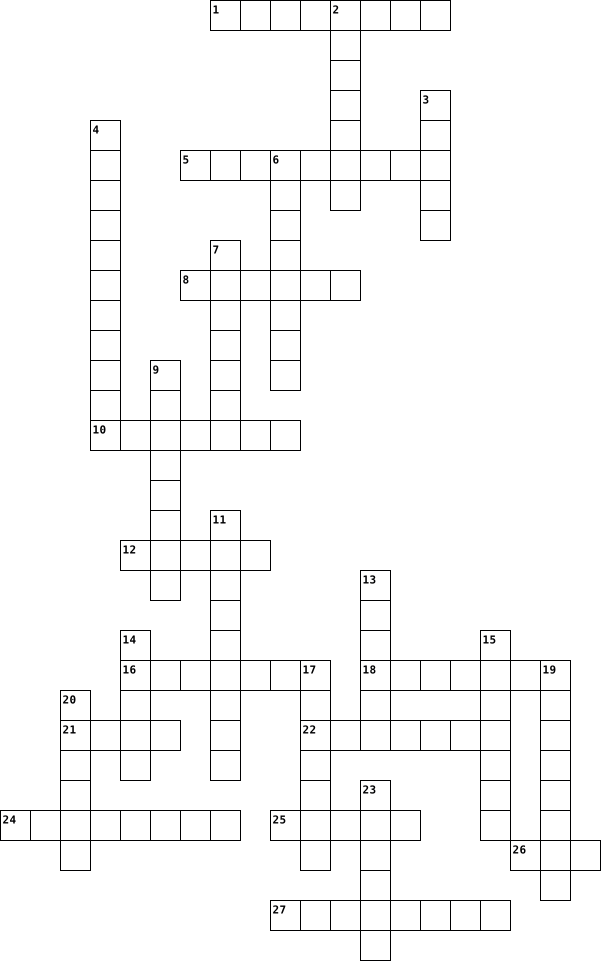
Chemistry Study Crossword 2016-02-10

Across
- usually the number of electrons or protons
- a neutrally charged piece of an atom
- coating a metal with a metal
- on the far right of the table
- takes in energy
- electrons in the outer orbital
- a positively charged piece of an atom
- two atoms bonded together
- created the first periodic table
- weight of an element
- center of an atom
Down
- one type of atom- a pure substance
- Na is sodium's ____________.
- you can't create or destroy matter.
- what goes into an experiment
- a column on the table
- a "string" of atoms,
- what comes out of an experiment
- a level of electrons in an atom
- usually shiny, ductile.
- releases energy
- a horizontal line on the table
- does not conduct electricity well.
- both a metal and a non metal
- a negatively charged piece of an atom
- smallest piece of matter
26 Clues: takes in energy • releases energy • center of an atom • a "string" of atoms, • weight of an element • a column on the table • usually shiny, ductile. • smallest piece of matter • two atoms bonded together • Na is sodium's ____________. • what goes into an experiment • coating a metal with a metal • both a metal and a non metal • on the far right of the table • ...
Atoms Crossword Puzzle By Chistian B.B , Bryce Deluna, Nick Nejad 2022-09-16

Across
- table with all chemical elements listed
- a row in the periodic table
- area where protons and neutrons reside
- total mass in an atom
- a charged atom
- how easily valence electrons interact
- electrons in the outermost energy level
Down
- a columm in the pariodic table
- building blocks of matter
- negativly charged particles in an atom
- postivly charged particles in an atom
- area where electrons reside
- the amount of protons in the nucleus
- partitcles that make up an atom
- particles with a neutural charge
15 Clues: a charged atom • total mass in an atom • building blocks of matter • area where electrons reside • a row in the periodic table • a columm in the pariodic table • partitcles that make up an atom • particles with a neutural charge • the amount of protons in the nucleus • postivly charged particles in an atom • how easily valence electrons interact • ...
Science Revision 2020-06-25

Across
- Study of chemicals and reactions.
- Study of living things/ organisms.
- Study of movement and forces.
- What element has the symbol Au?
Down
- What element has the symbol O?
- The planet that's closest to the sun.
- What are the rows of the Periodic Table called?
- What are the columns of the Periodic Table called?
- What element has the symbol Fe?
9 Clues: Study of movement and forces. • What element has the symbol O? • What element has the symbol Fe? • What element has the symbol Au? • Study of chemicals and reactions. • Study of living things/ organisms. • The planet that's closest to the sun. • What are the rows of the Periodic Table called? • What are the columns of the Periodic Table called?
scientific crossword 2013-04-19

Across
- is the very first element on the periodic table
- atomic symbol is B and its atomic number is 5
- has the secound smallest atomic number
- has 1 valance electron
- its atomic number is 10 it is a noble gas
Down
- discovered in 1898 chemical symbol
- horizonal on the periodic table
- has 8 valence electrons
- the element under hydrogen
9 Clues: has 1 valance electron • has 8 valence electrons • the element under hydrogen • horizonal on the periodic table • discovered in 1898 chemical symbol • has the secound smallest atomic number • its atomic number is 10 it is a noble gas • atomic symbol is B and its atomic number is 5 • is the very first element on the periodic table
Scientific Crossword 2013-04-19

Across
- atomic symbol is B and its atomic number is 5
- has the secound smallest atomic number
- discovered in 1898 chemical symbol
- has 1 valence elctron
- its atomic number is 10 it is a noble gas
Down
- horizonal on the periodic table
- is the very first element of the periodic table
- has 8 valence electrons
- the element under hydrogen
9 Clues: has 1 valence elctron • has 8 valence electrons • the element under hydrogen • horizonal on the periodic table • discovered in 1898 chemical symbol • has the secound smallest atomic number • its atomic number is 10 it is a noble gas • atomic symbol is B and its atomic number is 5 • is the very first element of the periodic table
Periodic Table Crossword 2023-11-30

Across
- Creator of the first periodic table
- Poisonous metalloid
- Nonmetal often used in signs
- Good conductor; can corrode
- Contains properties of both metals and nonmetals
Down
- Sodium, silver, and strontium are examples of this
- Stated that elements listed in order of their atomic numbers will fall into groups
- Low melting point; breaks easily
- Organized the modern periodic table
9 Clues: Poisonous metalloid • Good conductor; can corrode • Nonmetal often used in signs • Low melting point; breaks easily • Creator of the first periodic table • Organized the modern periodic table • Contains properties of both metals and nonmetals • Sodium, silver, and strontium are examples of this • ...
Periodic Table Crossword 2023-11-30

Across
- Creator of the first periodic table
- Poisonous metalloid
- Nonmetal often used in signs
- Good conductor; can corrode
- Contains properties of both metals and nonmetals
Down
- Sodium, silver, and strontium are examples of this
- Stated that elements listed in order of their atomic numbers will fall into groups
- Low melting point; breaks easily
- Organized the modern periodic table
9 Clues: Poisonous metalloid • Good conductor; can corrode • Nonmetal often used in signs • Low melting point; breaks easily • Creator of the first periodic table • Organized the modern periodic table • Contains properties of both metals and nonmetals • Sodium, silver, and strontium are examples of this • ...
5.2.1 Chemical Bonds (Ionic) 2017-05-15

Across
- elements found on the left of the periodic table
- the number of different types of chemical bond
- elements found on the right of the periodic table
- atoms .... electrons to form negative ions
- when atoms lose electrons this type of ion is formed
- if an atoms gains or loses electrons an ... is formed
Down
- a particle with the same number of electrons and protons
- negatively charged particle
- the type of bonding where non-metal atoms share pairs of electrons
- the strength of chemical bonds
- the type of bonding in metals
- the type of bond formed when oppositely charged ions attract
12 Clues: negatively charged particle • the type of bonding in metals • the strength of chemical bonds • atoms .... electrons to form negative ions • the number of different types of chemical bond • elements found on the left of the periodic table • elements found on the right of the periodic table • when atoms lose electrons this type of ion is formed • ...
Chemistry Quiz 1 2024-04-01

Across
- caused an increase in the amount of oxygen in
- lowers the amount of activation energy needed to create a chemical reaction
- vertical on periodical table
- poisonous gas made from partially burn carbon is called carbon ……
- removing oxygen
- an element with a low boiling point is a …….. at average temperatures
- makes up around 70% of atmosphere
- elements with the same number of protons and electrons but different numbers of neutrons
- coloured green on universal indicator
- if a substance’s a varied boiling or melting point it is .. …
- diamonds, graphite and fulerenes are made of this
Down
- group 7 always come in twos because they share an electron
- group 1 alkaline metals become more ….. as you go down the periodic table
- group on inert gases in group 0
- gas….. used to measure small quantities of gase given off in a chemical reaction
- how you measure the rate of a chemical reaction at between set points
- conditions affecting the rate of a reaction are temperature, surface are and …..
- atmosphere over time
- an an acid + a base => a …… and water
- elements from the same period number have the same number of electron …….
- horizontal on periodic table
- form when two clear solutions form a solid
22 Clues: removing oxygen • atmosphere over time • vertical on periodical table • horizontal on periodic table • group on inert gases in group 0 • makes up around 70% of atmosphere • an an acid + a base => a …… and water • coloured green on universal indicator • form when two clear solutions form a solid • caused an increase in the amount of oxygen in • ...
PERIODIC TABLE VOCABULARY CROSSWORD PUZZLE 2013-12-05

Across
- that share SOME of the qualities of metals
- horizontal organization system
- no charge
- Number/The Numbering system used in the Periodic Table, the bigger the _____________, the bigger the Atomic Mass gets
- Sulfur
- vertical organization system
- Point/The point at which it goes from a liquid to a gas
- Conduct electricity very well
- Table/A chart that organizes information about all of the known Elements according to their Properties
Down
- Neutrons, Protons and Electrons
- Is made out of Protons and Neutrons
- a negative charge
- Point/The point at which it goes from a solid to a liquid
- Hydrogen, Carbon, Nitrogen, Oxygen and Chlorine
- a positive charge
- Gases/Characteristics of the ___________ are that they all conduct electricity, fluoresce, are odorless and colorless
- up of 2 or more Elements
- Pure Substance
- First letter is in UPPERCASE and if there is a second letter, it is in lowercase
19 Clues: Sulfur • no charge • Pure Substance • a negative charge • a positive charge • up of 2 or more Elements • vertical organization system • Conduct electricity very well • horizontal organization system • Neutrons, Protons and Electrons • Is made out of Protons and Neutrons • that share SOME of the qualities of metals • Hydrogen, Carbon, Nitrogen, Oxygen and Chlorine • ...
Outline 8 Science 10 Crossword 2022-10-31

Across
- An abbreviation of the element name
- The number of electrons Magnesium has
- The name of the element Ba
- A substance in which two or more different elements are CHEMICALLY bonded together
- Electrons have a _________ charge
- a subatomic particle without an electric charge
- Atomic ______ tells you how many protons or neutrons there are
- Has 8 electrons
- A chemical ______ is a process in which atoms of one or more substances are rearranged to form different substances
- Atomic _____ is the number of protons and neutrons in the nucleus of an atom
- The name of the element Kr
Down
- Protons have a ________ charge
- The name of the element Ta
- The 1st element on the periodic table
- The 20th element of the periodic table
- Has 6 electrons
- The number of electrons boron has
- A substance composed of a single kind of atom.
- Two or more substances that are mixed together but are NOT chemically bonded.
19 Clues: Has 6 electrons • Has 8 electrons • The name of the element Ta • The name of the element Ba • The name of the element Kr • Protons have a ________ charge • Electrons have a _________ charge • The number of electrons boron has • An abbreviation of the element name • The 1st element on the periodic table • The number of electrons Magnesium has • ...
IMF and Gas Law Review 2023-03-31

Across
- a bond between a metal and non-metal
- an unequal sharing of electrons
- point the point on a phase diagram where all substances exist
- what side of the periodic table non-metals are located on
- bonding that polar molecules can have
- a bond between two non-metals
- "_______ dissolves _______"
- the strongest IMF CH4 can have
- the flat line on a heating curve is where this type of change occurs
- an equal sharing of electrons
- this law says (V1/T1) = (V2/T2)
Down
- as heat is increased at a constant volume pressure...
- the strongest IMF HF can have
- this does NOT change during a phase change
- how much an element wants to pull electrons in
- this bonding occurs when H is bonded to NOF
- when IMF increase this point also increases
- the strongest IMF RbBr can have
- this law says P1V1=P2V2
- the only force non-polar molecules can have
- the most electronegative atom on the periodic table
- as this is added to a substance the molecules speed up and spread out
22 Clues: this law says P1V1=P2V2 • "_______ dissolves _______" • the strongest IMF HF can have • a bond between two non-metals • an equal sharing of electrons • the strongest IMF CH4 can have • an unequal sharing of electrons • the strongest IMF RbBr can have • this law says (V1/T1) = (V2/T2) • a bond between a metal and non-metal • bonding that polar molecules can have • ...
7th Grade Science Final 2023-05-15

Across
- Clouds are formed by the process of
- the build up electric charge on an object
- SI unit for measuring mass
- SI unit for volume
- helps keep the Earth revolving around the sun
- What can you predict from an elements position on the periodic table?
- a variable that you measure during an experiment
- the process by which cells capture energy in sunlight and uses it to make sugars
Down
- A complete, unbroken path through which electric charges can flow
- Relative humidity can be measured with a
- The number of different species in an area
- The center part of most cells that stores genetic info
- an observation that deals with numbers
- The layer of our atmosphere in which weather occurs is the
- Created the first periodic table
- an example of an insulator
- temp scale based around water's boiling and freezing point
- The atomic number of an element is based on the number of
- A large pellet of ice that is formed in a cumulonimbus cloud is called ______
19 Clues: SI unit for volume • SI unit for measuring mass • an example of an insulator • Created the first periodic table • Clouds are formed by the process of • an observation that deals with numbers • Relative humidity can be measured with a • the build up electric charge on an object • The number of different species in an area • helps keep the Earth revolving around the sun • ...
Boredom #6 2026-05-04

Across
- What the Eastern Roman Empire became
- The First element on the Periodic Table
- Technically this is tsarist propaganda but it's a great film none the less
- Month that doesn't work well for a name
- Harry Potter's middle name
- What people use to defend their horrible jokes
- Movie about the Black Women who helped us to the moon!
- What Heath Ledger won his post mortem Oscar for
- People get _______ after they sneeze
- Plant that eats insects that land on its "mouth"
Down
- "April showers bring ___ _______"
- Revolution that inspired "Animal Farm" (technically "Animal Farm" is about authoritarian governments in general, but it is still somewhat based off of this revolution)
- The Last element on the Periodic Table
- This city in Russia was the capital for a while
- "_____ _____: A Knives Out Mystery"
- There is a very famous Communist One
- Element that is shortened to Sn
- June
- What an absence becomes if you turn in a note
19 Clues: June • Harry Potter's middle name • Element that is shortened to Sn • "April showers bring ___ _______" • "_____ _____: A Knives Out Mystery" • What the Eastern Roman Empire became • There is a very famous Communist One • People get _______ after they sneeze • The Last element on the Periodic Table • The First element on the Periodic Table • ...
Fun Facts about Bones and Joints 2022-12-27

Across
- this is the v-shaped bone located at the base of the tongue, the only bone in the human skeletal system not connected to another
- this nutrient is used to make bone, P on the Periodic Table of Elements
- the adult human body is made of ___ bones
- the ___, or collarbone, is the most commonly broken bone among children
- this bone of the middle ear in humans, is the smallest and lightest bone of the human skeleton
- most bones in the human skeleton stop growing in length during or around ___
- the bones of the human skeleton provide ___ to internal organs and other structures, like the ribs offer to the heart and lungs
Down
- there are 26 bones in the human ___
- this is likely the most notable function of the human skeleton
- this nutrient is used to make bone, Na on the Periodic Table of Elements
- the human ___, including the wrist, contains 54 bones
- in addition to nutrients and other minerals, bones are commonly composed of specialized protein called ___
- the thighbone, or ___, is the longest and strongest bone of the human skeleton
- bone ___ changes over time, a measure of the amount of mass for a given volume of bone
- bones produce white and ___ blood cells
- this nutrient is used to make bone, Ca on the Periodic Table of Elements
16 Clues: there are 26 bones in the human ___ • bones produce white and ___ blood cells • the adult human body is made of ___ bones • the human ___, including the wrist, contains 54 bones • this is likely the most notable function of the human skeleton • this nutrient is used to make bone, P on the Periodic Table of Elements • ...
Y9 CHEM MIXED 2026-01-04

Across
- — The only non-metal found in Group 1
- — An ionic compound with a crystal lattice (6,8)
- — Group 1 elements that become more reactive down the group (6,6)
- — Bonding in metals involving delocalised electrons
- — Generally increases down Groups 1 and 2
- — A negatively charged particle around the nucleus
Down
- — A vertical column in the periodic table
- — A horizontal row in the periodic table
- — Bonding formed by electron transfer between a metal and a non-metal
- — An energy level where electrons are found
- — Bonding where atoms share electrons
- — A regular repeating structure of particles in a solid
- — A giant covalent structure made of carbon
- — A giant covalent structure that can conduct electricity
- — Increases down Groups 1 and 2; likelihood of forming compounds
- — An element that gains or shares electrons in reactions
16 Clues: — The only non-metal found in Group 1 • — Bonding where atoms share electrons • — A horizontal row in the periodic table • — A vertical column in the periodic table • — Generally increases down Groups 1 and 2 • — An energy level where electrons are found • — A giant covalent structure made of carbon • — An ionic compound with a crystal lattice (6,8) • ...
Chemistry Crossword 2020-09-04

Across
- horrizontal row
- solid from liquid
- gas
- a mixture of substances
- packed atoms
- new substance
- measurement of space
Down
- chemical composition
- physically combined
- two or more elements
- fluid
- table of elements
- from chemical reaction
- separating solids
- vertical column
- a pure substance
16 Clues: gas • fluid • packed atoms • new substance • horrizontal row • vertical column • a pure substance • solid from liquid • table of elements • separating solids • physically combined • chemical composition • two or more elements • measurement of space • from chemical reaction • a mixture of substances
PERIODIC CROSSWORD 2019-08-12

Across
- Atoms have the same number of protons and _____.
- Number of protons and neutrons in an atom (2 words)
- Moving left to right across the periodic table, atomic radius ______.
Down
- Elements are arranged by _____ table.
- Number of protons in an atom (2 words)
- Moving left to right across the periodic table, the number of electrons in atoms______.
- Smallest particle of an element.
7 Clues: Smallest particle of an element. • Elements are arranged by _____ table. • Number of protons in an atom (2 words) • Atoms have the same number of protons and _____. • Number of protons and neutrons in an atom (2 words) • Moving left to right across the periodic table, atomic radius ______. • ...
Module 2 2025-08-18

Across
- of vaporization
- pool
- Table
- cycle
- molecule
- reaction
- formula
- tension
- bond
Down
- symbol
- reaction
- reaction
- heat
13 Clues: pool • heat • bond • Table • cycle • symbol • formula • tension • reaction • reaction • molecule • reaction • of vaporization
Periodic Table Structure 2022-11-15

Across
- tell you atomic + mass number and symbol
- 20th element on periodic table
- tells you the number of protons and electrons equal to number of protons when neutral
- element with no neutrons
Down
- 4th element down on the 8th column
- element with 6 electrons
- provides the number of protons
- element with 8 protons
- 17th element on periodic table
9 Clues: element with 8 protons • element with 6 electrons • element with no neutrons • provides the number of protons • 20th element on periodic table • 17th element on periodic table • 4th element down on the 8th column • tell you atomic + mass number and symbol • tells you the number of protons and electrons equal to number of protons when neutral
Elements and compounds crossword Puzzle 2021-10-26

Across
- far, 118 elements have been discovered. Gold is an element made up of only gold atoms.
- Able to be hammered or pressed into shape without breaking
- formula A symbol that shows the chemical composition of a substance
- A substance made up of two or more types of atom bonded together
- has the atomic number 6 and is followed in the periodic table by nitrogen (7) and oxygen (8).
- A repeating arrangement of atoms in a solid
- metals are located in the first group of the periodic table.
- are broken or formed during chemical reactions.
- The smallest particle of an element
- Easily broken
- the number by which elements are ordered in the periodic table
- metal rhenium is the element with the highest known boiling point, 5590°C!
- general, metals have higher melting points than non-metals.
- chemicalformula for water shows that it has 2 hydrogen atoms for each oxygen atom.
- The temperature at which a substance changes from solid to liquid
- in the same group have similar properties. Atomic number increases from top to bottom.
- is a compound with molecules made of one oxygen atom bonded to two hydrogen atoms.
Down
- One or two letters used to represent an element
- The temperature at which a substance changes from liquid to gas
- symbols for some elements come from Latin, such as Au for gold, from the Latin word 'aurum'.
- non-metal elements are brittle, breaking easily when hit.
- bond An attractive force that holds two atoms together
- A soft, shiny metal that is highly reactive
- and oxygen gases chemically react to form a new substance, water.
- The re-arrangement of atoms to form one or more new substances
- A substance made up of only one type of atom
- metals are malleable, allowing them to be hammered into thin sheets.
- are highly ordered structures held together by bonds between atoms.
- atom is made up of even smaller “subatomic” particles.
29 Clues: Easily broken • The smallest particle of an element • A soft, shiny metal that is highly reactive • A repeating arrangement of atoms in a solid • A substance made up of only one type of atom • One or two letters used to represent an element • are broken or formed during chemical reactions. • bond An attractive force that holds two atoms together • ...
Unit 1 Crossword (NO SPACES) 2021-09-29

Across
- the _________ variable goes on the y-axis
- glucose is a kind of...
- this provides the plant with energy for photosynthesis
- A tiny hole in the lower epidermis. These holes let carbon dioxide from the air get into the leaf.
- What is "C" on the periodic table of elements.
- some plants are green because they contain...
- the "i" in IB stands for...
- when two variables move in opposite directions it is called a ________ correlation
- when two variables move in the same direction it is called a ________ correlation
- The name of your Science teacher right now
- The study of living things is called...
- another name for C6H12O6
- this carries water to the cells in leaves
- something else that is required for photosynthesis
Down
- The ________ contains cells that do most of the photosynthesis.
- Another name for independent variable is ________ variable.
- a relationship between variables is called a...
- All living things are made of...
- The process by which plants make food
- What is "H" on the periodic table of elements.
- the _________ variable goes on the x-axis
- Another name for dependent variable is _________ variable.
- something that is produced in photosynthesis that humans need
- The cells in the _______ do a small amount of photosynthesis.
- A variable that you want to keep the same each time so they are not affecting your experiment is called a _________ variable.
- something required for photosynthesis
- What is "Au" on the periodic table of elements.
- Anything that can change and be changed and anything that we can measure and observe is called a...
- The name of this class
- The _________ on the leaf surface stops the leaf cells from drying out.
30 Clues: The name of this class • glucose is a kind of... • another name for C6H12O6 • the "i" in IB stands for... • All living things are made of... • The process by which plants make food • something required for photosynthesis • The study of living things is called... • the _________ variable goes on the y-axis • the _________ variable goes on the x-axis • ...
Chemistry Crossword 2017-11-13

Across
- the mass of one atom in an element calculated using the protons and neutrons
- Things that speed up the chemical reaction rate
- neutral particle in the nucleus of an atom
- the number of protons in one atom of an element
- A compound made up of 2 non-metals
- a change where an entirely new substance is created with different properties from the original combinations
- A physical characteristic of a substance in which it can be pounded or rolled into sheets
- The vertical columns of the periodic table also known as families
- A property that describes the appearance and composition of a substance
- An experiment where one or more products of a chemical reaction can escape
- An experiment in which all reactants and product in a chemical reaction are accounted for
- characteristics used to describe a substance
- A homogeneous mixture
Down
- group 17 of the periodic table
- the substance that reacts to another substance to create a product
- a positivly charged centre of an atom consisting of protons and neutrons
- An invisible negatively charged particle that orbits around the nucleus of an atom
- the most reactive group of the metals on the periodic table
- A substance that strongly resists the flow of electricity
- Heterogeneous Mixtures
- A element with both metal and nonmetal properties
- Pure substances merged as a result of their opposite charges
- a new substance produced in a chemical reaction between reactants
- An atom or a group of atoms that become electrically charged because it has lost or gained electrons
- a pure substance made up of only one type of atom
25 Clues: A homogeneous mixture • Heterogeneous Mixtures • group 17 of the periodic table • A compound made up of 2 non-metals • neutral particle in the nucleus of an atom • characteristics used to describe a substance • Things that speed up the chemical reaction rate • the number of protons in one atom of an element • A element with both metal and nonmetal properties • ...
Semester 2 2016-05-18

Across
- units for resistance
- formed by the transfer of electrons
- an element of Group 1
- a circuit with parts connected one after another
- the process of combining nuclei
- a material that does the dissovling
- a wave made on a rope for example
- measured in amps
- a reaction that emits energy
- a horizontal row on the periodic table
- positive subatomic particle
- the change from gas to liquid
- neutral subatomic particle
- formed by the sharing of electrons
- a measure of energy in a wave
- a sound wave for example
- an electron/positron emitted in nuclear decay
- began with the Big Bang and is still expanding
- the highest point of a wave
- the ratio of mass per unit volume
- A + B -> C
- a substance that participates in a chemical reaction
Down
- a circuit created with different branches
- looks the same throughout
- a stable non-reactive group on the periodic table
- a positive He nucleus emitted in nuclear decay
- a charged atom
- A -> B + C
- created from the death of the most massive stars
- tearing paper or painting a wall
- a reaction that takes in energy
- attractive force that holds atoms together
- negative subatomic particle
- a voltage source
- burning, rusting, decomposing for example
- the smallest unit of an element
- a vertical column on the periodic table
- the lowest point of a wave
- different parts are visible
- opposing the flow of current in a circuit
- a substance that forms in a chemical reaction
- a material that will dissolve
- the process of splitting a nucleus
43 Clues: A -> B + C • A + B -> C • a charged atom • a voltage source • measured in amps • units for resistance • an element of Group 1 • a sound wave for example • looks the same throughout • the lowest point of a wave • neutral subatomic particle • negative subatomic particle • positive subatomic particle • different parts are visible • the highest point of a wave • a reaction that emits energy • ...
✰crossword✰ 2020-01-14

Across
- Positive charge
- No charge.
- Any of the series of fifteen metallic elements from lanthanum to lutetium in the periodic table.
- Element that doesn't have the characteristics of metal.
- An electrically charged atom or group of atoms formed by the loss or gain of one or more electrons.
- The number of protons in the nucleus of an atom.
- Properties are intermediate between those of metals and solid nonmetals or semiconductors.
- Any of the set of metallic elements occupying a central block.
- Region of negative charge surrounding an atomic nucleus that is associated with an atomic orbital
- An electrically charged atom or group of atoms formed by the loss or gain of one or more electrons.
- Negative charge.
Down
- A horizontal row in the periodic table of the elements (has varying properties).
- Each of two or more forms of the same element that contain equal numbers of protons but different numbers of neutrons in their nucleus.
- Any of the elements fluorine, chlorine, bromine, iodine, and astatine, occupying group
- Any of the elements found in Group.
- Spontaneous emission of radiation in the form of particles or high energy photons resulting from a nuclear reaction.
- Atom or molecule that has gained or lost one or more of its valence electrons.
- A vertical column in the periodic table of the elements.
- Loss of elementary particles from an unstable nucleus, ultimately changing the unstable element into another more stable element.
- Average of the proton rest mass and the neutron rest mass.
- Any chemical element that is an effective conductor of electricity and heat.
- These elements, together with the lanthanides, are called internal transition elements.
- Very reactive, electropositive, monovalent metals forming strongly alkaline hydroxides.
- Group of chemical elements with very similar properties
- Positively charged center of the atom consisting of protons and neutrons.
25 Clues: No charge. • Positive charge • Negative charge. • Any of the elements found in Group. • The number of protons in the nucleus of an atom. • Element that doesn't have the characteristics of metal. • Group of chemical elements with very similar properties • A vertical column in the periodic table of the elements. • Average of the proton rest mass and the neutron rest mass. • ...
Chemistry Wood Search 2013-05-30

Across
- A change in which one or more new substances are produced or they'res a change in the starting substance.
- Any property of a substance that does not have a numerical number is a ______ property such as colour or odour.
- A change in which no new substances are formed and the substance remains unaltered.
- The temperature at which a substance changes state from a liquid to a gas.
- The elements found in the upper right portion of the periodic table are called ______.
- A negatively charged particle in an atom that orbits the nucleus.
- An ____ is a pure element that cannot be broken down in, by any physical or chemicals means.
- The ____ of a substance is a ratio of its mass to its volume.
- A positively charged ion.
- The ____ number is the number of protons and neutrons in an atom's nucleus.
Down
- The temperature at which a substance changes state ffrom a liquid to a solid.
- A _____ substance is a substance that is made up of only one type of particle.
- The ____ gases are named this because of their stable nature and unreactivity.
- A _____ bond is a bond formed when two non-metal atoms share electrons.
- A _____ is two or more atoms of the same or different elements that are chemically joined together.
- A pure substance composed of two or more elements that have been chemically joined.
- A substance with two different types of particles is known as a ______.
- The smallest unit of an element.
- An _____ is a solid solution made up of two or more moetals.
- A row on the periodic table is called a _____.
- Potassium, Calcium, and Lithium are all on the periodic table and are all examples of ______.
- A particle that has became charged. Either positively or negatively.
22 Clues: A positively charged ion. • The smallest unit of an element. • A row on the periodic table is called a _____. • An _____ is a solid solution made up of two or more moetals. • The ____ of a substance is a ratio of its mass to its volume. • A negatively charged particle in an atom that orbits the nucleus. • ...
Chemistry crossword 2014-11-07

Across
- ability of a substance to conduct electricity or heat
- mass of 1 atom of an element calculated from the total number of protons, neutrons, and electrons of that atom
- pure substance formed when at least one metal and non- metal combine
- change that results when two or more substances react to create a different substance or substances
- chemical reaction that occurs when oxygen reacts with a substance to form a new substance and give off energy
- new substance produced in a chemical reaction between reactants
- element that has both metallic and non metallic properties
- pure substance that can not be broken down into other substances
- number of protons in the nucleus of one atom of an element
- description of a substance that can be pounded or rolled into sheets
- vertical column of elements in the periodic table
Down
- substance that helps a chemical reaction proceed more quickly
- change in the appearance or state of a substance that does not change the composition
- an experiment in which all reactants and all product of a chemical reaction are accounted for
- group 17 elements in the periodic table; the most reactive non-metals
- vertical column of elements in the periodic table
- description of a solid that can be stretched into long wire
- slow chemical change that occurs when oxygen in the air reacts with a metal
- pure substance formed when at least one metal and one non metal combine
- chemical combination of two or more elements i a specific ratio
- neutral particle in the nucleus of an atom
- group 1 elements in the periodic table, not including hydrogen; the most reactive of the metals
- catalyst involved in chemical reactions in living things
- shiny,malleable,ductile, element that conducts electricity
- invisible negatively charged particle that orbits the nucleus of an atom
25 Clues: neutral particle in the nucleus of an atom • vertical column of elements in the periodic table • vertical column of elements in the periodic table • ability of a substance to conduct electricity or heat • catalyst involved in chemical reactions in living things • element that has both metallic and non metallic properties • ...
Chemistry Crossword 2014-05-14

Across
- a numerical scale ranging from 0-14 that is used to compare the acidity of solutions
- The rapid reactions of a substance with oxygen to produce oxides and energy
- The breakdown of a metal resulting from reactions with chemicals in its environment
- A molecule consisting of only two atoms of either the same or different elements
- A reaction in which a larger or more complex molecule breaks down to form two (or more) simpler products
- A bond that results from the sharing of outer electrons between non-metal atoms
- A solid formed from the reaction of 2 solutions
- An aqueous solution that conducts electricity, tastes sour, turns blue litmus red, and neutralizes bases
- The elements in the 17th column of the periodic table
- A chemical, present at the start of a chemical reaction, that is used up during the reaction
Down
- A particle in which atoms are joined by covalent bonds
- A measure of how acidic or basic a solution is
- Neither acidic nor basic
- A way of describing a chemical reaction using the chemical formulas of the reactants and products
- A charged particle that results when an atom gains or loses one or more electrons
- A row of elements in the periodic table
- A chemical that is produced during a chemical reaction
- A column of elements in the periodic table with similar products
- An aqueous solution that conducts electricity and turns red litmus blue
- A description of what a substance does as it changes into one or more new substance(s)
- An ion made up of more than 1 atom that acts as a single particle
- A compound that separates into ions when it dissolves in water, producing a solution that conducts electricity
22 Clues: Neither acidic nor basic • A row of elements in the periodic table • A measure of how acidic or basic a solution is • A solid formed from the reaction of 2 solutions • The elements in the 17th column of the periodic table • A particle in which atoms are joined by covalent bonds • A chemical that is produced during a chemical reaction • ...
Chapter 10 Modern Atomic Theory And The Periodic Table 2016-01-11

Across
- small packets of energy in streams of light
- Every principle energy level is divided into _____
- outermost electron shell(2)
- as stated by this principle, an orbital cannot contain more than 2 electrons(3)
- what is white light?(2)
- 4th sublevel
- this atom's orbital configuration is 1s² 2s²2p⁶ 3s²3p⁶ 4s²3d¹⁰
- energy is emitted in tiny distinct packets called _____
- columns in the periodic table
- region in space around a nucleus with a high probability of finding an electron
- all the Group IIIB to Group IIB (3-12) elements(2)
- Who said this: “electrons revolve in specific regions at various distances from the nucleuscalled energy levels”(2)
- this atom's orbital configuration is 1s² 2s²2p⁶ 3s²3p⁶
Down
- Group VIIA Elements
- all the Group A’s elements in the Periodic Table(2)
- rows in the periodic table
- electrons on the outermost energy level (2)
- the energy level expressed by the principal quantum number n(3)
- this method of arranging electrons uses numbers, letters, and superscripts(2)
- When a gas emits light shown through a prism, the beaming colored lines are part of a _____(2)
- this method of arranging electrons uses arrows and boxes(2)
- 2nd sublevel
- this atom's orbital configuration is 1s² 2s²2p⁶ 3s²3p⁶ 4s²
- lowest energy level(2)
- 3rd sublevel
- 1st sublevel
- Which rule is this: electrons will occupy separate orbitals of the same energy before pairing of electrons occur(2)
- distance between two peaks or trough inside a wave
- neon’s orbital configuration
- German physicist who was best known for his quantum mechanics work(2)
30 Clues: 2nd sublevel • 3rd sublevel • 1st sublevel • 4th sublevel • Group VIIA Elements • lowest energy level(2) • what is white light?(2) • rows in the periodic table • outermost electron shell(2) • neon’s orbital configuration • columns in the periodic table • small packets of energy in streams of light • electrons on the outermost energy level (2) • ...
Chapter 10 Modern Atomic Theory And The Periodic Table 2016-01-10

Across
- Group VIIA Elements
- all the Group A’s elements in the Periodic Table
- 3rd sublevel
- rows in the periodic table
- small packets of energy in streams of light
- in a given atom, no 2 electrons may have the same set of 4 quantum numbers therefore an orbital must have electrons with opposite spins ↓↑
- the energy level expressed by the principal quantum number n
- 2nd sublevel
- columns in the periodic table
- 1st sublevel
- Every principle energy level is divided into _____
- all the Group IIIB to Group IIB (3-12) elements
Down
- neon’s orbital configuration
- Who said this: “electrons revolve in specific regions at various distances from the nucleus called energy levels”
- outermost electron shell
- this atom's orbital configuration is 1s² 2s²2p⁶ 3s²3p⁶
- as stated by this principle, an orbital cannot contain more than 2 electrons
- region in space around a nucleus with a high probability of finding an electron
- this atom's orbital configuration is 1s² 2s²2p⁶ 3s²3p⁶ 4s²
- what is white light?
- Which rule is this: electrons will occupy separate orbitals of the same energy before pairing of electrons occur
- 4th sublevel
- electrons on the outermost energy level
- this atom's orbital configuration is 1s² 2s²2p⁶ 3s²3p⁶ 4s²3d¹⁰
- this method of arranging electrons uses numbers, letters, and superscripts
- distance between two peaks or trough inside a wave
- this method of arranging electrons uses arrows and boxes
- When a gas emits light shown through a prism, the beaming colored lines are part of a _____
- lowest energy level
- energy is emitted in tiny distinct packets called _____
30 Clues: 3rd sublevel • 4th sublevel • 2nd sublevel • 1st sublevel • Group VIIA Elements • lowest energy level • what is white light? • outermost electron shell • rows in the periodic table • neon’s orbital configuration • columns in the periodic table • electrons on the outermost energy level • small packets of energy in streams of light • all the Group IIIB to Group IIB (3-12) elements • ...
Chapter 10 Modern Atomic Theory And The Periodic Table 2016-01-10

Across
- energy is emitted in tiny distinct packets called _____
- what is white light?
- 1st sublevel
- as stated by this principle, an orbital cannot contain more than 2 electrons
- 2nd sublevel
- electrons on the outermost energy level
- all the Group A’s elements in the Periodic Table
- Every principle energy level is divided into _____
- this method of arranging electrons uses arrows and boxes
- small packets of energy in streams of light
- all the Group IIIB to Group IIB (3-12) elements
- When a gas emits light shown through a prism, the beaming colored lines are part of a _____
- Which rule is this: electrons will occupy separate orbitals of the same energy before pairing of electrons occur
- lowest energy level
- region in space around a nucleus with a high probability of finding an electron
Down
- this method of arranging electrons uses numbers, letters, and superscripts
- columns in the periodic table
- the energy level expressed by the principal quantum number n
- rows in the periodic table
- neon’s orbital configuration
- Group VIIA Elements
- in a given atom, no 2 electrons may have the same set of 4 quantum numbers therefore an orbital must have electrons with opposite spins ↓↑
- this atom's orbital configuration is 1s² 2s²2p⁶ 3s²3p⁶
- this atom's orbital configuration is 1s² 2s²2p⁶ 3s²3p⁶ 4s²
- distance between two peaks or trough inside a wave
- outermost electron shell
- Who said this: “electrons revolve in specific regions at various distances from the nucleus called energy levels”
- this atom's orbital configuration is 1s² 2s²2p⁶ 3s²3p⁶ 4s²3d¹⁰
- 3rd sublevel
- 4th sublevel
30 Clues: 1st sublevel • 2nd sublevel • 3rd sublevel • 4th sublevel • Group VIIA Elements • lowest energy level • what is white light? • outermost electron shell • rows in the periodic table • neon’s orbital configuration • columns in the periodic table • electrons on the outermost energy level • small packets of energy in streams of light • all the Group IIIB to Group IIB (3-12) elements • ...
Chapter 10 Modern Atomic Theory And The Periodic Table 2016-01-10

Across
- region in space around a nucleus with a high probability of finding an electron
- energy is emitted in tiny distinct packets called _____
- small packets of energy in streams of light
- as stated by this principle, an orbital cannot contain more than 2 electrons
- Every principle energy level is divided into _____
- outermost electron shell
- all the Group A’s elements in the Periodic Table
- this method of arranging electrons uses arrows and boxes
- the energy level expressed by the principal quantum number n
- this atom's orbital configuration is 1s² 2s²2p⁶ 3s²3p⁶ 4s²
- this method of arranging electrons uses numbers, letters, and superscripts
- this atom's orbital configuration is 1s² 2s²2p⁶ 3s²3p⁶ 4s²3d¹⁰
- 4th sublevel
- 1st sublevel
- 3rd sublevel
Down
- what is white light?
- Group VIIA Elements
- Who said this: “electrons revolve in specific regions at various distances from the nucleus called energy levels”
- columns in the periodic table
- neon’s orbital configuration
- When a gas emits light shown through a prism, the beaming colored lines are part of a _____
- in a given atom, no 2 electrons may have the same set of 4 quantum numbers therefore an orbital must have electrons with opposite spins ↓↑
- 2nd sublevel
- rows in the periodic table
- all the Group IIIB to Group IIB (3-12) elements
- electrons on the outermost energy level
- Which rule is this: electrons will occupy separate orbitals of the same energy before pairing of electrons occur
- this atom's orbital configuration is 1s² 2s²2p⁶ 3s²3p⁶
- distance between two peaks or trough inside a wave
- lowest energy level
30 Clues: 2nd sublevel • 4th sublevel • 1st sublevel • 3rd sublevel • Group VIIA Elements • lowest energy level • what is white light? • outermost electron shell • rows in the periodic table • neon’s orbital configuration • columns in the periodic table • electrons on the outermost energy level • small packets of energy in streams of light • all the Group IIIB to Group IIB (3-12) elements • ...
Chemistry unit study guide 2016-02-11

Across
- something formed by a union of elements or parts
- the mass of the products in a chemical reaction must equal the mass of the reactants
- a substance that is a good conductor of heat and electricity, can be melted, and is usually capable of being shaped
- the smallest particle of a substance that can exist by itself or be combined with other atoms
- characterized by or formed with absorption of heat
- any of a group of rare gases
- a very small particle of matter that has no electrical charge
- one of the basic substances that are made of atoms of one kind and that cannot be separated by ordinary chemical means into simple substances
- only partially conducts electricity
- a very small particle of matter that is part of the nucleus of an atom, and that has a positive electrical charge
Down
- columns in the periodic table
- the smallest possible amount of a particular substance
- a very small particle of matter that has a negative charge of electricity
- characterized by or formed with evolution of heat
- of protons in a nucleus
- a thin layer of metal that has been added to the outside of something
- Russian chemist, created periodic table
- a substance that changes when combined with another substance
- the mass of an atom usually expressed in atomic mass units
- has properties opposite of metals
- the central part of an atom that is made up of protons and neutrons
- the result of a process
- a mathematically described region around a nucleus in a atom or molecule that may contain zero, one, or two electrons
- rows going across the periodic table
24 Clues: of protons in a nucleus • the result of a process • any of a group of rare gases • columns in the periodic table • has properties opposite of metals • only partially conducts electricity • rows going across the periodic table • Russian chemist, created periodic table • something formed by a union of elements or parts • characterized by or formed with evolution of heat • ...
chemistry 2022-12-06
Across
- created by linking monomers together to make a chain; proteins; DNA, and slime
- number that shows the number of each element in a compound
- anything that has mass or volume
- substance that does the dissolving in a solution
- a mixture of two or more metals
- subatomic particle with no charge; found in the nucleus
- atoms of the same element with different numbers of neutrons
- smallest part of an element; made up of protons, neutrons, and electrons
- a solid in which the atoms are arranged in a pattern that repeats again and again
- substances that are produced by a chemical reaction
- particles that make up protons and neutrons
- an atom that has lost or gained an electron
- molecules that are linked together to make polymers
Down
- two or more substances mixed together, but are not chemically combined
- elements found on the left-hand side of the periodic table
- type of mixture appears the same throughout
- homogeneous mixture in which one substance is dissolved in another
- electrons in the outermost energy level
- a group of atoms held together by covalent bonds
- elements found on the right-hand side of the periodic table
- groups or columns of elements in the periodic table with similar properties
- an atom that has gained an electron and has a negative charge
- a mixture made up of a liquid and particles that remain suspended rather than dissolved in that liquid
- center of the atom
- subatomic particle with a negative charge; found in energy levels around the nucleus
- an atom that has lost an electron and has a positive charge
- subatomic particle with a positive charge; found in the nucleus
27 Clues: center of the atom • a mixture of two or more metals • anything that has mass or volume • electrons in the outermost energy level • type of mixture appears the same throughout • particles that make up protons and neutrons • an atom that has lost or gained an electron • a group of atoms held together by covalent bonds • substance that does the dissolving in a solution • ...
Matter and Change 2013-12-10

Across
- smallest unit of an element
- study of composition, structure, and properties of matter
- horizontal rows of elements in the periodic table
- high temperature physical state of matter, in which most electrons are lost
- definite volume but not a definite shape
Down
- anything that has mass and takes up space
- any substance that has a definite composition
- no definite volume or shape
- vertical columns of elements in the periodic table
- definite volume and shape
10 Clues: definite volume and shape • smallest unit of an element • no definite volume or shape • definite volume but not a definite shape • anything that has mass and takes up space • any substance that has a definite composition • horizontal rows of elements in the periodic table • vertical columns of elements in the periodic table • ...
Atomic Structure 2021-04-13

Across
- Basic unit of all matter
- Number of protons and neutrons in nucleus of an atom
- Columns on periodic table equal to valance electrons
- Subatomic particle with a negative charge
- Subatomic particle with a neutral charge
- Pure substance made of only one kinds of atom
Down
- Number of protons in the nucleus of an atom
- Electrons in outermost energy level
- Subatomic particle with a positive charge
- Rows on periodic table equal to energy levels
10 Clues: Basic unit of all matter • Electrons in outermost energy level • Subatomic particle with a neutral charge • Subatomic particle with a positive charge • Subatomic particle with a negative charge • Number of protons in the nucleus of an atom • Rows on periodic table equal to energy levels • Pure substance made of only one kinds of atom • ...
Chapter 5 Section 2 & 3 Crossword 2023-11-16

Across
- These elements fill the 4f orbital
- radius of the atom
- All these elements are radioactive.
- patterns that appear vertically in the periodic table
Down
- an atom that has a charge due to the gain or loss of electrons
- energy needed to remove an electron from a neutral atom
- size of the atom
- This block is unpredictable
- The metal side of the periodic table wants to ______ electrons
- p-block has ______ electrons in the ns sublevel
10 Clues: size of the atom • radius of the atom • This block is unpredictable • These elements fill the 4f orbital • All these elements are radioactive. • p-block has ______ electrons in the ns sublevel • patterns that appear vertically in the periodic table • energy needed to remove an electron from a neutral atom • an atom that has a charge due to the gain or loss of electrons • ...
The Radical Radium Rascal Puzzle 2023-03-23

Across
- A metal on the periodic table with the atomic mass of 88
- Term used when something can cause harm
- Emits ionizing radiation particles
- When a metal can be molded
- Poisonous, venomous, causes harm
Down
- table Where the element radium is found
- earth metals The family radium is found in
- Term when something is shiny
- Term for when something glows in the dark
- term for when a metal can be pulled into a wire
10 Clues: When a metal can be molded • Term when something is shiny • Poisonous, venomous, causes harm • Emits ionizing radiation particles • Term used when something can cause harm • Term for when something glows in the dark • table Where the element radium is found • earth metals The family radium is found in • term for when a metal can be pulled into a wire • ...
Periodic Table Project 2024-11-22

Across
- Recognized that atomic numbers is the basis for the organization of the periodic table
- credited for designing the first periodic table
- Reacts with water to make strong base
- low melting point (are usually gases)
Down
- iron is in this group
- hydrogen is in this group
- good conductor of heat and electricity
- silicon is in this group
- Mendeleev organized the elements in order of increasing atomic
- shape can be easy or hard to change
10 Clues: iron is in this group • silicon is in this group • hydrogen is in this group • shape can be easy or hard to change • Reacts with water to make strong base • low melting point (are usually gases) • good conductor of heat and electricity • credited for designing the first periodic table • Mendeleev organized the elements in order of increasing atomic • ...
Mixtures 2022-02-14

Across
- physical property
- made up of two or more elements, not on periodic table
- smallest particle
- when something changes from one thing to another and does NOT remain the same compound
- different throughout
Down
- when something changes from one thing to another but does remain the same compound, phase change
- chemical property
- physical property
- found on the periodic table
- chemical property
- physical property
- same through out
12 Clues: same through out • chemical property • physical property • physical property • chemical property • smallest particle • physical property • different throughout • found on the periodic table • made up of two or more elements, not on periodic table • when something changes from one thing to another and does NOT remain the same compound • ...
Scientific Crossword 2013-04-19

Across
- discovered in 1898 chemical symbol
- its atomic number is 10 it is a noble gas
- the element under hydrogen
- has 8 valence electrons
- has the secound smallest atomic number
Down
- atomic symbol is B and its atomic number is 5
- is the very first element of the periodic table
- has 1 valence elctron
- horizonal on the periodic table
9 Clues: has 1 valence elctron • has 8 valence electrons • the element under hydrogen • horizonal on the periodic table • discovered in 1898 chemical symbol • has the secound smallest atomic number • its atomic number is 10 it is a noble gas • atomic symbol is B and its atomic number is 5 • is the very first element of the periodic table
My crossword ♦♣♠♥→Chimin 2015-06-14

Across
- all substances made by this small particles
- First element in periodic table
- The substances produced when two or more elements combine in chemical reaction
- Element that name like Albert Einstein
Down
- Symbol is Fe
- Compound of Hydrogen and oxygen
- First element in the periodic table
- Symbol of Gold
- Second element in periodic table
- One way to make chemical reaction that use heat
10 Clues: Symbol is Fe • Symbol of Gold • Compound of Hydrogen and oxygen • First element in periodic table • Second element in periodic table • First element in the periodic table • Element that name like Albert Einstein • all substances made by this small particles • One way to make chemical reaction that use heat • ...
Vocab chapter 5 2023-01-07

Across
- elements in group 2A
- electrons on the outermost ring of electrons
- have properties of both metals and nonmetals
- the pattern of repeating properties displayed by elements
- elements in group 7A
- table of organized elements
Down
- bad conductors of heat and electric currents
- rows on the table of elements with increasing atomic numbers
- elements in group 1A not including hydrogen
- a column of elements in the periodic table
- elements in group 8A
- elements in the middle of the table
- good conductors of heat and electric currents also malleable
- one twelfth the mass of a carbon-12 atom
14 Clues: elements in group 2A • elements in group 8A • elements in group 7A • table of organized elements • elements in the middle of the table • one twelfth the mass of a carbon-12 atom • a column of elements in the periodic table • elements in group 1A not including hydrogen • bad conductors of heat and electric currents • electrons on the outermost ring of electrons • ...
Periodic table of elements 2023-05-03

Across
- name of element such as sodium is also known as the
- # of elements in periodic table
- to the left of the staircase
- second extended group found on the bottom of the table
- 18th group name
- # of groups on table
- first extended group found on the bottom of the table
- to the left of the staircase
- the letters that are what the elements are found by example: Na
- consists of most of the non-metals including hydrogen
- found in the nucleus is positive
- on the staircase
- # of ____ found based on period number
- biggest group of elements
Down
- # found on the top of the element block
- group after transition metals
- the total weight of an atom
- the most ____ are the elements toward the bottom left corner
- 2nd group name
- found on the rings is negative
- the leftover elements that are found at the end of the table
- up to 8 and are found based on group number
- # of periods on table
- found in the nucleus is neutral
- 1st group name
25 Clues: 2nd group name • 1st group name • 18th group name • on the staircase • # of groups on table • # of periods on table • biggest group of elements • the total weight of an atom • to the left of the staircase • to the left of the staircase • group after transition metals • found on the rings is negative • # of elements in periodic table • found in the nucleus is neutral • ...
Periodic Table Crossword 2024-11-25

Across
- Metals have a ______ melting point
- Calcium is
- recognized that atomic number, not atomic mass, is the basis of the organization of the periodic table
- developed the first type of periodic table but wasn't finished due to incompleteness
Down
- Metalloids ______ can be easy or hard to change
- published the first periodic table
- Nonmetals are _____ conductors of heat and electricity
7 Clues: Calcium is • Metals have a ______ melting point • published the first periodic table • Metalloids ______ can be easy or hard to change • Nonmetals are _____ conductors of heat and electricity • developed the first type of periodic table but wasn't finished due to incompleteness • ...
Revision 2013-12-08

Across
- Different planets take different amounts of time to ____________ the sun.
- Key word describing liquid to a gas
- A compound has ________________ properties to the elements that have reacted.
- Two or more elements that are chemically combined is a _________________
- Non-metals are found on the _______________ of the periodic table
- Iron and sulphur react to form iron_____________
- A bowl of grapes and apples is an example of a _______________
- Metal properties include conduction of electricity and _____________
Down
- When a metal reacts with air a metal ___________ is formed
- Magnesium + ______________ --> Magnesium oxide
- I am the fifth element from the sun.
- Metals are found on the _____________ of the periodic table
- In this state of matter the particles are far apart
- When steam cools on a cold surface we say it is
- At the centre of the solar system
- Solids ______________ and gases are the 3 states of matter
- I am the third planet from the sun
17 Clues: At the centre of the solar system • I am the third planet from the sun • Key word describing liquid to a gas • I am the fifth element from the sun. • Magnesium + ______________ --> Magnesium oxide • When steam cools on a cold surface we say it is • Iron and sulphur react to form iron_____________ • In this state of matter the particles are far apart • ...
Dallas Science Crossword 2024-05-02

Across
- The molecular forces are weaker than in a solid
- The elements on the right side of the periodic table
- Bonds One metal and nonmetal Bond that transfer electrons
- When you lose electrons/ positively charged
- Any substance, usually liquid, which is capable of dissolving one or several substances
- When you gain electrons/ negatively charged
- A solid, liquid, or gas which is dissolved to make a solution
- The atomic number of the elements
- A splitting or breaking up into parts
- The elements on the left side of the periodic table
Down
- The molecules are closely bound to one another by molecular forces
- Occurs when two atoms slam together to form a heavier atom
- Have the same number of protons
- Bonds Two nonmetal Bonds that share electrons
- The atom that has a neutral charge
- The molecular forces are very weak
- The fourth state of matter
17 Clues: The fourth state of matter • Have the same number of protons • The atomic number of the elements • The atom that has a neutral charge • The molecular forces are very weak • A splitting or breaking up into parts • When you lose electrons/ positively charged • When you gain electrons/ negatively charged • Bonds Two nonmetal Bonds that share electrons • ...
Unit 1 Review 2023-10-05

Across
- Number of electron energy levels that Magnesium has.
- Type of bond where electrons are transferred between a metal and a nonmetal.
- The element with the largest atomic radius.
- Analyzing the colors a planet or star gives off to see what elements it contains.
- Horizontal row on the periodic table.
- Subatomic particle with a positive charge, that tells us what element it is.
- Type of bond where electrons are shared between two nonmetals.
- Subatomic particle with a negative charge.
- When an atom has an equal number of protons and electrons.
Down
- The element with the highest ionization energy.
- Atom with a charge.
- Element in group 2, period 4.
- When a molecule like water has a positive and negative end.
- Element with 6 protons, 6 neutrons and 6 electrons.
- Subatomic particle with no charge.
- Electron in the outermost energy level.
- Vertical column on the periodic table.
17 Clues: Atom with a charge. • Element in group 2, period 4. • Subatomic particle with no charge. • Horizontal row on the periodic table. • Vertical column on the periodic table. • Electron in the outermost energy level. • Subatomic particle with a negative charge. • The element with the largest atomic radius. • The element with the highest ionization energy. • ...
6th grade: Vocabulary - School subjects 2022-02-21

Across
- theatre
- science
- periodic table
- picasso
- technology
Down
- instruments
- countries
- sports
- past happenings
- numbers
10 Clues: sports • theatre • science • numbers • picasso • countries • technology • instruments • periodic table • past happenings
electronegativity 2023-05-21

Across
- This element has a lower electronegativity than chlorine and is located in the same period as sulfur.
- This element has the highest electronegativity of all the elements on the periodic table.
- which element is located in the same group as fluorine and has a lower electronegativity than fluorine?
- Which element is located in the same period as magnesium and has a lower electronegativity than magnesium?
- Which side of the periodic table is an element on if it has a high electronegativity value and tends to attract electrons to itself in a chemical bond?
Down
- What is it called when a measure of an atom's ability to attract electrons when it forms a chemical bond with another atom occurs?
- What element on the periodic table is located in the same period as oxygen and has a higher electronegativity than oxygen?
- This element has a higher electronegativity than phosphorus and is located in the same period as silicon.
- This element has the lowest electronegativity of all the elements on the periodic table.
- This element has a higher electronegativity than carbon and is located in the same group as nitrogen.
10 Clues: This element has the lowest electronegativity of all the elements on the periodic table. • This element has the highest electronegativity of all the elements on the periodic table. • This element has a lower electronegativity than chlorine and is located in the same period as sulfur. • ...
SCIENCE 2016-01-17

Across
- The breaking down of rocks on the earth's surface is _____
- If fish are caught faster than they can breed, what will happen to the population?
- Which term refers to the number of protons in an atom and helps to place elements on the Periodic Table?
- The study of interactions between organisms and their environment is called_____
- Which subatomic particle has a positive charge?
- Which body system pumps and transports the blood to all parts of the body as well as supply oxygen and remove waste products from body tissues?
- Which subatomic particle is NOT found in the nucleus of an atom?
- On the Periodic Table, elements that are in the same vertical column are considered to be in the same_____
- Which of the following nutrients is used to build and repair cells?
Down
- Which organelle contains nearly all of a eukaryotic cell's DNA?
- In addition to food, what else does a mitochondrion need to release energy?
- What is the hormone responsible for causing sudden emotional changes and sexual feelings that occur in males during puberty?
- Which area of Earth science includes the study of stars?
- This structure, found in cells, assembles proteins.
- A species in danger of becoming extinct in the near future is referred to as a(an)_____ species.
- On the Periodic Table, all elements that are in the same horizontal rows are considered to be in the same ______
16 Clues: Which subatomic particle has a positive charge? • This structure, found in cells, assembles proteins. • Which area of Earth science includes the study of stars? • The breaking down of rocks on the earth's surface is _____ • Which organelle contains nearly all of a eukaryotic cell's DNA? • Which subatomic particle is NOT found in the nucleus of an atom? • ...
IPC vocab 2019-09-19

Across
- a state of matter consisting of particles that have neither a defined volume nor defined shape.
- a stable subatomic particle occurring in all atomic nuclei.
- does not have a definite shape.
- a measure of its ability to conduct electricity.
- smallest unit of matter.
- the smallest of the particles that make up an atom.
- an electromotive force.
- a part or aspect of something abstract.
- vertical column in the Periodic Table.
Down
- firm and stable in shape; not liquid or fluid.
- a subatomic particle found in the nucleus of atoms
- a solid material that is typically hard.
- a material made up of two or more different substances.
- a substance formed when two or more chemical elements.
- the name given to a horizontal row of the periodic table.
15 Clues: an electromotive force. • smallest unit of matter. • does not have a definite shape. • vertical column in the Periodic Table. • a part or aspect of something abstract. • a solid material that is typically hard. • firm and stable in shape; not liquid or fluid. • a measure of its ability to conduct electricity. • a subatomic particle found in the nucleus of atoms • ...
The Periodic Table and its Trends 2024-05-02

Across
- a negative charge
- do not form bonds in group 8 and have 8 valence electrons
- an element that have some property of metal and nonmetal combined
- group 2 and have 2 valence electrons
- horizontal row in a periodic table
- the number of protons in one atoms
- located in group 7 contain nonmetal and have 7 valence electrons
- A bond formed between two non metal elements
Down
- A bond formed between two metal element
- A positive charge
- elements that does not conduct electricity and gas at a room temperature
- the electrons in the outer most shell
- elements or substance that very good in conduct electricity
- group 1, 1 valence electrons in outer level and very reactive, shiny,silver
- vertical column in the periodic table
15 Clues: A positive charge • a negative charge • horizontal row in a periodic table • the number of protons in one atoms • group 2 and have 2 valence electrons • the electrons in the outer most shell • vertical column in the periodic table • A bond formed between two metal element • A bond formed between two non metal elements • ...
element 2023-03-28

Across
- carbon dioxide
- the thing that go around the nuculaus
- 2 elements combined
- same group of atoms
- makes up everything
Down
- a table of elements
- water
- salt
- matter
- not chemically bounded
10 Clues: salt • water • matter • carbon dioxide • a table of elements • 2 elements combined • same group of atoms • makes up everything • not chemically bounded • the thing that go around the nuculaus
Chemistry Terms 2020-04-21

Across
- A verticle row on the periodic table
- A combination of two or more substances
- A particle found around all atoms with a negative charge
- The ability to dissolve in a substance
- The result of a chemical reaction
Down
- A horizontal row on the periodic table
- When liquid state turns into the state of gas
- Anything that has mass and takes up space
- A substance that changes during a reaction
- A change where a substance is exposed to oxygen
- A state of matter with a fixed volume and stable shape
- The measure of how acidic or basic a solution is
12 Clues: The result of a chemical reaction • A verticle row on the periodic table • A horizontal row on the periodic table • The ability to dissolve in a substance • A combination of two or more substances • Anything that has mass and takes up space • A substance that changes during a reaction • When liquid state turns into the state of gas • ...
the chemistry crossword 2012-12-18

Across
- what does an atom make
- the number of protons plus neutrons
- this has no charge
- it is made up of diffrent elements
Down
- the very small and dense part of an atom
- the number of protons which equals the number of electrons
- this is the smallest part of an element
- all the elements in each collum in the periodic table
- is a posotive charge
- this is an atom that has the same number of protons but diffrent number of neutrons
- the rows that go across in the periodic table
- it is a negative charge
12 Clues: this has no charge • is a posotive charge • what does an atom make • it is a negative charge • it is made up of diffrent elements • the number of protons plus neutrons • this is the smallest part of an element • the very small and dense part of an atom • the rows that go across in the periodic table • all the elements in each collum in the periodic table • ...
The History of the Atom and the Periodic Table 2016-07-04

Across
- What did Mendeleev use to predict properties of other elements
- Who put forward the idea of using the atomic number instead of the atomic mass as the organising factor on the Periodic Table
- Who discovered the proton
- The positive part of an atom
- One of the scientists who discovered the nucleus
- One of the scientists who discovered the nucleus
- The negative part of the atom
Down
- What Dalton believed an Atom looked like
- Who discovered the electron
- Who published the Periodic Table in 1869
- What metal was used during the experiment to find the nucleus of the Atom
- The neutral part of an atom
- Who discovered the neutron
13 Clues: Who discovered the proton • Who discovered the neutron • Who discovered the electron • The neutral part of an atom • The positive part of an atom • The negative part of the atom • What Dalton believed an Atom looked like • Who published the Periodic Table in 1869 • One of the scientists who discovered the nucleus • One of the scientists who discovered the nucleus • ...
Atomic Structure & Periodic Table 2025-11-12

Across
- subatomic particle that has negative charge
- the sum of number of protons and neutrons in an atom
- a horizontal row of elements in the periodic table
- an atom’s central region made of protons and neutrons
- a vertical column of elements in the periodic table
- subatomic particle that is neutral in charge
- the number of protons in an atom
Down
- a region around the nucleus where electrons are located
- electrons in the outermost orbital
- subatomic particle that has positive charge
- atoms with same number of protons but different number of neutrons
- a charged atom by losing or gaining electrons
12 Clues: the number of protons in an atom • electrons in the outermost orbital • subatomic particle that has negative charge • subatomic particle that has positive charge • subatomic particle that is neutral in charge • a charged atom by losing or gaining electrons • a horizontal row of elements in the periodic table • a vertical column of elements in the periodic table • ...
Layers of the Earth 2025-12-09

Across
- name for nickel on the periodic table
- Crust primarily made of basalt
- Crust primarily made of granite
- Layer responsible for the movement of tectonic plates; partially molten
- Seismic waves that cannot travel through liquids
- Least dense, thinnest layer of the earth
Down
- Densest layer of the earth. Solid Fe/Ni
- Responsible for the different Layers of the Earth
- The parts of the Earth that move during earthquakes
- Layer of the Earth made of liquid Fe/Ni
- Seismic waves that can travel through all layers of earth
- name for iron on the periodic table
12 Clues: Crust primarily made of basalt • Crust primarily made of granite • name for iron on the periodic table • name for nickel on the periodic table • Densest layer of the earth. Solid Fe/Ni • Layer of the Earth made of liquid Fe/Ni • Least dense, thinnest layer of the earth • Seismic waves that cannot travel through liquids • Responsible for the different Layers of the Earth • ...
Atomic Crossword 2025-11-05

Across
- has mass and takes up space
- the symbol for iron
- the lightest element
- the most common type of element on the period table
- have no charge (neutral)
- the rows on the period table
- have a negative charge and are found around the nucleus
- element with atomic number 79
- have a positive charge & is in nucleus
Down
- smallest unit of mass
- has only 1 type of atom
- what element is in group 1 period 3
- two or more elements
- the columns on the periodic table
- the period number is copper in
- the group number copper is in
- element 10 found in many business signs
17 Clues: the symbol for iron • two or more elements • the lightest element • smallest unit of mass • has only 1 type of atom • have no charge (neutral) • has mass and takes up space • the rows on the period table • the group number copper is in • element with atomic number 79 • the period number is copper in • the columns on the periodic table • what element is in group 1 period 3 • ...
Everyday Chemistry 2022-04-11

Across
- Positively charged particles
- _____ rule states when several orbitals are available in a subshell, each orbital gets one electron before the electrons pair up
- ___________ electrons are the electrons in the outermost principal energy level of an atom.
- He
- Ni
- Na
- A _______ table is a table of the chemical elements arranged in order of atomic number
- A substance that ionizes in water to form hydrogen ions, H+. Taste sour and turns litmus paper red.
- Ti
- Electron configuration for this element is
- _______ is a strong acid that is used in car batteries
- Fe
Down
- The _____________ is the first antibiotic discovered by the scientist Alexander Fleming
- Smallest particle of an element
- Nuclear particle with no charge
- Vertical columns in the periodic table, where elements contain similar chemical properties
- Made of 2 or more elements that are chemically combines
- Co
- Form positive ions
- The study ofthe behavior of matter and its charges and how it interacts with other matter and energy
- A substance that produces hydroxide ions, HO− , in water. Taste bitter and turns litmus paper blue
- The fundamental states of matter are: Liquid, solid, and _____
- Negatively charged ions
- ______ Curie first discovered the radioactive elements polonium and radium
24 Clues: He • Ni • Na • Co • Ti • Fe • Form positive ions • Negatively charged ions • Positively charged particles • Smallest particle of an element • Nuclear particle with no charge • Electron configuration for this element is • _______ is a strong acid that is used in car batteries • Made of 2 or more elements that are chemically combines • ...
Metals, Nonmetals and Metalloids Crossword 2020-03-30

Across
- ,is considered a metal but lies along the zigzag line
- , element that has no metallic properties
- ,luster and do not reflect much light, not metallic looking
- ,the ability of a substance to conduct electricity
- ,can be drawn into wire, but some more ductile than others
- found along the zigzag line on the periodic table
- ,when they are solid
- , are shared by metals and nonmetals
- ,the ability of a substance to be hammered into sheets without breaking
- ,generally shiny is easily pulled into wires or hammered into thin sheets
Down
- ,the ability of a substance to be pulled into a thin wire
- ,has the properties of both metals and nonmetals
- , conductors of electricity and heat
- ,at room temperature, except for mercury, which is a liquid
- found to the right of the zigzag line on periodic table
- ,look with a shiny luster
- ,liquid or gas at room temperature
- ,the ability of a substance to reflect light
- ,conductors of electricity and heat
- ,can be hammered into sheets without breaking
20 Clues: ,when they are solid • ,look with a shiny luster • ,liquid or gas at room temperature • ,conductors of electricity and heat • , conductors of electricity and heat • , are shared by metals and nonmetals • , element that has no metallic properties • ,the ability of a substance to reflect light • ,can be hammered into sheets without breaking • ...
Elements of the periodic table Alice R 2012-09-05

Across
- This makes up 25.7% of the earths crust by weight
- This smells like rotten eggs and comes from the ground
- This makes up 78% of the atmosphere by volume
- This is black and semi metallic
- Lots of drink cans are made of this
- This is the lightest element
- This is the 3rd element on the periodic table
- This mineral is found in milk, grains and protein rich foods
- We must breath this to survive
- Diamond is made of this
Down
- We need this mineral to make our bones healthy and strong
- This is never found free in nature
- This is a colourless, odourless gas
- The symbol for this element is Be
- This is the 9th element on the periodic table
- The symbol for this element is Ne
- When burned this glows bright white
- This is put in swimming pools to kill bacteria
- The symbol for this element is Ne
- This make your voice go funny and high when inhaled
20 Clues: Diamond is made of this • This is the lightest element • We must breath this to survive • This is black and semi metallic • The symbol for this element is Be • The symbol for this element is Ne • The symbol for this element is Ne • This is never found free in nature • This is a colourless, odourless gas • Lots of drink cans are made of this • When burned this glows bright white • ...
Science Review Crossword Puzzle 2022-10-26

Across
- A substance that enters into a chemical reaction.
- Negatively charged particle the surrounds the nucleus of an atom.
- Positively charged particle in the nucleus of an atom.
- The rate at which one form of energy is transferred into another.
- A Change in which substances combine or break apart to form new substances.
- A push or pull on an object.
- A measure of how much matter is in an object.
- Energy of movement.
- Basic unit of matter.
- Elements listed horizontally on the Periodic Table.
Down
- A pure substance that cannot be broken into other substances.
- Energy that has the potential to happen.
- The ability to do work or cause change.
- The amount of space that matter occupies
- Neutral particle in the nucleus of an atom.
- A change in the form of a material but not substance.
- The measure of how much mass is contained in a given volume.
- Anything that has mass and takes up space.
- Elements listed vertically on the Periodic Table.
19 Clues: Energy of movement. • Basic unit of matter. • A push or pull on an object. • The ability to do work or cause change. • Energy that has the potential to happen. • The amount of space that matter occupies • Anything that has mass and takes up space. • Neutral particle in the nucleus of an atom. • A measure of how much matter is in an object. • ...
Chemistry 1 2023-09-01

Across
- the first element on the periodic table
- description of bonded atoms
- Which is larger, a decimeter or a millimeter
- A type of mixture with all components NOT equally distributed
- the measurement taken by dividing the mass by the volume
- A system used to help shorten very large or very small numbers
- The study of matter and its properties
- the chemicals that are formed during a reaction
Down
- a solid that forms from mixing two liquids
- 10^3 meters
- the amount of centigrams in a gram
- fundamental materials of the universe organized in the periodic table
- A type of mixture with all components equally distributed
- a product seen from bubbles forming
- the chemicals that start a chemical reaction
- the law of ______________ of mass
- Description of bonded atoms composed of at least two different elements
- the amount of space taken up by an object or a sample
- the amount of "stuff" in an object
19 Clues: 10^3 meters • description of bonded atoms • the law of ______________ of mass • the amount of centigrams in a gram • the amount of "stuff" in an object • a product seen from bubbles forming • The study of matter and its properties • the first element on the periodic table • a solid that forms from mixing two liquids • Which is larger, a decimeter or a millimeter • ...
Enriched crossword 2025-10-29

Across
- energy required to remove an electron
- a particle found in the nucleus that has no charge
- the addition of kinetic and potential energy
- periodic table patterns which repeat themselves
- element with the strongest ionization energy
- a chemical reaction that releases energy usually in the form of heat
- has a specific heat of 4.19 J/g·°C
- elements that have the same number of protons, but different number of neutrons
Down
- energy of motion
- the most reactive metal found on the periodic table
- when a force is applied to an object and the object moves in the direction of the force
- mass, the mass of one mole of a substance (2words)
- has a molar mass of 12.01 g/mol
- unit of work
- the only element that can be found with no neutrons
- a unit of measurement measuring 6.02x10²³
- the type of bond where electrons are shared
- measures the quantity of matter in an object
- the type of radiation that has a negative charge
19 Clues: unit of work • energy of motion • has a molar mass of 12.01 g/mol • has a specific heat of 4.19 J/g·°C • energy required to remove an electron • a unit of measurement measuring 6.02x10²³ • the type of bond where electrons are shared • the addition of kinetic and potential energy • element with the strongest ionization energy • measures the quantity of matter in an object • ...
Periodic family 2020-10-08

Across
- conductors of electricity
- conductors of electricity
- up of elements that have similar chemical and physical properties.
- of bottom two rows taken out of Periodic Table
- to combine most often with Group 7
Down
- shiny something is a substance's ability reflect light
- 7
- of bottom two rows taken out of Periodic Table
- columns on the Periodic Table
- substance made up of only 1 type of atom
- of both metals and non-metals
11 Clues: 7 • conductors of electricity • conductors of electricity • columns on the Periodic Table • of both metals and non-metals • to combine most often with Group 7 • substance made up of only 1 type of atom • of bottom two rows taken out of Periodic Table • of bottom two rows taken out of Periodic Table • shiny something is a substance's ability reflect light • ...
Scientific Crossword 2013-04-19

Across
- the element under hydrogen
- discovered in 1898 chemical symbol
- has 8 valence electrons
Down
- has the secound smallest atomic number
- horizonal on the periodic table
- is the very first element of the periodic table
- has 1 valence elctron
- atomic symbol is B and its atomic number is 5
- its atomic number is 10 it is a noble gas
9 Clues: has 1 valence elctron • has 8 valence electrons • the element under hydrogen • horizonal on the periodic table • discovered in 1898 chemical symbol • has the secound smallest atomic number • its atomic number is 10 it is a noble gas • atomic symbol is B and its atomic number is 5 • is the very first element of the periodic table
Scientific Crossword 2013-04-19

Across
- discovered in 1898 chemical symbol
- has 8 valence electrons
- atomic symbol is B and its atomic number is 5
- the element under hydrogen
- has the secound smallest atomic number
Down
- horizonal on the periodic table
- is the very first element of the periodic table
- has 1 valence elctron
- its atomic number is 10 it is a noble gas
9 Clues: has 1 valence elctron • has 8 valence electrons • the element under hydrogen • horizonal on the periodic table • discovered in 1898 chemical symbol • has the secound smallest atomic number • its atomic number is 10 it is a noble gas • atomic symbol is B and its atomic number is 5 • is the very first element of the periodic table
Atoms and elements 2025-04-01

Across
- The central part of the atom
- Positively charged sub-atomic particle
- Formed when a liquid evaporates
- Substance made up of only one type of atom
- Noble gas with a relative atomic mass of 40
- Least reactive metal in group 1
- A list of elements in order of how much they react is called the _________ series
- Neutral sub-atomic particle found in the nucleus
Down
- Rows on the periodic table
- Type of reaction where the more reactive element takes the place of the less reactive element in the compound
- Type of element found on the left of the periodic table
- Metal with 12 electrons
- Element in group 2, period 5
- Metal with 29 protons
- Negatively charged sub-atomic particle found in shells
- Smallest particle of an element that can exist
16 Clues: Metal with 29 protons • Metal with 12 electrons • Rows on the periodic table • The central part of the atom • Element in group 2, period 5 • Formed when a liquid evaporates • Least reactive metal in group 1 • Positively charged sub-atomic particle • Substance made up of only one type of atom • Noble gas with a relative atomic mass of 40 • ...
element 2023-03-28

Across
- carbon dioxide
- the thing that go around the nuculaus
- 2 elements combined
- same group of atoms
- makes up everything
Down
- a table of elements
- water
- salt
- matter
- not chemically bounded
10 Clues: salt • water • matter • carbon dioxide • a table of elements • 2 elements combined • same group of atoms • makes up everything • not chemically bounded • the thing that go around the nuculaus
element 2023-03-28

Across
- carbon dioxide
- the thing that go around the nuculaus
- 2 elements combined
- same group of atoms
- makes up everything
Down
- a table of elements
- water
- salt
- matter
- not chemically bounded
10 Clues: salt • water • matter • carbon dioxide • a table of elements • 2 elements combined • same group of atoms • makes up everything • not chemically bounded • the thing that go around the nuculaus
FFF 2025-06-20

Across
- Rare earth metals usually shown in a separate row below the main table
- Metals – Elements in the center of the periodic table, often used in industry
- Russian chemist who organized the first widely recognized periodic table
Down
- Element 118, the heaviest confirmed element on the periodic table
- Row of radioactive elements below the main table
- The repeating pattern of chemical properties that Mendeleev observed
6 Clues: Row of radioactive elements below the main table • Element 118, the heaviest confirmed element on the periodic table • The repeating pattern of chemical properties that Mendeleev observed • Rare earth metals usually shown in a separate row below the main table • Russian chemist who organized the first widely recognized periodic table • ...
vocabulary 2014-10-07

Across
- magnetic radiation: radio waves. xrays. and gamma rays.
- mechanical model: modern description of the electrons in atoms.
- emission spectrum: the pattern formed when light passes through a prism or diffraction grating the separate it into the different frequencies of light it contains.
- number: the total number of protons and neutrons in an atom.
- wavelengths of the visible light that are separated when a beam of light passes though a prism.
- principle: electrons occupy the orbitals of lowest energy first.
- the distance between the crests.
- exclusion principle: atomic orbital may describe at most two electrons.
- configuration: ways in which electrons are arranged in various orbitals around the nuclei of atoms.
- the number of eave cycles to pass a given point per unit of time.
- atoms that have the same number of protons but different numbers of neutrons.
- SI unit of cycles per second.
- rules: states that electrons occupy orbitals of the same energy in a way that makes the number of electrons with the same spin direction as large as possible.
Down
- table: an arrangement of elements in which the elements are separated into groups based on a set of repeating properties.
- amount of energy requires to move an electron from one energy level to another.
- levels: fixed energrys an electron can have.
- the waves height from zero to the crest.
- vertical column of the periodic table.
- uncertainty principle: states that it is impossible to know exactly both the velocity and the position of a particle at the same time.
- light quanta
- horizontal row of the periodic table.
- defines as one of the mass of a carbon atom.
- state: the electron has its lowest possible energy.
23 Clues: light quanta • SI unit of cycles per second. • the distance between the crests. • horizontal row of the periodic table. • vertical column of the periodic table. • the waves height from zero to the crest. • levels: fixed energrys an electron can have. • defines as one of the mass of a carbon atom. • state: the electron has its lowest possible energy. • ...
Chapter 10 Modern Atomic Theory And The Periodic Table 2016-01-10

Across
- distance between two peaks or trough inside a wave
- lowest energy level
- columns in the periodic table
- in a given atom, no 2 electrons may have the same set of 4 quantum numbers therefore an orbital must have electrons with opposite spins ↓↑
- this method of arranging electrons uses numbers, letters, and superscripts
- what is white light?
- neon’s orbital configuration
- When a gas emits light shown through a prism, the beaming colored lines are part of a _____
- Group VIIA Elements
- all the Group IIIB to Group IIB (3-12) elements
- electrons on the outermost energy level
- energy is emitted in tiny distinct packets called _____
- this method of arranging electrons uses arrows and boxes
- Who said this: “electrons revolve in specific regions at various distances from the nucleus called energy levels”
- this atom's orbital configuration is 1s² 2s²2p⁶ 3s²3p⁶ 4s²
- the energy level expressed by the principal quantum number n
- Every principle energy level is divided into _____
Down
- Which rule is this: electrons will occupy separate orbitals of the same energy before pairing of electrons occur
- outermost electron shell
- 4th sublevel
- 3rd sublevel
- this atom's orbital configuration is 1s² 2s²2p⁶ 3s²3p⁶ 4s²3d¹⁰
- as stated by this principle, an orbital cannot contain more than 2 electrons
- all the Group A’s elements in the Periodic Table
- small packets of energy in streams of light
- region in space around a nucleus with a high probability of finding an electron
- rows in the periodic table
- 1st sublevel
- this atom's orbital configuration is 1s² 2s²2p⁶ 3s²3p⁶
- 2nd sublevel
30 Clues: 4th sublevel • 3rd sublevel • 1st sublevel • 2nd sublevel • lowest energy level • Group VIIA Elements • what is white light? • outermost electron shell • rows in the periodic table • neon’s orbital configuration • columns in the periodic table • electrons on the outermost energy level • small packets of energy in streams of light • all the Group IIIB to Group IIB (3-12) elements • ...
Chapter 10 Modern Atomic Theory And The Periodic Table 2016-01-11

Across
- distance between two peaks or trough inside a wave
- Who said this: “electrons revolve in specific regions at various distances from the nucleuscalled energy levels”(2)
- this atom's orbital configuration is 1s² 2s²2p⁶ 3s²3p⁶ 4s²3d¹⁰
- Every principle energy level is divided into _____
- this method of arranging electrons uses numbers, letters, and superscripts(2)
- all the Group A’s elements in the Periodic Table(2)
- columns in the periodic table
- rows in the periodic table
- 2nd sublevel
- this atom's orbital configuration is 1s² 2s²2p⁶ 3s²3p⁶ 4s²
- small packets of energy in streams of light
- 4th sublevel
- German physicist who was best known for his quantum mechanics work(2)
- Which rule is this: electrons will occupy separate orbitals of the same energy before pairing of electrons occur(2)
- electrons on the outermost energy level (2)
Down
- as stated by this principle, an orbital cannot contain more than 2 electrons(3)
- the energy level expressed by the principal quantum number n(3)
- what is white light?(2)
- 1st sublevel
- lowest energy level(2)
- energy is emitted in tiny distinct packets called _____
- this atom's orbital configuration is 1s² 2s²2p⁶ 3s²3p⁶
- Group VIIA Elements
- this method of arranging electrons uses arrows and boxes(2)
- When a gas emits light shown through a prism, the beaming colored lines are part of a _____(2)
- all the Group IIIB to Group IIB (3-12) elements(2)
- 3rd sublevel
- neon’s orbital configuration
- outermost electron shell(2)
- region in space around a nucleus with a high probability of finding an electron
30 Clues: 1st sublevel • 3rd sublevel • 2nd sublevel • 4th sublevel • Group VIIA Elements • lowest energy level(2) • what is white light?(2) • rows in the periodic table • outermost electron shell(2) • neon’s orbital configuration • columns in the periodic table • small packets of energy in streams of light • electrons on the outermost energy level (2) • ...
Crossword 2020-01-13

Across
- Positive charge
- No charge.
- Any of the series of fifteen metallic elements from lanthanum to lutetium in the periodic table.
- Element that doesn't have the characteristics of metal.
- An electrically charged atom or group of atoms formed by the loss or gain of one or more electrons.
- The number of protons in the nucleus of an atom.
- Properties are intermediate between those of metals and solid nonmetals or semiconductors.
- Any of the set of metallic elements occupying a central block.
- Region of negative charge surrounding an atomic nucleus that is associated with an atomic orbital
- An electrically charged atom or group of atoms formed by the loss or gain of one or more electrons.
- Negative charge.
Down
- A horizontal row in the periodic table of the elements (has varying properties).
- Each of two or more forms of the same element that contain equal numbers of protons but different numbers of neutrons in their nucleus.
- Any of the elements fluorine, chlorine, bromine, iodine, and astatine, occupying group
- Any of the elements found in Group.
- Spontaneous emission of radiation in the form of particles or high energy photons resulting from a nuclear reaction.
- Atom or molecule that has gained or lost one or more of its valence electrons.
- A vertical column in the periodic table of the elements.
- Loss of elementary particles from an unstable nucleus, ultimately changing the unstable element into another more stable element.
- Average of the proton rest mass and the neutron rest mass.
- Any chemical element that is an effective conductor of electricity and heat.
- These elements, together with the lanthanides, are called internal transition elements.
- Very reactive, electropositive, monovalent metals forming strongly alkaline hydroxides.
- Group of chemical elements with very similar properties
- Positively charged center of the atom consisting of protons and neutrons.
25 Clues: No charge. • Positive charge • Negative charge. • Any of the elements found in Group. • The number of protons in the nucleus of an atom. • Element that doesn't have the characteristics of metal. • Group of chemical elements with very similar properties • A vertical column in the periodic table of the elements. • Average of the proton rest mass and the neutron rest mass. • ...
Chemistry Crossword 2020-09-02

Across
- electron, The electrons in the outside shell of atoms. They are the furthest from the center and have the most energy
- The property of unstable atoms that emit to nuclear radiation
- Change, A change in which does not change the original substance
- State, When an electron temporarily occupies an energy state greater than its ground state
- Atoms with the same number of protons, but different numbers of neutrons
- Change, A change in which a substance is changed into a different one
- Used to make the same amount of atoms on either side of the arrow to make the equation balanced.
- Indicates the charge of an ion.
- Vertical on the periodic table, the ___________ number indicates the number of valence electrons
- The number of atoms chemically bonded together.
- The ability to be drawn out into long, thin wires
- Made up of 2 or more atoms
- Made up of a single atom
- Atoms that lose or gain electrons to have a full valence shell, therefore giving the atoms a positive or negative charge
Down
- Mass, The average mass of atoms of an element
- What makes a chemical reaction happen?
- State, The state of lowest energy for that electron
- What the matter is made of
- Orbits the nucleus
- Horizontal on the periodic table and indicates the number of shells occupied
- Metals, Groups 3-12 on the periodic table
- Bonding, Chemical bonding that rises from electrostatic force between conduction electrons and positively charged metal ions
- The state that the matter is in (for example: (l), (s), (g), (aq).)
- Symbolic representation of a chemical reaction
- Contains two or more pure substances.
- What does a chemical reaction produce?
- Number, Number of protons in the nucleus of an atom
- How the matter is put together
- The amount of mass packed into matter
29 Clues: Orbits the nucleus • Made up of a single atom • What the matter is made of • Made up of 2 or more atoms • How the matter is put together • Indicates the charge of an ion. • Contains two or more pure substances. • The amount of mass packed into matter • What makes a chemical reaction happen? • What does a chemical reaction produce? • Metals, Groups 3-12 on the periodic table • ...
CHEMISTRY UNIT VOCAB REVIEW 2017-02-12

Across
- 1 or 2 letters that abbreviate an element
- The temperature increases
- A substance that is formed when two or more chemicals react
- A period is one of the horizontal rows in the periodic table, all of whose elements have the same number of electron shells
- A Russian man who created the periodic table
- A substance that takes part in and undergoes change during a reaction
- Electrons in the outermost energy shell(Level/Orbital)
- Solid, shiny, ductile, malleable, and good conductor of heat and electricity
- A form of matter that may not be broken further down
- A group of atoms bonded together
- The mass of an atom of a chemical element expressed in atomic mass units
- The central and most important part of an object
- Atomic particles found in the the nucleus of an atom and carries a positive charge
Down
- Atomic particles that move around the nucleus of an atom and carries a negative charge
- Is a column of elements in the periodic table of the chemical elements
- The temperature decreases
- Brittle, not malleable or ductile, poor conductor of heat and electricity
- The number of atoms on both sides of the equation must be the same
- The number of Protons or Electrons in an atom
- Share properties of both metals and non-metals
- Regions of space outside the nucleus of an atom
- Atomic particles found in the nucleus of an atom and carries no electrical charge
- A rare gas that is usually radon, show great stability and have extremely low reaction rates
- A thing that is composed of two or more separate elements
- A substance that is made up of one type of atom
25 Clues: The temperature increases • The temperature decreases • A group of atoms bonded together • 1 or 2 letters that abbreviate an element • A Russian man who created the periodic table • The number of Protons or Electrons in an atom • Share properties of both metals and non-metals • Regions of space outside the nucleus of an atom • ...
Unit B Crossword 2017-11-11

Across
- vertical columns of elements in the periodic table
- description of a substance that can be pounded or rolled into sheets
- cloudy mixture in which tiny particles of one substance are held within another and particles cannot be separated out from the other substance
- change of state from a liquid to a gas
- vertical column of elements in the periodic table;also called a family
- description of a solid that can be stretched into a long wire
- neutral particle in the nucleus of an atom
- change of state from a gas to a liquid
- anything that has mass and occupies space
- change of state from a solid to a liquid
- substance that helps a chemical reaction to proceed more quickly
- atom that became electrically charged because it lost or gained electrons
- slow chemical change that occurs when oxygen in the air reacts with a metal
Down
- the smallest part of an element that is representative of that element
- change of state from a liquid to a solid
- shiny,malleable,ductile element that conducts electricity
- change of state from a gas to a solid
- ability of a substance to conduct electricity or heat
- group 17 in the periodic table;the most reactive non-metals
- catalyst involved in chemical reactions in living things
- chemical reaction that occurs when oxygen reacts with a substance to form a new substance and give off energy
- element that has both metallic and non-metallic properties
- pure substance that cannot be broken down into other substances;substance made up of only one type of atom
- amount of mass in a given volume of a substance
- chemical combination of two or more elements in a specific ratio
25 Clues: change of state from a gas to a solid • change of state from a liquid to a gas • change of state from a gas to a liquid • change of state from a liquid to a solid • change of state from a solid to a liquid • anything that has mass and occupies space • neutral particle in the nucleus of an atom • amount of mass in a given volume of a substance • ...
PS.4 Vocabulary 2023-10-02

Across
- he man-made or laboratory made elements on the periodic table.
- The positively charged subatomic particles in the nucleus of an atom.
- A change of materials into another, new materials with different properties and one or more than one new substances are formed.
- Organizes all discovered elements into rows (periods) and columns (groups) according to increasing atomic number.
- A process that involves rearrangement of the molecular or ionic structure of a substance.
- amount of protons in an element
- Metals have a shiny appearance, are good conductors of heat and electricity, can be melted, are malleable and ductile.
- Electron in the outer shell of an atom.
- The horizontal rows on the periodic table. There are 7.
- smallest unit of matter
- The material involved in the change is structurally the same before and after the change.
Down
- An element whose properties are between those of metals and solid nonmetals or semiconductors.
- The center of an atom that includes protons and neutrons.
- Forms of the same element that contain equal numbers of protons but different numbers of neutrons in the nucleus.
- made up of one atom
- An atom or molecule with a net charge due to the loss or gain of one or more electrons.
- An expression that shows the elements in a compound and the proportions of those elements.
- The averaged number of protons and neutrons in an element.
- The neutrally (no charge) subatomic particle in the nucleus of an atom.
- A type of chemical element that lacks the characteristics of a metal.
- The vertical columns on the periodic table. There are 18.
21 Clues: made up of one atom • smallest unit of matter • amount of protons in an element • Electron in the outer shell of an atom. • The horizontal rows on the periodic table. There are 7. • The center of an atom that includes protons and neutrons. • The averaged number of protons and neutrons in an element. • The vertical columns on the periodic table. There are 18. • ...
End of year 8 2023-06-20

Across
- Absorb light from sun
- A ________ gas causes global warming
- How heat is transferred in a fluid
- Name given to group 1 in the periodic table
- Type of reproduction in which only 1 parent is involved
- A type of respiration that takes place without oxygen
- A type of wave that is transferred by radiation
- An offspring made from two different species
- The smallest unit of an organism
- A metal with an other element mixed in
- Contains the cell's DNA
- A microscopic organism without a nucleus
- Tests for the presence of sugars in food
- When a substance moves from an area of low concentration to an area of high concentration
- Sac of cell sap found in plant cell
- A microscopic fungus
- These increase the surface area of the small intestines
- Chemical used to test for the presence of protein
- How heat is transferred in a solid
Down
- When a fuel reacts with oxygen
- Process where light appears to bend when it enters a new substance
- Name given to group 7 in the periodic table
- An alloy of iron and carbon
- On the left of the periodic table
- When oxygen is added to a substance
- A force that acts against the motion of an object
- A force that pushes up
- A microscopic, unicellular organism with a nucleus
- Sexual and asexual are examples of this
- The new species made from reproduction
- The _______ point tells us the temperature at which a substance changes from solid to liquid
- Process where light rebounds off a surface at the same angle that it hit it
- Amount of matter in a certain volume
- A type of respiration that takes place in the presence of oxygen
34 Clues: A microscopic fungus • Absorb light from sun • A force that pushes up • Contains the cell's DNA • An alloy of iron and carbon • When a fuel reacts with oxygen • The smallest unit of an organism • On the left of the periodic table • How heat is transferred in a fluid • How heat is transferred in a solid • When oxygen is added to a substance • Sac of cell sap found in plant cell • ...
Unit 2 words 2021-09-14

Across
- small, dense region consisting of protons and neutrons.
- earth metals They are reactive, electropositive, divalent metals, and form basic oxides which react with water to form comparatively insoluble hydroxides.
- electrons an electron in the outer shell associated with an atom.
- metals a group of metals in the middle of the periodic table that have some similar properties with one another.
- basic unit of a chemical element.
- exist outside of and surrounding the atom nucleus.
- subatomic particle with a positive charge.
- in contact with air, water or other common substances, vigorously or violently give off heat, energy or toxic gases or vapors.
- is a column of elements in the periodic table of the chemical elements.
- a chemical element that forms a salt when it reacts with metal.
- a molecule with a positive or negative charge.
Down
- metal are very reactive, electropositive, monovalent metals forming strongly alkaline hydroxides.
- a type of subatomic particle with no charge.
- chemical element which has a preponderance of properties in between, or that are a mixture of, those of metals and nonmetals.
- a row of chemical elements.
- atoms that have the same atomic number and position in the periodic table.
- shows a lustrous appearance, and conducts electricity and heat relatively well.
- charge cations
- radius the total distance from an atom's nucleus to the outermost orbital of electron.
- gasses a class of chemical elements with similar properties; under standard conditions, they are all odorless.
- group of atoms that bears one or more positive or negative electrical charges.
- negatively charged ion
- model a system consisting of a small, dense nucleus surrounded by orbiting electrons
- metals substance that is not a metal.
24 Clues: charge cations • negatively charged ion • a row of chemical elements. • basic unit of a chemical element. • metals substance that is not a metal. • subatomic particle with a positive charge. • a type of subatomic particle with no charge. • a molecule with a positive or negative charge. • exist outside of and surrounding the atom nucleus. • ...
CP Chemical Naming 2021-10-25

Across
- bonds that result from shared electrons between nonmetals
- used in ionic naming to indicate the oxidation number of the transition metal in the compound
- prefix for two
- the ending of a polyatomic ion name that is changed to ous for the ternary acid name
- metals found in the middle of the periodic table that can have more than one oxidation number
- prefix for five
- the overall charge of any ionic compound
- prefix for ten
- the element at the beginning of any acid formula
- bonds that result from the transfer of electrons to form ions
- tells how many of an element in a chemical formula
- an ion with more than one element covalently bonded together, these participate in ionic bonding
- prefix for nine
- prefix for four
Down
- atoms on the right side of the periodic table that form ionic bonds with metals and covalent bonds with nonmetals
- prefix for three
- atoms on the left side of the periodic table that form ionic bonds with nonmetals and have positive oxidation numbers
- prefix for one
- the ending of a polyatomic ion name that is changed to ic for the ternary acid name
- prefix for six
- the one or two letter representation for an element
- the ending of the second element for all ionic and covalent names
- the prefix found in binary acid names
- the charge of an ion
- the ending found in all binary acid names and some ternary acid names
- prefix for seven
- prefix for eight
- word part at the beginning of a covalent compound name to indicate how many of an element is present
28 Clues: prefix for one • prefix for two • prefix for six • prefix for ten • prefix for five • prefix for nine • prefix for four • prefix for three • prefix for seven • prefix for eight • the charge of an ion • the prefix found in binary acid names • the overall charge of any ionic compound • the element at the beginning of any acid formula • tells how many of an element in a chemical formula • ...
Chemistry is Awesome!!! 2022-05-26

Across
- the strongest base has a pH of what?
- protons + neutrons give what number to an atom?
- what element is in period 4, group 2 of the periodic table?
- atoms with the same atomic number but have different mass numbers are called what?
- when an acid and base are added together it is called a what type of reaction?
- how many electrons can fit in the first electron shell?
- which subatomic particle has no charge at all?
- on a pH scale 7 is neutral, when it is below 7, what is it called?
- what small group sits between metals and non-metals on the periodic table?
- when an acid and base react they generally produce water and a ?
- combustion and oxidisation reactions involve which element?
- what element has the atomic number 105?
- the atomic number tells you how many protons are in an atom, this is also equal to the number of what?
Down
- all matter is made up of?
- electrons are found outside the nucleus in orbitals or?
- the number of protons in an atom gives what number?
- which subatomic particle is found in the nucleus of an atom with neutrons?
- electrons have this kind of charge
- a periodic table is organised in periods and?
- helium and neon are non-reactive and are in what 'gas' group?
- which element has the symbol H?
- pure substances that cannot be broken down into any other substance are called?
- what element has the symbol Ga?
- in a chemical reaction you need reactants to form a what?
- covalent and ionic are both forms of chemical what?
25 Clues: all matter is made up of? • which element has the symbol H? • what element has the symbol Ga? • electrons have this kind of charge • the strongest base has a pH of what? • what element has the atomic number 105? • a periodic table is organised in periods and? • which subatomic particle has no charge at all? • protons + neutrons give what number to an atom? • ...
Science 8 crossword 2022-06-01

Across
- First name of the person who created newtons laws
- Has the atomic number 8
- Amount of times a wave passes a point in a certain amount of time
- Negative interference of two sound waves
- Has a negative charge
- Distance from crest to crest
- The 2nd shortest wave length
- Heat transfer by touch
- The top of a wave
- Amount of tenets of nature
- The 3rd lowest frequency on the EM spectrum
- The tenet which stated science knowledge was tentative
- Distance from crest to trough
- Energy in a moving object
- The bottom of a wave
- Force=mass times acceleration
Down
- The degree of compactness of a substance.
- Energy that is not Kinetic
- Has the atomic number 1
- Every action has an equal and opposite reaction
- The middle of the EM spectrum
- When two sound waves meet
- The 2nd lowest frequency on the EM spectrum
- Positive interference of two sound waves
- The 3rd highest frequency
- What equals mass times acceleration? radiowave The lowest frequency on the EM spectrum
- The 18th group on the periodic table
- Substance that results from a combination of two or more different chemical elements
- Energy stored in the bonds of atoms and molecules
- Amount of groups in the periodic table
- Has a positive charge
- Every object will remain at rest or in uniform motion in a straight line unless compelled to change its state by the action of an external force.
- There are 118 of these on the periodic table.
- Orders each type of wave from lowest frequency to highest
- Has a neutral charge
- The highest frequency and shortest wavelength
36 Clues: The top of a wave • Has a neutral charge • The bottom of a wave • Has a negative charge • Has a positive charge • Heat transfer by touch • Has the atomic number 1 • Has the atomic number 8 • When two sound waves meet • The 3rd highest frequency • Energy in a moving object • Energy that is not Kinetic • Amount of tenets of nature • Distance from crest to crest • The 2nd shortest wave length • ...
SPS1 Periodic Table Vocab. 2022-05-17

Across
- Building block of all matter.
- A reaction that causes atoms to bond and form new substances.
- An arrangement of elements into rows and columns according to similarities in their properties.
- This is a very unreactive element in Group 18 with full valence shell.
- A subatomic particle with a positive charge
- This is a substance that cannot be broken down further by chemical means.
- This is a type of element or substance that is not a metal.
- This is a column on the periodic table of elements.
- This is a group of elements with few valence electrons that conducts heat and electricity.
- Area outside the atomic nucleus
- A subatomic particle with a negative charge
- The number of protons and neutrons in the nucleus of any atom.
Down
- These are the highly reactive elements located in Group 1
- A horizontal row of elements in the periodic table.
- These are the reactive elements located in Group 2 of the periodic table.
- These elements have 7 electrons in their outer energy level
- A subatomic particle with no charge
- Atoms of the same element with varying number of neutrons.
- The weighted average of all of the isotopes of an element.
- The central part of an atom that comprises nearly all of the atomic mass and that consists of protons and neutrons.
- This is a group of elements that have properties intermediate to metals and nonmetals.
- A number of an element that is the number of protons in the nucleus of each atom of that element.
- An electron in the highest occupied energy level of an atom
23 Clues: Building block of all matter. • Area outside the atomic nucleus • A subatomic particle with no charge • A subatomic particle with a positive charge • A subatomic particle with a negative charge • A horizontal row of elements in the periodic table. • This is a column on the periodic table of elements. • These are the highly reactive elements located in Group 1 • ...
Rate of Reaction 2019-03-19

Across
- The vertical columns of the periodic table
- The kind of change that does not form new products
- The chemical that are mixed together
- A factor that can change rate of reaction
- A molecule made up of more than one element
- The new chemicals that are formed in a reaction
- Particles speed up which increases collision rate
- When a gas becomes a liquid
- When a solid becomes a liquid
Down
- The horizontal rows of the periodic table
- An example of a slow chemical change that affects metals
- The kind of change that forms new products
- This must occur for a reaction to take place
- A substance made up of only one kind of atom
- More particles are available to collide and react
- An example of a new substance that can form
- Something that is added to increase reaction rate
17 Clues: When a gas becomes a liquid • When a solid becomes a liquid • The chemical that are mixed together • The horizontal rows of the periodic table • A factor that can change rate of reaction • The vertical columns of the periodic table • The kind of change that forms new products • An example of a new substance that can form • A molecule made up of more than one element • ...
Unit 1 Review 2023-10-05

Across
- Number of electron energy levels that Magnesium has.
- Type of bond where electrons are transferred between a metal and a nonmetal.
- The element with the largest atomic radius.
- Analyzing the colors a planet or star gives off to see what elements it contains.
- Horizontal row on the periodic table.
- Subatomic particle with a positive charge, that tells us what element it is.
- Type of bond where electrons are shared between two nonmetals.
- Subatomic particle with a negative charge.
- When an atom has an equal number of protons and electrons.
Down
- The element with the highest ionization energy.
- Atom with a charge.
- Element in group 2, period 4.
- When a molecule like water has a positive and negative end.
- Element with 6 protons, 6 neutrons and 6 electrons.
- Subatomic particle with no charge.
- Electron in the outermost energy level.
- Vertical column on the periodic table.
17 Clues: Atom with a charge. • Element in group 2, period 4. • Subatomic particle with no charge. • Horizontal row on the periodic table. • Vertical column on the periodic table. • Electron in the outermost energy level. • Subatomic particle with a negative charge. • The element with the largest atomic radius. • The element with the highest ionization energy. • ...
Chemistry Basics 2023-10-31

Across
- a charged atomic particle create by the donation or acceptance of an electron
- type of bonding in which atoms are shared
- positively charged subatomic particle
- compound created by covalent bonding
- subatomic particle with no charge
- Atoms will share, donate, and accept electrons to increase _________.
- substances made of more than one element
Down
- elements with the same number of protons and electrons but differing numbers of neutrons
- negatively charged subatomic particle
- the outer shell of an atom; it wants to be full
- vertical columns on the periodic table, have similar properties
- smallest unit of matter
- The ________ model shows the layout of electrons in an atom.
- horizontal row on the periodic table
- center of an atom, made of protons and neutrons
- pure substance that cannot be broken down into other substances by chemical means
- the first orbital of an atom can hold ____ electrons.
17 Clues: smallest unit of matter • subatomic particle with no charge • horizontal row on the periodic table • compound created by covalent bonding • negatively charged subatomic particle • positively charged subatomic particle • substances made of more than one element • type of bonding in which atoms are shared • the outer shell of an atom; it wants to be full • ...
chemistry 2025-11-12

Across
- what do elements do with their electrons in covalent bonding?
- positively charged particle is a..
- What does the melting point of alkali metals do as you go down the group?
- can be used to seperate a mixture of liquids using their boiling point.
- how many gases are there in the periodic table?
- pudding what model of the atom did JJ Thompson make?
- who discovered the neutron?
- an oxygen atom and a sodium atom would bond to form a..
- Who left gaps in their version of the periodic table?
Down
- group 7 elements are known as the..
- the mobile phase in chromatography is..
- Iron, Cobalt and Nickel are all..
- layers of graphite are..
- negatively charged particles is an..
- metal + non metal bonding is..
- How many atoms are there in the first shell of fluorine?
- What does the symbol Ni stand for?
17 Clues: layers of graphite are.. • who discovered the neutron? • metal + non metal bonding is.. • Iron, Cobalt and Nickel are all.. • positively charged particle is a.. • What does the symbol Ni stand for? • group 7 elements are known as the.. • negatively charged particles is an.. • the mobile phase in chromatography is.. • how many gases are there in the periodic table? • ...
ATOMS FAMILY 2022-07-26

Across
- Name of the First group on the Periodic Table (two words)
- Number of protons in an atom (two words)
- Element with 11 protons
Down
- Name given to the last group in the Periodic Table (two words)
- Name of the rows in the Periodic table (two words)
- Name of Russian scientist who created the first proper periodic table
6 Clues: Element with 11 protons • Number of protons in an atom (two words) • Name of the rows in the Periodic table (two words) • Name of the First group on the Periodic Table (two words) • Name given to the last group in the Periodic Table (two words) • Name of Russian scientist who created the first proper periodic table
Chemistry Crossword Puzzle 2012-08-31

Across
- A column in the periodic table
- Joining of two atoms in a stable arrangementmolecule/Discrete group of atoms that share electrons
- Consists of only one kind of atom
- A measure of the pull of gravity of the earth in a body
- Salt-formers
- Atoms of the same element having a different number of neutrons
- The weighted average of the mass of the naturally occurring isotopes of a particular element reported in atomic mass units
- Building blocks of nucleon
- has a constant composition, regardless of sample size and origin of sample
- Assigning an unambiguous name to each compound is called ____________
- All matter is composed of the same building blocks called?
- discrete group of atoms
- Periodic table can be divided into four regions called?
- Amount or quantity of matter in a body
- Negatively charged ions
Down
- The lowest energy arrangement of electrons is called the ________ state
- A row in the periodic table
- A physical property that relates the mass of a substance to its volume
- Dense core that contains the protons and neutrons
- Every atom of a given type of element always has the same number of protons in the nucleus, a value called the ________ number
- Smallest region of space where the probability of finding the electron is great
- Ability or tendency of atoms to attract electrons from adjacent atoms
- When particles and anti-particles meet
- Nuclear glue
- Black deposit
- Ionic _________ are composed of cations and anions
- Highly ionized particles of gases
- Have properties intermediate between metals and nonmetals
- Positively charged ions
- Disturbance set as a particle
30 Clues: Nuclear glue • Salt-formers • Black deposit • Positively charged ions • discrete group of atoms • Negatively charged ions • Building blocks of nucleon • A row in the periodic table • Disturbance set as a particle • A column in the periodic table • Consists of only one kind of atom • Highly ionized particles of gases • When particles and anti-particles meet • ...
The Periodic Table Challenge Crossword Puzzle 2013-03-26

Across
- What is the number assigned to an element based on the number of protons in the nucleas called
- I am an element on the periodic table, my element symbol is Cl, and my atomic number is 17
- What is a fundamental substance that cannot be broken into simpler substances by chemical or physical processess called
- What is the characteristics of a substance that can be observed without changing it chemically, such as size, shape, density, and phase called
- What is the smallest part of an element called
- I am an element on the periodic table, my element symbol is H, and my atomic number is 1
- What is a form of matter that is different from everyday matter called
- What is the decreasing of volume called
- What is the temperature at which the substance changes from a solid to a liquid called
- I am an element on the periodic table, my element symbol is Na, and my atomic number is 11
Down
- What is the reducing of volume as a result of applied pressure called
- What is the temperature at which a liquid freezes called
- I am energy in motion What am is my name
- What is the smallest piece of a substance called
- What is the easy to remember commonly used, and seen in everyday world called
- What is something that takes up space called
- I Display fundamental substances called elements what am I called
- What is the increasing of volume called
- What is a phase of matter that has definite shape and volume called
- What is a phase of matter that has no definite shape or volume called
20 Clues: What is the increasing of volume called • What is the decreasing of volume called • I am energy in motion What am is my name • What is something that takes up space called • What is the smallest part of an element called • What is the smallest piece of a substance called • What is the temperature at which a liquid freezes called • ...
Science Crosswords 2015-11-17

Across
- description of a substance that can be pounded or rolled into sheets
- principle that matter is not created or destroyed in a chemical reaction
- chemical reaction that releases heat
- Vertical columns in the periodic table
- chemical reaction that absorbs energy
- element that has both metallic and non-metallic properties
- the smallest part of an element that is representative of that element
- property that describe the physical appearance of a substance
- Comes from the Arabic word "alkimiya", meaning "the chemist"
Down
- an experiment in which all reactants and all products of a chemical reaction are accounted for
- the temperature in which a solid will melt
- pure substance that cannot be broken down into other substances
- group 17 elements in the periodic table; most reactive non-metals
- change that results when two or more substances react to create a different substance
- measure of atomic mass
- an experiment in which one or more products of a chemical reaction can escape
- pure substance formed when non-metals combine
- atom that has become electrically charged because it has lost or gained electrons
- Anything that has mass and occupies space
- description of a solid that can be stretched into a long wire
- chemical reaction that occurs when oxygen reacts with a substance to form a new substance and give off energy
- slow chemical change that occurs when oxygen in the air reacts with metal
- substance that reacts with other substances in a chemical reaction to create new substances with different properties
- new substance produced in a chemical reaction between reactants
- Horizontal row in the periodic table
25 Clues: measure of atomic mass • chemical reaction that releases heat • Horizontal row in the periodic table • chemical reaction that absorbs energy • Vertical columns in the periodic table • Anything that has mass and occupies space • the temperature in which a solid will melt • pure substance formed when non-metals combine • ...
Science Crosswords 2015-11-17

Across
- pure substance that cannot be broken down into other substances
- an experiment in which one or more products of a chemical reaction can escape
- the smallest part of an element that is representative of that element
- principle that matter is not created or destroyed in a chemical reaction
- Vertical columns in the periodic table
- change that results when two or more substances react to create a different substance
- property that describe the physical appearance of a substance
- group 17 elements in the periodic table; most reactive non-metals
- element that has both metallic and non-metallic properties
- measure of atomic mass
- description of a solid that can be stretched into a long wire
Down
- an experiment in which all reactants and all products of a chemical reaction are accounted for
- the temperature in which a solid will melt
- chemical reaction that absorbs energy
- new substance produced in a chemical reaction between reactants
- pure substance formed when non-metals combine
- Comes from the Arabic word "alkimiya", meaning "the chemist"
- chemical reaction that releases heat
- slow chemical change that occurs when oxygen in the air reacts with metal
- description of a substance that can be pounded or rolled into sheets
- atom that has become electrically charged because it has lost or gained electrons
- Horizontal row in the periodic table
- substance that reacts with other substances in a chemical reaction to create new substances with different properties
- Anything that has mass and occupies space
- chemical reaction that occurs when oxygen reacts with a substance to form a new substance and give off energy
25 Clues: measure of atomic mass • chemical reaction that releases heat • Horizontal row in the periodic table • chemical reaction that absorbs energy • Vertical columns in the periodic table • Anything that has mass and occupies space • the temperature in which a solid will melt • pure substance formed when non-metals combine • ...
vocabulary 2014-10-07

Across
- number: the total number of protons and neutrons in an atom.
- mechanical model: modern description of the electrons in atoms.
- exclusion principle: atomic orbital may describe at most two electrons.
- wavelengths of the visible light that are separated when a beam of light passes though a prism.
- the distance between the crests.
- vertical column of the periodic table.
- mass: a weighted average mass of the atoms in a naturally occuring sample of the element.
- light quanta
- configuration: ways in which electrons are arranged in various orbitals around the nuclei of atoms.
- SI unit of cycles per second.
- state: the electron has its lowest possible energy.
Down
- rules: states that electrons occupy orbitals of the same energy in a way that makes the number of electrons with the same spin direction as large as possible.
- principle: electrons occupy the orbitals of lowest energy first.
- atoms that have the same number of protons but different numbers of neutrons.
- defines as one of the mass of a carbon atom.
- the waves height from zero to the crest.
- table: an arrangement of elements in which the elements are separated into groups based on a set of repeating properties.
- amount of energy requires to move an electron from one energy level to another.
- the number of eave cycles to pass a given point per unit of time.
- uncertainty principle: states that it is impossible to know exactly both the velocity and the position of a particle at the same time.
- horizontal row of the periodic table.
- emission spectrum: the pattern formed when light passes through a prism or diffraction grating the separate it into the different frequencies of light it contains.
- levels: fixed energrys an electron can have.
- magnetic radiation: radio waves. xrays. and gamma rays.
24 Clues: light quanta • SI unit of cycles per second. • the distance between the crests. • horizontal row of the periodic table. • vertical column of the periodic table. • the waves height from zero to the crest. • defines as one of the mass of a carbon atom. • levels: fixed energrys an electron can have. • state: the electron has its lowest possible energy. • ...
Chemistry 2016-02-11

Across
- elements odorless, colorless, and have little chemical reactivity.
- regions of space outside nucleus where electrons may exist.
- atomic particle that moves around nucleus, carrying negative charge.
- atomic particle found in nucleus with a positive charge.
- atomic particle found in nucleus with a neutral charge.
- number on periodic table that represents number of electrons in one atom of an element.
- electrons in outer most orbital.
- a reaction that occurs when a layer of metal is bonded to surface of another substance.
- familly or column of elements on periodic table that share similar properties.
- came up with law of Octaves to predict new elements.
- substance you get after a reaction.
- average mass of an atom of an element
- substance you use to combine to make a reaction.
- the smallest unit of an element, can exist alone or combined with others.
- a combination of atoms bonded together. (Little lump)
Down
- matter can change form to form, mixtures separated or made, pure substances decomposed, but total amount of mass remains constant.
- energy released.
- positively charged center of atom.
- elements that partially conduct electricity, and have properties between both metals and non-metals.
- elements not malleable, not ductile, poor conductors, and are brittle.
- row of elements on periodic table, atomic number increases left to right.
- pure substance made of 2 or more different kinds of atoms bonded together, with new properties.
- energy absorbed.
- a pure substance that has only one kind of atom in it.
- capital letter followed by one or more lowercase letters to represent an element.
- elements that are usually solid, shiny, good electricity and heat conductors, malleable, and ductile.
26 Clues: energy released. • energy absorbed. • electrons in outer most orbital. • positively charged center of atom. • substance you get after a reaction. • average mass of an atom of an element • substance you use to combine to make a reaction. • came up with law of Octaves to predict new elements. • a combination of atoms bonded together. (Little lump) • ...
Chapter 10 Modern Atomic Theory And The Periodic Table 2016-01-10

Across
- distance between two peaks or trough inside a wave
- what is white light?
- all the Group IIIB to Group IIB (3-12) elements
- When a gas emits light shown through a prism, the beaming colored lines are part of a _____
- 2nd sublevel
- 1st sublevel
- the energy level expressed by the principal quantum number n
- this method of arranging electrons uses arrows and boxes
- this atom's orbital configuration is 1s² 2s²2p⁶ 3s²3p⁶
- Who said this: “electrons revolve in specific regions at various distances from the nucleus called energy levels”
- outermost electron shell
- this atom's orbital configuration is 1s² 2s²2p⁶ 3s²3p⁶ 4s²3d¹⁰
- as stated by this principle, an orbital cannot contain more than 2 electrons
- this method of arranging electrons uses numbers, letters, and superscripts
- energy is emitted in tiny distinct packets called _____
- neon’s orbital configuration
Down
- in a given atom, no 2 electrons may have the same set of 4 quantum numbers therefore an orbital must have electrons with opposite spins ↓↑
- Which rule is this: electrons will occupy separate orbitals of the same energy before pairing of electrons occur
- Every principle energy level is divided into _____
- all the Group A’s elements in the Periodic Table
- columns in the periodic table
- region in space around a nucleus with a high probability of finding an electron
- this atom's orbital configuration is 1s² 2s²2p⁶ 3s²3p⁶ 4s²
- small packets of energy in streams of light
- electrons on the outermost energy level
- 4th sublevel
- 3rd sublevel
- rows in the periodic table
- Group VIIA Elements
- lowest energy level
30 Clues: 2nd sublevel • 1st sublevel • 4th sublevel • 3rd sublevel • Group VIIA Elements • lowest energy level • what is white light? • outermost electron shell • rows in the periodic table • neon’s orbital configuration • columns in the periodic table • electrons on the outermost energy level • small packets of energy in streams of light • all the Group IIIB to Group IIB (3-12) elements • ...
Back to Science Class Crossword (8th Grade) 2023-01-02

Across
- This root word means together or with.
- This root word means many.
- The law of ________________ of mass states that matter is neither created nor destroyed.
- Verticle columns on the periodic table.
- In science class, you can lose a _________ piece by leaving the room or not having the needed supplies by the time class starts.
- The smallest building block of matter.
- Because many science vocabulary words contain these, we learn 5 new ones almost weekly. (2 words, no spaces)
- If you miss school, you don't have to answer the question of the day. (true/false)
- The subatomic particle in an atomic's nucleus that is neutral.
- The starting materials in a chemical reaction.
- How many total passes do you get all day?
- In these types of bonds, atoms nonmetals share electrons.
- If you are absent from school, whose responsibility is it to figure out what you missed?
- When you hear this, you should stop what you are doing and find your teacher. (2 words, no spaces)
- The daily agenda can be found on __________ on the home page.
Down
- The atomic number is the number of __________ in an atom.
- This root word means under
- How many times can you use the restroom in science class each quarter?
- Horizontal columns on the periodic table.
- If your class completes its entire puzzle by the end of the week, you can choose seats for a day OR choose your ________________. (2 words no spaces)
- This root word means earth.
- This root word means heat
- Your pencils should be sharpened _________ class starts.
- This root word means inside
- The outermost electrons in an atom.
- This root word means instrument
- The name of group 17 on the periodic table.
27 Clues: This root word means heat • This root word means under • This root word means many. • This root word means earth. • This root word means inside • This root word means instrument • The outermost electrons in an atom. • This root word means together or with. • The smallest building block of matter. • Verticle columns on the periodic table. • ...