
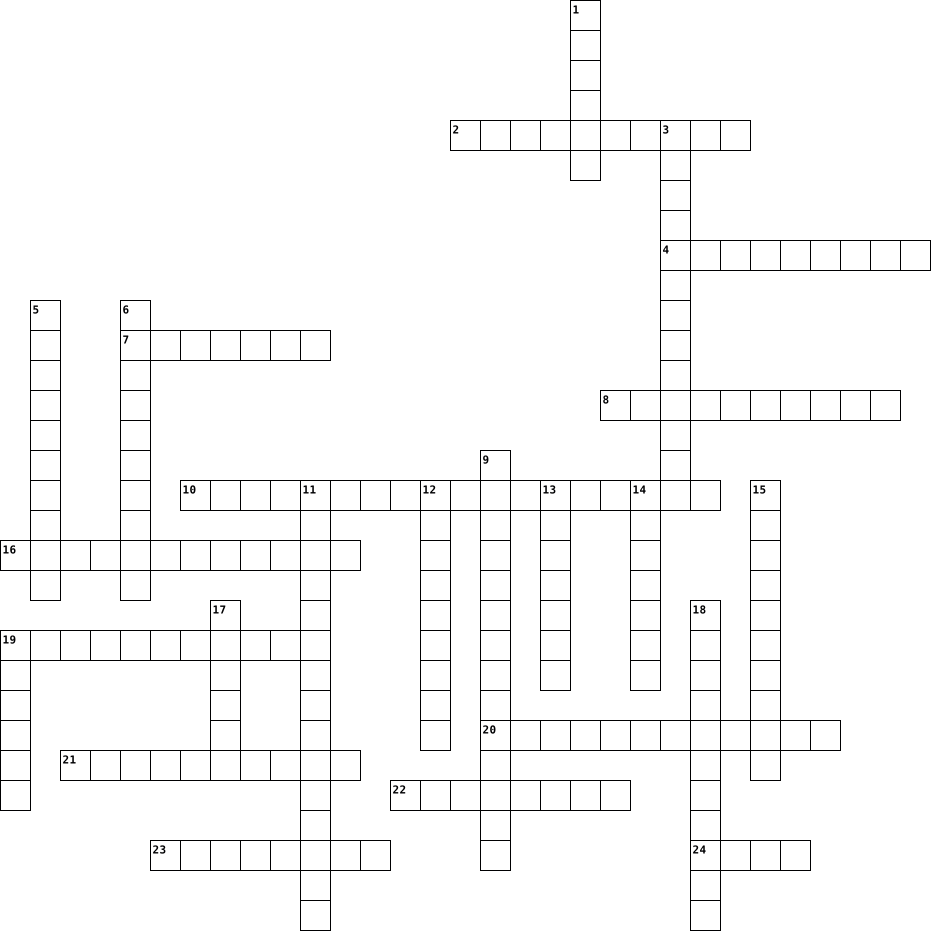
periodic table Crossword Puzzles
year 8 revision 2023-11-16

Across
- Group of elements that get more reactive as you go down the periodic table.
- Grouping elements in threes(triads) based on properties.
- Element in group 2 period 3.
- When a chemical reaction has the same number of each atom on each side.
- Scientist who ordered elements based on atomic mass.
- A type of reaction that is easily reversed.
- Group of elements that get less reactive as you go down the periodic table.
- 2 or more elements or compounds not chemically bonded.
- Scientist who ordered elements based on properties into groups of 8.
Down
- A material made of multiple different materials to get the best properties.
- Made by firing clay.
- All one type of atom.
- Element with atomic number 6.
- Two or more elements chemically bonded
- A type of reaction where the mass changes, it is hard to reverse.
- Group of elements that have almost no reactivity.
16 Clues: Made by firing clay. • All one type of atom. • Element in group 2 period 3. • Element with atomic number 6. • Two or more elements chemically bonded • A type of reaction that is easily reversed. • Group of elements that have almost no reactivity. • Scientist who ordered elements based on atomic mass. • 2 or more elements or compounds not chemically bonded. • ...
Chemistry Vocab 2024-04-24

Across
- A phase that does not have a definite shape or volume
- Cloud The area around the nucleus of an atom where the electrons are found
- The action of being moved or moving
- A pattern of gradual change in a condition, output, or process
- Element that shares some properties with metals and some with nonmetals
- A negatively charges ion
- A pattern of gradual change in a condition, output, or process
- Point The temperature at which the liquid becomes a gas.
Down
- An equal amount of charge or particles
- Horizontal row in the periodic table
- A phase that has a definite shape and volume
- Atoms of the same element that have different numbers of neutrons
- The smallest particle of an element that still retains the properties of the element
- A positively charged ion
- The degree to which a specified material conducts electricity
- Horizontal row in the periodic table
- A distinctive form of matter such as a solid, liquid, gas, or plasma
- Vertical row in the periodic table
18 Clues: A positively charged ion • A negatively charges ion • Vertical row in the periodic table • The action of being moved or moving • Horizontal row in the periodic table • Horizontal row in the periodic table • An equal amount of charge or particles • A phase that has a definite shape and volume • A phase that does not have a definite shape or volume • ...
Chemistry Crossword 2024-05-08

Across
- change and acid or base to a neutral substance
- has 1 proton,1 neutron, and 1 electron(its and element on the periodic table)
- paper: paper that indicates how concentrated a acid or base it
- scale: a scale which shows how concentrated and acid or base can be
- method:a process by which scientists conduct experiments
- substances that are made of particles
- taste bitter and feel slippery
- paper:paper that indicates if a substance is and acid or base
Down
- table: list of all of the elements in our universe that are made of particles
- All matter that is made of different atoms
- changes:occur when forces or energy or mixture are created but the substances stays the same
- a very strong scientific prediction with reasons
- changes: occur when 2 substances mix and a chemical reaction takes place
- Bonds: a force holding similar molecules together
- building blocks of our universe
- taste sour and is corrosive
16 Clues: taste sour and is corrosive • taste bitter and feel slippery • building blocks of our universe • substances that are made of particles • All matter that is made of different atoms • change and acid or base to a neutral substance • a very strong scientific prediction with reasons • Bonds: a force holding similar molecules together • ...
Unit 5 Metals and Non-metals 2025-01-24

Across
- The non-metal that is used in balloons because it's very light
- Non-metals shatter easily. This is called?
- Most non-metals are _____
- Gold and silver are used as jewellery because they do not ______
- They are found on the right side of the periodic table
- Metals are shiny when they are freshly cut or _____
- They are found on the left side of the periodic table
- Iron, cobalt and _____ are magnetic metals.
- All metals have very high melting and boiling point except ______
Down
- Non-metals are poor conductors of heat. What is the opposite of 'conductors'?
- Today is?
- Metals are ductile. They can be _____ out into wires.
- The colour of sulphur
- Can be hammered into shapes is called _______
- Metals are good conductors of heat. When you touch them, they ________ heat away from your hand.
- Metals makes a ringing sound when hit. What is this called?
16 Clues: Today is? • The colour of sulphur • Most non-metals are _____ • Non-metals shatter easily. This is called? • Iron, cobalt and _____ are magnetic metals. • Can be hammered into shapes is called _______ • Metals are shiny when they are freshly cut or _____ • Metals are ductile. They can be _____ out into wires. • They are found on the left side of the periodic table • ...
Chemistry Crossword (Periodic Table and Acids/Bases) 2025-10-20

Across
- A substance with a pH less than 7
- A group of atoms bonded together
- A substance with a pH of 7
- A row in the periodic table
- An ion that is released by bases in solution
- A base that dissolves in water
- A substance made up of two or more types of atom bonded together
- An ion that is released by acids in solution
Down
- Able to damage or destroy another substance by a chemical reaction
- A substance with a pH greater than 7
- The outermost occupied shell of an atom
- A dye that turns red in acidic solutions and blue in basic solutions
- The standard way of measuring the strengths of acids and bases
- A column in the periodic table
- Any substance that changes colour when mixed with an acid or base
- The number of protons in each atom of an element
16 Clues: A substance with a pH of 7 • A row in the periodic table • A column in the periodic table • A base that dissolves in water • A group of atoms bonded together • A substance with a pH less than 7 • A substance with a pH greater than 7 • The outermost occupied shell of an atom • An ion that is released by bases in solution • An ion that is released by acids in solution • ...
KO5 Chemical Reactions 2026-02-02

Across
- A reaction breaking down a substance into smaller parts using heat
- When an acid and base reaction to make salt and water
- A substance that is produced during a chemical reaction
- A substance which speeds up a reaction without itself being used up
- A substance that takes part in and undergoes change during a reaction
- A measurement reading of how acidic or alkaline something is
- A row in the periodic table
Down
- Substances with a pH more than 7
- A reaction where a substance bonds with oxygen
- Reaction where heat is given off
- An interaction between two or more substances that brings about a chemical change
- Substances with a pH less than 7
- Reaction where heat is absorbed
- Type of indicator used to test for pH
- A more reactive element take s the lace of a less reactive element in a compound
- A column in the periodic table
16 Clues: A row in the periodic table • A column in the periodic table • Reaction where heat is absorbed • Substances with a pH more than 7 • Reaction where heat is given off • Substances with a pH less than 7 • Type of indicator used to test for pH • A reaction where a substance bonds with oxygen • When an acid and base reaction to make salt and water • ...
Science Crossword 2018-12-20

Across
- What is the first element on the periodic table
- Regular pattern in bonding
- The top compartment of the heart with the most muscle
- The person who discovers vaccines
- What has the electronic structure of 2,8,18,18,8
- The bond where atoms share electrons with each other
- Something consisting of 2 atoms
- Who was the french biologist who developed the germ theory
- A molecule that can be bonded to other identical molecules to form a polymer.
Down
- A bacterium, virus, or other microorganism that can cause disease.
- Who was the german physician who developed the germ theory
- A Cell without a nucleus.
- What is the atomic symbol of oganesson
- Is a giant covalent structure that is transparen
- The gas with 1 carbon atom and 2 oxygen atom
- The bottom compartment of the heart with the most muscle
- A cell with a nucleus.
- What has the atomic mass of 294
- An injection of a dead or weak strain of a disease
- what is the 88th period on the periodic table
20 Clues: A cell with a nucleus. • A Cell without a nucleus. • Regular pattern in bonding • What has the atomic mass of 294 • Something consisting of 2 atoms • The person who discovers vaccines • What is the atomic symbol of oganesson • The gas with 1 carbon atom and 2 oxygen atom • what is the 88th period on the periodic table • What is the first element on the periodic table • ...
DA#1 Crossword Review 2013-10-02

Across
- The hardest mineral on Earth.
- A property of nonmetals where energy cannot pass through.
- The resistance of a mineral from being scratched.
- The type of element with properties of both metals and nonmetals.
- The amount of matter an object has.
- The physical property of a mineral that gives it a definite shape.
- The property of a mineral that states that it is not(never been) alive.
- The side of the periodic table where nonmetals are found.
- An object with a surface that reflects light.
- The side of the Periodic Table where metals are found.
Down
- Ability of metals to be hammered into sheets.
- A unit of mass.
- To calculate density you must ________________ mass and volume.
- The ability of metals to allow energy to pass through it.
- The scale that sorts minerals from hardest to softest.
- The softest mineral found on Earth.
- Property of minerals that describes the amount of matter in a certain amount of space.
- Nonmetals breaks or shatters easily.
- The amount of space an object takes up.
- The true color of minerals.
20 Clues: A unit of mass. • The true color of minerals. • The hardest mineral on Earth. • The softest mineral found on Earth. • The amount of matter an object has. • Nonmetals breaks or shatters easily. • The amount of space an object takes up. • Ability of metals to be hammered into sheets. • An object with a surface that reflects light. • ...
Periodic Table Created by: Angilee Ubiles 2015-06-02

Across
- A substance that is made of two or more elements that are bonded chemically.
- Elements 57-71 on the periodic table.
- Is needed for humans on earth for survival.
- Pattern of repeating properties.
- A negatively charged particle in an atom.
- Helps keep your bones and your teeth strong.
- Classified as metals, nonmetals, and metalloids.
- number The number of protons in the nucleus of atom.
- first artificially made element.
- A subatomic particle that has no electric charge.
Down
- The periodic table was invented in the year 18.
- A positively charged particle in an atom.
- An electron that is the highest occupied energy level of an atom.
- A value that depends on the distribution of an elements isotopes in nature and the masses of those isotopes.
- Group that contains elements like lithium, sodium, potassium, and rubidium.
- Alkali metals are very reactive with.
- symbol Another term for a chemical symbol.
- Elements that are poor conductors of heat and electricity.
- Elements with properties that fall between those of metals and nonmetals.
- elements that are good conductors of electric current and heat.
20 Clues: Pattern of repeating properties. • first artificially made element. • Elements 57-71 on the periodic table. • Alkali metals are very reactive with. • A positively charged particle in an atom. • A negatively charged particle in an atom. • symbol Another term for a chemical symbol. • Is needed for humans on earth for survival. • Helps keep your bones and your teeth strong. • ...
Chemistry 2014-11-06
Across
- when they have metallic and non-metallic properties
- slow chemical change
- new materials produced by the reaction
- characteristics that can be used to describe a substance
- when two non-metals combine
- when no additional materials can enter or leave
- absorbs heat
- the ability of a substance to conduct electricity or heat
- chemical reactions that occur when oxygen reacts with a substance to form a new substance
- Group 17 elements are called
- when two or more elements combine
- when a metal and non-metal form an aqueous solution of
Down
- shiny, malleable, and ductile
- when a non-metal and metal combine
- solid or gas
- when the product of the reaction can escape
- when ions can form when certain atoms of elements combine
- compound have a chemical name and a
- materials at the start of a reaction are called
- horizontal rows in the periodic table of elements
- has the same mass as a proton
- releases heat
- vertical columns on the periodic table
- when gas turns into a solid
- catalyst involved in chemical reactions in living things
25 Clues: solid or gas • absorbs heat • releases heat • slow chemical change • when two non-metals combine • when gas turns into a solid • Group 17 elements are called • shiny, malleable, and ductile • has the same mass as a proton • when two or more elements combine • when a non-metal and metal combine • compound have a chemical name and a • new materials produced by the reaction • ...
Chemistry Crossword Puzzle 2016-01-07

Across
- bond/the bond formed when two atoms share electrons
- order for neutralization to occur, a salt and ____ must be made in a reaction
- compound/compounds formed with no metals
- gases/the most stable element group on the periodic table is the _______
- that change colour depending on if it is exposed to a acid or base
- atom that has either gained or lost an electron
- ability to be dissolved into a liquid
- reaction in which molecules break down
- naturally found in pairs
- reaction that occurs when two different atoms join together to make a --molecule
Down
- ability for a material to be stretched
- acid/HNO3
- + O2 → H2O + CO2
- lowest temperature that a liquid will ignite
- acid
- metals/the first group on the periodic table is the __________
- displacement/the reaction when two different molecules switch atoms
- ability for a material to be flattened or rolled
- shell/the outermost shell in an atom
- compound/compounds that have both a metal atom and a nonmetal atom
20 Clues: acid • acid/HNO3 • + O2 → H2O + CO2 • naturally found in pairs • shell/the outermost shell in an atom • ability to be dissolved into a liquid • ability for a material to be stretched • reaction in which molecules break down • compound/compounds formed with no metals • lowest temperature that a liquid will ignite • atom that has either gained or lost an electron • ...
Nuclear Reactions/Periodic Table Review 2023-03-07

Across
- negative ion of an atom
- Name of the group 2 element Alkaline ________ metals
- neutral subatomic particle
- a form of an element that has a different number of neutrons
- nuclear reaction where atoms combine
- electrons on the outermost energy level
- Name of the group 1 metals __________metals
- electrons are located in the electron __________
- Name of the group 17 elements
- vertical columns on Periodic Table
- bond where atoms share electrons
- number that states the charge of an atom after it loses/gains electrons
- building block of all matter
Down
- rule that states all atoms want a full outer shell
- nuclear reaction that is used in power plants to create energy
- horizontal rows on Periodic Table
- bond between metal atoms
- Name of the group 18 elements _________gases
- negatively charged subatomic particle
- center of an atom
- weak bond between a positive hydrogen and a negative atom
- energy released during nuclear fission
- bond where atoms give or receive electrons
- positively charged subatomic particle
- positive ion of an atom
25 Clues: center of an atom • negative ion of an atom • positive ion of an atom • bond between metal atoms • neutral subatomic particle • building block of all matter • Name of the group 17 elements • bond where atoms share electrons • horizontal rows on Periodic Table • vertical columns on Periodic Table • nuclear reaction where atoms combine • negatively charged subatomic particle • ...
hydrology choice assignment 2024-05-06

Across
- the ability of a substance to combine chemically with another substance
- Prepared or created artificially man-made
- two things not chemicaly mixed
- simple substances that cannot be broken down into simpler substances
- A solid that is produced as a result of a chemical reaction in solution
- the ability of a substance to be hammered or beaten into thin sheets
- the ability to dissolve in another substance
- the temperature at which a substance changes from a liquid to a gas
- The amount of space something occupies
- the temperature below which a solid turns into a liquid
Down
- vertical on the periodic table
- Attraction between opposite poles
- Measure of the amount of matter in a substance
- the ability of a material to allow either heat or electricity to flow through it
- changed chemicaly
- a single substance
- two or more atoms held together by bonds
- horizontal on the periodic table
- The law that states that mass is neither created nor destroyed in ordinary chemical and physical changes.
- not changed chemicaly
20 Clues: changed chemicaly • a single substance • not changed chemicaly • vertical on the periodic table • two things not chemicaly mixed • horizontal on the periodic table • Attraction between opposite poles • The amount of space something occupies • two or more atoms held together by bonds • Prepared or created artificially man-made • the ability to dissolve in another substance • ...
Periodic Table We Have a Problem! 2023-04-30

Across
- A subatomic particle which has a neutral charge is called___
- Rows(across)the Periodic Table are called___
- A subatomic particle with a negative one electric charge is called___
- Elements that are shiny, ductile, and malleable are called___
- Silicon is a type of___
- A negatively charged ion is called___
- Bonds between nonmetals are called___
- Columns (up/down) on the Periodic Table are called___
- Elements that are brittle, dull, and powdery are called___
Down
- A material able to be stretched without losing its form is called___
- Carbon and Oxygen make a___
- A small portion of matter are called___
- A subatomic particle with a positive one electric charge is called___
- An atom with a charge is called___
- Hydrogen and Oxygen are examples of___
- The smallest particle of an element is called___
- Material that is able to be flexible is called___
- Atoms of the same element that have a different number of neutrons are called___
- Bonds between a metal and a nonmetal are called___
- A positively charged ion is called___
20 Clues: Silicon is a type of___ • Carbon and Oxygen make a___ • An atom with a charge is called___ • A negatively charged ion is called___ • A positively charged ion is called___ • Bonds between nonmetals are called___ • Hydrogen and Oxygen are examples of___ • A small portion of matter are called___ • Rows(across)the Periodic Table are called___ • ...
Chemistry Crossword Puzzle 2022-06-01

Across
- synthesis always forms solids
- Most reactive nonmetals
- elements tend to be stable with eight valence electrons
- Conduct electricity and heat
- ion with a negative charge e- are gained
- used in a balanced chemical equation
- Columns on the periodic table
- most comment element in the universe
- ion with a positive charge e- are lost
- allows us to change/convert between two units
- atom or molecule that has a charge becasue it has gained or lost electrons
- Rows on the periodic table
- Very reactive
- subatomic particles that have a negative charge
Down
- electrons are shared
- another name for percent yield
- the smallest particle thats made up of matter
- is a unit of concentration for solutions that is frequently used in chemistry
- shows only the substances that undergo a change
- 1/12 the mass of a carbon-12 isotope
- properties of elements repeat as a result of being ordered by atomic number
- an atom with the same number of protons but a different number of neutrons
22 Clues: Very reactive • electrons are shared • Most reactive nonmetals • Rows on the periodic table • Conduct electricity and heat • synthesis always forms solids • Columns on the periodic table • another name for percent yield • used in a balanced chemical equation • 1/12 the mass of a carbon-12 isotope • most comment element in the universe • ion with a positive charge e- are lost • ...
Elements 2025-03-14

Across
- This element is the densest of all elements it is also very similar to iridium
- Named for greatest 'gods'.
- Used to make ballons float
- Latin for 'white metal'; a South American country
- Group 2 period 6
- Its chemical symbol is Sb
- The most chemically reactive element with all the other elements except oxygen, helium, neon, and krypton
- This element was named after vanadis the scandinavian goddess of beauty because of the beautiful multicolored compounds formed by the metal
- This element was named after America because it's located below europium in the periodic table which was named after Europe
Down
- Takes its name from the country of its discovery France
- Only woman on the periodic table
- Mn
- on average each brazil nut contains 180 quadrillion atoms of this element
- W
- Alone deadly; combined with chlorine, need for life
- The first noble gas to be discovered
- Sunscreen
- The atomic mass of this element subtracted by the number of neutrons it has is 49
- Period 5, group 3
- This element is the 5th most abundant element in the universe
20 Clues: W • Mn • Sunscreen • Group 2 period 6 • Period 5, group 3 • Its chemical symbol is Sb • Named for greatest 'gods'. • Used to make ballons float • Only woman on the periodic table • The first noble gas to be discovered • Latin for 'white metal'; a South American country • Alone deadly; combined with chlorine, need for life • Takes its name from the country of its discovery France • ...
8A Science so far 2025 2025-09-30

Across
- a liquid that dissolves a solid
- used to separate solids from liquids
- lab equipment used for heating objects
- different substances that are combined, but easily separated
- this compound contains 1 carbon atom and 2 oxygen atoms
- highest energy wave of the electromagnetic spectrum
- produced when iron is heated with sulfur
- 2 or more atoms chemically bonded
- elements on the left of the periodic table tend to be this
- the distance between two points on a wave
- a solid dissolved in a liquid
- is larger when sound waves get louder
- what waves transfer from one place to another
Down
- element 11 on the periodic table
- this type of wave makes particles move back and forward as it travels
- relates to the pitch of a sound
- examples are oxygen, carbon, helium. non examples are iron, aluminium and gold
- 2 or more different atoms chemically bonded
- pure substances made of only one type of atom
- largest wavelength of the electromagnetic spectrum
- this type of wave makes particles move up and down as it travels
- the substance a wave travels through
22 Clues: a solid dissolved in a liquid • a liquid that dissolves a solid • relates to the pitch of a sound • element 11 on the periodic table • 2 or more atoms chemically bonded • used to separate solids from liquids • the substance a wave travels through • is larger when sound waves get louder • lab equipment used for heating objects • produced when iron is heated with sulfur • ...
Y9 Key Words So Far 2025-11-13

Across
- One repeating unit
- A circuit with one loop
- Removing oxygen in a chemical reaction
- A wet material evaporated in an oven to form a hard material
- The 'food' plants make
- The unit of current
- The centre of an atom
- The process of plants making their own food
- Removing pure metal from how it is found
- Word to describe the noble gases meaning unreactive
- Different materials combined to create a better material e.g. fibreglass
- How metals are found in nature
Down
- Measures voltage in a circuit
- Name for the group 7 elements
- The reaction of one metal taking another metals place
- A circuit with multiple loops
- Adding oxygen in a chemical reaction
- Columns on the periodic table
- The word to describe 'free' electrons
- The force that causes static electricity
- The unit of voltage
- Measures current in a circuit
- Rows on the periodic table
- Where photosynthesis takes place in a cell
- Negatively charged particle in an atom
- Monomers joined together in a long chain
- Where photosynthesis takes place in a plant
27 Clues: One repeating unit • The unit of voltage • The unit of current • The centre of an atom • The 'food' plants make • A circuit with one loop • Rows on the periodic table • Measures voltage in a circuit • Name for the group 7 elements • A circuit with multiple loops • Columns on the periodic table • Measures current in a circuit • How metals are found in nature • ...
Periodic Table Crossword 2025-02-01

Across
- The electron configuration of Hydrogen.
- Mass number of Nitrogen.
- Atomic mass of Helium .
Down
- Atomic mass of Hydrogen.
- Second element on periodic table.
- The electron configuration of Helium.
- H on the periodic table.
7 Clues: Atomic mass of Helium . • Atomic mass of Hydrogen. • H on the periodic table. • Mass number of Nitrogen. • Second element on periodic table. • The electron configuration of Helium. • The electron configuration of Hydrogen.
COUCH - SCIENCE CROSSWORD 2020-11-02

Across
- What is the hardest natural mineral (it is 10 on the Moh's Scale of Hardness)?
- The smallest part of all matter.
- Density equals mass divided by _________.
- Non-metals are ______, which means they break into small pieces or crumble instead of bending.
- Scientists all over the world measure using the _______ system.
- The volume of a cube is _____ times Width times Height.
- All known elements are arranged on the Period _____.
- O is the element symbol for the element _________.
- Non-metals are poor conductors of ______ and electricity.
- Elements are divided into three main groups; ______, metalloids, and non-metals.
- Elements on the Periodic Table have either a 1 or 2 letter ________ (like O, He, Li, etc.)
Down
- Anything that has mass and takes up space (has volume)
- Our current month.
- Which liquid has a density of 1?
- Most metals are ductile, which means they can be shaped into long, thin _______.
- Minerals have a hardness of 1-10, which is organized on the ______ Scale of Hardness.
- Lab safety is an important part of science; we wear these sometimes to protect our eyes.
- The elements on the Periodic Table that are arranged in a "stair-step" pattern.
- Thanksgiving is ALWAYS on this day of the week.
19 Clues: Our current month. • Which liquid has a density of 1? • The smallest part of all matter. • Density equals mass divided by _________. • Thanksgiving is ALWAYS on this day of the week. • O is the element symbol for the element _________. • All known elements are arranged on the Period _____. • Anything that has mass and takes up space (has volume) • ...
atoms 2013-05-20

Across
- another word for Families
- the minimum amount of energy that can be gained or lost by an atom
- protons and neutrons made up of smaller particles
- Elements next to the stair-step line
- the symbol of the element, the atomic number of the element and the mass number of the specific isotope
- Symbol Letter or pair of letters which is an abbreviated way to write the name of an element
- Atoms of the same element that have different numbers of neutrons
- Those elements to the right of the stair-step line of the periodic table
- One of the two major kinds of particles in the nucleus
Down
- state the lowest allowable energy state of an atom
- Atoms consist of a positively charged center
- The number of protons in its nucleus
- A table of elements arranged
- One of the two major kinds of particles in the nucleus
- the number of waves that pass a given point per second
- Number The sum of the number of protons and the number of neutrons in the nucleus of an atom
- Cloud Model that the cloud surrounds the nucleus of an atom
- good conductor of heat
- An atom or a group of bonded atoms has a positive or negative change
- The horizontal rows of the element in the periodic table
20 Clues: good conductor of heat • another word for Families • A table of elements arranged • The number of protons in its nucleus • Elements next to the stair-step line • Atoms consist of a positively charged center • protons and neutrons made up of smaller particles • state the lowest allowable energy state of an atom • One of the two major kinds of particles in the nucleus • ...
Chemistry vocab chapter 2 2020-09-07

Across
- amount of space an object takes up
- matter that doesn’t change as amount of mass changes
- particular kind of matter with uniform properties
- causes a subsistance to be deposited in solid form form a solution
- action of purrifing liquid by heating and cooling
- substance formed as a result of a chemical reaction
- homogenous mixture of 2 or more substances
Down
- Matter that changes as amount of mass changes
- change affecting chemical substance that doesn’t change chemical composition
- column of elements on a periodic table
- pure substance that can’t be chemically broken down
- material made of 2 or more physically combined substances
- property of physical body measure of resistance to acceleration when net force is applied
- set of elements occupying entire horizontal row on a periodic table
- firm and stable shape
- gaseous substance that can’t be liquified by pressure alone
- substance that flows freely but has constant volume
- any substance composed of identical molecules consisting of 2 or more elements
18 Clues: firm and stable shape • amount of space an object takes up • column of elements on a periodic table • homogenous mixture of 2 or more substances • Matter that changes as amount of mass changes • particular kind of matter with uniform properties • action of purrifing liquid by heating and cooling • pure substance that can’t be chemically broken down • ...
The first 20 elements 2012-09-05

Across
- in your body and you get it from common table salt
- used in shampoo
- diamond is a type of it
- component of DNA
- used in toothpaste
- the first element on the periodic table
- burns with bright light
- the lightest metal
- keeps your bones strong
- used in street lamps
Down
- your breathing it right now
- used to clean pools
- spelt similarly to baron
- used for aircraft and missile parts
- wrap your sandwich
- used in soap
- makes your voice go squeaky
- colorless and tasteless and explodes if it gets to hot
- smells bad
- sea sponges need it to survive
20 Clues: smells bad • used in soap • used in shampoo • component of DNA • wrap your sandwich • used in toothpaste • the lightest metal • used to clean pools • used in street lamps • diamond is a type of it • burns with bright light • keeps your bones strong • spelt similarly to baron • your breathing it right now • makes your voice go squeaky • sea sponges need it to survive • ...
Periodic family 2020-10-10

Across
- 7
- of bottom two rows taken out of Periodic Table
- conductors of electricity
- to combine most often with Group 7
- columns on the Periodic Table
- up of elements that have similar chemical and physical properties.
Down
- of bottom two rows taken out of Periodic Table
- conductors of electricity
- of both metals and non-metals
- substance made up of only 1 type of atom
10 Clues: 7 • conductors of electricity • conductors of electricity • of both metals and non-metals • columns on the Periodic Table • to combine most often with Group 7 • substance made up of only 1 type of atom • of bottom two rows taken out of Periodic Table • of bottom two rows taken out of Periodic Table • up of elements that have similar chemical and physical properties.
Periodic family 2020-10-10

Across
- 7
- of bottom two rows taken out of Periodic Table
- conductors of electricity
- to combine most often with Group 7
- columns on the Periodic Table
- up of elements that have similar chemical and physical properties.
Down
- of bottom two rows taken out of Periodic Table
- conductors of electricity
- of both metals and non-metals
- substance made up of only 1 type of atom
10 Clues: 7 • conductors of electricity • conductors of electricity • of both metals and non-metals • columns on the Periodic Table • to combine most often with Group 7 • substance made up of only 1 type of atom • of bottom two rows taken out of Periodic Table • of bottom two rows taken out of Periodic Table • up of elements that have similar chemical and physical properties.
Periodic Table of Elements 2021-07-26

Across
- He
- Fe
- Pb
- Ne
- Cu
- K
- O
- N
- Cl
- Na
Down
- S
- Sn
- H
- C
- Hg
- Ni
- Al
- Ag
- Au
19 Clues: S • H • C • K • O • N • Sn • He • Hg • Fe • Ni • Pb • Ne • Cu • Al • Ag • Cl • Au • Na
Periodic Table of Elements 2013-05-20

Across
- I am the 2nd most abundant element in the Earth’s crust and have 14 neutrons
- crust
- My atomic number is 47 and I am used to make photographic film
- My atomic number is 79
- I am a member of the boron family and am the most abundant metal in the
- I am a transition metal with 25 electrons
- I have 2 electrons in the first shell, 8 in the second shell, and 6 in the third shell
- My atomic mass is 35.453
- - I am the head of the carbon family known as the “basis of life”
- I am a gas with 8 protons and 8 neutrons
Down
- I am a member of the carbon family often mistaken for the end of your pencil.
- I make up 78% of the air and am found in the 15th group
- I am a silvery white metal used to make salt
- I am not really an alkali metal, but since I have only 1 electron I behave like
- I am a noble gas with 2 electrons
- I am a member of the alkaline earth metals used to make fireworks and
- I am a metal that is liquid at room temperature
- Table A table in which the chemical elements, arranged according to their atomic numbers, are shown in related groups
- I am a metal with 28 electrons
19 Clues: crust • My atomic number is 79 • My atomic mass is 35.453 • I am a metal with 28 electrons • I am a noble gas with 2 electrons • I am a gas with 8 protons and 8 neutrons • I am a transition metal with 25 electrons • I am a silvery white metal used to make salt • I am a metal that is liquid at room temperature • I make up 78% of the air and am found in the 15th group • ...
Periodic Table Crossword Puzzle 2025-02-25

Across
- The atomic number of this element is 2.
- The atomic number of this element is 50.
- The atomic number of this element is 8.
- The atomic number of this element is 86.
- The atomic number of this element is 29.
- Particles of the atom that has a negative charge.
- The atomic number of this element is 7.
- The atomic number of this element is 17.
- The atomic number of this element is 11.
Down
- The atomic number of this element is 47.
- The atomic number of this element is 10.
- Mass The number of protons and neutrons in the nucleus is called_____________?
- The atomic number of this is 1.
- Particles of this atom that has a positive charge.
- the atomic number of this element is 26.
- The atomic number of this element is 22.
- The atomic number of this element is 3.
- The atomic number of this element is 27.
- The atomic number of this element is 79.
19 Clues: The atomic number of this is 1. • The atomic number of this element is 2. • The atomic number of this element is 8. • The atomic number of this element is 3. • The atomic number of this element is 7. • The atomic number of this element is 47. • The atomic number of this element is 50. • The atomic number of this element is 10. • The atomic number of this element is 86. • ...
Periodic Table Elements Crossword 2026-02-04

Across
- 7 valence electrons
- He
- C
- Au
- O
- B
- Ar
- Ag
- Al
- N
Down
- S
- Atomic # 17
- Cu
- H
- Na
- Co
- Li
- Superman's weakness
- Ne
19 Clues: S • C • H • O • B • N • He • Cu • Au • Na • Co • Ar • Ag • Li • Al • Ne • Atomic # 17 • 7 valence electrons • Superman's weakness
Hannah Brown 2021-10-14

Across
- found in nature combined with other elements
- shares many properties with metals and nonmetals
- to reactive to be found in nature and can easily be cut with a knife
- designed a periodic table
- indicates energy levels
Down
- can form many different compounds
- element that has 3 protons and is third on the periodic table
- metals shiny metals that are harder than alkaline metals
- indicates valance electrons
9 Clues: indicates energy levels • designed a periodic table • indicates valance electrons • can form many different compounds • found in nature combined with other elements • shares many properties with metals and nonmetals • metals shiny metals that are harder than alkaline metals • element that has 3 protons and is third on the periodic table • ...
Hannah Brown 2021-10-14

Across
- found in nature combined with other elements
- shares many properties with metals and nonmetals
- to reactive to be found in nature and can easily be cut with a knife
- designed a periodic table
- indicates energy levels
Down
- can form many different compounds
- element that has 3 protons and is third on the periodic table
- metals shiny metals that are harder than alkaline metals
- indicates valance electrons
9 Clues: indicates energy levels • designed a periodic table • indicates valance electrons • can form many different compounds • found in nature combined with other elements • shares many properties with metals and nonmetals • metals shiny metals that are harder than alkaline metals • element that has 3 protons and is third on the periodic table • ...
Hannah Brown 2021-10-14

Across
- found in nature combined with other elements
- shares many properties with metals and nonmetals
- to reactive to be found in nature and can easily be cut with a knife
- designed a periodic table
- indicates energy levels
Down
- can form many different compounds
- element that has 3 protons and is third on the periodic table
- metals shiny metals that are harder than alkaline metals
- indicates valance electrons
9 Clues: indicates energy levels • designed a periodic table • indicates valance electrons • can form many different compounds • found in nature combined with other elements • shares many properties with metals and nonmetals • metals shiny metals that are harder than alkaline metals • element that has 3 protons and is third on the periodic table • ...
The Periodic Table 2018-04-14

Across
- What are the columns of the Periodic Table called?
- What are the rows of the Periodic Table called?
- What is the name of the compound NaCl?
- _________ is an example of a metal.
Down
- This gas is found in air.
- __________ is a general property of non-metals.
- K is the symbol for which element?
- _________ is a general property of metals.
- _________ are the simplest form of matter.
9 Clues: This gas is found in air. • K is the symbol for which element? • _________ is an example of a metal. • What is the name of the compound NaCl? • _________ is a general property of metals. • _________ are the simplest form of matter. • __________ is a general property of non-metals. • What are the rows of the Periodic Table called? • ...
Science Crossward 2023-02-08

Across
- an element in group 1, also a nirvana song
- name of the type of metals in the center of the periodic table
- name of the gases in group 8
- name of group 7
Down
- nationality of the creator
- name of the blue/purple side of a ph scale
- multiple elements that aren't chemically combined
- surname of the periodic table creator
- word for an unreactive element
9 Clues: name of group 7 • nationality of the creator • name of the gases in group 8 • word for an unreactive element • surname of the periodic table creator • name of the blue/purple side of a ph scale • an element in group 1, also a nirvana song • multiple elements that aren't chemically combined • name of the type of metals in the center of the periodic table
Science 2022-05-24

Across
- made up of elements
- makes up the periodic tables
- table made by Mendeleev
- what makes up elements
- when the chemistry equation is simplified
- when only one element or compound moves
Down
- when 2 elements or compounds moves
- when the chemistry equations enlarge
- -charge
- +charges
10 Clues: -charge • +charges • made up of elements • what makes up elements • table made by Mendeleev • makes up the periodic tables • when 2 elements or compounds moves • when the chemistry equations enlarge • when only one element or compound moves • when the chemistry equation is simplified
Choice Board Crossword Puzzle 2021-12-14

Across
- Elements are organized on this table, based on similar properties!
- This is approximately equivalent to the number of protons and neutrons in the atom (the mass number) or to the average number allowing for the relative abundances of different isotopes. (Hint: this is the quantity of matter contained in an atom of an element.)
- This is a particle of an atom that has a (+) positive charge.
- This is the center of an atom.
- The _______ of an element tells you the number of atoms in the molecule.
- This is a particle of an atom that has a (-) negative charge.
- Each horizontal row of the Periodic Table is called this.
- The _______ which surround some groups of atoms indicate that the numbers of all of the atoms inside the bracket need to be multiplied by the coefficient.
Down
- The columns of the Periodic Table is called this.
- This force holds atoms together!
- This is a particle of an atom that has no charge.
- The basic building blocks of all matter.
- This chemical element with the symbol 'C' is used for fuel in the form of coal, and more!
- This is the number of protons in the nucleus of an atom, which determines the chemical properties of an element. (Hint: located above the element symbol.)
- This person devised the periodic classification of the chemical elements, in which the elements were arranged in order of increasing atomic weight.
15 Clues: This is the center of an atom. • This force holds atoms together! • The basic building blocks of all matter. • The columns of the Periodic Table is called this. • This is a particle of an atom that has no charge. • Each horizontal row of the Periodic Table is called this. • This is a particle of an atom that has a (+) positive charge. • ...
vocabulary terms crossword puzzle 2023-04-21

Across
- doesn't affect the charge
- protons,neutrons,electrons
- first periodic table of elements
- determines the element
- number of protons and neutrons in an element
- column of elements
- group of elements that share the same features
Down
- the idea that everything is composed of atoms
- easily conductive and shiny
- table that contains all elements
- horizontal row for the elements
- protons plus neutrons
- location of electron around nucleus
- center of an atom
- has a negative charge
15 Clues: center of an atom • column of elements • protons plus neutrons • has a negative charge • determines the element • doesn't affect the charge • protons,neutrons,electrons • easily conductive and shiny • horizontal row for the elements • table that contains all elements • first periodic table of elements • location of electron around nucleus • ...
The Periodic Table 2023-03-15

Across
- Columns in the periodic table are also known as?
- State the trend in reactivity down group 7?
- State the trend in reactivity down group 1?
- What state is Iodine at room temperature?
- State the most reactive element in group 7?
Down
- State the name given to group 7 elements?
- State the element with the chemical symbol Cu
- State the name of the metals between group 3 and 4?
- metal State the name given to group 1 metals?
- What state are group 1 elements at room temperature?
- Rows in the periodic table are also known as?
- What state is Bromine at room temperature?
12 Clues: State the name given to group 7 elements? • What state is Iodine at room temperature? • What state is Bromine at room temperature? • State the trend in reactivity down group 7? • State the trend in reactivity down group 1? • State the most reactive element in group 7? • State the element with the chemical symbol Cu • metal State the name given to group 1 metals? • ...
Chemical Bonding 2023-04-03

Across
- A bond formed between cations and anions
- The outermost electrons from the nucleus involved in ion formation
- The charge on an anion
- A row representing an energy level on the Periodic Table
Down
- The charge on a cation
- A column of elements with the same number of valence electrons on the Periodic Table
- A bond formed from neutral atoms sharing valence electrons
- A compound made with only covalent bonds
- Two or more types of atoms chemically combined in a defined ratio
- A full set of valence electrons
- Protons - Electrons = __________
- Atoms that are considered the same type because they have the same number of protons
12 Clues: The charge on a cation • The charge on an anion • A full set of valence electrons • Protons - Electrons = __________ • A compound made with only covalent bonds • A bond formed between cations and anions • A row representing an energy level on the Periodic Table • A bond formed from neutral atoms sharing valence electrons • ...
Chemistry Final Review 2025-05-03

Across
- moles of solute divided by liters of solution
- bond type when one atom pulls electrons away from the other
- group 17s name on the periodic table
- the largest classification of elements on the periodic table
- bond type when electrons are evenly shared between atoms
Down
- defined as the SI unit for amount of substance
- electronegativity values were calculated by comparing other elements to
- gas law comparing volume and temperature
- max number of electrons that can total be in the p subshell
- gas law comparing pressure and volume
- when two atoms or ions have the same number of total electrons
- defined as energy moving into the system
12 Clues: group 17s name on the periodic table • gas law comparing pressure and volume • gas law comparing volume and temperature • defined as energy moving into the system • moles of solute divided by liters of solution • defined as the SI unit for amount of substance • bond type when electrons are evenly shared between atoms • ...
CHEMICAL BONDS 2024-11-08

Across
- Equal sharing of electrons is a nonpolar bond while equal sharing of electrons is _ bonds
- Sodium (Na) has this many valence electrons
- What time does school end today?
- Oxygen becomes a negative ion while potassium (K) loses one electrons and becomes a _ ion
- There are three types of chemical bonds: covalent bonds, ionic bonds, and _ bonds
- PHS mascot
- Metals lose electrons while nonmetals _ elections
- Nonmetal elements are found on the _ side of the periodic table
- How many energy levels does Sodium (Na) have?
Down
- Covalent bonds form between a nonmetal and _ elements
- Metal elements are found one the _ side of the periodic table
- When chlorine loses an electron, its ending changes to 'ide' which is then called what ion?
- How many valence electrons does helium (He) have?
- Ions can either be positive or _
- How many valence electrons does oxygen have?
- Electronegativity increases from bottom to _
- Metals elements become cations while nonmetal elements become _
- A positive ion is called _
18 Clues: PHS mascot • A positive ion is called _ • What time does school end today? • Ions can either be positive or _ • Sodium (Na) has this many valence electrons • How many valence electrons does oxygen have? • Electronegativity increases from bottom to _ • How many energy levels does Sodium (Na) have? • How many valence electrons does helium (He) have? • ...
Chapter 9 Crossword Jacob Riggs 2017-09-18

Across
- Any member of a set of atoms of the same element whose nuclei contain the same number of protons but different number of neutrons.
- A chart in which all known elements are listed in order of atomic number.
- A count of the number of protons in the atomic nucleus.
- An electrically neutral subatomic particle in the atomic nucleus.
- A vertical column in the periodic table; also known as a family of elements.
Down
- In the context of physics, the time required for a vibration or a wave to make one complete cycle. In chemistry, a horizontal row in the periodic table.
- The mass of an element's atoms; listed in the periodic table as an average value based on the relative abundance of the element's isotopes.
- An extremely small, negatively charged subatomic particle found in a cloud outside the atomic nucleus.
- An abbreviation for an element or atom.
- Any material that is made up of only one type of atom.
- A positively charged subatomic particle in the atomic nucleus.
11 Clues: An abbreviation for an element or atom. • Any material that is made up of only one type of atom. • A count of the number of protons in the atomic nucleus. • A positively charged subatomic particle in the atomic nucleus. • An electrically neutral subatomic particle in the atomic nucleus. • A chart in which all known elements are listed in order of atomic number. • ...
Black coal energy 2014-10-28

Across
- A station which generates electricity?
- An era 250 - 200 million years ago?
- _______ mostly contains silica.
- coal used in the production of steel?
- The first element on the periodic table?
- Coal used in the production of electricity?
Down
- 201.3 -0.6 million years ago?
- A unit of measurement used to measure electricity?
- A unit of measurement used to measure energy
- A form of energy resulting from the existence of charged particles either statically s an accumulation of charge or dynamically as a current?
- A substance formed in the geological past from the remains of living organisms?
- A element on the periodic table symbolised as C?
- An era 65.5 million years ago?
- A system using which electricity is distributed?
- A fossil fuel with a shiny lustre and a black colour?
- An era 250 million years ago?
16 Clues: 201.3 -0.6 million years ago? • An era 250 million years ago? • An era 65.5 million years ago? • _______ mostly contains silica. • An era 250 - 200 million years ago? • coal used in the production of steel? • A station which generates electricity? • The first element on the periodic table? • Coal used in the production of electricity? • ...
Science 2023-09-27

Across
- You sneeze so you because you had a tingling sensation in your nose.
- Elements like helium,neon,krypton.
- It has a negative charge and is on the outside of the neucleus.
- The most important part of the atom.
- solid,liquid,and gas are all a ___________.
- It's the same number as the atomic number.
- The letter/s of the element.
- Has over 100 elements on it.
Down
- the combining power of an atom as shown by the number of electrons.
- The experiment failed so it was ______.
- The charge is neutral.
- an expression that shows the elements in a compound and the relative proportions of those elements.
- It is at the top of an element on the periodic table.
- It's equal to the number of protons and neutrons in the atom.
- some jewelry is made out of this.
- The right side of the periodic table is ________.
16 Clues: The charge is neutral. • The letter/s of the element. • Has over 100 elements on it. • some jewelry is made out of this. • Elements like helium,neon,krypton. • The most important part of the atom. • The experiment failed so it was ______. • It's the same number as the atomic number. • solid,liquid,and gas are all a ___________. • ...
biochemical puzzle 2024-09-20

Across
- in our atmosphere and we inhale it
- the process of a solid turning into a gas without becoming a liquid
- the gathering of water through plants
- water that has come up from an aquifer and is visible
- is found in the atmosphere and has N as its symbol on the periodic table
- the recycling of carbon through different organisms
- the process of the recycling of Earth's water
- has the letter C as its symbol on the periodic table
- what happens to water to get water in the sky
- the process of combining nitrogen with one of its compounds
Down
- the falling of water back down to earth
- element used to make water
- the loss or removal of nitrogen compounds
- the recycling of nitrogen through different events and creatures
- water that is not yet on the surface but waiting underground
- the process of turning water in the sky into clouds
16 Clues: element used to make water • in our atmosphere and we inhale it • the gathering of water through plants • the falling of water back down to earth • the loss or removal of nitrogen compounds • the process of the recycling of Earth's water • what happens to water to get water in the sky • the process of turning water in the sky into clouds • ...
Unit 3 Vocabulary 2022-09-28

Across
- vertical column on the periodic table
- another name for light quanta
- sum of protons and neutrons in the nucleus of an atom
- the smallest part of matter that retains the properties of that matter
- horizontal row on the periodic table
- atoms of the same element having different numbers of neutrons
- abbreviation for the unit of mass used for describing atoms
- distance between two peaks of a wave
- a particle with no charge in the nucleus of an atom
- number of waves that pass a given point per second
Down
- a positively charged particle in the nucleus of an atom
- the mass of a single atom measured in atomic mass units
- a negatively charged particle in the nucleus of an atom
- electron in the outermost energy shell of an atom
- central part of the atom, responsible for the atom's mass
- the number of protons in the nucleus of an atom
16 Clues: another name for light quanta • horizontal row on the periodic table • distance between two peaks of a wave • vertical column on the periodic table • the number of protons in the nucleus of an atom • electron in the outermost energy shell of an atom • number of waves that pass a given point per second • a particle with no charge in the nucleus of an atom • ...
DA#1 REVIEW 2013-10-02

Across
- The physical property of a mineral that gives it a definite shape.
- The amount of space an object takes up.
- The type of element with properties of both metals and nonmetals.
- To calculate density you must ________________ mass and volume.
- A property of nonmetals where energy cannot pass through.
- The softest mineral found on Earth.
- The property of a mineral that states that it is not(never been) alive.
- Nonmetals breaks or shatters easily.
- The true color of minerals.
- Property of minerals that describes the amount of matter in a certain amount of space.
Down
- The amount of matter an object has.
- The hardest mineral on Earth.
- A unit of mass.
- The ability of metals to allow energy to pass through it.
- Ability of metals to be hammered into sheets.
- The side of the Periodic Table where metals are found.
- The side of the periodic table where nonmetals are found.
- The scale that sorts minerals from hardest to softest.
- An object with a surface that reflects light.
- The resistance of a mineral from being scratched.
20 Clues: A unit of mass. • The true color of minerals. • The hardest mineral on Earth. • The amount of matter an object has. • The softest mineral found on Earth. • Nonmetals breaks or shatters easily. • The amount of space an object takes up. • Ability of metals to be hammered into sheets. • An object with a surface that reflects light. • ...
DA#1 Crossword Review 2013-10-02

Across
- A unit of mass.
- The hardest mineral on Earth.
- The amount of matter an object has.
- A property of nonmetals where energy cannot pass through.
- An object with a surface that reflects light.
- The physical property of a mineral that gives it a definite shape.
- The side of the periodic table where nonmetals are found.
- The type of element with properties of both metals and nonmetals.
- Nonmetals breaks or shatters easily.
Down
- The resistance of a mineral from being scratched.
- The softest mineral found on Earth.
- Property of minerals that describes the amount of matter in a certain amount of space.
- The amount of space an object takes up.
- Ability of metals to be hammered into sheets.
- The ability of metals to allow energy to pass through it.
- To calculate density you must ________________ mass and volume.
- The scale that sorts minerals from hardest to softest.
- The property of a mineral that states that it is not(never been) alive.
- The true color of minerals.
- The side of the Periodic Table where metals are found.
20 Clues: A unit of mass. • The true color of minerals. • The hardest mineral on Earth. • The softest mineral found on Earth. • The amount of matter an object has. • Nonmetals breaks or shatters easily. • The amount of space an object takes up. • Ability of metals to be hammered into sheets. • An object with a surface that reflects light. • ...
DA#1 Crossword Review 2013-10-02

Across
- The amount of matter an object has.
- A unit of mass.
- A property of nonmetals where energy cannot pass through.
- The amount of space an object takes up.
- The type of element with properties of both metals and nonmetals.
- The true color of minerals.
- Property of minerals that describes the amount of matter in a certain amount of space.
- An object with a surface that reflects light.
- The side of the periodic table where nonmetals are found.
Down
- The resistance of a mineral from being scratched.
- Ability of metals to be hammered into sheets.
- To calculate density you must ________________ mass and volume.
- The hardest mineral on Earth.
- Nonmetals breaks or shatters easily.
- The property of a mineral that states that it is not(never been) alive.
- The ability of metals to allow energy to pass through it.
- The scale that sorts minerals from hardest to softest.
- The physical property of a mineral that gives it a definite shape.
- The side of the Periodic Table where metals are found.
- The softest mineral found on Earth.
20 Clues: A unit of mass. • The true color of minerals. • The hardest mineral on Earth. • The amount of matter an object has. • The softest mineral found on Earth. • Nonmetals breaks or shatters easily. • The amount of space an object takes up. • Ability of metals to be hammered into sheets. • An object with a surface that reflects light. • ...
Science Crossword 2018-12-20

Across
- Something consisting of 2 atoms
- A cell with a nucleus.
- A bacterium, virus, or other microorganism that can cause disease.
- The bond where atoms share electrons with each other
- Who was the french biologist who developed the germ theory
- What has the electronic structure of 2,8,18,18,8
- A Cell without a nucleus.
- The gas with 1 carbon atom and 2 oxygen atom
- Is a giant covalent structure that is transparen
- The top compartment of the heart with the most muscle
- A molecule that can be bonded to other identical molecules to form a polymer.
Down
- Regular pattern in bonding
- What is the first element on the periodic table
- The person who discovers vaccines
- An injection of a dead or weak strain of a disease
- The bottom compartment of the heart with the most muscle
- What is the atomic symbol of oganesson
- what is the 88th period on the periodic table
- Who was the german physician who developed the germ theory
- What has the atomic mass of 294
20 Clues: A cell with a nucleus. • A Cell without a nucleus. • Regular pattern in bonding • Something consisting of 2 atoms • What has the atomic mass of 294 • The person who discovers vaccines • What is the atomic symbol of oganesson • The gas with 1 carbon atom and 2 oxygen atom • what is the 88th period on the periodic table • What is the first element on the periodic table • ...
HYDRICK's Atomic History Crossword 2024-04-26

Across
- organized periodic table by atomic number
- Who discovered the first subatomic particle
- where electrons are located
- A region of an atom in which electrons of the same energy are likely to be found
- Bohr suggested that electrons were in ______ orbits or energy levels around the nucleus
- Cloud Model The Modern Model is also called
- Who offered the first modern theory of the atom
- According to Dalton, atoms are invisible and _____________
- The Modern Model is based on the types of physics called
- Thomson's model was also known as the
Down
- Protons, neutrons and electrons are all
- organized periodic table by atomic mass
- Electrons or the "cloud" accounts for most of the _____ of the atom
- What famous experiment did Ernest Rutherford perform
- The negatively charged particles
- simplest piece of matter
- Greek word meaning "uncuttable"
- came up with the word 'atom'
- The positively charged particles
- Bohr Who's model resembles the planets orbiting around the sun
- The central core of the atom
- Rutherford concluded that the atom was mostly _____ space with electrons moving around the nucleus
22 Clues: simplest piece of matter • where electrons are located • came up with the word 'atom' • The central core of the atom • Greek word meaning "uncuttable" • The negatively charged particles • The positively charged particles • Thomson's model was also known as the • Protons, neutrons and electrons are all • organized periodic table by atomic mass • ...
Chemistry Review 2023-09-14

Across
- neutrally charged subatomic particles
- the number on the PT without decimals, represents the number of protons and atom has
- the group number of the family, "noble gases"
- the name for many connected monomers
- an atom of an element with an altered number of neutrons
- positively charged subatomic particles
- an element that is brittle, non-conductive, and dull
- the group number of the family, "halogens"
- the number on the PT with decimals that is protons and neutrons added together
- the smallest component of matter
Down
- electrons that can be found on the outer most ring of an atom's electron cloud
- an atom of an element with an altered number of electrons
- the group number of the family, "alkali metals"
- an element that is brittle, semi-conductive, and lustrous
- a column on the periodic table
- a row on the periodic table
- the group number of the family, "alkaline earth metals"
- the core of atoms where all the mass can be found
- an element that is malleable, conductive, and lustrous
- negatively charged subatomic particles
20 Clues: a row on the periodic table • a column on the periodic table • the smallest component of matter • the name for many connected monomers • neutrally charged subatomic particles • positively charged subatomic particles • negatively charged subatomic particles • the group number of the family, "halogens" • the group number of the family, "noble gases" • ...
hydrology choice assignment 2024-05-06

Across
- the ability of a substance to combine chemically with another substance
- Prepared or created artificially man-made
- two things not chemicaly mixed
- simple substances that cannot be broken down into simpler substances
- A solid that is produced as a result of a chemical reaction in solution
- the ability of a substance to be hammered or beaten into thin sheets
- the ability to dissolve in another substance
- the temperature at which a substance changes from a liquid to a gas
- The amount of space something occupies
- the temperature below which a solid turns into a liquid
Down
- vertical on the periodic table
- Attraction between opposite poles
- Measure of the amount of matter in a substance
- the ability of a material to allow either heat or electricity to flow through it
- changed chemicaly
- a single substance
- two or more atoms held together by bonds
- horizontal on the periodic table
- The law that states that mass is neither created nor destroyed in ordinary chemical and physical changes.
- not changed chemicaly
20 Clues: changed chemicaly • a single substance • not changed chemicaly • vertical on the periodic table • two things not chemicaly mixed • horizontal on the periodic table • Attraction between opposite poles • The amount of space something occupies • two or more atoms held together by bonds • Prepared or created artificially man-made • the ability to dissolve in another substance • ...
PHYSICAL SCIENCE Lessons 1 and 2 2023-03-01

Across
- / Element belongs to Group 3A and Period 2
- / First element in Period 1
- / Arranged the Periodic table of elements in increasing atomic masses
- / Particle accelerator used to create Plutonium
- / Greek word use to refer "salt"
- / These refers to high-speed electron
- / Elements with both metal and non-metal properties
- / These are transition metals involving only the lanthanides and actinides
- / First element in Group VA
- / This group refers to Groups IB - VIIIB
- / The other name of Oxygen Group
- / Refers to the horizontal rows of the periodic table
- / Found in Period 3 and Group IVA
- / Particles made of a proton and a neutron
Down
- / This group refers to the Groups IA to VIIIA
- / The first element in the lanthanide series with element number 57
- / refers to stars
- / Total number of groups
- / He created Neptunium by bombarding Uranium
- / phenomenon which emits energetic particles from nuclear reactions
- / refers to group of gases with limited reactivity
- / Halogen in Period 3
- / Element classification found in the right of Metalloid
- / Positively charged particle
24 Clues: / refers to stars • / Halogen in Period 3 • / Total number of groups • / First element in Group VA • / First element in Period 1 • / Positively charged particle • / Greek word use to refer "salt" • / The other name of Oxygen Group • / Found in Period 3 and Group IVA • / These refers to high-speed electron • / This group refers to Groups IB - VIIIB • ...
Max’s crossword puzzle 2021-04-27

Across
- earth metal, they are all shiny, silvery-white, somewhat reactive metals
- Particles with an electrical charge of positive 1
- atomic number 5
- gas, any of the gaseous elements
- the center of an atom made up of protons and neutrons
- atomic number 2
- reactive nonmetallic elements
- an element that has properties of both a metal and nonmetal
- Particles with an electric charge of negative 1
- Na
- Neutral particles that do not have an electrical charge
- Together with hydrogen they constitute group 1
Down
- C
- This group is also known as the oxygen family
- atomic number 1
- Sn
- the elemnts that are usually poor conductors of heat and electricity
- N
- Fe
- number, the number of protons in the nucleus of an atom
- the elements thta are good conductors of heat and electricity
- a horizontal row of elements in the periodic table
- a vertical column of elements in the periodic table
- an atom or a group of atoms that has lost or gained one or more electrons
- the smallest particle that has the properties of an element
25 Clues: C • N • Sn • Fe • Na • atomic number 1 • atomic number 5 • atomic number 2 • reactive nonmetallic elements • gas, any of the gaseous elements • This group is also known as the oxygen family • Together with hydrogen they constitute group 1 • Particles with an electric charge of negative 1 • Particles with an electrical charge of positive 1 • ...
Semester final crossword puzzle. by: Townes Edwards 2024-12-19

Across
- Elements that are poor conductors of heat and electricity
- A change in a substance that does not alter its chemical composition
- Energy in motion
- A vertical row in the periodic table
- An object at rest stays at rest, and an object in motion stays in motion unless acted upon by an external force
- Energy stored
- A neutral particle in an atom's nucleus
- elements with properties of both metals and nonmetals
- The sum of all forces acting on an object
- The ability of a substance to be hammered or rolled into sheets
Down
- A negatively charged particle orbiting an atom's nucleus
- Two or more atoms bonded together
- A process that changes a substance into new substance
- For every action, there is an equal and opposite reaction
- Elements that are good conductors of electricity and heat
- A horizontal row in the periodic table
- A positively charged particle in the nucleus of an atom
- The number of protons in the nucleus of an atom
- Force equals mass times acceleration (F = ma)
- The upward force exerted by a fluid on a submerged object
20 Clues: Energy stored • Energy in motion • Two or more atoms bonded together • A vertical row in the periodic table • A horizontal row in the periodic table • A neutral particle in an atom's nucleus • The sum of all forces acting on an object • Force equals mass times acceleration (F = ma) • The number of protons in the nucleus of an atom • ...
Chemistry 2024-03-22

Across
- a bond between two non-metals that is a sharing of electrons
- elements that are in the far right of the periodic table
- the indication of polarity in a bond or molecule
- soap is one
- column 17 in the periodic table
- required lab safety gear
- what we call a drawing of the molecular structure
- describes how easily a liquid evaporates
- atom that has gained an electron
- this element has the chemical symbol Na
- the rule about how many electrons to make an atom "happy"
- chemical symbol Hg
Down
- your best friend in chem class
- chemical symbol K
- the shape of a CH4 molecule
- molecules that hold tightly together at the surface of a liquid because of intermolecular forces
- describes how easily a liquid flows
- found in molecules with O,N,F
- a bond between a metal and a non-metal where electrons are fully exchanged
- atom that has lost an electron
- the force that exists between two atoms in a covalent molecule
- chemical symbol W
22 Clues: soap is one • chemical symbol K • chemical symbol W • chemical symbol Hg • required lab safety gear • the shape of a CH4 molecule • found in molecules with O,N,F • your best friend in chem class • atom that has lost an electron • column 17 in the periodic table • atom that has gained an electron • describes how easily a liquid flows • this element has the chemical symbol Na • ...
1.1 - 3.2 2025-07-17

Across
- a particle with a negative charge
- most of an atom's mass is found here
- flexible covering that protects the inside of a cell
- tells you the number of protons in the nucleus of an atom of that element
- atoms of the same element that have the same number of protons, but a different number of neutrons
- the smallest unit of elemental matter
- an atomic particle that has a positive charge
- a row on the periodic table
- are ductile and conduct heat and electricity
Down
- a chart of the elements
- shows an element’s chemical symbol, atomic number, and atomic mass
- an electrically neutral particle
- the main ingredient in cells
- have physical and chemical properties of both metals and nonmetals
- use light energy to make glucose from water and carbon dioxide
- stiff structure outside the cell membrane
- a column on the periodic table
- have no metallic properties
- atoms of the same element that have the same number of protons, but a different number of electrons
- make energy during cellular respiration
- a molecule that has a positive end and a negative end
21 Clues: a chart of the elements • have no metallic properties • a row on the periodic table • the main ingredient in cells • a column on the periodic table • an electrically neutral particle • a particle with a negative charge • most of an atom's mass is found here • the smallest unit of elemental matter • make energy during cellular respiration • ...
Science Crossword Puzzle 2023-01-16

Across
- The process where atoms produce energy and particles
- Elements that conduct electricity and heat
- Positively charged particles
- Metals that can be easily shaped
- When an atom loses or gains an electron
- The location of electrons
- An ion that loses on or more electrons
- Rare earth elements
- Negatively charged particles
- Uncharged particles
- the number of protons in an atom's nucleus
- The atomic mass unit of an element
- Elements that cannot conduct electricity or heat
Down
- Atoms of the same element that have different numbers of neutrons
- Metals that are very reactive
- Elements that have properties of both metals and nonmetals
- Metals that are not very reactive
- An ion that contains extra electrons
- A process in which the number of protons change in an atom
- The combination of protons and neutrons in the center of an atom
- Gases that almost never react with other elements
- Elements in vertical columns in the periodic table
- Each horizontal row in the periodic table
- Dense radioactive metals
- Elements that are highly reactive and used to kill dangerous microorganisms
25 Clues: Rare earth elements • Uncharged particles • Dense radioactive metals • The location of electrons • Positively charged particles • Negatively charged particles • Metals that are very reactive • Metals that can be easily shaped • Metals that are not very reactive • The atomic mass unit of an element • An ion that contains extra electrons • An ion that loses on or more electrons • ...
Important Words for the exam 2025-10-16

Across
- A medical condition with specific symptoms
- A medical condition that is caused by a pathogen
- A column in the periodic table
- A row in the periodic table
- A cell that detects inputs of a specific type
- Barriers that prevent pathogens from entering the body
- An attraction between atoms that share electrons
- The brain and spinal cord
- A protein that can identify and fight a specific pathogen
- chain A polymer molecule that has side chains
- A cell that transmits electrical signals
Down
- something which can be broken down by a living thing
- A piece of plastic that is less than 5 millimeters in size
- The outermost occupied shell of an atom
- A microscopic organism or agent that causes disease
- A synthetic polymer
- The number of protons in each atom of an element
- The gap between neurons where signals are sent from one to another
- the body's ability to maintain stable environment
- A treatment that helps build immunity to an infectious disease
- The arrangement of electrons in shells around an atom's nucleus
- An electrostatic attraction between ions with opposite charges
22 Clues: A synthetic polymer • The brain and spinal cord • A row in the periodic table • A column in the periodic table • The outermost occupied shell of an atom • A cell that transmits electrical signals • A medical condition with specific symptoms • A cell that detects inputs of a specific type • chain A polymer molecule that has side chains • ...
Periodic Families 2025-09-18

Across
- The charge of the alkaline earth metals
- Family that is used in industry and jewlery
- Elements found on the left of the zig zag
- What group starts with Carbon
- Elements found touching the zig zag
- Number of valance electrons for the Alkali Metals
- Number of valance electrons for the Alkaline Earth Metals
- Toxic, most reactive non metals
- Element in Group 14 Period 6
- Number of valance electrons for the Noble Gases
- The horizontal rows on the periodic table
- The charge of the alkali metals
- Element found in Group 2 Period 4
- The charge of the noble gases
- Element in Group 16 Period 3
Down
- Element in Group 6 Period 6
- The charge of the halogens
- The most reactive metals, explode when put in water
- Un-reactive colorless, odorless
- Number of valance electrons for the Halogens
- Elements found to the right of the zig zag
- The 2nd most reactive metals
- Noble gas found in Period 5
- What period starts with Rubidium
- The vertical columns on the periodic table
25 Clues: The charge of the halogens • Element in Group 6 Period 6 • Noble gas found in Period 5 • The 2nd most reactive metals • Element in Group 14 Period 6 • Element in Group 16 Period 3 • What group starts with Carbon • The charge of the noble gases • Un-reactive colorless, odorless • Toxic, most reactive non metals • The charge of the alkali metals • What period starts with Rubidium • ...
science 2021-03-05

Across
- The rest of the air is made of this, hydrogen and neon
- 21% of the air is made of this
- It can cause carpet burn
- In the periodic table it is Ag
Down
- The rest of the air is made from this, hydrogen and carbon dioxide
- the rest of the air is made from this, neon and carbon dioxide
- In the periodic table i am Br
- 78% of the air is made of this
- It is exothermic
- i am a non-contact force
10 Clues: It is exothermic • It can cause carpet burn • i am a non-contact force • In the periodic table i am Br • 78% of the air is made of this • 21% of the air is made of this • In the periodic table it is Ag • The rest of the air is made of this, hydrogen and neon • the rest of the air is made from this, neon and carbon dioxide • ...
Atoms and Bonds 2021-11-05

Across
- negative charged subatomic particle
- the basic unit of a chemical element
- what it called when two-atom share electrons
- positive charged subatomic particle
- what it called when one atom takes an electron or electrons for another
Down
- the letter or letters that present the element
- electrons in the out shell are called
- the number of orbitals
- the number above the atomic symbol on the periodic table number of protons
- the number below the atomic symbol on the periodic table protons+nutrons
10 Clues: the number of orbitals • negative charged subatomic particle • positive charged subatomic particle • the basic unit of a chemical element • electrons in the out shell are called • what it called when two-atom share electrons • the letter or letters that present the element • what it called when one atom takes an electron or electrons for another • ...
Chemistry crossword 2024-01-09

Across
- Can be stretched into wires.
- Breaks or shatters easily.
- Atoms that have a positive or negative charge as a result of gaining or losing an electron.
- Ability to be hammered.
- A positive atom that has lost one or more electrons.
- A row on the periodic table reads from left to right horizontally. Also known as a family.
Down
- Not shiny, does not reflect light.
- can bend
- Column on the periodic table located in a vertical position.
- Shine, shiny- reflects light.
10 Clues: can bend • Ability to be hammered. • Breaks or shatters easily. • Can be stretched into wires. • Shine, shiny- reflects light. • Not shiny, does not reflect light. • A positive atom that has lost one or more electrons. • Column on the periodic table located in a vertical position. • A row on the periodic table reads from left to right horizontally. Also known as a family. • ...
The Periodic Table 2023-03-07

Across
- what year was the first periodic table created in
- who discovered a set of patterns that applies to all elements?
- all elements are considered what?
- according to what was the first table arranged
Down
- tells us the amount of protons/electrons
- word for a regular or repeated pattern
- a letter or abbreviation to describe an element
- what were most of the elements discovered by 1869?
- How many elements were discovered by 1869?
- mass the average mass of all isotopes of that element
10 Clues: all elements are considered what? • word for a regular or repeated pattern • tells us the amount of protons/electrons • How many elements were discovered by 1869? • according to what was the first table arranged • a letter or abbreviation to describe an element • what year was the first periodic table created in • what were most of the elements discovered by 1869? • ...
Science structure of the atom. Concept 1 notes 2022-05-09

Across
- plum pudding model
- nuclear model 1911
- bohr model
- n
- e
- electron
- 1926
- 400 bc
Down
- a table of the chemical elements arranged in order of atomic number, usually in rows, so that elements with similar atomic structure (and hence similar chemical properties) appear in vertical columns.
- solid sphere model was made by who
- developed the first periodic table
- protons
- electron cloud
- 1913
- center is dense
- space, shells, energy levels
- is the smallest particle of an element that still has the properties of that element. example h20
- p
18 Clues: n • e • p • 1913 • 1926 • 400 bc • protons • electron • bohr model • electron cloud • center is dense • plum pudding model • nuclear model 1911 • space, shells, energy levels • solid sphere model was made by who • developed the first periodic table • is the smallest particle of an element that still has the properties of that element. example h20 • ...
Matter Crossword 2021-12-16

Across
- This model of the atom lets us see the circular orbits around nucleus
- A type of matter with a fixed composition
- A particle with a positive charge
- A substance made of atoms that are all alike
- The sum of the protons and neutrons in an atom
- The part of the atom that circles the nucleus
- A particle that has no charge
Down
- ________ electrons are the electrons on the outermost orbit of an atom
- The columns on the periodic table
- The rows on the periodic table
- The number that determines the identity of an atom
- A tool scientists have created that organizes elements by increasing atomic number and by changes in physical and chemical properties
- The center of the atom
- Anything that has mass and takes up space
- A particle with a negative charge
- The smallest particle of an element
16 Clues: The center of the atom • A particle that has no charge • The rows on the periodic table • The columns on the periodic table • A particle with a positive charge • A particle with a negative charge • The smallest particle of an element • A type of matter with a fixed composition • Anything that has mass and takes up space • A substance made of atoms that are all alike • ...
Chemistry Vocabulary 2022-02-18

Across
- Electrons in the outermost shell of an atom
- Elements that have the same atomic number but different number of neutrons
- The heaviest part of an atom
- The base unit of amount of a substance as determined by the International System of Units
- The least reactive group on the periodic table
- The part of the atom with a positive charge
- Where the protons and neutrons are found in a atom
Down
- The study of substances and their behaviors
- The smallest part of an atom
- An atom that has lost or gained one or more electrons
- Substance used to cause a chemical reaction
- The smallest unit of matter that forms an element
- A substance made of atoms that all have the same number of protons
- The most reactive group of metals on the periodic table
- A substance composed of two or more chemical elements
- The results of a chemical reaction
16 Clues: The smallest part of an atom • The heaviest part of an atom • The results of a chemical reaction • The study of substances and their behaviors • Electrons in the outermost shell of an atom • Substance used to cause a chemical reaction • The part of the atom with a positive charge • The least reactive group on the periodic table • ...
Periodic Trends Review 2023-11-14

Across
- Elements in the same group have the same number of ______________ electrons.
- What family contains a solid, liquid and gas at STP?
- What is the diatomic element in period 3?
- This element will have luster, be ductile, and malleable.
- The current day periodic table is arranged by increasing...
- Elements in the same period have the same number of _______________.
- The most reactive metal family.
- The energy required to remove an electron.
Down
- The family of elements that forms colorful compounds.
- The element on group 16 and period 3 is ...
- Which element has the highest electronegativity?
- The family on the periodic table that is most stable.
- An element that is properties of both nonmetals and metals would be classified as...
- The ability of an atom to attract electrons.
- As we move down the elements in Group 16, the electronegativity of the elements...
- What type of elements will gain electrons and form anions?
16 Clues: The most reactive metal family. • What is the diatomic element in period 3? • The energy required to remove an electron. • The element on group 16 and period 3 is ... • The ability of an atom to attract electrons. • Which element has the highest electronegativity? • What family contains a solid, liquid and gas at STP? • ...
Chemistry Crossword 2024-05-08

Across
- change and acid or base to a neutral substance
- has 1 proton,1 neutron, and 1 electron(its and element on the periodic table)
- paper: paper that indicates how concentrated a acid or base it
- scale: a scale which shows how concentrated and acid or base can be
- method:a process by which scientists conduct experiments
- substances that are made of particles
- taste bitter and feel slippery
- paper:paper that indicates if a substance is and acid or base
Down
- table: list of all of the elements in our universe that are made of particles
- All matter that is made of different atoms
- changes:occur when forces or energy or mixture are created but the substances stays the same
- a very strong scientific prediction with reasons
- changes: occur when 2 substances mix and a chemical reaction takes place
- Bonds: a force holding similar molecules together
- building blocks of our universe
- taste sour and is corrosive
16 Clues: taste sour and is corrosive • taste bitter and feel slippery • building blocks of our universe • substances that are made of particles • All matter that is made of different atoms • change and acid or base to a neutral substance • a very strong scientific prediction with reasons • Bonds: a force holding similar molecules together • ...
Parts of an Atom 2025-05-05

Across
- The vertical columns on the periodic table.
- Electrons in the outermost shell of an atom.
- The horizontal rows on the periodic table.
- The central part of an atom, contains protons and neutrons.
- The smallest unit of an element, consisting of protons, neutrons, and electrons.
- A negatively charged ion.
- A positively charged particle found in the nucleus.
- A charged atom, is formed when an atom gains or loses electrons.
- A substance that is made of only one type of atom.
Down
- Atoms of the same element that have a different number of neutrons.
- A negatively charged particle that orbits around the nucleus.
- The number of protons in an atom's nucleus.
- A positively charged ion.
- A neutrally charged particle found in the nucleus.
- The sum of the number of protons and neutrons in an atom’s nucleus.
- The electrical property of particles, either positive or negative.
16 Clues: A positively charged ion. • A negatively charged ion. • The horizontal rows on the periodic table. • The vertical columns on the periodic table. • The number of protons in an atom's nucleus. • Electrons in the outermost shell of an atom. • A neutrally charged particle found in the nucleus. • A substance that is made of only one type of atom. • ...
Chemistry Vocabulary Crossword 2013-10-20

Across
- The height of a wave from the origin to a crest or from the origin to a trough
- Consists of an element’s symbol, representing the atomic nucleus and inner level electrons, that is surrounded by dots, representing the atom’s valence electrons
- A type of group B element that is contained in the d-block of the periodic table and, with some exceptions, is characterized by a filled outermost s orbital of energy level n, and filled or partially filled d orbitals of energy level n-1
- Groups of elements in the modern periodic table that are designated with a B and are further divided into transition metals and inner transition metals
- negatively charged particles that are part of all forms of matter
- States that atoms lose, gain, or share electrons in order to acquire a full set of eight valence electrons
- All matter is composed of extremely small particles called atoms
- A subatomic particle in an atoms nucleus that has a positive charge of 1+
- An element that is solid at room temperature, a good conductor of heat and electricity, and generally is shiny
- Group 2A elements in the modern periodic table
- located along the bottom of the periodic table
- Groups of elements in the modern periodic table that are designated with an A and possess a wide range of chemical and physical properties
- A horizontal row of elements in the modern periodic table
- An ion that has a negative charge
- Highly reactive group 7A elements
- Elements that are generally gases or dull, brittle solids that are poor conductors of heat and electricity
- States that equal volumes of gases at the same temperature and pressure contain equal numbers of particles
- Group 1A elements, except for hydrogen, that are on the left side of the modern periodic table
- A particle with two protons and two neutrons, with a 2+ charge
- The positively charged protons and neutral neutrons contained in an atom’s densely packed nucleus.
- The minimum amount of energy that can be gained or lost by an atom
- Ray of radiation that originated from the cathode to the anode within the tube
- Radiation consisting of fast moving electrons
- The process in which some substances spontaneously emit radiation
- The rays and particles-alpha and beta particles and gamma rays-that are emitted by radioactive material
Down
- The boxes that are arranged in order of increasing atomic number into a series of columns
- The weighted average mass of the isotopes of that element
- An element, such as silicon or germanium, that has physical and chemical properties of both metals and nonmetals
- The shortest distance between equivalent points on a continuous wave; is usually expressed in meters, centimeters, or nanometers.
- A three-dimensional region around the nucleus of an atom that describes an electron’s probable location
- Includes all forms of electromagnetic radiation, with the only differences in the types of radiation being their frequencies and wavelengths
- relative ability of its atoms to attract electrons in a chemical bond
- An extremely unreactive group 8A element
- A neutral subatomic particle in an atom’s nucleus that has a mass nearly equal to that of a proton
- States that when the elements are arranged by increasing atomic number, there is a periodic repetition of their chemical and physical properties
- The arrangement of electrons in an atom, which is prescribed by three rules-the aufbau principle, the Pauli exclusion principle, and Hund’s rule
- High-energy radiation that has no electrical charge and no mass, is not deflected by electric or magnetic fields, usually accompanies alpha and beta radiation, and accounts for most of the energy lost during radioactive decay
- A reaction that involves a change in the nucleus of an atom
- A spontaneous process in which the unstable nuclei lose energy by emitting radiation
- The number 6.022x10^23, which is the number representative particles in a mole
- The energy required ti remove an electron from a gaseous atom; generally increases in moving from left-to-right across a period and decreases in moving down a group
- an atom or a bonded group of atoms that has a positive or negative charge
- The number after an element’s name, representing the sum of its protons and neutrons
- Radiation that is made up of alpha particles
- Radiation that is deflected toward the positively charged plate
- A type of equation that shows the atomic number and mass number of the particles involved
- The electrons in an atoms outermost orbitals; determine the chemical properties of an element
- Atoms of the same element with the same number of protons but different numbers of neutrons
- The number of protons in an atom
- A particle of electromagnetic radiation with no mass that carries a quantum of energy
50 Clues: The number of protons in an atom • An ion that has a negative charge • Highly reactive group 7A elements • An extremely unreactive group 8A element • Radiation that is made up of alpha particles • Radiation consisting of fast moving electrons • Group 2A elements in the modern periodic table • located along the bottom of the periodic table • ...
Chemistry 2021-11-18

Across
- they interact
- change that causes a change in appearance.
- columns of the periodic table
- Solid, metallic, and fair conductors
- Center of the atom
- the particles below or inside the atom.
- change that causes a new substance to be formed
- a substance that cannot be broken down
- Group of 2 or more atoms
- subatomic particle located in the nucleus and has a neutral charge
- the smallest unit of matter that has all the chemical properties of an element.
Down
- the study of the properties of atoms and
- A substance that forms from a chemical reaction.
- A single kind of matter
- anything that has volume and mass.
- substance made of 2 or more atoms.
- subatomic particle located in the electron cloud and has a negative charge
- subatomic particle located in the nucleus and has a positive charge
- has conductive, malleable, and lustrous properties
- A substance that undergoes a change during a reaction
- the area around the nucleus
- colorless, brittle, poor conductors, and not malleable or ductile.
- rows of the periodic table
23 Clues: they interact • Center of the atom • A single kind of matter • Group of 2 or more atoms • rows of the periodic table • the area around the nucleus • columns of the periodic table • anything that has volume and mass. • substance made of 2 or more atoms. • Solid, metallic, and fair conductors • a substance that cannot be broken down • the particles below or inside the atom. • ...
C2 Revision 2013-06-14

Across
- The colour of cooper sulphate
- Salt formed from ethanoic acid
- An element or compound that increases the rate of a reaction
- The type of bonding between two non-metals
- The ions that any alkaline substance contains
- Where a more reactive metal displaces a less reactive metal from a compound
- The first element in the Periodic Table
- Plastics that can be re-moulded
- These nanoparticles are being used to treat malignant tumors
- The first element in Group 1 of the Periodic Table
- Anything that can neutralise an acid
- A carbon-based substance that can conduct electricity. Used in pencils
Down
- A positive ion
- Sodium chloride dissolved in water
- The main source of aluminium ore
- These allow metals to conduct electricity(two words)
- A technique in which a thin layer of metal is used to coat another object
- The negative electrode
- An atom of an element that has a different number of neutrons
- An insoluble substance
- A reaction in which energy is taken in
- Densest element known to man
- A reaction in which energy is given out
23 Clues: A positive ion • The negative electrode • An insoluble substance • Densest element known to man • The colour of cooper sulphate • Salt formed from ethanoic acid • Plastics that can be re-moulded • The main source of aluminium ore • Sodium chloride dissolved in water • Anything that can neutralise an acid • A reaction in which energy is taken in • ...
DA#1 REVIEW 2013-10-02

Across
- The side of the periodic table where nonmetals are found.
- Property of minerals that describes the amount of matter in a certain amount of space.
- The scale that sorts minerals from hardest to softest.
- Ability of metals to be hammered into sheets.
- The ability of metals to allow energy to pass through it.
- An object with a surface that reflects light.
- The amount of matter an object has.
- The property of a mineral that states that it is not(never been) alive.
- Nonmetals breaks or shatters easily.
Down
- The resistance of a mineral from being scratched.
- To calculate density you must ________________ mass and volume.
- The physical property of a mineral that gives it a definite shape.
- The softest mineral found on Earth.
- The type of element with properties of both metals and nonmetals.
- The side of the Periodic Table where metals are found.
- A unit of mass.
- The hardest mineral on Earth.
- The amount of space an object takes up.
- A property of nonmetals where energy cannot pass through.
- The true color of minerals.
20 Clues: A unit of mass. • The true color of minerals. • The hardest mineral on Earth. • The softest mineral found on Earth. • The amount of matter an object has. • Nonmetals breaks or shatters easily. • The amount of space an object takes up. • Ability of metals to be hammered into sheets. • An object with a surface that reflects light. • ...
Chemistry Crossword Puzzle 2016-01-17

Across
- the bond formed when two atoms share electrons
- materials that change colour depending on if it is exposed to a acid or base
- an atom that has either gained or lost an electron
- the outermost shell in an atom
- the ability for a material to be flattened or rolled
- in order for neutralization to occur, a salt and ____ must be made in a reaction
- elements naturally found in pairs
- compounds formed with no metals
- the ability to be dissolved into a liquid
- the reaction that occurs when two different atoms join together to make a molecule
Down
- the first group on the periodic table is the __________
- the most stable element group on the periodic table is the _______
- the reaction when two different molecules switch atoms
- compounds that have both a metal atom and a nonmetal atom
- the reaction in which molecules break down
- chloric acid
- CxHy + O2 → H2O + CO2
- HNO3
- the ability for a material to be stretched
- the lowest temperature that a liquid will ignite
20 Clues: HNO3 • chloric acid • CxHy + O2 → H2O + CO2 • the outermost shell in an atom • compounds formed with no metals • elements naturally found in pairs • the ability to be dissolved into a liquid • the reaction in which molecules break down • the ability for a material to be stretched • the bond formed when two atoms share electrons • the lowest temperature that a liquid will ignite • ...
Chemistry Crossword Puzzle 2016-01-17

Across
- the reaction in which molecules break down
- elements naturally found in pairs
- the ability for a material to be flattened or rolled
- the ability for a material to be stretched
- the outermost shell in an atom
- an atom that has either gained or lost an electron
- the lowest temperature that a liquid will ignite
- the bond formed when two atoms share electrons
- compounds formed with no metals
- HNO3
- chloric acid
- the reaction that occurs when two different atoms join together to make a molecule
Down
- the most stable element group on the periodic table is the _______
- the reaction when two different molecules switch atoms
- materials that change colour depending on if it is exposed to a acid or base
- the first group on the periodic table is the __________
- compounds that have both a metal atom and a nonmetal atom
- the ability to be dissolved into a liquid
- in order for neutralization to occur, a salt and ____ must be made in a reaction
- CxHy + O2 → H2O + CO2
20 Clues: HNO3 • chloric acid • CxHy + O2 → H2O + CO2 • the outermost shell in an atom • compounds formed with no metals • elements naturally found in pairs • the ability to be dissolved into a liquid • the reaction in which molecules break down • the ability for a material to be stretched • the bond formed when two atoms share electrons • the lowest temperature that a liquid will ignite • ...
Periodicity 2023-01-24

Across
- group 17/group VIIA
- a column of the periodic table
- an ion or molecule attached to a metal atom by coordinate bonding
- the number of atoms, ions, or molecules that a central atom or ion carries in a complex or coordination compound
- rare-earth metals
- monovalent elements in group 1/group IA
- gaseous elements in group 18/group 0
- radioactive elements
- variable valence and a strong tendency to form coordination compounds
- a row of the periodic table
Down
- chemical elements are arranged in rows and columns with similar chemical properties
- the phase of catalysts differs from that of the reactants or products
- chemical compound that binds tightly to metal ions
- the total charge in the nucleus of all the protons
- ions containing more than one atom
- electrically uncharged materials strongly attract others
- the reactants, products and catalyst exist in the same phase
- unpaired electrons are attracted to a magnetic field
- when outer electrons are repelled by core electrons
- element characteristics have a tendency to repeat
- paired electrons are repelled by a magnetic field
21 Clues: rare-earth metals • group 17/group VIIA • radioactive elements • a row of the periodic table • a column of the periodic table • ions containing more than one atom • gaseous elements in group 18/group 0 • monovalent elements in group 1/group IA • element characteristics have a tendency to repeat • paired electrons are repelled by a magnetic field • ...
Chemistry Crossword Puzzle 2021-02-26

Across
- This element makes up pencil lead
- This is group one on the periodic table
- This type of bond is formed when atoms give or take electrons from one another
- The positive particle found in the nucleus
- I can't function without this in the morning
- The 118 elements are organized by atomic number on this
- The more common name for sodium chloride
- This type of bond occurs when atoms share electrons
- When atoms gain or lose electrons, they become _____
- number of protons in the atom
- Your absolute, most favorite class this year
- Also called dihydrogen monoxide, this substance is required for life
- This compound is found when you breathe out
Down
- This element is used in toothpaste to make your teeth stronger
- The weight of an element is its _________
- The negative particle in the atom
- This metal in period 4 explodes when put into water
- This Russian scientist is given credit for arranging the periodic table
- The particle in an atom responsible for isotopes
- The small particles that make up everything
- Also known as the charge of an atom
21 Clues: number of protons in the atom • This element makes up pencil lead • The negative particle in the atom • Also known as the charge of an atom • This is group one on the periodic table • The more common name for sodium chloride • The weight of an element is its _________ • The positive particle found in the nucleus • The small particles that make up everything • ...
Science Crossword Puzzle 2021-06-03

Across
- when an item breaks easily
- spinning all the way around
- left to right
- the electronic to see our bones
- the distance between succesive crests
- the gottom of a wavelength
- the number on the tp right of element name
- the 4 divisions of the year
- the moons different phases
- how fast or slow an object is
- on full movement around an object
Down
- the top of a wavelength
- formula using the elements
- up to down
- the motion that makes objects fall
- the feeling of the outside of an object
- when an item can bend easily
- the feild at the ends of magnets
- the invisible pole that goes through the earth the planet we live on
- Not metals but not nonmetals
- ho long the wavelength is
- the lines going horizontaly on the periodic table
- the waves in the ocean
- static electricity
- the lines going verticaly on the periodic periodictable the table that holds the elements
- the weight of the amount of molecules
26 Clues: up to down • left to right • static electricity • the waves in the ocean • the top of a wavelength • ho long the wavelength is • formula using the elements • when an item breaks easily • the gottom of a wavelength • the moons different phases • spinning all the way around • the 4 divisions of the year • when an item can bend easily • Not metals but not nonmetals • ...
Chemistry Crossword Puzzle 2022-05-09

Across
- branch of science that deals with the composition, structure, properties, and transformations of substances
- standard temperature and pressure
- pH of 7
- when to substances can not mix
- a homogeneous mixture
- Subatomic particle with a positive charge
- number of protons and neutrons in an atom's nucleus
- elements on the right side of the periodic table (last column)
- adding a base to an acid or an acid to a base to neutralize
- A part of chemistry that studies amounts of substances that are involved in reactions
Down
- elements on the left side of the periodic table (first column)
- the area around a nucleus that contains electrons
- the amount of heat energy needed to raise the temperature of a gram of a substance 1 degree Celsius
- pH of 0-6
- subatomic particle with a neutral charge
- subatomic particle with a negative charge
- substance that takes part in and undergoes change during a reaction
- two substances that can mix
- the amount of heat energy needed to raise the temperature of 1 gram of water 1 degree Celsius
- pH of 8-14
20 Clues: pH of 7 • pH of 0-6 • pH of 8-14 • a homogeneous mixture • two substances that can mix • when to substances can not mix • standard temperature and pressure • subatomic particle with a neutral charge • subatomic particle with a negative charge • Subatomic particle with a positive charge • the area around a nucleus that contains electrons • ...
Chemistry Crossword 2017-02-05

Across
- A substance that can accept of neutralise hydrogen ions.
- A particle that makes up everything.
- A substance that speeds or slows down a reaction without getting involved.
- A positively charged particle.
- The process of decay.
- A compound with chemical properties.
- The result of a chemical reaction.
- The bond of two or more elements.
- A negatively charged ion.
- a substance that is added to cause a chemical reaction,
Down
- Where substances act with each other, or change into a new substance.
- Damage caused to a metal or stone.
- The process of precipitating a substance from a solution.
- A non-charged /neutral particle.
- A positively charged ion.
- A molecule that can donate a proton or accept a pair of electrons in reactions.
- A fast chemical combination of a substance with oxygen.
- Elements that occupy a horizontal row on the periodic table.
- A negatively charged particle.
- The power of combined elements.
- A combination of element symbols.
- A particle that has lost or gained one or more electrons.
- Elements that occupy a column on the periodic table.
23 Clues: The process of decay. • A positively charged ion. • A negatively charged ion. • A positively charged particle. • A negatively charged particle. • The power of combined elements. • A non-charged /neutral particle. • A combination of element symbols. • The bond of two or more elements. • Damage caused to a metal or stone. • The result of a chemical reaction. • ...
Unit B Crossword 2017-11-08

Across
- a chemical reaction in your body
- chemical combination of 2 or more elements
- a subatomic particle with a negative charge
- release of heat
- substances that speed up the reaction rate
- consists of a nonmetal and a nonmetal
- average mass of an element
- when oxygen reacts with another substance to form a new substance that gives off energy
- a subatomic particle found in every nucleus, except for hydrogen
- an irreversible reaction
- the most stable and nonreactive nonmetals
Down
- earth metals, less reactive than alkali
- a new substance produced in a chemical reaction between reactants
- absorption of heat
- organic catalyst
- consists of a metal and a nonmetal
- anything on the periodic table
- a substance that reacts with another to create a new substance
- made up of one type of matter
- most reactive metals
- can be in between metals and nonmetals
- the number of protons of an atom, determines its place on the periodic table
- a slow chemical change that occurs when oxygen reacts with metal
- most reactive non metals
- a subatomic particle with a positive charge
25 Clues: release of heat • organic catalyst • absorption of heat • most reactive metals • most reactive non metals • an irreversible reaction • average mass of an element • made up of one type of matter • anything on the periodic table • a chemical reaction in your body • consists of a metal and a nonmetal • consists of a nonmetal and a nonmetal • can be in between metals and nonmetals • ...
science choice board 2023-12-06

Across
- a chemical reaction that has to do with electricity
- big number in the front of a chemical equation
- negative found in the electron cloud
- have luster,malleable,solid,conductive, ductile
- law of action and reaction
- a chemical reaction that has to do with food and batteries
- a chemical reaction that has to do with movement
- f=ma
- a chemical reaction that has to do with atoms
- the parts that go up and down on the periodic table
- net force equals 0
- not force is greater then 0
- positive and found in the nucleus of an atom
- have luster,not malleable,not durable,and semiconductive
Down
- F/M
- brittle solids, not malleable gaseous, not conductive
- a chemical reaction that has to do with light
- a chemical reaction that has to do with heat
- neutral found in the nucleus of an atom
- an object in motion stays in motion or an object at rest stays at rest
- vertical lines of the periodic table
- distance/time
- MxA
- small number found on a chemical equation
- F/A
25 Clues: F/M • MxA • F/A • f=ma • distance/time • net force equals 0 • law of action and reaction • not force is greater then 0 • negative found in the electron cloud • vertical lines of the periodic table • neutral found in the nucleus of an atom • small number found on a chemical equation • a chemical reaction that has to do with heat • positive and found in the nucleus of an atom • ...
Integrated: Unit 1 2023-09-17

Across
- Subatomic particle, negatively charged
- A vertical column in the periodic table.
- Fundamental property of matter, electrical
- matter which has definite chemical composition and distinct properties
- The amount of matter in an object
- A solid that is usually hard, shiny, malleable
- A horizontal row of the periodic table.
- The sort of bond where electrons are shared
- AKA semiconductors
- The sort of bond involving unscrupulous ions
- The basic (smallest) unit of a chemical element
- How light interacts with the surface
Down
- Information, facts or data
- The movement of an item from one place to another
- Small object with properties, such as volume, density, or mass.
- a plan for asking questions and testing possible answers
- Substances that cannot be chemically broken down into simpler substances
- Electrons on the outer energy level of an atom
- A physical property of metals, can be bent without breaking
- A characteristic of a substance that can be observed or measured
- A lasting connection between atoms
- movement of heat or electricity through a material
22 Clues: AKA semiconductors • Information, facts or data • The amount of matter in an object • A lasting connection between atoms • How light interacts with the surface • Subatomic particle, negatively charged • A horizontal row of the periodic table. • A vertical column in the periodic table. • Fundamental property of matter, electrical • The sort of bond where electrons are shared • ...
Year 9 Science revision 2023-09-08

Across
- Highest density
- Father of the modern periodic table
- A type of resistive force
- Law that links force and extension
- Appliance that produce less wasted energy
- Two or more elements joined together
- This material is a great insulator
- A muscle in the arm
- An organisms lives here
- Gas to liquid
- These organisms reproduce asexually
- Mass per unit volume
- Solar, wind and tidal power
- Muscle contractions in digestion
- rain A result of sulphur dioxide pollution
- Aerobic respiration takes place here
- Heat transfer in solids
Down
- A drug that increases heart rate
- Test for carbon dioxide
- A seed grows
- Objects slow down in water because of this
- Site of gas exchange
- A liquid that allows certain solids to dissolve in
- Extra solute is visible at the bottom in the solution
- A type of energy stored in objects in the air
- Combustion releases heat
- Group 1 in the periodic table
- Solids and liquids don't have this ability
- Breaks down starch into glucose
- Name of sac that holds a developing foetus
30 Clues: A seed grows • Gas to liquid • Highest density • A muscle in the arm • Site of gas exchange • Mass per unit volume • Test for carbon dioxide • An organisms lives here • Heat transfer in solids • Combustion releases heat • A type of resistive force • Solar, wind and tidal power • Group 1 in the periodic table • Breaks down starch into glucose • A drug that increases heart rate • ...
Elements Crossword 2024-08-01

Across
- It is the second-most electropositive element and the second-rarest naturally occurring element
- the element with symbol Eu
- the element whose refrigerating capacity is 40 times more than liquid helium
- the element with atomic number 103
- the most diamagnetic element
- the metal first isolated in 1781 by Peter Jacob Hjelm.
- the element whose atomic number is 64
- the element with atomic mass 269 g.mol -1
- the element officially known as Tennessine
- the element made by a named after a Scandinavian goddess
- the element discovered by Albert Ghiorso
Down
- the element which was first prepared by chemist Aristid V. Grosse
- the element named after the father of the periodic table
- Its name was derived from a Greek word meaning "to be concealed"
- the 66th element in the periodic table
- the element discovered in Germany
- the element discovered by Lawrence Livermore National Laboratory and Joint Institute of Nuclear Research.
- the element with symbol Bh
- Robert Bunsen and Gustav Kirchhoff discovered this element by the method of flame spectroscopy.
- the element used by Rutherford in his famous scattering experiment
20 Clues: the element with symbol Bh • the element with symbol Eu • the most diamagnetic element • the element discovered in Germany • the element with atomic number 103 • the element whose atomic number is 64 • the 66th element in the periodic table • the element discovered by Albert Ghiorso • the element with atomic mass 269 g.mol -1 • the element officially known as Tennessine • ...
hydrology choice assignment 2024-05-06

Across
- the ability of a substance to combine chemically with another substance
- Prepared or created artificially man-made
- two things not chemicaly mixed
- simple substances that cannot be broken down into simpler substances
- A solid that is produced as a result of a chemical reaction in solution
- the ability of a substance to be hammered or beaten into thin sheets
- the ability to dissolve in another substance
- the temperature at which a substance changes from a liquid to a gas
- The amount of space something occupies
- the temperature below which a solid turns into a liquid
Down
- vertical on the periodic table
- Attraction between opposite poles
- Measure of the amount of matter in a substance
- the ability of a material to allow either heat or electricity to flow through it
- changed chemicaly
- a single substance
- two or more atoms held together by bonds
- horizontal on the periodic table
- The law that states that mass is neither created nor destroyed in ordinary chemical and physical changes.
- not changed chemicaly
20 Clues: changed chemicaly • a single substance • not changed chemicaly • vertical on the periodic table • two things not chemicaly mixed • horizontal on the periodic table • Attraction between opposite poles • The amount of space something occupies • two or more atoms held together by bonds • Prepared or created artificially man-made • the ability to dissolve in another substance • ...
Science Term 2 2024-05-07

Across
- atoms that change over time
- the scale used to compare the electronegativity of atoms
- pure substances made from a single type of atom
- a column on the periodic table
- an atom or molecule's ability to attract electrons
- when a single compound breaks down into 2 or more smaller products
- an exothermic chemical reaction
- the central zone of atoms
- a bunch of atoms bonded together
- electrons in the outer shell of an atom
- subatomic particles with a positive charge
Down
- the arrangement of electrons in the shell
- when 2 or more substances combine
- a molecule containing over 2 types of atoms
- scale measures acids and bases
- subatomic particles with a negative charge
- when elements/compounds rearrange themselves in an equation
- occur when the nucleus loses or gains a neutron
- is neutralised by bases
- the founder of modern atomic theory
- chemicals that change colour when added to an acid or base
- the most electronegative element on the Pauling Scale
- a row on the periodic table
- subatomic particles with no charge
- chemical particle that retains the particle's properties
25 Clues: is neutralised by bases • the central zone of atoms • atoms that change over time • a row on the periodic table • scale measures acids and bases • a column on the periodic table • an exothermic chemical reaction • a bunch of atoms bonded together • when 2 or more substances combine • subatomic particles with no charge • the founder of modern atomic theory • ...
ATOMS 2025-12-08

Across
- _______ Horizontal rows in the periodic table
- ____________ Number of protons in an atom
- ________ Regions where electrons are likely to be found
- _________ Model showing electrons in fixed orbits
- ______ Neutral particle in the nucleus
- _______________ Process of forming new elements in stars
- ______ Number of electrons lost or gained
- ____ SI unit for amount of substance
- _____________ Region where electrons are found
- ________ Most reactive nonmetals
- ____ The smallest unit of matter
- _______ Proposed the plum pudding model
- _____ Positively charged particle
- ____ Charged particles
- __________ Sum of protons and neutrons
- __________ Said matter is made of tiny indivisible particles
- ____________ Elements in Group 1
- __________ Elements in Group 18
Down
- ________ How easily an element reacts
- ______ Vertical columns in the periodic table
- ________ Atoms of the same element with different masses
- _____________ Chart that organizes all elements
- __________ Discovered the nucleus
- ______ Center of the atom
- _________ Brittle elements that do not conduct electricity
- ________ Negatively charged particle
- ________ Particles inside the nucleus
- ____ Developed the planetary model
- _______________ Energy needed to remove an electron
- ______ Shiny elements that conduct heat and electricity
30 Clues: ____ Charged particles • ______ Center of the atom • __________ Elements in Group 18 • ________ Most reactive nonmetals • ____ The smallest unit of matter • ____________ Elements in Group 1 • __________ Discovered the nucleus • _____ Positively charged particle • ____ Developed the planetary model • ________ Negatively charged particle • ____ SI unit for amount of substance • ...
ATOMS 2025-12-08

Across
- _______ Horizontal rows in the periodic table
- ____________ Number of protons in an atom
- ________ Regions where electrons are likely to be found
- _________ Model showing electrons in fixed orbits
- ______ Neutral particle in the nucleus
- _______________ Process of forming new elements in stars
- ______ Number of electrons lost or gained
- ____ SI unit for amount of substance
- _____________ Region where electrons are found
- ________ Most reactive nonmetals
- ____ The smallest unit of matter
- _______ Proposed the plum pudding model
- _____ Positively charged particle
- ____ Charged particles
- __________ Sum of protons and neutrons
- __________ Said matter is made of tiny indivisible particles
- ____________ Elements in Group 1
- __________ Elements in Group 18
Down
- ________ How easily an element reacts
- ______ Vertical columns in the periodic table
- ________ Atoms of the same element with different masses
- _____________ Chart that organizes all elements
- __________ Discovered the nucleus
- ______ Center of the atom
- _________ Brittle elements that do not conduct electricity
- ________ Negatively charged particle
- ________ Particles inside the nucleus
- ____ Developed the planetary model
- _______________ Energy needed to remove an electron
- ______ Shiny elements that conduct heat and electricity
30 Clues: ____ Charged particles • ______ Center of the atom • __________ Elements in Group 18 • ________ Most reactive nonmetals • ____ The smallest unit of matter • ____________ Elements in Group 1 • __________ Discovered the nucleus • _____ Positively charged particle • ____ Developed the planetary model • ________ Negatively charged particle • ____ SI unit for amount of substance • ...
Atoms and Ions 2026-01-13

Across
- The neutral subatomic particle
- The scientist who discovered neutrons
- The scientist who calculated fixed electron shells
- The type of atoms that lose electrons for a full outer shell
- What we draw around a diagram of an ion
- The maximum number of electrons that can fit in the first shell
- The location of electrons in an atom
- Atoms lose or gain electrons for a full ______ shell
- The charge of an ion of the atom gains electrons
- Rows of the periodic table
- The centre of an atom
- The name given to group 0, ______ gases
Down
- The scientist who discovered the positive nucleus
- Columns of the periodic table
- The negative subatomic particle
- Why scientific theories change over time
- The positive subatomic particle
- The scientist who discovered electrons
- A charged particle formed when atoms lose or gain electrons
- The maximum number of electrons that can fit in the second and third shells
- The name given to group 1, ______ metals
- The charge of an ion if the atom loses electrons
22 Clues: The centre of an atom • Rows of the periodic table • Columns of the periodic table • The neutral subatomic particle • The negative subatomic particle • The positive subatomic particle • The location of electrons in an atom • The scientist who discovered neutrons • The scientist who discovered electrons • What we draw around a diagram of an ion • ...
Y10 christmas crossword 2025-12-17

Across
- a molecule containing 60 carbon atoms
- a particle in an atom that has a positive charge
- an allotrope of carbon made up of layers
- change of state between solid and liquid
- a method of separating 2 liquids with different boiling points
- the columns on the periodic table
- change of state between gas and liquid
- a word to describe electrons that are spread throughout a structure
- type of bonding that involves attraction between metal ions and delocalised electrons
Down
- type of bonding that involves attraction between ions
- a method of separating an insoluble solid from a liquid
- change of state between liquid and solid
- a particle in an atom that has no charge
- forces that act between molecules
- the rows on the periodic table
- a particle in an atom that has a negative charge
- change of state between liquid and gas
- type of bonding that involves sharing of electrons
- a large molecule made up of smaller molecules called monomers
- and allotrope of carbon that is very hard and cannot conduct electricity
20 Clues: the rows on the periodic table • forces that act between molecules • the columns on the periodic table • a molecule containing 60 carbon atoms • change of state between liquid and gas • change of state between gas and liquid • change of state between liquid and solid • a particle in an atom that has no charge • an allotrope of carbon made up of layers • ...
Nomenclature Crossword Puzzle 2025-01-09

Across
- What element always has the prefix in a binary compound?
- what is the suffix in binary compounds?
- What is a binary compound also known as?
- What is a compound made up of three elements called?
- What subatomic particle is positive?
- What do we use to signify the oxidation state in a compound?
- What tells us the composition of a formula?
- What is NaCl?
- What is CaO?
- What is the system of naming chemical formulas called?
- What is on the right of the staircase on the periodic table?
- What subatomic particle is negative?
Down
- What part of a chemical formula tells us how many of an atom?
- What is the charge of an element called?
- What is a compound made up of two elements called?
- What is a compound made up of two non-metals called?
- What is the charge of a free element?
- What subatomic particle has no charge?
- How are binary compounds bonded?
- What is on the left of the staircase on the periodic table?
20 Clues: What is CaO? • What is NaCl? • How are binary compounds bonded? • What subatomic particle is positive? • What subatomic particle is negative? • What is the charge of a free element? • What subatomic particle has no charge? • what is the suffix in binary compounds? • What is the charge of an element called? • What is a binary compound also known as? • ...
Year 8 Revision 2025 2025-05-08

Across
- Working scientifically: to keep constant
- Sound: detects sound
- Light: of seven colours (5,5)
- Working scientifically: Increase reliability
- Sound: Type of wave
- Light: Sends light to the brain (5,5)
- Electricity: Not a bulb or a battery, but mush be connected in a series
- Periodic table: Group 7
- Chemical reactions: a reversible reaction
- Energy: Doesn't run out (9,6)
- Chemical reactions: Burning of fuel
- Light: Slows down and changes direction
- Light: light bending
- Electricity: 2 or more loops (8,7)
- Periodic table: Group 1 (6,6)
- Health and lifestyle: For growth and repair
Down
- Working scientifically: continuous data graph
- Energy: Energy cannot be created or destroyed. Law of ____ of energy
- Working scientifically: to keep constant
- Electricity: Measure of electric charge
- Electricity: more than one cell
- Health and lifestyle:Responsible for blackening the lungs
- Sound: volume is often referred to as this
- Health and lifestyle: Lack of vitamin D
- Working scientifically: this is changed
- Energy: Stored in food
- Health and lifestyle: Used for energy
- Sound: turns sound waves into electrical signals
- Health and lifestyle: For growth and repair
- Light: detects
30 Clues: Light: detects • Sound: Type of wave • Sound: detects sound • Light: light bending • Energy: Stored in food • Periodic table: Group 7 • Light: of seven colours (5,5) • Energy: Doesn't run out (9,6) • Periodic table: Group 1 (6,6) • Electricity: more than one cell • Electricity: 2 or more loops (8,7) • Chemical reactions: Burning of fuel • Light: Sends light to the brain (5,5) • ...
chemistry 2022-04-13

Across
- a process that involves rearrangement
- chemical bond if the outer shell nucleus
- negative charge
- neutral charge
Down
- amount of energy that a system described
- the system of electron
- positive charge
- the horizontal rows of the periodic
- periodic table same chemical elements
- source of nuclear energy
10 Clues: neutral charge • positive charge • negative charge • the system of electron • source of nuclear energy • the horizontal rows of the periodic • a process that involves rearrangement • periodic table same chemical elements • amount of energy that a system described • chemical bond if the outer shell nucleus
Atomic Structure & The Periodic Table 2015-12-16

Across
- rows across the periodic table
- "map" of all of the elements
- an atom that has a +/- charge on it
- a change during a chemical reaction where a new substance is made
- the center of the atom
- negatively charged particle that orbits the nucleus of the atoms
Down
- the number of protons and neutrons in an atom
- a change in a substance where the identity of the substance is not changed
- an atom of the same element with a different number of neutrons
- one or two letters which abbreviate the name of an element
- the basic substances that make up all matter
- the number of protons in an atom of an element
- columns up and down on the periodic table
- this particle in the atom has no charge
- positively charged particle in the nucleus of an atom
15 Clues: the center of the atom • "map" of all of the elements • rows across the periodic table • an atom that has a +/- charge on it • this particle in the atom has no charge • columns up and down on the periodic table • the basic substances that make up all matter • the number of protons and neutrons in an atom • the number of protons in an atom of an element • ...
Singers, planets, countries, animals & elements (S,P,C,A&E) 2025-10-22

Across
- which planets is known as the ‘red planet’?
- who sings die with a smile with lady gaga?
- which planet famously has rings around it?
- which country has 3 capital cities?
- what is the first element on the periodic table?
- which animal/reptile has a venomous bite and slithers?
- what is the most populated country?
Down
- which singer released a song called ‘Please Please Please’?
- which planet is often laughed about in school becase of its funny name?
- which animal is known as man’s best friend?
- who sings the fate of ophelia?
- which animal lives mainly in Canada, has brown fur, and eats fish?
- what is the biggest country in land area?
- what element of the periodic table do we breathe in?
- which element is radioactive and has its symbol as ‘U’?
15 Clues: who sings the fate of ophelia? • which country has 3 capital cities? • what is the most populated country? • what is the biggest country in land area? • who sings die with a smile with lady gaga? • which planet famously has rings around it? • which planets is known as the ‘red planet’? • which animal is known as man’s best friend? • ...
Chemistry Crossword 2025-03-28

Across
- Energy levels where electrons are found.
- Negatively charged particle.
- Neutral particle in the nucleus.
- The tendency of a substance to undergo chemical reactions.
Down
- A pure substance consisting of only one type of atom.
- Rows on the periodic table.
- Positively charged particle in the nucleus.
- Columns on the periodic table.
8 Clues: Rows on the periodic table. • Negatively charged particle. • Columns on the periodic table. • Neutral particle in the nucleus. • Energy levels where electrons are found. • Positively charged particle in the nucleus. • A pure substance consisting of only one type of atom. • The tendency of a substance to undergo chemical reactions.
Chem terms Crossword 2021-09-14

Across
- chemical elements arranged in order of atomic number usually in rows so that elements that they show in vertical column's
- is the tendency for an atom of a given chemical element to attract shared electrons when forming a chemical bond.
- a chemical substance composed of many identical molecules composed of atoms from more than one element held together by chemical bonds.
- a column of elements in the periodic table of the chemical elements.
- is one of two stable isotopes of hydrogen.
- The horizontal rows of the periodic table.
- is a subatomic particle, symbol p or p⁺ , with a positive electric charge.
Down
- an analytical technique that is used to measure the mass-to-charge ratio of ions.
- is the minimum amount of energy required to remove the most loosely bound electron of an isolated neutral gaseous atom or molecule.
- is a pure substance consisting only of atoms that all have the same numbers of protons in their atomic nuclei.
- are two or more types of atoms that have the same atomic number and position in the periodic table.
- is a measure of the size of its atoms, usually the mean or typical distance from the center of the nucleus to the boundary of the surrounding shells of electrons.
- is a subatomic particle, symbol n or n⁰, which has a neutral charge.
- a negatively charged ion.
- a positively charged ion.
- is a subatomic particle, whose electric charge is negative one elementary charge.
16 Clues: a negatively charged ion. • a positively charged ion. • is one of two stable isotopes of hydrogen. • The horizontal rows of the periodic table. • is a subatomic particle, symbol n or n⁰, which has a neutral charge. • a column of elements in the periodic table of the chemical elements. • is a subatomic particle, symbol p or p⁺ , with a positive electric charge. • ...