
periodic table Crossword Puzzles
Matter 2021-11-20
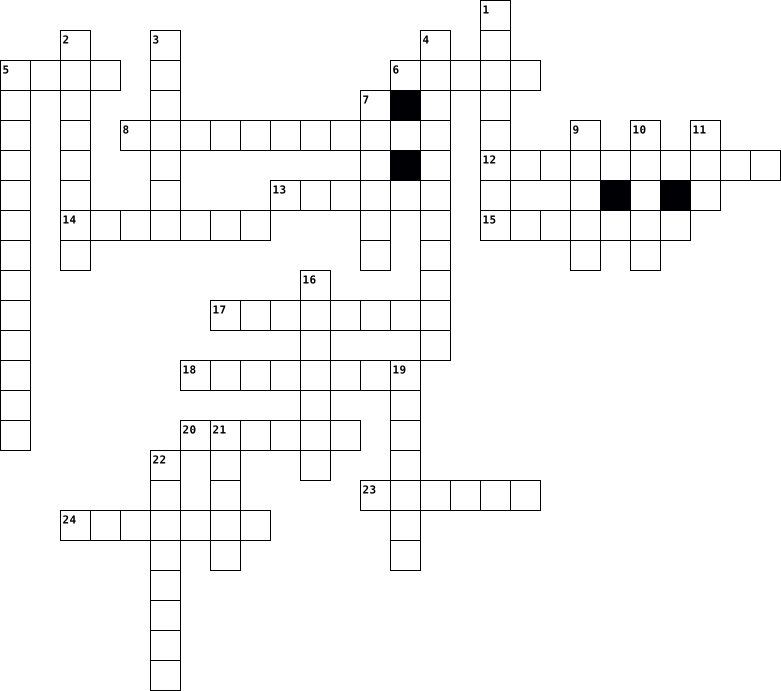
Across
- The smallest single neutral particle that makes up all life.
- H2O
- the relative average of all isotopes of an element.
- An experiment took place in which microscopes picked up where the positively charged alpha particle rays went when directed at a thin piece of gold.
- positively charged subatomic particle
- the name of the outermost shell in an atoms electron configuration
- the center of an atom that contains the dna, protons and neutrons
- Two or more atoms bonded together.
- a charge that electrons have
- an ion that has lost electrons
- the rows of the periodic table
- JJ created a model of an atom where the electrons are scattered in a mass of positively charged nucleus replicating a plum pudding.
Down
- negatively charged subatomic particle
- a charge that protons have
- the different types of atoms of an element that contains different amounts of neutrons.
- the number of protons and electrons added together.
- the number of protons, electrons and place in the periodic table
- John's atomic theory consisted of, all gas has weight, atoms are the smallest particle, simple multiple proportion, elements combine into molecules of simple ratios, elements join together to form compounds, water always contains twice as much hydrogen as oxygen, when chemicals react with each other the total mass of the chemicals does not change, pure oxygen has the same properties wherever it is found on the Earth or in space, gases some of which are invisible, have mass and different gases have different masses, modern microscopes produce images of surfaces that look bumpy
- a configuration of rings in which the electrons are placed,
- the columns of the periodic table
- an atom that has gained or lost an electron
- a neutrally charged subatomic particle
- A pure substance consisting of one type of atom.
- an ion that has gained electrons
- Two or more different elements bonded together.
25 Clues: H2O • a charge that protons have • a charge that electrons have • an ion that has lost electrons • the rows of the periodic table • an ion that has gained electrons • the columns of the periodic table • Two or more atoms bonded together. • negatively charged subatomic particle • positively charged subatomic particle • a neutrally charged subatomic particle • ...
Gold & Silver 2022-02-03

Across
- gold or silver heated in a crucible and transferred into a mold
- How gold comes out of the ground
- periodic table symbol of gold
- a naturally occurring solid material from which a metal or valuable mineral can be profitably extracted
- periodic table symbol for silver
- system by which the value of a currency was defined in terms of gold
- The US gold and silver 1 oz Coin
- natural accumulations of minerals in the earth crust
- originated to show the purity of gold in a piece of gold jewelry
- Precious metals have been used for this for centuries
- personal ornaments, such as necklaces, rings, or bracelets, that are typically made from or contain precious metal.
- a form of weight for metal
- "Royal Water"
- Spanish for gold
- One of the largest gold nuggets ever found
Down
- 925/1000 parts silver
- made by forcing gold or silver into a die or mold
- Adding to your metals
- pure substance consisting only of atoms that all have the same numbers of protons in their nuclei
- Silver in Latin
- 1000 grams
- Generally Copper with a thin layer of gold or silver applied on top
- Metal composed of 2 or more elements
- Gold and Silver are part of this periodic table
- Uncoined Gold or Silver in Bars or rounds
- a person who searches for mineral deposits
- the testing of a metal or ore to determine its ingredients and quality
- Pure gold
- measure of the fineness (i.e., purity) of gold
- 180 Troy Grains
- Latin for Gold
- At one point the largest manufacturer of precious metals that was sold to BASF in 2006 for $5 Billion
- a form of placer mining
- a block of gold or silver
- Spanish for silver
- a vein of metal ore in the earth
36 Clues: Pure gold • 1000 grams • "Royal Water" • Latin for Gold • Silver in Latin • 180 Troy Grains • Spanish for gold • Spanish for silver • 925/1000 parts silver • Adding to your metals • a form of placer mining • a block of gold or silver • a form of weight for metal • periodic table symbol of gold • How gold comes out of the ground • periodic table symbol for silver • ...
Chapter 10 Vocabulary 2016-01-10

Across
- the lowest available level within an atom (2W)
- colored lines generated when light emitted by a gas is shown through a spectroscope (2W)
- the last name of a French physicist who suggested that all objects have wave properties
- small measures of energy
- a cloudlike region around the nucleus where electrons are located
- the property of an electron that describes its appearance of spinning on an axis like a globe
- the number that indicates the shape of the orbital (4W)
- horizontal groups of elements in the periodic table
- the number of electrons a p orbital can hold
- noble gas configuration (2W)
- a measurement of the number of waves that pass a particular point per second
- a new branch of physics (2W)
- the B groups and group VIII (2W)
Down
- a particle representing a quantum of light or other electromagnetic radiation
- principle that states that energy levels in atoms are written; n=1, n=2... (3W)
- a way of showing the arrangement of electrons in an atom (2W)
- also called families, vertical groups of elements in the periodic table
- two possible values for spin, +1/2 or -1/2 (3W)
- an atomic orbital can hold a maximum of 2 electrons, which most have opposite (3W)
- the orbital arrangement of electrons in an atom (2W)
- contains electrons in the orbitals (3W)
- one way energy travels through space (3W)
- an A group element (2W)
- the electrons in the outermost energy level of an atom (2W)
- electrons fill the lowest energy level first (2W)
- electrons on the outermost electron shell (2W)
- the publisher of the periodic table
- a measurement of how fast a wave travels in space
- the distance between consecutive peaks in a wave
- within a sublevel, place one electron per orbital before pairing them (2W)
30 Clues: an A group element (2W) • small measures of energy • noble gas configuration (2W) • a new branch of physics (2W) • the B groups and group VIII (2W) • the publisher of the periodic table • contains electrons in the orbitals (3W) • one way energy travels through space (3W) • the number of electrons a p orbital can hold • the lowest available level within an atom (2W) • ...
Chemistry Review 2023-05-01

Across
- negative value for H
- positive subatomic particle
- used to quantify the heat flow into or out of a system
- electrons are arranged in a "sea of electrons"
- a chemical geometry with a 180 degree angle
- type of radiation that is pure energy
- the weakest of the intermolecular forces
- unit of pressure
- the capacity to do work
- the rows of the periodic table
- type of chemical reaction in which one product is formed
- 1s2 2s2 2p6 3s2 3p6 4s2 3d6
- gas law that related pressure, volume, temperature, and amount of a gas
- bond between a nonmetal and a nonmetal
- credited for the Atomic Theory of Atoms
- the unit of energy, heat, or work
- type of chemical reaction in which water and carbon dioxide are products
- used to measure volume of a liquid
- most electronegative element
Down
- the bond that holds two molecules together
- first part of the atom to be discovered
- unit of temperature
- electron geometry of methane
- group 1 of the periodic table
- studies the rate at which a chemical reaction occurs
- happens when there are too many protons in the nucleus and neutrons cannot hold them in
- a metal that is a liquid at room temperature
- ionic, covalent, or metallic bond
- a force between H and N,O, or F
- the study of heat released or required by a chemical reaction
- mass divided by volume
- created the "Nuclear" model of the atom, after the gold foil experiment
- a unit to measure concentration
- created the "Plum Pudding" model of the atom
- group 7 on the periodic table
- type of replacement reaction where one element "trades places" with an element in a compound
- Valence shell electron pair repulsion
- result of an electronegativity difference greater than 0.3
- bond between a metal and a nonmetal
- 1s2 2s2 2p6 3s2 3p6 4s2
40 Clues: unit of pressure • unit of temperature • negative value for H • mass divided by volume • the capacity to do work • 1s2 2s2 2p6 3s2 3p6 4s2 • positive subatomic particle • 1s2 2s2 2p6 3s2 3p6 4s2 3d6 • electron geometry of methane • most electronegative element • group 1 of the periodic table • group 7 on the periodic table • the rows of the periodic table • ...
Chemistry Vocabulary Crossword Puzzle 2020-11-11

Across
- a chemical reaction that absorbs heat
- substance that does the dissolving in a chemical solution
- chemical bond between atoms caused by an electrostatic force in opposite charged ions
- expression which states the number and types of atoms in a molecule
- part of the atomic nucleus that has a charge of +1
- chemical species formed when two or more elements form a chemical bond
- a substance that cannot be subdivided and is identified by the number of protons in its atoms
- chemical mass unit equal to Avogadro's number
- any element found in the last column of the periodic table
- part of the atomic nucleus that has a charge of -1
- whole number that is the sum of protons and neutrons in the atomic nucleus
- outer electron that is most likely to participate in a bond formation or a chemical reaction
- part of the atomic nucleus that has a charge of 0
- measure of hydrogen ion in a solution showing the acidity or basicity of a substance
- a chemical species that accepts protons
- chemical bond between atoms where electrons are more or less evenly shared
Down
- a chemical reaction that releases heat
- the arrangement of elements by increase of their atomic number
- homogenous mixture of two or more substances
- atoms that have the same number of protons but different amount of neutrons changing its atomic weight
- the number of protons in the nucleus of an atom of an element
- a chemical species that donates protons
- any element found in the 1st column of the periodic table
- substance that is dissolved in a chemical solution
- substance formed as a result of a chemical reaction
- starting material for a chemical reaction
- any element found in the 2nd column of the periodic table
- the ability to do work
28 Clues: the ability to do work • a chemical reaction that absorbs heat • a chemical reaction that releases heat • a chemical species that donates protons • a chemical species that accepts protons • starting material for a chemical reaction • homogenous mixture of two or more substances • chemical mass unit equal to Avogadro's number • ...
Chemistry Crossword. 2017-11-08

Across
- mass of one atom of an element calculated from the total number of protons, neutrons, and electrons of that atom
- cloudy mixture in which tiny particles of one substance are held within another and particles cannot be separated out from the other substance\
- positively charged centre of an atom
- property that describes the physical appearance and composition of a substance
- an experiment in which all reactants and all products of a chemical reaction are accounted for
- a reaction that takes place when two or more substances react to form new substances
- group 2 elements in the periodic table
- dull, brittle element that does not conduct electricity
- amount of mass in a given volume of a substance
- group 18 elements in the periodic table
- homogeneous mixture
Down
- description of a solid that can be stretched into a long wire
- chemical reaction that occurs when oxygen reacts with a substance to form a new substance and give off energy
- the smallest part of an element that is representative of that element
- number of protons in the nucleus of one atom of an element
- slow chemical change that occurs when oxygen in the air reacts with metal
- substance that reacts with another substance or substances in a chemical reaction to create a new substances with different properties
- metals group 1 elements in the periodic table
- principle that matter is not created or destroyed in a chemical reaction
- group of atoms acting as one
- change in the appearance or state of a substance that does not change the composition
- changing of state from a solid to a liquid
- chemical combination of two or more elements in a specific ratio
- an experiment in which one or more products of a chemical reaction can escape
- mass of a substance that can dissolve in a given amount of solvent to form a saturated solution at a given temperature
25 Clues: homogeneous mixture • group of atoms acting as one • positively charged centre of an atom • group 2 elements in the periodic table • group 18 elements in the periodic table • changing of state from a solid to a liquid • metals group 1 elements in the periodic table • amount of mass in a given volume of a substance • dull, brittle element that does not conduct electricity • ...
chemistry 2017-11-15

Across
- The phase change from a solid to a liquid
- the temperature in which the substance starts to melt
- the metals of Group 1 on the periodic table
- an atom that is defined by its atomic number
- an element which is not metallic
- H2O a chemical substance, a major part of cells and Earth, and covalently bonded
- Group 17 on the Periodic Table and are all non-metals
- A state of matter in which cohesive force is less than or equal to the separating force
- the change of one or more substances into another or multiple substances
- formation of a solid in a solution or inside another solid during a chemical reaction or by diffusion in a solid
- homogeneous mixture made up of multiple substances. It is made up of solutes and solvents.
- The amount of mass per unit volume. d = m/V
Down
- a positive unit or subatomic particle that has a positive charge
- is the same as a proton or electron but without a charge
- energy transferred from one system to another by thermal interaction
- the metals of Group 2 on the periodic table
- gases group 18 elements, those whose outer electron shell is filled
- material with definite chemical composition
- the part of the solution that is mixed into the solvent (NaCl in saline water)
- particles that fill their container though have no definite shape or volume
- the number representing an element which corresponds with the number of protons within the nucleus
- the temperature in which the substance starts to boil
- a phase transition from solid to limewater fuel or gas
- the part of the solution that dissolves the solute (H2O in saline water
- Chemical element that is a good conductor of both electricity and heat and forms cations and ionic bonds with non-metals
25 Clues: an element which is not metallic • The phase change from a solid to a liquid • the metals of Group 2 on the periodic table • material with definite chemical composition • the metals of Group 1 on the periodic table • The amount of mass per unit volume. d = m/V • an atom that is defined by its atomic number • the temperature in which the substance starts to melt • ...
Kallie 2023-05-10

Across
- An element that has some characteristics of both metals and nonmetals v
- A Small particle in the nucleus of the atom,with no electrical charge v
- Solid nonmetals tend to be ___ and brittle.(O)
- Small positively charged particle that are in the nucleus of an atom v
- The____ of an element can be predicted from its location in the periodic table.(O)
- symbol A one or two letter representation of an element v
- At the ____ of the atom is a tiny,dense nucleus containing protons and neutrons.(O)
- An element that lacks most of the properties of a metal v
- metal An element in Group 1 of the periodic table v
- particle A fast moving electron that is given off as nuclear radiation v
Down
- Metals are ___ as alkaline, earth metals,transition metals.(O)
- rays Electromagnetic waves with the shortest wavelength and highest frequencies v
- Mendeleev noticed a _____ of properties in elements arranged by increasing atomic mass. (O)
- A tiny-negatively charged particle that moves around the outside of the nucleus of an atom v
- number The number of protons in the nucleus of an atom v
- The central core of an atom which contains protons and neutrons v
- The basic particle from which all elements are made v
- The physical properties of ___ includes luster,malleability,ductility,and conductivity.(O)
- conductivity The ability of an object to transfer heat v
- table The_____ includes each element's atomic number,symbol,name,and atomic mass.(O)
- life The time it takes for half of the atoms of a radioactive element to decay v
- During radioactive decay, the ___ of an atom changes. (O)
- mass The average mass of all the isotopes of an element v
- Atomic theory grew as a series of _____ models that developed from experimental evidence (O)
- The ___ containing nonmetals include the carbon,nitrogen,oxygen,halogen,noble gasses,and hydrogen families.(O)
25 Clues: Solid nonmetals tend to be ___ and brittle.(O) • metal An element in Group 1 of the periodic table v • The basic particle from which all elements are made v • number The number of protons in the nucleus of an atom v • conductivity The ability of an object to transfer heat v • symbol A one or two letter representation of an element v • ...
Reactivity 2024-01-25

Across
- A compound containing hydrogen and carbon only.
- A reaction in which energy is transferred to the reactants from the surroundings. The temperature of the surroundings decreases.
- If a substance has lost oxygen then it has been reduced.
- Burning, usually in air. The reaction gives out energy, which is transferred to the surroundings by heating or light.
- A reaction in which an acid reacts with an alkali or a base to produce a salt and water.
- An explosive substance reacts very fast, releasing a lot of energy and gas.
- _______ series: A list of metals that shows them in order of reactivity with the most reactive metal at the top.
- A sub-atomic particle found outside the nucleus of an atom. It has an electrical charge of –1.
- A flammable substance catches fire easily.
- The central part of an atom, where protons and neutrons are found.
Down
- A reaction in which energy is transferred from the reactants to the surroundings. The temperature of the surroundings increases.
- _______ table, showing all the elements in order of atomic number.
- The amount of force pushing on a certain area. It is a way of saying how spread out a force is.
- A sub-atomic particle found in an atom’s nucleus. It has an electrical charge of +1.
- A sub-atomic particle found in an atom’s nucleus. It has no electrical charge.
- The smaller particles of which atoms are made (electrons, protons, neutrons).
- Reaction in which a substance gains oxygen.
- A horizontal row in the periodic table.
- _______reaction:A reaction in which one reactant is reduced and another is oxidised.
- A vertical column in the periodic table.
- An object is destroyed by collapsing in on itself.
- A change in which no new substances are formed (e.g. changes of state).
- A rock that contains enough of a certain mineral to make it worth mining.
23 Clues: A horizontal row in the periodic table. • A vertical column in the periodic table. • A flammable substance catches fire easily. • Reaction in which a substance gains oxygen. • A compound containing hydrogen and carbon only. • An object is destroyed by collapsing in on itself. • If a substance has lost oxygen then it has been reduced. • ...
6CHEM Unit 2 Vocab Practice 2024-11-22

Across
- transition metal, expected charge of 2+, 4 electron shells
- particle with no charge and same mass to a proton; found in the nucleus
- atom or group of atoms that has a positive or negative charge
- rare earth metals
- the lonely element
- positively charge particle with a mass of 1 amu
- 4 valence electrons and 3 electron shells
- 5 valence electrons and 4 electron shells
- atoms usually want 8 valence electrons to be stable
- area around the nucleus of the atom where electrons are most likely found
- 1 valence electron and 2 electron shells
- transition metal, expected charge of 2+, 5 electron shells
- 2 core electrons, 8 valence electrons, charge of 2-
- measure of electric charge (positive or negative) of an atom or molecule
- less soft and less reactive than group 1 metals
- metals in the middle of the periodic table
- particles smaller than an atom
- group 1, very reactive, soft, silver, shiny metals
Down
- transition metal, expected charge of 1+
- atomic mass of 247
- radioactive metals
- elements that are dull (not shiny) and poor conductors of heat and energy
- electrons in the outermost energy level
- contains nonmetals, extremely reactive and poor conductors
- atomic number of 92
- malleable and ductile elements, usually solid at R.T.
- vertical column on the periodic table
- least reactive elements (inert)
- center of an atom
- #p + #n = ___
- horizontal row of elements in the periodic table
- number of energy levels in an atom that matches the period or row of an element
- elements that separate metals and nonmetals
- atoms of the same element with a different number of neutrons/atomic masses
- positively charge ion
- average mass of all isotopes of an element
- the number of protons in an atom
- negatively charge particle with no mass
- negatively charge ion
39 Clues: #p + #n = ___ • rare earth metals • center of an atom • atomic mass of 247 • radioactive metals • the lonely element • atomic number of 92 • positively charge ion • negatively charge ion • particles smaller than an atom • least reactive elements (inert) • the number of protons in an atom • vertical column on the periodic table • transition metal, expected charge of 1+ • ...
Earth Systems 3209: Chemistry Basics 2014-11-04

Across
- The smallest amount of a compound that still shares the properties of it
- A subtance made of only one type of atom
- A compound made when nonmetals bond together
- The smallest amount of an element that still shares the properties of it
- A neutral subatomic particle found within the nucleus of an atom
- A compound made when metals bond with nonmetals
- Anything that has mass and takes up space
Down
- The positively charged center of an atom
- Elements to the right side of the periodic table
- A negatively charged subatomic particle found that orbits the nucleus
- Elements to the left side of the periodic table
- A substance made of more than one type of element
- A positively charged subatomic particle found within the nucleus of an atom
- A charged atom formed by gaining or losing electrons
14 Clues: The positively charged center of an atom • A subtance made of only one type of atom • Anything that has mass and takes up space • A compound made when nonmetals bond together • Elements to the left side of the periodic table • A compound made when metals bond with nonmetals • Elements to the right side of the periodic table • ...
Science Crossword Puzzle 2024-09-06

Across
- Change a change from one state to another
- number multiplied by variable
- basic unit of a chemical element
- uncharged atomic particle that has mass
- shiny, malleable, solid
- a simple substance
- Table of Elements elements in a table
- anything that has mass and takes up space
- letter or number to the side of another character
- Symbol abbreviations for an element
- two or more separate elements
Down
- group of atoms held together
- Number number of protons in the nucleus
- stable subatomic particle
- lacks metal attributes
- Change change of chemical substances
- subatomic particle with negative energy
- Mass total mass in an atom
- Formula a number of atoms of each element in a compound
- properties between metals and nonmetals
20 Clues: a simple substance • lacks metal attributes • shiny, malleable, solid • stable subatomic particle • Mass total mass in an atom • group of atoms held together • number multiplied by variable • two or more separate elements • basic unit of a chemical element • Symbol abbreviations for an element • Table of Elements elements in a table • Change change of chemical substances • ...
Boring Science 2022-05-04

Across
- Chemical
- a minute portion of matter.
- What is air
- more separate elements
- science
- What is a table
- battle
- the chemical element of atomic number 6
- the matter from which a thing is or can be made.
- science
- a substance made by mixing
- Funny talking
Down
- essential or characteristic
- It’s hot
- Some smart
- physical substance
- it’s runny
- Small hole
- Smart
- your things
- it’s stinky
- hard
22 Clues: hard • Smart • battle • science • science • Chemical • It’s hot • Some smart • it’s runny • Small hole • What is air • your things • it’s stinky • Funny talking • What is a table • physical substance • more separate elements • a substance made by mixing • essential or characteristic • a minute portion of matter. • the chemical element of atomic number 6 • the matter from which a thing is or can be made.
List #13 2023-11-30

Across
- building for sick people
- a soft like voice
- at the top
- old family members
- best friend
- to leave beside
- color changes
- formal argument
- like alike
- more then one
- on the periodic table
- inside of anything
Down
- helps with donations
- open sweeter
- outskirts of a city
- opposite of horizontal
- has four sides
- good enough
- city area
- fair and just
- an estimation
21 Clues: city area • at the top • like alike • good enough • best friend • open sweeter • color changes • fair and just • an estimation • more then one • has four sides • to leave beside • formal argument • a soft like voice • old family members • inside of anything • outskirts of a city • helps with donations • on the periodic table • opposite of horizontal • building for sick people
The Periodic Table 2025-11-17

Across
- Which element has a zero valency?
- Mendeleev Who invented the periodic table?
- What do horizontal rows represent?
- Which element has the lowest electronegativity?
Down
- row What is a period on the periodic table?
- 17 What are the halogens?
- What do vertical columns represent?
7 Clues: 17 What are the halogens? • Which element has a zero valency? • What do horizontal rows represent? • What do vertical columns represent? • row What is a period on the periodic table? • Mendeleev Who invented the periodic table? • Which element has the lowest electronegativity?
Biomolecules 2026-02-06

Across
- basis of life
- Breathing in?
- Fats and oils
- symbol P, atomic #15
- what is on the periodic table
- body builders
- sugars, starches, and fiber
- liquid ______
Down
- Nucleic acid function
- Testosteron,Estrogen
- Store info
- lighest element
- post or beam
- Gas tank, silo
14 Clues: Store info • post or beam • basis of life • Breathing in? • Fats and oils • body builders • liquid ______ • Gas tank, silo • lighest element • Testosteron,Estrogen • symbol P, atomic #15 • Nucleic acid function • sugars, starches, and fiber • what is on the periodic table
General Chemistry 2020-05-25
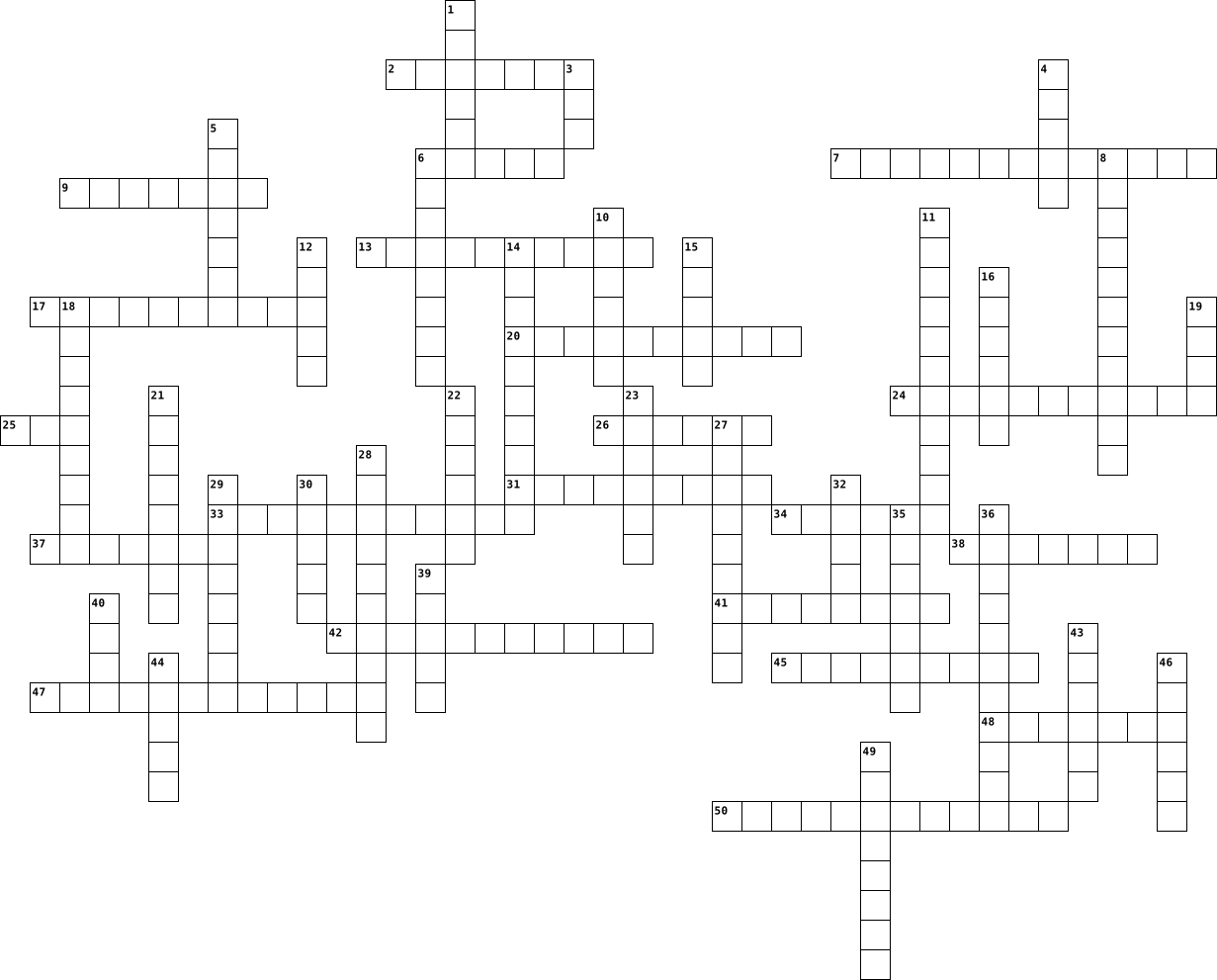
Across
- Phase change that involves the conversion from solid to liquid
- the fundamental unit of length in the metric system equal to 100 centimeters or approximately 39.37 inches.
- mixture Mixture whose a composition varies from position to position within a sample.
- Group 7A elements
- a metric unit of length equal to one hundredth of a meter.
- Process in which the solid particles are filtered to allow the liquid or filtrate to pass through the filter and be collected as residue
- chemistry it is a branch of chemistry that studies and uses instruments and methods used to separate identify and quantify matter.
- inner transition elements located in the first row of the f block in the periodic table
- Formed when atom loses or gains electron
- a substance that flows freely but is of constant volume having a consistency like that of water or oil.
- movement of one fluid through another.
- mixture Called as solution a mixture with uniform composition.
- Positively charged subatomic particle of an atom
- Ratio of the mass of an object to the volume occupied by that object.
- Uncharged particle found within the atomic nuclei
- Element that appears at the far right side of the periodic table
- figures The digits in any measurement that are known with certainty plus one digit which is uncertain
- the branch of science that deals with the identification of the substances of which matter is composed; the investigation of their properties and the ways in which they interact combine and change; and the use of these processes to form new substances.
- Separates components of mixture at different boiling points.
- Composed of two or more substances combined physically in variable proportions
- it is a branch of chemistry that studies the chemical processes within and relating to living organisms. Biochemical processes give rise to the complexity of life.
Down
- The amount of space occupied by a substance
- a substance or matter in a state in which it will expand freely to fill the whole of a container having no fixed shape and no fixed volume.
- rule states that atoms other than hydrogen tend to form bonds until surrounded by eight valence electrons
- Substance consisting of only one kind of atom
- separation The separation of elemental metals from the mixtures
- phase change in which liquid is converted to gas
- Elements at the left side and in the center of the periodic table
- Organic compound with carbon and oxygen only
- compound Compound that consists of two charged ions
- Elements found in the zigzag order in the periodic table
- a substance or object that is solid rather than liquid or fluid
- the measurement or extent of something from end to end.
- physical property physical property that does not depend on the size or amount of the sample
- number The sum of the number of protons and neutrons in its nucleus
- Phase change in which liquid is converted to solid
- Horizontal row in the periodic table
- a period of time equal to sixty seconds or a sixtieth of an hour.
- Chemistry it is a branch of chemistry that deals with synthesis and behavior of inorganic and organometallic compounds.
- the quality, condition, or fact of being exact and accurate.
- chemistry the branch of chemistry concerned with the application of the techniques and theories of physics to the study of chemical systems.
- mass Indicates that one mole of an element has a mass in grams numerically equal to its atomic mass units
- gas insert gas located at the rightmost side of the periodic table
- chemistry it is a branch of chemistry that studies the structure properties and reactions of organic compounds which contain carbon in covalent bonding. Study of structure determines their chemical composition and formula.
- the size length or amount of something as established by measuring.
- bond Formed by losing and gaining of electrons between metal and nonmetal
- The quantity of matter in the body
- Anything that has mass and occupies space
- a metric unit of capacity formerly defined as the volume of one kilogram of water under standard conditions now equal to 1 000 cubic centimeters
- level Specific energy value of electrons for an atom
- Negatively charged subatomic particle of an atom
51 Clues: Group 7A elements • The quantity of matter in the body • Horizontal row in the periodic table • movement of one fluid through another. • Formed when atom loses or gains electron • Anything that has mass and occupies space • The amount of space occupied by a substance • Organic compound with carbon and oxygen only • Substance consisting of only one kind of atom • ...
General Chemistry 2020-05-25
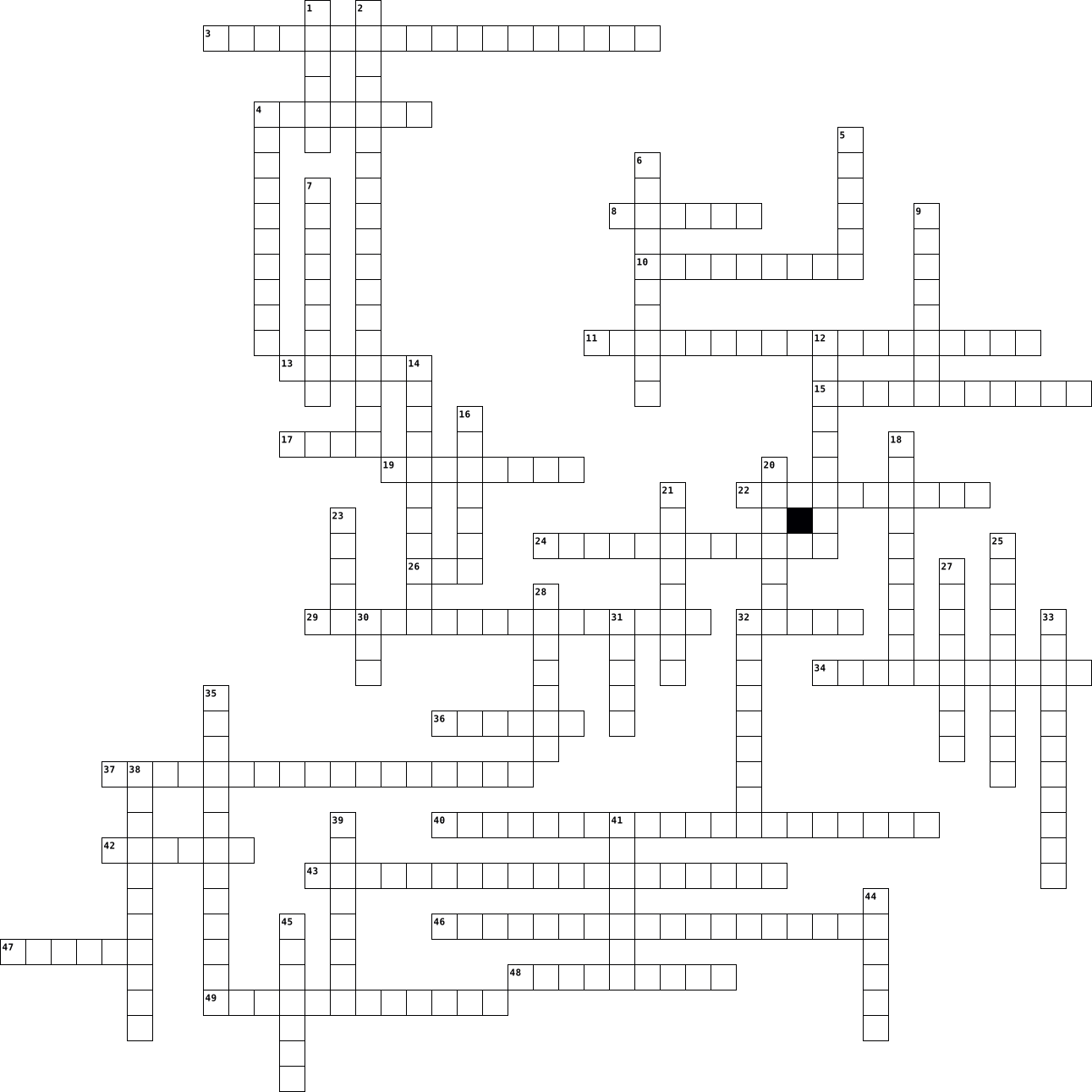
Across
- The separation of elemental metals from the mixtures
- Phase change that involves the conversion from solid to liquid
- Horizontal row in the periodic table
- Formed by losing and gaining of electrons between metal and nonmetal
- it is a branch of chemistry that deals with synthesis and behavior of inorganic and organometallic compounds.
- The amount of space occupied by a substance
- Specific energy value of electrons for an atom
- The quantity of matter in the body
- insert gas located at the rightmost side of the periodic table
- Process in which the solid particles are filtered to allow the liquid or filtrate to pass through the filter and be collected as residue
- it is a branch of chemistry that studies the chemical processes within and relating to living organisms. Biochemical processes give rise to the complexity of life.
- Formed when atom loses or gains electron
- it is a branch of chemistry that studies the structure properties and reactions of organic compounds which contain carbon in covalent bonding. Study of structure determines their chemical composition and formula.
- the fundamental unit of length in the metric system equal to 100 centimeters or approximately 39.37 inches.
- the size length or amount of something as established by measuring.
- a period of time equal to sixty seconds or a sixtieth of an hour.
- the branch of chemistry concerned with the application of the techniques and theories of physics to the study of chemical systems.
- Mixture whose a composition varies from position to position within a sample.
- Positively charged subatomic particle of an atom
- it is a branch of chemistry that studies and uses instruments and methods used to separate identify and quantify matter.
- Called as solution a mixture with uniform composition.
- Anything that has mass and occupies space
- states that atoms other than hydrogen tend to form bonds until surrounded by eight valence electrons
- Separates components of mixture at different boiling points.
Down
- Elements at the left side and in the center of the periodic table
- The digits in any measurement that are known with certainty plus one digit which is uncertain
- The sum of the number of protons and neutrons in its nucleus
- a substance that flows freely but is of constant volume having a consistency like that of water or oil.
- the quality, condition, or fact of being exact and accurate.
- movement of one fluid through another.
- Phase change in which liquid is converted to solid
- the branch of science that deals with the identification of the substances of which matter is composed.
- phase change in which liquid is converted to gas
- Group 7A elements
- Elements found in the zigzag order in the periodic table
- Composed of two or more substances combined physically in variable proportions
- Negatively charged subatomic particle of an atom
- a metric unit of capacity formerly defined as the volume of one kilogram of water under standard conditions now equal to 1 000 cubic centimeters
- a metric unit of length equal to one hundredth of a meter.
- the quality or state of being correct or precise.
- Ratio of the mass of an object to the volume occupied by that object.
- a substance or matter in a state in which it will expand freely to fill the whole of a container having no fixed shape and no fixed volume.
- a substance or object that is solid rather than liquid or fluid
- Indicates that one mole of an element has a mass in grams numerically equal to its atomic mass units
- inner transition elements located in the first row of the f block in the periodic table
- Compound that consists of two charged ions
- Organic compound with carbon and oxygen only
- Element that appears at the far right side of the periodic table
- Substance consisting of only one kind of atom
- the measurement or extent of something from end to end.
- Uncharged particle found within the atomic nuclei
51 Clues: Group 7A elements • The quantity of matter in the body • Horizontal row in the periodic table • movement of one fluid through another. • Formed when atom loses or gains electron • Anything that has mass and occupies space • Compound that consists of two charged ions • The amount of space occupied by a substance • Organic compound with carbon and oxygen only • ...
General Chemistry 2020-05-25
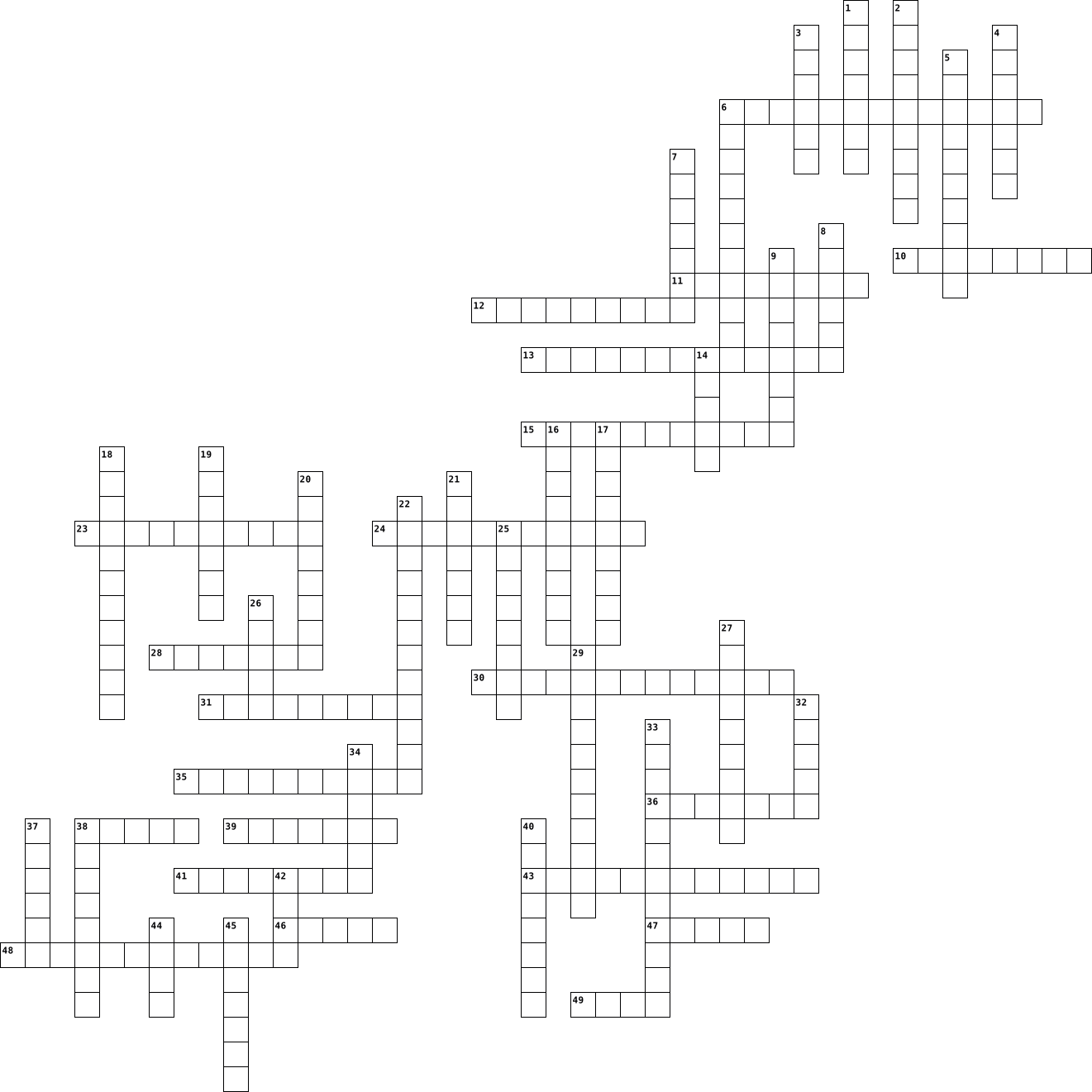
Across
- mixture: Mixture whose a composition varies from position to position within a sample.
- chemistry: the branch of chemistry concerned with the application of the techniques and theories of physics to the study of chemical systems.
- Substance consisting of only one kind of atom
- Phase change in which liquid is converted to solid
- it is a branch of chemistry that studies the chemical processes within and relating to living organisms. Biochemical processes give rise to the complexity of life.
- Elements found in the zigzag order in the periodic table
- chemistry: it is a branch of chemistry that studies and uses instruments and methods used to separate: identify: and quantify matter.
- a metric unit of length: equal to one hundredth of a meter.
- the measurement or extent of something from end to end.
- Separates components of mixture at different boiling points.
- physical property: physical property that does not depend on the size or amount of the sample
- movement of one fluid through another.
- Horizontal row in the periodic table
- mass: Indicates that one mole of an element has a mass in grams numerically equal to its atomic mass units
- chemistry: it is a branch of chemistry that studies the structure: properties and reactions of organic compounds: which contain carbon in covalent bonding. Study of structure determines their chemical composition and formula.
- Ratio of the mass of an object to the volume occupied by that object.
- inner transition elements located in the first row of the f:block in the periodic table
- gas: insert gas located at the rightmost side of the periodic table
- bond: Formed by losing and gaining of electrons between metal and nonmetal
- Organic compound with carbon and oxygen only
- a substance or matter in a state in which it will expand freely to fill the whole of a container: having no fixed shape and no fixed volume.
Down
- Positively:charged subatomic particle of an atom
- Element that appears at the far right side of the periodic table
- the fundamental unit of length in the metric system: equal to 100 centimeters or approximately 39.37 inches.
- a substance that flows freely but is of constant volume: having a consistency like that of water or oil.
- the branch of science that deals with the identification of the substances of which matter is composed; the investigation of their properties and the ways in which they interact: combine: and change; and the use of these processes to form new substances.
- mixture: Called as solution: a mixture with uniform composition.
- a period of time equal to sixty seconds or a sixtieth of an hour.
- a metric unit of capacity: formerly defined as the volume of one kilogram of water under standard conditions: now equal to 1:000 cubic centimeters
- Uncharged particle found within the atomic nuclei
- compound: Compound that consists of two charged ions
- Negatively:charged subatomic particle of an atom
- the closeness of a single measurement to its true value
- figures: The digits in any measurement that are known with certainty plus one digit which is uncertain
- Anything that has mass and occupies space
- Phase change that involves the conversion from solid to liquid
- Elements at the left side and in the center of the periodic table
- the size: length: or amount of something: as established by measuring.
- separation: The separation of elemental metals from the mixtures
- rule: states that atoms other than hydrogen tend to form bonds until surrounded by eight valence electrons
- Chemistry: it is a branch of chemistry that deals with synthesis and behavior of inorganic and organometallic compounds.
- Process in which the solid particles are filtered to allow the liquid or filtrate to pass through the filter: and be collected as residue
- The quantity of matter in the body
- phase change in which liquid is converted to gas
- a substance or object that is solid rather than liquid or fluid
- level: Specific energy value of electrons for an atom
- Composed of two or more substances: combined physically in variable proportions
- Group 7A elements
- Formed when atom loses or gains electron
- number: The sum of the number of protons and neutrons in its nucleus
- The amount of space occupied by a substance
51 Clues: Group 7A elements • The quantity of matter in the body • Horizontal row in the periodic table • movement of one fluid through another. • Formed when atom loses or gains electron • Anything that has mass and occupies space • The amount of space occupied by a substance • Organic compound with carbon and oxygen only • Substance consisting of only one kind of atom • ...
General Chemistry 2024-05-09

Across
- Negatively charged subatomic particle of an atom
- table metals: Elements at the left side and in the center of the periodic table.
- The separation of elemental metals from the
- mixture: Called as solution: a mixture with uniform composition.
- a metric unit of length: equal to one hundredth of a meter.
- chemistry: the branch of chemistry concerned with the application of the techniques and theories of physics to the study of chemical systems.
- metalloids: Elements found in the zigzag order in the
- level: Specific energy value of electrons for an atom
- Phase change in which liquid is converted to solid
- Separates components of mixture at different boiling points.
- ion: Formed when atom loses or gains electron
- gas: insert gas located at the rightmost side of
- movement of one fluid through another.
- periodic table nonmetal: Element that appears at the far right side of the periodic table.
- or fluid liquid: a substance that flows freely but
- chemistry: it is a branch of chemistry that
- Uncharged particle found within the atomic nuclei.
- bond: Formed by losing and gaining of electrons between metal and nonmetal
- the measurement or extent of something from end to end.
- phase change in which liquid is converted to gas
- combine: and change; and the use of these processes to form new substances.
- Composed of two or more substances: combined physically in variable proportions
Down
- Phase change that involves the conversion from solid to
- Group 7A elements.
- mass: Indicates that one mole of an element has a mass in grams numerically equal to its atomic mass units
- the size: length: or amount of something: as established by measuring.
- mass:The quantity of matter in the body mass.
- the closeness of a single measurement to its true value.
- the branch of science that deals with the identification of the substances of which matter is composed; the investigation of their properties and the ways in which they
- Positively:charged subatomic particle of an atom significant figures: The digits in any measurement that are known with certainty plus one digit which is uncertain
- Ratio of the mass of an object to the volume occupied by that object.
- it is a branch of chemistry that studies the chemical processes within and relating to living organisms. Biochemical processes give rise to the complexity of life.
- Process in which the solid particles are filtered to allow the liquid or filtrate to pass through the filter: and be collected as residue.
- the fundamental unit of length in the metric system equal to 100 centimeters or approximately 39.37 inches.
- Organic compound with carbon and oxygen only
- a metric unit of capacity: formerly defined as the volume of one kilogram of water under standard conditions: now equal to 1:000 cubic centimeters
- compound: Compound that consists of two charged
- chemistry: it is a branch of chemistry that studies and uses instruments and methods used to separate: identify: and quantify matter.
- Chemistry: it is a branch of chemistry that deals with synthesis and behavior of inorganic and organometallic compounds.
- the structure: properties and reactions of organic compounds: which contain carbon in covalent bonding. Study of structure determines their chemical composition and formula.
- The amount of space occupied by a substance
- a period of time equal to sixty seconds or a sixtieth of an hour.
- a substance or object that is solid rather than
- Substance consisting of only one kind of atom
- a substance or matter in a state in which it will expand freely to fill the whole of a container: having no fixed shape and no fixed volume.
- rule: states that atoms other than hydrogen tend to form bonds until surrounded by eight valence electrons.
- physical property: physical property that does not depend on the size or amount of the sample.
- mixture: Mixture whose a composition varies from position to position within a sample.
- Horizontal row in the periodic table
- inner transition elements located in the first row of the f block in the periodic table magnetic.
- of constant volume: having a consistency like that of water or oil.
- The sum of the number of protons and neutrons in its nucleus matter: Anything that has mass and occupies space
52 Clues: Group 7A elements. • Horizontal row in the periodic table • movement of one fluid through another. • The separation of elemental metals from the • The amount of space occupied by a substance • chemistry: it is a branch of chemistry that • Organic compound with carbon and oxygen only • mass:The quantity of matter in the body mass. • ...
The Fundamentals Of Chemistry 2023-01-15

Across
- broken stone for use in making roads.
- a length or portion of time.
- metals, any of the set of metallic elements occupying a central block (Groups IVB–VIII, IB, and IIB, or 4–12) in the periodic table, e.g., iron, manganese, chromium, and copper. Chemically they show variable valence and a strong tendency to form coordination compounds, and many of their compounds are colored.
- inert gases, noble gas. noun. no·ble gas ˈnō-bəl- : any of a group of rare gases that include helium, neon, argon, krypton, xenon, and sometimes radon and that exhibit great stability and extremely low reaction rates.
- a stable subatomic particle occurring in all atomic nuclei, with a positive electric charge equal in magnitude to that of an electron, but of opposite sign.
- an element (e.g. arsenic, antimony, or tin) whose properties are intermediate between those of metals and solid nonmetals or semiconductors.
- atomic mass unit
- an element or substance that is not a metal.
- decay, Radioactive decay is the process in which a radioactive atom spontaneously gives off radiation in the form of energy or particles to reach a more stable state. It is important to distinguish between radioactive material and the radiation it gives off.
- a stable subatomic particle with a charge of negative electricity, found in all atoms and acting as the primary carrier of electricity in solids.
- any of the series of fifteen (15) metallic elements from lanthanum to lutetium in the periodic table.
- put together or place in a group or groups.
Down
- the emission of ionizing radiation or particles caused by the spontaneous disintegration of atomic nuclei.
- ion, An atomic or molecular system having an excess of negative charge. Negative ions, also called anions, are formed in attachment processes in which an additional electron is captured by an atom, molecule, or cluster. They can also be formed when a molecule or cluster dissociates.
- ion, Positive ions are formed by atoms or molecules suffering an inelastic collision with an energetic electron in which an electron is lost from the atom or molecule (electron impact ionization). The degree of ionization of the plasma depends strongly on the electron density and energy distribution in the gas.
- denoting lamps and radiant heat sources using a filament surrounded by the vapor of iodine or another halogen.
- each of two or more forms of the same element that contain equal numbers of protons but different numbers of neutrons in their nuclei, and hence differ in relative atomic mass but not in chemical properties; in particular, a radioactive form of an element.
- cloud, the system of electrons surrounding the nucleus of an atom.
- number, the number of protons in the nucleus of an atom, which determines the chemical properties of an element and its place in the periodic table.
- any of the series of fifteen metallic elements from actinium (atomic number 89) to lawrencium (atomic number 103) in the periodic table. They are all radioactive, the heavier members being extremely unstable and not of natural occurrence.
- metals, alkali metal, any of the six chemical elements that make up Group 1 (Ia) of the periodic table—namely, lithium (Li), sodium (Na), potassium (K), rubidium (Rb), cesium (Cs), and francium (Fr). The alkali metals are so called because reaction with water forms alkalies (i.e., strong bases capable of neutralizing acids).
- the central and most important part of an object, movement, or group, forming the basis for its activity and growth.
- an atom or molecule with a net electric charge due to the loss or gain of one or more electrons.
- metals, any of the elements lithium, sodium, potassium, rubidium, cesium, and francium, occupying Group IA (1) of the periodic table. They are very reactive, electropositive, monovalent metals forming strongly alkaline hydroxides.
- a subatomic particle of about the same mass as a proton but without an electric charge, present in all atomic nuclei except those of ordinary hydrogen.
25 Clues: atomic mass unit • a length or portion of time. • broken stone for use in making roads. • put together or place in a group or groups. • an element or substance that is not a metal. • cloud, the system of electrons surrounding the nucleus of an atom. • an atom or molecule with a net electric charge due to the loss or gain of one or more electrons. • ...
SCIENCE 2016-01-17

Across
- Which of the following nutrients is used to build and repair cells?
- This is the structure in plant cells that captures the sun's energy and changes it into chemical energy.
- The study of interactions between organisms and their environment is called_____
- Which term refers to the number of protons in an atom and helps to place elements on the Periodic Table?
- On the Periodic Table, elements that are in the same vertical column are considered to be in the same_____
- A species in danger of becoming extinct in the near future is referred to as a(an)_________species.
- Which area of Earth science includes the study of stars?
Down
- What is the hormone responsible for causing sudden emotional changes and sexual feelings that occur in males during puberty?
- The breaking down of rocks on the earth's surface is ____
- Which body system pumps and transports the blood to all parts of the body as well as supply oxygen and remove waste products from body tissues?
- The outer layers of plants, fungi and some protist cells which support and protect the cell are called the _____
- On the Periodic Table, all elements that are in the same horizontal rows are considered to be in the same ____
12 Clues: Which area of Earth science includes the study of stars? • The breaking down of rocks on the earth's surface is ____ • Which of the following nutrients is used to build and repair cells? • The study of interactions between organisms and their environment is called_____ • ...
Chemistry Crossword 2017-12-08

Across
- A negatively charged ion
- A pure substance that cannot be broken down
- Elements found in the first column of the periodic table
- A chemical, present during the beginning of a chemical reaction that is used up doing the reaction
- This is used to compare the acidity of solutions
- An aqueous solution that neutralizes a base
Down
- A pure substance, formed with 2 or more non-metals
- Has a pH of 7, not acidic or basic
- An aqueous solution that turns red litmus blue
- A row of elements in the periodic table
10 Clues: A negatively charged ion • Has a pH of 7, not acidic or basic • A row of elements in the periodic table • A pure substance that cannot be broken down • An aqueous solution that neutralizes a base • An aqueous solution that turns red litmus blue • This is used to compare the acidity of solutions • A pure substance, formed with 2 or more non-metals • ...
science 2023-04-14

Across
- a horizontal row in the periodic table that tells you how many energy levels an element has
- a column in the periodic table that tells you how many valence electrons a element has
- a small natural particle in atoms
- is a poor conductor and brittle
- a substance that can't be broken down
Down
- a small negatively charged particle in atoms
- a small positively charged particle in atoms
- solid material that is hard, shiny, and malleable
- basic unit of chemical elements
- an element that has both metal and non metal properties
10 Clues: is a poor conductor and brittle • basic unit of chemical elements • a small natural particle in atoms • a substance that can't be broken down • a small negatively charged particle in atoms • a small positively charged particle in atoms • solid material that is hard, shiny, and malleable • an element that has both metal and non metal properties • ...
Sun Crossword Puzzle 2022-11-07

Across
- areas that appear dark on the surface of the Sun
- the second element of the periodic table
- a reddish glowing layer of gas above the sun's photosphere
- an intense burst of radiation coming from the release of magnetic energy
- a dying star in the final stages of stellar evolution
Down
- the transfer of heat through fluid
- the first element of the periodic table
- created by the outward expansion of plasma from the Corona
- outer layer of the Sun's atmosphere
- the process that powers the sun and stars.
10 Clues: the transfer of heat through fluid • outer layer of the Sun's atmosphere • the first element of the periodic table • the second element of the periodic table • the process that powers the sun and stars. • areas that appear dark on the surface of the Sun • a dying star in the final stages of stellar evolution • created by the outward expansion of plasma from the Corona • ...
Chemistry crossword 2021-08-16

Across
- High speed electron ejected out of nucleus when a neutron gains a positive or negative charge
- a reaction that occours to make a radioactive element stable
- The study of the properties characteristics and reactions of matter
- an atom that has gained or lost an electron
- the number of protons/electrons in an atom
- splitting of heavier atoms into lighter ones
Down
- helium nucleus released as a product has 4 neutrons and 2 electrons/protons
- +1 charge
- High speed radiation that comes out of beta or
- -1 charge very light part of an atom
- what is found on the periodic table
- no charge and found in the nucleus of an atom
- splitting of heavier atoms into lighter ones
- what an element on average weighs represented on the periodic table on the bottom of an element
- an atom with a change in nuetrons
15 Clues: +1 charge • an atom with a change in nuetrons • what is found on the periodic table • -1 charge very light part of an atom • the number of protons/electrons in an atom • an atom that has gained or lost an electron • splitting of heavier atoms into lighter ones • splitting of heavier atoms into lighter ones • no charge and found in the nucleus of an atom • ...
Chemistry Crossword 2017-11-09

Across
- A substance that can't be broken down by chemical changed or or broken down; composed of atoms
- The basic unit of an element
- Determined by valence electrons
- A subatomic particle with a negative charge
- The group of non-metal elements that do not react with other elements
- A subatomic particle with a neutral charge
- A subatomic particle with a negative charge
- One or more letters given to identify an element
- The rows in a periodic table that organize elements based on their energy levels
- The columns in a periodic table that organize elements based on their valence electrons
- A particle that is formed when an element loses or gains an extra proton or electron
Down
- The electrons located on the outer energy level
- When two atoms come together to form a molecule
- The center of an atom
- A subatomic particle with a positive charge
15 Clues: The center of an atom • The basic unit of an element • Determined by valence electrons • A subatomic particle with a neutral charge • A subatomic particle with a negative charge • A subatomic particle with a negative charge • A subatomic particle with a positive charge • The electrons located on the outer energy level • When two atoms come together to form a molecule • ...
Nuclear Energy 2023-11-01

Across
- Can go through skin and aluminium but is stopped by lead
- Calculated by adding neutrons and protons
- When an atom has a different mass than whats on the periodic table
- Instability in a atom which makes it this
- 2 atom combine and release energy
- When something happens and causes another set of reactions to happen
- This determines its place on the periodic table, Calculated by the number of protons
- The Time point when a sample has gotten to half of its original amount
Down
- An atom splits and releases energy
- Is released during beta decay, Is one electron
- Releases during Alpha decay, Also known as a helium nucleus
- Determines what element it is
- the center of a atom and contains most mass in a atom
- Neutrally charged subatomic particle, Weighs 1 amu
14 Clues: Determines what element it is • 2 atom combine and release energy • An atom splits and releases energy • Calculated by adding neutrons and protons • Instability in a atom which makes it this • Is released during beta decay, Is one electron • Neutrally charged subatomic particle, Weighs 1 amu • the center of a atom and contains most mass in a atom • ...
Kerly crossword 2020-03-31

Across
- a group of energy levels of an atom
- the mass of an atom of a chemical element expressed in atomic mass units. It is approximately equivalent to the number of protons and neutrons in the atom
- the fixed amount of energy that a system described by quantum mechanics, such as a molecule, atom, electron, or nucleus, can have.
- In atomic physics and quantum chemistry, the electron configuration is the distribution of electrons of an atom or molecule
- the number of protons in the nucleus of an atom, which determines the chemical properties of an element and its place in the periodic table.
Down
- The periodic table, also known as the periodic table of elements, is a tabular display of the chemical elements, which are arranged by atomic number, electron configuration, and recurring chemical properties. The structure of the table shows periodic trends.
- a process that involves rearrangement of the molecular or ionic structure of a substance, as opposed to a change in physical form or a nuclear reaction.
- tending to lose electrons and form positive ions in chemical reactions.
- a stable subatomic particle with a charge of negative electricity, found in all atoms and acting as the primary carrier of electricity in solids.
9 Clues: a group of energy levels of an atom • tending to lose electrons and form positive ions in chemical reactions. • In atomic physics and quantum chemistry, the electron configuration is the distribution of electrons of an atom or molecule • ...
Science Crossword Puzzle 2023-08-31

Across
- The ability of a material to conduct electricity of heat
- Elements with similar properties found on the left side of the staircase
- Formula A notation used by scientists to show the number of atoms in a molecule
Down
- Symbol One or two letters abbreviation from the element’s name
- The tendency of a substance to undergo chemical changes
- table A reference for associating the name and symbol of an element
- Elements with similar properties found on the right side of the staircase on the periodic table
- Elements with similar properties that create a staircase on the periodic table
8 Clues: The tendency of a substance to undergo chemical changes • The ability of a material to conduct electricity of heat • Symbol One or two letters abbreviation from the element’s name • table A reference for associating the name and symbol of an element • Elements with similar properties found on the left side of the staircase • ...
Elements, Compounds, and Mixtures 2021-09-16

Across
- a pure substance that can not be broken down into any other substances
- he started the first Periodic Table
- when one or more elements have been chemically combined through a chemical reaction to form a new substance
- a combination of many different elements, but they are not chemically bonded and can be separated
Down
- anything that has mass and takes up space
- Table: it is a display of the elements
- the incredibly, small building blocks of matter
- the element of sodium
- compound for water
- the element for chloride
10 Clues: compound for water • the element of sodium • the element for chloride • he started the first Periodic Table • Table: it is a display of the elements • anything that has mass and takes up space • the incredibly, small building blocks of matter • a pure substance that can not be broken down into any other substances • ...
Periodic Table Crossword 2022-05-06

Across
- These metals have 1 outer electron and are highly reactive with non-metals. and are highly reactive with non-metals.
- the columns going up and down
- a large thing of elements.
- the rows going across
- Elements in family 18
- located on the left side of the periodic table.
Down
- These metals have 2 outer electrons and are so reactive that they are not found by themselves in nature.
- Nonmetals are located on the right side of the periodic table.
- ability to reflect light
- Elements in family 17.
10 Clues: the rows going across • Elements in family 18 • Elements in family 17. • ability to reflect light • a large thing of elements. • the columns going up and down • located on the left side of the periodic table. • Nonmetals are located on the right side of the periodic table. • ...
Chemical Bonds And Atomic Stucture 2018-09-11

Across
- Negative charged particle that orbits the atom.
- Two atoms with different numbers of neutrons are called
- Highly reactive group of elements with water.
- Neutral charged particle in the nucleus.
- Is located on the bottom of the element on the periodic table
Down
- The attractive force that holds atoms or ions together.
- positive charged particle in the nucleus.
- How many orbital particles can be in the first orbital ring of an atom
- Is located on the top of the element on the periodic table
- An atom that carries an electrical charge is called an
10 Clues: Neutral charged particle in the nucleus. • positive charged particle in the nucleus. • Highly reactive group of elements with water. • Negative charged particle that orbits the atom. • An atom that carries an electrical charge is called an • The attractive force that holds atoms or ions together. • Two atoms with different numbers of neutrons are called • ...
Unit 1 Vocabulary 2022-12-14

Across
- atoms of the same element that have the same atomic number but different atomic masses due to different numbers of neutrons
- vertical columns of elements in the periodic table, made of elements with similar physical properties
- a compound that produces hydrogen ions in solution
- the total number of protons and neutrons in the nucleus of an atom
- an element in group 8A of the periodic table, they ahave the s and p of the highest energy level filled
- one of the group B elements that the highest occupied s and nearest d sublevels contain electrons
- horizontal rows of elements in the periodic table
- the weighted average of the masses of isotopes of certain elements
- a negatively charged subatomic particle
- a positively charged subatomic particle
- one of a class of elements that are good conductors of heat and electric current, tend to be ductile, malleable and shiny
- an element that tends to be a poor conductor of heat and electric current, generally have properties opposite of metals
- a negatively charged ion
- a unit of mass equal to one-twelfth of the carbon-12 atom
Down
- a tightly bound group of atoms that behave as a unitand has a positive or negative charge
- a one or two letter symbol representation of an element
- the region of an atom that contains the protons and neutrons
- a postively charged ion
- an element that tends to have properties that are similar to metals and nonmetals
- a subatomic particle with no charge
- an expression that indicates the number and types of atoms present in the smallest representative unit of a substance
- the smallest particle of an element that retains its identity in a chemical reaction
- an atom or group of atoms that have a positive or negative charge
- the number of protons in the nucleus of an atom of an element
24 Clues: a postively charged ion • a negatively charged ion • a subatomic particle with no charge • a negatively charged subatomic particle • a positively charged subatomic particle • horizontal rows of elements in the periodic table • a compound that produces hydrogen ions in solution • a one or two letter symbol representation of an element • ...
Atomic Structure & Periodic Table Crossword 2023-06-09

Across
- The substance that 'does' the dissolving to form a solution
- Negatively charged subatomic particle
- Group 0 elements, generally unreactive and odourless
- The technique used to separate a soluble and insoluble substance
- Atom with the same number of protons but a different number of neutrons
- When setting up a chromatogram, you must always use a ...
- In paper chromatography the paper is considered the ... phase
- The technique used to separate a mixture based on boiling points
- Positively charged subatomic particle
- The substance that is collected after passing through filter paper
- Central part of an atom containing protons and neutrons
- Elements in the middle of the periodic table with varying properties. ... metals
- The substance that dissolves to form a solution
- clue: Electron in the outermost energy level of an atom can be the called the ... electron
- A substance has completely moved with the mobile phase. What is its RF value?
- Horizontal row in the periodic table
- Number of protons in an atom
- Metals Group 1 elements, highly reactive. ... metals
Down
- Tabular arrangement of elements based on atomic number and properties
- The equipment specifically during distillation
- The substance that is captured by the filter paper
- In paper chromatography the water is considered the ... phase
- A substance has a perfect affinity to the stationary phase. What is its RF value?
- This is needed to separate a solvent and from a solute
- Vertical column in the periodic table
- Combined mass of protons and neutrons in an atom
- The process a solute does, as the solvent is evaporated
- Neutrally charged subatomic particle
- Group 7 elements, highly reactive nonmetals
- The technique used to separate substances based on their solubility
- A mixture of a solute and solvent
- distance travelled by substance / distance moved by solvent front
- Smallest part of an atom that could still be recognised as a member of that element
33 Clues: Number of protons in an atom • A mixture of a solute and solvent • Neutrally charged subatomic particle • Horizontal row in the periodic table • Negatively charged subatomic particle • Vertical column in the periodic table • Positively charged subatomic particle • Group 7 elements, highly reactive nonmetals • The equipment specifically during distillation • ...
PS review crossword 2014-01-12

Across
- usually liquid or gas at room temp.
- The maximum number of __________ in the second energy level of an atom is 4.
- variable the measurable outcome of the experiment
- centimeters example of a derived unit of volume
- the process of changing one element to another through nuclear decay.
- Moving from left to right in a row of the periodic table, metallic properties _____.
- Usually solid at room temperature
- In SI units, temperature is measured on the ________ scale. Here, 0 degrees is the coldest possible temperature, absolute zero.
- These are negatively charged within an atom
- The nucleus of an atom has a __________ charge
- number The ___________ of an element is a number that tells how many protons it has.
Down
- variable plotted on the horizontal, or x-axis
- Arranged in a staircase design on the periodic table.
- chamber detects radiation by means of a supercooled gas.
- The vast majority of an atom’s mass is located in the
- Metals are good _________ of heat and electricity.
- factor a ratio that is equal to one and is used to change one unit to another.
- chamber detects radiation by means of a supeheated liquid.
- These have a charge of either +2/3 or -1/3
- These subatomic particles have no charge at all, only mass.
- when what the scientist expects changes how the results are viewed
- an experiment where information is purposely concealed from the test subject is called a ______ experiment
- One ________ and one electron are added to each element as you go across the periodic table.
- mass the amount of material required so that each fission reaction produces approximately one more fission reaction.
- SI unit of mass
- a measurement of the quantity of matter in an object. (and also the property of it having gravitational attraction).
26 Clues: SI unit of mass • Usually solid at room temperature • usually liquid or gas at room temp. • These have a charge of either +2/3 or -1/3 • These are negatively charged within an atom • variable plotted on the horizontal, or x-axis • The nucleus of an atom has a __________ charge • centimeters example of a derived unit of volume • ...
SCIENCE 2016-01-17

Across
- A species in danger of becoming extinct in the near future is referred to as a(an)_________species.
- The study of interactions between organisms and their environment is called_____
- What day is it when the sun is at its lowest elevation in the sky all year and we experience the shortest day of the year?
- Which area of Earth science includes the study of stars?
- Which body system pumps and transports the blood to all parts of the body as well as supply oxygen and remove waste products from body tissues?
- Which organelle contains nearly all of a eukaryotic cell's DNA?
- This is the structure in plant cells that captures the sun's energy and changes it into chemical energy.
- This structure, found in cells, assembles proteins.
Down
- If fish are caught faster than they can breed, what will happen to the population?
- In addition to food, what else does a mitochondrion need to release energy?
- ____are often slippery substances that are used for cleaning.
- What is the hormone responsible for causing sudden emotional changes and sexual feelings that occur in males during puberty?
- On the Periodic Table, elements that are in the same vertical column are considered to be in the same_____
- Which subatomic particle is NOT found in the nucleus of an atom?
- Which term refers to the number of protons in an atom and helps to place elements on the Periodic Table?
- The breaking down of rocks on the earth's surface is ____
- The longest phase of the cell cycle is______
- Which subatomic particle has a positive charge?
- Which of the following nutrients is used to build and repair cells?
- The outer layers of plants, fungi and some protist cells which support and protect the cell are called the _____
- On the Periodic Table, all elements that are in the same horizontal rows are considered to be in the same ____
21 Clues: The longest phase of the cell cycle is______ • Which subatomic particle has a positive charge? • This structure, found in cells, assembles proteins. • Which area of Earth science includes the study of stars? • The breaking down of rocks on the earth's surface is ____ • ____are often slippery substances that are used for cleaning. • ...
Chapter 10 Vocabulary 2016-01-10

Across
- horizontal groups of elements in the periodic table
- within a sublevel, place one electron per orbital before pairing them (2W)
- a measurement of how fast a wave travels in space
- the lowest available level within an atom (2W)
- small measures of energy
- the number that indicates the shape of the orbital (4W)
- noble gas configuration (2W)
- a particle representing a quantum of light or other electromagnetic radiation
- a new branch of physics (2W)
- contains electrons in the orbitals (3W)
- the distance between consecutive peaks in a wave
- the last name of a French physicist who suggested that all objects have wave properties
Down
- principle that states that energy levels in atoms are written; n=1, n=2... (3W)
- also called families, vertical groups of elements in the periodic table
- the orbital arrangement of electrons in an atom (2W)
- a way of showing the arrangement of electrons in an atom (2W)
- two possible values for spin, +1/2 or -1/2 (3W)
- colored lines generated when light emitted by a gas is shown through a spectroscope (2W)
- one way energy travels through space (3W)
- an atomic orbital can hold a maximum of 2 electrons, which most have opposite (3W)
- the electrons in the outermost energy level of an atom (2W)
- electrons on the outermost electron shell (2W)
- electrons fill the lowest energy level first (2W)
- the B groups and group VIII (2W)
- an A group element (2W)
- a cloudlike region around the nucleus where electrons are located
- a measurement of the number of waves that pass a particular point per second
- the publisher of the periodic table
- the property of an electron that describes its appearance of spinning on an axis like a globe
- the number of electrons a p orbital can hold
30 Clues: an A group element (2W) • small measures of energy • noble gas configuration (2W) • a new branch of physics (2W) • the B groups and group VIII (2W) • the publisher of the periodic table • contains electrons in the orbitals (3W) • one way energy travels through space (3W) • the number of electrons a p orbital can hold • the lowest available level within an atom (2W) • ...
Chapter 10 Vocabulary 2016-01-10

Across
- colored lines generated when light emitted by a gas is shown through a spectroscope (2W)
- the electrons in the outermost energy level of an atom (2W)
- noble gas configuration (2W)
- the last name of a French physicist who suggested that all objects have wave properties
- a way of showing the arrangement of electrons in an atom (2W)
- the property of an electron that describes its appearance of spinning on an axis like a globe
- contains electrons in the orbitals (3W)
- a cloudlike region around the nucleus where electrons are located
- the number that indicates the shape of the orbital (4W)
- within a sublevel, place one electron per orbital before pairing them (2W)
- a new branch of physics (2W)
- horizontal groups of elements in the periodic table
- the distance between consecutive peaks in a wave
- the number of electrons a p orbital can hold
- a particle representing a quantum of light or other electromagnetic radiation
- an A group element (2W)
Down
- the orbital arrangement of electrons in an atom (2W)
- electrons on the outermost electron shell (2W)
- one way energy travels through space (3W)
- two possible values for spin, +1/2 or -1/2 (3W)
- small measures of energy
- an atomic orbital can hold a maximum of 2 electrons, which most have opposite (3W)
- principle that states that energy levels in atoms are written; n=1, n=2... (3W)
- electrons fill the lowest energy level first (2W)
- the lowest available level within an atom (2W)
- the publisher of the periodic table
- the B groups and group VIII (2W)
- a measurement of the number of waves that pass a particular point per second
- also called families, vertical groups of elements in the periodic table
- a measurement of how fast a wave travels in space
30 Clues: an A group element (2W) • small measures of energy • noble gas configuration (2W) • a new branch of physics (2W) • the B groups and group VIII (2W) • the publisher of the periodic table • contains electrons in the orbitals (3W) • one way energy travels through space (3W) • the number of electrons a p orbital can hold • electrons on the outermost electron shell (2W) • ...
Chapter 10 Vocabulary 2016-01-10

Across
- principle that states that energy levels in atoms are written; n=1, n=2... (3W)
- contains electrons in the orbitals (3W)
- electrons fill the lowest energy level first (2W)
- noble gas configuration (2W)
- the distance between consecutive peaks in a wave
- the publisher of the periodic table
- the last name of a French physicist who suggested that all objects have wave properties
- the number that indicates the shape of the orbital (4W)
- electrons on the outermost electron shell (2W)
- a cloudlike region around the nucleus where electrons are located
- a way of showing the arrangement of electrons in an atom (2W)
- a measurement of the number of waves that pass a particular point per second
- horizontal groups of elements in the periodic table
- a measurement of how fast a wave travels in space
- the electrons in the outermost energy level of an atom (2W)
Down
- the lowest available level within an atom (2W)
- one way energy travels through space (3W)
- the number of electrons a p orbital can hold
- a new branch of physics (2W)
- a particle representing a quantum of light or other electromagnetic radiation
- two possible values for spin, +1/2 or -1/2 (3W)
- also called families, vertical groups of elements in the periodic table
- an A group element (2W)
- colored lines generated when light emitted by a gas is shown through a spectroscope (2W)
- small measures of energy
- an atomic orbital can hold a maximum of 2 electrons, which most have opposite (3W)
- within a sublevel, place one electron per orbital before pairing them (2W)
- the B groups and group VIII (2W)
- the orbital arrangement of electrons in an atom (2W)
- the property of an electron that describes its appearance of spinning on an axis like a globe
30 Clues: an A group element (2W) • small measures of energy • a new branch of physics (2W) • noble gas configuration (2W) • the B groups and group VIII (2W) • the publisher of the periodic table • contains electrons in the orbitals (3W) • one way energy travels through space (3W) • the number of electrons a p orbital can hold • the lowest available level within an atom (2W) • ...
Chemistry Crossword 2015-11-17

Across
- Description of a solid that can be stretched into a long wire
- substance that reacts with another substance or substances in a chemical reaction to create new substances with different properties
- Chemical combination of two or more elements in a specific ration
- chemical reaction that releases heat/energy
- description of a substance that can be pounded or rolled into sheets
- change in the appearance or state of a substance that does not change the composition
- neutral particle in the nucleus of an atom
- Mass of one atom of an element calculated from the total number of protons, neutrons, and electrons of the atom; measured in atomic mass units
- new substance produced in a chemical reaction between reactants
- pure substance formed when non-metals combine
- Group 1 Elements in the periodic table, not including hydrogen; the most reactive of the metals
Down
- pure substance that cannot be broken down into other substances
- combination of pure substances
- Slow chemical change that occurs when oxygen in the air reacts with a metal
- group 18 elements in the periodic table; the most stable and unreactive elements
- Stands for Atomic Mass Units
- A reaction that takes place when two or more substances react to form new substances
- Group 2 elements in the periodic table; their reactivity is not as strong as that of the alkali earth metals
- Change that results when two or more substances react to create a different substance or substances; the new substances have completely different properties from the original ones
- positively charged particle in the nucleus of an atom
- Pure substance formed when at least one metal and one non-metal combine
- Number of protons in the nucleus of one atom of an element
- chemical reaction that absorbs heat/energy
- Ability of a substance to conduct electricity or heat
- Substance that helps a chemical reaction to proceed more quickly
25 Clues: Stands for Atomic Mass Units • combination of pure substances • chemical reaction that absorbs heat/energy • neutral particle in the nucleus of an atom • chemical reaction that releases heat/energy • pure substance formed when non-metals combine • positively charged particle in the nucleus of an atom • Ability of a substance to conduct electricity or heat • ...
Chemistry 2016-02-28

Across
- _________is a temperature scale having an absolute zero below which temperatures do not exist.
- _________ reorganized the periodic table by atomic number.
- _____ law pressure and volume are inversely related.
- _________ reactions occur when a compound breaks up into the elements or in a few simpler compounds.
- ______ replacement reactions occur when one element replaces another in a compound.
- The ________ scale is based on 32 degrees for the freezing point of water and 212 degrees as the boiling point of water.
- As the ___________ of the gas and/or the temperature of the gas changes so does its behavior.
- _______ is a fluids resistance to flow.
- In _______ bonds atoms share valance electrons.
- ______ is a measure of the average amount of kinetic energy of particles in matter.
- _______ have an indefinite shape and a definite volume.
- _______ have a definite shape and a definite volume.
Down
- In general metals _____ electrons to form positive cations.
- __________ reactions occur when two substances combine and form a new compound.
- _________ composed the first list of all known elements.
- A(n) ________ bond is a chemical bond formed by the electrostatic attraction between positive and negative ions.
- _________ indicates the relative ability of an atom to attract electrons in a chemical bond.
- _________ reactions occur when a hydrocarbon reacts wit oxygen.
- _______ arranged the elements by atomic mass and by similar properties.
- in general non-metals _____ electrons to form negative anions.
- Eacn vertical column of the periodic table is called a(n) ________.
- The _______ scale is based on 0 degrees for the freezing point of water and 100 degrees as the boiling point.
- _____ stands for standard temperature and pressure.
- _____ reactions is the process by which atoms of one or more substances are rearranged to form different substances.
- _______ collisions are ones where no kinetic energy is lost.
- Each horizontal row of the periodic table is called a(n) ______.
- _______ does not have a definite shape or volume.
27 Clues: _______ is a fluids resistance to flow. • In _______ bonds atoms share valance electrons. • _______ does not have a definite shape or volume. • _____ stands for standard temperature and pressure. • _____ law pressure and volume are inversely related. • _______ have a definite shape and a definite volume. • _______ have an indefinite shape and a definite volume. • ...
Unit B Chemistry Crossword - Camille Lugtu 9A 2018-11-14

Across
- positively charged particles
- most reactive non metals
- mass of one atom of an element
- invisible negatively charged particle that orbits the nucleus of an atom
- from the total number of protons,
- positively charged centre of an atom; contains protons and neutrons
- which are formed from two nonmetals
- least reactive substances
- when energy is absorbed into, especially during a chemical reaction
- group 1 metals in the periodic table, not including hydrogen;the most reactive of the metals
- that are made up for 2 or more substances
- the orbit of an electron around the nucleus of an atom
- and electrons of that atom; measured in
- shiny, malleable, ductile element that conducts electricity
- anything that has mass and occupies space
Down
- The non-metal in the periodic table with the symbol O
- also known as rusting, is caused when oxygen reacts with a metal
- measure of atomic mass; 1 amu is equal to 1/12th the mass of a carbon-12 atom
- second most reactive elements, group 2 of the periodic table
- when energy is given off from, especially from a chemical reaction
- substances that are made up of one type of matter and have a unique set of characteristics
- chemical reaction that occurs when oxygen reacts with a substance to form a new substance and give off energy
- atom that has become electrically charged because it has lost or gained electrons; a positive ___ is an atom that has lost one or more electrons; a negative ___ is an atom that has gained one or more electrons
- which are formed from a nonmetal and a metal which balance out
- number of protons in the nucleus of one atom in an element
- dull, brittle insulators
- has the properties of metals and non metals
- neutral particles
28 Clues: neutral particles • most reactive non metals • dull, brittle insulators • least reactive substances • positively charged particles • mass of one atom of an element • from the total number of protons, • which are formed from two nonmetals • and electrons of that atom; measured in • that are made up for 2 or more substances • anything that has mass and occupies space • ...
Chemistry Terminology 2026-01-07

Across
- Very reactive non-metals
- Multiple atoms bound together
- _____ Number: an identifying number that is unique for each element
- The process of turning a solid into a gas
- The process of turning a liquid into a gas
- A powder that forms when two liquids are mixed together
- The same type of atom, either separate or bonded together
- _______ metals: Elements in the middle of the Periodic Table with low-reactivity
- A negatively charged subatomic particle
- A row on the periodic table
- A state of matter characterized by low-particle movement
- ______ property: A property describing the ability for the substance to interact with something else
- The process of turning a solid into a liquid
- Elements that are dull, brittle, and poor conductors of electricity
- __________ metals (Two Words: 8,5): Reactive metals, but not as strongly as Group 1
- The process of turning a gas into a liquid
- Made up of two or more substances
Down
- A state of matter where particles move very quickly, overcoming attractive forces
- _____ Metals: Very strongly reactive metals
- Elements that are shiny, malleable, and conduct electricity
- _____ Change: the chemical composition of the substance has changed
- _____ change: the chemical composition of the substance has not changed
- _____ Electrons: Electrons in the outermost orbital of the atom
- The process of turning a gas into a solid
- Different types of atoms, bonded together
- A positively charged subatomic particle
- _____ Mixture: A mixture that is non-uniform - you can each type of substance
- A column on the periodic table
- ______ property: A property describing the substance by itself
- _____ Number: Protons + Neutrons
- A neutral subatomic particle
- The process of turning a liquid into a gas
- Elements with properties of metals and non-metals
- _____ Mixture: A mixture that appears uniform in composition; A solution
- A state of matter where particles resist some forces of attraction and can flow around each other
- _____ Gases: Non-reactive gasses
- _____ substance: A substance that is made up of only one type of particle
37 Clues: Very reactive non-metals • A row on the periodic table • A neutral subatomic particle • Multiple atoms bound together • A column on the periodic table • _____ Number: Protons + Neutrons • _____ Gases: Non-reactive gasses • Made up of two or more substances • A positively charged subatomic particle • A negatively charged subatomic particle • ...
Biology IGCSE (9-1) #2.0 2025-04-04

Across
- a chemical element, which is 18 percent of the body
- a chemical element, which is 65 percent of the body
- a type of polysaccharide, not to be confused with “glycerol”
- plural, this word is coupled with “fatty” to designate a component of lipids
- plural for molecules made up of small basic units called simple sugars
- an enclosure for a cell made of lipids
- a unit of storage made of lipids
- a biological molecule consisting of carbon, hydrogen and oxygen
- a chemical element in the body that begins with an “n”; is present in the lungs(from the periodic table)
- a basic unit that makes up a lipid (in addition to three fatty acids)
- a biological molecule consisting of carbon, oxygen, hydrogen, and nitrogen, and sometimes containing sulfur
- plural for molecules made up of one glycerol and three fatty acids
- “simple _________” are small basic units, which make up carbohydrates
- plural, types of lipids that are solids and are used as storage in the body
- a name for a simple sugar
- a chemical element in the body that begins with an “i”; is present in our blood (from the periodic table)
- a pair of glucose molecules together; a short carbohydrate
Down
- a biological molecule consisting of carbon, hydrogen, oxygen
- a type of polysaccharide
- a chemical element, which is 10 percent of the body
- some proteins can contain this element in addition to carbon, hydrogen, oxygen and nitrogen
- adjective in front of “acids”: basic units, three of which make up a lipid (in addition to one glycogen)
- a short carbohydrate
- plural, long chains of glucose molecules
- a type of lipid that is a liquid
- plural for molecules made up of long chains of amino acids
- the most prominent chemical __________ in the body are carbon, hydrogen and oxygen
- a chemical element in the body that begins with a “c”; makes up our bones (from the periodic table)
28 Clues: a short carbohydrate • a type of polysaccharide • a name for a simple sugar • a unit of storage made of lipids • a type of lipid that is a liquid • an enclosure for a cell made of lipids • plural, long chains of glucose molecules • a chemical element, which is 18 percent of the body • a chemical element, which is 65 percent of the body • ...
Chemistry crossword 2018-11-13

Across
- chlorine
- combination of pure substances
- substance that reacts with another substances in a chemical reaction to create new substances with different properties
- shell orbit of electrons around the nucleus of an atom
- a chemical combination of two or more elements in a specific ratio
- table a table in which the elements are organized by their physical and chemical properties
- cloudy mixture in which tiny particles of one substance are held within another and the particles can be separated out
- neutral particle in the nucleus of an atom
- number number of protons in the nucleus of one atom of an element
- group 17 elements in the perodic table,the most reactive not metals
- metals group 1 elements in the peroidic table,not including hydrogeon the most reactive of the metals
Down
- a pure substance that cannot be broken down into other substances,made up of only one type of atom
- something that has mass and occupies space
- group of atoms joined by covalent bonds
- homogenous mixture mixture of two or more pure substances that looks like one substance
- reaction a reaction that takes place when to or more substances react to form a new substance
- change in the appearance or state of a substance that does not change the composition
- compound pure substance formed when non-metals combine
- positively charged particle in the nucleus of an atom
- cloudy mixture in which tiny particles of one substance are held within another and particles cannot be seperatedout from other substances
- compound pure substance formed when at least one metal and one non metal combine
- compound that dissolves in water to form a solution with a ph lower than 7
- gases group 18 elements in the periodic table,the most stable and interactive elements
23 Clues: chlorine • combination of pure substances • group of atoms joined by covalent bonds • something that has mass and occupies space • neutral particle in the nucleus of an atom • positively charged particle in the nucleus of an atom • shell orbit of electrons around the nucleus of an atom • compound pure substance formed when non-metals combine • ...
Matter Part 2 2013-11-11

Across
- the substance that is dissolved
- elements that are shiny and conduct heat and electricity
- area outside of the nucleus where the electrons are found
- elements that are in group 16; includes oxygen and sulfur
- elements that are dull and do not conduct heat and electricity
- elements that are part of the transition metals; many are radioactive
- the part of the Periodic Table that is arranged by increasing atomic number
- elements in groups 3-12, includes most of the well-known metals
- atoms with the same number of protons but different number of neutrons
- a substance that is physically combined
- the number of protons
- elements in group 2 that form useful compounds
- elements that are in group 15; includes nitrogen that makes up 80% of the air we breath
- elements that are in group 13; includes aluminum is the most abundant
- the ability of the solute to dissolve in a solvent at a certain temperature
- a mixture that appears to be a single substance
- the type of matter that is found on the Periodic Table
- neutral particles of an atom found in the nucleus
Down
- elements that are in group 18; unreactive nonmetals
- elements that are part of the transition metals; many are used to make steel
- elements that are in group 17; very reactive nonmetals
- elements that have properties of both metals and nonmetals
- the number of protons plus the number of neutrons
- elements and compounds
- the part of the Periodic Table that is arranged by similar properties
- elements in group 1 that are the most reactive
- charged particles of an atom found in the nucleus
- a mixture where the particles do not settle out
- negatively charged particles of an atom found in electron clouds
- a pure substance that is combined chemically
- a measure the amount of solute dissolved in solvent
- a word that means repeating
- elements that are in group 14; these form compounds that are necessary for living things
- a mixture where the particles are big enough to settle out
- element that does not belong to a group because its properties do not match
- the substance that does the dissolving
- the smallest unit of matter that makes up all matter
37 Clues: the number of protons • elements and compounds • a word that means repeating • the substance that is dissolved • the substance that does the dissolving • a substance that is physically combined • a pure substance that is combined chemically • elements in group 1 that are the most reactive • elements in group 2 that form useful compounds • ...
Extra Credit Lucas 2024-02-26

Across
- Hydrogen
- different elements
- latin derived
- same element
- positive
- most common in the water
- Makes up everything
- shared electrons
- periodic table
- most common element
Down
- most common in the air
- right
- exponents opposite
- left
- Micky mouse
- 118 things on it
- compound for ocean
- protons and neutrons
- what we breathe
- I think I lost a blank, in fact i'm positive
- part of nucleus
21 Clues: left • right • Hydrogen • positive • Micky mouse • same element • latin derived • periodic table • what we breathe • part of nucleus • 118 things on it • shared electrons • exponents opposite • different elements • compound for ocean • Makes up everything • most common element • protons and neutrons • most common in the air • most common in the water • I think I lost a blank, in fact i'm positive
The Atom 2025-03-28

Across
- Particle in the nucleus with a positive electric charge.
- it is the same as the atomic number in a periodic table - only in a neurally charged element. It is located in the cloud "shells". It has negative charge -1. It weights nothing compared to neutrons/protons
- total number of protons in an atom. It indicates where the atom is located within the periodic table and also its properties.
- brittle, soft, dull, not solid in room temperature, poor conductor of heat/electricity
- houses the protons and neutrons. It is the centre of the atom and contains most of its mass.
- highly reactive, lustrous, reacts with water
Down
- It is the smallest particle of a matter that still holds the element's properties.
- particle in the nucleus with a neutral charge.
- the number underneath the atom symbol in the periodic table. It represents the weight of the atom. It is calculated by the total number of protons plus the total number of neutrons.
- blend/mixed of properties of metals and non-metals
- ductility, lusture, conductivity, hardness
11 Clues: ductility, lusture, conductivity, hardness • highly reactive, lustrous, reacts with water • particle in the nucleus with a neutral charge. • blend/mixed of properties of metals and non-metals • Particle in the nucleus with a positive electric charge. • It is the smallest particle of a matter that still holds the element's properties. • ...
Electron Configurations 2025-06-01

Across
- the element of the periodic table that has a 1s22s2sp2 configuration
- the element of the periodic table that has a [Ne]3s1 configuration
- positively charged particle found within an atom's nucleus
- negatively charged particle found within an atom's nucleus
- 3D potential location of an electron around a nucleus of an atom
- principle that states that no two electrons can be in the same place at the same time
- holds up to 14 electrons
- principle that states that electrons fill lower energy orbitals before filling higher energy orbitals
- holds up to ten electrons
Down
- neutrally charged particle found within an atom's nucleus
- holds up to six electrons
- holds up to two electrons
- rule that states that electrons will fill each suborbital individually before pairing up and filling the orbitals completely
13 Clues: holds up to 14 electrons • holds up to six electrons • holds up to two electrons • holds up to ten electrons • neutrally charged particle found within an atom's nucleus • positively charged particle found within an atom's nucleus • negatively charged particle found within an atom's nucleus • 3D potential location of an electron around a nucleus of an atom • ...
What in the Periodic Table? 2026-01-09

Across
- shiny & good conductors of heat and electricity
- Name of element with the chemical symbol, Pt.
- dull, brittle & poor conductors of heat and electricity
- Name of element with 23 protons in its atoms.
- share characteristics of both metals and nonmetals
- up & down columns of periodic table; elements that share this share similar properties
Down
- When writing the chemical symbols of elements, the first letter is always a _______.
- Number in an element tile that represents the number of protons in the nucleus of its atom.
- side to side rows of periodic table; atomic number increases from left to right
- Name of element with the chemical symbol, Bi.
- Name of element that is atomic number 41.
- Name of element that is Group 9, Period 4.
- Name of element that is Group 18, Period 3.
13 Clues: Name of element that is atomic number 41. • Name of element that is Group 9, Period 4. • Name of element that is Group 18, Period 3. • Name of element with the chemical symbol, Bi. • Name of element with the chemical symbol, Pt. • Name of element with 23 protons in its atoms. • shiny & good conductors of heat and electricity • ...
Metals, Nonmetals, Metalloids 2023-09-08

Across
- - metalloids and they display characteristics of both metals and nonmetals
- - lacking brightness
- - able to be drawn out into a thin wire
- - vertical columns on the Periodic Table
- – materials which can have the properties of both metals and nonmetals
- - a material that does not conduct heat or electrical current
- – materials which are typically dull, not conductors and brittle
- – the ability of a material to reflect light
Down
- – material which is typically solid, lustrous(shiny), a conductor of heat and electricity, and malleable
- – the ability of a material to be shaped, molded or hammered without breaking
- – the ability of a material to carry (transmit) heat or an electrical charge
- - likely to break, snap, or crack when subjected to pressure
- - horizontal rows on the Periodic Table
- - a pure substance composed of the same type of atom throughout
14 Clues: - lacking brightness • - able to be drawn out into a thin wire • - horizontal rows on the Periodic Table • - vertical columns on the Periodic Table • – the ability of a material to reflect light • - likely to break, snap, or crack when subjected to pressure • - a material that does not conduct heat or electrical current • ...
Chemistry of Matter 2022-10-04

Across
- Atoms are different from one another because of the number of these
- A tool that can be used to separate magnetic substances from non-magnetic ones
- A substance that cannot be broken down into a simpler substance
- Anything that has mass and volume
- The number of GROUPS in the Periodic Table
Down
- when a gas turns to a liquid
- The number of protons is equal to the number of these
- Most elements in the Periodic Table are solids and these
- The smallest most basic unit of matter
- A group of atoms bonded together
- A change in matter that can be un-done
11 Clues: when a gas turns to a liquid • A group of atoms bonded together • Anything that has mass and volume • The smallest most basic unit of matter • A change in matter that can be un-done • The number of GROUPS in the Periodic Table • The number of protons is equal to the number of these • Most elements in the Periodic Table are solids and these • ...
elements 2023-05-04

Across
- are located on the right side of the periodic table
- A negatively charged particle
- A tool used by chemists to help arrange the elements based on certain characteristics they share
- The positively charged center of an atom that contains protons and neutrons
- are located on the left side of the periodic table
Down
- A positively charged particle
- The building blocks of matter
- is what forms when two or more atoms combine
- A neutrally charged particle
- Two or more different elements that combine by a chemical change and create something with NEW and different physical and chemical characteristics
- A combination of two or more materials that are NOT chemically combined
11 Clues: A neutrally charged particle • A positively charged particle • The building blocks of matter • A negatively charged particle • is what forms when two or more atoms combine • are located on the left side of the periodic table • are located on the right side of the periodic table • A combination of two or more materials that are NOT chemically combined • ...
Elements 2025-05-04

Across
- Nonmetals are located on the right side of the periodic table. Nonmetals commonly form bonds with metals.
- they display properties of both metals and nonmetals. Metalloids can be found in 4 different families along the stair-step line on the periodic table. These elements are considered semi-conductors and often form weak bonds.
- The 7 horizontal (across) rows of elements in the periodic table One common characteristic is how many electron energy levels these atoms have. 1st row has 1 energy level. 2nd row has 2 energy levels.
Down
- The 18 vertical (up/down) columns of elements in the periodic table. One common characteristic is how these atoms form compounds since they all have the same number of outer electrons.
- Metals are located on the left side of the periodic table. Metals commonly form bonds with nonmetals to make compounds.
- Elements in family 17. These nonmetals have 7 outer electrons. The word halogen means “salt former.” They are very reactive elements.
- Elements in family 18. These nonmetals have full outer energy levels. These elements are very stable and do not naturally form compounds with other elements. These nonmetals are gases at room temperature.
- A combination of two or more materials that are NOT chemically combined. There are several different categories of mixtures. (solutions, colloids, suspensions)
8 Clues: Nonmetals are located on the right side of the periodic table. Nonmetals commonly form bonds with metals. • Metals are located on the left side of the periodic table. Metals commonly form bonds with nonmetals to make compounds. • ...
Elements 2023-02-24

Across
- Breathe in Breathe out
- Orbits Atom
- Makes everything
- Aftermath
- Number at bottom of symbol
- What Happens before
- Center of an Atom
- Connection of Elements
Down
- H2O
- Holds Atoms Together
- Also In a Atom
- Elements Combined
- Title for elements
- Everything
- Half of what makes an Atom
- First element on the periodic table
16 Clues: H2O • Aftermath • Everything • Orbits Atom • Also In a Atom • Makes everything • Elements Combined • Center of an Atom • Title for elements • What Happens before • Holds Atoms Together • Breathe in Breathe out • Connection of Elements • Number at bottom of symbol • Half of what makes an Atom • First element on the periodic table
Chemistry Review 2024-09-12

Across
- Elements are made up of these, you created a diagram for this
- Our security, the E in PEN
- Atomic number 11, was thrown into a lake and exploded in a video we watched
- What you're learning about now, the study of how things react and make new things
- When two elements combine together, they form this (ex. water)
- How "thick" something is
- These things are produced in a chemical reaction
- Atomic number 2, this makes your voice go really high and is found in balloons
- These things react in a chemical reaction
Down
- The best document ever, arranges the elements in order by how they react
- Atomic number 8, something we need to breathe every day
- The written form of a compound (ex. H2O)
- A horizontal row of the periodic table
- Your favorite teacher ever (duh!)
- One of the things invited to the party, the N in PEN
- The genius behind the periodic table
- What everything is made of (cannot be created or destroyed)
- One of the things invited to the party, the P in PEN
18 Clues: How "thick" something is • Our security, the E in PEN • Your favorite teacher ever (duh!) • The genius behind the periodic table • A horizontal row of the periodic table • The written form of a compound (ex. H2O) • These things react in a chemical reaction • These things are produced in a chemical reaction • One of the things invited to the party, the N in PEN • ...
Chemistry Crossword 2017-12-08

Across
- Has a pH of 7, not acidic or basic
- A row of elements in the periodic table
- Elements found in the first column of the periodic table
- A chemical, present during the beginning of a chemical reaction that is used up doing the reaction
- A negatively charged ion
Down
- A pure substance, formed with 2 or more non-metals
- A pure substance that cannot be broken down
- This is used to compare the acidity of solutions
- An aqueous solution that turns red litmus blue
- An aqueous solution that neutralizes a base
10 Clues: A negatively charged ion • Has a pH of 7, not acidic or basic • A row of elements in the periodic table • A pure substance that cannot be broken down • An aqueous solution that neutralizes a base • An aqueous solution that turns red litmus blue • This is used to compare the acidity of solutions • A pure substance, formed with 2 or more non-metals • ...
Paris Presnell Chapter 9 Mr.Burkholder 2018-09-11

Across
- what charge does a neutron give off
- what element is number 16 on the periodic table
- located in the outer most shell of an atom
- what charge does a proton give off
Down
- an atom or molecule with a net electric charge due to the loss or gain of an electron
- Which element has 1 electron, 1 proton, and 0 neutrons
- The number of protons
- what charge does an electron give off
- The number of protons and neutrons added together
- which element is number 29 on the periodic table
10 Clues: The number of protons • what charge does a proton give off • what charge does a neutron give off • what charge does an electron give off • located in the outer most shell of an atom • what element is number 16 on the periodic table • which element is number 29 on the periodic table • The number of protons and neutrons added together • ...
Crossword 2023-08-25

Across
- group eight elements are called ......... gases.
- the electrons move in different ............... around the nucleus.
- the first group in the periodic table is also known as .......... metals.
- carbon also forms a giant structure for a very soft material .............
- the forces between the molecules are called .............. forces.
- the electrons in the electronic structure are held in place by ................. forces.
Down
- giant covalent structures are called ............
- the ionic compound sodium chloride makes a giant structure known as ........
- group 7 in the periodic table is also known as ..........
- compounds made from ions form ......... lattices.
10 Clues: group eight elements are called ......... gases. • giant covalent structures are called ............ • compounds made from ions form ......... lattices. • group 7 in the periodic table is also known as .......... • the forces between the molecules are called .............. forces. • the electrons move in different ............... around the nucleus. • ...
Crossword 2023-08-25

Across
- giant covalent structures are called.........
- compounds made from ions from ......... lattices.
- the ionic compound sodium chloride makes a giant structure known as......
- the electrons move in different ............ around the nucleus.
- group 7 elements in the periodic table is also known as .........
Down
- the electrons in the electronic structure are held in place by ........... forces.
- the forces between the molecules are called........
- the first group in the periodic table is also known as .......... metals.
- group eight elements are called ........ gases.
- carbon also forms a giant structure for a very soft material........
10 Clues: giant covalent structures are called......... • group eight elements are called ........ gases. • compounds made from ions from ......... lattices. • the forces between the molecules are called........ • the electrons move in different ............ around the nucleus. • group 7 elements in the periodic table is also known as ......... • ...
PERIODICTY 2023-10-30

Across
- how strongly an atom attracts an electron to its own nucleus
- amount of energy required to remove, AKA take, an electron from an atom
- as the # of protons increase the positive nuclear charge increases
- Mendeleev organized the first periodic table by
- Hybrid chemical and physical properties; semi-conductors
Down
- as the # of energy levels increase, it reduces the proton pull effect
- Pictoral description of the electrons in an atom
- the radius of an atom
- a set of numbers that describe the location of an electron
- Mosley organized the modern periodic table by
10 Clues: the radius of an atom • Mosley organized the modern periodic table by • Mendeleev organized the first periodic table by • Pictoral description of the electrons in an atom • Hybrid chemical and physical properties; semi-conductors • a set of numbers that describe the location of an electron • how strongly an atom attracts an electron to its own nucleus • ...
Chemical Reactions Vocabulary 2025-10-19

Across
- means staying the same
- a change that creates a new substance
- the substances created after a reaction occurs
- the type of a substance, shown on the Periodic Table
- the substances mixed before a reaction occurs
Down
- a type of chemical reaction that creates heat
- a change that does not change the type of matter, but does change its appearance
- the name for the letter(s) that represent an element on the Periodic Table
- a type of chemical reaction that feels cool
- chemical equations use this symbol instead of an equal sign
10 Clues: means staying the same • a change that creates a new substance • a type of chemical reaction that feels cool • a type of chemical reaction that creates heat • the substances mixed before a reaction occurs • the substances created after a reaction occurs • the type of a substance, shown on the Periodic Table • chemical equations use this symbol instead of an equal sign • ...
Properties of Matter 2025-01-14

Across
- The center of an atom containing protons and neutrons.
- Characteristics used to identify elements.
- How readily an element combines with other substances.
- The smallest unit of matter, consisting of protons, neutrons, and electrons.
- A one- or two-letter abbreviation for an element.
Down
- The ability of a material to transfer heat or electricity.
- A pure substance that consists of only one type of atom.
- Vertical columns on the periodic table that share similar properties.
- Horizontal rows on the periodic table showing repeating patterns.
- Negatively charged particle found in energy levels around the nucleus.
10 Clues: Characteristics used to identify elements. • A one- or two-letter abbreviation for an element. • The center of an atom containing protons and neutrons. • How readily an element combines with other substances. • A pure substance that consists of only one type of atom. • The ability of a material to transfer heat or electricity. • ...
General Chemistry 2020-05-25
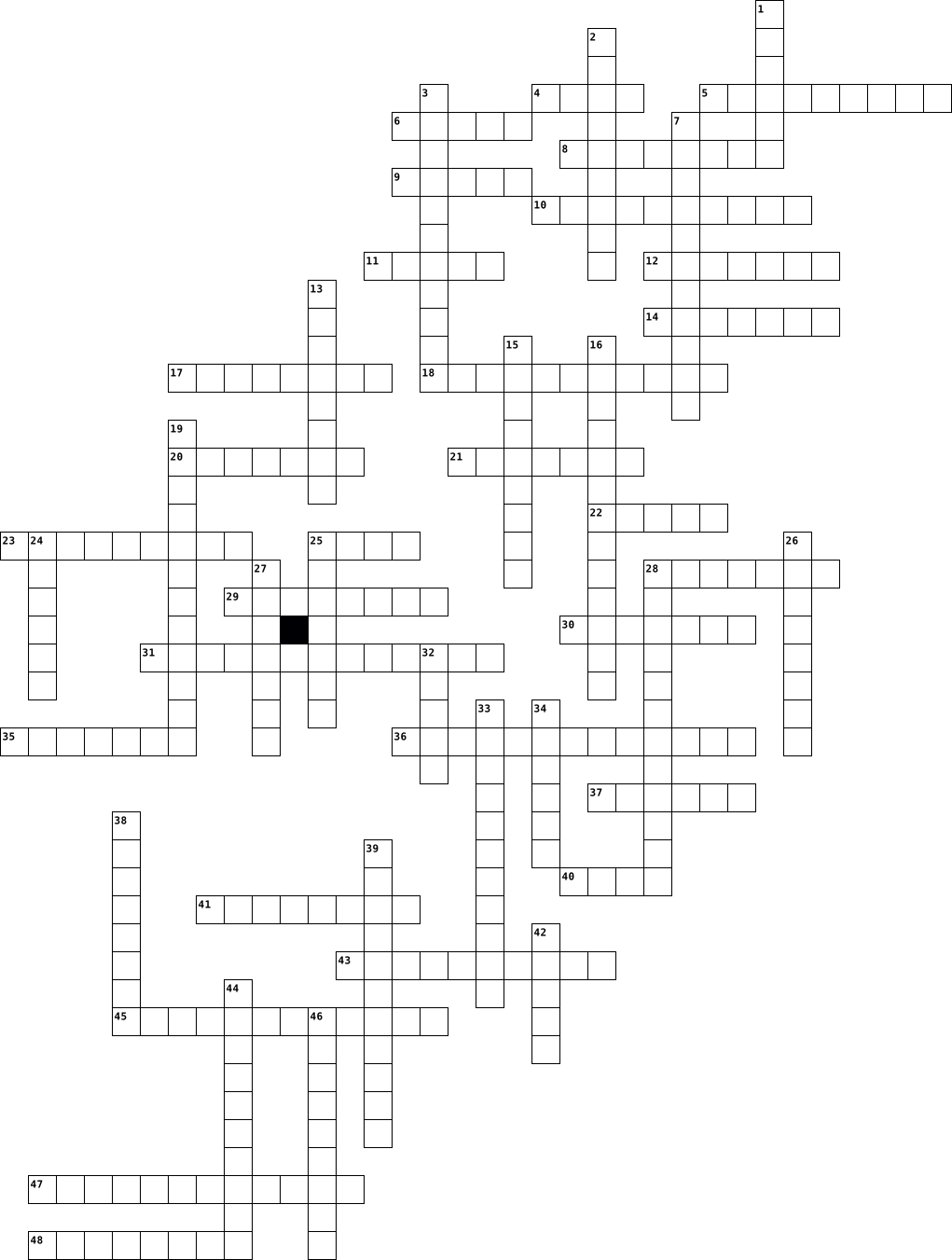
Across
- Formed when atom loses or gains electron
- Phase change in which liquid is converted to solid
- gas: insert gas located at the rightmost side of the periodic table
- Ratio of the mass of an object to the volume occupied by that object.
- compound: Compound that consists of two charged ions
- chemistry: it is a branch of chemistry that studies and uses instruments and methods used to separate: identify: and quantify matter.
- bond: Formed by losing and gaining of electrons between metal and nonmetal
- Anything that has mass and occupies space
- a substance that flows freely but is of constant volume: having a consistency like that of water or oil.
- separation: The separation of elemental metals from the mixtures
- figures: The digits in any measurement that are known with certainty plus one digit which is uncertain
- The amount of space occupied by a substance
- the measurement or extent of something from end to end
- The quantity of matter in the body
- Negatively:charged subatomic particle of an atom
- number: The sum of the number of protons and neutrons in its nucleus
- a period of time equal to sixty seconds or a sixtieth of an hour.
- Phase change that involves the conversion from solid to liquid
- chemistry: it is a branch of chemistry that studies the structure: properties and reactions of organic compounds: which contain carbon in covalent bonding. Study of structure determines their chemical composition and formula.
- Separates components of mixture at different boiling points.
- Positively:charged subatomic particle of an atom
- mixture: Mixture whose a composition varies from position to position within a sample.
- level: Specific energy value of electrons for an atom
- a substance or matter in a state in which it will expand freely to fill the whole of a container: having no fixed shape and no fixed volume.
- Group 7A elements
- movement of one fluid through another.
- inner transition elements located in the first row of the f:block in the periodic table
- Organic compound with carbon and oxygen only
- Substance consisting of only one kind of atom
Down
- the fundamental unit of length in the metric system: equal to 100 centimeters or approximately 39.37 inches.
- Element that appears at the far right side of the periodic table
- mixture: Called as solution: a mixture with uniform composition.
- Process in which the solid particles are filtered to allow the liquid or filtrate to pass through the filter: and be collected as residue
- Composed of two or more substances: combined physically in variable proportions
- physical property: physical property that does not depend on the size or amount of the sample
- it is a branch of chemistry that studies the chemical processes within and relating to living organisms. Biochemical processes give rise to the complexity of life.
- phase change in which liquid is converted to gas
- a metric unit of capacity: formerly defined as the volume of one kilogram of water under standard conditions: now equal to 1:000 cubic centimeters
- Elements at the left side and in the center of the periodic table
- Uncharged particle found within the atomic nuclei
- Horizontal row in the periodic table
- the size: length: or amount of something: as established by measuring.
- rule: states that atoms other than hydrogen tend to form bonds until surrounded by eight valence electrons
- Elements found in the zigzag order in the periodic table
- a substance or object that is solid rather than liquid or fluid
- chemistry: the branch of chemistry concerned with the application of the techniques and theories of physics to the study of chemical systems.
- a metric unit of length: equal to one hundredth of a meter.
- mass: Indicates that one mole of an element has a mass in grams numerically equal to its atomic mass units
- the branch of science that deals with the identification of the substances of which matter is composed; the investigation of their properties and the ways in which they interact: combine: and change; and the use of these processes to form new substances.
- Chemistry: it is a branch of chemistry that deals with synthesis and behavior of inorganic and organometallic compounds.
50 Clues: Group 7A elements • The quantity of matter in the body • Horizontal row in the periodic table • movement of one fluid through another. • Formed when atom loses or gains electron • Anything that has mass and occupies space • The amount of space occupied by a substance • Organic compound with carbon and oxygen only • Substance consisting of only one kind of atom • ...
General Chemistry 2020-05-25
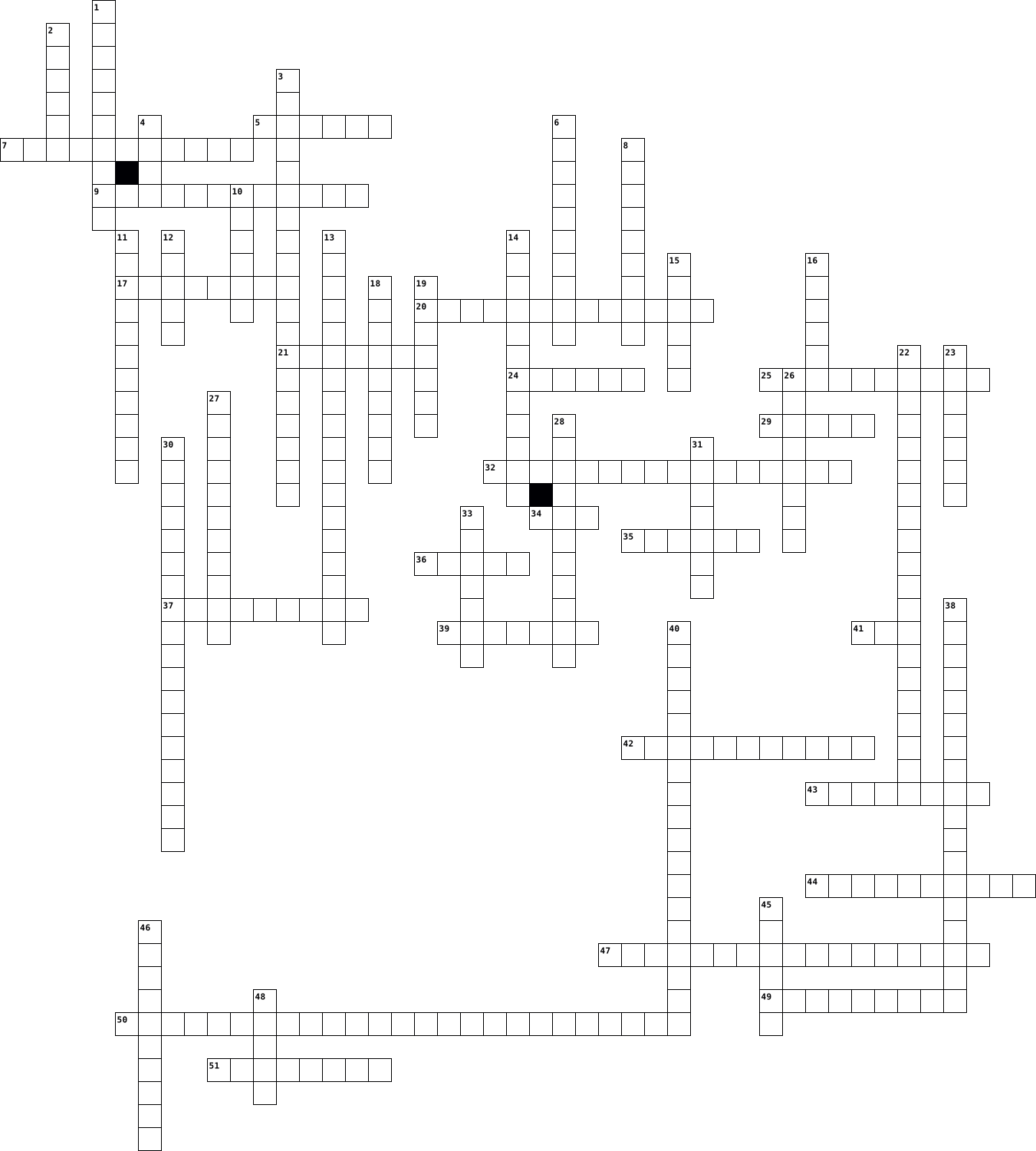
Across
- Anything that has mass and occupies space
- Organic compound with carbon and oxygen only
- Separates components of mixture at different boiling points.
- Element that appears at the far right side of the periodic table
- Compound that consists of two charged ions
- Substance consisting of only one kind of atom
- Elements at the left side and in the center of the periodic table
- a metric unit of length equal to one hundredth of a meter.
- the fundamental unit of length in the metric system equal to 100 centimeters or approximately 39.37 inches.
- it is a branch of chemistry that studies the structure properties and reactions of organic compounds which contain carbon in covalent bonding. Study of structure determines their chemical composition and formula.
- Formed when atom loses or gains electron
- Horizontal row in the periodic table
- a substance or object that is solid rather than liquid or fluid
- the branch of science that deals with the identification of the substances of which matter is composed; the investigation of their properties and the ways in which they interact combine and change; and the use of these processes to form new substances.
- Uncharged particle found within the atomic nuclei
- a substance or matter in a state in which it will expand freely to fill the whole of a container having no fixed shape and no fixed volume.
- the size length or amount of something as established by measuring.
- insert gas located at the rightmost side of the periodic table
- the quality, condition, or fact of being exact and accurate.
- the branch of chemistry concerned with the application of the techniques and theories of physics to the study of chemical systems.
- Indicates that one mole of an element has a mass in grams numerically equal to its atomic mass units
- physical property that does not depend on the size or amount of the sample
- Phase change in which liquid is converted to solid
Down
- Elements found in the zigzag order in the periodic table
- a substance that flows freely but is of constant volume having a consistency like that of water or oil.
- it is a branch of chemistry that studies and uses instruments and methods used to separate identify and quantify matter.
- The quantity of matter in the body
- Process in which the solid particles are filtered to allow the liquid or filtrate to pass through the filter and be collected as residue
- movement of one fluid through another.
- the measurement or extent of something from end to end.
- inner transition elements located in the first row of the f block in the periodic table
- bond Formed by losing and gaining of electrons between metal and nonmetal
- Called as solution a mixture with uniform composition.
- it is a branch of chemistry that studies the chemical processes within and relating to living organisms. Biochemical processes give rise to the complexity of life.
- a period of time equal to sixty seconds or a sixtieth of an hour.
- Positively charged subatomic particle of an atom
- states that atoms other than hydrogen tend to form bonds until surrounded by eight valence electrons
- Composed of two or more substances combined physically in variable proportions
- Mixture whose a composition varies from position to position within a sample.
- Phase change that involves the conversion from solid to liquid
- Negatively charged subatomic particle of an atom
- Specific energy value of electrons for an atom
- phase change in which liquid is converted to gas
- The separation of elemental metals from the mixtures
- Ratio of the mass of an object to the volume occupied by that object.
- Group 7A elements
- The digits in any measurement that are known with certainty plus one digit which is uncertain
- it is a branch of chemistry that deals with synthesis and behavior of inorganic and organometallic compounds.
- The amount of space occupied by a substance
- The sum of the number of protons and neutrons in its nucleus
- a metric unit of capacity formerly defined as the volume of one kilogram of water under standard conditions now equal to 1 000 cubic centimeters
51 Clues: Group 7A elements • The quantity of matter in the body • Horizontal row in the periodic table • movement of one fluid through another. • Formed when atom loses or gains electron • Anything that has mass and occupies space • Compound that consists of two charged ions • The amount of space occupied by a substance • Organic compound with carbon and oxygen only • ...
General Chemistry 2020-05-25
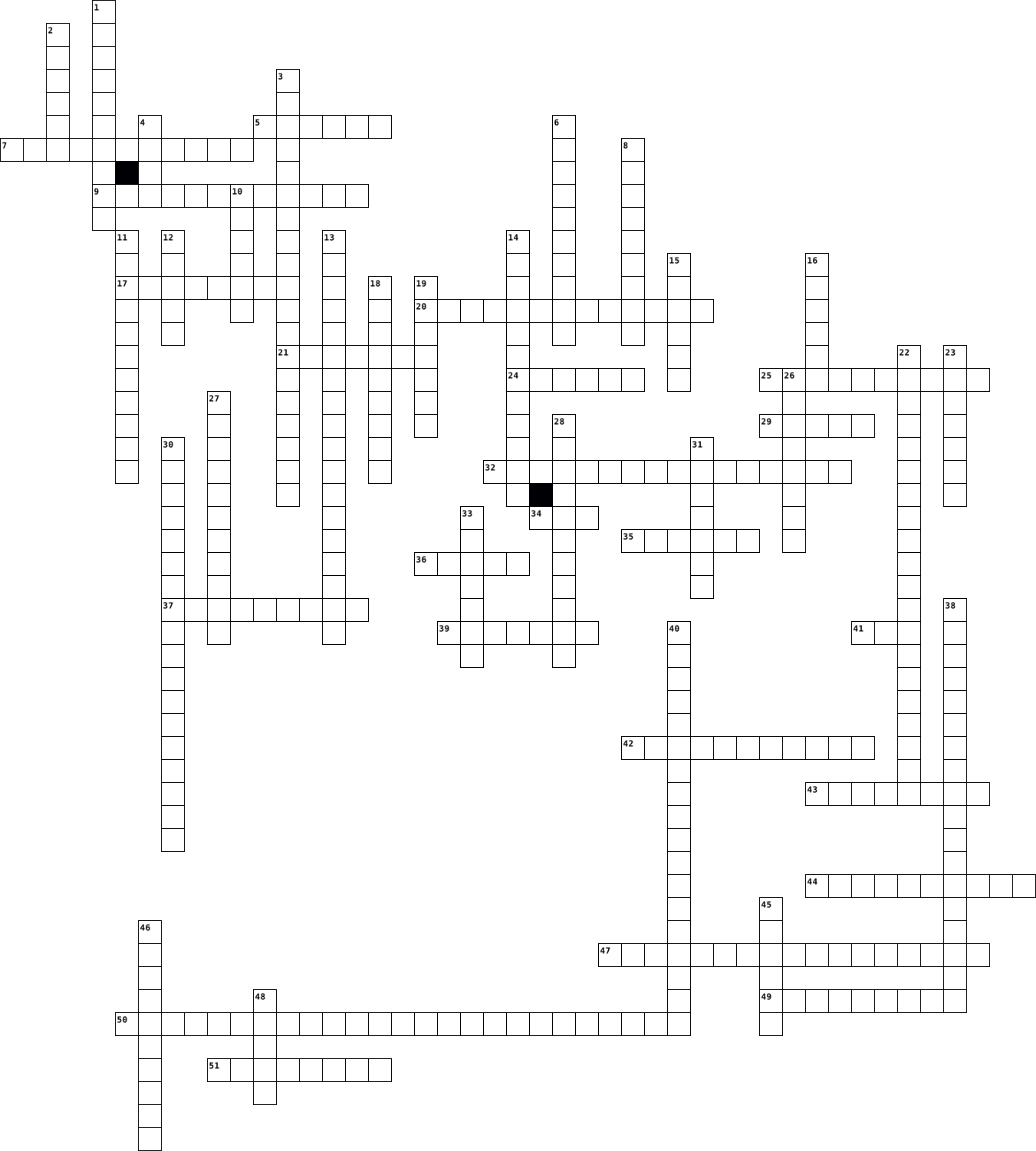
Across
- Anything that has mass and occupies space
- Organic compound with carbon and oxygen only
- Separates components of mixture at different boiling points.
- Element that appears at the far right side of the periodic table
- Compound that consists of two charged ions
- Substance consisting of only one kind of atom
- Elements at the left side and in the center of the periodic table
- a metric unit of length equal to one hundredth of a meter.
- the fundamental unit of length in the metric system equal to 100 centimeters or approximately 39.37 inches.
- it is a branch of chemistry that studies the structure properties and reactions of organic compounds which contain carbon in covalent bonding. Study of structure determines their chemical composition and formula.
- Formed when atom loses or gains electron
- Horizontal row in the periodic table
- a substance or object that is solid rather than liquid or fluid
- the branch of science that deals with the identification of the substances of which matter is composed; the investigation of their properties and the ways in which they interact combine and change; and the use of these processes to form new substances.
- Uncharged particle found within the atomic nuclei
- a substance or matter in a state in which it will expand freely to fill the whole of a container having no fixed shape and no fixed volume.
- the size length or amount of something as established by measuring.
- insert gas located at the rightmost side of the periodic table
- the quality, condition, or fact of being exact and accurate.
- the branch of chemistry concerned with the application of the techniques and theories of physics to the study of chemical systems.
- Indicates that one mole of an element has a mass in grams numerically equal to its atomic mass units
- physical property that does not depend on the size or amount of the sample
- Phase change in which liquid is converted to solid
Down
- Elements found in the zigzag order in the periodic table
- a substance that flows freely but is of constant volume having a consistency like that of water or oil.
- it is a branch of chemistry that studies and uses instruments and methods used to separate identify and quantify matter.
- The quantity of matter in the body
- Process in which the solid particles are filtered to allow the liquid or filtrate to pass through the filter and be collected as residue
- movement of one fluid through another.
- the measurement or extent of something from end to end.
- inner transition elements located in the first row of the f block in the periodic table
- bond Formed by losing and gaining of electrons between metal and nonmetal
- Called as solution a mixture with uniform composition.
- it is a branch of chemistry that studies the chemical processes within and relating to living organisms. Biochemical processes give rise to the complexity of life.
- a period of time equal to sixty seconds or a sixtieth of an hour.
- Positively charged subatomic particle of an atom
- states that atoms other than hydrogen tend to form bonds until surrounded by eight valence electrons
- Composed of two or more substances combined physically in variable proportions
- Mixture whose a composition varies from position to position within a sample.
- Phase change that involves the conversion from solid to liquid
- Negatively charged subatomic particle of an atom
- Specific energy value of electrons for an atom
- phase change in which liquid is converted to gas
- The separation of elemental metals from the mixtures
- Ratio of the mass of an object to the volume occupied by that object.
- Group 7A elements
- The digits in any measurement that are known with certainty plus one digit which is uncertain
- it is a branch of chemistry that deals with synthesis and behavior of inorganic and organometallic compounds.
- The amount of space occupied by a substance
- The sum of the number of protons and neutrons in its nucleus
- a metric unit of capacity formerly defined as the volume of one kilogram of water under standard conditions now equal to 1 000 cubic centimeters
51 Clues: Group 7A elements • The quantity of matter in the body • Horizontal row in the periodic table • movement of one fluid through another. • Formed when atom loses or gains electron • Anything that has mass and occupies space • Compound that consists of two charged ions • The amount of space occupied by a substance • Organic compound with carbon and oxygen only • ...
General Chemistry 2020-05-25
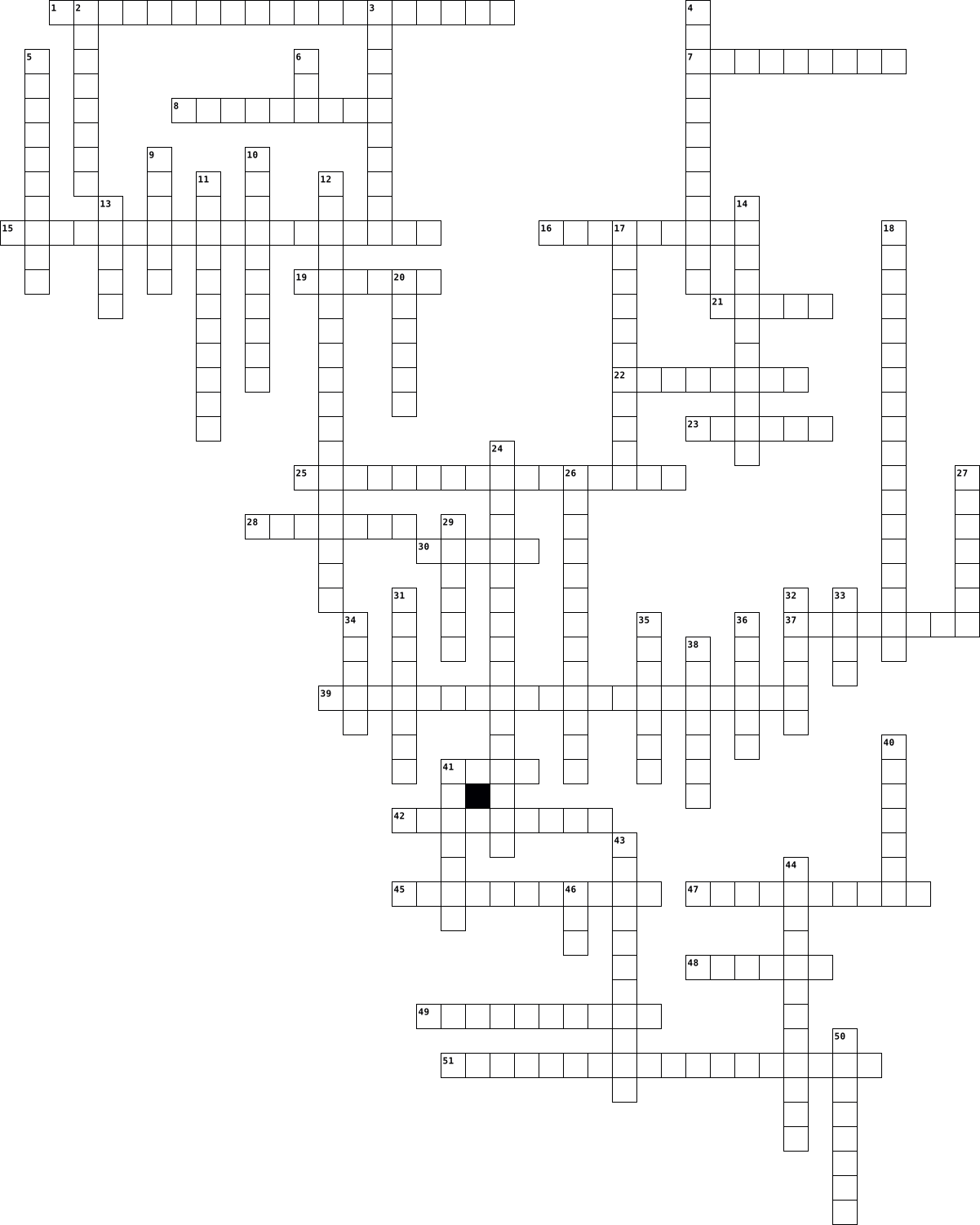
Across
- it is a branch of chemistry that studies and uses instruments and methods used to separate identify and quantify matter.
- states that atoms other than hydrogen tend to form bonds until surrounded by eight valence electrons
- movement of one fluid through another.
- The digits in any measurement that are known with certainty plus one digit which is uncertain
- the branch of science that deals with the identification of the substances of which matter is composed.
- Elements at the left side and in the center of the periodic table
- bond Formed by losing and gaining of electrons between metal and nonmetal
- Negatively charged subatomic particle of an atom
- Positively charged subatomic particle of an atom
- it is a branch of chemistry that studies the structure properties and reactions of organic compounds which contain carbon in covalent bonding. Study of structure determines their chemical composition and formula.
- Uncharged particle found within the atomic nuclei
- a substance or object that is solid rather than liquid or fluid
- the quality or state of being correct or precise.
- Mixture whose a composition varies from position to position within a sample.
- The quantity of matter in the body
- Indicates that one mole of an element has a mass in grams numerically equal to its atomic mass units
- inner transition elements located in the first row of the f block in the periodic table
- the quality, condition, or fact of being exact and accurate.
- a substance that flows freely but is of constant volume having a consistency like that of water or oil.
- a metric unit of length equal to one hundredth of a meter.
- Called as solution a mixture with uniform composition.
Down
- Element that appears at the far right side of the periodic table
- The sum of the number of protons and neutrons in its nucleus
- it is a branch of chemistry that studies the chemical processes within and relating to living organisms. Biochemical processes give rise to the complexity of life.
- Elements found in the zigzag order in the periodic table
- a substance or matter in a state in which it will expand freely to fill the whole of a container having no fixed shape and no fixed volume.
- Horizontal row in the periodic table
- Process in which the solid particles are filtered to allow the liquid or filtrate to pass through the filter and be collected as residue
- phase change in which liquid is converted to gas
- The separation of elemental metals from the mixtures
- a metric unit of capacity formerly defined as the volume of one kilogram of water under standard conditions now equal to 1 000 cubic centimeters
- Organic compound with carbon and oxygen only
- the size length or amount of something as established by measuring.
- it is a branch of chemistry that deals with synthesis and behavior of inorganic and organometallic compounds.
- the measurement or extent of something from end to end.
- the branch of chemistry concerned with the application of the techniques and theories of physics to the study of chemical systems.
- Compound that consists of two charged ions
- Ratio of the mass of an object to the volume occupied by that object.
- The amount of space occupied by a substance
- insert gas located at the rightmost side of the periodic table
- Anything that has mass and occupies space
- a chemical substance that neutralizes some elements.
- the fundamental unit of length in the metric system equal to 100 centimeters or approximately 39.37 inches.
- Substance consisting of only one kind of atom
- a period of time equal to sixty seconds or a sixtieth of an hour.
- Composed of two or more substances combined physically in variable proportions
- Group 7A elements
- Phase change that involves the conversion from solid to liquid
- Specific energy value of electrons for an atom
- Separates components of mixture at different boiling points.
- Formed when atom loses or gains electron
- Phase change in which liquid is converted to solid
52 Clues: Group 7A elements • The quantity of matter in the body • Horizontal row in the periodic table • movement of one fluid through another. • Formed when atom loses or gains electron • Anything that has mass and occupies space • Compound that consists of two charged ions • The amount of space occupied by a substance • Organic compound with carbon and oxygen only • ...
General Chemistry 2020-05-25
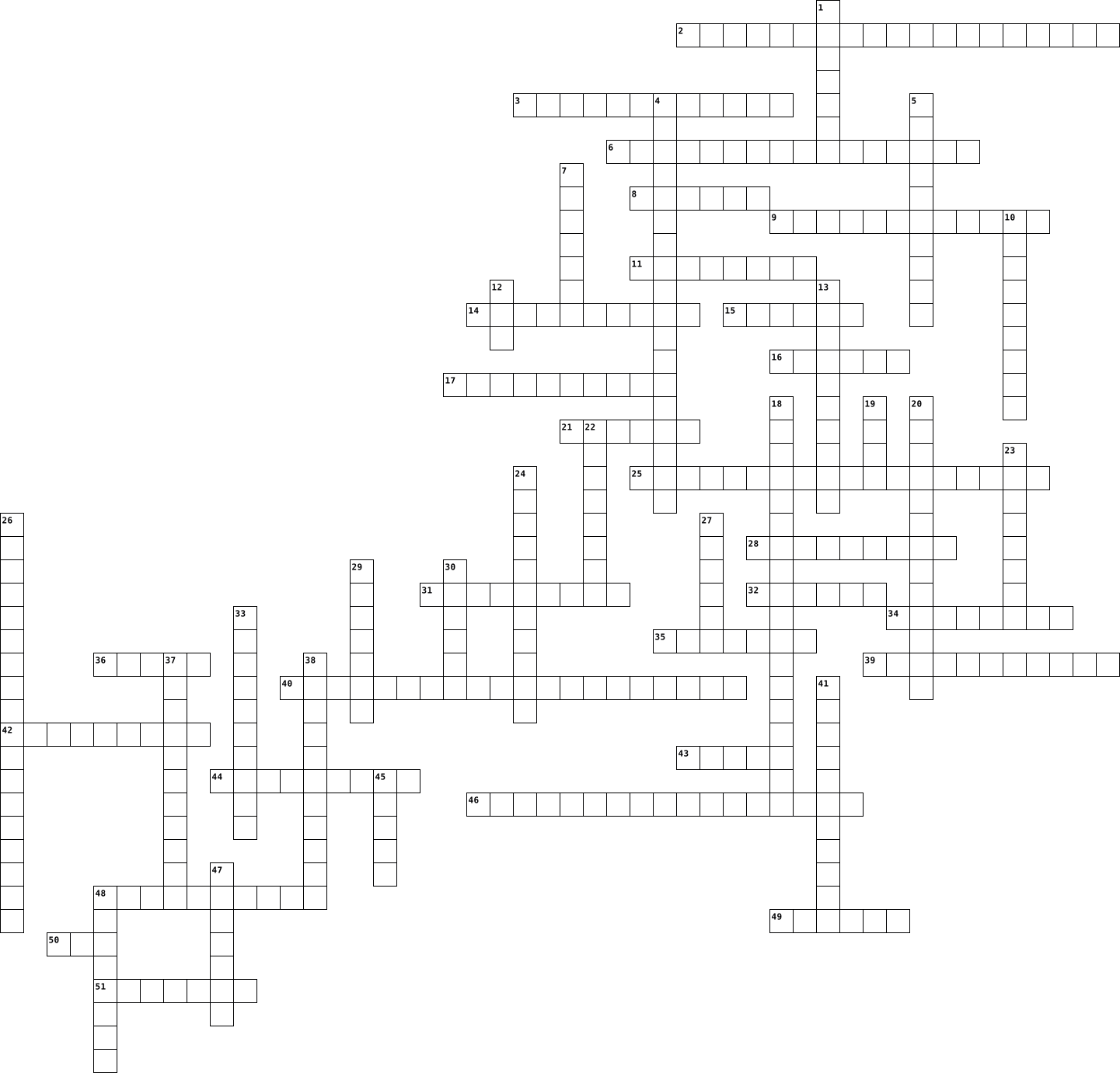
Across
- it is a branch of chemistry that studies and uses instruments and methods used to separate identify and quantify matter.
- it is a branch of chemistry that studies the chemical processes within and relating to living organisms. Biochemical processes give rise to the complexity of life.
- it is a branch of chemistry that studies the structure properties and reactions of organic compounds which contain carbon in covalent bonding. Study of structure determines their chemical composition and formula.
- Horizontal row in the periodic table
- Separates components of mixture at different boiling points.
- the quality or state of being correct or precise.
- The sum of the number of protons and neutrons in its nucleus
- a substance that flows freely but is of constant volume having a consistency like that of water or oil.
- Elements at the left side and in the center of the periodic table
- a metric unit of length equal to one hundredth of a meter.
- the measurement or extent of something from end to end.
- Called as solution a mixture with uniform composition.
- movement of one fluid through another.
- Formed by losing and gaining of electrons between metal and nonmetal
- Anything that has mass and occupies space
- insert gas located at the rightmost side of the periodic table
- Ratio of the mass of an object to the volume occupied by that object.
- the fundamental unit of length in the metric system equal to 100 centimeters or approximately 39.37 inches.
- inner transition elements located in the first row of the f block in the periodic table
- Mixture whose a composition varies from position to position within a sample.
- the branch of science that deals with the identification of the substances of which matter is composed.
- a metric unit of capacity formerly defined as the volume of one kilogram of water under standard conditions now equal to 1 000 cubic centimeters
- Indicates that one mole of an element has a mass in grams numerically equal to its atomic mass units
- the branch of chemistry concerned with the application of the techniques and theories of physics to the study of chemical systems.
- a result without the expected content
- a period of time equal to sixty seconds or a sixtieth of an hour.
- Formed when atom loses or gains electron
- Substance consisting of only one kind of atom
Down
- Composed of two or more substances combined physically in variable proportions
- The separation of elemental metals from the mixtures
- Elements found in the zigzag order in the periodic table
- Uncharged particle found within the atomic nuclei
- states that atoms other than hydrogen tend to form bonds until surrounded by eight valence electrons
- a substance or matter in a state in which it will expand freely to fill the whole of a container having no fixed shape and no fixed volume.
- Process in which the solid particles are filtered to allow the liquid or filtrate to pass through the filter and be collected as residue
- The digits in any measurement that are known with certainty plus one digit which is uncertain
- The quantity of matter in the body
- Compound that consists of two charged ions
- Negatively charged subatomic particle of an atom
- Phase change in which liquid is converted to solid
- Organic compound with carbon and oxygen only
- it is a branch of chemistry that deals with synthesis and behavior of inorganic and organometallic compounds.
- Positively charged subatomic particle of an atom
- Group 7A elements
- The amount of space occupied by a substance
- the quality, condition, or fact of being exact and accurate.
- Specific energy value of electrons for an atom
- the size length or amount of something as established by measuring.
- phase change in which liquid is converted to gas
- a substance or object that is solid rather than liquid or fluid
- Phase change that involves the conversion from solid to liquid
- Element that appears at the far right side of the periodic table
52 Clues: Group 7A elements • The quantity of matter in the body • Horizontal row in the periodic table • a result without the expected content • movement of one fluid through another. • Formed when atom loses or gains electron • Anything that has mass and occupies space • Compound that consists of two charged ions • The amount of space occupied by a substance • ...
General Chemistry 2020-05-25
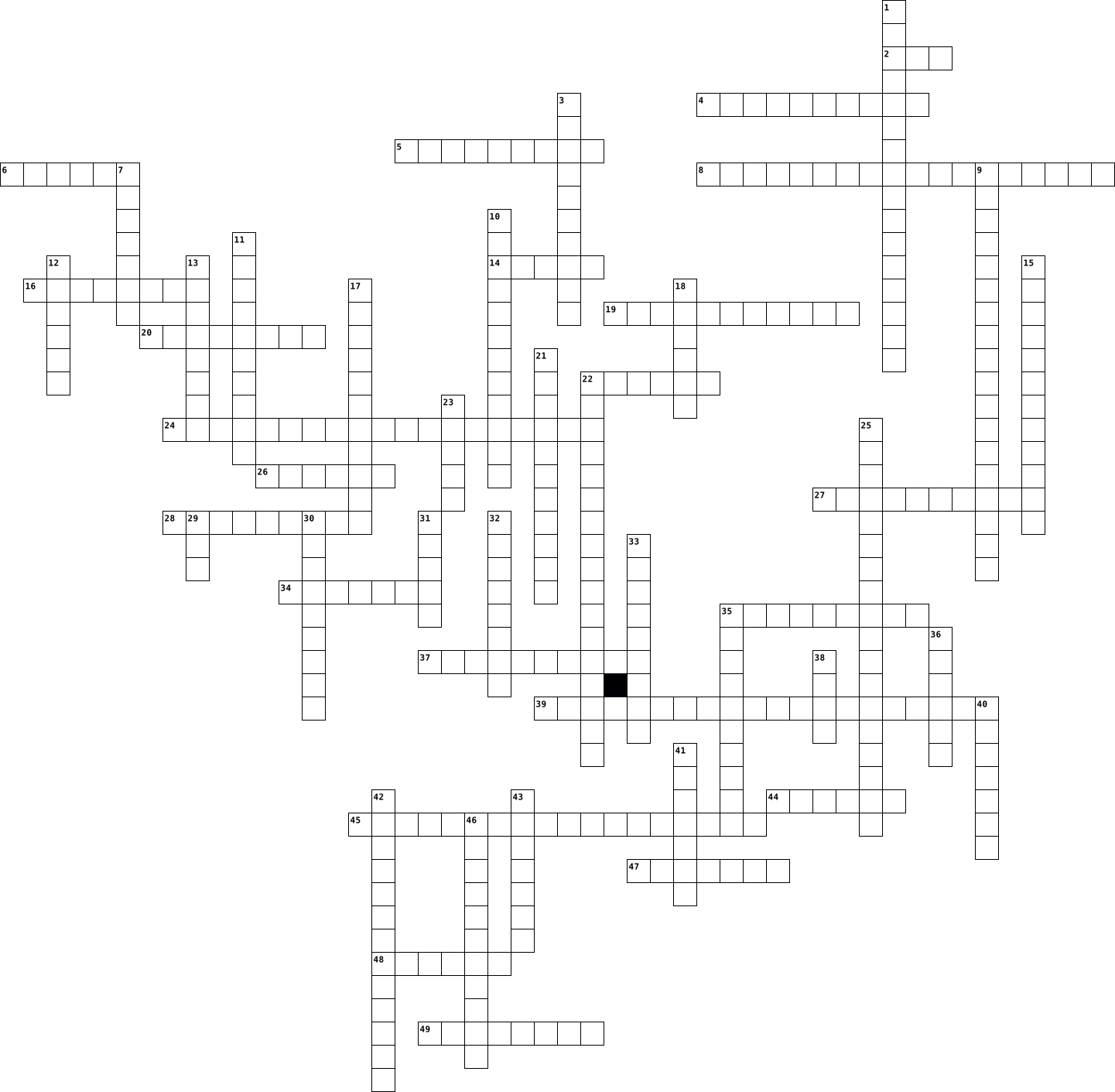
Across
- a substance or matter in a state in which it will expand freely to fill the whole of a container having no fixed shape and no fixed volume.
- the quality, condition, or fact of being exact and accurate.
- states that atoms other than hydrogen tend to form bonds until surrounded by eight valence electrons
- the measurement or extent of something from end to end.
- it is a branch of chemistry that deals with synthesis and behavior of inorganic and organometallic compounds.
- a substance or object that is solid rather than liquid or fluid
- Element that appears at the far right side of the periodic table
- Organic compound with carbon and oxygen only
- the quality or state of being correct or precise.
- Horizontal row in the periodic table
- it is a branch of chemistry that studies and uses instruments and methods used to separate identify and quantify matter.
- a substance that flows freely but is of constant volume having a consistency like that of water or oil.
- a metric unit of length equal to one hundredth of a meter.
- movement of one fluid through another.
- Composed of two or more substances combined physically in variable proportions
- Indicates that one mole of an element has a mass in grams numerically equal to its atomic mass units
- Elements found in the zigzag order in the periodic table
- Mixture whose a composition varies from position to position within a sample.
- Anything that has mass and occupies space
- Called as solution a mixture with uniform composition.
- Ratio of the mass of an object to the volume occupied by that object.
- Elements at the left side and in the center of the periodic table
- Phase change in which liquid is converted to solid
Down
- it is a branch of chemistry that studies the structure properties and reactions of organic compounds which contain carbon in covalent bonding. Study of structure determines their chemical composition and formula.
- Process in which the solid particles are filtered to allow the liquid or filtrate to pass through the filter and be collected as residue
- Group 7A elements
- The separation of elemental metals from the mixtures
- Separates components of mixture at different boiling points.
- a result without the expected content
- The amount of space occupied by a substance
- Negatively charged subatomic particle of an atom
- it is a branch of chemistry that studies the chemical processes within and relating to living organisms. Biochemical processes give rise to the complexity of life.
- phase change in which liquid is converted to gas
- Positively charged subatomic particle of an atom
- inner transition elements located in the first row of the f block in the periodic table
- the branch of chemistry concerned with the application of the techniques and theories of physics to the study of chemical systems.
- the fundamental unit of length in the metric system equal to 100 centimeters or approximately 39.37 inches.
- The digits in any measurement that are known with certainty plus one digit which is uncertain
- Formed when atom loses or gains electron
- Formed by losing and gaining of electrons between metal and nonmetal
- a metric unit of capacity formerly defined as the volume of one kilogram of water under standard conditions now equal to 1 000 cubic centimeters
- insert gas located at the rightmost side of the periodic table
- the branch of science that deals with the identification of the substances of which matter is composed.
- The sum of the number of protons and neutrons in its nucleus
- a period of time equal to sixty seconds or a sixtieth of an hour.
- The quantity of matter in the body
- Substance consisting of only one kind of atom
- Phase change that involves the conversion from solid to liquid
- Compound that consists of two charged ions
- Uncharged particle found within the atomic nuclei
- Specific energy value of electrons for an atom
51 Clues: Group 7A elements • The quantity of matter in the body • Horizontal row in the periodic table • a result without the expected content • movement of one fluid through another. • Formed when atom loses or gains electron • Anything that has mass and occupies space • Compound that consists of two charged ions • The amount of space occupied by a substance • ...
Crossword 2021-01-20

Across
- these elements react to form positive ions
- scientist who devised the modern periodic table
- elements with similar properties are arranged in these
- the discovery of these made it possible to explain why the order of elements based on atomic weights was not always correct
- these are non-metals with seven electrons in their outer shell
- a more reactive halogen can do this to a less reactive halogen from an aqueous solution of its salt
Down
- these were left by Mendeleev for undiscovered elements
- these occur down groups and depend on distinctive properties of elements
- the arrangement of these in its atoms determines an elements position in the table
- these metals are reactive as they have a single electron in their outer shell
- these gases are unreactive as they have a stable arrangement of electrons
- this number determines the order of elements in the periodic table
12 Clues: these elements react to form positive ions • scientist who devised the modern periodic table • these were left by Mendeleev for undiscovered elements • elements with similar properties are arranged in these • these are non-metals with seven electrons in their outer shell • this number determines the order of elements in the periodic table • ...
Chemistry crossword 2018-11-13

Across
- a chemical combination of two or more elements in a specific ratio
- change in the appearance or state of a substance that does not change the composition
- group 17 elements in the perodic table,the most reactive not metals
- gases group 18 elements in the periodic table,the most stable and interactive elements
- compound pure substance formed when non-metals combine
- substance that reacts with another substances in a chemical reaction to create new substances with different properties
- table a table in which the elements are organized by their physical and chemical properties
- something that has mass and occupies space
- metals group 1 elements in the peroidic table,not including hydrogeon the most reactive of the metals
- combination of pure substances
- compound that dissolves in water to form a solution with a ph lower than 7
- shell orbit of electrons around the nucleus of an atom
Down
- number number of protons in the nucleus of one atom of an element
- cloudy mixture in which tiny particles of one substance are held within another and the particles can be separated out
- compound pure substance formed when at least one metal and one non metal combine
- positively charged particle in the nucleus of an atom
- neutral particle in the nucleus of an atom
- reaction a reaction that takes place when to or more substances react to form a new substance
- chlorine
- group of atoms joined by covalent bonds
- homogenous mixture mixture of two or more pure substances that looks like one substance
- a pure substance that cannot be broken down into other substances,made up of only one type of atom
- cloudy mixture in which tiny particles of one substance are held within another and particles cannot be seperatedout from other substances
23 Clues: chlorine • combination of pure substances • group of atoms joined by covalent bonds • neutral particle in the nucleus of an atom • something that has mass and occupies space • positively charged particle in the nucleus of an atom • compound pure substance formed when non-metals combine • shell orbit of electrons around the nucleus of an atom • ...
word work week 7 2021-11-25

Across
- a group of mammals that are sorted because of their position
- to restrict things with limits
- a mark over a vowel to indicate length of the sound in some languages
- a serious gum infection
- applied with layers of skin
- occurring within a single galaxy
- particular events
- something that is in the mind
- a infinite line forming a boundary around a shape
Down
- to get around a object
- fluids that are in the eye
- a mineral found in a white opaque crystal
- relating to the periodic table
- The boundary of a curved shape
- lying within nasal structures
15 Clues: particular events • to get around a object • a serious gum infection • fluids that are in the eye • applied with layers of skin • lying within nasal structures • something that is in the mind • to restrict things with limits • relating to the periodic table • The boundary of a curved shape • occurring within a single galaxy • a mineral found in a white opaque crystal • ...
Science Crossword Puzzle 2023-08-31

Across
- The ability of a material to conduct electricity of heat
- Elements with similar properties found on the left side of the staircase
- Formula A notation used by scientists to show the number of atoms in a molecule
Down
- Symbol One or two letters abbreviation from the element’s name
- The tendency of a substance to undergo chemical changes
- table A reference for associating the name and symbol of an element
- Elements with similar properties found on the right side of the staircase on the periodic table
- Elements with similar properties that create a staircase on the periodic table
8 Clues: The tendency of a substance to undergo chemical changes • The ability of a material to conduct electricity of heat • Symbol One or two letters abbreviation from the element’s name • table A reference for associating the name and symbol of an element • Elements with similar properties found on the left side of the staircase • ...
PSM Atoms Review X-Word Puzzle 2023-01-22

Across
- [two words] charge on an ion formed by a Group 17 atom that gains one electron
- mixture that appears uniform throughout
- dull; poor conductors of heat and electricity; most are gases at room temperature (those that are solid are brittle)
- name of element for an atom with mass number 39 containing 20 neutrons
- [two words] distance from the nucleus to the outermost edge of the electron cloud
- repeating at regular intervals
- nucleus has the potential to break down, or decay, and change into a different element
- negatively charged; almost no mass compared to protons; exist outside the nucleus; discovered by J.J. Thomson
- negative ions formed by atoms gaining electrons
- [two words] the arrangement of the elements in order of their atomic numbers
- the rows of the table
- [two words] modern periodic table is organized by arranging elements in order by this
- [two words] predictable patterns in the periodic table, either down a group or across a period
- positively charged region at the center of the atom, consisting of protons and neutrons packed tightly together
- number of valence electrons in all elements in group 1
- number of valence electrons in all elements in Group 17
- his gold foil experiment and resulting atomic model show that the positively-charged regions of atoms are incredibly small
- mixture in which particles are distributed uniformly throughout and are too light to settle out
- [two words] describes how atoms react to form compounds that allow them to have a group of 8 valence electrons like the noble gases
- ability of matter to combine chemically with other substances.
- [two words] 1 type of particle; cannot be separated into simpler substances by physical or chemical means
- [two words] the mass of the atom in a unit called the atomic mass unit (amu)
- the minimum amount of energy that can be absorbed or released by matter
- pure substance; appears on the periodic table
- conducted experiments showing gases must consist of tiny, individual particles that are in constant, random motion; a given compound is always comprised of the same elements in the same whole-number ratio; different compounds consist of different elements or ratios; and, elements are made of separate, discrete particles that cannot be subdivided.
- mixture in which particles are distributed throughout but are heavy enough that they will settle out
- vertical column of the periodic table
- [two words] a one-or two-letter designation of an element
- condition of an atom’s outermost energy level that produces the greatest stability
Down
- share characteristics of metals and nonmetals; semiconductors
- positive ions formed by atoms losing electrons
- Atomic Number of an atom with mass number 19 containing 10 neutrons
- class found in left, bottom, center of periodic table
- [two words] protons, neutrons, and electrons
- class found in right of periodic table (except H on left)
- unit of length used to measure atomic radius that is equal to one-trillionth of a meter
- [two words] nonreactive, nonmetallic elements in Group 18
- [two words] charge on an ion formed by a Group 2 atom that loses two electrons
- appears to be only one substance, but is actually two or more substances distributed evenly amongst each other
- [two words] the number of protons in an atom
- [two words] an electron found in the outermost energy level of an atom
- atom of the same element with a different number of neutrons
- located in the nucleus; neutrally charged; mass = 1 amu
- shiny; good conductors of heat and electricity; malleable; ductile
- region in modern Quantum Mechanics model where an electron is most likely to be
- mixture in which different components are visible
- [two words] quarks and gluons
- first proposed atoms, without evidence to support his idea
- arranged elements in order by increasing atomic mass
- mass number of a nitrogen atom containing 8 neutrons
- located in the nucleus; positively charged; mass = 1 amu
- atoms that have a positive or negative charge because they have unequal numbers of protons and electrons
- [two words] an expression that shows the elements in a compound and the relative proportions of those elements.
- [three words] depiction with negative charges distributed throughout an atom
- the building blocks of matter; the smallest particles of an element that still have the element's properties
- described electrons as orbiting at specific distances from the nucleus
- radioactive isotope
- 2 or more substances NOT chemically combined (bonded)
- chemically inactive (unreactive)
- a representation of an object or system that is easier to study and manipulate; the periodic table’s ability to make accurate predictions makes it a useful one of these
- these occur more often in nature than do individual elements; consist of atoms of different elements chemically bonded together in fixed proportions
61 Clues: radioactive isotope • the rows of the table • [two words] quarks and gluons • repeating at regular intervals • chemically inactive (unreactive) • vertical column of the periodic table • mixture that appears uniform throughout • [two words] protons, neutrons, and electrons • [two words] the number of protons in an atom • pure substance; appears on the periodic table • ...
General Chemistry 2020-05-25

Across
- number The sum of the number of protons and neutrons in its nucleus
- phase change in which liquid is converted to gas
- Organic compound with carbon and oxygen only
- separation The separation of elemental metals from the mixtures
- Process in which the solid particles are filtered to allow the liquid or filtrate to pass through the filter and be collected as residue
- a substance or object that is solid rather than liquid or fluid
- Horizontal row in the periodic table
- mixture Mixture whose a composition varies from position to position within a sample.
- The quantity of matter in the body
- Negatively charged subatomic particle of an atom
- level Specific energy value of electrons for an atom
- chemistry it is a branch of chemistry that studies and uses instruments and methods used to separate identify and quantify matter.
- Elements at the left side and in the center of the periodic table
- a substance or matter in a state in which it will expand freely to fill the whole of a container having no fixed shape and no fixed volume.
- Formed when atom loses or gains electron
- the size length or amount of something as established by measuring.
- a metric unit of capacity formerly defined as the volume of one kilogram of water under standard conditions now equal to 1 000 cubic centimeters
- figures The digits in any measurement that are known with certainty plus one digit which is uncertain
- inner transition elements located in the first row of the f block in the periodic table
- bond Formed by losing and gaining of electrons between metal and nonmetal
- Chemistry it is a branch of chemistry that deals with synthesis and behavior of inorganic and organometallic compounds.
- it is a branch of chemistry that studies the chemical processes within and relating to living organisms. Biochemical processes give rise to the complexity of life.
Down
- Separates components of mixture at different boiling points.
- Composed of two or more substances combined physically in variable proportions
- Phase change that involves the conversion from solid to liquid
- Positively charged subatomic particle of an atom
- Element that appears at the far right side of the periodic table
- the branch of science that deals with the identification of the substances of which matter is composed; the investigation of their properties and the ways in which they interact combine and change; and the use of these processes to form new substances.
- Ratio of the mass of an object to the volume occupied by that object.
- a metric unit of length equal to one hundredth of a meter.
- mixture Called as solution a mixture with uniform composition.
- The amount of space occupied by a substance
- Group 7A elements
- Phase change in which liquid is converted to solid
- chemistry the branch of chemistry concerned with the application of the techniques and theories of physics to the study of chemical systems.
- chemistry it is a branch of chemistry that studies the structure properties and reactions of organic compounds which contain carbon in covalent bonding. Study of structure determines their chemical composition and formula.
- the fundamental unit of length in the metric system equal to 100 centimeters or approximately 39.37 inches.
- Substance consisting of only one kind of atom
- Anything that has mass and occupies space
- gas insert gas located at the rightmost side of the periodic table
- the measurement or extent of something from end to end.
- a substance that flows freely but is of constant volume having a consistency like that of water or oil.
- physical property physical property that does not depend on the size or amount of the sample
- mass Indicates that one mole of an element has a mass in grams numerically equal to its atomic mass units
- rule states that atoms other than hydrogen tend to form bonds until surrounded by eight valence electrons
- a period of time equal to sixty seconds or a sixtieth of an hour.
- Elements found in the zigzag order in the periodic table
- movement of one fluid through another.
- Uncharged particle found within the atomic nuclei
- compound Compound that consists of two charged ions
50 Clues: Group 7A elements • The quantity of matter in the body • Horizontal row in the periodic table • movement of one fluid through another. • Formed when atom loses or gains electron • Anything that has mass and occupies space • The amount of space occupied by a substance • Organic compound with carbon and oxygen only • Substance consisting of only one kind of atom • ...
General Chemistry 2020-05-25

Across
- Composed of two or more substances combined physically in variable proportions
- a metric unit of length equal to one hundredth of a meter.
- Organic compound with carbon and oxygen only
- Elements at the left side and in the center of the periodic table
- it is a branch of chemistry that studies the chemical processes within and relating to living organisms. Biochemical processes give rise to the complexity of life.
- the size length or amount of something as established by measuring.
- Positively charged subatomic particle of an atom
- a substance that flows freely but is of constant volume having a consistency like that of water or oil.
- Indicates that one mole of an element has a mass in grams numerically equal to its atomic mass units
- a substance or matter in a state in which it will expand freely to fill the whole of a container having no fixed shape and no fixed volume.
- the branch of science that deals with the identification of the substances of which matter is composed; the investigation of their properties and the ways in which they interact combine and change; and the use of these processes to form new substances.
- the fundamental unit of length in the metric system equal to 100 centimeters or approximately 39.37 inches.
- Group 7A elements
- Process in which the solid particles are filtered to allow the liquid or filtrate to pass through the filter and be collected as residue
- a substance or object that is solid rather than liquid or fluid
- Horizontal row in the periodic table
- Negatively charged subatomic particle of an atom
- Element that appears at the far right side of the periodic table
- it is a branch of chemistry that deals with synthesis and behavior of inorganic and organometallic compounds.
- The digits in any measurement that are known with certainty plus one digit which is uncertain
- The amount of space occupied by a substance
- Separates components of mixture at different boiling points.
- phase change in which liquid is converted to gas
- a period of time equal to sixty seconds or a sixtieth of an hour.
- Specific energy value of electrons for an atom
- inner transition elements located in the first row of the f block in the periodic table
Down
- The separation of elemental metals from the mixtures
- The quantity of matter in the body
- Uncharged particle found within the atomic nuclei
- the quality or state of being correct or precise.
- a metric unit of capacity formerly defined as the volume of one kilogram of water under standard conditions now equal to 1 000 cubic centimeters
- Elements found in the zigzag order in the periodic table
- the branch of chemistry concerned with the application of the techniques and theories of physics to the study of chemical systems.
- it is a branch of chemistry that studies and uses instruments and methods used to separate identify and quantify matter.
- it is a branch of chemistry that studies the structure properties and reactions of organic compounds which contain carbon in covalent bonding. Study of structure determines their chemical composition and formula.
- Substance consisting of only one kind of atom
- the measurement or extent of something from end to end.
- Ratio of the mass of an object to the volume occupied by that object.
- The sum of the number of protons and neutrons in its nucleus
- Mixture whose a composition varies from position to position within a sample.
- movement of one fluid through another.
- states that atoms other than hydrogen tend to form bonds until surrounded by eight valence electrons
- Called as solution a mixture with uniform composition.
- Phase change in which liquid is converted to solid
- Anything that has mass and occupies space
- Compound that consists of two charged ions
- Phase change that involves the conversion from solid to liquid
- Formed when atom loses or gains electron
- insert gas located at the rightmost side of the periodic table
- the quality, condition, or fact of being exact and accurate.
- bond Formed by losing and gaining of electrons between metal and nonmetal
51 Clues: Group 7A elements • The quantity of matter in the body • Horizontal row in the periodic table • movement of one fluid through another. • Formed when atom loses or gains electron • Anything that has mass and occupies space • Compound that consists of two charged ions • The amount of space occupied by a substance • Organic compound with carbon and oxygen only • ...
General Chemistry 2020-05-25

Across
- Composed of two or more substances combined physically in variable proportions
- a metric unit of length equal to one hundredth of a meter.
- Organic compound with carbon and oxygen only
- Elements at the left side and in the center of the periodic table
- it is a branch of chemistry that studies the chemical processes within and relating to living organisms. Biochemical processes give rise to the complexity of life.
- the size length or amount of something as established by measuring.
- Positively charged subatomic particle of an atom
- a substance that flows freely but is of constant volume having a consistency like that of water or oil.
- Indicates that one mole of an element has a mass in grams numerically equal to its atomic mass units
- a substance or matter in a state in which it will expand freely to fill the whole of a container having no fixed shape and no fixed volume.
- the branch of science that deals with the identification of the substances of which matter is composed.
- the fundamental unit of length in the metric system equal to 100 centimeters or approximately 39.37 inches.
- Group 7A elements
- Process in which the solid particles are filtered to allow the liquid or filtrate to pass through the filter and be collected as residue
- a substance or object that is solid rather than liquid or fluid
- Horizontal row in the periodic table
- Negatively charged subatomic particle of an atom
- Element that appears at the far right side of the periodic table
- it is a branch of chemistry that deals with synthesis and behavior of inorganic and organometallic compounds.
- The digits in any measurement that are known with certainty plus one digit which is uncertain
- The amount of space occupied by a substance
- Separates components of mixture at different boiling points.
- phase change in which liquid is converted to gas
- a period of time equal to sixty seconds or a sixtieth of an hour.
- Specific energy value of electrons for an atom
- inner transition elements located in the first row of the f block in the periodic table
Down
- The separation of elemental metals from the mixtures
- The quantity of matter in the body
- Uncharged particle found within the atomic nuclei
- the quality or state of being correct or precise.
- a metric unit of capacity formerly defined as the volume of one kilogram of water under standard conditions now equal to 1 000 cubic centimeters
- Elements found in the zigzag order in the periodic table
- the branch of chemistry concerned with the application of the techniques and theories of physics to the study of chemical systems.
- it is a branch of chemistry that studies and uses instruments and methods used to separate identify and quantify matter.
- it is a branch of chemistry that studies the structure properties and reactions of organic compounds which contain carbon in covalent bonding. Study of structure determines their chemical composition and formula.
- Substance consisting of only one kind of atom
- the measurement or extent of something from end to end.
- Ratio of the mass of an object to the volume occupied by that object.
- The sum of the number of protons and neutrons in its nucleus
- Mixture whose a composition varies from position to position within a sample.
- movement of one fluid through another.
- states that atoms other than hydrogen tend to form bonds until surrounded by eight valence electrons
- Called as solution a mixture with uniform composition.
- Phase change in which liquid is converted to solid
- Anything that has mass and occupies space
- Compound that consists of two charged ions
- Phase change that involves the conversion from solid to liquid
- Formed when atom loses or gains electron
- insert gas located at the rightmost side of the periodic table
- the quality, condition, or fact of being exact and accurate.
- bond Formed by losing and gaining of electrons between metal and nonmetal
51 Clues: Group 7A elements • The quantity of matter in the body • Horizontal row in the periodic table • movement of one fluid through another. • Formed when atom loses or gains electron • Anything that has mass and occupies space • Compound that consists of two charged ions • The amount of space occupied by a substance • Organic compound with carbon and oxygen only • ...
General Chemistry 2020-05-25

Across
- the measurement or extent of something from end to end.
- Formed by losing and gaining of electrons between metal and nonmetal
- Positively charged subatomic particle of an atom
- the quality or state of being correct or precise.
- a substance or object that is solid rather than liquid or fluid
- Phase change in which liquid is converted to solid
- Called as solution a mixture with uniform composition.
- The quantity of matter in the body
- states that atoms other than hydrogen tend to form bonds until surrounded by eight valence electrons
- Anything that has mass and occupies space
- Uncharged particle found within the atomic nuclei
- the branch of chemistry concerned with the application of the techniques and theories of physics to the study of chemical systems.
- Element that appears at the far right side of the periodic table
- Composed of two or more substances combined physically in variable proportions
- The separation of elemental metals from the mixtures
- it is a branch of chemistry that studies the chemical processes within and relating to living organisms. Biochemical processes give rise to the complexity of life.
- the branch of science that deals with the identification of the substances of which matter is composed.
- The sum of the number of protons and neutrons in its nucleus
- Horizontal row in the periodic table
- a period of time equal to sixty seconds or a sixtieth of an hour.
- it is a branch of chemistry that studies the structure properties and reactions of organic compounds which contain carbon in covalent bonding. Study of structure determines their chemical composition and formula.
- Phase change that involves the conversion from solid to liquid
- Process in which the solid particles are filtered to allow the liquid or filtrate to pass through the filter and be collected as residue
- a metric unit of capacity formerly defined as the volume of one kilogram of water under standard conditions now equal to 1 000 cubic centimeters
- Elements at the left side and in the center of the periodic table
- it is a branch of chemistry that studies and uses instruments and methods used to separate identify and quantify matter.
- the size length or amount of something as established by measuring.
Down
- Mixture whose a composition varies from position to position within a sample.
- a substance that flows freely but is of constant volume having a consistency like that of water or oil.
- The amount of space occupied by a substance
- Ratio of the mass of an object to the volume occupied by that object.
- a result without the expected content
- Compound that consists of two charged ions
- phase change in which liquid is converted to gas
- insert gas located at the rightmost side of the periodic table
- the fundamental unit of length in the metric system equal to 100 centimeters or approximately 39.37 inches.
- Substance consisting of only one kind of atom
- Negatively charged subatomic particle of an atom
- Group 7A elements
- Elements found in the zigzag order in the periodic table
- movement of one fluid through another.
- Specific energy value of electrons for an atom
- the quality, condition, or fact of being exact and accurate.
- a substance or matter in a state in which it will expand freely to fill the whole of a container having no fixed shape and no fixed volume.
- inner transition elements located in the first row of the f block in the periodic table
- Formed when atom loses or gains electron
- it is a branch of chemistry that deals with synthesis and behavior of inorganic and organometallic compounds.
- The digits in any measurement that are known with certainty plus one digit which is uncertain
- Organic compound with carbon and oxygen only
- a metric unit of length equal to one hundredth of a meter.
- Indicates that one mole of an element has a mass in grams numerically equal to its atomic mass units
- Separates components of mixture at different boiling points.
52 Clues: Group 7A elements • The quantity of matter in the body • Horizontal row in the periodic table • a result without the expected content • movement of one fluid through another. • Formed when atom loses or gains electron • Anything that has mass and occupies space • Compound that consists of two charged ions • The amount of space occupied by a substance • ...
General Chemistry 2020-05-25

Across
- Positively charged subatomic particle of an atom
- Organic compound with carbon and oxygen only
- Indicates that one mole of an element has a mass in grams numerically equal to its atomic mass units
- a result without the expected content
- the branch of chemistry concerned with the application of the techniques and theories of physics to the study of chemical systems.
- Elements at the left side and in the center of the periodic table
- a metric unit of length equal to one hundredth of a meter.
- movement of one fluid through another.
- Formed when atom loses or gains electron
- Uncharged particle found within the atomic nuclei
- states that atoms other than hydrogen tend to form bonds until surrounded by eight valence electrons
- The amount of space occupied by a substance
- The quantity of matter in the body
- Substance consisting of only one kind of atom
- a substance or matter in a state in which it will expand freely to fill the whole of a container having no fixed shape and no fixed volume.
- the measurement or extent of something from end to end.
- the quality, condition, or fact of being exact and accurate.
- it is a branch of chemistry that deals with synthesis and behavior of inorganic and organometallic compounds.
- Anything that has mass and occupies space
- the branch of science that deals with the identification of the substances of which matter is composed.
- a metric unit of capacity formerly defined as the volume of one kilogram of water under standard conditions now equal to 1 000 cubic centimeters
- Phase change in which liquid is converted to solid
- Phase change that involves the conversion from solid to liquid
- phase change in which liquid is converted to gas
- The digits in any measurement that are known with certainty plus one digit which is uncertain
- Separates components of mixture at different boiling points.
- Group 7A elements
- it is a branch of chemistry that studies the chemical processes within and relating to living organisms. Biochemical processes give rise to the complexity of life.
- inner transition elements located in the first row of the f block in the periodic table
- Element that appears at the far right side of the periodic table
Down
- it is a branch of chemistry that studies the structure properties and reactions of organic compounds which contain carbon in covalent bonding. Study of structure determines their chemical composition and formula.
- Mixture whose a composition varies from position to position within a sample.
- the quality or state of being correct or precise.
- a substance or object that is solid rather than liquid or fluid
- the size length or amount of something as established by measuring.
- The separation of elemental metals from the mixtures
- insert gas located at the rightmost side of the periodic table
- Formed by losing and gaining of electrons between metal and nonmetal
- Called as solution a mixture with uniform composition.
- Elements found in the zigzag order in the periodic table
- The sum of the number of protons and neutrons in its nucleus
- it is a branch of chemistry that studies and uses instruments and methods used to separate identify and quantify matter.
- Composed of two or more substances combined physically in variable proportions
- Specific energy value of electrons for an atom
- Process in which the solid particles are filtered to allow the liquid or filtrate to pass through the filter and be collected as residue
- Ratio of the mass of an object to the volume occupied by that object.
- Horizontal row in the periodic table
- the fundamental unit of length in the metric system equal to 100 centimeters or approximately 39.37 inches.
- Compound that consists of two charged ions
- a period of time equal to sixty seconds or a sixtieth of an hour.
- Negatively charged subatomic particle of an atom
- a substance that flows freely but is of constant volume having a consistency like that of water or oil.
52 Clues: Group 7A elements • The quantity of matter in the body • Horizontal row in the periodic table • a result without the expected content • movement of one fluid through another. • Formed when atom loses or gains electron • Anything that has mass and occupies space • Compound that consists of two charged ions • The amount of space occupied by a substance • ...
Words about the Periodic Table 2013-12-04

Across
- It is taken from the Latin word element.
- They are located in the middle of the periodic Table.
- Most metals have what type of boiling point.
- Non-Metals _______ most of the properties of metals.
- They have usually lower densities than metals.
- It is the mass of the nucleus of an atom which includes the protons and neutrons.
- It represents the number of protons in the nucleus of that elements atom.
- Pure substance that cannot be broken down into any other substances.
- It is made of two or more substances, elements, compounds, or both.
- There are _______ metalloids in the Periodic table.
- It comes in pure form from nature.
Down
- There are currently _______ known elements.
- Non-Metals have what type of boiling point.
- It is another word for metals having good flow of electricity.
- It shows shininess.
- It means when two metals get attracted.
- It is material that can be pulled out or drawn into long wire.
- It is material that can be pounded into shapes.
- It is made of two or more elements.
- Most ________ that you find in the environment occurs as mixtures.
20 Clues: It shows shininess. • It comes in pure form from nature. • It is made of two or more elements. • It means when two metals get attracted. • It is taken from the Latin word element. • There are currently _______ known elements. • Non-Metals have what type of boiling point. • Most metals have what type of boiling point. • They have usually lower densities than metals. • ...
THE CELL X-word Puzzle 2021-10-25

Across
- Monomers of carbohydrates
- Releases H ions when dissolved
- Building blocks of matter
- Pure substance that can't be broken down
- Same element, different # of neutrons
- Anything that takes up space and has mass
- Center of atom
- Atom with electric charge
- uniform composition throughout
- lowers activation energy
- Has positive charge
- Negatively charged
- starting substances in a rxn
- Electrons donated and accepted b/t atoms
- substances formed in a rxn
- Biological catalyst
- Reactants that bind to an enzyme
Down
- Responsible for cell membrane
- Compound made of small amino acids
- atoms held together by covalent bonds
- Carbs, Lipids, Proteins, Nucleic acids
- single bonds in lipids
- Release OH ions when dissolved
- Composed of fatty acids and glycerol
- electrons shared between two atoms
- Neutral charge
- Formed when two elements combine
- made from repeating monomers
- store and transmit genetic info
- # of electrons needed to complete shell #2
- Vertical Column of periodic table
- unequal distribution of charges
- components remain distinct
- Horizontal rows on periodic table
- Has 4 outermost electrons
- place where substrate binds to enzyme
36 Clues: Neutral charge • Center of atom • Negatively charged • Has positive charge • Biological catalyst • single bonds in lipids • lowers activation energy • Monomers of carbohydrates • Building blocks of matter • Atom with electric charge • Has 4 outermost electrons • components remain distinct • substances formed in a rxn • made from repeating monomers • starting substances in a rxn • ...
year 10 mock MAD time 2022-07-11

Across
- used to test for sugars
- the variable that is changed in an investigation
- bonding where electrons are transferred
- the location of the pacemaker in the heart
- the term to describe the loss of water by evaporation through the stomata
- this vessel brings deoxygenated blood back into the right atrium
- the colour of strong acids in Universal indicator
- the enzyme that digests starch
- the way early scientists organised the periodic table
- the gas needed for aerobic respiration
- the colour of strong alkalis in universal indicator
- used to test for starch
Down
- bonding where electrons are shared
- this acid has this formula HCL
- this acid has this formula HNO3
- Mendeleev left these to help sort out problems in the periodic table in the early development stages
- this meaning o this state symbol (aq)
- how the particles in a gas move
- these polymers are made up of amino acids
- the mineral needed by plants to make amino acids
- the types of vessels that carry blood away form the heart
- the type of transport that needs energy and moves molecules from low to high concentrations
- reactions that give out heat energy
23 Clues: used to test for sugars • used to test for starch • this acid has this formula HCL • the enzyme that digests starch • this acid has this formula HNO3 • how the particles in a gas move • bonding where electrons are shared • reactions that give out heat energy • this meaning o this state symbol (aq) • the gas needed for aerobic respiration • ...
1st Semester Review 2023-12-11

Across
- Changing from gas to liquid
- These elements are located on the bottom row of the Periodic Table
- One of the six signs of a chemical change
- Something that cannot be broken down any further
- These are elements that are found on the Left side of the periodic table
- Type of change that results in a new substance
- State of matter that has no definite shape but has a fixed volume
- This is the amount of matter that can fit into a given volume
- Changing from liquid to gas
Down
- One of the signs of a chemical change that releases energy
- Lemonade is an example of this type of mixture
- Changing from solid to gas
- A salad would be an example of this type of mixture
- These elements are brittle, dull, and insulators
- Most dense state of matter
- Changing from liquid to solid
- These elements are also called semiconductors. Found on the "Staircase"
- What a substance will do when it is less dense than another substance
- Type of change that is usually reversible
- State of matter that has the most kinetic energy
20 Clues: Changing from solid to gas • Most dense state of matter • Changing from gas to liquid • Changing from liquid to gas • Changing from liquid to solid • One of the six signs of a chemical change • Type of change that is usually reversible • Lemonade is an example of this type of mixture • Type of change that results in a new substance • ...
Periodic Trend 2023-10-30

Across
- This orbital follows the 4s orbital.
- Beryllium, Calcium, Radium, Barium are all ______ earth metals.
- Shiny
- Elements in the top right portion of the periodic table have high ______. They don't want to lose electrons.
- Tendency to attract an electron
- Increases as you move down a group and left across a period
- Malleable, lustrous, and dense
- Halogens have a total of 7
- Can hold 2 electrons. Closest to nucleus
- Have a filled valence shell and are generally unreactive
- In the plum pudding model, the body of the atom was believed to be _____
Down
- Developed what is known as 'The bowling ball model' of the atom
- AKA semimetals
- Atoms with low electronegativity, such as metals, tend to form
- Elements in this atomic family tend to form ions with a 1+ charge
- The _____ metals are the short portion of the periodic table that make up the d block
- Neutral Francium has this many FILLED electron shells
- Brittle, dull, poor conductors
- Ba 2+ has 54 total
- First element to have a d-orbital
- The bigger the atomic radius, the _____ it is for an atom to lose an electron.
21 Clues: Shiny • AKA semimetals • Ba 2+ has 54 total • Halogens have a total of 7 • Brittle, dull, poor conductors • Malleable, lustrous, and dense • Tendency to attract an electron • First element to have a d-orbital • This orbital follows the 4s orbital. • Can hold 2 electrons. Closest to nucleus • Neutral Francium has this many FILLED electron shells • ...
Curiosities about Iron 2019-03-24

Across
- In which table of elements is classified Iron?
- What is Iron?
- What is the color of Iron?
- What is Iron for humans, plants and animals that they need to survive?
- What make people from the Iron?
- One of the stars that contain significant amounts of Iron
- What produce the using of products that contains ions of Iron in our organism?
- What type of structure tipically has Iron?
- How is Iron in high doses?
- What kind of temperatures are needed to form Iron by exposing to moist air?
Down
- What is the latin word for Iron?
- Which food is a good and a well-known source of Iron
- What is the Atomic symbol for Iron on the Periodic Table of Elements?
- Where in the nature ions of iron are needed for the production of chlorophyll?
- For whom are crucial ions of Iron to the survival?
- What kind of problems can create Iron deficiency?
- What is the color of blood because of the presence of Iron?
- What type of metal is Iron?
- How becomes Iron after thecombination with other metals (like carbon)?
- What is the phase of Iron at room temperature?
20 Clues: What is Iron? • What is the color of Iron? • How is Iron in high doses? • What type of metal is Iron? • What make people from the Iron? • What is the latin word for Iron? • What type of structure tipically has Iron? • In which table of elements is classified Iron? • What is the phase of Iron at room temperature? • What kind of problems can create Iron deficiency? • ...
Particles 2026-01-18

Across
- The number of protons in an atom’s nucleus
- A column in the periodic table
- The arrangement of electrons in an atom
- A tiny particle that makes up all matter
- A positively charged particle in the nucleus of an atom
- A type of element that is usually shiny and conducts electricity
- A type of element that is usually dull and does not conduct electricity
- A property that describes how a substance reacts with others
Down
- The force between negatively charged electrons and the positively charged nucleus
- The central part of an atom containing protons and neutrons
- A negatively charged particle that orbits the nucleus
- A property you can observe without changing the substance
- The starting substances in a chemical reaction
- A chart listing elements in order of atomic number
- A substance made up of only one type of atom
- A row in the periodic table
- The new substance formed in a chemical reaction
- A substance made of two or more different types of atoms joined together
- A sign that a chemical reaction has taken place, e.g., colour change, gas, or temperature change
- A particle in the nucleus with no electric charge
20 Clues: A row in the periodic table • A column in the periodic table • The arrangement of electrons in an atom • A tiny particle that makes up all matter • The number of protons in an atom’s nucleus • A substance made up of only one type of atom • The starting substances in a chemical reaction • The new substance formed in a chemical reaction • ...
Year 8 Chemistry 2026-03-27

Across
- An element that is a poor conductor of heat and electricity and not shiny
- Breaks easily when force is applied
- The smallest unit of matter that still retains the properties of an element
- A property describing something that is shiny
- A pure substance made of only one type of atom
- An element with properties of both metals and non-metals
- A particle with no charge found in the nucleus
- A material that allows heat or electricity to flow through it
- A chart that organises elements by atomic number
- A vertical column in the periodic table
- The dense centre of an atom containing protons and neutrons
Down
- A positively charged particle found in the nucleus of an atom
- A negatively charged particle that moves around the nucleus
- A type of element that conducts heat and electricity well and is usually shiny
- A one- or two-letter abbreviation used to represent an element
- number The number of protons in an atom
- A material that does not allow heat or electricity to flow easily
- Able to be stretched into a wire
- Able to be hammered or bent into shape without breaking
- A horizontal row in the periodic table
20 Clues: Able to be stretched into a wire • Breaks easily when force is applied • A horizontal row in the periodic table • number The number of protons in an atom • A vertical column in the periodic table • A property describing something that is shiny • A pure substance made of only one type of atom • A particle with no charge found in the nucleus • ...
Periodic Table 2023-11-30

Across
- This form of classification is malleable
- Recognized atomic number is the basis of organization for the periodic table
Down
- The first person to create a periodic table arranged by increasing atomic mass
- Made a periodic table with 28 elements
- This classification contains properties of metals and nonmetals
- This form classification are brittle and break easily
6 Clues: Made a periodic table with 28 elements • This form of classification is malleable • This form classification are brittle and break easily • This classification contains properties of metals and nonmetals • Recognized atomic number is the basis of organization for the periodic table • The first person to create a periodic table arranged by increasing atomic mass
tonya 2019-10-21

Across
- cloudy
- what you add
- the smallest particle
- different
- five senses
- mass of an atom
- what you start with
- change during a reactions
Down
- includes flammability
- final product full of substance
- discovered the periodic table
- of the same kind
- a mixture
- a substance
- two or more elements combined
- a part of an aspect
16 Clues: cloudy • a mixture • different • a substance • five senses • what you add • mass of an atom • of the same kind • a part of an aspect • what you start with • includes flammability • the smallest particle • change during a reactions • discovered the periodic table • two or more elements combined • final product full of substance
Elements 2023-02-24

Across
- Breathe in Breathe out
- Orbits Atom
- Makes everything
- Aftermath
- Number at bottom of symbol
- What Happens before
- Center of an Atom
- Connection of Elements
Down
- H2O
- Holds Atoms Together
- Also In a Atom
- Elements Combined
- Title for elements
- Everything
- Half of what makes an Atom
- First element on the periodic table
16 Clues: H2O • Aftermath • Everything • Orbits Atom • Also In a Atom • Makes everything • Elements Combined • Center of an Atom • Title for elements • What Happens before • Holds Atoms Together • Breathe in Breathe out • Connection of Elements • Number at bottom of symbol • Half of what makes an Atom • First element on the periodic table
Atoms 2021-10-06

Across
- atoms with different number of neutrons.
- and heavy like protons and have no electrical charge.
- used for things to be understood easily
- Mass- equal to the amount of protons and neutrons.
- Levels-Any of the possible energies an electron may have in an atom.
Down
- larger than electrons and have a positive charge
- very light particles and have a negative charge
- number-the number of protons located on the top left of any element on the periodic table.
- table-a table of the chemical elements arranged in order of the atomic number usually in rows.
- atom that carries an electrical charge
10 Clues: atom that carries an electrical charge • used for things to be understood easily • atoms with different number of neutrons. • very light particles and have a negative charge • larger than electrons and have a positive charge • Mass- equal to the amount of protons and neutrons. • and heavy like protons and have no electrical charge. • ...
Periodic Table IGCSE 2026-01-12

Across
- very reactive group 1 metals with one outer shell electron
- a reaction where a more reactive halogen replaces a less reactive one
- a table that arranges elements by atomic number and shows patterns in their properties
Down
- reactive group 7 nonmetals with seven outer shell electrons
- compounds formed when halogens gain electrons in reactions
- elements that have properties of both metals and nonmetals
- a vertical column in the periodic table with elements that have similar properties
- how easily a substance reacts with other substances
- a horizontal row in the periodic table showing elements with the same number of shells
9 Clues: how easily a substance reacts with other substances • very reactive group 1 metals with one outer shell electron • compounds formed when halogens gain electrons in reactions • elements that have properties of both metals and nonmetals • reactive group 7 nonmetals with seven outer shell electrons • ...
Chemistry crossword 2018-11-13

Across
- chlorine
- combination of pure substances
- substance that reacts with another substances in a chemical reaction to create new substances with different properties
- shell orbit of electrons around the nucleus of an atom
- a chemical combination of two or more elements in a specific ratio
- table a table in which the elements are organized by their physical and chemical properties
- cloudy mixture in which tiny particles of one substance are held within another and the particles can be separated out
- neutral particle in the nucleus of an atom
- number number of protons in the nucleus of one atom of an element
- group 17 elements in the perodic table,the most reactive not metals
- metals group 1 elements in the peroidic table,not including hydrogeon the most reactive of the metals
Down
- a pure substance that cannot be broken down into other substances,made up of only one type of atom
- something that has mass and occupies space
- group of atoms joined by covalent bonds
- homogenous mixture mixture of two or more pure substances that looks like one substance
- reaction a reaction that takes place when to or more substances react to form a new substance
- change in the appearance or state of a substance that does not change the composition
- compound pure substance formed when non-metals combine
- positively charged particle in the nucleus of an atom
- cloudy mixture in which tiny particles of one substance are held within another and particles cannot be seperatedout from other substances
- compound pure substance formed when at least one metal and one non metal combine
- compound that dissolves in water to form a solution with a ph lower than 7
- gases group 18 elements in the periodic table,the most stable and interactive elements
23 Clues: chlorine • combination of pure substances • group of atoms joined by covalent bonds • something that has mass and occupies space • neutral particle in the nucleus of an atom • positively charged particle in the nucleus of an atom • shell orbit of electrons around the nucleus of an atom • compound pure substance formed when non-metals combine • ...
Chemistry crossword 2018-11-13

Across
- neutral particle in the nucleus of an atom
- group of atoms joined by covalent bonds
- chlorine
- number number of protons in the nucleus of one atom of an element
- positively charged particle in the nucleus of an atom
- a chemical combination of two or more elements in a specific ratio
- a pure substance that cannot be broken down into other substances,made up of only one type of atom
- cloudy mixture in which tiny particles of one substance are held within another and particles cannot be seperatedout from other substances
- change in the appearance or state of a substance that does not change the composition
- compound pure substance formed when non-metals combine
- reaction a reaction that takes place when to or more substances react to form a new substance
- group 17 elements in the perodic table,the most reactive not metals
Down
- compound pure substance formed when at least one metal and one non metal combine
- shell orbit of electrons around the nucleus of an atom
- substance that reacts with another substances in a chemical reaction to create new substances with different properties
- something that has mass and occupies space
- homogenous mixture mixture of two or more pure substances that looks like one substance
- table a table in which the elements are organized by their physical and chemical properties
- combination of pure substances
- cloudy mixture in which tiny particles of one substance are held within another and the particles can be separated out
- metals group 1 elements in the peroidic table,not including hydrogeon the most reactive of the metals
- gases group 18 elements in the periodic table,the most stable and interactive elements
- compound that dissolves in water to form a solution with a ph lower than 7
23 Clues: chlorine • combination of pure substances • group of atoms joined by covalent bonds • neutral particle in the nucleus of an atom • something that has mass and occupies space • positively charged particle in the nucleus of an atom • shell orbit of electrons around the nucleus of an atom • compound pure substance formed when non-metals combine • ...
periodic table 2020-12-17

Across
- it,s use on balloons to float
- Number 6 in the periodic table
- his symbol its Fi
- we use this element to make food tasty
Down
- we use this at home to paste objects
- Number 4 in the periodic table
- it glows
7 Clues: it glows • his symbol its Fi • it,s use on balloons to float • Number 6 in the periodic table • Number 4 in the periodic table • we use this at home to paste objects • we use this element to make food tasty
Chemistry of Matter 2022-10-13

Across
- The number of GROUPS in the Periodic Table
- The smallest most basic unit of matter
- A change in matter that can be un-done
- A change in matter that cant be un-done
- Atoms are different from one another because of the number of these
Down
- Most elements in the Periodic Table are solids and these
- Anything that has mass and volume
- The number of protons is equal to the number of these
- A group of atoms bonded together
9 Clues: A group of atoms bonded together • Anything that has mass and volume • The smallest most basic unit of matter • A change in matter that can be un-done • A change in matter that cant be un-done • The number of GROUPS in the Periodic Table • The number of protons is equal to the number of these • Most elements in the Periodic Table are solids and these • ...
julia vance week 6 vocab 2023-09-26

Across
- a substance that cannot be separated or broke down
- the smallest unit of an element that maintains the pro
- number the number of protons in the nucleus of an atom
- in chemistry, a column in the periodic table
Down
- is a horizontal row of the periodic table
- in nuclear physics, the sum of the numbers
- a subatomic particle that has no charge
- a subatomic particle that has a negative charge
- a subatomic particle that has a positive charge
9 Clues: a subatomic particle that has no charge • is a horizontal row of the periodic table • in nuclear physics, the sum of the numbers • in chemistry, a column in the periodic table • a subatomic particle that has a negative charge • a subatomic particle that has a positive charge • a substance that cannot be separated or broke down • ...
General Chemistry 2020-05-25

Across
- Negatively charged subatomic particle of an atom
- table metals: Elements at the left side and in the center of the periodic table.
- The separation of elemental metals from the
- mixture: Called as solution: a mixture with uniform composition.
- a metric unit of length: equal to one hundredth of a meter.
- chemistry: the branch of chemistry concerned with the application of the techniques and theories of physics to the study of chemical systems.
- metalloids: Elements found in the zigzag order in the
- level: Specific energy value of electrons for an atom
- Phase change in which liquid is converted to solid
- Separates components of mixture at different boiling points.
- ion: Formed when atom loses or gains electron
- gas: insert gas located at the rightmost side of
- movement of one fluid through another.
- periodic table nonmetal: Element that appears at the far right side of the periodic table.
- or fluid liquid: a substance that flows freely but
- chemistry: it is a branch of chemistry that
- Uncharged particle found within the atomic nuclei.
- bond: Formed by losing and gaining of electrons between metal and nonmetal
- the measurement or extent of something from end to end.
- phase change in which liquid is converted to gas
- combine: and change; and the use of these processes to form new substances.
- Composed of two or more substances: combined physically in variable proportions
Down
- Phase change that involves the conversion from solid to
- Group 7A elements.
- mass: Indicates that one mole of an element has a mass in grams numerically equal to its atomic mass units
- the size: length: or amount of something: as established by measuring.
- mass:The quantity of matter in the body mass.
- the closeness of a single measurement to its true value.
- the branch of science that deals with the identification of the substances of which matter is composed; the investigation of their properties and the ways in which they
- Positively:charged subatomic particle of an atom significant figures: The digits in any measurement that are known with certainty plus one digit which is uncertain
- Ratio of the mass of an object to the volume occupied by that object.
- it is a branch of chemistry that studies the chemical processes within and relating to living organisms. Biochemical processes give rise to the complexity of life.
- Process in which the solid particles are filtered to allow the liquid or filtrate to pass through the filter: and be collected as residue.
- the fundamental unit of length in the metric system equal to 100 centimeters or approximately 39.37 inches.
- Organic compound with carbon and oxygen only
- a metric unit of capacity: formerly defined as the volume of one kilogram of water under standard conditions: now equal to 1:000 cubic centimeters
- compound: Compound that consists of two charged
- chemistry: it is a branch of chemistry that studies and uses instruments and methods used to separate: identify: and quantify matter.
- Chemistry: it is a branch of chemistry that deals with synthesis and behavior of inorganic and organometallic compounds.
- the structure: properties and reactions of organic compounds: which contain carbon in covalent bonding. Study of structure determines their chemical composition and formula.
- The amount of space occupied by a substance
- a period of time equal to sixty seconds or a sixtieth of an hour.
- a substance or object that is solid rather than
- Substance consisting of only one kind of atom
- a substance or matter in a state in which it will expand freely to fill the whole of a container: having no fixed shape and no fixed volume.
- rule: states that atoms other than hydrogen tend to form bonds until surrounded by eight valence electrons.
- physical property: physical property that does not depend on the size or amount of the sample.
- mixture: Mixture whose a composition varies from position to position within a sample.
- Horizontal row in the periodic table
- inner transition elements located in the first row of the f block in the periodic table magnetic.
- of constant volume: having a consistency like that of water or oil.
- The sum of the number of protons and neutrons in its nucleus matter: Anything that has mass and occupies space
52 Clues: Group 7A elements. • Horizontal row in the periodic table • movement of one fluid through another. • The separation of elemental metals from the • The amount of space occupied by a substance • chemistry: it is a branch of chemistry that • Organic compound with carbon and oxygen only • mass:The quantity of matter in the body mass. • ...
General Chemistry 2020-05-25

Across
- Negatively charged subatomic particle of an atom
- mixture: Called as solution: a mixture with uniform composition.
- gas: insert gas located at the rightmost side of
- physical property: physical property that does not depend on the size or amount of the sample.
- metalloids: Elements found in the zigzag order in the
- combine: and change; and the use of these processes to form new substances.
- a period of time equal to sixty seconds or a sixtieth of an hour.
- the fundamental unit of length in the metric system equal to 100 centimeters or approximately 39.37 inches.
- of constant volume: having a consistency like that of water or oil.
- Group 7A elements.
- the structure: properties and reactions of organic compounds: which contain carbon in covalent bonding. Study of structure determines their chemical composition and formula.
- The sum of the number of protons and neutrons in its nucleus matter: Anything that has mass and occupies space
- The separation of elemental metals from the
- table metals: Elements at the left side and in the center of the periodic table.
- rule: states that atoms other than hydrogen tend to form bonds until surrounded by eight valence electrons.
- Phase change in which liquid is converted to solid
- chemistry: it is a branch of chemistry that studies and uses instruments and methods used to separate: identify: and quantify matter.
- mass: Indicates that one mole of an element has a mass in grams numerically equal to its atomic mass units
- bond: Formed by losing and gaining of electrons between metal and nonmetal
- Composed of two or more substances: combined physically in variable proportions
- a metric unit of capacity: formerly defined as the volume of one kilogram of water under standard conditions: now equal to 1:000 cubic centimeters
- Chemistry: it is a branch of chemistry that deals with synthesis and behavior of inorganic and organometallic compounds.
- movement of one fluid through another.
- it is a branch of chemistry that studies the chemical processes within and relating to living organisms. Biochemical processes give rise to the complexity of life.
- Separates components of mixture at different boiling points.
Down
- Positively:charged subatomic particle of an atom significant figures: The digits in any measurement that are known with certainty plus one digit which is uncertain
- Horizontal row in the periodic table
- or fluid liquid: a substance that flows freely but
- level: Specific energy value of electrons for an atom
- Substance consisting of only one kind of atom
- the measurement or extent of something from end to end.
- a substance or object that is solid rather than
- the branch of science that deals with the identification of the substances of which matter is composed; the investigation of their properties and the ways in which they
- mass:The quantity of matter in the body mass.
- The amount of space occupied by a substance
- a metric unit of length: equal to one hundredth of a meter.
- Phase change that involves the conversion from solid to
- periodic table nonmetal: Element that appears at the far right side of the periodic table.
- a substance or matter in a state in which it will expand freely to fill the whole of a container: having no fixed shape and no fixed volume.
- inner transition elements located in the first row of the f block in the periodic table magnetic.
- Process in which the solid particles are filtered to allow the liquid or filtrate to pass through the filter: and be collected as residue.
- chemistry: it is a branch of chemistry that
- chemistry: the branch of chemistry concerned with the application of the techniques and theories of physics to the study of chemical systems.
- Uncharged particle found within the atomic nuclei.
- mixture: Mixture whose a composition varies from position to position within a sample.
- phase change in which liquid is converted to gas
- the size: length: or amount of something: as established by measuring.
- compound: Compound that consists of two charged
- Ratio of the mass of an object to the volume occupied by that object.
- Organic compound with carbon and oxygen only
- ion: Formed when atom loses or gains electron
51 Clues: Group 7A elements. • Horizontal row in the periodic table • movement of one fluid through another. • The amount of space occupied by a substance • chemistry: it is a branch of chemistry that • The separation of elemental metals from the • Organic compound with carbon and oxygen only • Substance consisting of only one kind of atom • ...