
periodic table Crossword Puzzles
Matter Matters 2021-07-30

Across
- This is formed by two or more elements.
- This part of an atom is usually found with a matching number with the electrons.
- The verb we use to describe a liquid becoming a gas.
- A state of matter with atoms arranged in a pattern.
- table, This chart contains all of the elements on earth.
Down
- A state of matter that takes the shape of its container.
- This exists in a cloud around the nucleus of an atom.
- The verb we use to describe a gas becoming a liquid.
- The most common state of matter in the universe.
- All matter is made of these tiny particles.
- A state of matter that can change into plasma.
- number, The amount of protons in an element on the periodic table.
12 Clues: This is formed by two or more elements. • All matter is made of these tiny particles. • A state of matter that can change into plasma. • The most common state of matter in the universe. • A state of matter with atoms arranged in a pattern. • The verb we use to describe a gas becoming a liquid. • The verb we use to describe a liquid becoming a gas. • ...
Quiz 2 Section 1 2025-03-23

Across
- The process where gas turns into a liquid when cooled.
- The process where a liquid turns into a gas at the surface, even below its boiling point.
- The physical forms of matter: solid, liquid, and gas.
- A combination of substances that are not chemically bonded.
- Anything that has mass and takes up space.
- A substance made of two or more elements chemically bonded.
Down
- A pure substance made of only one type of atom.
- A model that explains that all matter is made up of tiny moving particles.
- The smallest unit of an element that retains its properties.
- A space with no matter.
- A horizontal row in the periodic table where properties change gradually across.
- A vertical column in the periodic table with elements having similar properties.
12 Clues: A space with no matter. • Anything that has mass and takes up space. • A pure substance made of only one type of atom. • The physical forms of matter: solid, liquid, and gas. • The process where gas turns into a liquid when cooled. • A combination of substances that are not chemically bonded. • A substance made of two or more elements chemically bonded. • ...
6th Unit 2 Vocab 2025-09-23

Across
- can be made into wires
- gentle shining light that is reflected from a surface
- a pure substance composed of the same type of atom throughout
- elements whose physical properties are intermediate between metals and nonmetals
Down
- ability of a substance to transfer heat or electrical energy
- Table of Elements an organized table of all the chemical elements in order of increasing atomic number
- a physical property of an object allowing it to be reshaped with bending or cracking
- property properties of matter that can be observed, measured, or changed without changing the matter itself
- elements that are mostly solids at room temperature, have luster, and are good conductors of heat and electricity
- elements that are mostly liquids and gases at room temperature and bad conductors of heat and electricity
- earth metals 17 metallic elements; located in the middle of the periodic table (atomic numbers 21, 39, and 57–71
- a solid formed due to a chemical reaction of liquids
12 Clues: can be made into wires • a solid formed due to a chemical reaction of liquids • gentle shining light that is reflected from a surface • ability of a substance to transfer heat or electrical energy • a pure substance composed of the same type of atom throughout • elements whose physical properties are intermediate between metals and nonmetals • ...
Cities in Europe 2022-12-30

Across
- European alpine country
- Whole,Together
- dot on a screen
- slightly drunk
- six zeros
- publishers leaf
- A banner
- Likely blue
- opposite of North
- volcanic island in Europe
- under attack
Down
- The big apple
- The city once divided
- hometown of the BEATLES
- great beyond
- for direction
- A mystery board game
- city in Europe
- Jovial chuckle
- Harry Potter’s winter dance
- NA on the Periodic Table
- final frontier
- The city the Eiffel Tower is in
23 Clues: A banner • six zeros • Likely blue • great beyond • under attack • The big apple • for direction • Whole,Together • slightly drunk • city in Europe • Jovial chuckle • final frontier • dot on a screen • publishers leaf • opposite of North • A mystery board game • The city once divided • European alpine country • hometown of the BEATLES • NA on the Periodic Table • volcanic island in Europe • ...
PHYSICAL SCIENCE 2020-04-10

Across
- there are 6 of these
- mass divided by volume
- needs heat
- anything that has mass
- a force moves an object
- on the periodic table
- heat transfer by air
- distance divided by time
- ph less than 7
Down
- heat transfer by contact
- roy g biv
- speed in a direction
- change in pitch
- discovered gravity
- bending of rays
- gives off heat
- ph greater than 7
- a whole spectrum
- transfer through space
- sound can not travel
20 Clues: roy g biv • needs heat • gives off heat • ph less than 7 • change in pitch • bending of rays • a whole spectrum • ph greater than 7 • discovered gravity • speed in a direction • there are 6 of these • heat transfer by air • sound can not travel • on the periodic table • mass divided by volume • anything that has mass • transfer through space • a force moves an object • heat transfer by contact • ...
Week 30: 6th Grade 2024-04-11

Across
- An envelope
- To let go
- To shake, or a bag for arrows
- Following the rules
- A yummy fish
- Money left over after expenses
- _____ Table in Science
- To count on someone
- Needed
Down
- I need to do this
- Ability/skill
- Opposite of negative
- 4 musicians
- A story with figurative language
- First planet from the Sun
- I can't wait for it!
- Boring
- To spoil or die
- Secret and alone
- To chase
20 Clues: Boring • Needed • To chase • To let go • An envelope • 4 musicians • A yummy fish • Ability/skill • To spoil or die • Secret and alone • I need to do this • Following the rules • To count on someone • Opposite of negative • I can't wait for it! • _____ Table in Science • First planet from the Sun • To shake, or a bag for arrows • Money left over after expenses • A story with figurative language
darts 2025-08-30

Across
- opposite of Bass
- has meaning (cryptic)
- mostly "W" in periodic table
- Mr miller won't share this
- small medium and large?
- Not away
- above everyone
Down
- T20 20 20
- twofold
- No6 ie No.2 commonly
- Storage device
- The chirpy chippy
12 Clues: twofold • Not away • T20 20 20 • Storage device • above everyone • opposite of Bass • The chirpy chippy • No6 ie No.2 commonly • has meaning (cryptic) • small medium and large? • Mr miller won't share this • mostly "W" in periodic table
⚛️ Atoms & Bonding 👫 Crosswd 2022-11-23

Across
- chemical ________ is the force that holds two atoms together
- center of an atom contains protons and neutrons
- the number of protons in the nucleus of an atom
- a horizontal row of elements in the periodic table
- an electron that is found in the outermost shell of an atom and that determines the atom's chemical properties
- a bond formed by the attraction between positively charged metal ions and the "sea of electrons" around them
- a positively charged subatomic particle
- a vertical column of elements in the periodic table
Down
- a bond formed when atoms share one or more pairs of electrons
- a subatomic particle that has no charge and that is found in the nucleus of an atom
- an atom with the same number of protons and a different number of neutrons
- the sum of the number of neutrons and protons in an atomic nucleus
- a negatively charged subatomic particle
- the basic unit of a chemical element
- chemical bond resulting from the attraction between oppositely charged ions
15 Clues: the basic unit of a chemical element • a negatively charged subatomic particle • a positively charged subatomic particle • center of an atom contains protons and neutrons • the number of protons in the nucleus of an atom • a horizontal row of elements in the periodic table • a vertical column of elements in the periodic table • ...
ch 16 ICP vocal 2022-02-14

Across
- small positively charged center of the atom. contains the protons and neutrons
- the elements are arranged by increasing atomic number and by changes in physical and chemical properties
- the number of protons in the element
- the vertical columns in the periodic table
- protons and neutrons are made of even smaller particles called
- particles with a negative 1 charge
- atoms of the same element that have different numbers of neutrons. (different mass numbers)
- the smallest piece of matter that still retains the properties of the element
- the sum of the protons and the neutrons in the element
Down
- area around the nucleus of an atom where its electrons are most likely found
- particles with a positive 1 charge
- neutral particles that have 0 charge
- uses the symbol of the element and dots to represent the electrons in the outer energy level
- the weighted-average mass of the mixture of its isotopes
- the horizontal rows in the periodic table
15 Clues: particles with a positive 1 charge • particles with a negative 1 charge • neutral particles that have 0 charge • the number of protons in the element • the horizontal rows in the periodic table • the vertical columns in the periodic table • the sum of the protons and the neutrons in the element • the weighted-average mass of the mixture of its isotopes • ...
Ch 16 Vocab 2022-02-15

Across
- small positively charged center of the atom. contains the protons and neutrons
- the elements are arranged by increasing atomic number and by changes in physical and chemical properties
- the number of protons in the element
- the vertical columns in the periodic table
- protons and neutrons that are made of even smaller particles
- particles with a negative 1 charge
- atoms of the same element that have different numbers of neutrons. (different mass numbers)
- the smallest piece of matter that still retains the properties of the element
- the sum of the protons and the neutrons in the element
Down
- area around the nucleus of an atom where its electrons are most likely found
- particles with a positive 1 charge
- neutral particles that have 0 charge
- uses the symbol of the element and dots to represent the electrons in the outer energy level
- the weighted-average mass of the mixture of its isotopes
- the horizontal rows in the periodic table
15 Clues: particles with a positive 1 charge • particles with a negative 1 charge • neutral particles that have 0 charge • the number of protons in the element • the horizontal rows in the periodic table • the vertical columns in the periodic table • the sum of the protons and the neutrons in the element • the weighted-average mass of the mixture of its isotopes • ...
Ch 16 Vocab 2022-02-15

Across
- particles with a negative 1 charge
- the vertical columns in the periodic table
- the weighted-average mass of the mixture of its isotopes
- small positively charged center of the atom. contains the protons and neutrons
- uses the symbol of the element and dots to represent the electrons in the outer energy level
- particles with a positive 1 charge
Down
- the elements are arranged by increasing atomic number and by changes in physical and chemical properties
- atoms of the same element that have different numbers of neutrons. (different mass numbers)
- area around the nucleus of an atom where its electrons are most likely found
- the sum of the protons and the neutrons in the element
- neutral particles that have 0 charge
- the smallest piece of matter that still retains the properties of the element
- protons and neutrons that are made of even smaller particles
- the number of protons in the element
- the horizontal rows in the periodic table
15 Clues: particles with a negative 1 charge • particles with a positive 1 charge • neutral particles that have 0 charge • the number of protons in the element • the horizontal rows in the periodic table • the vertical columns in the periodic table • the sum of the protons and the neutrons in the element • the weighted-average mass of the mixture of its isotopes • ...
Sam's Crossword 2022-02-15

Across
- particles with a negative 1 charge
- neutral particles that have o charge
- small positively charged center of the atom, contains the protons and neutrons
- the elements are arranged by increasing atomic number and by changed in physical and chemical properties
- the number of protons in the element
- area around. the nucleus of an atom where its electrons are most likely found
- protons and neutrons are made of even smaller particles
Down
- the weighted-average mass of the mixture of its isotopes
- atoms of the same element that have different numbers of neutrons, different mass numbers
- the sum of the protons and the neutrons in the element
- the horizontal rows in the periodic table
- uses the symbol of the element and dots to represent the electrons in the outer energy level
- particles with a positive 1 charge
- the smallest piece of matter that still retains the properties of the element
- the vertical columns in the periodic table
15 Clues: particles with a negative 1 charge • particles with a positive 1 charge • neutral particles that have o charge • the number of protons in the element • the horizontal rows in the periodic table • the vertical columns in the periodic table • the sum of the protons and the neutrons in the element • protons and neutrons are made of even smaller particles • ...
icp 2022-02-15

Across
- small positively charged center of the atom. contains the protons and neutrons
- the elements are arranged by increasing atomic number and by changes in physical and chemical properties
- the number of protons in the element
- the vertical columns in the periodic table
- protons and neutrons are made of even smaller particles called
- particles with a negative 1 charge
- atoms of the same element that have different numbers of neutrons. (different mass numbers)
- the smallest piece of matter that still retains the properties of the element
- the sum of the protons and the neutrons in the element
Down
- area around the nucleus of an atom where its electrons are most likely found
- particles with a positive 1 charge
- neutral particles that have 0 charge
- uses the symbol of the element and dots to represent the electrons in the outer energy level
- the weighted-average mass of the mixture of its isotopes
- the horizontal rows in the periodic table
15 Clues: particles with a positive 1 charge • particles with a negative 1 charge • neutral particles that have 0 charge • the number of protons in the element • the horizontal rows in the periodic table • the vertical columns in the periodic table • the sum of the protons and the neutrons in the element • the weighted-average mass of the mixture of its isotopes • ...
Tier 4 2023-10-27

Across
- Vertical row in the periodic table.
- Element that shares some properties with metals and some with nonmetals.
- A distinctive form of matter such as a solid, liquid, gas, or plasma.
- A neutral particle that forms as a result of electron sharing.
- Atoms of the same element that have different numbers of neutrons.
- A charged product resulting from the gain or loss of electrons.
Down
- A phase that has a definite volume but takes the shape of its container.
- Horizontal row in the periodic table.
- A minute portion of matter.
- A phase that does not have a definite shape or volume.
- Element that typically is a hard, shiny solid, is malleable, and is a good conductor of heatMetalloidtricity.
- Positively charged center of an atom that contains protons and neutrons and is surrounded by a cloud of electrons.
- Neutral particle, composed of quarks, inside the nucleus of an atom.
- Amount of matter in an object.
- The action of being moved or moving.
15 Clues: A minute portion of matter. • Amount of matter in an object. • Vertical row in the periodic table. • The action of being moved or moving. • Horizontal row in the periodic table. • A phase that does not have a definite shape or volume. • A neutral particle that forms as a result of electron sharing. • A charged product resulting from the gain or loss of electrons. • ...
Parts of an atom 2024-05-09

Across
- a small, positively charged particle in the nucleus of the atom
- a tiny, negatively charged particle that moves around the nucleus of an atom
- the electrons in the outermost electron level or orbital of the electron
- the columns going down the periodic table
- a small partial in the nucleus of the, with no electrical charge
- the smallest component of an element having the same properties of the element
Down
- arrangement of chemical elements according to atomic number
- the set of characters that is used to identify an element
- two or more elements that contain the same number of protons but different number of neutrons
- a combination of two or more atoms that are bonded together
- the rows going across the periodic table
- a substance of two or more elements
- region of space around the nucleus where an electron is likely to be found
- a charged atom, with more electrons than neutrons
- the central core an atom containing protons usually neutrons
15 Clues: a substance of two or more elements • the rows going across the periodic table • the columns going down the periodic table • a charged atom, with more electrons than neutrons • the set of characters that is used to identify an element • arrangement of chemical elements according to atomic number • a combination of two or more atoms that are bonded together • ...
Parts of an Atom Crossword puzzle by jasper 2024-05-06

Across
- a small localized object which can be described by several physical or chemical properties, such as volume, density, or mass.
- the weighted average mass of the atoms in a naturally occurring sample of the element.
- In the outer rings of the atom; Has a negative charge
- an ordered arrangement of the chemical elements into rows and columns
- Row in the Periodic Table
- The charge number of an atomic nucleus
- Column in the Periodic Table
Down
- The middle of the atom
- Electrons in the outermost shell, or energy level, of an atom.
- a group of atoms bonded together
- In the middle of the atom; Has a neutral charge
- The basic building block of chemistry. Super duper extra small.
- In the middle of the atom; Has a positive charge
- an atom or group of atoms that carries a positive or negative electric charge as a result of having lost or gained one or more electrons.
- an ion, or charged particle, with a positive charge.
15 Clues: The middle of the atom • Row in the Periodic Table • Column in the Periodic Table • a group of atoms bonded together • The charge number of an atomic nucleus • In the middle of the atom; Has a neutral charge • In the middle of the atom; Has a positive charge • an ion, or charged particle, with a positive charge. • In the outer rings of the atom; Has a negative charge • ...
Bonding starter 2025-09-09

Across
- The lightest and most abundant element in the universe. (8)
- A property calculated as mass divided by volume. (7)
- The outer shell electrons involved in chemical bonding. (7)
- The type of bond formed between metal atoms. (8)
- The smallest unit of a compound that retains its properties. (8)
- A combination of substances that are not chemically bonded. (7)
- A positively charged particle found in the nucleus of an atom. (6)
- A substance formed when two or more elements are chemically bonded together. (8)
Down
- A negatively charged particle found in atoms. (8)
- A substance made of only one type of atom. (7)
- A noble gas used in balloons because it is lighter than air. (6)
- Atoms of the same element with different numbers of neutrons. (7)
- A non existant silly element that makes the periodic table feel cheesy?..;) (8)
- A particle found in the nucleus of an atom with no charge. (7)
- A table that organizes elements by increasing atomic number. (8)
15 Clues: A substance made of only one type of atom. (7) • The type of bond formed between metal atoms. (8) • A negatively charged particle found in atoms. (8) • A property calculated as mass divided by volume. (7) • The lightest and most abundant element in the universe. (8) • The outer shell electrons involved in chemical bonding. (7) • ...
Quick Crossword 2025-12-03

Across
- Goes against
- 27th element of the periodic table
- Study of the psyche of a criminal
- Composer
- Author of Mansfield Park
- Sofa
Down
- Breed of cat
- TV show about girl with shaved head
- Time of day
- Shopping
- At the bottom of a sail
- Musical instrument
- Building in paris
13 Clues: Sofa • Shopping • Composer • Time of day • Breed of cat • Goes against • Building in paris • Musical instrument • At the bottom of a sail • Author of Mansfield Park • Study of the psyche of a criminal • 27th element of the periodic table • TV show about girl with shaved head
The predecessors of the Periodic Table. 2020-01-21

Across
- The author of the earliest predecessor of the Periodic Table.
- The table which organised chemical elements by the atomic weight.
Down
- The author of the Periodic Table.
- The author of the Table which organised chemical elements by atomic weight. .
- The earliest predecessor to the Periodic Table.
5 Clues: The author of the Periodic Table. • The earliest predecessor to the Periodic Table. • The author of the earliest predecessor of the Periodic Table. • The table which organised chemical elements by the atomic weight. • The author of the Table which organised chemical elements by atomic weight. .
Atoms and Elements Vocabulary 2016-08-25

Across
- A particle in the nucleus with a positive charge
- one of the three major classifications of elements solid at room temperature)
- A particle in the nucleus with a neutral or no charge
- an abbreviated one or two letter symbol used to name an element
- the average of the masses of the naturally occurring isotopes in an element
- one of the three major classifications of elements (contain both properties of metals and metalloids
- Particles, like protons, neutron, and electrons that are smaller than the atom
- the scientist who came up with the theory that electrons orbit the nucleus of an atom
- The Greek scientist who discovered and named the atom “atomas”
Down
- the scientist who started the foundation of the modern atomic theory (he confirmed Democritus’’ model of the atom)
- the tiny, dense positively charged region in the center of an atom
- the scientist that worked with Thomson and added the nucleus to the modern model of atom
- the arrangement of elements on a table based on their atomic number
- pure substances that are made my multiple of the same atoms
- Metals one of the three major classifications of elements (not solids ex. Liquids and gases)
- a column on the periodic table containing elements with the same number of valence electrons
- the scientist who discovered electrons by using the Cathode Ray tube experiment
- the number of protons in an element
- Cloud Regions inside the atom where electrons are likely to be found
- the horizontal rows on the periodic table
20 Clues: the number of protons in an element • the horizontal rows on the periodic table • A particle in the nucleus with a positive charge • A particle in the nucleus with a neutral or no charge • pure substances that are made my multiple of the same atoms • The Greek scientist who discovered and named the atom “atomas” • ...
Atoms and Elements Vocabulary 2016-08-25

Across
- A particle in the nucleus with a positive charge
- one of the three major classifications of elements solid at room temperature)
- A particle in the nucleus with a neutral or no charge
- an abbreviated one or two letter symbol used to name an element
- the average of the masses of the naturally occurring isotopes in an element
- one of the three major classifications of elements (contain both properties of metals and metalloids
- Particles, like protons, neutron, and electrons that are smaller than the atom
- the scientist who came up with the theory that electrons orbit the nucleus of an atom
- The Greek scientist who discovered and named the atom “atomas”
Down
- the scientist who started the foundation of the modern atomic theory (he confirmed Democritus’’ model of the atom)
- the tiny, dense positively charged region in the center of an atom
- the scientist that worked with Thomson and added the nucleus to the modern model of atom
- the arrangement of elements on a table based on their atomic number
- pure substances that are made my multiple of the same atoms
- Metals one of the three major classifications of elements (not solids ex. Liquids and gases)
- a column on the periodic table containing elements with the same number of valence electrons
- the scientist who discovered electrons by using the Cathode Ray tube experiment
- the number of protons in an element
- Cloud Regions inside the atom where electrons are likely to be found
- the horizontal rows on the periodic table
20 Clues: the number of protons in an element • the horizontal rows on the periodic table • A particle in the nucleus with a positive charge • A particle in the nucleus with a neutral or no charge • pure substances that are made my multiple of the same atoms • The Greek scientist who discovered and named the atom “atomas” • ...
science 2021-02-15

Across
- are earths metal
- theory it explians the physical properties of matter
- is a membrane-bound organelle that contains cells chromosomes
- made up of several pats of elements
- a group of atoms bonded together
- is the net movement of solvent molecules through a selectively membrane into a region of higher solute concentration
- a particle about the same mass as a proton but without an electrical charge
- any substance that has mass
- a table of the element arranged in order of atomic number
- to get peoples attention
- lack characteristics of metal
- another name for atomic number
- a minute portion of matter
- a metal made by combining two or more metallic elements
Down
- is the number of protons found in the nucleus of every atom of that element
- it is a subatomic particle with a charge of negative energy
- they are acidic
- the net movement of anything thing form higher or lower concentration
- they have properties of metal and non metals
- smaller than or occurring within an atom
- an essential part of something abstract
- a notation of one or two letters representing a chemical element
- a total number of protons and nuetrons in a nucleus
- they are very reactive, electropositive metals
- its apart of the periodic table
- a number of elements occupying a column
- the capacity of doing work
- the smallest part of a chemical element
- a solid material that use to build things
- is a stable particle with a positive energy charge
30 Clues: they are acidic • are earths metal • to get peoples attention • the capacity of doing work • a minute portion of matter • any substance that has mass • lack characteristics of metal • another name for atomic number • its apart of the periodic table • a group of atoms bonded together • made up of several pats of elements • an essential part of something abstract • ...
6th Unit 2 Vocabulary 2024-09-16

Across
- – can be made into wires
- – gentle shining light that is reflected from a surface
- – a pure substance composed of the same type of atom throughout; cannot be broken down into simpler substances
- – elements whose physical properties are intermediate between metals and nonmetals
Down
- – the ability of a substance to transfer heat or electrical energy
- table of elements – an organized table of all the chemical elements in order of increasing atomic number
- – a physical property of an object allowing it to be reshaped with bending or cracking
- property -- a feature of matter that can be observed or measured to describe and differentiate between samples of matter
- – elements that are mostly solids at room temperature, have luster and are good conductors of heat and electricity
- – elements that are mostly liquids and gases at room temperature and bad conductors of heat and electricity
- earth metals – 17 metallic elements; located in the middle of the periodic table (atomic numbers 21, 39, and 57–71)
- – a solid formed due to a chemical reaction of liquids
12 Clues: – can be made into wires • – a solid formed due to a chemical reaction of liquids • – gentle shining light that is reflected from a surface • – the ability of a substance to transfer heat or electrical energy • – elements whose physical properties are intermediate between metals and nonmetals • ...
The Bloody Chemistry Crossword 2021-09-13

Across
- Sugar and Glucose
- Super Hot
- Long word with Naphthyl
- Hot
- Metal
- Cold Liquid
- element on the periodic table
Down
- lung disease
- separation of a mixture.
- A Chain
10 Clues: Hot • Metal • A Chain • Super Hot • Cold Liquid • lung disease • Sugar and Glucose • Long word with Naphthyl • separation of a mixture. • element on the periodic table
vinny 2021-03-23

Across
- table
- bonded
- is a compound
- 2 or more atoms
- major part of steel
- example (rings made of this)
Down
- example (pizza)
- made of
- building blocks
- mass
10 Clues: mass • table • bonded • made of • is a compound • example (pizza) • building blocks • 2 or more atoms • major part of steel • example (rings made of this)
Atoms 2022-03-07

Across
- group of atoms together
- number of protons
- source of nuclear energy
- positive
- negative
Down
- periodic table
- mass number
- atomic nucleus
- neutral
- two or more species of atom
10 Clues: neutral • positive • negative • mass number • periodic table • atomic nucleus • number of protons • group of atoms together • source of nuclear energy • two or more species of atom
Hudson crossword 1 2025-01-10

Across
- College football: Division 1
- Tricked
- Greek for 5
- Applauds
- 5th element in Periodic Table
Down
- Woodwind Instrument
- Sniffed
- Poodle in a cipher, maybe?
- Walk heavily
- Coral reef
10 Clues: Sniffed • Tricked • Applauds • Coral reef • Greek for 5 • Walk heavily • Woodwind Instrument • Poodle in a cipher, maybe? • College football: Division 1 • 5th element in Periodic Table
Crossword Puzzle 2024-05-20

Across
- bonds transfer electrons between atoms, forming charged ions
- contains three basic particles, protons, neutrons, electrons
- formula the pieces that make up a chemical
- groups of atoms held together by chemical bonds
- charged ions atoms on the left side of the periodic table
- group of two or more atoms chemically bonded together
Down
- charged ions atoms on the right side of the periodic table
- change A change in size/shape/form/identity
- bonds occurs between a metal and a nonmetals
- bonds links between atoms in a substance that determine its identity
10 Clues: groups of atoms held together by chemical bonds • formula the pieces that make up a chemical • change A change in size/shape/form/identity • bonds occurs between a metal and a nonmetals • group of two or more atoms chemically bonded together • charged ions atoms on the left side of the periodic table • ...
Oxygen Crossword Puzzle 2025-04-02

Across
- the group in the periodic table that oxygen is a part of
- the conversion of oxygen into carbon dioxide
- A chemical element that does not have metallic properties which oxygen is a part of
- part of the body where oxygen is stored
Down
- An element in the periodic table that turns green when mixed with oxygen
- vital for living
- the process of releasing air
- the process of taking in air
8 Clues: vital for living • the process of releasing air • the process of taking in air • part of the body where oxygen is stored • the conversion of oxygen into carbon dioxide • the group in the periodic table that oxygen is a part of • An element in the periodic table that turns green when mixed with oxygen • ...
Vocab Set #4 2014-10-28

Across
- able to be drawn out into a thin wire
- any gaseous elements occupying Group 8A
- and element or substance that is not metal and not a good conductor of electricity or heat
- able to be hammered or pressed permanently out of shape without breaking or cracking
- groups of elements within the middle of the Periodic Table
Down
- elements in groups I,II,II,IV,V,VI,VII,VIII
- a solid material that is typically hard, shiny, malleqable, fusible, and ductil with good electrical and thermal conductivity
- any of the series of 14 metallic elements from Actinium to Lawrencium in the period table.
- any of the series of 14 metallic elements from Lanthanum to Lutetium in the periodic table
- an element whose properties are intermediate between those of metals and solid metals
10 Clues: able to be drawn out into a thin wire • any gaseous elements occupying Group 8A • elements in groups I,II,II,IV,V,VI,VII,VIII • groups of elements within the middle of the Periodic Table • able to be hammered or pressed permanently out of shape without breaking or cracking • an element whose properties are intermediate between those of metals and solid metals • ...
Rock Cycle Crossword 2023-05-11

Across
- Not leaflike
- Lava but inside
- Made by nature
- A large magma funnel
- cycle The cycle of which rocks are made
- When pieces off sediment are compressed together
- Warmth
- Broken rock
- Heavy
- The in habitants of the periodic table
- Fading
Down
- Going inside
- Forms when molten rock crystallizes
- Forms when either kind of rock encounter heat and pressure
- Leaflike
- Rock crumbs
- Going outside
- Solid clear rock
- Turning to liquid
- Getting cold
20 Clues: Heavy • Warmth • Fading • Leaflike • Rock crumbs • Broken rock • Going inside • Not leaflike • Getting cold • Going outside • Made by nature • Lava but inside • Solid clear rock • Turning to liquid • A large magma funnel • Forms when molten rock crystallizes • The in habitants of the periodic table • cycle The cycle of which rocks are made • When pieces off sediment are compressed together • ...
Chemistry Study Guide 2016-02-10

Across
- row of elements (horizontal)
- things on the periodic table
- smallest particle
- formed from chemical reactions
- chemical element
- release
- gaseous element
- column of elements (vertical)
- smallest unit
- thin coating of metal
- electrons on the outside
- two elements combined
- letters of the element
- center of an object
Down
- solid material
- 2882
- negative charge
- Russian chemist
- changes during reaction
- absorb
- amount of protons
- mass of element
- lacks characteristics of metal
- neutral charge
- positive charge
25 Clues: 2882 • absorb • release • smallest unit • solid material • neutral charge • negative charge • Russian chemist • gaseous element • mass of element • positive charge • chemical element • smallest particle • amount of protons • center of an object • thin coating of metal • two elements combined • letters of the element • changes during reaction • electrons on the outside • row of elements (horizontal) • ...
Science Crossword 2022-02-10

Across
- the middle of something
- light cant escape
- happens in the sun
- 2nd layer of the sun
- makes up everything
- how much matter
- table of all the atoms
- over 90% of the sun
- helps earth be habitable
Down
- where everything is
- requirements to live
- 9% of the sun
- what we live on
- our planet
- what the sun is
- our galaxy
- tiny sun
- makes you fall
- life requirement
- ball of plasma
20 Clues: tiny sun • our planet • our galaxy • 9% of the sun • makes you fall • ball of plasma • what we live on • what the sun is • how much matter • life requirement • light cant escape • happens in the sun • where everything is • makes up everything • over 90% of the sun • requirements to live • 2nd layer of the sun • table of all the atoms • the middle of something • helps earth be habitable
Chemistry 2015-10-07

Across
- A substance that flows freely
- The smallest particle of an element
- Tiny things that join together to make a solid liquid or gas
- An air like substance
- The substance we breath out
- A liquid or mixture
- A teqnique of separation
- What is used to blow up balloons
Down
- A distinct or profound substance
- Firm and stable shape
- A combination of atoms
- What we need to breath
- A table that contains all of the elements
13 Clues: A liquid or mixture • Firm and stable shape • An air like substance • A combination of atoms • What we need to breath • A teqnique of separation • The substance we breath out • A substance that flows freely • A distinct or profound substance • What is used to blow up balloons • The smallest particle of an element • A table that contains all of the elements • ...
Matter Vocab 2020-04-22

Across
- The smallest part of an element is called a ____?
- The particles with negative charges the move around the nucleus of an atom
- Anything that gas mass and takes up space
- The particles with positive charges in the nucleus of an atom.
- This type of mixture looks the same throughout.
Down
- At least two elements or compounds that have been physically mixed together are a _______?
- This is made up of only one type of atom.
- This type of mixture looks different throughout.
- The particles with a neutral charge in the nucleus of an atom
- At least to elements that have been chemically mixed together are a ________?
- What are the rows of elements on the periodic table called?
- What are the column of elements on the periodic table called?
12 Clues: This is made up of only one type of atom. • Anything that gas mass and takes up space • This type of mixture looks the same throughout. • This type of mixture looks different throughout. • The smallest part of an element is called a ____? • What are the rows of elements on the periodic table called? • The particles with a neutral charge in the nucleus of an atom • ...
Hydrogen--nonmetal 2025-04-08

Across
- hydrdogen is one of the most________elements
- most common source of hydrogen
- percentage of all matter by mass in the universe that is hydrogen
- hydrogen gas is ______in Earth's atmosphere because the atoms are light and escape gravity floating into space
- hydrogen takes this place as the most abundant on Earth
- hydrogen is the element from which all other elements are formed and a process start is in these
Down
- hydrogen is in this position on the periodic table
- the number of protons that give hydrogen the number one on the periodic table
- percentage of all atoms in the universe that are hydrogen
- another source of hydrogen besides hydrocarbons in fossil fuels
- hydrogen's comparative weight compared with all the chemical elements
- the type of element that hydrogen is
12 Clues: most common source of hydrogen • the type of element that hydrogen is • hydrdogen is one of the most________elements • hydrogen is in this position on the periodic table • hydrogen takes this place as the most abundant on Earth • percentage of all atoms in the universe that are hydrogen • another source of hydrogen besides hydrocarbons in fossil fuels • ...
History of the Periodic table 2022-09-19

Across
- a group of three elements with similar chemical properties in which the relative atomic mass of the middle element is approximately equal to the average of the other two
- The Law of ______ states that when elements are arranged in order of increasing atomic mass their properties repeat every eight elements.
- ______ rearranged the periodic table in order of increasing atomic number.
- chlorine, _______ and iodine are an example of a triad
Down
- The modern periodic law states that when elements are arranged in order of increasing atomic ______, the properties of elements recur periodically.
- Mendeleev left gaps in his periodic table to leave room for ________ elements with similar properties in the group.
- predicted that elements combined together in chemical reactions to form what are now called compounds.
- a substance that cannot be split into simpler substances by chemical means
- Mendeleev’s _______ law states that when elements are arranged in order of increasing atomic mass the properties of elements recur periodically.
9 Clues: chlorine, _______ and iodine are an example of a triad • ______ rearranged the periodic table in order of increasing atomic number. • a substance that cannot be split into simpler substances by chemical means • predicted that elements combined together in chemical reactions to form what are now called compounds. • ...
6B 2017-03-31

Across
- Electron- electrons on the outermost energy level of an atom that determine the reactivity of the atom.
- horizontal row of elements on the Periodic Table that have the same number of electron shells.
- Reaction- A chemical reaction in which heat is released and usually feels warm when the heat is released from the reaction.
- elements that have some properties of metals and non-metals and are found along the zigzag on the Periodic Table.
Down
- of Conservation of Mass- states that matter is neither created nor destroyed in ordinary chemical and physical changes.
- Reaction- A chemical reaction that requires an input of energy and usually feels cold when it absorbs heat in the reaction.
- Bond- an interaction that holds atoms together.
- vertical column of elements on the Periodic Table that have similar physical and chemical properties.
8 Clues: Bond- an interaction that holds atoms together. • horizontal row of elements on the Periodic Table that have the same number of electron shells. • vertical column of elements on the Periodic Table that have similar physical and chemical properties. • Electron- electrons on the outermost energy level of an atom that determine the reactivity of the atom. • ...
Adnan mufleh vocab 2017-03-31

Across
- Reaction- A chemical reaction that requires an input of energy and usually feels cold when it absorbs heat in the reaction.
- horizontal row of elements on the Periodic Table that have the same number of electron shells.
- Electron- electrons on the outermost energy level of an atom that determine the reactivity of the atom.
- of Conservation of Mass- states that matter is neither created nor destroyed in ordinary chemical and physical changes.
Down
- Reaction- A chemical reaction in which heat is released and usually feels warm when the heat is released from the reaction.
- vertical column of elements on the Periodic Table that have similar physical and chemical properties.
- elements that have some properties of metals and non-metals and are found along the zigzag on the Periodic Table.
- Bond- an interaction that holds atoms together.
8 Clues: Bond- an interaction that holds atoms together. • horizontal row of elements on the Periodic Table that have the same number of electron shells. • vertical column of elements on the Periodic Table that have similar physical and chemical properties. • Electron- electrons on the outermost energy level of an atom that determine the reactivity of the atom. • ...
6B Vocab-Kaitlyn Wilhelm 2017-03-20

Across
- elements that have some properties of metals and non metals and are found along the zig-zag on the periodic table.
- and interaction that holds atoms together.
- a chemical reaction that requires an input of energy and usually feels cold when it absorbs heat in the reaction.
- vertical column of elements on the periodic table that have similar physical and chemical properties.
Down
- states that matter is neither created nor destroyed in ordinary chemical and physical changes.
- a chemical reaction in which heat is released and usually feels warm when the heat is released from the reaction.
- horizontal row of elements on the periodic table that have the same number of electron shells.
- electrons on the outermost energy level of an atom that determine the reactivity of the atom.
8 Clues: and interaction that holds atoms together. • electrons on the outermost energy level of an atom that determine the reactivity of the atom. • states that matter is neither created nor destroyed in ordinary chemical and physical changes. • horizontal row of elements on the periodic table that have the same number of electron shells. • ...
AJ DuBoise Period 3 Graham Vocab 6B 2017-03-23

Across
- electrons on the outermost energy level of an atom that determine the reactivity of the atom.
- of Mass- states that matter is neither created nor destroyed in ordinary chemical and physical changes.
- A chemical reaction that requires an input of energy and usually feels cold when it absorbs heat in the reaction.
Down
- horizontal row of elements on the Periodic Table that have the same number of electron shells.
- elements that have some properties of metals and non-metals and are found along the zigzag on the Periodic Table.
- vertical column of elements on the Periodic Table that have similar physical and chemical properties.
- A chemical reaction in which heat is released and usually feels warm when the heat is released from the reaction.I'm
- an interaction that holds atoms together.
8 Clues: an interaction that holds atoms together. • electrons on the outermost energy level of an atom that determine the reactivity of the atom. • horizontal row of elements on the Periodic Table that have the same number of electron shells. • vertical column of elements on the Periodic Table that have similar physical and chemical properties. • ...
Crossword Puzzle 2018-04-20

Across
- Led Salt March
- Smallest version of the ipod
- Impeached President (1999)
- A Long Speech (SNL)
- Most decorated Olympian
Down
- Pants with many pockets
- Former POTUS
- Played Ms. Doubtfire
- Sport with Shooting and Skiing
- Laughing Bone
- Opposite of Spoon
- Au on the Periodic Table
- Conservative news program
13 Clues: Former POTUS • Laughing Bone • Led Salt March • Opposite of Spoon • A Long Speech (SNL) • Played Ms. Doubtfire • Pants with many pockets • Most decorated Olympian • Au on the Periodic Table • Conservative news program • Impeached President (1999) • Smallest version of the ipod • Sport with Shooting and Skiing
Chemistry 2024-09-18

Across
- – A type of bond where electrons are shared across a lattice of atoms (8 letters).
- – Positively charged particle in an atom's nucleus (6 letters).
- – A horizontal row in the periodic table (6 letters).
- – An atom with the same number of protons but a different number of neutrons (7 letters).
- – A negatively charged subatomic particle (8 letters).
- – A type of bond where atoms share electrons (8 letters).
Down
- – Outer electrons involved in bonding (7 letters).
- – A vertical column in the periodic table (5 letters).
- gases – Group of elements that are unreactive due to full electron shells (10 letters).
- – A bond formed when one atom transfers electrons to another (5 letters).
- – A neutral subatomic particle in the nucleus of an atom (7 letters).
- number – The number of protons in an atom (12 letters).
12 Clues: – Outer electrons involved in bonding (7 letters). • – A horizontal row in the periodic table (6 letters). • – A vertical column in the periodic table (5 letters). • – A negatively charged subatomic particle (8 letters). • number – The number of protons in an atom (12 letters). • – A type of bond where atoms share electrons (8 letters). • ...
Atomic Structure Unit Vocab 2025-05-13

Across
- A subatomic particle that has no charge and that is found in the nucleus of an atom
- Atoms of the same element that have different numbers of neutrons
- A subatomic particle that has a positive charge and that is found in the nucleus of an atom
- the sum of the number of neutrons and protons in an atomic nucleus
- Horizontal rows on the periodic table
Down
- the weighted average of the atomic masses of the naturally occurring isotopes of an element
- Electrons on the outermost energy level of an atom
- the number of protons in the nucleus of an atom
- particles of matter that make up protons and neutrons
- Vertical columns on the periodic table
- Basic unit of matter; Smallest particle of an element
- A subatomic particle that has a negative charge
12 Clues: Horizontal rows on the periodic table • Vertical columns on the periodic table • the number of protons in the nucleus of an atom • A subatomic particle that has a negative charge • Electrons on the outermost energy level of an atom • particles of matter that make up protons and neutrons • Basic unit of matter; Smallest particle of an element • ...
tonya 2019-10-18

Across
- change during a reactions
- dicovered the periodic table
- cloudy
- five senses
- of the same kind
- mass of an atom
Down
- a part of an aspect
- includes flammability
- a mixture
- a substance
- two or more elements combined
- the smallest particle
12 Clues: cloudy • a mixture • five senses • a substance • mass of an atom • of the same kind • a part of an aspect • includes flammability • the smallest particle • change during a reactions • dicovered the periodic table • two or more elements combined
vinny 2021-03-23

Across
- major part of steel
- component made of
- has mass
- matter example
- element example
Down
- small building blocks
- ____ table
- ____bond is a compound
- chemical bonded
- 2 or more atoms
10 Clues: has mass • ____ table • matter example • chemical bonded • 2 or more atoms • element example • component made of • major part of steel • small building blocks • ____bond is a compound
C1a crossword starter 2016-10-17

Across
- This metal is used to make wires due to its conductivity.
- If metals are not reused this is where they will end up.
- A column in the periodic table is called a _________.
- This element has an electron configuration of 2,8,7.
- A more reactive metal replaces a less reactive metal in this type of reaction.
- The reaction to break down limestone is called thermal _________.
- The part of the atom where protons & neutrons are found.
- These are made up of only one type of atom.
- One way of reducing the amount of metal we have to extract.
- This metal is an example of a native metal.
Down
- Two or more different elements joined together.
- The number of electrons that can fit in the 3rd shell.
- This metal is used to make aircraft due to its properties.
- The process of separating metals using electricity.
- A mixture of a metal with one or more elements is known as an ________.
- The common name for calcium carbonate.
- Most metals are found in the ground as an ________.
- Most iron is converted to this to make it more useful.
- A limestone quarry would provide this for local people.
- A row in the periodic table is called a ___________.
20 Clues: The common name for calcium carbonate. • These are made up of only one type of atom. • This metal is an example of a native metal. • Two or more different elements joined together. • The process of separating metals using electricity. • Most metals are found in the ground as an ________. • This element has an electron configuration of 2,8,7. • ...
Science 2017-01-31

Across
- who was an english physicist
- how much atomic mass unit does a neutron have
- when representing an element , what is the minimum of items you must have
- what particle does the extra nuclear region have
- what words represent the amount of protons and neutrons in the nucleus
- who was the first person to discover the atom
- the amount of protons in the nucleus is called .....
- what is the element for the symbol NA
- how many regions does the atom have
Down
- what do you call atoms that have the same amount of protons but different amount of neutrons
- who discovered the electron
- what charge does a neutral atom have
- what has momentum but no electric charge
- what charge does a proton have
- who discovered the neutron
- what has a negative charge
- within the extra nuclear region, are found.......... concentric orbits
- a ....... atom has the same amount of protons and electrons
- what takes up approximately 99% of an atoms volume
- what is the shortened way of saying atomic mass units
- what is the lightest element in its gaseous state
- what is the 19th element on the periodic table
- what is the smallest part of matter
- what is the 5th element in the periodic table
24 Clues: who discovered the neutron • what has a negative charge • who discovered the electron • who was an english physicist • what charge does a proton have • what is the smallest part of matter • how many regions does the atom have • what charge does a neutral atom have • what is the element for the symbol NA • what has momentum but no electric charge • ...
Bonding by Elias Mussali 2013-11-28

Across
- One of the hardest substances on Earth, it is a giant covalent structure
- Sand and Diamond are ______ covalent structures
- The combination of two or more different elements
- The combinations of two pure metals in order to create a substance with higher quality
- NaCl or sodium chloride
- The electrons that are located in the outer shell of an atom are called ______ electrons
- Element found in sand
- A bond of two metals
- Structure in which a metallic bond is arranged
- An Ionic bond can conduct electricity when _____
- I can be found in group 8 of the periodic table, I am a...
- I am an element that has characteristics of a metal and a non metal
Down
- Structure in which a bond is arranged
- A strong force that unites two atoms
- A bond of a metal and a non metal
- A compound of Nitrogen and Hydrogen
- An allotrope of carbon that helps a lot in medicine
- A substance that is made only from one type of element or compound
- A bond of two non-metals
- Substances that can be found in the periodic table
- The same element arranged in different forms is an
- An allotrope of carbon that can be found in pencils
22 Clues: A bond of two metals • Element found in sand • NaCl or sodium chloride • A bond of two non-metals • A bond of a metal and a non metal • A compound of Nitrogen and Hydrogen • A strong force that unites two atoms • Structure in which a bond is arranged • Structure in which a metallic bond is arranged • Sand and Diamond are ______ covalent structures • ...
The Periodic Table of Elements by Lucy Pankow 2015-04-17

Across
- bond between a metal and a metal
- a unit of mass that describes the mass of an atom or a molecule
- a horizontal row of elements in the periodic table
- a substance made up of atoms of two or more different elements joined by chemical bonds
- an element that conducts heat and electricity poorly
- in physical science an atoms central region which is made up of protons and neutrons
- type of metal that is easily combined
- makes up the universe
- a subatomic particle that has no charge and is found in the nucleus of an atom
Down
- an element that is shiny and that conducts heat and electricity well
- bond between a metal and a nonmetal
- number of protons and neutrons in an atom
- the mass of an atom expressed in atomic mass units
- element that have have properties of both metals and nonmetals
- a vertical column of elements in the periodic table
- name for the most important elements
- bond between a nonmetal and a nonmetal
- a subatomic particle that has a negative charge
- a substance that cannot be separated or broken down into simpler substances by chemical means
- a subatomic particle that has a positive charge and that is found in the nucleus of an atom
20 Clues: makes up the universe • bond between a metal and a metal • bond between a metal and a nonmetal • name for the most important elements • type of metal that is easily combined • bond between a nonmetal and a nonmetal • number of protons and neutrons in an atom • a subatomic particle that has a negative charge • the mass of an atom expressed in atomic mass units • ...
Chemistry Chapter 2 2022-09-09

Across
- substances produced from a reaction
- when 1 or more substances change into 1 or more new substances
- takes shape and volume of its container
- gaseous state of a substance
- has a definite shape and volume
- depends on TYPE of matter in a sample, not amount
- representation of elements
- physical blend of 2 or more comoponents
- when matter CHANGES composition
- some properties of the material change but NOT its composition
- ability of a substance to undergo a specific chemical change (composition of matter always changes)
- indefinite shape but definite volume
- another name for a heterogeneous mixture
- vertical column on periodic table
Down
- 2 or more elements chemically combined
- matter that has a definite composition
- depends on the AMOUNT of matter in a sample
- separates elements into groups based in a set of repeating properties
- mixture in which composition is not uniform. ex:chicken noodle soup
- condition of a substance measured WITHOUT changing its compositon
- separates water from other components
- space the object occupies
- simplest form of matter
- process that separates solids and liquids in a heterogeneous mixture
- horizontal row on periodic table
- substances present at the start of a reaction
- measure of amount of matter an object contains
27 Clues: simplest form of matter • space the object occupies • representation of elements • gaseous state of a substance • has a definite shape and volume • when matter CHANGES composition • horizontal row on periodic table • vertical column on periodic table • substances produced from a reaction • indefinite shape but definite volume • separates water from other components • ...
Unit 2 2021-12-14

Across
- amount of energy required to remove an electron from a molecule
- scale at which energy is measured
- last column of the periodic table and nothing can bind with them
- electrons enter orbitals of lowest energy 1st
- negative part of an atom
- electromagnetic spectrum visible to humans
- type of electron configuration that uses arrows
- electromagnetic radiation
- type of light that comes from the sun
- energy with wavelength behavior as it travels through space
- negatively charged particle in the outer shell
- used to heat food
- organizes EMR according to wavelength
- used to communicate
Down
- amount of energy that an electron has
- the arrangement of electrons to identify and element
- used for night vision
- the number of waves that pass a given point per second
- distance between an atomic nucleus and the outer shell
- measure of atoms ability to attract electrons
- used to take pictures of peoples bones through their skin
- an orbital can hold a max of 2e- and they must have opposite spins
- the shortest distance between equivalent points on a continuous wave
- where the electrons are in the periodic table
- one e- must enter each orbital of same energy before pairing up
25 Clues: used to heat food • used to communicate • used for night vision • negative part of an atom • electromagnetic radiation • scale at which energy is measured • amount of energy that an electron has • type of light that comes from the sun • organizes EMR according to wavelength • electromagnetic spectrum visible to humans • electrons enter orbitals of lowest energy 1st • ...
Particles Review 2021-04-13

Across
- diffusion of water
- energy for respiration
- osmosis is the diffusion of this substance
- the number of electrons in a neutral atom is equal to the number of ____
- semi-conductors found along the stairstep on the periodic table
- poor conductors, good insulators, often gases, found on the right side of the periodic table
- molecule made of two atoms
- tells us the amount of protons in an atom
- highly reactive metals because they have one valence electron
- when particles move from high to low concentration without requiring energy
- charge of an electron
Down
- where the protons and neutrons of an atom are found
- is the combined mass of protons and neutrons
- what water must pass across for osmosis to occur
- a membrane that allows smaller molecules to pass, but not larger ones
- elements that are nonreactive in nature with a full valence electron shell
- greenhouse gas taken in by plants during photosyntheis
- the force that holds molecules together
- molecule made of two different types of atoms
- often good conductors, lustrous, malleable, and possibly ductile
- made of three types of subatomic particles
- contents that contain a variety of non-bonded molecules
- an atom with a charge due to unequal number of protons and electrons
23 Clues: diffusion of water • charge of an electron • energy for respiration • molecule made of two atoms • the force that holds molecules together • tells us the amount of protons in an atom • osmosis is the diffusion of this substance • made of three types of subatomic particles • is the combined mass of protons and neutrons • molecule made of two different types of atoms • ...
Electronic Structure of Atoms 2023-11-09

Across
- A positively charged region at the center of the atom
- The distance between two peaks of a wave
- Whenever the number of protons differs from the number of electrons surrounding that nucleus
- The capacity of doing work
- The ability of a material to be stretched, pulled or drawn into a thin wire.
- A particle of matter that uniquely defines a chemical element
- Height of wave from a point called the origin
- Side to side, a row on your periodic table. West and East
- the amount of matter in a substance or an object
- A tiny particle of matter that is smaller than an atom and has a negative electrical charge
Down
- A measure of a solution' ability to conduct electricity.
- Number of waves to pass a given point of time.
- This has amplitude, and frequency.
- Poor conductivity, dull, brittle
- Highest point on one wave
- Up and down on the periodic table. North and South
- Medium conductivity, properties of both metals and non metals.
- High conductivity,shiny, malleable and ductile
- A pure substance that cannot be broken down by any physical or chemical means into simpler substances
- A specific characteristic of a substance like an element or a compound
20 Clues: Highest point on one wave • The capacity of doing work • Poor conductivity, dull, brittle • This has amplitude, and frequency. • The distance between two peaks of a wave • Height of wave from a point called the origin • Number of waves to pass a given point of time. • High conductivity,shiny, malleable and ductile • the amount of matter in a substance or an object • ...
Chemistry crossword 2023-10-31

Across
- How close to the true value results are
- There are 118 of them
- Solid, liquid, gas
- When a gas substance forms a solid
- The 16th element
- Made of copper and tin
- A slow chemical reaction between metal and oxygen that makes metal oxide
- How close to each other the results are
- Water and carbon dioxide react through sunlight
- A chemical process where a substance gives off heat
- Turning a solid into liquid
- One of the smallest things
- Created when two or more metals are combined
- number The amount of protons and neutrons in an atom
- An ingredient in air
Down
- Able to be stretched into a wire
- It means that something can be hammered into a sheet without cracked
- A liquid turning into a solid
- How heavy is it for its size
- silver Made of silver and copper
- A substance dissolved in a solution
- The first element on the periodic table
- Having a Ph level of less than 7
- The construction of complex compounds from simpler ones
- Acid A liquid made with Hydrogen
- The 92nd element on the periodic table that has high radioactivity
- Shiny
- A chemical reaction between hydrocarbon and oxygen releasing heat and light
- Reaction between oxygen and sugar
- It is used by the human body
30 Clues: Shiny • The 16th element • Solid, liquid, gas • An ingredient in air • There are 118 of them • Made of copper and tin • One of the smallest things • Turning a solid into liquid • How heavy is it for its size • It is used by the human body • A liquid turning into a solid • Able to be stretched into a wire • Having a Ph level of less than 7 • silver Made of silver and copper • ...
Chemistry Vocabulary Extra Credit 2023-12-20

Across
- The electron _____________ is where electrons can be located.
- A positively charged ion.
- A pure substance that can be broken down into two or more simpler pure substances by chemical means.
- The building block of matter.
- A pure substance that cannot be broken down into simpler pure substances by chemical means such as a chemical reaction.
- The positive subatomic particle found in the nucleus.
- Very dense region found in the center of the atom.
- This atom is the smallest in group 15.
- The rows of the Periodic Table are known as these.
- This atom is the most electronegative in Period 4.
- An atom that has a charge due to it gaining or losing a electron(s).
Down
- The columns of the Periodic Table are known as these.
- Electrons found in the outermost shell of an atom are known as ___________ electrons.
- An atom that comes in multiple forms with different mass numbers.
- Physical combination of two or more pure substances in which each substance retains its own chemical identity.
- A negatively charged ion.
- Anything that has mass and takes up space.
- A neutral subatomic particle found within the nucleus.
- The negative charged subatomic particle found in the atom.
- This chemist discovered the nucleus by shooting particles at Gold Foil.
20 Clues: A positively charged ion. • A negatively charged ion. • The building block of matter. • This atom is the smallest in group 15. • Anything that has mass and takes up space. • Very dense region found in the center of the atom. • The rows of the Periodic Table are known as these. • This atom is the most electronegative in Period 4. • ...
Chemistry Crossword-Chapter 1 and Chapter 2 2024-08-15

Across
- vertical columns in the periodic table
- anything that occupies space and has mass
- an apparatus for measuring the masses of isotopes
- the ratio of the average mass of atoms of a chemical element in a given sample to the atomic mass constant(three words)
- the space between atoms and molecules in a liquid or gas
- regions surrounding the atomic nucleus containing a specific number of electrons
- a liquid dissolving the solute to form a solution
- the amount of substance in a defined space
- a substance that cannot be further divided into simpler substances with chemical methods
- same element but with different nucleon number
Down
- a single chemical element or compound(has two words)
- two or more substances mixed together
- a solution with as much dissolved solute possible at a given temperature
- the movement of molecules from a region of higher concentration to a region of lower concentration
- horizontal columns in the periodic table
- the property of how fast a liquid evaporates
- a substance dissolves into another substance
- a substance dissolved into a liquid
- a substance made from two or more different elements that have been chemically joined
- the smallest part of an element that can take part in a chemical reaction
20 Clues: a substance dissolved into a liquid • two or more substances mixed together • vertical columns in the periodic table • horizontal columns in the periodic table • anything that occupies space and has mass • the amount of substance in a defined space • the property of how fast a liquid evaporates • a substance dissolves into another substance • ...
Caden Caldwell 2025-05-22

Across
- columns on the periodic table
- the total area of the exterior of an object
- hydrogen carbon and oxygen combine to make heat and light water and carbon dioxide
- reaction where a compound replaces a part of itself with another element
- something known because of your senses (sight sound smell etc)
- a number placed in front of a chemical symbol
- a atom that gained or lost a charge
- scaled from 0 to 7
- can be measured with a thermometer
- a reaction where a single compound splits or breaks down into smaller bits
- a reaction where two compound swap one of there parts with the other
- positive charge
- scaled from 7 to 14
- a atom that gained a positive charge
Down
- electrons on the outer most shell
- scaled at 7
- a atom that gained a negative charge
- range of numbers from 0 to 14
- a reaction where two or more elements or compounds combine
- a educated guess based on what you know
- the amount of a substance given
- the rows on the periodic table
- neutral charge
- number of protons
- how much matter contained in atom
- small number written below the chemical symbol and right a bit
- negative charge
27 Clues: scaled at 7 • neutral charge • positive charge • negative charge • number of protons • scaled from 0 to 7 • scaled from 7 to 14 • columns on the periodic table • range of numbers from 0 to 14 • the rows on the periodic table • the amount of a substance given • electrons on the outer most shell • how much matter contained in atom • can be measured with a thermometer • ...
End of the Year Exam Chemistry Review 2025-05-12

Across
- freezing happens when particles
- subatomic particle in the outermost shell of an atom
- bond between two nonmetals
- all covalent bonds _______ valence electrons
- change of a stable atom
- state of matter with a fixed shape
- ancient Greeks thought that all matter was made of only ___ elemtns
- freezing point of water in SI units
- row on the periodic table of elements
- sublimate happens when solid particles ______ energy
- combine in variable proportions
- mixture that has a uniform appearance
- name of JJ Thomson's Atomic Model
Down
- 80% of elements are
- science you will take next year
- family of elements in group 1
- mixture that does not have a uniform appearance
- demonstrated that fire was not an element
- substance made of up or more elements that have been chemically combined
- electron dot notation used to represent
- what does the period number tell you about an element
- metals found on the periodic table
- first called particle atomos
- all ionic bonds _____ electrons
- atomic model used in physical science because it is workable and easy to understant
- positively charged particle in nucleus
- not a state of matter
- elements contains only one kind of
- highly conductive malleable and lustrous solid
29 Clues: 80% of elements are • not a state of matter • change of a stable atom • bond between two nonmetals • first called particle atomos • family of elements in group 1 • science you will take next year • freezing happens when particles • all ionic bonds _____ electrons • combine in variable proportions • name of JJ Thomson's Atomic Model • state of matter with a fixed shape • ...
Grubbs PS Review 2025-05-23

Across
- a push or pull
- found on the Periodic Table and contain only identical atoms
- the only wave that we can see
- smallest unit of matter
- positive particle in an atom's nucleus
- how often a wave travels through a point
- the force that pull objects together
- property of matter that rearranges the atoms and creates a new substance
- type of circuit where if one lightbulb goes out, they all go out
- lowest point of a wave
- this law of motion say Force= mass times acceleration
- bond between 2 nonmetals
Down
- negative particle in an atom
- this law of motion is called inertia
- a wave that does not require a medium to travel
- the bouncing back of a wave of light
- type of circuit where each lightbulb has an independent path
- property of matter that only changes the way it looks (like state of matter)
- a wave that requires a medium to travel
- bond between a metal and nonmetal
- highest point of a wave
- speed in a given direction
- this law of motion relates to equal but opposite forces
- columns on periodic table that all have similar properties
- the distance an object travels per unit of time
25 Clues: a push or pull • lowest point of a wave • smallest unit of matter • highest point of a wave • bond between 2 nonmetals • speed in a given direction • negative particle in an atom • the only wave that we can see • bond between a metal and nonmetal • this law of motion is called inertia • the bouncing back of a wave of light • the force that pull objects together • ...
Review for Atomic Structure/Waves 2025-09-05

Across
- another way to express Hz?
- what the number above an element represents in the periodic table
- the exponent in the wavelength that has a frequency of 1.50 x 10^15
- # of electrons and protons are always the same in...
- what frequency is multiplied by to find c (speed of light)
- unit for energy
- the value of speed of light is...
- the number below an element in the periodic table
- unit used for frequency
- strongest color of light
- the most important determinate of whether metals eject their electrons
- the lowest point of a wavelength
- the furthest distance from the equilibrium on a wave
- atoms with same # protons but different # neutrons
Down
- the mantissa in the energy of a photon with a frequency of 7.23 x 10^14 (use pt for dec. point)
- what the h in E=hv represents
- highest point of wavelength
- the unit for speed of light
- quantum energy of a photon (in word form, using the variables)
- what wavelengths are measured by in the visible light spectrum
- minimum amount of energy that can be gained or lost by an atom
- higher frequencies means __ wavelengths
- acronym that sorts colors from least to most energetic
- lower frequencies means __ wavelengths
- atomic mass minus # protons
25 Clues: unit for energy • unit used for frequency • strongest color of light • another way to express Hz? • highest point of wavelength • the unit for speed of light • atomic mass minus # protons • what the h in E=hv represents • the lowest point of a wavelength • the value of speed of light is... • lower frequencies means __ wavelengths • higher frequencies means __ wavelengths • ...
science 2025-11-18

Across
- describes the recurring pattern of properties
- discovered by JJ Thomson
- what noble gas has two protons
- follows specific guidelines of IUPAC
- properties of both metals and non-metals opposite of metals
- The charge of protons
- vertical columns
- does not allow heat and electricity to pass through
- unique magnetic and radioactive properties
- his atomic model was at 1913
- discovered the nuclear models
- allows heat and electricity to pass through
- his atomic model was at 1927
- reactive metals
- central part of an atom
- region of space where an electron can be found
- number of protons in the nucleus
- contains metals, metalloids, non-metals
Down
- most electronegative element
- first element of the periodic table
- revealed atoms have a smell, dense, positively charged nucleus
- easily broken
- characteristic you can observe
- widely used in formulas and equations
- ability to be stretched into wire
- The charge of electrons
- discovered plum-pudding model
- good conductor of heat and electricity
- can be pounded or rolled into thin sheets
- negatively charged
- his atomic model was at 1800s
- neutral particles
- third element of the periodic table
- positively charged
- matter reflects light from its surface
- ability to form colorful compounds
36 Clues: easily broken • reactive metals • vertical columns • neutral particles • negatively charged • positively charged • The charge of protons • The charge of electrons • central part of an atom • discovered by JJ Thomson • most electronegative element • his atomic model was at 1913 • his atomic model was at 1927 • discovered plum-pudding model • his atomic model was at 1800s • ...
All about atoms 2020-12-19

Across
- if compounds name ends with ate it has ...
- means one
- full atom name of Mg
- rows are called...
- ... are particles made of two or more atoms
Down
- table elements are arranged in .....
- smallest particle
- ... is formed when atoms of two or more bond together
- ... are made of one type of atom
- ... written at the left side of the table
- columns are called...
11 Clues: means one • smallest particle • rows are called... • full atom name of Mg • columns are called... • ... are made of one type of atom • table elements are arranged in ..... • ... written at the left side of the table • if compounds name ends with ate it has ... • ... are particles made of two or more atoms • ... is formed when atoms of two or more bond together
CHEM 2015-03-09

Across
- able to be metal or non-metal
- the quality of a substance how much it could bend
- He,Ne,Ar,Kr,Xe, and Rn
- a change of appearance physically
- one of particle consisting an atom, no charge
- an unable to be separated into simpler
- Mass/Density
Down
- a change of a substance invisibly
- the quality of being dense
- the condition of the substance
- 17th family on periodic table
- Arranged element according to atomic number on table
- the quality of being soluble
- it's located in the middle of an atom
14 Clues: Mass/Density • He,Ne,Ar,Kr,Xe, and Rn • the quality of being dense • the quality of being soluble • able to be metal or non-metal • 17th family on periodic table • the condition of the substance • a change of a substance invisibly • a change of appearance physically • it's located in the middle of an atom • an unable to be separated into simpler • ...
19. Classifying Materials 2023-11-23

Across
- First element on the periodic table
- no new substances are made
- a pure substance made from two more different elements that are chemically combinded
- new substance made
- Al
- good conductors of heat and electricity
- Au
Down
- made of two or more different types of particles mingled together
- table that contains all the known elements
- Cu
- H20
- explodes when you put it in water
- made of particles that area all the same
- a pure substance that cannot be broken down into simple substances by chemical means
14 Clues: Cu • Al • Au • H20 • new substance made • no new substances are made • explodes when you put it in water • First element on the periodic table • good conductors of heat and electricity • made of particles that area all the same • table that contains all the known elements • made of two or more different types of particles mingled together • ...
Navigating the Periodic Table 2023-02-03

Across
- The only nonmetal in group 1
- The name for the vertical columns
- The name for group 1
- The elements found along the stairstep
- The creator of the periodic table
- The name for group 2
- The name of group 17
Down
- The name for groups 3-12
- The name of group 18
- The only nonmetal that is a liquid
- The mass of an atom of an element
- The name for the horizontal rows
- A transition metal with an atomic mass of 107.868
- The least represented state of matter on the table
14 Clues: The name of group 18 • The name for group 1 • The name for group 2 • The name of group 17 • The name for groups 3-12 • The only nonmetal in group 1 • The name for the horizontal rows • The name for the vertical columns • The mass of an atom of an element • The creator of the periodic table • The only nonmetal that is a liquid • The elements found along the stairstep • ...
Team 4 2025-02-16

Across
- Lightest and most abundant element (8)
- Bond formed by electron sharing (8)
- Element essential for bones and teeth (7)
- Scientist who proposed the atomic theory (6)
- Positively charged particle in an atom (6)
- Type of reaction that absorbs energy (11)
Down
- Speed at which a reaction occurs (8)
- Table (Table that organizes all elements (8)
- Measure of acidity or basicity (2)
- Process of a solid turning into a gas (11)
- Negatively charged particle in an atom (8)
- Symbol for gold (Au)
- Symbol for sodium (2)
- Gas essential for respiration (6)
14 Clues: Symbol for gold (Au) • Symbol for sodium (2) • Gas essential for respiration (6) • Measure of acidity or basicity (2) • Bond formed by electron sharing (8) • Speed at which a reaction occurs (8) • Lightest and most abundant element (8) • Element essential for bones and teeth (7) • Type of reaction that absorbs energy (11) • Process of a solid turning into a gas (11) • ...
Science Crossword puzzle 2020-07-21

Across
- Horizontal rows on a periodic table. Tells you how many outer electron shells/energy levels an element has.
- If a atom has more electrons than protons, or more protons than electrons its called a...
- Neutral charge particle.
- A substance that contains atoms of more then two different elements that are chemically joined together. Example: Water.
Down
- Negatively charged particle.
- Vertical columns on a periodic table. Tells you the number of electrons in the outer shells.
- Positively charged particle.
- Made up of atoms that are held together by chemical bonds.
- Building blocks of life. Neutral charge.
9 Clues: Neutral charge particle. • Negatively charged particle. • Positively charged particle. • Building blocks of life. Neutral charge. • Made up of atoms that are held together by chemical bonds. • If a atom has more electrons than protons, or more protons than electrons its called a... • ...
Chemistry And Beyond Level 4 2024-04-30

Across
- Found in bananas and avocados.
- What Humans Breath
- It is the lightest metal and a key component in batteries.
- I am a key component of Water
Down
- Its symbol on the periodic table is Pt.
- Its symbol is Ti on the periodic table.
- I smell like rotten eggs but help make matches. What am I?
- It is a key component of steel and is known for its magnetic components.
- I am bright and shiny, sought after by many. People covet me, but I'm not money. What am I?
9 Clues: What Humans Breath • I am a key component of Water • Found in bananas and avocados. • Its symbol on the periodic table is Pt. • Its symbol is Ti on the periodic table. • I smell like rotten eggs but help make matches. What am I? • It is the lightest metal and a key component in batteries. • It is a key component of steel and is known for its magnetic components. • ...
The Periodic Table and it's Trends 2025-05-02

Across
- element with atomic number 10
- left of the staircase
- right of staircase
- number of families
- atom with a positive charge
- element with the symbol 'K'
- row
Down
- first element
- creator of periodic table
- outer shell
- first family
- element in the carbon family, fifth period
- element that is good for your bones
- family
- atom with a negative
15 Clues: row • family • outer shell • first family • first element • right of staircase • number of families • atom with a negative • left of the staircase • creator of periodic table • atom with a positive charge • element with the symbol 'K' • element with atomic number 10 • element that is good for your bones • element in the carbon family, fifth period
BIOMOLECULES 2018-09-12

Across
- the type of bonding that occurs when atoms transfer electrons
- the smallest particle of an element which cannot be broken down
- the combining of atoms by rearranging electrons
- the negative particle in the atom; found in energy levels
- a charged particle formed when atoms gain or lose electrons
- the positive particle in an atom
- the smallest group of elements; have some properties of metals and some properties of nonmetals
- the smallest particle of a compound
- a substance composed only of itself; made of only one kind of atom
Down
- the type of bonding that occurs when atoms share electrons
- the electrons in the outer energy level that will participate in chemical bonding
- a substance formed when two or more elements chemically combine
- the neutral particle in the nucleus of an atom
- the group of elements found on the far right side of the periodic table
- means that an atom has 8 electrons in its outer energy level
- the energy that holds atoms together after chemical bonding
- the group of elements that will not combine with anything else
- the largest group of elements on the periodic table
18 Clues: the positive particle in an atom • the smallest particle of a compound • the neutral particle in the nucleus of an atom • the combining of atoms by rearranging electrons • the largest group of elements on the periodic table • the negative particle in the atom; found in energy levels • the type of bonding that occurs when atoms share electrons • ...
ECM Vocabulary Review 2014-04-28

Across
- Elements and compounds are both __ substances
- Fizzing and foaming and change in temperature are signs that a __ change is occurring
- Gets credit for organizing the Periodic Table
- Particle in an atom with a negative charge
- A reaction that produces and gives off heat
- Found on the Periodic Table
- Law that states that in a closed system, the mass before a change occurs will equal the mass after the change
- The new substances formed during a chemical reaction are called __
- Two or more elements chemically joined in a specific ratio
- Smallest unit of a compound that maintains the properties of the compound
Down
- Density and malleability are examples of __ properties
- Two or more elements and/or compounds NOT chemically combined
- Is equal to the number of protons in an atom
- A property that is unique to a substance and can be used to identify the substance
- A reaction that uses heat energy and therefore feels cool
- Particle in an atom with a positive charge
- Smallest unit of an element that maintains the properties of the element
- The substances on the left side of a chemical equation are called __
18 Clues: Found on the Periodic Table • Particle in an atom with a positive charge • Particle in an atom with a negative charge • A reaction that produces and gives off heat • Is equal to the number of protons in an atom • Elements and compounds are both __ substances • Gets credit for organizing the Periodic Table • Density and malleability are examples of __ properties • ...
Discovering Atomos 2022-04-26

Across
- form of matter with no definite shape, weight, or size
- name for a column of the periodic table, based on number of valence electrons in atom
- a variation of an atom based on loss or gain of an electron
- form of matter that has a definite shape and volume
- two or more elements combined chemically
- a principle particle in an atom that has no electrical charge
- chemical bond between two elements formed by sharing electrons
- specific form of matter composed of only one type of atom
- form of matter that does not have a definite shape but has a definite volume
- the name for a row in the periodic table, determined by highest energy level where electrons can be found in an atom of that elements
Down
- smallest form of matter
- an atom that has lost an electron
- positiviely charged particle found in the nucleus of an atom
- an atom that has gained an electron
- central core of an atom
- a group of two or more atoms linked by a chemical bond
- negatively charged particle in an atom
- two or more elements that are combined physically rather than chemeically
18 Clues: smallest form of matter • central core of an atom • an atom that has lost an electron • an atom that has gained an electron • negatively charged particle in an atom • two or more elements combined chemically • form of matter that has a definite shape and volume • form of matter with no definite shape, weight, or size • ...
Chemistry 2023-08-28

Across
- Table A powerful tool chemists use to organize.
- Each element is represented by this on the periodic table with one ore more letters.
Down
- Makes the periodic table really invaluable.
- You can predict a lot about the chemical of an element when you have this.
- Above the chemical symbol is the moss on the periodic table.
5 Clues: Makes the periodic table really invaluable. • Table A powerful tool chemists use to organize. • Above the chemical symbol is the moss on the periodic table. • You can predict a lot about the chemical of an element when you have this. • Each element is represented by this on the periodic table with one ore more letters.
D Block Review Crossword - Unit 7 2025-04-25

Across
- a nonmetal with a atomic number of 6 (LW)
- Outer edge electron (JW)
- All atoms are this, variations of an element (MO)
- An element named after the creator of what we know as the Periodic Table.
- are atoms of the same element with a different number of neutrons. (AC)
- A pure substance that cannot be separated. (ET)
- A range of stuff. (GM)
- Atoms with the same number of protons but different numbers of neutrons. Carbon - 12 is the most common one of these for carbon.(GMM)
Down
- A subatomic particle with a positive charge found in the nucleus of an atom. (SA)
- total mass of particles of matter in an atom (MH)
- The type of electron that exists in the outermost shell of an atom (LS)
- The number of protons plus the average number of neutrons. (GF)
- A compound formed by the reaction of a acid and a base resulting in a neutral compound. (VJ)
- an element named after the creator of the periodic table. OA
- An atom with a positive or negative charge.(MD)
15 Clues: A range of stuff. (GM) • Outer edge electron (JW) • a nonmetal with a atomic number of 6 (LW) • An atom with a positive or negative charge.(MD) • A pure substance that cannot be separated. (ET) • total mass of particles of matter in an atom (MH) • All atoms are this, variations of an element (MO) • an element named after the creator of the periodic table. OA • ...
34's & 3s 2025-04-06

Across
- 34th state - "surrender Dorothy"
- #3 on AFI's Best American Films - 1972 "I'll make him an offer he can't refuse"
- Star Wars Episode III
- 34th president - "I like Ike!"
- Currently #3 on Billboard Top 100 - Singer of A Bar Song (Tipsy). "Someone pour me up a double shot of whiskey"
Down
- #34 on AFI's Best American Films - 1962 Portrayal of Harper Lee's iconic novel
- #3 on Washingtonian's best D.C. restaurants - fancy Mexican in NE - closeby!
- #34 on Washingtonian's best D.C. restaurants - Japanese near Dupont Circle - Second floor above a CVS
- 3rd state to ratify the Constitution - of Jersey Shore fame
- 3rd element on the periodic table - symbol is Li - ____ batteries
- 3rd president
- 34th element on the periodic table - symbol is Se - health benefits and sounds like famous singer ____ Gomez
12 Clues: 3rd president • Star Wars Episode III • 34th president - "I like Ike!" • 34th state - "surrender Dorothy" • 3rd state to ratify the Constitution - of Jersey Shore fame • 3rd element on the periodic table - symbol is Li - ____ batteries • #3 on Washingtonian's best D.C. restaurants - fancy Mexican in NE - closeby! • ...
Cullompton Gazette - Crossword Of The Week 2024-04-21

Across
- Discovered Radium
- Early study of probability
- Created the Periodic Table
- English physicist for energy work
- Alternating Current Electricity
- Atomic Model
- Father of Classical Physics
Down
- Laws of Electromagnetism
- Father of Modern Science
- Planetary Motion
- Theory of Relativity
- Discovered electromagnetic waves
12 Clues: Atomic Model • Planetary Motion • Discovered Radium • Theory of Relativity • Laws of Electromagnetism • Father of Modern Science • Early study of probability • Created the Periodic Table • Father of Classical Physics • Alternating Current Electricity • Discovered electromagnetic waves • English physicist for energy work
ICP B Review Game 2022-04-21

Across
- a table of the chemical elements arranged in order of atomic number
- anything that takes up space
- number of protons in a atom nucleas
- center of an atom
- there are __ states of matter
Down
- atoms are tightly packed and do not move
- negative charge in a atom
- creator of the periodic table
- neutral charge in a atom
- atoms are free flowing and do not touch
- beginning of a basic unit of life
- positive charge in a atom
- atoms slide against each other freely
13 Clues: center of an atom • neutral charge in a atom • negative charge in a atom • positive charge in a atom • anything that takes up space • creator of the periodic table • there are __ states of matter • beginning of a basic unit of life • number of protons in a atom nucleas • atoms slide against each other freely • atoms are free flowing and do not touch • ...
science puzzle 2022-05-17

Across
- large electronegative
- unequal
- lose positive charge
- electron's highest available energy levels
- when rxn doesn't finish
- amount of matter
- gain a charge
Down
- table chart of elements
- equal sharing
- mass matter in an atom
- how fast something happens
- atoms with a charge
- bonds form by electronic force
13 Clues: unequal • equal sharing • gain a charge • amount of matter • atoms with a charge • lose positive charge • large electronegative • mass matter in an atom • when rxn doesn't finish • table chart of elements • how fast something happens • bonds form by electronic force • electron's highest available energy levels
Matter 2022-12-17
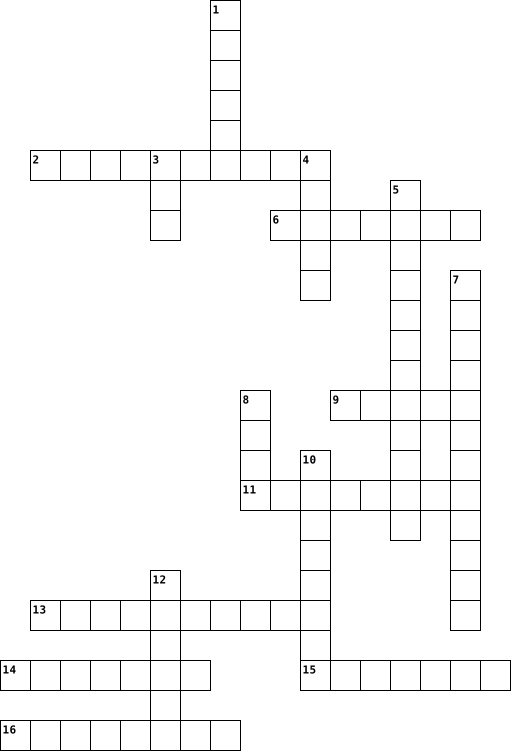
Across
- not able to see different materials
- pure substance
- same as an electron cloud
- water is an example
- unit to measure liquid
- center of an atom
- no charge
- table grouping of elements
Down
- positive charge
- vapor state
- hard object
- able to see different materials
- water moved after adding an object
- unit of weight measurement
- negative charge
- aqueous fluid
16 Clues: no charge • vapor state • hard object • aqueous fluid • pure substance • positive charge • negative charge • center of an atom • water is an example • unit to measure liquid • same as an electron cloud • unit of weight measurement • table grouping of elements • able to see different materials • water moved after adding an object • not able to see different materials
Chemistry Test Ch 6 2025-12-09

Across
- What is the only metal that is a liquid at room temperature?
- Type of metals mostly geologic minerals that are dissolved slightly in water
- Which category has good conductors of heat and electricity; usually hard, lustrous, malleable, and ductile
- Which has the smaller atomic radius, lower left or upper right of P.T.?
- Oxygen combines with other elements to form compounds called
- Which category are generally gases or soft solids?
- Who was credited with developing the first ordered table of elements?
- Which property measures the attraction of bonded atoms to electrons?
- A positively charged ion
- the distance from the center of the atom’s nucleus to its outermost electron
- Which of the following is the lightest, most abundant element, extremely flammable in air?
- The lanthanoid and actinoid series together compose what grouping on the periodic table?
- Semiconductors can also be called
Down
- Graphite and ___ are both composed of the element carbon
- A larger atomic radius means a _____ionization energy
- Which element is the most reactive as well as the most electronegative?
- Elements in the same group have similar physical and chemical properties because of ____ configuration
- An element that has a silvery luster, conducts electricity well, and is highly reactive is most likely
- Group 15 is also known as the
- Which property measures the energy required to remove an outermost electron?
- The chemist who arranged elements according to increasing atomic masses (law of octaves)
- Whose work resulted in the atomic number being used to organize the periodic table?
- helium, neon, argon, krypton, xenon, and radon
23 Clues: A positively charged ion • Group 15 is also known as the • Semiconductors can also be called • helium, neon, argon, krypton, xenon, and radon • Which category are generally gases or soft solids? • A larger atomic radius means a _____ionization energy • Graphite and ___ are both composed of the element carbon • ...
Erik_sierra77 2017-09-12

Across
- A vertical column in the periodic table of elements; also known as a family of elements
- An extremely small negatively charged subatomic particle found in a cloud outside the atomic nucleus
- An abbreviatioin for an element or atom
- A count of the number of protons in the atomic nucleus
- An electrically neutral subatomic particle in the atomic nucleus
- A horizontal row in the periodic table of elements
Down
- The dense, positively charged center of every atom
- A positively charged subatomic particle in the atomic nucleus
- A chart in which all known elements are listed in order of atomic number
- Any material that is made up of one type of atom
10 Clues: An abbreviatioin for an element or atom • Any material that is made up of one type of atom • The dense, positively charged center of every atom • A horizontal row in the periodic table of elements • A count of the number of protons in the atomic nucleus • A positively charged subatomic particle in the atomic nucleus • ...
Matter Unit 2012-11-26

Across
- What can form if two or more different substances join together and can't be separated
- A change that occurs when a new substance is created
- solid material that is typically hard, shiny, malleable, good conductivity to heat
- a group of the same atoms
- What can form if two or more elements join together?
- Have characteristics of metals and non metals and are found toward the middle of the periodic table
Down
- The Scientist that created the Periodic table
- A change that occurs when no new substance is form
- Matter cannot be created nor destroyed
- non-lusturous , non conductors of heat, opposite characteristics of a metal
10 Clues: a group of the same atoms • Matter cannot be created nor destroyed • The Scientist that created the Periodic table • A change that occurs when no new substance is form • A change that occurs when a new substance is created • What can form if two or more elements join together? • non-lusturous , non conductors of heat, opposite characteristics of a metal • ...
the element crossword - green 2015-06-19

Across
- what is the compound of two hydrogen and one oxygen?
- is an electron that is associated with an atom.
- what is famous of C?
Down
- element is a species of chemical objects, chararacterized by a number of protons in atoms nucleus.
- are the elements in groups 14-16 of the periodic table.
- are the elements found along the step like line between metals and non-metals of the periodic table.
- is the number of protons in an atom of an element.
- this naturally occuring chemical compound is composed of a carbon atom covalently double bonded to two oxygen atoms.
- what is famous in N2?
- have a positive electric charge.
10 Clues: what is famous of C? • what is famous in N2? • have a positive electric charge. • is an electron that is associated with an atom. • is the number of protons in an atom of an element. • what is the compound of two hydrogen and one oxygen? • are the elements in groups 14-16 of the periodic table. • ...
Chemistry 2022-02-24

Across
- of protons in the nucleus
- average atomic mass of an element
- number in front of a symbol tat represents the number of molecules present
- subatomic particle with a negative electrical charge
- substance formed as a result of chemical reaction
- subatomic particles with a positive electrical change located in the nucleus
Down
- shows how many atom of an element are present in a molecule
- column of the elements on the periodic table with atomic properties
- subatomic particle with a neutral electrical charge located in the nucleus
- horizontal row in the periodic table were all the elements have the number of energy levels
10 Clues: of protons in the nucleus • average atomic mass of an element • substance formed as a result of chemical reaction • subatomic particle with a negative electrical charge • shows how many atom of an element are present in a molecule • column of the elements on the periodic table with atomic properties • ...
Chemistry 2022-09-07

Across
- Refers to the closeness of a set of measurement of the same quantity made in the same way
- Any substance with a definite composition
- Vertical column of the periodic table. ALso called family
- Anything that has mass and takes up space
- Blend of tow or more kinds of matter, each which retains its own identity and properties
- An element that is a good electrical conductor and a good heat conductor
Down
- Mathematical technique that uses units to solve problems
- The smallest unit of an element that maintains its identity
- Horizontal row of the periodic table
- The study of substances and processes in living things
10 Clues: Horizontal row of the periodic table • Any substance with a definite composition • Anything that has mass and takes up space • The study of substances and processes in living things • Mathematical technique that uses units to solve problems • Vertical column of the periodic table. ALso called family • The smallest unit of an element that maintains its identity • ...
Crossword puzzle 2022-01-13

Across
- - a flow of water that flows across the land.
- events that happen in a rotation (repeated).
- - This is found in plants' leaves, stems, and other parts of plants.
- -When plants and other organisms use sunlight to make nutrients.
- - This is one of the elements in the periodic table known as co2
Down
- - This is also known as the water cylce.
- - This is one of the elements in the periodic table known as N.
- - This process involves the plants and organisms taking in nitrogen and carbon dioxide.
- - These are places where carbon is store in for a long period of time.
- -little living organisms that were the first forms of life.
10 Clues: - This is also known as the water cylce. • events that happen in a rotation (repeated). • - a flow of water that flows across the land. • -little living organisms that were the first forms of life. • -When plants and other organisms use sunlight to make nutrients. • - This is one of the elements in the periodic table known as N. • ...
Kendall Wyse- Chapter 9 Atomic Structure 2021-02-01

Across
- A material that conducts heat well and has a lustrous appearance.
- Particle that is 1 amu, positive charge, located in the nucleus.
- Name of the man who created one of the best models of the atom.
- Particle that is 1 amu, with no charge located in the nucleus.
Down
- A material that has properties of both metals and nonmetals.
- Tiny particles, only 1/1200 amu, with a negative charge.
- The same meaning as a column on the periodic table.
- A material that lacks the properties of a metal.
- An atom that carries an electrical charge.
- The same meaning as row on the periodic table.
10 Clues: An atom that carries an electrical charge. • The same meaning as row on the periodic table. • A material that lacks the properties of a metal. • The same meaning as a column on the periodic table. • Tiny particles, only 1/1200 amu, with a negative charge. • A material that has properties of both metals and nonmetals. • ...
Crossword Puzzle Kesleigh 2022-10-26

Across
- number of protons and neutrons
- a way of describing the number of atoms that make up a molecule or compound
- the ability to combine and to chemically bond with each other
Down
- high luster, good conductor, malleable, found on the left of periodic table
- molecule that is made up of more than one type of element
- a chart where all elements are organized into periods and steps of the periodic table
- compounds that include Carbon
- substaces that are the building blocks of all matter(made of one kind of atom)
- a row of elements that have a certain proprties in common
- the basic unit of a chemical element
10 Clues: compounds that include Carbon • number of protons and neutrons • the basic unit of a chemical element • molecule that is made up of more than one type of element • a row of elements that have a certain proprties in common • the ability to combine and to chemically bond with each other • high luster, good conductor, malleable, found on the left of periodic table • ...
Atomic structure 2023-02-01

Across
- An atom or a group of atoms with a electrical charge, formed by the loss or gain of electrons
- A change that does not result in a new substance being formed. It can be reversed
- A vertical column of elements on the periodic table
- A change where new substances are formed. This can not easily be reversed
- Two or more diffrent elements chemically combined
Down
- A substance made from one type of atom
- A reaction where a chemical change occurs
- Group of atoms bonded together by sharing electrons
- A horizontal row of elements on the periodic table
- Smallest particle of a chemical element that can exist
10 Clues: A substance made from one type of atom • A reaction where a chemical change occurs • Two or more diffrent elements chemically combined • A horizontal row of elements on the periodic table • Group of atoms bonded together by sharing electrons • A vertical column of elements on the periodic table • Smallest particle of a chemical element that can exist • ...
Where are we going on Sunday 2021-12-27

Across
- shape of exec office
- where we are going
- word meaning practical
- most populated country
- element on periodic table
Down
- opposite of domestic
- charles darwin studied
- what’s your ____?
- monica
- sublime, rhyme, thyme, dime
- travis scott
11 Clues: monica • travis scott • what’s your ____? • where we are going • opposite of domestic • shape of exec office • charles darwin studied • word meaning practical • most populated country • element on periodic table • sublime, rhyme, thyme, dime
Word List 3 2017-01-31

Across
- a human
- first element in periodic table
- a small
- someone who watches
- a necklace
Down
- multiple marriages
- one color
- a picture
- a calling device
- a five sided shape
10 Clues: a human • a small • one color • a picture • a necklace • a calling device • multiple marriages • a five sided shape • someone who watches • first element in periodic table
Chase cromer 4th period vocabulary 6B 2017-03-23

Across
- vertical column of elements on the Periodic Table that have similar physical and chemical properties.
- states that matter is neither created nor destroyed in ordinary chemical and physical changes.
- A chemical reaction in which heat is released and usually feels warm when the heat is released from the reaction.
- horizontal row of elements on the Periodic Table that have the same number of electron shells.
Down
- elements that have some properties of metals and non-metals and are found along the zigzag on the Periodic Table.
- A chemical reaction that requires an input of energy and usually feels cold when it absorbs heat in the reaction.
- electrons on the outermost energy level of an atom that determine the reactivity of the atom.
- Bond an interaction that holds atoms together.
8 Clues: Bond an interaction that holds atoms together. • electrons on the outermost energy level of an atom that determine the reactivity of the atom. • states that matter is neither created nor destroyed in ordinary chemical and physical changes. • horizontal row of elements on the Periodic Table that have the same number of electron shells. • ...
Vocab 6b 2017-03-23

Across
- Electron electrons on the outermost energy level of an atom that determine the reactivity of the atom.
- elements that have some properties of metals and non-metals and are found along the zigzag on the Periodic Table.
- A chemical reaction in which heat is released and usually feels warm when the heat is released from the reaction
- A chemical reaction that requires an input of energy and usually feels cold when it absorbs heat in the reaction.
- an interaction that holds atoms together.
Down
- states that matter is neither created nor destroyed in ordinary chemical and physical changes.
- vertical column of elements on the Periodic Table that have similar physical and chemical properties.
- horizontal row of elements on the Periodic Table that have the same number of electron shells.
8 Clues: an interaction that holds atoms together. • states that matter is neither created nor destroyed in ordinary chemical and physical changes. • horizontal row of elements on the Periodic Table that have the same number of electron shells. • vertical column of elements on the Periodic Table that have similar physical and chemical properties. • ...
hw 6B 2017-03-23

Across
- states that matter is neither created nor destroyed in ordinary chemical and physical changes
- A chemical reaction in which heat is released and usually feels warm when the heat is released from the reaction
- vertical column of elements on the Periodic Table that have similar physical and chemical properties
- an interaction that holds atoms together
Down
- electrons on the outermost energy level of an atom that determine the reactivity of the atom
- A chemical reaction that requires an input of energy and usually feels cold when it absorbs heat in the reaction
- horizontal row of elements on the Periodic Table that have the same number of electron shells
- elements that have some properties of metals and non-metals and are found along the zigzag on the Periodic Table
8 Clues: an interaction that holds atoms together • electrons on the outermost energy level of an atom that determine the reactivity of the atom • states that matter is neither created nor destroyed in ordinary chemical and physical changes • horizontal row of elements on the Periodic Table that have the same number of electron shells • ...
Unit 6B 2017-03-21

Across
- Electron- electrons on the outermost energy level of an atom that determine the reactivity of the atom.
- horizontal row of elements on the Periodic Table that have the same number of electron shells.
- elements that have some properties of metals and non-metals and are found along the zigzag on the Periodic Table.
Down
- of Conservation of Mass- states that matter is neither created nor destroyed in ordinary chemical and physical changes.
- vertical column of elements on the Periodic Table that have similar physical and chemical properties.
- Reaction- A chemical reaction that requires an input of energy and usually feels cold when it absorbs heat in the reaction.
- Bond- an interaction that holds atoms together.
- Reaction- A chemical reaction in which heat is released and usually feels warm when the heat is released from the reaction.
8 Clues: Bond- an interaction that holds atoms together. • horizontal row of elements on the Periodic Table that have the same number of electron shells. • vertical column of elements on the Periodic Table that have similar physical and chemical properties. • Electron- electrons on the outermost energy level of an atom that determine the reactivity of the atom. • ...
Vocab 6B 2017-04-04

Across
- an interaction that holds atoms together.
- elements that have some properties of metals and non-metals and are found along the zigzag on the Periodic Table.
- A chemical reaction that requires an input of energy and usually feels cold when it absorbs heat in the reaction.
- horizontal row of elements on the Periodic Table that have the same number of electron shells.
Down
- of Mass states that matter is neither created nor destroyed in ordinary chemical and physical changes.
- electrons on the outermost energy level of an atom that determine the reactivity of the atom.
- A chemical reaction in which heat is released and usually feels warm when the heat is released from the reaction.
- vertical column of elements on the Periodic Table that have similar physical and chemical properties.
8 Clues: an interaction that holds atoms together. • electrons on the outermost energy level of an atom that determine the reactivity of the atom. • horizontal row of elements on the Periodic Table that have the same number of electron shells. • vertical column of elements on the Periodic Table that have similar physical and chemical properties. • ...
Unit 1 Chemistry Crossword 2022-09-15

Across
- how compact somethings molecules are
- result of a chemical reaction
- where two things are joined together
- table of elements
- a substance made of one kind of atom
- when elements are physically combined but not chemically
- compounds formed by acid and base reactions
- measurement of kinetic energy in a substance
- something that dissolves another substance
- an atom with a charge
Down
- a metal that electrical energy flows easily through
- making a liquid weaker
- when a substance dissolves in another like sugar and water
- smallest unit of matter
- negatively charged particle
- atom without charge
- flexibility of a substance to be molded or shaped
- an atom with a positive charge
- how much matter is in a substance
19 Clues: table of elements • atom without charge • an atom with a charge • making a liquid weaker • smallest unit of matter • negatively charged particle • result of a chemical reaction • an atom with a positive charge • how much matter is in a substance • how compact somethings molecules are • where two things are joined together • a substance made of one kind of atom • ...
density crossword 2012-09-24

Across
- cylynder measures volume
- a group of atoms bound together
- used when an irregular object doesn't fit in a graduated cylynder
- the symbol is g
- measures the mass
- amount something weighs
- two or more elements bound together
- where the electrons move around the atom
- have negative charge
Down
- the center of an atom
- about the equivilent of protons and neutrons in an atom
- have a positive charge
- where all the electrons are located
- a table of elements in rows and columns
- the number of protons of an atom
- have no charge
- a pure material of a substance (oxyegen)
- mass divided by volume
- amount of space an object takes up
19 Clues: have no charge • the symbol is g • measures the mass • have negative charge • the center of an atom • have a positive charge • mass divided by volume • amount something weighs • cylynder measures volume • a group of atoms bound together • the number of protons of an atom • amount of space an object takes up • where all the electrons are located • two or more elements bound together • ...
Perioidic Table Crossword 2014-09-29

Across
- formula contains coefficicent and subscript
- mass # - atomic # = # of neutrons
- shiny,ductile,good conductors
- semi-conductors
- verticial columns
- negatively charged
- a substance produced during a natural, chemical, or manufacturing process
Down
- table a table that organizes the known elements by order of increasing atomic #
- atomic # = # of protons= # of electrons
- dull,brittle,poor conductor
- the big #;multiply all subscripts by the coefficient
- mass round to mass #
- a substance that takes part in and undergoes change during a reaction
- little #;indicates the number of atoms of an element
- postively charged
- electrons only the electrons in the outer most shell
- numbers arranged in groups known as energy levels
- the smallest units of an element
- neutral charge
19 Clues: neutral charge • semi-conductors • postively charged • verticial columns • negatively charged • mass round to mass # • dull,brittle,poor conductor • shiny,ductile,good conductors • the smallest units of an element • mass # - atomic # = # of neutrons • atomic # = # of protons= # of electrons • formula contains coefficicent and subscript • ...