
periodic table Crossword Puzzles
States of Matter Crossword Puzzle 2022-09-09

Across
- Two or more substances combined chemically; must be seperated through chemical means
- Any two or more atoms bonded together
- State of Matter with definite volume and shape
- Phase Change of Gas to Liquid
- makes up matter
- Two or more substances combined physically; can be seperated through physical means
- A pure substance
- State of Matter with definite volume and no definite shape
- State of Matter with no definite volume or shape
- Phase Change of Liquid to Solid
Down
- Phase Change of Solid to Gas
- Russian chemist who formulates Periodic Law and arranged elements in periodic table by atomic weight and similar properties
- Phase Change of Liquid to Gas
- Phase Change of Solid to Liquid
14 Clues: makes up matter • A pure substance • Phase Change of Solid to Gas • Phase Change of Liquid to Gas • Phase Change of Gas to Liquid • Phase Change of Solid to Liquid • Phase Change of Liquid to Solid • Any two or more atoms bonded together • State of Matter with definite volume and shape • State of Matter with no definite volume or shape • ...
periodic table-callan horoszewki 2021-10-14

Across
- the 6th group
- periods
- made up with chemical elements with simular properties
- found in nature combined with other elements
Down
- family 5a
- group 1a
- designer of the periodic table
- know as these in the 7th group
- groups
- group 2a
- group 4a
11 Clues: groups • periods • group 1a • group 2a • group 4a • family 5a • the 6th group • designer of the periodic table • know as these in the 7th group • found in nature combined with other elements • made up with chemical elements with simular properties
Welding Vocabulary Crossword 2020-12-11

Across
- A base element that makes up the primary substance in steel and cast iron
- Containing or relating to iron
- A container used to store and transport gas
- A substance that facilitates soldering, brazing and welding by chemically cleaning the metals to be joined
- A gas that has been heated to the point where it will conduct electricity
- A metal made by mixing two or more metals
- A device used to heat metal for forming and bending
- Energy from heat or light that you cannot see
- A tool or device used to hold pieces in place for welding
Down
- A very hard, heavy, steel-grey-to-white transition metal; W in the periodic table
- Pure oxygen combined with gas
- To join two pieces of metal together permanently by melting the parts that touch
- To cause fresh air to enter and move around an enclosed space
- A material such as sand, silicon or crushed stone used for surface cleaning
- The most common noble gas on Earth and represented by Ar in the periodic table
15 Clues: Pure oxygen combined with gas • Containing or relating to iron • A metal made by mixing two or more metals • A container used to store and transport gas • Energy from heat or light that you cannot see • A device used to heat metal for forming and bending • A tool or device used to hold pieces in place for welding • ...
Vocabulary Unit 1 Chs 4-5 2021-01-17

Across
- Number: The number of protons in the nucleus of an atom.
- Electrons: The electrons in the outermost energy level of an atom, Which determine how an atom bonds with other atoms
- Elements that have properties of both metals and nonmetals
- Bond: The force of attraction between oppositely charged particles
- Positively charged particles inside the nucleus of an atom
- Bond: A bond in which valence electrons are shared between atoms.
- Particles with no charge found inside the nucleus of an atom
- number after a symbol that tells how many atoms of an element are in each molecule
Down
- Symbol: A one or two letter abbreviation for an element.
- formula: A combination of chemical symbols and numbers used to represent a compound or indicate atoms present in a molecule.
- horizontal row of elements on the periodic table of elements
- Gases:The elements in the far right column of the periodic table, which have full outer energy levels and will not combine with other elements under ordinary conditions
- Atoms of the same element have the same number of protons but different numbers of neutrons
- amount of matter in an object.
- Negatively charged particles surrounding the nucleus of an atom
- A charged particle.
16 Clues: A charged particle. • amount of matter in an object. • Symbol: A one or two letter abbreviation for an element. • Number: The number of protons in the nucleus of an atom. • Elements that have properties of both metals and nonmetals • Positively charged particles inside the nucleus of an atom • horizontal row of elements on the periodic table of elements • ...
Chapter 16: Properties of Atoms and the Periodic Table 2022-02-04

Across
- The small, positively charged center of an atom, contains protons and neutrons.
- Weighted-average mass of an element’s isotopes according to their natural abundance.
- Organized list of all known elements that are arranged by increasing atomic number and by changes in chemical and physical properties.
- Particle in the nucleus with an electric charge of +1.
- Horizontal row in the periodic table.
- Uses the symbol for an element and dots representing the number of electrons in the element’s outer energy level.
- Particle of matter that makes up protons and neutrons.
Down
- Area around the nucleus of an atom where the atom’s electrons are mostly likely to be found.
- Vertical column in the periodic table.
- Electrically neutral particle inside the nucleus of an atom.
- Number of protons in an atom’s nucleus.
- The smallest particle of an element that still retains the properties of the element.
- Particle with an electric charge of -1, surrounds the nucleus of an atom.
- Atom of an element that has a specific number of neutrons.
- Sum of the number of protons and neutrons in an atom’s nucleus.
15 Clues: Horizontal row in the periodic table. • Vertical column in the periodic table. • Number of protons in an atom’s nucleus. • Particle in the nucleus with an electric charge of +1. • Particle of matter that makes up protons and neutrons. • Atom of an element that has a specific number of neutrons. • Electrically neutral particle inside the nucleus of an atom. • ...
Science 2024-11-05

Across
- A substance made up of atoms of two or more different elements joined by chemical bonds
- generally located on the left side of the zigzag line
- Tubes that move air from the trachea to the lungs (one is in each lung). Part of each is outside the lung and part is inside
- A combination of two or more substances that are not chemically combined
- A material that allows heat and electricity to pass through it.
- A subatomic particle that has a positive charge and that is found in the nucleus of an atom
- Another word for groups, columns of elements on the periodic table
- Basic unit of matter
Down
- a testable question
- contains protons and neutrons
- changes with phase changes due to the difference in the particle arrangement in
- A subatomic particle that has no charge and that is found in the nucleus of an atom
- A subatomic particle that has a negative charge
- Easily broken; not flexible
- are located on the right side of the zigzag line on the periodic table.
15 Clues: a testable question • Basic unit of matter • Easily broken; not flexible • contains protons and neutrons • A subatomic particle that has a negative charge • generally located on the left side of the zigzag line • A material that allows heat and electricity to pass through it. • Another word for groups, columns of elements on the periodic table • ...
Week 6 vocabulary 2023-09-27

Across
- A period is a horizontal row of the periodic table. There are seven periods in the table, with each one beginning at the far left. A new period begins when a new principal energy level begins filling with electrons. Period 1 has only two elements (hydrogen and helium), while periods 2 and 3 have 8 elements.
- A subatomic particle that has no charge and that is located in the nucleus of an atom
- The number of protons in the nucleus of an atom; the atomic number is the same for all atoms of an element
Down
- A subatomic particle that has a positive charge and that is located in the nucleus of an atom; the number of protons in the nucleus is the atomic number, which determines the identity of an element
- A subatomic particle that has a negative charge
- Mass number is the sum of the numbers and protons and neutrons present in the nucleus of an atom
- A substance that cannot be separated or broken into simpler substances by chemical means
- table An arrangement of the elements in order of their atomic numbers such that elements with similar properties fall in the same column, or group
- The smallest unit of an element that maintains the properties of that element
- In chemistry, a column in the periodic table of the chemical elements
10 Clues: A subatomic particle that has a negative charge • In chemistry, a column in the periodic table of the chemical elements • The smallest unit of an element that maintains the properties of that element • A subatomic particle that has no charge and that is located in the nucleus of an atom • ...
Week 6 vocabulary 2023-09-27

Across
- A period is a horizontal row of the periodic table. There are seven periods in the table, with each one beginning at the far left. A new period begins when a new principal energy level begins filling with electrons. Period 1 has only two elements (hydrogen and helium), while periods 2 and 3 have 8 elements.
- A subatomic particle that has no charge and that is located in the nucleus of an atom
- The number of protons in the nucleus of an atom; the atomic number is the same for all atoms of an element
Down
- A subatomic particle that has a positive charge and that is located in the nucleus of an atom; the number of protons in the nucleus is the atomic number, which determines the identity of an element
- A subatomic particle that has a negative charge
- Mass number is the sum of the numbers and protons and neutrons present in the nucleus of an atom
- A substance that cannot be separated or broken into simpler substances by chemical means
- table An arrangement of the elements in order of their atomic numbers such that elements with similar properties fall in the same column, or group
- The smallest unit of an element that maintains the properties of that element
- In chemistry, a column in the periodic table of the chemical elements
10 Clues: A subatomic particle that has a negative charge • In chemistry, a column in the periodic table of the chemical elements • The smallest unit of an element that maintains the properties of that element • A subatomic particle that has no charge and that is located in the nucleus of an atom • ...
Periodic Tables 2024-02-23

Across
- First element on the most reactive side of a periodic table
- Has an atomic mass of 55.845
- Symbol is Ti
- Is used inside of batteries
- What we breathe in
Down
- This elements atomic mass is 40.078
- In group 3 has a Atomic number of 39
- Atomic number 5
- This is a conductive type of material (shiny)
- First element on the least reactive side of a table
- Symbol of element is Sn
11 Clues: Symbol is Ti • Atomic number 5 • What we breathe in • Symbol of element is Sn • Is used inside of batteries • Has an atomic mass of 55.845 • This elements atomic mass is 40.078 • In group 3 has a Atomic number of 39 • This is a conductive type of material (shiny) • First element on the least reactive side of a table • First element on the most reactive side of a periodic table
Scientific Vocabulary By Kristian Oliver 2021-10-12

Across
- the quantity of matter which a body contains
- the subatomic particle found in the nucleus with a neutral charge
- the degree of compactness of a substance
- something made up or consisting of two or more existing parts or elements
- a pure substance consisting only of atoms that all have the same numbers of protons in their nuclei
- the central core of an atom
- a substance or matter in a state in which it will expand freely to fill the whole of a container; not solid or liquid
- the subatomic particle found in the orbitals with a negative charge
- firm and stable in shape; not liquid or fluid
- a substance that flows freely but is of constant volume; not solid or gaseous
- this person proposed a theory for the hydrogen atom
Down
- the basic unit of a chemical element
- the mass of an atom of a chemical element expressed in units
- Table a table of the chemical elements arranged in order of atomic number
- this person developed the periodic classification of the elements
- a group of atoms chemically bonded
- Cloud the system of electrons surrounding the nucleus of an atom
- the number of protons in the nucleus of an atom
- the subatomic particle found in the nucleus with a positive charge
19 Clues: the central core of an atom • a group of atoms chemically bonded • the basic unit of a chemical element • the degree of compactness of a substance • the quantity of matter which a body contains • firm and stable in shape; not liquid or fluid • the number of protons in the nucleus of an atom • this person proposed a theory for the hydrogen atom • ...
Chemistry Crossword 2017-02-16

Across
- metals, gases, non-metals
- two different elements
- solid, gas, liquid
- a positive charge
Down
- negative charge
- change color change, smell
- dissolving
- oxygen
- rows on the periodic table
9 Clues: oxygen • dissolving • negative charge • a positive charge • solid, gas, liquid • two different elements • metals, gases, non-metals • change color change, smell • rows on the periodic table
Does it matter? 2020-08-27

Across
- study of composition, structure, and properties chemical substance with a definite composition
- a mixture that is the same through out
- category of elements
- change of state
- characteristic of matter
- amount of matter
- vertical column
- state of matter
- combination of 2 or more types of compounds
Down
- knowledge of natural events
- a type of mixture
- change of state
- periodic table unit
- not a metal
- horizontal row
- semiconductor
- a type of change
- state of mater
18 Clues: not a metal • semiconductor • horizontal row • state of mater • change of state • change of state • vertical column • state of matter • a type of change • amount of matter • a type of mixture • periodic table unit • category of elements • characteristic of matter • knowledge of natural events • a mixture that is the same through out • combination of 2 or more types of compounds • ...
Light & sound 2024-09-16

Across
- Periodic Table
- both are energy
- high and low
Down
- visible light
- Heart rate
- Noise
- sound waves
- bright and shiny
8 Clues: Noise • Heart rate • sound waves • high and low • visible light • Periodic Table • both are energy • bright and shiny
Chemistry cross word 2013-11-09

Across
- subdivision of electron shells separated by electron orbitals
- a regular periodic variation of properties of elements with atomic number and position in the Periodic table
- The arrangement of electrons in an atom
- a grouping of electrons surrounding the nucleus of an atom
Down
- the energy required to remove the most loosely held electron from one mole of gaseous atoms to produce 1 mole of gaseous ions with a charge 1+.
- used to describe the size of an atom, referring to ions radius, covalent radius, metallic radius, or van der Waals radius.
- a horizontal row of elements in the periodic table
- describes the decrease in attraction between an electron and the nucleus in any atom with more than one electron shell
8 Clues: The arrangement of electrons in an atom • a horizontal row of elements in the periodic table • a grouping of electrons surrounding the nucleus of an atom • subdivision of electron shells separated by electron orbitals • a regular periodic variation of properties of elements with atomic number and position in the Periodic table • ...
Chemistry cross word 2013-11-09

Across
- the energy required to remove the most loosely held electron from one mole of gaseous atoms to produce 1 mole of gaseous ions with a charge 1+.
- a regular periodic variation of properties of elements with atomic number and position in the Periodic table
Down
- subdivision of electron shells separated by electron orbitals
- a horizontal row of elements in the periodic table
- used to describe the size of an atom, referring to ions radius, covalent radius, metallic radius, or van der Waals radius.
- The arrangement of electrons in an atom
- a grouping of electrons surrounding the nucleus of an atom
- describes the decrease in attraction between an electron and the nucleus in any atom with more than one electron shell
8 Clues: The arrangement of electrons in an atom • a horizontal row of elements in the periodic table • a grouping of electrons surrounding the nucleus of an atom • subdivision of electron shells separated by electron orbitals • a regular periodic variation of properties of elements with atomic number and position in the Periodic table • ...
Elements 2020-11-23

Across
- Capital of Georgia
- hot that can burn
- something that eats it's own species
- sweet treat
- catch fish with
- Fe on the periodic table
Down
- Smell with this
- Meat from a pig
- this makes you laugh
- something you do with your eyes
- someone that is good at something
- where we live
- do this with your legs
13 Clues: sweet treat • where we live • Smell with this • Meat from a pig • catch fish with • hot that can burn • Capital of Georgia • this makes you laugh • do this with your legs • Fe on the periodic table • something you do with your eyes • someone that is good at something • something that eats it's own species
O' Boy! Words that Start with O 2023-07-20

Across
- Spotted Wild Cat
- City name in Ukraine and Texas
- Husband of Desdemona
- Double-reed Woodwind Instrument
- A person in their 80s
- Popcorn Brand Founder
Down
- Kalamata, Manzanilla
- A rectangle with rounded sides
- 8th element on the Periodic Table
- African "Forrest Giraffe"
- Baltimore's Baseball Team
- Tall, pointed four-sided monument
- Japan's Third Largest City
13 Clues: Spotted Wild Cat • Kalamata, Manzanilla • Husband of Desdemona • A person in their 80s • Popcorn Brand Founder • African "Forrest Giraffe" • Baltimore's Baseball Team • Japan's Third Largest City • City name in Ukraine and Texas • A rectangle with rounded sides • Double-reed Woodwind Instrument • 8th element on the Periodic Table • Tall, pointed four-sided monument
Preston 2025-08-28

Across
- My fourth favorite sport
- favorite sport
- not my favorite number
- favorite color
- favorite number
- how many siblings do I have
- what color eye I have
Down
- what sport do I play right now
- my second favorite sport
- my favorite food
- my age
- apple or Samsung
- my favorite periodic table element
- my 3 favorite sport
- how many dog do I have
15 Clues: my age • favorite sport • favorite color • favorite number • my favorite food • apple or Samsung • my 3 favorite sport • what color eye I have • not my favorite number • how many dog do I have • my second favorite sport • My fourth favorite sport • how many siblings do I have • what sport do I play right now • my favorite periodic table element
Ahnikas crossword puzzle 2022-12-02

Across
- something you can play with
- something that takes up space
- a table
- NI and number 28 on the periodic table of the elements
Down
- moves really fast
- the season that comes after summer
- something you cannot hold with your bare hands without it spilling
- something you can drink
- the center of our solar system
9 Clues: a table • moves really fast • something you can drink • something you can play with • something that takes up space • the center of our solar system • the season that comes after summer • NI and number 28 on the periodic table of the elements • something you cannot hold with your bare hands without it spilling
Properties of Atoms 2023-08-31

Across
- versions of the same element with different numbers of neutrons
- first man to conceive of atoms.
- used to measure the mass of atoms
- weighted average of all isotopes in an element
- particle in an atom that doesn't have a charge.
- negative particle in an atom
- smallest part of an element with unique properties.
- father of modern chemistry
- location where electrons are likely to be.
Down
- positive center of an atom
- table containing all known elements
- gives number of protons in an element
- tiny particles that make up protons and neutrons
- number of protons + neutrons in an atom
- positive particle in an atom
- element with a mass number of 16
- element on the periodic table with 13 protons
17 Clues: positive center of an atom • father of modern chemistry • positive particle in an atom • negative particle in an atom • first man to conceive of atoms. • element with a mass number of 16 • used to measure the mass of atoms • table containing all known elements • gives number of protons in an element • number of protons + neutrons in an atom • ...
Yet Another Science Crossword 2025-11-06

Across
- Mr. Soffer's go to breakfast
- the reason Mr. Soffer drinks coffee
- name of the king with the knights of the round table
- famous scientist who said e=mc^2
- minimum age to be president of the US
- name of the first element on the periodic table
- Mr. Soffer's favorite meat
- cause of most chemical weathering
- Mr. Soffer's favorite pastry
Down
- famous scientist who invented calculus
- name of the queen of the Greek gods
- name of the king of the Greek gods
- famous scientist who died from her own x ray experiments
- Mr. Soffer's shoe size
- wizard from lord of the rings
- famous scientist who made the first electric generator
- evil wizard from Harry Potter
17 Clues: Mr. Soffer's shoe size • Mr. Soffer's favorite meat • Mr. Soffer's go to breakfast • Mr. Soffer's favorite pastry • wizard from lord of the rings • evil wizard from Harry Potter • famous scientist who said e=mc^2 • cause of most chemical weathering • name of the king of the Greek gods • name of the queen of the Greek gods • the reason Mr. Soffer drinks coffee • ...
Chemistry Unit Crossward 2021-10-22

Across
- A vertical column of elements
- A horizontal row of elements
- A kind of statement can be observed roughly
- A short form of Workspace Hazardous Materials Information System
- The smallest particle of an element
- A kind of pure substances that made of two particles
- The particles that on energy level
- On the left side of the periodic table
- Use the fact that the 2 types of particles have different particle sizes
- In between metals and non-metals
- Smell
- Atoms loses e- to from
- The protons and neutron that in the middle of an atom
- Group 1 Period 2 on the periodic table
- Use the fact that the 2 types of particles have different magnetic properties
- Electrons - Protons
- Easiness to be stretched into a wire
- Mass/Volume
- Group 16 Period 2
Down
- When gas transforms to liquid
- When solid transforms to gas
- Use the fact that the 2 types of particles have different boiling points
- When gas transforms to solid
- Same as the atomic numbers
- Ability of a substance(solute) to dissolve in a solvent such as water
- A kind of statement can be observed by specific states
- The outer most shell of a orbit
- Easiness to bend or shape
- Shininess
- A kind of mixture that can't be observed as two kind of matters
- Atoms gains e- to from
31 Clues: Smell • Shininess • Mass/Volume • Group 16 Period 2 • Electrons - Protons • Atoms loses e- to from • Atoms gains e- to from • Easiness to bend or shape • Same as the atomic numbers • When solid transforms to gas • A horizontal row of elements • When gas transforms to solid • When gas transforms to liquid • A vertical column of elements • The outer most shell of a orbit • ...
Think Tac Toe 2021-06-02

Across
- the distance between two corresponding parts of a wave
- elements with properties that fall between those of metals and nonmetals
- a rule where atoms react by gaining or losing electrons so as to acquire the stable electron structure of a noble gas, usually eight electrons
- a number that shows the positive charge of a monatomic ion
- elements found to the right and above the stairs on the periodic table
- a measure of the extra positive or negative particles that an object has
- molecular geometry when atoms are in a straight line
- nonmetal and nonmetal molecules that share electrons evenly
Down
- electrons on the outermost energy level on an atom
- molecular geometry about a central atom with 4 legs and no lone pairs of electrons
- elements that are found on the left side of the periodic table
- a mixture of two or more metals
- atoms of the same elements that have different numbers of neutrons
- a number showing how many protons are in a molecule
- a type of compound where two are more elements where the electrons are shared in a covalent bond
- an atom or group of atomes that has a positive or negative charge
- anion with a negative charge
- molecule with partial charges on opposite sides
- a positively charged ion
- metal and nonmetal
20 Clues: metal and nonmetal • a positively charged ion • anion with a negative charge • a mixture of two or more metals • molecule with partial charges on opposite sides • electrons on the outermost energy level on an atom • a number showing how many protons are in a molecule • molecular geometry when atoms are in a straight line • ...
Period Table Challenge Crossword 2012-11-26

Across
- the center of an atom; made up of protons and neutrons
- a vertical column of elements in the periodic table
- (two words) the properties of elements tend to repeat in a regular pattern when elements are arranged in order of increasing atomic number
- the elemnts that are usually poor conductors of heat and electricity
- the smallest particle that has the properties of an element
- another name for group
- a negatively charged subatomic particle found in the electron cloud of an atom
- (three words) a quantity equal to one-twelfth the mass of a carbon-12 atom
- a neutral subatomic particle in the nucleus of an atom
- an atom or a group of atoms that has lost or gained one or more electrons and therefore has a net electric charge
- the elements thta are good conductors of heat and electricity
Down
- (two words) an electron in the outermost energy level of an atom
- symbol for atomic mass unit
- a horizontal row of elements in the periodic table
- another name for metalloid
- (two words) the total number of protons and neutrons in the nucleus of an atom
- an element that has properties of both a metal and nonmetal
- another name for period
- any atoms having the same number of protons but a different number of neutrons
- a positively charged subatomic particle in the nucleus of an atom
20 Clues: another name for group • another name for period • another name for metalloid • symbol for atomic mass unit • a horizontal row of elements in the periodic table • a vertical column of elements in the periodic table • the center of an atom; made up of protons and neutrons • a neutral subatomic particle in the nucleus of an atom • ...
Science Crossword Puzzle 2014-02-26

Across
- Has no definite volume or shape
- The amount of matter
- Made of two or more atoms
- An element that has properties of both a metal and nonmetal
- Study of the properties and changes of matter
- Property/ A Property that doesn't depend on pressure, temperature, or density.
- Made up of atoms of one type
- A vertical column in a periodic table
- Study of matter and how it changes
- An element that is a poor conductor of electricity and does not form positive ions in a solution
- Change/ A change of matter from one form to another without chemical Change (solid, liquid, gas)
- Of State/ Liquid, solid, gas
- An element that is shiny and a good conductor of electricity
Down
- A horizontal row in a periodic table
- Smallest particle
- Study of substances
- organic Chemistry/ Study of non organics
- Has a definite volume and definite shape
- A substance or molecule that participates in a chemical reaction
- Any substance that has a defined composition
- A state of change starting from a gas then ionizing
- Property/ A property that depends on size.
- Anything that takes up space
- Chemistry/ The study of carbon compounds
- Reaction/ The process by which one or more substances change to produce one or more substances
- Has a definite volume, but no definite shape
26 Clues: Smallest particle • Study of substances • The amount of matter • Made of two or more atoms • Made up of atoms of one type • Anything that takes up space • Of State/ Liquid, solid, gas • Has no definite volume or shape • Study of matter and how it changes • A horizontal row in a periodic table • A vertical column in a periodic table • organic Chemistry/ Study of non organics • ...
Chemistry Crossword 2015-11-19

Across
- Change of state from a gas to liquid.
- Description of a substance that can be pounded or rolled into sheet.
- Shiny, malleable, ductile element that conducts electricity.
- Substance that strongly resist the flow of electricity.
- Chemical reaction that absorb energy.
- The smallest part of an element that is representative of that element.
- Measure of atomic mass.
- Vertical column of element in the periodic table.
- Chemical combination of two or more elements in a specific ratio.
- Change of state from a liquid to gas.
- Change of state from solid to liquid.
Down
- Chemical reaction that takes place in cell.
- Ability to work.
- Catalyst involved in a chemical reaction in living things.
- Change of state from a gas to solid.
- Slow chemical change that occurs when oxygen in the air reacts with a metal.
- Number of protons in the nucleus of one atom of an element.
- Group 17 elements in the periodic table.
- Invisible negatively charged particle that orbits the nucleus of an atom.
- A material that that electric charge can move through easily.
- Chang of state from a liquid to solid.
- Anything that has mass and occupies space.
- Substance that helps a chemical reaction to proceed more quickly.
- Chemical reaction that releases energy.
- Amount of mass in a given volume of a substance.
25 Clues: Ability to work. • Measure of atomic mass. • Change of state from a gas to solid. • Change of state from a gas to liquid. • Chemical reaction that absorb energy. • Change of state from a liquid to gas. • Change of state from solid to liquid. • Chang of state from a liquid to solid. • Chemical reaction that releases energy. • Group 17 elements in the periodic table. • ...
Science: Matter and Chemical Change 2014-11-10

Across
- supported the idea that everything was made up of the 4 elements
- stated each type of material was made up of a different type of atomos
- represents the number of atoms
- a pure substance that cannot be broken down into other substances
- the 18 columns on the Periodic Table of Elements
- Workplace Hazardous Material Information System
- a chemical reaction that takes place in the cells of your body
- ______ systems is an experiment in which reactants and products can not escape
- occurs when oxygen reacts to another substance to form a new substance and releases energy
- experimented with the behaviour of gases
- most reactive of the metals
- substances that helps reaction proceed faster
- the rows in the Periodic Table of Elements
Down
- substance that strongly resists the flow of electricity
- characteristics that can be used to describe a substance
- the mass of one of an element
- compound formed when 2 non-metals combine
- has the element symbol Br
- the Law of ________ of Mass
- an atom or group of atoms that become electrically charges because it has lost or gained electrons
- neutral particles
- occurs when oxygen reacts with metal, a chemical reaction in which the metal is decomposed
- positively charged particles
- organic catalysts
- Father of Modern Chemistry
- published by Andreas Libau in 1597, it describes the achievements of alchemists
26 Clues: neutral particles • organic catalysts • has the element symbol Br • Father of Modern Chemistry • the Law of ________ of Mass • most reactive of the metals • positively charged particles • the mass of one of an element • represents the number of atoms • experimented with the behaviour of gases • compound formed when 2 non-metals combine • the rows in the Periodic Table of Elements • ...
Science Crossword 2014-11-09

Across
- The ability of a substance to conduct electricity or heat
- The change from a liquid to a gas
- Anything that has a mass and occupies space
- A change from one state to another
- Also called a family, a vertical column in the periodic table
- The most reactive of the metals
- A pure substance formed when non-metals combine
- Substances that are shiny, malleable, and ductile
- The ability of a substance to be dissolved in another substance
- Neutral particles
- A horizontal row in the periodic table
- Most reactive non-metals
- The amount of mass in a given volume of a substance
- the most stable and unreactive elements
Down
- The change from a gas to a liquid
- A reaction that takes place when 2 or more substances react to form new substances
- The mass of one atom of a substance
- The change from a liquid to a solid
- A combination of pure substances
- Positively charged particles
- The change from a solid to a gas and vice versa
- The ability of a substance to be able to be pounded or rolled into sheets
- A formula that states what substances and the amount of each substance there is in a compound
- 2 or more materials joining to create new materials
- The change from a solid to a liquid.
25 Clues: Neutral particles • Most reactive non-metals • Positively charged particles • The most reactive of the metals • A combination of pure substances • The change from a gas to a liquid • The change from a liquid to a gas • A change from one state to another • The mass of one atom of a substance • The change from a liquid to a solid • The change from a solid to a liquid. • ...
mining 2022-06-26

Across
- the layer of the earth containing all 'air'
- when rocks are brought to the surface
- inner most layer of the earth
- the scale of how hard a mineral is
- igneous rocks formed above the earth
- a resource that is found in nature is said to be
- how shiny a mineral is
- the elements on the left side of the periodic table
- a common aluminium ore
- outer most layer of the earth
- when a rock is broken
- rock type formed from small fragments
- the raw material mined from the earth that we refine
- a second type of fossil
- a type of fossil
- right side of the periodic table
- a resource that cannot be reused
Down
- all of the water on the planet
- when eroded pieces of rock move to new place
- a resource that can be used over and over again
- the layer of the earth all mining is in
- the type of mining that uses huge pits to
- heat and pressure makes these types of rocks
- a common lead ore
- what fossilised tree sap is called
- the name of the theory that all rock layers above others must be younger
- when parts of a rock are removed by air or water
- thickest layer of the earth
28 Clues: a type of fossil • a common lead ore • when a rock is broken • how shiny a mineral is • a common aluminium ore • a second type of fossil • thickest layer of the earth • inner most layer of the earth • outer most layer of the earth • all of the water on the planet • right side of the periodic table • a resource that cannot be reused • the scale of how hard a mineral is • ...
Structure of the Atom 2023-02-26

Across
- the name given to electrons in the outermost shell
- A group of non-metals that include fluorine, chlorine, iodine, bromine and astatine.
- The heaviest Alkali Metal
- The lightest Noble Gas
- A chemical element that is not a metal.
- the charge of a neutron
- An Alkali Metal with 4 Shells (Period 4)
- the charge of an electron
- the subatomic particle inside the nucleus with a neutral charge
- the subatomic particle inside the nucleus with a positive charge
- the name given to the columns of the periodic table
- the Element with chemical symbol H
- the name for layers around the atom that houses electrons
Down
- The arrangement of electrons in the shells and subshells of an atom.
- The total number of protons and neutrons in the nucleus of an atom.
- the charge of a proton
- the Element with chemical symbol Cl
- An element that has properties of both metals and non-metals.
- the subatomic particle with a negative charge that orbits the atom
- the lightest Alkali metal
- The element with atomic number 33
- An element that is malleable, ductile, and an electrical and thermal conductor.
- The name given to the rows on the periodic table (number of shells)
- The number of protons in the nucleus of an atom, which is a unique identifier for each element.
- the Element with chemical symbol O
25 Clues: the charge of a proton • The lightest Noble Gas • the charge of a neutron • The heaviest Alkali Metal • the lightest Alkali metal • the charge of an electron • The element with atomic number 33 • the Element with chemical symbol H • the Element with chemical symbol O • the Element with chemical symbol Cl • A chemical element that is not a metal. • ...
chemistry bonus 2023-05-01

Across
- what rule states that electrons must occupy all of the orbitals of a sublevel before pairing begins?
- visually seperate solids can be separated by?
- Who discovered electrons while experimenting with a cathode ray tube?
- polar molecules can be dissolved in...
- what is a combination of 2 or more pure substances in which each substance retains its own chemical properties?
- the number of protons in the nucleus
- who created the first periodic table?
- a single compound breaks down into two or more elements or new compounds is...
- what is the ratio of the error to the actual value multiplied by 100?
Down
- what is located on the right of the metalloid line?
- what is located on the left of the metalloid line?
- what is the smallest ratio of cations to anions referred to as?
- a description of an element's tendency to undergo chemical reactions is called?
- what is the mass of an atom given in amu?
- Who discovered the nucleus of an atom?
- the transfer of electrons between atoms that results in cations and anions...
- atoms will gain, lose, or share valence electrons to attain 8 valence electrons is what rule?
- what is called when oxygen combines with a substance and releases heat and light?
- What is the lowest energy of an atom called?
- horizontal rows on the periodic table are called...\
20 Clues: the number of protons in the nucleus • who created the first periodic table? • polar molecules can be dissolved in... • Who discovered the nucleus of an atom? • what is the mass of an atom given in amu? • What is the lowest energy of an atom called? • visually seperate solids can be separated by? • what is located on the left of the metalloid line? • ...
Kemi - Kemiska förening (4) ENG 2023-08-30

Across
- Element Fe
- Element Li
- Rows in the periodic table.
- Different types of atoms are combined in a compound and form e.g. water
- A solution that is neither acidic nor basic.
- Element N
- Strong acidic substance. Chemical formula HCl.
- Element B
- A substance made up of positive and negative ions.
- What makes acids corrosive and acidic?
- What makes bases corrosive and basic?
- Is like an atom but lacks or has more electrons. Has a negative or positive charge.
- Element Mn
Down
- A chemical compound formed when negative and positive ions are attracted to each other.
- Element O
- When a substance reacts with another substance and forms new properties, form and character.
- There are different kinds of this. All are used to measure the pH value of a solution, e.g. bath water.
- A chemical compound in which at least two atoms are joined together, can be different or the same elements.
- scale A scale that describes whether a substance is acidic or basic.
- Element Ne
- Columns in the periodic table.
- A substance that has a high proportion of hydroxide ions and a high pH value.
- Element C
- Element Al
- Element Cl
- Strong basic substance. Chemical formula NH4.
- A substance that has a high proportion of hydrogen ions and a low pH value.
27 Clues: Element O • Element N • Element C • Element B • Element Fe • Element Li • Element Ne • Element Al • Element Cl • Element Mn • Rows in the periodic table. • Columns in the periodic table. • What makes bases corrosive and basic? • What makes acids corrosive and acidic? • A solution that is neither acidic nor basic. • Strong basic substance. Chemical formula NH4. • ...
Vocab Crossword 2023-09-20

Across
- Greek philosopher who called nature’s basic particle an atom
- Bonding, Special type of dipole-dipole attraction that is the strongest of the intermolecular bonds
- a force that results from one end of a molecule being positive and the other end being negative
- the neutral particle in the nucleus of an atom
- Forces, Short-range proton-neutron, proton-proton, and neutron-neutron forces that hold these particles together
- Vertical columns on the periodic table
- Proposed the “plum pudding” model and discovered the electron
- the basic unit of a chemical element
- Formed the atomic theory of the atom, said atoms were “hard little spheres”
Down
- Discovered the nucleus using his gold foil experiment
- Dispersion Forces, Weakest of the intermolecular forces between two nonpolar molecules
- Number, the number of protons in the nucleus and determines the chemical properties of an element
- the negative particle that circles the nucleus
- Cloud, Current explanation of where electrons might be found in an atom
- Horizontal rows of the periodic table
- A collection of protons and neutrons at the center of an atom
- Molecular Theory, Theory that explains that as atoms speed up, they are more likely to be gases
- the positive particle in the nucleus of an atom
- Number, The total number of protons and neutrons in a nucleus
- Used by scientists to explain something we can not see or understand
20 Clues: the basic unit of a chemical element • Horizontal rows of the periodic table • Vertical columns on the periodic table • the negative particle that circles the nucleus • the neutral particle in the nucleus of an atom • the positive particle in the nucleus of an atom • Discovered the nucleus using his gold foil experiment • ...
reactivity 2022-05-17

Across
- which is essential for ironoxide to happen? water, lead or carbon.
- Elements that react to form positive ion are ___.
- Metals atom are ___ when they react because they lose electrons.
- What is the oxidising agent in this reaction: lead oxide + carbon → lead + carbon monoxide?
- How to test for carbon dioxide.
- Calcium+carbon.
- Which can displace zinc from zinc sulphate.
- which one is less reactive magnesium or aluminum.
- Which gas is required to burn.
- When u add gold in hydrochloric acid.
- When there is 2 oxygen what do you add at the end.
Down
- zinccinoxide+magnesium.
- What is the most reactive metal on the periodic table?
- Violent reaction and very dangerous when reacted with dilute acid.
- Which metal could be used for the sacrificial protection of iron?
- magnesium+hydrochloric acid= magnesium chloride+___.
- Which of these react with dilute acid? lead or copper.
- True or nope can iron displace zinc?
- Metals can be arranged in order of their reactivity in a ___.
- magnesium has slow reaction in cold water to form ___?
- What is potassium stored in?
- Which one reacts with steam but not water to form an oxidre? iron, copper or magnesium.
- What reacts violently with dilute acid and reacts slowly with cold water.
- Which one is more reactive copper or silver.
- What is the most reactice element on the periodic table?
25 Clues: Calcium+carbon. • zinccinoxide+magnesium. • What is potassium stored in? • Which gas is required to burn. • How to test for carbon dioxide. • True or nope can iron displace zinc? • When u add gold in hydrochloric acid. • Which can displace zinc from zinc sulphate. • Which one is more reactive copper or silver. • Elements that react to form positive ion are ___. • ...
8th Grade Science 2025-06-01

Across
- This layer is solid nickel and iron
- The attraction between two or more objects (keeps our feet on Earth)
- This subatomic particle number is the atomic number
- This type of diagram shows valence electrons
- Water moving across the surface
- Water goes from a gas to a liquid
- Dominoes are an example of these
- Fe on the periodic table
- Neutral subatomic particle
- Heat is released in this type of reaction
- These are pure substances
- Water goes from liquid to a gas
- The electrons in the outer shell
- Type of plane used in Rube Goldberg machines
- Two or more elements
- Lighting a match is this type of change
Down
- Heat is absorbed in this type of reaction
- Water exits the leaves of trees
- This subatomic particle has a negative charge
- Measurement for Work
- Objects in motion stay in motion until acted upon
- Hg on the Periodic Table
- This turns off and on the flow of electricity
- Breaking wood into pieces is this type of change
- The Earth is an example this type of magnet
- Carbon dioxide and water are examples of this in photosynthesis
- Important to humans and has 6 valence electrons
- Gravity on earth is 9.81 m/s2
- Stored energy
- Energy in motion
- Measurement for force
31 Clues: Stored energy • Energy in motion • Measurement for Work • Two or more elements • Measurement for force • Hg on the Periodic Table • Fe on the periodic table • These are pure substances • Neutral subatomic particle • Gravity on earth is 9.81 m/s2 • Water exits the leaves of trees • Water moving across the surface • Water goes from liquid to a gas • Dominoes are an example of these • ...
Term 1 Review 2025-08-27

Across
- the command center of the cell
- the diffusion of water
- the smallest unit of elemental matter
- atoms of the same element that have the same number of protons, but a different number of neutrons
- a particle that has a positive charge
- a particle with a negative charge
- organelle that performs photosynthesis
- The main ingredient in any cell
- atoms of the same element that have the same number of protons, but a different number of electrons
- are ductile, conduct heat and electricity, have luster, and are malleable
- the place where most photosynthesis happens
- a chart of the elements arranged into rows and columns
Down
- tells you the number of protons in the nucleus of an atom of that element
- a row on the periodic table
- have physical and chemical properties of both metals and nonmetals
- the hole gases use to move in and out of the leaf
- shows an element’s chemical symbol, atomic number, and atomic mass
- organelle that performs cellular respiration
- a column on the periodic table
- an electrically neutral particle
- have three jobs 1. anchor a plant in the soil 2. absorb food and water 3. store food and water
- have no metallic properties
- vascular tissue that moves glucose
- molecule with a positive end and a negative end
- vascular tissue that moves water
25 Clues: the diffusion of water • a row on the periodic table • have no metallic properties • the command center of the cell • a column on the periodic table • The main ingredient in any cell • an electrically neutral particle • vascular tissue that moves water • a particle with a negative charge • vascular tissue that moves glucose • the smallest unit of elemental matter • ...
a,d[p,w 2025-10-13

Across
- a shorthand method of describing the arrangement of electron shells of an atom
- a state of matter that have a definite shape and volume
- a process occuring at the surface of a liquid involving the change of state of liquid into gas at a temperature below the boiling point
- a substance which cannot be further divided into simpler substances by chemical method
- any basic unit of matter and energy
- The process by which different substances mix as a result of the random motions of their particles
- A solid where particle are arranged in definite way giving specific shape
- ability to do force
- tranfers thermal energy to its surroundings, leading to an increase in the temperature of the surroundings
Down
- the smallest part of an element that can exist as a stable entity
- decrease in size if cooled
- a state of matter that has neither definite shape and volume
- the temperature at which solid melts into liquid
- helps to explain the way matter behaves
- A group of atoms covalently bonded together
- a vertical column of the periodic table containing elements with the same number of electrons in their outer electron shell
- horizontal rows of the periodic table
- increase slightly in size when heated
- a state of matter that has a definite volume and moves by flowing
- Anything which occupies space and mass
20 Clues: ability to do force • decrease in size if cooled • any basic unit of matter and energy • horizontal rows of the periodic table • increase slightly in size when heated • Anything which occupies space and mass • helps to explain the way matter behaves • A group of atoms covalently bonded together • the temperature at which solid melts into liquid • ...
element crossword 2025-03-21

Across
- has California in its name
- very valuable
- second element of the periodic table
- used in pencels
- is good for athletes
- symbol is fe
- used in coins
- has the symbol of NA
- 1st element
Down
- atomc number is 281
- put in pools
- in soda and sparkling water
- killed the women who worked in clock factories
- used in lights
- is in rocks and nature
15 Clues: 1st element • put in pools • symbol is fe • very valuable • used in coins • used in lights • used in pencels • atomc number is 281 • is good for athletes • has the symbol of NA • is in rocks and nature • has California in its name • in soda and sparkling water • second element of the periodic table • killed the women who worked in clock factories
Chemistry - Matter 2023-07-17

Across
- Substance made up of only one type of atom.
- Atoms of the same element with different numbers of neutrons.
- Emission of energy as electromagnetic waves or subatomic particles.
- Representation or simulation of something.
- The fundamental unit of matter.
- Negatively charged particle orbiting an atom's nucleus.
Down
- Central core of an atom.
- Neutral particle in an atom's nucleus.
- Pertaining to the periodic table of elements.
- Positively charged particle in an atom's nucleus.
10 Clues: Central core of an atom. • The fundamental unit of matter. • Neutral particle in an atom's nucleus. • Representation or simulation of something. • Substance made up of only one type of atom. • Pertaining to the periodic table of elements. • Positively charged particle in an atom's nucleus. • Negatively charged particle orbiting an atom's nucleus. • ...
Chemistry Project 2022-04-13

Across
- What are all things made of?
- The subatomic particle of an atom that is negatively charged.
- What is the opposite of an insulator?
- The subatomic particle of an atom that is positively charged.
- What is the other name for the vertical families of the periodic table that determines and groups elements by chemical properties, reactivity, and the number of valence electrons?
Down
- The number that comes in front of a chemical formula that you distribute.
- Elements in Group 18 have the least __________ because they already have a full valence electron shell.
- What is matter made of? (Singular)
- When a molecule is made of 2 or more elements, what is it called?
- The subatomic particle of an atom that is neutrally charged.
- The small, lower "exponent" on an element that signals how many there are of it.
- The 7 horizontal rows on the periodic table that group the elements by how many energy levels they have.
12 Clues: What are all things made of? • What is matter made of? (Singular) • What is the opposite of an insulator? • The subatomic particle of an atom that is neutrally charged. • The subatomic particle of an atom that is negatively charged. • The subatomic particle of an atom that is positively charged. • When a molecule is made of 2 or more elements, what is it called? • ...
Chemistry 2021-06-17

Across
- King of acids
- simplest repeating structure of a crystal
- Study of Matter
- month of Avogadro Number
- Lightest element
Down
- 17th group elements
- Laughing gas
- rows on the periodic table
- Polymer of isoprene
- one of the chalcogens
10 Clues: Laughing gas • King of acids • Study of Matter • Lightest element • 17th group elements • Polymer of isoprene • month of Avogadro Number • one of the chalcogens • rows on the periodic table • simplest repeating structure of a crystal
Big Bang 2021-09-18

Across
- matter and energy
- electrons
- radiation
- shift electromagnetic property
- atoms and hydrogen combined
Down
- gas dust and billions of stars
- extremely hot collections of electrons
- colors
- 1st element in periodic table
- touch, feel, sense, and measure
10 Clues: colors • electrons • radiation • matter and energy • atoms and hydrogen combined • 1st element in periodic table • gas dust and billions of stars • shift electromagnetic property • touch, feel, sense, and measure • extremely hot collections of electrons
periodic table of elements 2021-09-23

Across
- is a colorless gas with no odor.
- has the lightest weight.
- has 45 neutrons.
- was discovered in 1894.
- is frequently used in soap.
- can be melted in the palm of your hand.
- is capable of combining with other elements.
Down
- was discovered in 1755.
- was discovered in 1875.
- has a reddish color.
- has a smell of an egg.
- has an atomic number of 22.
- has a mass of 50.942.
- has 14 electrons, neutrons and protons.
14 Clues: has 45 neutrons. • has a reddish color. • has a mass of 50.942. • has a smell of an egg. • was discovered in 1755. • was discovered in 1875. • was discovered in 1894. • has the lightest weight. • has an atomic number of 22. • is frequently used in soap. • is a colorless gas with no odor. • has 14 electrons, neutrons and protons. • can be melted in the palm of your hand. • ...
Periodic Table of elements 2021-09-23

Across
- the only element that can exist without neutrons
- is one of the rarest gases on earth
- sometimes used to make stink bombs
- is an antibacterial metal
- it's atomic number is 19
- used to produce things like cars
- can be found in more than 60 minerals
Down
- came from the Greek word chloras meaning yellow green
- it can melt in the palm of your hand
- a non toxic element
- has 3 stable isotopes
- the first metal to be discovered
- is enough metal that you can cut it with a knife
- is a metalloid
14 Clues: is a metalloid • a non toxic element • has 3 stable isotopes • it's atomic number is 19 • is an antibacterial metal • the first metal to be discovered • used to produce things like cars • sometimes used to make stink bombs • is one of the rarest gases on earth • it can melt in the palm of your hand • can be found in more than 60 minerals • ...
Periodic Table crossword puzzle 2023-12-19

Across
- element is a alkali metal with 19 electrons.
- This family is known for having hard and shiny solids with a high melting point.
- This element is in the Noble gasses family and has 2 electrons.
- This element is in period 2 and has 8 protons
- This element is a nonmetal in period 2 with 6 protons.
- This element is a part of the halogen family with 125 neutrons.
- This element is apart of the transition metals and has 155 neutrons.
Down
- This element has the atomic number of 22
- This element has 6 neutrons.
- This element has an atomic mass of 1.
- This element is in period 4 with 30 protons.
- This element is in group 11 and has 79 electrons.
- This element has 36 protons.
- This element has 29 electrons.
14 Clues: This element has 6 neutrons. • This element has 36 protons. • This element has 29 electrons. • This element has an atomic mass of 1. • This element has the atomic number of 22 • element is a alkali metal with 19 electrons. • This element is in period 4 with 30 protons. • This element is in period 2 and has 8 protons • This element is in group 11 and has 79 electrons. • ...
Atoms & Periodic Table Vocabulary 2019-01-30

Across
- Property of the elements that can be predicted from the arrangement of the periodic table
- The average mass of all the isotopes of an element or the sum of protons and neutrons in an atom
- A negatively charged ion; gained valence electrons
- The 14 elements with atomic numbers from 90 to 103
- A positively charged ion; lost valence electrons
- The 14 elements with atomic numbers from 58 to 71
- A region of an atom in which electrons of the same energy are likely to be found; represented by periods on periodic table
- The arrangement of electrons in the orbitals of an atom
- Electrons on the outermost energy level of an atom; involved in ion formation and chemical bonding
Down
- Elements with atomic numbers greater than 92
- An atom or group of atoms that has a positive or negative charge because they lost or gained electrons
- The amount of energy required to remove an electron from an atom
- Atoms of the same element that have different numbers of neutrons; different atomic mass
- A region around the nucleus of an atom where electrons are likely to be found
14 Clues: Elements with atomic numbers greater than 92 • A positively charged ion; lost valence electrons • The 14 elements with atomic numbers from 58 to 71 • A negatively charged ion; gained valence electrons • The 14 elements with atomic numbers from 90 to 103 • The arrangement of electrons in the orbitals of an atom • ...
Periodic Table & Atomic Structure 2023-05-15

Across
- What is right of the staircase?
- Created Lewis dot diagram
- What is left of the staircase?
- Have same atomic # but different mass #
- Is neutral and inside nucleus
- Shortened for the name of an element
- Created model of an atom
- The number o protons in the nucleus of the atom is called...
Down
- Located around nucleus
- Created element classifications.
- Average mass of atoms in an element
- Discovered atoms had a nucleus
- What is the staircase?
- Is positive located inside nucleus
14 Clues: Located around nucleus • What is the staircase? • Created model of an atom • Created Lewis dot diagram • Is neutral and inside nucleus • Discovered atoms had a nucleus • What is left of the staircase? • What is right of the staircase? • Created element classifications. • Is positive located inside nucleus • Average mass of atoms in an element • Shortened for the name of an element • ...
PERIODIC TABLE ESCAPE ROOM CROSSWORD 2025-09-16

Across
- The element with atomic number 1.
- The type of bond between metals and nonmetals.
- A row in the Periodic Table.
Down
- The element with an atomic weight of 35.453.
- The type of bond where electrons are SHARED.
- A column in the Periodic Table.
6 Clues: A row in the Periodic Table. • A column in the Periodic Table. • The element with atomic number 1. • The element with an atomic weight of 35.453. • The type of bond where electrons are SHARED. • The type of bond between metals and nonmetals.
The Crossword of the Great Scientists! 2020-10-21

Across
- Periodic table of elements
- Telephone
- Radioactivity
Down
- Printing
- "Pap smear"
- Developer of the first vaccine
- S.O.S.
- ...Brothers. Invented the aeroplane
8 Clues: S.O.S. • Printing • Telephone • "Pap smear" • Radioactivity • Periodic table of elements • Developer of the first vaccine • ...Brothers. Invented the aeroplane
Science Crossword puzzle 2022-09-15

Across
- To determine the taxonomic position or category of (a biological specimen).
- Able to be hammered or pressed
- A table of the chemical elements arranged in goups and periods.
- Vertical rows on the periodic table that sort elements by there valence electrons.
- An element (e.g. arsenic, antimony, or tin) whose properties are intermediate between those of metals and solid nonmetals.
- The state or power of being reactive or the degree to which a thing is reactive.
- Properties A chemical property is any of a material's properties that becomes evident during, or after, a chemical reaction; that is, any quality that can be established only by changing a substance's chemical identity.
- A law stating that the elements, when listed in order of their atomic numbers (originally, atomic weights).
Down
- A property (as color, hardness, boiling point) of matter not involving in its manifestation a chemical change.
- Horizontal rows on the periodic table that sort elements by there energy levels.
- Able to be deformed without losing toughness; pliable, not brittle
- An element or substance that is not a metal.
- A solid material that is typically hard, shiny, malleable, fusible, and ductile, with good electrical conductivity.
- A gentle sheen or soft glow, especially that of a partly reflective surface.
14 Clues: Able to be hammered or pressed • An element or substance that is not a metal. • A table of the chemical elements arranged in goups and periods. • Able to be deformed without losing toughness; pliable, not brittle • To determine the taxonomic position or category of (a biological specimen). • ...
Science Crossword puzzle 2022-09-15

Across
- The state or power of being reactive or the degree to which a thing is reactive.
- Able to be hammered or pressed
- Vertical rows on the periodic table that sort elements by there valence electrons.
- Able to be deformed without losing toughness; pliable, not brittle
- A solid material that is typically hard, shiny, malleable, fusible, and ductile, with good electrical conductivity.
- A law stating that the elements, when listed in order of their atomic numbers (originally, atomic weights).
- An element or substance that is not a metal.
- A gentle sheen or soft glow, especially that of a partly reflective surface.
- Horizontal rows on the periodic table that sort elements by there energy levels.
Down
- Properties A chemical property is any of a material's properties that becomes evident during, or after, a chemical reaction; that is, any quality that can be established only by changing a substance's chemical identity.
- Properties A property (as color, hardness, boiling point) of matter not involving in its manifestation a chemical change.
- An element (e.g. arsenic, antimony, or tin) whose properties are intermediate between those of metals and solid nonmetals.
- A table of the chemical elements arranged in goups and periods.
- To determine the taxonomic position or category of (a biological specimen).
14 Clues: Able to be hammered or pressed • An element or substance that is not a metal. • A table of the chemical elements arranged in goups and periods. • Able to be deformed without losing toughness; pliable, not brittle • To determine the taxonomic position or category of (a biological specimen). • ...
Science Crossword puzzle 2022-09-15

Across
- An element or substance that is not a metal.
- A solid material that is typically hard, shiny, malleable, fusible, and ductile, with good electrical conductivity.
- To determine the taxonomic position or category of (a biological specimen).
- A gentle sheen or soft glow, especially that of a partly reflective surface.
- A table of the chemical elements arranged in goups and periods.
- Properties A property (as color, hardness, boiling point) of matter not involving in its manifestation a chemical change.
- Able to be hammered or pressed
Down
- Horizontal rows on the periodic table that sort elements by there energy levels.
- An element (e.g. arsenic, antimony, or tin) whose properties are intermediate between those of metals and solid nonmetals.
- The state or power of being reactive or the degree to which a thing is reactive.
- Able to be deformed without losing toughness; pliable, not brittle
- Vertical rows on the periodic table that sort elements by there valence electrons.
- Properties A chemical property is any of a material's properties that becomes evident during, or after, a chemical reaction; that is, any quality that can be established only by changing a substance's chemical identity.
- A law stating that the elements, when listed in order of their atomic numbers (originally, atomic weights).
14 Clues: Able to be hammered or pressed • An element or substance that is not a metal. • A table of the chemical elements arranged in goups and periods. • Able to be deformed without losing toughness; pliable, not brittle • To determine the taxonomic position or category of (a biological specimen). • ...
chemistry 2020-09-15

Across
- table a table where you find elements
- consisting of a charge of negative electricity
- has a positive charge
- configuration represents the number of electrons found in each shell
Down
- vertical rows
- negative ion
- rule all elements become stable by either losing, gaining, sharing electrons in order to have a full outer shell
- positive ion
- made up of protons and neutrons
- horizontal rows
10 Clues: negative ion • positive ion • vertical rows • horizontal rows • has a positive charge • made up of protons and neutrons • table a table where you find elements • consisting of a charge of negative electricity • configuration represents the number of electrons found in each shell • ...
Menu project Ethan King 2023-03-30

Across
- reaction to sunlight
- reaction to touch
- multi pull elements
- element used to fill bloons
- reaction to water
- system in body that digests food
- letter found on periodic table
Down
- graph that shows all elements
- a change that is chemical
- element used in pools
- a change that is physical
- Start of digestive system
- element you inhale
13 Clues: reaction to touch • reaction to water • element you inhale • multi pull elements • reaction to sunlight • element used in pools • a change that is chemical • a change that is physical • Start of digestive system • element used to fill bloons • graph that shows all elements • letter found on periodic table • system in body that digests food
Atoms and Elements 2022-01-07

Across
- elements in a periodic table row and which change properties in a predictable pattern
- smallest particle of an element
- an atom that has taken on or lost electrons to become negatively or positively charged instead of neutral
- two or more atoms joined together
- a type of element that tends to be shiny, hard, malleable, ductile, and a good conductor
- positively charged region in the center of an atom
- can be pounded into shapes
- positively charged particle
- pure substance made of two or more elements that are combined chemically in a specific ratio
- particle with no electric charge
Down
- two or more substances that are in the same place but not chemically combined
- symbol, usually consists of a one or two letter abbreviation of the element name
- negatively charged particle
- an element that binds tightly to their atoms and conducts hardly any electricity.
- the center of an atom that contains most of the mass of the atom in the form of positive protons and negative neutrons
- mass, minus atomic number is how to find the number of neutrons in an atom
- anything that has mass and takes up space
- number, the number of protons and electrons in an atom
- or family, elements in a periodic table column that have similar properties
- simplest pure substance that can not be broken down into any other substance
20 Clues: can be pounded into shapes • negatively charged particle • positively charged particle • smallest particle of an element • particle with no electric charge • two or more atoms joined together • anything that has mass and takes up space • positively charged region in the center of an atom • number, the number of protons and electrons in an atom • ...
Matter 2024-10-29

Across
- change
- point
- property
- substance
Down
- point
- energy
- motion
- point
- Periodic Table of Elements
9 Clues: point • point • point • energy • motion • change • property • substance • Periodic Table of Elements
Chemistry Crossword 2015-11-19

Across
- Catalyst involved in a chemical reaction in living things.
- The smallest part of an element that is representative of that element.
- A material that that electric charge can move through easily.
- Shiny, malleable, ductile element that conducts electricity.
- Chemical reaction that takes place in cell.
- Change of state from a liquid to gas.
- Chemical combination of two or more elements in a specific ratio.
- Chemical reaction that releases energy.
- Anything that has mass and occupies space.
- Slow chemical change that occurs when oxygen in the air reacts with a metal.
- Change of state from solid to liquid.
Down
- Number of protons in the nucleus of one atom of an element.
- Invisible negatively charged particle that orbits the nucleus of an atom.
- Measure of atomic mass.
- Description of a substance that can be pounded or rolled into sheet.
- Chemical reaction that absorb energy.
- Substance that helps a chemical reaction to proceed more quickly.
- Change of state from a gas to liquid.
- Change of state from a gas to solid.
- Vertical column of element in the periodic table.
- Group 17 elements in the periodic table.
- Substance that strongly resist the flow of electricity.
- Chang of state from a liquid to solid.
- Amount of mass in a given volume of a substance.
- Ability to work.
25 Clues: Ability to work. • Measure of atomic mass. • Change of state from a gas to solid. • Chemical reaction that absorb energy. • Change of state from a gas to liquid. • Change of state from a liquid to gas. • Change of state from solid to liquid. • Chang of state from a liquid to solid. • Chemical reaction that releases energy. • Group 17 elements in the periodic table. • ...
Biochemistry Vocabulary Review 2016-05-18

Across
- When two different molecules stick together, this is called _______.
- Located on the right side of a chemical equation.
- A column in the periodic table is referred to as a _______.
- A row in the periodic table is called a _______.
- A subatomic particle located in the nucleus. It has a positive charge.
- This type of chemical reaction requires energy.
- Atoms are most stable when their _______ shells are complete.
- A substance that results from the combination of two or more elements.
- A subatomic particle that orbits the nucleus and has a negative charge.
- A negatively charged particle.
- A positively charged particle.
- The "universal" solvent necessary for life.
- When two similar molecules stick together, this is called _______.
Down
- Atoms of the same element, but with different atomic masses.
- Biological macromolecules have a backbone composed of long chains of this elelment.
- The smallest unit of a chemical element.
- A group of two or more atoms that share electrons in a chemical bond.
- This type of chemical reaction releases energy.
- Located on the left side of a chemical equation.
- Water has high surface tension due to these types of binds.
- In this type of bond, atoms may equally or unequally share electrons.
- A charged particle.
- A neutral subatomic particle that is located in the nucleus.
- In _______ bonds, atoms of opposite charges are attracted to each other.
24 Clues: A charged particle. • A negatively charged particle. • A positively charged particle. • The smallest unit of a chemical element. • The "universal" solvent necessary for life. • This type of chemical reaction releases energy. • This type of chemical reaction requires energy. • A row in the periodic table is called a _______. • ...
its a crossword 2021-01-18

Across
- negatively charged particles
- atomic mass unit
- these tend to be brittle lack luster and not good conductors of electricity
- the process by which unstable atoms become more stable
- the number of protons in an element
- very stable colorless and odorless
- horizontal rows on the periodic table that read left to right and one protons and electron is added from one element to the next
- good conductors of heat and electricity they are malleable and shiny
- rare earth metals
- An element with a different number of electrons with the same amount of protons
- these tend to be lustrous, ductile, malleable, and good conductors of electricity
- positively charged particles
- vertical columns on the periodic table that share the same properties
Down
- uncharged or neutral particles
- properties of metals and nonmetals
- An element with a different number of neutrons with the same amount of protons
- electrons that could be surrounding the nucleus
- reactive with group 7 but not a much as alkali metals
- reactive with groups 1 and 2 and common anti-bacterial
- when an atom gains an electron
- very reactive with group 7
- when an atom loses an electron
- particles the that are given off when atoms break apart
- all are radioactive
- found in the center of the atom and contains protons and neutrons
25 Clues: atomic mass unit • rare earth metals • all are radioactive • very reactive with group 7 • negatively charged particles • positively charged particles • uncharged or neutral particles • when an atom gains an electron • when an atom loses an electron • properties of metals and nonmetals • very stable colorless and odorless • the number of protons in an element • ...
The world of chemistry 2023-09-14

Across
- definite volume and indefinite shape
- used to grab hot item in the lab.
- name of elements in group 17 (7A)
- larger units of matter that consist of two or more atoms.
- a property that indicates heat flow
- substance made of two or more elements in a fixed ratio.
- very radioactive element
- state of matter with the highest kinetic energy
- one of the main electrolytes
- the smallest distinct units in a sample of matter
- An ionic solid consisting of oppositely charged ions.
- Positively charged ions.
- most elements in the periodic table.
- the study of the composition, structure, properties and behavior of matter.
- how close a set of measurements agree with each other.
Down
- chemical symbol W
- the father of the periodic table
- a mixture that has the same composition throughout.
- water does this at 100 degress celcius
- varies in composition (and/or properties) from one part of the mixture to another
- when substances change from solid to liquid.
- atoms are tightly packed together and just vibrate in place.
- Atoms with the same number of protons, but a different number of neutrons.
- Negatively charged ions.
- substances composed of only one type of atom.
- how close the average of a set of measurements comes to the “correct” value.
- most used element in jewelry
- one of only two liquid elements at room temperature
28 Clues: chemical symbol W • very radioactive element • Negatively charged ions. • Positively charged ions. • one of the main electrolytes • most used element in jewelry • the father of the periodic table • used to grab hot item in the lab. • name of elements in group 17 (7A) • a property that indicates heat flow • definite volume and indefinite shape • most elements in the periodic table. • ...
Chemistry 2022-05-19

Across
- molecules that can be drawn more than one way
- a rule that shows the order in which subshells are filled with electrons
- laws that relate the pressure, volume, and temperature of a gas
- Number of moles of solute per liter of solution
- C7H16
- a particular region where electrons can orbit the nucleus of an atom
- the mass of one mole of a substance
- a horizontal row of the periodic table
- the distance from the nucleus to the outermost electrons of an atom.
- a subdivision of a shell
- electrons in an outer shell of an atom that can be lost to or shared
- hydrocarbon with only single bonds
- attraction between atoms
Down
- a vertical column in the periodic table of elements.
- a region in space occupied by an electron or pair of electrons
- a solid that is dissolved
- the ability of an atom in a molecule to attract shared electrons
- A way of representing atoms or molecules by showing electrons as dots
- hydrocarbon with at least one triple bond
- tiny packets of energy
- the quantitative relationship between constituents in a chemical substance
- a description of the shells, subshells, and orbitals occupied by electrons
- C2H6
- the number of protons in the nucleus of an atom
- degree the solute dissolves
- a compound of hydrogen and carbon
- hydrocarbon with at least one double bond
27 Clues: C2H6 • C7H16 • tiny packets of energy • a subdivision of a shell • attraction between atoms • a solid that is dissolved • degree the solute dissolves • a compound of hydrogen and carbon • hydrocarbon with only single bonds • the mass of one mole of a substance • a horizontal row of the periodic table • hydrocarbon with at least one triple bond • ...
Chemistry 2025-01-16

Across
- Element with the highest atomic number, named after a physicist.
- Type of reaction where a substance burns in the presence of oxygen, often releasing heat and light.
- It supports combustion.
- Subatomic particles found in the nucleus of an atom.
- Term for the smallest unit of a chemical element that retains its properties.
- Term for a mixture where particles are evenly distributed, also used in mathematics.
- Compound with the formula H2SO4, a strong acid used in car batteries.
- It's a combination of sodium and chlorine.
- It's around 78% of Earth's atmosphere.
- Type of bond between sodium and chlorine in NaCl due to the transfer of electrons.
- Acid found in the stomach that aids in digestion. Its formula is HCl.
Down
- Device used to measure atmospheric pressure, sounds like a musical instrument.
- It involves chlorophyll.
- Scientist known for the gold foil experiment and discovering the nucleus of the atom.
- Group 18 elements in the periodic table, known for their lack of reactivity.
- Common name for H2O2, often used as a disinfectant.
- Avogadro's number is related to it.
- Scientist who created the Periodic Table. His last name starts with "M".
- Law that states the volume of gas is inversely proportional to its pressure, named after a scientist with a last name starting with "B".
- It's a gas that plants take in for photosynthesis.
20 Clues: It supports combustion. • It involves chlorophyll. • Avogadro's number is related to it. • It's around 78% of Earth's atmosphere. • It's a combination of sodium and chlorine. • It's a gas that plants take in for photosynthesis. • Common name for H2O2, often used as a disinfectant. • Subatomic particles found in the nucleus of an atom. • ...
Chemistry 2023-10-16

Across
- Nucleus changes from a higher energy state to a lower energy state, emits photos (energy)
- Bomb made using plutonium
- Two light nuclei combine together to release energy
- Scientist who created the world’s first atomic bomb
- Unstable nucleus changes into another element by shooting out a particle composed of 2 protons and 2 neutrons
- Neutron decays into a proton, nucleus emits a beta particle
- charged atoms that form when an atom loses or gains electrons
- Any chemical element that lie beyond uranium in the periodic table
- Releases energy in the form of ionizing radiation
- Atoms with the same number of protons but different numbers of neutrons
- number of protons on periodic table
Down
- City in Japan where Fat Man was dropped
- Amount of time it takes for one-half of the radioactive isotope to decay
- Splitting of a nucleus into two lighter nuclei
- Bomb made using uranium
- Series of chemical reactions where the products of a reaction contribute to the reactants of another reaction
- Scientist who discovered radium and polonium
- Smallest particle of an element that retains the properties of that element
- City in Japan where Little Boy was dropped
- Emission of ionizing radiation from nuclear decay
- number of how much an element weighs
- Energy that comes from a source and travels through space at the speed of light
22 Clues: Bomb made using uranium • Bomb made using plutonium • number of protons on periodic table • number of how much an element weighs • City in Japan where Fat Man was dropped • City in Japan where Little Boy was dropped • Scientist who discovered radium and polonium • Splitting of a nucleus into two lighter nuclei • Emission of ionizing radiation from nuclear decay • ...
unit 2 vocab 2024-02-01

Across
- each of the actual or potential patterns of electron density that may be formed in an atom or molecule by one or more electrons, and that can be represented as a wave function
- A particle of electromagnetic radiation with no mass that carries a quantum of energy
- an atom or group of atoms with a positive or negative charge
- Measures the tendency of an atom to attract a shared pair of electrons
- measures the mass of an atom or molecule
- subatomic particle with a negative charge
- lowest energy level of an atom or particle
- amount of energy required to remove an electron from the atom
- negatively charged ion
- a nuclide of 2 or more of the same element
- horizontal row on a periodic table
- positively charged ion
Down
- the reduction of attracting forces between a nucleus and its outer electrons due to the blocking effect of electrons
- only certain values are allowed
- vertical row on a periodic table
- likelihood an event will happen
- area around a nucleus where electrons are found
- subatomic particle with a positive charge
- subatomic particle with a no charge
- energy needed to remove a electron from a negative ion to form a neutral atom or molecule
- a state where an atom has higher energy potential than ground state
- one-half the distance between the nuclei of two atoms when joined
22 Clues: negatively charged ion • positively charged ion • only certain values are allowed • likelihood an event will happen • vertical row on a periodic table • horizontal row on a periodic table • subatomic particle with a no charge • measures the mass of an atom or molecule • subatomic particle with a positive charge • subatomic particle with a negative charge • ...
Chemistry Puzzle 2024-04-03

Across
- any of a class of substances characterized by high electrical and thermal conductivity
- the structure in a cell that contains the chromosomes
- poor conductors of heat and electricity.
- smallest particle of an element which can exist itself
- any substance that has a defined composition.
- a horizontal row of the periodic table
- a representation of chemical elements using one or two letters.
- a subatomic particle with a positive electrical charge.
- mass of a unit volume of a material substance.
- ability to do work,
- chemical substances made up of two or more elements that are chemically bound together in a fixed ratio.
Down
- quantitative measure of inertia, a fundamental property of all matter
- the area around an atom's nucleus where electrons are most likely to be found.
- subatomic particles found inside the nucleus of every atom.
- The outermost shell or orbital of an atom
- chemical element that exhibits some metal and some nonmetal properties.
- occur when chemical bonds between atoms are formed or broken.
- metal made by combining two or more metallic elements
- the quantity of matter contained in an atom of an element.
- a pure substance that cannot be broken down by chemical methods into simpler parts.
- a column in the periodic table of the chemical elements
- anything that takes up space and can be weighed.
22 Clues: ability to do work, • a horizontal row of the periodic table • poor conductors of heat and electricity. • The outermost shell or orbital of an atom • any substance that has a defined composition. • mass of a unit volume of a material substance. • anything that takes up space and can be weighed. • the structure in a cell that contains the chromosomes • ...
atoms and elements 2022-01-03

Across
- a stable subatomic particle with a charge of negative electricity
- the lightest element
- the basic unit of a chemical element.
- A one-or-two letter abbreviation for the element that appears directly below its atomic number on the periodic table
- a class of chemical elements they are all odorless, colorless, monatomic gases with very low chemical reactivity
- a chemical element with the symbol N and atomic number 7
- a subatomic particle of about the same mass as a proton but without an electric charge
- combine to form composite particles called hadrons
- the smallest discrete amount or quantum of electromagnetic radiation.
- positively charged region in the center of an atom
Down
- the number of protons and electrons in an atom
- a chemical element that forms a salt when it reacts with metal
- chemical change reactants
- one of two or more species of atoms of a chemical element with the same atomic number and position in the periodic table
- minus atomic number is how to find the number of neutrons in an atom
- a chemical element with the symbol Ne and atomic number 10
- a chemical element with the symbol C and atomic number 6
- Substance is made up of two or more atoms in a fixed proportion.
- has the same properties at every point
- Composed of only one type of Adam, molecule, element
20 Clues: the lightest element • chemical change reactants • the basic unit of a chemical element. • has the same properties at every point • the number of protons and electrons in an atom • combine to form composite particles called hadrons • positively charged region in the center of an atom • Composed of only one type of Adam, molecule, element • ...
Gardening Midterm 2022-03-09

Across
- An ingredient in soil (spelled similarly to a chickpea dip that tastes great with pita bread).
- During ___, ammonia is converted into nitrite and nitrate.
- During ____, nitrogen from animal waste or decaying bodies is returned to the soil as ammonia by bacteria and decomposers.
- Seeds that have not been genetically modified (not artificially at least).
- Shredded, chipped, or ground-up pieces of wood (mentioned many times in the Back to Eden video)
- Do not store your seeds here.
- The process where a seed sprouts into a plant.
- PH __ encourages nutrients and discourages harmful elements in the soil.
Down
- The process in which plants absorb nitrogen.
- Another chemical in addition to nitrogen that is essential for plants (atomic number 15 on the periodic table).
- Seeds that come from two different species.
- “Improved” seeds are __ modified.
- __ rotation helps plants to grow better and healthier.
- In a process called nitrogen ___, bacteria convert nitrogen gas into ammonia.
- According to the Back to Eden video, this is the ideal way to water.
- Seeds that are suitable for consumption.
- About 78% of the atmosphere is made up of this gas (atomic number 7 on the periodic table).
- During ___, nitrate is changed into nitrogen gas which becomes part of the atmosphere.
- Wild plants that grow where they are not wanted.
- Is made up of inorganic and organic material, air, and water.
20 Clues: Do not store your seeds here. • “Improved” seeds are __ modified. • Seeds that are suitable for consumption. • Seeds that come from two different species. • The process in which plants absorb nitrogen. • The process where a seed sprouts into a plant. • Wild plants that grow where they are not wanted. • __ rotation helps plants to grow better and healthier. • ...
Physical Science 2025-12-04

Across
- particle that stabilizes the nucleus
- (15)
- column in the periodic table
- of creating heavier elements in stars
- decay where a neutron becomes a proton
- electron involved in bonding
- charged particle in the nucleus
- (15)
- 18 elements known for low reactivity
- charged ion
- that has gained or lost electrons
- formed when atoms bond chemically
- who proposed the first modern atomic theory
- of nuclear decay releasing a helium nucleus
- property of particles (positive, negative, neutral)
- model proposing electrons orbit in energy levels
Down
- row in the periodic table
- region where electrons move around the nucleus
- part of the atom containing protons and neutrons
- unit of matter that retains chemical properties
- easily an atom undergoes chemical change
- of elements by atomic number
- charged particle found outside the nucleus
- that is shiny, malleable, and conducts electricity
- of how strongly an atom attracts electrons
- of the same element with different numbers of neutrons
- of protons and neutrons in an atom
- of protons in an atom
- charged ion
- process that forms heavier elements in stars
- substance made of one type of atom
- where electrons are likely to be found
32 Clues: (15) • (15) • charged ion • charged ion • of protons in an atom • row in the periodic table • column in the periodic table • of elements by atomic number • electron involved in bonding • charged particle in the nucleus • that has gained or lost electrons • formed when atoms bond chemically • of protons and neutrons in an atom • substance made of one type of atom • ...
Matter Unit Vocabulary Words 2022-02-01

Across
- tiny things that makes up everything
- two compounds mixed
- sum of protons and neutrons in a nucleus
- has no charge
Down
- the center of an atom
- has a positive charge
- number can be found on top left of box
- a group of bonded atoms
- goes around the nucleus with a negative charge
- table a table showing elements found on earth
10 Clues: has no charge • two compounds mixed • the center of an atom • has a positive charge • a group of bonded atoms • tiny things that makes up everything • number can be found on top left of box • sum of protons and neutrons in a nucleus • table a table showing elements found on earth • goes around the nucleus with a negative charge
Topic 1 Vocab 2021-08-24

Across
- the attraction between ions with opposite charges
- a horizontal row of elements in the periodic table
- elements in the same vertical column of the periodic table, also called family
- the way a mineral reflects light from its surface
- a substance that can conduct electric current under some conditions
- the ease and speed with which an element combines, or reacts, with other elements and compounds
Down
- term used to describe material that can be hammered or rolled into flat sheets
- the electrons that are in the highest energy level of an atom and that are involved in chemical bonding
- ion - an ion that is made of more than one atom
- - a term used to describe a material that can be pulled out into a long wire
- a substance made of two or more elements chemically combined in a specific ratio, or proportion
- an atom or group of atoms that has become electrically charged
12 Clues: ion - an ion that is made of more than one atom • the attraction between ions with opposite charges • the way a mineral reflects light from its surface • a horizontal row of elements in the periodic table • an atom or group of atoms that has become electrically charged • a substance that can conduct electric current under some conditions • ...
Chemistry Final Exam「2nd Quarter」 2013-12-10

Across
- Unequal sharing of electrons
- Share ONLY 2 electrons. Hint: Form only single bonds
- BD: 3; NBD: 0
- H-O, H-F, H-N
- BD: 5; NBD: 1
- BD: 3, NBD: 2
- Energy change when an electron is added to the atom
- As much as possible; share 8 electrons.
- Nonpoloar and polar electrons. HINT: An IMF
- BD: 2; NBD: 1 or 2
- BD: 5; NBD: 0
- 2 or more valid Lewis structure for a compound
- Loses electrons. HINT: Found on the right side of the Periodic Table
- Equal sharing of electrons
- Contains strictly metalloids and non-metals
Down
- "Colorwriting"
- Valence Shell Electron Pair Repulsion (Electrons arrange themselves to be as far away as possible)
- More protons, less electrons. HINT: Found on the left side and middle of the Periodic Table
- 1 sigma; 2 pi bond
- VE-AE = _______
- 18 Do not form ions; they combine with other elements
- BD: 4; NBD: 0 (HINT: The model is blue and white)
- Always Roman Numeral One in the compound. HINT: An element
- Roman numerals are used in this compound
- Electrons in the highest, occupied energy level. HINT: Used in bonding
- 2nd strongest IMF
- BD: 2; NBD: 0 or 3
- Most electronegative element
- Bond _____ is stronger than Pi
- BD: 6; NBD: 0
30 Clues: BD: 3; NBD: 0 • H-O, H-F, H-N • BD: 5; NBD: 1 • BD: 3, NBD: 2 • BD: 5; NBD: 0 • BD: 6; NBD: 0 • "Colorwriting" • VE-AE = _______ • 2nd strongest IMF • 1 sigma; 2 pi bond • BD: 2; NBD: 1 or 2 • BD: 2; NBD: 0 or 3 • Equal sharing of electrons • Unequal sharing of electrons • Most electronegative element • Bond _____ is stronger than Pi • As much as possible; share 8 electrons. • ...
Science: Matter and Chemical Change 2014-11-10

Across
- the rows in the Periodic Table of Elements
- the 18 columns on the Periodic Table of Elements
- ______ systems is an experiment in which reactants and products can not escape
- neutral particles
- occurs when oxygen reacts to another substance to form a new substance and releases energy
- occurs when oxygen reacts with metal, a chemical reaction in which the metal is decomposed
- an atom or group of atoms that become electrically charges because it has lost or gained electrons
- compound formed when 2 non-metals combine
- Workplace Hazardous Material Information System
- substance that strongly resists the flow of electricity
- the mass of one of an element
- most reactive of the metals
- published by Andreas Libau in 1597, it describes the achievements of alchemists
- substances that helps reaction proceed faster
- a pure substance that cannot be broken down into other substances
Down
- represents the number of atoms
- has the element symbol Br
- positively charged particles
- the Law of ________ of Mass
- experimented with the behaviour of gases
- characteristics that can be used to describe a substance
- stated each type of material was made up of a different type of atomos
- a chemical reaction that takes place in the cells of your body
- Father of Modern Chemistry
- supported the idea that everything was made up of the 4 elements
- organic catalysts
26 Clues: neutral particles • organic catalysts • has the element symbol Br • Father of Modern Chemistry • the Law of ________ of Mass • most reactive of the metals • positively charged particles • the mass of one of an element • represents the number of atoms • experimented with the behaviour of gases • compound formed when 2 non-metals combine • the rows in the Periodic Table of Elements • ...
Properties and the Periodic Table 2015-04-29

Across
- the positively charged particles in the nucleus of an atom
- the number of protons in the nucleus of one atom of the element
- a chart that organizes elements by their properties
- a column in the periodic table
- the negatively charged particles that circle the nucleus of an atom
- the ways an element behaves with other elements
- the center part of an atom, which contains protons and neutrons
- change chemically
- giving off high-energy particles
- imaginary paths around the nucleus of an atom in which electrons move
- balanced and not easy to change
- having qualities that set one thing apart from others
Down
- the characteristics of a substance you can observe without changing the substance
- people who find new ways to use elements and compounds
- the smallest part of an element that has the properties of that element
- events that happen over and over
- a row in the periodic table
- a change in matter that results in the formation of a new substance
- an abbreviation for an element, usually made of one or two letters from the beginning of its name
- a substance that cannot be split into simpler substances
- materials that allow heat and electricity to pass through
- any substance from which something can be made
- the mass per unit volume of a substance
23 Clues: change chemically • a row in the periodic table • a column in the periodic table • balanced and not easy to change • events that happen over and over • giving off high-energy particles • the mass per unit volume of a substance • any substance from which something can be made • the ways an element behaves with other elements • ...
Biochemistry Vocabulary Review 2016-05-18

Across
- A subatomic particle located in the nucleus. It has a positive charge.
- A row in the periodic table is called a _______.
- Located on the right side of a chemical equation.
- A group of two or more atoms that share electrons in a chemical bond.
- When two different molecules stick together, this is called _______.
- A charged particle.
- Biological macromolecules have a backbone composed of long chains of this elelment.
- A subatomic particle that orbits the nucleus and has a negative charge.
- In _______ bonds, atoms of opposite charges are attracted to each other.
- This type of chemical reaction requires energy.
- A negatively charged particle.
- Atoms of the same element, but with different atomic masses.
Down
- A column in the periodic table is referred to as a _______.
- Water has high surface tension due to these types of binds.
- In this type of bond, atoms may equally or unequally share electrons.
- A substance that results from the combination of two or more elements.
- A neutral subatomic particle that is located in the nucleus.
- The "universal" solvent necessary for life.
- When two similar molecules stick together, this is called _______.
- This type of chemical reaction releases energy.
- Atoms are most stable when their _______ shells are complete.
- Located on the left side of a chemical equation.
- A positively charged particle.
- The smallest unit of a chemical element.
24 Clues: A charged particle. • A positively charged particle. • A negatively charged particle. • The smallest unit of a chemical element. • The "universal" solvent necessary for life. • This type of chemical reaction releases energy. • This type of chemical reaction requires energy. • A row in the periodic table is called a _______. • ...
Chemistry Crossword 2016-09-20

Across
- a pure substance that cannot be broken down into simpler substance
- the small positively charged center of the atom
- the charge on an ion
- a number that describes the relative ability of an atom when bonded to attract electrons
- an element that is a good conductor of electricity, malleable, ductile, and lustrous
- a circular path in which an electron can move around a nucleus
- knowledge coming directly from observations
- a positively charged subatomic particle in the nucleus of an atom
- any process by which a neutral atom or molecule is converted into an ion
- a comprehensive set of ideas that explains a law or a large number of related observations
Down
- a mental or physical representation of a theoretical concept
- Russian chemist responsible for periodic table
- a charged entity formed by the addition or removal or one or more electrons
- knowledge based on ideas created to explain observations
- an element that is generally a non conductor of electricity and is brittle
- another word for base
- the smallest particle of an element
- used to heat elements and comes out of a burner
- acronym for stand ambient temperature and pressure
- atoms of an element that have the same number of protons and neutrons
- a row in the periodic table
- a group of three elements with similar properties
22 Clues: the charge on an ion • another word for base • a row in the periodic table • the smallest particle of an element • knowledge coming directly from observations • Russian chemist responsible for periodic table • the small positively charged center of the atom • used to heat elements and comes out of a burner • a group of three elements with similar properties • ...
Alchemist's Crossword 2 2020-10-28

Across
- chemical symbol of water
- copying and using someone's work as if it were your own
- atom or molecule which has more or less electrons than proton
- particle in nucleus of atom that has no charge
- negatively charged particle in atoms
- find value of
- characteristics of elements - their fingerprints.
- word that describes nouns or pronouns
- lover of wisdom
- he, she, it, they - words used in place of nouns
- fuel + ozygen + energy --> Carbon dioxide + water + Energy
- gasses which have full outer shells
- chemical symbol of carbon dioxide
Down
- the substance scientists believed was fire for 200 years.
- one or more atoms bonded together
- bond based on the attraction of negatively and postively charged atoms or molecules
- substance needed / that reacts with Oxygen in combustion
- table of elements designed by Mendleleev- that organizes all elements by rows - atomic number- and groups - by properties.
- mathematical terms that can include numbers and variables and functions
- - infinitely small, uncuttable, indestuctable particle of a substance - made up of protons, electrons and neutrons
- in Greek philosophy = Earth, Air, Fire and Water; in modern times all the substances that are on the periodic table
- philosophy and practice that substances can be transmuted - ie. lead into gold, and belief that immortal life can be achieved through use of philsopher's Stone and Water of life.
- transformation of substances
- postively charged particle in nucleus of atoms
24 Clues: find value of • lover of wisdom • chemical symbol of water • transformation of substances • one or more atoms bonded together • chemical symbol of carbon dioxide • gasses which have full outer shells • negatively charged particle in atoms • word that describes nouns or pronouns • particle in nucleus of atom that has no charge • postively charged particle in nucleus of atoms • ...
C1 Revision - SHA 2017-01-29

Across
- Used in chromatography to dissolve a compound.
- Gas released when a group 1 metal reacts with water.
- Filtration and ___ can be used to separate rock salt.
- As you descend group 7 the elements become ___ reactive.
- A vertical column in the periodic table.
- Another name for group 0 gases.
- Group 1 metals are very ___.
- The charge of a nucleus.
- Two or more elements bonded together.
- Bromine will do this to iodine.
- As you descend group 1, the reactivity ____.
- The particles scattered from a gold nucleus in Rutherford's experiment.
- The number of protons is the ___ number.
Down
- American billionaire and owner of Wayne Enterprises.
- The number of electrons is ___ to the number of protons in an atom.
- When positive nuclear charge is blocked by electron shells.
- The element with electron configuration 2,8.
- Bohr concluded electrons were arranged in ___.
- An atom is ___, unlike an ion.
- This scientist showed the plum pudding model was wrong.
- Effective mass of an electron.
- Filtration separates ____ solids from liquids.
- Same number of protons but different number of neutrons.
- A red-brown halogen.
- The number of electrons held in the first shell.
- The element with electron configuration 2,8,8,2.
- The number of electrons held in the second or third shell.
- The modern periodic table is in order of ___ number.
28 Clues: A red-brown halogen. • The charge of a nucleus. • Group 1 metals are very ___. • An atom is ___, unlike an ion. • Effective mass of an electron. • Another name for group 0 gases. • Bromine will do this to iodine. • Two or more elements bonded together. • A vertical column in the periodic table. • The number of protons is the ___ number. • ...
Daffney Renteria 2017-11-28

Across
- are atoms or groups or a atoms with positive or negative charge.
- that goes around like a cycle
- something that dissolves
- The number of protons and electrons is equal in each atom
- a column of elements in the periodic table
- is the name given to a horizontal row of the periodic table
- force of attraction between positively and negatively charged ions.
- a solid material whose constituents (such as atoms, molecules, or ions)
- a regular pattern, showing the positions of atoms, molecules, or ions
- do not have luster but they are also dull.
- a chemical rule of thumb that reflects observation that atoms of main-group elements that combines
- good at forming bonds and cations with non-metals
Down
- measure of its combining power with other atoms when it forms chemical compounds
- made up atoms
- molecules are molecules composed of only two atoms, of the same or different chemical elements.
- Unit any ionic or covalent network solid compound
- an ionic species having a negative charge
- a particle without electrical charge.
- a measure of the tendency of an atom to attract a bonding pair of electrons
- any positively charged atom or group of atoms (opposed to anion )
- bond that involves the sharing of electron pairs between atoms.
- causing the atoms to be bound to each other
22 Clues: made up atoms • something that dissolves • that goes around like a cycle • a particle without electrical charge. • an ionic species having a negative charge • a column of elements in the periodic table • do not have luster but they are also dull. • causing the atoms to be bound to each other • Unit any ionic or covalent network solid compound • ...
Chemistry Crossword 2023-07-21
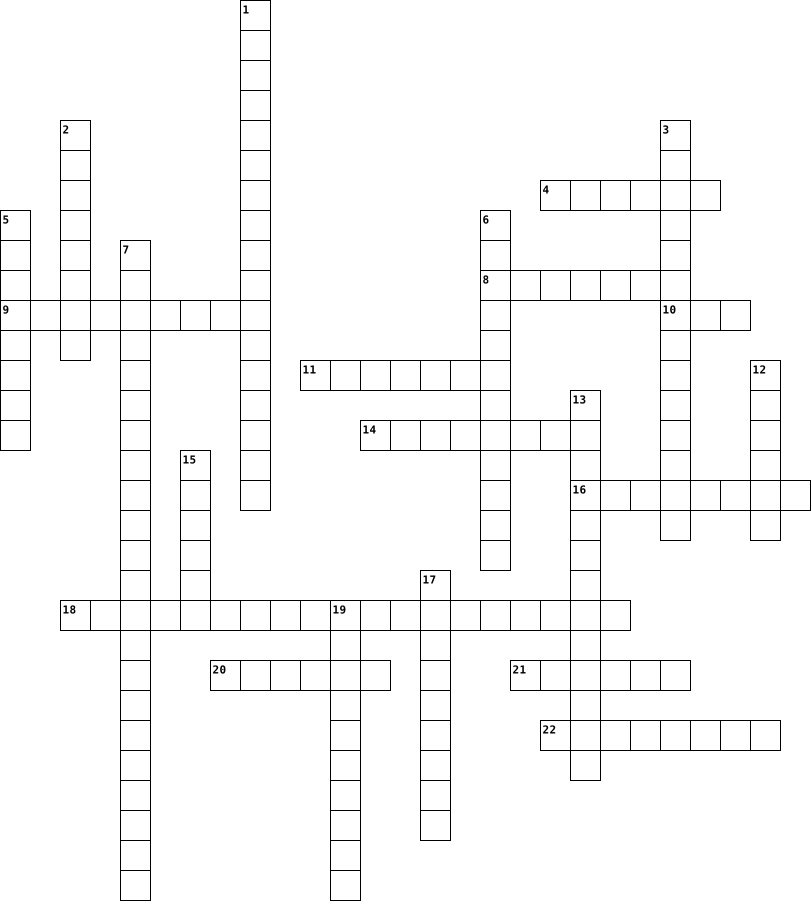
Across
- is anything that has mass and takes up space
- this chemistry is the study of chemicals containing carbon
- An element
- the best known compound
- An element that possesses characteristics that fall between those of chlorine and iodine.
- A compound with C6H14O6 molecular formula and structural formula below
- the first element on the periodic table
- It seeks to create chemical products and processes that are not only environmentally friendly but also socially responsible and economically viable.
- the positive particle in an atom
- An asymmetric carbon atom (chiral carbon) is a carbon atom that is attached to four different types of atoms or groups of atoms.
- the negative particle in an atom
Down
- chemistry, (chemistry and physics).
- two or more elements bonded together
- A set of principles that guide the design and the development of safer chemical products and processes by reducing or eliminating the use and production of hazardous substances.
- the things on the periodic table
- (Chemistry and biology).
- Used in several industries like oil refineries and chemical plants mainly for purification and separation of many organic compounds
- A solution that can resist pH change upon the addition of an acidic or basic components
- a helium nuclei
- the centre of an atom
- chemistry, (medicine and chemistry).
- this is a reaction that release energy
22 Clues: An element • a helium nuclei • the centre of an atom • the best known compound • (Chemistry and biology). • the things on the periodic table • the positive particle in an atom • the negative particle in an atom • chemistry, (chemistry and physics). • two or more elements bonded together • chemistry, (medicine and chemistry). • this is a reaction that release energy • ...
Chapter 2 Review (Lessons 1 & 2) 2023-10-25

Across
- the amount of energy needed to raise the temperature of water
- on the periodic table it tells us the number of protons in an atom's nucleus
- when water molecules stick to other water molecules
- substance in a solution that is dissolved
- center of the atom
- bond formed when electrons are shared between atoms
- when water molecules stick to different substances
- mixture of water and undissolved material
- a material where all components are evenly distributed
- solution with a pH that is greater than 7; produces OH- ions in solution
- substance in a solution that does the dissolving
- the universal solvent
- bond formed when electrons are transferred from one atom to another
Down
- basic unit of matter
- solution with a pH that is less than 7; produces H+ ions in solution
- a positively or negatively charged atom
- subatomic particle with a negative charge
- subatomic particle with a positive charge
- on the periodic table it tells us the total protons + neutrons in an atom's nucleus
- a weak acid or base that prevents sharp changes in pH
- pure substance of one atom
- atoms of the same element with different numbers of neutrons
- material composed of 2 or more elements or compounds that are physically combined
- subatomic particle with a neutral charge
- substance formed by the chemical combination of two or more elements
25 Clues: center of the atom • basic unit of matter • the universal solvent • pure substance of one atom • a positively or negatively charged atom • subatomic particle with a neutral charge • subatomic particle with a negative charge • subatomic particle with a positive charge • substance in a solution that is dissolved • mixture of water and undissolved material • ...
IPC - MT 2 2023-12-11

Across
- number the number of protons in the nucleus of an atom
- a change in matter that produces one or more new substances
- mixture in which different materials can be distinguished easily
- subatomic particle that has a negative charge and is found outside the nucleus
- the smallest particle of an element that retains the properties of that element
- a column on the periodic table
- the electrons in the outermost shell of an atom
- a state of matter with no definite shape or volume
- a substance made up of atoms of two or more different elements joined by chemical bonds
- the number of protons and neutrons in an atom of an element
- a state of matter that has a definite shape and definite volume
- anything that has mass and takes up space
- mass/volume
Down
- elements that are good conductors of heat and electric current
- mixture in which substances are evenly distributed throughout the mixture
- the process by which one or more substances change to produce on or more different substances
- reaction that absorbs energy in the form of heat
- a subatomic particle that has a positive charge and is found inside the nucleus
- the center of an atom which contains the protons and neutrons
- a horizontal row of elements on the periodic table
- atoms of the same element that have different numbers of neutrons
21 Clues: mass/volume • a column on the periodic table • anything that has mass and takes up space • the electrons in the outermost shell of an atom • reaction that absorbs energy in the form of heat • a state of matter with no definite shape or volume • a horizontal row of elements on the periodic table • number the number of protons in the nucleus of an atom • ...
Grade 9 Chemistry 2023-11-22

Across
- An example of an endothermic process
- The chemical name for rust
- This is formed when calcium reacts with hydrochloric acid
- 20% of the air is this gas
- An element with the chemical symbol Be
- Group 8 elements are known as .........
- This is where you find electrons
- Group 7 elements are known as the........
- This is formed when charcoal burns
- How many electrons fit in the second shell
- Group 1 elements are known as the......
- Rusting is this type of reaction
- One of the noble gases
- He discovered the proton
- A type of fuel
Down
- These are found inside the nucleus
- This material can be used instead of glass to measure temperature changes in chemical reactions
- This substance added to citric acid is an endothermic reaction
- These are found on the right-hand side of the Periodic Table
- These atomic particles have no charge
- How many electrons fit in the first shell
- In an endothermic reaction, the temperature .......
- These are on the left-hand side of the Periodic Table
- An element with the chemical symbol Si
- chloride Dissolving this chemical is an endothermic process
- One of the alkali metals
- In an exothermic reaction the temperature .........
- This is formed with the combustion of hydrogen
- He discovered the electron
- This is needed for combustion
30 Clues: A type of fuel • One of the noble gases • One of the alkali metals • He discovered the proton • The chemical name for rust • 20% of the air is this gas • He discovered the electron • This is needed for combustion • This is where you find electrons • Rusting is this type of reaction • These are found inside the nucleus • This is formed when charcoal burns • ...
Chemistry Midterm 2023-12-14

Across
- A negatively charged, fast-moving particle
- The extremely small, positively charged, dense center of an atom
- A neutral, subatomic particle in an atom’s nucleus
- Describes a relationship in nature that is supported by many experiments
- A highly reactive group 17 element
- A tentative, testable, statement or prediction about what has been observed
- The sum of protons and neutrons
- A transition of matter from one state to another
- Electrons on the outermost energy level
- The amount of heat required to raise the temperature of a given substance by one degree Celsius
- An explanation supported by many experiments
- A subatomic particle in an atom’s nucleus that has a positive charge
Down
- A 3-d region around the nucleus
- The amount of mass per unit volume
- A vertical column of elements in the periodic table arranged in order of increasing atomic number
- Group 1 elements
- An extremely unreactive group 18 element
- Gaseous state of a substance that is a liquid or a solid at room temperature
- The SI unit of heat and energy
- A pure substance that cannot be broken down into simpler substances
- Atoms of the same element with different numbers of neutrons
- The smallest particle of an element
- The study of matter and the changes it undergoes
- A horizontal row of elements in the modern periodic table
24 Clues: Group 1 elements • The SI unit of heat and energy • A 3-d region around the nucleus • The sum of protons and neutrons • The amount of mass per unit volume • A highly reactive group 17 element • The smallest particle of an element • Electrons on the outermost energy level • An extremely unreactive group 18 element • A negatively charged, fast-moving particle • ...
Patterns of the Periodic Table 2024-05-15

Across
- Elements whose atomic numbers range from 57 to 71
- How easily a substance reacts chemically with other substances.
- A row of chemical elements
- The number of protons in the nucleus of an atom
- A positively charged ion
- Elements are arranged in an order, which their properties would repeat after some period
- Elements that are usually poor conductors
- An atom or molecule that has a different number of electrons than protons
- Another word for family
- Reacts with water on the periodic table
- Elements found in groups 3-12
- Elements who sit between the transition metals on their left, and the metalloids on their right
Down
- A series of metallic elements whose atomic numbers start from 89 and end at 103
- Reactive but less than alkali metals
- Electrons that are in the outermost energy level
- The distribution of electrons of an atom or molecule in atomic or molecular orbitals
- Toxic, non-metallic element group
- A column of elements in the periodic table of the chemical elements
- The process by which ions are formed by gain or loss of an electron from an atom or molecule
- A negatively charged ion
- Elements whose properties are between metals and nonmetals
- Historically, the inert gasses
- To the left of the metalloids
- The mass of an atom
- Atomic mass rounded
25 Clues: The mass of an atom • Atomic mass rounded • Another word for family • A positively charged ion • A negatively charged ion • A row of chemical elements • To the left of the metalloids • Elements found in groups 3-12 • Historically, the inert gasses • Toxic, non-metallic element group • Reactive but less than alkali metals • Reacts with water on the periodic table • ...
Semester 1 puzzle 2024-04-18

Across
- The element that is found in period 3, group 13 of the periodic table
- The study of matter and energy and the interaction between them
- The ability to be hammered or pressed into sheets
- A way of reporting data based on numbers and obtain by measurement
- A mixture that does not have an uniform appearance and is unevenly distributed
- A row in the periodic table of the elements
- Anything that has mass and occupy space
- A workable explanation or description of a phenomenon
- A negatively charged ion
- Both the protons and neutrons are found in an atom
- The electrons found on the outer most energy level is known as _____ electrons
Down
- The study of the composition, structure, and properties, and changes in matter.
- Law of octave states that every _____ element is similar
- An SI unit that represents the intensity of light
- A subatomic particle found in the nucleus of an atom, and is having a positive charge
- The relatively slow form of vaporization
- One of the scientific inquiry processes that allow initial, testable explaination
- A pure substance that consist of atoms with the same atomic number
- Any elements found in Group 17 are known as ----
- An element found in the inner-transition metal and has an atomic number of 92
- The state of matter in which particles vibrates in fixed positions, have a fixed shape and volume
21 Clues: A negatively charged ion • Anything that has mass and occupy space • The relatively slow form of vaporization • A row in the periodic table of the elements • Any elements found in Group 17 are known as ---- • An SI unit that represents the intensity of light • The ability to be hammered or pressed into sheets • Both the protons and neutrons are found in an atom • ...
Periodic Trends 2024-11-20

Across
- Noble gas with the largest atomic size
- Trends that deals with attraction of an atom to electrons
- Element with the largest electronegativity in period 4
- Energy needed to remove an electron from an atom (2 words)
- Elements that have the same atomic number but different number of neutrons is called this
- Ions that are smaller than the neutral atom they form from
- Ions that are largest than the neutral atom they form from
- Alkali metal with the largest atomic radius
- Trend determine by the distance of the nucleus to the valence electron (2 words)
- Number of protons + neutrons in Hydrogen-3
- Number of protons in Hydrogen-3
- Chlorine is a member of this family
Down
- Transition metal with the largest ionization energy
- Alkaline earth metal with the largest atomic size
- Number of neutrons in Calcium-40
- Most electronegative element in periodic table
- Smallest element in the periodic table
- Largest element in period 4
- Alkaline earth metal with the highest electronegativity
- Least electronegativity element in period 2
- The atomic _____ is written on the bottom left of the symbol
- Halogen with the lowest ionization energy
- Number of neutrons in Hydrogen-3
- _____ electrons are the electrons in the outermost shell of an atom
- Element in period 3 with the lowest ionization energy
25 Clues: Largest element in period 4 • Number of protons in Hydrogen-3 • Number of neutrons in Calcium-40 • Number of neutrons in Hydrogen-3 • Chlorine is a member of this family • Noble gas with the largest atomic size • Smallest element in the periodic table • Halogen with the lowest ionization energy • Number of protons + neutrons in Hydrogen-3 • ...
Chemical Reactions 2025-01-13

Across
- A chemical substance that has a soapy feel and accepts hydrogen ions (H+)
- Two or more atoms bonded together
- The breaking down of a substance, particularly metals, due to a reaction with the environment
- number The number of particles in the nucleus (protons plus neutrons)
- Two or more different atoms bonded together
- A reaction in which two soluble solutions produce an insoluble solid
- A reaction in which a substance burns with oxygen to produce heat
- A reaction in which the product is neither acidic or basic
- The horizontal rows on a periodic table
Down
- A reaction in which one reactant breaks up into two or more parts
- A chemical substance that has a sour taste and releases hydrogen ions (H+)
- Number The number of protons in an atom
- A negatively charged subatomic particle that is found in a cloud around the nucleus of an atom.
- A neutrally charged subatomic particle found in the nucleus of an atom.
- A substance that contains only one type of atom
- The smallest building blocks of matter.
- A positively charged subatomic particle found in the nucleus of an atom.
- Atoms of the same element with different numbers of neutrons
- The vertical rows on a periodic table
- The combining power of an atom due to the number of electrons in the outer shell
20 Clues: Two or more atoms bonded together • The vertical rows on a periodic table • Number The number of protons in an atom • The smallest building blocks of matter. • The horizontal rows on a periodic table • Two or more different atoms bonded together • A substance that contains only one type of atom • A reaction in which the product is neither acidic or basic • ...
random chem 2025-04-30

Across
- complimentary color to violet
- a dissolved substance in a solution
- gas state to solid
- having a low affinity for water and more affinity for non-polar molecules
- attraction between molecules
- reaction in which two molecules are combined into one molecule and water is eliminated
- A type of reaction in which two or more substances combine to form a new and chemically different substance
- A type of reaction in which hydrocarbons react with oxygen gas to produce carbon dioxide and water
- substance that increases the rate of reaction but is itself unchanged at the end of the reaction
- A row of elements in the periodic table.
- A type of reaction in which a single compound breaks down into simpler parts.
Down
- solid state to gas
- a reaction in which hydrogen is added, electrons are added, or oxygen is removed
- a liquid that can dissolve other substances to make a solution
- having an affinity for water
- bond between atoms within a molecule
- molecule consisting of many subunits linked by covalent bonds
- complimentary color to orange
- a reaction in which hydrogen is removed, electrons are removed, or oxygen is added
- a type of isotope with an unstable nucleus which can emit raditation
- substance per unit volume
- A column of elements in the periodic table, sometimes also called a family of elements
22 Clues: solid state to gas • gas state to solid • substance per unit volume • having an affinity for water • attraction between molecules • complimentary color to violet • complimentary color to orange • a dissolved substance in a solution • bond between atoms within a molecule • A row of elements in the periodic table. • molecule consisting of many subunits linked by covalent bonds • ...
science 2025-09-15

Across
- Negatively charged particle orbiting the nucleus.
- Strong metal element in crust and core.
- Common element in living things.
- Common element in Earth’s crust.
- State of matter with no definite shape or volume.
- Lightest and most abundant element in the universe.
- State of matter with definite shape and volume.
- A type of property that can be observed without changing matter.
- A high-energy state of matter found in stars.
- Two or more substances physically combined.
- Mass divided by volume.
- State of matter with definite volume but no shape.
- A type of property that describes how matter changes.
- Major element in Earth’s atmosphere.
- A characteristic used to describe matter.
- Chart that organizes elements by atomic number and properties.
- Two or more atoms bonded together.
- The smallest unit of matter.
- Positively charged particle in the nucleus.
Down
- Neutral particle in the nucleus.
- The amount of matter in an object.
- The center of an atom containing protons and neutrons.
- Lightweight element in Earth’s crust.
- The space an object occupies.
- Refers to the periodic table that organizes elements.
- A pure substance made of one kind of atom.
- Anything that has mass and takes up space.
- Common element in Earth’s crust and living things.
- What matter does during a chemical change.
- Two or more different atoms chemically combined.
30 Clues: Mass divided by volume. • The smallest unit of matter. • The space an object occupies. • Neutral particle in the nucleus. • Common element in living things. • Common element in Earth’s crust. • The amount of matter in an object. • Two or more atoms bonded together. • Major element in Earth’s atmosphere. • Lightweight element in Earth’s crust. • ...
Periodic table and Atoms 2022-01-03

Across
- metals groups 3-12
- average
- metals group 1 (except Hydrogen)
- Negative charge
- groups 14-16
- No charge
- vertical
Down
- Positive charge
- Made up of protons,neutrons,and electrons
- group 2
- abbreviation for the element
- number of protons and neutrons
- organizes the elements
- horizontal
14 Clues: average • group 2 • vertical • No charge • horizontal • groups 14-16 • Positive charge • Negative charge • metals groups 3-12 • organizes the elements • abbreviation for the element • number of protons and neutrons • metals group 1 (except Hydrogen) • Made up of protons,neutrons,and electrons
Periodic Table Crossword Puzzle 2023-12-20

Across
- This element has 6 neutrons.
- This element is in group 11 and has 79 electrons.
- This element has the atomic number of 22.
- This element is in period 4 with 30 protons.
- This family is known for having hard and shiny solids with a high melting point.
- This element is a nonmetal in period 2 with 6 protons.
Down
- This element is in period 2 and has 8 protons
- This element has 36 protons.
- This element is in the Noble gasses family and has 2 electrons.
- This element is an alkali metal with 19 electrons.
- This element is a part of the transition metals and has 155 neutrons.
- This element has an atomic mass of 1.
- This element has 29 electrons.
- This element is a part of the halogen family with 125 neutrons.
14 Clues: This element has 6 neutrons. • This element has 36 protons. • This element has 29 electrons. • This element has an atomic mass of 1. • This element has the atomic number of 22. • This element is in period 4 with 30 protons. • This element is in period 2 and has 8 protons • This element is in group 11 and has 79 electrons. • ...
Elements and Table Periodic 2024-01-02

Across
- This gas helps clean swimming pools
- Often used to make rings and jewellery
- The element's chemical symbol is Ar
- The simple particle in the particle model
- You can find all the elements listed here
- About 78% of the Earth's atmosphere
- This gas can be used to fill party balloons
- This element is mostly known to build maintain strong bones
- This element's chemical symbol is Be
Down
- This element's chemical symbol is K
- About 21% of the Earth's atmosphere
- This element is black and usually can be found inside a pencil
- The element''s chemical symbol is Mg
- This element's number is 1
14 Clues: This element's number is 1 • This element's chemical symbol is K • This gas helps clean swimming pools • About 21% of the Earth's atmosphere • The element's chemical symbol is Ar • About 78% of the Earth's atmosphere • The element''s chemical symbol is Mg • This element's chemical symbol is Be • Often used to make rings and jewellery • ...
THE PERIODIC TABLE (ELEMENTS) 2024-04-30

Across
- most unreactive metals and does not rust
- the most abundant element in the earth's crust
- we LOVE bananas
- most chemically reactive element
- 80% of earth's outer and inner crust
- used to strengthen our bones
- tasteless and colorless
- is used in televisions and lasers
Down
- used to create green colored fireworks
- the most abundant element on earth
- only metal that is liquid at earth's crust
- most abundant metal on earth
- sometimes called the "king of elements"
- period 4 group 10
14 Clues: we LOVE bananas • period 4 group 10 • tasteless and colorless • most abundant metal on earth • used to strengthen our bones • most chemically reactive element • is used in televisions and lasers • the most abundant element on earth • 80% of earth's outer and inner crust • used to create green colored fireworks • sometimes called the "king of elements" • ...
Chemistry Vocab 2023-08-18

Across
- another word for huge
- turn this up when the music is good
- 2 chemicals stuck together
- length
- periodic table
- combination
Down
- can be accelerated
- a perfect element
- makes rocks heavy
- anything that takes up space
10 Clues: length • combination • periodic table • a perfect element • makes rocks heavy • can be accelerated • another word for huge • 2 chemicals stuck together • anything that takes up space • turn this up when the music is good
Idk 2026-03-30

Across
- _____ Nose
- A town
- _____ Something
- What a bride wears
- A kids TV show
Down
- _________ Storm
- Another word for Mum
- A Word for autism
- The people who made the great pyramids
- 118th Elemnt on the periodic table
10 Clues: A town • _____ Nose • A kids TV show • _________ Storm • _____ Something • A Word for autism • What a bride wears • Another word for Mum • 118th Elemnt on the periodic table • The people who made the great pyramids
Nuclear Vocab Samuel Maria 2021-11-08

Across
- The number of protons in the nucleus of an atom, it also shows the number of chemical properties of an element on the periodic table.
- The time required for of something to go through a process.
- High energy/speed electron is a _______?
- A stable subatomic particle that has a positive charge.
- A stable subatomic particle that has a neutral charge.
- One or two atoms of a element with the same atomic number and position in the periodic table.
Down
- One of three or more closely related chemical substance An unstable form of an element that releases radiation and breaks down to become stable.
- The processes of dividing or splitting something into parts.
- Total number of protons and neutrons in a nucleus.
- The processes or result of 2 or more things becoming one.
- The process where an atom losses particles.
- Is a positively charged particle
12 Clues: Is a positively charged particle • High energy/speed electron is a _______? • The process where an atom losses particles. • Total number of protons and neutrons in a nucleus. • A stable subatomic particle that has a neutral charge. • A stable subatomic particle that has a positive charge. • The processes or result of 2 or more things becoming one. • ...
Types of Substances: Elements, Compounds and Mixtures 2013-06-13

Across
- a particle which two or more atoms of the same non-metal element are chemically bonded together
- Pure substance made of only one type of atom
- Collection of symbols and numbers that represents the number of atoms in a practise of an element or copound
- Both a philosophy and ancient practise of science
- pure substance made up of two or more differnt atoms chemically bonded together
- a column down the periodic table
Down
- Substance made of the same types of particles
- a particle which two or more atoms of different non-metal elements are bonded together
- Substance made of different types of particle, physically combined
- A letter (or letters) of the alphabet used to represent an atom of a specifc chemical element
- a rrow across the periodic table
- a molecule consisting of two atoms('di-' meaning 'two'; 'atomic' meaning 'atom')
12 Clues: a rrow across the periodic table • a column down the periodic table • Pure substance made of only one type of atom • Substance made of the same types of particles • Both a philosophy and ancient practise of science • Substance made of different types of particle, physically combined • pure substance made up of two or more differnt atoms chemically bonded together • ...
Elements 2020-11-23

Across
- Capital of Georgia
- hot that can burn
- something that eats it's own species
- sweet treat
- catch fish with
- Fe on the periodic table
Down
- Smell with this
- Meat from a pig
- this makes you laugh
- something you do with your eyes
- someone that is good at something
- where we live
- do this with your legs
13 Clues: sweet treat • where we live • Smell with this • Meat from a pig • catch fish with • hot that can burn • Capital of Georgia • this makes you laugh • do this with your legs • Fe on the periodic table • something you do with your eyes • someone that is good at something • something that eats it's own species
CHemPeriodicity 2022-10-24

Across
- Where you can locate electrons (orientations)
- Created Modern Table
- As the number of energy levels increses, attraction weakens
- s,p,d,f are examples of
Down
- Desire to gain more electrons
- Attraction of the Nucleus to Valence Electrons
- Energy Energy needed to remove an electron
- Size of the atom
- Father of Periodic table
9 Clues: Size of the atom • Created Modern Table • s,p,d,f are examples of • Father of Periodic table • Desire to gain more electrons • Energy Energy needed to remove an electron • Where you can locate electrons (orientations) • Attraction of the Nucleus to Valence Electrons • As the number of energy levels increses, attraction weakens
Braxton's science crossword 2024-09-14

Across
- something u cant change back
- a physical blend of two or more substances
- a table of elements
- is everything
- homogeneous mixture of one or more solutes dissolved in a solvent
Down
- something that changes the physical appearance of an object
- something on the periodic table
- an element chemically bonded together
- is in everything
9 Clues: is everything • is in everything • a table of elements • something u cant change back • something on the periodic table • an element chemically bonded together • a physical blend of two or more substances • something that changes the physical appearance of an object • homogeneous mixture of one or more solutes dissolved in a solvent