
periodic%20table Crossword Puzzles
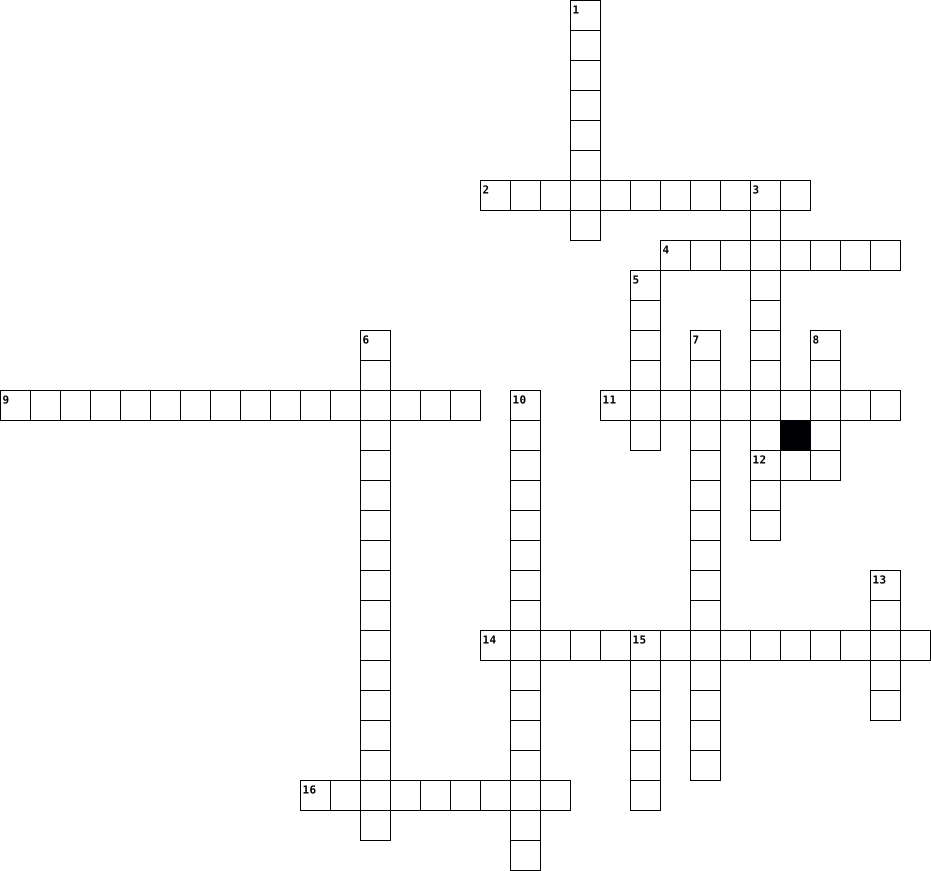
Brailynn crossword puzzle 2022-11-17

Across
- What month was helium discovered in?
- What is number 2 on the periodic table?
- Who created the periodic table?
- Who discovered gold?
- what element is Fe?
- What is number 1 on the periodic table?
Down
- What element has the atomic mass of 24.305?
- who discovered Chlorine?
- who discovered Radon?
- What is number 103 on the periodic table?
- What is number 109 on the periodic table?
- What element has a melting point of 1455 degrees Celsius
12 Clues: what element is Fe? • Who discovered gold? • who discovered Radon? • who discovered Chlorine? • Who created the periodic table? • What month was helium discovered in? • What is number 2 on the periodic table? • What is number 1 on the periodic table? • What is number 103 on the periodic table? • What is number 109 on the periodic table? • ...
Periodic table 2017-06-08

Across
- A scientific representation that helps us understand what is happening or how something works.
- A vertical column of elements on the periodic table.
- Usually electrical insulators poor conductors.
- Regular arrangement of molecules. Diamonds emeralds etc.
- The starting chemicals in a reaction.
- The chemicals that we end up in a reaction.
- The smallest whole part of matter.
- An element or a compound
- A group of atoms chemcically joiined together
- A sign or abbreviation to represent an element
- Another word for what everything is made of.
Down
- shiny materials which are good conductors of heat and electricity
- Contains only one type of atom and is listed on the periodic table.
- What distinguishes one substance from another
- A horizontal row of the periodic table.
- A chmical something combines substances together
- This means joined together.
- Form of matter-solid,liquid,gas.
- Table where we find all the lements listed.
- A recipe for a particular chemical compound
20 Clues: An element or a compound • This means joined together. • Form of matter-solid,liquid,gas. • The smallest whole part of matter. • The starting chemicals in a reaction. • A horizontal row of the periodic table. • The chemicals that we end up in a reaction. • Table where we find all the lements listed. • A recipe for a particular chemical compound • ...
periodic table 2013-05-20

Across
- pure substances that are composed of two or more types of elements thet are chemically combined
- ability to be hammered into different shapes
- the component substances cannot be visibly
- heavy for their size
- heat and electricity move through easily
- new substance in a chemical reaction
- the component substances can be visibly
- a vertical colunms on the periodic table, also known as groups
- ability to be drawn into a wire
- composed of two or more different substances that are physically combined
- located on the left side of the zigzag line on the periodic table
Down
- heat and electricity do not move through easily
- having a shiny surface
- pure substances that cannot be changed into simpler sustances
- located on the right side of the zigzag line on the periodic table
- the number show how many of each kind of atom are in the compound
- substances combined in a chemical reaction
- a horizontal row on the periodic table
- break easily
- not shiny
20 Clues: not shiny • break easily • heavy for their size • having a shiny surface • ability to be drawn into a wire • new substance in a chemical reaction • a horizontal row on the periodic table • the component substances can be visibly • heat and electricity move through easily • the component substances cannot be visibly • substances combined in a chemical reaction • ...
Electrons and The Periodic Table 2022-01-26

Across
- The most reactive element on The Periodic Table.
- The modern-day Periodic Table is organized by increasing atomic ___.
- These are good conductors of energy.
- These elements are usually gases, except sulfur, Phosphorus, and Bromine.
- These rays have the shortest wavelength.
- This is a negatively charged, subatomic particle found in all atoms.
- Least reactive elements on The Periodic Table.
- The ability of an atom to attract electrons from another element.
- The greek word for frequency.
Down
- These elements share the properties of nonmetals and metals.
- As wavelength decreases, frequency ____.
- This principle states that electrons must occupy the lowest energy level first.
- The greek word for wavelength.
- Electrons move and behave like ____.
- On the Aufbau Diagram, electrons are depicted as ___.
- Published the first version of The Periodic Table.
- What is the height of the wave from zero to crest?
- The name of the elements in group 7A.
- How many electrons can each orbital hold?
- The number of orbitals block F contains.
20 Clues: The greek word for frequency. • The greek word for wavelength. • These are good conductors of energy. • Electrons move and behave like ____. • The name of the elements in group 7A. • As wavelength decreases, frequency ____. • These rays have the shortest wavelength. • The number of orbitals block F contains. • How many electrons can each orbital hold? • ...
Chemistry Vocab 2021-12-09

Across
- Rows on the periodic table.
- A table in which organizes all of the known elements.
- Has properties of both nonmetals and metals.
- An object in motion, stays in motion unless acted upon by another force.
- Speed or direction change.
- A push or pull measured by Newtons.
- One of the 5 key evidences in which includes bubbles, steam, smell, and smoke.
- A change that doesn't alter the chemical composition.
- A law in which states that matter cannot be created nor destroyed.
Down
- Can be pulled into a wire.
- Distance an object travels divided by time.
- Takes up most of the periodic table.
- The amount of key evidences that a chemical reaction has happened.
- Columns on the periodic table.
- How reactive something is.
- Speed and a direction.
- Brittle, insulator, dull, and is found on the right side of the periodic table.
- Can bend.
- The more of this, the more stable an element is.
- A change that permanently alters the chemical composition.
20 Clues: Can bend. • Speed and a direction. • Can be pulled into a wire. • How reactive something is. • Speed or direction change. • Rows on the periodic table. • Columns on the periodic table. • A push or pull measured by Newtons. • Takes up most of the periodic table. • Distance an object travels divided by time. • Has properties of both nonmetals and metals. • ...
Chemistry 2024-08-09

Across
- anything that has mass and volume
- neutral charge
- a state of matter that expands to fill its container
- a measure of how much space something occupies
- table a table of chemical elements arranged in order of atomic number
- group two of the periodic table
- two or more atoms chemically bonded
- a state of matter that does not take up the space of it's container
- two or more substances that are not chemically bonded
- made of one type of atom
Down
- group one on the periodic table
- positive charge
- a state of matter that is in between a solid and a gas
- group eighteen of the periodic table
- two or more elements chemically bonded
- a measure of how much space something takes up (is similar to weight)
- simplest particle of an element
- negative charge
- a state of matter that fills the container
- a gas made of nitrogen, oxygen, and argon
- group seventeen of the periodic table
21 Clues: neutral charge • positive charge • negative charge • made of one type of atom • group one on the periodic table • simplest particle of an element • group two of the periodic table • anything that has mass and volume • two or more atoms chemically bonded • group eighteen of the periodic table • group seventeen of the periodic table • two or more elements chemically bonded • ...
Chemistry Crossword puzzle 2022-12-07

Across
- Different words for the rows and columns on the periodic table
- How an element is identified
- Located in in electron cloud and has a negative charge
- Substances that are located on the stairs of the periodic table
- The mass of an elements atom
- Two parts of a atom that are equal to eachother
- Located in the nucleus and has a positive charge
- How the periodic table is arranged
Down
- Substances located on the right side of the periodic table
- Substances located on the left side of the period table
- Something made up of one type of atom
- The number of protons in a nucleus
- The structure of an atom
- The study of the makeup of chemical elements and their structure
- The center of an atom
- Rows and collumns of substances organized by atomic number
- A group of electrons surrounding the nucleus
- A representation of an atom
- Smallest part of an element
- Located in the nucleus and has a negative charge
20 Clues: The center of an atom • The structure of an atom • A representation of an atom • Smallest part of an element • How an element is identified • The mass of an elements atom • The number of protons in a nucleus • How the periodic table is arranged • Something made up of one type of atom • A group of electrons surrounding the nucleus • ...
Chemistry Extra Credit 2025-04-02

Across
- a part or aspect of something abstract, especially one that is essential or characteristic
- group 2 on periodic table
- positively charged ion
- the basic unit of a chemical element.
- group 17 on periodic table
- and car}bon dioxide
- A chemical bond formed when two atoms share two
- a thing that is composed of two or more separate elements; a mixture.
- group 18 on periodic table
Down
- neutral subatomic particle
- group 1 on periodic table
- able to be hammered or pressed permanently out of shape without breaking or cracking.
- forms of the same element that contain equal numbers of protons but different numbers of neutrons
- negative subatomic particle
- A bond between atoms or ions that allows molecules to form
- positive subatomic particle
- negatively charged ion
- dissolved in water
- When a compound combines with oxygen gas to form water,
- all of the atoms (or ions) are arranged in a regular grid pattern
20 Clues: dissolved in water • and car}bon dioxide • positively charged ion • negatively charged ion • group 1 on periodic table • group 2 on periodic table • neutral subatomic particle • group 17 on periodic table • group 18 on periodic table • negative subatomic particle • positive subatomic particle • the basic unit of a chemical element. • A chemical bond formed when two atoms share two • ...
Chemistry Extra Credit 2025-03-28

Across
- and carbon dioxide
- neutral subatomic particle
- a part or aspect of something abstract, especially one that is essential or characteristic
- A bond between atoms or ions that allows molecules to form
- negatively charged ion
- group 1 on periodic table
- negative subatomic particle
- a thing that is composed of two or more separate elements; a mixture.
- positive subatomic particle
- dissolved in water
Down
- positively charged ion
- group 17 on periodic table
- When a compound combines with oxygen gas to form water,
- group 2 on periodic table
- the basic unit of a chemical element.
- A chemical bond formed when two atoms share two
- able to be hammered or pressed permanently out of shape without breaking or cracking.
- all of the atoms (or ions) are arranged in a regular grid pattern
- forms of the same element that contain equal numbers of protons but different numbers of neutrons
- group 18 on periodic table
20 Clues: and carbon dioxide • dissolved in water • positively charged ion • negatively charged ion • group 2 on periodic table • group 1 on periodic table • group 17 on periodic table • neutral subatomic particle • group 18 on periodic table • negative subatomic particle • positive subatomic particle • the basic unit of a chemical element. • A chemical bond formed when two atoms share two • ...
You Should Know This Stuff 2025-04-30

Across
- the element with the most protons
- a substance in which all atoms are alike
- positively charged atom
- shiny and malleable substances
- the element with the least amount of protons
- a chemical that can dissolve in water and can combine with acids to form salts
- neutral charged atom
- an element or substance that is not a metal
- the element most commonly found in bananas
- very reactive elements that form a salt when it reacts with metal
Down
- nuclear charge number
- vertical rows in the periodic table
- a substance composed of two or more chemically bonded elements in fixed proportions
- horizontal rows of the periodic table
- negatively charged atom
- the group of gasses in the periodic table
- a radioactive metallic chemical element with the atomic number 88
- the mass of an atom
- the first in the noble gas group in the periodic table
- the element that living organisms need to breathe
20 Clues: the mass of an atom • neutral charged atom • nuclear charge number • negatively charged atom • positively charged atom • shiny and malleable substances • the element with the most protons • vertical rows in the periodic table • horizontal rows of the periodic table • a substance in which all atoms are alike • the group of gasses in the periodic table • ...
Chemistry 2015-10-04

Across
- A substance consisting of atoms
- The number of protons in the element
- Vertical column in the periodic table
- Composed of two or more separate elements
- The positively charged centre of the atom containing protons and neutrons
- The electrons on the atom's outermost electron shell
- A chemical link between two atoms caused by the electrostatic force between oppositely-charged ions in an ionic compound.
- Elements 90 to 103
- A positively charged atom
- Any of the fifteen metallic elements from lanthanum to lutetium on the periodic table.
- Group 17 of the periodic table. Reactive non-metallic elements
- The smallest component of an element. Makes up all matter
- An abbreviation of a chemical element
- Elements that have the properties of both metals and non-metals
- Determines the negativity of an element
- Any of the gases in group 18 of the periodic table
Down
- state When the atom has an electron in a higher than normal level than its ground state
- the distribution of electrons in the electron shells
- An atom that is negatively charged
- The state of electrons in the atom
- The number protons and neutrons together
- The elements in the centre of the periodic table between groups 2 and 3
- Horizontal rows of the periodic table
- The outermost electron shell
- Any of the elements found in group 1 of the periodic table. Very reactive elements that readily lose their one valence electron in ionic bonding
- A particle of light
- An atom that has gained or lost electrons
- state The lowest energy state of an atom or other particle
- shell Grouping of electrons orbiting the nucleus
- An atom that has gained or lost neutrons
- Atomic structure that consists of a small, positively charged nucleus orbited by negatively charged electrons
- A subatomic particle with the same mass as a proton but without an electric charge. Holds the nucleus together
32 Clues: Elements 90 to 103 • A particle of light • A positively charged atom • The outermost electron shell • A substance consisting of atoms • An atom that is negatively charged • The state of electrons in the atom • The number of protons in the element • Vertical column in the periodic table • Horizontal rows of the periodic table • An abbreviation of a chemical element • ...
Chemistry Vocab 2023-09-28

Across
- The second group on the periodic table
- A substance/mixture in 1 phase
- the largest periodic family
- Two or more elements coming together
- A family with elements that don't readily enter chemical combintion
- To be solidified by extreme cold
- A type of material with a high conductivity
- A change of materials into another
- A material with a medium conductivity
- An element that becomes a salt when reacting with metal
- Composes all matter
- A substance on the Periodic Table
- A material with low conductivity
- Composed of Atoms
- A single kind of matter
- A state of matter with a shape and fixed volume
Down
- A substance/mixture in 2 or more phases
- An organized chart of Elements
- The name for rare metals in the periodic table
- A dissolved solution gets formed into a solid
- The amount of protons in the nucleus of an atom
- A property dependent on the size of the material
- A row on the periodic table
- A process that results in a chemical change
- A family with high radioactivity
- To be turned into a gas by heat
- A change not affecting the form of the substance
- Two or more substances that are not chemically combined
- A state of matter with no shape or fixed volume
- Any characteristic that can be viewed without altering the substances identity
- The first group of the Periodic Table
- To be liquified by heat
- A column on the periodic table
- A state of matter with no shape but a fixed volume
- The weight of an element
- When liquid condenses
- Designated Letter for an element
- A property not dependent on the size of the material
- Able to be pressed out of shape permanently
39 Clues: Composed of Atoms • Composes all matter • When liquid condenses • To be liquified by heat • A single kind of matter • The weight of an element • A row on the periodic table • the largest periodic family • An organized chart of Elements • A substance/mixture in 1 phase • A column on the periodic table • To be turned into a gas by heat • A family with high radioactivity • ...
7S Chapter 8 Vocabulary 2026-03-02

Across
- The ability of an object to transfer heat
- One of the elements in Groups 3-12 of the periodic table
- A horizontal row of elements in the periodic table
- An element that lacks most of the properties of a metal
- The ease and speed with which an element combines, or reacts, with other elements and compounds
- A one or two-letter representation of an element
- An arrangement of the elements showing the repeating pattern of their properties
- An element in Group 1 of the periodic table
- A substance that can conduct electric current under some conditions
- An element found in Group 17 of the periodic table
Down
- The way a mineral reflects light from its surface
- The ability of an object to carry an electric current
- An element in Group 2 of the periodic table
- An element in Group 18 of the periodic table
- Small, positively charged particles that are found in the nucleus of an atom
- A term used to describe a material that can be hammered or rolled into flat sheets
- A term used to describe a material that can be pulled in to a long wire
- A small particle in the nucleus of an atom with no electrical charge
- The average mass of all the isotopes of an element
- A class of elements characterized by physical properties that include shininess, malleability, ductility, and conductivity
- The number of protons in the nucleus of an atom
- An element that has some characteristics of both metals and nonmetals
- A tiny, negatively charged particle that moves around the outside of the nucleus of an atom
- Elements in the same vertical column of the periodic table; also called a family
- The central core of an atom which contains protons and neutrons
25 Clues: The ability of an object to transfer heat • An element in Group 2 of the periodic table • An element in Group 1 of the periodic table • An element in Group 18 of the periodic table • The number of protons in the nucleus of an atom • A one or two-letter representation of an element • The way a mineral reflects light from its surface • ...
7S Chapter 8 Vocabulary 2025-03-28

Across
- A tiny, negatively charged particle that moves around the outside of the nucleus of an atom
- A term used to describe a material that can be pulled in to a long wire
- An element in Group 2 of the periodic table
- The ability of an object to transfer heat
- An element in Group 18 of the periodic table
- One of the elements in Groups 3-12 of the periodic table
- An element that lacks most of the properties of a metal
- An element that has some characteristics of both metals and nonmetals
- A small particle in the nucleus of an atom with no electrical charge
- A one or two-letter representation of an element
- The way a mineral reflects light from its surface
- Elements in the same vertical column of the periodic table; also called a family
Down
- Small, positively charged particles that are found in the nucleus of an atom
- The ease and speed with which an element combines, or reacts, with other elements and compounds
- A class of elements characterized by physical properties that include shininess, malleability, ductility, and conductivity
- The ability of an object to carry an electric current
- A term used to describe a material that can be hammered or rolled into flat sheets
- An element found in Group 17 of the periodic table
- A horizontal row of elements in the periodic table
- A substance that can conduct electric current under some conditions
- The number of protons in the nucleus of an atom
- The central core of an atom which contains protons and neutrons
- The average mass of all the isotopes of an element
- An element in Group 1 of the periodic table
- An arrangement of the elements showing the repeating pattern of their properties
25 Clues: The ability of an object to transfer heat • An element in Group 2 of the periodic table • An element in Group 1 of the periodic table • An element in Group 18 of the periodic table • The number of protons in the nucleus of an atom • A one or two-letter representation of an element • The way a mineral reflects light from its surface • ...
Properties of Atoms & Molecules Unit 2 Vocabulary Review 2022-10-29

Across
- elements in column VIIIA, non-reactive elements
- row of the periodic table
- adding of oxygen to a molecule
- non-reactive
- addition of hydrogen atoms to a molecule
- those to the right of the transition metals, between transition metals and metalloids
- easily combines chemically with other elements
- top four elements in column VIIA on the periodic table
- those that do not easily react with other metals
- able to be drawn into a wire
- recycling of carbon for reuse by plants and animals
- elements on the periodic table between the metals and the non-metals
Down
- able to be hammered into a shape
- column of the periodic table
- another name for metalloid
- removal of oxygen from a molecule
- removal of hydrogen atoms from a molecule
- list of metals from most to least reactive
- elements in the center columns, labeled with the letter B
19 Clues: non-reactive • row of the periodic table • another name for metalloid • column of the periodic table • able to be drawn into a wire • adding of oxygen to a molecule • able to be hammered into a shape • removal of oxygen from a molecule • addition of hydrogen atoms to a molecule • removal of hydrogen atoms from a molecule • list of metals from most to least reactive • ...
DHT's Crazy Chemistry Crossword 2011-11-22

Across
- Periodic Table element known as Superman's ultimate weakness.
- The smallest particle of an element
- Element with the periodic table symbol "Sb"
- Element with the periodic table symbol "H"
- Chemical name for Water.
- An atom or a group of atoms that carries an electric charge
- A negative ion; an atom or goup of atoms that has gained one or more electrons
- The only periodic table element that does not solidify
- A subatomic particle with a positive charge
- The required eyewear when a chem lab is going on!
- The first name of Mr. Erlenmeyer, after whom a popular laboratory flask was named.
- The only metal that remains liquid at room temperature
Down
- The most common gas in the Earth's atmosphere
- A chemical process where plants, algae and cyanobacteria use energy from the sun to convert carbon dioxide into sugar.
- What humans breathe out
- This well-known feline brings smiles to every chemists face when seen.
- Large pincers made of welded steel often used to manipulate hot objects.
- Russian chemist credited with being the creator of the first version of the periodic table of the elements.
- Helium, Xenon and krypton belong in this group of elements
19 Clues: What humans breathe out • Chemical name for Water. • The smallest particle of an element • Element with the periodic table symbol "H" • Element with the periodic table symbol "Sb" • A subatomic particle with a positive charge • The most common gas in the Earth's atmosphere • The required eyewear when a chem lab is going on! • ...
PS 4 periodic table review puzzle 2016-11-02

Across
- rows on the periodic table
- atomic __ is the total of the protons and neutrons
- type of bond where nonmetal bonds with another nonmetal
- because an atom is neutral there is an ___ number of protons and electrons
- elements touching the stair step line on periodic table
- when an atom gains or loses an electron
- atomic number is the number of
- type of bond where nonmetal bonds with metal
- columns on the periodic table; also called families
Down
- the periodic table is arranged in order of ___ atomic number
- in a covalent bond electrons are ___
- largest section of the periodic table
- atoms join together to form these
- when an atom gains or loses a neutron
14 Clues: rows on the periodic table • atomic number is the number of • atoms join together to form these • in a covalent bond electrons are ___ • largest section of the periodic table • when an atom gains or loses a neutron • when an atom gains or loses an electron • type of bond where nonmetal bonds with metal • atomic __ is the total of the protons and neutrons • ...
Unit 2: Atoms & the Periodic Table - Vocabulary Crossword Puzzle 2021-02-12

Across
- A particle with a negative charge
- Non-reactive elements in group 18A of the periodic table
- Horizontal (⬌) rows on the periodic table
- Atoms that gain or lose electrons; becoming charged-ion Charge An electric charge that forms on an atom when it gains or loses electrons
- Atoms that lose electrons and have a positive charge
- A particle with a neutral or no charge
- The smallest parts of matter
- Highly reactive metals in group 1A of the periodic table
- Are not malleable nor ductile, poor conductors, and have a High-non reactivity
- Highly reactive non-metals in group 17A of the periodic table
- Electrons in the outermost shell
- Are malleable & ductile, good conductors, and have a High-Low reactivity
Down
- The center of an atom is called a _______
- metals that form multiple ions and colorful compounds in groups 3-12
- How a chemical substance interacts with itself or with other materials, releasing energy
- Moderately reactive metals in group 2A of the periodic table
- A particle with a positive charge
- Measuring the size of atoms based on their distance from the nucleus
- Varies in being malleable & ductile, are semi-conductors, and have a Medium-Low reactivity
- Atoms that gain electrons and have a negative charge
- Vertical (⬍) rows on the periodic table
- A visual representation of an atom where electrons move along rings surrounding the nucleus
- Atoms of the same element that have differing numbers of neutrons
23 Clues: The smallest parts of matter • Electrons in the outermost shell • A particle with a positive charge • A particle with a negative charge • A particle with a neutral or no charge • Vertical (⬍) rows on the periodic table • The center of an atom is called a _______ • Horizontal (⬌) rows on the periodic table • Atoms that gain electrons and have a negative charge • ...
Chemistry Crossword 2015-12-01

Across
- A physical property calculated by mass divided by volume
- A substance that helps a chemical reaction to proceed more quickly.
- A pseudo science that involved turning things into gold
- The person who came up with the current periodic table
- A vertical column on the periodic table that have similar properties
- Table A table that organizes the elements
- A slow chemical change that occurs when oxygen in the air reacts with a metal.
- Group 17 elements in the periodic table: the most reactive non-metals.
- Gas to liquid
- The process of losing heat to turn from a gas to a solid
- A atom model developed by J.J. Thomson
- A horizontal row on the periodic table
- A change of state from liquid to a solid.
- A neutral charged Elementary Particle that forms part of the Nucleus
Down
- A pure stance that can’t be separated any more, 118 of them
- A physical property based on the Moh’s scale
- metal The most reactive group of metals on the periodic table
- The person who created the word Atom or Atomos
- A unit used to measure atomic mass
- A form of mixture, milk is one example
- charge Happens to an atom when it losses or gains electrons
- A negatively charged elementary Particle that moves in shells around the nucleus
- Elements that don’t react much because of their equal numbered valence shell
- The core or solid center of an atom
- A positively charged Elementary Particle that is embedded in the Nucleus
25 Clues: Gas to liquid • A unit used to measure atomic mass • The core or solid center of an atom • A form of mixture, milk is one example • A atom model developed by J.J. Thomson • A horizontal row on the periodic table • Table A table that organizes the elements • A change of state from liquid to a solid. • A physical property based on the Moh’s scale • ...
Periodic table 2025-11-06

Across
- a substance made of two or more elements chemically combined
- two or more atoms joined together
- makes a ringing sound when struck
- (4,9) does not allow heat or electricity to pass easily
- element found in every living thing
- scientist who arranged the first periodic table
- breaks or shatters easily instead of bending
- (4,9) allows heat or electricity to pass through easily
- a horizontal row on the periodic table
- one- or two-letter abbreviation used for an element
- (7,5) temperature at which a solid becomes a liquid; high in metals
- can be drawn out into wires
- can be hammered or shaped without breaking
Down
- shiny surface that reflects light
- (8,5) chart that organises all known elements by atomic number
- Greek philosopher who proposed that matter is made of tiny particles
- a vertical column on the periodic table
- state of most non-metals at room temperature
- most common element in the universe
- element in group 6 and period 2; supports burning and life
- quick to combine with other elements or compounds
- element in group 1 and period 2; a soft reactive metal
- found on the left side of the periodic table; shiny and conducts heat
- 118 types or “flavours” of substance found on the periodic table
- mass per unit volume; how tightly matter is packed
- state of most metals at room temperature
- found on the right side of the periodic table; often dull and brittle
- not shiny; opposite of lustrous
- smallest unit of an element that still has its properties
29 Clues: can be drawn out into wires • not shiny; opposite of lustrous • shiny surface that reflects light • two or more atoms joined together • makes a ringing sound when struck • most common element in the universe • element found in every living thing • a horizontal row on the periodic table • a vertical column on the periodic table • state of most metals at room temperature • ...
MODERN PERIODIC TABLE 2021-02-19

Across
- states that the physical and chemical properties of the elements recur in a systematic and predictable way when the elements are arranged in order of increasing atomic number
- name for the six nonmetallic elements that constitute Group 17 (Group VIIa) of the periodic table and considered as most reactive nonmetals
- energy required to remove an electron from a neutral atom of an element
- process by which an atom or a molecule acquires a negative or positive charge by gaining or losing electrons
- a particle, atom or molecule with a net electrical charge.
- an outer shell electron that can participate in the formation of a chemical bond
- an element that has properties that are intermediate between those of metals and nonmetals
Down
- trends specific patterns that are present in the periodic table that illustrate different aspects of a certain element, including its size and its electronic properties
- defined as one - half the distance between the nuclei of identical atoms that are bonded together
- horizontal rows on the periodic table
- measure of the ability of an atom in a chemical compound to attract electrons from another atom in the compound
- formulated the Periodic Law and created a farsighted version of the periodic table of elements
- a negatively charged ion
- energy change that occurs when an electron is acquired by a neutral atom
- vertical columns on the periodic table
- a positively charged ion
16 Clues: a negatively charged ion • a positively charged ion • horizontal rows on the periodic table • vertical columns on the periodic table • a particle, atom or molecule with a net electrical charge. • energy required to remove an electron from a neutral atom of an element • energy change that occurs when an electron is acquired by a neutral atom • ...
Periodic Table, Elements, Compounds, and Molecules 2023-02-17

Across
- O3
- C
- CO2
- The letter or letters that represent an element (e.g. Fe)
- A.M.U.
- The last column in the periodic table
- Au
- FeS2
Down
- Ge
- Ne
- The number that corresponds to each element in the periodic table
- Fe
- Am
- He
- W
- S
- C2H4
- H2O
- Ti
- O
20 Clues: C • W • S • O • Ge • O3 • Ne • Fe • Am • He • Ti • Au • CO2 • H2O • C2H4 • FeS2 • A.M.U. • The last column in the periodic table • The letter or letters that represent an element (e.g. Fe) • The number that corresponds to each element in the periodic table
Periodic Table, Elements, Compounds, and Molecules 2023-02-17

Across
- O3
- C
- CO2
- The letter or letters that represent an element (e.g. Fe)
- A.M.U.
- The last column in the periodic table
- Au
- FeS2
Down
- Ge
- Ne
- The number that corresponds to each element in the periodic table
- Fe
- Am
- He
- W
- S
- C2H4
- H2O
- Ti
- O
20 Clues: C • W • S • O • Ge • O3 • Ne • Fe • Am • He • Ti • Au • CO2 • H2O • C2H4 • FeS2 • A.M.U. • The last column in the periodic table • The letter or letters that represent an element (e.g. Fe) • The number that corresponds to each element in the periodic table
1.1 Atomic Structure & the Periodic Table 2021-01-12

Across
- these are elements in Group 2 on the periodic table
- electrons found in the outermost energy level of an atom
- vertical columns on the periodic table
- these elements are located in Groups 3-12 on the periodic table
- the total number of protons + neutrons in the nucleus
- horizontal rows on the periodic table
Down
- arranged in increasing atomic number, so that elements with similar properties fall in the same column
- subatomic particle with a negative charge
- indicates the number of protons in the nucleus of an atom
- these are the most reactive metals on the periodic table; located in Group 1
- subatomic particle with a positive charge
- subatomic particle with no charge; located in the nucleus with protons
- these elements are not reactive because they have a full outer energy level; located in Group 18
- these are the most reactive nonmetals on the periodic table; located in Group 17
14 Clues: horizontal rows on the periodic table • vertical columns on the periodic table • subatomic particle with a negative charge • subatomic particle with a positive charge • these are elements in Group 2 on the periodic table • the total number of protons + neutrons in the nucleus • electrons found in the outermost energy level of an atom • ...
Unit 2 Crossword Puzzle 2025-10-28

Across
- Group 2 on periodic table
- Between the alkaline earth metals and transition metals in period 6
- The measure of how easily an atom loses electrons
- Group 3-12 on periodic table
- Group 17 on periodic table
Down
- Increases going down a group, decreases going left to right across a period
- Group 18 on periodic table
- The measure of how easily an atom gains electrons
- The subatomic particles in the outermost shell of an atom
- Group 1 on periodic table
- Between the alkaline earth metals and transition metals in period 7
- The staircase on the periodic table
12 Clues: Group 2 on periodic table • Group 1 on periodic table • Group 18 on periodic table • Group 17 on periodic table • Group 3-12 on periodic table • The staircase on the periodic table • The measure of how easily an atom gains electrons • The measure of how easily an atom loses electrons • The subatomic particles in the outermost shell of an atom • ...
PERIODIC CLASSIFICATION OF ELEMENTS 2017-12-14

Across
- Groups in modern periodic table
- Halogens belong to this group of modern periodic table
- This classification worked well for first 20 elements
- Periods in modern periodic table
- Shortest period of modern periodic table
Down
- The number of electrons present in the valence shell of an atom of an element
- Longest period of modern periodic table
- Alkaline earth metals belong to this group of modern periodic table
- SHELL The outermost shell of an atom of an element
- These gases were discovered very late because of their low reactivity
- Incomplete period of modern periodic table
11 Clues: Groups in modern periodic table • Periods in modern periodic table • Longest period of modern periodic table • Shortest period of modern periodic table • Incomplete period of modern periodic table • SHELL The outermost shell of an atom of an element • This classification worked well for first 20 elements • Halogens belong to this group of modern periodic table • ...
MODERN PERIODIC TABLE 2021-02-19
Across
- states that the physical and chemical properties of the elements recur in a systematic and predictable way when the elements are arranged in order of increasing atomic number
- name for the six nonmetallic elements that constitute Group 17 (Group VIIa) of the periodic table and considered as most reactive nonmetals
- energy required to remove an electron from a neutral atom of an element
- process by which an atom or a molecule acquires a negative or positive charge by gaining or losing electrons
- a particle, atom or molecule with a net electrical charge.
- an outer shell electron that can participate in the formation of a chemical bond
- an element that has properties that are intermediate between those of metals and nonmetals
Down
- trends specific patterns that are present in the periodic table that illustrate different aspects of a certain element, including its size and its electronic properties
- defined as one - half the distance between the nuclei of identical atoms that are bonded together
- horizontal rows on the periodic table
- measure of the ability of an atom in a chemical compound to attract electrons from another atom in the compound
- formulated the Periodic Law and created a farsighted version of the periodic table of elements
- a negatively charged ion
- energy change that occurs when an electron is acquired by a neutral atom
- vertical columns on the periodic table
- a positively charged ion
16 Clues: a negatively charged ion • a positively charged ion • horizontal rows on the periodic table • vertical columns on the periodic table • a particle, atom or molecule with a net electrical charge. • energy required to remove an electron from a neutral atom of an element • energy change that occurs when an electron is acquired by a neutral atom • ...
Science Crossword by Charles Kajmowicz 2022-01-12

Across
- Electrons not equal to the protons
- number the # of protons in an atom
- a column of elements on the periodic table
- ion ion with a net positive charge
- what semiconductors are made of
- positively charged sub-atomic particle
- up a small portion of the periodic table
Down
- ion Ion with a net negative charge
- zero-charged sub atomic particles
- negatively charged sub-atomic particle
- a row of elements on the periodic table
- makes up most of the periodic table
- same element and different # of neutrons
- center of the atom
- the mass of an atom
15 Clues: center of the atom • the mass of an atom • what semiconductors are made of • zero-charged sub atomic particles • ion Ion with a net negative charge • Electrons not equal to the protons • number the # of protons in an atom • ion ion with a net positive charge • makes up most of the periodic table • negatively charged sub-atomic particle • positively charged sub-atomic particle • ...
Elements Recap 2024-09-13

Across
- Element at period 5, group 0.
- The smallest thing anything can be made from.
- The middle block of the periodic table are the _____ elements.
- What did the scientist who devised the periodic table leave in the table?
- A substance made from only one type of atom.
- Element at period 3, group 3.
Down
- Elements on the left hand side of the periodic table.
- Element at the top of group 5.
- Scientist who devised the periodic table (Bonus)
- Element at period 4, group 1.
- A column on the periodic table (down).
- A row on the periodic table (across).
12 Clues: Element at period 5, group 0. • Element at period 4, group 1. • Element at period 3, group 3. • Element at the top of group 5. • A row on the periodic table (across). • A column on the periodic table (down). • A substance made from only one type of atom. • The smallest thing anything can be made from. • Scientist who devised the periodic table (Bonus) • ...
Science Vocab Words 2023-05-09

Across
- Positively charged and resides in the nucleus of an atom
- each of two or more forms of the same element that contain equal numbers of protons
- Rows of the periodic table of elements
- negatively charged and resides in the electronic cloud
- A group of atoms, usually but not always representing more than one element, joined by chemical bonds
- A phenomenon whereby certain isotopes known as radioisotopes are subject to a form of decay brought about by the emission of high-energy particles
- each of more than one hundred substances that cannot be chemically interconverted or broken down into simpler substances
- The last element on the periodic table
- The first name of the person who made the periodic table
- symbol The number of protons in the nucleus of an atom
Down
- The number of protons in the nucleus of an atom
- The first element on the periodic table
- A pattern of probabilities regarding the regions that an electron can occupy within an atom in a particular energy state
- A substance made of two or more elements that have bonded chemically
- Rows of the periodic table of elements
- Neutral and resides in the nucleus of an atom
- Columns on the periodic table of elements
- The last name of the person who made the periodic table
- an atom or molecule with a net electric charge
- A group of atoms, usually but not always representing more than one element, joined by chemical bonds
20 Clues: Rows of the periodic table of elements • Rows of the periodic table of elements • The last element on the periodic table • The first element on the periodic table • Columns on the periodic table of elements • Neutral and resides in the nucleus of an atom • an atom or molecule with a net electric charge • The number of protons in the nucleus of an atom • ...
Periodic Table Crossword 2021-05-12

Across
- negatively charged particle that orbits the center of an atom
- elements and/or compounds that when put together are unable to react chemically. The noble gases (group 18) elements are inert because of a full valence shell.
- an element that has some properties of a metal and some properties of a nonmetal. The metalloids are found on the boron staircase
- positively charged particle in the nucleus of the atom
- an atom that has gained or lost one or more electrons.
- Group 1 metals on the periodic table that contain 1 valence electron and lose their valence electrons the most easily, making them the most reactive metals.
- Group 1 metals on the periodic table that contain 2 valence electrons and are the second most reactive metals.
- very center of the atom
- Group 18 elements on the periodic table that contain 8 valence electrons
- a vertical column (up and down) on the periodic table
Down
- electrons that are located in the outermost energy level of an atom
- Group 17 nonmetals on the periodic table that contain 7 valence electrons.
- describes how likely an element is to form bonds with other elements.
- an element that does not conduct electricity or heat and is usually a gas at room temperature. Nonmetals are brittle, have high ionization energies and high electronegativity values. Nonmetals tend to gain electrons to form anions. Nonmetals are found on the right side of the boron staircase.
- the number of protons contained in each nucleus of its atoms of the element. Located over the elemental symbol (at the top of the element box on the periodic table).
- the number of protons and neutrons in the nucleus of one atom of the element. Located under the elemental symbol (at the bottom of the element box on the periodic table).
- an element or substance that conducts heat and electricity, is malleable and ductile and has low ionization energy and low electronegativity values. Metals tend to lose their electrons to form cations. Metals are found on the left side of the boron staircase.
- a substance that cannot be broken down into a simpler substance by ordinary chemical means.
- a horizontal row (left to right) in the periodic table.
- the smallest unit of an element that has all of the properties of the element; basic building block of matter.
20 Clues: very center of the atom • a vertical column (up and down) on the periodic table • positively charged particle in the nucleus of the atom • an atom that has gained or lost one or more electrons. • a horizontal row (left to right) in the periodic table. • negatively charged particle that orbits the center of an atom • ...
Periodic Table: Crossword Puzzle 2012-06-06

Across
- Description of the elements on the right side of the periodic table
- The second group of the periodic table
- The number of noble gases on the periodic table
- The person who created the periodic table in 1869 to show trends between elements
- Radii from left to right and increases from top to bottom
Down
- The number of groups on the periodic table
- The element with an atomic number of 1
- Description of the elements on the left side of the periodic table
- increases from left to right and decreases from top to bottom
- The first group of the periodic table
- The number of periods there are on the periodic table
11 Clues: The first group of the periodic table • The element with an atomic number of 1 • The second group of the periodic table • The number of groups on the periodic table • The number of noble gases on the periodic table • The number of periods there are on the periodic table • Radii from left to right and increases from top to bottom • ...
Periodic Table Crossword Puzzle 2012-11-13

Across
- on the Periodic Table this color is magenta and represents a state of matter
- another name for a group
- the chemical symbol for Flourine
- describes something that repeats at regular intervals
- a column of elements
- an atomic mass of 10.8
- the name of an element
- shiny, conductor of heat, and brittle
- on the Periodic Table this color is green and represents a state of matter
- the smallest unit of an element
- the atomic mass of Phosphorus
- on the Periodic Table this color is blue and represents a state of matter
Down
- an atomic mass of 32.1
- that atomic number of Beryllium
- dull, poor conductor of heat, and not malleable
- a subatomic particle that has a positive charge
- a row of elements
- the mass of an atom expressed in atomic mass units
- the number of protons in the element
- semi-shiny, fair conductor of heat, and semi-malleable
- the symbol for magnesium
21 Clues: a row of elements • a column of elements • an atomic mass of 32.1 • an atomic mass of 10.8 • the name of an element • another name for a group • the symbol for magnesium • the atomic mass of Phosphorus • that atomic number of Beryllium • the smallest unit of an element • the chemical symbol for Flourine • the number of protons in the element • shiny, conductor of heat, and brittle • ...
Periodic Table Crossword 2014-06-04

Across
- Found to the left of the zigzag line on the periodic table
- The element with the symbol Rb
- shiny, reactive metals.
- A dark red liquid with the symbol Br
- combines with most metals to form salts
- A row of elements
- can be drawn into thin wires
- The element with the symbol Mg
- The element with the symbol Si
- The element with the symbol Hf
- The element with the symbol Na
Down
- or group A column of elements
- law the law that states that the repeating chemical and physical properties of elements change periodically with the atomic numbers of the elements
- a yellowish green gas with the symbol CI
- A dark gray solid with the symbol I
- The hardest material known.
- elements that border the zigzag line on the periodic table
- The most abundant metal in Earth's crust
- The element with the symbol N
- gases unreactive nonmetals in group 18 of the periodic table
20 Clues: A row of elements • shiny, reactive metals. • The hardest material known. • can be drawn into thin wires • The element with the symbol N • or group A column of elements • The element with the symbol Rb • The element with the symbol Mg • The element with the symbol Si • The element with the symbol Hf • The element with the symbol Na • A dark gray solid with the symbol I • ...
Chemistry Final Examination 2023-11-22
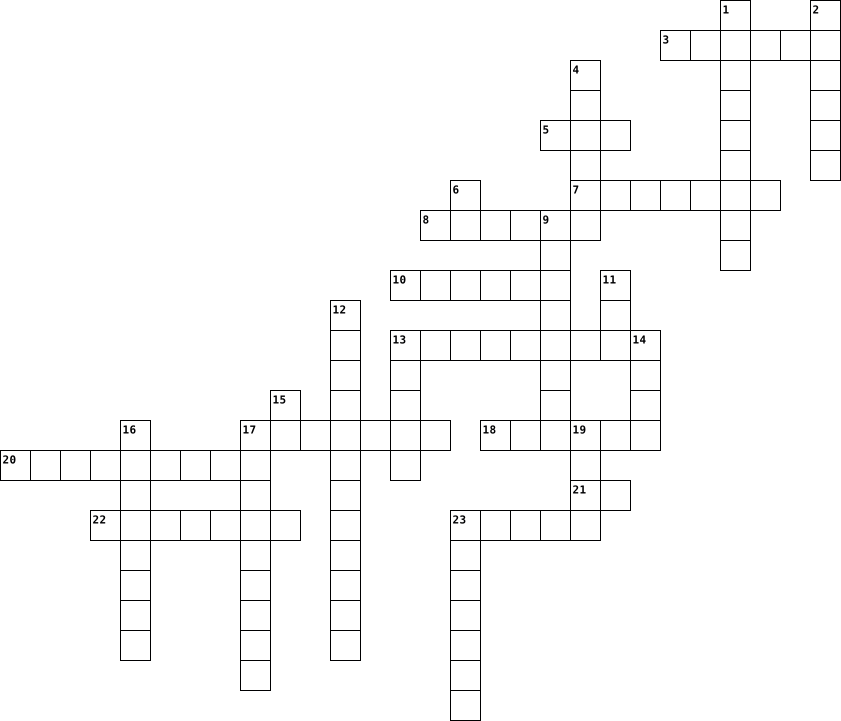
Across
- Used to hold varying volumes of liquid
- Boron, Oxygen, Itrium
- The branch of chemistry that deals with the study of carbon compounds
- Used to heat things in laboratory
- the 53th element in periodic table
- Green chemistry is an approach to chemistry that endeavour to prevent or reduce
- A flammable greenhouse gas
- Used to aide in the transfer of liquids
- OH-
- The chemical symbol for sodium
- The horizontal rows on the periodic table
- The prefix for four in chemical nomenclature
Down
- Mg
- The vertical columns on the periodic table
- Positive charge
- The chemical symbol for gold
- negative charge
- water
- branch of chemistry that focusing their study in living organisms
- He discovered the quantum theory
- salt
- The chemical symbol for helium
- combination of two or more atom
- he develop the first periodic table
- The prefix for nine in chemical nomenclature
- the one who discovered electron
26 Clues: Mg • OH- • salt • water • Positive charge • negative charge • Boron, Oxygen, Itrium • A flammable greenhouse gas • The chemical symbol for gold • The chemical symbol for helium • The chemical symbol for sodium • combination of two or more atom • the one who discovered electron • He discovered the quantum theory • Used to heat things in laboratory • the 53th element in periodic table • ...
VOCABULARY IN CHEMISTRY 2023-04-25

Across
- Type of elements in the left side of the periodic table
- Unit to measure mass
- The conditions in which a gas occupies 22.7L at 25C and 1 atm.
- Last part of the chemical reaction
- Is the mass that appears in the periodic table.
- Negative particle of the atom
- Is the number of protons of an atom.
- Energy that needs to have a molecule to react
- Type of elements in the right side of the periodic table
- Chemical property that describes the tendency of an atom or a functional group to attract electrons toward itself.
- Type of element in the last group of the periodic table
Down
- Fist part of the chemical reaction
- Ion with positive charge
- Part of chemistry that studies changes in a chemical reaction
- Ion with negative charge
- Process that involves rearrangement of atoms
- An atom with charge is called...
- Positive particle of the atom
- Element with symbol K
- Unit for the amount of substance
- Neutral particle of the atom
21 Clues: Unit to measure mass • Element with symbol K • Ion with positive charge • Ion with negative charge • Neutral particle of the atom • Positive particle of the atom • Negative particle of the atom • An atom with charge is called... • Unit for the amount of substance • Fist part of the chemical reaction • Last part of the chemical reaction • Is the number of protons of an atom. • ...
Periodic Table Crossword 2023-04-26

Across
- Elements that are dull, brittle, and often a gas at room temperature.
- Atomic number is the number of _________________ an atom has.
- ______________ gases are also called nonmetals.
- Group 17 on the Periodic Table.
- Positively charged ion.
- Bond between nonmetals.
- Atoms of the same elment that have a different number of neutrons.
- An electron _________ model has the element symbol and valence electrons.
Down
- Rows (across) on the Periodic Table.
- Columbs (up/down) on the Periodic Table.
- Atomic mass is the number of protons plus the number of ________________.
- Elements that are shiny and good conductors.
- Negatively charged ion.
- A ____________ model has the number of electrons and rings.
- The positively charged center of the atom.
- Particles with a -1 charge that occupies the space around the nucleus.
- Smallest particle of an element that retains the elements properties.
- An electron _____________ model is the most accurate model.
- Metals are found on the ___________ side of the stair step on the Periodic Table.
- An atom with charge.
20 Clues: An atom with charge. • Negatively charged ion. • Positively charged ion. • Bond between nonmetals. • Group 17 on the Periodic Table. • Rows (across) on the Periodic Table. • Columbs (up/down) on the Periodic Table. • The positively charged center of the atom. • Elements that are shiny and good conductors. • ______________ gases are also called nonmetals. • ...
Periodic Table Crossword By Rylie Restivo 2023-04-26

Across
- Atomic mass is the number of protons plus the number of ________________.
- Atomic number is the number of _________________ an atom has.
- A ____________ model has the number of electrons and rings.
- Particles with a -1 charge that occupies the space around the nucleus.
- Smallest particle of an element that retains the elements properties.
- Negatively charged ion.
- Elements that are shiny and good conductors.
- An electron _____________ model is the most accurate model.
Down
- Bond between nonmetals.
- Group 17 on the Periodic Table.
- Atoms of the same elment that have a different number of neutrons.
- Rows (across) on the Periodic Table.
- An atom with charge.
- Columbs (up/down) on the Periodic Table.
- ______________ gases are also called nonmetals.
- An electron _________ model has the element symbol and valence electrons.
- Metals are found on the ___________ side of the stair step on the Periodic Table.
- Positively charged ion.
- Elements that are dull, brittle, and often a gas at room temperature.
- The positively charged center of the atom.
20 Clues: An atom with charge. • Bond between nonmetals. • Positively charged ion. • Negatively charged ion. • Group 17 on the Periodic Table. • Rows (across) on the Periodic Table. • Columbs (up/down) on the Periodic Table. • The positively charged center of the atom. • Elements that are shiny and good conductors. • ______________ gases are also called nonmetals. • ...
Periodic Table 2025-04-30

Across
- the heaviest element found on the Periodic Table
- smallest particle of an element that retains the elements properties
- rows (going across) on the Periodic Table
- columns (going up and down) on the Periodic Table
- number of man made elements
- the total number of elements found on the Periodic Table
- number of elements found in nature
- particles with a negative charge of one that occupies the space around the nucleus
Down
- particles in the nucleus with a positive charge of 1
- atoms of the same element that have a different number of neutrons
- the number of protons an atom has
- the number of protons plus the number of neutrons
- particle in the nucleus that is electrically neutral
- an atom with a charge
- left side of the stair step line (except hydrogen)
- the correct chemical formula for salt
- right side of stair step line (+ hydrogen)
- positively charged center of the atom
- bond between nonmetals
- bond between a metal and nonmetal
20 Clues: an atom with a charge • bond between nonmetals • number of man made elements • the number of protons an atom has • bond between a metal and nonmetal • number of elements found in nature • the correct chemical formula for salt • positively charged center of the atom • rows (going across) on the Periodic Table • right side of stair step line (+ hydrogen) • ...
Elements Crossword 2025-09-08

Across
- Non-flammable noble gas that makes up just under 1% of Earth’s atmosphere
- Found in pools
- Found in fruits and vegetables like bananas, apricots, spinach, and potatoes
- Has “C” as a periodic symbol
- Makes balloons float
- Seeds, nuts, and legumes contain a lot of this element
- The first element of the periodic table
- Flammable solid found in the second group and second period of the periodic table of elements
- Makes up more than half of the atmosphere's gas
- Highly reactive element found in DNA, RNA, and ATP
Down
- Metalloid with fourteen protons
- Dairy products like milk contain this element
- Provides the saltiness in salt
- Element number ten on the periodic table
- Highly reactive gas that is in the air we breathe
- Commonly found in toothpaste, the ninth element
- Has the highest boiling point of the metalloids and five protons
- When mixed with hydrogen, this element creates a “rotten egg” smell
- Recyclable soft metal often found in tin foil
- Has three protons and three neutrons
20 Clues: Found in pools • Makes balloons float • Has “C” as a periodic symbol • Provides the saltiness in salt • Metalloid with fourteen protons • Has three protons and three neutrons • The first element of the periodic table • Element number ten on the periodic table • Dairy products like milk contain this element • Recyclable soft metal often found in tin foil • ...
The Periodic Table 2023-03-20

Across
- Mendeleev ordered the his Periodic Table by increasing atomic _____________ .
- The Modern Periodic Table is ordered by increasing atomic __________ .
- How does the reactivity change as you move down the alkali metals.
- Most metals are this state of matter at room temperature.
- A column of the Periodic Table.
- The lowest mass halogen.
- The only metal that is a liquid at room temperature.
- Metals bend and can be shaped without breaking. They are _________.
- This element is in Period 3 and Group 13.
- Non-Metals break under stress. They are _________.
- A row of the Periodic Table.
- The lowest mass alkali metal.
Down
- Moseley discovered this particle, which led to changes in the Periodic Table.
- The lowest mass Noble Gas.
- Metals have high thermal and electrical __________.
- Mendeleev left these when he believed an element had not yet been discovered.
- This element has a higher atomic number but a lower atomic mass than the element before it. This caused an issue for Mendeleev when ordering the elements.
- Mendeleev grouped elements with similar __________.
- The property of an element that relates to whether it is shiny or dull.
- This repeats every time a new period is started.
- The name of the group containing unreactive elements.
- The lowest mass alkaline earth metal.
22 Clues: The lowest mass halogen. • The lowest mass Noble Gas. • A row of the Periodic Table. • The lowest mass alkali metal. • A column of the Periodic Table. • The lowest mass alkaline earth metal. • This element is in Period 3 and Group 13. • This repeats every time a new period is started. • Non-Metals break under stress. They are _________. • ...
Periodic Table Terms 2020-10-12

Across
- First group on the periodic table
- vertical columns on the periodic table that tell you the valence electron number of an element
- a class of elements that are malleable and is a good conductor of heat and electricity
- Family that has the largest amounts of elements in it and are all metals
Down
- the number of electrons in the outermost shell of an element
- the most reactive family on the periodic table
- 2nd most reactive family on the periodic table
- also known as inert gases and are unreactive
- Top of bottom two rows taken out of the periodic table
- bottom of bottom to rows taken out of the periodic table
- horizontal rows on the periodic table
- a class of elements that are dull and a poor conductor of heat and electricity
12 Clues: First group on the periodic table • horizontal rows on the periodic table • also known as inert gases and are unreactive • the most reactive family on the periodic table • 2nd most reactive family on the periodic table • Top of bottom two rows taken out of the periodic table • bottom of bottom to rows taken out of the periodic table • ...
Chemistry vocabulary 2015-02-05

Across
- element found on the left side of the jagged line on the periodic table
- created by two or more atoms attached with chemical bonds
- charge of an ion
- substance at the start of a reaction
- atoms that lose electrons will have a ______________ charge
- scientist who created the first periodic table
- type of bond where atoms share electrons
- atom with a charge
- atoms want to have 8 valence electrons
- element found touching the jagged line on the period table
- element in group 17
- charge of a neutron
- element found on the right side of the jagged line on the periodic table
- not reactive
Down
- elements in group 1 are called _______________metals
- small number in a chemical formula
- the region in an atom where the electrons are found is called the electron ________________
- row of the periodic table
- electron on the outside of an atom
- substance created in a reaction
- atoms with 5, 6, or 7 electrons will _________ electrons to fulfill the octet rule
- positive subatomic particle in an atom
- element with 54 protons
- inert element in group 18
- subatomic particle involved in bonding
- type of bond where atoms transfer electrons
- prefix that means 4 when used in naming covalent compounds
- column in the periodic table
28 Clues: not reactive • charge of an ion • atom with a charge • element in group 17 • charge of a neutron • element with 54 protons • row of the periodic table • inert element in group 18 • column in the periodic table • substance created in a reaction • small number in a chemical formula • electron on the outside of an atom • substance at the start of a reaction • ...
The Periodic Table 2017-12-18

Across
- the ease and speed with which an element combines, or reacts, with other elements and compounds
- an element in Group 18 of the periodic table
- shininess
- the ability of an object to carry electrical current
- an element found in Group 17 of the periodic table
- an element in group 1 of the periodic table
- arrangements of the elements
- a class of elements characterized by physical properties that include shininess, malleability, ductility, and conductitvity
- the gradual wearing away of a metal element due to wear away the metal
Down
- a term used to describe materials that can be hammered or rolled into flat sheets
- 1 of the elements in group 3
- the ability of an object to transfer heat
- a horizontal row on elements in the periodic table
- an element that lacks most of the properties of a metal
- a substance that can conduct electric current under some conditions
- the average mass of all the isotopes of an element
- a one or two letter representation of an element
- a term used to describe a material that can be pulled out into long wire
- a element that has some characteristics of both metal and nonmetals
- a vertical row of elements in the periodic table
20 Clues: shininess • 1 of the elements in group 3 • arrangements of the elements • the ability of an object to transfer heat • an element in group 1 of the periodic table • an element in Group 18 of the periodic table • a one or two letter representation of an element • a vertical row of elements in the periodic table • a horizontal row on elements in the periodic table • ...
Atomic Structure & Periodic Trends Crossword Puzzle 2025-01-29

Across
- Negatively charged subatomic particle.
- Measure of an atom's ability to attract electrons.
- Principle that electrons fill orbitals starting with the lowest energy.
- Rule that electrons fill orbitals singly before pairing.
- Number: Sum of protons and neutrons in an atom.
- Element with properties intermediate between metals and nonmetals.
- Energy required to remove an electron from an atom.
- Positively charged subatomic particle.
- Nuclear Charge: Net positive charge experienced by an electron in an atom.
- Atoms of the same element with different numbers of neutrons.
- Positively charged ion.
- Exclusion principle stating no two electrons can have the same quantum numbers.
- Vertical column in the periodic table.
- Number: Number of protons in an atom's nucleus.
Down
- Effect where inner electrons reduce the nuclear charge felt by outer electrons.
- Central part of an atom containing protons and neutrons.
- Neutral subatomic particle found in the nucleus.
- Horizontal row in the periodic table.
- Metal: Group 1 elements in the periodic table.
- Negatively charged ion.
- Electrons in the outermost shell of an atom.
- Discrete quantity of energy.
- Region in an atom where an electron is likely to be found.
- Law: Properties of elements are a periodic function of their atomic numbers.
- Atom or molecule with a net electric charge.
25 Clues: Negatively charged ion. • Positively charged ion. • Discrete quantity of energy. • Horizontal row in the periodic table. • Negatively charged subatomic particle. • Positively charged subatomic particle. • Vertical column in the periodic table. • Electrons in the outermost shell of an atom. • Atom or molecule with a net electric charge. • ...
Periodic Table Crossword Puzzle 2025-11-21

Across
- a metalloid on The Periodic Table
- Lanthanides have ____ melting points and _____ boiling points (same word)
- _______ are in group 2
- Halogens are the most _______ nonmetals
- Copper is in _____ ____
- An atom will have a consistent ion chrage patter that will be produced when transfering ______ to form and ionic bond
- how many valence electrons does group 16 have?
- Mosely recognized that the Periodic Table is organized by increasing _________
- Alkiline Earth Metals have a gray white _______ when cut
- ______ are all noble gasses
- Metals _____ electrons when forming ions
- _____ is a metal
- The Halogen groups are the only groups that contain solids
- Noble gasses are on the _____ hand side of the Periodic table
- ________ are the second best conductors behind metals
- Anthinides are all _________
- Who is considered the father of the Periodic Table?
Down
- Nonmetals are ______ and break easily
- Anions are _______ that become negative ions
- All anthinides are ___ ____
- Alkali metals contain the ______ atoms in the period
- ________ metlas that are ductile and malleable
- _______ ____ are colorless, odorless, and tastlest
- The Periodic Table is organized by groups and ______
- Alkali metals are the _____ reactive metals
- Nitrogen has ____ valence electrons
- Metals will _______ when exposed to natural forces
- _________ react violently with most nonmetals
- _______ have the consistancy of cream cheese
- Metals that become positive are called ______
30 Clues: _____ is a metal • _______ are in group 2 • Copper is in _____ ____ • All anthinides are ___ ____ • ______ are all noble gasses • Anthinides are all _________ • a metalloid on The Periodic Table • Nitrogen has ____ valence electrons • Nonmetals are ______ and break easily • Halogens are the most _______ nonmetals • Metals _____ electrons when forming ions • ...
Chemistry 2022-06-20

Across
- Number Number of protons
- A mix of multiple different metals
- State of matter. Attraction between particles holds them in a shape very strongly. Particles vibrate.
- Anything that has mass and takes up space
- A particle (atom) with either a positive (Cation) or negative (Anion) charge.
- State of matter. Particles move fast. Flow out of the container.
- Substance containing one type of particle. Two types: Element and compound.
- Group/Family/Column on the Periodic Table. Very unreactive because it has full valence shells. Colourless gases at room temperature.
Down
- A table that lists the known elements in row (period) and columns (group/family).
- Has an atomic number of 8 on the periodic table. Needed for breathing.
- First element of the periodic table and the Alkali Metals
- Group/Family/Column on the Periodic Table. Shiny, soft, malleable, low melting point. One valence electron.
- Has an atomic mass of about 15.9994
- The symbol is Al on the periodic table
- Group/Family/Column on the Periodic Table. 7 valence electrons. Fluoride, Chlorine, Bromine, Iodine, Astatine.
- State of matter. Particles move a little, and take the shape of its container.
16 Clues: Number Number of protons • A mix of multiple different metals • Has an atomic mass of about 15.9994 • The symbol is Al on the periodic table • Anything that has mass and takes up space • First element of the periodic table and the Alkali Metals • State of matter. Particles move fast. Flow out of the container. • ...
Crossword 2013-12-02

Across
- a horizontal row of elements in the periodic table
- another term for atomic mass
- has properties that is a mix between metals and non-metals
- the way that elements are arranged in the periodic table
- the number of protons in the nucleus of an atom, located above the element symbol
- another word for group
- elements atomic number is 8
- the total number of protons and neutrons in an atoms nucleus
- element symbol is Fe
- a vertical column of elements on the periodic table
- metals not a metal
- located under the atomic mass
Down
- element is located in Group 18 and period 1
- table that organizes elements
- the smallest piece of matter
- two or more elements mixed together to form a
- a pure substance
- a properties that has to do with heat
18 Clues: a pure substance • metals not a metal • element symbol is Fe • another word for group • elements atomic number is 8 • the smallest piece of matter • another term for atomic mass • table that organizes elements • located under the atomic mass • a properties that has to do with heat • element is located in Group 18 and period 1 • two or more elements mixed together to form a • ...
METALS AND NON METALS 2015-12-10

Across
- 80% of the elements
- Metals are good conductors of which makes them ideal for making wires
- This nonmetal, a precious form of Carbon, does not conduct electricity
- A precious metal used to make jewelry
- This nonmetal, a form of Carbon, conducts electricity
- Glass and wood are examples
- Metals are good conductors of which makes them ideal for making wires
- right side of the semi metal
- A metal that is liquid at room temperature
- An element's shine
Down
- Side of the periodic table where metals are found
- Mixture of two or more different metals
- first element of periodic table
- rows are there in the periodic table
- Many metals have a surface
- Metal used to make foil for cooking
- The property of being easy to bend or flatten
- 2nd element in the periodic table
- Metal used to make coins and jewelry
19 Clues: An element's shine • 80% of the elements • Many metals have a surface • Glass and wood are examples • right side of the semi metal • first element of periodic table • 2nd element in the periodic table • Metal used to make foil for cooking • rows are there in the periodic table • Metal used to make coins and jewelry • A precious metal used to make jewelry • ...
Bonding 2023-11-09

Across
- How you can identify a substance (H2O)
- Elements to the right of the "Stair Case" on the periodic table
- The electrons on the outermost ring of an atom
- Elements in group 18 of the periodic table
- When 2 different elements come together or make a new compound
- Elements to the left of the "Stair Case" on the periodic table
Down
- When groups of atoms are held together with a chemical bond
- Rows going across the periodic table
- Columns going down the periodic table
- A particle that contains protons, neutrons, and electrons
- General force of attraction between 2 atoms or ions
- Electrons shared between atoms
- Electrons transferred between atoms
- When chemical bonds are formed or broken
14 Clues: Electrons shared between atoms • Electrons transferred between atoms • Rows going across the periodic table • Columns going down the periodic table • How you can identify a substance (H2O) • When chemical bonds are formed or broken • Elements in group 18 of the periodic table • The electrons on the outermost ring of an atom • ...
Vocab 4 2024-11-13

Across
- a collum of elements in the periodic table having similar valence electron arrangement, resulting in similar chemical properties; also known as a group
- a row in the periodic table of the elements; also called a series
- an element in group 18 on the periodic table having eight valence electrons that fill the outer energy level. (Helium is an exeption with only two.) With a full outer energy level, it is inert
- the law that states that the properties of the elements very with their atomic numbers in a regular, repeated pattern
- any electron in the outermost energy level of a neutral atom. Unpaired valence electrons are usually involved in chemical bonding
- an element in group 17 of the periodic table having seven valence electrons. It easily gains an electron, forming a 1- anion, which causes it to be highly reactive
- any of groups 13-16 in the periodic table; so named because they contain metals, nonmetals, and metalloids. These groups are often named for the first element in the family
Down
- an element with characteristics between those of metals and nonmetals; also called semiconductors; located between metals and nonmetals on the periodic table
- an element from either of two rows usually placed below the periodic table; a member of either the lanthanide or actinide series. It typically has two valence electrons
- see family
- an element in group 1 of the periodic table, having one valence electron that it can easily lose to form a 1+ cation, making it extremely reactive; the most reactive of all the metals
- an element that is typically dense, solid, ductile, malleable, highly conductive, and chemically reactive, especially in the presence of nonmetal elements. Metals are located on the left end of the periodic table
- an element that typically has four or more valence electrons and that does not exhibit the general proporties of metals; located on the right side of the periodic table
- an element in group 2 of the periodic table, having two valence electrons that it tends to lose easily to become a 2+ cation, making it very reactive
14 Clues: see family • a row in the periodic table of the elements; also called a series • the law that states that the properties of the elements very with their atomic numbers in a regular, repeated pattern • any electron in the outermost energy level of a neutral atom. Unpaired valence electrons are usually involved in chemical bonding • ...
Periodic table 2023-09-25

Across
- a measure of how a substance undergoes a chemical reaction
- A element that that shares characteristics of both metal and non metal
- A grid of elements, orderly and neat. Rows and columns structured array
- An element that forms salt when it reacts with a metal
- a column of elements in the periodic table of the chemical elements.
- a molecule composed of two of the same atom
- a chemical element that lacks characteristics of a metal
- the total distance from the nucleus of an atom to the outermost orbital of its electron
- A group of elements found in the second column of the periodic table
Down
- a chemical property that describes the tendency of an atom or a functional group to attract electrons toward itself
- A horizontal row in the periodic table
- The point where substances changes from solid to liquid
- elements that are arranged in an order, the properties of elements would repeat after some period
- A gaseous chemical element that does not readily enter into chemical combination with other elements
- A group of elements that are found in the first column of periodic table
- A group of elements found in the middle of the periodic table
- opaque, lustrous element that is a good conductor of heat and electricity
17 Clues: A horizontal row in the periodic table • a molecule composed of two of the same atom • An element that forms salt when it reacts with a metal • The point where substances changes from solid to liquid • a chemical element that lacks characteristics of a metal • a measure of how a substance undergoes a chemical reaction • ...
Periodic Table Trends Game 2023-01-10

Across
- number of protons
- The reactivity of metals
- attraction of the nucleus and electrons and repulsion of electrons.
- the tendency of an atom to lose electrons.
- Vertical line on periodic table.
Down
- distance from nucleus to outermost electron.
- the tendency of an atom to attract electrons towards itself
- located mainly at the middle of the periodic table.
- Located on periodic table staircase.
- Located mainly top right of periodic table.
- energy needed to remove a electron from a isolated atom.
- Horizontal line on periodic table
12 Clues: number of protons • The reactivity of metals • Vertical line on periodic table. • Horizontal line on periodic table • Located on periodic table staircase. • the tendency of an atom to lose electrons. • Located mainly top right of periodic table. • distance from nucleus to outermost electron. • located mainly at the middle of the periodic table. • ...
Periodic Table 2023-08-25

Across
- A vertical column of elements is called a(n) ______ or a family
- On a square, above the chemical symbol is the ____ of the element
- What makes the periodic table really invaluable is its use as a __________ tool
- You can predict a lot about the chemical _______ of an element if you know where it is on the periodic table
- Atoms are listed on the periodic table in order of increasing _________
- Found on the upper left away from the metals
- With a one or two letter chemical ______
- This is the most powerful tool chemists have for organizing chemical information
- This is found on the upper right of the periodic table
- Like Mendeleev, Moseley left ____ in the periodic table where he proposed several yet undiscovered elements should fit.
Down
- If you arrange elements by atomic number, a pattern emerges. There is a ___________, or a repeating of certain characteristics
- Each row corresponds to a different ____________
- You can find them on the ______ ______ and in the middle of the table
- Each element is represented by one ______ on the periodic table
- Most elements are this
- The 7 horizontal rows are called ______
- Each number has a unique atomic number-that's the number of _______ in the nucleus of the atoms
17 Clues: Most elements are this • The 7 horizontal rows are called ______ • With a one or two letter chemical ______ • Found on the upper left away from the metals • Each row corresponds to a different ____________ • This is found on the upper right of the periodic table • A vertical column of elements is called a(n) ______ or a family • ...
hysical Science Crossword: Sections 3A and 3B 2024-11-13

Across
- earth metal- an elemnt in group 2 of the periodic table having 2 valance electrons that can easily lose to form +2 cation making it extremly reactive
- element that typically has four or more valance electronsand that does not exhibt the general properties of metals
- an element with characteritics between those of metals and non metals
- radius -the distance from the center of an atoms nucleus to its outermost energy level
- an element that is tipcally dense ,solid,ductile,malleable, highly conductive, and chemical reactive
- metal -an element in group 1 of the periodic table, having one valance electron that can easily lose to form +1 cation making it extremly reactive
- see family.
- metal-any element in group 1-3of the periodic table, typically having one or two valance electron which it easily loses, resulting in cations with charges of 1+ or 2+
- group- any groups of 13-16 in the periodic table so named because they contain metals
Down
- electron- -any electron in the outermost energy level of a nuetral atom. unparied valnce electrons are usally involved in chemical bonding
- law - the law that states that the properties of the elements vary with their atomic numbers in a regular, repeted pattern
- gas- an element of group 18 on the periodic table having 8 valance electrons that fill the outer energy level
- - a measure of an elements ability to attract and hold electrons when bonded to other atoms
- A colum of elements in the periodic table having similar valance electrons arrangment, resulting in similar chemical properties also known as a group
- dot navigation- a representation of an atom consiting of its chemical symbol with surrounding dots represtinting its valance electrons
- an element in group 17 of the periodic table having 7 valance electrons, it easliy gains electrons -1
- table- A table of the chemical elements arranged to display their periodic properties in relation to their atomic numbers
- a row in the periodic table also called a series
18 Clues: see family. • a row in the periodic table also called a series • an element with characteritics between those of metals and non metals • group- any groups of 13-16 in the periodic table so named because they contain metals • radius -the distance from the center of an atoms nucleus to its outermost energy level • ...
The Periodic Table 2015-02-10

Across
- Only nonmetal in group 14
- Elements in group 17 of the periodic table
- The ability of a metal to reflect light
- The elements in groups 3-12
- A column on the periodic table
- Has the smallest atomic mass
Down
- The rows on the periodic table
- Elements in group 1
- Found on the right side of the periodic table
- 3/4 of the elements on the periodic table
- Conducts electricity at high temperatures, but not at low temperatures
- The ability of a metal to reflect light
- Ability of a substance to be hammered or rolled into thin sheets
- Gases Elements in group 18
14 Clues: Elements in group 1 • Only nonmetal in group 14 • Gases Elements in group 18 • The elements in groups 3-12 • Has the smallest atomic mass • The rows on the periodic table • A column on the periodic table • The ability of a metal to reflect light • The ability of a metal to reflect light • 3/4 of the elements on the periodic table • Elements in group 17 of the periodic table • ...
Periodic Table Crossword 2024-05-03

Across
- Determines an element,positive charge
- Vertical rows on the periodic table
- Second most common element in humans
- Everything that makes up the universe
- Most common state of mater for non-metals
- Has 3 electrons
- NaCl
- The gases on the 18th group
- Element named after the creator of the periodic table
- Has a neutral charge
- Has 6 protons
Down
- 2 or more elements chemically combined
- Any metal in the first group
- CO2
- Humans need it to breathe
- The last name of our science teacher
- H2O
- Can change the charge of an atom negatively
- Horizontal rows on the periodic table
- most common type of atom
20 Clues: CO2 • H2O • NaCl • Has 6 protons • Has 3 electrons • Has a neutral charge • most common type of atom • Humans need it to breathe • The gases on the 18th group • Any metal in the first group • Vertical rows on the periodic table • Second most common element in humans • The last name of our science teacher • Determines an element,positive charge • Everything that makes up the universe • ...
Atomic structure, and Periodic table 2022-12-07

Across
- 3 parts make it up
- found on the left side of the periodic table
- no charge in the nucleus
- can be made into wire
- easily breakable
- have properties of both metal and non-metals
- levels circle the protons and neutrons
- how an element changes to different things
- able to be bent or hammered into shapes
- in the nucleus positive charge
- not shiny
Down
- electrons determine the reactivity of an
- shiny object
- allows heat through
- negative charge very small
- found on the right side of the periodic table
- doesn't allow heat to pass
- everything in the periodic table
- has a atomic number of five
- air we breath
20 Clues: not shiny • shiny object • air we breath • easily breakable • 3 parts make it up • allows heat through • can be made into wire • no charge in the nucleus • negative charge very small • doesn't allow heat to pass • has a atomic number of five • in the nucleus positive charge • everything in the periodic table • levels circle the protons and neutrons • able to be bent or hammered into shapes • ...
periodic 2024-02-23

Across
- H
- Pu
- I
- Ho
- Os
- La
- Ti
Down
- Uus
- Ir
- Hg
- Cf
- Ni
- Ra
- Bi
- Co
15 Clues: H • I • Ir • Hg • Cf • Ni • Pu • Ra • Bi • Co • Ho • Os • La • Ti • Uus
Atoms Elements and Compounds 2025-05-02

Across
- a list of all the elements
- atoms of elements joined together
- starting chemicals in a chemical reaction
- a column in the periodic table
- the name for group 7
- shiny substances usually solid-on right of periodic table
- where compound are made
- the tiny particle that makes up all substances
Down
- the compound made from sodium and chlorine
- the name for group 1
- compound made from lithium,nitrogen & oxygen
- a substance made up of only one type of atom
- can be solid liquid or gas-on left of periodic table
- how to describe a chemical reaction
- new chemical substances made in chemical reaction
- a row in the periodic table
16 Clues: the name for group 1 • the name for group 7 • where compound are made • a list of all the elements • a row in the periodic table • a column in the periodic table • atoms of elements joined together • how to describe a chemical reaction • starting chemicals in a chemical reaction • the compound made from sodium and chlorine • compound made from lithium,nitrogen & oxygen • ...
Chemistry Vocab 2022-12-07

Across
- In a atom and has a negative charge
- Verticle columns in the periodic table
- Horozontal row in the periodic table
- Protons and nutrons inside
- # of protons and electrons in a element
- Same mass as a proton
- New substance formed
- Table of elements ordered by atomic #
- Change in size,shape,or state of matter
- Tells # of molecules
Down
- Mix of metal and non-metal
- Outer layer of electrons
- Goupe of electrons circling the nucleus
- Atom with a positive charge
- Shows the # of atoms
- Brittle,dull,insulator
- Majority of the periodic table
- Levles of electrons
- New substance and properties
19 Clues: Levles of electrons • Shows the # of atoms • New substance formed • Tells # of molecules • Same mass as a proton • Brittle,dull,insulator • Outer layer of electrons • Mix of metal and non-metal • Protons and nutrons inside • Atom with a positive charge • New substance and properties • Majority of the periodic table • In a atom and has a negative charge • ...
100 2023-09-01

Across
- panicky
- periodic
- steep
- insurance
- regret
- outstanding
Down
- descriptive
- abject
- preside
- protect
- conspire
- periodic
- smile
- bright
- store
15 Clues: steep • smile • store • abject • bright • regret • panicky • preside • protect • conspire • periodic • periodic • insurance • descriptive • outstanding
Periodic Table: Crossword Puzzle 2012-06-06

Across
- Description of the elements on the left side of the periodic table
- The number of groups on the periodic table
- increases from left to right and decreases from top to bottom
- Description of the elements on the right side of the periodic table
- The number of noble gases on the periodic table
Down
- Radii from left to right and increases from top to bottom
- The first group of the periodic table
- The element with an atomic number of 1
- The person who created the periodic table in 1869 to show trends between elements
- The second group of the periodic table
- The number of periods there are on the periodic table
11 Clues: The first group of the periodic table • The element with an atomic number of 1 • The second group of the periodic table • The number of groups on the periodic table • The number of noble gases on the periodic table • The number of periods there are on the periodic table • Radii from left to right and increases from top to bottom • ...
Periodic Table: Crossword Puzzle 2012-06-06

Across
- The second group of the periodic table
- The person who created the periodic table in 1869 to show trends between elements
- The number of noble gases on the periodic table
- Description of the elements on the left side of the periodic table
- The element with an atomic number of 1
Down
- The first group of the periodic table
- Description of the elements on the right side of the periodic table
- increases from left to right and decreases from top to bottom
- The number of groups on the periodic table
- Radii from left to right and increases from top to bottom
- The number of periods there are on the periodic table
11 Clues: The first group of the periodic table • The second group of the periodic table • The element with an atomic number of 1 • The number of groups on the periodic table • The number of noble gases on the periodic table • The number of periods there are on the periodic table • Radii from left to right and increases from top to bottom • ...
Unit 5-Properties/changes in Matter 2018-05-15

Across
- solid metals
- hammered into flat sheets
- formed when 2 or more atoms combine
- heat can pass through
- 2 or more elements put together
- can see all different parts
- properties of metals and nonmetals
- horizontal rows on periodic table
- left side of equation
- reactants are equal to product
- located on right side of staircase
- cant see different parts
- organized periodic table with atomic mass
- pure subsatnce
- water vapor
- able to be drawn into wire
- anything that takes up space
Down
- no new substance is formed
- 2 or more substances combined
- a new substance is formed
- energy cant be created or destroyed
- right side of equation
- vertical rows on periodic table sometimes called families
- nu,ber of electrons on outer ring
- table of all elements
- point where solid melts
- last group of elements on periodic table
- located on left of stair case
- point where water boils
- when liquid freezes
30 Clues: water vapor • solid metals • pure subsatnce • when liquid freezes • heat can pass through • table of all elements • left side of equation • right side of equation • point where solid melts • point where water boils • cant see different parts • a new substance is formed • hammered into flat sheets • no new substance is formed • able to be drawn into wire • can see all different parts • ...
Periodic Table Crossword 2014-06-04

Across
- The element with the symbol Rb
- gases unreactive nonmetals in group 18 of the periodic table
- shiny, reactive metals.
- The most abundant metal in Earth's crust
- A dark red liquid with the symbol Br
- The element with the symbol Si
- combines with most metals to form salts
- Found to the left of the zigzag line on the periodic table
Down
- can be drawn into thin wires
- A dark gray solid with the symbol I
- law the law that states that the repeating chemical and physical properties of elements change periodically with the atomic numbers of the elements
- A row of elements
- The element with the symbol Mg
- a yellowish green gas with the symbol CI
- elements that border the zigzag line on the periodic table
- The hardest material known.
- The element with the symbol N
- The element with the symbol Na
- The element with the symbol Hf
- or group A column of elements
20 Clues: A row of elements • shiny, reactive metals. • The hardest material known. • can be drawn into thin wires • The element with the symbol N • The element with the symbol Rb • The element with the symbol Mg • The element with the symbol Si • The element with the symbol Na • The element with the symbol Hf • or group A column of elements • A dark gray solid with the symbol I • ...
Atomic crossword 2015-10-03

Across
- the building blocks of the universe
- group 18 on the periodic table
- Elements 57-71
- Aka rows
- The setup of electrons
- transfer of valence electrons
- name of elements in the middle
- An element with more/less neutrons
- current model of atom
- The centre of an atom
- number of protons plus electrons
- the last shell in the electron config.
- AKA columns in the periodic table
Down
- 2 bonded elements
- Subatomic particle circling the atom
- The charged state of an atom
- Elements 89-103
- electrons in the last electron shell
- elements with mixtures of metals and non metals
- Group 1 of the periodic table
- a particle carrying light
- State without charge
- Subatomic particle with no charge
- number of protons
- positively charged ion
- A negatively charged ion
- an atom with more/less electrons
- The space around an atom that electrons travel in
- simplest form of a substance
- Group 17 in Periodic table
30 Clues: Aka rows • Elements 57-71 • Elements 89-103 • 2 bonded elements • number of protons • State without charge • current model of atom • The centre of an atom • The setup of electrons • positively charged ion • A negatively charged ion • a particle carrying light • Group 17 in Periodic table • The charged state of an atom • simplest form of a substance • Group 1 of the periodic table • ...
VOCABULARY IN CHEMISTRY 2023-05-15

Across
- Unit for the amount of substance
- Energy that needs to have a molecule to react
- Type of element in the last group of the periodic table
- Chemical property that describes the tendency of an atom or a functional group to attract electrons toward itself.
- Ion with positive charge
- Fist part of the chemical reaction
- Is the mass that appears in the periodic table.
- Negative particle of the atom
- Is the number of protons of an atom.
- Neutral particle of the atom
Down
- Last part of the chemical reaction
- The conditions in which a gas occupies 22.7L at 25C and 1 atm.
- An atom with charge is called...
- Ion with negative charge
- Part of chemistry that studies changes in a chemical reaction
- Type of elements in the right side of the periodic table
- Process that involves rearrangement of atoms
- Type of elements in the left side of the periodic table
- Positive particle of the atom
- Unit to measure mass
- Element with symbol Cd
21 Clues: Unit to measure mass • Element with symbol Cd • Ion with negative charge • Ion with positive charge • Neutral particle of the atom • Positive particle of the atom • Negative particle of the atom • Unit for the amount of substance • An atom with charge is called... • Last part of the chemical reaction • Fist part of the chemical reaction • Is the number of protons of an atom. • ...
Periodic Table Vocabulary Crossword By:Helen X 2013-12-03

Across
- The number of Periods in the Periodic Table
- Smallest particle that has the property of an element
- Two or more elements make up these
- Another name for Metalliods
- The number of groups in the Periodic Table
- The number of protons in an element
- The group in between the Non Metals and Metals
- The group on the very right
- These things have a positive charge in an atom
- The name that Au stands for
- These things have no charge in an atom
- The group on the very left
Down
- Two or more of these equals a compound
- What is the symbol for the element Einsteinium
- Atoms having the same number of protons but not Neutrons
- A abbreviation for the name of the element
- The number of protons and neutrons in an element
- The numbers across the top of the Periodic Table
- These things have a negative charge
- There are seven of these things in the Periodic Table
20 Clues: The group on the very left • Another name for Metalliods • The group on the very right • The name that Au stands for • Two or more elements make up these • The number of protons in an element • These things have a negative charge • Two or more of these equals a compound • These things have no charge in an atom • A abbreviation for the name of the element • ...
Periodic Table Crossword 2014-06-04

Across
- A row of elements
- The hardest material known.
- The element with the symbol Mg
- elements that border the zigzag line on the periodic table
- A dark gray solid with the symbol I
- a yellowish green gas with the symbol CI
- The element with the symbol N
- Found to the left of the zigzag line on the periodic table
- gases unreactive nonmetals in group 18 of the periodic table
Down
- The element with the symbol Hf
- or group A column of elements
- A dark red liquid with the symbol Br
- The element with the symbol Rb
- law the law that states that the repeating chemical and physical properties of elements change periodically with the atomic numbers of the elements
- shiny, reactive metals.
- The element with the symbol Si
- The most abundant metal in Earth's crust
- can be drawn into thin wires
- combines with most metals to form salts
- The element with the symbol Na
20 Clues: A row of elements • shiny, reactive metals. • The hardest material known. • can be drawn into thin wires • The element with the symbol N • The element with the symbol Hf • or group A column of elements • The element with the symbol Rb • The element with the symbol Mg • The element with the symbol Si • The element with the symbol Na • A dark gray solid with the symbol I • ...
Periodic Table of Elements Crossword Puzzle 2014-12-19

Across
- Metals are found on the ____ of the table.
- The bottom row of rare Earth metals.
- The periodic table is arranged by _____ (vertically)
- Table was made by __________.
- This is number of protons and electrons.
- There are 6 of these known to exist; smaller particles that make up protons and neutrons
- Nonmetals are very ____ solids; the opposites of metals.
- The periodic table was published in 18__.
- Transition metalsare found in ______.
- Most common element in the universe.
- Nonmetals form compounds called ____.
- Gas used to make bright city lights.
Down
- The periodic table is arranged by _____ (horizontally)
- Nonmetals are found on the ____ of the table.
- Average of all of the elements isotopes.
- The top row of rare Earth metals.
- Metalloids are most often used in ____.
- ________ arranged the elements by atomic number
- This is the abbreviation for the element.
- Metals are elements that conduct ___ very well.
- There are ___ number of groups in the periodic table.
21 Clues: Table was made by __________. • The top row of rare Earth metals. • The bottom row of rare Earth metals. • Most common element in the universe. • Gas used to make bright city lights. • Transition metalsare found in ______. • Nonmetals form compounds called ____. • Metalloids are most often used in ____. • Average of all of the elements isotopes. • ...
The Periodic Table 2021-02-08

Across
- has the atomic symbol Pb
- consist of lithium, sodium, potassium, etc.
- is apart of the noble gases and has the atomic number 222
- has the atomic number 18
- used to blow up balloons
- has the atomic symbol Fe
- has an atomic weight of 118.71
- consists of helium, argon, xenon, etc.
- apart of the alkaline earth metals
- invented the periodic table
- in the middle part of the periodic table
- has the atomic weight 28.0855
Down
- a column of elements on the periodic table
- has the atomic number 27
- consist of calcium and magnesium
- a horizontal row of the periodic table
- has the atomic number 35
- has the atomic number 13
- has the atomic number 47
- is used to make fluorescent signs
- has the symbol Au
- is in period 2
- the complete transfer of valence electrons
- has the atomic weight of 35.45
- the sharing of electrons
- has the atomic symbol K
26 Clues: is in period 2 • has the symbol Au • has the atomic symbol K • has the atomic number 27 • has the atomic symbol Pb • has the atomic number 35 • has the atomic number 13 • has the atomic number 47 • has the atomic number 18 • used to blow up balloons • has the atomic symbol Fe • the sharing of electrons • invented the periodic table • has the atomic weight 28.0855 • ...
Periodic Table of Elements Crossword 2023-02-23

Across
- What element has the atomic number 82 on the periodic table?
- Which direction does atomic radius increase?
- What is the second most reactive element in alkali metals?
- What element has the least electron shells?
- Boron, Silicon, Germanium, Arsenic, Antimony, Tellurium, Astertine
- Atoms attract electrons towards itself
- Element organisms need to survive
- What material makes up most of the periodic table?
- What element is the heaviest?
Down
- What represents the number of valence electrons on an atom?
- What element has the largest atomic radius?
- What is the name of the 18th column in the periodic table?
- What is the most reactive element in the Halogens?
- What is the element with the lowest boiling point?
- What element has the atomic number 38?
- Who proposed the idea of the periodic table?
- What is the name of the metals in column one?
- What element has the highest boiling point?
- Which direction does atomic radius decrease?
- What represents the number of shells on an atom?
20 Clues: What element is the heaviest? • Element organisms need to survive • What element has the atomic number 38? • Atoms attract electrons towards itself • What element has the largest atomic radius? • What element has the least electron shells? • What element has the highest boiling point? • Which direction does atomic radius increase? • ...
The Periodic Table 2025-02-23

Across
- has the atomic symbol Pb
- consist of lithium, sodium, potassium, etc.
- is apart of the noble gases and has the atomic number 222
- has the atomic number 18
- used to blow up balloons
- has the atomic symbol Fe
- has an atomic weight of 118.71
- consists of helium, argon, xenon, etc.
- apart of the alkaline earth metals
- invented the periodic table
- in the middle part of the periodic table
- has the atomic weight 28.0855
Down
- a column of elements on the periodic table
- has the atomic number 27
- consist of calcium and magnesium
- a horizontal row of the periodic table
- has the atomic number 35
- has the atomic number 13
- has the atomic number 47
- is used to make fluorescent signs
- has the symbol Au
- is in period 2
- the complete transfer of valence electrons
- has the atomic weight of 35.45
- the sharing of electrons
- has the atomic symbol K
26 Clues: is in period 2 • has the symbol Au • has the atomic symbol K • has the atomic number 27 • has the atomic symbol Pb • has the atomic number 35 • has the atomic number 13 • has the atomic number 47 • has the atomic number 18 • used to blow up balloons • has the atomic symbol Fe • the sharing of electrons • invented the periodic table • has the atomic weight 28.0855 • ...
Periodic Table Crossword Puzzle 2023-10-13

Across
- Elements in period seven have how many shells?
- Group One is filled with which type of metals?
- The atomic number is the number of what subatomic particle?
- What is the name of the elements in group 17?
- What subatomic particle determines the reactivity of an atom?
- The columns of the periodic table are called?
- The rows of the periodic table are called?
- What element has the highest atomic radius?
Down
- First element on the periodic table?
- All elements in a row have the same number of electron _____?
- Elements in the same group have similar?
- The electrons on the outermost ring are called _____ electrons.
- Scientist who created the periodic table?
- The D block is filled with which type of metals?
- Protons and ______ make up the mass of an atom.
- How many valence electrons does group 14 have?
- Elements in group 18 are called _______ gases.
- Noble ______ are the least reactive.
- What is the symbol of silicon
- Atomic mass is measured in what?
20 Clues: What is the symbol of silicon • Atomic mass is measured in what? • First element on the periodic table? • Noble ______ are the least reactive. • Elements in the same group have similar? • Scientist who created the periodic table? • The rows of the periodic table are called? • What element has the highest atomic radius? • What is the name of the elements in group 17? • ...
Acids and Bases 2022-06-17

Across
- Product of acid-base reaction
- Type of collision needed for a reaction
- Particle in nucleus of an atom
- Liquid made during neutralisation reactions
- pH of a neutral substance
- These have no overall charge
- Gas made when carbonates react
- Present in all bases
- Found on the RHS of periodic table
- Number of protons in an atom
- Another name for a positive ion
- Used to determine if a gas is Hydrogen
- Number of neutrons and protons
Down
- This speeds up a reaction but is not involved
- Present in all acids
- Vertical Columns on periodic table
- Found on the LHS of periodic table
- This gives particles more kinetic energy
- Made when atoms join together
- Particle found outside of the nucleus
- Factor affecting rates of reaction
- Shows a full rainbow pH scale
- Another name for a negative ion
- Horizontal rows on periodic table
- Particle found in nucleus of an atom
25 Clues: Present in all acids • Present in all bases • pH of a neutral substance • These have no overall charge • Number of protons in an atom • Product of acid-base reaction • Made when atoms join together • Shows a full rainbow pH scale • Particle in nucleus of an atom • Gas made when carbonates react • Number of neutrons and protons • Another name for a negative ion • ...
Chemistry Crossword 2020-12-17

Across
- discovered the nucleus using the Gold Foil Experiment
- columns on a periodic table
- smallest part of a covalent bond
- free electrons that are able to bond with any atom that surrounds it
- combination of two or more substances that can be seperated through physical means
- identified the neutron
- ion with a positive charge
- ion with a negative charge
- ability to attract electrons
- solid formed from two solutions
- made atomic theory
Down
- rows on a periodic table
- two or more elements that are bonded chemically
- means of seperating a mixture by trapping larger particles on a piece of paper
- chemical reaction where energy is absorbed
- means of seperating a mixture by using boiling points
- the same element with different masses
- bond caused by Attraction between a positve ion and negative ion
- arranged the periodic table by atomic # instead of by mass
- first person to come up with accepted periodic table
20 Clues: made atomic theory • identified the neutron • rows on a periodic table • ion with a positive charge • ion with a negative charge • columns on a periodic table • ability to attract electrons • solid formed from two solutions • smallest part of a covalent bond • the same element with different masses • chemical reaction where energy is absorbed • ...
ELEMENTS 2023-04-27

Across
- Only metal that is liquid at room temperature
- Particle with a positive charge that changes the identity and mass of an element
- ELement that is necessary for strong bones
- Particle with negative charge that changes an elements charge, not mass
- Right side of stair step on periodic table, and hydrogen
- A substance that has no fixed size or shape
- ELement used in batteries and helps with bipolar
- Left of stair step on periodic table not including hydrogen
- Rows across periodic table
Down
- Columns (up/down) on periodic table
- A bond with a metal and a metal
- substance with 2 or more combined elements
- An ion with a negative charge
- A bond with a metal and a non metal
- A substance in which all particles are alike
- Element found in high levels in bananas
- Particle with a neutral charge that changes an elements mass
- Mostly extracted from sea water
- An atom with a positive charge
- Element in group 14 period 2
20 Clues: Rows across periodic table • Element in group 14 period 2 • An ion with a negative charge • An atom with a positive charge • A bond with a metal and a metal • Mostly extracted from sea water • Columns (up/down) on periodic table • A bond with a metal and a non metal • Element found in high levels in bananas • substance with 2 or more combined elements • ...
Final Exam Review 2023-05-05

Across
- Horizontal rows on the periodic table
- Avogadro's number (6.02 x 10^23) of anything
- The substance that gets dissolved
- Electrons in the atom's outermost energy level
- Ability of an atom to attract electrons
- Group 1 on the periodic table
- Group 17 on the periodic table
- PV=nRT
- Charged molecule that contains more than one atom
- Forms between two molecules where there is a transfer of electrons
Down
- An insoluble solid that emerges from a liquid solution
- Group 2 on the periodic table
- The average kinetic energy of the particles that make up an object
- The state of a compound (solid, liquid, gas)
- One reactant breaking down into two or more products
- Protons plus neutrons
- Atoms strive to achieve a full set of electrons (8)
- A process that gives off heat
- universal solvent
- Two nonmetals sharing electrons
- The liquid that does the dissolving
- A process that absorbs heat
- Located in the nucleus; no electrical charge
23 Clues: PV=nRT • universal solvent • Protons plus neutrons • A process that absorbs heat • Group 2 on the periodic table • A process that gives off heat • Group 1 on the periodic table • Group 17 on the periodic table • Two nonmetals sharing electrons • The substance that gets dissolved • The liquid that does the dissolving • Horizontal rows on the periodic table • ...
Properties of Matter 2014-03-24

Across
- Repeating pattern
- Change of a liquid to a gas
- Ability to be drawn into thin wires
- Horizontal rows of elements in the periodic table
- Has no definite shape or volume
- The last group of elements on the periodic table
- Elements that have no properties of metals
- New substances are produced
- Has a definite shape and volume
- Elements that have properties of luster, ductility and malleability
- Has a definite volume but no definite shape
Down
- Change of a solid to a liquid
- Change where no new substances are produced
- Change of a liquid to a solid
- Characteristics used to describe a substance
- Change of a gas to a liquid
- Anything that has mass and takes up space
- Another term for shine
- Ability to be hammered into different shapes
- Form of matter
- Shorthand way of writing elements
- Cannot be broken down into simpler substances
- Study of matter
- Vertical columns of elements in the periodic table
24 Clues: Form of matter • Study of matter • Repeating pattern • Another term for shine • Change of a gas to a liquid • Change of a liquid to a gas • New substances are produced • Change of a solid to a liquid • Change of a liquid to a solid • Has no definite shape or volume • Has a definite shape and volume • Shorthand way of writing elements • Ability to be drawn into thin wires • ...
chemistry crossword 2022-04-18

Across
- i am used to blow up balloons
- silvery white metal used to make salt
- able to kill superman
- used for bombs
- hydrygen,oxygen are called what
- the scientist who came up with atomic theory
- table of the what
- vertical columns on the periodic table
- i am a metalloid used in computer chips
- ELEMENTS ARE LISTED ON THE PERIODIC TABLE IN ORDER OF
Down
- have both metals and nonmetals
- first column of elements is named
- not a akali metal but i only have 1 electron and behave like them
- * table
- only element in the halide family that is a liquid
- most electro negative element on the periodic table
- i am a metal with 28 electrons
- metal that is liquid at room temperature
- my atomic number is 79
- type of science class
- sometimes used as poison
- i am a gas with 8 protons & 8 neutrons
- i have 26 protons
23 Clues: * table • used for bombs • table of the what • i have 26 protons • able to kill superman • type of science class • my atomic number is 79 • sometimes used as poison • i am used to blow up balloons • have both metals and nonmetals • i am a metal with 28 electrons • hydrygen,oxygen are called what • first column of elements is named • silvery white metal used to make salt • ...
Chemistry Extra Credit 2025-03-28

Across
- group 1 on periodic table
- neutral subatomic particle
- A chemical bond formed when two atoms share two
- A bond between atoms or ions that allows molecules to form
- the basic unit of a chemical element.
- negatively charged ion
- able to be hammered or pressed permanently out of shape without breaking or cracking.
- a thing that is composed of two or more separate elements; a mixture.
- positive subatomic particle
Down
- all of the atoms (or ions) are arranged in a regular grid pattern
- dissolved in water
- forms of the same element that contain equal numbers of protons but different numbers of neutrons
- a part or aspect of something abstract, especially one that is essential or characteristic
- group 2 on periodic table
- positively charged ion
- When a compound combines with oxygen gas to form water,
- group 17 on periodic table
- and carbon dioxide
- negative subatomic particle
- group 18 on periodic table
20 Clues: dissolved in water • and carbon dioxide • positively charged ion • negatively charged ion • group 1 on periodic table • group 2 on periodic table • neutral subatomic particle • group 17 on periodic table • group 18 on periodic table • negative subatomic particle • positive subatomic particle • the basic unit of a chemical element. • A chemical bond formed when two atoms share two • ...
henrys chapter 5 crossword 2014-06-12

Across
- property/ a description of what s substance does as it changes into one or more new substances
- property/ a description of a substance that does not involve forming a new substance
- a negatively charged ion
- a compound that separates into ions when it dissolves in water, producing a solution that conducts electricity
- a column of elements in the periodic table
- earth metals/ the elements in the second column of the periodic table
- bond/ a bond that results from the sharing of outer electrons between non-metal atoms
- gases/ the element in the eighteenth column of the periodic table
Down
- metals/ the elements in the first column of the periodic table
- molecule/ a molecule consisting of only 2 atoms of eather the same or different elements
- the elements in the seventeenth column of the periodic table
- a row of elements in the periodic table
- a particle in which atoms are joined by covalent bonds
- ion/ an ion made up of more than one atom that acts as a single particle
- a charged particle that results when an atom gains or loses one or more electrons
- a positively charged ion
16 Clues: a negatively charged ion • a positively charged ion • a row of elements in the periodic table • a column of elements in the periodic table • a particle in which atoms are joined by covalent bonds • the elements in the seventeenth column of the periodic table • metals/ the elements in the first column of the periodic table • ...
Chapter 3&4 Vocaubulary 2023-09-06

Across
- The electrons that are in the highest energy level of an atom
- various metallic elements, found in the center of the periodic table groups 3-12
- chemical elements whose physical and chemical properties fall in between the metal and non-metal categories, group looks like a staircase on the periodic table
- group 2 on the periodic table, have 2 valence electrons
- a group of symbols that show the ratio of elements in a compound
- mixture made of two or more elements, at least one has to be a metal
- model of an atom that shows the chemical symbol surrounded by dots representing valence electrons
- attraction between positive metal ion and the electrons surrounding it
Down
- bond formed when two atoms share electrons
- all chemical bonds
- A gaseous chemical element that is very stable,do not chemically combine often because they have 8 valence electrons, group 18 on the periodic table.
- tell the ratio of elements in a compound
- elements on the right of the periodic table, not metallic, not malleable
- the attraction between two oppositely charged ions
- force of attraction that holds atoms together
- group 1 on the periodic table, very reactive, only have 1 valence electron
16 Clues: all chemical bonds • tell the ratio of elements in a compound • bond formed when two atoms share electrons • force of attraction that holds atoms together • the attraction between two oppositely charged ions • group 2 on the periodic table, have 2 valence electrons • The electrons that are in the highest energy level of an atom • ...
... 2021-10-07

Across
- Elements on the left of the periodic table
- Atom with a different number of neutrons
- Which period of the periodic table corresponds with Sodium (NA).
- Which group of the periodic table corresponds with the noble gases.
- LI
- Atom with a different number of electrons
- The element with one proton
Down
- CU
- Metalloid at the top of the staircase
- The elements that touch the zigzag line (staircase) on the Periodic Table
- Which group of the periodic table corresponds with the Alkali Earth Metals.
- BR
12 Clues: CU • BR • LI • The element with one proton • Metalloid at the top of the staircase • Atom with a different number of neutrons • Atom with a different number of electrons • Elements on the left of the periodic table • Which period of the periodic table corresponds with Sodium (NA). • Which group of the periodic table corresponds with the noble gases. • ...
Element Crossword 2021-10-07

Across
- The element with one proton
- The elements that touch the zigzag line (staircase) on the Periodic Table
- Which period of the periodic table corresponds with Sodium (NA).
- Atom with a different number of electrons
- Atom with a different number of neutrons
- Metalloid at the top of the staircase
Down
- CU
- BR
- Elements on the left of the periodic table
- Which group of the periodic table corresponds with the noble gases.
- LI
- Which group of the periodic table corresponds with the Alkali Earth Metals.
12 Clues: CU • BR • LI • The element with one proton • Metalloid at the top of the staircase • Atom with a different number of neutrons • Atom with a different number of electrons • Elements on the left of the periodic table • Which period of the periodic table corresponds with Sodium (NA). • Which group of the periodic table corresponds with the noble gases. • ...
Element Crossword 2021-10-11

Across
- Believed empty space did not exist
- Br
- Number of groups on the periodic table
- Ar
- Atomic mass of eleven
- Rutherford and the gold foil experiment discovered this
- Which period of the periodic table corresponds with Calcium (Ca)
- Number of periods on the periodic table
Down
- The element with 8 protons
- Group eleven
- The elements that touch the zigzag line (staircase) of the periodic table
- Ne
- Atom with different number of electrons
13 Clues: Br • Ne • Ar • Group eleven • Atomic mass of eleven • The element with 8 protons • Believed empty space did not exist • Number of groups on the periodic table • Atom with different number of electrons • Number of periods on the periodic table • Rutherford and the gold foil experiment discovered this • Which period of the periodic table corresponds with Calcium (Ca) • ...
periodic table 2016-12-20

Across
- is the other very simple element that you will find with one atomic orbital.
- is the first element in the periodic table and the most basic and common of all elements in the Universe.
- (F) is the ninth element of the periodic table and was first isolated and identified in 1886 by a scientist named Moisson.
- is in the family of alkaline earth metals with calcium (Ca) and beryllium (Be).
- (Ca) is an important element that helps your bones stay strong and able to support your weight.
- is the third element of the periodic table and was discovered in 1817 by a chemist named Arfvedson.
- is in those cleaning compounds.
Down
- You're breathing right now and your body is taking it in
- (Be) is the fourth element of the periodic table and was discovered and named in 1798 by a chemist named Vaquelin.
- is the seventh element of the periodic table.
- Many of you wrap your sandwiches with it.
- is a member of the alkali metal family with potassium (K) and lithium (Li).
- The periodic table's close relative of carbon (C)>>(Si).
- is the tenth element of the periodic table and the second of the noble gases.
- has been known and used for thousands of years.
15 Clues: is in those cleaning compounds. • Many of you wrap your sandwiches with it. • is the seventh element of the periodic table. • has been known and used for thousands of years. • You're breathing right now and your body is taking it in • The periodic table's close relative of carbon (C)>>(Si). • ...
cohens chemistry crossword 2020-08-31

Across
- liquid called water
- goes from solid to liquid caused by heat
- what happens to salt when in water
- particles are spread appart
- Ne on the periodic table
- F on the periodic table
- most valuable element
- increase of temperature
- joined together to make molecules
Down
- C+o2
- measured using balance
- a gas that makes your voice high pitch
- Na on the periodic table
- gas that smells bad
- particles are compacted together
- takes shape of container
- amount of space an object takes up
- the gas you breath
- a solid that is in your pencil
- solid that a cocacola can is made up of
20 Clues: C+o2 • the gas you breath • liquid called water • gas that smells bad • most valuable element • measured using balance • F on the periodic table • increase of temperature • Na on the periodic table • takes shape of container • Ne on the periodic table • particles are spread appart • a solid that is in your pencil • particles are compacted together • joined together to make molecules • ...
Chemistry Vocabulary 2021-09-13

Across
- a stable isotope twice the weight of the usual isotope
- acquires electrons to form negative charges
- electrons surrounding the nucleus
- used to measure mass-to-charge ratio
- size of atoms in chemical element
- protons minus neutrons
- minimum amount to remove the most loose electron
- positively charged center of the atom
- resides on the periodic table
- positive charge
- positively charged and attracted to cathrode
Down
- set of elements occupying periodic table
- House of the elements
- two or more elements with equal protons
- neutral charge
- composed of multiple elements
- column in periodic table
- total amount of protons and neutrons
- negatively charges and attracted to
- negative charge
20 Clues: neutral charge • negative charge • positive charge • House of the elements • protons minus neutrons • column in periodic table • composed of multiple elements • resides on the periodic table • electrons surrounding the nucleus • size of atoms in chemical element • negatively charges and attracted to • used to measure mass-to-charge ratio • total amount of protons and neutrons • ...
7 2024-08-23

Across
- Solid formed in a solution
- Group 18 gases
- Measure of disorder
- Releases heat
- Group 1 metals
- Number of particles in a mole
- Quantitative relationship in reactions
- Biological catalyst
- Horizontal row in periodic table
- Study of reaction rates
- Absorbs heat
- Gain of electrons
Down
- Study of energy changes
- Vertical column in periodic table
- Metals in the center of the table
- Oxidation-reduction reaction
- Splitting of a compound by electricity
- Unit of chemical amount
- Group 17 elements
- Free energy in a system
- Group 2 metals
- Table organizing elements
- Loss of electrons
- Balance in a reaction
- Law of heat summation
25 Clues: Absorbs heat • Releases heat • Group 18 gases • Group 1 metals • Group 2 metals • Group 17 elements • Loss of electrons • Gain of electrons • Measure of disorder • Biological catalyst • Balance in a reaction • Law of heat summation • Study of energy changes • Unit of chemical amount • Free energy in a system • Study of reaction rates • Table organizing elements • Solid formed in a solution • ...
Period Table of Elements 3 2025-02-23

Across
- Number of electrons in outer shell for Neon
- Element with 56 protons
- The column in the periodic table
- Element symbol Pt
- Name for element symbol Cf
- Element in period 6 group 7
- Makes up the majority of the air we breath
- Period number for Xenon
- Element with 33 electrons
- The rows in the periodic table
Down
- Element number 38
- Type of metal for Cobalt
- Number of Neutrons in Chlorine
- Particle with a positive charge
- Atomic number 28
- Atomic number of Ne
- Element in period 5 group 3
- The nuclide notation for _______ elements
- Mass of lithium
- 82nd element in the periodic table
20 Clues: Mass of lithium • Atomic number 28 • Element number 38 • Element symbol Pt • Atomic number of Ne • Element with 56 protons • Period number for Xenon • Type of metal for Cobalt • Element with 33 electrons • Name for element symbol Cf • Element in period 5 group 3 • Element in period 6 group 7 • Number of Neutrons in Chlorine • The rows in the periodic table • Particle with a positive charge • ...
Chemistry Vocab 2021-12-08

Across
- The rate at which something reacts.
- Malleable, conductor, and takes up most of the Periodic table.
- Brittle, insulator, and found on the right side of the Periodic table.
- Something that can bend.
- Something that is shiny.
- Can be pulled into a wire.
Down
- Rows on the Periodic table.
- The outer most of electrons.
- Smallest unit into which matter can be divided.
- Located in the center of an atom.
- Has a neutral charge.
- Columns on the Periodic table.
- Has a negative charge.
- Has a positive charge.
14 Clues: Has a neutral charge. • Has a negative charge. • Has a positive charge. • Something that can bend. • Something that is shiny. • Can be pulled into a wire. • Rows on the Periodic table. • The outer most of electrons. • Columns on the Periodic table. • Located in the center of an atom. • The rate at which something reacts. • Smallest unit into which matter can be divided. • ...
Chemistry Vocab 2021-12-08

Across
- Has a negative charge.
- Rows on the Periodic table.
- Something that is shiny.
- Something that can bend.
- Smallest unit into which matter can be divided.
- Located in the center of an atom.
- Columns on the Periodic table.
Down
- Has a neutral charge.
- The rate at which something reacts.
- Brittle, insulator, and found on the right side of the Periodic table.
- Can be pulled into a wire.
- Has a positive charge.
- The outer most of electrons.
- Malleable, conductor, and takes up most of the Periodic table.
14 Clues: Has a neutral charge. • Has a negative charge. • Has a positive charge. • Something that is shiny. • Something that can bend. • Can be pulled into a wire. • Rows on the Periodic table. • The outer most of electrons. • Columns on the Periodic table. • Located in the center of an atom. • The rate at which something reacts. • Smallest unit into which matter can be divided. • ...
Periodic Table 2018-05-28

Across
- Horizontal rows of the Periodic table
- Able to react with both acids and bases
- Group VII elements are also known as _____
- The most reactive halogen
- Vertical columns of the Periodic table
- Property of Group VIII elements
- Happens when Group 1 metals are heated strongly
Down
- There are _____ periods in the periodic table
- Commonly used in rechargeable batteries
- _____ elements can be used as catalysts
- Group VIII elements are also known as _____
- Group I metals are also known as _____
- There are _____ groups in the periodic table
- Liquid halogen at room temperature
14 Clues: The most reactive halogen • Property of Group VIII elements • Liquid halogen at room temperature • Horizontal rows of the Periodic table • Group I metals are also known as _____ • Vertical columns of the Periodic table • Commonly used in rechargeable batteries • _____ elements can be used as catalysts • Able to react with both acids and bases • ...
Chemistry 2022-12-07

Across
- energy levels or rings
- Tells how stable an element is.
- the structure in the atom
- holds 2 electrons
- has a positive charge in the nucleus
- holds 8 electrons
- Other word for stability
- Other word for rows.
- Most stable side on the periodic table.
- How stable an element is.
Down
- made up of protons and neutrons
- on the periodic table
- smallest part of an element
- made up of electrons
- has zero charge in the nucleus
- has a negative charge outside the nucleus
- Other word for columns.
- holds 18 electrons
- Least stable side on the periodic table.
19 Clues: holds 2 electrons • holds 8 electrons • holds 18 electrons • made up of electrons • Other word for rows. • on the periodic table • energy levels or rings • Other word for columns. • Other word for stability • the structure in the atom • How stable an element is. • smallest part of an element • has zero charge in the nucleus • made up of protons and neutrons • ...
Elements Cross Word 2026-03-26

Across
- Which element is a nonmetal, solid at room temperature, and has 3 valence electrons?
- Which alkali metal is in period 4?
- What is the most reactive element on the Periodic Table?
- Which family of metals is the most reactive?
- Which family of metals includes Magnesium and Calcium?
- an element that does not conduct electricity and is a gas at room temperature is likely a __________
- Metals become more reactive as you move ________ a group
- Which element family is known for being Inert
- Which element is a gas at room temperature and found in group 16?
- the only nonmetal found on the wrong side of the periodic table
- able to be made into a thin wire
- an element that conducts electricity and reacts with acids is likely a __________
Down
- nonmetals are found to the ________ of the staircase on the periodic table
- horizontal rows on the periodic table are called
- able to be bent or shaped
- Which family has 7 valence electrons?
- Which transition metal is in group 11 period 6?
- Nonmetals become more reactive as you move ____ a group
- breaks or shatters when pressure is applied
- elements that have properties of metals and nonmetals, and are located on the staircase of the periodic table
- Which metalloid is in group 13?
- Which element is located in period 2 and has 8 valence electrons?
- metals are found to the __________ of the staircase on the PT
- means not reactive
- vertical columns on the periodic table are called
- Which element is located in period 3 and has 3 valence electrons?
- shiny appearance from reflecting light
27 Clues: means not reactive • able to be bent or shaped • Which metalloid is in group 13? • able to be made into a thin wire • Which alkali metal is in period 4? • Which family has 7 valence electrons? • shiny appearance from reflecting light • breaks or shatters when pressure is applied • Which family of metals is the most reactive? • Which element family is known for being Inert • ...
Matter and Periodic Table review 2025-11-04

Across
- Elements and ____ are the two types of pure substances.
- The ______ ______ metals are radioactive and mostly mad-made elements.
- The neutral subatomic particle in an atom.
- A column on the periodic table.
- Another name for a group on the periodic table because they have similar properties.
- This salt former is liquid at room temperature.
- When two or more types of matter are mixed together.
- A liquid at room temperature with the chemical symbol Hg.
- The _____ metals conduct electricity and heat well, an example of these elements would be Iron and Copper.
- This is the mass found on the periodic table, the average of all the masses.
- Poor conductors of electricity and heat, typically dull and many are found as gasses.
- First group of elements that are very reactive and can explode when exposed to water.
- This is the first element in the alkaline earth metal family.
- Very reactive metals, not found freely in nature and the second column on the periodic table.
- The electron ____ is where all of the electrons of an atom are found.
- This is the state of matter most of the elements are found in at room temperature.
Down
- This element belongs in the other metals and has an atomic number of 13.
- This is what the periodic table is organized by.
- This is the first element on the periodic table.
- This is the alkali metal with the highest mass.
- Gasses that do not easily form compounds.
- The positive subatomic particle in an atom.
- All of these are found on the periodic table.
- Have properties of both metals and non-metals.
- Good conductors of heat and electricity are shiny, ductile and malleable.
- Where the protons and neutrons are found in an atom.
- Salt former elements that have elements that exist in all three states of matter.
- The ____ number is what we get when we add the protons and neutrons together.
- Mercury and Bromine are the two elements found in this state at room temperature.
- The negative sub atomic particle of an atom.
- A row on the periodic table.
- This is the state of matter that the noble gasses are found in at room temperature.
32 Clues: A row on the periodic table. • A column on the periodic table. • Gasses that do not easily form compounds. • The neutral subatomic particle in an atom. • The positive subatomic particle in an atom. • The negative sub atomic particle of an atom. • All of these are found on the periodic table. • Have properties of both metals and non-metals. • ...
Periodic Table Crossword 2024-09-13

Across
- Certain elements that are usually poor conductors of heat and electricity
- An atom that has gained, or lost, one or more electrons
- A group of elements within the Periodic Table that have similar chemical properties
- The term to define something that cannot undergo a chemical change
- The properties of elements, that when arranged in order of increasing atomic number, repeats in a regular pattern
- A neutrally charged particle within the nucleus of an atom
- Electron An electron on the outer energy level in an atom
- The horizontal row of elements in the Periodic Table
- A certain area in the Periodic Table that contains certain elements that are between metals and nonmetals
- A negatively charged particle that resides in the energy levels in an atom
- The term to describe the number of protons in the nucleus of an atom
- Elements in the Periodic Table that are placed in Group 2A
- The tendency of an atom to attract electrons within a formation called an “Ionic Bond”
- The person who arranged the elements in order of increasing atomic number
Down
- A quantity equal to one-twelfth the mass of a carbon-12 atom
- The total number of protons and neutrons within the nucleus of an atom
- Elements that are in Group 1A, the far left side, of the Periodic Table (Does NOT include Hydrogen)
- Certain elements that are good conductors of heat and electricity
- A process of adding, or removing, electrons from an atom
- A Russian Chemist who created the first ever Periodic Table of Elements
- A positively charged particle within the nucleus of an atom
- The center of an atom (made up of protons and neutrons)
- An element in the Periodic Table that has both properties of a metal and non-metal
- The outer path where electrons move on (or revolve)
- Different levels that contain a certain number of electrons
- The smallest part of an element (can’t be broken down)
- The term to define something that can undergo a chemical change
- A vertical column of elements within the Periodic Table
- Any atoms that contain the same number of protons but a different number of neutrons
- The symbol for Atomic Mass Unit
30 Clues: The symbol for Atomic Mass Unit • The outer path where electrons move on (or revolve) • The horizontal row of elements in the Periodic Table • The smallest part of an element (can’t be broken down) • An atom that has gained, or lost, one or more electrons • The center of an atom (made up of protons and neutrons) • ...
Periodic Table Crossword 2023-05-17

Across
- the fifth element on the periodic table; it gives flares a distinctive green colour
- the atomic sybol is Be; can be used to make nuclear weapons
- its atomic mass is 35,453; used to disinfect water
- the atomic mass is 22.990; used in the production of titanium
- its atomic symbol is K; helps mintain normal levels of fluid inside the cells
- sixteenth on the periodic table; used for bateries, detergents and fungicides
- the atomic mass is 28.086; the most useful element to mankind
- the atomic symbol is He; can be used for balloons
- the thirteenth elemt on the periodic table; used to make cans, foils, kitchen utensils and window frames
Down
- the atomic symbol is P; used for growth, maintenance and repair of all tissues and cells
- the first element on the periodic table; can be used for treating metals
- the atmoic mass is 12.011; useful for the manufacture of fuels
- the atomic symbol is Mg; important to regulate muscle and nerve function
- the atomic mass is 6.9410; Can be used to treat mania
- the ninth element on the periodic table; is used in production of low friction plastics
- the atomic mass is 15.999; can be used for melting, refining and manufacture
- its atomic symbol is Ar; a colourless odourless gass that is intert to other substances
- twentieth on the periodic table; helps keep muscles to move for nerves to carry messages between brain and every part of the body
- the atomic symbol is Ne; can be used to make lighting arrestors
19 Clues: the atomic symbol is He; can be used for balloons • its atomic mass is 35,453; used to disinfect water • the atomic mass is 6.9410; Can be used to treat mania • the atomic sybol is Be; can be used to make nuclear weapons • the atomic mass is 22.990; used in the production of titanium • the atomic mass is 28.086; the most useful element to mankind • ...