
periodic%20table Crossword Puzzles
Periodic Table Terms 2020-10-12

Across
- a class of elements that are dull and a poor conductor of heat and electricity
- bottom of bottom to rows taken out of the periodic table
- also known as inert gases and are unreactive
- horizontal rows on the periodic table
- Top of bottom two rows taken out of the periodic table
- the most reactive family on the periodic table
Down
- the number of electrons in the outermost shell of an element
- 2nd most reactive family on the periodic table
- Family that has the largest amounts of elements in it and are all metals
- First group on the periodic table
- vertical columns on the periodic table that tell you the valence electron number of an element
- a class of elements that are malleable and is a good conductor of heat and electricity
12 Clues: First group on the periodic table • horizontal rows on the periodic table • also known as inert gases and are unreactive • 2nd most reactive family on the periodic table • the most reactive family on the periodic table • Top of bottom two rows taken out of the periodic table • bottom of bottom to rows taken out of the periodic table • ...
Physical Science 6.4 Review 2015-02-20

Across
- this elements is not an alkali metal even though it is in group 1
- according to the_______rule, most atoms tend to react to obtain eight electrons in their valence shell
- each column on the periodic table is called a __________
- these elements are found beneath the main body of the periodic table
- chemist who developed the periodic table
- these elements are poor conductors of heat and electricity, soft with low densities and melting points
- for main-group elements, the number of valence electrons_______the ones place of the group number
Down
- each row on the periodic table is called a_________
- Group 18 elements are called________
- Group 17 elements are called_________
- these elements are all solids that have properties intermediate between metals and nonmetals
- elements in groups 1,2, and 13-18 are called_________elements
- this law states that when elements are arranged by their increasing atomic numbers, they show regular and repeating properties
- these elements are in groups 3-12
- Group 2 elements are called___________ metals
- Group 1 elements are called__________
- electrons in the valence shell
- these elements are hard, dense, shiny, and good conductors of heat and electricity
18 Clues: electrons in the valence shell • these elements are in groups 3-12 • Group 18 elements are called________ • Group 17 elements are called_________ • Group 1 elements are called__________ • chemist who developed the periodic table • Group 2 elements are called___________ metals • each row on the periodic table is called a_________ • ...
Periodic Table Terms 2020-10-12

Across
- First group on the periodic table
- vertical columns on the periodic table that tell you the valence electron number of an element
- a class of elements that are malleable and is a good conductor of heat and electricity
- Family that has the largest amounts of elements in it and are all metals
Down
- the number of electrons in the outermost shell of an element
- the most reactive family on the periodic table
- 2nd most reactive family on the periodic table
- also known as inert gases and are unreactive
- Top of bottom two rows taken out of the periodic table
- bottom of bottom to rows taken out of the periodic table
- horizontal rows on the periodic table
- a class of elements that are dull and a poor conductor of heat and electricity
12 Clues: First group on the periodic table • horizontal rows on the periodic table • also known as inert gases and are unreactive • the most reactive family on the periodic table • 2nd most reactive family on the periodic table • Top of bottom two rows taken out of the periodic table • bottom of bottom to rows taken out of the periodic table • ...
Periodic Table and Subatomic Particles 2024-09-19

Across
- The energy levels where electrons orbit the nucleus
- Negatively charged subatomic particle
- Positively charged subatomic particle found in the nucleus.
- The horizontal rows on the periodic table are called ______.
- These metals are found in the center of the periodic table
- The total number of protons and neutrons in the nucleus of an atom is called the atomic ____.
Down
- The element with atomic number 1
- The 17th group on the periodic table
- Alkali metals are in this group
- The number of protons in an atom's nucleus is its ______ number.
- Subatomic particle with no charge.
- The vertical columns on the periodic table.
- Name of the element with the atomic number of 6
- The 18th group on the periodic table
14 Clues: Alkali metals are in this group • The element with atomic number 1 • Subatomic particle with no charge. • The 17th group on the periodic table • The 18th group on the periodic table • Negatively charged subatomic particle • The vertical columns on the periodic table. • Name of the element with the atomic number of 6 • The energy levels where electrons orbit the nucleus • ...
Periodic trends 2022-09-20

Across
- verticle columns on the periodic table that share similar properties
- very reactive non-metals that react with metal and form salts, hard to find in nature
- law a law stating that the elements, when listed in order of their atomic numbers (originally, atomic weights), fall into recurring groups, so that elements with similar properties occur at regular interval
- any substance that contains a high amount of eletrical and thermal conductivity. Malliable and reflective of light
- An element that is not metal
- Russian scientist who created the periodic table of elements
- the chemical property of an atom that describes its ability to attract electrons towards itself
- The total distance from the nucleus of an atom to its outermost electron
- An atom with a positive or negative charge due to the gain or loss of electrons
- Negatively charged ions
- Elements that exist soley in gas form, and are non-reactive
Down
- Any element in the central block of the periodic table that have a strong tendancy to form coordination compounds
- Very reactive metals found in the first collumn of the periodic table
- Positively charged ions
- Horizontal classifications on the periodic table, where elements on the left have lower atomic numbers and it increases as you move right and down
- the tendancy of normal atoms to resist the loss of electrons
- a chemical element that has properties somewhere between a typical metal and nonmental
- Elements in which the inner shell is complete but the outer is not
18 Clues: Positively charged ions • Negatively charged ions • An element that is not metal • Elements that exist soley in gas form, and are non-reactive • the tendancy of normal atoms to resist the loss of electrons • Russian scientist who created the periodic table of elements • Elements in which the inner shell is complete but the outer is not • ...
chapter 4 2023-10-17

Across
- the distance between from the center of the nucleus to the electrons in its outermost energy levels
- elements on row one and two the ones on the first row are rare and the second are radioactive
- set of elements in the same column on the periodic table
- a table of chemical elements arranged in a way that displays their periodic properties in relationship to their atomic number
- consists of elements chemical symbols surrounded by the atomic's valence electrons
- elements that have characteristics between those of metal and nonmetals
- elements in group 2 and has two valence electrons
- what do scientist call a row on the periodic table
- elements in group 1 and has one valence electron
- 8 valence electrons and have full outer energy levels
Down
- electrons in the outermost energy level of a neutron level
- states that the properties of elements vary in a periodic way with their atomic numbers
- has four or more valence electrons and do not exhibit the general properties of metals
- elements in groups 3-12 and has one or two valence electrons
- elements in group 17 and has 7 valence electrons
- almost 80% of elements have this and has few valence electrons
- elements in groups 13-16 and include metals, nonmetals, and metalliods
- the measure of an element's ability to attract and hold electrons when bonded to another atom
18 Clues: elements in group 17 and has 7 valence electrons • elements in group 1 and has one valence electron • elements in group 2 and has two valence electrons • what do scientist call a row on the periodic table • 8 valence electrons and have full outer energy levels • set of elements in the same column on the periodic table • ...
Those Crazy Elements 2016-01-13

Across
- the rows across the periodic table are called
- element that you breathe in
- molecule that is made up of two atoms
- the creator of the periodic table
- a element found in tooth paste
- dull and brittle are properties of
- what is the chemical symbol for Potassium?
- the creator of the idea of the first atomic theory
- a extremely dangerous gas
- the average massif all the isotopes of an element is called
Down
- what is k the chemical symbol for?
- another name for a family in the periodic table
- shiny and malleable are properties of
- a element that makes up about 78% of Earths atmosphere by volume
- the most reactive elements in the periodic table
- the only nonmetal in group 14
16 Clues: a extremely dangerous gas • element that you breathe in • the only nonmetal in group 14 • a element found in tooth paste • the creator of the periodic table • what is k the chemical symbol for? • dull and brittle are properties of • shiny and malleable are properties of • molecule that is made up of two atoms • what is the chemical symbol for Potassium? • ...
Unit 5 Review Crossword Puzzle 2023-12-28

Across
- A substance consisting of atoms with the same number of protons in their nuclei, characterized by its unique chemical properties.
- Electrically charged particles formed when an atom gains or loses electrons.
- Elements in Group 18 of the periodic table, including helium, neon, argon, krypton, xenon, and radon, known for their stable and unreactive nature.
- The overall electric charge of an object or particle, calculated by the sum of the individual charges.
- Subatomic particles with no electric charge (neutral) found in the nucleus of an atom.
- Group of elements in the periodic table, including beryllium, magnesium, calcium, and others, with properties similar to the alkali metals.
- A one or two-letter abbreviation used to represent an element in the periodic table.
- Atoms of the same element with the same number of protons but different numbers of neutrons.
- The number of protons in the nucleus of an atom, which determines its place in the periodic table.
- Elements in the central block of the periodic table
Down
- A tabular arrangement of chemical elements based on their atomic number, electron configuration, and recurring chemical properties.
- Subatomic particles with a positive electric charge found in the nucleus of an atom.
- The weighted average of the masses of isotopes of an element, taking into account their abundance.
- A group of highly reactive nonmetals in Group 17 of the periodic table, including fluorine, chlorine, bromine, and iodine.
- The total number of protons and neutrons in the nucleus of an atom.
- The property of matter that gives rise to electric force, either positive or negative.
- The basic unit of a chemical element, consisting of a nucleus (protons and neutrons) surrounded by electrons.
- Group of elements in the periodic table that includes lithium, sodium, potassium, and others, characterized by their reactivity.
- Subatomic particles with a negative electric charge that orbit the nucleus of an atom.
19 Clues: Elements in the central block of the periodic table • The total number of protons and neutrons in the nucleus of an atom. • Electrically charged particles formed when an atom gains or loses electrons. • Subatomic particles with a positive electric charge found in the nucleus of an atom. • ...
Elements and Bonding 2015-01-14

Across
- Name given to the columns in the periodic table.
- Type of bond formed between non metals.
- Number of electrons that can be carried by the second and third electron shells.
- Charge carried by metal ions.
- Gas produced when alkali metals react with water.
- The number which tells us the combined number of protons and neutrons in the nucleus.
- The type of gasses in group 0 of the periodic table.
- Number which tells us the number of protons in the nucleus.
Down
- Name given to the rows in the periodic table.
- Charge carried by ions of non metals.
- Group of the periodic table which contains the alkali metals.
- Subatomic partical which has no charge.
- Group of the periodic table which contains elements which have seven electrons in their outer electron shells.
- Type of bond formed between metals and non metals.
- A charged particle.
15 Clues: A charged particle. • Charge carried by metal ions. • Charge carried by ions of non metals. • Type of bond formed between non metals. • Subatomic partical which has no charge. • Name given to the rows in the periodic table. • Name given to the columns in the periodic table. • Gas produced when alkali metals react with water. • ...
The Elements 2021-02-05

Across
- the gas that we exhale.
- the gas that we inhale.
- a vertical line of elements in the Periodic Table.
- the element represented by the chemical symbol ‘Fe’ on the Periodic Table.
- the gas that you find in balloons from the card shop and can raise the pitch of your voice.
- Curie the first and last name of the female scientist who discovered Radium.
Down
- the element found in toothpaste that prevents plaque build-up and strengthens teeth.
- the element found batteries.
- the element found in a thermometer that rises and falls depending on the temperature.
- the name of the first element on the Periodic Table.
- a horizontal line of elements in the Periodic Table.
- the element represented by the chemical symbol ‘Au’ on the Periodic Table.
- the element that plants need to grow.
- a word that means a substance is not chemically reactive.
- the element we need for strong bones and teeth.
15 Clues: the gas that we exhale. • the gas that we inhale. • the element found batteries. • the element that plants need to grow. • the element we need for strong bones and teeth. • a vertical line of elements in the Periodic Table. • the name of the first element on the Periodic Table. • a horizontal line of elements in the Periodic Table. • ...
periodic table 2025-01-24

Across
- types of elements found in groups 17
- elements found in groups 3-12
- metals on the periodic table are mostly on which side?
- something elements in the same group have in common
- metals found in group 2
Down
- number of known elements
- what order the periodic table is arranged in
- number found below the element name on the periodic
- Created the periodic table
- lanthanides and actinides are located where on the periodic table
- metals found in group 1
- elements in group 18 are all...
12 Clues: metals found in group 1 • metals found in group 2 • number of known elements • Created the periodic table • elements found in groups 3-12 • elements in group 18 are all... • types of elements found in groups 17 • what order the periodic table is arranged in • number found below the element name on the periodic • something elements in the same group have in common • ...
Revision 2025-06-03

Across
- A horizontal row in the periodic table.
- Positively charged subatomic particle found in the nucleus.
- The number of protons in an atom.
- Elements in Group 7 of the periodic table.
- bond Electrostatic attraction between oppositely charged ions.
- Negatively charged subatomic particle orbiting the nucleus.
Down
- Atoms of the same element with different numbers of neutrons.
- A vertical column in the periodic table.
- The central part of an atom containing protons and neutrons.
- table An arrangement of elements by atomic number.
- bond A bond formed by the sharing of electrons.
- metals Elements in Group 1 of the periodic table.
- number The total number of protons and neutrons in an atom.
- Neutral subatomic particle found in the nucleus.
14 Clues: The number of protons in an atom. • A horizontal row in the periodic table. • A vertical column in the periodic table. • Elements in Group 7 of the periodic table. • bond A bond formed by the sharing of electrons. • Neutral subatomic particle found in the nucleus. • metals Elements in Group 1 of the periodic table. • table An arrangement of elements by atomic number. • ...
periodic table 2023-05-09

Across
- numbers across
- Group number 17s name
- what is uraniums natrual state
- most reactive alkali metal
- the first metaloid in the nitrogen group
- first element in the boron group
- The abreviation of the element
- neutraly charged
- the only metaloid in the oxygen group
- non reactive non metal
Down
- atoms of the same element with a different number of neutrons
- the atomic number
- number 92 on the periodic table
- neg. charged
- the combination of protrons and neutrons
- Number 1 on the periodic table
- the last noble gas
- number 14 on the periodic table
- the transiti9on metals group numbers
- what is oxygens natrual state
- numbers down
21 Clues: neg. charged • numbers down • numbers across • neutraly charged • the atomic number • the last noble gas • Group number 17s name • non reactive non metal • most reactive alkali metal • what is oxygens natrual state • what is uraniums natrual state • Number 1 on the periodic table • The abreviation of the element • number 92 on the periodic table • number 14 on the periodic table • ...
Chemistry Vocabulary Review 2017-01-09

Across
- block or area of the periodic table that represents those elements with their last electron in an 'f' orbital
- dense center of the atom where 'all' mass is located
- physical combination of matter, can be homogeneous or heterogeneous
- atoms of the same element with different numbers of neutrons and masses
- name for a row on the periodic table
- property that can be seen when a substance undergoes a chemical change (ex - flammability, rustability)
- elements in main group 2, they have 2 valence electrons and are very reactive
- how close a measurement is to the true value (how 'right' or correct your answer is)
- elements found in a stairstep pattern in the 'p' block of the period table, they have properties of both metals and nonmetals
- positive subatomic particle that determines the type of atom
- elemenst found in the 'f' block of the periodic table, they are radioactive or man-made substances
- name for a positive ion that has lost electrons
- state of matter with variable volume and variable shape
- negative subatomic particle located in orbitals around the nucleus
- elements in main group 1, they have 1 valence electron and are very very reactive
- the number of protons and neutrons in an atom
- anything with mass that takes up space
- electrons located in the outer energy level, involved in bonding and gives an atom its chemical properties
- property that can be identified without changing the identity of a substance (ex - boiling point, mass)
- block or area of the periodic table that represents those elements with their last electron in an 's' orbital
- block or area of the periodic table that represents those elements with their last electron in a 'd' orbital
- name for a negative ion that has gained electrons
Down
- subatomic particle with no charge and a mass of 1 amu
- the study of matter and the transformations it can undergo
- when inner core electrons block the attractive pull of the nucleus from outer valence electrons
- ability of an atom to attract electrons
- how close several measurements are to each other (reflection of the amount of care you take in your procedure - how consistent you are)
- elements on the left of the periodic table that lose electrons to become positive ions, they are typically shiny, maleable, and ductile
- chemical combination of matter, composed of more than 1 type of atom
- elements in main group 8, they have a full outer energy level and are very unreactive
- elements on the right of the periodic table that gain electrons to become negative ions, they are typically dull and brittle
- elements found in the center of the periodic table, they represent the 'd' block of the periodic table
- the amount of energy required to remove an electron from an atom
- name for a column on the periodic table, also called a group
- block or area of the periodic table that represents those elements with their last electron in a 'p' orbital
- state of matter with a fixed volume and fixed shape
- state of matter with a fixed volume and variable shape
- elements in main group 7, they have 7 valence electrons and are very electronegative
- smallest unit of matter
- atoms of the same element with different numbers of electrons and charges
40 Clues: smallest unit of matter • name for a row on the periodic table • anything with mass that takes up space • ability of an atom to attract electrons • the number of protons and neutrons in an atom • name for a positive ion that has lost electrons • name for a negative ion that has gained electrons • state of matter with a fixed volume and fixed shape • ...
Matter and Periodic Table review 2025-11-04

Across
- Salt former elements that have elements that exist in all three states of matter.
- Very reactive metals, not found freely in nature and the second column on the periodic table.
- Gasses that do not easily form compounds.
- The ____ number is what we get when we add the protons and neutrons together.
- The positive subatomic particle in an atom.
- The ______ ______ metals are radioactive and mostly mad-made elements.
- This is what the periodic table is organized by.
- The electron ____ is where all of the electrons of an atom are found.
- This is the state of matter most of the elements are found in at room temperature.
- Where the protons and neutrons are found in an atom.
- The neural subatomic particle in an atom.
- Elements and ____ are the two types of pure substances.
Down
- First group of elements that are very reactive and can explode when exposed to water.
- All of these are found on the periodic table.
- Have properties of both metals and non-metals.
- The negative sub atomic particle of an atom.
- This is the state of matter that the noble gasses are found in at room temperature.
- Poor conductors of electricity and heat, typically dull and many are found as gasses.
- The _____ metals conduct electricity and heat well, an example of these elements would be Iron and Copper.
- Good conductors of heat and electricity are shiny, ductile and malleable.
- Another name for a group on the periodic table because they have similar properties.
- When two or more types of matter are mixed together.
- Mercury and Bromine are the two elements found in this state at room temperature.
- A row on the periodic table.
- A column on the periodic table.
25 Clues: A row on the periodic table. • A column on the periodic table. • Gasses that do not easily form compounds. • The neural subatomic particle in an atom. • The positive subatomic particle in an atom. • The negative sub atomic particle of an atom. • All of these are found on the periodic table. • Have properties of both metals and non-metals. • ...
science 2024-06-17

Across
- o periodic table of elements
- is a big explosion
- an educated guess
- is affected by the pull of gravity on a object
- is the amount of material that is in a object
- stars are born from clouds of gas and dust
- h periodic table of elements
Down
- look at your collected data
- is something that can not be measured directly
- c periodic table of elements
- is a 3d measurement of how much space an object occupies
- you test your hypothesis
- workplace hazardous materials information system
- Na periodic table of elements
14 Clues: an educated guess • is a big explosion • you test your hypothesis • look at your collected data • o periodic table of elements • c periodic table of elements • h periodic table of elements • Na periodic table of elements • stars are born from clouds of gas and dust • is the amount of material that is in a object • is something that can not be measured directly • ...
Chemistry 2017-10-24

Across
- major component of atmosphere
- period number of erbium
- d and f blocks
- abundant metal in meteorites
- hydrogen-3
- not a dime
- major bone constituent
- 79 protons
- protons plus neutrons
- alkaline earth
- silliest element
- high energy light rays
- invented periodic table
- found in electrical wire
- where protons are found
- pencil lead
- equals atomic number
- inert gas
Down
- positive electron
- occurs at regular intervals
- unreactive
- unstable nucleus
- last naturally-occurring element
- helium-4 nucleus
- same protons different neutrons
- where elements are made
- alkali metal
- periodic table columns
- conducts electricity
- part of scientific notation
- neutral charged particle
- halogen
32 Clues: halogen • inert gas • unreactive • hydrogen-3 • not a dime • 79 protons • pencil lead • alkali metal • d and f blocks • alkaline earth • unstable nucleus • helium-4 nucleus • silliest element • positive electron • conducts electricity • equals atomic number • protons plus neutrons • major bone constituent • high energy light rays • periodic table columns • period number of erbium • where elements are made • ...
Periodic Trends 2020-11-03

Across
- elements in the s and p blocks
- 2nd group, 4th period
- Made into wire
- Separates metals from nonmetals
- Vertical column
- d block metals
- Metal that is grouped with the metalloids
- Horizontal row
- group with s and p sublevels completely filled
- Arranged periodic table based on atomic number
- group that has configurations ending in s1
Down
- Group 17
- Inner transition metals
- First scientist credited with periodic table
- Has properties of both metals and nonmetals
- Nonmetal that is grouped with the metalloids
- Result when elements arrange by atomic number
- How the periodic table was first arranged
- Brittle, dull, poor conductors
- Group where the alkaline earth metals are located
20 Clues: Group 17 • Made into wire • d block metals • Horizontal row • Vertical column • 2nd group, 4th period • Inner transition metals • elements in the s and p blocks • Brittle, dull, poor conductors • Separates metals from nonmetals • How the periodic table was first arranged • Metal that is grouped with the metalloids • group that has configurations ending in s1 • ...
Science Crossword 2021-12-08

Across
- Smallest part of an element
- Electrons on the far outside level
- # of atoms in chem equation
- # for how many molecules in an equation
- The center of an atom
- Where electrons arrange themselves
- Unit for measuring atoms
- equation of atoms with
- Does not change the atom arrangment
- Characteristics of an atom
- Greater on left of the periodic table
Down
- solid is formed from mixing liquids
- Columns on a periodic table
- made of only one atom
- electrons energy level 1 can hold
- Positively charged sub atomic particle
- Neutrally charged sub atomic particle
- Rows on a periodic table
- Negatively charged sub atomic particle
- Change where atoms rearrange
20 Clues: made of only one atom • The center of an atom • equation of atoms with • Rows on a periodic table • Unit for measuring atoms • Characteristics of an atom • Columns on a periodic table • Smallest part of an element • # of atoms in chem equation • Change where atoms rearrange • electrons energy level 1 can hold • Electrons on the far outside level • Where electrons arrange themselves • ...
7 2025-02-22

Across
- Solid formed in a solution
- Group 18 gases
- Measure of disorder
- Releases heat
- Group 1 metals
- Number of particles in a mole
- Quantitative relationship in reactions
- Biological catalyst
- Horizontal row in periodic table
- Study of reaction rates
- Absorbs heat
- Gain of electrons
Down
- Study of energy changes
- Vertical column in periodic table
- Metals in the center of the table
- Oxidation-reduction reaction
- Splitting of a compound by electricity
- Unit of chemical amount
- Group 17 elements
- Free energy in a system
- Group 2 metals
- Table organizing elements
- Loss of electrons
- Balance in a reaction
- Law of heat summation
25 Clues: Absorbs heat • Releases heat • Group 18 gases • Group 1 metals • Group 2 metals • Group 17 elements • Loss of electrons • Gain of electrons • Measure of disorder • Biological catalyst • Balance in a reaction • Law of heat summation • Study of energy changes • Unit of chemical amount • Free energy in a system • Study of reaction rates • Table organizing elements • Solid formed in a solution • ...
Basic chemistry 2025-11-06

Across
- Symbol for water
- Center of an atom
- Subatomic particle with no charge
- Horizontal row in periodic table
- The pH of a neutral substance
- Negatively charged particle
- Smallest particle of an element
- Number of protons in an atom
- Gas needed for combustion
Down
- Mixture that looks uniform
- Device used to measure mass
- Tool used to heat substances
- Table organizing elements
- Vertical column in the periodic table
- Process that forms new substances
- Bond formed by sharing electrons
- Abbreviation for sodium chloride
- Simplest type of pure substance
- Positively charged particle
- Unit of temerature in science
- Electron shell or ______ level
- Opposite of base
22 Clues: Symbol for water • Opposite of base • Center of an atom • Table organizing elements • Gas needed for combustion • Mixture that looks uniform • Device used to measure mass • Positively charged particle • Negatively charged particle • Tool used to heat substances • Number of protons in an atom • Unit of temerature in science • The pH of a neutral substance • Electron shell or ______ level • ...
Atomic Structure/Periodic Table 2025-12-08

Across
- used for fuel
- neutral,found in nucleus
- a chart that organizes all known chemical elements
- with a positive electric charge in nucleus
- columns on Periodic table
- definite shape and volume
- mass of a single atom
- rows on Periodic table
- anything with mass and volume
- the things on the periodic table
- the electrons in the outermost shell of an atom
Down
- liquid into gas
- negatively charged particles
- building block of all matter
- no definite shape but definite volume
- the number of protons in the nucleus of an atom
- gas changes into liquid
- solid to liquid
- liquid to solid
- state of matter that is like an electrically charged gas
20 Clues: used for fuel • liquid into gas • solid to liquid • liquid to solid • mass of a single atom • rows on Periodic table • gas changes into liquid • neutral,found in nucleus • columns on Periodic table • definite shape and volume • negatively charged particles • building block of all matter • anything with mass and volume • the things on the periodic table • ...
read the cues to find the answers 2025-09-29

Across
- – Lightweight silver metal with the symbol Al.
- – Type of element that is shiny and conducts electricity.
- – Columns on the periodic table.
- – Father of the periodic table.
- – How easily an element combines with other substances.
- Table – Chart that organises all known elements.
- Shell – Energy level where electrons are found around the nucleus.
- – Element that is dull and does not conduct electricity.
Down
- Point – Temperature at which a solid turns into a liquid.
- – Name of the elements in Group 7.
- Metals – Metals found in the centre block of the table.
- – Particle in the nucleus with no charge (optional if they know basic particles).
- Point – Temperature at which a substance changes from liquid to gas.
- – Pattern seen across a period or down a group.
- – One or two letters that represent an element.
- – Rows on the periodic table.
- – Negatively charged particle in an atom.
- Gas – Name of the elements in Group 0.
- Metals – Name of the metals in Group 1.
19 Clues: – Rows on the periodic table. • – Father of the periodic table. • – Columns on the periodic table. • – Name of the elements in Group 7. • Gas – Name of the elements in Group 0. • Metals – Name of the metals in Group 1. • – Negatively charged particle in an atom. • – Lightweight silver metal with the symbol Al. • – Pattern seen across a period or down a group. • ...
Chemistry Reviewer 2014-05-10

Across
- a vertical column of elements in the periodic table; elements in a group share chemical properties
- one of the elements of Group 17 of the periodic table
- an element that conducts heat and electricity poorly
- an atom, radical or molecule that has gained or lost one or more electrons and has a negative or positive charge
- one of the elements of Group 2 of the periodic table
- an element that is shiny and that conducts heat and electricity well
Down
- one of the metals that can use the inner shell before the using the outer shell to bond
- an element or compound that conducts electric current better than an insulator does but not as well as a conductor does
- the law that states that the repeating chemical and physical properties of elements change periodically with the atomic numbers of the elements
- positively charged ion
- negatively charged ion
- a horizontal row of elements in the periodic table
- one of the elements of Group 1 of the periodic table
- one of the elements of Group 18 of the periodic table
- also refers to semiconductors
15 Clues: positively charged ion • negatively charged ion • also refers to semiconductors • a horizontal row of elements in the periodic table • an element that conducts heat and electricity poorly • one of the elements of Group 2 of the periodic table • one of the elements of Group 1 of the periodic table • one of the elements of Group 17 of the periodic table • ...
Chemistry Crossword 2019-10-25

Across
- metals, any of the elements found in group 1 of the periodic table
- an atom's central region which is made up of protons and neutrons
- model, a model that shows that the electrons in atoms are in orbits of differing energy around the nucleus
- a subatomic particle with a neutral charge can be found in the nucleus
- unit of a chemical element
- number, number of protons and neutrons in an atom
- a subatomic particle with a negative charge can be found in the outside shells of the atoms.
- row of chemical elements in the periodic table
Down
- earth metals, any of the basic metals found in group 2 of the periodic table
- subatomic particle with a positive charge can be found in the nucleus
- chemical elements found in group 17 of the periodic table
- metals, metals that produce electricity can be found in groups 3-12
- electrons, electrons in the outermost shells in the atom
- table, a table made up of all the elements
- column of elements in the periodic table
15 Clues: unit of a chemical element • column of elements in the periodic table • table, a table made up of all the elements • row of chemical elements in the periodic table • number, number of protons and neutrons in an atom • electrons, electrons in the outermost shells in the atom • chemical elements found in group 17 of the periodic table • ...
DEVELOPMENT OF THE PERIODIC TABLE OF ELEMENTS 2024-03-06

Across
- The new name of eka-aluminum which is the element predicted by Mendeleev
- periodic System, Name of Mendeleev’s periodic table.
- Number, Basis in the arrangement of the modern periodic table
- Elements are arranged periodically and if they are in the same group, they share similar _____.
- of triads, Law which states that “the group of three are chemically similar elements because of their average atomic weight”
- One of the first elements known to humans during the very early times.
- Newlands, The man behind the law of octaves
Down
- Mendeleev, Known to be the father of the periodic table
- Weight, The basis of the arrangement of the elements until the time of Mendeleev.
- Moseley, An English physicist whose observation of elements led to the development of Modern Periodic Law.
- In today's periodic table, elements in an interval of eight (8) belong to the same group or ____.
- The number of elements in the modern periodic table
- of Octaves, “Every 8th element has similar properties” Which law was established by this idea?
- Meyer, German chemist who was one of the pioneers in developing the earlier versions of the periodic table of chemical elements.
- Dobereiner, Chemist who formed the law of triads
15 Clues: Newlands, The man behind the law of octaves • Dobereiner, Chemist who formed the law of triads • The number of elements in the modern periodic table • periodic System, Name of Mendeleev’s periodic table. • Mendeleev, Known to be the father of the periodic table • Number, Basis in the arrangement of the modern periodic table • ...
Scope 1 Crossword 2021-11-18

Across
- h on the periodic table
- has protons in its nucleus
- neutral charge
- found in a cloud outside of the nucleus
- movement energy
- has an ordered pattern
- nonliving
Down
- these are found in the periodic table
- has volume and mass
- atom is the greek word for this
- o on the periodic table
- adding pressure will increase this
- water is an example of this
- definite shape and volume
- the 2 in h20
- an animal is this type of factor
- takes the shape of the container it is in
- heat makes molecules move
- has the most kinetic energy
19 Clues: nonliving • the 2 in h20 • neutral charge • movement energy • has volume and mass • has an ordered pattern • h on the periodic table • o on the periodic table • definite shape and volume • heat makes molecules move • has protons in its nucleus • water is an example of this • has the most kinetic energy • atom is the greek word for this • an animal is this type of factor • ...
Period Table of Elements 3 2023-01-13

Across
- Number of electrons in outer shell for Neon
- Element with 56 protons
- The column in the periodic table
- Element symbol Pt
- Name for element symbol Cf
- Element in period 6 group 7
- Makes up the majority of the air we breath
- Period number for Xenon
- Element with 33 electrons
- The rows in the periodic table
Down
- Element number 38
- Type of metal for Cobalt
- Number of Neutrons in Chlorine
- Particle with a positive charge
- Atomic number 28
- Atomic number of Ne
- Element in period 5 group 3
- The nuclide notation for _______ elements
- Mass of lithium
- 82nd element in the periodic table
20 Clues: Mass of lithium • Atomic number 28 • Element number 38 • Element symbol Pt • Atomic number of Ne • Element with 56 protons • Period number for Xenon • Type of metal for Cobalt • Element with 33 electrons • Name for element symbol Cf • Element in period 5 group 3 • Element in period 6 group 7 • Number of Neutrons in Chlorine • The rows in the periodic table • Particle with a positive charge • ...
Comical Atomical 2013-02-27

Across
- Einstienium is an ____________ element?
- 1 on the Periodic Table?
- a noble gas commonly used in signs?
- popular toy from Denmark
- the tallest hostile mob in Minecraft
- ________ vulpes, or the red fox
- magical sport
- secondary color+secondary color=________ color.
- Elements on the far right side of the periodic table are called____?
- 8 on the periodic table?
- the fastest animal on earth is a _________ falcon.
- deep sea transportation
Down
- roman god of death
- a way to tell time, based on the movement of the planets.
- LEDs stand for ___________________.
- Everything is made of _____?
- The middle of an atom?
- Smallest particle known to man?
- Au?
- DNA's double _____.
20 Clues: Au? • magical sport • roman god of death • DNA's double _____. • The middle of an atom? • deep sea transportation • 1 on the Periodic Table? • popular toy from Denmark • 8 on the periodic table? • Everything is made of _____? • ________ vulpes, or the red fox • Smallest particle known to man? • LEDs stand for ___________________. • a noble gas commonly used in signs? • ...
vocabulary 2021-11-26

Across
- the device to measure amperes
- the transfer of energy from one solid to another
- concentration of a force
- have metal and non-metal properties
- the unit of current
- how may electron are in the last shell
- an atom that is not neutral
- positive charge
- vertical row of the periodic table
Down
- poor conductors
- what measures volts
- is an imbalance of electric charges
- negative charge
- the turning effect of a force
- something that uses the energy
- no equilibrium
- a group in the periodic table
- is a substance whose atoms all have the same number of protons
- horizontal row of the periodic table
- neutral charge
20 Clues: no equilibrium • neutral charge • poor conductors • negative charge • positive charge • what measures volts • the unit of current • concentration of a force • an atom that is not neutral • the device to measure amperes • the turning effect of a force • a group in the periodic table • something that uses the energy • vertical row of the periodic table • is an imbalance of electric charges • ...
Periodic Table 2026-01-23

Across
- Chemical symbol:Ag
- Chemical symbol:N
- A mixture that can be easily separated
- Chemical symbol:He
- An uppercase letter or uppercase and lowercase letter that represents an element on the Periodic Table.
- Chemical symbol:Au
- A mixture that is uniform through out
- Russian chemist credited with creating the first Periodic Table
Down
- Chemical symbol:Cl
- Chemical Symbol:S
- Atomic mass:173.045 atomic mass units
- Two or more atoms chemically combined
- Chemical symbol:O
- Chemical Symbol:K
- Shows you what elements and how many of each are in a compound
- Chemical symbol:Fe
- Two or more elements chemically combined
- Chemical Symbol:Ne
- Chemical symbol:C
- Cannot be broken down further, makes up the Periodic Table
20 Clues: Chemical Symbol:S • Chemical symbol:N • Chemical symbol:O • Chemical Symbol:K • Chemical symbol:C • Chemical symbol:Cl • Chemical symbol:Ag • Chemical symbol:Fe • Chemical symbol:He • Chemical Symbol:Ne • Chemical symbol:Au • Atomic mass:173.045 atomic mass units • Two or more atoms chemically combined • A mixture that is uniform through out • A mixture that can be easily separated • ...
TANG 2023-06-12

Across
- label or touch
- badger or old horse
- preposition
- blade shank in the handle
- darken in the sun
Down
- Gallium (Periodic)
- Tantalum (Periodic)
- annoying insect
- pistol (slang)
- article
- hardworking insect
- Gallium Nitride (Periodic)
12 Clues: article • preposition • label or touch • pistol (slang) • annoying insect • darken in the sun • Gallium (Periodic) • hardworking insect • Tantalum (Periodic) • badger or old horse • blade shank in the handle • Gallium Nitride (Periodic)
Periodic table 2022-11-17

Across
- 8th element of the periodic table
- 7th element of the periodic table
- 4th element of the periodic table
- 36th element of the periodic table
Down
- 64th element of the periodic table
- 1st element of the periodic table
- 47th element of the periodic table
- The 5th element of the periodic table
- 57th element of the periodic table
9 Clues: 1st element of the periodic table • 8th element of the periodic table • 7th element of the periodic table • 4th element of the periodic table • 64th element of the periodic table • 47th element of the periodic table • 57th element of the periodic table • 36th element of the periodic table • The 5th element of the periodic table
Chemistry 9 (Sec 2) - no spaces 2024-11-26

Across
- equivalent to the number of protons and neutrons in an atom
- the scientist with the model of the atom that looks like a billiard ball
- Reactive metals on the periodic table and found in group 2
- scientist with the model of the atom with a positively charged sphere with negatively charged electrons embedded in it
- positively charges particle in the nucleus
- The number of neutrons fluorine has
- a material that is shiny, malleable, ductile and usually grey or silver in color
- neutral charge found in the nucleus
Down
- The most reactive nonmetals on the periodic table
- This model of the atom is used in high school. it contains electrons in energy levels surrounding the nucleus that contains protons and neutrons
- Potassium belongs to this group of metals on the periodic table
- The number of protons is also known as the
- elements with properties of both metals and nonmetals
- The element found at Group 15 period 2
- Scientist who discovered the nucleus in the atom
- the most stable family/ group on the periodic Table
- negatively charged particle orbiting the nucleus
- found on the right side of the staircase on the periodic table.
18 Clues: The number of neutrons fluorine has • neutral charge found in the nucleus • The element found at Group 15 period 2 • The number of protons is also known as the • positively charges particle in the nucleus • Scientist who discovered the nucleus in the atom • negatively charged particle orbiting the nucleus • The most reactive nonmetals on the periodic table • ...
Chapter 5 Vocab 2023-11-21

Across
- One of the elements of Group 17 of the periodic table
- A Russian chemist that was one of the first scientists to design a way of organizing the elements
- An element that is shiny and that conducts heat and electricity well
- An element or compound that conducts electric current better than an insulator does but not as well as a conductor does
- A vertical column of elements in the periodic table; all of which share chemical properties
- One of the elements of Group 2 of the periodic table
- A horizontal row of elements in the periodic table
- One of the metals that can use the inner shell before using the outer shell to bond
Down
- One of the elements of Group 1 of the periodic table
- An element that conducts heat and electricity poorly
- The law that states that the repeating chemical and physical properties with the atomic numbers of the elements
- The semiconductor elements are sometimes called this
- The element that is in a class by itself & is the most abundant element in the universe
- disagreement or difference between apparent facts
- Halogens combine easily with metals to form _____
- One of the elements of Group 18 of the periodic table
- An atom, radical, or molecule that has gained or lost one or more electrons and has a negative or positive charge
17 Clues: disagreement or difference between apparent facts • Halogens combine easily with metals to form _____ • A horizontal row of elements in the periodic table • One of the elements of Group 1 of the periodic table • An element that conducts heat and electricity poorly • The semiconductor elements are sometimes called this • ...
chapter 4 2023-10-17

Across
- the distance between from the center of the nucleus to the electrons in its outermost energy levels
- elements on row one and two the ones on the first row are rare and the second are radioactive
- set of elements in the same column on the periodic table
- a table of chemical elements arranged in a way that displays their periodic properties in relationship to their atomic number
- consists of elements chemical symbols surrounded by the atomic's valence electrons
- elements that have characteristics between those of metal and nonmetals
- elements in group 2 and has two valence electrons
- what do scientist call a row on the periodic table
- elements in group 1 and has one valence electron
- 8 valence electrons and have full outer energy levels
Down
- electrons in the outermost energy level of a neutron level
- states that the properties of elements vary in a periodic way with their atomic numbers
- has four or more valence electrons and do not exhibit the general properties of metals
- elements in groups 3-12 and has one or two valence electrons
- elements in group 17 and has 7 valence electrons
- almost 80% of elements have this and has few valence electrons
- elements in groups 13-16 and include metals, nonmetals, and metalliods
- the measure of an element's ability to attract and hold electrons when bonded to another atom
18 Clues: elements in group 17 and has 7 valence electrons • elements in group 1 and has one valence electron • elements in group 2 and has two valence electrons • what do scientist call a row on the periodic table • 8 valence electrons and have full outer energy levels • set of elements in the same column on the periodic table • ...
chapter 4 2023-10-17

Across
- the distance between from the center of the nucleus to the electrons in its outermost energy levels
- elements on row one and two the ones on the first row are rare and the second are radioactive
- set of elements in the same column on the periodic table
- a table of chemical elements arranged in a way that displays their periodic properties in relationship to their atomic number
- consists of elements chemical symbols surrounded by the atomic's valence electrons
- elements that have characteristics between those of metal and nonmetals
- elements in group 2 and has two valence electrons
- what do scientist call a row on the periodic table
- elements in group 1 and has one valence electron
- 8 valence electrons and have full outer energy levels
Down
- electrons in the outermost energy level of a neutron level
- states that the properties of elements vary in a periodic way with their atomic numbers
- has four or more valence electrons and do not exhibit the general properties of metals
- elements in groups 3-12 and has one or two valence electrons
- elements in group 17 and has 7 valence electrons
- almost 80% of elements have this and has few valence electrons
- elements in groups 13-16 and include metals, nonmetals, and metalliods
- the measure of an element's ability to attract and hold electrons when bonded to another atom
18 Clues: elements in group 17 and has 7 valence electrons • elements in group 1 and has one valence electron • elements in group 2 and has two valence electrons • what do scientist call a row on the periodic table • 8 valence electrons and have full outer energy levels • set of elements in the same column on the periodic table • ...
Periodic trends 2022-09-20

Across
- Russian scientist who created the periodic table of elements
- Horizontal classifications on the periodic table, where elements on the left have lower atomic numbers and it increases as you move right and down
- An atom with a positive or negative charge due to the gain or loss of electrons
- the tendancy of normal atoms to resist the loss of electrons
- Any element in the central block of the periodic table that have a strong tendancy to form coordination compounds
- Elements in which the inner shell is complete but the outer is not
Down
- a chemical element that has properties somewhere between a typical metal and nonmental
- law a law stating that the elements, when listed in order of their atomic numbers (originally, atomic weights), fall into recurring groups, so that elements with similar properties occur at regular interval
- The total distance from the nucleus of an atom to its outermost electron
- very reactive non-metals that react with metal and form salts, hard to find in nature
- Very reactive metals found in the first collumn of the periodic table
- verticle columns on the periodic table that share similar properties
- Positively charged ions
- An element that is not metal
- Elements that exist soley in gas form, and are non-reactive
- Negatively charged ions
- any substance that contains a high amount of eletrical and thermal conductivity. Malliable and reflective of light
- the chemical property of an atom that describes its ability to attract electrons towards itself
18 Clues: Positively charged ions • Negatively charged ions • An element that is not metal • Elements that exist soley in gas form, and are non-reactive • Russian scientist who created the periodic table of elements • the tendancy of normal atoms to resist the loss of electrons • Elements in which the inner shell is complete but the outer is not • ...
Annaliese's Super Fun Periodic Table Crossword! 2021-05-16

Across
- Group 1A are the ___________ Metals.
- Gases, The family of elements that do not usually like to react are the __________ ___________.
- I am in Group zero, period 2.
- Nonmetals of group 7A.
- The Russian chemist who organized the periodic table in 1869.
- Elements that are generally nonlustrous and that are generally poor conductors of electricity are __________________.
- The vertical columns of the periodic table.
- Representative elements that have a high electrical conductivity and have a high luster when clean.
- B, I include Inner transition elements and transition elements. Am I Group A or Group B?
- A one or two-letter abbreviation for a chemical element name.
- Number, The number of protons in the nucleus of an atom.
Down
- Group 2A elements.
- Tough and versatile metals that are easy to shape.
- Elements that exhibit a wide range of both physical and chemical properties are the ___________________ ____________.
- The arrangement of the elements according to similarities in their properties is the _____________ _________.
- The horizontal rows of the periodic table.
- Elements with properties that are intermediate between those of metals and nonmetals.
- A noble gas generally used in party balloons.
- My symbol is Au. What element am I?
- Law, A law stating that when the elements are arranged in order of increasing atomic number, there is a periodic repetition of their physical and chemical properties.
20 Clues: Group 2A elements. • Nonmetals of group 7A. • I am in Group zero, period 2. • My symbol is Au. What element am I? • Group 1A are the ___________ Metals. • The horizontal rows of the periodic table. • The vertical columns of the periodic table. • A noble gas generally used in party balloons. • Tough and versatile metals that are easy to shape. • ...
Chemistry Revision 2024-07-19

Across
- - Center of an atom containing protons and neutrons (7)
- - Elements typically found on the left side of the periodic table (6)
- - Positively charged particles in an atom's nucleus (7)
- - Essential for respiration, atomic number 8 (6)
- - Halogen, used in disinfectants, atomic number 17 (8)
- - Basic units of matter (5)
- - Vertical groups in the periodic table (7)
- - Scientist who created the first periodic table (9)
- - Noble gas with atomic number 2 (6)
- - Negatively charged particle found in shells around the nucleus (8)
- - Basis for organic life, atomic number 6 (6)
- - Alkali metal, atomic number 11 (6)
- - Energy levels where electrons are found (14)
- - Lightest element, atomic number 1 (8)
Down
- - Another term for a vertical column in the periodic table (5)
- - Pure substances consisting of only one type of atom (8)
- - Atoms of the same element with different numbers of neutrons (8)
- - Chart organizing all known elements by atomic number (12)
- - Transition metal, atomic number 26 (4)
- - Number of protons in an atom (12)
- - Alkaline earth metal, important for bones, atomic number 20 (7)
- - Neutral particles found in the nucleus of an atom (8)
- - Scientist who proposed the model of the atom with electrons in shells (4)
- - Noble gas, atomic number 10 (4)
- - Horizontal lines in the periodic table (4)
25 Clues: - Basic units of matter (5) • - Noble gas, atomic number 10 (4) • - Number of protons in an atom (12) • - Noble gas with atomic number 2 (6) • - Alkali metal, atomic number 11 (6) • - Lightest element, atomic number 1 (8) • - Transition metal, atomic number 26 (4) • - Vertical groups in the periodic table (7) • - Horizontal lines in the periodic table (4) • ...
Science Crossword - Chemistry, Physics, and Energy 2023-05-19

Across
- Atoms with a positive or negative charge
- Chemicals you start with before the reaction in chemical equation
- Elements on periodic table can be grouped into these based on their chemical properties.
- Gases or brittle solids at room temperature, and good insulators
- Combination of two or more pure substances that are not chemically combined
- Positively charged ions
- New chemicals formed by the reaction in chemical equation
- Number of protons an atom has
- Atoms of the same elements that have a different atomic mass than found on the periodic table
- Vertical columns of elements on the periodic table
- Properties that are determined by the use of five senses
- Russian Chemist who developed periodic table in 1869, in order of increasing atomic mass.
- Good conductors of heat, exist as solids at room temperature
Down
- Average masses of all the isotopes of an element
- Simplest form of pure substance
- Ability to do work or cause change
- Horizontal rows of elements on periodic table
- Contains protons and neutrons
- Properties that are determined by a substance's ability to react with other substances.
- Pure substance that is unions of two or more different elements. Can be broken into simpler substances.
- Have properties of both metals and non-metals. Exist as solids at room temperature
- Negatively charged ions
- Energy that is transferred between objects that are different temperatures
23 Clues: Positively charged ions • Negatively charged ions • Contains protons and neutrons • Number of protons an atom has • Simplest form of pure substance • Ability to do work or cause change • Atoms with a positive or negative charge • Horizontal rows of elements on periodic table • Average masses of all the isotopes of an element • ...
Chapter 6 Crossword 2025-11-17

Across
- result of the overlap of two parallel electron cloud densities
- Formed when one or more electrons are transferred from one atom to another
- the elements in Group 8A of the periodic table
- One of the elements in Groups 3 through 12 of the periodic table. d block
- Elements that are poor conductors of heat and electric current
- Contains nonmetals, 7 valence electrons in it's outermost energy level. Very reactive
- elements with properties that fall between those of metals and nonmetals
- A negatively charged ion
- any metal in Group 1A of the periodic table
- Elements that are good conductors of electric current and heat.
Down
- A positively charged ion
- a single covalent bond that is formed when an electron pair is shared by the direct overlap of bonding orbitals
- Elements below the body of the periodic table. (Lanthanides and Actinides) f block
- the law that states that the repeating chemical and physical properties of elements change periodically with the atomic numbers of the elements
- A charged atom
- the elements in Group 2A of the periodic table
- a bond formed when atoms share one or more pairs of electrons
- A measure of the ability of an atom in a chemical compound to attract electrons
- The amount of energy required to remove an electron from an atom
- one-half the distance between the nuclei of identical atoms that are bonded together
20 Clues: A charged atom • A positively charged ion • A negatively charged ion • any metal in Group 1A of the periodic table • the elements in Group 8A of the periodic table • the elements in Group 2A of the periodic table • a bond formed when atoms share one or more pairs of electrons • result of the overlap of two parallel electron cloud densities • ...
Periodic Table Project Puzzle C 2025-12-01

Across
- Noble gases are colorless, odorless, and ____
- The charge of a nitrogen ion
- These types of elements are brittle and they break easily
- An alkali metal in period 3
- An element known as a Lanthanide
- The outermost electrons are called the ____ electrons
- A metalloid located on the periodic table
- When transfering electrons, atoms form an ____ bond
- Published a periodic table containing all 60 known elements
- Alkaline Earth Metals ____ in air
- This metal group has a charge of +1
- These types of elements are good conductors of heat and electricity
- This metal group is ductile and malleable
- Designed the first periodic table but didn't get credit
- A noble gas on the periodic table
Down
- All actinides are ____
- The Lewis Dot Structure for Mg contains ___ dots
- A transition metal located in period 4
- Alkali metals are the most ____ metals
- Lanthanides are also known as ____ earth metals
- Wrote a textbook that included 28 elements
- Nonmetals ____ electrons
- Noble gases are essentially ___________.
- This nonmetal group has a charge of -1
- A nonmetal located in period 4
- A metal in period 4
- The halogens are group number ______.
- Uranium is an element in this periodic table group.
- An alkaline earth metal in period 4
- Metalloids can be shiny or ____
- Metals ____ electrons
31 Clues: A metal in period 4 • Metals ____ electrons • All actinides are ____ • Nonmetals ____ electrons • An alkali metal in period 3 • The charge of a nitrogen ion • A nonmetal located in period 4 • Metalloids can be shiny or ____ • An element known as a Lanthanide • Alkaline Earth Metals ____ in air • A noble gas on the periodic table • This metal group has a charge of +1 • ...
Elements in the Periodic Table 2021-07-15

Across
- Greenish yellow gas and can be used as bleaching agent
- Is named after Wilhelm Roentgen, physicist
- This element also known as the "nitric acid generator"
- In the Periodic Table, the vertical row is called?
- Name of the Russian chemist who proposed the Periodic Table
- Can be used as an antiseptic (prevent injuries from bacterial infection)
- In cell respiration, we use this element to produce energy, carbon dioxide and water
Down
- In the Periodic Table, the horizontal row is called?
- In the Periodic Table, the rare earth element is called the .... series
- Other name for gold (in Latin)
- What element is present in fluorescent lights?
- The lightest element in the Periodic Table
- The country of Argentina is named after this element
- The only non-metal element that can conduct electricity
14 Clues: Other name for gold (in Latin) • Is named after Wilhelm Roentgen, physicist • The lightest element in the Periodic Table • What element is present in fluorescent lights? • In the Periodic Table, the vertical row is called? • In the Periodic Table, the horizontal row is called? • The country of Argentina is named after this element • ...
Chemistry 2023-02-27

Across
- Dark rock used for power generation
- The most used metal in jewellery making?
- How are groups marked in the periodic table?
- Looks like silver but is a liquid?
- Named after a famous female scientist
- Marks horizontally on the periodic table
- What materials are marked with La in the periodic table?
Down
- Most used element in electronics?
- What are electric car batteries made from?
- Very radioactive material used for power generation
- What is the main element of air?
- Primary metal in car making nowadays?
- What materials are marked with Ac on the periodic table?
- What makes signs glow besides electricity
- Material used to protect from radiation
15 Clues: What is the main element of air? • Most used element in electronics? • Looks like silver but is a liquid? • Dark rock used for power generation • Primary metal in car making nowadays? • Named after a famous female scientist • Material used to protect from radiation • The most used metal in jewellery making? • Marks horizontally on the periodic table • ...
chemistry and energy 2020-04-13

Across
- subatomic particle with a positive charge
- subatomic particle with a negative charge
- energy from inside the earth
- column of the periodic table
- mixture of two or more elements
Down
- subatomic particle with a neutral charge
- how well a substance can transmit electricity
- second last group of the periodic table
- last group of the periodic table
- center of an atom
- how acidic or basic a substance is
- energy from charged particles
- row of the periodic table
13 Clues: center of an atom • row of the periodic table • energy from inside the earth • column of the periodic table • energy from charged particles • mixture of two or more elements • last group of the periodic table • how acidic or basic a substance is • second last group of the periodic table • subatomic particle with a neutral charge • subatomic particle with a positive charge • ...
Ch. 6 vocab 2022-02-24

Across
- Group B elements
- the elements in Group 2A of the periodic table
- a nonmetal in Group 7A of the periodic table
- A negatively charged ion
- Elements in groups 1A through 7A
- when the elements are arranged in order of increasing atomic number, there is a periodic repetition of their physical and chemical properties
- has properties of both metals and nonmetals
Down
- A positively charged ion
- An atom or group of atoms that has a positive or negative charge.
- the energy required to remove an electron from an atom
- the ability of an atom to attract electrons when the atom is in a compound
- any metal in Group 1A of the periodic table
- Group 8A
- elements that appear below the main body of the periodic table
- one-half the distance between the nuclei of two atoms of the same element when the atoms are joined
15 Clues: Group 8A • Group B elements • A positively charged ion • A negatively charged ion • Elements in groups 1A through 7A • any metal in Group 1A of the periodic table • has properties of both metals and nonmetals • a nonmetal in Group 7A of the periodic table • the elements in Group 2A of the periodic table • the energy required to remove an electron from an atom • ...
week 2 corina mendoza 2015-06-26

Across
- what is the last step you do when drawing lewis structure to see if you are correct
- non metal and nonmetal
- metal and non metal
- multiple charges
- going down the periodic table (columns)
- who created the periodic table
- bond involving three pairs of electrons
Down
- ions made of many atoms
- located on the right of the staircase line
- a covalent bond involving one pair of electrons
- the ability to attract electrons
- located on the left of the stairstep of the periodic table
- when naming you add this name only for covalent
- going across the periodic table(rows)
- bond involving two pairs of electrons
15 Clues: multiple charges • metal and non metal • non metal and nonmetal • ions made of many atoms • who created the periodic table • the ability to attract electrons • going across the periodic table(rows) • bond involving two pairs of electrons • going down the periodic table (columns) • bond involving three pairs of electrons • located on the right of the staircase line • ...
periodic table and it trends 2025-05-06

Across
- what group is seventeen
- how many valence electrons does hydrogen have
- The first group in the periodic table
- the vertical rows on the periodic table
- how many valence electrons does carbon have
Down
- On the right side of the staircase
- how many valence electrons does sulfur have
- what group is two
- The last group in a periodic table
- On the left side of the staircase
- how many valence electrons does radium have
- how many valence electrons does iodine have
- The horizontal rows in the periodic table
- how many valence electrons does cesium have
- how many valence electrons does calcium have
15 Clues: what group is two • what group is seventeen • On the left side of the staircase • On the right side of the staircase • The last group in a periodic table • The first group in the periodic table • the vertical rows on the periodic table • The horizontal rows in the periodic table • how many valence electrons does sulfur have • how many valence electrons does radium have • ...
Crossword 2020-12-07

Across
- Right side of the periodic table dull
- father of the periodic table
- Neutral charged particle
- A ratio
- when a element gains electrons then form negative ions as a reaction.
- Measure size of atoms
- amount of energy released
- negatively charged subatomic particle.
Down
- Left side of the periodic table & good conductors
- basic unit a source of energy.
- variations of a element
- light and radio waves
- change into a ion
- Positive charged particle
- Published his ideas about the atoms in 1803
- capacity for doing work.
- groups one and two
- bottom 2 rows
18 Clues: A ratio • bottom 2 rows • change into a ion • groups one and two • light and radio waves • Measure size of atoms • variations of a element • Neutral charged particle • capacity for doing work. • Positive charged particle • amount of energy released • father of the periodic table • basic unit a source of energy. • Right side of the periodic table dull • ...
Chemistry 2023-02-27

Across
- Primary metal in car making nowadays?
- How are groups marked in the periodic table?
- What materials are marked with Ac on the periodic table?
- What is the main element of air?
- The most used metal in jewelery making?
Down
- Most used element in electronics?
- What materials are marked with La in the periodic table?
- Marks horizontally on the periodic table
- Named after a famous female scientist
- Looks like silver but is a liquid?
- Material used to protect from radiation
- Very radioactive material used for power generation
- What are electric car batteries made from?
- What makes signs glow besides electricity
- Dark rock used for power generation
15 Clues: What is the main element of air? • Most used element in electronics? • Looks like silver but is a liquid? • Dark rock used for power generation • Named after a famous female scientist • Primary metal in car making nowadays? • Material used to protect from radiation • The most used metal in jewelery making? • Marks horizontally on the periodic table • ...
Unit 2 Chem Vocab 2025-10-28

Across
- a chemical element in the d-block of the periodic table (groups 3-12)
- having a valency of one
- __ radius, the distance from the center of an atom's nucleus to the outermost electron shell
- a group of six chemical elements in Group 2 of the periodic table
- two words, patterns in the properties of chemical elements that emerge as you move across or down the periodic table
- __ levels, the discrete, quantized states where electrons can exist within an atom
- a series of 15 radioactive metallic elements in the periodic table, from atomic numbers 89 (actinium) to 103 (lawrencium)
- a group of highly reactive nonmetallic elements in Group 17 of the periodic table
- group of soft, shiny, highly reactive metallic elements found in Group 1 of the periodic table
- the process where an atom or molecule gains or loses electrons/the energy required for electron loss
Down
- __ electrons, the electrons in the outermost shell of an atom that are involved in chemical bonding
- any in a series of elements of increasing atomic numbers beginning with lanthanum (57) or cerium (58) and ending with lutetium (71)
- a chemical property that measure of how strongly an atom pulls on electrons when it's already bonded to another atom
- an element or species that can form more than one type of ion or chemical bond
- a group of unreactive, gaseous elements in Group 18 of the periodic table
- the tendency of a substance to undergo a chemical reaction
16 Clues: having a valency of one • the tendency of a substance to undergo a chemical reaction • a group of six chemical elements in Group 2 of the periodic table • a chemical element in the d-block of the periodic table (groups 3-12) • a group of unreactive, gaseous elements in Group 18 of the periodic table • ...
End of the Year GT Capstone Project 2023-04-26

Across
- The horizontal lines on the periodic table.
- The two most reactive groups.
- The mass of an atom.
- Make up the right side of the periodic table.
- Are on a zigzag line in the periodic table.
Down
- The number of electrons on the outermost ring in the electron cloud.
- The vertical lines on the periodic table that determine reactivity.
- They are positively charged subatomic particles.
- The least reactive group, also known as the noble gasses.
- They are neutrally charged subatomic particles.
- Make up the left side of the periodic table.
- They are negatively charged subatomic particles.
- The number of protons in an atom.
13 Clues: The mass of an atom. • The two most reactive groups. • The number of protons in an atom. • The horizontal lines on the periodic table. • Are on a zigzag line in the periodic table. • Make up the left side of the periodic table. • Make up the right side of the periodic table. • They are neutrally charged subatomic particles. • ...
Chapter 4 2023-04-17

Across
- positive mass at the center of the atom
- Lightest element on the periodic table
- the possible energies that electrons in an atom can have
- negative subatomic particle
- the number of protons in an atom
- Element Fe on the periodic table
- Element K on the periodic table
- neutral subatomic particle
- the first scientist to contribute to atomic theory
- atoms of the same element with a different number of neutrons
- scientist who discovered neutrons
Down
- the number of protons and neutrons in the nucleus of an atom
- this model is sometimes called the planetary model and places electrons on various energy levels outside the nucleus
- Element 17 on the periodic table
- visual model for the most likely location of electrons in an atom
- positive subatomic particle
- scientist who discovered the existence of electrons
17 Clues: neutral subatomic particle • negative subatomic particle • positive subatomic particle • Element K on the periodic table • Element 17 on the periodic table • the number of protons in an atom • Element Fe on the periodic table • scientist who discovered neutrons • Lightest element on the periodic table • positive mass at the center of the atom • ...
science 2025-08-27

Across
- Vertical columns on the periodic table
- Energy levels where electrons are found
- How easily an element undergoes a chemical reaction
- A negatively charged particle that orbits the nucleus
- Horizontal rows on the periodic table
- A pure substance made of only one type of atom
Down
- The center of an atom containing protons and neutrons
- Relating to atoms
- A group of reactive metals found in Group 2 of the periodic table
- The lightest element in the periodic table
- The first metal in Group 1 of the periodic table
- A neutral particle in the nucleus
- A positively charged particle in the nucleus
13 Clues: Relating to atoms • A neutral particle in the nucleus • Horizontal rows on the periodic table • Vertical columns on the periodic table • Energy levels where electrons are found • The lightest element in the periodic table • A positively charged particle in the nucleus • A pure substance made of only one type of atom • The first metal in Group 1 of the periodic table • ...
8th Science Matter and Energy 2026-03-17

Across
- elements located to the left of the stair-step (zig zag) line on the Periodic Table
- neutral charged subatomic particles found in the nucleus
- the ability to break or shatter under stress
- the tendency of a substance to react with its surroundings or certain other substances
- the way light reflects from the surface of a substance
- the name given to the vertical columns of elements on the Periodic Table
- the name given to the horizontal rows of elements on the Periodic Table
- the amount of space taken up by an object
- two or more substances that are together, but not chemically combined
- the ratio of an object’s mass to its volume
- the center of an atom that contains the protons and neutrons
- elements or compounds on the right side of a chemical equation
- negative charged subatomic particles found in the electron cloud surrounding the nucleus
Down
- the ability to be stretched into a wire
- the amount of matter in an object
- the ability to be hammered into thin sheets
- elements located on the stair-step (zig zag) line on the Periodic Table except for Aluminum
- elements located to the right of the stair-step (zig zag) line on the Periodic Table
- the basic building block of matter that make up everyday objects
- elements or compounds on the left side of a chemical equation
- elements located in group/family 17 on the Periodic Table
- a pure substance that cannot be broken down chemically
- a substance that consists of 2 or more elements combined in a set ratio
- positive charged subatomic particles found in the nucleus
- the ability to move heat or electricity from one place to another
25 Clues: the amount of matter in an object • the ability to be stretched into a wire • the amount of space taken up by an object • the ability to be hammered into thin sheets • the ratio of an object’s mass to its volume • the ability to break or shatter under stress • the way light reflects from the surface of a substance • ...
Periodic Table Crossword Puzzle 2013-12-02

Across
- Mass What is the mass of an element called?
- The group of elements next to the zigzag line is called ______.
- The rows of elements on the periodic table is called _______.
- Everything that has mass and takes up space is _______.
- When two or more elements are chemically combined, it is called a _______.
- Name Helium is He's _________.
- This element's symbol is Cl.
- He is Helium's __________.
Down
- The biggest group of elements is called _______.
- This element's symbol is H.
- Anything on the periodic table that is not a metal or metalloid are called_______.
- The weight of an object is also called its _______.
- The basic unit of an element is an _______.
- This element's atomic number is 7.
- Table A chart of elements is called ________.
- This elements symbol is Ar.
- This element's symbol is O.
- The columns of elements in the periodic table is called _______.
18 Clues: He is Helium's __________. • This element's symbol is H. • This elements symbol is Ar. • This element's symbol is O. • Name Helium is He's _________. • This element's symbol is Cl. • This element's atomic number is 7. • Mass What is the mass of an element called? • The basic unit of an element is an _______. • Table A chart of elements is called ________. • ...
Basic Chemistry Review 2020-11-15

Across
- Number of protons in an atom
- an example of a metal on the periodic table
- nuclear particle with no charge
- rows on the periodic table that indicate energy levels
- a type of bond that pairs an anion and a cation
- Number of protons and electrons
- an element with varying numbers of neutrons
- electrons in the outer energy level of an atom
- an example of a nonmetal on the periodic table
Down
- compounds that are ductile, shiny, malleable and conductive
- columns on the periodic table with similar properties
- have a complete valence shell of electrons
- negatively charged atomic particle
- electrons in the complete inner energy levels of an atom
- a number that identifies if an element is a cation or anion
- a visual representation of an element and its valence electrons
- positively charged particle in the nucleus of an atom
- covalent compounds are made of these types of elements
18 Clues: Number of protons in an atom • nuclear particle with no charge • Number of protons and electrons • negatively charged atomic particle • have a complete valence shell of electrons • an example of a metal on the periodic table • an element with varying numbers of neutrons • electrons in the outer energy level of an atom • an example of a nonmetal on the periodic table • ...
Periodic Table & Trends 2023-09-12

Across
- element with the greatest electronegativity
- group with 7 valence electrons
- nonreactive or inert elements
- elements that exhibit properties of metals and nonmetals
- ability of an atom to attract electrons from another atom in a chemical bond
- collection of elements in groups 3-12
- credited with creating the periodic table
- modernized the periodic table by listing according to atomic number
Down
- group 1 on the periodic table
- indicates the charge on an atom after it has gained or lost electrons
- amount of energy required to remove an electron from an atom
- elements that are typically either brittle solids or gases at room temperature
- group 2 on the periodic table
- inner core electrons block the pull of the nucleus
- electrons in the outermost energy level
- element with the largest atomic radius
- element in period 4 and group 16
- elements that are typically shiny, malleable and conductive
18 Clues: group 1 on the periodic table • group 2 on the periodic table • nonreactive or inert elements • group with 7 valence electrons • element in period 4 and group 16 • collection of elements in groups 3-12 • element with the largest atomic radius • electrons in the outermost energy level • credited with creating the periodic table • element with the greatest electronegativity • ...
Periodic Families and Trends 2024-12-09

Across
- The outermost electrons on an atom
- The noble gas with a mass of 222 amu
- The type of earth metal with a low density
- The alkali metal with 11 electrons
- The word for nonreactive
- Form salts when bonding with metals
- The rule for having eight valence electrons
- The type of metal that is the most reactive
- The halogen with 35 protons
Down
- The alkaline earth metal that is good for bones
- The number of valence electrons needed to complete Cl
- The vertical columns on the periodic table
- The name of the metals in the middle of the periodic table
- The type of gas that has a full octet
- The horizontal rows on the periodic table
- The element in period 2 group 18
- The last element in the alkali metal family
- The number of groups on the periodic table
18 Clues: The word for nonreactive • The halogen with 35 protons • The element in period 2 group 18 • The outermost electrons on an atom • The alkali metal with 11 electrons • Form salts when bonding with metals • The noble gas with a mass of 222 amu • The type of gas that has a full octet • The horizontal rows on the periodic table • The vertical columns on the periodic table • ...
Periodic table 2022-11-17

Across
- 8th element of the periodic table
- 7th element of the periodic table
- 4th element of the periodic table
- 36th element of the periodic table
Down
- 64th element of the periodic table
- 1st element of the periodic table
- 47th element of the periodic table
- The 5th element of the periodic table
- 57th element of the periodic table
9 Clues: 1st element of the periodic table • 8th element of the periodic table • 7th element of the periodic table • 4th element of the periodic table • 64th element of the periodic table • 47th element of the periodic table • 57th element of the periodic table • 36th element of the periodic table • The 5th element of the periodic table
Vocabulary chapter 5 2022-10-26

Across
- law the pattern of repeating properties displayed by elements in the periodic table
- table an arrangement of elements in columns, based on a set of properties that repeat from row to row
- the elements in group 7A of the periodic table
- gases the elements in group 8A of the periodic table
- earth metals the elements in group 2A of the periodic table
- elements with properties that fall between those of metals and nonmetals Valence electron - an electron that is in the highest occupied energy level of an atom
- mass unit (amu) one twelfth the mass of a carbon-12 atom Metals elements that are good conductors of heat and electric current
Down
- a row in a periodic table of elements
- a column of elements in a periodic table
- metals elements that form a bridge between elements on the left and right sides of the periodic table
- elements that are poor conductors of heat and electric current
- metals the elements in group 1A of the periodic table, not including hydrogen
12 Clues: a row in a periodic table of elements • a column of elements in a periodic table • the elements in group 7A of the periodic table • gases the elements in group 8A of the periodic table • earth metals the elements in group 2A of the periodic table • elements that are poor conductors of heat and electric current • ...
Vocabulary 4 2023-10-18

Across
- Have two valence electrons; lose the electrons easily making them only slightly less reactive than alkali metals. They are often added to alloys.
- Have eight valence electrons; their outer energy levels are full
- Distance from the center of an atom’s nucleus to the electrons in its outermost energy level
- A set of elements in the same column on the periodic table, also known as family
- States that the properties of the elements vary in a periodic way with their atomic numbers
- Measure of an element’s ability to attract and hold electrons when bonded to other atoms
- Have one valence electron; they easily lose said electron making them extremely reactive
- Make up almost 80% of elements; have few valence electrons
- Elements that have either one or two valence electrons
- Consists of the element’s chemical symbol surrounded by the atom’s valence electrons.
- Do not exhibit the general properties of metal; typically have four or more valence electrons
Down
- Have characteristics between those of nonmetals and metals
- A table of the chemical elements arranged in a way that displays their periodic properties in relationship to their atomic numbers
- Contains metals nonmetals, and metalloids; named for the first element in each family
- Electrons in the outermost energy level of a neutral atom
- Usually have two valence electrons; name derives from the placement between transition metals in the periodic table
- Have seven valence electrons; tend to gain electrons making them very reactive
- A row on the periodic table
- A set of elements in the same column on the periodic table, also known as group
19 Clues: A row on the periodic table • Elements that have either one or two valence electrons • Electrons in the outermost energy level of a neutral atom • Have characteristics between those of nonmetals and metals • Make up almost 80% of elements; have few valence electrons • Have eight valence electrons; their outer energy levels are full • ...
Year 9 Science Atom Basics 2013-04-15

Across
- The columns in the periodic table are called this.
- Made up of only one type of atom.
- A category on the periodic table that contains the most elements.
- The rows in the periodic table are called this.
- The building blocks of all matter.
- 1800s chemist who suggested that atoms of an element are the same type.
- In 1911 this person discovered protons.
- In 1932 this person discovered the neutron.
- A category on the periodic table where you would find hydrogen and helium.
Down
- Has a positive charge and is found in the nucleus of an atom.
- Has no charge and is found in the nucleus of an atom.
- Atoms join together to make these things.
- A category on the periodic table where you would find boron.
- In 460BC this person came up with the idea of atoms.
- In 1912 this person discovered that electrons orbit around the nucleus at different levels.
- Has a negative charge and orbits around the nucleus of an atom.
- In 1897 this person suggested the 'pudding' model of the atom.
17 Clues: Made up of only one type of atom. • The building blocks of all matter. • In 1911 this person discovered protons. • Atoms join together to make these things. • In 1932 this person discovered the neutron. • The rows in the periodic table are called this. • The columns in the periodic table are called this. • In 460BC this person came up with the idea of atoms. • ...
Atoms/Isotopes/Ions 2023-10-05

Across
- An electron that is found in the outermost shell of an atom
- One of the metals that can change their charge
- Subatomic particle that has a positive charge and is equal to the atomic number
- The sum of the protons and neutrons
- A charged atom or molecule
- An element in Group 18 on the periodic table
- An element that conducts heat and electricity poorly
- One of the elements of Group 1 on the periodic table
Down
- The law that states that the repeating chemical and physical properties change periodically with the atomic numbers
- A subatomic particle that has no charge
- Subatomic particle that has a negative charge
- One of the elements of Group 17 on the periodic table
- The number of protons in the nucleus of an atom
- An atom with same number of protons but different number of neutrons
- A vertical column of elements in the periodic table
- Elements of Group 2 on the periodic table
- An element that is shiny and conducts heat and electricity well
17 Clues: A charged atom or molecule • The sum of the protons and neutrons • A subatomic particle that has no charge • Elements of Group 2 on the periodic table • An element in Group 18 on the periodic table • Subatomic particle that has a negative charge • One of the metals that can change their charge • The number of protons in the nucleus of an atom • ...
Periodic Table Crossword 2016-01-31

Across
- What element has 11 protons?
- What group is oxygen located in?
- What is the mass number of Magnesium?
- shell What is another name for the outer shell?
- What is the 13th element?
- Which group in the periodic table are the noble gases found?
- In which group are the alkali metals found?
- What side of the table are the nonmetals located on?
- How many electrons does Chlorine have in its outer shell?
Down
- How many shells does Calcium have?
- What is another name for a column?
- What group of the periodic table are the halogens found?
- Who modernized the periodic table?
- Who created the first periodic table?
- What metals are stored under oils?
- Where are the protons and neutrons located?
- What does the mass number subtract the atomic number equal?
- What side of the table are the metals located on?
18 Clues: What is the 13th element? • What element has 11 protons? • What group is oxygen located in? • How many shells does Calcium have? • What is another name for a column? • Who modernized the periodic table? • What metals are stored under oils? • Who created the first periodic table? • What is the mass number of Magnesium? • Where are the protons and neutrons located? • ...
Vocabulary 2023-03-15

Across
- the elements in group 1A of the periodic table, not including hydrogen
- elements that are poor conductors of heat and electric current
- the elements in group 8A of the periodic table
- a row in a periodic table of elements
- elements with properties that fall between those of metals and nonmetals
- an electron that is in the highest occupied energy level of an atom
- the elements in group 7A of the periodic table
Down
- metals the elements in group 2A of the periodic table
- elements that are good conductors of heat and electric current Transition metals - metals that form a bridge between elements on the left and right sides of the periodic table
- a column of elements in a periodic table
- an arrangement of elements in columns, based on a set of properties that repeat from row to row
- the pattern of repeating properties displayed by elements in the periodic table Atomic mass unit (amu) - one twelfth the mass of a carbon-12 atom
12 Clues: a row in a periodic table of elements • a column of elements in a periodic table • the elements in group 8A of the periodic table • the elements in group 7A of the periodic table • metals the elements in group 2A of the periodic table • elements that are poor conductors of heat and electric current • ...
Vocab 3 2023-10-17

Across
- Come from group 18, each has 8 valence electrons except for helium which has 2.
- A table of chemical elements arranged in a way that displays periodic properties in relation to their atomic number.
- These are elements in group one, they only have one valence electron.
- Consists of elements from group 17, these elements have 7 valence electrons.
- Name for a row on the periodic table.
- These are elements in group one tend to have 2 valence electrons which they lose making them 2+ cations.
- A set of elements on the same colomn on the periodic table.
- Have four or more valence electrons do not exhibit the general properties of metals.
- An element that has few valence electrons.
- The distance from the center of the nucleus to the electrons outermost energy level.
Down
- Model of the elements chemical symbol surrounded by the atoms valence electrons.
- Make up groups 3 to 12 normally have one to 2 valence electrons.
- Electrons in the outermost energy level of a nuetral atom.
- Main body of the periodic table normally have 2 valence electrons.
- A set of elements on the same column of the periodic table.
- Make up groups 13 to 16 which contain metals, non-metals, and metalloids.
- States that the elements vary in a periodic way with their atomic number.
- Measure of an elements ability to attract and hold electrons when bonded to other atoms.
- Elements that have characteristics between those of metals and non-metals, also known as semiconductors.
19 Clues: Name for a row on the periodic table. • An element that has few valence electrons. • Electrons in the outermost energy level of a nuetral atom. • A set of elements on the same column of the periodic table. • A set of elements on the same colomn on the periodic table. • Make up groups 3 to 12 normally have one to 2 valence electrons. • ...
Chapter 4 vocab 2023-02-14

Across
- states that the properties of the elements vary in a periodic way
- electrons in the outermost energy level of a neutral atom
- elements in group 17, 7 valence electrons
- elements in groups 3-12, 1 or 2 valence electron
- 80% of all elements
- do not exhibit the general properties of metals, typically have 4 or more valence electrons
- get their name from their place on the periodic table, typically have 2 valence electrons
- a set of elements in the same column on the periodic table
- the measure of an element's ability to attract and hold electrons when bonded
- groups 13-16(metals,nonmetals, and melloids)
Down
- a table of the chemical elements arranged so that their periodic properties are displayed in relationship to their atomic number
- elements in group 18, 8 valence electron(besides helium)
- elements that have characteristics between metals and nonmetals
- elements in group 2, 2 valence electron
- the distance from the center of an atom's nucleus to the electrons in its outermost energy level
- consists of the element's chemical symbol surrounded by the atom's valence electrons
- elements in group 1, 1 valence electron
- a set of elements in the same column on the periodic table
- a row on the periodic table
19 Clues: 80% of all elements • a row on the periodic table • elements in group 2, 2 valence electron • elements in group 1, 1 valence electron • elements in group 17, 7 valence electrons • groups 13-16(metals,nonmetals, and melloids) • elements in groups 3-12, 1 or 2 valence electron • elements in group 18, 8 valence electron(besides helium) • ...
Science Vocab 3 Ch. 4 2023-10-18

Across
- Set of Atoms in The Same Periodic Column
- Groups 13-16 Contains Metals, Metalloids, and Non-metals
- Properties of The Elements Vary in a Periodic Way With Their Atomic Numbers
- The Electrons in The Outermost Energy Level of a Neutral Atom
- A Table of The Chemical Elements Arranged in a Way That Displays Their Periodic Properties in Relationship to Their Atomic Numbers
- A Row in The Periodic table
- Elements in Group One That Have One Valence Electron
- The Distance From The Center of The Atom's Nucleus to The Electrons in The Outermost Energy Level
- Typically Have Two Valence Electrons; Under The Main Body of The Periodic Table
Down
- Elements in Group Two That Have Two Valence Electron
- The Measure of an Atom's Ability to Attract and Hold Electrons When Bonded to Other Atoms
- Element's Chemical Symbol Surrounded by The Atom's Valence Electrons
- Have Characteristics Between Metals and Non-Metals
- Elements in Group 3-12 That Have One or Two Valence Electrons
- Group 17 Has Seven Valence Electrons
- Set of Atoms in The Same Periodic Column
- Group 18 Has Eight Valence Electrons
- Have Four or More Valence Electrons Don't Have The Properties of Metal
- Have Few Valence Electrons
19 Clues: Have Few Valence Electrons • A Row in The Periodic table • Group 17 Has Seven Valence Electrons • Group 18 Has Eight Valence Electrons • Set of Atoms in The Same Periodic Column • Set of Atoms in The Same Periodic Column • Have Characteristics Between Metals and Non-Metals • Elements in Group Two That Have Two Valence Electron • ...
Periodic table 2021-03-04

Across
- a pure substance consisting only one type of atom
- which group of elements are un-reactive
- what element is liquid at room temperature?
- what is the chemical symbol for gold?
- what are most elements on the periodic table
- each horizontal row on the periodic table is called what?
- on the periodic table, what is used to help distinguished between the metals and nonmetals?
- as?
Down
- which group of elements does not change or melt when placed in fire?
- a substance that IS NOT chemically combined and can be separated
- what is the name of the element with the symbol of 'Mg'?
- around how many elements are on the periodic table?
- more than one element held together by chemical bonds
- the number of protons found in the nucleus of an atom is known as the...
- how many periods are there in the periodic table?
- hydrochloric acid is shown in a symbol form as what?
16 Clues: as? • what is the chemical symbol for gold? • which group of elements are un-reactive • what element is liquid at room temperature? • what are most elements on the periodic table • a pure substance consisting only one type of atom • how many periods are there in the periodic table? • around how many elements are on the periodic table? • ...
The Spiral Periodic Table 2024-03-08

Across
- The last name of the creator of the spiral periodic table
- One of the two grouped together, begins with an 'A'
- Group at the left side of the spiral periodic table
- Direction in which atomic number and mass increase continuously
- Name of the magazine Theodor was appointed editor for
Down
- What the spiral periodic table fails to not accommodate for
- The animal the periodic table was nicknamed after
- The issue that Benfey found with the standard periodic table
- Element at the center of the spiral
- Last name of the person who assisted with the periodic table
- Model that inspired the spiral periodic table
11 Clues: Element at the center of the spiral • Model that inspired the spiral periodic table • The animal the periodic table was nicknamed after • One of the two grouped together, begins with an 'A' • Group at the left side of the spiral periodic table • Name of the magazine Theodor was appointed editor for • The last name of the creator of the spiral periodic table • ...
Simple Machines 2025-03-13

Across
- Where the electrons float around the nucleus.
- Element with atomic number 8.
- The property in which the periodic table is currently organized.
- Number of electrons in the first shell of the electron cloud.
- There are only 17 of these on the periodic table but are essential for life.
- The process of an atom losing energy
- The building block of matter.
- Atoms with the same number of protons with differing numbers of neutrons.
- There are 7 rows or ___________ on the modern periodic table.
- After the first shell, each electron shell can hold this number of electrons.
Down
- The electrons are the ___________ particles found in the atom.
- The two subatomic particles that make up the majority of an atom's mass.
- Created the first periodic table.
- a term used for nonmetals that are easily broken.
- Original property that Mendeleev used to organize the elements.
- Where the protons and neutrons are located in the atom.
- The amount of time it takes for half of a sample of an element to decay.
- Found in the nucleus with the protons.
- a term used for metals that can be hammered or reshaped without breaking.
- Positively charge subatomic particles
- Adding protons and neutrons together gives you the atom's _______ number.
- There are 18 columns or _________ on the modern periodic table.
22 Clues: Element with atomic number 8. • The building block of matter. • Created the first periodic table. • The process of an atom losing energy • Positively charge subatomic particles • Found in the nucleus with the protons. • Where the electrons float around the nucleus. • a term used for nonmetals that are easily broken. • ...
Periodic Table Terms 2020-10-12

Across
- bottom of bottom to rows taken out of the periodic table
- Metals First group on the periodic table
- a class of elements that are dull and a poor conductor of heat and electricity
- vertical columns on the periodic table that tell you the valence electron number of an element
- a class of elements that are malleable and is a good conductor of heat and electricity
Down
- the number of electrons in the outermost shell of an element
- horizontal rows on the periodic table
- Family that has the largest amounts of elements in it and are all metals
- Earth Metals 2nd most reactive family on the periodic table
- the most reactive family on the periodic table
- Top of bottom two rows taken out of the periodic table
- also known as inert gases and are unreactive
12 Clues: horizontal rows on the periodic table • Metals First group on the periodic table • also known as inert gases and are unreactive • the most reactive family on the periodic table • Top of bottom two rows taken out of the periodic table • bottom of bottom to rows taken out of the periodic table • Earth Metals 2nd most reactive family on the periodic table • ...
Periodic Table Crossword 2017-12-05

Across
- He arranged the elements in the periodic table
- Elements in a ____________, or family, of the periodic table have similar characteristics.
- in stars more massive than the sun, fusion continues until the core is almost all _________
- elements in the same column in the periodic table have similar ___________
- the periodic table is organized by ___________ _____________
- An element's ______________is its row in the periodic table
Down
- the average mass of all the isotopes of that element
- a state of matter that consists of a gas like mixture of free electrons
- You can use an element's position in the periodic table to predict its _______________
- A one or two letter representation of an element is called a
- the process in which two atomic nuclei combine to form a larger nucleus, releasing huge amount of energy
- a regular repeated pattern
12 Clues: a regular repeated pattern • He arranged the elements in the periodic table • the average mass of all the isotopes of that element • An element's ______________is its row in the periodic table • A one or two letter representation of an element is called a • the periodic table is organized by ___________ _____________ • ...
Reactivity 2023-02-27

Across
- what are two or more elements bonded together called?
- the topic’s name
- what do you call a row in the periodic table?
- what is the element named after the creator of the current periodic table?
- first found by Democitus that makes up everything
- contains neutrons and protons
- the scientific term for giving out heat
- it has an atomic weight of 24.3
- gives negative energy (-energy)
Down
- what does Uus stand for in the periodic table?
- the name of the first group in the periodic table
- the most reactive wins a new partner
- a reaction that cannot be reversed
- occurs during the test for Hydrogen
- atom that only contains carbon atoms and hydrogen
- 8 neutrons
16 Clues: 8 neutrons • the topic’s name • contains neutrons and protons • it has an atomic weight of 24.3 • gives negative energy (-energy) • a reaction that cannot be reversed • occurs during the test for Hydrogen • the most reactive wins a new partner • the scientific term for giving out heat • what do you call a row in the periodic table? • ...
Science 2023-12-09

Across
- H in the periodic table
- contains batteries or cells
- I in the periodic table
- measures temperatures
- below a neutral
Down
- Where are the planets
- HE in the periodic table
- O in the periodic table
- k in the periodic table
- Above a neutral
10 Clues: below a neutral • Above a neutral • Where are the planets • measures temperatures • H in the periodic table • O in the periodic table • k in the periodic table • I in the periodic table • HE in the periodic table • contains batteries or cells
Ch. 6 vocab 2022-02-24

Across
- Group B elements
- the elements in Group 2A of the periodic table
- a nonmetal in Group 7A of the periodic table
- A negatively charged ion
- Elements in groups 1A through 7A
- when the elements are arranged in order of increasing atomic number, there is a periodic repetition of their physical and chemical properties
- has properties of both metals and nonmetals
Down
- A positively charged ion
- An atom or group of atoms that has a positive or negative charge.
- the energy required to remove an electron from an atom
- the ability of an atom to attract electrons when the atom is in a compound
- any metal in Group 1A of the periodic table
- Group 8A
- elements that appear below the main body of the periodic table
- one-half the distance between the nuclei of two atoms of the same element when the atoms are joined
15 Clues: Group 8A • Group B elements • A positively charged ion • A negatively charged ion • Elements in groups 1A through 7A • any metal in Group 1A of the periodic table • has properties of both metals and nonmetals • a nonmetal in Group 7A of the periodic table • the elements in Group 2A of the periodic table • the energy required to remove an electron from an atom • ...
basic PT Vocab 2017-09-16

Across
- a negatively charged ion
- an arrangement of the elements in which atomic number increases from left to right and elements with similar properties fall in columns called families or groups
- the group 2A elements, which are fairly reactive metals
- elements that have similar outer electron configurations and therefore similar properties
- elements that tend to lose electrons in chemical reactions; found on the left side and in the center of the periodic table
- elements that tend to gain electrons in chemical reactions; found at the upper right side of the periodic table
- the elements in the middle of the periodic table whose properties tend to be less predictable based simply on their position in the periodic table
- groups 1A thru 8A on the periodic table
- describes a substance that emits tiny, invisible, energetic particles from the nuclei of its component atoms
- the percentage amount of each isotope of an element in a naturally occurring sample of the element
- the group 1A elements, which are highly reactive metals
- a law that states that when the elements are arranged in order of increasing relative mass, certain sets of properties recur periodically
Down
- one of two or more atoms with the same number of protons but different numbers of neutrons
- those elements that fall along the boundary between the metal and the nonmetal in the periodic table
- a compound or element exhibiting intermediate electrical conductivity that can be changed and controlled
- the group 7A or 17 elements, which are very reactive nonmetals
- the elements in columns designated with B or in columns 3-12 of the periodic table
- an atom or group of atoms that has gained or lost one or more electrons, so that it has an electric charge
- a positively charged ion
- a group of elements that have similar properties
- the group 8A or 18 elements, which are chemically unreactive
- the energetic particles emitted from the nucleus of an atom when it is undergoing a nuclear process
- a weighted average of the masses of each naturally occurring isotope of an element
- the sum of the number of neutrons and protons in an atom
24 Clues: a negatively charged ion • a positively charged ion • groups 1A thru 8A on the periodic table • a group of elements that have similar properties • the group 2A elements, which are fairly reactive metals • the group 1A elements, which are highly reactive metals • the sum of the number of neutrons and protons in an atom • ...
Periodic trends 2022-09-20

Across
- verticle columns on the periodic table that share similar properties
- very reactive non-metals that react with metal and form salts, hard to find in nature
- law a law stating that the elements, when listed in order of their atomic numbers (originally, atomic weights), fall into recurring groups, so that elements with similar properties occur at regular interval
- any substance that contains a high amount of eletrical and thermal conductivity. Malliable and reflective of light
- An element that is not metal
- Russian scientist who created the periodic table of elements
- the chemical property of an atom that describes its ability to attract electrons towards itself
- The total distance from the nucleus of an atom to its outermost electron
- An atom with a positive or negative charge due to the gain or loss of electrons
- Negatively charged ions
- Elements that exist soley in gas form, and are non-reactive
Down
- Any element in the central block of the periodic table that have a strong tendancy to form coordination compounds
- Very reactive metals found in the first collumn of the periodic table
- Positively charged ions
- Horizontal classifications on the periodic table, where elements on the left have lower atomic numbers and it increases as you move right and down
- the tendancy of normal atoms to resist the loss of electrons
- a chemical element that has properties somewhere between a typical metal and nonmental
- Elements in which the inner shell is complete but the outer is not
18 Clues: Positively charged ions • Negatively charged ions • An element that is not metal • Elements that exist soley in gas form, and are non-reactive • the tendancy of normal atoms to resist the loss of electrons • Russian scientist who created the periodic table of elements • Elements in which the inner shell is complete but the outer is not • ...
Periodic Table & Atomic Structure 2024-11-06

Across
- the main dividing region of the periodic table
- the element in group 8A that has the FEWEST amount of valence electrons
- the nonmetal located in the metals region on the periodic table
- the type of elements located to the right of the metalloid staircase
- electrons located in the highest energy level
- the vertical columns of the periodic table
- this term refers to different elements that all have the same amount of electrons
Down
- another name used to refer to groups of the periodic table
- the horizontal rows of the periodic table
- the type of ionic charge that most nonmetals have
- the dots in a Lewis Dot Diagram represent __________ electrons
- the metal located within the metalloid staircase on the periodic table
- the type of ionic charge that most metals have
- the type of elements located to the left of the metalloid staircase
14 Clues: the horizontal rows of the periodic table • the vertical columns of the periodic table • electrons located in the highest energy level • the main dividing region of the periodic table • the type of ionic charge that most metals have • the type of ionic charge that most nonmetals have • another name used to refer to groups of the periodic table • ...
Metals, Nonmetals, and Metalloids 2021-09-24

Across
- On the left of the periodic table
- The column of the periodic table
- The positive charge
- On the staircase of the periodic table
- No charge
Down
- The negative charge
- Which ever row the atom is on, it has this many...
- The row of the periodic table
- The center of the atom
- On the right of the periodic table
- Which ever period the atom is on, it has this many...
11 Clues: No charge • The negative charge • The positive charge • The center of the atom • The row of the periodic table • The column of the periodic table • On the left of the periodic table • On the right of the periodic table • On the staircase of the periodic table • Which ever row the atom is on, it has this many... • Which ever period the atom is on, it has this many...
Chemistry Middle Test 2022-09-12

Across
- Sulfur, Uranium, Kalium, Samarium, Arsenic
- this thing we use for deliver liquid substances into another place in big scale
- The negatively charged particle in an atom
- The particle that discovered by James Chadwick from Alpha Ray Experiment in Beryllium element
- The name of group 1 metals
- the element with 11 atomic number
- the 6th element in periodic table
Down
- the 47th element in periodic table
- Thing that we use for measuring the temperature
- The cylindrical glass that we use for store, heat, and mix substances
- the element that has 238,03 mass number
- the 50th element in periodic table
- proton discoverer
- The other name of group VIIA
- the 82th element in periodic table
15 Clues: proton discoverer • The name of group 1 metals • The other name of group VIIA • the element with 11 atomic number • the 6th element in periodic table • the 47th element in periodic table • the 50th element in periodic table • the 82th element in periodic table • the element that has 238,03 mass number • Sulfur, Uranium, Kalium, Samarium, Arsenic • ...
Unit 4 crossword 2023-11-10

Across
- electrons hang out in this space
- atoms giving off waves
- columns on the periodic table
- elctrons are in their lowest possible energy states
- a row on the periodic table
- height of the wave from the origin
- medium conductivity
- electrons farthest from the shell
- found in column 18
- poor conductivity
Down
- found in column 2
- found in column 16
- found in column 17
- an electron absorbs energy to move to a higher energy level
- in the middle of the periodic table
- found in column 1
- number of waves to pass a given point per unit of time
- distance from crest to crest
- found in column 15
- High conductivity
- highest point on one wave
21 Clues: found in column 2 • found in column 1 • High conductivity • poor conductivity • found in column 16 • found in column 17 • found in column 15 • found in column 18 • medium conductivity • atoms giving off waves • highest point on one wave • a row on the periodic table • distance from crest to crest • columns on the periodic table • electrons hang out in this space • ...
Periodic Table Crossword 2025-02-23

Across
- element symbol is Au
- element in period 2 group 13
- elements between alkali earth metals and halogens
- element symbol is o
- element in the bottom left corner of the periodic table
- valence levels are full
- symbol is Ni
- element is the bottom right corner of the periodic table
- atomic number is 10
Down
- elements between alkali metals and transition metals
- elements on the far left side of the periodic table
- elements between transition metals and noble gasses
- atomic number is 2
- element in period 4 group 9
- element in period 4 group 1
- element symbol is Fe
- element under hydrogen
- element symbol is N
- atomic number is 1
- element in the nonmetal elements
20 Clues: symbol is Ni • atomic number is 2 • atomic number is 1 • element symbol is o • element symbol is N • atomic number is 10 • element symbol is Au • element symbol is Fe • element under hydrogen • valence levels are full • element in period 4 group 9 • element in period 4 group 1 • element in period 2 group 13 • element in the nonmetal elements • ...
Spelling words 2023-06-20

Across
- 61st element on the periodic table
- 27th element on the periodic table
- 43rd element on the periodic table
- 116th element on the periodic table
Down
- 13th element on the periodic table
- 1st element on the periodic table
- 87th element on the periodic table
- 32nd element on the periodic table
- 113rd element on the periodic table(aka Nihonium)
9 Clues: 1st element on the periodic table • 13th element on the periodic table • 87th element on the periodic table • 32nd element on the periodic table • 61st element on the periodic table • 27th element on the periodic table • 43rd element on the periodic table • 116th element on the periodic table • 113rd element on the periodic table(aka Nihonium)
Makayla Hair PS211- B 11-15-24 2024-11-16

Across
- An element in group 17 of the periodic table has seven valence electrons. It quickly gains an electron, forming a 1 - anion, which causes it to be highly reactive.
- A column of elements in the periodic table having similar valence electron arrangement, resulting in similar chemical properties; also known as a group.
- electrons- Any electron in the outermost energy level of a neutral atom. Unpaired valence electrons are usually involved in chemical bonding.
- metals- An element in group 2 of the periodic table, having two valence electrons that it tends to lose easily to become a 2+ cation, making it very reactive.
- metals- Any elements in groups 3-12 of the periodic table, typically having one or two valence electrons, which it easily loses, resulting in cations with charges of 1 + or 2+.
- law- The law that states that the properties of the elements vary with their atomic numbers in a regular, repeated pattern.
- groups– A wave from the upper end of the radio wave band; used for navigation, communication, and cooking.
- radius- The distance from the center of an atom’s nucleus to its outermost energy level.
- see family.
Down
- A measure of an element’s ability to attract and hold electrons when bonded to other atoms.
- gases- An element in group 18 on the periodic table having with valence electrons that fill the outer energy level. With a full outer energy level, it is inert.
- metals- An element in group 1 of the periodic table, having one valence electron that it can easily lose to form a 1+ cation, making it extremely reactive; the most reactive of all the metals.
- dot notation- A representation of an atom consisting of its chemical symbol with surrounding dots representing its valence electrons.
- A row in the periodic table of the elements; also called a series. The time interval for one complete cycle of periodic motion.
- transition metals- An element from either of two rows usually placed below the periodic table; a member of either the lanthanide or actnide series. It typically has two valence electrons.
15 Clues: see family. • radius- The distance from the center of an atom’s nucleus to its outermost energy level. • A measure of an element’s ability to attract and hold electrons when bonded to other atoms. • groups– A wave from the upper end of the radio wave band; used for navigation, communication, and cooking. • ...
Periodic Table 2020-10-12

Across
- they are malleable
- metals group 1 in the periodic table
- gas group 18 in the periodic table
- They are rows in the periodic table
- These are columns in the periodic table
Down
- first element made
- group 3-12 on the periodic table
- group 17 in the periodic table
- total number of protons and neutrons
- it is a nonmetal
10 Clues: it is a nonmetal • first element made • they are malleable • group 17 in the periodic table • group 3-12 on the periodic table • gas group 18 in the periodic table • They are rows in the periodic table • total number of protons and neutrons • metals group 1 in the periodic table • These are columns in the periodic table
Atoms Elements 2025-03-04

Across
- Vertical column in the periodic table
- Greek philosopher who proposed the idea of atoms
- Important for strong bones and teeth
- The lightest and first element in the periodic table
- Substance made of only one type of atom
- Smallest unit of matter
- Horizontal row in the periodic table
Down
- Found in all living things
- Essential for respiration
- A noble gas with two protons
- A highly reactive metal in Group 1
- Positively charged particle
- table Organizes elements by their properties
13 Clues: Smallest unit of matter • Essential for respiration • Found in all living things • Positively charged particle • A noble gas with two protons • A highly reactive metal in Group 1 • Important for strong bones and teeth • Horizontal row in the periodic table • Vertical column in the periodic table • Substance made of only one type of atom • ...
adaleena 2025-10-07

Across
- Gas essential for breathing
- Neutral particle in an atom
- line Divides metals and nonmetals on the periodic table
- Negatively charged ion
- Substance made of only one kind of atom
- Wearing away of metal by chemical reaction
- Positively charged ion
- Mixture of two or more metals
- Smallest unit of matter
- Shiny, conductive element
Down
- table Chart of chemical elements (2 wds.)
- Positively charged particle in an atom
- Element that’s not shiny or conductive
- Charged atom or molecule
- Negatively charged particle
- How easily an element combines with others
- Atoms of the same element with different neutrons
- Group 17 elements on the periodic table
- Amount of matter in an object
19 Clues: Negatively charged ion • Positively charged ion • Smallest unit of matter • Charged atom or molecule • Shiny, conductive element • Gas essential for breathing • Neutral particle in an atom • Negatively charged particle • Mixture of two or more metals • Amount of matter in an object • Positively charged particle in an atom • Element that’s not shiny or conductive • ...
Periodic Table Crossword 2012-11-02

Across
- Any of the elements fluorine, chlorine, bromine, iodine, and astatine, occupying group 7 of the periodic table.
- Has no charge.
- Attracts protons and neutrons because they have different charges.
- an electrically neutral group of two or more atoms
- Copies of the same element with different number of neutrons
- Material that is usually hard, shiny, and conducts heat and electricity.
- iron, manganese, chromium, and copper.
- Any of the gaseous elements helium, neon, argon, krypton, xenon, and radon, occupying Group 0 (8) of the periodic table.
- Represents an element with first letter capitalized and second letter lowercase
Down
- a table of the chemical elements arranged in order of atomic number, usually in rows,
- a set of elements occupying an entire horizontal row in the periodic table
- Has negative charge.
- Number of _______ determine what element it is.
- holds nucleus together
- a group of chemical elements in the periodic table with very similar properties: they are all shiny, soft, silvery, highly reactive metals.
- An element that shares characteristics of both metals and nonmetals.
- Always acting between objects and depends on distance and mass.
- Number The number of protons in the nucleus of an atom, which determines the chemical properties of an element and its place in the periodic table.
- Element that lacks metallic properties. Usually not conductive.
- a combination of atoms having a recognizable identity in a number of compounds.
20 Clues: Has no charge. • Has negative charge. • holds nucleus together • iron, manganese, chromium, and copper. • Number of _______ determine what element it is. • an electrically neutral group of two or more atoms • Copies of the same element with different number of neutrons • Always acting between objects and depends on distance and mass. • ...
PERIODIC TABLE 2014-11-16

Across
- An atom that has become electrically charged.
- The staircase that separates metals from nonmetals begins below this element.
- Can be pounded into shapes.
- Can be pulled into a wire.
- Group 2 elements.
- The number of protons in the nucleus of an atom.
- A subatomic particle with a negative charge.
- This group consists of very unreactive gases.
- The number of groups in the periodic table.
- An atom with the same number of protons and a different number of neutrons from other atoms of the same element.
- An element that is dull and brittle.
- The law that states that the properties of elements repeat as a function of their atomic numbers.
- Most nonmetals are in this state at room temperature.
- The central core of an atom.
Down
- The first alkali metal.
- A liquid nonmetal.
- He created the first periodic table.
- An element that is shiny and conductive.
- A subatomic particle with no electrical charge.
- Elements that have both metal and nonmetal characteristics.
- The process in which two atomic nuclei combine.
- The sum of protons and neutrons in the nucleus.
- A subatomic particle with a positive charge.
- Another name for a group.
- Group 17 elements.
- Horizontal rows in the periodic table.
- A liquid metal.
- Most metals are in this state.
- The number of periods in the periodic table.
29 Clues: A liquid metal. • Group 2 elements. • A liquid nonmetal. • Group 17 elements. • The first alkali metal. • Another name for a group. • Can be pulled into a wire. • Can be pounded into shapes. • The central core of an atom. • Most metals are in this state. • He created the first periodic table. • An element that is dull and brittle. • Horizontal rows in the periodic table. • ...
Forces and Motion / Subatomic Particles 2021-10-15

Across
- this subatomic particle is found within the nucleus and has a neutral charge
- this is the favorite sports team of coach richard, the chicago ___
- this subatomic particle is found within the nucleus and has a positive charge
- which make up the majority of the elements, are found on the left side and middle of the
- the change in an objects velocity
- the speed and direction an object is travelling
- is the name given to the vertical columns on the periodic table
- the sum of the protons and neutrons in the nucleus of an atom
- the total distance travelled divided by the total of time travelled
- are found between the metals and nonmetals on the periodic table
- are found on the right side of the periodic table (except for hydrogen)
Down
- the rate of motion at a given instant
- table
- how far an object moves
- describes both the distance and direction the object moved (from point A to point B)
- how fast an object is traveling
- when an object covers equal distances in equal amounts of time
- is the name given for the horizontal rows on the periodic table
- is coach richard's dog's name
- this subatomic particle has a negative charge and is located outside the nucleus in a "cloud"
- tells how many protons are in one atom of an element
21 Clues: table • how far an object moves • is coach richard's dog's name • how fast an object is traveling • the change in an objects velocity • the rate of motion at a given instant • the speed and direction an object is travelling • tells how many protons are in one atom of an element • the sum of the protons and neutrons in the nucleus of an atom • ...
Dylan's Periodic Table Crossword 2017-12-18

Across
- a small particle in the nucleus of the atom with no electrical charge
- A pure substance that cannot be broken down into other substances by chemical or physical means
- An element in group 18 of the periodic table
- A horizontal row of elements in the periodic table
- Another word for metalloid
- A substance made from two or more elements and chemically combined
- An arrangement of the elements that shows their symbols and properties
- elements with characteristics of both metals and nonmetals
- all elements located on the right side of the periodic table with the exception of hydrogen
- The Average mass of all Isotopes of an element
- Located on the left side of the periodic table
Down
- The core of an atom that contains protons and neutrons
- Positively charged particles found in the nucleus of an atom
- Indicates how likely an element is to undergo a chemical change
- Two or more substances that are in the same area but are not chemically bonded
- A one- or two -letter representation of an element
- A vertical column on the periodic table also called family
- A tiny negatively charged particle that moves around the outside of the nucleus of an atom
- The Number of protons in the nucleus of an atom
- The basic particle from which all elements are made
20 Clues: Another word for metalloid • An element in group 18 of the periodic table • The Average mass of all Isotopes of an element • Located on the left side of the periodic table • The Number of protons in the nucleus of an atom • A one- or two -letter representation of an element • A horizontal row of elements in the periodic table • ...
Water and life, periodic table, energy 2025-03-20

Across
- – The process of heat transfer in fluids due to differences in density.
- – Short forms used to represent chemical elements in the periodic table.
- – The green pigment in plants that helps in photosynthesis.
- – The transfer of heat energy through electromagnetic waves without needing a medium.
- – A lightweight metal essential for plant chlorophyll and human bones.
- – Subatomic particles found in the nucleus with no electrical charge.
- – The part of a plant that supports leaves and transports nutrients.
- – A vertical column in the periodic table containing elements with similar properties.
- – Essential nutrients made of amino acids that help in body growth and repair.
- – A reaction that absorbs heat energy from its surroundings.
Down
- – A material that reduces heat transfer, keeping things warm or cool.
- Metals – A group of highly reactive metals found in Group 1 of the periodic table.
- – A horizontal row in the periodic table where properties change progressively.
- – The measure of how hot or cold an object or environment is.
- – A reactive metal essential for nerve function and found in bananas.
- – A device used to measure energy in joules.
- – The process by which water evaporates from plant leaves.
- – The tissue in plants that transports water from roots to leaves.
- Energy – The total energy of moving particles in a substance.
- Mendeleev – The scientist who arranged elements in the first periodic table.
20 Clues: – A device used to measure energy in joules. • – The process by which water evaporates from plant leaves. • – The green pigment in plants that helps in photosynthesis. • – A reaction that absorbs heat energy from its surroundings. • – The measure of how hot or cold an object or environment is. • Energy – The total energy of moving particles in a substance. • ...
Periodic Table Crossword 2012-11-03

Across
- a table of the chemical elements arranged in order of atomic number, usually in rows,
- holds nucleus together
- Number of _______ determine what element it is.
- Has no charge.
- a group of chemical elements in the periodic table with very similar properties: they are all shiny, soft, silvery, highly reactive metals.
- Any of the elements fluorine, chlorine, bromine, iodine, and astatine, occupying group 7 of the periodic table.
- an electrically neutral group of two or more atoms
- a set of elements occupying an entire horizontal row in the periodic table
- Always acting between objects and depends on distance and mass.
- iron, manganese, chromium, and copper.
- Has negative charge.
- Represents an element with first letter capitalized and second letter lowercase
Down
- Attracts protons and neutrons because they have different charges.
- The number of protons in the nucleus of an atom, which determines the chemical properties of an element and its place in the periodic table.
- Any of the gaseous elements helium, neon, argon, krypton, xenon, and radon, occupying Group 0 (8) of the periodic table.
- Copies of the same element with different number of neutrons
- a combination of atoms having a recognizable identity in a number of compounds.
- Element that lacks metallic properties. Usually not conductive.
- An element that shares characteristics of both metals and nonmetals.
- Material that is usually hard, shiny, and conducts heat and electricity.
20 Clues: Has no charge. • Has negative charge. • holds nucleus together • iron, manganese, chromium, and copper. • Number of _______ determine what element it is. • an electrically neutral group of two or more atoms • Copies of the same element with different number of neutrons • Always acting between objects and depends on distance and mass. • ...
Chemistry Crossword 2015-11-19

Across
- A vertical column on the periodic table that have similar properties
- When a nonmetal and a nonmetal combine
- A form of mixture, milk is one example
- A unit used to measure atomic mass
- When two elements join, there are ionic and molecular ones
- Happens to an atom when it losses or gains electrons
- The process of losing heat to turn from a gas to a solid
- A horizontal row on the periodic table
- A physical property calculated by mass divided by volume
- Elements that don’t react much, gases
- A positively charged Elementary Particle that is embedded in the Nucleus
- A pure substance that can’t be separated any more, 118 of them
Down
- Table A table that organizes the elements
- A atom model developed by J.J. Thomson
- The most reactive group of metals on the periodic table
- A neutral charged Elementary Particle that forms part of the Nucleus
- When a metal and a nonmetal with ionic charges combine
- A pseudo science that involved turning things into gold
- Gas to liquid
- The person who created the word atom or atomos
- The person who came up with the current periodic table
- A physical property based on the Moh’s scale
- The core or solid center of an atom
- A negatively charged Elementary Particle that moves in shells around the nucleus
- The fourth state of matter
25 Clues: Gas to liquid • The fourth state of matter • A unit used to measure atomic mass • The core or solid center of an atom • Elements that don’t react much, gases • A atom model developed by J.J. Thomson • When a nonmetal and a nonmetal combine • A form of mixture, milk is one example • A horizontal row on the periodic table • Table A table that organizes the elements • ...
Chemistry 2016-01-26

Across
- atom that has become electrically charged because it has lost or gained electrons
- substance made up of only one type of atom
- number of protons in the nucleus of one atom of an element
- pure substance formed when at least one metal and one non metal combine
- neutral particle in the nucleus of an atom
- pure substance formed when non-metals combine
- group 18 elements in the periodic table the most stable and un reactive elements
- horizontal row of elements in the periodic table
- combination of symbols that represent a compound
- neutral particle in the nucleus of an atom
Down
- vertical column of elements in the periodic table
- invisible negatively charged particle that orbits the nucleus of an atom.
- catalyst involved in chemical reactions in living things
- group two elements in the periodic table their reactivity is not as strong as the alkali metals
- group one elements in the periodic table not including hydrogen
- invisible negatively charged particle that orbits the nucleus of an atom
- metal that has both metallic and non-metallic properties
- the sum of the protons and neutrons in an atom
- description of a substance that can be pounded or rolled into sheets
- positively charged atom in the nucleus of an atom
- substance that helps a chemical reaction to proceed more qiucklly
- group of atoms joined by covalent bonds
- the smallest part of an element that is representative of that element
23 Clues: group of atoms joined by covalent bonds • substance made up of only one type of atom • neutral particle in the nucleus of an atom • neutral particle in the nucleus of an atom • pure substance formed when non-metals combine • the sum of the protons and neutrons in an atom • horizontal row of elements in the periodic table • ...
Simple Machines 2021-02-11
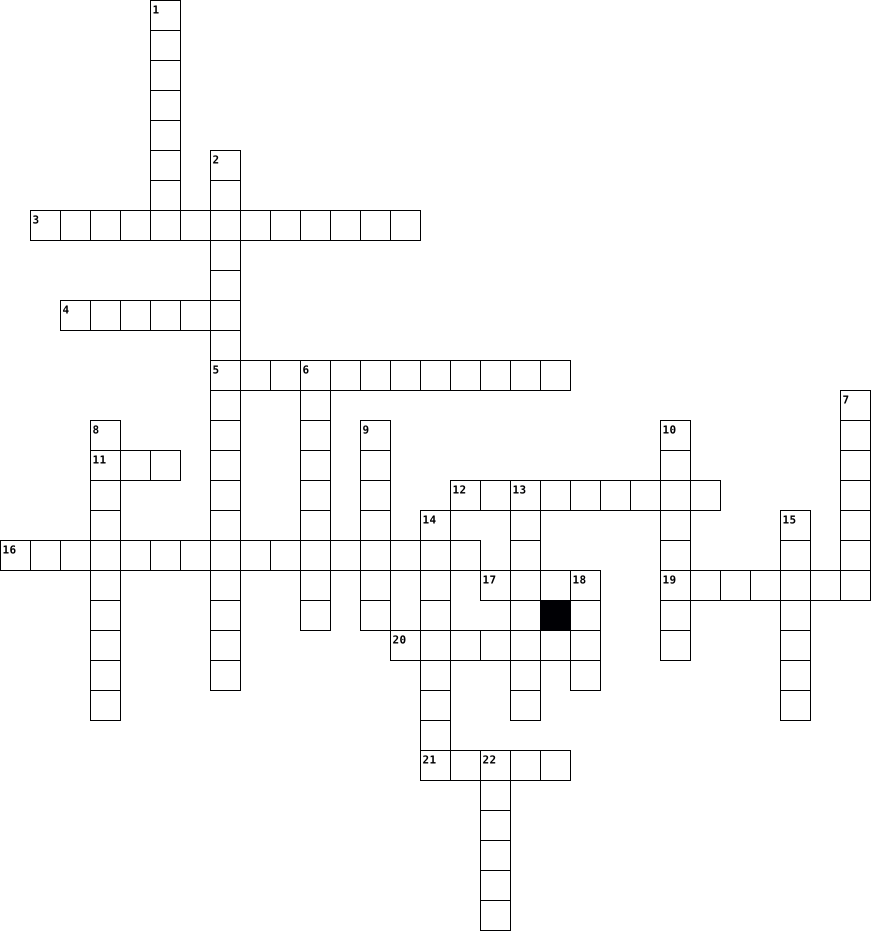
Across
- Where the electrons float around the nucleus.
- Element with atomic number 8.
- The property in which the periodic table is currently organized.
- Number of electrons in the first shell of the electron cloud.
- There are only 17 of these on the periodic table but are essential for life.
- The process of an atom losing energy
- The building block of matter.
- Atoms with the same number of protons with differing numbers of neutrons.
- There are 7 rows or ___________ on the modern periodic table.
- After the first shell, each electron shell can hold this number of electrons.
Down
- The electrons are the ___________ particles found in the atom.
- The two subatomic particles that make up the majority of an atom's mass.
- Created the first periodic table.
- a term used for nonmetals that are easily broken.
- Original property that Mendeleev used to organize the elements.
- Where the protons and neutrons are located in the atom.
- The amount of time it takes for half of a sample of an element to decay.
- Found in the nucleus with the protons.
- a term used for metals that can be hammered or reshaped without breaking.
- Positively charge subatomic particles
- Adding protons and neutrons together gives you the atom's _______ number.
- There are 18 columns or _________ on the modern periodic table.
22 Clues: Element with atomic number 8. • The building block of matter. • Created the first periodic table. • The process of an atom losing energy • Positively charge subatomic particles • Found in the nucleus with the protons. • Where the electrons float around the nucleus. • a term used for nonmetals that are easily broken. • ...
Chemistry Revision 2024-07-19

Across
- - Center of an atom containing protons and neutrons (7)
- - Elements typically found on the left side of the periodic table (6)
- - Positively charged particles in an atom's nucleus (7)
- - Essential for respiration, atomic number 8 (6)
- - Halogen, used in disinfectants, atomic number 17 (8)
- - Basic units of matter (5)
- - Vertical groups in the periodic table (7)
- - Scientist who created the first periodic table (9)
- - Noble gas with atomic number 2 (6)
- - Negatively charged particle found in shells around the nucleus (8)
- - Basis for organic life, atomic number 6 (6)
- - Alkali metal, atomic number 11 (6)
- - Energy levels where electrons are found (14)
- - Lightest element, atomic number 1 (8)
Down
- - Another term for a vertical column in the periodic table (5)
- - Pure substances consisting of only one type of atom (8)
- - Atoms of the same element with different numbers of neutrons (8)
- - Chart organizing all known elements by atomic number (12)
- - Transition metal, atomic number 26 (4)
- - Number of protons in an atom (12)
- - Alkaline earth metal, important for bones, atomic number 20 (7)
- - Neutral particles found in the nucleus of an atom (8)
- - Scientist who proposed the model of the atom with electrons in shells (4)
- - Noble gas, atomic number 10 (4)
- - Horizontal lines in the periodic table (4)
25 Clues: - Basic units of matter (5) • - Noble gas, atomic number 10 (4) • - Number of protons in an atom (12) • - Noble gas with atomic number 2 (6) • - Alkali metal, atomic number 11 (6) • - Lightest element, atomic number 1 (8) • - Transition metal, atomic number 26 (4) • - Vertical groups in the periodic table (7) • - Horizontal lines in the periodic table (4) • ...