
periodic%20table Crossword Puzzles
Periodic Table 2020-04-14

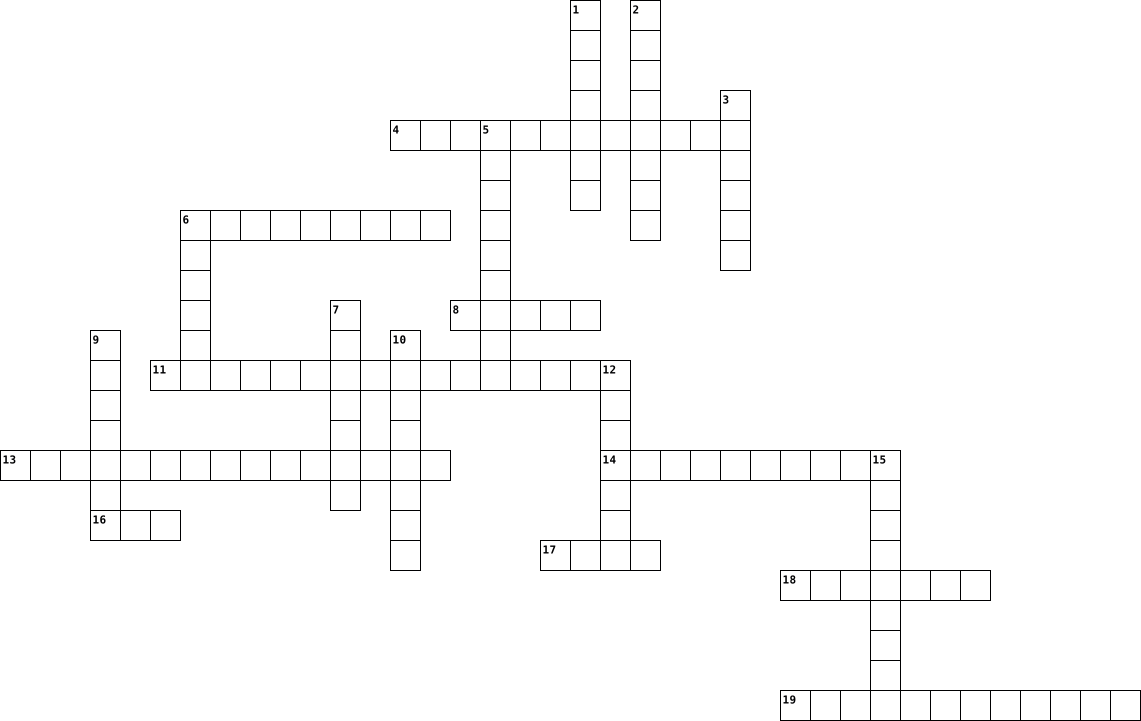
Across
- elements located by the staircase
- number of valence electrons in group 1 elements
- metal with 13 protons
- metalloid in period 3
- element with a ground state electron configuration of 2-6
- Carbon's atomic number
- the first element in the periodic table
- the only group 17 element that is a liquid
- element #12
- period 2 element with 8 valence electrons
- element with the largest atomic radius
Down
- gases located in group 18
- most electronegative element in the periodic table
- vertical columns on the table
- the periodic table is organized in order of increasing _____________________.
- located in period 3, group 17
- also known as a family
- located to the right of the staircase
- horizontal row on the table
- smallest noble gas
- number of valence electrons in an atom of nitrogen
- the only metal that is a liquid at STP
22 Clues: element #12 • smallest noble gas • metal with 13 protons • metalloid in period 3 • also known as a family • Carbon's atomic number • gases located in group 18 • horizontal row on the table • vertical columns on the table • located in period 3, group 17 • elements located by the staircase • located to the right of the staircase • the only metal that is a liquid at STP • ...
Chemistry: Periodic Table 2023-08-28

Across
- Not good of heat and electricity_______
- The most powerful tool chemists have for organizing chemical info_______
- A vertical column of elements is called a_________
- The elements in a group have similar_________
- Above the chemical symbol________
- each element has a unique atomic number thats the number of___________
- the seven horizontal rows are called______________
- Found on the upper right of the periodic table___________
- Moseley listed numbers in increasing order________
- fewer than_______ had been discovered in mid 1800's
- A one to two letter chemical_______
Down
- You can find metals on the________
- Below the symbol are names of its element and_________
- number Listed on period table from increasing_______
- Each element is represented by one________
- You can predict a lot about the chemical________
- What makes the periodic table really invaluable________
- Found on the upper left of periodic table___________
- have similar valence_______
- Most elements are________
20 Clues: Most elements are________ • have similar valence_______ • Above the chemical symbol________ • You can find metals on the________ • A one to two letter chemical_______ • Not good of heat and electricity_______ • Each element is represented by one________ • The elements in a group have similar_________ • You can predict a lot about the chemical________ • ...
Chemistry Crossword 2024-12-20

Across
- a negatively charged particle in an atom
- the ability of a substance to be shaped
- the vertical colums in the periodic table
- elements with seven valence electrons
- the ability of a substance to be drawn into wires
- a substance that can conduct electricity
- elements that are good conductors
- the number of protons and electrons in an element
- the horizontal rows in the periodic table
- a positively charged particle in an atom
Down
- elements that are not good conductors
- elements that will not react with other gases
- a neutral particle in an atom
- a change that changes the appearance of a substance
- a change that makes something into a new substance
- what does the periodic table list
- the number that is the mass of an element
- two or more substances that can be separated
- the shininess of an substance
- a substance made up of two or more elements
20 Clues: a neutral particle in an atom • the shininess of an substance • elements that are good conductors • what does the periodic table list • elements that are not good conductors • elements with seven valence electrons • the ability of a substance to be shaped • a negatively charged particle in an atom • a substance that can conduct electricity • ...
The Periodic Table 2023-05-12

Across
- Ar 18
- number what its arranged by
- Ba 56 0.89
- As 33 2.18
- the property of transmitting heat, electricity, or sound
- Am 95 1.3
- Sb 51 2.05
- At 85 2.2
- Al 13 1.61
- Be 4 1.57
Down
- a horizontal row in the periodic table
- the property of an atom that causes it to have weight
- Bk 97 1.3
- describes how likely an element is to form bonds with other elements
- any of the monovalent metals of group I of the periodic table (lithium or sodium or potassium or rubidium or cesium or francium)Actinium Ac 89 1.1Actinium Ac 89 1.1
- atom with same atomic number, different number of neutrons
- quantity of protons in the nucleus of an atom of an element
- a vertical column in the periodic table
- 7 element groups
- Bi 83 2.02
20 Clues: Ar 18 • Bk 97 1.3 • Am 95 1.3 • At 85 2.2 • Be 4 1.57 • Ba 56 0.89 • As 33 2.18 • Bi 83 2.02 • Sb 51 2.05 • Al 13 1.61 • 7 element groups • number what its arranged by • a horizontal row in the periodic table • a vertical column in the periodic table • the property of an atom that causes it to have weight • the property of transmitting heat, electricity, or sound • ...
tables crossword 2024-11-22

Across
- has multiple oxidation states
- most reactive none metal
- these are the staircase on the periodic table
- lithium has this valence charge
- nonmetals ____ electrons
- grouped into a column not a row
- created the first periodic table
- not gonna be found out in nature
- gold is this type of element
- wrote a textbook that contained 28 elements
- only group that has liquid solids and gases
- is the least reactive transition metal
- developed the periodic table by increasing mass but was not published
Down
- colorless, tasteless, and odorless
- metal has this type of charge
- borons has this valence charge
- have low melting point
- carbon is this kind of element
- most reactive type of metal
- is a atom with a charge
- considered the "rare" earth metals
- is a highly reactive alkali metal
- are good conductors of heat
- when metals and nonmetals bond together ions for from a ___ electrons
- metal ___ electrons
25 Clues: metal ___ electrons • have low melting point • is a atom with a charge • most reactive none metal • nonmetals ____ electrons • most reactive type of metal • are good conductors of heat • gold is this type of element • metal has this type of charge • has multiple oxidation states • borons has this valence charge • carbon is this kind of element • lithium has this valence charge • ...
Chemistry CrossWord 2022-05-12

Across
- He on the periodic table
- filled with helium
- Li on periodic table, found in batteries
- large body of salt water
- alien found on mars
- university that conducted the experiment on coral
- used to protect skin from the sun
Down
- pale yellow filters found in UVA filters
- U.S. island state
- when color is removed from coral
- name of the rover from mars
- C on the periodic table
- national aeronautics and space administration
- 4th planet from the sun
14 Clues: U.S. island state • filled with helium • alien found on mars • C on the periodic table • 4th planet from the sun • He on the periodic table • large body of salt water • name of the rover from mars • when color is removed from coral • used to protect skin from the sun • pale yellow filters found in UVA filters • Li on periodic table, found in batteries • ...
science 2022-06-07

Across
- where we live
- everything around us
- how fast something goes
- what keeps us from flying
- Star wars
- metals
- good at conducting electricity
- nonmetallic elements t
Down
- rough ground
- chemical change
- steam
- who found out gravity
- creator of the periodic table
- the ______ table
- things you can mix together to make something new
- you
16 Clues: you • steam • metals • Star wars • rough ground • where we live • chemical change • the ______ table • everything around us • who found out gravity • nonmetallic elements t • how fast something goes • what keeps us from flying • creator of the periodic table • good at conducting electricity • things you can mix together to make something new
Atoms 2022-03-07

Across
- 8th element of the periodic table
- Subatomic particles within the nucleus that, when added to the number of protons, gives the atom it's atomic mass and has a negative charge
- 47th element of the periodic table
- center of the atom containing protons and neutrons
- 55th element of the periodic table
Down
- 18th element of the periodic table
- the seventh family of the periodic table and has 7 valence electrons
- 1th element of the periodic table
- 4th element of the periodic table
- 18th element of the periodic table
10 Clues: 1th element of the periodic table • 8th element of the periodic table • 4th element of the periodic table • 18th element of the periodic table • 18th element of the periodic table • 47th element of the periodic table • 55th element of the periodic table • center of the atom containing protons and neutrons • ...
Chemistry4Life 2021-12-28

Across
- horizontal line in periodic table
- electron the name of electrons on the last shell of an atom
- elements from group 17
- vertical column in periodic table
- A table containing elements
Down
- founder of periodic table
- an inert gas
- first element in the periodic table
- positive charge in the nucleus
- chemical formula of iron
10 Clues: an inert gas • elements from group 17 • chemical formula of iron • founder of periodic table • A table containing elements • positive charge in the nucleus • horizontal line in periodic table • vertical column in periodic table • first element in the periodic table • electron the name of electrons on the last shell of an atom
Compounds and mixtures 2022-05-03

Across
- S on the periodic table
- C on the periodic table
- Fe on the periodic table
- a single type of molecules
- 2 hydrogen and 1 oxygen molecule
- multiple atom that make up a substance
Down
- H on the periodic
- the building blocks for all things
- molecules mixed but with no chemical bond
- chemically bonded molecules
10 Clues: H on the periodic • S on the periodic table • C on the periodic table • Fe on the periodic table • a single type of molecules • chemically bonded molecules • 2 hydrogen and 1 oxygen molecule • the building blocks for all things • multiple atom that make up a substance • molecules mixed but with no chemical bond
The Periodic Table 2012-06-09

Across
- negative subatomic particle.
- vertical columns on the periodic table.
- The elements that are in between the zigzag line on the periodic table.
- To be unreactive with other elements.
- number of protons and neutrons.
Down
- the electrons in the outermost energy level.
- The elements that are on the far upper right corner of the periodic table.
- Name of metals in group 3-12 that have many useful properties.
- Elements in group 17.
- Elements in group 18, very unreactive.
- horizontal rows on the periodic table.
- number number of protons in an element.
12 Clues: Elements in group 17. • negative subatomic particle. • number of protons and neutrons. • To be unreactive with other elements. • Elements in group 18, very unreactive. • horizontal rows on the periodic table. • vertical columns on the periodic table. • number number of protons in an element. • the electrons in the outermost energy level. • ...
Periodic Table Review 2022-10-26

Across
- particle with no charge in the nucleus
- vertical arrangement of elements, share valence electrons
- elements that are not metals
- another word for group
- number of groups
- increasing, how the entire periodic table is organized, also number of protons
- the abbreviation of an element on the periodic table
- horizontal arrangement of elements, share same number of energy shells
- number of periods
Down
- the levels where electrons are located
- represents the 'weight' of an atom
- negatively charges particle not in the nucleus
- group 1 metals, alkali metals
- center of atom with protons and neutrons
- electrons in the outermost energy shell
- positively charged particle in the nucleus
- share characteristics of metals and non-metals
- the chart that organizes all the elements
- group on the far right of the periodic table
19 Clues: number of groups • number of periods • another word for group • elements that are not metals • group 1 metals, alkali metals • represents the 'weight' of an atom • the levels where electrons are located • particle with no charge in the nucleus • electrons in the outermost energy shell • center of atom with protons and neutrons • the chart that organizes all the elements • ...
The periodic table 2025-09-30

Across
- can be drawn into a wire
- the type of metal that is located at the bottom of the periodic table
- how many metalliods there are
- the type of element that sits on the staircase
- lets heat pass through some of the time
- can be hammered into a thin sheet
- the periodic ______ of elements
- the only nonmetal that is located on the left side of the staircase
- what the periodic table can provide you
- periodic table of ________
Down
- what the metalloids sit on
- the type of element that is located to the left of the staircase
- ______ number
- is shiny
- does not allow heat to pass through
- the type of element that is located on the right of the staircase
- another word for table
- table of elements
- something that represents the elements
- what the elements are classifies by
20 Clues: is shiny • ______ number • table of elements • another word for table • can be drawn into a wire • what the metalloids sit on • periodic table of ________ • how many metalliods there are • the periodic ______ of elements • can be hammered into a thin sheet • does not allow heat to pass through • what the elements are classifies by • something that represents the elements • ...
Chemistry Study Guide 2016-02-10

Across
- developed periodic table
- to form by combining separate things
- positive charge
- a chemical element that lacks he characteristics of a metal
- characterized by or formed with evolution of heat
- the smallest particle of a substance of that can exist by itself
- electron(s) in outermost orbital
- positive charge
- the rows going left to right on the periodic table
- also known as atomic weight
- center of an atom made of protons and neutrons
- any group of rare gases with great stability (helium, neon, argon, krypton)
- the columns that going up and down on the periodic table
Down
- the smallest possible amount of a substance that has the same characteristics
- a substance that usually has a shiny appearance, good conducted of electricity
- states that the total number of atoms stay the same
- characterized by or formed with evolution of heat
- regions of space outside the nucleus of an atom where electrons may exist
- no charge
- one of the basic substances that are made of atoms
- shorter element name on periodic table
- something that is the result of a process
- a substance that changes when it is combined with another substance
- an element intermediate in properties between metals and non-metals
- a reaction that occurs in which a larger of metal is bonded to the surface of another substance
25 Clues: no charge • positive charge • positive charge • developed periodic table • also known as atomic weight • electron(s) in outermost orbital • to form by combining separate things • shorter element name on periodic table • something that is the result of a process • center of an atom made of protons and neutrons • characterized by or formed with evolution of heat • ...
Periodic Table 2017-01-11

Across
- it is one kind of group 4a and sometimes used in beauty field
- it is used for make bicycle frames
- It is one kind of nobel gases. it have 36 atomic number
- it is used make the bright light in photographer's flash gun
- in the body, this compound used for control of the water content of the blood
- amount of group 3a in perodic table
- it is can you see in periodic table is placed alone
- This compound used to kill bacteria
- it is used for the formation of healty teeth and bones
- The horizontal rows of the periodic table are called
Down
- it is used of street lamp that give an orange glow
- This compound have 38 atomic number and part of alkali earth metals
- The number of proton in an atom
- the name of group 7A in periodic table
- it is on kind of alkali metals and it is used in bateries and medicine to treat mental disorders
- the name of group 6A in periodic table
- amount of compound in noble gases
- it is one of the element in choloroflourocarbons or CFCs
- it is used for lift meteorological ballons into atmosphere
- it is one kind of group 3A and the position under alumunium
20 Clues: The number of proton in an atom • amount of compound in noble gases • it is used for make bicycle frames • amount of group 3a in perodic table • This compound used to kill bacteria • the name of group 7A in periodic table • the name of group 6A in periodic table • it is used of street lamp that give an orange glow • it is can you see in periodic table is placed alone • ...
Periodic Table 2013-02-03

Across
- the horizontal row(s) of the periodic table
- a Russian man that made the first periodic table with 63 elements
- the vertical row(s) of the periodic table
- an element that makes up most of electronic wafers
- a particle with no charge and has effect on mass
- an element whose symbol is Fe
- an element with the atomic number of 2
- an element that is found easily and can have four bonds
Down
- a word used to describe an object's inferior size to another and has physical properties
- an atom with a positive or negative charge
- an element with the atomic number of 1
- a particle with a negative charge and is commonly found in an outer cloud of atoms
- a force on an object by gravity
- a particle with a positive charge and has effect on mass
- something that is good at conducting and usually malleable, ductile, and shiny
- a basic piece of matter consisting of protons, neutrons, and elections
- a determination of how much matter is in an object
- a version of a given element with different amounts of neutrons
- an element that makes up about 20% of air
- a pure substance distinguished by atomic number on the periodic table
20 Clues: an element whose symbol is Fe • a force on an object by gravity • an element with the atomic number of 1 • an element with the atomic number of 2 • the vertical row(s) of the periodic table • an element that makes up about 20% of air • an atom with a positive or negative charge • the horizontal row(s) of the periodic table • ...
Chemistry 2020-12-18
Across
- The absolute value of the accepted variable minus the experimental divided by the accepte, then multiplied by 100.
- a group of atoms bonded together, representing the smallest unit of a chemical compound that can take part in a chemical reaction.
- Silver, Aluminum, Zinc, and Cadmium are specific elements with their own charges without Roman Numerals.
- A group of elements on the periodic chart that carries the D-Block.
- The man who discovered Oxygen.
- Cr2O7 with a charge of -2.
- how many Lewis Dots are on the element Helium?
- a large body of matter with no definitive weight.
- Positive charges in the nucleus of an atom.
- The man who discovered Carbon Dioxide.
Down
- The 36th element on the Periodic Table, also the name of Superman's home planet.
- Neutral charges in the nucleus of an atom.
- A column on the periodic chart is called_____.
- CO3 with a charge of -2.
- The general, physical substance.
- NO3 with a charge of -1.
- A pure substance that cannot be broken down by chemical means.
- Group 18 of the Periodic Chart is also known as the _____, which consists of Krypton, Argon, and Helium.
- All marks and one estimated number.
- Negative charges that travels around the nucleus of an atom.
20 Clues: CO3 with a charge of -2. • NO3 with a charge of -1. • Cr2O7 with a charge of -2. • The man who discovered Oxygen. • The general, physical substance. • All marks and one estimated number. • The man who discovered Carbon Dioxide. • Neutral charges in the nucleus of an atom. • Positive charges in the nucleus of an atom. • A column on the periodic chart is called_____. • ...
Atom and Periodic Table 2022-07-13

Across
- Electron’s in the outer most shell. _______________ shell.
- atomic number from the atomic mass.
- These are good conductors of heat and
- #6 on The Periodic Table of the Elements.
- A _______________ is a vertical column on The
- They also have luster and a high
- Metals are considered this if they can be made
- Atoms are arranged on The Periodic Table of
- Abbreviation for Atomic Mass Units. The
- This particle has no charge and is found within the nucleus of an atom.
- Atoms which loses(s) electron(s) are known as __________.
- and electrons, this called the
- To find the number of __________: Subtract
- organic compounds consisting entirely of hydrogen and carbon.
- These types of metals are found in the middle of the Periodic Table.
Down
- This scientist created the atomic theory.
- These have properties of both metals and nonmetals.
- but different numbers of neutrons.
- atoms always have the same number of
- Metals are considered this if they can be made into sheets.
- of protons, neutrons, and electrons.
- _____________.
- wire.
- Table of the Elements
- The positively charged dense center of an
- Atom with same number of protons and
- Atoms which gain(s) electron(s) are known as __________.
27 Clues: wire. • _____________. • Table of the Elements • and electrons, this called the • They also have luster and a high • but different numbers of neutrons. • atomic number from the atomic mass. • atoms always have the same number of • of protons, neutrons, and electrons. • Atom with same number of protons and • These are good conductors of heat and • ...
Electrons and The Periodic Table 2022-01-26

Across
- The greek word for wavelength.
- Electrons move and behave like ____.
- As wavelength decreases, frequency ____.
- The name of the elements in group 7A.
- These are good conductors of energy.
- When an electron loses absorbed energy and falls back to its ground state and emits light.
- These rays have the shortest wavelength.
- The number of orbitals block F contains.
- The ability of an atom to attract electrons from another element.
- The most reactive element on The Periodic Table.
- The modern-day Periodic Table is organized by increasing atomic ___.
- These elements are usually gases, except sulfur, Phosphorus, and Bromine.
Down
- These elements share the properties of nonmetals and metals.
- Typically represents the number of valence electrons in an element.
- Published the first version of The Periodic Table.
- The greek word for frequency.
- What is the height of the wave from zero to crest?
- This color has the longest wavelength, shortest frequency, lowest energy.
- Least reactive elements on The Periodic Table.
- How many electrons can each orbital hold?
- This is a negatively charged, subatomic particle found in all atoms.
- This principle states that electrons must occupy the lowest energy level first.
- On the Aufbau Diagram, electrons are depicted as ___.
23 Clues: The greek word for frequency. • The greek word for wavelength. • Electrons move and behave like ____. • These are good conductors of energy. • The name of the elements in group 7A. • As wavelength decreases, frequency ____. • These rays have the shortest wavelength. • The number of orbitals block F contains. • How many electrons can each orbital hold? • ...
Atomic Structure Crossword 2023-10-01

Across
- The horizontal rows of the periodic table.
- A particle that has positive or negative charge.
- Lives in the nucleus and has no charge.
- __________ number = protons + neutrons
- This element in period 3 makes a -2 charge when it becomes an ion.
- Elements on the periodic table are arranged in order of ________ number.
- An ion that has a positive charge.
- Lives in the nucleus and has a positive charge.
- The vertical columns of the periodic table.
- This element is a metal that has one valence electron and is found in period 3.
- Found outside of the nucleus and has a negative charge.
- A type of substance that can conduct electricity, is malleable and is shiny.
Down
- When an anion and cation are attracted to each other, they form an _________ bond.
- This element is a nonmetal in period 2 that does not make ionic bonds.
- The identity of an atom; changes when number of protons change.
- This element in period 4 makes a +2 charge when it becomes an ion.
- The smallest particle of a chemical element that can exist.
- An ion that has a negative charge.
- This element is in group 7, period 2.
- The types of substances found on the right side of the periodic table.
- This element is found in diamond.
21 Clues: This element is found in diamond. • An ion that has a negative charge. • An ion that has a positive charge. • This element is in group 7, period 2. • __________ number = protons + neutrons • Lives in the nucleus and has no charge. • The horizontal rows of the periodic table. • The vertical columns of the periodic table. • Lives in the nucleus and has a positive charge. • ...
Periodic Table 2024-05-20

Across
- an atom with a charge (positive or negative)
- The vertical columns on the periodic table.
- Has a nucleus with subatomic particles, protons and neutrons, and electrons are on a ring on the outside.
- Is a horizontal row on the periodic table.
- 7 electrons in their valence shell, they react rapidly with metals to form salts
- a small electrically charged particle
- The negative charge that surrounds the nucleus.
- They are protons, electrons, and neutrons.
- Chemical elements that mostly lack distinctive metallic properties
- The middle of an atom.
- The positive charge in the nucleus of an atom.
Down
- Is a vertical column on the periodic table
- A chemical element that exhibits some metal and some nonmetal properties
- The number of combined protons in an atom.
- Any substance capable of conducting electricity at a temperature of absolute zero
- Two or more forms of the same element that contain the same protons and different neutrons.
- If OH- ions has greater quantity than H+ ions
- Any of the seven chemical elements that make up Group 18 (VIIIa) of the periodic table
- The amount of protons and neutrons in the atom.
- The neutral charge in the nucleus of an atom.
20 Clues: The middle of an atom. • a small electrically charged particle • Is a vertical column on the periodic table • The number of combined protons in an atom. • Is a horizontal row on the periodic table. • They are protons, electrons, and neutrons. • The vertical columns on the periodic table. • an atom with a charge (positive or negative) • ...
Ch. 5 Sec. 1 Quiz Review 2023-02-26

Across
- is arranged by atomic mass
- states that the physical and chemical properties of the elements are periodic functions of their atomic numbers.
- additions to the periodic table after Mendeleev’s version
- means "one"
- repeating patterns
- discovered that the elements fit into patterns better when they were arranged according to atomic number, rather than atomic mass.
Down
- is arranged by atomic number.
- Mendeleev predicted the ____________ of elements that would fill three of the spaces.
- Mendeleev used “eka” to show that the unknown element was ____ _______ _____ from the known element
- Mendeleev placed all the known elements in his periodic table. Several _______ ________ were left.
- The difference in atomic numbers down a group is ____ ______ for each main group.
- created a table of elements so that similar properties were grouped together, called the periodic table of the elements
- an arrangement of the elements in order of their atomic numbers so that elements with similar properties fall in the same column, or group
13 Clues: means "one" • repeating patterns • is arranged by atomic mass • is arranged by atomic number. • additions to the periodic table after Mendeleev’s version • The difference in atomic numbers down a group is ____ ______ for each main group. • Mendeleev predicted the ____________ of elements that would fill three of the spaces. • ...
The Atom and Nuclear Chemistry 2021-02-01

Across
- a substance that increases the rate of a chemical reaction without itself undergoing any permanent chemical change.
- the quality of being reactive or the degree to which something is reactive.
- bubbles in a liquid; fizz.
- a subatomic particle with a positive electric charge.
- any of the elements occupying group VIIA (17) of the periodic table.
Down
- relating to the periodic table of the elements.
- cause (a substance) to be deposited in solid form from a solution.
- the combining power of an element.
- the positively charged central core of an atom and containing nearly all its mass.
- undergo or cause to undergo a process or period of transition.
- an atom or molecule with a net electric charge due to the loss or gain of one or more electrons.
- a set of elements occupying a horizontal row in the periodic table.
- a set of elements occupying a column in the periodic table.
13 Clues: bubbles in a liquid; fizz. • the combining power of an element. • relating to the periodic table of the elements. • a subatomic particle with a positive electric charge. • a set of elements occupying a column in the periodic table. • undergo or cause to undergo a process or period of transition. • cause (a substance) to be deposited in solid form from a solution. • ...
Periodic table 2024-10-09

Across
- Verticle columns in the periodic table are called....
- Only liquid metal in the periodic table
- Chlorine is a h_____________
- metal Sodium is an a__________ m__________
- Non- metals are found on the _________ side of the periodic table
- Gas Neon is a ___________ Gas
Down
- Horizontal rows in the periodic table are called...
- metal Iron is a t___________ ___________
- earth metal- Barium is a _________ _________ m___
- Metals are found on the ________ side of the periodic table
10 Clues: Chlorine is a h_____________ • Gas Neon is a ___________ Gas • Only liquid metal in the periodic table • metal Iron is a t___________ ___________ • metal Sodium is an a__________ m__________ • earth metal- Barium is a _________ _________ m___ • Horizontal rows in the periodic table are called... • Verticle columns in the periodic table are called.... • ...
CHEMISTRY 2014-07-19
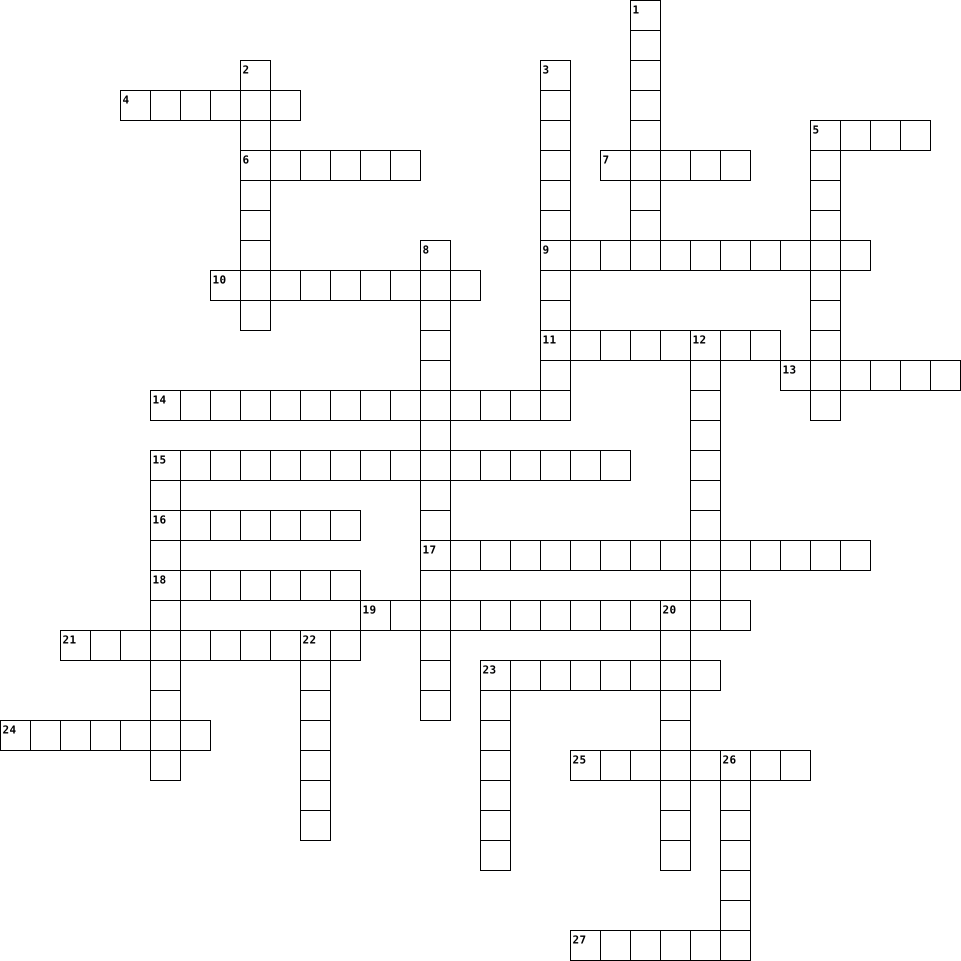
Across
- / is the name of the force exerted on an object due to the acceleration of gravity.
- / amount of matter in a body
- / is anything that has mass and occupies space.
- / a column in the periodic table
- / process of comparing something with a standard.
- / refers to the smallest estimated value taken directly from the device.
- / refers to the smallest exact value taken directly from the device.
- / a row in the periodic table
- / an element located in group 2A of periodic table.
- / an element contained in one of the 10 columns in the periodic table
- / modern periodic table
- / is a quantity that compares the density of a substance with the density of water at 4'C
- / simplest known substance.
- / cannot be broken down into simpler components by ordinary mechanical means; fixed composition
- / have properties intermediate between metals and nonmetals.
- / uncharged particles
- / contains 2 or more components whose composition may be varied.
- / atoms of the same elements having a different number of neutrons
- / are shiny substance that conduct heat and electricity.
Down
- / negatively charged particles
- / deals with the study of matter--its composition, properties, and transformations.
- / an element located in group 1A.
- / number of protons + number of neutrons
- / a group consisting of 3 elements with the same properties.
- / a compound that contains both a hydrogen atom and a lone pair of electrons so that it can be either an acid or a base.
- / is a measure of how hot or cold an object is.
- / are poor conductors of heat and electricity.
- / is a physical property that relates the mass of a substance to its volume.
- / the 1st and 8th element resemble one another in physical & chemical properties.
- / positively charged particles
30 Clues: / uncharged particles • / modern periodic table • / simplest known substance. • / amount of matter in a body • / a row in the periodic table • / negatively charged particles • / positively charged particles • / a column in the periodic table • / an element located in group 1A. • / number of protons + number of neutrons • / are poor conductors of heat and electricity. • ...
Chemistry UnitB 2014-11-06

Across
- horizontal row of elements in the periodic table
- shiny,malleable,ductile element that conducts electricity
- principle that matter is not created or destroyed in a chemical reaction
- ability to be stretched into wire
- the smallest part of an element that is representative of that element
- number of protons in the nucleus of an element
- positively charged center of an atom
- group 2 elements in the periodic table
- dull brittle element that does not conduct electricity
- an experiment in which all parts of a chemical reaction are accounted for
- atom that is electrically charged
- ability to be pounded into sheets
- description of how a substance interacts with other substances
- pure substance that cannot be broken down
- slow chemical change when oxygen reacts with a metal
- combination of symbols that represent a compound
- pure substance formed from a metal and non-metal
- absorbs energy (cold)
- workplace hazardous materials information system
- releases energy (warm)
Down
- experiment in which products can escape a chemical reaction
- negatively charged particle
- group 17 of the periodic table
- substance that helps a chemical reaction to proceed quicker
- chemical reaction that takes place in cells
- element has both metallic and non-metallic properties
- catalyst involved in chemical reactions in living things
- chemical combination of two or more elements
- group 18 of the periodic table
- group 1 metals in the periodic table
- pure substance formed when non-metals combine
- change that results when substances react to create a different substance
- reaction that occurs when oxygen reacts with a substance to form a new substance
- chemical name of CO
- mass of one atom of an element
35 Clues: chemical name of CO • absorbs energy (cold) • releases energy (warm) • negatively charged particle • group 17 of the periodic table • group 18 of the periodic table • mass of one atom of an element • ability to be stretched into wire • atom that is electrically charged • ability to be pounded into sheets • positively charged center of an atom • group 1 metals in the periodic table • ...
Chemistry Review 2021-03-21

Across
- A group of elements missing an electron in their outermost shell
- The name for having more or fewer electrons than protons
- Another name for an energy level
- A substance that increases the rate of a chemical reaction
- A solution in which the solvent is water
- A positively charged ion
- The ‘inventor’ of the modern Periodic Table
- The location of electrons
- a pattern of gradual change
- the rule describing the tendency of atoms to react in order to obtain a full outer shell
- A positively charged sub-atomic particle
- A column of elements in the periodic table
- Protons + Neutrons
- A neutral compound consisting of anions and cations
- A substance in which two or more elements are bonded together
- An element with a full valence shell of electrons
- The number of protons in the nucleus of an atom
- The relationship between the mass of a substance and the space it takes up
Down
- The bond formed between two non-metals
- A group of atoms bonded together
- Any element in the d-block (groups 3 – 12) of the periodic table
- An element in Group 1 of the Periodic Table
- An atom with a specific number of protons
- electrons involved in chemical bond formation
- A bond in which electrons are shared
- When elements/compounds exist together but without chemical bonds
- A negatively charged sub-atomic particle
- A sub-atomic particle with no charge
- The horizontal rows of the Periodic Table
- The bond formed between a metal and a non-metal in which electrons are transferred
- The arrangement of the nucleus and electrons
- An atom which has gained or lost an electron
- A negatively charged ion
33 Clues: Protons + Neutrons • A positively charged ion • A negatively charged ion • The location of electrons • a pattern of gradual change • A group of atoms bonded together • Another name for an energy level • A bond in which electrons are shared • A sub-atomic particle with no charge • The bond formed between two non-metals • A solution in which the solvent is water • ...
Chemistry Crossword Puzzle 2020-11-04

Across
- The element with the atomic symbol I
- The element with the atomic symbol as Sb
- pure substances that are the unions of two or more elements
- The first element on the periodic table
- How many groups there are on the periodic table
- diverse in character or content
- Atoms that have an unequal number of electrons and protons
- When did Dmitri Mendeleev publish a table of the elements organized by increasing atomic mass?
- Which element has 79 protons?
- Which element has the atomic symbol Pb?
- If it CAN be separated by physical means it is a _______
- The element with 48 protons
- A substance made of all the same kind of particle
- Chadwick, The man who found the Neutron
- How many periods there are on the periodic table
- What test is used to ID some metals in compounds?
- Theory that states Atoms are building blocks of elements
Down
- Law, The law that was named after Robert Boyle
- Atoms with the same number of electrons and protons
- The amount of elements on the Periodic Table
- of the same kind; alike
- The final element on the periodic table
- Germanium has what Atomic symbol?
- substance, If it CAN'T be separated by physical means it is a ____ _________
- What are bundles of light energy that is emitted by electrons as they go from higher energy levels to lower levels?
- The shape of an atom
- Ions that form by losing electrons
- The element with 31 protons
- How many protons does Radon have?
- which element has 66 protons?
- The element with 22 protons
31 Clues: The shape of an atom • of the same kind; alike • The element with 31 protons • The element with 48 protons • The element with 22 protons • Which element has 79 protons? • which element has 66 protons? • diverse in character or content • Germanium has what Atomic symbol? • How many protons does Radon have? • Ions that form by losing electrons • The element with the atomic symbol I • ...
Periodic Table Challenge 1 2020-04-07

Across
- Maximum number of electrons in the second energy shell
- Which is more numerous metals or nonmetals?
- This element has the symbol Cd
- Atomic mass 131.29
- This is the first element of the transitional metals
- This doesn't react and is in period 3.
- You put this in a pool to keep it clean
- The series of extracted elements from period 6
- This has 22 protons
- The lightest non-metal
- The creator of the first periodic table of elements
- Protons plus neutrons
- Negatively charged part of an atom
- Location of protons and neutrons in atoms
- This element has 9 electrons
- Lightest member of group 8
- English word for Plumbum
- Wound cleaner
- Rotten egg smell
- This element is period 4 group 4
- This element has the symbol Hg
Down
- The number of periods in the periodic table
- This has symbol Al
- This has two more protons than Vanadium
- It's what we breath
- Two more protons than Cadmium
- Something our bones contain
- The symbol is Na
- This is the name of the 5cent coin in the USA
- This element is period 5 group 8
- It's symbol is Au
- This element has 78 electrons
- Positively charged part of an atom
- This element is located in period 4 and group 5
- Maximum number of electrons in the first energy shell
- This element has 49 protons
- Rows in the periodic table are called
- This has symbol K
- This is below carbon in the periodic table
- It's in a battery and in group 1
- Lightest element
- Superman's weakness
- Vertical columns in the periodic table are called
43 Clues: Wound cleaner • The symbol is Na • Lightest element • Rotten egg smell • It's symbol is Au • This has symbol K • This has symbol Al • Atomic mass 131.29 • It's what we breath • This has 22 protons • Superman's weakness • Protons plus neutrons • The lightest non-metal • English word for Plumbum • Lightest member of group 8 • Something our bones contain • This element has 49 protons • ...
CHEM 1AB 2015-10-06
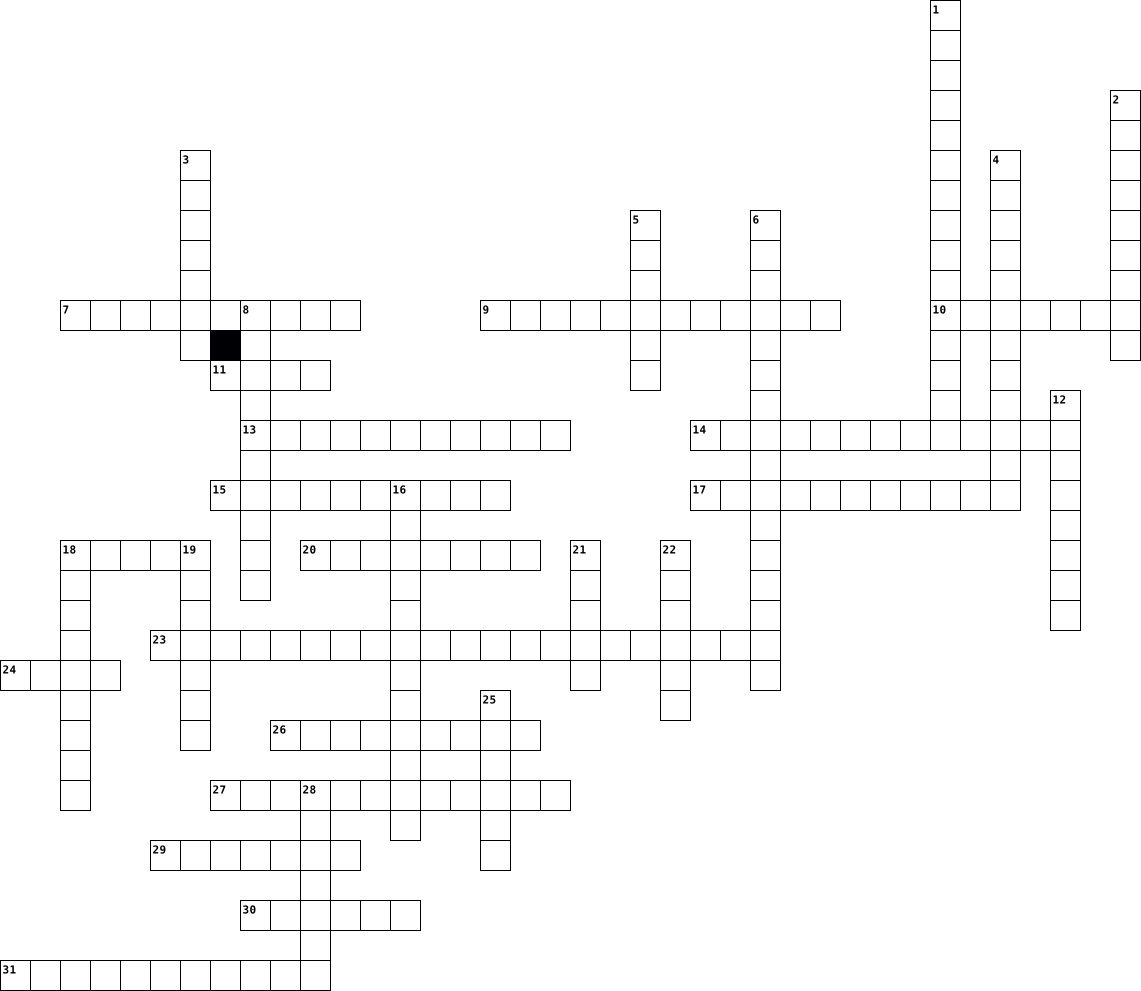
Across
- total number of protons and neutrons in a nucleus
- metals in Group IA (1) of the periodic table.
- state a state that is higher than ground state
- the smallest particle of a chemical element that can exist
- a series of fifteen metallic elements
- the space electrons travels in
- any of the gaseous elements in Group 0 (18) of the periodic table
- one of a quantized series of states in which matter may exist
- a negatively charged ion
- any element in group 17 of the periodic table
- the distribution of electrons of an atom or molecule
- an atom that has an electric charge
- an atomic model starting with B
- a type of chemical bond that generates two oppositely charged ions
- present in all atomic nuclei except those of ordinary hydrogen
- number the number of protthe smallest particle of a chemical element that can exist.ons in the nucleus of an atom
- the lowest energy state of an atom
Down
- any of the set of metallic elements occupying a central block
- something that is composed of two or more elements
- a substance consisting of atoms
- the outermost shell of an atom
- positively charged ion
- electrons in the outer most shell of an atom
- another term for semimetal
- Found in all atoms,is negatively charged
- a sign that identifies an element
- any of the series of fifteen metallic elements
- center of an atom
- a column in the periodic table
- a particle representing a quantum of light
- rows in periodic table
- each of two or more forms of the same element
32 Clues: center of an atom • positively charged ion • rows in periodic table • a negatively charged ion • another term for semimetal • the outermost shell of an atom • the space electrons travels in • a column in the periodic table • a substance consisting of atoms • an atomic model starting with B • a sign that identifies an element • the lowest energy state of an atom • ...
Science 2023-06-28

Across
- the first ever artificially produced element, produced as a by-product at nuclear power stations
- the group of metals that are shiny, soft, and react violently with water
- a category of atom on the periodic table
- where two or more substances bind to create one complex substance
- the subatomic particles with a positive charge
- the rarest element ever
- the inventor of the periodic table, Dmitri Mendeleyev, was from... ?
- the subatomic particles with a negative charge
- where electrons flow from atom to atom
- some elements abbreviations don't make much sense to english speakers because they are the element's name in this language
- where one or more complex molecule/s breaks down into simpler compounds
- subcategories of when a atom gains or loses a neutron
Down
- this country was named after the element of silver's latin name
- what is a group of interconnected atoms called?
- the element with the highest weight on the periodic table
- what is everything in the universe made of?
- the effect radioactivity has on some less dense materials
- where two molecules interact with each other and change structure
- the center of the atom
- the rarest naturally occurring element on earth
- the element with the lightest atomic weight on the periodic table
- the rows on the periodic table are called...?
- this element is widely regarded as the most versatile elements because of how it is the base element of so many things
- this element exists naturally in abundance on earth, but it was discovered because of astronomers observing the sun
- what is left after a reaction occurs
25 Clues: the center of the atom • the rarest element ever • what is left after a reaction occurs • where electrons flow from atom to atom • a category of atom on the periodic table • what is everything in the universe made of? • the rows on the periodic table are called...? • the subatomic particles with a positive charge • the subatomic particles with a negative charge • ...
Chemistry Final Project 2020-12-12

Across
- type of decay that emits an alpha particle
- 1 or 2 letters that represents the element
- State of matter that has a definite shape and volume
- Ni on periodic table
- type of decay that emits gamma radiation
- Columns on a periodic table
- Nuclear _____: when a particle splits and causes a release of energy
- State of matter that doesn’t have volume or shape
- Particle with positive charge
Down
- type of decay that emits a beta particle
- C on periodic table
- ______ change: Changes to something we can tell with our senses
- Particle with negative charge
- ______ change: Changes to the chemical makeup of something
- Different versions of atoms in an element
- Particle with neutral charge
- ____ number: sum of protons and neutrons
- State of matter that has a definite volume but no shape
- Nuclear _____: when particles combine and cause a release of energy
- ____ Number: number of protons in an element
20 Clues: C on periodic table • Ni on periodic table • Columns on a periodic table • Particle with neutral charge • Particle with negative charge • Particle with positive charge • type of decay that emits a beta particle • type of decay that emits gamma radiation • ____ number: sum of protons and neutrons • Different versions of atoms in an element • ...
Chemistry Redox Crossword 2021-08-26

Across
- What word can you make with Cobalt,Oxygen,Potassium,Iodine,Einsteinium?
- A substance that speeds up a reaction
- What is NH4 called?
- An element in group 8 of the periodic table
- A substance with the symbol Fe
- An element in group 7 of the periodic table
- The chemical reaction between Iron oxide and Aluminium
- What is C6H8O7 called?
- A way to remember redox
- A substance gaining valence electrons
- The reaction between an acid and an alkali
Down
- A substance with a PH level above 7
- Herr Szartowicz's favourite beach
- A chemical reaction which releases heat
- what is H2SO4 called?
- A substance losing valence electrons
- A chemical reaction which uses up more heat than it produces
- An element in group 1 of the periodic table
- What is the most common element in the universe?
- A measurement of a substance's acidity
- A substance with a PH level below 7
21 Clues: What is NH4 called? • what is H2SO4 called? • What is C6H8O7 called? • A way to remember redox • A substance with the symbol Fe • Herr Szartowicz's favourite beach • A substance with a PH level above 7 • A substance with a PH level below 7 • A substance losing valence electrons • A substance that speeds up a reaction • A substance gaining valence electrons • ...
Periodic Table 2022-02-06

Across
- the negatively charged particles in an atom
- comprised of protons, electrons and neutrons
- the energy level of an atom
- a compound with 2 hydrogen atoms and 1 oxygen atom
- elements with 7 electrons on their outer shell
- a molecule made up of two or more different elements
- the element that is present in banana
- the element with the symbol Al
- the total number of protons and neutrons in an atom
- also known as proton number
- anything that has mass and takes up space
Down
- the scientist whose work resulted in the modern Periodic Table
- the gases found in group 0 of the Periodic table
- the element with the symbol Na
- the horizontal rows of the Periodic Table
- use in the treatment of water
- the group 1 elements
- a molecule with the same atoms
- the element with the symbol Ca
- movement of fluid particles
20 Clues: the group 1 elements • the energy level of an atom • movement of fluid particles • also known as proton number • use in the treatment of water • the element with the symbol Na • a molecule with the same atoms • the element with the symbol Ca • the element with the symbol Al • the element that is present in banana • the horizontal rows of the Periodic Table • ...
Periodic Table Crossword 2017-02-22

Across
- described by atomic number
- element in group 7 and period 4
- rows of elements in the periodic table
- element with atomic number 89
- first element in group 13
- have similar properties
- first element in group 4
- abbreviation of element on the periodic square
- element in group 10 and period 6
- element in group 16 and period 6
- element with atomic number 57
- A system that organizes the elements
- columns of elements in the periodic table
Down
- first element in period 6
- first element in group 16
- contains information for each element
- first element in period 4
- first element in period 2
- how elements are arranged
- element in group 2 and period 5
- element with chemical symbol Sn
- first element in period 3
- element with chemical symbol Hg
- first element in group 18
- element with chemical symbol Au
25 Clues: have similar properties • first element in group 4 • first element in period 6 • first element in group 16 • first element in period 4 • first element in period 2 • how elements are arranged • first element in group 13 • first element in period 3 • first element in group 18 • described by atomic number • element with atomic number 89 • element with atomic number 57 • ...
periodic table 2013-05-15

Across
- the numbers that shows how many of each kind of atom are in the compound
- new substance formed in a chemical reaction
- composed of more than one element
- the table that shows elements
- located on the left sid of the zigzag line
- elements on the periodic table arranged numerically by
- horizontal rows on the periodic table
- not shiny
Down
- substances combined in a chemical reaction
- ability to be drawn into a wire
- can be observed without changing the kind of matter being studied
- heat and electricity do not move through them easily
- heat and electricity move through them easily
- the smallest form of matter
- composed of one kind of atom
- having a shiny surface
- vertical columns on the periodic table
- ability to be hammered into different shapes
- located on the right side of the zigzag line
- breaks easily
20 Clues: not shiny • breaks easily • having a shiny surface • the smallest form of matter • composed of one kind of atom • the table that shows elements • ability to be drawn into a wire • composed of more than one element • horizontal rows on the periodic table • vertical columns on the periodic table • substances combined in a chemical reaction • ...
periodic table 2023-12-04

Across
- Highest energy
- relatively soft
- wrote a textbook that included an abbreviated version of a periodic table that contained 28 elements.
- metals become _____ ions
- Colorless, odorless, tasteless
- Nonmetals ____ ions
- shiny
- actinides
- Grouped into a row not a column
- halogens have ___ electronegativity
- Found in earths crust
- Valence electrons are __?
- was the first person who developed a periodic table by increasing atomic mass
- Nonmetals
Down
- halogens
- this element is in the halogens group.
- metals ___ ions
- provide a way to visualize an atom’s structure and potential to bond
- Dull
- Credited for the first periodic table.
- also known as "rare earth metals"
- When metals and nonmetals chemically bond together, ions are formed from a transfer of electrons.
- Transition metals
- silvery gray
- can contain properties of metals and nonmetals
- Noble Gases
- alkaline earth metals
- most reactive nonmetals
- Lanthanides
29 Clues: Dull • shiny • halogens • actinides • Nonmetals • Noble Gases • Lanthanides • silvery gray • Highest energy • relatively soft • metals ___ ions • Transition metals • Nonmetals ____ ions • alkaline earth metals • Found in earths crust • most reactive nonmetals • metals become _____ ions • Valence electrons are __? • Colorless, odorless, tasteless • Grouped into a row not a column • ...
Periodic Table Project 2023-02-23

Across
- are killed by halogens
- represents the number of valence electrons
- metals are in the middle of the table
- has the largest element on the periodic table
- is an example of a noble gas
- only need 1 electrons to have a full valence shell
- has an atomic number of 8
- get more reactive as you go down the column
- gases are nonreactive
Down
- is the measure of whether or not atoms will trade electrons with other atoms
- is the pattern of change
- is the most reactive halogen
- is the first element in the periodic table
- was discovered in the USA and is the most recent discovered element
- represents the number of shells
- has the heaviest mass in noble gasses
- invented the periodic table
- metals are located in column 2
- move left to right
- electrons are on the outermost shell of the atom
20 Clues: move left to right • gases are nonreactive • are killed by halogens • is the pattern of change • has an atomic number of 8 • invented the periodic table • is the most reactive halogen • is an example of a noble gas • metals are located in column 2 • represents the number of shells • metals are in the middle of the table • has the heaviest mass in noble gasses • ...
Konstantinos Chemistry Vocab 2024-05-06

Across
- two or more atoms held together by bonds
- man made
- ability of a material to let heat or electricity flow through them
- vertical column on Periodic Table
- ability to react chemically with others elements
- number Infront of a chemical formula
- horizontal row on Periodic Table
- ability of substances to be turned into thin sheets
- particle with a positive charge
- characteristic of a substance that cannot be observed without changing the identity of the substance
- attraction between two opposite poles
Down
- substance that is doing the dissolving
- particle with a neutral charge
- simple substances
- temperature a substance has to be to change from liquid to solid
- total number of protons and neutrons
- particle with a negative charge
- ability to dissolve into another substance
- temperature that is needed to turn a substance from a solid to liquid
- smallest particle
- element in the first group the the periodic table
21 Clues: man made • simple substances • smallest particle • particle with a neutral charge • particle with a negative charge • particle with a positive charge • horizontal row on Periodic Table • vertical column on Periodic Table • total number of protons and neutrons • number Infront of a chemical formula • attraction between two opposite poles • substance that is doing the dissolving • ...
Periodic Table Crossword Puzzle 2024-05-03

Across
- average mass of all the isotopes of that element
- flourine, bromine, chlorine and iodine. very reactive
- very center of the atom
- particle that has no charge
- have some properties of metals and some of nonmetals
- anything that hass mass and volume
- where the electrons of an atom are located
- particle that is negatively charged
- term for the rows of the periodic table
- elements of group 18
- elements that are good conductors of electricity
- mostly found on the right side of periodic table
Down
- arrangement of elements showing a repeating pattern
- these metals are harder and denser and melt at higher temperatures
- the outermost electrons
- most reactive elements
- particles that is positively charged
- number of protons inside the nucleus of an atom
- the bulding blocks of matter
- term for columns of the periodic table
20 Clues: elements of group 18 • most reactive elements • the outermost electrons • very center of the atom • particle that has no charge • the bulding blocks of matter • anything that hass mass and volume • particle that is negatively charged • particles that is positively charged • term for columns of the periodic table • term for the rows of the periodic table • ...
Chemistry Review 2024-05-08

Across
- A substance made of one element
- The measure of how easily something is shaped
- A way to separate mixtures by their density
- A substance's ability to be dissolved
- A change that creates a new substance
- A different name for a homogeneous mixture
- The amount of matter in a object
- Has properties of both metals and non-metals
- Located in the middle of the periodic table
- The most reactive substances on the periodic table
Down
- A positively charged particle that makes up atoms
- A physically bound combination of many materials
- Least reactive substances on the periodic table
- A solid formed from a chemical reaction
- The second most reactive metals
- Anything lower than 7 on the acid scale
- The flammability of a material
- A way to separate mixtures through boiling
- The space something takes up
- The smallest unit of matter
20 Clues: The smallest unit of matter • The space something takes up • The flammability of a material • A substance made of one element • The second most reactive metals • The amount of matter in a object • A substance's ability to be dissolved • A change that creates a new substance • A solid formed from a chemical reaction • Anything lower than 7 on the acid scale • ...
Chemistry Vocab Crossword 2024-05-08

Across
- a group of atoms bonded together
- the sum of protons and neutrons of an element on the periodic table
- represents the amount of protons and electrons of an element on the periodic table
- the ability for metal to be flexible
- the thing that does the dissolving
- rows in the periodic table
- the amount of space and object occupies
- the thing being dissolved
- a way to filter liquids
- liquid with a pH less than 7
- substances that go into a reaction
- liquids with a pH more than 7
Down
- one type of atom that cannot be broken down
- ability to be molded into shape or bend
- something produced from a reaction
- ability to be dissolved
- two or more atoms chemically bonded
- rusting
- the amount of matter within an object
- the basic unit of a chemical element
20 Clues: rusting • ability to be dissolved • a way to filter liquids • the thing being dissolved • rows in the periodic table • liquid with a pH less than 7 • liquids with a pH more than 7 • a group of atoms bonded together • something produced from a reaction • the thing that does the dissolving • substances that go into a reaction • two or more atoms chemically bonded • ...
Unit 5 Vocab 2023-04-10

Across
- positively charged atom
- vertical on the periodic table
- organizes elements by atomic number
- positive electric charge
- negatively charged atom
- 1 or 2 letter designation of an atom
- group 18 of the periodic table
- number of protons and neutrons in the nucleus
- horizontal on the periodic table
- neutral electric charge
- negative electric charge
Down
- the dots represent the valence electrons of the atom
- an atom or a molecule that has a positive or negative electrical charge
- number of protons in the nucleus
- a group of atoms with charge
- have 8 valence electrons
- electrons in the outermost shell of an atom
- a small nucleus (positively charged) surrounded by negative electrons moving around the nucleus in orbits
- how easily a substance reacts chemically with other substances
- atoms with thesame number of protons and electrons, but a different number of neutrons
20 Clues: positively charged atom • negatively charged atom • neutral electric charge • positive electric charge • have 8 valence electrons • negative electric charge • a group of atoms with charge • vertical on the periodic table • group 18 of the periodic table • number of protons in the nucleus • horizontal on the periodic table • organizes elements by atomic number • ...
Case's crossword puzzle 2023-04-27

Across
- a vertical row of the periodic table
- a element with 1 proton
- a element in bananas
- a neutral charge
- an element that is good for your bones
- has four protons
- basic building block of matter.
- describes how likely an element is to form bonds with other elements
- an atom that has gained or lost one or more electron
Down
- a shiny metal that is very expensive, has 79 protons
- a positive charge
- a chemical element that generally lacks a predominance of metallic properties
- has three protons
- a staircase of elements that separate metal and nonmetal
- a negative charge
- a substance whose atoms all have the same number of protons
- An element that has 22 protons
- a element that makes balloons float
- a horizontal row of the periodic table
- elements on the periodic table that are malleable
20 Clues: a neutral charge • has four protons • a positive charge • has three protons • a negative charge • a element in bananas • a element with 1 proton • An element that has 22 protons • basic building block of matter. • a element that makes balloons float • a vertical row of the periodic table • a horizontal row of the periodic table • an element that is good for your bones • ...
The periodic table word search 2022-05-17

Across
- The rows in the periodic table were called.
- Describes how likely an element is to form bonds with other elements.
- This is the heaviest metal.
- These make up elements.
- The first element founded was.
- This is the lightest metal.
- I would make a joke but the best ones ______.
- A pure substance consisting of only atoms.
- Vertical column of elements.
- This gas is used in light up signs.
- We breath it in.
Down
- This element is used for balloons.
- Most elements on the table are.
- An element that has gained or lost one or more electrons.
- Weight The periodic table is in order by.
- This is the rarest metal.
- If you don't get enough you get cramps.
- This type of metal has a low melting point.
- He created the modern periodic table.
- We mine this metal.
20 Clues: We breath it in. • We mine this metal. • These make up elements. • This is the rarest metal. • This is the heaviest metal. • This is the lightest metal. • Vertical column of elements. • The first element founded was. • Most elements on the table are. • This element is used for balloons. • This gas is used in light up signs. • He created the modern periodic table. • ...
Periodic Table Review 2023-09-26

Across
- potassium is found in this "block" of the periodic table
- most reactive group
- properties of both metals and nonmetals
- positively charged ion
- most unreactive group on the periodic table
- most electronegative element
- one valence electron in the 2nd energy level
- the lanthanoids and actinoids are found in this block
- credited for first periodic table
- the classification, or type of element, of sodium
- number of valence electrons for carbon
Down
- 2nd most reactive element, after francium
- negatively charged ion
- includes all "d block" elements
- a positively charged subatomic particle
- name means "salt former"
- 2 valence electrons in the 4th energy level
- 8 valence electrons in the 5th energy level
- stable(unreactive) with 2 valence electrons
- most reactive element
- number of total electrons for oxygen when it becomes an ion
- number of total electrons when lithium becomes an ion
22 Clues: most reactive group • most reactive element • negatively charged ion • positively charged ion • name means "salt former" • most electronegative element • includes all "d block" elements • credited for first periodic table • number of valence electrons for carbon • a positively charged subatomic particle • properties of both metals and nonmetals • ...
nullscapes 2025-12-03

Across
- – Elements that are dull and poor conductors.
- – Elements that are shiny, flexible, and good conductors.
- – Groups used to classify elements.
- – A pure substance made of only one kind of atom.
- – Rare-earth metals found in the first bottom row.
- – Very stable gases in Group 18.
- – Patterns that repeat across the table
- – A horizontal row on the periodic table.
- – How easily an element reacts with others.
- – One or two letters that represent an element.
- – A vertical column on the periodic table.
- – The electrons in the outermost shell of an atom.
Down
- – Metals in the center of the periodic table.
- – Highly reactive nonmetals in Group 17.
- – The number of protons in an atom.
- – Radioactive metals found in the second bottom row.
- – Elements with properties of both metals and nonmetals.
- – Characteristics used to describe an element.
- – The energy levels where electrons are found.
- – Atoms of the same element with different neutrons.
20 Clues: – Very stable gases in Group 18. • – The number of protons in an atom. • – Groups used to classify elements. • – Patterns that repeat across the table • – Highly reactive nonmetals in Group 17. • – A horizontal row on the periodic table. • – A vertical column on the periodic table. • – How easily an element reacts with others. • ...
The Periodic Table Of Elements 2025-02-04

Across
- Which noble gas is in party balloons?
- What are the vertical columns on a periodic table called?
- Which metal is in chalk and bones?
- The Modern Periodic Table of Elements are arranged by? (2)
- Metals are found on the _____ side of the periodic table.
- What is the organisational system or chart for elements?(2)
- Which element is found in period 3 group 2?
Down
- Which element makes up most of the air?
- What does the chemical symbol H stand for?
- What does the chemical symbol Na stand for?
- Which metal is in soda cans?
- If there are 8 protons what element does it identify?
- This element is in pencils
- What do you call the horizontal row of elements in a periodic table of elements'
14 Clues: This element is in pencils • Which metal is in soda cans? • Which metal is in chalk and bones? • Which noble gas is in party balloons? • Which element makes up most of the air? • What does the chemical symbol H stand for? • What does the chemical symbol Na stand for? • Which element is found in period 3 group 2? • If there are 8 protons what element does it identify? • ...
SCIENCE STUFF 2020-08-31

Across
- First on the periodic table
- The building blocks of the world
- Raises balloons to the sky
- We need it to breath
- 110 on the periodic table
- In bananas
- Yellow metal
- In milk
- Gas that smells bad
Down
- Popular for jewelry
- Indigo uses to much
- Girls best friend
- ___,Liquid,gas
- Iron
- Solid,___,Gas
- Use in pools
- Inside a pencil
- Solid,Liquid,___
- The closest planet to the sun
- Cans are made of ___
20 Clues: Iron • In milk • In bananas • Use in pools • Yellow metal • Solid,___,Gas • ___,Liquid,gas • Inside a pencil • Solid,Liquid,___ • Girls best friend • Popular for jewelry • Indigo uses to much • Gas that smells bad • We need it to breath • Cans are made of ___ • 110 on the periodic table • Raises balloons to the sky • First on the periodic table • The closest planet to the sun • ...
Periodic Table Puzzle-Joshua Manns 2023-05-01

Across
- : A column on the periodic table is A
- : I have 11 Neutrons in group 13
- : My atomic mass is 12
- : S
- : I
- : atomic number is 1
- : Rn
- : Xe
- : My atomic number is 24
- : what equals Atomic number and electrons
- : Te
- : I have 4 neutrons in group 18
Down
- : B
- : (14,1)
- : (10,1)
- : My atomic mass is 9
- : rows on the periodic table is called A
- : Cl
- : Left of the zig zag line are
- : I have 56 neutrons in group 26
- : (2,6)
- : Pt
- : I have 127 neutrons in group 17
- : (3,2)
24 Clues: : B • : S • : I • : Cl • : Pt • : Rn • : Xe • : Te • : (2,6) • : (3,2) • : (14,1) • : (10,1) • : atomic number is 1 • : My atomic mass is 9 • : My atomic mass is 12 • : My atomic number is 24 • : Left of the zig zag line are • : I have 4 neutrons in group 18 • : I have 11 Neutrons in group 13 • : I have 56 neutrons in group 26 • : I have 127 neutrons in group 17 • : A column on the periodic table is A • ...
Crossword Of Science 2023-05-17

Across
- Radiation Detected by human eye
- Elements weight
- Unit of measurement for power
- Periodic #1
- _________spectrum
- Neutron, proton and ______
- Result of charged particles
- 3rd law, not push but ___
- Electromagnetic energy
- Ability to work
Down
- 118 of these
- Ability to rust is a ______ property
- Created Laws of Motion
- Science branch about natures fundamental structure
- Nucleus + electron Cloud
- Newtons #1 law
- Mother of radioactivity
- Last name of electron model inventor
- Bike energy
- Type of table?
20 Clues: Periodic #1 • Bike energy • 118 of these • Newtons #1 law • Type of table? • Elements weight • Ability to work • _________spectrum • Created Laws of Motion • Electromagnetic energy • Mother of radioactivity • Nucleus + electron Cloud • 3rd law, not push but ___ • Neutron, proton and ______ • Result of charged particles • Unit of measurement for power • Radiation Detected by human eye • ...
Periodic Table Organization 2018-12-20

Across
- rule that talks about 8s
- first group; metal
- this group can make two different ions; spelled out
- compactness
- distance from center to outside
- repeats across the periodic table
Down
- charged element
- properties of both
- only 2 elements are this state at room temp
- row on the periodic table
- column on the periodic table
- last group; gas
12 Clues: compactness • charged element • last group; gas • properties of both • first group; metal • rule that talks about 8s • row on the periodic table • column on the periodic table • distance from center to outside • repeats across the periodic table • only 2 elements are this state at room temp • this group can make two different ions; spelled out
Basic Science Crossword Puzzle 2020-12-16

Across
- K on the Periodic Table
- Rabbits and dogs belong to the animal ______.
- Rocks formed from compacted sediments
- Heat transfer through empty space.
- Cells that have a nucleus
- W on the Periodic Table
- Another name for heat energy.
- Tectonic plates moving away from each other.
- Heat always travels from hot to _______.
- The thickest layer of Earth.
- Tectonic plates moving towards each other.
- The basic unit of life.
- Type of elements that conduct electricity and are often shiny
- The type of energy in food and batteries.
- The liquid layer of Earth.
- The number of organisms of one species in a community.
- A living factor in an ecosystem.
- Type of element that is brittle but shiny.
- Cells that don't have a nucleus.
- Melted rock underground
- The Earth's crust is broken up into several tectonic ______.
- The United States sits on the _____ American plate.
- A non-living factor in an ecosystem.
Down
- All of the organisms that live in an ecosystem.
- The state of matter of Earth's outer core.
- South America sits on the South _______ plate.
- The outer layer of Earth.
- The type of energy that powers a lightbulb.
- The layer of the Earth at the very center.
- He on the Periodic Table
- The center of a cell.
- Au on the Periodic Table
- Type of element that does not conduct electricity well
- A deep _____ is often formed when an ocean plate collides with a continental plate.
- Another name for light energy.
- Heat transfer from moving air.
- ______ and erosion break down rock into sediments.
- Hg on the Periodic Table
- Rocks formed from volcanoes
- The type of plate boundary where the plates move alongside each other.
- Mushrooms belong to the _____ kingdom.
- The basic unit of matter.
- The energy of objects in motion.
- H on the Periodic Table
- Heat transfer from touching.
- These often occur near transform plate boundaries.
- Very common prokaryotic cells
- Rocks formed from heat and pressure
- Melted rock outside of a volcano
49 Clues: The center of a cell. • K on the Periodic Table • W on the Periodic Table • The basic unit of life. • H on the Periodic Table • Melted rock underground • He on the Periodic Table • Au on the Periodic Table • Hg on the Periodic Table • The outer layer of Earth. • Cells that have a nucleus • The basic unit of matter. • The liquid layer of Earth. • Rocks formed from volcanoes • ...
Science 2023-05-17

Across
- a neutral particle made of two or more atoms joined in a chemical bond
- the average mass of all the isotopes of an element; this is the decimal value found on an element card
- a small particle in the nucleus of the atom; it has no electrical charge
- An element is a pure substance that is made from a single type of atom. Elements are the building blocks for all the rest of the matter in the world
- "a class of elements characterized by physical properties that include shininess
- an element that lacks most of the properties of a metal; these are found on the right-hand side of the zigzag line on the periodic table
- a horizontal row of elements in the periodic table
- the number of protons in the nucleus of an atom; this number identifies an element and its location on the periodic table
- the central core of the atom made up of protons and neutrons
- a positively charged particle that is part of an atom's nucleus; the number of protons is known as the atomic number
- the places surrounding the nucleus of an atom where the electrons are most likely to be at any given time
Down
- a well-blended mixture, containing a solvent and at least one solute, which has the same properties throughout
- two or more substances that are mixed together but are not chemically combined; the recipe is changeable
- an element that has some characteristics of both metals and nonmetals; these are found hugging the zigzag line on the periodic table
- a pure substance made of two or more different elements chemically combined in a set ratio (the recipe is always the same)
- the basic particle from which all elements are made
- a negatively charged particle found outside the nucleus of an atom
- a one- or two-letter representation of an element on the periodic table
- elements in the same vertical column of the periodic table; also known as a 'family'
- a chart of the elements showing the repeating pattern of their properties; arranged by atomic numbers of the elements
20 Clues: a horizontal row of elements in the periodic table • the basic particle from which all elements are made • the central core of the atom made up of protons and neutrons • a negatively charged particle found outside the nucleus of an atom • a neutral particle made of two or more atoms joined in a chemical bond • ...
The Periodic Table 2025-03-14

Across
- Lavoisier wrote Elementary Treatise of Chemistry, which classified elements as acid forming, gas-like, metallic, or earthy.
- table - a table that organizes the chemical elements in order of increasing atomic number and that groups elements based on similarities in chemical properties and electron configurations
- created the first Periodic Table
- examples include boron and polonium
- examples include gold, tin, and iron
Down
- arranged elements according to their atomic mass
- mass - the average mass of all isotopes of an element
- - a vertical column of elements in the periodic table
- examples include carbon and sulfur
- revised and created the modern Periodic Table
- - a horizontal row of elements in the periodic table
11 Clues: created the first Periodic Table • examples include carbon and sulfur • examples include boron and polonium • examples include gold, tin, and iron • revised and created the modern Periodic Table • arranged elements according to their atomic mass • - a horizontal row of elements in the periodic table • mass - the average mass of all isotopes of an element • ...
Chemistry 2021-03-04

Across
- - different substances not chemically joined that can be separated
- nitrate - salt made of sodium hydroxide and nitric acid
- dish - a dish for evaporating solutions
- - number on ph scale which represents strong alkali
- - element with symbol Fe
- - element with atomic number 20
- - number on ph scale which represents strong acid
- - columns on periodic table
Down
- - compound with chemical formula H2O
- - rows on periodic table
- - one type of atom
- - number on ph scale which represents neutral
- metals - group 1 on periodic table
- cylinder - apparatus used to measure liquid
- - two or more different elements chemically joined together
- burner - gas burner used for heating things
16 Clues: - one type of atom • - rows on periodic table • - element with symbol Fe • - columns on periodic table • - element with atomic number 20 • metals - group 1 on periodic table • - compound with chemical formula H2O • dish - a dish for evaporating solutions • cylinder - apparatus used to measure liquid • burner - gas burner used for heating things • ...
Periodic table 2021-01-12

Across
- smallest particle of an element
- the number of protons in an atom
- nonmetal in group 17 of the periodic table that has seven valence electrons
- si unit for the mass of an atom
- elements that have properties of both metals and nonmetal
- a table organizing all of the elements known exist
Down
- a particle that is inside of the nucleus and has a positive charge
- a particle outside the nucleus that has a negative charge
- column of the periodic table that contains elements with similar properties
- class of elements that are good conductors of electricity
- the center of an atom
- nonmetal in group 18 of the periodic table that has eighth valence electrons
- located in the nucleus and has a neutral charge
- class of element that do not conduct electricity
- row of the periodic table that contains elements ranging from metals on the left to Metalloid and then nonmetals on the right
15 Clues: the center of an atom • smallest particle of an element • si unit for the mass of an atom • the number of protons in an atom • located in the nucleus and has a neutral charge • class of element that do not conduct electricity • a table organizing all of the elements known exist • a particle outside the nucleus that has a negative charge • ...
Topic 9: Periodic Table 2021-08-24

Across
- Element in Group III, Period 4
- The group of elements between Group II and Group III are known as the ___ metals
- Elements in the periodic table are arranged in order of increasing ___ number from left to right across the period.
- Protons, neutrons and electrons are collectively known as the ___ particles.
- Group 8 or Group 0 elements are known to be unreactive. What is another word for unreactive?
- Name of the horizontal rows in the periodic table
- Collective name of Group VII ions
Down
- The most reactive metal
- The elements between the metals and non-metals on the periodic table are called ___
- Name of the vertical columns in the periodic table
- Group VII elements form molecules with two atoms. They are called ___ molecules.
- Group I elements are known as ___ metals
- name of Group VII elements
- The most reactive non-metal
- Metals ___ electrons to form cations.
15 Clues: The most reactive metal • name of Group VII elements • The most reactive non-metal • Element in Group III, Period 4 • Collective name of Group VII ions • Metals ___ electrons to form cations. • Group I elements are known as ___ metals • Name of the horizontal rows in the periodic table • Name of the vertical columns in the periodic table • ...
Metals, Nonmetals and Metalloids 2024-11-26

Across
- Vertical column in the periodic table
- A material that does not allow heat or electrons to move through it easily.
- The degree of compactness of a substance.
- Easily broken not flexible
- An element that is considered to be a semiconductor
- Most reactive nonmetal
- how the elements are arranged on the periodic table
- A material that conducts heat well
- An element that is shiny and that conducts heat and electricity well
- A horizontal row of elements in the periodic table
Down
- An element that conducts heat and electricity poorly on the right
- Easy to shape or bend or pound in thin sheets
- Separates the metals and nonmetals on the periodic table
- An arrangement of elements in which the elements are separated into groups based on a set of repeating properties
- The way a mineral reflects light from its surface
15 Clues: Most reactive nonmetal • Easily broken not flexible • A material that conducts heat well • Vertical column in the periodic table • The degree of compactness of a substance. • Easy to shape or bend or pound in thin sheets • The way a mineral reflects light from its surface • A horizontal row of elements in the periodic table • ...
Chemisty terms 2022-10-31

Across
- atomic number 90
- atomic number 35
- the basic unit of a chemical elemnent
- atomic mass 127
- atomic mass 52
- nuetral charged element
- atomic number 5
- circles the nuclues
- In on the periodic table
- atomic number 3
Down
- 1st element on the periodic table
- atomic number 75
- mechanic model cloud model
- atomic mass 23
- ray thomsons expirement
- - element Mg
- atomic number 6
- atomic number 60
- atomic mass 59
- located inside the nucleus
20 Clues: - element Mg • atomic mass 23 • atomic mass 52 • atomic mass 59 • atomic mass 127 • atomic number 6 • atomic number 5 • atomic number 3 • atomic number 75 • atomic number 90 • atomic number 35 • atomic number 60 • circles the nuclues • ray thomsons expirement • nuetral charged element • In on the periodic table • mechanic model cloud model • located inside the nucleus • ...
Chemistry 2017-02-20

Across
- The staircase column highlight in the Periodic Table
- Number of protons and electrons
- Can't be changed (rust)
Down
- Can be changed back. (water, ice, water vapor)
- On the right to center sides on the Periodic Table
- The periodic Table of elements are all considered...
- Its a pure substance, not an element but a...
- On the left side on the Periodic Table
- You find this in the Periodic Table
- Physical combination of 2 or more substances
10 Clues: Can't be changed (rust) • Number of protons and electrons • You find this in the Periodic Table • On the left side on the Periodic Table • Physical combination of 2 or more substances • Its a pure substance, not an element but a... • Can be changed back. (water, ice, water vapor) • On the right to center sides on the Periodic Table • ...
Periodic Table of Elements Vocabulary 2025-10-20

Across
- Horizontal rows of elements on the periodic table.
- The tendency of a substance to react with its surroundings or certain other substances
- An organized chart of the chemical elements arranged in order of atomic number.
- The Russian chemist who was credited with organizing the first periodic table.
- All of the elements located in Group 17 of the Periodic Table – react with many metals to form salts.
- All of the elements located in Group 2 of the Periodic Table – contain 2 valence electrons and are highly reactive
Down
- All of the elements located in Groups 3-12 of the Periodic Table.
- All of the elements located in Group 18 of the Periodic Table – the least reactive and most stable group of elements.
- Vertical columns of elements on the periodic table.
- All of the metals located in Group 1 of the Periodic Table – contain 1 valence electron and are highly reactive in water
10 Clues: Horizontal rows of elements on the periodic table. • Vertical columns of elements on the periodic table. • All of the elements located in Groups 3-12 of the Periodic Table. • The Russian chemist who was credited with organizing the first periodic table. • An organized chart of the chemical elements arranged in order of atomic number. • ...
Intro to The Periodic Table 2024-09-11

Across
- The property that makes the Periodic table so handy to use- the process of properties eventually repeating in an organized manner
- How miss Ford tells you to remember the periods on a periodic table; You write a ____ from left to right and then you put a period on it.
- Our class pet will most likely be a...
- How the periodic table was originally organized according to our Russian friend Mr. M
- The name of your teacher
- This type of metal is less reactive than group 1 but more reactive than the transition metals
- This group on the periodic table contains the gases that are just "one away" from perfection
- This type of metal has an imposter in its group and only has one valence electron
- The name of warmups in chemistry class
- The alkali metal imposter; this friend is definitely NOT a metal
- BFND!!! Our Mascot
Down
- These guys have a full valence shell and are incredibly stable
- The school play is Miracle on__ street (I got this from the announcements in case it is wrong)
- The perfect imposter (technically doesn't have 8 valence electrons)
- This type of metal is hard to identify based on the number of valence electrons because it can change based on circumstance
- These guys are pretty cool, they can share properties like conductivity and nonconductivity, luster and dull, etc.
- These entities on the periodic table usually share things like reactivity, state of matter, and even stability
- The name of Mrs. Ford's oldest bean
- The name of Mrs. Ford's youngest bean
19 Clues: BFND!!! Our Mascot • The name of your teacher • The name of Mrs. Ford's oldest bean • The name of Mrs. Ford's youngest bean • Our class pet will most likely be a... • The name of warmups in chemistry class • These guys have a full valence shell and are incredibly stable • The alkali metal imposter; this friend is definitely NOT a metal • ...
Science extra credit marking period 3 2022-02-28

Across
- a substance only made of one element
- C on the periodic table
- a substance mixed together with two or more subtances
- the number of protons and neutrons in an atom
- particles that make up protons, Neutrons, and electrons
- atom with a negative charge
- atoms with the same amount of protons but a different amount of neutrons
- part of an atom with electrons
- o on the periodic table
- an atom made up of more than 1 element
- part of an atom with protons and neutrons
Down
- a table that lists all element
- Positively charged particle
- mass of an atom
- Model of an atom Named after the person who made it.
- Particle with no charge
- Particle with negative charge
- h on the periodic table
- an atom only made of itself
19 Clues: mass of an atom • C on the periodic table • Particle with no charge • h on the periodic table • o on the periodic table • Positively charged particle • atom with a negative charge • an atom only made of itself • Particle with negative charge • a table that lists all element • part of an atom with electrons • a substance only made of one element • ...
Science extra credit marking period 3 2022-02-28

Across
- Model of an atom Named after the person who made it.
- an atom only made of itself
- o on the periodic table
- Positively charged particle
- atom with a negative charge
- a table that lists all element
- Particle with no charge
- a substance mixed together with two or more subtances
- part of an atom with protons and neutrons
- mass of an atom
- C on the periodic table
Down
- a substance only made of one element
- part of an atom with electrons
- atoms with the same amount of protons but a different amount of neutrons
- h on the periodic table
- the number of protons and neutrons in an atom
- Particle with negative charge
- particles that make up protons, Neutrons, and electrons
- an atom made up of more than 1 element
19 Clues: mass of an atom • o on the periodic table • h on the periodic table • Particle with no charge • C on the periodic table • an atom only made of itself • Positively charged particle • atom with a negative charge • Particle with negative charge • part of an atom with electrons • a table that lists all element • a substance only made of one element • ...
GEN CHEM 2020-05-26

Across
- branch of science that explores living organism
- a laboratory technique for the separation of a mixture.
- what is Ti stands for in period table.
- chemistry that studies the structure of matter.
- Substance substances that are made of only one type of atom
- is a mixture in which the components of the mixture are not uniform
- it’s the meaning of Au in the periodic table
- is the degree to which a chemical substance or a particular mixture of substances can damage an organism
- it is a special type of homogeneous mixture composed of two or more substances
- is the process by which an atom or a molecule acquires a negative or positive
- the meaning of Rb in the periodic table
- 5th element in the periodic table
- change of state from solid to gas
- it is a measure of the amount of matter in an object
- change of state from liquid to gas
- it is the relationship between the mass of the substance and how much space it takes up
- the meaning of Xe in the periodic table
- the technique of heating a liquid to create vapor which is collected when cooled separate from the original liquid
- it is a mixture in which the molecules that make up the mixture are uniformly distributed.
- the element Ca in the periodic table
- is the ratio between the activity of your sample of interest.
- 4th element in the periodic table
- the most abundant element in the universe
- is a chemical substance composed of many identical molecules
- change of state from solid to liquid
Down
- the meaning of Cl in the periodic table
- is a measure of how readily a substance undergoes a chemical reaction.
- a chemical operation that separates solid matter and fluid from a mixture with a filter medium
- it is a heterogeneous mixture that contains solid particles sufficiently large for sedimentation
- the chemistry that study the behavior of matter
- in science it means when the properties of the substance is unchanging
- state of matter where atoms are far apart.
- change of state from gas to solid
- property that does depend on the size of matter
- a property that does not depend on the size of matter.
- it is a measure of the "hotness" or "coldness" of a substance.
- change of state from liquid to solid
- it is a measure of how easily a substance burst into flames
- the chemistry of carbon compounds
- it is a material made up of two or more different substances which are physically combined.
- a mixture that has a small diameter yet are still uniformly distributed in a solution
- 57th in the periodic table
- state of matter that atoms are close together.
- chemistry that deals with inorganic compounds
- it is the quantity of space occupied by a liquid, solid, or gas.
- state of matter where atoms are not to far from each other
- makes your voice change when inhaled and it is a noble gas.
- it is a substance whose atoms all have the same number of protons
- the 18th element in the periodic table
- an effect is light scattering by particles in a colloid or in a very fine suspension
- humans inhale this gas.
51 Clues: humans inhale this gas. • 57th in the periodic table • change of state from gas to solid • the chemistry of carbon compounds • 5th element in the periodic table • change of state from solid to gas • 4th element in the periodic table • change of state from liquid to gas • change of state from liquid to solid • the element Ca in the periodic table • ...
Periodic Trends/Reactions Extra Credit 2025-03-12

Across
- The ability of a substance to dissolve in a solvent, usually expressed as the maximum amount that can dissolve in a specific volume at a given temperature.
- An electron in the outermost shell of an atom that determines its chemical properties and bonding behavior.
- The vertical columns in the periodic table, where elements have similar chemical properties due to the same number of valence electrons.
- A group of highly reactive elements in Group 1 of the periodic table, including lithium, sodium, and potassium.
- Elements that lack metallic properties, generally poor conductors, and can be gases, liquids, or brittle solids, including oxygen, nitrogen, and sulfur.
- A Russian chemist who created the first widely accepted periodic table by arranging elements based on atomic mass and properties.
- The state in which a solution contains the maximum amount of solute that can dissolve at a given temperature and pressure.
- The substance that is dissolved in a solution.
- Elements with properties intermediate between metals and non-metals, found along the "stair-step" line on the periodic table, including silicon and boron.
- A pure substance consisting of only one type of atom that cannot be broken down into simpler substances by chemical means.
- The process of breaking down rocks and minerals into smaller pieces by physical, chemical, or biological means.
- A solution that has a high amount of solute relative to the amount of solvent.
- A group of highly reactive non-metal elements in Group 17 of the periodic table, including fluorine, chlorine, and iodine.
- The breakdown of rocks through chemical reactions, often involving water, acids, or gases, leading to changes in mineral composition.
Down
- A group of elements in Group 2 of the periodic table that are reactive but less so than alkali metals, including magnesium and calcium.
- The mechanical breakdown of rocks into smaller fragments without changing their chemical composition, caused by factors like temperature changes, freezing and thawing, or abrasion.
- A solution that has a low amount of solute relative to the amount of solvent.
- A substance composed of two or more different elements chemically bonded together in a fixed ratio.
- A set of metallic elements located between the transition metals and metalloids, generally softer and having lower melting points, including aluminum, tin, and lead.
- A homogeneous mixture of two or more substances, consisting of a solute dissolved in a solvent.
- A large group of metallic elements in the center of the periodic table (Groups 3-12) known for variable oxidation states and forming colorful compounds.
- A solution that contains more solute than it can normally hold at a given temperature, often achieved by changing conditions like temperature or pressure.
- The horizontal rows in the periodic table, where elements are arranged by increasing atomic number and share the same number of electron shells.
- A homogeneous mixture of two or more substances, consisting of a solute dissolved in a solvent.
- A group of inert, non-reactive elements in Group 18 of the periodic table, including helium, neon, and argon.
- The process of transporting weathered rock and soil from one location to another by natural agents such as water, wind, ice, or gravity.
- The substance that dissolves the solute to form a solution.
- A combination of two or more substances that are physically blended but not chemically bonded, which can be separated by physical means.
28 Clues: The substance that is dissolved in a solution. • The substance that dissolves the solute to form a solution. • A solution that has a low amount of solute relative to the amount of solvent. • A solution that has a high amount of solute relative to the amount of solvent. • ...
Symbols of the periodic table 2024-06-11

Across
- is C on the periodic table
- is H20 on the periodic table
- is an O on the periodic table
- is NI on the periodic table
- is HE on the periodic table
Down
- the N symbol on the periodic table
- is CH2 on the periodic table
- is H2 on the periodic table
8 Clues: is C on the periodic table • is H2 on the periodic table • is NI on the periodic table • is HE on the periodic table • is CH2 on the periodic table • is H20 on the periodic table • is an O on the periodic table • the N symbol on the periodic table
atomic structure and periodic table 2021-12-19

Across
- positively charged subatomic particle
- negatively charged particle
- ...model (model that states that the mass was concentrated at the centre of the atom and the nucleus was charged.
- composed of protons and neutrons at the centre of every atom.
- separation technique between solids and liquids.
- element that reacts to form negative ions
- column of periodic table
- element in group 7
- atom or molecule with an electric charge due to loss or gain of electrons
- chemical reaction where a more reactive element swaps with a less reactive element in a compound.
- substance made of 1 type of atom.
- smallest part of an element that can exist.
- atoms of the same element with a different number of neutrons.
Down
- ... distillation is a method of separating a mixture according to their boiling points.
- type of metal in group 1 of periodic table.
- separating mixture of chemicals by distributing components between 2 phases.
- substance made of 2 or more types of atoms chemically combined.
- ... number is the number of protons in the nucleus.
- ...metals (metallic elements in the middle of the periodic table.
- ...gases (elements in group 0)
- consists of 2 or more elements not chemically combined together.
- atoms that react to form positive ions
- ...table arranges elements
- nuetral subatomic particles.
24 Clues: element in group 7 • column of periodic table • ...table arranges elements • negatively charged particle • nuetral subatomic particles. • ...gases (elements in group 0) • substance made of 1 type of atom. • positively charged subatomic particle • atoms that react to form positive ions • element that reacts to form negative ions • type of metal in group 1 of periodic table. • ...
atomic structure and periodic table 2021-12-19

Across
- positively charged subatomic particle
- negatively charged particle
- ...model (model that states that the mass was concentrated at the centre of the atom and the nucleus was charged.
- composed of protons and neutrons at the centre of every atom.
- separation technique between solids and liquids.
- element that reacts to form negative ions
- column of periodic table
- element in group 7
- atom or molecule with an electric charge due to loss or gain of electrons
- chemical reaction where a more reactive element swaps with a less reactive element in a compound.
- substance made of 1 type of atom.
- smallest part of an element that can exist.
- atoms of the same element with a different number of neutrons.
Down
- ... distillation is a method of separating a mixture according to their boiling points.
- type of metal in group 1 of periodic table.
- separating mixture of chemicals by distributing components between 2 phases.
- substance made of 2 or more types of atoms chemically combined.
- ... number is the number of protons in the nucleus.
- ...metals (metallic elements in the middle of the periodic table.
- ...gases (elements in group 0)
- consists of 2 or more elements not chemically combined together.
- atoms that react to form positive ions
- ...table arranges elements
- nuetral subatomic particles.
24 Clues: element in group 7 • column of periodic table • ...table arranges elements • negatively charged particle • nuetral subatomic particles. • ...gases (elements in group 0) • substance made of 1 type of atom. • positively charged subatomic particle • atoms that react to form positive ions • element that reacts to form negative ions • type of metal in group 1 of periodic table. • ...
Get to know the Periodic Table 2023-12-15

Across
- something every humans use
- any of various metallic elements
- the number of protons in the nucleus of an atom
- a substance that is in a gaseous, or vaporous, state of matter
- is the first element on the periodic table
- any of the strongly basic metals
- an unstable form of elements in an atomic nucleus with an excess nuclear charge
- a chart of chemical elements organized by atomic number
- any of a group of rare gases
Down
- a one or two letter symbol that represents the element
- elements with atomic numbers 58-71
- is a substance where the particles are still close together, but not as tightly bonded
- shiny metals with low melting points
- there are families which are groups of elements with similar properties.
- The main elements of nature for life on earth
- poor conductors of heat and electricity
- they touch the bold step-shaped line in periodic table
- the number assigned to the vertical columns of the periodic table
- constructed into elements by humans
- is the sixth period and third group of the periodic table
- a state of matter that is in a firm
- is a substance that is in a gaseous, or vaporous, state of matter
22 Clues: something every humans use • any of a group of rare gases • any of various metallic elements • any of the strongly basic metals • elements with atomic numbers 58-71 • constructed into elements by humans • a state of matter that is in a firm • shiny metals with low melting points • poor conductors of heat and electricity • is the first element on the periodic table • ...
Honors Chem Crossword 2024-01-24

Across
- The temperature at which something starts melting
- Number of groups on the periodic table
- Matierial that can easily flow
- A measure of the average kinetic energy of the atoms or molecules in the system
- To bind to a Substance or Surface
- Only metal that is liquid at room temperature
- A liquid's resistence to flowing
- Oxygen's normal state of matter
- Number of rows on the periodic table
- Basic Building block of everything
- A pure substance made up of on type of atom
- When a compound breaks down leaving hydrocarbons behind
- When two things seperate in too simpler compounds
- Inert Elements with a full Valence Shell
- Formed when 2 reactants combine
Down
- Water's state of matter
- The Change fomr a liquid to a solid
- When two elements combine to form a compound
- Metal and Non-metal Bond
- What all the elements are sorted into
- The ability to do work and cause change
- Group 17 on the periodic table
- Having a PH greater than 7
- Block that holds the noble gases
- Element 88 on the periodic table
- Combine to form a product
- Non-metal bond
- What hold compounds together
- The PH of battery acid
- The studies of properties and states of matter
30 Clues: Non-metal bond • The PH of battery acid • Water's state of matter • Metal and Non-metal Bond • Combine to form a product • Having a PH greater than 7 • What hold compounds together • Matierial that can easily flow • Group 17 on the periodic table • Oxygen's normal state of matter • Formed when 2 reactants combine • A liquid's resistence to flowing • Block that holds the noble gases • ...
Matter Menu Appitizer 2016-09-29

Across
- The largest category on the Periodic Table
- The number of protons in the nucleus of an atom
- A category on the Periodic Table that has characteristics of metals and non-metals
- The horizontal rows in the Periodic Table
- True or false, Most non-metals are solid at room temperature
Down
- True or false, Metals are good conductors of heat and electricity and are solid at room temperature
- What the Periodic Table is made up of
- A category on the Periodic Table that does not have characteristics of metals
- The vertical rows in the Periodic Table
- This is the short form to represent each element in its element box.
10 Clues: What the Periodic Table is made up of • The vertical rows in the Periodic Table • The horizontal rows in the Periodic Table • The largest category on the Periodic Table • The number of protons in the nucleus of an atom • True or false, Most non-metals are solid at room temperature • This is the short form to represent each element in its element box. • ...
Unit 1 Vocabulary Games 2021-09-14

Across
- radius of neutral atom.
- ex:acidity,reactivity,flammability.
- solid,liquid,gas,plasma.
- take shape of its container.
- negative charge circling the nucleus.
- can be found in the center of periodic table.
- found on the right side of the periodic table.
- two or more substance combined together.
- example:color,length,volume,luster.
- similar to electron shells.
- elements 58-71.
- cannot be broken down into smaller substances.
- family found in group 17.
- found on the left side of periodic table.
- contains genetic materials.
- liquid to gas.
- family found in group 18.
- energy needed to remove an electron.
- made up of two or more element.
- smallest particle of an element.
- the bigger number on an element.
- tightly packed.
- held together by chemical bond.
- abbreviated elements on the periodic table.
- orbital rings around the nucleus.
- solid to gas.
- smallest particle in the universe.
Down
- positive charge inside a nucleus.
- cannot be reversible.
- energy needed to attract electron.
- the sum of all mass of an element isotopes.
- the smaller number on the element.
- gas to liquid.
- family found in group 1.
- difference in number of neutrons.
- can be reversible.
- not uniform to the eye.
- negative ions.
- made up of one type of particle.
- family found in group 2.
- appear uniform to the eye.
- elements 90-103.
- stair-steps on periodic table.
- neutral charge inside the nucleus.
- positive ions.
- radius of an atom's ion.
- area around nucleus where the electrons are likely to be found.
- no definite shape or volume.
- difference in number of electrons.
- very high temperature of a star.
50 Clues: solid to gas. • gas to liquid. • negative ions. • positive ions. • liquid to gas. • elements 58-71. • tightly packed. • elements 90-103. • can be reversible. • cannot be reversible. • radius of neutral atom. • not uniform to the eye. • solid,liquid,gas,plasma. • family found in group 1. • family found in group 2. • radius of an atom's ion. • family found in group 17. • family found in group 18. • ...
Compounds Physical Science 2025-04-04

Across
- Elements in the same group have ______________ properites.
- These numbers are used to show how many electrons were either lost or gained to write chemical names
- Covalent bonds are formed when electrons are ___________________.
- Covalent bonds are formed between a ______________ and a ________________.
- The oxidation numbers must equal __________ to write a chemical formula.
- This side of the periodic table is made of metals.
- The anion is the ___________________ ion.
- Which group on the periodic table is nonreactive elements.
- This ion is always written first in a chemical name.
- These columns show families.
- Name the following compound: AgSO4
- This ion is always written second in a chemical name.
- The cation is the _________________ ion.
- These large numbers are placed in front of a chemical name to show multiple molecules.
- The group number tells you the number of _______________ electrons in the last energy level.
- A shorthand way of writing chemical names are called chemical _____________.
Down
- When an atom loses electrons it becomes a _________________ charged ion.
- These rows run left to right on the periodic table.
- The small numbers that tell you how many atoms are in a chemical formula are called _________________.
- These molecules are formed between two of the same elements.
- Ionic bonds are formed between a ____________ and a ___________
- Write the name for N2P5.
- These bonds are formed when two ions attract.
- When an atom gains electrons it becomes a ___________________ charged ion.
- These elements are found along the staircase of the periodic table.
- These ions act like one element, but are composed of multiple elements.
- Ionic bonds are formed from the _________________ of electrons.
- This side of the periodic table is made of nonmetals.
- The electrons in the last energy level are called the ________________ electrons.
- The period number tells you the number of energy ____________ of an atom.
- ________________ are formed between two different elements.
31 Clues: Write the name for N2P5. • These columns show families. • Name the following compound: AgSO4 • The cation is the _________________ ion. • The anion is the ___________________ ion. • These bonds are formed when two ions attract. • This side of the periodic table is made of metals. • These rows run left to right on the periodic table. • ...
Unit 1 Atomic Structure 2025-01-07

Across
- The outtermost electrons in an atom. The 'bonding' electrons.
- A horizontal row of elements in the periodic table
- A chart of the elements showing the repeating pattern of their properties
- Number of protons and neutrons
- A subatomic particle that has a negative charge
- Number of protons in an atom
- The electron filling rule that electrons fill the lowest energy level first
- The 'ring' from the bohr model, the principal quantum number in the quantum model.
- the arrangement of electrons in an atom
- describes the motions of subatomic particles
- Area around the nucleus. Electrons are found here. Volume of the atom
- The shape an electrons moves in around the nucleus
Down
- A model showing only the valence electrons in an atom
- A subatomic particle that has a positive charge and that is found in the nucleus of an atom
- an element in group 2 of the periodic table
- Group 18 of the periodic table
- A subatomic particle that has no charge and that is found in the nucleus of an atom
- Vertical column in the periodic table
- The electron filling rule that each orbital gets 2 electrons with opposite spin
- an element in group 1 of the periodic table
- Group 17
- model of an atom that shows electrons in circular orbits around the nucleus
- The electron filling rule that electrons fill orbitals of the same energy will have the maximum number of electrons with the same spin
- Center of an atom. Protons and neutrons found here. Mass of the atom.
- Smallest unit of matter that retains all of the chemical properties of an element.
25 Clues: Group 17 • Number of protons in an atom • Number of protons and neutrons • Group 18 of the periodic table • Vertical column in the periodic table • the arrangement of electrons in an atom • an element in group 2 of the periodic table • an element in group 1 of the periodic table • describes the motions of subatomic particles • A subatomic particle that has a negative charge • ...
Atoms, Elements & the PT 2025-11-21

Across
- Came up with the "Atomic Theory of Matter"
- Discovered neutrons
- Discovered the electron
- Father of the periodic table
- substance that is made up of only one kind of atom
- smallest part of an element that can be identified as that element and has properties of that element
- Discovered that electrons go around the nucleus in different energy levels
- when atoms of the same element have varying numbers of neutrons
- characteristic used to describe an object
- Occupy the top right hand corner of the periodic table; brittle, dull, mostly solids and gases at room temp, higher numbers of valence electrons
- a column in the periodic table
- anything that has mass and takes up space
- number, the number of protons and neutrons added together
Down
- particle that has no charge - located in the nucleus of an atom
- center, or core, of an atom (where the protons and neutrons are located)
- particle that has a positive charge - located in the nucleus of an atom.
- a row in the periodic table
- Realized that electrons are found in electron clouds
- particle that has a negative charge - located in rings outside the nucleus of an atom.
- , The largest portion of the elements on the periodic table; shiny, malleable, ductile, rust, lower number of valence electrons, almost all solids at room temp
- Discovered the nucleus, protons, and said that atoms are mostly empty space
- Ancient Greek who first proposed the idea of an atom
- Cross between a metal and a nonmetal
- atomic mass unit
- mass, the weighted average of the nucleus of an atom
25 Clues: atomic mass unit • Discovered neutrons • Discovered the electron • a row in the periodic table • Father of the periodic table • a column in the periodic table • Cross between a metal and a nonmetal • characteristic used to describe an object • anything that has mass and takes up space • Came up with the "Atomic Theory of Matter" • ...
Atoms and the Periodic Table 2021-08-03

Across
- Atoms to the right of the Periodic Table; usually lose electrons
- number of protons + neutrons in an atom
- Atoms become more stable when they fill their outermost shell, usually with 8 electrons. This is called the .... rule
- the Periodic Table is arranged according to this
- has most of the mass of the atom
- subatomic particle with positive charge and mass of 1
Down
- an ion with more electrons than protons
- another name for the outermost shell
- Most atoms in the table; usually form cations
- an ion with positive charge
- row in the Periodic Table. Elements here share the same number of shells.
- column in the Periodic Table. Elements here share similar chemical and physical properties.
- electrons are arranged in...
- subatomic particle with negative charge and 0 mass
14 Clues: an ion with positive charge • electrons are arranged in... • has most of the mass of the atom • another name for the outermost shell • an ion with more electrons than protons • number of protons + neutrons in an atom • Most atoms in the table; usually form cations • the Periodic Table is arranged according to this • subatomic particle with negative charge and 0 mass • ...
Chemistry Crossword 2017-11-28

Across
- - anything that has mass and occupies space
- metals - group 1 elements in the periodic table, not including hydrogen; the most reactive of the metals
- of matter - refers to the three common states in which matter can exist
- mass - mass of one atom of an element calculated from the total number of protons, neutrons, and electrons of that atom; measured in amu
- property - description of how a substance interacts with other substances, such as acids; chemical properties are observable only when a chemical change occurs
- - group 17 elements in the periodic table, the most reactive non-metals
- - pure substance that cannot be broken down into other substances; substances made up of only one type of atom
- - positively charged particle in the nucleus of an atom
- table - a table in which are organized by their physical and chemical properties
- un it - measure of atomic mass; 1 amu equals to 1 twelfth the mass of a carbon 12 atom
- - horizontal row of elements in the periodic table
- - ability of a substance to conduct electricity or heat
- - positively charged centre of an atom; contains protons and neutrons
Down
- - shiny, malleable, ductile element that conducts electricity
- - change of state from solid to liquid
- - neutral particle in the nucleus of an atom
- - substance that reacts with another substance or substances in a chemical reaction to create new substances with different properties
- - vertical column of elements of elements in the periodic table
- property - property that describes the physical appearance and composition of a substance
- metals - group 2 elements in the periodic table their reactivity is not as strong as alkali metals
- reaction - chemical reaction that releases energy
- reaction - chemical reaction that absorbs energy
- shell - orbits of electrons around the nucleus of an atom
- solution - a solution in which water is the solvent
- number - the sum of a number of protons and neutrons in an atom
- - chemical combination of two or more elements in a specific ratio
- gases - group 18 elements in the period table; the most stable and most unreactive elements
27 Clues: - change of state from solid to liquid • - anything that has mass and occupies space • - neutral particle in the nucleus of an atom • reaction - chemical reaction that absorbs energy • reaction - chemical reaction that releases energy • - horizontal row of elements in the periodic table • solution - a solution in which water is the solvent • ...
Atoms and Elements Crossword Puzzle 2025-11-04

Across
- able to be hammered or rolled into thin sheets
- the ability of a substance to transfer heat or electricity
- a machine that moves atomic nuclei at high speeds to make heavier elements
- a particle in the nucleus of an atom that has no electric charge
- the average mass of all the isotopes of an element
- a chart of elements arranged by increasing atomic number and similar properties
- elements in groups 3-12 of the periodic table; includes metals like iron, copper, and gold with moderate reactivity
- element that are typically shiny, malleable, ductile, and good conductors of heat and electricity
- the number of protons in the nucleus of an atom; identifies the element
- the sum of the protons and neutrons in the nucleus of an atom
Down
- a negatively charged particle that moves around the nucleus of an atom
- the specific region around the nucleus where electrons are likely to be found
- the process in which two atomic nuclei combine to form a larger nucleus, releasing large amounts of energy
- the center of an atom that contains protons and neutrons
- how easily an element combines with other elements and compounds
- atoms of the same element that have different numbers of neutrons
- a high-energy state of matter in which atoms lose electrons, creating a mixture of charged particles
- the gradual wearing away of a metal due to a chemical reaction, often with oxygen
- one or two letters that represent an element
- metal elements in group 2 of the periodic table; fairly reactive metals such as magnesium and calcium
- able to be pulled into thin wires
- the smallest particles of an element that has the properties of that element
- a positively charged particle found in the nucleus of an atom
- elements in group 1 of the periodic table; very reactive metals such as sodium and potassium
- a horizontal row on the periodic table
- a vertical column on the periodic table; elements in the same group share similar properties
26 Clues: able to be pulled into thin wires • a horizontal row on the periodic table • one or two letters that represent an element • able to be hammered or rolled into thin sheets • the average mass of all the isotopes of an element • the center of an atom that contains protons and neutrons • the ability of a substance to transfer heat or electricity • ...
Periodic Table 2020-09-17

Across
- The name for the elements who have a configuration that ends in the s block first column
- Brittle, dull, poor conductors
- Vertical column
- Frist scientist given credit for organizing the Periodic Table
- How the Periodic Table was first arranged
- horizontal row
- Has properties of both metals and nonmetals
- Where the alkaline earth metals are located
Down
- Group 17
- second scientist who arranged the Periodic Table according to atomic number
- What results when elements are arranged in order of increasing atomic number
- Elements that both the s and p sublevels are completely filled
- Separates metals from nonmetals
- The elements in the s and p blocks
- Inner transition metals
- Made into wore
- 2nd group, 4th row
- The metal that is grouped with the metalloids
18 Clues: Group 17 • Made into wore • horizontal row • Vertical column • 2nd group, 4th row • Inner transition metals • Brittle, dull, poor conductors • Separates metals from nonmetals • The elements in the s and p blocks • How the Periodic Table was first arranged • Has properties of both metals and nonmetals • Where the alkaline earth metals are located • ...
Periodic Table Vocab 2023-05-09

Across
- What group is Phosphorus in?
- Tells the number of p+ in an atom of the element
- Shiny, silvery solids and good conductors
- What group is the most reactive?
- How many protons does Sulfur have?
- gases, or dull brittle solids and poor conductors
- the horizontal rows on the periodic table
- What do the periods stand for?
- What is group 2 names
- Is Boron a Not-Metal, Metal, Or metalloid
Down
- Average of all the different versions of an element
- What does Br stand for?
- Is fluorine a Not-Metal, Metal, Or metalloid
- Is Gold a Not-Metal, Metal, Or metalloid
- What is the most reactive nonmetal
- What is the highest number on the periodic table
- the vertical columns on the periodic table
- What group is non-reactive?
- solids and semiconductors
- Is Beryllium a Not-Metal, Metal, Or metalloid
20 Clues: What is group 2 names • What does Br stand for? • solids and semiconductors • What group is non-reactive? • What group is Phosphorus in? • What do the periods stand for? • What group is the most reactive? • What is the most reactive nonmetal • How many protons does Sulfur have? • Is Gold a Not-Metal, Metal, Or metalloid • Shiny, silvery solids and good conductors • ...
science vocab 2016-01-26

Across
- anything that has mass and takes up space
- border the zigzag line
- allows heat and energy to flow through
- charge of an ion
- energy due to an objects motion
- all of an objects kinetic energy
- smallest particle of an element
- vertical columns on the periodic table
- energy of and object due to its height or position
- exact opposite of metals
- the ability to do work
- distance from nucleus to the outermost layer of electrons
- horizontal row on the periodic table
- force exerted through a distance
Down
- smallest breakdown of a substance
- kinetic and potential energy
- -273 Celsius
- atoms gain or lose electrons
- to gently wave fumes
- blocks the flow of heat
- measurement of temperature
- organization of elements
- energy from changes in the nucleus of an atom
- electrons transferred between atoms
- occurs or repeats in regular intervals
25 Clues: -273 Celsius • charge of an ion • to gently wave fumes • border the zigzag line • the ability to do work • blocks the flow of heat • organization of elements • exact opposite of metals • measurement of temperature • kinetic and potential energy • atoms gain or lose electrons • energy due to an objects motion • smallest particle of an element • all of an objects kinetic energy • ...
Chemistry 2023-03-09

Across
- __________ is when the object sinks
- ____________ is when the object floats.
- The _______ contains all the elements.
- Inside the nucleus, it contains _______ and neutrons.
- ___________ can be identified by PUFLART
- When two elements make an explosion it is called _____________?
- On the periodic table it contains ______?
- This whole unit is called ______.
- The "F" in PUFLART.
- The "U" in PUFLART,
Down
- This is the first element on the periodic table.
- Inside the nucleus, it contains protons, and _______.
- The "L" in PUFLART.
- The "R" in PUFLART.
- The "P" in PUFLART.
- The "T" in PUFLART.
- On the the leftt side beside the elements is called the _______.
- _______ gives off negative energy.
- When an object changes size, matter, or shape it is called?
- The "A" in PUFLART.
- On the periodic table the numbers on the top of the element is called?
21 Clues: The "L" in PUFLART. • The "R" in PUFLART. • The "P" in PUFLART. • The "T" in PUFLART. • The "A" in PUFLART. • The "F" in PUFLART. • The "U" in PUFLART, • This whole unit is called ______. • _______ gives off negative energy. • __________ is when the object sinks • The _______ contains all the elements. • ____________ is when the object floats. • ...
Periodic Table Project 2023-02-23

Across
- are killed by halogens
- represents the number of valence electrons
- metals are in the middle of the table
- has the largest element on the periodic table
- is an example of a noble gas
- only need 1 electrons to have a full valence shell
- has an atomic number of 8
- get more reactive as you go down the column
- gases are nonreactive
Down
- is the measure of whether or not atoms will trade electrons with other atoms
- is the pattern of change
- is the most reactive halogen
- is the first element in the periodic table
- was discovered in the USA and is the most recent discovered element
- represents the number of shells
- has the heaviest mass in noble gasses
- invented the periodic table
- metals are located in column 2
- move left to right
- electrons are on the outermost shell of the atom
20 Clues: move left to right • gases are nonreactive • are killed by halogens • is the pattern of change • has an atomic number of 8 • invented the periodic table • is the most reactive halogen • is an example of a noble gas • metals are located in column 2 • represents the number of shells • metals are in the middle of the table • has the heaviest mass in noble gasses • ...
Periodic Table words 2023-05-02

Across
- a type of bond with two non metals
- a type of bond with one metal and one non metal
- Elements with luster and they are conductors
- The electrons in the outer shell of the atom
- The horizontal lines of the periodic table
- what the element is called
- Elements combine together to make a ___
- What the elements consist of
- Elements that are brittle and insulators
- The vertical lines of the periodic table
Down
- a table which shows information about elements
- Elements that are semi-conductors
- How heavy an element is
- The negative charge outside the nucleus of the atom
- No charge in the atom
- The circles surrounding the nucleus of the atom
- Elements mix together to make a ___
- The positive charge in an atom
- The number of an element
- What's in the periodic table
- The letters in the table
21 Clues: No charge in the atom • How heavy an element is • The number of an element • The letters in the table • what the element is called • What's in the periodic table • What the elements consist of • The positive charge in an atom • Elements that are semi-conductors • a type of bond with two non metals • Elements mix together to make a ___ • Elements combine together to make a ___ • ...
The Periodic Table Review (Yr 10) 2020-05-03

Across
- Extended 3D structure
- Core of an atom
- Small group of atoms bonded together
- 118 of these are known to exist
- A special block of elements in groups 3–12
- Bonding between non-metallic atoms
- Formed when electrons transfer from one atom to another
- Bonding based on an electron ‘sea’
- Different forms of the same element
Down
- One of two special blocks of elements at the bottom of the periodic table
- Shows how electrons are arranged in their shells
- Bonding that involves complete transfer of electrons
- Non-metals that are in group 17
- Group 18 gases
- Exists as single atoms
- The lightest of all the elements
- Horizontal rows in the periodic table
- Elements that have the same proton number but different numbers of neutrons
- Number that tells you how many protons are in the nucleus
- Metals that are in group 1
- Vertical columns in the periodic table
21 Clues: Group 18 gases • Core of an atom • Extended 3D structure • Exists as single atoms • Metals that are in group 1 • Non-metals that are in group 17 • 118 of these are known to exist • The lightest of all the elements • Bonding between non-metallic atoms • Bonding based on an electron ‘sea’ • Different forms of the same element • Small group of atoms bonded together • ...
Chemistry Unit Review Crossword 2017-02-09

Across
- groups of atoms that are bonded
- rows of elements on the Periodic Element Table
- a law that says that mass can’t be created or destroyed by any chemical reactions
- two chemical elements combined
- a substance that cannot be broken down into a simpler substance
- mass equal to protons and neutrons
- heat releasing reaction
- shiny, good electricity and heat conductors
- dull, poor electricity and heat conductors
- positive charge
- has positive and neutral charges
- electron an atom’s outermost energy level
Down
- Gas gaseous elements
- letters for every element
- heat absorption reaction
- neutral charge
- undergoes chemical changes to broken chemical bonds to create products
- a russian chemist and inventor that created the Periodic Element Table
- equal between nonmetals and metals
- new materials created by chemical reactions
- negative charge
- matter building blocks
- energy level or shell
- columns of elements on the Periodic Element Table
24 Clues: neutral charge • negative charge • positive charge • Gas gaseous elements • energy level or shell • matter building blocks • heat releasing reaction • heat absorption reaction • letters for every element • two chemical elements combined • groups of atoms that are bonded • has positive and neutral charges • equal between nonmetals and metals • mass equal to protons and neutrons • ...
Periodic Table Project 2024-11-22

Across
- polonium is this type of element
- Colorless,odorless,tasteless
- Rare Earth metals
- sodium is this type of element
- is a lanthanides
- gray white luster when cut
- Beryllium is this type of element
- nonmetals become blank ions called anions
- is a Alkaline earth metal
- metals blank electrons when bonded together
- the most reactive nonmetal
- metals become blank ions called cations
- is a Noblegases
- found on the outermost
- diagrams that describe the chemical bonding between atoms in a molecule
Down
- first to Develop the periodic table that was not published
- extreamly soft like cream cheese
- nonmetals blank electrons when bonded together
- made the first published periodic table
- is a halogen
- Fluorine is this type of element
- tellurium is this type of element
- All are radioactive
- sulfer is this type of element
- reacts with sulfure
- 7 valance electrons
- The horizontal rows of periodic table
- have multipule oxdation states
- is a alkali metal
- is a transition metal
30 Clues: is a halogen • is a Noblegases • is a lanthanides • Rare Earth metals • is a alkali metal • All are radioactive • reacts with sulfure • 7 valance electrons • is a transition metal • found on the outermost • is a Alkaline earth metal • gray white luster when cut • the most reactive nonmetal • Colorless,odorless,tasteless • sodium is this type of element • sulfer is this type of element • ...
Periodic Table and Bonding 2025-12-05

Across
- Space where electron exists
- Electron energy level
- Atom with extra or missing electrons
- Lightweight particle like electron
- Noble gas with two protons
- Mass of protons/neutrons unit
- Displays all known elements
- Neutral particle in nucleus
- Force holding nucleus together
- Column in periodic table
- Electron gains energy level
- Positive charge particle
- Combining nuclei to form one
Down
- Energy source at sun’s center
- Bond sharing electrons
- Electrons in outer shell
- Bond transferring electrons
- Number of protons only
- Contains protons and neutrons
- Equal positive and negative charges
- Negative charge particle
- Element with one proton
- Sum of protons and neutrons
- Rule of eight electrons for stability
- Periodic table organizer
- Breaking an atom’s nucleus
- Smallest unit of an element
- Symbol representing element
- Row in periodic table
- Arrangement of electrons
- Electron’s path around nucleus
31 Clues: Electron energy level • Row in periodic table • Bond sharing electrons • Number of protons only • Element with one proton • Electrons in outer shell • Negative charge particle • Periodic table organizer • Column in periodic table • Arrangement of electrons • Positive charge particle • Noble gas with two protons • Breaking an atom’s nucleus • Space where electron exists • ...
Periodic Table and Bonding 2025-12-05

Across
- Space where electron exists
- Electron energy level
- Atom with extra or missing electrons
- Lightweight particle like electron
- Noble gas with two protons
- Mass of protons/neutrons unit
- Displays all known elements
- Neutral particle in nucleus
- Force holding nucleus together
- Column in periodic table
- Electron gains energy level
- Positive charge particle
- Combining nuclei to form one
Down
- Energy source at sun’s center
- Bond sharing electrons
- Electrons in outer shell
- Bond transferring electrons
- Number of protons only
- Contains protons and neutrons
- Equal positive and negative charges
- Negative charge particle
- Element with one proton
- Sum of protons and neutrons
- Rule of eight electrons for stability
- Periodic table organizer
- Breaking an atom’s nucleus
- Smallest unit of an element
- Symbol representing element
- Row in periodic table
- Arrangement of electrons
- Electron’s path around nucleus
31 Clues: Electron energy level • Row in periodic table • Bond sharing electrons • Number of protons only • Element with one proton • Electrons in outer shell • Negative charge particle • Periodic table organizer • Column in periodic table • Arrangement of electrons • Positive charge particle • Noble gas with two protons • Breaking an atom’s nucleus • Space where electron exists • ...
Periodic Table 2012-08-22

Across
- Elements that are malleable, ductile and lustrous.
- The number of an element on the periodic table.
- There are 92 of these that occur naturally.
- A type of change which can't be reversed.
- The lightest element.
- A type of change which can easily be reversed.
- A particle that is neither positive or negative.
- A non-shiny material.
- The elements in Group 7.
Down
- Difficult to bend, will snap.
- A positively charged particle.
- mass The number of protons plus neutrons in an atom.
- Elements with low melting points and are poor conductors.
- The elements in Group 8.
- The chemicals mixed together before a reaction.
- A negatively charged particle.
- Shiny.
- The result of a chemical reaction
- This element is essential for all life on Earth.
- A row on the Periodic Table.
- A column of elements on the Periodic Table.
- This gas makes up 79% of the Earth's atmosphere.
22 Clues: Shiny. • The lightest element. • A non-shiny material. • The elements in Group 8. • The elements in Group 7. • A row on the Periodic Table. • Difficult to bend, will snap. • A positively charged particle. • A negatively charged particle. • The result of a chemical reaction • A type of change which can't be reversed. • There are 92 of these that occur naturally. • ...
periodic table 2013-05-15

Across
- the numbers that shows how many of each kind of atom are in the compound
- new substance formed in a chemical reaction
- composed of more than one element
- the table that shows elements
- located on the left sid of the zigzag line
- elements on the periodic table arranged numerically by
- horizontal rows on the periodic table
- not shiny
Down
- substances combined in a chemical reaction
- ability to be drawn into a wire
- can be observed without changing the kind of matter being studied
- heat and electricity do not move through them easily
- heat and electricity move through them easily
- the smallest form of matter
- composed of one kind of atom
- having a shiny surface
- vertical columns on the periodic table
- ability to be hammered into different shapes
- located on the right side of the zigzag line
- breaks easily
20 Clues: not shiny • breaks easily • having a shiny surface • the smallest form of matter • composed of one kind of atom • the table that shows elements • ability to be drawn into a wire • composed of more than one element • horizontal rows on the periodic table • vertical columns on the periodic table • substances combined in a chemical reaction • ...
Structure of an Atom 2013-12-04

Across
- AMU
- charge on the proton
- charge on the neutron
- proposed the existence of energy
- made of electrons, neutrons, and protons
- groups of atoms
- atoms with the same number of protons but different mass and neutron numbers
- groups of two or more elements that are bonded together
- building blocks for all matter
Down
- number representing the number of protons in the nucleus of an atom
- 1- 3 letter notation used to represent an atom corresponding to a particular element
- Cloud group of electrons that form an electron cloud
- charge on the electron
- neutral particle within the nucleus of an atom
- columns on periodic table
- positively charged particle in an atom
- Table big grid where elements are placed according to the way they work and act
- center of an atom
- rows in periodic table
- or electron orbits
20 Clues: AMU • groups of atoms • center of an atom • or electron orbits • charge on the proton • charge on the neutron • charge on the electron • rows in periodic table • columns on periodic table • building blocks for all matter • proposed the existence of energy • positively charged particle in an atom • made of electrons, neutrons, and protons • neutral particle within the nucleus of an atom • ...
Periodic Table Crossword 2013-10-31

Across
- good conductor, shiny, ductile, malleable
- semi-conductors, has some metal and nonmetal properties
- the smallest particle in which an element can be broken down into
- not malleable, not shiny, poor conductors, not ductile
- groups 3-12
- the columns in the Periodic Table
- (H) (C) (O) (He) (Ne)
- (H), one valance electrons
- having a regular, repeated pattern
- the rows in the Periodic Table
- seventeenth group
- number of protons and neutrons in an atom
- (B) three valance electrons
Down
- elements Actinium- Lawrencium
- (N) five valance electrons
- second group
- first group
- the electrons in the outermost energy level of an atom
- number of protons in an atom's nucleus
- eighteenth group
- composed of two or more elements
- elements Lanthanum- Lutetium
- (He) two valance electrons
- (O), six valance electrons
- (C) four valance electrons
25 Clues: first group • groups 3-12 • second group • eighteenth group • seventeenth group • (H) (C) (O) (He) (Ne) • (N) five valance electrons • (H), one valance electrons • (He) two valance electrons • (O), six valance electrons • (C) four valance electrons • (B) three valance electrons • elements Lanthanum- Lutetium • elements Actinium- Lawrencium • the rows in the Periodic Table • ...
Chemistry Crossword 2015-11-19

Across
- A combination of pure substances.
- Shiny, malleable, ductile, conduct electricity.
- Negatively charged particles.
- The new materials produced by the reaction.
- Anything on the periodic table.
- A chemical reaction that releases heat energy.
- Liquid to solid.
- Most reactive non-metals.
- Positively charged particles.
- Characteristics that can be used to describe a substance.
- A cloudy mixture that cannot be separated.
- An element that we need to live.
Down
- Gas to solid.
- The materials at the start of a reaction.
- Have both metallic and non-metallic properties.
- Solid to gas.
- A catalyst found in the human body.
- A chemical reaction that absorbs heat energy.
- A substance that help a reaction proceed faster.
- Liquid to gas.
- Anything that has mass and occupies space.
- Solid to liquid.
- A cloudy mixture that can be separated.
- The horizontal rows on the periodic table.
- The vertical rows on the periodic table.
25 Clues: Gas to solid. • Solid to gas. • Liquid to gas. • Liquid to solid. • Solid to liquid. • Most reactive non-metals. • Negatively charged particles. • Positively charged particles. • Anything on the periodic table. • An element that we need to live. • A combination of pure substances. • A catalyst found in the human body. • A cloudy mixture that can be separated. • ...
Chemistry Unit Crossword 2016-02-11

Across
- each horizontal row
- element that has properties of metals and non metals
- basic unit of chemistry
- substance that undergoes change in a reaction
- (2words) number of protons on an element
- elements bonded together
- (2words) outermost electron
- absorption of energy
- column of elements on the periodic table
- a mixture of elements
- center of an atom
- elements that lacks properties of metal elements
- code for a chemical element
Down
- contains a neutral charge
- contains a positive charge
- (5 words) matter cannot be created or destroyed.
- (2words) helped make the periodic table
- contains a negative
- substance produced from a chemical process
- (2words) mass of an atomic particle
- coating of metal
- release of energy
- (2words) the seven gasses from group 18 on the periodic table
- a substance that can't be broken down
- rings around nucleus
- a element that is usually shiny and hard
26 Clues: coating of metal • release of energy • center of an atom • each horizontal row • contains a negative • absorption of energy • rings around nucleus • a mixture of elements • basic unit of chemistry • elements bonded together • contains a neutral charge • contains a positive charge • (2words) outermost electron • code for a chemical element • (2words) mass of an atomic particle • ...
negative electrons are 2023-05-09

Across
- most reactive metals
- what tells the number of protons in an atom of the element
- description structure of atoms
- protons are
- what are electrons in the outermost energy level called
- holds the protons and neutrons
- developed the first periodic table of elements, organized by atomic mass
Down
- eleceltrons are
- what are the smallest particles of an element that still have properties of that element called
- postive and are in the nucleus
- what is the smallest particle aware to scientists
- what are atoms of the same elements with diffrent numbers of neutrons called.
- non reactive elements, due to already being chemicaly stable
- the horizontal rows on the periodic table
- the space surrounding the nucleus
- it tells the number of protons and neutrons in the nucleus of an atom.
- are neutral
- groups 3-12
- the energy level
- the vertical columns on the periodic table
20 Clues: protons are • are neutral • groups 3-12 • eleceltrons are • the energy level • most reactive metals • postive and are in the nucleus • description structure of atoms • holds the protons and neutrons • the space surrounding the nucleus • the horizontal rows on the periodic table • the vertical columns on the periodic table • what is the smallest particle aware to scientists • ...
Addie Parrish Final Project Word Search. 2023-05-18

Across
- temperature at which a liquid turns into a gas
- newtons first law
- change of liquid to gas phase
- particles move from high concentration to low concentration
- tendency of different particles’ surfaces it to cling to one another
- Group 17 on the periodic table, very reactive
- everything has this kind of energy
- building blocks of proteins
Down
- The process in which vapor turns into liquid
- formula M/V
- vertical column of elements on the periodic table
- kinetic energy particles in a system
- everything/anything that gives off the H+ ions of water
- flow of electrons
- Basic unit of matter
- height of a wave
- this is the lowest temperature possible
- High energy light given off during a nuclear process
- rate at which velocity changes with time
- cannot be created or destroyed
- closed path through which electrons flow
- metals Group 1 in periodic table
22 Clues: formula M/V • height of a wave • newtons first law • flow of electrons • Basic unit of matter • building blocks of proteins • change of liquid to gas phase • cannot be created or destroyed • metals Group 1 in periodic table • everything has this kind of energy • kinetic energy particles in a system • this is the lowest temperature possible • rate at which velocity changes with time • ...
Atomic Theory Vocabulary 2025-06-19

Across
- negative particle outside the nucleus
- developed the first periodic table
- good conductors of heat and electricity
- also known as energy levels
- nonreactive elements, group 18
- negatively charged particles in the outermost energy levels of the electron cloud
- positive particle in the nucleus
- created the solid sphere model
- neutral particle in the nucleus
- the horizontal rows on the periodic table
- the smallest particle of an element
- gasses, or dull brittle solids
Down
- atoms of the same element with different numbers of neutrons
- the smallest particles that make up both protons and neutrons
- dense center of an atom
- discovered the number of protons is unique to each element
- solids, semi-conductors
- the first person to name an atom
- space surrounding the nucleus
- the vertical columns on the periodic table
- most reactive metals, group 1
- most reactive nonmetals, group 17
22 Clues: dense center of an atom • solids, semi-conductors • also known as energy levels • space surrounding the nucleus • most reactive metals, group 1 • nonreactive elements, group 18 • created the solid sphere model • gasses, or dull brittle solids • neutral particle in the nucleus • the first person to name an atom • positive particle in the nucleus • most reactive nonmetals, group 17 • ...