
periodic%20table Crossword Puzzles
Science wk.10 2025-07-01

Across
- The product of carbon + oxygen
- CH₄ is the chemical formula for?
- The gas essential for combustion
- The vertical columns on the periodic table
- Combustion reactions always release this
- This element is a liquid metal at room temp
- Metal + Oxygen → ?
- Group 18 elements are called?
- Rusting metal is an example of this reaction
- The state symbol (g) stands for?
- The process that forms rust on iron
- Fuel + oxygen → ? + heat
- The element with symbol "Mg"
Down
- What type of reaction is burning?
- What compound forms when hydrogen burns in oxygen?
- The atomic number of Magnesium
- A non-metal + oxygen gives this
- The element with atomic number 6
- Periodic Table: What is element 8?
- The formula for water
- Group 1 elements are called?
- The row number in the periodic table is called a?
- Shiny, conductive elements on the left side of the periodic table
- The element with symbol "Fe"
24 Clues: Metal + Oxygen → ? • The formula for water • Fuel + oxygen → ? + heat • Group 1 elements are called? • The element with symbol "Fe" • The element with symbol "Mg" • Group 18 elements are called? • The product of carbon + oxygen • The atomic number of Magnesium • A non-metal + oxygen gives this • CH₄ is the chemical formula for? • The gas essential for combustion • ...
chemistry periodic table 2023-08-29

Across
- metallic elements are typically shiny
- the periodic table is drawn as a thick staircase.
- you can predict a lot about the chemical behavior.
- not good conductors of electricity.
- table The periodic table is the most powerful tool.
- you can find them on the left and middle.
- most elements are metal
- The periodic table is really invaluable is its use as a predictive tool.
Down
- Each element is represented by one square
- are good conductors of heat
- below the symbol are the full name of the element and its atomic mass
- with a one or 2 letter chemical symbol
- except for hydrogen which is on the upper left
- on a square above the chemical symbol is the atomic number
14 Clues: most elements are metal • are good conductors of heat • not good conductors of electricity. • metallic elements are typically shiny • with a one or 2 letter chemical symbol • Each element is represented by one square • you can find them on the left and middle. • except for hydrogen which is on the upper left • the periodic table is drawn as a thick staircase. • ...
Chemistry Review 2017-02-10

Across
- Substance in simplest form
- Shiny, malleable, conductive
- Dull, brittle, not conductive
- Says that mass is not destroyed or gained in a reaction
- Row on periodic table
- Columns of Periodic table
- Carries negative charge
- Substance takes parts in chemical reaction
- Mass of an element
- Gases of Group 18, Outer shells are full
Down
- Energy level of atoms
- Basic unit of an element
- Electron in outermost orbital
- Inventor of first periodic table
- Abbreviation of element
- Center of an atom
- Number of protons and electrons in the element
- Reaction that gives of heat
- Substance with at least 2 elements chemically bonded together
- Carries Neutral Charge
- Reaction that produces cold substance
- Substance formed as a result of a chemical reaction
- Groups on atoms bonded together
- Carries Positive Charge
- Shares properties of both metals and metalloids
25 Clues: Center of an atom • Mass of an element • Energy level of atoms • Row on periodic table • Carries Neutral Charge • Abbreviation of element • Carries Positive Charge • Carries negative charge • Basic unit of an element • Columns of Periodic table • Substance in simplest form • Reaction that gives of heat • Shiny, malleable, conductive • Electron in outermost orbital • ...
MATTER CROSSWORD 2020-08-23

Across
- it is what is in the periodic table
- it makes us the world
- the person cameup with the hydrogen atom theory
- a molecule with positive and negative atoms
- is the negatively charged part of atom
- columns in the periodic table
- is the part of the atom that hold the DNA
- the opposite of positive
- a negatively charged ion
- did the gold foil experiment
- the outer shell of the atom
- the person who came up with the idea of atoms
Down
- the opposite of negative
- made the plumb pudding diagram
- the same type of atoms in a group
- H2O
- a positively charged ion
- a different variant of a atom
- is the positive part of the atom
- is the neutral part of the atom
- in the middle
- is the place around the atom
- rows in the periodic table
23 Clues: H2O • in the middle • it makes us the world • the opposite of negative • a positively charged ion • the opposite of positive • a negatively charged ion • rows in the periodic table • the outer shell of the atom • is the place around the atom • did the gold foil experiment • a different variant of a atom • columns in the periodic table • made the plumb pudding diagram • ...
Periodic Table Crossword Puzzle 2020-03-25

Across
- It is applied to the skin for skin inflammation and to kill germs and facilitate wound healing.
- Used in batteries and hybrid vehicles.
- Non-metal that has 34 atomic number.
- The first element at Period 4 in the group 9.
- The ninth most abundant element on Earth.
- Metal in group 15.
- It has ability to resist corrosion.
- Ferrum is my Latin name.
- To galvanise other metals, such as iron, to prevent rusting.
- Humans and animals need me for breathing.
- The symbol is Au in the periodic table.
Down
- Exists in three important allotropic forms (diamond, graphite & fullerenes).
- The least reactive in group 1.
- Has 25 atomic number.
- In the group 2, it does not react with water.
- Important for bone health.
- Metalloids in group 14.
- Has 9 atomic number.
- The symbol is W in the periodic table.
- The lightest element in the periodic table.
20 Clues: Metal in group 15. • Has 9 atomic number. • Has 25 atomic number. • Metalloids in group 14. • Ferrum is my Latin name. • Important for bone health. • The least reactive in group 1. • It has ability to resist corrosion. • Non-metal that has 34 atomic number. • Used in batteries and hybrid vehicles. • The symbol is W in the periodic table. • The symbol is Au in the periodic table. • ...
Unit 2 2023-01-24

Across
- what was Bohr's model called
- Who discovered the neutron?
- boron and Antimony are examples of?
- Thompson's model called?
- barium and magnesium are what type of metal?
- what contains electrons that are massless, and are negatively charged?
- what ion has a positive charge?
- what ion gains electrons?
- what charge does Electrons have?
- What is 80% of the periodic table made of?
- the way electrons are arranged in various orbitals.
- What is easy to break and are poor conductors?
Down
- what radioactive decay emits a new electron?
- Dalton's model is called?
- what are the horizontal rows called on the periodic table?
- what are the vertical columns on the periodic table?
- AMU stands for?
- who discovered the proton?
- what is the name of group 18 or 8A called?
- what is the wave's height from zero to crest called?
20 Clues: AMU stands for? • Thompson's model called? • Dalton's model is called? • what ion gains electrons? • who discovered the proton? • Who discovered the neutron? • what was Bohr's model called • what ion has a positive charge? • what charge does Electrons have? • boron and Antimony are examples of? • what is the name of group 18 or 8A called? • ...
Chemical Reactions 2025-03-05

Across
- a change that can be reversed. no new substance is made
- a column in the periodic table
- shiny
- able to hammered into flat sheets
- positively charged particle
- the number of protons in the nucleus
- _____________ of mass says that the mass in the beginning is the same as the mass at the end
- the center of an atom
- has a negative charge
- able to be made into wires
Down
- the same throughout
- different throughout
- the mass of the protons plus neutrons
- 2 or more elements or compounds not chemically combined
- breaks easily
- 2 or more elements joined together chemically
- a change that is irreversible. a new substance is created
- the smallest unit of matter
- has no charge
- the table that contains all of the elements
- one kind of atom
- a row of the periodic table
22 Clues: shiny • breaks easily • has no charge • one kind of atom • the same throughout • different throughout • the center of an atom • has a negative charge • able to be made into wires • positively charged particle • the smallest unit of matter • a row of the periodic table • a column in the periodic table • able to hammered into flat sheets • the number of protons in the nucleus • ...
Reading the periodic table 2025-09-25

Across
- this element has the symbol Ne
- this element has the symbol Na
- this element has the symbol N
- this element has the symbol H
- this element has the symbol C
- this element has the symbol K
- this element has the symbol Si
- this element has the symbol Ar
- solids on the left side of the periodic table
- these elements don't form bonds
- this element has the symbol O
- this element has the symbol Li
- this element has the symbol He
Down
- this element has the symbol P
- this element has the symbol I
- this element has the symbol Cl
- solids and gases on the right side of the periodic table
- this element has the symbol Al
- this element has the symbol Mg
- these non-metals are group 17
- these metals are group 1 on the periodic table
- this element has the symbol Ca
22 Clues: this element has the symbol P • this element has the symbol I • this element has the symbol N • this element has the symbol H • this element has the symbol C • this element has the symbol K • these non-metals are group 17 • this element has the symbol O • this element has the symbol Ne • this element has the symbol Na • this element has the symbol Cl • ...
Chemisty Crossing Crossword 2025-05-23

Across
- GASES Element family with full outer shells
- Vertical column in periodic table
- Measure of matter in object
- Charge an atom obtains by losing/gaining electrons
- Simplest particle retaining chemical properties
- Electrically neutral particle
- Horizontal row in the periodic table
- NUMBER Number of particles in a mole
- Ability to attract bonding electrons
- BONDING Bond between metal and nonmetal
- Smallest part of an element
- Atomic number equals number of these
Down
- Elements that conduct heat and electricity
- Substance made of two or more elements
- Element with 11 protons
- Group 17 elements
- RADIUS Distance from nucleus to valence shell
- BOND Bond where electrons are shared unequally
- Type of matter with uniform composition
- TABLE Table that classifies chemical elements
- Cloud-like region where electrons are found
- Attraction between ions of opposite charge
- Formed when electrons are transferred
23 Clues: Group 17 elements • Element with 11 protons • Measure of matter in object • Smallest part of an element • Electrically neutral particle • Vertical column in periodic table • Horizontal row in the periodic table • NUMBER Number of particles in a mole • Ability to attract bonding electrons • Atomic number equals number of these • Formed when electrons are transferred • ...
Chemistry Review 2024-05-08

Across
- A substance made of one element
- The measure of how easily something is shaped
- A way to separate mixtures by their density
- A substance's ability to be dissolved
- A change that creates a new substance
- A different name for a homogeneous mixture
- The amount of matter in a object
- Has properties of both metals and non-metals
- Located in the middle of the periodic table
- The most reactive substances on the periodic table
Down
- A positively charged particle that makes up atoms
- A physically bound combination of many materials
- Least reactive substances on the periodic table
- A solid formed from a chemical reaction
- The second most reactive metals
- Anything lower than 7 on the acid scale
- The flammability of a material
- A way to separate mixtures through boiling
- The space something takes up
- The smallest unit of matter
20 Clues: The smallest unit of matter • The space something takes up • The flammability of a material • A substance made of one element • The second most reactive metals • The amount of matter in a object • A substance's ability to be dissolved • A change that creates a new substance • A solid formed from a chemical reaction • Anything lower than 7 on the acid scale • ...
stuff from last 2 week 2022-09-21

Across
- a chart of the elements arranged into rows and columns according to their physical and chemical properties
- an element in group 328 on the periodic table
- positive charges
Down
- an element in group 1 on the periodic table
- a column on the periodic table
- a small particle that is the building block of matter
- negative charges
- a element in group 17 on the periodic tables
- anything that has mass and volume
- a row on the periodic table
10 Clues: negative charges • positive charges • a row on the periodic table • a column on the periodic table • anything that has mass and volume • an element in group 1 on the periodic table • a element in group 17 on the periodic tables • an element in group 328 on the periodic table • a small particle that is the building block of matter • ...
Unit 2 2025-10-28

Across
- The smallest part of a chemical element.
- Group 7 of the periodic table
- Group 8 of the periodic table
- Are the electrons found in the outermost energy level of an atom.
Down
- Two or more different atoms chemically joined together
- Group 1 of the periodic table
- Horizontal rows on the periodic table
- One or two letter code to identify the elements
- Vertical columns on the periodic table
- The repeating patterns of properties when arranged by increasing atomic number.
10 Clues: Group 1 of the periodic table • Group 7 of the periodic table • Group 8 of the periodic table • Horizontal rows on the periodic table • Vertical columns on the periodic table • The smallest part of a chemical element. • One or two letter code to identify the elements • Two or more different atoms chemically joined together • ...
ICP Crossword puzzle 2015-11-01

Across
- occupy a position in between the elements lanthanum (Z=57) and hafnium (Z=72), and between actinium (Z=89) and rutherfordium (Z=104)
- are five non-metallic elements found in group 17 of the periodic table.
- A vertical column in the periodic table.
- is the name given to a horizontal row of the periodic table.
- is an element belonging to group 2 of the periodic table.
Down
- whose properties are intermediate between those of metals and solid nonmetals.
- The thirty elements of the Lanthanides and Actinides series, which are sub-series of the Transition Metals.
- is any of the elements found in Group IA of the periodic table.
- Any of the elements found in Group 8 at the far right of the Periodic Table.
- elements within Groups 3 through 12 in the Periodic Table.
10 Clues: A vertical column in the periodic table. • is an element belonging to group 2 of the periodic table. • elements within Groups 3 through 12 in the Periodic Table. • is the name given to a horizontal row of the periodic table. • is any of the elements found in Group IA of the periodic table. • are five non-metallic elements found in group 17 of the periodic table. • ...
Periodic Table Trends 2024-05-10

Across
- When an atom has a full outer shell and are less likely to react with outside stimuli
- These are the vertical columns on the periodic table
- How much the atom weighs, determined by the number of protons and neutrons
- The number that determines the identity of the atom and the number of protons
- When an atom is more likely to react with another in order to form a full outer shell
- These are located on the far right of the periodic table
- The electrons that an atom has on it's outermost shell
Down
- These are metals located in the middle of the table, also known as the "Bridge"
- Group of metals that are found naturally, located next to the alkali metals
- These are the horizontal rows on the periodic table
- An array of chemical elements arranged by atomic number, what this crossword is about
- These are located in the "staircase" and are a cross between metals and nonmetals
- Highly reactive metals, also known as the lithium family
- These take up most of the periodic table
- Highly unreactive gases located in the very last column of the periodic table
15 Clues: These take up most of the periodic table • These are the horizontal rows on the periodic table • These are the vertical columns on the periodic table • The electrons that an atom has on it's outermost shell • Highly reactive metals, also known as the lithium family • These are located on the far right of the periodic table • ...
m 2023-05-09

Across
- the name given to elements in group 18
- amount of protons and neutrons in an element
- the smallest particle to exist
- the rows in the periodic table
- neutral atom
- smallest part of an element
- electrons in the outer energy level
- made the periodic table
- amount of protons in an element
Down
- the name given to elements in group 1 (except hydrogen)
- same element; different amount of neutrons
- the columns in the periodic table
- organizes the elements in a particular order
- positively charged atoms
- model that represents the proton and neutrons in the nucleus along with the electrons and shells
- the balanced finished part when balancing equations
- center of the atom containing the protons and neutrons
- the side of when balancing equations that needs to be balanced out
- negatively charged atoms
19 Clues: neutral atom • made the periodic table • positively charged atoms • negatively charged atoms • smallest part of an element • the smallest particle to exist • the rows in the periodic table • amount of protons in an element • the columns in the periodic table • electrons in the outer energy level • the name given to elements in group 18 • same element; different amount of neutrons • ...
Scientific Method and Periodic Table Crossword Puzzle 2024-09-19

Across
- vertical columns in the periodic table called
- Fe is the symbol for what element
- this step involves using the 5 senses
- electrons in the outermost shell
- most abundant elements of the periodic table
- the difference between atomic mass and atomic number
- equals the number of protons
- horizontal columns in the periodic table
- minimum times an experiment should be conducted
- number of electrons in the second and third shell
- variable that is measured
- these elements have the nickname of the staircase
- most exciting step of the scientific method
- final step of the scientific method
Down
- equals the number of protons
- written as an if then statement
- found in the nucleus
- number of electrons in the first shell/cloud/energy level
- pure substance made up of only one atom
- what is changed in an experiment/testing
20 Clues: found in the nucleus • variable that is measured • equals the number of protons • equals the number of protons • written as an if then statement • electrons in the outermost shell • Fe is the symbol for what element • final step of the scientific method • this step involves using the 5 senses • pure substance made up of only one atom • what is changed in an experiment/testing • ...
Chemistry Crossword Puzzle 2023-10-29

Across
- most dense element
- charge of an atom when there are less electrons than protons
- element without a family
- positively charged subatomic particles
- where elections can be found
- elements in group 18
- most abundant natural element on earth
- greatest chemist of all time
- Atom with a positive or negative charge
- family found in group 18
- family found in d-block
Down
- charge of an atom when there are more electrons than protons
- vertical columns on the periodic table
- who organized the periodic table
- electrons in the outermost energy level of an atom
- rarest naturally occurring element in earth's crust
- major contributor to the atomic bomb
- charge of an atom when there are the same number of electrons and protons
- force of attraction or repulsion by charged particles
- Group 1 of the periodic table
20 Clues: most dense element • elements in group 18 • family found in d-block • element without a family • family found in group 18 • where elections can be found • greatest chemist of all time • Group 1 of the periodic table • who organized the periodic table • major contributor to the atomic bomb • vertical columns on the periodic table • positively charged subatomic particles • ...
chemistry crossword 2025-04-04

Across
- the periodic table
- change smells different
- the rows for the periodic table
- change looks different
- has no charge
Down
- has negative charge
- the columns of the periodic table
- has positive charge
- A specific chemical reaction or element
- weight of an atom
- holds electrons
11 Clues: has no charge • holds electrons • weight of an atom • the periodic table • has negative charge • has positive charge • change looks different • change smells different • the rows for the periodic table • the columns of the periodic table • A specific chemical reaction or element
Periodic Table Trends Vocab Review 2022-12-05

Across
- Elements on the Periodic Table that have high melting points, are ductile and malleable, and good conductors of electricity and heat.
- A group of elements that generally do not chemically react due to their complete valence shell (two words).
- The energy required to remove an electron from an atom (two words)
- The inward force of attraction due to the number of protons in the nucleus (two words)
- Rearranged the Periodic Table by atomic number, worked with Rutherford
- Group 1 on the Periodic Table (two words)
- Otherwise known as the d-block (two words)
- Organized the Periodic Table by atomic mass, Predictive Tool
Down
- The number of protons in the nucleus, The chemical properties of the elements are periodic functions of their..... (two words)
- A measure of how much an atom wants to gain an electron
- Brittle, nonconductive, and not shiny
- Element with the highest Ionization Energy
- The element with the largest atomic radius
- A law stating that the elements, when listed in order of their atomic numbers (originally, atomic masses), fall into recurring groups, so that elements with similar properties occur at regular intervals (two words)
- Share properties of metals and nonmetals, located on/around the stairs (e.g. Silicon)
- The element with the highest electronegativity
- The number of ...... stays the same going down a group (two words)
17 Clues: Brittle, nonconductive, and not shiny • Group 1 on the Periodic Table (two words) • Element with the highest Ionization Energy • The element with the largest atomic radius • Otherwise known as the d-block (two words) • The element with the highest electronegativity • A measure of how much an atom wants to gain an electron • ...
stuff from last 2 week 2022-09-21

Across
- a chart of the elements arranged into rows and columns according to their physical and chemical properties
- an element in group 328 on the periodic table
- positive charges
Down
- an element in group 1 on the periodic table
- a column on the periodic table
- a small particle that is the building block of matter
- negative charges
- a element in group 17 on the periodic tables
- anything that has mass and volume
- a row on the periodic table
10 Clues: negative charges • positive charges • a row on the periodic table • a column on the periodic table • anything that has mass and volume • an element in group 1 on the periodic table • a element in group 17 on the periodic tables • an element in group 328 on the periodic table • a small particle that is the building block of matter • ...
Duty’s assignment 2022-03-22

Across
- Positive charged ion that results from an atom losing electrons
- A nerve cell
- Have groups and periods
- A molecule that consists of two
- Elements on the right hand side of the periodic table.
- The frozen water in the hydrosphere .
- A group of three nucleotides on mRNA
- number The number of protons in an atom.
- Group or two or more atoms bonded together.
- acids Small molecules that make up protons .
- is to breath and live
- nanotube a very small tube of carbon atoms
- Programmed cell death
- pool Alleles in a population
Down
- The process of becoming an adult
- Periodic table with
- two or more different atoms bonded together.
- The trans of thermal energy by direct contact with no movement of material .
- only exist as a gas
- A chain of amino acids
- A pure substance made up of only one type of atom.
- in common.
- The size or extant of something
- An atom that is charged
- The energy possessed by moving object.
- Group of 1 of the periodic table
- Containing a small number of solute particles in the same volume .
- has 9 atomic number
- group A group of organisms
- Left handed side of the periodic table.
- variables that remain unchanged during an experiment.
31 Clues: in common. • A nerve cell • Periodic table with • only exist as a gas • has 9 atomic number • is to breath and live • Programmed cell death • A chain of amino acids • Have groups and periods • An atom that is charged • A molecule that consists of two • The size or extant of something • group A group of organisms • The process of becoming an adult • Group of 1 of the periodic table • ...
Periodic table 2013-11-20

Across
- a _____ is a column of elements in the periodic table
- the chemical element of the atomic number 8
- the total number of protons and neutrons in a nucleus
- a solid material that is typically hard, shiny, malleable, fusible, and ductile, with good electrical and thermal conductivity
- a colorless, odorless, highly flammable gas, the chemical element of atomic number 1
- a thing that is composed of 2 or more separate elements
- the number of protons in the nucleus of an atom, which determines the chemical properties of an element and its place in the periodic table
- on the periodic table ________ are placed between metals and nonmetals
- 1 or 2 letters that represent an element
- there are 7 _____ going horizontally across the Periodic Table
- chemical ______ cannot be broken down by chemical means
Down
- an element or substance that is not a metal
- _____ is a body of matter with no specific shape
- a table of chemical elements arranged in order of atomic number
- that which occupies space and possesses rest mass
- elements are arranged in a ______ of rows (or periods)
- the smallest particle that has the properties of an element
- Is a chemical element with the symbol of Ar
- a group of atoms bonded together
- A person that studies science
20 Clues: A person that studies science • a group of atoms bonded together • 1 or 2 letters that represent an element • an element or substance that is not a metal • the chemical element of the atomic number 8 • Is a chemical element with the symbol of Ar • that which occupies space and possesses rest mass • _____ is a body of matter with no specific shape • ...
ICP Chapter 16 Review 2014-02-25

Across
- The number of quarks which have been found
- The number of neutrons in a typical Flourine atom
- The only particle in an atom without charge
- Horizontal row on the periodic table
- The mass number (atomic mass) of an atom containing 6 protons and 7 neutrons
- The element in the 5th period & the 13th group
- An element with very similar properties to Neon
- Particles that make up protons and neutrons
- The type of element between metal and non-metal
- The model of the atom that says electrons travel in fixed orbits
- Where the electrons are located in an atom
- Most of an atom is made up of _______ space
Down
- The number of protons in Boron
- Group 18 elements are called _______ gasses
- The positively charged center of an atom
- The particle which determines what element it is
- A repeating pattern
- The category of elements contained on the left side of the periodic table
- The physicist who discovered the nucleus
- The most common form for non-metals besides gas
- Vertical column on the periodic table
- If an atom was the size of a stadium, the nucleus would be the size of a
- The most common form for metals
23 Clues: A repeating pattern • The number of protons in Boron • The most common form for metals • Horizontal row on the periodic table • Vertical column on the periodic table • The positively charged center of an atom • The physicist who discovered the nucleus • The number of quarks which have been found • Where the electrons are located in an atom • ...
chemistry unit study guide 2016-02-10

Across
- a thing that is composed of 2 or more elements
- The same number as protons and Neutrons
- The coloms on the periodic table
- a thin coating of metal
- a reaction acomponied by the relese of heat
- a part of an atom with a neutral charge
- a reaction acomponied by the absorbtion of heat
- electrons on the outermost orbital
- smallest unit of any form of matter
- rings around the necleus that electrons move on
- Russion chemist who created the periodic table
- a mererial normaly hard, shiny, malleable, and ductile
Down
- an element whose properties are intermediate between metals and solid nonmetals
- any gaseous element in group 18 of the periodic table
- mass is not created or destroyed in a chemical reaction
- innermost part of an atom that contains protons and neutrons
- an element or substence that is not a metal
- positively charged part of an atom
- Negatively charged part of an atom
- An abriviation on an elements name
- the rows on the periodic table
- the things that are created in a chemical reaction
- a substence that takes part in a chemical reaction
- a group of elements that are bonded
- cannot be broken down or chemically intercinverted
25 Clues: a thin coating of metal • the rows on the periodic table • The coloms on the periodic table • positively charged part of an atom • electrons on the outermost orbital • Negatively charged part of an atom • An abriviation on an elements name • smallest unit of any form of matter • a group of elements that are bonded • The same number as protons and Neutrons • ...
Chemistry - MT 1 2023-12-07

Across
- particles of light
- a negatively charged ion
- unit of energy
- a positively charged ion
- elements found between metals and nonmetals
- bonds formed when atoms share electrons
- a mixture in which substances are evenly distributed throughout the mixture
- a horizontal row of elements on the periodic table
- 0 kelvin
- elements found to the left side of the periodic table
Down
- a reaction that absorbs energy in the form of heat
- group 1 elements
- group 17 elements
- smallest particle of an element
- Avogadro's number of anything
- anything that has mass and takes up space
- groups of two or more atoms held together by chemical bonds
- elements found at the far right side of the periodic table
- a chemical reaction that gives off heat
- groups 3-12 on the periodic table
- the study of the properties of matter and how matter changes
- bonds resulting from the attraction between oppositely charged ions
- atoms of the same element with different numbers of neutrons
- a region in an atom where there is a high probability of finding electrons
- a number written slightly below and to the right of a chemical symbol that shows how many atoms of an element are in a compound
25 Clues: 0 kelvin • unit of energy • group 1 elements • group 17 elements • particles of light • a negatively charged ion • a positively charged ion • Avogadro's number of anything • smallest particle of an element • groups 3-12 on the periodic table • a chemical reaction that gives off heat • bonds formed when atoms share electrons • anything that has mass and takes up space • ...
Periodic Table Crossword! 2023-12-13

Across
- A tiny, negatively charged particle that moves around the nucleus of an atom.
- a chemical element that forms a salt when it reacts with metal
- The number of protons in the nucleus of an atom of an element
- compound made from two or more nonmetals
- Positively charged particle in the nucleus of an atom
- A group of atoms bonded together or two or more atoms held together by covalent bonds.
- pure substance that consists entirely of one type of atom
- Center of an atom
- Elements with properties of both metals and nonmetals
- The ease and speed with which an element combines, or reacts, with other elements and compounds.
Down
- A subatomic particle that is neutral and that is found in the nucleus of an atom
- compound made from metal and not metal
- shiny, malleable, ductile and good conductors
- Unreactive nonmetals. all are colorless, odorless, gases at room temp.
- Columns of the periodic table are called
- the electrons in the outermost shell of an atom are called
- Russian chemist who developed a periodic table of the chemical elements
- A horizontal row of elements in the periodic table
- the smallest unit of an element that maintains the properties of that element
- Group 1 of the periodic table (metals)
20 Clues: Center of an atom • compound made from metal and not metal • Group 1 of the periodic table (metals) • Columns of the periodic table are called • compound made from two or more nonmetals • shiny, malleable, ductile and good conductors • A horizontal row of elements in the periodic table • Positively charged particle in the nucleus of an atom • ...
Atomic Structure and Balancing Equations 2025-05-16

Across
- Elements found in groups 3-12
- Atoms with the same number of protons but different numbers of neutrons
- combination of elements that make up a substance
- Atoms with a net charge other than 0
- Elements found in Group 1
- Substances created by a chemical reaction
- Elements found in group 2
- Weighted average of all isotopes of a substance
- Elements found in group 18
- An atom with a negative charge
- the difference between the number of protons and electrons in an atom
- Elements with properties of both metals and nonmetals
Down
- Used to show how many atoms of each element are in a specific chemical formula
- Row on the periodic table
- Numbers used to balance a chemical equation
- Process of splitting liquids using electricity
- Elements found in group 17
- Substances used as ingredients in a chemical reaction
- A specific type of atom
- The number of protons in the nucleus of an atom
- An atom with a positive charge
- The total number of particles in the nucleus of an atom
- Type of element found on the left side of the periodic table
- Column of the periodic table
- Type of element found on the right side of the periodic table
25 Clues: A specific type of atom • Row on the periodic table • Elements found in Group 1 • Elements found in group 2 • Elements found in group 17 • Elements found in group 18 • Column of the periodic table • Elements found in groups 3-12 • An atom with a positive charge • An atom with a negative charge • Atoms with a net charge other than 0 • Substances created by a chemical reaction • ...
ICP Chapter 16 Review 2014-02-25

Across
- Group 18 elements are called _______ gasses
- The physicist who discovered the nucleus
- The number of protons in Boron
- The category of elements contained on the left side of the periodic table
- The number of neutrons in a typical Flourine atom
- The positively charged center of an atom
- A repeating pattern
- Particles that make up protons and neutrons
- The particle which determines what element it is
- The most common form for metals
- An element with very similar properties to Neon
Down
- The only particle in an atom without charge
- The mass number (atomic mass) of an atom containing 6 protons and 7 neutrons
- If an atom was the size of a stadium, the nucleus would be the size of a
- The type of element between metal and non-metal
- The element in the 5th period & the 13th group
- The number of quarks which have been found
- The most common form for non-metals besides gas
- Horizontal row on the periodic table
- Most of an atom is made up of _______ space
- Where the electrons are located in an atom
- The model of the atom that says electrons travel in fixed orbits
- Vertical column on the periodic table
23 Clues: A repeating pattern • The number of protons in Boron • The most common form for metals • Horizontal row on the periodic table • Vertical column on the periodic table • The physicist who discovered the nucleus • The positively charged center of an atom • The number of quarks which have been found • Where the electrons are located in an atom • ...
ICP Chapter 16 Review 2014-02-25

Across
- The model of the atom that says electrons travel in fixed orbits
- Where the electrons are located in an atom
- Particles that make up protons and neutrons
- The particle which determines what element it is
- Horizontal row on the periodic table
- The number of quarks which have been found
- Group 18 elements are called _______ gasses
- The physicist who discovered the nucleus
- The number of protons in Boron
- If an atom was the size of a stadium, the nucleus would be the size of a
- The category of elements contained on the left side of the periodic table
- A repeating pattern
Down
- Vertical column on the periodic table
- The most common form for non-metals besides gas
- An element with very similar properties to Neon
- The only particle in an atom without charge
- The mass number (atomic mass) of an atom containing 6 protons and 7 neutrons
- The most common form for metals
- The element in the 5th period & the 13th group
- The type of element between metal and non-metal
- The number of neutrons in a typical Flourine atom
- Most of an atom is made up of _______ space
- The positively charged center of an atom
23 Clues: A repeating pattern • The number of protons in Boron • The most common form for metals • Horizontal row on the periodic table • Vertical column on the periodic table • The physicist who discovered the nucleus • The positively charged center of an atom • Where the electrons are located in an atom • The number of quarks which have been found • ...
Chemistry Vocabulary 2016-12-01

Across
- The electrical charge of the electron
- The basic building block of most of the matter around us
- A chart of the elements
- The eighteenth family on the periodic table they are non reactive
- Change that results in the formation of a new substance
- Vertical column in the periodic table
- A group of elements that have properties of both metals and nonmetals
- Electrical property that can be either positive or negative
- Measure of an atom's mass that is equal to the number of protons and neutrons in the atom's nucleus
- The process in which bubbles of gas form throughout a liquid and rise to the surface
Down
- The first family on the periodic table they are very reactive
- The second family on the periodic table
- The temperature at which a substance boils
- Force that holds atoms together in molecules
- The positive negatively charged subatomic particle that is located in the nucleus of an atom
- The energy that is stored in chemical bonds
- The neutrally charged subatomic particle that is located inside the nucleus of an atom
- The number of protons in the nucleus of an atom
- The electrical charge of the proton
- Anything that has mass and takes up space
20 Clues: A chart of the elements • The electrical charge of the proton • The electrical charge of the electron • Vertical column in the periodic table • The second family on the periodic table • Anything that has mass and takes up space • The temperature at which a substance boils • The energy that is stored in chemical bonds • Force that holds atoms together in molecules • ...
Cross Word about Periodic Table 2017-01-11

Across
- The horizontal rows of the periodic table are called
- the name of group 7A in periodic table
- This compound have 38 atomic number and part of alkali earth metals
- it is used for make bicycle frames
- the name of group 6A in periodic table
- amount of compound in noble gases
- This compound used to kill bacteria
- it is one kind of group 4a and sometimes used in beauty field
- it is on kind of alkali metals and it is used in bateries and medicine to treat mental disorders
- amount of group 3a in perodic table
Down
- it is one of the element in choloroflourocarbons or CFCs
- in the body, this compound used for control of the water content of the blood
- it is used of street lamp that give an orange glow
- It is one kind of nobel gases. it have 36 atomic number
- The number of proton in an atom
- it is one kind of group 3A and the position under alumunium
- it is can you see in periodic table is placed alone
- it is used make the bright light in photographer's flash gun
- it is used for the formation of healty teeth and bones
- it is used for lift meteorological ballons into atmosphere
20 Clues: The number of proton in an atom • amount of compound in noble gases • it is used for make bicycle frames • This compound used to kill bacteria • amount of group 3a in perodic table • the name of group 7A in periodic table • the name of group 6A in periodic table • it is used of street lamp that give an orange glow • it is can you see in periodic table is placed alone • ...
Elemental, My Dear Watson 2023-10-30

Across
- The columns of the periodic table
- Periodic table family containing Sodium, Rubidium, Cesium, Francium, Lithium, and Potassium
- The act of emitting radiation spontaneously. Many elements with a higher number of protons are this word
- The top row ot the F block; contained Lanthanum, Cerium, Europium, etc
- The family located in Group 2
- The family containing Bromine, Fluorine, Astatine, Chlorine, Iodine, and Tennessine
- The only non reactive elements
- 1st element found by Marie Curie; the most expensive element; named after Poland
- Natural materials that do not produce heat or electricity and that are structurally brittle
Down
- An element that has been used in bombs, paint, and ceramics
- The characteristics that enable us to differentiate one material from another
- The Family that stretches across group 3 to group 12
- Created the first periodic table. Based his arrangement on atomic mass
- An element who has properties of both metals and nonmetals
- The bottom row of the F block; contains Actinium, Americium, Lawrencium, etc
- The rows of the periodic table
- An element found in every living thing
- The electrons located in the outermost energy level of an atom
- An atom that has lost or gained one or more electrons
- Usually have a shiny metallic luster and reflective surface
20 Clues: The family located in Group 2 • The rows of the periodic table • The only non reactive elements • The columns of the periodic table • An element found in every living thing • The Family that stretches across group 3 to group 12 • An atom that has lost or gained one or more electrons • An element who has properties of both metals and nonmetals • ...
Chemistry vocab review 2025-12-14

Across
- small number in a chemical formula that indicated the number of atoms of that element
- horizontal row on the periodic table
- electron found in the outermost energy level
- subatomic particle with a negative charge
- type of element found on the left side of the zig zag line on the periodic table
- substance made of only one type of atom
- substance made of two or more types of atoms that are chemically attached
- reaction that gives off heat
- property that can be observed without changing the identity of the substance
- subatomic particle that creates chemical bonds
- "ring" where electrons are likely to be found
- type of element touching the zig zag line of the periodic table
- reaction that absorbs heat
Down
- vertical column on the periodic table
- state of matter with the highest kinetic energy
- substance created in a chemical reaction
- property that is observed when a substance changes into something new
- element with 17 protons
- change from a gas to a liquid
- number of energy levels in an atom of uranium
- large number in front of a chemical formula
- substance with two more things that are not chemically attached
- number of valence electrons in helium
- subatomic particle in the nucleus with a positive charge
- substance at the start of a chemical reaction
25 Clues: element with 17 protons • reaction that absorbs heat • reaction that gives off heat • change from a gas to a liquid • horizontal row on the periodic table • vertical column on the periodic table • number of valence electrons in helium • substance made of only one type of atom • substance created in a chemical reaction • subatomic particle with a negative charge • ...
Science 2020-12-14

Across
- Attraction between atoms
- chemical element
- Horizontal sequence on the periodic table
- No charge
- what makes up an atom
Down
- Center of an atom
- Vertical column on the periodic table
- Two elements combined
- Positive charge
- Negative Charge
- A part of the periodic table
11 Clues: No charge • Positive charge • Negative Charge • chemical element • Center of an atom • Two elements combined • what makes up an atom • Attraction between atoms • A part of the periodic table • Vertical column on the periodic table • Horizontal sequence on the periodic table
science 2023-03-01

Across
- on periodic table with a H
- known as an influential physicist.
- ask a _________ for a report.
- no eating and __________ in the lab
- something that scientist studies
- make sure your hair is _________.
- use a productor to get the _______.
- measurers the temperature
- on the periodic table with a c
Down
- when a scientist makes a discovery and decide to do a ______
- something that gives you fire using a Macht and gas.
- it can hold liquid.
- it is in the periodic table with a M and a C
- a type of weighting tool.
- something that protect you when doing something.
15 Clues: it can hold liquid. • measurers the temperature • a type of weighting tool. • on periodic table with a H • ask a _________ for a report. • on the periodic table with a c • something that scientist studies • make sure your hair is _________. • known as an influential physicist. • no eating and __________ in the lab • use a productor to get the _______. • ...
science 2022-09-08

Across
- a subatomic particle with a negative charge
- a column of elements in the periodic table
- a subatomic particle with a neutral charge
- shiny
- the horizontal rows of a periodic table
- an atom molecule with a net electric charge
- able to be permanently changed
Down
- able to be drawn out of wire
- hcjgdc
- an element that lacks metallic properties
- a subatomic particle with a positive charge
- a solid material that is typically hard and shiny
- the substances on the periodic table
- the smallest unit of an element
- a close similarity or affinity
15 Clues: shiny • hcjgdc • able to be drawn out of wire • a close similarity or affinity • able to be permanently changed • the smallest unit of an element • the substances on the periodic table • the horizontal rows of a periodic table • an element that lacks metallic properties • a column of elements in the periodic table • a subatomic particle with a neutral charge • ...
Chemistry Vocab 2023-09-23

Across
- a negatively charged ion
- They are reactive, electropositive, divalent metals, and form basic oxides which react with water to form comparatively insoluble hydroxides.
- any of a class of substances characterized by high electrical and thermal conductivity as well as by malleability, ductility, and high reflectivity of light.
- rare gases that include helium, neon, argon, krypton, xenon, and usually radon and that exhibit great stability and extremely low reaction rates
- elements that have partially filled d orbitals
- a positively charged ion
- a horizontal row of elements on the periodic table.
- devised the periodic table
- The physical and chemical properties of the elements are periodic functions of their atomic numbers
- an element whose properties are intermediate between those of metals and solid nonmetals
- a vertical column in the Periodic Table
Down
- a measure of an atom's ability to attract shared electrons to itself.
- a chemical element that lacks the characteristics of a metal.
- They are reactive nonmetallic elements that form strongly acidic compounds with hydrogen from which simple salts can be made.
- The elements of group 1 and group 2 and the elements from group 13 to group 18 of the periodic table are known as representative elements
- They are very reactive, electropositive, monovalent metals forming strongly alkaline hydroxides.
- an atom or molecule with a net electric charge due to the loss or gain of one or more electrons
- the total distance from the nucleus of an atom to the outermost orbital of its electron.
- the amount of energy required to remove an electron from an isolated atom or molecule
19 Clues: a negatively charged ion • a positively charged ion • devised the periodic table • a vertical column in the Periodic Table • elements that have partially filled d orbitals • a horizontal row of elements on the periodic table. • a chemical element that lacks the characteristics of a metal. • a measure of an atom's ability to attract shared electrons to itself. • ...
Periodic Table Crossword 2021-11-05

Across
- scientist who made the periodic table
- electron in an outer shell
- elements that are shiny and good conductors
- list of all known elements
- positive subatomic particle
- negative subatomic particle
- smallest part of an element
- row on the periodic table
Down
- elements that are insulators and are not shiny
- have properties of metals and nonmetals
- used to organize elements on the table
- subatomic particle with no charge
- column on the periodic table
13 Clues: row on the periodic table • electron in an outer shell • list of all known elements • positive subatomic particle • negative subatomic particle • smallest part of an element • column on the periodic table • subatomic particle with no charge • scientist who made the periodic table • used to organize elements on the table • have properties of metals and nonmetals • ...
Structure of Matter 2024-09-22

Across
- The total number of protons plus neutrons in an atom is called the ____ _____.
- This class of elements has characteristics in-between metals and nonmetals
- This particle has a negative charge
- This class of elements are brittle and do not conduct electricity
- On a periodic table square, the _____ _____ tells you the number of protons.
- Horizontal rows on the periodic table are called___.
- This particle doesn't have a charge, it is neutral
- This particle has a positive charge
Down
- He called the uncuttable bits "atomos"
- The Russian scientist who created the first periodic table of elements
- The part of the atom that is made of protons and neutrons
- This class of elements conduct electricity
- Vertical columns on the periodic table are called ____.
- The name of the scientist that came up with the atom models we made in class
- A pure substance that is made of one type of atom
- This is the smallest particle of an element that still has all the characteristics of that element
16 Clues: This particle has a negative charge • This particle has a positive charge • He called the uncuttable bits "atomos" • This class of elements conduct electricity • A pure substance that is made of one type of atom • This particle doesn't have a charge, it is neutral • Horizontal rows on the periodic table are called___. • ...
Period Table Crossword Puzzle 2024-12-17

Across
- Electron An electron in the outermost shell of an atom, which participates in chemical bonding.
- An element that is typically shiny, ductile, malleable, and good conductor of heat and electricity.
- Metal An element in Group 1 of the periodic table, highly reactive and readily lose one electron to form a positive ion.
- An element that is usually brittle, poor conductor of heat and electricity, and often exists as a gas at room temperature.
- A vertical column on the periodic table, containing elements with similar chemical properties due to the same number of valence electrons.
- Atoms of the same element with a different number of neutrons, resulting in a different atomic mass.
- Number The number of protons in the nucleus of an atom, which uniquely identifies an element.
Down
- Earth Metal An element in Group 2 of the periodic table, less reactive than alkali metals but still readily form positive ions.
- An element in Group 17 of the periodic table, highly reactive nonmetals that readily gain one electron to form negative ions.
- An element with properties intermediate between metals and nonmetals, sometimes exhibiting semiconductor behavior.
- Configuration The arrangement of electrons in an atom's electron shells, which influences its chemical behavior.
- A pure substance made up of only one type of atom, identified by its atomic number on the periodic table.
- A horizontal row on the periodic table, representing elements with the same number of electron shells.
- Gas An element in Group 18 of the periodic table, very unreactive due to a full valence electron shell.
- Mass The average mass of all isotopes of an element, usually expressed in atomic mass units (amu).
15 Clues: Number The number of protons in the nucleus of an atom, which uniquely identifies an element. • Electron An electron in the outermost shell of an atom, which participates in chemical bonding. • Mass The average mass of all isotopes of an element, usually expressed in atomic mass units (amu). • ...
chapter 4 vocab 2022-11-08

Across
- The alkaline earth metals are six chemical elements in group 2 of the periodic table. They are beryllium, magnesium, calcium, strontium, barium, and radium.
- electrons on the outer shell of the atom
- an element intermediate between those of metals and solid nonmetals or semiconductors
- a law stating that the elements, when listed in order of their atomic numbers fall into recurring groups
- The halogens are a group in the periodic table consisting of five chemically related elements: fluorine, chlorine, bromine, iodine (I), and astatine
- a table that displays all known elements and atoms that have a given number of protrons in their nuclei
Down
- an element that is not a metal
- the rows of the periodic table
- elements whose reactions make strong bases
- the columns of the periodic table
- gases with very low reactivity
- the metal in the center of the periodic table connecting the main groups of metals
- atom that is ductile, good conductors of electricity, and typically solid at room temperature
- a unit of mass used for atomic weight
14 Clues: an element that is not a metal • the rows of the periodic table • gases with very low reactivity • the columns of the periodic table • a unit of mass used for atomic weight • electrons on the outer shell of the atom • elements whose reactions make strong bases • the metal in the center of the periodic table connecting the main groups of metals • ...
Chapter 5 Vocab Assignment 2023-11-13

Across
- A horizontal row of the periodic table
- A substance with high electrical conductivity, luster, and malleability, which readily loses electrons to form positive ions (cations)
- Any of the elements found in Group IA of the periodic table
- A unit for expressing masses of atoms, molecules, or subatomic particles
- Any of the bivalent strongly basic metals of group II of the periodic table
- A column in the periodic table
- A gaseous chemical element that does not readily enter into chemical combination with other elements
Down
- Any of various metallic elements (such as chromium, iron, and nickel) that have valence electrons in two shells instead of only one
- What holds all the elements
- The Physical and Chemical Properties Of The Elements Are Periodic Functions Of Their Atomic Numbers
- A chemical element that exhibits some metal and some nonmetal properties
- The electrons located at the outermost shell of an atom
- Poor conductors of heat and electricity, and are not malleable or ductile
- A chemical element that forms a salt when it reacts with metal
14 Clues: What holds all the elements • A column in the periodic table • A horizontal row of the periodic table • The electrons located at the outermost shell of an atom • Any of the elements found in Group IA of the periodic table • A chemical element that forms a salt when it reacts with metal • A chemical element that exhibits some metal and some nonmetal properties • ...
science 2022-09-08

Across
- able to be drawn out of wire
- a subatomic particle with a neutral charge
- the horizontal rows of a periodic table
- an element that lacks metallic properties
- a subatomic particle with a negative charge
- a solid material that is typically hard and shiny
Down
- the substances on the periodic table
- a column of elements in the periodic table
- shiny
- an atom molecule with a net electric charge
- able to be permanently changed
- a subatomic particle with a positive charge
- a close similarity or affinity
- the smallest unit of an element
14 Clues: shiny • able to be drawn out of wire • able to be permanently changed • a close similarity or affinity • the smallest unit of an element • the substances on the periodic table • the horizontal rows of a periodic table • an element that lacks metallic properties • a column of elements in the periodic table • a subatomic particle with a neutral charge • ...
Periodic 2023-12-21

Across
- We go to this school
- A game previously mentioned in Mr. Crofoot's crossword
- This element doesn't need any extra or negative charges
- This element helps keep pools clean
- This element was named after a famous mathematician
- A superhero associated with spiders
- The symbol of this element is also an abbreviation for Mountain
Down
- This element is in the 5th row and it's symbol is not apart of its name
- The symbol of this element is Xe
- The last periodic table element
- This element sounds like the word "magnet"
- Bananas!
12 Clues: Bananas! • We go to this school • The last periodic table element • The symbol of this element is Xe • This element helps keep pools clean • A superhero associated with spiders • This element sounds like the word "magnet" • This element was named after a famous mathematician • A game previously mentioned in Mr. Crofoot's crossword • ...
Periodic 2023-12-21

Across
- We go to this school
- A game previously mentioned in Mr. Crofoot's crossword
- This element doesn't need any extra or negative charges
- This element helps keep pools clean
- This element was named after a famous mathematician
- A superhero associated with spiders
- The symbol of this element is also an abbreviation for Mountain
Down
- This element is in the 5th row and it's symbol is not apart of its name
- The symbol of this element is Xe
- The last periodic table element
- This element sounds like the word "magnet"
- Bananas!
12 Clues: Bananas! • We go to this school • The last periodic table element • The symbol of this element is Xe • This element helps keep pools clean • A superhero associated with spiders • This element sounds like the word "magnet" • This element was named after a famous mathematician • A game previously mentioned in Mr. Crofoot's crossword • ...
Chemistry Review 2017-07-23

Across
- the smallest subatomic particle
- least reactive group
- in a solution of salt water, it's the salt
- model of the atom in which electrons have circular orbits
- atoms of the same element with different numbers of neutrons
- subatomic particle with no charge
- nonmetals are located on the ____ side of the periodic table
- most reactive group
- units for measuring the mass of subatomic particles
- scientist who made first periodic table
- technique to separates mixtures based on boiling point
- instrument that spins to separate mixtures
- property of being able to be drawn into wires
- vertical column on periodic table
Down
- metalloid used in computer chips
- scientist who performed the cathode ray experiment
- describes a solution withe a low concentration
- scientist who performed the gold foil experiment
- ancient Greek who said atoms are indivisible
- during a chemical reaction, atoms are ________
- structure formed as a result of ionic bonding
- the charge on a proton
- number of valence electrons in oxygen
- solution containing more than one metal
- this happens to electrons in a covalent bond
- one method for breaking apart compounds
- horizontal row on periodic table
- group 17
- the physical property that determines if a balloon floats
29 Clues: group 17 • most reactive group • least reactive group • the charge on a proton • the smallest subatomic particle • metalloid used in computer chips • horizontal row on periodic table • subatomic particle with no charge • vertical column on periodic table • number of valence electrons in oxygen • solution containing more than one metal • one method for breaking apart compounds • ...
Chemistry Crossword 2022-02-10

Across
- the study of the properties of matter and how matter changes
- the first element on the periodic table
- the amount of 3-dimensional space occupied by an object
- the last row of elements on the periodic table
- A physical change of a substance from one state to another
- a homogeneous mixture of two or more substances
- a positively charged ion
- a horizontal row of elements in the periodic table
- a substance that can be broken down into simple stable substances
- that which has mass and occupies space
Down
- the vertical force exerted by a mass as a result of gravity
- Shows the in the compound and the ratio of atoms
- the ability to do work
- any substance that cannot be broken down into simpler substances
- a negatively charged ion
- a chemical substance that is present at the start of a chemical reaction
- a basic unit of a chemical element
- indefinite volume and indefinite shape
- definite volume and indefinite shape
- the degree or intensity of heat present in a substance or object
- Vertical column of elements in the periodic table
- any substance that has a definite composition
- definite volume and definite shape
- the amount of matter in an object
24 Clues: the ability to do work • a negatively charged ion • a positively charged ion • the amount of matter in an object • a basic unit of a chemical element • definite volume and definite shape • definite volume and indefinite shape • indefinite volume and indefinite shape • that which has mass and occupies space • the first element on the periodic table • ...
Unit 2 periodic table 2023-12-07

Across
- The ability to be dissolved in water
- Element that tends to get positive charge. Found as a solid.
- Element with atomic number 19
- Element that shares properties with metals and nonmetals
- Element with atomic number 6
- The ability to conduct electricity
- Chemical name for the number of protons
- Protons+neutrons
- Element that can get positive or negative charge. Can be found as solid, liquid or gas.
- Part of the atom where protons and neutrons are located
- Smallest unit of matter
- Element with atomic number 3
- Neutral subparticle of the atom
- Negative subparticle of the atom
- The periodic table has 7...
Down
- Element with atomic number 46
- The tendency of atoms to prefer to have eight electrons in the valence shell
- First element of the periodic table
- Bond between two metals
- The periodic table has 18...
- Atomn with charge
- Element with atomic number 30
- Bond between two nonmetals
- Element with atomic number 53
- Element with atomic number 12
- Element with atomic number 16
- Bond between metal-nonmetal
- Strongest covalent molecule
- Positive subparticle of the atom
- Ion with positive charge
- Name of the last group of the periodic table
- Protons-electrons
- Ion with negative charge
- Element with atomic number 36
34 Clues: Protons+neutrons • Atomn with charge • Protons-electrons • Bond between two metals • Smallest unit of matter • Ion with positive charge • Ion with negative charge • Bond between two nonmetals • Bond between metal-nonmetal • Strongest covalent molecule • The periodic table has 7... • The periodic table has 18... • Element with atomic number 6 • Element with atomic number 3 • ...
Chemistry key words 2025-01-26

Across
- Gases – Group 18 elements that are inert under normal conditions.
- – Radioactive elements from atomic numbers 89–103.
- – A division of principal energy levels in an atom.
- Affinity – The energy changes when an atom gains an electron.
- – Positively charged particle in an atom.
- – The electrons in the outermost shell of an atom.
- – Neutral particle in an atom's nucleus.
- – The smallest unit of matter.
- – A vertical column in the periodic table.
- – Rare earth metals from atomic numbers 57–71.
- – A region with a high probability of finding an electron.
- – Nonmetals in Group 17 are known for forming salts.
Down
- Radius – Distance from the nucleus to the outermost electron shell.
- – Atoms with the same number of protons but different neutrons.
- Metals – Highly reactive metals in Group 1 of the periodic table.
- – A measure of an atom's ability to attract electrons.
- Energy – The energy required to remove an electron from an atom.
- – Negatively charged particle in an atom.
- – A phenomenon that reduces the effective nuclear charge felt by outer electrons.
- – A horizontal row in the periodic table.
- – Central part of an atom containing protons and neutrons.
- Metals – Elements in the d-block of the periodic table.
- – Atom or molecule with a net electric charge.
- – The capacity to do work or cause change.
24 Clues: – The smallest unit of matter. • – Neutral particle in an atom's nucleus. • – Negatively charged particle in an atom. • – Positively charged particle in an atom. • – A horizontal row in the periodic table. • – A vertical column in the periodic table. • – The capacity to do work or cause change. • – Atom or molecule with a net electric charge. • ...
Periodic Table 2025-01-07

Across
- Ce, Nd, Sm, Gd and Ho are all part of this group
- A vertical column on the Periodic Table
- Calcium and Magnesium are in this group
- Sodium and Potassium are in this group
- This element has an atomic number of 54
- A horizontal row on the Periodic Table
- F, Cl, and I are in this group
- Element number 77
- Elements in this group are all non-reactive gases
Down
- This element is in a group by itself
- Antimony is in this group
- Ac, Pa, Pu, Bk, and Es are all part of this group
- Mendeleev put his table in order by _____ _____
- This member of the Chalogen family has the smell of rotten eggs
- Current Periodic Table is in order by _____ ____
- B, Si, Ge, As, Sb, Te, At are all in this sub-group
- This group contains elements that are used for jewelry and construction
- Father of the Periodic Table
- Silicon and Germanium are important semiconductors and are part of this group
- This halogen is used in swimming pools
- This element is a member of the Nitrogen group and is the red stuff on the end of a match
- A member of the Boron group that is the 3rd most abundant element in the Earth's crust
22 Clues: Element number 77 • Antimony is in this group • Father of the Periodic Table • F, Cl, and I are in this group • This element is in a group by itself • This halogen is used in swimming pools • Sodium and Potassium are in this group • A horizontal row on the Periodic Table • A vertical column on the Periodic Table • Calcium and Magnesium are in this group • ...
Physics 2024-11-06

Across
- Transition between conducting and insulating behavior in materials.
- A model that explains electron behavior in periodic potentials.
- Arrangement of atoms in conductors that allows for easy electron flow.
- The limit of electron velocity in a lattice due to scattering effects.
- Lattice structure in crystals where atoms or ions are arranged periodically
- Theory that electrons in a periodic potential have a wave-like behavior.
- Minimum energy required for electrons to move freely in a conductor.
- An effect causing band gaps in electronic structures due to periodic potentials.
- The outermost electron shell where conduction electrons are located
- The probability distribution for energy states at absolute zero temperature.
- A type of semiconductor created by adding impurities to pure material.
- State of matter that lacks free electrons and resists electrical flow.
Down
- The temperature above which a semiconductor behaves more like a metal.
- Gap in energy levels between valence and conduction bands in insulators
- Phenomenon where electron energy levels are separated by forbidden zones
- Particles that follow the Fermi-Dirac statistics and make up conductors
- Law describing electron energy based on temperature and energy level
- An interaction in conductors that leads to resistance at higher temperatures
- Describes the minimum wavelength of electrons in a periodic lattice
- Materials that allow electrons to move freely and conduct electricity.
20 Clues: A model that explains electron behavior in periodic potentials. • Transition between conducting and insulating behavior in materials. • Describes the minimum wavelength of electrons in a periodic lattice • The outermost electron shell where conduction electrons are located • Law describing electron energy based on temperature and energy level • ...
Ajlas Assignment 2022-03-22

Across
- Its found in milk for humans
- the sum of the numbers of protons and neutrons present in the nucleus of an atom.
- a column in the periodic table of the chemical elements
- he property of an element that determines the number of other a ionic
- (non metal) atomic number is 9
- (non metal) atomic weight is 11
- the number of a chemical element in the periodic system, whereby the elements are arranged in order of increasing number of protons in the nucleus.
- a positive electric charge
- a group of rare gases that include helium, neon, argon, krypton, xenon
- has groups and periods
- any of the six chemical elements that make up Group 1 (Ia) of the periodic table
- inert gas
- elements on the right of the periodic table
- A neutral chemical substance is neither an acid nor an alkali
- (non metal) chemical symbol is O
Down
- an electron in an atom, ion, or molecule not associated with any single atom or a single covalent bond
- (Metal) atomic weight is 56
- (non metal) atomic weight is 4
- subatomic particle that has a positive charge equal magnitude
- The horizontal rows of the periodic table
- neutral subatomic particle
- monosaccharide sugar
- inert gas
- any of a class of substances characterized by high electrical and thermal conductivity as well as by malleability, ductility, and high reflectivity of light.
- the interatomic linkage that results from the sharing of an electron pair between two atoms.
- a characteristic of a unit of matter that expresses the extent to which it has more or fewer electrons than protons.
- (Metal) chemical symbol is TI
- membrane-bound organelle that contains the cell's chromosomes
- a negatively charged subatomic particle
29 Clues: inert gas • inert gas • monosaccharide sugar • has groups and periods • neutral subatomic particle • a positive electric charge • (Metal) atomic weight is 56 • Its found in milk for humans • (Metal) chemical symbol is TI • (non metal) atomic weight is 4 • (non metal) atomic number is 9 • (non metal) atomic weight is 11 • (non metal) chemical symbol is O • ...
Periodic Table 2014-05-04

Across
- I have 20 neutrons and am found in your bones.
- A group is a _______ column in the periodic table.
- I am the only element in the halide family that is a liquid.
- Group 17 is called the ___ group.
- All ____ earth metals have an oxidation number of +2.
- They are the 18th group on the periodic table.
- I am a metal that is liquid at room temperature.
- All halogens have ___ electrons in their outer shells.
- There are ___ noble gases found in group 18 on the periodic table.
- The term "halogen" means.
- Have properties of both metals and non-metals.
- I am a gas with 8 protons and 8 neutrons.
- The biggest group of elements in periodic table is called the __________ metals group.
- My atomic number is 79.
- there are __ groups on the periodic table.
- My atomic number is 3.
Down
- These metals have only one electron in their outer shell.
- I am a halogen that has an atomic mass of 35.4527 amu.
- I am a transition metal with 25 electrons.
- Very reactive because there oxidation number is +2.
- Elements is arranged in order of _______ atomic weight.
- I am a gas with a mass number of 19.
- I make up 78% of the air and am found in the 15th group.
- These metals can explode if they are exposed to water.
- I am a Lanthanoid metal with an atomic mass of 140.116 amu.
- Group two is called the ____ earth metals.
- I am a noble gas that has a atomic number of 86.
- My atomic number is 33.
- Metals that do not conduct electricity or heat very well.
- I am a noble gas with 2 electrons.
30 Clues: My atomic number is 3. • My atomic number is 33. • My atomic number is 79. • The term "halogen" means. • Group 17 is called the ___ group. • I am a noble gas with 2 electrons. • I am a gas with a mass number of 19. • I am a gas with 8 protons and 8 neutrons. • I am a transition metal with 25 electrons. • Group two is called the ____ earth metals. • ...
CHEMISTRY 2014-07-19
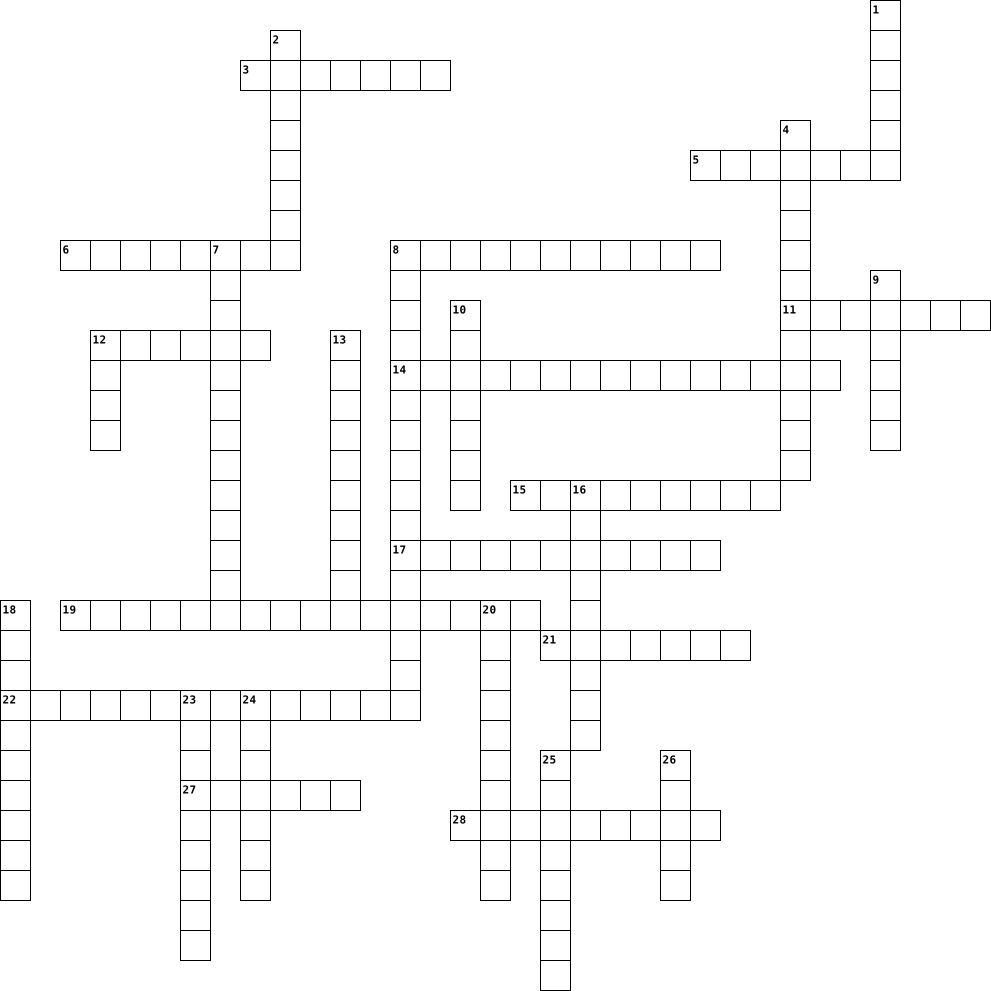
Across
- / is a physical property that relates the mass of a substance to its volume.
- / the 1st and 8th element resemble one another in physical & chemical properties.
- / atoms of the same elements having a different number of neutrons
- / is a measure of how hot or cold an object is.
- / modern periodic table
- / is anything that has mass and occupies space.
- / is a quantity that compares the density of a substance with the density of water at 4'C
- / deals with the study of matter--its composition, properties, and transformations.
- / process of comparing something with a standard.
- / a group consisting of 3 elements with the same properties.
- / positively charged particles
- / an element located in group 2A of periodic table.
- / are shiny substance that conduct heat and electricity.
- / refers to the smallest estimated value taken directly from the device.
Down
- / a row in the periodic table
- / uncharged particles
- / an element located in group 1A.
- / cannot be broken down into simpler components by ordinary mechanical means; fixed composition
- / an element contained in one of the 10 columns in the periodic table
- / is the name of the force exerted on an object due to the acceleration of gravity.
- / simplest known substance.
- / amount of matter in a body
- / number of protons + number of neutrons
- / negatively charged particles
- / have properties intermediate between metals and nonmetals.
- / a compound that contains both a hydrogen atom and a lone pair of electrons so that it can be either an acid or a base.
- / are poor conductors of heat and electricity.
- / contains 2 or more components whose composition may be varied.
- / refers to the smallest exact value taken directly from the device.
- / a column in the periodic table
30 Clues: / uncharged particles • / modern periodic table • / simplest known substance. • / amount of matter in a body • / a row in the periodic table • / negatively charged particles • / positively charged particles • / a column in the periodic table • / an element located in group 1A. • / number of protons + number of neutrons • / are poor conductors of heat and electricity. • ...
Periodic Table Of Elements Crossword Puzzle 2012-11-12

Across
- A element that is shiny and has the capability to conduct heat and electricity well.
- A subatomic particle without a charge that is located in the nucleus of a atom.
- When one or more electrons loses or gains atoms,This happens when a charged particles forms a atom or "groups" of atoms.
- A negatively charged particle that is subatomic.
- A horizontal row of which elements are on the periodic table,This is described in chemistry.
- A atom that shares the same atomic number of other atoms of the same element, but has a different atomic mass.
- This symbol represents the first one too two letters of an element on the periodic table.
- The mass of the atom showed/expressed in the atomic mass number.
- The law that states a repeating chemical and physical properties that changes periodically with there atomic number.
- This a element is neither a metal or nonmetal but has the properties of both elements.
- This is a subatomic particle that is positively charged, it is also located in nucleus of the atomic number,This determines a identity of a element.
Down
- A sort of substance that can not be separated into a simpler substance.
- A element that keeps/maintains the properties of there elements.
- This element poorly conducts heat and electricity.
- On the periodic table of elements,Thus is the line that shows where the nonmetals, metals and, metalloids are located.
- This is the column that is vertical on the periodic table.
- A central region of a atom that is made up of protons and neutrons.
- This is the number that representes the number of protons in the nucleus of a atom.
- A element classified as neither acidic or basic.
- This is when something happens at regular intervals/time.
20 Clues: A negatively charged particle that is subatomic. • A element classified as neither acidic or basic. • This element poorly conducts heat and electricity. • This is when something happens at regular intervals/time. • This is the column that is vertical on the periodic table. • A element that keeps/maintains the properties of there elements. • ...
Unit1VocabGame 2021-09-15

Across
- radius of neutral atom.
- ex:acidity,reactivity,flammability.
- solid,liquid,gas,plasma.
- take shape of its container.
- negative charge circling the nucleus.
- can be found in the center of periodic table.
- found on the right side of the periodic table.
- two or more substance combined together.
- example:color,length,volume,luster.
- similar to electron shells.
- elements 58-71.
- cannot be broken down into smaller substances.
- family found in group 17.
- found on the left side of periodic table.
- contains genetic materials.
- liquid to gas.
- family found in group 18.
- energy needed to remove an electron.
- made up of two or more element.
- smallest particle of an element.
- the bigger number on an element.
- tightly packed.
- held together by chemical bond.
- abbreviated elements on the periodic table.
- orbital rings around the nucleus.
- solid to gas.
- smallest particle in the universe.
Down
- positive charge inside a nucleus.
- cannot be reversible.
- energy needed to attract electron.
- the sum of all mass of an element isotopes.
- the smaller number on the element.
- gas to liquid.
- family found in group 1.
- difference in number of neutrons.
- can be reversible.
- not uniform to the eye.
- negative ions.
- made up of one type of particle.
- family found in group 2.
- appear uniform to the eye.
- elements 90-103.
- stair-steps on periodic table.
- neutral charge inside the nucleus.
- positive ions.
- radius of an atom's ion.
- area around nucleus where the electrons are likely to be found.
- no definite shape or volume.
- difference in number of electrons.
- very high temperature of a star.
50 Clues: solid to gas. • gas to liquid. • negative ions. • positive ions. • liquid to gas. • elements 58-71. • tightly packed. • elements 90-103. • can be reversible. • cannot be reversible. • radius of neutral atom. • not uniform to the eye. • solid,liquid,gas,plasma. • family found in group 1. • family found in group 2. • radius of an atom's ion. • family found in group 17. • family found in group 18. • ...
Chemistry Review 2025-02-22

Across
- A group of elements missing an electron in their outermost shell
- The name for having more or fewer electrons than protons
- Another name for an energy level
- A substance that increases the rate of a chemical reaction
- A solution in which the solvent is water
- A positively charged ion
- The ‘inventor’ of the modern Periodic Table
- The location of electrons
- a pattern of gradual change
- the rule describing the tendency of atoms to react in order to obtain a full outer shell
- A positively charged sub-atomic particle
- A column of elements in the periodic table
- Protons + Neutrons
- A neutral compound consisting of anions and cations
- A substance in which two or more elements are bonded together
- An element with a full valence shell of electrons
- The number of protons in the nucleus of an atom
- The relationship between the mass of a substance and the space it takes up
Down
- The bond formed between two non-metals
- A group of atoms bonded together
- Any element in the d-block (groups 3 – 12) of the periodic table
- An element in Group 1 of the Periodic Table
- An atom with a specific number of protons
- electrons involved in chemical bond formation
- A bond in which electrons are shared
- When elements/compounds exist together but without chemical bonds
- A negatively charged sub-atomic particle
- A sub-atomic particle with no charge
- The horizontal rows of the Periodic Table
- The bond formed between a metal and a non-metal in which electrons are transferred
- The arrangement of the nucleus and electrons
- An atom which has gained or lost an electron
- A negatively charged ion
33 Clues: Protons + Neutrons • A positively charged ion • A negatively charged ion • The location of electrons • a pattern of gradual change • A group of atoms bonded together • Another name for an energy level • A bond in which electrons are shared • A sub-atomic particle with no charge • The bond formed between two non-metals • A solution in which the solvent is water • ...
Periodic Table Basics Crossword 2025-01-10

Across
- What special name is given to the Group 17 elements?
- These are shown on the periodic table with one or two letters and the first is always capitalized.
- The first nonmetal in period 4.
- What special name is given to the Group 18 elements?
- What special name is given to the Group 2 elements?
- Combining an atom each of the first three alkali metals would yield an atom of this element.
- To which group(s) do elements 57 through 70 belong?
- What is the largest category of elements?
- One of the elements that is a liquid at standard temperature and pressure.
- Group 1 element that is not an Alkali Metal.
- If you took an atom of neon out of an atom of the period 6 noble gas you would be left with an atom of this element.
Down
- This periodic table number usually includes several decimal places.
- If you took a zirconium atom out of a seaborgium atom you would be left with an atom of this element.
- The elements are ordered on the Periodic Table by this.
- How many groups are included on the current Periodic Table?
- What special name is given to the Group 1 elements (minus hydrogen)?
- The symbol for atomic number.
- Combining an atom with Z=15 to yittrium would yield an atom of this element.
- The last metal in period 5.
- You would end-up with an atom of this element if you combined an atom of Tc with an atom of Re.
- What is the smallest category of elements?
- What is another name for “group”?
- How many periods are included on the current Periodic Table?
- We call elements 89 through 102 this because they are not assigned to a group or family.
- One of the elements that is a liquid at standard temperature and pressure.
25 Clues: The last metal in period 5. • The symbol for atomic number. • The first nonmetal in period 4. • What is another name for “group”? • What is the largest category of elements? • What is the smallest category of elements? • Group 1 element that is not an Alkali Metal. • What special name is given to the Group 2 elements? • To which group(s) do elements 57 through 70 belong? • ...
Quarter 3 Crossword PS 2026-03-19

Across
- use these to show how many of each in the names of covalent compounds
- only positive polyatomic on your sheet
- Fr
- theyre blue on your periodic table
- different version of an atom (different mass)
- weight of one mole of a substance
- lab equipment used to protect your eyes
- color of a non-metal on your periodic table
- sodium bromide
- Fe
- relative amount of each element in a compound
- metal – nonmetal
- brown outline on your periodic table
- used to show energy levels of an atom
- smallest particle of an element
- these can take on multiple charges
- these are found only in the outermost energy level
- row on a periodic table
- Ba
- has a mass of 131.54
- lightest noble gas
Down
- number of valence electrons for a halogen
- use these to convert from mass to moles or moles to mass
- has a mass of 1.01g
- positive ion
- number of energy levels for argon
- charge of something that has one more electron than proton
- indicates which charge a transition metal actually has
- sulfur as an ion is called…
- has 51 protons
- CO
- these have one valence electron
- equal to the number of protons of an atom
- 10 in a covalent compound
- column on a periodic table
- negative ion
- tetra + penta
- equal to 602000000000000000000000 atoms
- first person who suggested “atoms” existed
- tendency of atoms to prefer to have eight valence electrons
- Calcium Selenide
- looks like 2 dots in a lewis structure
- polyatomic that includes 2 carbon, 3 hydrogen, 2 oxygen
- Sn
44 Clues: Fr • CO • Fe • Sn • Ba • positive ion • negative ion • tetra + penta • has 51 protons • sodium bromide • metal – nonmetal • Calcium Selenide • lightest noble gas • has a mass of 1.01g • has a mass of 131.54 • row on a periodic table • 10 in a covalent compound • column on a periodic table • sulfur as an ion is called… • these have one valence electron • smallest particle of an element • ...
cross word 2015-11-23

Across
- catalyst involved in chemical reactions in living things
- description of a solid that can be stretched into a long wire
- dull, brittle element that does not conduct electricity
- pure substance formed when two non-metals combine
- horizontal row of elements in the periodic table
- a reaction that takes place when two or more substances react to form new substance
- new substance produced in a chemical reaction between reactants
- invisible negatively charged particle that orbits the nucleus of an atom
- energy stored in chemical and released when chemicals react; a form of potential or stored energy
- element that has both metallic and non-metallic properties
- pure substance that cannot be broken down into other substances
Down
- substance that reacts with another substance or substances in a chemical reaction
- group 17 elements in the periodic table; the most reactive non-metals
- atom that has become electrically charged because it has lost or gained electrons
- description of a substance that can be pounded or rolled into sheets
- colourless, odourless gas; produced by incomplete combustion of chemicals containing carbon
- the sum of the number of protons and neutrons in an atom
- group 2 elements in the periodic table
- shiny, malleable, ductile element that conducts electricity
- a table in which the elements are organized by their physical and chemical properties
- group 18 elements in the periodic table; the most stable an unreactive elements
- or substances
- change that results when two or more substances react to create a different
- number of protons in the nucleus of one atom of an element
- pure substance formed when at least one metal and one non-metal
- group 1 elements in the periodic table, not including hydrogen
26 Clues: or substances • group 2 elements in the periodic table • horizontal row of elements in the periodic table • pure substance formed when two non-metals combine • dull, brittle element that does not conduct electricity • catalyst involved in chemical reactions in living things • the sum of the number of protons and neutrons in an atom • ...
Chemistry Cross word 2020-10-16

Across
- Where in the periodic table are noble gases located Left Or right side of the periodic table
- What is the name for something that is transparent, translucent or opaque
- When you leave a bottle of water in the freezer for a long time it beings to
- When a object is caught on fire it begins to start
- A substance that is clear and has nothing in it Exp (water)
- what does the atomic number mean on the periodic table Number of protons or Electrons?
- bond, What is the name for the process that involves the sharing of electrons between two atoms
- A chemical that consists of two particles
- Why do atoms bond with each other. To become ____
Down
- bond, A type of covalent bond between two atoms in which electrons are shared unequally is called a ______ bond
- where in the periodic table are alkaline metals located Left or Right side of the periodic table
- Neutrons and ______ will always have the same amount of atoms
- What is the name for something that is square, powder, crystalline, amorphous
- What is the name for something that is smooth, or rough
- A chemical that consists of 1 particle
- bonding, a transfer of an electron, so one atom gains an electron while one atom loses an electron is called
- On the periodic table which vertical row has all -1 ion charges
- When you have some water in a pot over a fire the water begins to?
- When a apple is left out for a long time it begins to start
- What is the name for something that is floral,pungent,choking or rancid
- What language did Na In ons odium come from?
21 Clues: A chemical that consists of 1 particle • A chemical that consists of two particles • What language did Na In ons odium come from? • Why do atoms bond with each other. To become ____ • When a object is caught on fire it begins to start • What is the name for something that is smooth, or rough • When a apple is left out for a long time it begins to start • ...
3.7 & Bohr model B chem 2023-09-07

Across
- B is the chemical symbol for this element
- Elements in the same group have similar ____ and chemical properties
- Cu is the chemical symbol for this element
- vertical column of elements in the periodic table
- I is the chemical symbol for this element
- this is how many elements can fit in the first energy level
- elements in the same period have the same number of ___ levels
- Second letter of a chemical symbol is always written using this type of letter
- Scientist from 1800s who ordered elements by atomic mass, first name is Dmitri
- Sweedish Scientist created a system for organizing elements, first name is Jon Jakob
- Fe is the chemical symbol for this element
- this is how many columns/groups there are on the periodic table
- O is the chemical symbol for this element
Down
- C is the chemical symbol for this element
- He is the chemical symbol for this element
- Rn is the chemical symbol for this element
- repeating pattern
- Na is the chemical symbol for this element
- First letter of a chemical symbol is alway written using this type of Letter
- This is how many rows/periods there are on the periodic table
- Ca is the chemical symbol for this element
- The periods have a pattern where elements start at this state ____ and move to a gas at the end
- horizontal row of elements in the periodic table
- this is how many electrons can fit in the second energy level
- Xe the chemical symbol for this element
- Ne is the chemical symbol for this element
26 Clues: repeating pattern • Xe the chemical symbol for this element • C is the chemical symbol for this element • B is the chemical symbol for this element • I is the chemical symbol for this element • O is the chemical symbol for this element • He is the chemical symbol for this element • Rn is the chemical symbol for this element • Na is the chemical symbol for this element • ...
Ajlas Assignment 2022-03-22

Across
- Its found in milk for humans
- the sum of the numbers of protons and neutrons present in the nucleus of an atom.
- a column in the periodic table of the chemical elements
- he property of an element that determines the number of other a ionic
- (non metal) atomic number is 9
- (non metal) atomic weight is 11
- the number of a chemical element in the periodic system, whereby the elements are arranged in order of increasing number of protons in the nucleus.
- a positive electric charge
- a group of rare gases that include helium, neon, argon, krypton, xenon
- has groups and periods
- any of the six chemical elements that make up Group 1 (Ia) of the periodic table
- inert gas
- elements on the right of the periodic table
- A neutral chemical substance is neither an acid nor an alkali
- (non metal) chemical symbol is O
Down
- an electron in an atom, ion, or molecule not associated with any single atom or a single covalent bond
- (Metal) atomic weight is 56
- (non metal) atomic weight is 4
- subatomic particle that has a positive charge equal magnitude
- The horizontal rows of the periodic table
- neutral subatomic particle
- monosaccharide sugar
- inert gas
- any of a class of substances characterized by high electrical and thermal conductivity as well as by malleability, ductility, and high reflectivity of light.
- the interatomic linkage that results from the sharing of an electron pair between two atoms.
- a characteristic of a unit of matter that expresses the extent to which it has more or fewer electrons than protons.
- (Metal) chemical symbol is TI
- membrane-bound organelle that contains the cell's chromosomes
- a negatively charged subatomic particle
29 Clues: inert gas • inert gas • monosaccharide sugar • has groups and periods • neutral subatomic particle • a positive electric charge • (Metal) atomic weight is 56 • Its found in milk for humans • (Metal) chemical symbol is TI • (non metal) atomic weight is 4 • (non metal) atomic number is 9 • (non metal) atomic weight is 11 • (non metal) chemical symbol is O • ...
Haha 2023-05-24

Across
- gases, Group 8A on the periodic table
- point, it increases moving from group 1A and 2A on the periodic table determines if a solid will melt
- metals, group 1A on the periodic table
- negativity, increases left to right across and top to down when it decreases fluorine has the highest EN
- metals, contains oxygen sulfur selenium phosphorus nitrogen and carbon
- Character, determines if a element to lose electrons to make ions or cations increases right to left and top and down
- Group 7A on the periodic table
- Energy, increases left to right decreases too to bottom helium has the highest ionization
Down
- earth metals, Group 2A on the periodic table
- affinity, same trend with ionization energy and changes if you add an electron to a gaseous atom
- metals, Groups 3-12
- radius, decreases left to right it’s the size of an atom
- contain boron silicon arsenic tellurium germanium and antimony
13 Clues: metals, Groups 3-12 • Group 7A on the periodic table • gases, Group 8A on the periodic table • metals, group 1A on the periodic table • earth metals, Group 2A on the periodic table • radius, decreases left to right it’s the size of an atom • contain boron silicon arsenic tellurium germanium and antimony • ...
Matthew’s crossword puzzle 2021-09-23

Across
- #33 on periodic table
- constitution
- lacking the ability or strength to move
- very clear
- starving
- open to attack
- dishonest
- making someone weak
- head of a college
Down
- having six sides
- very detailed
- public ally supporting
- #18 on periodic table
- large or powerful
- what is done to dead people
- underground room to bury people
- never done before
17 Clues: starving • dishonest • very clear • constitution • very detailed • open to attack • having six sides • large or powerful • never done before • head of a college • making someone weak • #33 on periodic table • #18 on periodic table • public ally supporting • what is done to dead people • underground room to bury people • lacking the ability or strength to move
spelling list 6 2022-09-22

Across
- the symbol for this is Cr on the periodic table
- a pot of this might be at the end of a rainbow
- this word starts with a b and has a z
- the symbol for this is Fe on the periodic table
- this is in your pencil
- the Dr. Pepper can is made out of what?
Down
- a metal that is a good conductor of electricity
- the symbol for this is Mg on the periodic table
- the symbol for this is Ti on the periodic table
- the symbol for this is Co on the periodic table
- many band instruments are made out of what?
11 Clues: this is in your pencil • this word starts with a b and has a z • the Dr. Pepper can is made out of what? • many band instruments are made out of what? • a pot of this might be at the end of a rainbow • a metal that is a good conductor of electricity • the symbol for this is Cr on the periodic table • the symbol for this is Mg on the periodic table • ...
Unit 4 Crossword 2024-11-20

Across
- Table: a table of the chemical elements arranged in order of atomic number, so that elements with similar atomic structure and hence similar chemical properties appear in vertical columns.
- type of element typically brittle, non-conductive elements that lack the characteristics of metals.
- any of the elements fluorine, chlorine, bromine, iodine, and astatine, occupying group 17 of the periodic table.
- number: The number of protons in the nucleus of an atom, which determines the chemical properties of an element and its place in the periodic table.
- metals: Any of the elements occupying Group 1 of the periodic table. They are very reactive metals
- mass: The mass of a single atom of a chemical element. It includes the masses of the 2 subatomic particles that make up an atom’s nucleus: protons and neutrons.
- metals: any of the set of metallic elements occupying groups 4–12 in the periodic table
- electrons: a valence electron is an outer shell electron that is associated with an atom, and that can participate in the formation of a chemical bond if the outer shell is not full.
- vertical columns of the periodic table. All elements in a group have the same number of valence electrons
Down
- horizontal rows of the periodic table. All elements in a row have the same number of electron shells
- earth metals: any of the six highly reactive chemical elements in group 2 of the periodic table
- a group of elements that act between a metal and a non-metal. Sometimes they can display metallic properties, other times they can act more like a non-metal.
- type of element that is typically hard, shiny, malleable, fusible, and ductile, with good electrical and thermal conductivity.
- rule: elements are most stable when their outer electron level is full, usually with eight electrons
14 Clues: metals: any of the set of metallic elements occupying groups 4–12 in the periodic table • earth metals: any of the six highly reactive chemical elements in group 2 of the periodic table • metals: Any of the elements occupying Group 1 of the periodic table. They are very reactive metals • ...
Science 2023-06-28

Across
- the first ever artificially produced element, produced as a by-product at nuclear power stations
- the group of metals that are shiny, soft, and react violently with water
- a category of atom on the periodic table
- where two or more substances bind to create one complex substance
- the subatomic particles with a positive charge
- the rarest element ever
- the inventor of the periodic table, Dmitri Mendeleyev, was from... ?
- the subatomic particles with a negative charge
- where electrons flow from atom to atom
- some elements abbreviations don't make much sense to english speakers because they are the element's name in this language
- where one or more complex molecule/s breaks down into simpler compounds
- subcategories of when a atom gains or loses a neutron
Down
- this country was named after the element of silver's latin name
- what is a group of interconnected atoms called?
- the element with the highest weight on the periodic table
- what is everything in the universe made of?
- the effect radioactivity has on some less dense materials
- where two molecules interact with each other and change structure
- the center of the atom
- the rarest naturally occurring element on earth
- the element with the lightest atomic weight on the periodic table
- the rows on the periodic table are called...?
- this element is widely regarded as the most versatile elements because of how it is the base element of so many things
- this element exists naturally in abundance on earth, but it was discovered because of astronomers observing the sun
- what is left after a reaction occurs
25 Clues: the center of the atom • the rarest element ever • what is left after a reaction occurs • where electrons flow from atom to atom • a category of atom on the periodic table • what is everything in the universe made of? • the rows on the periodic table are called...? • the subatomic particles with a positive charge • the subatomic particles with a negative charge • ...
Periodic Table Of Elements Crossword Puzzle 2012-11-12

Across
- This is the column that is vertical on the periodic table.
- This is a subatomic particle that is positively charged, it is also located in nucleus of the atomic number,This determines a identity of a element.
- The mass of the atom showed/expressed in the atomic mass number.
- On the periodic table of elements,Thus is the line that shows where the nonmetals, metals and, metalloids are located.
- This is the number that representes the number of protons in the nucleus of a atom.
- A element that is shiny and has the capability to conduct heat and electricity well.
- A central region of a atom that is made up of protons and neutrons.
- A element classified as neither acidic or basic.
- A element that keeps/maintains the properties of there elements.
- A horizontal row of which elements are on the periodic table,This is described in chemistry.
- A subatomic particle without a charge that is located in the nucleus of a atom.
Down
- This element poorly conducts heat and electricity.
- When one or more electrons loses or gains atoms,This happens when a charged particles forms a atom or "groups" of atoms.
- The law that states a repeating chemical and physical properties that changes periodically with there atomic number.
- This symbol represents the first one too two letters of an element on the periodic table.
- A atom that shares the same atomic number of other atoms of the same element, but has a different atomic mass.
- A negatively charged particle that is subatomic.
- This a element is neither a metal or nonmetal but has the properties of both elements.
- This is when something happens at regular intervals/time.
- A sort of substance that can not be separated into a simpler substance.
20 Clues: A negatively charged particle that is subatomic. • A element classified as neither acidic or basic. • This element poorly conducts heat and electricity. • This is when something happens at regular intervals/time. • This is the column that is vertical on the periodic table. • The mass of the atom showed/expressed in the atomic mass number. • ...
Chemistry Crossword 2015-11-19

Across
- Homogeneous mixture
- A system of easy-to-see warning symbols on hazardous materials
- Mass of one atom of an element calculated by total number of protons, neutrons, and electrons of that atom
- An element in which its properties are between those of metals and solid nonmetals
- substance that helps a chemical reaction to proceed faster
- Neutral particle in the nucleus of an atom
- Invisible negatively charged particle that orbits the nucleus of an atom
- Second group of elements in the periodic table; not as reactive as those in the first group
- Positively charged particle in the nucleus of an atom
- A chemical reaction that absorbs heat energy
- Change of state from a gas to a solid
- Chemical combination of two or more elements in a specific ration
Down
- Change of state from a solid to a liquid
- Pure substance that cannot be broken down into other substances; made up of only one type of atom
- Slow chemical change that occurs when oxygen in the air reacts with a metal
- Vertical column of elements in the periodic table
- Group of atoms joined by covalent bonds
- ability of a substance to conduct electricity or heat
- Change of state from a gas to liquid
- Horizontal row of elements in the periodic table
- First group of elements in the periodic table; most reactive of the metals
- A chemical reaction that releases heat energy
- Group 17 elements in the Periodic Table of Elements; most reactive nonmetals
- Catalyst involved in a chemical reactions within living things
- Anything that has a mass and occupies space
25 Clues: Homogeneous mixture • Change of state from a gas to liquid • Change of state from a gas to a solid • Group of atoms joined by covalent bonds • Change of state from a solid to a liquid • Neutral particle in the nucleus of an atom • Anything that has a mass and occupies space • A chemical reaction that absorbs heat energy • A chemical reaction that releases heat energy • ...
Chemistry Crossword 2015-11-13

Across
- an experiment in which all products of a chemical reaction are accounted for
- chemical combination of two or more elements in a specific ratio
- a colourless, odorless, poisonous gas
- substance that helps a chemical reaction proceed more quickly
- number of protons in the nucleus of one atom as an element
- the smallest part of an element that is representative of that element
- change that results when two or more substances react to form a new substance
- measure of atomic mass
- combination of symbols that represent a compound
- ability of a substance to conduct electricity or heat
- mass of one atom of an element calculated from the total number of protons, neutrons, and electrons in an atom
- atom that has become electrically charged because it lost or gained electrons
- principle that matter is not created or destroyed in a reaction
- group 1 elements in the periodic table, not including hydrogen; the most reactive of the elements
Down
- invisible negatively charged particle that orbits around the nucleus of an atom
- pure substance formed when at least one metal and one non-metal combine
- material that electric charge can move through easily
- pure substance that cannot be broken down into other substances
- group 2 elements in the periodic table: their reactivity is not as strong as that of alkili metals
- vertical column of elements in the periodic table
- a reaction that takes place when two or more substances to form a new substance
- group 17 elements in the periodic table: the most reactive non-metal
- chemical reaction that occurs when oxygen reacts with a substance to form a new substance and give off energy
- energy stored in chemicals and released when chemicals react
- vertical column of elements in periodic table
25 Clues: measure of atomic mass • a colourless, odorless, poisonous gas • vertical column of elements in periodic table • combination of symbols that represent a compound • vertical column of elements in the periodic table • material that electric charge can move through easily • ability of a substance to conduct electricity or heat • ...
Chemistry Vocabulary #2 2017-10-23

Across
- Smallest unit of matter
- a group of atom chemically combine. (2 or more atoms)
- The amount of matter in a given amount of space
- “Potential” to go through a chemical change. Can be seen in a chemical reaction.
- Level The rings around the nucleus of an atom
- Goes from Side to Side on the Periodic Table and tells the number of energy levels.
- Changes in the States of Matter. Change the phase or shape but not the substance.
- A pure substance containing only one type of atom
- Has properties of both metals and nonmetals and is along the zig–zag line on the periodic table
- The part of an atom that does not have a charge
- Goes Up and Down on the Periodic Table, Tells how reactive an element is and similar
- The negative part of an atom
Down
- Describes and element. Can be observed without changing the element
- The positive part of an atom.
- Electrons in the outermost energy level
- Number of Molecules in a chemical formula.
- Elements that combine for form a new substance
- The number of atom of an element in a chemical formula
- Chemical symbols that represent a compound
- The number of protons in an atom
- A brittle, dull, and insulator material that is on the right side of the periodic table.
- How something interacts with something else
- A shiny, malleable, ductile, and conductive material on the left side of the periodic table.
- Two or more different kinds of atoms. (2 or more elements)
- Center of an atom with a positive charge
25 Clues: Smallest unit of matter • The negative part of an atom • The positive part of an atom. • The number of protons in an atom • Electrons in the outermost energy level • Center of an atom with a positive charge • Number of Molecules in a chemical formula. • Chemical symbols that represent a compound • How something interacts with something else • ...
8th Prop of Atoms & Molecules L 1-15 Vocab Crossword 2021-11-19

Across
- substance that cannot be broken down by ordinary chemical means
- bond formed when thousands of atoms freely share their electrons
- a bond formed by transferring of electrons
- gases elements in column VIIA, (18) non-reactive elements
- removal of oxygen from a molecule
- a measure of how strongly an element attracts electrons to itself
- two of the same type of atom bonded together
- positively charged particle (+) in the nucleus of an atom
- number of protons in an atom
- column of the periodic table
- non-reactive
- recycling of carbon for reuse by plants and animals
- row of the periodic table
- substance whose atoms form in an orderly pattern
Down
- elements on the periodic table between the metals and nonmetals
- negatively charged particle orbiting the nucleus of an atom
- an element with an electrical charge due to missing or extra electrons
- symbolic representation of the atoms in a molecule
- molecules formed by sharing of electrons
- top four elements in column VIIA (17) on the periodic table
- refining ore through high temperature
- number of protons plus the number of neutrons in an atom
- separating of atoms by passing electrical current through them
- electrically neutral (neither + nor - )in the nucleus of an atom
- group of chemically connected atoms
- metal that results when a small amount of one metal is added to another
- adding of oxygen to a molecule
- two or more different kinds of atoms bonded together
- outermost energy level (or shell) of an atom
- elements in the center columns of the periodic table, labeled with the letter B
- tight mass of protons and neutrons in the center of an atom
31 Clues: non-reactive • row of the periodic table • number of protons in an atom • column of the periodic table • adding of oxygen to a molecule • removal of oxygen from a molecule • group of chemically connected atoms • refining ore through high temperature • molecules formed by sharing of electrons • a bond formed by transferring of electrons • ...
Periodic Table Review 2026-01-14

Across
- An f block family of metals in period 6 with very large densities
- The atomic ____ is calculated by adding the number of protons and neutrons.
- Area of mathematical probability where an electron might be found. Come in varieties s, p, d, and f.
- Class of elements on the right side of the periodic table that are defined by their brittle, dull nature.
- Reactive nonmetals that form salt when combined with alkali metals
- Type of atom with a different number of neutrons, giving the atom a different atomic mass.
- Negatively charged subatomic particle found in rings orbiting the nucleus.
- F block family of metals that are all radioactive.
- Class of elements found on the "staircase" of the periodic table that exhibit properties of both metals and nonmetals
- Positively charged subatomic particle, the number of which is equivalent to the atomic number
Down
- Electrons farthest from the nucleus. Found in the outermost shell of an atom
- Neutrally charged subatomic particle there to stabilize the nucleus of the atom.
- Type of metal readily found in on Earth
- An atomic ____ is equivalent to the number of protons and is unique to the atom.
- Group 18 is named the ___ gases
- Type of low density, low melting point, highly reactive metal found in group 1.
- Columns on the periodic table
- Electrons found closer to the nucleus in energy levels below the highest.
- Class of elements on the left side of the periodic table; defined by their good conductivity, shiny luster, and malleability
- Rows on the periodic table
- Type of atoms with a different number of electrons, giving the atom a charge.
21 Clues: Rows on the periodic table • Columns on the periodic table • Group 18 is named the ___ gases • Type of metal readily found in on Earth • F block family of metals that are all radioactive. • An f block family of metals in period 6 with very large densities • Reactive nonmetals that form salt when combined with alkali metals • ...
Chapter 6 Periodic Table 2026-02-17

Across
- an atom or group of atoms that have a positive or negative charge.
- The modern day periodic table is arranged by? (2 words)
- An ion with a negative charge.
- How did Mendeleev organize his periodic table? (2 Words)
- Good conductors of heat and electric current.
- The ability of an atom of an element to attract electrons when the atom is in a compound.
- atomic size(radius)________ from top to bottom within a group.
- How many elements were identified by 1700?
- The nonmetals of group 7A are called?
- the group B elements that are usually displayed in the main body of a periodic table? (2 words)
- Positive and negative ions form when __________ are transferred between atoms.
Down
- one half of the distance between the nuclei of two atoms of the same element when the atoms are joined. (2 Words)
- The elements in group 2A are called? (3 words)
- poor conductors of heat and electric current.
- The energy required to remove an electron from an atom.
- The elements in group 8A are called? (2 words)
- The elements in group 1A are called? (2 Words)
- Most of the elements of the periodic table are?
- Early chemists used ____________ to sort the elements into groups.
- How many electrons does the d orbital hold?
- An ion with a positive charge.
- Elements in group 1A-7A are often referred to as? (2 words)
- When the elements are arranged in order of increasing atomic number, there is a periodic repetition of their physical and chemical properties. (2 words)
- Generally has properties that are similar to those of metals and nonmetals.
- What element is a liquid at room temperature that is in period six?
- Electronegativity values ____________ from top to bottom within a group.
26 Clues: An ion with a negative charge. • An ion with a positive charge. • The nonmetals of group 7A are called? • How many elements were identified by 1700? • How many electrons does the d orbital hold? • poor conductors of heat and electric current. • Good conductors of heat and electric current. • The elements in group 2A are called? (3 words) • ...
Chap 5 vocab 2023-03-27

Across
- - a column of elements in a periodic table
- and right sides of the periodic table
- that repeat from row to ro Period - a row in a periodic table of elements
- electron - an electron that is in the highest occupied energy level
- metals - elements that form a bridge between elements on the
Down
- - elements that are poor conductors of heat and electric current
- an atom
- law - the pattern of repeating properties displayed by elements in
- - elements with properties that fall between those of metals and
- mass unit (amu) - one twelfth the mass of a carbon-12 atom Metals - elements that are good conductors of heat and electric current
- table - an arrangement of elements in columns, based on a set of
- periodic table
12 Clues: an atom • periodic table • and right sides of the periodic table • - a column of elements in a periodic table • metals - elements that form a bridge between elements on the • - elements that are poor conductors of heat and electric current • - elements with properties that fall between those of metals and • ...
Atomic Structure and the Periodic Table 2023-02-28

Across
- Although this element is in a group with metals, it is a nonmetal.
- protons and ________________ are found in the nucleus
- This element has an average atomic mass of 40.078 amu.
- The mass number of an atom is found by adding __________ and neutrons.
- Lithium-7 would have how many neutrons? (Write out the number.)
- Group 18 is called the ________ gases.
- What main subatomic particle has no charge?
- In order for an atom to be neutral the number of ____________ must be equal to the number of protons.
- The atomic number is always equal to the number of _________________.
- This is the last element in the alkali metals group.
- Is cerium a lanthanide or actinide?
- Is neon a metal, nonmetal, or metalloid?
- protons have a ___________ charge
- These elements are on the right side of the periodic table.
- Is strontium a metal, nonmetal, or metalloid?
- The current periodic table arranged elements by increasing _____________ number.
- These elements are on the stairstep on the periodic table.
Down
- Is thorium a lanthanide or actinide?
- This element has an atomic number of 30.
- Group 17 is called the _____________.
- Isotopes are atoms of the same element with different numbers of ________________.
- This element has 54 protons.
- A helium atom has this many protons. (Write out the number.)
- On the periodic table, the vertical columns are called __________ or families.
- Beryllium has how many protons? (Write out the number.)
- On the periodic table, the horizontal rows are called ____________.
- Magnesium-26 would have how many neutrons? (Write out the number.)
- This element has 24 protons.
- This element has 12 protons.
- A neutral atom of this element would have 50 electrons.
- A neutral atom of this element would have 47 electrons.
- Is boron a metal, nonmetal, or metalloid?
- Groups 3-12 are called the ___________ metals.
- How many protons does a neon atom have? (Write out the number.)
- electrons have a ___________ charge
- These elements are on the left side of the periodic table.
- This element has an average atomic mass of 55.845 amu.
- Group 2 is called the ___________ earth metals.
- This is the first element in the noble gases group.
- Group 1 is called the ___________ metals.
40 Clues: This element has 54 protons. • This element has 24 protons. • This element has 12 protons. • protons have a ___________ charge • Is cerium a lanthanide or actinide? • electrons have a ___________ charge • Is thorium a lanthanide or actinide? • Group 17 is called the _____________. • Group 18 is called the ________ gases. • This element has an atomic number of 30. • ...
Atomic Theory & Periodic Table 2025-09-21

Across
- The force that causes opposite charges (positive and negative) to attract and like charges to repel. These forces hold an atom together.
- An element that is usually dull, brittle, and a poor conductor. Found on the right side of ther periodic table.
- A horizontal row on the periodic table. Each element in a period having the same number of energy levels.
- The scientific idea that all matter is made of tiny particles called atoms.
- Atoms of the same element that have the same number of protons but different numbers of neutrons.
- A simple representation used to explain or show how something too small, big, or complex works.
- The smallest unit of matter that makes up everything around us.
- A negatively charged particle that moves around the nucleus of an atom.
- A small unit of mass used to measure the weight of subatomic particles and atoms.
- A pure substance made of only one kind of atom.
- A well-tested explanation that helps us understand why something happens in nature.
- The tiny, dense center of an atom that contains protons and neutrons.
Down
- The smaller parts inside an atom, called protons, neutrons, and electrons.
- A model showing electrons moving quickly in regions around the nucleus instead of in fixed paths.
- The mass of an element’s protons and neutrons.
- An element with properties of both metals and non-metals. Found on the “staircase” of ther periodic table.
- A particle with no charge found inside the nucleus of an atom.
- The electrons in the outermost energy level of an atom that are involved in bonding.
- The number of protons in an atom’s nucleus, which identifies the element.
- A positively charged particle found inside the nucleus of an atom.
- The one- or two-letter abbreviation that represents an element on the periodic table.
- An element that is usually shiny, a good conductor, and can be shaped or stretched. Found on the left side of ther periodic table.
- A vertical column on the periodic table where elements have similar properties.
23 Clues: The mass of an element’s protons and neutrons. • A pure substance made of only one kind of atom. • A particle with no charge found inside the nucleus of an atom. • The smallest unit of matter that makes up everything around us. • A positively charged particle found inside the nucleus of an atom. • ...
Final Exam Extra Credit 2016-06-15

Across
- This is the full way to represent each element in its element box.
- The first name of the inventor of the periodic table.
- This number, found in each element box, contains a decimal.
- and chemical properties.
- There are ___ periods on the periodic table.
- Group ___ contains elements like lithium, sodium, potassium, and rubidium.
- These are found to the right of the staircase.
- Elements in Group 1 and 2 get more reactive as you go ___ the group.
- These are found to the left of the staircase.
- Elements in Group 17 get more reactive as you go ___ the group.
- This chemical family of elements contains the second group of most reactive metals.
- Alkali metals are very reactive with ___ and may combust in its presence.
- ___ is the most reactive of the non-metals.
- This is the short form to represent each element in its element box.
- This chemical family of elements contains the most reactive non-metals.
- This zigzag line separates the metals from the non-metals.
- The last name of the inventor of the periodic table.
- Each column on the periodic table is called a ___.
Down
- Each row on the periodic table is called a ___.
- The metals are found to the ___ of the staircase.
- These elements form Groups 3 to 12.
- The periodic table was invented in the year 18__
- Group ___ contains elements like fluorine, chlorine, bromine, iodine and astatine.
- The ___ is a chart that organizes elements based on their increasing atomic number and their
- This is the whole number found in each element square.
- ___ is the most reactive of the alkali metals.
- This class of elements is located directly around the staircase.
- This chemical family of elements contains elements that do not react with other elements.
- Group ___ contains elements like helium, neon, argon, krypton and xenon.
- This chemical family of elements contains the most reactive metals.
- Fe
- Group ___ contains elements like beryllium, magnesium, calcium and strontium.
- The non-metals are found to the ___ of the staircase.
33 Clues: Fe • and chemical properties. • These elements form Groups 3 to 12. • ___ is the most reactive of the non-metals. • There are ___ periods on the periodic table. • These are found to the left of the staircase. • ___ is the most reactive of the alkali metals. • These are found to the right of the staircase. • Each row on the periodic table is called a ___. • ...
The Periodic Table 2021-10-26

Across
- the ability of a substance to be hammered or beaten into thin sheets
- A column on the periodic table
- a material that conducts current under certain conditions
- the ability of a substance to be drawn, pulled, or extruded through a small opening to produce a wire
- Group 1
- Group 18
- element that shares some properties with both metals and nonmetals
Down
- the elements in Group 2A of the periodic table
- elements in groups 3-12
- A horizontal row of elements in the periodic table
- A table that shows the elements, their atomic number, symbol, and average atomic mass; elements with similar chemical properties are grouped together.
- An element that lacks most of the properties of a metal
- an element that is shiny and that conducts heat and electricity well
- a nonmetal in Group 7A of the periodic table
- The way a mineral reflects light
15 Clues: Group 1 • Group 18 • elements in groups 3-12 • A column on the periodic table • The way a mineral reflects light • a nonmetal in Group 7A of the periodic table • the elements in Group 2A of the periodic table • A horizontal row of elements in the periodic table • An element that lacks most of the properties of a metal • ...
Periodic table 2021-01-12

Across
- smallest particle of an element
- the number of protons in an atom
- nonmetal in group 17 of the periodic table that has seven valence electrons
- si unit for the mass of an atom
- elements that have properties of both metals and nonmetal
- a table organizing all of the elements known exist
Down
- a particle that is inside of the nucleus and has a positive charge
- a particle outside the nucleus that has a negative charge
- column of the periodic table that contains elements with similar properties
- class of elements that are good conductors of electricity
- the center of an atom
- nonmetal in group 18 of the periodic table that has eighth valence electrons
- located in the nucleus and has a neutral charge
- class of element that do not conduct electricity
- row of the periodic table that contains elements ranging from metals on the left to Metalloid and then nonmetals on the right
15 Clues: the center of an atom • smallest particle of an element • si unit for the mass of an atom • the number of protons in an atom • located in the nucleus and has a neutral charge • class of element that do not conduct electricity • a table organizing all of the elements known exist • a particle outside the nucleus that has a negative charge • ...
Periodic Table Crossword - SL 2022-05-07

Across
- An atom that has gained or lost one or more electrons.
- In between metals and non-metals.
- The element on the periodic table which has an atomic number of 18.
- The amount of protons and electrons in an atom.
- A mixture of two or more elements.
- The positively charged particle in an atom.
- The element whose atomic symbol is "K".
Down
- A particle within an atom that has a neutral charge.
- A negatively charged particle within an atom.
- A type of electron that can share with other atoms and creates bonds.
- The element on the periodic table which has an atomic number of 4.
- A column of elements in the Periodic Table.
- The bond that has electrical attraction between a negative ion and a positive ion.
- Something that is dissolved in a solvent.
- A row of elements in the Periodic Table.
15 Clues: In between metals and non-metals. • A mixture of two or more elements. • The element whose atomic symbol is "K". • A row of elements in the Periodic Table. • Something that is dissolved in a solvent. • A column of elements in the Periodic Table. • The positively charged particle in an atom. • A negatively charged particle within an atom. • ...
Periodic table 2021-01-12

Across
- smallest particle of an element
- the number of protons in an atom
- nonmetal in group 17 of the periodic table that has seven valence electrons
- si unit for the mass of an atom
- elements that have properties of both metals and nonmetal
- a table organizing all of the elements known exist
Down
- a particle that is inside of the nucleus and has a positive charge
- a particle outside the nucleus that has a negative charge
- column of the periodic table that contains elements with similar properties
- class of elements that are good conductors of electricity
- the center of an atom
- nonmetal in group 18 of the periodic table that has eighth valence electrons
- located in the nucleus and has a neutral charge
- class of element that do not conduct electricity
- row of the periodic table that contains elements ranging from metals on the left to Metalloid and then nonmetals on the right
15 Clues: the center of an atom • smallest particle of an element • si unit for the mass of an atom • the number of protons in an atom • located in the nucleus and has a neutral charge • class of element that do not conduct electricity • a table organizing all of the elements known exist • a particle outside the nucleus that has a negative charge • ...
Y10 Chemistry Alexander McKay 2023-03-29

Across
- the chance that the results of an experiment were a fluke
- a substance formed with two or more elements
- the colour when potassium cholride is burned
- the outermost electron shell
- the most least reactive group of elements on the far right of the periodic table
- the amount of energy needed to start a reaction
- most reactive group on the periodic table on the far left
- size of distance from nucleus to outermost electron
- has properties between those of metals and non-metals
- energy needed to remove outermost electrons
Down
- an atom with a different number of neutrons than protons
- the degree to which an element tends to gain electrons and form negative ions in chemical reactions
- the smaller number under the element letters on the periodic table
- burns red colour when burned
- the number of protons in an element on the periodic table
15 Clues: the outermost electron shell • burns red colour when burned • energy needed to remove outermost electrons • a substance formed with two or more elements • the colour when potassium cholride is burned • the amount of energy needed to start a reaction • size of distance from nucleus to outermost electron • has properties between those of metals and non-metals • ...
elements and periodic table 2024-11-09

Across
- This element is a noble gas with the symbol "He".
- Table The name of the table that organizes all known elements.
- The positively charged particle in the nucleus.
- The scientist who created the first periodic table.
- Elements in the same group have similar __________ properties.
- This element has the symbol "O".
- This element has the symbol "Na".
Down
- A negatively charged particle that orbits the nucleus.
- The atomic number represents the number of these in the nucleus.
- Mass The average mass of all the isotopes of an element.
- A horizontal row on the periodic table.
- The central part of an atom, containing protons and neutrons.
- A vertical column on the periodic table.
- The smallest unit of matter that retains the properties of an element.
14 Clues: This element has the symbol "O". • This element has the symbol "Na". • A horizontal row on the periodic table. • A vertical column on the periodic table. • The positively charged particle in the nucleus. • This element is a noble gas with the symbol "He". • The scientist who created the first periodic table. • A negatively charged particle that orbits the nucleus. • ...
Science Vocab Puzzle 2020-10-13

Across
- vertical rows of the elements on the periodic table.
- How to wright out the chemical and the electron charge (ions) ex: NaCl-Sodium Chloride (table salt)
- A chemical bond between multiple non-metals.
- horizontal rows of elements on the periodic table.
- A chemical bond between a metal(s) and a nonmetal(s).
- Metals, nonmetals, and metalloids are the main groups on the periodic table
- an atom with a net electric charge due to the loss or gain of one or more ions
- along the zig-zag staircase line of the periodic table properties of metals and non-metals, shiny brittle semiconductors of heat and electricity.
- electrons on the outer shell of the atom
- Atoms bonding together by chemical bonding.
- In atomic physics and quantum chemistry, the electron configuration is the distribution of electrons of an atom or molecule in atomic or molecular orbitals.
- the way elements appear in room temperature (gas, Liquid, or solid)
- atoms that join together to form forces of attraction.
- a column on the periodic table
- total number of protons and neutrons in a nucleus
- smallest particle of an element that retains the chemical properties
- total number of protons and neutrons that make up the nucleus of an isotope
- Were an atom gained an electron this is also known as a anion
Down
- Substance made up of two different elements.
- positively charged particles found in the nucleus
- Table with all the elements and their atomic #, atomic mass, electrons,protons, neutrons, symbol, and their name.
- Atoms that lost and electron. This is also known as an cation
- loss of electron in an ion
- must be a metal(s) and a nonmetal(s).
- atoms of the element all have the same number
- Neural charged particles found in the nucleus
- Ions of two elements these two
- right side of the periodic table, brittle, poor conductors of heat and electricity
- circles around the nucleus that contain the electrons
- showing information about a chemical or chemicals for compounds.
- number of valence electron, types of ions location/properties of the main groups of elements, and phases at room temperature.
- Negatively charges particles found in the electron clouds
- Left side of the periodic table, hard shiny, high melting points, good conductors of heat and electricity.
- When to elements have a chemical reaction.
- small dense positively charged center of the atom
- gain of electron in an ion
- atoms of the same element that have different masses
37 Clues: loss of electron in an ion • gain of electron in an ion • Ions of two elements these two • a column on the periodic table • must be a metal(s) and a nonmetal(s). • electrons on the outer shell of the atom • When to elements have a chemical reaction. • Atoms bonding together by chemical bonding. • Substance made up of two different elements. • ...
atomic mass 2022-09-28

Across
- C (look at the periodic table)
- Os (look at the periodic table)
- Cu (look at the periodic table)
- Sn (look at the periodic table)
Down
- B (look at the periodic table)
- mass of an atom
- Au (look at the periodic table)
- Fe (look at the periodic table)
8 Clues: mass of an atom • B (look at the periodic table) • C (look at the periodic table) • Au (look at the periodic table) • Os (look at the periodic table) • Fe (look at the periodic table) • Cu (look at the periodic table) • Sn (look at the periodic table)
Chemistry Atomic Crossword 2022-09-08

Across
- how many f electrons can be in an energy level
- what element does Ho stand for
- what does Cs stand for
- makes everything up
- Speed of light equals _ x frequency
- What is the maximum amount of electrons for orbitals
- what does e=6.26*10^-34 Js(1.60*10^14 1/s)
- acronym for energy levels
- amount of energy that can be gained or lost by an atom
- rows in the periodic table equal what
- potassium as electron configuration using aufbau principle method
- letter that indicates the type of orbital
- how many electrons is in the orbital 4d
- what does B stand for
- method of indicating the arrangement of electrons about a nucleus
- how many electrons does sulfur have
- what element does O stand for
- what is the shape of a p orbital
- Referred to as the atomic number
- how many electrons are in the orbital 4f
Down
- first method for E configuration
- what element does Ir stand for
- 3.00*10^8 m/s= 5.8*10^-7 m*f
- how many rows are in the F section in the periodic table
- number under element name
- even smaller sub-atomic particles than protons
- what element does Kr stand for
- unique upper-case letter and lower-case symbol
- how many elements are in the periodic table
- how many rows are in the P section in the periodic table
- number of protons equals
- how many p orbitals can be in an energy level
- formula for energy
- how many rows are in the D section in the periodic table
- sum of protons and neutrons equals...
- sub-atomic particles with a zero charge
- what element does CA stand for
- second method for E configuration
- what element does Li stand for
- what is the shape of a s orbital
- number that indicates the energy level
- how many electrons is in the orbital 5p
- which is the lowest energy level having d orbitals
- how many rows are in the S section in the periodic table
- what element does Cu stand for
- how many d orbitals can be in an energy level
46 Clues: formula for energy • makes everything up • what does B stand for • what does Cs stand for • number of protons equals • number under element name • acronym for energy levels • 3.00*10^8 m/s= 5.8*10^-7 m*f • what element does O stand for • what element does Ir stand for • what element does Ho stand for • what element does Kr stand for • what element does CA stand for • ...
Periodic Table crossword 2021-10-25

Across
- Characteristics of a particular substance that can be observed
- An element that's properties are intermediate between those of metals and solid semiconductors
- An element that is not a metal
- The smallest unit of ordinary matter
- Vertical columns of the periodic table
- Symbol used to identify an element
- Positively charged subatomic particles
- Table of elements
Down
- The mass of an atom
- An element characterized by high electrical and thermal conductivity
- Neutral charged subatomic partivles
- Horizontal rows of the periodic table
- The outside part of an atom's nucleus
- Negatively charged subatomic particles
- Bond between two atoms of similar electron amount
- The centre of an atom
- Number of protons in the nucleus of an atom
- Russian chemist who created the periodic table
18 Clues: Table of elements • The mass of an atom • The centre of an atom • An element that is not a metal • Symbol used to identify an element • Neutral charged subatomic partivles • The smallest unit of ordinary matter • Horizontal rows of the periodic table • The outside part of an atom's nucleus • Negatively charged subatomic particles • Vertical columns of the periodic table • ...
Chapter 3 Vocab 2020-10-22

Across
- the ability of a substance to be hammered or rolled into sheets.
- Earth Metal-Is the elements in group 2.
- the ability of a metal to reflect light.
- a column of the periodic table.
- the ability to be pulled into thin wires.
- an element that has physical and chemical properties of both metal and nonmetals.
- the rows on the periodic table.
- Element-Is the elements in groups 3-12.
- gas-Is the elements in group 18.
Down
- elements that have no metallic properties.
- an element that is generally shiny.
- Table-Is a chart of the elements arranged into rows and columns according to their physical and chemical properties.
- electricity at high temperatures, but not at low temperatures.
- Metal-Is the elements in group 1.
- an element in group 17 of the periodic table.
15 Clues: a column of the periodic table. • the rows on the periodic table. • gas-Is the elements in group 18. • Metal-Is the elements in group 1. • an element that is generally shiny. • Earth Metal-Is the elements in group 2. • Element-Is the elements in groups 3-12. • the ability of a metal to reflect light. • the ability to be pulled into thin wires. • ...
study 2024-01-18

Across
- which group on the periodic table has 6 valence electrons
- what is the formula for decomposition
- what is the difference between a chemical reaction and a nuclear reaction
- what is the formula for oxidation
- what is the most dangerous type of ray?
- which element on the periodic table has a mass of 1
- what is the formula for single replacement
- when the atom becomes more negative do the amount of electrons increase or decrease
- what are the 5 covalent bonds
Down
- what is contained in the nucleus of an atom
- when the atom becomes less negative do the amount of electrons increase or decrease
- what is the formula for synthesis
- which group on the periodic table has 8 valence electrons
- what is the formula for double replacement
- which group in the periodic table has 1 valence electron
15 Clues: what are the 5 covalent bonds • what is the formula for synthesis • what is the formula for oxidation • what is the formula for decomposition • what is the most dangerous type of ray? • what is the formula for double replacement • what is the formula for single replacement • what is contained in the nucleus of an atom • which element on the periodic table has a mass of 1 • ...
Chemistry 2025-11-17

Across
- The distance from an atom's nucleus to its outermost electron.
- A positively charged ion, typically formed by metals losing electrons.
- An atom or molecule that has a net positive or negative charge due to gaining or losing electrons.
- Elements that are typically brittle, poor conductors, and tend to gain electrons.
- Elements in the d-block (groups 3-12) of the periodic table, often forming colored compounds.
- Elements found in groups 1, 2, and 13-18 of the periodic table.
- The statement that the properties of the elements are a periodic function of their atomic numbers.
- The minimum energy required to remove the most loosely bound electron from a gaseous atom.
- A horizontal row of elements in the periodic table.
Down
- The energy released when an electron is added to a neutral atom to form a negative ion.
- The net positive charge experienced by an electron in a multi-electron atom.
- Elements with properties intermediate between those of metals and nonmetals.
- Elements that are typically shiny, malleable, ductile, good conductors, and tend to lose electrons.
- A negatively charged ion, typically formed by nonmetals gaining electrons.
- A vertical column in the periodic table; elements in the same one have similar properties.
15 Clues: A horizontal row of elements in the periodic table. • The distance from an atom's nucleus to its outermost electron. • Elements found in groups 1, 2, and 13-18 of the periodic table. • A positively charged ion, typically formed by metals losing electrons. • A negatively charged ion, typically formed by nonmetals gaining electrons. • ...
Topic 1- Atomic structure and the periodic table 2021-11-17

Across
- A substance made up of two or more types of atoms chemically combined together.
- The columns of the periodic table represent different groups of elements. Elements with similar properties are in the same group.
- table Table of elements arranged in order of atomic number and such that elements with similar properties are in the same column (group).
- A chemical reaction in which a more reactive element displaces a less reactive element from its compound.
- The number of protons in the nucleus.
- model stated that the mass was concentrated at the centre of the atom and that the nucleus was charged.
- consists of two or more elements or compounds not chemically combined together.
- the components between two phases.
- periodic table.
- The smallest part of an element that can exist. All substances are made up of atoms.
- A separation technique used to separate a mixture of chemicals by
- pudding model Atomic model devised after the discovery of the electron. The model suggests the atom is a ball of positive charge with negative electrons scattered through it.
- An atom or molecule with an electric charge due to the loss or gain of electrons.
- The elements in Group 1 of the periodic table.
- Elements that react to form negative ions. Found towards the right and top of the periodic table.
- number The total number of protons and neutrons in the nucleus.
- metals: The collection of metallic elements in the middle of the periodic table.
- A separation technique used to separate solids from liquids.
Down
- Positively charged subatomic particle present in the nucleus of the atom. Relative mass of 1.
- atomic mass An average value that takes account of the abundance of the isotopes of the element.
- A separation technique used to produce solid crystals from a solution by evaporating the solvent.
- A method of separating a mixture of substances according to their different boiling points.
- Different energy levels in atoms occupied by electrons.
- Neutral subatomic particle present in the nucleus of the atom. Relative mass of 1. Noble gases: The elements in Group 0 of the periodic table.
- Atoms of the same element with the same number of protons but a different number of neutrons.
- The elements in Group 7 of the periodic table.
- Negatively charged subatomic particle which orbit the nucleus at various energy levels. Very small relative mass (negligible).
- A substance made up of only one type of atom.
- Elements that react to form positive ions. Found to the left and towards the bottom of
- Positively charged object composed of protons and neutrons at the centre of every atom with one or more electrons orbiting it.
- distillation A procedure by which two liquids with different boiling points can be separated.
31 Clues: periodic table. • the components between two phases. • The number of protons in the nucleus. • A substance made up of only one type of atom. • The elements in Group 7 of the periodic table. • The elements in Group 1 of the periodic table. • Different energy levels in atoms occupied by electrons. • A separation technique used to separate solids from liquids. • ...
Topic 1 – Atomic Structure and the Periodic Table 2021-11-17

Across
- The nuclear atomic model stated that the mass was concentrated at the centre of the atom and that the nucleus was charged.
- A chemical reaction in which a more reactive element displaces a less reactive element from its compound.
- Elements that react to form negative ions. Found towards the right and top of the periodic table.
- Positively charged subatomic particle present in the nucleus of the atom. Relative mass of 1.
- Atoms of the same element with the same number of protons but a different number of neutrons.
- Negatively charged subatomic particle which orbit the nucleus at various energy levels. Very small relative mass (negligible).
- A separation technique used to separate solids from liquids.
- metals: The collection of metallic elements in the middle of the periodic table.
- table Table of elements arranged in order of atomic number and such that elements with similar properties are in the same column (group).
- Different energy levels in atoms occupied by electrons.
- A substance made up of two or more types of atoms chemically combined together.
- The elements in Group 1 of the periodic table.
- The elements in Group 7 of the periodic table.
- The total number of protons and neutrons in the nucleus.
- An average value that takes account of the abundance of the isotopes of the element.
- A method of separating a mixture of substances according to their different boiling points.
Down
- The columns of the periodic table represent different groups of elements. Elements with similar properties are in the same group.
- distillation: A procedure by which two liquids with different boiling points can be separated.
- Atomic model devised after the discovery of the electron. The model suggests the atom is a ball of positive charge with negative electrons scattered through it.
- An atom or molecule with an electric charge due to the loss or gain of electrons.
- The smallest part of an element that can exist. All substances are made up of atoms.
- Neutral subatomic particle present in the nucleus of the atom. Relative mass of 1. Noble gases: The elements in Group 0 of the periodic table.
- the components between two phases.
- The number of protons in the nucleus.
- periodic table.
- Elements that react to form positive ions. Found to the left and towards the bottom of
- A substance made up of only one type of atom.
- A separation technique used to produce solid crystals from a solution by evaporating the solvent.
- Positively charged object composed of protons and neutrons at the centre of every atom with one or more electrons orbiting it.
- A mixture consists of two or more elements or compounds not chemically combined together.
- A separation technique used to separate a mixture of chemicals by
31 Clues: periodic table. • the components between two phases. • The number of protons in the nucleus. • A substance made up of only one type of atom. • The elements in Group 7 of the periodic table. • The elements in Group 1 of the periodic table. • Different energy levels in atoms occupied by electrons. • The total number of protons and neutrons in the nucleus. • ...
Periodic Table and its Trends 2024-05-03

Across
- family What is the family to the left of the Noble gasses
- What element has the Symbol AU
- What nonmetal has a mass of 35.45
- What are the elements located on the right side of the Periodic Table called
- What is a column called on the periodic
- What is the element that has 3 protons
- What is the Metal that creates the Ionic Bond KCl
Down
- What is a row on the periodic table called
- What is the element at the top of the staircase
- What are the elements of the left side of the Periodic table called
- What is the Element that has the symbol Rb
- What is the noble gas that is located on the 6th row
- earth metal What is the name of the family to the right of the Alkali metals
- What is the only Metal that is a liquid
- What are the elements located on the staircase called
- What is the Element in the Alkali metals family on the 3rd row
- What element has the symbol FE
17 Clues: What element has the Symbol AU • What element has the symbol FE • What nonmetal has a mass of 35.45 • What is the element that has 3 protons • What is the only Metal that is a liquid • What is a column called on the periodic • What is a row on the periodic table called • What is the Element that has the symbol Rb • What is the element at the top of the staircase • ...
Chapter 6 2023-02-08

Across
- A negativity charged ion, formed by a gain of electrons
- The radius of an atom. Cations are smaller, anions are larger than their atom
- the ability of an object to transfer heat or electricity to another object
- Alkali metals.
- A set of elements typically placed at the bottom of the periodic table that consist of the f block elements form Period 7
- An element of Group 17 on the periodic tale. It is a highly reactive nonmetal with seven valence electrons. It easily gains an additional electron to make a 1- anion
- brittle , dull, poor conductors of heat and electricity
- Positively charged particle in the nucleus of an atom
- Process of atoms joining to form molecules or formula units. Electrons are transferred or shared in this process.
- An element from the f block of the periodic table (lanthanoid and actinoid series)
- The measure of the attraction between the nucleus of an atom and shared electrons in chemical bonds
- smallest part of a substance that cannot be divided by chemical means.
- The radius of an atom
- physical property of metals; able to be hammered into thin sheets
- Unreactive, like noble gases
- hard, grey-white, good conductors of electricity, calcium and magnesium are examples, Group 2 elements
- Group 17 A group of reactive nonmetals. Group 17
- One of a general group of elements with similar characteristics, such as being solid at room temperature, lustrous, malleable, ductile, and a good conductor of heat and electricity.
- Electrons on the outermost energy level of an atom
- can be made into a wire
- The change in energy when an electron is added to a neutral atom to form an anion
- The amount of energy required to remove an electron from an atom
- An element of Group 18 on the periodic table. It is a nonreactive (inert) nonmetallic gas with a full valence shell
Down
- Group 18 Unreactive nonmetals. Atoms of this group have a full set of electrons in their outer level.
- A compound that contains oxygen, often oxygen combined with one other element
- An element from the d block of the periodic table (Groups 3-12). It is a metal that typically has one or two valence electrons that it easily loses to form a 1+ or 2+ cation
- A table of all the known elements ordered by increasing atomic number and arranged in a manner that models the atomic structure of the elements
- most are hard and shiny, less reactive, examples are iron, copper, nickel and gold
- A column of the periodic table that includes elements that have similar properties because they have similar electron configurations. Aka. a family
- A neutral subatomic particle that is neutral and that is found in the nucleus of an atom
- metallic luster reflecting light;metallic luster, shiny
- A row in the periodic table that includes elements that have their valence electrons in the same energy level. The period number represents the valence shell. Aka. a series
- A positively charged ion, formed by a lost of electrons
- A set of elements typically placed at the bottom of the periodic table that consists of the f block elements from period 6
- Number The number of protons in the nucleus of an atom of an element
- A tiny, negatively charged particle that moves around the nucleus of an atom.
- transition metals
- Good conductor of heat and electricity. Has luster and high density.
- groups (families) vertical columns on the periodic table
- horizontal rows on the periodic table
- Alkaline earth metals
- very reactive, not found alone in nature, potassium and sodium are examples, Group 1 elements
- One of a general group of elements with similar characteristics, such as being a gas or a soft, crumbly solid at room temperature, and being a poor conductor of heat and electricity.
- pure substance that consists entirely of one type of atom
- An element with an atomic number greater than 92, the atomic number of uranium
- One of a general group of elements with characteristics that are between those of metals and nonmetals. Aka. a semiconductor
- An element of Group 2 on the periodic table. It is a reactive metal, having two valence electrons that is easily loses to form a 2+ cation
- An element of Group 1 on the periodic table. It is a soft, highly reactive metal that has one valence electron that it easily loses to form a 1+ cation
- the ease and speed with which an element combines or reacts with other elements and compounds
- A compound that contains sulfur, often sulfur combined with one other element
- Found along the 'staircase'. Have properties of both metals and nonmetals
- Brittle, poor conductors, no luster; can be a solid (s), liquid (l) or gas.(g)
52 Clues: Alkali metals. • transition metals • Alkaline earth metals • The radius of an atom • can be made into a wire • Unreactive, like noble gases • horizontal rows on the periodic table • Group 17 A group of reactive nonmetals. Group 17 • Electrons on the outermost energy level of an atom • Positively charged particle in the nucleus of an atom • ...
GEN CHEM 2020-05-26

Across
- it’s the meaning of Au in the periodic table
- a mixture that has a small diameter yet are still uniformly distributed in a solution
- is a mixture in which the components of the mixture are not uniform
- a property that does not depend on the size of matter.
- is a chemical substance composed of many identical molecules
- 57th in the periodic table
- the technique of heating a liquid to create vapor which is collected when cooled separate from the original liquid
- a laboratory technique for the separation of a mixture.
- the chemistry of carbon compounds
- change of state from solid to gas
- it is a measure of the amount of matter in an object
- Substance substances that are made of only one type of atom
- it is a special type of homogeneous mixture composed of two or more substances
- is a measure of how readily a substance undergoes a chemical reaction.
- it is a material made up of two or more different substances which are physically combined.
- branch of science that explores living organism
- makes your voice change when inhaled and it is a noble gas.
- it is the relationship between the mass of the substance and how much space it takes up
- state of matter that atoms are close together.
- is the process by which an atom or a molecule acquires a negative or positive
- 4th element in the periodic table
- chemistry that studies the structure of matter.
- is the ratio between the activity of your sample of interest.
- the meaning of Cl in the periodic table
Down
- an effect is light scattering by particles in a colloid or in a very fine suspension
- chemistry that deals with inorganic compounds
- change of state from liquid to solid
- it is a mixture in which the molecules that make up the mixture are uniformly distributed.
- the meaning of Xe in the periodic table
- what is Ti stands for in period table.
- change of state from liquid to gas
- the 18th element in the periodic table
- change of state from gas to solid
- the most abundant element in the universe
- it is a heterogeneous mixture that contains solid particles sufficiently large for sedimentation
- state of matter where atoms are far apart.
- it is a measure of the "hotness" or "coldness" of a substance.
- it is the quantity of space occupied by a liquid, solid, or gas.
- humans inhale this gas.
- it is a measure of how easily a substance burst into flames
- state of matter where atoms are not to far from each other
- is the degree to which a chemical substance or a particular mixture of substances can damage an organism
- in science it means when the properties of the substance is unchanging
- property that does depend on the size of matter
- change of state from solid to liquid
- the meaning of Rb in the periodic table
- the chemistry that study the behavior of matter
- a chemical operation that separates solid matter and fluid from a mixture with a filter medium
- 5th element in the periodic table
- it is a substance whose atoms all have the same number of protons
- the element Ca in the periodic table
51 Clues: humans inhale this gas. • 57th in the periodic table • change of state from gas to solid • the chemistry of carbon compounds • change of state from solid to gas • 5th element in the periodic table • 4th element in the periodic table • change of state from liquid to gas • change of state from liquid to solid • change of state from solid to liquid • ...
Periodic Table 2021-03-25

Across
- the metallic elements within groups 3 and 12 in the periodic table
- the elements that are good conductors of heat and electricity
- avg mass of all isotopes of that element
- this element is in the first period and has an atomic number of 1
- the soft metal elements in group 1 that are very reactive in water
- the primary creator of the first version of the periodic table
- the non-flammable, odorless, and nonreactive elements in group 18
Down
- abbreviations used in chemistry for chemical elements
- the elements in group 2 that are somewhat soft and reactive
- a horizontal row of elements in the periodic table
- a vertical column of elements in the periodic table
- the name of elements that do not have properties of a metal
- number of protons in an atom
- matter made up of one kind of atom
- the nonmetallic elements in group 17 that have colored vapors
- elements such as boron and silicon that are neither metals nor nonmetal
16 Clues: number of protons in an atom • matter made up of one kind of atom • avg mass of all isotopes of that element • a horizontal row of elements in the periodic table • a vertical column of elements in the periodic table • abbreviations used in chemistry for chemical elements • the elements in group 2 that are somewhat soft and reactive • ...
Chemistry revision 2021-10-08

Across
- when a gas is cooled
- elements on the right in the periodic table
- elements on the left in the periodic table
- has only one type of atom
- a three-dimensional structure of carbon
Down
- the name of group 1 elements
- all elements are listed in here
- a column in the periodic table
- a form of carbon that conducts electricity
- when a substance is being heated
- all substance are made out of
11 Clues: when a gas is cooled • has only one type of atom • the name of group 1 elements • all substance are made out of • a column in the periodic table • all elements are listed in here • when a substance is being heated • a three-dimensional structure of carbon • a form of carbon that conducts electricity • elements on the left in the periodic table • ...
Unit 2 Vocab Crossword 2025-10-28

Across
- the horizontal rows of the periodic table in which all the elements have the same amount of energy levels
- the effect where electron shells between the valence electrons and nucleus lessen the pull of the nucleus on the valence electrons
- the 2nd group in the periodic table where the elements have two valence electrons
- the amount of energy it takes to remove an electron from an element
- the 18th group in the periodic table where the elements have a full valence electron shell
Down
- how easily an element attracts new electrons
- the 17th group in the periodic table where the elements have seven valence electrons
- how easy it is for an element to react with other elements or compounds
- the metals in groups 3-12 that could have different amounts of valence electrons
- the measurement from the nucleus of an atom to its valence electrons shell
- the electrons in the outermost electron shell of an atom
- the 1st group in the periodic table where the elements have one valence electron
- the vertical columns in the periodic table in which the elements all have similar properties
13 Clues: how easily an element attracts new electrons • the electrons in the outermost electron shell of an atom • the amount of energy it takes to remove an electron from an element • how easy it is for an element to react with other elements or compounds • the measurement from the nucleus of an atom to its valence electrons shell • ...