
periodic%20table Crossword Puzzles
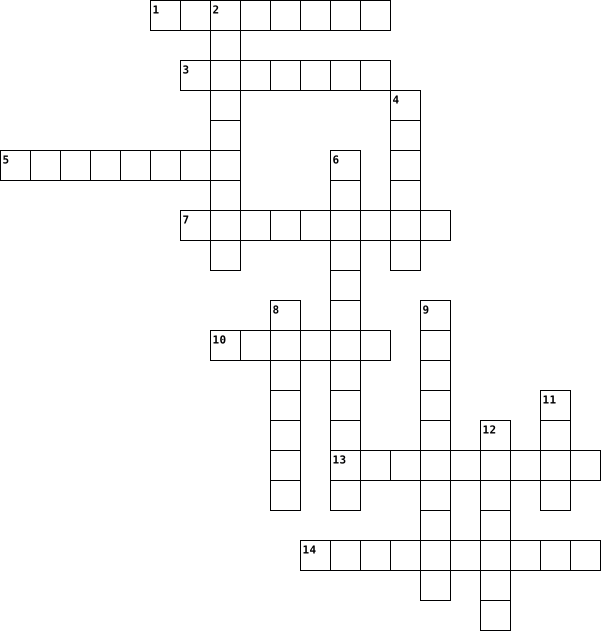
Periodic 2023-12-21

Across
- We go to this school
- A game previously mentioned in Mr. Crofoot's crossword
- This element doesn't need any extra or negative charges
- This element helps keep pools clean
- This element was named after a famous mathematician
- A superhero associated with spiders
- The symbol of this element is also an abbreviation for Mountain
Down
- This element is in the 5th row and it's symbol is not apart of its name
- The symbol of this element is Xe
- The last periodic table element
- This element sounds like the word "magnet"
- Bananas!
12 Clues: Bananas! • We go to this school • The last periodic table element • The symbol of this element is Xe • This element helps keep pools clean • A superhero associated with spiders • This element sounds like the word "magnet" • This element was named after a famous mathematician • A game previously mentioned in Mr. Crofoot's crossword • ...
Chemistry 2021-07-14

Across
- horizontal columns on the periodic table
- part of an atom postive
- part of an atom's shells
- changes as you move down group 1 begins with r
- group 1 name first word
- state of matter begins with s
Down
- electrons sit on them
- periodic table of ____s
- vertical columns on the periodic table
- part of an atom neutral
- group 1 name second word
- state of matter begins with l
- state of matter begins with g
13 Clues: electrons sit on them • periodic table of ____s • part of an atom postive • part of an atom neutral • group 1 name first word • part of an atom's shells • group 1 name second word • state of matter begins with l • state of matter begins with g • state of matter begins with s • vertical columns on the periodic table • horizontal columns on the periodic table • ...
Periodic table 2022-11-02

Across
- is the amount of a substance usually represented as a percentage
- structure is the structure of the atom. When we examine the atom it is made up of smaller parts called sub atomic particles.
- particle An alpha particle is a product of nuclear decay released by some radioactive elements. Made of two protons and two neutrons with a mass of 4. A large particle but slow moving and is easily stopped by air
- Earth Metals Alkaline earth metals is the second most reactive group of elements in the periodic table. They are found in group 2 of the periodic table (formally known as group IIA).
- (Al) is a silver coloured metal often tarnished by oxidation that has the atomic number 13 in the periodic table. It is in Group 13 of the periodic table. It has the symbol Al.
- An alchemist is the term given to a scientist who practiced the investigation of materials and changing of elements but not using very scientific techniques.
- the distance measured from the nucleus to the outer valence electrons
Down
- is a silvery-white soft metal that has the atomic number 20 in the periodic table.
- Metal The alkali metals, found in group 1 of the periodic table (formally known as group IA), are so reactive that they are generally found in nature combined with other elements. The alkali metals are shiny, soft, highly reactive metals at standard temperature and pressure.
- Zero Absolute zero is the temperature measured in kelvin, a temperature where in theory atoms will have no kinetic energy
- are elements from the atomic number 89 to 103 largely forming the F block of elements in the extended periodic table. They are mostly radioactive
- An atom is the smallest particle that makes up all matter
- (At) is a radioactive non-metal that has the atomic number 85 in the periodic table in Group 17
- Structure
- exists as several allotropes, most commonly as Diamond or the gray-black solid Graphite.
- An anion is a negatively charged particle
16 Clues: Structure • An anion is a negatively charged particle • An atom is the smallest particle that makes up all matter • is the amount of a substance usually represented as a percentage • the distance measured from the nucleus to the outer valence electrons • is a silvery-white soft metal that has the atomic number 20 in the periodic table. • ...
Periodic Table 2025-07-16

Across
- A vertical column on the periodic table
- Scientist who created the first version of the periodic table
- Inert group on the far right of the table
- One or two letters representing an element
- Element that is dull, brittle, and poor conductor of heat and electricity
- A horizontal row in the periodic table
- Shiny, conductive, and often malleable element type
Down
- Metals in the center of the periodic table
- The average atomic weight of an element
- Very reactive metals in group 1
- The basic unit of a chemical element
- A substance made of only one kind of atom
12 Clues: Very reactive metals in group 1 • The basic unit of a chemical element • A horizontal row in the periodic table • A vertical column on the periodic table • The average atomic weight of an element • Inert group on the far right of the table • A substance made of only one kind of atom • Metals in the center of the periodic table • One or two letters representing an element • ...
chemistry crossword -ella baumert 2020-11-05

Across
- negatively charged ion
- fluorine, chlorine, bromine, iodine, and astatine
- line indicates the position of the metalloids in the periodic table
- express large numbers as the product of only two numbers
- mss in grams of one mole of a substance
- outer shell electron
- horizontal rows on the periodic table
Down
- vertical column of the periodic table
- rare gases that include helium, neon, argon, krypton, xenon.
- eight valence electrons
- number of proton in the nucleus of an atom
- element that lacks characteristics of a metal
- atom or molecule with an electrical net charge.
- element that has metallic bonds
- mass of an atom
- positively charged ion
- element that has properties of both metals and nonmetals
17 Clues: mass of an atom • outer shell electron • negatively charged ion • positively charged ion • eight valence electrons • element that has metallic bonds • vertical column of the periodic table • horizontal rows on the periodic table • mss in grams of one mole of a substance • number of proton in the nucleus of an atom • element that lacks characteristics of a metal • ...
Periodic table 2023-08-25

Across
- : are good sources of heat and electricity
- : Nonmetals are generally not
- : Metallic elements are typically
- : Number : On a square, above the chemical symbol
- : the most powerful tool in chemical information
- : One or two letter chemical
- : You can find them on the
- : Each element is represented by one
- : Each element has a unique number of
- : What makes a periodic table really invaluable
Down
- : Nonmetals are generally not good_____ of heat or electricity
- : It is found on the upper right of the periodic table
- : You can predict a lot about the chemical
- : This is in between Metal and Nonmetal
- : Atoms are listed in order of increasing
- : It is found on the upper left of the periodic table
- : Most elements are
- :The 7 horizontal rows is called.
18 Clues: : Most elements are • : You can find them on the • : One or two letter chemical • : Nonmetals are generally not • : Metallic elements are typically • :The 7 horizontal rows is called. • : Each element is represented by one • : Each element has a unique number of • : This is in between Metal and Nonmetal • : Atoms are listed in order of increasing • ...
The Logic of the Periodic! 2012-12-06

Across
- Atoms gain or ___ electrons
- The ___ of an element decreases when you go across the periodic table
- These always touch staircase line on the periodic table
- All atoms want to be like the ____ gasses
- How many regions divide the Periodic Table?
Down
- Are very brittle
- The ____ energy is the amount of energy it takes to detach one electron from a neutral atom
- The first column on the periodic table is call what?
- Number of Periodic Families
- Valence electrons are located in the last ____
10 Clues: Are very brittle • Atoms gain or ___ electrons • Number of Periodic Families • All atoms want to be like the ____ gasses • How many regions divide the Periodic Table? • Valence electrons are located in the last ____ • The first column on the periodic table is call what? • These always touch staircase line on the periodic table • ...
History of the atom and the periodic table 2016-07-04

Across
- Russian Scientist who created the first periodic table
- man who published the law of octaves
- man who thought that an atom was spherical with only electrons in
- man who put the periodic table by proton number rather than relative atomic mass
- man who discovered the electron
Down
- man who first noticed that elements had physical properties
- man who discovered the proton
- the subject involving the periodic table
- the basis that determines where in the periodic table elements are
- pure substance made up of one type of atom
- the man who discovered the proton also discovered this
- the particles inside everything
12 Clues: man who discovered the proton • the particles inside everything • man who discovered the electron • man who published the law of octaves • the subject involving the periodic table • pure substance made up of one type of atom • Russian Scientist who created the first periodic table • the man who discovered the proton also discovered this • ...
Unit 4/5 Vocab 2022-10-24

Across
- the law that states that the repeating chemical and physical properties of elements change periodically with the atomic numbers of the elements
- the mass in grams of one mole of a substance
- as their name suggests, semiconductors are able to conduct heat and electricity under certain conditions
- an atom or molecule that has gained or lost one or more electrons and has a negative or positive charge
- the sum of the numbers of protons and neutrons in the nucleus of an atom
- one of the elements of Group 2 of the periodic table
- one of the metals that can use the inner shell before using the outer shell to bond
- one of the elements of Group 17 of the periodic table
- an element that is shiny and that conducts heat and electricity well
Down
- an atom that has the same number of protons (or the same atomic number) as other atoms of the same element do but that has a different number of neutrons (and thus a different atomic mass)
- one of the elements of Group 18 of the periodic table
- the SI base unit used to measure the amount of a substance whose number of particles is the same as the number of atoms of carbon in exactly 12 g of carbon-12
- the number of protons in the nucleus of an atom; the atomic number is the same for all atoms of an element.
- an electron that is found in the outermost shell of an atom and that determines the atom’s chemical properties
- in chemistry, a horizontal row of elements in the periodic table
- one of the elements of Group 1 of the periodic table
- a vertical column of elements in the periodic table; elements in a group share chemical properties
- an element that conducts heat and electricity poorly and that does not form positive ions in an electrolytic solution
18 Clues: the mass in grams of one mole of a substance • one of the elements of Group 2 of the periodic table • one of the elements of Group 1 of the periodic table • one of the elements of Group 18 of the periodic table • one of the elements of Group 17 of the periodic table • in chemistry, a horizontal row of elements in the periodic table • ...
atomic mass 2022-09-28

Across
- C (look at the periodic table)
- Os (look at the periodic table)
- Cu (look at the periodic table)
- Sn (look at the periodic table)
Down
- B (look at the periodic table)
- mass of an atom
- Au (look at the periodic table)
- Fe (look at the periodic table)
8 Clues: mass of an atom • B (look at the periodic table) • C (look at the periodic table) • Au (look at the periodic table) • Os (look at the periodic table) • Fe (look at the periodic table) • Cu (look at the periodic table) • Sn (look at the periodic table)
atomic mass 2022-09-28

Across
- C (look at the periodic table)
- Os (look at the periodic table)
- Cu (look at the periodic table)
- Sn (look at the periodic table)
Down
- B (look at the periodic table)
- mass of an atom
- Au (look at the periodic table)
- Fe (look at the periodic table)
8 Clues: mass of an atom • B (look at the periodic table) • C (look at the periodic table) • Au (look at the periodic table) • Os (look at the periodic table) • Fe (look at the periodic table) • Cu (look at the periodic table) • Sn (look at the periodic table)
Periodic table-KG 2022-05-10

Across
- has an atomic weight of 12.01
- atomic number is 31
- how many protons, neutrons, and electrons are in an element
- a net electric charge from the gain or loss of electrons
- the highest element to the right on the periodic table
- the first element on the periodic table
- part of an atom starts with p
Down
- center of an atom
- horizontal rows on the periodic table
- a group of atoms bonded together
- an attraction of oppositely charged ions
- has an atomic mass of 195.08
- what holds atoms together
- part of an atom starts with n
- below the element with 4.00 atomic mass
- part of an atom starts with e
16 Clues: center of an atom • atomic number is 31 • what holds atoms together • has an atomic mass of 195.08 • has an atomic weight of 12.01 • part of an atom starts with n • part of an atom starts with e • part of an atom starts with p • a group of atoms bonded together • horizontal rows on the periodic table • below the element with 4.00 atomic mass • ...
Periodic 2023-12-21

Across
- We go to this school
- A game previously mentioned in Mr. Crofoot's crossword
- This element doesn't need any extra or negative charges
- This element helps keep pools clean
- This element was named after a famous mathematician
- A superhero associated with spiders
- The symbol of this element is also an abbreviation for Mountain
Down
- This element is in the 5th row and it's symbol is not apart of its name
- The symbol of this element is Xe
- The last periodic table element
- This element sounds like the word "magnet"
- Bananas!
12 Clues: Bananas! • We go to this school • The last periodic table element • The symbol of this element is Xe • This element helps keep pools clean • A superhero associated with spiders • This element sounds like the word "magnet" • This element was named after a famous mathematician • A game previously mentioned in Mr. Crofoot's crossword • ...
Periodic 2023-12-21

Across
- We go to this school
- A game previously mentioned in Mr. Crofoot's crossword
- This element doesn't need any extra or negative charges
- This element helps keep pools clean
- This element was named after a famous mathematician
- A superhero associated with spiders
- The symbol of this element is also an abbreviation for Mountain
Down
- This element is in the 5th row and it's symbol is not apart of its name
- The symbol of this element is Xe
- The last periodic table element
- This element sounds like the word "magnet"
- Bananas!
12 Clues: Bananas! • We go to this school • The last periodic table element • The symbol of this element is Xe • This element helps keep pools clean • A superhero associated with spiders • This element sounds like the word "magnet" • This element was named after a famous mathematician • A game previously mentioned in Mr. Crofoot's crossword • ...
Periodic 2023-12-21

Across
- This element helps keep pools clean
- The symbol of this element is Xe
- We go to this school
- The symbol of this element is also an abbreviation for Mountain
- A game previously mentioned in Mr. Crofoot's crossword
- This element sounds like the word "magnet"
- The last periodic table element
Down
- A superhero associated with spiders
- Bananas!
- This element was named after a famous mathematician
- This element is in the 5th row and it's symbol is not apart of its name
- This element doesn't need any extra or negative charges
12 Clues: Bananas! • We go to this school • The last periodic table element • The symbol of this element is Xe • A superhero associated with spiders • This element helps keep pools clean • This element sounds like the word "magnet" • This element was named after a famous mathematician • A game previously mentioned in Mr. Crofoot's crossword • ...
Atomic Structure 2020-03-17

Across
- The number of protons in an atom is given by this number
- Number of electrons in the valence shell of a group 1 atom
- A substance made of one type of atom
- Maximum number of electrons in every subsequent electron shell after the first
- The maximum number of electrons in the first shell
- Oxygen, fluorine and neon are all examples of
- Mendeleev organised his periodic table by atomic mass and similar chemical ...?
- Subatomic particles with negligible mass and a -1 charge
- The name for a row in the periodic table
Down
- Atoms with the same proton number (same element) but different numbers of neutrons
- The number of electrons in the valence (outermost) shell of a group 7 atom
- Most of the mass of an atom is contained here
- The metals in the central block of the periodic table are called ... metals
- Lithium, copper and iron are all examples of
- The name for a column in the periodic table
- The charge on an atom
- The name of the gases found in group 0
17 Clues: The charge on an atom • A substance made of one type of atom • The name of the gases found in group 0 • The name for a row in the periodic table • The name for a column in the periodic table • Lithium, copper and iron are all examples of • Most of the mass of an atom is contained here • Oxygen, fluorine and neon are all examples of • ...
The Periodic Table 2023-10-05

Across
- Maximum number of electrons in shell 2
- Particle with no charge
- Particle with a positive charge
- The name for a column in the periodic table
- Negatively charged particle
- Atomic ____ - the bigger number for each element in the periodic table
Down
- There are 118 of these in the periodic table
- Same number of protons, different number of neutrons
- _____ Number. Tells you how many protons an atom has
- The name for a row in the Periodic Table
- Part of an atoms where protons and neutrons are found
11 Clues: Particle with no charge • Negatively charged particle • Particle with a positive charge • Maximum number of electrons in shell 2 • The name for a row in the Periodic Table • The name for a column in the periodic table • There are 118 of these in the periodic table • Same number of protons, different number of neutrons • _____ Number. Tells you how many protons an atom has • ...
Chapter 4 terms 2023-02-13

Across
- 4 or more valence electrons and do not show properties of metal
- radius the distance from the center of the nucleus to the outermost electron
- metals one valence electron, most reactive, found in parts of compounds
- few valence electrons, 80% of elements, on the left of stair step
- a row on the periodic table
- gas group 18, 8 valence electrons, chemically unreactive
- transition metal typically two electrons
- groups groups 13-16 containing metals, nonmetals, and metalloids
- law properties of an element varies in a periodic way with their atomic numbers
- table table of of chemical elements arranged to display periodic properties with atomic numbers
Down
- electrons electrons in the outermost energy level of a neutral atom
- measure of an elements ability to attract and hold electrons when bonded
- metal often used as alloys, containing cations charged plus 1 or 2
- metal two valence electrons,slightly less reactive to alkali
- a set of numbers in the same column of the periodic table
- group 17, seven valence electrons, highly reactive
- dot notation elements chemical symbol surrounded by the atoms valence electrons
- characters of both metals and nonmetals also called semiconductors
18 Clues: a row on the periodic table • transition metal typically two electrons • group 17, seven valence electrons, highly reactive • gas group 18, 8 valence electrons, chemically unreactive • a set of numbers in the same column of the periodic table • metal two valence electrons,slightly less reactive to alkali • ...
Science Test Review 2024-01-02

Across
- an irreversible change - burning paper
- a mixture in which the concentration is not uniform
- elements on the periodic table are arranged in order of increasing
- a molecule composed of two or more separate elements
- the most reactive elements on the periodic table
- made when two or more substances are combined
- the mass of an atom comes from the protons and ____
- particles are tightly packed and fixed
- A property that can be observed/measured
Down
- a change that is reversible - ice melting
- horizontal row on the periodic table
- a process where water vapor becomes liquid
- a process where liquid turns into a vapor
- particles are packed closely but can move freely, definite volume
- heat energy is ____________ during condensation
- Flammability and toxicity are examples of a
- is dissolved in a solution
- any substance capable of dissolving one or more substances
- formed when two or more metals are combined(brass)
19 Clues: is dissolved in a solution • horizontal row on the periodic table • an irreversible change - burning paper • particles are tightly packed and fixed • A property that can be observed/measured • a change that is reversible - ice melting • a process where liquid turns into a vapor • a process where water vapor becomes liquid • Flammability and toxicity are examples of a • ...
Atom vocab 2021-09-13

Across
- subatomic particle in the nucleus with no charge
- subatomic particle outside the nucleus with a charge of 1
- cloud area around the nucleus where electrons are most likely to be found
- pure substances made of up two or more elements that combine in fixed ratios, can be chemically broken down
- subatomic particle in the nucleus with a charge of +1
- atoms of the same element with different numbers of neutrons
- a stale isotope of hydrogen with a mass number of 2
- positively charged center of an atom containing protons and neutrons
- horizontal rows of the periodic table
Down
- of an atom the number of protons minus the number of electrons, should be neutral
- ion with a positive charge
- energy amount of energy required to remove an electron from an atom
- pure substance whose atoms all have the same number of protons
- table an organized list of the chemical elements arranged by increasing atomic number and chemical and physical properties
- radius half the distance between two identical bonded atoms
- number sum of number of protons and neutrons in an atom
- ion with negative charge
- in the periodic table vertical columns of periodic table
- atom's tendency to attract electrons to attract bonding electrons
- spectroscopy analytical technique used to measure masstocharge ratio of ions
20 Clues: ion with negative charge • ion with a positive charge • horizontal rows of the periodic table • subatomic particle in the nucleus with no charge • a stale isotope of hydrogen with a mass number of 2 • subatomic particle in the nucleus with a charge of +1 • subatomic particle outside the nucleus with a charge of 1 • ...
Chapter 2 Vocabulary Atoms & Bonding 2025-05-17

Across
- A bond formed between oppositely charged ions. (2 words no space)
- A particle in the nucleus with a positive charge.
- The number of protons in an atom. (2 words no space)
- The electrons in the outermost energy level of an atom. (2 words no space)
- A horizontal row in the periodic table.
- Atoms that share electrons equally form this type of bond.
- The center of an atom that contains protons and neutrons.
- A negatively charged particle found outside the nucleus.
- A group of atoms that acts as a single charged particle. (2 words no space)
Down
- A particle in the nucleus with no electric charge.
- A bond formed when atoms share two pairs of electrons.(2 words no space)
- A bond formed by the sharing of electrons between atoms. (2 words no space)
- A vertical column in the periodic table; also called a "______".
- Atoms that share electrons unequally create this type of bond.
- A very reactive group in Group 17 of the periodic table.
- An atom or molecule with a positive or negative charge.
- A column in the periodic table is also called this.
- A substance that is naturally occurring, inorganic, and solid.
18 Clues: A horizontal row in the periodic table. • A particle in the nucleus with a positive charge. • A particle in the nucleus with no electric charge. • A column in the periodic table is also called this. • The number of protons in an atom. (2 words no space) • An atom or molecule with a positive or negative charge. • ...
Metals, Non-Metals, and Semi-metals 2025-10-29

Across
- Elements with common properties are organized into ___________.
- The ability of a substance to be pulled into thin wires without breaking
- A metalloid element that has the chemical symbol "B"
- A metal element that has the chemial symbol "Cu"
- Elements found along the zig zag line on the periodic table
- The ability of a substance to be pounded into thin sheets
- A metal element that has the chemical symbol "Fe"
- A pure substance containing only one type of atom
- A bright glossy surface that reflects light
- Table, An organized arrangement of elements according to their atomic number
Down
- The ability of a substance to allow heat or electricity to pass through with minimal resistance
- A nonmetal element that has the chemical sybol "C"
- Elements found on right side of zig zag line on the periodic table
- Elements found on left of zigzag line on the periodic table
- Elements that have properties of both metals and non-metals
- A metalloid element that has the chemical symbol "Si"
- A pure substance containing only one type of atom
- A property of a substance that is easily broken or shattered when stress is applied
- Elements are organized by increasing atomic numbers in _______________.
19 Clues: A bright glossy surface that reflects light • A metal element that has the chemial symbol "Cu" • A pure substance containing only one type of atom • A metal element that has the chemical symbol "Fe" • A pure substance containing only one type of atom • A nonmetal element that has the chemical sybol "C" • A metalloid element that has the chemical symbol "B" • ...
Periodic Table of Elements 2013-06-11

Across
- Are periods depicted in rows or columns?
- How many groups are shown in the Periodic Table of Elements?
- Fe is the abbreviation for what element?
- True or False? Iron is a Transitional Metal
- What group can you find Alkali Metals on the Periodic Table?
- Columns represent ...
- Boron's Atomic Number
- Neon is classified as a ...
- Scandium belongs to what group?
Down
- Element that is abbreviated by the letter U
- Arsenic's Atomic Number
- Calcium's Atomic Number
- How many periods are shown in the Periodic Table of Elements?
- Humans need this to live
14 Clues: Columns represent ... • Boron's Atomic Number • Arsenic's Atomic Number • Calcium's Atomic Number • Humans need this to live • Neon is classified as a ... • Scandium belongs to what group? • Are periods depicted in rows or columns? • Fe is the abbreviation for what element? • Element that is abbreviated by the letter U • True or False? Iron is a Transitional Metal • ...
science 2022-09-08

Across
- able to be drawn out of wire
- a subatomic particle with a neutral charge
- the horizontal rows of a periodic table
- an element that lacks metallic properties
- a subatomic particle with a negative charge
- a solid material that is typically hard and shiny
Down
- the substances on the periodic table
- a column of elements in the periodic table
- shiny
- an atom molecule with a net electric charge
- able to be permanently changed
- a subatomic particle with a positive charge
- a close similarity or affinity
- the smallest unit of an element
14 Clues: shiny • able to be drawn out of wire • able to be permanently changed • a close similarity or affinity • the smallest unit of an element • the substances on the periodic table • the horizontal rows of a periodic table • an element that lacks metallic properties • a column of elements in the periodic table • a subatomic particle with a neutral charge • ...
Parts of an atom 2024-05-03
Across
- Atom with different number of neutrons
- Atom with positive charge
- Particle with no cahrge
- model of an atom with rings and dots
- Atom with negative charge
- Particle with negative charge
- model of an atom with the number of protons and the chemical symbol
Down
- Number 118 on the periodic table
- Number 8 on the periodic table
- Number of protons in an atom
- Number 3 on the periodic table
- Total mass of particals in an object
- Atom with an extra electron
- Particle with positive charge
14 Clues: Particle with no cahrge • Atom with positive charge • Atom with negative charge • Atom with an extra electron • Number of protons in an atom • Particle with positive charge • Particle with negative charge • Number 8 on the periodic table • Number 3 on the periodic table • Number 118 on the periodic table • model of an atom with rings and dots • Total mass of particals in an object • ...
Periodic Table and its Trends 2024-05-03

Across
- What element has the Symbol AU
- What is the Element in the Alkali metals family on the 3rd row
- What is the Element that has the symbol Rb
- What nonmetal has a mass of 35.45
- earth metal What is the name of the family to the right of the Alkali metals
- What are the elements of the left side of the Periodic table called
- What is the element at the top of the staircase
- What is the only Metal that is a liquid
- What are the elements located on the staircase called
Down
- What is a row on the periodic table called
- What is the noble gas that is located on the 6th row
- What is a column called on the periodic
- What are the elements located on the right side of the Periodic Table called
- What element has the symbol FE
- What is the Metal that creates the Ionic Bond KCl
- What is the family to the left of the Noble gasses
- What is the element that has 3 protons
17 Clues: What element has the Symbol AU • What element has the symbol FE • What nonmetal has a mass of 35.45 • What is the element that has 3 protons • What is a column called on the periodic • What is the only Metal that is a liquid • What is a row on the periodic table called • What is the Element that has the symbol Rb • What is the element at the top of the staircase • ...
UNIT 4 PERIODIC TABLE 2023-11-27

Across
- vertical column of the periodic table
- horizontal row of the periodic table
- element that appears dull, a poor conductor of heat and electricity
- inner transition metal in the bottom of the bottom two rows of the periodic table
- element in groups 3-12
- element in the bottom two rows; if in the first row, also called lanthanide, or if in the second row, also called actinide
- element in group 2
- consists of two atoms of the same element that are chemically bonded together
Down
- element in columns 1, 2, and 12-18 (also, main-group element)
- electrons on the outermost energy level of an atom
- is an electrically charged atom or molecule (contains unequal numbers of protons and electrons)
- element that conducts heat and electricity moderately well, and possesses some properties of metals and some properties of nonmetals
- inner transition metal in the top of the bottom two rows of the periodic table
- element that is shiny, malleable, and a good conductor of heat and electricity
- element in group 1
- element in group 18 (also, inert gas)
- element in group 17
17 Clues: element in group 1 • element in group 2 • element in group 17 • element in groups 3-12 • horizontal row of the periodic table • vertical column of the periodic table • element in group 18 (also, inert gas) • electrons on the outermost energy level of an atom • element in columns 1, 2, and 12-18 (also, main-group element) • ...
Periodic table 2018-05-23

Across
- A substance with very long molecules.
- More reactive metals _________ less reactive metals from compounds.
- In the periodic table the vertical columns are called_________.
- The noble gases take part in very few reactions and are therefore said to be _____________.
- The state symbol (aq) stands for ____________
- The state symbol (s) stands for _____________.
Down
- A squeeky pop test tests for this gas.
- A mixture of materials, e.g. concrete
- This series describes the patterns of metal reactions with acids, oxygen and water.
- Group 7 of the periodic table are also called the _________.
- In the periodic table the horizontal lines are called_________.
- In the periodic table _______ are on the left side of the stepped line.
- A rock that you can extract a metal from.
13 Clues: A mixture of materials, e.g. concrete • A substance with very long molecules. • A squeeky pop test tests for this gas. • A rock that you can extract a metal from. • The state symbol (aq) stands for ____________ • The state symbol (s) stands for _____________. • Group 7 of the periodic table are also called the _________. • ...
Escape Room Puzzle 2021-02-17

Across
- equal to the number of protons of an element
- the ability to be pulled into thin wires
- property of metalloids that allows them to conduct electricity at high temperatures but not at low temperatures; useful in electronic devices
- the ability of a substance to be hammered or rolled into sheets
- a row on the periodic table
- the only metal which is liquid at room temperature
- a column on the periodic table
Down
- the only nonmetal in group 14
- this term means "repeating pattern"
- the only nonmetal on the left side of the periodic table
- poor conductor
- a property of metals that allows them to move thermal and electrical energy
- the ability of a metal to reflect light
13 Clues: poor conductor • a row on the periodic table • the only nonmetal in group 14 • a column on the periodic table • this term means "repeating pattern" • the ability of a metal to reflect light • the ability to be pulled into thin wires • equal to the number of protons of an element • the only metal which is liquid at room temperature • ...
Chemistry Review 2022-05-18

Across
- positively charged atomic particle found in
- proportional
- bond
- triphosphate, the name of a compound made of one
- number, the number of protons in an atom
- nucleus of an atom
- a row on the periodic table
- orbit the nucleus of an atom
- a column on the periodic table
Down
- neutrally charged atomic particle found in
- table, an organized table of all the known
- nucleus of an atom
- metals, group 1 elements
- and three phosphates
- two or more elements bond together by a
- law, states volume and temperature of a gas are
16 Clues: bond • proportional • nucleus of an atom • nucleus of an atom • and three phosphates • metals, group 1 elements • a row on the periodic table • orbit the nucleus of an atom • a column on the periodic table • two or more elements bond together by a • number, the number of protons in an atom • neutrally charged atomic particle found in • table, an organized table of all the known • ...
Periodic Table 2026-03-03

Across
- Element with atomic number 6
- Classification of hydrogen
- Location of most metals in the periodic table
- Location of most nonmetals in the periodic table
- Element with 11 protons
- Positively charged particles in the nucleus
- Number of protons in an atom
- Element with atomic number 8
Down
- Halogen in period 2
- Group 2 element in period 4
- Element with atomic number 12
- Lightest element in the periodic table
- Number of neutrons in magnesium-24
13 Clues: Halogen in period 2 • Element with 11 protons • Classification of hydrogen • Group 2 element in period 4 • Element with atomic number 6 • Number of protons in an atom • Element with atomic number 8 • Element with atomic number 12 • Number of neutrons in magnesium-24 • Lightest element in the periodic table • Positively charged particles in the nucleus • ...
Figure it out 2021-09-16

Across
- it's just fire
- is the symbol of TH on the periodic table
- the most poisonous element
- it's something a blant breathes in
- very precious and are worth more than gold
- this element group consists of fluorine
- second lightest element
Down
- poisonous and the heaviest on the periodic table
- All in this group are radioactive and release energy upon radioactive decay
- symbole of B with the atomic number 5
- most reactive chemical element
- this has the atomic number four with the symbole of BE
- without it, we would die
- 69th element on the periodic table
- used in electric signs and fluorescent lamps
15 Clues: it's just fire • second lightest element • without it, we would die • the most poisonous element • most reactive chemical element • it's something a blant breathes in • 69th element on the periodic table • symbole of B with the atomic number 5 • this element group consists of fluorine • is the symbol of TH on the periodic table • very precious and are worth more than gold • ...
LT 8-11 Chemistry 2022-04-26

Across
- A substance's tendency to stick together
- Located on the left side of the periodic table
- Rule that states most atoms are stable with 8 VE
- Vertical column on the periodic table
- An atom's ability to attract electrons
- Element with one proton
- Second period, 5 Valence electrons(VE)
Down
- Elements in this group have 1 valence electron(VE)
- The outermost electron shell
- bond with an electronegativity difference of 0.4 or less
- Horizontal row on the periodic table
- bond formed between metals and nonmetals
- On the left side of a chemical equation
- bond formed between nonmetals
- On the right side of a chemical equation
15 Clues: Element with one proton • The outermost electron shell • bond formed between nonmetals • Horizontal row on the periodic table • Vertical column on the periodic table • An atom's ability to attract electrons • Second period, 5 Valence electrons(VE) • On the left side of a chemical equation • A substance's tendency to stick together • bond formed between metals and nonmetals • ...
Atomic Structure and The periodic Table 2021-08-10

Across
- ability of an element to be plastically deformed
- ability of an element to be disfigured
- vertical lines on periodic tables
- atoms with same number and position of periodic table but with different masses and physicalp
- number of protons and neutrons in an atom
- basic unit of a chemical element
- gas, liquid, or brittle solid
Down
- elements that have characteristics of metals
- element that has metallic bonds
- horizontal lines on periodic table
- subatomic particle with a positive charge
- subatomic particle with negative charge
- number of protons in nucleus of an atom
- subatomic particle with no charge
- positively charged center of an atom
15 Clues: gas, liquid, or brittle solid • element that has metallic bonds • basic unit of a chemical element • vertical lines on periodic tables • subatomic particle with no charge • horizontal lines on periodic table • positively charged center of an atom • ability of an element to be disfigured • subatomic particle with negative charge • number of protons in nucleus of an atom • ...
Heavy metals 2026-02-23

Across
- bottom most position in periodic table
- mineral in epsom salt
- metals forming coloured compounds
- an unusual contraction due to f block is caused in these elements
Down
- columns in periodic
- required for bone health
- rows in periodic table
- periodic law formulator
- substance that cannot conduct electricity
- an element that has medicinal uses and it is silvery white and brittle
10 Clues: columns in periodic • mineral in epsom salt • rows in periodic table • periodic law formulator • required for bone health • metals forming coloured compounds • bottom most position in periodic table • substance that cannot conduct electricity • an unusual contraction due to f block is caused in these elements • ...
Periodic 2023-12-21

Across
- We go to this school
- A game previously mentioned in Mr. Crofoot's crossword
- This element doesn't need any extra or negative charges
- This element helps keep pools clean
- This element was named after a famous mathematician
- A superhero associated with spiders
- The symbol of this element is also an abbreviation for Mountain
Down
- This element is in the 5th row and it's symbol is not apart of its name
- The symbol of this element is Xe
- The last periodic table element
- This element sounds like the word "magnet"
- Bananas!
12 Clues: Bananas! • We go to this school • The last periodic table element • The symbol of this element is Xe • This element helps keep pools clean • A superhero associated with spiders • This element sounds like the word "magnet" • This element was named after a famous mathematician • A game previously mentioned in Mr. Crofoot's crossword • ...
science 2023-12-11

Across
- nonmetal and nonmetal
- cannot be undone
- before the yield symbol
- negative charge
- neutral charge
- ms servant and her friend at prom with dates
- not a permanent change
- reaction that has water and gas as a product
Down
- table of elements
- ms serventi and tom holland
- after the yield symbol
- right side of periodic table
- positive charge
- absorbs heat
- metal and nonmetal
- releases heat
- how compact something is
- middle and left side of periodic table
- undoes a synthesis reaction
- reverse decomposition reaction
20 Clues: absorbs heat • releases heat • neutral charge • positive charge • negative charge • cannot be undone • table of elements • metal and nonmetal • nonmetal and nonmetal • after the yield symbol • not a permanent change • before the yield symbol • how compact something is • ms serventi and tom holland • undoes a synthesis reaction • right side of periodic table • reverse decomposition reaction • ...
Periodic Trends 2025-10-15

Across
- How well an atom attracts electrons from other atoms
- The largest atom on the periodic table
- This element is an alkali metal and in period 3
- An atom’s ability to attract electrons from other atoms
- The octet rule states atoms are usually most stable with this number of valence electrons
- The only nonmetal on the left side of the periodic table
- The largest alkaline earth metal
- This model only shows an atom’s valence electrons
- The element is in group 2, period 4
Down
- This model shows all the electrons for an atom
- This alkaline earth metal is bigger than barium
- This element has the highest electronegativity of all the elements
- This is what a row going left to right across the periodic table is called
- An atom that has gained or lost electrons
- This family includes fluorine (F) and chlorine (Cl)
- A column (up and down) on the periodic table
16 Clues: The largest alkaline earth metal • The element is in group 2, period 4 • The largest atom on the periodic table • An atom that has gained or lost electrons • A column (up and down) on the periodic table • This model shows all the electrons for an atom • This alkaline earth metal is bigger than barium • This element is an alkali metal and in period 3 • ...
Chemistry Crossword 2022-09-29

Across
- have particles that are far apart and move very fast
- negatively charged ions
- the study of the composition, structure, properties,and reactions of matter
- positive charge
- are located along the heavy zigzag line of the periodic table
- negative charge
- composed of one type of atom
- have particles that are close together in a fixed arrangement
- contain elements with similar properties in vertical columns.
- neutral charge
Down
- are horizontal rows of elements, counted from top to bottom of the table as Periods 1−7.
- material that makes up all things
- have particles that are close together but mobile
- positively charged ions
- are located to the right of the periodic table
- most abundant element
- located to the left of the periodic table
- composed of two or more elements always combined in the same proportion
18 Clues: neutral charge • positive charge • negative charge • most abundant element • negatively charged ions • positively charged ions • composed of one type of atom • material that makes up all things • located to the left of the periodic table • are located to the right of the periodic table • have particles that are close together but mobile • ...
Chemistry Crossword 2022-09-29

Across
- negative charge
- have particles that are far apart and move very fast
- positive charge
- the study of the composition, structure, properties,and reactions of matter
- most abundant element
- negatively charged ions
- located to the left of the periodic table
- contain elements with similar properties in vertical columns.
- have particles that are close together but mobile
- composed of two or more elements always combined in the same proportion
Down
- composed of one type of atom
- positively charged ions
- are located to the right of the periodic table
- material that makes up all things
- have particles that are close together in a fixed arrangement
- are located along the heavy zigzag line of the periodic table
- are horizontal rows of elements, counted from top to bottom of the table as Periods 1−7.
- neutral charge
18 Clues: neutral charge • negative charge • positive charge • most abundant element • positively charged ions • negatively charged ions • composed of one type of atom • material that makes up all things • located to the left of the periodic table • are located to the right of the periodic table • have particles that are close together but mobile • ...
Atoms & Periodic Table Crossword 2021-04-19

Across
- gaseous element with an atomic mass of 20amu
- the element with the highest atomic number
- calculated by adding protons and neutrons
- the element with 29 protons
- columns on the periodic table
- element in period 6 with 86 protons
- the negatively-charged subatomic particle
- the element found in group 2, period 6
- the element with atomic number 18
Down
- how we refer to an atom with zero charge
- is always the same as the number of protons
- how many neutrons most sodium atoms will have
- the element with one more proton than sulfur
- the smallest element on the periodic table
- the only metal that is liquid at room temperature
- the element with 26 electrons when it's neutral
- the element found in group 14, period 3
- rows on the periodic table
18 Clues: rows on the periodic table • the element with 29 protons • columns on the periodic table • the element with atomic number 18 • element in period 6 with 86 protons • the element found in group 2, period 6 • the element found in group 14, period 3 • how we refer to an atom with zero charge • calculated by adding protons and neutrons • the negatively-charged subatomic particle • ...
periodic table 2023-08-25

Across
- :elements are typically
- each element is represented by one on the periodic table
- Each element has a unique atomic number
- and are not good of heat or electrity
- :and in the middle of the table.
- with one or two letter chemical number
- nonmetals generally are not
- You can predict a lot about the chemical of an element
- what makes the periodic table really invaluble
- :most elements are and you can find them on the
- :are found on the upper right on periodic table
- : on a square above the chemical symbol
- The 7 horizontal are called
Down
- :and are good of the heat
- :of the element and below the symbol are the full name
- Atoms are listed in order of increase
- The most powerful tool chemisist
- :on the upper left
- The dividing line between metals and nonmetals
19 Clues: :on the upper left • :elements are typically • :and are good of the heat • nonmetals generally are not • The 7 horizontal are called • The most powerful tool chemisist • :and in the middle of the table. • Atoms are listed in order of increase • and are not good of heat or electrity • with one or two letter chemical number • Each element has a unique atomic number • ...
Chemistry 2021-03-04

Across
- one magnesium atom and two chlorine atoms
- the atomic number is 28
- numbers going across the top of the periodic table
- the symbol for chromium
- substance made entirely of one type of atom
- element that has the symbol C
- group 7, period 2
- within the air
- atomic mass for oxygen
Down
- numbers on the left side of the periodic table
- 2 or more atoms held together by chemical bonds
- 2 or more different element held together by chemical bonds
- 2 or more substances not chemically combined together
- a compound that is used daily
- amount of alkali metals on the periodic table
- what is hydrogens atomic number
16 Clues: within the air • group 7, period 2 • atomic mass for oxygen • the atomic number is 28 • the symbol for chromium • element that has the symbol C • a compound that is used daily • what is hydrogens atomic number • one magnesium atom and two chlorine atoms • substance made entirely of one type of atom • amount of alkali metals on the periodic table • ...
8th staar review chemistry 2023-04-27

Across
- made of subatomic particles
- the columns in the periodic table
- left side of a chemical reaction, what reacts with each.
- atomic ____ is the number of neutrons and protons in a atom
- _____ electrons are the electrons that determine reactivity
- how likely an element is to react with another
- good conductors, shiny and malleable
- electron ______ is where the electrons are located
- the rows in the periodic table
- a chemical _____ shows the amount of specific atoms there are in a compound
Down
- good insulators, no luster and brittle solid
- where protons and neutrons are located
- neutral subatomic particle
- right side of a chemical reaction, what the end results are
- atomic ____ is the number that identifies an element(also tells you the number of protons)
- negative subatomic particle
- semi-conductors, only few found in the periodic table
- what occupies space
- positive subatomic particle
19 Clues: what occupies space • neutral subatomic particle • made of subatomic particles • negative subatomic particle • positive subatomic particle • the rows in the periodic table • the columns in the periodic table • good conductors, shiny and malleable • where protons and neutrons are located • good insulators, no luster and brittle solid • ...
Chemistry 2021-03-04

Across
- the symbol for chromium
- element that has the symbol C
- a compound that is used daily
- 2 or more atoms held together by chemical bonds
- within the air
- 2 or more substances not chemically combined together
- one magnesium atom and two chlorine atoms
Down
- numbers on the left side of the periodic table
- the atomic number is 28
- numbers going across the top of the periodic table
- substance made entirely of one type of atom
- what is hydrogens atomic number
- amount of alkali metals on the periodic table
- group 7, period 2
- 2 or more different element held together by chemical bonds
- atomic mass for oxygen
16 Clues: within the air • group 7, period 2 • atomic mass for oxygen • the atomic number is 28 • the symbol for chromium • element that has the symbol C • a compound that is used daily • what is hydrogens atomic number • one magnesium atom and two chlorine atoms • substance made entirely of one type of atom • amount of alkali metals on the periodic table • ...
S2 Elements, Compounds and Chemical Reactions 2023-02-19

Across
- a sign of a chemical reaction
- the chemical symbol is O
- when atleast two elements are joined together
- the chemical symbol is Na
- All the different elements are arranged in a chart
- found to the left of the periodic table
- group 7 of the periodic table
- when elements fuse/join together
- contains only one type of atom
Down
- metals are good conductors of this
- substances that are formed in a reaction
- found to the right of the periodic table
- physical appearance of a metal when cut into
- meaning they can be bent and shaped without breaking
- the smallest part of an element
- The different substances are not chemically joined together
16 Clues: the chemical symbol is O • the chemical symbol is Na • a sign of a chemical reaction • group 7 of the periodic table • contains only one type of atom • the smallest part of an element • when elements fuse/join together • metals are good conductors of this • found to the left of the periodic table • substances that are formed in a reaction • ...
Chem 2013-07-21

Across
- name for group 1
- particle that flows
- solid to gas (vice versa)
- liquid to a solid
- name for group 7
- gas to liquid
- all substances are made of ........
- located around the centre
- rows in periodic table
Down
- liquid to gas
- located in the nucleus, positive charge
- have a definite shape
- columns in periodic table
- solid to liquid
- name for group 8
- can be compressed
- matter has ........
- located in the nucleus, neutral charge
- matter takes up ........
19 Clues: liquid to gas • gas to liquid • solid to liquid • name for group 1 • name for group 8 • name for group 7 • liquid to a solid • can be compressed • particle that flows • matter has ........ • have a definite shape • rows in periodic table • matter takes up ........ • columns in periodic table • solid to gas (vice versa) • located around the centre • all substances are made of ........ • ...
Science Review (1-3) 2022-05-23

Across
- middle of periodic table
- left side of periodic table
- replaced in nature
- right side of periodic table
- evenly mixed
- one atom
Down
- unevenly mixed
- hammered into sheets
- substance not blended together
- used faster than replaced
10 Clues: one atom • evenly mixed • unevenly mixed • replaced in nature • hammered into sheets • middle of periodic table • used faster than replaced • left side of periodic table • right side of periodic table • substance not blended together
Chapter 6 Vocabulary 2012-11-29

Across
- this can be also called families or periods
- atoms can gain or lose one or more electrons to form _____.
- the groups designated with an A.
- his periodic table was widely accepted because he predicted the existence and properties of undiscovered elements
- what kind of energy is needed to remove an electron from a gaseous lithium atom?
- Silicon and germanium are two of the most important ___________.
- best Chemistry teacher who has a great humor
- the extremely unreactive group.
- one of the most important principles in chemistry.
- fluorine, chlorine, bromine, iodine, and astatine are part of what group?
- the group 2A elements
Down
- the groups designated with a B.
- two sets of ___________ _____________ ______ known as the lanthanide and actinides series
- the statement that there is a periodic repetition of chemical and physical properties of the elements when they are arranged by increasing atomic number.
- an element indicates the relative ability of its atoms to attract electrons in a chemical bond is the definition of _______________.
- what element is most malleable and ductile?
- these elements are on the left of the modern periodic table
- which group occupies the upper right side of the periodic table?
18 Clues: the group 2A elements • the groups designated with a B. • the extremely unreactive group. • the groups designated with an A. • this can be also called families or periods • what element is most malleable and ductile? • best Chemistry teacher who has a great humor • one of the most important principles in chemistry. • ...
chemical periodic table 2023-08-29

Across
- most elements are made of metal
- you can predict a lot about the chemical behavior.
- the periodic table is drawn as a thick staircase
- number on a square above the chemical symbol is the atomic number
- are good conducters of heat
- with a one or 2 letter chemical symbol
- not good conducters of electricity
Down
- you can find them on the left and middle
- the periodic table is really invaluable is its use as a predictive tool.
- except for hydrogen which is on the upper left
- Each element is represented by one square
- table The periodic table is the most powerful tool.
- metallic elements are mostly shiny
- mass bellow the symbol are the full name of the element and its atomic mass
14 Clues: are good conducters of heat • most elements are made of metal • metallic elements are mostly shiny • not good conducters of electricity • with a one or 2 letter chemical symbol • you can find them on the left and middle • Each element is represented by one square • except for hydrogen which is on the upper left • the periodic table is drawn as a thick staircase • ...
Matter and Chemical Change 2013-06-17

Across
- mass of one atom of an element calculated from the total number of protons
- how a substance interacts with other substances
- Formed when more than one element on the periodic table are combine
- a group of 18 elements in the periodic table
- the horizontal row on the periodic table
Down
- number of protons in the nucleus of one atom of an element
- Located on the right side of a periodic table
- The melting of ice is a....
- Can define anything that has mass and occupies space.
- the vertical rows on a periodic table
10 Clues: The melting of ice is a.... • the vertical rows on a periodic table • the horizontal row on the periodic table • a group of 18 elements in the periodic table • Located on the right side of a periodic table • how a substance interacts with other substances • Can define anything that has mass and occupies space. • ...
LT 8-11 Chemistry 2022-04-26

Across
- bond formed between nonmetals
- bond with an electronegativity difference of 0.4 or less
- Located on the left side of the periodic table
- bond formed between metals and nonmetals
- A substance's tendency to stick together
- Vertical column on the periodic table
- On the left side of a chemical equation
- Elements in this group have 1 valence electron(VE)
Down
- Element with one proton
- An atom's ability to attract electrons
- Second period, 5 Valence electrons(VE)
- On the right side of a chemical equation
- Horizontal row on the periodic table
- Rule that states most atoms are stable with 8 VE
- The outermost electron shell
15 Clues: Element with one proton • The outermost electron shell • bond formed between nonmetals • Horizontal row on the periodic table • Vertical column on the periodic table • An atom's ability to attract electrons • Second period, 5 Valence electrons(VE) • On the left side of a chemical equation • On the right side of a chemical equation • bond formed between metals and nonmetals • ...
PERIODIC TABLE YOU GOTTA LUV IT 2015-11-13

Across
- A term meaning the number of outer shell electrons
- Atoms of the same element with different masses
- Lightest element on the periodic chart
- Place where electrons orbit the nucleus
- The average mass of an element
- A horizontal row on the periodic chart
- The sum of protons and neutrons
Down
- A vertical column on the periodic chart
- The number of protons in an atom
- Most stable number of outer shell electrons
- Elements that do not chemically react with other elements
- Positively charged particle in the nucleus
- Negatively charged particle which orbits around the nucleus
- The abbreviation for an element
- Particle with no charge in the nucleus
15 Clues: The average mass of an element • The sum of protons and neutrons • The abbreviation for an element • The number of protons in an atom • Lightest element on the periodic chart • A horizontal row on the periodic chart • Particle with no charge in the nucleus • A vertical column on the periodic chart • Place where electrons orbit the nucleus • ...
Unit 5 Periodic Table Vocab 2022-01-12

Across
- half reaction in which a chemical species decreases its oxidation number, generally by gaining electrons.
- Effect the electron and the nucleus in an atom have a decrease in attraction which changes the nuclear charge
- ion with a positive electrical charge.
- loss of electrons by an atom, molecule or ion in a chemical reaction.
- The ability of an atom to attract electrons
- Energy The energy required to remove an electron from an atom
- an ion with a negative electrical charge.
Down
- recurring variations in element properties with increasing atomic number due to trends in atomic structure.
- a vertical column on the periodic table consisting of elements that share periodic properties.
- Properties are Similar to Both Metals and Nonmetals
- Electron outer electron most likely to participate in bond formation or a chemical reaction.
- horizontal row of the periodic table; elements with the same highest unexcited electron energy level
- Good Conductors, Solid at Room Temperature, Ductile and Malleable
- Poor Conductors, Most are Gases at Room Temperature
- State the difference between the number of electrons in an atom in a compound compared with the number of electrons in a neutral atom of the element.
- Radii distance away from the nucleus. Increases going from top to bottom and decreases going across the periodic table.
- Radii distance away from the central atom. Increases going from top to bottom and decreases across the periodic table.
17 Clues: ion with a positive electrical charge. • an ion with a negative electrical charge. • The ability of an atom to attract electrons • Properties are Similar to Both Metals and Nonmetals • Poor Conductors, Most are Gases at Room Temperature • Energy The energy required to remove an electron from an atom • ...
Unit 5 Periodic Table Vocab 2022-01-12

Across
- half reaction in which a chemical species decreases its oxidation number, generally by gaining electrons.
- Effect the electron and the nucleus in an atom have a decrease in attraction which changes the nuclear charge
- ion with a positive electrical charge.
- loss of electrons by an atom, molecule or ion in a chemical reaction.
- The ability of an atom to attract electrons
- Energy The energy required to remove an electron from an atom
- an ion with a negative electrical charge.
Down
- recurring variations in element properties with increasing atomic number due to trends in atomic structure.
- a vertical column on the periodic table consisting of elements that share periodic properties.
- Properties are Similar to Both Metals and Nonmetals
- Electron outer electron most likely to participate in bond formation or a chemical reaction.
- horizontal row of the periodic table; elements with the same highest unexcited electron energy level
- Good Conductors, Solid at Room Temperature, Ductile and Malleable
- Poor Conductors, Most are Gases at Room Temperature
- State the difference between the number of electrons in an atom in a compound compared with the number of electrons in a neutral atom of the element.
- Radii distance away from the nucleus. Increases going from top to bottom and decreases going across the periodic table.
- Radii distance away from the central atom. Increases going from top to bottom and decreases across the periodic table.
17 Clues: ion with a positive electrical charge. • an ion with a negative electrical charge. • The ability of an atom to attract electrons • Properties are Similar to Both Metals and Nonmetals • Poor Conductors, Most are Gases at Room Temperature • Energy The energy required to remove an electron from an atom • ...
science 2023-12-11

Across
- undoes a synthesis reaction
- ms serventi and tom holland
- nonmetal and nonmetal
- absorbs heat
- releases heat
- table of elements
- metal and nonmetal
- positive charge
- middle and left side of periodic table
Down
- ms servant and her friend at prom with dates
- not a permanent change
- reaction that has water and gas as a product
- before the yield symbol
- neutral charge
- reverse decomposition reaction
- right side of periodic table
- how compact something is
- negative charge
- cannot be undone
- after the yield symbol
20 Clues: absorbs heat • releases heat • neutral charge • negative charge • positive charge • cannot be undone • table of elements • metal and nonmetal • nonmetal and nonmetal • not a permanent change • after the yield symbol • before the yield symbol • how compact something is • undoes a synthesis reaction • ms serventi and tom holland • right side of periodic table • reverse decomposition reaction • ...
Year 8 Chemistry Periodic Table 2021-12-13

Across
- What element is in group 1 and period 2?
- This is the name of group 7 in the periodic table.
- This is the name of group 1 in the periodic table.
- This is the name for the rows of the periodic table.
- The elements in the middle of the periodic table are called the ________ metals.
- What element is in group 7 and period 3?
Down
- This is the name of the columns in the periodic table.
- This is the name of group 8/0 in the periodic table.
- The period of an element determines the ________ of electron shells it has.
- The group of an element determines how many electrons are in its _______ shell.
10 Clues: What element is in group 1 and period 2? • What element is in group 7 and period 3? • This is the name of group 7 in the periodic table. • This is the name of group 1 in the periodic table. • This is the name of group 8/0 in the periodic table. • This is the name for the rows of the periodic table. • This is the name of the columns in the periodic table. • ...
Chemistry 2024-01-31

Across
- columns on the periodic table
- gases the least reactive family on the periodic table
- anything that takes up space or has mass
- has properties of both metals and non-metals
- after the arrow
- if atoms on both sides are the same
Down
- atoms can only be
- rows on the periodic table
- metals most reactive family on the periodic table
- before the arrow
10 Clues: after the arrow • before the arrow • atoms can only be • rows on the periodic table • columns on the periodic table • if atoms on both sides are the same • anything that takes up space or has mass • has properties of both metals and non-metals • metals most reactive family on the periodic table • gases the least reactive family on the periodic table
Notes Day 1 2025-09-25

Across
- A property of metals that means they can be made into a thin wire.
- The name for the elements in Group 1 on the periodic table.
- Elements that have properties of both metals and nonmetals and are located along the "staircase".
- Elements that are good conductors, lustrous, and can be hammered into thin sheets.
- The name for the vertical columns on the periodic table.
Down
- The law that states there is a periodic pattern in the physical and chemical properties of elements when they are arranged by increasing atomic number.
- The first scientist to organize the periodic table, arranging elements by increasing atomic mass.
- Elements in Group 17.
- The scientist who rearranged the elements by increasing atomic number to create the modern periodic table
- The type of elements that are brittle, dull, and poor conductors.
- The horizontal rows on the periodic table.
11 Clues: Elements in Group 17. • The horizontal rows on the periodic table. • The name for the vertical columns on the periodic table. • The name for the elements in Group 1 on the periodic table. • The type of elements that are brittle, dull, and poor conductors. • A property of metals that means they can be made into a thin wire. • ...
Periodic Trends Vocabulary 2023-09-22

Across
- Natural materials that do not produce heat or electricity and are structurally fragile
- an element whose properties are intermediate between those of metals and solid nonmetals or semiconductors
- an atom or molecule with a net electric charge due to the loss or gain of one or more electrons
- colourless, odourless, tasteless, nonflammable gases. Group 0
- helium, lithium, beryllium, boron, carbon, nitrogen, oxygen, and fluorine
- scandium (Sc), titanium (Ti), vanadium (V), chromium (Cr), manganese (Mn), iron (Fe), cobalt (Co), nickel (Ni), copper (Cu), and zinc (Zn). Period 4.
- any of a class of substances characterized by high electrical and thermal conductivity as well as by malleability, ductility, and high reflectivity of light
- the amount of energy required to remove an electron from an isolated atom or molecule
- negatively charged ion
- the tendency of an atom participating in a covalent bond to attract the bonding electrons
- "When elements are arranged in order of increasing atomic number, there is a periodic repetition of their chemical and physical properties"
Down
- any of the six chemical elements that make up Group 1 (Ia) of the periodic table
- the total distance from the nucleus of an atom to the outermost orbital of its electron.
- The vertical columns on the periodic table
- a horizontal row of the periodic table
- positively charged ion
- Group 2 elements except beryllium are known as alkaline earth metals. These are so called because their oxides and hydroxides are alkaline in nature and these metal oxides are found in Earth.
- a chemical element that forms a salt when it reacts with metal
- Russian chemist who devised the periodic table of the elements
19 Clues: positively charged ion • negatively charged ion • a horizontal row of the periodic table • The vertical columns on the periodic table • colourless, odourless, tasteless, nonflammable gases. Group 0 • a chemical element that forms a salt when it reacts with metal • Russian chemist who devised the periodic table of the elements • ...
Periodic Table 2024-11-19

Across
- Which direction does atomic radius decrease in the periodic table? (In between the two words put a dash)
- Which group contains the most reactive metals?
- Which element has the electron configuration 1s² 2s² 2p⁶ 3s² 3p⁶?
- Which element has the highest electronegativity in the periodic table?
- Which has a smaller radius: a positive ion or its neutral atom? (put a dash in between the two words)
- Which trend describes the increase in the ability of an atom to attract electrons as you move across a period?
- In which period would you find an element with the electron configuration 2s² 2p⁶? (put a dash in between the word period and the number)
- Which element has the highest first ionization energy in period 2?
- Which block contains the transition metals? (Put a dash in between the letter and the word block)
Down
- Which block contains the alkali metals? (Put a dash in between the letter and the word block)
- Which element would have the electron configuration ending in 3p⁶?
- Which element has the largest atomic radius?
- What is the name of Group 17 in the periodic table?
- Which block contains the halogens? (Put a dash in between the letter and the word block)
- Which is larger: the atomic radius of chlorine (Cl) or the ionic radius of chloride ion (Cl⁻)? (put a dash in between the two words)
- Which element has the highest ionisation energy?
- How many periods are there in the periodic table?
- What group is known as the noble gases?
- Which is larger: the atomic radius of sodium (Na) or the ionic radius of sodium ion (Na⁺)? (put a dash in between the two words)
- Who is credited with creating the periodic table?
20 Clues: What group is known as the noble gases? • Which element has the largest atomic radius? • Which group contains the most reactive metals? • Which element has the highest ionisation energy? • How many periods are there in the periodic table? • Who is credited with creating the periodic table? • What is the name of Group 17 in the periodic table? • ...
Periodic Table Organization 2025-10-16

Across
- The largest atom on the periodic table
- How well an atom attracts electrons from other atoms
- The largest alkaline earth metal
- This model shows all the electrons for an atom
- A column (up and down) on the periodic table
- An atom that has gained or lost electrons
- This element has the highest electronegativity of all the elements
- This alkaline earth metal is bigger than barium
Down
- An atom’s ability to attract electrons from other atoms
- The element is in group 2, period 4
- This element is an alkali metal and in period 3
- The only nonmetal on the left side of the periodic table
- This model only shows an atom’s valence electrons
- The octet rule states atoms are usually most stable with this number of valence electrons
- This family includes fluorine (F) and chlorine (Cl)
- This is what a row going left to right across the periodic table is called
16 Clues: The largest alkaline earth metal • The element is in group 2, period 4 • The largest atom on the periodic table • An atom that has gained or lost electrons • A column (up and down) on the periodic table • This model shows all the electrons for an atom • This element is an alkali metal and in period 3 • This alkaline earth metal is bigger than barium • ...
Periodic Table 2023-12-06

Across
- the most reactive nonmetal elements found in group 17 of the periodic table
- a row of the Periodic Table (there are 7)
- An element with characteristics of both metals and nonmetals
- table the chart of the elements showing the repeating pattern of their properties
- metal elements found in period 6 of the periodic table
- Gases unreactive nonmetal gas elements found in group 18 of the periodic table
Down
- radioactive metal elements found in period 7 of the periodic table
- a material that prevents heat or electricity from easily passing through
- Mass the average mass of all the atoms of an element
- a property used to describe a material that can be pounded into shapes
10 Clues: a row of the Periodic Table (there are 7) • Mass the average mass of all the atoms of an element • metal elements found in period 6 of the periodic table • An element with characteristics of both metals and nonmetals • radioactive metal elements found in period 7 of the periodic table • a property used to describe a material that can be pounded into shapes • ...
Science Assessment 2023-05-16

Across
- an element that lacks most of the properties of a metal; these are found on the right-hand side of the zigzag line on the periodic table
- a negatively charged particle found outside the nucleus of an atom
- the places surrounding the nucleus of an atom where the electrons are most likely to be at any given time
- An element is a pure substance that is made from a single type of atom. Elements are the building blocks for all the rest of the matter in the world
- a one- or two-letter representation of an element on the periodic table
- a small particle in the nucleus of the atom; it has no electrical charge
- the basic particle from which all elements are made
- the number of protons in the nucleus of an atom; this number identifies an element and its location on the periodic table
Down
- a horizontal row of elements in the periodic table
- a chart of the elements showing the repeating pattern of their properties; arranged by atomic numbers of the elements
- "a class of elements characterized by physical properties that include shininess
- elements in the same vertical column of the periodic table; also known as a 'family'
- the central core of the atom made up of protons and neutrons
- an element that has some characteristics of both metals and nonmetals; these are found hugging the zigzag line on the periodic table
- the average mass of all the isotopes of an element; this is the decimal value found on an element card
- a positively charged particle that is part of an atom's nucleus; the number of protons is known as the atomic number
16 Clues: a horizontal row of elements in the periodic table • the basic particle from which all elements are made • the central core of the atom made up of protons and neutrons • a negatively charged particle found outside the nucleus of an atom • a one- or two-letter representation of an element on the periodic table • ...
Metals, Nonmetals and Metalloids Crossword 2020-03-30

Across
- can be hammered into sheets without breaking
- is considered a metal but lies along the zigzag line
- conductors of electricity and heat
- conductors of electricity and heat
- the ability of a substance to conduct electricity
- can be drawn into wire, but some more ductile than others
- are shared by metals and nonmetals
- found along the zigzag line on the periodic table
- the ability of a substance to be pulled into a thin
- generally shiny is easily pulled into wires or
Down
- found to the right of the zigzag line on periodic table
- luster and do not reflect much light, not metallic looking
- into thin sheets
- liquid or gas at room temperature
- look with a shiny luster
- the ability of a substance to reflect light
- at room temperature, except for mercury, which is a
- without breaking
- found to the left of the zigzag line on the periodic
- when they are solid
- the ability of a substance to be hammered into
21 Clues: into thin sheets • without breaking • when they are solid • look with a shiny luster • liquid or gas at room temperature • conductors of electricity and heat • conductors of electricity and heat • are shared by metals and nonmetals • the ability of a substance to reflect light • can be hammered into sheets without breaking • the ability of a substance to be hammered into • ...
3-1/3-2 2017-11-15

Across
- The smallest part of an element
- An atom with the same number of protons and a different number of electrons
- Electrons with _____ energy stay close to the nucleus
- The vertical columns on the periodic table
- The electrons on the outermost orbit
- The "shell" that the electrons travels on
- Cannot be broken down into any other substance
- Has a negative charge
- A diagram, mental image, mathematical statement, or object to represent something
Down
- The sum of the protons and neutrons
- The average mass for the isotopes of an element
- The abbreviation of an element
- The number of protons an atom has
- Electrons with _______ energy go far from the nucleus
- Has a negative charge
- The center of an atom
- The last name of the man who made the first periodic table
- Has a positive charge
- When two elements come together
- The horizontal rows on the periodic table
20 Clues: Has a negative charge • The center of an atom • Has a positive charge • Has a negative charge • The abbreviation of an element • The smallest part of an element • When two elements come together • The number of protons an atom has • The sum of the protons and neutrons • The electrons on the outermost orbit • The "shell" that the electrons travels on • ...
Chemistry Crossword Game 2024-05-01

Across
- Who arranged the periodic table by atomic number
- Elements that loses electrons
- Salt
- A reaction that means to break apart
- The amount of reactants has to be equal to the amount of
- A noble gas that does not have a valency of 8
- What must be added to balance an equation
Down
- Most reactive element in the periodic table
- We balance an equation to follow the law of conservation of
- A reaction that produces H2O and CO2
- Must never be changed to balance an equation
- The first element in the periodic table
- Has a PH less than 7
- Mainly found in stars
- total number of protons in an atom
- The most common element in the Earth’s crust
- The only metal on Earth that is liquid at room temperature
- The most active elements of the Halogens
- Substance that speeds up the reaction but is not used up in the reaction
19 Clues: Salt • Has a PH less than 7 • Mainly found in stars • Elements that loses electrons • total number of protons in an atom • A reaction that produces H2O and CO2 • A reaction that means to break apart • The first element in the periodic table • The most active elements of the Halogens • What must be added to balance an equation • Most reactive element in the periodic table • ...
Periodic Table Elements 2021-05-10

Across
- a chemical element with the symbol C
- atomic number 1
- the thirteenth and third-last element
- the symbol Te and atomic number 5
- the most common element on Earth
- the symbol Fm and atomic number 1
- rare-earth element with a metallic silver luster
- soft silvery white high;y reactive metal
- group 18 of the periodic table and is a noble gas
- a colorless, odorless, tasteless noble gas
- a soft, silvery metal at standard temperature
Down
- the symbol Cl and atomic number 17
- the sixth element in group 2 of the periodic table
- the most abundant metallic element in Earth's crust
- atomic number 71
- the first in the noble gas group in the periodic table
- atomic number 12
- member of the the chalcogen group, symbol O
- 92 protons and 92 electrons, of which 6 electrons
19 Clues: atomic number 1 • atomic number 71 • atomic number 12 • the most common element on Earth • the symbol Te and atomic number 5 • the symbol Fm and atomic number 1 • the symbol Cl and atomic number 17 • a chemical element with the symbol C • the thirteenth and third-last element • soft silvery white high;y reactive metal • a colorless, odorless, tasteless noble gas • ...
Quarter 1 Physical Science Review (Matter) 2025-10-07

Across
- Has different atoms bonded together
- True or False: The protons, neutrons and electrons in an atom has the same charge
- Has no shape or volume
- The smallest unit of all matter
- Has only one type of atom
- Also called a "Family", this is the vertical columns on the periodic table
- The horizontal rows of the periodic table
- The atomic ________ tells us the number of protons
- Has a pH less than 7
- Malleable, Shiny and a good conductor of heat
Down
- Anything that takes up space
- How packed the matter within an object is
- Very hot and charged gas particles
- The letter(s) that represents the Element
- True or False: The periodic table is organized by the number of proton
- A combination of pure substances
- Particles are close together and vibrates
- Has volume but no shape
- Has a pH more than 7
19 Clues: Has a pH more than 7 • Has a pH less than 7 • Has no shape or volume • Has volume but no shape • Has only one type of atom • Anything that takes up space • The smallest unit of all matter • A combination of pure substances • Very hot and charged gas particles • Has different atoms bonded together • How packed the matter within an object is • ...
Periodic Table Review B 2017-10-18

Across
- unreactive elements with 8 valence electrons
- a row on the periodic table
- diatomic element; sometimes behaves as a metal, sometimes behaves as a nonmetal
- diatomic element in Group 5A
- metals with 2 valence electrons
- only liquid metal
- name of the group that contains the element Erbium
- type of elements found to the right of the bold, dark line on the periodic table
- arranged the elements into groups of three based on shared properties
- metals that form ions with a +1 charge
- group name of the elements found in the f-block of period 7
- noble gas with only 2 valence electrons
Down
- type of elements that are malleable, ductile and good conductors of electricity
- solid, diatomic element that gains one electron when forming an ion
- diatomic element; only liquid nonmetal
- said that the properties of the elements repeated every seven elements
- element that forms a +2 ion, located in Period 4 of the s-block
- groups labeled with a “B” on the periodic table
- one of the two names for a column on the periodic table
- reordered the elements based on their atomic number rather than atomic weight
- one of the two names for a column on the periodic table
- metalloid with 4 valence electrons
- correctly predicted the existence of elements and their properties
- elements that have properties of both metals and nonmetals
24 Clues: only liquid metal • a row on the periodic table • diatomic element in Group 5A • metals with 2 valence electrons • metalloid with 4 valence electrons • diatomic element; only liquid nonmetal • metals that form ions with a +1 charge • noble gas with only 2 valence electrons • unreactive elements with 8 valence electrons • groups labeled with a “B” on the periodic table • ...
ChemTestCh2 2021-09-22

Across
- trend the gradual change of properties across a period
- homogen mix with components in different phases
- a mixture where the the comp is consistent
- a notation used to indicate the comp of a compound. incl atomic symbols and subscripts indicating ratio
- an element that is shiny, opaque, conductive
- any phys attribute of a substance. Ex: color, density, hardness
- groups 3-12
- an abbrev for an element/atom
- salt-forming elements
- chart that has all known elements organized by properties
- innertrans group 6
- upper right of periodic table. Ex: S,O,F
- properties of both metals and nonmetals
Down
- the 2 subgroups of trans group
- a combo of 2+ substances in which they retain their indiv properties
- homogen mix where all components in same phase
- group 2 elements
- a material with atoms of different elements bonded together
- the state of a material that only has 1 type of atom
- a mixture where components can be seen indiv
- a fundamental material consisting of only 1 type of atom
- = chemical change
- a change in which a substance's phys properties w/o changing its chem ID
- a type of property that characterizes the ability of a substance to change its chem ID
- unreactive/very stable elements
- group 1 elements
- type of change where atoms are rearranged, resulting in new chem ID
- vertical column of periodic table
- innertrans group 7
- horiz row of periodic table
30 Clues: groups 3-12 • group 2 elements • group 1 elements • = chemical change • innertrans group 7 • innertrans group 6 • salt-forming elements • horiz row of periodic table • an abbrev for an element/atom • the 2 subgroups of trans group • unreactive/very stable elements • vertical column of periodic table • properties of both metals and nonmetals • upper right of periodic table. Ex: S,O,F • ...
Year 8 Chemical Reactions 2021-03-11

Across
- part of the atom that is negatively charged
- what is the scientific term for burning
- One type of atom. Found in the Periodic Table
- carbon dioxide released into the environment is a pollutant because it is a __________
- In a chemical equation these substances come after the arrow
- this type of combustion only produces carbon dioxide and water
- All matter are made up of this tiny spheres.
- type of elements found on the right of the Periodic Table.
Down
- an insoluble solid can be separated from a liquid using this method; e.g. sand mixed with water.
- the chemistry word for when something reacts with oxygen
- more than one element chemically bonded together
- type of elements found on the left and centre of the Periodic table.
- a dissolved solid can be separated from a liquid using this method; e.g. salt dissolved in water.
- the chemistry word for when something loses oxygen in a reaction
- In a chemical equation these substances come before the arrow
- this type of combustion produces carbon monoxide and soot particles and is less efficient
- Part of the atom in the centre
- chemical equations need to be __________ so there is the same number of atoms in the reactants and products.
- more than one substance not chemically bonded together
- All the elements can be found in The Periodic _______
20 Clues: Part of the atom in the centre • what is the scientific term for burning • part of the atom that is negatively charged • All matter are made up of this tiny spheres. • One type of atom. Found in the Periodic Table • more than one element chemically bonded together • All the elements can be found in The Periodic _______ • ...
Vocabulary Review 2020-11-09

Across
- The only element located to the left of the staircase on the periodic table that is a nonmetal
- Not as good as metals, but not as poor as nonmetals.. its an "okay" conductor.
- The amount of space the object takes up.
- all elements (except one) located to the left of the staircase on the periodic table are
- characteristic of metal: hammered into thin sheets
- characteristic of a nonmetal: break easily
- Heat is transferred by heat waves we can not see with out eyes, but we can certainly feel it.
- The unit for volume if it is a liquid
- ALL elements located to the right of the staircase on the periodic table are
- Tells you how closely compact atoms are in an object.
Down
- heat is transferred in a circular motion caused by differences in temperature and density.
- The unit for mass
- the name of the spectrum that allows you to see the different types of radiation waves we can not see with a naked eye,
- heat is transferred by DIRECT contact
- ALL elements located ON the staircase on the periodic table are
- The unit for volume if it is a solid
- Type of energy that causes atoms to vibrate and collide
- characteristic of a metal: shiny
- characteristic of a metal: stretch into wire
- The amount of matter (atoms) that make up an object.
20 Clues: The unit for mass • characteristic of a metal: shiny • The unit for volume if it is a solid • heat is transferred by DIRECT contact • The unit for volume if it is a liquid • The amount of space the object takes up. • characteristic of a nonmetal: break easily • characteristic of a metal: stretch into wire • characteristic of metal: hammered into thin sheets • ...
Chemistry 2024-01-19
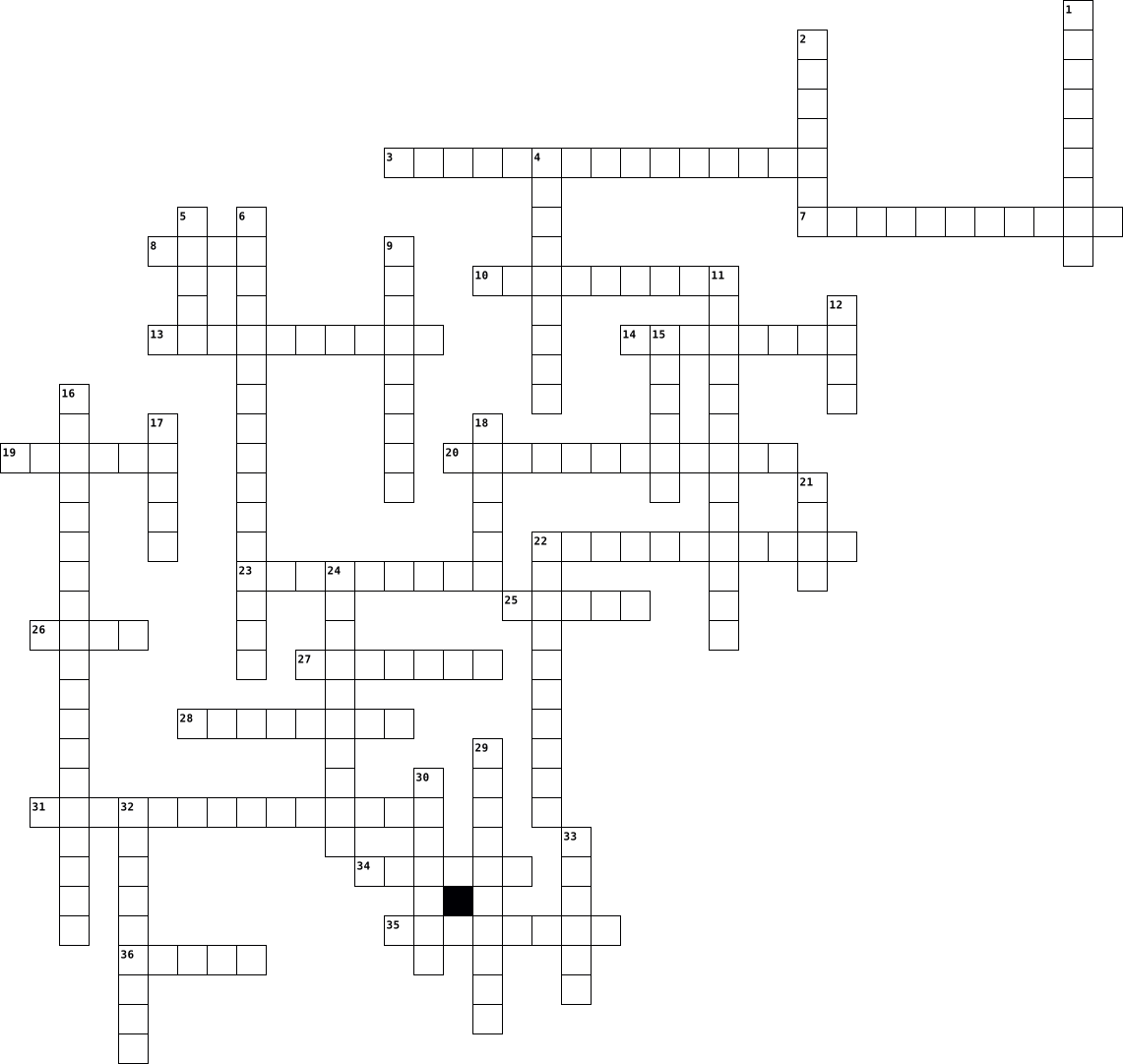
Across
- Al2(SO4)3
- developed quantum model of the atom
- developed planetary model of the atom
- from a bottle to a weighing tray
- developed uncertainty principle
- use to transfer solid
- row on the periodic table
- CaO
- a reaction that absorbs energy
- process used to determine concentration of an unknown solution
- gas law P1V1=P2V2
- smallest building block
- developed plum pudding model of the atom
- negatively charged subatomic particle
- NaCl
- largest region on the period table
- a unit of concentration
- negatively charged ion
Down
- a type of cylinder used for measuring liquids
- composed of neutrons and protons
- region on the periodic table that forms negative ions
- unit of energy
- region on the periodic table that can have multiple charges
- what the atomic radius does as you move across a period
- relationship between quantities in a chemical reaction
- anion is typically hydroxide
- positively charged ion
- CCl4
- gas law from which all the others are derived
- developed spherical model of the atom
- cation is always hydrogen
- a reaction that releases energy
- developed nuclear model of the atom
- group on the periodic table that has a full outer shell
- subatomic particle with mass but no charge
- what the atomic radius does as you move down a group
- positively charged subatomic particle
37 Clues: CaO • CCl4 • NaCl • Al2(SO4)3 • unit of energy • gas law P1V1=P2V2 • use to transfer solid • positively charged ion • negatively charged ion • smallest building block • a unit of concentration • row on the periodic table • cation is always hydrogen • anion is typically hydroxide • a reaction that absorbs energy • developed uncertainty principle • a reaction that releases energy • ...
8th Science Lesson 2 2024-08-29

Across
- These types of metals are good conductors of heat and electricity
- The temperature at which a solid becomes a liquid is the ______ point
- A type of property that describes how a substance undergoes a reaction
- Most reactive nonmetal group
- If an element has a high likelihood to go through a chemical reaction, it is very ___
- A type of property that describes how a substance behaves without being changed chemically
- at extremely high temperatures, almost any element can be a ____
- If an elements' atoms are really compact (close together), they are ____
- Group 2: ___ earth metals
- Characteristics about elements that may be either chemical or physical
- Potassium, Rhodium, and lead are all examples of this
- Carbon, Iodine, and Argon are all examples of this
- Element with the simplest atoms
Down
- The kind of energy that may change a solid to a liquid or a liquid to a gas
- atomic mass is an ____ of the masses of all isotopes of that element
- Scientist that first started sorting the elements into a periodic table
- A repeated pattern
- A column in the periodic table may also be called this
- Most stable group
- A row in the periodic table may also be called this
- The most reactive group of metals
- Have similarities to both metals and nonmetals
22 Clues: Most stable group • A repeated pattern • Group 2: ___ earth metals • Most reactive nonmetal group • Element with the simplest atoms • The most reactive group of metals • Have similarities to both metals and nonmetals • Carbon, Iodine, and Argon are all examples of this • A row in the periodic table may also be called this • ...
Periodic Table 2021-12-03

Across
- full outer shell
- semiconductors
- discovered by Chadwick
- arranged periodic table by atomic number
- charge on neutron
- found on outermost shell
- discovered by JJ Thomson
- charge on proton
Down
- number of protons and neutrons
- arranged periodic table by mass
- current model of atom
- number of protons
- brittle
- discovered by Rutherford
- charge on electron
- good conductors of heat and electricity
16 Clues: brittle • semiconductors • full outer shell • charge on proton • number of protons • charge on neutron • charge on electron • current model of atom • discovered by Chadwick • discovered by Rutherford • found on outermost shell • discovered by JJ Thomson • number of protons and neutrons • arranged periodic table by mass • good conductors of heat and electricity • ...
CHEM CROSSWORD 2023-05-24

Across
- The study of matter
- Air we need to survive
- The organized chart of elements according to the increasing atomic number
- The amount of matter in an atom of an element
- The subatomic particle of an atom that has a neutral charge
Down
- The chemical element on the periodic table with the atomic number 1
- The subatomic particle of an atom that has a negative charge
- The subatomic particle of an atom that has a positive charge
- Consists of electrically positive protons and neutral neutrons
- Elements located on the left side of the periodic table
- The smallest unit of an element
- Elements located on the right side of the periodic table
- The first metalloid on the periodic table
13 Clues: The study of matter • Air we need to survive • The smallest unit of an element • The first metalloid on the periodic table • The amount of matter in an atom of an element • Elements located on the left side of the periodic table • Elements located on the right side of the periodic table • The subatomic particle of an atom that has a neutral charge • ...
Ionic Vocabulary 2022-10-24

Across
- a substance made of two or more elements bonded together
- a type of electron that's in the outer shell of an atom
- the columns on the periodic table
- a positive ion
- small numbers to the bottom right of an element to show how many atoms are in a compound
- a measure of how strong an element can pull on another element's valence electrons
Down
- the rule that atoms want 8 valence electrons
- a type of compound that involves two ions
- the rows on the periodic table
- to the right on the periodic table, tend to form negative charges
- a negative ion
- a charged atom
- to the left on the periodic table, tend to form positive charges
13 Clues: a negative ion • a positive ion • a charged atom • the rows on the periodic table • the columns on the periodic table • a type of compound that involves two ions • the rule that atoms want 8 valence electrons • a type of electron that's in the outer shell of an atom • a substance made of two or more elements bonded together • ...
Unit 4: Chemical Reactions 2021-11-13
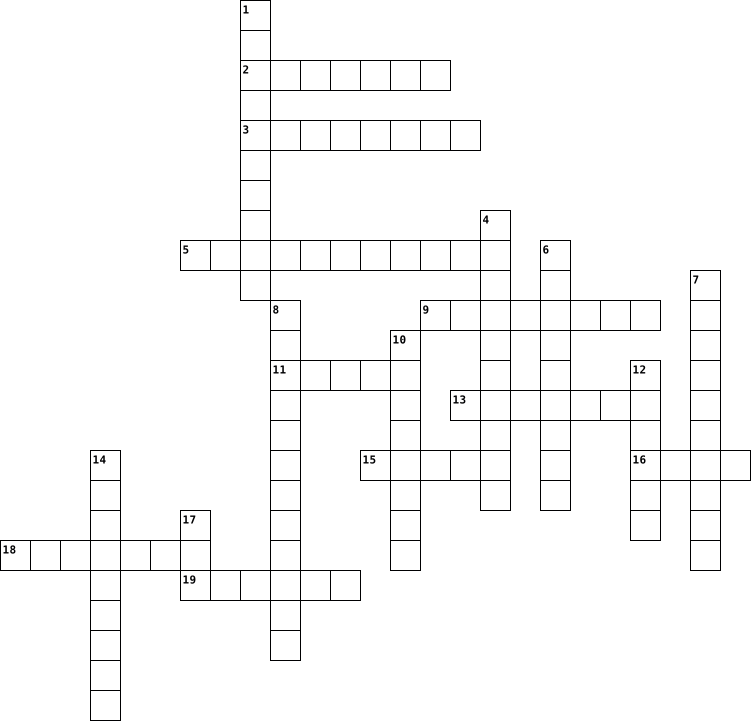
Across
- One capital/shape type; can not break; atoms same
- Change type with substance remaining the same
- Liquid plus liquid makes this solid
- Change type with new substance being formed
- Proportion of number of each atom type
- With >1 type of substance that are not attached
- Shape or letters (& numbers) to represent matter
- Tiny building block has protons, neutrons, electrons
- With >1 chemical symbol touching is a chemical...
- Periodic Table abbreviation is a chemical...
Down
- Type of (color) change in chemical reactions
- Physical change (of state) that can go back
- Chemical reaction with oxygen to change color
- Element types on zig zag line of PTE
- Chemical change type that can't go back
- With >1 capital/shape type; can break chemically
- Element types on left side of Periodic Table
- Element types on right side of Periodic Table
- State of matter produced if fizzing/bubbling occurs
19 Clues: Liquid plus liquid makes this solid • Element types on zig zag line of PTE • Proportion of number of each atom type • Chemical change type that can't go back • Physical change (of state) that can go back • Change type with new substance being formed • Type of (color) change in chemical reactions • Element types on left side of Periodic Table • ...
Elements, Ions and the Periodic table 2025-08-07

Across
- The name of an element is shortened to this "atomic-
- Ion great for your teeth they say
- Burnt wood will leave this behind
- Very light gas that is used to fill balloons
- Charge of an ion that loses electrons
- Neutrally charged particle in the atom's nucleus
- General name for atoms on the left of the periodic table
- The name of the rows in a periodic table
- The general name of the columns in a periodic table
- The lightest element
- Charge of an ion that gains electrons
Down
- Name of the scientist that models electrons in rings around an atom
- Negative particles surrounding the nucleus
- The name of an atom that loses or gains electrons
- Smells like the swimming pool
- Not quite metals!
- Element essential for plants and fills the air
- Gas that is required for us to respire
- Positively charged particle in an atom's nucleus
19 Clues: Not quite metals! • The lightest element • Smells like the swimming pool • Ion great for your teeth they say • Burnt wood will leave this behind • Charge of an ion that loses electrons • Charge of an ion that gains electrons • Gas that is required for us to respire • The name of the rows in a periodic table • Negative particles surrounding the nucleus • ...
Unit 4 Study Guide 2021-12-07

Across
- _____________ is a separation technique that involves the use of a magnet.
- the _______________ side of the periodic table is where you can find the metals.
- substance An element and compound are both a _______________
- _____________ is a technique for separating a solid and a liquid that requires gravity.
- Salt that is COMPLETELY dissolved in water is known as a _______________ mixture.
- Homozygous mixtures are _______________ throughout
- ______________ involves substances with different boiling points and an elaborate setup where one substance will change states of matter (liquid to gas to liquid).
Down
- Group number 18 of the periodic table, also known as the _______________, are the least reactive elements.
- _____________ can involve the use of a special type of paper and is used to identify different dyes or pigments in a substance.
- a bowl of cereal and milk is known as a _______________ mixture.
- _____________ separation involves the use of a tool, like forceps or a strainer.
- On the periodic table, groups 3-12 (the middle section) are known as _______________ metals.
- _______________ consists of 2 or more elements and can be separated, but only by a chemical reaction
- The right side of the periodic table is where you can find the _______________ .
- ______________ can NOT be broken down by physical or chemical means and is located on the periodic table.
15 Clues: Homozygous mixtures are _______________ throughout • substance An element and compound are both a _______________ • a bowl of cereal and milk is known as a _______________ mixture. • _____________ is a separation technique that involves the use of a magnet. • the _______________ side of the periodic table is where you can find the metals. • ...
Radioactivity Vocabulary 2022-10-24

Across
- a substance made of two or more elements bonded together
- a type of electron that's in the outer shell of an atom
- the columns on the periodic table
- a positive ion
- small numbers to the bottom right of an element to show how many atoms are in a compound
- a measure of how strong an element can pull on another element's valence electrons
Down
- the rule that atoms want 8 valence electrons
- a type of compound that involves two ions
- the rows on the periodic table
- to the right on the periodic table, tend to form negative charges
- a negative ion
- a charged atom
- to the left on the periodic table, tend to form positive charges
13 Clues: a negative ion • a positive ion • a charged atom • the rows on the periodic table • the columns on the periodic table • a type of compound that involves two ions • the rule that atoms want 8 valence electrons • a type of electron that's in the outer shell of an atom • a substance made of two or more elements bonded together • ...
The periodic table and atoms crossword 2022-01-05

Across
- relating to atoms
- a particle with a positive charge
- the horizontal numbers that label vertical rows
- a particle with a neutral charge
- everything on the periodic table
- the noble gas with the lowest atomic mass
- the particle that makes up matter
- the letters that abbreviate the element they are placed on
Down
- a particle with a negative charge
- a group of atoms that are together
- the vertical numbers that label horizontal rows
- the elements on the periodic table that aren't metals
- an element with 20 electrons
- the elements on the periodic table that are metals
- the thing in the center of the atom
15 Clues: relating to atoms • an element with 20 electrons • a particle with a neutral charge • everything on the periodic table • a particle with a negative charge • a particle with a positive charge • the particle that makes up matter • a group of atoms that are together • the thing in the center of the atom • the noble gas with the lowest atomic mass • ...
IAFNR 2023-02-22

Across
- element that lacks most of the properties
- radioactive isotope
- atom with the same number of protons, but a different number of neutrons
- positive electrical charge
- gradual wearing away of a metal element
- class of elements character used by physical properties
Down
- element that has some characteristics of metals and nonmetals
- the way a mineral reflects light from its surface
- elements in the same verticle column of the periodic table
- no electrical charge
- basic/smallest particle
- tiny, negatively charged particle
- element found in group 17 of the periodic table
- horizontal row of elements in the periodic table
- middle of an atom
15 Clues: middle of an atom • radioactive isotope • no electrical charge • basic/smallest particle • positive electrical charge • tiny, negatively charged particle • gradual wearing away of a metal element • element that lacks most of the properties • element found in group 17 of the periodic table • horizontal row of elements in the periodic table • ...
Periodic Table crossword 2021-10-25

Across
- Vertical columns of the periodic table
- Number of protons in the nucleus of an atom
- Negatively charged subatomic particles
- Horizontal rows of the periodic table
- Symbol used to identify an element
- An element that is not a metal
- An element that's properties are intermediate between those of metals and solid semiconductors
Down
- Table of elements
- Russian chemist who created the periodic table
- Characteristics of a particular substance that can be observed
- Positively charged subatomic particles
- The mass of an atom
- The outside part of an atom's nucleus
- Neutral charged subatomic partivles
- An element characterized by high electrical and thermal conductivity
15 Clues: Table of elements • The mass of an atom • An element that is not a metal • Symbol used to identify an element • Neutral charged subatomic partivles • The outside part of an atom's nucleus • Horizontal rows of the periodic table • Vertical columns of the periodic table • Positively charged subatomic particles • Negatively charged subatomic particles • ...
Periodic table 2020-10-10

Across
- gases aren't reactive
- Metals are the first part of the periodic table
- is what they call the rows of the table
- is an element named after the person who popularized the periodic table
- are very reactive
- in the periodic table are the columns
Down
- are a mix of metals and nonmetals
- earth metals are the second
- metals is the biggest group
- make up the periodic table
10 Clues: are very reactive • gases aren't reactive • make up the periodic table • earth metals are the second • metals is the biggest group • are a mix of metals and nonmetals • in the periodic table are the columns • is what they call the rows of the table • Metals are the first part of the periodic table • is an element named after the person who popularized the periodic table
Periodic Table 2014-11-16

Across
- The first alkali metal
- The number of periods in the periodic table
- The group the consists of very unreactive gases
- Horizontal rows in a periodic table
- most metals are in this state
Down
- Another name for groups
- Who created the first periodic table
- The number of groups in the periodic table
- The staircase that separates metals from nonmetals begins below this element
- Group 17 elements
10 Clues: Group 17 elements • The first alkali metal • Another name for groups • most metals are in this state • Horizontal rows in a periodic table • Who created the first periodic table • The number of groups in the periodic table • The number of periods in the periodic table • The group the consists of very unreactive gases • ...
The Periodic Table 2023-05-12

Across
- There are 18 of these on the periodic table.
- This element has 8 protons and is the air that we breathe.
- An element with the atomic # of 6.
- An element that has 1 valence electron and is also known as salt.
- The elements that take up the middle part of the periodic table are called _______ metals.
- A group of elements that are great conductors, shiny, and solids.
- An element with the atomic mass of 14.007.
- The atomic # of an element represents the amount of ____ and electrons.
- This element is in period 2 and has 1 valence electron.
- The element that is represented by the symbol Si.
Down
- This element is a metalloid with 3 valence electrons.
- Metals, nonmetals, and ____ are the 3 main categories of elements.
- There are 7 of these on the periodic table.
- An element that has 8 valence electrons and is found in period 5.
- The metalloids on the periodic table are arranged in the formation of a _____.
- The first element on the period table.
- This element is a noble gas in the same period as gold.
- _____ dot structures are diagrams that represent elements using electron count.
- The elements in group 18 are a part of the ______ gas family.
19 Clues: An element with the atomic # of 6. • The first element on the period table. • An element with the atomic mass of 14.007. • There are 7 of these on the periodic table. • There are 18 of these on the periodic table. • The element that is represented by the symbol Si. • This element is a metalloid with 3 valence electrons. • ...
Gases 2025-04-11

Across
- How hot or cold something is
- Carbon _______________ is a gas that makes the bubbles in soda. The formula is CO2
- Pressure is the ____________ of particles on a container
- A gas that makes balloons float and has an atomic mass of 2
- A gas we need to breathe to stay alive
- When the volume of a gas decreases, the pressure _________________
- A substance that does not have a fixed volume or shape
- ____________ energy is the energy of an object in motion
Down
- A gas that is used to clean swimming pools and has an atomic mass of 35.45 on the periodic table
- The amount of space air takes up
- A gas that is number 7 on the periodic table
- A small amount of matter, like an atom or molecule
- A gas found in rock and soil and number 86 on the periodic table
- The force of particles on the walls of a container
- When temperature of a gas decreases, the speed of the atoms also _________
- A gas that is in some light up signs and number 10 on the periodic table
- How we measure very small particles like atoms and molecules
- Anything that holds things inside it
- A unit for pressure
19 Clues: A unit for pressure • How hot or cold something is • The amount of space air takes up • Anything that holds things inside it • A gas we need to breathe to stay alive • A gas that is number 7 on the periodic table • A small amount of matter, like an atom or molecule • The force of particles on the walls of a container • ...
Unit 1 crossword 2023-08-29

Across
- A section of the periodic table that comprises nonmetals not forming in nature (they react with metals to form salts)
- purest form of a substance, made up of uniform matter
- The ability of a material to be stretched, pulled, or drawn into thin wire without breaking
- unit of mass used to express atomic and molecular traits
- Particle The particles that make up an atom
- number of atoms in one molecule of an element
- A column on the periodic table in which every element has the same number of valence electrons
- gas A gaseous chemical element that doesn't react with other elements
- A row of the periodic table where every element has the same amount of energy levels
- electrons the electrons residing on the outermost energy level of an atom
Down
- Cloud the place electrons inhabit in an atom
- negatively charged subatomic particle
- Table An organized list of elements based on increasing atomic number
- The capability of an atom/molecule to chemically react with another atom/molecule
- Building blocks of matter
- Radius, total distance from the nucleus to the outermost orbital of its electron
- Representation of an element using 1 or 2 letters
- positively charged subatomic particle
- neutrally charged subatomic particle
- the center of an atom
20 Clues: the center of an atom • Building blocks of matter • neutrally charged subatomic particle • negatively charged subatomic particle • positively charged subatomic particle • Cloud the place electrons inhabit in an atom • Particle The particles that make up an atom • number of atoms in one molecule of an element • Representation of an element using 1 or 2 letters • ...
Chemistry Midterm Study Guide Vocab Chapter 3 2026-01-05

Across
- – A series of 14 elements from atomic numbers 57–71, often called rare earth elements, located in the f-block
- Gas – An element in Group 18 that is very unreactive due to having a full valence electron shell
- – The repeating pattern of chemical and physical properties of elements across periods and groups in the periodic table
- Law – The law stating that the properties of elements are a periodic function of their atomic numbers
- – An element that is generally not shiny, brittle, and a poor conductor of heat and electricity
- – An element that is typically shiny, malleable, ductile, and a good conductor of heat and electricity
- – A substance that can conduct electricity under some conditions but not others, often a metalloid
Down
- – A series of 14 elements from atomic numbers 89–103, mostly radioactive, located in the f-block
- Element – An element in the d-block of the periodic table, often exhibiting multiple oxidation states and forming colored compounds
- – A horizontal row in the periodic table
- – A vertical column in the periodic table
- – An element that has properties of both metals and nonmetals
12 Clues: – A horizontal row in the periodic table • – A vertical column in the periodic table • – An element that has properties of both metals and nonmetals • – An element that is generally not shiny, brittle, and a poor conductor of heat and electricity • – A series of 14 elements from atomic numbers 89–103, mostly radioactive, located in the f-block • ...
Random Info 2022-04-11

Across
- Short form of poetry
- Periodic table symbol Ag
- used to be a grocery store before phone
- October 31st
- symbol C
- symbol N
- Jewish holiday
- December 25th
- German word for granny
- Symbol O
- capital of Texas
- weather forecaster
Down
- Periodic table symbol Cu
- Town you live in
- Main cause of salmonella
- City Capital of Missouri
- Scientific name for water
- Capital of Canada
- Town Crystal is from
- what you do when you finish high school
- last Thursday of the month
21 Clues: symbol C • symbol N • Symbol O • October 31st • December 25th • Jewish holiday • Town you live in • capital of Texas • Capital of Canada • weather forecaster • Short form of poetry • Town Crystal is from • German word for granny • Periodic table symbol Cu • Periodic table symbol Ag • Main cause of salmonella • City Capital of Missouri • Scientific name for water • last Thursday of the month • ...
CHEMISTRY CROSSWORD 2022-05-12

Across
- si unit of energy
- unit of temoerature
- solids in a liquid are removed
- type of gas on the periodic table
- name of the class
- turns litmus blue
- technique of heating a liquid
- increases the rate of a reaction
- number of protons
- m
- ion thatis positively charged
Down
- two bonding pairs
- turns into a solid
- turns litmus red
- quantity of matter
- dissolves a solvent
- middle of periodic table
- unit of a element
- salt
- solution with a little solute
20 Clues: m • salt • turns litmus red • two bonding pairs • si unit of energy • name of the class • turns litmus blue • unit of a element • number of protons • turns into a solid • quantity of matter • unit of temoerature • dissolves a solvent • middle of periodic table • technique of heating a liquid • solution with a little solute • ion thatis positively charged • solids in a liquid are removed • ...
Periodic Table 2016-09-25

Across
- Used in various electrical wiring.
- Michael Phelps has 23 of these.
- Found in a bullet.
- America.
- You can get a record made out of this.
- A chevy car.
- Has three protons.
- What we breathe.
- Salt
- Makes your voice high pitched.
Down
- Superman.
- First element on the periodic table.
- Found in bananas.
- Used in the making of various vehicles.
- A planet.
- Put in pools to purify the water.
- Found in some sunscreens.
- Dimes, pennies, etc.
- Found in milk.
- Sn
- Has 47 protons.
21 Clues: Sn • Salt • America. • Superman. • A planet. • A chevy car. • Found in milk. • Has 47 protons. • What we breathe. • Found in bananas. • Found in a bullet. • Has three protons. • Dimes, pennies, etc. • Found in some sunscreens. • Makes your voice high pitched. • Michael Phelps has 23 of these. • Put in pools to purify the water. • Used in various electrical wiring. • ...
Periodic Table 2015-12-12

Across
- Makes a clanging sound (8)
- An element with symbol W (8)
- The state with the lowest density (3)
- One of the two elements in water (6)
- Cannot transmit heat and electricity (9)
- An unreactive metal (4)
- Another name for the Group 1 metals (6)
- How reactive something is (10)
- An element used in balloons (6)
- Can be drawn into wires (7)
- An element with symbol At (8)
- An element with symbol Se (8)
- An element with symbol C (6)
Down
- Can transmit heat and electricity (9)
- A gas produced when metals react with acid (8)
- A less reactive metal (4)
- A row of elements (6)
- The state with the highest density (5)
- Can be hammered flat (9)
- A group 1 element beginning with R… (8)
- Another name for the Group 0 non-metals (5)
- A group 2 element beginning with S… (9)
- Another name for the Group 7 non-metals (7)
- A column of elements (5)
- A very reactive metal (6)
25 Clues: A row of elements (6) • An unreactive metal (4) • Can be hammered flat (9) • A column of elements (5) • A less reactive metal (4) • A very reactive metal (6) • Makes a clanging sound (8) • Can be drawn into wires (7) • An element with symbol W (8) • An element with symbol C (6) • An element with symbol At (8) • An element with symbol Se (8) • How reactive something is (10) • ...
Periodic Table 2015-09-30

Across
- Horizontal row on the periodic table
- Describes the likelihood of an element to forms bond with other elements
- Solid at room temperature; Good conductors of heat and electricity
- Special mass unit for the mass of a subatomic particle
- Group 18 or 8a
- Have properties of both metals and non-metals
- Atoms form _____ by gaining or losing electrons
- Electron on outermost energy ring; Outside the nucleus
- Item used by J.J. Thompson in his experiment to prove that atoms contain electrons
- Each element has an atomic _______ that usually consists of one or two letters
- My symbol is O
- Greek scientist who named the atom "atoms" for indivisible
- Mixture containing two or more metallic elements
- Scientist who discovered electrons
- A form of matter which has mass, occupies a volume, and flows to adopt the shape of its container.
- Atoms that contain the same number of protons but different number of neutrons
- Subatomic particle located in the nucleus; Neutral charge.
- Smallest unit of a compound that contains all the elements of a compound
- My symbol is He
Down
- The total distance from an atom's nucleus to the outermost electron orbital.
- A measure of the attraction an atom has for electrons.
- Pure substance; Cannot be broken down into another substance
- My symbol is H
- A form of matter which has a definite shape and volume.
- Number of protons in an element
- Group 1 or 1a
- A form of matter that has mass but no definite shape, and can be either compressed or expanded to fill an infinite volume.
- Electrons are shared; Chemical bond between two non-metals
- Subatomic particle located on energy rings outside the nucleus; Negatively charged
- A chemical bond between oppositely charged ions that forms when a metal atom gives away an electron and a non metal takes an electron
- Chart that displays the information of all known elements according to their properties
- Group 17 or 7a
- Started the modern theory of atoms; approved Democritus' model of an invisible atom
- Vertical column on the periodic table
- Neither solid nor good conductors; Not lustrous
- Smallest component of an element
- Subatomic particle located in the nucleus; Positively charged
- Composed of protons and neutrons; Center of the atom
38 Clues: Group 1 or 1a • My symbol is H • Group 18 or 8a • Group 17 or 7a • My symbol is O • My symbol is He • Number of protons in an element • Smallest component of an element • Scientist who discovered electrons • Horizontal row on the periodic table • Vertical column on the periodic table • Have properties of both metals and non-metals • Atoms form _____ by gaining or losing electrons • ...
Periodic Table 2015-09-30

Across
- Group 17 or 7a
- Atoms form _____ by gaining or losing electrons
- Group 1 or 1a
- Neither solid nor good conductors; Not lustrous
- My symbol is O
- Special mass unit for the mass of a subatomic particle
- Describes the likelihood of an element to forms bond with other elements
- A measure of the attraction an atom has for electrons.
- Smallest unit of a compound that contains all the elements of a compound
- Horizontal row on the periodic table
- Chart that displays the information of all known elements according to their properties
- Smallest component of an element
- Have properties of both metals and non-metals
- Started the modern theory of atoms; approved Democritus' model of an invisible atom
- Subatomic particle located in the nucleus; Neutral charge.
- Greek scientist who named the atom "atoms" for indivisible
- Group 18 or 8a
- A form of matter which has mass, occupies a volume, and flows to adopt the shape of its container.
- My symbol is H
- Atoms that contain the same number of protons but different number of neutrons
Down
- The total distance from an atom's nucleus to the outermost electron orbital.
- Subatomic particle located in the nucleus; Positively charged
- Number of protons in an element
- A form of matter that has mass but no definite shape, and can be either compressed or expanded to fill an infinite volume.
- Electron on outermost energy ring; Outside the nucleus
- A chemical bond between oppositely charged ions that forms when a metal atom gives away an electron and a non metal takes an electron
- Scientist who discovered electrons
- Vertical column on the periodic table
- Item used by J.J. Thompson in his experiment to prove that atoms contain electrons
- Mixture containing two or more metallic elements
- Solid at room temperature; Good conductors of heat and electricity
- Electrons are shared; Chemical bond between two non-metals
- Subatomic particle located on energy rings outside the nucleus; Negatively charged
- My symbol is He
- A form of matter which has a definite shape and volume.
- Each element has an atomic _______ that usually consists of one or two letters
- Composed of protons and neutrons; Center of the atom
- Pure substance; Cannot be broken down into another substance
38 Clues: Group 1 or 1a • Group 17 or 7a • My symbol is O • Group 18 or 8a • My symbol is H • My symbol is He • Number of protons in an element • Smallest component of an element • Scientist who discovered electrons • Horizontal row on the periodic table • Vertical column on the periodic table • Have properties of both metals and non-metals • Atoms form _____ by gaining or losing electrons • ...
Periodic table 2016-02-03

Across
- 16 protons
- 3 protons
- 20 protons
- 6 protons
- 12 protons
- 5 protons
- 9 protons
- 11 protons
- 15 protons
- 17 protons
- 7 protons
Down
- 13 protons
- 14 protons
- 8 protons
- 4 protons
- 18 protons
- 2 protons
- 19 protons
- 1 proton
- 10 protons
20 Clues: 1 proton • 3 protons • 8 protons • 4 protons • 6 protons • 5 protons • 2 protons • 9 protons • 7 protons • 13 protons • 16 protons • 14 protons • 20 protons • 18 protons • 12 protons • 11 protons • 15 protons • 19 protons • 17 protons • 10 protons
periodic table 2017-01-23

Across
- / basic building block
- / lighter elements
- / Can cut with a knife
- / made up of two or more substances
- / baking a cake
- / applies to Valence Electrons
- / result of losing or gaining
- / put in bombs
- / N
- / separates the solid of a mixture
- / distributed evenly throughout the mixture
- / has no metal in the element
Down
- / E-
- / a homogeneous mixture
- / father of the periodic table
- / P+
- / ice to water
- / salt producers
- / highly unreactive
- / made up of two or more substances
- / a physical property that describes how much matter is found in a certain space
- / mixture of metals and non-metals
- / increases with temperature
- / energy levels
24 Clues: / N • / E- • / P+ • / ice to water • / put in bombs • / baking a cake • / energy levels • / salt producers • / lighter elements • / highly unreactive • / basic building block • / Can cut with a knife • / a homogeneous mixture • / increases with temperature • / result of losing or gaining • / has no metal in the element • / father of the periodic table • / applies to Valence Electrons • ...
periodic vocabulary 2017-12-11

Across
- the number of protons in the nucleus of an atom, which determines the chemical properties of an element and its place in the periodic table.
- semi-conductors
- the substances that create a product
- a table of the chemical elements arranged in order of atomic number
- a substance formed as the result of a chemical reaction
- horizontal rown in a periodic table
- where electrons are when they go around the nucleus of an atom
- outer shell electron that is assoiciated with an atom
- tells us the number of atoms of each element in a compound
Down
- total number of protons and neutrons in a nucleus
- a number that goes before the chemical formula
- the principle that matter cannot be created or destroyed
- nuetral charged particle in an atom
- a basic unit of a chemical element
- positive charged particle in an atom
- contains protons and neutrons
- vertical columns in a periodic bubble
- good conductor of heat and electricity
- bad conductors
- negative charge particle in an atom
20 Clues: bad conductors • semi-conductors • contains protons and neutrons • a basic unit of a chemical element • nuetral charged particle in an atom • horizontal rown in a periodic table • negative charge particle in an atom • the substances that create a product • positive charged particle in an atom • vertical columns in a periodic bubble • good conductor of heat and electricity • ...