
periodic%20table Crossword Puzzles
Atoms and the periodic table 2016-04-11

Across
- The scientific name for columns in the periodic table
- The number of electrons in chlorine's OUTER shell
- The positively charged particle in an atom
- Another name for group seven elements
- Formed when an element gains an electron
- The scientist who's periodic table we still use
- Where we find electrons in an atom
Down
- The element with the relative atomic mass of 16
- The scientific name for rows in the periodic table
- What we make when we remove an electron from an element
- The element which contains 6 protons and 6 neutrons
- The number of electrons allowed in the first shell
- The name for the group of protons and neutrons
- The element with the chemical symbol Hg
- The element with the chemical symbol Pb
15 Clues: Where we find electrons in an atom • Another name for group seven elements • The element with the chemical symbol Hg • The element with the chemical symbol Pb • Formed when an element gains an electron • The positively charged particle in an atom • The name for the group of protons and neutrons • The element with the relative atomic mass of 16 • ...
Periodic classification Of Elements 2020-09-13

Across
- Newland divided elements into horizontal rows of eight element reach State True or False.
- other name of group 18th elements.
- most stable element in the third row.
- non- metallic character _________across a period.
- Group 17 elements are called.
- on moving from left to right in a periodic table _____ character decreases.
- The basis of modern Periodic table is.
Down
- What happens to the electropositive character of elements on moving from left to right in a periodic table.
- According to Newland’s law of octave ______________is similar to oxygen.
- number of shells in strontium.
- An element ‘x’ belongs to groups 2. Find its valency.
- most reactive element of group seventeenth.
- elements has two shells and both are completely filled.
- tendency to_______ electrons decreases down the group.
- predict whether "K" is metal or non- metal.
- nature of the oxide of element with atomic number 12.
16 Clues: Group 17 elements are called. • number of shells in strontium. • other name of group 18th elements. • most stable element in the third row. • The basis of modern Periodic table is. • most reactive element of group seventeenth. • predict whether "K" is metal or non- metal. • non- metallic character _________across a period. • ...
C2 The periodic table 2020-12-14

Across
- smallest unit of matter that has the characteristic properties of a chemical element
- I'm in group 7 and period 3
- the maximum number of electrons that can occupy the third electron shell
- the maximum number of electrons that can occupy the second electron shell
- horizontal row of elements on the periodic table that have the number of electrons shells
- the centre of an atom
- I'm in group 1 and period 4
Down
- the elements found in Group 7 of the periodic table
- elements in Group 1 of the periodic table
- the maximum number of electrons that can occupy the first electron shell
- a column of elements in the periodic table which have similar chemical properties
- a particle, atom or molecule with a net electrical charge
12 Clues: the centre of an atom • I'm in group 7 and period 3 • I'm in group 1 and period 4 • elements in Group 1 of the periodic table • the elements found in Group 7 of the periodic table • a particle, atom or molecule with a net electrical charge • the maximum number of electrons that can occupy the third electron shell • ...
Physics Chapter 14 Quiz 2023-04-19

Across
- The wave pulse that bounces back from striking a boundary.
- Type of wave that disturbs particles parallel to the direction of wave travel
- Object suspended from a pendulum
- Material that a wave moves through
- Tool that allows for investigation of wave behavior
- Motion that repeats, or follows the same path during the same amount of time in a regular cycle
- The initial pulse that strikes a boundary is the ___ wave.
- Number of complete oscillations a point on a wave makes each second
- Object with mass suspended by a string or light rod
- A stretched spring has ___ potential energy
- Line that represents the crest of a two-dimensional wave
- Time needed for an object to repeat one complete cycle of periodic motion
Down
- Type of wave that causes particles to move both parallel and perpendicular to wave direction
- Occurs when extra force is applied to an object in periodic motion, increasing its amplitude
- A wave traveling from one medium to another is crossing a ___.
- The result of superposition
- Angle of incidence is equal to the angle of ___.
- Disturbance that carries energy through matter or space without transferring matter
- Type of wave that disturbs particles perpendicular to the direction of wave travel
- Maximum distance that an object moves from its equilibrium position
- The ___ constant is equal to the slope of a force-distance graph according to Hooke's law.
- Change in direction of waves at the boundary between two different mediums
- Point at which an object in periodic motion has a net force of zero
23 Clues: The result of superposition • Object suspended from a pendulum • Material that a wave moves through • A stretched spring has ___ potential energy • Angle of incidence is equal to the angle of ___. • Tool that allows for investigation of wave behavior • Object with mass suspended by a string or light rod • Line that represents the crest of a two-dimensional wave • ...
Physical Science Ch 17 Periodic Motion and Waves 2025-02-11

Across
- A wave in which the disruptions move perpendicular to the direction of wave travel.
- A region of high density and pressure in a longitudinal wave.
- The combining of waves where they overlap.
- The perceived change in the frequency of a wave due to the motion of the wave’s source or of the receiver.
- The maximum displacement from the equilibrium position during periodic motion
- The lowest point of a wave.
- Motion that repeats in equal time intervals.
- The number of waves or cycles that occurs per second.
- A wave that is moving even though the locations of the crests and troughs appear to be stationary.
- Periodic motion that is caused by a restoring force that is proportional to the displacement of the system.
- Reducing the amplitude of periodic motion by applying a force that works against motion.
- A disruption that carries energy from one location to another.
Down
- The bouncing of waves off a surface.
- The highest point of a wave.
- A region of lower density and pressure in a longitudinal (compression) wave.
- An increase in the amplitude of a vibration due to additional wave input.
- The bending of waves around an obstacle or through an opening.
- A wave that carries energy through a physical medium.
- A wave in which the disruptions are parallel to the direction of wave travel.
- The time interval for one complete cycle of periodic motion.
- A change in wave direction due to a change in a wave’s speed as it enters a new medium.
- The distance between two identical points on successive waves.
22 Clues: The lowest point of a wave. • The highest point of a wave. • The bouncing of waves off a surface. • The combining of waves where they overlap. • Motion that repeats in equal time intervals. • A wave that carries energy through a physical medium. • The number of waves or cycles that occurs per second. • The time interval for one complete cycle of periodic motion. • ...
Periodic Table and Atomic Structure of Matter - Unit 4 2025-04-30

Across
- a positive ion
- any substance composed of identical molecules that consist of atoms of at least two elements
- a negative ion
- a group of two or more atoms bonded together
- the positively charged subatomic particle
- discovered nucleus using alpha particles and gold foil
- the name of the force that is felt between two charged particles
- rare earth metal that is needed for electric cars
- the name of the rare earth metals from atomic number 57-71
- a pure substance that cannot be broken down into simpler substances by chemical processes
- the negatively charged subatomic particle
- the number of groups in the periodic table
- where electrons are found in an atom
- where the mass of an atom is concentrated
Down
- the naturally occurring element with the highest atomic number
- the name of the 16th group of elements
- the name of the group 17 elements
- a substance formed by physically combining two or more different elements or compounds where each component retains its own chemical identity
- the subatomic particle with no charge
- an element in the fifth period and 15th group
- a row in the periodic table
- discovered the neutron
- a column in the periodic table
- the element whose cation form is a single proton
- atoms of an element that have different numbers of neutrons
- the first person to name the basic building block of matter "atom"
- the country with the greatest capacity for mining rare earth metals
- the number of rows in the periodic table
28 Clues: a positive ion • a negative ion • discovered the neutron • a row in the periodic table • a column in the periodic table • the name of the group 17 elements • where electrons are found in an atom • the subatomic particle with no charge • the name of the 16th group of elements • the number of rows in the periodic table • the positively charged subatomic particle • ...
Types of Elements & Atoms 2024-12-12

Across
- Elements on the right side of the periodic table's staircase
- Elements on the periodic table's staircase
- The smallest unit of matter
- Pure substance found on the periodic table
Down
- An atom that has gained or lost electrons
- Elements on the left side of the periodic table's staircase
- An atom that has lost electrons
- Different versions of an element with different numbers of neutrons
- An atom that has gained electrons
9 Clues: The smallest unit of matter • An atom that has lost electrons • An atom that has gained electrons • An atom that has gained or lost electrons • Elements on the periodic table's staircase • Pure substance found on the periodic table • Elements on the left side of the periodic table's staircase • Elements on the right side of the periodic table's staircase • ...
Periodic Table of Elements Crossword 2013-04-24

Across
- C
- In general, period number indicates the number of electron _________ in neutral atoms of the elements in that period.
- Li
- How elements are DISPLAYED on the periodic table: _________ symbols.
- Al
- Be
- Na
- K
- The group of elements that share properties associated with metals and nonmetals.
- Cl
- O
- For metals, reactivity __________ as you go from left to right across a period.
- Ne
- He
- F
- In general, group number indicates the number of ________ electrons in the neutral atoms of elements belonging to that group.
- Group 1: ________ metals
- Ar
- A row in the periodic table.
Down
- Group 18 elements: _________ gases; these elements are very stable and do not react easily.
- A column in the periodic table; also referred to as a group.
- To calculate the number of ________ in an atom for an element, subtract the atomic number from the atomic mass.
- Elements in the same group have __________ physical and chemical properties.
- Ca
- Group 17 elements, which are very reactive and dangerous.
- Mg
- The units for atomic mass.
- H
- P
- For non-metals, reactivity __________ as you go from left to right across a period.
- For a neutral atom of an element, the atomic number and number of protons also equals the number of ________.
- For a neutral atom of an element, the atomic number equals the number of ________.
- Groups 3 through 12: _________ metals
- Si
- N
- S
- Group 2: __________ earth metals
- B
- Elements in the periodic table are arranged in order of increasing ________ number.
39 Clues: C • H • K • P • N • O • S • F • B • Li • Ca • Mg • Al • Be • Na • Si • Cl • Ne • He • Ar • Group 1: ________ metals • The units for atomic mass. • A row in the periodic table. • Group 2: __________ earth metals • Groups 3 through 12: _________ metals • Group 17 elements, which are very reactive and dangerous. • A column in the periodic table; also referred to as a group. • ...
Chemistry crossword-Andrea M. 9-H 2019-11-09

Across
- vertical column of elements in the periodic table
- a group 18 elements in the periodic table
- when an element absorbs heat
- atom that has become electrically charged because it has lost or gained electrons
- number of protons in the nucleus of one atom of an element
- element that has both metallic and nonmetallic properties
- dull, brittle element that does not conduct electricity
- group 2 elements in the periodic table; their reactivity is not as strong as that of the alkali metals
- pure substance that can't be broken down into other substances
- chemical combination of two or more elements
- pure substance formed when at least one metal and one non-metal combine
Down
- ability of a substance to conduct electricity or heat
- a system of warning symbols on hazardous materials
- a table in which the elements are organized by their physical and chemical properties
- change that results when two or more substances react to create a different substance or substances
- mass of one atom of an element
- pure substance formed when at least two non-metals combine
- a material that electric charge can move through easily
- chemistry) vertical column of elements in the periodic table
- a reaction that takes place when two or more substances react to form new substances
- anything that has mass and occupies space
- the smallest part of an element
- neutral particle in the nucleus of an atom
- when an element gives of heat
- positively charged centre of an atom; contains protons and neutrons
25 Clues: when an element absorbs heat • when an element gives of heat • mass of one atom of an element • the smallest part of an element • a group 18 elements in the periodic table • anything that has mass and occupies space • neutral particle in the nucleus of an atom • chemical combination of two or more elements • vertical column of elements in the periodic table • ...
C2 The periodic table 2020-12-14

Across
- The centre of an atom
- The maximum number of electrons that can occupy the third electron shell
- A product formed when sodium reacts with water (6,9).
- we have full outer electron shells, we are unreactive (5,5).
- I have a mass number of 12 and an atomic number of 6, how many neutrons do I have?
- Elements in Group 1 of the periodic table
- The maximum number of electrons that can occupy the first electron shell
- A flammable gas produced when an alkali metal reacts with water.
- I have a mass number of 12 and an atomic number of 6, what element am I?
- Horizontal row of elements on the periodic table that have the same number of electrons shells.
- A product formed when lithium reacts with water (7,9).
- The elements found in Group 7 of the periodic table (6,6)
Down
- I have four electrons in my outermost shell what group do I belong to?
- Scientist who arranged the elements by atomic weight and chemical properties. He also left gaps for undiscovered elements.
- A product formed when potassium reacts with water (6,9).
- I have five electrons in my outermost shell what group do I belong to?
- A column of elements in the periodic table which have similar chemical properties
- Smallest unit of matter that has the characteristic properties of a chemical element
- I have two electron shells what period do I belong to?
- I'm in group 1 and period 4
- I'm in group 7 and period 3
- The maximum number of electrons that can occupy the second electron shell
- I have three electron shells what period do I belong to?
- A particle, atom or molecule with a net electrical charge
- I have two electrons in my outermost shell what group do I belong to?
25 Clues: The centre of an atom • I'm in group 1 and period 4 • I'm in group 7 and period 3 • Elements in Group 1 of the periodic table • A product formed when sodium reacts with water (6,9). • I have two electron shells what period do I belong to? • A product formed when lithium reacts with water (7,9). • A product formed when potassium reacts with water (6,9). • ...
Chemistry Crossword 2017-11-13

Across
- system of easy-to-see warning symbols on hazardous materials
- neutral particle in the nucleus of an atom
- metals group 1 elements in the periodic table, not including hydrogen; the most reactive of the metals
- mixture mixture in which the different substances that make up the mixture are visible
- substance that reacts with another substance
- change of state from a solid to a liquid
- change of state from a solid to a gas or from a gas to a solid
- number number of protons in the nucleus of one atom of an element
- neutral particle made up of a nucleus containing protons and neutrons
- pure substance that cannot be broken down into other substances
- horizontal row of elements in the periodic table
Down
- anything that has mass and occupies space
- cloudy mixture in which tiny particles of one substance are held within another and particles cannot be separated
- gases group 18 elements in the periodic table
- homogeneous mixture
- mass of a substance that can dissolve in a given amount of solvent to
- dull, brittle element that does not conduct electricity
- element that has both metallic and non-metallic properties
- change change that results when two or more substances react to create a different substance or substances
- amount of mass in a given volume of a substance
- solution solution in which water is the solvent
- positively charged particle in the nucleus of an atom
- vertical column of elements in the periodic table
- substance substance made of only one kind of matter
24 Clues: homogeneous mixture • change of state from a solid to a liquid • anything that has mass and occupies space • neutral particle in the nucleus of an atom • substance that reacts with another substance • gases group 18 elements in the periodic table • amount of mass in a given volume of a substance • solution solution in which water is the solvent • ...
Unit 4: The Periodic Table 2023-10-20

Across
- A column on the periodic table
- pure elements that form molecules consisting of two atoms bonded together to be more stable
- The amount of energy required to remove an electron from an atom
- Horizontal rows on the periodic table
- A negatively charged ion
- A positively charged ion
- Elements that have properties of both metals and nonmetals.
- Elements that are good conductors of electric current and heat.
- elements that appear below the main body of the periodic table; sometimes referred to as rare earth metals
Down
- Groups 3-12, 1-2 electrons in the outer energy level, less reactive than alkali-earth metals, shiny, good conductor of thermal energy and electrical current, high density
- the ability of an atom to attract electrons when the atom is in a compound
- the energy required to remove the first electron from an atom
- one-half the distance between the nuclei of identical atoms that are bonded together
- An atom or group of atoms that has a positive or negative charge.
- Elements that are poor conductors of heat and electric current. Often gasses at room temperature.
- Group 18, full valence shell, nonmetals that rarely react
- When elements are arranged in order of increasing atomic number, there is a periodic repetition of their physical and chemical properties.
- group 2, 2 valence electrons, harder than the alkali metals and are also less reactive
- Group 17, 7 valence electrons, nonmetals and very reactive
- Group 1, 1 valence electron, very reactive, soft, silver, shiny, low density.
20 Clues: A negatively charged ion • A positively charged ion • A column on the periodic table • Horizontal rows on the periodic table • Group 18, full valence shell, nonmetals that rarely react • Group 17, 7 valence electrons, nonmetals and very reactive • Elements that have properties of both metals and nonmetals. • the energy required to remove the first electron from an atom • ...
Atoms 2023-04-23

Across
- The Atomic _____ is the same as the number of protons and electrons
- Electrical charge of a proton
- Electrical charge of an electron
- Electrical charge of a neutron
- All elements and their information is on the _____ Table
- These are the horizontal rows on the Periodic Table
Down
- These are the vertical columns on the Periodic Table
- the electrons in the outer shell of an atom
- protons added to neutrons equal the Atomic _____
- Use the atoms symbol and number of valence electrons to make a _____ diagram
- Elements are grouped as either metal, nonmetal, synthetic or _____
- This is where you find the protons and neutrons
- Atom of the same element with a different number of neutrons
- Electrons are located in the Electron _____
14 Clues: Electrical charge of a proton • Electrical charge of a neutron • Electrical charge of an electron • the electrons in the outer shell of an atom • Electrons are located in the Electron _____ • This is where you find the protons and neutrons • protons added to neutrons equal the Atomic _____ • These are the horizontal rows on the Periodic Table • ...
Mole Day Crossword 2022-10-21

Across
- Central part of an atom
- Positively charged
- Animal that is brown and furry
- Metal's ability to be shaped or formed
- Brittle, luster, semiconductor, all solids
- Shiny, malleable, conductors of heat, mostly solid
- Horizontal rows on the Periodic Table
- Month of mole day
Down
- The way an object's surface reflects the light
- Measure of matter
- When metals can be pulled into wires
- Brittle, dull, insulators, all states of matter
- No charge
- Measurement of mass per unit of volume
- Clump of atoms together
- Our chemistry teacher
- Negatively charged
- Vertical columns on the Periodic Table
18 Clues: No charge • Measure of matter • Month of mole day • Positively charged • Negatively charged • Our chemistry teacher • Central part of an atom • Clump of atoms together • Animal that is brown and furry • When metals can be pulled into wires • Horizontal rows on the Periodic Table • Measurement of mass per unit of volume • Metal's ability to be shaped or formed • ...
chemical 2022-04-24

Across
- Length, width, height, and volume it takes up
- Any numerical information
- a bond making metallic substance
- Some non numerical information
- The physical look of a shape, sometimes doesnt change other times changes with container
- The product that comes from 2 physically mixed chemicals
- of matter A solid liquid or gas
- The letter(s) representing an element on the periodic table
- a bond between atleast one metal element
- number The number on the top left of an element on the periodic table
Down
- A substance class with a high conduction rate is generally seen as shiny
- One of many unique combinations of protons, neutrons and electrons
- Something that will change regardless of what type of change it is
- a bond with 2 non metals
- something that shares both a metals and non metals characteristics
- A substance made when 2 chemicals are added together
- Changes that do impact the chemical makeup of an element
- Changes that do not impact the chemical makeup of an element
- mass The number on the bottom of an element on the periodic table
- metals elements on the far right of the periodic table
20 Clues: a bond with 2 non metals • Any numerical information • Some non numerical information • of matter A solid liquid or gas • a bond making metallic substance • a bond between atleast one metal element • Length, width, height, and volume it takes up • A substance made when 2 chemicals are added together • metals elements on the far right of the periodic table • ...
Elements of a Periodic table 2022-10-03

Across
- this element is a type of metal that is used to build parts of nuclear bombs, missiles, and rockets.
- this element is used for cooling dried ice.
- human bones rely on this element.
- 53rd element in a periodic table.
- this element has the same name as a specific type of color group.
- this element has the same name as a certain USA cent.
- 1st element in the periodic table.
- this element is used to make molds.
- this element is used as a type of food flavoring (salty).
Down
- this element is used for making jewelry (cheaper than gold).
- 30th element in the periodic table.
- this element has the symbol Na.
- this element is used to build kitchen cabinets as well as doors.
- this element is a good energy transporter.
- this element can be put in balloons.
- this element is a primary source in a human breathing life cycle.
- this element has the name of a planet in our solar system.
- this element has the symbol Li.
- this element can be put in mechanical pencils.
- many Emirati women wear this type of jewelry during national celebrations, Ramadan, and weddings.
20 Clues: this element has the symbol Na. • this element has the symbol Li. • human bones rely on this element. • 53rd element in a periodic table. • 1st element in the periodic table. • 30th element in the periodic table. • this element is used to make molds. • this element can be put in balloons. • this element is a good energy transporter. • ...
Elements of a Periodic table 2022-10-03

Across
- this element is a type of metal that is used to build parts of nuclear bombs, missiles, and rockets.
- this element is used for cooling dried ice.
- human bones rely on this element.
- 53rd element in a periodic table.
- this element has the same name as a specific type of color group.
- this element has the same name as a certain USA cent.
- 1st element in the periodic table.
- this element is used to make molds.
- this element is used as a type of food flavoring (salty).
Down
- this element is used for making jewelry (cheaper than gold).
- 30th element in the periodic table.
- this element has the symbol Na.
- this element is used to build kitchen cabinets as well as doors.
- this element is a good energy transporter.
- this element can be put in balloons.
- this element is a primary source in a human breathing life cycle.
- this element has the name of a planet in our solar system.
- this element has the symbol Li.
- this element can be put in mechanical pencils.
- many Emirati women wear this type of jewelry during national celebrations, Ramadan, and weddings.
20 Clues: this element has the symbol Na. • this element has the symbol Li. • human bones rely on this element. • 53rd element in a periodic table. • 1st element in the periodic table. • 30th element in the periodic table. • this element is used to make molds. • this element can be put in balloons. • this element is a good energy transporter. • ...
Periodic Table, Isotopes & Ions. 2024-11-19

Across
- Carbon-12 and Carbon-14 are examples of ____.
- The __ __ represents the weighted average of all the isotopes of an element.
- The number of protons and neutrons in an atom gives its ____.
- The mass number of an atom is the sum of its neutrons and ____.
- The table that organizes elements by atomic number is the ____.
- The atomic number of an element is equal to the number of ____.
- The horizontal rows of the periodic table are called ____.
- An Oxygen ion has a charge of -2, this type of ion is a ______.
- ______ is an element part of the Halogen group.
Down
- Group I is the periodic Table is call ____
- Atoms of the same element with different numbers of neutrons are called ____.
- The element with 46 protons is ______.
- The element located in Group 6, Period 4 is ____.
- Isotopes of the same element have different numbers of ____.
- A column in the periodic table is also called a ____.
- Neutrons have no _____.
- The element with atomic number 17 is _______.
- An example of a noble gas is ______.
- Sodium has a charge of +1, this type of ion is call a _____.
- The subatomic particle with a negative charge is the ____.
- The first element in group 14 is _______.
21 Clues: Neutrons have no _____. • An example of a noble gas is ______. • The element with 46 protons is ______. • The first element in group 14 is _______. • Group I is the periodic Table is call ____ • Carbon-12 and Carbon-14 are examples of ____. • The element with atomic number 17 is _______. • ______ is an element part of the Halogen group. • ...
Periodic Table, Electron Configuration, History and Atom Structure 2020-12-11

Across
- Groups in the periodic table that describes similar chemical properties with other elements (ex: Halogens)
- Thomson: 1904, he discovered negative charges within the atom’s and made the Plumm pudding model
- 1910, he claimed that atoms have a mass consisting of Protons and Neutrons, created Rutherford model
- Radius: The length from the center of the nucleus to the outermost electron shell
- 1913, he stated and created the Bohr model where electrons were in electron rings with specific number of electrons in each ring
- The energy required to move electrons from the electron shell
- Principle: Principle states start at the lowest energy on the Aufbau diagram
- Organizes the periodic table Downwards
- Organizes the periodic table Across
- Contains two electrons, used for electron configuration
- The tendency to attract electrons to form a full electron shell
Down
- Rule: Rule declares electrons must fill up other orbitals before pairing them up
- Particle located outside the nucleus in shells with a negative charge
- Dalton: 1803, stated atoms can't be created nor destroyed
- Particle in the nucleus that has a positive charge, and determines atomic number
- electrons: Electrons located on the outermost layer of the electron shell, can describe reactivity and for bonding.
- Particle in the nucleus with a neutral charge, varies with isotopes
- A Greek who discovered the atoms existence, states it makes up all matter
- Exclusion Principle: A principle states each orbital holds 3 electrons with opposite spins
- Term used where directions Ionization, Electronegativity and Atomic Radius follow on the periodic table.
20 Clues: Organizes the periodic table Across • Organizes the periodic table Downwards • Contains two electrons, used for electron configuration • Dalton: 1803, stated atoms can't be created nor destroyed • The energy required to move electrons from the electron shell • The tendency to attract electrons to form a full electron shell • ...
Euka Science G10T2W10 2022-07-28

Across
- The abbreviation for "potential of hydrogen"
- A reaction that occurs when an acid is added to a base.
- An example of oxidation.
- When water is split apart, the result is oxygen and...?
- What kind of ions do acids release?
- The person who made the periodic table
- The group that has elements that are shiny, soft and can be cut with a knife in the periodic table is called ... metals.
- In the periodic table, a row is called a?
- The element symbol of an atom with 26 protons
- They have their own characteristics and they are pure substances.
- When conducting an experiment, what should we always prioritize?
- An element with an atomic number of 41 and the symbol Nb.
- The ability of something to conduct electricity.
Down
- Group 3-12 in the periodic table is called the ... metals.
- The scale that is most commonly used to measure electronegativity.
- The electrons in the outermost shell that are the most active.
- When 2 or more substances combine and form a new substance.
- When an element loses or gains a neutron
- Subatomic particle that has a negative charge
- When elements or compounds rearrange themselves in an equation.
- The mass number shows the number of protons &?
- These types of atoms are unstable and change over time.
- Helium and neon are in the same group and they are called ... gases.
- The smallest part of any thing
- The speed of a reaction that can be dangerous and even cause an explosion.
- Oxygen has an atomic number of 8, so how many electrons are in the outermost shell?
26 Clues: An example of oxidation. • The smallest part of any thing • What kind of ions do acids release? • The person who made the periodic table • When an element loses or gains a neutron • In the periodic table, a row is called a? • The abbreviation for "potential of hydrogen" • Subatomic particle that has a negative charge • The element symbol of an atom with 26 protons • ...
Grade 7 2026-03-13

Across
- – A movement that transfers energy through matter or space.
- Factor – A condition that restricts the growth of a population.
- – The loose top layer of Earth where plants grow.
- – When a liquid changes into a gas slowly at the surface.
- – A pure substance made of only one type of atom.
- – A close relationship between two different species living together.
- – The force that pulls objects toward each other.
- (Periodic Table) – A horizontal row of elements on the periodic table.
- – A symbiotic relationship where both organisms benefit.
- – All the different populations living in the same area.
- – The hot, dense center layer of the Earth.
- Energy – Energy related to the heat of an object.
Down
- – An organism that makes its own food, usually using sunlight.
- Metals – Very reactive metals found in the first column of the periodic table.
- Energy – Energy an object has because it is moving.
- Energy – Energy produced by vibrating objects and heard as sound.
- – When a solid changes directly into a gas without becoming liquid.
- Energy – Energy released from the nucleus of an atom.
- – An organism that gets energy by eating other organisms.
- – A mathematical statement showing that two expressions are equal.
- Table – A chart that organizes elements based on their properties.
- – A community of living organisms interacting with their environment.
- – The smallest unit of an element that keeps its properties.
- – Two or more atoms chemically joined together.
- Energy – Stored energy based on position or condition.
- Gas – An element that is very stable and rarely reacts with other elements.
26 Clues: – The hot, dense center layer of the Earth. • – Two or more atoms chemically joined together. • – The loose top layer of Earth where plants grow. • – A pure substance made of only one type of atom. • – The force that pulls objects toward each other. • Energy – Energy related to the heat of an object. • Energy – Energy an object has because it is moving. • ...
chemistry 2022-12-06

Across
- energy level rings
- can be bent or hammered into a sheet
- can be pulled into a wire
- located in the center
- electricity and heat passes through it
- smallest part of an element
- on the left side of the periodic table
- shatter easily
- not shiny
- 1 made of 2 electrons max
- negative charge
- neutral charge
Down
- properties of both touching the zigzag line.
- 3 holds up to 18 electrons
- electricity heat does not pass through it.
- reflects light
- right side of periodic table
- 2 holds up to 8 electrons
- cloud on the outside made of electrons
- positive charge
20 Clues: not shiny • reflects light • shatter easily • neutral charge • positive charge • negative charge • energy level rings • located in the center • can be pulled into a wire • 2 holds up to 8 electrons • 3 holds up to 18 electrons • 1 made of 2 electrons max • smallest part of an element • right side of periodic table • can be bent or hammered into a sheet • ...
Science Vocab Words 2016-10-23

Across
- a vertical column in the Periodic Table
- describes how a mineral appears to reflects light, and how brilliant or dull the mineral is
- Table a table of the chemical elements arranged in order of atomic number with rows and columns
- capable of being stretched or bent into different shapes
- a material which permits a flow of energy
- substance that does not exhibit such characteristic properties of metals as hardness, mechanical adaptability, or the ability to conduct electricity
- Point the temperature at which a given solid will melt
- Electron an electron of an atom, located in the outermost shell that can be transferred to or shared with another atom
- an element, compound, or alloy that is typically hard, opaque, shiny, and has good electrical and thermal conductivity
Down
- the name given to a horizontal row of the periodic table
- able to undergo change of form without breaking
- an element whose properties are intermediate between those of metals and solid nonmetals, they are electrical semiconductors
- Symbol representation of a chemical element the symbols in the periodic table
- Point the temperature at which a liquid boils and turns to vapor
- Atomic Mass The mass of an atom, usually expressed in atomic mass units
15 Clues: a vertical column in the Periodic Table • a material which permits a flow of energy • able to undergo change of form without breaking • Point the temperature at which a given solid will melt • the name given to a horizontal row of the periodic table • capable of being stretched or bent into different shapes • ...
Science Vocab Words 2016-10-23

Across
- a vertical column in the Periodic Table
- describes how a mineral appears to reflects light, and how brilliant or dull the mineral is
- Table a table of the chemical elements arranged in order of atomic number with rows and columns
- capable of being stretched or bent into different shapes
- a material which permits a flow of energy
- substance that does not exhibit such characteristic properties of metals as hardness, mechanical adaptability, or the ability to conduct electricity
- Point the temperature at which a given solid will melt
- Electron an electron of an atom, located in the outermost shell that can be transferred to or shared with another atom
- an element, compound, or alloy that is typically hard, opaque, shiny, and has good electrical and thermal conductivity
Down
- the name given to a horizontal row of the periodic table
- able to undergo change of form without breaking
- an element whose properties are intermediate between those of metals and solid nonmetals, they are electrical semiconductors
- Symbol representation of a chemical element the symbols in the periodic table
- Point the temperature at which a liquid boils and turns to vapor
- Atomic Mass The mass of an atom, usually expressed in atomic mass units
15 Clues: a vertical column in the Periodic Table • a material which permits a flow of energy • able to undergo change of form without breaking • Point the temperature at which a given solid will melt • the name given to a horizontal row of the periodic table • capable of being stretched or bent into different shapes • ...
Metals & Non Metals 2013-06-05

Across
- The most reactive element in group 7 (halogens). It displaces all other halogens.
- The .............. point is where a solid turns into a liquid. Its a change of state.
- They are often a gas at room temperature. They react with metals. Examples include oxygen and nitrogen
- The metals in group 1 on the periodic table. They turn the water purple due as they make hydroxides (eg lithium Hydroxide)
- A gas which is present in many reactions. It is used by humans to allow them to survive and released by plants as a waste product.
Down
- The .............. point is where a liquid turns into a gas. Its a change of state.
- Has the element symmbol: 'H'. It is a gas which is first on the periodic table
- They are solid at room temperature. They are on the left side of the periodic table. Examples include magnesium, iron and copper
- The .............. table shows all the elements in the world. The table includes groups and periods.
- The non metals in group 7 on the periodic table. They react with metals to form halides (eg sodium chloride)
- The ............. number are the columns of the periodic table. There are 8 of these. (1-7 including 8)
11 Clues: Has the element symmbol: 'H'. It is a gas which is first on the periodic table • The most reactive element in group 7 (halogens). It displaces all other halogens. • The .............. point is where a liquid turns into a gas. Its a change of state. • The .............. point is where a solid turns into a liquid. Its a change of state. • ...
CHAPTER 6 2019-11-24

Across
- Transition Metal- They are normally shown in two rows below all the other elements
- Any of the five elements fluorine, chlorine, bromine, iodine, and astatine that form part of group VIIA of the periodic table and exist in the free state normally as diatomic molecules
- Gas- The very last Group on the right
- Series- A series of heavy radioactive metallic elements of increasing atomic number
- Law- a law in chemistry: the elements when arranged in the order of their atomic numbers show a periodic variation of atomic structure and of most of their properties
- Energy- The energy required to remove an electron from a gaseous atom or ion
- the staircase that starts B and ends with Po
- elements right of the metalloid staircase
- An atom or group of atoms that carries a positive or negative electric charge as a result of having lost or gained one or more electrons
- Element- The elements within the first two families (Groups I and II on the far left)
Down
- All elements to the left of the metalloid staircase
- Metal- Any of various metallic elements (such as chromium, iron, and nickel) that have valence electrons in two shells instead of only one
- Rule- Is a chemical rule of thumb that reflects observation that elements tend to bond in such a way that each atom has eight electrons in its valence shell, giving it the same electronic configuration as a noble gas.
- having a tendency to attract electrons
- The elements from top to bottom
- Metal- Any of the monovalent mostly basic metals of group I of the periodic table comprising lithium, sodium, potassium, rubidium, cesium, and francium
- Series- The group of rare-earth metals
- Earth Metal- Any of the divalent strongly basic metals of group II of the periodic table comprising beryllium, magnesium, calcium, strontium, barium, and radium
- Element- Any of various metallic elements (such as chromium, iron, and nickel) that have valence electrons in two shells instead of only one
- The elements left to right
20 Clues: The elements left to right • The elements from top to bottom • Gas- The very last Group on the right • having a tendency to attract electrons • Series- The group of rare-earth metals • elements right of the metalloid staircase • the staircase that starts B and ends with Po • All elements to the left of the metalloid staircase • ...
Standard 3 Crossword 2016-08-23

Across
- the number of valence electrons will predict how ________ an element is
- a substance with an orderly three-dimensional arrangement of particles
- most of the mass of an atom is found in the ___________
- another word for a column on the periodic table
- a type of solid that does not have an orderly arrangement of its particles
- unit of measurement used for the mass of subatomic particles
- if a train were a polymer, each train car would be a __________
- information on the periodic table that tells you how many protons can be found in one atom of an element
- element with 6 valence electrons and 6 electron energy levels
- type of bond that holds water molecules together
- particle found in a cloud outside the nucleus
- subatomic particle without an electrical charge
- type of bond formed between metals and non-metals
- particle formed when two or more atoms chemically bond together
- atoms are always electrically ____________
- a long chain of molecules combined into a larger molecule
Down
- chemical symbol for germanium
- a chemical symbol on the periodic table is a(n) __________ for the element's name
- a material that is made of a single type of particle
- characteristics of a substance
- element on the periodic table with the lowest mass
- rubber is an example of a _________ polymer
- the particles found in the nucleus of an atom are neutrons and __________
- the smallest amount of an element
- an ion always has a(n) __________ number of protons and neutrons
- substance formed when two or more elements combine
- the most massive element with only one valence electron
- the first 92 elements are ________ occurring
- the number on the periodic table that shows how energy levels an atom will have
- has the symbol Ar
- outermost electrons on an atom
- element with only 6 protons in its nucleus
- a pure substance that cannot be broken down by physical or chemical means
- name of a combination of two or more substances physically combined
34 Clues: has the symbol Ar • chemical symbol for germanium • characteristics of a substance • outermost electrons on an atom • the smallest amount of an element • element with only 6 protons in its nucleus • atoms are always electrically ____________ • rubber is an example of a _________ polymer • the first 92 elements are ________ occurring • ...
Unit 2 Vocabulary 2024-10-28

Across
- a group 1A element
- atom with the same number of protons but a different number of neutrons than another atom
- lines of colored light obtained by passing the light emitted by an element through a prism
- the way in which electrons are arranged around the nucleus of an atom
- the smallest particle of an element that retains its identity in a chemical reaction
- a region around a nucleus where there is a high probability of finding an electron
- the number of protons in the nucleus of an atom
- the region around a nucleus where electrons are likely to be moving
- the total number of protons and neutrons in an atom
- the modern description of electrons in an atom
- the unit used to measure the relative masses of atoms
- the portion of the weighted atomic mass that each isotope composes
- an element found on the right side of the periodic table that does not have characteristics of a metal
- a horizontal row of the periodic table
- a vertical column of the periodic table
Down
- the tendency of an atom to attract electrons
- an element found along the zigzag line in the periodic table
- periodic trend that decreases across periods but increases down groups
- the weighted average mass of the atoms in a naturally-occurring sample of an element
- a subatomic particle with no charge
- a negatively-charged ion
- a charged atom
- a group 2A element
- the amount of energy required to move an electron from one energy level to the next higher energy level
- a negatively-charged subatomic particle
- a positively-charged subatomic particle
- the energy required to remove an electron from an atom
- the one or two letter abbreviation of an element
- an element that conducts electricity well, has high luster, and is malleable and ductile
- a group 7A (or 17) element
- a positively-charged ion
- an element in which the highest occupied orbitals are full
32 Clues: a charged atom • a group 1A element • a group 2A element • a negatively-charged ion • a positively-charged ion • a group 7A (or 17) element • a subatomic particle with no charge • a horizontal row of the periodic table • a negatively-charged subatomic particle • a positively-charged subatomic particle • a vertical column of the periodic table • ...
Periodic Table Trends 2024-11-21

Across
- ____________ Affinity:the amount of energy released when an electron attaches to a neutral atom
- ____________Metal:any metal in Group 1 of the periodic table
- _____________charge: the magnitude of positive charge in an atom from the pull on the valence electrons towards the positively charged nucleus
- any member of a group of gaseous elements in Group 0 or 18 or VIII A
- when the elements are arranged in order of increasing atomic number, there is a periodic repetition of their physical and chemical properties
- the tendency for an atom to attract electrons to itself when it is chemically combined with another element
- one of a class of elements having properties intermediate to metals and nonmetals
- ______________Energy:the energy required to remove an electron from a gaseous atom
Down
- _______________Metal:element characterized by addition of electrons to d suborbitals
- one of a class of elements that are not lustrous and are generally poor conductors of heat and electricity; nonmetals are grouped on the right side of the periodic table
- _____________Earth Metal:any metal in Group 2 on the periodic table
- ____________Electrons: Highest occupied energy level s and p electrons
- ________________effect: the blocking of valence shell electron attraction by the nucleus, due to the presence of inner-shell electrons
- a law stating that like charges repel and opposite charges attract, with a force proportional to the product of the charges and inversely proportional to the square of the distance between them
- any member of the nonmetallic elements in Group 17 of the periodic table
- one-half the distance between the nuclei in a molecule consisting of identical atoms
- Positively charged ion resulting from the loss of one or more electrons
- one of a class of elements that includes a large majority of the known elements; metals are characteristically lustrous, malleable, ductile, and good conductors of heat and electricity
- Negatively charged ion resulting from the gaining of one or more electrons
- _______________Transition Metals (Lanthanides & Actinides):an element in the lanthanide and actinide series; characterized by addition of electrons to f orbitals
- Elements in Groups 1,2, and 13-18.
21 Clues: Elements in Groups 1,2, and 13-18. • ____________Metal:any metal in Group 1 of the periodic table • _____________Earth Metal:any metal in Group 2 on the periodic table • any member of a group of gaseous elements in Group 0 or 18 or VIII A • ____________Electrons: Highest occupied energy level s and p electrons • ...
Grade 7 Science : Matter and Energy 2024-12-12

Across
- The path electrons follow around the nucleus of an atom.
- Negatively charged particles that orbit the nucleus of an atom.
- A state of matter with widely spaced particles moving freely and quickly.
- The process where a gas cools and changes into a liquid.
- The process where a solid absorbs heat and changes into a liquid.
- The process where a liquid changes into a gas, often by heating.
- Positively charged particles found in the nucleus of an atom.
- The basic units of matter, consisting of a nucleus surrounded by electrons.
- The process where a liquid loses heat and changes into a solid.
- A state of matter where particles are close together but can flow past one another.
- A group of reactive nonmetals in Group 17 of the periodic table.
- The process where a solid changes directly into a gas without becoming a liquid.
- Elements that are poor conductors of heat and electricity, often brittle when solid.
Down
- Anything that has mass and takes up space.
- Gases Elements in Group 18 of the periodic table, known for their lack of reactivity.
- Metals A group of metals located in the center of the periodic table, known for their conductivity and malleability.
- The capacity to do work or cause change, present in many forms like kinetic and thermal.
- Metals Highly reactive metals found in Group 1 of the periodic table.
- The process where a gas changes directly into a solid without becoming a liquid.
- Neutral particles found in the nucleus of an atom.
- Zero The theoretical temperature at which all particle motion stops, 0 Kelvin.
- A form of energy transfer between substances due to a temperature difference.
- The small units of matter, including atoms, molecules, and ions.
- A state of matter with particles tightly packed in a fixed structure.
- Elements with properties of both metals and nonmetals, often found along the "stair-step" line on the periodic table.
- Elements that are good conductors of heat and electricity, often malleable and ductile.
26 Clues: Anything that has mass and takes up space. • Neutral particles found in the nucleus of an atom. • The path electrons follow around the nucleus of an atom. • The process where a gas cools and changes into a liquid. • Positively charged particles found in the nucleus of an atom. • Negatively charged particles that orbit the nucleus of an atom. • ...
TERNARY ACIDS 2020-10-21

Across
- perchloric
- oxalic
- periodic
- carbonic
- idos
- cyanic
Down
- nitric
- chloric
- chromic
- sulfrufours
- permanganic
- sulfuric
- hypochros
- metaboric
- bromic
- metaphric
- iodic
- nitros
- formic
- chrlous
20 Clues: idos • iodic • nitric • bromic • oxalic • nitros • formic • cyanic • chloric • chromic • chrlous • sulfuric • periodic • carbonic • hypochros • metaboric • metaphric • perchloric • sulfrufours • permanganic
TERNARY ACIDS 2020-10-21

Across
- perchloric
- sulfrufours
- chloric
- chrlous
- nitros
- hypochros
- periodic
- sulfuric
- permanganic
- metaboric
- formic
Down
- idos
- bromic
- metaphric
- cyanic
- iodic
- carbonic
- oxalic
- nitric
- chromic
20 Clues: idos • iodic • bromic • cyanic • nitros • oxalic • nitric • formic • chloric • chrlous • chromic • periodic • sulfuric • carbonic • metaphric • hypochros • metaboric • perchloric • sulfrufours • permanganic
CHEMISTRY 2025-04-28

Across
- 2
- 7
- 9
- 3
- 1
- 12
- 18
- 14
- 16
- 20
Down
- 5
- 15
- 17
- 13
- 6
- 10
- 4
- 8
- 11
- 19
20 Clues: 5 • 2 • 7 • 6 • 4 • 9 • 8 • 3 • 1 • 15 • 17 • 13 • 10 • 11 • 12 • 18 • 14 • 16 • 19 • 20
CHEMISTRY 2025-04-28

Across
- 20
- 19
- 3
- 4
- 9
- 18
- 16
- 10
- 11
Down
- 5
- 6
- 12
- 2
- 13
- 15
- 8
- 1
- 7
- 17
- 14
20 Clues: 5 • 6 • 2 • 3 • 8 • 4 • 1 • 9 • 7 • 12 • 20 • 13 • 19 • 15 • 18 • 16 • 17 • 14 • 10 • 11
PERIODIC TABLE 2020-11-04

Across
- Number, the number of protons in the atom
- Down to the group melting and boiling point increase
- How many of periods or rows in periodic table
- arrangements of electrons is 2.8.8.7
- First chemical element in periodic table
- What is symbol of potassium in periodic table
Down
- arrangements of electrons is 2.8.8.1
- Used as a bleaching agent, component of common table salt
- metal, Coloured compounds
- Used to fill hot air balloons
- gas, The name of group 18
11 Clues: metal, Coloured compounds • gas, The name of group 18 • Used to fill hot air balloons • arrangements of electrons is 2.8.8.1 • arrangements of electrons is 2.8.8.7 • First chemical element in periodic table • Number, the number of protons in the atom • How many of periods or rows in periodic table • What is symbol of potassium in periodic table • ...
structure of matter 2021-09-21

Across
- table of elements all the chemicals and elements
- structure of all matter
- is a horizontal row of the periodic table
- a group of atoms bonded together
- is a proton without electrical charge
Down
- is a particle in a atom that has no electrical charge
- is a positive elective charge
- two more separated elements
- made of only of atoms with the same protons
- number is the number of protons an a nucleus
- a column of the periodic table
11 Clues: structure of all matter • two more separated elements • is a positive elective charge • a column of the periodic table • a group of atoms bonded together • is a proton without electrical charge • is a horizontal row of the periodic table • made of only of atoms with the same protons • number is the number of protons an a nucleus • ...
Vocabulary is not scary (numbers are in some clues) 2022-09-16

Across
- a combination of elements that aren't chemically bonded
- The formula for hydrogen peroxide
- The best 8th grade science teacher in peak charter academy
- a combination of protons, electrons, and neutrons
- Silicon is in this section of the periodic table
- the 26th element on the periodic table
Down
- the element thats atomic weight is 183.84
- the first element on the periodic table
- you ______
- building block of everything
- a combination of elements that are chemically bonded
11 Clues: you ______ • building block of everything • The formula for hydrogen peroxide • the 26th element on the periodic table • the first element on the periodic table • the element thats atomic weight is 183.84 • Silicon is in this section of the periodic table • a combination of protons, electrons, and neutrons • a combination of elements that are chemically bonded • ...
Science Crossowrd 2023-03-29

Across
- particles are weakest in this form
- when matter heats up, these move slower
- this can affect the way molecule move
- the temperature at which H20 becomes a solid
- the 49th element on the periodic table
- these can be found on the periodic table
- the form in which particles are further apart
- the form in which particles are closest together
Down
- all of this is made up of tiny moving particles
- these are attracted to each other
- are very close together in a solid form
- particles are always moving because they have this kind of energy
- this form of heat is not considered matter
- The table where elements are found
14 Clues: these are attracted to each other • particles are weakest in this form • The table where elements are found • this can affect the way molecule move • the 49th element on the periodic table • when matter heats up, these move slower • are very close together in a solid form • these can be found on the periodic table • this form of heat is not considered matter • ...
Periodic Trends Vocab 1 2018-11-01

Across
- The physical and chemical properties of the elements recur in a systematic and predictable way when the elements are arranged in order of increasing atomic number.
- A substance that does not exhibit such characteristic properties of metals.
- Elements that feature atoms that have an incomplete d sub-shell.
- Belong to Group 2 elements of the periodic table and are made up of radium, barium, strontium, calcium, magnesium, and beryllium.
- Chemical elements that are best defined by two criteria (Silicon, boron, germanium, tellurium, antimony, and arsenic).
- Include elements 57-71 (lanthanides) and 89-103 (actinides), Have three incomplete outermost electron shells and are all metals.
- Five non-metallic elements found in group 17 of the periodic table (Have 7 electrons in their outer shells, giving them an oxidation number of -1).
Down
- All elements in the s and p blocks of the periodic table, The most abundant elements in the periodic table.
- Any chemical element that is an effective conductor of electricity and heat.
- A group of metals that you can find on the periodic table, known as the Group 1 elements.
- Full valence orbitals, Any of the gaseous elements helium, neon, argon, krypton, xenon, and radon, occupying Group 0 (18) of the periodic table.
11 Clues: Elements that feature atoms that have an incomplete d sub-shell. • A substance that does not exhibit such characteristic properties of metals. • Any chemical element that is an effective conductor of electricity and heat. • A group of metals that you can find on the periodic table, known as the Group 1 elements. • ...
chapter 4 2023-02-14

Across
- almost 80% of elements hav few valence electrons
- metals two or more valence electrons
- electrons electrons in the outermost energy level in a neutral atom
- hav seven valence electrons highly reactively
- groups metals nonmetals nonmetals metalloids
- both columns and rows on the periodic table relate to the relate the structure of the atom
- characteristics of metals and nonmetals
Down
- metals one valence electrons highly reactive
- table chemical elements arranged in a way that displays their periodic properties
- gases eight valence electrons and unreactive
- earth metals hav two valence electrons
- law elements vary in a periodic way with their atomic numbers
- transition metals two valence electrons and are rare
- four or more valence electrons don't exhibit characteristics of metals
- set of elements similar structures
15 Clues: set of elements similar structures • metals two or more valence electrons • earth metals hav two valence electrons • characteristics of metals and nonmetals • metals one valence electrons highly reactive • gases eight valence electrons and unreactive • groups metals nonmetals nonmetals metalloids • hav seven valence electrons highly reactively • ...
Periodic Table Crossword Puzzle 2023-01-09

Across
- A periodic table family with elements that contain seven valence electrons.
- Ionization energy is a _______ property.
- Horizontal rows in the periodic table
- Ionization energy ______ across a period.
- Atomic radius is measured in what unit?
- The least reactive family
- The ability of an atom to accept an electron.
Down
- Half the distance between two atoms.
- The amount of energy required to remove one or more electrons from the atom to form a positive ion.
- Atomic radius _______ across a period.
- How likely an atom is to react with other substances.
- Vertical columns in the periodic table
- The ability of an atom to attract or bind with electrons.
13 Clues: The least reactive family • Half the distance between two atoms. • Horizontal rows in the periodic table • Atomic radius _______ across a period. • Vertical columns in the periodic table • Atomic radius is measured in what unit? • Ionization energy is a _______ property. • Ionization energy ______ across a period. • The ability of an atom to accept an electron. • ...
CHAPTER 5 CROSSWORD 2022-11-10

Across
- are the 14 elements with atomic numbers from 90 (thorium, Th) to 103 (lawrencium, Lr).
- What group is Bromine in?
- Is the arrangement of the elements with similar properties fall in the same column or group
- who's work led to finding atomic mass on the periodic table?
- what group is Alkaline-earth metals in
Down
- how many metalloids are on the periodic table
- Who dicoverd the perodic law
- what does Cu stand for on the periodic table
- The physical and chemical properties of the elements are periodic functions of their atomic number
- what element has the atomic number of 109?
10 Clues: What group is Bromine in? • Who dicoverd the perodic law • what group is Alkaline-earth metals in • what element has the atomic number of 109? • what does Cu stand for on the periodic table • how many metalloids are on the periodic table • who's work led to finding atomic mass on the periodic table? • ...
Periodic Table 2012-11-25

Across
- reacts with water
- group 18
- radioactive elements
- a horizontal row of elements on the periodic table
- arranged table by increasing atomic mass
- the 6th period
- good conductors
Down
- atomic # 11
- atomic # 12
- has chemical reactions with other atoms,#'s 1-8
- a vertical column of elements on the periodic table
- atomic # 18
- group 17
- organized table by increasing atomic number
- generally gasea or dull, brittle solids
15 Clues: group 18 • group 17 • atomic # 11 • atomic # 12 • atomic # 18 • the 6th period • good conductors • reacts with water • radioactive elements • generally gasea or dull, brittle solids • arranged table by increasing atomic mass • organized table by increasing atomic number • has chemical reactions with other atoms,#'s 1-8 • a vertical column of elements on the periodic table • ...
Periodic classification of elements 2020-09-01

Across
- most stable element in the third row.
- What happens to the electropositive character of elements on moving from left to right in a periodic table.
- An element ‘x’ belongs to groups 2. Find its valency.
- other name of group 18th elements.
- elements has two shells and both are completely filled.
- most reactive element of group seventeenth.
- According to Newland’s law of octave ______________is similar to oxygen.
- predict whether "K" is metal or non- metal.
Down
- The basis of modern Periodic table is.
- nature of the oxide of element with atomic number 12.
- number of shells in strontium.
- on moving from left to right in a periodic table _____ character decreases.
- Group 17 elements are called.
- non- metallic character _________across a period.
- tendency to_______ electrons decreases down the group.
- Newland divided elements into horizontal rows of eight element reach State True or False.
16 Clues: Group 17 elements are called. • number of shells in strontium. • other name of group 18th elements. • most stable element in the third row. • The basis of modern Periodic table is. • most reactive element of group seventeenth. • predict whether "K" is metal or non- metal. • non- metallic character _________across a period. • ...
PERIODIC TABLE PUZZLE! 2021-09-25

Across
- UNIT OF ATOMIC RADIUS AND IONIC RADIUS.
- BERYLLIUM HAS 2 AS ITS ELECTRONIC CONFIGURATION IS 1s²,2s².
- KNOWN AS BLEACHING AGENT.
- WHAT TYPES OF ION IS BIGGER THAN ITS NEUTRAL ATOM?
- THE FATHER OF PERIODIC TABLE.
- THE OUTERMOST SHELL IN AN ATOM IS _________________ SHELL.
- THE GREATER NUCLEAR ATTRACTION BETWEEN ELECTRONS AND NUCLEUS SHRINKS ELECTRON _____________.
- ELECTRO_________________ INCREASES FROM PHOSPHORUS TO SULPHUR TO CHLORINE.
Down
- I'M THE GROUP WHERE CHLORINE, ASTATINE AND TENNESSINE ARE LOCATED.
- THE MAIN COMPONENT OF MILK IS ACTUALLY AN ALKALINE EARTH METAL!
- THE ELEMENTS THAT TRAVEL ACROSS ME WILL EVENTUALLY DECREASE IN SIZE.
- ALKALINE EARTH METAL ARE LOCATED IN GROUP _____________.
- A GROUP IS _______________ ORDER OF A PERIODIC TABLE.
- THE BOND OF SULPHUR.
- A STATE WHERE THE ELEMENTS NEITHER REACT NOR CHEMICALLY ACTIVE.
- I'M LIKE A LAMP POST IN THE STREET KNOWN AS A PERIODIC TABLE
16 Clues: THE BOND OF SULPHUR. • KNOWN AS BLEACHING AGENT. • THE FATHER OF PERIODIC TABLE. • UNIT OF ATOMIC RADIUS AND IONIC RADIUS. • WHAT TYPES OF ION IS BIGGER THAN ITS NEUTRAL ATOM? • A GROUP IS _______________ ORDER OF A PERIODIC TABLE. • ALKALINE EARTH METAL ARE LOCATED IN GROUP _____________. • THE OUTERMOST SHELL IN AN ATOM IS _________________ SHELL. • ...
Rivers and Streams 2022-09-12

Across
- Rivers that are created to carry water for irrigation or drinking water
- Point where a river empties into an estuary, sea, or ocean
- This type of river can go dry for decades at a time
- Another name for a periodic river
- Point where distributary river branches off another river
- A big difference between a periodic and episodic river is that periodic rivers have ________ seasons
- Large freshwater body of water with a well-defined path
- the "shore" of a river
- This serves as a barrier between a river and a community
Down
- All 15 Texas river basins empty here
- An example of this type of river is the Missouri river emptying into the Mississippi River
- Source or origin of a river
- This type of river is often dammed for hydroelectric and irrigation purposes
- You can find these rivers running through caves
- ground below flowing water of a river
- A distributary river
16 Clues: A distributary river • the "shore" of a river • Source or origin of a river • Another name for a periodic river • All 15 Texas river basins empty here • ground below flowing water of a river • You can find these rivers running through caves • This type of river can go dry for decades at a time • Large freshwater body of water with a well-defined path • ...
Chemistry 2023-09-29

Across
- when two or more substances are combined but not chemically
- makes up everything in the world
- positive atoms that can also determine the number of electrons and the atomic number of an element
- pure substance that can't be broken down into simpler substances physically
- when two things that are combined are the same
- rings/shells around nucleus
- neutral atoms that have no charge
- rows left to right on the Periodic Table
- columns up to down on the Periodic Table
- negative atoms that can also determine number of protons and group for elements
- the unit we're learning
Down
- chart of elements ranked by characteristics
- electrons in the outer most shell of a energy level of a nucleus
- when atoms of 2 or more are chemically combined
- when two things are combined are different
- number on the Periodic Table that ranks the element
16 Clues: the unit we're learning • rings/shells around nucleus • makes up everything in the world • neutral atoms that have no charge • rows left to right on the Periodic Table • columns up to down on the Periodic Table • when two things are combined are different • chart of elements ranked by characteristics • when two things that are combined are the same • ...
Chemistry Crossword 2024-09-11

Across
- the energy required to remove an electron from an atom
- the principle which gives the increasing order of energies of atomic orbitals
- the principle which states that no more than two electrons can be present in a single orbital
- the particle in an atom without any charge
- the scientist who created the first periodic table
- geometry of CCL4
- substance made up of two or more elements in a fixed ratio
- the vertical columns of the periodic table
- the bond formed involving the sharing of electrons
- the horizontal rows of the periodic table
Down
- the bond formed involving the donation of electrons
- the region around the nucleus where an electron is most likely to be found
- the central part of an atom
- the negatively charged particle in an atom
- the measure of an atom’s ability to attract electrons
- the measure of the amount of substance
16 Clues: geometry of CCL4 • the central part of an atom • the measure of the amount of substance • the horizontal rows of the periodic table • the particle in an atom without any charge • the negatively charged particle in an atom • the vertical columns of the periodic table • the scientist who created the first periodic table • the bond formed involving the sharing of electrons • ...
Periodic Trends 2025-11-19

Across
- – Effective nuclear charge felt by valence electrons.
- – Elements in the d-block with partially filled d-orbitals.
- – Vertical column in the periodic table with similar properties.
- – Reduction of nuclear attraction on outer electrons due to inner electrons.
- – Energy change when an atom gains an electron.
- – Radioactive elements in the f-block (atomic numbers 89–103).
- – Rare earth metals in the f-block (atomic numbers 57–71).
- – Electrons in the outermost shell involved in bonding.
- – Energy required to remove an electron from an atom.
Down
- – Ability of an atom to attract electrons in a bond.
- – Repeating pattern of properties across the periodic table.
- – Highly reactive nonmetals in Group 17.
- – Degree to which an element exhibits metallic properties.
- – Degree to which an element exhibits nonmetallic properties.
- – Distance from the nucleus to the outermost electron.
- – Horizontal row in the periodic table.
16 Clues: – Horizontal row in the periodic table. • – Highly reactive nonmetals in Group 17. • – Energy change when an atom gains an electron. • – Ability of an atom to attract electrons in a bond. • – Effective nuclear charge felt by valence electrons. • – Energy required to remove an electron from an atom. • – Distance from the nucleus to the outermost electron. • ...
Periodic table 2023-04-25

Across
- the smallest number next to an element
- the columns of the periodic table
- these elements are fully stable
- nonmetals make these
- the number of protons + neutrons
- the rows of the periodic table
- same number as element's group no
- Carbon 12 Is this
- same numbers as element's period no
Down
- nonmetal and nonmetal bond
- metals make these
- Copper and Iron are these
- react with Na
- the elements on the left
- the elements to the right
- nonmetals and metals bonding
16 Clues: react with Na • metals make these • Carbon 12 Is this • nonmetals make these • the elements on the left • Copper and Iron are these • the elements to the right • nonmetal and nonmetal bond • nonmetals and metals bonding • the rows of the periodic table • these elements are fully stable • the number of protons + neutrons • the columns of the periodic table • ...
ChemTest 2021-05-07

Across
- A liquid metal
- Used to blow up balloons
- Added to salt
- Common element in the rotten egg nebula
- The Periodic Table is a resource in this topic
- Most of the atmosphere
- Found in milk, bones, and chalk
- A metalloid used in computer chips
Down
- Superman's weakness
- Most abundant metal in Earth's crust
- Atoms are made of these
- Created the Periodic Table
- Used to make super strong magnets
- The lightest element
- A person who does chemistry
- Element with atomic number 79
16 Clues: Added to salt • A liquid metal • Superman's weakness • The lightest element • Most of the atmosphere • Atoms are made of these • Used to blow up balloons • Created the Periodic Table • A person who does chemistry • Element with atomic number 79 • Found in milk, bones, and chalk • Used to make super strong magnets • A metalloid used in computer chips • ...
Periodic Table 2021-09-30

Across
- what you put in balloons that make them float
- first element
- column
- symbol K
- element 5,14,32,33,51,52
- group 17
- the horizontal rows of the periodic table
- group 1
Down
- group 2
- group 3-12
- any of the series of fifteen metallic elements from actinium (atomic number 89) to lawrencium (atomic number 103) in the periodic table.
- symbol Pr and element 59
- symbol Fe
- group 18
- element 57-71
15 Clues: column • group 2 • group 1 • symbol K • group 17 • group 18 • symbol Fe • group 3-12 • first element • element 57-71 • symbol Pr and element 59 • element 5,14,32,33,51,52 • the horizontal rows of the periodic table • what you put in balloons that make them float • ...
SISTEM PERIODIK UNSUR 2021-08-20

Across
- karbon termasuk
- nama golongan VA adalah
- 8 golongan tegak disebut
- Sistem periodic disempurnakan oleh
- Golongan VIII disebut juga
- Besi termasuk benda
- orang yang mekemukakan unsur dibagi dua adalah
Down
- jumlah electron valensi
- unsur dengan lambing Ca
- Unsur dengan nomer 7
- system periodic unsur dikemukakan oleh
- Unsur disusun berapa baris
- Unsur dengan lambang He adalah
- Nama unsur neon adalah
- Jumlah kulit bertambah maka jari jari maki
- Oksigen adalah unsur dengan nomer
16 Clues: karbon termasuk • Besi termasuk benda • Unsur dengan nomer 7 • Nama unsur neon adalah • jumlah electron valensi • unsur dengan lambing Ca • nama golongan VA adalah • 8 golongan tegak disebut • Unsur disusun berapa baris • Golongan VIII disebut juga • Unsur dengan lambang He adalah • Oksigen adalah unsur dengan nomer • Sistem periodic disempurnakan oleh • ...
unit 6 & 7 2021-04-25

Across
- cations are ...
- a continuous spectrum has ... gaps between colors
- neutrons and protons are located in the ...
- the name of the ionic compound for Na and F will be ...
- a line spectrum has ... gaps between colors
- anions are ...
Down
- electrons located in the ... region
- on the periodic table ... are located in the second to last group to the right
- valence electrons are important because they determine how ... an element will be
- on the periodic table a ... goes from side to side
- a flame test is done and the color of the fire is violet, what is the element tested
- an ... is a positive or negatively charged particle
- ... are a single neutral particle
- on the periodic table a ... goes up and down
14 Clues: anions are ... • cations are ... • ... are a single neutral particle • electrons located in the ... region • neutrons and protons are located in the ... • a line spectrum has ... gaps between colors • on the periodic table a ... goes up and down • a continuous spectrum has ... gaps between colors • on the periodic table a ... goes from side to side • ...
Nuclear Energy and Radioactivity, Vocabulary! 2023-11-09

Across
- Amount of time for an Isotope to equal half its value
- On the periodic table it is located under the element
- You can also describe fission as this.
- Found on the sun/stars
- A particle with no/neutral charge
- Decreases the atomic number by 2 and the mass by 4
- Is a decomposition reaction
Down
- Is a synthesis reaction
- The ability of an atom to emit mass and energy, a process called radiation
- Positively charged particle
- How you locate an element on the periodic
- An unbalanced element (The mass is different then the one on the periodic table)
- Increases atomic number by 1
- The center of the cell
14 Clues: Found on the sun/stars • Is a synthesis reaction • The center of the cell • Positively charged particle • Is a decomposition reaction • Increases atomic number by 1 • A particle with no/neutral charge • You can also describe fission as this. • How you locate an element on the periodic • Decreases the atomic number by 2 and the mass by 4 • ...
periodic table trends! 2022-12-01

Across
- which one has the lowest ionization energy.francium or helium?
- what is the atomic number of fluorine?
- a gas that is commonly used
- the only metaloid in group 13
- the periodic table mostly consists of this type of element
- a metal in group 8 of the periodic table
- what side are the metals usually on?
Down
- the elements in each___ have the same number of valence electrons
- the least reactive metal
- the most reactive element of group 1
- what are the horizontal rows in the periodic table called?
- the number of protons in the nucleus of an atom is called a__
- its in the air we breathe (not oxygen)
- what is the most important element on the table?
- group 18 consists of this type of element
15 Clues: the least reactive metal • a gas that is commonly used • the only metaloid in group 13 • the most reactive element of group 1 • what side are the metals usually on? • what is the atomic number of fluorine? • its in the air we breathe (not oxygen) • a metal in group 8 of the periodic table • group 18 consists of this type of element • ...
Periodic Table 2021-04-19

Across
- gases has 8 valence electrons in this family
- stretched into wires
- positively charged
- has both metallic and nonmetallic properties
- rows in the periodic table
- electrons outer most atoms
Down
- hammered into sheets
- poor conductors
- columns in the periodic table
- good conductors
- negatively charged
- no charge
12 Clues: no charge • poor conductors • good conductors • positively charged • negatively charged • hammered into sheets • stretched into wires • rows in the periodic table • electrons outer most atoms • columns in the periodic table • gases has 8 valence electrons in this family • has both metallic and nonmetallic properties
Elements and its properties 2023-11-09

Across
- most common chemical
- columns in the periodic table
- symbol is O.
- rarest chemical element with symbol At
- rows in the periodic table
- electronic configuration 2,8,2
Down
- symbol K
- a radioactive gas
- most reactive of all non-metal.
- 78% of the earth's atmosphere is
- atomic number is 32
- Na
12 Clues: Na • symbol K • symbol is O. • a radioactive gas • atomic number is 32 • most common chemical • rows in the periodic table • columns in the periodic table • electronic configuration 2,8,2 • most reactive of all non-metal. • 78% of the earth's atmosphere is • rarest chemical element with symbol At
Chemistry - The periodic table 2023-04-25

Across
- the smallest number next to an element
- Copper and Iron are these
- nonmetal and nonmetal bond
- same number as element's group no
- these elements are fully stable
- Carbon 12 Is this
- metals make these
Down
- the number of protons + neutrons
- same numbers as element's period no
- nonmetals make these
- react with Na
- the elements on the left
- the rows of the periodic table
- the elements to the right
- nonmetals and metals bonding
- the columns of the periodic table
16 Clues: react with Na • Carbon 12 Is this • metals make these • nonmetals make these • the elements on the left • Copper and Iron are these • the elements to the right • nonmetal and nonmetal bond • nonmetals and metals bonding • the rows of the periodic table • these elements are fully stable • the number of protons + neutrons • same number as element's group no • ...
Chemistry: Periodic Table 2023-09-19

Across
- found in the nucleus and has a neutral charge
- tendency for a chemical substance to undergo a chemical reaction
- where electrons are found
- the center of an atom where protons and neutrons may be found
- a positive subatomic particle
- negatively charged particle
- the smallest particle of an element with all the properties of that element
- a model of an atom where electrons travel in circular pathways around the nucleus
- zero charge
- a property of a substance that cannot be observed without changing the identity of the substance
Down
- the number of protons in the atom
- a property of a substance that can be observed without changing the identity of the substance
- a table organizing all the known elements based on electron shells, the number of valence electrons, and the number of protons
- electrons in the outermost shell
- a column on the periodic table
- a pure substance made of only one type of atom
- the father of the periodic table
- the combined mass of the protons and the neutrons of an atom
- a row on the periodic table
19 Clues: zero charge • where electrons are found • negatively charged particle • a row on the periodic table • a positive subatomic particle • a column on the periodic table • electrons in the outermost shell • the father of the periodic table • the number of protons in the atom • found in the nucleus and has a neutral charge • a pure substance made of only one type of atom • ...
GAMS Atoms and the Periodic Table Review 2019-04-19

Across
- A charged particle that forms when an atom or group of atoms gains or loses one or more electrons.
- An interaction that holds atoms or ions together.
- The region around the nucleus of an atom where electrons are likely to be found.
- The law that states that mass cannot be created or destroyed in ordinary chemical and physical changes.
- The smallest unit of an element that maintains the properties of that element.
- A atom's central region, which is made up of protons and neutrons.
- The law that states that the repeating chemical and physical properties of elements change periodically with the atomic numbers of the elements.
- A vertical column of elements on the periodic table; elements in a group share chemical properties.
- The mass of an atom expressed in atomic mass units.
- A subatomic particle that has no charge and that is found in the nucleus of an atom.
- The combining of atoms to form molecules or ionic compounds.
- A substance or molecule that participates in a chemical reaction.
- The number of protons in the nucleus of an atom; the atomic number is the same for all atoms of an element.
- An atom that has the same number of protons (atomic number) as other atoms of the same element do but that has a different number of neutrons, and thus a different atomic mass.
- One of the elements of Group 18 of the periodic table; elements of Group 18 are nonreactive due to a full outer energy level. (He, Ne, Ar, Kr, Xe Rn)
- A subatomic particle that has a positive charge and that is found in the nucleus of an atom.
Down
- In chemistry, a horizontal row of elements on the periodic table.
- A bond that forms when electrons are transferred from one atom to another, which results in a positive ion and a negative ion.
- An electron that is found in the outermost shell of an atom and that determines the atom's chemical properties.
- Describes something that occurs or repeats at regular intervals.
- A subatomic particle that has a negative charge.
- Bond - A bond formed when atoms share one or more pairs of electrons.
- One of the elements of Group 1 of the periodic table. (Li, Na, K, Rb, Cs, Fr)
- The sum of the numbers of protons and neutrons in the nucleus of an atom.
- One of the elements of Group 2 of the periodic table. (Be, Mg, Ca, Sr, Ba, Ra)
- The substance that forms in a chemical reaction.
- The process by which one or more substances change to produce one or more different substances.
- A unit of mass that describes the mass of an atom or molecule.
- The smallest unit of a substance that keeps all of the physical and chemical properties of that substance.
- One of the elements of Group 17 of the periodic table, combines with most metals to form salts. (F, Cl, Br, I, At)
30 Clues: A subatomic particle that has a negative charge. • The substance that forms in a chemical reaction. • An interaction that holds atoms or ions together. • The mass of an atom expressed in atomic mass units. • The combining of atoms to form molecules or ionic compounds. • A unit of mass that describes the mass of an atom or molecule. • ...
Unit 3 Vocabulary 2025-09-26

Across
- the smallest particle of an element that retains the chemical identity of the element; made up of positively charged protons, negatively charged electrons, and neutrons
- the electrode at which oxidation occurs; it is the positively charged electrode within a cathode ray tube
- the weighted average of the masses of the existing isotopes of an element; the sum of the masses of an element’s isotopes each multiplied by its natural abundance
- elements that typically have a low melting point,a dull surface, breaks easily, and is a poor conductor of heat and electricity
- an atom that has the same number of protons as another, identical atom, but with differing numbers of neutrons
- an arrangement of the elements by their atomic numbers so that elements are periodic functions of their atomic numbers
- gases elements in Group 8A (18); they do not readily react with other elements due to a satisfied octet; they are inert
- the number of protons in the nucleus of an atom
- the attractive force among the particles in the nucleus of an atom; in a stable atom, it overcomes the forces of repulsion among protons
- elements in Group 2A of the periodic table; the ions of the elements in this group have 2+ charge
- electrons in the outermost energy level of an atom
- a stream of electrons produced at the negative electrode (cathode) of a tube containing a gas at low pressure
Down
- a positively charged particle within the nucleus of an atom; it has a mass of 1.00720 amu
- an electron that has absorbed energy and, therefore, exists at a higher energy level
- the percentage of an isotope that occurs in nature
- elements in Group 7A (17); they are the most reactive nonmetals
- a horizontal row on the periodic table; the elements within the same period have the same number of energy levels
- an element that typically has a high melting point, is ductile, malleable, and shiny, and a good conductor of heat and electricity
- elements found on the stair-step line of the periodic table with properties of metals and nonmetals
- elements that exist as diatomic molecules in nature; they include oxygen, hydrogen, nitrogen, fluorine, chlorine, iodine, and bromine
- the normal state of an electron or atom; at this state the electron or atom has the lowest possible energy
- elements found in the middle column of the periodic table; they have multiple oxidation states
- the electrode at which reduction occurs; it is the negatively charged electrode within a cathode ray tube
- elements in Group 1A of the periodic table; the ions of the elements in this group have a 1+ charge
- number the sum of the number of protons and neutrons in the nucleus of an atom
- a neutral particle within the nucleus of an atom; it has a mass of 1.00867 amu
- a vertical column on the periodic table with similar electron configurations, chemical properties, and the same number of valence electrons
- a negatively charged particle within an atom; it has a mass of 0.000549 amu
28 Clues: the number of protons in the nucleus of an atom • the percentage of an isotope that occurs in nature • electrons in the outermost energy level of an atom • elements in Group 7A (17); they are the most reactive nonmetals • a negatively charged particle within an atom; it has a mass of 0.000549 amu • ...
Marc Cruz Camacho B2 02/25/21 Periodic Table of Elements 2021-02-26

Across
- properties that becomes clear during or after a chemical reaction.
- helps indicate elemenets
- Periodic table of
- help scientists to make stuff such as vaccines
- scientist trained the study of chemistry
- vertical column
Down
- chemical reacting
- person who developed the PTOE
- chemical groups
- uses periodic table of elements
- horizontal row
- number of protons in the nucleus
- a abbreviation
- Protons and Neutrons
14 Clues: horizontal row • a abbreviation • chemical groups • vertical column • chemical reacting • Periodic table of • Protons and Neutrons • helps indicate elemenets • person who developed the PTOE • uses periodic table of elements • number of protons in the nucleus • scientist trained the study of chemistry • help scientists to make stuff such as vaccines • ...
Science Vocab Words 2016-10-23

Across
- a vertical column in the Periodic Table
- describes how a mineral appears to reflects light, and how brilliant or dull the mineral is
- Table a table of the chemical elements arranged in order of atomic number with rows and columns
- capable of being stretched or bent into different shapes
- a material which permits a flow of energy
- substance that does not exhibit such characteristic properties of metals as hardness, mechanical adaptability, or the ability to conduct electricity
- Point the temperature at which a given solid will melt
- Electron an electron of an atom, located in the outermost shell that can be transferred to or shared with another atom
- an element, compound, or alloy that is typically hard, opaque, shiny, and has good electrical and thermal conductivity
Down
- the name given to a horizontal row of the periodic table
- able to undergo change of form without breaking
- an element whose properties are intermediate between those of metals and solid nonmetals, they are electrical semiconductors
- Symbol representation of a chemical element the symbols in the periodic table
- Point the temperature at which a liquid boils and turns to vapor
- Atomic Mass The mass of an atom, usually expressed in atomic mass units
15 Clues: a vertical column in the Periodic Table • a material which permits a flow of energy • able to undergo change of form without breaking • Point the temperature at which a given solid will melt • the name given to a horizontal row of the periodic table • capable of being stretched or bent into different shapes • ...
Measurements and Atoms and Elements 2016-12-21

Across
- The densest part of the atom; Always positive
- The elements in the two leftmost columns and six rightmost columns of the periodic table are known as _______ elements
- An atom that became charged by losing or gaining some electrons
- Two ___________ of the same element are identical in every way except the number of neutrons in the nucleus
- The _________ number is used to distinguish between elements. It counts the number of protons in the atom
- The periodic table is dominated by ______. They tend to lose electrons in chemical reactions
Down
- Members of group 7A
- These elements (e.g., helium and neon)on the right edge of the periodic table are "too comfortable on their own" so they don't make compounds. They are known as _______ gases
- All the numbers of the measurement, estimated digit included, are known as ____________ figures
- Horizontal collection of elements in the periodic table
- The weighted average mass of an atom of the element (two words)
- Mass divided by volume
- The ___________ number counts the protons and neutrons in the atom
13 Clues: Members of group 7A • Mass divided by volume • The densest part of the atom; Always positive • Horizontal collection of elements in the periodic table • The weighted average mass of an atom of the element (two words) • An atom that became charged by losing or gaining some electrons • The ___________ number counts the protons and neutrons in the atom • ...
pertains vocab 2024-01-23

Across
- group 2 elements not as reactive as group 1
- the smallest unit of an element that maintains the properties of that element
- Positively charged particle in the nucleus of an atom
- Number The total number of protons and neutrons in an atom's nucleus
- table A chart of all chemical elements currently known, orga- nized by their properties.
- pure substance that consists entirely of one type of atom
Down
- Found along the 'staircase'. Have properties of both met- als and nonmetals
- brittle , dull, poor conductors of heat and electricity; located on the right side of the periodic table
- Metals Group 1 elements (except Hydrogen) - most reactive met- als on the periodic table
- groups 3-12 located in the middle of the periodic table
- Number The number of protons in the nucleus of an atom of an element
- A subatomic particle that is neutral and that is found in the nucleus of an atom
- A tiny, negatively charged particle that moves around the nucleus of an atom.
13 Clues: group 2 elements not as reactive as group 1 • Positively charged particle in the nucleus of an atom • groups 3-12 located in the middle of the periodic table • pure substance that consists entirely of one type of atom • Number The number of protons in the nucleus of an atom of an element • Number The total number of protons and neutrons in an atom's nucleus • ...
Periodic Table 2023-08-25

Across
- Free electrons Nonmetals generally are not good ____ _________ of heat and electricity
- Configuration Predicting a lot about the chemical ________ _____________ if you know where it is on the periodic table
- Elements Elements are __________ you can find them on the ________
- Each row corresponds to a different _______.
- Symbol Element is represented by one ________ on the periodic table, one or two-letter chemical ______
Down
- Elements found on either side are often called __________
- Hydrogen is on the upper left
- Shell The elements in a group have similar chemical _______ _____.
- Table A powerful tool chemists have for organizing chemical information is the ________ _____
- Every so often, and _____ gas appears.
- size In order of increasing ______ ____ as you read the periodic table from left to right top to bottom.
11 Clues: Hydrogen is on the upper left • Every so often, and _____ gas appears. • Each row corresponds to a different _______. • Elements found on either side are often called __________ • Shell The elements in a group have similar chemical _______ _____. • Elements Elements are __________ you can find them on the ________ • ...
The best Crossword 2023-05-25

Across
- replaced by x/y
- has many plugins
- two lives create another life
- word you use to ask for the reason
- person who run in competition
- left side of the periodic table
- base x height
- person who recites and sings stories
- eating problem
- add all sides
Down
- calulable forms
- the meat contributes...
- electronic utensil to do work
- right side of the periodic table
- is the person who commits illegal acts
- it is the most important verb in English
- reduce the normal price of a product
17 Clues: base x height • add all sides • eating problem • calulable forms • replaced by x/y • has many plugins • the meat contributes... • electronic utensil to do work • two lives create another life • person who run in competition • left side of the periodic table • right side of the periodic table • word you use to ask for the reason • reduce the normal price of a product • ...
Chapter 5 Vocab IPS 2023-11-13

Across
- any of the set of metallic elements occupying a central block (Groups IVB–VIII, IB, and IIB, or 4–12) in the periodic table, e.g., iron, manganese, chromium, and copper. Chemically they show variable valence and a strong tendency to form coordination compounds, and many of their compounds are colored.
- a law stating that the elements, when listed in order of their atomic numbers (originally, atomic weights), fall into recurring groups, so that elements with similar properties occur at regular intervals.
- In chemistry and physics, valence electrons are electrons in the outermost shell of an atom, and that can participate in the formation of a chemical bond if the outermost shell is not closed.
- any of the elements fluorine, chlorine, bromine, iodine, and astatine, occupying group VIIA (17) of the periodic table. They are reactive nonmetallic elements that form strongly acidic compounds with hydrogen from which simple salts can be made.
- an element (e.g. arsenic, antimony, or tin) whose properties are intermediate between those of metals and solid nonmetals or semiconductors.
- any of the gaseous elements helium, neon, argon, krypton, xenon, and radon, occupying Group 0 (18) of the periodic table. They were long believed to be totally unreactive but compounds of xenon, krypton, and radon are now known.
- any of the elements lithium, sodium, potassium, rubidium, cesium, and francium, occupying Group IA (1) of the periodic table. They are very reactive, electropositive, monovalent metals forming strongly alkaline hydroxides.
Down
- the organized array of all the chemical elements in order of increasing atomic number
- a substance characterized by high electrical and thermal conductivity
- any of the elements beryllium, magnesium, calcium, strontium, barium, and radium, occupying Group IIA (2) of the periodic table. They are reactive, electropositive, divalent metals, and form basic oxides which react with water to form comparatively insoluble hydroxides.
- a column in the periodic table of elements
- an element or substance that is not a metal
- horizontal rows of the periodic table
- a unit of mass used to express atomic and molecular weights, equal to one-twelfth of the mass of an atom of carbon-12. It is equal to approximately 1.66 x 10⁻²⁷ kg.
14 Clues: horizontal rows of the periodic table • a column in the periodic table of elements • an element or substance that is not a metal • a substance characterized by high electrical and thermal conductivity • the organized array of all the chemical elements in order of increasing atomic number • ...
Standard 3 Crossword 2016-08-23

Across
- a pure substance that cannot be broken down by physical or chemical means
- the particles found in the nucleus of an atom are neutrons and __________
- if a train were a polymer, each train car would be a __________
- outermost electrons on an atom
- a material that is made of a single type of particle
- a type of solid that does not have an orderly arrangement of its particles
- particle found in a cloud outside the nucleus
- the number of valence electrons will predict how ________ an element is
- the smallest amount of an element
- the first 92 elements are ________ occurring
- the number on the periodic table that shows how energy levels an atom will have
- name of a combination of two or more substances physically combined
- rubber is an example of a _________ polymer
- an ion always has a(n) __________ number of protons and neutrons
- a substance with an orderly three-dimensional arrangement of particles
- most of the mass of an atom is found in the ___________
Down
- element with only 6 protons in its nucleus
- unit of measurement used for the mass of subatomic particles
- chemical symbol for germanium
- information on the periodic table that tells you how many protons can be found in one atom of an element
- a chemical symbol on the periodic table is a(n) __________ for the element's name
- a long chain of molecules combined into a larger molecule
- particle formed when two or more atoms chemically bond together
- element on the periodic table with the lowest mass
- type of bond that holds water molecules together
- atoms are always electrically ____________
- the most massive element with only one valence electron
- characteristics of a substance
- type of bond formed between metals and non-metals
- element with 6 valence electrons and 6 electron energy levels
- substance formed when two or more elements combine
- has the symbol Ar
- another word for a column on the periodic table
- subatomic particle without an electrical charge
34 Clues: has the symbol Ar • chemical symbol for germanium • outermost electrons on an atom • characteristics of a substance • the smallest amount of an element • element with only 6 protons in its nucleus • atoms are always electrically ____________ • rubber is an example of a _________ polymer • the first 92 elements are ________ occurring • ...
Matter 2021-02-16
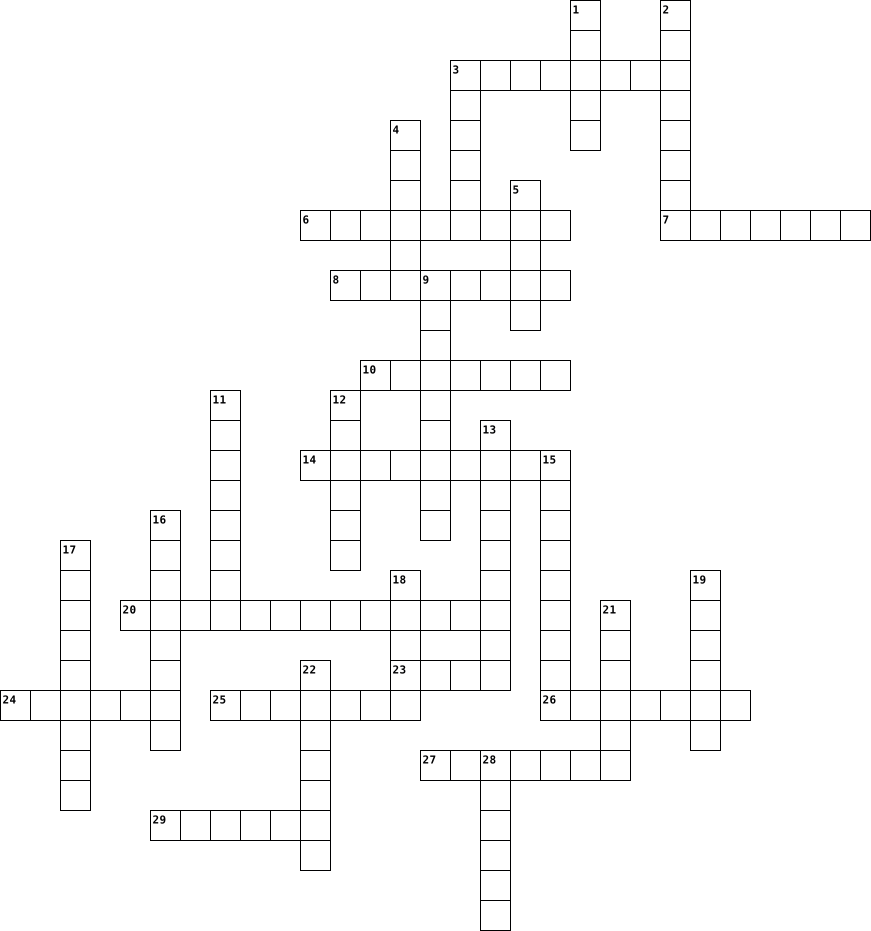
Across
- earth Any of the six chemical elements that comprise Group 2 (IIa) of the periodic table.
- A tiny bit of matter that makes up everything in the universe.
- The information centre of the cell.
- A chemical element that forms a salt when it reacts with metal.
- A substance whose atoms all have the same number of protons.
- A chemical element that forms a simple substance having properties intermediate between those of a typical metal and a typical nonmetal.
- The amount of a substance in a defined space.
- number The sum of the number of nucleons in an atom.
- An elementary particle that is identical with the nucleus of the hydrogen atom.
- A row of chemical elements.
- An uncharged elementary particle that has a mass nearly equal to that of the proton.
- The spontaneous net movement of solvent molecules through a selectively permeable membrane into a region of higher solute concentration.
- metal Any of the six chemical elements that make up Group 1 (Ia) of the periodic table.
Down
- A chemical element that forms a simple substance having properties intermediate between those of a typical metal and a typical nonmetal.
- The negatively charged particles of atoms.
- number The number of a chemical element in the periodic system.
- number The number of protons found in the nucleus of every atom of that element.
- Lattice of positive ions surrounded by a cloud of delocalized electrons.
- A group of two or more atoms that form the smallest identifiable unit.
- table A tabular array of the chemical elements organized by atomic number.
- The ability to do work.
- A material formed by chemically bonding two or more chemical elements.
- The movement of a substance from an area of high concentration to an area of low concentration.
- A chemical element that forms a salt when it reacts with metal.
- Any of various self-contained units of matter or energy that are the fundamental constituents of all matter.
- Smallest unit into which matter can be divided without the release of electrically charged particles.
- A chemical notation of one or two letters representing a chemical element.
- A vertical column in the Periodic Table.
- theory A fundamental theory of matter that explains physical properties in terms of the motion of atoms and molecules.
- Anything that has mass and volume.
30 Clues: The ability to do work. • A row of chemical elements. • Anything that has mass and volume. • The information centre of the cell. • A vertical column in the Periodic Table. • The negatively charged particles of atoms. • The amount of a substance in a defined space. • number The sum of the number of nucleons in an atom. • ...
Science Vocab Review 2022-11-18

Across
- When using the triangle method to calculate density, volume or mass if the numbers are next to each other you have to _________.
- Two or more DIFFERENT elements joined together is called a ________.
- If the atoms are compact, then the object/liquid will __________.
- All elements that share similar properties or react the same are located in the same _________.
- A pure substance made up of only one type of atom.
- Hammered into thin sheets like a gold bracelet or chain.
- Located to the right of the staircase on the periodic table.
- True or False When sugar dissolve in water, it is a chemical change.
- This vocabulary word means really tight or close together.
- How many metalloids are on the periodic table? (Bring Some Grapes And Sale The Plates)
- True or False: The best way to remember the definition of ductile is how you stretch out duct tape.
- Breaks Easily
- It is located on all of your charging cables and anything you have to plug into the wall to prevent you from being shocked by electricity.
- A new substance is formed when mixing two or more things together is called a __________ change.
- When using the triangle method to calculate density, volume or mass if the numbers are on top of each other you have to _________.
Down
- No new substance is formed is called a ___________ change.
- The only element that is a nonmetal but is located with all of the other metals on the periodic table.
- Takes up majority of the periodic table.
- All elements begin with a capital letter called a _______.
- If the atoms are spread out, then the object/liquid will __________.
- Anything that has mass and takes up space.
- A bigger word for "okay" conductor
- What number ALWAYS go in the calculator first when using the triangle method to solve for density?
- Can have a High Luster and be Brittle at the same time.
- They go left to right on the periodic table.
- Tells you how compacted atoms are in an object
- Metals stretch into wire this vocabulary word is called _____________
- A gentle movement of air towards the nose.
28 Clues: Breaks Easily • A bigger word for "okay" conductor • Takes up majority of the periodic table. • Anything that has mass and takes up space. • A gentle movement of air towards the nose. • They go left to right on the periodic table. • Tells you how compacted atoms are in an object • A pure substance made up of only one type of atom. • ...
Unit 3 CCA Crossword 2023-10-04

Across
- type of bond that involved transfer of electrons, often between metal and nonmetal
- subatomic particle, found in nucleus, no charge
- energy level or shell of an atom, contains electrons
- average kinetic energy of molecules, increases solubility of a solute
- a solution that can dissolve more solute
- the basic building block of matter
- a mixture of solvent and solute
- material that dissolves the solute (often a liquid)
- subatomic particle, found in nucleus, positive charge
- how many molecules of solute are exposed to solvent due to structure, allows for more solubility
- number of protons and electrons (if neutral, smaller number on periodic table
- a solution with the maximum amount of solute
- rows on the periodic table, contain elements with same number of orbitals
- distribution of charge in a molecule, can be polar or nonpolar
Down
- how readily a solute dissolves in a solvent
- organizes elements based on their atomic properties
- columns on the periodic table, contain families of elements with same number of valence electrons
- the center of an atom, majority of its mass, contains protons and electrons
- family of elements (column 18, group VIIIA), 8 valence electrons, stable, doesn't bond
- stirring or shaking that increases the solubility of a solute
- type of bond that involves sharing of electrons, often between nonmetals
- organized on the periodic table, has unique number of protons, neutrons, and electrons
- combination of protons and neutrons of an element, bigger number on periodic table
- outermost orbital/shell, electrons found here form bonds
- metals, family of elements (column 2, group IIA), 2 valence electrons, bonds with VIA
- material that dissolves in solvent (often a solid)
- family of elements (column 17, group VIIA) has 7 valence electrons, readily bonds with alkali metals
- metals, family of elements (column 1, group IA), 1 valence electron, reactive, bonds with halogens
- tiny subatomic particle, negative charge, involved in bonding
- a solution with more solute than usual due to heating and slowly cooling
30 Clues: a mixture of solvent and solute • the basic building block of matter • a solution that can dissolve more solute • how readily a solute dissolves in a solvent • a solution with the maximum amount of solute • subatomic particle, found in nucleus, no charge • material that dissolves in solvent (often a solid) • organizes elements based on their atomic properties • ...
Science Puzzle 2012-02-20

Across
- bond / formed when atoms share two pairs of electrons
- / an idea to help the people to understand a concept that they cannot observe directly
- / move around outside the nucleus of an atom
- / elements in the same vertical column of the periodic table
- bond / an attraction between a positive metal ion and the electrons surrounding it
- / the center core of the atom
- bond / the force that holds atoms together
- ion / is made of more than one atom
- / elements in the same horizontal row of the periodic table
- / two or more substances that are mixed together but not chemical combined
- bond / electrons are share unequally
- / an neutral particle made of two or more atoms joined by covalent bonds
- / tells you the ratio of elements in the compound
- bond / share three pairs of electrons
- bond / formed when two atoms share electrons
- electrons / they are in the highest energy level
- / the smallest particle of an element
- / cannot be broken down into any other substance by chemical or physical means
Down
- / is called family
- / material that can be pulled out into a long wire
- / used to describe a material that can be hammered or rolled into shape
- compound / compound that is composed of molecules
- metal / element belonging to group 1 of the periodic table
- bond / electrons are shared equally
- / occupies space
- theory / explains and connects wide range of observations
- compound / consist of a positive and negative ions
- gas / is found in the group 18 in the periodic table
- / has the properties of a metal
- / particles that are found in the nucleus of an atom
- / used to identify an element
- / an orderly three dimensional pattern of ions or atoms share electrons
- / an atom or group of atoms that has become electrically charged
- / an element belonging to group 17of the periodic table
- number / protons in the nucleus of an atom
- level / a region of an atom in which electrons of the same energy are likely to be found
36 Clues: / occupies space • / is called family • / the center core of the atom • / used to identify an element • / has the properties of a metal • bond / electrons are shared equally • ion / is made of more than one atom • bond / electrons are share unequally • bond / share three pairs of electrons • / the smallest particle of an element • bond / the force that holds atoms together • ...
Chemistry crossword 2013-07-21

Across
- amount of material contained in a body
- is an ion that is negatively charged, and is attracted to the cathode (negative electrode) in electrolysis
- Table/ systematic arrangement of known elements based on increasing atomic number
- smallest estimated value from the device
- German who contributed in the development of the periodic table in 1829
- it a non-metal that behaves like a metal
- measure of the pull of gravity of Earth
- a process of comparing something with a standard (devices) to see how many times as big it is with a standard
- element that is best for conducting heat and electricity
- Gravity/ ratio of the weight of a substance to the weight of equal volume of water
- English man who contributed the Law of Octave in 1865
- property of metals wherein they're able to be drawn to wire or sheets
- Latin name for Ag
- group of the horizontal rows int he periodic table
- the ratio of the mass of a substance per unit volume
Down
- he focused on the chemical properties of the elements and his contribution to the periodic table is superior
- Number/ it is the identity of the element; refers to the # protons and electrons
- Molecular Theory/ this theory stated that when the volume increases the density becomes smaller
- phenomenon wherein a substance can behave as acid or base at the same time
- composition is variable; easily separated
- refers to the hotness or coldness of a substance
- property of metals that can be hammered into thin sheets
- smallest exact digit or line which is taken directly from the instrument or device
- simplest form of substance
- metals/ group of metals where Silver, Gold and copper can be made to coins or jewelries
- is anything that has mass and volume
- group of the vertical rows in the periodic table
- French man who contributed the Helix in 1889
- is an ion, which has a net positive charge, is attracted to the anode (positive electrode) in electrolysis
- consisting of 2 or more elements but in a definite ratio
- substance/ single component; constant composition
31 Clues: Latin name for Ag • simplest form of substance • is anything that has mass and volume • amount of material contained in a body • measure of the pull of gravity of Earth • smallest estimated value from the device • it a non-metal that behaves like a metal • composition is variable; easily separated • French man who contributed the Helix in 1889 • ...
Matter 2021-02-16
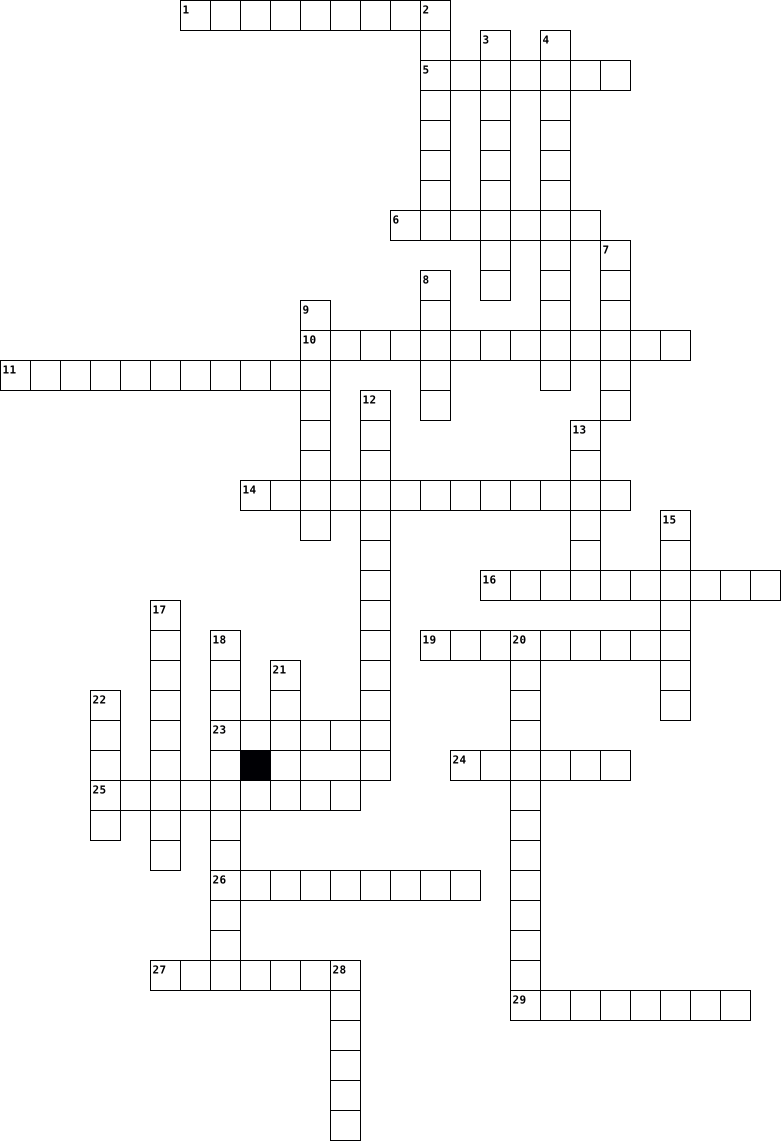
Across
- the act of spreading or allowing to spread freely
- subatomic particl that is constituent of every atomic nucleus except ordinary hydrogen
- a substance consisting only of atoms that all have the same numbers of protons in their atomic nuclei
- six chemical elements in group 2 of the periodic table
- any of the 6 chemical element that make up group 1 of the periodic table
- the amount of substance in a defined space
- the sum of the numbers of protons in the nucleus of an atom
- a substance formed when two or more chemical elements are chemically bonded together
- a substance that has mass and can take up space
- a stable subatomic particle that has a positive charge
- an electrical neutral group of atoms joined together by chemical bonds
- a nonmetal that in combination with a metal forms an alloy
- the horizantal row on the periodic table
- the negatively charged particles of an atom
Down
- a chemical element that mostly lacks the characteristics of a metal
- a particle smaller than an atom
- the number of protons found in the nucleus of every atom of that element
- the capacity of doing work
- a metallic substances composed of two or more elements,as either a compound or a solution
- the group in the periodic table consisting of five chemically related elements
- a fundamental theory of matter that explains physical properties in terms of the motion of atoms and molecules
- a column in the periodic table of the chemical elements
- the movement of a solvent(e.g water)through a semipermeable membrane(e.g a living cell)from a less concentrated solution into a more concentrated one
- a small portion of matter
- the number of protons in the nucleus of an atom
- an organised array of all the chemical elements in order of increasing atomic number
- an element that readily forms positive icons and has metallic bonds
- the smallest unit of ordinary matter that forms a chemical element
- a notation of one or two letters representing a chemical element
29 Clues: a small portion of matter • the capacity of doing work • a particle smaller than an atom • the horizantal row on the periodic table • the amount of substance in a defined space • the negatively charged particles of an atom • the number of protons in the nucleus of an atom • a substance that has mass and can take up space • the act of spreading or allowing to spread freely • ...
Chemistry crossword 2017-11-13

Across
- (in chemistry) vertical column of elements in the periodic table; elements in a family all have similar chemical properties; also called a group.
- change of state from a solid to a liquid.
- group 18 elements in the periodic table;the most stable and unreactive elements.
- change that results when two or more substances react to create a different substance or substances; the new substances have completely different properties from the original ones.
- group 1 elements in the periodic table, not including hydrogen; the most reactive of the metals.
- mass of one atom of an element calculated from the total number of protons,neutrons, and electrons of that atom; measured in atomic mass units .
- amount of mass in a given volume of a substance.
- vertical column of elements in the periodic table; elements in a family all have similarchemical properties; also called a family.
- a material that electric charge can move through easily.
- compound that dissolves in water to form a solution with a pH lower than 7.
Down
- group 17 elements in the periodic table;the most reactive non-metals.
- ability of a substance to conduct electricity or heat.
- energy stored in chemicals and released when chemicals react; a form of potential or stored energy .
- shiny, malleable, ductile element thatconducts electricity.
- colourless, odourless gas;produced by incomplete combustion of chemicals containing carbon (e.g. hydrocarbons); major source: motor vehicles.
- conductor through which electric current enters or leaves a device or material.
- chemical reaction that occurs when oxygen reacts with a substance to form a new substance and give off energy.
- the sum of the number of protonsand neutrons in an atom.
- element that has both metallic and non-metallic properties.
- positively charged centre of an atom;contains protons and neutrons.
- chemical combination of two or more elements in a specific ratio.
- pure substance that cannot be broken down into other substances; substance made up of only one type of atom.
- neutral particle in the nucleus of an atom.
23 Clues: change of state from a solid to a liquid. • neutral particle in the nucleus of an atom. • amount of mass in a given volume of a substance. • ability of a substance to conduct electricity or heat. • the sum of the number of protonsand neutrons in an atom. • a material that electric charge can move through easily. • ...
Standard 3 Crossword 2016-08-23

Across
- element with only 6 protons in its nucleus
- a substance with an orderly three-dimensional arrangement of particles
- element with 6 valence electrons and 6 electron energy levels
- the number of valence electrons will predict how ________ an element is
- a type of solid that does not have an orderly arrangement of its particles
- type of bond formed between metals and non-metals
- a material that is made of a single type of particle
- name of a combination of two or more substances physically combined
- if a train were a polymer, each train car would be a __________
- substance formed when two or more elements combine
- the first 92 elements are ________ occurring
- particle found in a cloud outside the nucleus
- chemical symbol for germanium
- subatomic particle without an electrical charge
Down
- the particles found in the nucleus of an atom are neutrons and __________
- a pure substance that cannot be broken down by physical or chemical means
- the smallest amount of an element
- unit of measurement used for the mass of subatomic particles
- another word for a column on the periodic table
- outermost electrons on an atom
- atoms are always electrically ____________
- the most massive element with only one valence electron
- rubber is an example of a _________ polymer
- characteristics of a substance
- a chemical symbol on the periodic table is a(n) __________ for the element's name
- information on the periodic table that tells you how many protons can be found in one atom of an element
- an ion always has a(n) __________ number of protons and neutrons
- most of the mass of an atom is found in the ___________
- type of bond that holds water molecules together
- a long chain of molecules combined into a larger molecule
- the number on the periodic table that shows how energy levels an atom will have
- particle formed when two or more atoms chemically bond together
- element on the periodic table with the lowest mass
- has the symbol Ar
34 Clues: has the symbol Ar • chemical symbol for germanium • outermost electrons on an atom • characteristics of a substance • the smallest amount of an element • element with only 6 protons in its nucleus • atoms are always electrically ____________ • rubber is an example of a _________ polymer • the first 92 elements are ________ occurring • ...
Chemistry A Final Exam review 2025-01-15

Across
- Looking at a periodic table, which element would be most reactive? (Sulfur, Nitrogen, Fluorine, Bromine)
- Scientific Knowledge can change when scientists conduct _____.
- This state, in which the particles are at extremely high temperatures, rarely found on Earth
- The 3 _______ particles of an atom are protons, neutrons, and electrons
- A ____ substance is made of either an element or a compound
- Chemical equations always have an ____ number of an element on both sides of the equation
- ______ bonds share electrons between two atoms at the same time.
- An atom that has a positive or negative charge
- A measurement of time
- When a chemical compound is exposed to a catalyst and breaks down into separate elements and/or different compounds, this is called a ______ reaction.
- _____ Compounds have a metal and a nonmetal.
- ____ bonds form because electrons can move freely between the atoms
- The electron dot ______ shows how many valence electrons an element has
- Scientific Knowledge established through direct observation
- An educated guess
Down
- Something that can be test/proven true or false.
- The chemical symbol K is what element?
- A small yellow ball that represents the Sun is an example of a ___ model.
- The last column of the Periodic Table is called the ____ gases.
- ____ are on the left side of a chemical equation
- Orbit the nucleus and have a negative charge
- Particles move freely but do not separate from neighboring particles
- A statement that is generally an opinion or belief and is not testable.
- Can be found on the Periodic Table
- The _____ of an element increases on the Periodic Table as it goes to the right and down.
- Salt dissolving in water is an example of a ______ change
- Rust is an example of a _____ change
- It retains its shape regardless of the shape of the container
- The number of valence electrons an element has can be determined by what ______ it is in on the Periodic Table
- _____ are on the right side of a chemical equation
- It expands to fill the volume of the container
- A measurement of length
32 Clues: An educated guess • A measurement of time • A measurement of length • Can be found on the Periodic Table • Rust is an example of a _____ change • The chemical symbol K is what element? • Orbit the nucleus and have a negative charge • _____ Compounds have a metal and a nonmetal. • An atom that has a positive or negative charge • It expands to fill the volume of the container • ...
Unit 7 - Periodic Table 2026-01-28

Across
- A scientist who created the first periodic table and predicted the existence of undiscovered elements
- Elements found in the middle of the periodic table that often have multiple charges and are good conductors
- Atoms of the same element with different numbers of neutrons
- A chart that organizes all known elements by increasing atomic number and similar properties
- A vertical column on the periodic table; elements in the same group have similar properties
- Very reactive nonmetals found in group 17 of the periodic table
- The number of protons in an atom’s nucleus; it identifies which element the atom is
- Negative particle outside of the nucleus in the electron cloud
- – Positive particle in the nucleus
- How easily an element reacts with other substances
- Elements in Group 1 of the periodic table that are very reactive metals
- – The center of an atom that contains protons and neutrons and has most of the atom’s mass
Down
- Elements that have properties of both metals and nonmetals; they are often used in electronics
- The total number of protons and neutrons in an atom’s nucleus
- Elements that are made in laboratories and do not occur naturally on Earth
- An atom that has gained or lost electrons and now has a positive or negative charge
- A one or two letter abbreviation used to represent an element
- – Neutral particle in the nucleus with protons
- Simple diagrams that show the atomic structure of an atom
- Elements that are usually shiny, conduct heat and electricity well, and can be bent or shaped
- The idea that when elements are arranged by increasing atomic number, their properties repeat a pattern
- Cloud – The area around the nucleus where electrons move; it shows where electrons are likely to be found
- Elements in Group 18 that are very unreactive because their outer electron shells are full
- – The smallest particle of an element that still has the properties of that element
- Elements that are usually dull, do not conduct heat or electricity well, and may be gases or brittle solids
25 Clues: – Positive particle in the nucleus • – Neutral particle in the nucleus with protons • How easily an element reacts with other substances • Simple diagrams that show the atomic structure of an atom • Atoms of the same element with different numbers of neutrons • The total number of protons and neutrons in an atom’s nucleus • ...
Chemical Bonding Vocabulary 2020-05-01

Across
- form when elements react chemically
- group of elements found largely on the right side of the periodic table
- group of elements in the same column of the periodic table
- a type of bond that occurs when valence electrons are shared
- group of elements found in the same row of the periodic table
- group of elements found largely on the left side of the periodic table
Down
- a representation of how many atoms of each element make up a compound using symbols
- what atoms become after they gain,lose, or share electrons
- what is made when atoms gain or lose electrons
- a type of bond that occurs when valence electrons are transferred
- what is made when atoms gain or lose a neutron
- group of elements found on the "stair-steps" between the nonmetals and the metals
12 Clues: form when elements react chemically • what is made when atoms gain or lose electrons • what is made when atoms gain or lose a neutron • what atoms become after they gain,lose, or share electrons • group of elements in the same column of the periodic table • a type of bond that occurs when valence electrons are shared • ...
mercedes-may connor 2020-12-10
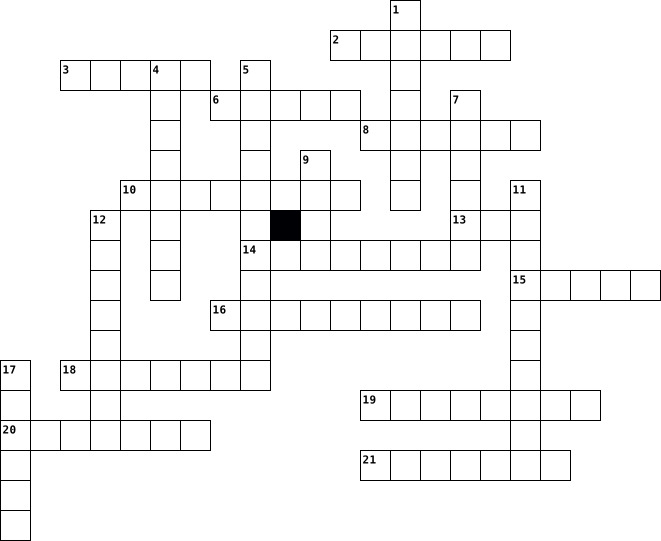
Across
- bursting
- flowing
- buds
- growing
- table
- flying
- reactions
- solids
- mass
- lab
- colour
- objects
- again
Down
- rising
- mixing
- signs
- cell
- burning
- glasses
- change
- training
21 Clues: lab • buds • cell • mass • signs • table • again • rising • mixing • change • flying • solids • colour • flowing • growing • burning • glasses • objects • bursting • training • reactions
Periodic Table 2015-12-15

Across
- located in the center of the atom, made of protons and neutrons
- Place where electrons of an atom are located
- An abbreviation for an element
- smallest piece of matter that still has the properties of the element
- Horizontal rows of elements that have increasing atomic numbers
- This element is found in Group 12 and Period 5
- To find this number add the protons and the neutrons
- Negatively charged part of atom, not located in the nucleus
- Part of the atom that has no charge, located in the nucleus
- Horizontal rows of elements with similar characteristics
Down
- Russian scientist who created the first Periodic Table
- This is equal to the number of protons in an element
- each one of these has its own atomic number
- Positively charged part of the atom, located int he nucleus
- This element has an atomic number of 38
- Arranged the Periodic Table based on atomic number and is the one we use today
- This element has an atomic mass of 222
17 Clues: An abbreviation for an element • This element has an atomic mass of 222 • This element has an atomic number of 38 • each one of these has its own atomic number • Place where electrons of an atom are located • This element is found in Group 12 and Period 5 • This is equal to the number of protons in an element • To find this number add the protons and the neutrons • ...
Periodic Table 2015-01-29

Across
- Fluorine
- Electronegative
- Sodium
- Cation
- Nonmetal
- Monatomic
- Octet Rule
- Anion
- Metal
Down
- Neon
- Effervescence
- Group Two
- Diatomic
- Alkali Metals
- Halogens
- Calcium
- Noble
17 Clues: Neon • Anion • Noble • Metal • Sodium • Cation • Calcium • Fluorine • Diatomic • Halogens • Nonmetal • Group Two • Monatomic • Octet Rule • Effervescence • Alkali Metals • Electronegative
Periodic Motion 2023-06-10

Across
- The height of a wave.
- Waves that oscillate in a single plane.
- The type of wave were the medium is moving perpendicular to the energy.
- Electromagnetic waves with slightly longer wavelengths than visible light.
- The type of waves used in wireless communication.
- The complete range of electromagnetic waves, including radio waves, microwaves, and X-rays.
- The type of wave were the medium is moving parallel to the energy.
Down
- The "squished" part of longitudinal wave.
- The bouncing back of light waves from a surface.
- The bending of light as it passes from one medium to another.
- The "stretched" part of a longitudinal wave.
- Electromagnetic waves with slightly shorter wavelengths than visible light.
- The spreading out of waves around an obstacle.
- The distance between two corresponding points on a wave.
- The colors of the rainbow.
- The high point on a transverse wave.
- The low point on a transverse wave.
17 Clues: The height of a wave. • The colors of the rainbow. • The low point on a transverse wave. • The high point on a transverse wave. • Waves that oscillate in a single plane. • The "squished" part of longitudinal wave. • The "stretched" part of a longitudinal wave. • The spreading out of waves around an obstacle. • The bouncing back of light waves from a surface. • ...
Periodic Table 2024-11-20

Across
- Li
- Cl
- Na
- Al
- SI
- C
- O
- H
- B
- P
Down
- He
- N
- F
- Mg
- S
- AR
- Be
- N
18 Clues: N • F • S • C • O • N • H • B • P • He • Li • Cl • Na • Mg • Al • SI • AR • Be
Periodic Table 2025-12-18

Across
- The type of bond created by electrostatic forces of attraction
- A noble gas that is lighter than air
- The gas released by adding water to sodium
- The number of electrons in the outer shell of halogens
- A type of bond created by sharing pairs of electrons between two non metals
- Chemical symbol for silver
- The number of electrons in the outer shell of alkali metals
- A group of very reactive non metals
- An alkali metal
- Chemical symbol for copper
Down
- A green gas at room temperature
- A type of reaction that releases energy
- The structure of an ionic compouns
- A liquid halogen at room temperature
- Chemical symbol for iron
- A noble gas used in light bulbs
- Chemical symbol K
17 Clues: An alkali metal • Chemical symbol K • Chemical symbol for iron • Chemical symbol for silver • Chemical symbol for copper • A green gas at room temperature • A noble gas used in light bulbs • The structure of an ionic compouns • A group of very reactive non metals • A noble gas that is lighter than air • A liquid halogen at room temperature • A type of reaction that releases energy • ...
TERNARY ACIDS 2020-10-21

Across
- nitros
- cyanic
- carbonic
- perchloric
- formic
- iodic
- chrlous
- sulfuric
- permanganic
Down
- periodic
- metaphric
- sulfrufours
- oxalic
- hypochros
- nitric
- bromic
- chloric
- idos
- chromic
- metaboric
20 Clues: idos • iodic • nitros • oxalic • nitric • cyanic • bromic • formic • chloric • chromic • chrlous • periodic • carbonic • sulfuric • metaphric • hypochros • metaboric • perchloric • sulfrufours • permanganic
periodic table elements 2025-12-15

Across
- og
- rb
- hg
- fe
- k
- kr
- cs
Down
- rn
- ca
- fr
- au
- cu
- he
- li
- ar
- ag
- h
- xe
- na
- table
20 Clues: h • k • rn • ca • fr • au • cu • he • og • li • ar • ag • rb • xe • hg • na • fe • kr • cs • table
Periodic Table 2021-08-25

Across
- An element named after a US state which happens to have the largest amount of overseas Vietnamese.
- A column in the Periodic Table.
- The first element listed in the Periodic Table.
- Usually solid at room temperature.
- Common characteristic of non-metals.
Down
- A positively charged subatomic particle.
- A row in the Periodic Table.
- A subatomic particle with no charge.
- An element with six protons.
- A negatively charged subatomic particle.
- Holds electrons. Also known as an orbital.
11 Clues: A row in the Periodic Table. • An element with six protons. • A column in the Periodic Table. • Usually solid at room temperature. • A subatomic particle with no charge. • Common characteristic of non-metals. • A positively charged subatomic particle. • A negatively charged subatomic particle. • Holds electrons. Also known as an orbital. • ...
Year 11 Chemistry 2 2022-04-28

Across
- Positive subatomic particle.
- Group 7 in the periodic table, more reactive at the top of the group.
- A molecule made up of two atoms.
- Negative subatomic particle.
- Two or more different atoms chemically bonded.
- gases Group 0 in the periodic table, very unreactive.
- Made up of only one type of atom.
Down
- Group 1 in the periodic table, very reactive.
- Regular arrangement of closely packed oppositely charged ions.
- Two or more atoms chemically bonded.
- Neutral subatomic particle.
11 Clues: Neutral subatomic particle. • Positive subatomic particle. • Negative subatomic particle. • A molecule made up of two atoms. • Made up of only one type of atom. • Two or more atoms chemically bonded. • Group 1 in the periodic table, very reactive. • Two or more different atoms chemically bonded. • gases Group 0 in the periodic table, very unreactive. • ...
Chemical composition 2022-04-18

Across
- the total number of groups found in the Periodic Table
- sodium potassium and lithium can be found in group number _______
- an element found in NH3 besides hydrogen
- ________ composition of a compound is unique to each substance
Down
- first element in the periodic table
- last element in group I
- chemical symbol for iron
- the first element in group VI
- the periodic table is divided into non metal and ________
- Ni is the chemical symbol
- Chemical symbol for copper
11 Clues: last element in group I • chemical symbol for iron • Ni is the chemical symbol • Chemical symbol for copper • the first element in group VI • first element in the periodic table • an element found in NH3 besides hydrogen • the total number of groups found in the Periodic Table • the periodic table is divided into non metal and ________ • ...
periodic table vocabulary 2020-10-12

Across
- the number of protons in the nucleus of an atom
- a set of chemical elements in the same row of the periodic table
- a table of chemical elements arranged in order of atomic number
- the mass of an atom of a chemical element
- an atom without a charge
Down
- a negatively charged atom
- a set of chemical elements in the same vertical column of the periodic table
- the chemical elements in group 18 of the periodic table
- an abbreviation of the name of each chemical element discovered and expressed in the periodic table
- a positively charged atom
10 Clues: an atom without a charge • a negatively charged atom • a positively charged atom • the mass of an atom of a chemical element • the number of protons in the nucleus of an atom • the chemical elements in group 18 of the periodic table • a table of chemical elements arranged in order of atomic number • a set of chemical elements in the same row of the periodic table • ...
PERIODIC CLASSIFICATION OF ELEMENTS 2022-01-18

Across
- Number of elements that were classified by newland
- Element with six electrons in it's M shell.
- Doberneer Made group of three elements showing similar properties and called them ______.
- Upto which element, the Law of Octaves was found applicable?
- The elements present in 17th group of modern periodic table
- the element whose position posed a problem in Mendeleev's periodic table
Down
- Gasses placed in the last (Group 18th)of the modern periodic table
- Name the element present in 3rd period 16th group of periodic table
- Name the element which was called aka aluminum by Mendeleev
- The combining capacity of an element.
10 Clues: The combining capacity of an element. • Element with six electrons in it's M shell. • Number of elements that were classified by newland • Name the element which was called aka aluminum by Mendeleev • The elements present in 17th group of modern periodic table • Upto which element, the Law of Octaves was found applicable? • ...
Chapter 12 Jacob Canfield 2019-09-18

Across
- charged particles
- electromagnetivity increases as you go to the _____ of the periodic table
- good guys have a _______ charge
- bond between two givers on the left side of the periodic table
- bond between a taker and a giver on opposite sides of the periodic table table
- the comparison of solute to solvent
Down
- bad guys have a _______ charge
- bond between two takers on the right side of the periodic table
- the only element on the left side of the table that is a taker
- the rule that atoms tend to want to have 8 electrons in their outer shell
10 Clues: charged particles • bad guys have a _______ charge • good guys have a _______ charge • the comparison of solute to solvent • bond between two givers on the left side of the periodic table • the only element on the left side of the table that is a taker • bond between two takers on the right side of the periodic table • ...
the periodic table of the elements 2024-12-27

Across
- an element that forms basic gas on combining with hydrogen
- the elements in the 17th group in the periodic table
- the modern periodic table was created by ___.
- the most electronegative element in the periodic table
- an element that burns brick-red
Down
- these elements do not react with any element or compound
- an element that reacts violently with cold water and can be cut with a knife
- the number of shells in an atom increases down a ____.
- an amphoteric element that belongs to the 13th group of the periodic table
- the electronegativity of elements increases across a _____.
10 Clues: an element that burns brick-red • the modern periodic table was created by ___. • the elements in the 17th group in the periodic table • the number of shells in an atom increases down a ____. • the most electronegative element in the periodic table • these elements do not react with any element or compound • an element that forms basic gas on combining with hydrogen • ...
Vocabulary Chapter 4 2023-10-17

Across
- the electrons in the outermost energy level of a neutral atom.
- They have one valence electron, which they can easily lose to form a 1+ cation
- a set of elements in the same column on the periodic table.
- the properties of the elements vary in a periodic way with their atomic numbers.
- the distance from the center of an atom’s nucleus to the electrons in its outermost energy level. T
- These elements each have seven valence electrons.
- These groups are also named for the first element in each family.
- consists of the element’s chemical symbol surrounded by the atom’s valence electrons.
- These elements typically have four or more valence electrons and do not exhibit the general properties of metals.
Down
- They typically have two valence electrons, and so they form 2+ cations.
- Almost 80% of elements are metals, which have few valence electrons.
- They each have two valence electrons, which they tend to lose, making them 2+ cations.
- The measure of an element’s ability to attract and hold electrons when bonded to other atoms
- These elements have characteristics between those of metals and nonmetals.
- a table of the chemical elements arranged in a way that displays their periodic properties in relationship to their atomic numbers.
- The elements in this group have eight valence electrons
- a row on the periodic table
- a set of elements in the same column on the periodic table.
- Most of these elements have one or two valence electrons
19 Clues: a row on the periodic table • These elements each have seven valence electrons. • The elements in this group have eight valence electrons • Most of these elements have one or two valence electrons • a set of elements in the same column on the periodic table. • a set of elements in the same column on the periodic table. • ...
Vocabulary Chapter 4 2023-10-16

Across
- the electrons in the outermost energy level of a neutral atom.
- They have one valence electron, which they can easily lose to form a 1+ cation
- a set of elements in the same column on the periodic table.
- the properties of the elements vary in a periodic way with their atomic numbers.
- the distance from the center of an atom’s nucleus to the electrons in its outermost energy level. T
- These elements each have seven valence electrons.
- These groups are also named for the first element in each family.
- consists of the element’s chemical symbol surrounded by the atom’s valence electrons.
- These elements typically have four or more valence electrons and do not exhibit the general properties of metals.
Down
- They typically have two valence electrons, and so they form 2+ cations.
- Almost 80% of elements are metals, which have few valence electrons.
- They each have two valence electrons, which they tend to lose, making them 2+ cations.
- The measure of an element’s ability to attract and hold electrons when bonded to other atoms
- These elements have characteristics between those of metals and nonmetals.
- a table of the chemical elements arranged in a way that displays their periodic properties in relationship to their atomic numbers.
- The elements in this group have eight valence electrons
- a row on the periodic table
- a set of elements in the same column on the periodic table.
- Most of these elements have one or two valence electrons
19 Clues: a row on the periodic table • These elements each have seven valence electrons. • The elements in this group have eight valence electrons • Most of these elements have one or two valence electrons • a set of elements in the same column on the periodic table. • a set of elements in the same column on the periodic table. • ...
Science Puzzle 2012-02-20

Across
- bond / formed when atoms share two pairs of electrons
- / an idea to help the people to understand a concept that they cannot observe directly
- / move around outside the nucleus of an atom
- / elements in the same vertical column of the periodic table
- bond / an attraction between a positive metal ion and the electrons surrounding it
- / the center core of the atom
- bond / the force that holds atoms together
- ion / is made of more than one atom
- / elements in the same horizontal row of the periodic table
- / two or more substances that are mixed together but not chemical combined
- bond / electrons are share unequally
- / an neutral particle made of two or more atoms joined by covalent bonds
- / tells you the ratio of elements in the compound
- bond / share three pairs of electrons
- bond / formed when two atoms share electrons
- electrons / they are in the highest energy level
- / the smallest particle of an element
- / cannot be broken down into any other substance by chemical or physical means
Down
- / is called family
- / material that can be pulled out into a long wire
- / used to describe a material that can be hammered or rolled into shape
- compound / compound that is composed of molecules
- metal / element belonging to group 1 of the periodic table
- bond / electrons are shared equally
- / occupies space
- theory / explains and connects wide range of observations
- compound / consist of a positive and negative ions
- gas / is found in the group 18 in the periodic table
- / has the properties of a metal
- / particles that are found in the nucleus of an atom
- / used to identify an element
- / an orderly three dimensional pattern of ions or atoms share electrons
- / an atom or group of atoms that has become electrically charged
- / an element belonging to group 17of the periodic table
- number / protons in the nucleus of an atom
- level / a region of an atom in which electrons of the same energy are likely to be found
36 Clues: / occupies space • / is called family • / the center core of the atom • / used to identify an element • / has the properties of a metal • bond / electrons are shared equally • ion / is made of more than one atom • bond / electrons are share unequally • bond / share three pairs of electrons • / the smallest particle of an element • bond / the force that holds atoms together • ...
chemistry crossword 2015-12-02

Across
- chemical combination of two or more elements in a specific ratio
- a material that electric change can move through easily
- change of state from a gas to a liquid
- element that has both metallic and non-metallic properties
- pure substance formed when at least one metal and one non-metal combine
- invisible negatively charged particle that orbits the nucleus of an atom
- a reaction that takes place when two or more substances react to form new substances
- atom that has become electrically charged because it has lost or gained electrons
- an experiment in which one or more products of a chemical reaction can escape
- group 2 elements in the periodic table
- group 17 elements in the periodic table;the most reactive non-metals
Down
- ability of a substance to conduct electricity or heat
- horizontal row of elements in the periodic table
- pure substance that cannot be broken down into other substances
- sum of the number of protons and neutrons in an atom
- results when two or more substances react to create a different substance or substances, the new substances have completely different properties from the original ones
- change of state from a gas to a solid
- results when two or more substance react to create a different substance or substances
- description of how a substance interacts with other substances
- amount of protons in the nucleus of one atom of an element
- principle that matter is not created or destroyed in a chemical reaction
- description of a substance that can be pounded or rolled into sheets
- an experiment in which all reactants and all products of a chemical reaction are accounted for
- dull brittle element that does not conduct electrons
- mass of one atom of an element calculated from the total number of protons
- group 1 elements in the periodic table
- the smallest part of an element that is representative of that element
- group 18 in the periodic table the most stable and nonreactive elements
28 Clues: change of state from a gas to a solid • change of state from a gas to a liquid • group 2 elements in the periodic table • group 1 elements in the periodic table • horizontal row of elements in the periodic table • sum of the number of protons and neutrons in an atom • dull brittle element that does not conduct electrons • ...