
periodic%20table Crossword Puzzles
unit 1 vocabulary choice board 2021-09-01

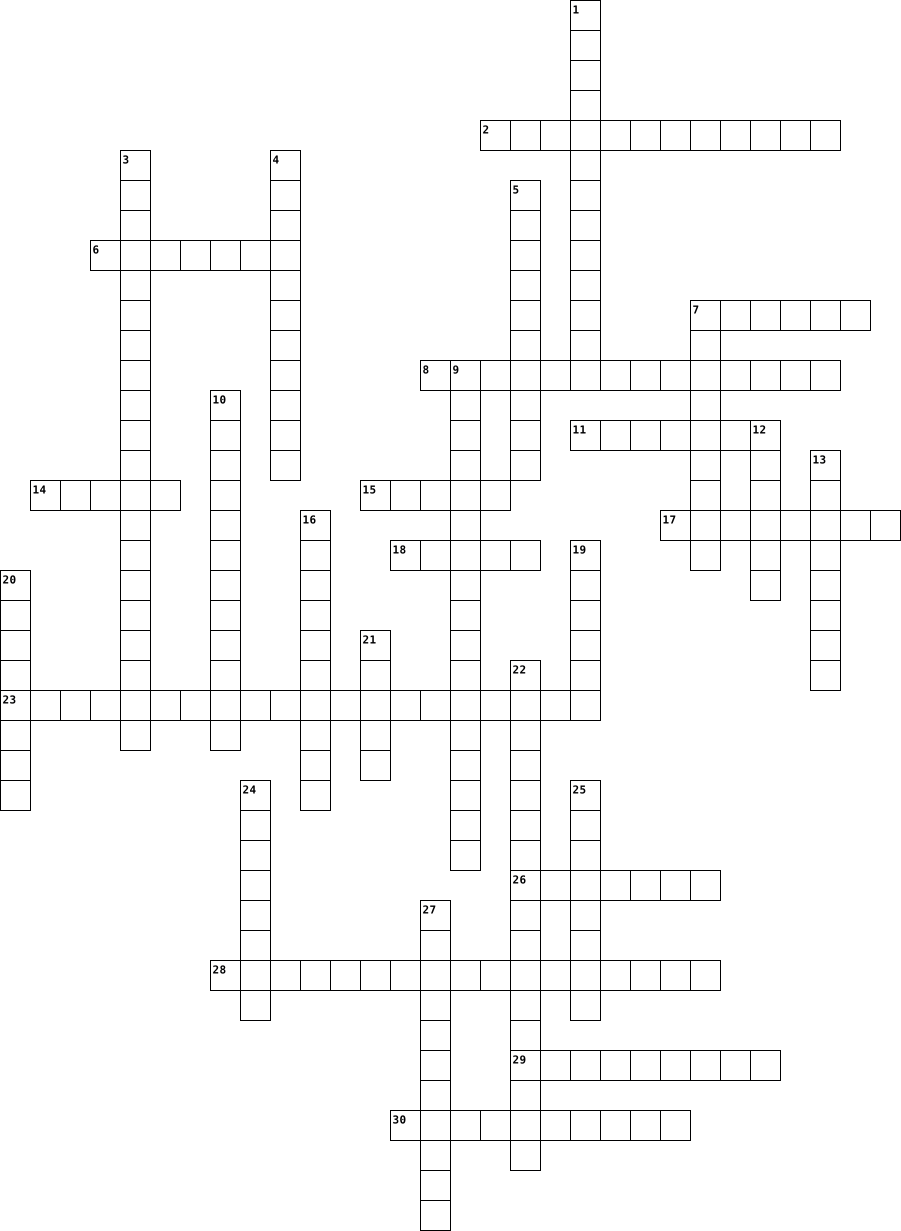
Across
- element (e.g. arsenic, antimony, or tin) whose properties are intermediate between those of metals and solid nonmetals or semiconductors.
- charge-basic property of matter carried by some elementary particles.
- a stable subatomic particle occurring in all atomic nucleus.
- mass-the mass of an atom of a chemical element expressed in atomic mass units.
- cloud-An electron cloud is the region of negative charge surrounding an atomic nucleus.
- metals-any of the set of metallic elements occupying a central block.
- metals-any of the elements lithium, sodium, potassium, rubidium, cesium, and francium.
- that is on the periodic table.
- central and most important part of an object.
- solid material that is typically hard, shiny, malleable, fusible, and ductile, with good electrical and thermal conductivity.
- quality or condition of being subatomic particle-a particle smaller than an atom.
- an element or substance that is not a metal.
- electrons-a single electron or one of two or more electrons in the outer shell of an atom.
Down
- horizontal rows of the periodic table are called periods.
- mass unit-a unit of mass used to express atomic and molecular weights.
- stable subatomic particle with a charge of negative electricity.
- subatomic particle of about the same mass as a proton but without an electric charge.
- properties-A physical property is any property that is measurable.
- property-a property of a substance relating to its chemical reactivity.
- gasses-any of the gaseous elements helium, neon, argon, krypton, xenon, and radon, occupying Group 0 (18) of the periodic table.
- number-the number of protons in the nucleus of an atom.
- table-the stuff that's on there.
- number-the total number of protons and neutrons in a nucleus.
- that makes up something.
- the number of valence electrons.
25 Clues: that makes up something. • that is on the periodic table. • table-the stuff that's on there. • the number of valence electrons. • an element or substance that is not a metal. • central and most important part of an object. • number-the number of protons in the nucleus of an atom. • horizontal rows of the periodic table are called periods. • ...
Chemistry crossword 2015-12-02

Across
- a system of easy-to-see warning symbols on hazardous materials
- the ability of a substance to conduct electricity or heat
- change in the appearance or state of a substance that does not change the composition
- a reaction that takes place when two or more substances react to form new substances
- mass of one atom of an element calculated from the total number of protons, neutrons, electrons of that atom
- characteristics that describe a particular substance (e.g. colour, lustre, melting point)
- combination of symbols that represent a compound
- group 1 elements in the periodic table, not including hydrogen
- anything that has mass and occupies space
- horizontal row of elements in the periodic table
- pure substance formed when at least one metal and one non-metal combine
- positively charged centre of an atom; contains protons and neutrons
Down
- group 17 elements in the periodic table
- a table in which the elements are organized by their physical and chemical properties
- netrual particle in the nucleus of an atom
- measure of one atomic mass
- pure substance formed when non-metals combine
- made of only one kind of matter
- occurs when two or more materials react and create new materials
- group of atoms acting as one
- group of atoms joined by covalent bonds
- vertical column of elements in the periodic table
- a chemical reaction that occurs when oxygen reacts with a substance to form a new substance and give off energy
- positively charged particle in the nucleus of an atom
- amount of mass in a given volume of a substance
25 Clues: measure of one atomic mass • group of atoms acting as one • made of only one kind of matter • group 17 elements in the periodic table • group of atoms joined by covalent bonds • anything that has mass and occupies space • netrual particle in the nucleus of an atom • pure substance formed when non-metals combine • amount of mass in a given volume of a substance • ...
AQA Chapters 1 & 2 Atomic Structure and Periodic Table 2025-10-22

Across
- Can be used to separate a mixture of liquids using their boiling point
- A positive sub-atomic particle
- The mobile phase in chromatography
- Proved that electrons orbit on fixed energy levels
- A solid that can dissolve
- Where electrons are found in an atom
- The ___________ metals are found between groups 2 and 3
- A way to separate a dissolved solid from a solution
- Mendeleev left these in his periodic table
- A row in the periodic table
- The stationary phase in chromatography
- The type of substance that produces one spot in chromatography
- The name for the group 0 elements (5,6)
- Discovered the electron
- Group 1 metals get _______ reactive down the group
- The number of electrons that the second and third shell can hold
- Discovered the neutron
- A solid that cannot dissolve
- Group 1 elements are known as the __________ metals
Down
- Group 7 elements are known as the _______________
- The part of the atoms that contains protons and neutrons
- A version of an element with a different number of neutrons
- A column in the periodic table
- Discovered the nucleus
- The period number of an element tells you this (6,2,6)
- Group 7 elements get _______ reactive down the group
- An element forms this when it loses or gains electrons
- A neutral sub-atomic particle
- The gas made when sodium reacts in water
- The solvent must be ________ the base line in chromatography
- A way to separate a solid from a liquid
- Used to draw a base line in chromatography
- A negative sub-atomic particle
- Elements in the periodic table are arranged in order of __________ (or proton) number
- Full inner shells have this effect on the attraction of the nucleus
35 Clues: Discovered the nucleus • Discovered the neutron • Discovered the electron • A solid that can dissolve • A row in the periodic table • A solid that cannot dissolve • A neutral sub-atomic particle • A positive sub-atomic particle • A column in the periodic table • A negative sub-atomic particle • The mobile phase in chromatography • Where electrons are found in an atom • ...
Periodic table crossword 2023-08-25

Across
- on right This is found where___
- tool Makes the periodic table invaluable___
- The man in 1969 who invented the periodic table___
- The atomic number___
- on left This is found where___
- The one to two letter symbol representing an element___
Down
- the s and p blocks are known as the___
- what seven rows are called___
- table Tells all of the elements___
- You can predict a lot about the chemical___
- each row corresponds to a different___
- Most elements are___
12 Clues: The atomic number___ • Most elements are___ • what seven rows are called___ • on left This is found where___ • on right This is found where___ • table Tells all of the elements___ • each row corresponds to a different___ • the s and p blocks are known as the___ • You can predict a lot about the chemical___ • tool Makes the periodic table invaluable___ • ...
Periodic table crossword 2023-08-25

Across
- on right This is found where___
- tool Makes the periodic table invaluable___
- The man in 1969 who invented the periodic table___
- The atomic number___
- on left This is found where___
- The one to two letter symbol representing an element___
Down
- the s and p blocks are known as the___
- what seven rows are called___
- table Tells all of the elements___
- You can predict a lot about the chemical___
- each row corresponds to a different___
- Most elements are___
12 Clues: The atomic number___ • Most elements are___ • what seven rows are called___ • on left This is found where___ • on right This is found where___ • table Tells all of the elements___ • each row corresponds to a different___ • the s and p blocks are known as the___ • You can predict a lot about the chemical___ • tool Makes the periodic table invaluable___ • ...
Matter and Elements 2026-02-09

Across
- the least reactive family on the periodic table
- the symbol in a chemical equation
- the middle family on the periodic table
- an equation with not equal number of atoms
- chemicals after a reaction
Down
- the most reactive family on the periodic table
- matter can not be destroyed
- the building blocks of matter
- chemicals before a reaction
- equation with an equal number of atoms
10 Clues: chemicals after a reaction • matter can not be destroyed • chemicals before a reaction • the building blocks of matter • the symbol in a chemical equation • equation with an equal number of atoms • the middle family on the periodic table • an equation with not equal number of atoms • the most reactive family on the periodic table • ...
periodic table 2024-08-26

Across
- bromine at room temperature
- An element you need to breath
- Name a group in the periodic table
- The atomic mass of carbon
- the atomic number of sodium
Down
- What atomic number splits the table
- the 1st element in the periodic table
- the element with the chemical symbol of Fe
- The 10th element in the periodic table
- the element with the chemical symbol Mg
10 Clues: The atomic mass of carbon • bromine at room temperature • the atomic number of sodium • An element you need to breath • Name a group in the periodic table • What atomic number splits the table • the 1st element in the periodic table • The 10th element in the periodic table • the element with the chemical symbol Mg • the element with the chemical symbol of Fe
Chapt 5 vocab 2022-11-01

Across
- one twelfth the mass of a carbon-12 atom
- a row in a periodic table of elements Group a column of elements in a periodic table
- the pattern of repeating properties displayed by elements in the periodic table
- elements that are good conductors of heat and electric current
Down
- an electron that is in the highest occupied energy level of an atom
- the elements in group 1A of the periodic table, not including hydrogen Alkalineearthmetals the elements in group 2A of the periodic table
- an arrangement of elements in columns, based on a set of properties that repeat from row to row
- elements that form a bridge between elements on the left and right sides of the periodic table
- elements that are poor conductors of heat and electric current. Metalloids elements with properties that fall between those of metals and nonmetals
9 Clues: one twelfth the mass of a carbon-12 atom • elements that are good conductors of heat and electric current • an electron that is in the highest occupied energy level of an atom • the pattern of repeating properties displayed by elements in the periodic table • a row in a periodic table of elements Group a column of elements in a periodic table • ...
Atomic cafe 2024-01-06

Across
- table something that holds all of the elements
- Something that is on top of the periodic table
- Who made the periodic table
- are the same as the atomic number as the atomic number
Down
- the least amount of this on the periodic table
- are the most of the periodic tables elements
- there are 118________on the periodic table
7 Clues: Who made the periodic table • there are 118________on the periodic table • are the most of the periodic tables elements • the least amount of this on the periodic table • table something that holds all of the elements • Something that is on top of the periodic table • are the same as the atomic number as the atomic number
Bonding and the Periodic Table CROSSWORD PUZZLE 2021-09-27

Across
- ability to conduct electricity under certain conditions
- ability to be pulled into a wire
- type of bond that shares valence electrons (nonmetal to nonmetal)
- ability to be hammered into flat sheets
- type of covalent bond that shares electrons "equally"
- ability to transfer heat or electricity
- group on the periodic table that are the best conductors
Down
- how the metal looks or shines
- type of covalent bond that shares electrons (unequally)
- type of bond that transfers valence electrons (metal to nonmetal)
- group on the periodic table that are poor conductors
- type of bond that shares a "sea" of electrons (metal to metal)
- group on the periodic table that tend to be good semiconductors of electricity
13 Clues: how the metal looks or shines • ability to be pulled into a wire • ability to be hammered into flat sheets • ability to transfer heat or electricity • group on the periodic table that are poor conductors • type of covalent bond that shares electrons "equally" • type of covalent bond that shares electrons (unequally) • ...
Organizing the Elements 2024-11-18

Across
- This type of mass is used to organize elements in the periodic table
- The element used as a reference for atomic mass
- Can be mechanical, solutions, suspensions, or colloids
- Pure substances that cannot be broken down further
- Proposed a new system of symbols for elements
- A state of matter that has a definite shape and volume
- A state of matter that has no fixed shape or volume
Down
- Helps organize unstructured scientific information
- Substances formed when two or more elements combine chemically
- Newlands described periodic patterns in elements using this musical term
- Scientists who study and classify elements
- Organized elements into a periodic table and predicted unknown elements
- Elements were first organized by increasing atomic ____
13 Clues: Scientists who study and classify elements • Proposed a new system of symbols for elements • The element used as a reference for atomic mass • Helps organize unstructured scientific information • Pure substances that cannot be broken down further • A state of matter that has no fixed shape or volume • Can be mechanical, solutions, suspensions, or colloids • ...
Periodic Table 2022-12-02

Across
- these gases are unreactive
- discovered a pattern to the elements
- also known as semiconductors
- positive charged particle
- negative charged particle
- a vertical column of elements
Down
- most reactive nonmetals
- on right side of periodic table
- describes something that repeats at regular intervals
- metals in group 1
- these metals are in group 2
- most elements are
- a horizontal row
13 Clues: a horizontal row • metals in group 1 • most elements are • most reactive nonmetals • positive charged particle • negative charged particle • these gases are unreactive • these metals are in group 2 • also known as semiconductors • a vertical column of elements • on right side of periodic table • discovered a pattern to the elements • ...
All About Atoms 2020-04-14

Across
- this is in the middle of an atoms, Houses the protons and neutrons
- These have a neutral charge, Housed in the nucleus
- The subject that atoms and the periodic table fall into
- What the atom weighs is the...
- Has a positive electrical charge
- House the electrons, outside of the nucleus
- The positive or negative charge of an atom is this..
Down
- The number of protons in an element is also this...
- The outermost layer of the electron cloud
- Everything is made up of this
- The most stable elements on the periodic table, Have a full valence shell
- These are all in the periodic table
- Holds all of the known elements, created by Dimitri Mendeleev
13 Clues: Everything is made up of this • What the atom weighs is the... • Has a positive electrical charge • These are all in the periodic table • The outermost layer of the electron cloud • House the electrons, outside of the nucleus • These have a neutral charge, Housed in the nucleus • The number of protons in an element is also this... • ...
Chemistry crossword 2020-12-18

Across
- strong alkalis that have OH symbol at last
- the element that have symbol K
- most nonreactive and lightest element
- shorthand way of referring to elements
- columns of periodic table
- solutions are ...
- the substance that is dissolves into
- ... of mass
Down
- every compound has...
- rows of periodic table
- variable that you change
- axis that you plot independent variable
- the substance that dissolves
- variable that you measure as the result
- variable that you keep the same
15 Clues: ... of mass • solutions are ... • every compound has... • rows of periodic table • variable that you change • columns of periodic table • the substance that dissolves • the element that have symbol K • variable that you keep the same • the substance that is dissolves into • most nonreactive and lightest element • shorthand way of referring to elements • ...
Unit 4 Project - Unit 3 2021-06-04

Across
- θ
- opposite over adjacent
- largest value on a graph
- the cycle of a periodic function
- adjacent over hypotenuse
- 180/πx
- πx/180
- how far the function is shifted vertically from the usual position
Down
- half the distance between the minimum and maximum values of the range of a periodic function
- lowest value on a graph
- adjacent over opposite
- hypotenuse over adjacent
- opposite over hypotenuse
- how far the function is shifted horizontally from the usual position
- hypotenuse over opposite
15 Clues: θ • 180/πx • πx/180 • adjacent over opposite • opposite over adjacent • lowest value on a graph • hypotenuse over adjacent • opposite over hypotenuse • largest value on a graph • adjacent over hypotenuse • hypotenuse over opposite • the cycle of a periodic function • how far the function is shifted vertically from the usual position • ...
Science Project 2022-05-16

Across
- in which heat is directly transmitted
- is used to separate mixtures
- the movement caused within a fluid
- energy as an attribute of physical
- a single particle
- when a energy goes down heal
- Gas,Liquid,solid
Down
- when a substance combines with another
- the action or process of moving
- Periodic of the ___
- a coherent, typically large body of matter
- Holds all the elements
- stores energy at the top
- people use ___ to work
- the emission of energy as waves
15 Clues: Gas,Liquid,solid • a single particle • Periodic of the ___ • Holds all the elements • people use ___ to work • stores energy at the top • is used to separate mixtures • when a energy goes down heal • the action or process of moving • the emission of energy as waves • the movement caused within a fluid • energy as an attribute of physical • in which heat is directly transmitted • ...
Periodic Table 2021-04-19

Across
- electrons in the outer most shell
- the amount of time it takes parent => daughter
- stretched into wires
- negatively charged
- when an element loses or gains electrons
- has 8 valence electrons in this family
- rows in the periodic table
Down
- hammered into sheets
- good conductors
- elements that have the same amount of protons but different number of neutrons
- has both metallic and nonmetallic properties
- positively charged
- no charge
- poor conductors
- columns in the periodic table
15 Clues: no charge • good conductors • poor conductors • positively charged • negatively charged • hammered into sheets • stretched into wires • rows in the periodic table • columns in the periodic table • electrons in the outer most shell • has 8 valence electrons in this family • when an element loses or gains electrons • has both metallic and nonmetallic properties • ...
idk 2023-10-04

Across
- is a chemical element
- atomic number is 7
- symbols are Ne
- is an essential mineral
- has 114 protons
- is in the human body
- is silver white metal
- is in the second group of the periodic table
Down
- is water
- is a noble gas
- is on the 4 period in the periodic table
- is part or the alkali metal group
- is the most non reactive metal
- symbol is B
- has an atomic mass of 55.933
15 Clues: is water • symbol is B • is a noble gas • symbols are Ne • has 114 protons • atomic number is 7 • is in the human body • is a chemical element • is silver white metal • is an essential mineral • has an atomic mass of 55.933 • is the most non reactive metal • is part or the alkali metal group • is on the 4 period in the periodic table • is in the second group of the periodic table
Basic Chemistry 2025-08-12

Across
- Positively charged ion
- Common solvent
- Substance made of only one type of atom
- gas, Group 18 elements (2 words)
- The center of an atom
- Negatively charged particle
- Vertical column in the periodic table
- A horizontal row in the periodic table
- Common table salt formula
Down
- Bond where electrons are shared
- The smallest unit of an element
- Type of reaction that absorbs heat
- pH less than 7
- Number, Number of protons in an atom (2 words)
- Gas released during photosynthesis
- Substance formed in a chemical reaction
16 Clues: Common solvent • pH less than 7 • The center of an atom • Positively charged ion • Common table salt formula • Negatively charged particle • Bond where electrons are shared • The smallest unit of an element • gas, Group 18 elements (2 words) • Type of reaction that absorbs heat • Gas released during photosynthesis • Vertical column in the periodic table • ...
Yuvias crossword puzzle 2021-09-17

Across
- positive
- table of elements home to all the elements
- negative
- columns
- a tile on the periodic table
Down
- number neutrons and protons
- more than one atom combined
- no charge
- the smallest building blocks
- rows
- more than one element combined
11 Clues: rows • columns • positive • negative • no charge • more than one atom combined • the smallest building blocks • a tile on the periodic table • number neutrons and protons • more than one element combined • table of elements home to all the elements
periodictable 2022-03-07

Across
- like a graph or something you put stuff on
- block in a school time table
- up and down lined
- horizontal lines
- stops and starts at different times
Down
- the creator of the periodic table
- what in a periodic table
- the element with symbol H
- element with the symbol B
9 Clues: horizontal lines • up and down lined • what in a periodic table • the element with symbol H • element with the symbol B • block in a school time table • the creator of the periodic table • stops and starts at different times • like a graph or something you put stuff on
Chemistry 2022-05-19
Across
- states that the physical and chemical properties of the elements are periodic functions of their atomic numbers.
- electron of one atom and proton of the other atom _______ one another.
- The elements of Group 1 of the
- is an arrangement of the elements in order of their atomic numbers so that elements with similar properties fall in the same column, or group.
- In the periodic table, the f-block elements are wedged between Groups 3 and 4 in the sixth and ______ periods.
- has just three valence electrons, which tends to form bonds in which it is surrounded by six electrons.
- The elements of Group 2 of the periodic table are called the alkaline-_____ metals.
- table are known as the _____ metals.
- All matter is composed of extremely small particles called?
- a chemical compound containing elements in exactly the same proportions by mass regardless of the size or source of the compound.
- Cationic and _______ radii decrease across a period.
- The energy change that occurs when an electron is acquired by a neutral atom is called the atom’s ___________.
- A chemical compound whose simplest units are molecules is called a _________ compound.
- All six of the __________ are also in the p block.
Down
- the attraction between two or more atoms that allows them to be able to form a stable chemical compound.
- if two or more different compounds are composed of the same two elements, then the ratio of the masses of the second element combined with a certain mass of the first element is always a ratio of small whole numbers.
- The first row of the f block are known as?
- Atoms cannot be __________, created, or destroyed.
- The second row of the f block are known as?
- is a measure of the ability of an atom in a chemical compound to attract electrons from another atom in the compound.
- ______ is used to form chemical compounds.
- the p block includes all of the nonmetals except hydrogen and ______.
- is a unique element.
- The p-block elements together with the s-block elements are called the __________ elements.
- Red Atoms of different elements combine are known as?
- A ________ formula indicates the relative numbers of atoms of each kind in a chemical compound by using atomic symbols and numerical subscripts.
- two nuclei and two electrons _____ each other.
- A ________ shows the types and numbers of atoms combined in a single molecule of a molecular compound.
- A ________ is a neutral group of atoms that are held together by covalent bonds.
- Repeating patterns are referred to as ________.
- is the energy required to break a chemical bond and form neutral isolated atoms.
31 Clues: is a unique element. • The elements of Group 1 of the • table are known as the _____ metals. • The first row of the f block are known as? • ______ is used to form chemical compounds. • The second row of the f block are known as? • two nuclei and two electrons _____ each other. • Repeating patterns are referred to as ________. • ...
Chemistry 2017-02-17

Across
- The smallest unit of a chemical compound
- The vertical lines of the Periodic Table
- The element's electrons on the outer rim
- The number that tells how much an atom in the element weighs
- The way that elements are organized in their groups
Down
- The horizontal rows on the Periodic Table
- This rule states that an element has to have 8 valence electrons to make a chemical bond
- Elements that can be found on the left/middle of the Periodic Table
- The number that tells how many protons an element has
- Elements that can be found on the right side of the Periodic Table
10 Clues: The smallest unit of a chemical compound • The vertical lines of the Periodic Table • The element's electrons on the outer rim • The horizontal rows on the Periodic Table • The way that elements are organized in their groups • The number that tells how many protons an element has • The number that tells how much an atom in the element weighs • ...
elements 2022-05-09

Across
- a mixture that never settles and cannot be seen with a microscope
- two+ different elements that combine by a chemical change and create something with new and different physical/chemical characteristics.
- a mixture with larger particles than a solution but still small enough that they will not settle
- substance that cannot be broken down any further while still maintaining its original properties
- the creator of the periodic table
- the columns on the periodic table
Down
- A combination of two or more materials that are not chemically combined
- What forms when two or more atoms combine
- first element on the periodic table
- the rows on the periodic table
10 Clues: the rows on the periodic table • the creator of the periodic table • the columns on the periodic table • first element on the periodic table • What forms when two or more atoms combine • a mixture that never settles and cannot be seen with a microscope • A combination of two or more materials that are not chemically combined • ...
Chemistry 2023-12-11
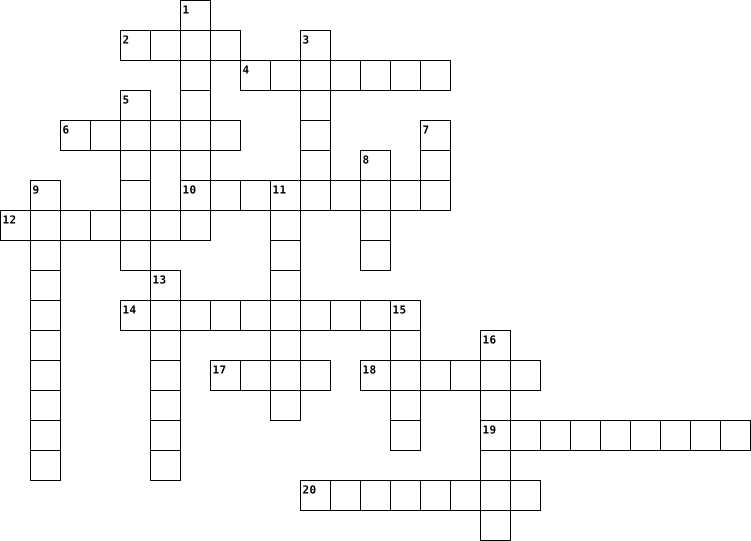
Across
- atomic number
- metals
- anion
- neutrons
- protons
- nonmetals
- periodic table
- alkali metals
- mixture
- hydrogen
Down
- states of matter
- oxidation
- structure
- plasma
- atoms
- sublimation
- monoatomic
- chemical
- liquid
- electronegativity
20 Clues: anion • atoms • metals • plasma • liquid • protons • mixture • neutrons • chemical • hydrogen • oxidation • structure • nonmetals • monoatomic • sublimation • atomic number • alkali metals • periodic table • states of matter • electronegativity
The periodic table! 2021-08-05

Across
- The symbol of the element with atomic number 10 in the periodic table.
- The mass number of Lithium (symbol Li) in the periodic table.
- The atomic number of Oxygen (symbol O) in the periodic table.
- The name of the particle that has a positive charge and we can find in the nucleus.
Down
- Atoms that have the same number of protons are of the same ____________.
- The symbol of the element with atomic number 2 in the periodic table.
- The name of the element with atomic number 26 in the periodic table.
- The name of the element with atomic number 197 in the periodic table.
8 Clues: The mass number of Lithium (symbol Li) in the periodic table. • The atomic number of Oxygen (symbol O) in the periodic table. • The name of the element with atomic number 26 in the periodic table. • The symbol of the element with atomic number 2 in the periodic table. • The name of the element with atomic number 197 in the periodic table. • ...
Chemistry Crossword Puzzle 2013-06-17

Across
- the electrons in the outer most energy level of an atom
- a neutral group of atoms held together by a covalent bond
- elements that have properties of both nonmetals and metals
- having a regular, repeating pattern
- a column of elements on the periodic table
- the simplest molecules, consisting of two atoms bonding together
- made up of protons and neutrons, brain of a cell
- elements that are dull and poor conductors or thermal energy
- a pure substance that can't be separated or broken down into simpler substances
- charged particles that form during chemical changes
- the positively charged particles of the nucleus
Down
- a representation of an object
- the smallest particle into which an element can be divided and still be the same substance
- a short representation of a chemical element
- the substances formed from a chemical reaction
- the starting materials in a chemical reaction
- a substance that speeds up a reaction without being permanently changed
- elements that are shiny and are good conductors of thermal energy and electric current
- the forming of building a more complex substance or compound form elements or simpler compounds
- a horizontal row of elements on the periodic table
20 Clues: a representation of an object • having a regular, repeating pattern • a column of elements on the periodic table • a short representation of a chemical element • the starting materials in a chemical reaction • the substances formed from a chemical reaction • the positively charged particles of the nucleus • made up of protons and neutrons, brain of a cell • ...
Chemistry Crossword 2015-12-02

Across
- amount of mass in a given volume of a substance
- a group of 17 elements on the periodic table
- chemical combination of two or more elements in a specific ratio
- description of a substance that can be pounded or rolled into sheets
- a extremely small thing
- an atom that has lost or gained electrons
- when oxygen reacts with another substance and creates energy
- when 2 or more substances react
- ability of a substance to conduct electricity or heat
- change of state
- a non-metal combined with a pure substance
- a thought that people generally accept
- during a reaction the product can escape
- a table in which the elements are organized by their physical and chemical properties
Down
- group of atoms joined by covalent bonds
- materials at the start of a reaction
- group 18 elements in the periodic table
- During a reaction the product cannot escape
- pure substances formed when non-metals combine
- Things are made up of __________
- new materials created by a reaction
- slow chemical change that occurs when oxygen in the air reacts with a metal
- a vertical column of elements in the periodic table
- change of state
- a material that electric charge can move through easily
25 Clues: change of state • change of state • a extremely small thing • when 2 or more substances react • Things are made up of __________ • new materials created by a reaction • materials at the start of a reaction • a thought that people generally accept • group of atoms joined by covalent bonds • group 18 elements in the periodic table • during a reaction the product can escape • ...
test review 2016-11-07
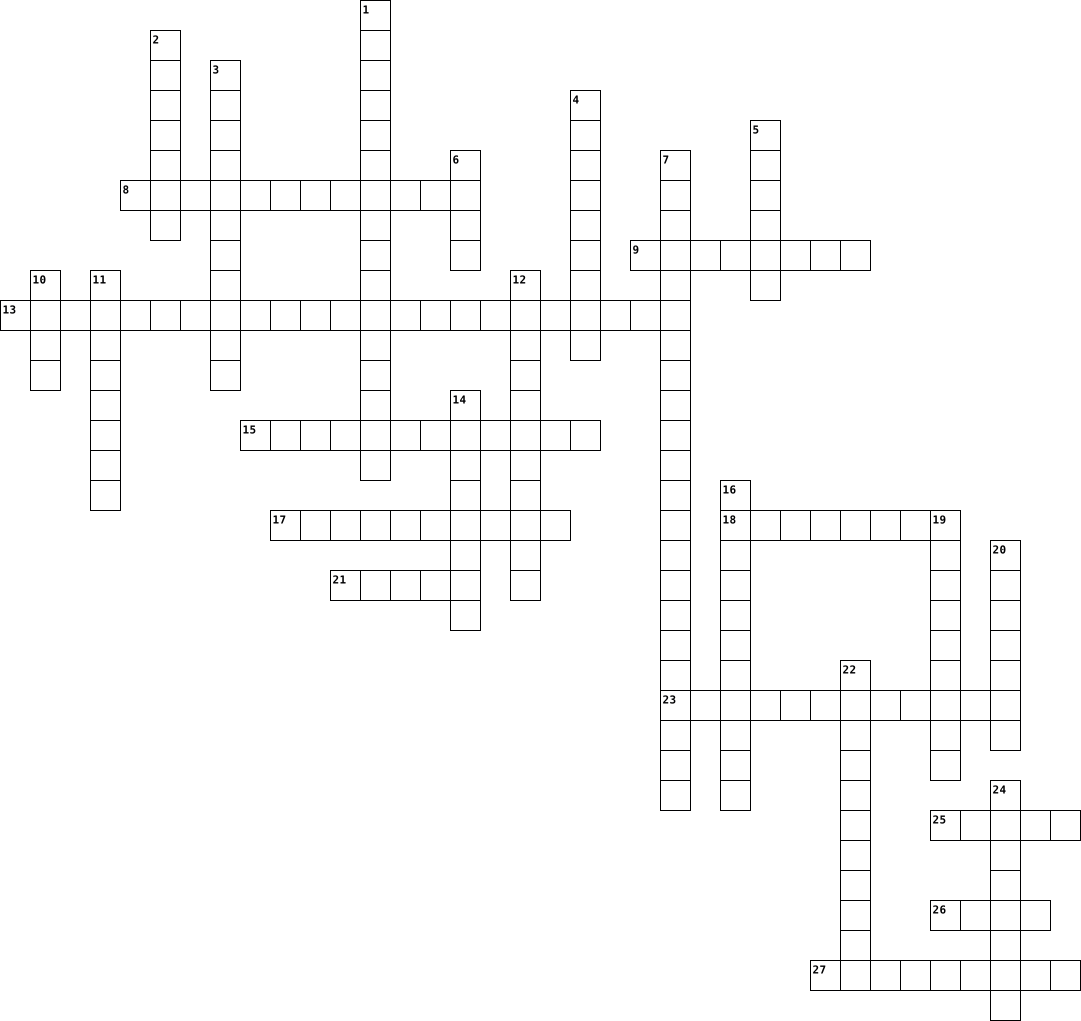
Across
- piece of evidence of a chemical reaction, such as temperature change, odor, light or sound
- sum of all the forces
- The ___ says matter is neither created nor destroyed.
- piece of evidence of a chemical reaction, such as bubbles, foaming, fizzing
- ___ forces cause change in motion.
- the formulas present at the end of a chemical reaction
- a push or pull
- any change in speed or direction
- a column on the periodic table
- one piece of an element
- the formulas present at the beginning of a chemical reaction
Down
- a process where new substances are formed
- one type of atom, also found on the periodic table
- piece of evidence of a chemical reaction, such as clear to blue
- unit for mass
- a row on the periodic table
- Balanced forces have a net force of ___ N.
- unit for acceleration
- amount of matter
- more than one atom combined
- tells the number of molecules
- ___ forces cause no change in motion.
- tool for force
- tells the number of atoms
- unit for force
- piece of evidence of a chemical reaction, such as two liquids producing a solid
- more than one type of atom
27 Clues: unit for mass • tool for force • unit for force • a push or pull • amount of matter • unit for acceleration • sum of all the forces • one piece of an element • tells the number of atoms • more than one type of atom • a row on the periodic table • more than one atom combined • tells the number of molecules • a column on the periodic table • any change in speed or direction • ...
test review 2016-11-07
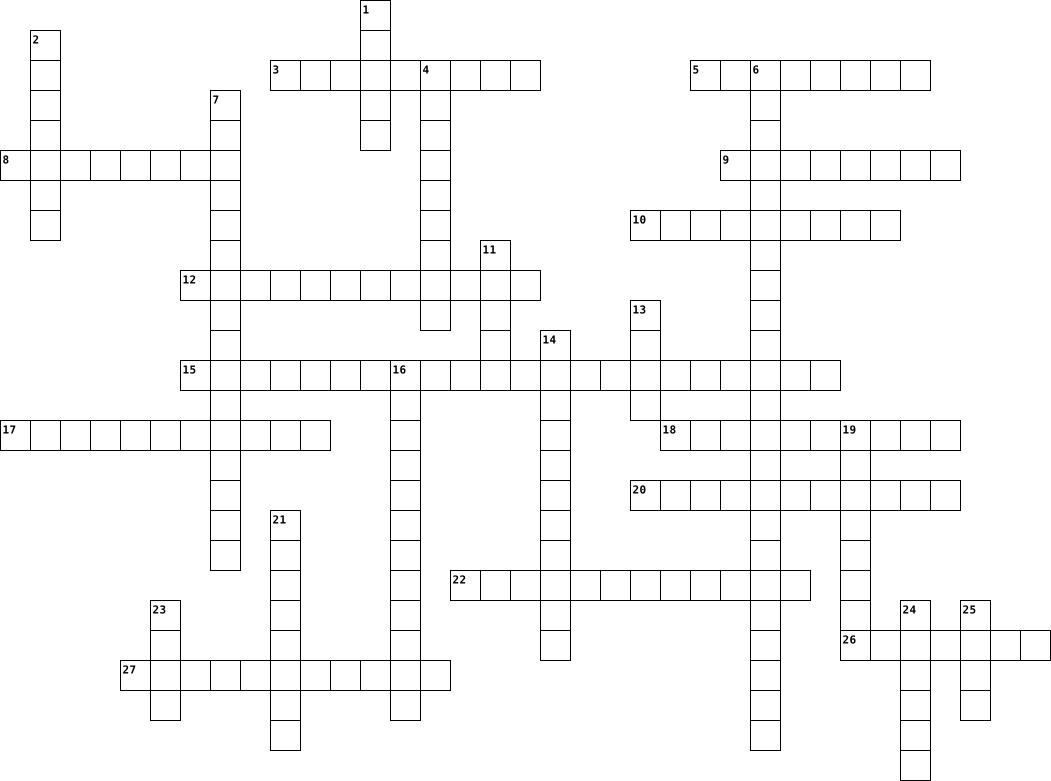
Across
- unit for mass
- ___ forces cause no change in motion.
- more than one atom combined
- more than one type of atom
- tells the number of atoms
- piece of evidence of a chemical reaction, such as bubbles, foaming, fizzing
- unit for acceleration
- tool for force
- ___ forces cause change in motion.
- piece of evidence of a chemical reaction, such as two liquids producing a solid
- any change in speed or direction
- one type of atom, also found on the periodic table
- piece of evidence of a chemical reaction, such as clear to blue
Down
- a column on the periodic table
- unit for force
- the formulas present at the beginning of a chemical reaction
- The ___ says matter is neither created nor destroyed.
- a process where new substances are formed
- a push or pull
- amount of matter
- tells the number of molecules
- piece of evidence of a chemical reaction, such as temperature change, odor, light or sound
- sum of all the forces
- the formulas present at the end of a chemical reaction
- one piece of an element
- a row on the periodic table
- Balanced forces have a net force of ___ N.
27 Clues: unit for mass • unit for force • a push or pull • tool for force • amount of matter • unit for acceleration • sum of all the forces • one piece of an element • tells the number of atoms • more than one type of atom • more than one atom combined • a row on the periodic table • tells the number of molecules • a column on the periodic table • any change in speed or direction • ...
Chemistry Crossword Puzzle: Quarter 1 Review 2017-10-23

Across
- can be drawn into wires
- element in period 4, group 15
- aka "family" on the periodic table
- side of the periodic table where the metals are found
- nonmetal in period 4 with smallest atomic number
- model of the atom that shows electrons orbiting the nucleus in rings
- the sum of the protons and neutrons in an atom
- isotopes have different numbers of this subatomic particle
- number of neutrons potassium has
- scientist who performed gold foil experiment and said the atom has a small, dense, positively-charged nucleus
- chalcogen with largest electronegativity
- horizontal row on the periodic table
Down
- number of electrons aluminum has
- metalloid with the smallest atomic number
- noble gas in period 3
- alkali metal in period 3
- a measure of how close repeated measurements are to each other
- smallest subatomic particle
- can be beaten into thin sheets
- the units used to measure volume
- the number of sig figs in this number: 2.000
- a type of data that includes numbers
- element helium would become if it lost a proton
- element in period 2, group 14
- subatomic particle with a positive charge
- what a positive and a negative charge do
26 Clues: noble gas in period 3 • can be drawn into wires • alkali metal in period 3 • smallest subatomic particle • element in period 4, group 15 • element in period 2, group 14 • can be beaten into thin sheets • number of electrons aluminum has • the units used to measure volume • number of neutrons potassium has • aka "family" on the periodic table • a type of data that includes numbers • ...
Unit B Chemistry Crossword 2018-11-07

Across
- elements with similar properties
- the left side of a chemical word equation
- chemical combinations
- e.g. when a liquid turns a different colour
- the non reactive gases on the periodic table
- hazardous household product system
- when a metal and a non metal combines
- the amount of protons and electrons in an element
- when a liquid turns into a gas
- when a solid turns into a liquid
- known for making the modern periodic table
- in between metals and non metals
- has one proton, one electron and no neutrons
- e.g. Au is for gold
Down
- the result of a chemical change
- the average mass in an element
- the most reactive metals on the periodic table
- Everything that takes up space, and has mass.
- when a gas turns into a solid
- when the change is reversible
- when a non metal and another non metal combines
- made up of one type of matter
- the result of a mixture, but can be separated
- have lustre, is a solid,and can conduct electricity
- when matter is mixed up with another. It’s the opposite of pure substances
25 Clues: e.g. Au is for gold • chemical combinations • when a gas turns into a solid • when the change is reversible • made up of one type of matter • the average mass in an element • when a liquid turns into a gas • the result of a chemical change • elements with similar properties • when a solid turns into a liquid • in between metals and non metals • hazardous household product system • ...
Atoms and Molecules 2024-01-19

Across
- accelerator special machine that smashes atoms
- the charge of a proton
- An ionic bond forms when positively and negatively charged ions ___ each other
- atoms have the same number of protons and ___
- the negative subatomic particle that travels in an orbit around the nucleus of an atom
- In a ___ atom, the outermost shell is completely closed or filled
- substance formed as a result of a chemical change
- a row on the periodic table of the elements (horizontal)
- the charge of an electron
- the table used to classify the elements
- a column on the periodic table of the elements (vertical)
Down
- atoms joined together
- what scientists think about atoms, based on repeated observations
- the study of matter and how substances change
- this reaction occurs when molecules combine to form a new substance
- a substance that contains only one kind of atom
- this reaction breaks a compound into two or more simpler compounds
- the smallest recognizable piece of an element
- an atom that has gained or lost electrons
- The atomic ____ of an atom is based on the number of protons in the nucleus
- the center of an atom, holds the protons and neutrons
21 Clues: atoms joined together • the charge of a proton • the charge of an electron • the table used to classify the elements • an atom that has gained or lost electrons • the study of matter and how substances change • atoms have the same number of protons and ___ • the smallest recognizable piece of an element • accelerator special machine that smashes atoms • ...
Periodic Table Crossword 2025-01-10

Across
- Which block/sublevel forms ions that are generally colored?
- What element is in group 15 and period 4 of the periodic table?
- What property describes the size of a neutral atom?
- Elements in a group have the same number of ___
- What group has the most metallic characteristics?
- What is the only metal that is liquid at STP?
- What property describes the attraction of electrons by a nucleus?
- What elements are generally shiny, malleable, and good conductors?
- What property describes the energy needed to pull one electron from a neutral gas atom?
- What is a horizontal row on the periodic table?
Down
- A group of the periodic table is known as what else?
- What kind of bond involves a transfer of electrons?
- What elements are generally dull, brittle, and poor conductors?
- What property describes the size of an ion?
- In terms of electron shells, what do atoms "want" to form?
- What group has no electronegativity?
- How many valence electrons do alkaline earth metals contain?
- What is the only nonmetal that is liquid at STP?
- What has properties of both metals and nonmetals?
- What group contains the most reactive nonmetals?
20 Clues: What group has no electronegativity? • What property describes the size of an ion? • What is the only metal that is liquid at STP? • Elements in a group have the same number of ___ • What is a horizontal row on the periodic table? • What is the only nonmetal that is liquid at STP? • What group contains the most reactive nonmetals? • ...
Chemistry Review 2025-12-09

Across
- Positively charged sub-atomic particle
- Anything that has mass and takes up space
- This mixture has the same make-up and appearance throughout
- A definite volume but no fixed shape
- Color change, temperature change and odor are some of the indicators of this type of reaction
- How much stuff is in a certain amount of space
- The one or two letter code representing an element
- Two or more different elements chemically combined
- A pure substance consisting of only one type of atom
- Made of electrically charged particles
- A combination of two or more substances that aren't the same throughout
Down
- The neutrally charged sub-atomic particle
- Represents the number of protons in an element on the periodic table
- No definite shape or volume
- It dissolves the solute
- Horizontal rows on the periodic table
- Negatively charged sub-atomic particle
- Size, shape and state change are all indicators of this type of reaction
- Vertical columns on the periodic table
- The basic building blocks of all matter
- Definite shape and volume
- Two or more of the same or different elements combined
- It gets dissolved in another substance
23 Clues: It dissolves the solute • Definite shape and volume • No definite shape or volume • A definite volume but no fixed shape • Horizontal rows on the periodic table • Positively charged sub-atomic particle • Negatively charged sub-atomic particle • Vertical columns on the periodic table • Made of electrically charged particles • It gets dissolved in another substance • ...
Year 8 Chemistry 2026-03-27

Across
- table A chart that organises elements by atomic number
- A material that does not allow heat or electricity to flow easily
- A one- or two-letter abbreviation used to represent an element
- The dense centre of an atom containing protons and neutrons
- A positively charged particle found in the nucleus of an atom
- A material that allows heat or electricity to flow through it
- A negatively charged particle that moves around the nucleus
- Able to be hammered or bent into shape without breaking
- A type of element that conducts heat and electricity well and is usually shiny
Down
- Able to be stretched into a wire
- A horizontal row in the periodic table
- The smallest unit of matter that still retains the properties of an element
- A particle with no charge found in the nucleus
- A property describing something that is shiny
- A vertical column in the periodic table
- number The number of protons in an atom
- An element that is a poor conductor of heat and electricity and not shiny
- An element with properties of both metals and non-metals
- Breaks easily when force is applied
- A pure substance made of only one type of atom
20 Clues: Able to be stretched into a wire • Breaks easily when force is applied • A horizontal row in the periodic table • A vertical column in the periodic table • number The number of protons in an atom • A property describing something that is shiny • A particle with no charge found in the nucleus • A pure substance made of only one type of atom • ...
6th Grade Unit 2 2012-09-13

Across
- found on the right side of the periodic table, usually magnetic, ductile, and maleable
- a pure substance that cannot be broken down by normal circumstance
- makes up rocks and found in the earth
- a specific sound given off when a metal is struck by an object
- found on the starcase on the periodic table, has properies of both metals and non-metals
- the color you see when you look at an object
- physical characteristic that we use to classify matter
- the residue left behind when you rub a mineral on a streak plate
- the jagged and uneven way a mineral breaks
- how light reflects off an object, is it shiny or dull
Down
- has mass and volume
- found on the left side of the periodic table, opposite properties of metals
- determines the strength of a mineral
- ability of an object to let heat and electricity flow through it freely
- the smooth and inverted way a mineral breaks
- can be hammered into a thin sheet
- can be drawn into a wire
- determines bouyancy of an object
- the amount of space something takes up
- amount of matter in an object
20 Clues: has mass and volume • can be drawn into a wire • amount of matter in an object • determines bouyancy of an object • can be hammered into a thin sheet • determines the strength of a mineral • makes up rocks and found in the earth • the amount of space something takes up • the jagged and uneven way a mineral breaks • the smooth and inverted way a mineral breaks • ...
Chemistry 2013-09-19

Across
- Opposite of a cation
- These build all matter
- To the left of the stair steps on the periodic table
- Positively charged ion
- A chart listed in order of increasing atomic numbers
- The relatively small, dense center of positive charge in an atom
- Except Al, all of these elements are touching the stair steps on the periodic table
- Also called "families"
- A molecule composed of 2 atoms
- A group 8 element
- These are represented by symbols
- The number of protons in the nucleus of a given atom
- A negatively charged subatomic particle
- A positively charged subatomic particle located in the atomic nucleus
Down
- A compound that results when a metal reacts with a nonmetal to form cations and anions
- On the right of the stair steps on the periodic table
- Fluorine, chlorine, bromine, & iodine are all ______
- This type of metal has multiple charges
- The most reactive metals
- These are represented with formulas
- Atoms with the same number of protons but a different number of neutrons
- A subatomic particle in the atomic nucleus with no charge
- An atom or a group of atoms that have positive o negative charge
23 Clues: A group 8 element • Opposite of a cation • These build all matter • Positively charged ion • Also called "families" • The most reactive metals • A molecule composed of 2 atoms • These are represented by symbols • These are represented with formulas • This type of metal has multiple charges • A negatively charged subatomic particle • ...
chemistry crossword 2016-02-25

Across
- organic catalyst
- negatively charged particle
- horizontal column of the periodic table of elects
- group 18 on the periodic table of elements
- an experiment which all reactants and all products of a chemical reaction are accounted for
- vertical column of elements on the periodic table
- a reaction that takes place when two or more substances react to form new substances
- description of how a substance interacts with other substances such as acids
- chemical reaction that releases energy
- an element with both metal and non-metal properties
- positively charged particle in the nucleus of an atom
Down
- a solution in which water is the solvent
- chemical combination of two more elements in a specific ratio
- substance made of only one type of matter
- pure substance formed when non-metals mix
- neutral particle the nucleus of an atom
- substance that helps speed up chemical reaction
- chemical reaction that absorbs energy
- change that results when two or more substances react to create a different substance or substances
- a formula of symbols that represent a compound
- an experiment in which one or more products of a chemical reaction can escape
21 Clues: organic catalyst • negatively charged particle • chemical reaction that absorbs energy • chemical reaction that releases energy • neutral particle the nucleus of an atom • a solution in which water is the solvent • substance made of only one type of matter • pure substance formed when non-metals mix • group 18 on the periodic table of elements • ...
Chemistry Vocabulary 2016-11-29

Across
- the temperature at which a substance melts
- metallic elements that occupy the largest part of the periodic table
- a model that shows how the electrons circle the nucleus
- the ability of a substance to be hammered or pressed into a shape without breaking
- a substance made by mixing other substances together
- the mass of a chemical element
- a substance that is formed when two or more chemical elements are chemically bonded together
- a subatomic particle with a positive charge
Down
- change that affects the form of a chemical substance but not its chemical composition
- gascous element occupying group 18 of the periodic table
- change that results with the formation of new substances
- the basic unit of life
- elements that have properties of metals and non-metals
- the temperature at which a substance boils
- Table a table that organizes the elements according to their number of protons
- a substance particle with a negative charge
- a subatomic particle that doesn't have a charge
- a part of science that deals with the identifications and properties of matter
- a substance of atoms which have the same number of protons
- a group of atoms that have the same chemical compound
20 Clues: the basic unit of life • the mass of a chemical element • the temperature at which a substance melts • the temperature at which a substance boils • a substance particle with a negative charge • a subatomic particle with a positive charge • a subatomic particle that doesn't have a charge • a substance made by mixing other substances together • ...
Exam Review 2018-05-16

Across
- Elements on the Periodic Table are arranged by ________ number.
- What type of change is ice melting?
- Scientific Theories can change
- The average temperature from 1995 to 2015 was 20 degrees is a statement about _____.
- Form of energy stored inside a battery.
- Each square of the Periodic Table represents an _______.
- When one scientists duplicates another scientists work.
- A liquid with a pH greater than 7
- Elements, compounds and mixtures are all made of _____.
- Elements in a row on the periodic table follow a pattern.
Down
- Elements in the same _______ have similar chemical properties.
- Elements that are shiny and can be bent.
- what do groups of cells form?
- a liquid with a pH less than 7
- Which is more basic a pH of eleven or thirteen.
- Animal cells do not have a _____ ________.
- A motor spinning is an example of ______ energy.
- Energy that comes out of a battery.
- Which is more acidic a pH of two or six?
- Elements that are found al0ng the zigzag line.
- "Today it will be 90 degrees and sunny" is a statement about ________
- multiple trials are performed in an experiment
22 Clues: what do groups of cells form? • a liquid with a pH less than 7 • Scientific Theories can change • A liquid with a pH greater than 7 • What type of change is ice melting? • Energy that comes out of a battery. • Form of energy stored inside a battery. • Elements that are shiny and can be bent. • Which is more acidic a pH of two or six? • ...
Exam Review 2018-05-16

Across
- "Today it will be 90 degrees and sunny" is a statement about ________
- Elements that are found al0ng the zigzag line.
- Elements that are shiny and can be bent.
- Animal cells do not have a _____ ________.
- multiple trials are performed in an experiment
- Which is more basic a pH of eleven or thirteen.
- What type of change is ice melting?
- Elements on the Periodic Table are arranged by ________ number.
- Energy that comes out of a battery.
- Elements in the same _______ have similar chemical properties.
- Scientific Theories can change
- The average temperature from 1995 to 2015 was 20 degrees is a statement about _____.
Down
- When one scientists duplicates another scientists work.
- what do groups of cells form?
- A motor spinning is an example of ______ energy.
- A liquid with a pH greater than 7
- Which is more acidic a pH of two or six?
- Elements, compounds and mixtures are all made of _____.
- Form of energy stored inside a battery.
- Each square of the Periodic Table represents an _______.
- a liquid with a pH less than 7
- Elements in a row on the periodic table follow a pattern.
22 Clues: what do groups of cells form? • a liquid with a pH less than 7 • Scientific Theories can change • A liquid with a pH greater than 7 • What type of change is ice melting? • Energy that comes out of a battery. • Form of energy stored inside a battery. • Elements that are shiny and can be bent. • Which is more acidic a pH of two or six? • ...
8th grade School Year Trivia 2024-06-03

Across
- genre with true stories
- French+Spanish have___ like le, la,los
- sad, sorrowful, joyless would all be called ___
- country where periodic table creator was from
- book genre with crime, secrets, clues
- Hamilton focuses on the _____ War
- Anne Frank's ________ was published
- cell division is called _____
- poet who wrote "Nothing Gold Can Stay"
- Gregor _____ was the first to study genetics
- Ag on periodic table is _______
- Gold's number on the periodic table
- Lin-Manual ____ was composer of Hamilton
- ____energy that deals with moving particles
- full name of Outsiders protagonist
- genre concerned with future and technology
- president after Lincoln
Down
- setting of The Outsiders
- All the Light We Cannot See is ___ fiction
- 1861-1900 is called the ___ in US history
- space between numbers on number line
- Civil War was fought over this issue
- book genre that includes plays
- president who was assassinated in April, 1865
- ____ fiction has injustices and suffering
- country where Anne Frank was born
- the main point in an essay is the __
- Outsiders is meant for this audience
- Convert .1 to a phrase
- a ___ poem tells a story
- Furtermore, First, Lastly are all ____
31 Clues: Convert .1 to a phrase • genre with true stories • president after Lincoln • setting of The Outsiders • a ___ poem tells a story • cell division is called _____ • book genre that includes plays • Ag on periodic table is _______ • Hamilton focuses on the _____ War • country where Anne Frank was born • full name of Outsiders protagonist • Anne Frank's ________ was published • ...
Science 10: Chemistry Review 2021-09-29

Across
- a standardized labelling system of workplace hazardous materials
- we use our five senses to determine this
- the rows on the periodic table
- elements and compounds are included in this category
- the common term for sodium chloride
- an example would be a granola bar
- located on the orbits of an atom
- when there is a strong odour change
- the columns on the periodic table
- mass and volume are involved
- has no charge
- this category make up majority of the elements on the periodic table
- how shiny or dull something is
- an example would be a change in size
Down
- there are less elements in this category compared to elements classified as metals
- containts 118 elements
- a substance's combustibility is an example
- how well a solid dissolves in a liquid
- number of protons added to number of neutrons provides us with this
- has a positive charge
- these elements contain one valence electron in its outer orbit
- the temperature when a substance goes from liquid to solid
- diagrams drawn used to show the organization of an atom
- what a mixture of liquids is called
- cannot be broken down even further, simplest form
25 Clues: has no charge • has a positive charge • containts 118 elements • mass and volume are involved • the rows on the periodic table • how shiny or dull something is • located on the orbits of an atom • an example would be a granola bar • the columns on the periodic table • the common term for sodium chloride • what a mixture of liquids is called • when there is a strong odour change • ...
Atoms and The Periodic Table Vocabulary Review 2024-03-13

Across
- a scale that indicates the strength of an acid or base
- the rows in a periodic table
- has a pH greater than 7
- a positively charged particle
- the center of the atom where protons and neutrons are located
- very reactive metals, soft enough to cut with a knife
- has an atomic mass of 12
- has a pH of 7
- a metal transfers its electrons to a nonmetal
- the most stable group on the periodic table
Down
- the columns in a periodic table
- a particle with no charge
- electrons in the outer most orbital, with the most energy and ability to bond with other atoms
- has 1 proton and 1 electron
- a chart showing all the elements arranged in repeating patterns
- the sum of protons and neutrons
- a negatively charged particle
- the smallest particle that can be considered an element
- a group of nonmetals, very reactive, have 7 valence electrons
- a nonmetal shares its electrons with another nonmetal
- the number of protons of an atom
- one or two letters that represent an element
- has a pH less than 7
23 Clues: has a pH of 7 • has a pH less than 7 • has a pH greater than 7 • has an atomic mass of 12 • a particle with no charge • has 1 proton and 1 electron • the rows in a periodic table • a positively charged particle • a negatively charged particle • the columns in a periodic table • the sum of protons and neutrons • the number of protons of an atom • ...
Periodic Table Crossword 2022-01-21

Across
- Element that is liquid at STP and in Group 17
- a specific type of metal found in Group 1; form +1 ions and very reactive
- electrons in the outermost electron shell
- elements that have luster, good conductors, malleable
- two atoms of the same element chemically bonded together (HONClBrIF)
- having 8 electrons in the outermost electron shell
- elements that are dull, poor conductors, brittle
- measure of the tendency of an atom to attract electrons to itself
- element that is the only metalloid in Group 13
- elements found in group 17 that form -1 ions and have 7 valence electrons
Down
- elements that have properties of metals and nonmetals
- a specific type of elements that do not occur in nature and they are radioactive
- bendable; a property of metals
- property of metals; able to be pulled into wires
- element that is the only nonmetal in Group 14
- vertical columns in a periodic table
- element that is liquid at STP and in Group 12
- horizontal rows in a periodic table
- A specific type of metal found in Group 2; form +2 ions
- a specific type of metal that is found in the middle of the periodic table; generally colored
20 Clues: bendable; a property of metals • horizontal rows in a periodic table • vertical columns in a periodic table • electrons in the outermost electron shell • Element that is liquid at STP and in Group 17 • element that is the only nonmetal in Group 14 • element that is liquid at STP and in Group 12 • element that is the only metalloid in Group 13 • ...
Acids and Bases 2025-09-02

Across
- Used to represent the concentration of acids and bases.
- A solution with a pH greater than 7 are.
- Reactant + _____________--------> product(s).
- What element is found in the Periodic Table in group 2, period 3 ?
- Solutions with a pH less than 7 are.
- What turns red in an acidic solution and remains blue when added to an alkali solution?.
- Elements on the Periodic Table are placed in order according to their.
- The minimum amount of energy required for a chemical reaction to proceed is called
- The pH of distilled water.
Down
- Cutting or grinding up a reactant increases this.
- Outermost level in the electron arrangement.
- The acid found in lemons and oranges.
- A special chemical that speeds up the rate of a reaction but are not used up in that reaction.
- This element is given the chemical symbol 'K'.
- Very small particle that exists outside the centre (nucleus) of the atom.
- What affects the speed of particles.
- A positive ion.
- What element is found in the Periodic Table in group 11, period 5?
- The gas produced when an acid reacts with a metal.
- A negative ion.
20 Clues: A positive ion. • A negative ion. • The pH of distilled water. • Solutions with a pH less than 7 are. • What affects the speed of particles. • The acid found in lemons and oranges. • A solution with a pH greater than 7 are. • Outermost level in the electron arrangement. • Reactant + _____________--------> product(s). • This element is given the chemical symbol 'K'. • ...
Unit 4 The Periodic Table 2025-10-07

Across
- The modern periodic table is organized by increasing what?
- Atom or group of atoms with a positive or negative charge
- Energy needed to remove an electron from an atom in the gaseous state
- F- and O2- are examples of this
- Have properties of both metals and nonmetals
- Na+ and Mg2+ are examples of this
- These are found underground and can be dull
- Ability of an atom of an element when in a compound to attract electrons
- Most are gases. If a solid, it is usually brittle.
- Father of the periodic table
- Shiny, easily cut, and very reactive
Down
- 1/2 the distance between two nuclei of the same element when joined
- Most of these don't exist naturally
- An example of an element that has been known for thousands of years
- The most electronegative element
- When elements are arranged in order of increasing atomic number, there is a repetition of physical and chemical properties
- Generally good conductors of heat and electricity
- Inert and have a full outer electron shell
- The first periodic table was organized by what?
- Found in the d block and used in a variety of ways
- Most reactive nonmetal group
21 Clues: Most reactive nonmetal group • Father of the periodic table • F- and O2- are examples of this • The most electronegative element • Na+ and Mg2+ are examples of this • Most of these don't exist naturally • Shiny, easily cut, and very reactive • Inert and have a full outer electron shell • These are found underground and can be dull • ...
Elements,compounds,mixtures 2022-12-02

Across
- number on the periodic table
- -
- stable
- 2 or more elements
Down
- kind of matter
- a mix of something
- a substance that takes up space
- +
- periodic table
- building blocks
10 Clues: + • - • stable • kind of matter • periodic table • building blocks • a mix of something • 2 or more elements • number on the periodic table • a substance that takes up space
Periodic Table and Its Trends 2024-05-08

Across
- poor conductor,not malleable or ductile, brittle
- easily hammered into sheets
- ______ metals; group 1
- another word for breaks easily
- group 18
- have characteristics of both metals and nonmetals
- columns on a periodic table that have similar characteristics
- metalloids are found along this zigzag
- rows on a periodic table
Down
- groups 3-12
- good conductor,malleable,ductile
- ________ _____ metals; group 2
- another word for group (Boron ______)
- group 17
- material that electricity and heat don't pass through very well
- being able to change shape without breaking
- material that electricity and heat pass through
17 Clues: group 17 • group 18 • groups 3-12 • ______ metals; group 1 • rows on a periodic table • easily hammered into sheets • ________ _____ metals; group 2 • another word for breaks easily • good conductor,malleable,ductile • another word for group (Boron ______) • metalloids are found along this zigzag • being able to change shape without breaking • ...
The periodic table! 2021-08-05

Across
- The symbol of the element with atomic number 10 in the periodic table.
- Atoms that have the same number of protons are of the same ____________.
- The name of the element with atomic number 197 in the periodic table.
- The name of the particle that has a positive charge and we can find in the nucleus.
Down
- The mass number of Lithium (symbol Li) in the periodic table.
- The symbol of the element with atomic number 2 in the periodic table.
- The atomic number of Oxygen (symbol O) in the periodic table.
- The name of the element with atomic number 26 in the periodic table.
8 Clues: The mass number of Lithium (symbol Li) in the periodic table. • The atomic number of Oxygen (symbol O) in the periodic table. • The name of the element with atomic number 26 in the periodic table. • The symbol of the element with atomic number 2 in the periodic table. • The name of the element with atomic number 197 in the periodic table. • ...
Vocab Project - Periodic Table 2022-05-24

Across
- Group 18
- An ion with a negative charge - gains electrons
- Table of all known elements, organized by increasing atomic mass
- Present in groups 1-16
- Characterized by Electrons in the f orbital, groups 3-16
- Measuring the size of the ion created to the element's atom. This is chunked between cations and anions.
- Characterized by Electrons in the d orbital, groups 3-12
- Mix of metal and non-metal properties; Considered to be nonmetals with metallic properties
- Present in groups 1,14-18
- Group 17
Down
- Group 2
- Group 1
- Patterns in chemical properties across the periodic table
- Horizontal rows
- 1A-8A, display a wide range of physical and chemical properties
- Phenomenon where inner levels of electrons weaken the attraction between the outer electrons and the protons in the nucleus
- ½ the distance between the nuclei of two atoms of the same element when the atoms are joined.
- Vertical columns
- An ion with a positive charge - loses electrons
- an atom or a group of atoms that has a charge attributed to them. (An atom with a charge)
20 Clues: Group 2 • Group 1 • Group 18 • Group 17 • Horizontal rows • Vertical columns • Present in groups 1-16 • Present in groups 1,14-18 • An ion with a negative charge - gains electrons • An ion with a positive charge - loses electrons • Characterized by Electrons in the f orbital, groups 3-16 • Characterized by Electrons in the d orbital, groups 3-12 • ...
Periodic Table Vocabulary 2022-09-25

Across
- abbreviation for atomic mass unit
- describes how likely an element is to form bonds with other elements
- a vertical column on the periodic table
- an atom that has gained or lost one or more electrons
- elements that are usually poor conductors of heat and electricity
- electrons that are located in the outermost energy level of an atom
- the number of protons of an atom or element
- ion with a negative charge
- the positively charged dense center of an atom
Down
- ion with a positive charge
- a horizontal row in the periodic table
- building block of matter
- a stable particle with a positive charge
- group 18 elements on the periodic table that contain 8 valence electrons making it stable
- the distance between the nucleus of an atom and its outermost energy level
- number of protons and neutrons in nucleus of an atom
- subatomic particle in the nucleus of an atom with no charge
- atoms having the same number of protons but a different number of protons
- substance that cannot be decomposed into simpler substances
- a region in an atom where there is a high probability of finding electrons
20 Clues: building block of matter • ion with a positive charge • ion with a negative charge • abbreviation for atomic mass unit • a horizontal row in the periodic table • a vertical column on the periodic table • a stable particle with a positive charge • the number of protons of an atom or element • the positively charged dense center of an atom • ...
Chemistry Unit Review 2017-02-10

Across
- Gasses that will not react with anything
- The biggest part of the atom, contains protons and neutrons
- The letters we use to show a certain element
- The steps of the shells of atoms that electrons spin on
- How many protons and electrons an atom has
- Has properties of both metals and nonmetals
- Matter cannot be create
- What is created in a chemical reaction
- Positively charged particle, in the nucleus of an atom
- Negatively charged particle, makes up the shell of an atom
- A mixture of different atoms
- Neutral particle, in the nucleus of an atom
- When a reaction creates energy (heat)
Down
- Column of the periodic table
- A group of atoms that are bonded together
- How massive an atom is
- An electron in the outermost shell of an atom
- The inventor of the modern periodic table
- When a reaction pulls in energy (cold)
- A collection of a single type of atom
- Dull, brittle, and non conductive
- One particle of an element
- Shiny, ductile, and malleable
- Row on the periodic table
- What is put into a chemical reaction
25 Clues: How massive an atom is • Matter cannot be create • Row on the periodic table • One particle of an element • Column of the periodic table • A mixture of different atoms • Shiny, ductile, and malleable • Dull, brittle, and non conductive • What is put into a chemical reaction • A collection of a single type of atom • When a reaction creates energy (heat) • ...
Chemistry Unit 2 2023-01-24

Across
- What principle states that electrons occupy orbitals of lowest energy first?
- All atoms are electrically ________
- The _______ number shows the # of protons and electrons
- When an electron has its lowest possible energy, what state is the atom in?
- What has the highest energy on an electromagnetic spectrum?
- What is the smallest particle of an element?
- What is it called when particles and rays emitted from the radioactive source?
- What attractive force holds the nucleus together?
- What are the horizontal rows on a periodic table called?
- Alkali Metals are found in which group?
- __________ are negatively charged and are massless
Down
- The vertical columns on a periodic table are called ________.
- _________ are positively charged and have a mass of 1 amu
- This region of the atom contains protons and neutrons; dense and is positively charged
- This scientist discovered the neutron
- What makes up 80% of the periodic table?
- What has the lowest energy on an electromagnetic spectrum?
- The _________ is a wave's height from zero to crest
- The longer the distance of a ________ is, the lower the energy.
- This scientist has a model named after him
- What nuclear radiation emits helium nuclei?
21 Clues: All atoms are electrically ________ • This scientist discovered the neutron • Alkali Metals are found in which group? • What makes up 80% of the periodic table? • This scientist has a model named after him • What nuclear radiation emits helium nuclei? • What is the smallest particle of an element? • What attractive force holds the nucleus together? • ...
Words that I learned in Science 2023-05-01

Across
- a column in the periodic table, the group number equals the number of electrons in the outer shell
- a group of rare gases
- any of a series of 15 consecutive chemical elements in the periodic table
- center of atom
- found in the shells and has negative charge
- the electrons in the outermost shell, or energy level, of an atom
- physical substance
- elements that constitute Group 17
Down
- a one or two letter symbol that represents the element
- an element that is generally a poor conductor of heat and electricity
- inside a nucleus and has a positive charge
- a row in the periodic table, the row number equals to the number of shells
- having the properties of an alkali, or containing alkali; having a pH greater than 7.
- the number of protons and neutrons combined
- inside of the atom and has no charge
- chemical substance that cannot be broken down into other substances
- the number of protons
- rings outside of an atom
- a substance that contains two or more elements chemically combined in a fixed proportion
- a type of chemical element which has a preponderance of properties in between
20 Clues: center of atom • physical substance • a group of rare gases • the number of protons • rings outside of an atom • elements that constitute Group 17 • inside of the atom and has no charge • inside a nucleus and has a positive charge • the number of protons and neutrons combined • found in the shells and has negative charge • a one or two letter symbol that represents the element • ...
Sciene Crossword 2012-11-25

Across
- symbol is Ag
- atomic number of osmium
- is used to clean pools
- in what group is chlorine
- it is in your bones
- name of group 3 until 12
- next to chromium on the periodic table
- symbol is Cf
- it is in group 2, and the atomic number is 12
- is used by dentists to clean your teeth
- atomic number of gold
- liquid we use to clean open wounds
- atomic number of lead
- american coin
Down
- next to nickel in the periodic table
- superman was born on that planet
- atomic number is 33
- it is in the nitrogen group, symbol P
- underneath cobalt on the periodic table
- what is the name of group 1?
- oxygen is in that group, so is sulfur and selenium
- bright colors or lights
- Fe
- B, Al, Ga, In, and Ti are in that group
- symbol is Mn
- there is a song about it by Sia and David Guetta
- we need it to breath without it we would die
- used for explosives
- atomic number is 1
- used in balloons
30 Clues: Fe • symbol is Ag • symbol is Cf • symbol is Mn • american coin • used in balloons • atomic number is 1 • atomic number is 33 • it is in your bones • used for explosives • atomic number of gold • atomic number of lead • is used to clean pools • atomic number of osmium • bright colors or lights • name of group 3 until 12 • in what group is chlorine • what is the name of group 1? • ...
Chapter 11: Periodic Table and the Trends 2016-01-09

Across
- + charged subatomic particle.
- - charged subatomic particle.
- When 2 elements cling together.
- System for organizing elements (2W).
- Models that show bonding between atoms (2W).
- The size of an atom (2W).
- Make up the periodic table.
- Column of elements on Periodic Table.
- Basic unit of an element.
- Decently malleable and decent conductor of electricity.
- Force of attraction between + and - charges (2W).
- Not malleable and bad conductor of electricity.
- Tendency of a substance to undergo a chemical change.
- Element without electronegativity (2W).
Down
- E- in the outer most shell.
- Rules that almost all elements follow.
- Ability of an atom to attract e- from bonded atom (2W).
- What happens to AR as you go across a period (right-left).
- Row of elements on Periodic Table.
- Energy required to remove an e- from an atom.
- What happens to AR as you go down a family.
- Distance between the outermost e-, and the nucleus (2W).
- Change in energy of an atom when an e- is added (2W).
- Center of an atom.
- What happens to atomic size as the AR increases.
- Energy level e- are stored on (2W).
- Malleable and good conductor of electricity.
27 Clues: Center of an atom. • The size of an atom (2W). • Basic unit of an element. • E- in the outer most shell. • Make up the periodic table. • + charged subatomic particle. • - charged subatomic particle. • When 2 elements cling together. • Row of elements on Periodic Table. • Energy level e- are stored on (2W). • System for organizing elements (2W). • ...
Science Crossword 2015-12-02

Across
- Element that is extremely reactive to water
- Negatively charged subatomic particle
- The ability to ______ electricity or heat.
- When a two or more elements combine, and a new substance is formed.
- Water
- Abbreviation for atomic mass unit
- Number of protons in the nucleus in an atom.
- The physical change from gas to solid or solid to gas.
- A substance that can be stretched into a long wire.
- Soft, shiny, valuable metal for jewelry.
- Elements of the periodic table that are the most stable
Down
- Neutrally charged subatomic particle
- The ability of a substance to be dissolved in another.
- Most used organizer of all known elements.
- A compound that has no metals
- A substance that can be pounded or rolled into sheets.
- A compound with two elements and at least one metal that equal an equal charge
- conductive and shiny elements in the periodic table
- Period5Coloumn18
- Elements that share the properties of metals and non-metals
- Building block of all matter
- liquid metal element
- non-conductive and dull elements in the periodic table
- Positively charged subatomic particle
- Element that we need to breathe
25 Clues: Water • Period5Coloumn18 • liquid metal element • Building block of all matter • A compound that has no metals • Element that we need to breathe • Abbreviation for atomic mass unit • Neutrally charged subatomic particle • Negatively charged subatomic particle • Positively charged subatomic particle • Soft, shiny, valuable metal for jewelry. • ...
Exam Review 2018-05-16

Across
- A liquid with a pH greater than 7
- Elements in the same _______ have similar chemical properties.
- multiple trials are performed in an experiment
- Elements that are shiny and can be bent.
- Elements that are found al0ng the zigzag line.
- Elements in a row on the periodic table follow a pattern.
- The average temperature from 1995 to 2015 was 20 degrees is a statement about _____.
- Animal cells do not have a _____ ________.
- a liquid with a pH less than 7
- what do groups of cells form?
- Energy that comes out of a battery.
- Which is more basic a pH of eleven or thirteen.
Down
- Each square of the Periodic Table represents an _______.
- Elements, compounds and mixtures are all made of _____.
- What type of change is ice melting?
- When one scientists duplicates another scientists work.
- Elements on the Periodic Table are arranged by ________ number.
- A motor spinning is an example of ______ energy.
- Form of energy stored inside a battery.
- Scientific Theories can change
- "Today it will be 90 degrees and sunny" is a statement about ________
- Which is more acidic a pH of two or six?
22 Clues: what do groups of cells form? • Scientific Theories can change • a liquid with a pH less than 7 • A liquid with a pH greater than 7 • What type of change is ice melting? • Energy that comes out of a battery. • Form of energy stored inside a battery. • Elements that are shiny and can be bent. • Which is more acidic a pH of two or six? • ...
Exam Review 2018-05-16

Across
- Which is more acidic a pH of two or six?
- Elements in a row on the periodic table follow a pattern.
- Animal cells do not have a _____ ________.
- The average temperature from 1995 to 2015 was 20 degrees is a statement about _____.
- multiple trials are performed in an experiment
- "Today it will be 90 degrees and sunny" is a statement about ________
- what do groups of cells form?
- A motor spinning is an example of ______ energy.
- Each square of the Periodic Table represents an _______.
- When one scientists duplicates another scientists work.
- a liquid with a pH less than 7
Down
- Elements in the same _______ have similar chemical properties.
- Scientific Theories can change
- What type of change is ice melting?
- Elements that are shiny and can be bent.
- Elements on the Periodic Table are arranged by ________ number.
- Energy that comes out of a battery.
- Which is more basic a pH of eleven or thirteen.
- A liquid with a pH greater than 7
- Elements that are found al0ng the zigzag line.
- Form of energy stored inside a battery.
- Elements, compounds and mixtures are all made of _____.
22 Clues: what do groups of cells form? • Scientific Theories can change • a liquid with a pH less than 7 • A liquid with a pH greater than 7 • What type of change is ice melting? • Energy that comes out of a battery. • Form of energy stored inside a battery. • Which is more acidic a pH of two or six? • Elements that are shiny and can be bent. • ...
Chemical Key Words 2018-05-30

Across
- a chain of molecules repeated
- a substance of a chemical reaction
- molecule that has only di-atoms
- from gas to liquid
- to go from ice to water
- the horizontal rows of elements on a periodic table
- the table of grouped elements
- a molecule that contains same bonded atoms
- when metal rusts
- bonded atoms
- a molecule with multiple bonded atoms
- to go straight from a solid to gas vice versa
- to evaporate
Down
- gas that forms from a boiling liquid
- particles arranged in a 3d gridwork pattern
- the end result of a chemical reaction
- a pure substance consisting of one atom
- collision for reaction
- subatomic particles needed to form it
- easy to become a gas
- the production of new chemicals
- when water evaporates
- a dangerous vapour that isn't good to inhale
- a material that makes the tempo of a chemical reaction faster
- a close gathering of substances
- multiple bonded atoms
- a column of elements in the periodic table
- multiple things conjoined
- 1 single atom
- a chemical that speeds up the process of a chemical reaction
30 Clues: bonded atoms • to evaporate • 1 single atom • when metal rusts • from gas to liquid • easy to become a gas • when water evaporates • multiple bonded atoms • collision for reaction • to go from ice to water • multiple things conjoined • a chain of molecules repeated • the table of grouped elements • molecule that has only di-atoms • the production of new chemicals • ...
Science Unit B Crossword 2018-12-03

Across
- has a positive charge
- Arabic word that translates to chemist
- when a gas transforms into a liquid
- mass of one atom of an element
- another name for groups in the periodic table
- indivisible
- anything that takes up space and has mass
- change in the appearance or state of matter of a substance, the change can’t be chemical
- -science activity that is not real science
- when a solid becomes a gas
- quality that describes a certain substance
- when a gas becomes a solid
- stands for globally harmonized system and it is a system that labels the hazard a material has
- the form in which a matter is; liquid, solid, gas
Down
- vertical columns of the periodic table
- horizontal rows in the periodic table
- has a neutral charge
- a quality of a substance that can be rolled into sheets
- has a negative charge
- comes from the Arabic word “alkimiya”
- quality that describes a matter’s physical look
- when a gas becomes a liquid
- a quality of a substance that can be made into a long wire
- when a liquid becomes a solid
- when a solid becomes a liquid
25 Clues: indivisible • has a neutral charge • has a positive charge • has a negative charge • when a solid becomes a gas • when a gas becomes a solid • when a gas becomes a liquid • when a liquid becomes a solid • when a solid becomes a liquid • mass of one atom of an element • when a gas transforms into a liquid • horizontal rows in the periodic table • comes from the Arabic word “alkimiya” • ...
Chapter 1 Matter 2023-10-07

Across
- elements in a group in periodic table have the same number of _______ electrons
- at every temperature a liquid __________
- the process of a gas turning into solid
- refreezing
- water is a ____
- small particle that makes an element
- a state of matter
- ______ number of Lithium is seven
- charge outside the nucleus
- continuous motion of molecules in liquids and gases
- in a solution water is the ______
- vertical column in periodic table
- atoms having the same atomic number but different mass number
- water is at its maximum ________ at +4 centigrade degrees
- ________ bonding is an example of intermolecular forces
Down
- non-metals from _________ bonds
- a solvent with maximum dissolved solute
- mixing of two gases
- non-crystalline structure
- have complete outer shells
- positive electrical charge
- metals and non-metal form _____ bonds
- an isotope of hydrogen atom
- the number of protons
- a good conductor of heat and electricity
- horizontal row in periodic table
- a process chemical compounds can be split up
- in a solution salt is the ________
- geometric pattern of metals
- a positive ion
- a negative ion
- hydrogen atom has ____ proton
32 Clues: refreezing • a positive ion • a negative ion • water is a ____ • a state of matter • mixing of two gases • the number of protons • non-crystalline structure • have complete outer shells • positive electrical charge • charge outside the nucleus • an isotope of hydrogen atom • geometric pattern of metals • hydrogen atom has ____ proton • non-metals from _________ bonds • ...
Atoms and Molecules 2025-05-29

Across
- the joining of atoms of different elements in a set ratio
- the # on the periodic table that gives the numbers of protons and electrons
- the particles that have a neutral or "no" charge
- in the Bill Nye video, the particles that are inside protons and neutrons
- the particles that move around the nucleus of the atom
- the lightest element of all
- the number of protons and neutrons together in the nucleus
- that charge of protons
- things are made of ------- pieces of stuff
- the area where the protons and neutrons exist
Down
- element # 10 on the periodic table
- atoms combine to make -------
- the particles that have a negative charge
- the particles that have a positive charge
- the smallest part of matter
- every living thing has the element
- the charge of neutrons
- the small numbers in a formula that tell how many atoms are present in a molecule
- the representation of an atom that makes its parts visible to the unaided eye
- the charge of electrons
- a substance that has only one type of atom making it up
- element that has the symbol Zn
- element #3 on the periodic table
- element that has the symbol Na
24 Clues: the charge of neutrons • that charge of protons • the charge of electrons • the smallest part of matter • the lightest element of all • atoms combine to make ------- • element that has the symbol Zn • element that has the symbol Na • element #3 on the periodic table • element # 10 on the periodic table • every living thing has the element • ...
The Periodic Table 2 2025-03-26

Across
- A metal that melts at just above room temperature
- A precious white metal with high electrical conductivity
- An atom’s tendency to attract shared electrons
- A noble gas commonly used in lighting and welding
- TABLE The organized chart of elements arranged by atomic number
- Radioactive elements from atomic numbers 89 to 103
- A lightweight, silvery metal used in cans and aircraft
- Highly reactive nonmetals in Group 17 of the periodic table
- The only liquid nonmetal at room temperature
- A rare transition metal often used in catalytic converters
- A metal used to galvanize steel against corrosion
- A toxic metal that is liquid at room temperature
Down
- Rare earth metals from atomic numbers 57 to 71
- ELECTRONS Outer electrons that determine an atom’s reactivity
- NUMBER The count of protons that defines each element
- SHELLS Regions around the nucleus where electrons orbit
- A reactive nonmetal essential for ATP and DNA
- MENDELEEV The Russian chemist who pioneered the first periodic table
- EARTH METALS Metals in Group 2 that readily form compounds
- A dense, soft metal historically used as currency
- A yellow nonmetal known for forming odorous compounds
- A greenish-yellow halogen used as a disinfectant
22 Clues: The only liquid nonmetal at room temperature • A reactive nonmetal essential for ATP and DNA • Rare earth metals from atomic numbers 57 to 71 • An atom’s tendency to attract shared electrons • A toxic metal that is liquid at room temperature • A greenish-yellow halogen used as a disinfectant • A metal that melts at just above room temperature • ...
Unit 4 vocab 2023-11-07

Across
- located on the left side of the periodic table
- vertical column in the periodic table
- a chemical substance that is made up of two or more diffrent kinds of atoms bonded together
- the particle known as the building block of matter
Down
- the groups of elements down
- located in a diagonal line near the middle of the periodic table
- horizontal row on the periodic table
- the smallest particle of any pure element
- smallest particle of a substance that makes up of two o more atoms
9 Clues: the groups of elements down • horizontal row on the periodic table • vertical column in the periodic table • the smallest particle of any pure element • located on the left side of the periodic table • the particle known as the building block of matter • located in a diagonal line near the middle of the periodic table • ...
Chemistry crossword 2015-12-02

Across
- a chemical reaction that occurs when oxygen reacts with a substance to form a new substance and give off energy
- group of atoms joined by covalent bonds
- anything that has mass and occupies space
- made of only one kind of matter
- horizontal row of elements in the periodic table
- group 17 elements in the periodic table
- group 1 elements in the periodic table, not including hydrogen
- a system of easy-to-see warning symbols on hazardous materials
- pure substance formed when non-metals combine
- a table in which the elements are organized by their physical and chemical properties
- pure substance formed when at least one metal and one non-metal combine
- change in the appearance or state of a substance that does not change the composition
- vertical column of elements in the periodic table
- measure of one atomic mass
- the ability of a substance to conduct electricity or heat
Down
- positively charged centre of an atom; contains protons and neutrons
- combination of symbols that represent a compound
- occurs when two or more materials react and create new materials
- characteristics that describe a particular substance (e.g. colour, lustre, melting point)
- netrual particle in the nucleus of an atom
- a reaction that takes place when two or more substances react to form new substances
- amount of mass in a given volume of a substance
- positively charged particle in the nucleus of an atom
- group of atoms acting as one
- mass of one atom of an element calculated from the total number of protons, neutrons, electrons of that atom
25 Clues: measure of one atomic mass • group of atoms acting as one • made of only one kind of matter • group of atoms joined by covalent bonds • group 17 elements in the periodic table • anything that has mass and occupies space • netrual particle in the nucleus of an atom • pure substance formed when non-metals combine • amount of mass in a given volume of a substance • ...
matter 2021-02-15
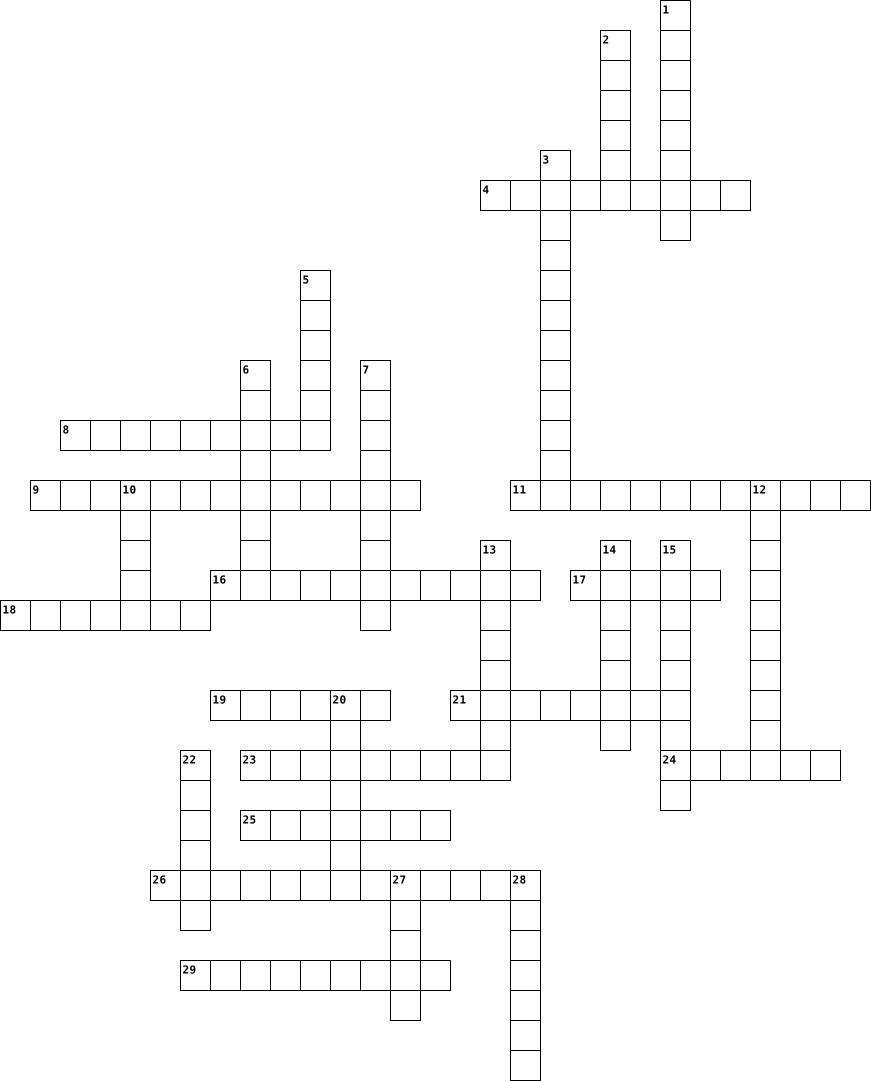
Across
- an element intermediate in properties between the typical metals and nonmetals
- a thing that is composed of two or more separate elements
- any of the elements beryllium , magnesium , calcium , strontium , barium ,and radium
- another name for atomic number
- any of the elements lithium , sodium , potassium , rubidium , caesium , and francium
- an element that readily forms positive ions
- the movement of a solvent
- anything that has mass and volume
- table a table of chemical elements arranged in order of atomic number
- a group of atoms bonded together
- the capacity for doing work
- theory is a theory that all matter consists of many very small particles
- a measure of how crowded the solute particles are
- the spreading of something more widely
Down
- a stable subatomic particle with a charge of negative electricity
- a notation of one or two letters representing a chemical element
- the number of a chemical element in the periodic system
- a column in the periodic table of the chemistry elements
- lacks the characteristics of a metal
- smaller than or occurring within an atom
- the smallest particle of a chemical
- the total of protons and neutrons in a nucleus
- any of the elements fluorine , chlorine , bromine , iodine , and astatine
- a row of chemical elements in the periodic table
- a portion of matter
- a substance whose atoms all have the same number of protons
- a stable subatomic particle occurring in all atomic nuclei
- a mixture of metals or a metal combined with one or more other elements
- a subatomic particle of about the same mass as a proton but without an electric charge
29 Clues: a portion of matter • the movement of a solvent • the capacity for doing work • another name for atomic number • a group of atoms bonded together • anything that has mass and volume • the smallest particle of a chemical • lacks the characteristics of a metal • the spreading of something more widely • smaller than or occurring within an atom • ...
Science 2022-08-02

Across
- Rusting is an example of ____________.
- A form of chemical bonding where one or more pairs of electrons are shared between atoms.
- The amount of protons and neutrons in an atom.
- Arranges the elements based on their atomic number and their properties.
- The measure of the ability of an atom or a molecule to attract a pair of electrons in a covalent bond.
- Chemicals that will change colour when added to an acid or a base are called:
- In a __________ displacement reaction, there are two rearrangements that occur.
- When an acid is added to a base _____________ reaction occurs.
- 2 H2O2 → 2 H2O + O2 is an example of a _________ reaction.
- A bunch of atoms bonded together are called:
- Has a negative charge and is found orbiting the nucleus.
Down
- Burning a substance in oxygen is an example of:
- Has a positive charge and is found inside the nucleus.
- Has no charge and is found inside the nucleus.
- The electrons in the outermost shell are called:
- 2Na + Cl2 → 2NaCl is an example of a _______ reaction.
- The columns on the periodic table are called:
- The word "atom" is derived from this Greek word.
- _________ defines a material’s ability to conduct electricity.When electrons flow from atom to atom.
- The type of bond between a non-metal and a metal atom that occurs when charged atoms (ions) attract.
- The amount of protons in an atom.
- The rows on the periodic table are called:
- 2HCl(aq)+Zn(s)→ZnCl2(aq)+H2(g)is an example of a ________ displacement reaction.
- Group 18, Period 6 on the Periodic Table (Element Name)
- An ________ of an element occurs when the nucleus loses (or gains) a neutron.
25 Clues: The amount of protons in an atom. • Rusting is an example of ____________. • The rows on the periodic table are called: • A bunch of atoms bonded together are called: • The columns on the periodic table are called: • Has no charge and is found inside the nucleus. • The amount of protons and neutrons in an atom. • Burning a substance in oxygen is an example of: • ...
Unit B Crossword 2017-11-13

Across
- a reaction that takes place when two or more substances to react to form new substances
- vertical column of elements in the periodic table
- change of state from a solid to a gas
- group 1 elements in the periodic table; the most reactive of the metals
- group 2 elements in the periodic table; reactivity is not as strong as the alkali metals
- change of state from a gas to a solid
- new substance produced in a chemical reaction between reactants
- combination of symbols that represent a compound
- refers to the three common states in which matter can exist
- a system of easy-to-see warning symbols on hazardous materials
- characteristic that describes a particular substance
Down
- change that results when two or more substances react to create a different substance or substances
- chemical reaction that occurs when oxygen reacts with a substance to form a new substance and give off energy
- ability of a substance to conduct electricity or heat
- positively charged centre of an atom
- chemical combination of two or more elements in a specific ratio
- description of how a substance interacts with other substances
- change of state from a gas to a liquid
- horizontal row of elements in the periodic table
- an experiment in which all reactants and all products of a chemical reaction are accounted for
- substance that helps a chemical reaction to proceed more quickly
- change of state from a solid to a liquid
- smallest part of an element that is representative of that element
- change of state from a liquid to a gas
- change of state from a liquid to a solid
25 Clues: positively charged centre of an atom • change of state from a solid to a gas • change of state from a gas to a solid • change of state from a gas to a liquid • change of state from a liquid to a gas • change of state from a solid to a liquid • change of state from a liquid to a solid • horizontal row of elements in the periodic table • ...
chemistry crossword 2024-05-08

Across
- the horizontal rows of the periodic table.
- the force of attraction between 2 atoms in a molecule.
- the smallest unit of an element.
- elements on the periodic table that are usually brittle, do not conduct electricity, and are sometimes gases.
- elements on the periodic table that are mostly silver, shiny and conduct electricity.
- the liquid that dissolves a solute.
- the solid that dissolves in a solvent.
- a mixture of 2 or more metals.
- 2 or more atoms bonded together.
- change of state from a solid to a liquid.
- does dissolve.
- another word for particles bumping into each other or hitting the sides of a container.
- made up of one type of atom.
- the vertical columns of the periodic table.
- what happens to a solute when you mix it with a solvent. the solute __________.
- when a particle cannot move around other particles, but it can still shake back and forth.
- NaOH, HCl, H2O, CO2, O2, N2 are examples of these.
- change of state from a liquid to a gas.
Down
- cannot see through.
- a shorter way to write an element's name.
- a lot of solute in a solution.
- this is caused by particles hitting the side of a container.
- can see through.
- when a liquid or gas spreads out.
- an impure substance.
- this can be solid, liquid, gas.
- these are shorter ways of writing the name of an element. e.g. Mg = magnesium.
- not much solute in a solution.
- does not dissolve.
- this can come in the form of kinetic, heat, light, chemical, potiential.
- made up of a solute and solvent.
- the separation of colours on filter paper.
- made up of two or more different types of atoms bonded together.
33 Clues: does dissolve. • can see through. • does not dissolve. • cannot see through. • an impure substance. • made up of one type of atom. • a lot of solute in a solution. • a mixture of 2 or more metals. • not much solute in a solution. • this can be solid, liquid, gas. • the smallest unit of an element. • 2 or more atoms bonded together. • made up of a solute and solvent. • ...
Electrons in Atoms 2024-11-21

Across
- The shape of an “s” type orbital
- The shape of a “p” type orbital
- The maximum number of electrons that can be held in an “s” type sublevel
- The transition metal section of the Periodic Table makes up this sublevel section
- This sublevel section appears as two long rows typically found belowthe periodic table
- Hund’s rule states that the first electrons placed into equal energy orbitals must be ______________.
- The abbreviated way of writing electron configurations begins with this kind of element
- The symbol placed around the element used at the beginning of an abbreviated electron configuration.
- The term used to describe orbitals that have equivalent energy
- The maximum number of electrons that can be held in a “p” type sublevel
- The maximum number of electrons that can be held in an “f” type sublevel
- The Pauli Exclusion Principle states that electrons that occupy the same orbital must have opposite _______.
- The number of orbitals in a “d” type sublevel
Down
- The physical area of space occupied by 2 electrons
- Groups 1 & 2 make up this sublevel section on the Periodic Table
- Principle that states electrons will fill in an atom in order of increasing orbital energy
- The number of orbitals in an “s” type sublevel
- Groups 13-18 make up this sublevel section on the Periodic Table
- Has the abbreviated configuration [Ne]3s²3p⁵
- Has the electron configuration 1s²2s¹
- The number of orbitals in an “f” type sublevel
- Rule that states that electrons will fill in one to an equivalent energy orbital first before pairing up
- The number of orbitals in a“p” type sublevel
- The maximum number of electrons that can be held in an “d” type sublevel
24 Clues: The shape of a “p” type orbital • The shape of an “s” type orbital • Has the electron configuration 1s²2s¹ • Has the abbreviated configuration [Ne]3s²3p⁵ • The number of orbitals in a“p” type sublevel • The number of orbitals in a “d” type sublevel • The number of orbitals in an “s” type sublevel • The number of orbitals in an “f” type sublevel • ...
Work Science 2025-08-28

Across
- The maximum number of known electron shells in an atom
- When a single compound breaks down into two or more simpler products
- The fifteenth element on the periodic table
- When elements or compounds rearrange themselves in an equation
- The type of atom bonding when electrons are shared
- The name for a row in the periodic table
- A chemical reaction between a substance and oxygen
- The name for a column in the periodic table
- The name for a bunch of atoms bonded together
- When a nucleus loses or gains a neutron
- The last element in the periodic table (118th)
- The element with the chemical symbol 'Mg'
Down
- The name of element made only in a lab by scientists
- What is produced when elements combine together chemically
- The name of the subatomic particle orbiting the nucleus
- A reaction when an acid is added to a base, forming water and at least one other substance
- The name for the number of protons in an atom (2 words no spaces)
- The positively charged subatomic particle within the nucleus of an atom
- Chemicals that change colour when added to an acid or a base
- An element made up of only one atom (2 words no spaces)
- The process or result of something being oxidised
- When two or more substances combine to produce a single substance
- The total number of protons and neutrons in an atom (2 words no spaces)
- The name of the person to develop the first scientific model of an atom (2 words no spaces)
- The type of atom bonding when electrons are transferred
- The sharing of electrons in chemistry
- The name for the metals in the first group of the peroidic table
27 Clues: The sharing of electrons in chemistry • When a nucleus loses or gains a neutron • The name for a row in the periodic table • The element with the chemical symbol 'Mg' • The fifteenth element on the periodic table • The name for a column in the periodic table • The name for a bunch of atoms bonded together • The last element in the periodic table (118th) • ...
periodic table crossword 2025-11-21

Across
- nonmetals have a __ melting point
- this elements is a halogen and has the symbol CL
- these groups are the most reactive non metals
- Fluorine sulfur and bromine are all examples of this element
- noble gasses have this many valence electrons
- this group have high melting and boiling points
- this group is radioactive
- this element is a part of the transitions metals that's symbol is TI
- this structure uses dots to show valence electrons
- bromine's charge when a ion is
- this element is a part of the noble gasses and has the symbol Ar
- the first the first periodic table sorted by ____________
- metalloids can be both shiny and ____
- this group has a full valence shell
- Lithium, sodium, and potassium are all parts of this element
Down
- these groups have a plus two charge
- this is the only group that cant be a ion
- this is the most reactive element on the table
- metals these groups are extremely soft
- oxygen's charge when a ion is
- this element is a part of the alkaline earth metals
- this is a part of the Actinide and symbol is U
- three nitrogen charge when a ion is
- Germanium Tellurium and astaline are all examples of this element
- theses groups are good conductors of heat
- Who Made the first periodic table
- metals are ____ conductors of electricity
- Changed the periodic table to be sorted by atomic numeber
- this element is a part of the alkali metals
- this is the least reactive element on the periodic table
- this event is a part of Lanthanide group and symbol is CE
31 Clues: this group is radioactive • oxygen's charge when a ion is • bromine's charge when a ion is • nonmetals have a __ melting point • Who Made the first periodic table • these groups have a plus two charge • three nitrogen charge when a ion is • this group has a full valence shell • metalloids can be both shiny and ____ • metals these groups are extremely soft • ...
Chapter 6 Vocab 2014-02-17

Across
- matter is composed of tiny particles
- tiny particles in an atom that circle the nucleus at tremendous speed
- composed of charged atoms or groups of atoms
- used to measure an object mass
- number of protons in an atom
- extremely dense core of an atom
- to turn directly from a solid into a gas
- substance that is composed of more than one type of atom bonded together
- amount of matter that makes in an object
- measure of the pull of gravity on an object
- burning;reacts rapidly with oxygen
- a tiny group of two or more atoms that are bonded together
- composed of individual molecules
- elements in the last column of the periodic table
- lacking a electrical charge
- elements located at the right side of the periodic table
- prevents other atoms from moving into the same space
Down
- geometric arrangement of atoms
- elements in the next to last column in the periodic table
- a chart constructed by Dmitri Mendeleeve
- set of electrons in an atom that orbit the nucleus at roughly the same distance
- blend of two different substances that are not bonded together
- anything that takes up space and has weight
- the study of what substances are made of, and how one substance can be changed into another
- one of two kinds of particles that make up the nucleus of an atom; has neutral charge
- elements or compounds are rearranged to form new substances
- a substance that is composed of only one type of atom
- one of two kinds of particles that make up the nucleus of an atom; positive charge
- elements located to the left and center in the periodic table
- amount of matter in one unit of volume
30 Clues: lacking a electrical charge • number of protons in an atom • geometric arrangement of atoms • used to measure an object mass • extremely dense core of an atom • composed of individual molecules • burning;reacts rapidly with oxygen • matter is composed of tiny particles • amount of matter in one unit of volume • a chart constructed by Dmitri Mendeleeve • ...
Vocabulary Crossword - Chapter 2 2014-05-05

Across
- Light, negatively charged particle found in shells outside of the nucleus.
- Heavy particle found in the nucleus of atoms that have no charge.
- Substance with a pH less than 7.
- Abbreviation for the six elements that make up most of living matter.
- Number on the periodic table that indicates the average weight of an element's atoms.
- Substance with a pH greater than 7.
- Elements that tend to attract electrons within a covalent bond are _____.
- Weak bonds between polar molecules such as water.
- One or two letter abbreviation for elements on the periodic table.
- Bond in which atoms gain or lose electrons and are attracted magnetically.
- Matter that cannot be broken down further into simpler substances with unique properties.
- Solution that resists changes in pH.
Down
- Heavy, positively charged particle found in the nucleus of atoms.
- Anything that has mass and takes up space.
- Bond in which electrons are unequally shared.
- Atoms of two or more different elements bonded together.
- Number not found on the periodic table that indicates the number of protons + neutrons in an atom.
- Bond in which atoms share electrons equally..
- Charged atom that results from a gain or loss of electrons.
- The outermost electron shell of an atom that determines how it reacts.
- An atom with the mass number twenty-two and the atomic number ten has _____ neutrons.
- Specific region of an electron cloud that contains a pair of electrons.
- Number on the periodic table that indicates the number of protons in an atom of the element.
- An atom with the atomic number eight will have _____ electrons in its valence shell.
- Any two atoms bonded together.
25 Clues: Any two atoms bonded together. • Substance with a pH less than 7. • Substance with a pH greater than 7. • Solution that resists changes in pH. • Anything that has mass and takes up space. • Bond in which electrons are unequally shared. • Bond in which atoms share electrons equally.. • Weak bonds between polar molecules such as water. • ...
Unit B Crossword 2017-11-13

Across
- change of state from a liquid to a gas
- change of state from a solid to a gas
- an experiment in which all reactants and all products of a chemical reaction are accounted for
- change of state from a liquid to a solid
- a reaction that takes place when two or more substances to react to form new substances
- group 2 elements in the periodic table; reactivity is not as strong as the alkali metals
- characteristic that describes a particular substance
- vertical column of elements in the periodic table
- combination of symbols that represent a compound
- chemical reaction that occurs when oxygen reacts with a substance to form a new substance and give off energy
- change of state from a gas to a liquid
- horizontal row of elements in the periodic table
- group 1 elements in the periodic table; the most reactive of the metals
- change of state from a solid to a liquid
Down
- refers to the three common states in which matter can exist
- a system of easy-to-see warning symbols on hazardous materials
- substance that helps a chemical reaction to proceed more quickly
- description of how a substance interacts with other substances
- change that results when two or more substances react to create a different substance or substances
- ability of a substance to conduct electricity or heat
- change of state from a gas to a solid
- positively charged centre of an atom
- new substance produced in a chemical reaction between reactants
- chemical combination of two or more elements in a specific ratio
- smallest part of an element that is representative of that element
25 Clues: positively charged centre of an atom • change of state from a solid to a gas • change of state from a gas to a solid • change of state from a liquid to a gas • change of state from a gas to a liquid • change of state from a liquid to a solid • change of state from a solid to a liquid • combination of symbols that represent a compound • ...
2023 SOL REVIEW #1 2023-05-11

Across
- The smallest unit of an organism (living thing) that can perform life functions).
- The process that allows plants to turn light energy(Sun) into chemical energy(glucose).
- Atomic _____, the letters that stand for the element.
- the number below the element - sub means below.
- Do not conduct heat or electricity, known as a insulator.
- the basic unit of ALL things.
- - go side to side (horizontal) on the Periodic Table.
- The process that every organism uses to change Chemical Energy (Glucose) into Energy organisms can use to think, move and live.
- Everything is made up of this. It takes up space.
- A mixture of metals and nonmetals, can conduct heat and electricity, just not easily.
- A type of bond that forms when atoms share one or more pairs of electrons.
- has a neutral charge, part of the nucleus of an atom.
- pure chemical substance made up of only one atom and can be found on the Periodic Table.
Down
- When the same number of elements exist on BOTH SIDES of the “yields” (arrow) in an equation.
- Substance created when two or more atoms chemically combine.
- a mixture of 2 or more different element.
- number in front of the compound in a chemical equation
- A type of bond that forms when electrons are transferred from one atom to another atom.
- On periodic table where metalloids are found.
- Atomic _____, the number of protons found in the nucleus of an atom.
- Shiny, conduct heat energy and electricity easily.
- has a POSITIVE (+)charge, part of the nucleus of an atom.
- has a NEGATIVE (-) charge, circles the nucleus of an atom.
- Chemical _______, go up and down (vertical) on the periodic table.
- The _______ Electron is found on the outermost shell of an atom.
25 Clues: the basic unit of ALL things. • a mixture of 2 or more different element. • On periodic table where metalloids are found. • the number below the element - sub means below. • Everything is made up of this. It takes up space. • Shiny, conduct heat energy and electricity easily. • Atomic _____, the letters that stand for the element. • ...
Elements and Atoms I 2023-08-22

Across
- order Arrangement that is shorter, less rigid, that travel in clusters.
- Can fit easily into metals and non metals.
- This type of matter makes up most of the matter in the universe.
- unit You can find the number of atoms in each element in 1.
- A mixture of components that are in distribution and visible.
- Component that does not disappear when mixed.
- metals Shown on the right side of periodic table.
- The smallest particle that exhibits all properties and characteristics of a compound.
- reaction Can restore a compound to a original condition.
- Component that does disappear when mixed.
- elements or compounds that are physically together.
- order Is a type of arrangement that extends in different directions.
- table A chart that has the elements that have been discovered.
- Elements that are chemically bonded together.
Down
- Types of matter that humans have made contact with and named (periodic table)
- Representatives in chemical shorthand.
- A shortened name to represent it in its chemical shorthand.
- zero The lowest point of temperature.
- A mixture of component that are blended intimately and there components are not individually visible.
- Shown on the left side of periodic table.
- energy Energy above absolute zero.
- Another word for liquids.
- Particles that exhibits properties and characteristics of an element.
- This is a state of matter that has a definite shape and definite volume.
- A list of directions and ingredients to make.
- condition Is a "structure" that particles travel independently.
- A state of matter that has no definite volume nor definite shape.
- A state of matter that has definite volume but not definite shape.
- Another word for homogeneous mixtures.
29 Clues: Another word for liquids. • energy Energy above absolute zero. • zero The lowest point of temperature. • Representatives in chemical shorthand. • Another word for homogeneous mixtures. • Shown on the left side of periodic table. • Component that does disappear when mixed. • Can fit easily into metals and non metals. • Component that does not disappear when mixed. • ...
Periodic Table crosword 2024-11-25

Across
- Alkaline Earth Metals react with water to form___.
- What kind of metals are in groups 3-12 and have multiple oxidation states(charges)?
- When metals and nonmetals chemically bond together,___ are formed from a transfer of electrons.
- How many valence electrons does Chlorine Cl, have?
- what kind of property is shiny, dense,and has a high melting point(usually are solids).
- What is the ionic charge of Oxygen?
- This group has all three phases of matter.
- He did not get credit because his periodic table was "incomplete".
- These are the outermost electrons.
- a table that consists of elements.
- The vertical_____of the periodic table numbered 1A-8A and 1B-8B.
- what year was Mendeleev's table published?
- How many valence electron does Beryllium have?
- The horizontal_______of the periodic table numbered from top to botton #1-7.
- What kind of property contains properties of both metals and nonmetals.
Down
- Metals___electrons
- the two rows that are moved to the bottom to fit on paper.
- What is the ionic charge of Aluminum?
- What kind of property is dull,low density, and low melting points(are usually gases).
- What kind of metal is group two and has a charge of +2?
- What kind of metal is in group one and has a charge of +1?
- What gas is in group 18 and have full valence electron shells?
- Created the first periodic table
- Nonmetals_____electrons
- Alkali metals react with____to make strong bases.
- What is the nonmetal that is group 17 and has a charge of -1?
- Positive ions are called?
- Negative ions are called?
- What is the maximum amount of dots in a Lewis Dot Structure?
29 Clues: Metals___electrons • Nonmetals_____electrons • Positive ions are called? • Negative ions are called? • Created the first periodic table • These are the outermost electrons. • a table that consists of elements. • What is the ionic charge of Oxygen? • What is the ionic charge of Aluminum? • This group has all three phases of matter. • what year was Mendeleev's table published? • ...
Science 2023-01-16

Across
- -an element that has properties of both metals and nonmetals
- -any atom or group of atoms that has a positive or negative electric charge
- -the emission of energy in the form of ionizing radiation
- -a particle that surrounds the nucleus, with a negative charge
- -a horizontal row in the periodic table of the elements
- -an element that tends to be shiny and easily shaped
- -the members of the 15 naturally occurring metallic chemical elements
- -An atomic or molecular system having an excess of negative charge
- -any of a group of rare gases
- -the process by which the nucleus of an atom of an element
- -1/12 the mass of a carbon-12 atom
- - A group of electrons circulating around a nucleus
- -the number of protons in the nucleus of an atom
- -a particle found in the nucleus with a positive charge
Down
- - the elements that correspond to group 2 of the modern periodic table
- -Atoms with the same number of protons but different numbers of neutrons
- - If it has more protons than electrons
- - a vertical column in the periodic table
- -the central region of an atom where most of the atom's mass is found in protons and neutrons
- - any of various metallic elements that have valence electrons in two shells instead of only one
- - an element that is not a metal
- -the chemical elements that are present in the 17th group of periodic table
- -any of the series of elements with increasing atomic numbers that begins with actinium or thorium and ends with lawrencium
- -any of the six chemical elements that make up Group 1
- -a particle found in the nucleus with a neutral charge
25 Clues: -any of a group of rare gases • - an element that is not a metal • -1/12 the mass of a carbon-12 atom • - If it has more protons than electrons • - a vertical column in the periodic table • -the number of protons in the nucleus of an atom • - A group of electrons circulating around a nucleus • -an element that tends to be shiny and easily shaped • ...
Science 2023-01-16

Across
- -a horizontal row in the periodic table of the elements
- -any of the six chemical elements that make up Group 1
- -any atom or group of atoms that has a positive or negative electric charge
- - a vertical column in the periodic table
- - If it has more protons than electrons
- -a particle that surrounds the nucleus, with a negative charge
- -An atomic or molecular system having an excess of negative charge
- -the process by which the nucleus of an atom of an element
- -1/12 the mass of a carbon-12 atom
- -an element that tends to be shiny and easily shaped
- -a particle found in the nucleus with a positive charge
- -a particle found in the nucleus with a neutral charge
- -the chemical elements that are present in the 17th group of periodic table
Down
- -Atoms with the same number of protons but different numbers of neutrons
- -an element that has properties of both metals and nonmetals
- -the number of protons in the nucleus of an atom
- - the elements that correspond to group 2 of the modern periodic table
- -the emission of energy in the form of ionizing radiation
- - an element that is not a metal
- -any of a group of rare gases
- -the members of the 15 naturally occurring metallic chemical elements
- - any of various metallic elements that have valence electrons in two shells instead of only one
- - A group of electrons circulating around a nucleus
- -the central region of an atom where most of the atom's mass is found in protons and neutrons
- -any of the series of elements with increasing atomic numbers that begins with actinium or thorium and ends with lawrencium
25 Clues: -any of a group of rare gases • - an element that is not a metal • -1/12 the mass of a carbon-12 atom • - If it has more protons than electrons • - a vertical column in the periodic table • -the number of protons in the nucleus of an atom • - A group of electrons circulating around a nucleus • -an element that tends to be shiny and easily shaped • ...
Science Crossword Puzzle 2023-01-17

Across
- very reactive non-metals that easily form compounds called salts
- an element that has properties of both metals and nonmetals
- a negatively charged particle located outside an atoms nucleus
- very reactive, group 1 in the periodic table
- a positively charged particle located in an atoms nucleus
- an atom or group of atoms that has a positive or negative electric charge
- equal to each proton or neutron
- an element that is not a metal and has properties generally opposite to those of a metal
- if an item loses an electron
- valuable because they are radioactive
- electrons, negatively charged particles, move within the nucleus
- these are some of the earliest known elements, such as copper, iron, silver, gold
Down
- if an atom gains an electron
- a particle that has no electric charge and is located in an atoms nucleus
- group 2 in the periodic table, not very reactive
- the central region of an atom where most of the atoms mass is found in protons and nuetrons
- almost never react with other elements
- the process by which the nucleus of an atom element releases energy and particles
- rare earth elements almost never react with other elements
- an element that tends to be shiny, easily shaped, and a good conductor of electricity and heat
- a horizontal row in the periodic of the elements
- number the number of protons in the nucleus of an atom
- a vertical column in the periodic table of the elements
- an atom of one element that has a different number of neutrons than another atom of the same element
24 Clues: if an atom gains an electron • if an item loses an electron • equal to each proton or neutron • valuable because they are radioactive • almost never react with other elements • very reactive, group 1 in the periodic table • group 2 in the periodic table, not very reactive • a horizontal row in the periodic of the elements • ...
ICP Review Semester 1 2022-11-29

Across
- ____ Gas Law that includes Pressure, Volume, and Temperature.
- Poor conductor of electricity and heat.
- The total of protons minus electrons.
- Two or more elements combine to form this.
- The left side of the chemical reaction is where these are located.
- A mixture in which you can distinguish the different parts.
- Good conductor of electricity and heat.
- Phase transition of liquid to solid.
- What the columns of the periodic table are called.
- Chemical reaction in which the reactants "get a divorce" and separate to individual products.
- Chemical reaction in which the reactants combine to form one product.
- Cannot be broken down into a simpler substance.
- Phase transition of liquid to gas.
- The name for the group of elements that have both metal and nonmetal characteristics and form a staircase shape on the periodic table.
Down
- Phase transition of gas to liquid.
- What the rows of the periodic table are called.
- Phase transition of gas to solid.
- ____'s Gas Law that includes Volume and Temperature.
- Chemical reaction in which oxygen gas is always a reactant and the products are always carbon dioxide and water.
- The name for group 7A on the periodic table.
- A uniform mixture in which you cannot separate the substances.
- The right side of the chemical reaction is where these are located.
- Made up of two or more substances that do not chemically bond together; can be homogeneous or heterogeneous
- ____'s Gas Law that includes Pressure and Volume.
- Phase transition of solid to liquid.
- Phase transition of solid to gas.
- When two or more atoms have the same number of protons and electrons, but a different number of neutrons.
- Mass divided by volume is called.
28 Clues: Phase transition of gas to solid. • Phase transition of solid to gas. • Mass divided by volume is called. • Phase transition of gas to liquid. • Phase transition of liquid to gas. • Phase transition of liquid to solid. • Phase transition of solid to liquid. • The total of protons minus electrons. • Poor conductor of electricity and heat. • ...
Atoms and The Periodic Table 2025-09-24

Across
- Energy needed to remove a valence electron is the _____ energy
- The subatomic particle that identifies an atom
- _____ charges attract
- The modern periodic table is organized by increasing atomic _____
- The center of the atom
- Negatively charged ion
- Horizontal rows on the periodic table
- The smallest atom on the periodic table
- When atoms have equal numbers of protons and electrons
- The largest atom in the periodic table
- Atoms of the same species but with different masses
- Lithium is part of the _____ metal family
- Also known as the planetary model
- Valence electrons determine an atoms _____
- Protons _____ electrons closer to the nucleus
- Atomic _____ describes the general size of the atom
- _____ gasses are known to be chemically inert
- _____ mass is the mass of an individual atom
- A charged atom
- Rule that states that atoms are most stable with a full valence shell
Down
- Region in space where electrons are likely to be found
- Model depicting only the valence electrons is called the _____ dot structure
- The subatomic particle that influences atomic charge
- The outermost electrons are called the _____ electrons
- Examples of this chemical family include F, Cl and Br
- Elements in the same group are known as chemical _____
- Subatomic particles with a neutral charge
- The study of matter, its makeup, properties, and behavior
- Electron _____ describe the general structure of the electron cloud
- Forces experienced by charged particles
- Metals ability to transfer heat/electrical energy
- Describe the general shape of an orbital
- Ability of metals to be stretched into wires
- Category of elements that are dull, brittle, and nonconductive
- Positively charged ions
- The shells of the electron cloud are known as _____ levels
36 Clues: A charged atom • _____ charges attract • The center of the atom • Negatively charged ion • Positively charged ions • Also known as the planetary model • Horizontal rows on the periodic table • The largest atom in the periodic table • Forces experienced by charged particles • The smallest atom on the periodic table • Describe the general shape of an orbital • ...
My Chemical World Part 2 2026-03-04

Across
- a metal that is liquid at room temperature
- group ________ are the halogens
- what is being reacted together in a chemical reaction to produce products
- atoms are __________ as the number of positive protons and number of negative electrons are equal
- positively charged particle, atomic number is based on the number of these
- the first electron shell can hold up to ____ electrons
- compounds made up of 2 elements end in _____
- a COLUMN in the Periodic Table is referred to a _________
- Group 0/8 are called the _________ gases
- fizzes across water's surface, bursts into a lilac flame
- fizzing/effervescence is evidence a chemical reaction has happened because it signs that a _______ is given off
- a ROW in the Periodic Table is referred to a _________
- element needed in compounds made up of 3 elements ending in -ate or -ite
- simple substances that cannot be broken down further, made up of only one type of atom
- every electron shell that is not the first electron shell can hold up to _____ electrons
Down
- atomic number 33 (chemical symbol: As)
- When a solid is produced in a chemical reaction, it is known as a _______________ reaction
- negatively charged particles that sit within shells around the nucleus
- the middle section of the Periodic Table are called __________ metals
- heat energy released (temperature rise) from a chemical reaction is called an ____________ reaction .
- a _______ is the result of having combined reactants
- Group 1 is the ________ metals
- dividing the Periodic Table into metals and non-metals
- a Group 7 halogen that us used in toothpaste
- a Group 0/8 element used for display signs
25 Clues: Group 1 is the ________ metals • group ________ are the halogens • atomic number 33 (chemical symbol: As) • Group 0/8 are called the _________ gases • a metal that is liquid at room temperature • a Group 0/8 element used for display signs • compounds made up of 2 elements end in _____ • a Group 7 halogen that us used in toothpaste • ...
leo chemistry project 2022-05-05

Across
- The number in a chemical equation that says how many atoms of an element there is
- Is equal to the atomic number
- A pure substance that cannot be broken down
- mass Is the sum of protons and neutrons
Down
- The rows on a periodic table
- The columns on a periodic table
- Represents an element
- The result of a chemical reaction
- table Organized chart of elements
- reaction A complete new substance
10 Clues: Represents an element • The rows on a periodic table • Is equal to the atomic number • The columns on a periodic table • The result of a chemical reaction • table Organized chart of elements • reaction A complete new substance • mass Is the sum of protons and neutrons • A pure substance that cannot be broken down • ...
Building Blocks of Chemistry 2025-01-29

Across
- What is He on the periodic table
- the periodic table is made up of
- when molecules have 2 or more different types of atoms
- what is H2O?
- all matter can be classified as a mixture or a _________
Down
- atoms that are grouped together
- has mass and takes up space
- what does the formula C6 H12 O6 make
- what is chlorine on the periodic table
- makes up matter
10 Clues: what is H2O? • makes up matter • has mass and takes up space • atoms that are grouped together • What is He on the periodic table • the periodic table is made up of • what does the formula C6 H12 O6 make • what is chlorine on the periodic table • when molecules have 2 or more different types of atoms • all matter can be classified as a mixture or a _________
science project 2023-04-20

Across
- element in group 1
- 1,2,12,13,14,15,16,17,18,horizontal
- 1-8, how many rings there are
- "lewis structure" represents valence electrons
- atoms share 2 pairs of electrons
- bond, shares electrons
- group 18 element
Down
- atoms share 3 pairs of electrons
- 2+ chemically combined electrons
- what is the ______ for carbon? C.
- an atom with a charge
- group 17 element
- Number of protons in nucleus
- bonding between elements opposite side or periodic table
- 1-7, horizontal on periodic table
15 Clues: group 17 element • group 18 element • element in group 1 • an atom with a charge • bond, shares electrons • Number of protons in nucleus • 1-8, how many rings there are • atoms share 3 pairs of electrons • 2+ chemically combined electrons • atoms share 2 pairs of electrons • what is the ______ for carbon? C. • 1-7, horizontal on periodic table • 1,2,12,13,14,15,16,17,18,horizontal • ...
B3 Chap8 Xword note 2021-07-16

Across
- In general, the density and reactivity _ as we go down group 1 & 2.
- Important to prevent tooth decay.
- Main component found in modern rechargeable batteries.
- Group 7 elements are also called _.
- Our current periodic table is sorted by _ number.
- Group 8 elements are also called _ gases.
- The modern periodic table is based on the work of _.
- In general, the density of group 2 elements _ as we go down the group.
- Krypton and Xenon are used to produce _ and high intensity light.
- Each row in the periodic table is called _.
- Johann Wolfgang Dobereiner sorted out the 12 elements known during his time into _.
- During John Dalton's time, he arranged the elements by atomic _.
- As you go _ the period from left to right, elements change from being metals to non-metals.
- Used in lights for advertising display.
Down
- Found naturally in emerald and aquamarine.
- Group 8 elements are very _. They do not take part in any chemical reactions.
- Group 2 elements are known as _ metals.
- The most common element found in the universe.
- John Newland devised the "law of _" to explain his discovery.
- Group 1 elements are known as _.
- In general, the melting and boiling point of group 1 & 2 elements _ as we go down the group.
- _ were left in the Mendeleev table to account for potentially new elements.
- Hydrogen gas can be identified in the lab because it produces "_" sound when burned, as there's a small explosion.
- Hydrogen is a clean fuel because it produces only _ when burned.
- The atomic number tells us the number of _ in an atom.
- Used in wire-filament light bulbs to ensure longevity.
- Each column in the periodic table in known as _.
27 Clues: Group 1 elements are known as _. • Important to prevent tooth decay. • Group 7 elements are also called _. • Group 2 elements are known as _ metals. • Used in lights for advertising display. • Group 8 elements are also called _ gases. • Found naturally in emerald and aquamarine. • Each row in the periodic table is called _. • The most common element found in the universe. • ...
Desrae's Science Puzzle 2021-02-16

Across
- a group in the periodic table consisting of five chemically related elements
- A period in the periodic table is a row of chemical elements
- metal any of the six chemical elements that make up Group 1 (Ia) of the periodic table
- a minute portion of matter
- everything around you
- a chemical substance composed of many identical molecules composed of atoms from more than one element held together by chemical bonds
- a stable subatomic particle occurring in all atomic nuclei, with a positive electric charge equal in magnitude to that of an electron, but of opposite sign
- a stable subatomic particle with a charge of negative electricity, found in all atoms and acting as the primary carrier of electricity in solids.
- smaller than or occurring within an atom
- admixture of metals
Down
- a process by which molecules of a solvent tend to pass through a semipermeable membrane from a less concentrated solution into a more concentrated one
- the capacity of doing work
- earth shiny, silvery-white, and somewhat reactive metals at standard temperature and pressure
- a type of chemical element which has a preponderance of properties in between, or that are a mixture of, those of metals and nonmetals
- a column in the periodic table of the chemical elements
- a pure substance consisting only of atoms that all have the same numbers of protons in their atomic nuclei
- spreading something more widely
- Chemical symbols are abbreviations used in chemistry for chemical elements, functional groups and chemical compounds
- An atom is the smallest unit of ordinary matter that forms a chemical element
- a subatomic particle of about the same mass as a proton but without an electric charge, present in all atomic nuclei except those of ordinary hydrogen
20 Clues: admixture of metals • everything around you • the capacity of doing work • a minute portion of matter • spreading something more widely • smaller than or occurring within an atom • a column in the periodic table of the chemical elements • A period in the periodic table is a row of chemical elements • ...
AP Chem Ch 2 Creation 2023-08-17

Across
- _________ bonds; when electrons are transferred and ions form
- revolutionized chemistry with his hypothesis using atomic theory (last name)
- atoms of the same element but differ in mass
- proposed the "plum pudding" model of atoms (last name)
- ____________ bonds; when electrons are "shared" and molecule form
- positively charged, subatomic particles found in nucleus
- negatively charged atoms; formed when atom gains 1+ electrons
- demonstrated that all pure compounds contain the same elements in the same proportion by mass (last name)
- negatively charged, subatomic particle; coined in 1891 by George Stoney
- compounds that contain hydrogen, oxygen, and one other element; replace -ate with ic and -it with ous
- the "staircase" on the periodic table that separte metals and nonmetals
- elements arranged in 18 vertical columns on the periodic table
Down
- collection of rules for naming things
- term word derivied from Greek word "indivisible"
- particles are attracted by __________ charges
- _____________ compounds: result when atoms share, rather than gaining or losing electrons
- positively charged; produced by radioactive decay of radium
- ____________ are formed when 2+ elements chemically combine = formation of bonds
- positively charged atoms; formed when atom loses 1+ electron
- ionic coumpounds that contaim water molecules as integral components of their crystals
- ____________ and Meyer noticed periodic relationships among properties of the elements
- a hydrogen and one other nonmetallic element: hydro_______ic
- particles are repelled by ___________ charges
- uncharged, subatomic particles with same amout of mass as of a proton
- polyatomic ions that contain 1+oxygen atoms
- compounds with the same chemical formula but differet molecular structures
- elements arranged in seven horizontal rows on periodic table
27 Clues: collection of rules for naming things • polyatomic ions that contain 1+oxygen atoms • atoms of the same element but differ in mass • particles are attracted by __________ charges • particles are repelled by ___________ charges • term word derivied from Greek word "indivisible" • proposed the "plum pudding" model of atoms (last name) • ...
Periodic Table Crossword 2025-02-24

Across
- This is the only nonmetal in Group 1.
- The element iodine is found in this family of elements.
- This is the heaviest discovered element.
- This metal in Period 7 produces energy in nuclear power plants.
- This is the chemical symbol for helium.
- This is another name for elements created in a laboratory.
- Iridium is an example of this kind of metal.
- This is the only metal naturally in liquid form.
- This is the most common element.
- This is the most common gas in the atmosphere.
- This is the chemical symbol for lead.
- Many metalloids are used to make these.
- Metals are good conductors of this.
- This compound combines two dangerous elements to make table salt.
- This man is credited with devising the periodic table.
Down
- This layer in the upper atmosphere screens us from the sun's radiation.
- This atom has a positive charge
- This is another name for a column on the periodic table.
- Lanthanides and Actinides are sometimes referred to as this.
- This is the chemical symbol for arsenic.
- The first group in the periodic table is called _______ metals.
- This atom has NO charge
- This atom has a negative charge
- This gas element shares a name with a type of light.
- The periodic table is organized by this.
- This is the chemical symbol for radium.
- This group of elements has 8 valence electrons.
- This is the chemical symbol for gold.
- This is the number of valence electrons elements want to have to make them happy.
- All living things contain compounds made from this element.
30 Clues: This atom has NO charge • This atom has a positive charge • This atom has a negative charge • This is the most common element. • Metals are good conductors of this. • This is the only nonmetal in Group 1. • This is the chemical symbol for lead. • This is the chemical symbol for gold. • This is the chemical symbol for helium. • This is the chemical symbol for radium. • ...
Chemistry Basics 2025-10-01

Across
- The model of the atom that has electrons orbiting the nucleus.
- This is the last name of the person who had the first widely accepted atomic theory.
- The state that electrons are in when they gain energy and move away from the nucleus.
- The name for rows on the periodic table.
- Some elements located on either side of the "stair step" on the periodic table.
- A solution that is full of solute.
- A positively charged particle in the atom.
- Discovered the nucleus in his famous Gold Foil experiment.
- The scientist who suggested electrons were in energy levels orbiting the nucleus.
- A substance that has one thing that traps and suspends another.
- The smallest subatomic particle, found in energy levels around the nucleus.
- A measure of the amount of mass in a given amount of volume.
Down
- A measure of how fast something will heat up or cool down.
- The name for elements in the first group on the periodic table.
- The name for the electrons in the outermost energy level.
- The model of the atom that describes electrons as being tiny and indivisible.
- This element has 12 protons.
- The state that electrons are in when they are in the lowest energy level possible.
- A process that uses boiling points to separate substances.
- These elements have full outermost shells and do not react.
- Atoms of the same element with a different number of neutrons.
- The model of the atom that is mathematical.
- Like charges do this to each other.
- A place in the atom where pairs of electrons are likely to be found.
- The father of the modern periodic table.
25 Clues: This element has 12 protons. • A solution that is full of solute. • Like charges do this to each other. • The name for rows on the periodic table. • The father of the modern periodic table. • A positively charged particle in the atom. • The model of the atom that is mathematical. • The name for the electrons in the outermost energy level. • ...
Chapter 6 Periodic Table 2026-02-16

Across
- electronegativity values _________ from top to bottom within a group.
- What element is a liquid at room temperature that is in period six?
- the energy required to remove an electron from an atom.
- the ability of an atom of an element to attract electrons when the atom is in a compound
- gases The elements in group 8A are called? (2 Words)
- how many electrons does the d orbital hold?
- The elements in group 1A are called? (2words)
- number The modern day periodic table is arranged by increasing _________ ________?
- The elements in group 2A are called? (3 words)
- the group B elements that are usually displayed in the main body of a periodic table? (2 words)
Down
- When the elements are arranged in order of increasing atomic number, there is a periodic repetition of their physical and chemical properties
- atomic size (radius) _________ from top to bottom within a group
- How many elements were identified by 1700
- Elements in group 1A-7A are often referred to as? (2 Words)
- an ion with a negative charge.
- an ion with a positive charge.
- most of the elements on the periodic table are?
- poor conductors of heat and electric current
- an atom or group of atoms that has a positive or negative charge.
- radius one half of the distance between the nuclei of two atoms of the same element when the atoms are joined? (2 Words)
- The nonmetals of Group 7A are called?
- good conductors of heat and electric current.
- generally has properties that are similar to those of metals and nonmetals
- Positive and negative ions form when __________ are transferred between atoms.
- Early chemist used____________ to sort the elements into groups
- How did Mendeleev organize his periodic table (2 words)
26 Clues: an ion with a negative charge. • an ion with a positive charge. • The nonmetals of Group 7A are called? • How many elements were identified by 1700 • how many electrons does the d orbital hold? • poor conductors of heat and electric current • good conductors of heat and electric current. • The elements in group 1A are called? (2words) • ...
Atom and Periodic Table stuff 2025-12-09

Across
- Good for your bones.
- The first element of the periodic table.
- The first man-made element.
- The 4 kinds of matter are made of Platonic solids that can be divided into triangles.
- He conceptualized the mole.
- The last element of the periodic table.
- You can find it in bananas.
- Used in wiring and for making alloys like bronze and brass..
- His atomic model looks like a miniature solar system.
- He became known as the Father of Chemistry.
- 67 Ag
- MSG but no S.
- They perfected the use of steel and iron and manufactured glass, dyes, cement, solutions for textiles, and soap.
- This atomic model resembles a cake with raisins embedded in it.
- They adapted their own processes for metal, ceramic materials and on finding minerals, plants and substance for longer life.
- His periodic table became the basis for the modern periodic table.
- He found a relationship between the wavelengths of x-rays emitted by the element and its atomic number.
Down
- Used to inflate balloons.
- The most abundant element in the atmosphere.
- A metal that is liquid at room temperature.
- Element that rhymes with alimony.
- In the quantum model, there are regions of space where you are likely to find electrons.
- Element named after a dwarf planet.
- An extremely unreactive element.
- They used techniques from the Mesopotamians and perfected the use of bronze, dye, and glass that the Greeks copied later.
- Displayed as the amount of protons in the nucleus of an atom.
- Used to disinfect swimming pools.
- A protoscience. Because of Aristotle's ideas, it became popular in the Western world.
- The middle of an atom.
- Pamplantsa pala 'to?
30 Clues: 67 Ag • MSG but no S. • Good for your bones. • Pamplantsa pala 'to? • The middle of an atom. • Used to inflate balloons. • The first man-made element. • He conceptualized the mole. • You can find it in bananas. • An extremely unreactive element. • Element that rhymes with alimony. • Used to disinfect swimming pools. • Element named after a dwarf planet. • ...
Chemistry Crossword 2015-12-01

Across
- chemical combination of two or more elements in a specific ratio
- group 17 elements in the periodic table
- change that results when two or more substances react to create a different substance or substances
- group one elements in the periodic table not including hydrogen
- a solution in which water is the solvent
- mass of one atom of an element
- chemical reaction that absorbs energy
- catalyst involved in chemical reactions in living things
- chemical reaction that releases energy
- the smallest part of an element that is representative of that element
- number of protons in the nucleus of one atom of an element
- measure of atomic mass
Down
- a reaction that takes place when two or more substances react to form new substances
- group two elements in the periodic table
- invisible negatively charged particle that orbits the nucleus of an atom
- substance that helps a chemical reaction
- pure substance that cannot be broken down into other substances
- combination of symbols that represent a compound
18 Clues: measure of atomic mass • mass of one atom of an element • chemical reaction that absorbs energy • chemical reaction that releases energy • group 17 elements in the periodic table • group two elements in the periodic table • a solution in which water is the solvent • substance that helps a chemical reaction • combination of symbols that represent a compound • ...
The Periodic Table and its Trends 2025-05-05

Across
- It classifies elements based on the number of valence electrons it has, and the number of shells it has.
- These elements are located between groups three through twelve.
- Two or more of these elements form covalent bonds.
- All elements want to try to have this by gaining or losing electrons.
- As the number of valence electrons decreases this increases.
- These elements have a full outer shell.
Down
- These elements have two valence electrons in their outer shell.
- These elements are extremely reactive and contain only nonmetals.
- This feature of the Periodic Table is the amount of protons that an element has.
- Columns of the Periodic Table
- These elements have features of both metals and nonmetals.
- Rows of the Periodic Table
- These elements are great conductors of electricity when dissolved in water.
- The outer most electrons of an element.
- These elements are extremely reactive and contain only metals.
15 Clues: Rows of the Periodic Table • Columns of the Periodic Table • The outer most electrons of an element. • These elements have a full outer shell. • Two or more of these elements form covalent bonds. • These elements have features of both metals and nonmetals. • As the number of valence electrons decreases this increases. • ...
All of Science 2021-12-09

Across
- Distance/Time
- Newtons First Law
- Newtons Second Law
- Speed+Direction
- negative charge and is found in the nucleus
- ChangeInSpeed,Direction,or Both
- Elements on the right are more _______
- Chemical Changes Physical Form
- 1 piece of evidence to show a chemical reaction
- 1 piece of evidence to show a chemical reaction
- Up and Down on the Periodic Table
Down
- Newtons Third Law
- A New Substance Is Formed
- Shows elements on a table or graph
- Determine the Reactivity of and Element
- Atoms Are Rearranged and Turned Into A New Substance
- Positive Charge and is found in the nucleus
- Elements on the left are more _______
- Left to Right on the Periodic Table
19 Clues: Distance/Time • Speed+Direction • Newtons Third Law • Newtons First Law • Newtons Second Law • A New Substance Is Formed • Chemical Changes Physical Form • ChangeInSpeed,Direction,or Both • Up and Down on the Periodic Table • Shows elements on a table or graph • Left to Right on the Periodic Table • Elements on the left are more _______ • Elements on the right are more _______ • ...