
periodic%20table Crossword Puzzles
Chem - Periodic Law 2020-10-28

Across
- [Xe] 4f14 5d10 6s2 6p3
- Elements on the staircase that have the properties of both metals and non-metals
- measure of the ability of an atom in a chemical compound to attract electrons
- [Rn] 5f3 6d1 7s2
- a column in the Periodic Table
- elements that all other elements want to have the same number of electrons as they do
- a row on the periodic table
- Metals with atomic number 90 to 103
- electrons found in the outer shell of an atom
- Metals with atomic numbers 58 to 71
- Trend observed in a Period or a Group of elements
Down
- Russian Chemist who began idea of Periodic table during the 19th century
- Column 1 family
- One-half the distance between the nuclei of identical atoms (such as Cl2) that are bonded together
- energy change that occurs when an electron is acquired by a neutral atom
- Energy required to remove one electron from a neutral atom of an element
- Family in column 17
- positive ion
- when an atom loses or gains electron to become an anion or a cation
- [Ar} 3d10 4s2 4p2
- negative ion
- a column in the Periodic Table
22 Clues: positive ion • negative ion • Column 1 family • [Rn] 5f3 6d1 7s2 • [Ar} 3d10 4s2 4p2 • Family in column 17 • [Xe] 4f14 5d10 6s2 6p3 • a row on the periodic table • a column in the Periodic Table • a column in the Periodic Table • Metals with atomic number 90 to 103 • Metals with atomic numbers 58 to 71 • electrons found in the outer shell of an atom • ...
Chemistry 2024-04-25
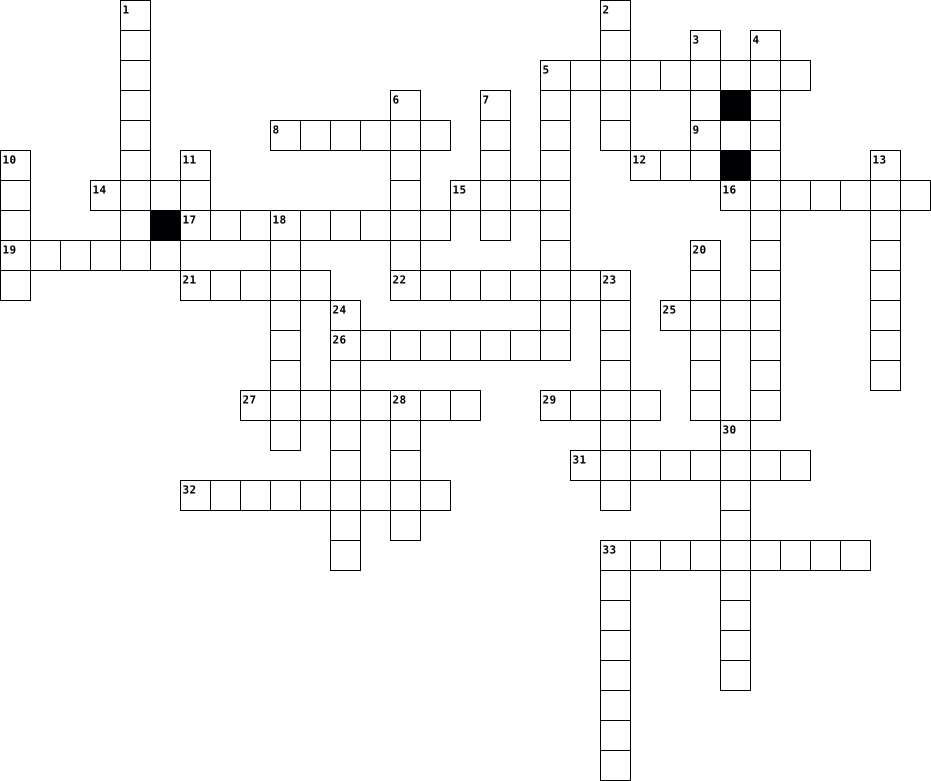
Across
- When a solvent is not able to dissolve more solute
- A positively charged ion
- How many oxygen atoms are in carbon monoxide
- A particle that has an electric charge
- Boron has an atomic number of ____
- Baking soda is a ____
- Milk is a ____
- The solvent ____ the solute
- Carbon + ____ = Carbon dioxide
- Helium is a ____ gas
- What element does Ti stand for
- Bases turn litmus paper ____
- Acids produce ____ ions
- Chlorine is a ____
- Orange juice is an ____
- A base is ____
- How many nonmetals are on the periodic table
- Silicon is a ____
Down
- Bases produce ____ ions
- What is the "Universal Solvent"
- Rn stands for what on the periodic table
- Sand and water make a ____ mixture
- Chalk powder in water is a ____
- Does the dissolving
- Platinum is a ____
- A negatively charged ion
- Acids turn litmus paper ____
- Where are the noble gases found on the periodic table
- Sugar and water create a ____
- Dissolves into another substance
- When balancing an equation you ____
- The study of matter
- Lithium has an atomic number of ____
- Fluoride and ____ create BeF2
- H2O is a ____
35 Clues: H2O is a ____ • Milk is a ____ • A base is ____ • Silicon is a ____ • Platinum is a ____ • Chlorine is a ____ • Does the dissolving • The study of matter • Helium is a ____ gas • Baking soda is a ____ • Bases produce ____ ions • Acids produce ____ ions • Orange juice is an ____ • A positively charged ion • A negatively charged ion • The solvent ____ the solute • Acids turn litmus paper ____ • ...
PS Exam Review CW 1 2023-05-26

Across
- carbon-14 has a mass # of?
- carbon-14 has this many neutrons?
- this family has 7 valence electrons
- transition metals have this many valence electrons
- carbon has this many valence electrons
- what rows on the periodic table are called
- where electrons reside in the atom?
- _____ metals are the most reactive metals on the periodic table
- an isotope has the same # of protons but a different # of neutrons
- negatively charged subatomic particle
- negatively charged ion that gains electrons
- ______ electrons reside in the outermost orbital
- ______ number tells how many proton sin an element
- nitrogen has this many electrons?
Down
- to get the mass # you have to ______ the average atomic mass
- positive center of the atom
- neutral subatomic particle
- ______ gases are in group 8A and are inert
- groups or _______ are the columns on the periodic table
- atomic # tells how many electrons in a neutral element
- positively charged subatomic particle
- # of neutrons in phosphorous
- this element in period 2 forms an ion with a -2 charge
- carbon-14 has this many protons?
- positively charged ion that loses electrons
- _____ number is equal to the protons + the neutrons in an element
26 Clues: carbon-14 has a mass # of? • neutral subatomic particle • positive center of the atom • # of neutrons in phosphorous • carbon-14 has this many protons? • carbon-14 has this many neutrons? • nitrogen has this many electrons? • this family has 7 valence electrons • where electrons reside in the atom? • positively charged subatomic particle • negatively charged subatomic particle • ...
Science STAAR Review 2023-04-19

Across
- when an object is NOT moving, the forces are ____
- energy in motion; highest at the bottom of hill or ramp
- the amount of time for a moon phase to go from full moon to 3rd quarter
- same as speed BUT with DIRECTION
- characteristic of metals that makes it easy to pound into sheets
- an atom with 1 or 7 valence electrons
- stored energy; highest at the top of a hill or ramp
- genetic material found in nucleus of cell 46 in humans
- positive subatomic particle found in nucleus
- rows on the periodic table; each row gets a new energy level
- groups or columns on the periodic table; most closely related
Down
- found by M-A=N, mass # minus atomic # equals this
- negatively charged subatomic particle found in the electron cloud; deals with reactivity
- energy source for all living things on Earth
- light is on the left for moon phases, appears smaller each night
- most of the elements on periodic table
- the non-living factors in the environment
- organisms that make their own food
- organelle in cell that makes energy ATP
- light is on the right for moon phases, appears larger each night
20 Clues: same as speed BUT with DIRECTION • organisms that make their own food • an atom with 1 or 7 valence electrons • most of the elements on periodic table • organelle in cell that makes energy ATP • the non-living factors in the environment • energy source for all living things on Earth • positive subatomic particle found in nucleus • ...
The Periodic Table 2024-10-12

Across
- These elements have a full valence shell of electrons.
- The first element to be made artificially.
- The second most prevalent element in the universe.
- The atoms of this element have 12 protons in their nuclei.
- This element is known to form up to 10 million different compounds.
- The element named after the woman who discovered radioactivity.
- Valence electrons determine an element's ________.
- The elements were formed by nuclear reactions inside ________.
- The rows in the periodic table are called ________.
- Uranium was named soon after the discovery of ________.
- The first element in the periodic table.
Down
- Sodium and Potassium are found in which group of metals?
- This is the lightest of all the metals and can easily float on water.
- Each element in table is represented by a unique ________.
- The shiny silver metal that is liquid at room temperature is ________.
- Subtracting the atomic number from the mass number gives you the number of ________.
- The columns in the periodic table are called ________.
- This element is named after one of the most famous scientists of all time.
- Fe is the symbol for which element?
- A molecule of water contains 2 hydrogen atoms bonded to one atom of this element.
20 Clues: Fe is the symbol for which element? • The first element in the periodic table. • The first element to be made artificially. • The second most prevalent element in the universe. • Valence electrons determine an element's ________. • The rows in the periodic table are called ________. • These elements have a full valence shell of electrons. • ...
Elements and Atoms 2025-04-07

Across
- particle that has no charge
- particle that has a negative charge
- horizontal row of elements in the periodic table
- place in an electron cloud where an electron is most likely to be found
- able to be hammered into different shapes
- total mass of the protons and neutrons in an atom measured in amu
- to be drawn into thin wires
- vertical column of elements in the periodic table
- shortened way of writing the name of an element
- make up Group 17
Down
- make up Group 18
- particle that has a positive charge
- atom of an element with the same number of protons as other atoms, different number of neutrons
- number of protons in the nucleus of an atom
- repeating pattern
- cannot be chemically broken down into smaller substances
- element that lacks most of the properties of a metal
- smallest part of an element that can be identified as that element
- numbers of protons and neutrons in the nucleus of an atom
- center or core of an atom
- element that has the property of shiny luster, ductility, & malleability
- way a material reflects light
22 Clues: make up Group 18 • make up Group 17 • repeating pattern • center or core of an atom • particle that has no charge • to be drawn into thin wires • way a material reflects light • particle that has a positive charge • particle that has a negative charge • able to be hammered into different shapes • number of protons in the nucleus of an atom • ...
atomic structure 2025-09-26

Across
- A row on the periodic table that describes the number of shells an atom has.
- protons and neutrons have this but electrons have very little
- the neutral sub atomic particle
- when you have an equation and you have added numbers to make it ____________
- The surname of the scientist who discovered atoms were mostly empty space
- Where protons and neutrons are found
- A molecule of Magnesium carbon and oxygen
- what the particles did if they were influenced by the nucleus
- an atom of the same element but a different number of neutrons
- created the model that describes electrons being in shells
- has an electron configuration of 2,8,1
Down
- the positively charged subatomic particle
- What electrons travel on
- Electrons are ordered like this as 2,8,8,2
- The particle fired at the gold foil to prove an atom was mostly empty space.
- the negatively charged subatomic particle
- A molecule of Sodium and Chlorine
- The creator of the periodic table.
- a column of the periodic table where they all have similar properties due to the number of electrons on the outer shell.
- A charged particle that has gained or lost electrons
20 Clues: What electrons travel on • the neutral sub atomic particle • A molecule of Sodium and Chlorine • The creator of the periodic table. • Where protons and neutrons are found • has an electron configuration of 2,8,1 • the positively charged subatomic particle • the negatively charged subatomic particle • A molecule of Magnesium carbon and oxygen • ...
Atoms 2021-02-01

Across
- the number that tells us the mass of an atom.
- the relative mass of protons and neutrons
- where all the elements are arranged in order.
- the part of the atom with no charge
- a type of atom that only has one proton and one electron
- the part of the atom with a negative charge
- where the protons and neutrons are found
- a horizontal row in the periodic table going from left to right.
Down
- a scientific word used to describe a substance.
- creator of the periodic table.
- the positively charged part of the atom
- the simplest type of substance, mad of one type of atom.
- the number that tells us the amount of protons in an atom.
- where the electrons are found
- made of two types of atom but not chemically joined
- a vertical column in the periodic table going from top to bottom
- made of two types of atoms chemically joined together
17 Clues: where the electrons are found • creator of the periodic table. • the part of the atom with no charge • the positively charged part of the atom • where the protons and neutrons are found • the relative mass of protons and neutrons • the part of the atom with a negative charge • the number that tells us the mass of an atom. • where all the elements are arranged in order. • ...
The Periodic Table 2017-11-12

Across
- The Group 1 metal that has the highest melting point.
- If a metal can be drawn into a wire, it is classed as being _________.
- Metals are good conductors of _________ and heat.
- If a metal rings when struck it is classed as being ___________.
- The most reactive Group 7 element.
- The Group 1 elements are known as the __________ metals.
- The Group 7 elements are known as the __________.
- Metals generally have ________ melting points.
Down
- Iron, magnesium and copper are examples of this material.
- The horizontal rows on the Periodic Table are called ________.
- Iron, cobalt and nickel are the only metals that are ___________.
- If a metal can be hammered into shape without cracking, it is classed as being ___________.
- A _________ property is how a substance behaves.
- A _________ property can be measured.
- The Group 0 elements are known as the __________ gases.
- The _________ table arranges the elements in order of their atomic number.
- The vertical columns on the Periodic Table are called _________.
17 Clues: The most reactive Group 7 element. • A _________ property can be measured. • Metals generally have ________ melting points. • A _________ property is how a substance behaves. • Metals are good conductors of _________ and heat. • The Group 7 elements are known as the __________. • The Group 1 metal that has the highest melting point. • ...
ATOMS 2019-11-08

Across
- Shorter version of Atomic Mass Unit.
- What is the shorter word for the element Cerium.
- The mass of an atom.
- Is Bromine solid,liquid,or gas.
- The number of proton for Oxygen.
- The region of negative charge surrounding an atomic nucleus that is associated with an atomic orbital.
- A stable subatomic particle occurring in all atomic nuclei, with a positive electric charge.
- What number of group is Noble Gasses in the periodic table.
- IS Gold solid,liquid,or gas.
Down
- The basic unit of a chemical element.
- A thing that is composed of two or more separate elements; a mixture.
- The number of protons in the nucleus of an atom.
- Name of group two on the periodic table.
- A stable subatomic particle with a charge of negative electricity.
- What does Fe stand for in the periodic table.
- The positively charged central core of an atom.
- A part or aspect of something abstract, especially one that is essential or characteristic.
17 Clues: The mass of an atom. • IS Gold solid,liquid,or gas. • Is Bromine solid,liquid,or gas. • The number of proton for Oxygen. • Shorter version of Atomic Mass Unit. • The basic unit of a chemical element. • Name of group two on the periodic table. • What does Fe stand for in the periodic table. • The positively charged central core of an atom. • ...
8th Revision 22-23 Part 2 2023-03-18

Across
- What is the process by which liquid is converted to gas?
- the substance that dissolves in a solution.
- What is the process by which solid is converted to liquid?
- The substance in which the solute dissolves.
- element symbol has a number above it on periodic table.
- Water is a __________.
- atomic number = number of ______.
- Group 18.
- Green plants make their own food in their leaves, but plants also transform energy from the sun into leaves, roots, seeds, and all plant tissues
- What is the process by which liquid is converted to solid?
Down
- vertical column of the periodic table.
- Hydrogen is an ______.
- NaCl is a _____.
- made up of two or more different substances which are mixed but are not combined chemically and do not lose their own physical properties.
- element symbol has a number below it on periodic table.
- How many diatomic elements are there?
- horizontal row of the periodical table.
- Oil and water is an example for _____ liquid.
18 Clues: Group 18. • NaCl is a _____. • Water is a __________. • Hydrogen is an ______. • atomic number = number of ______. • How many diatomic elements are there? • vertical column of the periodic table. • horizontal row of the periodical table. • the substance that dissolves in a solution. • The substance in which the solute dissolves. • Oil and water is an example for _____ liquid. • ...
C1 Atomic structure and the Periodic table - Periodic Table 2024-06-26

Across
- What colour flame does sodium burn with?
- Which scientist left gaps for elements that hadn't been discovered?
- What metals are found in the group 1?
- What do we call columns in the periodic table?
- Elements in the same group share the same __________ ?
- What colour gas is chlorine?
- Elements are arranged in order of their ______ numbers in the periodic table.
- What colour gas is fluorine?
- What happens to the reactivity of the alkali metals as you go down the group?
Down
- What happens to the reactivity of the halogens as you go down group 7?
- What type of ions do non-metals form?
- The ________ gases are found in group 0.
- The nobles gases are very unreactive because they have a _____ outer shell?
- What colour flame does lithium burn with?
- What do we call all of the elements found in group 7?
- What do we call rows in the periodic table?
- What colour flame does potassium burn with?
- What type of ions do metals form?
18 Clues: What colour gas is chlorine? • What colour gas is fluorine? • What type of ions do metals form? • What type of ions do non-metals form? • What metals are found in the group 1? • The ________ gases are found in group 0. • What colour flame does sodium burn with? • What colour flame does lithium burn with? • What do we call rows in the periodic table? • ...
Chemistry Crossword 2022-05-02

Across
- In a covalent bond, electrons are __________ to become stable.
- Another term for "sea of electrons".
- The non-metals are located on the __________ side of the periodic table of elements.
- There are transferred electrons in a(n) __________ bond.
- The __________ are on the left side of the periodic table of elements
- Xenon is on the 18th __________ of the periodic table of elements.
Down
- The carbon (C) atom has 6 __________ because carbon is on the 16 group of the periodic table of elements.
- Gilbert _________ discovered the electron dot diagram.
- Helium is a __________ because it is chemically stable by itself.
- One picometer is equal to one-__________ of a meter.
- Ammonia is a __________ because it is made up of two or more different kinds of atoms joined together by chemical bonds.
- Water is a __________ molecule because it has an uneven distribution of atoms, there is a positive side and a negative one.
- Methane is __________ because the hydrogen atoms are equally distributed around the one carbon atom.
13 Clues: Another term for "sea of electrons". • One picometer is equal to one-__________ of a meter. • Gilbert _________ discovered the electron dot diagram. • There are transferred electrons in a(n) __________ bond. • In a covalent bond, electrons are __________ to become stable. • Helium is a __________ because it is chemically stable by itself. • ...
Unit 8 Atom 2026-03-01

Across
- Find the amount of these by looking at the period number on the periodic table
- The smallest particle of matter that makes up an element
- Has a neutral charge and are in the nucleus with a mass of 1 amu
- Determine element
- Model of an atom that shows the shells of the electrons around the nucleus
- Represents the number of protons on a periodic cell
- Notation set up as mass number on top, atomic number on bottom, and the element symbol to the right
Down
- Find the amount of these by looking at the group number on the periodic table
- Atoms of the same element that have different numbers of neutrons
- Has a positive charge and are in the nucleus with a mass of 1 amu
- The total number of protons and neutrons in an atom's nucleus
- Notation set up as Element name-Mass number
- Weighted average of naturally occurring isotopes that can be found on a periodic table cell
- Determine ion
- Has a negative charge and is in the orbitals around the nucleus of an atom with a mass of 0 amu
- Determine isotope
16 Clues: Determine ion • Determine element • Determine isotope • Notation set up as Element name-Mass number • Represents the number of protons on a periodic cell • The smallest particle of matter that makes up an element • The total number of protons and neutrons in an atom's nucleus • Has a neutral charge and are in the nucleus with a mass of 1 amu • ...
periodic table 2022-12-14

Across
- sn
- ru
- po
- ra
- k
- h
- sc
- ac
Down
- ti
- u
- nb
- og
- ba
- fr
- b
- ta
- zn
17 Clues: u • b • k • h • ti • sn • ru • nb • po • og • ba • fr • ra • ta • sc • zn • ac
Periodic Table! 2013-04-30

Across
- based around how many control you visit.
- in gasoline
- the room was solid from 8.30 and the full sign was flashing red
- it is found in Australia, Brazil, India, Russia and the United States.
- atom was in use in atomic clocks.
- alloys by the eastern zhou period.
- is obtained commercially as bromide and chloride
- it is found everywhere.
Down
- plants produce it
- at a temperature just above absolute zero would be useful.
- in the blood.
- nitride.
- bonded layers that form, providing the driving force for the process.
- valproate had received some bad press recently, which she felt was mostly undeserved.
- metal hydride.
- amalgam some years ago.
- gate onto a cobbled road.
17 Clues: nitride. • in the blood. • in gasoline • metal hydride. • plants produce it • amalgam some years ago. • gate onto a cobbled road. • it is found everywhere. • alloys by the eastern zhou period. • atom was in use in atomic clocks. • based around how many control you visit. • is obtained commercially as bromide and chloride • ...
Periodic Table 2013-11-26

Across
- solid material that is typically hard and shiny
- element whose properties are intermediate between those of metals and solid nonmetals
- of atoms bonded together
- Bond/mutual attraction between two atoms resulting from a redistribution of their outer electrons
- Bond/ chemical bond in which electrons are shared over many nuclei and electronic conduction occurs
- atom or molecule with a net electric charge due to the loss or gain of one or more electrons
- Bond/chemical bond in which one atom loses an electron to form a positive ion and the other atom gains an electron to form a negative ion
- or number used to identify an element
- Electrons/electron in the outer shell of an atom which can combine with other atoms to form molecules
- element or substance that is not a metal
Down
- Dot Diagram/ representation of an atom in which only the valence electrons are illustrated
- Mass/equivalent to the number of protons and neutrons in the atom
- of two atoms
- a column of elements
- a row of elements
- Bond/ chemical bond that involves sharing a pair of electrons between atoms in a molecule
- Structure/diagrams that show the bonding between atoms of a molecule and the lone pairs of electrons that may exist in the molecule
17 Clues: of two atoms • a row of elements • a column of elements • of atoms bonded together • or number used to identify an element • element or substance that is not a metal • solid material that is typically hard and shiny • Mass/equivalent to the number of protons and neutrons in the atom • element whose properties are intermediate between those of metals and solid nonmetals • ...
Periodic Table 2022-02-22

Across
- C
- Pb
- Fe
- Mn
- Sn
- Al
- Na
- Cu
- S
Down
- Ca
- Cl
- K
- Mg
- Cr
- Xe
- Zn
- Ba
17 Clues: K • C • S • Ca • Cl • Mg • Cr • Pb • Fe • Xe • Mn • Zn • Sn • Ba • Al • Na • Cu
periodic table 2026-01-26

Across
- Clue- made up of elements
- Clue- what is one element we need the most?
- Clue- The number of protons
- Clue- Makes or changes a substance
- Clue- Describes a reaction
- Clue- The number that represents it
- Clue- How many families are there?
- Clue- The mass of a single atom
- Clue- cannot be broken down
- Clue- Represents how many molecules you have
Down
- Clue- A change in shape, form, or state of matter
- Clue- When a substance isnt uniformed
- Clue- made up of 2+ atoms
- Clue- When a substance is uniform throughout
- Clue- Represents how many atoms are in each element
- Clue- A combination of 2 substances
- Clue- who made a part of the periodic table
17 Clues: Clue- made up of elements • Clue- made up of 2+ atoms • Clue- The number of protons • Clue- cannot be broken down • Clue- The mass of a single atom • Clue- Makes or changes a substance • Clue- How many families are there? • Clue- The number that represents it • Clue- A combination of 2 substances • Clue- When a substance isnt uniformed • Clue- Describes a reaction • ...
Periodic table 2025-12-03

Across
- A small group of atoms joined together by chemical bonds, like H₂O.
- The one- or two-letter abbreviation used to represent an element (e.g., He or Ag).
- The bond type formed by the sharing of electrons, typical between two nonmetal atoms.
- The subatomic particle that is transferred, shared, or forms a ""sea"" during a chemical bond.
- The type of bond formed by the transfer of electrons from a metal to a nonmetal, creating positive and negative charges.
- Elements that are shiny, malleable, and good conductors of heat and electricity.
- The large chart where all known elements are organized by atomic number and properties.
- The elements in Group 17, known for being ""Corrosive Thieves"" that need one electron.
Down
- A pure substance made of only one type of atom (e.g., Carbon or Sulfur).
- Elements that lack metallic properties and typically gain or share electrons.
- The horizontal rows in the periodic table, which indicate how many electron shells an element has.
- The type of bond where metal atoms share their outer electrons in a ""sea of electrons,"" explaining why metals are flexible.
- The basic unit of a chemical element.
- A substance formed when two or more different elements are chemically bonded together, like NaCl.
- The elements in Group 18, often called ""The Lonely Emos"" because they are stable and non-reactive.
- The vertical columns in the periodic table; elements here have similar ""personalities.
- A solid structure in which atoms or molecules are placed in a perfect, ordered, repeating pattern, like in table salt.
17 Clues: The basic unit of a chemical element. • A small group of atoms joined together by chemical bonds, like H₂O. • A pure substance made of only one type of atom (e.g., Carbon or Sulfur). • Elements that lack metallic properties and typically gain or share electrons. • Elements that are shiny, malleable, and good conductors of heat and electricity. • ...
Tabelul periodic 2025-09-02

Across
- He
- O
- N
- P
- Si
- Cu
- C
- Na
- Pb
Down
- Ca
- H
- K
- Au
- Zn
- Fe
- Mg
- Cl
17 Clues: H • K • O • N • P • C • Ca • He • Au • Zn • Fe • Mg • Si • Cu • Cl • Na • Pb
Periodic Table Vocabulary 2021-10-04

Across
- all nonmetals very reactive. poor conductors of heat and electricity tend to form salts with metals (7 outer level electrons)
- The average mass of all the isotopes of an element
- Groups 3-12, 1-2 electrons in the outer energy level, less reactive than alsali-earth metals, shiny, good conductor of thermal energy and electrical current, high density
- metallic elements in group 2 of the periodic table which are harder than the alkali metals and are also less reactive
- electrons in the outermost shell
- vertical columns on the periodic table
- gasses Elements in group 8A of the periodic table. Have no charge and are gases under normal conditions.
Down
- Group 1, 1 electron in outer level, very reactive, soft, silver, shiny, low density
- Horizontal rows on the periodic table
- the property that describes how readily a substance combines chemically with other substances
- Elements that have properties of both metals and nonmetals
- Elements that are not metals, poor conductors of heat and electric current
- the number of protons in an atom
13 Clues: the number of protons in an atom • electrons in the outermost shell • Horizontal rows on the periodic table • vertical columns on the periodic table • The average mass of all the isotopes of an element • Elements that have properties of both metals and nonmetals • Elements that are not metals, poor conductors of heat and electric current • ...
Periodic Table Vocabulary 2021-10-04

Across
- all nonmetals very reactive. poor conductors of heat and electricity tend to form salts with metals (7 outer level electrons)
- The average mass of all the isotopes of an element
- Groups 3-12, 1-2 electrons in the outer energy level, less reactive than alsali-earth metals, shiny, good conductor of thermal energy and electrical current, high density
- metallic elements in group 2 of the periodic table which are harder than the alkali metals and are also less reactive
- electrons in the outermost shell
- vertical columns on the periodic table
- gasses Elements in group 8A of the periodic table. Have no charge and are gases under normal conditions.
Down
- Group 1, 1 electron in outer level, very reactive, soft, silver, shiny, low density
- Horizontal rows on the periodic table
- the property that describes how readily a substance combines chemically with other substances
- Elements that have properties of both metals and nonmetals
- Elements that are not metals, poor conductors of heat and electric current
- the number of protons in an atom
13 Clues: the number of protons in an atom • electrons in the outermost shell • Horizontal rows on the periodic table • vertical columns on the periodic table • The average mass of all the isotopes of an element • Elements that have properties of both metals and nonmetals • Elements that are not metals, poor conductors of heat and electric current • ...
science topic's crossword by Nathan Shaw 2013-11-12

Across
- creats protean in a cell
- contains DNA in a cell
- the green in a plant cell
- PB on the periodic table
- the O in H2o
Down
- FE on the periodic table
- what it is called when particles spread out
- what it is called when two element's atoms connect
- contains cell sap in a plant cell
- the element on its own on the periodic table
10 Clues: the O in H2o • contains DNA in a cell • FE on the periodic table • creats protean in a cell • PB on the periodic table • the green in a plant cell • contains cell sap in a plant cell • what it is called when particles spread out • the element on its own on the periodic table • what it is called when two element's atoms connect
Element 2023-05-08

Across
- A negatively charged particle
- combination of two or more materials
- located on the left side of the periodic table
- located on the right side of the periodic table
- positively charged center of an atom
Down
- Gases Elements in family 18
- A positively charged particle
- Table A tool used by chemists
- forms when two or more atoms combine
- display properties of both metals and nonmetals
10 Clues: Gases Elements in family 18 • A positively charged particle • A negatively charged particle • Table A tool used by chemists • combination of two or more materials • forms when two or more atoms combine • positively charged center of an atom • located on the left side of the periodic table • display properties of both metals and nonmetals • ...
Periodic table crossword 2023-08-25

Across
- on right This is found where___
- tool Makes the periodic table invaluable___
- The man in 1969 who invented the periodic table___
- The atomic number___
- on left This is found where___
- The one to two letter symbol representing an element___
Down
- the s and p blocks are known as the___
- what seven rows are called___
- table Tells all of the elements___
- You can predict a lot about the chemical___
- each row corresponds to a different___
- Most elements are___
12 Clues: The atomic number___ • Most elements are___ • what seven rows are called___ • on left This is found where___ • on right This is found where___ • table Tells all of the elements___ • each row corresponds to a different___ • the s and p blocks are known as the___ • You can predict a lot about the chemical___ • tool Makes the periodic table invaluable___ • ...
Periodic table crossword 2023-08-25

Across
- on right This is found where___
- tool Makes the periodic table invaluable___
- The man in 1969 who invented the periodic table___
- The atomic number___
- on left This is found where___
- The one to two letter symbol representing an element___
Down
- the s and p blocks are known as the___
- what seven rows are called___
- table Tells all of the elements___
- You can predict a lot about the chemical___
- each row corresponds to a different___
- Most elements are___
12 Clues: The atomic number___ • Most elements are___ • what seven rows are called___ • on left This is found where___ • on right This is found where___ • table Tells all of the elements___ • each row corresponds to a different___ • the s and p blocks are known as the___ • You can predict a lot about the chemical___ • tool Makes the periodic table invaluable___ • ...
Periodic atomic tic tac toe 2021-02-12

Across
- has a atomic nummber 9
- element next to iodine in the periodic table
Down
- element below plata in the periodic table
- its between thallium and bismuth in the periodic table
- next to flourine in periodic table
- element between indium and antimony in the periodic table
- item in the periodic table
7 Clues: has a atomic nummber 9 • item in the periodic table • next to flourine in periodic table • element below plata in the periodic table • element next to iodine in the periodic table • its between thallium and bismuth in the periodic table • element between indium and antimony in the periodic table
Vocabulary Chapter 4 2023-10-17

Across
- the electrons in the outermost energy level of a neutral atom.
- They have one valence electron, which they can easily lose to form a 1+ cation
- a set of elements in the same column on the periodic table.
- the properties of the elements vary in a periodic way with their atomic numbers.
- the distance from the center of an atom’s nucleus to the electrons in its outermost energy level. T
- These elements each have seven valence electrons.
- These groups are also named for the first element in each family.
- consists of the element’s chemical symbol surrounded by the atom’s valence electrons.
- These elements typically have four or more valence electrons and do not exhibit the general properties of metals.
Down
- They typically have two valence electrons, and so they form 2+ cations.
- Almost 80% of elements are metals, which have few valence electrons.
- They each have two valence electrons, which they tend to lose, making them 2+ cations.
- The measure of an element’s ability to attract and hold electrons when bonded to other atoms
- These elements have characteristics between those of metals and nonmetals.
- a table of the chemical elements arranged in a way that displays their periodic properties in relationship to their atomic numbers.
- The elements in this group have eight valence electrons
- a row on the periodic table
- a set of elements in the same column on the periodic table.
- Most of these elements have one or two valence electrons
19 Clues: a row on the periodic table • These elements each have seven valence electrons. • The elements in this group have eight valence electrons • Most of these elements have one or two valence electrons • a set of elements in the same column on the periodic table. • a set of elements in the same column on the periodic table. • ...
Vocabulary Chapter 4 2023-10-17

Across
- the electrons in the outermost energy level of a neutral atom.
- They have one valence electron, which they can easily lose to form a 1+ cation
- a set of elements in the same column on the periodic table.
- the properties of the elements vary in a periodic way with their atomic numbers.
- the distance from the center of an atom’s nucleus to the electrons in its outermost energy level. T
- These elements each have seven valence electrons.
- These groups are also named for the first element in each family.
- consists of the element’s chemical symbol surrounded by the atom’s valence electrons.
- These elements typically have four or more valence electrons and do not exhibit the general properties of metals.
Down
- They typically have two valence electrons, and so they form 2+ cations.
- Almost 80% of elements are metals, which have few valence electrons.
- They each have two valence electrons, which they tend to lose, making them 2+ cations.
- The measure of an element’s ability to attract and hold electrons when bonded to other atoms
- These elements have characteristics between those of metals and nonmetals.
- a table of the chemical elements arranged in a way that displays their periodic properties in relationship to their atomic numbers.
- The elements in this group have eight valence electrons
- a row on the periodic table
- a set of elements in the same column on the periodic table.
- Most of these elements have one or two valence electrons
19 Clues: a row on the periodic table • These elements each have seven valence electrons. • The elements in this group have eight valence electrons • Most of these elements have one or two valence electrons • a set of elements in the same column on the periodic table. • a set of elements in the same column on the periodic table. • ...
Vocabulary Chapter 4 2023-10-17

Across
- the electrons in the outermost energy level of a neutral atom.
- They have one valence electron, which they can easily lose to form a 1+ cation
- a set of elements in the same column on the periodic table.
- the properties of the elements vary in a periodic way with their atomic numbers.
- the distance from the center of an atom’s nucleus to the electrons in its outermost energy level. T
- These elements each have seven valence electrons.
- These groups are also named for the first element in each family.
- consists of the element’s chemical symbol surrounded by the atom’s valence electrons.
- These elements typically have four or more valence electrons and do not exhibit the general properties of metals.
Down
- They typically have two valence electrons, and so they form 2+ cations.
- Almost 80% of elements are metals, which have few valence electrons.
- They each have two valence electrons, which they tend to lose, making them 2+ cations.
- The measure of an element’s ability to attract and hold electrons when bonded to other atoms
- These elements have characteristics between those of metals and nonmetals.
- a table of the chemical elements arranged in a way that displays their periodic properties in relationship to their atomic numbers.
- The elements in this group have eight valence electrons
- a row on the periodic table
- a set of elements in the same column on the periodic table.
- Most of these elements have one or two valence electrons
19 Clues: a row on the periodic table • These elements each have seven valence electrons. • The elements in this group have eight valence electrons • Most of these elements have one or two valence electrons • a set of elements in the same column on the periodic table. • a set of elements in the same column on the periodic table. • ...
chemistry crossword 2015-11-24

Across
- characteristics that describe a particular substance (e.g. colour, lustre, melting point)
- group 1 elements in the periodic table, not including hydrogen
- change in the appearance or state of a substance that does not change the composition
- pure substance formed when at least one metal and one non-metal combine
- anything that has mass and occupies space
- pure substance formed when non-metals combine
- netrual particle in the nucleus of an atom
- vertical column of elements in the periodic table
- positively charged centre of an atom; contains protons and neutrons
- a system of easy-to-see warning symbols on hazardous materials
Down
- horizontal row of elements in the periodic table
- positively charged particle in the nucleus of an atom
- a table in which the elements are organized by their physical and chemical properties
- group 17 elements in the periodic table
- combination of symbols that represent a compound
- occurs when two or more materials react and create new materials
- the ability of a substance to conduct electricity or heat
- mass of one atom of an element calculated from the total number of protons, neutrons, electrons of that atom
- a chemical reaction that occurs when oxygen reacts with a substance to form a new substance and give off energy
- made of only one kind of matter
- amount of mass in a given volume of a substance
- group of atoms joined by covalent bonds
- group of atoms acting as one
- a reaction that takes place when two or more substances react to form new substances
- measure of one atomic mass
25 Clues: measure of one atomic mass • group of atoms acting as one • made of only one kind of matter • group 17 elements in the periodic table • group of atoms joined by covalent bonds • anything that has mass and occupies space • netrual particle in the nucleus of an atom • pure substance formed when non-metals combine • amount of mass in a given volume of a substance • ...
Matter 2021-02-16
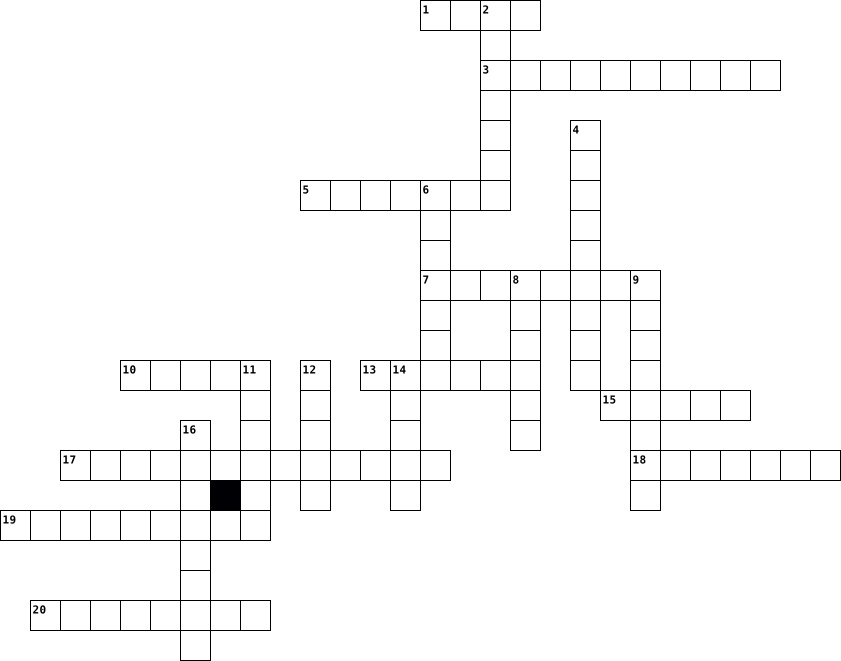
Across
- number - the total number of protons and neutrons in an atomic nucleus.
- - an element whose properties are intermediate between those of metals and solid non-metals or semiconductors.
- - a specialized structure occurring in most cells
- - a group of two or more atoms that form the smallest identifiable unit into which a pure substance
- - column in the periodic table of the chemical elements.
- - anything that has mass and volume
- - smallest unit into which matter can be divided without the release of electrically charged particles.
- - the abundance of a constituent divided by the total volume of a mixture.
- - the spontaneous passage or diffusion of water or other solvents through a semipermeable membrane
- - process resulting from random motion of molecules by which there is a net flow of matter from a region of high concentration to a region of low concentration
- earth - metal, any of the six chemical elements that comprise Group 2 of the periodic table.
Down
- - a notation of one or two letters representing a chemical element.
- - any substance composed of identical molecules consisting of atoms of two or more chemical elements.
- - any substance that cannot be decomposed into simpler substances by ordinary chemical processes.
- - the capacity for doing work.
- - a stable subatomic particle with a charge of negative electricity, found in all atoms and acting as the primary carrier of electricity in solids.
- number - the number of a chemical element in the periodic system
- - an element that readily forms positive ions and has metallic bonds.
- - metallic substance composed of two or more elements, as either a compound or a solution.
- table - a tabular display of the chemical elements, which are arranged by atomic number
20 Clues: - the capacity for doing work. • - anything that has mass and volume • - a specialized structure occurring in most cells • - column in the periodic table of the chemical elements. • number - the number of a chemical element in the periodic system • - a notation of one or two letters representing a chemical element. • ...
Up and Atoms 2021-07-13

Across
- A pure substance made up of chemically combined atoms in a fixed ratio
- Has mass and takes up space
- Columns on the Periodic Table
- The average mass of atoms of an element, calculated using the relative abundance of isotopes in a naturally-occurring element.
- Unstable isotopes that decay by releasing radiation
- Neutral particle in the nucleus of the atom
- A table containing all the known elements in order of atomic number
- An impure substance made up of pure substances physically mixed.
- Elements on the right side of the Periodic Table
- Radiactive decay made up of gamma rays
- Levels where electrons are found
- Negative particle of the atom that orbits the nucleus
- Atoms with the same atomic number and different mass number
- The time taken for the radioactivity of a specified isotope to fall to half its original value.
Down
- The dense centre of an atom containing protons and neutrons
- Also called semi-metals, have some properties of both metals and non-metals
- Building blocks of matter
- The mass of an atom calculated by adding the number of neutrons to the number of protons for an atom
- Positive particle in the nucleus of an atom
- Elements on the left side of the Periodic Table
- Radioactive decay made up of a helium nucleus
- Radiation released due to the decay of the nucleus of an atom
- The number of protons in an atom of a particular element
- Rows on the Periodic Table
- Radioactive decay made up of an electron
- An atom that has lost or gained electrons
26 Clues: Building blocks of matter • Rows on the Periodic Table • Has mass and takes up space • Columns on the Periodic Table • Levels where electrons are found • Radiactive decay made up of gamma rays • Radioactive decay made up of an electron • An atom that has lost or gained electrons • Positive particle in the nucleus of an atom • Neutral particle in the nucleus of the atom • ...
Physical Science Semester 1 review 2020-12-05

Across
- the spontaneous process in which an atomic nucleus emits radiation
- this element radioactively decays into Lead
- number of electron energy levels and also the number of rows in the periodic table
- chemicals listed to the left of the arrow in a chemical reaction
- center of an atom
- atoms with the same number of protons but different number of neutrons
- adding this to a reaction can speed it up
- these gases do not react because they are completely stable on their own
- number of electrons the 2nd energy level can hold
- the bonding where electrons are transferred
- it takes the most energy to get this color
- ability of an atom to attract electrons to itself
- neutrons have this charge
- color with the lowest energy
- number of protons
- when a chemical reaction takes in heat
- anything that takes up space and has mass
- a charged particle
Down
- chemicals listed to the right of the arrow in a chemical reaction
- adding protons and neutrons
- when a chemical reaction releases energy
- when an electron gains energy, it moves from a grounded state to this state
- the middle part of the periodic table, which we colored red, are these metals
- Column 1 of the periodic table are these types of metals
- the reason atoms combine with each other
- the bonding where electrons are shared
- protons have this charge
- electrons have this charge
- orbit the nucleus
- father of the Periodic Table of Elements
- the amount of time it takes for one half of a sample to decay
- the conservation of ______ says that matter cannot be created or destroyed
- another name for electron energy levels
- outer electrons can be called this
34 Clues: center of an atom • orbit the nucleus • number of protons • a charged particle • protons have this charge • neutrons have this charge • electrons have this charge • adding protons and neutrons • color with the lowest energy • outer electrons can be called this • the bonding where electrons are shared • when a chemical reaction takes in heat • another name for electron energy levels • ...
Test 1 Practice 2025-03-06

Across
- "Category of element that is conductive, and malleable, making it useful in wires"
- "Type of mixture whose parts you can tell apart visually and/or separate out physically"
- "Type of mixture whose parts you can't tell apart visually or filter out physically"
- "A pure substance made from multiple different elements bonded together"
- "Category of metal that contains elements like nitrogen, carbon, and oxygen"
- "The type of table used to identify elements based on their properties and masses"
- "Category of metal that shares properties of both metals and nonmetals"
- "Phase of matter with a heat energy so high that it loses electrons"
- "Element with 18 protons"
- "Phase of matter that takes the shape AND volume of its container"
- "PPE that protects your hands"
- "Symbol for sodium on periodic table"
- "Atoms of the same element but different masses, due to an abnormal number of neutrons"
- "Phase of matter with the lowest heat energy"
Down
- "Gender of Mr. Filoteo's new baby due in August"
- "Subatomic particle with no charge"
- "Element with 5 protons"
- "A pure substance from the periodic table with a unique number of protons"
- "Symbol for helium on periodic table"
- "Subatomic particle with a negative charge"
- "Atomic ______: # of protons in an atom"
- "PPE that protects your torso and clothes"
- "The only metal element that is liquid at room temperature"
- "The number of neutrons in a typical lithium atom"
- "Subatomic particle with a positive charge"
- "Lab tool used to measure mass"
- "Atomic ______: # of protons + # of neutrons in an atom"
- "Atoms of an element with a nonzero charge"
- "PPE that protects your eyes"
- "The number of protons in a nitrogen atom"
- "Phase of matter that takes the shape of its container"
31 Clues: "Element with 5 protons" • "Element with 18 protons" • "PPE that protects your eyes" • "PPE that protects your hands" • "Lab tool used to measure mass" • "Subatomic particle with no charge" • "Symbol for helium on periodic table" • "Symbol for sodium on periodic table" • "Atomic ______: # of protons in an atom" • "PPE that protects your torso and clothes" • ...
Atoms, Substances, and the Periodic Table 2025-05-22

Across
- Positive particle in the nucleus
- Chemical _____ is one- or two-letter element code
- Alloy of iron and carbon
- Shiny, conductive, malleable element
- Discovered the electron
- Arranged first periodic table by mass
- _______ electrons are in the outermost shell
- Substance made of one kind of atom
- Vertical column in the periodic table
- First to suggest atoms exist
- _______ particles are protons, neutrons, and electrons
- Found the nucleus using gold foil
- ______ shell is the outermost shell of an atom
- _____ table organizes all known elements
- _____ ray is the beam that led to discovery of electrons
- Central part of an atom
- Alloy of copper and tin
- Electron ______ is the arrangement of electrons in shells
- Proposed modern atomic theory
- ____ particle is an Helium nucleus used in atom experiments
- _____ mass is the verage mass of an element’s atoms
- Mixture of a metal with other elements
- _____ property describes how a substance reacts
- Discovered the neutron
- Described electron clouds using maths
Down
- Likely to form chemical bonds
- Chemical _______ Symbols showing atoms in a substance.
- Type of matter with specific makeup
- Two or more elements chemically joined
- A feature used to describe matter
- Has properties of metals and non-metals
- smallest unit of an element
- _____ property can be observed without changing the substance
- Breaks or shatters when bent
- Tiny negative particle orbiting the nucleus
- Group of atoms bonded together
- Neutral particle in the nucleus
- Said electrons orbit in energy levels
- Horizontal row in the periodic table
- A testable scientific prediction or idea
- Electrically _____ means equal protons and electrons
- ____ pudding is Thomson’s model of the atom
- Can be hammered into shapes
- Can be stretched into a wire
- _____ number is the number of protons in an atom
- Electron _____ is where electrons orbit the nucleus
46 Clues: Discovered the neutron • Discovered the electron • Central part of an atom • Alloy of copper and tin • Alloy of iron and carbon • smallest unit of an element • Can be hammered into shapes • Breaks or shatters when bent • First to suggest atoms exist • Can be stretched into a wire • Likely to form chemical bonds • Proposed modern atomic theory • Group of atoms bonded together • ...
Year 7 Science 2025-12-18

Across
- Sub cellular structure with holes to allow substances to go in or out
- All of an organism's genetic information
- Cells which contain a permanent vacuole and a cell wall
- Represented by Na in the periodic table
- Cells without a permanent vacuole or cell wall
- Any living thing
- Found in the nucleus of all cells
- The M in MRSGREN
- Organisms getting this from their food and drink
- An organism reacting to changes in their environment
- A section of DNA which codes for a certain characteristic
- Two members of the same species can breed to produce offspring
- A solid substance formed out of a solution
- A chemical reaction done by all living things
- Large structures which store DNA in the nucleus
- Sub cellular structure where DNA is stored
- A small group of atoms strongly held together
Down
- A biological molecule required for growth
- A specific type of organism
- The jelly-like sub cellular structure
- Represented by H in the periodic table
- Represented by He in the periodic table
- Particles move from an area of high concentration to an area of low concentration
- A sub cellular structure found only in plant cells
- The smallest building blocks of everything
- Sub cellular structure where respiration takes place
- Something all organisms do with their waste
- Cells with a certain shape, size or structure for their function
- The G in MRSGREN
- Represented by C in the periodic table
- A piece of equipment used to view cells
- Small differences between members of the same species
- The smallest thing which can be alive
33 Clues: Any living thing • The M in MRSGREN • The G in MRSGREN • A specific type of organism • Found in the nucleus of all cells • The jelly-like sub cellular structure • The smallest thing which can be alive • Represented by H in the periodic table • Represented by C in the periodic table • Represented by He in the periodic table • Represented by Na in the periodic table • ...
Periodic Table Puzzle (Golan, Dajae, Merrick) 2024-11-13

Across
- Used with copper or nickel to form alloys to make springs; has 2 valence electrons
- Has an ionic radius of 27pm; only nonmetal in group 13 of the periodic table
- Has the least mass of any element on the periodic table
- Atomic radius of 0.143nm, a metal, 3 valence electrons, a light weight chemical element, silvery white metal, the most about metallic element in earth's crust
- Ionization energy is 12,9676, it was named after the Greek word ¨chloros,” mostly used for bleaching
- Nonmetal, 2.19 electronegativity, It forms the sugar-phosphate backbone of DNA and RNA
- Most stable element on the periodic table; almost always in a gaseous state
- Has a charge of 0, provides an inert atmosphere in which welded metals will not oxidize
Down
- 4 valence electrons, used in gloves and other supplies
- Mass is 32.066, protons,neutrons and electrons are all 16 it is used to make two of the essential amino acids needed to make proteins
- Has the second highest atomic mass of the 3 Noble gases part of elements 1-18.
- Electronic configuration is [Ne] 3s^2
- Used as a component in rechargeable batteries; has a charge of +1
- Has 6 valence electrons, located in the 2nd row
- Has the unique ability to form long, strongly-bonded chains; has a charge of +4
- Has an atomic mass of 22.99
- Has 7 Protons
- Has the highest electronegativity on the periodic table; the 13th most abundant element in the Earth's crust
18 Clues: Has 7 Protons • Has an atomic mass of 22.99 • Electronic configuration is [Ne] 3s^2 • Has 6 valence electrons, located in the 2nd row • 4 valence electrons, used in gloves and other supplies • Has the least mass of any element on the periodic table • Used as a component in rechargeable batteries; has a charge of +1 • ...
Periodic Table 2012-11-15

Across
- Two elements chemically combined make a...
- when two elements share a container but arent chemically bonded
- the result when chemically combining Sulphur and Oxygen.
- The air we breathe in
- a way of separating two liquids.
- Solid, Liquid, or Gas?
- an element starting with 'Co'
- a way to separate sand and water
- can it be hammered into shape?
Down
- the solute salt dissolves in the... water
- an element which has the same name as the item you use when taking creases out of your clothes
- when separating two soluble substances you use...
- can it be pulled into wire?
- the air we breathe out
- In the periodic table there are...
- otherxise known as suulphur dioxide
- the chemical formula is 'C'
17 Clues: The air we breathe in • the air we breathe out • Solid, Liquid, or Gas? • can it be pulled into wire? • the chemical formula is 'C' • an element starting with 'Co' • can it be hammered into shape? • a way to separate sand and water • a way of separating two liquids. • In the periodic table there are... • otherxise known as suulphur dioxide • ...
Periodic Table 2014-10-24

Across
- Group 13, Period 2
- Si
- He
- Group 13, Period 3
- Hg
- Group 2 Period 4
- Ne
- Group 8, Period 4
- Au
Down
- Co
- H
- Li
- Group 12, Period 4
- As
- Group 18, Period 3
- Group 14, Period 2
- O
17 Clues: H • O • Co • Li • Si • He • As • Hg • Ne • Au • Group 2 Period 4 • Group 8, Period 4 • Group 13, Period 2 • Group 12, Period 4 • Group 13, Period 3 • Group 18, Period 3 • Group 14, Period 2
Periodic Table 2022-12-07

Across
- Which element would have similar properties to Sulfer?
- Which element has 2 valence electrons and 4 energy levels?
- Which element has 3 energy levels and
- properties to Oxygen?
- what group is magnesium in?
- The chemical formula for sodium sulfate is Na2SO4.How many total atoms are in the formula?
- Which element has 2 valence electrons
- What is the least reactive element
- Groups tell you an atom's
Down
- How many valence electrons does gallium have?
- Which element is the most reactive?
- Which metal is the least reactive on the periodic table?
- How many valence electrons are in an atom of each element in Group 15 in the periodic table?
- How many energy levels does Calcium
- 3 energy levels?
- what group is iron in?
- Periods tells you an atom's
17 Clues: 3 energy levels? • properties to Oxygen? • Groups tell you an atom's • what group is magnesium in? • Periods tells you an atom's • what group is iron in? • What is the least reactive element • Which element is the most reactive? • How many energy levels does Calcium • Which element has 3 energy levels and • Which element has 2 valence electrons • ...
Periodic table 2020-10-14

Across
- as rocket propulsion
- is larger than its atom
- can be found in common salt
- effect is one of factors affecting IE.
- can be found in each household
- is smaller than its neutral atoms
- is tendency of an atom to attract electrons
- can make our bones and teeth stronger
Down
- form sweet salt
- radius half of the distance taken between two adjacent atoms
- IE is .... When moving across a period
- can be found in battery
- used in explosive and laughing gas
- is used in fertilizer industry
- is a grouo of atoms or ions having same electronic configuration
- ionisation energy is minimum energy needed to remove an electron from atoms or ions.
- is use to prevent cavities
17 Clues: form sweet salt • as rocket propulsion • can be found in battery • is larger than its atom • is use to prevent cavities • can be found in common salt • is used in fertilizer industry • can be found in each household • is smaller than its neutral atoms • used in explosive and laughing gas • can make our bones and teeth stronger • IE is .... When moving across a period • ...
Periodic Table 2023-08-23

Across
- a covalent bond in which electrons are shared unevenly
- These elements on the periodic table are nonreactive
- a chemical bond in which electrons are transferred
- the horizontal rows on the periodic table are called
- forms of an element with differing numbers of neutrons
- this element would likely show similar patterns in bonding to sodium
- these tend to form ionic bonds by gaining electrons
- atomic number 7 on the periodic table
- a chemical bond in which electrons are shared
- a model that shows the chemical symbol of an element surrounded by dots showing the number of valence electrons
Down
- these tend to form ionic bonds by losing electrons
- the electrons that determine chemical bonding are __________________________________
- all elements in group 2 will have _____ valence electrons
- this shows the number of protons in an element
- a charged particle
- This group has some qualities of nonmetals and some qualities of metals
- If an atom accepts an electron, it will have a ________ charge
17 Clues: a charged particle • atomic number 7 on the periodic table • a chemical bond in which electrons are shared • this shows the number of protons in an element • these tend to form ionic bonds by losing electrons • a chemical bond in which electrons are transferred • these tend to form ionic bonds by gaining electrons • These elements on the periodic table are nonreactive • ...
Chemistry Crossword puzzle by Eniayo 2023-04-14

Across
- A vertical row of the periodic table
- cloud where elctrons are located
- The ability for something to break easily
- a thing that is composed of two or more elements
- The center of an atom
- table the table of all the elements
Down
- a small particle with a negative charge
- anything that takes up space and has mass
- number the amount of protons in an element
- the horizontal row of the periodic table
- How shiny something is and how it reflects light
- the study of properties and the basics of matter
12 Clues: The center of an atom • cloud where elctrons are located • table the table of all the elements • A vertical row of the periodic table • a small particle with a negative charge • the horizontal row of the periodic table • anything that takes up space and has mass • The ability for something to break easily • number the amount of protons in an element • ...
Chapter 9 atomic structure Isaac Sheets 2021-10-14

Across
- Electrons have _____ charge
- Rows 3-11 on the periodic table are all _____ metals
- protons & neutrons are located in the ______ of an atom
- protons have a _____ charge
- The first row on the periodic table is _____ metals
Down
- #1 on the periodic table
- ______ electrons in the outermost energy level of an atom
- Neutrons have a ______ charge
- weight average mass of the naturally occurring isotopes of an atom
- The atomic mass number is the number of protons + ______
- The # of _____ for a given atom never changes
11 Clues: #1 on the periodic table • Electrons have _____ charge • protons have a _____ charge • Neutrons have a ______ charge • The # of _____ for a given atom never changes • The first row on the periodic table is _____ metals • Rows 3-11 on the periodic table are all _____ metals • protons & neutrons are located in the ______ of an atom • ...
Chemistry Chapter 2 Vocab 2020-09-04

Across
- Amount of space occupied
- Flows freely; fixed volume
- Combination of 2+ substances
- Matter which a body contains
- A row in the Periodic Table
- Purifying a liquid
- Substance diffused in the air
- Takes part in a reaction
Down
- Combination of 2+ elements
- firm and stable in shape
- A certain type of atom
- Particular kind of matter
- A column in the Periodic Table
- Produced during a process
- No fixed volume or shape
15 Clues: Purifying a liquid • A certain type of atom • firm and stable in shape • Amount of space occupied • No fixed volume or shape • Takes part in a reaction • Particular kind of matter • Produced during a process • Combination of 2+ elements • Flows freely; fixed volume • A row in the Periodic Table • Combination of 2+ substances • Matter which a body contains • Substance diffused in the air • ...
SCIENCE CROSSWORD 2020-12-23

Across
- FIRST TO PUBLISH THE PERIODIC TABLE
- HE GAVE THE THEORY OF EVOLUTION.
- INVENTOR OF TELEVISION
- DISCOVERED ELECTRONS
- INVENTED TYPEWRITING MACHINE
- COLOUR WHICH DEVIATES LESS IN A PRISM
- LIGHTEST ELEMENT IN THE PERIODIC TABLE
- INVENTED THERMO FLASK
Down
- TYPE OF CHARGE CARRIED BY ELECTRONS
- PHOTOSYNTHESIS OCCURS IN THIS PART OF THE PLANT
- UNIT OF LIGHT YEAR
- INVENTED CINEMATOGRAPHY
- LENS USED IN MAGNIFYING GLASS
- FATHER OF PLASTIC SURGERY
- FIRST PERSON TO DEFINE SPEED
15 Clues: UNIT OF LIGHT YEAR • DISCOVERED ELECTRONS • INVENTED THERMO FLASK • INVENTOR OF TELEVISION • INVENTED CINEMATOGRAPHY • FATHER OF PLASTIC SURGERY • INVENTED TYPEWRITING MACHINE • FIRST PERSON TO DEFINE SPEED • LENS USED IN MAGNIFYING GLASS • HE GAVE THE THEORY OF EVOLUTION. • TYPE OF CHARGE CARRIED BY ELECTRONS • FIRST TO PUBLISH THE PERIODIC TABLE • ...
Chemistry 2024-11-19

Across
- Au (4)
- Colour of potassium flame (6)
- Chemical and ________ changes (8)
- State with no vibration (5)
- Opposite of element (8)
- Opposite of Chemical (8)
- Fe (4)
- Means of heating within the lab (6)
Down
- Name of vertical columns in periodic table (5)
- ________ Table (8)
- Pb (4)
- Pt (8)
- Number of atoms in 1 oxygen molecule (3)
13 Clues: Au (4) • Pb (4) • Pt (8) • Fe (4) • ________ Table (8) • Opposite of element (8) • Opposite of Chemical (8) • State with no vibration (5) • Colour of potassium flame (6) • Chemical and ________ changes (8) • Means of heating within the lab (6) • Number of atoms in 1 oxygen molecule (3) • Name of vertical columns in periodic table (5)
Chemistry Crossword puzzle by Eniayo 2023-04-14

Across
- A vertical row of the periodic table
- cloud where elctrons are located
- The ability for something to break easily
- a thing that is composed of two or more elements
- The center of an atom
- table the table of all the elements
Down
- a small particle with a negative charge
- anything that takes up space and has mass
- number the amount of protons in an element
- the horizontal row of the periodic table
- How shiny something is and how it reflects light
- the study of properties and the basics of matter
12 Clues: The center of an atom • cloud where elctrons are located • table the table of all the elements • A vertical row of the periodic table • a small particle with a negative charge • the horizontal row of the periodic table • anything that takes up space and has mass • The ability for something to break easily • number the amount of protons in an element • ...
Chapter 9 atomic structure Isaac Sheets 2021-10-14

Across
- Electrons have _____ charge
- Rows 3-11 on the periodic table are all _____ metals
- protons & neutrons are located in the ______ of an atom
- protons have a _____ charge
- The first row on the periodic table is _____ metals
Down
- #1 on the periodic table
- ______ electrons in the outermost energy level of an atom
- Neutrons have a ______ charge
- weight average mass of the naturally occurring isotopes of an atom
- The atomic mass number is the number of protons + ______
- The # of _____ for a given atom never changes
11 Clues: #1 on the periodic table • Electrons have _____ charge • protons have a _____ charge • Neutrons have a ______ charge • The # of _____ for a given atom never changes • The first row on the periodic table is _____ metals • Rows 3-11 on the periodic table are all _____ metals • protons & neutrons are located in the ______ of an atom • ...
periodic table 2021-11-17

Across
- How many elements are in Period 3?
- number how are elements arranged on the Periodic Table?
- Hydrogen ( H on the Periodic Table) is a
- How many elements can be found in Group 2?
- what is the Atomic Number of Carbon
Down
- what are the horizontal rows on the Periodic Table called?
- which of the following is true about Lithium (symbol of Li on the Periodic Table)?
- properties elements in the same groups have
- What are the verticle rows of the Periodic Table called?
9 Clues: How many elements are in Period 3? • what is the Atomic Number of Carbon • Hydrogen ( H on the Periodic Table) is a • How many elements can be found in Group 2? • properties elements in the same groups have • number how are elements arranged on the Periodic Table? • What are the verticle rows of the Periodic Table called? • ...
Science Periodic Table 2023-08-28

Across
- You can predict a lot about chemical _3_ of an element if you know where it is on the periodic table
- Metallic elements are typically _10_ and are good 11_ of heat and electricity
- The 7 horizontal rows are called _29_
- On a square, above the chemical symbol is the _6_ of the lement, and below the symbol are the full name of the element, and its _7_
- Each row corresponds to a different _30_
- What makes the periodic table really invaluable is its use as a(n) _2_ tool.
Down
- Atoms are listed (on the periodic table) in order of increasing _19_, as you read the periodic table from left to right,top to bottom.
- Each element is represented by one _4_ on the periodic table, with one or two-letter chemical _5_
- The _1_ is the most powerful tool chemists have for organizing chemical information
- Each element has a unique atomic number-that's the number _20_ in the necleus of the atom
- If you arrange elements by atomic number, a pattern emerges. There is a _21_, or a repeating of certain characteristics
- A vertical comumn of lements is called a(n) _26_ or a family
12 Clues: The 7 horizontal rows are called _29_ • Each row corresponds to a different _30_ • A vertical comumn of lements is called a(n) _26_ or a family • What makes the periodic table really invaluable is its use as a(n) _2_ tool. • Metallic elements are typically _10_ and are good 11_ of heat and electricity • ...
Elements and compounds 2023-05-31

Across
- It's letter K in periodic table
- it's composed of one Atom
- C periodic table
Down
- it's composed of more than 2 atom
- Au in periodic table
- Ag in periodic table
- H periodic table
7 Clues: H periodic table • C periodic table • Au in periodic table • Ag in periodic table • it's composed of one Atom • It's letter K in periodic table • it's composed of more than 2 atom
Atoms/Periodic Table Vocabulary 2023-01-03

Across
- each of more than one hundred substances that cannot be interconverted or broken down into simpler substances and are primary constituents of matter. Each element is distinguished by its atomic number i.e the number of protons in the nuclei of its atoms.
- emitting or relating to the emission of ionizing radiation or particles.
- an element whose properties are intermediate between those of metal and solid nonmetals.
- A stable subatomic particle with a charge of negative electricity, found in all atoms and
- A solid material that is typically hard, shiny, malleable, fusible, and ductile, with good electrical and thermal conductivity.
- the basic unit of a chemical element.
- not liable to undergo chemical decomposition, radioactive decay, or other physical change.
- A thing that is composed of two or more separate elements; a mixture
- Any of the set of metallic elements occupying a central block in the periodic table.
- a set of elements occupying an entire horizontal row in the periodic table.
- in all atomic nuclei except those of ordinary hydrogen.
- a table of the chemical elements arranged in order of atomic number, usually in rows, so that elements with similar atomic structure appear in vertical columns.
- an atom or molecule with a net electric charge due to the loss or gain of one or more electrons.
- that form strongly acidic compounds with hydrogen from which simple salts can be made.
- a set of elements occupying a column in the periodic table and having broadly similar properties
- a stable subatomic particle occurring in all atomic nuclei, with a positive electric charge
- in magnitude to that of an electron, but of opposite sign.
- of an atom of carbon-12. It is approximately equal to 1.66 x 10^-27 kg.
- a subatomic particle of about the same mass as a proton but without an electric charge
- the sum of the numbers of protons and neutrons in the nucleus of an atom.
- Any of the gaseous elements occupying group 18 of the periodic table.
- Any of the elements occupying group 17 of the periodic table. They are reactive nonmetallic
Down
- A substance made by mixing other substances together.
- property of subatomic particles that causes it to experience a force when placed in an electric and magnetic field.
- each of two or more forms of the same element that contain equal numbers of protons but different numbers of neutrons in their nuclei, and hence differ in relative atomic mass but not in chemical properties; in particular, a radioactive form of an element.
- the quality or character of being periodic; the tendency to recur at intervals.
- a single electron or one of two or more electrons in the outer shell of an atom that is
- a unit of mass used to express atomic and molecular weights, equal to one-twelfth of the
- a fundamental constant that is the smallest known quantity of electricity. Has a value (+or-) of 1.602176634x10^-19 coulombs.
- small, dense region consisting of protons and neutrons at the center of an atom.
- An element or substance that is not a metal.
- for the chemical properties of an atom.
- the system of electrons surrounding the nucleus of an atom.
- as the primary carrier of electricity in solids.
- Any of the reactive elements occupying group 2 of the periodic table.
- Any of the reactive elements occupying group 1 of the periodic table.
- they show variable valence, and a strong tendency to form coordination compounds.
- a theory of matter and energy based on the concept of quanta, especially quantum
- the fixed amount of energy that a system described by quantum mechanics, such as a molecule, an atom, electron, or nucleus, can have.
- the number of a chemical element in the periodic system, whereby the elements are arranged in order of increasing number of protons in the nucleus.
- from their electronic structure.
41 Clues: from their electronic structure. • the basic unit of a chemical element. • for the chemical properties of an atom. • An element or substance that is not a metal. • as the primary carrier of electricity in solids. • A substance made by mixing other substances together. • in all atomic nuclei except those of ordinary hydrogen. • ...
Periodic table 2023-01-16

Across
- The name for elements in group 1
- The horizontal rows on the periodic table
- The smallest part of an element that exists
- The positive atoms in the nucleus
- The neutral atoms in the nucleus
- A substance made of only one type of atom
Down
- The name of the man who formed the atomic theory of matter in 1803
- The name for elements in group 0
- The vertical columns in the periodic table
- The number found at the top left of each chemical elements
- A combination of two or more elements which are not chemically combined
- something that is composed of two or more elements chemically joined together
- name for elements in group 7
- The negative atoms in the nucleus
- the number of elements on the periodic table that are naturally occurring
15 Clues: name for elements in group 7 • The name for elements in group 0 • The name for elements in group 1 • The neutral atoms in the nucleus • The positive atoms in the nucleus • The negative atoms in the nucleus • The horizontal rows on the periodic table • A substance made of only one type of atom • The vertical columns in the periodic table • ...
Reactions 2019-05-12

Across
- for combustion to occur you need to have heat, fuel and _______
- before a fuel is burnt, energy is stored in the form of _______ energy
- two or more different elements chemically bonded together
- the scientific word for the process of burning
- during a chemical reactions b_____ between atoms are formed and/or broken
- during a chemical reaction mass is c_________ (kept the same)
- the periodic table consists of _________.
Down
- in the periodic table C is the symbol for ________
- every atom is made of _______, neutrons and electrons
- the substance(s) present before a chemical reaction
- in the periodic table H is the symbol for ________
- during a chemical reactions atoms are r_________
- a state change (e.g. melting) is reversible and is therefore a ________ change
- the substance(s) present after a chemical reaction
- the combustion reaction releases _______ energy
15 Clues: the periodic table consists of _________. • the scientific word for the process of burning • the combustion reaction releases _______ energy • during a chemical reactions atoms are r_________ • in the periodic table C is the symbol for ________ • in the periodic table H is the symbol for ________ • the substance(s) present after a chemical reaction • ...
Vocabulary Review 2013-05-08

Across
- A row on the Periodic Table
- The substances on the left side of a chemical equation
- Elements join chemically in a specific ratio to form a __
- The substances on the right side of a chemical equation
- Atomic particle with a positive charge
- In 2HCl, the 2 is called a __
- The smallest particle of a compound that still maintains the properties of the compound
- A column on the Periodic Table
Down
- All elements in group 1 have 1 __ electron
- Elements and compounds are made of only one type of particle, therefore they are each a __
- Atomic particle with a neutral charge
- In H2O, the 2 would be written as a __
- The smallest unit of an element that still maintains the properties of the element
- Atomic particle with a negative charge
- Found on the Periodic Table
15 Clues: A row on the Periodic Table • Found on the Periodic Table • In 2HCl, the 2 is called a __ • A column on the Periodic Table • Atomic particle with a neutral charge • In H2O, the 2 would be written as a __ • Atomic particle with a positive charge • Atomic particle with a negative charge • All elements in group 1 have 1 __ electron • ...
electron configuration 2014-05-09

Across
- the name of the rows on the periodic table
- the periodic table is made up of metals non-metals and
- a metal atom loses this to become positively charged
- the number of electrons in the outer shell of noble gases
- the maximum number of electrons in the first shell
- the name of the outer shell of atoms
- the type of compounds formed when metals react with non-metals
- the atomic number of Sodium
Down
- this element has the atomic mass of 14.007
- non-metals do this with electrons to achieve the octet arrangement
- positive ions attract this type of ion
- having this in the outer shell makes atoms stable
- the name of the vertical columns on the periodic table
- C is the symbol for this element
- alkaline metals belong to this group
15 Clues: the atomic number of Sodium • C is the symbol for this element • the name of the outer shell of atoms • alkaline metals belong to this group • positive ions attract this type of ion • this element has the atomic mass of 14.007 • the name of the rows on the periodic table • having this in the outer shell makes atoms stable • ...
The Periodic Table Terms 2017-11-29

Across
- can be drawn or pulled into wire
- positive ion formed when an atom loses electrons
- length equal to half the distance between the nuclei of two covalently bonded atoms
- equal to the number of protons plus neutrons
- the electrons in the outermost shell of an atom
- negative ion formed when an atom gains electrons
Down
- measure of an atom’s attraction for electrons when bonded to another atom
- rows on the periodic table
- also called families; column on the periodic table
- are shiny
- amount of energy needed to remove the most loosely bound electron from an atom
- equal to the number of protons in an atom
- can be hammered into a shape
- properties of the elements are periodic functions of their atomic numbers
- atoms that have gained or lost one or more of its valence electrons
15 Clues: are shiny • rows on the periodic table • can be hammered into a shape • can be drawn or pulled into wire • equal to the number of protons in an atom • equal to the number of protons plus neutrons • the electrons in the outermost shell of an atom • positive ion formed when an atom loses electrons • negative ion formed when an atom gains electrons • ...
Periodic Table 2024-11-06

Across
- A horizontal row in the periodic table.
- Refers to the amount of matter in an atom, related to atomic mass.
- Elements that are usually gasses or brittle solids and poor conductors.
- A vertical column in the periodic table.
- A grid where elements are organized by atomic number.
- The central part of an atom, containing protons and neutrons.
- A particle in the nucleus with no electric charge.
- A pure substance made of only one kind of atom.
Down
- Describes something that occurs at regular intervals.
- Elements that are typically shiny and good conductors of electricity.
- The basic unit of a chemical element.
- Number The number of protons in an atom's nucleus.
- A one or two-letter abbreviation for an element.
- A positively charged particle in the nucleus.
- A negatively charged particle orbiting the nucleus.
15 Clues: The basic unit of a chemical element. • A horizontal row in the periodic table. • A vertical column in the periodic table. • A positively charged particle in the nucleus. • A pure substance made of only one kind of atom. • A one or two-letter abbreviation for an element. • A particle in the nucleus with no electric charge. • ...
Atoms choice board 2022-10-20

Across
- vertical columns
- negative charge
- the weight of something
- divised a pattern in the 1800s
- 75% of the periodic table
- element that has physical and chemical properties
- doesn't have shape or volume
Down
- positive charge
- elements with no metallic properties
- represents the short version on the periodic table
- horizontal rows
- item that can't be easily broken into smaller pieces
- no charge
- smallest particle of an element
- retains a shape and density
15 Clues: no charge • positive charge • negative charge • horizontal rows • vertical columns • the weight of something • 75% of the periodic table • retains a shape and density • doesn't have shape or volume • divised a pattern in the 1800s • smallest particle of an element • elements with no metallic properties • element that has physical and chemical properties • ...
Periodic Table 2024-05-07

Across
- Gold
- Periods
- Groups
- A negatively charged particles that orbit around the outside of the nucleus
- Touches the staircase
- 1rst noble gas element
Down
- First element if halogen group
- A particle with no charge
- located on the right side of the periodic table
- least reactive group
- Most reactive group
- Positive charged particles found in every element
- Left side of the periodic table
- 8 protons
- Only transition metal thats a liquid in room temperature
15 Clues: Gold • Groups • Periods • 8 protons • Most reactive group • least reactive group • Touches the staircase • 1rst noble gas element • A particle with no charge • First element if halogen group • Left side of the periodic table • located on the right side of the periodic table • Positive charged particles found in every element • Only transition metal thats a liquid in room temperature • ...
Chemistry Crossword puzzle by Eniayo 2023-04-14

Across
- A vertical row of the periodic table
- cloud where elctrons are located
- The ability for something to break easily
- a thing that is composed of two or more elements
- The center of an atom
- table the table of all the elements
Down
- a small particle with a negative charge
- anything that takes up space and has mass
- number the amount of protons in an element
- the horizontal row of the periodic table
- How shiny something is and how it reflects light
- the study of properties and the basics of matter
12 Clues: The center of an atom • cloud where elctrons are located • table the table of all the elements • A vertical row of the periodic table • a small particle with a negative charge • the horizontal row of the periodic table • anything that takes up space and has mass • The ability for something to break easily • number the amount of protons in an element • ...
Periodic Table 2021-09-30

Across
- group 3-12
- element 5,14,32,33,51,52
- what you put in balloons that make them float
- symbol Pr and element 59
- column
- any of the series of fifteen metallic elements from actinium (atomic number 89) to lawrencium (atomic number 103) in the periodic table.
Down
- group 1
- group 2
- symbol K
- the horizontal rows of the periodic table
- symbol Fe
- group 18
- first element
- element 57-71
14 Clues: column • group 1 • group 2 • symbol K • group 18 • symbol Fe • group 3-12 • first element • element 57-71 • element 5,14,32,33,51,52 • symbol Pr and element 59 • the horizontal rows of the periodic table • what you put in balloons that make them float • ...
Atoms, Ions, and Isotopes 2021-10-28

Across
- metals become this type of ion
- name for CaS
- electrons in the outer most shell
- all things are made of these
- location of the electrons
- bond between metal and nonmetal
- negative particle that moves at the speed of light
- number of protons and neutrons in an atom
- name for NaCl
- covalent bonds do this with electrons
- nonmetals do this with electrons
- number of valence electrons for Fluorine
- number of neutrons in calcium
- electrons needed to fill the second orbital
- positive particle found in the nucleus
Down
- number of valence electrons for nitrogen
- elements on right side of the periodic table
- metals do this with their electrons
- atom that has lost or gained electrons
- number of protons in an atom
- location of the mass of an atom
- two or more elements put together
- atom with extra neutrons
- elements on left side of the periodic table
- bond between metals
- pure substance
- nonmetals become this type of ion
- how much of a substance there is
- neutral particle found in the nucleus
- bond between nonmetals
- electrons needed to fill the first orbital
- last column of the periodic table
32 Clues: name for CaS • name for NaCl • pure substance • bond between metals • bond between nonmetals • atom with extra neutrons • location of the electrons • number of protons in an atom • all things are made of these • number of neutrons in calcium • metals become this type of ion • location of the mass of an atom • bond between metal and nonmetal • how much of a substance there is • ...
Essential Terms for Chemistry Unit 2017-02-08

Across
- an element that has factors of both metals and nonmetals
- we're made of billions of these
- aka a family on the periodic table
- has a negative electric charge
- russian chemist who developed the periodic table
- a substance that changes during a reaction
- an electron associated with an atom
- the mass of an atom of a element
- studied the atom and electron
- the center of an atom
- typically hard, shiny, ductile
- formed in an atom or molecule by one or more electrons
- absorption of heat
- abbreviation of an element
- has no electric charge
Down
- mass is neither created nor destroyed by reaction
- a substance deposited in solid from solution
- an element that is not a metal
- each numbered row is this
- the number of protons in the nucleus of an atom
- there are 118 of these on the back wall
- has a positive electric charge
- release of heat
- any of the gaseous elements on the periodic table
- group of atoms bonded together
- composed of two or more elements
- a new material formed in a chemical reaction
27 Clues: release of heat • absorption of heat • the center of an atom • has no electric charge • each numbered row is this • abbreviation of an element • studied the atom and electron • an element that is not a metal • has a negative electric charge • has a positive electric charge • typically hard, shiny, ductile • group of atoms bonded together • we're made of billions of these • ...
S1 Chemical Reactions 2023-03-29

Across
- Go along the rows in a periodic table to find a ...
- When two or more types of atom are mixed but not chemically joined, a __________ is formed.
- Particles have to do this in order for a chemical reaction to happen.
- Elements are made up of one type of ______.
- Elements are either metals or ...
- Elements which share similar chemical properties are in ___________.
- This element has the atomic number 16.
- If it's not a chemical reaction, it's a _______ change.
- Fluorine, chlorine, bromine and iodine are all in this group.
- This non-metal element is a liquid at room temperature.
Down
- Seeing these tells us that a chemical reaction has occurred.
- Increasing this can increase the rate of reaction.
- These negatively charged particles are found on the outer shells of an atom.
- The periodic table is made up of these.
- This element has the symbol K.
- The group 1 ________ metals.
- This liquid metal was used in thermometers.
- He created the periodic table.
- These speed up a chemical reaction without getting used up.
- When two or more types of atoms are chemically joined, a _____________ is formed.
20 Clues: The group 1 ________ metals. • This element has the symbol K. • He created the periodic table. • Elements are either metals or ... • This element has the atomic number 16. • The periodic table is made up of these. • Elements are made up of one type of ______. • This liquid metal was used in thermometers. • Increasing this can increase the rate of reaction. • ...
The Periodic Table 2022-03-09

Across
- a material that does not allow heat and electricity to pass through it
- element that has the property of shiny luster, ductility, and malleability
- horizontal row of elements in the periodic table
- shortened way of writing the name of an element
- repeating pattern
- vertical column of elements in the periodic table
Down
- able to be drawn into thin wires
- element that lacks most of the properties of a metal
- element that has some properties of both metals and nonmetals
- able to be hammered into different shapes
- the way a material reflects light
- can carry heat or electricity
12 Clues: repeating pattern • can carry heat or electricity • able to be drawn into thin wires • the way a material reflects light • able to be hammered into different shapes • shortened way of writing the name of an element • horizontal row of elements in the periodic table • vertical column of elements in the periodic table • element that lacks most of the properties of a metal • ...
Periodic Table Organization 2025-03-18

Across
- semiconductors
- electrons in the highest energy level
- element in period 4 that forms a -3 anion
- metals property describing the ability to be formed and not break
- the elements of the same period have their valence electrons in the same ___
- the columns on the periodic table are called
- the rows on the periodic table are called
Down
- ____ make up most of the periodic table
- family that forms a +1 charge
- group with 7 valence electrons
- due to having the same valence electrons, members of a group have similar___
- number of valence electrons in the nonreactive family
12 Clues: semiconductors • family that forms a +1 charge • group with 7 valence electrons • electrons in the highest energy level • ____ make up most of the periodic table • element in period 4 that forms a -3 anion • the rows on the periodic table are called • the columns on the periodic table are called • number of valence electrons in the nonreactive family • ...
Periodic Table- Sauter 2019-09-22

Across
- Metals- lithium, sodium, potassium, rubidium, cesium, and francium.
- fluorine, chlorine, bromine, iodine, and astatine.
- Metalloids, Gases, and Nonmetals- not normally ions unless you put other ions with them, also, they are related to metals.
- Metals- elements that are metallic that are the transition between the two sides of the periodic table.
- the horizontal rows of elements in the periodic table.
Down
- Metals- beryllium, magnesium, calcium, strontium, barium, and radium.
- they are inner transition metals and are related to group 2 elements.
- Mandeleev- the creator of the periodic table.
- the vertical columns of elements in the periodic table.
- Gases- helium, neon, argon, krypton, xenon, and randon.
10 Clues: Mandeleev- the creator of the periodic table. • fluorine, chlorine, bromine, iodine, and astatine. • the horizontal rows of elements in the periodic table. • the vertical columns of elements in the periodic table. • Gases- helium, neon, argon, krypton, xenon, and randon. • Metals- lithium, sodium, potassium, rubidium, cesium, and francium. • ...
Periodic table and its trend 2025-05-07

Across
- Table : A table that organizes elements by atomic number and properties
- Number : The number of protons in an atom’s nucleus
- Metals : Group 1 elements, very reactive
- Gases : Group 18 elements, nonreactive and stable
- : An element with properties of both metals and nonmetals
- : How likely an element is to undergo a chemical reaction
- : An element that is dull, brittle, and a poor conductor
- : Group 17 elements, very reactive nonmetals
Down
- Mass : The weighted average mass of an element’s atoms
- : The ability of an atom to attract electrons
- : A vertical column in the periodic table
- Earth Metals : Group 2 elements, reactive but less so than Group 1
- Metals : Elements in groups 3-12, often used in jewelry and tools
- : An element that is shiny, malleable, and conducts electricity
- : A horizontal row in the periodic table
15 Clues: Metals : Group 1 elements, very reactive • : A horizontal row in the periodic table • : A vertical column in the periodic table • : Group 17 elements, very reactive nonmetals • : The ability of an atom to attract electrons • Gases : Group 18 elements, nonreactive and stable • Number : The number of protons in an atom’s nucleus • ...
Reece T Science 2021-12-09

Across
- Smallest part of an element
- Rings of electrons
- Change in size, shape, or state of matter
- Surrounds and atom
- Mass-Atomic#=Neutrons
- Tells how many molecules are in a chemical formula
- Unit used to measure atoms
- Something made up of only 1 type of atom
- An atom with a low amount of valance electrons is very...
Down
- Protons, Neutrons, Electrons
- Columns on the Periodic Table
- An atom with a large amount of valance electrons is...
- Negative Charge
- Rows on the Periodic Table
- Center of an atom
- Change in a substances atoms
- No Charge
- Atomic#=Protons=Electrons
- Positive Charge
- Tells how many atom are in an element
20 Clues: No Charge • Negative Charge • Positive Charge • Center of an atom • Rings of electrons • Surrounds and atom • Mass-Atomic#=Neutrons • Atomic#=Protons=Electrons • Rows on the Periodic Table • Unit used to measure atoms • Smallest part of an element • Protons, Neutrons, Electrons • Change in a substances atoms • Columns on the Periodic Table • Tells how many atom are in an element • ...
Periodic Table of Elements 2015-04-17

Across
- around the nucleus
- metal+metal
- non-metal+non-metal
- the mass of an atom expressed in atomic mass units
- created the Periodic Table
- holds quarks together
- metal+non-metal
- tiny piece of everything
- zero charged particle
- in the middle of an atom
- has the same number of protons
- positively charged particle
Down
- a unit of mass that describes the mass of an atom or molecule
- makes up everything in the universe
- number of protons of an atom
- the sum of the numbers of protons and neutrons in the nucleus of an atom
- negatively charged particle
- the number of groups in the Periodic Table
- an atom
- a charged atom
20 Clues: an atom • metal+metal • a charged atom • metal+non-metal • around the nucleus • non-metal+non-metal • holds quarks together • zero charged particle • tiny piece of everything • in the middle of an atom • created the Periodic Table • negatively charged particle • positively charged particle • number of protons of an atom • has the same number of protons • makes up everything in the universe • ...
Chemistry Crossword 2023-04-24

Across
- able to be dissolved
- the horizontal rows of the periodic table
- protons + neutrons
- A + B = AB
- phase change from solid to gas
- AX + B = AB + X
- 273K is the standard for ________
- types of metals that make covalent bonds
- unable to be dissolved
- electrons are transferred between atoms, which makes cations and anions
Down
- discovered by James Chadwick
- the vertical columns of the periodic table
- AB = A+B
- discovered by JJ Thompson
- simplest unit of an ionic compound
- nitrogen, oxygen, and bromine are ____
- how many sig figs is 0.239
- a mixture containing particles that settle out
- microscopic particles that are evenly dispersed
- having 8 valence electrons
20 Clues: AB = A+B • A + B = AB • AX + B = AB + X • protons + neutrons • able to be dissolved • unable to be dissolved • discovered by JJ Thompson • how many sig figs is 0.239 • having 8 valence electrons • discovered by James Chadwick • phase change from solid to gas • 273K is the standard for ________ • simplest unit of an ionic compound • nitrogen, oxygen, and bromine are ____ • ...
Chemistry Crossword 2020-10-06

Across
- collumns on a periodic table
- negative charge
- the substances after change are called
- where electrons are found (2 words)
- the weight of an element(2 words)
- the smallest unit of matter
- positively charged
- the number before a chemical formula
- shiny and malleable
Down
- electrons in the last shell(2 words)
- the small number in a chemical formula
- a group of atoms
- the substances before change are called
- neutrally charged
- rows on a periodic table
- the formula of an element (2 words)
- used to organize elements(2 words
- levels in the electron cloud (2 words)
- where elements are organized (2 words)
- a pure substance that cannot be broken down
20 Clues: negative charge • a group of atoms • neutrally charged • positively charged • shiny and malleable • rows on a periodic table • the smallest unit of matter • collumns on a periodic table • used to organize elements(2 words • the weight of an element(2 words) • the formula of an element (2 words) • where electrons are found (2 words) • electrons in the last shell(2 words) • ...
Chem Menu #4 2023-11-08

Across
- wave properties: distance from crest to crest
- can emit a single unit length, like a laser
- wave properties: height of the wave from the origin
- high conductivity, shiny, malleable, and ductile
- wave properties: # of waves pass by a unit of time
- column #17 family
- column #1 family
- rows on periodic table
- columns on periodic table
- column #15 family
Down
- column #2 family
- frequency and energy are ...
- wave properties: heighest point on one wave
- poor conductivity, dull, brittle
- column #16 family
- mass less bundle of energy
- medium conductivity, properties of both metals and nonmetals
- column #18 family
- created by vibrating charges
- wavelength and energy are ...
20 Clues: column #2 family • column #1 family • column #16 family • column #18 family • column #17 family • column #15 family • rows on periodic table • columns on periodic table • mass less bundle of energy • frequency and energy are ... • created by vibrating charges • wavelength and energy are ... • poor conductivity, dull, brittle • wave properties: heighest point on one wave • ...
periodic table crossword 2023-09-11

Across
- atomic number of 1
- is the name of the atom
- its symbol is Au
- its symbol is Ag
- it has 8 protons
- the table that shows all the elements
- the vertical side of the periodic table
- its symbol is Ar
- its atomic number is 6
- has atomic mass of 32.06
Down
- its symbol is Na
- the top number of the element
- has 17 electrons
- the horizontal side of the periodic table
- atomic mass of 55.845
- has an atomic number of 2
- has 36 protons
- the weight of the atom
- the same value as the atomic number
- the capitalized letter that represents the atom
20 Clues: has 36 protons • its symbol is Na • has 17 electrons • its symbol is Au • its symbol is Ag • it has 8 protons • its symbol is Ar • atomic number of 1 • atomic mass of 55.845 • the weight of the atom • its atomic number is 6 • is the name of the atom • has atomic mass of 32.06 • has an atomic number of 2 • the top number of the element • the same value as the atomic number • ...
Definitely not Christmas 2025-11-26

Across
- Moe offspring
- Rent missed
- Healthy Homes standard most important in winter
- The government's leading API developer ministry
- Should be done on a routine basis
- Bronwyn's canine
- Tenancy that just keeps rolling
- The $170 (as of monday) upgrade destination
- "___-Free"
- Where updates are posted
Down
- The street of our demo property
- Must be considered on a case-by-case basis come Monday
- East London, born and raised
- Where naughty tenants and/or landlords meet
- Four weeks' rent, usually
- Rob's birth city
- Dishwasher, blinds, curtains, etc.
- Formerly TINZ
- NZME's listing site
- "___% property management, historically"
- Landlord days notice to end a periodic tenancy
21 Clues: "___-Free" • Rent missed • Moe offspring • Formerly TINZ • Rob's birth city • Bronwyn's canine • NZME's listing site • Where updates are posted • Four weeks' rent, usually • East London, born and raised • The street of our demo property • Tenancy that just keeps rolling • Should be done on a routine basis • Dishwasher, blinds, curtains, etc. • "___% property management, historically" • ...
Grade 8 Science 2021 Review 2021-12-09

Across
- an intelligent guess
- the rate of change of velocity
- a push or pull
- positive charge
- columns on the periodic table
- element with a mass number of 40 and 22 neutrons
- negative charge
- rows on the periodic table
- no charge
Down
- used in laboratory experiments to measure fluids
- distanne traveled per unit time
- resistant force when object touches each other
- contains neutrons and protons
- SI unit for mass
- mass multiplied by velocity
- speed in a given direction
- the smallest indivisible particle of matter
- holds electrons around the nucleus
- the tendency for an object to resist a change in motion
- sum of all forces acting on an object
20 Clues: no charge • a push or pull • positive charge • negative charge • SI unit for mass • an intelligent guess • speed in a given direction • rows on the periodic table • mass multiplied by velocity • contains neutrons and protons • columns on the periodic table • the rate of change of velocity • distanne traveled per unit time • holds electrons around the nucleus • ...
Science 2023-12-05

Across
- Change in direction and speed
- H2O
- d/t=s
- Positive charge in nucleus
- Negative charge in rings
- F=ma
- two or more molecules producing a new product(s)
- number in front of a chemical equation
- Position vs time graph
- For every action, there's a reaction
- good conductor
- rows on periodic table
- one directions force is greater than the other
Down
- opposite in direction, equal in size
- f/m=a
- Numbers that come after a symbol or below
- columns on periodic table
- not moving
- At rest/in motion
- Neutral charge in nucleus
20 Clues: H2O • F=ma • f/m=a • d/t=s • not moving • good conductor • At rest/in motion • Position vs time graph • rows on periodic table • Negative charge in rings • columns on periodic table • Neutral charge in nucleus • Positive charge in nucleus • Change in direction and speed • opposite in direction, equal in size • For every action, there's a reaction • number in front of a chemical equation • ...
Siu 2022-03-22

Across
- consists of two atoms
- Horizontal list of words
- A diagram that shows the arrangement of electrons in an atom
- outermost electron shell
- ____compound
- _____diagram
- Core of a atom
- Having neither acid nor basic properties
- in group 18
- multiple atoms share electrons
- ______nanotube
- ___________electron
- negative or positive charge
Down
- ____table
- vertical lists of elements
- _____number
- H
- characterised of metals and non metals
- 2 or more atoms that bond together
- pure substance
- Be
- collection of elements
- negatively charged ion
- positively charged ion
- 17 elements in periodic table
- ____technology
- a stable subatomic particle, symbol p
- a negatively charged subatomic particle.
- Ne
29 Clues: H • Be • Ne • ____table • _____number • in group 18 • ____compound • _____diagram • pure substance • Core of a atom • ____technology • ______nanotube • ___________electron • consists of two atoms • collection of elements • negatively charged ion • positively charged ion • Horizontal list of words • outermost electron shell • vertical lists of elements • negative or positive charge • ...
The Periodic Table 2017-11-12

Across
- The most reactive Group 7 element.
- Metals generally have ________ melting points.
- Iron, magnesium and copper are examples of this material.
- The vertical columns on the Periodic Table are called _________.
- A _________ property can be measured.
- The Group 1 elements are known as the __________ metals.
- Metals are good conductors of _________ and heat.
- The Group 7 elements are known as the __________.
- If a metal can be drawn into a wire, it is classed as being _________.
Down
- The horizontal rows on the Periodic Table are called ________.
- Iron, cobalt and nickel are the only metals that are ___________.
- The Group 0 elements are known as the __________ gases.
- If a metal can be hammered into shape without cracking, it is classed as being ___________.
- If a metal rings when struck it is classed as being ___________.
- The _________ table arranges the elements in order of their atomic number.
- A _________ property is how a substance behaves.
- The Group 1 metal that has the highest melting point.
17 Clues: The most reactive Group 7 element. • A _________ property can be measured. • Metals generally have ________ melting points. • A _________ property is how a substance behaves. • Metals are good conductors of _________ and heat. • The Group 7 elements are known as the __________. • The Group 1 metal that has the highest melting point. • ...
ATOMS 2025-09-22

Across
- Shorter version of Atomic Mass Unit.
- The mass of an atom.
- Is Bromine solid,liquid,or gas.
- The positively charged central core of an atom.
- A stable subatomic particle with a charge of negative electricity.
- The region of negative charge surrounding an atomic nucleus that is associated with an atomic orbital.
- What is the shorter word for the element Cerium.
- What number of group is Noble Gasses in the periodic table.
- The basic unit of a chemical element.
Down
- Name of group two on the periodic table.
- The number of protons in the nucleus of an atom.
- What does Fe stand for in the periodic table.
- IS Gold solid,liquid,or gas.
- A stable subatomic particle occurring in all atomic nuclei, with a positive electric charge.
- A part or aspect of something abstract, especially one that is essential or characteristic.
- A thing that is composed of two or more separate elements; a mixture.
- The number of proton for Oxygen.
17 Clues: The mass of an atom. • IS Gold solid,liquid,or gas. • Is Bromine solid,liquid,or gas. • The number of proton for Oxygen. • Shorter version of Atomic Mass Unit. • The basic unit of a chemical element. • Name of group two on the periodic table. • What does Fe stand for in the periodic table. • The positively charged central core of an atom. • ...
Investigation 2 Review 2025-03-11

Across
- Electrons closer to the nucleus, shielding outer ones
- When core electrons block the full nuclear charge from the valence electrons
- A positively charged ion, smaller than the parent atom
- When an atom loses or gains an electron,it turns into this
- A horizontal row on the periodic table
- A vertical column on the periodic table
- The properties of elements recur periodically when arranged by increasing atomic number
- A conductor of heat and electricity, malleable and shiny
- How easy it is to gain an electron
- Poor conductor, often brittle, found on the right side of the periodic table
- The distance from the nucleus to the outermost electron
Down
- Outermost electrons
- The net positive charge felt by valence electrons after shielding.
- How difficult it is to lose an electron
- The greater the distance between charges, the weaker the attraction or repulsion, like charges attract, opposite charges repel
- The in-betweeners of metals and nonmetals, mixed properties
- A negatively charged ion, bigger than the parent atom
17 Clues: Outermost electrons • How easy it is to gain an electron • A horizontal row on the periodic table • How difficult it is to lose an electron • A vertical column on the periodic table • Electrons closer to the nucleus, shielding outer ones • A negatively charged ion, bigger than the parent atom • A positively charged ion, smaller than the parent atom • ...
Big Bang Theory 2021-11-02

Across
- You need this to survive
- A theory that says our universe is expanding
- Second element on the Periodic table
- All mater and space that exists
- The other name for the Crab Nebula
- Something used to study light
Down
- Particles of what all matter is composed of
- Creator of the Theory of relativity
- The third element on the periodic table
- First element on the periodic table
10 Clues: You need this to survive • Something used to study light • All mater and space that exists • The other name for the Crab Nebula • Creator of the Theory of relativity • First element on the periodic table • Second element on the Periodic table • The third element on the periodic table • Particles of what all matter is composed of • A theory that says our universe is expanding
Periodic Table 2021-02-12

Across
- The rows on the periodic table
- The person who believed matter was made of the 4 elements
- A neutrally charged sub-atomic particle
- A column on the periodic table
- A pure substance
- protons plus neutrons
Down
- A sub atomic particle with an extremely small mass
- The middle section of an atom
- The eighth element
- What we use to represent an element on the periodic table
10 Clues: A pure substance • The eighth element • protons plus neutrons • The middle section of an atom • The rows on the periodic table • A column on the periodic table • A neutrally charged sub-atomic particle • A sub atomic particle with an extremely small mass • The person who believed matter was made of the 4 elements • What we use to represent an element on the periodic table
Chemistry 2022-06-07

Across
- found to the left on the line
- created the first periodic table
- numbers what the periodic table is organized by today
- row represents the principal quantum number
Down
- in group 2 has 2 valence electrons
- found to the right of the line
- the elements found on the line
- metals in the first row of the periodic table
- excluded from group 1
- atomic number of 94
10 Clues: atomic number of 94 • excluded from group 1 • found to the left on the line • found to the right of the line • the elements found on the line • created the first periodic table • in group 2 has 2 valence electrons • row represents the principal quantum number • metals in the first row of the periodic table • numbers what the periodic table is organized by today
Periodic Table Crossword 2023-12-19

Across
- atomic number 79
- A substance that has a unique atomic number on the periodic table.
- atomic number 13
- atomic number 4
- negatively charged atom
Down
- found in group 1 of the periodic table
- number of protons in the nucleus
- A fundamental substance that has a unique atomic number on the periodic table.
- A molecule containing two or more different atoms bound together
- positively charged ion
10 Clues: atomic number 4 • atomic number 79 • atomic number 13 • positively charged ion • negatively charged atom • number of protons in the nucleus • found in group 1 of the periodic table • A molecule containing two or more different atoms bound together • A substance that has a unique atomic number on the periodic table. • ...
Chapt. 4 Vocab 2024-11-14

Across
- An element that is typically dense, solid, ductile, malleable, highly conductive, and chemically receive, especially in the presence of nonmetal elements. Metals are located on the left end of the periodic table
- An element with characteristics between those of metals and nonmetals; also called semiconductors; located between metals and nonmetals on the periodic table
- An element in Group 1 of the periodic table, having one valence electron that it can easily lose to form a 1+ cation, making it extremely reactive; the most reactive of all the metals.
- An element in group 17 of the periodic table having seven valence electrons. It easily gains an electron, forming an 1- anion, which causes it to be highly reactive.
- A row in the periodic table of elements
Down
- The law that states that the properties of the elements vary with their atomic numbers in a regular, repeated pattern
- A table of the chemical elements arranged to display their periodic properties in relation to their atomic numbers
- Any electron in the outermost energy level of a neutral atom. Unpaired valence electrons are usually involved in chemical bonding
- A column of elements in the periodic table having similar valence electron arrangement, resulting in similar chemical properties; also known as a group
- See family
10 Clues: See family • A row in the periodic table of elements • A table of the chemical elements arranged to display their periodic properties in relation to their atomic numbers • The law that states that the properties of the elements vary with their atomic numbers in a regular, repeated pattern • ...
The 20 science elemets 2022-12-02

Across
- we breath this everyday
- Number 6 on periodic table
- Number one of periodic table
- letters are Ag
Down
- used to clean pools/in pools
- yellow substance used for guns or ammo
- number 5 on periodic table
- initials N and is the name of a US coin
- worth lots of money and its used for flexing
- Used to fill balloons up that float in the sky
10 Clues: letters are Ag • we breath this everyday • number 5 on periodic table • Number 6 on periodic table • used to clean pools/in pools • Number one of periodic table • yellow substance used for guns or ammo • initials N and is the name of a US coin • worth lots of money and its used for flexing • Used to fill balloons up that float in the sky
Henry's science thingy 2026-02-09

Across
- the building blocks
- anything that takes up space
- the side to side categories on the periodic table
- the end result of a chemical equation
- two or more elements and or compound combined
Down
- the up and down categories on the periodic table
- two or more elements combined
- metals, nonmetals, and metaloids are all
- the things being added together in a chemical equation
- _______ table
10 Clues: _______ table • the building blocks • anything that takes up space • two or more elements combined • the end result of a chemical equation • metals, nonmetals, and metaloids are all • two or more elements and or compound combined • the up and down categories on the periodic table • the side to side categories on the periodic table • ...
Periodic Table- Chem Finals Project Hannah Idrissi 2020-12-14

Across
- The lightest element
- Family with 8 valence electrons
- Element that Ti stands for
- Most reactive family of non-metals
- Groups show how many ______ an atom has
- What group is “brittle”?
- Number of groups
- There are 110 _______ in the Periodic Table
- Atomic number represents
- Element that makes your voice sound higher
Down
- Element with the symbol O
- What do families tell you about the elements?
- Inventor of the Periodic Table
- The family Boron is in
- Symbol for Gold
- Type of metal that groups 3-12 are
- Periods show how many _______ an atom has
- Number of periods
- Most reactive family
- Bananas are a good source of
20 Clues: Symbol for Gold • Number of groups • Number of periods • The lightest element • Most reactive family • The family Boron is in • What group is “brittle”? • Atomic number represents • Element with the symbol O • Element that Ti stands for • Bananas are a good source of • Inventor of the Periodic Table • Family with 8 valence electrons • Type of metal that groups 3-12 are • ...
Indigo's crossword 2020-08-31

Across
- Has atomic number of 79
- is a gas
- molecules that are a combination of 2 or more elements
- the sign H
- change one of the 2 changes
- the symbol for iron
- a type of movement
- we need it to survive
- when atoms combined
Down
- the surface of an object
- incredibly small partials to small to be seen
- can take the shape or form of anything
- we breathe it in
- one of the only liquids in the periodic table
- gas that smells
- table where you can see all the elements
- cannot be broken down
- a increased temperature
- the sign for carbon dioxide
- something that cant change its shape
20 Clues: is a gas • the sign H • gas that smells • we breathe it in • a type of movement • the symbol for iron • when atoms combined • cannot be broken down • we need it to survive • Has atomic number of 79 • a increased temperature • the surface of an object • change one of the 2 changes • the sign for carbon dioxide • something that cant change its shape • can take the shape or form of anything • ...
Periodic Table Crossword- Brynna Stone 2023-04-27

Across
- I am a row on the periodic table
- Og
- I have 10 neutrons in group 17
- (12,5)
- I have 42 electrons
- I have 12 neutrons in period 3
- Cu
- I have 2 protons
- (8,4)
- I am a column on the periodic table
- I have 26 neutrons in group 4
- I have 5 neutrons in period 2
- My atomic number is 96
Down
- I have 1 proton
- (6,4)
- You get my number by subtracting atomic mass and atomic number
- (6,7)
- Ag
- (12,6)
- I have the same meaning as atomic number
- Au
- My atomic number is 69
- I have 117 neutrons in period 6
- Mt
24 Clues: Og • Ag • Cu • Au • Mt • (6,4) • (6,7) • (8,4) • (12,5) • (12,6) • I have 1 proton • I have 2 protons • I have 42 electrons • My atomic number is 69 • My atomic number is 96 • I have 26 neutrons in group 4 • I have 5 neutrons in period 2 • I have 10 neutrons in group 17 • I have 12 neutrons in period 3 • I have 117 neutrons in period 6 • I am a row on the periodic table • I am a column on the periodic table • ...
Chemistry Crossword 2014-05-07

Across
- Two metals combine
- 89-103
- Pencils use to be made with...
- Chloroform
- Last column of the periodic table
- What element is Fe?
- What element is represented by U?
- 57-71
- What is the show cesium and iodine love watching together?
- What does sulfur and lead create?
- Who helped develop the periodic table?
Down
- Gas that makes your voice high pitched
- Gas that lowers your voice
- Two non-metals combine
- Iron + Sulfur
- Wilbert's favorite element
- What element is represented by C?
- America's element
- What is the liquid metal?
- What is the strongest metal?
- Gold's atomic symbol
- Metal and non-metal combining
- What is oxygen's atomic mass?
23 Clues: 57-71 • 89-103 • Chloroform • Iron + Sulfur • America's element • Two metals combine • What element is Fe? • Gold's atomic symbol • Two non-metals combine • What is the liquid metal? • Gas that lowers your voice • Wilbert's favorite element • What is the strongest metal? • Metal and non-metal combining • What is oxygen's atomic mass? • Pencils use to be made with... • ...
Reece T Science 2021-12-09

Across
- Smallest part of an element
- Rings of electrons
- Change in size, shape, or state of matter
- Surrounds and atom
- Mass-Atomic#=Neutrons
- Tells how many molecules are in a chemical formula
- Unit used to measure atoms
- Something made up of only 1 type of atom
- An atom with a low amount of valance electrons is very...
Down
- Protons, Neutrons, Electrons
- Columns on the Periodic Table
- An atom with a large amount of valance electrons is...
- Negative Charge
- Rows on the Periodic Table
- Center of an atom
- Change in a substances atoms
- No Charge
- Atomic#=Protons=Electrons
- Positive Charge
- Tells how many atom are in an element
20 Clues: No Charge • Negative Charge • Positive Charge • Center of an atom • Rings of electrons • Surrounds and atom • Mass-Atomic#=Neutrons • Atomic#=Protons=Electrons • Rows on the Periodic Table • Unit used to measure atoms • Smallest part of an element • Protons, Neutrons, Electrons • Change in a substances atoms • Columns on the Periodic Table • Tells how many atom are in an element • ...
Reece T Science 2021-12-09

Across
- Smallest part of an element
- Rings of electrons
- Change in size, shape, or state of matter
- Surrounds and atom
- Mass-Atomic#=Neutrons
- Tells how many molecules are in a chemical formula
- Unit used to measure atoms
- Something made up of only 1 type of atom
- An atom with a low amount of valance electrons is very...
Down
- Protons, Neutrons, Electrons
- Columns on the Periodic Table
- An atom with a large amount of valance electrons is...
- Negative Charge
- Rows on the Periodic Table
- Center of an atom
- Change in a substances atoms
- No Charge
- Atomic#=Protons=Electrons
- Positive Charge
- Tells how many atom are in an element
20 Clues: No Charge • Negative Charge • Positive Charge • Center of an atom • Rings of electrons • Surrounds and atom • Mass-Atomic#=Neutrons • Atomic#=Protons=Electrons • Rows on the Periodic Table • Unit used to measure atoms • Smallest part of an element • Protons, Neutrons, Electrons • Change in a substances atoms • Columns on the Periodic Table • Tells how many atom are in an element • ...
Grade 8 Science 2021 Review 2021-12-09

Across
- an intelligent guess
- the rate of change of velocity
- a push or pull
- positive charge
- columns on the periodic table
- element with a mass number of 40 and 22 neutrons
- negative charge
- rows on the periodic table
- no charge
Down
- used in laboratory experiments to measure fluids
- distanne traveled per unit time
- resistant force when object touches each other
- contains neutrons and protons
- SI unit for mass
- mass multiplied by velocity
- speed in a given direction
- the smallest indivisible particle of matter
- holds electrons around the nucleus
- the tendency for an object to resist a change in motion
- sum of all forces acting on an object
20 Clues: no charge • a push or pull • positive charge • negative charge • SI unit for mass • an intelligent guess • speed in a given direction • rows on the periodic table • mass multiplied by velocity • contains neutrons and protons • columns on the periodic table • the rate of change of velocity • distanne traveled per unit time • holds electrons around the nucleus • ...
Atoms and Elements 2022-01-03

Across
- The weight of helium in grams
- Element with the symbol of Br
- Least radioactive element in period 3
- The mass of carbon (No decimal Places)
- Located in period 3, group 15
- The symbol for Sodium
- Electrons in the outer most shell
- 1s2 2s2 2p1
- Types of elements in the d-block
- Amount of groups on the periodic table
Down
- This group has two valence electrons
- 1s1
- The least radioactive group of elements
- Has 80 protons
- [Ar] 4s2 3d10
- This group has 7 valence electrons
- Has a mass of 9.012 grams
- A vertical column on the periodic table
- Mass of H3N in grams
- Has a mass of 15.99 grams
20 Clues: 1s1 • 1s2 2s2 2p1 • [Ar] 4s2 3d10 • Has 80 protons • Mass of H3N in grams • The symbol for Sodium • Has a mass of 9.012 grams • Has a mass of 15.99 grams • The weight of helium in grams • Element with the symbol of Br • Located in period 3, group 15 • Types of elements in the d-block • Electrons in the outer most shell • This group has 7 valence electrons • ...