
periodic%20table Crossword Puzzles
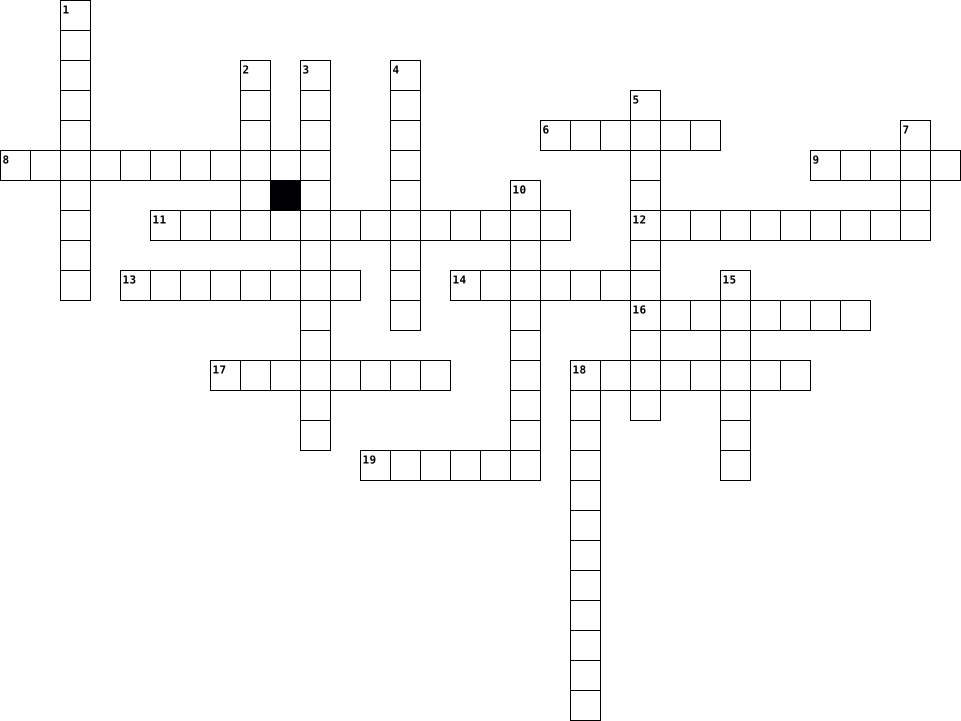
Vocabulary 2023-09-22

Across
- ex. Noble gases, alkali metals, transition metals
- A positively charged ion
- A class of certain elements that make up most of the periodic table
- Any element that is neither metals nor non-metal
- A molecule with the ability to add a charge to an atom
- A negatively charged ion
- Any metal within the first column of the periodic table
- A group of naturally occuring gases that are slightly reactive
- A class of certain elements that make up a smaller portion of the periodic table
- Metallic elements that have valence electrons in two shells instead of one
- The process of gaining or losing electrons
Down
- Elements with completed inner shells but incomplete outer shells
- The distance from an atoms nucleus to its outermost electron
- Created the period table
- A law that the properties of the elements are periodic functions of their atomic numbers
- An atoms ability to attract shared electrons to itself
- The horizontal rows of the periodic table
- Any metal within the second column of the periodic table
- Any metal within the seventeenth column of the periodic table
19 Clues: Created the period table • A positively charged ion • A negatively charged ion • The horizontal rows of the periodic table • The process of gaining or losing electrons • Any element that is neither metals nor non-metal • ex. Noble gases, alkali metals, transition metals • An atoms ability to attract shared electrons to itself • ...
Properties of Matter and The Periodic Table 2021-05-21

Across
- This is when electrons in the electron cloud have different amounts of energy
- Particles in the nucleus with an electric charge of 1+
- The smallest particle of an element that retains the elements properties
- The horizontal rows of elements in the periodic table; and are numbered 1-7
- Arranged the elements on the periodic table in rows based on increasing atomic mass, and in columns based on elements that share similar physical and chemical properties
- The small, positively charged center of the atom
- Group 1 on the periodic table
- Particles with an electric charge of 1-
- The elements that make up the "stairsteps" on the periodic table
- The vertical columns in the periodic table; they are numbered 1-18; are also called families
- Group 2 on the periodic table
Down
- This is equal to the number of electrons in a neutral atom
- The electrons in an elements outermost energy level; determines the chemical properties of each individual element
- Protons and neutrons are composed of smaller particles called these
- The electrically neutral particles in the nucleus; they do not have a charge
- Where the elements are arranged by increasing atomic number, not atomic mass, and by periodic changes in physical and chemical properties
- Group 18 on the periodic table
- Uses the chemical symbol of an element surrounded by dots to represent the number of electrons in the outer most energy level
- The area around the nucleus of an atom where electrons are most likely to be found
- Group 17 on the periodic table
20 Clues: Group 1 on the periodic table • Group 2 on the periodic table • Group 18 on the periodic table • Group 17 on the periodic table • Particles with an electric charge of 1- • The small, positively charged center of the atom • Particles in the nucleus with an electric charge of 1+ • This is equal to the number of electrons in a neutral atom • ...
Periodic Table Crossword Puzzle 2024-11-22

Across
- This periodic table group have the most reactive nonmetals
- The periodic table grouped in a row not a column
- a Metalloid with a atomic number of 13
- Created the first published periodic table
- the number of valence electrons group 1 has
- Shiny and The most dense organization on the perioduc table
- the first element that is in the Lanthanides periodic table group
- Have full valence electron shells
- The ionic charge of oxegen
- Dull,brittle, and break easily
- a noble gas with a atomic mass of 83.80
- The ionic charge of Hydrogen
- Created the first periodic table but was never published
- come from ores in the earth crust
- a nonmetal with an atomic mass of 18.00
- This element is found in the alkali metal group with a atomic number of 11
Down
- the range or groups in the periodic table where Transition metals can be found
- The periodic table group that oxidizes in air
- also known as "Rare earth metals
- The number of valence electrons Group 18 has
- Recognized that the atomic number organizes the periodic table
- Have low melting and boiling points
- The name of a positively charged ion in a metal
- a non-metal with a atomic number of 15
- The periodic table group that is extremly soft
- Contain properties of non-metals and metals
- the group where Alkaline earth metals can be found
- this element is a type of metal with an atomic number of 20
- The name of a negatively charged ion in a nonmetal
29 Clues: The ionic charge of oxegen • The ionic charge of Hydrogen • Dull,brittle, and break easily • also known as "Rare earth metals • Have full valence electron shells • come from ores in the earth crust • Have low melting and boiling points • a Metalloid with a atomic number of 13 • a non-metal with a atomic number of 15 • a noble gas with a atomic mass of 83.80 • ...
Crossword for Chemistry 2025-11-21

Across
- Mendeleev's Periodic Table was organized by increasing ______ ____
- A metal in the fifteenth group on the periodic table
- A Lanthanide
- An Actinide (hint: it’s green)
- Nonmetals have ___ melting points
- Metals These groups are malleable and ductile.
- Metals This group is the most reactive type of metals
- What is the charge of a noble gas ion?
- This type of element is an excellent Conductor of heat and electricity
- A transition metal found in group twelve of the periodic table
- Creator of the first Periodic Table
- A nonmetal in the sixteenth group on the periodic table
- This group has high melting and boiling points.
- What is the charge of a halogen?
- Noble Gases are colorless, odorless, and _________
Down
- What is the charge of an Alkaline Earth Metal?
- A metalloid in the fifteenth group on the periodic table
- How many valence electrons are in an atom of Carbon?
- Most reactive non-metal on the periodic table
- First person to create a periodic table organized by atomic number
- This type of element shares properties with both Metals and nonmetals
- What is the charge of an Alkali Metal?
- This group is the only group that contains liquids, solids, AND gases.
- Halogens are found in this group number
- ________ are all radioactive
- Alkaline Earth Metals oxidize in ___
- How many Valence electrons are in an atom of oxygen?
- Least reactive metal on the periodic table
- Alkaline Earth Metals make up this group number
- Alkali Metals make up this group number
30 Clues: A Lanthanide • ________ are all radioactive • An Actinide (hint: it’s green) • What is the charge of a halogen? • Nonmetals have ___ melting points • Creator of the first Periodic Table • Alkaline Earth Metals oxidize in ___ • What is the charge of an Alkali Metal? • What is the charge of a noble gas ion? • Halogens are found in this group number • ...
Periodic Table Vocab/questions ---Kylie M 2017-12-18

Across
- my atomic mass is 12.
- my atomic symbol is Fe
- my atomic symbol is Co.
- my atomic symbol is O
- my atomic symbol is F.
- my atomic symbol is He.
- this has properties of both metals and nonmetals.
- located on the the right side of the periodic table.
- I am a metalloid in the 13th family.
- protons and neutrons are on this.
- another word for shiny.
- building blocks of matter.
Down
- my atomic symbol is Ne.
- I am a nonmetal located on the right side of the periodic table.
- my atomic symbol is N.
- below the atomic symbol.
- located on the the left side of the periodic table.
- vertical on the periodic table.
- my atomic symbol is H.
- horizontal on the periodic table.
20 Clues: my atomic mass is 12. • my atomic symbol is O • my atomic symbol is N. • my atomic symbol is Fe • my atomic symbol is F. • my atomic symbol is H. • my atomic symbol is Ne. • my atomic symbol is Co. • my atomic symbol is He. • another word for shiny. • below the atomic symbol. • building blocks of matter. • vertical on the periodic table. • horizontal on the periodic table. • ...
Vocabulary of U1S2 - Chemistry 2021-08-21

Across
- elements found in group 1 of the periodic table
- elements found in group 18 of the periodic table
- inner transition metals at the bottom of the periodic table
- elements that are generally gases or dull, brittle solids that are poor conductors of heat and electricity
- how readily an atom can lose an electron
- A row of elements on the period table
- the amount of energy an electron has
- groups 3 through 12 on the periodic table
- the ability of an atom to attract electrons when the atom is in a compound
- a mathematical function that can be used to calculate the probability of finding any electron of an atom
- elements found in group 17 of the periodic table
Down
- the arrangement of electrons in an atom
- a measurement of the size of an atom from the nucleus to the last surrounding shell
- elements found in group 2 of the period table
- a pattern found in the properties of the periodic table
- groups 1 and 2 on the periodic table
- the energy required to remove an electron from an atom
- the amount of energy released when an electron is acquired by a neutral atom
- elements that have properties of both metals and nonmetals.
- groups 13 through 18 on the periodic table
- how readily an atom can accept an electron
- elements that are typically shiny and good conductors of heat and electricity
- A table showing all known elements in chemistry
- a column of elements on the periodic table
24 Clues: groups 1 and 2 on the periodic table • the amount of energy an electron has • A row of elements on the period table • the arrangement of electrons in an atom • how readily an atom can lose an electron • groups 3 through 12 on the periodic table • groups 13 through 18 on the periodic table • how readily an atom can accept an electron • ...
Apt Unit review crossword 2021-11-29

Across
- Central core of an atom
- What fills in periodic table
- The electrons displayed around the nucleus
- Weighted average of mass of all neutral isotopes
- Rows in periodic table
- # of protons
- Right side of the periodic table
- stable subatomic particle that has a positive charge
- a stable subatomic particle with a charge of negative electricity
- Model to represent an element
Down
- Bond of elements
- Chemical bond formed between two ions with opposite charges
- Staircase/barrier on the periodic table of metals and nonmetals
- system that surrounds the nucleus
- # of protons and neutrons
- sharing of an electron pair between two atoms
- Smallest particle of an element
- Charged particle (cations=+) (anions=-)
- Columns in periodic table
- Atoms of the same element with a different # of neutrons
- a subatomic particle of about the same mass as a proton but without an electric charge
- Left side of the periodic table
- Smallest particle of a substance, composed of one or more atoms
23 Clues: # of protons • Bond of elements • Rows in periodic table • Central core of an atom • # of protons and neutrons • Columns in periodic table • What fills in periodic table • Model to represent an element • Smallest particle of an element • Left side of the periodic table • Right side of the periodic table • system that surrounds the nucleus • Charged particle (cations=+) (anions=-) • ...
Periodic Table Crossword 2018-12-14

Across
- on the left side of the periodic table
- Used in advertisement signs
- Published the first periodic table in 1869; from Russia
- The number of groups in the periodic table
- Also known as families or the columns
- Center of the atom where the most mass is
- Positive charged particle located inside the nucleus
- The number found in the top right corner on the periodic table
- Element added to table salt
- The ________ of the element increases from top to bottom on the periodic table
- used to make balloons float
- Negative charged particles located outside the nucleus
Down
- The first element in the periodic table
- Atom of the same element with a different number of neutrons
- Used to graph the number of electrons on an element
- Formal name for the rows
- Used to clean things; usually swimming pools
- Most soda cans are made from this element
- Number of protons plus electrons
- Elements used in fireworks
20 Clues: Formal name for the rows • Elements used in fireworks • Used in advertisement signs • Element added to table salt • used to make balloons float • Number of protons plus electrons • Also known as families or the columns • on the left side of the periodic table • The first element in the periodic table • Center of the atom where the most mass is • ...
Elements 2025-02-07

Across
- The atomic number of this element is 20.
- 35 is the atomic number of this element.
- 19 is the atomic number of this element.
- Li is the symbol of this element.
- K is the symbol of this element.
- The seventh element on the periodic table.
- This is the eighteenth element on the periodic table.
- The symbol of this element is P.
- Na is the symbol of this element.
- The atomic number of this element is 2.
Down
- The first element on the periodic table.
- This is used to make foil with.
- 28 is the atomic number of this element
- This is the forth element on the periodic table.
- This is the tenth element on the periodic table.
- We inhale this element daily.
- This is the sixteenth element on the periodic table.
- The symbol of this element is Mg.
- The atomic number of this element is 12.
- B is the symbol of this element.
20 Clues: We inhale this element daily. • This is used to make foil with. • K is the symbol of this element. • B is the symbol of this element. • The symbol of this element is P. • Li is the symbol of this element. • The symbol of this element is Mg. • Na is the symbol of this element. • 28 is the atomic number of this element • The atomic number of this element is 2. • ...
Extra Credit Project 2022-12-15

Across
- bonds
- atom with positive charge
- combining capacity
- of conservation
- columns on periodic tabel
- atom with negative charge
- ion
- bonds
- changes what it is
- dot plot
Down
- ice
- connecting
- bonding
- rows on periodic table
- steam
- atom with no charge
- Table
- water
- goes around
- changes how it looks
20 Clues: ice • ion • bonds • steam • Table • water • bonds • bonding • dot plot • connecting • goes around • of conservation • combining capacity • changes what it is • atom with no charge • changes how it looks • rows on periodic table • atom with positive charge • columns on periodic tabel • atom with negative charge
science crossword 2017-11-15

Across
- Zn in the periodic table
- Al in the periodic table
- S in the periodic table
- anything that occupies space and has mass
- process in which molecules move from an area of higher consintration to an area with lower consintration
- invisible negitivaly charged particle that orbits the nucleous of an atom
- O in the periodic table
- change that results in two or more substances react to create a new substance
- a substance that helps a chemical act more quickly
- a part of a chemical reaction
- orbit of electrons around the nuculous of an atom
Down
- Ca in the periodic table
- ll, brittle element that does not conduct electricity
- He in the periodic table
- a change in state or appearance
- mixing a substance with air or water to make the substance less consintrated
- mass in one atom of an element
- NOx(g); major air pollutant; forms when nitrogen combines with oxygen as a result of fuel combustion; gives smog its characteristic brown colour; major source: motor vehicles
- a system in which nothing can enter and nothing can leave
- Fe in the periodic table
- a new substance formed in some kind of reaction
- shiny, malleable, ductile element that conducts electricity
- element that has both metallic and non-metallic properties
- another word or poisonous
- H in the periodic table
25 Clues: S in the periodic table • O in the periodic table • H in the periodic table • Ca in the periodic table • He in the periodic table • Zn in the periodic table • Al in the periodic table • Fe in the periodic table • another word or poisonous • a part of a chemical reaction • mass in one atom of an element • a change in state or appearance • anything that occupies space and has mass • ...
science crossword 2025-02-22

Across
- Zn in the periodic table
- Al in the periodic table
- S in the periodic table
- anything that occupies space and has mass
- process in which molecules move from an area of higher consintration to an area with lower consintration
- invisible negitivaly charged particle that orbits the nucleous of an atom
- O in the periodic table
- change that results in two or more substances react to create a new substance
- a substance that helps a chemical act more quickly
- a part of a chemical reaction
- orbit of electrons around the nuculous of an atom
Down
- Ca in the periodic table
- ll, brittle element that does not conduct electricity
- He in the periodic table
- a change in state or appearance
- mixing a substance with air or water to make the substance less consintrated
- mass in one atom of an element
- NOx(g); major air pollutant; forms when nitrogen combines with oxygen as a result of fuel combustion; gives smog its characteristic brown colour; major source: motor vehicles
- a system in which nothing can enter and nothing can leave
- Fe in the periodic table
- a new substance formed in some kind of reaction
- shiny, malleable, ductile element that conducts electricity
- element that has both metallic and non-metallic properties
- another word or poisonous
- H in the periodic table
25 Clues: S in the periodic table • O in the periodic table • H in the periodic table • Ca in the periodic table • He in the periodic table • Zn in the periodic table • Al in the periodic table • Fe in the periodic table • another word or poisonous • a part of a chemical reaction • mass in one atom of an element • a change in state or appearance • anything that occupies space and has mass • ...
Periodic Table 2025-02-22

Across
- is the number equivalent to the protons and neutrons of an atom
- these metals are found in groups 3-12
- the name of the group 16 in The Periodic Table
- is a table that lists all elements in a certain order
- least reactive the non metals also known as?
- the name of the group 17 in The Periodic Table
- these elements found along the staircase to separate the metals and noble gasses
- a chemical property that determines how elements will react with others to form a compound
- the name of group 15 in The Periodic Table
Down
- is an electron that is associated with an atom, and that can participate in the formation of a chemical bond
- the name of group 1 in The Periodic Table
- horizontal rows
- the name of group 13 in The Periodic Table
- the name of group 2 in The Periodic Table
- the elememts that are to the right of the stair case are categorized
- the element that are to the left of the stair case are categorized
- is the number of protons found in the nucleus of the atom and is also how the elements are organized in the periodic table
- most reactive the metals also known as?
- vertical columns
- the name of group 14 in The Periodic Table
20 Clues: horizontal rows • vertical columns • these metals are found in groups 3-12 • most reactive the metals also known as? • the name of group 1 in The Periodic Table • the name of group 2 in The Periodic Table • the name of group 13 in The Periodic Table • the name of group 14 in The Periodic Table • the name of group 15 in The Periodic Table • ...
Periodic Table 2014-10-18

Across
- a chemical property that determines how elements will react with others to form a compound
- is an electron that is associated with an atom, and that can participate in the formation of a chemical bond
- the name of group 15 in The Periodic Table
- the name of the group 16 in The Periodic Table
- the name of group 13 in The Periodic Table
- horizontal rows
- the name of group 2 in The Periodic Table
- least reactive the non metals also known as?
- the element that are to the left of the stair case are categorized
- the name of group 14 in The Periodic Table
- is the number of protons found in the nucleus of the atom and is also how the elements are organized in the periodic table
Down
- vertical columns
- these metals are found in groups 3-12
- the elememts that are to the right of the stair case are categorized
- most reactive the metals also known as?
- is a table that lists all elements in a certain order
- the name of group 1 in The Periodic Table
- is the number equivalent to the protons and neutrons of an atom
- the name of the group 17 in The Periodic Table
- these elements found along the staircase to separate the metals and noble gasses
20 Clues: horizontal rows • vertical columns • these metals are found in groups 3-12 • most reactive the metals also known as? • the name of group 2 in The Periodic Table • the name of group 1 in The Periodic Table • the name of group 15 in The Periodic Table • the name of group 13 in The Periodic Table • the name of group 14 in The Periodic Table • ...
Periodic Table 2014-10-18

Across
- the name of the group 16 in The Periodic Table
- most reactive the metals also known as?
- is the number equivalent to the protons and neutrons of an atom
- the name of the group 17 in The Periodic Table
- the name of group 2 in The Periodic Table
- the name of group 14 in The Periodic Table
- the name of group 13 in The Periodic Table
- the name of group 15 in The Periodic Table
- the elememts that are to the right of the stair case are categorized
Down
- a chemical property that determines how elements will react with others to form a compound
- least reactive the non metals also known as?
- is an electron that is associated with an atom, and that can participate in the formation of a chemical bond
- these elements found along the staircase to separate the metals and noble gasses
- is a table that lists all elements in a certain order
- horizontal rows
- the name of group 1 in The Periodic Table
- is the number of protons found in the nucleus of the atom and is also how the elements are organized in the periodic table
- these metals are found in groups 3-12
- vertical columns
- the element that are to the left of the stair case are categorized
20 Clues: horizontal rows • vertical columns • these metals are found in groups 3-12 • most reactive the metals also known as? • the name of group 2 in The Periodic Table • the name of group 1 in The Periodic Table • the name of group 14 in The Periodic Table • the name of group 13 in The Periodic Table • the name of group 15 in The Periodic Table • ...
Periodic Table 2025-02-22

Across
- a chemical property that determines how elements will react with others to form a compound
- is an electron that is associated with an atom, and that can participate in the formation of a chemical bond
- the name of group 15 in The Periodic Table
- the name of the group 16 in The Periodic Table
- the name of group 13 in The Periodic Table
- horizontal rows
- the name of group 2 in The Periodic Table
- least reactive the non metals also known as?
- the element that are to the left of the stair case are categorized
- the name of group 14 in The Periodic Table
- is the number of protons found in the nucleus of the atom and is also how the elements are organized in the periodic table
Down
- vertical columns
- these metals are found in groups 3-12
- the elememts that are to the right of the stair case are categorized
- most reactive the metals also known as?
- is a table that lists all elements in a certain order
- the name of group 1 in The Periodic Table
- is the number equivalent to the protons and neutrons of an atom
- the name of the group 17 in The Periodic Table
- these elements found along the staircase to separate the metals and noble gasses
20 Clues: horizontal rows • vertical columns • these metals are found in groups 3-12 • most reactive the metals also known as? • the name of group 2 in The Periodic Table • the name of group 1 in The Periodic Table • the name of group 15 in The Periodic Table • the name of group 13 in The Periodic Table • the name of group 14 in The Periodic Table • ...
Periodic Table Review 2024-10-23

Across
- Silver
- Gallium
- Plutonium
- Titanium
- Arsenic
- Group 18 on the periodic table
- S
- Bromine
- This is the 2nd group on the periodic table
- Gold
- Tin
- These types of elements are found on the left side of the staircase on the periodic table
- Astatine
- Ba
- Fe
- Often written as a whole number and found in order on the Periodic table
- Lead
- Often found as a decimal number on the periodic table(protons plus neutrons)
- Zinc
- Magnesium
- Strontium
- I
- Large group of metals found in the middle of the periodic table
- These types of elements are found to the right of the staircase
- Cs
- This might be the 2nd most used table in chemistry class
- C
- Silicon
Down
- H
- This row of elements is found directly below the Lanthanides
- Group number 17 on the periodic table
- P
- W
- Be
- U
- F
- Hg
- Radium
- Thisis group #1 on the periodic table
- He
- This row of elements is found directly above the Actinides
- Ca
- Selenium
- B
- Rn
- Rubidium
- Cl
- K
- O
- Lithium
- This group of elements has properties of both metals and nonmetals
- Bi
- Cobalt
- Ni
- Sodium
- Xenon
- Antimony
- Krypton
- Copper
59 Clues: H • P • W • S • U • F • B • K • O • I • C • Be • Hg • He • Ca • Ba • Fe • Rn • Cl • Bi • Ni • Cs • Tin • Gold • Lead • Zinc • Xenon • Silver • Radium • Cobalt • Sodium • Copper • Gallium • Arsenic • Bromine • Lithium • Krypton • Silicon • Titanium • Astatine • Selenium • Rubidium • Antimony • Plutonium • Magnesium • Strontium • Group 18 on the periodic table • Group number 17 on the periodic table • Thisis group #1 on the periodic table • This is the 2nd group on the periodic table • ...
Crossword 2022-10-06

Across
- Periodic ________ of elements
- electron, is an electron in the outer shell associated with an atom
- grouped the elements based on their properties into gases, non-metals, metals and earths
- as the tendency of an atom participating in a covalent bond to attract the bonding electrons
- a column in the periodic table of the chemical elements
- refers to the tendency of atoms to prefer to have eight electrons in the valence shell
- number, the number of a chemical element in the periodic system
- an element that has properties that are intermediate between those of metals and nonmetals.
- table, Lesson of Labster 5
- Newlands invented the Law of _________
Down
- tests are used to identify the presence of a relatively small number of metal ions in a compound.
- placed in order on the periodic table based on their atomic number
- invented the law of octave
- element with the lowest electronegativity value
- gas, another term for noble gas
- Father of periodic table
- number, also called atomic mass number or nucleon number,
- gas,any of a group of rare gases that include helium, neon, argon, krypton, xenon, and usually radon and that exhibit great stability and extremely low reaction rates
- The horizontal rows of the periodic table are called ______
- Last name of the father of periodic table
20 Clues: Father of periodic table • invented the law of octave • table, Lesson of Labster 5 • Periodic ________ of elements • gas, another term for noble gas • Newlands invented the Law of _________ • Last name of the father of periodic table • element with the lowest electronegativity value • a column in the periodic table of the chemical elements • ...
Atoms, Periodic Table and Bonding 2025-11-14

Across
- Up and down columns on the periodic table.
- Group number that have all of their energy shell filled.
- Covalent bonding involves atoms _______ electrons.
- To make an atom neutral it must have equal numbers of protons and ________.
- Top number in the square that reveals number of protons an atom has.
- This bottom number in the periodic square.
- Side of periodic table where most nonmetals are found.
- The charge of an electron.
- It is the number of _________ an atom has that the periodic table is arranged by.
Down
- Example of an Ionic compound (2 words).
- Number of energy shells an Arsenic (As) atom has.
- The left to right rows on a periodic table.
- Most of the periodic table are these elements.
- The group number tells you how many dots to put on this "diagram".
- Ductile, malleable and luster are associated with ______ bonding.
- Charge of ion if it loses valence electrons.
- The nucleus of the atom contains the protons and these particles.
- The "father of the periodic table" Dmitri _______.
18 Clues: The charge of an electron. • Example of an Ionic compound (2 words). • Up and down columns on the periodic table. • This bottom number in the periodic square. • The left to right rows on a periodic table. • Charge of ion if it loses valence electrons. • Most of the periodic table are these elements. • Number of energy shells an Arsenic (As) atom has. • ...
Physical science Chapter 4 2023-10-18

Across
- Any elements in Groups 3-12 of the periodic table, typically having one or two valence electrons, which it easily loses, resulting in cations with charges of 1+ or 2+
- An element in Group 18 of the periodic table having eight valence electrons that fill the other energy level with a full outer energy level it is inert
- The distance from the center of an atoms nucleus to its outer most energy level
- The law that states that the priorities of the elements vary with their atomic numbers in a regular, repeated pattern
- A column of elements in the periodic table having similar valence electron arrangement, resulting in similar chemical properties; also known as a group
- A representation of an atom consisting of its chemical symbol with surrounding dots representing its valence electron
- An element in Group 1 of the periodic table, having one valence electron that it can easily form a 1+ cation, making it extremely reactive; the most reactive of all the metals
- see Family
- An element in Group 17 of the Periodic table; having seven valence electrons. It easily gains an electron, forming a 1- anion, which causes it to be highly reactive
- An element with characteristics between those of metals and nonmetals; also called semi-conductors; located on the left end of the periodic table
- An element in Group 2 of the periodic table, having two valence electrons that it tends to lose easily to become 2+ cation, making it very reactive
Down
- An element that typically has four or more valence electrons and that does not exhibit the general properties of metals; located on the right side of the periodic table
- A table of the chemical elements arranged to display their periodic properties in relation to their atomic numbers
- (1) a row in the periodic table of the elements; also called a series; (2) The time interval (T) for one complete cycle of a periodic motion
- Any of groups 13-16 in the periodic table; so named because they contain metals, nonmetals, and Metalloids. These groups are often named after the first element in the family
- Any electron in the outer most energy level of a neutral atom. Unpaired valence electrons are usually involved in chemical bonding
- An element that is typically dense, solid, ductile, malleable, highly conductive, and chemically reactive, especially in the presense of nonmetal elements. Metals are located on the left end of the periodic table
- An element from either of two rows usually placed below the periodic table; a member of either the lanthonide or actonide series. It typically has two valence electrons
- A measure of an elements ability to attach and hold electrons when bonded to other atoms
19 Clues: see Family • The distance from the center of an atoms nucleus to its outer most energy level • A measure of an elements ability to attach and hold electrons when bonded to other atoms • A table of the chemical elements arranged to display their periodic properties in relation to their atomic numbers • ...
jolies science for mr Harris 2021-12-10

Across
- numbers on top of the periodic table
- when a new solid is formed
- tiny number in a chemical equation
- protons and neutrons both have the ____ __ ___
- change in size,shape, or matter
- and located in the nucleus of an atom
- change in a substance or objects, pigment or look
- go up and down to eachother on the periodic table
- the new substance from a chemical equation
- take up most of periodic table
- a number that is on top of the symbol of a element
- negative and located in the outside of the nucleus
- number of physical changes
Down
- the periodic table has more __________ on the left† side of the periodic table
- number in a chemical equation
- spark, fire,and flame caused by a chemical change
- a boundary that slides past each other.
- when are atoms are rearranged and turned into a completely new substance
- the number on the side of a periodic table
- positive and located in the nucleus of an atom
- matter is neither _______ nor destroyed
- letter on an element on the periodic table that tell us what the element may be
22 Clues: when a new solid is formed • number of physical changes • number in a chemical equation • take up most of periodic table • change in size,shape, or matter • tiny number in a chemical equation • numbers on top of the periodic table • and located in the nucleus of an atom • a boundary that slides past each other. • matter is neither _______ nor destroyed • ...
The Periodic Table 2020-12-18

Across
- Element with the chemical symbol of Na
- There are ... non-metals in the first 20 elements of the periodic table
- The atoms of the elements increase in ... as you read across each row.
- If there is a second letter in the chemical symbol, it is always ....
- The man who invented the periodic table
- One or Two letters that represent an element.
- There are ... known elements on the periodic table.
- Natrium is the ... name for sodium.
- What do we call the table that shows all the elements?
- Columns in a periodic table.
Down
- ... atoms has the highest mass
- The heaviest element
- Atomic number of aluminium
- The chemical symbol of lead is
- Number of protons and electrons an atom contains
- The first element on the periodic table is Helium. (TRUE/FALSE)
- There are ... metals in the first 20 elements of the periodic table
- Chemical symbol of magnesium
- How many elements have scientists discovered naturally?
- How many elements were made in the laboratory?
- Elements in the same column share similar chemical and ... properties.
- Element with the chemical symbol of K.
- Rows in a periodic table.
- Element with the atomic number of 5
24 Clues: The heaviest element • Rows in a periodic table. • Atomic number of aluminium • Chemical symbol of magnesium • Columns in a periodic table. • ... atoms has the highest mass • The chemical symbol of lead is • Natrium is the ... name for sodium. • Element with the atomic number of 5 • Element with the chemical symbol of Na • Element with the chemical symbol of K. • ...
Periodic table 2024-05-16

Across
- Measure of an atom's ability to attract electrons in a chemical bond.
- Energy required to remove an electron from an atom.
- Series of elements in the periodic table with atomic numbers from 89 to 103.
- Number of electrons in the outermost shell of an atom.
- The repeating pattern of properties in the periodic table.
- Number of protons in the nucleus of an atom.
- Group of elements with partially filled d orbitals.
- Group 17 elements known for their high reactivity.
Down
- Series of elements in the periodic table with atomic numbers from 57 to 71.
- To forecast the properties of undiscovered elements based on their position in the periodic table.
- Russian chemist who developed the periodic table.
- Element with properties intermediate between metals and nonmetals.
- Organization of elements based on similar properties.
- Group 1 element with a single valence electron.
- Substance consisting of atoms with the same number of protons.
- Group of elements with full outer electron shells, making them unreactive.
- Principle stating that the properties of elements vary periodically with their atomic numbers.
- Horizontal row in the periodic table.
- Weighted average of the masses of an element's isotopes.
- Vertical column in the periodic table.
20 Clues: Horizontal row in the periodic table. • Vertical column in the periodic table. • Number of protons in the nucleus of an atom. • Group 1 element with a single valence electron. • Russian chemist who developed the periodic table. • Group 17 elements known for their high reactivity. • Energy required to remove an electron from an atom. • ...
Periodic Table 2023-10-19
Across
- The block that contains both Lithium and Radium
- The only element with an atomic number over ninety-eight that starts with a C
- The number of groups in the periodic table
- The letter representation of every element on the periodic table
- The variety of metals that are better at conducting heat and electricity
- The name for group seventeen of the periodic table
- The type of electron found in the outermost energy ring of an atom
- The element that makes up most of Earth's atmosphere
- The name for the upper right section of the periodic table
- Group three, three valence electrons
- The horizontal organization of the periodic table
Down
- The type of atom including Silicon, Germanium, and Arsenic tsymbol
- An element with two valence electrons in the sixth period
- Number of protons in an atom
- The element with the highest possible atomic number
- The only element with an atomic number that repeats three times
- Noble gas in period one
- The elements found in the rightmost period of the periodic table
- The only element in the F block with a one-letter chemical symbol
- Bottom number in each square of the periodic table
20 Clues: Noble gas in period one • Number of protons in an atom • Group three, three valence electrons • The number of groups in the periodic table • The block that contains both Lithium and Radium • The horizontal organization of the periodic table • The name for group seventeen of the periodic table • Bottom number in each square of the periodic table • ...
Periodic Table 2023-10-19

Across
- The block that contains both Lithium and Radium
- The only element with an atomic number over ninety-eight that starts with a C
- The number of groups in the periodic table
- The letter representation of every element on the periodic table
- The variety of metals that are better at conducting heat and electricity
- The name for group seventeen of the periodic table
- The type of electron found in the outermost energy ring of an atom
- The element that makes up most of Earth's atmosphere
- The name for the upper right section of the periodic table
- Group three, three valence electrons
- The horizontal organization of the periodic table
Down
- The type of atom including Silicon, Germanium, and Arsenic tsymbol
- An element with two valence electrons in the sixth period
- Number of protons in an atom
- The element with the highest possible atomic number
- The only element with an atomic number that repeats three times
- Noble gas in period one
- The elements found in the rightmost period of the periodic table
- The only element in the F block with a one-letter chemical symbol
- Bottom number in each square of the periodic table
20 Clues: Noble gas in period one • Number of protons in an atom • Group three, three valence electrons • The number of groups in the periodic table • The block that contains both Lithium and Radium • The horizontal organization of the periodic table • The name for group seventeen of the periodic table • Bottom number in each square of the periodic table • ...
Metals vs Non Metals Starter 2025-10-21

Across
- A metalloid used in computer chips. (7)
- The only metal that is liquid at room temperature. (7)
- Negatively charged particle orbiting the nucleus of an atom. (8)
- The mass per unit volume of a substance. (7)
- The scientist who developed the first widely recognized periodic table. (9)
- Positively charged particle in the nucleus of an atom. (6)
- Horizontal rows in the periodic table. (6)
- Elements in Group 17 with high reactivity. (8)
- A precious metal with the chemical symbol Au. (4)
- Vertical columns in the periodic table. (5)
Down
- Very reactive metals found in Group 1 of the periodic table. (6)
- The first element in the periodic table. (8)
- Found in the central block of the periodic table, these metals are good conductors. (10)
- A non-metal that forms the basis of organic compounds. (6)
- Elements with properties of both metals and non-metals. (10)
- Neutral particle found in the nucleus of an atom. (7)
- Gases Unreactive elements found in Group 18. (11)
- A gas used in balloons, found in Group 18. (6)
- The arrangement of elements based on their atomic number. (8)
- Essential for respiration and found in Group 16. (6)
20 Clues: A metalloid used in computer chips. (7) • Horizontal rows in the periodic table. (6) • Vertical columns in the periodic table. (5) • The first element in the periodic table. (8) • The mass per unit volume of a substance. (7) • A gas used in balloons, found in Group 18. (6) • Elements in Group 17 with high reactivity. (8) • ...
Unit 3 Crossword 2025-02-23

Across
- Metals found in Group 1 of the periodic table.
- Type of atomic model that shows rings (energy levels) and electron placement. Invented by Niels ____.
- Name of columns on periodic table.
- Element located at Period 2, Group 13
- The best chemistry teacher in the world (probably).
- Element located at period 6, group 15.
- Element located at Period 4, Group 2
- Last Name of creator of first periodic table
Down
- Name of rows on the periodic table.
- Element on periodic table with 6 protons.
- Element located at Period 4, Group 18
- Periodic table is in order of increasing atomic ________.
- Element on periodic table with 11 electrons.
- Element #50
- Family of elements found in group 17 of periodic table.
15 Clues: Element #50 • Name of columns on periodic table. • Name of rows on the periodic table. • Element located at Period 4, Group 2 • Element located at Period 4, Group 18 • Element located at Period 2, Group 13 • Element located at period 6, group 15. • Element on periodic table with 6 protons. • Element on periodic table with 11 electrons. • ...
Periodic Table 2023-10-25

Across
- The type of atom including Silicon, Germanium, and Arsenic tsymbol
- Number of protons in an atom
- The only element with an atomic number that repeats three times
- Bottom number in each square of the periodic table
- The element with the highest possible atomic number
- The variety of metals that are better at conducting heat and electricity
- The name for group seventeen of the periodic table
- An element with two valence electrons in the sixth period
- The letter representation of every element on the periodic table
Down
- Group three, three valence electrons
- The number of groups in the periodic table
- The name for the upper right section of the periodic table
- The block that contains both Lithium and Radium
- The only element in the F block with a one-letter chemical symbol
- The elements found in the rightmost period of the periodic table
- The horizontal organization of the periodic table
- The element that makes up most of Earth's atmosphere
- The type of electron found in the outermost energy ring of an atom
- The only element with an atomic number over ninety-eight that starts with a C
- Noble gas in period one
20 Clues: Noble gas in period one • Number of protons in an atom • Group three, three valence electrons • The number of groups in the periodic table • The block that contains both Lithium and Radium • The horizontal organization of the periodic table • Bottom number in each square of the periodic table • The name for group seventeen of the periodic table • ...
Periodic Table and Trends 2024-09-30

Across
- Soft Metals that are very reactive in water and are found in group 1A of the periodic table.
- The number of protons(or electrons) found in an atom.
- These are the horizontal rows of the periodic table that determine the number of electron energy levels/shells an element has.
- These are gases or dull, brittle, & poor conductors of electricity solids, found on the right hand side of the periodic table.
- The protons and neutrons are found here.
- The distance from the center of the nucleus to the outermost electron.
- The tendency of an atom to ATTRACT electrons to form bonds.
- Dull brittle solids and toxic gases found in group 7A of the periodic table.
Down
- When elements are arranged in order of increasing atomic number.
- The number of protons PLUS the number of neutrons found in an atom.
- Shiny silver white metals with high melting points, and are found in group 2A of the periodic table.
- These are ductile, malleable, shiny, good conductors of heat & electricity and are found on the left hand side of the periodic table.
- Unreactive gases, with a full set of valence electrons found in group 8A of the periodic table.
- This chemist discovered that properties of elements are determined by their atomic mass/weight and went on to arrange the first periodic table.
- This chemist proposed arranging the current periodic table by atomic number instead of atomic mass.
- The energy needed to REMOVE an electron.
- These are the vertical columns of the periodic table that contain elements that share similar properties.
- Semiconductors, with properties of metals and nonmetals and are found on the stair-step section of the periodic table.
18 Clues: The protons and neutrons are found here. • The energy needed to REMOVE an electron. • The number of protons(or electrons) found in an atom. • The tendency of an atom to ATTRACT electrons to form bonds. • When elements are arranged in order of increasing atomic number. • The number of protons PLUS the number of neutrons found in an atom. • ...
The Periodic Table 2012-11-15

Across
- family, vertical column of elements on the periodic table
- unreactive nonmetals and are in Group 18
- very reactive, in Group 17
- is in the boron group, the most abundant metal in Earth's crust
- less reactive than alkali metals are
- a Russian chemist, discovered a pattern to the elements in 1869
- formed from burning oil, coal, and wood
- also called semimetals, are the elements that border the zigzag line on the periodic table
- found to the right of the zigzag line on the periodic table
Down
- gas at room temperature, makes up about 80% of the air you breathe
- elements of Group 3 - 12
- horizontal row of elements on the periodic table
- forms a wide variety of compounds
- states that the repeating chemical and physical properties of elements change periodically with the elements' atomic numbers
- elements in Group 1 of the periodic table
- most abundant element in the universe
- "happening at regular intervals'
- found to the left of the zigzag lin on the periodic table
- British scientist, determined the number of protons the atomic number in an atom
- makes up about 20% of air, necessary for substances to burn
20 Clues: elements of Group 3 - 12 • very reactive, in Group 17 • "happening at regular intervals' • forms a wide variety of compounds • less reactive than alkali metals are • most abundant element in the universe • formed from burning oil, coal, and wood • unreactive nonmetals and are in Group 18 • elements in Group 1 of the periodic table • ...
Periodic Table Vocabulary 2013-11-21
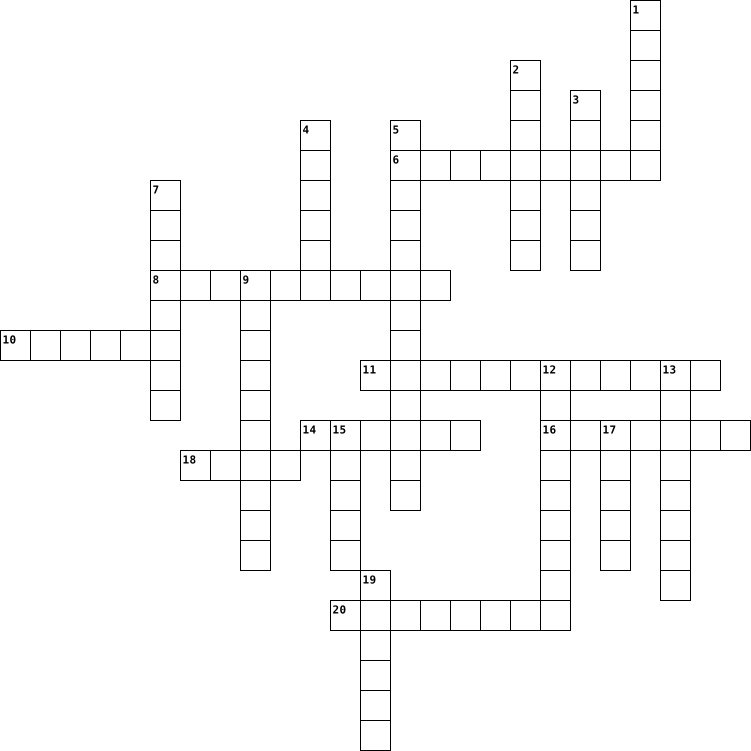
Across
- They are generally negative in charge and are much smaller than the nucleus of the atom
- the group along the diagonal line
- When mixed with Hydrogen, this element makes H2O
- The big number on the top of the element's symbol
- When mixed with oxygen, it makes C02
- Made of protons and neutrons, center of an atom
- What the symbol stands for. Located underneath the symbol
- This isn't an element, but has a symbol that is n or n0
Down
- The group on the left side of the periodic table
- With neutrons, they make the nucleus
- The columns in the periodic table. There are 18 of them
- The elements in the periodic table are easy to find by this
- The chart in which the information of the elements are in
- This element has the symbol Al
- The small number underneath the element's symbol
- The group on the right side of the periodic table
- What the periodic table is made of
- the basic building blocks of matter that make up everyday objects.
- What the periodic table is. You record information on this
- The rows in the periodic table. There are 7 of them
20 Clues: This element has the symbol Al • the group along the diagonal line • What the periodic table is made of • With neutrons, they make the nucleus • When mixed with oxygen, it makes C02 • Made of protons and neutrons, center of an atom • The group on the left side of the periodic table • The small number underneath the element's symbol • ...
Periodic Table 2023-10-20

Across
- atoms that have the same number of protons and electrons but different numbers of neutrons and therefore have different physical properties
- negatively charged particle
- elements found in Group 1A of the periodic table
- column of elements in the periodic table
- elements found in Group 8A of the periodic table
- positively charged particle
- alkali metal that belongs to the sixth period
- nonmetals form into these type of ions
- row of elements in the periodic table
Down
- who first published the classification of the elements in the periodic table
- number of protons in the nucleus of an atom
- elements found in Group 2A of the periodic table
- A substance with high electrical conductivity, luster, and malleability, which readily loses electrons to form positive ions
- neutrally charged particle
- metals form into these type of ions
- elements found in Group 7A of the periodic table
- poor conductors of heat and electricity, and are not malleable or ductile
- atom or molecule with net electric charge due to the loss or gain of electrons
- average mass of the elements isotopes
- positively charged region at the center of the atom
20 Clues: neutrally charged particle • negatively charged particle • positively charged particle • metals form into these type of ions • average mass of the elements isotopes • row of elements in the periodic table • nonmetals form into these type of ions • column of elements in the periodic table • number of protons in the nucleus of an atom • ...
Metals vs Non Metals Starter 2025-10-21

Across
- A metalloid used in computer chips. (7)
- The only metal that is liquid at room temperature. (7)
- Negatively charged particle orbiting the nucleus of an atom. (8)
- The mass per unit volume of a substance. (7)
- The scientist who developed the first widely recognized periodic table. (9)
- Positively charged particle in the nucleus of an atom. (6)
- Horizontal rows in the periodic table. (6)
- Elements in Group 17 with high reactivity. (8)
- A precious metal with the chemical symbol Au. (4)
- Vertical columns in the periodic table. (5)
Down
- Very reactive metals found in Group 1 of the periodic table. (6)
- The first element in the periodic table. (8)
- Found in the central block of the periodic table, these metals are good conductors. (10)
- A non-metal that forms the basis of organic compounds. (6)
- Elements with properties of both metals and non-metals. (10)
- Neutral particle found in the nucleus of an atom. (7)
- Gases Unreactive elements found in Group 18. (11)
- A gas used in balloons, found in Group 18. (6)
- The arrangement of elements based on their atomic number. (8)
- Essential for respiration and found in Group 16. (6)
20 Clues: A metalloid used in computer chips. (7) • Horizontal rows in the periodic table. (6) • Vertical columns in the periodic table. (5) • The first element in the periodic table. (8) • The mass per unit volume of a substance. (7) • A gas used in balloons, found in Group 18. (6) • Elements in Group 17 with high reactivity. (8) • ...
Periodic Table Vocab/questions ---Kylie M 2025-02-22

Across
- my atomic mass is 12.
- my atomic symbol is Fe
- my atomic symbol is Co.
- my atomic symbol is O
- my atomic symbol is F.
- my atomic symbol is He.
- this has properties of both metals and nonmetals.
- located on the the right side of the periodic table.
- I am a metalloid in the 13th family.
- protons and neutrons are on this.
- another word for shiny.
- building blocks of matter.
Down
- my atomic symbol is Ne.
- I am a nonmetal located on the right side of the periodic table.
- my atomic symbol is N.
- below the atomic symbol.
- located on the the left side of the periodic table.
- vertical on the periodic table.
- my atomic symbol is H.
- horizontal on the periodic table.
20 Clues: my atomic mass is 12. • my atomic symbol is O • my atomic symbol is N. • my atomic symbol is Fe • my atomic symbol is F. • my atomic symbol is H. • my atomic symbol is Ne. • my atomic symbol is Co. • my atomic symbol is He. • another word for shiny. • below the atomic symbol. • building blocks of matter. • vertical on the periodic table. • horizontal on the periodic table. • ...
Periodic Table and Trends Review 2023-12-01

Across
- positively charged ion
- Nickname of 12 across
- one half of the distance between the nuclei of two atoms of the same element when the atoms are joined
- there are 18 of these on the periodic table
- nonreactive element family
- the d and f orbitals on the periodic table
- Developed his model of the periodic table in 1869
- there are 7 of these on the periodic table
- number of elements discovered in 1913
- most of the elements on the periodic table are these
- Mass of an atom
Down
- energy needed to remove an electron from an atom
- the ability of an atom of an element to attract electrons when the atom is in a compound
- last name of the scientist who first grouped elements together by similar property
- negatively charged ion
- reworked the periodic table and arranged it by 11 across
- Mendeleev's periodic table was important because it was able to _______ new elements
- three elements grouped together by similar properties
- number of protons in the nucleus of an atom
19 Clues: Mass of an atom • Nickname of 12 across • positively charged ion • negatively charged ion • nonreactive element family • number of elements discovered in 1913 • the d and f orbitals on the periodic table • there are 7 of these on the periodic table • there are 18 of these on the periodic table • number of protons in the nucleus of an atom • ...
Periodic Trends Vocabulary 2023-11-22

Across
- Group 2
- Elements that touch the staircase
- Metals are on this side of the periodic table
- Columns
- Group 18
- Nonmetals are on this side of the periodic table
- Organized periodic table by atomic mass
- How the periodic table was first arranged
Down
- Elements in the same group have similar ______
- Organized periodic table by atomic number
- d-block metals in the center of the periodic table
- Separates metals and nonmetals
- Group 17
- Rows
- Group 1
15 Clues: Rows • Group 2 • Columns • Group 1 • Group 17 • Group 18 • Separates metals and nonmetals • Elements that touch the staircase • Organized periodic table by atomic mass • Organized periodic table by atomic number • How the periodic table was first arranged • Metals are on this side of the periodic table • Elements in the same group have similar ______ • ...
Periodic Table and Trends Review 2023-12-01

Across
- positively charged ion
- negatively charged ion
- energy needed to remove an electron from an atom
- most of the elements on the periodic table are these
- number of protons in the nucleus of an atom
- Developed his model of the periodic table in 1869
- the ability of an atom of an element to attract electrons when the atom is in a compound
- last name of the scientist who first grouped elements together by similar property
- Mass of an atom
- there are 7 of these on the periodic table
- Mendeleev's periodic table was important because it was able to _______ new elements
Down
- the d and f orbitals on the periodic table
- number of elements discovered in 1913
- reworked the periodic table and arranged it by 11 across
- there are 18 of these on the periodic table
- Nickname of 12 across
- one half of the distance between the nuclei of two atoms of the same element when the atoms are joined
- nonreactive element family
- three elements grouped together by similar properties
19 Clues: Mass of an atom • Nickname of 12 across • positively charged ion • negatively charged ion • nonreactive element family • number of elements discovered in 1913 • the d and f orbitals on the periodic table • there are 7 of these on the periodic table • there are 18 of these on the periodic table • number of protons in the nucleus of an atom • ...
Element 2025-07-23

Across
- written as Ag in periodic table
- positive charge subatomic particle
- group 6 period 2
- atomic number of 35
- atomic number of 15
- group 7 period 5
- neutral charge located in nucleus
- atomic number of 20
- negative charge subatomic particle
- atomic number of 11
- group 8 period 1
Down
- group 6 period 3
- first element in periodic table
- written as K in periodic table
- atomic number 7
- group 3 period 2
- written as Fe in periodic table
- group 7 period 3
- written as Hg
- group 2 period 3
- group 1 period 2
21 Clues: written as Hg • atomic number 7 • group 6 period 3 • group 3 period 2 • group 6 period 2 • group 7 period 3 • group 7 period 5 • group 2 period 3 • group 1 period 2 • group 8 period 1 • atomic number of 35 • atomic number of 15 • atomic number of 20 • atomic number of 11 • written as K in periodic table • written as Ag in periodic table • first element in periodic table • ...
Chemistry Exam 1 2019-02-03

Across
- PO3-4
- NO3-
- (c) 10^-2
- (µ) 10^-6
- CO2-3
- the name of group 6A on the periodic table
- the name of group 2A on the periodic table
- Cr2O2-7
- (k) 10^3
- the name of group 7A on the periodic table
- CH3COO-
- (G) 10^9
- compound formed from a metal and nonmetal
- the name of group 8A on the periodic table
- named first in naming binary ionic compounds
- (f) 10^-15
Down
- the name of the elements in the center block on the periodic table
- ClO4-
- MnO4-
- (n) 10^-9
- (p) 10^-12
- compound formed from two or more nonmetals
- CrO2-4
- (m) 10^-3
- NH4+
- ClO3-
- the name of group 1A on the periodic table
- (M) 10^6
- negative ion usually formed from a nonmetal
- positive ion usually formed from a metal
- (d) 10^-1
- SO2-4
32 Clues: NO3- • NH4+ • ClO4- • MnO4- • PO3-4 • CO2-3 • ClO3- • SO2-4 • CrO2-4 • Cr2O2-7 • CH3COO- • (M) 10^6 • (k) 10^3 • (G) 10^9 • (n) 10^-9 • (c) 10^-2 • (µ) 10^-6 • (m) 10^-3 • (d) 10^-1 • (p) 10^-12 • (f) 10^-15 • positive ion usually formed from a metal • compound formed from a metal and nonmetal • compound formed from two or more nonmetals • the name of group 6A on the periodic table • ...
Chemistry about Atoms and the Periodic Table 2018-03-07

Across
- the elements of Group 7 of the periodic table
- the block that contains the Lanthanides and Actinides
- it bears a positive charge
- the elements of Group 8 of the periodic table
- the elements of Group 2 of the periodic table
- it is the columns that divide the periodic table
- He proposed the Law of Conservation of Mass
- the block that contains Groups 1A and 2A
- it bears neither a positive nor a negative charge
- the block that contains Groups 3A to 8A
- It was discovered by Henry Moseley
Down
- it bears a negative charge
- the elements of Group 1 of the periodic table
- designed the gold-foil experiment
- the block that contains Group 1B to 8B
- He proposed the Law of Definite Proportions
- He proposed the 1st Atomic Theory
- He discovered the x-ray
- Greek word meaning indivisible
- it is the rows that divide the periodic table
20 Clues: He discovered the x-ray • it bears a negative charge • it bears a positive charge • Greek word meaning indivisible • designed the gold-foil experiment • He proposed the 1st Atomic Theory • It was discovered by Henry Moseley • the block that contains Group 1B to 8B • the block that contains Groups 3A to 8A • the block that contains Groups 1A and 2A • ...
BGE Atoms, Elements and Compounds 2023-08-31

Across
- Name for a column on the periodic table.
- The charge of an electron
- Used to organise all the elements (8,5)
- Group 1 of the periodic table (6.5)
- Group 7 of the periodic table - the salt formers
- Compounds with only two elements end in this.
- Also found in the nucleus of an atom
- Compounds that contains three elements end in this.
- The charge of a proton
- Found in the nucleus of an atom
- Everything is made from these.
- Name for a row on the periodic table.
Down
- OH!
- Contains only one type of atom
- Found in the centre of the periodic table (10,6)
- A substance that cannot be chemically broken down.
- Likes to have a partner, like Oxygen.
- Likes to be on its own like Helium.
- The centre of the atom
- What a neutron is.
- Orbits round the nucleus of an atom
- Group 0 of the periodic table - they don't react (5,5)
- Contains two or more different type of atom.
23 Clues: OH! • What a neutron is. • The centre of the atom • The charge of a proton • The charge of an electron • Contains only one type of atom • Everything is made from these. • Found in the nucleus of an atom • Likes to be on its own like Helium. • Group 1 of the periodic table (6.5) • Orbits round the nucleus of an atom • Also found in the nucleus of an atom • ...
BGE Atoms, Elements and Compounds 2023-09-01

Across
- Also found in the nucleus of an atom
- A substance that cannot be chemically broken down.
- OH!
- Found in the nucleus of an atom
- Contains two or more different type of atom.
- Name for a row on the periodic table.
- Group 1 of the periodic table (6.5)
- Group 7 of the periodic table - the salt formers
- What a neutron is.
- Contains only one type of atom
- The charge of a proton
Down
- Likes to have a partner, like Oxygen.
- Found in the centre of the periodic table (10,6)
- Name for a column on the periodic table.
- The centre of the atom
- Used to organise all the elements (8,5)
- with only two elements end in this.
- Everything is made from these.
- The charge of an electron
- Group 0 of the periodic table - they don't react (5,5)
- Likes to be on its own like Helium.
- Orbits round the nucleus of an atom
- Compounds that contains three elements end in this.
23 Clues: OH! • What a neutron is. • The centre of the atom • The charge of a proton • The charge of an electron • Everything is made from these. • Contains only one type of atom • Found in the nucleus of an atom • with only two elements end in this. • Group 1 of the periodic table (6.5) • Likes to be on its own like Helium. • Orbits round the nucleus of an atom • ...
The periodic table 2021-10-24

Across
- The period table is this type of system.
- This is a good conductor for electricity.
- A lightweight metal used for cooldrink cans.
- The compound that we breath out.
- The last name of the man who first developed the periodic table.
- Elements are organized into rows and columns based on what?
- The element symbol for chlorine.
- What element is used for glowsticks?
- Reading the periodic table top to bottom is known as the?
Down
- This is the 9th element on the periodic table.
- The element used in washing powders.
- These have properties of both metals and non-metals.
- This is the 19th element on the periodic table.
- The element symbol for magnesium.
- Reading the periodic table from left to right is know as the?
- One of the most common compounds.
- The element name for "Si".
- These are found mostly on the right hand side of the periodic table.
- The element name for "Be".
- The atomic number indicates how many _________ are in the atom.
20 Clues: The element name for "Si". • The element name for "Be". • The compound that we breath out. • The element symbol for chlorine. • The element symbol for magnesium. • One of the most common compounds. • The element used in washing powders. • What element is used for glowsticks? • The period table is this type of system. • This is a good conductor for electricity. • ...
Periodic Table crossword 2021-10-25

Across
- Neutral charged subatomic partivles
- Bond between two atoms of similar electron amount
- Negatively charged subatomic particles
- The only element separated on the periodic table
- Any of the six chemical elements that make up group 1 of the periodic table
- The centre of an atom
- The mass of an atom
- An element characterized by high electrical and thermal conductivity
- Symbol used to identify an element
- Russian chemist who created the periodic table
- The outside part of an atom's nucleus
- An element that's properties are intermediate between those of metals and solid semiconductors
Down
- Vertical columns of the periodic table
- The smallest unit of ordinary matter
- An element that is not a metal
- Horizontal rows of the periodic table
- Positively charged subatomic particles
- Number of protons in the nucleus of an atom
- Characteristics of a particular substance that can be observed
- Two or more types of atoms that have the same atomic number and position on the periodic table
- Table of elements
21 Clues: Table of elements • The mass of an atom • The centre of an atom • An element that is not a metal • Symbol used to identify an element • Neutral charged subatomic partivles • The smallest unit of ordinary matter • Horizontal rows of the periodic table • The outside part of an atom's nucleus • Vertical columns of the periodic table • Positively charged subatomic particles • ...
Physical science Chapter 4 2023-10-18

Across
- Any elements in Groups 3-12 of the periodic table, typically having one or two valence electrons, which it easily loses, resulting in cations with charges of 1+ or 2+
- An element in Group 18 of the periodic table having eight valence electrons that fill the other energy level with a full outer energy level it is inert
- The distance from the center of an atoms nucleus to its outer most energy level
- The law that states that the priorities of the elements vary with their atomic numbers in a regular, repeated pattern
- A column of elements in the periodic table having similar valence electron arrangement, resulting in similar chemical properties; also known as a group
- A representation of an atom consisting of its chemical symbol with surrounding dots representing its valence electron
- An element in Group 1 of the periodic table, having one valence electron that it can easily form a 1+ cation, making it extremely reactive; the most reactive of all the metals
- see Family
- An element in Group 17 of the Periodic table; having seven valence electrons. It easily gains an electron, forming a 1- anion, which causes it to be highly reactive
- An element with characteristics between those of metals and nonmetals; also called semi-conductors; located on the left end of the periodic table
- An element in Group 2 of the periodic table, having two valence electrons that it tends to lose easily to become 2+ cation, making it very reactive
Down
- An element that typically has four or more valence electrons and that does not exhibit the general properties of metals; located on the right side of the periodic table
- A table of the chemical elements arranged to display their periodic properties in relation to their atomic numbers
- (1) a row in the periodic table of the elements; also called a series; (2) The time interval (T) for one complete cycle of a periodic motion
- Any of groups 13-16 in the periodic table; so named because they contain metals, nonmetals, and Metalloids. These groups are often named after the first element in the family
- Any electron in the outer most energy level of a neutral atom. Unpaired valence electrons are usually involved in chemical bonding
- An element that is typically dense, solid, ductile, malleable, highly conductive, and chemically reactive, especially in the presense of nonmetal elements. Metals are located on the left end of the periodic table
- An element from either of two rows usually placed below the periodic table; a member of either the lanthonide or actonide series. It typically has two valence electrons
- A measure of an elements ability to attach and hold electrons when bonded to other atoms
19 Clues: see Family • The distance from the center of an atoms nucleus to its outer most energy level • A measure of an elements ability to attach and hold electrons when bonded to other atoms • A table of the chemical elements arranged to display their periodic properties in relation to their atomic numbers • ...
Chapter 4 PS Vocab 2024-11-18

Across
- - a table of the chemical elements arranged to display their periodic properties in relation to their atomic numbers
- - a representation of an atom consisting of its chemical symbol with surrounding dots representing its valence electrons
- is an element in group 18 on the periodic table with eight valence electrons that fill the outer energy level. (Helium is an expectation with only two.) With a whole outer energy level, it is inert.
- - an element that is typically dense, solid, ductile, malleable, highly conductive, and chemically reactive, especially in the presence of nonmental elements. Metals are located on the left end of the periodic table
- - the distance from the center of an atom’s nucleus to its outermost energy level
- is an element in Group 17 of the periodic table with seven valence electrons. It easily gains an electron, forming a 1-anion, which makes it highly reactive.
- - any elements in group 3-12 of the periodic table, typically having one or two valence electrons, which it easily loses, resulting in cations with charges of 1+ or 2+
- - any group 13-16 in the periodic table; so named because they contain metals, nonmetals, and metalloids. These groups are often named for the first element in the family
Down
- - the law that states that the properties of the elements vary with their atomic numbers in the regular, repeated pattern
- - an element from either of two rows usually placed below the periodic table; a member of either the lanthanide or actinide series. It typically has two valence electrons.
- - an element in group 1 of the periodic table, having one valence electron that it can easily lose to form a 1+ cation, making it highly reactive; the most reactive of all the metals
- - a row in the periodic table of the elements; also called a series
- - any electron in the outermost energy level of a neutral atom. Unpaired valence electrons are usually involved in chemical bonding.
- - a measure of an element’s ability to attract and hold electrons when bonded to other atoms
- - a column of elements in the periodic table having similar valence electron arraignments, resulting in similar chemical properties; also known as a group
- - an element that typically has four or more valence electrons and does not exhibit the general properties of metals; located on the right side of the periodic table
- metal - an element in Group 2 of the periodic table, having two valence electrons that it tends to lose easily to become a 2+ cation, making it very reactive
- - an element that is characterized between those of metals and nonmetals; located between metals and nonmetals on the periodic table
- - a column of elements in the periodic table having similar valence electron arrangement, resulting in similar chemical properties; also known as a group.
19 Clues: - a row in the periodic table of the elements; also called a series • - the distance from the center of an atom’s nucleus to its outermost energy level • - a measure of an element’s ability to attract and hold electrons when bonded to other atoms • ...
Chemistry Vocabulary 2021-09-14

Across
- of an atom number of protons minus electrons
- spectroscopy used to measure mass to ratio
- in the periodic table columns on periodic table
- table of elements
- two or more types of atoms in the periodic table that have the same atomic number
- Substance that cannot be chemically broken
- attract shared electrons
- energy amount of energy to remove bound electron
- membrane-bound organelle
- Stable isotope of hydrogen
- positive charged ion
Down
- radius measurement size of its atom
- tendency for an atom
- number total number of protons and neutrons in a nucleus
- cloud system of electron surrounding the nucleus of an atom
- horizontal rows on periodic table
- particle with positive charge
- Particle with negative charge
- negative charged ion
- particle with no charge
- composed of two or more separate elements
21 Clues: table of elements • tendency for an atom • negative charged ion • positive charged ion • particle with no charge • attract shared electrons • membrane-bound organelle • Stable isotope of hydrogen • particle with positive charge • Particle with negative charge • horizontal rows on periodic table • radius measurement size of its atom • composed of two or more separate elements • ...
Periodic 2021-10-28

Across
- another name for Families
- I have seven valence electrons and am in the second period
- I am another name for Other Metals
- I am a transition metal that is not very magnetic or hard
- I have one valence electron, and one full d orbital
- I have a large atomic radius, low ionization energy, 5 full orbitals, and two valence electrons
- We are reactive and usually bond with high-charge gases to make salts
- I am necessary for life to thrive
- another name for Period
- I am in the thirteenth family, and the sixth period
- more reactive than solids, but less reactive than halogens
- the element with the highest ionization energy of all
- The only element whos atomic mass is roughly the same as my atomic number
- I prefer to live with metals despite not quite being one myself
- I'm used in computers and found in a group that shares properties with gases and metals
- I have two more electrons than Bismuth
- the last element without a d orbital
Down
- I am considered the most electronegative element
- I am the biggest atom!
- We all have 7 valence electrons
- [Kr] 5s2 4d8
- I should just die
- We are pretty conductive unreactive malleable and solid!
- We love stealing things and making friends fast
- We don't make friends unless we're literally forced to
- I am the chemical symbol of the biggest element in the Carbon Family
- I make friends easily, and am only decently reactive
- We are softer than most metals
- I am the only Other Metal who is a '4p' element
- Lots of dense and radioactive elements live here
- We are reactive metals but not the most reactive metals and have low densities
- I am something that should be solid at room temperature but isn't
- I'm usually just making friends with myself but am found as a gas normally
33 Clues: [Kr] 5s2 4d8 • I should just die • I am the biggest atom! • another name for Period • another name for Families • We are softer than most metals • We all have 7 valence electrons • I am necessary for life to thrive • I am another name for Other Metals • the last element without a d orbital • I have two more electrons than Bismuth • We love stealing things and making friends fast • ...
Unit 3 Crossword 2025-02-23

Across
- Metals found in Group 1 of the periodic table.
- Type of atomic model that shows rings (energy levels) and electron placement. Invented by Niels ____.
- Name of columns on periodic table.
- Element located at Period 2, Group 13
- The best chemistry teacher in the world (probably).
- Element located at period 6, group 15.
- Element located at Period 4, Group 2
- Last Name of creator of first periodic table
Down
- Name of rows on the periodic table.
- Element on periodic table with 6 protons.
- Element located at Period 4, Group 18
- Periodic table is in order of increasing atomic ________.
- Element on periodic table with 11 electrons.
- Element #50
- Family of elements found in group 17 of periodic table.
15 Clues: Element #50 • Name of columns on periodic table. • Name of rows on the periodic table. • Element located at Period 4, Group 2 • Element located at Period 4, Group 18 • Element located at Period 2, Group 13 • Element located at period 6, group 15. • Element on periodic table with 6 protons. • Element on periodic table with 11 electrons. • ...
Unit 3 Crossword 2021-11-12

Across
- Metals found in Group 1 of the periodic table.
- Type of atomic model that shows rings (energy levels) and electron placement. Invented by Niels ____.
- Name of columns on periodic table.
- Element located at Period 2, Group 13
- The best chemistry teacher in the world (probably).
- Element located at period 6, group 15.
- Element located at Period 4, Group 2
- Last Name of creator of first periodic table
Down
- Name of rows on the periodic table.
- Element on periodic table with 6 protons.
- Element located at Period 4, Group 18
- Periodic table is in order of increasing atomic ________.
- Element on periodic table with 11 electrons.
- Element #50
- Family of elements found in group 17 of periodic table.
15 Clues: Element #50 • Name of columns on periodic table. • Name of rows on the periodic table. • Element located at Period 4, Group 2 • Element located at Period 4, Group 18 • Element located at Period 2, Group 13 • Element located at period 6, group 15. • Element on periodic table with 6 protons. • Element on periodic table with 11 electrons. • ...
Periodic table crossword 2024-05-03

Across
- The sign for this element is Au
- The number of protons an atom has
- Everything on the periodic table
- Has 7 protons
- What classifies an element
- On the left side of the periodic table.
- Have an electric charge of 0
Down
- Smallest group on the periodic table
- Has 2 protons
- First element on the periodic table
- Usually the same number as the protons
- Shows how many valence electrons an atom has
- Has 6 protons
- Has 8 protons
- The last energy level has these types of electrons
- Shous how many energy levels an atom has
- The sign of this element is B
- Largest group on the periodic table
- The sign for this element is Fe
- Has 92 protons
20 Clues: Has 2 protons • Has 6 protons • Has 8 protons • Has 7 protons • Has 92 protons • What classifies an element • Have an electric charge of 0 • The sign of this element is B • The sign for this element is Au • The sign for this element is Fe • Everything on the periodic table • The number of protons an atom has • First element on the periodic table • Largest group on the periodic table • ...
Element Crossword Puzzle 2016-10-10

Across
- Name a transition metal with the symbol Co.
- Name the first alkali metal in group 1.
- Name the sixth and final alkali metal in group 1.
- Name the third alkali metal in group 1.
- Name the second alkali metal in group 1.
- Name the second halogen in row 3 of the periodic table.
- What is the name of the element that we use in our pencils everyday?
- What is the name of the fourth noble gas on row 4 of the periodic table?
- Name the first halogen in row 2 of the periodic table.
- What is the name of the sixth noble gas in row 6 of the periodic table?
- What is the name of the first noble gas in the first period of the periodic table?
- Name a transition metal with the symbol Ni.
- What is the name of the second noble gas on the periodic table?
Down
- Name the fifth alkali metal in group 1.
- What is one of the names of the liquid element at room temperature?
- What is the name of the second metalloid on the periodic table in row 3?
- Name a transition metal with the symbol Ti.
- What is the name of the first transition metal in row 4 of the periodic table?
- What is the name of the third noble gas in row 3?
- Name the short abbreviation of the elements that like to pair up.
- Name the transition metal with the symbol Zn.
- Name the fifth halogen in row 6 of the periodic table.
- What is the name of the gas that we all breathe in?
- Name a transition metal with the symbol Hg.
- Name a transition metal with the symbol Cu.
- Name the first metalloid that is in the second period of the periodic table.
- Name the fourth alkali metal in group 1.
- What is the third element in the helpful word "BrINClHOF?"
- What is the name of the fifth noble gas in row 5 of the periodic table?
- Name the fourth halogen in row 5 of the periodic table.
- What is the name of the transition metal with the symbol Fe?
31 Clues: Name the fifth alkali metal in group 1. • Name the first alkali metal in group 1. • Name the third alkali metal in group 1. • Name the second alkali metal in group 1. • Name the fourth alkali metal in group 1. • Name a transition metal with the symbol Co. • Name a transition metal with the symbol Ti. • Name a transition metal with the symbol Hg. • ...
Chemistry Unit 2016-02-10

Across
- The smallest individual part of a molecule.
- An Element that shows no sign of metal in it. (Has no properties of either metal or non-metals)
- Anumber in the bottom center of the elements space on the Periodic Table. (63.545- Copper)
- Rows on the Periodic Table
- Has a Neutral Charge.
- Has a Negative Charge.
- Chemical change of cold
- The Electron on the outer ring of the element. (2,8,8,2).
- All the gases on the Periodic table (Hydrogen, Helium, etc)
- Orbitals are regions of space around the nucleus of an atom where an electron is likely to be found.
- the Number at the center top of the elements space in the Periodic Table. (29- Copper)
- We did a lab about this. Metal was _________
- Composed of 2 or more parts
- Is the ball of Positive and Negative charge in the center of the atom.
Down
- a thing in the Periodic Table of Elements (rock or gas or metal, etc)
- Substance obtained by another substance
- Elements that form cations when compounds.
- system subjected to external force
- Chemical change of hot
- Has a Positive Charge.
- The two letters that represent each element on the periodic table. (CU- Copper)
- Inventor of the Periodic Table.
- Elements that have no signs of metal in them (Gases)
- Is a column of elements in the periodic table of the chemical elements.
- Quantity of Substance
- Substance the undergoes a chemical change
26 Clues: Has a Neutral Charge. • Quantity of Substance • Chemical change of hot • Has a Positive Charge. • Has a Negative Charge. • Chemical change of cold • Rows on the Periodic Table • Composed of 2 or more parts • Inventor of the Periodic Table. • system subjected to external force • Substance obtained by another substance • Substance the undergoes a chemical change • ...
Elements 2023-04-26

Across
- Lr; Number 103 on the periodic table
- N; Number 7 on the periodic table
- O; Number 8 on the periodic table
- Ti; Number 22 on the periodic table
- Au; Number 79 on the periodic table
Down
- Na; Number 11 on the periodic table
- Ag; Number 47 on the periodic table
- Sn; Number 50 on the periodic table
- Pt; Number 78 on the periodic table
- Cl; Number 17 on the periodic table
- Zn; Number 30 on the periodic table
- Fe; Number 26 on the periodic table
12 Clues: N; Number 7 on the periodic table • O; Number 8 on the periodic table • Na; Number 11 on the periodic table • Ag; Number 47 on the periodic table • Sn; Number 50 on the periodic table • Pt; Number 78 on the periodic table • Cl; Number 17 on the periodic table • Zn; Number 30 on the periodic table • Ti; Number 22 on the periodic table • Fe; Number 26 on the periodic table • ...
Chemistry 2025-02-23

Across
- The twenty-eighth element on the periodic table
- The third element on the periodic table
- The thirty-first element on the periodic table
- The thirtieth element on the periodic table
- The last element on the periodic table
Down
- The sixty-fifth element on the periodic table
- The first element on the periodic table
- The second element on the periodic table
- The twenty-seventh element on the periodic table
- The hundred and eighth element on the periodic table
- The twenty-sixth element on the periodic table
- The tenth element on the periodic table
12 Clues: The last element on the periodic table • The first element on the periodic table • The third element on the periodic table • The tenth element on the periodic table • The second element on the periodic table • The thirtieth element on the periodic table • The sixty-fifth element on the periodic table • The thirty-first element on the periodic table • ...
Periodic table 2016-03-14

Across
- increases as you go down the periodic table with the exception of 7A
- group8A
- first group in the periodic table
- group 2A in periodic table
- model of the atom that includes the orbitals and all electrons
- group 4A
- group 7A
- group 6A
Down
- rings around the nucleus
- the groups in the middle of periodic table
- vertical lines in the periodic table
- the horizontal lines in the periodic table
- the model that includes only the valence electrons
- group 5A
- group 3A
15 Clues: group8A • group 5A • group 4A • group 3A • group 7A • group 6A • rings around the nucleus • group 2A in periodic table • first group in the periodic table • vertical lines in the periodic table • the groups in the middle of periodic table • the horizontal lines in the periodic table • the model that includes only the valence electrons • ...
The Periodic Table 2013-05-22

Across
- the number of groups on the periodic table
- the second person to make a periodic table and organized the elements by atomic number
- the elements in Group 2 of the periodic table (beryllium, magnesium, calcium, strontium, barium, and radium)
- an atom, radical, or molecule that has or lost one or more electrons and has a negative or positive charge
- glucose and chlorophyll are examples of ___________
- a vertical column of elements in the periodic table; they share chemical properties
- the elements in Group 1 of the periodic table (lithium, sodium, potassium, rubidium, cesium, and francium)
- groups of similar elements that go vertically by columns; there are 18 of them
- the element that has only the element that has one proton and one electron and it does not behave like any other element
Down
- the law that states that the repeating chemical and physical properties of elements change periodically with the atomic numbers of the elements
- elements in group 1 form ____________ ions
- a horizontal row of elements in the periodic table
- the elements in Group 17 of the periodic table (fluorine, chlorine, bromine, iodine, and astatine);they combine with most metals to from salts
- metals that can use the inner shell before using the outer shell to bond; all positive
- loosing and gaining electrons
- an element that conducts heat and electricity poorly and that does not form positive ions in an electrolytic solution
- an element or compound that conducts electric current better than an insulator does but not as well as a conductor does
- the elements in Group 18 of the periodic table (helium, neon, argon, krypton, xenon, and radon);they are nonreactive because they are stable
- the name of group 14
- elements in group 17 form _____________ ions
- number of periods on the periodic table
- an element that is shiny and that conducts heat and electricity well
- the man who created the first periodic table of elements in 1869 and arranged the elements by atomic mass
23 Clues: the name of group 14 • loosing and gaining electrons • number of periods on the periodic table • the number of groups on the periodic table • elements in group 1 form ____________ ions • elements in group 17 form _____________ ions • a horizontal row of elements in the periodic table • glucose and chlorophyll are examples of ___________ • ...
Metals and Non-Metals 2024-10-11

Across
- Element named after France (the country)
- Very reactive non-metals in group VII of the periodic table
- About 80% of the elements are _____
- Unreactive gases in group VIII of the periodic table
- Table organising all the elements
- Found on the right side of the periodic table
- Elements next to the zig zag line on the periodic table
Down
- The hardest natural substance, made from carbon
- First element on the periodic table
- Number of electrons in the first shell
- Able to be bent
- Families of elements in the same vertical column
- An element's shine
- Another name for metalloids
- Horizontal row of elements in the periodic table
- Mixture of different metals
- Element named after Albert Einstein
17 Clues: Able to be bent • An element's shine • Another name for metalloids • Mixture of different metals • Table organising all the elements • First element on the periodic table • About 80% of the elements are _____ • Element named after Albert Einstein • Number of electrons in the first shell • Element named after France (the country) • Found on the right side of the periodic table • ...
Lesley rodriguez 2024-12-06

Across
- this metal will melt in your hand
- which element is in group 12, period 4?
- group 6 period period 5
- most elements are?
- Transition metals can be found in the ------ of the periodic table
- horizontal rows are called?
- semi-Metals can be found on the ----- of the Periodic table
- vertical columns are called?
Down
- and all the elements in a column had the same?
- Chemical properties of the elements are periodic functions of their atomic?
- the physical and chemical properties of the elements are?
- when the elements were arranged in this way they fell into?
- Inter Transition metals can be found on the ------ of the periodic table?
- Russian chemis arranged the table by atomic ----?
- the periodic table is in order of increasing ----- number
- Alkalin metals are found on the ---- of the periodic table
- Melting points tend to be?
17 Clues: most elements are? • group 6 period period 5 • Melting points tend to be? • horizontal rows are called? • vertical columns are called? • this metal will melt in your hand • which element is in group 12, period 4? • and all the elements in a column had the same? • Russian chemis arranged the table by atomic ----? • the physical and chemical properties of the elements are? • ...
periodic 2025-06-21

Across
- (Sr): Gives bright red to fireworks and used in CRT screens.
- (Se): Used in solar panels and photocells.
- (As): Historically used in pesticides; now studied in semiconductor research.
- (Be): Used in aerospace-grade alloys for high strength and light weight.
- (P): Vital in DNA, fertilizers, and matchsticks.
- (S): Used in rubber, gunpowder, and medicines.
- (B): Adds durability to borosilicate glass and detergents.
- (N): 78% of air, essential in fertilizers and proteins.
- (Cu): Excellent electrical conductor for wiring and plumbing.
- (Ga): Found in semiconductors and blue-violet laser diodes.
- (Ca): Builds bones and used in cement, cheese, plaster.
- (Rb): Used in atomic clocks for precise timing.
- (Ar): In light bulbs, welding applications, thermal insulation.
- (Y): Adds strength to alloys and used in LEDs/phosphors.
- (Ne): Illumines neon signs and high-voltage indicators.
- (Na): In table salt, soap, and used as nuclear reactor coolant.
- (Cl): Keeps swimming pools clean and makes PVC plastic.
- (F): Reacts in toothpaste and Teflon coatings.
- (C): Foundation of all life, present in fuels, diamonds, graphite.
Down
- (Mg): Light alloy used in firework pigments and plant chlorophyll.
- (Br): Employed in flame retardants and photographic chemicals.
- (V): Strengthens steel for tools and engines.
- (Si): Key in semiconductors, glass, and concrete.
- (Li): Powers rechargeable batteries in electronics and EVs.
- (Sc): Enhances strength of aerospace aluminum alloys.
- (Fe): Heart of steel production and blood hemoglobin.
- (Zr): Corrosion-resistant metal used in nuclear reactor components.
- (Ge): Semiconductor used in fiber optics and infrared tech.
- (Co): Used in superalloys, batteries, blue pigments.
- (Zn): Galvanizes steel to prevent rust; plays roles in enzymes.
- (Ni): In coins, stainless steel, and rechargeable batteries.
- (K): Nutrient in fertilizers and soap.
- (Mn): Used in steelmaking and battery cathodes.
- (O): Essential for breathing and combustion, used in steelmaking.
- (Kr): Present in high-intensity lamps and photography.
- (Cr): Gives stainless steel its shine and anti-rust properties.
- (He): Inert noble gas used in balloons and MRI machines.
- (Ti): Lightweight, corrosion-resistant, used in medical implants and aircraft.
- (H): Fuels star fusion, used in fuel cells, and a core component of water and organic compounds.
- (Al): Used extensively in foil, cars, aircraft, cans.
40 Clues: (K): Nutrient in fertilizers and soap. • (Se): Used in solar panels and photocells. • (V): Strengthens steel for tools and engines. • (S): Used in rubber, gunpowder, and medicines. • (F): Reacts in toothpaste and Teflon coatings. • (Mn): Used in steelmaking and battery cathodes. • (Rb): Used in atomic clocks for precise timing. • ...
Periodic Table Project Puzzle 1 2025-12-01

Across
- Nonmetals become ________ after gaining electrons.
- Moseley arranged the modern periodic table by increasing atomic _______.
- Cerium is found in this periodic table group.
- The least reactive Alkali metal.
- What is the ionic charge of Gallium
- Nonmetals are ____ conductors of heat and electricity.
- Cobalt is in this periodic table group.
- Metals are more reactive as you go _______ the group.
- These types of elements are dense and have a high melting point.
- The actinites are all _______.
- The ionic charge is dependent on the number of ________ electrons transferred.
- A metal in period 2.
- Valence electrons are found the _________ electron shell.
- Uranium is found in this periodic table group.
- Transition metals comes from the _____ of the earth’s crust.
- The charge of Alkaline earth metals.
- Most reactive nonmetals.
- This group is colorless, odorless, and tasteless.
- Helium is _______ because it has full valence shell.
Down
- A metalloid on the periodic table
- Neon is this type of element.
- Created the first published periodic table.
- Calcium is in this periodic table group.
- Developed the first periodic table, but didn't get credit due to incompleteness.
- This group has elements that are extremely soft and the largest in its period.
- This is an element in the Halogen group.
- Metals ions are _____________ charged
- The lanthanides are known as these
- These elements contain properties of both metals and nonmetals.
- The maximum number of dots on the Lewis Dot Structure of an atom
30 Clues: A metal in period 2. • Most reactive nonmetals. • Neon is this type of element. • The actinites are all _______. • The least reactive Alkali metal. • A metalloid on the periodic table • The lanthanides are known as these • What is the ionic charge of Gallium • The charge of Alkaline earth metals. • Metals ions are _____________ charged • Cobalt is in this periodic table group. • ...
Periodic Table Crossword Puzzle 2012-11-16

Across
- an element that is shiny and that conducts heat and electricity well
- one of the elements of Group 1 of the periodic table
- the law that states that the repeating chemical and physical properties of elements change periodically with the atomic numbers of the elements
- Group 15
- elements that undergo a process that allows them to combine to form into compounds
- one of the elements of Group 17 of the periodic table
- another term for group
- Groups 3-12
- a man who played chemical solitaire and made a table that became the Periodic table of the elements
- He determined the number of protons-the atomic number- in an atom
- in chemistry, a horizontal row of elements in the periodic table
Down
- an element that has properties of both metals and nonmetals
- a vertical column of elements in a group share chemical properties
- one of the elements of Group 2 of the periodic table
- another term for metalloids
- one of the elements of group 18 of the periodic table
- Group 14
- this was the name of the noble gases because scientists thought they would not reactive.
- an element that conducts heat and electricity poorly
- describes something that occurs or repeats at regular intervals
20 Clues: Group 15 • Group 14 • Groups 3-12 • another term for group • another term for metalloids • one of the elements of Group 2 of the periodic table • one of the elements of Group 1 of the periodic table • an element that conducts heat and electricity poorly • one of the elements of Group 17 of the periodic table • one of the elements of group 18 of the periodic table • ...
Periodic Table Crossword Puzzle 2016-01-14

Across
- Yb is the symbol from this element
- This element has the same name as Superman's home planet.
- Elements are sorted into __________.
- Family 17
- New elements are discovered every ____.
- Creator of the Periodic Table
- Dmitri Mendeleev was _________ about creating the Periodic Table.
Down
- Elements that react in a similar way
- Dy is the symbol for this element
- Some elements _____ with substances well.
- The only metal liquid at room temperature, with the same name as a planet.
- The separated part of period 6
- What makes up the Periodic Table
- The first element on the Periodic Table.
- Some symbols derive from the elements _____ name instead of English name.
- Family 18
- Every element is identified by its ______.
- The right side of the Periodic Table
- Most of the elements on the table are ______
- Atomic number 76
20 Clues: Family 17 • Family 18 • Atomic number 76 • Creator of the Periodic Table • The separated part of period 6 • What makes up the Periodic Table • Dy is the symbol for this element • Yb is the symbol from this element • Elements that react in a similar way • Elements are sorted into __________. • The right side of the Periodic Table • New elements are discovered every ____. • ...
Science 2025-02-22

Across
- the symbol for Beryllium
- Group 15, Period 4
- what a row is called in a periodic table
- an example of oxidation
- on the right of the arrow in a compound equation
- on the left of the arrow in a compound equation
- a common type of molecule
- how many periods there are in a periodic table
- Found in the nucleus
- how many groups there are in a periodic table
- a bunch of atoms that are stuck together
- a type of compound
Down
- number of non-metals in the periodic table
- Group 2, Period 4
- yellow metals in the periodic table
- Has an atomic number of 26
- Group 11, Period 4
- Have a positive charge
- element that has a symbol of K
- exothermic chemical reaction
- Group 15 Period 3
- orbits the nucleus
- on the periodic table
23 Clues: Group 2, Period 4 • Group 15 Period 3 • Group 15, Period 4 • Group 11, Period 4 • orbits the nucleus • a type of compound • Found in the nucleus • on the periodic table • Have a positive charge • an example of oxidation • the symbol for Beryllium • a common type of molecule • Has an atomic number of 26 • exothermic chemical reaction • element that has a symbol of K • ...
M1:U2.L2 2024-06-04

Across
- Recall that there are more than 100 elements, each with a unique set of physical and chemical _____
- The melting point of carbon is higher than the melting point of _____.
- Mendeleev predicted that scientists would _________elements that would fit into the spaces in the periodic table
- _______ was the man who arranged the elements in rows of increasing atomic mass.
- There are ____ in the physical properties of a group such as density, melting point, and boiling point.
- Boiling point and ______ also follow a periodic pattern
- _____ can use the periodic table to predict the properties of new elements they create.
Down
- In group 15 of the periodic table ______ is a recently discovered element.
- ___ is a column on the periodic table
- ______ are also considered periodic because they are a repeating pattern
- In period 3 of the periodic table _____ is a metalloid
- the periodic table is a unique chart of the ______ arranged into rows and columns according to their physical and chemical properties
- The rows in the periodic table are called _____
- _____ are located on the right side of the periodic table
- Mendeleev believed that the atomic masses of certain elements must be ______ because the elements appeared in the wrong place on the periodic table.
- _____ found that if elements were listed according to increasing atomic number instead of increasing atomic mass, columns would contain elements with similar properties.
16 Clues: ___ is a column on the periodic table • The rows in the periodic table are called _____ • In period 3 of the periodic table _____ is a metalloid • Boiling point and ______ also follow a periodic pattern • _____ are located on the right side of the periodic table • The melting point of carbon is higher than the melting point of _____. • ...
mostly periodic table 2020-11-07

Across
- 6th element of the periodic table
- 5th element of the periodic table
- cold and solid
- 4th element of the periodic table
- a planet also a periodic table element
- has the symbol uuo in the periodic table
Down
- 1st element of the periodic table
- 7th element of the periodic table
- 3rd element of the periodic table
- needed to live
- has the symbol uub in the periodic table
- 2nd element of the periodic table
12 Clues: needed to live • cold and solid • 1st element of the periodic table • 6th element of the periodic table • 7th element of the periodic table • 3rd element of the periodic table • 5th element of the periodic table • 4th element of the periodic table • 2nd element of the periodic table • a planet also a periodic table element • has the symbol uub in the periodic table • ...
Metals & non-metals 2012-11-05

Across
- About 80% of the elements are _____
- Number of electrons in the first shell
- First element on the periodic table
- Able to be bent
- Elements next to the zig zag line on the periodic table
- An element's shine
- Found on the right side of the periodic table
- Table organising all the elements
- Unreactive gases in group VIII of the periodic table
- Element named after Albert Einstein
Down
- The hardest natural substance, made from carbon
- Very reactive non-metals in group VII of the periodic table
- Element named after France (the country)
- Another name for metaloids
- Horizontal row of elements in the periodic table
- Mixture of different metals
- Families of elements in the same vertical column
17 Clues: Able to be bent • An element's shine • Another name for metaloids • Mixture of different metals • Table organising all the elements • About 80% of the elements are _____ • First element on the periodic table • Element named after Albert Einstein • Number of electrons in the first shell • Element named after France (the country) • Found on the right side of the periodic table • ...
Periodic Table Project 2025-11-21

Across
- This group is the most reactive
- Alkali metals are found in this group on the periodic table
- Only nonmetal found on the left side of the periodic table
- These are formed when ions are tranfered
- This type of element donates electrons
- Element with six valence electrons
- Created a periodic table based on increasing atomic number
- Alkaline earth metal found in group two starting with the letter C
- Mendeleev's periodic table was created in what year
- Very reactive group that includes bromine
- Metal found in group 8
- Group that includes number 57-71 atomic # on the periodic table
- Noble Gases are found the the ________ on the periodic table
- Uranium is a part of this group
- This group is found naturally in nature
- The most reactive known element
Down
- Transition metals are found in the ____________ of the periodic table
- Type of element that is not only ductile but also malleable
- Type of element known for having intermediate properties of the other two types of elements
- This group/row is known for being the most reactive out of all the groups
- The halogen chlorine is found in this group on the periodic table
- The colorless,odorless,and tasteless group
- This causes an atom to be charged
- Metalloid found in group 13
- All elements in group one have ___ ions in their outermost shell
- Created the first complete periodic table
- This group has a high boiling point
- Type of element that is dull
- Nonmetals ________ electrons from metals
- What year was the lewis dot structure created
- Lanthanide found on the bottom of the periodic table beginning with C
31 Clues: Metal found in group 8 • Metalloid found in group 13 • Type of element that is dull • This group is the most reactive • Uranium is a part of this group • The most reactive known element • This causes an atom to be charged • Element with six valence electrons • This group has a high boiling point • This type of element donates electrons • This group is found naturally in nature • ...
The Periodic Table + Trends 2024-05-06

Across
- The most reactive metal on the Periodic Table
- The series of the 15 metal elements between (and including) Ac to Lr
- As you go to the right of the Periodic Table in a period, the amount of _______ will increase
- The series of the 15 metal elements between (and including) La to Lu
- The name of the group of metals in rows 3-12
- A row on the Periodic table
Down
- The family on the Periodic table that has a 2+ charge
- The most reactive Halogen,used in toothpaste
- The family that is most reactive and is all nonmetals
- a column on the Periodic table
- As you go right on a period in the Periodic table,or down a column, the _____ number increases
- The elements on the right side of the Periodic table
- The family on the Periodic table that is least reactive,all elements in it have a full valence shell
- The family of metals that is the most reactive
- The elements on the left side of the Periodic table are ____
- The element with the least protons
16 Clues: A row on the Periodic table • a column on the Periodic table • The element with the least protons • The most reactive Halogen,used in toothpaste • The name of the group of metals in rows 3-12 • The most reactive metal on the Periodic Table • The family of metals that is the most reactive • The elements on the right side of the Periodic table • ...
vocabulary crossword 2020-11-05

Across
- is just an ion
- also part of the periodic table
- mass is the amount of mass in a molar
- far right on the periodic table
- a negative ion
- a positive ion
- can be used as a wearable item
- is the number of the elements in the periodic table
- I don't know what to say
- basically the group number
Down
- is the mass of the elements in the periodic table
- uses math
- a chunk of something
- is the math thing that you do to know if it is a cation or anion
- are in group 8
- part of the periodic table
- in the metals area
- can be a noble gas
18 Clues: uses math • is just an ion • a negative ion • are in group 8 • a positive ion • in the metals area • can be a noble gas • a chunk of something • I don't know what to say • part of the periodic table • basically the group number • can be used as a wearable item • also part of the periodic table • far right on the periodic table • mass is the amount of mass in a molar • ...
Chemistry Vocabulary 2021-09-14
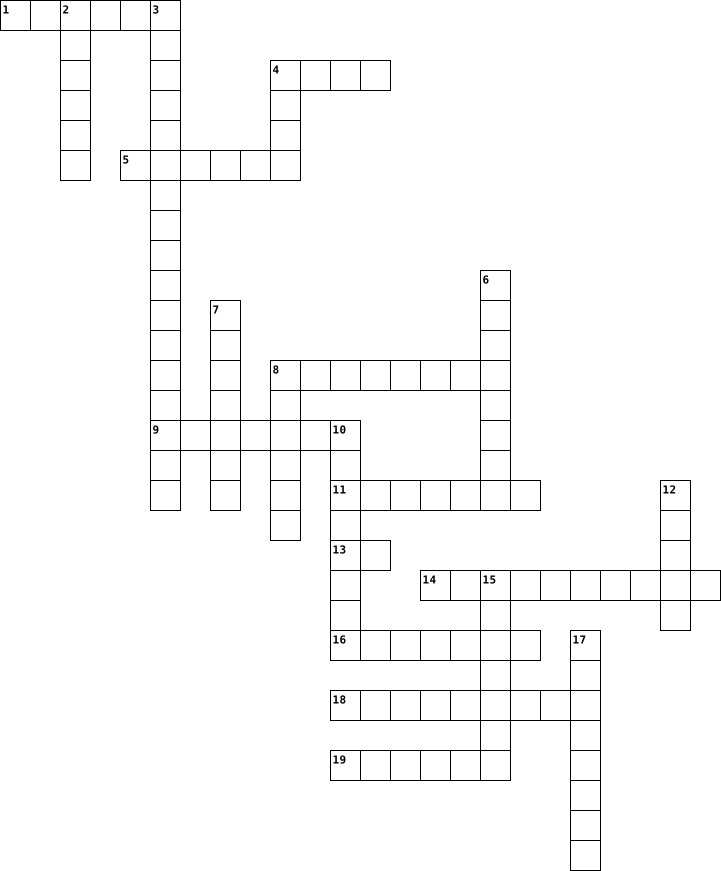
Across
- of an atom number of protons minus electrons
- spectroscopy used to measure mass to ratio
- in the periodic table columns on periodic table
- table of elements
- two or more types of atoms in the periodic table that have the same atomic number
- Substance that cannot be chemically broken
- attract shared electrons
- energy amount of energy to remove bound electron
- membrane-bound organelle
- Stable isotope of hydrogen
- positive charged ion
Down
- radius measurement size of its atom
- tendency for an atom
- number total number of protons and neutrons in a nucleus
- cloud system of electron surrounding the nucleus of an atom
- horizontal rows on periodic table
- particle with positive charge
- Particle with negative charge
- negative charged ion
- particle with no charge
- composed of two or more separate elements
21 Clues: table of elements • tendency for an atom • negative charged ion • positive charged ion • particle with no charge • attract shared electrons • membrane-bound organelle • Stable isotope of hydrogen • particle with positive charge • Particle with negative charge • horizontal rows on periodic table • radius measurement size of its atom • composed of two or more separate elements • ...
Chemistry Vocabulary 2021-09-14

Across
- of an atom number of protons minus electrons
- spectroscopy used to measure mass to ratio
- in the periodic table columns on periodic table
- table of elements
- two or more types of atoms in the periodic table that have the same atomic number
- Substance that cannot be chemically broken
- attract shared electrons
- energy amount of energy to remove bound electron
- membrane-bound organelle
- Stable isotope of hydrogen
- positive charged ion
Down
- radius measurement size of its atom
- tendency for an atom
- number total number of protons and neutrons in a nucleus
- cloud system of electron surrounding the nucleus of an atom
- horizontal rows on periodic table
- particle with positive charge
- Particle with negative charge
- negative charged ion
- particle with no charge
- composed of two or more separate elements
21 Clues: table of elements • tendency for an atom • negative charged ion • positive charged ion • particle with no charge • attract shared electrons • membrane-bound organelle • Stable isotope of hydrogen • particle with positive charge • Particle with negative charge • horizontal rows on periodic table • radius measurement size of its atom • composed of two or more separate elements • ...
Periodic Table - Artem Belikin 2020-01-20

Across
- the catagory that is between metals and nonmetals
- positively charged particle
- negatively charged particles
- number of rows on the periodic table
- the catagory that "helium" is in
- elements that are harmful to humans
- mendeleev father of the periodic table
- neutral particals
- name the name of an element
Down
- the catagory that "iron" is in
- the first element in the periodic table
- can the substance be ignited?
- orbitals
- how reactive a substance is
- located on the periodic table
- the number of groups on the periodoc table
- mass total number of protons + neutrons
- one way to determin how many valence electrons an element has
- number the number of protons in an element
- metals the first family in the periodic table
20 Clues: orbitals • neutral particals • positively charged particle • how reactive a substance is • negatively charged particles • can the substance be ignited? • located on the periodic table • the catagory that "iron" is in • name the name of an element • the catagory that "helium" is in • elements that are harmful to humans • number of rows on the periodic table • ...
The Modern Periodic Table (from a Physical Science 11 textbook) 2022-02-02

Across
- element that belongs to Group 3A and Period 2
- Sanskrit word that means "first"
- elements found in the shorter columns of the periodic table aka B groups
- particles found in the nucleus aside from neutrons
- classification of elements that exhibit properties of both metals and nonmetals
- elements found in the longer columns of the periodic table aka A groups
- first element in Group 5A
- horizontal arrangement of elements in the periodic table
- another term for the horizontal arrangement of elements in the periodic table
Down
- collective name for the elements in Group 7A
- classification of elements that tend to form cations
- number of electrons in the outermost shell of a carbon atom
- vertical arrangements of elements in the periodic table
- first element in the periodic table
- Russian chemist who proposed the arrangement of elements based on increasing atomic masses
- word that describes the repeating patterns of physical and chemical properties of elements
- collective name for the elements with atomic numbers 58 to 71
- an atom or group of atoms that has a net positive or negative charge
- English chemist who proposed the law of octaves
- first word of the collective name for the elements in Group 8A
- term used for the electrons in the outermost shell of an atom
21 Clues: first element in Group 5A • Sanskrit word that means "first" • first element in the periodic table • collective name for the elements in Group 7A • element that belongs to Group 3A and Period 2 • English chemist who proposed the law of octaves • particles found in the nucleus aside from neutrons • classification of elements that tend to form cations • ...
The Periodic Crossword Puzzle 2025-02-22

Across
- one of the elements of Group 17 of the periodic table
- the law that states that the repeating chemical and physical properties of elements change periodically with the atomic numbers of the elements
- one of the elements of Group 1 of the periodic table
- He determined the number of protons-the atomic number- in an atom
- Group 15
- an element that has properties of both metals and nonmetals
- Groups 3-12
- another term for metalloids
- one of the elements of group 18 of the periodic table
Down
- an element that conducts heat and electricity poorly
- an element that is shiny and that conducts heat and electricity well
- a vertical column of elements in a group share chemical properties
- in chemistry, a horizontal row of elements in the periodic table
- Group 14
- one of the elements of Group 2 of the periodic table
- elements that undergo a process that allows them to combine to form into compounds
- describes something that occurs or repeats at regular intervals
- another term for group
- a man who played chemical solitaire and made a table that became the Periodic table of the elements
- this was the name of the noble gases because scientists thought they would not reactive.
20 Clues: Group 14 • Group 15 • Groups 3-12 • another term for group • another term for metalloids • an element that conducts heat and electricity poorly • one of the elements of Group 1 of the periodic table • one of the elements of Group 2 of the periodic table • one of the elements of Group 17 of the periodic table • one of the elements of group 18 of the periodic table • ...
montes cross word 2012-09-09

Across
- something that makes your voice go funny
- this element is used in swimming pools
- this element is 4th on the periodic table
- this element starts with a b andends with an n
- this element is 7th on the periodic table
- something with this glows in the dark
- plastic surgery fills you with this
- one before calcium on the periodic table
- a nickname for callum
- this element kills bugs
Down
- 11th on the periodic table
- trees make this
- 2 of these and 1 oxygen make water
- this element has a family
- what makes your teeth stronger?
- this element starts with a a and ends with a on
- this element is 15th on the periodic table
- this word initials are mg
- a type of metal
- eating this helps fuel your body
20 Clues: trees make this • a type of metal • a nickname for callum • this element kills bugs • this element has a family • this word initials are mg • 11th on the periodic table • what makes your teeth stronger? • eating this helps fuel your body • 2 of these and 1 oxygen make water • plastic surgery fills you with this • something with this glows in the dark • ...
The Periodic Table 2023-11-09

Across
- most abundant element in the universe
- noble gases are the least _____________.
- two or more neutral atoms held by covalent bond
- ease and speed with which an element reacts to another
- which table puts the elements in order
- rows of the periodic table
- predicted by an element's place on the periodic table
- characteristics that determine how the element will react
Down
- atoms of two or more elements bonded together
- opposites do this
- characteristics observed without changing identity of substance
- columns of the periodic table
- the outer shell of an atom
- neutral part of an atom
- chemical bond where atoms transfer electrons
- chemical bond where atoms share electrons
- negative part of an atom
- atom that has a positive or negative charge
- positive part of an atom
- inventor of the periodic table
20 Clues: opposites do this • neutral part of an atom • negative part of an atom • positive part of an atom • the outer shell of an atom • rows of the periodic table • columns of the periodic table • inventor of the periodic table • most abundant element in the universe • which table puts the elements in order • noble gases are the least _____________. • ...
The Periodic Table 2025-02-22

Across
- most abundant element in the universe
- noble gases are the least _____________.
- two or more neutral atoms held by covalent bond
- ease and speed with which an element reacts to another
- which table puts the elements in order
- rows of the periodic table
- predicted by an element's place on the periodic table
- characteristics that determine how the element will react
Down
- atoms of two or more elements bonded together
- opposites do this
- characteristics observed without changing identity of substance
- columns of the periodic table
- the outer shell of an atom
- neutral part of an atom
- chemical bond where atoms transfer electrons
- chemical bond where atoms share electrons
- negative part of an atom
- atom that has a positive or negative charge
- positive part of an atom
- inventor of the periodic table
20 Clues: opposites do this • neutral part of an atom • negative part of an atom • positive part of an atom • the outer shell of an atom • rows of the periodic table • columns of the periodic table • inventor of the periodic table • most abundant element in the universe • which table puts the elements in order • noble gases are the least _____________. • ...
Science 2025-02-22

Across
- the symbol for Beryllium
- Group 15, Period 4
- what a row is called in a periodic table
- an example of oxidation
- on the right of the arrow in a compound equation
- on the left of the arrow in a compound equation
- a common type of molecule
- how many periods there are in a periodic table
- Found in the nucleus
- how many groups there are in a periodic table
- a bunch of atoms that are stuck together
- a type of compound
Down
- number of non-metals in the periodic table
- Group 2, Period 4
- yellow metals in the periodic table
- Has an atomic number of 26
- Group 11, Period 4
- Have a positive charge
- element that has a symbol of K
- exothermic chemical reaction
- Group 15 Period 3
- orbits the nucleus
- on the periodic table
23 Clues: Group 2, Period 4 • Group 15 Period 3 • Group 15, Period 4 • Group 11, Period 4 • orbits the nucleus • a type of compound • Found in the nucleus • on the periodic table • Have a positive charge • an example of oxidation • the symbol for Beryllium • a common type of molecule • Has an atomic number of 26 • exothermic chemical reaction • element that has a symbol of K • ...
chemistry crossword 2022-12-09

Across
- what element has an atomic number of 27 neutron subatomic particle found in the nucleus
- what element has an atomic mass of 4.0026
- what element has an atomic mass of 22.990
- what is the atomic number of niobium
- what is the atomic mass of krypton
- what group is oxygen in on the periodic table
- what element is Pb on the periodic table
- what element is Sn on the periodic table
- what element has an atomic mass of 12.011
Down
- what element is Zn on the periodic table
- what element has an atomic mass of 47.88
- what element has an atomic number of 1
- what abbreviation does gold have
- what is the atomic number of iron
- what group is Mercury in on the periodic table
- how much groups are there on the periodic table
- what element has an atomic mass of 20.179
- what element has an atomic mass of 196.59
- what element has an atomic number of 47
19 Clues: what abbreviation does gold have • what is the atomic number of iron • what is the atomic mass of krypton • what is the atomic number of niobium • what element has an atomic number of 1 • what element has an atomic number of 47 • what element is Zn on the periodic table • what element has an atomic mass of 47.88 • what element is Pb on the periodic table • ...
History of Elements 2024-11-07

Across
- A possible new arrangement of the Periodic Table
- Number 115 on the Periodic Table with an extra amount of skepticism regarding its addition to the table
- The rows in the Periodic Table
- What the Periodic Table was originally ordered by
- Is made by bombarding curium atoms with calcium
- The element 118 on the Periodic Table
- Number 117 on the Periodic Table and another questionable element
Down
- The first person to measure the atomic number of an element (last name)
- Specific place where they created SHREC
- Was experimented with to find the atomic number
- The columns in the Periodic Table
- Russian chemist created the modern periodic table
- The amount of positive charges in the atomic nucleus
- Is used to create Superheavy elements
- Has an atomic mass of 113
15 Clues: Has an atomic mass of 113 • The rows in the Periodic Table • The columns in the Periodic Table • Is used to create Superheavy elements • The element 118 on the Periodic Table • Specific place where they created SHREC • Was experimented with to find the atomic number • Is made by bombarding curium atoms with calcium • A possible new arrangement of the Periodic Table • ...
Chemistry Unit 2016-02-10

Across
- Anumber in the bottom center of the elements space on the Periodic Table. (63.545- Copper)
- An Element that shows no sign of metal in it. (Has no properties of either metal or non-metals)
- a thing in the Periodic Table of Elements (rock or gas or metal, etc)
- Substance the undergoes a chemical change
- Quantity of Substance
- Rows on the Periodic Table
- Chemical change of cold
- Has a Negative Charge.
- Is a column of elements in the periodic table of the chemical elements.
- system subjected to external force
- Has a Neutral Charge.
- Chemical change of hot
Down
- The two letters that represent each element on the periodic table. (CU- Copper)
- The Electron on the outer ring of the element. (2,8,8,2).
- Inventor of the Periodic Table.
- Is the ball of Positive and Negative charge in the center of the atom.
- All the gases on the Periodic table (Hydrogen, Helium, etc)
- Substance obtained by another substance
- the Number at the center top of the elements space in the Periodic Table. (29- Copper)
- Composed of 2 or more parts
- Elements that have no signs of metal in them (Gases)
- The smallest individual part of a molecule.
- Orbitals are regions of space around the nucleus of an atom where an electron is likely to be found.
- Elements that form cations when compounds.
- We did a lab about this. Metal was _________
- Has a Positive Charge.
26 Clues: Quantity of Substance • Has a Neutral Charge. • Has a Negative Charge. • Has a Positive Charge. • Chemical change of hot • Chemical change of cold • Rows on the Periodic Table • Composed of 2 or more parts • Inventor of the Periodic Table. • system subjected to external force • Substance obtained by another substance • Substance the undergoes a chemical change • ...
Elements 2025-02-23

Across
- Lr; Number 103 on the periodic table
- N; Number 7 on the periodic table
- O; Number 8 on the periodic table
- Ti; Number 22 on the periodic table
- Au; Number 79 on the periodic table
Down
- Na; Number 11 on the periodic table
- Ag; Number 47 on the periodic table
- Sn; Number 50 on the periodic table
- Pt; Number 78 on the periodic table
- Cl; Number 17 on the periodic table
- Zn; Number 30 on the periodic table
- Fe; Number 26 on the periodic table
12 Clues: N; Number 7 on the periodic table • O; Number 8 on the periodic table • Na; Number 11 on the periodic table • Ag; Number 47 on the periodic table • Sn; Number 50 on the periodic table • Pt; Number 78 on the periodic table • Cl; Number 17 on the periodic table • Zn; Number 30 on the periodic table • Ti; Number 22 on the periodic table • Fe; Number 26 on the periodic table • ...
The Periodic Table 2012-11-13

Across
- found to the right of the zigzag line on the periodic table
- atoms that have the same number of protons but different numbers of neutrons are this of each other
- less reactive than alkali metals
- very reactive because their atoms neeed to gain only one electron to have a complete outer level
- the most common element from Group 13, most abundant element in Earth's crust
- the most abundant element in the universe, found in large amounts in stars
- states that the repeating chemical and physical properties of elements change periodically with the elements' atomic numbers
- another commonly found member of Group 16, used to make sulfric acid
- vertical column of elements on the periodic table
- horizontal row of elements on the periodic table
- are found to the left of the zigzag line on the periodic table
Down
- elements of Groups 3-12
- gas at room temperature, makes up about 80% of the air that you breathe
- also known as semimetals, are the elements that border the zigzag line on the periodic table
- elements in Group 1 of the periodic table
- Russian chemist, discovered a pattern to the elements in 1869
- British scientist, determined the number of protons, the atomic number in an atom
- unreactive nonmetals and are in Group 18 of the periodic table
- makes up about 20% of the air, necessary for substances to burn
- "happening at regular intervals"
20 Clues: elements of Groups 3-12 • less reactive than alkali metals • "happening at regular intervals" • elements in Group 1 of the periodic table • horizontal row of elements on the periodic table • vertical column of elements on the periodic table • found to the right of the zigzag line on the periodic table • Russian chemist, discovered a pattern to the elements in 1869 • ...
Periodic Table crossword 2013-12-05

Across
- A particle in the nucleus with a positive charge
- The different molecules on the periodic table
- The number of protons in an element's nucleus
- The number of protons and neutrons in an element's nucleus
- First name of the inventor of the periodic table
- Often known as the rare earth elements, this comprises of fifteen metallic elements
- A type of element with good electric conductivity, malleability and ductility
- Last name of the inventor of the periodic table
- The short name for elements
- This element has a symbol of Cl
Down
- A particle in the nucleus with no charge
- The vertical rows on the periodic table
- What elements are made out of
- This element has an Atomic Number of 59
- A type of element with properties of both metals and nonmetals
- Encompasses the fifteen metallic elements with atomic numbers 89 - 103
- table The list of elements and their properties
- A type of element with bad electric conductivity, bad malleability and ductility
- The center of an atom
- The horizontal rows on the periodic table
20 Clues: The center of an atom • The short name for elements • What elements are made out of • This element has a symbol of Cl • The vertical rows on the periodic table • This element has an Atomic Number of 59 • A particle in the nucleus with no charge • The horizontal rows on the periodic table • The different molecules on the periodic table • ...
Chemistry 2023-03-24

Across
- The twenty-eighth element on the periodic table
- The third element on the periodic table
- The thirty-first element on the periodic table
- The thirtieth element on the periodic table
- The last element on the periodic table
Down
- The sixty-fifth element on the periodic table
- The first element on the periodic table
- The second element on the periodic table
- The twenty-seventh element on the periodic table
- The hundred and eighth element on the periodic table
- The twenty-sixth element on the periodic table
- The tenth element on the periodic table
12 Clues: The last element on the periodic table • The first element on the periodic table • The third element on the periodic table • The tenth element on the periodic table • The second element on the periodic table • The thirtieth element on the periodic table • The sixty-fifth element on the periodic table • The thirty-first element on the periodic table • ...
Periodic Trends 2023-09-22

Across
- Negatively charged Ion.
- Elements in group VIIA of the periodic table. Reactive nonmetallic elements that form acidic compounds.
- Positively charged Ion.
- Elements that make up group IIA of the periodic table. Reactive and form basic oxides.
- Metallic elements occupying the central block of the periodic table. Form coordination compounds that show variable and valence.
- When elements are listed in order of atomic numbers, they will fall into recurring groups.
- Elements that make up group Ia of the periodic table. Reactive.
- Person that arranged the periodic table.
- Atom with a non neutral charge. Happens due to a loss or gain of electrons.
- Tendency for an atom to attract Electrons.
- Gaseous Elements in Group 0 that almost entirely unreactive.
Down
- Amount of energy to move an electron from an atom.
- Elements with physical and chemical properties that are between metal and non-metals.
- Elements that represent their groups without anomalies.
- Elements that lack metallic attributes and are good insulators of electricity and heat.
- Column on the periodic table.
- Elements that are denser and are good conductors of electricity and heat.
- Row on the periodic table.
- Distance between the center of the nucleus to the outermost electron orbitals.
19 Clues: Negatively charged Ion. • Positively charged Ion. • Row on the periodic table. • Column on the periodic table. • Person that arranged the periodic table. • Tendency for an atom to attract Electrons. • Amount of energy to move an electron from an atom. • Elements that represent their groups without anomalies. • Gaseous Elements in Group 0 that almost entirely unreactive. • ...
chemistry crossword 2022-12-09

Across
- what element has an atomic number of 27 neutron subatomic particle found in the nucleus
- what element has an atomic mass of 4.0026
- what element has an atomic mass of 22.990
- what is the atomic number of niobium
- what is the atomic mass of krypton
- what group is oxygen in on the periodic table
- what element is Pb on the periodic table
- what element is Sn on the periodic table
- what element has an atomic mass of 12.011
Down
- what element is Zn on the periodic table
- what element has an atomic mass of 47.88
- what element has an atomic number of 1
- what abbreviation does gold have
- what is the atomic number of iron
- what group is Mercury in on the periodic table
- how much groups are there on the periodic table
- what element has an atomic mass of 20.179
- what element has an atomic mass of 196.59
- what element has an atomic number of 47
19 Clues: what abbreviation does gold have • what is the atomic number of iron • what is the atomic mass of krypton • what is the atomic number of niobium • what element has an atomic number of 1 • what element has an atomic number of 47 • what element is Zn on the periodic table • what element has an atomic mass of 47.88 • what element is Pb on the periodic table • ...
chemistry crossword 2022-12-09

Across
- what element has an atomic number of 27 neutron subatomic particle found in the nucleus
- what element has an atomic mass of 4.0026
- what element has an atomic mass of 22.990
- what is the atomic number of niobium
- what is the atomic mass of krypton
- what group is oxygen in on the periodic table
- what element is Pb on the periodic table
- what element is Sn on the periodic table
- what element has an atomic mass of 12.011
Down
- what element is Zn on the periodic table
- what element has an atomic mass of 47.88
- what element has an atomic number of 1
- what abbreviation does gold have
- what is the atomic number of iron
- what group is Mercury in on the periodic table
- how much groups are there on the periodic table
- what element has an atomic mass of 20.179
- what element has an atomic mass of 196.59
- what element has an atomic number of 47
19 Clues: what abbreviation does gold have • what is the atomic number of iron • what is the atomic mass of krypton • what is the atomic number of niobium • what element has an atomic number of 1 • what element has an atomic number of 47 • what element is Zn on the periodic table • what element has an atomic mass of 47.88 • what element is Pb on the periodic table • ...
Periodic Table Crossword Puzzle 2012-11-16

Across
- Groups 3-12
- this was the name of the noble gases because scientists thought they would not reactive.
- Group 14
- a man who played chemical solitaire and made a table that became the Periodic table of the elements
- He determined the number of protons-the atomic number- in an atom
- the law that states that the repeating chemical and physical properties of elements change periodically with the atomic numbers of the elements
- in chemistry, a horizontal row of elements in the periodic table
- another term for metalloids
- one of the elements of Group 17 of the periodic table
- one of the elements of Group 1 of the periodic table
- elements that undergo a process that allows them to combine to form into compounds
Down
- an element that is shiny and that conducts heat and electricity well
- one of the elements of Group 2 of the periodic table
- Group 15
- an element that conducts heat and electricity poorly
- one of the elements of group 18 of the periodic table
- another term for group
- an element that has properties of both metals and nonmetals
- a vertical column of elements in a group share chemical properties
- describes something that occurs or repeats at regular intervals
20 Clues: Group 15 • Group 14 • Groups 3-12 • another term for group • another term for metalloids • one of the elements of Group 2 of the periodic table • an element that conducts heat and electricity poorly • one of the elements of Group 1 of the periodic table • one of the elements of group 18 of the periodic table • one of the elements of Group 17 of the periodic table • ...
2Q_SCI9_WW1_Crossword Labs 2021-10-17

Across
- Element that belongs to Group 3A and Period 2
- Collective name for the elements in Group VIIA
- first word of the collective name for the elements in Group VIIIA
- Classification of elements that exhibit properties of both metals and nonmetals
- First element in Group 5A
- word that describes the repeating chemical properties of elements
- English chemist who proposed the law of octaves
- first element in the periodic table
- an atom or group of atoms that has a net positive or negative charge
- term used for the electrons in the outermost shell of an atom
- elements found in the longer columns of the periodic table, also called A groups
- Russian chemist who proposed the arrangement of elements based on increasing atomic masses
Down
- elements found in the shorter columns of the periodic table, also called B group
- classification of elements that tend to form cations
- number of electrons in the outermost shell of a carbon atom
- particles found in the nucleus aside from neutrons
- sanskrit word that means "first"
- collective name for the elements with atomic numbers 58 to 71
- vertical arrangements of elements in the periodic table
- Another term for the horizontal arrangement of elements in the periodic table
- Horizontal arrangements of elements in the periodic table
21 Clues: First element in Group 5A • sanskrit word that means "first" • first element in the periodic table • Element that belongs to Group 3A and Period 2 • Collective name for the elements in Group VIIA • English chemist who proposed the law of octaves • particles found in the nucleus aside from neutrons • classification of elements that tend to form cations • ...
Periodic Table Crossword Puzzle 2025-02-22

Across
- Groups 3-12
- this was the name of the noble gases because scientists thought they would not reactive.
- Group 14
- a man who played chemical solitaire and made a table that became the Periodic table of the elements
- He determined the number of protons-the atomic number- in an atom
- the law that states that the repeating chemical and physical properties of elements change periodically with the atomic numbers of the elements
- in chemistry, a horizontal row of elements in the periodic table
- another term for metalloids
- one of the elements of Group 17 of the periodic table
- one of the elements of Group 1 of the periodic table
- elements that undergo a process that allows them to combine to form into compounds
Down
- an element that is shiny and that conducts heat and electricity well
- one of the elements of Group 2 of the periodic table
- Group 15
- an element that conducts heat and electricity poorly
- one of the elements of group 18 of the periodic table
- another term for group
- an element that has properties of both metals and nonmetals
- a vertical column of elements in a group share chemical properties
- describes something that occurs or repeats at regular intervals
20 Clues: Group 15 • Group 14 • Groups 3-12 • another term for group • another term for metalloids • one of the elements of Group 2 of the periodic table • an element that conducts heat and electricity poorly • one of the elements of Group 1 of the periodic table • one of the elements of group 18 of the periodic table • one of the elements of Group 17 of the periodic table • ...
Periodic Table Crossword Puzzle 2025-02-22

Across
- an element that is shiny and that conducts heat and electricity well
- one of the elements of Group 1 of the periodic table
- the law that states that the repeating chemical and physical properties of elements change periodically with the atomic numbers of the elements
- Group 15
- elements that undergo a process that allows them to combine to form into compounds
- one of the elements of Group 17 of the periodic table
- another term for group
- Groups 3-12
- a man who played chemical solitaire and made a table that became the Periodic table of the elements
- He determined the number of protons-the atomic number- in an atom
- in chemistry, a horizontal row of elements in the periodic table
Down
- an element that has properties of both metals and nonmetals
- a vertical column of elements in a group share chemical properties
- one of the elements of Group 2 of the periodic table
- another term for metalloids
- one of the elements of group 18 of the periodic table
- Group 14
- this was the name of the noble gases because scientists thought they would not reactive.
- an element that conducts heat and electricity poorly
- describes something that occurs or repeats at regular intervals
20 Clues: Group 15 • Group 14 • Groups 3-12 • another term for group • another term for metalloids • one of the elements of Group 2 of the periodic table • one of the elements of Group 1 of the periodic table • an element that conducts heat and electricity poorly • one of the elements of Group 17 of the periodic table • one of the elements of group 18 of the periodic table • ...
Science 2021-06-16

Across
- the symbol for Beryllium
- Group 15, Period 4
- what a row is called in a periodic table
- an example of oxidation
- on the right of the arrow in a compound equation
- on the left of the arrow in a compound equation
- a common type of molecule
- how many periods there are in a periodic table
- Found in the nucleus
- how many groups there are in a periodic table
- a bunch of atoms that are stuck together
- a type of compound
Down
- number of non-metals in the periodic table
- Group 2, Period 4
- yellow metals in the periodic table
- Has an atomic number of 26
- Group 11, Period 4
- Have a positive charge
- element that has a symbol of K
- exothermic chemical reaction
- Group 15 Period 3
- orbits the nucleus
- on the periodic table
23 Clues: Group 2, Period 4 • Group 15 Period 3 • Group 15, Period 4 • Group 11, Period 4 • orbits the nucleus • a type of compound • Found in the nucleus • on the periodic table • Have a positive charge • an example of oxidation • the symbol for Beryllium • a common type of molecule • Has an atomic number of 26 • exothermic chemical reaction • element that has a symbol of K • ...
Periodic Table Crossword Puzzle 2012-11-16

Across
- Group 14
- another term for group
- another term for metalloids
- the law that states that the repeating chemical and physical properties of elements change periodically with the atomic numbers of the elements
- an element that conducts heat and electricity poorly
- He determined the number of protons-the atomic number- in an atom
- Groups 3-12
- this was the name of the noble gases because scientists thought they would not reactive.
- a vertical column of elements in a group share chemical properties
- one of the elements of Group 1 of the periodic table
- elements that undergo a process that allows them to combine to form into compounds
- in chemistry, a horizontal row of elements in the periodic table
- describes something that occurs or repeats at regular intervals
Down
- one of the elements of Group 2 of the periodic table
- a man who played chemical solitaire and made a table that became the Periodic table of the elements
- Group 15
- one of the elements of Group 17 of the periodic table
- an element that is shiny and that conducts heat and electricity well
- one of the elements of group 18 of the periodic table
- an element that has properties of both metals and nonmetals
20 Clues: Group 14 • Group 15 • Groups 3-12 • another term for group • another term for metalloids • one of the elements of Group 2 of the periodic table • an element that conducts heat and electricity poorly • one of the elements of Group 1 of the periodic table • one of the elements of Group 17 of the periodic table • one of the elements of group 18 of the periodic table • ...
The Periodic Table 2020-12-18

Across
- Atomic number of aluminium
- ... is the latin name of potassium
- The mass of a single atom
- Element with the chemical symbol of Na
- What do we call the table that shows all the elements?
- There are ... metals in the first 20 elements of the periodic table
- Rows in a periodic table.
- Element with the atomic number of 5
- There are ... known elements on the periodic table.
- The first element on the periodic table is Helium. (TRUE/FALSE)
- How many elements were made in the laboratory?
Down
- One or Two letters that represent an element.
- There are ... non-metals in the first 20 elements of the periodic table
- If there is a second letter in the chemical symbol, it is always ....
- Number of protons an atom contains
- The man who invented the periodic table
- The atoms of the elements increase in ... as you read across each row.
- Columns in a periodic table.
- Natrium is the ... name for sodium.
- The chemical symbol of lead is
- Element with the chemical symbol of K.
- The heaviest element
- Chemical symbol of magnesium
- ... atoms has the highest mass
- How many elements have scientists discovered naturally?
- Elements in the same column share similar chemical and ... properties.
26 Clues: The heaviest element • The mass of a single atom • Rows in a periodic table. • Atomic number of aluminium • Columns in a periodic table. • Chemical symbol of magnesium • The chemical symbol of lead is • ... atoms has the highest mass • Number of protons an atom contains • ... is the latin name of potassium • Natrium is the ... name for sodium. • Element with the atomic number of 5 • ...
1Q_PHYSCI_PT4_Part 1: Crossword Puzzle 2021-10-08

Across
- Element that belongs to Group 3A and Period 2
- sanskrit word that means "first"
- elements found in the shorter columns of the periodic table, also called B group
- particles found in the nucleus aside from neutrons
- Classification of elements that exhibit properties of both metals and nonmetals
- elements found in the longer columns of the periodic table, also called A groups
- First element in Group 5A
- Horizontal arrangements of elements in the periodic table
- Another term for the horizontal arrangement of elements in the periodic table
Down
- Collective name for the elements in Group VIIA
- classification of elements that tend to form cations
- number of electrons in the outermost shell of a carbon atom
- vertical arrangements of elements in the periodic table
- first element in the periodic table
- Russian chemist who proposed the arrangement of elements based on increasing atomic masses
- word that describes the repeating chemical properties of elements
- collective name for the elements with atomic numbers 58 to 71
- an atom or group of atoms that has a net positive or negative charge
- English chemist who proposed the law of octaves
- first word of the collective name for the elements in Group VIIIA
- term used for the electrons in the outermost shell of an atom
21 Clues: First element in Group 5A • sanskrit word that means "first" • first element in the periodic table • Element that belongs to Group 3A and Period 2 • Collective name for the elements in Group VIIA • English chemist who proposed the law of octaves • particles found in the nucleus aside from neutrons • classification of elements that tend to form cations • ...
Periodic Table Crossword Puzzle 2025-02-22

Across
- an element that is shiny and that conducts heat and electricity well
- one of the elements of Group 1 of the periodic table
- the law that states that the repeating chemical and physical properties of elements change periodically with the atomic numbers of the elements
- Group 15
- elements that undergo a process that allows them to combine to form into compounds
- one of the elements of Group 17 of the periodic table
- another term for group
- Groups 3-12
- a man who played chemical solitaire and made a table that became the Periodic table of the elements
- He determined the number of protons-the atomic number- in an atom
- in chemistry, a horizontal row of elements in the periodic table
Down
- an element that has properties of both metals and nonmetals
- a vertical column of elements in a group share chemical properties
- one of the elements of Group 2 of the periodic table
- another term for metalloids
- one of the elements of group 18 of the periodic table
- Group 14
- this was the name of the noble gases because scientists thought they would not reactive.
- an element that conducts heat and electricity poorly
- describes something that occurs or repeats at regular intervals
20 Clues: Group 15 • Group 14 • Groups 3-12 • another term for group • another term for metalloids • one of the elements of Group 2 of the periodic table • one of the elements of Group 1 of the periodic table • an element that conducts heat and electricity poorly • one of the elements of Group 17 of the periodic table • one of the elements of group 18 of the periodic table • ...
Periodic Table 2020-12-14

Across
- Strong, good conductors, shiny
- Electric charge for a proton
- How many protons are in Carbon
- Goes up and down the periodic table
- metalloids are located
- symbol for neon
- symbol for gold
- Goes left to right on the periodic table
- How many neutrons does Aluminum have?
- to become a negative ion, an atom must __ an atom
- To become a positive ion, an atom must __ an atom
Down
- who created the first periodic table
- negative electric charge
- Going from top to bottom on the periodic table , The atomic mass __
- where are electrons located
- Has 26 protons
- How many periods are there in the periodic table
- The elements in group one are also called
- The number of ____ is the same as the atomic number
- Weak, not good conductors, brittle
20 Clues: Has 26 protons • symbol for neon • symbol for gold • metalloids are located • negative electric charge • where are electrons located • Electric charge for a proton • Strong, good conductors, shiny • How many protons are in Carbon • Weak, not good conductors, brittle • Goes up and down the periodic table • who created the first periodic table • How many neutrons does Aluminum have? • ...
periodic crossword 2023-04-28

Across
- positively charged atom
- model that shows electrons and orbitals
- bond between metals and non metals
- 118 on the periodic table
- change the mass without effecting the properties or element
- the most common element in earths crust
- dull, brittle, and powdery
- an atom with a charge
- the rows across the periodic table
- shiny, malleable, and good conductor
Down
- negatively charged atom
- the type of properties that are shared in the groups of the periodic table
- how many capitals are in every abbreviation
- the same element with a different atomic mass
- bond between two metals
- the rings that hold electrons
- element with the symbol K
- the columns down the periodic table
- last name of who created the current system of the periodic table
- model that shows valence electrons
20 Clues: an atom with a charge • positively charged atom • negatively charged atom • bond between two metals • 118 on the periodic table • element with the symbol K • dull, brittle, and powdery • the rings that hold electrons • bond between metals and non metals • the rows across the periodic table • model that shows valence electrons • the columns down the periodic table • ...