
periodic%20table Crossword Puzzles
Science Term 2 2024-06-19

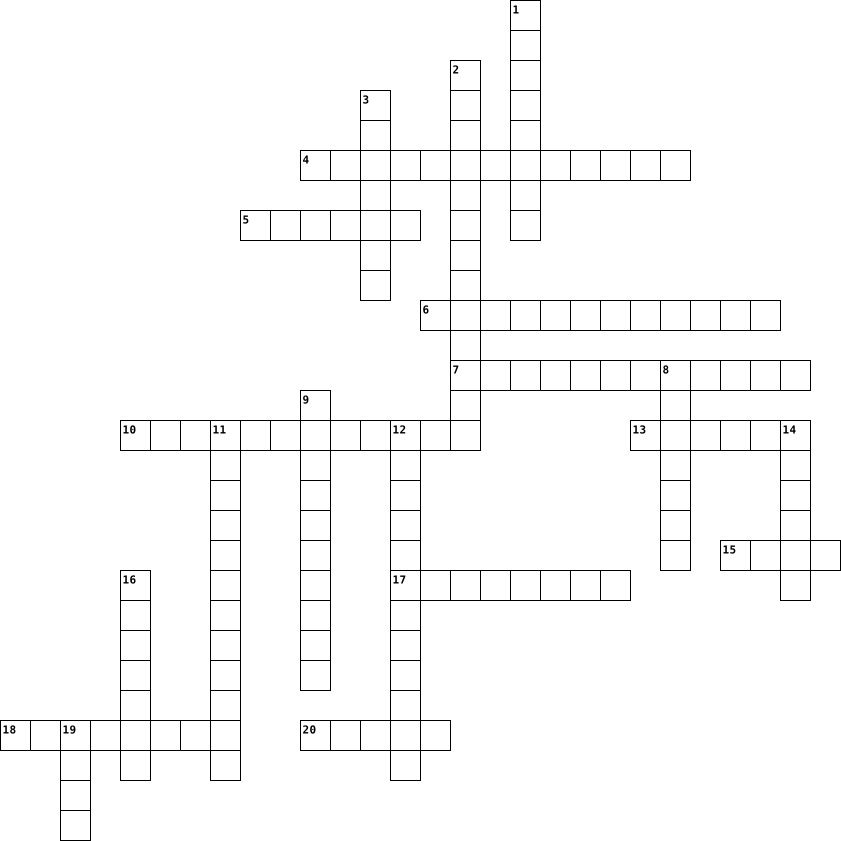
Across
- Two or more atoms bonded together
- Number Number of protons in an atom's nucleus
- An atom with a positive or negative charge
- The center of an atom
- Outer shell electrons involved in bonding
- Group 1 elements in the periodic table
- Elements that are good conductors of heat and electricity
- A particle in the nucleus with no charge
- Gas Group 18 elements known for their lack of reactivity
- Atoms of the same element with different numbers of neutrons
- Mass Total number of protons and neutrons in an atom
- A positively charged particle in the nucleus
- Elements with properties of both metals and nonmetals
Down
- Substance made of two or more different elements
- Metal Elements found in groups 3-12 of the periodic table
- A pure substance consisting of one type of atom
- Energy levels where electrons are found
- Table Chart organizing all known elements
- A negatively charged particle orbiting the nucleus
- Configuration Distribution of electrons in an atom's shells
- Elements that are poor conductors of heat and electricity
- Group 17 elements in the periodic table
- Horizontal rows in the periodic table
- Vertical columns in the periodic table
- The smallest unit of matter
25 Clues: The center of an atom • The smallest unit of matter • Two or more atoms bonded together • Horizontal rows in the periodic table • Group 1 elements in the periodic table • Vertical columns in the periodic table • Energy levels where electrons are found • Group 17 elements in the periodic table • A particle in the nucleus with no charge • ...
The Periodic Crossword Puzzle 2012-11-16

Across
- one of the elements of Group 17 of the periodic table
- the law that states that the repeating chemical and physical properties of elements change periodically with the atomic numbers of the elements
- one of the elements of Group 1 of the periodic table
- He determined the number of protons-the atomic number- in an atom
- Group 15
- an element that has properties of both metals and nonmetals
- Groups 3-12
- another term for metalloids
- one of the elements of group 18 of the periodic table
Down
- an element that conducts heat and electricity poorly
- an element that is shiny and that conducts heat and electricity well
- a vertical column of elements in a group share chemical properties
- in chemistry, a horizontal row of elements in the periodic table
- Group 14
- one of the elements of Group 2 of the periodic table
- elements that undergo a process that allows them to combine to form into compounds
- describes something that occurs or repeats at regular intervals
- another term for group
- a man who played chemical solitaire and made a table that became the Periodic table of the elements
- this was the name of the noble gases because scientists thought they would not reactive.
20 Clues: Group 14 • Group 15 • Groups 3-12 • another term for group • another term for metalloids • an element that conducts heat and electricity poorly • one of the elements of Group 1 of the periodic table • one of the elements of Group 2 of the periodic table • one of the elements of Group 17 of the periodic table • one of the elements of group 18 of the periodic table • ...
Periodic Table Crossword Puzzle 2012-11-16

Across
- an element that is shiny and that conducts heat and electricity well
- one of the elements of Group 1 of the periodic table
- the law that states that the repeating chemical and physical properties of elements change periodically with the atomic numbers of the elements
- Group 15
- elements that undergo a process that allows them to combine to form into compounds
- one of the elements of Group 17 of the periodic table
- another term for group
- Groups 3-12
- a man who played chemical solitaire and made a table that became the Periodic table of the elements
- He determined the number of protons-the atomic number- in an atom
- in chemistry, a horizontal row of elements in the periodic table
Down
- an element that has properties of both metals and nonmetals
- a vertical column of elements in a group share chemical properties
- one of the elements of Group 2 of the periodic table
- another term for metalloids
- one of the elements of group 18 of the periodic table
- Group 14
- this was the name of the noble gases because scientists thought they would not reactive.
- an element that conducts heat and electricity poorly
- describes something that occurs or repeats at regular intervals
20 Clues: Group 15 • Group 14 • Groups 3-12 • another term for group • another term for metalloids • one of the elements of Group 2 of the periodic table • one of the elements of Group 1 of the periodic table • an element that conducts heat and electricity poorly • one of the elements of Group 17 of the periodic table • one of the elements of group 18 of the periodic table • ...
Periodic Table Crossword Puzzle 2025-02-22

Across
- Group 14
- another term for group
- another term for metalloids
- the law that states that the repeating chemical and physical properties of elements change periodically with the atomic numbers of the elements
- an element that conducts heat and electricity poorly
- He determined the number of protons-the atomic number- in an atom
- Groups 3-12
- this was the name of the noble gases because scientists thought they would not reactive.
- a vertical column of elements in a group share chemical properties
- one of the elements of Group 1 of the periodic table
- elements that undergo a process that allows them to combine to form into compounds
- in chemistry, a horizontal row of elements in the periodic table
- describes something that occurs or repeats at regular intervals
Down
- one of the elements of Group 2 of the periodic table
- a man who played chemical solitaire and made a table that became the Periodic table of the elements
- Group 15
- one of the elements of Group 17 of the periodic table
- an element that is shiny and that conducts heat and electricity well
- one of the elements of group 18 of the periodic table
- an element that has properties of both metals and nonmetals
20 Clues: Group 14 • Group 15 • Groups 3-12 • another term for group • another term for metalloids • one of the elements of Group 2 of the periodic table • an element that conducts heat and electricity poorly • one of the elements of Group 1 of the periodic table • one of the elements of Group 17 of the periodic table • one of the elements of group 18 of the periodic table • ...
Chemistry Review 2021-03-07

Across
- non-metals are found on this side of the periodic table
- examples include neon, argon and helium
- negative subatomic particle
- a change that cannot be easily undone
- where protons and neutrons are found
- metalloids are found near this on the periodic table
- an element with the symbol Hg
- most reactive non-metals
- have characteristics of metals and non-metals
Down
- a column on the periodic table
- most reactive metals
- tells you the number of protons and electrons
- a row on the periodic table
- an element with the symbol Pb
- subatomic particle with no charge
- where electrons can be found
- positive subatomic particle
- change a change in state of matter or size
- metals are found on this side of the periodic table
- tells you the total number of protons and neutrons
20 Clues: most reactive metals • most reactive non-metals • negative subatomic particle • a row on the periodic table • positive subatomic particle • where electrons can be found • an element with the symbol Pb • an element with the symbol Hg • a column on the periodic table • subatomic particle with no charge • where protons and neutrons are found • a change that cannot be easily undone • ...
Element crossword puzzle 2021-10-22

Across
- its atomic mass is 207.2
- its sign is Hg
- its atomic number 27
- the first element on the periodic table
- its sign is Au
- the second noble gas on the periodic table
- its atomic mass is 15.999
- its the second element on the periodic table
- its sign is Fe
- its atomic mass is 137.328
- its sign is Na
- its the third element on the periodic table
- is sign is S
Down
- its sign is ti
- it located in the 4th row 10th column
- the third noble gas
- the fifth noble gas
- its sign cr
- its atomic is 53
- its atomic number is 33
- its sign is Rh
- its atomic number is 50
- the last element on the periodic table
- its atomic mass is 222
24 Clues: its sign cr • is sign is S • its sign is ti • its sign is Hg • its sign is Au • its sign is Rh • its sign is Fe • its sign is Na • its atomic is 53 • the third noble gas • the fifth noble gas • its atomic number 27 • its atomic mass is 222 • its atomic number is 33 • its atomic number is 50 • its atomic mass is 207.2 • its atomic mass is 15.999 • its atomic mass is 137.328 • ...
Periodic Table 2013-12-04

Across
- How many periods are there in the Periodic Table?
- How many groups are in the Periodic Table?
- Vertical columns in the Periodic Table
- What makes up matter
- Chart of the elements
- Horizontal rows in the Periodic Table
- Has more than one type of molecule
- Temperature which turns a solid into a liquid
- How tightly packed something is
Down
- Has one or more of the same type of molecules
- title of substance
- First element in Periodic Table
- Temperature which turns a liquid into a gas
- Number of protons and Neutrons
- Temperature which turns a liquid into a solid
- The ratio of the average mass of atoms of an element
- The number of protons in an atom
- Symbol is Au
- What elements make up
- Shortened version of the element’s name
20 Clues: Symbol is Au • title of substance • What makes up matter • Chart of the elements • What elements make up • Number of protons and Neutrons • First element in Periodic Table • How tightly packed something is • The number of protons in an atom • Has more than one type of molecule • Horizontal rows in the Periodic Table • Vertical columns in the Periodic Table • ...
Periodic Table 2013-12-05
Across
- Temperature which turns a liquid into a solid
- What elements make up
- The ratio of the average mass of atoms of an element
- Temperature which turns a liquid into a gas
- title of substance
- Vertical columns in the Periodic Table
- What makes up matter
- Has more than one type of molecule
- How many groups are in the Periodic Table?
- How many periods are there in the Periodic Table?
Down
- First element in Periodic Table
- Chart of the elements
- Has one or more of the same type of molecules
- Horizontal rows in the Periodic Table
- Number of protons and Neutrons
- Temperature which turns a solid into a liquid
- The number of protons in an atom
- Shortened version of the element’s name
- How tightly packed something is
- Symbol is Au
20 Clues: Symbol is Au • title of substance • What makes up matter • Chart of the elements • What elements make up • Number of protons and Neutrons • First element in Periodic Table • How tightly packed something is • The number of protons in an atom • Has more than one type of molecule • Horizontal rows in the Periodic Table • Vertical columns in the Periodic Table • ...
Periodic Table 2017-02-18

Across
- which element of the periodic table boiling point 3,927 °C
- extracted from limestone
- it glows reddish orange in a vacuum tube.
- which element of the periodic table is the second most common element in the Universe (after hydrogen), making up around 24% of its mass.
- sometimes referred to as the "Devil's Element," because it used to be the thirteenth element discovered and because of its explosive properties.
- Atomic number is 9
- makes up around 78% of the air you breathe
- It is the sixth most abundant metal in the Earth's crust
- a French scientist Antoine Lavoisier named -------- and he carried out a variety of experiments to reveal its nature.
Down
- Melting point -189.4 °C
- which element of the periodic table It is so light it can float on water
- helps your bones grow stronger
- what element of the periodic table symbol is be
- lighter halogen than chlorine.
- which element of the periodic table makes up more than 90 percent of all the atoms.
- -most abundant mineral on Earth after oxygen and silicon
- most abundant element in the universe by weight
- is a member of the chalcogen group on the periodic table
- 15 on the periodic table
19 Clues: Atomic number is 9 • Melting point -189.4 °C • extracted from limestone • 15 on the periodic table • helps your bones grow stronger • lighter halogen than chlorine. • it glows reddish orange in a vacuum tube. • makes up around 78% of the air you breathe • what element of the periodic table symbol is be • most abundant element in the universe by weight • ...
Periodic Trends 2023-10-13

Across
- The likelihood of an element to undergo chemical reactions and form compounds with other elements.
- A horizontal row on the periodic table, indicating the number of energy levels an element's atoms have.
- A measure of how closely an element's properties resemble those of a metal, such as luster, conductivity, and malleability.
- The size of an atom, typically measured as the distance from the nucleus to the outermost electron cloud.
- A group of highly reactive nonmetals in Group 17 of the periodic table.
- Systematic variations in properties of elements across a period or down a group on the periodic table.
- The reduction in the effective nuclear charge on the outermost electrons due to the presence of inner electron shells.
- The energy required to remove an electron from an atom, indicating an atom's tendency to lose electrons.
- A pattern or tendency in the properties of elements across the periodic table.
- A vertical column on the periodic table, also called a family, indicating the number of valence electrons and similar chemical properties.
- The number of protons in the nucleus of an atom, which defines an element's identity on the periodic table.
- element with properties intermediate between metals and nonmetals.
- The positive charge in the nucleus of an atom, which attracts electrons.
Down
- that have properties of both metals and nonmetals, found along the "staircase" on the periodic table.
- A group of elements that are chemically inert, stable, and typically found as gases.
- Electrons in the outermost energy level of an atom that are involved in chemical bonding.
- The ability of an atom to attract electrons when forming chemical bonds, indicating its tendency to gain electrons.
- on the right side of the periodic table that are typically poor conductors of heat and electricity.
- A group of metals in Group 2 of the periodic table, which are less reactive than alkali metals.
- The principle that states that the physical and chemical properties of elements are periodic functions of their atomic numbers.
- The energy change associated with adding an electron to an atom, indicating the atom's tendency to gain electrons.
- A highly reactive group of metals in Group 1 of the periodic table.
22 Clues: element with properties intermediate between metals and nonmetals. • A highly reactive group of metals in Group 1 of the periodic table. • A group of highly reactive nonmetals in Group 17 of the periodic table. • The positive charge in the nucleus of an atom, which attracts electrons. • ...
Chapter 4 Vocab 2024-11-05

Across
- An element that typically has four or more valence electrons and that does not exhibit the general properties of metals; located on the right side of the periodic table
- An element in Group 17 of the periodic table having seven valence electrons. It easily gains electron, forming a 1- anion, which causes it to be highly reactive
- Any electron in the outermost energy level of a neutral atom. Unpaired valence electrons are usually involved in chemical bonding
- An element with characteristics between those of metals and nonmetals; also called semi-conductors; located between metals and nonmetals on the periodic table
- 1) a row in the periodic table of the elements; also called a series 2) The time interval (T) for one complete cycle of periodic motion
- The distance from the center of an atom´s nucleus to its outermost energy level
- Any elements in Groups 3-12 of the periodic table, typically having one or two valence electrons, which it easily loses, resulting in cations with charges of 1+ or 2+
- A measure of an element´s ability to attract and hold electrons when bonded to other atoms
- A representation of an atom consisting of its chemical symbol with surrounding dots representing its valence electrons
Down
- An element in Group 1 of the periodic table, having one valence electron that it can easily lose to form a 1+ cation, making it extremely reactive; the most reactive of all metals
- An element in Group 2 of the periodic table, having two valence electrons that it tends to lose easily to become a 2+ cation, making it reactive
- An element in Group 18 on the periodic table having eight valence electrons that fill the outer energy level. (Helium is an exception with only two). With a full outer energy level, it is inert (i.e., nonreactive)
- An element that is typically dense, solid, ductile, malleable, highly conductive, and chemically reactive, especially in the presence of nonmetal elements. Metals are located on the left end of the periodic table
- A table of the chemical elements arranged to display their periodic properties in relation to their atomic number
- Any of Groups 13-16 in the periodic table; so named because they contain metals, nonmetals, and metalloids. These groups are often named for the first element in the family
- An element from either of two rows usually placed below the periodic table; a member of either the lanthanide or actinide series; It typically has two valence electrons
- A column of elements in the periodic table having similar valence electron arrangement, resulting in similar chemical properties; also known as a group
- The law that states that the properties of the elements vary with their atomic numbers in a regular, repeated pattern
- A column of elements in the periodic table having similar valence electron arrangement, resulting in similar chemical properties
19 Clues: The distance from the center of an atom´s nucleus to its outermost energy level • A measure of an element´s ability to attract and hold electrons when bonded to other atoms • A table of the chemical elements arranged to display their periodic properties in relation to their atomic number • ...
Physical Science Crossword: Sections 4A, 4B and 4C Gayeon Kim/Nov 14, 2024/PS 211 B 2024-11-19

Across
- An element in Group 17 of the periodic table having seven valence electrons. It easily gains an electron, forming a 1 − anion, which causes it to be highly reactive.
- An element in Group 18 on the periodic table having eight valence electrons that fill the outer energy level. (Helium is an exception with only two.) With a full outer energy level, it is inert (i.e., nonreactive).
- A column of elements in the periodic table having similar valence electron arrangement, resulting in similar chemical properties
- An element with characteristics between those of metals and nonmetals; also called semiconductors; located between metals and nonmetals on the periodic table.
- A measure of an element’s ability to attract and hold electrons when bonded to other atoms.
- An element that typically has four or more valence electrons and that does not exhibit the general properties of metals; located on the right side of the periodic table.
- An element that is typically dense, solid, ductile, malleable, highly conductive, and chemically reactive, especially in the presence of nonmetal elements. Metals are located on the left end of the periodic table.
- A representation of an atom consisting of its chemical symbol with surrounding dots representing its valence electrons.
- Any of Groups 13–16 in the periodic table; so named because they contain metals, nonmetals, and metalloids. These groups are often named for the first element in the family.
- (1) A row in the periodic table of the elements; also called a series. (2) The time interval (T) for one complete cycle of periodic motion.
- A column of elements in the periodic table having similar valence electron arrangement, resulting in similar chemical properties; also known as a group.
- Any elements in Groups 3–12 of the periodic table, typically having one or two valence electrons, which it easily loses, resulting in cations with charges of 1 + or 2 + .
Down
- An element in Group 2 of the periodic table, having two valence electrons that it tends to lose easily to become a 2 + cation, making it very reactive.
- Any electron in the outermost energy level of a neutral atom. Unpaired valence electrons are usually involved in chemical bonding.
- A table of the chemical elements arranged to display their periodic properties in relation to their atomic numbers.
- The distance from the center of an atom’s nucleus to its outermost energy level.
- An element from either of two rows usually placed below the periodic table; a member of either the lanthanide or actinide series. It typically has two valence electrons.
- An element in Group 1 of the periodic table, having one valence electron that it can easily lose to form a 1 + cation, making it extremely reactive; the most reactive of all the metals.
- The law that states that the properties of the elements vary with their atomic numbers in a regular, repeated pattern.
19 Clues: The distance from the center of an atom’s nucleus to its outermost energy level. • A measure of an element’s ability to attract and hold electrons when bonded to other atoms. • A table of the chemical elements arranged to display their periodic properties in relation to their atomic numbers. • ...
Periodic Table crossword 2023-08-22

Across
- center of an atom
- staircase on the periodic table
- removing electrons
- a bond formed when two atoms share valence electrons
- number of protons in nucules
- located in the outer most energy level
- makes up periodic table
- found in the middle of the periodic table
Down
- forming a bond between other elements
- a vertical column
- a horizontal row
- Negative charge
- Neatral charge
- brittle an poor conducters
- nonreactive elements
- same number of protons and electrons in a atom
- an atom that has gained or lost electrons
- Positive charge
- the smallest part of an element
- number one on the periodic table
20 Clues: Neatral charge • Negative charge • Positive charge • a horizontal row • center of an atom • a vertical column • removing electrons • nonreactive elements • makes up periodic table • brittle an poor conducters • number of protons in nucules • staircase on the periodic table • the smallest part of an element • number one on the periodic table • forming a bond between other elements • ...
Vocab 4 2024-11-19

Across
- an element in group 17 of the periodic table having seven valence electrons. It easily gains an electron, forming a 1- anion, which causes it to be highly reactive
- the law that states that the properties of the elements very with their atomic numbers in a regular, repeated pattern
- an element in group 1 of the periodic table, having one valence electron that it can easily lose to form a 1+ cation, making it extremely reactive; the most reactive of all the metals
- a measure of an element’s ability to attract and hold electrons when bonded to other atoms
- an element in group 2 of the periodic table, having two valence electrons that it tends to lose easily to become a 2+ cation, making it very reactive
- an element in group 18 on the periodic table having eight valence electrons that fill the outer energy level. (Helium is an exeption with only two.) With a full outer energy level, it is inert
- a row in the periodic table of the elements; also called a series
- an element with characteristics between those of metals and nonmetals; also called semiconductors; located between metals and nonmetals on the periodic table
- see family
Down
- an element from either of two rows usually placed below the periodic table; a member of either the lanthanide or actinide series. It typically has two valence electrons
- any elements in groups 3-12 of the periodic table, typically having one or two valence electrons, which it easily loses, resulting in cations with charges of 1+ or 2+
- any electron in the outermost energy level of a neutral atom. Unpaired valence electrons are usually involved in chemical bonding
- any of groups 13-16 in the periodic table; so named because they contain metals, nonmetals, and metalloids. These groups are often named for the first element in the family
- the distance from the center of an atom’s nucleus to its outermost energy level
- an element that is typically dense, solid, ductile, malleable, highly conductive, and chemically reactive, especially in the presence of nonmetal elements. Metals are located on the left end of the periodic table
- a representation of an atom consisting of its chemical symbol with surrounding dots representing its valence electrons
- a colum of elements in the periodic table having similar valence electron arrangement, resulting in similar chemical properties; also known as a group
- an element that typically has four or more valence electrons and that does not exhibit the general proporties of metals; located on the right side of the periodic table
- table of the chemical elements arranged in a way that displays their periodic properties in relationship to their atomic numbers
19 Clues: see family • a row in the periodic table of the elements; also called a series • the distance from the center of an atom’s nucleus to its outermost energy level • a measure of an element’s ability to attract and hold electrons when bonded to other atoms • ...
chemistry crossword 2022-12-09

Across
- what element has an atomic number of 27 neutron subatomic particle found in the nucleus
- what element has an atomic mass of 4.0026
- what element has an atomic mass of 22.990
- what is the atomic number of niobium
- what is the atomic mass of krypton
- what group is oxygen in on the periodic table
- what element is Pb on the periodic table
- what element is Sn on the periodic table
- what element has an atomic mass of 12.011
Down
- what element is Zn on the periodic table
- what element has an atomic mass of 47.88
- what element has an atomic number of 1
- what abbreviation does gold have
- what is the atomic number of iron
- what group is Mercury in on the periodic table
- how much groups are there on the periodic table
- what element has an atomic mass of 20.179
- what element has an atomic mass of 196.59
- what element has an atomic number of 47
19 Clues: what abbreviation does gold have • what is the atomic number of iron • what is the atomic mass of krypton • what is the atomic number of niobium • what element has an atomic number of 1 • what element has an atomic number of 47 • what element is Zn on the periodic table • what element has an atomic mass of 47.88 • what element is Pb on the periodic table • ...
Unit 1 Atomic Structure & the Periodic Table 2025-11-21

Across
- Fluorine has _________ valence electrons.
- Horizontal rows on the periodic table are called ________.
- ____________ is the most reactive metal on the periodic table.
- the number of protons in an element
- smallest particle of a substance that still retains the properties of that substance
- What type of compounds are named using prefixes.
- ____________ is the most reactive nonmetal on the periodic table.
- Groups on the Periodic table are also called ______________.
- Subatomic particles with no charge
- ____________ Said that matter is composed of tiny, indivisible particles called atoms.
- ___________ has six protons.
Down
- _________ has fourteen neutrons.
- _______ bonds are formed from the sharing of Electrons between Nonmetals.
- Negatively charged subatomic particles
- the number of protons + neutrons
- Positively charged subatomic particles
- _____________ are located between metals (Left) and nonmetals (right) on the periodic table.
- The periodic table is arranged according to increasing __________ #.
- _______ atomic mass is an average of the mass #’s of the element’s naturally occurring isotopes.
- # of _________ = mass # (or rounded atomic mass)–protons(atomic #)
- _______ bonds are formed from the transfer of electrons between metals and nonmetals.
21 Clues: ___________ has six protons. • _________ has fourteen neutrons. • the number of protons + neutrons • Subatomic particles with no charge • the number of protons in an element • Negatively charged subatomic particles • Positively charged subatomic particles • Fluorine has _________ valence electrons. • What type of compounds are named using prefixes. • ...
chemistry crossword 2022-12-09

Across
- what element has an atomic number of 27 neutron subatomic particle found in the nucleus
- what element has an atomic mass of 4.0026
- what element has an atomic mass of 22.990
- what is the atomic number of niobium
- what is the atomic mass of krypton
- what group is oxygen in on the periodic table
- what element is Pb on the periodic table
- what element is Sn on the periodic table
- what element has an atomic mass of 12.011
Down
- what element is Zn on the periodic table
- what element has an atomic mass of 47.88
- what element has an atomic number of 1
- what abbreviation does gold have
- what is the atomic number of iron
- what group is Mercury in on the periodic table
- how much groups are there on the periodic table
- what element has an atomic mass of 20.179
- what element has an atomic mass of 196.59
- what element has an atomic number of 47
19 Clues: what abbreviation does gold have • what is the atomic number of iron • what is the atomic mass of krypton • what is the atomic number of niobium • what element has an atomic number of 1 • what element has an atomic number of 47 • what element is Zn on the periodic table • what element has an atomic mass of 47.88 • what element is Pb on the periodic table • ...
chemistry crossword 2022-12-09

Across
- what element has an atomic number of 27 neutron subatomic particle found in the nucleus
- what element has an atomic mass of 4.0026
- what element has an atomic mass of 22.990
- what is the atomic number of niobium
- what is the atomic mass of krypton
- what group is oxygen in on the periodic table
- what element is Pb on the periodic table
- what element is Sn on the periodic table
- what element has an atomic mass of 12.011
Down
- what element is Zn on the periodic table
- what element has an atomic mass of 47.88
- what element has an atomic number of 1
- what abbreviation does gold have
- what is the atomic number of iron
- what group is Mercury in on the periodic table
- how much groups are there on the periodic table
- what element has an atomic mass of 20.179
- what element has an atomic mass of 196.59
- what element has an atomic number of 47
19 Clues: what abbreviation does gold have • what is the atomic number of iron • what is the atomic mass of krypton • what is the atomic number of niobium • what element has an atomic number of 1 • what element has an atomic number of 47 • what element is Zn on the periodic table • what element has an atomic mass of 47.88 • what element is Pb on the periodic table • ...
CROSSWORD PUZZLE ABOUT PERIODIC TABLE 2022-10-05

Across
- most metallic element
- the central part of the atom
- to which element group does argon belong
- negatively charged ions
- the name of the element with the symbol "w"
- name of the columns of the elements
- the only element in the halide family that is liquid
- surname of inventor of the modern periodic table
- has the atomic mass number 24
Down
- the heaviest metal on the chart
- which element is the number 12 on the periodic table
- the lightest weight metalloids
- surname of who arrange the known elements in order of decreasing mass
- which element is the number 14 on the periodic table
- state of the matter of element calcium
- what is the "ar" symbol for
- first chemical element on the periodic table
- most conductive metal element
- a gas with 8 protons and 8 neutrons
- most of the chemical elements on the periodic table
20 Clues: most metallic element • negatively charged ions • what is the "ar" symbol for • the central part of the atom • most conductive metal element • has the atomic mass number 24 • the lightest weight metalloids • the heaviest metal on the chart • name of the columns of the elements • a gas with 8 protons and 8 neutrons • state of the matter of element calcium • ...
The periodic table 2024-11-16

Across
- the number of electrons in a full energy level
- ion with positive charge
- ion with negative charge
- the number of valence electrons in the halogen group
- a light gas used to fill balloons
- the number of groups in the periodic table
- the number of electrons in the first energy level
- the name of the inventor of the periodic table
Down
- the 17th group of elements
- name of a horizontal set of elements in the periodic table
- elements arrangement in the periodic table is according to the…
- gases – least reactive elements
- electrons in the last energy level
- an atom that lost or gained an electron
- the most abundant type of elements in the periodic table
- name of a vertical set of elements in the periodic table
- the rule that is responsible for chemical reactions
- metals – group of elements with one valence electron
18 Clues: ion with positive charge • ion with negative charge • the 17th group of elements • gases – least reactive elements • a light gas used to fill balloons • electrons in the last energy level • an atom that lost or gained an electron • the number of groups in the periodic table • the number of electrons in a full energy level • the name of the inventor of the periodic table • ...
chemistry crossword 2022-12-09

Across
- what element has an atomic number of 27 neutron subatomic particle found in the nucleus
- what element has an atomic mass of 4.0026
- what element has an atomic mass of 22.990
- what is the atomic number of niobium
- what is the atomic mass of krypton
- what group is oxygen in on the periodic table
- what element is Pb on the periodic table
- what element is Sn on the periodic table
- what element has an atomic mass of 12.011
Down
- what element is Zn on the periodic table
- what element has an atomic mass of 47.88
- what element has an atomic number of 1
- what abbreviation does gold have
- what is the atomic number of iron
- what group is Mercury in on the periodic table
- how much groups are there on the periodic table
- what element has an atomic mass of 20.179
- what element has an atomic mass of 196.59
- what element has an atomic number of 47
19 Clues: what abbreviation does gold have • what is the atomic number of iron • what is the atomic mass of krypton • what is the atomic number of niobium • what element has an atomic number of 1 • what element has an atomic number of 47 • what element is Zn on the periodic table • what element has an atomic mass of 47.88 • what element is Pb on the periodic table • ...
chemistry crossword 2022-12-09

Across
- what element has an atomic number of 27 neutron subatomic particle found in the nucleus
- what element has an atomic mass of 4.0026
- what element has an atomic mass of 22.990
- what is the atomic number of niobium
- what is the atomic mass of krypton
- what group is oxygen in on the periodic table
- what element is Pb on the periodic table
- what element is Sn on the periodic table
- what element has an atomic mass of 12.011
Down
- what element is Zn on the periodic table
- what element has an atomic mass of 47.88
- what element has an atomic number of 1
- what abbreviation does gold have
- what is the atomic number of iron
- what group is Mercury in on the periodic table
- how much groups are there on the periodic table
- what element has an atomic mass of 20.179
- what element has an atomic mass of 196.59
- what element has an atomic number of 47
19 Clues: what abbreviation does gold have • what is the atomic number of iron • what is the atomic mass of krypton • what is the atomic number of niobium • what element has an atomic number of 1 • what element has an atomic number of 47 • what element is Zn on the periodic table • what element has an atomic mass of 47.88 • what element is Pb on the periodic table • ...
Chapter 6 2017-01-22

Across
- Democritus named this particle
- Neutral particle in the atom’s nucleus
- A row on the periodic table
- (3 words) Shows the numbers and locations of protons, neutrons and electrons in an atom
- group 1 of the periodic table
- Very reactive
- Cannot be broken down into simpler chemical substance by any physical or chemical means
- Located on the right of the staircase on the periodic table
- The number of protons and neutrons in an atom’s nucleus
- An abbreviation for a chemical element
Down
- Positively charged particle in the atom's nucleus
- Located along the staircase line
- Any pure substance that is composed of two or more different elements that are chemically joined
- The mass of an atom
- a column with similar properties on the periodic table
- Group 18 on the periodic table
- (3 words) These metals are shiny and silvery but not as soft or reactive as alkali metals
- Located at the top left corner of each element on the periodic table
- An atom with the same number of protons but a different number of neutrons
- Part of Thomson's experiment
20 Clues: Very reactive • The mass of an atom • A row on the periodic table • Part of Thomson's experiment • group 1 of the periodic table • Democritus named this particle • Group 18 on the periodic table • Located along the staircase line • Neutral particle in the atom’s nucleus • An abbreviation for a chemical element • Positively charged particle in the atom's nucleus • ...
Elements Crossword 2025-02-22

Across
- The reactive elements that produce salt
- Metals with Nonmetallic properties that are poor conductors of electricity
- The chemical elements that have properties similar to metals AND Nonmetals
- The odorless and colorless chemical elements
- A group with the chemical elements on the Periodic Table
- The discoverer of the Periodic Table
- Atomic Number 30 and used in sunscreen Isotopes/A concept in which there are more neutrons that electrons and protons
Down
- The rows of the Periodic Table
- Atomic Number 26 and Element Symbol Fe
- Atomic Number 24 has shiny, metallic color
- The basic building blocks of matter
- A group of metallic chemical elements
- Strong and shiny elements that are good conductors of electricity
- The columns of the Periodic Table
- A group of the chemically reactive elements on the Periodic Table
- A noble gas
- Atomic Number 12 is a shiny, gray, metal
- Atomic Number 40
- Earth Metals A group with elements with similar properties
- Metals The group of the shiny and strong metals on the Periodic Table
20 Clues: A noble gas • Atomic Number 40 • The rows of the Periodic Table • The columns of the Periodic Table • The basic building blocks of matter • The discoverer of the Periodic Table • A group of metallic chemical elements • Atomic Number 26 and Element Symbol Fe • The reactive elements that produce salt • Atomic Number 12 is a shiny, gray, metal • ...
Elements Crossword 2016-01-15

Across
- The reactive elements that produce salt
- Metals with Nonmetallic properties that are poor conductors of electricity
- The chemical elements that have properties similar to metals AND Nonmetals
- The odorless and colorless chemical elements
- A group with the chemical elements on the Periodic Table
- The discoverer of the Periodic Table
- Atomic Number 30 and used in sunscreen Isotopes/A concept in which there are more neutrons that electrons and protons
Down
- The rows of the Periodic Table
- Atomic Number 26 and Element Symbol Fe
- Atomic Number 24 has shiny, metallic color
- The basic building blocks of matter
- A group of metallic chemical elements
- Strong and shiny elements that are good conductors of electricity
- The columns of the Periodic Table
- A group of the chemically reactive elements on the Periodic Table
- A noble gas
- Atomic Number 12 is a shiny, gray, metal
- Atomic Number 40
- Earth Metals A group with elements with similar properties
- Metals The group of the shiny and strong metals on the Periodic Table
20 Clues: A noble gas • Atomic Number 40 • The rows of the Periodic Table • The columns of the Periodic Table • The basic building blocks of matter • The discoverer of the Periodic Table • A group of metallic chemical elements • Atomic Number 26 and Element Symbol Fe • The reactive elements that produce salt • Atomic Number 12 is a shiny, gray, metal • ...
Periodic Table Crossword 2018-01-30

Across
- I am in group 14 and period 2 who am i?
- I am the second element on the periodic table
- The periodic table is arranged in row and what else?
- I am the first of the alkali earth metals
- I am a non metal and my atomic number is 9
- What does the periodic table show? Starts with E
- I have 10 protons who am i?
- My atomic mass is 14
Down
- I am a metalloid and my Symbol is B
- My symbol is O
- I am the first alkali metal
- What are the vertical columns called ?
- What is another name for the vertical columns that are called groups?
- Looking at the first 10 elements on the periodic table, How many are noble gases?
- If i have an atomic mass of 35 what element am i?
- I am the first element on the periodic table
- How many groups exist on the periodic table?
- What kind of gas is helium?
- What are the rows called?
- Does the atomic number increase or decrease when going left to right
20 Clues: My symbol is O • My atomic mass is 14 • What are the rows called? • I am the first alkali metal • What kind of gas is helium? • I have 10 protons who am i? • I am a metalloid and my Symbol is B • What are the vertical columns called ? • I am in group 14 and period 2 who am i? • I am the first of the alkali earth metals • I am a non metal and my atomic number is 9 • ...
Periodic Table 2024-09-30

Across
- The elements on the stair steps
- As you go down group 1 the elements are more ______
- The horizontal rows on the periodic table
- The elements in group VIIA/17
- The number of groups on the periodic table
- The only metal that is liquid at room temperature
- The element in group 1 period 4
- The elements to the far right of the periodic table
- The number of periods on the periodic table
Down
- The group number tells the amount of _____ on the last shell of the atom
- The periodic table consists of 118 of these
- The ability of a metal to be drawn into wires
- The metals in group IIA/2 are called____
- Elements in groups have the same chemical and physical ____
- The period number tells the number of _____ that element has in its atom
- The elements are organized by increasing_____
- Most elements are classified as _____
- The only non-metal that is in group 1
- The ability of a metal to be bent
- The vertical columns on the Periodic Table
20 Clues: The elements in group VIIA/17 • The elements on the stair steps • The element in group 1 period 4 • The ability of a metal to be bent • Most elements are classified as _____ • The only non-metal that is in group 1 • The metals in group IIA/2 are called____ • The horizontal rows on the periodic table • The number of groups on the periodic table • ...
Chemistry shenanigans by Joey 2024-08-09

Across
- First atomic model made?
- First noble gas on the periodic table?
- Circles around an atom
- most reactive metal type?
- Last element on the periodic table?
- another name for a group on the periodic table?
- what do we breathe out?
- A knife thrown into a wall (type of change)
- from liquid to solid
- Which direction do atoms get bigger as you go? (North, east, etc)
Down
- from solid straight to gas
- from liquid to gas
- (not a cell!) the centre of an atom
- The term to describe how greedy an atom is?
- what do we breathe in?
- gas type that no longer reacts with anything else?
- (QUESTION FOR THE FUNNIES) What element do i want to put into a bottle to throw as an IED? (Please do not do at home)
- what is a gas produced from a reaction called (hint change type)
- First Element on the periodic table?
- Direction of Greediness on periodic table? (North? east? south? west? (etc)
- what else is a group known as on the periodic table?
21 Clues: from liquid to gas • from liquid to solid • Circles around an atom • what do we breathe in? • what do we breathe out? • First atomic model made? • most reactive metal type? • from solid straight to gas • (not a cell!) the centre of an atom • Last element on the periodic table? • First Element on the periodic table? • First noble gas on the periodic table? • ...
Elements Crossword 2025-02-22

Across
- The reactive elements that produce salt
- Metals with Nonmetallic properties that are poor conductors of electricity
- The chemical elements that have properties similar to metals AND Nonmetals
- The odorless and colorless chemical elements
- A group with the chemical elements on the Periodic Table
- The discoverer of the Periodic Table
- Atomic Number 30 and used in sunscreen Isotopes/A concept in which there are more neutrons that electrons and protons
Down
- The rows of the Periodic Table
- Atomic Number 26 and Element Symbol Fe
- Atomic Number 24 has shiny, metallic color
- The basic building blocks of matter
- A group of metallic chemical elements
- Strong and shiny elements that are good conductors of electricity
- The columns of the Periodic Table
- A group of the chemically reactive elements on the Periodic Table
- A noble gas
- Atomic Number 12 is a shiny, gray, metal
- Atomic Number 40
- Earth Metals A group with elements with similar properties
- Metals The group of the shiny and strong metals on the Periodic Table
20 Clues: A noble gas • Atomic Number 40 • The rows of the Periodic Table • The columns of the Periodic Table • The basic building blocks of matter • The discoverer of the Periodic Table • A group of metallic chemical elements • Atomic Number 26 and Element Symbol Fe • The reactive elements that produce salt • Atomic Number 12 is a shiny, gray, metal • ...
Periodic Table Project Puzzle 2 2025-12-01

Across
- These types of elements can be either shiny or dull
- this periodic table group are silvery gray in color
- The charge of an aluminum ion
- fluorine is this type of element
- in a vacuum tube this noble gas glows reddish-orange
- this halogen produces a toxic vapor at room temperature
- nonmetals _______ electrons to become ions
- Designed the modern version of the periodic table
- A lanthanide on the periodic table
- this periodic table group are malleable and good conductors
- all of these elements are radioactive
- The ________________ uses dots to represent the valence electrons of an atom
- this periodic table group is nonreactive
Down
- metals _______ electrons to become ions
- Was credited as the first to design the periodic table
- Lanthanides are violently ________ with nonmetals
- this periodic table group form bases when exposed to water
- this alkali metal is used in rechargable batteries
- these are known as rare earth metals
- this element is the most reactive alkali metal
- this type of element holds the most reactive nonmetals
- Metals have a tendency to chemically _______.
- Attempted to make the periodic table but it was ruled incomplete
- The charge of a potassium ion
- this actinide is a naturally occurring radioactive element
- The electrons on the outermost shell of an atom
- potassium is this type of element
- Nonmetals aren't very durable, they are ______.
- this alkalinei earth metal is used in the body for nerve reactions
- this transition metal is found in period five.
- This metalloid is used in night vision
31 Clues: The charge of a potassium ion • The charge of an aluminum ion • fluorine is this type of element • potassium is this type of element • A lanthanide on the periodic table • these are known as rare earth metals • all of these elements are radioactive • This metalloid is used in night vision • metals _______ electrons to become ions • this periodic table group is nonreactive • ...
Science Vocab Unit#1 2017-01-31

Across
- a region of space around the nucleus where an electron is likely to be found
- an electron that is in its highest occupied energy level of an atom
- elements with properties that fall between those of metals and nonmetals
- the sum of the number of protons and neutrons in the nucleus of an atom
- a neutral subatomic particle that is found in the nucleus of an atom
- elements that are poor conductors of heat and electric current
- the possible energies that electrons in an atom can have
- the arrangement of electrons in the orbitals of an atom
- a visual model of the most likely locations for the electrons in an atom
- the elements in Group 1A of the periodic table, not including hydrogen
- a row in a periodic table of elements
- elements that are good conductors of heat and electrical current
Down
- a positively charged subatomic particle that is found in the nucleus of an atom
- the elements in Group 7A of the periodic table
- the elements in group 2A of the periodic table
- atom of an element that has a number of neutrons different from that of other atoms of the same element
- a state in which all the electrons in an atom have the lowest possible energies
- the center of the atom which contains the protons and neutrons, in cells, structure that contains the cells genetic material(DNA and controls the cells activities
- the pattern of repeating properties displayed by elements in the periodic table
- one twelfth the mass of a carbon-12 atom
- an arrangement of elements in columns, based on a set of properties that repeat from row to row
- elements that form a bridge between elements on the left and right sides of the periodic table
- the elements in group 8A of the periodic table
- a unique number foread element that equals the number of protons in an atom of that element
- a column of elements in a periodic table
- negatively charged particle located outside the atomic nucleus
26 Clues: a row in a periodic table of elements • one twelfth the mass of a carbon-12 atom • a column of elements in a periodic table • the elements in Group 7A of the periodic table • the elements in group 2A of the periodic table • the elements in group 8A of the periodic table • the arrangement of electrons in the orbitals of an atom • ...
The Periodic Table and its Terms 2020-10-10

Across
- the vertical column on the periodic table
- how many electrons does carbon have
- the smallest unit of matter that forms elements
- pt is the chemical symbol for ___
- what number is aluminium on the periodic table
- discovered the neutron
- what number is neon on the periodic table
- developed the idea of atoms
- a collection of protons and is always in the centre of the atom
- re is the chemical symbol for ___
- what does the formula H2O belong to
- what number is chlorine on the periodic table
- how many groups are there
- a subatomic particle with a neutral charge and a mass higher than a proton
- a group in the periodic table consisting of five chemically related elements
- what number is zirconium on the periodic table
- what is hydrogen’s atomic number
- a material made up of two or more different substances combined physically but not chemically
- the horizontal columns on the periodic table
- how many neutrons does beryllium have
Down
- a type of matter with uniform properties
- a group of atoms bonded together to make up an element
- contains more electrons than protons and therefore has a negative charge
- created the gold foil experiment
- a substance that can be broken down into another substance
- what number is helium on the periodic table
- what is sodium’s chemical symbol
- created the first periodic table
- a molecule that consists of two or more elements chemically bonded
- an atom can be considered the smallest unit of an element that retains the ___ of that element
- contains more protons than electrons and therefore has a positive charge
- discovered the electron
- rf is the chemical symbol for ___
- an atom or molecule with a net electrical charge
- an orbit followed by electrons around the atom’s nucleus
- what group is argon found in
- mendeleev’s periodic table was published in which century
- b is the chemical symbol for ___
- how many protons does lithium have
- th is the chemical symbol for ___
40 Clues: discovered the neutron • discovered the electron • how many groups are there • developed the idea of atoms • what group is argon found in • created the gold foil experiment • what is sodium’s chemical symbol • created the first periodic table • b is the chemical symbol for ___ • what is hydrogen’s atomic number • pt is the chemical symbol for ___ • ...
Element Vocab 2021-09-01

Across
- Where electrons go
- On the left side of the periodic table
- Can hold 2 electrons
- On the right side of the periodic table
- On the staircase of the periodic table
- Number of shells
- Type of nonmetal
- A table with elements
- Made up of protons and electrons
- Something that takes up space
- Positively charged
Down
- Can hold 8 electrons
- Number of electrons
- The number above the element's symbol
- Whether or not an element will react
- Are all over the periodic table
- Neutral (or 0)
- Type of metal
- The basic unit of an element
- Negatively charged
20 Clues: Type of metal • Neutral (or 0) • Number of shells • Type of nonmetal • Where electrons go • Negatively charged • Positively charged • Number of electrons • Can hold 8 electrons • Can hold 2 electrons • A table with elements • The basic unit of an element • Something that takes up space • Are all over the periodic table • Made up of protons and electrons • Whether or not an element will react • ...
Maebry Benavides Periodic Table Crossword 2024-10-16

Across
- What element is Cu?
- A noble gas that sounds like a superman planet
- What group of metals is found in the middle of the periodic table?
- Alkaline _____ Metals
- A noble gas that starts with an A
- Aluminum and Gallium are in which group on the periodic table?
- What element is Ne?
- Which element is Na?
- What element in Au?
- What element is found in milk and is important for bones?
- A group of nonmetals like Oxygen, Iodine, and Chlorine
Down
- What is the second element on the periodic table?
- What is the third element on the periodic table?
- What element is K?
- The total weight of an atom is the ______ weight.
- What element is Mg?
- What kind of gases are on the period table?
- What element is Fe?
- What element is Pb?
- Which element is Co?
- What is the first element on the periodic table?
21 Clues: What element is K? • What element is Cu? • What element is Mg? • What element is Fe? • What element is Ne? • What element in Au? • What element is Pb? • Which element is Na? • Which element is Co? • Alkaline _____ Metals • A noble gas that starts with an A • What kind of gases are on the period table? • A noble gas that sounds like a superman planet • ...
Chapter 4. Science 2024-11-14

Across
- An element from either two rows usually placed below the periodic table a member of either the lanthandle or actinidle series.
- The distance from the center of an atoms nucleus to its outermost energy level.
- A column of elements in the periodic table.
- An element in group one of the periodic table having one valence electron that can easily lose to form of a 1+ cation.
- A element in group 18 on the periodic table having eight valence electrons that fill the outer energy level.
- Any groups of 13-16 in the periodic table so named because they contain metals,nonmetals and metalloids.
- A representation of an atom consisting of its chemical symbol with surrounding dots representing its valence electrons.
- A column of elements in the periodic table having similar valence electron arrgangement.
- An element in group two of the periodic table having two valence electrons that it tends to lose easily to become 2+ cation.
- The law that states that the properties of the elements vary with their atomic number in a regular repeated pattern.
Down
- A table of the chemical elements arranged to display their periodic properties of the elements with their atomic numbers.
- A measure of a elements ability to attract and hold electrons when bonded to other atoms.
- A row in the periodic table of elements also called a series
- An element with characteristics between those of metals and nonmetals, also called semiconductors.
- Any electron in the outermost energy level of a neutral atom. Unpaired valence electrons are usually involved in chemical bonding.
- An element in Group 17b of the periodic table having seven valanceelectrons it is easily gains an electron.
- An element that typically has four or more valence electrons and that does not exhibit the general properties of metal.
- Any elements in groups 3-12 of the periodic table typically having one or more valence electrons.
- An element that is typically dense,solid,ductile,malleable,highly conductive and chemically reactive
19 Clues: A column of elements in the periodic table. • A row in the periodic table of elements also called a series • The distance from the center of an atoms nucleus to its outermost energy level. • A column of elements in the periodic table having similar valence electron arrgangement. • ...
The Periodic Table and its Trends :O 2024-05-08

Across
- Group 15, has an oxidation number of -3
- The rows in the periodic table.
- The columns in a periodic table.
- Group 14, has an oxidation number of +/-4
- How many electrons are in the outer shell, increases from left to right on the periodic table,
- Typically located on the left of the periodic table.
Down
- Groups 3-12
- Located on the staircase in the periodic table.
- Group 1, very reactive, and has an oxidation number of +1.
- Typically located on the right of the periodic table.
- The arrangement of chemical elements ordered by its atomic number.
- Group 16, has an oxidation number of -2
- Group 2, has an oxidation number of +2.
- Increases as you go through the periodic table; the amount of protons an element has
- Group 17, has an oxidation number of -1.
- Group 18, Elements that are not reactive.
16 Clues: Groups 3-12 • The rows in the periodic table. • The columns in a periodic table. • Group 15, has an oxidation number of -3 • Group 16, has an oxidation number of -2 • Group 2, has an oxidation number of +2. • Group 17, has an oxidation number of -1. • Group 14, has an oxidation number of +/-4 • Group 18, Elements that are not reactive. • ...
Ch 5 vocab 2024-12-06

Across
- - an electron that is in the highest occupied energy level of an atom
- - a column of elements in a periodic table
- - metals that form a bridge between elements on the left and right sides of the periodic table
- - the elements in group 7A of the periodic table
- metals - the elements in group 2A of the periodic table
- (amu) - one twelfth the mass of a carbon-12 atom
- - the elements in group 1A of the periodic table, not including hydrogen
Down
- - an arrangement of elements in columns, based on a set of properties that repeat from row to row
- - elements that are poor conductors of heat and electric current
- - the pattern of repeating properties displayed by elements in the periodic table
- - a row in a periodic table of elements
- - the elements in group 8A of the periodic table
- - elements with properties that fall between those of metals and nonmetals
- - elements that are good conductors of heat and electric current
14 Clues: - a row in a periodic table of elements • - a column of elements in a periodic table • - the elements in group 7A of the periodic table • - the elements in group 8A of the periodic table • (amu) - one twelfth the mass of a carbon-12 atom • metals - the elements in group 2A of the periodic table • - elements that are poor conductors of heat and electric current • ...
Unit 7 science vocab 2024-12-06

Across
- - an electron that is in the highest occupied energy level of an atom
- - a column of elements in a periodic table
- - metals that form a bridge between elements on the left and right sides of the periodic table
- - the elements in group 7A of the periodic table
- metals - the elements in group 2A of the periodic table
- (amu) - one twelfth the mass of a carbon-12 atom
- - the elements in group 1A of the periodic table, not including hydrogen
Down
- - an arrangement of elements in columns, based on a set of properties that repeat from row to row
- - elements that are poor conductors of heat and electric current
- - the pattern of repeating properties displayed by elements in the periodic table
- - a row in a periodic table of elements
- - the elements in group 8A of the periodic table
- - elements with properties that fall between those of metals and nonmetals
- - elements that are good conductors of heat and electric current
14 Clues: - a row in a periodic table of elements • - a column of elements in a periodic table • - the elements in group 7A of the periodic table • - the elements in group 8A of the periodic table • (amu) - one twelfth the mass of a carbon-12 atom • metals - the elements in group 2A of the periodic table • - elements that are poor conductors of heat and electric current • ...
Chemistry Review 2017-11-15

Across
- Number / It defines the isotopes
- that makes up everything
- reaction/ A reaction involving the partials in the nucleus of an atom that can change one element into another element
- charged partials
- Model/A model that shows what an atom looks like
- is in the nucleus of the atom
- Metal /Groups 3 through 12 on the periodic table
- He was a famous chemist
Down
- An element that lacks metal proprieties
- that have the same number of protons and different number's of neutrons
- Level /An electrons movement
- model / This shows the atoms energy level
- Rows of the periodic table
- Negatively charged partials
- on the periodic table
- He discovered patterns in the periodic table
- Mass/ The average mass of an atom
- Table / An arrangement of the elements
- An atoms center
19 Clues: An atoms center • charged partials • on the periodic table • He was a famous chemist • that makes up everything • Rows of the periodic table • Negatively charged partials • Level /An electrons movement • is in the nucleus of the atom • Number / It defines the isotopes • Mass/ The average mass of an atom • Table / An arrangement of the elements • ...
Periodic Table 2023-03-22

Across
- The method by which elements are grouped on the basis of their characteristics.
- A positively charged particle that resides within the atomic nucleus.
- Atoms are composed of protons, neutrons, and electrons, which are composed of the basic building blocks of matter.
- The first element of the periodic table as its atomic number is one.
- The chemical elements are what the periodic table classifies and organizes.
- chemical element of the alkali metal group of the periodic table.
- A substance made up of two or more different chemical elements combined in a fixed ratio.
- A transition metal, grouped with cadmium and mercury.
- A chemical element with the symbol (HE) and atomic number 2.
- A particle of matter that uniquely defines a chemical element.
- A chemical element with symbol ( CA ) and atomic number 20.
- A chemical element with the symbol (N) and atomic number 7.
Down
- Table organizes all discovered chemical elements in rows and columns according to increasing atomic numbers.
- A chemical element with the symbol ( C ) and atomic number.
- The vertical columns on the periodic table are called groups or families because of their similar chemical behavior.
- A substance that contains only one type of atom.
- The number of electrons will equal the number of protons.
- The periodic table of chemical elements, often called the periodic table, organizes all discovered chemical elements in rows
- The important characteristics of an element in the periodic table are its atomic symbol, atomic number and mass number.
- A one or two letter symbol that represents the element.
20 Clues: A substance that contains only one type of atom. • A transition metal, grouped with cadmium and mercury. • A one or two letter symbol that represents the element. • The number of electrons will equal the number of protons. • A chemical element with the symbol ( C ) and atomic number. • A chemical element with symbol ( CA ) and atomic number 20. • ...
The Periodic Crossword Table 2017-11-06

Across
- The element with an atomic mass of 207.20.
- The element with the shortest name.
- The heaviest element on the current Periodic Table.
- The element that has the abbreviation of Uup
- The element that has the abbreviation of K.
- The element with an atomic mass of 18.998
- The element that has the abbreviation Tc.
Down
- The 88th element on the Periodic Table.
- The 46th element on the current Periodic Table.
- The first Transition Metal on the current Periodic Table.
- The element with the longest name.
- The lightest element on the current Periodic Table..
- The last element on the current Periodic Table.
- The last Lanthanide on the current Periodic Table.
- The element that has the abbreviation Fe.
15 Clues: The element with the longest name. • The element with the shortest name. • The 88th element on the Periodic Table. • The element with an atomic mass of 18.998 • The element that has the abbreviation Fe. • The element that has the abbreviation Tc. • The element with an atomic mass of 207.20. • The element that has the abbreviation of K. • ...
Crossword puzzle 2023-01-17

Across
- atoms of the same element that have a different number of neutrons
- group 1 periodic table metals that are very reactive
- combination of a proton and neutron
- elements on the right side of the periodic table that are gases or liquids
- shiny and solid element that conduct electricity and heat well
- the process by which atoms produce energy and particles
- elements in group 3-2 of the periodic table that are less reactive than most other metals
- elements that have properties of both metals and nonmetals
- uncharged particle
- gases that almost never reactive with other metals
- positively charged particle
- each horizonal row in a periodic table
- 90-103 elements that are set apart from the rest of the periodic table
Down
- the change in the number of protons of an atom
- cloud group of electrons circulating around a nucleus
- are rare earth metals that are actually not that rare
- an atom that is smaller than the atom that formed it
- group 2 periodic table metals that are more reactive then most other metals
- an atom that is larger then an atom that formed it
- the total number of protons and neutrons in an atoms nucleus
- very reactive nonmetals in group 17 of the periodic table that form compounds called salts with other metals
- identity of an atom determined by the number of protons in its nucleus
- the elements in a column of the periodic table
- negatively charged particle that moves around the nucleus
- an atom that gained or lost electrons
25 Clues: uncharged particle • positively charged particle • combination of a proton and neutron • an atom that gained or lost electrons • each horizonal row in a periodic table • the change in the number of protons of an atom • the elements in a column of the periodic table • an atom that is larger then an atom that formed it • gases that almost never reactive with other metals • ...
Periodic Table 2023-03-22

Across
- The important characteristics of an element in the periodic table are its atomic symbol, atomic number and mass number.
- The first element of the periodic table as its atomic number is one.
- The number of electrons will equal the number of protons.
- A positively charged particle that resides within the atomic nucleus.
- The vertical columns on the periodic table are called groups or families because of their similar chemical behavior.
- The periodic table of chemical elements, often called the periodic table, organizes all discovered chemical elements in rows
- A chemical element with the symbol (N) and atomic number 7.
- A chemical element with symbol ( CA ) and atomic number 20.
- A substance that contains only one type of atom.
- A one or two letter symbol that represents the element.
Down
- Atoms are composed of protons, neutrons, and electrons, which are composed of the basic building blocks of matter.
- A chemical element with the symbol ( C ) and atomic number.
- A particle of matter that uniquely defines a chemical element.
- A substance made up of two or more different chemical elements combined in a fixed ratio.
- Table: organizes all discovered chemical elements in rows and columns according to increasing atomic numbers.
- chemical element of the alkali metal group of the periodic table.
- The method by which elements are grouped on the basis of their characteristics.
- The chemical elements are what the periodic table classifies and organizes.
- A chemical element with the symbol (HE) and atomic number 2.
- A transition metal, grouped with cadmium and mercury.
20 Clues: A substance that contains only one type of atom. • A transition metal, grouped with cadmium and mercury. • A one or two letter symbol that represents the element. • The number of electrons will equal the number of protons. • A chemical element with the symbol ( C ) and atomic number. • A chemical element with the symbol (N) and atomic number 7. • ...
chemistry with ur 2022-03-22

Across
- two metals as a compound
- group 18, period 3
- ___ number
- a metal and a non-metal compound
- multiple of the same atom joined
- positively charged ions
- rows of the periodic table
- outermost shell
- holds the neutrons and protons
- 118 elements
- two non-metals in a compound
- has 2 valence electrons
Down
- metal and non-metal characteristics
- The creator of the first periodic table
- negative charged particle
- the more left and down in metals, the more
- positive charged particle
- a bond between a negatively charged and positively charged ion
- negatively charged ions
- two or more atoms combined
- most of the mass of an atom
- O
- 2,8,18,36
- neutral charged particle
- columns of the periodic table
- the 17 group of the periodic table
- makes up 80% of the periodic table
- group 1 19 electrons
- mass weight of an atom
29 Clues: O • 2,8,18,36 • ___ number • 118 elements • outermost shell • group 18, period 3 • group 1 19 electrons • negatively charged ions • positively charged ions • has 2 valence electrons • two metals as a compound • neutral charged particle • negative charged particle • positive charged particle • two or more atoms combined • rows of the periodic table • most of the mass of an atom • ...
Chemistry crossword 2016-11-23

Across
- a hard,shiny,strong material
- the organization and grouping of elements
- Ability to be set on fire
- The number of protons and nuetrons
- Matter cannot be lost or created
- A model of the atom with 3 rings
- the rows in the periodic
- The branch of science that deals with elements
- a subatomic particle with a negative charge
- The product of a solution
Down
- The minor component in the solution
- The columns in the periodic table
- cannot be reversed
- A substance produced during a chemical process
- The number of protons and electrons in an element
- The state or power of being reactant
- group 18 in the periodic table the happy gases
- Pure substance on the periodic table
- The ability to be dissolved
- point the temperature a given object will melt
20 Clues: cannot be reversed • the rows in the periodic • Ability to be set on fire • The product of a solution • The ability to be dissolved • a hard,shiny,strong material • Matter cannot be lost or created • A model of the atom with 3 rings • The columns in the periodic table • The number of protons and nuetrons • The minor component in the solution • The state or power of being reactant • ...
CROSSWORD PUZZLE ABOUT PERIODIC TABLE 2022-10-05

Across
- most metallic element
- the central part of the atom
- to which element group does argon belong
- negatively charged ions
- the name of the element with the symbol "w"
- name of the columns of the elements
- the only element in the halide family that is liquid
- surname of inventor of the modern periodic table
- has the atomic mass number 24
Down
- the heaviest metal on the chart
- which element is the number 12 on the periodic table
- the lightest weight metalloids
- surname of who arrange the known elements in order of decreasing mass
- which element is the number 14 on the periodic table
- state of the matter of element calcium
- what is the "ar" symbol for
- first chemical element on the periodic table
- most conductive metal element
- a gas with 8 protons and 8 neutrons
- most of the chemical elements on the periodic table
20 Clues: most metallic element • negatively charged ions • what is the "ar" symbol for • the central part of the atom • most conductive metal element • has the atomic mass number 24 • the lightest weight metalloids • the heaviest metal on the chart • name of the columns of the elements • a gas with 8 protons and 8 neutrons • state of the matter of element calcium • ...
Periodic Table 2025-01-06

Across
- arsenic is a? (metal, nonmetal, metaloid
- which side of the periodic table are metals on
- property of metal, means to be shiny
- a substance that is dull, brittle and a bad conductor
- 2 valence electrons, +2 ions, reactive
- Same # of valence electrons, chemical family
- ___ metals have multiple oxidation states and have colorful ions
- Show number of occupied energy levels
- means 'repeats at regular intervals'
- What is the periodic table based on?
Down
- only 1 valence electron, most metallic character
- Who is the father of the periodic table?
- groups are also known as chemical ___
- semimetals
- how many elements are liquid at stp?
- most stable
- a substance that is conductive, malleable, and ductable
- atomic size goes __ when you move right across a periodic table
- 7 valence electrons, form -1 ions, reactive nonmetals
- a property of metals which means you can be pulled into wires
20 Clues: semimetals • most stable • how many elements are liquid at stp? • property of metal, means to be shiny • means 'repeats at regular intervals' • What is the periodic table based on? • groups are also known as chemical ___ • Show number of occupied energy levels • 2 valence electrons, +2 ions, reactive • Who is the father of the periodic table? • ...
Periodic Table Vocabulary 2013-11-20

Across
- element whose symbol is H
- element whose symbol is K
- the diagonal line of elements in the periodic table
- the rows in a periodic table
- element whose symbol is N
- element whose symbol is Mg
- element whose symbol is Fe
- element whose symbol is O
- element whose symbol is Se
- one or two letter chemical letters that represent an element
Down
- the right side of the periodic table
- element whose symbol is S
- the left side of the periodic table
- number of protons in the nucleus of that element's atom
- element whose symbol is He
- the mass of the nucleus of an atom which includes the protons and neutrons
- the columns in a periodic table
- element whose symbol is Ni
- pure substances that cannot be broken down by physical or chemical means
- element whose symbol is C
- element whose symbol is Ne
21 Clues: element whose symbol is H • element whose symbol is S • element whose symbol is K • element whose symbol is N • element whose symbol is C • element whose symbol is O • element whose symbol is He • element whose symbol is Ni • element whose symbol is Mg • element whose symbol is Fe • element whose symbol is Ne • element whose symbol is Se • the rows in a periodic table • ...
Chemistry's Most Important Words 2021-02-25

Across
- _ increases further down the periodic table
- Number of protons
- Hydrogen carbonate formula
- Column of periodic table (down)
- Placed on right side of periodic table
- Atom with different number of protons than neutrons
- Number of protons and neutrons
- Electron in outermost shell
- Subatomic particle with positive charge
- Br2 O5 name
- A table in which elements are sorted
- Dicarbon tetrafluoride formula
- Bond between metals
- Metallic compounds have valance electrons in the
Down
- Ion with negative charge
- Gold (III) oxide formula
- Ion with positive charge
- Ammonium formula
- Bond between non-metals
- Attraction between atoms that bonds them
- Have properties of metals and non-metals
- Bond between metals and non-metals
- Al2 O3 name
- Atom/Molecule with electric charge
- Subatomic particle with neutral charge
- Row of periodic table (across)
- Subatomic particle with negative charge
- Placed on left side of periodic table
28 Clues: Al2 O3 name • Br2 O5 name • Ammonium formula • Number of protons • Bond between metals • Bond between non-metals • Ion with negative charge • Gold (III) oxide formula • Ion with positive charge • Hydrogen carbonate formula • Electron in outermost shell • Number of protons and neutrons • Row of periodic table (across) • Dicarbon tetrafluoride formula • Column of periodic table (down) • ...
Chemistry unit review-Elias .T 2017-02-10

Across
- Motion & Chemical Reactions
- Gas: gases with complete outer shells
- center of atom
- group shares properties of both metals and nonmetals
- (on the P.T.): section based on properties of element
- produces heat
- smallest particle makes up everything
- negative charge
- paths of electrons
- abbreviation of an element
- makes up the periodic table
Down
- Table
- group on periodic table dull , non reactive
- material made up of a chain of molecules
- absorbs heat
- something that reacts
- electron: electrons make up outer shells of atoms
- group on periodic table shiny, reactive
- made up of 2 or more atoms
- something produced from a chemical reaction
- of Conservation of Mass: atoms can not be created or destroyed
- Mendeleev: made the periodic table
- neutral charge
- positive charge
- number: number of electrons and protons
- (on the P.T.): row on P.T.
26 Clues: Table • absorbs heat • produces heat • center of atom • neutral charge • negative charge • positive charge • paths of electrons • something that reacts • made up of 2 or more atoms • abbreviation of an element • Motion & Chemical Reactions • (on the P.T.): row on P.T. • makes up the periodic table • Mendeleev: made the periodic table • smallest particle makes up everything • ...
CROSSWORD PUZZLE ABOUT PERIODIC TABLE 2022-10-05

Across
- the heaviest metal on the chart
- which element is the number 12 on the periodic table
- first chemical element on the periodic table
- which element is the number 14 on the periodic table
- to which element group does argon belong
- name of the columns of the elements
- most metallic element
- the central part of the atom
- a gas with 8 protons and 8 neutrons
- surname of inventor of the modern periodic table
Down
- the name of the element with the symbol "w"
- most conductive metal element
- negatively charged ions
- has the atomic mass number 24
- surname of who arrange the known elements in order of decreasing mass
- what is the "ar" symbol for
- the only element in the halide family that is liquid
- state of the matter of element calcium
- the lightest weight metalloids
- most of the chemical elements on the periodic table
20 Clues: most metallic element • negatively charged ions • what is the "ar" symbol for • the central part of the atom • most conductive metal element • has the atomic mass number 24 • the lightest weight metalloids • the heaviest metal on the chart • name of the columns of the elements • a gas with 8 protons and 8 neutrons • state of the matter of element calcium • ...
Chemistry Vocabulary 2022-12-07

Across
- smallest component of an element
- neutral charge in the nucleus
- property of metals; shiny
- Shows every substance/element in the universe.
- a process in which substances are changed into new substances
- a type of model in which you see the parts of the atom
- stability of an atom, (more electrons, more stable)
- elements on the far right side of the periodic table
- elements that make a staircase through the periodic table
Down
- matter is not created nor destroyed
- negative charge furthest away from the nucleus
- passes electricity
- does not pass electricity
- when two liquids come together to create a solid
- vertical columns that catagorize the elements in the periodic table
- negative charge that goes around the nucleus
- elements in the middle of the periodic table
- property of nonmetals; able to shatter
- horizontal rows that catagorize the elements in the periodic table
- positive charge in the nucleus
20 Clues: passes electricity • does not pass electricity • property of metals; shiny • neutral charge in the nucleus • positive charge in the nucleus • smallest component of an element • matter is not created nor destroyed • property of nonmetals; able to shatter • negative charge that goes around the nucleus • elements in the middle of the periodic table • ...
CROSSWORD PUZZLE ABOUT PERIODIC TABLE 2022-10-05

Across
- name of the columns of the elements
- the lightest weight metalloids
- negatively charged ions
- has the atomic mass number 24
- state of the matter of element calcium
- the heaviest metal on the chart
- the name of the element with the symbol "w"
- which element is the number 12 on the periodic table
- most of the chemical elements on the periodic table
- surname of who arrange the known elements in order of decreasing mass
- a gas with 8 protons and 8 neutrons
Down
- to which element group does argon belong
- what is the "ar" symbol for
- which element is the number 14 on the periodic table
- most metallic element
- the central part of the atom
- first chemical element on the periodic table
- the only element in the halide family that is liquid
- surname of inventor of the modern periodic table
- most conductive metal element
20 Clues: most metallic element • negatively charged ions • what is the "ar" symbol for • the central part of the atom • has the atomic mass number 24 • most conductive metal element • the lightest weight metalloids • the heaviest metal on the chart • name of the columns of the elements • a gas with 8 protons and 8 neutrons • state of the matter of element calcium • ...
Periodic Table Vocab Puzzle 2023-05-01

Across
- Proton plus neutrons
- An atom with charge
- The smallest part of an element that retains it's properties
- The elements that are in the second column of the periodic table
- A form of am element with a different number of neutrons
- The electrons on the most out orbital ring
- Negatively particle
- Found to the right of the of the periodic table
- A negatively charged ion
Down
- Columns on a periodic table
- The number of protons
- A bond between nonmetals
- Rows on a periodic table
- A positively charged ion
- A particle with same mass as a proton just without a charge
- Elements that are malleable, shiny, and ductile
- A model that shows how many rings and electrons an element has
- A bond between a metal and a nonmetal
- Positively particle
- The elements that are in the first column of the periodic table
20 Clues: An atom with charge • Positively particle • Negatively particle • Proton plus neutrons • The number of protons • A bond between nonmetals • Rows on a periodic table • A positively charged ion • A negatively charged ion • Columns on a periodic table • A bond between a metal and a nonmetal • The electrons on the most out orbital ring • Elements that are malleable, shiny, and ductile • ...
Periodic Table Vocabulary 2025-02-22

Across
- element whose symbol is H
- element whose symbol is K
- the diagonal line of elements in the periodic table
- the rows in a periodic table
- element whose symbol is N
- element whose symbol is Mg
- element whose symbol is Fe
- element whose symbol is O
- element whose symbol is Se
- one or two letter chemical letters that represent an element
Down
- the right side of the periodic table
- element whose symbol is S
- the left side of the periodic table
- number of protons in the nucleus of that element's atom
- element whose symbol is He
- the mass of the nucleus of an atom which includes the protons and neutrons
- the columns in a periodic table
- element whose symbol is Ni
- pure substances that cannot be broken down by physical or chemical means
- element whose symbol is C
- element whose symbol is Ne
21 Clues: element whose symbol is H • element whose symbol is S • element whose symbol is K • element whose symbol is N • element whose symbol is C • element whose symbol is O • element whose symbol is He • element whose symbol is Ni • element whose symbol is Mg • element whose symbol is Fe • element whose symbol is Ne • element whose symbol is Se • the rows in a periodic table • ...
CROSSWORD PUZZLE ABOUT PERIODIC TABLE 2025-02-22

Across
- name of the columns of the elements
- the lightest weight metalloids
- negatively charged ions
- has the atomic mass number 24
- state of the matter of element calcium
- the heaviest metal on the chart
- the name of the element with the symbol "w"
- which element is the number 12 on the periodic table
- most of the chemical elements on the periodic table
- surname of who arrange the known elements in order of decreasing mass
- a gas with 8 protons and 8 neutrons
Down
- to which element group does argon belong
- what is the "ar" symbol for
- which element is the number 14 on the periodic table
- most metallic element
- the central part of the atom
- first chemical element on the periodic table
- the only element in the halide family that is liquid
- surname of inventor of the modern periodic table
- most conductive metal element
20 Clues: most metallic element • negatively charged ions • what is the "ar" symbol for • the central part of the atom • has the atomic mass number 24 • most conductive metal element • the lightest weight metalloids • the heaviest metal on the chart • name of the columns of the elements • a gas with 8 protons and 8 neutrons • state of the matter of element calcium • ...
Cameron Smith - 11/12/24 - Chapter 4 Vocab Crossword Puzzle - PS211-A1 2024-11-13

Across
- An element in Group 17 of the periodic table having seven valence electrons. It easily gains an electron, forming a 1 − anion, which causes it to be highly reactive.
- An element in Group 18 on the periodic table having eight valence electrons that fill the outer energy level. (Helium is an exception with only two.) With a full outer energy level, it is inert (i.e., nonreactive).
- Another word for family
- An element with characteristics between those of metals and nonmetals; also called semiconductors; located between metals and nonmetals on the periodic table.
- A measure of an element’s ability to attract and hold electrons when bonded to other atoms.
- An element that typically has four or more valence electrons and that does not exhibit the general properties of metals; located on the right side of the periodic table.
- An element that is typically dense, solid, ductile, malleable, highly conductive, and chemically reactive, especially in the presence of nonmetal elements. Metals are located on the left end of the periodic table.
- A representation of an atom consisting of its chemical symbol with surrounding dots representing its valence electrons.
- Any of Groups 13–16 in the periodic table; so named because they contain metals, nonmetals, and metalloids. These groups are often named for the first element in the family.
- (1) A row in the periodic table of the elements; also called a series. (2) The time interval (T) for one complete cycle of periodic motion.
- A column of elements in the periodic table having similar valence electron arrangement, resulting in similar chemical properties; also known as a group.
- Any elements in Groups 3–12 of the periodic table, typically having one or two valence electrons, which it easily loses, resulting in cations with charges of 1 + or 2 + .
Down
- An element in Group 2 of the periodic table, having two valence electrons that it tends to lose easily to become a 2 + cation, making it very reactive.
- Any electron in the outermost energy level of a neutral atom. Unpaired valence electrons are usually involved in chemical bonding.
- A table of the chemical elements arranged to display their periodic properties in relation to their atomic numbers.
- The distance from the center of an atom’s nucleus to its outermost energy level.
- An element from either of two rows usually placed below the periodic table; a member of either the lanthanide or actinide series. It typically has two valence electrons.
- An element in Group 1 of the periodic table, having one valence electron that it can easily lose to form a 1 + cation, making it extremely reactive; the most reactive of all the metals
- The law that states that the properties of the elements vary with their atomic numbers in a regular, repeated pattern.
19 Clues: Another word for family • The distance from the center of an atom’s nucleus to its outermost energy level. • A measure of an element’s ability to attract and hold electrons when bonded to other atoms. • A table of the chemical elements arranged to display their periodic properties in relation to their atomic numbers. • ...
Physical Science Chapter 4 Vocabulary 2024-11-13

Across
- An element that typically has four or more valence electrons and that does not exhibit the general properties of metals; located on the right side of the periodic table
- An element in Group 17 of the periodic table having seven valence electrons. It easily gains an electron, forming a 1 - anion, which causes it to be highly reactive
- A representation of an atom consisting of its chemical symbol with surrounding dots representing its valence electrons
- An element that is typically dense, solid, ductile, malleable, highly conductive, and chemically reactive, especially in the presence of nonmetal elements. Metals are located on the left end of the periodic table.
- A table of the chemical properties of the elements arranged to display their periodic properties in relation to their atomic numbers
- Also a family
- (1) A row in the periodic table of the elements; also called a series. (2)The time interval (T) for one complete cycle of periodic motion
- An element in Group 1 of the periodic table, having one valence electron that it can easily lose to form a 1 + cation, making it extremely reactive; the most reactive of all the metals
- A column of elements in the periodic table having similar valence electron arrangement, resulting in similar chemical properties; also known as a group
- Any elements in Groups 3-12 of the periodic table, typically having one or two valence electrons, which it easily loses, resulting in cations with charged of 1+ or 2+
Down
- The law that states that the properties of the elements vary with their atomic numbers in a regular, repeated pattern
- Any electron in the outermost energy level of a neutral atom. Unpaired valence electrons are usually involved in chemical bonding
- An element in Group 18 on the periodic table having eight valence electrons that fill the outer energy level. (Helium is an exception with only two.) With a full outer energy level, it is inert (i.e., nonreactive).
- An element from either of two rows usually placed below the periodic table; a member of either the lanthanide or actinide series. It typically has two valance electrons
- The distance from the center of an atom's nucleus to its outermost energy level
- Any of Groups 13-16 in the periodic table; so named because they contain metals, nonmetals, and metalloids. These groups are often named for the first element in the family.
- An element with characteristics between those of metals and nonmetals; also called semiconductors; located between metals and nonmetals on the periodic table
- An element in Group 2 of the periodic table, having two valence electrons that it tends to lose easily to become a 2 + cation, making very reative
- A measure of an element's ability to attract and hold electrons when bonded to other atoms
19 Clues: Also a family • The distance from the center of an atom's nucleus to its outermost energy level • A measure of an element's ability to attract and hold electrons when bonded to other atoms • The law that states that the properties of the elements vary with their atomic numbers in a regular, repeated pattern • ...
Ryan Brown November 13,2024 PS211 Chapter 4 Crossword 2024-11-13

Across
- An element in Group 17 of the periodic table having seven valence electrons. It easily gains an electron, forming a 1 − anion, which causes it to be highly reactive.
- An element in Group 18 on the periodic table having eight valence electrons that fill the outer energy level. (Helium is an exception with only two.) With a full outer energy level, it is inert (i.e., nonreactive).
- See family.
- An element with characteristics between those of metals and nonmetals; also called semiconductors; located between metals and nonmetals on the periodic table.
- A measure of an element’s ability to attract and hold electrons when bonded to other atoms.
- An element that typically has four or more valence electrons and that does not exhibit the general properties of metals; located on the right side of the periodic table.
- An element that is typically dense, solid, ductile, malleable, highly conductive, and chemically reactive, especially in the presence of nonmetal elements. Metals are located on the left end of the periodic table.
- A representation of an atom consisting of its chemical symbol with surrounding dots representing its valence electrons.
- Any of Groups 13–16 in the periodic table; so named because they contain metals, nonmetals, and metalloids. These groups are often named for the first element in the family.
- (1) A row in the periodic table of the elements; also called a series. (2) The time interval (T) for one complete cycle of periodic motion.
- A column of elements in the periodic table having similar valence electron arrangement, resulting in similar chemical properties; also known as a group.
- Any elements in Groups 3–12 of the periodic table, typically having one or two valence electrons, which it easily loses, resulting in cations with charges of 1 + or 2 + .
Down
- An element in Group 2 of the periodic table, having two valence electrons that it tends to lose easily to become a 2 + cation, making it very reactive.
- Any electron in the outermost energy level of a neutral atom. Unpaired valence electrons are usually involved in chemical bonding.
- A table of the chemical elements arranged to display their periodic properties in relation to their atomic numbers.
- The distance from the center of an atom’s nucleus to its outermost energy level.
- An element from either of two rows usually placed below the periodic table; a member of either the lanthanide or actinide series. It typically has two valence electrons.
- An element in Group 1 of the periodic table, having one valence electron that it can easily lose to form a 1 + cation, making it extremely reactive; the most reactive of all the metals.
- The law that states that the properties of the elements vary with their atomic numbers in a regular, repeated pattern.
19 Clues: See family. • The distance from the center of an atom’s nucleus to its outermost energy level. • A measure of an element’s ability to attract and hold electrons when bonded to other atoms. • A table of the chemical elements arranged to display their periodic properties in relation to their atomic numbers. • ...
Periodic Table of Elements 2014-12-31

Across
- The element which has the chemical symbol Ag.
- The type of metals found in group 1 of the periodic table.
- The first element in the periodic table.
- The chemical symbol of Gold.
- Number which tells us the number of protons in the nucleus of an atom.
- The group of the periodic table which contains the alkali earth metals.
- Subatomic particle which has a negative charge.
- The type of gases found in group 0 of the periodic table.
Down
- The chemical element which has a mass number of 23 and an atomic number of 11.
- Pure materials which contain only a single type of atom.
- Number which tells us the combined number of protons and neutrons.
- A column in the periodic table.
- The type of elements found in group 7 of the periodic table.
- A row in the periodic table.
- Subatomic particle which has a positive charge.
- Subatomic particle which has no charge.
16 Clues: The chemical symbol of Gold. • A row in the periodic table. • A column in the periodic table. • Subatomic particle which has no charge. • The first element in the periodic table. • The element which has the chemical symbol Ag. • Subatomic particle which has a positive charge. • Subatomic particle which has a negative charge. • ...
The Periodic Table and its Trends :O 2024-05-08

Across
- Group 15, has an oxidation number of -3
- The rows in the periodic table.
- The columns in a periodic table.
- Group 14, has an oxidation number of +/-4
- How many electrons are in the outer shell, increases from left to right on the periodic table,
- Typically located on the left of the periodic table.
Down
- Groups 3-12
- Located on the staircase in the periodic table.
- Group 1, very reactive, and has an oxidation number of +1.
- Typically located on the right of the periodic table.
- The arrangement of chemical elements ordered by its atomic number.
- Group 16, has an oxidation number of -2
- Group 2, has an oxidation number of +2.
- Increases as you go through the periodic table; the amount of protons an element has
- Group 17, has an oxidation number of -1.
- Group 18, Elements that are not reactive.
16 Clues: Groups 3-12 • The rows in the periodic table. • The columns in a periodic table. • Group 15, has an oxidation number of -3 • Group 16, has an oxidation number of -2 • Group 2, has an oxidation number of +2. • Group 17, has an oxidation number of -1. • Group 14, has an oxidation number of +/-4 • Group 18, Elements that are not reactive. • ...
The Periodic Table and its Trends :O 2024-05-08

Across
- Group 15, has an oxidation number of -3
- The rows in the periodic table.
- The columns in a periodic table.
- Group 14, has an oxidation number of +/-4
- How many electrons are in the outer shell, increases from left to right on the periodic table,
- Typically located on the left of the periodic table.
Down
- Groups 3-12
- Located on the staircase in the periodic table.
- Group 1, very reactive, and has an oxidation number of +1.
- Typically located on the right of the periodic table.
- The arrangement of chemical elements ordered by its atomic number.
- Group 16, has an oxidation number of -2
- Group 2, has an oxidation number of +2.
- Increases as you go through the periodic table; the amount of protons an element has
- Group 17, has an oxidation number of -1.
- Group 18, Elements that are not reactive.
16 Clues: Groups 3-12 • The rows in the periodic table. • The columns in a periodic table. • Group 15, has an oxidation number of -3 • Group 16, has an oxidation number of -2 • Group 2, has an oxidation number of +2. • Group 17, has an oxidation number of -1. • Group 14, has an oxidation number of +/-4 • Group 18, Elements that are not reactive. • ...
The Periodic Table and its Trends :O 2024-05-08

Across
- Group 15, has an oxidation number of -3
- The rows in the periodic table.
- The columns in a periodic table.
- Group 14, has an oxidation number of +/-4
- How many electrons are in the outer shell, increases from left to right on the periodic table,
- Typically located on the left of the periodic table.
Down
- Groups 3-12
- Located on the staircase in the periodic table.
- Group 1, very reactive, and has an oxidation number of +1.
- Typically located on the right of the periodic table.
- The arrangement of chemical elements ordered by its atomic number.
- Group 16, has an oxidation number of -2
- Group 2, has an oxidation number of +2.
- Increases as you go through the periodic table; the amount of protons an element has
- Group 17, has an oxidation number of -1.
- Group 18, Elements that are not reactive.
16 Clues: Groups 3-12 • The rows in the periodic table. • The columns in a periodic table. • Group 15, has an oxidation number of -3 • Group 16, has an oxidation number of -2 • Group 2, has an oxidation number of +2. • Group 17, has an oxidation number of -1. • Group 14, has an oxidation number of +/-4 • Group 18, Elements that are not reactive. • ...
Periodic table of elements 2025-12-01

Across
- Periodic Law of Mendeleev ,,Physical and chemical properties of elements are periodic functions of their _______."
- Electron affinity _______ towards the same period with increasing of atomic number.
- Lithium has ________________ 1s2 2s1.
- Elements of first group of periodic table.
- Electronegativity ________ going down to the same group.
- Advantage of Mendeleev was that he left ___ spaces for elements not discovered yet.
- Elements of 18th group in periodic table.
- Mininum of energy needed to remove an electron from the atom in gaseous state.
Down
- Moseley discovered that physical and chemical properties of elements are periodic functions of their ______.
- Elements of 17th group in periodic table.
- Ionic radius is _____ from atomic radius.
- Half-distance between two nucleus' of atoms.
- Atomic radius ______ going down to the same group.
- Newlands discovered that 8th element has similar properties to 1st one, known as law of______.
- Dobereiner arranged elements in group of three known as law of ______.
- Contemporary periodic table has ___ periods and 18 groups.
- Flourine has the highest __________ of 4.0.
17 Clues: Lithium has ________________ 1s2 2s1. • Elements of 17th group in periodic table. • Ionic radius is _____ from atomic radius. • Elements of 18th group in periodic table. • Elements of first group of periodic table. • Flourine has the highest __________ of 4.0. • Half-distance between two nucleus' of atoms. • Atomic radius ______ going down to the same group. • ...
Chapter 5 Vocabulary 2023-11-13

Across
- All gaseous elements in group 18 on the periodic table.
- All elements within group IA on the periodic table.
- All elements within group IIA on the periodic table.
- A column, or vertical line, in the periodic table.
- Any metals within the central block of the periodic table.
- A law stating that when elements are arranged in increasing atomic number, they demonstrate similar physical and chemical properties.
- Any elements on the periodic table that are not metals.
- The arrangement of chemical elements by increasing atomic number.
Down
- A horizontal row in the periodic table.
- Electrons located on the farthest shell of the nucleus in an atom.
- Opaque, lustrous elements that are good conductors of heat and electricity.
- Elements that display both metal and nonmetal properties.
- Very reactive, non-metal elements located in group 17 on the periodic table.
- The unit of mass used to express atomic and molecular weights.
14 Clues: A horizontal row in the periodic table. • A column, or vertical line, in the periodic table. • All elements within group IA on the periodic table. • All elements within group IIA on the periodic table. • All gaseous elements in group 18 on the periodic table. • Any elements on the periodic table that are not metals. • ...
Vocab 5 Crossword 2024-03-20

Across
- - an arrangement of elements in columns, based on a set of properties that repeat from row to row
- - a column of elements in a periodic table
- - the pattern of repeating properties displayed by elements in the periodic table
- - elements that are good conductors of heat and electric current
- - elements that are poor conductors of heat and electric current
- - an electron that is in the highest occupied energy level of an atom
- - one twelfth the mass of a carbon-12 atom
Down
- - the elements in group 1A of the periodic table, not including hydrogen
- - the elements in group 2A of the periodic table
- - the elements in group 8A of the periodic table
- - elements with properties that fall between those of metals and nonmetals
- - the elements in group 7A of the periodic table
- - metals that form a bridge between elements on the left and right sides of the periodic table
- - a row in a periodic table of elements
14 Clues: - a row in a periodic table of elements • - a column of elements in a periodic table • - one twelfth the mass of a carbon-12 atom • - the elements in group 2A of the periodic table • - the elements in group 8A of the periodic table • - the elements in group 7A of the periodic table • - elements that are good conductors of heat and electric current • ...
The Periodic Table 2023-10-23

Across
- This elements symbol is Kr
- Found in bananas
- Found in the iphone 15 pro
- Collums on the Periodic table
- Is found in salt
- first element to be made artificially
- Found in the alkaline earth metals
- Used to make rubbers
- This element helps activate enzymes
- Flourine can be found in this group
- It's atomic number is one
Down
- Can be found in vitamins
- Groups 3-12 are called
- Created the periodic table
- Element named after Thor
- Rows on the Periodic table are called
- Found in Ballons
- The last element in the periodic table
- It's atomic number is six
- Neon is found in this group
20 Clues: Found in bananas • Is found in salt • Found in Ballons • Used to make rubbers • Groups 3-12 are called • Can be found in vitamins • Element named after Thor • It's atomic number is six • It's atomic number is one • This elements symbol is Kr • Found in the iphone 15 pro • Created the periodic table • Neon is found in this group • Collums on the Periodic table • ...
Periodic Table Crossword 2021-12-06

Across
- element symbol for gold
- Vertical rows on the periodic table
- can be hammered down
- On the left side of the periodic table
- On the right side of the periodic table
- Atomic number represents the number of
- mass Number under element symbol
- symbol that represents element name
- can be made into wire
Down
- center of an atom
- Number above element symbol
- Form a staircase on the periodic table
- protons or electrons an element has.
- Small number above symbol that tells how
- easily shatters or breaks
- Horizontal rows on the periodic table
16 Clues: center of an atom • can be hammered down • can be made into wire • element symbol for gold • easily shatters or breaks • Number above element symbol • Vertical rows on the periodic table • symbol that represents element name • protons or electrons an element has. • Horizontal rows on the periodic table • On the left side of the periodic table • ...
Yr 9 Chemistry 2024-08-29

Across
- group 16 from the periodic table
- alkali metals are highly ...............
- element with the symbol Ca
- makes up nearly 80% of the air we breathe
- made up of at least 2 atoms
- positive subatomic particle
- number of electrons that can fit in the 2nd electron shell
- Groups 3-12 from the Periodic Table
- number of electrons that can fit in the first electron shell
Down
- Group 17 from the Periodic table
- Group 1 from the periodic table
- the most reactive alkali metal
- smallest unit of matter
- found in the centre of the atom
- Group 18 from the periodic table
- the most reactive halogen
- element with the atomic number 10
- made up of at least 2 different atoms
18 Clues: smallest unit of matter • the most reactive halogen • element with the symbol Ca • made up of at least 2 atoms • positive subatomic particle • the most reactive alkali metal • Group 1 from the periodic table • found in the centre of the atom • Group 17 from the Periodic table • group 16 from the periodic table • Group 18 from the periodic table • element with the atomic number 10 • ...
science cross 2013-05-20

Across
- the periodic table os seperated by a what
- what is the smallest typy of matter
- A row across the periodic table
- what do we breath that is in the air
- number of protons in the nuceus
- The substance of which a physical object is composed
- liquad gas what are the three types of matter
- matter is made of many of
Down
- A collum or family in the periodic table
- what takes the shape of its container
- sample of matter that is made of only one kind of atom
- what are the elements on the leftside of the periodic table
- the periodic table shows the
- what is the name for gold (element)
- what are on the right side of the periodic table
- we are made of many
- different number of electrons
17 Clues: we are made of many • matter is made of many of • the periodic table shows the • different number of electrons • A row across the periodic table • number of protons in the nuceus • what is the smallest typy of matter • what is the name for gold (element) • what do we breath that is in the air • what takes the shape of its container • A collum or family in the periodic table • ...
Periodic Table of Elements 2021-06-03

Across
- He arranged the elements into a pattern that showed how they reacted similarly.
- an element (e.g., germanium or silicon) whose properties are intermediate between those of metals and solid nonmetals.
- an element or substance that is not a metal.
- He created his own periodic table of elements.
- able to be drawn out into a thin wire.
- a solid material that is typically hard, shiny, malleable, fusible, and ductile, with good electrical and thermal conductivity
- In chemistry, a group (also known as a family) is a column of elements in the periodic table of the chemical elements.
- any of the elements fluorine, chlorine, bromine, iodine, and astatine, occupying group VIIA (17) of the periodic table.
- the number of protons in the nucleus of an atom, which determines the chemical properties of an element and its place in the periodic table.
- Lewis structures are diagrams that show the bonding between atoms of a molecule and the lone pairs of electrons that may exist in the molecule.
Down
- Today's Periodic Table lists elements according to the increasing atomic number, while Mendeleev's Periodic Table lists elements according to the increasing atomic mass.
- any of the gaseous elements helium, neon, argon, krypton, xenon, and radon, occupying Group 0 (18) of the periodic table.
- A period 1 element is one of the chemical elements in the first row (or period) of the periodic table of the chemical elements.
- any of the elements beryllium, magnesium, calcium, strontium, barium, and radium, occupying Group IIA (2) of the periodic table.
- He suggested that electrons could only have certain classical motions: Electrons in atoms orbit the nucleus.
- The protons and neutrons account for almost all of the mass of an atom.
- a table of the chemical elements arranged in order of atomic number
- any of the elements lithium, sodium, potassium, rubidium, cesium, and francium, occupying Group IA (1) of the periodic table.
- able to be hammered or pressed permanently out of shape without breaking or cracking.
- an electron located in the valence shell
20 Clues: able to be drawn out into a thin wire. • an electron located in the valence shell • an element or substance that is not a metal. • He created his own periodic table of elements. • a table of the chemical elements arranged in order of atomic number • The protons and neutrons account for almost all of the mass of an atom. • ...
crossword 2021-05-03

Across
- celebrity
- periodic
- celebrate
- locality
- metallic
- criticise
- normality
- normal
- academic
Down
- generality
- vitality
- emphasis
- local
- academy
- vital
- emphatic
- general
- period
- critic
- metal
20 Clues: local • vital • metal • period • critic • normal • academy • general • vitality • emphasis • periodic • emphatic • locality • metallic • academic • celebrity • celebrate • criticise • normality • generality
Periodic Table cross word puzzle 2025-10-07

Across
- The element in Group 1 and Period 4
- The second of the two additional rows often shown below the main table.
- metals The group containing lithium, sodium, and potassium is called the ______.
- The only liquid metal at room temperature.
- The elements arranged by proton number and properties create repeating ______.
- table The table that lists all known elements in order of increasing atomic number.
- Vertical columns in the periodic table are called ______.
- The first of the two additional rows often shown below the main table.
- gases The group containing helium and neon is called the ______ gases.
- elements The elements found in the center of the periodic table are called ______.
- Elements that are gases at room temperature include oxygen and ______.
- A period 4 metalloid
- An element that exists as a diatomic molecule and is a solid nonmetal.
- Elements in the same group have similar chemical ______.
- The element in Group 14 and Period 2
- A substance made up of only one type of atom.
- number The number of protons in an atom (also called proton number).
- There are a total of ___ groups in the periodic table.
- The group containing fluorine and chlorine is called the ______ group.
Down
- There are ___ periods in the periodic table.
- Group 2 is also know as _______ earth metals
- Elements that have properties between metals and non-metals are called ______.
- numer of gases in periodic table
- The arrangement of electrons in shells is called electronic
- Horizontal rows in the periodic table are called ______.
- Number of metals in periodic table
- salt formers
- The table is arranged by increasing ______ number.
- The element in Group 2 and Period 3
- Any characteristic that describes an element is called a
- The right-side elements of the periodic table (except hydrogen) are mostly ______.
- Elements such as H₂, N₂, O₂, and Cl₂ exist naturally as ______ molecules.
- The elements on the left and center of the periodic table are mostly ______.
- Numer of Diatomic elements in Periodic table
- The only liquid nonmetal at room temperature.
- The smallest unit of an element that retains its properties.
36 Clues: salt formers • A period 4 metalloid • numer of gases in periodic table • Number of metals in periodic table • The element in Group 1 and Period 4 • The element in Group 2 and Period 3 • The element in Group 14 and Period 2 • The only liquid metal at room temperature. • There are ___ periods in the periodic table. • Group 2 is also know as _______ earth metals • ...
Science Chapter 4 Vocab 2023-10-17

Across
- group- Any groups 13-16 in the periodic table; so named because they contain metals, nonmetals, and metalloids. These groups are often named for the first element in the family.
- A measure of an elements ability to attract and hold electrons when bonded to other atoms.
- An element with characteristics between those of those metals and nonmetals, also called semi-conductors, located between metals and nonmetals on the periodic table.
- An element that is typically dense,solid,ductile,malleable,highly conductive, and chemically reactive, especialy in the presence of nonmetal elements. Metals are located on the left end of the periodic table.
- metal- An element in Group 2 of the preiodic table, having two valence electrons that it tends to lose easily to become a 2+ cation, making it very reactive.
- A row in the periodic table of the elements also called a series. The time interval for one complete cycle of periodic motion.
- dot notation- A representation of an atom consisting of its chemical symble with surrounding dots representing its valence electrons.
- metal- Any elements in Group 3-12 of the periodic table, typically having one or two valence electrons, which it easily loses, resulting in cations with charges of 1+ or 2+.
Down
- electron- Any electron in the outermost energy level of a neutral atom. Unpaired valence electrons are usually involved in the chemical bonding.
- table- A table of the chemical elements arranged to display their periodic properties in relation to their atomic numbers.
- a set of elements
- A column of elements in the periodic table having similar valence electron arrangement, resulting in similar chemical properties, also known as a group.
- radius- The distance from the center of an atom's nucleus to its outermost energy level.
- metal- An element in Group 1 of the periodic table, having one valence electron that it can easily lose to from a 1+ cation, making it extreamly reative;the most reactive of all the metals.
- An element that typically has four or more valence electrons and that does not exhibit the general properties of metals; located on the right side of the periodic table.
- Law- The law that states that the properties of the elements vary with their atomic numbers in a regular, repeated pattern.
- transition metal- An element from either of two rows usually placed below the periodic table; a member of either lanthanide or actinide series. It typically has two valence electrons.
- An element in Group 17 of the periodic table having seven valence electrons. It easily gains an electric, forming a 1- anion, which causes it to be highly reactive.
- Gas- An element in Group 18 on the periodic table having eight valence electrons that fills the outer energy level. Helium is an exception with only two. With a full outer energy level, it is insert.
19 Clues: a set of elements • radius- The distance from the center of an atom's nucleus to its outermost energy level. • A measure of an elements ability to attract and hold electrons when bonded to other atoms. • table- A table of the chemical elements arranged to display their periodic properties in relation to their atomic numbers. • ...
Physical Science Vocabulary 4 2023-10-17

Across
- an element with characteristics between those of metals and nonmetals; also called semiconductors; located between metals and nonmetals on the periodic table
- an element that is typically dense, solid, ductile, malleable, highly conductive, and chemically reactive, especially in the presence of nonmetal elements. Materials are located on the left end of the periodic table
- a row in the periodic table of elements
- any of Groups 13-16 in the periodic table; so named because they contain metals, nonmetals, and metalloids. These groups are often named for the first element in the family
- any elements from group 3-12 of the periodic table, typically having one or two valence electrons, which it easily loses, resulting in cations with charges of 1+ or 2+
- a column of elements in the periodic table having similar valence electron arrangement, resulting in similar chemical properties; also known as a group
- an element in group 2 of the periodic table, having two valence electrons that it tends to lose easily to become a 2+ cation, making it very reactive
- an element in group 1 of the periodic table, having one valence electron that it can easily lose to form a 1+ cation, making it extremely reactive; the most reactive of all the metals
- a representation of an atom consisting of its chemical symbol with surrounding dots representing its valence electrons
Down
- the distance from the center of an atom's nucleus to its outermost energy level
- an element from either of two rows usually placed below the periodic table; a member of either the lanthanide or actinate series. It typically has two valence electrons
- a measure of an element's ability to attract and hold electrons when bonded to other atoms
- a column of elements in the periodic table having similar valence electron arrangement, resulting in similar chemical properties; also known as a family
- a table of the chemical elements arranged to display their periodic properties in relation to their atomic numbers
- any electron in the outermost energy level of a neutral atom. Unpaired valence electrons are usually involved in chemical bonding
- the law that states that the properties elements vary with their atomic number in a regular, repeated pattern
- an element in group 18 on the periodic table having eight valence electrons that fill the outer energy level. (Helium is an exception with only two.) With a full outer energy level, it is insert (i.e., nonreactive
- an element in group 17 of the periodic table having seven valence electrons. It easily gains an electron, forming a 1 - anion, which causes it to be highly reactive
- an element that typically has four or more valence electrons and that does not exhibit the general properties of metals; located on the right side of the periodic table
19 Clues: a row in the periodic table of elements • the distance from the center of an atom's nucleus to its outermost energy level • a measure of an element's ability to attract and hold electrons when bonded to other atoms • the law that states that the properties elements vary with their atomic number in a regular, repeated pattern • ...
Chapter 4 Vocab 2023-10-19

Across
- An element in Group 17 of the periodic table having seven valence electrons. It easily gains an electron, forming a 1- anion, which causes it to be highly reactive.
- An element in Group 18 on the periodic table having eight valence electrons that fill the outer energy level. (Helium is an exception with only two.) With a full outer energy level, it is inert (i.e., nonreactive).
- See family.
- An element with characteristics between those of metals and nonmetals; also called semiconductors; located between metals and nonmetals on the periodic table.
- A measure of an element’s ability to attract and hold electrons when bonded to other atoms.
- An element that typically has four or more valence electrons and that does not exhibit the general properties of metals; located on the right side of the periodic table.
- An element that is typically dense, solid, ductile, malleable, highly conductive, and chemically reactive, especially in the presence of nonmetal elements. Metals are located on the left end of the periodic table.
- A representation of an atom consisting of its chemical symbol with surrounding dots representing its valence electrons.
- Any of Groups 13-16 in the periodic table; so named because they contain metals, nonmetals, and metalloids. These groups are often named for the first element in the family.
- (1) A row in the periodic table of the elements; also called a series. (2) The time interval (T) for one complete cycle of periodic motion.
- A column of elements in the periodic table having similar valence electron arrangement, resulting in similar chemical properties; also known as a group.
- Any elements in Groups of 3-12 of the periodic table, typically having one or two valence electrons, which it easily loses, resulting in cations with charges of 1+ or 2+.
Down
- An element in Group 2 of the periodic table, having two valence electrons that it tends to lose easily to become 2+ cation, making it very reactive.
- Any electron in the outermost energy level of a neutral atom. Unpaired valence electrons are usually involved in chemical bonding.
- A table of the chemical elements arranged to display their periodic properties in relation to their atomic numbers.
- The distance from the center of an atom’s nucleus to its outermost energy level.
- An element from either of two rows usually placed below the periodic table; a member of either the lanthanide or actinide series. It typically has two valence electrons.
- An element in Group 1 of the periodic table, having one valence electron that it can easily lose to form a 1+ cation, making it extremely reactive; the most reactive of all the metals.
- The law that states that the properties of the elements vary with their atomic numbers in a regular, repeated pattern.
19 Clues: See family. • The distance from the center of an atom’s nucleus to its outermost energy level. • A measure of an element’s ability to attract and hold electrons when bonded to other atoms. • A table of the chemical elements arranged to display their periodic properties in relation to their atomic numbers. • ...
Science Chapter 4 Vocabulary 11/14/24 Yeoone Im PS211B 2024-11-19

Across
- A measure of an element’s ability to attract and hold electrons when bonded to other atoms.
- An element that typically has four or more valence electrons and that does not exhibit the general properties of metals; located on the right side of the periodic table.
- An element in Group 17 of the periodic table having seven valence electrons. It easily gains an electron, forming a 1 − anion, which causes it to be highly reactive.
- An element with characteristics between those of metals and nonmetals; also called semiconductors; located between metals and nonmetals on the periodic table.
- An element from either of two rows usually placed below the periodic table; a member of either the lanthanide or actinide series. It typically has two valence electrons.
- An element that is typically dense, solid, ductile, malleable, highly conductive, and chemically reactive, especially in the presence of nonmetal elements. Metals are located on the left end of the periodic table.
- Any of Groups 13–16 in the periodic table; so named because they contain metals, nonmetals, and metalloids. These groups are often named for the first element in the family.
- A column of elements in the periodic table having similar valence electron arrangement, resulting in similar chemical properties; also known as a group.
Down
- A representation of an atom consisting of its chemical symbol with surrounding dots representing its valence electrons.
- An element in Group 1 of the periodic table, having one valence electron that it can easily lose to form a 1 + cation, making it extremely reactive; the most reactive of all the metals.
- Any electron in the outermost energy level of a neutral atom. Unpaired valence electrons are usually involved in chemical bonding.
- See family.
- Any elements in Groups 3–12 of the periodic table, typically having one or two valence electrons, which it easily loses, resulting in cations with charges of 1 + or 2 + .
- A table of the chemical elements arranged to display their periodic properties in relation to their atomic numbers.
- The law that states that the properties of the elements vary with their atomic numbers in a regular, repeated pattern.
- (1) A row in the periodic table of the elements; also called a series. (2) The time interval (T) for one complete cycle of periodic motion.
- The distance from the center of an atom’s nucleus to its outermost energy level.
- An element in Group 2 of the periodic table, having two valence electrons that it tends to lose easily to become a 2 + cation, making it very reactive.
- An element in Group 18 on the periodic table having eight valence electrons that fill the outer energy level. (Helium is an exception with only two.) With a full outer energy level, it is inert (i.e., nonreactive).
19 Clues: See family. • The distance from the center of an atom’s nucleus to its outermost energy level. • A measure of an element’s ability to attract and hold electrons when bonded to other atoms. • A table of the chemical elements arranged to display their periodic properties in relation to their atomic numbers. • ...
Elizabeth Powell, PS211B 11/14/2024, Chapter 4 Crossword 2024-11-13

Across
- An element in Group 17 of the periodic table having seven valence electrons. It easily gains an electron, forming a 1 − anion, which causes it to be highly reactive.
- An element in Group 18 on the periodic table having eight valence electrons that fill the outer energy level. (Helium is an exception with only two.) With a full outer energy level, it is inert (i.e., nonreactive).
- see family
- An element with characteristics between those of metals and nonmetals; also called semiconductors; located between metals and nonmetals on the periodic table.
- A measure of an element’s ability to attract and hold electrons when bonded to other atoms.
- An element that typically has four or more valence electrons and that does not exhibit the general properties of metals; located on the right side of the periodic table.
- An element that is typically dense, solid, ductile, malleable, highly conductive, and chemically reactive, especially in the presence of nonmetal elements. Metals are located on the left end of the periodic table.
- A representation of an atom consisting of its chemical symbol with surrounding dots representing its valence electrons.
- Any of Groups 13–16 in the periodic table; so named because they contain metals, nonmetals, and metalloids. These groups are often named for the first element in the family.
- (1) A row in the periodic table of the elements; also called a series. (2) The time interval (T) for one complete cycle of periodic motion.
- A column of elements in the periodic table having similar valence electron arrangement, resulting in similar chemical properties; also known as a group.
- Any elements in Groups 3–12 of the periodic table, typically having one or two valence electrons, which it easily loses, resulting in cations with charges of 1 + or 2 + .
Down
- An element in Group 2 of the periodic table, having two valence electrons that it tends to lose easily to become a 2 + cation, making it very reactive.
- Any electron in the outermost energy level of a neutral atom. Unpaired valence electrons are usually involved in chemical bonding.
- A table of the chemical elements arranged to display their periodic properties in relation to their atomic numbers.
- The distance from the center of an atom’s nucleus to its outermost energy level.
- An element from either of two rows usually placed below the periodic table; a member of either the lanthanide or actinide series. It typically has two valence electrons.
- An element in Group 1 of the periodic table, having one valence electron that it can easily lose to form a 1 + cation, making it extremely reactive; the most reactive of all the metals.
- The law that states that the properties of the elements vary with their atomic numbers in a regular, repeated pattern.
19 Clues: see family • The distance from the center of an atom’s nucleus to its outermost energy level. • A measure of an element’s ability to attract and hold electrons when bonded to other atoms. • A table of the chemical elements arranged to display their periodic properties in relation to their atomic numbers. • ...
The Periodic Table 2020-12-18

Across
- The first element on the periodic table is Helium. (TRUE/FALSE)
- What do we call the table that shows all the elements?
- There are ... known elements on the periodic table.
- Natrium is the ... name for sodium.
- Columns in a periodic table.
- Chemical symbol of magnesium
- The atoms of the elements increase in ... as you read across each row.
- Element with the chemical symbol of K.
- How many elements were made in the laboratory?
- Element with the atomic number of 5
Down
- Elements in the same column share similar chemical and ... properties.
- Rows in a periodic table.
- ... atoms has the highest mass
- One or Two letters that represent an element.
- The man who invented the periodic table
- Atomic number of aluminium
- There are ... metals in the first 20 elements of the periodic table
- The mass of a single atom
- How many elements have scientists discovered naturally?
- Element with the chemical symbol of Na
- The chemical symbol of lead is
- If there is a second letter in the chemical symbol, it is always ....
- Number of protons an atom contains
- There are ... non-metals in the first 20 elements of the periodic table
- The heaviest element
25 Clues: The heaviest element • Rows in a periodic table. • The mass of a single atom • Atomic number of aluminium • Columns in a periodic table. • Chemical symbol of magnesium • ... atoms has the highest mass • The chemical symbol of lead is • Number of protons an atom contains • Natrium is the ... name for sodium. • Element with the atomic number of 5 • ...
Periodic Table Crossword- Rebecca Russell 2017-12-11

Across
- An element in Group 1 of the periodic table.
- The average mass of all the isotopes of an element.
- An element that lacks most of the properties of metal.
- A molecule consisting of two atoms.
- An element in Group 18 of the periodic table.
- The way a mineral reflects light from its surface; shiny or dullness.
- conductivity The ability of an object to carry electric current.
- An element found in Group 17 of the periodic table.
- A class of elements characterized by physical properties that include shininess, malleability, ductility, and conductility.
- The ability of an object to transfer heat.
- An arrangement of the elements showing the repeating pattern of their properties.
Down
- One of the elements in Group 3 through 12 of the periodic table.
- An element in Group 2 of the periodic table.
- The ease and speed with which an element combines, or reacts, with other elements and compounds.
- A horizontal row of elements in the periodic table.
- A one-or-two-letter representation of an element.
- A term used to describe materials that can be hammered or rolled into flat sheets.
- Elements in the same vertical column of the periodic table; also called family.
- A term used to describe a material that can be pulled out into a long wire.
- The gradual wearing away of a metal element due to a chemical reaction.
20 Clues: A molecule consisting of two atoms. • The ability of an object to transfer heat. • An element in Group 1 of the periodic table. • An element in Group 2 of the periodic table. • An element in Group 18 of the periodic table. • A one-or-two-letter representation of an element. • The average mass of all the isotopes of an element. • ...
Periodic Table 2012-11-23

Across
- each horizontal rowof elements on the periodic table
- a Russian chemist, discovered a pattern to the elements in 1869
- "happening at regular intervals"
- unreactive nonmetals and are in Group 18 of the periodic table
- British scientist, determined the number of protons in an atom
- forms a wide variety of compounds
- less reactive than alkali metals are
- another commonly found member of Group 16, can be found as a yellow solid in nature
- gas at room temperature, makes up about 80% of the air that you breathe
- very reactive because their atoms need to gain only one electron to have a complete outer level
Down
- each vertical column of element on the periodic table
- most abundant element in the universe, found in large amounts in stars
- elements in Group 1 of the periodic table
- states that the repeating chemical and physical properties of elements change periodically with the elements' atomic numbers
- makes up about 20% of air, necessary for substances to burn
- found to the left of the zigzag line on the periodic table
- most common element from Group 13, most abundant metal in Earth's crust
- found to the right of the zigzag line on the periodic table
- elements of Group 3 - 12
- called semimetals, elements that border the zigzag line on the perioidc table
20 Clues: elements of Group 3 - 12 • "happening at regular intervals" • forms a wide variety of compounds • less reactive than alkali metals are • elements in Group 1 of the periodic table • each horizontal rowof elements on the periodic table • each vertical column of element on the periodic table • found to the left of the zigzag line on the periodic table • ...
Chandlerś Periodic Table 2017-12-15

Across
- a term used to describe materials that can be hammered or rolled into flat sheets
- a substance that can conduct electric current under some conditions
- the ability of an object to transfer
- a term used to describe a material that can be pulled out into a long wire
- an element in that lacks most of the properties of a metal
- the gradual wearing away of a metal element due to a chemical reaction
- one of the elements in group 3 through 12 of the periodic table
- a class of elements characterized by physical properties that include shininess,malleability,ductility, and conductivity
- the ease and speed with which an element combines,or reacts, with other elements and compounds
Down
- the way a mineral reflects light
- a molecule consisting of two atoms
- the average mass of all the isotopes of an element
- an element found in group 17 of the periodic table
- an element that has some characteristics of both metals and nonmetals
- the ability of an object to carry electric current
- an element in group 2 of the periodic table
- an element in group 1 of the periodic table
- elements in the same vertical column of the periodic table also called family
- an element in group 18 of the periodic table
- a horizontal row of elements in the periodic table
20 Clues: the way a mineral reflects light • a molecule consisting of two atoms • the ability of an object to transfer • an element in group 2 of the periodic table • an element in group 1 of the periodic table • an element in group 18 of the periodic table • the average mass of all the isotopes of an element • an element found in group 17 of the periodic table • ...
The Periodic Table Crossword 2024-11-21

Across
- the designer of the modern periodic table
- these elements tend to be malleable, ductile, and bond in a sea of electrons
- what we call the last group on the periodic table
- this family is in the middle of the periodic table
- the distance from the nucleus to the farthest electron
- an early attempt at the periodic table
- states that patterns repeat on the periodic table
Down
- the energy required to remove an electron from an atom
- these elements are known for forming acids and salts
- these elements have properties between metals and nonmetals
- these elements have properties opposite metals
- how much an element likes to hold electrons close to itself
- this group is known for containing carbon
- what we call group 1 on the periodic table
- the element with the highest electronegativity
- the most abundant element in earth's crust
- the element with the highest ionization energy (the most stable element)
17 Clues: an early attempt at the periodic table • the designer of the modern periodic table • this group is known for containing carbon • what we call group 1 on the periodic table • the most abundant element in earth's crust • these elements have properties opposite metals • the element with the highest electronegativity • what we call the last group on the periodic table • ...
The Periodic Table 2023-10-23

Across
- This elements symbol is Kr
- Found in bananas
- Found in the iphone 15 pro
- Collums on the Periodic table
- Is found in salt
- first element to be made artificially
- Found in the alkaline earth metals
- Used to make rubbers
- This element helps activate enzymes
- Flourine can be found in this group
- It's atomic number is one
Down
- Can be found in vitamins
- Groups 3-12 are called
- Created the periodic table
- Element named after Thor
- Rows on the Periodic table are called
- Found in Ballons
- The last element in the periodic table
- It's atomic number is six
- Neon is found in this group
20 Clues: Found in bananas • Is found in salt • Found in Ballons • Used to make rubbers • Groups 3-12 are called • Can be found in vitamins • Element named after Thor • It's atomic number is six • It's atomic number is one • This elements symbol is Kr • Found in the iphone 15 pro • Created the periodic table • Neon is found in this group • Collums on the Periodic table • ...
Periodic Table Crossword 2024-04-30

Across
- Elements put below the Periodic Table
- NiCl
- Most reactive family
- Atomic number for Barium
- How many groups are on the Periodic Table
- Arranged the Periodic Table how it is today
- Neutral particles
- Gas One of the five families on the Periodic Table
- charge of +1
- Not very accurate atom model
Down
- Mr. Machu's favorite element
- Along the stair step line
- Has the chemical symbol C
- The mass number for cobalt (rounded)
- Nonmetal left of the stair step line
- Negatively charged particles
- made up of like atoms
- Center of the atom
- one of the smallest particles of an element
- Atom model with electron rings
20 Clues: NiCl • charge of +1 • Neutral particles • Center of the atom • Most reactive family • made up of like atoms • Atomic number for Barium • Along the stair step line • Has the chemical symbol C • Mr. Machu's favorite element • Negatively charged particles • Not very accurate atom model • Atom model with electron rings • The mass number for cobalt (rounded) • ...
crossword puzzle 2023-04-07

Across
- elements of group on this table
- atomic symbols is Li
- cannot change shape easily
- atomic number of 6
- not solids or gases
- group 18 on the periodic table
- equations must be
Down
- row of chemical elements of the periodic table
- make up the periodic table
- combination of elements
- stretched into thin wires
- a column in the periodic table of chemical elements
- Metals in group 1
- model for elements
- the number of element location on the table
15 Clues: Metals in group 1 • equations must be • atomic number of 6 • model for elements • not solids or gases • atomic symbols is Li • combination of elements • stretched into thin wires • make up the periodic table • cannot change shape easily • group 18 on the periodic table • elements of group on this table • the number of element location on the table • ...
Science 2022-02-10
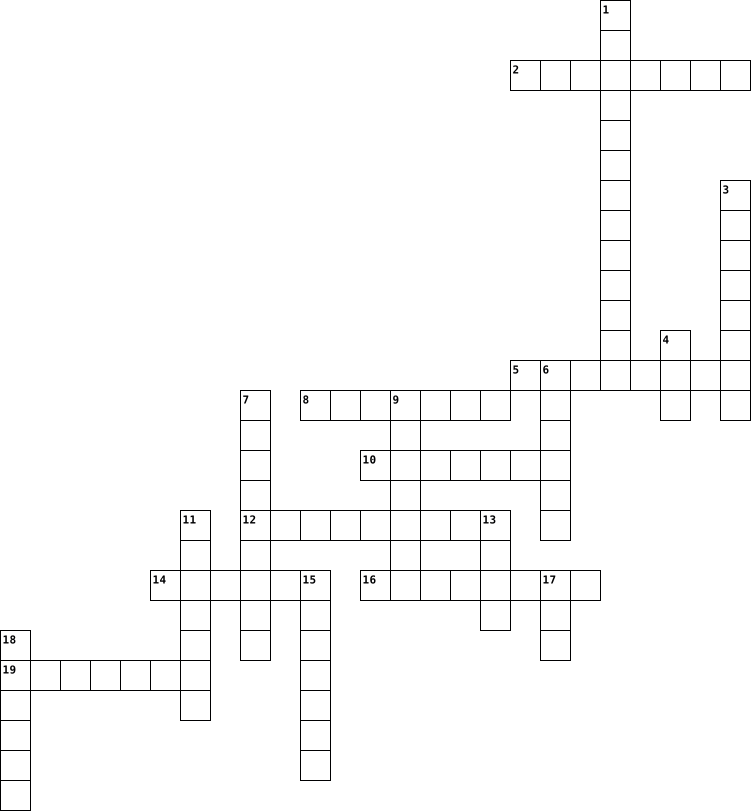
Across
- Infrared
- Molecule
- physics
- Bigbang
- Supernova
- Cation
- Periodic
- Element
Down
- Airresistance
- Hydrogen
- Sun
- Oxygen
- Potassium
- science
- Gravity
- atom
- Nuclear
- Ion
- Helium
19 Clues: Sun • Ion • atom • Oxygen • Cation • Helium • physics • science • Bigbang • Gravity • Nuclear • Element • Infrared • Hydrogen • Molecule • Periodic • Potassium • Supernova • Airresistance
Periodic Table 2023-01-10

Across
- Vertical column of elements that all have similar properties
- Group that has properties of a metal and nonmetal
- First element in the periodic table
- Group of elements in the middle of the periodic table; do not belong in a group
- Number of protons and neutrons
- Number of protons in an element
- Symbol:Li
- Distance from nucleus to outermost shell of an electron
Down
- Second group in the periodic table
- Horizontal rows of elements that all have the same number of electron shells
- Element with the smallest atomic radius
- Elements with a full shell of electrons
- Symbol:B
- A pure substance that makes up everything in the world
- First group in the periodic table
- Element with the largest atomic radius
- Smallest particle that cannot be cut
- Symbol:O
- Trends across the periodic table
19 Clues: Symbol:B • Symbol:O • Symbol:Li • Number of protons and neutrons • Number of protons in an element • Trends across the periodic table • First group in the periodic table • Second group in the periodic table • First element in the periodic table • Smallest particle that cannot be cut • Element with the largest atomic radius • Element with the smallest atomic radius • ...
Easy Atom Review 2017-04-10

Across
- Period 4 on the periodic table starts with Potassium(19) and ends with _______(36)
- To find metals on the periodic table look on the _______ side (right or left?)
- most of what is contained in an atom (two words)
- A column on the periodic table is called a _______
- protons and neutrons have nearly equal _______
- Elements are organized by atomic _________
- Group 2 on the table starts with Be(4 protons) and ends with _______ (88protons)
- Shows the element symbol, atomic number and atomic mass (two words)
- on the far right side of the table you find mostly ___________ (gasses, solids, jello)
- Passing a current through water yields 2 parts hydrogen gas and 1 part ______ gas
Down
- equal to the number of protons(two words)
- The atomic number for sodium is _________
- A row on the periodic table is called a _________
- A periodic table us used to organize ________
- Russian Chemist who created the first periodic table Dimitri___________
- Silicon(14) has properties of metals and nonmetals. It is classified as a _______
- particle that is 1/1840 the mass of a proton
- the atomic number of oxygen, and the number of protons of oxygen
- To find non-meals look on the _______ side of the periodic table
19 Clues: equal to the number of protons(two words) • The atomic number for sodium is _________ • Elements are organized by atomic _________ • particle that is 1/1840 the mass of a proton • A periodic table us used to organize ________ • protons and neutrons have nearly equal _______ • most of what is contained in an atom (two words) • ...
The Atom and Periodic Table 2024-10-08

Across
- The horizontal rows on the periodic table.
- Atoms of the same element that have different numbers of neutrons.
- Number of periods on the periodic table.(spell number)
- Number of groups on the periodic table (spell number)
- The vertical (up and down) columns on the periodic table.
- The father of the periodic table Dmitri________.
- Number of electrons the "first" energy shell can hold. (spell number)
- The charge of the nucleus.
- The negatively charged subatomic particles in the atom.
Down
- The positively charged subatomic particles in the atom.
- The top number in the square (# of protons in the nucleus).
- Word for regular repeating pattern.
- The bottom number in the square (protons + neutrons)
- The science chart made up of atoms of elements. (2 words)
- The dense central part of the atom.
- One of the two main parts of the atom where electrons are found (2 words).
- The neutrally charged subatomic particles in the atom.
- Only those electrons in the outermost energy shell.
- Substance made up of only one type of atom.
19 Clues: The charge of the nucleus. • Word for regular repeating pattern. • The dense central part of the atom. • The horizontal rows on the periodic table. • Substance made up of only one type of atom. • The father of the periodic table Dmitri________. • Only those electrons in the outermost energy shell. • The bottom number in the square (protons + neutrons) • ...
Easy Atom Review 2024-02-02

Across
- Period 4 on the periodic table starts with Potassium(19) and ends with _______(36)
- To find metals on the periodic table look on the _______ side (right or left?)
- most of what is contained in an atom (two words)
- A column on the periodic table is called a _______
- protons and neutrons have nearly equal _______
- Elements are organized by atomic _________
- Group 2 on the table starts with Be(4 protons) and ends with _______ (88protons)
- Shows the element symbol, atomic number and atomic mass (two words)
- on the far right side of the table you find mostly ___________ (gasses, solids, jello)
- Passing a current through water yields 2 parts hydrogen gas and 1 part ______ gas
Down
- equal to the number of protons(two words)
- The atomic number for sodium is _________
- A row on the periodic table is called a _________
- A periodic table us used to organize ________
- Russian Chemist who created the first periodic table Dimitri___________
- Silicon(14) has properties of metals and nonmetals. It is classified as a _______
- particle that is 1/1840 the mass of a proton
- the atomic number of oxygen, and the number of protons of oxygen
- To find non-meals look on the _______ side of the periodic table
19 Clues: equal to the number of protons(two words) • The atomic number for sodium is _________ • Elements are organized by atomic _________ • particle that is 1/1840 the mass of a proton • A periodic table us used to organize ________ • protons and neutrons have nearly equal _______ • most of what is contained in an atom (two words) • ...
Kanye Johnson 11/14/24 PS211-B 2024-11-14

Across
- To see family
- An element in Group 2 of the periodic table, having two valence electrons that it tends to lose easily to become a 2 + cation, making it very reactive.
- A row in the periodic table of the elements; also called a series.
- Any electron in the outermost energy level of a neutral atom.
- -An element in Group 18 on the periodic table having eight valence electrons that fill the outer energy level.
- An element from either of two rows usually placed below the periodic table
- Any elements in Groups 3–12 of the
- Earth Metal
- A representation of an atom
Down
- The law that states that the properties of the elements vary with their atomic numbers in a regular, repeated pattern.
- An element with characteristics between those of metals and nonmetals; also called semiconductors; located between metals and nonmetals on the periodic table
- As a group the alkali metals are the least electronegative of the elements, ranging from 0.7 to 1.0 on the scale, while the alkaline earths, the next group on the table, have electronegativities ranging from about 0.9 to 1.5.Sep
- A measure of an element's ability to attract and hold electrons when bonded to other atoms.
- An element in Group 17 of the periodic table having seven valence electrons.
- An element that typically has four or more valence electrons and that does not exhibit the general properties of metals
- table, typically having one or two valence
- A column of elements in the periodic table having similar valence electron arrangement, resulting in similar chemical properties
- An element that is typically dense, solid, ductile, malleable, highly conductive, and chemically reactive, especially in the presence of nonmetal elements.
- Any of Groups 13-16 in the periodic table
- The distance from the center of an atom's nucleus to its outermost energy level
20 Clues: Earth Metal • To see family • A representation of an atom • Any elements in Groups 3–12 of the • Any of Groups 13-16 in the periodic table • table, typically having one or two valence • Any electron in the outermost energy level of a neutral atom. • A row in the periodic table of the elements; also called a series. • ...
Chemical properties of matter 2023-06-13

Across
- Verticals in the periodic table
- An element with an atomic number of 51
- Period number of uranium
- Period number of potassium
- Made up of elements chemically combined together through a chemical reaction
- Group number of iron
- Group 13 period 2 in the periodic table
- Substances combined only through physical means
- Group 2 Period 4 in the periodic table
Down
- Elements that occur as gases or liquids and not capable of conducting electricity
- Horizontals in the periodic table
- Group 1 Period 1 in the periodic table
- Basic unit of matter
- An element with 79 electrons
- An element with 16 protons
- Period number of rubidium
- Elements which are good conductors
17 Clues: Basic unit of matter • Group number of iron • Period number of uranium • Period number of rubidium • Period number of potassium • An element with 16 protons • An element with 79 electrons • Verticals in the periodic table • Horizontals in the periodic table • Elements which are good conductors • An element with an atomic number of 51 • Group 1 Period 1 in the periodic table • ...
Elements Quiz 2014-02-27

Across
- a horizontal row in the periodic table
- A small particle in the nucleus of the atom, with no charge
- the elements are organized, on the periodic table, by increasing this number
- I have a family all of my own
- element with atomic number 20
- I have 26 protons
- an atom with a different number of neutrons from another atom of the same element
- term used for metals who transfer heat and electricity
- term used for the ability of an element to be pulled into wire
- I am a nobel gas in period 6
- elements in group 1 of the periodic table
Down
- the subatomic particle found in the energy level and orbitals surrounding the nucleus
- a vertical row in the periodic table
- element with atomic mass of 15.9994
- elements found in group 17 of the periodic table
- an element found in Groups 3-12 of the periodic table
- an element that is dull, doesnt conduct electricity, and is fragile
- the combined number of protons and neutrons in an atom
- Term that describes an element that can be pounded into a thin sheet
- I am an alkali-earth metal in period 2
20 Clues: I have 26 protons • I am a nobel gas in period 6 • I have a family all of my own • element with atomic number 20 • element with atomic mass of 15.9994 • a vertical row in the periodic table • a horizontal row in the periodic table • I am an alkali-earth metal in period 2 • elements in group 1 of the periodic table • elements found in group 17 of the periodic table • ...
Keith Vinston-November 13, 2024-PS 211 B-Chapter 4 Vocab 2024-11-13

Across
- an element in Group 17 of the periodic table having seven valence electrons; it easily gains an electron, forming a 1- anion, which causes it to be highly reactive
- an element in Group 18 on the periodic table having eight valence electrons that fill the outer energy level (helium is an exception with only two); with a full outer energy level, it is insert (i.e., nonreactive)
- see family
- an element with characteristics between those of metals and nonmetals; also called semi-conductors; located between metals and nonmetals on the periodic table
- a measure of an element's ability to attract and hold electrons when bonded to other atoms
- an element that typically has four or more valence electrons and that does not exhibit the general properties of metals; located on the right side of the periodic table
- an element that is typically dense, solid, ductile, malleable, highly conductive, and chemically reactive, especially in the presence of nonmetal elements; metals are located on the left end of the periodic table
- a representation of an atom consisting of its chemical symbol with surrounding dots representing its valence electrons
- any of Groups 13-16 in the periodic table; so named because they contain, metals, nonmetals, and metalloids; these groups are often named for the first element in the family
- a row in the periodic table of elements, also called a series; the time interval (T) for one complete cycle of periodic motion
- a column of elements in the periodic table having similar valence electron arrangement, resulting in similar chemical properties; also known as a group
- any elements in Groups 3-12 of the periodic table, typically having one or two valence electrons, which it easily loses, resulting in cations with charges of 1+ or 2+
Down
- an element in Group 2 of the periodic table, having two valence electrons that it tends to lose easily to become a 2+ cation, making it very reactive
- any electron in the outermost energy level of a neutral atom; unpaired valence electrons are usually involved in chemical bonding
- a table of the chemical elements arranged to display their periodic properties in relation to their atomic numbers
- the distance from the center of an atom's nucleus to its outermost energy level
- an element from either of two rows usually placed below the periodic table; a member of either the lanthanide or actinide series; it typically has two valence electrons
- an element in Group 1 of the periodic table, having one valence electron that it can easily lose to form a 1+ cation, making it extremely reactive; the most reactive of all the metals
- the law that states that the properties of the elements vary with their atomic numbers in a regular, repeated pattern
19 Clues: see family • the distance from the center of an atom's nucleus to its outermost energy level • a measure of an element's ability to attract and hold electrons when bonded to other atoms • a table of the chemical elements arranged to display their periodic properties in relation to their atomic numbers • ...
Chapter 4 Vocabulary 2024-11-13

Across
- An element that typically has four or more valence electrons and that does not exhibit the general properties of metals; located on the right side of the periodic table
- The distance from the center of an atom's nucleus to its outermost energy level
- An element in Group 18 in the periodic table having eight valence electrons that fill the outer energy level. (Helium is an expectation with only two.) With a full outer energy level. it is inert (i,e., nonreactive
- The law that states that the properties of the elements vary with their atomic numbers in a regular, repeated pattern
- A row in the periodic table of the elements; also called a series (2) The time interval (T) for one complete cycle of a periodic motion
- An element that is typically dense, solid, ductile, malleable, highly conductive, and chemically reactive, especially in the presence of nonmetal elements. Metals are located on the left end of the periodic table
- Any elements in Groups 3-12 of the periodic table, typically having one or two valence electrons, which it easily loses, resulting in cations with charges 1+ or 2+
- A table of the chemical elements arranged to display their periodic properties in relation to their atomic numbers
- An element from either of two rows usually placed below the periodic table; a member of either the lanthanide or actinide series. It typically has two valence electrons
- A representation of an atom consisting of its chemical symbol with surrounding dots representing its valence electrons
- Any of Groups 13-16 in the periodic table so named because they contain metals, nonmetals, and metalloids. These groups are often named for the first element in the family
Down
- An element in Group 17 of the periodic table having seven valence electrons. It easily gains an electron, forming a 1- anion, which causes it to be highly reactive
- An element in Group 2 of the periodic table, having two valence electrons that it tends to lose easily to become a 2+ cation, making it very reactive
- Has the same definition as family
- A measure of an element's ability to attract and hold electrons when bonded to other atoms
- A column of elements in the periodic table having similar valence electron arrangement, resulting in similar chemical properties; also known as a group
- An element with characteristics between those of metals and nonmetals; also called semiconductors; located between metals and nonmetals on the periodic table
- Any electron in the outermost energy level of a neutral atom. Unpaired valence electrons are usually involved in chemical bonding
- An element in Group 1 of the periodic table, having one valence electron that it can easily lose to form a 1+ cation, making it extremely reactive; the most reactive of all the metals
19 Clues: Has the same definition as family • The distance from the center of an atom's nucleus to its outermost energy level • A measure of an element's ability to attract and hold electrons when bonded to other atoms • A table of the chemical elements arranged to display their periodic properties in relation to their atomic numbers • ...
Vocab 4 - PS211A - Taniyah Elder 2024-11-14

Across
- An element in Group 17 of the periodic table having seven valence electrons. It easily gains an electron, forming a 1 − anion, which causes it to be highly reactive.
- An element in Group 18 on the periodic table having eight valence electrons that fill the outer energy level. (Helium is an exception with only two.) With a full outer energy level, it is inert (i.e., nonreactive).
- See family.
- An element with characteristics between those of metals and nonmetals; also called semiconductors; located between metals and nonmetals on the periodic table.
- A measure of an element’s ability to attract and hold electrons when bonded to other atoms.
- An element that typically has four or more valence electrons and that does not exhibit the general properties of metals; located on the right side of the periodic table.
- An element that is typically dense, solid, ductile, malleable, highly conductive, and chemically reactive, especially in the presence of nonmetal elements. Metals are located on the left end of the periodic table.
- A representation of an atom consisting of its chemical symbol with surrounding dots representing its valence electrons.
- Any of Groups 13–16 in the periodic table; so named because they contain metals, nonmetals, and metalloids. These groups are often named for the first element in the family.
- (1) A row in the periodic table of the elements; also called a series. (2) The time interval (T) for one complete cycle of periodic motion.
- A column of elements in the periodic table having similar valence electron arrangement, resulting in similar chemical properties; also known as a group.
- Any elements in Groups 3–12 of the periodic table, typically having one or two valence electrons, which it easily loses, resulting in cations with charges of 1 + or 2 + .
Down
- An element in Group 2 of the periodic table, having two valence electrons that it tends to lose easily to become a 2 + cation, making it very reactive.
- Any electron in the outermost energy level of a neutral atom. Unpaired valence electrons are usually involved in chemical bonding.
- A table of the chemical elements arranged to display their periodic properties in relation to their atomic numbers.
- The distance from the center of an atom’s nucleus to its outermost energy level.
- An element from either of two rows usually placed below the periodic table; a member of either the lanthanide or actinide series. It typically has two valence electrons.
- An element in Group 1 of the periodic table, having one valence electron that it can easily lose to form a 1 + cation, making it extremely reactive; the most reactive of all the metals.
- The law that states that the properties of the elements vary with their atomic numbers in a regular, repeated pattern.
19 Clues: See family. • The distance from the center of an atom’s nucleus to its outermost energy level. • A measure of an element’s ability to attract and hold electrons when bonded to other atoms. • A table of the chemical elements arranged to display their periodic properties in relation to their atomic numbers. • ...
periodic table 2022-10-06

Across
- the vertical columns on the table. These define a "family" of elements that have similar chemical properties.
- the man who developed the concept of atomic number.
- he reported the discovery of a new gaseous element ARGON This element is chemically inert and did not fit any of the known periodic groups.
- english chemist who presented another way of classifying and organizing the elements.
- gasses a group of elements that has full octet electrons
- positively charged ion
- elements could be classified into sets of three
- german chemist who observed that several elements could be classified into sets of three which is called Triad
- An element in the periodic table that is represented by the letter H.
- An element in the periodic table that is represented by the letter B.
- negatively charged ion
Down
- An element in the periodic table that is represented by the letter O.
- Process by which electrically neutral atoms or molecules are converted to electrically charged atoms or molecules (ions) through gaining or losing electrons.
- A subatomic particle whose electric charge is negative one elementary charge.
- the horizontal rows on the table, with the elements arranged in order of increasing atomic number.
- An element in the periodic table that is represented by the letter S.
- mass the average mass of the atoms of an element measured in atomic mass unit
- table list of all known elements arranged in order of increasing atomic number in horizontal rows and elements which are chemically alike fall directly under one another
- An element in the periodic table that is represented by the letter C.
- An element in the periodic table that is represented by the letter K.
20 Clues: positively charged ion • negatively charged ion • elements could be classified into sets of three • the man who developed the concept of atomic number. • gasses a group of elements that has full octet electrons • An element in the periodic table that is represented by the letter O. • An element in the periodic table that is represented by the letter S. • ...
Science chapter 4 2024-11-20

Across
- An element from either of two rows usually placed below the periodic table; a member of either the lanthanide or actinide series. It typically has two valence electrons.
- Any electron in the outermost energy level of a neutral atom. Unpaired valence electrons are usually involved in chemical bonding.
- Any elements in Groups 3–12 of the periodic table, typically having one or two valence electrons, which it easily loses, resulting in cations with charges of 1 + or 2 + .
- An element in Group 17 of the periodic table having seven valence electrons. It easily gains an electron, forming a 1 − anion, which causes it to be highly reactive.
- An element that typically has four or more valence electrons and that does not exhibit the general properties of metals; located on the right side of the periodic table.
- An element in Group 1 of the periodic table, having one valence electron that it can easily lose to form a 1 + cation, making it extremely reactive; the most reactive of all the metals.
- An element that is typically dense, solid, ductile, malleable, highly conductive, and chemically reactive, especially in the presence of nonmetal elements. Metals are located on the left end of the periodic table.
- A measure of an element’s ability to attract and hold electrons when bonded to other atoms.
- The distance from the center of an atom’s nucleus to its outermost energy level.
Down
- An element with characteristics between those of metals and nonmetals; also called semiconductors; located between metals and nonmetals on the periodic table.
- See family.
- A column of elements in the periodic table having similar valence electron arrangement, resulting in similar chemical properties; also known as a group.
- An element in Group 18 on the periodic table having eight valence electrons that fill the outer energy level. (Helium is an exception with only two.) With a full outer energy level, it is inert (i.e., nonreactive).
- (1) A row in the periodic table of the elements; also called a series. (2) The time interval (T) for one complete cycle of periodic motion.
- A representation of an atom consisting of its chemical symbol with surrounding dots representing its valence electrons.
- A table of the chemical elements arranged to display their periodic properties in relation to their atomic numbers.
- An element in Group 2 of the periodic table, having two valence electrons that it tends to lose easily to become a 2 + cation, making it very reactive.
- Any of Groups 13–16 in the periodic table; so named because they contain metals, nonmetals, and metalloids. These groups are often named for the first element in the family.
- The law that states that the properties of the elements vary with their atomic numbers in a regular, repeated pattern.
19 Clues: See family. • The distance from the center of an atom’s nucleus to its outermost energy level. • A measure of an element’s ability to attract and hold electrons when bonded to other atoms. • A table of the chemical elements arranged to display their periodic properties in relation to their atomic numbers. • ...
Science Chapter 4 Vocabulary 11/14/24 Andy Choi PS211B 2024-11-14

Across
- An element that typically has four or more valence electrons and that does not exhibit the general properties of metals; located on the right side of the periodic table.
- An element in Group 17 of the periodic table having seven valence electrons. It easily gains an electron, forming a 1 − anion, which causes it to be highly reactive.
- A representation of an atom consisting of its chemical symbol with surrounding dots representing its valence electrons.
- An element that is typically dense, solid, ductile, malleable, highly conductive, and chemically reactive, especially in the presence of nonmetal elements. Metals are located on the left end of the periodic table.
- A table of the chemical elements arranged to display their periodic properties in relation to their atomic numbers.
- See family.
- (1) A row in the periodic table of the elements; also called a series. (2) The time interval (T) for one complete cycle of periodic motion.
- An element in Group 1 of the periodic table, having one valence electron that it can easily lose to form a 1 + cation, making it extremely reactive; the most reactive of all the metals.
- A column of elements in the periodic table having similar valence electron arrangement, resulting in similar chemical properties; also known as a group.
- Any elements in Groups 3–12 of the periodic table, typically having one or two valence electrons, which it easily loses, resulting in cations with charges of 1 + or 2 + .
Down
- The law that states that the properties of the elements vary with their atomic numbers in a regular, repeated pattern.
- Any electron in the outermost energy level of a neutral atom. Unpaired valence electrons are usually involved in chemical bonding.
- An element in Group 18 on the periodic table having eight valence electrons that fill the outer energy level. (Helium is an exception with only two.) With a full outer energy level, it is inert (i.e., nonreactive).
- An element from either of two rows usually placed below the periodic table; a member of either the lanthanide or actinide series. It typically has two valence electrons.
- The distance from the center of an atom’s nucleus to its outermost energy level.
- Any of Groups 13–16 in the periodic table; so named because they contain metals, nonmetals, and metalloids. These groups are often named for the first element in the family.
- An element with characteristics between those of metals and nonmetals; also called semiconductors; located between metals and nonmetals on the periodic table.
- An element in Group 2 of the periodic table, having two valence electrons that it tends to lose easily to become a 2 + cation, making it very reactive.
- A measure of an element’s ability to attract and hold electrons when bonded to other atoms.
19 Clues: See family. • The distance from the center of an atom’s nucleus to its outermost energy level. • A measure of an element’s ability to attract and hold electrons when bonded to other atoms. • A table of the chemical elements arranged to display their periodic properties in relation to their atomic numbers. • ...