
periodic%20table Crossword Puzzles
Science Review Game (Basic Chemistry Vocab) 2021-12-08

Across
- "Matter is neither created nor destroyed"- Used to describe chemical equations.
- The type of element that can be have luster, cam be a conductor, and can be brittle
- another word for shiny (generally used to describe elements)
- The unit of measurement to measure the mass of subatomic particles.
- The name for the outermost particles of an atom.
- The changing of chemical composition
- to not be shiny
- A new solid being formed (Chemical Reactions)
- This refers to what certain subatomic particles sort themselves into (these subatomic particles have almost no mass).
- Anything of something that is of one unit or one subatomic particle.
Down
- This word refers to the characteristics, traits or ________ of atoms.
- The word on the Periodic Table that signifies an assortment/organization of elements in vertical fashion.
- The parts or elements before their reaction in a chemical equation.
- This guarantees/proves that a chemical reaction has taken place.
- The visual representation of showing an element's structure.
- the side of which (on the Periodic Table) that contains elements with more Valence Electrons.
- One of the two parts of an atom, this part has the most variety of subatomic particles.
- This word changes depending on the amount of outermost subatomic particles.
- the side of which all metals (on the Periodic Table) are located.
- This subatomic particle determines most of the mass in an atom, and does not have a positive charge
20 Clues: to not be shiny • The changing of chemical composition • A new solid being formed (Chemical Reactions) • The name for the outermost particles of an atom. • The visual representation of showing an element's structure. • another word for shiny (generally used to describe elements) • This guarantees/proves that a chemical reaction has taken place. • ...
Atomic Structure and the Periodic Table 2022-02-16

Across
- weakest fundamental force
- If there are more protons than electrons, you would have a positive __________.
- large number of elements found to the left and center of the periodic table
- This researcher discovered the positively-charged nucleus during his gold foil experiment.
- This force holds together the nucleus.
- Greek philosopher who came up with the idea of atoms
- This is where we find neutrons and protons.
- Horizontal rows on the periodic table
- gases that are nonreactive and found to the far right of the periodic table
- Electrons have a much smaller ______ than protons or neutrons.
- This scientist discovered neutrons.
- This researcher came up with the plum pudding atomic model.
Down
- Atomic __________ is the total of protons and neutrons.
- Researcher who created a model of the atom with electrons circling the nucleus in fixed orbitals like planets
- In order for an atom to have no charge, it must have an equal number of protons and these negatively-charged subatomic particles.
- The atomic number is the number of these positively charged particles in one atom of the element.
- As you get further from the nucleus the energy level of electrons gets ______________.
- different forms of the same element that differ in the number of neutrons
- Researcher who proposed that atoms combine in given ratios to form compounds
- The only form of nuclear decay/radiation that does not create a different element
- Schrodinger helped develop our idea of an electron ___________.
- Most of an atom's ______________ is made up of empty space.
22 Clues: weakest fundamental force • This scientist discovered neutrons. • Horizontal rows on the periodic table • This force holds together the nucleus. • This is where we find neutrons and protons. • Greek philosopher who came up with the idea of atoms • Atomic __________ is the total of protons and neutrons. • Most of an atom's ______________ is made up of empty space. • ...
Matter and Chemical Change 2013-06-17

Across
- Solids at room temperature, shiny, malleable, and a good conductor of energy.
- Substance that can be broken down into component parts.
- A substance that can be pounded into sheets.
- Negative charge that orbits or energy levels.
- The ability of a substance to conduct electricity.
- The horizontal rows in the Periodic Table.
- The total mass of the protons and neutrons (3 Words).
- Cannot be broken down into a simpler substance (2 words).
- Substances composed of 2 or more substances.
- Positive charge in the nucleus.
- When metals and non-metals come together because opposite charges attract (2 Words).
- Releases heat.
- The vertical rows in the Periodic Table.
- No charge in the nucleus.
- The amount of mass in a given volume of a substance.
Down
- Workplace Hazardous Materials Information System.
- The ability of a substance to be dissolved in another.
- Have both metallic and non-metallic properties.
- Can be a solid or gas at room temperature, are dull, and act as insulators.
- Formed when atoms share electrons (2 Words).
- The number of protons found in the nucleus (2 Words).
- Absorbs heat.
- A cloudy mixture.
- Located on the extreme right of the Periodic Table and are non-reactive and stable (2 Words).
- Substances composed of only one kind of atom.
- A cloudy mixture which cannot be easily separated.
- Any solid that can be stretched into a long wire.
27 Clues: Absorbs heat. • Releases heat. • A cloudy mixture. • No charge in the nucleus. • Positive charge in the nucleus. • The vertical rows in the Periodic Table. • The horizontal rows in the Periodic Table. • A substance that can be pounded into sheets. • Formed when atoms share electrons (2 Words). • Substances composed of 2 or more substances. • ...
Physical & Chemical Changes 2018-05-30

Across
- another scientific word for evaporate is ____________
- molecule with or more different atoms bonded
- you can speed this up by adding heat energy
- gas to solid or solid to gas
- when a metal gets damaged by its environment it is known as ___________
- a product is made by 2 or more ___________
- made of sub-atomic particles
- children refer fire water air and earth as ________
- 1 atom is known as a __________________
- gaseous form of a substance that is generally solid or liquid at room temperature
- a substance that speeds up chemical changes
- gas to liquid is known as ___________
- group of two or more atoms that are bonded together
- water does this at 100 degrees
- vertical columns in the periodic table
Down
- opposite of a molecular compound
- reactant + reactant = __________________
- when substances react, they come in contact and this is known as the
- the dead sea has a high ____________ of salt
- the _____________ has 118 elements
- chain of molecules
- pungent gas that is dangerous to breathe in
- if two atoms are attracted, they are
- when ice-cream is in the sun for a long time it starts to ______
- things that easily turn into gas are ___________
- molecule with two atoms
- pineapple's __________ is known as bromelain
- substance that has two or more different types of atoms that are bonded
- horizontal rows in the periodic table
- 3 dimensional arrangement of particles in a regular pattern
30 Clues: chain of molecules • molecule with two atoms • gas to solid or solid to gas • made of sub-atomic particles • water does this at 100 degrees • opposite of a molecular compound • the _____________ has 118 elements • if two atoms are attracted, they are • horizontal rows in the periodic table • gas to liquid is known as ___________ • vertical columns in the periodic table • ...
Science Cross-Word 2023-12-11

Across
- The positive and negative ions in two switch places
- two or more ions come together and are held together by charge differences.
- A subatomic particle with no electrical charge
- The table where all elements are found
- A subatomic particle with a positive electrical charge
- A change that can be undone
- A compound containing carbon and hydrogen (sometimes oxygen) produces carbon dioxide and water.
- A compound is made from simpler materials
- Found on the right side of the periodic table
- One element that starts out by itself replaces another element in a compound,Kicking it out
- A subatomic particle with a negative electrical charge
- Atoms with with the same number of protons but different number of neutrons
Down
- A change that cannot be undone
- How much space an object takes up
- The end result of an experiment is the ____
- A compound is broken down into a simpler compound,or all the way down to the elements that make it up.
- The chemical that changes in a experiment is the _____
- Found on the left side of the periodic table
- Numbers added together are called an ____
- How easily two products react to each other
- temperature of the immediate surroundings to rise
- absorbs heat and cools the surroundings
- sharing of electrons between two or more atoms
- a chemical species which holds a positive or negative charge of some magnitude.
24 Clues: A change that can be undone • A change that cannot be undone • How much space an object takes up • The table where all elements are found • absorbs heat and cools the surroundings • Numbers added together are called an ____ • A compound is made from simpler materials • The end result of an experiment is the ____ • How easily two products react to each other • ...
Science Cross-Word 2023-12-11

Across
- The positive and negative ions in two switch places
- two or more ions come together and are held together by charge differences.
- A subatomic particle with no electrical charge
- The table where all elements are found
- A subatomic particle with a positive electrical charge
- A change that can be undone
- A compound containing carbon and hydrogen (sometimes oxygen)produce carbon dioxide and water.
- A compound is made from simpler materials
- Found on the right side of the periodic table
- One element that starts out by itself replaces another element in a compound,Kicking it out
- A subatomic particle with a negative electrical charge
- Atoms with with the same number of protons but different number of neutrons
Down
- A change that cannot be undone
- How much space an object takes up
- The end result of an experiment is the ____
- A compound is broken down into a simpler compound,or all the way down to the elements that make it up.
- The chemical that changes in a experiment is the _____
- Found on the left side of the periodic table
- Numbers added together are called an ____
- How easily two products react to each other
- temperature of the immediate surroundings to rise
- absorbs heat and cools the surroundings
- sharing of electrons between two or more atoms
- a chemical species which holds a positive or negative charge of some magnitude.
24 Clues: A change that can be undone • A change that cannot be undone • How much space an object takes up • The table where all elements are found • absorbs heat and cools the surroundings • Numbers added together are called an ____ • A compound is made from simpler materials • The end result of an experiment is the ____ • How easily two products react to each other • ...
mewing streak in chemistry 2024-08-09

Across
- A carboxylic acid is an organic molecule containing a -COOH group. An example of a carboxylic acid is acetic acid
- is an ionic compound that dissolves in water to produce ions, which can conduct electricity
- relating to elements in periodic table
- the dominant male animal in a particular group
- the contour of the lower edge of a person's jaw
- is an organic molecule that only contains single carbon-carbon bonds
- is the movement of particles from an area of higher concentration to one of lower concentration
- the process of becoming smaller.
- table of periodic elements
- a type of change where the physical properties of matter change
- gases any of the chemically inert gaseous elements of the helium group in the periodic table
Down
- A chemical that can dissolve in water, combine with acids to form salts, and make acids less acidic
- dominant leader, lone wolf, cool and popular
- is a chemical element; it has symbol He and atomic number 2.
- a colourless, odourless reactive gas, the chemical element of atomic number 8 and the life-supporting component of the air.
- a change of materials into another, new materials with different properties and one or more than one new substances are formed
- is one made up of two elements
- a chemical element; it has symbol N and atomic number 7.
- hand and feet actions
- a substance made by mixing other substances together.
- the action of becoming larger or more extensive.
21 Clues: hand and feet actions • table of periodic elements • is one made up of two elements • the process of becoming smaller. • relating to elements in periodic table • dominant leader, lone wolf, cool and popular • the dominant male animal in a particular group • the contour of the lower edge of a person's jaw • the action of becoming larger or more extensive. • ...
Chemistry Vocabualry 2025-04-28

Across
- anything that occupies space and has mass.
- a group of atoms held together by covalent bonds.
- consist of atoms of two or more elements that are joined to chemical bonds.
- a substance that cannot be broken down chemically into simpler kinds of matter.
- having a regular, repeating pattern.
- substance that is doing the dissolving.
- elements that are dull (not shiny) and that are poor conductors of thermal energy and electric current.
- the ability of one substance to dissolve another.
- an atom with an electrical charge (+ or -).
- a mixture that appears to be a single substance but is composed of particles of two or more substances that are distributed evenly amongst each other.
Down
- elements that are shiny and are good conductors of thermal energy and electric current.
- each vertical row of elements on a periodic table.
- two or more substances mixed together whose composition is not fixed.
- the part of an atom that has no electrical charge.
- each horizontal row of elements on a periodic table.
- substance that is being dissolved
- the fundamental unit of matter that contains a nucleus, protons, neutrons, and electrons.
- atoms of the same element that differ in the number of neutrons they contain.
- the part of an atom that has a positive electrical charge.
- the part of an atom that has a negative electrical charge.
- semiconductors that are elements that have properties of both metals and nonmetals.
21 Clues: substance that is being dissolved • having a regular, repeating pattern. • substance that is doing the dissolving. • anything that occupies space and has mass. • an atom with an electrical charge (+ or -). • a group of atoms held together by covalent bonds. • the ability of one substance to dissolve another. • each vertical row of elements on a periodic table. • ...
PERIODIC TABLE CROSSWORD 2026-05-17

Across
- The lightest metal in Group I, used in batteries.
- Vertical columns in the periodic table are called ___.
- Elements that exist as molecules of two atoms are called ___.
- A charged particle formed when an atom gains or loses electrons is an __
- Group VII elements are called ___.
- Group 1 elements form ___ solutions when reacting with water.
- Atoms are ___ when they have no charge.
- Group II elements are called ___ earth metals.
- The number of electrons in the outer shell is called ___ electrons.
- Atomic ___ refers to the size of an atom.
- Group 8 elements are known as ___ gases.
- Group I elements ___ one electron to become stable.
- The arrangement of electrons in energy levels is called electron ___.
- Noble gases are very ___ due to full outer shells.
- A halogen used as an antiseptic to clean wounds.
- Atomic number is equal to the number of ___.
Down
- Group 7 elements tend to ___ electrons in reactions.
- Elements that rarely form compounds are ___.
- A Group II element important for bones and teeth.
- Group 7 elements are classified as ___.
- Group I elements are called ___ metals.
- An anion has a ___ charge.
- A noble gas used in bright advertising lights.
- Alkali metals are highly ___ with water.
- The most reactive element in Group 7 is ___.
- Elements in Group 1 belong to the ___ category of the periodic table.
- Two or more atoms bonded together form a ___.
- Ions are formed by gaining or losing ___.
- Horizontal rows in the periodic table are called ___.
- A cation has a ___ charge.
30 Clues: An anion has a ___ charge. • A cation has a ___ charge. • Group VII elements are called ___. • Group 7 elements are classified as ___. • Group I elements are called ___ metals. • Atoms are ___ when they have no charge. • Alkali metals are highly ___ with water. • Group 8 elements are known as ___ gases. • Atomic ___ refers to the size of an atom. • ...
Unit 3 Vocab. 2016-10-06

Across
- number the number of protons in the nucleus
- smallest particle of an element
- table chart that organizes all known elements
- element that is a good conductor if heat and electricity
- column of elements in the periodic table
- a particle in the nucleus with no charge
- a particle that carry a negative charge
- gas an extremely nonreactive group 18 element
- metal element that is characterized by a filled outermost "s" orbital of energy level "n"
- an ion that has a negative charge
- reactive nonmetallic elements that form strongly acidic compounds with hydrogen
- metal group 1 metals, reactive and usually exists as compounds
- center of an atom
Down
- an atom with the same amount of protons and a different amount of neutrons
- ray narrow beam of an electron of an electrical discharge
- transition metal elements that have three incomplete outermost electron shells
- an ion that has a positive charge
- element a element that possesses a wide range of chemical and physical properties
- particle in the nucleus with a positive charge
- an element that has physical and chemical properties of both metals and nonmetals
- element that is generally gases or dull, brittle solids that are poor conductors of heat and electricity
- earth metal group 2 elements, highly reactive
- of definite proportion a compound is always composed of the same amount of the same elements
- number total number of protons and neutrons
- a horizontal row of elements in the periodic table
25 Clues: center of an atom • smallest particle of an element • an ion that has a positive charge • an ion that has a negative charge • a particle that carry a negative charge • column of elements in the periodic table • a particle in the nucleus with no charge • number the number of protons in the nucleus • number total number of protons and neutrons • ...
science 2018-10-29

Across
- what is the atomic number
- whats a neutron
- actinides are
- what does the periodic table hold
- copper is a
- the energy level of a periodic table
- electron being excited form the ground
- the substance on which an enzyme acts
- the centre where protons and neutrons are hold
- is mercurey solid or liquid
- who made the periodic table
- water vapour that falls under ground
- something that is used to keep cold or heat away
- a something of electricity
- an element whose properties are intermediate between those of metals and solid nonmetals
- the charge of a lightbulb
- transfer of energy
- gives off heat
- helium is a
- a mix of elements
Down
- when a solid is turned into a liquid
- dispositive and disnegitive
- type of metal in the 1st column
- the third nobel gas
- animals that use heat to see
- a mixture of compounds
- a common gas used in ballons
- whats a proton
- copper is a
- number of valence electrons
- the state or process that occurs when no more of something can be absorbed, combined with, or added
- when heat meets water gas if formed what is it called
- whats an electron
- what is the other number on the element
- gives off a negative output
- whats a solid liquid and gas called
- something you drink daily
- what do electrons have
- symbol of carbon trioxide
39 Clues: copper is a • copper is a • helium is a • actinides are • whats a proton • gives off heat • whats a neutron • whats an electron • a mix of elements • transfer of energy • the third nobel gas • a mixture of compounds • what do electrons have • what is the atomic number • the charge of a lightbulb • something you drink daily • symbol of carbon trioxide • a something of electricity • ...
CHEMISTRY UNIT REVIEW CROSSWORD 2017-02-11

Across
- a set of elements occupying an entire horizontal row in the periodic table
- a solid material that is typically hard, shiny, malleable, fusible, and ductile, with good electrical and thermal conductivity
- the number of protons in the nucleus of an atom
- is composed of two or more separate elements
- a group of atoms bonded together
- an element that is not a metal
- elements that have properties of both metals and nonmetals
- occupying Group 0 of the periodic table
- The number atoms presents before and after a reaction takes place is always the same.
- a subatomic particle of about the same mass as a proton but without an electric charge
- ingredients present before the reactions begins
- substances that cannot be broken down into simpler substances
- the absorption of heat
Down
- a set of elements in a column having similar properties
- regions of space outside the nucleus of an atom where an electron may exist.
- electrons in the outermost shell of an atom
- a stable subatomic particle occurring in all atomic nuclei
- the letter or letters standing for a chemical element
- the basic unit of a chemical element.
- created a version of the periodic table of elements
- ingredients produced after the reaction takes place
- the mass of an atom of a chemical element
- the release of heat
- the positively charged central core of an atom
- a stable subatomic particle with a charge of negative electricity
25 Clues: the release of heat • the absorption of heat • an element that is not a metal • a group of atoms bonded together • the basic unit of a chemical element. • occupying Group 0 of the periodic table • the mass of an atom of a chemical element • electrons in the outermost shell of an atom • is composed of two or more separate elements • ...
mewing streak in chemistry 2024-08-09

Across
- A carboxylic acid is an organic molecule containing a -COOH group. An example of a carboxylic acid is acetic acid
- is an ionic compound that dissolves in water to produce ions, which can conduct electricity
- relating to elements in periodic table
- the dominant male animal in a particular group
- the contour of the lower edge of a person's jaw
- is an organic molecule that only contains single carbon-carbon bonds
- is the movement of particles from an area of higher concentration to one of lower concentration
- the process of becoming smaller.
- table of periodic elements
- a type of change where the physical properties of matter change
- gases any of the chemically inert gaseous elements of the helium group in the periodic table
Down
- A chemical that can dissolve in water, combine with acids to form salts, and make acids less acidic
- dominant leader, lone wolf, cool and popular
- is a chemical element; it has symbol He and atomic number 2.
- a colourless, odourless reactive gas, the chemical element of atomic number 8 and the life-supporting component of the air.
- a change of materials into another, new materials with different properties and one or more than one new substances are formed
- is one made up of two elements
- a chemical element; it has symbol N and atomic number 7.
- hand and feet actions
- a substance made by mixing other substances together.
- the action of becoming larger or more extensive.
21 Clues: hand and feet actions • table of periodic elements • is one made up of two elements • the process of becoming smaller. • relating to elements in periodic table • dominant leader, lone wolf, cool and popular • the dominant male animal in a particular group • the contour of the lower edge of a person's jaw • the action of becoming larger or more extensive. • ...
mewing streak in chemistry 2024-08-09

Across
- A carboxylic acid is an organic molecule containing a -COOH group. An example of a carboxylic acid is acetic acid
- is an ionic compound that dissolves in water to produce ions, which can conduct electricity
- relating to elements in periodic table
- the dominant male animal in a particular group
- the contour of the lower edge of a person's jaw
- is an organic molecule that only contains single carbon-carbon bonds
- is the movement of particles from an area of higher concentration to one of lower concentration
- the process of becoming smaller.
- table of periodic elements
- a type of change where the physical properties of matter change
- gases any of the chemically inert gaseous elements of the helium group in the periodic table
Down
- A chemical that can dissolve in water, combine with acids to form salts, and make acids less acidic
- dominant leader, lone wolf, cool and popular
- is a chemical element; it has symbol He and atomic number 2.
- a colourless, odourless reactive gas, the chemical element of atomic number 8 and the life-supporting component of the air.
- a change of materials into another, new materials with different properties and one or more than one new substances are formed
- is one made up of two elements
- a chemical element; it has symbol N and atomic number 7.
- hand and feet actions
- a substance made by mixing other substances together.
- the action of becoming larger or more extensive.
21 Clues: hand and feet actions • table of periodic elements • is one made up of two elements • the process of becoming smaller. • relating to elements in periodic table • dominant leader, lone wolf, cool and popular • the dominant male animal in a particular group • the contour of the lower edge of a person's jaw • the action of becoming larger or more extensive. • ...
Physical Science Vocabulary Review 2024-10-15

Across
- A table of all known elements arranged by atomic number
- Horizontal rows in the periodic table
- The smallest particle of an element that has all the characteristics of that element
- The variable that is being tested (effect)
- Made up of all of the same types of atoms
- Two or more elements that are chemically combined
- A heterogeneous mixture, particles don't dissolve
- Formed from the chemical reaction between an acid and a base
- Two or more substances that are combined physically
- A substance with a pH greater than 7
- Has a definite shape and a definite volume
- The amount of a substance in a defined space
- Located outside the nucleus and has a negative charge
- A chemical reaction between an acid and a base
Down
- The variable that the experimenter changes (cause)
- The amount of space an object takes up
- Positively charged particle located within the nucleus
- A scale (0-14) to classify substances as acids or bases
- Compounds that have a pH less than 7
- A different ratio of substances throughout
- The same ratio of substances throughout
- Also known as family, vertical column in periodic table
- The center of an atom
- Has to do with motion, related to motion
- Has a definite volume but not a definite shape
- The ability to do work
- Particle located in the nucleus with no charge
- Has an indefinite shape and an indefinite volume
28 Clues: The center of an atom • The ability to do work • Compounds that have a pH less than 7 • A substance with a pH greater than 7 • Horizontal rows in the periodic table • The amount of space an object takes up • The same ratio of substances throughout • Has to do with motion, related to motion • Made up of all of the same types of atoms • ...
The Periodic Table 2025-03-26

Across
- Variants of an element with different neutron counts
- GASES Elements in Group 18 known for their chemical inertness
- Neutral particles found in an atom’s nucleus
- Positively charged particles in an atom’s nucleus
- A highly reactive alkali metal essential for nerve impulses
- The lightest and most abundant element in the universe
- A noble gas used in some fluorescent lamps
- A strong, lightweight transition metal used in alloys
- METALS Highly reactive metals in Group 1 of the periodic table
- A metalloid fundamental to computer chips and semiconductors
- MASS Weighted average mass of an element’s isotopes
- A diatomic gas making up about 78 percent of Earth’s air
Down
- Pure substances made of only one type of atom
- Horizontal rows of elements in the periodic table
- Negatively charged particles orbiting the nucleus
- A reactive metal crucial for chlorophyll in plants
- A hard metalloid in Group 13 used in borax and fiberglass
- A red-brown transition metal with high electrical conductivity
- Another term for a set of elements with similar properties
- A diatomic gas vital for respiration, about 21 percent of air
- METALS Elements in Groups 3–12 with partially filled d orbitals
- A noble gas known for its bright glow in signage
- Vertical columns of elements in the periodic table
- A noble gas used in balloons, the second element
- The basis of organic compounds, forms diamond and graphite
25 Clues: A noble gas used in some fluorescent lamps • Neutral particles found in an atom’s nucleus • Pure substances made of only one type of atom • A noble gas known for its bright glow in signage • A noble gas used in balloons, the second element • Horizontal rows of elements in the periodic table • Negatively charged particles orbiting the nucleus • ...
Chemistry So Far 2025-04-08

Across
- Horizontal rows on the periodic table.
- Elements that are brittle, dule, and poor conductors of electricity.
- Elements that are hard, shiny, and good conductors of electricity.
- A change that does not change a substance's chemical composition.
- Properties that can only be observed by changing the chemical composition of the substance.
- A substance made of two or more different types of elements.
- A moderately reactive group of metals.
- Is not matter, but can cause a change in matter.
- A change that does change a substance's chemical composition.
- Vertical columns on the periodic table.
- A nonreactive group of nonmetals.
- A positively charged subatomic particle that is found in the nucleus of an atom.
- A pure substance that cannot be broken down into simpler substances.
- The small, dense, centre of an atom.
Down
- Average weight of an atom.
- The special element.
- The electrons in the outermost energy shell.
- A negatively charged subatomic particle that orbits the nucleus of an atom.
- Is equal to the number of protons and electrons.
- Elements that have properties of both metals and nonmetals.
- A highly reactive group of metals.
- A highly reactive group of nonmetals.
- Mr. McPhee's favourite element.
- Properties that can be observed without chemically changing the substance.
- The outermost energy shell in a Bohr model.
- A neutral subatomic particle found in the nucleus of an atom.
- The father of the periodic table.
27 Clues: The special element. • Average weight of an atom. • Mr. McPhee's favourite element. • A nonreactive group of nonmetals. • The father of the periodic table. • A highly reactive group of metals. • The small, dense, centre of an atom. • A highly reactive group of nonmetals. • Horizontal rows on the periodic table. • A moderately reactive group of metals. • ...
Chemistry ALL UNITS REVIEW 2025-05-16

Across
- - the spreading of gases in an available space is known as this
- - the process of separating colored mixture by using a filter paper.
- - when we combine two or more things, it is known as this chemical reaction.
- - this element is used to create nuclear energy
- - when a metal transfers electricity it is known to be this.
- - the process of filtering water but collecting the condensation for clean water.
- - a state of matter that has tightly packed atoms that do not move freely.
- - when a solid turns to a gas skipping the liquid phase, it is known as this.
- - when something can stretch and return to its original position it is known to be ____________.
- - a category on the periodic table that is not solid, is most abundant, and has no melting points.
- - a row on the periodic table is called a _________.
Down
- - the process of separating a mixture of light weight substances with the wind.
- - a state of matter that is charged and moves freely at high speeds
- - water is known as the universal ___________ because it will dissolve anything dissolves.
- - 3D structure of a crystal.
- - a reaction in which oxygen is added
- - these metals are the most reactive on the periodic table and are on the very left.
- - the smallest level of matter
- - valency is determined by how many electrons are on the outer _______ of an atom.
- - a combination of two or more elements.
20 Clues: - 3D structure of a crystal. • - the smallest level of matter • - a reaction in which oxygen is added • - a combination of two or more elements. • - this element is used to create nuclear energy • - a row on the periodic table is called a _________. • - when a metal transfers electricity it is known to be this. • ...
Science, Physics and Math Crossword 8th Grade 2025-09-30

Across
- - SI unit of pressure.
- - Substance that dissolves another.
- - Smallest unit of matter.
- - Neutral particle in nucleus.
- - Combination of substances not chemically combined.
- - Atom with same protons but different neutrons.
- - Vertical column in periodic table.
- - SI unit of force.
- - Substance made of only one kind of atom.
- - Amount of matter in an object.
- - Distance traveled per unit of time.
- - Amount of space an object occupies.
- - Tendency of an object to resist change in motion.
- - Speed in a given direction.
- - Number of wave cycles per second.
- - SI unit of energy.
- - Bouncing back of waves from a surface.
- - Force pulling objects to Earth.
- - Distance between consecutive wave crests.
Down
- - Negatively charged particle orbiting nucleus.
- - Homogeneous mixture of solute and solvent.
- - Substance being dissolved.
- - Substance formed by two or more elements.
- - Positively charged particle in nucleus.
- - Rate of change of velocity.
- - Resistance between two surfaces in contact.
- - Force applied over a distance.
- - Force exerted per unit area.
- - Ability to cause change or do work.
- - Referring to repeating patterns in the table of elements.
- - Rate of doing work.
- - Horizontal row in periodic table.
- - Disturbance that transfers energy.
- - Bending of waves when changing medium.
- - Mass per unit volume.
- - Mass times velocity.
- - Push or pull on an object.
- - Two or more atoms bonded together.
- - Atom with electric charge from losing or gaining electrons.
- - Maximum displacement of a wave.
40 Clues: - SI unit of force. • - SI unit of energy. • - Rate of doing work. • - SI unit of pressure. • - Mass times velocity. • - Mass per unit volume. • - Smallest unit of matter. • - Substance being dissolved. • - Push or pull on an object. • - Rate of change of velocity. • - Speed in a given direction. • - Neutral particle in nucleus. • - Force exerted per unit area. • ...
ELA 2022-11-22

Across
- on time
- attention
- don't like
- used in court
- messy
- step in
Down
- paper
- circular hole
- periodic
- school prevention
- left behind
- about to happen
- shorten
- shorten information
- only
15 Clues: only • paper • messy • on time • shorten • step in • periodic • attention • don't like • left behind • circular hole • used in court • about to happen • school prevention • shorten information
Metals and Nonmetals 2017-05-16

Across
- an element is used in electric wires copper
- a metal in position 3 in the periodic table
- a nonmetal gas used in bought birthday balloons
- a solid nonmetal found in all living things
- the only liquid diatomic molecule element
- an expensive metal
- a metal used to build bridges
Down
- the only liquid metal
- a metal in position 11 in the periodic table
- a nonmetal gas produced in this experiment
- a metal in location 30
- a nonmetal gas that we breathe in
12 Clues: an expensive metal • the only liquid metal • a metal in location 30 • a metal used to build bridges • a nonmetal gas that we breathe in • the only liquid diatomic molecule element • an element is used in electric wires copper • a nonmetal gas produced in this experiment • a solid nonmetal found in all living things • a metal in position 11 in the periodic table • ...
Review Your Chem! 2021-01-15

Across
- horizontal row of elements in the periodic table
- the noble gas used in light bulbs
- an alkali metal with 19 electrons
- the only metal which is liquid at room temp
- atoms of the same element with different mass numbers
- the positively charged particle in an atom
Down
- an element with no neutrons
- reactions that give out alot of heat
- the other name for group 7
- vertical row of elements in the periodic table
- where electrons are found in an atom
- a fossil fuel
12 Clues: a fossil fuel • the other name for group 7 • an element with no neutrons • the noble gas used in light bulbs • an alkali metal with 19 electrons • reactions that give out alot of heat • where electrons are found in an atom • the positively charged particle in an atom • the only metal which is liquid at room temp • vertical row of elements in the periodic table • ...
Loreto's crossword 2021-01-29

Across
- This metal is liquid at room temperature
- It’s the last group of the periodic table
- It's used in catalytic converters
- The study of this element made Marie Curie die
- With it, we grow strong
- Some religious ancient structures are made with it
Down
- We can find this element all through the air
- The most radioactive element
- It conducts electricity and it is used in wiring
- It’s the first group in the periodic table
- It is used to illuminate some panels
- It’s the heaviest metal
12 Clues: With it, we grow strong • It’s the heaviest metal • The most radioactive element • It's used in catalytic converters • It is used to illuminate some panels • This metal is liquid at room temperature • It’s the last group of the periodic table • It’s the first group in the periodic table • We can find this element all through the air • ...
science periodic table crossword 2022-10-04

Across
- a neutral charged particle
- a table of all the basic elements
- a place around particles where there is nothing
- a positivly charged particle
- the first element on the periodic table
- has an atomic number of 6
Down
- there is an _______ on the periodic table
- number indicating the amount of
- a form of matter where the particles are moving very slow.
- a negativly charged particle
- a form of matter where the particles are moving but not very very fast.
- small particle
12 Clues: small particle • has an atomic number of 6 • a neutral charged particle • a negativly charged particle • a positivly charged particle • number indicating the amount of • a table of all the basic elements • the first element on the periodic table • there is an _______ on the periodic table • a place around particles where there is nothing • ...
Chemistry Elements and the periodic table 2023-03-20

Across
- An element commonly used for electrical wiring
- the smallest element
- The state of matter of most non metals at RT
- Particles of matter
- Graphite and diamond are forms of this element
- Element with the symbol K
- There is one atom of this element in water
Down
- Description of metals in Group 1
- Rows in the periodic table
- a halogen in period 3
- The only metal element liquid at room temperature
- Elements in the same column of the periodic table
12 Clues: Particles of matter • the smallest element • a halogen in period 3 • Element with the symbol K • Rows in the periodic table • Description of metals in Group 1 • There is one atom of this element in water • The state of matter of most non metals at RT • An element commonly used for electrical wiring • Graphite and diamond are forms of this element • ...
GMS Crossword 1 2023-05-08

Across
- what is the power house of the cell
- the study of living organisms
- person who is study the natural or physical sciences
- mascot of franklin college
- study of the human mind
- one of franklin colleges school colours
- amount of atoms that are exactly 12 grams of carbon
Down
- first women scientist
- First element on periodic table
- what part of the brain is in charge of voluntary movement
- number 6 on the periodic table
- rotational analogue of linear force
- one of franklin colleges school colours
13 Clues: first women scientist • study of the human mind • mascot of franklin college • the study of living organisms • number 6 on the periodic table • First element on periodic table • what is the power house of the cell • rotational analogue of linear force • one of franklin colleges school colours • one of franklin colleges school colours • ...
baieti b3 2026-02-07

Across
- mate
- young love
- glowdown
- tantar
- periodic
- gabriel
Down
- priviri😼
- bolovan😉
- saruturi
- muscatura
- zapaceala
- sara bere
- baggy
13 Clues: mate • baggy • tantar • gabriel • priviri😼 • bolovan😉 • glowdown • saruturi • periodic • muscatura • zapaceala • sara bere • young love
baieti b3 2026-02-07

Across
- mate
- young love
- glowdown
- tantar
- periodic
- gabriel
Down
- priviri😼
- bolovan😉
- saruturi
- muscatura
- zapaceala
- sara bere
- baggy
13 Clues: mate • baggy • tantar • gabriel • priviri😼 • bolovan😉 • glowdown • saruturi • periodic • muscatura • zapaceala • sara bere • young love
Word Search Chemistry Fun! 2020-12-15

Across
- The process of transmission of energy in waves through a material or open space
- A device that uses heat is used to control a nuclear chain reaction
- A subatomic particle with negative charge
- Table of chemical elements
- Weighted average mass of atoms from the same element
- Two or more versions of a chemical element with the same atomic number, but different mass numbers
- Mass divided by volume equals _____.
- Amount of time taken for half of a radioactive element to decay into something else
- A force stronger than the repulsion of protons
- Collectively, protons and neutrons are known as ______
Down
- A subatomic particle with no/neutral charge
- A charged subatomic particle
- Rows in a periodic table (shows # of electron shells)
- Total number of protons and neutrons in an element’s nucleus
- Number of protons in the nucleus that also determines which element it is
- Pure energy and has no mass
- Happens when a neutron in the nucleus transforms itself into a proton and electrons, then ejects the electrons
- A substance that cannot be simpler and are shown on a periodic table
- Unit used for radiation
- A subatomic particle with positive charge
- Occurs when a DNA gene is destroyed/damaged that changes the initial outcome of the gene
- Contains protons and neutrons
- Happens when the nucleus ejects 2 protons and 2 neutrons
- Tiny bit of matter that makes up everything
- Columns in a periodic table (# of valence electrons)
25 Clues: Unit used for radiation • Table of chemical elements • Pure energy and has no mass • A charged subatomic particle • Contains protons and neutrons • Mass divided by volume equals _____. • A subatomic particle with negative charge • A subatomic particle with positive charge • A subatomic particle with no/neutral charge • Tiny bit of matter that makes up everything • ...
Atoms Vocab 2022-06-09

Across
- type of bonding where atoms share electrons
- properties of both metals and nonmetals
- elements that are malleable, lose electrons easily, good conductors of heat or electricity and typically appear reflective
- interactions that require the association of atoms
- positively charged subatomic particle that is found in the center of an atom
- atoms with same number of protons and electrons by varying neutrons
- set of chemical properties associated with elements that are metals
- elements that lack metallic properties and can be solid liquid or gaseous
- Scientist that created atomic theory
- #6 on the periodic table
- vertical column on the periodic table
- metals are considered this if they can be made into wire
- electrons in the outermost shell
- scientist that proposed electrons move in discrete quanta
- used a gold foil experiment to further understand structure of an atom
Down
- subatomic particles that has a negative charge
- subatomic particle that has mass but no charge
- horizontal rows on the periodic table
- type of bonding where an electron is donated or gained
- early model of an atom that has electrons and protons mixed together evenly
- amount of matter in an object
- abbreviation for the mass unit that describes atoms
- smallest unit of matter
- dense center of an atom
- organic compounds consisting entirely of hydrogen and carbon
- process of removing/gaining electrons in which an atom now possesses a charge
26 Clues: smallest unit of matter • dense center of an atom • #6 on the periodic table • amount of matter in an object • electrons in the outermost shell • Scientist that created atomic theory • horizontal rows on the periodic table • vertical column on the periodic table • properties of both metals and nonmetals • type of bonding where atoms share electrons • ...
Vocabulary Terms to Know 2020-10-13

Across
- the elements present in a compound.
- the primary carrier of electricity in solids.
- oppositely charged ions in an ionic compound.
- column of elements in the periodic table.
- number of protons and neutrons in a nucleus.
- the basic unit of a chemical element.
- number of protons in the nucleus.
- horizontal row in the periodic table.
- this type of ion is called an anion.
- the positively charged central core of an atom.
- an outer shell electron,
- equal to the number of protons and neutrons.
- is a poor conductor of heat and electricity.
- the lose or gain of one or more electrons.
- particle of about the same mass as a proton.
- a radioactive form of an element.
- two or more elements chemically united.
- results from sharing of valence electrons
Down
- a distinct and homogeneous form of matter.
- vertical column in the periodic table.
- a figure or symbol.
- is composed of two elements.
- spread of electrons of an atom.
- a stable subatomic particle.
- made of two different ions elements
- organized list of all known elements.
- this type of ion is called an cation.
- specific patterns in the properties.
- a group of atoms bonded together.
- shares properties with metals and nonmetals.
- attraction between atoms and ions.
- a positively charged ion.
- a negatively charged ion.
- element that typically is hard, shiny solid.
- non-metals, alkali metals, metals,
- electrons surrounding the nucleus.
36 Clues: a figure or symbol. • an outer shell electron, • a positively charged ion. • a negatively charged ion. • is composed of two elements. • a stable subatomic particle. • spread of electrons of an atom. • number of protons in the nucleus. • a group of atoms bonded together. • a radioactive form of an element. • attraction between atoms and ions. • non-metals, alkali metals, metals, • ...
Key Terms Quiz Review 2020-02-16

Across
- An element, usually a gas or a dull powdery solid, that is not conductive
- The point at which a solid tuns into a liquid
- The trend that increases as you move down a group of metal
- The name of the earth metals in group 2
- An element that has properties of both metals and non-metals
- The name of the group that contains H, Li, and Na
- A positively charged particle in the atom's nucleus
- The point at which a liquid turns into a solid
- The part of the atom that contains most of the mass
- The name for the rows in the periodic table
- The location of the electrons
- The name of the gases that have a full outer electron orbit
Down
- The smallest unit of an element
- The name of the diagrams we draw to represent atoms
- A negativly charged particle in an atom
- The point at which a liquid turns into a gas
- The type of change that makes a new substance
- A pure substance that cannot be broken down into a simpler substance
- The name of the group that contains F, Cl, and Br.
- The outer most electrons in an atom
- The name for the columns in the periodic table
- The table that houses all the elements
- A particle in the atom's nucleus that has no charge
- An element that is lustrous, malleable, ductile, and conductive
24 Clues: The location of the electrons • The smallest unit of an element • The outer most electrons in an atom • The table that houses all the elements • A negativly charged particle in an atom • The name of the earth metals in group 2 • The name for the rows in the periodic table • The point at which a liquid turns into a gas • The point at which a solid tuns into a liquid • ...
Science Year 10 Term 2 Patrick 2021-11-11

Across
- The sum of protons and neutrons in the nucleus
- The salt of carbonic acid
- Ca(OH)2 --> CaO + H2O Synthesis or decomposition?
- The salt of hydrochloric acid
- The type of radioactivity that couldn't go through walls but was the largest of its kind
- The man that studied with bohr during his electron shell discovery
- Elements are the building blocks of all ____.
- If an element has a mass number of 12, how many electrons does it have?
- Type of displacement reaction of ZnCl + Na --> NaCl + Zn
- The man that discovered the electron shell.
- The most abundant element in the air
- The maximum number of electrons if the element has 3 shells
Down
- The salt of nitric acid
- Which electron shell was the most important when determining how it would react
- A way of finding an element in the periodic table in the vertical plain
- The man who discovered the neutrons
- The person to make the periodic table
- Greek philosopher who first thought of the existence of tiny invisible particles
- BaO + H2O --> Ba(OH)2 Synthesis or decomposition reaction?
- a way to find an element in the periodic table in the horizontal plain
- The amount of protons in an element
- Type of radioactivity that was harmful to humans
- Na2S + AgNO3 --> NaNO3 + Ag2S Single displacement or double displacement?
- The maximum number of electron if the element has 2 shells
- If you had 7 electrons, how many would go in the second shell?
25 Clues: The salt of nitric acid • The salt of carbonic acid • The salt of hydrochloric acid • The man who discovered the neutrons • The amount of protons in an element • The most abundant element in the air • The person to make the periodic table • The man that discovered the electron shell. • Elements are the building blocks of all ____. • ...
The Elements 2014-07-15

Across
- Graphite and diamond are both made from this element
- The ________, the posh term for group 7
- The maximum number of electrons that can be held by the second electron shell
- I am the most reactive of the halogens
- I bond with 2 hydrogen atoms covalently to make water
- A neutral sub-atomic structure
- Properties of both metal and non-metals
- The vertical columns of the periodic table are called
- In this type of bond atoms share electrons
- My atomic number is 84
- I burn in oxygen to give a bright white light
- This metal ion burns with a lilac flame
- The horizontal rows of the periodic table are called
Down
- An excellent conductor of electricity, often used to make wires
- This group in the periodic table is unreactive
- A positive sub-atomic structure
- I have a mass number of 1
- A negative sub-atomic structure
- The name given to an atom that has a different number of neutrons
- My symbol is Xe
- When two or more elements chemically combine
- My symbol is Zr
- This type of metals have very colourful compounds
- I am the most reactive of the alkali metals
- Used in party balloons to make them float
- The _______ metals, the posh term for group 1
- Yellow non-metal, burns in oxygen to produce an acidic choking gas
- A metal often used in jewellery
- In this type of bond atoms gain or lose electrons
29 Clues: My symbol is Xe • My symbol is Zr • My atomic number is 84 • I have a mass number of 1 • A neutral sub-atomic structure • A positive sub-atomic structure • A negative sub-atomic structure • A metal often used in jewellery • I am the most reactive of the halogens • The ________, the posh term for group 7 • Properties of both metal and non-metals • ...
Physical Science 2.1 2023-10-23

Across
- most common transition metal in the earth's core
- transition metal used in human prosthetics
- slow wearing away of a metal as a result of chemical reaction
- substance that speeds up a reaction
- number of valence electrons in alkaline-earth metals
- series of elements with atomic numbers 57 through 71
- process of removing a mineral from an ore using high heat
- capable of being flattened into sheets by hammering or extreme pressure
- process of converting an ore to a free, uncombined metal
- naturally occurring rock from which a useful metal or mineral is recovered
- series of elements with atomic numbers 89 through 103
- type of elements that only exist in a laboratory setting
- process of removing useful minerals from the ground
Down
- type of bond between two nonmetals
- type of bond between a metal and a nonmetal
- type of metal found in Group 1 of the periodic table
- when a transition metal is strongly attracted to an external magnetic field
- type of metal found in Group 2 of the periodic table
- most conductive element
- only metal found in liquid form at room temperature
- most rare and radioactive alkali metal
- substance made when two or more metals or a metal and nonmetal are combined
- number of valence electrons in alkali metals
- type of metal found in groups 3-12 on the periodic table
- capable of being drawn out into a thin wire
- type of bond between two metals
26 Clues: most conductive element • type of bond between two metals • type of bond between two nonmetals • substance that speeds up a reaction • most rare and radioactive alkali metal • transition metal used in human prosthetics • type of bond between a metal and a nonmetal • capable of being drawn out into a thin wire • number of valence electrons in alkali metals • ...
Periodic Table Project 2023-12-02

Across
- Silvery gray metals, Extremely soft, and have melting and boiling points.
- Electrons in the highest energy level and are the outermost electrons.
- An alkali Metal.
- The charge of oxygen as an ion.
- Transition Metal in period five.
- React violently with most nonmetals.
- A metalloid on the periodic table.
- A way to visualize an atom's structure and potential to bond.
- Radioactive and man made group.
- Noble Gas; located in the second period.
- React with water to make strong bases.
- has a high electronegativity, and only group that contains solids, liquids, and gases.
- He recognized that atomic number is the basis for the organization of the periodic table.
- Shiny, dense, ductile, and are good conductors of heat.
Down
- Can be shiny and dull; shape can be easy or hard to change.
- Metals become _____ when they are ions.
- Rare earth metals, shiny and silvery white, tarnishes, and have high melting and boiling points.
- Oxidize in air, Not found alone in nature, and react with water to form bases.
- The most reactive nonmetal.
- Dull, brittle, and have low melting point.
- Nonmetals become _____ when they are ions.
- Colorless, odorless, and tasteless.
- Transferring electrons from one atom to another.
- Ductile and malleable, good conductors, and ores come from ores in the earth's crust.
- Russian chemist that looked for common properties in elements.
- Halogen; located in the fourth period.
- The first person who developed a periodic table by increasing atomic mass, but it was incomplete.
27 Clues: An alkali Metal. • The most reactive nonmetal. • The charge of oxygen as an ion. • Radioactive and man made group. • Transition Metal in period five. • A metalloid on the periodic table. • Colorless, odorless, and tasteless. • React violently with most nonmetals. • Halogen; located in the fourth period. • React with water to make strong bases. • ...
Grade 8 Unit 2 Review 2025-02-25

Across
- A negatively charged particle that orbits the nucleus of an atom.
- Elements that are good conductors of heat and electricity and are malleable.
- A positively charged particle found in the nucleus of an atom.
- The ability of an atom to attract electrons in a chemical bond.
- metals Elements found in the middle of the periodic table with variable oxidation states.
- number The number of protons in an atom, which determines the element.
- A vertical column in the periodic table.
- A negatively charged ion formed when an atom gains electrons.
Down
- gases Elements in Group 18 that are unreactive due to having full outer shells.
- covalent structure A structure where atoms are bonded in a continuous network, such as diamond or graphite.
- The tendency of an element to undergo chemical reactions.
- table A chart that organizes elements based on their properties.
- bond A type of bond where atoms share electrons.
- The central part of an atom that contains protons and neutrons.
- A particle in the nucleus of an atom that has no charge.
- A charged particle formed when an atom gains or loses electrons.
- A positively charged ion formed when an atom loses electrons.
- Elements in Group 17 that are highly reactive non-metals.
- metals Elements in Group 1 that are highly reactive and form alkaline solutions.
- bond A type of bond formed when electrons are transferred from one atom to another.
20 Clues: A vertical column in the periodic table. • bond A type of bond where atoms share electrons. • A particle in the nucleus of an atom that has no charge. • The tendency of an element to undergo chemical reactions. • Elements in Group 17 that are highly reactive non-metals. • A positively charged ion formed when an atom loses electrons. • ...
Periodic Table of Elements 2023-05-16

Across
- Atomic number 2, represented by He
- Atomic number 1, represented by H
- Atomic number 11, represented by Na
- Atomic number 12, represented by Mg
- Atomic number 19, represented by K
- Atomic number 17, represented by Cl
Down
- Atomic number 13, represented by Al
- The name for the horizontal rows on the Periodic Table.
- The name for the vertical columns on the Periodic Table.
- Atomic number 16, represented by S
- Atomic number 53, represented by I
- Atomic number 6, represented by C
- Atomic number 8, represented by O
13 Clues: Atomic number 1, represented by H • Atomic number 6, represented by C • Atomic number 8, represented by O • Atomic number 2, represented by He • Atomic number 16, represented by S • Atomic number 53, represented by I • Atomic number 19, represented by K • Atomic number 13, represented by Al • Atomic number 11, represented by Na • Atomic number 12, represented by Mg • ...
harambe 2016-10-04

Across
- when something is shiny
- it conducts electricity
- opposite of metal
- moldable
Down
- opposite of neutrons
- table of elements
- stretchy
- a class in the periodic table
8 Clues: stretchy • moldable • table of elements • opposite of metal • opposite of neutrons • when something is shiny • it conducts electricity • a class in the periodic table
Chemistry Crossword 2017-11-08

Across
- atom that has become electrically charged because it has lost or gained electrons; a positive ion is an atom that has lost one or more electrons;a negative ion is an atom that has gained one or more electrons
- positively charged particle in the nucleus of an atom
- Substance that help a reaction speed faster
- An experiment in which all reactants and all products of a chemical reaction are accounted for
- substance made of only one kind of matter, which has a unique set of properties
- When two or substances react to make a new substance
- smallest part of an element that is representative of that element; a neutral particle made up of a nucleus containing protons and neutrons, and in which the number of electrons equals the number of protons
- chemical reaction that occurs when oxygen reacts with a substance to form a new substance and give off energy
- group 1 elements in the periodic table, not including hydrogen; the most reactive of the metals
- new substance produced in a chemical reaction between reactants
- neutral particle in the nucleus of an atom
- shiny, malleable, ductile element that conducts electricity
Down
- slow chemical change that occurs when oxygen in the air reacts with a metal
- pure substance formed when at least one metal and one non-metal combine
- An experiment in which one or more products of a chemical reaction can escape
- dull, brittle element that does not conduct electricity
- group 18 elements in the periodic table;the most stable and nonreactive elements
- When a substance state changes, but can be changed back
- group 2 elements in the periodic table; their reactivity is not as strong as that of the alkali metals
- Releases heat energy
- element that has both metallic and non-metallic properties
- positively charged center of an atom;contains protons and neutrons
- Absorbs heat energy
- group 17 elements in the periodic table;the most reactive non-metals
- catalyst involved in chemical reactions in living things
25 Clues: Absorbs heat energy • Releases heat energy • neutral particle in the nucleus of an atom • Substance that help a reaction speed faster • When two or substances react to make a new substance • positively charged particle in the nucleus of an atom • dull, brittle element that does not conduct electricity • When a substance state changes, but can be changed back • ...
PS Review Semester 1 - 2021 2021-12-08

Across
- Carbon dioxide and water are usually the products in this type of reaction
- one sign of a chemical reaction taking place
- the amount of time it takes for one half of a sample to decay
- electrons have this charge
- displacement AB + C → AC + B
- the bonding where electrons are shared
- these gases do not react because they are completely stable on their own
- anything that takes up space and has mass
- adding protons and neutrons
- when a chemical reaction takes in heat
- a charged particle
- neutrons have this charge
- this element radioactively decays into Lead
- protons have this charge
- adding this to a reaction can speed it up
- number of protons
- orbit the nucleus
Down
- AB → A + B
- A + B → AB
- number of electrons the 2nd energy level can hold
- another name for electron energy levels
- center of an atom
- displacement AB + CD → AD + BC
- happens in nuclear energy when one reaction sets off another and another
- the spontaneous process in which an atomic nucleus emits radiation
- the bonding where electrons are transferred
- father of the Periodic Table of Elements
- Column 1 of the periodic table are these types of metals
- the middle part of the periodic table, which we colored red, are these metals
- chemicals listed to the right of the arrow in a chemical reaction
- chemicals listed to the left of the arrow in a chemical reaction
- when a chemical reaction releases energy
- outer electrons can be called this
- the reason atoms combine with each other
- the conservation of ______ says that matter cannot be created or destroyed
- ability of an atom to attract electrons to itself
- number of electron energy levels and also the number of rows in the periodic table
- atoms with the same number of protons but different number of neutrons
- when an electron gains energy, it moves from a grounded state to this state
39 Clues: AB → A + B • A + B → AB • center of an atom • number of protons • orbit the nucleus • a charged particle • protons have this charge • neutrons have this charge • electrons have this charge • adding protons and neutrons • displacement AB + C → AC + B • displacement AB + CD → AD + BC • outer electrons can be called this • the bonding where electrons are shared • ...
Chemistry crossword 2013-07-21

Across
- the ratio of the mass of a substance per unit volume
- composition is variable; easily separated
- property of metals wherein they're able to be drawn to wire or sheets
- amount of material contained in a body
- a process of comparing something with a standard (devices) to see how many times as big it is with a standard
- substance single component; constant composition
- refers to the hotness or coldness of a substance
- element that is best for conducting heat and electricity
- smallest exact digit or line which is taken directly from the instrument or device
- it a non-metal that behaves like a metal
- group of the horizontal rows in the periodic table
- ratio of the weight of a substance to the weight of equal volume of water
- number it is the identity of the element; equal to the # protons and electrons
- measure of the pull of gravity of Earth
- French man who contributed the Helix in 1889
Down
- is an ion that is negatively charged, and is attracted to the cathode (negative electrode) in electrolysis
- is an ion, which has a net positive charge, is attracted to the anode (positive electrode) in electrolysis
- English man who contributed the Law of Octave in 1865
- German who contributed in the development of the periodic table in 1829
- is anything that has mass and volume
- this theory stated that when the volume increases the density becomes smaller
- he focused on the chemical properties of the elements and his contribution to the periodic table is superior
- simplest form of substance
- Latin name for Ag
- property of metals that can be hammered into thin sheets
- phenomenon wherein a substance can behave as acid or base at the same time
- consisting of 2 or more elements but in a definite ratio
- smallest estimated value from the device
- systematic arrangement of known elements based on increasing atomic number
- group of the vertical rows in the periodic table
30 Clues: Latin name for Ag • simplest form of substance • is anything that has mass and volume • amount of material contained in a body • measure of the pull of gravity of Earth • it a non-metal that behaves like a metal • smallest estimated value from the device • composition is variable; easily separated • French man who contributed the Helix in 1889 • ...
Science Crossword 2014-11-06

Across
- positively charged particle in the nucleus of an atom
- change of state from liquid to gas
- anything that has mass and takes up space
- an experiment in which all reactants and all products of a chemical reaction are accounted for
- shiny, malleable ductile element that conducts electricity
- combination of symbols that represent a compound;the formula identifies the element in the compound and the amount of each element
- substance that reacts with another substance or substances in a chemical reaction to create new substances with different properties
- slow chemical change that occurs when oxygen in the air reacts with metal
- the smallest part of an element that is representative of the element; a neutral particle made up of a nucleus containing protons and neutrons; and in which the number of electrons equals the number of protons
- group of atoms acting as one
- neutral particle in the nucleus of an atom
- horizontal row of elements in the periodic table
- group 18 element in the periodic table; the most stable and unreactive elements
- catalyst involved in chemical reactions in living things
Down
- new substance produced in a chemical reaction between reactants
- pure substance formed when non-metals combine
- number of protons in the nucleus of one atom of an element
- vertical column of elements in the periodic table; elements in a family all have similar chemical properties; also called a family
- invisible negatively charged particle that orbits the nucleus of an atom
- chemical reaction that occurs when oxygen reacts with a substance to form a new substance and give off energy
- substance that helps a chemical reaction to proceed more quickly
- cloudy mixture in which tiny particles of one substance are held within another and particles cannot seperate
- mass of one atom of an element calculated from the total number of protons, neutrons, and electrons of that atom; measured in atomic mass units
- group 17 elements in the periodic table; the most reactive non-metals
- element that has both metallic and non-metallic properties
25 Clues: group of atoms acting as one • change of state from liquid to gas • anything that has mass and takes up space • neutral particle in the nucleus of an atom • pure substance formed when non-metals combine • horizontal row of elements in the periodic table • positively charged particle in the nucleus of an atom • catalyst involved in chemical reactions in living things • ...
Atomic Structure + Waves Crossword Puzzle 2024-09-06

Across
- Represented as “v” in the Quantum Formula, “E = hv”.
- Electron Configuration: 1s²2s²2p⁶3s¹
- Represented as “λ” in the Wave Formula, “c = λv”.
- The height of an electron wave.
- Electron Configuration: 1s²2s²2p⁶3s²3p⁶4s²3d¹⁰4p⁶5s²
- Represented as “E” in the Quantum Formula, “E = hv”.
- Chemical Symbol: K
- Below a certain frequency, no electrons will eject no matter the ___ of the light.
- Energy that is released as electromagnetic waves.
- The periodic table contains chemical ___.
- Noble Gas configuration: [Ar]4s²3d⁸
- A unit of measurement represented as “Hz”.
- Contains characteristics, such as wavelength, amplitude, trough, and crest.
- Electron Configuration: 1s²2s²2p⁴
- The arrangement of electrons.
- Chemical Symbol: S
- Represented as “c” in the Wave Formula, “c = λv”.
- An arrangement of chemical elements in rows and columns.
- The “building block” of all matter.
- The minimum amount of energy which could be gained or lost by an atom.
- Chemical Symbol: As
- Noble Gas Configuration: [Ar]4s²3d¹⁰
Down
- Noble Gas Configuration: [He]2s²
- A unit of measurement represented as “J”.
- When the forces of electrons and protons in atoms are balanced.
- 17 is the ___ of Chlorine.
- The range of all types of electromagnetic radiation.
- Electron configuration: 1s²2s²2p⁶3s²3p⁶4s²3d⁵
- S, P, D, and F represent the four ___ on the periodic table.
- An electron will emit ___ as it goes from its excited state to its ground state.
- Chemical symbol: Si
- Certain electrons in the outermost orbital of an atom.
- The atomic number of an element on the periodic table represents the number of ___.
- The ___ of an atom contains protons and neutrons.
- All gases in column 8A on the periodic table.
- A subatomic particle with a negative charge.
- ___ must contain two electrons.
- The highest point of an electron wave.
- A ___ always has a neutral charge.
- The lowest point of an electron wave.
- The two electrons in an orbital must have opposite ___.
41 Clues: Chemical Symbol: K • Chemical Symbol: S • Chemical symbol: Si • Chemical Symbol: As • 17 is the ___ of Chlorine. • The arrangement of electrons. • The height of an electron wave. • ___ must contain two electrons. • Noble Gas Configuration: [He]2s² • Electron Configuration: 1s²2s²2p⁴ • A ___ always has a neutral charge. • Noble Gas configuration: [Ar]4s²3d⁸ • ...
Christmas Chemistry Retrieval 2024-12-17

Across
- the name for a liquid that a substance dissolves into
- the day exactly one week after Christmas day
- season in Australia when it is Christmas
- scientist with a big beard and known as the 'father' of the modern Periodic Table
- most reactive element in group 7
- the element found in all acids
- Santa's third reindeer
- a vegetable served with Christmas dinner that is named after the capital of Belgium
- type of solution if the number of days of Christmas were a pH number
- Group 0 element and Superman's home planet
- an element brought by one of the 'Three Wise Men'
- total number of presents given in 12 Days of Christmas Hint: not quite a year in days
- sub-atomic particle with a negative charge
- a process to separate liquids with different boiling points
- sub-atomic particle with a positive charge
Down
- metal element which was found in Argentina (Hint: use periodic table symbols that are close to those in Argentina)
- reaction when a molecule loses oxygen
- a type of calendar usually with twenty-four doors
- an early model of the atom which was similar to a Christmas pudding
- the only metal element which is a liquid at room temperature - also a planet
- in 'OILRIG', what does the 'O' stand for?
- gas formed from burning fossil fuels that causes acid rain
- a column in the Periodic Table
- Scandanavian country that gives a massive Christmas tree to the UK every year as thanks for the help given in Second World War
- another name for the elements found in Group O
- Santa will get covered by this sooty element when he goes down a chimney
- water cooled glass tube which converts gas to liquid in distillation
- number of ghosts that visit Scrooge in 'A Christmas Carol'
- a row in the Periodic Table
- maximum number of electrons that can go in the second or third shell
- another name for Father Christmas
31 Clues: Santa's third reindeer • a row in the Periodic Table • a column in the Periodic Table • the element found in all acids • most reactive element in group 7 • another name for Father Christmas • reaction when a molecule loses oxygen • season in Australia when it is Christmas • in 'OILRIG', what does the 'O' stand for? • Group 0 element and Superman's home planet • ...
Periodic Table 2017-11-03

Across
- In the sun
- Used in foods
- Used to cure most poisons
- Pretty heavy metal
- Heavy liquid metal
- Something used to make necklaces
- Used to make fiber
Down
- in cans
- Fools Gold
- Used to clean pools
- Something you breath
- Used to make pipes
- Expensive metal
13 Clues: in cans • Fools Gold • In the sun • Used in foods • Expensive metal • Pretty heavy metal • Heavy liquid metal • Used to make pipes • Used to make fiber • Used to clean pools • Something you breath • Used to cure most poisons • Something used to make necklaces
Periodic Table 2013-04-17

Across
- The periodic table is arranged by the number of ________.
- The oxides of elements near the line that separates metals and non-metals have this property.
- This is the halogen with the lowest boiling point.
- The left most vertical set of elements are known as the ______ metals.
- This line separates the metals and the non-metals.
- Metals prefer to form ________.
Down
- The elements that between the second and third vertical set of elements.
- This is the ion form of a non-metal.
- This is what a horizontal set of elements is known as.
- Most metals form _______ oxides.
- A vertical set of elements has the same number of ________ electrons.
- A vertical set of elements is a _______.
- These oxides are usually formed by non-metals.
13 Clues: Metals prefer to form ________. • Most metals form _______ oxides. • This is the ion form of a non-metal. • A vertical set of elements is a _______. • These oxides are usually formed by non-metals. • This is the halogen with the lowest boiling point. • This line separates the metals and the non-metals. • This is what a horizontal set of elements is known as. • ...
PERIODIC TABLE 2020-11-04

Across
- Nama kumpulan 17 di dalam jadual berkala
- Neon berada pada kala berapa jika mempunyai nombor proton 10
- Susunan elektron adalah 2.8.8.7
- Membentuk sebatian dan ion berwarna
- Maksud simbol Ca di dalam jadual berkala
Down
- Agen peluntur
- Antara Oksigen dan Flourin manakah lebih elektron
- Diisi dalam belon kaji cuaca
- Nama kumpulan 18 di dalam jadual berkala
- Berapa bilangan kala di dalam jadual berkala
- Saiz atom apabila menuruni jadual berkala
- Susunan elektron adalah 2.8.8.1
- Unsur pertama di dalam jadual berkala
13 Clues: Agen peluntur • Diisi dalam belon kaji cuaca • Susunan elektron adalah 2.8.8.7 • Susunan elektron adalah 2.8.8.1 • Membentuk sebatian dan ion berwarna • Unsur pertama di dalam jadual berkala • Nama kumpulan 17 di dalam jadual berkala • Nama kumpulan 18 di dalam jadual berkala • Maksud simbol Ca di dalam jadual berkala • Saiz atom apabila menuruni jadual berkala • ...
periodic table 2023-09-13

Across
- gases that are not reactive
- metals that form variable changes
- first person to arrange a table of elements
- mixture that separates liquid from solid with a porous barrier
- metals that are very reactive
Down
- separation method that forms pure solid particles
- nonmetals that form diatomic molecules
- separation method on the basis of a substance's ability to travel across the surface of another material
- arranged the table by atomic numbers
- metals that are pretty reactive
- separation method based on different boiling points
- horizontal rows
- vertical columns
13 Clues: horizontal rows • vertical columns • gases that are not reactive • metals that are very reactive • metals that are pretty reactive • metals that form variable changes • arranged the table by atomic numbers • nonmetals that form diatomic molecules • first person to arrange a table of elements • separation method that forms pure solid particles • ...
Periodic Table 2024-06-10

Across
- group I metal
- the vertical columns are called families or ...
- the sum of the protons and neutrons is the ... number
- nonmetals tend to form ... ions
- inactive gases
- most active nonmetals
- the horizontal rows are called ...
- most of the elements are ...
Down
- group II metal
- elements in the middle of the periodic table are the ... metals
- metal tend to form ...
- atomic number is the number of ..
- the elements are arranged by atomic
13 Clues: group I metal • group II metal • inactive gases • most active nonmetals • metal tend to form ... • most of the elements are ... • nonmetals tend to form ... ions • atomic number is the number of .. • the horizontal rows are called ... • the elements are arranged by atomic • the vertical columns are called families or ... • the sum of the protons and neutrons is the ... number • ...
Periodic table 2023-06-21

Across
- Electron in outer shell
- A group of elements
- The weighted average mass of the atoms
- The quantity of energy that an isolated atomicnumber
- Between metals and nonmetals
- Row of chemical elements
- Tendency of an atom
Down
- Lack of metal attributes
- diagrams that show the bonding between atoms
- Measure of an element
- High density,dutile, and high melting point.
- Does not occur naturally on Earth
- Consists of two atoms
13 Clues: A group of elements • Tendency of an atom • Measure of an element • Consists of two atoms • Electron in outer shell • Lack of metal attributes • Row of chemical elements • Between metals and nonmetals • Does not occur naturally on Earth • The weighted average mass of the atoms • diagrams that show the bonding between atoms • High density,dutile, and high melting point. • ...
Periodic Table 2023-01-06

Across
- The first Alkali Metal.
- An element with 1 proton.
- Nonmetal that makes up table salt.
- Period 7, Group 2
- Period 3, Group 16
- Metalloid in period 2.
- Electron Configuration 2-8-2
Down
- Metal that makes up table salt.
- Metalloid in period 3.
- Period 5, Group 14
- Electron Configuration 2-8-8
- Most Reactive metal.
- Atomic number 13
13 Clues: Atomic number 13 • Period 7, Group 2 • Period 5, Group 14 • Period 3, Group 16 • Most Reactive metal. • Metalloid in period 3. • Metalloid in period 2. • The first Alkali Metal. • An element with 1 proton. • Electron Configuration 2-8-8 • Electron Configuration 2-8-2 • Metal that makes up table salt. • Nonmetal that makes up table salt.
Periodic table 2025-09-17

Across
- 1
- 4
- 38
- 19
- 12
- 37
- 11
Down
- 56
- 20
- 87
- 3
- 88
- 55
13 Clues: 1 • 4 • 3 • 56 • 20 • 87 • 38 • 88 • 19 • 55 • 12 • 37 • 11
Periodic Table 2026-05-05

Across
- Element named after Marie Curie
- Radioactive noble gas linked to lung cancer risk
- Element named after a dwarf planet
- Gas used in excimer lasers and lighting, heavier than air
- Lanthanide known for strong magnets
- Element with atomic number 74
- Alkali metal that explodes violently in water and is stored in oil
- Element whose symbol derives from stannum
- Element whose name comes from the Greek for “water-forming”
Down
- Halogen that is liquid at room temperature
- Most electronegative element
- Transition metal with the highest melting point
- First element synthesized (not naturally occurring on Earth)
- Metalloid essential in semiconductors
14 Clues: Most electronegative element • Element with atomic number 74 • Element named after Marie Curie • Element named after a dwarf planet • Lanthanide known for strong magnets • Metalloid essential in semiconductors • Element whose symbol derives from stannum • Halogen that is liquid at room temperature • Transition metal with the highest melting point • ...
huwhwuwa 2020-05-20

Across
- reaction is a chemical reaction that releases energy through light or heat.
- is examining materials by separating them into their components
- horizontal row of the periodic table.
- five non-metallic elements found in group 17 of the periodic table.
Down
- reaction or process accompanied by or requiring the absorption of heat.
- the vertical columns on the periodic table
- the branch of science that explores the chemical processes within and related to living organisms.
- a substance that an enzyme acts on to produce a chemical reaction
- this group is also known as the oxygen family.
- is an atom or molecule that has a net electrical charge
10 Clues: horizontal row of the periodic table. • the vertical columns on the periodic table • this group is also known as the oxygen family. • is an atom or molecule that has a net electrical charge • is examining materials by separating them into their components • a substance that an enzyme acts on to produce a chemical reaction • ...
Conservation of Mass 2016-01-13

Across
- An action in a reverse direction or manner.
- Substances initially present in a chemical reaction that are consumed during the reaction to make products.
- Is part of the 11 group in the periodic table.
- Substance that is formed as the result of a chemical reaction.
- He is widely considered in popular literature as the "father of modern chemistry"
Down
- Is part of the 8 group in the periodic table.
- He was the first Russian Scientist of natural importance
- The downward force caused by gravity on an object.
- A measure of how much matter is in an object.
- Is part of the 12 group in the periodic table.
10 Clues: An action in a reverse direction or manner. • Is part of the 8 group in the periodic table. • A measure of how much matter is in an object. • Is part of the 11 group in the periodic table. • Is part of the 12 group in the periodic table. • The downward force caused by gravity on an object. • He was the first Russian Scientist of natural importance • ...
metals and nonmetals 2021-03-12

Across
- Aluminum can e made into foil and cans because it is ___________.
- is the only nonmetal on the left side of the periodic table
- The elements in Group 18 are commonly known as the _____________.
- Copper is useful as wire in a lamp because it conducts electricity and is _________.
- two atoms of the same element, when bonded form a(n) _______ molecule
- is the only liquid nonmetal
Down
- Fluorine, chlorine, bromine and iodine are ____.
- is the most chemically reactive element.
- What category of elements is found on the right side of the periodic table?
- metals in Groups 3-12 of the periodic table are called ____ elements
10 Clues: is the only liquid nonmetal • is the most chemically reactive element. • Fluorine, chlorine, bromine and iodine are ____. • is the only nonmetal on the left side of the periodic table • Aluminum can e made into foil and cans because it is ___________. • The elements in Group 18 are commonly known as the _____________. • ...
Atoms and elements 2024-01-18

Across
- found along staircase have properties of metals and nonmentls
- poor conductors of heat and electricity:on the left side of the periodic table
- positivley charged particle in the nucleus of an atom
- A tiny, negatively charged particle that moves around the nucleus of an atom.
Down
- shiny, malleable, ductile and good conductors
- the smallest unit of an element that maintains the properties of that element
- horizontal rows on the periodic table
- vertical columns on the periodic table that have common properties. Also known as families
- A subatomic particle that is neutral and that is found in the nucleus of an atom
- pure substance that consists entirely of one type of atom
10 Clues: horizontal rows on the periodic table • shiny, malleable, ductile and good conductors • positivley charged particle in the nucleus of an atom • pure substance that consists entirely of one type of atom • found along staircase have properties of metals and nonmentls • the smallest unit of an element that maintains the properties of that element • ...
Periodic table Vocab 2024-01-24

Across
- able to be hammered into thin sheets
- Positively charged particle in the nucleus of an atom
- Found along the 'staircase'. Have properties of both metals and nonmetals
- the smallest unit of an element that maintains the properties of that element
- shiny, malleable, ductile and good conductors
- A subatomic particle that is neutral and that is found in the nucleus of an atom
Down
- horizontal rows on the periodic table
- brittle , dull, poor conductors of heat and electricity; located on the right side of the periodic table
- pure substance that consists entirely of one type of atom
- vertical columns on the periodic table that have common properties. Also known as families
10 Clues: able to be hammered into thin sheets • horizontal rows on the periodic table • shiny, malleable, ductile and good conductors • Positively charged particle in the nucleus of an atom • pure substance that consists entirely of one type of atom • Found along the 'staircase'. Have properties of both metals and nonmetals • ...
Chemistry Key Terms 2024-01-05

Across
- The measurement of the size of an atom.
- Negatively charged subatomic particle located outside the nucleus of an atom in the electron cloud.
- A subatomic particle in the nucleus of an atom that has no charge.
- Breaks or shatters easily.
- Column on the periodic table located in a vertical position.
Down
- Number of protons/electrons in an atom.
- Substances produced from a chemical reaction.
- Ability to be hammered.
- Elements in group 3-12, also include elements below the periodic table. True metals that are hard, dense, and malleable.
- A row on the periodic table reads from left to right horizontally. Also known as a family.
10 Clues: Ability to be hammered. • Breaks or shatters easily. • Number of protons/electrons in an atom. • The measurement of the size of an atom. • Substances produced from a chemical reaction. • Column on the periodic table located in a vertical position. • A subatomic particle in the nucleus of an atom that has no charge. • ...
Science Vocab Richna Krishnan 2020-10-13

Across
- A different type of atom of a chemical element, atomic number is the same but masses are different.
- These are neutral compounds,contain positively/negatively charged ions,cations,contain two types of elements.
- When an atom loses electrons, it has a positive charge,more protons than electrons.
- A written way to show the amount of atoms in each element in a compound/substance.
- This shows how much of each molecule is in a compound.
- A subatomic particle with a negative charge.
- A horizontal row of elements on the periodic table.
- A small area in the center of an atom, with neutrons and protons.
- This type of bond forms when one or more electrons are exchanged/transferred from one atom to the other.
- number A number that shows how many protons are in an atom.
- The basic units of matter that make elements.
- A combination of 2 or more atoms that form a unit, it can be divided and have the same properties as before.
- An ion that is negatively charged.
- mass An average of all the isotopes in an element.
Down
- The type of bond that shares electron pairs between the atoms.
- When an atom gains electrons, it has a negative charge more electrons than protons.
- An area of electrons around the nucleus of an atom.
- The way electrons are arranged in their shells.
- number The amount of protons and neutrons combined.
- A display of chemical elements arranged by various different properties.
- This is a material/substances that are made of separate elements, different elements.
- Specific patterns in properties of chemical elements on the periodic table of elements.
- When two elements are held together by sharing/attracting electrons.
- A charged particle that has less/more electrons than protons.
- A subatomic particle with no electric charge.
- A subatomic particle with a positive charge.
- This is a substance that is made up of only two different elements. They cannot be simplified further.
- elements that share different particular characteristics.
- An ion that is positively charged.
- A vertical column of elements on the periodic table.
30 Clues: An ion that is positively charged. • An ion that is negatively charged. • A subatomic particle with a negative charge. • A subatomic particle with a positive charge. • A subatomic particle with no electric charge. • The basic units of matter that make elements. • The way electrons are arranged in their shells. • mass An average of all the isotopes in an element. • ...
PS Semester 1 Review 2021-12-04

Across
- Carbon dioxide and water are usually the products in this type of reaction
- one sign of a chemical reaction taking place
- the amount of time it takes for one half of a sample to decay
- electrons have this charge
- displacement AB + C → AC + B
- the bonding where electrons are shared
- these gases do not react because they are completely stable on their own
- anything that takes up space and has mass
- adding protons and neutrons
- when a chemical reaction takes in heat
- a charged particle
- neutrons have this charge
- this element radioactively decays into Lead
- protons have this charge
- adding this to a reaction can speed it up
- number of protons
- orbit the nucleus
Down
- AB → A + B
- A + B → AB
- number of electrons the 2nd energy level can hold
- another name for electron energy levels
- center of an atom
- displacement AB + CD → AD + BC
- happens in nuclear energy when one reaction sets off another and another
- the spontaneous process in which an atomic nucleus emits radiation
- the bonding where electrons are transferred
- father of the Periodic Table of Elements
- Column 1 of the periodic table are these types of metals
- the middle part of the periodic table, which we colored red, are these metals
- chemicals listed to the right of the arrow in a chemical reaction
- chemicals listed to the left of the arrow in a chemical reaction
- when a chemical reaction releases energy
- outer electrons can be called this
- the reason atoms combine with each other
- the conservation of ______ says that matter cannot be created or destroyed
- ability of an atom to attract electrons to itself
- number of electron energy levels and also the number of rows in the periodic table
- atoms with the same number of protons but different number of neutrons
- when an electron gains energy, it moves from a grounded state to this state
39 Clues: AB → A + B • A + B → AB • center of an atom • number of protons • orbit the nucleus • a charged particle • protons have this charge • neutrons have this charge • electrons have this charge • adding protons and neutrons • displacement AB + C → AC + B • displacement AB + CD → AD + BC • outer electrons can be called this • the bonding where electrons are shared • ...
Chemistry Review 2013-12-09

Across
- When 2 or more elements come together and bind chemically.
- Has an atomic mass of 12.011.
- Published the first periodic table in which the elements are arranged by atomic.
- Used gold foil experiment to determine that most of an atom's mass is in the nucleus.
- Property that can be observed by the 5 senses.
- An amount equal to 6.02 x 10^23.
- Type of physical property that does not depend on the amount of mass of a substance.
- Type of mixture that cannot be easily separated such as Kool-aid, generally a solution.
- Variations of an element with different numbers of neutrons.
- Dull, brittle, most are gases, poor conductors of heat and electricity.
- Horizontal rows of elements on the periodic table.
- 2 or more molecules or elements chemically bound to each other and can only be changed by a chemical reaction.
- Change that results in new compounds.
- Slightly compressible, atoms slide past one another--no fixed shape, but does have a fixed volume.
- A group of elements with the same number of valence electrons, and similar characterics including reactivity.
- Establishes identity of the element.
- The densely packed middle of an atom.
- Has the atomic symbol Xe.
Down
- Hypothesized that electrons traveled in discrete orbits around the nucleus.
- A physical property defined at mass/volume and has units of g/ml org/cm^2.
- Negative particle of an atom.
- Family with 3 valence electrons.
- Type of mixture that can be easily separated such as chunky peanut butter, or stew.
- Many data points that are closely grouped together.
- The combination of 2 or more substances that does not result in a chemical change.
- Good conductor of heat and electricity, malleable, shiny.
- Family with an oxidation number of -3.
- Type of physical property that depends on the amount of mass of a substance.
- Compressible, atoms move quickly and have a large amount of space between them--no fixed shape or volume.
- Not compressible, atoms are closely packed and only move slightly--has a fixed shape and volume.
- What goes into a chemical reaction.
- Found on the periodic table and cannot be separated out to a more pure form.
- Attaining the intended target.
- Has an atomic number of 17.
- A positive ion.
- The result of a chemical reaction.
- An element that has lost or gained electrons.
- Vertical columns of elements on the periodic table.
- Has the atomic symbol Na.
- Discovered the modern periodic table.
- A negative ion.
41 Clues: A positive ion. • A negative ion. • Has the atomic symbol Na. • Has the atomic symbol Xe. • Has an atomic number of 17. • Negative particle of an atom. • Has an atomic mass of 12.011. • Attaining the intended target. • Family with 3 valence electrons. • An amount equal to 6.02 x 10^23. • The result of a chemical reaction. • What goes into a chemical reaction. • ...
Daily Puzzle 2026-04-19

Across
- A flavourful cake and aroma used in baking
- Pop star and actor born February 1
- a very viscous substance that bees make in and a substitute of sugar
- "This 2016 animated film about a rabbit cop and a fox con artist solving a mystery in a city of anthropomorphic animals won Best Animated Feature."
- Our _____ on earth was through
- The second final element of the periodic table, also has a protective bubble around it
- Singer known for “bad guy,” born December 18
- station on the old Line 3, another reference to Scarborough’s transit system
- Singer and actress born July 22
- Singer and actress born May 11
- The heroine who played as Auli’i Cravalho
- The fourth final element of the periodic table, also has a protective bubble around it and can transition into another element using test tubes
- The app that incorrectly credited the song “What Was I Made For?” to Billie Eilish.
- Put on the ground in Lola Young’s Messy
- Living in your ________ house, I’m outside
- Music artist born in June 25, 2002
- A shade of purple
- 1 ____ 7 Days Drop it Like It’s Hot
- The third final element of the periodic table, also has a protective bubble around it
- A sport that involves a birdie and racquet
- Octane Deo, Get _________
Down
- The object Rosie threw during her final outburst
- Paint my nails _________ red
- An upcoming movie that stars and direct by Tate McRae and Olivia Rodrigo, and co produced by SK Productions, Paarvathaa Entertainments, Jenna Filmworks and Cake Entertainment
- Final element of the periodic table, has a protective bubble around it
- Station serving a popular science attraction
- Jack + 8 Spades + 9 Clubs + 9 Clubs + Ace is a Girl Name
- Moonbeam _____ ________
- A Canadian singer who is born on Canada Day
- You cling to your papers and ____
- A hardest substance found in earth
- Stop leading toward downtown
- Actress and rapper known for Crazy Rich Asians and The Farewell
- But you wrote a ____ and I just take the page out
- Breakout Music Artist which won in the KCA 2022
- This street runs through the heart of Scarborough, connecting the east and west sides.
- Gonna be gonna be ____en
- Music Artist born September 28
- Soft skin and I ___________d it for ya
- _______ Powerhouse (2026 film)
- Discovered in 1982 by German Artists
- I’m doing lonely ____________
- The fifth final element of the periodic table, also has a protective bubble around it and can transition into another element using test tubes
43 Clues: A shade of purple • Moonbeam _____ ________ • Gonna be gonna be ____en • Octane Deo, Get _________ • Paint my nails _________ red • Stop leading toward downtown • I’m doing lonely ____________ • Our _____ on earth was through • Singer and actress born May 11 • Music Artist born September 28 • _______ Powerhouse (2026 film) • Singer and actress born July 22 • ...
Circles 2023-06-06

Across
- periodic
- opposite of left
- every person
- forest
- understanding
Down
- difficult
- buoyant
- sad planet
- clothing
- clutches
- waves
- pleasant info
- orb
13 Clues: orb • waves • forest • buoyant • clothing • periodic • clutches • difficult • sad planet • every person • pleasant info • understanding • opposite of left
Unit 5 Vocabulary by Mason Wood 2016-11-13

Across
- a vertical column of elements in the periodic table arranged in order of increasing atomic number; also called a family
- a measure of the tendency of an atom to accept an electron
- a highly reactive group 17 element
- in the periodic table, the f-block elements from period 7 that follow the element actinide
- the SI unit for frequency (one cycle per second)
Down
- a horizontal row of elements in the modern periodic table
- an element that has physical an chemical properties of both metals and nonmetals
- the lowest allowable energy state of an atom
- an elevation in energy level above an arbitrary baseline
- an extremely unreactive group 18 element
10 Clues: a highly reactive group 17 element • an extremely unreactive group 18 element • the lowest allowable energy state of an atom • the SI unit for frequency (one cycle per second) • an elevation in energy level above an arbitrary baseline • a horizontal row of elements in the modern periodic table • a measure of the tendency of an atom to accept an electron • ...
Periodic table 2024-08-26

Across
- move in the energy level
- has three protons
- column in the periodic table
- atomic number nine in the periodic table
- are found in the nucleus that have a positive charge
Down
- are found in the nucleus that have no charge
- has the atomic mass of 9
- has the atomic number of 20
- has 8 neutrons
- have horizontal rows
10 Clues: has 8 neutrons • has three protons • have horizontal rows • has the atomic mass of 9 • move in the energy level • has the atomic number of 20 • column in the periodic table • atomic number nine in the periodic table • are found in the nucleus that have no charge • are found in the nucleus that have a positive charge
chemistry - 9th grade 2023-01-30

Across
- common salt also called as
- group of different type of atoms
- supporter for combustion
- total of protons and neutrons in atom
Down
- first element in periodic table
- vertical columns in periodic table
- solid form of water
- place where protons and neutrons are together
- point where solid turns into liquid
- negatively charged particle in an atom
10 Clues: solid form of water • supporter for combustion • common salt also called as • first element in periodic table • group of different type of atoms • vertical columns in periodic table • point where solid turns into liquid • total of protons and neutrons in atom • negatively charged particle in an atom • place where protons and neutrons are together
Chemical Formulas 2023-09-27

Across
- composed of molecules
- a group of atoms bonded together
- particles that have negative charges
- particles that have positive charges
Down
- makes up periodic table
- tiny numbers next to elements
- large numbers located in front of elements
- everything in the world is made out of it
- table all elements are located here
- particles that have neutral charges
10 Clues: composed of molecules • makes up periodic table • tiny numbers next to elements • a group of atoms bonded together • table all elements are located here • particles that have neutral charges • particles that have negative charges • particles that have positive charges • everything in the world is made out of it • large numbers located in front of elements
Chemistry Crossword 2023-01-14

Across
- compound, a pure substance formed from two or more non-metals
- bond, the simultaneous strong attraction of positive and negative ions in an ionic compound
- the breakdown of a metal resulting from reactions with chemicals in its environment
- displacement, a reaction that occurs when elements in different compounds displace each other or exchange places producing two new compounds
- a pure substance composed of two or more elements in a fixed ratio
- a compound that separates into ions when it dissolves in water- producing a solution that conducts electricity
- ion, an ion made up of more than one atom that acts as a single particle
- a column of elements in the periodic table with similar properties alkali metals the elements (except hydrogen) in the first column of the periodic table (Group 1)
- a row of elements in the periodic table
- a chemical present at the start of a chemical reaction, that is used up during the reaction
- a negatively charged ion
- equation, a way of describing a chemical reaction using the chemical formulas of the reactants and products
- a reaction in which two reactants combine to make a larger or more complex product; general pattern: A + B -> AB
- gases, the elements in the eighteenth column of the periodic table (Group 18)
- a charged particle that results when an atom gains or loses one or more electrons
- equation, a way of describing a chemical reaction using the names of the reactants and products
- reaction, a process in which substances interact causing the formation of new substances with new properties
- steel, steel that has been coated with a protective layer of zinc which forms a hard and insoluble oxide
- bond, a bond that results from the sharing of outer electrons between non-metal atoms
- the elements in the seventeenth column of the periodic table (Group 17)
- a pure substance that cannot be broken down into simpler substances
Down
- a chemical that is produced during a chemical reaction
- a description of a substance that does not involve forming a new substance; for example colour- texture- density- smell- solubility- taste- melting point and physical state
- Hazardous Materials Information System, provides Canadian workers with information on the safe use of hazardous products in their workplace.
- earth metals, the elements in the second column of the periodic table (Group 2)
- the rapid reaction of a substance with oxygen to produce oxides and energy; burning
- a particle in which atoms are joined by covalent bonds
- a reaction in which a large or more complex molecule breaks down to form two (or more) simpler products; general pattern: AB -> A + B
- a positively charged ion
- diagram, a model representing the arrangement of electrons in orbits around the nucleus of an atom
- molecule, a molecule consisting of only two atoms of either the same or different elements
- compound, a compound made up of one or more positive metal ions (cations) and one or more negative non-metal ions (anions)
- displacement, a reaction in which an element displaces another element in a compound producing a new compound and a new element
- combustion, a combustion reaction of hydrocarbons that may produce carbon monoxide- carbon- carbon dioxide- soot, water and energy; occurs when the oxygen supply is limited
- combustion, a combustion reaction of hydrocarbons that uses all the available fuel and produces only carbon dioxide- water and energy; occurs when the supply of oxygen is plentiful
- of conservation of mass, the statement that in any given chemical reaction the total mass of the reactants equals the total mass of the products
- property, a description of what a substance does as it changes into one or more new substances
37 Clues: a positively charged ion • a negatively charged ion • a row of elements in the periodic table • a chemical that is produced during a chemical reaction • a particle in which atoms are joined by covalent bonds • compound, a pure substance formed from two or more non-metals • a pure substance composed of two or more elements in a fixed ratio • ...
Science Vocab 2020-10-13

Across
- composed of ions of two different elements one of which is a metal, and the other a nonmetal.
- region of space,throughout which all physical properties of a material are essentially uniform
- a positively charged ion
- A type of lettering form written lower than the thing around it
- group of elements whose lightest members are represented by helium, lithium, beryllium, boron, carbon, nitrogen, oxygen, and fluorine as arranged in the periodic table of the elements.
- complete transfer of valence electron between atoms. It is a type of chemical bond that generates two oppositely charged ions.
- surrounding the nucleus have a negative charge
- smallest particle of a element
- an electrically charged atom or group of atoms formed by the loss of one or more electrons.
- the distribution of electrons of an atom or molecule in atomic or molecular orbitals.
- small molecules that have gained a positive charge.
- is a lasting attraction between atoms, ions or molecules that enables the formation of chemical compounds.
- charged particle that has more or fewer electrons than protons
- outer shell electron that is associated with an atom
- sum of the number of protons and neutrons in an atom's nucleus
Down
- chemical element that mostly lacks the characteristics of a metal
- a column of the periodic table
- chemical element which has a preponderance of properties in between, or that are a mixture of, those of metals and nonmetals.
- specific patterns of the periodic table
- display of all the elements
- of proteins in an atom's nucleus
- a group of atoms bonded together.
- atom's of the same element that have different numbers of neutrons
- area around the nucleus where electrons are found
- particle in the nucleus that has positive charge
- the 5 families of the periodic table are Alkaline earth metals, Alkali metals, ransition metals. Halogens, and Noble gases.
- A substance with high electrical conductivity, luster, and malleability, which readily loses electrons to form positive ions.
- a chemical bond that involves the sharing of electron pairs between atoms
- a row in a periodic table
- a substance composed of exactly two different elements, which are substances that cannot be simplified further by chemical means
- indicate the simple numbers of each type of atom in a molecule, with no information on structure.
- the average of all known isotopes of a element
- positive charged center of the atom that had neutrons and protons
- natural particle, inside the nucleus
- a negatively charged ion
- is a substance formed when two or more chemical elements are chemically bonded together.
36 Clues: a positively charged ion • a negatively charged ion • a row in a periodic table • display of all the elements • a column of the periodic table • smallest particle of a element • of proteins in an atom's nucleus • a group of atoms bonded together. • natural particle, inside the nucleus • specific patterns of the periodic table • surrounding the nucleus have a negative charge • ...
ee 2017-08-05

Across
- / فیوز
- / مدار
- / القاء
- / محور، میله
- / متناوب
- / راه انداز
- / سیم پیچ
- / تابع
- / افت، سقوط
- / متناوب
- / جریان مخالف
- / انتقال(برق)
Down
- / نوسان ساز
- / اختشاش
- / یکسو ساز
- / رسانا
- / ظرفیت
- / بار الکتریکی
- / تقویت کننده
- / تیر برق
- / پرتو
- / جریان
- / میدان
- / عبور
- / ضربان
25 Clues: / فیوز • / مدار • / پرتو • / تابع • / عبور • / القاء • / رسانا • / ظرفیت • / متناوب • / جریان • / میدان • / ضربان • / اختشاش • / متناوب • / تیر برق • / سیم پیچ • / یکسو ساز • / نوسان ساز • / محور، میله • / راه انداز • / افت، سقوط • / تقویت کننده • / جریان مخالف • / انتقال(برق) • / بار الکتریکی
Metals and Nonmetals 2017-05-16

Across
- the only liquid diatomic molecule element
- a metal in location 30
- a metal in location 3 in the periodic table
- an element is used in electric wires copper
- a metal used to build bridges
- an expensive metal
- a nonmetal gas that we breathe in
Down
- a gas used in store bought birthday balloons
- the only liquid metal
- a gas produced in this experiment
- a solid nonmetal found in all living things
- a metal in location 11 in the periodic table
12 Clues: an expensive metal • the only liquid metal • a metal in location 30 • a metal used to build bridges • a nonmetal gas that we breathe in • a gas produced in this experiment • the only liquid diatomic molecule element • an element is used in electric wires copper • a solid nonmetal found in all living things • a gas used in store bought birthday balloons • ...
Quarter 3 Exam Review 2018-03-11

Across
- One of the seven horizontal rows in the periodic table. Every element in a row has the same number of electron levels.
- The electrons are located in the _____ of the atom.
- Negatively charged particles in an atom that are located outside of the nucleus.
- all are radioactive and can be man made, have 7 energy levels
- The ability of a substance to burn or ignite, causing fire or combustion.
- Name of group 1 in periodic table, 1 valence electron and very reactive
- Any change that affects the physical properties of a substance.
- When a substance releases energy making it hot
- Created the First periodic table, arranged it by increasing atomic mass
- The temperature at which a liquid turns into a solid when cooled.
- Same number of protons and neutrons as original element but different number of electrons.
- Same number of protons and electrons as the original element but different number of neutrons
- An object’s ability to dissolve
- an insoluble solid that emerges from a liquid solution.
- the number of protons in the nucleus of an atom, which determines the chemical properties of an element and its place in the periodic table.
- Group 18, full outer shell, inert
- The mass of an atom, on the periodic table
- Negatively charged particles in the outermost electron shell of an atom. These electrons are those lost, gained or shared in bonding.
- The measure of how much matter an object contains.
- can be found naturally on Earth. Only on element in the series is radioactive, has 6 energy levels
- the smallest piece of matter, can not be broken into smaller pieces, consists of a nucleus with protons and neutrons with electrons orbiting its nucleus.
- How good electrons or heat moves through a substance
- the physical combination of two or more substances
- Group 17, 7 valence electrons very reactive
Down
- Has no charge, found in the nucleus of an atom
- The amount of space that matter takes up.
- reorganized the Periodic Table in the early 1900’s according to increasing atomic number so now the elements within a period change in a predictable way
- Any change that affects the chemical properties of substance.
- The measure of the amount of matter in a given volume.
- How shiny an objects is (how much light it can reflect)
- Have some characteristics of metals and some of nonmetals, so hey are semiconductors, form a criss-cross pattern on the periodic table
- used mathematical equations to describe the likelihood of finding an electron in a certain position. This atomic model is known as the quantum mechanical model of the atom.
- an abbreviation or short representation of a chemical element
- Groups 2-12 3-5 valence electrons, less reactive
- Rings around the nucleus of an atom in which specific electrons are most likely located.
- The temperature at which a liquid boils and turns to vapor.
- Positively charged particles in the nucleus of an atom.
- A state of matter where the molecules are a little bit spaced out able to move a little freely.
- A state of matter where the molecules are very spaced out and able to move around freely.
- The temperature at which a given solid will melt.
- Group 2, 2 valence electrons, very reactive
- has a pH level of more than 7, a chemical species that donates electrons or hydroxide ions or that accepts protons.
- The 18 vertical columns in the periodic table. Each element in a group has the same number of electrons in its outer shell.
- a substance whose atoms all have the same number of protons
- a substance formed when two or more chemical elements are chemically bonded together.
- repeating chemical and physical properties of elements change periodically with the atomic number of the elements
- Any substance that has mass and takes up space by having volume.
- A state of matter where the molecules are packed closely together and vibrating.
- a substance that increases the rate of a chemical reaction without itself undergoing any permanent chemical change.
- When a substance absorbs energy making it cold
- has a pH level of less than 7, molecule or other entity that can donate a proton or accept an electron pair in reactions
51 Clues: An object’s ability to dissolve • Group 18, full outer shell, inert • The amount of space that matter takes up. • The mass of an atom, on the periodic table • Group 2, 2 valence electrons, very reactive • Group 17, 7 valence electrons very reactive • Has no charge, found in the nucleus of an atom • When a substance releases energy making it hot • ...
Elements, Compounds and Mixtures LSS 2022-03-29

Across
- the elements present in magnesium oxide are magnesium and ___
- ____ substances dissolve to different extents in the same solvent
- metals are ___ which means they can be hammered into thin sheets
- metals have high ____ e.g. lead is used to make fishing weights
- the ____ of a solute refers to the maximum mass of solute that can dissolve in a given volume of solvent at a given temperature
- sodium chloride is a compound made up of two elements, sodium and ___
- ___ are stronger and harder than pure metals
- a solution that contains the maximum mass of dissolved solute in a fixed volume of solvent at a fixed temperature
- a pure substance that cannot be broken down into two or more simpler substances by chemical methods
- calcium nitrate is made up of calcium, oxygen and ___
- elements in the same group have ___ chemical properties hence undergo similar chemical reactions
- solubility of substances generally ____ with temperature_drop_
- ___ or light is involved in the formation of a compound
- a compound has properties ___ from those of its constituent elements
- metals are ___ which means they can be pulled into long, thin wires
- solid non-metals are ___ and break easily when a force is applied
- a solution that contains a small mass of solute in a large volume of solvent
- the only liquid metal at room temperature
- a solution formed when water is the solvent used to make the solution
- seawater is a mixture made up mainly of ___, sodium chloride and dissolved gases
- a metal that is used to make cooking pots and foil to wrap food
- a mixture that is made up of a metal and other metals or non-metals
- element in Group 4 and Period 2 of the Periodic Table
- a mixture in which small particles present in a liquid prevent light from passing through easily
- a mixture ___ the properties of its constituents
- a black non-metal that conducts electricity
- elements can be classified into ____ and non-metals
- iron and sulfur when heated together in the correct compositions by mass forms iron(II) ____
Down
- a solution that contains a large mass of solute in a given volume of solvent
- non-metals are ____ conductors of heat and electricity
- sodium chloride can be obtained from seawater by a physical method of separation called ___
- the only liquid non-metallic element at room temperature
- potassium chloride can be separated into potassium and chlorine by ___ methods e.g. electrolysis
- the Periodic Table comprises metallic and non-metallic ___
- a substance that contains elements and/or compounds physically mixed together in variable proportions
- a yellow non-metal
- a compound containing hydrogen particles and oxygen particles present in the ratio of 2:1
- steel is used to make utensils and surgical instruments
- the ___ of dissolving measures how fast a solute dissolves in a solvent
- element in Group 1 and Period 3 of the Periodic Table
- metals have ___ melting and boiling points
- a pure substance that is made up of two or more elements chemically combined in a fixed composition by mass
- metals are usually shiny and ____
- elements in the Periodic Table are arranged in order of increasing ___ numbers
- a horizontal row in the Periodic Table
- a solution can be coloured but is ______ i.e clear
- a vertical column in the Periodic Table
- a mixture made up of 78% nitrogen, 21% oxygen, carbon dioxide, noble gases and variable amounts of water vapour
- a metal that is used to make electrical wiring
- ___ steel is used to make car bodies and girders for bridges
50 Clues: a yellow non-metal • metals are usually shiny and ____ • a horizontal row in the Periodic Table • a vertical column in the Periodic Table • the only liquid metal at room temperature • metals have ___ melting and boiling points • a black non-metal that conducts electricity • ___ are stronger and harder than pure metals • a metal that is used to make electrical wiring • ...
Chapter 8 Terms 2021-10-29

Across
- a periodic current which changes in value but never changes direction
- the repeated occurrence of two things in turn
- the time required to complete one cycle
- type of electrical current, in which the direction of the flow of electrons switches back and forth at regular intervals or cycles
- an electric current that reverses its direction many times a second at regular intervals, typically used in power supplies
- a representation of how alternating current varies with time
- a sawtooth wave ramps upward and then sharply drops
Down
- a curve representing periodic oscillations of constant amplitude as given by a sine function
- a voltage that reverses direction in regular cycles
- a non-sinusoidal periodic waveform in which the amplitude alternates at a steady frequency between fixed minimum and maximum values
- the rate at which cycles are produced
- a series of events that are regularly repeated in the same order
12 Clues: the rate at which cycles are produced • the time required to complete one cycle • the repeated occurrence of two things in turn • a voltage that reverses direction in regular cycles • a sawtooth wave ramps upward and then sharply drops • a representation of how alternating current varies with time • a series of events that are regularly repeated in the same order • ...
Ela 2022-11-22

Across
- dont like
- circular hole
- periodic
- about to happen
- messy
- used in court
Down
- shorten
- on time
- shorten information
- only
- attention
- left behind
- step in
- school prevention
- paper
15 Clues: only • paper • messy • shorten • on time • step in • periodic • dont like • attention • left behind • circular hole • used in court • about to happen • school prevention • shorten information
Physics 101 Crossword 2014-09-03

Across
- -The shortest length of time it takes a periodic motion to repeat (1/f)
- -The location at which a mirror focuses rays parallel to the optic axis
- -The shortest repetition length for a periodic wave
- -A peak of a wave
- -The combining of two more more waves at a location in space
- -Large increase in the amplitude of a vibration when the force is applied at the natural frequency of the medium or object
Down
- -The spreading of waves passing through an opening or around a barrier
- -The spreading of light into a spectrum of colors
- -The number of times a periodic motion repeats in a unit of time
- -A valley of a wave
- -The bending of light that occurs at the interface between two transparent media. It occurs when the speed of light changes
- -Position on a standing wave pattern where the amplitude is maximum
- -Position on a standing wave pattern where amplitude is zero
13 Clues: -A peak of a wave • -A valley of a wave • -The spreading of light into a spectrum of colors • -The shortest repetition length for a periodic wave • -The combining of two more more waves at a location in space • -Position on a standing wave pattern where amplitude is zero • -The number of times a periodic motion repeats in a unit of time • ...
Chapter 4 Vocab 2025-09-30

Across
- mass the total mass of matter in a single atom
- ray A stream of electrons emitted from the cathode in a vacuum tube
- A particle in the nucleus of an atom with no electric charge
- Atoms of the same element that have different numbers of neutron
- number he total number of protons and neutrons in an atom’s nucleus
- A tiny negatively charged particle found in atoms
Down
- number The number of protons found in the nucleus of an atom
- atomic theory A theory that states all matter is made of tiny particles called atoms, which are indivisible and combine in fixed ratios to form compounds
- The small, dense center of an atom that contains protons and neutrons
- A positively charged particle found in the nucleus of an atom
- table A chart that organizes all known elements by their atomic number and properties
- the basic building block of all matter
- A horizontal row in the periodic table; elements in a period have increasing atomic numbers
- mass unit a unit of mass used for atoms and molecules
- A vertical column in the periodic table; elements in a group have similar chemical properties
15 Clues: the basic building block of all matter • mass the total mass of matter in a single atom • A tiny negatively charged particle found in atoms • mass unit a unit of mass used for atoms and molecules • number The number of protons found in the nucleus of an atom • A particle in the nucleus of an atom with no electric charge • ...
Periodic Table Terms 2021-10-20

Across
- gases that are chemically VERY stable. They don't react
- a positive ion
- atomic ____is the distance from nucleus to outside
- All have the same valence electron configuration
- elements like both metals and nonmetals
- _______ earth metals include Mg, Ca, Ba,.....
- Another name for a period. There are 7 on the PT
- amount of energy needed to remove an electron
- A horizontal row on the periodic table
- attraction for shared electrons
Down
- these metals occupy the d sublevel block
- metals have one valence electron...very reactive
- a series in which the 5f sublevel is filled.
- a negative ion
- F,Cl,Br,I
- A vertical column on the periodic table. Elements in these have similar properties.
- in the f block, a series beginning with La
17 Clues: F,Cl,Br,I • a positive ion • a negative ion • attraction for shared electrons • A horizontal row on the periodic table • elements like both metals and nonmetals • these metals occupy the d sublevel block • in the f block, a series beginning with La • a series in which the 5f sublevel is filled. • _______ earth metals include Mg, Ca, Ba,..... • ...
PERIODIC TABLE 2020-11-05

Across
- nama kumpulan 17 di dalam jadual berkala
- neon berada pada kala berapa jika mempunyai nombor proton 10
- susunan elektron adalah 2.8.8.7
- membentuk sebatian dan ion berwarna
- maksud simbol Ca di dalam jadual berkala
Down
- agen peluntur
- antara Oksigen dan Flourin manakah lebih elekton
- diisi dalam belon kaji cuaca
- nama kumpulan 18 di dalam jadual berkala
- berapa bilangan kala di dalam jadual berkala
- saiz atom apabila menuruni jadual berkala
- susunan elektron adalah 2.8.8.1
- unsur pertama di dalam jadual berkala
13 Clues: agen peluntur • diisi dalam belon kaji cuaca • susunan elektron adalah 2.8.8.7 • susunan elektron adalah 2.8.8.1 • membentuk sebatian dan ion berwarna • unsur pertama di dalam jadual berkala • nama kumpulan 17 di dalam jadual berkala • nama kumpulan 18 di dalam jadual berkala • maksud simbol Ca di dalam jadual berkala • saiz atom apabila menuruni jadual berkala • ...
periodic table 2023-11-27

Across
- commonly used to wrap food
- named after a country
- used in jewelry
- used to clean pools
- alkali metal
- we need it to live
Down
- good for your bones
- first element
- most chemically reactive element
- very valuable
- used to blow up balloons
- most common element in the universe
- was originally called Ferrum
13 Clues: alkali metal • first element • very valuable • used in jewelry • we need it to live • good for your bones • used to clean pools • named after a country • used to blow up balloons • commonly used to wrap food • was originally called Ferrum • most chemically reactive element • most common element in the universe
Periodic table 2023-02-28

Across
- A sphere made up of carbon atoms
- A strong, hard magnetic silvery-grey metal, the chemical element of atomic number 26, much used as a material for construction and manufacturing, especially in the form of steel. Iron
- Groups of elements with similar properties
- Substance made up two or more different elements bonded together
- Cannot be separated into simpler substance by physical or chemical means
- Substances that are not chemically combined
- The hardest material on earth and is made of pure carbon
Down
- nanotubes Cylindrical, tubular structures formed by carbon atoms
- A non-metal used in pencils and is a conductor of electricity
- The horizontal rows on the periodic table
- number of electrons present in the outermost energy shells
- An element with three allotropes
- A triatomic molecule, consisting of three oxygen atoms
13 Clues: A sphere made up of carbon atoms • An element with three allotropes • The horizontal rows on the periodic table • Groups of elements with similar properties • Substances that are not chemically combined • A triatomic molecule, consisting of three oxygen atoms • The hardest material on earth and is made of pure carbon • ...
Periodic Table 2025-12-14

Across
- name of group 0 elements
- a group two element with 12 electrons
- name of group 2 elements
- Table containing elements
- forms most abundant gas on earth
- noble gas with 10 electrons
- element that forms gas used in respiration
Down
- Name of Group 1 elements
- first element of the periodic table
- element with 6 electrons
- group 1 elements with 3 electrons
- an elelment used to make sauce pans and utensils
- Name of group 7 elements
13 Clues: Name of Group 1 elements • name of group 0 elements • element with 6 electrons • name of group 2 elements • Name of group 7 elements • Table containing elements • noble gas with 10 electrons • forms most abundant gas on earth • group 1 elements with 3 electrons • first element of the periodic table • a group two element with 12 electrons • ...
Tharun Balaji. D 2024-10-15

Across
- it has 1 oxygen and 2 hydrogen
- 1st element in periodic table
- reacts with base
- most toxic element
- most used element in the world
Down
- it mixed with gold to make jewel
- rarest element
- expansive element
- 1st nobel gas in periodic table
9 Clues: rarest element • reacts with base • expansive element • most toxic element • 1st element in periodic table • it has 1 oxygen and 2 hydrogen • most used element in the world • 1st nobel gas in periodic table • it mixed with gold to make jewel
Chemistry revision 2015-02-09

Across
- This is made up of only one type of atom.
- To separate solids from liquids we used this paper.
- Two or more elements chemically bonded together.
- To separate the ink from the water we used a technique called....
- Most of the periodic table is made up of....
- Mg is the symbol for...
- When a liquid changes into a solid.
Down
- Fe is the symbol for...
- This table contains all the known elements.
- When a solid is heated, it will....
- This kind of change cannot be undone.
- This kind of change can be undone.
- When a liquid changes into a gas.
- O is the symbol for...
- When a solid changes into a liquid.
- Au is the symbol for...
16 Clues: O is the symbol for... • Fe is the symbol for... • Mg is the symbol for... • Au is the symbol for... • When a liquid changes into a gas. • This kind of change can be undone. • When a solid is heated, it will.... • When a solid changes into a liquid. • When a liquid changes into a solid. • This kind of change cannot be undone. • This is made up of only one type of atom. • ...
Matter 2021-09-23
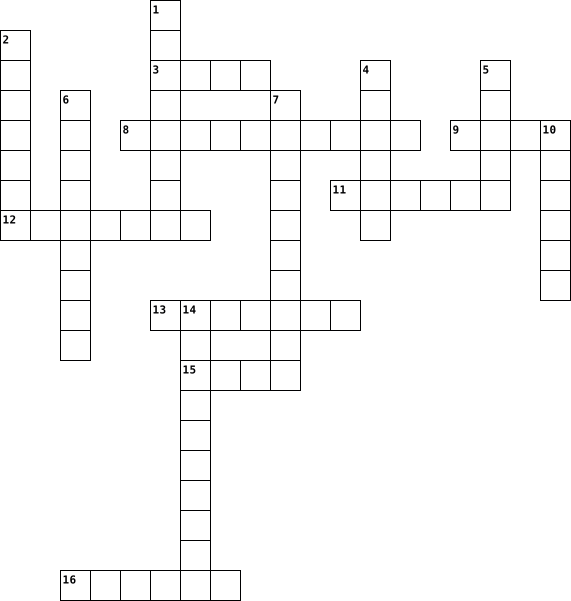
Across
- The opposite site of shiny.
- Are not good conductors of electricity.
- smallest particle of an element
- Another word for shinny.
- pure substance
- This element is known as Hs.
- a measure of how much matter is present in a substance
- We need it to breathe.(element)
Down
- The first element
- Means to break apart easily.
- The 16th element on the periodic table.
- This compound has 2 hydrogen and one oxygen
- When you can flatten an element into a sheet it is considered what?
- Have properties of both metals and non-metals
- The largest group on the Periodic Table of Elements is called.
- the layers of gas surrounding a planet that is held in place by gravity.
16 Clues: pure substance • The first element • Another word for shinny. • The opposite site of shiny. • Means to break apart easily. • This element is known as Hs. • smallest particle of an element • We need it to breathe.(element) • The 16th element on the periodic table. • Are not good conductors of electricity. • This compound has 2 hydrogen and one oxygen • ...
The Periodic Table 2021-01-29

Across
- This element has the symbol Au
- This element has the atomic number 9
- This element has the symbol Al
- This element has the symbol He
- This element has the atomic number 5
- metals This T is the big block of metals in the middle of the periodic table
- This element has the atomic number 11
- This element has the mass number 40
Down
- This Element has the symbol H
- This element has the mass number 7
- This element has the atomic number 6
- This element has the mass number 85
- This is how many group there are in the periodic table
- This element has the symbol Fe
- This element has the atomic number 18
- This element has the symbol Mn
16 Clues: This Element has the symbol H • This element has the symbol Au • This element has the symbol Al • This element has the symbol Fe • This element has the symbol He • This element has the symbol Mn • This element has the mass number 7 • This element has the mass number 85 • This element has the mass number 40 • This element has the atomic number 6 • ...
Science-Chemistry 2021-03-09

Across
- substance containing two or more different elements
- abbreviations for chemical elements
- the amount of space occupied by a substance
- a column of elements in the periodic table
- number of protons and neutrons in an atomic nucleus
- a small glass tube used for experiments in science
- the number of protons in the nucleus of an atom
- a table of chemical elements
- anything that occupies space and has mass
Down
- the smallest particle of an element
- a small gas burner used as lab equipment
- a scientific procedure to test something
- a small portion of matter
- two or more atoms chemically joined
- substance containing only one type of atom
- a row of elements in the periodic table
16 Clues: a small portion of matter • a table of chemical elements • the smallest particle of an element • abbreviations for chemical elements • two or more atoms chemically joined • a row of elements in the periodic table • a small gas burner used as lab equipment • a scientific procedure to test something • anything that occupies space and has mass • ...
Everyday Chemistry 2022-04-11

Across
- ______ Curie first discovered the radioactive elements polonium and radium
- electron configuration for this element is
- Negatively charged particles
- Smallest particle of an element
- Positively charged particles
- Made of 2 or more elements that are chemically combines
- The study ofthe behavior of matter and its charges and how it interacts with other matter and energy
- _______ is a strong acid that is used in car batteries
Down
- Fe
- _____ rule states when several orbitals are available in a subshell, each orbital gets one electron before the electrons pair up
- Vertical columns in the periodic table, where elements contain similar chemical properties
- useful in batteries since it will release electrons
- Ti
- Ni
- Horizontal rows in the periodic table
- Nuclear particle with no charge
16 Clues: Fe • Ti • Ni • Negatively charged particles • Positively charged particles • Smallest particle of an element • Nuclear particle with no charge • Horizontal rows in the periodic table • electron configuration for this element is • useful in batteries since it will release electrons • _______ is a strong acid that is used in car batteries • ...
Chemistry of Life 2024-11-14

Across
- ____ label shows consumers what nutrients are in the foods you eat
- negatively charged subatomic particle
- _____ action helps water flow against gravity
- water has a lower ____ when in the solid form than n the liquid form
- two or more atoms bonded together
- positively charged subatomic particle
- an example of a fossil fuel
- the term universal _____ means that water will dissolve many different molecules
Down
- the sticking together of like molecules
- the _____ table shows all of the known atoms
- molecule with C-C and C-H bonds
- molecule found in non-living things
- in the nucleus of the atom with the proton
- the first atom found on the periodic table
- the sticking together of different molecules
- smallest unit of matter
16 Clues: smallest unit of matter • an example of a fossil fuel • molecule with C-C and C-H bonds • two or more atoms bonded together • molecule found in non-living things • negatively charged subatomic particle • positively charged subatomic particle • the sticking together of like molecules • in the nucleus of the atom with the proton • the first atom found on the periodic table • ...
Elements, Compounds, and Mixtures 2022-10-13

Across
- vertical row of the periodic table
- a table that represents all of the elements
- building blocks
- one type of element/atom
Down
- the horizontal row of the periodic table
- two different types of atoms chemically bonded
- not chemically bonded together
- atoms of the same type grouped together
- a pure substance
- a metal mixed with at least one other
- anything that has mass or takes up space
11 Clues: building blocks • a pure substance • one type of element/atom • not chemically bonded together • vertical row of the periodic table • a metal mixed with at least one other • atoms of the same type grouped together • the horizontal row of the periodic table • anything that has mass or takes up space • a table that represents all of the elements • ...
Semiconductor Basics 1 2018-01-01

Across
- The dual of electron.
- An early elemental semiconductor.
- Charge on p-type material.
- A semiconductor made by adding controlled quantities of impurities
- What is generated when a photon with enough energy interacts with a semiconductor.
- Reverse bias _______ current.
- A subatomic particle that is more mobile that its dual.
- Semiconductor made from different elements.
- A semiconductor diode, but not pn-junction.
- Highest energy band.
Down
- Not negative.
- Region of a pn-junction without mobile carriers.
- Undoped, single-crystal semiconductor.
- Element from Group III in the periodic table.
- What is generated when a hole and electron combines in direct semiconductor material.
- An element from Group V in the periodic table.
- An elemental semiconductor and part of the nickname for the valley south of San Francisco Bay area.
- Not pure.
18 Clues: Not pure. • Not negative. • Highest energy band. • The dual of electron. • Charge on p-type material. • Reverse bias _______ current. • An early elemental semiconductor. • Undoped, single-crystal semiconductor. • Semiconductor made from different elements. • A semiconductor diode, but not pn-junction. • Element from Group III in the periodic table. • ...
Atoms 2022-04-04

Across
- To find the atomic mass, ______ the number of protons and neutrons
- Ancient Greek scientist who first studied atoms about 2,000 years ago
- Neutrally charged particle
- Negatively charged particle
- Electron is located ________ the nucleus
- studied atoms after Democritus
- Democritus determined that matter was made of
Down
- Protons and neutrons are located _______ the nucleus
- The scientist who organized the periodic table by atomic number
- The atomic number is the same as the number of ____.
- Smallest part of an element that is still that element
- Positively charged particle
- The center of the atom
- The overall charge of the atom is ______
- Chemical reactions _______ produce new atoms
- Electrons ______ contribue to the mass
- The periodic table lists all of the ________ in the world
- Dalton and Democritus both believed that atoms ________ be split apart
18 Clues: The center of the atom • Neutrally charged particle • Positively charged particle • Negatively charged particle • studied atoms after Democritus • Electrons ______ contribue to the mass • The overall charge of the atom is ______ • Electron is located ________ the nucleus • Chemical reactions _______ produce new atoms • Democritus determined that matter was made of • ...
Chemistry Revison 2024-03-25

Across
- the name for group 17 elements
- the name for group 18 elements
- decreasing this slows down a reaction
- the name of Isaac's older brother
- adding this to a reaction will increase the rate
- when tasting an acid, it should taste ________
- an element that has 18 electrons
- the name of Mr Sahely's dog
Down
- the reactivity of metals ______ down a group
- increasing this speeds up the rate of a reaction
- the street to the south of the college
- a substance that turns universal indicator green
- the name for group 1 metals
- a substance with a pH >7
- the name for the horizontal row on the Periodic Table
- an element that has 6 protons and 6 neutrons
- a group 1 metal in the third period
- the name of the vertical columns on the Periodic Table
18 Clues: a substance with a pH >7 • the name for group 1 metals • the name of Mr Sahely's dog • the name for group 17 elements • the name for group 18 elements • an element that has 18 electrons • the name of Isaac's older brother • a group 1 metal in the third period • decreasing this slows down a reaction • the street to the south of the college • ...
Kyle's Element Crossword 2026-04-29

Across
- type of change when the appearence changes and not the identity
- nonmetals can't be bent so they are not ______
- bond formed when nonmetals bond with metals
- nonmetals are _____ when solid
- metals are _____ of the stairstep line
- nonmetals are _____ of the stairstep line
- metals are solid at room _____
- property of metal that allows metal to bend
- a property of nonmetals making them breakable
Down
- coulomns in periodic table that shows chemical properties
- nonmetals do not _____ elecricitey well
- property of metal that makes metal easy to be reshaped
- property of metal that allows it to "glow"
- rows on periodic tables that show electron shells
- metals are good ______
- nonmetals can not be reshaped so they are not _____
- type of change whenever the identity changes
- bond formed when two nonmetals bond together
- a diagram with circles and dots on it is a _____ diagram
- the electron dot diagram shows the number of ______
20 Clues: metals are good ______ • nonmetals are _____ when solid • metals are solid at room _____ • metals are _____ of the stairstep line • nonmetals do not _____ elecricitey well • nonmetals are _____ of the stairstep line • property of metal that allows it to "glow" • bond formed when nonmetals bond with metals • property of metal that allows metal to bend • ...
Science! - Surya Theunis 2022-06-23

Across
- Hottest planet
- Its symbol on the periodic table is Zn
- reaction of salt mixed in water
- Hot or cold
- The largest organ in the human body
Down
- An animal that only eats plants
- State of matter where the molecules are tightly packed togeher
- A living organisms home
- Its symbol on the periodic table is Na
- An animal that only eats meat
- Solid to a gas process
11 Clues: Hot or cold • Hottest planet • Solid to a gas process • A living organisms home • An animal that only eats meat • An animal that only eats plants • reaction of salt mixed in water • The largest organ in the human body • Its symbol on the periodic table is Zn • Its symbol on the periodic table is Na • State of matter where the molecules are tightly packed togeher
periodic table 2014-04-03

Across
- symbol-is-Au
- symbol-is-Bo
- positively-charged-particles
- symbol-is-Pb
- table-of-elements
- symbol-is-Fe
- negatively-charged-particles
Down
- symbol-is-Co
- fire-water-air-earth
- symbol-is-H
- neutral-charged-particles
- matter-cannot-be-divided-forever
- symbol-is-Li
13 Clues: symbol-is-H • symbol-is-Co • symbol-is-Au • symbol-is-Bo • symbol-is-Pb • symbol-is-Fe • symbol-is-Li • table-of-elements • fire-water-air-earth • neutral-charged-particles • positively-charged-particles • negatively-charged-particles • matter-cannot-be-divided-forever
Periodic table 2025-06-02

Across
- ne
- ag
- he
- na
- o
- f
- cu
Down
- n
- mg
- al
- h
- au
- c
13 Clues: n • h • o • c • f • ne • mg • al • ag • he • na • au • cu
Periodic Table 2025-11-28

Across
- alkali earth metal in period 4
- transition metal with symbol Co
- element in group 1, period 4
- element in group 3, period 2
- noble gas in period 5 (Xe)
Down
- transition metal with symbol Au
- transition metal with symbol Zr
- element in group 1, period 2
- halogen in period 3
- alkali metal in group 1 period 6
- element in group 4 period 2
- element in group 6 period 3
- transition metal with symbol Fe
13 Clues: halogen in period 3 • noble gas in period 5 (Xe) • element in group 4 period 2 • element in group 6 period 3 • element in group 1, period 2 • element in group 1, period 4 • element in group 3, period 2 • alkali earth metal in period 4 • transition metal with symbol Au • transition metal with symbol Zr • transition metal with symbol Co • transition metal with symbol Fe • ...