
periodic%20table Crossword Puzzles
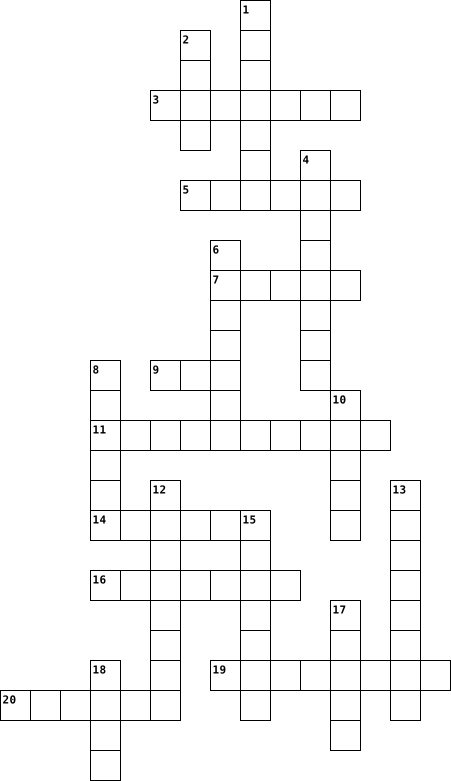
Exam Review 2018-05-16

Across
- THE AVERAGE TEMPERATURE IN ALASKA IS 20 DEGREES
- A LIQUID WITH A PH GREATER THAN 7.
- WHAT DO GROUPS OF CELLS FORM?
- WHICH IS MORE ACIDIC A PH OF TWO OR SIX?
- ELEMENTS THAT ARE SHINY AND CAN BE BENT.
- ELEMENTS IN THE SAME _____ HAVE SIMILAR CHEMICAL PROPERTIES.
- WHEN ONE SCIENTIST DUPLICATES ANOTHER SCIENTISTS WORK.
- ELEMENTS ON THE PERIODIC TABLE ARE ARRANGED BY _______ NUMBER.
- ENERGY THAT COMES OUT OF A BATTERY.
- WHICH IS MORE BASIC A PH OF ELEVEN OR THIRTEEN?
- WHAT TYPE OF CHANGE IS ICE MELTING?
Down
- MULTIPLE TRIALS ARE PERFORMED IN AN EXPERIMENT
- ELEMENTS, COMPOUNDS AND MIXTURES ARE ALL MADE OF _______.
- ANIMALS CELLS DO NOT HAVE A _____________.
- A LIQUID WITH A PH LESS THAN 7.
- FORM OF ENERGY STORED INSIDE A BATTERY.
- ELEMENTS THAT ARE FOUND ALONG THE ZIGZAG.
- SCIENTIFIC THEORIES CAN CHANGE WHEN NEW _______ IS FOUND.
- ELEMENTS IN A ROW ON THE PERIODIC TABLE.
- A MOTOR SPINNING IS AN EXAMPLE OF _______ ENERGY.
20 Clues: WHAT DO GROUPS OF CELLS FORM? • A LIQUID WITH A PH LESS THAN 7. • A LIQUID WITH A PH GREATER THAN 7. • ENERGY THAT COMES OUT OF A BATTERY. • WHAT TYPE OF CHANGE IS ICE MELTING? • FORM OF ENERGY STORED INSIDE A BATTERY. • WHICH IS MORE ACIDIC A PH OF TWO OR SIX? • ELEMENTS THAT ARE SHINY AND CAN BE BENT. • ELEMENTS IN A ROW ON THE PERIODIC TABLE. • ...
Water Chemistry Word Fun 2017-10-22

Across
- minimal to no bonds between molecules
- mixing without bonding of two or more elements
- space occupied by matter or substance
- common form of pollution in mining areas
- resistance to flow
- everything we come in contact with
- measure of how fast the molecules move
- mass per unit volume
- Fool’s Gold
- describing chemical and physical properties
- element same protons but varying number neutrons
- part of atom containing protons and neutrons
- positive charge
Down
- measure of earth’s gravitational attraction for a body
- force created by the interaction of different masses
- column in periodic table
- quantity of matter which a body possesses
- what Mohr scale measures
- row in periodic table
- mass/unit volume in solvent
- strong bonds between atoms/molecules
- negative charge
- no charge
- unstable atom
- force acting per unit area
- describing how matter behaves
- bonding of any two or more elements
- weak bonds between molecules
28 Clues: no charge • Fool’s Gold • unstable atom • negative charge • positive charge • resistance to flow • mass per unit volume • row in periodic table • column in periodic table • what Mohr scale measures • force acting per unit area • mass/unit volume in solvent • weak bonds between molecules • describing how matter behaves • everything we come in contact with • bonding of any two or more elements • ...
Atom/Periodic Table Crossword 2022-01-07

Across
- gas, far right
- basic building block of all matter
- identifies the element, if you change protons, change the element
- contains most of the mass in a very small space
- earth very reactive and do not occur freely in nature
- solid, far left through middle
- characteristics that can be observed
- fixed shape and volume, doesn't easily change shape
- metals that are very reactive and do not occur freely in nature
- definite volume, can change shape
- rows in the Periodic Table
Down
- solid, along zig-zag line
- may change but doesn't change the element, no charge, has mass
- number number of protons
- columns in the Periodic Table
- very small particles with little mass, move quickly around the nucleus
- based on matter's ability to change into a new, different substance
- gas have the maximum number of electrons in their outer shell, don't want to react with other elements
- wants to combine with other elements
- no definite volume of shape, can change shape
20 Clues: gas, far right • number number of protons • solid, along zig-zag line • rows in the Periodic Table • columns in the Periodic Table • solid, far left through middle • definite volume, can change shape • basic building block of all matter • characteristics that can be observed • wants to combine with other elements • no definite volume of shape, can change shape • ...
The Fundamentals of Chemistry 2022-01-12

Across
- less reactive than alkali metals.
- a positively charged particle.
- when an atom gains an electron.
- very reactive, important for life.
- the vertical rows on the periodic table.
- when atoms have different numbers of neutrons.
- when an atom loses an electron.
- shows all possible locations of electrons
- atomic mass unit
- an uncharged (neutral) particle.
- when an atom gains or loses one or more electrons.
- a rare earth element.
- when atoms produce energy and particles.
- almost never react, found in atmosphere.
- negatively charged, circle around the nucleus.
- in groups 3 and 12, copper,gold,etc.
Down
- very reactive,used to kill microorganisms.
- the number of protons within an element.
- series 90-103
- the center of an atom, has protons and neutrons
- have properties of metals and nonmetals.
- the horizontal rows on the periodic table.
- elements that have a shiny look and conduct heat.
- when radiation decays something ?
- have dull surfaces and cannot be shaped.
25 Clues: series 90-103 • atomic mass unit • a rare earth element. • a positively charged particle. • when an atom gains an electron. • when an atom loses an electron. • an uncharged (neutral) particle. • less reactive than alkali metals. • when radiation decays something ? • very reactive, important for life. • in groups 3 and 12, copper,gold,etc. • the number of protons within an element. • ...
science review crossword puzzle 2021-10-22

Across
- a solid that forms between two liquids
- flammable may ignite if exposed
- the amount of space an object takes up
- the guy who organized the periodic table
- two or more substances are visible
- the most reactive metal group
- a subatomic particle that is negative
- feeling, seeing, smelling
- a subatomic particle that is neutral
- non metals that do not react
- ability to stay unchanged
- how easy it is to bend
- the rings that surround the nucleus
- a subatomic particle that is positive
- how able it is to hammer it into a sheet
- particles are very close together
- state of matter with least attraction
Down
- the last energy level in an atom
- numbers, measuring, fixed value
- reacts with oxygen
- means unstable
- there on the periodic table
- mass/volume =
- negative ion
- from gas to solid state
- from solid to liquid
- solid, shiny, good conductor
- from liquid to solid
- positive ion
- smallest particle of an element
30 Clues: negative ion • positive ion • mass/volume = • means unstable • reacts with oxygen • from solid to liquid • from liquid to solid • how easy it is to bend • from gas to solid state • feeling, seeing, smelling • ability to stay unchanged • there on the periodic table • non metals that do not react • solid, shiny, good conductor • the most reactive metal group • numbers, measuring, fixed value • ...
science review crossword puzzle 2021-10-22

Across
- how able it is to hammer it into a sheet
- negative ion
- there on the periodic table
- two or more substances are visible
- positive ion
- means unstable
- particles are very close together
- numbers, measuring, fixed value
- the rings that surround the nucleus
- non metals that do not react
- from liquid to solid
- a solid that forms between two liquids
- the amount of space an object takes up
- solid, shiny, good conductor
Down
- feeling, seeing, smelling
- smallest particle of an element
- flammable may ignite if exposed
- from gas to solid state
- the last energy level in an atom
- a subatomic particle that is negative
- the guy who organized the periodic table
- reacts with oxygen
- ability to stay unchanged
- from solid to liquid
- state of matter with least attraction
- the most reactive metal group
- a subatomic particle that is positive
- mass/volume =
- how easy it is to bend
- a subatomic particle that is neutral
30 Clues: negative ion • positive ion • mass/volume = • means unstable • reacts with oxygen • from solid to liquid • from liquid to solid • how easy it is to bend • from gas to solid state • feeling, seeing, smelling • ability to stay unchanged • there on the periodic table • non metals that do not react • solid, shiny, good conductor • the most reactive metal group • smallest particle of an element • ...
science review crossword puzzle 2021-10-22

Across
- a solid that forms between two liquids
- flammable may ignite if exposed
- the amount of space an object takes up
- the guy who organized the periodic table
- two or more substances are visible
- the most reactive metal group
- a subatomic particle that is negative
- feeling, seeing, smelling
- a subatomic particle that is neutral
- non metals that do not react
- ability to stay unchanged
- how easy it is to bend
- the rings that surround the nucleus
- a subatomic particle that is positive
- how able it is to hammer it into a sheet
- particles are very close together
- state of matter with least attraction
Down
- the last energy level in an atom
- numbers, measuring, fixed value
- reacts with oxygen
- means unstable
- there on the periodic table
- mass/volume =
- negative ion
- from gas to solid state
- from solid to liquid
- solid, shiny, good conductor
- from liquid to solid
- positive ion
- smallest particle of an element
30 Clues: negative ion • positive ion • mass/volume = • means unstable • reacts with oxygen • from solid to liquid • from liquid to solid • how easy it is to bend • from gas to solid state • feeling, seeing, smelling • ability to stay unchanged • there on the periodic table • non metals that do not react • solid, shiny, good conductor • the most reactive metal group • numbers, measuring, fixed value • ...
Advanced Science 2012-08-22

Across
- Atomic particle that its charge likes to sit on the fence.
- Solid
- The types of metals in the middle of the periodic table
- If you bump into a bear in the forest you should ________ yourself.
- A type of test to show what metal is in a solution
- Structure of ionic substances
- You will find these on the left of the periodic table or on a cd.
- Different number of neutrons
Down
- A property of ionic substances
- Magnesium forms this ion
- Chlorine forms this ion
- A property of noble gases
- Atomic particle that doesn't have much good to say about the other particles.
- You will be soon
- A bond formed with the transfer of electrons.
- A property of alkali metals
- A bond formed through the sharing of electrons.
- You wont find an electron here
- You will find an electron here
- Atomic particle that always has a smile on his face
20 Clues: Solid • You will be soon • Chlorine forms this ion • Magnesium forms this ion • A property of noble gases • A property of alkali metals • Different number of neutrons • Structure of ionic substances • A property of ionic substances • You wont find an electron here • You will find an electron here • A bond formed with the transfer of electrons. • ...
Jonathan 2013-05-08

Across
- Pi
- The heaviest element in the periodic table with a name
- Type of programming I'm best at
- The Doctor
- What is the only thing light can't escape from?
- What is the only mineral in minecraft that is fantasy?
- What are my cats' names?
- What is the smallest subatomic particle?
- My favorite video game
- What does the Doctor travel in?
- What is gold known as in Minecraft?
- Fuzzy balls of fur!
Down
- How many Doctors are there?
- How many years old is the sun?
- The lightest element in the periodic table
- My favorite card game
- What will the sun become when it dies?
- What does a cat say when it's hurt?
- How is the smallest subatomic particle pronounced?
- Last name
- what is the farthest object in our solar system named?
- Nom nom!
- What does the C in programming languages mean?
- What does a supergiant star turn into when it dies?
- Middle name
25 Clues: Pi • Nom nom! • Last name • The Doctor • Middle name • Fuzzy balls of fur! • My favorite card game • My favorite video game • What are my cats' names? • How many Doctors are there? • How many years old is the sun? • Type of programming I'm best at • What does the Doctor travel in? • What does a cat say when it's hurt? • What is gold known as in Minecraft? • ...
Periodic Table Crossword puzzle. 2023-02-16

Across
- this is a type of substance.
- a horizontal row on the periodic table.
- anything with mass or volume.
- the smallest unit of the element.
- boron falls under this category.
- an atom that has lost or gained, one or more electrons.
- you put this element in balloons.
- a substance that can not be broken down into simpler substances.
- this element falls under transition metals.
- a column (up or down) on the periodic table.
Down
- the smallest unit of the compound.
- describes how likely an element is to form bonds with other elements.
- a stable particle with positive charge.
- this element is found as a setting on jewelry.
- this element is found in milk, and in our bones.
- this element is found in the pools we swim in.
- we breathe this element and it's nonmetal.
- elements and/or compounds that when put together are unable to react chemically.
- this element is very strong.
- an element or substance that conducts heat and electricity.
20 Clues: this is a type of substance. • this element is very strong. • anything with mass or volume. • boron falls under this category. • the smallest unit of the element. • you put this element in balloons. • the smallest unit of the compound. • a horizontal row on the periodic table. • a stable particle with positive charge. • we breathe this element and it's nonmetal. • ...
AP Chem Review 2022-09-12

Across
- separated by boiling point
- lose cation=smaller radius gain anion= larger radius
- the total mass in grams of an atom to make up a molecule per mole
- mass of one mole in an atom
- an atom's tendency to attract bonding electrons
- exist in energy levels
- added energy causing an electron jump a level
- BE
- increases down a group and left in a period
- cant be separated physically
- 2 electron per orbital fill in one at a time
- 6.022x10^23
Down
- measure of an atom's tendency to attract free electrons
- columns on the periodic table
- PES
- atoms with the same number of electrons
- 2 or more elements/compounds
- electron with a negative charge
- electron with a positive charge
- inner level shield the attractive force
- attraction to polarity
- effective nuclear charge
- energy required to remove an electron
- rows on the periodic table
- law F=q1q2/r^2
25 Clues: BE • PES • 6.022x10^23 • law F=q1q2/r^2 • attraction to polarity • exist in energy levels • effective nuclear charge • separated by boiling point • rows on the periodic table • mass of one mole in an atom • 2 or more elements/compounds • cant be separated physically • columns on the periodic table • electron with a negative charge • electron with a positive charge • ...
Biology Bonus 2023-04-24

Across
- The prefix that is "K" in KHDUDCM.
- What is the standard unit temperature?
- What describes a mole solute per liter solution?
- Matter is composed of _?
- The chemical with an atomic mass of 16.00.
- Ernest Rutherford discovered what part of the atom?
- A mixture where individual particles cannot be distinguished.
- The temperature and pressure where the solid, liquid, and gas forms of a substance coexist.
- The periodic element with the smallest atomic radius.
- Li on the periodic table.
- The bond between atoms that share electrons.
Down
- What is the transition of a substance directly from solid to gas?
- JJ Thomspon discovered what part of the atom?
- Diffusion through a tiny opening is _.
- The solid produced in a chemical reaction.
- A substance that can be dissolved.
- What type of reaction is A+B-->AB.
- What type of reaction involves oxygen combining with a substance to release light and heat?
- James Chadwick discovered what part of the atom?
- A mixture that is not uniform.
20 Clues: Matter is composed of _? • Li on the periodic table. • A mixture that is not uniform. • The prefix that is "K" in KHDUDCM. • A substance that can be dissolved. • What type of reaction is A+B-->AB. • What is the standard unit temperature? • Diffusion through a tiny opening is _. • The solid produced in a chemical reaction. • The chemical with an atomic mass of 16.00. • ...
Chemistry Basics 2022-07-04

Across
- the result of the combination of the synthesis
- the formula of which acid gets poured on to create a violent reaction
- the modification of a neutron
- a row in the periodic table
- the elements being used for a product
- a small series of particles that makes up the universe
- atoms that travel through air signals
- a series of particles included in the atom
- the combination of at least 2 reactants
- a combination of at least 2 elements bonded together
- the stage the burning takes when the substance has been burned
- two parts of an equation with separate elements
- the scientist who discovered the initial atomic theory
Down
- a material with a unique amount of atoms in them
- the measure of attracting electrons
- a column in the periodic table
- the burning of a substance in oxygen
- a scientific formula which can cause a violent reaction when mixed with a base
- a series of elements sorted together in a table
- the particle that guards the atom
20 Clues: a row in the periodic table • the modification of a neutron • a column in the periodic table • the particle that guards the atom • the measure of attracting electrons • the burning of a substance in oxygen • the elements being used for a product • atoms that travel through air signals • the combination of at least 2 reactants • a series of particles included in the atom • ...
crossword puzzle 2022-11-17

Across
- C at periodic table
- hot energy
- some thing we will breath out at air
- a thing one face to the ground and move
- is the gelatinous liquid that fills the inside of a cell
- plant die will
- is body change food to energy
- movement by heat
- get smaller
- A lot of atom is this
- state of cell swelling
- some thing we must get at air
Down
- what is plant use sunlight make oxygen and energy
- something we must drink
- a little room in your body
- something we get energy from
- stain used in microscope
- are membrane-bound organelles that can be found in both animals and plants.
- get bigger
- water change to the rain
- powerhouse of the cell
- H at periodic table
- plant move around
- a lot of this are molecule
- corresponds to a cell lacking turgidity
- something eat to much will fat
26 Clues: hot energy • get bigger • get smaller • plant die will • movement by heat • plant move around • C at periodic table • H at periodic table • A lot of atom is this • powerhouse of the cell • state of cell swelling • something we must drink • stain used in microscope • water change to the rain • a little room in your body • a lot of this are molecule • something we get energy from • ...
Semiconductor Basics 1 2018-01-01

Across
- The dual of electron.
- Charge on p-type material.
- Reverse bias _______ current.
- What is generated when a hole and electron combines in direct semiconductor material.
- Highest energy band.
- What is generated when a photon with enough energy interacts with a semiconductor.
- Region of a pn-junction without mobile carriers.
- Movement from high- to low concentration.
- An elemental semiconductor and part of the nickname for the valley south of San Francisco Bay area.
- An element from Group V in the periodic table.
- Type of diode, not to be confused with a heavy metal.
Down
- A semiconductor made by adding controlled quantities of impurities.
- A semiconductor diode, but not pn-junction.
- A common donor element.
- A common acceptor element
- An early elemental semiconductor.
- Element from Group III in the periodic table.
- A subatomic particle that is more mobile that its dual.
- Undoped, single-crystal semiconductor.
- Semiconductor made from different elements.
- Not pure.
- Not negative.
22 Clues: Not pure. • Not negative. • Highest energy band. • The dual of electron. • A common donor element. • A common acceptor element • Charge on p-type material. • Reverse bias _______ current. • An early elemental semiconductor. • Undoped, single-crystal semiconductor. • Movement from high- to low concentration. • A semiconductor diode, but not pn-junction. • ...
Science Crossword 2023-12-11

Across
- an atom with more Neutrons than it would usually have
- the ability for 2 substances to react with eachother
- 2 or more simple materials combine to make 1 complex compound
- sub-atomic particle with a negative charge
- a bond between a metal and a nonmetal
- sub-atomic particle with a positive charge
- a reaction that produces heat, water, and carbon dioxide
- elements found on the left side of the periodic table
- what is required for any reaction
- a change that cannot be undone
Down
- 1 complex compound is reduced to 2 or more simpler materials
- this equals Mass divided by Volume
- a bond between 2 nonmetals
- an atom with more Electrons than it would usually have
- heat is taken in
- sub-atomic particle with a neutral charge
- heat is given off
- a change that can be undone
- what is found at the end of any reaction
- elements found on the right side of the periodic table
20 Clues: heat is taken in • heat is given off • a bond between 2 nonmetals • a change that can be undone • a change that cannot be undone • what is required for any reaction • this equals Mass divided by Volume • a bond between a metal and a nonmetal • what is found at the end of any reaction • sub-atomic particle with a neutral charge • sub-atomic particle with a negative charge • ...
Oh Chemistree! 2020-12-21

Across
- electrons are in the outermost shell of an atom
- able to be pressed into a flat sheet
- popular Christmas movie with Will Ferrell
- a row on the periodic table
- subatomic particle with positive charge
- family in group 18
- striped hard candy stick, originally mint, now comes in all flavors
- the reindeer with the shiny nose
- Mariah Carey says "All I Want for Christmas is ___"
- this number shows protons plus neutrons in an atom
Down
- subatomic particle with negative charge
- most reactive family of metals, found in group one
- older song has these roasting over an open fire
- able to be stretched into a long wire without breaking
- subatomic particle with no charge (neutral)
- this model shows all parts of an atom
- the snowman that came to life one day
- the center of an atom
- this number shows how many protons an atom has
- a column on the periodic table
20 Clues: family in group 18 • the center of an atom • a row on the periodic table • a column on the periodic table • the reindeer with the shiny nose • able to be pressed into a flat sheet • this model shows all parts of an atom • the snowman that came to life one day • subatomic particle with negative charge • subatomic particle with positive charge • ...
On the Shoulders of Giants 2024-05-13

Across
- A harbinger of doom
- The Water of Life
- Person who determined Heliocentric solar system with CIRCULAR orbits of planets
- A modern day Elixir of Life using Sassafras root
- This religion punished Galileo
- Stone that holds the Elixir of Life
- Predicted the return of his comet
- Missing his nose, but his observations of Mars were critical to others
Down
- Equal and ____________ reaction (law of motion)
- Latin term for an Earth centered solar system
- A body at _________ has a tendency to stay motionless
- Modern day Elixir of Life
- Many periodic comets come from this region of the Solar System
- Person who determined planet orbits were ELLIPSES
- Planet responsible for protecting Earth from many comet collisions
- Math invented by Newton to predict locations of planets
- A comet that returns regularly is called a ________ comet
- Turning worthless metal into gold
- Adds the concept of Gravity to exactly order the movement of Solar System objects
- Committed Heresy by turning a telescope to the heavens
20 Clues: The Water of Life • A harbinger of doom • Modern day Elixir of Life • This religion punished Galileo • Turning worthless metal into gold • Predicted the return of his comet • Stone that holds the Elixir of Life • Latin term for an Earth centered solar system • Equal and ____________ reaction (law of motion) • A modern day Elixir of Life using Sassafras root • ...
Elements & Compounds 2024-09-11

Across
- The chemical symbol He
- One or two letters used to represent an element
- The chemical symbol Mg
- A single substance without anything mixed in
- Easily broken
- An attractive force that holds two atoms together
- The number by which elements are ordered in the periodic table
- A repeating arrangement of atoms in a solid
- A column in the periodic table
Down
- C6H12O6
- An element that typically does not conduct heat or electricity
- A group of atoms bonded together
- The chemical symbol Cl
- A substance made up of two or more types of atom bonded together
- A shiny element that conducts heat and electricity
- The re-arrangement of atoms to form one or more new substances
- A grid arrangement of all known chemical elements
- A substance made up of only one type of atom
- The temperature at which a substance changes from liquid to gas
- The temperature at which a substance changes from solid to liquid
- The chemical symbol Na
21 Clues: C6H12O6 • Easily broken • The chemical symbol Cl • The chemical symbol He • The chemical symbol Mg • The chemical symbol Na • A column in the periodic table • A group of atoms bonded together • A repeating arrangement of atoms in a solid • A single substance without anything mixed in • A substance made up of only one type of atom • One or two letters used to represent an element • ...
Raynne J Crossword Maker 2024-09-26

Across
- What is the same element with different masses?
- Where are protons found?
- Who created the uncetainty principle?
- This is the same as the atomic number?
- table What is the arrangement of elements called?
- What is the first element on the periodic table?
- What is the first Nobel gas?
- What element has an average mass of 131.29?
- cloud Where are electrons found?
- What is a protons mass?
- What element has the symbol "Ne"
- A reaction where heat/energy is lost is called?
- number What is the number representing an element?
- What are the outermost electrons?
Down
- What did J.J Tompson discover?
- What charge does an electron have?
- What element has 5 protons?
- A reaction where heat/energy is gained?
- Heat transfer through touch?
- Heat transfer through waves is called?
- What is the smallest unit of matter?
- What is a chemical substance
- The number of protons and neutrons added?
- waves What is the longest wavelength?
- What element has the symbol "Na"
25 Clues: What is a protons mass? • Where are protons found? • What element has 5 protons? • Heat transfer through touch? • What is the first Nobel gas? • What is a chemical substance • What did J.J Tompson discover? • cloud Where are electrons found? • What element has the symbol "Ne" • What element has the symbol "Na" • What are the outermost electrons? • ...
Chemistry Crossword Puzzle 2024-09-27

Across
- includes helium, krypton, neon, and more
- distance between wave crests
- the letter representation of an element
- the smallest part of an element
- type of charged particle
- lowest amount of frequency
- highest amount of frequency
- type or structure that deals with the valence electrons
- horizontal row on the periodic table
- positively charged particle
- positively charged item of the nucleus
- type of diagram that has up and down arrows
- number of waves that pass a certain point per unit of time
- chemical substance that cannot be broken down
Down
- theory that all substances are composed of atoms
- number of protons in the nucleus of an atom
- where protons and neutrons stay
- the whole arrangement of elements
- same protons different neutrons
- outer layer of electrons
- negatively charged particle
- negatively charged item in a nucleus
- vertical row on the periodic table
- total number of protons and neutrons in the nucleus of an atom
- neutral charge in a nucleus
25 Clues: outer layer of electrons • type of charged particle • lowest amount of frequency • negatively charged particle • highest amount of frequency • positively charged particle • neutral charge in a nucleus • distance between wave crests • where protons and neutrons stay • same protons different neutrons • the smallest part of an element • the whole arrangement of elements • ...
Pakhi’s science puzzle 2025-09-18

Across
- What do you say when someone is going away
- Magnetic
- Cool
- join to make solid
- The way they behave
- example hail
- Has been tested and accepted widely as valid
- Rows are periodic table
- Example of gas
- Volume of liquid
- Water goes inside soil an water
- Particles in solid———
- Sign
- Tiny piece of matter
- example solid,liquid,gas
- particles held in position
- rivers ——————-
- particles heated
- used to measure
- Something made out of 1 type atom
Down
- Get biggest
- Heat
- water carried of
- example oceans
- Bubble formed
- I ———— milk
- hydrology
- used to measure liquids
- Does not change
- evaporation from plants
- When water evaporates
- Curve formed on a cylinder
- changed
- arranging of elements
- What subject is this?
- Not Magnetic
- Gas around earth
- Air ——————-
- THE PERSON WHO MADE THE PUZZLE
39 Clues: Heat • Cool • Sign • changed • Magnetic • hydrology • Get biggest • I ———— milk • Air ——————- • example hail • Not Magnetic • Bubble formed • example oceans • Example of gas • rivers ——————- • Does not change • used to measure • water carried of • Volume of liquid • Gas around earth • particles heated • join to make solid • The way they behave • Tiny piece of matter • When water evaporates • arranging of elements • ...
Y10 Adv Science (Chemistry) Recall Xword 2025-10-26

Across
- another name for a hydrogen atom
- atoms that lose or gain electrons
- light and strong metal used in aircraft manufacturing
- neither metals nor non-metals
- a chemical ______ is a written chemical reaction
- the number of electron shells of an atom
- most metals have a high _______ point
- hold ions together to form compounds
- the electrons on the outer shell
- an insoluble ionic compound
Down
- compounds formed between metals and non-metals
- the main gas in Earth's atmosphere
- Can not be created nor destroyed during a chemical reaction
- ____metals. The first group of the periodic table
- metals are good conductors of
- non-metals are mainly solids except this
- sharing 4 electrons between atoms
- most abundant element in the universe
- ____ represent the number of valence electrons in the periodic table
- the group of unreactive gases
- the rule that requires 8 electrons on the outer shell
- two or more atoms bonded together
- bonds that share electrons
23 Clues: bonds that share electrons • an insoluble ionic compound • metals are good conductors of • neither metals nor non-metals • the group of unreactive gases • another name for a hydrogen atom • the electrons on the outer shell • atoms that lose or gain electrons • sharing 4 electrons between atoms • two or more atoms bonded together • the main gas in Earth's atmosphere • ...
Semiconductor Basics 1 2025-11-30

Across
- Undoped, single-crystal semiconductor.
- Not pure.
- The dual of electron.
- Region of a pn-junction without mobile carriers.
- An element from Group V in the periodic table.
- An early elemental semiconductor.
- Charge on p-type material.
- A semiconductor made by adding controlled quantities of impurities.
- A common donor element.
- Semiconductor made from different elements.
- An elemental semiconductor and part of the nickname for the valley south of San Francisco Bay area.
- What is generated when a hole and electron combines in direct semiconductor material.
Down
- A common acceptor element
- Highest energy band.
- Not negative.
- Type of diode, not to be confused with a heavy metal.
- Reverse bias _______ current.
- Movement from high- to low concentration.
- A subatomic particle that is more mobile that its dual.
- Element from Group III in the periodic table.
- What is generated when a photon with enough energy interacts with a semiconductor.
- A semiconductor diode, but not pn-junction.
22 Clues: Not pure. • Not negative. • Highest energy band. • The dual of electron. • A common donor element. • A common acceptor element • Charge on p-type material. • Reverse bias _______ current. • An early elemental semiconductor. • Undoped, single-crystal semiconductor. • Movement from high- to low concentration. • A semiconductor diode, but not pn-junction. • ...
Periodic Table of the Elements 2026-01-23

Across
- Element with an abbreviation of "Au"
- Element with an atomic mass of 30.97 amu
- Element with an abbreviation of Pd
- The number of columns on the periodic table
- Abbreviation for Lead
- Abbreviation for Magnesium
- Element with an atomic number of 74
- Element with an atomic mass of 55.84 amu
- Element with an atomic mass of 131.29 amu
- Element with an abbreviation of "Hg"
- Element with an atomic number of 8
- The very first element of the table
- Element with an atomic number of 85
- Element with an atomic number of 47
Down
- Element directly above Chlorine
- Abbreviation for Copper
- Element on the left side of Tellurium
- Element with an atomic mass of 14.00 amu
- The number of rows on the periodic table
- Element with an abbreviation of "B"
- Element with an abbreviation of "C"
- Element with an atomic mass of 65.38 amu
- Element on the right side of Iodine
- Abbreviation for Calcium
- Element with an atomic mass of 4.00 amu
25 Clues: Abbreviation for Lead • Abbreviation for Copper • Abbreviation for Calcium • Abbreviation for Magnesium • Element directly above Chlorine • Element with an abbreviation of Pd • Element with an atomic number of 8 • Element with an abbreviation of "B" • Element with an atomic number of 74 • Element with an abbreviation of "C" • Element on the right side of Iodine • ...
Chemistry Crossword 2026-02-16

Across
- On the periodic table a horizontal row is called _____
- Represents the electron configuration
- Wine is an example of _____ Mixture
- ____ ____ is the specific volume of space where an electron is usually found
- Scientific chart
- Up and down on the periodic table
- Static electricity
- I am the smallest amount of energy that can be gained or lost. What am I?
- This energy is needed to remove an outer electron
- Replicates an object to be more scale convenient
Down
- Force attraction between 2 atoms
- Im a material that only has one type of atom. What am I?
- An arrangement of atoms within a unit of an element
- Semiconductor Element
- A process of one or more substances that turn into new substances.
- Representation that helps predict
- An atom would not be an element without this positively charged particle
- NaCl is an example of a _____
- Mass Weighted average of an element's isotopes
- I characterize how substances react and transform. What am I?
20 Clues: Scientific chart • Static electricity • Semiconductor Element • NaCl is an example of a _____ • Force attraction between 2 atoms • Representation that helps predict • Up and down on the periodic table • Wine is an example of _____ Mixture • Represents the electron configuration • Replicates an object to be more scale convenient • ...
Y9 Chemistry 2026-02-11

Across
- A vertical column in the periodic table.
- A neutral solution has a pH of _______.
- A reaction that releases energy to the surroundings.
- A positively charged subatomic particle.
- Method used to separate substances based on their solubility.
- Method used to separate two liquids based on their boiling points.
- The reaction between an acid and a base.
Down
- Two or more substances not chemically bonded.
- Group 7 elements are called ________.
- The centre of an atom.
- This is used to test pH by colour change.
- What is transferred during chemical reactions?
- Method used to separate an insoluble solid from a liquid.
- A substance made up of two or more elements chemically bonded together.
- A horizontal row in the periodic table.
- Reaction involving oxygen that releases energy.
- A reaction that takes in energy from the surroundings.
- Substances with a pH less than 7.
- A substance made up of only one type of atom.
- Group 0 elements are known as ______ gases.
20 Clues: The centre of an atom. • Substances with a pH less than 7. • Group 7 elements are called ________. • A neutral solution has a pH of _______. • A horizontal row in the periodic table. • A vertical column in the periodic table. • A positively charged subatomic particle. • The reaction between an acid and a base. • This is used to test pH by colour change. • ...
All About the Numbers 2026-03-12

Across
- Lebron James' jersey number (2 words).
- Number of teeth an adult has (2 words)
- Number of continents in the world.
- Number of classes most students have per school day.
- Smallest "prime" number.
- Year Mr. Winters was born (I'll be 62) 19____ (2 words)
- Number of times Mr. Winters has been married.
- Number of planets in our solar system.
- Number of spaces around a Monopoly board.
- Number of "groups" on a periodic table.
Down
- Number of years in a century.
- Spanish word for 70.
- Room number of Mr. Winters' old room (Mr. Rodriguez's room)(2 words)
- Atomic number of gold (Au) on a periodic table. (2 words)
- A "Baker's Dozen:.
- How many a dozen is.
- Number of years Mr. Winters has been teaching (Started in 1993) (2 words).
- Mr Winters' room number(2 words).
- Number that a Roman numeral of "L" means.
- Number of children Mr. Winters has.
- Number of strings a bass guitar usually has.
21 Clues: A "Baker's Dozen:. • Spanish word for 70. • How many a dozen is. • Smallest "prime" number. • Number of years in a century. • Mr Winters' room number(2 words). • Number of continents in the world. • Number of children Mr. Winters has. • Lebron James' jersey number (2 words). • Number of teeth an adult has (2 words) • Number of planets in our solar system. • ...
Chemistry 2012-01-15

Across
- A ________ is a charged atom
- Ionic bonds are comprimised of one non-metal and one _______
- Matter breaks down into two sub-sections, pure substances and ______________
- When two or more atoms join together they form __________ compounds
- Metals in the first group on the periodic table
- Ionic compounds are very _____________
- When one or more pairs of electrons are shared between two atoms it forms a _________ bond
- __________ measures a substance's resistance to pour
- Particles _______ attract each other
Down
- Lab chemicals come with _______ lables to ensure safety
- ____________ Are elements that share both metal and non-metal proerties
- Sodium and chlorine form table ________
- A charge orbiting around the nucleus
- Stable gases in the 18th periodic table group are called ______ gases
- The element that is in everything and is important to all living things
- The only liquid metal
- Rutherford discovered the ___________
- All elements want a full ________ ring
- If bubble of gas are produced a _________ change has occured
- A positve charge inside the atom's nucleus
20 Clues: The only liquid metal • A ________ is a charged atom • A charge orbiting around the nucleus • Particles _______ attract each other • Rutherford discovered the ___________ • Ionic compounds are very _____________ • All elements want a full ________ ring • Sodium and chlorine form table ________ • A positve charge inside the atom's nucleus • ...
Global Systems 2014-04-09

Across
- Describes the temperature, wind or cloud
- One extreme formed of the Southern Oscillation
- Can be recycled
- The long term effect of Weather
- The cooling of water vapour to form water droplets
- Effect Increase in temperature caused by gases
- Where green plants use sunlight to synthesize nutrients
- ........line
- Everything on Earth that is living
- Fuels Fuels containing dead organisms and plants
- The cutting down of trees
- A fuel made of living materials
- Land
Down
- In......
- All liquid on Earth
- Sheet Thick sheets of ice covering large areas
- In arctic or subarctic regions
- An element with periodic symbol CO2
- Water from the Ocean turning into vapour
- Energy in waves moving subatomic particles
- Occurring or being formed between Glaciations
- Colourless, Odourless, Flammable gas
- Discharge of fuel as a fume
- A wavelength over 60 metres
- Every component making up an environment
- Gases over the planet
- A element with periodic symbol N
27 Clues: Land • In...... • ........line • Can be recycled • All liquid on Earth • Gases over the planet • The cutting down of trees • Discharge of fuel as a fume • A wavelength over 60 metres • In arctic or subarctic regions • The long term effect of Weather • A fuel made of living materials • A element with periodic symbol N • Everything on Earth that is living • ...
Vibrations and Waves 2014-04-14

Across
- Originates from vibrations; leads to vibrations
- Various ways in which a system can vibrate
- French physicist who demonsrated Earth's rotation using pendulum
- A kind of analysis of periodic functions
- Prevention of vibrations
- English physicist who discovered Argon and also worked on dynamics of resonance
- Useful for reducing vibrations
- Vibrations in the air
- Combining two different frequencies to produce two new frequencies in radio reception
- What always remains conserved
- A kind of failure resulting from vibrations
- What all waves carry and transmit
- Results from interference of two waves
Down
- A type of vibration damper
- Interval of eight diatonic degrees between two tones
- Repeating after a fixed interval of time
- Signals used in tone dialing
- Series of subsidiary vibrations, whose frequencies are in simple ratios
- Causes vibrations while in motion
- Swinging motion
- Scientist who observed swinging of lantern
- To wave rapidly in irregular manner
- Occurs at resonance
- A tremendous increase in amplitude
- Matching of frequencies
25 Clues: Swinging motion • Occurs at resonance • Vibrations in the air • Matching of frequencies • Prevention of vibrations • A type of vibration damper • Signals used in tone dialing • What always remains conserved • Useful for reducing vibrations • Causes vibrations while in motion • What all waves carry and transmit • A tremendous increase in amplitude • To wave rapidly in irregular manner • ...
Vibrations and Waves 2014-04-14

Across
- A kind of analysis of periodic functions
- Useful for reducing vibrations
- A kind of failure resulting from vibrations
- Causes dynamic vibrations
- Occurs at resonance
- Combining two different frequencies to produce two new frequencies in radio reception
- Vibrations in the air
- Prevention of vibrations
- Series of subsidiary vibrations, whose frequencies are in simple ratios
- What all waves carry and transmit
- Various ways in which a system can vibrate
- What always remains conserved
- French physicist who demonstrated Earth's rotation using pendulum
- Results from interference of two waves
- Repeating after a fixed interval of time
Down
- Signals used in tone dialing
- To waive rapidly in irregular manner
- English physicist who discovered Argon and also worked on dynamics of resonance
- Swinging motion
- Scientist who observed swinging of lantern
- Matching of frequencies
- Interval of eight diatonic degrees between two tones
- A tremendous increase in amplitude
- A type of vibration damper
24 Clues: Swinging motion • Occurs at resonance • Vibrations in the air • Matching of frequencies • Prevention of vibrations • Causes dynamic vibrations • A type of vibration damper • Signals used in tone dialing • What always remains conserved • Useful for reducing vibrations • What all waves carry and transmit • A tremendous increase in amplitude • To waive rapidly in irregular manner • ...
C4 2015-03-06

Across
- ionic compounds have a ... melting point
- sub-atomic particle with positive charge
- A mixture of 2 or more elements, chemically bonded
- the type of reaction that occurs when two solutions react to form a solid
- A charged particle
- a bond between two non-metals
- element with the chemical symbol Al
- something made up of 1 type of atom
- sub-atomic particle that has no charge
- scientist who arranged the elements into the periodic table
- sub-atomic particle with negative charge
- the part of the atom made up of protons and neutrons
Down
- first element on the periodic table
- the gaining of an electron
- the loss of an electron
- element with the chemical symbol Na
- the type of reaction that occurs when a halogen is added to a solution of a compound containing a less reactive halogen
- table of all the elements (two words)
- the scientist who created the law of octaves
- chemical symbol of chlorine
20 Clues: A charged particle • the loss of an electron • the gaining of an electron • chemical symbol of chlorine • a bond between two non-metals • first element on the periodic table • element with the chemical symbol Na • element with the chemical symbol Al • something made up of 1 type of atom • table of all the elements (two words) • sub-atomic particle that has no charge • ...
Aaditya's science crossword. 2015-09-21

Across
- One shell can hold less than three electrons.
- A group of elements starts with noble.
- Gases that are stable.
- A group of elements starts with non
- Total number of elements in the periodic table
- Elements in group eight have another name.
- A group of elements starts with semi.
- Name the element. The atomic number is seven.
- Humans made those metals.
- Bold alphabet in each box.
- Name of the last row.
- The top number in each box.
- Name the element. The atomic number is fifty seven.
- First element in the periodic table.
Down
- A group of elements starts with trans.
- They are everywhere.
- A man made metal.
- Another name for vertical columns.
- A group of elements starts with alkali.
- Name of the second last row.
- Another name for horizontal rows.
- They stay on the shell.
- Name the element. The atomic number is eighty.
- Weight of an element.
24 Clues: A man made metal. • They are everywhere. • Name of the last row. • Weight of an element. • Gases that are stable. • They stay on the shell. • Humans made those metals. • Bold alphabet in each box. • The top number in each box. • Name of the second last row. • Another name for horizontal rows. • Another name for vertical columns. • A group of elements starts with non • ...
CH163 Week 4 Recitation 2020-02-04

Across
- F-1
- positively charged ion
- negatively charged subatomic particle
- positively charged subatomic particle
- I-1
- CN-1
- the name for group 2A elements
- no charge and in the nucleus
- elements to the left of the staircase are _____
- S-2
- tells you the number of protons in an element
- Br-1
- P-3
- columns on the periodic table
Down
- OH-1
- elements to the right of the staircase are _____
- rows on the periodic table
- the same number of protons and electrons but different number of neutrons
- negatively charged ion
- the name for group 8A elements
- weighted average of all naturally occuring isotopes of an element
- Cl-1
- the sum of protons and neutrons
- the name for group 1A elements
- elements along the staircase are _____
- the name for group 7A elements
- C-4
- N-3
- protons and electrons are _____ in a neutral atom
- O-2
30 Clues: F-1 • I-1 • C-4 • N-3 • S-2 • P-3 • O-2 • OH-1 • Cl-1 • CN-1 • Br-1 • negatively charged ion • positively charged ion • rows on the periodic table • no charge and in the nucleus • columns on the periodic table • the name for group 8A elements • the name for group 1A elements • the name for group 7A elements • the name for group 2A elements • the sum of protons and neutrons • ...
Matter 2020-08-23
Across
- the creator of the plum pudding model
- when electrons are lost in an atom
- when protons are lost in an atom
- a charged atom formed by the loss of one or more electrons or protons
- __ model shows that an atom is a mostly empty space
- He was an English chemist and physicist
- a positively charged central core in a cell
- having the same charge of a proton
- a subatomic particle with a positive charge
Down
- Different Substances
- Niels_ created the theory for a hydrogen atom
- A mixture of 2 or more elements
- a property of an atom that shows the number of atoms in an element
- rows in a periodic table
- columns on a periodic table
- a subatomic particle with a negative charge
- having the same charge of an electron
- The same as an electron but without a charge
- A compound made up of hydrogen and oxygen
- Basic units of matter
20 Clues: Different Substances • Basic units of matter • rows in a periodic table • columns on a periodic table • A mixture of 2 or more elements • when protons are lost in an atom • when electrons are lost in an atom • having the same charge of a proton • the creator of the plum pudding model • having the same charge of an electron • He was an English chemist and physicist • ...
Intro to Physics Final Exam Review 2021-01-11

Across
- Vertical rows on the periodic table
- the tendency of something to stay in rest or motion
- substance that can’t be broken down into further
- a push or a pull
- center of an atom
- rate of change of velocity
- subatomic particle that has a neutral charge
- these are the building blocks of matter
- distance traveled per unit time in one direction
- anything that has mass and takes up space
- dissolved in the solvent
Down
- the amount of space that matter takes up
- positive ion
- a substance made by mixing other substances together.
- horizontal rows on the periodic table
- not of the same kind or nature
- the amount of matter in an object
- subatomic particle that has a negative charge
- any substance that has mass and takes up space
- subatomic particle that has a positive charge
- how much matter is in a given space
- all of the same or similar kind or nature
- negative ion
- able to dissolve other substances
24 Clues: positive ion • negative ion • a push or a pull • center of an atom • dissolved in the solvent • rate of change of velocity • not of the same kind or nature • the amount of matter in an object • able to dissolve other substances • Vertical rows on the periodic table • how much matter is in a given space • horizontal rows on the periodic table • these are the building blocks of matter • ...
Science Christmas Assesment 2020-12-13

Across
- This can be small or large in our bodies
- SpeedxTime
- How a plant makes its own food
- Where a plant stores its food in the cell
- Mr........., the most patient teacher
- The gas a plant makes during photosynthesis
- System our food flows through
- Distance/Speed
- Element with 6 protons and 6 neutrons
- Chemical equation for Carbon Dioxide
Down
- Type of bond between a metal and non-metal
- Subject where you study Biology, Chemistry and Physics
- Found on the periodic table
- Type of bond between two non-metals
- This can be single, double or triple
- Type of charge on a neutron
- This can be positive, negative or neutral
- Sub-atomic particle with a positive charge
- The food a plant makes during photosynthesis
- Table with all the elements on it
- Distance/Time
- Adults have 32 of these for eating
- Sub-atomic particle with a negative charge
- Where food mixes with acid and is ground up
- 100cm
25 Clues: 100cm • SpeedxTime • Distance/Time • Distance/Speed • Found on the periodic table • Type of charge on a neutron • System our food flows through • How a plant makes its own food • Table with all the elements on it • Adults have 32 of these for eating • Type of bond between two non-metals • This can be single, double or triple • Chemical equation for Carbon Dioxide • ...
Year 10 Great Big Christmas Crossword 2017-12-19

Across
- a vertical column in the periodic table
- Breathe ! (3,5)
- a molecule made of just two atoms
- the state symbol for a substance dissolved in water
- these metals sound like they are changing !
- A substance containing only one type of atom.
- This is simply Be !
- an early model of an atom, where the atom was a ball and the electrons were embedded in it (4,7)
- the sum of the protons and neutrons in a nucleus (4,6)
- the reactivity of group 1 metals increases in this direction
- Dimitri was the daddy of the periodic table
- The bond between atoms when electrons are shared
Down
- this mans not hot
- group 7..thats all
- An insoluble solid formed by the reaction of two solutions
- liquids that do not mix..like oil and water !
- a compound containing any group 7 element
- When elements chemically bond together
- When two or more atoms join together, can be same or different!
- The electrostatic bond when electrons are transferred
20 Clues: Breathe ! (3,5) • this mans not hot • group 7..thats all • This is simply Be ! • a molecule made of just two atoms • When elements chemically bond together • a vertical column in the periodic table • a compound containing any group 7 element • these metals sound like they are changing ! • Dimitri was the daddy of the periodic table • ...
Exam Review 2018-05-16

Across
- ELEMENTS IN A ROW ON THE PERIODIC TABLE.
- WHICH IS MORE BASIC A PH OF ELEVEN OR THIRTEEN?
- A MOTOR SPINNING IS AN EXAMPLE OF _______ ENERGY.
- MULTIPLE TRIALS ARE PERFORMED IN AN EXPERIMENT
- WHAT DO GROUPS OF CELLS FORM?
- WHEN ONE SCIENTIST DUPLICATES ANOTHER SCIENTISTS WORK.
- ELEMENTS THAT ARE SHINY AND CAN BE BENT.
- FORM OF ENERGY STORED INSIDE A BATTERY.
Down
- WHAT TYPE OF CHANGE IS ICE MELTING?
- WHICH IS MORE ACIDIC A PH OF TWO OR SIX?
- ENERGY THAT COMES OUT OF A BATTERY.
- THE AVERAGE TEMPERATURE IN ALASKA IS 20 DEGREES
- ELEMENTS, COMPOUNDS AND MIXTURES ARE ALL MADE OF _______.
- ELEMENTS THAT ARE FOUND ALONG THE ZIGZAG.
- ELEMENTS IN THE SAME _____ HAVE SIMILAR CHEMICAL PROPERTIES.
- A LIQUID WITH A PH GREATER THAN 7.
- SCIENTIFIC THEORIES CAN CHANGE WHEN NEW _______ IS FOUND.
- ANIMALS CELLS DO NOT HAVE A _____________.
- ELEMENTS ON THE PERIODIC TABLE ARE ARRANGED BY _______ NUMBER.
- A LIQUID WITH A PH LESS THAN 7.
20 Clues: WHAT DO GROUPS OF CELLS FORM? • A LIQUID WITH A PH LESS THAN 7. • A LIQUID WITH A PH GREATER THAN 7. • WHAT TYPE OF CHANGE IS ICE MELTING? • ENERGY THAT COMES OUT OF A BATTERY. • FORM OF ENERGY STORED INSIDE A BATTERY. • ELEMENTS IN A ROW ON THE PERIODIC TABLE. • WHICH IS MORE ACIDIC A PH OF TWO OR SIX? • ELEMENTS THAT ARE SHINY AND CAN BE BENT. • ...
Spelling H-4 2023-09-21

Across
- opposite of weak
- what farmers grow to sell or for feed
- people drink this hot, cold, with creamer and sugar
- large solid pieces of hard material usually with flat sides
- sport placed on ice with a puck
- material used to make clothes
- a thing or things that belong to someone, possessions
- flying vehicle with one propellor on the top
- element 8 on the periodic table, gas you need in your body
- of the present or recent times, not the past
Down
- main ingredient in many candy bars
- left-right, up-down, in-out
- to find unexpectedly during a search
- part of a tree trunk or branch that has fallen or been cut off
- a group of people working together on a task
- element 29 on the periodic table, pennies made from it
- to make exactly like the first thing
- small pouch in clothing used to carry small things
- not a liquid or a gas but this
- what is the same, ordinary
20 Clues: opposite of weak • what is the same, ordinary • left-right, up-down, in-out • material used to make clothes • not a liquid or a gas but this • sport placed on ice with a puck • main ingredient in many candy bars • to find unexpectedly during a search • to make exactly like the first thing • what farmers grow to sell or for feed • a group of people working together on a task • ...
Chemistry Crossword 2024-05-08

Across
- The small number under the element;shows the number of that atom there
- A column in the periodic table
- A substance that is made up of only one kind of particle
- A homogenous mixture of 2+ substances
- You cannot see the different ingredients within
- The number of protons in an atom's nucleus
- Something imitating a natural substance; manmade
- Something that can produce salts in chemical reactions and tastes sour
- Something that dissolves other substances
- The process of getting a certain substance from a liquid by evaporation or condensation
- A row in the periodic table
- what is being dissolved in another substance
- Something chemically inactive, it wont react
- How well something can be stretched and flexed
Down
- The number in front of chemical formula that multiplies the subscript
- You can see the different ingredients within
- The ability of something to conduct electricity
- Something that can neutralize acid
- The process or action of filtering something
- The process of reacting with oxygen
20 Clues: A row in the periodic table • A column in the periodic table • Something that can neutralize acid • The process of reacting with oxygen • A homogenous mixture of 2+ substances • Something that dissolves other substances • The number of protons in an atom's nucleus • You can see the different ingredients within • The process or action of filtering something • ...
4th Nine Weeks Bonus Crossword Puzzle 2024-05-08

Across
- A microscopic particle that makes up all matter.
- Number 1 on the periodic table.
- The atoms on the 18th column of the periodic table.
- Substance with a pH greater than 7
- The time required for a certain amount of atoms to decay by half the amount originally present.
- A temperature measuring instrument.
- Substance with a pH less than 7
- A combination of 2 or more substances
- A positively charged ion.
- KHDUDCM
Down
- A positively charged particle.
- A negatively charged ion.
- A particle with no charge.
- A substance's mass per unit of volume (Water's is 1 gram per millimeter.)
- Light particle.
- A negatively charged particle.
- The phase state of H2O when it is ice
- Rings around atoms that hold electrons.
- the outermost electrons of an atom.
- One measurement of this is 6.02 x 10^23 units of a substance.
- The phase state of H2O when it is vapor
- The center of an atom.
22 Clues: KHDUDCM • Light particle. • The center of an atom. • A negatively charged ion. • A positively charged ion. • A particle with no charge. • A positively charged particle. • A negatively charged particle. • Number 1 on the periodic table. • Substance with a pH less than 7 • Substance with a pH greater than 7 • A temperature measuring instrument. • the outermost electrons of an atom. • ...
Elements 2023-01-30

Across
- I am a positive particle in the nucleus of an atom
- My symbol is Sc
- I have 3 neutrons and live in group 1
- My symbol is U
- My symbol is Ta
- I can be found at (7,9)
- My symbol is Cr
- My symbol is W
- I can be found at (1,6)
- I have 10 neutrons and live in group 14
Down
- I can be found at (5,4)
- My symbol is Th
- I have 14 neutrons and live in group 14
- I can be found at (13,2)
- I have 100 neutrons and live in group 4
- weight The amount of the weight of the elements
- I can be found at (18,2)
- I can be found at (12,6)
- My atomic number is 37
- The columns on a periodic table
- I have 6 electrons
- I have 14 protons
- My atomic number is 79
- The rows on a periodic table
24 Clues: My symbol is U • My symbol is W • My symbol is Th • My symbol is Sc • My symbol is Ta • My symbol is Cr • I have 14 protons • I have 6 electrons • My atomic number is 37 • My atomic number is 79 • I can be found at (5,4) • I can be found at (7,9) • I can be found at (1,6) • I can be found at (13,2) • I can be found at (18,2) • I can be found at (12,6) • The rows on a periodic table • ...
Periodic table of elements crossword 2023-05-02

Across
- I'm in group 14 period 2
- My chemical symbol is Se
- My chemical symbol is Nh
- Ds is its chemical symbol
- in group 8 period 6
- what is the name of the columns on the periodic
- my chemical symbol is Rn
- A negative part of an atom
- I have 77 neutrons and in period 18
- my chemical symbol is Ag
- I have 30 neutrons and in group 8
- elements
- I'm in group 9 period 7
- I have 25 protons
- I have 7 electrons
Down
- of elements
- I have 4 protons
- P is its chemical symbol
- My chemical symbol is Cd
- I have 110 neutrons and in group 6
- Im in group 18 and period 3
- I have 117 neutrons and in group 17
- what is the name of the rows on the periodic table
- Rb is its chemical symbol
- I have 44 protons
- A positive part of an atom
26 Clues: elements • of elements • I have 4 protons • I have 44 protons • I have 25 protons • I have 7 electrons • in group 8 period 6 • I'm in group 9 period 7 • I'm in group 14 period 2 • P is its chemical symbol • My chemical symbol is Se • My chemical symbol is Cd • My chemical symbol is Nh • my chemical symbol is Rn • my chemical symbol is Ag • Ds is its chemical symbol • Rb is its chemical symbol • ...
Periotic table 2023-05-09

Across
- Verticle column on the periodic table.
- What group is potassium in?
- what is the classification of sodium?
- what element is in period 1 group 6?
- What element is in group 1 and period 1?
- Positive particles in the nucleus.
- Neutral particle in the nucleus with protons.
- Tells the number of protons in an atom of the element.
- The smallest particle in an atom.
Down
- A table organizing all of the elements known to exist by atomic number and chemical properties.
- Negative particle outside of the nucleus.
- Properties of both metals and nonmetals.
- Horizontal row on the periodic.
- The basic unit of a chemical element.
- What is the name of the group helium is in?
- An element with an atomic number of 16.
- How many valence e- does Magnesium have?
- How many valences e- does group one have?
- Tells the number of protons and neutrons in the nucleus.
- What element is in period 2 and in the alkaline earth metal group?
20 Clues: What group is potassium in? • Horizontal row on the periodic. • The smallest particle in an atom. • Positive particles in the nucleus. • what element is in period 1 group 6? • The basic unit of a chemical element. • what is the classification of sodium? • Verticle column on the periodic table. • An element with an atomic number of 16. • ...
science review crossword puzzle 2021-10-22

Across
- a solid that forms between two liquids
- flammable may ignite if exposed
- the amount of space an object takes up
- the guy who organized the periodic table
- two or more substances are visible
- the most reactive metal group
- a subatomic particle that is negative
- feeling, seeing, smelling
- a subatomic particle that is neutral
- non metals that do not react
- ability to stay unchanged
- how easy it is to bend
- the rings that surround the nucleus
- a subatomic particle that is positive
- how able it is to hammer it into a sheet
- particles are very close together
- state of matter with least attraction
Down
- the last energy level in an atom
- numbers, measuring, fixed value
- reacts with oxygen
- means unstable
- there on the periodic table
- mass/volume =
- negative ion
- from gas to solid state
- from solid to liquid
- solid, shiny, good conductor
- from liquid to solid
- positive ion
- smallest particle of an element
30 Clues: negative ion • positive ion • mass/volume = • means unstable • reacts with oxygen • from solid to liquid • from liquid to solid • how easy it is to bend • from gas to solid state • feeling, seeing, smelling • ability to stay unchanged • there on the periodic table • non metals that do not react • solid, shiny, good conductor • the most reactive metal group • numbers, measuring, fixed value • ...
science review crossword puzzle 2021-10-22

Across
- a solid that forms between two liquids
- flammable may ignite if exposed
- the amount of space an object takes up
- the guy who organized the periodic table
- two or more substances are visible
- the most reactive metal group
- a subatomic particle that is negative
- feeling, seeing, smelling
- a subatomic particle that is neutral
- non metals that do not react
- ability to stay unchanged
- how easy it is to bend
- the rings that surround the nucleus
- a subatomic particle that is positive
- how able it is to hammer it into a sheet
- particles are very close together
- state of matter with least attraction
Down
- the last energy level in an atom
- numbers, measuring, fixed value
- reacts with oxygen
- means unstable
- there on the periodic table
- mass/volume =
- negative ion
- from gas to solid state
- from solid to liquid
- solid, shiny, good conductor
- from liquid to solid
- positive ion
- smallest particle of an element
30 Clues: negative ion • positive ion • mass/volume = • means unstable • reacts with oxygen • from solid to liquid • from liquid to solid • how easy it is to bend • from gas to solid state • feeling, seeing, smelling • ability to stay unchanged • there on the periodic table • non metals that do not react • solid, shiny, good conductor • the most reactive metal group • numbers, measuring, fixed value • ...
science words 2022-05-18

Across
- no difference in the mixture
- Negatively charged parts of an atom
- positively charged part of an atom
- furthest part of the waves
- make up everything
- energy to physically move an object
- the force holding atoms together
- the path energy takes
- A push or pull acted upon an object
- ray on the non visible light spectrum
- the thickness of a substance
Down
- a unit of measurement
- allows no light through
- a wave that travels without a medium
- characteristics of an object
- An element on the periodic table
- The force that attracts objects
- The neutral parts of an atom
- Object in motion will stay in motion
- represents elements on the periodic table
- any disturbance from a vibration
- forces not of equal size
- needs a medium to travel through
- the speed and direction of an object
- The product after chemical reaction
- Unit used to measure energy
26 Clues: make up everything • a unit of measurement • the path energy takes • allows no light through • forces not of equal size • furthest part of the waves • Unit used to measure energy • no difference in the mixture • characteristics of an object • The neutral parts of an atom • the thickness of a substance • The force that attracts objects • An element on the periodic table • ...
Chemistry Words 2022-06-01

Across
- The reactant that limits how much product is made
- Consists of protons and neutrons
- Where you can find all the elements
- Anything that takes up space and has a mass
- The element Pb
- A substance made up of two or more different kinds of atoms
- The study of matter
- Has a positive charge
- Made the first periodic table
- A compound where electrons are shared
Down
- Combination of two or more substances that are not chemically combined
- A symbol of something that can dissolve in a solution
- A massive explosion that created elements
- Cannot see individual components of mixture
- A reaction that breaks down a compound into two or more substances
- Has a negative charge
- Number in front of a compound or element
- Made the periodic table we use today
- Smallest unit of an element
- An atom or molecule that has a charge because it has gained or lost electrons
- Any substance that has definite composition
21 Clues: The element Pb • The study of matter • Has a negative charge • Has a positive charge • Smallest unit of an element • Made the first periodic table • Consists of protons and neutrons • Where you can find all the elements • Made the periodic table we use today • A compound where electrons are shared • Number in front of a compound or element • ...
PS U2 C Break return 2025-01-06

Across
- gas to liquid
- predicting ahead of time what will happen in an experiment
- determines whether an object will sink or float in water
- will mix with water
- will not mix with water
- amount of space a substance takes up
- a table that shows all atoms known to humankind
- the atoms are everywhere
- liquid to gas
- solid to liquid
- temperature that a substance melts at
- a change resulting in a new substance
Down
- attracts iron
- define a substance
- change that involves making or building a new substance
- change that doesn't involve changing what it is
- what you see
- the atoms vibrate in place
- the atoms roll over one another
- one piece of the periodic table
- something is different
- ph greater than 7
- pH less than 7
- refers to one element by itself on the periodic table
- two different substances combined, but do not form a chemical reaction
- will a substance mix?
26 Clues: what you see • attracts iron • gas to liquid • liquid to gas • pH less than 7 • solid to liquid • ph greater than 7 • define a substance • will mix with water • will a substance mix? • something is different • will not mix with water • the atoms are everywhere • the atoms vibrate in place • the atoms roll over one another • one piece of the periodic table • amount of space a substance takes up • ...
Chemistry Crossword Puzzle 2024-09-27

Across
- includes helium, krypton, neon, and more
- distance between wave crests
- the letter representation of an element
- the smallest part of an element
- type of charged particle
- lowest amount of frequency
- highest amount of frequency
- type or structure that deals with the valence electrons
- horizontal row on the periodic table
- positively charged particle
- positively charged item of the nucleus
- type of diagram that has up and down arrows
- number of waves that pass a certain point per unit of time
- chemical substance that cannot be broken down
Down
- theory that all substances are composed of atoms
- number of protons in the nucleus of an atom
- where protons and neutrons stay
- the whole arrangement of elements
- same protons different neutrons
- outer layer of electrons
- negatively charged particle
- negatively charged item in a nucleus
- vertical row on the periodic table
- total number of protons and neutrons in the nucleus of an atom
- neutral charge in a nucleus
25 Clues: outer layer of electrons • type of charged particle • lowest amount of frequency • negatively charged particle • highest amount of frequency • positively charged particle • neutral charge in a nucleus • distance between wave crests • where protons and neutrons stay • same protons different neutrons • the smallest part of an element • the whole arrangement of elements • ...
Unit 1 2023-12-06

Across
- the area around the nucleus where electrons are most likely to be found
- the horizontal rows on the periodic table
- an atom with a positive electric charge
- subatomic particle with no charge
- this tells you the number of protons an element has
- elements that have luster, are malleable, and ductile
- the #protons + #neutrons
- atoms are electrically ___
- the vertical columns on the periodic table
Down
- ___ electrons are in the outermost level
- elements that are brittle and poor conductors
- subatomic particle with a positive charge
- the positively charged central part of an atom
- subatomic particle with a negative charge
- an atom that has an electric charge
- the smallest part of matter that still retains the properties of that element
- matter made of only one type of atom
- an atom with a negative electric charge
- elements found on either side of the staircase
- most atoms are stable with this many valence electrons
20 Clues: the #protons + #neutrons • atoms are electrically ___ • subatomic particle with no charge • an atom that has an electric charge • matter made of only one type of atom • an atom with a positive electric charge • an atom with a negative electric charge • ___ electrons are in the outermost level • subatomic particle with a positive charge • ...
7th Grade Science Cambridge Quarter 1 2023-10-17

Across
- Jelly-like substance that holds cell organelles
- The ‘brain’ of cells, contains the DNA
- Small unit of matter
- Small unit of life
- organelle that contains chlorophyll and it is found only in plant cells
- Plant cell with a lot of chloroplasts
- Different tissues joined to carry an specific function
- not ductile, break easily
- Animal cell does not have this structure
Down
- column in the Periodic Table
- Two or more atoms chemically joined
- Group of similar cells joined together
- They are not ductile, have low density, at overall they are gases
- Able to be hammered into thin sheets
- row in the periodic table
- Two or more different type of atoms chemically joined
- Security guard of a cell, controls who enters or leaves
- They are shiny, strong and good conductors of heat and electricity
- Cell that is in charge of sending electrical signals and is the basis of the nervous system
- mixture of metals
20 Clues: mixture of metals • Small unit of life • Small unit of matter • row in the periodic table • not ductile, break easily • column in the Periodic Table • Two or more atoms chemically joined • Able to be hammered into thin sheets • Plant cell with a lot of chloroplasts • Group of similar cells joined together • The ‘brain’ of cells, contains the DNA • ...
Fundamentals of Chemistry 2024-01-24

Across
- not reactive elements
- element series 90-103
- number, the number of protons in nucleus
- elements series 58-71
- atomic mass unit
- horizontal row in periodic table
- groups 3-12
- group 17, combine easily w/ other elements
- an atom that has pos. or neg. electric charge
- positively charged particle in nucleus
- atom releases energy stablizes nucleus
- where an electron could be if measured
Down
- reactive metals than group 1, group 2
- the central region of an atom
- element that has opposite prop. of metal
- neg. charged particle
- atom with diff. # neutrons than a. of same elem.
- element with prop. of both metals and non-metals
- vertical column in periodic table
- very reactive metals, group one
- particle with no electric charge
- change # of protons the element changes
- grows bigger than atom when it gains electrons.
- smaller than atom when it loses electrons
- element that is good conducter of electricity
25 Clues: groups 3-12 • atomic mass unit • not reactive elements • element series 90-103 • elements series 58-71 • neg. charged particle • the central region of an atom • very reactive metals, group one • horizontal row in periodic table • particle with no electric charge • vertical column in periodic table • reactive metals than group 1, group 2 • positively charged particle in nucleus • ...
words lol 2025-03-27

Across
- less than two
- Four legs. You put stuff on it. Like for dinner.
- Who made the password game?
- Because ____ eight nine!
- Doesn't exist, at least for this puzzle
- You do this every day.
- Crappy laptop
- Happening at certain intervals
- Plural of my species
- ___ are solving this
- The best basketball team
- Four more than another number
- The mascot for the best basketball team
- less than seven
- for "package"
- You also do this every day
- Nothing to see here
- The current year as of making this
Down
- another word for "student"
- One followed by 6 zeros
- This is what the word is
- Don't do this.
- Seven Crappy Hours Of Our Lives
- another word for "subject"
- The periodic table of _____
- This puzzle is a _____
- What I did to make this puzzle
- less than three
- Trying something out
- Made of graphite, use it for writing
- The answer is oo0
- 6*9
32 Clues: 6*9 • less than two • Crappy laptop • for "package" • Don't do this. • less than three • less than seven • The answer is oo0 • Nothing to see here • Plural of my species • ___ are solving this • Trying something out • You do this every day. • This puzzle is a _____ • One followed by 6 zeros • This is what the word is • Because ____ eight nine! • The best basketball team • another word for "student" • ...
Elements 2025-03-20

Across
- Has the symbol Sn.
- A poisonous gas combined with Sodium to make table salt.
- Has an atomic mass of 12 amu
- Elements that have a full outer electron shell.
- Has the symbol Pb.
- A soft metal found in group 13, period 3.
- Mercury is in this state at room temperature.
- Is a noble gas found in balloons
- Has 9 protons in its nucleus
- Has 8 protons and neutrons.
- Has the symbol K.
Down
- Makes up 78 percent of our atmosphere and has a mass of 14 amu.
- The element found in period 4, group 11.
- Has the symbol Na, because it was originally called Natrium.
- Has the symbol Au.
- Most elements on the periodic table are this state at room temp.
- Has the symbol Hg.
- Has the symbol Fe.
- is the lightest metal on the periodic table.
- The state of matter of the elements in red.
- Has the symbol Ag.
21 Clues: Has the symbol K. • Has the symbol Sn. • Has the symbol Au. • Has the symbol Pb. • Has the symbol Hg. • Has the symbol Fe. • Has the symbol Ag. • Has 8 protons and neutrons. • Has an atomic mass of 12 amu • Has 9 protons in its nucleus • Is a noble gas found in balloons • The element found in period 4, group 11. • A soft metal found in group 13, period 3. • ...
Atoms and Elements 2022-01-03

Across
- Subatomic particle with no charge.
- An element with a varying number of electrons.
- Number of protons + Number of neutrons = __________ (no spaces)
- The smallest particles of an element that still have the element's properties.
- Electrons on the outermost shell (enter the first word).
- Element with the electron configuration of 1s2 2s2 2p5.
- Used to organize all of the known elements (no spaces).
- An element with a varying number of neutrons.
- Certain elements in groups 13-16 (plural).
- A row on the periodic table.
- Subatomic particle with a positive charge.
Down
- Element with electron configuration of 1s2 2s1.
- Element with electron configuration of [Rn] 5f3 6d1 7s2
- Element with electron configuration of 1s2 2s2 2p6 3s2 3p6 4s2 3d8.
- The number of protons in an element (no spaces).
- Element with electron configuration of [Kr] 5s2 4d9.
- Elements in group 18, are the most stable (plural).
- Elements in group 1 (plural).
- Subatomic particle with a negative charge.
- A column on the periodic table.
20 Clues: A row on the periodic table. • Elements in group 1 (plural). • A column on the periodic table. • Subatomic particle with no charge. • Subatomic particle with a negative charge. • Certain elements in groups 13-16 (plural). • Subatomic particle with a positive charge. • An element with a varying number of neutrons. • An element with a varying number of electrons. • ...
Biology 2025-11-14

Across
- Outer border of a cell
- Controls what enters and exits the cell
- postal service of the cell
- Monomers are glucose, fructose, and sucrose
- The least reactive group in the periodic table
- Releases O2 in exchange for CO2
- Structures that clean up the cell
- Barrier around the nucleus
- Makes up most of the leaf's interior and where photosynthesis occurs
- Uses cellular respiration to make energy
Down
- "Eukie" counterpart
- Links two amino acids together to create peptides and proteins
- Combines carbon from carbon dioxide, uses chemical energy to make glucose
- How plants make their food and energy from the sun
- Just DNA
- Number 6 on the periodic table
- Electromagnetic radiation that allows us to see light and colors
- Just ATP
- A sac like storage
- Process in which water is used to break down amino acids
- Where ribosomes are made
- Our teacher!!!
- 6H20
- Basic unit of all living organisms
- nicknamed "eukie"
25 Clues: 6H20 • Just DNA • Just ATP • Our teacher!!! • nicknamed "eukie" • A sac like storage • "Eukie" counterpart • Outer border of a cell • Where ribosomes are made • postal service of the cell • Barrier around the nucleus • Number 6 on the periodic table • Releases O2 in exchange for CO2 • Structures that clean up the cell • Basic unit of all living organisms • ...
Biology 2025-11-14

Across
- Outer border of a cell
- Controls what enters and exits the cell
- postal service of the cell
- Monomers are glucose, fructose, and sucrose
- The least reactive group in the periodic table
- Releases O2 in exchange for CO2
- Structures that clean up the cell
- Barrier around the nucleus
- Makes up most of the leaf's interior and where photosynthesis occurs
- Uses cellular respiration to make energy
Down
- "Eukie" counterpart
- Links two amino acids together to create peptides and proteins
- Combines carbon from carbon dioxide, uses chemical energy to make glucose
- How plants make their food and energy from the sun
- Just DNA
- Number 6 on the periodic table
- Electromagnetic radiation that allows us to see light and colors
- Just ATP
- A sac like storage
- Process in which water is used to break down amino acids
- Where ribosomes are made
- Our teacher!!!
- 6H20
- Basic unit of all living organisms
- nicknamed "eukie"
25 Clues: 6H20 • Just DNA • Just ATP • Our teacher!!! • nicknamed "eukie" • A sac like storage • "Eukie" counterpart • Outer border of a cell • Where ribosomes are made • postal service of the cell • Barrier around the nucleus • Number 6 on the periodic table • Releases O2 in exchange for CO2 • Structures that clean up the cell • Basic unit of all living organisms • ...
Periodic Table of Elements 2025-09-07

Across
- What element is used as a powerful disinfectant in pools?
- Which element has an atomic mass of 10.81?
- What element is in bananas?
- Which element has a symbol of Ar?
- Which is the first element of group 15 on the periodic table of elements?
- Which element comes from sand?
- Which element has an atomic mass of 32.06?
- What element rhymes with medium?
- Which element is used as a food seasoning?
Down
- Which element has an atomic number of ten?
- Which element is in the 2nd group of the 2nd row?
- Which element has an atomic mass of 1.00794?
- What is an element that is essential to our existence?
- Which element’s symbol is Mg?
- Which element is labeled as the 15th element on the periodic table?
- Which element is used to make the case of an iPhone?
- What element rhymes with bargain?
- Which element is in dairy products?
- Which element is used to make toothpaste?
- Which element has three electrons?
20 Clues: What element is in bananas? • Which element’s symbol is Mg? • Which element comes from sand? • What element rhymes with medium? • What element rhymes with bargain? • Which element has a symbol of Ar? • Which element has three electrons? • Which element is in dairy products? • Which element is used to make toothpaste? • Which element has an atomic number of ten? • ...
Chemistry Terms - 2D Science 2025-10-06

Across
- non-metals from group 17
- an observation without a number
- made of atoms
- a compound that puts H+ in solution
- something that changes colour to tell us the pH
- smallest particle of an element
- a row on the periodic table
- an observation with a number
- how atoms stick together
- made of 2 or more atoms
- a positive subatomic particle
- Calcium has 2 valence __________
- a tool to measure mass
- another word for homogeneous mixture
- the outer electrons are called _______ electrons
Down
- a reaction that burns CHO compounds
- anything with mass and volume
- matter made of 2+ types of atoms
- the reaction between acids and bases
- a type of mixture where we can see the parts
- metals from group 1 of periodic table
- a type of mixture where we cannot see the parts
- a reaction with only one product
- a compound that puts OH- in solution
- the scale to measure the amount of H+
- the centre of the atom
26 Clues: made of atoms • the centre of the atom • a tool to measure mass • made of 2 or more atoms • non-metals from group 17 • how atoms stick together • a row on the periodic table • an observation with a number • anything with mass and volume • a positive subatomic particle • an observation without a number • smallest particle of an element • matter made of 2+ types of atoms • ...
periodic table 2024-08-26

Across
- negative charge
- first element on the periodic table
- number smaller number on periodic table
Down
- positive charge
- neutral charge
- HE
- O
7 Clues: O • HE • neutral charge • positive charge • negative charge • first element on the periodic table • number smaller number on periodic table
Business Math 2023-08-16

Across
- Type of insurance where the insurer and insured share the risks
- A test of financial strength of a business. Calculated as:(current assets-inventory-prepaid expenses)/current liabilities
- Periodic payments that an insured makes on their insurance policy
- Total of all inventory divided by the number of inventory taken
- A periodic inventory method "Last in, First out" meaning that the newest items get sold first
- A periodic inventory method "First in, First out" meaning the oldest items get sold first
- What an asset is worth. Calculated as: Asset Cost - Accumulated Depreciation
- Ratio showing how quickly a company sells out of its inventory
Down
- a way to calculate the cost of equipment over its life, and track its decline each year
- What a company paid for the purchases of an asset
- The person designed to receive the face value of a life insurance policy if the insured dies
- The number of years an asset will be in use
- the amount of insurance stated on the policy. Usually also the maximum amount the insurance company will pay
- The easiest way to Depreciate an asset. Divide depreciation equally over usable life of the asset
- The amount the insured person pays out of pocket before the insurance company pays
- Amount owed by costumer to a business for purchases made
- Operating expenses not associated with a specific department or product. Often Fixed expenses (rather than variable)
- Amount owed by a business to creditors for services or items purchased
18 Clues: The number of years an asset will be in use • What a company paid for the purchases of an asset • Amount owed by costumer to a business for purchases made • Ratio showing how quickly a company sells out of its inventory • Type of insurance where the insurer and insured share the risks • Total of all inventory divided by the number of inventory taken • ...
Chemistry final crossword 2020-06-10

Across
- anything having mass and taking up space
- one of states of matter
- spectrum chemical element or chemical compound
- fusion when two or more nuclei together
- able to be changed
- something becomes a liquid by heat
- bang how the universe began
- when water become a solid
- how far is it from starting cycle to ending cycle
- are dark planet -sized regions that appear on the sun
- one complete performance of a periodic process
- light from the sun
- having a PH of less than 7
Down
- the basic unit of matter
- a rearrangement of atoms into new substances
- lighter elements sometimes have too many neutrons
- mountain or hill which having lava
- matter and space as a whole
- type of rocks
- atoms of same elements having a different mass
- all atoms with more than 82 protons are radioactive
- the relative amount of solute
- table of chemical elements
- microwave type of big bang theory
- send into the air
25 Clues: type of rocks • send into the air • able to be changed • light from the sun • one of states of matter • the basic unit of matter • when water become a solid • table of chemical elements • having a PH of less than 7 • matter and space as a whole • bang how the universe began • the relative amount of solute • microwave type of big bang theory • mountain or hill which having lava • ...
Matter 2020-08-23
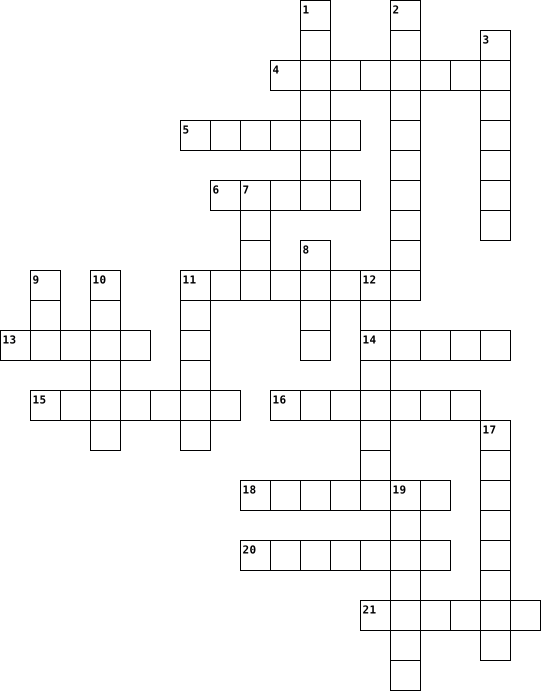
Across
- +
- John ______'s atomic theory
- H2O
- Something composed of two or more separate elements
- a negatively charged ion
- Columns in the Periodic Table
- Last name of the creator of the plum pudding model
- Not positively or negatively charged
- A substance that cannot be broken down into any other substance
- The outer shell of an element
- Rows in the Periodic Table
Down
- A variant of an atom
- __________ atomic model, described as the atom as a tiny, dense, positively charged core called a nucleus, in which nearly all the mass is concentrated, around which the light, negative constituents, called electrons, circulate at some distance, much like planets revolving around the Sun.
- Neutral particle in an atom
- Made up with three different kinds of particles
- Niels ____ proposed a theory for the hydrogen atom
- A molecule with a positive or negative charge
- Positive particle in an atom
- A positively charged ion
- -
- Negative particle in an atom
- The part of an atom that contains the protons and neutrons
22 Clues: + • - • H2O • A variant of an atom • A positively charged ion • a negatively charged ion • Rows in the Periodic Table • Neutral particle in an atom • John ______'s atomic theory • Positive particle in an atom • Negative particle in an atom • Columns in the Periodic Table • The outer shell of an element • Not positively or negatively charged • A molecule with a positive or negative charge • ...
Electrons and the Periodic Table 2020-11-06

Across
- The atomic number of magnesium.
- The element that forms a +2 ion in period 4.
- This element has the electron configuration [Ar] 4s2 3d8 and rhymes with pickle
- The number of valence electrons that Krypton has.
- The alkali metal in period 7
- The element with the most protons in period 6.
- vertical column on the periodic table
- The alkali earth metal in period 6.
- horizontal row on the periodic table
- The noble gas in period 5.
- The halogen in period 4.
Down
- The type of electron in the outer most energy level of an atom.
- The element with 3 electrons in 2p
- The element with an atomic number of 30.
- The element in period 4 and group 6.
- The element with only 1 electron in 2s.
- The element with the atomic number of 82.
- The metalloid in period 2.
- This element is in period 2 and group 16
- The element with 3 valence electrons in period 3.
20 Clues: The halogen in period 4. • The metalloid in period 2. • The noble gas in period 5. • The alkali metal in period 7 • The atomic number of magnesium. • The element with 3 electrons in 2p • The alkali earth metal in period 6. • The element in period 4 and group 6. • horizontal row on the periodic table • vertical column on the periodic table • ...
Atoms and Electricity 2020-12-03

Across
- The first person who created the light bulb.
- have a positive and negative charge.
- Are Electric Charges.
- Positive electric charges.
- the smallest unit or matter.
- charge of negative electric
- Doesn't allow electrons move freely
- A group of electrons.
- allow electron flow freely from one particle to another.
Down
- The first element in the periodic table.
- The charges are carried by tiny particles with incredibility small mass.
- This solid matter is a conductor that allows electrons to flow.
- Allows and sometimes doesn't allow electrons to flow through.
- table A table of chemical elements arrange in order of the atomic number.
- electric charge are charge....
- the number of a chemical unit
- Neutral charge
- is a Stationary Charge, which is typically produce by Friction that can cause sparks or crackling and even from your hair.
- When there is two forms of Electricity one is static electricity and the other is dynamic electricity.
- The center and made out of protons and neutrons.
20 Clues: Neutral charge • Are Electric Charges. • A group of electrons. • Positive electric charges. • charge of negative electric • the smallest unit or matter. • the number of a chemical unit • electric charge are charge.... • Doesn't allow electrons move freely • have a positive and negative charge. • The first element in the periodic table. • ...
science review crossword puzzle 2021-10-22

Across
- a solid that forms between two liquids
- flammable may ignite if exposed
- the amount of space an object takes up
- the guy who organized the periodic table
- two or more substances are visible
- the most reactive metal group
- a subatomic particle that is negative
- feeling, seeing, smelling
- a subatomic particle that is neutral
- non metals that do not react
- ability to stay unchanged
- how easy it is to bend
- the rings that surround the nucleus
- a subatomic particle that is positive
- how able it is to hammer it into a sheet
- particles are very close together
- state of matter with least attraction
Down
- the last energy level in an atom
- numbers, measuring, fixed value
- reacts with oxygen
- means unstable
- there on the periodic table
- mass/volume =
- negative ion
- from gas to solid state
- from solid to liquid
- solid, shiny, good conductor
- from liquid to solid
- positive ion
- smallest particle of an element
30 Clues: negative ion • positive ion • mass/volume = • means unstable • reacts with oxygen • from solid to liquid • from liquid to solid • how easy it is to bend • from gas to solid state • feeling, seeing, smelling • ability to stay unchanged • there on the periodic table • non metals that do not react • solid, shiny, good conductor • the most reactive metal group • numbers, measuring, fixed value • ...
General science knowledge 2012-11-29

Across
- What colour is lead on the periodic table?
- What is the hardest mineral?
- The heart has both atriums and ________?
- What is another word for gas?
- What do you use to examine cells?
- What rocks are formed when sediments are pressed together by overlying sediments?
- What colour is oxygen?
- To make an incision in a body part you can use either scissors or a _____?
- True or False, All metals are the same?
- what is the symbol silicon?
- Leonardo di _______?
Down
- Dinosaurs can be bird or _______ hipped?
- starting with F what is one cause of heat?
- What is a zygote?
- True or false, televisions are made up of 1000s of pixels?
- The particles in a solid_________?
- Who is the hardness scale for minerals named after?
- Stalagmites grow from the _______?
- What do we breathe?
- is ice a solid, liquid or gas
- Is water a solid, liquid or gas?
- what colour is titanium on the periodic table?
22 Clues: What is a zygote? • What do we breathe? • Leonardo di _______? • What colour is oxygen? • what is the symbol silicon? • What is the hardest mineral? • What is another word for gas? • is ice a solid, liquid or gas • Is water a solid, liquid or gas? • What do you use to examine cells? • The particles in a solid_________? • Stalagmites grow from the _______? • ...
Chemistry Crossword 2013-01-12

Across
- A compound that is 0-6 on the pH scale.
- When an acid and a base produce a salt and water.
- CH4
- Produces a solution that conducts electricity when dissolved in water.
- Compound made up of a non-metal and non-metal.
- Combustion that produces carbon, carbon monoxide, carbon dioxide and water.
- Lewis Dot Diagrams represents the number of ______ electron around an atom.
- Atomic number of 47.
- Colour, texture, density, viscosity, solubility are examples of _____ properties.
- CuO
- Hydrogen ion forming a bond with a polyatomic ion with an oxygen ion.
Down
- Naming chemical formulas.
- A compound formed by hydrogen and carbon.
- Columns on the periodic table
- Chemical reaction involving an element reacting with a compound.
- 18th family on periodic table
- A chemical present at the start of a chemical reaction and is used up during the reaction.
- Negatively charged ion.
- Elements that naturally exist in pairs, HOFBrINCl.
- Compound made up of a metal and non-metal.
20 Clues: CH4 • CuO • Atomic number of 47. • Negatively charged ion. • Naming chemical formulas. • Columns on the periodic table • 18th family on periodic table • A compound that is 0-6 on the pH scale. • A compound formed by hydrogen and carbon. • Compound made up of a metal and non-metal. • Compound made up of a non-metal and non-metal. • When an acid and a base produce a salt and water. • ...
Chemistry study guide 2016-02-10

Across
- conducts heat, malleable and ductile
- the numbers of protons in an element
- the rows on the periodic table
- cold, energy is adsorbed
- reaction that occurs in which a layer of metal is bonded to the surface to another substance
- mixture of two or more different elements
- total amount of mass within a substance remains constant even after a chemical reaction
- the columns on the periodic table
- includes protons, neutrons, and electrons
- negatively charged particles found in the nucleus
Down
- partially conduct heat
- heat, energy is released
- outermost electron orbital
- smallest part of an element cannot be broken down any farther
- positively charged atomic particles found in the nucleus
- Russian chemist and inventor
- the mass of an atom
- no charge, atomic particles found in the nucleus
- substance that is made entirely from one type of atom
- the substance that is formed
- atoms that bond together
- brittle, poor conductors of heat
- two metals that react
- gas gaseous element
24 Clues: the mass of an atom • gas gaseous element • two metals that react • partially conduct heat • heat, energy is released • cold, energy is adsorbed • atoms that bond together • outermost electron orbital • Russian chemist and inventor • the substance that is formed • the rows on the periodic table • brittle, poor conductors of heat • the columns on the periodic table • ...
Science Crosswod 2017-10-29

Across
- Chlorine, Bromine and Iodine are in this section of the periodic table
- This substances chemical symbol comes from a Roman word
- Section of the periodic table
- Another word for markings
- A group of atoms bonded together
- A metal found in thermometers
- Has a positive electric charge
- A substance used in science
- A small piece of matter eg dust
- Same mass as a proton without an electric charge
Down
- Found in coal
- Opposite to positive
- Solid and shiny substance eg Silver
- Everything around us is made of these
- Found in all atoms, it has a negative charge
- A table which is made up of chemical symbols of metals and non metals
- A chemical when heated turns yellow and gummy
- Made up of 2 or more elements that cannot be separated
- A gas made by the human body
- A shiny pure metal, with a chemical symbol that starts with an F
20 Clues: Found in coal • Opposite to positive • Another word for markings • A substance used in science • A gas made by the human body • Section of the periodic table • A metal found in thermometers • Has a positive electric charge • A small piece of matter eg dust • A group of atoms bonded together • Solid and shiny substance eg Silver • Everything around us is made of these • ...
Semiconductor Basics 1 2018-01-01

Across
- An early elemental semiconductor.
- Movement from high- to low concentration.
- Semiconductor made from different elements.
- Charge on p-type material.
- A common donor element.
- Element from Group III in the periodic table.
- Undoped, single-crystal semiconductor.
- Not negative.
- A semiconductor diode, but not pn-junction.
- Not pure.
Down
- The dual of electron.
- Reverse bias _______ current.
- An elemental semiconductor and part of the nickname for the valley south of San Francisco Bay area.
- A common acceptor element
- Region of a pn-junction without mobile carriers.
- Type of diode, not to be confused with a heavy metal.
- A subatomic particle that is more mobile that its dual.
- Highest energy band.
- A semiconductor made by adding controlled quantities of impurities.
- An element from Group V in the periodic table.
- What is generated when a hole and electron combines in direct semiconductor material.
- What is generated when a photon with enough energy interacts with a semiconductor.
22 Clues: Not pure. • Not negative. • Highest energy band. • The dual of electron. • A common donor element. • A common acceptor element • Charge on p-type material. • Reverse bias _______ current. • An early elemental semiconductor. • Undoped, single-crystal semiconductor. • Movement from high- to low concentration. • Semiconductor made from different elements. • ...
science study crossword 2022-01-12

Across
- center of a atom
- the opposite of metals
- when an atom gains or loses more than one electron
- metals metals with no melting point
- when an atom produces particles
- neutrally charged subatomic particles
- rare earth metal
- ions with one or more less electron
- columns on the periodic table that share similar properties
- negatively charged subatomic particle
- rows on the periodic table
- elements that conduct electricity and heat that are shiny
- atoms of a element with different neutron counts
- dense radioactive metallic elements
Down
- gases that don't react to anything
- positively charged subatomic particles
- elements with metal and nonmetal properties
- ion with one or more electron
- very reactive non metals that can easily form compounds
- when the atoms in a radioactive isotopes turn into different elements
- area with the most possibility a electron is
- how many protons an atom has
- less reactive metal
- unit for measuring atomic mass
24 Clues: center of a atom • rare earth metal • less reactive metal • the opposite of metals • rows on the periodic table • how many protons an atom has • ion with one or more electron • unit for measuring atomic mass • when an atom produces particles • gases that don't react to anything • metals metals with no melting point • ions with one or more less electron • ...
Physical Science 2023-11-13

Across
- mass must equal the same before and after a chemical reaction
- two or more atoms fused
- left side of a chemical equation
- can be physically separated
- letter(s) representing an element
- properties only observed after a chemical reaction
- stored energy in an object
- the ability a system has to function
Down
- matter isn't created nor destroyed
- a mixture blended evenly
- right side of a chemical equation
- horizontal rows of the periodic table
- energy can't be created or destoryed
- the amount of matter per unit of volume
- a mixture blended unevenly
- energy in the form of motion
- element symbols and subscripts representing a substance
- ionized gas
- everything and anything that has mass
- substance made of one atom throughout
- properties that can be observed before a chemical reaction
- smallest unit of an element
- organizes all known elements
- either an element or a compound
- vertical rows of the periodic table
25 Clues: ionized gas • two or more atoms fused • a mixture blended evenly • a mixture blended unevenly • stored energy in an object • smallest unit of an element • can be physically separated • energy in the form of motion • organizes all known elements • either an element or a compound • left side of a chemical equation • right side of a chemical equation • letter(s) representing an element • ...
Science Crossword 2023-12-11

Across
- Found on the Left side of the Periodic Table
- Found on the Right side of the Periodic Table
- An atom with more or less Electrons than it normally has
- This reaction gives off Water, carbon dioxide, and heat
- 1 complex substance becomes 2 or more simpler substances
- Mass divided by Volume equals this
- A reaction where heat is given off
- A change that cannot be undone
- The ability for a substance to react with another substance
Down
- What a reaction begins with
- A sub-atomic particle with a positive charge
- A bond between a metal and a nonmetal
- A change that can be undone
- 2 or more simple substances become 1 complex substance
- What is at the end of a reaction
- A sub-atomic particle with a neutral charge
- A bond between 2 nonmetals
- A sub-atomic particle with a negative charge
- A reaction where heat is taken in
- An atom with more or less Neutrons than it normally has
20 Clues: A bond between 2 nonmetals • What a reaction begins with • A change that can be undone • A change that cannot be undone • What is at the end of a reaction • A reaction where heat is taken in • Mass divided by Volume equals this • A reaction where heat is given off • A bond between a metal and a nonmetal • A sub-atomic particle with a neutral charge • ...
Fundamentals of Chemistry 2024-01-24

Across
- atom with diff. # neutrons than a. of same elem.
- atom releases energy stablizes nucleus
- grows bigger than atom when it gains electrons.
- very reactive metals, group one
- positively charged particle in nucleus
- the central region of an atom
- particle with no electric charge
- change # of protons the element changes
- groups 3-12
- not reactive elements
- neg. charged particle
- element series 90-103
Down
- elements series 58-71
- horizontal row in periodic table
- element that is good conducter of electricity
- where an electron could be if measured
- the number of protons in nucleus
- an atom that has pos. or neg. electric charge
- element with prop. of both metals and non-metals
- group 17, combine easily w/ other elements
- element that has opposite prop. of metal
- smaller than atom when it loses electrons
- reactive metals than group 1, group 2
- vertical column in periodic table
- atomic mass unit
25 Clues: groups 3-12 • atomic mass unit • elements series 58-71 • not reactive elements • neg. charged particle • element series 90-103 • the central region of an atom • very reactive metals, group one • horizontal row in periodic table • the number of protons in nucleus • particle with no electric charge • vertical column in periodic table • reactive metals than group 1, group 2 • ...
Gr 8, Extra Credit - Elements, Compounds, and Mixtures Crossword 2023-09-19

Across
- elements are represented by _____ on the periodic table
- a molecule is the smallest unit that retains the _____ of a compound
- formula for table salt
- when a compound is formed, a _____ _____ takes place
- silicon is a major part of the earth's _____
- organized elements into a periodic table
- this element makes up approximately 80 percent of earth's atmosphere
- substance whose formula is H2O
- any two or more atoms bonded together
Down
- compounds are represented by these
- an element cannot be _____ _____ into any other substance
- two or more different types of atoms bonded together
- to determine the number of elements in a molecule, you need to count the _____ _____
- the building blocks of matter
- this element is used to add strength to glass
- the parts are easy to separate by physical means
- this is formed when a chemical reaction takes place
- atoms with the same atomic number
- _____ and oxygen make up a large proportion of living matter
- this is the most common element in the ocean
20 Clues: formula for table salt • the building blocks of matter • substance whose formula is H2O • atoms with the same atomic number • compounds are represented by these • any two or more atoms bonded together • organized elements into a periodic table • silicon is a major part of the earth's _____ • this is the most common element in the ocean • ...
Grade 9 - Chemistry worksheet 2024-05-18

Across
- A measure of the heat content in a system
- Horizontal rows in the periodic table
- Loss of electrons in a chemical reaction
- A substance that cannot be broken down into simpler substances
- Gain of electrons in a chemical reaction
- The negative electrode in electrolysis
- The mass of one mole of a substance
- Particles smaller than an atom, such as protons, neutrons, and electrons
- The process of using electricity to split compounds into elements
Down
- Electrons in the outermost shell of an atom
- Substances that start a chemical reaction
- Molecules composed of two atoms
- Elements in group 1 of the periodic table
- Atoms of the same element with different numbers of neutrons
- A negatively charged ion
- The central part of an atom containing protons and neutrons
- The tendency of a substance to undergo chemical reactions
- A substance made of two or more elements chemically combined
- Anything that has mass and takes up space
- A positively charged ion
20 Clues: A negatively charged ion • A positively charged ion • Molecules composed of two atoms • The mass of one mole of a substance • Horizontal rows in the periodic table • The negative electrode in electrolysis • Loss of electrons in a chemical reaction • Gain of electrons in a chemical reaction • Substances that start a chemical reaction • ...
Merchandise Crossword 2024-11-17

Across
- inventory system; COGS determined only at the end of an accounting period.
- the book of original entry
- profit - Sales Revenue minus COGS
- activity that change the value of an asset, liability or equity
- taken at or very near the end of the accounting period in a periodic inventory
- salaries, utilities, permits and licenses
- transfer of journal entries to ledgers
- – used to offset the debit of a regular asset account
- a merchandiser’s primary source of revenue
- seller pays freight costs
- a document issued by a buyer for unsatisfactory goods.
Down
- FOB ________; freight in
- debited if buyer pays freight
- the book of final entry
- inventory system frequently relies on bar coding and computer scanning
- the exchange of goods or services for money or other assets
- cost of goods sold
- goods that are held for sale to customers
- stock of goods
- the process of buying and selling
- sales minus COGS
- proof of payment
- the process of acquiring goods
- FOB _______; freight out
- free on board
25 Clues: free on board • stock of goods • sales minus COGS • proof of payment • cost of goods sold • the book of final entry • FOB ________; freight in • FOB _______; freight out • seller pays freight costs • the book of original entry • debited if buyer pays freight • the process of acquiring goods • profit - Sales Revenue minus COGS • the process of buying and selling • ...
Chemistry Final Exam Review 2024-05-01

Across
- An element can have up to 8 of these electrons
- Can increase the rate of a chemical reaction
- When a chemical reaction is reversible, it has reached ________________
- Energy is absorbed
- Proton and Neutron particles are located here
- Covalent bonding is between nonmetals and involves the _____________ of electrons
- The time it takes for a radioactive isotope to reach 50% decay
- Ionic bonding is usually between a metal and nonmetal and involves the __________ of electrons
- 6.02 X 10^23
- Charged particles
Down
- The number of protons; also how elements are arranged on the periodic table
- Energy is released
- Elements in this order on the periodic table have the same number of valence electrons
- Splitting of a larger atom into 2 smaller nuclei
- Elements that have different number of neutrons
- An example of a chemical reaction, also known as combustion
- Salt dissolved in water
- Particles surrounding the nucleus
- Characteristic that helps water dissolve things
- Energy needed to start a chemical reaction
20 Clues: 6.02 X 10^23 • Charged particles • Energy is released • Energy is absorbed • Salt dissolved in water • Particles surrounding the nucleus • Energy needed to start a chemical reaction • Can increase the rate of a chemical reaction • Proton and Neutron particles are located here • An element can have up to 8 of these electrons • Elements that have different number of neutrons • ...
Biology 2025-11-14

Across
- Outer border of a cell
- Controls what enters and exits the cell
- postal service of the cell
- Monomers are glucose, fructose, and sucrose
- The least reactive group in the periodic table
- Releases O2 in exchange for CO2
- Structures that clean up the cell
- Barrier around the nucleus
- Makes up most of the leaf's interior and where photosynthesis occurs
- Uses cellular respiration to make energy
Down
- "Eukie" counterpart
- Links two amino acids together to create peptides and proteins
- Combines carbon from carbon dioxide, uses chemical energy to make glucose
- How plants make their food and energy from the sun
- Just DNA
- Number 6 on the periodic table
- Electromagnetic radiation that allows us to see light and colors
- Just ATP
- A sac like storage
- Process in which water is used to break down amino acids
- Where ribosomes are made
- Our teacher!!!
- 6H20
- Basic unit of all living organisms
- nicknamed "eukie"
25 Clues: 6H20 • Just DNA • Just ATP • Our teacher!!! • nicknamed "eukie" • A sac like storage • "Eukie" counterpart • Outer border of a cell • Where ribosomes are made • postal service of the cell • Barrier around the nucleus • Number 6 on the periodic table • Releases O2 in exchange for CO2 • Structures that clean up the cell • Basic unit of all living organisms • ...
Atomic Models 2025-12-04

Across
- Basis of organic chemistry
- Element that donates electrons
- Area where electrons are likely found
- Developed the planetary model
- Most dense region of the atom
- Simplest atom with one proton
- Smallest unit retaining chemical properties
- Two nuclei combine to form a heavier nucleus
- Elements formed during supernovae
- Region of electron probability
- Formation of heavy elements in stars
- Neutral particles in the nucleus
- Electrons orbit in energy levels
- Proposed the nuclear atom model
- Total protons and neutrons
Down
- Number of protons in the nucleus
- Horizontal rows on the periodic table
- Bond formed by sharing electrons
- Unit used to measure atomic mass
- Organizes elements by atomic number
- Proposed the plum-pudding model
- Same protons, different neutrons
- Basic building blocks of matter
- Splitting of a heavy nucleus
- Mixing of atomic orbitals
- Negatively charged subatomic particle
- Particles responsible for chemical reactions
- Vertical columns on the periodic table
- Element that tends to gain electrons
- Positively charged particle in the nucleus
30 Clues: Mixing of atomic orbitals • Basis of organic chemistry • Total protons and neutrons • Splitting of a heavy nucleus • Developed the planetary model • Most dense region of the atom • Simplest atom with one proton • Element that donates electrons • Region of electron probability • Proposed the plum-pudding model • Basic building blocks of matter • Proposed the nuclear atom model • ...
Matter Part 2 2013-11-11

Across
- the substance that is dissolved
- elements that are shiny and conduct heat and electricity
- area outside of the nucleus where the electrons are found
- elements that are in group 16; includes oxygen and sulfur
- elements that are dull and do not conduct heat and electricity
- elements that are part of the transition metals; many are radioactive
- the part of the Periodic Table that is arranged by increasing atomic number
- elements in groups 3-12, includes most of the well-known metals
- atoms with the same number of protons but different number of neutrons
- a substance that is physically combined
- the number of protons
- elements in group 2 that form useful compounds
- elements that are in group 15; includes nitrogen that makes up 80% of the air we breath
- elements that are in group 13; includes aluminum is the most abundant
- the ability of the solute to dissolve in a solvent at a certain temperature
- a mixture that appears to be a single substance
- the type of matter that is found on the Periodic Table
- neutral particles of an atom found in the nucleus
Down
- elements that are in group 18; unreactive nonmetals
- elements that are part of the transition metals; many are used to make steel
- elements that are in group 17; very reactive nonmetals
- elements that have properties of both metals and nonmetals
- the number of protons plus the number of neutrons
- elements and compounds
- the part of the Periodic Table that is arranged by similar properties
- elements in group 1 that are the most reactive
- charged particles of an atom found in the nucleus
- a mixture where the particles do not settle out
- negatively charged particles of an atom found in electron clouds
- a pure substance that is combined chemically
- a measure the amount of solute dissolved in solvent
- a word that means repeating
- elements that are in group 14; these form compounds that are necessary for living things
- a mixture where the particles are big enough to settle out
- element that does not belong to a group because its properties do not match
- the substance that does the dissolving
- the smallest unit of matter that makes up all matter
37 Clues: the number of protons • elements and compounds • a word that means repeating • the substance that is dissolved • the substance that does the dissolving • a substance that is physically combined • a pure substance that is combined chemically • elements in group 1 that are the most reactive • elements in group 2 that form useful compounds • ...
Chemical Reactions 2024-03-04

Across
- group 18 on the periodic table
- atoms exchange or share electrons in order to produce a noble gas electron configuration for each element involved
- have properties similar to both metals and nonmetals
- one of the two products of hydrocarbon combustion
- atoms of the same element with different numbers of neutrons
- type of bond involving a transfer of electrons
- atomic number 79
- the smallest whole number ratio of the different atoms in a compound
- one of the two products of a hydrocarbon combustion
- reaction analogous to "cutting in" on the dance floor
- group 1 on the periodic table
- type of bond where electrons are shared between two atoms
- they represent electrons in orbital diagrams
- units of molar mass
- reaction where oxygen gas is a reactant
- the Greek letter used to show that a reaction is heated
- dissolved in water
- the outermost electrons of an atom
- it speeds up a reaction but is not used up
- molecular geometry shape where four atoms are bonded to a central atom
- group 2 on the periodic table
- reverse of a decomposition reaction
- used to determine if Au + NaCl will go
Down
- an atoms ability to attract electrons from another atom in a bond
- CaS
- nitrogen, oxygen, hydrogen, and the halogens
- abbreviations for Valence Shell Electron Pair Repulsion
- atoms are neither created nor destroyed in a chemical reaction
- area of high probability of finding an electron
- a solid that separates out of solution in a reaction
- charge of silver metal
- shows locations of electrons with boxes and arrows
- group 2, period 3
- elements that contain only one atom in their elemental state
- the number of sulfur atoms in elemental sulfur
- numbers added before chemical formulas in a reaction to balance it
- hydrogen bonds, London dispersion forces, or dipole dipole interactions
- 6.022 times 10 to the 23rd
- type of reaction that gives off heat
- type of reaction when sodium chloride reacts with silver nitrate
- evidence of gas formation in a reaction
- horizontal rows in the periodic table
- abbreviation for a solid that crashes out of solution
43 Clues: CaS • atomic number 79 • group 2, period 3 • dissolved in water • units of molar mass • charge of silver metal • 6.022 times 10 to the 23rd • group 1 on the periodic table • group 2 on the periodic table • group 18 on the periodic table • the outermost electrons of an atom • reverse of a decomposition reaction • type of reaction that gives off heat • ...
chemistry 2022-12-12
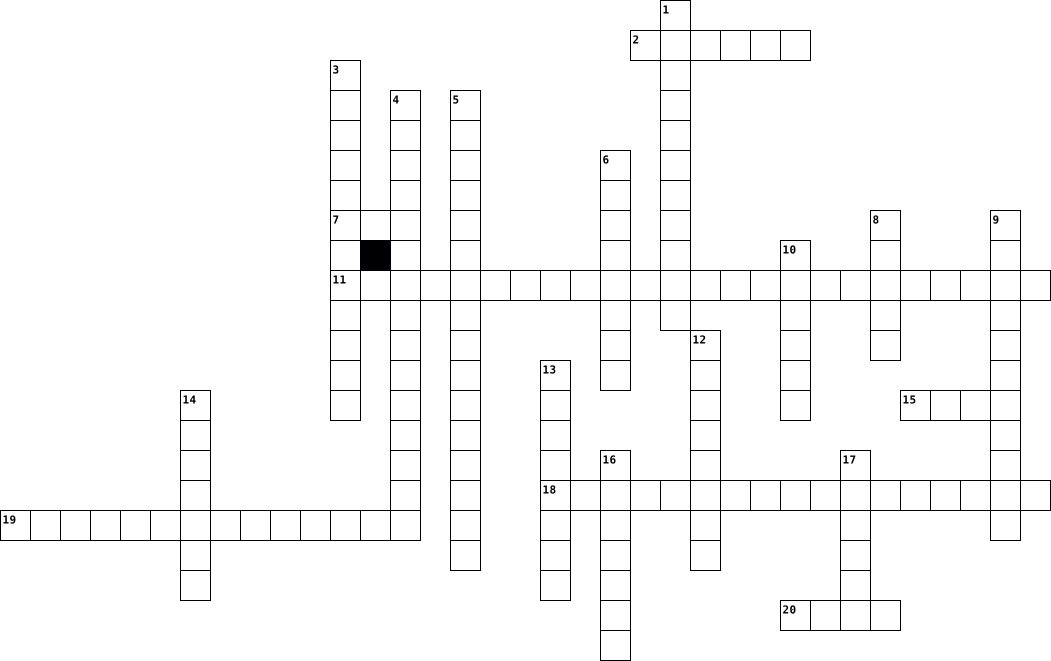
Across
- how much space an object takes up
- an atom or molecule with a net electric charge due to the loss or gain of one or more electrons
- energy that exhibits wave-like behavior and travels through space at the speed of light
- amount of matter in an object
- the tendency of an atom participating in a covalent bond to attract the bonding electrons
- a nuclear reaction in which a heavy nucleus splits spontaneously or on impact with another particle, with the release of energy
- the prefix for 1
Down
- any of the gaseous elements helium, neon, argon, krypton, xenon, and radon, occupying Group 0 (18) of the periodic table. They were long believed to be totally unreactive but compounds of xenon, krypton, and radon are now known
- any of the elements lithium, sodium, potassium, rubidium, cesium, and francium, occupying Group IA (1) of the periodic table. They are very reactive, electropositive, monovalent metals forming strongly alkaline hydroxides
- electrons in the outermost shell, or energy level, of an atom
- any of the set of metallic elements occupying a central block (Groups IVB–VIII, IB, and IIB, or 4–12) in the periodic table, e.g., iron, manganese, chromium, and copper. Chemically they show variable valence and a strong tendency to form coordination compounds, and many of their compounds are colored
- any of the elements fluorine, chlorine, bromine, iodine, and astatine, occupying group VIIA (17) of the periodic table. They are reactive nonmetallic elements that form strongly acidic compounds with hydrogen from which simple salts can be made
- negatively charged ions
- electrons in their lowest energy state and are stable
- a stable subatomic particle occurring in all atomic nuclei, with a positive electric charge equal in magnitude to that of an electron, but of opposite sign
- a stable subatomic particle with a charge of negative electricity, found in all atoms and acting as the primary carrier of electricity in solids
- an element or substance that is not a metal
- a subatomic particle of about the same mass as a proton but without an electric charge, present in all atomic nuclei except those of ordinary hydrogen
- amount of mass within a certain amount of space
- positively charges ions
20 Clues: the prefix for 1 • negatively charged ions • positively charges ions • amount of matter in an object • how much space an object takes up • an element or substance that is not a metal • amount of mass within a certain amount of space • electrons in their lowest energy state and are stable • electrons in the outermost shell, or energy level, of an atom • ...
Atomic Structure, Periodic Table & Reactivity of Metals 2025-06-20

Across
- Negatively charged particle
- Most reactive metal in reactivity series
- Gas released when metal reacts with acid
- An inert metal that resists corrosion
Down
- Metals form these when they react with oxygen
- Vertical columns in periodic table
- Horizontal rows in periodic table
- Subatomic particle with a positive charge
- The symbol for this element is Pb
9 Clues: Negatively charged particle • Horizontal rows in periodic table • The symbol for this element is Pb • Vertical columns in periodic table • An inert metal that resists corrosion • Most reactive metal in reactivity series • Gas released when metal reacts with acid • Subatomic particle with a positive charge • Metals form these when they react with oxygen
Elements 2021-09-21

Across
- number of protons in an atom
- a column in the periodic table
- the organized array of all the chemical elements in order of increasing atomic number
- the horizontal rows of the periodic table
- each of more than one hundred substances that cannot be chemically interconverted
Down
- made up or consisting of two or more existing parts or elements
- neutral electric charge
- basic unit of a chemical unit
- positive electric charge
- negative electric charge
- a group of atoms bonded together
11 Clues: neutral electric charge • positive electric charge • negative electric charge • number of protons in an atom • basic unit of a chemical unit • a column in the periodic table • a group of atoms bonded together • the horizontal rows of the periodic table • made up or consisting of two or more existing parts or elements • ...
Structure of matter 2021-09-21

Across
- table of elements a tabular display of the chemical elements
- a row of chemical elements
- a chemical substance that combines two or more elements
- a subatomic particle with a negative charge
Down
- the number of protons found in the nucleus
- the smallest unit of matter
- a column in the periodic table
- a subatomic particle with a neutral charge
- a subatomic particle that has a positive
- an electrically neutral group of two or more atoms
- a pure substance consisting only of atoms
11 Clues: a row of chemical elements • the smallest unit of matter • a column in the periodic table • a subatomic particle that has a positive • a pure substance consisting only of atoms • the number of protons found in the nucleus • a subatomic particle with a neutral charge • a subatomic particle with a negative charge • an electrically neutral group of two or more atoms • ...
lalala1234 2022-03-17

Across
- ______ table is the tabular arrangement of elements according to their properties
- used to test acidity
- examples are water, methane, sodium chloride
- examples are hydrogen, iron, lithium
Down
- represented by the symbol Ca
- made up of two or more atoms of the same kind
- elements found on the right side of the periodic table
- For ______ substances, the composition does not vary from sample to sample
- examples are soap and drain cleaner
- generally tastes sour
- represented by the symbol Pb
11 Clues: used to test acidity • generally tastes sour • represented by the symbol Ca • represented by the symbol Pb • examples are soap and drain cleaner • examples are hydrogen, iron, lithium • examples are water, methane, sodium chloride • made up of two or more atoms of the same kind • elements found on the right side of the periodic table • ...
Elements Crossword Puzzle 2022-05-05

Across
- neutrally charged
- something made by Demtri Mendeleev to arrange the elemnts by their characteristics
- different elements that are chemically combined to make something new
- the building blocks of matter
- poor conductors located on the right side of the periodic table
- contain properties of metals and nonmetals
Down
- negative charged
- materials that are not chemically combined
- forms when 2 or more atoms are combined
- positvily charged
- located on the left side of the periodic table and are good conductors
11 Clues: negative charged • neutrally charged • positvily charged • the building blocks of matter • forms when 2 or more atoms are combined • materials that are not chemically combined • contain properties of metals and nonmetals • poor conductors located on the right side of the periodic table • different elements that are chemically combined to make something new • ...
S1 Material World Crossword 2024-12-08

Across
- Made up of one type of atom
- Element that burns with a pop
- Positive charge in an atom
- Found on the left hand side of the periodic table
- Gas that relights a glowing splint
- Second smallest element that formed after the big bang
Down
- State of matter, water is an example of this
- Negative charge in an atom
- Neutral charge in an atom
- Metals in the first row of the periodic table and are reactive
- Made up of different atoms joined together
11 Clues: Neutral charge in an atom • Negative charge in an atom • Positive charge in an atom • Made up of one type of atom • Element that burns with a pop • Gas that relights a glowing splint • Made up of different atoms joined together • State of matter, water is an example of this • Found on the left hand side of the periodic table • ...
Gavin Raby ch. 9 2021-10-13

Across
- the things electrons are located on
- designed the periodic table
- first element on the periodic table
- atom that carries an electrical charge
- negatively charged particle
Down
- positively charged particle
- common atom model
- forms of the same element that have the same amount of protons, but different number of neutrons
- particle that has no charge
9 Clues: common atom model • positively charged particle • designed the periodic table • particle that has no charge • negatively charged particle • the things electrons are located on • first element on the periodic table • atom that carries an electrical charge • forms of the same element that have the same amount of protons, but different number of neutrons
Periodic Table Crossword 2025-01-15

Across
- Period 3 and Group 15
- A element which follows octet rule in Period 2
- The person who named the Periodic Table
- They are electronegative in nature
Down
- Lowest Ionization Potential
- Period 2 and Group 14
- Zero Electron Affinity
- Lightest element in periodic table
- What is the most abundant element in the human body (by weight)?
9 Clues: Period 2 and Group 14 • Period 3 and Group 15 • Zero Electron Affinity • Lowest Ionization Potential • Lightest element in periodic table • They are electronegative in nature • The person who named the Periodic Table • A element which follows octet rule in Period 2 • What is the most abundant element in the human body (by weight)?
Final Review 2024-01-16

Across
- Events that are repeated and observed.
- Parts or pieces of a model.
- Element with atomic number 8.
- The number of electrons found in a Neon atom.
- Elements found on the left side of the periodic table.
Down
- A bond between a metal and non-metal element.
- The energy it takes to remove one electron from an atom.
- Subatomic particle with a mass of 1.
- Who is known for organizing the periodic table?
- The amount of charge.
- An object of ________ charge is needed to find an unkchargeharge.
- Empty space is found between these particles.
- Atoms that gain electrons and become positively charged.
13 Clues: The amount of charge. • Parts or pieces of a model. • Element with atomic number 8. • Subatomic particle with a mass of 1. • Events that are repeated and observed. • A bond between a metal and non-metal element. • The number of electrons found in a Neon atom. • Empty space is found between these particles. • Who is known for organizing the periodic table? • ...
Atomic Theory and Periodic Table 2024-07-31

Across
- Particle that has no charge
- Average mass of all the isotopes of that element
- All atoms of the same element have the same number of protons
- Same number of protons but with a different number of neutrons
- Smallest particle that still can be considered an element
- Columns or "Families" on the periodic table
Down
- Negative particle of an atom
- One- or Two- letter abbreviation
- A chart showing all of the elements arranged according to the repeating pattern of their properties
- Positive particle of an atom
- Dense center of an atom
- Sum of protons and neutrons
- Rows on the periodic table
13 Clues: Dense center of an atom • Rows on the periodic table • Particle that has no charge • Sum of protons and neutrons • Negative particle of an atom • Positive particle of an atom • One- or Two- letter abbreviation • Columns or "Families" on the periodic table • Average mass of all the isotopes of that element • Smallest particle that still can be considered an element • ...
periodic table 2021-06-25

Across
- element number 106 (10)
- element number 50 (3)
- element number 3 (7)
- element number 79 (4)
- element number 52 (9)
- element number 54 (5)
Down
- element number 18 (5)
- element number 94 (9)
- element number 80 (7)
- element number 81(8)
- element number 69 (7)
- element number 47 (6)
12 Clues: element number 81(8) • element number 3 (7) • element number 18 (5) • element number 94 (9) • element number 80 (7) • element number 50 (3) • element number 69 (7) • element number 47 (6) • element number 79 (4) • element number 52 (9) • element number 54 (5) • element number 106 (10)
Periodic Table 2019-09-18

Across
- The "odd one", has the smallest atomic number of all
- Reaction in which one of the elements changes from the less reactive to the most reactive
- Another name for the elements that are toxic
- First envisioned by a Russian scientist to organise the elements
- Elements of this group does not react
- Another name for elements that react well with water
Down
- Elements of this group react well with water
- Creator of the periodic table of elements
- The base element for making living things
- Has the most intensive reaction with water
- Another name for elements that are stable and do not react
- Elements of this group are toxic
12 Clues: Elements of this group are toxic • Elements of this group does not react • Creator of the periodic table of elements • The base element for making living things • Has the most intensive reaction with water • Elements of this group react well with water • Another name for the elements that are toxic • The "odd one", has the smallest atomic number of all • ...
Periodic Table 2021-07-21

Across
- chemical elements in group 18 of the periodic table.
- an imprecise term used to describe a chemical element that forms a simple substance having properties intermediate between those of a typical metal and a typical nonmetal.
- Very poisonous
- metal is soft and white with a silvery lustre
- Atomic number of 2
Down
- a colourless, odourless, tasteless, flammable gaseous substance that is the simplest member of the family of chemical elements
- It is one of the least reactive chemical elements and is solid under standard conditions.
- has an atomic number of 11
- soft, silvery-white, metal that heads group 1
- It is a hard, brittle crystalline solid with a blue-grey metallic lustre, and is a trivalent metalloid and semiconductor.
- colourless, odourless, tasteless gas essential to living organisms,
- one of the most reactive of the elements
12 Clues: Very poisonous • Atomic number of 2 • has an atomic number of 11 • one of the most reactive of the elements • soft, silvery-white, metal that heads group 1 • metal is soft and white with a silvery lustre • chemical elements in group 18 of the periodic table. • colourless, odourless, tasteless gas essential to living organisms, • ...