
periodic%20table Crossword Puzzles
Science cross word Joey S 2013-09-17

Across
- very small pieces of solid or liquid mass
- columns of the periodic table
- the smallest form of an element that still holds its properties
- a subatomic particle that moves around the nucleus
- when a liquid becomes a gas through heat
- the smallest particle that has same physical property's and two or more atoms
- a measurement of force of gravity on an object
- a subatomic particle with a positive charge
Down
- an atom with one of every subatomic particles.
- rows of the periodic table
- a sub atomic particle without a charge
- the amount of matter in an object
- the informational pallet that gives you info. about elements
- point the temperature at which a liquid becomes a solid
- solid,shiny, good conductors of electricity and heat, are very ductile.
- mass the mass of the sub atomic particles in the atom
- the atomic symbol for gold
- point the temperature at which a solid becomes a liquid
- formed when two or more substances are combined chemically
- an important element to water and air its atomic number is 8
20 Clues: rows of the periodic table • the atomic symbol for gold • columns of the periodic table • the amount of matter in an object • a sub atomic particle without a charge • when a liquid becomes a gas through heat • very small pieces of solid or liquid mass • a subatomic particle with a positive charge • an atom with one of every subatomic particles. • ...
Chemistry 2013-11-20
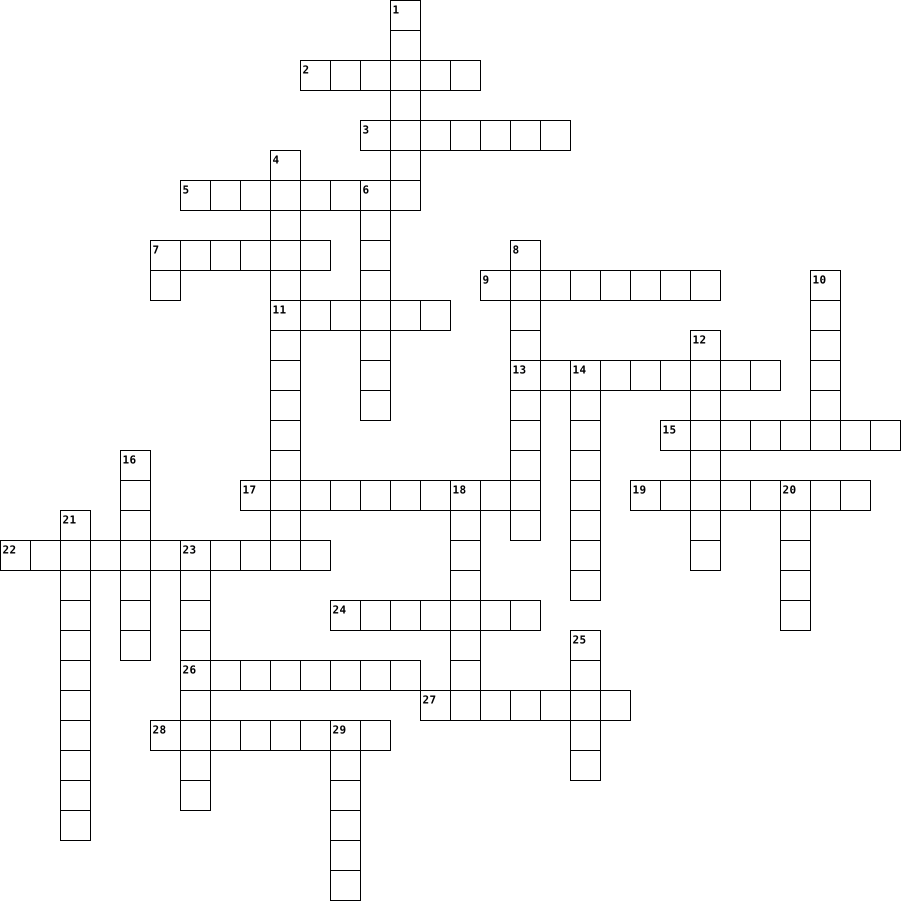
Across
- Particle with positive charge
- Example of a giant covalent structure
- Fl
- Ionic bonds conduct electricity if they are
- bonding Bond between two non-metals
- Ionic solids conduct electricity if
- Covalent bonds share
- Metals have.... ions
- In the Periodic Table, metals and non metals are separated by a
- Metal with Atomic number of 52
- electrons In metallic bonding, there is a sea of
- Protons and neutrons are located in the
- Different number of neutrons but same number of electrons
- Particle with no charge
- Name of group 7
Down
- Regular arrangement of particles
- Sodium + chlorine
- Non-metals have.... ions
- Lithium
- Name of group 8
- earth metals Name of group 2 metals
- Transition metals have... compounds
- Particle with negative charge
- Liquid element at room temperature
- In group 7, size and mass of atoms... down the group
- bonding Bond between a metal and a non-metal
- Metals conduct
- Graphite can be used as a
- Everything is made up of millions of
- of electron shells Periods in the periodic table tell us
30 Clues: Fl • Lithium • Metals conduct • Name of group 8 • Name of group 7 • Sodium + chlorine • Covalent bonds share • Metals have.... ions • Particle with no charge • Non-metals have.... ions • Graphite can be used as a • Particle with positive charge • Particle with negative charge • Metal with Atomic number of 52 • Regular arrangement of particles • Liquid element at room temperature • ...
Periodic Table Created by: Angilee Ubiles 2015-06-02

Across
- Is needed for humans on earth for survival.
- number The number of protons in the nucleus of atom.
- An electron that is the highest occupied energy level of an atom.
- Helps keep your bones and your teeth strong.
- Elements that are poor conductors of heat and electricity.
- A substance that is made of two or more elements that are bonded chemically.
- symbol Another term for a chemical symbol.
- A subatomic particle that has no electric charge.
Down
- Pattern of repeating properties.
- The periodic table was invented in the year 18.
- A positively charged particle in an atom.
- Elements 57-71 on the periodic table.
- Elements with properties that fall between those of metals and nonmetals.
- first artificially made element.
- A value that depends on the distribution of an elements isotopes in nature and the masses of those isotopes.
- Classified as metals, nonmetals, and metalloids.
- A negatively charged particle in an atom.
- elements that are good conductors of electric current and heat.
- Alkali metals are very reactive with.
- Group that contains elements like lithium, sodium, potassium, and rubidium.
20 Clues: Pattern of repeating properties. • first artificially made element. • Elements 57-71 on the periodic table. • Alkali metals are very reactive with. • A positively charged particle in an atom. • A negatively charged particle in an atom. • symbol Another term for a chemical symbol. • Is needed for humans on earth for survival. • Helps keep your bones and your teeth strong. • ...
Periodic Table Created by: Angilee Ubiles 2015-06-02

Across
- A positively charged particle in an atom.
- A negatively charged particle in an atom.
- Classified as metals, nonmetals, and metalloids.
- Elements 57-71 on the periodic table.
- Elements with properties that fall between those of metals and nonmetals.
- Pattern of repeating properties.
- Helps keep your bones and your teeth strong.
- A substance that is made of two or more elements that are bonded chemically.
- Alkali metals are very reactive with.
Down
- A subatomic particle that has no electric charge.
- The periodic table was invented in the year 18.
- elements that are good conductors of electric current and heat.
- symbol Another term for a chemical symbol.
- number The number of protons in the nucleus of atom.
- Elements that are poor conductors of heat and electricity.
- Group that contains elements like lithium, sodium, potassium, and rubidium.
- An electron that is the highest occupied energy level of an atom.
- first artificially made element.
- A value that depends on the distribution of an elements isotopes in nature and the masses of those isotopes.
- Is needed for humans on earth for survival.
20 Clues: first artificially made element. • Pattern of repeating properties. • Elements 57-71 on the periodic table. • Alkali metals are very reactive with. • A positively charged particle in an atom. • A negatively charged particle in an atom. • symbol Another term for a chemical symbol. • Is needed for humans on earth for survival. • Helps keep your bones and your teeth strong. • ...
Intro to Physics Final Exam Review 2021-01-11

Across
- how much matter is in a given space
- the property created by the space between two objects
- anything that has mass and takes up space
- negative ion
- a push or a pull
- able to dissolve other substances
- vertical columns on the periodic table
- the tendency of something to stay in rest or motion
- the amount of space that matter takes up
- horizontal rows on the periodic table
- a rate at which something happens
- substance that can’t be broken down into further
- positive ion
- all of the same or similar kind or nature
Down
- distance traveled per unit time in one direction
- dissolved in the solvent
- subatomic particle that has a negative charge
- subatomic particle that has a positive charge
- these are the building blocks of matter
- rate of change of velocity
- subatomic particle that has a neutral charge
- center of an atom
- the amount of matter in an object
- a substance made by mixing other substances together.
- not of the same kind or nature
- any substance that has mass and takes up space
26 Clues: negative ion • positive ion • a push or a pull • center of an atom • dissolved in the solvent • rate of change of velocity • not of the same kind or nature • able to dissolve other substances • the amount of matter in an object • a rate at which something happens • how much matter is in a given space • horizontal rows on the periodic table • vertical columns on the periodic table • ...
Final Exam Terms for Chemistry 2021-06-02

Across
- substance being dissolved in solvent
- bond formed by transfer of electrons
- positive particles in the nucleus
- property dependent on quantity
- metals in group 1
- solution containing maximum amount of solute
- solution with a pH of 7
- produces H+ ions in water
- prefix meaning millionths
- metals in the middle of the periodic table
- gases in group 18
- common unit for pressure
- Father of the Periodic Table
- alkali metal in period 3
- nonmetals in group 17
Down
- element with highest electronegativity
- produced in a neutralization reaction
- atom with different number of neutrons
- temperature scale with no negatives
- prefix meaning thousandths
- produces OH- ions in water
- Law of Conservation of ___
- closeness of measurement to true value
- negative particles in the atom
- bond formed by sharing electrons
- series used for SR reactions
- positive ion
- charged atom
- elements that form diatomic molecules
- electrons in outermost energy level
- alkaline earth metal in period 3
- force over area
- negative ion
- no definite shape or volume
34 Clues: positive ion • charged atom • negative ion • force over area • metals in group 1 • gases in group 18 • nonmetals in group 17 • solution with a pH of 7 • common unit for pressure • alkali metal in period 3 • produces H+ ions in water • prefix meaning millionths • prefix meaning thousandths • produces OH- ions in water • Law of Conservation of ___ • no definite shape or volume • ...
Chemistry Crossword Puzzle 2022-05-09

Across
- pH of 7
- the amount of heat energy needed to raise the temperature of 1 gram of water 1 degree Celsius
- A part of chemistry that studies amounts of substances that are involved in reactions
- Subatomic particle with a positive charge
- a homogeneous mixture
- two substances that can mix
- pH of 8-14
- subatomic particle with a negative charge
- branch of science that deals with the composition, structure, properties, and transformations of substances
- number of protons and neutrons in an atom's nucleus
Down
- elements on the left side of the periodic table (first column)
- the amount of heat energy needed to raise the temperature of a gram of a substance 1 degree Celsius
- pH of 0-6
- the area around a nucleus that contains electrons
- adding a base to an acid or an acid to a base to neutralize
- elements on the right side of the periodic table (last column)
- when to substances can not mix
- substance that takes part in and undergoes change during a reaction
- subatomic particle with a neutral charge
- standard temperature and pressure
20 Clues: pH of 7 • pH of 0-6 • pH of 8-14 • a homogeneous mixture • two substances that can mix • when to substances can not mix • standard temperature and pressure • subatomic particle with a neutral charge • Subatomic particle with a positive charge • subatomic particle with a negative charge • the area around a nucleus that contains electrons • ...
Science 2021-11-26

Across
- effect a force may cause an object to turn a pivot
- is the concentration of a force
- amount of motion than an object has
- negative charge on an atom
- turning effect of a force
- positive charge on an atom
- amount of space the objects takes up.
- transfer of heat by electromagnetic waves.
- how much material there is in something
- how heavy an object is on it's size.
Down
- main way that heat travels through liquids and gases.
- vertical column of the periodic table.
- electricity imbalance of electric charges.
- difference is a measure of the difference in energy between two parts of a circuit
- it’s symbol is A
- current the rate of flow of electric charge through a conducting medium with respect to time.
- transfer of energy from one molecule to another by direct contact.
- is a horizontal raw of the periodic table.
- element that has one proton.
- is a charge atom, it is charge because the number of electrons don’t not equal the number of protons in the atom.
20 Clues: it’s symbol is A • turning effect of a force • negative charge on an atom • positive charge on an atom • element that has one proton. • is the concentration of a force • amount of motion than an object has • how heavy an object is on it's size. • amount of space the objects takes up. • vertical column of the periodic table. • how much material there is in something • ...
Chemistry crossword 2023-11-06

Across
- made of only one type of atom
- the number of atoms in HCl
- an element with 4 energy levels and 2 valence electrons
- two or more atoms chemically bonded together
- elements with full outer energy levels
- molecules are rearranged to make new molecules
- responsible for the identity of the element
- all the elements found in group 1A
- contains all of the mass of the atom
- subatomic particle with no charge
- tells you the number of atoms of an element in a molecule
- areas in the electron cloud where electrons are found
- found in the outermost energy level
Down
- the moleculs before a chemical reaction
- tells you the number of molecules in a chemical formula
- a notation that tells you what a molecule is made of
- tells you the number of subgroups in a chemical formula
- matter cannot be created or destroyed, only_
- an element with 30 protons
- all elements with the same number of valence electrons are found here
- an element found on the zigzag line in the Periodic table
- a horizontal row in the Periodic table
22 Clues: the number of atoms in HCl • an element with 30 protons • made of only one type of atom • subatomic particle with no charge • all the elements found in group 1A • found in the outermost energy level • contains all of the mass of the atom • elements with full outer energy levels • a horizontal row in the Periodic table • the moleculs before a chemical reaction • ...
Module 2 Vocabulary 2024-02-05

Across
- Any atom with any charge.
- When atoms split apart.
- A lustrous material that conducts electricity and heat.
- A row on the periodic table.
- A particle with a negative charge.
- A particle of matter that defines an element.
- A decrease in the efficiency of nuclear charge due to opposing forces of electrons.
- When atoms combine.
- A characteristic of matter that expresses itself depending on the ratio of electrons and protons.
- An element that has the properties of metals and nonmetals.
- A spherical path for objects to travel.
- A particle with no charge.
- A region in an atom that consists of protons and neutrons.
Down
- A nuclear species pertaining the same chemical element.
- The simplest form of a substance.
- A particle with a positive charge.
- The time it takes for something to reach half it's original count.
- The ability for something to chemically interact.
- Energy released from the decay of nuclei from some atoms and isotopes.
- Any element that occupies group seventeen.
- A column on the periodic table.
21 Clues: When atoms combine. • When atoms split apart. • Any atom with any charge. • A particle with no charge. • A row on the periodic table. • A column on the periodic table. • The simplest form of a substance. • A particle with a positive charge. • A particle with a negative charge. • A spherical path for objects to travel. • Any element that occupies group seventeen. • ...
Chemistry Crossword Puzzle 2024-09-27

Across
- chemical substance that cannot be broken down
- number of protons in the nucleus of an atom
- process that allows heat to be released
- total number of protons and neutrons in the nucleus of an atom
- process that absorbs heat
- outer layer of electrons
- the whole arrangement of elements
- neutral charge in a nucleus
- the letter representation of an element
- the smallest part of an element
- type or structure that deals with the valence electrons
Down
- includes helium, krypton, neon, and more
- highest amount of frequency
- number of waves that pass a certain point per unit of time
- horizontal row on the periodic table
- theory that all substances are composed of atoms
- lowest amount of frequency
- same protons different neutrons
- negatively charged item in a nucleus
- distance between wave crests
- vertical row on the periodic table
- positively charged particle
- where protons and neutrons stay
- type of diagram that has up and down arrows
- type of charged particle
- negatively charged particle
- positively charged item of the nucleus
27 Clues: outer layer of electrons • type of charged particle • process that absorbs heat • lowest amount of frequency • highest amount of frequency • positively charged particle • neutral charge in a nucleus • negatively charged particle • distance between wave crests • same protons different neutrons • where protons and neutrons stay • the smallest part of an element • ...
Periodic Table Crossword puzzle 2023-01-26

Across
- I am the lightest element
- I have 27 neutrons and protons
- My atomic number is 14
- I am the only post-transition metal in period 3
- I am the only liquid in the 12th group
- I am the only element in the periodic table that starts with an x
- My atomic number is 16
- I am the 92nd element in the periodic table
- Im found in the alkali metals family and found in bananas
- I am the only element in the Lanthanide series that weighs under 140
- I have an atomic weight of (226)
- I have 39 protons
- I am what you breath
- I am the only gas in the 6th period
Down
- I have 35 electrons
- I am the only liquid in the 4th period
- i have the atomic symble of Ag
- I am found in bones
- I weigh 190.23u
- I am the heaviest element
- weigh 63.546u
- I have an atomic number of 46
- I have 53 neutrons
- My atomic symble is Sn
24 Clues: weigh 63.546u • I weigh 190.23u • I have 39 protons • I have 53 neutrons • I have 35 electrons • I am found in bones • I am what you breath • My atomic number is 14 • My atomic number is 16 • My atomic symble is Sn • I am the lightest element • I am the heaviest element • I have an atomic number of 46 • I have 27 neutrons and protons • i have the atomic symble of Ag • ...
Nomenclature Crossword Puzzle 2025-01-09

Across
- What element always has the prefix in a binary compound?
- what is the suffix in binary compounds?
- What is a binary compound also known as?
- What is a compound made up of three elements called?
- What subatomic particle is positive?
- What do we use to signify the oxidation state in a compound?
- What tells us the composition of a formula?
- What is NaCl?
- What is CaO?
- What is the system of naming chemical formulas called?
- What is on the right of the staircase on the periodic table?
- What subatomic particle is negative?
Down
- What part of a chemical formula tells us how many of an atom?
- What is the charge of an element called?
- What is a compound made up of two elements called?
- What is a compound made up of two non-metals called?
- What is the charge of a free element?
- What subatomic particle has no charge?
- How are binary compounds bonded?
- What is on the left of the staircase on the periodic table?
20 Clues: What is CaO? • What is NaCl? • How are binary compounds bonded? • What subatomic particle is positive? • What subatomic particle is negative? • What is the charge of a free element? • What subatomic particle has no charge? • what is the suffix in binary compounds? • What is the charge of an element called? • What is a binary compound also known as? • ...
Chemistry Vocab 2025-05-14

Across
- The number of these determines the element.
- Atomic ____. Where it is on the periodic table.
- ____ Gas. Nonreactive "Country Club"
- Mixture that is different throughout.
- Mixture that is the same all the way through.
- Atomic ____. Largest at the bottom left side of Periodic Table.
- Elements with the same number of electron shells.
- Less stable from more or less neutrons.
- Everything above and right of the stairs.
- Two or more elements chemically bonded in a fixed ratio.
- The likelihood they will take someone else's electrons.
- Elements with similar properties.
- Everything below and left of the stairs.
Down
- ____ Energy. Amount of energy needed to steal electrons.
- The number of these determines the stability of the element.
- Super reactive nonmetals.
- More or less electrons than protons.
- Atomic ____. How much an element weighs.
- The number of these determines the charge.
- The substance that is dissolved.
- Homogenous mixture of two or more substances.
- The substance that makes something dissolve.
- ____ Metals. Super reactive metals.
- Any matter that is not a mixture.
- Two or more atoms chemically bonded.
25 Clues: Super reactive nonmetals. • The substance that is dissolved. • Any matter that is not a mixture. • Elements with similar properties. • ____ Metals. Super reactive metals. • More or less electrons than protons. • ____ Gas. Nonreactive "Country Club" • Two or more atoms chemically bonded. • Mixture that is different throughout. • Less stable from more or less neutrons. • ...
Matter Unit Review 2025-10-23

Across
- elements found in group 2
- basic building block of matter
- found on right side of chemical equation
- elements found in group 18
- has no charge
- mixture that is not uniform throughout
- center of an atom
- has a positive charge
- no definite shape or volume
- anything that has mass and takes up space
- shiny, conduct heat and electricity
- element in groups 3-12
- liquid in a solution
- solid in a solution
Down
- elements found in group 1
- has definite volume not shape
- homogeneous mixture
- mixture that is evenly throughout
- found on left side of chemical equation
- pure substance that cannot be broken down
- same element with different number of neutrons
- two or more elements chemically combined
- dull, poor conductors of heat and electricity
- run left to right on periodic table
- elements found in group 17
- have both properties of metals and nonmetals
- has a negative charge
- has definite shape and volume
- run up and down on periodic table
29 Clues: has no charge • center of an atom • homogeneous mixture • solid in a solution • liquid in a solution • has a positive charge • has a negative charge • element in groups 3-12 • elements found in group 1 • elements found in group 2 • elements found in group 18 • elements found in group 17 • no definite shape or volume • has definite volume not shape • has definite shape and volume • ...
Intro to Metals 2026-03-17

Across
- ability of a material to withstand an applied load with failure
- Ability of a metal to bend, stretch, or distort without breaking or crushing
- Sub Atomic particles with no electrical charge
- Containing Iron, are magnetic
- Sub Atomic particles with a positive charge
- Particles which are smaller than an atom make up the atom
- Sub Atomic particles with a negative charge
- Ability of a material to resist penetration or indention
- Columns is the periodic table of elements
Down
- Ability of a metal to be hammered into shape
- Rows in the periodic table of element
- Physical effect of the stress applied to the material
- Strength Ability of a metal to resist crushing
- Atom with an overall negative or positive charge which are most commonly formed when an electron
- Atom with a negative charge
- Atom with a positive charge
- Measurement of how much a material can be twisted before it breaks
- No containing iron, not magnetic, does not corrode easily
- Smallest Unit of an element
- Load applied to a material
20 Clues: Load applied to a material • Atom with a negative charge • Atom with a positive charge • Smallest Unit of an element • Containing Iron, are magnetic • Rows in the periodic table of element • Columns is the periodic table of elements • Sub Atomic particles with a positive charge • Sub Atomic particles with a negative charge • Ability of a metal to be hammered into shape • ...
Atoms and Chemical Reactions 2023-03-21

Across
- sum of the protons and neutrons in the atom
- the rows in the periodic table
- smallest particle of an element
- a chart showing all of the elements arranged according to the repeating pattern off their properties
- atoms with the same number of protons, but different number of neutrons from other atoms of the same element
- particle with no charge
Down
- the number of protons in the nucleus of the atom
- dense, positively charged center of an atom
- a one or two letter abbreviation for an element
- elements in the same vertical column of the periodic table; also called family.
- negatively charged particle
- the average mass of all the isotopes of that element
- positively charged particle
13 Clues: particle with no charge • negatively charged particle • positively charged particle • the rows in the periodic table • smallest particle of an element • dense, positively charged center of an atom • sum of the protons and neutrons in the atom • a one or two letter abbreviation for an element • the number of protons in the nucleus of the atom • ...
Ionic Crossword 2021-08-30

Across
- positively charged ion
- hard, greyish-white element, has a metallic lustre but is brittle like glass. It is classified as a metalloid having the same crystal structure as diamond.
- Usually gains or shares electrons
- series of points that are arranged in a distinct pattern
- Related to the utilisation of ions
- Any atom or group of atoms that bears one or more positive or negative electrical charges
Down
- Has an atomic number of 11
- negatively charged ion
- what are on the periodic table?
- Synonymous to outer shell
- Negatively charged subatomic particle
- elements of this group include fluorine, chlorine, bromine, iodine, astatine, Tennessee
- On the left and bottom section of the periodic table
13 Clues: positively charged ion • negatively charged ion • Synonymous to outer shell • Has an atomic number of 11 • what are on the periodic table? • Usually gains or shares electrons • Related to the utilisation of ions • Negatively charged subatomic particle • On the left and bottom section of the periodic table • series of points that are arranged in a distinct pattern • ...
Ishan Chemistry Puzzle 3 April 2021 2021-04-03

Across
- this element has atomic number 2 in periodic table
- chemical formula of ethen / Ethylene
Down
- chemical symbol of iron
- chemical symbol of gold
- formula/symbol of sulphuric acid / oil of vitriol
- this element has atomic number 3 in periodic table
- formula/symbol of muriatic acid
- formula of nitric acid / aqua fortis
8 Clues: chemical symbol of iron • chemical symbol of gold • formula/symbol of muriatic acid • chemical formula of ethen / Ethylene • formula of nitric acid / aqua fortis • formula/symbol of sulphuric acid / oil of vitriol • this element has atomic number 2 in periodic table • this element has atomic number 3 in periodic table
SCIENCE 2016-01-17

Across
- On the Periodic Table, all elements that are in the same horizontal rows are considered to be in the same ______
- Which subatomic particle has a positive charge?
- What is the hormone responsible for causing sudden emotional changes and sexual feelings that occur in males during puberty?
- The study of interactions between organisms and their environment is called_____
- Which subatomic particle is NOT found in the nucleus of an atom?
- In addition to food, what else does a mitochondrion need to release energy?
Down
- Which term refers to the number of protons in an atom and helps to place elements on the Periodic Table?
- Which body system pumps and transports the blood to all parts of the body as well as supply oxygen and remove waste products from body tissues?
- On the Periodic Table, elements that are in the same vertical column are considered to be in the same_____
- Which of the following nutrients is used to build and repair cells?
- This structure, found in cells, assembles proteins.
- The breaking down of rocks on the earth's surface is _____
- Which area of Earth science includes the study of stars?
- A species in danger of becoming extinct in the near future is referred to as a(an)_____ species.
14 Clues: Which subatomic particle has a positive charge? • This structure, found in cells, assembles proteins. • Which area of Earth science includes the study of stars? • The breaking down of rocks on the earth's surface is _____ • Which subatomic particle is NOT found in the nucleus of an atom? • Which of the following nutrients is used to build and repair cells? • ...
PHY SCI Crossword by Mr. Walls 2024-10-09

Across
- An element or compound that conducts electric current better than an insulator but not as well as a conductor does
- An element that conducts heat and electricity poorly
- A subatomic particle that has no charge and that is found in the nucleus of an atom
- One of the elements of Group 17 of the periodic table
- A vertical column of elements in the periodic table
- A horizontal row of elements in the periodic table
- An atom’s central region which is made up of protons and neutrons
Down
- An atom or group of atoms that has lost or gained one or more electrons and has a negative or positive charge
- A unit of mass that describes the mass of an atom or molecule; it is exactly one-twelfth of the mass of a carbon atom with mass number 12
- A subatomic particle that has a positive charge and that is found in the nucleus of an atom
- An atom that has the same number of protons as other atoms of the same element do but that has a different number of neutrons
- A subatomic particle that has a negative charge
- An element that is shiny and conducts heat and electricity well
- A region in an atom where there is a high probability of finding elections
14 Clues: A subatomic particle that has a negative charge • A horizontal row of elements in the periodic table • A vertical column of elements in the periodic table • An element that conducts heat and electricity poorly • One of the elements of Group 17 of the periodic table • An element that is shiny and conducts heat and electricity well • ...
Science 2023-10-11

Across
- to reflect light
- anything that takes up space and has mass
- physical force of attraction or repulsion
- used in electronic devices
Down
- ability to be molded without breaking
- ability to be stretched without breaking
- what most of the periodic table is made of
- located mostly on the right side of the periodic table
- located in between nonmetals and metals and arranged in a staircase like pattern
9 Clues: to reflect light • used in electronic devices • ability to be molded without breaking • ability to be stretched without breaking • anything that takes up space and has mass • physical force of attraction or repulsion • what most of the periodic table is made of • located mostly on the right side of the periodic table • ...
Science 2023-10-11

Across
- to reflect light
- anything that takes up space and has mass
- physical force of attraction or repulsion
- used in electronic devices
Down
- ability to be molded without breaking
- ability to be stretched without breaking
- what most of the periodic table is made of
- located mostly on the right side of the periodic table
- located in between nonmetals and metals and arranged in a staircase like pattern
9 Clues: to reflect light • used in electronic devices • ability to be molded without breaking • ability to be stretched without breaking • anything that takes up space and has mass • physical force of attraction or repulsion • what most of the periodic table is made of • located mostly on the right side of the periodic table • ...
Chemical puzzle quiz 2024-09-16

Across
- amount of matter that makes up an object
- long term weather
- capacity to supply heat or do work
- a column in the periodic table of the chemical elements
- Horizontal rows of the periodic table
- short term weather
Down
- anything that takes up space and can be weighed
- the power of solar radiation per unit area
- substnace whose atoms that have the same number of protons
9 Clues: long term weather • short term weather • capacity to supply heat or do work • Horizontal rows of the periodic table • amount of matter that makes up an object • the power of solar radiation per unit area • anything that takes up space and can be weighed • a column in the periodic table of the chemical elements • substnace whose atoms that have the same number of protons
minerals Nik Masotti 2014-11-25

Across
- a rare mineral that doesn't rust
- the colour of the mark left by scraping the mineral on a white unglazed tile
- physical property based on ability to scratch particular mineral
- represented as 'C' on the periodic table
- how shiny a mineral is
Down
- used for wiring and represented as 'Cu' on the periodic table
- the hardest substance
- the colour a mineral glows when heated to a high temperature in a flame
- rocks containing minerals
- used to create electricity
10 Clues: the hardest substance • how shiny a mineral is • rocks containing minerals • used to create electricity • a rare mineral that doesn't rust • represented as 'C' on the periodic table • used for wiring and represented as 'Cu' on the periodic table • physical property based on ability to scratch particular mineral • ...
Ionic, Covalent, and metallic bonding 2020-04-28

Across
- Verticle column on the periodic table
- Group of atoms held together by chemical bonds
- Have some properties of metals and nonmetals
- Elements that are shiny and conduct heat and electricity well
- Brings oppositely charged ions together
- Particle with a positive or negative charge
Down
- Poor conductors of heat and electrcity
- Forms between metal atoms when there outermost energy levels overlap
- Forms when atom shares one or more pairs of electrons
- horizontal line on the periodic table
10 Clues: Verticle column on the periodic table • horizontal line on the periodic table • Poor conductors of heat and electrcity • Brings oppositely charged ions together • Particle with a positive or negative charge • Have some properties of metals and nonmetals • Group of atoms held together by chemical bonds • Forms when atom shares one or more pairs of electrons • ...
G7 PETRA CROSSWORD PUZZLE 2021-05-27

Across
- , Who painted the Mona Lisa?
- , What fruit takes the scientific name Mangifera indica?
- , How many colors of the olympic rings ?
- , What is the largest country in the world?
- How many valves does the heart have?
- , What's the biggest animal in the world?
Down
- , How many elements are there in the periodic table?
- , What does He stand for on the periodic table?
- , Which planet is closet to the sun?
- , How many bones does a shark have?
10 Clues: , Who painted the Mona Lisa? • , How many bones does a shark have? • How many valves does the heart have? • , Which planet is closet to the sun? • , What's the biggest animal in the world? • , How many colors of the olympic rings ? • , How many elements are there in the periodic table? • , What is the largest country in the world? • ...
Starter - Macromolecules WS Lesson 3 2018-09-20

Across
- becomes rust if mixed with oxygen and water [4]
- Pauli's _______ principle [9]
- Russian chemist who arranged the Periodic table [8]
- all matter is made from this [4]
Down
- we used 'Inorganic Tofu' to solve the electron arrangement [13]
- element found in molecular form in table salt, chemical symbol Na [6]
- negative charged fundamental particle [8]
- something in the sAga shone [cryptic] [6]
- row in the periodic table [6]
- means 'building up/on' in German [6]
10 Clues: Pauli's _______ principle [9] • row in the periodic table [6] • all matter is made from this [4] • means 'building up/on' in German [6] • negative charged fundamental particle [8] • something in the sAga shone [cryptic] [6] • becomes rust if mixed with oxygen and water [4] • Russian chemist who arranged the Periodic table [8] • ...
Chemistry 2025-06-19

Across
- A shiny element that conducts heat and electricity
- a substance made up of one type of atom
- Able to be hammered or pressed into shape without breaking
- A column in the periodic table
- the smallest particle of an element
Down
- something that is easily broken
- A group of atoms bonded together
- A repeating arrangement of atoms in a solid
- a substance made up of two or more types of atoms bonded together
- A row in the periodic table
10 Clues: A row in the periodic table • A column in the periodic table • something that is easily broken • A group of atoms bonded together • the smallest particle of an element • a substance made up of one type of atom • A repeating arrangement of atoms in a solid • A shiny element that conducts heat and electricity • Able to be hammered or pressed into shape without breaking • ...
Chemical Composition 2025-11-07

Across
- the components that mixed my fixed proportion
- The periodic table shows elements with similar chemical properties
- from periodic table we know that lithium and Rubidium is
- Heating a drink usually makes sugar dissolve faster because this factor increases
- The shiny yellow element used in jewelry
Down
- The substance that gets dissolved (in a solution)
- The simplest pure substance
- Milk is the example of
- How fast a solute disappears in a solvent
- a horizontal row of elements
10 Clues: Milk is the example of • The simplest pure substance • a horizontal row of elements • The shiny yellow element used in jewelry • How fast a solute disappears in a solvent • the components that mixed my fixed proportion • The substance that gets dissolved (in a solution) • from periodic table we know that lithium and Rubidium is • ...
Chem Vocab 2018-11-14

Across
- elements with similar properties found on the right side of the “staircase” on the periodic table
- a subatomic particle with no charge (neutral) found in the nucleus of the atom.
- Mixture is uniform throughout, the substances are evenly mixed and cannot be visibly distinguished
- table a quick reference for associating the name and symbol of an element.
Down
- a positive subatomic particle found in the nucleus of an atom.
- a negatively charged subatomic particle found outside of the nucleus of the atom
- pure substances that are composed of two or more types of elements that are chemically combined
- physical combinations of two or more different substances that retain their own individual properties and are combined physically (mixed together)
- Mixture is not uniform throughout, the component substances can be visibly distinguished
- elements with similar properties that create a “staircase” on the periodic table
10 Clues: a positive subatomic particle found in the nucleus of an atom. • table a quick reference for associating the name and symbol of an element. • a subatomic particle with no charge (neutral) found in the nucleus of the atom. • a negatively charged subatomic particle found outside of the nucleus of the atom • ...
Metals and non metals 2017-02-15

Across
- One of the methods to prevent rust
- One of the magnetic metals
- What do you get when you react a metal with water
- Only metal that is not solid
- Another method to to prevent rusting
Down
- Two or more metals bonded together
- Metals or non metals are most in the periodic table
- Which metal is more reactive, copper or magnesium?
- First element on the periodic table
- What do you get when you react a metal with oxygen
10 Clues: One of the magnetic metals • Only metal that is not solid • Two or more metals bonded together • One of the methods to prevent rust • First element on the periodic table • Another method to to prevent rusting • What do you get when you react a metal with water • Which metal is more reactive, copper or magnesium? • What do you get when you react a metal with oxygen • ...
Unit 5 2024-01-08

Across
- electrons electrons on the outer shell of an atom
- occurs when atoms or groups lose electrons
- Law elements arranged in the order of their atomic number
Down
- found on a slanted line that spilts the metals and nonmetals
- the transfer of electrons between species in a chemical reaction
- found on the left side of the periodic table
- found on the right side and upper corner of the periodic table
7 Clues: occurs when atoms or groups lose electrons • found on the left side of the periodic table • electrons electrons on the outer shell of an atom • Law elements arranged in the order of their atomic number • found on a slanted line that spilts the metals and nonmetals • found on the right side and upper corner of the periodic table • ...
!@#$% 2021-07-20

Across
- #1 on the periodic table
- Og
- #113 on the periodic table
Down
- #101 on periodic table
- #103 on periodic table
5 Clues: Og • #101 on periodic table • #103 on periodic table • #1 on the periodic table • #113 on the periodic table
Brooke's English Vocabulary 2023-09-19

Across
- pondering, thinking over
- facial expression
- periodic
- to decrease
- unable to move
- dreadful
Down
- an attack
- unwilling and hesitant
- large number
- rapid outpouring
- to drive away
- thoughtful
- rebuke; show of disapproval
13 Clues: periodic • dreadful • an attack • thoughtful • to decrease • large number • to drive away • unable to move • rapid outpouring • facial expression • unwilling and hesitant • pondering, thinking over • rebuke; show of disapproval
chemisty 2023-09-11

Across
- ,atomic mass
- ,corrosion
- ,mass number
- ,malleable
- ,conductivity
Down
- ,neutron
- ,nucleus
- ,atomic number
- ,periodic table
- ,nonmetal
10 Clues: ,neutron • ,nucleus • ,nonmetal • ,corrosion • ,malleable • ,atomic mass • ,mass number • ,conductivity • ,atomic number • ,periodic table
FFF 2025-06-20

Across
- Rare earth metals usually shown in a separate row below the main table
- Metals – Elements in the center of the periodic table, often used in industry
- Russian chemist who organized the first widely recognized periodic table
Down
- Element 118, the heaviest confirmed element on the periodic table
- Row of radioactive elements below the main table
- The repeating pattern of chemical properties that Mendeleev observed
6 Clues: Row of radioactive elements below the main table • Element 118, the heaviest confirmed element on the periodic table • The repeating pattern of chemical properties that Mendeleev observed • Rare earth metals usually shown in a separate row below the main table • Russian chemist who organized the first widely recognized periodic table • ...
Vocabulary Words Created By: Christin Yeates 2021-10-12

Across
- cloud- model that shows electrons traveling in specific energy levels around the nucleus
- Number- the number of protons in an atoms
- has a definite shape and volume
- mass per unit volume
- located in the center of an atom
- matter that is composed of one type of atom
- the smallest piece of matter that still has the properties of the element
- a group of atoms bonded together
- Mass- composed mostly of protons and neutrons in the nucleus- also called mass number
- negatively charged particles in the shells
Down
- Danish physicist who made foundational contributions to understanding atomic structure and quantum theory
- table- a tabular display of the chemical elements
- a coherent, typically large body of matter with no definite shape.
- he created a farsighted version of the periodic table of elements.
- no definite shape or volume
- neutrally charged particles in the nucleus
- positively charged particle in the nucleus
- no definite shape and has a definite volume
- a thing that is composed of two or more separate elements
19 Clues: mass per unit volume • no definite shape or volume • has a definite shape and volume • located in the center of an atom • a group of atoms bonded together • Number- the number of protons in an atoms • neutrally charged particles in the nucleus • positively charged particle in the nucleus • negatively charged particles in the shells • ...
Chemistry of Food 2021-09-26

Across
- the basic units of matter which consist of protons, neutrons, and electrons
- mixtures that have a nonuniform appearance and consist of visibly different substances
- a shortened version of the name of a chemical element
- form when atoms share one or more electrons
- small, negatively charged particles located in atomic orbits
- the columns of a periodic table
- occurs when electrons are transferred from one atom to another
- substances in which two or more elements chemically combine
Down
- pure substances consisting of one type of atom
- the approximate mass of an element
- the electrons located in the outermost occupied orbit in an atom and can participate in chemical bonding
- the rows of a periodic table
- involves changing shape, size or temperature and/or physical state
- involves change in color, odor, or flavor or releases a gas
- large particles with no charge
- mixtures that have the same uniform appearance throughout
- the number of protons in an atom
- large, positively charged particles
18 Clues: the rows of a periodic table • large particles with no charge • the columns of a periodic table • the number of protons in an atom • the approximate mass of an element • large, positively charged particles • form when atoms share one or more electrons • pure substances consisting of one type of atom • a shortened version of the name of a chemical element • ...
Chemical reactions 2025-02-02

Across
- A bond that includes only metals.
- A __________ reaction also always produces CO2 and H2O.
- The more an object moves, the more ________ ________ it has.
- The number of protons in a nucleus
- is a reaction in which a compound breaks down into two or more simpler substances
- An alkali metal is a metal in Group I of the periodic table.
- what type of bond is NaBr - Sodium Bromide?
- occurs when a part of two ionic compounds is exchanged and makes two new components
- most basic unit of matter
- A + B → AB.
Down
- atom's outermost electrons.
- negatively charged subatomic particle
- a chemical bond formed when two atoms share two electrons
- reaction in which one element is substituted for another element in a compound.
- a row (left to right) of the periodic table.
- result of a chemical reaction.
- Nitric acid reacts with sodium carbonate to form sodium nitrate, ca,rbon dioxide and water.
- substance that gets dissolved in a solvent.
18 Clues: A + B → AB. • most basic unit of matter • atom's outermost electrons. • result of a chemical reaction. • A bond that includes only metals. • The number of protons in a nucleus • negatively charged subatomic particle • substance that gets dissolved in a solvent. • what type of bond is NaBr - Sodium Bromide? • a row (left to right) of the periodic table. • ...
Intro to Carbon Chemistry 2026-03-12

Across
- A substance made of carbon bonded in layers. It comes off easily on paper for writing
- A strong substance that is made of carbon atoms arranged in a crystal structure
- A sub-atomic particle with no charge
- A column on the Periodic table is called a ______
- An element with the atomic number 6
- A hydrocarbon with single bonds is called an _____
- The _____ number tells us how many electrons there are in an atom
- Pentane has _____ hydrogen atoms
- Butane has ______ many carbon atoms
- A sub-atomic particle with a negative charge
Down
- A sub-atomic particle with a positive charge
- Carbon will always form 4 _____ with other atoms
- An alkane with 2 carbons is called ______
- A carbon-containing molecule that we use in respiration to make energy
- An alkane with 3 carbon atoms is called ______
- A row on the Periodic table is called a ______
- The _____ number tells us how many protons or electrons are in an atom
- The smallest hydrocarbon is called _____
18 Clues: Pentane has _____ hydrogen atoms • An element with the atomic number 6 • Butane has ______ many carbon atoms • A sub-atomic particle with no charge • The smallest hydrocarbon is called _____ • An alkane with 2 carbons is called ______ • A sub-atomic particle with a positive charge • A sub-atomic particle with a negative charge • ...
Conditions and Habitability of Mars 2024-02-01

Across
- The name of the SPACEX planned rocket to travel to Mars
- A human health risk of inhabiting Mars
- Founder of SPACEX
- Home country of NASA
- City in which NASA headquarters are situated in
- Number of seasons in a Mars year
- The amount of months it takes to travel to Mars
- Rare metal found on Mars with periodic symbol of 'Au'
Down
- Discovery of these microscopic cells is a pro of travelling to Mars
- Amount of miles in millions it is from Earth to Mars
- Rare metal found on Mars with periodic symbol of 'Co'
- Amount of successful NASA Mars rover missions
12 Clues: Founder of SPACEX • Home country of NASA • Number of seasons in a Mars year • A human health risk of inhabiting Mars • Amount of successful NASA Mars rover missions • City in which NASA headquarters are situated in • The amount of months it takes to travel to Mars • Amount of miles in millions it is from Earth to Mars • ...
Unit 7.5.2 Vocab 2024-03-26

Across
- All the things in a compound.
- The things at the end of a chemical reaction.
- The horizontal sorting of the Periodic Table.
- Two or more elements chemically combined.
- The number of molecules in an element or compound.
Down
- A law that states that matter cannot be created or destroyed.
- The starting element or compounds before a chemical reaction.
- The vertical sorting of the Periodic Table.
- An element that is used in a rocket's engines to cool them down before liftoff.
- The number of atoms the element behind it.
- Something that cannot be broken down chemically into simpler substances.
- The smallest unit of an element.
12 Clues: All the things in a compound. • The smallest unit of an element. • Two or more elements chemically combined. • The number of atoms the element behind it. • The vertical sorting of the Periodic Table. • The things at the end of a chemical reaction. • The horizontal sorting of the Periodic Table. • The number of molecules in an element or compound. • ...
Science crossword week 6 by andrew green 2023-09-27

Across
- table) group, in chemistry, a column in the periodic table of the chemical elements.
- the smallest unit of an element that maintains the properties of that element.
- a substance that cannot be separated or broken down into a simpler substances by chemical means
- The number of protons of an atom;the atomic number is the same for all atoms of an element.
Down
- a subatomic particle that has a positive charge and that is located in the nucleus of an atom
- table) The periodic table has undergone extensive changes in the time since it was originally developed by Mendeleev and Moseley.
- a subatomic particle that has no charge and that is located in the nucleus of an atom.
- mass number, in nuclear physics, the sum of the numbers of protons and neutrons present in the nucleus of an atom.
8 Clues: the smallest unit of an element that maintains the properties of that element. • table) group, in chemistry, a column in the periodic table of the chemical elements. • a subatomic particle that has no charge and that is located in the nucleus of an atom. • The number of protons of an atom;the atomic number is the same for all atoms of an element. • ...
Periodic table perfect 10 2022-12-19

Across
- - a property used to describe a material that can be drawn into a long wire
- Mass - the average mass of all the atoms of an element
- - an element characterized by physical properties that include shininess, malleability, ductility and conductivity
- - a column of elements with similar properties on the Periodic Table (there are 18)
- - a property used to describe a material that breaks or fractures with a small amount of force
Down
- Table - the chart of the elements showing the repeating pattern of their properties
- - a row of the Periodic Table (there are 7)
- - a property used to describe a material that can be pounded into shapes
- - a property used to describe the ability to transfer heat or electricity to another object
- Number - the number of protons in an atom, determines arrangement of elements on the Periodic Table
- - an element characterized by physical properties that include dull, brittle and poor conductivity
11 Clues: - a row of the Periodic Table (there are 7) • Mass - the average mass of all the atoms of an element • - a property used to describe a material that can be pounded into shapes • - a property used to describe a material that can be drawn into a long wire • Table - the chart of the elements showing the repeating pattern of their properties • ...
breanna huffman science chapter 9 crossword 2017-09-17

Across
- Any material that is made up of only one type of atom
- A count of the number of protons in the atomic nucleus
- Any of the possible energies an electron may have in an atom
- An electron in the outermost energy level of an atom
- Any member of a set of atoms of the same element whose nuclei contain the same number of protons but different numbers of neutrons
Down
- Who designed the periodic table?
- An atom that carries an electrical charge
- A _____ is used for things that are too small or too large to be observed or that are too difficult to be understood easily
- table A chart in which all known elements are listed in order of atomic number
- A vertical column in the periodic table; also known as the family of elements
10 Clues: Who designed the periodic table? • An atom that carries an electrical charge • An electron in the outermost energy level of an atom • Any material that is made up of only one type of atom • A count of the number of protons in the atomic nucleus • Any of the possible energies an electron may have in an atom • ...
G7 PETRA CROSSWORD PUZZLE 2021-05-27

Across
- Who painted the Mona Lisa?
- What fruit takes the scientific name Mangifera indica?
- How many colors of the olympic rings ?
- What is the largest country in the world?
- How many valves does the heart have?
- What's the biggest animal in the world?
Down
- How many elements are there in the periodic table?
- What does He stand for on the periodic table?
- Which planet is closet to the sun?
- How many bones does a shark have?
10 Clues: Who painted the Mona Lisa? • How many bones does a shark have? • Which planet is closet to the sun? • How many valves does the heart have? • How many colors of the olympic rings ? • What's the biggest animal in the world? • What is the largest country in the world? • What does He stand for on the periodic table? • How many elements are there in the periodic table? • ...
Chapter 9 Crossword - Zack Zattau 2020-09-18

Across
- charge of an atom with more electrons than pro
- up and down rows on the periodic table
- side to side rows on the periodic table
- how many electrons are in level 6
- parts of an atom with a positive charge
Down
- highly reactive metals that go boom
- charge when there is more protons than elect
- parts of an atom with a neutral charge
- how many electrons are in level 2
- how many electrons are in level 1
10 Clues: how many electrons are in level 2 • how many electrons are in level 6 • how many electrons are in level 1 • highly reactive metals that go boom • parts of an atom with a neutral charge • up and down rows on the periodic table • side to side rows on the periodic table • parts of an atom with a positive charge • charge when there is more protons than elect • ...
Elements & Atoms 2013-10-27

Across
- You can see the parts of this mixture
- Made of two or more types of atoms that are not chemically combined
- Most of the elements
Down
- You cannot see the parts of this mixtures
- Made from the bonding of two or more atoms
- A row in the Periodic Table
- A substance that contains two or more different elements
- The simplest and purest things
- Smaller way of writing an element name
- A column in the Periodic Table
10 Clues: Most of the elements • A row in the Periodic Table • The simplest and purest things • A column in the Periodic Table • You can see the parts of this mixture • Smaller way of writing an element name • You cannot see the parts of this mixtures • Made from the bonding of two or more atoms • A substance that contains two or more different elements • ...
Periodic Trends 2021-12-01

Across
- The blocking that inner electrons do on the attraction of the nucleus for outer electrons
- Energy required to remove one valence electron from one atom
- Electron found in the outermost energy level
- One half the distance between two nuclei of the same element
- Attraction the electrons feel from the positive nucleus
Down
- Attraction of one atom for electrons while bonded
- Negative ion
- A horizontal row in the periodic table
- A vertical column in the periodic table
- Positive ion
10 Clues: Negative ion • Positive ion • A horizontal row in the periodic table • A vertical column in the periodic table • Electron found in the outermost energy level • Attraction of one atom for electrons while bonded • Attraction the electrons feel from the positive nucleus • Energy required to remove one valence electron from one atom • ...
Periodic table 2025-05-20

Across
- Which element is in a toothpaste?
- metal Which type of metal is Iron?
- What are the horizontal rows of the periodic table called?
- Who created the periodic table?
Down
- What is more reactive than carbon,but less reactive than Magnesium
- Which element can be found in both gas and liquid forms?
- Element 82 is ___ reactive than element 50.
- How many Isotopes does hydrogen have?
- What is the name of the full-shelled elements?
- The lightest element is __
10 Clues: The lightest element is __ • Who created the periodic table? • Which element is in a toothpaste? • metal Which type of metal is Iron? • How many Isotopes does hydrogen have? • Element 82 is ___ reactive than element 50. • What is the name of the full-shelled elements? • Which element can be found in both gas and liquid forms? • ...
Science Vocabulary 2024-09-13

Across
- Changes in the size or shape of matter.
- A group of atoms bonded together.
- A table that has all the elements organized in categories.
- A pure substance made of 2 or more types of atoms
- A pure substance made of 1 type of atom.
Down
- Example of a chemical change.
- When a substance turns into a new substance.
- 1 of the elements on the periodic table.
- Example of physical change
- Basic building block of life.
10 Clues: Example of physical change • Example of a chemical change. • Basic building block of life. • A group of atoms bonded together. • Changes in the size or shape of matter. • 1 of the elements on the periodic table. • A pure substance made of 1 type of atom. • When a substance turns into a new substance. • A pure substance made of 2 or more types of atoms • ...
CHEMISTRY(50 Qustions) 2020-05-21

Across
- Proponent of Model of the atom (ESAAS)
- Proponent of Model of the atom (ESAAO)
- Proponent of Model of the atom (ESAAQ)
- Part of Periodic Table
- Proponent of Model of the atom (ESAAP)
Down
- Proponent of Periodic Table
- Part of Periodic Table
- Structure of a matter
- Part of Periodic Table
- Proponent of Model of the atom (ESAAR)
10 Clues: Structure of a matter • Part of Periodic Table • Part of Periodic Table • Part of Periodic Table • Proponent of Periodic Table • Proponent of Model of the atom (ESAAS) • Proponent of Model of the atom (ESAAO) • Proponent of Model of the atom (ESAAQ) • Proponent of Model of the atom (ESAAP) • Proponent of Model of the atom (ESAAR)
Periodic Table 2020-12-02

Across
- element that loses its electrons easily
- going across --- valance electrons
- highest electronegative
- lose electrons
- a group that has 3 valence electrons
- helium is what kind of gas
Down
- gains electrons
- most reactive
- radioactive
- how well an atom gains electrons
- going down the shells will
11 Clues: radioactive • most reactive • lose electrons • gains electrons • highest electronegative • going down the shells will • helium is what kind of gas • how well an atom gains electrons • going across --- valance electrons • a group that has 3 valence electrons • element that loses its electrons easily
Periodic Table 2021-01-06

Across
- represents number of electron in each shell
- outmost shell needs 8 electrons to be stable
- neon, oxygen
- negative ion
Down
- not a metal or nonmetal, silicon
- outmost shell electron
- same row, horizontal
- in the same column
- positive ion
- iron, gold, steel
- molecule with a negative charge
11 Clues: positive ion • neon, oxygen • negative ion • iron, gold, steel • in the same column • same row, horizontal • outmost shell electron • molecule with a negative charge • not a metal or nonmetal, silicon • represents number of electron in each shell • outmost shell needs 8 electrons to be stable
periodic table 2020-12-15

Across
- 7 different levels on the periodic table
- they are reactive and form oxcide
- a molecule, atom, electron, or nucleus
- gases totally unreactive
- an element that has properties that are intermediate between those of metals and nonmetals
- there are 7 groups alkali metals, alkaline earth metals, boron group, carbon group, nitrogen group, oxygen group, halogens, and noble gases
Down
- an element that readily forms positive ions and has metallic bonds
- metals an element that is generally a poor conductor of heat and electricity
- the outer shell of an atom that is responsible for the chemical properties of the atom
- They are reactive nonmetallic elements that form strongly acidic compounds
- so reactive that they are generally found in nature combined with other elements
11 Clues: gases totally unreactive • they are reactive and form oxcide • a molecule, atom, electron, or nucleus • 7 different levels on the periodic table • an element that readily forms positive ions and has metallic bonds • They are reactive nonmetallic elements that form strongly acidic compounds • ...
PERIODIC TABLE 2021-09-25

Across
- Rubidium is in what element group?
- Helium has two
- Au stands for what element?
- How many element group are there?
- Most abundant element in the universe
- Who is the creator of periodic table?
Down
- Discovered the number of proton in the nucleus of each atom
- has 73 atomic number
- Has 63.546 atomic weight
- 14 atomic mass
- Fe stands for what element?
11 Clues: Helium has two • 14 atomic mass • has 73 atomic number • Has 63.546 atomic weight • Au stands for what element? • Fe stands for what element? • How many element group are there? • Rubidium is in what element group? • Most abundant element in the universe • Who is the creator of periodic table? • Discovered the number of proton in the nucleus of each atom
Periodic Table 2021-09-17

Across
- Makes up our bones.
- The most radioactive element.
- Heaviest natural element.
- The most abundant gas in our atmosphere.
- Used in the bombs Gadget and Fat Man.
- Liquid-like metal.
Down
- Reacts very violently to water.
- A deadly gas.
- Only has one electron.
- Makes up around 21% of our atmosphere.
- Used in most modern wiring.
11 Clues: A deadly gas. • Liquid-like metal. • Makes up our bones. • Only has one electron. • Heaviest natural element. • Used in most modern wiring. • The most radioactive element. • Reacts very violently to water. • Used in the bombs Gadget and Fat Man. • Makes up around 21% of our atmosphere. • The most abundant gas in our atmosphere.
Periodic table 2022-04-24

Across
- Metal with variable valency 1 and 2
- Noble gas with a duplet
- A neutral gas
- Supporter of combustion
- Gives a brick red flame
Down
- Radioactive elements
- A highly reactive metal
- A monovalent nonmetal
- Valency of Group 18 elements
- A metalloid in Period 3
- Electrons in the outermost orbit
11 Clues: A neutral gas • Radioactive elements • A monovalent nonmetal • A highly reactive metal • A metalloid in Period 3 • Noble gas with a duplet • Supporter of combustion • Gives a brick red flame • Valency of Group 18 elements • Electrons in the outermost orbit • Metal with variable valency 1 and 2
Periodic Table 2017-02-12

Across
- examples: helium, neon, argon, krypton, xenon, and radon,
- solid material, shiny, hard, fusible, ductile
- same number as protons and nutrons
- abreviation of an element on the P.T.
- numbered row
- person who created the P.T.
Down
- electrical semiconductors
- substance that isn't a metal
- number of protons
- each column in the P.T.
- has a atomic number, protons and electrons
11 Clues: numbered row • number of protons • each column in the P.T. • electrical semiconductors • person who created the P.T. • substance that isn't a metal • same number as protons and nutrons • abreviation of an element on the P.T. • has a atomic number, protons and electrons • solid material, shiny, hard, fusible, ductile • examples: helium, neon, argon, krypton, xenon, and radon,
Periodic table 2017-12-11

Across
- has the character of Shiny,And malleable.
- An arrangement of elements showing the repeating pattern
- The number under the Chemical Symbol.
- It has no electric charge.
Down
- The letter below the atomic number.
- the number of protons in the nucleus of atom is the________.
- opposite traits of Metals.
- the horizontal line on the periodic table.
- The basic building block of matter.
- Contain negative charged particle.
- The elements in a column form is a _ _ _ _ _.
11 Clues: opposite traits of Metals. • It has no electric charge. • Contain negative charged particle. • The letter below the atomic number. • The basic building block of matter. • The number under the Chemical Symbol. • has the character of Shiny,And malleable. • the horizontal line on the periodic table. • The elements in a column form is a _ _ _ _ _. • ...
Periodic Elements 2023-12-06

Across
- The first discovered element.
- By wearing this kind of jewelry,it can reduce muscle stiffness and pain.
- A gas used for bright, colored lighting.
- Sounds like a planet in the solar system.
- A mineral for growth and development.
- The gas that goes into balloons.
- A metallic element that is used for coins and jewelry.
Down
- Named after a popular state.
- It is used as a pigment.
- The air that you breathe.
- You may know it as a coin.
11 Clues: It is used as a pigment. • The air that you breathe. • You may know it as a coin. • Named after a popular state. • The first discovered element. • The gas that goes into balloons. • A mineral for growth and development. • A gas used for bright, colored lighting. • Sounds like a planet in the solar system. • A metallic element that is used for coins and jewelry. • ...
Periodic Elements 2023-12-06

Across
- The first discovered element.
- By wearing this kind of jewelry,it can reduce muscle stiffness and pain.
- A gas used for bright, colored lighting.
- Sounds like a planet in the solar system.
- A mineral for growth and development.
- The gas that goes into balloons.
- A metallic element that is used for coins and jewelry.
Down
- Named after a popular state.
- It is used as a pigment.
- The air that you breathe.
- You may know it as a coin.
11 Clues: It is used as a pigment. • The air that you breathe. • You may know it as a coin. • Named after a popular state. • The first discovered element. • The gas that goes into balloons. • A mineral for growth and development. • A gas used for bright, colored lighting. • Sounds like a planet in the solar system. • A metallic element that is used for coins and jewelry. • ...
Periodic trends 2016-08-26

Across
- common name for Group I elements
- this is how much valence electrons Group V elements have
- measure for the likelyhood of an atom to attract electrons
- common name for Group VII elements
Down
- a property of elements that increases down a group
- electrons on the outermost shell
- a sub-group of metals that have electrons on d subshells
- elements that tend to lose electrons / electropositive elements
- the most electronegative element
- this happens to ionization energy as you go down a group
- vertical columns of the Periodic Table of Elements
11 Clues: electrons on the outermost shell • common name for Group I elements • the most electronegative element • common name for Group VII elements • a property of elements that increases down a group • vertical columns of the Periodic Table of Elements • a sub-group of metals that have electrons on d subshells • this is how much valence electrons Group V elements have • ...
Periodic Table 2019-11-30

Across
- rows
- This mann arranged elements in order of atomic weights
- inert
- Group 1 metals
- Group 7
Down
- columns
- godfather of the periodic table
- The number of protons plus neutrons gives this
- Metals in the middle
- shells holds electrons
- This man suggested 'Law of Octaves'
11 Clues: rows • inert • columns • Group 7 • Group 1 metals • Metals in the middle • shells holds electrons • godfather of the periodic table • This man suggested 'Law of Octaves' • The number of protons plus neutrons gives this • This mann arranged elements in order of atomic weights
Periodic Table 2021-03-01

Across
- This element is the most abundant in the air of the Earth, when it is liquid it is used to cool things instantly.
- It was actually discovered in America, and was later brought to Europe, an incredible metal with the atomic number 78.
- It is one of the most valuable and useful metals, it is used in jewelry and scientific experiments. Has one of the highest melting points.
- The element was more normally used in the past to travel in the sky from one place to another, but we stopped it because it was very inflamable.
- It was the fifth radioactive element to be discovered, it is a health hazard and the heaviest gas known. It can only combine with other substances in extreme conditions.
- This element is the most important for humans, and is used to breathe and form water molecules.
Down
- This element was discovered in 1807 by Humphry Davy, it’s in the s block and it has a melting point of 63.5 ° C
- A noble gas that is odorless and colorless, has two-thirds the density of air, its name came from the greek word new, and is used at parties in the dark.
- This element is the only metal in the liquid phase at room temperature, this is used to make thermometers.
- Is the second lightest element in the halogens group, is a toxic and corrosive gas that is irritating to the eyes and the respiratory system. Is used in the pools to clean them.
- A reddish ductile metal that is usually used to make roofs, is placed in the group 11 and when it is at room state is solid.
11 Clues: This element is the most important for humans, and is used to breathe and form water molecules. • This element is the only metal in the liquid phase at room temperature, this is used to make thermometers. • This element was discovered in 1807 by Humphry Davy, it’s in the s block and it has a melting point of 63.5 ° C • ...
Periodic Table 2021-05-19

Across
- Sought after for it’s yellow shine
- trinity used this as it’s fissile material
- The most heat resistant metal
- A radioactive element used in nuclear power station
- A metal used commonly in wiring
- A metal with a very low melting point
- only a few atoms of this element have been ever created
Down
- known to be in bananas
- lightest element on the periodic table
- Mixed with charcoal to make gunpowder
- Created through photosynthesis
11 Clues: known to be in bananas • The most heat resistant metal • Created through photosynthesis • A metal used commonly in wiring • Sought after for it’s yellow shine • Mixed with charcoal to make gunpowder • A metal with a very low melting point • lightest element on the periodic table • trinity used this as it’s fissile material • ...
Periodic Tables 2024-02-23

Across
- First element on the most reactive side of a periodic table
- Has an atomic mass of 55.845
- Symbol is Ti
- Is used inside of batteries
- What we breathe in
Down
- This elements atomic mass is 40.078
- In group 3 has a Atomic number of 39
- Atomic number 5
- This is a conductive type of material (shiny)
- First element on the least reactive side of a table
- Symbol of element is Sn
11 Clues: Symbol is Ti • Atomic number 5 • What we breathe in • Symbol of element is Sn • Is used inside of batteries • Has an atomic mass of 55.845 • This elements atomic mass is 40.078 • In group 3 has a Atomic number of 39 • This is a conductive type of material (shiny) • First element on the least reactive side of a table • First element on the most reactive side of a periodic table
Periodic Table 2023-08-28

Across
- a stable subatomic particle with a charge of negative electricity, found in all atoms and acting as the primary carrier of electricity in solids.
- non-metals are generally poor_____.
- a supposition or proposed explanation made on the basis of limited evidence as a starting point for further investigation.
- every element has a unique atomic number
- the basic unit of a chemical element.
Down
- number The____ is found above the chemical formula.
- metallic elements are mostly ____.
- elements found in groups have similar chemical properties.
- a compound or substance that has been purified or prepared, especially artificially.
- the systematic study of the structure and behavior of the physical and natural world through observation, experimentation, and the testing of theories against the evidence obtained.
- a vertical column of elements is called a _____.
11 Clues: metallic elements are mostly ____. • non-metals are generally poor_____. • the basic unit of a chemical element. • every element has a unique atomic number • a vertical column of elements is called a _____. • number The____ is found above the chemical formula. • elements found in groups have similar chemical properties. • ...
Periodic Elements 2023-12-06

Across
- The first discovered element.
- By wearing this kind of jewelry,it can reduce muscle stiffness and pain.
- A gas used for bright, colored lighting.
- Sounds like a planet in the solar system.
- A mineral for growth and development.
- The gas that goes into balloons.
- A metallic element that is used for coins and jewelry.
Down
- Named after a popular state.
- It is used as a pigment.
- The air that you breathe.
- You may know it as a coin.
11 Clues: It is used as a pigment. • The air that you breathe. • You may know it as a coin. • Named after a popular state. • The first discovered element. • The gas that goes into balloons. • A mineral for growth and development. • A gas used for bright, colored lighting. • Sounds like a planet in the solar system. • A metallic element that is used for coins and jewelry. • ...
Periodic Elements 2023-12-06

Across
- The first discovered element.
- By wearing this kind of jewelry,it can reduce muscle stiffness and pain.
- A gas used for bright, colored lighting.
- Sounds like a planet in the solar system.
- A mineral for growth and development.
- The gas that goes into balloons.
- A metallic element that is used for coins and jewelry.
Down
- Named after a popular state.
- It is used as a pigment.
- The air that you breathe.
- You may know it as a coin.
11 Clues: It is used as a pigment. • The air that you breathe. • You may know it as a coin. • Named after a popular state. • The first discovered element. • The gas that goes into balloons. • A mineral for growth and development. • A gas used for bright, colored lighting. • Sounds like a planet in the solar system. • A metallic element that is used for coins and jewelry. • ...
Periodic Table 2025-03-25

Across
- Name of outermost electrons
- Created a universally accepted list of the elements
- Noticed similarities between groups of elements
- Families/groups of elements
Down
- Made one of the first lists of elements
- Arranged by atomic mass, elements had pairs every 8th element
- Left blank spaces in the table for elements yet to be discovered
- The name of each row on the table
- Properties of the elements vary in a periodic way according to their atomic numbers
- Used X-ray spectroscopy to determine atomic number
- Published The Skeptical Chemyst
11 Clues: Name of outermost electrons • Families/groups of elements • Published The Skeptical Chemyst • The name of each row on the table • Made one of the first lists of elements • Noticed similarities between groups of elements • Used X-ray spectroscopy to determine atomic number • Created a universally accepted list of the elements • ...
Periodic Table 2025-05-05

Across
- Au
- Al
- Ge
- Lr
Down
- Li
- Ba
- W
- U
- As
- Sn
- Ar
11 Clues: W • U • Au • Li • Ba • Al • As • Ge • Sn • Lr • Ar
Periodic table 2023-02-08

Across
- O, 8
- Ra, 88
- Li, 3
- He, 2
- N, 7
- C, 6
Down
- K, 19
- Ge, 32
- Fm, 100
- Fe, 36
- W, 74
11 Clues: O, 8 • N, 7 • C, 6 • K, 19 • Li, 3 • W, 74 • He, 2 • Ge, 32 • Ra, 88 • Fe, 36 • Fm, 100
Gen Chem 1110 2023-02-09

Across
- 6.022x10^23
- J.J. Thomson used this tool to discover the electron
- sugar water is...
- molecules are ________
- elements whos properties tend to be largely predictable based on their position on the periodic table
- a description of the orbitals occupied by electrons is called and ______
- occur between two or more nonmetals
Down
- a formula that gives the relative number of atoms of each element in a compound
- calculated by averaging the isotopes
- electrons enter atomic orbitals from lowest energy to highest
- summarized these observations in the periodic law
- used mainy to illustrate covalent-bonded molecular compounds but can be used to illustrate simple ionic compounds
- a formula that gives the actual number of atoms of each element present in a molecule
- occur between metals and nonmetals
- when two or more elements combine a ________ is formed
15 Clues: 6.022x10^23 • sugar water is... • molecules are ________ • occur between metals and nonmetals • occur between two or more nonmetals • calculated by averaging the isotopes • summarized these observations in the periodic law • J.J. Thomson used this tool to discover the electron • when two or more elements combine a ________ is formed • ...
Chemistry-1 2022-12-06

Across
- Reactive Group-2 metals
- Highly reactive Group-1 metals
- A substance made of only one type of atom
- The negatively charged subatomic particle that orbits the nucleus of an atom
- The positively charged subatomic particle in the nucleus of an atom
- A substance made of more than one element
- An atom that has lost or gained electrons and therefore carries a charge
Down
- Group 17 non-metal
- Horizontal row of the periodic table
- Vertical column of the periodic table
- Metals in Groups 3 to 12 inclusive
- Forms of an element with different atomic mass
- Group 18 inert gas
- The property of an element that determines the number of other atoms with which an atom of the element can combine
- The subatomic particle of neutral charge in the nucleus of an atom
15 Clues: Group 17 non-metal • Group 18 inert gas • Reactive Group-2 metals • Highly reactive Group-1 metals • Metals in Groups 3 to 12 inclusive • Horizontal row of the periodic table • Vertical column of the periodic table • A substance made of only one type of atom • A substance made of more than one element • Forms of an element with different atomic mass • ...
Atomic Structure 2025-04-30

Across
- The mass of a proton or a neutron
- Horizontal rows on the periodic table that have outer electrons in the same shell
- The smallest particle of an element
- divider between metals and non-metals
- A substance containing only one type of atom
- Negatively charged particles that orbit the nucleus
- The number of protons in an atom
Down
- The number of neutrons and protons added together
- The amount of mass an electron has
- Vertical columns on the periodic table that share properties and have the same number of valence electrons
- Elements that are present as molecules in their pure form
- When two or more atoms are bonded together
- A substance containing more than one element in fixed ratios to each other
- positive sub-atomic particle found in the nucleus
- The charge on a Neutron
15 Clues: The charge on a Neutron • The number of protons in an atom • The mass of a proton or a neutron • The amount of mass an electron has • The smallest particle of an element • divider between metals and non-metals • When two or more atoms are bonded together • A substance containing only one type of atom • The number of neutrons and protons added together • ...
Metals (and Non-Metals) 2025-08-28

Across
- This type of metal is the most reactive
- Where the most reactive metals are found in the Periodic Table
- A property of non-metals, the opposite of malleable
- These little particles create electric currents in metals
- Metals form in a _______ structure
- A property that allows a metal to be drawn into a wire
- The gas that gets released when an acid reacts with a metal
Down
- A property that allows a metal to be hit into shapes
- A metal made by combining two or more metallic elements
- A property that allows a metal to create sound when hit
- The property that makes metals shiny
- The side of the periodic table where non-metals are found
- Metals are good conductors of ___________
- Non-metals are poor conductors of ____
- The name for electrons in an atom's outer shell
15 Clues: Metals form in a _______ structure • The property that makes metals shiny • Non-metals are poor conductors of ____ • This type of metal is the most reactive • Metals are good conductors of ___________ • The name for electrons in an atom's outer shell • A property of non-metals, the opposite of malleable • A property that allows a metal to be hit into shapes • ...
3.1 & 3.2 Vocab 2025-10-13

Across
- a chart showing all of the elements arranged according to the repeating patterns of their properties
- negatively charged particles in in atom
- particle located in the nucleus that contains no charge
- the smallest particle that can still be considered an element
- the average mass of all the isotopes of that element
- positively charged particle in an atom's nucleus
- the number of protons in the nucleus of an atom
- an explanation that may change with new evidence
- rows in the periodic table
Down
- something that helps describe or visualize another thing
- one-or-two letter abbreviation for an element
- elements in the same vertical column of the periodic table; also called family
- how an isotope is identified
- atoms with the same number of protons and different numbers of neutrons
- the dense, positively charged center of the atom
15 Clues: rows in the periodic table • how an isotope is identified • negatively charged particles in in atom • one-or-two letter abbreviation for an element • the number of protons in the nucleus of an atom • the dense, positively charged center of the atom • positively charged particle in an atom's nucleus • an explanation that may change with new evidence • ...
Periodic Table Crossword 2025-11-20

Across
- a positively charged ion
- a negatively charged ion
- First person to publish a completed periodic table
- Group 1 on the periodic table
Down
- Found in the earth's crust
- Only group on the periodic table to have all three phases of matter
6 Clues: a positively charged ion • a negatively charged ion • Found in the earth's crust • Group 1 on the periodic table • First person to publish a completed periodic table • Only group on the periodic table to have all three phases of matter
School Subjects 2020-01-04

Across
- the periodic table!!!
- clase The class
- Spanish
- PE
- Computers!!!
Down
- History
- Food!
- Geometry!!!
- Grammar
- Painting, drawing
10 Clues: PE • Food! • History • Spanish • Grammar • Geometry!!! • Computers!!! • clase The class • Painting, drawing • the periodic table!!!
The Periodic Table Created by: Angelina Eam 2021-10-12

Across
- A sample of matter that retains its shape and density when not confined.
- A subatomic particle that has no charge
- A theory of atomic structure in which the hydrogen atom (Bohr atom).
- The number of protons in the nucleus of an atom, which determines the chemical properties of an element and its place in the periodic table.
- Neutral subatomic particle that is a constituent of every atomic nucleus except hydrogen.
- An arrangement of chemical elements based on the periodic law
- The smallest particle of an element that can exist either alone or in combination
- The smallest particle of a substance that retains all the properties of the substance and is composed of one or more atoms
- A mass of a unit volume of a material substance
Down
- A subatomic particle that has a negative charge.
- A subatomic particle that has a positive charge.
- The average mass of the atoms of an element measured in atomic mass unit.
- A substance consisting of atoms or ions of two or more different elements in definite proportions joined by chemical bonds into a molecule.
- A measure of the amount of matter that an object contains.
- The system of electrons surrounding the nucleus of an atom
- Russian chemist who developed a periodic table of the chemical elements and predicted the discovery of several new elements.
- A state of matter that has no fixed shape and no fixed volume.
- A sample of matter that conforms to the shape of a container in which it's held.
- one of the basic substances that are made of atoms of only one kind and that cannot be separated by ordinary chemical means into simpler substances
19 Clues: A subatomic particle that has no charge • A mass of a unit volume of a material substance • A subatomic particle that has a negative charge. • A subatomic particle that has a positive charge. • A measure of the amount of matter that an object contains. • The system of electrons surrounding the nucleus of an atom • ...
Periodic Table Crossword 2025-02-01

Across
- The electron configuration of Hydrogen.
- Mass number of Nitrogen.
- Atomic mass of Helium .
Down
- Atomic mass of Hydrogen.
- Second element on periodic table.
- The electron configuration of Helium.
- H on the periodic table.
7 Clues: Atomic mass of Helium . • Atomic mass of Hydrogen. • H on the periodic table. • Mass number of Nitrogen. • Second element on periodic table. • The electron configuration of Helium. • The electron configuration of Hydrogen.
Periodic Table Crossword 2022-03-27

Across
- What is a Negatively charged Atom Called?
- What is a Horizontal line of Elements called?
- What is the order of Electrons called?
- What is a Positively charged Atom Called?
- What is an Element that has both the properties of a Metal and Non-Metal?
- What is it called when two atoms bond?
- What is the Outermost shell of an Atom Called?
- What is ‘Electrons not being stuck to an atom’ called?
Down
- The Ninth Element of the Periodic Table
- what is an Atom that has a Charge other than Neutral?
- What is the name of the Seventeenth Group on the Periodic Table Called?
- What determines the Charge of an Atom?
- What is a Vertical line of Elements called?
- What is it called when a Cation and Anion combine?
- What Depicts the Atomic Number of an Atom?
- What is it called when Two Non-Metals bond?
16 Clues: What determines the Charge of an Atom? • What is the order of Electrons called? • What is it called when two atoms bond? • The Ninth Element of the Periodic Table • What is a Negatively charged Atom Called? • What is a Positively charged Atom Called? • What Depicts the Atomic Number of an Atom? • What is a Vertical line of Elements called? • ...
year 8 revision 2023-11-16

Across
- Group of elements that get more reactive as you go down the periodic table.
- Grouping elements in threes(triads) based on properties.
- Element in group 2 period 3.
- When a chemical reaction has the same number of each atom on each side.
- Scientist who ordered elements based on atomic mass.
- A type of reaction that is easily reversed.
- Group of elements that get less reactive as you go down the periodic table.
- 2 or more elements or compounds not chemically bonded.
- Scientist who ordered elements based on properties into groups of 8.
Down
- A material made of multiple different materials to get the best properties.
- Made by firing clay.
- All one type of atom.
- Element with atomic number 6.
- Two or more elements chemically bonded
- A type of reaction where the mass changes, it is hard to reverse.
- Group of elements that have almost no reactivity.
16 Clues: Made by firing clay. • All one type of atom. • Element in group 2 period 3. • Element with atomic number 6. • Two or more elements chemically bonded • A type of reaction that is easily reversed. • Group of elements that have almost no reactivity. • Scientist who ordered elements based on atomic mass. • 2 or more elements or compounds not chemically bonded. • ...
Chemistry Vocab 2024-04-24

Across
- A phase that does not have a definite shape or volume
- Cloud The area around the nucleus of an atom where the electrons are found
- The action of being moved or moving
- A pattern of gradual change in a condition, output, or process
- Element that shares some properties with metals and some with nonmetals
- A negatively charges ion
- A pattern of gradual change in a condition, output, or process
- Point The temperature at which the liquid becomes a gas.
Down
- An equal amount of charge or particles
- Horizontal row in the periodic table
- A phase that has a definite shape and volume
- Atoms of the same element that have different numbers of neutrons
- The smallest particle of an element that still retains the properties of the element
- A positively charged ion
- The degree to which a specified material conducts electricity
- Horizontal row in the periodic table
- A distinctive form of matter such as a solid, liquid, gas, or plasma
- Vertical row in the periodic table
18 Clues: A positively charged ion • A negatively charges ion • Vertical row in the periodic table • The action of being moved or moving • Horizontal row in the periodic table • Horizontal row in the periodic table • An equal amount of charge or particles • A phase that has a definite shape and volume • A phase that does not have a definite shape or volume • ...
Chemistry Crossword 2024-05-08

Across
- change and acid or base to a neutral substance
- has 1 proton,1 neutron, and 1 electron(its and element on the periodic table)
- paper: paper that indicates how concentrated a acid or base it
- scale: a scale which shows how concentrated and acid or base can be
- method:a process by which scientists conduct experiments
- substances that are made of particles
- taste bitter and feel slippery
- paper:paper that indicates if a substance is and acid or base
Down
- table: list of all of the elements in our universe that are made of particles
- All matter that is made of different atoms
- changes:occur when forces or energy or mixture are created but the substances stays the same
- a very strong scientific prediction with reasons
- changes: occur when 2 substances mix and a chemical reaction takes place
- Bonds: a force holding similar molecules together
- building blocks of our universe
- taste sour and is corrosive
16 Clues: taste sour and is corrosive • taste bitter and feel slippery • building blocks of our universe • substances that are made of particles • All matter that is made of different atoms • change and acid or base to a neutral substance • a very strong scientific prediction with reasons • Bonds: a force holding similar molecules together • ...
Unit 5 Metals and Non-metals 2025-01-24

Across
- The non-metal that is used in balloons because it's very light
- Non-metals shatter easily. This is called?
- Most non-metals are _____
- Gold and silver are used as jewellery because they do not ______
- They are found on the right side of the periodic table
- Metals are shiny when they are freshly cut or _____
- They are found on the left side of the periodic table
- Iron, cobalt and _____ are magnetic metals.
- All metals have very high melting and boiling point except ______
Down
- Non-metals are poor conductors of heat. What is the opposite of 'conductors'?
- Today is?
- Metals are ductile. They can be _____ out into wires.
- The colour of sulphur
- Can be hammered into shapes is called _______
- Metals are good conductors of heat. When you touch them, they ________ heat away from your hand.
- Metals makes a ringing sound when hit. What is this called?
16 Clues: Today is? • The colour of sulphur • Most non-metals are _____ • Non-metals shatter easily. This is called? • Iron, cobalt and _____ are magnetic metals. • Can be hammered into shapes is called _______ • Metals are shiny when they are freshly cut or _____ • Metals are ductile. They can be _____ out into wires. • They are found on the left side of the periodic table • ...
Chemistry Crossword (Periodic Table and Acids/Bases) 2025-10-20

Across
- A substance with a pH less than 7
- A group of atoms bonded together
- A substance with a pH of 7
- A row in the periodic table
- An ion that is released by bases in solution
- A base that dissolves in water
- A substance made up of two or more types of atom bonded together
- An ion that is released by acids in solution
Down
- Able to damage or destroy another substance by a chemical reaction
- A substance with a pH greater than 7
- The outermost occupied shell of an atom
- A dye that turns red in acidic solutions and blue in basic solutions
- The standard way of measuring the strengths of acids and bases
- A column in the periodic table
- Any substance that changes colour when mixed with an acid or base
- The number of protons in each atom of an element
16 Clues: A substance with a pH of 7 • A row in the periodic table • A column in the periodic table • A base that dissolves in water • A group of atoms bonded together • A substance with a pH less than 7 • A substance with a pH greater than 7 • The outermost occupied shell of an atom • An ion that is released by bases in solution • An ion that is released by acids in solution • ...
KO5 Chemical Reactions 2026-02-02

Across
- A reaction breaking down a substance into smaller parts using heat
- When an acid and base reaction to make salt and water
- A substance that is produced during a chemical reaction
- A substance which speeds up a reaction without itself being used up
- A substance that takes part in and undergoes change during a reaction
- A measurement reading of how acidic or alkaline something is
- A row in the periodic table
Down
- Substances with a pH more than 7
- A reaction where a substance bonds with oxygen
- Reaction where heat is given off
- An interaction between two or more substances that brings about a chemical change
- Substances with a pH less than 7
- Reaction where heat is absorbed
- Type of indicator used to test for pH
- A more reactive element take s the lace of a less reactive element in a compound
- A column in the periodic table
16 Clues: A row in the periodic table • A column in the periodic table • Reaction where heat is absorbed • Substances with a pH more than 7 • Reaction where heat is given off • Substances with a pH less than 7 • Type of indicator used to test for pH • A reaction where a substance bonds with oxygen • When an acid and base reaction to make salt and water • ...
Chem Vocab 2021-12-10

Across
- Columns on the periodic table
- A law in which it states that matter cannot be created nor destroyed
- Rows on the periodic table
- Can be bent
- Malleable, luster, conductor, and ductile
- Can be pulled into a wire
- The type of change that does alter the chemical composition
- A type of crust in which has to do more with land than water.
- A type of crust in which has to do more with water than land.
- How reactive something is
- A push or pull measured by Newtons
Down
- A table that sorts out all of the known elements
- The type of change that does not alter the chemical composition
- Speed or direction change
- The amount of key evidences there are when a chemical reaction goes off
- Tells you the stability of reactivity
- Distance an object travels divided by time
- Speed and direction
- Has properties of both metals and nonmetals
- Brittle, insulator, and dull
- One of the key evidences that includes bubbles, steam, smell, and smoke
21 Clues: Can be bent • Speed and direction • Speed or direction change • Can be pulled into a wire • How reactive something is • Rows on the periodic table • Brittle, insulator, and dull • Columns on the periodic table • A push or pull measured by Newtons • Tells you the stability of reactivity • Malleable, luster, conductor, and ductile • Distance an object travels divided by time • ...
Science Review 2017-02-12

Across
- absorption of heat
- number of protons in the nucleus
- have properties of both metals and metalloids
- any of the gaseous elements on the periodic table
- outermost energy level of an atom
- rule, number of atoms on both sides of the equation must be the same
- form of matter that cannot be further broken down
- central part of an atom or cell
- shiny, ductile, malleable
- result of the action or process
- positive electric charge
Down
- can't be broken down into a simpler substance, on the perodic table
- created The Periodic Table of Elements
- negative electric charge
- energy level or shell
- a substance that comes out a solid as the solution
- suggested the idea that electrons move from one orbital to another in large steps
- dull, poor conductor of electricity
- release of heat
- number of protons and neutrons in the atom
- substance that goes through a change during the reaction
- made of up of two or more separate elements
- atoms that are attracted to one another and bond this
- neutral electric charge
24 Clues: release of heat • absorption of heat • energy level or shell • neutral electric charge • negative electric charge • positive electric charge • shiny, ductile, malleable • central part of an atom or cell • result of the action or process • number of protons in the nucleus • outermost energy level of an atom • dull, poor conductor of electricity • created The Periodic Table of Elements • ...
Science Crossword 2018-12-20

Across
- What is the first element on the periodic table
- Regular pattern in bonding
- The top compartment of the heart with the most muscle
- The person who discovers vaccines
- What has the electronic structure of 2,8,18,18,8
- The bond where atoms share electrons with each other
- Something consisting of 2 atoms
- Who was the french biologist who developed the germ theory
- A molecule that can be bonded to other identical molecules to form a polymer.
Down
- A bacterium, virus, or other microorganism that can cause disease.
- Who was the german physician who developed the germ theory
- A Cell without a nucleus.
- What is the atomic symbol of oganesson
- Is a giant covalent structure that is transparen
- The gas with 1 carbon atom and 2 oxygen atom
- The bottom compartment of the heart with the most muscle
- A cell with a nucleus.
- What has the atomic mass of 294
- An injection of a dead or weak strain of a disease
- what is the 88th period on the periodic table
20 Clues: A cell with a nucleus. • A Cell without a nucleus. • Regular pattern in bonding • What has the atomic mass of 294 • Something consisting of 2 atoms • The person who discovers vaccines • What is the atomic symbol of oganesson • The gas with 1 carbon atom and 2 oxygen atom • what is the 88th period on the periodic table • What is the first element on the periodic table • ...
Unit 2 Project 2012-11-01

Across
- A subatomic particle located in the nucleus of an atom and has a positive charge.
- A substance that conducts heat and is well malleable.
- Columns:_________ as Rows:Periods
- A table that shows the elements by their atomic number.
- Anything that has mass and takes up space.
- A substance made of two or more elements that are chemically combined.
- Substance made up of one kind of atom.
- Rings around the outside of the nucleus that holds electrons.
- Number of protons in an atom.
- A subatomic particle located in the nucleus of an atom with a neutral charge.
Down
- P
- A control center of every cell, made up of protons and neutrons.
- A state of matter made up of charged and uncharged atoms and free electrons.
- A subatomic particle located on the outer shell of an atom and has a negative charge.
- The elections on the outside shell of an atom.
- The smallest unit of an element.
- Another name for a row in the periodic table.
- Another name for families in the periodic table.
- Ga
- Kr
20 Clues: P • Ga • Kr • Number of protons in an atom. • The smallest unit of an element. • Columns:_________ as Rows:Periods • Substance made up of one kind of atom. • Anything that has mass and takes up space. • Another name for a row in the periodic table. • The elections on the outside shell of an atom. • Another name for families in the periodic table. • ...
DA#1 Crossword Review 2013-10-02

Across
- The hardest mineral on Earth.
- A property of nonmetals where energy cannot pass through.
- The resistance of a mineral from being scratched.
- The type of element with properties of both metals and nonmetals.
- The amount of matter an object has.
- The physical property of a mineral that gives it a definite shape.
- The property of a mineral that states that it is not(never been) alive.
- The side of the periodic table where nonmetals are found.
- An object with a surface that reflects light.
- The side of the Periodic Table where metals are found.
Down
- Ability of metals to be hammered into sheets.
- A unit of mass.
- To calculate density you must ________________ mass and volume.
- The ability of metals to allow energy to pass through it.
- The scale that sorts minerals from hardest to softest.
- The softest mineral found on Earth.
- Property of minerals that describes the amount of matter in a certain amount of space.
- Nonmetals breaks or shatters easily.
- The amount of space an object takes up.
- The true color of minerals.
20 Clues: A unit of mass. • The true color of minerals. • The hardest mineral on Earth. • The softest mineral found on Earth. • The amount of matter an object has. • Nonmetals breaks or shatters easily. • The amount of space an object takes up. • Ability of metals to be hammered into sheets. • An object with a surface that reflects light. • ...
Periodic Table Created by: Angilee Ubiles 2015-06-02

Across
- A substance that is made of two or more elements that are bonded chemically.
- Elements 57-71 on the periodic table.
- Is needed for humans on earth for survival.
- Pattern of repeating properties.
- A negatively charged particle in an atom.
- Helps keep your bones and your teeth strong.
- Classified as metals, nonmetals, and metalloids.
- number The number of protons in the nucleus of atom.
- first artificially made element.
- A subatomic particle that has no electric charge.
Down
- The periodic table was invented in the year 18.
- A positively charged particle in an atom.
- An electron that is the highest occupied energy level of an atom.
- A value that depends on the distribution of an elements isotopes in nature and the masses of those isotopes.
- Group that contains elements like lithium, sodium, potassium, and rubidium.
- Alkali metals are very reactive with.
- symbol Another term for a chemical symbol.
- Elements that are poor conductors of heat and electricity.
- Elements with properties that fall between those of metals and nonmetals.
- elements that are good conductors of electric current and heat.
20 Clues: Pattern of repeating properties. • first artificially made element. • Elements 57-71 on the periodic table. • Alkali metals are very reactive with. • A positively charged particle in an atom. • A negatively charged particle in an atom. • symbol Another term for a chemical symbol. • Is needed for humans on earth for survival. • Helps keep your bones and your teeth strong. • ...
Chapter 10 Crossword 2014-11-04

Across
- group 17
- the central core of an atom
- how easily the element reacts with other elements
- groups on the periodic table that classifies elements depending on their properties
- a particle with no charge
- the horizontal rows of the periodic table
- a particle that gives the nucleus it's positive charge
- the sum of the number of protons and the number of neutrons
- a particle that moves around the nucleus forming a cloud of negative charge
- the elements located along the right side of the stair-step line
- groups 3-12
- similar to each other in their properties
Down
- group 18
- the region around the nucleus occupied by electrons
- an average of the masses of all the isotopes that occur in nature for that element
- atoms of the same element with different numbers of neutrons
- have five or more electrons in their outer energy level
- the number of protons in an atom
- a table of elements classified by their properties
- the smallest particle of any element that has the properties of that element
20 Clues: group 17 • group 18 • groups 3-12 • a particle with no charge • the central core of an atom • the number of protons in an atom • the horizontal rows of the periodic table • similar to each other in their properties • how easily the element reacts with other elements • a table of elements classified by their properties • the region around the nucleus occupied by electrons • ...
Chemistry 2014-11-06
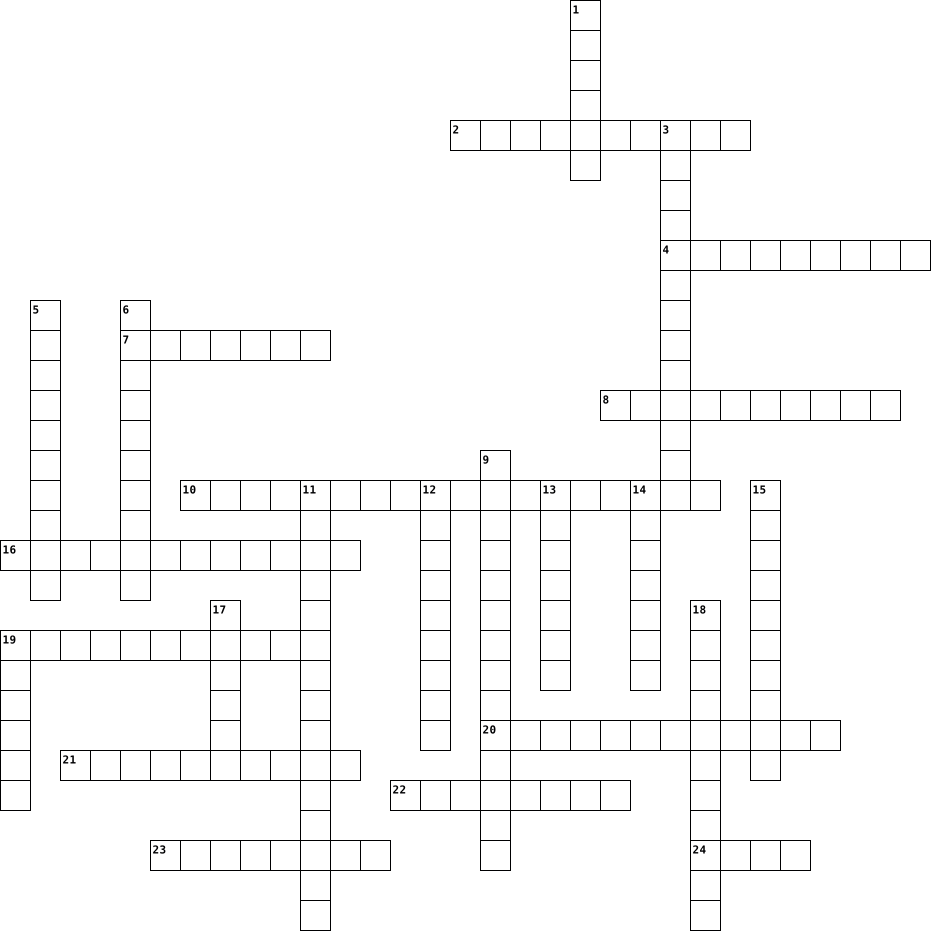
Across
- when they have metallic and non-metallic properties
- slow chemical change
- new materials produced by the reaction
- characteristics that can be used to describe a substance
- when two non-metals combine
- when no additional materials can enter or leave
- absorbs heat
- the ability of a substance to conduct electricity or heat
- chemical reactions that occur when oxygen reacts with a substance to form a new substance
- Group 17 elements are called
- when two or more elements combine
- when a metal and non-metal form an aqueous solution of
Down
- shiny, malleable, and ductile
- when a non-metal and metal combine
- solid or gas
- when the product of the reaction can escape
- when ions can form when certain atoms of elements combine
- compound have a chemical name and a
- materials at the start of a reaction are called
- horizontal rows in the periodic table of elements
- has the same mass as a proton
- releases heat
- vertical columns on the periodic table
- when gas turns into a solid
- catalyst involved in chemical reactions in living things
25 Clues: solid or gas • absorbs heat • releases heat • slow chemical change • when two non-metals combine • when gas turns into a solid • Group 17 elements are called • shiny, malleable, and ductile • has the same mass as a proton • when two or more elements combine • when a non-metal and metal combine • compound have a chemical name and a • new materials produced by the reaction • ...
Chemistry Crossword Puzzle 2016-01-07

Across
- bond/the bond formed when two atoms share electrons
- order for neutralization to occur, a salt and ____ must be made in a reaction
- compound/compounds formed with no metals
- gases/the most stable element group on the periodic table is the _______
- that change colour depending on if it is exposed to a acid or base
- atom that has either gained or lost an electron
- ability to be dissolved into a liquid
- reaction in which molecules break down
- naturally found in pairs
- reaction that occurs when two different atoms join together to make a --molecule
Down
- ability for a material to be stretched
- acid/HNO3
- + O2 → H2O + CO2
- lowest temperature that a liquid will ignite
- acid
- metals/the first group on the periodic table is the __________
- displacement/the reaction when two different molecules switch atoms
- ability for a material to be flattened or rolled
- shell/the outermost shell in an atom
- compound/compounds that have both a metal atom and a nonmetal atom
20 Clues: acid • acid/HNO3 • + O2 → H2O + CO2 • naturally found in pairs • shell/the outermost shell in an atom • ability to be dissolved into a liquid • ability for a material to be stretched • reaction in which molecules break down • compound/compounds formed with no metals • lowest temperature that a liquid will ignite • atom that has either gained or lost an electron • ...
Periodic Table Crossword Puzzle 2015-12-12

Across
- This element is in every living thing
- The least reactive member of the alkali metals
- The smallest particle that has properties of an element
- An element that has an abnormal amount of neutrons
- A pure substance that cannot be broken down into simpler substances by chemical or physical means
- The group of elements that are not reactive at all
- The most simple element there is
- The center of an atom
- Last name of the creator of the Periodic Table
- A subatomic particle that has a positive charge
Down
- A horizontal row of elements in the Periodic Table
- The densest Transition Metal
- An element that has properties of both metals and nonmetals
- A subatomic particle that has a neutral charge
- The rarest naturally occurring element
- The number of protons in an element's nucleus (2 words)
- A subatomic particle that has a negative charge
- This element makes up about 80% of the atmosphere
- The only Transition Metal that is liquid at room temperature
- What most of the elements are
20 Clues: The center of an atom • The densest Transition Metal • What most of the elements are • The most simple element there is • This element is in every living thing • The rarest naturally occurring element • The least reactive member of the alkali metals • A subatomic particle that has a neutral charge • Last name of the creator of the Periodic Table • ...