
periodic%20table Crossword Puzzles
Science 2021-09-01

Across
- bond together
- matter
- table: 118 elements
- indivisible
Down
- h2o
- not chemically bonded
- together
- one type of atom
- C
- physical substance
10 Clues: C • h2o • matter • together • indivisible • bond together • one type of atom • physical substance • table: 118 elements • not chemically bonded
The Periodic Table 2025-05-01

Across
- The element with atomic number 26.
- A halogen that is a liquid at room temperature.
- The elements on the right of the step line are the ____________ .
- Elements are arranged based on their ________ number.
- The halogens are in Group ________ .
Down
- The element with symbol Sn.
- Ag is the _________ of silver.
- The most reactive alkali metal.
- The element with symbol Cu.
- The least reactive alkali metal.
- The elements on the left of the step line are the __________ .
- Dr Van Brussel's favourite element.
- A metal but it is a liquid at room temperature.
- The element with symbol Pb.
- The element with symbol Na.
- The elements in Group 8 are called the _______ Gases.
16 Clues: The element with symbol Sn. • The element with symbol Cu. • The element with symbol Pb. • The element with symbol Na. • Ag is the _________ of silver. • The most reactive alkali metal. • The least reactive alkali metal. • The element with atomic number 26. • Dr Van Brussel's favourite element. • The halogens are in Group ________ . • ...
Periodic Table Crossword 2022-03-08

Across
- I am not an alkali metal, but I am in group 1.
- My atomic number is 47.
- I have 28 electrons when electrically neutral.
- I am a metalloid that usually has 71 neutrons.
- Eat me when you have cramps in your legs.
- my average atomic mass is 35.453
- I am the 2nd most reactive metal.
Down
- I am a gas with 8 neutrons in my most common form.
- I have 26 protons.
- I'm the only noble gas with 2 electrons.
- I am in the fifth period and the carbon family.
- I'm an alkaline earth metal used in fireworks.
- I am very important for healthy teeth and bones
- I have 6 valence electrons and 16 protons.
- I am the only liquid metal at room temperature
- I am a halogen with 5 energy levels.
16 Clues: I have 26 protons. • My atomic number is 47. • my average atomic mass is 35.453 • I am the 2nd most reactive metal. • I am a halogen with 5 energy levels. • I'm the only noble gas with 2 electrons. • Eat me when you have cramps in your legs. • I have 6 valence electrons and 16 protons. • I am not an alkali metal, but I am in group 1. • ...
List #13 2023-11-30

Across
- building for sick people
- a soft like voice
- at the top
- old family members
- best friend
- to leave beside
- color changes
- formal argument
- like alike
- more then one
- on the periodic table
- inside of anything
Down
- helps with donations
- open sweeter
- outskirts of a city
- opposite of horizontal
- has four sides
- good enough
- city area
- fair and just
- an estimation
21 Clues: city area • at the top • like alike • good enough • best friend • open sweeter • color changes • fair and just • an estimation • more then one • has four sides • to leave beside • formal argument • a soft like voice • old family members • inside of anything • outskirts of a city • helps with donations • on the periodic table • opposite of horizontal • building for sick people
List #13 2023-11-30

Across
- building for sick people
- a soft like voice
- at the top
- old family members
- best friend
- to leave beside
- color changes
- formal argument
- like alike
- more then one
- on the periodic table
- inside of anything
Down
- helps with donations
- open sweeter
- outskirts of a city
- opposite of horizontal
- has four sides
- good enough
- city area
- fair and just
- an estimation
21 Clues: city area • at the top • like alike • good enough • best friend • open sweeter • color changes • fair and just • an estimation • more then one • has four sides • to leave beside • formal argument • a soft like voice • old family members • inside of anything • outskirts of a city • helps with donations • on the periodic table • opposite of horizontal • building for sick people
elements 2023-05-03

Across
- can't make steel without it
- needed to breathe
- 1st place
- makes up some of earth's crust
- cans
- odorless, tasteless, and colorless
- very stinky
- a planet
- used in pools
- 2nd place
Down
- used for wiring
- found in bananas
- 1st on the periodic table
- glows in the dark
- type of battery
- found in milk
- antiseptic
- used in balloons
- atomic number 12
- named after coal
20 Clues: cans • a planet • 1st place • 2nd place • antiseptic • very stinky • found in milk • used in pools • used for wiring • type of battery • found in bananas • used in balloons • atomic number 12 • named after coal • needed to breathe • glows in the dark • 1st on the periodic table • can't make steel without it • makes up some of earth's crust • odorless, tasteless, and colorless
Physics 2025-09-02

Across
- ___ flow, physicists love it
- Nobel ___
- forgotten state of matter
- conservation of ___
- unit of voltage
- laser and lenses
- density
- unit of frequency
- they have cheese AND a particle accelerator
- physics 101
Down
- ___ decay
- chaos!
- at a constant rate, repeating
- type of physics, type of a computer
- pV = nRT governs...
- he solved circuits
- stars and black holes
- unit of temperature
- solid, liquid, gas
- apple?
20 Clues: chaos! • apple? • density • ___ decay • Nobel ___ • physics 101 • unit of voltage • laser and lenses • unit of frequency • he solved circuits • solid, liquid, gas • pV = nRT governs... • unit of temperature • conservation of ___ • stars and black holes • forgotten state of matter • ___ flow, physicists love it • at a constant rate, repeating • type of physics, type of a computer • ...
chapter 16 vocab crossword 2022-02-14

Across
- small positively charged center of the atom
- the elements are arranged by increasing atomic number and by changes in physical and chemical properties
- the number of protons in the element
- the vertical columns in the periodic table
- protons and neutrons are made of even smaller particles called
- particles with a negative 1 charge
- atoms of the same element that have different numbers of neutrons
- the smallest piece of matter that still retains the properties of the element
- the sum of the protons and the neutrons in the element
Down
- area around the nucleus of an atom where its electrons are
- particles with a positive 1 charge
- neutral particles that have 0 charge
- uses the symbol of the element and dots to represent the electrons in the outer energy level
- the weighted-average mass of the mixture of its isotopes
- the horizontal rows in the periodic table
15 Clues: particles with a positive 1 charge • particles with a negative 1 charge • neutral particles that have 0 charge • the number of protons in the element • the horizontal rows in the periodic table • the vertical columns in the periodic table • small positively charged center of the atom • the sum of the protons and the neutrons in the element • ...
chemistry 2020-05-26

Across
- tell us the number of atoms of each element in a compound.
- goes across the periodic table
- a table of the chemical elements
- the first letter of an element
- an element that readily forms positive ions and has metallic bonds
- a particle made up of two or more atoms that are chemically bonded together
Down
- an element that doesn't have the characteristics of metal including
- goes down the periodic table
- the second letter of an element
- a substance whose atoms all have the same number of protons
- the smallest particle of a chemical element that can exist.
- a substance formed when two or more chemical elements are chemically bonded together
12 Clues: goes down the periodic table • goes across the periodic table • the first letter of an element • the second letter of an element • a table of the chemical elements • tell us the number of atoms of each element in a compound. • a substance whose atoms all have the same number of protons • the smallest particle of a chemical element that can exist. • ...
History of the Periodic Table 2020-10-05

Across
- John Dalton arranged the known elements only in order of ______________.
- John Newlands noticed that the properties of every _____________ element were similar.
- The name of a row on the periodic table.
- Mendeleev’s first name.
- The name of the negatively charged particle that surrounds an atom’s nucleus.
- Which noble gas did Mendeleev place out of order to make it fit with the others in its group?
Down
- How many known elements did Mendeleev have to work with?
- The atomic mass of potassium.
- The element with the chemical symbol Na.
- The ‘law of octaves’ only worked up to which element?
- The nationality of Mendeleev.
- The atomic particle that defines an element’s position in the periodic table.
12 Clues: Mendeleev’s first name. • The atomic mass of potassium. • The nationality of Mendeleev. • The element with the chemical symbol Na. • The name of a row on the periodic table. • The ‘law of octaves’ only worked up to which element? • How many known elements did Mendeleev have to work with? • John Dalton arranged the known elements only in order of ______________. • ...
Nuclear Energy 2023-11-01

Across
- Can go through skin and aluminium but is stopped by lead
- Calculated by adding neutrons and protons
- When an atom has a different mass than whats on the periodic table
- Instability in a atom which makes it this
- 2 atom combine and release energy
- When something happens and causes another set of reactions to happen
- This determines its place on the periodic table, Calculated by the number of protons
- The Time point when a sample has gotten to half of its original amount
Down
- An atom splits and releases energy
- Is released during beta decay, Is one electron
- Releases during Alpha decay, Also known as a helium nucleus
- Determines what element it is
- the center of a atom and contains most mass in a atom
- Neutrally charged subatomic particle, Weighs 1 amu
14 Clues: Determines what element it is • 2 atom combine and release energy • An atom splits and releases energy • Calculated by adding neutrons and protons • Instability in a atom which makes it this • Is released during beta decay, Is one electron • Neutrally charged subatomic particle, Weighs 1 amu • the center of a atom and contains most mass in a atom • ...
PERIODE 3 CROSSWORD 2022-10-12

Across
- In the third period of the periodic system from Na to Ar, the atom of the first element has an outer electron
- sodium to magnesium to aluminum causes atoms to be
- one of the period 3 elements of the S-block member
- chlorine appears between fluorine and
- a liquid metal that does not have a solid metallic luster at temperature and pressure
- atomic number of sodium
- all period 3 elements have at least how many stable isotopes
- Argon is the third-most .... gas in earth's atmosphere
- symbol of silicon
Down
- the chemical element with the symbol S and atomic number 16
- The strongest oxidizing property in the third period is owned by
- which is a soft, silvery white and highly reactive metal
- phosporus available as a
- yellow-green gas at room temperature
- Period 3 elements are in the...rows of the periodic table
15 Clues: symbol of silicon • atomic number of sodium • phosporus available as a • yellow-green gas at room temperature • chlorine appears between fluorine and • sodium to magnesium to aluminum causes atoms to be • one of the period 3 elements of the S-block member • Argon is the third-most .... gas in earth's atmosphere • which is a soft, silvery white and highly reactive metal • ...
Annuities 2026-02-17

Across
- Also known as pure life annuity
- A tax-deferred arrangement that's established by an employer to provide retirement benefits for employees Fixed annuities with interest linked to a market index
- Begin paying benefits more than one year in the future
- Also called back-end loads
- Periodic premium annuity with variable payment amounts determined by the owner
- A financial product designed to provide a steady income stream
- Fixed annuities with interest linked to a market index
- Begin paying benefits within 30 days to 12 months of purchase
Down
- Guarantee a predetermined income amount
- Pays the remaining principal in a lump sum
- Contract owner assumes investment risk
- Determines the tax-free portion of payments
- Periodic premium annuity with a fixed schedule
- A particular type of annuity plan that's reserved for non-profit organizations and their employees
14 Clues: Also called back-end loads • Also known as pure life annuity • Contract owner assumes investment risk • Guarantee a predetermined income amount • Pays the remaining principal in a lump sum • Determines the tax-free portion of payments • Periodic premium annuity with a fixed schedule • Begin paying benefits more than one year in the future • ...
METALS AND NONMETAL 2019-12-02

Across
- An............ is a substance in which all atoms in it are alike
- a nonmetal element that belongs to group IV and period
- it is of nonmetal element but has conducts electricity
- it is a metalloid element that is used in macro chips
- Air is a mixture, mainly of oxygen and
Down
- In which direction do periods go on periodic table
- when you heat solids, it............
- The periodic table is a table that lists
- ........... is the hardest macro molecule of carbon
- the nonmetal that belongs to group zero and period 2
10 Clues: when you heat solids, it............ • Air is a mixture, mainly of oxygen and • The periodic table is a table that lists • In which direction do periods go on periodic table • ........... is the hardest macro molecule of carbon • the nonmetal that belongs to group zero and period 2 • it is a metalloid element that is used in macro chips • ...
Chapter 9 crossword-Brooke Sintobin 2020-09-20

Across
- An atom that carries an electrical charge.
- Any of the possible energies an electron may have in an atom.
- Located in the nucleus of the atom; no charge.
- Move around the outside of the nucleus; negative charge.
- Two atom with a different number of neutrons.
Down
- Highly reactive elements on the periodic table of elements.
- Designer of the periodic table of elements.
- An electron in the outermost energy level of an atom.
- Located in the nucleus of the atom; positive charge.
- Used for things that are too small or too large to be observed.
10 Clues: An atom that carries an electrical charge. • Designer of the periodic table of elements. • Two atom with a different number of neutrons. • Located in the nucleus of the atom; no charge. • Located in the nucleus of the atom; positive charge. • An electron in the outermost energy level of an atom. • Move around the outside of the nucleus; negative charge. • ...
Konner Sanford Crossword 2021-10-13

Across
- An atom that carries an electrical charge.
- what type of charge does an electron have?
- The mass per unit volume.
- The force exerted per unit area of a force.
- How many valence electrons does Fluorine have?
Down
- A substances reaction with another to form a new substance with different properties.
- Who made the periodic table?
- what is Number 9 on the periodic table?
- What type of charge does a proton have?
- property A characteristic of a substance that can be observed without changing the composition of a substance.
10 Clues: The mass per unit volume. • Who made the periodic table? • what is Number 9 on the periodic table? • What type of charge does a proton have? • An atom that carries an electrical charge. • what type of charge does an electron have? • The force exerted per unit area of a force. • How many valence electrons does Fluorine have? • ...
Chemistry 2022-04-14

Across
- easily broken cracked, or snapped
- study of substances
- a notation of one or two letters representing a chemical element.
- table table of the chemical elements arranged
- a component of an atomic nucleus with a mass defined as 1 and a charge of positive 1
Down
- fixed distances from the nucleus of an atom where electrons may be found
- basic building block of chemistry
- the appearance of a mineral surface in terms of its light reflective qualities
- material which contains movable electric charges
- a column in the periodic table of the chemical elements
10 Clues: study of substances • basic building block of chemistry • easily broken cracked, or snapped • table table of the chemical elements arranged • material which contains movable electric charges • a column in the periodic table of the chemical elements • a notation of one or two letters representing a chemical element. • ...
Chemistry Crossword 2017-12-08

Across
- This is used to compare the acidity of solutions
- A pure substance, formed with 2 or more non-metals
- A pure substance that cannot be broken down
- A chemical, present during the beginning of a chemical reaction that is used up doing the reaction
- An aqueous solution that neutralizes a base
Down
- An aqueous solution that turns red litmus blue
- Elements found in the first column of the periodic table
- A row of elements in the periodic table
- A negatively charged ion
- Has a pH of 7, not acidic or basic
10 Clues: A negatively charged ion • Has a pH of 7, not acidic or basic • A row of elements in the periodic table • A pure substance that cannot be broken down • An aqueous solution that neutralizes a base • An aqueous solution that turns red litmus blue • This is used to compare the acidity of solutions • A pure substance, formed with 2 or more non-metals • ...
Multiple Sclerosis & Type 1 Diabetes 2018-11-18

Across
- An autoimmune disease of the central nervous system
- Type of MS where patient experiences periodic symptoms
- Type of MS where the condition worsens overtime
- A hormone that helps cells in the body absorb glucose
Down
- The part of the body that is attacked in people with MS
- Type of MS where condition worsens with each periodic remission
- An organ that is responsible for producing insulin
- Scientific name for sugar
- A metabolic disease where the body does not produce enough insulin
- A condition where a person’s immune system attacks the body
10 Clues: Scientific name for sugar • Type of MS where the condition worsens overtime • An organ that is responsible for producing insulin • An autoimmune disease of the central nervous system • A hormone that helps cells in the body absorb glucose • Type of MS where patient experiences periodic symptoms • The part of the body that is attacked in people with MS • ...
pun-pun 2015-06-15

Across
- is a soft, malleable and heavy post-transition metal.
- is soft and malleable and have orange color
- monatomic gas that heads the noble gas group in the periodic table
- It is a soft, silvery, ductile metal which easily oxidizes in air
- it is a soft, silver-white, highly reactive metal
- It is a metal in the first transition series
Down
- A soft, white, lustrous transition metal
- is a soft gray alkaline earth metal
- a non-metallic solid
- It is a main group metal in group 14 of the periodic table
10 Clues: a non-metallic solid • is a soft gray alkaline earth metal • A soft, white, lustrous transition metal • is soft and malleable and have orange color • It is a metal in the first transition series • it is a soft, silver-white, highly reactive metal • is a soft, malleable and heavy post-transition metal. • It is a main group metal in group 14 of the periodic table • ...
Periodic Table 2014-07-22

Across
- udsed in the Haber process for making ammonia
- ______ table is a tabular arrangement of the chemical elements
- group 7 of the periodic table of elements
- electron ____________ the distribution of electrons of an atom or molecule in atomic or molecular orbitals.
- produced by thyroid gland
Down
- used in the manufacture of ethylene dibromine
- atomic _______ is a mathematical function that describes the wave-like behavior of either one electron or a pair of electrons in an atom
- used to sterilize water
- used to reduce dental decay
- a chemical element that mostly lacks metallic attributes
10 Clues: used to sterilize water • produced by thyroid gland • used to reduce dental decay • group 7 of the periodic table of elements • used in the manufacture of ethylene dibromine • udsed in the Haber process for making ammonia • a chemical element that mostly lacks metallic attributes • ______ table is a tabular arrangement of the chemical elements • ...
science vocabulary 2024-09-13

Across
- the basic building block of life
- the formula that tells you what elements are in a compound
- cannot be broken down into more basic substances, make up the periodic table
- made of elements; mixture
- where all of the elements are arranged
- the abbreviation for each element
Down
- a change that changes the chemical makeup of a substance
- the number that tells you where on the periodic table each element is
- a change that does NOT change the chemical makeup of a
- everything that takes up space consists of _______
10 Clues: made of elements; mixture • the basic building block of life • the abbreviation for each element • where all of the elements are arranged • everything that takes up space consists of _______ • a change that does NOT change the chemical makeup of a • a change that changes the chemical makeup of a substance • the formula that tells you what elements are in a compound • ...
Periodic Table of Elements 2021-09-12

Across
- A pure substance composed of the same type of atom throughout
- The number of protons in the nucleus of one atom of an element
- The mass of an atom, approximately equal to the number of protons and neutrons in the atom
- Elements that are typically not shiny, not malleable, and poor conductors of hear and electricity; usually gases or brittle solids
- Elements that are typically solid, shiny, malleable, and good conductors of hear and electricity; includes most elements
- Nonreactive nonmetals in Group 18 of the periodic table
Down
- The electrons in the outermost energy level of an atom that influence how an element will react with other substances
- a one-or two -letter notation used to represent an atoms of a particular element
- The columns on a periodic table that arrange the elements by the number of electrons that are in the outermost shell; also called families
- A table in which all the known elements are arranged by properties and are represented by symbols
- Elements that have properties of both metals and nonmetals; sometimes referred to as semiconductors
- The rows in a periodic table that classify the elements by the number of electron shells
- The area surrounding the nucleus of an atom where the electrons are found
13 Clues: Nonreactive nonmetals in Group 18 of the periodic table • A pure substance composed of the same type of atom throughout • The number of protons in the nucleus of one atom of an element • The area surrounding the nucleus of an atom where the electrons are found • a one-or two -letter notation used to represent an atoms of a particular element • ...
SCIENCE 2016-01-17

Across
- On the Periodic Table, all elements that are in the same horizontal rows are considered to be in the same ____
- A species in danger of becoming extinct in the near future is referred to as a(an)_________species.
- Which term refers to the number of protons in an atom and helps to place elements on the Periodic Table?
- The study of interactions between organisms and their environment is called_____
- On the Periodic Table, elements that are in the same vertical column are considered to be in the same_____
- This is the structure in plant cells that captures the sun's energy and changes it into chemical energy.
- This structure, found in cells, assembles proteins.
Down
- Which area of Earth science includes the study of stars?
- The breaking down of rocks on the earth's surface is ____
- What is the hormone responsible for causing sudden emotional changes and sexual feelings that occur in males during puberty?
- Which body system pumps and transports the blood to all parts of the body as well as supply oxygen and remove waste products from body tissues?
- Which of the following nutrients is used to build and repair cells?
- The outer layers of plants, fungi and some protist cells which support and protect the cell are called the _____
13 Clues: This structure, found in cells, assembles proteins. • Which area of Earth science includes the study of stars? • The breaking down of rocks on the earth's surface is ____ • Which of the following nutrients is used to build and repair cells? • The study of interactions between organisms and their environment is called_____ • ...
Chemistry Chapter 2 2024-11-19

Across
- – A particle in the nucleus with no charge.
- – A horizontal row in the periodic table.
- NUMBER – Number of protons in an atom, defining the element.
- GASES – Inert elements in Group 18.
- MASS – Sum of protons and neutrons in an atom.
- – Atoms of the same element with different numbers of neutrons.
Down
- - Positively charged particle in an atom's nucleus.
- – A vertical column in the periodic table.
- – The dense central part of an atom containing protons and neutrons.
- – Negatively charged particle orbiting the nucleus.
10 Clues: GASES – Inert elements in Group 18. • – A horizontal row in the periodic table. • – A vertical column in the periodic table. • – A particle in the nucleus with no charge. • MASS – Sum of protons and neutrons in an atom. • – Negatively charged particle orbiting the nucleus. • - Positively charged particle in an atom's nucleus. • ...
Elements, Compounds and Mixtures 2023-09-06

Across
- The term for a splint on fire
- A single type of atom
- This is used to test the presence of hydrogen/oxygen
- The group of elements that do not react to anything
- The term for the letter(s) shown in the periodic table
- What the atomic number in an element represents
Down
- The item added to create hydrogen
- the amount of groups in a periodic table (in words)
- The chemical that speeds up a reaction
9 Clues: A single type of atom • The term for a splint on fire • The item added to create hydrogen • The chemical that speeds up a reaction • What the atomic number in an element represents • the amount of groups in a periodic table (in words) • The group of elements that do not react to anything • This is used to test the presence of hydrogen/oxygen • ...
Chemistry project 2022-04-13

Across
- liquid, gas, or solid
- a stable subatomic particle with a charge of negative electricity
- hard but liable to break or shatter easily
- mass the quantity of matter contained in an atom of an element
- the center part of an atom
Down
- a stable subatomic particle
- a subatomic particle of about the same mass as a proton
- a group of atoms bonded together
- table a table of the chemical elements arranged in order of atomic number
- number the number of a chemical element in the periodic system
10 Clues: liquid, gas, or solid • the center part of an atom • a stable subatomic particle • a group of atoms bonded together • hard but liable to break or shatter easily • a subatomic particle of about the same mass as a proton • number the number of a chemical element in the periodic system • mass the quantity of matter contained in an atom of an element • ...
Chemistry 2021-01-05

Across
- an element that tends to be shiny, easily shaped, and a good conductor of electricity and heat
- a horizontal row in the periodic table of the elements; elements in a period have varying properties
- an element that is not a metal and has properties generally opposite to those of a metal
- table, a table of elements, arranged by atomic number, that shows the patterns in their properties
- a negatively charged particle located outside an atom's nucleus, An electron is about 2000 times smaller than either a proton or neutron
- number the number of protons in the nucleus of an atom
- The central region of an atom where most of the atom's mass is found in protons and neutrons
Down
- the length of time it takes for half of the atoms in a sample of a radioactive element to decay into atoms of another element
- an element that has properties of both metals and nonmetals
- an atom or group of atoms that has a positive or negative electric charge
- a particle that has no electric charge and is located in an atom's nucleus
- mass number the total number of protons and neutrons in an atom's nucleus
- an atom of one element that has a different number of neutrons than another atom of the same element
- a positively charged particle located in an atom's nucleus
- a vertical column in the periodic table of the elements; elements in a group have similar properties
15 Clues: number the number of protons in the nucleus of an atom • a positively charged particle located in an atom's nucleus • an element that has properties of both metals and nonmetals • an atom or group of atoms that has a positive or negative electric charge • mass number the total number of protons and neutrons in an atom's nucleus • ...
Chemistry vocabulary 2021-01-05

Across
- mass number, the total number of protons and neutrons is an atom's nucleus
- an atom that has a postive or negative electric charge
- , the lengh of time it takes for half of the atoms in a sample of a radioactive element to decay into atoms of another element.
- , an atom of one element that has a different number of neutrons than another atom of the same element
- a vertical column in the periodic table of the elements . Elements in a group have similar properties
- , an element that has properties of both metals and nonmentals
- , The structure in a eukaryotic cell that contains the genetic material a cell needs to reproduce and function .
- table , a table of elements , arranged by atomic number, that shows the patterens in there properties
Down
- A hortizontal row in periodic table of elements. Elements in a period have verying properties
- and element that is not a mental and has properties generally oppisite to those mental
- Number, The number of protons and neutrons is an atom's nucleus
- an element that tends to be shiny,easily shaped , and a good conductor of electricity and heat
- , A positively charged particle located atoms nucleus.
- , A particle that has no electric charge and is located in an atom nucleus
- , A negatively charged particle located outside an atom’s nucleus An electron that is 2000 times smaller than a proton or neutron
15 Clues: an atom that has a postive or negative electric charge • , A positively charged particle located atoms nucleus. • , an element that has properties of both metals and nonmentals • Number, The number of protons and neutrons is an atom's nucleus • mass number, the total number of protons and neutrons is an atom's nucleus • ...
Crossword Puzzle Test 1 2021-11-03

Across
- Energy in = energy out
- ratio of temperature and mass
- hot to cold
- mass and volume
- can do work
- on periodic table
Down
- space
- one type to another
- a sodium and chlorine atom joined
- particle speed
- work being done
- stopped
- a new battery
- push or pull
- two hydrogen atoms joined
- moves balance
16 Clues: space • stopped • hot to cold • can do work • push or pull • a new battery • moves balance • particle speed • work being done • mass and volume • on periodic table • one type to another • Energy in = energy out • two hydrogen atoms joined • ratio of temperature and mass • a sodium and chlorine atom joined
C3.1 Revision Crossword 2015-11-22

Across
- What type of bond is formed where two atoms share electrons
- How is the modern periodic table arranged
- A name for group 7 of the periodic table
Down
- A thing Transition metals Conduct
- What does the number at the top of the element represent
- Group 7 boiling and melting points
- what does reactivity do as you go down group 1
- Scientist who used music theory to order elements
- What is a charged particle
9 Clues: What is a charged particle • A thing Transition metals Conduct • Group 7 boiling and melting points • A name for group 7 of the periodic table • How is the modern periodic table arranged • what does reactivity do as you go down group 1 • Scientist who used music theory to order elements • What does the number at the top of the element represent • ...
Muhammad's crossward 2024-05-02

Across
- a law in chemistry
- 13 electrons
- Charge can be positive or negative
- has more protons than elecrtrons
- 6 neutrons
Down
- 5 protons
- metal group Li
- positive charge
- defines a chemical element
- outermost shell
- the outermost electrons
- negative charge
- no electrical charge
- uncombined atoms
- charged with electricity
15 Clues: 5 protons • 6 neutrons • 13 electrons • metal group Li • positive charge • outermost shell • negative charge • uncombined atoms • a law in chemistry • no electrical charge • the outermost electrons • charged with electricity • defines a chemical element • has more protons than elecrtrons • Charge can be positive or negative
Chemistry Terms 2025-03-28

Across
- Energy levels where electrons are found
- A negatively charged particle orbiting the nucleus
- A neutral subatomic particle found in the nucleus
- How easily an element undergoes a chemical reaction
Down
- A pure substance made of only one type of atom
- A horizontal row in the periodic table
- A positively charged subatomic particle
- A vertical column in the periodic table
8 Clues: A horizontal row in the periodic table • Energy levels where electrons are found • A positively charged subatomic particle • A vertical column in the periodic table • A pure substance made of only one type of atom • A neutral subatomic particle found in the nucleus • A negatively charged particle orbiting the nucleus • ...
Module 5 and 6 Vocab Review 2024-02-21

Across
- an atom with a positive or negative charge
- horizontal rows of the periodic table
- ability of atoms to attract electrons
- a negatively charged ion
Down
- chemical ____, force that holds two atoms together
- vertical columns of the periodic table
- _____ rule, states that atoms tend to gain, lose, or share electrons in order to reach eight valence electrons
- a positively charged ion
8 Clues: a positively charged ion • a negatively charged ion • horizontal rows of the periodic table • ability of atoms to attract electrons • vertical columns of the periodic table • an atom with a positive or negative charge • chemical ____, force that holds two atoms together • ...
#1 2024-11-08

Across
- Renowned chemist who developed the periodic table (9)
- Nobel Prize-winning chemist known for electron theory (5)
- A highly reactive metal in group 1 (7)
- This gas supports combustion (6)
Down
- Gas used in party balloons (6)
- Element named after Marie Curie (6)
- Lightest element in the periodic table (8)
- Type of bond in sodium chloride (5)
8 Clues: Gas used in party balloons (6) • This gas supports combustion (6) • Element named after Marie Curie (6) • Type of bond in sodium chloride (5) • A highly reactive metal in group 1 (7) • Lightest element in the periodic table (8) • Renowned chemist who developed the periodic table (9) • Nobel Prize-winning chemist known for electron theory (5)
Challenge It Unit 8 2022-02-15

Across
- cannot be divided
- molecule made up of on type of atom
- table with all the elements
Down
- group of atoms chemically bonded together
- one or two letters representing an element
- the rows in the periodic table
- the columns in the periodic table
7 Clues: cannot be divided • table with all the elements • the rows in the periodic table • the columns in the periodic table • molecule made up of on type of atom • group of atoms chemically bonded together • one or two letters representing an element
The Periodic Table 2025-11-17

Across
- Which element has a zero valency?
- Mendeleev Who invented the periodic table?
- What do horizontal rows represent?
- Which element has the lowest electronegativity?
Down
- row What is a period on the periodic table?
- 17 What are the halogens?
- What do vertical columns represent?
7 Clues: 17 What are the halogens? • Which element has a zero valency? • What do horizontal rows represent? • What do vertical columns represent? • row What is a period on the periodic table? • Mendeleev Who invented the periodic table? • Which element has the lowest electronegativity?
General Chemistry 2020-05-25
Across
- Phase change that involves the conversion from solid to liquid
- the fundamental unit of length in the metric system equal to 100 centimeters or approximately 39.37 inches.
- mixture Mixture whose a composition varies from position to position within a sample.
- Group 7A elements
- a metric unit of length equal to one hundredth of a meter.
- Process in which the solid particles are filtered to allow the liquid or filtrate to pass through the filter and be collected as residue
- chemistry it is a branch of chemistry that studies and uses instruments and methods used to separate identify and quantify matter.
- inner transition elements located in the first row of the f block in the periodic table
- Formed when atom loses or gains electron
- a substance that flows freely but is of constant volume having a consistency like that of water or oil.
- movement of one fluid through another.
- mixture Called as solution a mixture with uniform composition.
- Positively charged subatomic particle of an atom
- Ratio of the mass of an object to the volume occupied by that object.
- Uncharged particle found within the atomic nuclei
- Element that appears at the far right side of the periodic table
- figures The digits in any measurement that are known with certainty plus one digit which is uncertain
- the branch of science that deals with the identification of the substances of which matter is composed; the investigation of their properties and the ways in which they interact combine and change; and the use of these processes to form new substances.
- Separates components of mixture at different boiling points.
- Composed of two or more substances combined physically in variable proportions
- it is a branch of chemistry that studies the chemical processes within and relating to living organisms. Biochemical processes give rise to the complexity of life.
Down
- The amount of space occupied by a substance
- a substance or matter in a state in which it will expand freely to fill the whole of a container having no fixed shape and no fixed volume.
- rule states that atoms other than hydrogen tend to form bonds until surrounded by eight valence electrons
- Substance consisting of only one kind of atom
- separation The separation of elemental metals from the mixtures
- phase change in which liquid is converted to gas
- Elements at the left side and in the center of the periodic table
- Organic compound with carbon and oxygen only
- compound Compound that consists of two charged ions
- Elements found in the zigzag order in the periodic table
- a substance or object that is solid rather than liquid or fluid
- the measurement or extent of something from end to end.
- physical property physical property that does not depend on the size or amount of the sample
- number The sum of the number of protons and neutrons in its nucleus
- Phase change in which liquid is converted to solid
- Horizontal row in the periodic table
- a period of time equal to sixty seconds or a sixtieth of an hour.
- Chemistry it is a branch of chemistry that deals with synthesis and behavior of inorganic and organometallic compounds.
- the quality, condition, or fact of being exact and accurate.
- chemistry the branch of chemistry concerned with the application of the techniques and theories of physics to the study of chemical systems.
- mass Indicates that one mole of an element has a mass in grams numerically equal to its atomic mass units
- gas insert gas located at the rightmost side of the periodic table
- chemistry it is a branch of chemistry that studies the structure properties and reactions of organic compounds which contain carbon in covalent bonding. Study of structure determines their chemical composition and formula.
- the size length or amount of something as established by measuring.
- bond Formed by losing and gaining of electrons between metal and nonmetal
- The quantity of matter in the body
- Anything that has mass and occupies space
- a metric unit of capacity formerly defined as the volume of one kilogram of water under standard conditions now equal to 1 000 cubic centimeters
- level Specific energy value of electrons for an atom
- Negatively charged subatomic particle of an atom
51 Clues: Group 7A elements • The quantity of matter in the body • Horizontal row in the periodic table • movement of one fluid through another. • Formed when atom loses or gains electron • Anything that has mass and occupies space • The amount of space occupied by a substance • Organic compound with carbon and oxygen only • Substance consisting of only one kind of atom • ...
General Chemistry 2020-05-25
Across
- The separation of elemental metals from the mixtures
- Phase change that involves the conversion from solid to liquid
- Horizontal row in the periodic table
- Formed by losing and gaining of electrons between metal and nonmetal
- it is a branch of chemistry that deals with synthesis and behavior of inorganic and organometallic compounds.
- The amount of space occupied by a substance
- Specific energy value of electrons for an atom
- The quantity of matter in the body
- insert gas located at the rightmost side of the periodic table
- Process in which the solid particles are filtered to allow the liquid or filtrate to pass through the filter and be collected as residue
- it is a branch of chemistry that studies the chemical processes within and relating to living organisms. Biochemical processes give rise to the complexity of life.
- Formed when atom loses or gains electron
- it is a branch of chemistry that studies the structure properties and reactions of organic compounds which contain carbon in covalent bonding. Study of structure determines their chemical composition and formula.
- the fundamental unit of length in the metric system equal to 100 centimeters or approximately 39.37 inches.
- the size length or amount of something as established by measuring.
- a period of time equal to sixty seconds or a sixtieth of an hour.
- the branch of chemistry concerned with the application of the techniques and theories of physics to the study of chemical systems.
- Mixture whose a composition varies from position to position within a sample.
- Positively charged subatomic particle of an atom
- it is a branch of chemistry that studies and uses instruments and methods used to separate identify and quantify matter.
- Called as solution a mixture with uniform composition.
- Anything that has mass and occupies space
- states that atoms other than hydrogen tend to form bonds until surrounded by eight valence electrons
- Separates components of mixture at different boiling points.
Down
- Elements at the left side and in the center of the periodic table
- The digits in any measurement that are known with certainty plus one digit which is uncertain
- The sum of the number of protons and neutrons in its nucleus
- a substance that flows freely but is of constant volume having a consistency like that of water or oil.
- the quality, condition, or fact of being exact and accurate.
- movement of one fluid through another.
- Phase change in which liquid is converted to solid
- the branch of science that deals with the identification of the substances of which matter is composed.
- phase change in which liquid is converted to gas
- Group 7A elements
- Elements found in the zigzag order in the periodic table
- Composed of two or more substances combined physically in variable proportions
- Negatively charged subatomic particle of an atom
- a metric unit of capacity formerly defined as the volume of one kilogram of water under standard conditions now equal to 1 000 cubic centimeters
- a metric unit of length equal to one hundredth of a meter.
- the quality or state of being correct or precise.
- Ratio of the mass of an object to the volume occupied by that object.
- a substance or matter in a state in which it will expand freely to fill the whole of a container having no fixed shape and no fixed volume.
- a substance or object that is solid rather than liquid or fluid
- Indicates that one mole of an element has a mass in grams numerically equal to its atomic mass units
- inner transition elements located in the first row of the f block in the periodic table
- Compound that consists of two charged ions
- Organic compound with carbon and oxygen only
- Element that appears at the far right side of the periodic table
- Substance consisting of only one kind of atom
- the measurement or extent of something from end to end.
- Uncharged particle found within the atomic nuclei
51 Clues: Group 7A elements • The quantity of matter in the body • Horizontal row in the periodic table • movement of one fluid through another. • Formed when atom loses or gains electron • Anything that has mass and occupies space • Compound that consists of two charged ions • The amount of space occupied by a substance • Organic compound with carbon and oxygen only • ...
General Chemistry 2020-05-25
Across
- mixture: Mixture whose a composition varies from position to position within a sample.
- chemistry: the branch of chemistry concerned with the application of the techniques and theories of physics to the study of chemical systems.
- Substance consisting of only one kind of atom
- Phase change in which liquid is converted to solid
- it is a branch of chemistry that studies the chemical processes within and relating to living organisms. Biochemical processes give rise to the complexity of life.
- Elements found in the zigzag order in the periodic table
- chemistry: it is a branch of chemistry that studies and uses instruments and methods used to separate: identify: and quantify matter.
- a metric unit of length: equal to one hundredth of a meter.
- the measurement or extent of something from end to end.
- Separates components of mixture at different boiling points.
- physical property: physical property that does not depend on the size or amount of the sample
- movement of one fluid through another.
- Horizontal row in the periodic table
- mass: Indicates that one mole of an element has a mass in grams numerically equal to its atomic mass units
- chemistry: it is a branch of chemistry that studies the structure: properties and reactions of organic compounds: which contain carbon in covalent bonding. Study of structure determines their chemical composition and formula.
- Ratio of the mass of an object to the volume occupied by that object.
- inner transition elements located in the first row of the f:block in the periodic table
- gas: insert gas located at the rightmost side of the periodic table
- bond: Formed by losing and gaining of electrons between metal and nonmetal
- Organic compound with carbon and oxygen only
- a substance or matter in a state in which it will expand freely to fill the whole of a container: having no fixed shape and no fixed volume.
Down
- Positively:charged subatomic particle of an atom
- Element that appears at the far right side of the periodic table
- the fundamental unit of length in the metric system: equal to 100 centimeters or approximately 39.37 inches.
- a substance that flows freely but is of constant volume: having a consistency like that of water or oil.
- the branch of science that deals with the identification of the substances of which matter is composed; the investigation of their properties and the ways in which they interact: combine: and change; and the use of these processes to form new substances.
- mixture: Called as solution: a mixture with uniform composition.
- a period of time equal to sixty seconds or a sixtieth of an hour.
- a metric unit of capacity: formerly defined as the volume of one kilogram of water under standard conditions: now equal to 1:000 cubic centimeters
- Uncharged particle found within the atomic nuclei
- compound: Compound that consists of two charged ions
- Negatively:charged subatomic particle of an atom
- the closeness of a single measurement to its true value
- figures: The digits in any measurement that are known with certainty plus one digit which is uncertain
- Anything that has mass and occupies space
- Phase change that involves the conversion from solid to liquid
- Elements at the left side and in the center of the periodic table
- the size: length: or amount of something: as established by measuring.
- separation: The separation of elemental metals from the mixtures
- rule: states that atoms other than hydrogen tend to form bonds until surrounded by eight valence electrons
- Chemistry: it is a branch of chemistry that deals with synthesis and behavior of inorganic and organometallic compounds.
- Process in which the solid particles are filtered to allow the liquid or filtrate to pass through the filter: and be collected as residue
- The quantity of matter in the body
- phase change in which liquid is converted to gas
- a substance or object that is solid rather than liquid or fluid
- level: Specific energy value of electrons for an atom
- Composed of two or more substances: combined physically in variable proportions
- Group 7A elements
- Formed when atom loses or gains electron
- number: The sum of the number of protons and neutrons in its nucleus
- The amount of space occupied by a substance
51 Clues: Group 7A elements • The quantity of matter in the body • Horizontal row in the periodic table • movement of one fluid through another. • Formed when atom loses or gains electron • Anything that has mass and occupies space • The amount of space occupied by a substance • Organic compound with carbon and oxygen only • Substance consisting of only one kind of atom • ...
General Chemistry 2024-05-09

Across
- Negatively charged subatomic particle of an atom
- table metals: Elements at the left side and in the center of the periodic table.
- The separation of elemental metals from the
- mixture: Called as solution: a mixture with uniform composition.
- a metric unit of length: equal to one hundredth of a meter.
- chemistry: the branch of chemistry concerned with the application of the techniques and theories of physics to the study of chemical systems.
- metalloids: Elements found in the zigzag order in the
- level: Specific energy value of electrons for an atom
- Phase change in which liquid is converted to solid
- Separates components of mixture at different boiling points.
- ion: Formed when atom loses or gains electron
- gas: insert gas located at the rightmost side of
- movement of one fluid through another.
- periodic table nonmetal: Element that appears at the far right side of the periodic table.
- or fluid liquid: a substance that flows freely but
- chemistry: it is a branch of chemistry that
- Uncharged particle found within the atomic nuclei.
- bond: Formed by losing and gaining of electrons between metal and nonmetal
- the measurement or extent of something from end to end.
- phase change in which liquid is converted to gas
- combine: and change; and the use of these processes to form new substances.
- Composed of two or more substances: combined physically in variable proportions
Down
- Phase change that involves the conversion from solid to
- Group 7A elements.
- mass: Indicates that one mole of an element has a mass in grams numerically equal to its atomic mass units
- the size: length: or amount of something: as established by measuring.
- mass:The quantity of matter in the body mass.
- the closeness of a single measurement to its true value.
- the branch of science that deals with the identification of the substances of which matter is composed; the investigation of their properties and the ways in which they
- Positively:charged subatomic particle of an atom significant figures: The digits in any measurement that are known with certainty plus one digit which is uncertain
- Ratio of the mass of an object to the volume occupied by that object.
- it is a branch of chemistry that studies the chemical processes within and relating to living organisms. Biochemical processes give rise to the complexity of life.
- Process in which the solid particles are filtered to allow the liquid or filtrate to pass through the filter: and be collected as residue.
- the fundamental unit of length in the metric system equal to 100 centimeters or approximately 39.37 inches.
- Organic compound with carbon and oxygen only
- a metric unit of capacity: formerly defined as the volume of one kilogram of water under standard conditions: now equal to 1:000 cubic centimeters
- compound: Compound that consists of two charged
- chemistry: it is a branch of chemistry that studies and uses instruments and methods used to separate: identify: and quantify matter.
- Chemistry: it is a branch of chemistry that deals with synthesis and behavior of inorganic and organometallic compounds.
- the structure: properties and reactions of organic compounds: which contain carbon in covalent bonding. Study of structure determines their chemical composition and formula.
- The amount of space occupied by a substance
- a period of time equal to sixty seconds or a sixtieth of an hour.
- a substance or object that is solid rather than
- Substance consisting of only one kind of atom
- a substance or matter in a state in which it will expand freely to fill the whole of a container: having no fixed shape and no fixed volume.
- rule: states that atoms other than hydrogen tend to form bonds until surrounded by eight valence electrons.
- physical property: physical property that does not depend on the size or amount of the sample.
- mixture: Mixture whose a composition varies from position to position within a sample.
- Horizontal row in the periodic table
- inner transition elements located in the first row of the f block in the periodic table magnetic.
- of constant volume: having a consistency like that of water or oil.
- The sum of the number of protons and neutrons in its nucleus matter: Anything that has mass and occupies space
52 Clues: Group 7A elements. • Horizontal row in the periodic table • movement of one fluid through another. • The separation of elemental metals from the • The amount of space occupied by a substance • chemistry: it is a branch of chemistry that • Organic compound with carbon and oxygen only • mass:The quantity of matter in the body mass. • ...
The Fundamentals Of Chemistry 2023-01-15

Across
- broken stone for use in making roads.
- a length or portion of time.
- metals, any of the set of metallic elements occupying a central block (Groups IVB–VIII, IB, and IIB, or 4–12) in the periodic table, e.g., iron, manganese, chromium, and copper. Chemically they show variable valence and a strong tendency to form coordination compounds, and many of their compounds are colored.
- inert gases, noble gas. noun. no·ble gas ˈnō-bəl- : any of a group of rare gases that include helium, neon, argon, krypton, xenon, and sometimes radon and that exhibit great stability and extremely low reaction rates.
- a stable subatomic particle occurring in all atomic nuclei, with a positive electric charge equal in magnitude to that of an electron, but of opposite sign.
- an element (e.g. arsenic, antimony, or tin) whose properties are intermediate between those of metals and solid nonmetals or semiconductors.
- atomic mass unit
- an element or substance that is not a metal.
- decay, Radioactive decay is the process in which a radioactive atom spontaneously gives off radiation in the form of energy or particles to reach a more stable state. It is important to distinguish between radioactive material and the radiation it gives off.
- a stable subatomic particle with a charge of negative electricity, found in all atoms and acting as the primary carrier of electricity in solids.
- any of the series of fifteen (15) metallic elements from lanthanum to lutetium in the periodic table.
- put together or place in a group or groups.
Down
- the emission of ionizing radiation or particles caused by the spontaneous disintegration of atomic nuclei.
- ion, An atomic or molecular system having an excess of negative charge. Negative ions, also called anions, are formed in attachment processes in which an additional electron is captured by an atom, molecule, or cluster. They can also be formed when a molecule or cluster dissociates.
- ion, Positive ions are formed by atoms or molecules suffering an inelastic collision with an energetic electron in which an electron is lost from the atom or molecule (electron impact ionization). The degree of ionization of the plasma depends strongly on the electron density and energy distribution in the gas.
- denoting lamps and radiant heat sources using a filament surrounded by the vapor of iodine or another halogen.
- each of two or more forms of the same element that contain equal numbers of protons but different numbers of neutrons in their nuclei, and hence differ in relative atomic mass but not in chemical properties; in particular, a radioactive form of an element.
- cloud, the system of electrons surrounding the nucleus of an atom.
- number, the number of protons in the nucleus of an atom, which determines the chemical properties of an element and its place in the periodic table.
- any of the series of fifteen metallic elements from actinium (atomic number 89) to lawrencium (atomic number 103) in the periodic table. They are all radioactive, the heavier members being extremely unstable and not of natural occurrence.
- metals, alkali metal, any of the six chemical elements that make up Group 1 (Ia) of the periodic table—namely, lithium (Li), sodium (Na), potassium (K), rubidium (Rb), cesium (Cs), and francium (Fr). The alkali metals are so called because reaction with water forms alkalies (i.e., strong bases capable of neutralizing acids).
- the central and most important part of an object, movement, or group, forming the basis for its activity and growth.
- an atom or molecule with a net electric charge due to the loss or gain of one or more electrons.
- metals, any of the elements lithium, sodium, potassium, rubidium, cesium, and francium, occupying Group IA (1) of the periodic table. They are very reactive, electropositive, monovalent metals forming strongly alkaline hydroxides.
- a subatomic particle of about the same mass as a proton but without an electric charge, present in all atomic nuclei except those of ordinary hydrogen.
25 Clues: atomic mass unit • a length or portion of time. • broken stone for use in making roads. • put together or place in a group or groups. • an element or substance that is not a metal. • cloud, the system of electrons surrounding the nucleus of an atom. • an atom or molecule with a net electric charge due to the loss or gain of one or more electrons. • ...
Fall Final Review (thru Exceptional Lewis) CP Chem 2023-01-11

Across
- the stuff is the same afterwards; can get it back easily
- code that tells us where electrons are in atoms
- packet of energy
- Can't make it any more simple with chemical means; need nuclear reaction to change it
- same number of protons and electrons
- photons we can see
- Zeroes at the right end of all other non zeroes...they only count if there is a decimal
- increases up and right, and down and left from the stair-step line
- from UV and up
- acids start with this
- as one goes up the other one goes down
- an electron does this when it emits a photon
- equals hc/lambda
- 1000 of these in a meter
- cobalt (II) iodide
- highest every radiation
- phosphorous dichloride
- the types of orbitals in order of increasing complexity
- the little superscripted numbers in configurations tell us this
- Mass over volume
- name of next to last column on periodic chart
- particles packed very tightly; they can't move past each other
- showed physics that there is no "exact" anymore, ever
- more protons than electrons
- oxygen difluoride
- energy required to pull an electron completely off of an atom
- created first periodic chart
- types of orbitals in the 3rd principle energy level on the periodic chart
- Density x volume
- must be put on the lewis structures for ions
- pull of gravity on matter
- aluminum bromide
- as wavelength goes up frequency goes
- where an electron can be in an atom according to schrodinger
- number of neutrons for sodium-23
- valence config for arsenic
- number of electrons for palladium
- salt that has water molecules surrounding it
- shiny, lose electrons, conductors
- prefix for eight
- 6.626 x 10^-34 Js
- usually metal and nonmetal; charges in structure
- all of the elements in the boron column are ______ to the octet rule
- another term for infrared
- another name for a row on the periodic chart
- how energy travels through space
- you can't see the different parts of this solution with your eyes
- name of first column
- amount of matter in an object
Down
- sodium oxide
- 3 x 10^8 m/s
- mass of an element reported on periodic chart
- tendency of an atom to pull electrons in bonds towards itself
- basic unit of matter
- to get to a higher orbital an electron must do this
- the number of lone pairs on the lewis structure for sulfur hexafluoride
- another name for a column on the periodic chart
- particles packed tightly but they can still slide past each other
- elements along the stair-step line
- study of matter and how it interacts and changes
- atoms rearrange; can't get it back very easily
- highest energy we can see
- equals c/nu (nu is the name of a variable
- iron (III) iodide
- made of more than one type of element
- official name for atomic size in chemistry
- created model where electrons are the orbital
- Typical unit for density in chem
- created model where electrons are on the rings
- low energy wavelength
- name of carbon with 6 neutrons (don't forget dash)
- entire config for vanadium
- The way we round in chemistry
- dull, gain electrons, insulators
- One billion of these in a meter
- the positive pull an electron feels from the nucleus
- all electromagnetic radiation travels
- number of electrons in selenium's lewis structure
- calcium bicarbonate
- the little superscripted numbers in configurations tell us this
- particles packed very loosely; roughly a thousand times larger than the other two states
- lead (II) chlorite
- zinc sulfate
- when an electron has the lowest energy possible
- hydrochloric acid
- hypochlorous acid
- ionic radius increases this way on the PC
- same protons and different number of neutrons
- number of p orbitals in a set of them
- ionization energy increases this way on the PC
- does not change in chemical reactions; it is conserved
- shortcut for configurations
- when an electron is not in the ground state
- more electrons than protons
- gold (I) chloride
95 Clues: sodium oxide • 3 x 10^8 m/s • zinc sulfate • from UV and up • packet of energy • equals hc/lambda • Mass over volume • Density x volume • aluminum bromide • prefix for eight • iron (III) iodide • oxygen difluoride • hydrochloric acid • hypochlorous acid • 6.626 x 10^-34 Js • gold (I) chloride • photons we can see • cobalt (II) iodide • lead (II) chlorite • calcium bicarbonate • basic unit of matter • ...
Year 10 science crossword puzzle 2026-03-15

Across
- dioxide an example of a covalent compound
- metal all metals in group one of the periodic table
- a negatively charged ion
- bond attraction between a cation and an anion
Down
- bond sharing of elections between two or more non-metals
- a positively charged ion
- group one element of the periodic table
- fluoride an example of an ionic compound
8 Clues: a positively charged ion • a negatively charged ion • group one element of the periodic table • fluoride an example of an ionic compound • dioxide an example of a covalent compound • bond attraction between a cation and an anion • metal all metals in group one of the periodic table • bond sharing of elections between two or more non-metals
honeycomb christmas 2023-12-25

Across
- Amazonian overlord
- a honeycomb ____
- annual holiday tradition
- 2022 event/name theme
- strongest color in among us
- noooooooooope
- newest text channel
- what chat?
Down
- before (and after) he was pog champion
- for the ____
- friends
- squid game snacc
- a hive member's anniversary of life
- nitro boosters
- mind your own
- trash x-word mechanic
- 🐮 -1
- leading periodic pet
18 Clues: 🐮 -1 • friends • what chat? • for the ____ • mind your own • noooooooooope • nitro boosters • squid game snacc • a honeycomb ____ • Amazonian overlord • newest text channel • leading periodic pet • 2022 event/name theme • trash x-word mechanic • annual holiday tradition • strongest color in among us • a hive member's anniversary of life • before (and after) he was pog champion
Periodic Table 2023-11-30

Across
- DmitriMendeleev put the periodic table in order by what?
- Created the first periodic table before the other chemist?
- This element is dull and has a low melting point?
- These types of elements have semi-conductors
- These types of elements are conductors?
Down
- Henry Moseley put the periodic table in order by what?
- This element can be shiny or dull?
- These types of elements don't have conductors?
- This element is shiny,malleable, and has a high melting point?
9 Clues: This element can be shiny or dull? • These types of elements are conductors? • These types of elements have semi-conductors • These types of elements don't have conductors? • This element is dull and has a low melting point? • Henry Moseley put the periodic table in order by what? • DmitriMendeleev put the periodic table in order by what? • ...
Performance Manager Crossword Puzzle 2025-01-03

Across
- - responsibility for actions
- - periodic assessment
- - work output quality
- - how well you do your job
- - growth of improvement
- - acknowledgement of success
Down
- - targets to achieve
- - guidance from experience
- - exchange of ideas
- - formal job evaluation
- - gathering for discussion
- - quantify progress
- - judging effectiveness
13 Clues: - exchange of ideas • - quantify progress • - targets to achieve • - periodic assessment • - work output quality • - formal job evaluation • - judging effectiveness • - growth of improvement • - guidance from experience • - gathering for discussion • - how well you do your job • - responsibility for actions • - acknowledgement of success
Kerly crossword 2020-03-31

Across
- a group of energy levels of an atom
- the mass of an atom of a chemical element expressed in atomic mass units. It is approximately equivalent to the number of protons and neutrons in the atom
- the fixed amount of energy that a system described by quantum mechanics, such as a molecule, atom, electron, or nucleus, can have.
- In atomic physics and quantum chemistry, the electron configuration is the distribution of electrons of an atom or molecule
- the number of protons in the nucleus of an atom, which determines the chemical properties of an element and its place in the periodic table.
Down
- The periodic table, also known as the periodic table of elements, is a tabular display of the chemical elements, which are arranged by atomic number, electron configuration, and recurring chemical properties. The structure of the table shows periodic trends.
- a process that involves rearrangement of the molecular or ionic structure of a substance, as opposed to a change in physical form or a nuclear reaction.
- tending to lose electrons and form positive ions in chemical reactions.
- a stable subatomic particle with a charge of negative electricity, found in all atoms and acting as the primary carrier of electricity in solids.
9 Clues: a group of energy levels of an atom • tending to lose electrons and form positive ions in chemical reactions. • In atomic physics and quantum chemistry, the electron configuration is the distribution of electrons of an atom or molecule • ...
SCIENCE 2016-01-17

Across
- The breaking down of rocks on the earth's surface is ____
- Which term refers to the number of protons in an atom and helps to place elements on the Periodic Table?
- Which body system pumps and transports the blood to all parts of the body as well as supply oxygen and remove waste products from body tissues?
- This is the structure in plant cells that captures the sun's energy and changes it into chemical energy.
- This structure, found in cells, assembles proteins.
- The study of interactions between organisms and their environment is called_____
- On the Periodic Table, all elements that are in the same horizontal rows are considered to be in the same ____
Down
- What is the hormone responsible for causing sudden emotional changes and sexual feelings that occur in males during puberty?
- A species in danger of becoming extinct in the near future is referred to as a(an)_________species.
- The outer layers of plants, fungi and some protist cells which support and protect the cell are called the _____
- What day is it when the sun is at its lowest elevation in the sky all year and we experience the shortest day of the year?
- Which area of Earth science includes the study of stars?
- Which of the following nutrients is used to build and repair cells?
- On the Periodic Table, elements that are in the same vertical column are considered to be in the same_____
- Which subatomic particle has a positive charge?
15 Clues: Which subatomic particle has a positive charge? • This structure, found in cells, assembles proteins. • Which area of Earth science includes the study of stars? • The breaking down of rocks on the earth's surface is ____ • Which of the following nutrients is used to build and repair cells? • ...
SCIENCE 2016-01-17

Across
- Which of the following nutrients is used to build and repair cells?
- This is the structure in plant cells that captures the sun's energy and changes it into chemical energy.
- The study of interactions between organisms and their environment is called_____
- Which term refers to the number of protons in an atom and helps to place elements on the Periodic Table?
- On the Periodic Table, elements that are in the same vertical column are considered to be in the same_____
- A species in danger of becoming extinct in the near future is referred to as a(an)_________species.
- Which area of Earth science includes the study of stars?
Down
- What is the hormone responsible for causing sudden emotional changes and sexual feelings that occur in males during puberty?
- The breaking down of rocks on the earth's surface is ____
- Which body system pumps and transports the blood to all parts of the body as well as supply oxygen and remove waste products from body tissues?
- The outer layers of plants, fungi and some protist cells which support and protect the cell are called the _____
- On the Periodic Table, all elements that are in the same horizontal rows are considered to be in the same ____
12 Clues: Which area of Earth science includes the study of stars? • The breaking down of rocks on the earth's surface is ____ • Which of the following nutrients is used to build and repair cells? • The study of interactions between organisms and their environment is called_____ • ...
Chapter 10 Vocabulary 2016-01-10

Across
- colored lines generated when light emitted by a gas is shown through a spectroscope (2W)
- the distance between consecutive peaks in a wave
- a particle representing a quantum of light or other electromagnetic radiation
- a measurement of the number of waves that pass a particular point per second
- a measurement of how fast a wave travels in space
- a cloudlike region around the nucleus where electrons are located
- the orbital arrangement of electrons in an atom (2W)
- horizontal groups of elements in the periodic table
- the property of an electron that describes its appearance of spinning on an axis like a globe
- one way energy travels through space (3W)
- a way of showing the arrangement of electrons in an atom (2W)
- noble gas configuration (2W)
- the number of electrons a p orbital can hold
Down
- contains electrons in the orbitals (3W)
- small measures of energy
- electrons fill the lowest energy level first (2W)
- an atomic orbital can hold a maximum of 2 electrons, which most have opposite (3W)
- an A group element (2W)
- principle that states that energy levels in atoms are written; n=1, n=2... (3W)
- the number that indicates the shape of the orbital (4W)
- two possible values for spin, +1/2 or -1/2 (3W)
- the publisher of the periodic table
- within a sublevel, place one electron per orbital before pairing them (2W)
- a new branch of physics (2W)
- the electrons in the outermost energy level of an atom (2W)
- the B groups and group VIII (2W)
- the lowest available level within an atom (2W)
- electrons on the outermost electron shell (2W)
- the last name of a French physicist who suggested that all objects have wave properties
- also called families, vertical groups of elements in the periodic table
30 Clues: an A group element (2W) • small measures of energy • a new branch of physics (2W) • noble gas configuration (2W) • the B groups and group VIII (2W) • the publisher of the periodic table • contains electrons in the orbitals (3W) • one way energy travels through space (3W) • the number of electrons a p orbital can hold • the lowest available level within an atom (2W) • ...
Chemistry Crossword 2015-12-01

Across
- group of atoms joined by covalent bonds
- catalyst involved in chemical reactions in living things.
- group 17 elements in the periodic table; the most reactive non-metals.
- homogeneous mixture of two or more substances that look like one substance.
- cloudy mixture in which tiny particles of one substance are held within another, and the particles can be separated out.
- combination of pure substances, the components do not combine chemically and are not always in the same ratio.
- number of protons in the nucleus of one atom of an element
- positively charged center of atom; contains protons and neutrons.
- an experiment in which one or more products of a chemical reaction can escape.
- chemical reaction that occurs when oxygen reacts with a substance to form a new substance and give off energy.
- vertical column of elements in the periodic table; elements in the periodic table, elements in a family all have similar chemical properties.
- positively charged particle in the nucleus of an atom
Down
- Chemical combination of two or more elements in a specific ratio.
- invisible negatively charged particle that orbits the nucleus of an atom
- substance that reacts with another substance(s) in a chemical reaction to create new substances with different properties.
- change of state from solid to gas or from gas to solid.
- cloudy mixture in which tiny particles of one substance are held within another, and the particles cannot be separated out.
- characteristics that describe a particular substance
- change of state from gas to a solid
- change of state from a gas to liquid.
- new substance produced in a chemical reaction between reactants
- atom that has become electrically charged because it has lost or gained electrons.
- Pure substance that cannot be broken down into other substances.
- element that has both metallic and nonmetallic properties.
- substance that helps a chemical reaction to proceed more quickly.
25 Clues: change of state from gas to a solid • change of state from a gas to liquid. • group of atoms joined by covalent bonds • characteristics that describe a particular substance • positively charged particle in the nucleus of an atom • change of state from solid to gas or from gas to solid. • catalyst involved in chemical reactions in living things. • ...
Chemistry Terms 2017-02-12

Across
- A combination of atoms that link together
- An element that isn’t a metal. Can break easily and can’t conduct electricity or heat
- Cause (a substance) to be deposited in solid form from a solution
- A mark or character used as a conventional representation of a element
- Any of the gaseous elements helium, neon, argon, krypton, xenon, and radon of the periodic table
- The number of protons in the nucleus of an atom, which determines the chemical properties of an element and its place in the periodic table
- Atomic particles found in the nucleus of an atom and carry a positive charge
- A form of matter that may not be further broken down using any chemical means
- Absorption of heat
- A thing that is composed of two or more separate elements; a mixture
- A substance that takes part in and undergoes change during a reaction.
- In each period (horizontal row), the atomic numbers increase from left to right
- Russian chemist and inventor
- Center of an atom
Down
- A substance consisting of atoms which all have the same number of protons
- Release of heat
- Regions of space outside the nucleus of an atom where an electron may exist
- Mass in an object is neither created nor destroyed by chemical reactions or physical transformations
- An element that can conduct electricity and heat. Is malleable and ductile
- A group is a column of elements in the periodic table of the chemical elements
- The mass of an atom of a chemical element
- Electrons in the outermost energy level of an atom
- Nobel Prize-winning research on the structure of atoms
- Substance formed from chemical reactions
- Atomic particles found in the nucleus of an atom and carry no electrical charge
- Atomic particles that move around the nucleus of an atom and carry a negative charge
- An element that has properties of metals and nonmetals
27 Clues: Release of heat • Center of an atom • Absorption of heat • Russian chemist and inventor • Substance formed from chemical reactions • A combination of atoms that link together • The mass of an atom of a chemical element • Electrons in the outermost energy level of an atom • Nobel Prize-winning research on the structure of atoms • ...
Chemistry Crossword 2017-11-11

Across
- cloudy mixture in which tiny particles of one substance are held within another and particles cannot be separated out from the other substance
- substance that helps a chemical reaction to proceed more quickly
- the smallest part of an element that is representative of that element
- combination of symbols that represent a compound
- group 1 element in the periodic table, not including hydrogen, the most reactive of the metals
- a solution in which water is the solvent
- invisible negatively charged particle that orbits around the nucleus of the atom
- chemical reaction that takes place in cells
- anything that has mass and takes up space
- positively charged center of an atom; contains protons and neutrons
- description of a substance that can be pounded or rolled into sheets
- change in state from a solid to a gas
- positively charged particle in the nucleus of an atom
- change of state from a solid to a liquid
Down
- a table in which elements are organized by their physical and chemical properties
- pure substance formed when at least one metal and non-metal combine
- mass of one atom of an element calculated from the total number of protons, electrons and neutrons of that atom
- number of protons in the nucleus of one atom of an element
- group 2 elements of the periodic table, their reactivity is not as strong as the alkali metals
- pure substance that cannot be broken down into other substances
- description of how a substance interacts with another substance
- measure of atomic mass
- change that results when 2 or more substances react to create a new substance
- vertical column of elements in the periodic table
- chemical reaction that occurs when oxygen reacts with a substance to form a new substance and give off energy
25 Clues: measure of atomic mass • change in state from a solid to a gas • a solution in which water is the solvent • change of state from a solid to a liquid • anything that has mass and takes up space • chemical reaction that takes place in cells • combination of symbols that represent a compound • vertical column of elements in the periodic table • ...
Chemistry Crossword 2017-11-11

Across
- combination of pure substances
- group 18 elements in the periodic table;the most stable and unreactive elements
- change in the appearance or state of a substance that does not change the composition
- group 17 elements in the periodic table;the most reactive non-metals
- vertical column of elements in the periodic table
- chemical reaction that releases energy
- a table in which the elements are organized by their physical and chemical properties
- chemical reaction that occurs when oxygen reacts with a substance to form a new substance and give off energy
- cloudy mixture in which tiny particles of one substance are held within another and particles cannot be separated out from the other substance
- pure substance formed when at least one metal and one non-metal combine
- cloudy mixture in which tiny particles of one substance are held within another, and the particles can be separated out
- catalyst involved in chemical reactions in living things
Down
- change that results when two or more substances react to create a different substance or substances
- neutral particle in the nucleus of an atom
- heterogeneous mixture;mixture in which the different substances that make up the mixture are visible
- substance made of only one kind of matter, which has a unique set of properties
- chemical reaction that absorbs energy
- substance that strongly resists the flow of electricity
- substance that reacts with another substance or substances in a chemical reaction to create new substances with different properties
- pure substance formed when non-metals combine
- positively charged particle in the nucleus of an atom
- an experiment in which one or more products of a chemical reaction can escape
- substance that helps a chemical reaction to proceed more quickly
- element that has both metallic and non-metallic properties
- description of a substance that can be pounded or rolled into sheets
25 Clues: combination of pure substances • chemical reaction that absorbs energy • chemical reaction that releases energy • neutral particle in the nucleus of an atom • pure substance formed when non-metals combine • vertical column of elements in the periodic table • positively charged particle in the nucleus of an atom • substance that strongly resists the flow of electricity • ...
Chemistry Crossword 2017-11-07

Across
- neutral particle in the nucleus of an atom
- element that has both metallic and non-metallic properties
- catalyst involved in chemical reactions in living things
- cloudy mixture in which tiny particles of one substance are held within another, and the particles can be separated out
- Chemical reaction that occurs when oxygen reacts with a substance to form a new substance and give off energy
- chemical reaction that absorbs energy
- pure substance formed when non-metals combine
- a table in which the elements are organized by their physical and chemical properties
- pure substance formed when at least one metal and one non-metal combine
- substance made of only one kind of matter, which has a unique set of properties
- Change that results when two or more substances react to create a different substance or substances
- an experiment in which one or more products of a chemical reaction can escape
- substance that reacts with another substance or substances in a chemical reaction to create new substances with different properties
Down
- group 18 elements in the periodic table;the most stable and unreactive elements
- group 17 elements in the periodic table;the most reactive non-metals
- cloudy mixture in which tiny particles of one substance are held within another and particles cannot be separated out from the other substance
- positively charged particle in the nucleus of an atom
- vertical column of elements in the periodic table
- heterogeneous mixture;mixture in which the different substances that make up the mixture are visible
- change in the appearance or state of a substance that does not change the composition
- chemical reaction that releases energy
- combination of pure substances
- substance that strongly resists the flow of electricity
- description of a substance that can be pounded or rolled into sheets
- substance that helps a chemical reaction to proceed more quickly
25 Clues: combination of pure substances • chemical reaction that absorbs energy • chemical reaction that releases energy • neutral particle in the nucleus of an atom • pure substance formed when non-metals combine • vertical column of elements in the periodic table • positively charged particle in the nucleus of an atom • substance that strongly resists the flow of electricity • ...
Unit B - Matter and Chemical Change. 2017-11-10

Across
- catalyst involved in all living things
- change of state from gas to a solid.
- a material that electric charge can move through easily
- the smallest part of an element that is representative of that element a neutral particle made up of a nucleus containing protons and neutrons
- reaction chemical reaction that absorbs energy
- substance that helps a chemical reaction to proceed quickly
- change that result when two or more substance react to create a different substance or substance the new substances have completely different properties from the original ones.
- slow chemical reaction that occurs when oxygen hits metal
- description of how a substance interacts with other substance such as acids chemical properties are observable only when a chemical change occurs to form new substances
- a vertical column of elements in the periodic table
- number of protons in the nucleus of one atom of an element
- a reaction that takes place between two elements
- mass of atom of an element calculated from the total number of protons neutrons and electrons.
- Group 1 elements in the periodic table not including hydrogen the most reactive non metals
Down
- reaction chemical reactions that gives off energy
- chemical reaction that occurs when oxygen reacts with a substance to form a new substance and gives off energy
- ability of a substance to conduct electricity or heat
- amount of mass in a given volume of a substance
- change of state form a gas to a liquid
- group two elements in the periodic table , not including hydrogen, the most reactive of the metals
- of mass principle that matter is not created or destroyed. It can not be destroyed or created, the mass is always equal.
- chemical combination of two or more elements in specific ration
- combination of symbols that represent a compound” the formula identifies the elements into the compound the formula identifies the element s in the compound and the amount of each element
23 Clues: change of state from gas to a solid. • catalyst involved in all living things • change of state form a gas to a liquid • reaction chemical reaction that absorbs energy • amount of mass in a given volume of a substance • a reaction that takes place between two elements • reaction chemical reactions that gives off energy • ...
Science Crossword 2017-11-07

Across
- cloudy mixture in which tiny particles of one substance are held within another and particles cannot be separated out from the other substance
- chemical reaction that releases energy
- catalyst involved in chemical reactions in living things
- group 2 elements in the periodic table; their reactivity is not as strong as that of the alkali metals
- slow chemical change that occurs when oxygen in the air reacts with a metal
- change that results when two or more substances react to create a different substance or substances
- a reaction that takes place when two or more substances react to form new substances
- atom that has become electrically charged because it has lost or gained electrons
- invisible negatively charged particle that orbits the nucleus of an atom
- chemical combination of two or more elements in a specific ratio
- pure substance that cannot be broken down into other substances
- an experiment in which all reactants and all products of a chemical reaction are accounted for
- the most reactive non-metals
- chemical reaction that occurs when oxygen reacts with a substance to form a new substance and give off energy
- mass of one atom of an element calculated from the total number of protons, neutrons, and electrons of that atom
- vertical column of elements in the periodic table that have similar chemical properties
Down
- combination of symbols that represent a compound
- orbit of electrons around the nucleus of an atom
- chemical reaction that absorbs energy
- the mass of the products always equals the mass of the reactants
- energy stored in chemicals and released when chemicals react
- substance that helps a chemical reaction to proceed more quickly
- number of protons in the nucleus of one atom of an element
- compound that dissolves in water to form a solution with a pH lower than 7
- group 1 elements in the periodic table, not including hydrogen; the most reactive of the metals
25 Clues: the most reactive non-metals • chemical reaction that absorbs energy • chemical reaction that releases energy • combination of symbols that represent a compound • orbit of electrons around the nucleus of an atom • catalyst involved in chemical reactions in living things • number of protons in the nucleus of one atom of an element • ...
gvh 2018-01-17

Across
- The most abundant metal in the universe
- It can be used to identify an element's atomic no.
- Regions where electrons can be "possibly" found
- Lightest of all metals
- Also known as vapor galvanizing or dry galvanizing
- The most stable/inert group in the periodic table
- Positively charged ion
- It is how easy for an atom to gain an electron
- Aside from Hydrogen, It is the only non-metal placed in the reactivity series
- An atom becomes an/a _ when electrons are lost of gained
- Element with an atomic no. of 118
- First person to arrange the elements according to atomic no., "Developer" of the Periodic Table (Last name)
Down
- Negatively charged ion
- It is the Element's symbol Mass number (ex: Fe-56)
- Element with an atomic no. of 117
- Eliminating (or Lowering) the amount of water or moisture in a certain area to prevent metal corrosion
- An element with a symbol of Rh
- The 'exponents' in an element's electronic configuration stands for its _
- Horizontal row in the Periodic Table
- Property It is how easy it is for an atom to lose an electron
- A substance that cannot be broken down into simpler substances by any chemical means
- Removal of air molecules to prevent metal corrosion
- Breaking down of metals due to chemical reactions (ex: rusting)
- Sacrificial metal
- One of the elements of metal corrosion, it is a substance that is capable of conducting electricity
- The nearer the valence electrons to the _, the harder it is to "give them away"
- Chemical compound that decreases the corrosion rate of a metal
- An element with an electronic configuration of |[Ar] 3d10 4s2 4p6| at a neutral state
- Most malleable metal, It has an atomic no. of 79
29 Clues: Sacrificial metal • Negatively charged ion • Lightest of all metals • Positively charged ion • An element with a symbol of Rh • Element with an atomic no. of 117 • Element with an atomic no. of 118 • Horizontal row in the Periodic Table • The most abundant metal in the universe • It is how easy for an atom to gain an electron • Regions where electrons can be "possibly" found • ...
Chemistry Vocabulary Crossword Puzzle 2020-11-11

Across
- a chemical reaction that absorbs heat
- substance that does the dissolving in a chemical solution
- chemical bond between atoms caused by an electrostatic force in opposite charged ions
- expression which states the number and types of atoms in a molecule
- part of the atomic nucleus that has a charge of +1
- chemical species formed when two or more elements form a chemical bond
- a substance that cannot be subdivided and is identified by the number of protons in its atoms
- chemical mass unit equal to Avogadro's number
- any element found in the last column of the periodic table
- part of the atomic nucleus that has a charge of -1
- whole number that is the sum of protons and neutrons in the atomic nucleus
- outer electron that is most likely to participate in a bond formation or a chemical reaction
- part of the atomic nucleus that has a charge of 0
- measure of hydrogen ion in a solution showing the acidity or basicity of a substance
- a chemical species that accepts protons
- chemical bond between atoms where electrons are more or less evenly shared
Down
- a chemical reaction that releases heat
- the arrangement of elements by increase of their atomic number
- homogenous mixture of two or more substances
- atoms that have the same number of protons but different amount of neutrons changing its atomic weight
- the number of protons in the nucleus of an atom of an element
- a chemical species that donates protons
- any element found in the 1st column of the periodic table
- substance that is dissolved in a chemical solution
- substance formed as a result of a chemical reaction
- starting material for a chemical reaction
- any element found in the 2nd column of the periodic table
- the ability to do work
28 Clues: the ability to do work • a chemical reaction that absorbs heat • a chemical reaction that releases heat • a chemical species that donates protons • a chemical species that accepts protons • starting material for a chemical reaction • homogenous mixture of two or more substances • chemical mass unit equal to Avogadro's number • ...
Science Vocab 2020-10-13

Across
- a chemical element that mostly lacks the characteristics of a metal
- an ion with a positive charge
- a distinct and homogeneous form of matter
- an ion with a negative charge
- the distribution of electrons of an atom or molecule in atomic or molecular orbitals
- a compound composed of a monatomic metal cation and a monatomic nonmetal anion
- name given to a horizontal row of the periodic table
- a solid material that is typically hard, shiny, malleable, fusible, and ductile, with good electrical and thermal conductivity
- an electron of an atom located in the outermost shell
Down
- a tabular display of the chemical elements, which are arranged by atomic number, electron configuration, and recurring chemical properties
- a lasting attraction between atoms, ions or molecules that enables the formation of chemical compounds
- a group of atoms bonded together, representing the smallest fundamental unit of a chemical compound that can take part in a chemical reaction
- any of the chemical elements belonging to the s and p blocks of the periodic table
- an element whose properties are intermediate between those of metals and solid nonmetals or semiconductors.
- a type of chemical bonding that involves the electrostatic attraction between oppositely charged ions
- name given to a vertical column of the periodic table
- A figure, letter, or symbol written below and to the side of another
- a group of elements with similar chemical properties
- a chemical bond that involves the sharing of electron pairs between atoms
- a substance formed from two or more elements chemically united in fixed proportions
- a substance composed of exactly two different elements, which are substances that cannot be simplified further by chemical means
- the general tendency of a set of data to change
- a way of presenting information about the chemical proportions of atoms that constitute a particular chemical compound or molecule
23 Clues: an ion with a positive charge • an ion with a negative charge • a distinct and homogeneous form of matter • the general tendency of a set of data to change • a group of elements with similar chemical properties • name given to a horizontal row of the periodic table • name given to a vertical column of the periodic table • ...
Unit B Crossword Miguel H. and Emmanuel T. 9C 2018-11-13

Across
- positively charged particles
- and electrons of that atom; measured in
- number of protons in the nucleus of one atom in an element
- mass of one atom of an element
- when energy is absorbed into, especially during a chemical reaction
- measure of atomic mass; 1 amu is equal to 1/12th the mass of a carbon-12 atom
- which are formed from a nonmetal and a metal which balance out
- the orbit of an electron around the nucleus of an atom
- when energy is given off from, especially from a chemical reaction
- positively charged centre of an atom; contains protons and neutrons
- second most reactive elements, group 2 of the periodic table
- which are formed from two nonmetals
Down
- most reactive non metals
- dull, brittle insulators
- chemical reaction that occurs when oxygen reacts with a substance to form a new substance and give off energy
- neutral particles
- anything that has mass and occupies space
- group 1 metals in the periodic table, not including hydrogen;the most reactive of the metals
- also known as rusting, is caused when oxygen reacts with a metal
- that are made up for 2 or more substances
- substances that are made up of one type of matter and have a unique set of characteristics
- from the total number of protons,
- atom that has become electrically charged because it has lost or gained electrons; a positive ion is an atom that has lost one or more electrons;a negative ion is an atom that has gained one or more electrons
- least reactive substances
- Molecule
- invisible negatively charged particle that orbits the nucleus of an atom
- shiny, malleable, ductile element that conducts electricity
- The non-metal in the periodic table with the symbol O
28 Clues: Molecule • neutral particles • most reactive non metals • dull, brittle insulators • least reactive substances • positively charged particles • mass of one atom of an element • from the total number of protons, • which are formed from two nonmetals • and electrons of that atom; measured in • anything that has mass and occupies space • that are made up for 2 or more substances • ...
Unit B Chemistry Crossword - Camille Lugtu 9A 2018-11-14

Across
- mass of one atom of an element
- number of protons in the nucleus of one atom in an element
- substances that are made up of one type of matter and have a unique set of characteristics
- which are formed from a nonmetal and a metal which balance out
- group 1 metals in the periodic table, not including hydrogen; the most reactive of the metals
- which are formed from two nonmetals
- invisible negatively charged particle that orbits the nucleus of an atom
- when energy is given off from, especially from a chemical reaction
- atom that has become electrically charged because it has lost or gained electrons; a positive ___ is an atom that has lost one or more electrons; a negative ___ is an atom that has gained one or more electrons
- measure of atomic mass; 1 amu is equal to 1/12th the mass of a carbon-12 atom
- the orbit of an electron around the nucleus of an atom
- The non-metal in the periodic table with the symbol O
- chemical reaction that occurs when oxygen reacts with a substance to form a new substance and give off energy
- shiny, malleable, ductile element that conducts electricity
Down
- dull, brittle insulators
- that are made up for 2 or more substances
- from the total number of protons,
- anything that has mass and occupies space
- and electrons of that atom; measured in
- second most reactive elements, group 2 of the periodic table
- also known as rusting, is caused when oxygen reacts with a metal
- most reactive non metals
- positively charged centre of an atom; contains protons and neutrons
- has the properties of metals and non metals
- positively charged particles
- when energy is absorbed into, especially during a chemical reaction
- neutral particles
- least reactive substances
28 Clues: neutral particles • dull, brittle insulators • most reactive non metals • least reactive substances • positively charged particles • mass of one atom of an element • from the total number of protons, • which are formed from two nonmetals • and electrons of that atom; measured in • that are made up for 2 or more substances • anything that has mass and occupies space • ...
The Structure of the Atom and Periodic Table 2021-10-05

Across
- The sum of protons and nuetrons (2 words)
- Symbol for sodium
- This group of elements are called rare earth, very reactive, hard to separate
- symbol for silver
- this is the same as the number of protons in an atom
- This element is often made into electrical wire
- These electrons are found farthest from the nucleus
- This is the atomic number for fluorine
- Name of an element used in fluorescent signs
- This group of elements are the most reactive metals (2 words)
- This is 1/12 the mass of a carbon-atom is the standard for measuring the mass of an atom (3words)
- Group of elements that conduct heat well
- A column of elements
- A group of dense, radioactive metals
- Positively charged subatomic particle
- This radioactive gas can accumulate in houses
Down
- This group of elements are non-reactive due to their full outer shell (2 words)
- 3 of these make up either a proton or a neutron
- this group can conduct some heat and includes silicon and boron
- This groups of elements are called the salt-formers
- This element is an alkaline earth metal
- Element 82
- Group of elements that are used in wiring and jewelry
- the negative charged subatomic particle
- We need this important gas for living
- The man who organized the periodic table to atmomic mass and repeating properties
- Element used in balloons
- the subatomic particle with approximately the same mass as the proton
- The region surrounding the nucleus which is occupied by electrons (2 words)
- Building block of matter
- The same elements but have different mass numbers
- This element is found in organic compounds
- Center of the aton
- A row of elements on the periodic table
- The man who reorganized the periodic table by atomic mass
- The scientist who found electrons to reside in orbits around the nucleus
36 Clues: Element 82 • Symbol for sodium • symbol for silver • Center of the aton • A column of elements • Element used in balloons • Building block of matter • A group of dense, radioactive metals • We need this important gas for living • Positively charged subatomic particle • This is the atomic number for fluorine • This element is an alkaline earth metal • ...
Chapter 17 2024-02-03

Across
- A _______ wave is a wave in which the disruptions move perpendicular to the direction of wave travel
- the bending of waves around an obstacle or through an opening
- a ______ wave carries energy through a physical medium. Can travel through solids, liquids and gases. examples are Sound waves, earthquake waves, and water waves
- a region of lower density and pressure in a longitudinal (compression) wave
- the maximum displacement from the equilibrium position during periodic motion
- the time interval for a motion to repeat
- the lowest point of a wave
- a region of high density and pressure in a longitudinal (compression) wave
- a change in wave direction due to a change in a wave’s speed as it enters a new medium
- the bouncing of waves off a surface
Down
- the distance between two identical points on successive waves
- simple ________ motion is periodic motion that is caused by a restoring force that is proportional to the displacement of the system
- motion that repeats in equal time intervals
- an increase in the amplitude of a vibration due to additional wave input
- the _____ effect is the perceived change in the frequency of a wave due to the motion of the wave’s source or of the receiver
- the combining of waves where they overlap
- A _______ wave is a wave in which the disruptions are parallel to the direction of wave travel
- the number of waves or cycles that occurs (f)
- a disruption that carries energy from one location to another
- a ______ wave is a wave that is moving even though the locations of the crests and troughs appear to be stationary
- reducing the amplitude of periodic motion by applying a force that works against the motion
- the highest point of a wave
- frequency is measured in _______ (Hz) Cycles per second
23 Clues: the lowest point of a wave • the highest point of a wave • the bouncing of waves off a surface • the time interval for a motion to repeat • the combining of waves where they overlap • motion that repeats in equal time intervals • the number of waves or cycles that occurs (f) • frequency is measured in _______ (Hz) Cycles per second • ...
Chemistry Review 2024-11-10

Across
- A group of atoms bonded together, representing the smallest fundamental unit of a compound.
- A positively charged ion formed when an atom loses electrons.
- Energy: The energy required to remove an electron from an atom.
- A type of bond formed when one atom transfers an electron to another.
- The tendency of an atom to attract electrons in a bond.
- Bond: A covalent bond with unequal sharing of electrons.
- A negatively charged ion formed when an atom gains electrons.
- Force: The force of attraction or repulsion between charged particles, central to ionic bonding.
- Metals: Elements in Group 1 of the periodic table, known for their high reactivity.
- Electrons: Electrons in the outermost energy level of an atom, involved in bonding.
- Positively charged particles found in the nucleus of an atom.
Down
- Affinity: The energy change that occurs when an atom gains an electron.
- Metals: Elements found in the central block of the periodic table, known for forming colorful compounds.
- Table: A chart that organizes elements by atomic number and properties.
- A mixture of metals, often enhancing properties like strength or corrosion resistance.
- The process of removing an electron from an atom or molecule.
- A type of bond formed when atoms share electrons.
- A type of bond found between metal atoms where electrons are shared in a "sea" of electrons.
- Gases: Group 18 elements, known for being inert due to a full outer electron shell.
- Number: The number of protons in an atom's nucleus, defining the element.
- Negatively charged subatomic particles involved in bonding.
- Elements with properties between metals and non-metals, often found along the "staircase" line.
- Bond: A covalent bond with equal sharing of electrons.
- Rule: The concept that atoms strive to have eight electrons in their outer shell.
- Radius: The distance from the nucleus to the outermost electron shell of an atom.
25 Clues: A type of bond formed when atoms share electrons. • Bond: A covalent bond with equal sharing of electrons. • The tendency of an atom to attract electrons in a bond. • Bond: A covalent bond with unequal sharing of electrons. • Negatively charged subatomic particles involved in bonding. • A positively charged ion formed when an atom loses electrons. • ...
Periodic Table Crossword Project #5 2024-12-02

Across
- This represents the number of valance electrons in the form of valence electrons in the form of dots for an element
- Nonmetals that are the most reactive and have high electronegativity
- Actinium is a classification of this group
- These types of substances contain both properties contained in Metals and Nonmetals. They can be shiny or dull, and easy or hard to change their shape
- Found out that the atomic number is what organizes the periodic table.
- Transition Metals have multiple _________ states and are malleable
- Developed the first periodic table by increasing atomic mass, but did not get credit due to "incompleteness"
- Polonium is a classification of this element
- A classification of this element is Iodine
- Anions are atoms that have a ___________ charge
- A classification of this group is the element Lithium
- "Rare Earth Metals." This group has elements that are shiny/silvery white and oxidize when exposed to air
- This group has relatively soft elements, not found alone in nature, and is less reactive than alkali metals
- Tellurium is a classification of this element
Down
- This group has an ionic charge of +2
- These are the outermost electrons and in the highest energy level.
- an ion is an atom with a _______
- This group reacts with water and is less reactive compared to alkali metals
- Ions that are positively charged
- Metals have many characteristics. Some characteristics are the fact that they’re shiny, _________, and are most likely to corrode.
- Titanium is a classification of this Group
- Nonmetals are usually ____ and have a low density and melting point.
- Alkali Metals have a _______ ____ color and are very soft substances
- Helium is a classification of this group
- This group reacts with water to create strong bases
- A classification of this group is Fluorine
- Noble gases are elements that are considered colorless, tasteless, and ________.
- Cerium is a classification of this element
- Actinides are grouped into a row on the periodic table and all the elements in this row are considered ___________.
- Russian Chemist who Created an extended version of Newlands' table and is generally given credit
30 Clues: an ion is an atom with a _______ • Ions that are positively charged • This group has an ionic charge of +2 • Helium is a classification of this group • Actinium is a classification of this group • Titanium is a classification of this Group • A classification of this element is Iodine • A classification of this group is Fluorine • Cerium is a classification of this element • ...
Final Exam Review 2023-01-17

Across
- definite volume and shape
- length between two points
- smallest unit of matter
- center of atom
- energy that is stored due to position or shape
- study of energy and matter and the interactions of forces and motion
- resources that will take millions of years to replace once they have all been used
- resistance of a liquid to flow
- energy due to motion
- neutral subatomic particle
- mixtures where parts are not evenly distributed and are easily noticeable
- ______ variable changes in due to the manipulated variable
- definite volume indefinite shape
- distance over time
- _____ properties will change the identity of a substance when observed
- change in speed over time
- mixtures where parts are distributed evenly
- _____ properties will not change the identity of a substance when observed or measured
- gas to solid phase change
- study of composition, structure, and properties of matter
Down
- positively charged subatomic particle
- equals number of protons + neutrons in an atom
- resources that can be replaced in a relatively short period of time
- length and direction from starting and end points
- units for force
- proposed answer to a question
- force of attraction between two masses
- atoms of the same element with a different number of neutrons
- column on periodic table
- two or more elements chemically combined
- row on periodic table
- solid to gas phase change
- creator of the periodic table
- force that is in opposite direction of an object's movement
- a push or pull
- indefinite volume and shape
- negatively charged subatomic particle
- ______ variable is the variable you change in an experiment
- statement that summarizes a pattern found in nature
- equals number of protons in an atom
- well tested explanation to an observed event.
- mass divided by volume
42 Clues: center of atom • a push or pull • units for force • distance over time • energy due to motion • row on periodic table • mass divided by volume • smallest unit of matter • column on periodic table • definite volume and shape • length between two points • solid to gas phase change • change in speed over time • gas to solid phase change • neutral subatomic particle • indefinite volume and shape • ...
gvh 2018-01-17

Across
- Positively charged ion
- Horizontal row in the Periodic Table
- The 'exponents' in an element's electronic configuration stands for its _
- Removal of air molecules to prevent metal corrosion
- An atom becomes an/a _ when electrons are lost of gained
- The most abundant metal in the universe
- Sacrificial metal
- An element with a symbol of Rh
- Property It is how easy it is for an atom to lose an electron
- Also known as vapor galvanizing or dry galvanizing
- First person to arrange the elements according to atomic no., "Developer" of the Periodic Table (Last name)
- An element with an electronic configuration of |[Ar] 3d10 4s2 4p6| at a neutral state
Down
- It can be used to identify an element's atomic no.
- It is the Element's symbol Mass number (ex: Fe-56)
- Corrosion Breaking down of metals due to chemical reactions (ex: rusting)
- Element with an atomic no. of 117
- Regions where electrons can be "possibly" found
- Aside from Hydrogen, It is the only non-metal placed in the reactivity series
- Eliminating (or Lowering) the amount of water or moisture in a certain area to prevent metal corrosion
- Lightest of all metals
- Chemical compound that decreases the corrosion rate of a metal
- Negatively charged ion
- Most malleable metal, It has an atomic no. of 79
- One of the elements of metal corrosion, it is a substance that is capable of conducting electricity
- The most stable/inert group in the periodic table
- The nearer the valence electrons to the _, the harder it is to "give them away"
- Element with an atomic no. of 118
- A substance that cannot be broken down into simpler substances by any chemical means
- Metallic Property It is how easy for an atom to gain an electron
29 Clues: Sacrificial metal • Positively charged ion • Lightest of all metals • Negatively charged ion • An element with a symbol of Rh • Element with an atomic no. of 117 • Element with an atomic no. of 118 • Horizontal row in the Periodic Table • The most abundant metal in the universe • Regions where electrons can be "possibly" found • Most malleable metal, It has an atomic no. of 79 • ...
Matter 2021-11-20
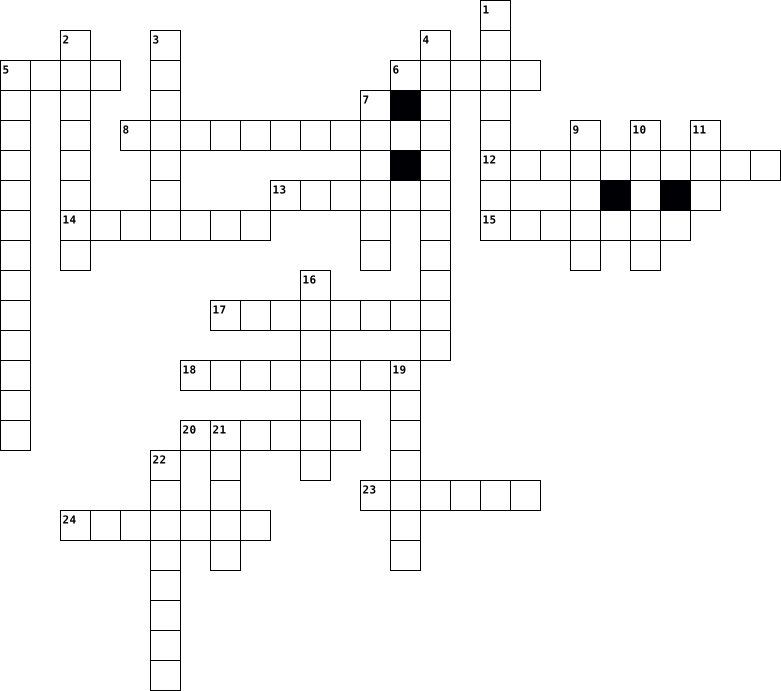
Across
- The smallest single neutral particle that makes up all life.
- H2O
- the relative average of all isotopes of an element.
- An experiment took place in which microscopes picked up where the positively charged alpha particle rays went when directed at a thin piece of gold.
- positively charged subatomic particle
- the name of the outermost shell in an atoms electron configuration
- the center of an atom that contains the dna, protons and neutrons
- Two or more atoms bonded together.
- a charge that electrons have
- an ion that has lost electrons
- the rows of the periodic table
- JJ created a model of an atom where the electrons are scattered in a mass of positively charged nucleus replicating a plum pudding.
Down
- negatively charged subatomic particle
- a charge that protons have
- the different types of atoms of an element that contains different amounts of neutrons.
- the number of protons and electrons added together.
- the number of protons, electrons and place in the periodic table
- John's atomic theory consisted of, all gas has weight, atoms are the smallest particle, simple multiple proportion, elements combine into molecules of simple ratios, elements join together to form compounds, water always contains twice as much hydrogen as oxygen, when chemicals react with each other the total mass of the chemicals does not change, pure oxygen has the same properties wherever it is found on the Earth or in space, gases some of which are invisible, have mass and different gases have different masses, modern microscopes produce images of surfaces that look bumpy
- a configuration of rings in which the electrons are placed,
- the columns of the periodic table
- an atom that has gained or lost an electron
- a neutrally charged subatomic particle
- A pure substance consisting of one type of atom.
- an ion that has gained electrons
- Two or more different elements bonded together.
25 Clues: H2O • a charge that protons have • a charge that electrons have • an ion that has lost electrons • the rows of the periodic table • an ion that has gained electrons • the columns of the periodic table • Two or more atoms bonded together. • negatively charged subatomic particle • positively charged subatomic particle • a neutrally charged subatomic particle • ...
Gold & Silver 2022-02-03

Across
- gold or silver heated in a crucible and transferred into a mold
- How gold comes out of the ground
- periodic table symbol of gold
- a naturally occurring solid material from which a metal or valuable mineral can be profitably extracted
- periodic table symbol for silver
- system by which the value of a currency was defined in terms of gold
- The US gold and silver 1 oz Coin
- natural accumulations of minerals in the earth crust
- originated to show the purity of gold in a piece of gold jewelry
- Precious metals have been used for this for centuries
- personal ornaments, such as necklaces, rings, or bracelets, that are typically made from or contain precious metal.
- a form of weight for metal
- "Royal Water"
- Spanish for gold
- One of the largest gold nuggets ever found
Down
- 925/1000 parts silver
- made by forcing gold or silver into a die or mold
- Adding to your metals
- pure substance consisting only of atoms that all have the same numbers of protons in their nuclei
- Silver in Latin
- 1000 grams
- Generally Copper with a thin layer of gold or silver applied on top
- Metal composed of 2 or more elements
- Gold and Silver are part of this periodic table
- Uncoined Gold or Silver in Bars or rounds
- a person who searches for mineral deposits
- the testing of a metal or ore to determine its ingredients and quality
- Pure gold
- measure of the fineness (i.e., purity) of gold
- 180 Troy Grains
- Latin for Gold
- At one point the largest manufacturer of precious metals that was sold to BASF in 2006 for $5 Billion
- a form of placer mining
- a block of gold or silver
- Spanish for silver
- a vein of metal ore in the earth
36 Clues: Pure gold • 1000 grams • "Royal Water" • Latin for Gold • Silver in Latin • 180 Troy Grains • Spanish for gold • Spanish for silver • 925/1000 parts silver • Adding to your metals • a form of placer mining • a block of gold or silver • a form of weight for metal • periodic table symbol of gold • How gold comes out of the ground • periodic table symbol for silver • ...
Chemistry Revision 2013-07-15

Across
- A positively charged species
- The shorthand way of writing the name of an element
- The term used to describe electrons in the outer-most shell
- A type of indicator
- Group I elements are knowns as this type of metal
- The element that has the atomic number 56
- A type of reaction where compounds breakdown into simpler compounds or elements
- The element with the symbol Zn
- The name used to describe each of the Group VII elements
- The term that describes the attraction between two atoms as a result of sharing or transferring electrons
- A substance made up of two or more element chemically combined
- The scientist who carried out the gold-foil experiment
- The term that describes an element with the same atomic number but different mass number
- The shorthand way of writing the name of a compound
- The name of the scientist who developed the theory of electron shells
Down
- The compound, table salt, is formed by this type of bond
- A common compound made up of Phosphorus and Oxygen atoms
- A substance that exhibits properties of metals and non-metals
- Non-metals tend to form compounds with this type of bond
- A type of reaction that involves acids and bases
- The name given to each element in Group VIII (2)
- The name given to the columns in the periodic table
- A model that was previously used to describe the structure of an atom (2)
- Most elements in the periodic table are found in this physical state
- The term used to describe a substance that cannot be dissolved
- A physical property of metals
- The name given to the rows in the periodic table
- A particle with no charge found in the nucleus of an atom
- A physical property of non-metals
- An example of this type of substance is soil
30 Clues: A type of indicator • A positively charged species • A physical property of metals • The element with the symbol Zn • A physical property of non-metals • The element that has the atomic number 56 • An example of this type of substance is soil • A type of reaction that involves acids and bases • The name given to each element in Group VIII (2) • ...
Physics Chapter 12 Crossword 2016-02-25

Across
- Harmonic Motion vibration about an equilibrium position in which a restoring force is proportional to the displacement of equilibrium
- wave a wave whose particles vibrate perpendicular to the diresction of wave motion
- wave a wave that propagates through a deformable elastic medium
- that material through which a disturbance travels
- the maximum displacement from equilibrium
- Interference interference in which individual displacements on the same side of the equilibrium position are added together to form the resultant wave
- the # of cycles or vibrations per unit of time
- constant a parameter that expresses how resistant a spring is to being compressed or stretched
- a point in a standing wave that always undergoes complete destructive interference and therefore is stationary
- a point in a standing wave, halfway between 2 nodes at which the largest amplitude occurs
- the time it takes to execute a complete cycle of motion
Down
- the distance between 2 adjacent similar points of the wave, such as from crest to crest or from trough to trough
- wave a wave pattern that results when 2 waves of the same frequency wavelength and amplitude travel in opposite directions and interfere
- The lowest point below the equilibrium position
- force force exerted by a material when it is stretched or compressed
- the region of a longitudinal wave in whicj the density and pressure are greater than normal
- interference interference in which individual displacement is on opposite sides of the equilibrium position are added together to form the resultant wave
- wave a wave whose particles vibrate parallel to the direction of wave motion
- the region of a longitudinal wave in which the density and pressure are less than normal
- wave a single non periodic disturbance
- a condition that exists when the frequency of a force applied to a system matches the natural frequency of vibration of the system
- wave a wave whose source is some form of periodic motion
- the highest point above the equilibrium position
23 Clues: wave a single non periodic disturbance • the maximum displacement from equilibrium • the # of cycles or vibrations per unit of time • The lowest point below the equilibrium position • the highest point above the equilibrium position • that material through which a disturbance travels • the time it takes to execute a complete cycle of motion • ...
Chapter 10 Vocabulary 2016-01-10

Across
- the lowest available level within an atom (2W)
- colored lines generated when light emitted by a gas is shown through a spectroscope (2W)
- the last name of a French physicist who suggested that all objects have wave properties
- small measures of energy
- a cloudlike region around the nucleus where electrons are located
- the property of an electron that describes its appearance of spinning on an axis like a globe
- the number that indicates the shape of the orbital (4W)
- horizontal groups of elements in the periodic table
- the number of electrons a p orbital can hold
- noble gas configuration (2W)
- a measurement of the number of waves that pass a particular point per second
- a new branch of physics (2W)
- the B groups and group VIII (2W)
Down
- a particle representing a quantum of light or other electromagnetic radiation
- principle that states that energy levels in atoms are written; n=1, n=2... (3W)
- a way of showing the arrangement of electrons in an atom (2W)
- also called families, vertical groups of elements in the periodic table
- two possible values for spin, +1/2 or -1/2 (3W)
- an atomic orbital can hold a maximum of 2 electrons, which most have opposite (3W)
- the orbital arrangement of electrons in an atom (2W)
- contains electrons in the orbitals (3W)
- one way energy travels through space (3W)
- an A group element (2W)
- the electrons in the outermost energy level of an atom (2W)
- electrons fill the lowest energy level first (2W)
- electrons on the outermost electron shell (2W)
- the publisher of the periodic table
- a measurement of how fast a wave travels in space
- the distance between consecutive peaks in a wave
- within a sublevel, place one electron per orbital before pairing them (2W)
30 Clues: an A group element (2W) • small measures of energy • noble gas configuration (2W) • a new branch of physics (2W) • the B groups and group VIII (2W) • the publisher of the periodic table • contains electrons in the orbitals (3W) • one way energy travels through space (3W) • the number of electrons a p orbital can hold • the lowest available level within an atom (2W) • ...
chem crossword 2022-09-09

Across
- SECOND THING ON PERIODIC TABLE
- LITTLE BALLS WE ROLLED
- PLUS 1 CHARGE ATOM
- visible gaseous part of a fire
- mineral composed primarily of sodium chloride
- a negativity charged ion
- ATOM WITH DIFF# OF NEUTRONS but same# OF PROTONS
- GROUP OF 2 OR MORE ATOMS
- A MISTAKE
- spatial period of a periodic wave
- what everything is made of
- the weight of an atom
- SHINY YELLOW METAL THAN PEOPLE MAKE JEWELRY WITH
- BEST CHEM PERIOD YES
- doer OF GOLD FOIL EXPERIMENT
- WHAT AN EXCITED ATOM GIVES OFF
- German theoretical physicist
- the physical interaction among electric charge
- a minute portion of matter
- a positively charged ion
- NAME OF BEST TEACHER YES
- 2ND THING ON PERIODIC TABLE
- THIN SHEET OF ALUMINUM THAT YOU WRAP FOOD IN
- type yesfree
- bipedal primate mammal
- NO CHARGE ATOM
- the number of waves that pass a fixed point in unit time
Down
- 6.626x10^-34
- CENTER OF ATOM
- innermost shell of electrons surrounding nucleus
- FREE SPACE JUST TYPE FREE
- 3.00x10^8
- MINUS 1 CHARGE ATOM
- a substance or matter in a state in which it will expand freely to fill
- ATOMIC MASS OF HYDROGEN
- the capacity for doing work
- ATOMIC MASS OF HYDROGEN
- energy that comes from a source and travels through space at the speed of light
- FREE SPACE TYPE AHHH
- FIRST THING ON PERIODIC TABLE
- a disturbance that moves energy from one place to another
- SYMBOL OF HELIUM
- the number of an atom
- a scientific procedure undertaken to make a discovery
- BEST SUBJECT YES
- an atom or molecule with a net electric charge due to the loss or gain of one or more electrons
- an electron in the outer shell associated with an atom
- FREE SPACE JUST TYPE ANDREW
- belonging to a hereditary class with high social or political status
49 Clues: 3.00x10^8 • A MISTAKE • 6.626x10^-34 • type yesfree • CENTER OF ATOM • NO CHARGE ATOM • SYMBOL OF HELIUM • BEST SUBJECT YES • PLUS 1 CHARGE ATOM • MINUS 1 CHARGE ATOM • FREE SPACE TYPE AHHH • BEST CHEM PERIOD YES • the weight of an atom • the number of an atom • LITTLE BALLS WE ROLLED • bipedal primate mammal • ATOMIC MASS OF HYDROGEN • ATOMIC MASS OF HYDROGEN • a negativity charged ion • ...
Chemistry Review 2023-05-01

Across
- negative value for H
- positive subatomic particle
- used to quantify the heat flow into or out of a system
- electrons are arranged in a "sea of electrons"
- a chemical geometry with a 180 degree angle
- type of radiation that is pure energy
- the weakest of the intermolecular forces
- unit of pressure
- the capacity to do work
- the rows of the periodic table
- type of chemical reaction in which one product is formed
- 1s2 2s2 2p6 3s2 3p6 4s2 3d6
- gas law that related pressure, volume, temperature, and amount of a gas
- bond between a nonmetal and a nonmetal
- credited for the Atomic Theory of Atoms
- the unit of energy, heat, or work
- type of chemical reaction in which water and carbon dioxide are products
- used to measure volume of a liquid
- most electronegative element
Down
- the bond that holds two molecules together
- first part of the atom to be discovered
- unit of temperature
- electron geometry of methane
- group 1 of the periodic table
- studies the rate at which a chemical reaction occurs
- happens when there are too many protons in the nucleus and neutrons cannot hold them in
- a metal that is a liquid at room temperature
- ionic, covalent, or metallic bond
- a force between H and N,O, or F
- the study of heat released or required by a chemical reaction
- mass divided by volume
- created the "Nuclear" model of the atom, after the gold foil experiment
- a unit to measure concentration
- created the "Plum Pudding" model of the atom
- group 7 on the periodic table
- type of replacement reaction where one element "trades places" with an element in a compound
- Valence shell electron pair repulsion
- result of an electronegativity difference greater than 0.3
- bond between a metal and a nonmetal
- 1s2 2s2 2p6 3s2 3p6 4s2
40 Clues: unit of pressure • unit of temperature • negative value for H • mass divided by volume • the capacity to do work • 1s2 2s2 2p6 3s2 3p6 4s2 • positive subatomic particle • 1s2 2s2 2p6 3s2 3p6 4s2 3d6 • electron geometry of methane • most electronegative element • group 1 of the periodic table • group 7 on the periodic table • the rows of the periodic table • ...
Chemistry Vocabulary Crossword Puzzle 2020-11-11

Across
- a chemical reaction that absorbs heat
- substance that does the dissolving in a chemical solution
- chemical bond between atoms caused by an electrostatic force in opposite charged ions
- expression which states the number and types of atoms in a molecule
- part of the atomic nucleus that has a charge of +1
- chemical species formed when two or more elements form a chemical bond
- a substance that cannot be subdivided and is identified by the number of protons in its atoms
- chemical mass unit equal to Avogadro's number
- any element found in the last column of the periodic table
- part of the atomic nucleus that has a charge of -1
- whole number that is the sum of protons and neutrons in the atomic nucleus
- outer electron that is most likely to participate in a bond formation or a chemical reaction
- part of the atomic nucleus that has a charge of 0
- measure of hydrogen ion in a solution showing the acidity or basicity of a substance
- a chemical species that accepts protons
- chemical bond between atoms where electrons are more or less evenly shared
Down
- a chemical reaction that releases heat
- the arrangement of elements by increase of their atomic number
- homogenous mixture of two or more substances
- atoms that have the same number of protons but different amount of neutrons changing its atomic weight
- the number of protons in the nucleus of an atom of an element
- a chemical species that donates protons
- any element found in the 1st column of the periodic table
- substance that is dissolved in a chemical solution
- substance formed as a result of a chemical reaction
- starting material for a chemical reaction
- any element found in the 2nd column of the periodic table
- the ability to do work
28 Clues: the ability to do work • a chemical reaction that absorbs heat • a chemical reaction that releases heat • a chemical species that donates protons • a chemical species that accepts protons • starting material for a chemical reaction • homogenous mixture of two or more substances • chemical mass unit equal to Avogadro's number • ...
Chemistry Crossword. 2017-11-08

Across
- mass of one atom of an element calculated from the total number of protons, neutrons, and electrons of that atom
- cloudy mixture in which tiny particles of one substance are held within another and particles cannot be separated out from the other substance\
- positively charged centre of an atom
- property that describes the physical appearance and composition of a substance
- an experiment in which all reactants and all products of a chemical reaction are accounted for
- a reaction that takes place when two or more substances react to form new substances
- group 2 elements in the periodic table
- dull, brittle element that does not conduct electricity
- amount of mass in a given volume of a substance
- group 18 elements in the periodic table
- homogeneous mixture
Down
- description of a solid that can be stretched into a long wire
- chemical reaction that occurs when oxygen reacts with a substance to form a new substance and give off energy
- the smallest part of an element that is representative of that element
- number of protons in the nucleus of one atom of an element
- slow chemical change that occurs when oxygen in the air reacts with metal
- substance that reacts with another substance or substances in a chemical reaction to create a new substances with different properties
- metals group 1 elements in the periodic table
- principle that matter is not created or destroyed in a chemical reaction
- group of atoms acting as one
- change in the appearance or state of a substance that does not change the composition
- changing of state from a solid to a liquid
- chemical combination of two or more elements in a specific ratio
- an experiment in which one or more products of a chemical reaction can escape
- mass of a substance that can dissolve in a given amount of solvent to form a saturated solution at a given temperature
25 Clues: homogeneous mixture • group of atoms acting as one • positively charged centre of an atom • group 2 elements in the periodic table • group 18 elements in the periodic table • changing of state from a solid to a liquid • metals group 1 elements in the periodic table • amount of mass in a given volume of a substance • dull, brittle element that does not conduct electricity • ...
Chemistry Crossword 2017-11-07

Across
- group 17 elements in the periodic table;the most reactive non-metals
- cloudy mixture in which tiny particles of one substance are held within another, and the particles can be separated out
- positively charged particle in the nucleus of an atom
- an experiment in which one or more products of a chemical reaction can escape
- chemical reaction that absorbs energy
- group 18 elements in the periodic table;the most stable and unreactive elements
- chemical reaction that occurs when oxygen reacts with a substance to form a new substance and give off energy
- change in the appearance or state of a substance that does not change the composition
- change that results when two or more substances react to create a different substance or substances
- pure substance formed when non-metals combine
- combination of pure substances
Down
- description of a substance that can be pounded or rolled into sheets
- substance that helps a chemical reaction to proceed more quickly
- substance that strongly resists the flow of electricity
- catalyst involved in chemical reactions in living things
- chemical reaction that releases energy
- pure substance formed when at least one metal and one non-metal combine
- neutral particle in the nucleus of an atom
- a table in which the elements are organized by their physical and chemical properties
- heterogeneous mixture;mixture in which the different substances that make up the mixture are visible
- vertical column of elements in the periodic table
- substance made of only one kind of matter, which has a unique set of properties
- element that has both metallic and non-metallic properties
- substance that reacts with another substance or substances in a chemical reaction to create new substances with different properties
- cloudy mixture in which tiny particles of one substance are held within another and particles cannot be separated out from the other substance
25 Clues: combination of pure substances • chemical reaction that absorbs energy • chemical reaction that releases energy • neutral particle in the nucleus of an atom • pure substance formed when non-metals combine • vertical column of elements in the periodic table • positively charged particle in the nucleus of an atom • substance that strongly resists the flow of electricity • ...
chemistry 2017-11-15

Across
- The phase change from a solid to a liquid
- the temperature in which the substance starts to melt
- the metals of Group 1 on the periodic table
- an atom that is defined by its atomic number
- an element which is not metallic
- H2O a chemical substance, a major part of cells and Earth, and covalently bonded
- Group 17 on the Periodic Table and are all non-metals
- A state of matter in which cohesive force is less than or equal to the separating force
- the change of one or more substances into another or multiple substances
- formation of a solid in a solution or inside another solid during a chemical reaction or by diffusion in a solid
- homogeneous mixture made up of multiple substances. It is made up of solutes and solvents.
- The amount of mass per unit volume. d = m/V
Down
- a positive unit or subatomic particle that has a positive charge
- is the same as a proton or electron but without a charge
- energy transferred from one system to another by thermal interaction
- the metals of Group 2 on the periodic table
- gases group 18 elements, those whose outer electron shell is filled
- material with definite chemical composition
- the part of the solution that is mixed into the solvent (NaCl in saline water)
- particles that fill their container though have no definite shape or volume
- the number representing an element which corresponds with the number of protons within the nucleus
- the temperature in which the substance starts to boil
- a phase transition from solid to limewater fuel or gas
- the part of the solution that dissolves the solute (H2O in saline water
- Chemical element that is a good conductor of both electricity and heat and forms cations and ionic bonds with non-metals
25 Clues: an element which is not metallic • The phase change from a solid to a liquid • the metals of Group 2 on the periodic table • material with definite chemical composition • the metals of Group 1 on the periodic table • The amount of mass per unit volume. d = m/V • an atom that is defined by its atomic number • the temperature in which the substance starts to melt • ...
Kallie 2023-05-10

Across
- An element that has some characteristics of both metals and nonmetals v
- A Small particle in the nucleus of the atom,with no electrical charge v
- Solid nonmetals tend to be ___ and brittle.(O)
- Small positively charged particle that are in the nucleus of an atom v
- The____ of an element can be predicted from its location in the periodic table.(O)
- symbol A one or two letter representation of an element v
- At the ____ of the atom is a tiny,dense nucleus containing protons and neutrons.(O)
- An element that lacks most of the properties of a metal v
- metal An element in Group 1 of the periodic table v
- particle A fast moving electron that is given off as nuclear radiation v
Down
- Metals are ___ as alkaline, earth metals,transition metals.(O)
- rays Electromagnetic waves with the shortest wavelength and highest frequencies v
- Mendeleev noticed a _____ of properties in elements arranged by increasing atomic mass. (O)
- A tiny-negatively charged particle that moves around the outside of the nucleus of an atom v
- number The number of protons in the nucleus of an atom v
- The central core of an atom which contains protons and neutrons v
- The basic particle from which all elements are made v
- The physical properties of ___ includes luster,malleability,ductility,and conductivity.(O)
- conductivity The ability of an object to transfer heat v
- table The_____ includes each element's atomic number,symbol,name,and atomic mass.(O)
- life The time it takes for half of the atoms of a radioactive element to decay v
- During radioactive decay, the ___ of an atom changes. (O)
- mass The average mass of all the isotopes of an element v
- Atomic theory grew as a series of _____ models that developed from experimental evidence (O)
- The ___ containing nonmetals include the carbon,nitrogen,oxygen,halogen,noble gasses,and hydrogen families.(O)
25 Clues: Solid nonmetals tend to be ___ and brittle.(O) • metal An element in Group 1 of the periodic table v • The basic particle from which all elements are made v • number The number of protons in the nucleus of an atom v • conductivity The ability of an object to transfer heat v • symbol A one or two letter representation of an element v • ...
Reactivity 2024-01-25

Across
- A compound containing hydrogen and carbon only.
- A reaction in which energy is transferred to the reactants from the surroundings. The temperature of the surroundings decreases.
- If a substance has lost oxygen then it has been reduced.
- Burning, usually in air. The reaction gives out energy, which is transferred to the surroundings by heating or light.
- A reaction in which an acid reacts with an alkali or a base to produce a salt and water.
- An explosive substance reacts very fast, releasing a lot of energy and gas.
- _______ series: A list of metals that shows them in order of reactivity with the most reactive metal at the top.
- A sub-atomic particle found outside the nucleus of an atom. It has an electrical charge of –1.
- A flammable substance catches fire easily.
- The central part of an atom, where protons and neutrons are found.
Down
- A reaction in which energy is transferred from the reactants to the surroundings. The temperature of the surroundings increases.
- _______ table, showing all the elements in order of atomic number.
- The amount of force pushing on a certain area. It is a way of saying how spread out a force is.
- A sub-atomic particle found in an atom’s nucleus. It has an electrical charge of +1.
- A sub-atomic particle found in an atom’s nucleus. It has no electrical charge.
- The smaller particles of which atoms are made (electrons, protons, neutrons).
- Reaction in which a substance gains oxygen.
- A horizontal row in the periodic table.
- _______reaction:A reaction in which one reactant is reduced and another is oxidised.
- A vertical column in the periodic table.
- An object is destroyed by collapsing in on itself.
- A change in which no new substances are formed (e.g. changes of state).
- A rock that contains enough of a certain mineral to make it worth mining.
23 Clues: A horizontal row in the periodic table. • A vertical column in the periodic table. • A flammable substance catches fire easily. • Reaction in which a substance gains oxygen. • A compound containing hydrogen and carbon only. • An object is destroyed by collapsing in on itself. • If a substance has lost oxygen then it has been reduced. • ...
Crossword Puzzle for Atmoic Structure and Waves 2024-09-06

Across
- the formula to find speed of light
- number located on top of element in periodic table
- s,d,p,f
- element with the atomic number of 22
- wearing goggles and an apron ensures ?
- found in atom's nuclei, positively charged
- atom that has a negative or positive charge due to losing/gaining an electron
- height of wave
- element that as an atomic number of 10
- of light c=*v
- radient energy we cannot see but instead feel as heat
- EXAMPLE: [Ne] 3s^1
- light at a certain frequency causes metals to eject their electrons
- highest point of wave
- lowest part of wave
- element that has an atomic number of 30
- acronym for the rainbow
- element that has an atomic number of 5
- #.##x10^#
Down
- name of this science class
- number located underneath the element in periodic table
- other particle found in nuclei, not a proton
- arrangment of electrons, always sits by lowest energy rows first
- its multipled by frequency to find speed of light
- element that has an atomic number of 88
- an object needed when taking quizzes
- in each of these, there are 2 electrons
- what is (h) called in the formula E=hv?
- table table that holds all of the elements
- things collected from and experiment and added into a table
- electromagnetic radiation of wavelengths of 10–400 nanometers
- small particle that has a negative charge, is found in all atoms
- electrons in outermost shell of atom
- a number that is sometimes in the top corner of element, can be positive or negative
- its multiplied by wavelength to find speed of light
- E=hv
- the formula to find energy of a photon
- name of our teacher
- unit used for E=hv
- smallest discrete unit of something (ex; photon)
40 Clues: E=hv • s,d,p,f • #.##x10^# • of light c=*v • height of wave • EXAMPLE: [Ne] 3s^1 • unit used for E=hv • lowest part of wave • name of our teacher • highest point of wave • acronym for the rainbow • name of this science class • the formula to find speed of light • an object needed when taking quizzes • element with the atomic number of 22 • electrons in outermost shell of atom • ...
6CHEM Unit 2 Vocab Practice 2024-11-22

Across
- transition metal, expected charge of 2+, 4 electron shells
- particle with no charge and same mass to a proton; found in the nucleus
- atom or group of atoms that has a positive or negative charge
- rare earth metals
- the lonely element
- positively charge particle with a mass of 1 amu
- 4 valence electrons and 3 electron shells
- 5 valence electrons and 4 electron shells
- atoms usually want 8 valence electrons to be stable
- area around the nucleus of the atom where electrons are most likely found
- 1 valence electron and 2 electron shells
- transition metal, expected charge of 2+, 5 electron shells
- 2 core electrons, 8 valence electrons, charge of 2-
- measure of electric charge (positive or negative) of an atom or molecule
- less soft and less reactive than group 1 metals
- metals in the middle of the periodic table
- particles smaller than an atom
- group 1, very reactive, soft, silver, shiny metals
Down
- transition metal, expected charge of 1+
- atomic mass of 247
- radioactive metals
- elements that are dull (not shiny) and poor conductors of heat and energy
- electrons in the outermost energy level
- contains nonmetals, extremely reactive and poor conductors
- atomic number of 92
- malleable and ductile elements, usually solid at R.T.
- vertical column on the periodic table
- least reactive elements (inert)
- center of an atom
- #p + #n = ___
- horizontal row of elements in the periodic table
- number of energy levels in an atom that matches the period or row of an element
- elements that separate metals and nonmetals
- atoms of the same element with a different number of neutrons/atomic masses
- positively charge ion
- average mass of all isotopes of an element
- the number of protons in an atom
- negatively charge particle with no mass
- negatively charge ion
39 Clues: #p + #n = ___ • rare earth metals • center of an atom • atomic mass of 247 • radioactive metals • the lonely element • atomic number of 92 • positively charge ion • negatively charge ion • particles smaller than an atom • least reactive elements (inert) • the number of protons in an atom • vertical column on the periodic table • transition metal, expected charge of 1+ • ...
Isotopes, Bohr, Lewis 2025-02-16

Across
- How many valence electrons does Chlorine have?
- An element has the following natural abundances and isotopic masses: 90.92% abundance with 19.99 amu, 0.26% abundance with 20.99 amu, and 8.82% abundance with 21.99 amu. Calculate and round to hundredths place the average atomic mass of this element.
- The electrons in the last energy level are called ________________ electrons.
- The atomic number for Gallium is ___________.
- Electrons have what charge?
- Elements on the periodic table are arranged according to their number of ____________.
- All elements on the periodic table have one or more __________________.
- Neutrons have a ___________ charge.
- The vertical columns on the period table are called __________.
- The way chemists show the valence electrons of an element in pairs of electrons is called a _________________structure.
- Elements in period 5 have how many energy levels?
- Electrons are found in an area called the _____________________.
- How many electrons does Tin have?
- Elements in group 16 have how many valence electrons?
- The elements on the periodic table that have a full last energy level and do not combine with other elements are called ________________________.
- Ga - 67 has how many neutrons?
Down
- When we write an isotope in this manner: X it is called ________________________.
- In order to find the weighted atomic mass you would need to the know the __________________________ and _____________.
- How many neutrons does Iodine have?
- The rounded atomic mass for scandium is ______________.
- Elements with the same number of protons but a different number of neutrons are called ____________.
- The group numbers tell you the number of ________________ electrons.
- When we write an isotope like this: C-13, it is called ______________.
- The atomic mass for C - 13 is ________________.
- Most of the mass of an atom is found in the _______________.
- The horizontal rows on the period table are called ___________.
- Protons have what charge?
- What elements are found along the staircase on the periodic table.
- The number of electrons in the second energy level is _______________.
- Only ___________________ are involved in chemical reactions.
- The number of electrons in the first energy level is __________.
- Potassium has how many energy levels?
32 Clues: Protons have what charge? • Electrons have what charge? • Ga - 67 has how many neutrons? • How many electrons does Tin have? • How many neutrons does Iodine have? • Neutrons have a ___________ charge. • Potassium has how many energy levels? • The atomic number for Gallium is ___________. • How many valence electrons does Chlorine have? • ...
The Atom 2025-03-28

Across
- Particle in the nucleus with a positive electric charge.
- it is the same as the atomic number in a periodic table - only in a neurally charged element. It is located in the cloud "shells". It has negative charge -1. It weights nothing compared to neutrons/protons
- total number of protons in an atom. It indicates where the atom is located within the periodic table and also its properties.
- brittle, soft, dull, not solid in room temperature, poor conductor of heat/electricity
- houses the protons and neutrons. It is the centre of the atom and contains most of its mass.
- highly reactive, lustrous, reacts with water
Down
- It is the smallest particle of a matter that still holds the element's properties.
- particle in the nucleus with a neutral charge.
- the number underneath the atom symbol in the periodic table. It represents the weight of the atom. It is calculated by the total number of protons plus the total number of neutrons.
- blend/mixed of properties of metals and non-metals
- ductility, lusture, conductivity, hardness
11 Clues: ductility, lusture, conductivity, hardness • highly reactive, lustrous, reacts with water • particle in the nucleus with a neutral charge. • blend/mixed of properties of metals and non-metals • Particle in the nucleus with a positive electric charge. • It is the smallest particle of a matter that still holds the element's properties. • ...
Electron Configurations 2025-06-01

Across
- the element of the periodic table that has a 1s22s2sp2 configuration
- the element of the periodic table that has a [Ne]3s1 configuration
- positively charged particle found within an atom's nucleus
- negatively charged particle found within an atom's nucleus
- 3D potential location of an electron around a nucleus of an atom
- principle that states that no two electrons can be in the same place at the same time
- holds up to 14 electrons
- principle that states that electrons fill lower energy orbitals before filling higher energy orbitals
- holds up to ten electrons
Down
- neutrally charged particle found within an atom's nucleus
- holds up to six electrons
- holds up to two electrons
- rule that states that electrons will fill each suborbital individually before pairing up and filling the orbitals completely
13 Clues: holds up to 14 electrons • holds up to six electrons • holds up to two electrons • holds up to ten electrons • neutrally charged particle found within an atom's nucleus • positively charged particle found within an atom's nucleus • negatively charged particle found within an atom's nucleus • 3D potential location of an electron around a nucleus of an atom • ...
What in the Periodic Table? 2026-01-09

Across
- shiny & good conductors of heat and electricity
- Name of element with the chemical symbol, Pt.
- dull, brittle & poor conductors of heat and electricity
- Name of element with 23 protons in its atoms.
- share characteristics of both metals and nonmetals
- up & down columns of periodic table; elements that share this share similar properties
Down
- When writing the chemical symbols of elements, the first letter is always a _______.
- Number in an element tile that represents the number of protons in the nucleus of its atom.
- side to side rows of periodic table; atomic number increases from left to right
- Name of element with the chemical symbol, Bi.
- Name of element that is atomic number 41.
- Name of element that is Group 9, Period 4.
- Name of element that is Group 18, Period 3.
13 Clues: Name of element that is atomic number 41. • Name of element that is Group 9, Period 4. • Name of element that is Group 18, Period 3. • Name of element with the chemical symbol, Bi. • Name of element with the chemical symbol, Pt. • Name of element with 23 protons in its atoms. • shiny & good conductors of heat and electricity • ...
Boring Science 2022-05-04

Across
- Chemical
- a minute portion of matter.
- What is air
- more separate elements
- science
- What is a table
- battle
- the chemical element of atomic number 6
- the matter from which a thing is or can be made.
- science
- a substance made by mixing
- Funny talking
Down
- essential or characteristic
- It’s hot
- Some smart
- physical substance
- it’s runny
- Small hole
- Smart
- your things
- it’s stinky
- hard
22 Clues: hard • Smart • battle • science • science • Chemical • It’s hot • Some smart • it’s runny • Small hole • What is air • your things • it’s stinky • Funny talking • What is a table • physical substance • more separate elements • a substance made by mixing • essential or characteristic • a minute portion of matter. • the chemical element of atomic number 6 • the matter from which a thing is or can be made.
List #13 2023-11-30

Across
- building for sick people
- a soft like voice
- at the top
- old family members
- best friend
- to leave beside
- color changes
- formal argument
- like alike
- more then one
- on the periodic table
- inside of anything
Down
- helps with donations
- open sweeter
- outskirts of a city
- opposite of horizontal
- has four sides
- good enough
- city area
- fair and just
- an estimation
21 Clues: city area • at the top • like alike • good enough • best friend • open sweeter • color changes • fair and just • an estimation • more then one • has four sides • to leave beside • formal argument • a soft like voice • old family members • inside of anything • outskirts of a city • helps with donations • on the periodic table • opposite of horizontal • building for sick people
Ancient Mesopotamia 2025-01-11

Across
- The basis or groundwork
- Raise and grow seeds
- Establishing a community
- Advanced human societies
- Barren desert
- Use of advanced tools and techniques
- Silt enriched soil
- Important river in Ancient Mesopotamia
- Fruitful and fertile
- Something handed down
Down
- Lowland
- Emerging early groups
- Moving from place to place
- Waterway
- Periodic
- Very old
- Make alterations
- Assets that can be used
- Densely populated
- Storm god
20 Clues: Lowland • Waterway • Periodic • Very old • Storm god • Barren desert • Make alterations • Densely populated • Silt enriched soil • Raise and grow seeds • Fruitful and fertile • Emerging early groups • Something handed down • The basis or groundwork • Assets that can be used • Establishing a community • Advanced human societies • Moving from place to place • Use of advanced tools and techniques • ...
List #13 2023-11-30

Across
- building for sick people
- a soft like voice
- at the top
- old family members
- best friend
- to leave beside
- color changes
- formal argument
- like alike
- more then one
- on the periodic table
- inside of anything
Down
- helps with donations
- open sweeter
- outskirts of a city
- opposite of horizontal
- has four sides
- good enough
- city area
- fair and just
- an estimation
21 Clues: city area • at the top • like alike • good enough • best friend • open sweeter • color changes • fair and just • an estimation • more then one • has four sides • to leave beside • formal argument • a soft like voice • old family members • inside of anything • outskirts of a city • helps with donations • on the periodic table • opposite of horizontal • building for sick people
List #13 2023-11-30

Across
- building for sick people
- a soft like voice
- at the top
- old family members
- best friend
- to leave beside
- color changes
- formal argument
- like alike
- more then one
- on the periodic table
- inside of anything
Down
- helps with donations
- open sweeter
- outskirts of a city
- opposite of horizontal
- has four sides
- good enough
- city area
- fair and just
- an estimation
21 Clues: city area • at the top • like alike • good enough • best friend • open sweeter • color changes • fair and just • an estimation • more then one • has four sides • to leave beside • formal argument • a soft like voice • old family members • inside of anything • outskirts of a city • helps with donations • on the periodic table • opposite of horizontal • building for sick people
List #13 2023-11-30

Across
- building for sick people
- a soft like voice
- at the top
- old family members
- best friend
- to leave beside
- color changes
- formal argument
- like alike
- more then one
- on the periodic table
- inside of anything
Down
- helps with donations
- open sweeter
- outskirts of a city
- opposite of horizontal
- has four sides
- good enough
- city area
- fair and just
- an estimation
21 Clues: city area • at the top • like alike • good enough • best friend • open sweeter • color changes • fair and just • an estimation • more then one • has four sides • to leave beside • formal argument • a soft like voice • old family members • inside of anything • outskirts of a city • helps with donations • on the periodic table • opposite of horizontal • building for sick people
Chemistry of Matter 2022-10-04

Across
- Atoms are different from one another because of the number of these
- A tool that can be used to separate magnetic substances from non-magnetic ones
- A substance that cannot be broken down into a simpler substance
- Anything that has mass and volume
- The number of GROUPS in the Periodic Table
Down
- when a gas turns to a liquid
- The number of protons is equal to the number of these
- Most elements in the Periodic Table are solids and these
- The smallest most basic unit of matter
- A group of atoms bonded together
- A change in matter that can be un-done
11 Clues: when a gas turns to a liquid • A group of atoms bonded together • Anything that has mass and volume • The smallest most basic unit of matter • A change in matter that can be un-done • The number of GROUPS in the Periodic Table • The number of protons is equal to the number of these • Most elements in the Periodic Table are solids and these • ...
elements 2023-05-04

Across
- are located on the right side of the periodic table
- A negatively charged particle
- A tool used by chemists to help arrange the elements based on certain characteristics they share
- The positively charged center of an atom that contains protons and neutrons
- are located on the left side of the periodic table
Down
- A positively charged particle
- The building blocks of matter
- is what forms when two or more atoms combine
- A neutrally charged particle
- Two or more different elements that combine by a chemical change and create something with NEW and different physical and chemical characteristics
- A combination of two or more materials that are NOT chemically combined
11 Clues: A neutrally charged particle • A positively charged particle • The building blocks of matter • A negatively charged particle • is what forms when two or more atoms combine • are located on the left side of the periodic table • are located on the right side of the periodic table • A combination of two or more materials that are NOT chemically combined • ...
Chemistry crossword 2021-08-16

Across
- High speed electron ejected out of nucleus when a neutron gains a positive or negative charge
- a reaction that occours to make a radioactive element stable
- The study of the properties characteristics and reactions of matter
- an atom that has gained or lost an electron
- the number of protons/electrons in an atom
- splitting of heavier atoms into lighter ones
Down
- helium nucleus released as a product has 4 neutrons and 2 electrons/protons
- +1 charge
- High speed radiation that comes out of beta or
- -1 charge very light part of an atom
- what is found on the periodic table
- no charge and found in the nucleus of an atom
- splitting of heavier atoms into lighter ones
- what an element on average weighs represented on the periodic table on the bottom of an element
- an atom with a change in nuetrons
15 Clues: +1 charge • an atom with a change in nuetrons • what is found on the periodic table • -1 charge very light part of an atom • the number of protons/electrons in an atom • an atom that has gained or lost an electron • splitting of heavier atoms into lighter ones • splitting of heavier atoms into lighter ones • no charge and found in the nucleus of an atom • ...
Chemistry Crossword 2017-11-09

Across
- A substance that can't be broken down by chemical changed or or broken down; composed of atoms
- The basic unit of an element
- Determined by valence electrons
- A subatomic particle with a negative charge
- The group of non-metal elements that do not react with other elements
- A subatomic particle with a neutral charge
- A subatomic particle with a negative charge
- One or more letters given to identify an element
- The rows in a periodic table that organize elements based on their energy levels
- The columns in a periodic table that organize elements based on their valence electrons
- A particle that is formed when an element loses or gains an extra proton or electron
Down
- The electrons located on the outer energy level
- When two atoms come together to form a molecule
- The center of an atom
- A subatomic particle with a positive charge
15 Clues: The center of an atom • The basic unit of an element • Determined by valence electrons • A subatomic particle with a neutral charge • A subatomic particle with a negative charge • A subatomic particle with a negative charge • A subatomic particle with a positive charge • The electrons located on the outer energy level • When two atoms come together to form a molecule • ...
Nuclear Energy 2023-11-01

Across
- Can go through skin and aluminium but is stopped by lead
- Calculated by adding neutrons and protons
- When an atom has a different mass than whats on the periodic table
- Instability in a atom which makes it this
- 2 atom combine and release energy
- When something happens and causes another set of reactions to happen
- This determines its place on the periodic table, Calculated by the number of protons
- The Time point when a sample has gotten to half of its original amount
Down
- An atom splits and releases energy
- Is released during beta decay, Is one electron
- Releases during Alpha decay, Also known as a helium nucleus
- Determines what element it is
- the center of a atom and contains most mass in a atom
- Neutrally charged subatomic particle, Weighs 1 amu
14 Clues: Determines what element it is • 2 atom combine and release energy • An atom splits and releases energy • Calculated by adding neutrons and protons • Instability in a atom which makes it this • Is released during beta decay, Is one electron • Neutrally charged subatomic particle, Weighs 1 amu • the center of a atom and contains most mass in a atom • ...
Earth Systems 3209: Chemistry Basics 2014-11-04

Across
- The smallest amount of a compound that still shares the properties of it
- A subtance made of only one type of atom
- A compound made when nonmetals bond together
- The smallest amount of an element that still shares the properties of it
- A neutral subatomic particle found within the nucleus of an atom
- A compound made when metals bond with nonmetals
- Anything that has mass and takes up space
Down
- The positively charged center of an atom
- Elements to the right side of the periodic table
- A negatively charged subatomic particle found that orbits the nucleus
- Elements to the left side of the periodic table
- A substance made of more than one type of element
- A positively charged subatomic particle found within the nucleus of an atom
- A charged atom formed by gaining or losing electrons
14 Clues: The positively charged center of an atom • A subtance made of only one type of atom • Anything that has mass and takes up space • A compound made when nonmetals bond together • Elements to the left side of the periodic table • A compound made when metals bond with nonmetals • Elements to the right side of the periodic table • ...