
periodic%20table Crossword Puzzles
Periodic Table Crossword 2022-02-13

Across
- A yellow-green gas at room temperature
- Inert Gas used for lighting
- highest melting point, can be found mainly in 2 forms with a valency of 4.
- Period 3 metalloid
- Element present in glass and used as a semiconductor
- Metal with atomic size 227pm has the Latin name Natrium
- A noble gas used for filling balloons and dirigibles
Down
- a diatomic molecule, with a valency of 1
- a silvery white material, also found in our bones and teeth
- I appear in as the last number in an electronic configuration
- Most reactive non metal
- Metal with valency 1 has a Latin name Kalium
- Non-metal with atomic size 188pm and valency 0
- The most widely used non ferrous metal
- The highest purity of which exists as an amorphous dark brown to black powder
- colourless and odourless gas, 21% of it is in the air
16 Clues: Period 3 metalloid • Most reactive non metal • Inert Gas used for lighting • A yellow-green gas at room temperature • The most widely used non ferrous metal • a diatomic molecule, with a valency of 1 • Metal with valency 1 has a Latin name Kalium • Non-metal with atomic size 188pm and valency 0 • Element present in glass and used as a semiconductor • ...
The Periodic Table 2013-01-09

Across
- I have the chemical symbol Au
- I have the chemical symbol Al
- I have the chemical symbol Fe
- I am located in Group 2, Period 3
- I am located in Group 1, Period 1
- I have the chemical symbol Hg
- I have the atomic number of 12
Down
- I have the chemical symbol K
- I am located in Group 17, Period 3
- I am located in Group 1, Period 3
- I have the chemical symbol Ca
- I have 2 electrons
- I have the chemical symbol Sn
- I have the chemical symbol Ag
- I have the atomic number of 14
- I have the atomic number of 16
16 Clues: I have 2 electrons • I have the chemical symbol K • I have the chemical symbol Au • I have the chemical symbol Ca • I have the chemical symbol Sn • I have the chemical symbol Al • I have the chemical symbol Fe • I have the chemical symbol Ag • I have the chemical symbol Hg • I have the atomic number of 14 • I have the atomic number of 16 • I have the atomic number of 12 • ...
The Periodic table 2019-12-04

Across
- The element with an atomic mass of 83.80 (in group 8)
- Name of the group at the end of the p.t. (group 8)
- The name of the element with the symbol Na
- The unique number associated with a specific element
- The element that diamonds (and coal!) is made from
- The element with an atomic number of 33
- Most elements are this type of atom
- Name of group 7 atoms
Down
- The one or two-letter short version of an Element name
- The element that has the symbol Au
- The symbol for Radon
- The mass of an element (the larger number on the p.t.)
- The smallest functional unit that makes up matter
- The chemical symbol for Calcium
- The name given to specific atoms
- One of the elements we breathe in
16 Clues: The symbol for Radon • Name of group 7 atoms • The chemical symbol for Calcium • The name given to specific atoms • One of the elements we breathe in • The element that has the symbol Au • Most elements are this type of atom • The element with an atomic number of 33 • The name of the element with the symbol Na • The smallest functional unit that makes up matter • ...
Periodic Table Challenge 2024-10-24

Across
- It has 2 electron shells and is in Group 2 (Alkaline earth metal).
- It has 2 valence electrons and is in Period 4.
- This element is very reactive in group 17! It has an atomic mass of 35.45.
- This metalloid is a semi conductor. It has 4 electron shells.
- It is in Group 1 and Period 3.
- This element is a Metalloid and a semi conductor. It has 3 valence electrons.
- It has 7 valence electrons and 4 electron shells. Liquid at room temperature.
- It has 8 neutrons. It is a non metal and a gas at room temperature.
Down
- It has 30 protons and is a transition metal.
- This element has one valence electron so it is highly reactive! It has 37 protons.
- It has 25 protons and electrons.
- This element is a NON metal with only one valence electron! It is a highly reactive gas at room temperature. No neutrons
- It is an unreactive noble gas with 8 valence electrons. It is in Period 4.
- This element is a metal so it is conductive! It has 65 electrons and an atomic mass of 158.93.
- The element has 2 electron shells and an atomic number of 7.
- The element is a nonreactive gas and non metal in Group 18. It has 2 electron shells.
16 Clues: It is in Group 1 and Period 3. • It has 25 protons and electrons. • It has 30 protons and is a transition metal. • It has 2 valence electrons and is in Period 4. • The element has 2 electron shells and an atomic number of 7. • This metalloid is a semi conductor. It has 4 electron shells. • It has 2 electron shells and is in Group 2 (Alkaline earth metal). • ...
MJH Periodic Table 2025-05-13

Across
- Metal that is liquid
- Element symbol is Sn
- Metal used in electrical wires
- Element found in water
- Metal used in jewelry (SYMBOL)
- Metalloid mass 75
- Element symbol for Sodium
- Used in nuclear plants
- Atomic mass 178
Down
- Atomic #1
- Used in colorful lights
- Nonmetal gas Mass 14
- Used in computer chips
- Atomic mass 132.91
- Needed for bone growth
- Atomic mass is 10.81
16 Clues: Atomic #1 • Atomic mass 178 • Metalloid mass 75 • Atomic mass 132.91 • Metal that is liquid • Nonmetal gas Mass 14 • Element symbol is Sn • Atomic mass is 10.81 • Used in computer chips • Element found in water • Needed for bone growth • Used in nuclear plants • Used in colorful lights • Element symbol for Sodium • Metal used in electrical wires • Metal used in jewelry (SYMBOL)
Biomolecules 2026-02-06

Across
- basis of life
- Breathing in?
- Fats and oils
- symbol P, atomic #15
- what is on the periodic table
- body builders
- sugars, starches, and fiber
- liquid ______
Down
- Nucleic acid function
- Testosteron,Estrogen
- Store info
- lighest element
- post or beam
- Gas tank, silo
14 Clues: Store info • post or beam • basis of life • Breathing in? • Fats and oils • body builders • liquid ______ • Gas tank, silo • lighest element • Testosteron,Estrogen • symbol P, atomic #15 • Nucleic acid function • sugars, starches, and fiber • what is on the periodic table
Unit 1 Vocabulary 2022-12-14

Across
- atoms of the same element that have the same atomic number but different atomic masses due to different numbers of neutrons
- vertical columns of elements in the periodic table, made of elements with similar physical properties
- a compound that produces hydrogen ions in solution
- the total number of protons and neutrons in the nucleus of an atom
- an element in group 8A of the periodic table, they ahave the s and p of the highest energy level filled
- one of the group B elements that the highest occupied s and nearest d sublevels contain electrons
- horizontal rows of elements in the periodic table
- the weighted average of the masses of isotopes of certain elements
- a negatively charged subatomic particle
- a positively charged subatomic particle
- one of a class of elements that are good conductors of heat and electric current, tend to be ductile, malleable and shiny
- an element that tends to be a poor conductor of heat and electric current, generally have properties opposite of metals
- a negatively charged ion
- a unit of mass equal to one-twelfth of the carbon-12 atom
Down
- a tightly bound group of atoms that behave as a unitand has a positive or negative charge
- a one or two letter symbol representation of an element
- the region of an atom that contains the protons and neutrons
- a postively charged ion
- an element that tends to have properties that are similar to metals and nonmetals
- a subatomic particle with no charge
- an expression that indicates the number and types of atoms present in the smallest representative unit of a substance
- the smallest particle of an element that retains its identity in a chemical reaction
- an atom or group of atoms that have a positive or negative charge
- the number of protons in the nucleus of an atom of an element
24 Clues: a postively charged ion • a negatively charged ion • a subatomic particle with no charge • a negatively charged subatomic particle • a positively charged subatomic particle • horizontal rows of elements in the periodic table • a compound that produces hydrogen ions in solution • a one or two letter symbol representation of an element • ...
Atomic Theory 2020-11-21

Across
- The "center" of an atom in which scientists expect to find protons and neutrons, but not electrons
- Dmitri Ivanovich Mendeleev formulated the Periodic Law, leading to the creation of this important document used by scientists around the world
- Particles that make up an atom including protons, neutrons, and electrons
- One of more then 110- known fundamental building blocks of matter - these particles cannot be broken down by chemical means
- This number tells you the valence electrons of an elements on the periodic table
- The location of electrons in an atom
- A minute portion of matter; an individual unit of matter that could be anything from an atom to a planet depending upon established parameters
- He laid the foundation for modern atomic theory
- A neutral subatomic particle located in the nucleus of an atom, having a mass of 1 AMU and serving to "bind" the nucleus together
Down
- This scientist conducted the Gold Foil Experiment, which proved that atoms contain a nucleus and are largely made up of empty space
- Electrons in the outermost shell
- Created the modern model of the atom
- Equivalent to the number of protons
- The sum of protons and neutrons
- A group of atoms bonded together, representing the smallest fundamental unit of a chemical compound that can take part in a chemical reaction.
- This scientists concluded that electrons sat in the positively charged atom
- A positively-charged subatomic particle having a mass of 1 AMU and located in the nucleus of an atom
- A negatively charged particle found outside of the nucleus of an atom
- This number tells you the energy level of an element on the periodic table
- The basic unit of a chemical elements
- This scientist created a model of the atom similar to planets orbiting a star. The nucleus was the star, and the planets were the orbitals
21 Clues: The sum of protons and neutrons • Electrons in the outermost shell • Equivalent to the number of protons • Created the modern model of the atom • The location of electrons in an atom • The basic unit of a chemical elements • He laid the foundation for modern atomic theory • A negatively charged particle found outside of the nucleus of an atom • ...
Atomic Structure & Periodic Table Crossword 2023-06-09

Across
- The substance that 'does' the dissolving to form a solution
- Negatively charged subatomic particle
- Group 0 elements, generally unreactive and odourless
- The technique used to separate a soluble and insoluble substance
- Atom with the same number of protons but a different number of neutrons
- When setting up a chromatogram, you must always use a ...
- In paper chromatography the paper is considered the ... phase
- The technique used to separate a mixture based on boiling points
- Positively charged subatomic particle
- The substance that is collected after passing through filter paper
- Central part of an atom containing protons and neutrons
- Elements in the middle of the periodic table with varying properties. ... metals
- The substance that dissolves to form a solution
- clue: Electron in the outermost energy level of an atom can be the called the ... electron
- A substance has completely moved with the mobile phase. What is its RF value?
- Horizontal row in the periodic table
- Number of protons in an atom
- Metals Group 1 elements, highly reactive. ... metals
Down
- Tabular arrangement of elements based on atomic number and properties
- The equipment specifically during distillation
- The substance that is captured by the filter paper
- In paper chromatography the water is considered the ... phase
- A substance has a perfect affinity to the stationary phase. What is its RF value?
- This is needed to separate a solvent and from a solute
- Vertical column in the periodic table
- Combined mass of protons and neutrons in an atom
- The process a solute does, as the solvent is evaporated
- Neutrally charged subatomic particle
- Group 7 elements, highly reactive nonmetals
- The technique used to separate substances based on their solubility
- A mixture of a solute and solvent
- distance travelled by substance / distance moved by solvent front
- Smallest part of an atom that could still be recognised as a member of that element
33 Clues: Number of protons in an atom • A mixture of a solute and solvent • Neutrally charged subatomic particle • Horizontal row in the periodic table • Negatively charged subatomic particle • Vertical column in the periodic table • Positively charged subatomic particle • Group 7 elements, highly reactive nonmetals • The equipment specifically during distillation • ...
PS review crossword 2014-01-12

Across
- usually liquid or gas at room temp.
- The maximum number of __________ in the second energy level of an atom is 4.
- variable the measurable outcome of the experiment
- centimeters example of a derived unit of volume
- the process of changing one element to another through nuclear decay.
- Moving from left to right in a row of the periodic table, metallic properties _____.
- Usually solid at room temperature
- In SI units, temperature is measured on the ________ scale. Here, 0 degrees is the coldest possible temperature, absolute zero.
- These are negatively charged within an atom
- The nucleus of an atom has a __________ charge
- number The ___________ of an element is a number that tells how many protons it has.
Down
- variable plotted on the horizontal, or x-axis
- Arranged in a staircase design on the periodic table.
- chamber detects radiation by means of a supercooled gas.
- The vast majority of an atom’s mass is located in the
- Metals are good _________ of heat and electricity.
- factor a ratio that is equal to one and is used to change one unit to another.
- chamber detects radiation by means of a supeheated liquid.
- These have a charge of either +2/3 or -1/3
- These subatomic particles have no charge at all, only mass.
- when what the scientist expects changes how the results are viewed
- an experiment where information is purposely concealed from the test subject is called a ______ experiment
- One ________ and one electron are added to each element as you go across the periodic table.
- mass the amount of material required so that each fission reaction produces approximately one more fission reaction.
- SI unit of mass
- a measurement of the quantity of matter in an object. (and also the property of it having gravitational attraction).
26 Clues: SI unit of mass • Usually solid at room temperature • usually liquid or gas at room temp. • These have a charge of either +2/3 or -1/3 • These are negatively charged within an atom • variable plotted on the horizontal, or x-axis • The nucleus of an atom has a __________ charge • centimeters example of a derived unit of volume • ...
Chemistry 2014-05-16

Across
- A subatomic particle that has a positive charge and that is found in the nucleus of an atom
- Two or more different atoms held together by chemical bonds
- Sum of the atomic masses of elements in a compound expressed in grams
- A substance made up of atoms of two or more different elements joined by chemical bonds
- A table that shows the elements, their atomic number, symbol, and average atomic mass; elements with similar chemical properties are grouped together
- The process of purifying a liquid by boiling it and condensing its vapors
- Smallest particle of an element
- Negatively charged particle; located outside the atomic nucleus
- An energy level representing the distance of an electron from the nucleus of an atom.
- A substance consisting of two or more substances mixed together but not chemically bonded together
- One of two or more atoms with the same atomic number but with different numbers of neutrons
- A subatomic particle that has no charge and that is found in the nucleus of an atom
Down
- a technique that separates the components of a mixture on the basis of the tendency of each to travel or be drawn across the surface of another material
- The sum of the numbers of protons and neutrons in the nucleus of an atom
- Separation of a mixture into fractions that differ in boiling points
- A process that separates materials based on the size of their particles
- The weighted mean mass of an atom of an element compared with one-twelfth of the mass of an atom of carbon-12; average mass of atoms of an element
- A horizontal row of elements in the periodic table
- The number of protons in the nucleus of an atom
- A substance composed of one type of atom only
- Vertical column of elements in the periodic table
21 Clues: Smallest particle of an element • A substance composed of one type of atom only • The number of protons in the nucleus of an atom • Vertical column of elements in the periodic table • A horizontal row of elements in the periodic table • Two or more different atoms held together by chemical bonds • Negatively charged particle; located outside the atomic nucleus • ...
SCIENCE 2016-01-17

Across
- A species in danger of becoming extinct in the near future is referred to as a(an)_________species.
- The study of interactions between organisms and their environment is called_____
- What day is it when the sun is at its lowest elevation in the sky all year and we experience the shortest day of the year?
- Which area of Earth science includes the study of stars?
- Which body system pumps and transports the blood to all parts of the body as well as supply oxygen and remove waste products from body tissues?
- Which organelle contains nearly all of a eukaryotic cell's DNA?
- This is the structure in plant cells that captures the sun's energy and changes it into chemical energy.
- This structure, found in cells, assembles proteins.
Down
- If fish are caught faster than they can breed, what will happen to the population?
- In addition to food, what else does a mitochondrion need to release energy?
- ____are often slippery substances that are used for cleaning.
- What is the hormone responsible for causing sudden emotional changes and sexual feelings that occur in males during puberty?
- On the Periodic Table, elements that are in the same vertical column are considered to be in the same_____
- Which subatomic particle is NOT found in the nucleus of an atom?
- Which term refers to the number of protons in an atom and helps to place elements on the Periodic Table?
- The breaking down of rocks on the earth's surface is ____
- The longest phase of the cell cycle is______
- Which subatomic particle has a positive charge?
- Which of the following nutrients is used to build and repair cells?
- The outer layers of plants, fungi and some protist cells which support and protect the cell are called the _____
- On the Periodic Table, all elements that are in the same horizontal rows are considered to be in the same ____
21 Clues: The longest phase of the cell cycle is______ • Which subatomic particle has a positive charge? • This structure, found in cells, assembles proteins. • Which area of Earth science includes the study of stars? • The breaking down of rocks on the earth's surface is ____ • ____are often slippery substances that are used for cleaning. • ...
Chapter 10 Vocabulary 2016-01-10

Across
- horizontal groups of elements in the periodic table
- within a sublevel, place one electron per orbital before pairing them (2W)
- a measurement of how fast a wave travels in space
- the lowest available level within an atom (2W)
- small measures of energy
- the number that indicates the shape of the orbital (4W)
- noble gas configuration (2W)
- a particle representing a quantum of light or other electromagnetic radiation
- a new branch of physics (2W)
- contains electrons in the orbitals (3W)
- the distance between consecutive peaks in a wave
- the last name of a French physicist who suggested that all objects have wave properties
Down
- principle that states that energy levels in atoms are written; n=1, n=2... (3W)
- also called families, vertical groups of elements in the periodic table
- the orbital arrangement of electrons in an atom (2W)
- a way of showing the arrangement of electrons in an atom (2W)
- two possible values for spin, +1/2 or -1/2 (3W)
- colored lines generated when light emitted by a gas is shown through a spectroscope (2W)
- one way energy travels through space (3W)
- an atomic orbital can hold a maximum of 2 electrons, which most have opposite (3W)
- the electrons in the outermost energy level of an atom (2W)
- electrons on the outermost electron shell (2W)
- electrons fill the lowest energy level first (2W)
- the B groups and group VIII (2W)
- an A group element (2W)
- a cloudlike region around the nucleus where electrons are located
- a measurement of the number of waves that pass a particular point per second
- the publisher of the periodic table
- the property of an electron that describes its appearance of spinning on an axis like a globe
- the number of electrons a p orbital can hold
30 Clues: an A group element (2W) • small measures of energy • noble gas configuration (2W) • a new branch of physics (2W) • the B groups and group VIII (2W) • the publisher of the periodic table • contains electrons in the orbitals (3W) • one way energy travels through space (3W) • the number of electrons a p orbital can hold • the lowest available level within an atom (2W) • ...
Chapter 10 Vocabulary 2016-01-10

Across
- colored lines generated when light emitted by a gas is shown through a spectroscope (2W)
- the electrons in the outermost energy level of an atom (2W)
- noble gas configuration (2W)
- the last name of a French physicist who suggested that all objects have wave properties
- a way of showing the arrangement of electrons in an atom (2W)
- the property of an electron that describes its appearance of spinning on an axis like a globe
- contains electrons in the orbitals (3W)
- a cloudlike region around the nucleus where electrons are located
- the number that indicates the shape of the orbital (4W)
- within a sublevel, place one electron per orbital before pairing them (2W)
- a new branch of physics (2W)
- horizontal groups of elements in the periodic table
- the distance between consecutive peaks in a wave
- the number of electrons a p orbital can hold
- a particle representing a quantum of light or other electromagnetic radiation
- an A group element (2W)
Down
- the orbital arrangement of electrons in an atom (2W)
- electrons on the outermost electron shell (2W)
- one way energy travels through space (3W)
- two possible values for spin, +1/2 or -1/2 (3W)
- small measures of energy
- an atomic orbital can hold a maximum of 2 electrons, which most have opposite (3W)
- principle that states that energy levels in atoms are written; n=1, n=2... (3W)
- electrons fill the lowest energy level first (2W)
- the lowest available level within an atom (2W)
- the publisher of the periodic table
- the B groups and group VIII (2W)
- a measurement of the number of waves that pass a particular point per second
- also called families, vertical groups of elements in the periodic table
- a measurement of how fast a wave travels in space
30 Clues: an A group element (2W) • small measures of energy • noble gas configuration (2W) • a new branch of physics (2W) • the B groups and group VIII (2W) • the publisher of the periodic table • contains electrons in the orbitals (3W) • one way energy travels through space (3W) • the number of electrons a p orbital can hold • electrons on the outermost electron shell (2W) • ...
Chapter 10 Vocabulary 2016-01-10

Across
- principle that states that energy levels in atoms are written; n=1, n=2... (3W)
- contains electrons in the orbitals (3W)
- electrons fill the lowest energy level first (2W)
- noble gas configuration (2W)
- the distance between consecutive peaks in a wave
- the publisher of the periodic table
- the last name of a French physicist who suggested that all objects have wave properties
- the number that indicates the shape of the orbital (4W)
- electrons on the outermost electron shell (2W)
- a cloudlike region around the nucleus where electrons are located
- a way of showing the arrangement of electrons in an atom (2W)
- a measurement of the number of waves that pass a particular point per second
- horizontal groups of elements in the periodic table
- a measurement of how fast a wave travels in space
- the electrons in the outermost energy level of an atom (2W)
Down
- the lowest available level within an atom (2W)
- one way energy travels through space (3W)
- the number of electrons a p orbital can hold
- a new branch of physics (2W)
- a particle representing a quantum of light or other electromagnetic radiation
- two possible values for spin, +1/2 or -1/2 (3W)
- also called families, vertical groups of elements in the periodic table
- an A group element (2W)
- colored lines generated when light emitted by a gas is shown through a spectroscope (2W)
- small measures of energy
- an atomic orbital can hold a maximum of 2 electrons, which most have opposite (3W)
- within a sublevel, place one electron per orbital before pairing them (2W)
- the B groups and group VIII (2W)
- the orbital arrangement of electrons in an atom (2W)
- the property of an electron that describes its appearance of spinning on an axis like a globe
30 Clues: an A group element (2W) • small measures of energy • a new branch of physics (2W) • noble gas configuration (2W) • the B groups and group VIII (2W) • the publisher of the periodic table • contains electrons in the orbitals (3W) • one way energy travels through space (3W) • the number of electrons a p orbital can hold • the lowest available level within an atom (2W) • ...
Chemistry Crossword 2015-11-17

Across
- Description of a solid that can be stretched into a long wire
- substance that reacts with another substance or substances in a chemical reaction to create new substances with different properties
- Chemical combination of two or more elements in a specific ration
- chemical reaction that releases heat/energy
- description of a substance that can be pounded or rolled into sheets
- change in the appearance or state of a substance that does not change the composition
- neutral particle in the nucleus of an atom
- Mass of one atom of an element calculated from the total number of protons, neutrons, and electrons of the atom; measured in atomic mass units
- new substance produced in a chemical reaction between reactants
- pure substance formed when non-metals combine
- Group 1 Elements in the periodic table, not including hydrogen; the most reactive of the metals
Down
- pure substance that cannot be broken down into other substances
- combination of pure substances
- Slow chemical change that occurs when oxygen in the air reacts with a metal
- group 18 elements in the periodic table; the most stable and unreactive elements
- Stands for Atomic Mass Units
- A reaction that takes place when two or more substances react to form new substances
- Group 2 elements in the periodic table; their reactivity is not as strong as that of the alkali earth metals
- Change that results when two or more substances react to create a different substance or substances; the new substances have completely different properties from the original ones
- positively charged particle in the nucleus of an atom
- Pure substance formed when at least one metal and one non-metal combine
- Number of protons in the nucleus of one atom of an element
- chemical reaction that absorbs heat/energy
- Ability of a substance to conduct electricity or heat
- Substance that helps a chemical reaction to proceed more quickly
25 Clues: Stands for Atomic Mass Units • combination of pure substances • chemical reaction that absorbs heat/energy • neutral particle in the nucleus of an atom • chemical reaction that releases heat/energy • pure substance formed when non-metals combine • positively charged particle in the nucleus of an atom • Ability of a substance to conduct electricity or heat • ...
Chemistry 2016-02-28

Across
- _________is a temperature scale having an absolute zero below which temperatures do not exist.
- _________ reorganized the periodic table by atomic number.
- _____ law pressure and volume are inversely related.
- _________ reactions occur when a compound breaks up into the elements or in a few simpler compounds.
- ______ replacement reactions occur when one element replaces another in a compound.
- The ________ scale is based on 32 degrees for the freezing point of water and 212 degrees as the boiling point of water.
- As the ___________ of the gas and/or the temperature of the gas changes so does its behavior.
- _______ is a fluids resistance to flow.
- In _______ bonds atoms share valance electrons.
- ______ is a measure of the average amount of kinetic energy of particles in matter.
- _______ have an indefinite shape and a definite volume.
- _______ have a definite shape and a definite volume.
Down
- In general metals _____ electrons to form positive cations.
- __________ reactions occur when two substances combine and form a new compound.
- _________ composed the first list of all known elements.
- A(n) ________ bond is a chemical bond formed by the electrostatic attraction between positive and negative ions.
- _________ indicates the relative ability of an atom to attract electrons in a chemical bond.
- _________ reactions occur when a hydrocarbon reacts wit oxygen.
- _______ arranged the elements by atomic mass and by similar properties.
- in general non-metals _____ electrons to form negative anions.
- Eacn vertical column of the periodic table is called a(n) ________.
- The _______ scale is based on 0 degrees for the freezing point of water and 100 degrees as the boiling point.
- _____ stands for standard temperature and pressure.
- _____ reactions is the process by which atoms of one or more substances are rearranged to form different substances.
- _______ collisions are ones where no kinetic energy is lost.
- Each horizontal row of the periodic table is called a(n) ______.
- _______ does not have a definite shape or volume.
27 Clues: _______ is a fluids resistance to flow. • In _______ bonds atoms share valance electrons. • _______ does not have a definite shape or volume. • _____ stands for standard temperature and pressure. • _____ law pressure and volume are inversely related. • _______ have a definite shape and a definite volume. • _______ have an indefinite shape and a definite volume. • ...
Unit B Chemistry Crossword - Camille Lugtu 9A 2018-11-14

Across
- positively charged particles
- most reactive non metals
- mass of one atom of an element
- invisible negatively charged particle that orbits the nucleus of an atom
- from the total number of protons,
- positively charged centre of an atom; contains protons and neutrons
- which are formed from two nonmetals
- least reactive substances
- when energy is absorbed into, especially during a chemical reaction
- group 1 metals in the periodic table, not including hydrogen;the most reactive of the metals
- that are made up for 2 or more substances
- the orbit of an electron around the nucleus of an atom
- and electrons of that atom; measured in
- shiny, malleable, ductile element that conducts electricity
- anything that has mass and occupies space
Down
- The non-metal in the periodic table with the symbol O
- also known as rusting, is caused when oxygen reacts with a metal
- measure of atomic mass; 1 amu is equal to 1/12th the mass of a carbon-12 atom
- second most reactive elements, group 2 of the periodic table
- when energy is given off from, especially from a chemical reaction
- substances that are made up of one type of matter and have a unique set of characteristics
- chemical reaction that occurs when oxygen reacts with a substance to form a new substance and give off energy
- atom that has become electrically charged because it has lost or gained electrons; a positive ___ is an atom that has lost one or more electrons; a negative ___ is an atom that has gained one or more electrons
- which are formed from a nonmetal and a metal which balance out
- number of protons in the nucleus of one atom in an element
- dull, brittle insulators
- has the properties of metals and non metals
- neutral particles
28 Clues: neutral particles • most reactive non metals • dull, brittle insulators • least reactive substances • positively charged particles • mass of one atom of an element • from the total number of protons, • which are formed from two nonmetals • and electrons of that atom; measured in • that are made up for 2 or more substances • anything that has mass and occupies space • ...
Chemistry Terminology 2026-01-07

Across
- Very reactive non-metals
- Multiple atoms bound together
- _____ Number: an identifying number that is unique for each element
- The process of turning a solid into a gas
- The process of turning a liquid into a gas
- A powder that forms when two liquids are mixed together
- The same type of atom, either separate or bonded together
- _______ metals: Elements in the middle of the Periodic Table with low-reactivity
- A negatively charged subatomic particle
- A row on the periodic table
- A state of matter characterized by low-particle movement
- ______ property: A property describing the ability for the substance to interact with something else
- The process of turning a solid into a liquid
- Elements that are dull, brittle, and poor conductors of electricity
- __________ metals (Two Words: 8,5): Reactive metals, but not as strongly as Group 1
- The process of turning a gas into a liquid
- Made up of two or more substances
Down
- A state of matter where particles move very quickly, overcoming attractive forces
- _____ Metals: Very strongly reactive metals
- Elements that are shiny, malleable, and conduct electricity
- _____ Change: the chemical composition of the substance has changed
- _____ change: the chemical composition of the substance has not changed
- _____ Electrons: Electrons in the outermost orbital of the atom
- The process of turning a gas into a solid
- Different types of atoms, bonded together
- A positively charged subatomic particle
- _____ Mixture: A mixture that is non-uniform - you can each type of substance
- A column on the periodic table
- ______ property: A property describing the substance by itself
- _____ Number: Protons + Neutrons
- A neutral subatomic particle
- The process of turning a liquid into a gas
- Elements with properties of metals and non-metals
- _____ Mixture: A mixture that appears uniform in composition; A solution
- A state of matter where particles resist some forces of attraction and can flow around each other
- _____ Gases: Non-reactive gasses
- _____ substance: A substance that is made up of only one type of particle
37 Clues: Very reactive non-metals • A row on the periodic table • A neutral subatomic particle • Multiple atoms bound together • A column on the periodic table • _____ Number: Protons + Neutrons • _____ Gases: Non-reactive gasses • Made up of two or more substances • A positively charged subatomic particle • A negatively charged subatomic particle • ...
Biology IGCSE (9-1) #2.0 2025-04-04

Across
- a chemical element, which is 18 percent of the body
- a chemical element, which is 65 percent of the body
- a type of polysaccharide, not to be confused with “glycerol”
- plural, this word is coupled with “fatty” to designate a component of lipids
- plural for molecules made up of small basic units called simple sugars
- an enclosure for a cell made of lipids
- a unit of storage made of lipids
- a biological molecule consisting of carbon, hydrogen and oxygen
- a chemical element in the body that begins with an “n”; is present in the lungs(from the periodic table)
- a basic unit that makes up a lipid (in addition to three fatty acids)
- a biological molecule consisting of carbon, oxygen, hydrogen, and nitrogen, and sometimes containing sulfur
- plural for molecules made up of one glycerol and three fatty acids
- “simple _________” are small basic units, which make up carbohydrates
- plural, types of lipids that are solids and are used as storage in the body
- a name for a simple sugar
- a chemical element in the body that begins with an “i”; is present in our blood (from the periodic table)
- a pair of glucose molecules together; a short carbohydrate
Down
- a biological molecule consisting of carbon, hydrogen, oxygen
- a type of polysaccharide
- a chemical element, which is 10 percent of the body
- some proteins can contain this element in addition to carbon, hydrogen, oxygen and nitrogen
- adjective in front of “acids”: basic units, three of which make up a lipid (in addition to one glycogen)
- a short carbohydrate
- plural, long chains of glucose molecules
- a type of lipid that is a liquid
- plural for molecules made up of long chains of amino acids
- the most prominent chemical __________ in the body are carbon, hydrogen and oxygen
- a chemical element in the body that begins with a “c”; makes up our bones (from the periodic table)
28 Clues: a short carbohydrate • a type of polysaccharide • a name for a simple sugar • a unit of storage made of lipids • a type of lipid that is a liquid • an enclosure for a cell made of lipids • plural, long chains of glucose molecules • a chemical element, which is 18 percent of the body • a chemical element, which is 65 percent of the body • ...
Chemistry Review 2024-09-12

Across
- Elements are made up of these, you created a diagram for this
- Our security, the E in PEN
- Atomic number 11, was thrown into a lake and exploded in a video we watched
- What you're learning about now, the study of how things react and make new things
- When two elements combine together, they form this (ex. water)
- How "thick" something is
- These things are produced in a chemical reaction
- Atomic number 2, this makes your voice go really high and is found in balloons
- These things react in a chemical reaction
Down
- The best document ever, arranges the elements in order by how they react
- Atomic number 8, something we need to breathe every day
- The written form of a compound (ex. H2O)
- A horizontal row of the periodic table
- Your favorite teacher ever (duh!)
- One of the things invited to the party, the N in PEN
- The genius behind the periodic table
- What everything is made of (cannot be created or destroyed)
- One of the things invited to the party, the P in PEN
18 Clues: How "thick" something is • Our security, the E in PEN • Your favorite teacher ever (duh!) • The genius behind the periodic table • A horizontal row of the periodic table • The written form of a compound (ex. H2O) • These things react in a chemical reaction • These things are produced in a chemical reaction • One of the things invited to the party, the N in PEN • ...
Extra Credit Lucas 2024-02-26

Across
- Hydrogen
- different elements
- latin derived
- same element
- positive
- most common in the water
- Makes up everything
- shared electrons
- periodic table
- most common element
Down
- most common in the air
- right
- exponents opposite
- left
- Micky mouse
- 118 things on it
- compound for ocean
- protons and neutrons
- what we breathe
- I think I lost a blank, in fact i'm positive
- part of nucleus
21 Clues: left • right • Hydrogen • positive • Micky mouse • same element • latin derived • periodic table • what we breathe • part of nucleus • 118 things on it • shared electrons • exponents opposite • different elements • compound for ocean • Makes up everything • most common element • protons and neutrons • most common in the air • most common in the water • I think I lost a blank, in fact i'm positive
Elements, Compounds, and Mixtures 2021-09-16

Across
- a pure substance that can not be broken down into any other substances
- he started the first Periodic Table
- when one or more elements have been chemically combined through a chemical reaction to form a new substance
- a combination of many different elements, but they are not chemically bonded and can be separated
Down
- anything that has mass and takes up space
- Table: it is a display of the elements
- the incredibly, small building blocks of matter
- the element of sodium
- compound for water
- the element for chloride
10 Clues: compound for water • the element of sodium • the element for chloride • he started the first Periodic Table • Table: it is a display of the elements • anything that has mass and takes up space • the incredibly, small building blocks of matter • a pure substance that can not be broken down into any other substances • ...
Periodic Table Crossword 2022-05-06

Across
- These metals have 1 outer electron and are highly reactive with non-metals. and are highly reactive with non-metals.
- the columns going up and down
- a large thing of elements.
- the rows going across
- Elements in family 18
- located on the left side of the periodic table.
Down
- These metals have 2 outer electrons and are so reactive that they are not found by themselves in nature.
- Nonmetals are located on the right side of the periodic table.
- ability to reflect light
- Elements in family 17.
10 Clues: the rows going across • Elements in family 18 • Elements in family 17. • ability to reflect light • a large thing of elements. • the columns going up and down • located on the left side of the periodic table. • Nonmetals are located on the right side of the periodic table. • ...
Chemical Bonds And Atomic Stucture 2018-09-11

Across
- Negative charged particle that orbits the atom.
- Two atoms with different numbers of neutrons are called
- Highly reactive group of elements with water.
- Neutral charged particle in the nucleus.
- Is located on the bottom of the element on the periodic table
Down
- The attractive force that holds atoms or ions together.
- positive charged particle in the nucleus.
- How many orbital particles can be in the first orbital ring of an atom
- Is located on the top of the element on the periodic table
- An atom that carries an electrical charge is called an
10 Clues: Neutral charged particle in the nucleus. • positive charged particle in the nucleus. • Highly reactive group of elements with water. • Negative charged particle that orbits the atom. • An atom that carries an electrical charge is called an • The attractive force that holds atoms or ions together. • Two atoms with different numbers of neutrons are called • ...
Chemistry Crossword 2017-12-08

Across
- A negatively charged ion
- A pure substance that cannot be broken down
- Elements found in the first column of the periodic table
- A chemical, present during the beginning of a chemical reaction that is used up doing the reaction
- This is used to compare the acidity of solutions
- An aqueous solution that neutralizes a base
Down
- A pure substance, formed with 2 or more non-metals
- Has a pH of 7, not acidic or basic
- An aqueous solution that turns red litmus blue
- A row of elements in the periodic table
10 Clues: A negatively charged ion • Has a pH of 7, not acidic or basic • A row of elements in the periodic table • A pure substance that cannot be broken down • An aqueous solution that neutralizes a base • An aqueous solution that turns red litmus blue • This is used to compare the acidity of solutions • A pure substance, formed with 2 or more non-metals • ...
science 2023-04-14

Across
- a horizontal row in the periodic table that tells you how many energy levels an element has
- a column in the periodic table that tells you how many valence electrons a element has
- a small natural particle in atoms
- is a poor conductor and brittle
- a substance that can't be broken down
Down
- a small negatively charged particle in atoms
- a small positively charged particle in atoms
- solid material that is hard, shiny, and malleable
- basic unit of chemical elements
- an element that has both metal and non metal properties
10 Clues: is a poor conductor and brittle • basic unit of chemical elements • a small natural particle in atoms • a substance that can't be broken down • a small negatively charged particle in atoms • a small positively charged particle in atoms • solid material that is hard, shiny, and malleable • an element that has both metal and non metal properties • ...
Sun Crossword Puzzle 2022-11-07

Across
- areas that appear dark on the surface of the Sun
- the second element of the periodic table
- a reddish glowing layer of gas above the sun's photosphere
- an intense burst of radiation coming from the release of magnetic energy
- a dying star in the final stages of stellar evolution
Down
- the transfer of heat through fluid
- the first element of the periodic table
- created by the outward expansion of plasma from the Corona
- outer layer of the Sun's atmosphere
- the process that powers the sun and stars.
10 Clues: the transfer of heat through fluid • outer layer of the Sun's atmosphere • the first element of the periodic table • the second element of the periodic table • the process that powers the sun and stars. • areas that appear dark on the surface of the Sun • a dying star in the final stages of stellar evolution • created by the outward expansion of plasma from the Corona • ...
physical words 2025-11-27

Across
- position Equilibrium position where no net force acts.
- motion Motion that repeats itself at regular intervals.
- Maximum amplitude oscillation when driven at natural frequency.
- Maximum displacement from the rest position.
Down
- Number of cycles per unit time.
- Time taken to complete one cycle.
- of phase Two waves with misaligned peaks and troughs.
- Unit of frequency (1 Hz = 1 cycle per second).
- phase Two waves with identical timing of peaks and troughs.
- One complete round of periodic motion.
10 Clues: Number of cycles per unit time. • Time taken to complete one cycle. • One complete round of periodic motion. • Maximum displacement from the rest position. • Unit of frequency (1 Hz = 1 cycle per second). • position Equilibrium position where no net force acts. • of phase Two waves with misaligned peaks and troughs. • ...
Periodic Table 2023-11-30

Across
- This form of classification is malleable
- Recognized atomic number is the basis of organization for the periodic table
Down
- The first person to create a periodic table arranged by increasing atomic mass
- Made a periodic table with 28 elements
- This classification contains properties of metals and nonmetals
- This form classification are brittle and break easily
6 Clues: Made a periodic table with 28 elements • This form of classification is malleable • This form classification are brittle and break easily • This classification contains properties of metals and nonmetals • Recognized atomic number is the basis of organization for the periodic table • The first person to create a periodic table arranged by increasing atomic mass
Metals, Nonmetals, Metalloids 2023-09-08

Across
- - metalloids and they display characteristics of both metals and nonmetals
- - lacking brightness
- - able to be drawn out into a thin wire
- - vertical columns on the Periodic Table
- – materials which can have the properties of both metals and nonmetals
- - a material that does not conduct heat or electrical current
- – materials which are typically dull, not conductors and brittle
- – the ability of a material to reflect light
Down
- – material which is typically solid, lustrous(shiny), a conductor of heat and electricity, and malleable
- – the ability of a material to be shaped, molded or hammered without breaking
- – the ability of a material to carry (transmit) heat or an electrical charge
- - likely to break, snap, or crack when subjected to pressure
- - horizontal rows on the Periodic Table
- - a pure substance composed of the same type of atom throughout
14 Clues: - lacking brightness • - able to be drawn out into a thin wire • - horizontal rows on the Periodic Table • - vertical columns on the Periodic Table • – the ability of a material to reflect light • - likely to break, snap, or crack when subjected to pressure • - a material that does not conduct heat or electrical current • ...
Matter! 2024-12-12

Across
- neutral particle in the nucleus
- A pure substance made of only one kind of atom
- A state of matter that has a definite volume but no definite shape.
- anything that takes up space and has mass
- small negative particle that circles the nucleus
- an element that is shiny and that conducts heat and electricity well
- Definite shape and volume
Down
- an element that conducts heat and electricity poorly
- A state of matter with no definite shape or volume
- Created the first periodic table. Arranged elements by increasing atomic mass
- smallest particles made of electrons, neutrons, and protons
- Table A table that shows the elements, their atomic number, symbol, and average atomic mass; elements with similar chemical properties are grouped together.
- (semiconductors) are the elements that have the properties of both metals and nonmetals
- positive particle in the nucleus
14 Clues: Definite shape and volume • neutral particle in the nucleus • positive particle in the nucleus • anything that takes up space and has mass • A pure substance made of only one kind of atom • small negative particle that circles the nucleus • A state of matter with no definite shape or volume • an element that conducts heat and electricity poorly • ...
Science Crossword Puzzle 2023-08-31

Across
- The ability of a material to conduct electricity of heat
- Elements with similar properties found on the left side of the staircase
- Formula A notation used by scientists to show the number of atoms in a molecule
Down
- Symbol One or two letters abbreviation from the element’s name
- The tendency of a substance to undergo chemical changes
- table A reference for associating the name and symbol of an element
- Elements with similar properties found on the right side of the staircase on the periodic table
- Elements with similar properties that create a staircase on the periodic table
8 Clues: The tendency of a substance to undergo chemical changes • The ability of a material to conduct electricity of heat • Symbol One or two letters abbreviation from the element’s name • table A reference for associating the name and symbol of an element • Elements with similar properties found on the left side of the staircase • ...
periodic table 2012-10-24

Across
- A well tested explanation of something that occurs.
- Method A systematic way of solving problems a progress that helps solve problems with ordered steps.
- A representation of something usually smaller used to study it's characteristics.
- A prediction that can be tested.
- Table A table that shows the elements arranged by their atomic number.
Down
- using observation patterns and my experience to say what I think will happen in the future.
- A collection of intergraded part that performs a specific function.
- organizing objects or events into categories based on one or more specific features
- using my senses to gather information about something
- Taking in the information I observe in using logical reasoning to come to a conclusion.
10 Clues: A prediction that can be tested. • A well tested explanation of something that occurs. • using my senses to gather information about something • A collection of intergraded part that performs a specific function. • Table A table that shows the elements arranged by their atomic number. • ...
Periodic Table 2013-03-13

Across
- An ____ is the smallest unit of an element
- Pure substances made up of 2 or more pure atoms
- _____ are made up of atoms bonded together
- Na
Down
- Silver
- Mg
- The chemical formula for water
- He
- Calcium
- pure substance made up of only one atom
10 Clues: Mg • He • Na • Silver • Calcium • The chemical formula for water • pure substance made up of only one atom • An ____ is the smallest unit of an element • _____ are made up of atoms bonded together • Pure substances made up of 2 or more pure atoms
Periodic Motion 2021-02-08

Across
- It is a disturbance that propagates from the place where it was created
- It is the time required to make a complete cycle
- It is the maximum displacement from equilibrium
- It is the position assumed by the body when it is not vibrating
- It is the simplest oscillatory systems
- It is the number of the cycle per unit time
Down
- It is the force that restore a body from its displacement to its equilibrium position
- It is a motion that repeats itself at regular time intervals
- It is the matter in which the mechanical waves travel
- It is usually repetitive for a significant number of cycles
10 Clues: It is the simplest oscillatory systems • It is the number of the cycle per unit time • It is the maximum displacement from equilibrium • It is the time required to make a complete cycle • It is the matter in which the mechanical waves travel • It is usually repetitive for a significant number of cycles • It is a motion that repeats itself at regular time intervals • ...
PERIODIC TABLE 2021-05-18

Across
- A subatomic particle that has no electric charge. together with protons, account for the majority of average atomic mass. When atoms have the same number of protons—and hence are the same element
- A substance made of two or more elements that have bonded chemically. These atoms are usually, but not always, joined in molecules.
- a material that, when freshly prepared, polished, or fractured, shows a lustrous appearance, and conducts electricity and heat relatively well.
- a mark, sign, or word that indicates, signifies, or is understood as representing an idea, object, or relationship.
- A group of atoms, usually but not always representing more than one element, joined by chemical bonds.
Down
- A substance made up of only one kind of atom, which cannot be chemically broken into other substances.
- An atom or atoms that has lost or gained one or more electrons, thus acquiring a net electric charge.
- a distinct compound or substance, especially one which has been artificially prepared or purified
- The smallest particle of an element that retains all the chemical and physical properties of the element.
- a chemical element that mostly lacks the characteristics of a metal. Physically, tends to have a relatively low melting point, boiling point, and density. it is typically brittle when solid and usually has poor thermal conductivity and electrical conductivity.
10 Clues: a distinct compound or substance, especially one which has been artificially prepared or purified • An atom or atoms that has lost or gained one or more electrons, thus acquiring a net electric charge. • A substance made up of only one kind of atom, which cannot be chemically broken into other substances. • ...
Periodic table 2021-08-30

Across
- Number of blocks in the modern periodic table
- Common name of d-block element is ---- element
- How does size of an atom vary down the group
Down
- First element of any group does not resembles with other elements of its group due to Behaviour
- Which group shows maximum inert pair effect
- What is the electron affinity of 18 group elements
- Are s block elements metals or non metals
- Number of shells tell the group or period
- How many periods are there
- How many groups are there
10 Clues: How many groups are there • How many periods are there • Are s block elements metals or non metals • Number of shells tell the group or period • Which group shows maximum inert pair effect • How does size of an atom vary down the group • Number of blocks in the modern periodic table • Common name of d-block element is ---- element • ...
Periodic Trends 2021-10-27

Across
- element or substance that is not a metal.
- Chemically they show variable valence and a strong tendency to form coordination compounds, and many of their compounds are colored.
- elements, when listed in order of their atomic numbers fall into recurring groups, so that elements with similar properties occur at regular intervals.
- metals chemical compound that neutralizes or effervesces with acids and turns litmus blue
Down
- reactive, electropositive, divalent metals, and form basic oxides which react with water to form comparatively insoluble hydroxides.
- elements where the s and p orbitals are filling
- an element whose properties are intermediate between those of metals and solid nonmetals or semiconductors.
- gaseous elements helium, neon, argon, krypton, xenon, and radon, occupying Group 0 (18) of the periodic table.
- solid material that is typically hard, shiny, malleable, fusible, and ductile, with good electrical and thermal conductivity
- reactive nonmetallic elements that form strongly acidic compounds with hydrogen from which simple salts can be made.
10 Clues: element or substance that is not a metal. • elements where the s and p orbitals are filling • metals chemical compound that neutralizes or effervesces with acids and turns litmus blue • an element whose properties are intermediate between those of metals and solid nonmetals or semiconductors. • ...
Periodic table 2022-03-01

Across
- The solid nonmetal in period 4 with the most electron affinity
- The most electronegative alkali metal
- The element in period 7, group 17
- The noble gas in period 3
- The noble gas in period 3
- The actinoid with atomic number 92
Down
- The lanthanoid with atomic number 62
- The halogen with the most electronegativity
- The most electronegative alkali metal
- The element with the highest ionization energy in group 15
- The lanthanoid with atomic weight of 151.96
- The transition metal in group 8 with the smallest atomic radius
12 Clues: The noble gas in period 3 • The noble gas in period 3 • The element in period 7, group 17 • The actinoid with atomic number 92 • The lanthanoid with atomic number 62 • The most electronegative alkali metal • The most electronegative alkali metal • The halogen with the most electronegativity • The lanthanoid with atomic weight of 151.96 • ...
periodic table 2022-02-23

Across
- Is a natural element.
- The 5th element on the periodic table.
- A metal that can be harmful to humans.
- Atomic number is 30
- Its atomic number is 55.
Down
- P is their chemical symbol.
- Has atomic weight of 131.
- It is found n foods such as milk and cheese.
- When freshly cut it is grey then turns blue.
- It is colorless,order-less,tasteless,and non toxic.
10 Clues: Atomic number is 30 • Is a natural element. • Its atomic number is 55. • Has atomic weight of 131. • P is their chemical symbol. • The 5th element on the periodic table. • A metal that can be harmful to humans. • It is found n foods such as milk and cheese. • When freshly cut it is grey then turns blue. • It is colorless,order-less,tasteless,and non toxic.
Periodic Table 2022-02-23

Across
- Has a mass number of 178
- Has a mass number of 115
- Has a mass number of 4
- Has a mass number of 85
- Has a mass number of 35
- Has a mass number of 190
- Has a mass number of 201
Down
- Has a mass number of 58
- Has a mass number of 262
- Has a mass number of 28
10 Clues: Has a mass number of 4 • Has a mass number of 58 • Has a mass number of 85 • Has a mass number of 28 • Has a mass number of 35 • Has a mass number of 178 • Has a mass number of 115 • Has a mass number of 262 • Has a mass number of 190 • Has a mass number of 201
Periodic table 2023-10-25

Across
- number 86.
- we breathe it.
- first.
- stinky.
- can be yellow or Grey, number 23.
- very cold,number 80.
Down
- number 51.
- this number.
- named by the 7th planet.
- salty,number 11.
- very chewy, silver-colored.
11 Clues: first. • stinky. • number 51. • number 86. • this number. • we breathe it. • salty,number 11. • very cold,number 80. • named by the 7th planet. • very chewy, silver-colored. • can be yellow or Grey, number 23.
Periodic Table 2024-01-07

Across
- This is the most reactive group 7 element
- The most common transition metal, a key component of Steel
- Group 7 elements want to ____ an electron
- This alkali metal reacts rapidly with water but does not catch fire, it has 11 electrons
- Transition metals form compounds which are often
Down
- Transition metals are often very S______
- Transition metals have a _____ Melting point
- Catches fire when reacts with water, A little more reactive than Sodium
- This is a Transition metal, it is a good catalyst, its name rhymes with pickle
- Group 0 elements have a _____ Outer shell
10 Clues: Transition metals are often very S______ • This is the most reactive group 7 element • Group 0 elements have a _____ Outer shell • Group 7 elements want to ____ an electron • Transition metals have a _____ Melting point • Transition metals form compounds which are often • The most common transition metal, a key component of Steel • ...
periodic crossword 2019-01-15

Across
- horizontal rows
- two or more forms of the same element that contain equal numbers of protons but different numbers of neutrons in their nucleus
- an element whose properties are intermediate between those of metals and solid nonmetals or semiconductors.
- are very reactive chemical species which readily lose their one valence electron to form ionic compounds with nonmetals
- a chemical element that mostly lacks metallic attributes
Down
- reactive nonmetallic elements that form strongly acidic compounds with hydrogen from which simple salts can be made
- a table of the chemical elements arranged in order of atomic number, usually in rows, so that elements with similar atomic structure
- elements in a column
- make up a group of chemical elements with similar properties; under standard conditions, they are all odorless, colorless, monatomic gases with very low chemical reactivity.
- the mass of an atom of a chemical element that is expressed in units and is approximately equivalent to the number of protons and neutrons in the atom and is the average number of the different isotopes in the atom
10 Clues: horizontal rows • elements in a column • a chemical element that mostly lacks metallic attributes • an element whose properties are intermediate between those of metals and solid nonmetals or semiconductors. • reactive nonmetallic elements that form strongly acidic compounds with hydrogen from which simple salts can be made • ...
Periodic table 2019-08-07

Across
- A red brown metal
- The symbol on the periodic table is, Ca.
- The 3rd most prevalent gas on earth.
- Atomic number = 1
- Has 2 protons.
Down
- 22.98977
- Is black and may contain diamonds.
- Has a atomic number of 22.
- Has 2 hydrogen and 2 oxygen.
- Most cans consist of it
10 Clues: 22.98977 • Has 2 protons. • A red brown metal • Atomic number = 1 • Most cans consist of it • Has a atomic number of 22. • Has 2 hydrogen and 2 oxygen. • Is black and may contain diamonds. • The 3rd most prevalent gas on earth. • The symbol on the periodic table is, Ca.
Periodic Table 2020-10-11

Across
- luster, good conductor of electricity and heat malleable
- the number of electron in the outermost shell
- Group 1, 1 electron in outer level
- any of the gaseous elements helium, neon, argon, krypton, xenon, and radon
- metallic elements in group 2 of the periodic table
Down
- contains nonmetals,7 valence electrons in it's outermost energy level
- dull poor conductor of electricity and heat brittle
- Groups 3-12, 1-2 electrons in the outer energy level, less reactive
- has properties of both nonmetals and metals can be shiny and dull
- elements are arranged in order of increasing atomic number
10 Clues: Group 1, 1 electron in outer level • the number of electron in the outermost shell • metallic elements in group 2 of the periodic table • dull poor conductor of electricity and heat brittle • luster, good conductor of electricity and heat malleable • elements are arranged in order of increasing atomic number • ...
Periodic Trends 2020-11-30

Across
- It is said to exist between certain pairs of diagonally adjacent elements in the second and third periods of the periodic table
- Loss of electron leads to formation of
- Provides a measure of the ease in which an atom adds an electron to form an anion
- Quantitative measure of the tendency of an element to lose electron
- Term for atoms and ions which contain the same number of electrons
Down
- Distance between two atoms when they are bound together by a single bond in a covalent molecule
- The effective nuclear charge experienced by a valence electron in an atom will be less because of
- Gain of electron leads to formation of
- Measurement of the ability of an atom to attract shared electrons in a compound is knows as
- Half the inter molecular distance separating the metal cores in the metallic crystals
10 Clues: Loss of electron leads to formation of • Gain of electron leads to formation of • Term for atoms and ions which contain the same number of electrons • Quantitative measure of the tendency of an element to lose electron • Provides a measure of the ease in which an atom adds an electron to form an anion • ...
Periodic Puzzle 2024-04-27

Across
- Au
- Na
- He
- Cl
- O
- N
Down
- H
- C
- Ag
- Fe
10 Clues: H • C • O • N • Au • Ag • Na • He • Cl • Fe
Periodic table 2023-03-07

Across
- an atom with the same # of protons but different # of neutrons
- what element has the symbol O
- positive charged particle in atoms
- dense center of an atom
- The smallest particle that still can be an element
Down
- an idea or thought
- negative charged particle in atoms
- the number of protons
- sum of protons and neutrons
- Has no electrical charge
10 Clues: an idea or thought • the number of protons • dense center of an atom • Has no electrical charge • sum of protons and neutrons • what element has the symbol O • negative charged particle in atoms • positive charged particle in atoms • The smallest particle that still can be an element • an atom with the same # of protons but different # of neutrons
Periodic Table 2023-07-25

Across
- A chart that organizes elements by their chemical properties
- The region of an atom where electrons are found
- The number of protons in an atom determines this
- The center of an atom, made up of protons and neutrons
- Positively charged particle in an atom
Down
- a property of particles that can be positive or negative
- The basic unit of matter
- A substance made up of one type of atom
- Negatively charged particle in an atom
- A particle in an atom with no charge
10 Clues: The basic unit of matter • A particle in an atom with no charge • Negatively charged particle in an atom • Positively charged particle in an atom • A substance made up of one type of atom • The region of an atom where electrons are found • The number of protons in an atom determines this • The center of an atom, made up of protons and neutrons • ...
Periodic table 2025-03-19

Across
- Commonly found in Minecraft
- Dental health
- Outback hunters look for this
- Banana
Down
- A coin in the USA
- You swim in this
- Used for balloons
- We breath this
- Makes your bones strong
- ___can
10 Clues: Banana • ___can • Dental health • We breath this • You swim in this • A coin in the USA • Used for balloons • Makes your bones strong • Commonly found in Minecraft • Outback hunters look for this
Periodic Table 2023-01-10

Across
- very deadly poison
- ____ sign. Plasma is the state of matter
- what we breath
- in balloons
- used in pool water
Down
- what trees breath
- named after a famous scientist
- used in nails or chains
- rich people often have it
- the tip of a pencil
10 Clues: in balloons • what we breath • what trees breath • very deadly poison • used in pool water • the tip of a pencil • used in nails or chains • rich people often have it • named after a famous scientist • ____ sign. Plasma is the state of matter
periodic table 2024-11-14

Across
- the only elemental metal that is liquid at room temperature
- you breath it
- as strong as steel but much less dence
- naturally antibactirial
- the most common state of matter in the universe
Down
- 80% of the Earth's inner and outer cores
- the 8th most abdunt element
- The discovery of lead is not attributed to any single human
- conducts heat and electricity
- helps cells to transmit nerve signals
10 Clues: you breath it • naturally antibactirial • the 8th most abdunt element • conducts heat and electricity • helps cells to transmit nerve signals • as strong as steel but much less dence • 80% of the Earth's inner and outer cores • the most common state of matter in the universe • the only elemental metal that is liquid at room temperature • ...
Periodic Table 2025-08-06

Across
- Nuclear power plants (and bombs) use this
- Your phone's brain is made of this
- Metal that melts in your hand
- Source of life
- Least reactive metal that looks like silver
Down
- Why is your blood red
- Most reactive element
- Element fire loves
- It's latin name was based on Messi's country
- Element of group 1 which is used in atomic clocks
10 Clues: Source of life • Element fire loves • Why is your blood red • Most reactive element • Metal that melts in your hand • Your phone's brain is made of this • Nuclear power plants (and bombs) use this • Least reactive metal that looks like silver • It's latin name was based on Messi's country • Element of group 1 which is used in atomic clocks
Periodic Table 2025-11-18

Across
- number one one eight
- what is number 1 on the periodic table
- the central part of an atom that contains protons neutrons.
- metals have a shiny appearance due to their ability to reflect light
- a tiny particle inside the centre of an atom. They make up most of the weight of an atom but are still very small.
Down
- what is the newest element in the periodic table
- number how many protons neutrons and electrons are in a element
- an element named after a scientist
- energy levels surrounding and atoms nucleus where electrons are located
- the tiniest energy dense particle in an atom
10 Clues: number one one eight • an element named after a scientist • what is number 1 on the periodic table • the tiniest energy dense particle in an atom • what is the newest element in the periodic table • the central part of an atom that contains protons neutrons. • number how many protons neutrons and electrons are in a element • ...
Periodic Table 2025-12-16

Across
- Elements in groups 3–12 with variable charges
- Group 2 elements that are reactive but less than alkali metals
- Group 1 elements that are highly reactive
- Elements lacking metallic properties
Down
- Group 17 elements that are very reactive nonmetals
- Metals found after the transition metals
- Heavy, often radioactive elements with atomic numbers 89–103
- Group 18 elements that are unreactive
- Elements with properties of both metals and nonmetals
- Rare earth metals with atomic numbers 57–71
10 Clues: Elements lacking metallic properties • Group 18 elements that are unreactive • Metals found after the transition metals • Group 1 elements that are highly reactive • Rare earth metals with atomic numbers 57–71 • Elements in groups 3–12 with variable charges • Group 17 elements that are very reactive nonmetals • Elements with properties of both metals and nonmetals • ...
Periodic Table 2026-02-27

Across
- Uses the symbol for an element and dots representing the number of electrons in the element's outer energy level
- Vertical column in the periodic table
- Property of metals and alloys that allows them to be hammered or rolled into thin sheets
- Element, such as radium, whose nucleus breaks down and emits particles and energy
Down
- Elements in groups 3 through12 of the periodic table; occur in nature as uncombined elements and include the iron triad and coinage metals
- Element that usually is a gas or brittle solid at room temperature, is not malleable or ductile, is a poor conductor of heat and electricity, and typically is not shiny
- Element that shares some properties with metals and some with nonmetals
- Organized list of all known elements that are arranged by increasing atomic number and by changes in chemical and physical properties
- Element that is shiny, malleable, ductile, and a good conductor of heat and electricity
- Horizontal row in the periodic table
10 Clues: Horizontal row in the periodic table • Vertical column in the periodic table • Element that shares some properties with metals and some with nonmetals • Element, such as radium, whose nucleus breaks down and emits particles and energy • Element that is shiny, malleable, ductile, and a good conductor of heat and electricity • ...
Periodic Table 2026-02-26

Across
- stable positively charged particles in the nucleus of every atom
- liquids and gases at room temperature
- found in nucleus alongside protons
- negatively charged particle that orbits the nucleus
- solid, shiny substances on the left and center of periodic table
Down
- metals spanning periods 4-7 of the table
- horizontal rows
- soft, highly reactive metals in group 1
- vertical columns
- possess properties of both metals and nonmetals
10 Clues: horizontal rows • vertical columns • found in nucleus alongside protons • liquids and gases at room temperature • soft, highly reactive metals in group 1 • metals spanning periods 4-7 of the table • possess properties of both metals and nonmetals • negatively charged particle that orbits the nucleus • stable positively charged particles in the nucleus of every atom • ...
Elements 2025-05-04

Across
- Nonmetals are located on the right side of the periodic table. Nonmetals commonly form bonds with metals.
- they display properties of both metals and nonmetals. Metalloids can be found in 4 different families along the stair-step line on the periodic table. These elements are considered semi-conductors and often form weak bonds.
- The 7 horizontal (across) rows of elements in the periodic table One common characteristic is how many electron energy levels these atoms have. 1st row has 1 energy level. 2nd row has 2 energy levels.
Down
- The 18 vertical (up/down) columns of elements in the periodic table. One common characteristic is how these atoms form compounds since they all have the same number of outer electrons.
- Metals are located on the left side of the periodic table. Metals commonly form bonds with nonmetals to make compounds.
- Elements in family 17. These nonmetals have 7 outer electrons. The word halogen means “salt former.” They are very reactive elements.
- Elements in family 18. These nonmetals have full outer energy levels. These elements are very stable and do not naturally form compounds with other elements. These nonmetals are gases at room temperature.
- A combination of two or more materials that are NOT chemically combined. There are several different categories of mixtures. (solutions, colloids, suspensions)
8 Clues: Nonmetals are located on the right side of the periodic table. Nonmetals commonly form bonds with metals. • Metals are located on the left side of the periodic table. Metals commonly form bonds with nonmetals to make compounds. • ...
Chemistry Crossword 2015-11-17

Across
- the amount of mass in a given volume of substance
- The purte substances on the periodic table
- Number of protons in a nucleus
- Invisible negatively charged particle that orbits the neclues of an atom
- A reaction that takes place when two or more substances form new substances
- A Chemical reaction that absorbs heat energy
- The most reactive element
- When an element changes from one state to another
- The table of Elements
- Neutral particle in a nucleus of an atom
- Most reactive non metal
- An experiment in which is one or more products of a chemical reaction can escape
- A Chemical reaction that releases heat energy
- Gas, Solid and Liquid
Down
- something that resists electricity
- Smallest part of a element
- A compound made from metal and non-metal
- Slow chemical change that occurs when oxygen in the air reacts with metal
- Change that results when two or more substances react to create a different substance or substances
- The symbol of Oxygen
- Change of state from solid to liquid
- Change of state from liquid to solid
- Water's chemical formula
- Combining of pure substance
- Vertical column of elements in the periodic table
25 Clues: The symbol of Oxygen • The table of Elements • Gas, Solid and Liquid • Most reactive non metal • Water's chemical formula • The most reactive element • Smallest part of a element • Combining of pure substance • Number of protons in a nucleus • something that resists electricity • Change of state from solid to liquid • Change of state from liquid to solid • ...
Chemistry 2013-05-09
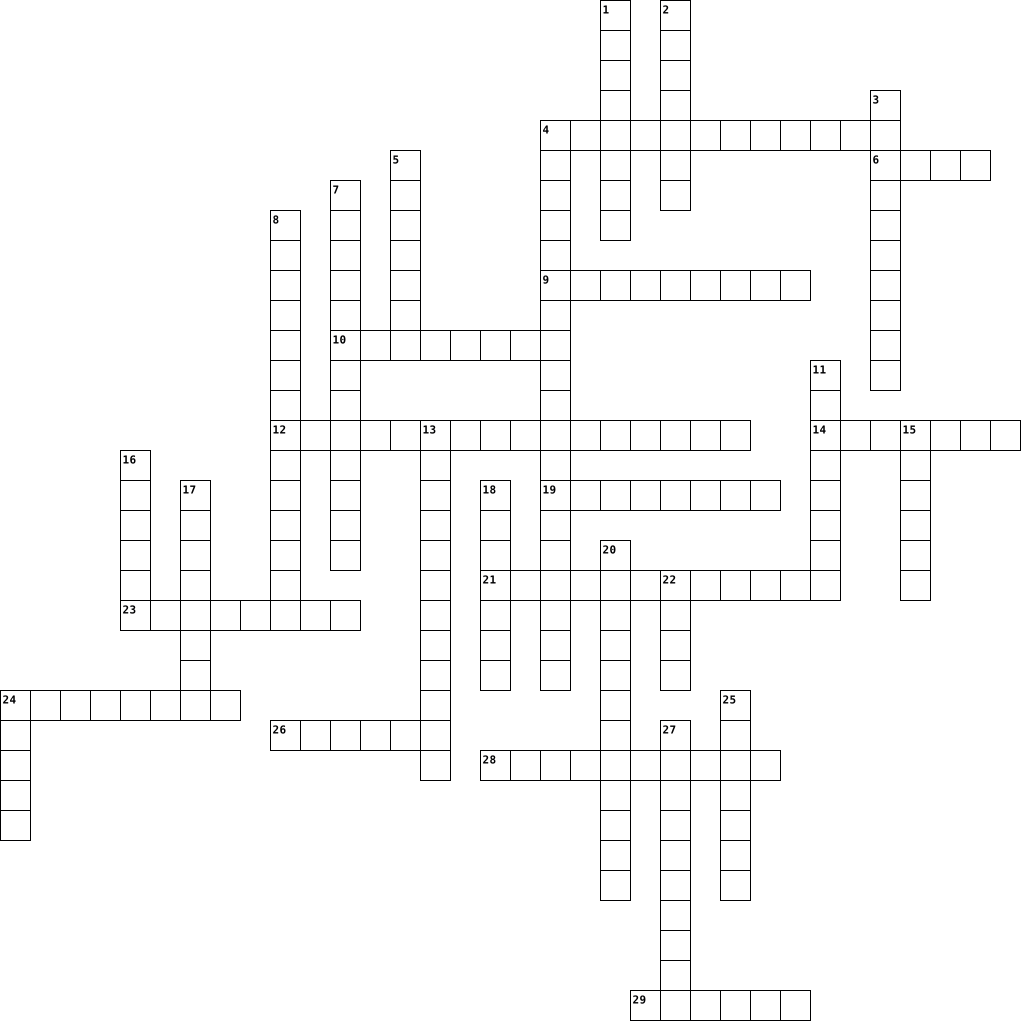
Across
- number of protons in nucleus
- smallest indivisible part of an element
- formed when a metal gives 1+ electrons to a non-metal so they both have full outer shells
- more reactive halogens........ less reactive ones
- giant ionic crystal
- simple covalent substance (CH4)
- group 7
- formed when metals become cations in a sea of electrons
- smallest mass and orbit the nucleus of an atom
- 2+ atoms covalently bonded together
- positive ion
- group 0
- columns in periodic table
Down
- elements that exist as 2 atoms
- burns red when in contact with air/oxygen
- metals which form coloured compounds and complex ions
- group 2
- rows in periodic table
- table with all atoms in it
- these forces are weak between covalent molecules
- 2+ atoms chemically joined together
- formed when 2+ atoms share electrons
- halogen ion
- noble gases are very ........
- poor conductor low melting point
- giant covalent structure, hardest substance known to man
- group 1
- formed by gain or loss of electrons
- good conductor, high melting point
- made up of 1 type of atom only
- total mass of protons and neutrons in an atom
31 Clues: group 2 • group 7 • group 1 • group 0 • halogen ion • positive ion • giant ionic crystal • rows in periodic table • columns in periodic table • table with all atoms in it • number of protons in nucleus • noble gases are very ........ • elements that exist as 2 atoms • made up of 1 type of atom only • simple covalent substance (CH4) • poor conductor low melting point • ...
Words about the Periodic Table 2013-12-04

Across
- It is taken from the Latin word element.
- They are located in the middle of the periodic Table.
- Most metals have what type of boiling point.
- Non-Metals _______ most of the properties of metals.
- They have usually lower densities than metals.
- It is the mass of the nucleus of an atom which includes the protons and neutrons.
- It represents the number of protons in the nucleus of that elements atom.
- Pure substance that cannot be broken down into any other substances.
- It is made of two or more substances, elements, compounds, or both.
- There are _______ metalloids in the Periodic table.
- It comes in pure form from nature.
Down
- There are currently _______ known elements.
- Non-Metals have what type of boiling point.
- It is another word for metals having good flow of electricity.
- It shows shininess.
- It means when two metals get attracted.
- It is material that can be pulled out or drawn into long wire.
- It is material that can be pounded into shapes.
- It is made of two or more elements.
- Most ________ that you find in the environment occurs as mixtures.
20 Clues: It shows shininess. • It comes in pure form from nature. • It is made of two or more elements. • It means when two metals get attracted. • It is taken from the Latin word element. • There are currently _______ known elements. • Non-Metals have what type of boiling point. • Most metals have what type of boiling point. • They have usually lower densities than metals. • ...
Module 5 Puzzle 2021-05-19

Across
- How quarks vary from traditional properties
- No two electrons in the same atom can have identical values for all four of their quantum numbers
- Corresponds to "ordinary" matter - Can be made with a particle accelerator
- Is equal to an electron in every way except mass
- Hold quarks together
- This is my name
- Predicted the existence of pi mesons
- Two or more types of the same element that have different numbers of neutrons
Down
- A particle you can't detect because it has no mass or charge
- The splitting of atoms
- A fundamental particle that isn't made up of anything else
- The merging of atoms
- The antimatter equivalent of an electron
- My teacher calls himself
- This should be called a nuclear bomb
- This force is strong and short range
- Decays into lead, used in dating
- Time required for one-half of the atomic nuclei of a radioactive sample to decay
- Periodic chart number that tells you how many protons and electrons there are
- Periodic chart number that is close to the total number of neutrons and protons in the average nucleus found around earth
- Used to measure dosages of radiation
21 Clues: This is my name • The merging of atoms • Hold quarks together • The splitting of atoms • My teacher calls himself • Decays into lead, used in dating • This should be called a nuclear bomb • This force is strong and short range • Predicted the existence of pi mesons • Used to measure dosages of radiation • The antimatter equivalent of an electron • ...
THE CELL X-word Puzzle 2021-10-25

Across
- Monomers of carbohydrates
- Releases H ions when dissolved
- Building blocks of matter
- Pure substance that can't be broken down
- Same element, different # of neutrons
- Anything that takes up space and has mass
- Center of atom
- Atom with electric charge
- uniform composition throughout
- lowers activation energy
- Has positive charge
- Negatively charged
- starting substances in a rxn
- Electrons donated and accepted b/t atoms
- substances formed in a rxn
- Biological catalyst
- Reactants that bind to an enzyme
Down
- Responsible for cell membrane
- Compound made of small amino acids
- atoms held together by covalent bonds
- Carbs, Lipids, Proteins, Nucleic acids
- single bonds in lipids
- Release OH ions when dissolved
- Composed of fatty acids and glycerol
- electrons shared between two atoms
- Neutral charge
- Formed when two elements combine
- made from repeating monomers
- store and transmit genetic info
- # of electrons needed to complete shell #2
- Vertical Column of periodic table
- unequal distribution of charges
- components remain distinct
- Horizontal rows on periodic table
- Has 4 outermost electrons
- place where substrate binds to enzyme
36 Clues: Neutral charge • Center of atom • Negatively charged • Has positive charge • Biological catalyst • single bonds in lipids • lowers activation energy • Monomers of carbohydrates • Building blocks of matter • Atom with electric charge • Has 4 outermost electrons • components remain distinct • substances formed in a rxn • made from repeating monomers • starting substances in a rxn • ...
APT Crossword Puzzle 2021-11-23

Across
- The smallest particle of an element
- Abbreviation of the name of an element
- The number of protons and neutrons
- A bond when atoms share one or more pairs of electrons
- Vertical column of elements in the periodic table
- Attraction between oppositely charged atoms
- An element that is shiny (Silver) and that conducts electricity well
- Charged particle that gains or loses electrons
- Group of atoms held together by chemical bonds
- Electrons in the outermost level of an atom
- Particle that has no charge
Down
- A bond formed by the attraction btw (+) metal ions and electrons
- Particle that has a positive charge
- An element that conducts heat and electricity poorly
- Average mass of isotopes
- The table of elements
- The number of protons in the nucleus of atoms
- Region around nucleus filled with electrons
- An interaction that holds atoms or ions together
- Substance made up of one or more of the same kind of atom chemically combined
- Horizontal row of elements (from left to right) on the periodic table
- Particle that has a negative charge
- Center of an atom filled with protons and neutrons
23 Clues: The table of elements • Average mass of isotopes • Particle that has no charge • The number of protons and neutrons • Particle that has a positive charge • The smallest particle of an element • Particle that has a negative charge • Abbreviation of the name of an element • Region around nucleus filled with electrons • Attraction between oppositely charged atoms • ...
Waves 2022-04-26

Across
- - time it takes something to happen
- - the change in direction of a wave passing from one medium to another caused by its change in speed.
- wave- wave with a repeating continuous pattern which determines its wavelength and frequency.
- wave-a wave vibrating in the direction of propagation.
- - sensation of a frequency
- - mechanical disturbance from a state of equilibrium
- the reduction of an item's density, the opposite of compression.
- wave -a wave that is not capable of transmitting its energy through a vacuum.
- speed- speed at which wave travels
- SI unit of length
Down
- - decrease in volume of any object or substance resulting from applied stress.
- -phenomenon of increased amplitude that occurs when the frequency of an applied periodic force is equal.
- International ( SI ) unit of time
- - maximum amount of displacement of a particle on the medium from its rest position.
- - the spreading of waves around polarization
- lowest part of a wave
- - electromagnetic radiation that can be detected by the human eye.
- wave-a wave vibrating at right angles to the direction of its propagation.
- -unit for expressing the ratio between two physical quantities,
- - how loud or soft a sound seems to a listener.
20 Clues: SI unit of length • lowest part of a wave • - sensation of a frequency • International ( SI ) unit of time • speed- speed at which wave travels • - time it takes something to happen • - the spreading of waves around polarization • - how loud or soft a sound seems to a listener. • - mechanical disturbance from a state of equilibrium • ...
year 10 mock MAD time 2022-07-11

Across
- used to test for sugars
- the variable that is changed in an investigation
- bonding where electrons are transferred
- the location of the pacemaker in the heart
- the term to describe the loss of water by evaporation through the stomata
- this vessel brings deoxygenated blood back into the right atrium
- the colour of strong acids in Universal indicator
- the enzyme that digests starch
- the way early scientists organised the periodic table
- the gas needed for aerobic respiration
- the colour of strong alkalis in universal indicator
- used to test for starch
Down
- bonding where electrons are shared
- this acid has this formula HCL
- this acid has this formula HNO3
- Mendeleev left these to help sort out problems in the periodic table in the early development stages
- this meaning o this state symbol (aq)
- how the particles in a gas move
- these polymers are made up of amino acids
- the mineral needed by plants to make amino acids
- the types of vessels that carry blood away form the heart
- the type of transport that needs energy and moves molecules from low to high concentrations
- reactions that give out heat energy
23 Clues: used to test for sugars • used to test for starch • this acid has this formula HCL • the enzyme that digests starch • this acid has this formula HNO3 • how the particles in a gas move • bonding where electrons are shared • reactions that give out heat energy • this meaning o this state symbol (aq) • the gas needed for aerobic respiration • ...
Midterms Vocabulary Review 2021-12-10

Across
- An electron found on the outermost energy ring of an atom
- A substance made of atoms
- A table of the chemical elements arranged in an order
- A substance composed of 2 or more elements that are chemically combined together
- A measure on how easily an element will bond with other elements to form compounds
- The large number in front of a chemical symbol in reaction equations.
- A negatively charged particle
- A particle with no charge
- A positively charged particle
Down
- Has properties of both metals and nonmetals
- Causes a substance to change into an entirely different substance
- Consisting of three parts - protons, neutrons, and electrons
- Elements in the same vertical column of the periodic table
- Atoms of 2 or more elements, which are covalently bonded together.
- The number of protons in one atom of a particular element
- The quantity of matter contained in an atom of an element
- The process by which a substance changes to produce a different substance
- One of the starting substances in a chemical reaction
- One of the substances made during a chemical reaction
- Elements in the same horizontal column of the periodic table
20 Clues: A substance made of atoms • A particle with no charge • A negatively charged particle • A positively charged particle • Has properties of both metals and nonmetals • A table of the chemical elements arranged in an order • One of the starting substances in a chemical reaction • One of the substances made during a chemical reaction • ...
1st Semester Review 2023-12-11

Across
- Changing from gas to liquid
- These elements are located on the bottom row of the Periodic Table
- One of the six signs of a chemical change
- Something that cannot be broken down any further
- These are elements that are found on the Left side of the periodic table
- Type of change that results in a new substance
- State of matter that has no definite shape but has a fixed volume
- This is the amount of matter that can fit into a given volume
- Changing from liquid to gas
Down
- One of the signs of a chemical change that releases energy
- Lemonade is an example of this type of mixture
- Changing from solid to gas
- A salad would be an example of this type of mixture
- These elements are brittle, dull, and insulators
- Most dense state of matter
- Changing from liquid to solid
- These elements are also called semiconductors. Found on the "Staircase"
- What a substance will do when it is less dense than another substance
- Type of change that is usually reversible
- State of matter that has the most kinetic energy
20 Clues: Changing from solid to gas • Most dense state of matter • Changing from gas to liquid • Changing from liquid to gas • Changing from liquid to solid • One of the six signs of a chemical change • Type of change that is usually reversible • Lemonade is an example of this type of mixture • Type of change that results in a new substance • ...
Curiosities about Iron 2019-03-24

Across
- In which table of elements is classified Iron?
- What is Iron?
- What is the color of Iron?
- What is Iron for humans, plants and animals that they need to survive?
- What make people from the Iron?
- One of the stars that contain significant amounts of Iron
- What produce the using of products that contains ions of Iron in our organism?
- What type of structure tipically has Iron?
- How is Iron in high doses?
- What kind of temperatures are needed to form Iron by exposing to moist air?
Down
- What is the latin word for Iron?
- Which food is a good and a well-known source of Iron
- What is the Atomic symbol for Iron on the Periodic Table of Elements?
- Where in the nature ions of iron are needed for the production of chlorophyll?
- For whom are crucial ions of Iron to the survival?
- What kind of problems can create Iron deficiency?
- What is the color of blood because of the presence of Iron?
- What type of metal is Iron?
- How becomes Iron after thecombination with other metals (like carbon)?
- What is the phase of Iron at room temperature?
20 Clues: What is Iron? • What is the color of Iron? • How is Iron in high doses? • What type of metal is Iron? • What make people from the Iron? • What is the latin word for Iron? • What type of structure tipically has Iron? • In which table of elements is classified Iron? • What is the phase of Iron at room temperature? • What kind of problems can create Iron deficiency? • ...
Waves 2024-11-15

Across
- A wave that has a vibration (periodically) parallel to the advance of the wave
- A wave that has a vibration perpendicular to the direction it is moving in
- Curve having periodic rotations given using a trigonometric function
- Bottom of a wave
- Form of radiation that is created when a electric and magnetic field couple
- Wave that appears on the boundary between two matierials
- A type of wave where some points in a system are fixed while others vibrate with maximum amplitude
- Waves produced by Earthquakes
- The top of a wave
Down
- Effect that increases the speed of a wave
- A vibration in matter that transfers energy through a matierial
- The maximum height of a wave from resting position
- Waves that describe the relationship between momentum and wavelength
- Effect that decreases the ideal frequency and amplitude
- Length between the two highest points of a wave next to each other
- A wave that transfers energy and momentum through wave motion
- Any repeating pattern with a constant wavelength and frequency
- Amount of wave lengths that passed per unit
- A single wave that spreads without changing shape
- The SI unit of frequency, given by one cycle per second
20 Clues: Bottom of a wave • The top of a wave • Waves produced by Earthquakes • Effect that increases the speed of a wave • Amount of wave lengths that passed per unit • A single wave that spreads without changing shape • The maximum height of a wave from resting position • Effect that decreases the ideal frequency and amplitude • ...
Algebra 2 Semester 2 Final Crossword (Seniors) 2025-04-30

Across
- half the height of the wave
- a quantity that can be multiplied with a vector or a matrix
- when 0 < b < 1 in an exponential function
- when b > 1 in an exponential function
- the inverse of an exponential function
- has base 10
- the dimensions of a matrix
- the side of an angle that denotes where the angle stops
- a rectangular array of values that can be used to organize information
- the length of a vector
- a matrix that has the same number of rows as it does columns
Down
- the acute angle formed by the x-axis and the terminal side of of an angle
- the ending point of a vector
- has base e
- measure or observe members of a sample in such a way that they are not affected by the study
- a quantity with both direction and magnitude
- the starting point of a vector
- a vector is represented by <a,b>
- a horizontal translation of a periodic function
- how long the wave takes until it repeats itself
- the part of an angle in standard position that lies along the positive x-axis
- when a function repeats itself
22 Clues: has base e • has base 10 • the length of a vector • the dimensions of a matrix • half the height of the wave • the ending point of a vector • the starting point of a vector • when a function repeats itself • a vector is represented by <a,b> • when b > 1 in an exponential function • the inverse of an exponential function • when 0 < b < 1 in an exponential function • ...
Particles 2026-01-18

Across
- The number of protons in an atom’s nucleus
- A column in the periodic table
- The arrangement of electrons in an atom
- A tiny particle that makes up all matter
- A positively charged particle in the nucleus of an atom
- A type of element that is usually shiny and conducts electricity
- A type of element that is usually dull and does not conduct electricity
- A property that describes how a substance reacts with others
Down
- The force between negatively charged electrons and the positively charged nucleus
- The central part of an atom containing protons and neutrons
- A negatively charged particle that orbits the nucleus
- A property you can observe without changing the substance
- The starting substances in a chemical reaction
- A chart listing elements in order of atomic number
- A substance made up of only one type of atom
- A row in the periodic table
- The new substance formed in a chemical reaction
- A substance made of two or more different types of atoms joined together
- A sign that a chemical reaction has taken place, e.g., colour change, gas, or temperature change
- A particle in the nucleus with no electric charge
20 Clues: A row in the periodic table • A column in the periodic table • The arrangement of electrons in an atom • A tiny particle that makes up all matter • The number of protons in an atom’s nucleus • A substance made up of only one type of atom • The starting substances in a chemical reaction • The new substance formed in a chemical reaction • ...
Year 8 Chemistry 2026-03-27

Across
- An element that is a poor conductor of heat and electricity and not shiny
- Breaks easily when force is applied
- The smallest unit of matter that still retains the properties of an element
- A property describing something that is shiny
- A pure substance made of only one type of atom
- An element with properties of both metals and non-metals
- A particle with no charge found in the nucleus
- A material that allows heat or electricity to flow through it
- A chart that organises elements by atomic number
- A vertical column in the periodic table
- The dense centre of an atom containing protons and neutrons
Down
- A positively charged particle found in the nucleus of an atom
- A negatively charged particle that moves around the nucleus
- A type of element that conducts heat and electricity well and is usually shiny
- A one- or two-letter abbreviation used to represent an element
- number The number of protons in an atom
- A material that does not allow heat or electricity to flow easily
- Able to be stretched into a wire
- Able to be hammered or bent into shape without breaking
- A horizontal row in the periodic table
20 Clues: Able to be stretched into a wire • Breaks easily when force is applied • A horizontal row in the periodic table • number The number of protons in an atom • A vertical column in the periodic table • A property describing something that is shiny • A pure substance made of only one type of atom • A particle with no charge found in the nucleus • ...
Periodic Table 2019-09-26

Across
- Horizontal row in the periodic table to called a
- Particle in nucleus that has a positive charge
- Negatively charged particle that orbits the center of an atom
- Ease and speed with which one element combines with another
- Very center of an atom
Down
- Way light interacts with the surface of a crystal, rock, or mineral.
- Deterioration of a metal due to a chemical reaction
- Term for the rows of the periodic table
- Particle in nucleus that has a neutral charge
- Elements that are good conductors of electricity and heat often shiny and bendable
10 Clues: Very center of an atom • Term for the rows of the periodic table • Particle in nucleus that has a neutral charge • Particle in nucleus that has a positive charge • Horizontal row in the periodic table to called a • Deterioration of a metal due to a chemical reaction • Ease and speed with which one element combines with another • ...
Periodic Table 2019-09-25

Across
- Any substance that cannot be broken down in to simpler stable substances by chemical means.
- a horizontal row of elements in the periodic table
- What is the number of protons in an atom?
- The columns on the periodic table
- Groups that have 8 electrons are said to be ____?
Down
- Found around the nucleus/ where electrons move
- The sum of the number of protons and neutrons
- How many elements occur naturally on earth?
- What is the most abundant element in earth's crust?
- What is the smallest unit of an element?
10 Clues: The columns on the periodic table • What is the smallest unit of an element? • What is the number of protons in an atom? • How many elements occur naturally on earth? • The sum of the number of protons and neutrons • Found around the nucleus/ where electrons move • Groups that have 8 electrons are said to be ____? • a horizontal row of elements in the periodic table • ...
8 - Period Table & Food and digestion v2021-02-08 2021-02-08

Across
- Vertical column on the Perodic Table
- Horizontal row on the Periodic Table
- Smallest particle that can be obtained in a chemical reaction
- A group of organs that carry out digestion.
- A way of writing out what happens in a chemical reaction.
Down
- Last group on the Periodic Table
- Substance made of two or more different types of atom bonded together
- Waste food material produced by the intestines.
- Temperature at which a liquid turns to a gas
- A substance that reacts together with another substance to form products during a chemical reaction.
10 Clues: Last group on the Periodic Table • Vertical column on the Perodic Table • Horizontal row on the Periodic Table • A group of organs that carry out digestion. • Temperature at which a liquid turns to a gas • Waste food material produced by the intestines. • A way of writing out what happens in a chemical reaction. • ...
Chemistry Crossword 2017-12-08

Across
- Has a pH of 7, not acidic or basic
- A row of elements in the periodic table
- Elements found in the first column of the periodic table
- A chemical, present during the beginning of a chemical reaction that is used up doing the reaction
- A negatively charged ion
Down
- A pure substance, formed with 2 or more non-metals
- A pure substance that cannot be broken down
- This is used to compare the acidity of solutions
- An aqueous solution that turns red litmus blue
- An aqueous solution that neutralizes a base
10 Clues: A negatively charged ion • Has a pH of 7, not acidic or basic • A row of elements in the periodic table • A pure substance that cannot be broken down • An aqueous solution that neutralizes a base • An aqueous solution that turns red litmus blue • This is used to compare the acidity of solutions • A pure substance, formed with 2 or more non-metals • ...
Paris Presnell Chapter 9 Mr.Burkholder 2018-09-11

Across
- what charge does a neutron give off
- what element is number 16 on the periodic table
- located in the outer most shell of an atom
- what charge does a proton give off
Down
- an atom or molecule with a net electric charge due to the loss or gain of an electron
- Which element has 1 electron, 1 proton, and 0 neutrons
- The number of protons
- what charge does an electron give off
- The number of protons and neutrons added together
- which element is number 29 on the periodic table
10 Clues: The number of protons • what charge does a proton give off • what charge does a neutron give off • what charge does an electron give off • located in the outer most shell of an atom • what element is number 16 on the periodic table • which element is number 29 on the periodic table • The number of protons and neutrons added together • ...
Crossword 2023-08-25

Across
- group eight elements are called ......... gases.
- the electrons move in different ............... around the nucleus.
- the first group in the periodic table is also known as .......... metals.
- carbon also forms a giant structure for a very soft material .............
- the forces between the molecules are called .............. forces.
- the electrons in the electronic structure are held in place by ................. forces.
Down
- giant covalent structures are called ............
- the ionic compound sodium chloride makes a giant structure known as ........
- group 7 in the periodic table is also known as ..........
- compounds made from ions form ......... lattices.
10 Clues: group eight elements are called ......... gases. • giant covalent structures are called ............ • compounds made from ions form ......... lattices. • group 7 in the periodic table is also known as .......... • the forces between the molecules are called .............. forces. • the electrons move in different ............... around the nucleus. • ...
Crossword 2023-08-25

Across
- giant covalent structures are called.........
- compounds made from ions from ......... lattices.
- the ionic compound sodium chloride makes a giant structure known as......
- the electrons move in different ............ around the nucleus.
- group 7 elements in the periodic table is also known as .........
Down
- the electrons in the electronic structure are held in place by ........... forces.
- the forces between the molecules are called........
- the first group in the periodic table is also known as .......... metals.
- group eight elements are called ........ gases.
- carbon also forms a giant structure for a very soft material........
10 Clues: giant covalent structures are called......... • group eight elements are called ........ gases. • compounds made from ions from ......... lattices. • the forces between the molecules are called........ • the electrons move in different ............ around the nucleus. • group 7 elements in the periodic table is also known as ......... • ...
PERIODICTY 2023-10-30

Across
- how strongly an atom attracts an electron to its own nucleus
- amount of energy required to remove, AKA take, an electron from an atom
- as the # of protons increase the positive nuclear charge increases
- Mendeleev organized the first periodic table by
- Hybrid chemical and physical properties; semi-conductors
Down
- as the # of energy levels increase, it reduces the proton pull effect
- Pictoral description of the electrons in an atom
- the radius of an atom
- a set of numbers that describe the location of an electron
- Mosley organized the modern periodic table by
10 Clues: the radius of an atom • Mosley organized the modern periodic table by • Mendeleev organized the first periodic table by • Pictoral description of the electrons in an atom • Hybrid chemical and physical properties; semi-conductors • a set of numbers that describe the location of an electron • how strongly an atom attracts an electron to its own nucleus • ...
Chemical Reactions Vocabulary 2025-10-19

Across
- means staying the same
- a change that creates a new substance
- the substances created after a reaction occurs
- the type of a substance, shown on the Periodic Table
- the substances mixed before a reaction occurs
Down
- a type of chemical reaction that creates heat
- a change that does not change the type of matter, but does change its appearance
- the name for the letter(s) that represent an element on the Periodic Table
- a type of chemical reaction that feels cool
- chemical equations use this symbol instead of an equal sign
10 Clues: means staying the same • a change that creates a new substance • a type of chemical reaction that feels cool • a type of chemical reaction that creates heat • the substances mixed before a reaction occurs • the substances created after a reaction occurs • the type of a substance, shown on the Periodic Table • chemical equations use this symbol instead of an equal sign • ...
Properties of Matter 2025-01-14

Across
- The center of an atom containing protons and neutrons.
- Characteristics used to identify elements.
- How readily an element combines with other substances.
- The smallest unit of matter, consisting of protons, neutrons, and electrons.
- A one- or two-letter abbreviation for an element.
Down
- The ability of a material to transfer heat or electricity.
- A pure substance that consists of only one type of atom.
- Vertical columns on the periodic table that share similar properties.
- Horizontal rows on the periodic table showing repeating patterns.
- Negatively charged particle found in energy levels around the nucleus.
10 Clues: Characteristics used to identify elements. • A one- or two-letter abbreviation for an element. • The center of an atom containing protons and neutrons. • How readily an element combines with other substances. • A pure substance that consists of only one type of atom. • The ability of a material to transfer heat or electricity. • ...
periodic table 2020-12-17

Across
- it,s use on balloons to float
- Number 6 in the periodic table
- his symbol its Fi
- we use this element to make food tasty
Down
- we use this at home to paste objects
- Number 4 in the periodic table
- it glows
7 Clues: it glows • his symbol its Fi • it,s use on balloons to float • Number 6 in the periodic table • Number 4 in the periodic table • we use this at home to paste objects • we use this element to make food tasty
Chemistry of Matter 2022-10-13

Across
- The number of GROUPS in the Periodic Table
- The smallest most basic unit of matter
- A change in matter that can be un-done
- A change in matter that cant be un-done
- Atoms are different from one another because of the number of these
Down
- Most elements in the Periodic Table are solids and these
- Anything that has mass and volume
- The number of protons is equal to the number of these
- A group of atoms bonded together
9 Clues: A group of atoms bonded together • Anything that has mass and volume • The smallest most basic unit of matter • A change in matter that can be un-done • A change in matter that cant be un-done • The number of GROUPS in the Periodic Table • The number of protons is equal to the number of these • Most elements in the Periodic Table are solids and these • ...
julia vance week 6 vocab 2023-09-26

Across
- a substance that cannot be separated or broke down
- the smallest unit of an element that maintains the pro
- number the number of protons in the nucleus of an atom
- in chemistry, a column in the periodic table
Down
- is a horizontal row of the periodic table
- in nuclear physics, the sum of the numbers
- a subatomic particle that has no charge
- a subatomic particle that has a negative charge
- a subatomic particle that has a positive charge
9 Clues: a subatomic particle that has no charge • is a horizontal row of the periodic table • in nuclear physics, the sum of the numbers • in chemistry, a column in the periodic table • a subatomic particle that has a negative charge • a subatomic particle that has a positive charge • a substance that cannot be separated or broke down • ...
Science Crossword Puzzle 2023-08-31

Across
- The ability of a material to conduct electricity of heat
- Elements with similar properties found on the left side of the staircase
- Formula A notation used by scientists to show the number of atoms in a molecule
Down
- Symbol One or two letters abbreviation from the element’s name
- The tendency of a substance to undergo chemical changes
- table A reference for associating the name and symbol of an element
- Elements with similar properties found on the right side of the staircase on the periodic table
- Elements with similar properties that create a staircase on the periodic table
8 Clues: The tendency of a substance to undergo chemical changes • The ability of a material to conduct electricity of heat • Symbol One or two letters abbreviation from the element’s name • table A reference for associating the name and symbol of an element • Elements with similar properties found on the left side of the staircase • ...
Elements 2023-02-24

Across
- Breathe in Breathe out
- Orbits Atom
- Makes everything
- Aftermath
- Number at bottom of symbol
- What Happens before
- Center of an Atom
- Connection of Elements
Down
- H2O
- Holds Atoms Together
- Also In a Atom
- Elements Combined
- Title for elements
- Everything
- Half of what makes an Atom
- First element on the periodic table
16 Clues: H2O • Aftermath • Everything • Orbits Atom • Also In a Atom • Makes everything • Elements Combined • Center of an Atom • Title for elements • What Happens before • Holds Atoms Together • Breathe in Breathe out • Connection of Elements • Number at bottom of symbol • Half of what makes an Atom • First element on the periodic table
tonya 2019-10-21

Across
- cloudy
- what you add
- the smallest particle
- different
- five senses
- mass of an atom
- what you start with
- change during a reactions
Down
- includes flammability
- final product full of substance
- discovered the periodic table
- of the same kind
- a mixture
- a substance
- two or more elements combined
- a part of an aspect
16 Clues: cloudy • a mixture • different • a substance • five senses • what you add • mass of an atom • of the same kind • a part of an aspect • what you start with • includes flammability • the smallest particle • change during a reactions • discovered the periodic table • two or more elements combined • final product full of substance
Elements 2023-02-24

Across
- Breathe in Breathe out
- Orbits Atom
- Makes everything
- Aftermath
- Number at bottom of symbol
- What Happens before
- Center of an Atom
- Connection of Elements
Down
- H2O
- Holds Atoms Together
- Also In a Atom
- Elements Combined
- Title for elements
- Everything
- Half of what makes an Atom
- First element on the periodic table
16 Clues: H2O • Aftermath • Everything • Orbits Atom • Also In a Atom • Makes everything • Elements Combined • Center of an Atom • Title for elements • What Happens before • Holds Atoms Together • Breathe in Breathe out • Connection of Elements • Number at bottom of symbol • Half of what makes an Atom • First element on the periodic table
General Chemistry 2020-05-25
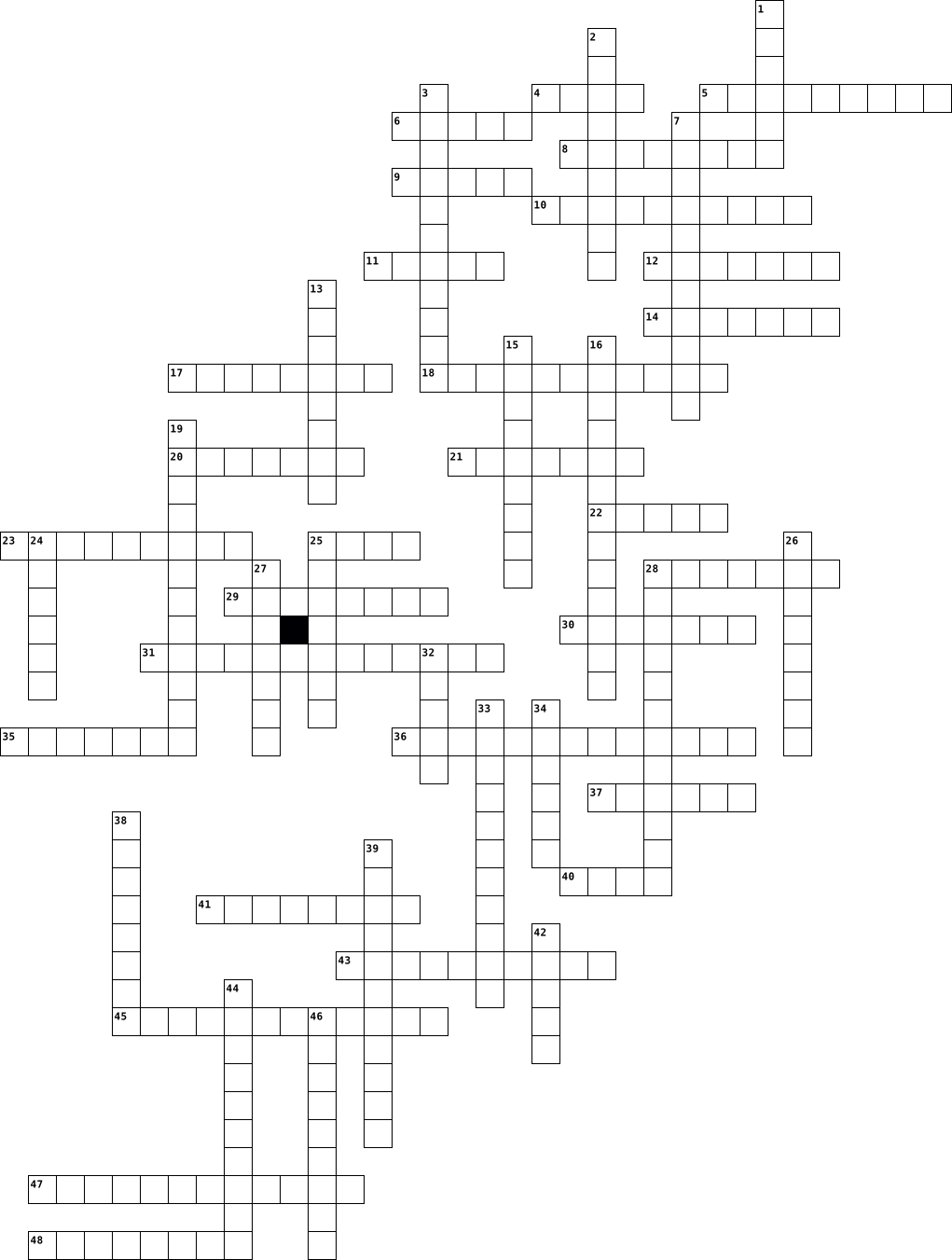
Across
- Formed when atom loses or gains electron
- Phase change in which liquid is converted to solid
- gas: insert gas located at the rightmost side of the periodic table
- Ratio of the mass of an object to the volume occupied by that object.
- compound: Compound that consists of two charged ions
- chemistry: it is a branch of chemistry that studies and uses instruments and methods used to separate: identify: and quantify matter.
- bond: Formed by losing and gaining of electrons between metal and nonmetal
- Anything that has mass and occupies space
- a substance that flows freely but is of constant volume: having a consistency like that of water or oil.
- separation: The separation of elemental metals from the mixtures
- figures: The digits in any measurement that are known with certainty plus one digit which is uncertain
- The amount of space occupied by a substance
- the measurement or extent of something from end to end
- The quantity of matter in the body
- Negatively:charged subatomic particle of an atom
- number: The sum of the number of protons and neutrons in its nucleus
- a period of time equal to sixty seconds or a sixtieth of an hour.
- Phase change that involves the conversion from solid to liquid
- chemistry: it is a branch of chemistry that studies the structure: properties and reactions of organic compounds: which contain carbon in covalent bonding. Study of structure determines their chemical composition and formula.
- Separates components of mixture at different boiling points.
- Positively:charged subatomic particle of an atom
- mixture: Mixture whose a composition varies from position to position within a sample.
- level: Specific energy value of electrons for an atom
- a substance or matter in a state in which it will expand freely to fill the whole of a container: having no fixed shape and no fixed volume.
- Group 7A elements
- movement of one fluid through another.
- inner transition elements located in the first row of the f:block in the periodic table
- Organic compound with carbon and oxygen only
- Substance consisting of only one kind of atom
Down
- the fundamental unit of length in the metric system: equal to 100 centimeters or approximately 39.37 inches.
- Element that appears at the far right side of the periodic table
- mixture: Called as solution: a mixture with uniform composition.
- Process in which the solid particles are filtered to allow the liquid or filtrate to pass through the filter: and be collected as residue
- Composed of two or more substances: combined physically in variable proportions
- physical property: physical property that does not depend on the size or amount of the sample
- it is a branch of chemistry that studies the chemical processes within and relating to living organisms. Biochemical processes give rise to the complexity of life.
- phase change in which liquid is converted to gas
- a metric unit of capacity: formerly defined as the volume of one kilogram of water under standard conditions: now equal to 1:000 cubic centimeters
- Elements at the left side and in the center of the periodic table
- Uncharged particle found within the atomic nuclei
- Horizontal row in the periodic table
- the size: length: or amount of something: as established by measuring.
- rule: states that atoms other than hydrogen tend to form bonds until surrounded by eight valence electrons
- Elements found in the zigzag order in the periodic table
- a substance or object that is solid rather than liquid or fluid
- chemistry: the branch of chemistry concerned with the application of the techniques and theories of physics to the study of chemical systems.
- a metric unit of length: equal to one hundredth of a meter.
- mass: Indicates that one mole of an element has a mass in grams numerically equal to its atomic mass units
- the branch of science that deals with the identification of the substances of which matter is composed; the investigation of their properties and the ways in which they interact: combine: and change; and the use of these processes to form new substances.
- Chemistry: it is a branch of chemistry that deals with synthesis and behavior of inorganic and organometallic compounds.
50 Clues: Group 7A elements • The quantity of matter in the body • Horizontal row in the periodic table • movement of one fluid through another. • Formed when atom loses or gains electron • Anything that has mass and occupies space • The amount of space occupied by a substance • Organic compound with carbon and oxygen only • Substance consisting of only one kind of atom • ...
General Chemistry 2020-05-25
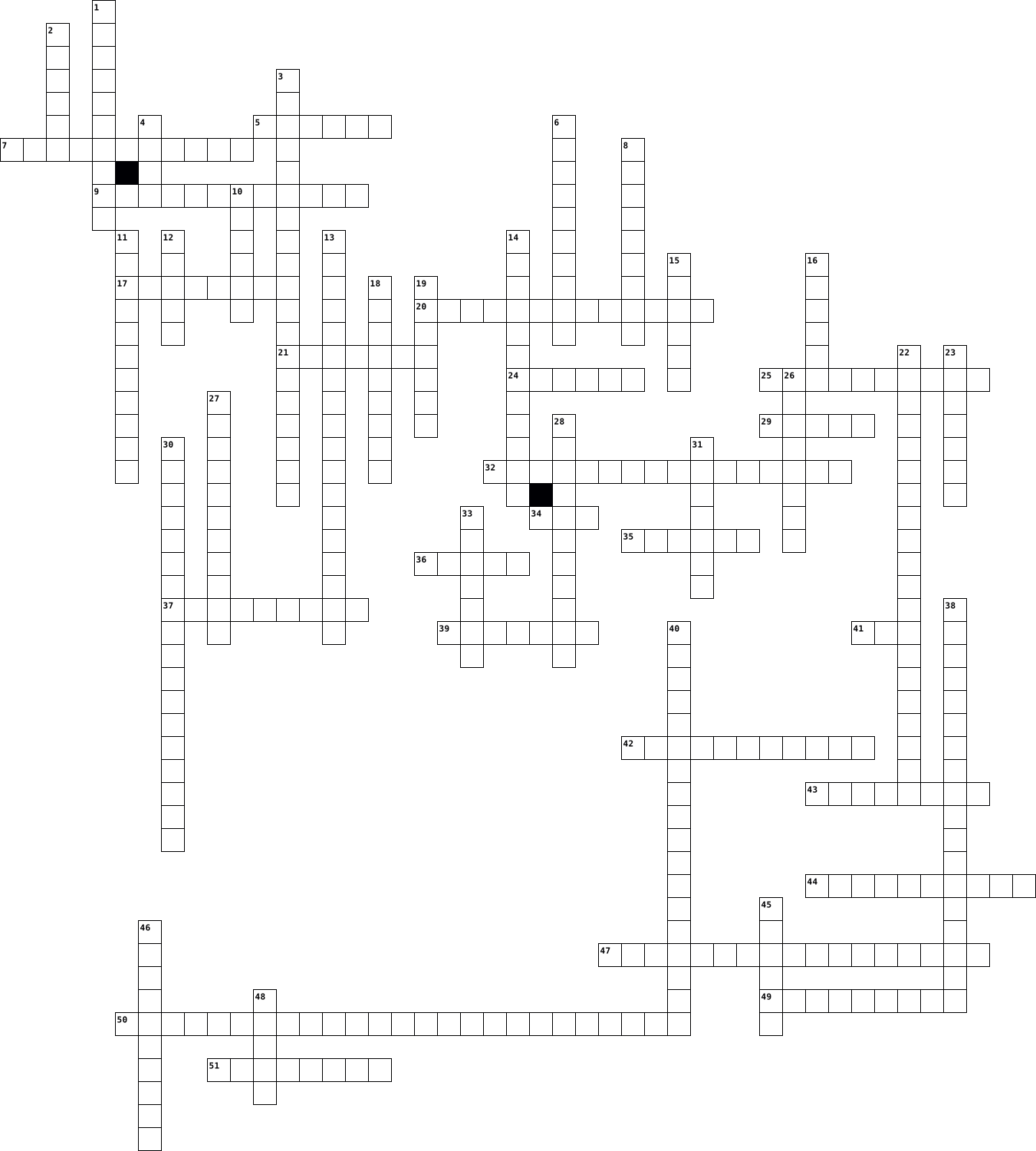
Across
- Anything that has mass and occupies space
- Organic compound with carbon and oxygen only
- Separates components of mixture at different boiling points.
- Element that appears at the far right side of the periodic table
- Compound that consists of two charged ions
- Substance consisting of only one kind of atom
- Elements at the left side and in the center of the periodic table
- a metric unit of length equal to one hundredth of a meter.
- the fundamental unit of length in the metric system equal to 100 centimeters or approximately 39.37 inches.
- it is a branch of chemistry that studies the structure properties and reactions of organic compounds which contain carbon in covalent bonding. Study of structure determines their chemical composition and formula.
- Formed when atom loses or gains electron
- Horizontal row in the periodic table
- a substance or object that is solid rather than liquid or fluid
- the branch of science that deals with the identification of the substances of which matter is composed; the investigation of their properties and the ways in which they interact combine and change; and the use of these processes to form new substances.
- Uncharged particle found within the atomic nuclei
- a substance or matter in a state in which it will expand freely to fill the whole of a container having no fixed shape and no fixed volume.
- the size length or amount of something as established by measuring.
- insert gas located at the rightmost side of the periodic table
- the quality, condition, or fact of being exact and accurate.
- the branch of chemistry concerned with the application of the techniques and theories of physics to the study of chemical systems.
- Indicates that one mole of an element has a mass in grams numerically equal to its atomic mass units
- physical property that does not depend on the size or amount of the sample
- Phase change in which liquid is converted to solid
Down
- Elements found in the zigzag order in the periodic table
- a substance that flows freely but is of constant volume having a consistency like that of water or oil.
- it is a branch of chemistry that studies and uses instruments and methods used to separate identify and quantify matter.
- The quantity of matter in the body
- Process in which the solid particles are filtered to allow the liquid or filtrate to pass through the filter and be collected as residue
- movement of one fluid through another.
- the measurement or extent of something from end to end.
- inner transition elements located in the first row of the f block in the periodic table
- bond Formed by losing and gaining of electrons between metal and nonmetal
- Called as solution a mixture with uniform composition.
- it is a branch of chemistry that studies the chemical processes within and relating to living organisms. Biochemical processes give rise to the complexity of life.
- a period of time equal to sixty seconds or a sixtieth of an hour.
- Positively charged subatomic particle of an atom
- states that atoms other than hydrogen tend to form bonds until surrounded by eight valence electrons
- Composed of two or more substances combined physically in variable proportions
- Mixture whose a composition varies from position to position within a sample.
- Phase change that involves the conversion from solid to liquid
- Negatively charged subatomic particle of an atom
- Specific energy value of electrons for an atom
- phase change in which liquid is converted to gas
- The separation of elemental metals from the mixtures
- Ratio of the mass of an object to the volume occupied by that object.
- Group 7A elements
- The digits in any measurement that are known with certainty plus one digit which is uncertain
- it is a branch of chemistry that deals with synthesis and behavior of inorganic and organometallic compounds.
- The amount of space occupied by a substance
- The sum of the number of protons and neutrons in its nucleus
- a metric unit of capacity formerly defined as the volume of one kilogram of water under standard conditions now equal to 1 000 cubic centimeters
51 Clues: Group 7A elements • The quantity of matter in the body • Horizontal row in the periodic table • movement of one fluid through another. • Formed when atom loses or gains electron • Anything that has mass and occupies space • Compound that consists of two charged ions • The amount of space occupied by a substance • Organic compound with carbon and oxygen only • ...
General Chemistry 2020-05-25
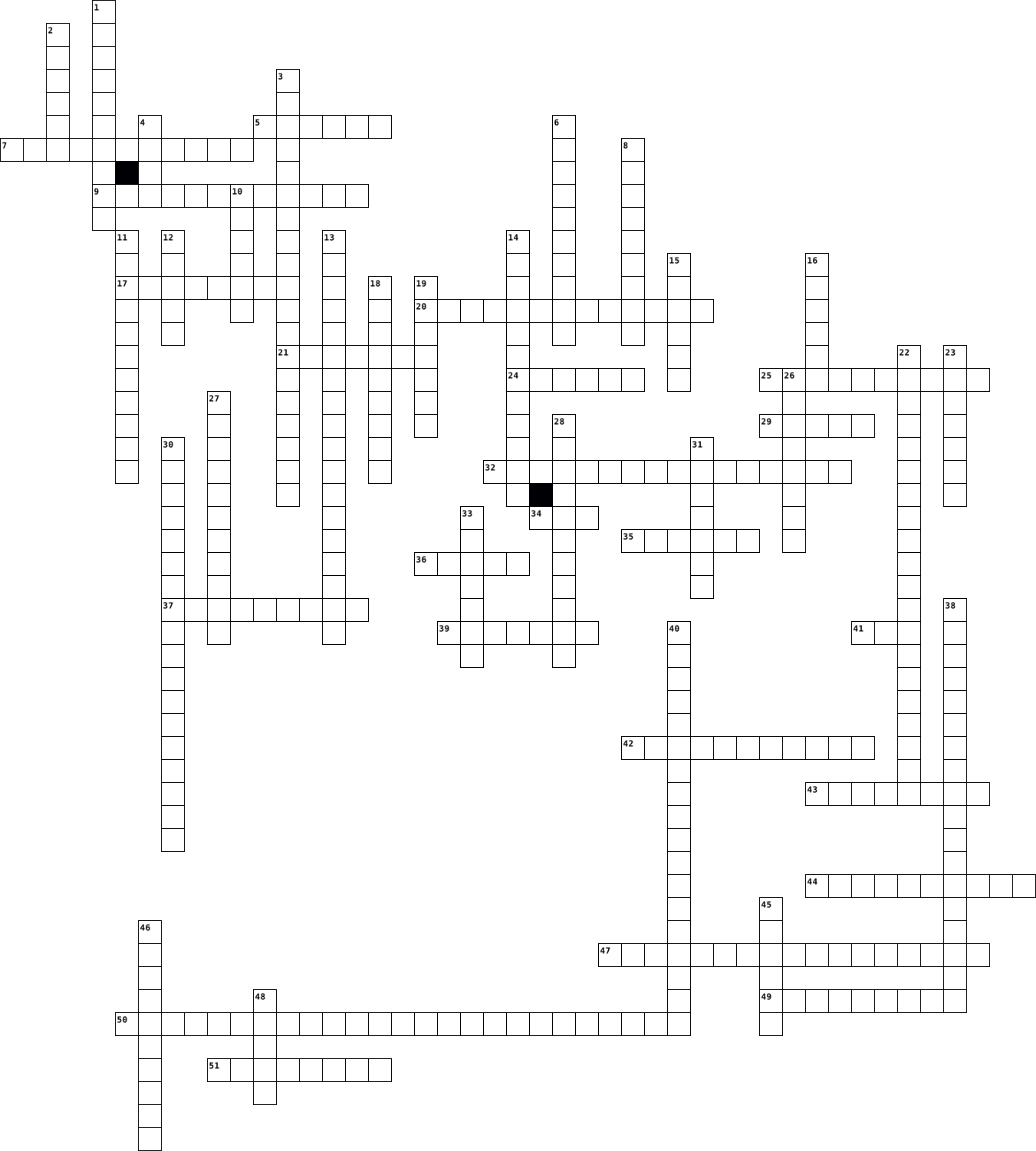
Across
- Anything that has mass and occupies space
- Organic compound with carbon and oxygen only
- Separates components of mixture at different boiling points.
- Element that appears at the far right side of the periodic table
- Compound that consists of two charged ions
- Substance consisting of only one kind of atom
- Elements at the left side and in the center of the periodic table
- a metric unit of length equal to one hundredth of a meter.
- the fundamental unit of length in the metric system equal to 100 centimeters or approximately 39.37 inches.
- it is a branch of chemistry that studies the structure properties and reactions of organic compounds which contain carbon in covalent bonding. Study of structure determines their chemical composition and formula.
- Formed when atom loses or gains electron
- Horizontal row in the periodic table
- a substance or object that is solid rather than liquid or fluid
- the branch of science that deals with the identification of the substances of which matter is composed; the investigation of their properties and the ways in which they interact combine and change; and the use of these processes to form new substances.
- Uncharged particle found within the atomic nuclei
- a substance or matter in a state in which it will expand freely to fill the whole of a container having no fixed shape and no fixed volume.
- the size length or amount of something as established by measuring.
- insert gas located at the rightmost side of the periodic table
- the quality, condition, or fact of being exact and accurate.
- the branch of chemistry concerned with the application of the techniques and theories of physics to the study of chemical systems.
- Indicates that one mole of an element has a mass in grams numerically equal to its atomic mass units
- physical property that does not depend on the size or amount of the sample
- Phase change in which liquid is converted to solid
Down
- Elements found in the zigzag order in the periodic table
- a substance that flows freely but is of constant volume having a consistency like that of water or oil.
- it is a branch of chemistry that studies and uses instruments and methods used to separate identify and quantify matter.
- The quantity of matter in the body
- Process in which the solid particles are filtered to allow the liquid or filtrate to pass through the filter and be collected as residue
- movement of one fluid through another.
- the measurement or extent of something from end to end.
- inner transition elements located in the first row of the f block in the periodic table
- bond Formed by losing and gaining of electrons between metal and nonmetal
- Called as solution a mixture with uniform composition.
- it is a branch of chemistry that studies the chemical processes within and relating to living organisms. Biochemical processes give rise to the complexity of life.
- a period of time equal to sixty seconds or a sixtieth of an hour.
- Positively charged subatomic particle of an atom
- states that atoms other than hydrogen tend to form bonds until surrounded by eight valence electrons
- Composed of two or more substances combined physically in variable proportions
- Mixture whose a composition varies from position to position within a sample.
- Phase change that involves the conversion from solid to liquid
- Negatively charged subatomic particle of an atom
- Specific energy value of electrons for an atom
- phase change in which liquid is converted to gas
- The separation of elemental metals from the mixtures
- Ratio of the mass of an object to the volume occupied by that object.
- Group 7A elements
- The digits in any measurement that are known with certainty plus one digit which is uncertain
- it is a branch of chemistry that deals with synthesis and behavior of inorganic and organometallic compounds.
- The amount of space occupied by a substance
- The sum of the number of protons and neutrons in its nucleus
- a metric unit of capacity formerly defined as the volume of one kilogram of water under standard conditions now equal to 1 000 cubic centimeters
51 Clues: Group 7A elements • The quantity of matter in the body • Horizontal row in the periodic table • movement of one fluid through another. • Formed when atom loses or gains electron • Anything that has mass and occupies space • Compound that consists of two charged ions • The amount of space occupied by a substance • Organic compound with carbon and oxygen only • ...
General Chemistry 2020-05-25
Across
- it is a branch of chemistry that studies and uses instruments and methods used to separate identify and quantify matter.
- states that atoms other than hydrogen tend to form bonds until surrounded by eight valence electrons
- movement of one fluid through another.
- The digits in any measurement that are known with certainty plus one digit which is uncertain
- the branch of science that deals with the identification of the substances of which matter is composed.
- Elements at the left side and in the center of the periodic table
- bond Formed by losing and gaining of electrons between metal and nonmetal
- Negatively charged subatomic particle of an atom
- Positively charged subatomic particle of an atom
- it is a branch of chemistry that studies the structure properties and reactions of organic compounds which contain carbon in covalent bonding. Study of structure determines their chemical composition and formula.
- Uncharged particle found within the atomic nuclei
- a substance or object that is solid rather than liquid or fluid
- the quality or state of being correct or precise.
- Mixture whose a composition varies from position to position within a sample.
- The quantity of matter in the body
- Indicates that one mole of an element has a mass in grams numerically equal to its atomic mass units
- inner transition elements located in the first row of the f block in the periodic table
- the quality, condition, or fact of being exact and accurate.
- a substance that flows freely but is of constant volume having a consistency like that of water or oil.
- a metric unit of length equal to one hundredth of a meter.
- Called as solution a mixture with uniform composition.
Down
- Element that appears at the far right side of the periodic table
- The sum of the number of protons and neutrons in its nucleus
- it is a branch of chemistry that studies the chemical processes within and relating to living organisms. Biochemical processes give rise to the complexity of life.
- Elements found in the zigzag order in the periodic table
- a substance or matter in a state in which it will expand freely to fill the whole of a container having no fixed shape and no fixed volume.
- Horizontal row in the periodic table
- Process in which the solid particles are filtered to allow the liquid or filtrate to pass through the filter and be collected as residue
- phase change in which liquid is converted to gas
- The separation of elemental metals from the mixtures
- a metric unit of capacity formerly defined as the volume of one kilogram of water under standard conditions now equal to 1 000 cubic centimeters
- Organic compound with carbon and oxygen only
- the size length or amount of something as established by measuring.
- it is a branch of chemistry that deals with synthesis and behavior of inorganic and organometallic compounds.
- the measurement or extent of something from end to end.
- the branch of chemistry concerned with the application of the techniques and theories of physics to the study of chemical systems.
- Compound that consists of two charged ions
- Ratio of the mass of an object to the volume occupied by that object.
- The amount of space occupied by a substance
- insert gas located at the rightmost side of the periodic table
- Anything that has mass and occupies space
- a chemical substance that neutralizes some elements.
- the fundamental unit of length in the metric system equal to 100 centimeters or approximately 39.37 inches.
- Substance consisting of only one kind of atom
- a period of time equal to sixty seconds or a sixtieth of an hour.
- Composed of two or more substances combined physically in variable proportions
- Group 7A elements
- Phase change that involves the conversion from solid to liquid
- Specific energy value of electrons for an atom
- Separates components of mixture at different boiling points.
- Formed when atom loses or gains electron
- Phase change in which liquid is converted to solid
52 Clues: Group 7A elements • The quantity of matter in the body • Horizontal row in the periodic table • movement of one fluid through another. • Formed when atom loses or gains electron • Anything that has mass and occupies space • Compound that consists of two charged ions • The amount of space occupied by a substance • Organic compound with carbon and oxygen only • ...
General Chemistry 2020-05-25
Across
- it is a branch of chemistry that studies and uses instruments and methods used to separate identify and quantify matter.
- it is a branch of chemistry that studies the chemical processes within and relating to living organisms. Biochemical processes give rise to the complexity of life.
- it is a branch of chemistry that studies the structure properties and reactions of organic compounds which contain carbon in covalent bonding. Study of structure determines their chemical composition and formula.
- Horizontal row in the periodic table
- Separates components of mixture at different boiling points.
- the quality or state of being correct or precise.
- The sum of the number of protons and neutrons in its nucleus
- a substance that flows freely but is of constant volume having a consistency like that of water or oil.
- Elements at the left side and in the center of the periodic table
- a metric unit of length equal to one hundredth of a meter.
- the measurement or extent of something from end to end.
- Called as solution a mixture with uniform composition.
- movement of one fluid through another.
- Formed by losing and gaining of electrons between metal and nonmetal
- Anything that has mass and occupies space
- insert gas located at the rightmost side of the periodic table
- Ratio of the mass of an object to the volume occupied by that object.
- the fundamental unit of length in the metric system equal to 100 centimeters or approximately 39.37 inches.
- inner transition elements located in the first row of the f block in the periodic table
- Mixture whose a composition varies from position to position within a sample.
- the branch of science that deals with the identification of the substances of which matter is composed.
- a metric unit of capacity formerly defined as the volume of one kilogram of water under standard conditions now equal to 1 000 cubic centimeters
- Indicates that one mole of an element has a mass in grams numerically equal to its atomic mass units
- the branch of chemistry concerned with the application of the techniques and theories of physics to the study of chemical systems.
- a result without the expected content
- a period of time equal to sixty seconds or a sixtieth of an hour.
- Formed when atom loses or gains electron
- Substance consisting of only one kind of atom
Down
- Composed of two or more substances combined physically in variable proportions
- The separation of elemental metals from the mixtures
- Elements found in the zigzag order in the periodic table
- Uncharged particle found within the atomic nuclei
- states that atoms other than hydrogen tend to form bonds until surrounded by eight valence electrons
- a substance or matter in a state in which it will expand freely to fill the whole of a container having no fixed shape and no fixed volume.
- Process in which the solid particles are filtered to allow the liquid or filtrate to pass through the filter and be collected as residue
- The digits in any measurement that are known with certainty plus one digit which is uncertain
- The quantity of matter in the body
- Compound that consists of two charged ions
- Negatively charged subatomic particle of an atom
- Phase change in which liquid is converted to solid
- Organic compound with carbon and oxygen only
- it is a branch of chemistry that deals with synthesis and behavior of inorganic and organometallic compounds.
- Positively charged subatomic particle of an atom
- Group 7A elements
- The amount of space occupied by a substance
- the quality, condition, or fact of being exact and accurate.
- Specific energy value of electrons for an atom
- the size length or amount of something as established by measuring.
- phase change in which liquid is converted to gas
- a substance or object that is solid rather than liquid or fluid
- Phase change that involves the conversion from solid to liquid
- Element that appears at the far right side of the periodic table
52 Clues: Group 7A elements • The quantity of matter in the body • Horizontal row in the periodic table • a result without the expected content • movement of one fluid through another. • Formed when atom loses or gains electron • Anything that has mass and occupies space • Compound that consists of two charged ions • The amount of space occupied by a substance • ...
General Chemistry 2020-05-25
Across
- a substance or matter in a state in which it will expand freely to fill the whole of a container having no fixed shape and no fixed volume.
- the quality, condition, or fact of being exact and accurate.
- states that atoms other than hydrogen tend to form bonds until surrounded by eight valence electrons
- the measurement or extent of something from end to end.
- it is a branch of chemistry that deals with synthesis and behavior of inorganic and organometallic compounds.
- a substance or object that is solid rather than liquid or fluid
- Element that appears at the far right side of the periodic table
- Organic compound with carbon and oxygen only
- the quality or state of being correct or precise.
- Horizontal row in the periodic table
- it is a branch of chemistry that studies and uses instruments and methods used to separate identify and quantify matter.
- a substance that flows freely but is of constant volume having a consistency like that of water or oil.
- a metric unit of length equal to one hundredth of a meter.
- movement of one fluid through another.
- Composed of two or more substances combined physically in variable proportions
- Indicates that one mole of an element has a mass in grams numerically equal to its atomic mass units
- Elements found in the zigzag order in the periodic table
- Mixture whose a composition varies from position to position within a sample.
- Anything that has mass and occupies space
- Called as solution a mixture with uniform composition.
- Ratio of the mass of an object to the volume occupied by that object.
- Elements at the left side and in the center of the periodic table
- Phase change in which liquid is converted to solid
Down
- it is a branch of chemistry that studies the structure properties and reactions of organic compounds which contain carbon in covalent bonding. Study of structure determines their chemical composition and formula.
- Process in which the solid particles are filtered to allow the liquid or filtrate to pass through the filter and be collected as residue
- Group 7A elements
- The separation of elemental metals from the mixtures
- Separates components of mixture at different boiling points.
- a result without the expected content
- The amount of space occupied by a substance
- Negatively charged subatomic particle of an atom
- it is a branch of chemistry that studies the chemical processes within and relating to living organisms. Biochemical processes give rise to the complexity of life.
- phase change in which liquid is converted to gas
- Positively charged subatomic particle of an atom
- inner transition elements located in the first row of the f block in the periodic table
- the branch of chemistry concerned with the application of the techniques and theories of physics to the study of chemical systems.
- the fundamental unit of length in the metric system equal to 100 centimeters or approximately 39.37 inches.
- The digits in any measurement that are known with certainty plus one digit which is uncertain
- Formed when atom loses or gains electron
- Formed by losing and gaining of electrons between metal and nonmetal
- a metric unit of capacity formerly defined as the volume of one kilogram of water under standard conditions now equal to 1 000 cubic centimeters
- insert gas located at the rightmost side of the periodic table
- the branch of science that deals with the identification of the substances of which matter is composed.
- The sum of the number of protons and neutrons in its nucleus
- a period of time equal to sixty seconds or a sixtieth of an hour.
- The quantity of matter in the body
- Substance consisting of only one kind of atom
- Phase change that involves the conversion from solid to liquid
- Compound that consists of two charged ions
- Uncharged particle found within the atomic nuclei
- Specific energy value of electrons for an atom
51 Clues: Group 7A elements • The quantity of matter in the body • Horizontal row in the periodic table • a result without the expected content • movement of one fluid through another. • Formed when atom loses or gains electron • Anything that has mass and occupies space • Compound that consists of two charged ions • The amount of space occupied by a substance • ...
General Chemistry 2020-05-25

Across
- number The sum of the number of protons and neutrons in its nucleus
- phase change in which liquid is converted to gas
- Organic compound with carbon and oxygen only
- separation The separation of elemental metals from the mixtures
- Process in which the solid particles are filtered to allow the liquid or filtrate to pass through the filter and be collected as residue
- a substance or object that is solid rather than liquid or fluid
- Horizontal row in the periodic table
- mixture Mixture whose a composition varies from position to position within a sample.
- The quantity of matter in the body
- Negatively charged subatomic particle of an atom
- level Specific energy value of electrons for an atom
- chemistry it is a branch of chemistry that studies and uses instruments and methods used to separate identify and quantify matter.
- Elements at the left side and in the center of the periodic table
- a substance or matter in a state in which it will expand freely to fill the whole of a container having no fixed shape and no fixed volume.
- Formed when atom loses or gains electron
- the size length or amount of something as established by measuring.
- a metric unit of capacity formerly defined as the volume of one kilogram of water under standard conditions now equal to 1 000 cubic centimeters
- figures The digits in any measurement that are known with certainty plus one digit which is uncertain
- inner transition elements located in the first row of the f block in the periodic table
- bond Formed by losing and gaining of electrons between metal and nonmetal
- Chemistry it is a branch of chemistry that deals with synthesis and behavior of inorganic and organometallic compounds.
- it is a branch of chemistry that studies the chemical processes within and relating to living organisms. Biochemical processes give rise to the complexity of life.
Down
- Separates components of mixture at different boiling points.
- Composed of two or more substances combined physically in variable proportions
- Phase change that involves the conversion from solid to liquid
- Positively charged subatomic particle of an atom
- Element that appears at the far right side of the periodic table
- the branch of science that deals with the identification of the substances of which matter is composed; the investigation of their properties and the ways in which they interact combine and change; and the use of these processes to form new substances.
- Ratio of the mass of an object to the volume occupied by that object.
- a metric unit of length equal to one hundredth of a meter.
- mixture Called as solution a mixture with uniform composition.
- The amount of space occupied by a substance
- Group 7A elements
- Phase change in which liquid is converted to solid
- chemistry the branch of chemistry concerned with the application of the techniques and theories of physics to the study of chemical systems.
- chemistry it is a branch of chemistry that studies the structure properties and reactions of organic compounds which contain carbon in covalent bonding. Study of structure determines their chemical composition and formula.
- the fundamental unit of length in the metric system equal to 100 centimeters or approximately 39.37 inches.
- Substance consisting of only one kind of atom
- Anything that has mass and occupies space
- gas insert gas located at the rightmost side of the periodic table
- the measurement or extent of something from end to end.
- a substance that flows freely but is of constant volume having a consistency like that of water or oil.
- physical property physical property that does not depend on the size or amount of the sample
- mass Indicates that one mole of an element has a mass in grams numerically equal to its atomic mass units
- rule states that atoms other than hydrogen tend to form bonds until surrounded by eight valence electrons
- a period of time equal to sixty seconds or a sixtieth of an hour.
- Elements found in the zigzag order in the periodic table
- movement of one fluid through another.
- Uncharged particle found within the atomic nuclei
- compound Compound that consists of two charged ions
50 Clues: Group 7A elements • The quantity of matter in the body • Horizontal row in the periodic table • movement of one fluid through another. • Formed when atom loses or gains electron • Anything that has mass and occupies space • The amount of space occupied by a substance • Organic compound with carbon and oxygen only • Substance consisting of only one kind of atom • ...
General Chemistry 2020-05-25

Across
- Composed of two or more substances combined physically in variable proportions
- a metric unit of length equal to one hundredth of a meter.
- Organic compound with carbon and oxygen only
- Elements at the left side and in the center of the periodic table
- it is a branch of chemistry that studies the chemical processes within and relating to living organisms. Biochemical processes give rise to the complexity of life.
- the size length or amount of something as established by measuring.
- Positively charged subatomic particle of an atom
- a substance that flows freely but is of constant volume having a consistency like that of water or oil.
- Indicates that one mole of an element has a mass in grams numerically equal to its atomic mass units
- a substance or matter in a state in which it will expand freely to fill the whole of a container having no fixed shape and no fixed volume.
- the branch of science that deals with the identification of the substances of which matter is composed; the investigation of their properties and the ways in which they interact combine and change; and the use of these processes to form new substances.
- the fundamental unit of length in the metric system equal to 100 centimeters or approximately 39.37 inches.
- Group 7A elements
- Process in which the solid particles are filtered to allow the liquid or filtrate to pass through the filter and be collected as residue
- a substance or object that is solid rather than liquid or fluid
- Horizontal row in the periodic table
- Negatively charged subatomic particle of an atom
- Element that appears at the far right side of the periodic table
- it is a branch of chemistry that deals with synthesis and behavior of inorganic and organometallic compounds.
- The digits in any measurement that are known with certainty plus one digit which is uncertain
- The amount of space occupied by a substance
- Separates components of mixture at different boiling points.
- phase change in which liquid is converted to gas
- a period of time equal to sixty seconds or a sixtieth of an hour.
- Specific energy value of electrons for an atom
- inner transition elements located in the first row of the f block in the periodic table
Down
- The separation of elemental metals from the mixtures
- The quantity of matter in the body
- Uncharged particle found within the atomic nuclei
- the quality or state of being correct or precise.
- a metric unit of capacity formerly defined as the volume of one kilogram of water under standard conditions now equal to 1 000 cubic centimeters
- Elements found in the zigzag order in the periodic table
- the branch of chemistry concerned with the application of the techniques and theories of physics to the study of chemical systems.
- it is a branch of chemistry that studies and uses instruments and methods used to separate identify and quantify matter.
- it is a branch of chemistry that studies the structure properties and reactions of organic compounds which contain carbon in covalent bonding. Study of structure determines their chemical composition and formula.
- Substance consisting of only one kind of atom
- the measurement or extent of something from end to end.
- Ratio of the mass of an object to the volume occupied by that object.
- The sum of the number of protons and neutrons in its nucleus
- Mixture whose a composition varies from position to position within a sample.
- movement of one fluid through another.
- states that atoms other than hydrogen tend to form bonds until surrounded by eight valence electrons
- Called as solution a mixture with uniform composition.
- Phase change in which liquid is converted to solid
- Anything that has mass and occupies space
- Compound that consists of two charged ions
- Phase change that involves the conversion from solid to liquid
- Formed when atom loses or gains electron
- insert gas located at the rightmost side of the periodic table
- the quality, condition, or fact of being exact and accurate.
- bond Formed by losing and gaining of electrons between metal and nonmetal
51 Clues: Group 7A elements • The quantity of matter in the body • Horizontal row in the periodic table • movement of one fluid through another. • Formed when atom loses or gains electron • Anything that has mass and occupies space • Compound that consists of two charged ions • The amount of space occupied by a substance • Organic compound with carbon and oxygen only • ...