
periodic%20table Crossword Puzzles
Periodic Table 2025-10-20

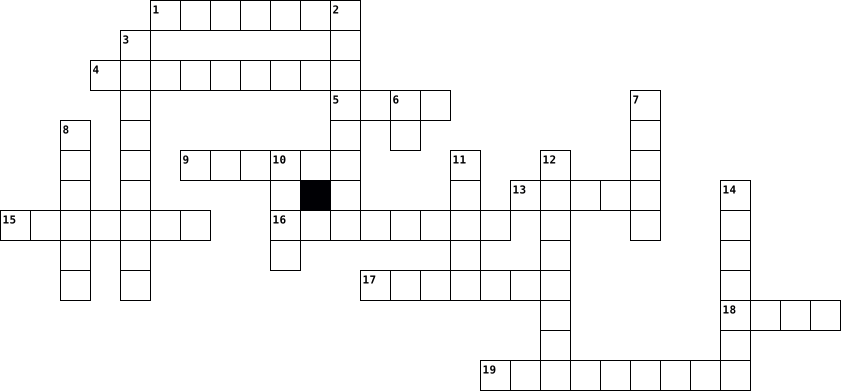
Across
- horizontal rows of elements
- a pure substance that cannot be broken down
- the number of protons in an atom's nucleus
- the average mass of an atom as it occurs naturally
- vertical columns; elements in the same group share similar properties
Down
- elements that are usually shiny and conduct heat and electricity well
- elements that are typically dull, brittle and poor conductors
- the smallest particle of an element that maintains its properties
- elements that have properties of metals and nonmetals
9 Clues: horizontal rows of elements • the number of protons in an atom's nucleus • a pure substance that cannot be broken down • the average mass of an atom as it occurs naturally • elements that have properties of metals and nonmetals • elements that are typically dull, brittle and poor conductors • the smallest particle of an element that maintains its properties • ...
Unit 3 Vocab 2024-01-11

Across
- smallest unit of an element that can maintain the properties of that element
- A substance that has definite physical and chemical properties; stands alone
- Organized chart of the elements found on earth based on their properties, chemical symbol, and classification (metals, nonmetals, metalloids)
- Scientist credited with organizing the modern periodic table by properties of known elements
Down
- abbreviation that represents an element on the periodic table; 1st letter is always capitalized; any extra characters are lower case; ex: H, Ne
- A pure substance composed of 2 or more elements that are chemically combined.
- pure substance that cannot be separated into a simpler substance by physical means.
7 Clues: smallest unit of an element that can maintain the properties of that element • A substance that has definite physical and chemical properties; stands alone • A pure substance composed of 2 or more elements that are chemically combined. • pure substance that cannot be separated into a simpler substance by physical means. • ...
periodic table vocabulary 2020-10-12

Across
- characteristics of elements
- very reactive,group1
- organization of elements
- rare earthmetals
- less reactive than group 1
- able to be pressed w/o breakability
- shininess
- terrible conductors
Down
- non metal, has 8 valence electrons
- unreactive,
- includes actinides and lanthanides
- combines easily with group 1
- vertical columns, family
- radioactive,man-made
- drawn into thin wires
15 Clues: shininess • unreactive, • rare earthmetals • terrible conductors • very reactive,group1 • radioactive,man-made • drawn into thin wires • organization of elements • vertical columns, family • less reactive than group 1 • characteristics of elements • combines easily with group 1 • non metal, has 8 valence electrons • includes actinides and lanthanides • able to be pressed w/o breakability
Periodic element name 2025-04-10

Across
- Ether Vintage anesthetic (10 letters)
- Dioxide Breath you exhale (13 letters)
- What you breathe (7 letters)
- Acid Vinegar's key ingredient (10 letters)
- Brilliant physicist's element (11 letters)
- Sparkly gem mineral's base element (10 letters)
- Nuclear physicist's tribute element (13 letters)
Down
- Acid Tannin-related chemical compound (10 letters)
- Superhero's home planet's namesake gas (8 letters)
- Named for a continent, used in smoke detectors (10 letters)
- Coin metal with a shine (6 letters)
- Rare earth element named after Swedish village (8 letters)
- Heavy metal used in old pipes (4 letters)
- Canned food's metal (3 letters)
14 Clues: What you breathe (7 letters) • Canned food's metal (3 letters) • Coin metal with a shine (6 letters) • Ether Vintage anesthetic (10 letters) • Dioxide Breath you exhale (13 letters) • Heavy metal used in old pipes (4 letters) • Brilliant physicist's element (11 letters) • Acid Vinegar's key ingredient (10 letters) • Sparkly gem mineral's base element (10 letters) • ...
The Periodic Puzzle 2025-09-14

Across
- The negative electrode in electrolysis
- Change of state from solid directly to gas
- (Energy of activation) The minimum energy needed for a reaction to occur
- A reddish-brown coating formed on iron due to oxidation
- A salt or ester of phosphoric acid
- Atoms of the same element with different numbers of neutrons
- A negatively charged ion
Down
- A type of chemical formula showing only bonds and arrangement
- The chemical name for gold
- A solid formed in a solution
- A flask with a wide base and narrow neck used in labs
- Describes metals that make a ringing sound when struck
- Atoms of the same element with different numbers of neutrons
- The combining power of an element
- A reaction that releases heat
15 Clues: A negatively charged ion • The chemical name for gold • A solid formed in a solution • A reaction that releases heat • The combining power of an element • A salt or ester of phosphoric acid • The negative electrode in electrolysis • Change of state from solid directly to gas • A flask with a wide base and narrow neck used in labs • ...
Lunar New Year 2022-02-02
Across
- the tastes in art and manners that are favored by a social group
- a feeling of thankfulness and appreciation
- Earth's satellite
- Fire-breathing beast
- Move to music
- Seance visitors
- Celebratory event
- Encased light
- "Preparation meeting opportunity," it's said
- Crackers, sparklers, etc
Down
- Items on the periodic table
- an inherited pattern of thought or action
- Dumb as an ___
- Large wild cat
- Group of 12 signs
- A present
- Lavish meal
- It's good for 12 months
- Wax sticks
19 Clues: A present • Wax sticks • Lavish meal • Move to music • Encased light • Dumb as an ___ • Large wild cat • Seance visitors • Earth's satellite • Group of 12 signs • Celebratory event • Fire-breathing beast • It's good for 12 months • Crackers, sparklers, etc • Items on the periodic table • an inherited pattern of thought or action • a feeling of thankfulness and appreciation • ...
Chemical Mahjick 2022-02-25

Across
- What powers the atoms
- Multiple Molecules create _____
- Forms that matter can exist
- Heat is released
- _____ and reactants
- Celsius or Fahrenheit
- A change that can't be reversed
- Heat is absorbed
Down
- Cannot be created nor destroyed
- Adopted forms of the chemical
- when two or more chemicals meet
- Compounds are made of _____
- Units cubed
- Everything in existance
- On the Periodic Table
- When it boils
- _____ and products
- When two or more chemicals are combined
- Basic weight
19 Clues: Units cubed • Basic weight • When it boils • Heat is released • Heat is absorbed • _____ and products • _____ and reactants • What powers the atoms • On the Periodic Table • Celsius or Fahrenheit • Everything in existance • Compounds are made of _____ • Forms that matter can exist • Adopted forms of the chemical • Cannot be created nor destroyed • when two or more chemicals meet • ...
Atom/Element Vocab 2023-03-17

Across
- The number of positive charges or protons in the nucleus of an atom of a given element
- one type of atom
- A stable, positively charged subatomic particle
- A subatomic particle found outside of the nucleus
- The positively charged mass within an atom, composed of neutrons and protons, and possessing most of the mass
- An particle of atoms consisting of a charge of negative electricity
- An elementary particle having no charge
- The sum of the number of neutrons and protons in an atomic nucleus.
- This subatomic article is found in the nucleus
Down
- A tabular arrangement of the elements according to their atomic numbers
- the average mass of an atom.
- Electrons found on the outermost shell of an atom
- A row of elements arranged forming one of the horizontal rows in the periodic table
- A column of elements on the periodic table that have similar properties
- This subatomic article is found in the nucleus
- The smallest component of an element with physical and chemical properties of the element
16 Clues: one type of atom • the average mass of an atom. • An elementary particle having no charge • This subatomic article is found in the nucleus • This subatomic article is found in the nucleus • A stable, positively charged subatomic particle • Electrons found on the outermost shell of an atom • A subatomic particle found outside of the nucleus • ...
Service Fees Act 2018-06-13

Across
- A service standard is required for each ____.
- Remissions will be ________________ under the Service Fees Act, rather than at the request of the client.
- Service standards must be __________________, based on 100% compliance and made available to the public.
- The Service Fees Act helps ensure that fees reflect the cost of __________________ the service.
- What must be made accessible to the public on June 22, 2018?
- Which Government Department is responsible for the Directive on Charging and Special Financial Authorities?
- The SFA aims to increase transparency, accountability and _______________.
- What policy will CIPO develop next to handle refunds?
Down
- After June 22, 2018 CIPO’s previous commitments will be maintained as ___________________ targets.
- Default periodic fee increases under the SFA are based on the ______________________________.
- Most service standards are measured in ________________ days.
- The Service Fees Act replaces which previous Act?
- The final step in implementing the Service Fees Act would be to implement a ______________ fee increase or accept the default increase.
13 Clues: A service standard is required for each ____. • The Service Fees Act replaces which previous Act? • What policy will CIPO develop next to handle refunds? • What must be made accessible to the public on June 22, 2018? • Most service standards are measured in ________________ days. • The SFA aims to increase transparency, accountability and _______________. • ...
Changes around us 2025-05-15

Across
- change: a change that can be Riversed to obtain the original substance by simplify riversing the condition involved
- the decrease in the size of an object on cooling
- periodic change: a change that does not occur in a timely manner
- change: a change that takes a long duration to complete
- change: a change in which a new substance is for with entirely different properties
Down
- substance
- change: a change that cannot be reversed to obtain the
- change: a change that occurs due to natural factors and is not under human control.
- change: a change in which no new substance is formed.
- the incre in the size of an object when it is exposed to heat
- change: change that complete in a short duration of time.
- change: a change that occurs at definite interval of time
- Man made change: a change brought about by humans
13 Clues: substance • the decrease in the size of an object on cooling • Man made change: a change brought about by humans • change: a change in which no new substance is formed. • change: a change that cannot be reversed to obtain the • change: a change that takes a long duration to complete • change: change that complete in a short duration of time. • ...
Changes around us 2025-05-15

Across
- the incre in the size of an object when it is exposed to heat
- change: a change that occurs due to natural factors and is not under human control.
- made change: a change brought about by humans
- the decrease in the size of an object on cooling
- change: a change in which a new substance is for with entirely different properties
Down
- change: a change that takes a long duration to complete
- periodic change :a change that does not occur in a timely manner
- change: change that complete in a short duration of time.
- change: a change in which no new substance is formed.
- change: a change that can be Riversed to obtain the original substance by simplify riversing the condition involved
- substance
- Periodic change: a change that occurs at definite interval of time
- change: a change that cannot be reversed to obtain the
13 Clues: substance • made change: a change brought about by humans • the decrease in the size of an object on cooling • change: a change in which no new substance is formed. • change: a change that cannot be reversed to obtain the • change: a change that takes a long duration to complete • change: change that complete in a short duration of time. • ...
Periodic Table 2019-09-03

Across
- the chemical element of atomic number 26
- electron: outer shell electron that is associated with an atom
- Without a charge
- a stable subatomic particle with a positive electric charge
- number the number of protons in the nucleus of an atom.
Down
- a negatively charged ion
- Subatomic particle with a negative charge
- a positively charged ion
- number: total number of protons and neutrons in a nucleus
9 Clues: Without a charge • a negatively charged ion • a positively charged ion • the chemical element of atomic number 26 • Subatomic particle with a negative charge • number the number of protons in the nucleus of an atom. • number: total number of protons and neutrons in a nucleus • a stable subatomic particle with a positive electric charge • ...
Periodic Motions 2021-03-25

Across
- lowest part of the graph
- the acute positive angle formed by the terminal side of theta and the x-axis
- one complete pattern
- the horizontal length on one cycle
Down
- highest part of the graph
- a special circle with the radius of one
- half the distance between max and min values
- function that repeats a pattern of y-values
- the horizontal line midway between the max & min
9 Clues: one complete pattern • lowest part of the graph • highest part of the graph • the horizontal length on one cycle • a special circle with the radius of one • function that repeats a pattern of y-values • half the distance between max and min values • the horizontal line midway between the max & min • ...
Periodic Table 2024-06-01

Across
- symbol He and atomic number 2. It is a colorless, odorless, tasteless, non-toxic, inert, monatomic gas and the first in the noble gas group in the periodic table.
- symbol Li and atomic number 3. It is a soft, silvery-white alkali metal. Under standard conditions, it is the least dense metal and the least dense solid element. Like all alkali metals, lithium is highly reactive and flammable, and must be stored in vacuum, inert atmosphere, or inert liquid such as purified kerosene or mineral oil. It exhibits a metallic luster.
- symbol B and atomic number 5. In its crystalline form it is a brittle, dark, lustrous metalloid; in its amorphous form it is a brown powder. As the lightest element of the boron group it has three valence electrons for forming covalent bonds, resulting in many compounds such as boric acid, the mineral sodium borate, and the ultra-hard crystals of boron carbide and boron nitride.
- symbol O and atomic number 8. It is a member of the chalcogen group in the periodic table, a highly reactive nonmetal, and an oxidizing agent that readily forms oxides with most elements as well as with other compounds. Oxygen is the most abundant element in Earth's crust, and after hydrogen and helium, it is the third-most abundant element in the universe.
- symbol N and atomic number 7. Nitrogen is a nonmetal and the lightest member of group 15 of the periodic table, often called the pnictogens. It is a common element in the universe, estimated at seventh in total abundance in the Milky Way and the Solar System.
Down
- symbol Be and atomic number 4. It is a steel-gray, strong, lightweight and brittle alkaline earth metal. It is a divalent element that occurs naturally only in combination with other elements to form minerals. Gemstones high in beryllium include beryl (aquamarine, emerald, red beryl) and chrysoberyl.
- symbol F and atomic number 9. It is the lightest halogen[note 1] and exists at standard conditions as pale yellow diatomic gas. Fluorine is extremely reactive as it reacts with all other elements except for the light inert gases. It is highly toxic.
- symbol H and atomic number 1. It is the lightest element and, at standard conditions, is a gas of diatomic molecules with the formula H2
- symbol C and atomic number 6. It is nonmetallic and tetravalent—meaning that its atoms are able to form up to four covalent bonds due to its valence shell exhibiting 4 electrons. It belongs to group 14 of the periodic table.
9 Clues: symbol H and atomic number 1. It is the lightest element and, at standard conditions, is a gas of diatomic molecules with the formula H2 • symbol He and atomic number 2. It is a colorless, odorless, tasteless, non-toxic, inert, monatomic gas and the first in the noble gas group in the periodic table. • ...
Periodic Table 2021-09-26

Across
- Nature of oxide of Sodium ?
- The other name for group 17 ?
- Nature of oxide of Aluminium ?
- MgO only can react with ?
- Sodium is _______ in water.
Down
- What element essential for building and maintaining healthy bones and teeth ?
- Element that only have 1st Ionisation Energy?
- A halogen in period 4 ?
- _______ kill bacteria , it is used to treat drinking water and swimming pool water .
9 Clues: A halogen in period 4 ? • MgO only can react with ? • Nature of oxide of Sodium ? • Sodium is _______ in water. • The other name for group 17 ? • Nature of oxide of Aluminium ? • Element that only have 1st Ionisation Energy? • What element essential for building and maintaining healthy bones and teeth ? • ...
Periodic Table 2021-12-10

Across
- the periodic table of elements
- the element we breath
- the top part of an element
- the bottom part of an element
- protons have what charge
Down
- the element that creates poison
- Smalled unit of matter
- neutrons have what charge
- electrons have what charge
9 Clues: the element we breath • Smalled unit of matter • protons have what charge • neutrons have what charge • electrons have what charge • the top part of an element • the bottom part of an element • the periodic table of elements • the element that creates poison
Periodic Table 2022-03-10

Across
- Ability to conduct electricity
- tendancy to accept an electron
- Column
- liquid metal
- First element
- Group18
Down
- Group17
- row
- distance between atomic nucleus and outermost electron
9 Clues: row • Column • Group17 • Group18 • liquid metal • First element • Ability to conduct electricity • tendancy to accept an electron • distance between atomic nucleus and outermost electron
Periodic Table 2025-07-28

Across
- Water (H₂O) is a ____________ because it is made from hydrogen and oxygen chemically combined.
- A ____________ is formed when two or more substances are physically combined.
- A substance made up of only one type of atom is called an ____________.
- Compound can be separated by using _________ method.
Down
- The components of a mixture can be separated by ____________ methods.
- During electrolysis, water is broken down into oxygen and ____________ gases.
- When two or more substances are mixed but do not chemically react, the result is called a ____________.
- In a mixture, the substances do not undergo a ____________ reaction.
- A compound has ____________ properties from the elements that make it.
- Carbon dioxide is a compound made up of ______ and oxygen.
10 Clues: Compound can be separated by using _________ method. • Carbon dioxide is a compound made up of ______ and oxygen. • In a mixture, the substances do not undergo a ____________ reaction. • The components of a mixture can be separated by ____________ methods. • A compound has ____________ properties from the elements that make it. • ...
Periodic Table 2023-01-11

Across
- atoms hold it together
- has 2 or more atoms
- substances are mixed together
- has mass and takes up space
Down
- the element is (Fe)
- can be made into any substance
- Grouped together by atoms
- the element is (C)
- we breathe it daily
9 Clues: the element is (C) • the element is (Fe) • has 2 or more atoms • we breathe it daily • atoms hold it together • Grouped together by atoms • has mass and takes up space • substances are mixed together • can be made into any substance
Periodic Table 2022-12-02

Across
- building blocks which make up everything
- made up of only one type of atom
- bonds the bonds formed for compounds
- isn't uniform
Down
- mass the bottom number of an element
- anything that takes up mass
- is uniform
- can only be physically separated
- made up of two or more atoms chemically combined
- number top number of the element
10 Clues: is uniform • isn't uniform • anything that takes up mass • made up of only one type of atom • can only be physically separated • number top number of the element • mass the bottom number of an element • bonds the bonds formed for compounds • building blocks which make up everything • made up of two or more atoms chemically combined
Periodic table 2022-11-29

Across
- has only one energy level
- atomic weight of 127
- has 14 neutrons
- atomic number 107
Down
- atomic mass of 75
- very hard, and very resistant to heat
- silvery-white metal
- attic number 18
- Electron Configurations 1s2 2s2 2p6 3s2 3p6 4s2 3d10 4p6
9 Clues: has 14 neutrons • attic number 18 • atomic mass of 75 • atomic number 107 • silvery-white metal • atomic weight of 127 • has only one energy level • very hard, and very resistant to heat • Electron Configurations 1s2 2s2 2p6 3s2 3p6 4s2 3d10 4p6
PERIODIC TABLEEEEE 2026-02-02

Across
- Gets rusty quickly
- You will most likely die a painful death!! :) (usually depicted as green)
- 'O'/ (hey look it's a face, look at the letter)
- VERY STRONG!!!!
- Reminds me EVEN MORE of BEARS
Down
- You can make fibres out of it
- WHEEEE IM FLYING AWAY OH GOD I CANT FINISH THE CROSSWO-
- think of the country of lieberhausen
- NAAAAAAAAH
9 Clues: NAAAAAAAAH • VERY STRONG!!!! • Gets rusty quickly • You can make fibres out of it • Reminds me EVEN MORE of BEARS • think of the country of lieberhausen • 'O'/ (hey look it's a face, look at the letter) • WHEEEE IM FLYING AWAY OH GOD I CANT FINISH THE CROSSWO- • You will most likely die a painful death!! :) (usually depicted as green)
Periodic Trends 2026-01-07

Across
- this is responsible for chemical bonding and reactivity
- this can also be called electron density
- forms a positive ion
- this is a process leading to an ion
- this atom has gained or lost electrons
Down
- the product of ionization energy
- measures how strong an atom attracts elections
- another way to say the measure of an atom
- the opposite of a cation
9 Clues: forms a positive ion • the opposite of a cation • the product of ionization energy • this is a process leading to an ion • this atom has gained or lost electrons • this can also be called electron density • another way to say the measure of an atom • measures how strong an atom attracts elections • this is responsible for chemical bonding and reactivity
Periodic trend 2026-01-07

Across
- the ability to attract shared electrons
- when an atom gains an electron from a negative ion causing an energy change
- the opposite of a positively charged ion
Down
- is the process by which an electrically charged particle becomes an ion
- the energy needed to remove an electron
- the opposite of a negatively charged ion
- in the outermost electron shell
- the dimensions of an atom's size
- is an atom or molecule that has gained or lost electrons
9 Clues: in the outermost electron shell • the dimensions of an atom's size • the energy needed to remove an electron • the ability to attract shared electrons • the opposite of a negatively charged ion • the opposite of a positively charged ion • is an atom or molecule that has gained or lost electrons • is the process by which an electrically charged particle becomes an ion • ...
Periodic Trends 2026-01-08

Across
- - an ion with a positive charge
- - an ion with a negative charge
- - an atom or group of atoms that has an electric charge due to an unequal number of protons and neutrons
- - the measure of how much an atom wants to gain an electron
- - an electron located in the outermost shell of an atom
Down
- - the measure of an atom's ability to attract a shared pair of electrons towards itself within a chemical bond
- - the process by which a neutral atom or molecule gains or loses electrons.
- - Measures an atom's size
- - the minimum amount of energy required to remove an electron from a neutral atom in its gaseous state
9 Clues: - Measures an atom's size • - an ion with a positive charge • - an ion with a negative charge • - an electron located in the outermost shell of an atom • - the measure of how much an atom wants to gain an electron • - the process by which a neutral atom or molecule gains or loses electrons. • ...
Periodic Table 2026-02-26

Across
- Horizontal row in the periodic table
- property of metals and alloys that allows them to be drawn into wires
- Occurs because some electrons move freely among a metal's positively charged ions, explains properties such as ductility and the ability to conduct electricity
- Property of metals and alloys that allows them to be hammered or rolled into thin sheets
Down
- vertical column in periodic table
- Uses the symbol for an element and dots representing the number of electrons in the elements outer energy level
- Element, such as radium, whose nucleus breaks down and emits particles and energy
- Organized list of all known elements that are arranged by increasing atomic number and by changes in chemical and physical properties
- Element that is shiny malleable, ductile, and a good conductor of heat and electricity
9 Clues: vertical column in periodic table • Horizontal row in the periodic table • property of metals and alloys that allows them to be drawn into wires • Element, such as radium, whose nucleus breaks down and emits particles and energy • Element that is shiny malleable, ductile, and a good conductor of heat and electricity • ...
End of Year Project 2021-05-27

Across
- a substance chemically combined
- take most of the periodic table
- malleable
- it rust
- one kind of atom
- smallest unit of matter
- type of mixture
Down
- study of properties
- Takes space up
- staircase
- When you mix something together
- are on the far right
12 Clues: it rust • staircase • malleable • Takes space up • type of mixture • one kind of atom • study of properties • are on the far right • smallest unit of matter • a substance chemically combined • take most of the periodic table • When you mix something together
Midterm 2017 - Chemistry and Intro Biology Terms 2017-02-27

Across
- All living things are made of cells, the cell is the basic unit of structure and function, all cells come from preexisting cells
- an element of Group 18 of the periodic table
- small, uncharged particles that are found in the nucleus of an atom
- an element belonging to Group 1 of the periodic table
- elements in the same horizontal row of the periodic table
- the central core of the atom, containing protons and usually neutrons
- plant, bacteria, animal, fungi, protist, archeabacteria
- has several organelles such as the nucleus, endoplasmic reticulum, golgi apparatus, mitochondria, ribosomes, and lysosomes. PLANTS, ANIMALS, AND FUNGI
- the electrons that are in the highest energy level of an atom and that are involved in chemical reactions
- Consists of multicellular organisms that can move from one place to another. Characteristics of the Animal kingdom: multicellular, eukaryotic, heterotrophic
- make proteins
- A solid that is formed from two solutions as a result of a chemical reaction
- A sample of matter that has definite chemical and physical properties
- receive proteins and other newly formed materials from the endoplasmic reticulum
- Single celled organism that uses cilia to move and to eat; belongs to the kingdom protist
- Single celled organism that uses its pseudopod to move and to eat; belongs to the kingdom protist
Down
- organelles that capture the energy from sunlight and convert it into chemical energy in a process called photosynthesis
- Many-celled, MOST cannot move, plant-like, but cannot make their own food, absorb food from other living things, reproduce with spores. ex. yeast, mold, mushrooms
- filled with enzymes used to break down food into particles that can be used
- Mass is conserved in a chemical reaction. Atoms can never be created or destroyed in a chemical reaction.
- the symbol (arrow) that leads to a product side of an equation rather than an equal sign
- elements in the same vertical column of the periodic table
- the number of protons in the nucleus of an atom
- have cell membranes and cytoplasm but do not contain nuclei, BACTERIA
- Single celled organism that uses the flagellum to move; makes it's food through photosynthesis using the sun's energy captured by the chloroplast; belongs to the kingdom protist
- long strands of DNA found in the eukaryotic cell nucleus; condense to form chromosomes
- Made up of organisms that can perform photosynthesis to make food. Characteristics of the Plant Kingdom: multicellular, eukaryotic, autotrophic, and mostly green in color.
- the force that holds atoms together
- negatively charged particles that move around outside the nucleus of an atom
- single celled organism with a cell wall and no nucleus; archeabacteria are ancient bacteria typically found in harsh conditions; some move using the flagella
30 Clues: make proteins • the force that holds atoms together • an element of Group 18 of the periodic table • the number of protons in the nucleus of an atom • an element belonging to Group 1 of the periodic table • plant, bacteria, animal, fungi, protist, archeabacteria • elements in the same horizontal row of the periodic table • ...
1st Semester Science Vocab Review 2022-03-07

Across
- The base unit of volume in the metric system. Abbreviated "L"
- The basic building block of matter. Cannot be broken into smaller pieces using chemical reactions or physical changes.
- The substances that go into a chemical reaction. These are on the left side of the arrow in a chemical equation.
- A substance made up of only one kind of atom. Organized in the Periodic Table.
- A tool used to measure the mass of objects, usually in grams.
- The study of atoms including the ways in which they interact, combine, and change, and the use of these processes to form new substances.
- Electron Any electron in the outermost electron level of an atom.
- The property of metal that means it allows heat and electricity to flow through it.
- The number in an element’s tile on the periodic table that tells you how many protons that elements have.
- The property of metal that means it’s shiny.
- The connecting point between atoms in a molecule. Different types of bonds are possible such as covalent, single, double, triple, and ionic.
- A process that is used by scientists and others in order to solve problems and find answers in a logical way.
- A measure of how much mass is in a certain volume. Units are usually g/mL or g/cm3.
- The positively charged subatomic particle that exists in the nucleus of an atom.
Down
- A family of elements in the periodic table made up of the most reactive non-metals. These have 7 valence electrons.
- Dimitri ________ - The scientist who organized the known elements into the periodic table.
- A tube-like piece of lab equipment that is used to precisely measure liquid amounts, usually in milliliters (mL).
- The amount of space that something takes up.
- A physical substance that occupies space.
- The negatively charged subatomic particle that orbits around the outside of the nucleus of an atom.
- A system of measurement that relies on decimals rather than fractions. The basic units are meters, liters, and grams.
- The base unit of mass in the metric system. Abbreviated "g"
- The neutrally charged subatomic particle that exists in the nucleus of an atom.
- The Law of _____________ of Mass is a scientific principle that states that matter cannot be created nor destroyed, only changed from one state to another.
- The base unit of length in the metric system. Abbreviated "m"
- The philosopher who first said that matter is composed of relatively simple particles that are too small to be visible to the naked eye. He called these particles “atoma”.
- Particle made up of two or more bonded atoms.
- The substances that come out of a chemical reaction. These are on the right side of the arrow in a chemical equation.
28 Clues: A physical substance that occupies space. • The amount of space that something takes up. • The property of metal that means it’s shiny. • Particle made up of two or more bonded atoms. • The base unit of mass in the metric system. Abbreviated "g" • The base unit of volume in the metric system. Abbreviated "L" • ...
Why Chemistry? 2023-09-26

Across
- The periodic table element that is used to represent Superman's home planet
- The symbol for the element in garlic and onion that causes tears
- Term for a substance that can dissolve in water and conduct electricity, often found in sports drinks
- A strong acid found in your stomach that helps with digestion
- Physicist who won the Nobel Prize for explaining the photoelectric effect
- A popular brand of soda that originally contained lithium
- A type of reaction where substances combine to form new compounds
- Author of "The Disappearing Spoon" about the history of the periodic table
- The car from "Back to the Future" that ran on a fictional fuel called plutonium
- What element is used to make different coloured glow sticks
- Famous periodic table researcher known for her work in radioactivity
- The element commonly used in party balloons
- The element commonly used as a tracer in PET scans
- The reaction between acid and base that forms salt and water
- The element on the periodic table that shares its name with a Norse God
- A sugar found in milk
- The number of protons in a carbon-12 atom
- The science that helps us understand the composition of substances
- The famous detective created by Sir Arthur Conan Doyle who used chemical knowledge to solve crimes
- Element responsible for making bananas radioactive
- A substance used to preserve bodies in ancient Egypt that is now commonly used in fertilizer
- The chemical compound that makes jalapenos spicy
Down
- The compound responsible for the smell of rotten eggs
- The fictional high school chemistry teacher in "Breaking Bad"
- The fictional element used to power Tony Stark's Iron Man suit
- The element that is responsible for the red colour in rubies
- Famously exclaims "D'oh! I missed!" when attempting chemistry experiments
- This gas is essential for respiration and combustion
- A chemical reaction involving the loss of electrons
- The process of converting sugar to alcohol, often used in brewing
- The element that gives Mars its red colour
- The element featured in the song by Tom Lehrer, known for its short half-life
- The only liquid metal at room temperature
- "Laughing gas"
- The famous and useful chart where the only letter that doesn't appear is J
- Found on the surface of Mars, contributing to its red colour
- The element that makes fireworks vibrant green in colour
- A substance that changes colour in the presence of an acid or base
- Chemistry is the science of _________
- The solid form of carbon dioxide
- A polymer used to make bottles and containers
- The chemical responsible for the smell of freshly cut grass
- The only noble gas that forms stable compounds with other elements
43 Clues: "Laughing gas" • A sugar found in milk • The solid form of carbon dioxide • Chemistry is the science of _________ • The only liquid metal at room temperature • The number of protons in a carbon-12 atom • The element that gives Mars its red colour • The element commonly used in party balloons • A polymer used to make bottles and containers • ...
Atoms in Periodic Table 2022-09-30

Across
- the horizontal rows of the periodic table
- an element that readily forms positive ions and has metallic bonds
- an element whose properties are intermediate between those metals and solid metals
- able to be hammered or pressed permanently out of shape without breaking
- levels the fixed amount of energy that a system described by quantum mechanics
- able to be deformed without losing toughness
- an element or substance that is not a metal
- the membrane-enclosed organelle within a cell that contains the chromosomes
- the vertical columns on the periodic table that have similar chemical properties
- Cloud the system of electrons surrounding the nucleus of an atom
Down
- a stable subatomic particle occurring in all atomic nuclei with a positive electric charge
- Electrons a negatively charged particle located in the outermost shell of an atom
- a stable subatomic particle with a charge of negative electricity
- a subatomic particle of about the same mass as a proton but without an electric charge
- a particle of matter that uniquely defines a chemical element
- a gentle sheen or soft glow, especially that of a partly reflective surface
16 Clues: the horizontal rows of the periodic table • an element or substance that is not a metal • able to be deformed without losing toughness • a particle of matter that uniquely defines a chemical element • Cloud the system of electrons surrounding the nucleus of an atom • a stable subatomic particle with a charge of negative electricity • ...
SHM WORDS 2018-10-07

Across
- Acceleration is proportional to displacement from the equilibrium position and in the opposite direction
- When an object is disturbed from its equilibrium position, a _________ acts on it to bring it back to the equilibrium position.
- movement back and forth in a regular rhythm
- Occurs when the frequency of a driving force equals the natural frequency of vibration of the system; the system then vibrates with a maximum amplitude
- Oscillations that occur without a periodic force being applied
- The simplest model to describe vibrations is called simple ___________ motion
- The number of oscillations per unit time
- the simple harmonic motion is described by a ________ function.
Down
- The maximum displacement of the object from its equilibrium position (always positive)
- In the mass and spring system the period depend on the mass and on the ______
- a situation where there are not frictional forces
- The distance an object moves from its equilibrium position
- Oscillations that occur when a periodic force is applied
- The time for one complete oscillation
- Number of radians completed per second
- the state in which the net force on an object is zero
16 Clues: The time for one complete oscillation • Number of radians completed per second • The number of oscillations per unit time • movement back and forth in a regular rhythm • a situation where there are not frictional forces • the state in which the net force on an object is zero • Oscillations that occur when a periodic force is applied • ...
Test 2023-04-12

Across
- Flying mammal
- W on periodic table
- Large marsupial
- A cloudy beer
- Likes to chase mice
- brewers
Down
- A troublemaker in South Park
- Has a trunk
- Ruined movie
- a cocktail and suburb
10 Clues: brewers • Has a trunk • Ruined movie • Flying mammal • A cloudy beer • Large marsupial • W on periodic table • Likes to chase mice • a cocktail and suburb • A troublemaker in South Park
Science thing 2022-12-13

Across
- Periodic table
- Has a nucleus
- Doesn't have a spine
- Energy in batteries
Down
- Being high up energy
- Type of kingdom
- Title of crossword
- Has a spine
- Moving type of energy
- gold
10 Clues: gold • Has a spine • Has a nucleus • Periodic table • Type of kingdom • Title of crossword • Energy in batteries • Being high up energy • Doesn't have a spine • Moving type of energy
Moseley 2022-09-28

Across
- He organized the periodic table by ______
- English Physicist rearranged the periodic table
- How many new chemical elements were found?
Down
- The element's identity is determined by _______
- He used _______ equipment.
- He used _________ for proving his point.
6 Clues: He used _______ equipment. • He used _________ for proving his point. • He organized the periodic table by ______ • How many new chemical elements were found? • The element's identity is determined by _______ • English Physicist rearranged the periodic table
Mendeleev 2021-10-01

Across
- what was his name?
- he was a ____ chemist
Down
- graduated with a __ for creating the periodic table
- table what did he create?
- played a major role in transforming ___ in russia.
- predicted the discovery of several new ___.
6 Clues: what was his name? • he was a ____ chemist • table what did he create? • predicted the discovery of several new ___. • played a major role in transforming ___ in russia. • graduated with a __ for creating the periodic table
Mendeleev 2021-10-01

Across
- table what did he create?
- what was his name?
- he was a ____ chemist
Down
- graduated with a __ for creating the periodic table
- predicted the discovery of several new ___.
- played a major role in transforming ___ in russia.
6 Clues: what was his name? • he was a ____ chemist • table what did he create? • predicted the discovery of several new ___. • played a major role in transforming ___ in russia. • graduated with a __ for creating the periodic table
General Chemistry 2020-05-25
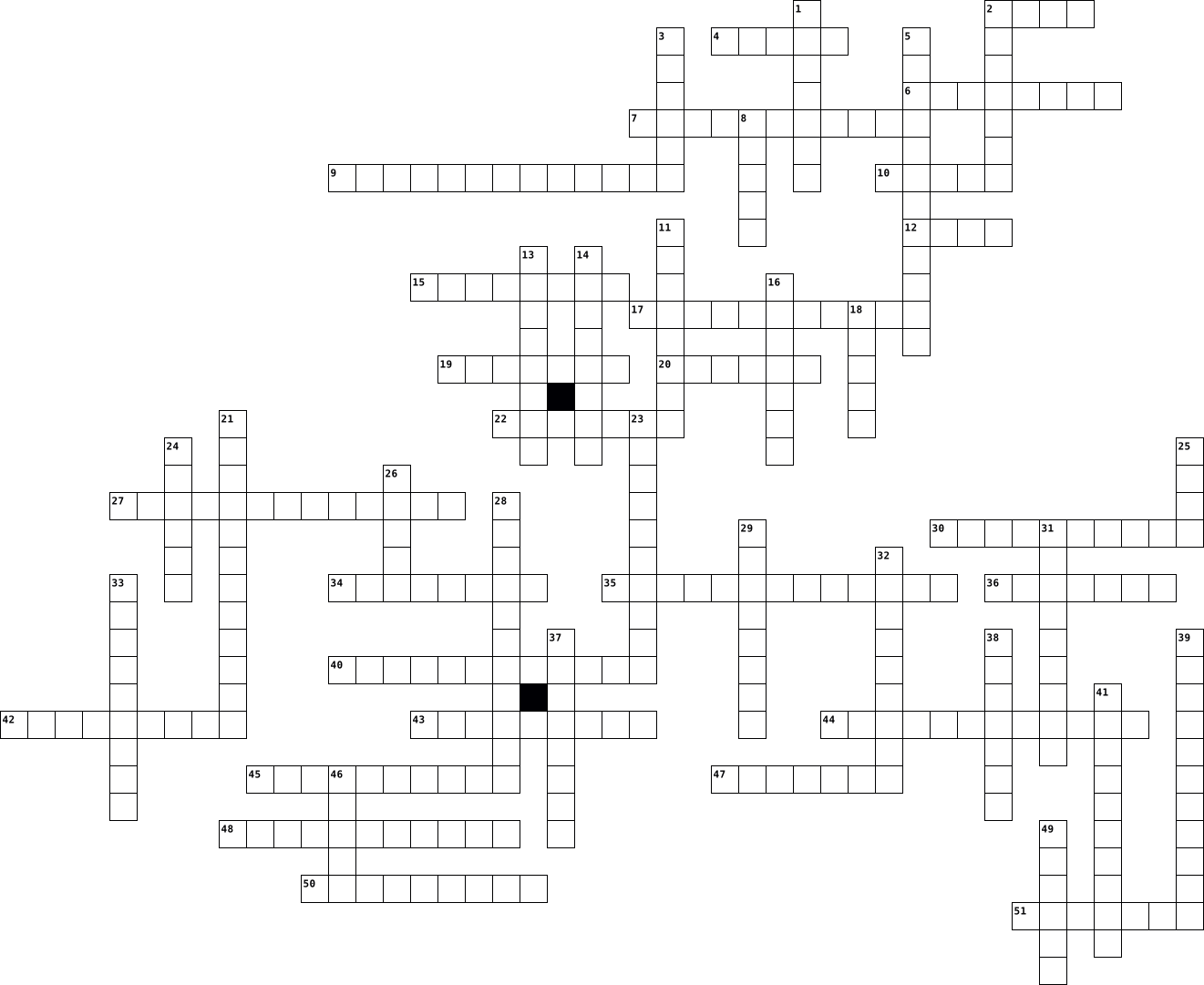
Across
- number: The sum of the number of protons and neutrons in its nucleus
- bond: Formed by losing and gaining of electrons between metal and nonmetal
- Uncharged particle found within the atomic nuclei
- figures: The digits in any measurement that are known with certainty plus one digit which is uncertain
- it is a branch of chemistry that studies the chemical processes within and relating to living organisms. Biochemical processes give rise to the complexity of life.
- The quantity of matter in the body
- Formed when atom loses or gains electron
- chemistry: the branch of chemistry concerned with the application of the techniques and theories of physics to the study of chemical systems.
- mixture: Called as solution: a mixture with uniform composition.
- a period of time equal to sixty seconds or a sixtieth of an hour.
- level: Specific energy value of electrons for an atom
- Horizontal row in the periodic table
- mixture: Mixture whose a composition varies from position to position within a sample.
- the quality, condition, or fact of being exact and accurate.
- Substance consisting of only one kind of atom
- Separates components of mixture at different boiling points.
- Positively:charged subatomic particle of an atom
- the size: length: or amount of something: as established by measuring.
- the closeness of a single measurement to its true value.
- physical property: physical property that does not depend on the size or amount of the sample
- phase change in which liquid is converted to gas
- the branch of science that deals with the identification of the substances of which matter is composed; the investigation of their properties and the ways in which they interact: combine: and change; and the use of these processes to form new substances.
- The amount of space occupied by a substance
- Elements found in the zigzag order in the periodic table
- Phase change in which liquid is converted to solid
- Elements at the left side and in the center of the periodic table
Down
- a substance that flows freely but is of constant volume: having a consistency like that of water or oil.
- Anything that has mass and occupies space
- a substance or object that is solid rather than liquid or fluid
- inner transition elements located in the first row of the f:block in the periodic table
- compound: Compound that consists of two charged ions
- Group 7A elements
- Composed of two or more substances: combined physically in variable proportions
- separation: The separation of elemental metals from the mixtures
- the measurement or extent of something from end to end.
- rule: states that atoms other than hydrogen tend to form bonds until surrounded by eight valence electrons
- Organic compound with carbon and oxygen only
- movement of one fluid through another.
- the fundamental unit of length in the metric system: equal to 100 centimeters or approximately 39.37 inches.
- a substance or matter in a state in which it will expand freely to fill the whole of a container: having no fixed shape and no fixed volume.
- gas: insert gas located at the rightmost side of the periodic table
- a metric unit of length: equal to one hundredth of a meter.
- Phase change that involves the conversion from solid to liquid
- Chemistry: it is a branch of chemistry that deals with synthesis and behavior of inorganic and organometallic compounds.
- Element that appears at the far right side of the periodic table
- Negatively:charged subatomic particle of an atom
- Ratio of the mass of an object to the volume occupied by that object.
- chemistry: it is a branch of chemistry that studies the structure: properties and reactions of organic compounds: which contain carbon in covalent bonding. Study of structure determines their chemical composition and formula.
- Process in which the solid particles are filtered to allow the liquid or filtrate to pass through the filter: and be collected as residue
- chemistry: it is a branch of chemistry that studies and uses instruments and methods used to separate: identify: and quantify matter.
- mass: Indicates that one mole of an element has a mass in grams numerically equal to its atomic mass units
- a metric unit of capacity: formerly defined as the volume of one kilogram of water under standard conditions: now equal to 1:000 cubic centimeters
52 Clues: Group 7A elements • The quantity of matter in the body • Horizontal row in the periodic table • movement of one fluid through another. • Formed when atom loses or gains electron • Anything that has mass and occupies space • The amount of space occupied by a substance • Organic compound with carbon and oxygen only • Substance consisting of only one kind of atom • ...
Crossword Puzzle Kesleigh 2022-10-26

Across
- one or two letter code that stand for an element
- a row of elements that have a certain proprties in common
- small number to the right of an element symbol that shows how many atoms of that element
- the basic unit of a chemical element
- number of protons and neutrons
- the ability to combine and to chemically bond with each other
- substaces that are the building blocks of all matter(made of one kind of atom)
- compounds that include Carbon
- a chart where all elements are organized into periods and steps of the periodic table
Down
- the number placed just before the chemical formula;number of destryed
- molecule that is made up of more than one type of element
- a way of describing the number of atoms that make up a molecule or compound
- electrons found in the outermost shell and determine the chemical properties such as reactivity
- high luster, good conductor, malleable, found on the left of periodic table
- compound or element that is the result of a chemical reaction
- number of protons in the nucleus of one ato of an element
16 Clues: compounds that include Carbon • number of protons and neutrons • the basic unit of a chemical element • one or two letter code that stand for an element • molecule that is made up of more than one type of element • a row of elements that have a certain proprties in common • number of protons in the nucleus of one ato of an element • ...
science project 2022-09-29

Across
- subatonic partical which has a neautral charge
- electrons the electrons in the outermost shell or energy level of an atom
- smallest unit of ordinary matter that forms a chemical element
- row of chemical elements
- small dense region consisting of protons and neutrons at the center of an atom
- elements on the periodic table that are malleable, lose electrons easily, good conductors of heat/electricity, and typically appear reflective
Down
- look like brittle metals but their chemical behaviors is distinctly nonmetals
- CLOUD region of negative charge surrounding an atomic nucleus
- represents the 3-dimentional space surrounding the nucleus where electrons are most likely to be
- stable subatonic partical with a positive electric charge
- the physical property of a material associated with the ability to be hammered thin or stretched into wire without breaking
- chemical element that generally lacks a predominance of metalic properties
- negatively charged subtonic particles located in orbitals surrounding the nucleus
- column of elements in the periodic table
- the ability of a solid to bend or be hammered into other shapes without breaking
- the ability of a substance to reflect light
16 Clues: row of chemical elements • column of elements in the periodic table • the ability of a substance to reflect light • subatonic partical which has a neautral charge • stable subatonic partical with a positive electric charge • CLOUD region of negative charge surrounding an atomic nucleus • smallest unit of ordinary matter that forms a chemical element • ...
science project 2022-09-29

Across
- subatonic partical which has a neautral charge
- smallest unit of ordinary matter that forms a chemical element
- elements on the periodic table that are malleable, lose electrons easily, good conductors of heat/electricity, and typically appear reflective
- negatively charged subtonic particles located in orbitals surrounding the nucleus
- stable subatonic partical with a positive electric charge
- small dense region consisting of protons and neutrons at the center of an atom
- electrons the electrons in the outermost shell or energy level of an atom
- the ability of a solid to bend or be hammered into other shapes without breaking
- region of negative charge surrounding an atomic nucleus
Down
- the physical property of a material associated with the ability to be hammered thin or stretched into wire without breaking
- row of chemical elements
- chemical element that generally lacks a predominance of metalic properties
- look like brittle metals but their chemical behaviors is distinctly nonmetals
- column of elements in the periodic table
- represents the 3-dimentional space surrounding the nucleus where electrons are most likely to be
- the ability of a substance to reflect light
16 Clues: row of chemical elements • column of elements in the periodic table • the ability of a substance to reflect light • subatonic partical which has a neautral charge • region of negative charge surrounding an atomic nucleus • stable subatonic partical with a positive electric charge • smallest unit of ordinary matter that forms a chemical element • ...
Scicns 2025-03-25

Across
- : the way something is symbolized.
- : a horizontal row in the periodic table, with elements having increasing atomic numbers.
- : one or two letters that signify the elements on the periodic table.
Down
- : organizes elements by atomic number and similar properties.
- : the average mass of an element's atoms, measured in atomic mass units (amu), based on the number of protons and neutrons in the atom's nucleus.
- : a vertical column in the periodic table, where elements share similar chemical properties.
6 Clues: : the way something is symbolized. • : organizes elements by atomic number and similar properties. • : one or two letters that signify the elements on the periodic table. • : a horizontal row in the periodic table, with elements having increasing atomic numbers. • : a vertical column in the periodic table, where elements share similar chemical properties. • ...
energyaa 2015-04-10

Across
- "x natural forces and resources"
- to change properties etc.
- apply oneself to something, direct one's efforts towards something, such as a question
- periodic
- synonym for separation
- global
Down
- producing a voltage when exposed to radiant energy (especially light)
- easy, simple, effortless
- a compromise
- integral, characteristic trait
- an obstacle
- original, first version
- add together
- gather
14 Clues: gather • global • periodic • an obstacle • a compromise • add together • synonym for separation • original, first version • easy, simple, effortless • to change properties etc. • integral, characteristic trait • "x natural forces and resources" • producing a voltage when exposed to radiant energy (especially light) • ...
words that have a sciencey clue and definition 2021-09-24

Across
- have a positive charge
- electrons are on the last outer ring of the cloud
- left side of the periodic table
- has a negative charge
Down
- right side of the periodic table
- no charge at all
6 Clues: no charge at all • has a negative charge • have a positive charge • left side of the periodic table • right side of the periodic table • electrons are on the last outer ring of the cloud
General Chemistry 2020-05-25

Across
- number: The sum of the number of protons and neutrons in its nucleus
- bond: Formed by losing and gaining of electrons between metal and nonmetal
- Uncharged particle found within the atomic nuclei
- figures: The digits in any measurement that are known with certainty plus one digit which is uncertain
- it is a branch of chemistry that studies the chemical processes within and relating to living organisms. Biochemical processes give rise to the complexity of life.
- The quantity of matter in the body
- Formed when atom loses or gains electron
- chemistry: the branch of chemistry concerned with the application of the techniques and theories of physics to the study of chemical systems.
- mixture: Called as solution: a mixture with uniform composition.
- a period of time equal to sixty seconds or a sixtieth of an hour.
- level: Specific energy value of electrons for an atom
- Horizontal row in the periodic table
- mixture: Mixture whose a composition varies from position to position within a sample.
- the quality, condition, or fact of being exact and accurate.
- Substance consisting of only one kind of atom
- Separates components of mixture at different boiling points.
- Positively:charged subatomic particle of an atom
- the size: length: or amount of something: as established by measuring.
- the closeness of a single measurement to its true value
- physical property: physical property that does not depend on the size or amount of the sample
- phase change in which liquid is converted to gas
- the branch of science that deals with the identification of the substances of which matter is composed; the investigation of their properties and the ways in which they interact: combine: and change; and the use of these processes to form new substances.
- The amount of space occupied by a substance
- Elements found in the zigzag order in the periodic table
- Phase change in which liquid is converted to solid
- Elements at the left side and in the center of the periodic table
Down
- a substance that flows freely but is of constant volume: having a consistency like that of water or oil.
- Anything that has mass and occupies space
- a substance or object that is solid rather than liquid or fluid
- inner transition elements located in the first row of the f:block in the periodic table
- compound: Compound that consists of two charged ions
- Group 7A elements
- Composed of two or more substances: combined physically in variable proportions
- separation: The separation of elemental metals from the mixtures
- the measurement or extent of something from end to end
- rule: states that atoms other than hydrogen tend to form bonds until surrounded by eight valence electrons
- Organic compound with carbon and oxygen only
- movement of one fluid through another.
- the fundamental unit of length in the metric system: equal to 100 centimeters or approximately 39.37 inches.
- a substance or matter in a state in which it will expand freely to fill the whole of a container: having no fixed shape and no fixed volume.
- gas: insert gas located at the rightmost side of the periodic table
- a metric unit of length: equal to one hundredth of a meter.
- Phase change that involves the conversion from solid to liquid
- Chemistry: it is a branch of chemistry that deals with synthesis and behavior of inorganic and organometallic compounds.
- Element that appears at the far right side of the periodic table
- Negatively:charged subatomic particle of an atom
- Ratio of the mass of an object to the volume occupied by that object.
- chemistry: it is a branch of chemistry that studies the structure: properties and reactions of organic compounds: which contain carbon in covalent bonding. Study of structure determines their chemical composition and formula.
- Process in which the solid particles are filtered to allow the liquid or filtrate to pass through the filter: and be collected as residue
- chemistry: it is a branch of chemistry that studies and uses instruments and methods used to separate: identify: and quantify matter.
- mass: Indicates that one mole of an element has a mass in grams numerically equal to its atomic mass units
- a metric unit of capacity: formerly defined as the volume of one kilogram of water under standard conditions: now equal to 1:000 cubic centimeters
52 Clues: Group 7A elements • The quantity of matter in the body • Horizontal row in the periodic table • movement of one fluid through another. • Formed when atom loses or gains electron • Anything that has mass and occupies space • The amount of space occupied by a substance • Organic compound with carbon and oxygen only • Substance consisting of only one kind of atom • ...
Science 2014-06-03

Across
- periodic table
- when something goes from solid to liquid
- something that decomposes
- melt something to get this
- cool down a liquid to get this
- fake
Down
- it burns
- melts and burns
- something is set on fire
- things float on it easier
- stretches
- water vapour
- when something changes or something happens
13 Clues: fake • it burns • stretches • water vapour • periodic table • melts and burns • something is set on fire • things float on it easier • something that decomposes • melt something to get this • cool down a liquid to get this • when something goes from solid to liquid • when something changes or something happens
11-1 2024-10-27

Across
- No. 1 in the periodic table
- rain or snow
- agent of change
- process that causes rust
- part of Miss Muffet's meal
- winter (in Spanish)
- a chemical that combines two or more elements
Down
- result of a patient look
- fireplace (in Spanish)
- bleaching chemical
- blizzard (in Spanish)
- methods used
- chemical change
13 Clues: rain or snow • methods used • agent of change • chemical change • bleaching chemical • winter (in Spanish) • blizzard (in Spanish) • fireplace (in Spanish) • result of a patient look • process that causes rust • part of Miss Muffet's meal • No. 1 in the periodic table • a chemical that combines two or more elements
Adi Sepanski 2023-10-04

Across
- the ability for an atom to attract electrons in a chemical reaction
- A positively charged ion
- A simplified representation of the valence shell electrons in an atom
- Elements in groups 1-2, and 13-18 on the periodic table
Down
- An electron located in the outermost shell of an atom
- Elements in groups 3-12 on the periodic table
- An atoms required amount of energy to remove an electron
- A reduction in the effective nuclear charge on the electron cloud
- Atoms must attain 8 electrons in its outermost energy level to become stable
- A negatively charged ion
- An occurrence of similar properties of elements after a certain amount of time
11 Clues: A positively charged ion • A negatively charged ion • Elements in groups 3-12 on the periodic table • An electron located in the outermost shell of an atom • Elements in groups 1-2, and 13-18 on the periodic table • An atoms required amount of energy to remove an electron • A reduction in the effective nuclear charge on the electron cloud • ...
Radiation recap 2025-03-25

Across
- this is the name for the centre of an atom - it contains the protons and neutrons
- this type of radiation is a wave with no charge
- this type of radiation has a negative charge
- this metal is very good at absorbing gamma radiation - it has the symbol 'Pb'
- I am found in group 5 on the periodic table - I have the symbol 'N'
- a few mm of this metal will stop beta radiation - it has the symbol 'Al'
Down
- this element has the symbol 'U' and is radioactive
- Chlorine is found in this group on the periodic table
- this type of radiation has a charge of +2
- paper or _ _ _ _ will stop alpha radiation
- this is the percentage of radiation remaining after one half life
11 Clues: this type of radiation has a charge of +2 • paper or _ _ _ _ will stop alpha radiation • this type of radiation has a negative charge • this type of radiation is a wave with no charge • this element has the symbol 'U' and is radioactive • Chlorine is found in this group on the periodic table • this is the percentage of radiation remaining after one half life • ...
Lowdan's Crossword V2 2023-10-04

Across
- the elements belonging to the s and p blocks
- The ionization is the amount of energy needed to remove an electron from an atom
- The measure of an atom's ability to attract electrons towards itself
- Positively charged ion that forms when a atom loses one of more electrons
Down
- The electrons on the outer shell
- When the inner electron partially shields the outer electron shells
- When atoms strive to have 8 electrons in their ourtermost shell
- the elements belonging to the D block of the periodic table
- The way to represent the valence electrons of a molecule
- Negatively charged ion that occurs when a atom gains electrons
- The repeating patterns or trends in the element properties of the periodic table.
- Atom that gained or lost electrons
12 Clues: The electrons on the outer shell • Atom that gained or lost electrons • the elements belonging to the s and p blocks • The way to represent the valence electrons of a molecule • the elements belonging to the D block of the periodic table • Negatively charged ion that occurs when a atom gains electrons • When atoms strive to have 8 electrons in their ourtermost shell • ...
Chemical Bonds 2023-01-24

Across
- Protons, Electrons, Neutrons
- Substance Equation
- an atom on the periodic table
- first element on table
Down
- group of atoms
- outer shell
- creates a new substance
- sharing electrons
- release of heat
- link between atoms
- best science teacher
11 Clues: outer shell • group of atoms • release of heat • sharing electrons • Substance Equation • link between atoms • best science teacher • first element on table • creates a new substance • Protons, Electrons, Neutrons • an atom on the periodic table
EMC 2023-03-29

Across
- the table of the elements
- a group of atoms
- Smallest unit of measurement
- also known as water.
Down
- makes up everything
- Chemically pure, cannot
- Salt
- salt water
- carbon dioxide
- negatively charged subatomic atom
- not chemically pure
11 Clues: Salt • salt water • carbon dioxide • a group of atoms • makes up everything • not chemically pure • also known as water. • Chemically pure, cannot • the table of the elements • Smallest unit of measurement • negatively charged subatomic atom
Structure of Matter 2021-09-21

Across
- the way to see all elements
- positive charge
- smallest unit of matter
Down
- different element bonded
- bonded element
- columns
- negative charge
- made up of protons
- neutral charge
- rows
- the weight of a element
11 Clues: rows • columns • bonded element • neutral charge • negative charge • positive charge • made up of protons • the weight of a element • smallest unit of matter • different element bonded • the way to see all elements
Module 1 2022-05-24

Across
- fee More expense more benefit
- yourself first invest in you
- cost lost money
- Acronym
- terms due dates
- Everyday things
- advance fee service charge
Down
- date final payment due
- gratification Patience/non patient
- Bills
- period. Have to pay back asap after dead line
- expenses Depending on situation
- expense paid annually
- Instant gratification
- reports document proving credit scoore
- Acronym
16 Clues: Bills • Acronym • Acronym • terms due dates • Everyday things • cost lost money • expense paid annually • Instant gratification • date final payment due • advance fee service charge • yourself first invest in you • fee More expense more benefit • expenses Depending on situation • gratification Patience/non patient • reports document proving credit scoore • ...
Today's crossword 2025-10-24

Across
- Periodic element Au
- Instrument you hit
- Fastest hedgehog alive
- Where spongebob lives
- Famous Australian dog
- A doctors favorite fruit
Down
- What came first, chicken or ___
- Brother of Mario
- Famous youtuber
- Number after 6
- Master Chief game
11 Clues: Number after 6 • Famous youtuber • Brother of Mario • Master Chief game • Instrument you hit • Periodic element Au • Where spongebob lives • Famous Australian dog • Fastest hedgehog alive • A doctors favorite fruit • What came first, chicken or ___
Wacky Crossword 2022-03-15

Across
- baked good
- tall flightless bird
- wand seller in Harry Potter
- killer of animals
- poisonous bug
- potato
- sports player
- robber
- utensil for eating soup
Down
- bird of Antarctica
- 39th element on the periodic table
- last name of the characters in "Honey I Shrunk The Kids"
- sleeveless jacket
- ground up stone
- a man, a plan, a canal,______
- you may find me on a rose bush
16 Clues: potato • robber • baked good • poisonous bug • sports player • ground up stone • sleeveless jacket • killer of animals • bird of Antarctica • tall flightless bird • utensil for eating soup • wand seller in Harry Potter • a man, a plan, a canal,______ • you may find me on a rose bush • 39th element on the periodic table • last name of the characters in "Honey I Shrunk The Kids"
Elements 2025-09-17

Across
- element number 88
- used in pennies
- found in bones
- used in baseball bats
- first element on the periodic table
- used in glow sticks
- Symbol O
- symbol B
- found in batteries
- used in balloons
Down
- found in toothpaste
- only metal that's liquid at room temperature
- found in salt
- metal with atomic number 64
- Most common gas in our Air
- It's used for supplements
16 Clues: Symbol O • symbol B • found in salt • found in bones • used in pennies • used in balloons • element number 88 • found in batteries • found in toothpaste • used in glow sticks • used in baseball bats • It's used for supplements • Most common gas in our Air • metal with atomic number 64 • first element on the periodic table • only metal that's liquid at room temperature
Crossword-March 25 2025-03-10

Across
- Bald cat
- Stay above water
- Docking Spots
- Add Gradually
- A lazy element in periodic table
Down
- High IQ club
- Story-telling dance
- Electric car company
- Capital of South Korea
- Cumulostratus
10 Clues: Bald cat • High IQ club • Docking Spots • Add Gradually • Cumulostratus • Stay above water • Story-telling dance • Electric car company • Capital of South Korea • A lazy element in periodic table
Periodic table 2022-10-12

Across
- dioxide you breathe it out
- what teeth are made from
- swimming pools are cleaned with this
- bright lights
Down
- bananas are rich in this
- what bridges are made from
- you breathe it
- this is in batteries
- a strong bond
- canned foods are in this
10 Clues: a strong bond • bright lights • you breathe it • this is in batteries • bananas are rich in this • what teeth are made from • canned foods are in this • what bridges are made from • dioxide you breathe it out • swimming pools are cleaned with this
periodic table 2020-11-20

Across
- A
- g
- c
- i
Down
- a
- d
- H
- s
- p
- o
10 Clues: A • a • d • H • g • s • p • c • o • i
periodic table 2021-11-18

Across
- all metals except for boron
- very reactive but not as much
- 7 valence electrons
- has 5 valence electrons
- unreactive
Down
- has 6 valence electrons
- reactivity increases as you go down
- the moderate reactivity
- has 4 valence electrons
9 Clues: unreactive • 7 valence electrons • has 6 valence electrons • the moderate reactivity • has 5 valence electrons • has 4 valence electrons • all metals except for boron • very reactive but not as much • reactivity increases as you go down
periodic tables 2017-12-18

Across
- natural occuring element
- of hemoglobin iron
- need to breath with it oxygen
- of an amino acid sulfur
- you need it to drink water
Down
- industry germanium
- helpswith the celluar respiration
- abundant mineral in the body phosphorus
- mineral found d]in some foods
9 Clues: natural occuring element • you need it to drink water • mineral found d]in some foods • industry germanium • helpswith the celluar respiration • of hemoglobin iron • of an amino acid sulfur • need to breath with it oxygen • abundant mineral in the body phosphorus
Periodic table 2024-04-04

Across
- The negative charge in an atom
- valence electrons charge in an atom
- The number of protons in a nucleus
- The positive charge in an atom
Down
- are the electrons on the outermost ring that determine an element's reactivity
- the quantity of matter contained in an atom of an element
- The different rows of elements
- The different columns of elements
- substance that cannot be broken down into smaller parts or changed into another substance.
9 Clues: The different rows of elements • The negative charge in an atom • The positive charge in an atom • The different columns of elements • The number of protons in a nucleus • valence electrons charge in an atom • the quantity of matter contained in an atom of an element • are the electrons on the outermost ring that determine an element's reactivity • ...
Periodic table 2024-04-04

Across
- The negative charge in an atom
- valence electrons charge in an atom
- The number of protons in a nucleus
- The positive charge in an atom
Down
- are the electrons on the outermost ring that determine an element's reactivity
- the quantity of matter contained in an atom of an element
- The different rows of elements
- The different columns of elements
- substance that cannot be broken down into smaller parts or changed into another substance.
9 Clues: The different rows of elements • The negative charge in an atom • The positive charge in an atom • The different columns of elements • The number of protons in a nucleus • valence electrons charge in an atom • the quantity of matter contained in an atom of an element • are the electrons on the outermost ring that determine an element's reactivity • ...
Periodic Table 2024-05-03

Across
- building blocks of matter
- another name for a "column"
- all of the elements are organized in this
- another name for a "row"
- located at the center of the atom
Down
- the small number located below the element symbol
- the number in the top left corner of the element square
- always written with only one capital letter
- made of 2 or more elements
9 Clues: another name for a "row" • building blocks of matter • made of 2 or more elements • another name for a "column" • located at the center of the atom • all of the elements are organized in this • always written with only one capital letter • the small number located below the element symbol • the number in the top left corner of the element square
Periodic Table 2025-01-02

Across
- Building block of life
- Highly reactive halogen
- Gas used in neon signs
- the lightest element
- Noble gas found in balloons
Down
- Key component of pencil lead
- Element with symbol "Be"
- Element with atomic number 7
- Metal found in batteries
- Gas that supports life
10 Clues: the lightest element • Building block of life • Gas used in neon signs • Gas that supports life • Highly reactive halogen • Element with symbol "Be" • Metal found in batteries • Noble gas found in balloons • Key component of pencil lead • Element with atomic number 7
Periodic Table 2024-10-07

Across
- People put it in pools to keep algae from growing.
- Metal and Non-metal
- One of the two compounds in water and we need it to breath.
- Used to make the first atomic bomb
Down
- Hard, Ductile, Malleable
- In bananas
- Only non-metal that isn't position with the non-metals
- Used to make the second atomic bomb
- Named after the creator of the Periodic Table
9 Clues: In bananas • Metal and Non-metal • Hard, Ductile, Malleable • Used to make the first atomic bomb • Used to make the second atomic bomb • Named after the creator of the Periodic Table • People put it in pools to keep algae from growing. • Only non-metal that isn't position with the non-metals • One of the two compounds in water and we need it to breath.
periodic table 2025-05-12

Across
- c
- mg
- he
- h
Down
- b
- na
- o
- li
- ne
9 Clues: c • b • o • h • na • mg • he • li • ne
Inventory 2021-03-26

Across
- A temporary account that only exists in the periodic inventory system.
- Sales revenue - COGS
- Inventory is an account that appears on which financial statement.
- COGS is an account that appears on which financial statement?
- COGS = Beginning inventory plus purchases minus ________________________.
- When merchandise is sold, you credit inventory and debit _______________________________.
Down
- You debit this account when a customer returns a product or gets a price reduction.
- Sales discounts is what type of account?
- An inventory system in which you use technology to constantly update your inventory and COGS accounts after each and every sale and purchase.
- Sales Revenue - Sales Discounts - Sales R & A
- An inventory system in which you update your inventory and COGS account once at the end of the month through a physical count.
11 Clues: Sales revenue - COGS • Sales discounts is what type of account? • Sales Revenue - Sales Discounts - Sales R & A • COGS is an account that appears on which financial statement? • Inventory is an account that appears on which financial statement. • A temporary account that only exists in the periodic inventory system. • ...
Science CrossWord 2015-12-10

Across
- metals-group one on the periodic table
- Hazardous Materials Information System
- negatively charged particle
- change-change that result when two or more substances react to create a different substance or substances
- that has become electrically charged because it has lost or gained electrons a positive ion is an atom that has lost one or more electrons a negative ion
- table-a table where all the elements are
- system-an experiment in which one or more products of a chemical reaction can escape 0
Down
- that has mass and occupies space
- substance that cannot be broken
- charged center of an atom
- Cell-cell that produced electricity by means of a chemical reaction that cannot be reversed
11 Clues: charged center of an atom • negatively charged particle • substance that cannot be broken • that has mass and occupies space • metals-group one on the periodic table • Hazardous Materials Information System • table-a table where all the elements are • system-an experiment in which one or more products of a chemical reaction can escape 0 • ...
Fund Facts 2023-07-27

Across
- Diversified mutual funds which invest in stocks across market capitalization
- Pooled Money from Shareholders for Investment Purposes
- Responsible for carrying out the investment related activities of the mutual fund
- Market value of all the securities help under a particular scheme
Down
- Type Of Investment Company where shares are not traded in open market
- Subscription offered by AMC to launch a new category of fund
- Fees that the investor must pay when they exit the mutual fund
- Alternative Investment Class which invests/acquires companies not listed on stock exchange
- A method of investing in mutual funds with small amounts at periodic intervals
- Periodic payment to the manager for his financial planning services
- Prime responsibility to provide advice to investors
11 Clues: Prime responsibility to provide advice to investors • Pooled Money from Shareholders for Investment Purposes • Subscription offered by AMC to launch a new category of fund • Fees that the investor must pay when they exit the mutual fund • Market value of all the securities help under a particular scheme • ...
Atoms and Molecules 2025-09-10

Across
- a negatively charged particle that surrounds the nucleus.
- positively charged particle found in the nucleus.
- a particle that has no electrical charge. Found in the nucleus.
- a molecule of at least two different elements.
- symbol, an abbreviation for the elements found on the periodic table
- number, Number of protons found in the nucleus of the atom
Down
- a substance that cannot be further broken down, found on the periodic table.
- Two or more substances NOT chemically combined
- the smallest particle of an element; made of electrons, protons, and neutrons.
- the simplest unit of a chemical, formed when two or more atoms join together through bonds.
- Substance, Made of one type of matter and cannot be separated.
- mass, the mass found in the nucleus of an atom. It is found by adding protons and neutrons.
12 Clues: Two or more substances NOT chemically combined • a molecule of at least two different elements. • positively charged particle found in the nucleus. • a negatively charged particle that surrounds the nucleus. • number, Number of protons found in the nucleus of the atom • Substance, Made of one type of matter and cannot be separated. • ...
Periodic Table 2022-05-09

Across
- an element that lacks most of the properties of a metal; these are found on the right-hand side of the zigzag line on the periodic table
- elements in the same vertical column of the periodic table; also known as a 'family'
- a small particle in the nucleus of the atom; it has no electrical charge
Down
- a negatively charged particle found outside the nucleus of an atom
- the central core of the atom made up of protons and neutrons
- the basic particle from which all elements are made
- a class of elements characterized by physical properties that include shininess, malleability, ductility, and conductivity; these are found on the left-hand side of the zigzag line on the periodic table
- a positively charged particle that is part of an atom's nucleus; the number of protons is known as the atomic number
8 Clues: the basic particle from which all elements are made • the central core of the atom made up of protons and neutrons • a negatively charged particle found outside the nucleus of an atom • a small particle in the nucleus of the atom; it has no electrical charge • elements in the same vertical column of the periodic table; also known as a 'family' • ...
UNIT 2 VOCABULARY 2024-02-13

Across
- the number of protons in the nucleus of an atom, which determines the chemical properties of an element and its place in the periodic table.
- a horizontal row of the periodic table.
- any of numerous subatomic constituents of the physical world that interact with each other, including electrons, neutrinos, photons, and alpha particles.
- a column in the periodic table of the chemical elements.
- the electrons encircle the nucleus of the atom in specific allowable paths called orbits.
Down
- a model used to describe the structure and makeup of an atom.
- each of two or more forms of the same element that contain equal numbers of protons but different numbers of neutrons in their nuclei, and hence differ in relative atomic mass but not in chemical properties; in particular, a radioactive form of an element.
- the total number of protons and neutrons in a nucleus.
8 Clues: a horizontal row of the periodic table. • the total number of protons and neutrons in a nucleus. • a column in the periodic table of the chemical elements. • a model used to describe the structure and makeup of an atom. • the electrons encircle the nucleus of the atom in specific allowable paths called orbits. • ...
weird test thing 2022-02-23

Across
- synonym for cool (also the password lol)
- dog standing up
- block game
- 17th periodic table element
Down
- my girlfriend
- _______, aw man
- planet with rings
- rock dragon from dragon city
- what im in
- my name
- the best marsupial
11 Clues: my name • what im in • block game • my girlfriend • _______, aw man • dog standing up • planet with rings • the best marsupial • 17th periodic table element • rock dragon from dragon city • synonym for cool (also the password lol)
Metals 2025-10-01

Across
- the first metal in group 1 of the periodic table
- a property of metals which means they can be bent into shapes
- found on the left of the periodic table
- Metal in steel alloy
Down
- A magnetic metal
- When a more reactive metal takes the place of a less reactive metal in a compound
- A metal used to make water pipes, it is more reactive than copper but less than tin
- a property of metals that means they reflect light
8 Clues: A magnetic metal • Metal in steel alloy • found on the left of the periodic table • the first metal in group 1 of the periodic table • a property of metals that means they reflect light • a property of metals which means they can be bent into shapes • When a more reactive metal takes the place of a less reactive metal in a compound • ...
Vocabulary chapter 16 2023-08-24

Across
- area around the nucleus of an atom where the atom’s electrons are most likely to be found
- weighted-average mass of an element’s isotopes according to their natural abundance
- electrically neutral particle inside the nucleus of an atom
- Horizontal row in the periodic table,
- organized list of all known elements tat are arranged by increasing atomic number and by changes in chemical and physical properties
- sum of the number of protons and neutrons in an atom’s nucleus
- particle in the nucleus with an electric charge of 1+
Down
- number of protons in an atom’s nucleus
- atom of an element that has a specific number of neutrons
- the small, positively charged center of an atom, contains protons and neutrons
- dot diagram uses the symbol for an element and dots representing the number of electrons in the element’s outer energy level
- vertical column in the periodic table
- particle with an electric charge of 1-, surrounds the nucleus of the atom
- smallest particle of an element that still retains the properties of the element
- particle of matter that makes up protons and neutrons
15 Clues: Horizontal row in the periodic table, • vertical column in the periodic table • number of protons in an atom’s nucleus • particle of matter that makes up protons and neutrons • particle in the nucleus with an electric charge of 1+ • atom of an element that has a specific number of neutrons • electrically neutral particle inside the nucleus of an atom • ...
Nuclear energy 2023-11-01

Across
- the part of beta decay that gets emitted
- an element with a different mass than listed on the periodic table
- the action of a radioactive nucleus splitting into two and releasing 3 nuetrons
- the part of an element that holds the nuetrons and protons
- the amount of mass an element has
- the action of the nuclei of two atoms coming together to form an atom with a heavier nucleus
- the release of gamma rays in radioactive decay
Down
- the number of protons an element has/the number above any elemnt of the periodic table that tells you what elemnt it is
- the part of alpha decay that gets emitted
- the amount of time it takes for a sample to decay into half of it's original quantity
- an atom with a nuetral charge
- an atom with a postitive charge
- the ability of an atom to emit energy and mass
- the result of one thing happening that causes many other thing to happen
14 Clues: an atom with a nuetral charge • an atom with a postitive charge • the amount of mass an element has • the part of beta decay that gets emitted • the part of alpha decay that gets emitted • the ability of an atom to emit energy and mass • the release of gamma rays in radioactive decay • the part of an element that holds the nuetrons and protons • ...
Matter 1 Vocabulary 2023-10-17

Across
- Ability to be hammered into different shapes.
- Ability to be drawn into a wire.
- The average mass of all the isotopes of an element.
- The number of protons in the nucleus of an atom.
- The positively charged sub-atomic particle found in the nucleus of an atom.
- A small particle in the nucleus of the atom, with no electrical charge.
Down
- Anything that has mass and takes up space.
- A horizontal row of elements in the periodic table.
- A pure substance that cannot be broken down into other substances by chemical or physical means.
- Having a shiny surface or reflecting light brightly.
- The basic particle from which all elements are made; the smallest particle of an element that has the properties of that element.
- The negatively charged sub-atomic particle found in the space around the nucleus.
- Elements in the same vertical column of the periodic table; also called family.
- The transfer of thermal energy from one particle of matter to another.
14 Clues: Ability to be drawn into a wire. • Anything that has mass and takes up space. • Ability to be hammered into different shapes. • The number of protons in the nucleus of an atom. • A horizontal row of elements in the periodic table. • The average mass of all the isotopes of an element. • Having a shiny surface or reflecting light brightly. • ...
Vocab 6b Austin Dial 2017-03-24

Across
- an interaction that holds atoms together.
- states that matter is neither created nor destroyed in ordinary chemical and physical changes.
- horizontal row of elements on the Periodic Table that have the same number of electron shells.
- electrons on the outermost energy level of an atom that determine the reactivity of the atom.
Down
- elements that have some properties of metals and non-metals and are found along the zigzag on the Periodic Table.
- A chemical reaction in which heat is released and usually feels warm when the heat is released from the reaction.
- vertical column of elements on the Periodic Table that have similar physical and chemical properties.
- states that matter is neither created nor destroyed in ordinary chemical and physical changes.
8 Clues: an interaction that holds atoms together. • electrons on the outermost energy level of an atom that determine the reactivity of the atom. • states that matter is neither created nor destroyed in ordinary chemical and physical changes. • states that matter is neither created nor destroyed in ordinary chemical and physical changes. • ...
Personal Finance, Wages and Taxes 2022-11-15

Across
- every once in a while
- social security tax
- pay plus more money
- Man's best friend
- percentage of sale
- wages before taxes are taken out
- rate per hour
- Money going out
- Has a trunk
- changes month to month
Down
- Planning your money
- Likes to chase mice
- federal income tax withheld
- incentive money paid for doing exceptional work
- Same every month
- Money received
- wages after taxes are taken out, take home
- annual payment usually dispersed bimonthly
- Flying mammal
19 Clues: Has a trunk • rate per hour • Flying mammal • Money received • Money going out • Same every month • Man's best friend • percentage of sale • Planning your money • Likes to chase mice • social security tax • pay plus more money • every once in a while • changes month to month • federal income tax withheld • wages before taxes are taken out • wages after taxes are taken out, take home • ...
Periodic Table Notes 2025-05-01

Across
- Elements in family 1. These metals have 1 outer electron and are highly reactive with non-metals.
- The 18 vertical (up/down) columns of elements in the periodic table. One common characteristic is how these atoms form compounds since they all have the same number of outer electrons.
- located on the right side of the periodic table, commonly form bonds with metals, and can also bond with each other or themselves.
- can be found in 4 different families along the stair-step line on the periodic table. These elements are considered semi-conductors and often form weak bonds.
- Elements in family 17.These nonmetals have 7 outer electrons. The word halogen means “salt former.” They are very reactive elements.
Down
- Elements in family 18.These nonmetals have full outer energy levels. These elements are very stable and do not naturally form compounds with other elements. These nonmetals are gases at room temperature.
- Elements in families 3 through 12. These metals are less active in combining then those in families 1 or 2. Thesemetals are often used for coins.
- located on the left side of the periodic table, commonly form bonds with nonmetals to make compounds.
8 Clues: Elements in family 1. These metals have 1 outer electron and are highly reactive with non-metals. • located on the left side of the periodic table, commonly form bonds with nonmetals to make compounds. • located on the right side of the periodic table, commonly form bonds with metals, and can also bond with each other or themselves. • ...
Just a random crossword 2024-01-22

Across
- pirates outfielder
- what you drop after a preformance
- periodic Sn
- yin and
- final old testament section
- make believe
- star of 'free guy'
- homophone of a synonym of thievery
- 2 ____ is 4
- auf wiedersehen language
- chewy candies
Down
- might go on your salad
- the act of taking over
- turned away
- spiky plants
- pull-out couch
- old spanish weapon
- what you need to go on a train in london
- twelve o-clock
19 Clues: yin and • periodic Sn • turned away • 2 ____ is 4 • spiky plants • make believe • chewy candies • pull-out couch • twelve o-clock • pirates outfielder • old spanish weapon • star of 'free guy' • might go on your salad • the act of taking over • auf wiedersehen language • final old testament section • what you drop after a preformance • homophone of a synonym of thievery • ...
Periodic Table 2013-05-20

Across
- - My atomic mass is 35.453.
- - I am the head of the carbon family known as the “basis of life”.
- crust
- - My atomic number is 79
- - I am a member of the boron family and am the most abundant metal in the
Down
- - I have 2 electrons in the first shell, 8 in the second shell, and 6 in the third shell.
- - I am not really an alkali metal, but since I have only 1 electron I behave like
- - I am a metal with 28 electrons
- - I have 26 protons.
9 Clues: crust • - I have 26 protons. • - My atomic number is 79 • - My atomic mass is 35.453. • - I am a metal with 28 electrons • - I am the head of the carbon family known as the “basis of life”. • - I am a member of the boron family and am the most abundant metal in the • - I am not really an alkali metal, but since I have only 1 electron I behave like • ...
PERIODIC TABLE 2022-10-02

Across
- What is the metallic character for Chlorine?
- The electronegativity when across a period will?
- Between sodium and potassium which has the larger atomic radius?
- Ionisation energy when going down a group will?
Down
- What is the classification for group 17?
- What type of ions that are smaller than their neutral atoms?
- What group that has five valence electrons?
- What can we get with the principle quantum number of the electrons in valence shell?
- What type of ions that are larger than their neutral atoms?
9 Clues: What is the classification for group 17? • What group that has five valence electrons? • What is the metallic character for Chlorine? • Ionisation energy when going down a group will? • The electronegativity when across a period will? • What type of ions that are larger than their neutral atoms? • What type of ions that are smaller than their neutral atoms? • ...
Periodic Table 2020-12-17

Across
- It´s after Zinc
- Group six,period 4
- It´s mass number is 238
- It´s equation is CU+O
- It´s mass number is 40
Down
- It´s atomic number is 12
- It´s group is 6 and period 7
- It´s Barium Oxide
- It´s symbol is Na
9 Clues: It´s after Zinc • It´s Barium Oxide • It´s symbol is Na • Group six,period 4 • It´s equation is CU+O • It´s mass number is 40 • It´s mass number is 238 • It´s atomic number is 12 • It´s group is 6 and period 7
the periodic 2021-04-18

Across
- a metal able to be drawn out into a thin wire.
- able to be hammered or pressed permanently out of shape without breaking or cracking.
- a sound
Down
- the chemical element of atomic number 13, a light silvery-gray metal.
- chemical element of atomic number 22, a hard silver-gray metal of the transition series, used in strong, light, corrosion-resistant alloys.
- A hard metal used in construction
- a yellow precious metal, the chemical element of atomic number 79, used especially in jewelry and decoration and to guarantee the value of currencies.
- a red-brown metal, the chemical element of atomic number 29.
- reflecting light, typically because very clean or polished.
9 Clues: a sound • A hard metal used in construction • a metal able to be drawn out into a thin wire. • reflecting light, typically because very clean or polished. • a red-brown metal, the chemical element of atomic number 29. • the chemical element of atomic number 13, a light silvery-gray metal. • ...
Periodic Table 2021-09-26

Across
- Nature of oxide of Sodium ?
- Element that only have 1st Ionisation Energy?
- What element essential for building and maintaining healthy bones and teeth ?
- The other name for group 17 ?
Down
- A halogen in period 4 ?
- Nature of oxide of Aluminium ?
- MgO only can react with ?
- _______ kill bacteria , it is used to treat drinking water and swimming pool water .
- Sodium is _______ in water.
9 Clues: A halogen in period 4 ? • MgO only can react with ? • Nature of oxide of Sodium ? • Sodium is _______ in water. • The other name for group 17 ? • Nature of oxide of Aluminium ? • Element that only have 1st Ionisation Energy? • What element essential for building and maintaining healthy bones and teeth ? • ...
Periodic table 2022-05-11

Across
- This element is the only metal that is liquid at room temperature
- This alkaline earth metal is found in milk
- This is highly reactive with water with 21 neutrons
- This poisonous post-transition metal is also what is rumored to have killed elizabeth the first
Down
- This element is poison and commonly used as rat poison
- This is an abundant nonmetal
- This is an metalloid has an atomic number of 52
- This has 118 neutrons
- Noble gas with lowest Atomic number
9 Clues: This has 118 neutrons • This is an abundant nonmetal • Noble gas with lowest Atomic number • This alkaline earth metal is found in milk • This is an metalloid has an atomic number of 52 • This is highly reactive with water with 21 neutrons • This element is poison and commonly used as rat poison • This element is the only metal that is liquid at room temperature • ...
Periodic table 2017-12-11

Across
- The elements in a column form is a _ _ _ _ _.
- The number under the Chemical Symbol.
- the horizontal line on the periodic table.
- opposite traits of Metals.
- The letter below the atomic number.
Down
- The basic building block of matter.
- An arrangement of elements showing the repeating pattern
- the number of protons in the nucleus of atom is the________.
- has the character of Shiny,And malleable.
9 Clues: opposite traits of Metals. • The basic building block of matter. • The letter below the atomic number. • The number under the Chemical Symbol. • has the character of Shiny,And malleable. • the horizontal line on the periodic table. • The elements in a column form is a _ _ _ _ _. • An arrangement of elements showing the repeating pattern • ...
Periodic Table 2023-05-20

Across
- element with relative atomic mass 119
- first element in group 0
- element with atomic symbol Fe
- element with relative atomic mass 139
- element with relative atomic mass 16
Down
- element with atomic number 53
- element with the atomic number 37
- element with atomic symbol W
- element with atomic symbol Ar
9 Clues: first element in group 0 • element with atomic symbol W • element with atomic number 53 • element with atomic symbol Fe • element with atomic symbol Ar • element with the atomic number 37 • element with relative atomic mass 16 • element with relative atomic mass 119 • element with relative atomic mass 139
Periodic table 2023-10-31

Across
- we need it to breath
- atomic number 3
- first place
- a hard grey metal
- a colourless, odourless unreactive gas
Down
- lightest member of the noble gasses
- after 7 across in a race
- CO2
- borax or a non metallic solid
9 Clues: CO2 • first place • atomic number 3 • a hard grey metal • we need it to breath • after 7 across in a race • borax or a non metallic solid • lightest member of the noble gasses • a colourless, odourless unreactive gas
Periodic Table 2024-11-19

Across
- How many of that atom you have
- Electrons the electrons on the outer shell
- A mixture of two or more elements
Down
- how many bonded compounds you have
- Number tells you how many protons and electrons there are
- Bonds The attraction between a metal cation
- Two elements
- Number the number you subtract from the protons to get the neutrons
- the number of electrons to lose or gain
9 Clues: Two elements • How many of that atom you have • A mixture of two or more elements • how many bonded compounds you have • the number of electrons to lose or gain • Electrons the electrons on the outer shell • Bonds The attraction between a metal cation • Number tells you how many protons and electrons there are • ...
Ben life prostheses crossword puzzle 2022-11-03

Across
- unable to reproduce
- pumps blood through body
- hold on in blood
- female Reproduction organ
- fecies are not included
- stores energy
- lack of iron in blood Villi in small intestine
- Chem reaction in body
- able to birth
- broken into amino acids
Down
- balance and control
- broken into glucose
- male hormone
- ability to move
- food to support life
- broken down into urea
- not needed to live
- iron periodic table
18 Clues: male hormone • stores energy • able to birth • ability to move • hold on in blood • not needed to live • unable to reproduce • balance and control • broken into glucose • iron periodic table • food to support life • broken down into urea • Chem reaction in body • fecies are not included • broken into amino acids • pumps blood through body • female Reproduction organ • ...
FINTURA - Fun in Finance 2025-06-26

Across
- Market fear sentiment
- Global capital inflow category
- War-benefiting industry
- Periodic portfolio reshuffle
- Non-traditional public listing
- Excessive IPO pricing
- New equity capital raised
- Sector diverging from index
- Large-scale institutional exits
Down
- Promoters selling shares at peak
- Long-term asset holding
- Valuation ratio using earnings
- IPO pricing mechanism under scrutiny
- Insider share sale
- Surge past resistance
- Shifting funds amid uncertainty
- Brief dip in an uptrend
- Temporary trading halt
18 Clues: Insider share sale • Market fear sentiment • Surge past resistance • Excessive IPO pricing • Temporary trading halt • Long-term asset holding • War-benefiting industry • Brief dip in an uptrend • New equity capital raised • Sector diverging from index • Periodic portfolio reshuffle • Global capital inflow category • Valuation ratio using earnings • Non-traditional public listing • ...
SOC LIST 2021-10-28

Across
- Ballsack____
- Didn't know how to pronounce for a long time
- Two animals
- Chips
- Tryna get the ___ sucked outta me 👀
- Synonym of occur
- He is not honored
- Flat earth society hates him
- Element on the periodic table
- Fuse that is not long
Down
- Tunnel that is not dark
- Monster multiplied by Bomber
- Type of gas
- Rhymes with Baddie👀
- Type of rock
- Little and rich
- Dunkin donuts mascot
- Sugmadragon
18 Clues: Chips • Type of gas • Two animals • Sugmadragon • Ballsack____ • Type of rock • Little and rich • Synonym of occur • He is not honored • Rhymes with Baddie👀 • Dunkin donuts mascot • Fuse that is not long • Tunnel that is not dark • Monster multiplied by Bomber • Flat earth society hates him • Element on the periodic table • Tryna get the ___ sucked outta me 👀 • ...
Atoms and Elements 2025-07-09

Across
- Scientific name heard in chemistry class
- Sunblock metal
- Pb, in chemistry
- Table entry?
- Nonreactive
- Tiny negative particle
- Neutral particle in an atom
- Radioactive gas
- Molecule part
Down
- Metal that gave its name to a shade of blue
- Outer electron count
- Atomic variant
- Fe on the periodic table
- Gas in a dinner sign
- Noble gas in bulbs
- Sn, to a chemist
- Positive particle in the nucleus
- Type of metal group
18 Clues: Nonreactive • Table entry? • Molecule part • Atomic variant • Sunblock metal • Radioactive gas • Pb, in chemistry • Sn, to a chemist • Noble gas in bulbs • Type of metal group • Outer electron count • Gas in a dinner sign • Tiny negative particle • Fe on the periodic table • Neutral particle in an atom • Positive particle in the nucleus • Scientific name heard in chemistry class • ...
Elements 2013-12-08

Across
- A property found in metals, referring to how reflective a substance is.
- The elements found along the stair-step line that distinguishes metals from non-metals.
- A group of elements consisting of nonreactive gases such as Helium and Neon.
- The element with the symbol Au.
- Capable of being shaped or formed, as by hammering or pressure.
- a compound particle made up of different types of atoms bonded together.
- The element with the symbol O.
- A positively charged particle found in the nucleus of an atom.
Down
- Elements which have luster, malleability, and are conductive.
- A cluster of elements found on the same row in the periodic table.
- The term that refers to the number of protons in an atom's nucleus.
- The ability or power to transmit heat, electricity, or sound.
- The basic unit of matter, consisting of a dense central nucleus surrounded by electrons.
- A cluster of elements found on the same row in the periodic table.
- The element with the symbol Ag.
- The Russian scientist who first organized the periodic table of elements in 1869.
- The mass of an atom usually expressed in atomic mass units.
- A substance formed when two or more chemical elements are chemically bonded together.
- A negatively charged particle surrounding the nucleus of an atom.
- The element with the symbol Fe.
20 Clues: The element with the symbol O. • The element with the symbol Ag. • The element with the symbol Au. • The element with the symbol Fe. • The mass of an atom usually expressed in atomic mass units. • Elements which have luster, malleability, and are conductive. • The ability or power to transmit heat, electricity, or sound. • ...
The Periodic Table crossword puzzle/Created by: Elijah Gresham 2021-10-12

Across
- Has a definite volume but no definite shape
- basic building block of life
- a thing that is composed of two or more separate elements; a mixture.
- Has a Neutral charge
- the mass of an atom of a chemical element expressed in atomic mass units. It is approximately equivalent to the number of protons and neutrons in the atom (the mass number) or to the average number allowing for the relative abundances of different isotopes.
- Creator of the periodic table
- a group of atoms bonded together, representing the smallest fundamental unit of a chemical compound that can take part in a chemical reaction.
- an element that has no metallic properties
- number 26 on the periodic table
- Has a positive charge
Down
- The amount of protons in an atom of an element
- The system of electrons surrounding the nucleus of an atom.
- a pure substance consisting only of atoms that all have the same numbers of protons in their nuclei
- Has a definite shape and volume
- The mass per unit volume of a substance
- Amount of energy in an object
- Has an negative charge
- Has no definite shape or definite volume
- a Danish physicist who made foundational contributions to understanding atomic structure and quantum theory.
19 Clues: Has a Neutral charge • Has a positive charge • Has an negative charge • basic building block of life • Creator of the periodic table • Amount of energy in an object • Has a definite shape and volume • number 26 on the periodic table • The mass per unit volume of a substance • Has no definite shape or definite volume • an element that has no metallic properties • ...
My Review Crossword Puzzle 2023-03-30

Across
- circuit a path where the current flows one way
- circuit a path which the current has multiple ways to flow
- a horizontal row of the periodic table
- how long the wave measures
- a form of electromagnet radiation,similar to visible light
- the unit of standard power
- a state of matter that retains it shape and density when not confined
- a measure of a top of one wave to the top of another wave
- symbol one or two letter abbreviations for a chemical element name
- the periodic variations in the surface water level of the ocean,rivers,bays,gulfs and inlets
Down
- energy a type of energy that is stored in the bonds of chemical compounds
- a number or letter that is right below and to the side of another character
- zero the temperature at which the particles in a substance are essentially motionless
- the phase change of a substance from the liquid state to the solid state
- a period of the year distinguished by special climate conditions
- a absolute unit of force
- to take up or receive by chemical or molecular action
- the force by which the planet or other body draws objects toward the center
- the time rate at which an object is moving
19 Clues: a absolute unit of force • how long the wave measures • the unit of standard power • a horizontal row of the periodic table • the time rate at which an object is moving • circuit a path where the current flows one way • to take up or receive by chemical or molecular action • a measure of a top of one wave to the top of another wave • ...