
periodic%20table Crossword Puzzles
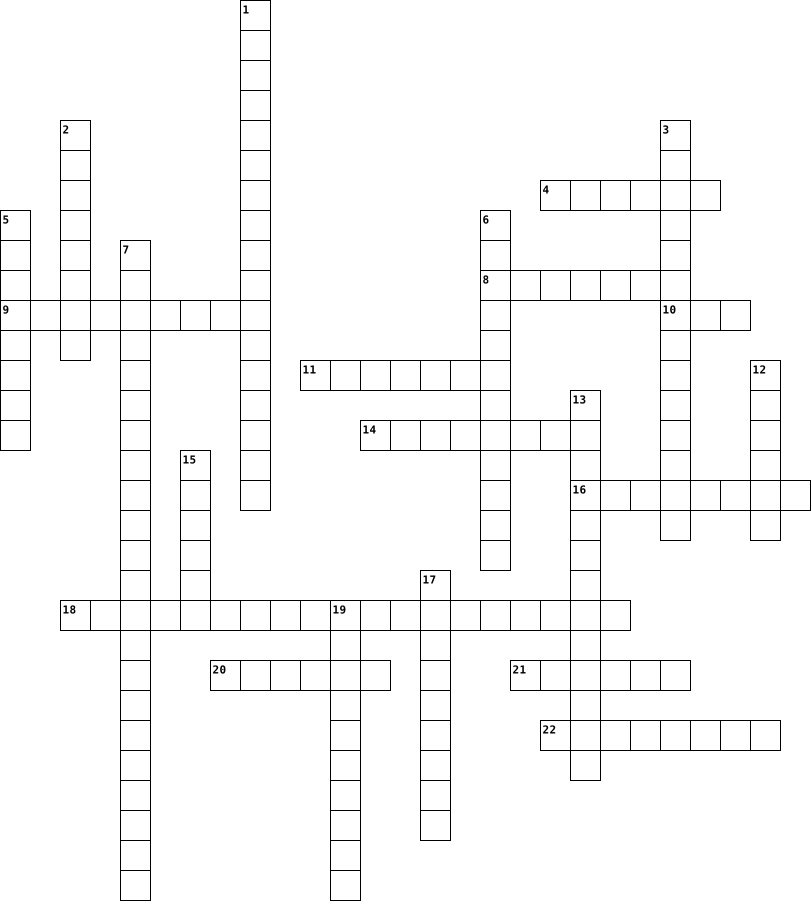
Vocab bingo Tyler robinson 4th 2024-01-12

Across
- all over
- change in frequency
- lowest part of a wave
- wave that mesures
- the rate of something
- agency
- reduction of items density
- wave that looks like ocean
Down
- small clumped up waves
- a periodic disturbance that moves through space
- the vibration
- a unit of frequency
- a force that squeezes something
- length of the wave
- the top of a wave
- maximum vibration
16 Clues: agency • all over • the vibration • wave that mesures • the top of a wave • maximum vibration • length of the wave • change in frequency • a unit of frequency • lowest part of a wave • the rate of something • small clumped up waves • reduction of items density • wave that looks like ocean • a force that squeezes something • a periodic disturbance that moves through space
Periodic Table Crossword Puzzle 2013-04-30

Across
- The atomic number of this element is 2.
- The atomic number of this element is 50.
- The atomic number of this element is 8.
- The atomic number of this element is 86.
- The atomic number of this element is 29.
- Particles of the atom that has a negative charge.
- The atomic number of this element is 7.
- The atomic number of this element is 17.
- The atomic number of this element is 11.
Down
- The atomic number of this element is 47.
- The atomic number of this element is 10.
- Mass The number of protons and neutrons in the nucleus is called_____________?
- The atomic number of this is 1.
- Particles of this atom that has a positive charge.
- the atomic number of this element is 26.
- The atomic number of this element is 22.
- The atomic number of this element is 3.
- The atomic number of this element is 27.
- The atomic number of this element is 79.
19 Clues: The atomic number of this is 1. • The atomic number of this element is 2. • The atomic number of this element is 8. • The atomic number of this element is 3. • The atomic number of this element is 7. • The atomic number of this element is 47. • The atomic number of this element is 50. • The atomic number of this element is 10. • The atomic number of this element is 86. • ...
THE PERIODIC TABLE CROSSWORD. 2025-02-07

Across
- This element is used to clean pool and bleaching.
- This element has 6 neutrons.
- What element is used for water processing?
- Humans breathe this element in their everyday lives
- Used for foils,kitchen utensils and aeroplane parts.
- Used to advertise signs.
- Can be used to inflate balloons.
- This element is also known as salt.
- This element is an odorless gas, used in light bulbs.
Down
- Which of the elements are used to make your teeth white?
- Which element is used for organic materials for oils?
- This element is a need for many body functions.
- This element has an atomic number of four.
- What element helps your muscles to contract.
- This element is used for fertilizers.
- It is a mood establishing element used to make medicines for mental illnesses.
- This element has 20 protons.
- How many neutrons does hydrogen have?
- You can use this element for thermal installation.
19 Clues: Used to advertise signs. • This element has 6 neutrons. • This element has 20 protons. • Can be used to inflate balloons. • This element is also known as salt. • This element is used for fertilizers. • How many neutrons does hydrogen have? • This element has an atomic number of four. • What element is used for water processing? • What element helps your muscles to contract. • ...
PTE 2021-03-17

Across
- includes Sodium
- nickname for the periodic table
- Tabular arrangement of chemical elements that is arranged by increasing atomic number and groups
- no charge
- pioneered the theory of atomism
- includes Neon
Down
- includes Barium
- first element
- includes Cobalt
- includes Iodine
- negative charge
- has a positive charge
- The 5th element of the PTE
- developed the Bohr model of the atom
- the smallest unit of ordinary matter
15 Clues: no charge • first element • includes Neon • includes Barium • includes Sodium • includes Cobalt • includes Iodine • negative charge • has a positive charge • The 5th element of the PTE • nickname for the periodic table • pioneered the theory of atomism • developed the Bohr model of the atom • the smallest unit of ordinary matter • ...
9/22 2021-09-20

Across
- 3D space
- Don't use these at beginning of answers
- two atoms
- Turned in at end of unit
- Never start answer with this word
- 70% of grade
- must be completed for retakes
Down
- turned in at end of year
- two different atoms
- makes balance move
- periodic table
- First place to look in schoology
- Worth 5% test bonus if fully completed
- mass and volume
- movement
15 Clues: 3D space • movement • two atoms • 70% of grade • periodic table • mass and volume • makes balance move • two different atoms • turned in at end of year • Turned in at end of unit • must be completed for retakes • First place to look in schoology • Never start answer with this word • Worth 5% test bonus if fully completed • Don't use these at beginning of answers
Atoms 2022-01-03

Across
- the number of protons in neculeus
- made the periodic table
- determine the atomic number
- Electron shells formula
- Atomic number is 1
- over 100 elemnets
- made up of protons and neutrons
- 18 in vertical colums
- numbered 1-7
Down
- has a negative charge
- react quickly with other elements
- Atomic number is 6
- Basic unit of matter
- he founded atoms
- contain either 1 or 2 letters
15 Clues: numbered 1-7 • he founded atoms • over 100 elemnets • Atomic number is 6 • Atomic number is 1 • Basic unit of matter • has a negative charge • 18 in vertical colums • made the periodic table • Electron shells formula • determine the atomic number • contain either 1 or 2 letters • made up of protons and neutrons • react quickly with other elements • the number of protons in neculeus
minerals by lovelymarch 2012-09-12

Across
- _____ wear
- Used for wires
- Is in all pencils
- _____ dioxide
- CaF2
- is used for poison, atomic number is 33
- one of the most well-known minerals on earth
- Only mineral with the hardness of 10
Down
- 75% of the earth
- Metal that people mine for
- planet closest to the sun
- Number 26 on the periodic table
- atomic symbol is 5
- Elastic metal
- when water freezes
15 Clues: CaF2 • _____ wear • _____ dioxide • Elastic metal • Used for wires • 75% of the earth • Is in all pencils • atomic symbol is 5 • when water freezes • planet closest to the sun • Metal that people mine for • Number 26 on the periodic table • Only mineral with the hardness of 10 • is used for poison, atomic number is 33 • one of the most well-known minerals on earth
Common Parasites 2013-12-06

Across
- Flat Worms
- Eight Legged Parasites
- Foot penetrating parasite
- Found in crowed, unclean environments like puppy mills
- Fungi
- Beaver Fever
- Single Celled Parasites
Down
- Spaghetti Like Worms
- The most common parasite in cats and dogs
- High risk zoonotic for pregnant woman
- Parasite spread by mosquitos
- Parasite that cause periodic smelly diarrhea
- Segmented parasite
13 Clues: Fungi • Flat Worms • Beaver Fever • Segmented parasite • Spaghetti Like Worms • Eight Legged Parasites • Single Celled Parasites • Foot penetrating parasite • Parasite spread by mosquitos • High risk zoonotic for pregnant woman • The most common parasite in cats and dogs • Parasite that cause periodic smelly diarrhea • Found in crowed, unclean environments like puppy mills
Menu project Ethan King 2023-03-30

Across
- reaction to sunlight
- reaction to touch
- multi pull elements
- element used to fill bloons
- reaction to water
- system in body that digests food
- letter found on periodic table
Down
- graph that shows all elements
- a change that is chemical
- element used in pools
- a change that is physical
- Start of digestive system
- element you inhale
13 Clues: reaction to touch • reaction to water • element you inhale • multi pull elements • reaction to sunlight • element used in pools • a change that is chemical • a change that is physical • Start of digestive system • element used to fill bloons • graph that shows all elements • letter found on periodic table • system in body that digests food
Science 2020-04-27

Across
- Horizontal row of elements on the periodic table
- Poor conductors of heat and electricity
- Are elements that are shiny and conduct heat and electricity well
Down
- The smallest particle into which an element can be divided and still be the same element
- Elements that have some properties of nonmetals
- Each vertical column of elements on the periodic table
- These negatively charged particles later become known as what
7 Clues: Poor conductors of heat and electricity • Elements that have some properties of nonmetals • Horizontal row of elements on the periodic table • Each vertical column of elements on the periodic table • These negatively charged particles later become known as what • Are elements that are shiny and conduct heat and electricity well • ...
Science 2023-08-28

Across
- What can you predict if you can locate where it is on a periodic table?
- What element is on the top left of the periodic table
- Non metals are not good __ of electricity and heat
Down
- Nonmetals are usually not _.
- what is a vertical column of elements called other than a family
- What are the seven horizontal rows called
- What do scientists use to organize chemical information?
7 Clues: Nonmetals are usually not _. • What are the seven horizontal rows called • Non metals are not good __ of electricity and heat • What element is on the top left of the periodic table • What do scientists use to organize chemical information? • what is a vertical column of elements called other than a family • ...
Science 2023-08-28

Across
- What can you predict if you can locate where it is on a periodic table?
- What element is on the top left of the periodic table
- Non metals are not good __ of electricity and heat
Down
- Nonmetals are usually not _.
- what is a vertical column of elements called other than a family
- What are the seven horizontal rows called
- What do scientists use to organize chemical information?
7 Clues: Nonmetals are usually not _. • What are the seven horizontal rows called • Non metals are not good __ of electricity and heat • What element is on the top left of the periodic table • What do scientists use to organize chemical information? • what is a vertical column of elements called other than a family • ...
Science Vocab: Periodic Table 2023-08-25

Across
- Anything that has mass and volume
- The smallest unit of an element that has all the properties of the element
- An element that does not conduct electricity or heat and is usually a gas at room temperature
- Symbol The single capital letter or capital letter followed by lowercase letter represents the name of the symbol
- The smallest unit of a compound that has all of the properties of the compound
- Theory Atoms of a given element are identical
- An element or substance that conducts heat and electricity
- A chart that organizes information about all of the known elements according to their properties
Down
- Elements and/or compounds that when put together are unable to react chemically
- Describes how likely an element is to form bonds with other elements
- The region surrounding the nucleus of an atom where the electrons are located
- A substance that cannot be broken down into a simpler substance by ordinary chemical means
- An atom that has gained or lost one or more electrons
- An element that has some properties of a metal and some properties of a nonmetal
- a vertical column on the periodic table
- a horizontal row in the periodic table
16 Clues: Anything that has mass and volume • a horizontal row in the periodic table • a vertical column on the periodic table • Theory Atoms of a given element are identical • An atom that has gained or lost one or more electrons • An element or substance that conducts heat and electricity • Describes how likely an element is to form bonds with other elements • ...
Properties of Matter 2023-10-09

Across
- A homogeneous mixture of two or more substances; can still be separated by physical processes
- Substance A kind of matter made entirely of either a single element or a single compound
- A substance that is dissolved in a solution.
- A measure of the amount of matter in an object
- A pure substance made of only one kind of atom; appears on the Periodic Table
- Smallest particle of an element that still has the properties of that element
- A substance made up of atoms of two or more different elements bonded together; can only be separated by chemical processes
Down
- A combination of two or more substances that are not chemically combined
- A compound formed by the chemical bonding of an oxygen atom and two hydrogen atoms
- The amount of space an object takes up
- characteristics used to describe a substance
- A liquid substance capable of dissolving other substances
- the makeup of something; the type of atoms that make up a substance
- The same all the way through; consistent
- Anything that has mass and takes up space
- Table A chart of all known elements, arranged according to their properties
16 Clues: The amount of space an object takes up • The same all the way through; consistent • Anything that has mass and takes up space • characteristics used to describe a substance • A substance that is dissolved in a solution. • A measure of the amount of matter in an object • A liquid substance capable of dissolving other substances • ...
Atomic Theory and the Periodic Table 2023-04-27

Across
- representation of the valence electrons for an element
- a horizontal row on the Periodic Table; same number of electron shells
- substance that can conduct electric currents under some conditions but not others; used in computer chips, solar cells
- an electron on the outermost shell, have the highest energy
- shiny and reflective
- the experiment where a green beam bent towards a positively charged plate
- the experiment where positively charged alpha particles mostly went straight through the foil but some deflected
Down
- substance composed of atoms of 2 or more elements bonded together
- the center of the atom where all mass is located
- a positively charged subatomic particle with 1 amu mass, located in the ceter
- a vertical column on the Periodic Table; same number of valence electrons, same chemical properties
- ability to be hammered/rolled into flat sheets or shapes
- ability to pull/draw out a material into long, thin wires
- the ease and speed that an element combines/reacts with other substances
- a neutrally charged subatomic particle with 1 amu mass, located in the center
- a negatively charged subatomic particle with negligible mass, located outside the center
16 Clues: shiny and reflective • the center of the atom where all mass is located • representation of the valence electrons for an element • ability to be hammered/rolled into flat sheets or shapes • ability to pull/draw out a material into long, thin wires • an electron on the outermost shell, have the highest energy • ...
Chem 1111 Ch 1/2 2025-08-29

Across
- Element with a mass number of 184 containing 110 neutrons
- Name of property whereby matter changes from one form to another
- Prefix representing 0.1 used to denote decimal fractions and multiples of SI units
- A supposition or proposed explanation made on the basis of limited evidence as a starting point for further investigation according to the scientific method
- Term for uncertainty that defines the closeness of a measured value to the true value
- Term for grams of one mole of substance (g/mol)
- Name of an atom that has the same atomic number Z but different mass number A than another atom
- Positively charged subatomic particle in the nucleus of an atom
- Temperature scale based on the properties of water
- Horizontal row of the Periodic Table
Down
- Physical state of matter with a fixed shape and volume
- Element with 49 protons
- B block elements are also called _____ metals
- Name for the group of elements found in column 16 of the Periodic Table
- Type of matter characterized by good conductor of electricity, high melting and lustrous appearance
- Name of a substance that contains 2 or more elements
16 Clues: Element with 49 protons • Horizontal row of the Periodic Table • B block elements are also called _____ metals • Term for grams of one mole of substance (g/mol) • Temperature scale based on the properties of water • Name of a substance that contains 2 or more elements • Physical state of matter with a fixed shape and volume • ...
Chemistry Crossword 2015-11-19

Across
- Catalyst involved in a chemical reaction in living things.
- The smallest part of an element that is representative of that element.
- A material that that electric charge can move through easily.
- Shiny, malleable, ductile element that conducts electricity.
- Chemical reaction that takes place in cell.
- Change of state from a liquid to gas.
- Chemical combination of two or more elements in a specific ratio.
- Chemical reaction that releases energy.
- Anything that has mass and occupies space.
- Slow chemical change that occurs when oxygen in the air reacts with a metal.
- Change of state from solid to liquid.
Down
- Number of protons in the nucleus of one atom of an element.
- Invisible negatively charged particle that orbits the nucleus of an atom.
- Measure of atomic mass.
- Description of a substance that can be pounded or rolled into sheet.
- Chemical reaction that absorb energy.
- Substance that helps a chemical reaction to proceed more quickly.
- Change of state from a gas to liquid.
- Change of state from a gas to solid.
- Vertical column of element in the periodic table.
- Group 17 elements in the periodic table.
- Substance that strongly resist the flow of electricity.
- Chang of state from a liquid to solid.
- Amount of mass in a given volume of a substance.
- Ability to work.
25 Clues: Ability to work. • Measure of atomic mass. • Change of state from a gas to solid. • Chemical reaction that absorb energy. • Change of state from a gas to liquid. • Change of state from a liquid to gas. • Change of state from solid to liquid. • Chang of state from a liquid to solid. • Chemical reaction that releases energy. • Group 17 elements in the periodic table. • ...
Biochemistry Vocabulary Review 2016-05-18

Across
- When two different molecules stick together, this is called _______.
- Located on the right side of a chemical equation.
- A column in the periodic table is referred to as a _______.
- A row in the periodic table is called a _______.
- A subatomic particle located in the nucleus. It has a positive charge.
- This type of chemical reaction requires energy.
- Atoms are most stable when their _______ shells are complete.
- A substance that results from the combination of two or more elements.
- A subatomic particle that orbits the nucleus and has a negative charge.
- A negatively charged particle.
- A positively charged particle.
- The "universal" solvent necessary for life.
- When two similar molecules stick together, this is called _______.
Down
- Atoms of the same element, but with different atomic masses.
- Biological macromolecules have a backbone composed of long chains of this elelment.
- The smallest unit of a chemical element.
- A group of two or more atoms that share electrons in a chemical bond.
- This type of chemical reaction releases energy.
- Located on the left side of a chemical equation.
- Water has high surface tension due to these types of binds.
- In this type of bond, atoms may equally or unequally share electrons.
- A charged particle.
- A neutral subatomic particle that is located in the nucleus.
- In _______ bonds, atoms of opposite charges are attracted to each other.
24 Clues: A charged particle. • A negatively charged particle. • A positively charged particle. • The smallest unit of a chemical element. • The "universal" solvent necessary for life. • This type of chemical reaction releases energy. • This type of chemical reaction requires energy. • A row in the periodic table is called a _______. • ...
its a crossword 2021-01-18

Across
- negatively charged particles
- atomic mass unit
- these tend to be brittle lack luster and not good conductors of electricity
- the process by which unstable atoms become more stable
- the number of protons in an element
- very stable colorless and odorless
- horizontal rows on the periodic table that read left to right and one protons and electron is added from one element to the next
- good conductors of heat and electricity they are malleable and shiny
- rare earth metals
- An element with a different number of electrons with the same amount of protons
- these tend to be lustrous, ductile, malleable, and good conductors of electricity
- positively charged particles
- vertical columns on the periodic table that share the same properties
Down
- uncharged or neutral particles
- properties of metals and nonmetals
- An element with a different number of neutrons with the same amount of protons
- electrons that could be surrounding the nucleus
- reactive with group 7 but not a much as alkali metals
- reactive with groups 1 and 2 and common anti-bacterial
- when an atom gains an electron
- very reactive with group 7
- when an atom loses an electron
- particles the that are given off when atoms break apart
- all are radioactive
- found in the center of the atom and contains protons and neutrons
25 Clues: atomic mass unit • rare earth metals • all are radioactive • very reactive with group 7 • negatively charged particles • positively charged particles • uncharged or neutral particles • when an atom gains an electron • when an atom loses an electron • properties of metals and nonmetals • very stable colorless and odorless • the number of protons in an element • ...
The world of chemistry 2023-09-14

Across
- definite volume and indefinite shape
- used to grab hot item in the lab.
- name of elements in group 17 (7A)
- larger units of matter that consist of two or more atoms.
- a property that indicates heat flow
- substance made of two or more elements in a fixed ratio.
- very radioactive element
- state of matter with the highest kinetic energy
- one of the main electrolytes
- the smallest distinct units in a sample of matter
- An ionic solid consisting of oppositely charged ions.
- Positively charged ions.
- most elements in the periodic table.
- the study of the composition, structure, properties and behavior of matter.
- how close a set of measurements agree with each other.
Down
- chemical symbol W
- the father of the periodic table
- a mixture that has the same composition throughout.
- water does this at 100 degress celcius
- varies in composition (and/or properties) from one part of the mixture to another
- when substances change from solid to liquid.
- atoms are tightly packed together and just vibrate in place.
- Atoms with the same number of protons, but a different number of neutrons.
- Negatively charged ions.
- substances composed of only one type of atom.
- how close the average of a set of measurements comes to the “correct” value.
- most used element in jewelry
- one of only two liquid elements at room temperature
28 Clues: chemical symbol W • very radioactive element • Negatively charged ions. • Positively charged ions. • one of the main electrolytes • most used element in jewelry • the father of the periodic table • used to grab hot item in the lab. • name of elements in group 17 (7A) • a property that indicates heat flow • definite volume and indefinite shape • most elements in the periodic table. • ...
Chemistry 2022-05-19

Across
- molecules that can be drawn more than one way
- a rule that shows the order in which subshells are filled with electrons
- laws that relate the pressure, volume, and temperature of a gas
- Number of moles of solute per liter of solution
- C7H16
- a particular region where electrons can orbit the nucleus of an atom
- the mass of one mole of a substance
- a horizontal row of the periodic table
- the distance from the nucleus to the outermost electrons of an atom.
- a subdivision of a shell
- electrons in an outer shell of an atom that can be lost to or shared
- hydrocarbon with only single bonds
- attraction between atoms
Down
- a vertical column in the periodic table of elements.
- a region in space occupied by an electron or pair of electrons
- a solid that is dissolved
- the ability of an atom in a molecule to attract shared electrons
- A way of representing atoms or molecules by showing electrons as dots
- hydrocarbon with at least one triple bond
- tiny packets of energy
- the quantitative relationship between constituents in a chemical substance
- a description of the shells, subshells, and orbitals occupied by electrons
- C2H6
- the number of protons in the nucleus of an atom
- degree the solute dissolves
- a compound of hydrogen and carbon
- hydrocarbon with at least one double bond
27 Clues: C2H6 • C7H16 • tiny packets of energy • a subdivision of a shell • attraction between atoms • a solid that is dissolved • degree the solute dissolves • a compound of hydrogen and carbon • hydrocarbon with only single bonds • the mass of one mole of a substance • a horizontal row of the periodic table • hydrocarbon with at least one triple bond • ...
Chemistry 2025-01-16

Across
- Element with the highest atomic number, named after a physicist.
- Type of reaction where a substance burns in the presence of oxygen, often releasing heat and light.
- It supports combustion.
- Subatomic particles found in the nucleus of an atom.
- Term for the smallest unit of a chemical element that retains its properties.
- Term for a mixture where particles are evenly distributed, also used in mathematics.
- Compound with the formula H2SO4, a strong acid used in car batteries.
- It's a combination of sodium and chlorine.
- It's around 78% of Earth's atmosphere.
- Type of bond between sodium and chlorine in NaCl due to the transfer of electrons.
- Acid found in the stomach that aids in digestion. Its formula is HCl.
Down
- Device used to measure atmospheric pressure, sounds like a musical instrument.
- It involves chlorophyll.
- Scientist known for the gold foil experiment and discovering the nucleus of the atom.
- Group 18 elements in the periodic table, known for their lack of reactivity.
- Common name for H2O2, often used as a disinfectant.
- Avogadro's number is related to it.
- Scientist who created the Periodic Table. His last name starts with "M".
- Law that states the volume of gas is inversely proportional to its pressure, named after a scientist with a last name starting with "B".
- It's a gas that plants take in for photosynthesis.
20 Clues: It supports combustion. • It involves chlorophyll. • Avogadro's number is related to it. • It's around 78% of Earth's atmosphere. • It's a combination of sodium and chlorine. • It's a gas that plants take in for photosynthesis. • Common name for H2O2, often used as a disinfectant. • Subatomic particles found in the nucleus of an atom. • ...
Chemistry 2023-10-16

Across
- Nucleus changes from a higher energy state to a lower energy state, emits photos (energy)
- Bomb made using plutonium
- Two light nuclei combine together to release energy
- Scientist who created the world’s first atomic bomb
- Unstable nucleus changes into another element by shooting out a particle composed of 2 protons and 2 neutrons
- Neutron decays into a proton, nucleus emits a beta particle
- charged atoms that form when an atom loses or gains electrons
- Any chemical element that lie beyond uranium in the periodic table
- Releases energy in the form of ionizing radiation
- Atoms with the same number of protons but different numbers of neutrons
- number of protons on periodic table
Down
- City in Japan where Fat Man was dropped
- Amount of time it takes for one-half of the radioactive isotope to decay
- Splitting of a nucleus into two lighter nuclei
- Bomb made using uranium
- Series of chemical reactions where the products of a reaction contribute to the reactants of another reaction
- Scientist who discovered radium and polonium
- Smallest particle of an element that retains the properties of that element
- City in Japan where Little Boy was dropped
- Emission of ionizing radiation from nuclear decay
- number of how much an element weighs
- Energy that comes from a source and travels through space at the speed of light
22 Clues: Bomb made using uranium • Bomb made using plutonium • number of protons on periodic table • number of how much an element weighs • City in Japan where Fat Man was dropped • City in Japan where Little Boy was dropped • Scientist who discovered radium and polonium • Splitting of a nucleus into two lighter nuclei • Emission of ionizing radiation from nuclear decay • ...
unit 2 vocab 2024-02-01

Across
- each of the actual or potential patterns of electron density that may be formed in an atom or molecule by one or more electrons, and that can be represented as a wave function
- A particle of electromagnetic radiation with no mass that carries a quantum of energy
- an atom or group of atoms with a positive or negative charge
- Measures the tendency of an atom to attract a shared pair of electrons
- measures the mass of an atom or molecule
- subatomic particle with a negative charge
- lowest energy level of an atom or particle
- amount of energy required to remove an electron from the atom
- negatively charged ion
- a nuclide of 2 or more of the same element
- horizontal row on a periodic table
- positively charged ion
Down
- the reduction of attracting forces between a nucleus and its outer electrons due to the blocking effect of electrons
- only certain values are allowed
- vertical row on a periodic table
- likelihood an event will happen
- area around a nucleus where electrons are found
- subatomic particle with a positive charge
- subatomic particle with a no charge
- energy needed to remove a electron from a negative ion to form a neutral atom or molecule
- a state where an atom has higher energy potential than ground state
- one-half the distance between the nuclei of two atoms when joined
22 Clues: negatively charged ion • positively charged ion • only certain values are allowed • likelihood an event will happen • vertical row on a periodic table • horizontal row on a periodic table • subatomic particle with a no charge • measures the mass of an atom or molecule • subatomic particle with a positive charge • subatomic particle with a negative charge • ...
Ocean Motion Puzzle 2024-11-05

Across
- There are _______ high and low tides each day
- The difference in height between high and low tide
- 100 kilometer wide current that is located in the Atlantic Ocean
- When waves enter ________ water, they become higher, steeper, and fall forward
- The Moon's _________pulls on ocean water and causes the oceans to bulge towards the moon
- Ocean currents ________ heat and nutrients
- Ocean waves are caused by __________
- Type of tide that occurs when the Earth, Moon, and Sun are at right angles and the tidal range is the lowest
- A mass of moving water
- Currents south of the __________ rotate counterclockwise
- Effect that shifts winds and surface currents from their expected path
- Ocean tides are the ________ rise and fall of sea level
- Ocean tides are caused by the ______ and Sun
Down
- Currents North of the Equator move __________
- Upward motion of ocean water
- Current that has horizontal movement of ocean water in the top 100-200 meters
- Current that is caused by the differences in temperature and salinity
- Cold water is more _______ than salty water
- Periodic rise and fall of sea level
- Ocean waves carry _________
- Type of tide that occurs when the Earth, Moon, and Sun are all aligned and the tidal range is the largest
- West coast currents are this temperature
- Collapsing waves
- Earth's movement that affects currents
24 Clues: Collapsing waves • A mass of moving water • Ocean waves carry _________ • Upward motion of ocean water • Periodic rise and fall of sea level • Ocean waves are caused by __________ • Earth's movement that affects currents • West coast currents are this temperature • Ocean currents ________ heat and nutrients • Cold water is more _______ than salty water • ...
Chemistry Puzzle 2024-04-03

Across
- any of a class of substances characterized by high electrical and thermal conductivity
- the structure in a cell that contains the chromosomes
- poor conductors of heat and electricity.
- smallest particle of an element which can exist itself
- any substance that has a defined composition.
- a horizontal row of the periodic table
- a representation of chemical elements using one or two letters.
- a subatomic particle with a positive electrical charge.
- mass of a unit volume of a material substance.
- ability to do work,
- chemical substances made up of two or more elements that are chemically bound together in a fixed ratio.
Down
- quantitative measure of inertia, a fundamental property of all matter
- the area around an atom's nucleus where electrons are most likely to be found.
- subatomic particles found inside the nucleus of every atom.
- The outermost shell or orbital of an atom
- chemical element that exhibits some metal and some nonmetal properties.
- occur when chemical bonds between atoms are formed or broken.
- metal made by combining two or more metallic elements
- the quantity of matter contained in an atom of an element.
- a pure substance that cannot be broken down by chemical methods into simpler parts.
- a column in the periodic table of the chemical elements
- anything that takes up space and can be weighed.
22 Clues: ability to do work, • a horizontal row of the periodic table • poor conductors of heat and electricity. • The outermost shell or orbital of an atom • any substance that has a defined composition. • mass of a unit volume of a material substance. • anything that takes up space and can be weighed. • the structure in a cell that contains the chromosomes • ...
atoms and elements 2022-01-03

Across
- a stable subatomic particle with a charge of negative electricity
- the lightest element
- the basic unit of a chemical element.
- A one-or-two letter abbreviation for the element that appears directly below its atomic number on the periodic table
- a class of chemical elements they are all odorless, colorless, monatomic gases with very low chemical reactivity
- a chemical element with the symbol N and atomic number 7
- a subatomic particle of about the same mass as a proton but without an electric charge
- combine to form composite particles called hadrons
- the smallest discrete amount or quantum of electromagnetic radiation.
- positively charged region in the center of an atom
Down
- the number of protons and electrons in an atom
- a chemical element that forms a salt when it reacts with metal
- chemical change reactants
- one of two or more species of atoms of a chemical element with the same atomic number and position in the periodic table
- minus atomic number is how to find the number of neutrons in an atom
- a chemical element with the symbol Ne and atomic number 10
- a chemical element with the symbol C and atomic number 6
- Substance is made up of two or more atoms in a fixed proportion.
- has the same properties at every point
- Composed of only one type of Adam, molecule, element
20 Clues: the lightest element • chemical change reactants • the basic unit of a chemical element. • has the same properties at every point • the number of protons and electrons in an atom • combine to form composite particles called hadrons • positively charged region in the center of an atom • Composed of only one type of Adam, molecule, element • ...
Gardening Midterm 2022-03-09

Across
- An ingredient in soil (spelled similarly to a chickpea dip that tastes great with pita bread).
- During ___, ammonia is converted into nitrite and nitrate.
- During ____, nitrogen from animal waste or decaying bodies is returned to the soil as ammonia by bacteria and decomposers.
- Seeds that have not been genetically modified (not artificially at least).
- Shredded, chipped, or ground-up pieces of wood (mentioned many times in the Back to Eden video)
- Do not store your seeds here.
- The process where a seed sprouts into a plant.
- PH __ encourages nutrients and discourages harmful elements in the soil.
Down
- The process in which plants absorb nitrogen.
- Another chemical in addition to nitrogen that is essential for plants (atomic number 15 on the periodic table).
- Seeds that come from two different species.
- “Improved” seeds are __ modified.
- __ rotation helps plants to grow better and healthier.
- In a process called nitrogen ___, bacteria convert nitrogen gas into ammonia.
- According to the Back to Eden video, this is the ideal way to water.
- Seeds that are suitable for consumption.
- About 78% of the atmosphere is made up of this gas (atomic number 7 on the periodic table).
- During ___, nitrate is changed into nitrogen gas which becomes part of the atmosphere.
- Wild plants that grow where they are not wanted.
- Is made up of inorganic and organic material, air, and water.
20 Clues: Do not store your seeds here. • “Improved” seeds are __ modified. • Seeds that are suitable for consumption. • Seeds that come from two different species. • The process in which plants absorb nitrogen. • The process where a seed sprouts into a plant. • Wild plants that grow where they are not wanted. • __ rotation helps plants to grow better and healthier. • ...
Physical Science 2025-12-04

Across
- particle that stabilizes the nucleus
- (15)
- column in the periodic table
- of creating heavier elements in stars
- decay where a neutron becomes a proton
- electron involved in bonding
- charged particle in the nucleus
- (15)
- 18 elements known for low reactivity
- charged ion
- that has gained or lost electrons
- formed when atoms bond chemically
- who proposed the first modern atomic theory
- of nuclear decay releasing a helium nucleus
- property of particles (positive, negative, neutral)
- model proposing electrons orbit in energy levels
Down
- row in the periodic table
- region where electrons move around the nucleus
- part of the atom containing protons and neutrons
- unit of matter that retains chemical properties
- easily an atom undergoes chemical change
- of elements by atomic number
- charged particle found outside the nucleus
- that is shiny, malleable, and conducts electricity
- of how strongly an atom attracts electrons
- of the same element with different numbers of neutrons
- of protons and neutrons in an atom
- of protons in an atom
- charged ion
- process that forms heavier elements in stars
- substance made of one type of atom
- where electrons are likely to be found
32 Clues: (15) • (15) • charged ion • charged ion • of protons in an atom • row in the periodic table • column in the periodic table • of elements by atomic number • electron involved in bonding • charged particle in the nucleus • that has gained or lost electrons • formed when atoms bond chemically • of protons and neutrons in an atom • substance made of one type of atom • ...
Vocabulary Unit 4 Weeks 1&2 Synonyms 2021-05-03

Across
- depressed, gloomy, unhappy, sad
- occasional, periodic, yearly, annual
- huff, gasp, breath, wheeze
- crinkle, wrinkle, crumple, crease
- smear, stain, spot, blemish
- cloudy, dark, hazy, gloomy
Down
- bother, irritation
- welcome, acknowledge, salute
- flexible, bendable
- crazy, busy, frantic, excited
10 Clues: bother, irritation • flexible, bendable • huff, gasp, breath, wheeze • cloudy, dark, hazy, gloomy • smear, stain, spot, blemish • welcome, acknowledge, salute • crazy, busy, frantic, excited • depressed, gloomy, unhappy, sad • crinkle, wrinkle, crumple, crease • occasional, periodic, yearly, annual
Chemistry Vocab 2023-08-18

Across
- another word for huge
- turn this up when the music is good
- 2 chemicals stuck together
- length
- periodic table
- combination
Down
- can be accelerated
- a perfect element
- makes rocks heavy
- anything that takes up space
10 Clues: length • combination • periodic table • a perfect element • makes rocks heavy • can be accelerated • another word for huge • 2 chemicals stuck together • anything that takes up space • turn this up when the music is good
Idk 2026-03-30

Across
- _____ Nose
- A town
- _____ Something
- What a bride wears
- A kids TV show
Down
- _________ Storm
- Another word for Mum
- A Word for autism
- The people who made the great pyramids
- 118th Elemnt on the periodic table
10 Clues: A town • _____ Nose • A kids TV show • _________ Storm • _____ Something • A Word for autism • What a bride wears • Another word for Mum • 118th Elemnt on the periodic table • The people who made the great pyramids
Chemistry Final Exam「2nd Quarter」 2013-12-10

Across
- Unequal sharing of electrons
- Share ONLY 2 electrons. Hint: Form only single bonds
- BD: 3; NBD: 0
- H-O, H-F, H-N
- BD: 5; NBD: 1
- BD: 3, NBD: 2
- Energy change when an electron is added to the atom
- As much as possible; share 8 electrons.
- Nonpoloar and polar electrons. HINT: An IMF
- BD: 2; NBD: 1 or 2
- BD: 5; NBD: 0
- 2 or more valid Lewis structure for a compound
- Loses electrons. HINT: Found on the right side of the Periodic Table
- Equal sharing of electrons
- Contains strictly metalloids and non-metals
Down
- "Colorwriting"
- Valence Shell Electron Pair Repulsion (Electrons arrange themselves to be as far away as possible)
- More protons, less electrons. HINT: Found on the left side and middle of the Periodic Table
- 1 sigma; 2 pi bond
- VE-AE = _______
- 18 Do not form ions; they combine with other elements
- BD: 4; NBD: 0 (HINT: The model is blue and white)
- Always Roman Numeral One in the compound. HINT: An element
- Roman numerals are used in this compound
- Electrons in the highest, occupied energy level. HINT: Used in bonding
- 2nd strongest IMF
- BD: 2; NBD: 0 or 3
- Most electronegative element
- Bond _____ is stronger than Pi
- BD: 6; NBD: 0
30 Clues: BD: 3; NBD: 0 • H-O, H-F, H-N • BD: 5; NBD: 1 • BD: 3, NBD: 2 • BD: 5; NBD: 0 • BD: 6; NBD: 0 • "Colorwriting" • VE-AE = _______ • 2nd strongest IMF • 1 sigma; 2 pi bond • BD: 2; NBD: 1 or 2 • BD: 2; NBD: 0 or 3 • Equal sharing of electrons • Unequal sharing of electrons • Most electronegative element • Bond _____ is stronger than Pi • As much as possible; share 8 electrons. • ...
Science: Matter and Chemical Change 2014-11-10

Across
- the rows in the Periodic Table of Elements
- the 18 columns on the Periodic Table of Elements
- ______ systems is an experiment in which reactants and products can not escape
- neutral particles
- occurs when oxygen reacts to another substance to form a new substance and releases energy
- occurs when oxygen reacts with metal, a chemical reaction in which the metal is decomposed
- an atom or group of atoms that become electrically charges because it has lost or gained electrons
- compound formed when 2 non-metals combine
- Workplace Hazardous Material Information System
- substance that strongly resists the flow of electricity
- the mass of one of an element
- most reactive of the metals
- published by Andreas Libau in 1597, it describes the achievements of alchemists
- substances that helps reaction proceed faster
- a pure substance that cannot be broken down into other substances
Down
- represents the number of atoms
- has the element symbol Br
- positively charged particles
- the Law of ________ of Mass
- experimented with the behaviour of gases
- characteristics that can be used to describe a substance
- stated each type of material was made up of a different type of atomos
- a chemical reaction that takes place in the cells of your body
- Father of Modern Chemistry
- supported the idea that everything was made up of the 4 elements
- organic catalysts
26 Clues: neutral particles • organic catalysts • has the element symbol Br • Father of Modern Chemistry • the Law of ________ of Mass • most reactive of the metals • positively charged particles • the mass of one of an element • represents the number of atoms • experimented with the behaviour of gases • compound formed when 2 non-metals combine • the rows in the Periodic Table of Elements • ...
Properties and the Periodic Table 2015-04-29

Across
- the positively charged particles in the nucleus of an atom
- the number of protons in the nucleus of one atom of the element
- a chart that organizes elements by their properties
- a column in the periodic table
- the negatively charged particles that circle the nucleus of an atom
- the ways an element behaves with other elements
- the center part of an atom, which contains protons and neutrons
- change chemically
- giving off high-energy particles
- imaginary paths around the nucleus of an atom in which electrons move
- balanced and not easy to change
- having qualities that set one thing apart from others
Down
- the characteristics of a substance you can observe without changing the substance
- people who find new ways to use elements and compounds
- the smallest part of an element that has the properties of that element
- events that happen over and over
- a row in the periodic table
- a change in matter that results in the formation of a new substance
- an abbreviation for an element, usually made of one or two letters from the beginning of its name
- a substance that cannot be split into simpler substances
- materials that allow heat and electricity to pass through
- any substance from which something can be made
- the mass per unit volume of a substance
23 Clues: change chemically • a row in the periodic table • a column in the periodic table • balanced and not easy to change • events that happen over and over • giving off high-energy particles • the mass per unit volume of a substance • any substance from which something can be made • the ways an element behaves with other elements • ...
Biochemistry Vocabulary Review 2016-05-18

Across
- A subatomic particle located in the nucleus. It has a positive charge.
- A row in the periodic table is called a _______.
- Located on the right side of a chemical equation.
- A group of two or more atoms that share electrons in a chemical bond.
- When two different molecules stick together, this is called _______.
- A charged particle.
- Biological macromolecules have a backbone composed of long chains of this elelment.
- A subatomic particle that orbits the nucleus and has a negative charge.
- In _______ bonds, atoms of opposite charges are attracted to each other.
- This type of chemical reaction requires energy.
- A negatively charged particle.
- Atoms of the same element, but with different atomic masses.
Down
- A column in the periodic table is referred to as a _______.
- Water has high surface tension due to these types of binds.
- In this type of bond, atoms may equally or unequally share electrons.
- A substance that results from the combination of two or more elements.
- A neutral subatomic particle that is located in the nucleus.
- The "universal" solvent necessary for life.
- When two similar molecules stick together, this is called _______.
- This type of chemical reaction releases energy.
- Atoms are most stable when their _______ shells are complete.
- Located on the left side of a chemical equation.
- A positively charged particle.
- The smallest unit of a chemical element.
24 Clues: A charged particle. • A positively charged particle. • A negatively charged particle. • The smallest unit of a chemical element. • The "universal" solvent necessary for life. • This type of chemical reaction releases energy. • This type of chemical reaction requires energy. • A row in the periodic table is called a _______. • ...
Chemistry Crossword 2016-09-20

Across
- a pure substance that cannot be broken down into simpler substance
- the small positively charged center of the atom
- the charge on an ion
- a number that describes the relative ability of an atom when bonded to attract electrons
- an element that is a good conductor of electricity, malleable, ductile, and lustrous
- a circular path in which an electron can move around a nucleus
- knowledge coming directly from observations
- a positively charged subatomic particle in the nucleus of an atom
- any process by which a neutral atom or molecule is converted into an ion
- a comprehensive set of ideas that explains a law or a large number of related observations
Down
- a mental or physical representation of a theoretical concept
- Russian chemist responsible for periodic table
- a charged entity formed by the addition or removal or one or more electrons
- knowledge based on ideas created to explain observations
- an element that is generally a non conductor of electricity and is brittle
- another word for base
- the smallest particle of an element
- used to heat elements and comes out of a burner
- acronym for stand ambient temperature and pressure
- atoms of an element that have the same number of protons and neutrons
- a row in the periodic table
- a group of three elements with similar properties
22 Clues: the charge on an ion • another word for base • a row in the periodic table • the smallest particle of an element • knowledge coming directly from observations • Russian chemist responsible for periodic table • the small positively charged center of the atom • used to heat elements and comes out of a burner • a group of three elements with similar properties • ...
Alchemist's Crossword 2 2020-10-28

Across
- chemical symbol of water
- copying and using someone's work as if it were your own
- atom or molecule which has more or less electrons than proton
- particle in nucleus of atom that has no charge
- negatively charged particle in atoms
- find value of
- characteristics of elements - their fingerprints.
- word that describes nouns or pronouns
- lover of wisdom
- he, she, it, they - words used in place of nouns
- fuel + ozygen + energy --> Carbon dioxide + water + Energy
- gasses which have full outer shells
- chemical symbol of carbon dioxide
Down
- the substance scientists believed was fire for 200 years.
- one or more atoms bonded together
- bond based on the attraction of negatively and postively charged atoms or molecules
- substance needed / that reacts with Oxygen in combustion
- table of elements designed by Mendleleev- that organizes all elements by rows - atomic number- and groups - by properties.
- mathematical terms that can include numbers and variables and functions
- - infinitely small, uncuttable, indestuctable particle of a substance - made up of protons, electrons and neutrons
- in Greek philosophy = Earth, Air, Fire and Water; in modern times all the substances that are on the periodic table
- philosophy and practice that substances can be transmuted - ie. lead into gold, and belief that immortal life can be achieved through use of philsopher's Stone and Water of life.
- transformation of substances
- postively charged particle in nucleus of atoms
24 Clues: find value of • lover of wisdom • chemical symbol of water • transformation of substances • one or more atoms bonded together • chemical symbol of carbon dioxide • gasses which have full outer shells • negatively charged particle in atoms • word that describes nouns or pronouns • particle in nucleus of atom that has no charge • postively charged particle in nucleus of atoms • ...
C1 Revision - SHA 2017-01-29

Across
- Used in chromatography to dissolve a compound.
- Gas released when a group 1 metal reacts with water.
- Filtration and ___ can be used to separate rock salt.
- As you descend group 7 the elements become ___ reactive.
- A vertical column in the periodic table.
- Another name for group 0 gases.
- Group 1 metals are very ___.
- The charge of a nucleus.
- Two or more elements bonded together.
- Bromine will do this to iodine.
- As you descend group 1, the reactivity ____.
- The particles scattered from a gold nucleus in Rutherford's experiment.
- The number of protons is the ___ number.
Down
- American billionaire and owner of Wayne Enterprises.
- The number of electrons is ___ to the number of protons in an atom.
- When positive nuclear charge is blocked by electron shells.
- The element with electron configuration 2,8.
- Bohr concluded electrons were arranged in ___.
- An atom is ___, unlike an ion.
- This scientist showed the plum pudding model was wrong.
- Effective mass of an electron.
- Filtration separates ____ solids from liquids.
- Same number of protons but different number of neutrons.
- A red-brown halogen.
- The number of electrons held in the first shell.
- The element with electron configuration 2,8,8,2.
- The number of electrons held in the second or third shell.
- The modern periodic table is in order of ___ number.
28 Clues: A red-brown halogen. • The charge of a nucleus. • Group 1 metals are very ___. • An atom is ___, unlike an ion. • Effective mass of an electron. • Another name for group 0 gases. • Bromine will do this to iodine. • Two or more elements bonded together. • A vertical column in the periodic table. • The number of protons is the ___ number. • ...
Daffney Renteria 2017-11-28

Across
- are atoms or groups or a atoms with positive or negative charge.
- that goes around like a cycle
- something that dissolves
- The number of protons and electrons is equal in each atom
- a column of elements in the periodic table
- is the name given to a horizontal row of the periodic table
- force of attraction between positively and negatively charged ions.
- a solid material whose constituents (such as atoms, molecules, or ions)
- a regular pattern, showing the positions of atoms, molecules, or ions
- do not have luster but they are also dull.
- a chemical rule of thumb that reflects observation that atoms of main-group elements that combines
- good at forming bonds and cations with non-metals
Down
- measure of its combining power with other atoms when it forms chemical compounds
- made up atoms
- molecules are molecules composed of only two atoms, of the same or different chemical elements.
- Unit any ionic or covalent network solid compound
- an ionic species having a negative charge
- a particle without electrical charge.
- a measure of the tendency of an atom to attract a bonding pair of electrons
- any positively charged atom or group of atoms (opposed to anion )
- bond that involves the sharing of electron pairs between atoms.
- causing the atoms to be bound to each other
22 Clues: made up atoms • something that dissolves • that goes around like a cycle • a particle without electrical charge. • an ionic species having a negative charge • a column of elements in the periodic table • do not have luster but they are also dull. • causing the atoms to be bound to each other • Unit any ionic or covalent network solid compound • ...
Chemistry Crossword 2023-07-21
Across
- is anything that has mass and takes up space
- this chemistry is the study of chemicals containing carbon
- An element
- the best known compound
- An element that possesses characteristics that fall between those of chlorine and iodine.
- A compound with C6H14O6 molecular formula and structural formula below
- the first element on the periodic table
- It seeks to create chemical products and processes that are not only environmentally friendly but also socially responsible and economically viable.
- the positive particle in an atom
- An asymmetric carbon atom (chiral carbon) is a carbon atom that is attached to four different types of atoms or groups of atoms.
- the negative particle in an atom
Down
- chemistry, (chemistry and physics).
- two or more elements bonded together
- A set of principles that guide the design and the development of safer chemical products and processes by reducing or eliminating the use and production of hazardous substances.
- the things on the periodic table
- (Chemistry and biology).
- Used in several industries like oil refineries and chemical plants mainly for purification and separation of many organic compounds
- A solution that can resist pH change upon the addition of an acidic or basic components
- a helium nuclei
- the centre of an atom
- chemistry, (medicine and chemistry).
- this is a reaction that release energy
22 Clues: An element • a helium nuclei • the centre of an atom • the best known compound • (Chemistry and biology). • the things on the periodic table • the positive particle in an atom • the negative particle in an atom • chemistry, (chemistry and physics). • two or more elements bonded together • chemistry, (medicine and chemistry). • this is a reaction that release energy • ...
Chapter 2 Review (Lessons 1 & 2) 2023-10-25

Across
- the amount of energy needed to raise the temperature of water
- on the periodic table it tells us the number of protons in an atom's nucleus
- when water molecules stick to other water molecules
- substance in a solution that is dissolved
- center of the atom
- bond formed when electrons are shared between atoms
- when water molecules stick to different substances
- mixture of water and undissolved material
- a material where all components are evenly distributed
- solution with a pH that is greater than 7; produces OH- ions in solution
- substance in a solution that does the dissolving
- the universal solvent
- bond formed when electrons are transferred from one atom to another
Down
- basic unit of matter
- solution with a pH that is less than 7; produces H+ ions in solution
- a positively or negatively charged atom
- subatomic particle with a negative charge
- subatomic particle with a positive charge
- on the periodic table it tells us the total protons + neutrons in an atom's nucleus
- a weak acid or base that prevents sharp changes in pH
- pure substance of one atom
- atoms of the same element with different numbers of neutrons
- material composed of 2 or more elements or compounds that are physically combined
- subatomic particle with a neutral charge
- substance formed by the chemical combination of two or more elements
25 Clues: center of the atom • basic unit of matter • the universal solvent • pure substance of one atom • a positively or negatively charged atom • subatomic particle with a neutral charge • subatomic particle with a negative charge • subatomic particle with a positive charge • substance in a solution that is dissolved • mixture of water and undissolved material • ...
IPC - MT 2 2023-12-11

Across
- number the number of protons in the nucleus of an atom
- a change in matter that produces one or more new substances
- mixture in which different materials can be distinguished easily
- subatomic particle that has a negative charge and is found outside the nucleus
- the smallest particle of an element that retains the properties of that element
- a column on the periodic table
- the electrons in the outermost shell of an atom
- a state of matter with no definite shape or volume
- a substance made up of atoms of two or more different elements joined by chemical bonds
- the number of protons and neutrons in an atom of an element
- a state of matter that has a definite shape and definite volume
- anything that has mass and takes up space
- mass/volume
Down
- elements that are good conductors of heat and electric current
- mixture in which substances are evenly distributed throughout the mixture
- the process by which one or more substances change to produce on or more different substances
- reaction that absorbs energy in the form of heat
- a subatomic particle that has a positive charge and is found inside the nucleus
- the center of an atom which contains the protons and neutrons
- a horizontal row of elements on the periodic table
- atoms of the same element that have different numbers of neutrons
21 Clues: mass/volume • a column on the periodic table • anything that has mass and takes up space • the electrons in the outermost shell of an atom • reaction that absorbs energy in the form of heat • a state of matter with no definite shape or volume • a horizontal row of elements on the periodic table • number the number of protons in the nucleus of an atom • ...
Grade 9 Chemistry 2023-11-22

Across
- An example of an endothermic process
- The chemical name for rust
- This is formed when calcium reacts with hydrochloric acid
- 20% of the air is this gas
- An element with the chemical symbol Be
- Group 8 elements are known as .........
- This is where you find electrons
- Group 7 elements are known as the........
- This is formed when charcoal burns
- How many electrons fit in the second shell
- Group 1 elements are known as the......
- Rusting is this type of reaction
- One of the noble gases
- He discovered the proton
- A type of fuel
Down
- These are found inside the nucleus
- This material can be used instead of glass to measure temperature changes in chemical reactions
- This substance added to citric acid is an endothermic reaction
- These are found on the right-hand side of the Periodic Table
- These atomic particles have no charge
- How many electrons fit in the first shell
- In an endothermic reaction, the temperature .......
- These are on the left-hand side of the Periodic Table
- An element with the chemical symbol Si
- chloride Dissolving this chemical is an endothermic process
- One of the alkali metals
- In an exothermic reaction the temperature .........
- This is formed with the combustion of hydrogen
- He discovered the electron
- This is needed for combustion
30 Clues: A type of fuel • One of the noble gases • One of the alkali metals • He discovered the proton • The chemical name for rust • 20% of the air is this gas • He discovered the electron • This is needed for combustion • This is where you find electrons • Rusting is this type of reaction • These are found inside the nucleus • This is formed when charcoal burns • ...
Chemistry Midterm 2023-12-14

Across
- A negatively charged, fast-moving particle
- The extremely small, positively charged, dense center of an atom
- A neutral, subatomic particle in an atom’s nucleus
- Describes a relationship in nature that is supported by many experiments
- A highly reactive group 17 element
- A tentative, testable, statement or prediction about what has been observed
- The sum of protons and neutrons
- A transition of matter from one state to another
- Electrons on the outermost energy level
- The amount of heat required to raise the temperature of a given substance by one degree Celsius
- An explanation supported by many experiments
- A subatomic particle in an atom’s nucleus that has a positive charge
Down
- A 3-d region around the nucleus
- The amount of mass per unit volume
- A vertical column of elements in the periodic table arranged in order of increasing atomic number
- Group 1 elements
- An extremely unreactive group 18 element
- Gaseous state of a substance that is a liquid or a solid at room temperature
- The SI unit of heat and energy
- A pure substance that cannot be broken down into simpler substances
- Atoms of the same element with different numbers of neutrons
- The smallest particle of an element
- The study of matter and the changes it undergoes
- A horizontal row of elements in the modern periodic table
24 Clues: Group 1 elements • The SI unit of heat and energy • A 3-d region around the nucleus • The sum of protons and neutrons • The amount of mass per unit volume • A highly reactive group 17 element • The smallest particle of an element • Electrons on the outermost energy level • An extremely unreactive group 18 element • A negatively charged, fast-moving particle • ...
Patterns of the Periodic Table 2024-05-15

Across
- Elements whose atomic numbers range from 57 to 71
- How easily a substance reacts chemically with other substances.
- A row of chemical elements
- The number of protons in the nucleus of an atom
- A positively charged ion
- Elements are arranged in an order, which their properties would repeat after some period
- Elements that are usually poor conductors
- An atom or molecule that has a different number of electrons than protons
- Another word for family
- Reacts with water on the periodic table
- Elements found in groups 3-12
- Elements who sit between the transition metals on their left, and the metalloids on their right
Down
- A series of metallic elements whose atomic numbers start from 89 and end at 103
- Reactive but less than alkali metals
- Electrons that are in the outermost energy level
- The distribution of electrons of an atom or molecule in atomic or molecular orbitals
- Toxic, non-metallic element group
- A column of elements in the periodic table of the chemical elements
- The process by which ions are formed by gain or loss of an electron from an atom or molecule
- A negatively charged ion
- Elements whose properties are between metals and nonmetals
- Historically, the inert gasses
- To the left of the metalloids
- The mass of an atom
- Atomic mass rounded
25 Clues: The mass of an atom • Atomic mass rounded • Another word for family • A positively charged ion • A negatively charged ion • A row of chemical elements • To the left of the metalloids • Elements found in groups 3-12 • Historically, the inert gasses • Toxic, non-metallic element group • Reactive but less than alkali metals • Reacts with water on the periodic table • ...
Semester 1 puzzle 2024-04-18

Across
- The element that is found in period 3, group 13 of the periodic table
- The study of matter and energy and the interaction between them
- The ability to be hammered or pressed into sheets
- A way of reporting data based on numbers and obtain by measurement
- A mixture that does not have an uniform appearance and is unevenly distributed
- A row in the periodic table of the elements
- Anything that has mass and occupy space
- A workable explanation or description of a phenomenon
- A negatively charged ion
- Both the protons and neutrons are found in an atom
- The electrons found on the outer most energy level is known as _____ electrons
Down
- The study of the composition, structure, and properties, and changes in matter.
- Law of octave states that every _____ element is similar
- An SI unit that represents the intensity of light
- A subatomic particle found in the nucleus of an atom, and is having a positive charge
- The relatively slow form of vaporization
- One of the scientific inquiry processes that allow initial, testable explaination
- A pure substance that consist of atoms with the same atomic number
- Any elements found in Group 17 are known as ----
- An element found in the inner-transition metal and has an atomic number of 92
- The state of matter in which particles vibrates in fixed positions, have a fixed shape and volume
21 Clues: A negatively charged ion • Anything that has mass and occupy space • The relatively slow form of vaporization • A row in the periodic table of the elements • Any elements found in Group 17 are known as ---- • An SI unit that represents the intensity of light • The ability to be hammered or pressed into sheets • Both the protons and neutrons are found in an atom • ...
Semester 1 Physical Science Review 2024-12-16

Across
- gas changes to a liquid
- contains 2 or more substances not bonded together
- the area where electrons are found around an atom's nucleus
- the tiny particles that make up all matter
- atoms loosely packed and move against each other
- atoms tightly packed with a regular pattern and vibrate in place
- a positively or negatively charged atom
- contains atoms of 2 or more different elements bonded together
- does not create a new substance
- atoms spaced far apart and move freely
- electrons in the outer most electron shell
- creates a new substance
- liquid changes to a gas
- the starting substances that participate in a reaction
- the relationship between mass and volume of a given substance
Down
- this law states that matter is neither created nor destroyed in a reaction
- indicates the number of protons in the nucleus of an atom
- 7 rows on the periodic table
- a table that shows all the different elements
- negatively charged subatomic particles found in the electron cloud surrounding an atom
- the substances produced because of a reaction
- positively charged subatomic particles found in the nucleus of an atom
- neutral charged subatomic particles found in the nucleus of an atom
- solid changes to a gas
- 18 columns on the periodic table
- a substance that cannot be broken down into simpler substances by chemical means
26 Clues: solid changes to a gas • gas changes to a liquid • creates a new substance • liquid changes to a gas • 7 rows on the periodic table • does not create a new substance • 18 columns on the periodic table • atoms spaced far apart and move freely • a positively or negatively charged atom • the tiny particles that make up all matter • electrons in the outer most electron shell • ...
Chemical Reactions 2025-01-13

Across
- A chemical substance that has a soapy feel and accepts hydrogen ions (H+)
- Two or more atoms bonded together
- The breaking down of a substance, particularly metals, due to a reaction with the environment
- number The number of particles in the nucleus (protons plus neutrons)
- Two or more different atoms bonded together
- A reaction in which two soluble solutions produce an insoluble solid
- A reaction in which a substance burns with oxygen to produce heat
- A reaction in which the product is neither acidic or basic
- The horizontal rows on a periodic table
Down
- A reaction in which one reactant breaks up into two or more parts
- A chemical substance that has a sour taste and releases hydrogen ions (H+)
- Number The number of protons in an atom
- A negatively charged subatomic particle that is found in a cloud around the nucleus of an atom.
- A neutrally charged subatomic particle found in the nucleus of an atom.
- A substance that contains only one type of atom
- The smallest building blocks of matter.
- A positively charged subatomic particle found in the nucleus of an atom.
- Atoms of the same element with different numbers of neutrons
- The vertical rows on a periodic table
- The combining power of an atom due to the number of electrons in the outer shell
20 Clues: Two or more atoms bonded together • The vertical rows on a periodic table • Number The number of protons in an atom • The smallest building blocks of matter. • The horizontal rows on a periodic table • Two or more different atoms bonded together • A substance that contains only one type of atom • A reaction in which the product is neither acidic or basic • ...
random chem 2025-04-30

Across
- complimentary color to violet
- a dissolved substance in a solution
- gas state to solid
- having a low affinity for water and more affinity for non-polar molecules
- attraction between molecules
- reaction in which two molecules are combined into one molecule and water is eliminated
- A type of reaction in which two or more substances combine to form a new and chemically different substance
- A type of reaction in which hydrocarbons react with oxygen gas to produce carbon dioxide and water
- substance that increases the rate of reaction but is itself unchanged at the end of the reaction
- A row of elements in the periodic table.
- A type of reaction in which a single compound breaks down into simpler parts.
Down
- solid state to gas
- a reaction in which hydrogen is added, electrons are added, or oxygen is removed
- a liquid that can dissolve other substances to make a solution
- having an affinity for water
- bond between atoms within a molecule
- molecule consisting of many subunits linked by covalent bonds
- complimentary color to orange
- a reaction in which hydrogen is removed, electrons are removed, or oxygen is added
- a type of isotope with an unstable nucleus which can emit raditation
- substance per unit volume
- A column of elements in the periodic table, sometimes also called a family of elements
22 Clues: solid state to gas • gas state to solid • substance per unit volume • having an affinity for water • attraction between molecules • complimentary color to violet • complimentary color to orange • a dissolved substance in a solution • bond between atoms within a molecule • A row of elements in the periodic table. • molecule consisting of many subunits linked by covalent bonds • ...
science 2025-09-15

Across
- Negatively charged particle orbiting the nucleus.
- Strong metal element in crust and core.
- Common element in living things.
- Common element in Earth’s crust.
- State of matter with no definite shape or volume.
- Lightest and most abundant element in the universe.
- State of matter with definite shape and volume.
- A type of property that can be observed without changing matter.
- A high-energy state of matter found in stars.
- Two or more substances physically combined.
- Mass divided by volume.
- State of matter with definite volume but no shape.
- A type of property that describes how matter changes.
- Major element in Earth’s atmosphere.
- A characteristic used to describe matter.
- Chart that organizes elements by atomic number and properties.
- Two or more atoms bonded together.
- The smallest unit of matter.
- Positively charged particle in the nucleus.
Down
- Neutral particle in the nucleus.
- The amount of matter in an object.
- The center of an atom containing protons and neutrons.
- Lightweight element in Earth’s crust.
- The space an object occupies.
- Refers to the periodic table that organizes elements.
- A pure substance made of one kind of atom.
- Anything that has mass and takes up space.
- Common element in Earth’s crust and living things.
- What matter does during a chemical change.
- Two or more different atoms chemically combined.
30 Clues: Mass divided by volume. • The smallest unit of matter. • The space an object occupies. • Neutral particle in the nucleus. • Common element in living things. • Common element in Earth’s crust. • The amount of matter in an object. • Two or more atoms bonded together. • Major element in Earth’s atmosphere. • Lightweight element in Earth’s crust. • ...
Matter- Properties and Changes Vocab 2022-01-25

Across
- A property dependent on the type of matter not amount.
- Chemical reaction involving the rearrangement of atoms.
- A gas whose atoms have lost some or all electrons.
- A group of rare gases in the periodic table.
- Method used by scientists to seperate organic and inorganic compounds so that they can be studied.
- A form of matter that takes the shape of volume of its container.
- A property that depends on the amount of matter in a sample.
- Amount of matter an object contains.
- Mixture consisting of two or more phases.
- A change in color, texture, flexibility, density, or mass.
- The volume of a gas equals a constant value multiplied by its temperature measured in kelvins.
- Horizontal row of the periodic table.
- Column of elements on the periodic table.
- Under the same temperature and pressure conditions, equal volumes of different gases have the same number of molecules.
- Gaseous state of a substance that is usually solid or liquid.
- Any substance composed of identical molecules consisting of two or more elements.
- Converting a liquid to a vapor and then back to a liquid.
- The pressure of a given quantity of a gas varies inversely with its volume at a constant temperature.
- Conversion of a solid to a liquid.
- Every chemical compound contains fixed and constant proportions by mass of its elements.
- A substance with properties typical of both metals and non-metals.
- The processof removing solid particles in a liquid or gas using a screen-like medium.
- Physical changes caused mainly by heating or cooling a substance.
- An element with characteristics unlike metals.
- The substance altered in a chemical reaction.
- Solidification of atoms into a strong form.
Down
- Pressure, temperature, and volume are related.
- the product of a pressure and volume of a gram molecule of an ideal gas is equal to the product of the absolute temperature of the gas and universal gas constant.
- Mixture in which composition is uniform throughout.
- A substance made from only one atom or molecule.
- Pressure is inversely proportional to volume.
- Two elements combine with each other to form more than one compound with a fixed weight.
- the mass of elements divided by the mass of the compound times 100.
- table A table of elements arranged in order of atomic number.
- Substance that can be observed without changing the composition.
- The combination of two or more substances.
- A property relating to chemical reactivity.
- The pressure of a mass of a gas varies directly with the absolute temperature of the gas.
- A physical substance with different shapes.
- The simplest form of a substance.
- A form of matter with definite shape and volume.
- Mass is neither created nor destroyed, it only changes form.
- A form of matter with an indefinite shape flows and has a fixed volume.
- A way to describe the behavior of atoms in a substance.
- A defining particle of matter.
- A substance obtained from another in chemical change.
- Classes of substances characterized by high electical and thermal conductivity, malleability, ductility and high reflectivity of light.
47 Clues: A defining particle of matter. • The simplest form of a substance. • Conversion of a solid to a liquid. • Amount of matter an object contains. • Horizontal row of the periodic table. • Mixture consisting of two or more phases. • Column of elements on the periodic table. • The combination of two or more substances. • A property relating to chemical reactivity. • ...
Elements 2020-11-23

Across
- Capital of Georgia
- hot that can burn
- something that eats it's own species
- sweet treat
- catch fish with
- Fe on the periodic table
Down
- Smell with this
- Meat from a pig
- this makes you laugh
- something you do with your eyes
- someone that is good at something
- where we live
- do this with your legs
13 Clues: sweet treat • where we live • Smell with this • Meat from a pig • catch fish with • hot that can burn • Capital of Georgia • this makes you laugh • do this with your legs • Fe on the periodic table • something you do with your eyes • someone that is good at something • something that eats it's own species
Topic 1 Vocab 2021-08-24

Across
- the attraction between ions with opposite charges
- a horizontal row of elements in the periodic table
- elements in the same vertical column of the periodic table, also called family
- the way a mineral reflects light from its surface
- a substance that can conduct electric current under some conditions
- the ease and speed with which an element combines, or reacts, with other elements and compounds
Down
- term used to describe material that can be hammered or rolled into flat sheets
- the electrons that are in the highest energy level of an atom and that are involved in chemical bonding
- ion - an ion that is made of more than one atom
- - a term used to describe a material that can be pulled out into a long wire
- a substance made of two or more elements chemically combined in a specific ratio, or proportion
- an atom or group of atoms that has become electrically charged
12 Clues: ion - an ion that is made of more than one atom • the attraction between ions with opposite charges • the way a mineral reflects light from its surface • a horizontal row of elements in the periodic table • an atom or group of atoms that has become electrically charged • a substance that can conduct electric current under some conditions • ...
Nuclear Vocab Samuel Maria 2021-11-08

Across
- The number of protons in the nucleus of an atom, it also shows the number of chemical properties of an element on the periodic table.
- The time required for of something to go through a process.
- High energy/speed electron is a _______?
- A stable subatomic particle that has a positive charge.
- A stable subatomic particle that has a neutral charge.
- One or two atoms of a element with the same atomic number and position in the periodic table.
Down
- One of three or more closely related chemical substance An unstable form of an element that releases radiation and breaks down to become stable.
- The processes of dividing or splitting something into parts.
- Total number of protons and neutrons in a nucleus.
- The processes or result of 2 or more things becoming one.
- The process where an atom losses particles.
- Is a positively charged particle
12 Clues: Is a positively charged particle • High energy/speed electron is a _______? • The process where an atom losses particles. • Total number of protons and neutrons in a nucleus. • A stable subatomic particle that has a neutral charge. • A stable subatomic particle that has a positive charge. • The processes or result of 2 or more things becoming one. • ...
Types of Substances: Elements, Compounds and Mixtures 2013-06-13

Across
- a particle which two or more atoms of the same non-metal element are chemically bonded together
- Pure substance made of only one type of atom
- Collection of symbols and numbers that represents the number of atoms in a practise of an element or copound
- Both a philosophy and ancient practise of science
- pure substance made up of two or more differnt atoms chemically bonded together
- a column down the periodic table
Down
- Substance made of the same types of particles
- a particle which two or more atoms of different non-metal elements are bonded together
- Substance made of different types of particle, physically combined
- A letter (or letters) of the alphabet used to represent an atom of a specifc chemical element
- a rrow across the periodic table
- a molecule consisting of two atoms('di-' meaning 'two'; 'atomic' meaning 'atom')
12 Clues: a rrow across the periodic table • a column down the periodic table • Pure substance made of only one type of atom • Substance made of the same types of particles • Both a philosophy and ancient practise of science • Substance made of different types of particle, physically combined • pure substance made up of two or more differnt atoms chemically bonded together • ...
vacab crossword puzzle 2021-01-11

Across
- are to the left on periodic table
- rule
- are on the right side of the periodic table
Down
- dot diagram
- electron
5 Clues: rule • electron • dot diagram • are to the left on periodic table • are on the right side of the periodic table
BACK TO SCHOOL 2020-08-06
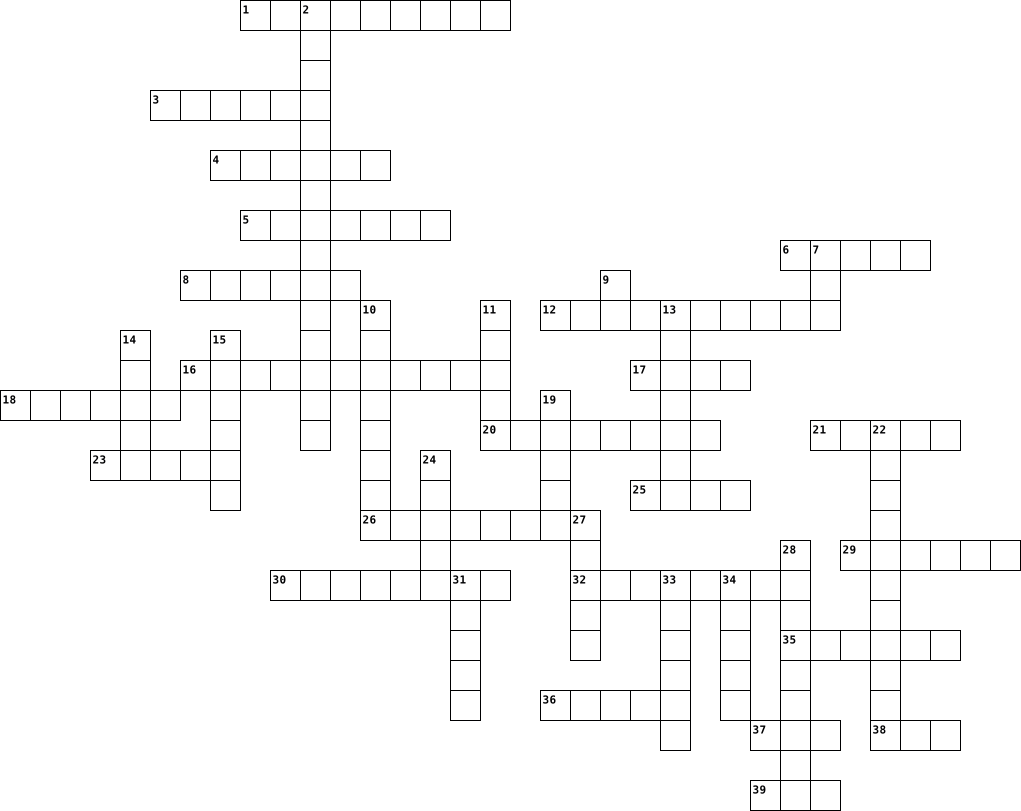
Across
- , THE SUBJECT WHERE YOU LEARN THE PERIODIC TABLE
- , STORAGE FOR BOOKS.. YOU MAY NEED A COMBINATION
- , ONLY NO. 2 ACCEPTED ON SCANTRON TEST
- , ONLINE LEARNING
- , TO SUBTRACT
- , A STICKY REMINDER
- , A DOODLE NOTEPAD
- , A WRITING UTENSIL THAT ACCENTUATES THE POINT
- , A CLASS WHERE STRINGS ARE INVOLVED
- , THE SCIENCE OF PLANTS
- , END OF THE YEAR MEMORIES
- , 1000 WORD MINIMUM
- , A GEOGRAPHY INSTRUMENT
- , A HOMEWORK ____ OR HALLWAY ____
- , THE OPPOSITE OF DEMANDS AND MUST HAVES TO START SCHOOL
- , A BRAND NAME THAT STICKS
- , A GYM REQUIREMENT FOR THE "SOLES"
- , SCHOOL FOR CHILDREN BORN ON OCT. 1ST
- , WHOOPS! QUICK FIX
- , FIRST DAY TEACHINGS AND REGULATIONS
- , A CLASS PERHAPS REQUIRING A BRUSH AND PENCIL
- , THE TEACHER'S FAVE
- , THE SCIENCE CLASSROOM
Down
- , AFTER SCHOOL ACTIVITY
- , BLUE OR BLACK IS PREFERRED
- , ABBR. FOR THE TEACHINGS OF EXERCISE
- , SCHOOL FOR WITCHES AND WIZARDS
- , TO BE LATE
- , BRAND NAME FOR COLORED WRITING UTENSILS
- , THE LAST TEST
- , A 3 RINGED ORGANIZER
- , DINING ROOM ____ OR PERIODIC ____
- , A FUND OR GRANT FOR COLLEGE
- , A GIFT FOR THE TEACHER
- , TO PREPARE FOR A FINAL EXAM
- , LUNCHTIME
- , A TOOL USED TO MEASURE AND KEEP YOUR LINES STRAIGHT
- , MORE FOR PLAY THAN FOR LEARNING
- , PAPER THAT KEEPS THE WORDING STRAIGHT
39 Clues: , TO BE LATE • , LUNCHTIME • , A 3 RINGED ORGANIZER • , AFTER SCHOOL ACTIVITY • , TO SUBTRACT • , A DOODLE NOTEPAD • , THE SCIENCE OF PLANTS • , ONLINE LEARNING • , THE LAST TEST • , A STICKY REMINDER • , WHOOPS! QUICK FIX • , 1000 WORD MINIMUM • , SCHOOL FOR WITCHES AND WIZARDS • , THE TEACHER'S FAVE • ...
Unit 1 & 2 Vocabulary Project 2021-10-17

Across
- Number put into a function/expression
- Function A function built from pieces of different functions over different intervals
- Set of all possible outputs for a function (y-values)
- Horizontal line halfway between the function's maximum and minimum output values
- A visual way to determine if a curve of a graph is a function or not (vertical line test)
- A type of problem that deals with a variable multiplied to itself
- Relationship between input and output
- Determine or calculate the value of an expression
- Function A function which forms part of a larger function
- The set made by combining the elements of two sets
Down
- Half the difference between the maximum and minimum values of the function
- The variable that does not depend on anything else
- The horizontal length of one cycle for a periodic or repeating function
- any function that repeats a pattern of y-values at regular intervals
- Set of all possible inputs for a function (x-values)
- Derives one output for every each given input
- One complete pattern of y-values for a periodic function
- Variable that depends on the independent variable (value changes based on the independent variable)
- A transformation in which a graph or geometric figure is moved to another location without any change
- Number that comes out after solving function/expression
20 Clues: Number put into a function/expression • Relationship between input and output • Derives one output for every each given input • Determine or calculate the value of an expression • The variable that does not depend on anything else • The set made by combining the elements of two sets • Set of all possible inputs for a function (x-values) • ...
Atoms and Elements Study Guide 2021-04-30

Across
- the number of protons and electrons in an atom are ___ so the atom has no charge
- subatomic particle with a negative charge
- atoms with the same number of protons but different number of neutrons
- the most common element in the universe
- the change from a solid to a gas
- made of 2 or more elements
- subatomic particle with a positive charge
- each column on the periodic table is called a __
- state of matter with definite volume but no definite shape
- the number of protons in an atom
- a very hot mix of charged atoms, uncharged atoms, and electrons
- the scientist who thought atoms were like raisins in a plum pudding
- when you add heat, molecules move ___
Down
- conduct heat and electricity well
- the scientist who said negative charges must revolve around positive charges
- a substance with only 1 kind of atom
- state of matter with definite shape and volume
- the temperature where a solid changes to a liquid
- the scientist who said some of the atom's mass must be made of neutrons
- state of matter with no definite volume or shape
- smallest unit of an element that can still be identified
- scientist who arranged the first periodic table
- the temperature where a substance becomes a gas
- subatomic particle with no charge
- atoms bonded together
- neutrons + protons in the nucleus
26 Clues: atoms bonded together • made of 2 or more elements • the change from a solid to a gas • the number of protons in an atom • conduct heat and electricity well • subatomic particle with no charge • neutrons + protons in the nucleus • a substance with only 1 kind of atom • when you add heat, molecules move ___ • the most common element in the universe • ...
Science physics 2023-03-24

Across
- Predator
- The person who discovered gravity.
- Another (and the second) element that makes up water.
- The total amount of force that is emitted (Including cancelling out forces.)
- An element that makes things glow.
- 1 of the elements that makes up water.
- Types of invertebrates with joint legs and with bodies in sections and which has hard outer covering.
- An element that makes you explode when you eat it. An element that looks like silvery metal things. Something that explodes in water.
- The fifth element.
- Every action force has an equal and opposite reaction force.
- Something that if you eat you died because it turns into acid when you eat it and something that is used in pools and they are green gases (A type of acid)
Down
- The name in the food chain for something that eats producers.
- The number of protons in the nucleus of an atom.
- If there's no force on an object, it won't move.
- The common centre of gravity of [a number of] bodies does not change its state of rest or motion by reason of the mutual actions of the bodies
- What silver is called on the element table
- What platinum is called on the periodic table.
- Push, Pull, or twist.
- What gold is called on the periodic table.
- An insect that can clone itself.
20 Clues: Predator • The fifth element. • Push, Pull, or twist. • An insect that can clone itself. • The person who discovered gravity. • An element that makes things glow. • 1 of the elements that makes up water. • What silver is called on the element table • What gold is called on the periodic table. • What platinum is called on the periodic table. • ...
periodic table of element crass words 2023-05-12

Across
- the mass number is 6, it is used in washing product
- the mass number is 28.08, used to make computer chips.
- the atomic weight is 39.098, found in bananas
- in column 7, raw 3, use to disinfect water
- the mass number is 22.99,It is added to food
- the number of protons is 4, it is use to make air crafts
- The atomic number is 18, Help to low- energy light bulbs
- the number of electrons is 2, used to blow balloons
- The atomic symbol is H, It is used in vehicles
- it is column 2 raw 3,it is used to regulation muscle
- the proton number is 9, used in toothpaste
Down
- the mass number is 12.01,it used to regulate the Earth's temperature
- second column, forth raw, your body need for your muscles to move
- it is the 11 elements in the periodic table, it is used to treat certain mental illness4)
- it in column 5 row 2, used in aircraft fuel systems
- the element symbol is p, help with growth
- the net charge is 3+, It is used for foils
- The number of the electron is 16, used in batteries
- the element symbol is NE, it is use in advertising
- it’s the number 8 in the periodic table, it is used to keep the human alive
20 Clues: the element symbol is p, help with growth • in column 7, raw 3, use to disinfect water • the net charge is 3+, It is used for foils • the proton number is 9, used in toothpaste • the mass number is 22.99,It is added to food • the atomic weight is 39.098, found in bananas • The atomic symbol is H, It is used in vehicles • ...
Chapter 5 and 4 Vocabulary Crossword 2012-04-16

Across
- This type of Element is a good conductor of heart and electrical current.
- An atom that is in the highest occupied energy level of an Atom is called?
- This metal has single Valence Electron and is highly reactive?
- A visual model, shows the movement of electrons in an Atom?
- Group 7A are sometimes referred as this term?
- This Element has properties that fall between those of metals and nonmetals?
- Element in Group 8A are referred to as this?
- This term means a pattern of repeating properties?
- This is defined as one twelfth the mass of a Carbon-12Atom?
- Atom that has the same atomic number but a different mass number?
Down
- This family is often known to be found in Fertilizers?
- This type of metals is poor conductors of heat and electrical currents?
- Magnesium is considered this term; found in Group 2A? DOWN
- Another name for a row in the Periodic Table of Elements is?
- A Positively charged Subatomic Particle is named?
- This______family has three Nonmetals and two Metalloids; Group 6A?
- A Negative charged subatomic particle; found outside the Nucleus?
- A Column on the Periodic Table of Elements is referred to as a?
- A region of space around the Nucleus where the Electron is most likely to be found is called?
- The center of an Atom; contains the Protons and Neutrons?
20 Clues: Element in Group 8A are referred to as this? • Group 7A are sometimes referred as this term? • A Positively charged Subatomic Particle is named? • This term means a pattern of repeating properties? • This family is often known to be found in Fertilizers? • The center of an Atom; contains the Protons and Neutrons? • ...
Structures and Changes Vocabulary 2013-12-17

Across
- the # of protons and neutrons in the nucleus
- a substance that is made up of only one kind of atom
- horizontal rows on the periodic table that are organized by atomic #
- a characteristic that enables a substance to undergo a chemical change. Ex: flammability
- when more than one atom chemically combines
- first to discover atoms
- greek word means indivisible
- a characteristic that can be observed or measured. Ex: texture
- materials that are needed to start the chemical reaction
- smallest unit of an element
- neutral and in the nucleus
- when two or more substances chemically combine and form a new substance
- vertical columns on the periodic table that are organized by similar properties
Down
- positive and is in the nucleus
- the amount of matter in a chemical reaction does not change, so the total mass of the reactants must equal the total mass of the products
- negative and goes around the nucleus
- new substances that are made during the reaction
- the process of one or more substances converting to form new substances with different properties
- a substance that is made of two or more elements chemically combined. Can only be broken apart by chemical reaction
- center of an atom that contains protons and neutrons
- alters the form of a substance but does not change it into a new substance with new properties
21 Clues: first to discover atoms • neutral and in the nucleus • smallest unit of an element • greek word means indivisible • positive and is in the nucleus • negative and goes around the nucleus • when more than one atom chemically combines • the # of protons and neutrons in the nucleus • new substances that are made during the reaction • ...
Structures and Changes Vocabulary 2013-12-17

Across
- when two or more substances chemically combine and form a new substance
- when more than one atom chemically combines
- alters the form of a substance but does not change it into a new substance with new properties
- positive and is in the nucleus
- a substance that is made of two or more elements chemically combined. Can only be broken apart by chemical reaction
- a characteristic that can be observed or measured. Ex: texture
- smallest unit of an element
- neutral and in the nucleus
- negative and goes around the nucleus
Down
- a characteristic that enables a substance to undergo a chemical change. Ex: flammability
- first to discover atoms
- greek word means indivisible
- vertical columns on the periodic table that are organized by similar properties
- the amount of matter in a chemical reaction does not change, so the total mass of the reactants must equal the total mass of the products
- a substance that is made up of only one kind of atom
- the # of protons and neutrons in the nucleus
- new substances that are made during the reaction
- the process of one or more substances converting to form new substances with different properties
- materials that are needed to start the chemical reaction
- center of an atom that contains protons and neutrons
- horizontal rows on the periodic table that are organized by atomic #
21 Clues: first to discover atoms • neutral and in the nucleus • smallest unit of an element • greek word means indivisible • positive and is in the nucleus • negative and goes around the nucleus • when more than one atom chemically combines • the # of protons and neutrons in the nucleus • new substances that are made during the reaction • ...
Unit B by TJ Zintel 9Mi 2014-11-20

Across
- a cloudy mixture that cannot be separated.
- Chemical combination of 2 or more elements in a specific ratio.
- a combination of pure substances
- A change of state from gas to solid.
- The number of protons in a nucleus.
- A solution in which the solvent is water.
- The measure of how easily electricity can move through this.
- The mass of one atom.
- A experiment in which the products are not accounted for.
- the elements that combine to create a chemical reactions.
- the vertical column in the periodic table of elements
- the center of the atom and it contains neutrons and protons
Down
- the amount of mass within a given area.
- A slow chemical reaction with oxygen and a metal.
- A fast chemical reaction that occurs when oxygen reacts with a substance.
- horizontal row on the periodic table of elements.
- a positively charged particle in a nucleus of an atom.
- A chemical reaction that gives off heat.
- a negatively charged particle in an atom.
- A combination of symbols and numbers to represent a compound.
- A experiment where the products are all accounted for.
- a neutral particle in a nucleus of an atom.
- A substance used to speed up a chemical reaction.
- shiny malleable substance that conducts electricity
- The smallest part of a element.
25 Clues: The mass of one atom. • The smallest part of a element. • a combination of pure substances • The number of protons in a nucleus. • A change of state from gas to solid. • the amount of mass within a given area. • A chemical reaction that gives off heat. • a negatively charged particle in an atom. • A solution in which the solvent is water. • ...
Biochemistry Vocabulary Review 2016-05-18

Across
- Biological macromolecules have a backbone composed of long chains of this elelment.
- When two similar molecules stick together, this is called _______.
- Located on the right side of a chemical equation.
- The "universal" solvent necessary for life.
- Located on the left side of a chemical equation.
- A neutral subatomic particle that is located in the nucleus.
- A negatively charged particle.
- This type of chemical reaction requires energy.
- A charged particle.
- A subatomic particle that orbits the nucleus and has a negative charge.
- A substance that results from the combination of two or more elements.
Down
- A column in the periodic table is referred to as a _______.
- Atoms are most stable when their _______ shells are complete.
- When two different molecules stick together, this is called _______.
- A row in the periodic table is called a _______.
- Water has high surface tension due to these types of binds.
- A group of two or more atoms that share electrons in a chemical bond.
- Atoms of the same element, but with different atomic masses.
- A subatomic particle located in the nucleus. It has a positive charge.
- This type of chemical reaction releases energy.
- The smallest unit of a chemical element.
- In _______ bonds, atoms of opposite charges are attracted to each other.
- In this type of bond, atoms may equally or unequally share electrons.
- A positively charged particle.
24 Clues: A charged particle. • A negatively charged particle. • A positively charged particle. • The smallest unit of a chemical element. • The "universal" solvent necessary for life. • This type of chemical reaction releases energy. • This type of chemical reaction requires energy. • A row in the periodic table is called a _______. • ...
UNIT B VOCABULARY 2018-11-20

Across
- a chemical combination of two or more elements in a specific ratio
- may cause life threating effects even in small amounts/short exposure
- an element defined by the number of protons it has
- globally Harmonized system
- anything on the periodic table
- a subatomic particle with only negative charges of electricity
- characteristics that can be used to describe a substance
- unicellular microorganism's that need warmth, air, and moisture to survive
- shininess of a substance
- conduct of electricity
- where there are positive and negative neutrons
- anything that has mass and occupies space
- a reversible change in the matter
- you can mold objects without breaking it if it has enough of this.
- the mass of one atom of an element in atomic mass units
Down
- the transition from a solid straight to a gas phase without passing through the liquid phase
- made up of two or more substances combined together
- a non-reversible change that forms a new substance with different properties
- most reactive non-metals and can be used to form new helpful substances
- metals that react to air and water
- a section of the periodic table solid at room temperature, often malleable, have luster, conduct electricity, have ductility.
- vinegar
- stretched into a long wire
- may cause skin burns and permanent eye damage
- the possibilty of suffering harm or injury
25 Clues: vinegar • conduct of electricity • shininess of a substance • globally Harmonized system • stretched into a long wire • anything on the periodic table • a reversible change in the matter • metals that react to air and water • anything that has mass and occupies space • the possibilty of suffering harm or injury • may cause skin burns and permanent eye damage • ...
Chemistry Review 2022-05-12

Across
- any substance that forms hydroxide ions (OH-) in a water solution
- solid turning into gas
- the number of electrons that are required to have a stable outer electron shell
- trioxide, N2O3
- tell you how many atoms of the element are contained in that compound
- fluoride, NaF
- variable, variable that is measured or observed
- covalent, bonding with equal sharing of electrons
- factor that does not change when the other variables change
- have a fixed volume and a fixed shape
- reaction, a hydrocarbon reacts with oxygen gas
Down
- positively charged ion
- the atomic number of carbon
- bond, formed when electrons are gained or lost in order to produce a stable ion
- the number of neutrons in chlorine
- when atoms of the same element have different numbers of neutrons
- the number of valence electrons that fluorine has
- method, an organized set of investigation procedures that scientists use to investigate a question that they have about the world
- theory, explains how a natural phenomenon works and is supported by scientific evidence
- positively charged particles in the nucleus of an atom
- metals, group 1 on the periodic table
- replacement reaction, when one element in a compound is replaced with the other single element
- the smallest piece of matter that forms an element
- gases, group 8 on the periodic table
- graph, used to show the comparison between categories, groups, or types of similar things
25 Clues: fluoride, NaF • trioxide, N2O3 • positively charged ion • solid turning into gas • the atomic number of carbon • the number of neutrons in chlorine • gases, group 8 on the periodic table • metals, group 1 on the periodic table • have a fixed volume and a fixed shape • reaction, a hydrocarbon reacts with oxygen gas • variable, variable that is measured or observed • ...
Grade 9 Chemistry 2023-11-22

Across
- A type of fuel
- This is formed when charcoal burns
- How many electrons fit in the first shell
- This material can be used instead of glass to measure temperature changes in chemical reactions
- This is formed with the combustion of hydrogen
- An element with the chemical symbol Si
- Rusting is this type of reaction
- This is needed for combustion
- These are found inside the nucleus
- One of the noble gases
- This is where you find electrons
- An element with the chemical symbol Be
- Dissolving this chemical is an endothermic process
- In an exothermic reaction the temperature .........
- Group 1 elements are known as the......
- The chemical name for rust
- He discovered the electron
Down
- This substance added to citric acid is an endothermic reaction
- In an endothermic reaction, the temperature .......
- These atomic particles have no charge
- Group 8 elements are known as .........
- Group 7 elements are known as the........
- A type of fuel
- This is formed when calcium reacts with hydrochloric acid
- He discovered the proton
- These are on the left-hand side of the Periodic Table
- One of the alkali metals
- These are found on the right-hand side of the Periodic Table
- 20% of the air is this gas
- An example of an endothermic process
- How many electrons fit in the second shell
31 Clues: A type of fuel • A type of fuel • One of the noble gases • He discovered the proton • One of the alkali metals • 20% of the air is this gas • The chemical name for rust • He discovered the electron • This is needed for combustion • Rusting is this type of reaction • This is where you find electrons • This is formed when charcoal burns • These are found inside the nucleus • ...
Chemical Reactions 2024-02-14

Across
- OUTERMOST ELECTRONS OF AN ATOM
- A REACTION WHERE ONE COMPOUND BREAKS APART INTO MULTIPLE ELEMENTS
- TYPE OF ELEMENT ON THE RIGHT 1/4 OF THE PERIODIC TABLE
- THE ENDING SUBSTANCES IN A CHEMICAL REACTION
- A SYMBOL FOR A SUBSTANCE WITH ONE CAPITAL LETTER
- WHEN A SUBSTANCES TURNS INTO A DIFFERENT SUBSTANCE
- TYPE OF ELEMENT ON THE LEFT 3/4 OF THE PERIODIC TABLE (EXCEPT HYDROGEN)
- LARGE NUMBER YOU PUT IN FRONT OF A CHEMICAL FORMULA WHEN YOU BALANCE AN EQUATION
- A SYMBOL FOR A SUBSTANCE WITH TWO OR MORE CAPITAL LETTERS
- AN EXPERIMENTAL SETUP THAT IS SEALED AND DOES NOT ALLOW THINGS TO GET IN OR OUT
- SOMETHING THAT DESCRIBES A CHEMICAL CHANGE USING NUMBERS, SYMBOLS, AND FORMULAS
- A REACTION WHERE TWO ELEMENTS COMBINE TO FORM A COMPOUND
Down
- AN ELEMENT WITH MULTIPLE POSSIBLE NUMBERS OF VALENCE ELECTRONS
- ANYTHING THAT HAS MASS AND TAKES UP SPACE
- MATTER IS NOT CREATED OR DESTROYED IN A CHEMICAL REACTION, JUST REARRANGED
- AN ELEMENT THAT ALWAYS GETS A SUBSCRIPT 2 WHEN ITS BY ITSELF
- THE STARTING SUBSTANCES IN A CHEMICAL REACTION
- AN EXPERIMENTAL SETUP THAT ALLOWS THINGS TO GET IN AND OUT
- DESCRIBES WHAT HAPPENS IN ORDER FOR A CHEMICAL CHANGE TO OCCUR
- A REACTION WHERE A CARBON COMPOUND BURNS IN THE PRESENCE OF OXYGEN AND PRODUCES WATER AND CARBON DIOXIDE
20 Clues: OUTERMOST ELECTRONS OF AN ATOM • ANYTHING THAT HAS MASS AND TAKES UP SPACE • THE ENDING SUBSTANCES IN A CHEMICAL REACTION • THE STARTING SUBSTANCES IN A CHEMICAL REACTION • A SYMBOL FOR A SUBSTANCE WITH ONE CAPITAL LETTER • WHEN A SUBSTANCES TURNS INTO A DIFFERENT SUBSTANCE • TYPE OF ELEMENT ON THE RIGHT 1/4 OF THE PERIODIC TABLE • ...
Chemical Compounds 2024-03-27

Across
- Ability of water to resist changes in temperature due to hydrogen bonds
- Molecules in which the electrons are shared equally
- Term given to water due to its ability to dissolve all polar and ionic compounds
- Weak chemical bonds formed when a hydrogen atom bonds with an oxygen or nitrogen atom on another polar molecule
- Term used in chemistry to describe rows on the periodic table
- Chemical bonds formed when metals atoms share a sea of electrons
- Barrier formed on the surface of water due to hydrogen bonds
- A pure substance in which two or more different elements are chemically combined
Down
- Tendency of water molecules to stick to other molecules
- Chemical bonds formed when metals and non-metals exchange electrons
- Specific regions in which electrons orbit the nucleus of an atom
- Ability of water to be pulled up a thin tube due to its cohesive and adhesive nature
- Molecules in which the electrons are not shared equally resulting in opposite charges on each end of the molecule
- Chemical bonds formed when non-metals share electrons
- Charge elements develop when they lose electrons
- Charge elements develop when they gain electrons
- Tendency of water molecules to stick to other water molecules
- Atoms with a charge
- Electrons found in the outer energy level of an atom
- Term used in chemistry to describe columns on the periodic table
20 Clues: Atoms with a charge • Charge elements develop when they lose electrons • Charge elements develop when they gain electrons • Molecules in which the electrons are shared equally • Electrons found in the outer energy level of an atom • Chemical bonds formed when non-metals share electrons • Tendency of water molecules to stick to other molecules • ...
Chemical Bonding + Structure & Properties of Materials 2024-05-06

Across
- easily separated by a physical process
- maximum number of electrons in the 2nd shell
- charge carried by a metal ion
- a small group of non-metallic atoms bonded together, e.g. NH3 and CH4
- bond formed when 2 non-metals react
- smallest and unique part of a chemical element
- number of protons in the nucleus of an atom equals the element’s ______ number
- a negative non-metal ion
- a mixture that is the same throughout
- atoms react to obtain a ________ valence shell
- a compound produced by respiration
- a metal will ________ electrons to a non-metal
Down
- a pure substance that cannot be converted into anything more simple by a chemical process
- the first element in the Periodic Table
- an inert non-metal on the Periodic Table
- a measure of how much a chemical dissolves
- a compound of hydrogen and oxygen
- a mixture that is different throughout
- a mixture of 2 or more metals
- two or more elements chemically combined together
- a covalent bond is a ______ pair of electrons
- a positive metal ion
- bond formed when metal reacts with non-metal
- maximum number of electrons in the 1st shell
- a mixture of nitrogen, oxygen and argon
- charge carried by a non-metal ion
- another name for the outer electron shell
- reacts with a non-metal to form an ionic compound
28 Clues: a positive metal ion • a negative non-metal ion • charge carried by a metal ion • a mixture of 2 or more metals • a compound of hydrogen and oxygen • charge carried by a non-metal ion • a compound produced by respiration • bond formed when 2 non-metals react • a mixture that is the same throughout • easily separated by a physical process • a mixture that is different throughout • ...
Chemistry 2021-06-17

Across
- Study of Matter
- rows on the periodic table
- 17th group elements
- Laughing gas
- one of the chalcogens
Down
- King of acids
- Lightest element
- month of Avogadro Number
- simplest repeating structure of a crystal
- Polymer of isoprene
10 Clues: Laughing gas • King of acids • Study of Matter • Lightest element • 17th group elements • Polymer of isoprene • month of Avogadro Number • one of the chalcogens • rows on the periodic table • simplest repeating structure of a crystal
RST, RPSGT 2020-04-01

Across
- periodic limb movements
- obstructive sleep apnea
- continuous positive airway pressure
- Sleeping position
- registered sleep technologist
- electrocardiogram that measures the activity of the heartbeat
Down
- monitors a persons oxygen saturation
- 4% desaturation
- bilevel positive airway pressure
- polysomnograhpy
10 Clues: 4% desaturation • polysomnograhpy • Sleeping position • periodic limb movements • obstructive sleep apnea • registered sleep technologist • bilevel positive airway pressure • continuous positive airway pressure • monitors a persons oxygen saturation • electrocardiogram that measures the activity of the heartbeat
Lorenzo's word puzzle 2021-01-04

Across
- takes shape of container
- negative
- makes up everything
- very spread out
- stays together only vibrates
Down
- on periodic table
- neutral
- number total number of protons and neutrons
- number the number of protons in the nucleus
- positive
10 Clues: neutral • negative • positive • very spread out • on periodic table • makes up everything • takes shape of container • stays together only vibrates • number total number of protons and neutrons • number the number of protons in the nucleus
vinny 2021-03-23

Across
- chemical bonded
- has mass
- the major part of steel
- element example (rings made of this)
- has 2 or more atoms
Down
- ____bond is a compound
- component made of
- ____ table
- small building blocks
- matter example (pizza)
10 Clues: has mass • ____ table • chemical bonded • component made of • has 2 or more atoms • small building blocks • ____bond is a compound • matter example (pizza) • the major part of steel • element example (rings made of this)
Exploration Station 2021-11-15

Across
- same group of atoms
- anything that takes up space
- what we breathe
- chemically bonded
- table: 118 elements organized
Down
- atoms held together by chemical bonds
- H2o
- mostly made of iron
- dioxide: Co2
- physically pushed together
10 Clues: H2o • dioxide: Co2 • what we breathe • chemically bonded • same group of atoms • mostly made of iron • physically pushed together • anything that takes up space • table: 118 elements organized • atoms held together by chemical bonds
Sir Jospeh John Thompson 2014-05-16

Across
- Sir Joseph ____ Thompson
- ____ bomb
- The university Thompson taught at
- Periodic table, chemist, chemistry
- ___ Joseph John Thompson
- A Hydrogen Ion
Down
- Sir Joseph John ________
- An atomic demonstration
- What is a part of everything?
- Sir ______ John Thompson
10 Clues: ____ bomb • A Hydrogen Ion • An atomic demonstration • Sir Joseph John ________ • Sir Joseph ____ Thompson • ___ Joseph John Thompson • Sir ______ John Thompson • What is a part of everything? • The university Thompson taught at • Periodic table, chemist, chemistry
Chemistry 2022-02-02

Across
- saftey reasons
- table- holds all elements
- very important to chemistry
- mass- molecular weight
- very small
- a reactant in chemistry
Down
- the first element
- testing chemicals
- things that react
- large body of matter with no shape
10 Clues: very small • saftey reasons • the first element • testing chemicals • things that react • mass- molecular weight • a reactant in chemistry • table- holds all elements • very important to chemistry • large body of matter with no shape
Chemistry Vocab 2023-08-18

Across
- a large gathering of people
- can be accelerated
- 2 chemicals stuck together
- anything that takes up space
- combonation
Down
- a perfect element
- periodic table
- makes rocks heavy
- length
- turn this up when the music is good
10 Clues: length • combonation • periodic table • a perfect element • makes rocks heavy • can be accelerated • 2 chemicals stuck together • a large gathering of people • anything that takes up space • turn this up when the music is good
Atoms! 2020-10-14

Across
- A subatomic particle which helps keep an atom stable
- Niels Bohr proposed in his model that electrons move around in _____ of fixed sizes and energies
- The center of an atom that contains protons and neutrons
- an average mass of all isotopes. Found on the atomic symbols on the periodic table (two words)
- Discovered electrons. Created the "plum pudding model"
Down
- In a ______ atom, the number of protons is equal to the number of electrons.
- The atomic number tells us the number of _____ within that element
- An atoms has a mass of 16amu. amu stands for atomic mass ____
- the addition of protons and neutrons is called the mass ____
- The smallest subatomic particle
- _____ Theory started by Dalton which states that all elements are made up of atoms
- The one or two letters on the periodic table that represent an element is called an element ______
12 Clues: The smallest subatomic particle • A subatomic particle which helps keep an atom stable • Discovered electrons. Created the "plum pudding model" • The center of an atom that contains protons and neutrons • the addition of protons and neutrons is called the mass ____ • An atoms has a mass of 16amu. amu stands for atomic mass ____ • ...
Crossword 2021-01-20

Across
- these elements react to form positive ions
- scientist who devised the modern periodic table
- elements with similar properties are arranged in these
- the discovery of these made it possible to explain why the order of elements based on atomic weights was not always correct
- these are non-metals with seven electrons in their outer shell
- a more reactive halogen can do this to a less reactive halogen from an aqueous solution of its salt
Down
- these were left by Mendeleev for undiscovered elements
- these occur down groups and depend on distinctive properties of elements
- the arrangement of these in its atoms determines an elements position in the table
- these metals are reactive as they have a single electron in their outer shell
- these gases are unreactive as they have a stable arrangement of electrons
- this number determines the order of elements in the periodic table
12 Clues: these elements react to form positive ions • scientist who devised the modern periodic table • these were left by Mendeleev for undiscovered elements • elements with similar properties are arranged in these • these are non-metals with seven electrons in their outer shell • this number determines the order of elements in the periodic table • ...
The Periodic Table 2021-01-18

Across
- these elements react to form positive ions
- scientist who devised the modern periodic table
- elements with similar properties are arranged in these
- the discovery of these made it possible to explain why the order of elements based on atomic weights was not always correct
- these are non-metals with seven electrons in their outer shell
- a more reactive halogen can do this to a less reactive halogen from an aqueous solution of its salt
Down
- these were left by Mendeleev for undiscovered elements
- these occur down groups and depend on distinctive properties of elements
- the arrangement of these in its atoms determines an elements position in the table
- these metals are reactive as they have a single electron in their outer shell
- these gases are unreactive as they have a stable arrangement of electrons
- this number determines the order of elements in the periodic table
12 Clues: these elements react to form positive ions • scientist who devised the modern periodic table • these were left by Mendeleev for undiscovered elements • elements with similar properties are arranged in these • these are non-metals with seven electrons in their outer shell • this number determines the order of elements in the periodic table • ...
The Periodic Table 2021-01-19

Across
- these elements react to form positive ions
- scientist who devised the modern periodic table
- elements with similar properties are arranged in these
- the discovery of these made it possible to explain why the order of elements based on atomic weights was not always correct
- these are non-metals with seven electrons in their outer shell
- a more reactive halogen can do this to a less reactive halogen from an aqueous solution of its salt
Down
- these were left by Mendeleev for undiscovered elements
- these occur down groups and depend on distinctive properties of elements
- the arrangement of these in its atoms determines an elements position in the table
- these metals are reactive as they have a single electron in their outer shell
- these gases are unreactive as they have a stable arrangement of electrons
- this number determines the order of elements in the periodic table
12 Clues: these elements react to form positive ions • scientist who devised the modern periodic table • these were left by Mendeleev for undiscovered elements • elements with similar properties are arranged in these • these are non-metals with seven electrons in their outer shell • this number determines the order of elements in the periodic table • ...
Parts of the periodic table 2021-04-16

Across
- Family name of the inner transition elements found on period 6.
- Elements in the periodic table are arranged according to ________________, the number of protons in the nucleus.
- Identifies the principal families of elements
- _______________ is the family usually found to have the most electronegative elements, such as Fluorine.
- _________________ transition elements are elements whose valence electrons are in the f-orbital.
- _____________ metals are the leftmost family in the periodic table and are usually the least electronegative.
- Family name of the inner transition elements found on period 7.
- Group 18, also called _____________ gases, have the lowest chemical reactivity.
Down
- The elements in groups 1, 2, and 13-18 are called __________________ elements.
- Elements were initially thought to be arranged according to increasing atomic _______________.
- Groups 3-12 are collectively referred to as _________________ elements, elements with partially filled d-orbitals.
- Rows of elements with the same highest electron energy level
12 Clues: Identifies the principal families of elements • Rows of elements with the same highest electron energy level • Family name of the inner transition elements found on period 6. • Family name of the inner transition elements found on period 7. • The elements in groups 1, 2, and 13-18 are called __________________ elements. • ...
puzzle 2024-09-12

Across
- It is type of mixture in which the composition is uniform thought the mixture example salt water
- It is everything that takes up spaces
- It is a type of matter that if we do condensation, it will be liquid
- It is a matter that have two or more elements chemically combined together
- It is an elements that is in periodic table and chemical formula is B
- It is an elements that is in periodic table and it is Alkali metal. Formula is K
Down
- It is a matter that have two or more substances mixed together physically
- It is a matter that cannot be broken down into simpler form
- smallest part of an element that can exist
- If we do this, liquid will turn to gas by heat
- It means two oxygen atoms bonded together(diatomic oxygen)
- It is a matter that has definite size and shape
12 Clues: It is everything that takes up spaces • smallest part of an element that can exist • If we do this, liquid will turn to gas by heat • It is a matter that has definite size and shape • It means two oxygen atoms bonded together(diatomic oxygen) • It is a matter that cannot be broken down into simpler form • ...
Chemistry Vocabulary 2021-12-08

Across
- Atomic mass unit
- number of molecules
- Go up and down (columes)
- 3rd ring
- no new substance
- More reactive
- properties of metals and nonmetals
- In nucleus,no charge
- Electricity and heat doesn't pass through
- Found on the left side of the periodic table
Down
- new substance
- 2 Nacl
- can be pulled into wire
- Can be bent or hammered into a sheet
- is the smallest part of an matter
- tell how many atoms
- Electrons cloud,negative
- not shinny
- More stable
19 Clues: 2 Nacl • 3rd ring • not shinny • More stable • new substance • More reactive • Atomic mass unit • no new substance • number of molecules • tell how many atoms • In nucleus,no charge • can be pulled into wire • Go up and down (columes) • Electrons cloud,negative • is the smallest part of an matter • properties of metals and nonmetals • Can be bent or hammered into a sheet • ...
Vocab 11-1 2023-04-19

Across
- a fund that collects periodic contributions from a firms employees
- the degree to which the outcome is uncertain but a probable outcome can be estimated
- institutions that channel savings to investors
- stocks or documents that represent a claim on the income and property of the borrower
- dollars that become available for investors to use wen others save
- regular allowance for someone who has worked a certains number of years or who has suffered from an injury
Down
- a firm that specializes in making loans directly to consumers
- a document showing that an interest bearing loan has been made to a bank or other financial institution
- nonprofit service cooperative that accepts deposits, make loans, issues CDs, and offers checking accounts
- network of savers, investors, financial institutions, and financial assets that work together to transfer saving from savers to investor
- something given as an equal for goods or services
- spreading your funds diversity your investments
- the periodic fee that the insured pays for this policy
13 Clues: institutions that channel savings to investors • spreading your funds diversity your investments • something given as an equal for goods or services • the periodic fee that the insured pays for this policy • a firm that specializes in making loans directly to consumers • a fund that collects periodic contributions from a firms employees • ...
Atoms and Elements 2022-01-07

Across
- elements in a periodic table row and which change properties in a predictable pattern
- smallest particle of an element
- an atom that has taken on or lost electrons to become negatively or positively charged instead of neutral
- two or more atoms joined together
- a type of element that tends to be shiny, hard, malleable, ductile, and a good conductor
- positively charged region in the center of an atom
- can be pounded into shapes
- positively charged particle
- pure substance made of two or more elements that are combined chemically in a specific ratio
- particle with no electric charge
Down
- two or more substances that are in the same place but not chemically combined
- symbol, usually consists of a one or two letter abbreviation of the element name
- negatively charged particle
- an element that binds tightly to their atoms and conducts hardly any electricity.
- the center of an atom that contains most of the mass of the atom in the form of positive protons and negative neutrons
- mass, minus atomic number is how to find the number of neutrons in an atom
- anything that has mass and takes up space
- number, the number of protons and electrons in an atom
- or family, elements in a periodic table column that have similar properties
- simplest pure substance that can not be broken down into any other substance
20 Clues: can be pounded into shapes • negatively charged particle • positively charged particle • smallest particle of an element • particle with no electric charge • two or more atoms joined together • anything that has mass and takes up space • positively charged region in the center of an atom • number, the number of protons and electrons in an atom • ...
Atoms and Elements 2022-01-07

Across
- elements in a periodic table row and which change properties in a predictable pattern
- smallest particle of an element
- an atom that has taken on or lost electrons to become negatively or positively charged instead of neutral
- two or more atoms joined together
- a type of element that tends to be shiny, hard, malleable, ductile, and a good conductor
- positively charged region in the center of an atom
- can be pounded into shapes
- positively charged particle
- pure substance made of two or more elements that are combined chemically in a specific ratio
- particle with no electric charge
Down
- two or more substances that are in the same place but not chemically combined
- symbol, usually consists of a one or two letter abbreviation of the element name
- negatively charged particle
- an element that binds tightly to their atoms and conducts hardly any electricity.
- the center of an atom that contains most of the mass of the atom in the form of positive protons and negative neutrons
- mass, minus atomic number is how to find the number of neutrons in an atom
- anything that has mass and takes up space
- number, the number of protons and electrons in an atom
- or family, elements in a periodic table column that have similar properties
- simplest pure substance that can not be broken down into any other substance
20 Clues: can be pounded into shapes • negatively charged particle • positively charged particle • smallest particle of an element • particle with no electric charge • two or more atoms joined together • anything that has mass and takes up space • positively charged region in the center of an atom • number, the number of protons and electrons in an atom • ...
Chemistry Test 1 Vocab 2022-08-23

Across
- a mixture whose composition is not uniform throughout
- the theory of matter with 5 points
- a property of a substance that characterizes the substance without the substance undergoing a chemical reaction
- the method of making observations, proposing theories, and testing those theories through experimentation
- horizontal rows on the periodic table; these elements typically have the same number of electron shells
- Any elements in groups IA, IIA, IIIA, IVA, VA, VIA, VIIA, and VIIIA of the periodic table
- the experimental investigation and explanation of natural phenomena
- an ion with a positive charge
- a general name for any element in group IA; the most reactive metals that have only 1 valence electron
- a change from the solid state directly to the gas state
- a starting material for a chemical reaction
- the process in which a substance changes from the solid state to the liquid state
- a mixture whose composition is uniform throughout; a solution
- a subatomic particle that has a mass approximately equal to that of the hydrogen atom, carries an electrical charge of +1, and is located in the nucleus of an atom
- a property of a substance that can be studied only by having the substance undergo a chemical change; a property that determines the chemical reactions the substance can undergo
- a verbal description or physical construction used to visualize something a theory describes
- the application to practical problems of knowledge gained by doing science
- a general name for any element in group IIA
- matter with constant composition that consists of just one element or compound in just one chemical form
- elements 58-71 on the periodic table, a.k.a. rare earth metals
- a pure substance that cannot be broken down into simpler substances
- an ion that has a negative charge
- an element whose properties are intermediate between those of metals and those of nonmetals; typically the physical properties of metals and chemical properties of nonmetals
- a homogeneous mixture of a solute or solutes dissolved in a solvent
- a unit of concentration for solutions, used most frequently for solutions made up of a solid solute dissolved in a liquid solvent (grams solute/grams solution)x100
- anything that has mass and takes up space
- the smallest unit of an element that has the properties of that element
- elements spaced at periodic intervals based on atomic number have similar chemical properties
- the physical states in which matter can occur: solid, liquid, & gas
- a combination of element symbols and numbers that gives the exact composition and makeup of a pure substance
- a general name for any group VIIA element; the most reactive nonmetals that are missing 1 valence electron
- the tiny, positively charged core of an atom, made up of protons and neutrons
- a process under which a pure substance becomes a different substance or substances
- any element in groups IB through VIIIB of the periodic table
- a general name for any element in group VIA
- a change in a pure substance that leaves it as the same substance but in a different physical state
Down
- matter that consists of two or more substances in variable amounts
- a procedure carried out to study a phenomenon or to test a theory
- a subatomic particle that has a mass approximately equal to that of the hydrogen atom, carries zero electrical charge, and is located in the nucleus of an atom
- the number of protons plus neutrons in the nucleus of an atom
- a strong preference or inclination that inhibits impartial judgement
- no matter is ever created or destroyed in any chemical reaction
- the amounts of the elements in a compound are determined by the identity of the compound
- a table of the elements arranged in order of increasing atomic number
- the process in which a substance changes from the liquid state to the solid state
- a pure substance composed of two or more atoms of different elements
- another term for chemical reaction
- a unitless number expressing the mass of a particular atom relative to the mass of an atom of carbon-12, which is arbitrarily assigned a mass of exactly 12
- a process in which one or more reactants are transformed into one or more products through the breaking of chemical bonds in the reactant molecules and the formation of new chemical bonds in the product molecules
- the amount of energy needed to remove an electron from the outermost shell of a neutral atom
- elements with atomic numbers 90 through 103
- another name for chemical periodicity
- a pure substance composed of atoms of a single element
- an element that tends to lose one or more valence elections in chemical reactions
- a substance produced in the course of a chemical reaction by the transformation of one or more reactants
- a subatomic particle that has a mass 1/1836 that of a Hydrogen atom, carries an electric charge of -1, and moves about at high velocity around the nucleus of an atom
- any element in group VIIIA of the periodic table
- a column of the periodic table; these elements have similar valence electron configurations
- a change from the gas phase to the liquid phase
- exactly one-twelfth the mass of a Carbon-12 atom and equal to 1.66054x10^-24 grams, a.k.a. dalton
- any atom or group of atoms carrying either a net negative or a net positive electrical charge
- an element that tends to gain one or more valence electrons in a chemical reaction
- an electron in the outermost shell of an atom
- a change from the liquid phase to the gas phase
- a helium nucleus ejected from some radioactive nuclei during a process known as alpha decay
- elements arranged on his version of the periodic table have properties similar to those of the elements eight positions to the left and eight positions to the right, a.k.a. the law of octaves
- the branch of science that studies matter and the changes it undergoes
- the number of protons in the nucleus of an atom
- different forms of an element having the same number of protons but different numbers of neutrons
- a tentative explanation for a set of observations
- a statement that describes the way things are consistently observed to behave under a given set of circumstances
71 Clues: an ion with a positive charge • an ion that has a negative charge • the theory of matter with 5 points • another term for chemical reaction • another name for chemical periodicity • anything that has mass and takes up space • elements with atomic numbers 90 through 103 • a starting material for a chemical reaction • a general name for any element in group IIA • ...
Unit 1 vocabulary words for 8th grade science 2020-10-14

Across
- a vertical column on the periodic table
- subatomic particle that has no charge and that is located in the nucleus of an atom
- Solubility is the property of a solid, liquid or gaseous chemical substance called solute to dissolve in a solid, liquid or gaseous solvent.
- a consistency like that of water or oil, flowing freely but of constant volume.
- change:alters some physical properties of a substance without changing the identity of the substance.
- mass: the sum of the number of neutrons and protons.
- number:the number of protons
- set on fire; combustible; inflammable.
- properties:is a characteristic that can be observed or measured without changing the identity of a substance.
- extreme malleability of gold.
Down
- subatomic particle that has a positive charge and that is located in the nucleus of an atom
- properties:is a characteristic that determines how one substance will interact with other substances during a chemical reaction.
- is a physical property that describes how much matter is packed into a certain space.
- and stable in shape; not liquid or fluid.
- gas at a very high temperature
- subatomic particle that has a negative charge
- smallest unit of an element that maintains the chemical properties of that element
- gas at a very high temperature
- for chemical elements
- electron:is a negatively charged particle, located in the outermost shell of an atom, that can be transferred to or shared with another atom.
- a horizontal row in the periodic table
21 Clues: for chemical elements • number:the number of protons • extreme malleability of gold. • gas at a very high temperature • gas at a very high temperature • set on fire; combustible; inflammable. • a horizontal row in the periodic table • a vertical column on the periodic table • and stable in shape; not liquid or fluid. • subatomic particle that has a negative charge • ...
Atoms and Elements 2022-01-07

Across
- elements in a periodic table row and which change properties in a predictable pattern
- smallest particle of an element
- an atom that has taken on or lost electrons to become negatively or positively charged instead of neutral
- two or more atoms joined together
- a type of element that tends to be shiny, hard, malleable, ductile, and a good conductor
- positively charged region in the center of an atom
- can be pounded into shapes
- positively charged particle
- pure substance made of two or more elements that are combined chemically in a specific ratio
- particle with no electric charge
Down
- two or more substances that are in the same place but not chemically combined
- symbol, usually consists of a one or two letter abbreviation of the element name
- negatively charged particle
- an element that binds tightly to their atoms and conducts hardly any electricity.
- the center of an atom that contains most of the mass of the atom in the form of positive protons and negative neutrons
- mass, minus atomic number is how to find the number of neutrons in an atom
- anything that has mass and takes up space
- number, the number of protons and electrons in an atom
- or family, elements in a periodic table column that have similar properties
- simplest pure substance that can not be broken down into any other substance
20 Clues: can be pounded into shapes • negatively charged particle • positively charged particle • smallest particle of an element • particle with no electric charge • two or more atoms joined together • anything that has mass and takes up space • positively charged region in the center of an atom • number, the number of protons and electrons in an atom • ...
Atom Vocab 2022-10-04

Across
- Space The empty space between
- the way things react
- tiny molecule that makes up everything
- Positive charge
- Neutral
- Table Chart that organizes the elements
Down
- symbol abbreviation of element
- Negative charge
- Substance that cannot be broken down
- H
- Number number of protons in a atom
- Electric current that they follow
12 Clues: H • Neutral • Negative charge • Positive charge • the way things react • symbol abbreviation of element • Space The empty space between • Electric current that they follow • Number number of protons in a atom • Substance that cannot be broken down • tiny molecule that makes up everything • Table Chart that organizes the elements
Chemestry 2020-04-22

Across
- How pact something is
- Point where something starts to melt
- Central part of an atom
- A vertical row in the periodic table
- Substance that has mass
- Smallest most basic substance
- Conservation of Matter
Down
- The same
- Made up of multiple elements
- Positive electric charge
- Charge of negative electricity
- Different
12 Clues: The same • Different • How pact something is • Conservation of Matter • Central part of an atom • Substance that has mass • Positive electric charge • Made up of multiple elements • Smallest most basic substance • Charge of negative electricity • Point where something starts to melt • A vertical row in the periodic table
Atoms 2026-01-25

Across
- A subatomic particle with a positive charge found in the nucleus.
- The smallest unit of an element that maintains the properties of that element.
- A change where substances transform into entirely new substances with different properties.
- regions around the nucleus where electrons are likely to be found.
- A subatomic particle found in the nucleus that has no electrical charge.
Down
- A table of all known elements arranged by increasing atomic number.
- A change in a substance's form or state (like melting) that does not alter its chemical identity.
- center of an atom
- The group of stable, unreactive gases located in the far-right column of the periodic table.
- A negatively charged subatomic particle that moves in the space around the nucleus.
10 Clues: center of an atom • A subatomic particle with a positive charge found in the nucleus. • regions around the nucleus where electrons are likely to be found. • A table of all known elements arranged by increasing atomic number. • A subatomic particle found in the nucleus that has no electrical charge. • ...
Periodic Table of Elements 2021-07-26

Across
- He
- Fe
- Pb
- Ne
- Cu
- K
- O
- N
- Cl
- Na
Down
- S
- Sn
- H
- C
- Hg
- Ni
- Al
- Ag
- Au
19 Clues: S • H • C • K • O • N • Sn • He • Hg • Fe • Ni • Pb • Ne • Cu • Al • Ag • Cl • Au • Na
Periodic Table of Elements 2013-05-20

Across
- I am the 2nd most abundant element in the Earth’s crust and have 14 neutrons
- crust
- My atomic number is 47 and I am used to make photographic film
- My atomic number is 79
- I am a member of the boron family and am the most abundant metal in the
- I am a transition metal with 25 electrons
- I have 2 electrons in the first shell, 8 in the second shell, and 6 in the third shell
- My atomic mass is 35.453
- - I am the head of the carbon family known as the “basis of life”
- I am a gas with 8 protons and 8 neutrons
Down
- I am a member of the carbon family often mistaken for the end of your pencil.
- I make up 78% of the air and am found in the 15th group
- I am a silvery white metal used to make salt
- I am not really an alkali metal, but since I have only 1 electron I behave like
- I am a noble gas with 2 electrons
- I am a member of the alkaline earth metals used to make fireworks and
- I am a metal that is liquid at room temperature
- Table A table in which the chemical elements, arranged according to their atomic numbers, are shown in related groups
- I am a metal with 28 electrons
19 Clues: crust • My atomic number is 79 • My atomic mass is 35.453 • I am a metal with 28 electrons • I am a noble gas with 2 electrons • I am a gas with 8 protons and 8 neutrons • I am a transition metal with 25 electrons • I am a silvery white metal used to make salt • I am a metal that is liquid at room temperature • I make up 78% of the air and am found in the 15th group • ...
Periodic Table Crossword Puzzle 2025-02-25

Across
- The atomic number of this element is 2.
- The atomic number of this element is 50.
- The atomic number of this element is 8.
- The atomic number of this element is 86.
- The atomic number of this element is 29.
- Particles of the atom that has a negative charge.
- The atomic number of this element is 7.
- The atomic number of this element is 17.
- The atomic number of this element is 11.
Down
- The atomic number of this element is 47.
- The atomic number of this element is 10.
- Mass The number of protons and neutrons in the nucleus is called_____________?
- The atomic number of this is 1.
- Particles of this atom that has a positive charge.
- the atomic number of this element is 26.
- The atomic number of this element is 22.
- The atomic number of this element is 3.
- The atomic number of this element is 27.
- The atomic number of this element is 79.
19 Clues: The atomic number of this is 1. • The atomic number of this element is 2. • The atomic number of this element is 8. • The atomic number of this element is 3. • The atomic number of this element is 7. • The atomic number of this element is 47. • The atomic number of this element is 50. • The atomic number of this element is 10. • The atomic number of this element is 86. • ...