
periodic%20table Crossword Puzzles
Olivia 2022-03-09

Across
- animals home
- appearing or occurring at intervals
- happy satisfaction
- hole in your tooth
- being wise
- colour with metallic sheen
- human body
- thing that explodes lava
- What u know
- person in jail or behind bars(did something bad)
Down
- offered to go to someone’s place
- getting ready for something
- child birth
- standing or sitting in a way or shape
- can catch on fire
- your brain chooses between a few options
- stops u from flying away
- Extremely good, outstanding
18 Clues: being wise • human body • child birth • What u know • animals home • can catch on fire • happy satisfaction • hole in your tooth • thing that explodes lava • stops u from flying away • colour with metallic sheen • getting ready for something • Extremely good, outstanding • offered to go to someone’s place • appearing or occurring at intervals • standing or sitting in a way or shape • ...
Periodic Table Crossword 2020-09-09

Across
- sum of protons and neutrons are ____ number
- group II metals
- metals tend to form ______ ions
- vertical columns are called families or ___
- elements in the middle of the table __metals?
- the elements are arranged by atomic number
- most of the elements are
Down
- group I Metals
- most active non-metals
- horizontal rows
- the atomic number is the number of protons
- non-metals tend to form _____ ions
- inactive gases
13 Clues: group I Metals • inactive gases • group II metals • horizontal rows • most active non-metals • most of the elements are • metals tend to form ______ ions • non-metals tend to form _____ ions • the atomic number is the number of protons • the elements are arranged by atomic number • sum of protons and neutrons are ____ number • vertical columns are called families or ___ • ...
Periodic Table Crossword 2021-10-25
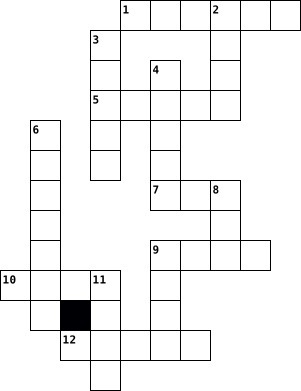
Across
- What Mr. Miller is
- Fought the south
- What you do to lemonade on a hot day
- Goes with a basketball
- Governmental alliance.
- What you use to fight
Down
- Country in the Middle East
- What a volcano does
- Covid
- What Monkeys eat
- Someone that's really good at what they do
- The opposite of cool
- Where we live
13 Clues: Covid • Where we live • Fought the south • What Monkeys eat • What Mr. Miller is • What a volcano does • The opposite of cool • What you use to fight • Goes with a basketball • Governmental alliance. • Country in the Middle East • What you do to lemonade on a hot day • Someone that's really good at what they do
Periodic Table-Miguel 2023-05-01

Across
- S
- (6,6)
- I have 82 neutrons in group 14
- is a hard brittle crystalline metallic luster
- Li
- (2,4)
- I have 27 protons
Down
- is a rare gas of group 18
- I have 79 electrons
- I have 54 protons
- I have an atomic number of 72
- Hg
- i have 86 neutrons in group 18
13 Clues: S • Li • Hg • (6,6) • (2,4) • I have 54 protons • I have 27 protons • I have 79 electrons • is a rare gas of group 18 • I have an atomic number of 72 • I have 82 neutrons in group 14 • i have 86 neutrons in group 18 • is a hard brittle crystalline metallic luster
Periodic Table Elements 2022-09-30

Across
- 6 protons; combines with oxygen to form CO2 and also pressurizes to form diamonds
- 2 protons; fills your balloons
- 79 protons; Olympic winners take this home
- 28 protons; worth five cents
- 17 protons; goes into your pool to kill bacteria
- 80 protons; liquid metal inside your thermometer
- 10 protons; lights up flashy signs
- 11 protons; combines with chlorine to form salt for your fries
Down
- 8 protons; we need to breathe this to survive!
- 1 proton; combines with oxygen to form H2O
- 20 protons; found in milk and builds strong bones
- 47 protons; Second place finishes at the Olympics take this home
- 24 protons; "everything is chrome in the future!"
13 Clues: 28 protons; worth five cents • 2 protons; fills your balloons • 10 protons; lights up flashy signs • 1 proton; combines with oxygen to form H2O • 79 protons; Olympic winners take this home • 8 protons; we need to breathe this to survive! • 17 protons; goes into your pool to kill bacteria • 80 protons; liquid metal inside your thermometer • ...
unit one 2020-04-07

Across
- wave,Type of waves that need a medium to propagate through.
- wave,Type of wave that don't need a medium to propagate through.
- The maximum displacement of the oscillating body.
Down
- time, Time needed by the body to make one complete oscillation.
- motion,Type of periodic motion where the body passes throught the fixed point.
- wave, Wave formed from crests and troughs. Fequency, Number of complete oscillations per unit time (one sec).
- wave, The waves that consist of compressions and rarefactions.
- vibration of the medium particles.
8 Clues: vibration of the medium particles. • The maximum displacement of the oscillating body. • wave,Type of waves that need a medium to propagate through. • wave, The waves that consist of compressions and rarefactions. • time, Time needed by the body to make one complete oscillation. • wave,Type of wave that don't need a medium to propagate through. • ...
unit one 2020-04-07

Across
- wave,Type of waves that need a medium to propagate through.
- wave,Type of wave that don't need a medium to propagate through.
- The maximum displacement of the oscillating body.
Down
- time, Time needed by the body to make one complete oscillation.
- motion,Type of periodic motion where the body passes throught the fixed point.
- wave, Wave formed from crests and troughs. Fequency, Number of complete oscillations per unit time (one sec).
- wave, The waves that consist of compressions and rarefactions.
- vibration of the medium particles.
8 Clues: vibration of the medium particles. • The maximum displacement of the oscillating body. • wave,Type of waves that need a medium to propagate through. • wave, The waves that consist of compressions and rarefactions. • time, Time needed by the body to make one complete oscillation. • wave,Type of wave that don't need a medium to propagate through. • ...
Chemistry key terms 2023-06-14

Across
- A horizontal row in the periodic table p _ _ _ _ _ _
- Two or more substances that are not joined together m _ _ _ _ _ _
- A type of reaction when a more reactive metal replaces a less reactive metal from its compound d _ _ _ _ _ _ _ _ _ _ _
- A reaction that takes in heat e _ _ _ _ _ _ _ _ _ _
Down
- A vertical column in the periodic table containing elements with similar chemical properties g _ _ _ _ _
- Two or more different elements which are chemically joined together c _ _ _ _ _ _ _
- Burning fuel in oxygen c _ _ _ _ _ _ _ _ _
- A substance containing only one type of atom e _ _ _ _ _ _
8 Clues: Burning fuel in oxygen c _ _ _ _ _ _ _ _ _ • A reaction that takes in heat e _ _ _ _ _ _ _ _ _ _ • A horizontal row in the periodic table p _ _ _ _ _ _ • A substance containing only one type of atom e _ _ _ _ _ _ • Two or more substances that are not joined together m _ _ _ _ _ _ • ...
Physics Crossword 2013-11-19

Across
- you can find the ..... number along the top of the periodic table
- (2 words no space) protons+neutrons=
- name what orbits the nucleus of an atom
- what is the shell arrangement i.e. how many electrons go into each shell layer (4 numbers typed out)
Down
- what determines the mass number in an isotope
- (2 words no space) number of proteins
- the process in which a solid turns to gas or vice versa
- you can find the ...... of an element along the side of the periodic table
8 Clues: (2 words no space) protons+neutrons= • (2 words no space) number of proteins • name what orbits the nucleus of an atom • what determines the mass number in an isotope • the process in which a solid turns to gas or vice versa • you can find the ..... number along the top of the periodic table • ...
Crossword Science 2022-02-11

Across
- An effect or influence
- An active learning strategy that improves comprehension and retention of information
- A tool that enables you to integrate the central ideas in a meaningful way
- The layer in the atmosphere which is in charge of breaking down rocks from outer space
- process by which plants use sunlight, water, and carbon dioxide to create oxygen and energy in the form of sugar
Down
- a element on the periodic table which coal is mainly made out with
- A long term weather patten in a region
- The layers of gases surrounding a planet
- A gas that fills 78% of our atmosphere, it places 7th in the periodic table
- A problematic situation
- A gas whose made out of 3 oxygen atoms is commonly known for protecting us from harmful radiation from the sun
11 Clues: An effect or influence • A problematic situation • A long term weather patten in a region • The layers of gases surrounding a planet • a element on the periodic table which coal is mainly made out with • A tool that enables you to integrate the central ideas in a meaningful way • A gas that fills 78% of our atmosphere, it places 7th in the periodic table • ...
Chemistry Vocab 2026-01-09

Across
- Neutral particle that exists within the nucleus of an atom.
- Negatively charged particle that orbits an atom's nucleus.
- Positively charged particle that exists within the nucleus of an atom.
- When elements are arranged in order of increasing atomic number, there is a periodic repetition of their chemical and physical properties.
- A row of chemical elements.
Down
- The electrons in the outermost shell,or energy level, of an atom.
- A column in the periodic table of the chemical elements.
- Atoms that have the same number of protons but different numbers of neutrons.
- The smallest part of a substance that can't be broken down chemically.
- an atom that has an electric charge because it's either lost or gained one or more of its electrons.
- Fixed energy state an electron occupies within an atom.
11 Clues: A row of chemical elements. • Fixed energy state an electron occupies within an atom. • A column in the periodic table of the chemical elements. • Negatively charged particle that orbits an atom's nucleus. • Neutral particle that exists within the nucleus of an atom. • The electrons in the outermost shell,or energy level, of an atom. • ...
The Periodic Crossword 2024-02-08

Across
- The liberty is made of this metal
- This metal is used to make cans
- An important substance in hemoglobin
- Diamond are made of ------
- This element gives name to a shade of blue
- A heavy metal known to damage the brain
- An element beginning with Z
Down
- The only element which begins with X
- This gas is filled in balloons to make them rise up
- Gas filled in fluorescent lamps
- Chemical used to clean swimming pools
- Our planets most vital gas
- Rust proof metal
13 Clues: Rust proof metal • Diamond are made of ------ • Our planets most vital gas • An element beginning with Z • This metal is used to make cans • Gas filled in fluorescent lamps • The liberty is made of this metal • The only element which begins with X • An important substance in hemoglobin • Chemical used to clean swimming pools • A heavy metal known to damage the brain • ...
Periodic Table Trends 2021-11-06

Across
- the the distance from the nucleus to the outermost electrons in a ion
- electronegativity and ionization energy both _____ from bottom to top
- the distance from the nucleus to the normal valance electrons
- the balance between the pull of the protons on valence electrons and the repulsion forces from inner electrons.
- the most electronegative element and has the strongest pull for electrons
- the ability of an atom to attract electrons when the atom is in a compound
- which atom is larger: Barium or Magnesium?
- lowest ionization energy
Down
- metallic character increases down a ____ from top to bottom
- metallic character decreases across ____ from left to right
- the energy required to remove an electron from an atom
- the amount of energy released when an electron is attached to a neutral atom or molecule in the gaseous state to form a negative ion.
- ionization energy increases from left to right because it increases _____
13 Clues: lowest ionization energy • which atom is larger: Barium or Magnesium? • the energy required to remove an electron from an atom • metallic character increases down a ____ from top to bottom • metallic character decreases across ____ from left to right • the distance from the nucleus to the normal valance electrons • ...
Trigonometry 2022-02-03

Across
- the study of numbers
- a circle with a radius of one
- tangent of 90 degrees
- the study of periodic functions
- horizontal distance
- sine cosine tangent
Down
- toa
- a quarter of the unit circle
- never ending
- height
- a measure of rotation
11 Clues: toa • height • never ending • horizontal distance • sine cosine tangent • the study of numbers • tangent of 90 degrees • a measure of rotation • a quarter of the unit circle • a circle with a radius of one • the study of periodic functions
JACOBS CROSSWORD PUZZLE Hard 2022-02-06

Across
- another word for bruise
- bebras is this
- to video someone
- something on the periodic table
- farmers vehicle
- something you frame
Down
- when you focus
- something you eat
- someone who acts
- something with 2 wheels that you ride
- "bring the ____" Star wars
11 Clues: when you focus • bebras is this • farmers vehicle • someone who acts • to video someone • something you eat • something you frame • another word for bruise • "bring the ____" Star wars • something on the periodic table • something with 2 wheels that you ride
Lorenzo's word puzzle 2021-01-04

Across
- stays together only vibrates
- it is everything around you
- very spread out
- neutral
- number the number of protons in the nucleus
Down
- takes shape of container
- negative
- on periodic table
- positive
- number total number of protons and neutrons
- makes up everything
11 Clues: neutral • negative • positive • very spread out • on periodic table • makes up everything • takes shape of container • it is everything around you • stays together only vibrates • number total number of protons and neutrons • number the number of protons in the nucleus
science 2021-02-03

Across
- takes shape of container
- always identical
- every thing around us
- smallest unit of matter
- group of atoms bonded together
Down
- made a version of periodic table
- one atom
- no fixed volume or shape
- easily separated
- chemically combined
- fixed size and shape
11 Clues: one atom • always identical • easily separated • chemically combined • fixed size and shape • every thing around us • smallest unit of matter • takes shape of container • no fixed volume or shape • group of atoms bonded together • made a version of periodic table
JACOBS CROSSWORD PUZZLE Hard 2022-02-06

Across
- another word for bruise
- bebras is this
- to video someone
- something on the periodic table
- farmers vehicle
- something you frame
Down
- when you focus
- something you eat
- someone who acts
- something with 2 wheels that you ride
- "bring the ____" Star wars
11 Clues: when you focus • bebras is this • farmers vehicle • someone who acts • to video someone • something you eat • something you frame • another word for bruise • "bring the ____" Star wars • something on the periodic table • something with 2 wheels that you ride
Into to Metals 2026-03-17

Across
- properties of non metals and metals
- metals in group 1
- negative charge
- Rows
- electrons on the last energy level
- average mass of atoms
- no charge
- an atom, negative or positive
Down
- Columns
- measurement of matter
- elements that are solid and room temperature
- positive charge
- metals in group 2
- Table of Elements- a table of all known elements
- mass per unit of volume
- A pure substance
- positive charge
- metallic and reflects light
- negative charge
- smallest unit of an element
20 Clues: Rows • Columns • no charge • positive charge • negative charge • positive charge • negative charge • A pure substance • metals in group 2 • metals in group 1 • measurement of matter • average mass of atoms • mass per unit of volume • metallic and reflects light • smallest unit of an element • an atom, negative or positive • electrons on the last energy level • properties of non metals and metals • ...
Scientific Vocabulary By Kristian Oliver 2021-10-12

Across
- the quantity of matter which a body contains
- the subatomic particle found in the nucleus with a neutral charge
- the degree of compactness of a substance
- something made up or consisting of two or more existing parts or elements
- a pure substance consisting only of atoms that all have the same numbers of protons in their nuclei
- the central core of an atom
- a substance or matter in a state in which it will expand freely to fill the whole of a container; not solid or liquid
- the subatomic particle found in the orbitals with a negative charge
- firm and stable in shape; not liquid or fluid
- a substance that flows freely but is of constant volume; not solid or gaseous
- this person proposed a theory for the hydrogen atom
Down
- the basic unit of a chemical element
- the mass of an atom of a chemical element expressed in units
- Table a table of the chemical elements arranged in order of atomic number
- this person developed the periodic classification of the elements
- a group of atoms chemically bonded
- Cloud the system of electrons surrounding the nucleus of an atom
- the number of protons in the nucleus of an atom
- the subatomic particle found in the nucleus with a positive charge
19 Clues: the central core of an atom • a group of atoms chemically bonded • the basic unit of a chemical element • the degree of compactness of a substance • the quantity of matter which a body contains • firm and stable in shape; not liquid or fluid • the number of protons in the nucleus of an atom • this person proposed a theory for the hydrogen atom • ...
topic 1 2023-07-06

Across
- Table of elements arranged in order of atomic number and such that elements with similar properties are in the same column
- particle occurring in all atomic nuclei
- A separation technique used to produce solid crystals from a solution by evaporating the solvent
- A chemical reaction in which a more reactive element displaces a less
- particle of about the same mass as a proton but without an electric charge
- A method of separating a mixture of substances according to their different boiling points
- The total number of protons and neutrons in the nucleus.
Down
- A separation technique used to separate solids from liquids.
- particle with a charge of negative electricity
- element from its compound.
- the smallest particle of a chemical element that can exist.
- A substance made up of two or more types of atoms chemically combined together.
- Elements that react to form positive ions. Found to the left and towards the bottom of the periodic table.
- two or more elements or compounds not chemically combined together
- The elements in Group 1 of the periodic table.
15 Clues: element from its compound. • particle occurring in all atomic nuclei • particle with a charge of negative electricity • The elements in Group 1 of the periodic table. • The total number of protons and neutrons in the nucleus. • the smallest particle of a chemical element that can exist. • A separation technique used to separate solids from liquids. • ...
topic 1 2023-07-06

Across
- Table of elements arranged in order of atomic number and such that elements with similar properties are in the same column
- particle occurring in all atomic nuclei
- A separation technique used to produce solid crystals from a solution by evaporating the solvent
- A chemical reaction in which a more reactive element displaces a less
- particle of about the same mass as a proton but without an electric charge
- A method of separating a mixture of substances according to their different boiling points
- The total number of protons and neutrons in the nucleus.
Down
- A separation technique used to separate solids from liquids.
- particle with a charge of negative electricity
- element from its compound.
- the smallest particle of a chemical element that can exist.
- A substance made up of two or more types of atoms chemically combined together.
- Elements that react to form positive ions. Found to the left and towards the bottom of the periodic table.
- two or more elements or compounds not chemically combined together
- The elements in Group 1 of the periodic table.
15 Clues: element from its compound. • particle occurring in all atomic nuclei • particle with a charge of negative electricity • The elements in Group 1 of the periodic table. • The total number of protons and neutrons in the nucleus. • the smallest particle of a chemical element that can exist. • A separation technique used to separate solids from liquids. • ...
Rosario Distefano Periodic Table 2017-05-02

Across
- protons and neutrons are found in a small, positively charged center of the atom.
- elements are arranged by increasing atomic number and by change in physical and chemical properties.
- the vertical columns in the periodic table.
- equal to a number in an atom.
- uses the symbol of the element and dots to represent the electrons in the outer energy level.
- particles with an electrical charge of 1-.
- an atom is the sum of the number of protons and the number of neutrons in the nucleus of an atom.
Down
- particles with an electrical charge of 1+.
- of an element is the weighted-average mass of the mixture of its isotopes.
- atoms of the same element that have different numbers of neutrons.
- the area around the nucleus of an atom where its electrons are most likely found.
- the smallest piece of matter that still retains the property of the element.
- the horizontal rows of elements increased on the periodic table.
- protons and neutrons are made up of these smaller particles.
- netural particles that do not have a electrical charge.
15 Clues: equal to a number in an atom. • particles with an electrical charge of 1+. • particles with an electrical charge of 1-. • the vertical columns in the periodic table. • netural particles that do not have a electrical charge. • protons and neutrons are made up of these smaller particles. • the horizontal rows of elements increased on the periodic table. • ...
topic 1 2023-07-06

Across
- Table of elements arranged in order of atomic number and such that elements with similar properties are in the same column
- particle occurring in all atomic nuclei
- A separation technique used to produce solid crystals from a solution by evaporating the solvent
- A chemical reaction in which a more reactive element displaces a less
- particle of about the same mass as a proton but without an electric charge
- A method of separating a mixture of substances according to their different boiling points
- The total number of protons and neutrons in the nucleus.
Down
- A separation technique used to separate solids from liquids.
- particle with a charge of negative electricity
- element from its compound.
- the smallest particle of a chemical element that can exist.
- A substance made up of two or more types of atoms chemically combined together.
- Elements that react to form positive ions. Found to the left and towards the bottom of the periodic table.
- two or more elements or compounds not chemically combined together
- The elements in Group 1 of the periodic table.
15 Clues: element from its compound. • particle occurring in all atomic nuclei • particle with a charge of negative electricity • The elements in Group 1 of the periodic table. • The total number of protons and neutrons in the nucleus. • the smallest particle of a chemical element that can exist. • A separation technique used to separate solids from liquids. • ...
CHEMISTRY REVIEW 2023-11-20

Across
- State of matter that neither has a fixed volume nor a fixed shape is ....
- Physical properties that make gold is suitable to make jewellery is ….
- The horizontal row on the periodic table is called as ….
- The temperature at which a substance changes from liquid to gas is ....
- change of state from liquid to gas ....
- Anything that has mass and takes up space is called ....
- The property of metals by virtue of which it can be beaten into sheets is ....
Down
- There are two kinds of polymers. Natural and … polymers.
- The vertical row on the periodic table is called as ….
- State of matter that the particles mostly touch but arranged in a random way is called ....
- The ability of metals to be drawn into thin wire is known as
- When water vapor gets cold, it will turn into ....
- ... is the metal mixture that made from copper and tin
- A single substance that can no longer be broken down into another substance by a chemical reaction is commonly called
- Smallest part of an elements is called as ....
- When you heat water, it will turn into ....
- State of matter that has a fixed volume but not a fixed shape is ....
- change of state from solid to liquid is ....
18 Clues: change of state from liquid to gas .... • When you heat water, it will turn into .... • change of state from solid to liquid is .... • Smallest part of an elements is called as .... • When water vapor gets cold, it will turn into .... • The vertical row on the periodic table is called as …. • ... is the metal mixture that made from copper and tin • ...
Region of Convergence 2024-07-03

Across
- The type of systems which are characterized by input and the output capable of taking any value in a particular set of values are called as
- A system which is linear which is said to obey the rule of
- What is the area of unit impulse function?
- overlapping, which is called process of aliasing?
- If the frequency spectrum of a function is discrete, then the function is
Down
- causality are
- State whether the integrator system is stable or not?
- The type of systems which are characterized by input and the output quantized at certain levels are called as
- All real time systems concerned with the concept
- All causal systems must have the component of
- harmonics, The Fourier series expansion of periodic function with half wave symmetry contains only
11 Clues: causality are • What is the area of unit impulse function? • All causal systems must have the component of • All real time systems concerned with the concept • overlapping, which is called process of aliasing? • State whether the integrator system is stable or not? • A system which is linear which is said to obey the rule of • ...
Atoms 2023-09-26

Across
- Has a trunk
- middle of a nucleus
- Center of an Atom
- takes up space
- Man's best friend
Down
- Likes to chase mice
- Large marsupial
- middle of a nucleus
- table
- Flying mammal
10 Clues: table • Has a trunk • Flying mammal • takes up space • Large marsupial • Center of an Atom • Man's best friend • Likes to chase mice • middle of a nucleus • middle of a nucleus
periodic table-callan horoszewki 2021-10-14

Across
- the 6th group
- periods
- made up with chemical elements with simular properties
- found in nature combined with other elements
Down
- family 5a
- group 1a
- designer of the periodic table
- know as these in the 7th group
- groups
- group 2a
- group 4a
11 Clues: groups • periods • group 1a • group 2a • group 4a • family 5a • the 6th group • designer of the periodic table • know as these in the 7th group • found in nature combined with other elements • made up with chemical elements with simular properties
Trigonometry 2023-11-25

Across
- the study of numbers
- never ending
- sine, cosine, tangent
- tangent of pi/2 radians
- a quarter of the unit circle
- a measure of rotations
Down
- the study of periodic functions
- horizontal distance
- TOA
- height
- a circle with a radius of one
11 Clues: TOA • height • never ending • horizontal distance • the study of numbers • sine, cosine, tangent • a measure of rotations • tangent of pi/2 radians • a quarter of the unit circle • a circle with a radius of one • the study of periodic functions
Chemistry Vocabulary 2024-01-23

Across
- substance A substance that has definite physical and chemical properties; stands alone
- Symbol Abbreviation that represents an element on the periodic table; 1st letter is always capitalized; any extra characters are lower case; ex: H, Ne
- Mendeleev A Scientist credited with organizing the modern periodic table by properties of known elements
- A pure substance composed of 2 or more elements that are chemically combined. Most of what is used/seen on a daily basis.
- Physical Properties of Metalloids: Solids; Can be shiny or dull; Ductile; Malleable; Conduct heat and electricity better than nonmetals but not as well as metals. Periodic Table- found along the zigzag line. Examples: Boron; Silicon; Germanium; Arsenic; Antimony; Tellurium; Polonium. Hint: not all that are along the zigzag line are metalloids
Down
- A pure substance that cannot be separated into a simpler substance by physical means. There are a limited # of elements on Earth!!! Made up of 1 type of atom.
- Table Organized chart of the elements found on earth based on their properties, chemical symbol, and classification (metals, nonmetals, metalloids)
- Physical Properties of Nonmetals: No luster (dull appearance); Poor conductor of heat and electricity; Brittle (breaks easily); Not ductile; Not malleable; Low density; Low melting point. Chemical Properties of Nonmetals: Tend to gain electrons. Examples: Hydrogen; Carbon; Nitrogen; Oxygen; Phosphorus; Sulfur; Selenium; etc.
- Physical Properties of Metals: Luster (shininess); Good conductors of heat and electricity; High density (heavy for their size); High melting point; Ductile (most metals can be drawn out into thin wires); Malleable (most metals can be hammered into thin sheets). Chemical Properties of Metals: Easily lose electrons; Corrode easily. Corrosion is a gradual wearing away. (Example: silver tarnishing and iron rusting)Examples: Nickel; Copper; Titanium; Calcium; Sodium; Ununilium; etc
- The smallest unit of an element that can maintain properties of that element
10 Clues: The smallest unit of an element that can maintain properties of that element • substance A substance that has definite physical and chemical properties; stands alone • Mendeleev A Scientist credited with organizing the modern periodic table by properties of known elements • ...
Light & sound 2024-09-16

Across
- Periodic Table
- both are energy
- high and low
Down
- visible light
- Heart rate
- Noise
- sound waves
- bright and shiny
8 Clues: Noise • Heart rate • sound waves • high and low • visible light • Periodic Table • both are energy • bright and shiny
Welding Vocabulary Crossword 2020-12-11

Across
- A base element that makes up the primary substance in steel and cast iron
- Containing or relating to iron
- A container used to store and transport gas
- A substance that facilitates soldering, brazing and welding by chemically cleaning the metals to be joined
- A gas that has been heated to the point where it will conduct electricity
- A metal made by mixing two or more metals
- A device used to heat metal for forming and bending
- Energy from heat or light that you cannot see
- A tool or device used to hold pieces in place for welding
Down
- A very hard, heavy, steel-grey-to-white transition metal; W in the periodic table
- Pure oxygen combined with gas
- To join two pieces of metal together permanently by melting the parts that touch
- To cause fresh air to enter and move around an enclosed space
- A material such as sand, silicon or crushed stone used for surface cleaning
- The most common noble gas on Earth and represented by Ar in the periodic table
15 Clues: Pure oxygen combined with gas • Containing or relating to iron • A metal made by mixing two or more metals • A container used to store and transport gas • Energy from heat or light that you cannot see • A device used to heat metal for forming and bending • A tool or device used to hold pieces in place for welding • ...
Vocabulary Unit 1 Chs 4-5 2021-01-17

Across
- Number: The number of protons in the nucleus of an atom.
- Electrons: The electrons in the outermost energy level of an atom, Which determine how an atom bonds with other atoms
- Elements that have properties of both metals and nonmetals
- Bond: The force of attraction between oppositely charged particles
- Positively charged particles inside the nucleus of an atom
- Bond: A bond in which valence electrons are shared between atoms.
- Particles with no charge found inside the nucleus of an atom
- number after a symbol that tells how many atoms of an element are in each molecule
Down
- Symbol: A one or two letter abbreviation for an element.
- formula: A combination of chemical symbols and numbers used to represent a compound or indicate atoms present in a molecule.
- horizontal row of elements on the periodic table of elements
- Gases:The elements in the far right column of the periodic table, which have full outer energy levels and will not combine with other elements under ordinary conditions
- Atoms of the same element have the same number of protons but different numbers of neutrons
- amount of matter in an object.
- Negatively charged particles surrounding the nucleus of an atom
- A charged particle.
16 Clues: A charged particle. • amount of matter in an object. • Symbol: A one or two letter abbreviation for an element. • Number: The number of protons in the nucleus of an atom. • Elements that have properties of both metals and nonmetals • Positively charged particles inside the nucleus of an atom • horizontal row of elements on the periodic table of elements • ...
topic 1 2023-07-06

Across
- Table of elements arranged in order of atomic number and such that elements with similar properties are in the same column
- particle occurring in all atomic nuclei
- A separation technique used to produce solid crystals from a solution by evaporating the solvent
- A chemical reaction in which a more reactive element displaces a less
- particle of about the same mass as a proton but without an electric charge
- A method of separating a mixture of substances according to their different boiling points
- The total number of protons and neutrons in the nucleus.
Down
- A separation technique used to separate solids from liquids.
- particle with a charge of negative electricity
- element from its compound.
- the smallest particle of a chemical element that can exist.
- A substance made up of two or more types of atoms chemically combined together.
- Elements that react to form positive ions. Found to the left and towards the bottom of the periodic table.
- two or more elements or compounds not chemically combined together
- The elements in Group 1 of the periodic table.
15 Clues: element from its compound. • particle occurring in all atomic nuclei • particle with a charge of negative electricity • The elements in Group 1 of the periodic table. • The total number of protons and neutrons in the nucleus. • the smallest particle of a chemical element that can exist. • A separation technique used to separate solids from liquids. • ...
topic 1 2023-07-06

Across
- Table of elements arranged in order of atomic number and such that elements with similar properties are in the same column
- particle occurring in all atomic nuclei
- A separation technique used to produce solid crystals from a solution by evaporating the solvent
- A chemical reaction in which a more reactive element displaces a less
- particle of about the same mass as a proton but without an electric charge
- A method of separating a mixture of substances according to their different boiling points
- The total number of protons and neutrons in the nucleus.
Down
- A separation technique used to separate solids from liquids.
- particle with a charge of negative electricity
- element from its compound.
- the smallest particle of a chemical element that can exist.
- A substance made up of two or more types of atoms chemically combined together.
- Elements that react to form positive ions. Found to the left and towards the bottom of the periodic table.
- two or more elements or compounds not chemically combined together
- The elements in Group 1 of the periodic table.
15 Clues: element from its compound. • particle occurring in all atomic nuclei • particle with a charge of negative electricity • The elements in Group 1 of the periodic table. • The total number of protons and neutrons in the nucleus. • the smallest particle of a chemical element that can exist. • A separation technique used to separate solids from liquids. • ...
Chapter 16: Properties of Atoms and the Periodic Table 2022-02-04

Across
- The small, positively charged center of an atom, contains protons and neutrons.
- Weighted-average mass of an element’s isotopes according to their natural abundance.
- Organized list of all known elements that are arranged by increasing atomic number and by changes in chemical and physical properties.
- Particle in the nucleus with an electric charge of +1.
- Horizontal row in the periodic table.
- Uses the symbol for an element and dots representing the number of electrons in the element’s outer energy level.
- Particle of matter that makes up protons and neutrons.
Down
- Area around the nucleus of an atom where the atom’s electrons are mostly likely to be found.
- Vertical column in the periodic table.
- Electrically neutral particle inside the nucleus of an atom.
- Number of protons in an atom’s nucleus.
- The smallest particle of an element that still retains the properties of the element.
- Particle with an electric charge of -1, surrounds the nucleus of an atom.
- Atom of an element that has a specific number of neutrons.
- Sum of the number of protons and neutrons in an atom’s nucleus.
15 Clues: Horizontal row in the periodic table. • Vertical column in the periodic table. • Number of protons in an atom’s nucleus. • Particle in the nucleus with an electric charge of +1. • Particle of matter that makes up protons and neutrons. • Atom of an element that has a specific number of neutrons. • Electrically neutral particle inside the nucleus of an atom. • ...
Science 2024-11-05

Across
- A substance made up of atoms of two or more different elements joined by chemical bonds
- generally located on the left side of the zigzag line
- Tubes that move air from the trachea to the lungs (one is in each lung). Part of each is outside the lung and part is inside
- A combination of two or more substances that are not chemically combined
- A material that allows heat and electricity to pass through it.
- A subatomic particle that has a positive charge and that is found in the nucleus of an atom
- Another word for groups, columns of elements on the periodic table
- Basic unit of matter
Down
- a testable question
- contains protons and neutrons
- changes with phase changes due to the difference in the particle arrangement in
- A subatomic particle that has no charge and that is found in the nucleus of an atom
- A subatomic particle that has a negative charge
- Easily broken; not flexible
- are located on the right side of the zigzag line on the periodic table.
15 Clues: a testable question • Basic unit of matter • Easily broken; not flexible • contains protons and neutrons • A subatomic particle that has a negative charge • generally located on the left side of the zigzag line • A material that allows heat and electricity to pass through it. • Another word for groups, columns of elements on the periodic table • ...
Chemistry Crossword 2017-02-16

Across
- metals, gases, non-metals
- two different elements
- solid, gas, liquid
- a positive charge
Down
- negative charge
- change color change, smell
- dissolving
- oxygen
- rows on the periodic table
9 Clues: oxygen • dissolving • negative charge • a positive charge • solid, gas, liquid • two different elements • metals, gases, non-metals • change color change, smell • rows on the periodic table
Nefe 1 and 2 jason gao 2022-05-24

Across
- rare expenses
- a type of goal
- the money you pay to borrow money
- dependable expenses
- basic necessities(food)
- debt to income ratio(5 cs)
- how trustworthy you are
Down
- guidelines of the loan
- security for loan/consequence for not paying (5cs)
- pay yourself(save money)
- (gratification)immediately
- set expenses
- the applicants history(5 c’s)
- not necessity
- decision making process
- (gratification)wait
- how much money a person has(5 cs)
17 Clues: set expenses • rare expenses • not necessity • a type of goal • dependable expenses • (gratification)wait • guidelines of the loan • decision making process • basic necessities(food) • how trustworthy you are • pay yourself(save money) • (gratification)immediately • debt to income ratio(5 cs) • the applicants history(5 c’s) • the money you pay to borrow money • ...
Titanium 2025-01-22

Across
- A Table of elements
- Endurance to object and weight
- The weight of something
- The color of a mineral
- A way of Transportation
- Luster of Titanium
- Surgical modifications
- What happens after major heat
- Metal breaking apart from rust
- The chemical compound of a mineral
Down
- Crystal formation
- Apart of the elemental table
- The hue of a mineral
- Breaking of a mineral
- A Mineral
- Ranking of minerals hardness
- Mixed metals with Titanium
17 Clues: A Mineral • Crystal formation • Luster of Titanium • A Table of elements • The hue of a mineral • Breaking of a mineral • The color of a mineral • Surgical modifications • The weight of something • A way of Transportation • Mixed metals with Titanium • Apart of the elemental table • Ranking of minerals hardness • What happens after major heat • Endurance to object and weight • ...
The predecessors of the Periodic Table. 2020-01-21

Across
- The author of the earliest predecessor of the Periodic Table.
- The table which organised chemical elements by the atomic weight.
Down
- The author of the Periodic Table.
- The author of the Table which organised chemical elements by atomic weight. .
- The earliest predecessor to the Periodic Table.
5 Clues: The author of the Periodic Table. • The earliest predecessor to the Periodic Table. • The author of the earliest predecessor of the Periodic Table. • The table which organised chemical elements by the atomic weight. • The author of the Table which organised chemical elements by atomic weight. .
Elements 2020-11-23

Across
- Capital of Georgia
- hot that can burn
- something that eats it's own species
- sweet treat
- catch fish with
- Fe on the periodic table
Down
- Smell with this
- Meat from a pig
- this makes you laugh
- something you do with your eyes
- someone that is good at something
- where we live
- do this with your legs
13 Clues: sweet treat • where we live • Smell with this • Meat from a pig • catch fish with • hot that can burn • Capital of Georgia • this makes you laugh • do this with your legs • Fe on the periodic table • something you do with your eyes • someone that is good at something • something that eats it's own species
O' Boy! Words that Start with O 2023-07-20

Across
- Spotted Wild Cat
- City name in Ukraine and Texas
- Husband of Desdemona
- Double-reed Woodwind Instrument
- A person in their 80s
- Popcorn Brand Founder
Down
- Kalamata, Manzanilla
- A rectangle with rounded sides
- 8th element on the Periodic Table
- African "Forrest Giraffe"
- Baltimore's Baseball Team
- Tall, pointed four-sided monument
- Japan's Third Largest City
13 Clues: Spotted Wild Cat • Kalamata, Manzanilla • Husband of Desdemona • A person in their 80s • Popcorn Brand Founder • African "Forrest Giraffe" • Baltimore's Baseball Team • Japan's Third Largest City • City name in Ukraine and Texas • A rectangle with rounded sides • Double-reed Woodwind Instrument • 8th element on the Periodic Table • Tall, pointed four-sided monument
Preston 2025-08-28

Across
- My fourth favorite sport
- favorite sport
- not my favorite number
- favorite color
- favorite number
- how many siblings do I have
- what color eye I have
Down
- what sport do I play right now
- my second favorite sport
- my favorite food
- my age
- apple or Samsung
- my favorite periodic table element
- my 3 favorite sport
- how many dog do I have
15 Clues: my age • favorite sport • favorite color • favorite number • my favorite food • apple or Samsung • my 3 favorite sport • what color eye I have • not my favorite number • how many dog do I have • my second favorite sport • My fourth favorite sport • how many siblings do I have • what sport do I play right now • my favorite periodic table element
Nefe 1 and 2 jason gao 2022-05-24

Across
- pay yourself(save money)
- basic necessities(food)
- decision making process
- how trustworthy you are
- the applicants history(5 c’s)
- (gratification)immediately
- how much money a person has(5 cs)
- not necessity
Down
- set expenses
- rare expenses
- a type of goal
- security for loan/consequence for not paying (5cs)
- the money you pay to borrow money
- (gratification)wait
- debt to income ratio(5 cs)
- guidelines of the loan
- dependable and expenses
17 Clues: set expenses • rare expenses • not necessity • a type of goal • (gratification)wait • guidelines of the loan • basic necessities(food) • decision making process • how trustworthy you are • dependable and expenses • pay yourself(save money) • debt to income ratio(5 cs) • (gratification)immediately • the applicants history(5 c’s) • the money you pay to borrow money • ...
Nefe 1 and 2 jason gao 2022-05-24

Across
- pay yourself(save money)
- basic necessities(food)
- decision making process
- how trustworthy you are
- the applicants history(5 c’s)
- (gratification)immediately
- how much money a person has(5 cs)
- not necessity
Down
- set expenses
- rare expenses
- a type of goal
- security for loan/consequence for not paying (5cs)
- the money you pay to borrow money
- (gratification)wait
- debt to income ratio(5 cs)
- guidelines of the loan
- dependable and expenses
17 Clues: set expenses • rare expenses • not necessity • a type of goal • (gratification)wait • guidelines of the loan • basic necessities(food) • decision making process • how trustworthy you are • dependable and expenses • pay yourself(save money) • debt to income ratio(5 cs) • (gratification)immediately • the applicants history(5 c’s) • the money you pay to borrow money • ...
Nefe 1 and 2 jason gao 2022-05-24

Across
- dependable and expenses
- (gratification)wait
- not necessity
- how trustworthy you are
- how much money a person has(5 cs)
- set expenses
- debt to income ratio(5 cs)
- basic necessities(food)
Down
- the money you pay to borrow money
- the applicants history(5 c’s)
- a type of goal
- rare expenses
- guidelines of the loan
- decision making process
- security for loan/consequence for not paying (5cs)
- (gratification)immediately
- pay yourself(save money)
17 Clues: set expenses • not necessity • rare expenses • a type of goal • (gratification)wait • guidelines of the loan • dependable and expenses • decision making process • how trustworthy you are • basic necessities(food) • pay yourself(save money) • (gratification)immediately • debt to income ratio(5 cs) • the applicants history(5 c’s) • the money you pay to borrow money • ...
Does it matter? 2020-08-27

Across
- study of composition, structure, and properties chemical substance with a definite composition
- a mixture that is the same through out
- category of elements
- change of state
- characteristic of matter
- amount of matter
- vertical column
- state of matter
- combination of 2 or more types of compounds
Down
- knowledge of natural events
- a type of mixture
- change of state
- periodic table unit
- not a metal
- horizontal row
- semiconductor
- a type of change
- state of mater
18 Clues: not a metal • semiconductor • horizontal row • state of mater • change of state • change of state • vertical column • state of matter • a type of change • amount of matter • a type of mixture • periodic table unit • category of elements • characteristic of matter • knowledge of natural events • a mixture that is the same through out • combination of 2 or more types of compounds • ...
element crossword 2025-03-21

Across
- has California in its name
- very valuable
- second element of the periodic table
- used in pencels
- is good for athletes
- symbol is fe
- used in coins
- has the symbol of NA
- 1st element
Down
- atomc number is 281
- put in pools
- in soda and sparkling water
- killed the women who worked in clock factories
- used in lights
- is in rocks and nature
15 Clues: 1st element • put in pools • symbol is fe • very valuable • used in coins • used in lights • used in pencels • atomc number is 281 • is good for athletes • has the symbol of NA • is in rocks and nature • has California in its name • in soda and sparkling water • second element of the periodic table • killed the women who worked in clock factories
Periodic Table Reactivity 2020-09-13

Across
- describes an atoms ability to bond with other elements
- the most stable group on the periodic table
- elements in same group have similar _____
- _____ metals are the most reactive metals
- _______ electrons are electrons in the outermost energy level
Down
- ___ have properties of both metals and nonmetals elements to the right of the metalloids
- reactivity ____ as you move from right to left across the table
- tendency to remain unchanged or stable
- elements in the same ______ have the same number of valence electrons
- elements to the left of the metalloids
- the rule of ____ makes all but H and He happy
- elements in the same ____ have the same number of energy levels
- are the most reactive elements on the table
13 Clues: tendency to remain unchanged or stable • elements to the left of the metalloids • elements in same group have similar _____ • _____ metals are the most reactive metals • the most stable group on the periodic table • are the most reactive elements on the table • the rule of ____ makes all but H and He happy • describes an atoms ability to bond with other elements • ...
Matter & Periodic Table 2021-08-01

Across
- Burning is … change.
- What is the proton number of Helium?
- Positively charged particle in an atom.
- Method to separate sand and water
- Potassium, iron and gold are examples of ..
- You need to use a ...to separate iron fillings and sand.
- Iron is shiny, carbon is ….
Down
- A...is formed from different types of element.
- Same type of atoms fuse together to form...
- Ability to lengthen when pulled or bent.
- Method to separate water and oil.
- The simplest particle in matter is called...
- A....of an atom consists of proton and neutron.
13 Clues: Burning is … change. • Iron is shiny, carbon is …. • Method to separate sand and water • Method to separate water and oil. • What is the proton number of Helium? • Positively charged particle in an atom. • Ability to lengthen when pulled or bent. • Same type of atoms fuse together to form... • Potassium, iron and gold are examples of .. • ...
Matter & Periodic Table 2021-08-01

Across
- Burning is … change.
- What is the proton number of Helium?
- Positively charged particle in an atom.
- Method to separate sand and water
- Potassium, iron and gold are examples of ..
- You need to use a ...to separate iron fillings and sand.
- Iron is shiny, carbon is ….
Down
- A...is formed from different types of element.
- Same type of atoms fuse together to form...
- Ability to lengthen when pulled or bent.
- Method to separate water and oil.
- The simplest particle in matter is called...
- A....of an atom consists of proton and neutron.
13 Clues: Burning is … change. • Iron is shiny, carbon is …. • Method to separate sand and water • Method to separate water and oil. • What is the proton number of Helium? • Positively charged particle in an atom. • Ability to lengthen when pulled or bent. • Same type of atoms fuse together to form... • Potassium, iron and gold are examples of .. • ...
atomic periodic table 2013-11-07

Across
- same properties
- postive charge
- a single electron or one of two or more electrons in the outer shell
- any of two or more species of atoms of a chemical element with the same atomic number
- the smallest particle of a substance that can exist by itself
Down
- Shiney ametals and nonmetals pperance good condutor
- How much the atom weights
- lacks the characteristics of a metal
- metals and nonmetals
- how many proton in the atom
- negitive charge
- no charge
- an atom or group of atoms that carries a positive or negative electric charge
13 Clues: no charge • postive charge • same properties • negitive charge • metals and nonmetals • How much the atom weights • how many proton in the atom • lacks the characteristics of a metal • Shiney ametals and nonmetals pperance good condutor • the smallest particle of a substance that can exist by itself • a single electron or one of two or more electrons in the outer shell • ...
Periodic Table 1 2024-01-15

Across
- The element, __________, has an electronic configuration of 2.8.1.
- The elements in the Periodic Table are arranged in order of increasing _____ number.
- The element, __________, can be found in Period 2, Group 14.
- Elements in the same group have the same number of _________ electrons.
- A _______ refers to a horizontal row of elements.
- Group 17 elements exist as ____________ molecules.
- Elements in the same period have the same number of electron __________.
Down
- A group refers to a vertical column of elements.
- Group 18 elements (noble gases) exist as _________ elements as they have a fully filled outer-most shell.
- Non-metals tend to _______ electrons.
- Metals tend to __________ electrons.
- Elements with the same number of valence (outermost) electrons have similar _________ properties.
- Across a period, the metallic character of the elements __________.
13 Clues: Metals tend to __________ electrons. • Non-metals tend to _______ electrons. • A group refers to a vertical column of elements. • A _______ refers to a horizontal row of elements. • Group 17 elements exist as ____________ molecules. • The element, __________, can be found in Period 2, Group 14. • The element, __________, has an electronic configuration of 2.8.1. • ...
Chemistry revision and transition 2021-02-16

Across
- combination of two or more materials
- row in Mendeleev's table
- from gas to a liquid
- the things that are made in a chemical reaction
- a reaction that takes in heat from its surroundings
- used to represent the elements
- Hg
- produced when an acid is added to a base
- used to separate the mixture of clours in a dye
- made of more than one atom
- W
- used to separate a solid from a liquid
- Group 8 gasses
- a reaction involving an acid and a base
- movement from a high concentration to a lower concentration
Down
- made up of a long chain of repeating atoms
- used to test for acids and alkalis
- a specific type of oxidation reaction
- molecules like hydrogen and oxygen
- solids liquids and gases
- where a more reactive metal replaces a less reactive one
- Au
- a reaction that transfers heat to its surroundings
- a type of particle
- Good thermal conductors
- where all the particles are the same
- used to separate the solvent from a solution
- column in the periodic table
- displayed in the periodic table
- lower the activation energy
- made of more than one type of atom
- materials such as glass and pottery
- Ag
- neither acidic or alkaline
- Sn
- solvent + solute
36 Clues: W • Au • Hg • Ag • Sn • Group 8 gasses • solvent + solute • a type of particle • from gas to a liquid • Good thermal conductors • row in Mendeleev's table • solids liquids and gases • made of more than one atom • neither acidic or alkaline • lower the activation energy • column in the periodic table • used to represent the elements • displayed in the periodic table • used to test for acids and alkalis • ...
Chemistry Unit Crossward 2021-10-22

Across
- A vertical column of elements
- A horizontal row of elements
- A kind of statement can be observed roughly
- A short form of Workspace Hazardous Materials Information System
- The smallest particle of an element
- A kind of pure substances that made of two particles
- The particles that on energy level
- On the left side of the periodic table
- Use the fact that the 2 types of particles have different particle sizes
- In between metals and non-metals
- Smell
- Atoms loses e- to from
- The protons and neutron that in the middle of an atom
- Group 1 Period 2 on the periodic table
- Use the fact that the 2 types of particles have different magnetic properties
- Electrons - Protons
- Easiness to be stretched into a wire
- Mass/Volume
- Group 16 Period 2
Down
- When gas transforms to liquid
- When solid transforms to gas
- Use the fact that the 2 types of particles have different boiling points
- When gas transforms to solid
- Same as the atomic numbers
- Ability of a substance(solute) to dissolve in a solvent such as water
- A kind of statement can be observed by specific states
- The outer most shell of a orbit
- Easiness to bend or shape
- Shininess
- A kind of mixture that can't be observed as two kind of matters
- Atoms gains e- to from
31 Clues: Smell • Shininess • Mass/Volume • Group 16 Period 2 • Electrons - Protons • Atoms loses e- to from • Atoms gains e- to from • Easiness to bend or shape • Same as the atomic numbers • When solid transforms to gas • A horizontal row of elements • When gas transforms to solid • When gas transforms to liquid • A vertical column of elements • The outer most shell of a orbit • ...
Chemistry 2022-02-10
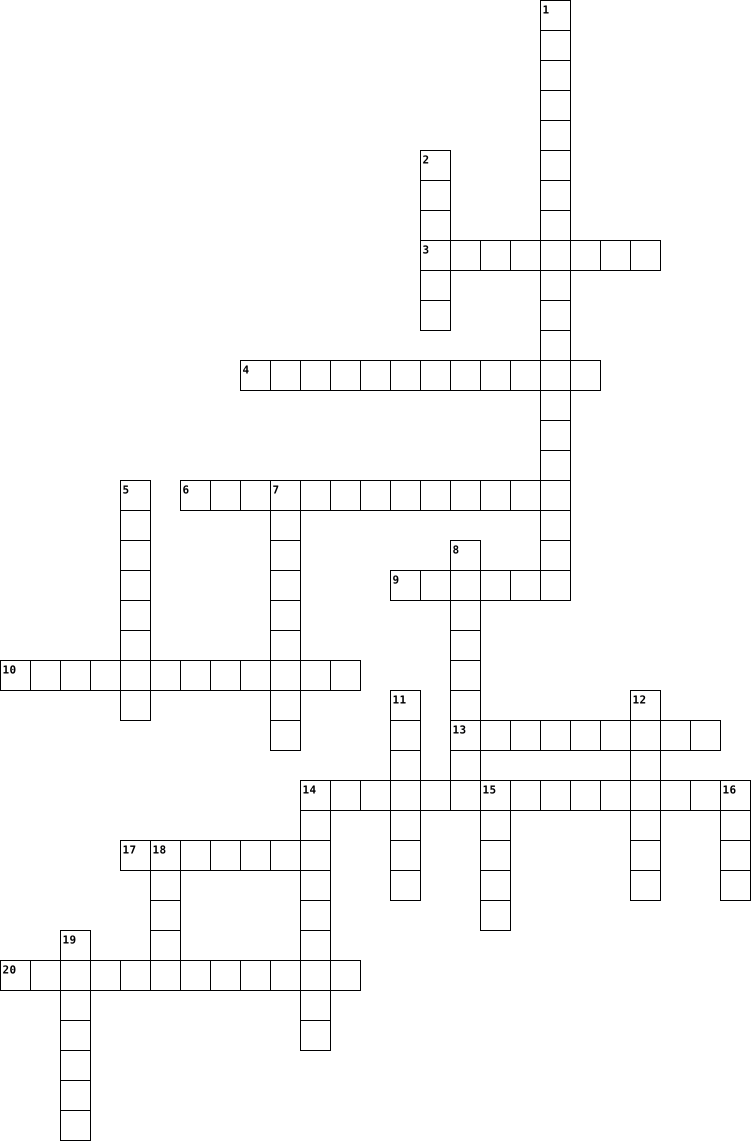
Across
- Atoms of the same element that have different numbers of neutrons.
- the number of protons in the nucleus of an atom, which determines the chemical properties of an element and its place in the periodic table
- a table of the chemical elements arranged in order of atomic number, usually in rows, so that elements with similar atomic structure and appear in vertical columns.
- The vertical columns in the periodic table.
- Attraction formed when elements share electrons.
- relating to the simplest units of an element or compound
- A formula that shows what elements are in a compound and what it will become.
- A chemical element with atomic number 3, symbol Li. It is an alkali metal
- Force that holds atoms together in a compound
Down
- Between groups 1 and 2, and 13 and 18.
- a positively charged ion
- the simplest structural unit of an element or compound
- type of linkage formed from the electrostatic attraction between oppositely charged ions in a chemical compound
- consisting of one atom
- a group of symbols that make a mathematical statement
- each of more than one hundred substances that cannot be chemically inter converted or broken down into simpler substances
- a thing that is composed of two or more separate elements
- a negatively charged ion
- the basic unit of a chemical element.
- relating to, composed of, or using ions
- Horizontal rows of elements.
21 Clues: consisting of one atom • a positively charged ion • a negatively charged ion • Horizontal rows of elements. • the basic unit of a chemical element. • Between groups 1 and 2, and 13 and 18. • relating to, composed of, or using ions • The vertical columns in the periodic table. • Force that holds atoms together in a compound • Attraction formed when elements share electrons. • ...
Think Tac Toe 2021-06-02

Across
- the distance between two corresponding parts of a wave
- elements with properties that fall between those of metals and nonmetals
- a rule where atoms react by gaining or losing electrons so as to acquire the stable electron structure of a noble gas, usually eight electrons
- a number that shows the positive charge of a monatomic ion
- elements found to the right and above the stairs on the periodic table
- a measure of the extra positive or negative particles that an object has
- molecular geometry when atoms are in a straight line
- nonmetal and nonmetal molecules that share electrons evenly
Down
- electrons on the outermost energy level on an atom
- molecular geometry about a central atom with 4 legs and no lone pairs of electrons
- elements that are found on the left side of the periodic table
- a mixture of two or more metals
- atoms of the same elements that have different numbers of neutrons
- a number showing how many protons are in a molecule
- a type of compound where two are more elements where the electrons are shared in a covalent bond
- an atom or group of atomes that has a positive or negative charge
- anion with a negative charge
- molecule with partial charges on opposite sides
- a positively charged ion
- metal and nonmetal
20 Clues: metal and nonmetal • a positively charged ion • anion with a negative charge • a mixture of two or more metals • molecule with partial charges on opposite sides • electrons on the outermost energy level on an atom • a number showing how many protons are in a molecule • molecular geometry when atoms are in a straight line • ...
Elements and Mixtures 2017-12-03

Across
- the average atomic _________ comes from the protons + neutrons
- a substance made of two or more elements chemically joined
- a substance made of one kind of atom
- a mixture that is not mixed evenly throughout
- Elements in the same row across the table are in the same ______
- one substance is dissolved in another
- negatively charged particles inside an atom in the cloud
- the smallest unit of an element that still has the properties of that element
- atoms are arranged in the periodic table by the _________
- along the zig zag line are ___________.
- particles will settle our if not shaken or stirred
- liquids that have a pH equal to 7
Down
- positively charged particles inside an atom
- Elements in a group have similar properties and are sometimes referred to as ______
- a mixture that is mixed evenly throughout
- to the left of the zig zag line are __________.
- particles inside an atom with no charge
- Elements are arranged in a chart called the ________ table
- Elements in the same column up and down are in the same _____
- liquids that have a pH greater than 7
- elements and compounds are pure ____________
- liquids that have a pH less than 7
- most of the elements are _____________.
- a substance that contains a variety of elements and compounds that are not chemically combined.
24 Clues: liquids that have a pH equal to 7 • liquids that have a pH less than 7 • a substance made of one kind of atom • liquids that have a pH greater than 7 • one substance is dissolved in another • particles inside an atom with no charge • most of the elements are _____________. • along the zig zag line are ___________. • a mixture that is mixed evenly throughout • ...
Chemistry Crossword 2018-11-13

Across
- a change from gas to liquid
- is anything that has mass and occupies space
- chemical combination of two or more elements in a specific ratio
- can't reverse (burning wood) when two or more materials react and create new materials.
- solids, liquid or gas depends on temperature
- can reverse (e.g melting ice) one in which a material changes from one state to another.
- pure substance that cannot be broken down into other substances (made up of only one type of atom)
- each element is composed of a particle called
- Place on periodic table showing vertically
- appearance from the outside e.g lustre
- Nucleus contained positively charged particles
- liquid to a solid
Down
- a solid also can change directly into a gas and vise versa
- substance made up of only one kind of matter, which has a unique set of properties
- a table in which the elements are organized, by their physical and chemical properties
- Place on periodic table showing horizontally
- combinations of pure substances the components of a mixture do not combine
- how a substance interacts with other substances (acid)
- change from solid to liquid
- characteristics of a substance
- You can not brake it down into another substance
- change from liquid to gas (a;so known as vaporization)
- workplace hazardous materials information system
- Neutral particles
- Negatively charged particles
25 Clues: Neutral particles • liquid to a solid • a change from gas to liquid • change from solid to liquid • Negatively charged particles • characteristics of a substance • appearance from the outside e.g lustre • Place on periodic table showing vertically • is anything that has mass and occupies space • Place on periodic table showing horizontally • ...
Waves Crossword Puzzle 2018-05-16

Across
- the distance from the crest to the trough divided by 2.
- Interference Any interference in which waves combine so that the resulting wave is smaller than the largest wave of the original waves
- back and forth periodic motion.
- Wave transmits energy through an empty space.
- a maternal or substance a wave travels through
- region within a longitudinal wave in which pressure is lower than normal.
- Wave A pattern of vibration that stimulates a wave that is still standing.
- Wave requires a medium to transport energy from one location to another.
- how many seconds pass within a single wave
- oscillation or repeating back and forth periodic motion
Down
- the number of waves per second
- the highest point of a wave
- transfer of energy in the form of a disturbance.
- one complete wave
- Waves the particle motion is parallel to the wave motion.
- Interference any interference in which waves combine so that the resulting wave is bigger than the original waves
- The combination of two or more waves combine so that the reulting wave is bigger than the original waves.
- region within a longitudinal wave in which pressure is greater than normal.
- the lowest point of a wave
- Waves the particle motion is perpendicular to the wave motion.
- Effect An observed change in frequency of a wave when the source or observer is moving
21 Clues: one complete wave • the lowest point of a wave • the highest point of a wave • the number of waves per second • back and forth periodic motion. • how many seconds pass within a single wave • Wave transmits energy through an empty space. • a maternal or substance a wave travels through • transfer of energy in the form of a disturbance. • ...
Waves Crossword Puzzle 2018-05-16

Across
- Waves the particle motion is perpendicular to the wave motion.
- the distance from the crest to the trough divided by 2.
- back and forth periodic motion.
- Effect An observed change in frequency of a wave when the source or observer is moving
- Wave transmits energy through an empty space.
- one complete wave
- the lowest point of a wave
- region within a longitudinal wave in which pressure is lower than normal.
- oscillation or repeating back and forth periodic motion
Down
- the highest point of a wave
- transfer of energy in the form of a disturbance.
- Interference Any interference in which waves combine so that the resulting wave is smaller than the largest wave of the original waves
- Wave requires a medium to transport energy from one location to another.
- a maternal or substance a wave travels through
- The combination of two or more waves combine so that the reulting wave is bigger than the original waves.
- Interference any interference in which waves combine so that the resulting wave is bigger than the original waves
- Waves the particle motion is parallel to the wave motion.
- region within a longitudinal wave in which pressure is greater than normal.
- the number of waves per second
- how many seconds pass within a single wave
- Wave A pattern of vibration that stimulates a wave that is still standing.
21 Clues: one complete wave • the lowest point of a wave • the highest point of a wave • the number of waves per second • back and forth periodic motion. • how many seconds pass within a single wave • Wave transmits energy through an empty space. • a maternal or substance a wave travels through • transfer of energy in the form of a disturbance. • ...
Period Table Challenge Crossword 2012-11-26

Across
- the center of an atom; made up of protons and neutrons
- a vertical column of elements in the periodic table
- (two words) the properties of elements tend to repeat in a regular pattern when elements are arranged in order of increasing atomic number
- the elemnts that are usually poor conductors of heat and electricity
- the smallest particle that has the properties of an element
- another name for group
- a negatively charged subatomic particle found in the electron cloud of an atom
- (three words) a quantity equal to one-twelfth the mass of a carbon-12 atom
- a neutral subatomic particle in the nucleus of an atom
- an atom or a group of atoms that has lost or gained one or more electrons and therefore has a net electric charge
- the elements thta are good conductors of heat and electricity
Down
- (two words) an electron in the outermost energy level of an atom
- symbol for atomic mass unit
- a horizontal row of elements in the periodic table
- another name for metalloid
- (two words) the total number of protons and neutrons in the nucleus of an atom
- an element that has properties of both a metal and nonmetal
- another name for period
- any atoms having the same number of protons but a different number of neutrons
- a positively charged subatomic particle in the nucleus of an atom
20 Clues: another name for group • another name for period • another name for metalloid • symbol for atomic mass unit • a horizontal row of elements in the periodic table • a vertical column of elements in the periodic table • the center of an atom; made up of protons and neutrons • a neutral subatomic particle in the nucleus of an atom • ...
Science Crossword Puzzle 2014-02-26

Across
- Has no definite volume or shape
- The amount of matter
- Made of two or more atoms
- An element that has properties of both a metal and nonmetal
- Study of the properties and changes of matter
- Property/ A Property that doesn't depend on pressure, temperature, or density.
- Made up of atoms of one type
- A vertical column in a periodic table
- Study of matter and how it changes
- An element that is a poor conductor of electricity and does not form positive ions in a solution
- Change/ A change of matter from one form to another without chemical Change (solid, liquid, gas)
- Of State/ Liquid, solid, gas
- An element that is shiny and a good conductor of electricity
Down
- A horizontal row in a periodic table
- Smallest particle
- Study of substances
- organic Chemistry/ Study of non organics
- Has a definite volume and definite shape
- A substance or molecule that participates in a chemical reaction
- Any substance that has a defined composition
- A state of change starting from a gas then ionizing
- Property/ A property that depends on size.
- Anything that takes up space
- Chemistry/ The study of carbon compounds
- Reaction/ The process by which one or more substances change to produce one or more substances
- Has a definite volume, but no definite shape
26 Clues: Smallest particle • Study of substances • The amount of matter • Made of two or more atoms • Made up of atoms of one type • Anything that takes up space • Of State/ Liquid, solid, gas • Has no definite volume or shape • Study of matter and how it changes • A horizontal row in a periodic table • A vertical column in a periodic table • organic Chemistry/ Study of non organics • ...
Chemistry Crossword 2015-11-19

Across
- Change of state from a gas to liquid.
- Description of a substance that can be pounded or rolled into sheet.
- Shiny, malleable, ductile element that conducts electricity.
- Substance that strongly resist the flow of electricity.
- Chemical reaction that absorb energy.
- The smallest part of an element that is representative of that element.
- Measure of atomic mass.
- Vertical column of element in the periodic table.
- Chemical combination of two or more elements in a specific ratio.
- Change of state from a liquid to gas.
- Change of state from solid to liquid.
Down
- Chemical reaction that takes place in cell.
- Ability to work.
- Catalyst involved in a chemical reaction in living things.
- Change of state from a gas to solid.
- Slow chemical change that occurs when oxygen in the air reacts with a metal.
- Number of protons in the nucleus of one atom of an element.
- Group 17 elements in the periodic table.
- Invisible negatively charged particle that orbits the nucleus of an atom.
- A material that that electric charge can move through easily.
- Chang of state from a liquid to solid.
- Anything that has mass and occupies space.
- Substance that helps a chemical reaction to proceed more quickly.
- Chemical reaction that releases energy.
- Amount of mass in a given volume of a substance.
25 Clues: Ability to work. • Measure of atomic mass. • Change of state from a gas to solid. • Change of state from a gas to liquid. • Chemical reaction that absorb energy. • Change of state from a liquid to gas. • Change of state from solid to liquid. • Chang of state from a liquid to solid. • Chemical reaction that releases energy. • Group 17 elements in the periodic table. • ...
Science: Matter and Chemical Change 2014-11-10

Across
- supported the idea that everything was made up of the 4 elements
- stated each type of material was made up of a different type of atomos
- represents the number of atoms
- a pure substance that cannot be broken down into other substances
- the 18 columns on the Periodic Table of Elements
- Workplace Hazardous Material Information System
- a chemical reaction that takes place in the cells of your body
- ______ systems is an experiment in which reactants and products can not escape
- occurs when oxygen reacts to another substance to form a new substance and releases energy
- experimented with the behaviour of gases
- most reactive of the metals
- substances that helps reaction proceed faster
- the rows in the Periodic Table of Elements
Down
- substance that strongly resists the flow of electricity
- characteristics that can be used to describe a substance
- the mass of one of an element
- compound formed when 2 non-metals combine
- has the element symbol Br
- the Law of ________ of Mass
- an atom or group of atoms that become electrically charges because it has lost or gained electrons
- neutral particles
- occurs when oxygen reacts with metal, a chemical reaction in which the metal is decomposed
- positively charged particles
- organic catalysts
- Father of Modern Chemistry
- published by Andreas Libau in 1597, it describes the achievements of alchemists
26 Clues: neutral particles • organic catalysts • has the element symbol Br • Father of Modern Chemistry • the Law of ________ of Mass • most reactive of the metals • positively charged particles • the mass of one of an element • represents the number of atoms • experimented with the behaviour of gases • compound formed when 2 non-metals combine • the rows in the Periodic Table of Elements • ...
Science Crossword 2014-11-09

Across
- The ability of a substance to conduct electricity or heat
- The change from a liquid to a gas
- Anything that has a mass and occupies space
- A change from one state to another
- Also called a family, a vertical column in the periodic table
- The most reactive of the metals
- A pure substance formed when non-metals combine
- Substances that are shiny, malleable, and ductile
- The ability of a substance to be dissolved in another substance
- Neutral particles
- A horizontal row in the periodic table
- Most reactive non-metals
- The amount of mass in a given volume of a substance
- the most stable and unreactive elements
Down
- The change from a gas to a liquid
- A reaction that takes place when 2 or more substances react to form new substances
- The mass of one atom of a substance
- The change from a liquid to a solid
- A combination of pure substances
- Positively charged particles
- The change from a solid to a gas and vice versa
- The ability of a substance to be able to be pounded or rolled into sheets
- A formula that states what substances and the amount of each substance there is in a compound
- 2 or more materials joining to create new materials
- The change from a solid to a liquid.
25 Clues: Neutral particles • Most reactive non-metals • Positively charged particles • The most reactive of the metals • A combination of pure substances • The change from a gas to a liquid • The change from a liquid to a gas • A change from one state to another • The mass of one atom of a substance • The change from a liquid to a solid • The change from a solid to a liquid. • ...
Zoology Final 2016-05-13

Across
- indicates the presence of four muscular limbs and feet with toes and fingers
- ventral portion of the shell of a turtle
- having more than one male mate
- primitive mammals that lay large yolky eggs
- olfactory receptors present in reptiles; used to sample airborne chemicals
- separates the nasal and oral cavities of some mammals and reptiles
- line the tip and trailing edge of the wing of a bird
- gas exchange through moist surfaces of mouth and pharynx
- egg of reptiles, birds, and mammals. Promote gas exchange
- primitive mammals that lay large yolky eggs
- periodic renewal of feathers
- members of the mammalian group characterized by the presence of a placenta
- period of development of the young in viviparous animals
- refers to dorsal portion of a turtle's shell
Down
- receptor of infrared radiation on the head of snakes
- having one mate at a time
- periodic round trips of animals between breeding and nonbreeding areas
- having more than one female mate
- provide insulation for adult and immature birds
- tough, water resistant protein found in the epidermal layer of skin of reptiles, birds, and mammals
- gas exchange across the skin
- surface that provides lift by using currents of air it moves through
- provide flight surfaces and are responsible for plumage colors
- produces and secretes milk to nourish developing young
- adaptation that allows lizards to detach a portion of tail
25 Clues: having one mate at a time • gas exchange across the skin • periodic renewal of feathers • having more than one male mate • having more than one female mate • ventral portion of the shell of a turtle • primitive mammals that lay large yolky eggs • primitive mammals that lay large yolky eggs • refers to dorsal portion of a turtle's shell • ...
Science 2023-12-06

Across
- if someone is pushing a table with 80 N and the table is only pushing back with 20 N, the forces are...
- The small numbers are called...
- Every letter in a molecule is a...
- they go up and down on the periodic table
- 2 things that can form in a chemical reaction are gas and...
- have a negative charge
- have a neutral charge
- what type of line shows acceleration in a speed and time graph
- the x-axis on a speed and time graph
- if someone is pushing right with 15 N and someone is pushing Left with 15 N their forces are...
Down
- speed with a direction
- one of the things needed to calculate speed
- they go left to right on the periodic table
- What type of line shows a constant speed in a speed and time graph
- measured in km/h and mph among others
- have a positive charge
- The # of law that states for every action there is an equal and opposite reaction
- The evidenced of a chemical reaction are color,temperature or heat change and production of gas and precipitate and...
- measured in things like meters, miles and kilometers
- if there is a big 2 at the beginning of the compound then there are 2...
- The # of law that states an object in motion stays in motion unless acted upon by an unbalanced force
21 Clues: have a neutral charge • speed with a direction • have a positive charge • have a negative charge • The small numbers are called... • Every letter in a molecule is a... • the x-axis on a speed and time graph • measured in km/h and mph among others • they go up and down on the periodic table • one of the things needed to calculate speed • ...
mining 2022-06-26

Across
- the layer of the earth containing all 'air'
- when rocks are brought to the surface
- inner most layer of the earth
- the scale of how hard a mineral is
- igneous rocks formed above the earth
- a resource that is found in nature is said to be
- how shiny a mineral is
- the elements on the left side of the periodic table
- a common aluminium ore
- outer most layer of the earth
- when a rock is broken
- rock type formed from small fragments
- the raw material mined from the earth that we refine
- a second type of fossil
- a type of fossil
- right side of the periodic table
- a resource that cannot be reused
Down
- all of the water on the planet
- when eroded pieces of rock move to new place
- a resource that can be used over and over again
- the layer of the earth all mining is in
- the type of mining that uses huge pits to
- heat and pressure makes these types of rocks
- a common lead ore
- what fossilised tree sap is called
- the name of the theory that all rock layers above others must be younger
- when parts of a rock are removed by air or water
- thickest layer of the earth
28 Clues: a type of fossil • a common lead ore • when a rock is broken • how shiny a mineral is • a common aluminium ore • a second type of fossil • thickest layer of the earth • inner most layer of the earth • outer most layer of the earth • all of the water on the planet • right side of the periodic table • a resource that cannot be reused • the scale of how hard a mineral is • ...
Structure of the Atom 2023-02-26

Across
- the name given to electrons in the outermost shell
- A group of non-metals that include fluorine, chlorine, iodine, bromine and astatine.
- The heaviest Alkali Metal
- The lightest Noble Gas
- A chemical element that is not a metal.
- the charge of a neutron
- An Alkali Metal with 4 Shells (Period 4)
- the charge of an electron
- the subatomic particle inside the nucleus with a neutral charge
- the subatomic particle inside the nucleus with a positive charge
- the name given to the columns of the periodic table
- the Element with chemical symbol H
- the name for layers around the atom that houses electrons
Down
- The arrangement of electrons in the shells and subshells of an atom.
- The total number of protons and neutrons in the nucleus of an atom.
- the charge of a proton
- the Element with chemical symbol Cl
- An element that has properties of both metals and non-metals.
- the subatomic particle with a negative charge that orbits the atom
- the lightest Alkali metal
- The element with atomic number 33
- An element that is malleable, ductile, and an electrical and thermal conductor.
- The name given to the rows on the periodic table (number of shells)
- The number of protons in the nucleus of an atom, which is a unique identifier for each element.
- the Element with chemical symbol O
25 Clues: the charge of a proton • The lightest Noble Gas • the charge of a neutron • The heaviest Alkali Metal • the lightest Alkali metal • the charge of an electron • The element with atomic number 33 • the Element with chemical symbol H • the Element with chemical symbol O • the Element with chemical symbol Cl • A chemical element that is not a metal. • ...
Science 2023-04-09

Across
- no scientist has not made it even those to this degree
- the smell of something
- all of the atoms are vibrating in one whole (table)
- when water is solidified
- the lowest of the wave
- unit for force
- When ice gets hot it
- The distance from the crest and middle of the wave
- allow electricity flow through it (copper)
- to zoom in to see the planets for the ground
- unit for work
- when two things rub together to make heat
- vertical groups on the periodic table
- It is attractive to metal and moves to it
- Column groups on the periodic table
- the highest of the wave
Down
- what the object feels like
- we have 4 of this a year because the earth rotate
- How fast something goes
- tiny waves (have them in the kitchen)
- the water outside your glass
- Get them a doctor if you broke a bone
- The atoms are together but still break off on there own (water)
- uses them when the power goes out
- not a real planet (Pluto)
- the distance between the crests of the wave
- liquid turns into vapor
- does not allow electricity to flow through it (plastic)
- how fast something can catch on fire
- Atoms move around all the time (air)
30 Clues: unit for work • unit for force • When ice gets hot it • the smell of something • the lowest of the wave • How fast something goes • liquid turns into vapor • the highest of the wave • when water is solidified • not a real planet (Pluto) • what the object feels like • the water outside your glass • uses them when the power goes out • Column groups on the periodic table • ...
chemistry bonus 2023-05-01

Across
- what rule states that electrons must occupy all of the orbitals of a sublevel before pairing begins?
- visually seperate solids can be separated by?
- Who discovered electrons while experimenting with a cathode ray tube?
- polar molecules can be dissolved in...
- what is a combination of 2 or more pure substances in which each substance retains its own chemical properties?
- the number of protons in the nucleus
- who created the first periodic table?
- a single compound breaks down into two or more elements or new compounds is...
- what is the ratio of the error to the actual value multiplied by 100?
Down
- what is located on the right of the metalloid line?
- what is located on the left of the metalloid line?
- what is the smallest ratio of cations to anions referred to as?
- a description of an element's tendency to undergo chemical reactions is called?
- what is the mass of an atom given in amu?
- Who discovered the nucleus of an atom?
- the transfer of electrons between atoms that results in cations and anions...
- atoms will gain, lose, or share valence electrons to attain 8 valence electrons is what rule?
- what is called when oxygen combines with a substance and releases heat and light?
- What is the lowest energy of an atom called?
- horizontal rows on the periodic table are called...\
20 Clues: the number of protons in the nucleus • who created the first periodic table? • polar molecules can be dissolved in... • Who discovered the nucleus of an atom? • what is the mass of an atom given in amu? • What is the lowest energy of an atom called? • visually seperate solids can be separated by? • what is located on the left of the metalloid line? • ...
Kemi - Kemiska förening (4) ENG 2023-08-30

Across
- Element Fe
- Element Li
- Rows in the periodic table.
- Different types of atoms are combined in a compound and form e.g. water
- A solution that is neither acidic nor basic.
- Element N
- Strong acidic substance. Chemical formula HCl.
- Element B
- A substance made up of positive and negative ions.
- What makes acids corrosive and acidic?
- What makes bases corrosive and basic?
- Is like an atom but lacks or has more electrons. Has a negative or positive charge.
- Element Mn
Down
- A chemical compound formed when negative and positive ions are attracted to each other.
- Element O
- When a substance reacts with another substance and forms new properties, form and character.
- There are different kinds of this. All are used to measure the pH value of a solution, e.g. bath water.
- A chemical compound in which at least two atoms are joined together, can be different or the same elements.
- scale A scale that describes whether a substance is acidic or basic.
- Element Ne
- Columns in the periodic table.
- A substance that has a high proportion of hydroxide ions and a high pH value.
- Element C
- Element Al
- Element Cl
- Strong basic substance. Chemical formula NH4.
- A substance that has a high proportion of hydrogen ions and a low pH value.
27 Clues: Element O • Element N • Element C • Element B • Element Fe • Element Li • Element Ne • Element Al • Element Cl • Element Mn • Rows in the periodic table. • Columns in the periodic table. • What makes bases corrosive and basic? • What makes acids corrosive and acidic? • A solution that is neither acidic nor basic. • Strong basic substance. Chemical formula NH4. • ...
Vocab Crossword 2023-09-20

Across
- Greek philosopher who called nature’s basic particle an atom
- Bonding, Special type of dipole-dipole attraction that is the strongest of the intermolecular bonds
- a force that results from one end of a molecule being positive and the other end being negative
- the neutral particle in the nucleus of an atom
- Forces, Short-range proton-neutron, proton-proton, and neutron-neutron forces that hold these particles together
- Vertical columns on the periodic table
- Proposed the “plum pudding” model and discovered the electron
- the basic unit of a chemical element
- Formed the atomic theory of the atom, said atoms were “hard little spheres”
Down
- Discovered the nucleus using his gold foil experiment
- Dispersion Forces, Weakest of the intermolecular forces between two nonpolar molecules
- Number, the number of protons in the nucleus and determines the chemical properties of an element
- the negative particle that circles the nucleus
- Cloud, Current explanation of where electrons might be found in an atom
- Horizontal rows of the periodic table
- A collection of protons and neutrons at the center of an atom
- Molecular Theory, Theory that explains that as atoms speed up, they are more likely to be gases
- the positive particle in the nucleus of an atom
- Number, The total number of protons and neutrons in a nucleus
- Used by scientists to explain something we can not see or understand
20 Clues: the basic unit of a chemical element • Horizontal rows of the periodic table • Vertical columns on the periodic table • the negative particle that circles the nucleus • the neutral particle in the nucleus of an atom • the positive particle in the nucleus of an atom • Discovered the nucleus using his gold foil experiment • ...
reactivity 2022-05-17

Across
- which is essential for ironoxide to happen? water, lead or carbon.
- Elements that react to form positive ion are ___.
- Metals atom are ___ when they react because they lose electrons.
- What is the oxidising agent in this reaction: lead oxide + carbon → lead + carbon monoxide?
- How to test for carbon dioxide.
- Calcium+carbon.
- Which can displace zinc from zinc sulphate.
- which one is less reactive magnesium or aluminum.
- Which gas is required to burn.
- When u add gold in hydrochloric acid.
- When there is 2 oxygen what do you add at the end.
Down
- zinccinoxide+magnesium.
- What is the most reactive metal on the periodic table?
- Violent reaction and very dangerous when reacted with dilute acid.
- Which metal could be used for the sacrificial protection of iron?
- magnesium+hydrochloric acid= magnesium chloride+___.
- Which of these react with dilute acid? lead or copper.
- True or nope can iron displace zinc?
- Metals can be arranged in order of their reactivity in a ___.
- magnesium has slow reaction in cold water to form ___?
- What is potassium stored in?
- Which one reacts with steam but not water to form an oxidre? iron, copper or magnesium.
- What reacts violently with dilute acid and reacts slowly with cold water.
- Which one is more reactive copper or silver.
- What is the most reactice element on the periodic table?
25 Clues: Calcium+carbon. • zinccinoxide+magnesium. • What is potassium stored in? • Which gas is required to burn. • How to test for carbon dioxide. • True or nope can iron displace zinc? • When u add gold in hydrochloric acid. • Which can displace zinc from zinc sulphate. • Which one is more reactive copper or silver. • Elements that react to form positive ion are ___. • ...
8th Grade Science 2025-06-01

Across
- This layer is solid nickel and iron
- The attraction between two or more objects (keeps our feet on Earth)
- This subatomic particle number is the atomic number
- This type of diagram shows valence electrons
- Water moving across the surface
- Water goes from a gas to a liquid
- Dominoes are an example of these
- Fe on the periodic table
- Neutral subatomic particle
- Heat is released in this type of reaction
- These are pure substances
- Water goes from liquid to a gas
- The electrons in the outer shell
- Type of plane used in Rube Goldberg machines
- Two or more elements
- Lighting a match is this type of change
Down
- Heat is absorbed in this type of reaction
- Water exits the leaves of trees
- This subatomic particle has a negative charge
- Measurement for Work
- Objects in motion stay in motion until acted upon
- Hg on the Periodic Table
- This turns off and on the flow of electricity
- Breaking wood into pieces is this type of change
- The Earth is an example this type of magnet
- Carbon dioxide and water are examples of this in photosynthesis
- Important to humans and has 6 valence electrons
- Gravity on earth is 9.81 m/s2
- Stored energy
- Energy in motion
- Measurement for force
31 Clues: Stored energy • Energy in motion • Measurement for Work • Two or more elements • Measurement for force • Hg on the Periodic Table • Fe on the periodic table • These are pure substances • Neutral subatomic particle • Gravity on earth is 9.81 m/s2 • Water exits the leaves of trees • Water moving across the surface • Water goes from liquid to a gas • Dominoes are an example of these • ...
Term 1 Review 2025-08-27

Across
- the command center of the cell
- the diffusion of water
- the smallest unit of elemental matter
- atoms of the same element that have the same number of protons, but a different number of neutrons
- a particle that has a positive charge
- a particle with a negative charge
- organelle that performs photosynthesis
- The main ingredient in any cell
- atoms of the same element that have the same number of protons, but a different number of electrons
- are ductile, conduct heat and electricity, have luster, and are malleable
- the place where most photosynthesis happens
- a chart of the elements arranged into rows and columns
Down
- tells you the number of protons in the nucleus of an atom of that element
- a row on the periodic table
- have physical and chemical properties of both metals and nonmetals
- the hole gases use to move in and out of the leaf
- shows an element’s chemical symbol, atomic number, and atomic mass
- organelle that performs cellular respiration
- a column on the periodic table
- an electrically neutral particle
- have three jobs 1. anchor a plant in the soil 2. absorb food and water 3. store food and water
- have no metallic properties
- vascular tissue that moves glucose
- molecule with a positive end and a negative end
- vascular tissue that moves water
25 Clues: the diffusion of water • a row on the periodic table • have no metallic properties • the command center of the cell • a column on the periodic table • The main ingredient in any cell • an electrically neutral particle • vascular tissue that moves water • a particle with a negative charge • vascular tissue that moves glucose • the smallest unit of elemental matter • ...
a,d[p,w 2025-10-13

Across
- a shorthand method of describing the arrangement of electron shells of an atom
- a state of matter that have a definite shape and volume
- a process occuring at the surface of a liquid involving the change of state of liquid into gas at a temperature below the boiling point
- a substance which cannot be further divided into simpler substances by chemical method
- any basic unit of matter and energy
- The process by which different substances mix as a result of the random motions of their particles
- A solid where particle are arranged in definite way giving specific shape
- ability to do force
- tranfers thermal energy to its surroundings, leading to an increase in the temperature of the surroundings
Down
- the smallest part of an element that can exist as a stable entity
- decrease in size if cooled
- a state of matter that has neither definite shape and volume
- the temperature at which solid melts into liquid
- helps to explain the way matter behaves
- A group of atoms covalently bonded together
- a vertical column of the periodic table containing elements with the same number of electrons in their outer electron shell
- horizontal rows of the periodic table
- increase slightly in size when heated
- a state of matter that has a definite volume and moves by flowing
- Anything which occupies space and mass
20 Clues: ability to do force • decrease in size if cooled • any basic unit of matter and energy • horizontal rows of the periodic table • increase slightly in size when heated • Anything which occupies space and mass • helps to explain the way matter behaves • A group of atoms covalently bonded together • the temperature at which solid melts into liquid • ...
Chemistry 2021-06-17

Across
- King of acids
- simplest repeating structure of a crystal
- Study of Matter
- month of Avogadro Number
- Lightest element
Down
- 17th group elements
- Laughing gas
- rows on the periodic table
- Polymer of isoprene
- one of the chalcogens
10 Clues: Laughing gas • King of acids • Study of Matter • Lightest element • 17th group elements • Polymer of isoprene • month of Avogadro Number • one of the chalcogens • rows on the periodic table • simplest repeating structure of a crystal
Big Bang 2021-09-18

Across
- matter and energy
- electrons
- radiation
- shift electromagnetic property
- atoms and hydrogen combined
Down
- gas dust and billions of stars
- extremely hot collections of electrons
- colors
- 1st element in periodic table
- touch, feel, sense, and measure
10 Clues: colors • electrons • radiation • matter and energy • atoms and hydrogen combined • 1st element in periodic table • gas dust and billions of stars • shift electromagnetic property • touch, feel, sense, and measure • extremely hot collections of electrons
Motion 2023-06-20

Across
- Study of Motion
- To and fro motion
- Length of a path
- Measures distance
Down
- Progression of events
- A device to measure time
- Repeated at a regular interval
- Shortest Path
- Metallic ball
- Motion about a fix axis
10 Clues: Shortest Path • Metallic ball • Study of Motion • Length of a path • To and fro motion • Measures distance • Progression of events • Motion about a fix axis • A device to measure time • Repeated at a regular interval
Crossword 2021-01-19

Across
- these elements react to form positive ions
- scientist who devised the modern periodic table
- elements with similar properties are arranged in these
- the discovery of these made it possible to explain why the order of elements based on atomic weights was not always correct
- these are non-metals with seven electrons in their outer shell
- a more reactive halogen can do this to a less reactive halogen from an aqueous solution of its salt
Down
- these were left by Mendeleev for undiscovered elements
- these occur down groups and depend on distinctive properties of elements
- the arrangement of these in its atoms determines an elements position in the table
- these metals are reactive as they have a single electron in their outer shell
- these gases are unreactive as they have a stable arrangement of electrons
- this number determines the order of elements in the periodic table
12 Clues: these elements react to form positive ions • scientist who devised the modern periodic table • these were left by Mendeleev for undiscovered elements • elements with similar properties are arranged in these • these are non-metals with seven electrons in their outer shell • this number determines the order of elements in the periodic table • ...
Chemistry Project 2022-04-13

Across
- What are all things made of?
- The subatomic particle of an atom that is negatively charged.
- What is the opposite of an insulator?
- The subatomic particle of an atom that is positively charged.
- What is the other name for the vertical families of the periodic table that determines and groups elements by chemical properties, reactivity, and the number of valence electrons?
Down
- The number that comes in front of a chemical formula that you distribute.
- Elements in Group 18 have the least __________ because they already have a full valence electron shell.
- What is matter made of? (Singular)
- When a molecule is made of 2 or more elements, what is it called?
- The subatomic particle of an atom that is neutrally charged.
- The small, lower "exponent" on an element that signals how many there are of it.
- The 7 horizontal rows on the periodic table that group the elements by how many energy levels they have.
12 Clues: What are all things made of? • What is matter made of? (Singular) • What is the opposite of an insulator? • The subatomic particle of an atom that is neutrally charged. • The subatomic particle of an atom that is negatively charged. • The subatomic particle of an atom that is positively charged. • When a molecule is made of 2 or more elements, what is it called? • ...
Science Vocab list 2020-10-13

Across
- a particle that has no charge. Also found in the nucleus
- the center of the atom. Is made up of protons and neutrons. Has he most mass
- is the total number of protons and neutrons in the nucleus.
- A group of atoms bonded together representing the smallest unit of chemical compound.
- Is a group of elements whose lightest member is represented (ex. Helium, boron, lithium, etc.)
- is another name for atomic mass
- Is a complete transfer of an valence electron from one atom to another.
- A form of matter (liquid, solid, gas) All elements go through these changes.
- is two atoms that are alike with the same number of protons but different number of neutrons.
- Group contains nonmetals, 8 electrons on the outer layer. nonreactive. do not form compounds.
- Basically another name for group.
- Vertical lines on the periodic table grouped up with how many electrons in the valence shell
- is the name of the ion that has lost an electron.
- Metals are on the left side, Nonmetals are on the right side, Metalloids are on along the zig zag line.
- table a table of elements
- is the bond between atoms sharing electrons
- this group also contains metals, but 2 electrons on the outer layer. Reactive but less than Alkali metals
- a positively charged particle in an atom found in the nucleus
- A mixture of metals and nonmetals. Most are under groups 6-9.
Down
- a negatively charged particle found in the electron cloud
- is a atoms that has gained or lost an electron.
- Is a substance composed to exactly 2 different elements.
- is a notation used by scientist to tell the number and types of atoms in a molecule.
- The smallest unit of matter. that can be divided.
- A compound made up of 2 different elements
- This group contains metals, 1 electron in the outer level, and is very reactive.
- is a physical phenomenon in which the chemicals attract by sharing or exchanging.
- a letter or number that is printed slightly below and on the side of another character.
- is the number of protons in the Atom. Determines where the element goes on the periodic table.
- is any substance composed of identical molecules consisting of atoms of 2 or more chemical elements.
- Made up of the electrons around the nucleus. Has the most volume
- a specific pattern in the properties of chemical elements revealed on the periodic table
- negatively charged particle in the outer most shell of a atom.
- This group contains nonmetals. 7 electrons on the outer layer, never in uncombined form in nature.
- Makes negative ions, bad conductors of heat, very brittle
- Makes positive ions, good conductors of heat,when polished it shows a lustrous appearance
- an arrangement of electrons in an atom
- A horizontal group of elements grouped up in the number of protons in a nucleus
- is the name of an ion that has gained an electron.
39 Clues: table a table of elements • is another name for atomic mass • Basically another name for group. • an arrangement of electrons in an atom • A compound made up of 2 different elements • is the bond between atoms sharing electrons • is a atoms that has gained or lost an electron. • The smallest unit of matter. that can be divided. • ...
Crossword Puzzle 2021-10-12

Across
- stable subatomic particle occurring in all atomic nuclei, with a positive electric charge equal in magnitude to that of an electron, but of opposite sign.
- They are a source of nuclear energy
- of a positively charged nucleus with electrons revolving around it in any of many possible circular orbits each corresponding to a distinct energy state.
- positively charged central core of an atom, consisting of protons and neutrons and containing nearly all its mass.
- a substance that flows freely but is of constant volume, having a consistency like that of water or oil.
- mass-the mass of an atom of a chemical element expressed in atomic mass units. It is approximately equivalent to the number of protons and neutrons in the
- measure of the amount of information on a storage medium (tape or disk)
- (the mass number) or to the average number allowing for the relative abundances of different isotopes.
- firm and stable in shape; not liquid or fluid.
- Table- a table of the chemical elements arranged in order of atomic number, usually in rows, so that elements with similar atomic structure (and hence similar chemical properties) appear in vertical columns
- a stable subatomic particle with a charge of negative electricity, found in all atoms and acting as the primary carrier of electricity in solids.
Down
- any substance composed of identical molecules consisting of atoms of two or more chemical elements.
- number-the number of protons in the nucleus of an atom, which determines the chemical properties of an element and its place in the periodic table.
- subatomic particle of about the same mass as a proton but without an electric charge, present in all atomic nuclei except those of ordinary hydrogen.
- a part or aspect of something abstract
- cloud - A group of electrons circulating around a nucleus or a molecule
- substance or matter in a state in which it will expand freely to fill the whole of a container, having no fixed shape (unlike a solid) and no fixed volume (unlike a liquid).
- the Father of the Periodic Table.
- a coherent, typically large body of matter with no definite shape
19 Clues: the Father of the Periodic Table. • They are a source of nuclear energy • a part or aspect of something abstract • firm and stable in shape; not liquid or fluid. • a coherent, typically large body of matter with no definite shape • cloud - A group of electrons circulating around a nucleus or a molecule • ...
light 2022-11-28

Across
- clear
- distance light travels
- diffused light
Down
- periodic wave
- colourless daylight
- different wave lengths
- bending of light
- sensitive layer of eye
8 Clues: clear • periodic wave • diffused light • bending of light • colourless daylight • different wave lengths • sensitive layer of eye • distance light travels
Periodic Table 2022-09-26

Across
- Seven of these are on the periodic table.
- Seven of these are on the periodic table.
- The creator of the periodic table.
- 1869 was the ___ the table was invented.
- The creator of the periodic table
- J is the only _______ not on the table.
Down
- List an example of a chemical element on the table
- Table of chemical elements by atomic #
- Has chemical elements listed by atomic #
9 Clues: The creator of the periodic table • The creator of the periodic table. • Table of chemical elements by atomic # • J is the only _______ not on the table. • 1869 was the ___ the table was invented. • Has chemical elements listed by atomic # • Seven of these are on the periodic table. • Seven of these are on the periodic table. • ...
Atoms and Elements 2022-01-07

Across
- elements in a periodic table row and which change properties in a predictable pattern
- smallest particle of an element
- an atom that has taken on or lost electrons to become negatively or positively charged instead of neutral
- two or more atoms joined together
- a type of element that tends to be shiny, hard, malleable, ductile, and a good conductor
- positively charged region in the center of an atom
- can be pounded into shapes
- positively charged particle
- pure substance made of two or more elements that are combined chemically in a specific ratio
- particle with no electric charge
Down
- two or more substances that are in the same place but not chemically combined
- symbol, usually consists of a one or two letter abbreviation of the element name
- negatively charged particle
- an element that binds tightly to their atoms and conducts hardly any electricity.
- the center of an atom that contains most of the mass of the atom in the form of positive protons and negative neutrons
- mass, minus atomic number is how to find the number of neutrons in an atom
- anything that has mass and takes up space
- number, the number of protons and electrons in an atom
- or family, elements in a periodic table column that have similar properties
- simplest pure substance that can not be broken down into any other substance
20 Clues: can be pounded into shapes • negatively charged particle • positively charged particle • smallest particle of an element • particle with no electric charge • two or more atoms joined together • anything that has mass and takes up space • positively charged region in the center of an atom • number, the number of protons and electrons in an atom • ...
Periodic Table Crossword 2021-10-25

Across
- name of group with 7 valence electrons
- the largest nonmetal
- Nonmetal - Only 1 valence electron
- The only metalloid that has 7 valence electrons
- the type of metals in middle block of table
- smallest metal
Down
- nonmetal with only 4 valence electrons
- Transition metal - liquid @ room temp
- alkali earth metal w/ mass around 24
- Metal w/ 5 valence electrons & under 100 protons
- The smallest metalloid
- the smallest noble gas
- largest nonmetal with 7 valence electrons
13 Clues: smallest metal • the largest nonmetal • The smallest metalloid • the smallest noble gas • Nonmetal - Only 1 valence electron • alkali earth metal w/ mass around 24 • Transition metal - liquid @ room temp • nonmetal with only 4 valence electrons • name of group with 7 valence electrons • largest nonmetal with 7 valence electrons • the type of metals in middle block of table • ...
Periodic Table Elements 2015-03-05

Across
- Li
- K
- Al
- Be
- O
- Ni
- C
Down
- Mg
- Ca
- Ti
- Mn
- H
- F
13 Clues: K • H • F • O • C • Li • Mg • Ca • Ti • Mn • Al • Be • Ni
Periodic Table Crossword 2022-05-04

Across
- the abbreviations used in chemistry for chemical elements
- difficult for electricity to move through
- a table of the chemical elements arranged in order of atomic number, usually in rows, so that elements with similar atomic structure
- a row of chemical elements
- the ability of a material to be drawn or plastically deformed without fracture.
- an electron in the outer shell associated with an atom
- a chemical element that generally lacks a predominance of metallic properties
Down
- the property of a metal's ability to be distorted below compression.
- an element whose properties are intermediate between those of metals and solid nonmetals or semiconductors.
- The six naturally occurring noble gases are helium, neon, argon, krypton, xenon, and the radioactive radon.
- a material which contains movable electric charges
- a column of elements in the periodic table
- a solid material that is typically hard, shiny, malleable, fusible, and ductile, with good electrical and thermal conductivity
13 Clues: a row of chemical elements • difficult for electricity to move through • a column of elements in the periodic table • a material which contains movable electric charges • an electron in the outer shell associated with an atom • the abbreviations used in chemistry for chemical elements • the property of a metal's ability to be distorted below compression. • ...
periodic table vocabulary 2018-09-18

Across
- symbol for atomic mass unit
- a region in an atom where there is a high probability of finding electrons
- a negatively charged subatomic particle found in the energy level of an atom
- level any of the possible energies an electron may have in an atom
- the smallest particle that has the properties of an element
- any atoms having the same number of protons but a different number of neutrons
- an atom or a group of atoms that has lost or gained one or more electrons and therefore has a net electric charge
Down
- the center of an atom; made up of protons and neutrons proton a positively charged subatomic particle in the nucleus of an atom
- the elements that are usually poor conductors of heat and electricity
- a neutral subatomic particle in the nucleus of an atom
- number the number of protons in the nucleus of an atom
- the elements that are good conductors of heat and electricity
- number the total number of protons and neutrons in the nucleus of an atom
13 Clues: symbol for atomic mass unit • a neutral subatomic particle in the nucleus of an atom • number the number of protons in the nucleus of an atom • the smallest particle that has the properties of an element • the elements that are good conductors of heat and electricity • level any of the possible energies an electron may have in an atom • ...
Periodic table elements 2023-11-10

Across
- Nutrien food(s)
- There is a foil from this element
- all though the air (it is from asap science)
- the second stable gas
- death,poison
- used in optical glasses and telescopes
Down
- Batteries
- Na and its a rock
- has 23 protons
- so you can breathe (it is from asap science)
- smaler that an electron
- 5 cents in dolars
- used in bleach and disinfectant
13 Clues: Batteries • death,poison • has 23 protons • Nutrien food(s) • Na and its a rock • 5 cents in dolars • the second stable gas • smaler that an electron • used in bleach and disinfectant • There is a foil from this element • used in optical glasses and telescopes • so you can breathe (it is from asap science) • all though the air (it is from asap science)
Periodic Table Elements 2025-12-15

Across
- Pt
- Mc
- Ti
- He
- LI
- B
Down
- Lv
- Zn
- K
- Cr
- W
- Ge
- Pb
13 Clues: K • W • B • Lv • Zn • Cr • Ge • Pt • Pb • Mc • Ti • He • LI
PERIODIC TABLE ESCAPE ROOM CROSSWORD 2025-09-16

Across
- The element with atomic number 1.
- The type of bond between metals and nonmetals.
- A row in the Periodic Table.
Down
- The element with an atomic weight of 35.453.
- The type of bond where electrons are SHARED.
- A column in the Periodic Table.
6 Clues: A row in the Periodic Table. • A column in the Periodic Table. • The element with atomic number 1. • The element with an atomic weight of 35.453. • The type of bond where electrons are SHARED. • The type of bond between metals and nonmetals.
Periodic Table 2022-09-26

Across
- The creator of the periodic table
- 1869 was the ___ the table was invented.
- Has chemical elements listed by atomic #
Down
- J is the only _______ not on the table.
- The creator of the periodic table.
- Seven of these are on the periodic table.
- List an example of a chemical element.
7 Clues: The creator of the periodic table • The creator of the periodic table. • List an example of a chemical element. • J is the only _______ not on the table. • 1869 was the ___ the table was invented. • Has chemical elements listed by atomic # • Seven of these are on the periodic table.
Matter 2024-10-29

Across
- change
- point
- property
- substance
Down
- point
- energy
- motion
- point
- Periodic Table of Elements
9 Clues: point • point • point • energy • motion • change • property • substance • Periodic Table of Elements
Lauras Clever CrossWord Puzzle 2019-10-29

Across
- An idea or opinion
- Information that can not be shared
- Therapeutic
- Synonym of depserately, starts with F
- Capital city of the United Kingdom
- Named after the goddess Juno
- Local or regional
Down
- Seventh month of the year
- Visit when very sick
- The amazon is a .... forest
- Past tense of bring
- Irregular or periodic
- Talking nonsense
- Opposite of Lost
- The last game
- To assume or give your opinion
16 Clues: Therapeutic • The last game • Talking nonsense • Opposite of Lost • Local or regional • An idea or opinion • Past tense of bring • Visit when very sick • Irregular or periodic • Seventh month of the year • The amazon is a .... forest • Named after the goddess Juno • To assume or give your opinion • Information that can not be shared • Capital city of the United Kingdom • ...
The Crossword of the Great Scientists! 2020-10-21

Across
- Periodic table of elements
- Telephone
- Radioactivity
Down
- Printing
- "Pap smear"
- Developer of the first vaccine
- S.O.S.
- ...Brothers. Invented the aeroplane
8 Clues: S.O.S. • Printing • Telephone • "Pap smear" • Radioactivity • Periodic table of elements • Developer of the first vaccine • ...Brothers. Invented the aeroplane