
periodic+table Crossword Puzzles
The Periodic Table 2024-05-03

Across
- the abbreviation of the element name
- The symbol for this element is H
- the different version of an element
- First to name the atom
- shows the number of valence electrons an element has
- the center of an atom
- positive charge
- The symbol for this element is Ar
- negative charge
Down
- name of the element - mass number
- created the plum pudding model
- smallest known particle
- The symbol for this element is B
- The creater of the Bohr model
- what surrounds the nucleus
- shows how many energy levels an element has
- The number of protons and neutrons
- The symbol for this element is C
- The smallest particle of an element
- neutral charge
20 Clues: neutral charge • positive charge • negative charge • the center of an atom • First to name the atom • smallest known particle • what surrounds the nucleus • The creater of the Bohr model • created the plum pudding model • The symbol for this element is B • The symbol for this element is H • The symbol for this element is C • name of the element - mass number • ...
Periodic table crossword 2024-04-30

Across
- A metalloid element commonly found in borax and used in fiberglass.
- A noble gas used in welding and as a protective atmosphere.
- Essential for respiration and abundant in the Earth's crust.
- A metalloid crucial for semiconductors and computer chips.
- Essential for nerve function and found in bananas.
- Important for bone and teeth health and found in dairy products.
- A greenish gas used in disinfectants and swimming pools.
- A lightweight metal used in cans, foil, and aircraft.
- A highly reactive gas used in toothpaste and Teflon.
- The lightest and most abundant chemical element, often found in water.
Down
- The basis of organic chemistry and found in all living organisms.
- A lightweight metal often used in aerospace applications.
- Essential for life, found in DNA, and used in fertilizers.
- A gas making up the majority of Earth's atmosphere.
- A noble gas known for its use in colorful signs.
- A highly reactive metal that explodes when in contact with water.
- Used in alloys and known for its role in muscle function.
- A metal known for its use in rechargeable batteries.
- A noble gas used in balloons to make them float.
- A yellow solid with a distinctive smell, often associated with volcanoes.
20 Clues: A noble gas known for its use in colorful signs. • A noble gas used in balloons to make them float. • Essential for nerve function and found in bananas. • A gas making up the majority of Earth's atmosphere. • A metal known for its use in rechargeable batteries. • A highly reactive gas used in toothpaste and Teflon. • ...
Periodic Table Crossword 2024-04-30

Across
- Most nonmetals are this state of matter.
- The second element of the periodic table.
- Element that has the element symbol K.
- Found left of stair-step line.
- Found on the stair-step line.
- The metals in the first group.
- When atoms are unstable.
- The gases in group 18.
- Only metal that is liquid at room temperature.
- Nonmetals: Dull or Shiny.
Down
- Metals: Dull or Shiny.
- Element that has the element symbol Na.
- Made of protons, neutrons, and electrons.
- Element with atomic number of 26.
- The scientist that discovered protons.
- When group 1 combines with group 17 it forms ____.
- Most metals are this state of matter.
- Most abundant element.
- Found right of stair-step line.
- Group 2, Period 4.
20 Clues: Group 2, Period 4. • Metals: Dull or Shiny. • Most abundant element. • The gases in group 18. • When atoms are unstable. • Nonmetals: Dull or Shiny. • Found on the stair-step line. • Found left of stair-step line. • The metals in the first group. • Found right of stair-step line. • Element with atomic number of 26. • Most metals are this state of matter. • ...
Periodic Table Trends 2024-04-26

Across
- The Atomic Number is 6
- The Atomic weight is 196.9
- The Atomic Number is 87
- The Atomic Number is 43
- The Atomic Weight is 158.9
- The Atomic Number is 83
- The Atomic Number is 86
- The Atomic Weight is 183.8
- The Atomic Symbol is Cs
- The Atomic Weight is 55.8
Down
- The Atomic Number is 103
- The Atomic Symbol is Si
- The Atomic Weight is 39.9
- The Atomic Number is 24
- The Atomic Number is 56
- The Atomic Weight is 145
- The Atomic Weight is 101
- The Atomic Weight is 192.2
- The lightest element
- The Atomic weight is 20.1
- The Atomic Symbol is Cu
21 Clues: The lightest element • The Atomic Number is 6 • The Atomic Symbol is Si • The Atomic Number is 24 • The Atomic Number is 56 • The Atomic Number is 87 • The Atomic Number is 43 • The Atomic Number is 83 • The Atomic Number is 86 • The Atomic Symbol is Cs • The Atomic Symbol is Cu • The Atomic Number is 103 • The Atomic Weight is 145 • The Atomic Weight is 101 • The Atomic Weight is 39.9 • ...
The Periodic Table 2024-05-07

Across
- Has the highest electrical conductivity
- makes up 78% of earth's atmosphere
- Known for its red orange glow
- most abundant element
- lightweight metal used in foil
- A precious metal highly valued for jewelry
- found in all living organisms
- A key component computer chips
Down
- only metal that is liquid at room temp
- a metal used in jewelry, more valuable than gold
- used in wires due to conductivity
- vital for blood production in the body
- resistant to corrosion and used in various alloys
- used in pipes and paints,known for its toxicity
- A major component of table salt
- used to fill balloons
- Essential for breathing
- used in light bulbs to prevent burning out
- crucial for bone health
- important for immune system defense
20 Clues: used to fill balloons • most abundant element • Essential for breathing • crucial for bone health • Known for its red orange glow • found in all living organisms • lightweight metal used in foil • A key component computer chips • A major component of table salt • used in wires due to conductivity • makes up 78% of earth's atmosphere • important for immune system defense • ...
The Periodic Table 2024-09-25

Across
- ______ Which element has a strong smell and is used in making matches?
- ______ What element has the symbol Fe and is used to make steel?
- ______ Which element is used in making batteries and has the symbol Li?
- ______ Find an element that is a metal and is often used to make coins.
- ______ Which element is used to make shiny jewelry and has the symbol Ag?
- ______ Which element is lightweight and used to make soda cans?
- ______ Which element has the symbol O? (Hint: It’s what we breathe!)
- ______ Which element has the symbol Cu and is used in electrical wiring?
- ______ Which element is sometimes called the "King of Metals" and used in jewelry?
- ______ What element is used to make cans and has the symbol Sn?
- ______ What element is known as the building block of life?
Down
- ______ Which element helps keep our bones strong and is found in milk?
- ______ Which element is radioactive and used as fuel in nuclear reactors?
- ______ Find an element that is a gas at room temperature and is used to fill balloons so they float.
- ______ Which element is the only metal that is liquid at room temperature?
- ______ Which element is used in cleaning products and has the symbol B?
- ______ What element has the atomic number 1? (Hint: It's the lightest element and is used in water.)
- ______ Which element is used in colorful signs that light up at night?
- ______ What two elements are needed to make table salt? One of them is a gas.
- ______ What element makes up most of the Earth’s atmosphere?
20 Clues: ______ What element is known as the building block of life? • ______ What element makes up most of the Earth’s atmosphere? • ______ Which element is lightweight and used to make soda cans? • ______ What element is used to make cans and has the symbol Sn? • ______ What element has the symbol Fe and is used to make steel? • ...
Periodic Table Elements 2024-09-23

Across
- C
- Ar
- Rn
- P
- Ni
- Si
- Ti
- Te
- Zn
- Xe
- Cl
- Sn
- In
- H
Down
- Be
- K
- B
- Cu
- Na
- Pb
- Ts
- Co
- Ba
- I
- Ne
25 Clues: K • B • C • P • I • H • Be • Cu • Ar • Rn • Na • Ni • Si • Pb • Ti • Ts • Te • Zn • Co • Xe • Ba • Cl • Sn • In • Ne
Periodic Table Search 2024-09-10

Across
- Which transition metal has an atomic weight of 196.97?
- Gas Krypton falls under which group of elements?
- Barium is considered which type of metal?
- Mg is the elemental symbol for which element?
- What is lithium's atomic number?
- Which element has an atomic number of 88?
- Xenon exists in which state of matter at 0 degrees Celsius?
- Which element has twenty as their atomic number?
- This element has an atomic weight of 15.999?
- Which of the elements listed is a metalloid(Carbon, Phosphorus, Silicon)?
Down
- Which element has the lowest atomic weight?
- Is carbon considered a metal or a non-metal?
- What is fluorine's atomic number?
- Potassium is considered which type of metal?
- Which element has an atomic weight of 14.007?
- Which metal is the only metal found as a liquid at 0 Celsius?
- What is helium's atomic symbol?
- Arsenic and Silicon are both characterized as what type of element?
- W is the atomic symbol for which element?
- This element has only eleven protons?
20 Clues: What is helium's atomic symbol? • What is lithium's atomic number? • What is fluorine's atomic number? • This element has only eleven protons? • Barium is considered which type of metal? • Which element has an atomic number of 88? • W is the atomic symbol for which element? • Which element has the lowest atomic weight? • Is carbon considered a metal or a non-metal? • ...
Periodic Table Quiz 2025-02-04

Across
- what element has the symbol "K"?
- What element is found in DNA and bones?
- What element do humans need to breathe?
- What metal burns with a bright white flame?
- What element is added to toothpaste to prevent cavities?
- What gas is used in bright advertising signs?
- What metal is used in rechargeable batteries?
- What element is found in emeralds?
Down
- What element has the symbol "Na"?
- What noble gas is used in light bulbs?
- What element has the symbol "B"?
- What does "Si" mean on the periodic table?
- What lightweight metal is used in soda cans?
- What is the first element on the periodic table?
- What gas makes up most of Earth's atmosphere?
- What element smells like rotten eggs?
- What element is found in diamonds and graphite?
- What element keeps bones and teeth strong?
- What element is used to disinfect swimming pools?
- What gas is used to fill balloons so they float?
20 Clues: What element has the symbol "B"? • what element has the symbol "K"? • What element has the symbol "Na"? • What element is found in emeralds? • What element smells like rotten eggs? • What noble gas is used in light bulbs? • What element is found in DNA and bones? • What element do humans need to breathe? • What does "Si" mean on the periodic table? • ...
The Periodic Table 2024-11-12

Across
- I am the heaviest metal in the 4th period
- the metalloid with 3 shells
- the alkaline _____ metals are in group 2A
- the group with a full outer shell of electrons
- I am in Group 1A but am not a metal
- the group 1A metals
- these elements are good conductors of electricity
- my atomic number is 16
- the alkali earth metal in period 3
- the type of ions formed by metals
Down
- a gas with a mass of 19
- I am in the 4th energy level and have 7 valence electrons
- If I lose 2 protons I will become nickel
- this tells you how many energy levels (shells) an atom has
- this tells you the number of valence electrons in an atom
- Group 7A
- the type of ions formed by nonmetals
- I have 19 protons
- I am the lightest noble gas
- elements with some properties of metals and some of nonmetals
- elements on the right side of the periodic table
- the noble gas in the second period
22 Clues: Group 7A • I have 19 protons • the group 1A metals • my atomic number is 16 • a gas with a mass of 19 • the metalloid with 3 shells • I am the lightest noble gas • the type of ions formed by metals • the alkali earth metal in period 3 • the noble gas in the second period • I am in Group 1A but am not a metal • the type of ions formed by nonmetals • ...
The Periodic Table 2023-12-01

Across
- Created the first official periodic table
- Have full valence electron shells, nonreactive.
- This element is a Lanthanide
- This element is an Actinide
- The number of dots a Lewis Dot Structure for Flourine would have.
- Metals _____ electrons to form ions, what is the other term for (lose)
- This element is an Alkaline Earth Metal
- All are radioactive, man made, and grouped into a row not a column
- Copper is this type of element
- two valence electrons, not found alone in nature
- This element is a Halogen
- The chemical property that determines how elements will react with other elements to form compounds
- One valence electron, silvery gray metals
- Ductile and malleable, good conductors, compounds have different colors.
- This group are the most reactive metals on the periodic table.
Down
- This element is a Noble Gas
- Rare earth metals, have high melting and boiling points.
- This element is an Alkali Metal
- Hydrogen is this type of element
- Are brittle, dull,and are poor conductors of heat and electricity
- This element is a Transition Metal in period 4
- Arranged elements in order of increasing atomic number
- Valence electrons are the electrons in the ________ energy level
- Metals become positive ions, called these
- These are good conductors of heat and electricity;shiny
- The current Periodic table is organized by this increasing physical feature
- Seven valence electrons, most reactive nonmetals.
- These type of elements are semiconductors
- Boron is this type of element
- Nonmetals _____ electrons to form ions, what is the other term for (give)
- Nonmetals become negative ions, called these
31 Clues: This element is a Halogen • This element is a Noble Gas • This element is an Actinide • This element is a Lanthanide • Boron is this type of element • Copper is this type of element • This element is an Alkali Metal • Hydrogen is this type of element • This element is an Alkaline Earth Metal • Created the first official periodic table • Metals become positive ions, called these • ...
Periodic Table Elements 2024-11-03

Across
- Mt 109
- Tc 43
- Pa 91
- Te 52
- Lu 71
- Gd 64
- Mo 42
- In 49
- H 1
- Fr 87
- Pt 78
- Nb 41
- Pm 61
- Cd 48
- Rn 86
- Ag 47
- Cn 112
- Se 34
- Y 39
- Xe 54
- Np 93
- Re 75
- Ne 10
- No 102
- Cs 55
- Ta 73
- Hs 108
- Dy 66
- Cu 29
- C 6
- Cl 17
- Ir 77
- Lv 116
- Pu 94
- Co 27
- Am 95
- Al 13
- Os 76
- As 33
- Ca 20
- Br 35
- Ar 18
- Au 79
- Po 84
- Nd 60
- U 92
- K 19
- Lr 103
- Md 101
- Th 90
- Yb 70
- Fm 100
- Ru 44
- Sn 50
- Sm 62
- Ho 67
Down
- Ce 58
- Ts 117
- Ni 28
- La 57
- Eu 63
- Fl 114
- Si 14
- Ra 88
- Rf 104
- Rh 45
- Be 4
- O 8
- B 5
- Mg 12
- Mn 25
- Sg 106
- Fe 26
- Db 105
- N 7
- He 2
- Ac 89
- Sr 38
- Tl 81
- Es 99
- Ti 22
- S 16
- Og 118
- At 85
- Er 68
- W 74
- V 23
- Bk 97
- Tb 65
- Ga 31
- Na 11
- Cr 24
- Zr 40
- Sb 51
- Pb 82
- Hg 80
- Rg 111
- Hf 72
- Ba 56
- Zn 30
- Tm 69
- Bh 107
- Sc 21
- Cf 98
- Cm 96
- F 9
- I 53
- Ds 110
- Rb 37
- Ge 32
- Pr 59
- P 15
- Li 3
- Mc 115
- Nh 113
- Pd 46
- Kr 36
- Bi 83
118 Clues: O 8 • B 5 • H 1 • N 7 • C 6 • F 9 • Be 4 • He 2 • Y 39 • S 16 • W 74 • V 23 • I 53 • U 92 • K 19 • P 15 • Li 3 • Ce 58 • Tc 43 • Ni 28 • La 57 • Eu 63 • Pa 91 • Si 14 • Te 52 • Ra 88 • Lu 71 • Rh 45 • Gd 64 • Mo 42 • Mg 12 • In 49 • Fr 87 • Mn 25 • Fe 26 • Pt 78 • Nb 41 • Pm 61 • Ac 89 • Cd 48 • Rn 86 • Ag 47 • Sr 38 • Se 34 • Tl 81 • Xe 54 • Np 93 • Re 75 • Ne 10 • Es 99 • Ti 22 • Cs 55 • Ta 73 • At 85 • Er 68 • Bk 97 • Tb 65 • Dy 66 • Ga 31 • Na 11 • Cu 29 • Cr 24 • Cl 17 • Zr 40 • Sb 51 • Pb 82 • Ir 77 • Hg 80 • Hf 72 • Ba 56 • Zn 30 • Pu 94 • Co 27 • Tm 69 • ...
Periodic Table Elements 2024-12-17

Across
- Cn 112
- Dy 66
- Hf 72
- Sr 38
- Ru 44
- B 5
- Yb 70
- I 53
- Ca 20
- Fr 87
- Sg 106
- Cd 48
- Al 13
- Po 84
- Kr 36
- U 92
- C 6
- Ag 47
- Sm 62
- As 33
- Ce 58
- Pt 78
- Tl 81
- Pu 94
- Ne 10
- O 8
- S 16
- Rh 45
- Xe 54
- Os 76
- Pb 82
- Ar 18
- Ni 28
- Lv 116
- Fl 114
- Bi 83
- Cm 96
- Md 101
- Ba 56
- Nd 60
- Nb 41
- He 2
- Ts 117
- Es 99
- Ac 89
- Li 3
- Lr 103
- P 15
- Se 34
- Np 93
- Og 118
- Ge 32
- Br 35
- Gd 64
- Sn 50
- Sc 21
- Th 90
- Cf 98
- Y 39
- Mo 42
Down
- Cl 17
- In 49
- Tm 69
- Pa 91
- Lu 71
- H 1
- Na 11
- Ta 73
- Cr 24
- Pd 46
- Co 27
- Db 105
- Fm 100
- Rb 37
- Zn 30
- F 9
- No 102
- Am 95
- At 85
- Tc 43
- Ds 110
- Cu 29
- Pr 59
- Ga 31
- V 23
- Mt 109
- W 74
- Fe 26
- Mc 115
- K 19
- Ra 88
- Ti 22
- Si 14
- Te 52
- La 57
- Be 4
- Hg 80
- Er 68
- Rg 111
- Nh 113
- Pm 61
- Rf 104
- Rn 86
- Tb 65
- Bh 107
- N 7
- Zr 40
- Mn 25
- Eu 63
- Cs 55
- Ho 67
- Mg 12
- Bk 97
- Sb 51
- Ir 77
- Re 75
- Hs 108
- Au 79
118 Clues: H 1 • B 5 • F 9 • C 6 • O 8 • N 7 • I 53 • U 92 • V 23 • W 74 • K 19 • S 16 • Be 4 • He 2 • Li 3 • P 15 • Y 39 • Cl 17 • In 49 • Tm 69 • Pa 91 • Lu 71 • Dy 66 • Hf 72 • Sr 38 • Ru 44 • Na 11 • Yb 70 • Ta 73 • Cr 24 • Pd 46 • Co 27 • Ca 20 • Fr 87 • Rb 37 • Zn 30 • Cd 48 • Al 13 • Am 95 • Po 84 • At 85 • Kr 36 • Tc 43 • Cu 29 • Pr 59 • Ga 31 • Ag 47 • Sm 62 • As 33 • Ce 58 • Pt 78 • Fe 26 • Tl 81 • Pu 94 • Ne 10 • Ra 88 • Rh 45 • Ti 22 • Si 14 • Te 52 • La 57 • Xe 54 • Os 76 • Hg 80 • Pb 82 • Er 68 • Ar 18 • Ni 28 • Pm 61 • Bi 83 • Cm 96 • Rn 86 • Tb 65 • Ba 56 • ...
Periodic Table Crossword 2024-12-17

Across
- Metals that are less reactive and silvery white
- Protons + Neutrons
- A metal in Group 2
- Gases that are nonmetal and nonreactive
- A term that describes the size of the atom
- A character of metals
- A metal in Group 1
- A nonmetal in Group 18
- Phosphorus is in this group
- The tendency of an atom to pull electrons close to itself
- Silicon is in this group
- Highly reactive nonmetals
- Element number 80
Down
- Boron is an example of a...
- The number of protons
- A nonmetal in Group 17
- Aluminum is in this group
- The energy required to remove an electron
- Metals that hard soft, shiny, and highly reactive
- Sulfur is in this group
- Element number 20
- This subatomic particle has a negative charge
- A type of electrons, found in the outermost shell
23 Clues: Element number 20 • Element number 80 • Protons + Neutrons • A metal in Group 2 • A metal in Group 1 • The number of protons • A character of metals • A nonmetal in Group 17 • A nonmetal in Group 18 • Sulfur is in this group • Silicon is in this group • Aluminum is in this group • Highly reactive nonmetals • Boron is an example of a... • Phosphorus is in this group • ...
Periodic Table CrossWord 2025-02-25

Across
- Found in group 10, period 4, with the atomic number 28
- In group 13, Atomic # 5
- Has a mass of 79.90
- In group 1 of the periodic table, sitting by itself
- Has an atomic mass of 126.90
- has an atomic mass 35.45, found in group 17
- Has an atomic number of 16
- Has a symbol of Hg
- Atomic number 8
- Found in group 12, with an atomic mass of 35.39
Down
- Has a symbol of Si
- Has an atomic mass of 39.95
- In group 4, period 4,atomic mass # 47.87
- has an atomic number of 2
- Atomic mass of 14.01
- Atomic number of 9
- Has an atomic mass 26.98
- A member of the periodic table, Atomic Number 6.
- Has an atomic number of 36
- atomic mass, 20.18
20 Clues: Atomic number 8 • Has a symbol of Si • Atomic number of 9 • Has a symbol of Hg • atomic mass, 20.18 • Has a mass of 79.90 • Atomic mass of 14.01 • In group 13, Atomic # 5 • Has an atomic mass 26.98 • has an atomic number of 2 • Has an atomic number of 16 • Has an atomic number of 36 • Has an atomic mass of 39.95 • Has an atomic mass of 126.90 • In group 4, period 4,atomic mass # 47.87 • ...
Periodic Table Crossword 2025-02-24

Across
- Ag
- K
- Cu
- Pu
- I
- Li
- Lv
- Lr
- Ca
Down
- Pt
- Kr
- Pd
- Tl
- Rh
- Mo
- Ho
- Na
- No
- Ne
- Au
20 Clues: K • I • Pt • Kr • Ag • Pd • Tl • Cu • Rh • Pu • Mo • Ho • Na • No • Li • Ne • Au • Lv • Lr • Ca
Periodic Table Crossword 2025-01-10

Across
- Which block/sublevel forms ions that are generally colored?
- What element is in group 15 and period 4 of the periodic table?
- What property describes the size of a neutral atom?
- Elements in a group have the same number of ___
- What group has the most metallic characteristics?
- What is the only metal that is liquid at STP?
- What property describes the attraction of electrons by a nucleus?
- What elements are generally shiny, malleable, and good conductors?
- What property describes the energy needed to pull one electron from a neutral gas atom?
- What is a horizontal row on the periodic table?
Down
- A group of the periodic table is known as what else?
- What kind of bond involves a transfer of electrons?
- What elements are generally dull, brittle, and poor conductors?
- What property describes the size of an ion?
- In terms of electron shells, what do atoms "want" to form?
- What group has no electronegativity?
- How many valence electrons do alkaline earth metals contain?
- What is the only nonmetal that is liquid at STP?
- What has properties of both metals and nonmetals?
- What group contains the most reactive nonmetals?
20 Clues: What group has no electronegativity? • What property describes the size of an ion? • What is the only metal that is liquid at STP? • Elements in a group have the same number of ___ • What is a horizontal row on the periodic table? • What is the only nonmetal that is liquid at STP? • What group contains the most reactive nonmetals? • ...
The Periodic Table 2025-03-09

Across
- has an atomic number of 40
- has 9 electrons
- has 55 electrons
- has 17 electrons
- has 2 protons
- has 75 protons
- has 38 protons
- has a mass of 51
- has 48 protons
- has an atomic number of 18
- has 30 electrons
- has an atomic number of 52
- has 50 neutrons and a mass of 89
Down
- has 21 protons
- has 81 neutrons and a mass of 137
- has 74 neutrons and a mass of 127
- has a mass of 7
- has an atomic number of 4
- has 45 neutrons and a mass of 79
- has 55 neutrons and a mass of 98
- has 15 protons
- has 45 protons
- has an atomic number of 31
- has a mass of 106
- has an atomic number of 72
- has 108 neutrons and a mass of 181
26 Clues: has 2 protons • has 21 protons • has 15 protons • has 45 protons • has 75 protons • has 38 protons • has 48 protons • has a mass of 7 • has 9 electrons • has 55 electrons • has 17 electrons • has a mass of 51 • has 30 electrons • has a mass of 106 • has an atomic number of 4 • has an atomic number of 40 • has an atomic number of 31 • has an atomic number of 72 • has an atomic number of 18 • ...
Periodic Table Puzzle 2025-04-03

Across
- Group 14 and Period 2
- Group 3 and Period 4
- Group 7 and Period 5
- Group 1 and Period 5
- Group 13 and Period 2
- Group 11 and Period 6
- Group 17 and Period 5
- Group 2 and Period 3
- Group 14 and Period 5
- Group 3 and Period 5
- Group 2 and Period 4
- Group 15 and Period 3
- Group 14 and Period 6
- Group 9 and Period 4
- Group 8 and Period 5
- Group 18 and Period 3
- Group 12 and Period 5
- Group 16 and Period 4
- Group 7 and Period 4
- Group 2 and Period 7
- Group 14 and Period 4
- Group 4 and Period 5
- Group 13 and Period 5
- Group 12 and Period 4
- Group 6 and Period 4
- Group 9 and Period 5
- Group 10 and Period 5
- Group 18 and Period 2
- Group 10 and Period 4
- Group 16 and Period 2
- Group 8 and Period 4
Down
- Group 1 and Period 7
- Group 2 and Period 2
- Group 15 and Period 5
- Group 16 and Period 3
- Group 15 and Period 2
- Group 13 and Period 4
- Group 1 and Period 4
- Group 15 and Period 6
- Group 18 and Period 5
- Group 16 and Period 5
- Group 2 and Period 5
- Group 6 and Period 5
- Group 17 and Period 2
- Group 18 and Period 4
- Group 1 and Period 6
- Group 1 and Period 3
- Group 4 and Period 4
- Group 11 and Period 4
- Group 1 and Period 1
- Group 5 and Period 5
- Group 1 and Period 2
- Group 17 and Period 4
- Group 18 and Period 1
- Group 11 and Period 5
- Group 5 and Period 4
- Group 14 and Period 3
- Group 2 and Period 6
- Group 15 and Period 4
- Group 18 and Period 6
- Group 13 and Period 3
- Group 17 and Period 3
62 Clues: Group 1 and Period 7 • Group 2 and Period 2 • Group 3 and Period 4 • Group 7 and Period 5 • Group 1 and Period 5 • Group 1 and Period 4 • Group 2 and Period 3 • Group 2 and Period 5 • Group 3 and Period 5 • Group 2 and Period 4 • Group 6 and Period 5 • Group 9 and Period 4 • Group 1 and Period 6 • Group 1 and Period 3 • Group 4 and Period 4 • Group 8 and Period 5 • Group 1 and Period 1 • ...
periodic table crossword 2025-04-09

Across
- Yellow nonmetal with a strong odor
- used in balloons
- Reddish metal that conducts electricity well
- Makes up about 78% of Earth's atmosphere
- Essential nutrient, in banana
- Soft metal, reacts violently with water
- 2nd place medal is made of
- Used to disinfect water and in bleach
- Important for bones and teeth
- Used to galvanize steel and in sunscreen
- Metal used in construction and in blood
- most abundant element in the universe
- Noble gas used in bright advertising signs
Down
- Highly reactive, used in toothpaste
- Burns with a bright white flame
- Found in DNA and used in fertilizers
- Common element in sand and computer chips
- Noble gas used in light bulbs and welding
- Lightweight metal used in aerospace materials
- Soft metal used in batteries
- Lightweight metal used in cans and foil
- Basis of all life on Earth
- Essential for respiration in most life forms
- Element used in detergents and glass
- Highly valued precious metal
25 Clues: used in balloons • 2nd place medal is made of • Basis of all life on Earth • Soft metal used in batteries • Highly valued precious metal • Essential nutrient, in banana • Important for bones and teeth • Burns with a bright white flame • Yellow nonmetal with a strong odor • Highly reactive, used in toothpaste • Found in DNA and used in fertilizers • ...
Periodic Table Review 2025-05-20

Across
- Group 1 elements, highly reactive.
- Elements with properties of both metals and nonmetals.
- Energy required to remove an electron from an atom.
- Group 17, very reactive nonmetals.
- Group 18, inert gases with full outer shells.
- Patterns in properties across periods or down groups.
- Sum of protons and neutrons.
- Elements that are shiny, malleable, and good conductors.
- The distance from the nucleus to the outermost electron.
- The ability of an atom to attract electrons.
Down
- Groups 3-12, contain metals with various charges.
- Electrons in the outermost shell involved in bonding.
- A horizontal row in the periodic table.
- A vertical column in the periodic table.
- The arrangement of electrons in an atom’s orbitals.
- Group 2 elements, less reactive than alkali metals.
- How likely an element is to undergo a chemical change.
- Number of protons in an atom.
- Elements that are brittle and poor conductors.
- Atoms with the same number of protons but different neutrons.
20 Clues: Sum of protons and neutrons. • Number of protons in an atom. • Group 1 elements, highly reactive. • Group 17, very reactive nonmetals. • A horizontal row in the periodic table. • A vertical column in the periodic table. • The ability of an atom to attract electrons. • Group 18, inert gases with full outer shells. • Elements that are brittle and poor conductors. • ...
Periodic Table Puns 2025-05-16

Across
- Your brother or mine
- What you do in a play
- And old car model
- Imitation diamond
- Not an exciting person
- Place for washing dishes
- Part of a whole
- Proud to be an ___________.
- The golden US state
- Superman's weakness
- Extinct
- What a dog does to a bone
Down
- E=mc2
- What you do to a wrinkled shirt
- What a doctor does to a patient
- "Tasty" part of your mouth
- Someone who likes to start fires
- What happens when you lasso a horse
- Police officer
- A type of flower
- Does a body good
- Mother's sister's cash
- Mickey Mouse's pal
- A goofy felon
- Las Vegas lights
- The first person has the ___________.
26 Clues: E=mc2 • Extinct • A goofy felon • Police officer • Part of a whole • A type of flower • Does a body good • Las Vegas lights • And old car model • Imitation diamond • Mickey Mouse's pal • The golden US state • Superman's weakness • Your brother or mine • What you do in a play • Not an exciting person • Mother's sister's cash • Place for washing dishes • What a dog does to a bone • ...
Periodic Table Crossword 2025-09-03

Across
- Used for light bulbs.
- Burns with a white flame.
- 78% of the Earth's atmosphere.
- Lighter than air, non-flammable.
- Main basis of life, found in diamonds and graphite.
- Smells like eggs.
- Metal in table salts.
- Light metal, in rechargeable batteries.
- Breathed by human beings and animals.
- Found in our computer chips.
- Consume this to strengthen bones.
Down
- Found in borax and glass making.
- Gives emeralds a green color.
- Found in matches.
- Noble gas, glows.
- Essential for nerve function.
- The lightest element in the universe.
- Used in toothpaste.
- Commonly bought in foil form.
- Used in swimming pools.
20 Clues: Smells like eggs. • Found in matches. • Noble gas, glows. • Used in toothpaste. • Metal in table salts. • Used for light bulbs. • Used in swimming pools. • Burns with a white flame. • Essential for nerve function. • Commonly bought in foil form. • Found in our computer chips. • Gives emeralds a green color. • ...
Periodic table elements 2025-11-17

Across
- Used in toothpaste
- Metal used in batteries
- Used in laptops because it is light
- Used in fertiliser and fireworks
- Found in pencil lead and diamonds
- Used in black lights
- Used in bright red-orange signs
- Found in salty chips
- Keeps bones strong
- Used in fuel and in some cars
- Used in fast airplanes and X-ray machines
Down
- Found in medicines and potatoes
- Gas used in balloons
- Helps plants grow and in the air
- Used for foil and airplanes
- Found in bananas
- We need it to breathe/live
- Used in bleach and swimming pools
- Used in computers and gels
- Used in matches and fireworks
20 Clues: Found in bananas • Used in toothpaste • Keeps bones strong • Gas used in balloons • Used in black lights • Found in salty chips • Metal used in batteries • We need it to breathe/live • Used in computers and gels • Used for foil and airplanes • Used in matches and fireworks • Used in fuel and in some cars • Found in medicines and potatoes • Used in bright red-orange signs • ...
Periodic Table Crossword 2026-02-04

Across
- Ac
- B
- Li
- Pb
- Ag
- Sc
- Pr
- O
- Rf
- Br
- Ds
Down
- Sg
- K
- Y
- Cl
- H
- S
- Na
- As
- Ne
- Ce
- Ti
- La
- Hg
24 Clues: K • Y • B • H • S • O • Sg • Cl • Ac • Li • Pb • Ag • Na • Sc • As • Ne • Pr • Ce • Rf • Br • Ti • La • Ds • Hg
Periodic Table Vocabulary 2025-11-13

Across
- Can be turned into a wire without breaking
- Number Protons + Neutrons = ________
- Number of atoms in an element.
- Neutrally charged located in the nucleus.
- A group of two or more atoms held together by chemical bonds representing the smallest particle of a pure substance that retains its chemical properties
- Shiny, malleable, reactive elements
- A substance formed by two or more different elements chemically joined in a fixed ratio.
- Stable, Noble gassesUnstable Reactive
- neutron charge
- proton charge
- Non reactive
- Mix of Nonmetals and Metals
- The electrons in the outermost shell of an atom that are involved in chemical bonding
- Number of protons
- Unstable
Down
- Number of molecules
- Charge that an atom needs to be stable. (gain or lose)
- A mix of elements that keep their properties and can be physically separated. (saltwater)
- A single type of matter made up of only one kind of particle
- Creator of Periodic Table, organized it by elements weight
- A pure substance made up of only one type of atom
- The basic building block of all matter representing the smallest particle of a pure substance that retains its chemical properties
- Columns # of valence
- Center of an atom, protons and neutrons are there.
- Located in the nucleus of an atom, also the atomic number, positively charged.
- rows # of of circles, energy levels, orbitals
- Can be pounded ( answer: malleable)
- electron charge
- All three states of matter, brittle
29 Clues: Unstable • Non reactive • proton charge • neutron charge • electron charge • Number of protons • Number of molecules • Columns # of valence • Mix of Nonmetals and Metals • Number of atoms in an element. • Shiny, malleable, reactive elements • Can be pounded ( answer: malleable) • All three states of matter, brittle • Neutrally charged located in the nucleus. • ...
Periodic Table Puzzles 2025-11-01

Across
- I am a member of the boron family and am the most abundant metal in the Earth's crust.
- My atomic number is 79.
- I am the head of the carbon family known as the basis of life.
- I have 26 protons.
- I am a gas with a mass of 19
- I am a transition metal with 30 electrons useful in making paint.
- My atomic mass is 35.45.
- I am a member of the carbon family often mistaken for the end of your pencil
- I make up 78% of the air and am found in group 5A.
- I am an alkali metal found in period 3, I am used to make salt.
- I am the only element in the halogen family that is a liquid.
- I am a member of the nitrogen family with 16 neutrons.
- My atomic number is 47 and I am used to make photographic film.
Down
- I am a member of the alkaline earth metals in period 3.
- I am a transition metal with 25 electrons.
- I am the halogen found in period 5.
- I am a metal with 28 electrons.
- I am the lightest of the noble gasses.
- You can find me in the carbon family in the 5th period.
- I am a metal that is a liquid at room temperature.
- I have 20 neutrons and am found in your teeth and bones.
- I am not really an alkali metal, but since I have only electron I behave like them.
- I am a gas with 8 protons and 8 neutrons.
- I am in period 3, group 4A.
- I am located in the third period and group 6A.
- I am the first element in the fourth period used in making fertilizer.
26 Clues: I have 26 protons. • My atomic number is 79. • My atomic mass is 35.45. • I am in period 3, group 4A. • I am a gas with a mass of 19 • I am a metal with 28 electrons. • I am the halogen found in period 5. • I am the lightest of the noble gasses. • I am a gas with 8 protons and 8 neutrons. • I am a transition metal with 25 electrons. • ...
Periodic Table Crossword 2025-11-21

Across
- metals are ____ conductors of heat
- is credited with the first periodic table
- Alkali metals react with _________ to make strong bases
- boron, silicon, and germanium are all examples of __________
- metalloids are good _______________
- cerium is an example of the __________ group
- the dots in Lewis' dot structure represent
- all actinides are ______________
- metals donate (____) electrons
- organisation of the modern periodic table
- transition metals are _________ and can be bent
- Helium is an example of the ___________ group
- aluminum, galium, and nickle are all examples of ________
- lithium is an example of the _____________ group
Down
- hydrogen, oxygen, and helium are all examples of _________
- halogens are the most ______ nonmetals
- iodine is an example of the ___________ group
- alkali metals are incredibly ______
- uranium is an example of the ______________
- berllium is an example of the ___________ group
- Chlorine contains ______ dots
- when noble gases are ________, they gain characteristic colors
- metals become positive ions called _________
- Lanthanides are also know as "_______________"
- nonmetals accept(____) electrons
- groups contain elements with similar _______ properties
- nonmetals are ______ and easy to break
- alkali earth metals oxidize in ___
- alkaline earth metals ________ in air
- nonmetals become negative ions called ______
- Titanium is an example of the __________ group
31 Clues: Chlorine contains ______ dots • metals donate (____) electrons • nonmetals accept(____) electrons • all actinides are ______________ • metals are ____ conductors of heat • alkali earth metals oxidize in ___ • alkali metals are incredibly ______ • metalloids are good _______________ • alkaline earth metals ________ in air • halogens are the most ______ nonmetals • ...
Periodic Table Crossword 2025-12-01

Across
- alkaline earth metals have a charge of __________
- made actinides are known to be ___ ____
- Henry Moseley properties by increasing atomic _ _ _ _ _ _
- alkaline earth metals have ___ valence electrons
- negative ions are called ______
- ____ represent electrons
- grouped into rows
- coloration of alkali metals
- noble gases are know as _ _ _ _ _
- noble gases express ______ colorations when excited
- metals ____ electrons
- _____ electrons are the outermost electrons
- all radioactive elements
- high rate of electron activity
Down
- commonly known as _ _ _ _ conductors
- often good conductors of heat and energy
- who created the first periodic table
- Dmitri arranged properties by increasing atomic _ _ _ _
- gases include full valence electron shells
- alkali metals have a charge of
- positive ions are called
- alkaline earth metals create bases by reacting with water
- _________ often contain properties of metals and non-metals
- show high melting and boiling points
- halogens have a charge of __________
- react violently to non-metals
- a common metal property
- alkaline earth metals are usually textured _____
- react when exposed to air
- non-metals ____ electrons
30 Clues: grouped into rows • metals ____ electrons • a common metal property • positive ions are called • ____ represent electrons • all radioactive elements • react when exposed to air • non-metals ____ electrons • coloration of alkali metals • react violently to non-metals • alkali metals have a charge of • high rate of electron activity • negative ions are called ______ • ...
Periodic table elements 2025-12-02

Across
- Hg
- O
- Kr
- I
- Sb
- K
- W
- Ti
- Xe
- Ra
- Hf
Down
- C
- Eu
- U
- Co
- He
- Os
- Ag
- Se
- Pb
20 Clues: C • O • U • I • K • W • Hg • Eu • Co • Kr • Sb • He • Os • Ag • Se • Ti • Xe • Pb • Ra • Hf
Periodic Table Puzzle 2026-01-19

Across
- I am the only element in the halogen family that is a liquid.
- I have 20 neutrons and am found in your teeth and bones.
- I am the first element in the fourth period used in making fertilizer.
- I have 2 electrons in the first ring, 8 electrons in the second ring, and 6 electrons in the third ring.
- My atomic # is 47 and I am used to make photographic film.
- My atomic mass is 35.453.
- I am the head of the Carbon family known as the "basis of life".
- I am a gas with 8 protons and 8 neutrons.
- I am a noble gas with 2 electrons.
- I am a metal with 28 electrons.
- I am a member of the Carbon family often mistaken for the end of your pencil.
- I am a gas with a mass # of 19.
Down
- I am a transition metal with 25 electrons.
- You can find me in the Carbon family in the fifth period.
- I am a member of the nitrogen Family with 16 neutrons.
- I am not really an alkali metal, but since I have only 1 electron I behave like them.
- I have 26 Protons.
- I am a transition metal with 30 electrons useful in making paint.
- I am a metal that is liquid at room temperature.
- I am a member of the Halogen family with an atomic # of 53.
- My atomic # is 79.
- I make up 78% of Air and am found in the 15th group.
22 Clues: I have 26 Protons. • My atomic # is 79. • My atomic mass is 35.453. • I am a metal with 28 electrons. • I am a gas with a mass # of 19. • I am a noble gas with 2 electrons. • I am a gas with 8 protons and 8 neutrons. • I am a transition metal with 25 electrons. • I am a metal that is liquid at room temperature. • I make up 78% of Air and am found in the 15th group. • ...
Periodic Table Crossword 2026-01-21

Across
- The main element found in all living things
- A gas that humans and animals need to breathe
- Given the nickname "lazy" because it doesn't easily react to other elements
- Has the nickname "Devil's Element"
- This element doesn’t rust and is used in airplanes and soda cans
- The most reactive of all the chemical elements
- Comes from the Greek word neos, meaning "new"
- This element has the atomic number of 14
- A metal that reacts violently with water
- A metal that burns with a bright white light
- This element has the atomic mass of 9.01218
Down
- An element used to make strong detergents
- The basis for bleach
- The universe's lightest element
- A gas that changes your voice to a higher pitch
- The lightest metal that can float on water
- Important for muscles and nerves
- Necessary for bone formation and strength
- Used to preserve food
- The 10th most common element in the universe
20 Clues: The basis for bleach • Used to preserve food • The universe's lightest element • Important for muscles and nerves • Has the nickname "Devil's Element" • This element has the atomic number of 14 • A metal that reacts violently with water • An element used to make strong detergents • Necessary for bone formation and strength • The lightest metal that can float on water • ...
Periodic Table Organization 2025-03-18

Across
- semiconductors
- electrons in the highest energy level
- element in period 4 that forms a -3 anion
- metals property describing the ability to be formed and not break
- the elements of the same period have their valence electrons in the same ___
- the columns on the periodic table are called
- the rows on the periodic table are called
Down
- ____ make up most of the periodic table
- family that forms a +1 charge
- group with 7 valence electrons
- due to having the same valence electrons, members of a group have similar___
- number of valence electrons in the nonreactive family
12 Clues: semiconductors • family that forms a +1 charge • group with 7 valence electrons • electrons in the highest energy level • ____ make up most of the periodic table • element in period 4 that forms a -3 anion • the rows on the periodic table are called • the columns on the periodic table are called • number of valence electrons in the nonreactive family • ...
Big Bang Theory 2021-11-02

Across
- You need this to survive
- A theory that says our universe is expanding
- Second element on the Periodic table
- All mater and space that exists
- The other name for the Crab Nebula
- Something used to study light
Down
- Particles of what all matter is composed of
- Creator of the Theory of relativity
- The third element on the periodic table
- First element on the periodic table
10 Clues: You need this to survive • Something used to study light • All mater and space that exists • The other name for the Crab Nebula • Creator of the Theory of relativity • First element on the periodic table • Second element on the Periodic table • The third element on the periodic table • Particles of what all matter is composed of • A theory that says our universe is expanding
Periodic Table 2021-02-12

Across
- The rows on the periodic table
- The person who believed matter was made of the 4 elements
- A neutrally charged sub-atomic particle
- A column on the periodic table
- A pure substance
- protons plus neutrons
Down
- A sub atomic particle with an extremely small mass
- The middle section of an atom
- The eighth element
- What we use to represent an element on the periodic table
10 Clues: A pure substance • The eighth element • protons plus neutrons • The middle section of an atom • The rows on the periodic table • A column on the periodic table • A neutrally charged sub-atomic particle • A sub atomic particle with an extremely small mass • The person who believed matter was made of the 4 elements • What we use to represent an element on the periodic table
Chemistry 2022-06-07

Across
- found to the left on the line
- created the first periodic table
- numbers what the periodic table is organized by today
- row represents the principal quantum number
Down
- in group 2 has 2 valence electrons
- found to the right of the line
- the elements found on the line
- metals in the first row of the periodic table
- excluded from group 1
- atomic number of 94
10 Clues: atomic number of 94 • excluded from group 1 • found to the left on the line • found to the right of the line • the elements found on the line • created the first periodic table • in group 2 has 2 valence electrons • row represents the principal quantum number • metals in the first row of the periodic table • numbers what the periodic table is organized by today
Periodic Table Crossword 2023-12-19

Across
- atomic number 79
- A substance that has a unique atomic number on the periodic table.
- atomic number 13
- atomic number 4
- negatively charged atom
Down
- found in group 1 of the periodic table
- number of protons in the nucleus
- A fundamental substance that has a unique atomic number on the periodic table.
- A molecule containing two or more different atoms bound together
- positively charged ion
10 Clues: atomic number 4 • atomic number 79 • atomic number 13 • positively charged ion • negatively charged atom • number of protons in the nucleus • found in group 1 of the periodic table • A molecule containing two or more different atoms bound together • A substance that has a unique atomic number on the periodic table. • ...
Atoms, Ions, and Isotopes 2021-10-28

Across
- metals become this type of ion
- name for CaS
- electrons in the outer most shell
- all things are made of these
- location of the electrons
- bond between metal and nonmetal
- negative particle that moves at the speed of light
- number of protons and neutrons in an atom
- name for NaCl
- covalent bonds do this with electrons
- nonmetals do this with electrons
- number of valence electrons for Fluorine
- number of neutrons in calcium
- electrons needed to fill the second orbital
- positive particle found in the nucleus
Down
- number of valence electrons for nitrogen
- elements on right side of the periodic table
- metals do this with their electrons
- atom that has lost or gained electrons
- number of protons in an atom
- location of the mass of an atom
- two or more elements put together
- atom with extra neutrons
- elements on left side of the periodic table
- bond between metals
- pure substance
- nonmetals become this type of ion
- how much of a substance there is
- neutral particle found in the nucleus
- bond between nonmetals
- electrons needed to fill the first orbital
- last column of the periodic table
32 Clues: name for CaS • name for NaCl • pure substance • bond between metals • bond between nonmetals • atom with extra neutrons • location of the electrons • number of protons in an atom • all things are made of these • number of neutrons in calcium • metals become this type of ion • location of the mass of an atom • bond between metal and nonmetal • how much of a substance there is • ...
Essential Terms for Chemistry Unit 2017-02-08

Across
- an element that has factors of both metals and nonmetals
- we're made of billions of these
- aka a family on the periodic table
- has a negative electric charge
- russian chemist who developed the periodic table
- a substance that changes during a reaction
- an electron associated with an atom
- the mass of an atom of a element
- studied the atom and electron
- the center of an atom
- typically hard, shiny, ductile
- formed in an atom or molecule by one or more electrons
- absorption of heat
- abbreviation of an element
- has no electric charge
Down
- mass is neither created nor destroyed by reaction
- a substance deposited in solid from solution
- an element that is not a metal
- each numbered row is this
- the number of protons in the nucleus of an atom
- there are 118 of these on the back wall
- has a positive electric charge
- release of heat
- any of the gaseous elements on the periodic table
- group of atoms bonded together
- composed of two or more elements
- a new material formed in a chemical reaction
27 Clues: release of heat • absorption of heat • the center of an atom • has no electric charge • each numbered row is this • abbreviation of an element • studied the atom and electron • an element that is not a metal • has a negative electric charge • has a positive electric charge • typically hard, shiny, ductile • group of atoms bonded together • we're made of billions of these • ...
S1 Chemical Reactions 2023-03-29

Across
- Go along the rows in a periodic table to find a ...
- When two or more types of atom are mixed but not chemically joined, a __________ is formed.
- Particles have to do this in order for a chemical reaction to happen.
- Elements are made up of one type of ______.
- Elements are either metals or ...
- Elements which share similar chemical properties are in ___________.
- This element has the atomic number 16.
- If it's not a chemical reaction, it's a _______ change.
- Fluorine, chlorine, bromine and iodine are all in this group.
- This non-metal element is a liquid at room temperature.
Down
- Seeing these tells us that a chemical reaction has occurred.
- Increasing this can increase the rate of reaction.
- These negatively charged particles are found on the outer shells of an atom.
- The periodic table is made up of these.
- This element has the symbol K.
- The group 1 ________ metals.
- This liquid metal was used in thermometers.
- He created the periodic table.
- These speed up a chemical reaction without getting used up.
- When two or more types of atoms are chemically joined, a _____________ is formed.
20 Clues: The group 1 ________ metals. • This element has the symbol K. • He created the periodic table. • Elements are either metals or ... • This element has the atomic number 16. • The periodic table is made up of these. • Elements are made up of one type of ______. • This liquid metal was used in thermometers. • Increasing this can increase the rate of reaction. • ...
Periodic Table- Chem Finals Project Hannah Idrissi 2020-12-14

Across
- The lightest element
- Family with 8 valence electrons
- Element that Ti stands for
- Most reactive family of non-metals
- Groups show how many ______ an atom has
- What group is “brittle”?
- Number of groups
- There are 110 _______ in the Periodic Table
- Atomic number represents
- Element that makes your voice sound higher
Down
- Element with the symbol O
- What do families tell you about the elements?
- Inventor of the Periodic Table
- The family Boron is in
- Symbol for Gold
- Type of metal that groups 3-12 are
- Periods show how many _______ an atom has
- Number of periods
- Most reactive family
- Bananas are a good source of
20 Clues: Symbol for Gold • Number of groups • Number of periods • The lightest element • Most reactive family • The family Boron is in • What group is “brittle”? • Atomic number represents • Element with the symbol O • Element that Ti stands for • Bananas are a good source of • Inventor of the Periodic Table • Family with 8 valence electrons • Type of metal that groups 3-12 are • ...
Indigo's crossword 2020-08-31

Across
- Has atomic number of 79
- is a gas
- molecules that are a combination of 2 or more elements
- the sign H
- change one of the 2 changes
- the symbol for iron
- a type of movement
- we need it to survive
- when atoms combined
Down
- the surface of an object
- incredibly small partials to small to be seen
- can take the shape or form of anything
- we breathe it in
- one of the only liquids in the periodic table
- gas that smells
- table where you can see all the elements
- cannot be broken down
- a increased temperature
- the sign for carbon dioxide
- something that cant change its shape
20 Clues: is a gas • the sign H • gas that smells • we breathe it in • a type of movement • the symbol for iron • when atoms combined • cannot be broken down • we need it to survive • Has atomic number of 79 • a increased temperature • the surface of an object • change one of the 2 changes • the sign for carbon dioxide • something that cant change its shape • can take the shape or form of anything • ...
Periodic Table Crossword- Brynna Stone 2023-04-27

Across
- I am a row on the periodic table
- Og
- I have 10 neutrons in group 17
- (12,5)
- I have 42 electrons
- I have 12 neutrons in period 3
- Cu
- I have 2 protons
- (8,4)
- I am a column on the periodic table
- I have 26 neutrons in group 4
- I have 5 neutrons in period 2
- My atomic number is 96
Down
- I have 1 proton
- (6,4)
- You get my number by subtracting atomic mass and atomic number
- (6,7)
- Ag
- (12,6)
- I have the same meaning as atomic number
- Au
- My atomic number is 69
- I have 117 neutrons in period 6
- Mt
24 Clues: Og • Ag • Cu • Au • Mt • (6,4) • (6,7) • (8,4) • (12,5) • (12,6) • I have 1 proton • I have 2 protons • I have 42 electrons • My atomic number is 69 • My atomic number is 96 • I have 26 neutrons in group 4 • I have 5 neutrons in period 2 • I have 10 neutrons in group 17 • I have 12 neutrons in period 3 • I have 117 neutrons in period 6 • I am a row on the periodic table • I am a column on the periodic table • ...
Chemistry Crossword 2014-05-07

Across
- Two metals combine
- 89-103
- Pencils use to be made with...
- Chloroform
- Last column of the periodic table
- What element is Fe?
- What element is represented by U?
- 57-71
- What is the show cesium and iodine love watching together?
- What does sulfur and lead create?
- Who helped develop the periodic table?
Down
- Gas that makes your voice high pitched
- Gas that lowers your voice
- Two non-metals combine
- Iron + Sulfur
- Wilbert's favorite element
- What element is represented by C?
- America's element
- What is the liquid metal?
- What is the strongest metal?
- Gold's atomic symbol
- Metal and non-metal combining
- What is oxygen's atomic mass?
23 Clues: 57-71 • 89-103 • Chloroform • Iron + Sulfur • America's element • Two metals combine • What element is Fe? • Gold's atomic symbol • Two non-metals combine • What is the liquid metal? • Gas that lowers your voice • Wilbert's favorite element • What is the strongest metal? • Metal and non-metal combining • What is oxygen's atomic mass? • Pencils use to be made with... • ...
Reece T Science 2021-12-09

Across
- Smallest part of an element
- Rings of electrons
- Change in size, shape, or state of matter
- Surrounds and atom
- Mass-Atomic#=Neutrons
- Tells how many molecules are in a chemical formula
- Unit used to measure atoms
- Something made up of only 1 type of atom
- An atom with a low amount of valance electrons is very...
Down
- Protons, Neutrons, Electrons
- Columns on the Periodic Table
- An atom with a large amount of valance electrons is...
- Negative Charge
- Rows on the Periodic Table
- Center of an atom
- Change in a substances atoms
- No Charge
- Atomic#=Protons=Electrons
- Positive Charge
- Tells how many atom are in an element
20 Clues: No Charge • Negative Charge • Positive Charge • Center of an atom • Rings of electrons • Surrounds and atom • Mass-Atomic#=Neutrons • Atomic#=Protons=Electrons • Rows on the Periodic Table • Unit used to measure atoms • Smallest part of an element • Protons, Neutrons, Electrons • Change in a substances atoms • Columns on the Periodic Table • Tells how many atom are in an element • ...
Reece T Science 2021-12-09

Across
- Smallest part of an element
- Rings of electrons
- Change in size, shape, or state of matter
- Surrounds and atom
- Mass-Atomic#=Neutrons
- Tells how many molecules are in a chemical formula
- Unit used to measure atoms
- Something made up of only 1 type of atom
- An atom with a low amount of valance electrons is very...
Down
- Protons, Neutrons, Electrons
- Columns on the Periodic Table
- An atom with a large amount of valance electrons is...
- Negative Charge
- Rows on the Periodic Table
- Center of an atom
- Change in a substances atoms
- No Charge
- Atomic#=Protons=Electrons
- Positive Charge
- Tells how many atom are in an element
20 Clues: No Charge • Negative Charge • Positive Charge • Center of an atom • Rings of electrons • Surrounds and atom • Mass-Atomic#=Neutrons • Atomic#=Protons=Electrons • Rows on the Periodic Table • Unit used to measure atoms • Smallest part of an element • Protons, Neutrons, Electrons • Change in a substances atoms • Columns on the Periodic Table • Tells how many atom are in an element • ...
Grade 8 Science 2021 Review 2021-12-09

Across
- an intelligent guess
- the rate of change of velocity
- a push or pull
- positive charge
- columns on the periodic table
- element with a mass number of 40 and 22 neutrons
- negative charge
- rows on the periodic table
- no charge
Down
- used in laboratory experiments to measure fluids
- distanne traveled per unit time
- resistant force when object touches each other
- contains neutrons and protons
- SI unit for mass
- mass multiplied by velocity
- speed in a given direction
- the smallest indivisible particle of matter
- holds electrons around the nucleus
- the tendency for an object to resist a change in motion
- sum of all forces acting on an object
20 Clues: no charge • a push or pull • positive charge • negative charge • SI unit for mass • an intelligent guess • speed in a given direction • rows on the periodic table • mass multiplied by velocity • contains neutrons and protons • columns on the periodic table • the rate of change of velocity • distanne traveled per unit time • holds electrons around the nucleus • ...
Atoms and Elements 2022-01-03

Across
- The weight of helium in grams
- Element with the symbol of Br
- Least radioactive element in period 3
- The mass of carbon (No decimal Places)
- Located in period 3, group 15
- The symbol for Sodium
- Electrons in the outer most shell
- 1s2 2s2 2p1
- Types of elements in the d-block
- Amount of groups on the periodic table
Down
- This group has two valence electrons
- 1s1
- The least radioactive group of elements
- Has 80 protons
- [Ar] 4s2 3d10
- This group has 7 valence electrons
- Has a mass of 9.012 grams
- A vertical column on the periodic table
- Mass of H3N in grams
- Has a mass of 15.99 grams
20 Clues: 1s1 • 1s2 2s2 2p1 • [Ar] 4s2 3d10 • Has 80 protons • Mass of H3N in grams • The symbol for Sodium • Has a mass of 9.012 grams • Has a mass of 15.99 grams • The weight of helium in grams • Element with the symbol of Br • Located in period 3, group 15 • Types of elements in the d-block • Electrons in the outer most shell • This group has 7 valence electrons • ...
Chapt 5 vocab 2022-11-01

Across
- one twelfth the mass of a carbon-12 atom
- a row in a periodic table of elements Group a column of elements in a periodic table
- the pattern of repeating properties displayed by elements in the periodic table
- elements that are good conductors of heat and electric current
Down
- an electron that is in the highest occupied energy level of an atom
- the elements in group 1A of the periodic table, not including hydrogen Alkalineearthmetals the elements in group 2A of the periodic table
- an arrangement of elements in columns, based on a set of properties that repeat from row to row
- elements that form a bridge between elements on the left and right sides of the periodic table
- elements that are poor conductors of heat and electric current. Metalloids elements with properties that fall between those of metals and nonmetals
9 Clues: one twelfth the mass of a carbon-12 atom • elements that are good conductors of heat and electric current • an electron that is in the highest occupied energy level of an atom • the pattern of repeating properties displayed by elements in the periodic table • a row in a periodic table of elements Group a column of elements in a periodic table • ...
Periodic Table- Sauter 2019-09-22

Across
- Metals- lithium, sodium, potassium, rubidium, cesium, and francium.
- fluorine, chlorine, bromine, iodine, and astatine.
- Metalloids, Gases, and Nonmetals- not normally ions unless you put other ions with them, also, they are related to metals.
- Metals- elements that are metallic that are the transition between the two sides of the periodic table.
- the horizontal rows of elements in the periodic table.
Down
- Metals- beryllium, magnesium, calcium, strontium, barium, and radium.
- they are inner transition metals and are related to group 2 elements.
- Mandeleev- the creator of the periodic table.
- the vertical columns of elements in the periodic table.
- Gases- helium, neon, argon, krypton, xenon, and randon.
10 Clues: Mandeleev- the creator of the periodic table. • fluorine, chlorine, bromine, iodine, and astatine. • the horizontal rows of elements in the periodic table. • the vertical columns of elements in the periodic table. • Gases- helium, neon, argon, krypton, xenon, and randon. • Metals- lithium, sodium, potassium, rubidium, cesium, and francium. • ...
All About Atoms 2020-04-14

Across
- this is in the middle of an atoms, Houses the protons and neutrons
- These have a neutral charge, Housed in the nucleus
- The subject that atoms and the periodic table fall into
- What the atom weighs is the...
- Has a positive electrical charge
- House the electrons, outside of the nucleus
- The positive or negative charge of an atom is this..
Down
- The number of protons in an element is also this...
- The outermost layer of the electron cloud
- Everything is made up of this
- The most stable elements on the periodic table, Have a full valence shell
- These are all in the periodic table
- Holds all of the known elements, created by Dimitri Mendeleev
13 Clues: Everything is made up of this • What the atom weighs is the... • Has a positive electrical charge • These are all in the periodic table • The outermost layer of the electron cloud • House the electrons, outside of the nucleus • These have a neutral charge, Housed in the nucleus • The number of protons in an element is also this... • ...
Matter and Elements 2026-02-09

Across
- the least reactive family on the periodic table
- the symbol in a chemical equation
- the middle family on the periodic table
- an equation with not equal number of atoms
- chemicals after a reaction
Down
- the most reactive family on the periodic table
- matter can not be destroyed
- the building blocks of matter
- chemicals before a reaction
- equation with an equal number of atoms
10 Clues: chemicals after a reaction • matter can not be destroyed • chemicals before a reaction • the building blocks of matter • the symbol in a chemical equation • equation with an equal number of atoms • the middle family on the periodic table • an equation with not equal number of atoms • the most reactive family on the periodic table • ...
Atomic structure 2023-03-30

Across
- consisting of protons and neutrons and containing nearly all its mass.
- positively charged particle of matter found in the atoms of all elements.
- has a neutral charge
- protons + neutrons
- has 2 valence electrons but grouped with elements with 8
- when an atom is most stable it has 8 valence electrons
- A small particle with a negative charge
- equal amount of electrons and protons
- more protons than electrons
- level closest to the nucleus
Down
- 2 forms of the same element same protons
- table where elements are put in a table
- Number of protons
- molecule with net charge
- basic unit of a chemical element
- electrons on the outer most level
- 1 on the periodic table
- chemical symbol representing the nucleus and all internal electrons
- more electrons than protons
19 Clues: Number of protons • protons + neutrons • has a neutral charge • 1 on the periodic table • molecule with net charge • more electrons than protons • more protons than electrons • level closest to the nucleus • basic unit of a chemical element • electrons on the outer most level • equal amount of electrons and protons • table where elements are put in a table • ...
Chemistry Crossword 2017-11-16

Across
- invisible negatively charged particle that orbits the nucleus of and atom
- chemical change that occurs when oxygen in the air reacts with a metal
- at table in which elements are organized by their physical and chemical properties
- chemical reaction that absorbs energy
- a pure substance formed when two non metals combine
- a pure substance formed when at least on metal and one non metal combine
- chemical reaction that releases energy
- metal the first column of the periodic table excluding hydrogen,that a really reactive in air and water
- workplace hazardous information material system
- can be stretched into wire
- substance that helps a chemical reaction proceed more quickly
- neutral particle in the nucleus of an atom
Down
- catalyst involved in chemical reactions in living things
- Irreversible change
- shininess of a metal
- the degree to which a specified material conducts electricity
- what everything is made up of
- Mass of Reactants= Mass of Products
- number of protons in the nucleus of one atom of an element
- group 18 in periodic table, they are the most stable and nonreactive elements. metalloid element that has both metallic and non metallic properties
- positively charged particle in the nucleus of an atom
- ability to pound and roll into flat sheets
- the mass of an element measured in amu
- horizontal row of elements in the periodic table
24 Clues: Irreversible change • shininess of a metal • can be stretched into wire • what everything is made up of • Mass of Reactants= Mass of Products • chemical reaction that absorbs energy • chemical reaction that releases energy • the mass of an element measured in amu • ...
Structure of the Atom 2014-11-20

Across
- the average mass of all the isotopes of an element
- a class of elements characterized by physical properties
- an element that lacks most of the properties of a metal
- an atom with the same number of protons and a different number of neutrons from other atoms of the same element
- an element in group 18 of the periodic table
- the number of protons in the nucleus of an atom
- the specific amount of energy an electron has
- a positively charged particle that is part of an atom's nucleus
- elements in the same vertical column of the periodic table
- a chart of the elements showing the repeating pattern of their properties
Down
- a term used to describe materials that can be pulled out into a long wire
- an element in group one of the period table
- the sum of protons and neutrons in the nucleus of an atom
- a one or two letter representation of an element
- a negatively charged particle that is found outside the nucleus of an atom
- a horizontal row of elements in the periodic table
- the central core of the atom
- a small particle in the nucleus of the atom
- the ability of an object to transfer heat or electricity to another object
- the basic particle from which all elements are made
20 Clues: the central core of the atom • an element in group one of the period table • a small particle in the nucleus of the atom • an element in group 18 of the periodic table • the specific amount of energy an electron has • the number of protons in the nucleus of an atom • a one or two letter representation of an element • the average mass of all the isotopes of an element • ...
chemistry 2023-11-30

Across
- the most reactive metal
- brittle, semi conductive, able to be cut with a knife
- what mendeleev used to organize the periodic table
- alkali metal with lowest atomic number
- an atom with a net negative or positive charge due to gaining or losing one or more electrons
- all are radioactive
- when valence electrons move from one atom to another permanantly
- the most reactive nonmetal
- last name of the scientist that made the periodic table
- illustration to show valence electrons on paper
- known for being malleable, highly conductive
- the top-left most part of the staircase
- alkaline earth metal that is commonly found in cows milk
- the electrons that exist in the outermost shell of the atom
- noble gas with lowest atomic number
Down
- will not bond with other atoms
- metals that are not found alone in nature
- highly reactive element with an atomic number of three
- negatively charged ion
- transition metal with an atomic number of seventy six
- called the high earth metals
- positively charged ion
- person who modernized the periodic table
- largest group in the period table
- metal known for its orange color and high conductivity, known for commonly being used in wires
- naturally gaseous, brittle in solid form
- bonds with chlorine to make salt
- only lanthanide that is completely radioactive
- actinide with the highest atomic mass
- nonmetal with an atomic number of eight
30 Clues: all are radioactive • negatively charged ion • positively charged ion • the most reactive metal • the most reactive nonmetal • called the high earth metals • will not bond with other atoms • bonds with chlorine to make salt • largest group in the period table • noble gas with lowest atomic number • actinide with the highest atomic mass • alkali metal with lowest atomic number • ...
Solutions, pH, and periodic table review 2025-05-19

Across
- we can use pH ______________ to measure a solution's pH
- element abbreviated K
- moles of solute dissolved per Liter of solution
- fruit whose juice is acidic
- element with a mass of 19 on the periodic table
- a solution that is neutral has this pH
- what dissolves in a solvent
- a solid that will dissolve in water
- element that is in table salt
- element that is often in balloons
- a solution that has a lot of dissolved solute
- a solution that will dissolve no more solute
- has a pH more than 7
- bases taste like this
- an element that is a gas that we need to live
- has a pH of less than 7
Down
- element abbreviated P
- substance that is often basic
- element that is shiny, ductile, and burns brightly
- the scale we use to measure how acidic or basic a solution is
- the substance that dissolves a solute
- an base has a pH that is _________ than 7
- a base has a pH that is ___________ than 7
- number 20 on the periodic table
- element abbreviated Au
- a solution that has a little dissolved solute
- a solution you can dissolve more solute in
- a solid that will NOT DISSOLVE in water
- acids taste like this
- number 18 on the periodic table
30 Clues: has a pH more than 7 • element abbreviated P • element abbreviated K • acids taste like this • bases taste like this • element abbreviated Au • has a pH of less than 7 • fruit whose juice is acidic • what dissolves in a solvent • substance that is often basic • element that is in table salt • number 20 on the periodic table • number 18 on the periodic table • ...
Metals, Nonmetals and Metalloids Crossword 2020-03-30

Across
- can be hammered into sheets without breaking
- is considered a metal but lies along the zigzag line
- conductors of electricity and heat
- conductors of electricity and heat
- the ability of a substance to conduct electricity
- can be drawn into wire, but some more ductile than others
- are shared by metals and nonmetals
- found along the zigzag line on the periodic table
- the ability of a substance to be pulled into a thin
- generally shiny is easily pulled into wires or
Down
- found to the right of the zigzag line on periodic table
- luster and do not reflect much light, not metallic looking
- into thin sheets
- liquid or gas at room temperature
- look with a shiny luster
- the ability of a substance to reflect light
- at room temperature, except for mercury, which is a
- without breaking
- found to the left of the zigzag line on the periodic
- when they are solid
- the ability of a substance to be hammered into
21 Clues: into thin sheets • without breaking • when they are solid • look with a shiny luster • liquid or gas at room temperature • conductors of electricity and heat • conductors of electricity and heat • are shared by metals and nonmetals • the ability of a substance to reflect light • can be hammered into sheets without breaking • the ability of a substance to be hammered into • ...
Bonding and the Periodic Table CROSSWORD PUZZLE 2021-09-27

Across
- ability to conduct electricity under certain conditions
- ability to be pulled into a wire
- type of bond that shares valence electrons (nonmetal to nonmetal)
- ability to be hammered into flat sheets
- type of covalent bond that shares electrons "equally"
- ability to transfer heat or electricity
- group on the periodic table that are the best conductors
Down
- how the metal looks or shines
- type of covalent bond that shares electrons (unequally)
- type of bond that transfers valence electrons (metal to nonmetal)
- group on the periodic table that are poor conductors
- type of bond that shares a "sea" of electrons (metal to metal)
- group on the periodic table that tend to be good semiconductors of electricity
13 Clues: how the metal looks or shines • ability to be pulled into a wire • ability to be hammered into flat sheets • ability to transfer heat or electricity • group on the periodic table that are poor conductors • type of covalent bond that shares electrons "equally" • type of covalent bond that shares electrons (unequally) • ...
Science Yr 9 Chemistry 2017-05-21

Across
- number of electrons on the outer most shell
- a type of atom
- 2 or more atoms together
- Solid metals in a lattice formation
- a table that records all elements known to man.
- the area in between the metals and non-metals on the periodic table
- compounds made of a metal and non-metal elements
- Negetively charged subatomic equel to that of a proton
- left side of the periodic table
- # of protons + # of eletrons
- ring of electrons around the atomic nucleaus
- Substance after a reaction that is the compound of the two reactants
- charged particles/atoms
- something composed of two or more different elements
Down
- Energy is absorbed and the reaction mixture becomes colder.
- right side of the periodic table
- positively charged subatomic equel to that of an electron
- power needed in a reaction
- substances that are apart of a reaction
- A state of matter that is usually invisible to the naked eye
- made when two or more nonmetal atoms bond by sharing valence electrons
- Energy is released and the reaction mixture becomes hotter.
- a molecule or ion capable of donating a hydron
- A state of matter that is Compressible and has a set shape
- needed in any reaction
- # of protons
- A state of matter that is incompressible
- gaseous elements such as helium (He), neon (Ne), argon (Ar), krypton (Kr), xenon (Xe), radon (Rn), and oganesson (Og
- Written expression to show the amount of atoms/elements/compunds are needed to make something
- substance that undergoes change during a reaction
- Materials of the same atom that have different numbers of atoms and form different structures
- a compound or substance found on the periodic table. Not commonly solid
- Building blocks of all life from chemicals to proteins in our body
- used to state the acidity of an acid
34 Clues: # of protons • a type of atom • needed in any reaction • charged particles/atoms • 2 or more atoms together • power needed in a reaction • # of protons + # of eletrons • left side of the periodic table • right side of the periodic table • Solid metals in a lattice formation • used to state the acidity of an acid • substances that are apart of a reaction • ...
unit 1 vocabulary choice board 2021-09-01

Across
- element (e.g. arsenic, antimony, or tin) whose properties are intermediate between those of metals and solid nonmetals or semiconductors.
- charge-basic property of matter carried by some elementary particles.
- a stable subatomic particle occurring in all atomic nucleus.
- mass-the mass of an atom of a chemical element expressed in atomic mass units.
- cloud-An electron cloud is the region of negative charge surrounding an atomic nucleus.
- metals-any of the set of metallic elements occupying a central block.
- metals-any of the elements lithium, sodium, potassium, rubidium, cesium, and francium.
- that is on the periodic table.
- central and most important part of an object.
- solid material that is typically hard, shiny, malleable, fusible, and ductile, with good electrical and thermal conductivity.
- quality or condition of being subatomic particle-a particle smaller than an atom.
- an element or substance that is not a metal.
- electrons-a single electron or one of two or more electrons in the outer shell of an atom.
Down
- horizontal rows of the periodic table are called periods.
- mass unit-a unit of mass used to express atomic and molecular weights.
- stable subatomic particle with a charge of negative electricity.
- subatomic particle of about the same mass as a proton but without an electric charge.
- properties-A physical property is any property that is measurable.
- property-a property of a substance relating to its chemical reactivity.
- gasses-any of the gaseous elements helium, neon, argon, krypton, xenon, and radon, occupying Group 0 (18) of the periodic table.
- number-the number of protons in the nucleus of an atom.
- table-the stuff that's on there.
- number-the total number of protons and neutrons in a nucleus.
- that makes up something.
- the number of valence electrons.
25 Clues: that makes up something. • that is on the periodic table. • table-the stuff that's on there. • the number of valence electrons. • an element or substance that is not a metal. • central and most important part of an object. • number-the number of protons in the nucleus of an atom. • horizontal rows of the periodic table are called periods. • ...
AQA Chapters 1 & 2 Atomic Structure and Periodic Table 2025-10-22

Across
- Can be used to separate a mixture of liquids using their boiling point
- A positive sub-atomic particle
- The mobile phase in chromatography
- Proved that electrons orbit on fixed energy levels
- A solid that can dissolve
- Where electrons are found in an atom
- The ___________ metals are found between groups 2 and 3
- A way to separate a dissolved solid from a solution
- Mendeleev left these in his periodic table
- A row in the periodic table
- The stationary phase in chromatography
- The type of substance that produces one spot in chromatography
- The name for the group 0 elements (5,6)
- Discovered the electron
- Group 1 metals get _______ reactive down the group
- The number of electrons that the second and third shell can hold
- Discovered the neutron
- A solid that cannot dissolve
- Group 1 elements are known as the __________ metals
Down
- Group 7 elements are known as the _______________
- The part of the atoms that contains protons and neutrons
- A version of an element with a different number of neutrons
- A column in the periodic table
- Discovered the nucleus
- The period number of an element tells you this (6,2,6)
- Group 7 elements get _______ reactive down the group
- An element forms this when it loses or gains electrons
- A neutral sub-atomic particle
- The gas made when sodium reacts in water
- The solvent must be ________ the base line in chromatography
- A way to separate a solid from a liquid
- Used to draw a base line in chromatography
- A negative sub-atomic particle
- Elements in the periodic table are arranged in order of __________ (or proton) number
- Full inner shells have this effect on the attraction of the nucleus
35 Clues: Discovered the nucleus • Discovered the neutron • Discovered the electron • A solid that can dissolve • A row in the periodic table • A solid that cannot dissolve • A neutral sub-atomic particle • A positive sub-atomic particle • A column in the periodic table • A negative sub-atomic particle • The mobile phase in chromatography • Where electrons are found in an atom • ...
Element Crossword 2023-05-01

Across
- bond between 2 metals
- metals that are stable and are used in coins
- formed when a nonmetal atom gains one or more electrons
- bond between 2 nonmetals
- atoms of the same element have different# of neutrons
- the electron on the outer ring
- bond between a metal and a nonmetal
- metal has l valence electron most reactive metals react with water
- dull,often gas at room temperature
Down
- able to be deformed without losing toughness
- rows across the periodic table
- all elements in group 17
- a atom with a net electric charger
- elements that share properties of metals and nonmetals
- metals found in groups 3-12
- columns up and down the periodic table
- a positively charged ion
- molecules made of only 2 atoms
- metal with 2 valence electrons not found in nature
- shiny,found on left side of table
20 Clues: bond between 2 metals • all elements in group 17 • bond between 2 nonmetals • a positively charged ion • metals found in groups 3-12 • rows across the periodic table • molecules made of only 2 atoms • the electron on the outer ring • shiny,found on left side of table • a atom with a net electric charger • dull,often gas at room temperature • bond between a metal and a nonmetal • ...
onic 2025-12-03

Across
- Horizontal rows in periodic table
- Number of protons in an atom
- Discovered the electron
- Elements that do not easily react
- Smallest unit of matter
- Table organizing elements
- Neutral particle in an atom
- Center of the atom
- Elements created artificially in labs
- Atoms of the same element bonded together (ex: O₂)
- Combination of two or more atoms
- Vertical columns in periodic table
- Organized elements by atomic number (scientist)
- Energy level around nucleus
- Particles orbiting nucleus
Down
- Negatively charged particle
- Process of creating new elements in stars
- Negatively charged ion
- Protons have this type of charge
- Each element has a unique _ number
- Particles found in the nucleus
- Tiny solid sphere model scientist (last name)
- Total protons + neutrons
- Positively charged particle
- Smallest particle of a compound
- Scientist who proposed that electrons move in orbits
- Atoms with different neutron numbers
- Space where electrons are found
28 Clues: Center of the atom • Negatively charged ion • Discovered the electron • Smallest unit of matter • Total protons + neutrons • Table organizing elements • Particles orbiting nucleus • Negatively charged particle • Positively charged particle • Neutral particle in an atom • Energy level around nucleus • Number of protons in an atom • Particles found in the nucleus • ...
Yuvias crossword puzzle 2021-09-17

Across
- positive
- table of elements home to all the elements
- negative
- columns
- a tile on the periodic table
Down
- number neutrons and protons
- more than one atom combined
- no charge
- the smallest building blocks
- rows
- more than one element combined
11 Clues: rows • columns • positive • negative • no charge • more than one atom combined • the smallest building blocks • a tile on the periodic table • number neutrons and protons • more than one element combined • table of elements home to all the elements
The periodic table! 2021-08-05

Across
- The symbol of the element with atomic number 10 in the periodic table.
- The mass number of Lithium (symbol Li) in the periodic table.
- The atomic number of Oxygen (symbol O) in the periodic table.
- The name of the particle that has a positive charge and we can find in the nucleus.
Down
- Atoms that have the same number of protons are of the same ____________.
- The symbol of the element with atomic number 2 in the periodic table.
- The name of the element with atomic number 26 in the periodic table.
- The name of the element with atomic number 197 in the periodic table.
8 Clues: The mass number of Lithium (symbol Li) in the periodic table. • The atomic number of Oxygen (symbol O) in the periodic table. • The name of the element with atomic number 26 in the periodic table. • The symbol of the element with atomic number 2 in the periodic table. • The name of the element with atomic number 197 in the periodic table. • ...
6th Grade Unit 2 2012-09-13

Across
- found on the right side of the periodic table, usually magnetic, ductile, and maleable
- a pure substance that cannot be broken down by normal circumstance
- makes up rocks and found in the earth
- a specific sound given off when a metal is struck by an object
- found on the starcase on the periodic table, has properies of both metals and non-metals
- the color you see when you look at an object
- physical characteristic that we use to classify matter
- the residue left behind when you rub a mineral on a streak plate
- the jagged and uneven way a mineral breaks
- how light reflects off an object, is it shiny or dull
Down
- has mass and volume
- found on the left side of the periodic table, opposite properties of metals
- determines the strength of a mineral
- ability of an object to let heat and electricity flow through it freely
- the smooth and inverted way a mineral breaks
- can be hammered into a thin sheet
- can be drawn into a wire
- determines bouyancy of an object
- the amount of space something takes up
- amount of matter in an object
20 Clues: has mass and volume • can be drawn into a wire • amount of matter in an object • determines bouyancy of an object • can be hammered into a thin sheet • determines the strength of a mineral • makes up rocks and found in the earth • the amount of space something takes up • the jagged and uneven way a mineral breaks • the smooth and inverted way a mineral breaks • ...
Chemistry 2013-09-19

Across
- Opposite of a cation
- These build all matter
- To the left of the stair steps on the periodic table
- Positively charged ion
- A chart listed in order of increasing atomic numbers
- The relatively small, dense center of positive charge in an atom
- Except Al, all of these elements are touching the stair steps on the periodic table
- Also called "families"
- A molecule composed of 2 atoms
- A group 8 element
- These are represented by symbols
- The number of protons in the nucleus of a given atom
- A negatively charged subatomic particle
- A positively charged subatomic particle located in the atomic nucleus
Down
- A compound that results when a metal reacts with a nonmetal to form cations and anions
- On the right of the stair steps on the periodic table
- Fluorine, chlorine, bromine, & iodine are all ______
- This type of metal has multiple charges
- The most reactive metals
- These are represented with formulas
- Atoms with the same number of protons but a different number of neutrons
- A subatomic particle in the atomic nucleus with no charge
- An atom or a group of atoms that have positive o negative charge
23 Clues: A group 8 element • Opposite of a cation • These build all matter • Positively charged ion • Also called "families" • The most reactive metals • A molecule composed of 2 atoms • These are represented by symbols • These are represented with formulas • This type of metal has multiple charges • A negatively charged subatomic particle • ...
chemistry crossword 2016-02-25

Across
- organic catalyst
- negatively charged particle
- horizontal column of the periodic table of elects
- group 18 on the periodic table of elements
- an experiment which all reactants and all products of a chemical reaction are accounted for
- vertical column of elements on the periodic table
- a reaction that takes place when two or more substances react to form new substances
- description of how a substance interacts with other substances such as acids
- chemical reaction that releases energy
- an element with both metal and non-metal properties
- positively charged particle in the nucleus of an atom
Down
- a solution in which water is the solvent
- chemical combination of two more elements in a specific ratio
- substance made of only one type of matter
- pure substance formed when non-metals mix
- neutral particle the nucleus of an atom
- substance that helps speed up chemical reaction
- chemical reaction that absorbs energy
- change that results when two or more substances react to create a different substance or substances
- a formula of symbols that represent a compound
- an experiment in which one or more products of a chemical reaction can escape
21 Clues: organic catalyst • negatively charged particle • chemical reaction that absorbs energy • chemical reaction that releases energy • neutral particle the nucleus of an atom • a solution in which water is the solvent • substance made of only one type of matter • pure substance formed when non-metals mix • group 18 on the periodic table of elements • ...
Exam Review 2018-05-16

Across
- Elements on the Periodic Table are arranged by ________ number.
- What type of change is ice melting?
- Scientific Theories can change
- The average temperature from 1995 to 2015 was 20 degrees is a statement about _____.
- Form of energy stored inside a battery.
- Each square of the Periodic Table represents an _______.
- When one scientists duplicates another scientists work.
- A liquid with a pH greater than 7
- Elements, compounds and mixtures are all made of _____.
- Elements in a row on the periodic table follow a pattern.
Down
- Elements in the same _______ have similar chemical properties.
- Elements that are shiny and can be bent.
- what do groups of cells form?
- a liquid with a pH less than 7
- Which is more basic a pH of eleven or thirteen.
- Animal cells do not have a _____ ________.
- A motor spinning is an example of ______ energy.
- Energy that comes out of a battery.
- Which is more acidic a pH of two or six?
- Elements that are found al0ng the zigzag line.
- "Today it will be 90 degrees and sunny" is a statement about ________
- multiple trials are performed in an experiment
22 Clues: what do groups of cells form? • a liquid with a pH less than 7 • Scientific Theories can change • A liquid with a pH greater than 7 • What type of change is ice melting? • Energy that comes out of a battery. • Form of energy stored inside a battery. • Elements that are shiny and can be bent. • Which is more acidic a pH of two or six? • ...
Exam Review 2018-05-16

Across
- "Today it will be 90 degrees and sunny" is a statement about ________
- Elements that are found al0ng the zigzag line.
- Elements that are shiny and can be bent.
- Animal cells do not have a _____ ________.
- multiple trials are performed in an experiment
- Which is more basic a pH of eleven or thirteen.
- What type of change is ice melting?
- Elements on the Periodic Table are arranged by ________ number.
- Energy that comes out of a battery.
- Elements in the same _______ have similar chemical properties.
- Scientific Theories can change
- The average temperature from 1995 to 2015 was 20 degrees is a statement about _____.
Down
- When one scientists duplicates another scientists work.
- what do groups of cells form?
- A motor spinning is an example of ______ energy.
- A liquid with a pH greater than 7
- Which is more acidic a pH of two or six?
- Elements, compounds and mixtures are all made of _____.
- Form of energy stored inside a battery.
- Each square of the Periodic Table represents an _______.
- a liquid with a pH less than 7
- Elements in a row on the periodic table follow a pattern.
22 Clues: what do groups of cells form? • a liquid with a pH less than 7 • Scientific Theories can change • A liquid with a pH greater than 7 • What type of change is ice melting? • Energy that comes out of a battery. • Form of energy stored inside a battery. • Elements that are shiny and can be bent. • Which is more acidic a pH of two or six? • ...
8th grade School Year Trivia 2024-06-03

Across
- genre with true stories
- French+Spanish have___ like le, la,los
- sad, sorrowful, joyless would all be called ___
- country where periodic table creator was from
- book genre with crime, secrets, clues
- Hamilton focuses on the _____ War
- Anne Frank's ________ was published
- cell division is called _____
- poet who wrote "Nothing Gold Can Stay"
- Gregor _____ was the first to study genetics
- Ag on periodic table is _______
- Gold's number on the periodic table
- Lin-Manual ____ was composer of Hamilton
- ____energy that deals with moving particles
- full name of Outsiders protagonist
- genre concerned with future and technology
- president after Lincoln
Down
- setting of The Outsiders
- All the Light We Cannot See is ___ fiction
- 1861-1900 is called the ___ in US history
- space between numbers on number line
- Civil War was fought over this issue
- book genre that includes plays
- president who was assassinated in April, 1865
- ____ fiction has injustices and suffering
- country where Anne Frank was born
- the main point in an essay is the __
- Outsiders is meant for this audience
- Convert .1 to a phrase
- a ___ poem tells a story
- Furtermore, First, Lastly are all ____
31 Clues: Convert .1 to a phrase • genre with true stories • president after Lincoln • setting of The Outsiders • a ___ poem tells a story • cell division is called _____ • book genre that includes plays • Ag on periodic table is _______ • Hamilton focuses on the _____ War • country where Anne Frank was born • full name of Outsiders protagonist • Anne Frank's ________ was published • ...
Science 10: Chemistry Review 2021-09-29

Across
- a standardized labelling system of workplace hazardous materials
- we use our five senses to determine this
- the rows on the periodic table
- elements and compounds are included in this category
- the common term for sodium chloride
- an example would be a granola bar
- located on the orbits of an atom
- when there is a strong odour change
- the columns on the periodic table
- mass and volume are involved
- has no charge
- this category make up majority of the elements on the periodic table
- how shiny or dull something is
- an example would be a change in size
Down
- there are less elements in this category compared to elements classified as metals
- containts 118 elements
- a substance's combustibility is an example
- how well a solid dissolves in a liquid
- number of protons added to number of neutrons provides us with this
- has a positive charge
- these elements contain one valence electron in its outer orbit
- the temperature when a substance goes from liquid to solid
- diagrams drawn used to show the organization of an atom
- what a mixture of liquids is called
- cannot be broken down even further, simplest form
25 Clues: has no charge • has a positive charge • containts 118 elements • mass and volume are involved • the rows on the periodic table • how shiny or dull something is • located on the orbits of an atom • an example would be a granola bar • the columns on the periodic table • the common term for sodium chloride • what a mixture of liquids is called • when there is a strong odour change • ...
Atoms and The Periodic Table Vocabulary Review 2024-03-13

Across
- a scale that indicates the strength of an acid or base
- the rows in a periodic table
- has a pH greater than 7
- a positively charged particle
- the center of the atom where protons and neutrons are located
- very reactive metals, soft enough to cut with a knife
- has an atomic mass of 12
- has a pH of 7
- a metal transfers its electrons to a nonmetal
- the most stable group on the periodic table
Down
- the columns in a periodic table
- a particle with no charge
- electrons in the outer most orbital, with the most energy and ability to bond with other atoms
- has 1 proton and 1 electron
- a chart showing all the elements arranged in repeating patterns
- the sum of protons and neutrons
- a negatively charged particle
- the smallest particle that can be considered an element
- a group of nonmetals, very reactive, have 7 valence electrons
- a nonmetal shares its electrons with another nonmetal
- the number of protons of an atom
- one or two letters that represent an element
- has a pH less than 7
23 Clues: has a pH of 7 • has a pH less than 7 • has a pH greater than 7 • has an atomic mass of 12 • a particle with no charge • has 1 proton and 1 electron • the rows in a periodic table • a positively charged particle • a negatively charged particle • the columns in a periodic table • the sum of protons and neutrons • the number of protons of an atom • ...
Acids and Bases 2025-09-02

Across
- Used to represent the concentration of acids and bases.
- A solution with a pH greater than 7 are.
- Reactant + _____________--------> product(s).
- What element is found in the Periodic Table in group 2, period 3 ?
- Solutions with a pH less than 7 are.
- What turns red in an acidic solution and remains blue when added to an alkali solution?.
- Elements on the Periodic Table are placed in order according to their.
- The minimum amount of energy required for a chemical reaction to proceed is called
- The pH of distilled water.
Down
- Cutting or grinding up a reactant increases this.
- Outermost level in the electron arrangement.
- The acid found in lemons and oranges.
- A special chemical that speeds up the rate of a reaction but are not used up in that reaction.
- This element is given the chemical symbol 'K'.
- Very small particle that exists outside the centre (nucleus) of the atom.
- What affects the speed of particles.
- A positive ion.
- What element is found in the Periodic Table in group 11, period 5?
- The gas produced when an acid reacts with a metal.
- A negative ion.
20 Clues: A positive ion. • A negative ion. • The pH of distilled water. • Solutions with a pH less than 7 are. • What affects the speed of particles. • The acid found in lemons and oranges. • A solution with a pH greater than 7 are. • Outermost level in the electron arrangement. • Reactant + _____________--------> product(s). • This element is given the chemical symbol 'K'. • ...
Unit 4 The Periodic Table 2025-10-07

Across
- The modern periodic table is organized by increasing what?
- Atom or group of atoms with a positive or negative charge
- Energy needed to remove an electron from an atom in the gaseous state
- F- and O2- are examples of this
- Have properties of both metals and nonmetals
- Na+ and Mg2+ are examples of this
- These are found underground and can be dull
- Ability of an atom of an element when in a compound to attract electrons
- Most are gases. If a solid, it is usually brittle.
- Father of the periodic table
- Shiny, easily cut, and very reactive
Down
- 1/2 the distance between two nuclei of the same element when joined
- Most of these don't exist naturally
- An example of an element that has been known for thousands of years
- The most electronegative element
- When elements are arranged in order of increasing atomic number, there is a repetition of physical and chemical properties
- Generally good conductors of heat and electricity
- Inert and have a full outer electron shell
- The first periodic table was organized by what?
- Found in the d block and used in a variety of ways
- Most reactive nonmetal group
21 Clues: Most reactive nonmetal group • Father of the periodic table • F- and O2- are examples of this • The most electronegative element • Na+ and Mg2+ are examples of this • Most of these don't exist naturally • Shiny, easily cut, and very reactive • Inert and have a full outer electron shell • These are found underground and can be dull • ...
test review 2016-11-07
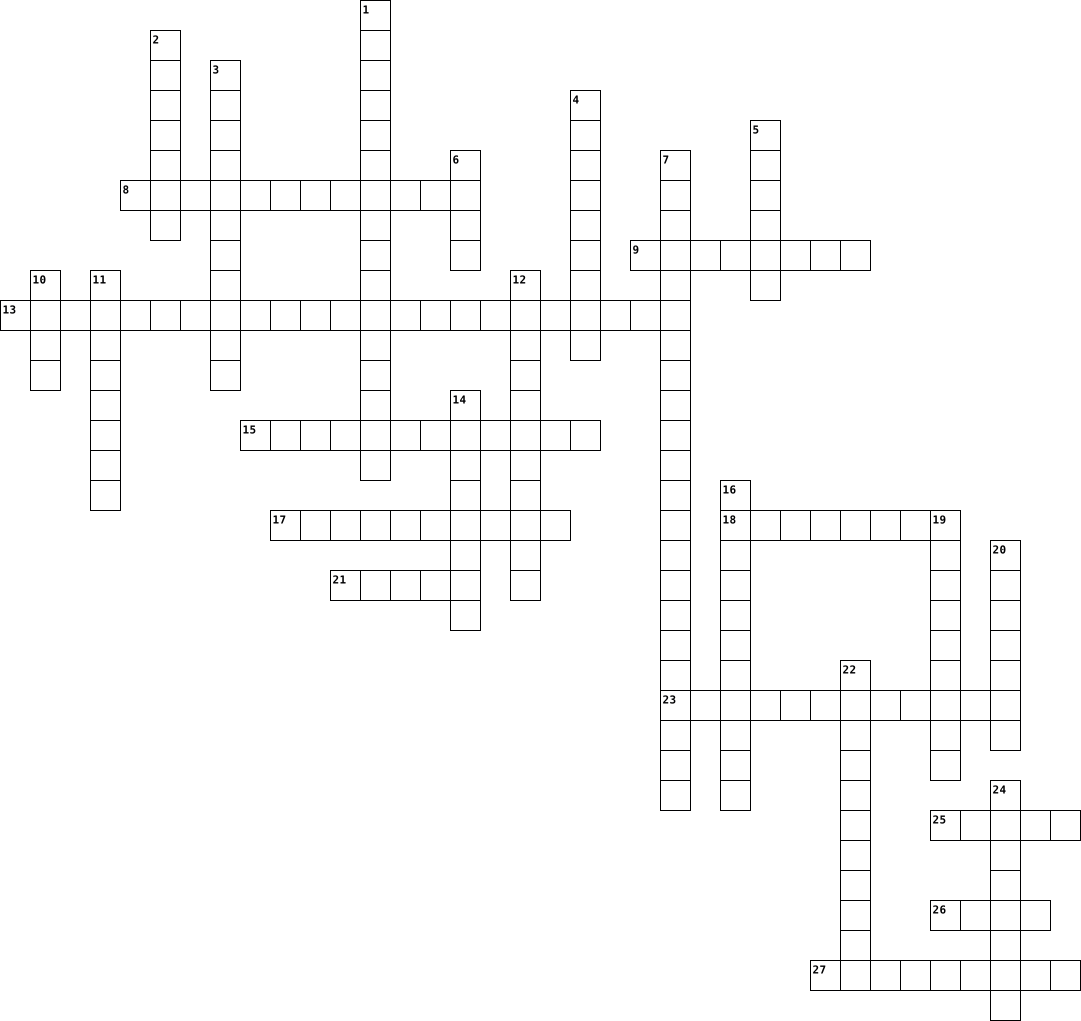
Across
- piece of evidence of a chemical reaction, such as temperature change, odor, light or sound
- sum of all the forces
- The ___ says matter is neither created nor destroyed.
- piece of evidence of a chemical reaction, such as bubbles, foaming, fizzing
- ___ forces cause change in motion.
- the formulas present at the end of a chemical reaction
- a push or pull
- any change in speed or direction
- a column on the periodic table
- one piece of an element
- the formulas present at the beginning of a chemical reaction
Down
- a process where new substances are formed
- one type of atom, also found on the periodic table
- piece of evidence of a chemical reaction, such as clear to blue
- unit for mass
- a row on the periodic table
- Balanced forces have a net force of ___ N.
- unit for acceleration
- amount of matter
- more than one atom combined
- tells the number of molecules
- ___ forces cause no change in motion.
- tool for force
- tells the number of atoms
- unit for force
- piece of evidence of a chemical reaction, such as two liquids producing a solid
- more than one type of atom
27 Clues: unit for mass • tool for force • unit for force • a push or pull • amount of matter • unit for acceleration • sum of all the forces • one piece of an element • tells the number of atoms • more than one type of atom • a row on the periodic table • more than one atom combined • tells the number of molecules • a column on the periodic table • any change in speed or direction • ...
test review 2016-11-07
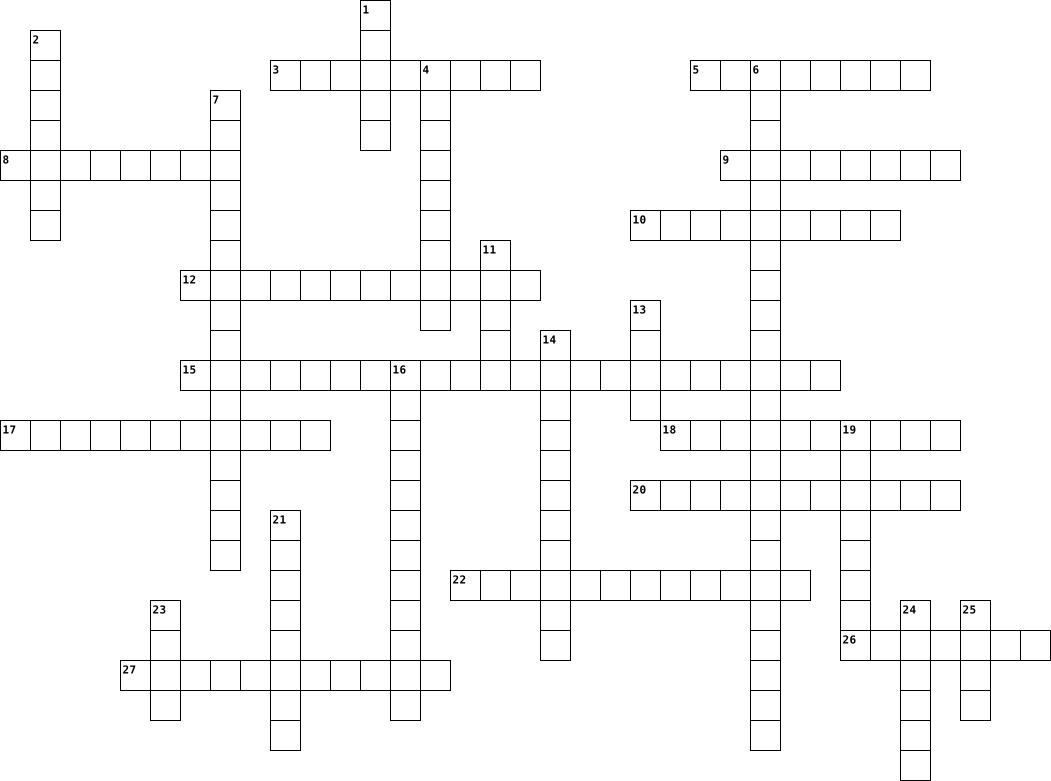
Across
- unit for mass
- ___ forces cause no change in motion.
- more than one atom combined
- more than one type of atom
- tells the number of atoms
- piece of evidence of a chemical reaction, such as bubbles, foaming, fizzing
- unit for acceleration
- tool for force
- ___ forces cause change in motion.
- piece of evidence of a chemical reaction, such as two liquids producing a solid
- any change in speed or direction
- one type of atom, also found on the periodic table
- piece of evidence of a chemical reaction, such as clear to blue
Down
- a column on the periodic table
- unit for force
- the formulas present at the beginning of a chemical reaction
- The ___ says matter is neither created nor destroyed.
- a process where new substances are formed
- a push or pull
- amount of matter
- tells the number of molecules
- piece of evidence of a chemical reaction, such as temperature change, odor, light or sound
- sum of all the forces
- the formulas present at the end of a chemical reaction
- one piece of an element
- a row on the periodic table
- Balanced forces have a net force of ___ N.
27 Clues: unit for mass • unit for force • a push or pull • tool for force • amount of matter • unit for acceleration • sum of all the forces • one piece of an element • tells the number of atoms • more than one type of atom • more than one atom combined • a row on the periodic table • tells the number of molecules • a column on the periodic table • any change in speed or direction • ...
Chemistry Crossword Puzzle: Quarter 1 Review 2017-10-23

Across
- can be drawn into wires
- element in period 4, group 15
- aka "family" on the periodic table
- side of the periodic table where the metals are found
- nonmetal in period 4 with smallest atomic number
- model of the atom that shows electrons orbiting the nucleus in rings
- the sum of the protons and neutrons in an atom
- isotopes have different numbers of this subatomic particle
- number of neutrons potassium has
- scientist who performed gold foil experiment and said the atom has a small, dense, positively-charged nucleus
- chalcogen with largest electronegativity
- horizontal row on the periodic table
Down
- number of electrons aluminum has
- metalloid with the smallest atomic number
- noble gas in period 3
- alkali metal in period 3
- a measure of how close repeated measurements are to each other
- smallest subatomic particle
- can be beaten into thin sheets
- the units used to measure volume
- the number of sig figs in this number: 2.000
- a type of data that includes numbers
- element helium would become if it lost a proton
- element in period 2, group 14
- subatomic particle with a positive charge
- what a positive and a negative charge do
26 Clues: noble gas in period 3 • can be drawn into wires • alkali metal in period 3 • smallest subatomic particle • element in period 4, group 15 • element in period 2, group 14 • can be beaten into thin sheets • number of electrons aluminum has • the units used to measure volume • number of neutrons potassium has • aka "family" on the periodic table • a type of data that includes numbers • ...
Unit B Chemistry Crossword 2018-11-07

Across
- elements with similar properties
- the left side of a chemical word equation
- chemical combinations
- e.g. when a liquid turns a different colour
- the non reactive gases on the periodic table
- hazardous household product system
- when a metal and a non metal combines
- the amount of protons and electrons in an element
- when a liquid turns into a gas
- when a solid turns into a liquid
- known for making the modern periodic table
- in between metals and non metals
- has one proton, one electron and no neutrons
- e.g. Au is for gold
Down
- the result of a chemical change
- the average mass in an element
- the most reactive metals on the periodic table
- Everything that takes up space, and has mass.
- when a gas turns into a solid
- when the change is reversible
- when a non metal and another non metal combines
- made up of one type of matter
- the result of a mixture, but can be separated
- have lustre, is a solid,and can conduct electricity
- when matter is mixed up with another. It’s the opposite of pure substances
25 Clues: e.g. Au is for gold • chemical combinations • when a gas turns into a solid • when the change is reversible • made up of one type of matter • the average mass in an element • when a liquid turns into a gas • the result of a chemical change • elements with similar properties • when a solid turns into a liquid • in between metals and non metals • hazardous household product system • ...
Atoms and Molecules 2024-01-19

Across
- accelerator special machine that smashes atoms
- the charge of a proton
- An ionic bond forms when positively and negatively charged ions ___ each other
- atoms have the same number of protons and ___
- the negative subatomic particle that travels in an orbit around the nucleus of an atom
- In a ___ atom, the outermost shell is completely closed or filled
- substance formed as a result of a chemical change
- a row on the periodic table of the elements (horizontal)
- the charge of an electron
- the table used to classify the elements
- a column on the periodic table of the elements (vertical)
Down
- atoms joined together
- what scientists think about atoms, based on repeated observations
- the study of matter and how substances change
- this reaction occurs when molecules combine to form a new substance
- a substance that contains only one kind of atom
- this reaction breaks a compound into two or more simpler compounds
- the smallest recognizable piece of an element
- an atom that has gained or lost electrons
- The atomic ____ of an atom is based on the number of protons in the nucleus
- the center of an atom, holds the protons and neutrons
21 Clues: atoms joined together • the charge of a proton • the charge of an electron • the table used to classify the elements • an atom that has gained or lost electrons • the study of matter and how substances change • atoms have the same number of protons and ___ • the smallest recognizable piece of an element • accelerator special machine that smashes atoms • ...
Chemistry Review 2025-12-09

Across
- Positively charged sub-atomic particle
- Anything that has mass and takes up space
- This mixture has the same make-up and appearance throughout
- A definite volume but no fixed shape
- Color change, temperature change and odor are some of the indicators of this type of reaction
- How much stuff is in a certain amount of space
- The one or two letter code representing an element
- Two or more different elements chemically combined
- A pure substance consisting of only one type of atom
- Made of electrically charged particles
- A combination of two or more substances that aren't the same throughout
Down
- The neutrally charged sub-atomic particle
- Represents the number of protons in an element on the periodic table
- No definite shape or volume
- It dissolves the solute
- Horizontal rows on the periodic table
- Negatively charged sub-atomic particle
- Size, shape and state change are all indicators of this type of reaction
- Vertical columns on the periodic table
- The basic building blocks of all matter
- Definite shape and volume
- Two or more of the same or different elements combined
- It gets dissolved in another substance
23 Clues: It dissolves the solute • Definite shape and volume • No definite shape or volume • A definite volume but no fixed shape • Horizontal rows on the periodic table • Positively charged sub-atomic particle • Negatively charged sub-atomic particle • Vertical columns on the periodic table • Made of electrically charged particles • It gets dissolved in another substance • ...
Year 8 Chemistry 2026-03-27

Across
- table A chart that organises elements by atomic number
- A material that does not allow heat or electricity to flow easily
- A one- or two-letter abbreviation used to represent an element
- The dense centre of an atom containing protons and neutrons
- A positively charged particle found in the nucleus of an atom
- A material that allows heat or electricity to flow through it
- A negatively charged particle that moves around the nucleus
- Able to be hammered or bent into shape without breaking
- A type of element that conducts heat and electricity well and is usually shiny
Down
- Able to be stretched into a wire
- A horizontal row in the periodic table
- The smallest unit of matter that still retains the properties of an element
- A particle with no charge found in the nucleus
- A property describing something that is shiny
- A vertical column in the periodic table
- number The number of protons in an atom
- An element that is a poor conductor of heat and electricity and not shiny
- An element with properties of both metals and non-metals
- Breaks easily when force is applied
- A pure substance made of only one type of atom
20 Clues: Able to be stretched into a wire • Breaks easily when force is applied • A horizontal row in the periodic table • A vertical column in the periodic table • number The number of protons in an atom • A property describing something that is shiny • A particle with no charge found in the nucleus • A pure substance made of only one type of atom • ...
Chemistry Review 2025-05-08

Across
- Shiny, conductive elements on the left of the table
- Dull, brittle elements to the right of the staircase
- Positively charged particle in the nucleus
- Atom with same protons but different neutrons
- Overall structure or connection between atoms
- Outermost electrons involved in bonding
- Type of chemical reaction where smaller parts build a compound
- Horizontal row on the periodic table
- How likely an atom is to undergo chemical change
Down
- Equation with equal atoms on both sides
- Type of reaction where a compound breaks into smaller parts
- Shared electron pair forms this type of bond
- Electrically neutral subatomic particle
- Bond formed by transferring electrons
- Two or more atoms chemically joined
- Term for numbers of protons in an element
- Center of the atom
- Vertical column on the periodic table
- Negatively charged particle outside the nucleus
19 Clues: Center of the atom • Two or more atoms chemically joined • Horizontal row on the periodic table • Bond formed by transferring electrons • Vertical column on the periodic table • Equation with equal atoms on both sides • Electrically neutral subatomic particle • Outermost electrons involved in bonding • Term for numbers of protons in an element • ...
Elements,compounds,mixtures 2022-12-02

Across
- number on the periodic table
- -
- stable
- 2 or more elements
Down
- kind of matter
- a mix of something
- a substance that takes up space
- +
- periodic table
- building blocks
10 Clues: + • - • stable • kind of matter • periodic table • building blocks • a mix of something • 2 or more elements • number on the periodic table • a substance that takes up space
Chemistry crossword 2020-12-18

Across
- strong alkalis that have OH symbol at last
- the element that have symbol K
- most nonreactive and lightest element
- shorthand way of referring to elements
- columns of periodic table
- solutions are ...
- the substance that is dissolves into
- ... of mass
Down
- every compound has...
- rows of periodic table
- variable that you change
- axis that you plot independent variable
- the substance that dissolves
- variable that you measure as the result
- variable that you keep the same
15 Clues: ... of mass • solutions are ... • every compound has... • rows of periodic table • variable that you change • columns of periodic table • the substance that dissolves • the element that have symbol K • variable that you keep the same • the substance that is dissolves into • most nonreactive and lightest element • shorthand way of referring to elements • ...
idk 2023-10-04

Across
- is a chemical element
- atomic number is 7
- symbols are Ne
- is an essential mineral
- has 114 protons
- is in the human body
- is silver white metal
- is in the second group of the periodic table
Down
- is water
- is a noble gas
- is on the 4 period in the periodic table
- is part or the alkali metal group
- is the most non reactive metal
- symbol is B
- has an atomic mass of 55.933
15 Clues: is water • symbol is B • is a noble gas • symbols are Ne • has 114 protons • atomic number is 7 • is in the human body • is a chemical element • is silver white metal • is an essential mineral • has an atomic mass of 55.933 • is the most non reactive metal • is part or the alkali metal group • is on the 4 period in the periodic table • is in the second group of the periodic table
Matter Key Terms 2021-02-16

Across
- A thing that is composed of 2 or more elements
- A portion of time
- Any of the elements in group IA on the periodic table
- A substance that is not metal
- An essential part of something molecules A group of atoms
- The theory that explains the physical properties of matter
- A stable particle with positive
- Any of the elements in group IIA on the periodic table
- Anything that has mass and volume and takes up space
- An ordered table of the ordered elements
- A tiny portion of matter
- A dense organelle that contains dna
- A large gathering of things
- Movement of solvent molecules through a selective permeable region
Down
- The wide spreading of something
- A number of things
- many protons it has
- The total amount of protons and neutrons in a nucleous
- A representative character
- The identity of an element depending on
- A metal made by combining 2 or more metallic elements
- A stable particle with negative electricity
- Smaller than or occurring in an atom
- A particle without an electric charge
- Any of the elements in group VIIA on the periodic table
- The number of protons in an atom nucleus
- A capability to perform work
- An intermediate property, that has some metallic properties
- The smallest particle that can exist
- A solid conductive material
30 Clues: A portion of time • A number of things • many protons it has • A tiny portion of matter • A representative character • A large gathering of things • A solid conductive material • A capability to perform work • A substance that is not metal • The wide spreading of something • A stable particle with positive • A dense organelle that contains dna • Smaller than or occurring in an atom • ...
Elements and Compounds 2018-07-30

Across
- pure substance that cannot be broken down into simpler substances
- two atoms that are chemically joined to each other per molecule
- prefixe in front of the element on the number of atoms of the elements (5)
- smallest unit of an element that maintains the chemical properties of that element
- individual atom elements
- elements having some properties of metals and some properties of non-metals
- A table of Elements
- zoomed out version
- there a total of eight of these in the Periodic Table
- a group of two or more atoms that are chemically combined together
- a substance which is made up of two or more different elements chemically combined together in a fixed ratio
Down
- three atoms that are chemically joined to each other per molecule
- prefixe in front of the element on the number of atoms of the elements (2)
- representation of elements in the Periodic Table
- prefixe in front of the element on the number of atoms of the elements (4)
- zoomed in version
- prefixe in front of the element on the number of atoms of the elements (1)
- tells us if an substance is an element or compound
- four or more atoms that are chemically joined to each other per molecule
- horizontal row in the Periodic Table
- prefixe in front of the element on the number of atoms of the elements (3)
21 Clues: zoomed in version • zoomed out version • A table of Elements • individual atom elements • horizontal row in the Periodic Table • representation of elements in the Periodic Table • tells us if an substance is an element or compound • there a total of eight of these in the Periodic Table • two atoms that are chemically joined to each other per molecule • ...
Chemistry Crossword 2017-11-16

Across
- invisible negatively charged particle that orbits the nucleus of and atom
- chemical change that occurs when oxygen in the air reacts with a metal
- at table in which elements are organized by their physical and chemical properties
- chemical reaction that absorbs energy
- a pure substance formed when two non metals combine
- a pure substance formed when at least on metal and one non metal combine
- chemical reaction that releases energy
- metal the first column of the periodic table excluding hydrogen,that a really reactive in air and water
- workplace hazardous information material system
- can be stretched into wire
- substance that helps a chemical reaction proceed more quickly
- neutral particle in the nucleus of an atom
Down
- catalyst involved in chemical reactions in living things
- Irreversible change
- shininess of a metal
- the degree to which a specified material conducts electricity
- what everything is made up of
- Mass of Reactants= Mass of Products
- number of protons in the nucleus of one atom of an element
- group 18 in periodic table, they are the most stable and nonreactive elements. metalloid element that has both metallic and non metallic properties
- positively charged particle in the nucleus of an atom
- ability to pound and roll into flat sheets
- the mass of an element measured in amu
- horizontal row of elements in the periodic table
24 Clues: Irreversible change • shininess of a metal • can be stretched into wire • what everything is made up of • Mass of Reactants= Mass of Products • chemical reaction that absorbs energy • chemical reaction that releases energy • the mass of an element measured in amu • ...
7th Grade Science- Get to know your classroom! 2023-09-01

Across
- The four states of matter are solid, __________, gas and plasma.
- This type of graph is most helpful in predicting what the data will do in the future.
- This root word means “below”
- My new 7th grade science teacher’s name is Ms. ___________.
- This type of board is used to project the computer large enough for the class to see it
- In case of a fire drill in the science room, the class is expected to walk quietly and calmly and line up on the _____________.
- The exact number of chairs/stools in the room
- This root word means "bone" in science
- The name for the horizontal axis of a graph.
- This root word means “nerve”
- This type of table shows how often something occurs.
Down
- The GIANT bone near the sink in Ms. Rychling’s room is of a __________ vertebrae.
- What does the color purple represent on the periodic table?
- It is important that I do not use the ____________ closest to the teacher’s desk because it needs to remain closed at all times.
- Ms. Rychling’s favorite color
- This science focused career studies black holes.
- Which element on the periodic table has an atomic weight of 74.922?
- What does the symbol “Ti” represent on the periodic table?
- The 7th pair of headphones is the color ____________.
- The color of the emergency eye wash station is ___________.
20 Clues: This root word means “below” • This root word means “nerve” • Ms. Rychling’s favorite color • This root word means "bone" in science • The name for the horizontal axis of a graph. • The exact number of chairs/stools in the room • This science focused career studies black holes. • This type of table shows how often something occurs. • ...
7th Grade Science- Get to know your classroom! 2023-08-24

Across
- This type of board is used to project the computer large enough for the class to see it
- What does the symbol “Ti” represent on the periodic table?
- The 7th pair of headphones is the color ____________.
- This type of graph is most helpful in predicting what the data will do in the future.
- In case of a fire drill in the science room, the class is expected to walk quietly and calming and line up on the _____________.
- This science focused career studies black holes.
- The four states of matter are solid, __________, gas and plasma.
- What does the color purple represent on the periodic table?
- My new 7th grade science teacher’s name is Ms. ___________.
- The name for the horizontal axis of the graph
Down
- This root word means "bone" in science
- The GIANT bone in the back of Ms. Rychling’s room is of a ________ vertebrae.
- This root word means “nerve”
- This root word means “below”
- Which element on the periodic table has an atomic weight of 74.922?
- Ms. Rychling’s favorite color
- This type of table shows how often something occurs.
- One of the 8 Science and Engineering Practices includes, “Plan and Carry Out ____________________.”
- The exact number of chairs in the room
- It is important that I do not use the ____________ closest to the teacher’s desk.
20 Clues: This root word means “nerve” • This root word means “below” • Ms. Rychling’s favorite color • This root word means "bone" in science • The exact number of chairs in the room • The name for the horizontal axis of the graph • This science focused career studies black holes. • This type of table shows how often something occurs. • ...
Mod 16: Properties of Atoms and Periodic Table Vocabulary 2025-02-19

Across
- name of vertical columns in the periodic table
- unit of measurement used to quantify an atom's mass (3 words)
- number of protons in an atom's nucleus is identified by this (2 words)
- area around the nucleus of an atom where electrons are likely to be found (2 words)
- arranged elements by increasing atomic number
- atomic particles smaller than protons and neutrons
- elements that are gases or brittle solids at room temperature and are not good conductors of heat and electricity
Down
- table that arranges elements by increasing atomic number (2 words)
- particle with an electric charge of 1+
- particles with an electric charge of 1-
- smallest particle of an element that retains the element's properties
- elements that exhibit properties of metals and nonmetals
- atoms of the same element that have different numbers of neutrons
- arranged periodic table by increasing atomic mass
- small, positively charged center of atom
- name of horizontal rows of elements in periodic table
- type of diagram that consists of the chemical symbol surrounded by dots to represent the number of electrons in the outermost energy level(2words)
- elements that are usually solid at room temperature, shiny, and are good conductors of heat and electricity
- electrically neutral particles in the nucleus
- sum of the number of protons and number of neutrons (2 words)
20 Clues: particle with an electric charge of 1+ • particles with an electric charge of 1- • small, positively charged center of atom • electrically neutral particles in the nucleus • arranged elements by increasing atomic number • name of vertical columns in the periodic table • arranged periodic table by increasing atomic mass • ...
The Stone Age Perfect 10 Crossword 2022-12-21

Across
- table Table of elements
- mass A Elements mass
- and object that is not a good conductor, easy to break, and dull.
- A shiny and malleable
- Columns on the periodic table
Down
- number A Elements number
- A horizontal line on the periodic table
- the measure of the ease at which an electric charge or heat can pass through a material.
- Easy to bend
- Easily breakable
10 Clues: Easy to bend • Easily breakable • A shiny and malleable • table Table of elements • mass A Elements mass • number A Elements number • Columns on the periodic table • A horizontal line on the periodic table • and object that is not a good conductor, easy to break, and dull. • the measure of the ease at which an electric charge or heat can pass through a material.
Chemistry 2015-12-02

Across
- A property that becomes evident during or after a chemical reaction
- Change of form a solid to a gas or a gas to a solid
- A table of the chemical elements arranged in order of atomic number
- A mixture in which the solute dissolves into the solvent
- Any change that results in a formation of a new substance
- A subatomic particle of about the same mass as a proton but without an electric charge
- A solid material that is typically hard, shiny, malleable, fusible, and ductile, with good electrical and thermal conductivity
- Any of the elements beryllium, magnesium, calcium, strontium, barium, and radium, occupying Group IIA (2) of the periodic table
- A substance made by mixing two or more substances together
- Characteristic that describes a particular substance
- Any of the elements fluorine, chlorine, bromine, iodine, and astatine, occupying group VIIA (17) of the periodic table
Down
- The total number of protons and neutrons in a nucleus
- Change in appearance or state that does not change the composition
- Property that describes a physical appearance of a substance
- Change of state from gas to solid
- An element whose properties are intermediate between those of metals and solid nonmetals
- An element or substance that is not a metal
- The number of protons in the nucleus of an atom
- Any of the elements lithium, sodium, potassium, rubidium, cesium, and francium, occupying Group IA (1) of the periodic table
- A representation of a substance using symbols for its constituent elements
- A unit of mass used to express atomic and molecular weights
- Any of the gaseous elements helium, neon, argon, krypton, xenon, and radon, occupying Group 0 (18) of the periodic table
- A stable subatomic particle occurring in all atomic nuclei, with a positive electric charge
- A stable subatomic particle with a charge of negative electricity
24 Clues: Change of state from gas to solid • An element or substance that is not a metal • The number of protons in the nucleus of an atom • Change of form a solid to a gas or a gas to a solid • Characteristic that describes a particular substance • The total number of protons and neutrons in a nucleus • A mixture in which the solute dissolves into the solvent • ...
Periodic Table and Atoms 2023-09-12

Across
- When alkali metals mix with water, they create a strong ___________.
- Scientist who organized the periodic table
- Smallest particle that makes up everything
- Carbon can be found in these substances that create pollution when burned
- A alkali metal used in our batteries
- _____________ gasses do not want to combine or react because their outer electron shell is full.
- These atoms have 7 outer shell electrons and do react strongly
- This alkali earth metal is found in our bones, milk and teeth.
- This contains both the protons and neutrons in the atom
- This Theory says that matter cannot be created or destroyed
- The __________ shell can fit 18 electrons
- ___________ is the word used to describe how atoms are held together in a bond
- _________ cycle is when this gas travels through the atmosphere, animals, waste and soil
- This gas is required for respiration
- this gas (non-metal) is used to harden tires
- This type of metal has characteristics of metals and non-metals.
- Alluminum fits in this category of the periodic table because it is not very strong.
- Most gasses fit in this category of the periodic table
Down
- This is the most common element in the universe
- This is where elecctrons live around the atoms.
- When a atom contains the same number of protons and neutrons it has this charge
- When two atoms combine to make a new substance it is called this
- When a metal can transfer electricity or heat
- These metals are strong, shiny, and have high melting points
- These metals are extremely reactive because they have one outer electron
- This gas is known as an inflammable gas
- In order to find the number of these, you must take the atomic mass and subtract the atomic number.
- When you mix _____________ with chlorine, you create table salt
- When a element is able to bend or fold
- Burning, Breathing and _________ all require oxygen.
- There are 92 natural ____________ on the periodic table
31 Clues: A alkali metal used in our batteries • This gas is required for respiration • When a element is able to bend or fold • This gas is known as an inflammable gas • The __________ shell can fit 18 electrons • Scientist who organized the periodic table • Smallest particle that makes up everything • this gas (non-metal) is used to harden tires • ...
Chemistry 2017-02-17

Across
- The smallest unit of a chemical compound
- The vertical lines of the Periodic Table
- The element's electrons on the outer rim
- The number that tells how much an atom in the element weighs
- The way that elements are organized in their groups
Down
- The horizontal rows on the Periodic Table
- This rule states that an element has to have 8 valence electrons to make a chemical bond
- Elements that can be found on the left/middle of the Periodic Table
- The number that tells how many protons an element has
- Elements that can be found on the right side of the Periodic Table
10 Clues: The smallest unit of a chemical compound • The vertical lines of the Periodic Table • The element's electrons on the outer rim • The horizontal rows on the Periodic Table • The way that elements are organized in their groups • The number that tells how many protons an element has • The number that tells how much an atom in the element weighs • ...
elements 2022-05-09

Across
- a mixture that never settles and cannot be seen with a microscope
- two+ different elements that combine by a chemical change and create something with new and different physical/chemical characteristics.
- a mixture with larger particles than a solution but still small enough that they will not settle
- substance that cannot be broken down any further while still maintaining its original properties
- the creator of the periodic table
- the columns on the periodic table
Down
- A combination of two or more materials that are not chemically combined
- What forms when two or more atoms combine
- first element on the periodic table
- the rows on the periodic table
10 Clues: the rows on the periodic table • the creator of the periodic table • the columns on the periodic table • first element on the periodic table • What forms when two or more atoms combine • a mixture that never settles and cannot be seen with a microscope • A combination of two or more materials that are not chemically combined • ...
Science Crossword 2020-01-10

Across
- co2
- that element that has 2 atoms
- a element that has 101 atoms
- a group of elements that are not reactive at all
- a element that is known as 'Mg'
- a small number that tells how many of this element are bonded together
- the group of elements that have Thorium
- elements that are not metals
- a noble Gas that is simplified into 'Ne'
- h20
Down
- a table where all the elements are categorized
- oxygen
- ozone
- a word that has 'mole' and 'cule' combined
- elements are categorized because of similar ___________
- that element that has the most atoms
- a element that has 13 atoms
- the group of elements that are listed on top of 'Actinides'
- electron the number of electrons in a element's outer shell
- the reactivity decreases if you move to the _________ of the periodic table
20 Clues: co2 • h20 • ozone • oxygen • a element that has 13 atoms • a element that has 101 atoms • elements that are not metals • that element that has 2 atoms • a element that is known as 'Mg' • that element that has the most atoms • the group of elements that have Thorium • a noble Gas that is simplified into 'Ne' • a word that has 'mole' and 'cule' combined • ...
Sudduth - Chemistry 2019-10-17

Across
- a substance deposited in solid form from a solution.
- matter cannot be created nor destroyed
- visible parts in the solution
- something that can be experienced with the senses
- composed of two or more bonded elements
- a change which does not form a new substance
- what is formed from a reaction
- group of the same atom bonded together
- on the left side of a yield sign
Down
- chemicals combine in specific amounts
- a trait which cannot be experienced with the senses
- mixture
- a reaction which does form a new substance
- smallest part of any element
- man given credit for organizing the periodic table
- a table in which the elements are organized
- mass of an atom
- no visible parts in the solution
- 118 found in the periodic table
- relation between 2 numbers in which they are set whole numbers
20 Clues: mixture • mass of an atom • smallest part of any element • visible parts in the solution • what is formed from a reaction • 118 found in the periodic table • no visible parts in the solution • on the left side of a yield sign • chemicals combine in specific amounts • matter cannot be created nor destroyed • group of the same atom bonded together • ...