
periodic+table Crossword Puzzles
elements 2019-09-25

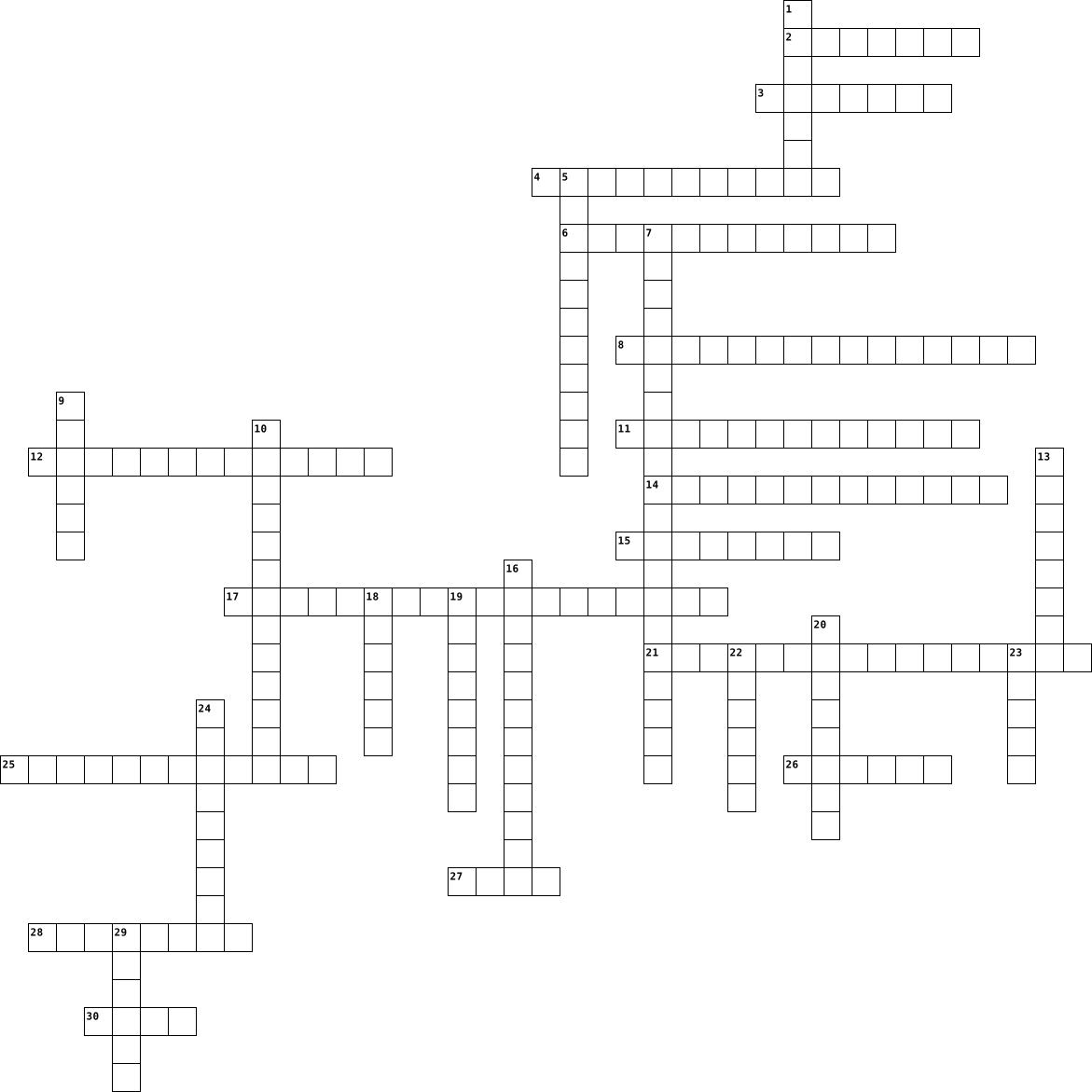
Across
- The smallest particle that has the properties of an element
- any atoms having the same number of protons but a different number of neutrons
- a vertical column of elements in the periodic table
- number the total number of protons and neutrons in the nucleus of an atom
Down
- a horizontal row of elements in the periodic table
- another name for group
- number the number of protons in the nucleus of an atom
- hundred eighteen elements The number of elements on the periodic table
- another name for period
- symbol for atomic mass unit
10 Clues: another name for group • another name for period • symbol for atomic mass unit • a horizontal row of elements in the periodic table • a vertical column of elements in the periodic table • number the number of protons in the nucleus of an atom • The smallest particle that has the properties of an element • ...
PROPERTIES AND CHANGES 2024-04-19

Across
- A solid that forms from a solution during a chemical reaction
- A column on the periodic table
- How readily a substance combines chemically with other substance
Down
- The ability to dissolve in another substance
- A substance or molecule that participates in a chemical reaction
- A column on the periodic table;another name for a group
- The "" sign in a chemical reaction; means to take or produce
- A substance produced in a chemical reaction
- A horizontal row of elements in the periodic table
- A general direction in which something is developing or changing
10 Clues: A column on the periodic table • A substance produced in a chemical reaction • The ability to dissolve in another substance • A horizontal row of elements in the periodic table • A column on the periodic table;another name for a group • The "" sign in a chemical reaction; means to take or produce • A solid that forms from a solution during a chemical reaction • ...
Chemistry Crossword Puzzle 2015-11-17

Across
- When 2 non-metals combine to make a pure substance
- The most stable and unreactive elements
- The mass of an one atom in a element
- Groups of atoms acting as one
- A neutral particle in the nucleus of an atom
- A column of elements on the Periodic Table
- NaCl
- A column of elements in the periodic table
- A very valuable element usually used for jewelry
- The number of protons and electrons in the nucleus of on atom of an element.
- The most reactive non-metals
Down
- Shiny,malleable, ductile element that conducts electricity
- Combination of symbols that represent a compound.Identifies the elements and the amount of each.
- Pure substance formed when at least on metal and one non-metal combvines
- A row of elements on the Periodic Table
- Element that has both metallic and non-metallic properties
- Anything that has mass and occupies space
- A table in which the elements are organized by their physical and chemical properties
- Atom that has become electrically charged because it has lost or gained electrons.
- Has 1 proton, 1 electron and an atomic mass of 1
- The most reactive of the metals
- A negatively charged particle that orbits the nucleus of an atom
- When a metal and non-metal combine to make a pure substance
- A positive particle in the nucleus of an atom
- The smallest part of an element with a nucleus containing protons and neutrons
- Dull,brittle element that does not conduct electricity
26 Clues: NaCl • The most reactive non-metals • Groups of atoms acting as one • The most reactive of the metals • The mass of an one atom in a element • A row of elements on the Periodic Table • The most stable and unreactive elements • Anything that has mass and occupies space • A column of elements on the Periodic Table • A column of elements in the periodic table • ...
YR 9 CHEMISTRY CROSSWORD 2024-05-22

Across
- an atom that has more electrons than protons
- the mass of an atom; equals the number of protons plus the number of neutrons
- the centre of an atom-contains protons and neutrons
- the area around the nucleus where the electrons travel
- describes the electrons moving around in each shell
- total number of protons in an atom;defines what atom it is
- a substance that contains only two or more type of atom
- positively charged particles in the nucleus of an atom
- an atom or molecule with a net electric charge due to the loss or gain of one or more electrons.
- theory that all matter is is made up of atoms
- vertical column on the periodic table
- a substance that only contains one type of atom
Down
- parts that make up an atom
- neutral particles found in the nucleus of an atom
- negatively charged particles found orbiting the nucleus of an atom
- an ion, or charged particle that has more protons than electrons.
- a table that lists all the elements in order of their atomic number
- smallest part of matter. contains protons, neutrons and electrons
- horizontal row on the periodic table
- A form of a chemical element in which the atoms have the same number of protons but with a different number of neutrons
- an obsolete model of the atom, presented by Niels Bohr in 1913.
- different energy levels where electrons orbit the nucleus
22 Clues: parts that make up an atom • horizontal row on the periodic table • vertical column on the periodic table • an atom that has more electrons than protons • theory that all matter is is made up of atoms • a substance that only contains one type of atom • neutral particles found in the nucleus of an atom • the centre of an atom-contains protons and neutrons • ...
Physical Science 1.3 2023-09-14

Across
- mass of a proton or neutron
- type of atom that has the same number of protons and electrons
- proposed the planetary model of the atom
- able to be drawn into a thin wire
- proposed the solid sphere model of the atom
- elements that have the properties of both metals and nonmetals
- part of an atom to is found outside the nucleus and has a negative charge
- unit used to measure atoms
- able to be flattened into thin sheets by compression force
- part of an atom found in the nucleus with a positive charge
- number of protons in an atoms nucleus
- the most malleable and ductile of all elements
- part of an atom located in the nucleus that has no charge
- horizontal row of elements on the periodic table of elements
- positively charged atoms
Down
- elements that are on the right side of the periodic table
- element with an atomic number of 3
- atom of an element that has the same atomic number but a different number of neutrons different mass number
- negatively charged atoms
- element with an atomic number of 1
- outermost level of electrons in an atom
- weighted average mass of the isotopes of an element
- largest group of elements on the period table
- vertical column on a periodic table of elements
- smallest unit into which an element can be divided and still maintain its properties
- sum of all the protons and neutrons in an atom's nucleus
- total number of electrons that can fit on Energy Level 2 of an atom
27 Clues: negatively charged atoms • positively charged atoms • unit used to measure atoms • mass of a proton or neutron • able to be drawn into a thin wire • element with an atomic number of 3 • element with an atomic number of 1 • number of protons in an atoms nucleus • outermost level of electrons in an atom • proposed the planetary model of the atom • ...
Nestor Depaz Final Exam Review Activity 2025-05-22

Across
- Reaction in which the nucleus of an atom splits into two or more smaller nuclei
- The element of atomic number 28
- The element of atomic number 79
- An element that is not a metal
- An atom with a net electric charge due to loss or gain of more electrons
- A particle occurring in all atomic nuclei
- A molecule that can donate a proton
- Reaction in which two or more atomic nuclei combine
- A solid material that is hard and shiny
- water,carbon dioxide
- A 3rd hour class I have
- The element of atomic number 26
- A particle with the same mass as a proton
- The total mass of particles of matter in an element
- The Symbol of an element
- The first element on the periodic table
- The unit basic unit in an element
- A variable whose works with others
- The name of an element
- A chemical bond formed by electrons
Down
- A row going up or down on the periodic table
- A row across on the periodic table
- The element of atomic number 30
- A variable that works alone
- A table with every element in order by atomic number
- A thing that is composed to two or more separate elements
- A positive charged ion
- The number of protons in the atom
- The element of atomic number 29
- a substance that increases the rate of a chemical reaction
- A negative charged ion
- A particle with a negative charge
- outer shell of an element
33 Clues: water,carbon dioxide • A positive charged ion • A negative charged ion • The name of an element • A 3rd hour class I have • The Symbol of an element • outer shell of an element • A variable that works alone • An element that is not a metal • The element of atomic number 30 • The element of atomic number 28 • The element of atomic number 79 • The element of atomic number 29 • ...
Chemistry Crossword 2025-04-07

Across
- The loss of electrons in a chemical reaction.
- State of matter with fixed shape and volume.
- State of matter with no fixed shape or volume.
- A reaction where one element replaces another.
- Group 18 on the periodic table.
- An element with properties of both metals and nonmetals.
- A homogeneous mixture of two or more substances.
- A substance that donates hydrogen ions.
- Atoms of the same element with different numbers of neutrons.
- Eight valence electrons — a stable arrangement.
- Group 1 on the periodic table.
- The amount of heat needed to raise one gram by 1°C.
- Matter is not created or destroyed.
- A reaction that breaks compounds apart.
- Separates mixtures using boiling points.
- Stored energy.
- A solid that forms from a solution during a chemical reaction.
- Group 17 on the periodic table.
- A reaction that releases heat.
- A reaction that absorbs heat.
- A reaction between an acid and a base.
- A measure of the amount of matter.
- A measure of an atom's ability to attract electrons.
- A negatively charged ion.
- Positively charged particle in the nucleus.
- A bond formed between oppositely charged ions.
- A pure substance made of only one kind of atom.
- The kind of table used to organize elements.
- Energy of motion.
- Discovered the nucleus with the gold foil experiment.
- Type of change that does not alter chemical identity.
- A measure of how much space an object occupies.
- An atom or molecule with a charge; more or less electrons than protons.
- A positively charged ion.
- Elements that are shiny, malleable, and good conductors.
- The substance being dissolved in a solution.
- A bond formed when atoms share electrons.
- Elements that are dull, brittle, and poor conductors.
Down
- Layers of electrons around the nucleus.
- Gas turning into liquid.
- A substance that speeds up a chemical reaction.
- Group 2 on the periodic table.
- A solution with a pH of 7.
- A reaction involving exchange of ions.
- A type of metal found in the center of the periodic table.
- Mass divided by volume.
- A substance present before a chemical reaction.
- A reaction that combines substances.
- Number that tells how many atoms in a compound.
- A reaction with oxygen that produces heat and light.
- The gain of electrons in a chemical reaction.
- Solid directly changing to gas.
- A representation of a chemical reaction with arrows and + signs.
- A substance that accepts hydrogen ions.
- The scientist who proposed electrons orbit the nucleus.
- A mixture of two or more metals.
- A device to measure heat transfer.
- Change from liquid to gas throughout the liquid.
- The SI unit for the amount of substance.
- Tool used to measure temperature.
- Gas directly changing to solid.
- The substance doing the dissolving in a solution.
- A connection formed between atoms.
- State of matter with fixed volume but no fixed shape.
- Type of electrons involved in bonding.
- A horizontal row on the periodic table.
- A vertical column on the periodic table.
- Number in front of compounds in a chemical equation.
- The ability to conduct electricity.
- A measure of average kinetic energy.
- Negatively charged particle in an atom.
- A method to find unknown concentration.
- The smallest unit of an element.
- A combination of substances not chemically bonded.
- Change from liquid to gas at the surface.
- A diagram that shows an atom's valence electrons.
- The amount of solute that dissolves in solvent.
- Substance that changes color in acid or base.
- The ability to do work or cause change.
- Type of change where a new substance is formed.
- Neutral particle in an atom's nucleus.
- The dense center of an atom.
- A substance formed during a chemical reaction.
- Number of protons in an atom.
84 Clues: Stored energy. • Energy of motion. • Mass divided by volume. • Gas turning into liquid. • A negatively charged ion. • A positively charged ion. • A solution with a pH of 7. • The dense center of an atom. • A reaction that absorbs heat. • Number of protons in an atom. • Group 2 on the periodic table. • Group 1 on the periodic table. • A reaction that releases heat. • ...
Atomic Structure 2023-03-03

Across
- Vertical columns on periodic table
- Electrons move around the nucleus in these?
- Bonding where elements gain/lose electrons?
- Two or more elements chemically combined?
- Number of protons in the nucleus?
- Sub atomic particle with negative charge?
Down
- Bonding where elements share electrons?
- Bigger number (protons + neutrons)
- Horizontal rows on periodic table
- Sub atomic particle with positive charge?
- The centre of the atom?
- Neutrons have this charge?
12 Clues: The centre of the atom? • Neutrons have this charge? • Horizontal rows on periodic table • Number of protons in the nucleus? • Bigger number (protons + neutrons) • Vertical columns on periodic table • Bonding where elements share electrons? • Two or more elements chemically combined? • Sub atomic particle with positive charge? • Sub atomic particle with negative charge? • ...
chemistry 2023-05-02

Across
- has a negative charge
- formed when atoms combine
- smallest piece of an element
- vertical columns of the periodic table
- center part of an atom
- abbreviations for the names of elements
Down
- mass number of protons plus neutrons
- has a positive charge
- horizontal rows of the periodic table
- an atom that has gained or lost electrons
- has no charge
- molecules formed from two or more different elements
12 Clues: has no charge • has a positive charge • has a negative charge • center part of an atom • formed when atoms combine • smallest piece of an element • horizontal rows of the periodic table • vertical columns of the periodic table • mass number of protons plus neutrons • abbreviations for the names of elements • an atom that has gained or lost electrons • ...
Carbon Crossword 2026-04-01

Across
- Negatively charged particle
- Outer electrons used for bonding
- Center of an atom
- Carbon form found in pencils
- The element your cereal is based on
- A super strong form of carbon
- Column on the periodic table
Down
- Carbon-based life chemistry
- A pure substance made of one type of atom
- Row on the periodic table
- What atoms form when they connect
- The basic unit of matter
12 Clues: Center of an atom • The basic unit of matter • Row on the periodic table • Carbon-based life chemistry • Negatively charged particle • Carbon form found in pencils • Column on the periodic table • A super strong form of carbon • Outer electrons used for bonding • What atoms form when they connect • The element your cereal is based on • A pure substance made of one type of atom
Chemistry Unit 2016-02-09

Across
- smallest particle in a substance
- negative electrical charge
- element not having a metal character
- top to bottom on a Periodic Table
- any closed system subjected to no external forces, the mass is constant irrespective of its changes in form
- gives off heat and energy
- a substance changes when combined with other substances in a chemical reaction
- group of rare gases
- center part of an atom with protons and neutrons
- one or more atoms of the same substance
- represents the element
- absorbs energy and is cold
- substance that is a conductor of heat and electricity
- substance obtained from another substance through chemical change
Down
- amount of orbitals on the outer shell of an atom
- positive electrical charge
- no electrical charge
- an external layer of metal
- Russian chemist and formed the Periodic law
- combining two or more substances
- represents the number of protons and electrons
- mass of a given element
- properties between metals and nonmetals
- one substance made from atoms
- goes around the nucleus of an atom
- left to right on a Periodic Table
26 Clues: group of rare gases • no electrical charge • represents the element • mass of a given element • gives off heat and energy • positive electrical charge • negative electrical charge • an external layer of metal • absorbs energy and is cold • one substance made from atoms • smallest particle in a substance • combining two or more substances • top to bottom on a Periodic Table • ...
Periodic table crossword 2023-08-25

Across
- on right This is found where___
- tool Makes the periodic table invaluable___
- The man in 1969 who invented the periodic table___
- The atomic number___
- on left This is found where___
- The one to two letter symbol representing an element___
Down
- the s and p blocks are known as the___
- what seven rows are called___
- table Tells all of the elements___
- You can predict a lot about the chemical___
- each row corresponds to a different___
- Most elements are___
12 Clues: The atomic number___ • Most elements are___ • what seven rows are called___ • on left This is found where___ • on right This is found where___ • table Tells all of the elements___ • each row corresponds to a different___ • the s and p blocks are known as the___ • You can predict a lot about the chemical___ • tool Makes the periodic table invaluable___ • ...
Periodic table crossword 2023-08-25

Across
- on right This is found where___
- tool Makes the periodic table invaluable___
- The man in 1969 who invented the periodic table___
- The atomic number___
- on left This is found where___
- The one to two letter symbol representing an element___
Down
- the s and p blocks are known as the___
- what seven rows are called___
- table Tells all of the elements___
- You can predict a lot about the chemical___
- each row corresponds to a different___
- Most elements are___
12 Clues: The atomic number___ • Most elements are___ • what seven rows are called___ • on left This is found where___ • on right This is found where___ • table Tells all of the elements___ • each row corresponds to a different___ • the s and p blocks are known as the___ • You can predict a lot about the chemical___ • tool Makes the periodic table invaluable___ • ...
period 6 chem 2020-10-09

Across
- this is the most reactive element in the periodic table
- this group of elements is known as rare earth metals
- this is the most unreactive group in the periodic table
- this group of elements can't be found free in nature
Down
- this i the largest group in the periodic table
- this group of elements are very radioactive
- this group has very toxic gases and the most reactive element
- this is most reactive group in the periodic table
8 Clues: this group of elements are very radioactive • this i the largest group in the periodic table • this is most reactive group in the periodic table • this group of elements is known as rare earth metals • this group of elements can't be found free in nature • this is the most reactive element in the periodic table • ...
chemistry 2014-03-26

Across
- property of metal- _____ shiny when freshly cut
- metals are _____ and can be stretched into wires
- 8 columns are called___
- in the periodic table noble gasses are in ___ ___ boxes
- first shell has a capacity of ____ electrons
- group one metals have low density so they ___
- mass number-sum of protons and _____
- symbol for silicon
- different forms of same elements are called____
- _____ don't form ions
- phenolphthalane is pink in ____
- 7 horizontal rows are called ___
- chlorine is ___ at room temperature
- elements are arranged in groups in the ___table
- group one metals react violently with ___
- argon has ___ electronic shells
Down
- metals form ions by loosing their ____
- some metals are_____
- colour of bromine
- alkali metals include lithium, sodium and _____
- group 2 metals are called
- group 7 metals are called ______
- in writing elements they use chemical____ instead of names
- metals conduct electricity through liquid and _____
- sodium is so reactive it is kept under ___
- non metals are easily broken, they are not____
- noble gasses do not lose or ___ electrons
- berrylium is what place in the periodic table
28 Clues: colour of bromine • symbol for silicon • some metals are_____ • _____ don't form ions • 8 columns are called___ • group 2 metals are called • phenolphthalane is pink in ____ • argon has ___ electronic shells • group 7 metals are called ______ • 7 horizontal rows are called ___ • chlorine is ___ at room temperature • mass number-sum of protons and _____ • ...
Unit 2: Properties of Metal 2023-03-10

Across
- The basic unit of a chemical element
- bond A transferred electron between a metal and non-metal ion
- Positively charged sub-atomic particle found in the nucleus of an atom
- Neutrally charged sub-atomic particle found in the nucleus of an atom
- metals Elements found in group 1 on the periodic table
- bond A shared pair of electrons between 2 non-metal atoms
- Negatively charged sub-atomic particle found orbiting an atom
Down
- Elements found in group 7 on the periodic table
- A molecule containing a very large number of atoms
- shells An electrons orbit around the nucleus of an atom
- Large macromolecule made up of carbon atoms covalently bonded together
- number The number of protons/electrons in the nucleus of an atom
- number The total number of protons and neutrons in a nucleus.
- gases Elements found in group 8 on the periodic table
14 Clues: The basic unit of a chemical element • Elements found in group 7 on the periodic table • A molecule containing a very large number of atoms • gases Elements found in group 8 on the periodic table • metals Elements found in group 1 on the periodic table • shells An electrons orbit around the nucleus of an atom • ...
Identifying metal and non metal oxides 2026-01-14

Across
- These are the up --> down columns on the periodic table
- This equipment is used to move small volumes of liquid. Drop by drop
- These are the left --> right rows of the periodic table
- Metal oxides produce substances which are (ends in s)
- If something has a pH of 6 we would say it is a ____ acid
Down
- An alkali with a pH of 14 might have this colour
- Something that is a 7 on the pH scale is called
- What type of indicator do we use most often
- The word used to describe chemicals that make your skin blister
- A common household alkali used to wash your hands
- Metals are found on the left of this on the periodic table
- What scale shows how acidic or alkaline something is
- Lemon juice is an example of this type of chemical
13 Clues: What type of indicator do we use most often • Something that is a 7 on the pH scale is called • An alkali with a pH of 14 might have this colour • A common household alkali used to wash your hands • Lemon juice is an example of this type of chemical • What scale shows how acidic or alkaline something is • Metal oxides produce substances which are (ends in s) • ...
Week 2 Tracy Nguyen 2015-06-26

Across
- structures in which the arrangement of atoms is the same but the bonds are different
- the ability ton attract electrons
- between two nonmetals
- used when writing covalent bonds
Down
- placed between the "stepstairs" and the noble gases
- often only has 6 electrons
- part of D block
- put together the periodic table
- second column/family
- atoms must gain,lose,or share electrons to have the same number of the closest noble gas
- can have only 4 electrons
- first column/family
- between one metal and one nonmetal and charges must balance
- negative ions
- positive ions
- runs across the periodic table
16 Clues: negative ions • positive ions • part of D block • first column/family • second column/family • between two nonmetals • can have only 4 electrons • often only has 6 electrons • runs across the periodic table • put together the periodic table • used when writing covalent bonds • the ability ton attract electrons • placed between the "stepstairs" and the noble gases • ...
matter 2021-05-25

Across
- positive charge
- a mixture that is uniform throughout
- No charge
- how to turn a liquid to a gas
- negative charge
- how to turn a solid to a liquid
- The vertical columns in the periodic table
Down
- two elements chemically combined
- how to turn a liquid into a solid
- what makes up everything around you
- the horizontal rows on the periodic table
- a mixture that is not uniform throughout
- the smallest level of matter
13 Clues: No charge • positive charge • negative charge • the smallest level of matter • how to turn a liquid to a gas • how to turn a solid to a liquid • two elements chemically combined • how to turn a liquid into a solid • what makes up everything around you • a mixture that is uniform throughout • a mixture that is not uniform throughout • the horizontal rows on the periodic table • ...
SNC 1P Key words 2012-06-18

Across
- an organism that eats for energy
- an example of electric discharge
- found on the left side of the periodic table
- the centre of the atom
- a row of the periodic table
- a positively charged subatomic particle
Down
- the flow of electrons
- allow electricity to flow through easily
- fuels, non-renewable sources of electricity
- dioxide, used by plants for photosynthesis
- no charge
- the nutrient found in all living things
- released into the atmosphere by producers
13 Clues: no charge • the flow of electrons • the centre of the atom • a row of the periodic table • an organism that eats for energy • an example of electric discharge • the nutrient found in all living things • a positively charged subatomic particle • allow electricity to flow through easily • released into the atmosphere by producers • dioxide, used by plants for photosynthesis • ...
Halloween Chemistry Crossword 2024-10-31

Across
- least reactive group on the periodic table
- month of halloween
- distance from nucleus to farthest electron
- the most reactive metals are ____ metals
- flies around and haunts people
- flies on a broomstick and wears a hat
- number of periods in the periodic table
Down
- group 17 name
- used to make a jack-o-lantern
- energy to remove an electron
- trick or ________
- smallest element and it's very special
- the reason kids go trick or treating
13 Clues: group 17 name • trick or ________ • month of halloween • energy to remove an electron • used to make a jack-o-lantern • flies around and haunts people • the reason kids go trick or treating • flies on a broomstick and wears a hat • smallest element and it's very special • number of periods in the periodic table • the most reactive metals are ____ metals • ...
Atoms 2022-03-06

Across
- Element that has 4 electrons.
- What is the symbol for Lithum.
- Iron is what number on the periodic table.
Down
- The ninth element in the periodic table.
- the 18th element in the periodic table.
- The first element in the periodic table.
- The Latin name for gold.
7 Clues: The Latin name for gold. • Element that has 4 electrons. • What is the symbol for Lithum. • the 18th element in the periodic table. • The ninth element in the periodic table. • The first element in the periodic table. • Iron is what number on the periodic table.
2nd Six Weeks Makeup Assignment 2022-10-28

Across
- the table of elements
- has an atomic number of 76
- elements on periodic table that do NOT conduct electricity
- subatomic particle with negative charge
Down
- elements with properties of metals and nonmetals
- this can be found int he center of an atom
- a change that cannot be reversed and forms a new substance
- has an atomic mass of 184
- a change that can be undone and no new substance is formed
- subatomic particle with neutral charge
- the largest category of elements on the periodic table
- subatomic particle with positive charge
12 Clues: the table of elements • has an atomic mass of 184 • has an atomic number of 76 • subatomic particle with neutral charge • subatomic particle with positive charge • subatomic particle with negative charge • this can be found int he center of an atom • elements with properties of metals and nonmetals • the largest category of elements on the periodic table • ...
10/27/24 2024-02-27

Across
- Rows in the periodic table
- Smallest particle something can be cut into while still retaining its properties.
- What the elements are abbreviated to
- 2 or more elements bonded together like a molecule
- The mass of an atom shown at the bottom of every element box in the periodic table
- Subatomic particles that orbit the nucleus and have a negative charge. Too small to be counted for the mass of the atom
- Subatomic particle that is in the nucleus, and has a neutral charge. The number of protons determines the element. Can be calculated by subtracting protons from mass.
Down
- Irregular atom where the number of neutrons are different
- Electrons in the outermost energy ring
- The mass of the atom, electrons are not included
- The number of protons in an atom and how the periodic table is organized by
- Subatomic particle that is in the nucleus, and has a positive charge. The number of protons determines the element.
- The center of the cell where the protons and neutrons are located
- Columns of elements that have something in common
- Table showing the all the elements, organized by Atomic number
15 Clues: Rows in the periodic table • What the elements are abbreviated to • Electrons in the outermost energy ring • The mass of the atom, electrons are not included • Columns of elements that have something in common • 2 or more elements bonded together like a molecule • Irregular atom where the number of neutrons are different • ...
Lab Aids Chemistry Semester 2 Final Exam 2025-05-16

Across
- The smallest possible quantity (or quanta) of light. Light exists in discrete bundles of energy called photons.
- The distance (separation) between any two successive peaks (or valleys) of a wave.
- Any 1 of the 7 horizontal rows of the periodic table.
- Principle that states that 2 electrons in the same atom may NEVER be in the same quantum state.
- The exact number and type of atoms in a molecule (covalent).
- A process by which the nucleus of an atom spontaneously changes itself by emitting particles or energy, a property of some element to break up and release energy.
- A diagram showing 1 dot for each valence electron an atom has. The dots surround the element symbol for the atom.
- Family of moderately reactive metals located in Group 2A of the periodic table.
- A family of virtually inert (unreative) gases located in group 18A(8)of the periodic table.
- Repeating at regular intervals. The periodic table is named for this because the rows are organized by repeating patterns found in both atomic structure and the properties of the elements.
- Rule that states that the atoms of most elements (except H through B)strive to have a total of 8 electrons in their outermost orbital (by sharing, gaining, or losing electrons.)
- The number of protons plus neutrons in the nucleus.
- A shape formed when a central atom has 2 unshared pairs of electrons and is bonded to 2 other atoms; water has this shape.
- The attractive forces that occur between the + part of one polar molecule and the - part of another polar molecule; found between all polar molecules.
- A shape (molecular geometry) formed when a central atom has 2 regions of electron density and zero lone pairs; 180 degree bond angle.
- A value between 0 and 4 that describes the relative “pull” of an element for electrons from other atoms. High numbers mean stronger attraction for electrons; the ability for an atom to attract another atom’s electrons when bonded to that other atom; tends to increase from left to right and up to fluorine.
- A group of quantum states that have similar spatial shapes. The orbitals are labeled s, p, d, and f.
- The tiny core of an atom that contains all the protons and neutrons. It is extraordinarily small- about 1/10,000 the diameter of the atom.
- A description of which orbitals contain electrons for a particular atom.
Down
- A shape formed when a central atom is bonded to 4 other atoms.
- The distance from the center of an atom to its “outer edge;” on the periodic table this property tends to increase as you go down a group and decrease from left to right across a period.
- Electrons in the highest/outermost unfilled energy level. These are the electrons involved in making chemical bonds.
- A trigonal shape (molecular geometry) formed when a central atom has 3 bonded pairs and 1 lone pair of electrons.
- A small molecule (with 2 or more atoms) with an overall positive or negative charge (usually).
- A type of covalent bond formed between two nonmetal atoms in which the electrons are shared equally or almost equally between the 2 atoms.
- A theory that states the shapes of molecules are dictated, in part, by the repulsion of the shared electrons and the unshared (lone) pairs of electrons.
- A large family of less reactive metals located in Groups 3-12 of the periodic table; many known for their ability to lose different numbers of electrons.
- Family of extremely reactive metals located in Group 1A of the periodic table.
- A type of covalent bond formed between two nonmetal atoms in which the electrons ARE NOT shared equally.
- The energy required to completely remove an electron; increases from left to right and up to helium.
- the "dispersion" attractive forces that occurs between nonpolar molecules due to temporary, slight polarizations that occur when the normally equal distributions of electrons is shifted.
- A representation that analyzes a sample of light into its component energies or colors, can be a picture, graph, table of data.
- Atoms or elements that have the same number of protons in the nucleus, but different numbers of neutrons.
- A type of chemical bond that often involves a metal, which loses 1 or more electrons to a more electronegative nonmetal.
- The family consisting of the most reactive nonmetals of the periodic table located in group 17A (7).
- the set of quantum states that have approximately the same energy.
- when a chemical formula could represent > 1 molecule, the same number/type of atoms bonded into different ways.
- Any 1 of the 8(18) vertical columns of the periodic table.
- An atom or small molecule with an overall + or - charge due to an imbalance of protons and electrons.
- A trigonal shape (molecular geometry) formed when a central atom has 3 bonded pairs and 0 lone pair of electrons.
- The attractions that occur between molecules.
- (Z) The number of protons in the nucleus, unique to each element.
- A theory of chemistry and physics that accurately describes the universe on very small scales, such as the inside of an atom.
- Formula with the simplest ratio of atoms in a substance.
44 Clues: The attractions that occur between molecules. • The number of protons plus neutrons in the nucleus. • Any 1 of the 7 horizontal rows of the periodic table. • Formula with the simplest ratio of atoms in a substance. • Any 1 of the 8(18) vertical columns of the periodic table. • The exact number and type of atoms in a molecule (covalent). • ...
Basic Chemistry Principles 2024-06-12

Across
- Scale used to measure acidity or alkalinity
- The smallest unit of an element
- A substance made of two or more elements chemically bonded together
- Element with atomic number 1
- Bond formed by the sharing of electrons
- Substances that donate protons
- Vertical columns on the periodic table
- A negatively charged particle
- Substances that accept protons
Down
- A positively charged particle
- Substance that increases the rate of a reaction without being consumed
- Elements in Group 18
- Number of protons in the nucleus of an atom
- Bond formed by the transfer of electrons
- A neutral particle in the nucleus of an atom
- The central part of an atom
- Horizontal rows on the periodic table
17 Clues: Elements in Group 18 • The central part of an atom • Element with atomic number 1 • A positively charged particle • A negatively charged particle • Substances that donate protons • Substances that accept protons • The smallest unit of an element • Horizontal rows on the periodic table • Vertical columns on the periodic table • Bond formed by the sharing of electrons • ...
Science Crossword 2025-02-09

Across
- atom
- mix
- neutron, proton, electron
- boiling point
- light
- heating up liquid
- ice
- dissolving
- flammable
- raw metal
Down
- metal
- perfume
- fragile
- fire
- Periodic Table
- moldable
- ice
- common metal
- explosive
- mix of word-6
- metal combination
21 Clues: mix • ice • ice • atom • fire • metal • light • perfume • fragile • moldable • explosive • flammable • raw metal • dissolving • common metal • boiling point • mix of word-6 • Periodic Table • heating up liquid • metal combination • neutron, proton, electron
Science Crossword 2025-02-09

Across
- atom
- mix
- neutron, proton, electron
- boiling point
- light
- heating up liquid
- ice
- dissolving
- flammable
- raw metal
Down
- metal
- perfume
- fragile
- fire
- Periodic Table
- moldable
- ice
- common metal
- explosive
- mix of word-6
- metal combination
21 Clues: mix • ice • ice • atom • fire • metal • light • perfume • fragile • moldable • explosive • flammable • raw metal • dissolving • common metal • boiling point • mix of word-6 • Periodic Table • heating up liquid • metal combination • neutron, proton, electron
Ch.16 Crossword 2022-02-15

Across
- the weighted-average mass of the mixture of its isotopes
- the number of proton and neutrons
- atom with different amount of neutrons
- The center of an atom
- 1- charge
- the elements arranged by atomic number
- 1+ charge
Down
- the amount of protons
- Everything is made of
- uses the symbol of the element and dots to represent the electrons in the outer energy level
- Where electrons are found randomly
- Protons and neutrons are made of
- The vertical columns in the periodic table
- The horizontal columns in the periodic table
- no charge
15 Clues: 1- charge • no charge • 1+ charge • the amount of protons • Everything is made of • The center of an atom • Protons and neutrons are made of • the number of proton and neutrons • Where electrons are found randomly • atom with different amount of neutrons • the elements arranged by atomic number • The vertical columns in the periodic table • ...
Periodic Table Crossword 2023-05-15

Across
- Bonds between 2 or more nonmetals, involves sharing electrons
- stable subatomic particle occurring in all atomic nuclei, with a positive electric charge equal in magnitude to that of an electron, but of opposite sign.
- One of the noble gasses, represented by Xe
- These elements have the characteristics
- the total number of protons and neutrons in an atom, determines the elements characteristics
- Bonds between 2 or more metals, involves transferring electrons
- The electrons in the outermost "shell" of the atom (no spaces)
- Last column of the periodic table of elements
Down
- Dull reflectionless elements with low boiling
- a subatomic particle of about the same mass as a proton but without an electric charge, present in all atomic nuclei except those of ordinary hydrogen.
- The total mass of an atom (No spaces)
- a stable subatomic particle with a charge of negative electricity, found in all atoms and acting as the primary carrier of electricity in solids.
- Represented by Cl, and has an atomic mass of 35.453
- Shiny metallic luster and a high boiling point
- First column of the periodic table of elements(No spaces)
- The first element in the periodic table
- Represented by K, and has an atomic mass of 39.098
17 Clues: The total mass of an atom (No spaces) • The first element in the periodic table • These elements have the characteristics • One of the noble gasses, represented by Xe • Dull reflectionless elements with low boiling • Last column of the periodic table of elements • Shiny metallic luster and a high boiling point • Represented by K, and has an atomic mass of 39.098 • ...
10/27/24 2024-02-27

Across
- Rows in the periodic table
- Smallest particle something can be cut into while still retaining its properties.
- What the elements are abbreviated to
- 2 or more elements bonded together like a molecule
- The mass of an atom shown at the bottom of every element box in the periodic table
- Subatomic particles that orbit the nucleus and have a negative charge. Too small to be counted for the mass of the atom
- Subatomic particle that is in the nucleus, and has a neutral charge. The number of protons determines the element. Can be calculated by subtracting protons from mass.
Down
- Irregular atom where the number of neutrons are different
- Electrons in the outermost energy ring
- The mass of the atom, electrons are not included
- The number of protons in an atom and how the periodic table is organized by
- Subatomic particle that is in the nucleus, and has a positive charge. The number of protons determines the element.
- The center of the cell where the protons and neutrons are located
- Columns of elements that have something in common
- Table showing the all the elements, organized by Atomic number
15 Clues: Rows in the periodic table • What the elements are abbreviated to • Electrons in the outermost energy ring • The mass of the atom, electrons are not included • Columns of elements that have something in common • 2 or more elements bonded together like a molecule • Irregular atom where the number of neutrons are different • ...
Words Based on Science Word search: 2018-05-30

Across
- Something that is made up of atoms which are chemically bonded together
- Is the rapid vibration of a liquid
- A substance that undergoes changes during a reaction
- reaction- Rearrangement of a molecular or ion structure of a substance
- A faintly visible suspension of particles of matter in air, mist, fumes or smoke
- theory- Theory used to predict the rates of chemical reactions
- To change or cause to change into vapour or into gaseous state
- Something essential of something abstract
- The amount of a substance per defined space
- Something consisting of one atom
- Breaking down or destruction of a material
- Is the opposite of horizontal column, which is on the periodic table
- Opposite of the vertical row of the periodic table
Down
- Tendency of a substance to vaporize
- Turning something into liquid, from heating it
- Substance formed from the result of a chemical reaction
- Is chemical compounds made of smaller identical molecules
- Speeds up a chemical reaction
- table- A table of elements arranged in order of atomic number
- element- Is the smallest particle in a chemical element
- produced from a living organism
- Holds atoms or ions together
- Something consisting of two atoms
- Is the amount of gas that's smelt very strong causing it to be dangerous
- Chemical process where a solid turns into a gas without it starting of as a liquid
- Smallest particle of a chemical element
- Composed of two or more separate elements
- Process of which air is changed into liquid water
28 Clues: Holds atoms or ions together • Speeds up a chemical reaction • produced from a living organism • Something consisting of one atom • Something consisting of two atoms • Is the rapid vibration of a liquid • Tendency of a substance to vaporize • Smallest particle of a chemical element • Something essential of something abstract • Composed of two or more separate elements • ...
Exam Revision: Chemistry Crossword (2 of 5) 2020-04-22

Across
- The element in group 14 and in period 2 (6)
- ________ (8) bonding is formed between two non-metals
- Elements in the same period have the same number of (6)
- The element that has an atomic number of 30 (4)
- Electronegativity _________ (9) down a group
Down
- Periodic table is made up of s, p, d and f _____ (6)
- Ionic bonding is formed between a ____(5) & non-metal
- Atomic radius _____ (9) down a group
- The horizontal row in the periodic table is called (6)
- The vertical column in the periodic table is called (5)
10 Clues: Atomic radius _____ (9) down a group • The element in group 14 and in period 2 (6) • Electronegativity _________ (9) down a group • The element that has an atomic number of 30 (4) • Periodic table is made up of s, p, d and f _____ (6) • Ionic bonding is formed between a ____(5) & non-metal • ________ (8) bonding is formed between two non-metals • ...
elements 2019-09-25

Across
- another name for group
- a horizontal row of elements in the periodic table
- number the number of protons in the nucleus of an atom
- hundred eighteen elements The number of elements on the periodic table
- symbol for atomic mass unit
- another name for period
Down
- any atoms having the same number of protons but a different number of neutrons
- The smallest particle that has the properties of an element
- number the total number of protons and neutrons in the nucleus of an atom
- a vertical column of elements in the periodic table
10 Clues: another name for group • another name for period • symbol for atomic mass unit • a horizontal row of elements in the periodic table • a vertical column of elements in the periodic table • number the number of protons in the nucleus of an atom • The smallest particle that has the properties of an element • ...
Chemistry Vocabulary 2017-02-16

Across
- The electrons on the outer rim, needs to be 8
- The smallest unit of a chemical compound
- number The number that tells how many protons there are in that element
- A solid, element that is a good conductor
Down
- You need 8 valence electrons for this rule to apply
- An element that isn't a metal
- The vertical columns of the Periodic Table
- The number that tells how much an atom in the element weighs
- The horizontal rows on the Periodic Table
- The way families in the Periodic Table are organized by column
10 Clues: An element that isn't a metal • The smallest unit of a chemical compound • The horizontal rows on the Periodic Table • A solid, element that is a good conductor • The vertical columns of the Periodic Table • The electrons on the outer rim, needs to be 8 • You need 8 valence electrons for this rule to apply • The number that tells how much an atom in the element weighs • ...
Olivia Bonaminio 2021-10-14

Across
- how much the usual atom of an element weighs
- particle with positive charge located in an atoms nucleus
- particle with a neutral charge located in the nucleus
- what the rings around an atom are called
- an elements number of protons and where it is located on the periodic table
- particle with a negative charge located outside the nucleus
Down
- the electrons on the outer shell of an atom
- forms of the same element with different numbers of protons or electrons
- periods in the periodic table going horizontally
- groups in the periodic table going vertically
10 Clues: what the rings around an atom are called • the electrons on the outer shell of an atom • how much the usual atom of an element weighs • groups in the periodic table going vertically • periods in the periodic table going horizontally • particle with a neutral charge located in the nucleus • particle with positive charge located in an atoms nucleus • ...
Chemistry 2022-05-19

Across
- not evenly mixed together, you can still see the different pieces (ex. salad, or oil and water)
- Organizes elements (created by Mendeleev)
- 2 or more atoms of different elements bonded together.
Down
- vertical columns on the periodic table; elements are similar
- horizontal rows on the periodic table
- Electrons located in the outermost shell; helps figure out which elements can bond
- Cannot be broken down, located on the periodic table.
- Two or more compounds mixed together
- can bend
- Basic unit of an element. Found in everything, living and nonliving.
10 Clues: can bend • Two or more compounds mixed together • horizontal rows on the periodic table • Organizes elements (created by Mendeleev) • Cannot be broken down, located on the periodic table. • 2 or more atoms of different elements bonded together. • vertical columns on the periodic table; elements are similar • ...
Periodic Table 2024-01-24

Across
- group 2 elements not as reactive as group 1
- horizontal rows on the periodic table
- A subatomic particle that is neutral and that is found in the nucleus
- brittle , dull, poor conductors of heat and electricity
Down
- Group 1 elements (except Hydrogen) - most reactive on the periodic table
- vertical columns on the periodic table or called families
- Positively charged particle in the nucleus of an atom
- pure substance that consists entirely of one type of atom
- negatively charged particle that moves around the nucleus
- he smallest unit of an element
10 Clues: he smallest unit of an element • horizontal rows on the periodic table • group 2 elements not as reactive as group 1 • Positively charged particle in the nucleus of an atom • brittle , dull, poor conductors of heat and electricity • vertical columns on the periodic table or called families • pure substance that consists entirely of one type of atom • ...
Chemistry Vocabulary 2017-02-10

Across
- an element that is dull, brittle, and unreactive
- a substance made up of only one kind of atom
- the result of a chemical reaction
- an element that is shiny, malleable, conductive, and reactive
- something that expels more heat than it takes in
- the part of the atom with a positive charge
- the chemist who formulated the Periodic Table
- a substance that changes during a chemical reaction
- an element that has properties of both a metal and a nonmetal
- the part of the atom with a neutral charge
- the central part of the atom
- the letter or two letters that stand for an element
Down
- the path that electron take around the nucleus
- the electron(s) in the outermost shell around the nucleus
- states that matter can’t be created or destroyed
- a substance made up of more than one atom
- the number of protons in the nucleus of an atom
- a substance made up of two or more elements
- the number of protons and neutrons in an atoms
- the smallest part of matter
- one vertical column on the periodic table
- the gases with the full number of valence electrons
- the part of the atom with a negative charge
- one horizontal row on the periodic table
- something that takes in more heat than it expels
25 Clues: the smallest part of matter • the central part of the atom • the result of a chemical reaction • one horizontal row on the periodic table • a substance made up of more than one atom • one vertical column on the periodic table • the part of the atom with a neutral charge • a substance made up of two or more elements • the part of the atom with a negative charge • ...
CHEMISTRY 2013-07-25
Across
- transition elements and it is in the middle of the periodic table
- mass of substance per unit volume
- wherein substance can believe as acid or base at the same time
- refers to the number of protons equal to number of electrons
- Group or family
- constant composition precision smallest estimated value
- form strong bases
- very stable and not reactive
- a pure substance that cannot be broken down into simpler substance by a chemical reaction
- refers us to the number of exact digits plus one digit which is estimated
- responsible if condition is maintained
- all molecular motion are dead
- a measure of the full of gravity of the earth in a body
- amount of matter in an object
- combining of two or more elements in definite combination or ratio
- a miniature solar system
Down
- retain only 1 uncertain digit
- number plus unit correct of significant figure
- good element of a body
- expansion due to increase kinetic energy of molecule
- organized, systematic arrangement of known elements based on INCREASING atomic number
- a negatively charged subatomic particle
- distance from the nucleus to the last level
- rare earth elements
- smallest exact digit or line which is taken directly from device
- salt-form
- left side of the periodic table
- building blocks of element
- smallest estimated value
- right side of the periodic table
30 Clues: salt-form • Group or family • form strong bases • rare earth elements • good element of a body • smallest estimated value • a miniature solar system • building blocks of element • very stable and not reactive • retain only 1 uncertain digit • all molecular motion are dead • amount of matter in an object • left side of the periodic table • right side of the periodic table • ...
PETA 2.4 2021-02-22

Across
- formula, Shows how many atoms of each element are in the compound.
- mass, Its units are grams/mole.
- formula, Shows the reduced ratio of elements in the compound.
- units, Can get by dividing ions in a compound.
- It is commonly expressed in grams per cubic centimeter.
- It is the surname of the maker of the mole formula.
- It is what you call a group of elements held together by chemical bonds.
- Used in science to describe how hot or cold an object is.
- Can be also called anions, cations, and zwitterions depending on the electrons.
Down
- A pure substance that can be found in the periodic table.
- mass, It is what you call the mass of an atom.
- percentage, Can be obtained by dividing the molar mass of an element to the molar mass of the whole compound.
- A unit used to measure different types of particles. (atoms, molecules, etc.)
- A property of a matter that depends on the gravity.
- It is what you call a group of atoms held together by chemical bonds.
- The first element on the periodic table.
- A thing made up of three particles (protons, neutrons and electrons).
- Expressed in cubic units.
- table, A useful tool that has all elements arranged based on its atomic number.
- Term used to describe how long an object is.
20 Clues: Expressed in cubic units. • mass, Its units are grams/mole. • The first element on the periodic table. • Term used to describe how long an object is. • mass, It is what you call the mass of an atom. • units, Can get by dividing ions in a compound. • A property of a matter that depends on the gravity. • It is the surname of the maker of the mole formula. • ...
Chemistry Knowledge 2019-10-30

Across
- vertical column on the periodic table
- determined that electrons live in specific energy levels
- most important personal protective equipment
- number of letters NOT on the periodic table
- ion with a positive charge
- how the periodic table was originally arranged
- molecular shape of carbon dioxide
- Dalton's model
- "You must be able to tell any 2 electrons apart!"
- rearrangement of atoms or elements
- alkali metal with a 1 letter atomic symbol
- elements that are NOT filling their valence energy level
- only liquid metal at room temperature
- type of bond formed bewteen sodium and chlorine
- number of nonmetals with a 1 letter atomic symbol
- Br-79 and Br-81 OR C-12 and C-13
- group name for elements with 7 valence electrons
Down
- solid to liquid
- inversely related to frequency
- info collected directly with the senses
- number of particles in 1 mole
- basically a helium nucleus
- noble gases have this
- number of valence electrons in nitrogen
- elements found on the stair step line
- outermost electron that participates in bonding
- one intensive property
- scientist who found the nucleus
- measures mass in the lab
- alkaline earth metal with 4 total energy levels
- no definite shape, no definite volume
- technology used in nuclear power plants
- element found in pencils and diamonds
33 Clues: Dalton's model • solid to liquid • noble gases have this • one intensive property • measures mass in the lab • basically a helium nucleus • ion with a positive charge • number of particles in 1 mole • inversely related to frequency • scientist who found the nucleus • molecular shape of carbon dioxide • Br-79 and Br-81 OR C-12 and C-13 • rearrangement of atoms or elements • ...
C7. Changing Subatomic Particles Crossword 2025-09-22

Across
- If an atom gains one or more electrons it will form a __________________ ion.
- An _________________ is a heavier or lighter version of an element
- These elements are found on the left side of the Periodic Table and usually form positive ions.
- Atoms form ions so that their outer ring looks like the _________ gases.
- Protons and __________________ are the subatomic particles that determine the mass of an atom.
- Non-metals are found on the __________________ side of the Periodic Table and usually form negative ions.
- An atom is a single particle of an ______________
- Positive ions are called _______________.
- All atoms are___________ because they have an equal number of protons and electrons.
Down
- When an oxygen atom becomes an ion its name will change to ___________.
- The isotope Cl-37 is ______________ than Cl-35 when we compare their mass.
- Negative ions are called _______________.
- We can form an ion by changing the number of _____________________ in an atom
- If we change the number of protons in the nucleus of an atom we will get a ___________________ element.
- Elements with less than four valence electrons tend to ___________ their valence electrons and form positive ions.
- Ions have a ___________ and are not neutral.
- Isotope notation includes the chemical symbol and atomic _________ of the isotope
- The isotope K-39 has _________________ neutrons.
- Elements in the periodic table are arranged by how many __________ they have.
- An atom of lithium has __________ protons.
20 Clues: Negative ions are called _______________. • Positive ions are called _______________. • An atom of lithium has __________ protons. • Ions have a ___________ and are not neutral. • An atom is a single particle of an ______________ • The isotope K-39 has _________________ neutrons. • An _________________ is a heavier or lighter version of an element • ...
Chemistry 2025-10-29

Across
- A vertical column in the periodic table.
- U,92 atomic number
- A pure substance
- A horizontal row in the periodic table
- The weighted average of all naturally occurring isotopes of an element
- The outermost electrons in an atom
- H,1 atomic number
- The smallest unit of matter that retains the properties of an element.
- Elements in Groups 1, 2, and 13–18 of the periodic table
- radioactive elements with atomic numbers 89–103
- 0
- total number of protons + neutrons in one atom.
Down
- conduct heat or electricity
- fixed distances from the nucleus where electrons are likely to be found
- Elements in Group 18 (like helium, neon, argon)
- Atoms of the same element with the same number of protons but different numbers of neutrons, giving them different atomic masses.
- the atom has a small, dense, positively charged nucleus at its center, with electrons orbiting around it.
- Positively charged particles consisting of 2 protons and 2 neutrons
- The atom was thought to be a positively charged with negative electrons plums.
- −1
- Au,79 atomic number
- Elements in Group 1 (like lithium, sodium, potassium).
- An atom (or group of atoms) that has gained or lost electron
- break or shatter easily
- Elements in Group 2 (like magnesium, calcium
- Ag,47 atomic number
- Number of protons in the nucleus.
- +1
28 Clues: 0 • −1 • +1 • A pure substance • H,1 atomic number • U,92 atomic number • Au,79 atomic number • Ag,47 atomic number • break or shatter easily • conduct heat or electricity • Number of protons in the nucleus. • The outermost electrons in an atom • A horizontal row in the periodic table • A vertical column in the periodic table. • Elements in Group 2 (like magnesium, calcium • ...
Year 8 Science 2025-12-18

Across
- Breaking down a molecule using heat
- The second layer of the earth's structure, it is mostly solid
- Molten Rock above the surface of the earth
- 'Plates' that are thicker than the earth's crust
- Rocks formed by layering of material under water
- What is mixed together at the start of a chemical change
- A reaction where a more reactive atom is added to a molecule
- Always added to reactants in oxidation reactions
- Molten Rock below the surface of the earth
- Represented by Na in the periodic table
- The third layer of the earth's structure, it is mostly liquid
- A chemical change where atoms are rearranged
Down
- Adding oxygen to a metal slowly over many years. Rust.
- The law of the ... of mass
- Adding oxygen to a molecule by setting it on fire
- Something which cannot be created or destroyed in a chemical change
- A reaction where oxygen atoms are added to a molecule
- A chemical substance rocks are made out of
- Represented by H in the periodic table
- The top most layer of the earth's structure
- What is made in a chemical change
- The central layer of the earth's structure
- Represented by C in the periodic table
- Rocks formed from other rocks due to high heat and pressure
- Rocks formed by the cooling of molten rock
25 Clues: The law of the ... of mass • What is made in a chemical change • Breaking down a molecule using heat • Represented by H in the periodic table • Represented by C in the periodic table • Represented by Na in the periodic table • Molten Rock above the surface of the earth • A chemical substance rocks are made out of • The central layer of the earth's structure • ...
earth 2025-01-22

Across
- only layer we can stand on
- Ni on the periodic table
- the densest layer
- comes out of a volcano
- we are on it
Down
- made of molten lava
- the only liquid layer
- caused by earth quakes
- Fe on the periodic table
- in the sky
10 Clues: in the sky • we are on it • the densest layer • made of molten lava • the only liquid layer • caused by earth quakes • comes out of a volcano • Ni on the periodic table • Fe on the periodic table • only layer we can stand on
Project 2017-12-18

Across
- is has elments
- these metals are harder and denser and melt hiher temperatures than the alkali metals
- these metals are the most reactive metals in the table.
- material tha can be puled out and rooled in flat sheets
- is the ability of an object to carry electric current
- the most on the table
- a horizontal row on the periodic tables
- the building blocks of matter
- when two pr more nonmetals share electrons
- is a zigzag line on the right side of the table
- The deterioration of a metal due to a chmical reaction in the environment
Down
- the ease and speed with which an element combines or racts with other substance
- is an abbrevaition of the elements name in english
- is the ability of an object to transfer heat
- most of these metals are hard and shiny solids
- when metals and nonmetals are boned
- is shiny and relective
- it is the average mass of all the isotopes of that elements
- are vetical cloums of elements on the periodic table
- is an elements that lacks most of the properties of a meatl
20 Clues: is has elments • the most on the table • is shiny and relective • the building blocks of matter • when metals and nonmetals are boned • a horizontal row on the periodic tables • when two pr more nonmetals share electrons • is the ability of an object to transfer heat • most of these metals are hard and shiny solids • is a zigzag line on the right side of the table • ...
Physical Science Halfway Crossword 2023-12-18

Across
- Tries to explain a scientific phenomenon
- Scientist who discovered the nucleus (gold foil)
- Group on the periodic table with 7 valence electron
- Anything with mass
- Negatively Charged Subatomic Particle
- The center of an atom; made up of protons and neutrons
- Period 4, Group 9
- An atom of an element with a different charge
- The outermost electrons are called ______ electrons
Down
- A Russian Chemist who really liked solitaire
- The smallest element on the Periodic Table
- Mr. Lagaras's second favorite holiday
- Period 3 with 2 valence electrons
- Neutrally Charged Subatomic Particle
- The highest voted Thanksgiving Food in the last poll
- Makes a statement about a scientific phenomenon
- An atom of an element with a different mass number
- Positively Charged Subatomic Particle
- The Latin Prefix for five
19 Clues: Period 4, Group 9 • Anything with mass • The Latin Prefix for five • Period 3 with 2 valence electrons • Neutrally Charged Subatomic Particle • Mr. Lagaras's second favorite holiday • Negatively Charged Subatomic Particle • Positively Charged Subatomic Particle • Tries to explain a scientific phenomenon • The smallest element on the Periodic Table • ...
Nuclear Energy and Radioactivity, Vocabulary! 2023-11-09

Across
- Amount of time for an Isotope to equal half its value
- On the periodic table it is located under the element
- You can also describe fission as this.
- Found on the sun/stars
- A particle with no/neutral charge
- Decreases the atomic number by 2 and the mass by 4
- Is a decomposition reaction
Down
- Is a synthesis reaction
- The ability of an atom to emit mass and energy, a process called radiation
- Positively charged particle
- How you locate an element on the periodic
- An unbalanced element (The mass is different then the one on the periodic table)
- Increases atomic number by 1
- The center of the cell
14 Clues: Found on the sun/stars • Is a synthesis reaction • The center of the cell • Positively charged particle • Is a decomposition reaction • Increases atomic number by 1 • A particle with no/neutral charge • You can also describe fission as this. • How you locate an element on the periodic • Decreases the atomic number by 2 and the mass by 4 • ...
Matter 2021-02-15
Across
- The number of a specific substance found in nucleus of every atom of an element.
- The central part of an atom which contains protons and neutron along with having an enormous density of matter .
- Metal made by combining two or more metallic elements.
- Intermingling of substances by natural movement of their particles
- Smaller than or occurring within an atom.
- A reactive non-metallic elements that forms strongly acidic compounds with hydrogen. Occupying the group of occupying group VIIA (17) of the periodic table.
- An element or substance which is not metallic.
- The smallest particle of a chemical element that can exist.
- Any elements occupying IA (1) of the periodic table, they are very reactive, monovalent metals that forms strongly alkaline hydroxides.
- The universe's fundamental unit of negative charge.
- A substance composed of identical molecules consisting of atoms of two or more chemical elements.
- A substance which cannot be decomposed into simpler substances.
- A column in the periodic table of chemical elements.
- A group of two or more atoms that forms the smallest identifiable unit.
- A notation of one or two letters representing a chemical element.
Down
- A particle formed in the nucleus of an atom and carries no electric charge.
- Stable subatomic particle that has a positive charge .
- The amount of particular substances contained within a solution/mixture or in a particular volume/space.
- A solid hard, shiny material with good electrical and thermal conductivity.
- A table of the chemical elements arranged in order of atomic number in rows so that elements with similar atomic structure/ chemical properties appears in vertical columns .
- Number of protons in the nucleus of an atom.
- The row of chemical elements in the periodic table.
- Any elements occupying group IIA (2) of the periodic tbale , usually words ending with ium. They are reactive, electropositive, divalent metals.
- The physical property of matter
- Sum of the number of protons and neutrons present in the nucleus of an atom.
- the property of matter and radiation which is manifest as a capacity to perform work.
- An element whose property are intermediate between those of metals and solid non-metals.
- A minute portion of matter
- Anything that has moss and occupies space
- process by which molecules of a solvent tends to pass through a semipermeable membrane from a less concentrated solution into a more concentrated one.
30 Clues: A minute portion of matter • The physical property of matter • Smaller than or occurring within an atom. • Anything that has moss and occupies space • Number of protons in the nucleus of an atom. • An element or substance which is not metallic. • The row of chemical elements in the periodic table. • The universe's fundamental unit of negative charge. • ...
Perodic Table 2018-12-06

Across
- It is a gray post-transition metal that is not found free in nature.
- It is a soft, silvery-white, highly reactive metal. is an alkali metal, being in group 1 of the periodic table, because it has a single electron in its outer shell that it readily donates.
- is silvery and tarnishes black when it is exposed to air, forming thorium dioxide; it is moderately hard, malleable, and has a high melting point.
- It is a soft, silvery-white alkali metal. Under standard conditions, it is the lightest metal and the lightest solid element.
- A colorless, odorless, tasteless noble gas, krypton occurs in trace amounts in the atmosphere and is often used with other rare gases in fluorescent lamps.
- It is a rare transition metal belonging to the platinum group of the periodic table.
- In its purest form, it is a bright, slightly reddish yellow, dense, soft, malleable, and ductile metal.
- It is a hard and brittle crystalline solid with a blue-grey metallic lustre; and it is a tetravalent metalloid and semiconductor.
- It is a rare, silvery-white, hard, corrosion-resistant and chemically inert transition metal. It is a noble metal and a member of the platinum group. It has only one naturally occurring isotope
- It is a post-transition metal that makes up 0.21 parts per million of the Earth's crust Very soft and malleable.
Down
- is presumed to be a solid metal, but since only a few atoms of it have been created, it is difficult to study. All of its isotopes have extremely short half-lives.
- It is a heavy metal that is denser than most common materials.
- It is a dense, malleable, ductile, highly unreactive, precious, silverish-white transition metal.
- t is a silvery-white, soft, nonmagnetic and ductile metal in the boron group.
- It is commonly known as quicksilver and was formerly named hydrargyrum.
- It is a member of the chalcogen group on the periodic table, a highly reactive nonmetal, and an oxidizing agent that readily forms oxides with most elements as well as with other compounds.
- is a soft, silvery-white metallic element of the alkali metal group, with a standard atomic weight of 85.4678.
- With a standard atomic weight of 1.008 is the lightest element on the periodic table. Its monatomic form is the most abundant chemical substance in the Universe
- It is abundant, multivalent, and nonmetallic.
- It is a post-transition metal in group 14 of the periodic table of elements. It is obtained chiefly from the mineral cassiterite
20 Clues: It is abundant, multivalent, and nonmetallic. • It is a heavy metal that is denser than most common materials. • It is a gray post-transition metal that is not found free in nature. • It is commonly known as quicksilver and was formerly named hydrargyrum. • t is a silvery-white, soft, nonmagnetic and ductile metal in the boron group. • ...
Chemistry Puzzle 2022-01-12

Across
- last familiy in the periodic table
- first group of the periodic table
- A distinct group of atoms bonded together
- common subgroup element
- An atom that has the same number of protons/atomic number as other atoms of the same element do but that has a different number of neutrons/atomic mass
Down
- Name of the rows in the periodic table
- Most abundant metal on earth
- An electron in the outer shell of an atom
- Has a neutral charge and is found in the nucleus
- Kind of particles that include protons, electrons and neutrons
10 Clues: common subgroup element • Most abundant metal on earth • first group of the periodic table • last familiy in the periodic table • Name of the rows in the periodic table • An electron in the outer shell of an atom • A distinct group of atoms bonded together • Has a neutral charge and is found in the nucleus • Kind of particles that include protons, electrons and neutrons • ...
Science CPT Crossword Puzzle 2023-01-10

Across
- What is the name of group 1?
- Which element has an atomic number of 20?
- Which element has an atomic mass of 4?
- How many groups on the periodic table are there?
Down
- Which group has a full valence shell?
- What is the name of the large group of metals in the middle of the periodic table?
- How many metalloids are there?
- Which is the rarest element on Earth?
- What does Ag stand for?
- What is the name of the element named after the inventor of the modern periodic table?
10 Clues: What does Ag stand for? • What is the name of group 1? • How many metalloids are there? • Which group has a full valence shell? • Which is the rarest element on Earth? • Which element has an atomic mass of 4? • Which element has an atomic number of 20? • How many groups on the periodic table are there? • ...
Periodic Table Vocabulary 2024-01-25

Across
- Created the periodic table
- Gasses Group 18
- Positively charged found in the nucleus
- "Staircase"
- Smallest unit of an element
Down
- Shiny Malleable
- Fragile and easily broken
- Metals Groups 3-12
- Number Number that is usually a decimal
- Metals Group one on the periodic table
10 Clues: "Staircase" • Shiny Malleable • Gasses Group 18 • Metals Groups 3-12 • Fragile and easily broken • Created the periodic table • Smallest unit of an element • Metals Group one on the periodic table • Positively charged found in the nucleus • Number Number that is usually a decimal
Science Crossword Making Activity 2022-02-01

Across
- Eka-Alluminium(Mendeleev)
- allotrope of carbon which is good conductor of electricity
- Horizontal Rows of a Periodic Table
- Vertical Coloumns of a Periodic Table
- different structural modifications of an element
Down
- same number of protons but different nuetrons
- latin name of Potassium
- the first element of the periodic table
8 Clues: latin name of Potassium • Eka-Alluminium(Mendeleev) • Horizontal Rows of a Periodic Table • Vertical Coloumns of a Periodic Table • the first element of the periodic table • same number of protons but different nuetrons • different structural modifications of an element • allotrope of carbon which is good conductor of electricity
Chemistry Crossword Puzzle 2015-11-17

Across
- Element that has both metallic and non-metallic properties
- When a metal and non-metal combine to make a pure substance
- A row of elements on the Periodic Table
- When 2 non-metals combine to make a pure substance
- Shiny,malleable, ductile element that conducts electricity
- The most reactive of the metals
- Combination of symbols that represent a compound.Identifies the elements and the amount of each.
- A table in which the elements are organized by their physical and chemical properties
- Anything that has mass and occupies space
- A column of elements in the periodic table
- The most stable and unreactive elements
- Has 1 proton, 1 electron and an atomic mass of 1
- Atom that has become electrically charged because it has lost or gained electrons.
Down
- The most reactive non-metals
- NaCl
- A very valuable element usually used for jewelry
- A positive particle in the nucleus of an atom
- Pure substance formed when at least on metal and one non-metal combvines
- The number of protons and electrons in the nucleus of on atom of an element.
- Dull,brittle element that does not conduct electricity
- Groups of atoms acting as one
- The mass of an one atom in a element
- A neutral particle in the nucleus of an atom
- The smallest part of an element with a nucleus containing protons and neutrons
- A negatively charged particle that orbits the nucleus of an atom
- A column of elements on the Periodic Table
26 Clues: NaCl • The most reactive non-metals • Groups of atoms acting as one • The most reactive of the metals • The mass of an one atom in a element • A row of elements on the Periodic Table • The most stable and unreactive elements • Anything that has mass and occupies space • A column of elements in the periodic table • A column of elements on the Periodic Table • ...
Periodic Charms 2022-05-12

Across
- A column of elements
- the total number of protons and neutons in an atom
- the number of chemical elements in the periodic system
- the electrons in the outermost shell, or energy level, of an atom
- elements on the periodic table that are malleable, lose electrons easy , good conductors of heat and typically appear reflective
Down
- represents the space surrounding the nucleus where electrons are most likely to be
- any of the six chemical elements that make up group 1 of the periodic table
- The horizontal rows on the periodic table
- a measure of how easily an element will combine with other elements to form compounds
- a chemical element that generally lack predominance of matalic property's
10 Clues: A column of elements • The horizontal rows on the periodic table • the total number of protons and neutons in an atom • the number of chemical elements in the periodic system • the electrons in the outermost shell, or energy level, of an atom • a chemical element that generally lack predominance of matalic property's • ...
ICP CH 5 Vocab and Key Ideas 2023-10-25

Across
- a row on the periodic table
- a column on the periodic table
- poor conductors of heat and electric current
- elements in Group 8A are called ______ gases
- noble gases are colorless and odorless and extremely ______
- good conductors of electric current and heat
- elements in Group 1A are called _____ metals
- elements in Group 2A are called alkaline _____ metals
- the most abundant metal in Earth’s crust
Down
- elements in Group 7A are called ________
- the most abundant element in Earth’s crust
- elements in a group have similar _____ because they have the same number of valence electrons
- this guy came up with one of the first periodic tables
- their properties fall between those of metals and nonmetals
- type of electron in the highest occupied energy level of an atom
- besides nitrogen, fertilizers often contain _______
- except for water, most of the compounds in your body contain _____
- defined as one twelfth the mass of a carbon-12 atom
18 Clues: a row on the periodic table • a column on the periodic table • elements in Group 7A are called ________ • the most abundant metal in Earth’s crust • the most abundant element in Earth’s crust • poor conductors of heat and electric current • elements in Group 8A are called ______ gases • good conductors of electric current and heat • ...
Svea Munson 2020-11-05

Across
- The number of protons in an atom
- A way to represent very large numbers in a clear way
- The mass of a mole
- The mass of an atom
- A charged subatomic particle
- A positively charged subatomic particle
- Opposite of a metal
- In group 8
- Electrons on the outermost shell of an atom
Down
- An element that forms a cation
- Similar to metals and non-metals have properties of both
- A row on the periodic table
- In group 7
- Transition metals
- A negatively charged subatomic particle
- Only 8 valence electrons in every shell expect for the inmost
- A base unit for the amount of a substance
- A collum on the periodic table
18 Clues: In group 7 • In group 8 • Transition metals • The mass of a mole • The mass of an atom • Opposite of a metal • A row on the periodic table • A charged subatomic particle • An element that forms a cation • A collum on the periodic table • The number of protons in an atom • A negatively charged subatomic particle • A positively charged subatomic particle • ...
ChemistryChapter 3 2023-10-05

Across
- Solute and solvent make this
- Horizontal rows on the periodic table
- Property that is dependent upon amount
- 2 or more pure substances combined, yet they retain individual characteristics
- Definite shape and volume
- Property that is independent upon amount
- Separation technique that results in forming a pure solid
- Positive particle of an atom
- Negative particle of an atom
Down
- Vertical column on the periodic table
- 2 or more different elements combined chemically
- Takes shape of container
- Substance that cannot be separated into simpler substances
- Fills container and can be compressed
- Matter that has a uniform composition
- Particle of an atom with no charge
- Charged atom
- Gaseous state of a substance that is usually liquid or solid
18 Clues: Charged atom • Takes shape of container • Definite shape and volume • Solute and solvent make this • Positive particle of an atom • Negative particle of an atom • Particle of an atom with no charge • Vertical column on the periodic table • Horizontal rows on the periodic table • Fills container and can be compressed • Matter that has a uniform composition • ...
Crossword atoms and elements - Atiruj 2015-06-14

Across
- Number of element is 1
- Symbols is K
- Symbols is I
- Most of elements is this.
- You can found it in diamond.
- Symbol is Ag
Down
- You use it for breathing
- Scientist named this element for praising the periodic table inventor.
- The smallest unit of all thing
- Symbol is Zn
- table A list of all known elements
11 Clues: Symbol is Zn • Symbols is K • Symbols is I • Symbol is Ag • Number of element is 1 • You use it for breathing • Most of elements is this. • You can found it in diamond. • The smallest unit of all thing • table A list of all known elements • Scientist named this element for praising the periodic table inventor.
Periodic Table Groups 2025-10-21

Across
- Group 15 elements
- Forms +3 cations
- Forms allotropes like diamond and graphite
- most reactive metals, has one valence electron\
- Columns of the periodic table
- Most reactive nonmetals
Down
- Forms -2 anions
- The properties of elements repeat periodically
- Beryllium, Magnesium, Calcium..
- Rows on the periodic Table
- Inert elements with a filled outer shell of electrons
11 Clues: Forms -2 anions • Forms +3 cations • Group 15 elements • Most reactive nonmetals • Rows on the periodic Table • Columns of the periodic table • Beryllium, Magnesium, Calcium.. • Forms allotropes like diamond and graphite • The properties of elements repeat periodically • most reactive metals, has one valence electron\ • Inert elements with a filled outer shell of electrons
Periodic table vocab 2026-01-07

Across
- a form of matter that does not have a definite volume or shape
- a measure of the amount of matter in an object
- a group of atoms that are held together by chemical forces; a molecule is the smallest unit of a compound that keeps all the properties of that compound
- a measure of how hot (or cold) something is; specifically, a measure of the average kinetic energy of the particles in an object
- a substance that cannot be separated or broken down into simpler substances by chemical means
- the amount of force exerted per unit area of a surface
- the state of matter that has a definite volume but not a definite shape
- the change of a substance from one physical state to another
Down
- the total kinetic energy of a substance's particles
- a sample of matter, either a single element or a single compound, that has definite chemical and physical properties
- the amount of space that an object takes up, or occupies
- the attractive force that holds atoms, ions, or molecules together
- the smallest unit of an element that maintains the properties of that element
- anything that has mass and takes up space
- a chart that organizes all known chemical elements by increasing atomic number, grouping them into rows (periods) and columns (groups) based on recurring chemical properties, showing fundamental relationships and trends like metallic character and reactivity, and serving as a crucial tool in chemistry to understand element characteristics like atomic mass, symbol, and electron configuration.
- the state of matter in which the volume and shape of a substance are fixed
- the degree of compactness of a substance
17 Clues: the degree of compactness of a substance • anything that has mass and takes up space • a measure of the amount of matter in an object • the total kinetic energy of a substance's particles • the amount of force exerted per unit area of a surface • the amount of space that an object takes up, or occupies • the change of a substance from one physical state to another • ...
Atoms 2022-09-19

Across
- the total number of protons and neutrons in the nucleus of an atom (two words)
- An atom or group of atoms that has a positive or negative charge.
- an electron that is found in the outermost shell of an atom and that determines the atom's chemical properties (two words)
- A horizontal row of elements in the periodic table
- A subatomic particle that has no charge and that is found in the nucleus of an atom
- an element that is a poor conductor of heat and electricity
- the number of protons in the nucleus of an atom (two words)
- A substance made up of atoms of two or more different elements joined by chemical bonds
Down
- The energy that allows atoms to stick together (two words)
- A pure substance made of only one kind of atom; found on the periodic table
- A table that shows the elements, their atomic number, symbol, and average atomic mass; elements with similar chemical properties are grouped together.(two words)
- A subatomic particle that has a negative charge and found outside the nucleus
- Basic unit of matter
- A subatomic particle that has a positive charge and that is found in the nucleus of an atom
- A class of elements characterized by physical properties that include shininess, malleability, ductility, and conductivity.
- Vertical column in the periodic table
- Unit of measurement (amu) for an atom (two words)
17 Clues: Basic unit of matter • Vertical column in the periodic table • Unit of measurement (amu) for an atom (two words) • A horizontal row of elements in the periodic table • The energy that allows atoms to stick together (two words) • an element that is a poor conductor of heat and electricity • the number of protons in the nucleus of an atom (two words) • ...
Periodic table 2024-05-16

Across
- metal A group of elements in the middle of the periodic table that have partially filled d orbitals.
- gas A group of elements that are generally unreactive due to their stable electron configurations.
- A substance that cannot be broken down into simpler substances by chemical means.
- metal A group of highly reactive metals found in Group 1 of the periodic table.
Down
- context menu
- A category of elements that are generally poor conductors of heat and electricity.
- A vertical column in the periodic table that shares similar chemical properties.
- A category of elements that are typically shiny, malleable, and good conductors of heat and electricity.
- A horizontal row in the periodic table that represents the energy levels or electron shells of the elements.
- number The number of protons in the nucleus of an atom, which determines the element's identity.
10 Clues: context menu • metal A group of highly reactive metals found in Group 1 of the periodic table. • A vertical column in the periodic table that shares similar chemical properties. • A substance that cannot be broken down into simpler substances by chemical means. • A category of elements that are generally poor conductors of heat and electricity. • ...
Structure of matter 2021-09-21

Across
- an understanding of how objects becomes charged begins with an understanding of the structure of the atom. The atom consists of uncharged neutrons
- possess a charge and is said to be neutral.
- a group of atoms bonded together
- something that has charge and protons are made out of charge
- table of elements periodic table of elements is were the elements are and shows you each letter atomic number and what kind of element it is.
- something small and every thing is made out of an atom
Down
- element is the letter and umber on the periodic table.
- Compound is an algorithmic, autonomous interest rate protocol built for developers, to unlock a universe of open financial applications.
- number is a number of a element on the periodic table
- is something with negative charge (no charge).
- ll matter such as solids, liquids, and gases, is composed of atoms. Therefore, the atom is considered to be the basic building block of matter.
11 Clues: a group of atoms bonded together • possess a charge and is said to be neutral. • is something with negative charge (no charge). • number is a number of a element on the periodic table • element is the letter and umber on the periodic table. • something small and every thing is made out of an atom • something that has charge and protons are made out of charge • ...
Science Crossword 2020-12-01

Across
- introduced atomic theory
- Discovered the first ion
- Columns on the periodic table
- Number of protons and neutrons in the nucleus
- Every solid, liquid, gas, and plasma is composed of this
- Can be used as a dietar supplememnt and has an atomic mass of 40
- Rows on the periodic table
- Does not have the properties of a metal
Down
- Subatomic particle with a positive charge
- Has an atomic number of 11
- helium, neon, argon, krypton, xenon, and radon are...
- electron outer shell of an electron
- Greek philosopher
- a negatively charged ion
- Calculated in amu(s)
- Subatomic particle with a neutral charge
- Fluorine, Bromine Chlorine & Iodine are…
17 Clues: Greek philosopher • Calculated in amu(s) • introduced atomic theory • Discovered the first ion • a negatively charged ion • Has an atomic number of 11 • Rows on the periodic table • Columns on the periodic table • electron outer shell of an electron • Does not have the properties of a metal • Subatomic particle with a neutral charge • Fluorine, Bromine Chlorine & Iodine are… • ...
Chemical Formulas & Periodic Table 2015-10-27

Across
- substances formed in a chemical reaction
- matter is neither created or destroyed in ordinary chemical and physical changes
- group 17 liquid with mass number 79.9
- law that states energy cannot be created or destroyed
- expression that shows starting substances and those produced by a chemical reaction
- an interaction that holds atoms together
- a reaction that requires an input of energy
- elements that dull and brittle and poor conductors
Down
- symbols and numbers that represent a substance
- that participate in a chemical reaction
- elements that have properties of metals and nonmetals
- a reaction that releases energy
- a substance that changes the rate of a reaction without being used up
- horizontal rows on the periodic table
- vertical columns on the period table, like Noble Gasses
- electrons in outer shell of atom
- Scientist that developed the current periodic table
- a charged atom having more or less electrons than protons
- elements that are shiny and good conductors
19 Clues: a reaction that releases energy • electrons in outer shell of atom • horizontal rows on the periodic table • group 17 liquid with mass number 79.9 • that participate in a chemical reaction • substances formed in a chemical reaction • an interaction that holds atoms together • a reaction that requires an input of energy • elements that are shiny and good conductors • ...
Midterm Review #2 2022-01-04

Across
- what holds you to the planet
- a row in the periodic table
- a positive or negative element/atom
- have a pH greater than 7
- where all elements are found
- an element with more neutrons than normal
- is the number of protons for the element
- used to measure acids and bases
Down
- a column on the periodic table
- pH of 7
- elements who do not react with others
- atoms want to have 8 valence electrons
- protons plus neutrons
- time needed for half of the isotope to decay
- 2 or more different elements bonded together
- have a pH less than 7
16 Clues: pH of 7 • protons plus neutrons • have a pH less than 7 • have a pH greater than 7 • a row in the periodic table • what holds you to the planet • where all elements are found • a column on the periodic table • used to measure acids and bases • a positive or negative element/atom • elements who do not react with others • atoms want to have 8 valence electrons • ...
Atomic Structure 2022-10-21

Across
- neutral subatomic particle
- part of an atom containing neutrons and protons
- positive subatomic particle
- has 40 electrons in a neutral atom
- number which represents the identity of the atom, can be found on the periodic table.
- Sulfur-16 has _______ neutrons
- Smallest unit of matter which has characteristics of an element
- has 7 protons
Down
- Amount of an isotope that exists
- _____ particles make up an atom
- has 6 protons
- Atoms which are the same element but have different masses
- has an atomic mass of 28.086 amu
- Atomic mass on periodic table is an __ of all the isotopes' mass
- protons + neutrons
- negative subatomic particle
16 Clues: has 6 protons • has 7 protons • protons + neutrons • neutral subatomic particle • positive subatomic particle • negative subatomic particle • Sulfur-16 has _______ neutrons • _____ particles make up an atom • Amount of an isotope that exists • has an atomic mass of 28.086 amu • has 40 electrons in a neutral atom • part of an atom containing neutrons and protons • ...
Science 2024-06-17

Across
- an animal that is eaten by a predator
- o on the periodic table of elements
- k on the periodic table of elements
- an animal that only eats meat
- a dense cloud of interstellar gas and dust which could become a star
Down
- big bang theory all matter in the universe was created in one brief moment
- A planet is a celestial body that is in orbit around the Sun
- workplace hazardous material information system
- the scientific name for the moon
- na on the periodic table of elements
10 Clues: an animal that only eats meat • the scientific name for the moon • o on the periodic table of elements • k on the periodic table of elements • na on the periodic table of elements • an animal that is eaten by a predator • workplace hazardous material information system • A planet is a celestial body that is in orbit around the Sun • ...
Periodic Table Crossword 2022-04-29

Across
- A material which contains movable electric charges
- A column of elements in the periodic table
- An element or substance that is not a metal.
- Abbreviations used in chemistry for chemical elements
- table a table of the chemical elements arranged in order of atomic number, usually in rows, so that elements with similar atomic structure (and hence similar chemical properties) appear in vertical columns.
- A solid material that is typically hard, shiny, malleable, fusible, and ductile, with good electrical and thermal conductivity
- An element whose properties are intermediate between those of metals and solid nonmetals or semiconductors
Down
- Able to be deformed without losing toughness; pliable, not brittle.
- The six naturally occurring gases on the periodic table
- A row of chemical elements in the
- Able to be hammered or pressed permanently out of shape without breaking or cracking
- A material which cannot move electrical charges
12 Clues: A row of chemical elements in the • A column of elements in the periodic table • An element or substance that is not a metal. • A material which cannot move electrical charges • A material which contains movable electric charges • Abbreviations used in chemistry for chemical elements • The six naturally occurring gases on the periodic table • ...
Matter Terms 2021-02-15

Across
- the number of protons in the nucleus of an atom
- acts as the primary carrier of electricity in solids
- a solid material which is hard,shiny and fusible
- composed of two or more separate elements
- any of the six elements that make up group one of the periodic table
- a set of elements classed together
- to spread freely
- an elementary particle that is identical with the nucleus of the hydrogen atom.
- an element that is not a metal
- the table of chemical elements arranged in order of atomic number
- the ability to do work
- any of the six nonmetallic elements that constitute group seventeen of the periodic table
- the number of electrons in a neutral atom
- has mass and takes up space
- six chemical elements in group two of the periodic table
- movement of solvent through semipermeable membrane into a solution of higher solute concentration
Down
- smaller than or occurring within an atom
- the total number of protons and neutrons in a nucleus
- a thing that represents or stands for something
- the particle theory
- the central part of the atom
- an essential or characteristic part of something abstract
- an element intermediate in properties between the typical metals and nonmetals
- a group of atoms bonded together
- time it takes to do something
- the smallest particle
- a minute portion of matter
- amount of a substance in a define space
- a subatomic particle with a mass of one and charge of zero
- a metal made by combining two or more metallic elements
30 Clues: to spread freely • the particle theory • the smallest particle • the ability to do work • a minute portion of matter • has mass and takes up space • the central part of the atom • time it takes to do something • an element that is not a metal • a group of atoms bonded together • a set of elements classed together • amount of a substance in a define space • ...
2nd Six Weeks Makeup Assignment 2022-10-28

Across
- the table of elements
- has an atomic number of 76
- elements on periodic table that do NOT conduct electricity
- subatomic particle with negative charge
Down
- elements with properties of metals and nonmetals
- this can be found in the center of an atom
- a change that cannot be reversed and forms a new substance
- has an atomic mass of 184
- a change that can be undone and no new substance is formed
- subatomic particle with neutral charge
- the largest category of elements on the periodic table
- subatomic particle with positive charge
12 Clues: the table of elements • has an atomic mass of 184 • has an atomic number of 76 • subatomic particle with neutral charge • subatomic particle with positive charge • subatomic particle with negative charge • this can be found in the center of an atom • elements with properties of metals and nonmetals • the largest category of elements on the periodic table • ...
kya,defne,neha 2020-12-03

Across
- a column in the periodic table
- sodium carbonate
- when same two elements are compared, they have the same amount of protons but different number of neutron
- regular arrangement of particles
- is a positively charged ion
- combining power
- a group of non-metals which are unreactive
Down
- group 7
- substances which don't conduct electricity
- the person who first arranged the periodic table
- electrons shared unevenly
- four hydrogen atoms and one carbon atom
- a full outer shell of an atom
- most reactive non-metal
- the type of bond that forms when atoms share electrons
15 Clues: group 7 • combining power • sodium carbonate • most reactive non-metal • electrons shared unevenly • is a positively charged ion • a full outer shell of an atom • a column in the periodic table • regular arrangement of particles • four hydrogen atoms and one carbon atom • substances which don't conduct electricity • a group of non-metals which are unreactive • ...
Atom Crossword Puzzle 2021-09-30

Across
- Resists heat or electricity flowing through them
- A molecule with a net electrical charge
- The basic unit of a chemical element
- A pure substance consisting only of atoms
- Can be stretched into thin wires
- Positive charge to an atom
Down
- Negative charge to an atom
- Can be hammered into thin sheets
- A negatively charged ion
- Neutral charge to an atom
- Elements with the same number of protons but different number of neutrons
- Able to have heat or electricity flow through them
- A positively charged ion
- A row on the periodic table
- A column on the periodic table
15 Clues: A negatively charged ion • A positively charged ion • Neutral charge to an atom • Negative charge to an atom • Positive charge to an atom • A row on the periodic table • A column on the periodic table • Can be hammered into thin sheets • Can be stretched into thin wires • The basic unit of a chemical element • A molecule with a net electrical charge • ...
Periodic Trends 2021-10-27

Across
- This increases right to left
- which element has the atomic symbol "O"
- Nitrogen is a _____.
- Boron is a _____.
- which has a larger atomic radius?
- which has more protons, nitrogen or fluorine?
- ionization energy decreases ___ to left
Down
- How many groups are on the periodic table
- What are the units for mass of an element
- Aluminum is a ___.
- Atomic radius ____ as you go down the periodic table
- Has a larger atomic radius; Boron or Argon?
- which has a smaller atomic radius, lithium or oxygen?
- Which group is magnesium in?
- Which group is sodium in?
- Which element has more electrons; cobalt or nickel?
16 Clues: Boron is a _____. • Aluminum is a ___. • Nitrogen is a _____. • Which group is sodium in? • This increases right to left • Which group is magnesium in? • which has a larger atomic radius? • which element has the atomic symbol "O" • ionization energy decreases ___ to left • How many groups are on the periodic table • What are the units for mass of an element • ...
Year 9 Chemistry revision 2025-03-30

Across
- Positive subatomic particle
- Columns found on the periodic table
- Tells you the amount of protons and electrons in an atom
- Rows found on the periodic table
- Where the protons and neutrons are located
- Smallest unit of matter
- How the electrons are arranged in an atoms electron shells
Down
- The total weight that includes the number of protons and electrons
- Ion that is negatively charged
- Two or more different atoms bonded together
- Negative subatomic particle
- shell Where the electrons are located
- Two or more atoms bonded together
- Neutral subatomic particle
- Ion that is positively charged
- Atom that has lost of gain electrons
16 Clues: Smallest unit of matter • Neutral subatomic particle • Positive subatomic particle • Negative subatomic particle • Ion that is negatively charged • Ion that is positively charged • Rows found on the periodic table • Two or more atoms bonded together • Columns found on the periodic table • Atom that has lost of gain electrons • shell Where the electrons are located • ...
School Subject Items 2021-04-04

Across
- microphone
- microscope
- airplane
- constitution
- paint brush
- newton's cradle
- buildings
- book
- telescope
Down
- map
- periodic table
- The president
- brain
- money
- calculator
15 Clues: map • book • brain • money • airplane • buildings • telescope • microphone • microscope • calculator • paint brush • constitution • The president • periodic table • newton's cradle
Matter 2021-02-16
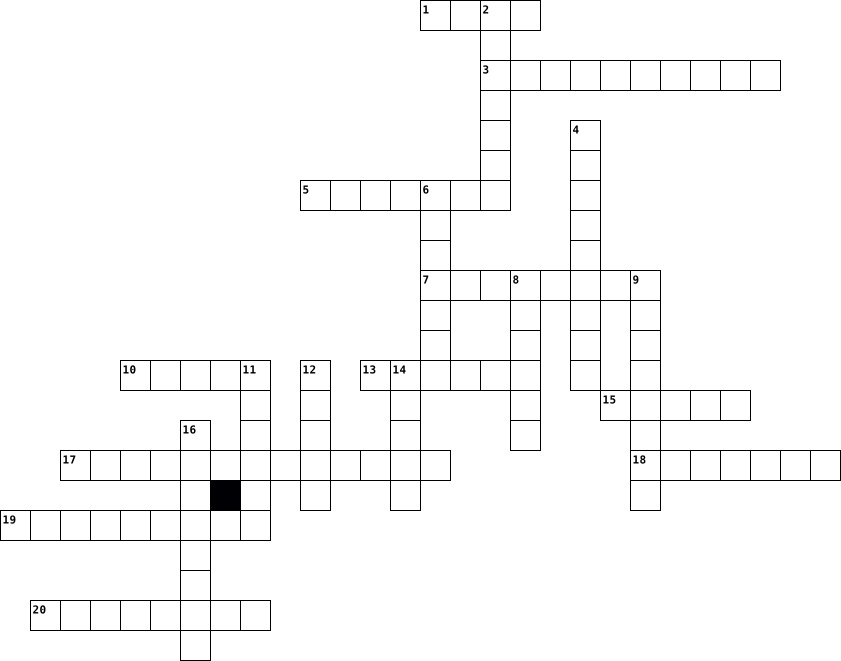
Across
- number - the total number of protons and neutrons in an atomic nucleus.
- - an element whose properties are intermediate between those of metals and solid non-metals or semiconductors.
- - a specialized structure occurring in most cells
- - a group of two or more atoms that form the smallest identifiable unit into which a pure substance
- - column in the periodic table of the chemical elements.
- - anything that has mass and volume
- - smallest unit into which matter can be divided without the release of electrically charged particles.
- - the abundance of a constituent divided by the total volume of a mixture.
- - the spontaneous passage or diffusion of water or other solvents through a semipermeable membrane
- - process resulting from random motion of molecules by which there is a net flow of matter from a region of high concentration to a region of low concentration
- earth - metal, any of the six chemical elements that comprise Group 2 of the periodic table.
Down
- - a notation of one or two letters representing a chemical element.
- - any substance composed of identical molecules consisting of atoms of two or more chemical elements.
- - any substance that cannot be decomposed into simpler substances by ordinary chemical processes.
- - the capacity for doing work.
- - a stable subatomic particle with a charge of negative electricity, found in all atoms and acting as the primary carrier of electricity in solids.
- number - the number of a chemical element in the periodic system
- - an element that readily forms positive ions and has metallic bonds.
- - metallic substance composed of two or more elements, as either a compound or a solution.
- table - a tabular display of the chemical elements, which are arranged by atomic number
20 Clues: - the capacity for doing work. • - anything that has mass and volume • - a specialized structure occurring in most cells • - column in the periodic table of the chemical elements. • number - the number of a chemical element in the periodic system • - a notation of one or two letters representing a chemical element. • ...
Metals Metalloids and Non Metals 2022-12-15

Across
- shiny, malleable and good conductors
- H on periodic table
- not shiny
- shines with reflected light
- not shiny, poor conductors, not malleable being able to be bent or shaped
- allows heat & electricity to flow through
Down
- anything that has volume and mass
- breaks easily
- I on periodic table
- has both properties
- characteristic that can be observed
11 Clues: not shiny • breaks easily • H on periodic table • I on periodic table • has both properties • shines with reflected light • anything that has volume and mass • characteristic that can be observed • shiny, malleable and good conductors • allows heat & electricity to flow through • not shiny, poor conductors, not malleable being able to be bent or shaped
Science By George Cook 2023-05-10

Across
- separates components from a mixture
- What is Lemonades Solvent
- Our Science Teacher this year
- Something that can be dissolves.
- What is Lemonades Solute
- One thing on the periodic table.
Down
- A substance that dissolves a solid or gas.
- separates liquid
- two or more things on the periodic table.
- contains different elements that are not chemically joined together.
- This Is something that Humphrey personally likes and it is a Solvent
- what is the main liquid used to start a DNA test.
- Something that can't be dissolves.
- The Solid being dissolved
14 Clues: separates liquid • What is Lemonades Solute • What is Lemonades Solvent • The Solid being dissolved • Our Science Teacher this year • Something that can be dissolves. • One thing on the periodic table. • Something that can't be dissolves. • separates components from a mixture • two or more things on the periodic table. • A substance that dissolves a solid or gas. • ...
Periodic table crossword 2021-10-16

Across
- Which element is in period 4, group 0?
- The smallest particle of an element that can exist.
- Is lithium or calcium an alkali metal?
- Shows all the elements arranged in rows and columns.
- Rows in the periodic table
- Two to thousands of atoms joined together. Most non-metals exist either as small or giant molecules.
- the chemical symbol for sodium
- Features of a substance that can be observed
- the chemical symbol for calcuim
Down
- Pure substances made up of two or more elements strongly joined together.
- What element does K represent
- what all substances are made up of, and which contain only one type of atom.
- The name of the elements in group 7
- Is chlorine or helium a halogen?
- Columns in the periodic table
- The name of the elements in group 1
- The name for the elements in group 0
17 Clues: Rows in the periodic table • What element does K represent • Columns in the periodic table • the chemical symbol for sodium • the chemical symbol for calcuim • Is chlorine or helium a halogen? • The name of the elements in group 7 • The name of the elements in group 1 • The name for the elements in group 0 • Which element is in period 4, group 0? • ...
Periodic Table Crossword 2022-05-13

Across
- a particle within an atom with a neutral charge
- the electrons involved in chemical bonds w/ other elements
- the abbreviated letter/s for an element
- the name for a column on the periodic table
- a particle within an atom with a negative charge
- bonds that are created by valence electrons
- average amount of protons and neutrons
- the name for a row on the periodic table
- the electrical attraction between a negative ion & a positive ion
Down
- the element with the atomic number '13'
- the element with 15 protons
- a particle within an atom with a positive charge
- the element with the atomic number '1'
- the amount of protons & electrons in an element
- where all the protons and neutrons are located in an atom
- the basic unit of a chemical element
- the element with 11 electrons
17 Clues: the element with 15 protons • the element with 11 electrons • the basic unit of a chemical element • the element with the atomic number '1' • average amount of protons and neutrons • the element with the atomic number '13' • the abbreviated letter/s for an element • the name for a row on the periodic table • the name for a column on the periodic table • ...
The periodic table 2025-11-17

Across
- - meta six chemical elements that make up Group
- -a soft, silvery-golden alkali metal with the chemical symbol Cs and atomic number 55
- - table also known as the organizes all cover
- - elements in group 17
- - Depending on the length
- -a colorless, odorless, and tasteless noble gas with the atomic number 54
- - Earth metal beryllium (Be), magnesium (Mg), calcium
Down
- - a misunderstanding of metals and metalloids
- - metallic elements in the periodic table
- -nonmetallic element that exists as a hard, black
- - the time it takes for one complete cycle
- - a chemical element that exhibits some metal
- - a law in chemistry
- - transition element the lanthanide and actin
- element- a metal found in groups 3–11
- - an element that lacks the physical and chemical
- - gas helium, neon, argon, krypton
17 Clues: - a law in chemistry • - elements in group 17 • - Depending on the length • - gas helium, neon, argon, krypton • element- a metal found in groups 3–11 • - metallic elements in the periodic table • - the time it takes for one complete cycle • - a chemical element that exhibits some metal • - table also known as the organizes all cover • ...
Atoms, Element & Molecules 2020-10-27

Across
- smallest particle that makes up matter
- positively charged and found in the nucleus
- electrons are found here
- negatively charged part of the atom
- the chemical symbol is 'K'
- has no charge and is found inside the atom
Down
- this has an atomic number of 6
- made up of different types of atoms
- the twentieth element of the periodic table
- made up of more than one atom
- we need this gas to live
- the chemical symbol is 'Na'
- chemical formula is H2O
- 118 and found in the periodic table
- has an electronic configuration of 2,8
15 Clues: chemical formula is H2O • we need this gas to live • electrons are found here • the chemical symbol is 'K' • the chemical symbol is 'Na' • made up of more than one atom • this has an atomic number of 6 • made up of different types of atoms • negatively charged part of the atom • 118 and found in the periodic table • smallest particle that makes up matter • ...
Atom Crossword Puzzle 2021-09-30

Across
- Resists heat or electricity flowing through them
- A molecule with a net electrical charge
- The basic unit of a chemical element
- A pure substance consisting only of atoms
- Can be stretched into thin wires
- Positive charge to an atom
Down
- Negative charge to an atom
- Can be hammered into thin sheets
- A negatively charged ion
- Neutral charge to an atom
- Elements with the same number of protons but different number of neutrons
- Able to have heat or electricity flow through them
- A positively charged ion
- A row on the periodic table
- A column on the periodic table
15 Clues: A negatively charged ion • A positively charged ion • Neutral charge to an atom • Negative charge to an atom • Positive charge to an atom • A row on the periodic table • A column on the periodic table • Can be hammered into thin sheets • Can be stretched into thin wires • The basic unit of a chemical element • A molecule with a net electrical charge • ...
Demetrie's Chemistry Crossword 2021-05-17

Across
- Center of an atom
- Anything with mass and volume
- Subatomic particle with negative charges
- Bond of 2 elements that give electrons
- Bond of 2 elements that share electrons
- Subatomic particle with positive charges
- Substances in a chemical reaction
- An atom that has a change in electrons
Down
- Electrons in the outermost energy level
- Elements on the left of a periodic table
- # of protons in an atom
- Same atoms but different electron #
- Element on the right of a periodic table
- Substance that dissolves in a solution
- Subatomic particle with no charge
15 Clues: Center of an atom • # of protons in an atom • Anything with mass and volume • Subatomic particle with no charge • Substances in a chemical reaction • Same atoms but different electron # • Bond of 2 elements that give electrons • Substance that dissolves in a solution • An atom that has a change in electrons • Electrons in the outermost energy level • ...
Physical Science 2022-05-17

Across
- Something that attracts something
- rows on a periodic table going up and down
- created the three laws of force
- every action has a reaction
- net force is greater than 0
- A push or pull on an object
Down
- area around a magnet that attractsmetal
- getting pulled toward something
- an electric magnet made with electricity
- rows on a periodic table going right to left
- amount of matter in an object
- the amount of mass in an object
- Net force equals 0
- Everything stays the same unless acted on
- More something weights more it takes move
15 Clues: Net force equals 0 • every action has a reaction • net force is greater than 0 • A push or pull on an object • amount of matter in an object • getting pulled toward something • the amount of mass in an object • created the three laws of force • Something that attracts something • area around a magnet that attractsmetal • an electric magnet made with electricity • ...
Matter 2021-02-15
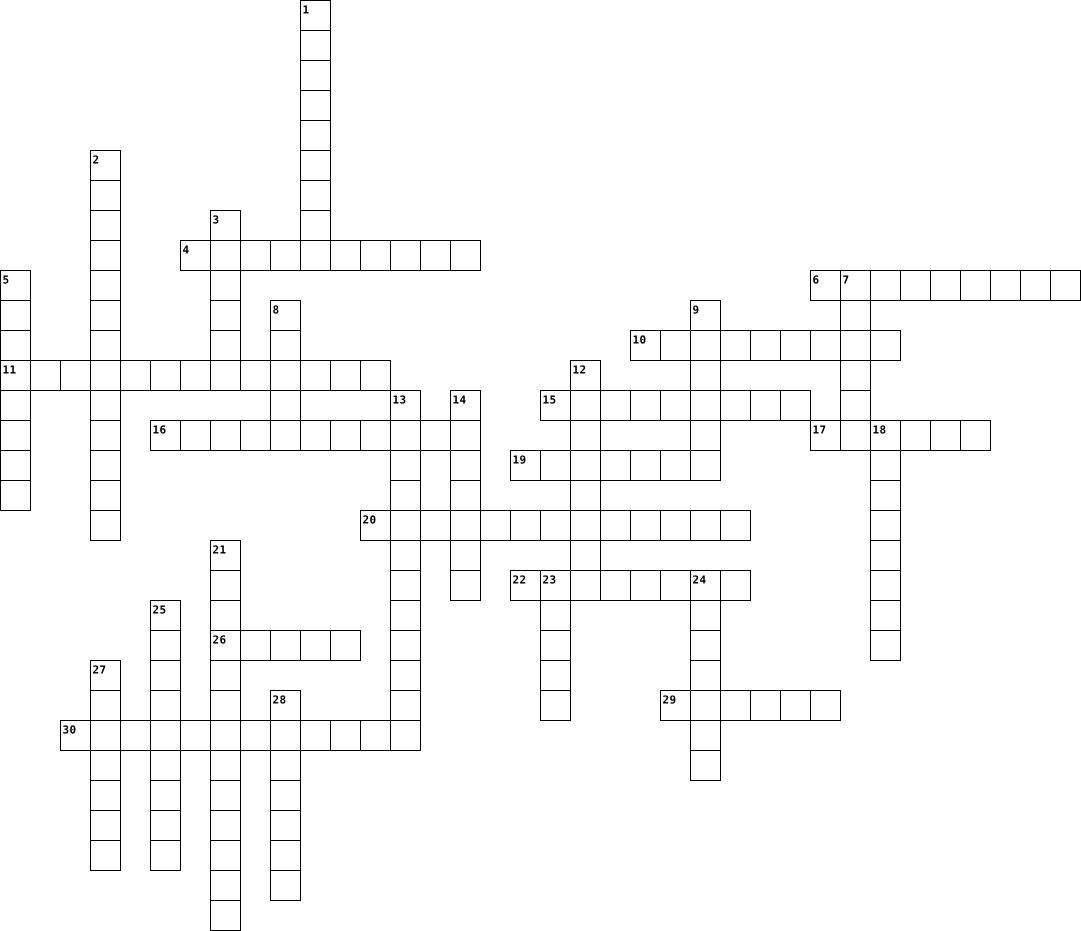
Across
- Sum of the number of protons and neutrons present in the nucleus of an atom.
- An element whose property are intermediate between those of metals and solid non-metals.
- A minute portion of matter
- The amount of particular substances contained within a solution/mixture or in a particular volume/space.
- A substance composed of identical molecules consisting of atoms of two or more chemical elements.
- Any elements occupying IA (1) of the periodic table, they are very reactive, monovalent metals that forms strongly alkaline hydroxides.
- A notation of one or two letters representing a chemical element.
- process by which molecules of a solvent tends to pass through a semipermeable membrane from a less concentrated solution into a more concentrated one.
- The physical property of matter
- A reactive non-metallic elements that forms strongly acidic compounds with hydrogen. Occupying the group of occupying group VIIA (17) of the periodic table.
- The smallest particle of a chemical element that can exist.
- Stable subatomic particle that has a positive charge .
- The number of a specific substance found in nucleus of every atom of an element.
Down
- Intermingling of substances by natural movement of their particles
- A table of the chemical elements arranged in order of atomic number in rows so that elements with similar atomic structure/ chemical properties appears in vertical columns .
- Anything that has moss and occupies space
- The universe's fundamental unit of negative charge.
- the property of matter and radiation which is manifest as a capacity to perform work.
- A solid hard, shiny material with good electrical and thermal conductivity.
- A column in the periodic table of chemical elements.
- An element or substance which is not metallic.
- Number of protons in the nucleus of an atom.
- A substance which cannot be decomposed into simpler substances.
- A group of two or more atoms that forms the smallest identifiable unit.
- Any elements occupying group IIA (2) of the periodic tbale , usually words ending with ium. They are reactive, electropositive, divalent metals.
- Metal made by combining two or more metallic elements.
- A particle formed in the nucleus of an atom and carries no electric charge.
- Smaller than or occurring within an atom.
- The row of chemical elements in the periodic table.
- The central part of an atom which contains protons and neutron along with having an enormous density of matter .
30 Clues: A minute portion of matter • The physical property of matter • Anything that has moss and occupies space • Smaller than or occurring within an atom. • Number of protons in the nucleus of an atom. • An element or substance which is not metallic. • The universe's fundamental unit of negative charge. • The row of chemical elements in the periodic table. • ...
More About Matter 2021-02-22

Across
- Any of the elements found in group A of the periodic table
- A metal made by the combining two or more metallic elements, especially to give greater strength or resistance to corrosion.
- An element or substance that is not a metal
- The movement of a solvent from a region lower of solute concentration to a region of higher solute concentration through a semi-permeable membrane
- The spreading of something more widely
- The ability to be active
- An element that forms positive ions and has metallic bonds
- A group of atoms bonded together, the smallest fundamental unit of a chemical compound that can take part in a chemical reaction
- Anything that has mass and volume
- A table of chemical elements arranged in order of atomic number, usually in rows
- A thing that is composed of two or more separate elements
- The number of chemical elements in the periodic system whereby the elements are arranged in or of increasing number of protons in the nucleus
- A subatomic particle of about the same mass as a proton but without an electronic charge
- Each of more than one hundred substances that cannot be chemically interconverted or broken down into simpler substances and are primary constituents of matter
- The total number of protons and neutrons in a nucleus
- The quantity of solute present in given quantity of solution.
Down
- A notation of one or two letters representing a chemical element
- A particle of positive charge that is in the nucleus of an atom
- The number of protons found in the nucleus of every atom of that element
- Any of the six chemicals that comprise of the periodic table.
- The smallest particle of a chemical element that can exist
- A theory of matter that explains physical properties in terms of the motion of atoms and molecules
- A chemical element that forms a salt when it reacts with metal
- An element whose properties are intermediate between those of metals and solid and non-metals or semiconductor
- A tiny bit of matter of matter that makes up everything in the universe
- A column in the periodic table of the chemical elements
- A name given to a horizontal row of the periodic table
- The positively charged central core of an atom,consisting of protons and neutrons and containing nearly all its mass
- A stable subatomic particle with a charge of negative electricity
- Smaller than or occurring with an atom
30 Clues: The ability to be active • Anything that has mass and volume • The spreading of something more widely • Smaller than or occurring with an atom • An element or substance that is not a metal • The total number of protons and neutrons in a nucleus • A name given to a horizontal row of the periodic table • A column in the periodic table of the chemical elements • ...
Unit 3 Sample work 2025-11-21

Across
- The number of protons in the atom
- A rule that states that molecules and atoms cannot be created or destroyed, only rearranged.
- A change that does not result in any new substances being formed.
- A row of elements in the periodic table
- Finding patterns in data
- Two or more substances reacting to form one or more new substances.
- A collection of elements that behave or look alike because they all have the same amount of valence electrons
- A subatomic particle that has a negative charge and orbits around the nucleus
- What holds atoms together to form molecules
- A list of all of the atoms in a molecule.
- neutrons and protons in the center of the atom
- Something's ability to combine or change into one or more new substances
- Nonreactive
- subatomic particle that is positively charged
- A group of atoms that make up a substance
- The substances before a chemical reaction.
- Look at your results to see if they support your hypothesis
- The process by which plants make energy from, light, water, and carbon dioxide.
- Shows the atoms that make up the molecule.
- A prediction on observations that can be tested
Down
- How many neutrons and protons are in an atom
- Elements in the second column of the periodic table that are silvery white metals, that have 2 valence electrons, are reactive and have low melting and boiling points
- The elements something is made of
- An intermolecular bond
- Conclusions Deciding what patterns mean in data
- Two or more chemical elements bonded together
- A structure of multiple atoms connected together such as sodium chloride.
- A toxic and reactive non-metal found in group 17 of the periodic table
- something that results in a different substance in an irreversible process.
- The orbiting electrons outside of the nucleus
- The group of elements that are found in the first column of the periodic table and are soft, silvery, have one valence electron, and are very reactive
- The outside electron shell.
- Trying to find meaning in data
- A property that can be measured
- A subatomic particle with no charge
- A charged particle that was made when an electron was added or lost from an atom or group of atoms
- The outcome of a chemical reaction.
- A group of elements on the periodic table that are nonreactive and inert
38 Clues: Nonreactive • An intermolecular bond • Finding patterns in data • The outside electron shell. • Trying to find meaning in data • A property that can be measured • The number of protons in the atom • The elements something is made of • A subatomic particle with no charge • The outcome of a chemical reaction. • A row of elements in the periodic table • ...
Periodic trends 2023-12-07

Across
- Atomic Radius
- Halogens
- electron
- atom
- Nucleus
- Electron Affinity
- nuclear
- Ionization Energy
Down
- Atomic
- Periodic Table
- Element
- Chemical
- ionic
- Shielding
- anion
15 Clues: atom • ionic • anion • Atomic • Element • Nucleus • nuclear • Halogens • electron • Chemical • Shielding • Atomic Radius • Periodic Table • Electron Affinity • Ionization Energy
CROSSWORD 2016-01-17

Across
- Column in the periodic table
- Amount of energy required to remove the most loosely bound electron
- Creator of the periodic table
- ... electrons - electrons in outer energy level of an atom
Down
- Substance that resists electricity
- They have properties between metals and nonmetals
- Row in the periodic table
- Consists of protons and neutrons
8 Clues: Row in the periodic table • Column in the periodic table • Creator of the periodic table • Consists of protons and neutrons • Substance that resists electricity • They have properties between metals and nonmetals • ... electrons - electrons in outer energy level of an atom • Amount of energy required to remove the most loosely bound electron
Chemistry Crossword 2020-07-26

Across
- Where the electrons sit on an atom
- Has a negative charge
- Has a neutral charge (no charge)
- What happens to an element in water
Down
- what is each box called on the Periodic Table
- The horizontal rows on the Periodic Table
- Has a positive charge
- The vertical columns on the Periodic Table
8 Clues: Has a positive charge • Has a negative charge • Has a neutral charge (no charge) • Where the electrons sit on an atom • What happens to an element in water • The horizontal rows on the Periodic Table • The vertical columns on the Periodic Table • what is each box called on the Periodic Table
Matter Matters post test starter 2025-06-17

Across
- The element found in all organic compounds (6)
- A type of gas in Group 18 that is unreactive under normal conditions (5)
- A negatively charged particle that orbits the nucleus (8)
- A substance made of two or more elements chemically combined (8)
- Group 7 elements that are non-metals and very reactive (8)
- A combination of substances that are not chemically bonded (7)
- A piece of glassware used for holding small amounts of substances during experiments (8)
- A gas that supports combustion and is released during photosynthesis (6)
Down
- The gas that produces a pop sound when a lit splint is used (8)
- Vertical columns in the periodic table that contain elements with similar properties (5)
- The group 1 elements in the periodic table that are highly reactive (11)
- Horizontal rows in the periodic table indicating energy levels of electrons (6)
- A term describing how easily an element combines with others (9)
- A positively charged subatomic particle found in the nucleus (6)
- Speeds up a chemical reaction without being used up
- A particle made from two or more atoms bonded together
- A subatomic particle with no charge found in the nucleus (7)
17 Clues: The element found in all organic compounds (6) • Speeds up a chemical reaction without being used up • A particle made from two or more atoms bonded together • A negatively charged particle that orbits the nucleus (8) • Group 7 elements that are non-metals and very reactive (8) • A subatomic particle with no charge found in the nucleus (7) • ...
|> /-\ | |\| 2026-02-12

Across
- The combining of atoms to form molecules.
- First group of the periodic table.
- Vertical row of elements.
- Unreactive nonmetals.
- The repeating pattern in a crystal.
- Electron found in the outermost shell of an atom.
Down
- A bond that is formed when electrons are transferred between atoms.
- A bond that is formed by the attraction between metal ions and electrons.
- A positively/negatively charged molecule.
- A Negatively charged ion.
- Highly reactive metals
- Horizontal row of elements.
- Second group of the periodic table.
- A bond interaction that holds atoms or ions together.
- A bond that is formed when atoms share electrons.
- A positively charged ion.
16 Clues: Unreactive nonmetals. • Highly reactive metals • A Negatively charged ion. • Vertical row of elements. • A positively charged ion. • Horizontal row of elements. • First group of the periodic table. • Second group of the periodic table. • The repeating pattern in a crystal. • A positively/negatively charged molecule. • The combining of atoms to form molecules. • ...
structure and bonding 2025-11-12

Across
- what is group 7 of the periodic table
- the making of things under 100 nanometres
- one layer of graphite
- when a metal and non-metal bond
- chemical formula H2O
- a buck minster ball is ______ so can carry substances
- the substitution of relative mass
Down
- atoms lose and gain these in bonding
- when 2 non metals bond
- which group is the noble gases in the periodic table
- electrons can carry
- acronym for metallic bonding
- the number of electrons lost by alkali metals
- the outcome of ionic bonding
- when 1 carbon atom is bonded to 4 other ones
- when 2 metals bond
16 Clues: when 2 metals bond • electrons can carry • chemical formula H2O • one layer of graphite • when 2 non metals bond • acronym for metallic bonding • the outcome of ionic bonding • when a metal and non-metal bond • the substitution of relative mass • atoms lose and gain these in bonding • what is group 7 of the periodic table • the making of things under 100 nanometres • ...
Science 2025-06-23

Across
- Excess acid build-up neutraliser
- short hand abbreviations for element names.
- Chemicals that change colour when added to an acid or base
- when the nucleus loses a neutron.
- a feature of certain types of atoms
- the average mass of the atoms in an element
- The opposite of an acid
- a liquid that releases positively charged ions.
- the number of protons in the nucleus of an atom
Down
- the product of two correct substances mixing.
- Water -> Hydrogen + Oxygen. That is a ... Reaction
- an exothermic chemical reaction
- When acid is added to a base.
- PH
- Name of the periodic table developer
- many of naturally occurring elements are :
- Oxygen + Hydrogen -> Water. That is a ... Reaction
- The ........ Table
18 Clues: PH • The ........ Table • The opposite of an acid • When acid is added to a base. • an exothermic chemical reaction • Excess acid build-up neutraliser • when the nucleus loses a neutron. • a feature of certain types of atoms • Name of the periodic table developer • many of naturally occurring elements are : • short hand abbreviations for element names. • ...
unit b 2017-11-13

Across
- a solid that can be stretched in a long wire
- substance that reacts with other substances
- pure substance formed when at least one metal and non metal is combined
- the result of when all substances are accounted for
- describes the physical appearance and composition
- group 1 elements in the periodic table not including hydrogen the most reactive of the metals
- a compound that has been electorally charged
- change of the state or apperance
- dull brittle element that does not conduct electricity
- a experiment where the substances can escape or new substances can enter
Down
- group of 17 metals in the periodic table
- the result of when to or more substances react to make a new substance
- positively charged centre of a atom
- a reaction the takes place when two or more substance react to form a new substance
- ability of a substance to conduct electricity or heat
- vertical column of element in the periodic table
- substance made of only one kind of matter
- process in which molecules move from an area higher to lower concentration
- anything that has a mass and occupies space
- shiny malleable ductile element and non metallic properties
- number of protons in the nucleus of one atom of an element
- vertical column of element in the periodic table
- amount of gas in a given volume of a substance
23 Clues: change of the state or apperance • positively charged centre of a atom • group of 17 metals in the periodic table • substance made of only one kind of matter • substance that reacts with other substances • anything that has a mass and occupies space • a solid that can be stretched in a long wire • a compound that has been electorally charged • ...