
physics Crossword Puzzles
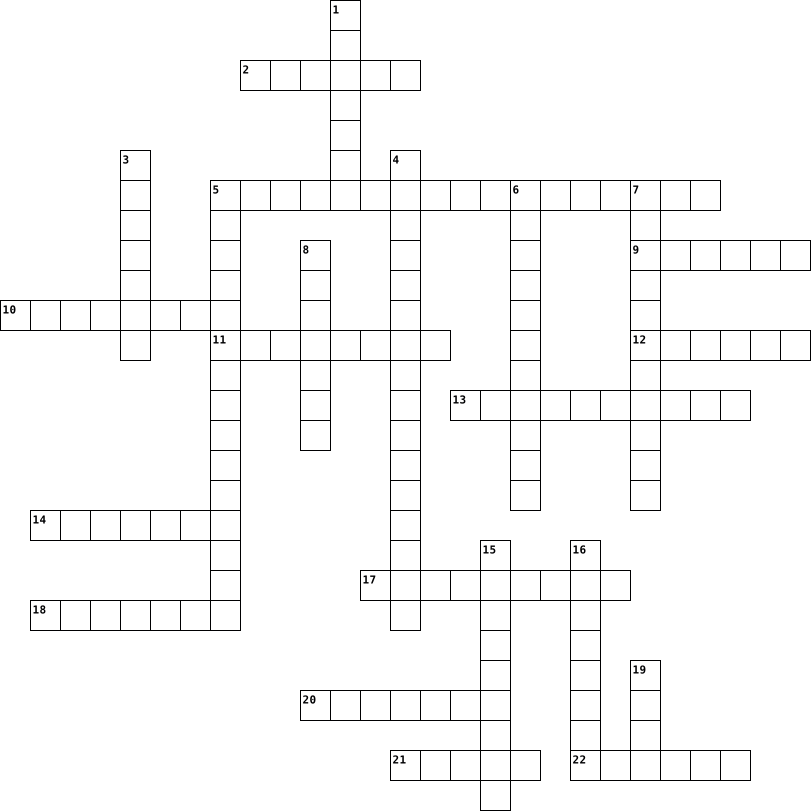
Map of Physics 2021-08-04

Across
- produce many colors
- law of motion founder
- language of physics
- the splitting of the atom used in our nuclear power plant
- who doesn't need medium to travel
- energy that pass from one to another
Down
- the description of magnets, electricity
- physics future research
- world for a small particles theory
- related to the theory of waves
- energy that travels through medium
- who developed relativity theory
- who discovered electric and magnetic field
13 Clues: produce many colors • language of physics • law of motion founder • physics future research • related to the theory of waves • who developed relativity theory • who doesn't need medium to travel • world for a small particles theory • energy that travels through medium • energy that pass from one to another • the description of magnets, electricity • ...
School Subjects 2024-05-18

Across
- физкультура
- русский язык
- информатика
- робототехника
- английский язык
- религиозное образование
- физика
- музыка
- казахский язык
- химия
Down
- изобразительное искусство
- естествознание
- биология
- гражданское образование
- география
- французский язык
- математика
- история
18 Clues: химия • физика • музыка • история • биология • география • математика • физкультура • информатика • русский язык • робототехника • естествознание • казахский язык • английский язык • французский язык • гражданское образование • религиозное образование • изобразительное искусство
school 2025-02-12

Across
- dancing
- write
- computer
- watching other people talk
- eating centre
- running
- numbers
- boring
- write
Down
- learning
- water boat
- black
- words
- storage
- not going class
- suck
- calculations
- technology
- people
19 Clues: suck • write • black • words • write • people • boring • dancing • storage • running • numbers • learning • computer • water boat • technology • calculations • eating centre • not going class • watching other people talk
isäinpäivä 2015-11-13

Across
- kemia
- naudanliha
- kaveri
- äiti
- sydän
- koira
- lava
- porsaanliha
Down
- fysiikka
- hockey jääkikko
- ongelma
- mukava
- rakastaa
- isä
- tähti
15 Clues: isä • äiti • lava • kemia • sydän • koira • tähti • mukava • kaveri • ongelma • fysiikka • rakastaa • naudanliha • porsaanliha • hockey jääkikko
German crossword 2025-05-08

Across
- math
- biology
- spanish
- health
- music
- physics
- French
- geometry
- Latin
Down
- science (NS)
- chemistry
- german
- english
- art
- algebra
15 Clues: art • math • music • Latin • health • german • French • biology • spanish • english • physics • algebra • geometry • chemistry • science (NS)
German crossword 2025-05-08

Across
- algebra
- English
- Spanish
- Natural sciences
- Biology
- physics
- German
- Geometry
- music
Down
- French
- Health
- art
- Math
- latin
- chemistry
15 Clues: art • Math • latin • music • French • Health • German • algebra • English • Spanish • Biology • physics • Geometry • chemistry • Natural sciences
Words around the lab 2025-05-22

Across
- oxygen
- lightenergy
- organelles
- heredity
- looking
- environment
- force/pull
- protons
Down
- numbers
- naturalselection
- matter
- living
- reactions
- testing
- alani
15 Clues: alani • oxygen • matter • living • numbers • testing • looking • protons • heredity • reactions • organelles • force/pull • lightenergy • environment • naturalselection
SCHOOL SUBJECTS 2026-01-20

Across
- náboženství
- občanka
- tělocvik
- dějepis
- přestávka
Down
- angličtina
- fyzika
- zeměpis
- výtvarka
- hudebka
- němčina
- chemie
- matematika
- přírodopis
- přírodní vědy
15 Clues: fyzika • chemie • zeměpis • hudebka • němčina • občanka • dějepis • výtvarka • tělocvik • přestávka • angličtina • matematika • přírodopis • náboženství • přírodní vědy
Wave vocab 2023 2023-01-25

Across
- In physics, mathematics, and related fields, a wave is a propagating dynamic disturbance of one or more quantities. Waves can be periodic, in which case those quantities oscillate repeatedly about an equilibrium value at some frequency.
- In physics, energy is the quantitative property that is transferred to a body or to a physical system, recognizable in the performance of work and in the form of heat and light.
- The amplitude of a periodic variable is a measure of its change in a single period. The amplitude of a non-periodic signal is its magnitude compared with a reference value.
- waves In physics, a mechanical wave is a wave that is an oscillaton of matter, and therefore transfers energy through a medium.
- In physics, a transverse wave is a wave whose oscillations are perpendicular to the direction of the wave's advance.
- waves Longitudinal waves are waves in which the vibration of the medium is parallel to the direction the wave travels and displacement of the medium is in the same direction of the wave propagation.
Down
- Vibration is a mechanical phenomenon whereby oscillations occur about an equilibrium point. The word comes from Latin vibrationem.
- the rate at which something occurs or is repeated over a particular period of time or in a given sample.
- the intervening substance through which impressions are conveyed to the senses or a force acts on objects at a distance.
- the rate at which someone or something is able to move or operate.
- waves In physics, electromagnetic radiation consists of waves of the electromagnetic field, which propagate through space and carry momentum and electromagnetic radiant energy
- In physics, the wavelength is the spatial period of a periodic wave—the distance over which the wave's shape repeats.
12 Clues: the rate at which someone or something is able to move or operate. • the rate at which something occurs or is repeated over a particular period of time or in a given sample. • In physics, a transverse wave is a wave whose oscillations are perpendicular to the direction of the wave's advance. • ...
Wave vocab 2023 2023-01-25

Across
- In physics, mathematics, and related fields, a wave is a propagating dynamic disturbance of one or more quantities. Waves can be periodic, in which case those quantities oscillate repeatedly about an equilibrium value at some frequency.
- In physics, energy is the quantitative property that is transferred to a body or to a physical system, recognizable in the performance of work and in the form of heat and light.
- The amplitude of a periodic variable is a measure of its change in a single period. The amplitude of a non-periodic signal is its magnitude compared with a reference value.
- waves In physics, a mechanical wave is a wave that is an oscillaton of matter, and therefore transfers energy through a medium.
- In physics, a transverse wave is a wave whose oscillations are perpendicular to the direction of the wave's advance.
- waves Longitudinal waves are waves in which the vibration of the medium is parallel to the direction the wave travels and displacement of the medium is in the same direction of the wave propagation.
Down
- Vibration is a mechanical phenomenon whereby oscillations occur about an equilibrium point. The word comes from Latin vibrationem.
- the rate at which something occurs or is repeated over a particular period of time or in a given sample.
- the intervening substance through which impressions are conveyed to the senses or a force acts on objects at a distance.
- the rate at which someone or something is able to move or operate.
- waves In physics, electromagnetic radiation consists of waves of the electromagnetic field, which propagate through space and carry momentum and electromagnetic radiant energy
- In physics, the wavelength is the spatial period of a periodic wave—the distance over which the wave's shape repeats.
12 Clues: the rate at which someone or something is able to move or operate. • the rate at which something occurs or is repeated over a particular period of time or in a given sample. • In physics, a transverse wave is a wave whose oscillations are perpendicular to the direction of the wave's advance. • ...
School Courses 2013-11-16
Across
- English
- FCS
- Physics
- History
- The Sciences
- Music
- Arithmetic
- The languages
- Geometry
- Chemistry
- Algebra
- Latin
- German
Down
- Calculus
- Spanish
- Social Studies
- Physical Education
- Mathematics
- Computer Science
- French
- Geography
- Biology
- Art
23 Clues: FCS • Art • Music • Latin • French • German • English • Spanish • Physics • History • Biology • Algebra • Calculus • Geometry • Geography • Chemistry • Arithmetic • Mathematics • The Sciences • The languages • Social Studies • Computer Science • Physical Education
Unit 2 2020-02-23

Across
- grawitacja
- chemik
- chemia
- obserwować
- klawiatura
- nazwa użytkownika
- biologia
- cyfrowy
- strona internetowa
- myszka
Down
- fizyka
- drukarka
- naukowiec
- hasło
- odkryć
- take..... - robić notatki
- .....music - ściągać, pobierać
- nauki ścisłe
- ... message - wiadomość tekstowa (sms)
- ekran
20 Clues: hasło • ekran • fizyka • odkryć • chemik • chemia • myszka • cyfrowy • drukarka • biologia • naukowiec • grawitacja • obserwować • klawiatura • nauki ścisłe • nazwa użytkownika • strona internetowa • take..... - robić notatki • .....music - ściągać, pobierać • ... message - wiadomość tekstowa (sms)
spanish project 2021-03-17

Across
- eraser
- economics
- to draw
- to arrive
- door
- to buy
- to like
- paper
- to answer
- literature
- table
Down
- physics
- to look
- to study
- to have dinner
- to talk
- art
- history
- to be
- biology
20 Clues: art • door • paper • to be • table • eraser • to buy • physics • to look • to draw • to talk • history • to like • biology • to study • economics • to arrive • to answer • literature • to have dinner
spanish project 2021-03-17

Across
- paper
- to have dinner
- to buy
- eraser
- art
- history
- economics
- physics
- to look
Down
- to like
- table
- door
- to answer
- biology
- to be
- to study
- to draw
- to talk
- to arrive
- literature
20 Clues: art • door • paper • table • to be • to buy • eraser • to like • biology • to draw • history • to talk • physics • to look • to study • to answer • to arrive • economics • literature • to have dinner
Para Tener Éxito 2022-04-27

Across
- rule
- on time
- to arrive late
- to discuss
- to respect
- physics
- project
- biology
- to answer
Down
- to turn in
- laboratory
- report
- to explain
- history
- algebra
- seat
- locker
- word
- one must
- scissors
20 Clues: rule • seat • word • report • locker • history • algebra • on time • physics • project • biology • one must • scissors • to answer • to turn in • laboratory • to explain • to discuss • to respect • to arrive late
unit 2 = Modelo Dos: La Escuela- Luke Bronkala 2022-04-21

Across
- physics
- paper
- anatomy
- chair
- window
- Music
- marker
- door
- table
- Art
- geography
- papel
Down
- biology
- poster
- flag
- to arrive
- health
- pencil
- band
- choir
- notebook
- ruler
- whiteboard
- chemistry
- clock
25 Clues: Art • flag • band • door • paper • chair • Music • choir • ruler • clock • table • papel • poster • health • pencil • window • marker • biology • physics • anatomy • notebook • to arrive • chemistry • geography • whiteboard
Tú Día en la Escuela 2019-11-06

Across
- elalmuerzo
- italiano
- música
- ciencias
- quimica
- lascienciassociales
- losartesdelenuaje
- geografía
- matemáticas
- computadores
- trigonometría
- russo
Down
- arte
- chino
- ingles
- historia
- educacíonfisica
- tecnología
- español
- francés
- biología
- geometria
- cálculo
- física
- banda
25 Clues: arte • chino • banda • russo • ingles • música • física • quimica • español • francés • cálculo • historia • italiano • ciencias • biología • geometria • geografía • elalmuerzo • tecnología • matemáticas • computadores • trigonometría • educacíonfisica • losartesdelenuaje • lascienciassociales
Project 1 unit 3 2025-01-30

Across
- tesi
- órarend
- vastag
- unalmas
- dzsungel
- alvó
- hittan
- tantárgy
- hörcsög
- gyűlés
- mindegyik
- történelem
Down
- különböző
- körülír
- egyenruha
- földrajz
- kémia
- állampolgari ismeretek
- biologia
- patkány
- félév
- matek
- sivatag
- jelentés
- fizika
25 Clues: tesi • alvó • kémia • félév • matek • vastag • hittan • gyűlés • fizika • körülír • órarend • unalmas • patkány • sivatag • hörcsög • földrajz • biologia • dzsungel • tantárgy • jelentés • különböző • egyenruha • mindegyik • történelem • állampolgari ismeretek
UNIDAD 2 EL COLEGIO 2025-10-23

Across
- history
- physics
- schedule
- to climb
- public speaking
- to value
- fencing
- advisery
- german
- orchestra
- biology
- to pass
Down
- geometry
- calculus
- chemistry
- to fail
- japonese
- chinese
- algebra
- to row
- adviser(masculine)
- theater
22 Clues: to row • german • history • to fail • physics • chinese • algebra • fencing • theater • biology • to pass • geometry • calculus • japonese • schedule • to climb • to value • advisery • chemistry • orchestra • public speaking • adviser(masculine)
CROSSWORD WITH PHYSICS 2021-01-21

Across
- he discovered the neutron
- Father of atomic physics
- he created the planetary model of the atom
- Father of Quantum Physics
Down
- he created his law of universal gravitation
- Father of modern physics
- he developed the theory of relativity
- he discovered the electron
8 Clues: Father of modern physics • Father of atomic physics • he discovered the neutron • Father of Quantum Physics • he discovered the electron • he developed the theory of relativity • he created the planetary model of the atom • he created his law of universal gravitation
Physics-Light 2016-04-03

Across
- A substance that glows after being exposed to energized bulb
- Producing light from frustration is called....
- A glass tube filled with a small amount of gas(mercury vapour)
- The process of transforming electrical energy directly into light energy light
- Produces brighter images
- involves passing an electric current through the air, or another gas, between two carbon rods
- An Electroluminescence light source made out of a material called a semiconductor
- emitted by some substances when they are exposed to electromagnetic radiation
- Large screen technology called a .....
- A chemical used to detect traces of blood
Down
- A light produced from a chemical reaction without a rise of temperature
- is a light that is produced by an object such as metal
- inside an ....... is a filament (thin piece of light)
- the ability to store the energy from a source of light, then emit slowly over a long period
- A material that can be made to change how well it conducts electricity
- A method for producing light e.x) neon and lightening
- An example of Electric Discharge:
- LED
- In a Liquid Crystal Display a white fluorescent shines behind a crystal
- solid that can change the orientation of it's molecules like a liquid but only when electricity is applied
- Organic light-emitting display
21 Clues: LED • Produces brighter images • Organic light-emitting display • An example of Electric Discharge: • Large screen technology called a ..... • A chemical used to detect traces of blood • Producing light from frustration is called.... • inside an ....... is a filament (thin piece of light) • A method for producing light e.x) neon and lightening • ...
Physics Crossword 2016-04-16

Across
- A positively charged atom.
- The central, positively charged, dense portion of an atom.
- What you multiply mass by to get weight
- When the magnification is positive the image is _______.
- The energy possessed by a body due to its motion
- The temperature of - 273.16 or 0 K.
- 700nm is what color in the wavelength spectrum?
- The distance between the two nearest points on a wave, which are in the same phase or the distance between two adjacent crests or two adjacent troughs.
- An object at rest stays at rest is which Newton’s Law?
- Distance traveled by a body in a particular direction per unit time or the displacement of the body per unit time. It is a vector quantity.
- SI unit for time
- The force per unit area.
- The number of oscillations completed in 1 second by an oscillating body.
- A unit of pressure.
- The radial force required to keep an object moving in a circular path; it is equal to mv2/r.
- The speedometer in your car tells you the _____ speed of your car.
- The amount of heat energy required to increase the temperature.
- The rate of change of velocity with respect to time.
- 400nm is what color in the wavelength spectrum?
- 6.626x10⁻³⁴ J*s is what?
- The S.I.unit of capacitance.
- Upward force on an object immersed in fluid.
- ________ is the product of mass and velocity.
- Distance divided by time known as _____ speed.
- S.I. unit for power; equivalent to joule/sec.
- The property to block the flow of current.
- The energy possessed by a body by virtue of its position or configuration.
- The study of matter and its motion through space and time.
- Newton’s first law of motion is also called law of _______
- Electrical device used to store charge and energy in the electrical field.
- 6.674x10--11 Nm2/kg2 is what constant?
- Force times distance is known as_____.
- When the focal point is positive then it’s a _______ mirror.
- The product of force and time for which force acts, also equal to the change in momentum.
- The number of molecules in a gram molecular weight of a substance, it is equal to 6.022 x 10²³.
- Which Newton’s law of motion sates F=ma
- SI unit for length
- Current multiplied by resistance.
- principle A body immersed in a fluid experiences an apparent loss in weight which is equal to the weight of the fluid displaced by the body.
- The product of lever arm and force is___________?
- For a given mass of a gas at constant temperature, the volume of the gas is inversely proportional to the pressure.
- The bouncing back of a wave from a boundary.
- if S’ is negative then it is __________ image
- The process in which heat is lost.
- if S’ is positive then it is _________ image
- Potential energy is the energy possessed by an object due to it’s __________.
- A negatively charged atom.
Down
- Any push or pull.
- Unit of resistance.
- Unit of measurement for force
- The vector sum of all of the forces acting on an object
- The region around a magnet where its magnetic force is experienced by other magnetic objects.
- The description of motion.
- When the magnification is negative the image is ______.
- Sound waves of frequencies above 20,000Hz
- The highness or lowness of musical town is referred to as_____
- S.I. Unit of electric current.
- An atom with no charge.
- Unit of potential difference, equivalent to joule/coulomb.
- image An image which can be projected on a screen.
- The rate of change of angular displacement with time.
- The sum of all the currents entering and leaving any point in a circuit is equal to zero.
- SI unit of charge
- A device that measures voltage.
- The materials which do not allow current to flow through them.
- When the focal point is negative then it’s a _______ mirror.
- The shortest distance between the initial and final position of a moving body. It is a vector quantity.
- An electrical current which always flows in one direction.
- A mechanical device used to measure electric current and usually has no units.
- A device which behave like conductors at higher temperature is known as _____.
- A constant specific to each spring, which describes its “springiness”, or how much work is needed to compress the spring.
- The process in which heat is absorbed.
- The sum of the number of protons and neutrons in a nucleus.
- The time for one complete cycle of a process that repeats known at (T).
- The number of protons in an atomic nucleus.
- The energy due to the position of a charge near other charges.
- An image formed when the reflected or refracted light rays appear to meet; this image cannot be projected on a screen.
- The transfer of heat from a region of higher temperature to a region of lower temperature by increased kinetic energy moving from molecule to molecule.
- The ratio of charge stored per increase in potential difference.
- 9.8 m/s2 is what?
- Velocity and acceleration are examples of what quantities?
- The bending of light from its straight line path when it travels from one medium to another.
- The materials that have free electrons and allow current to flow through them.
- SI unit for mass
- The mass and _______ of an object on Earth’s surface are directly proportional to each other.
- The mass of a substance per unit volume.
- ray A high energy photon.
- Power is _______ over time
- The idealized motion where air resistance is ignored and acceleration is nearly constant.
- What Newton’s Law states that for every action there is an equal and opposite reaction.
- The unit of work and energy
- SI unit of temperature
- The maximum absolute value attained by the disturbance of a wave.
- What law states that the force needed to extend or compress a spring by some distance is proportional to that distance, known as F=-kX
- The force on an object perpendicular to the surface it rests on utilized in order to account for the body's lack of movement.
- The force between any two charges is directly proportional to the product of charges and inversely proportional to the square of the distance between the charges.
- A back and forth motion that repeats itself.
- A force resistance to relative motion between two bodies or substances in physical contact.
- The unit of frequency, also known as cycles per second.
- Displacement divided by change in time.
- when the frequency of the impressed periodic force is equal to the natural frequency of the body
- state The lowest energy state of an atom.
- The rate of doing work.
- If an object is moving then the magnitude of its velocity and ________ can’t be zero.
104 Clues: SI unit for time • SI unit for mass • Any push or pull. • SI unit of charge • 9.8 m/s2 is what? • SI unit for length • Unit of resistance. • A unit of pressure. • SI unit of temperature • An atom with no charge. • The rate of doing work. • The force per unit area. • 6.626x10⁻³⁴ J*s is what? • ray A high energy photon. • A positively charged atom. • The description of motion. • ...
Nuclear Physics 2016-07-29

Across
- when protons and neutrons form the nucleus
- should be called a nuclear bomb
- two nucleons can't do the same thing at the same time
- dating old objects by counting the number of electrons in an excited state
- collective name of protons and neutrons
- just a form of a given element with a different number of neutrons
- high number of nucleons to a low number
- radioactive debri
- anti-particle of an electron
Down
- tends to be lean with no radioactive isotopes
- low number of nucleons to a high number
- consequence of fusion occuring at very high temperatures
- identifying isotopes from their characteristic half lives, decay particles and energy by applying neutrons
- 100 times as strong as an electrical force
- makes use of gravity to sustain fusion
- when nucleons are forced together
- replacing atoms with a radioisotope to unveil it's origins
- all of them have one proton
- their half-life is only 18 minutes because they are unstable by themselves
- most useful for dating anything that has been alive
- a form of brute for that causes a nuclear force
21 Clues: radioactive debri • all of them have one proton • anti-particle of an electron • should be called a nuclear bomb • when nucleons are forced together • makes use of gravity to sustain fusion • low number of nucleons to a high number • collective name of protons and neutrons • high number of nucleons to a low number • when protons and neutrons form the nucleus • ...
Microscopic Physics 2016-09-13

Across
- Positive nucleus, negative electrons
- Look & behave the same as matter, but with opposite charge
- Holds quarks together to form hadrons
- Point-like particles without internal structure
- Particles that obey the Pauli Exclusion Principle
- Fundamental particle that make up protons & neutrons
- Lepton with an electrical charge
- Explains what the world is & what holds it together
- Created & destroyed whenever electrons are created & destroyed
- When a quark or lepton changes type, due to weak interactions
- Broken into increments or particles
- Effect on a particle due to presence of another particle
Down
- Hold atoms together & produce electrical force
- Gravity force carrier particle
- Causes like-charged things to repel & oppositely charged things to attract
- Particles that do not obey the Pauli Exclusion Principle
- Made of protons & neutrons
- Weak & electromagnetic interactions
- Composite particles made of quarks
- Anti-electron
- Any hadron made of 3 quarks
- One quark, one antiquark
- My teacher calls himself
23 Clues: Anti-electron • One quark, one antiquark • My teacher calls himself • Made of protons & neutrons • Any hadron made of 3 quarks • Gravity force carrier particle • Lepton with an electrical charge • Composite particles made of quarks • Weak & electromagnetic interactions • Broken into increments or particles • Positive nucleus, negative electrons • ...
Physics Crosswords 2015-11-26

Across
- Very useful glass in chemistry , especially for dilution
- This is gaz wich allow us to live on Earth.
- This is the English for Amidon
- Help us to identify compounds in objects, at school you may hate it...
- Used to know the temperature of something
- Used with a volumetric pipet ( it looks like a pear )
- You can see a lot of those things when it's rainy
- Maybe the most famous glass lab in chemistry
Down
- One hit Isaac Newton head's
- They protects your hands from chemical injuries
- Used to catalyze reaction
- The suit of every scientists , you should have one
- Protect your eyes from various injuries ( chemicals, projections , explosions )
- It's used to heat stuff
- This is an unit which is telling if a solution is acid, basic and even neutral
- You can put a various kind of things ( liquid and solid ) and do reactions in it
- This is a Ph indicator
- Can be obtained when you grind something
- A very common and powerful solvent
- This is the place where you're doing experiments
20 Clues: This is a Ph indicator • It's used to heat stuff • Used to catalyze reaction • One hit Isaac Newton head's • This is the English for Amidon • A very common and powerful solvent • Can be obtained when you grind something • Used to know the temperature of something • This is gaz wich allow us to live on Earth. • Maybe the most famous glass lab in chemistry • ...
Physics Vocabulary 2017-05-10

Across
- occurs when a container has no air
- what is done when a force applied to an object moves it
- motion under gravity only
- motion relative to something else
- both potential and kinetic energy
- the upward force that balances the weight of an object on a surface
- mass per unit volume
- a push or pull on an object
- the correct answer
- includes liquids and gases
- air drag
- heat is released in a process
- heat is absorbed in a process
- an object moving at a constant velocity
- inertia in motion
- the amount of matter something contains
- this law says that when volume increases, temperature increases
- energy from an object's position
- it can be transferred and transformed but not created or destroyed
- the measure of hotness or coldness
- Newton's law that says that an object accelerates when a force acts on it
- the amount of heat it takes to raise the temperature of 1 g of a substance by 1 degree
- the speed of an object that tells its direction of motion
Down
- this law says that when pressure decreases, volume increases
- this law says that when pressure decreases, temperature decreases
- energy from an object's motion
- a collision where two objects bounce off each other and are not damaged
- the net upward force that a fluid exerts on a submerged object
- this is reached when acceleration stops
- occurs when objects are at rest
- the rate of change in velocity
- the amount of space something takes up
- a location you use to describe the location of other things
- Newton's First Law
- Newton's law that says for every action there is an equal and opposite reaction
- the amount of work done per unit time
- gas pressure is caused by this
- occurs when two objects hit each other
- a collision where two objects become damaged or attached to each other
- the answer you got during lab
- this is used to find the volume of an object with an odd shape
- the force that pulls something toward the earth
- the power of engines is measured in this
- measures the temperature
- the temperature when a substance's particles have lost all of their kinetic energy
- occurs when an object rubs against something else
- force per unit area
47 Clues: air drag • inertia in motion • Newton's First Law • the correct answer • force per unit area • mass per unit volume • measures the temperature • motion under gravity only • includes liquids and gases • a push or pull on an object • the answer you got during lab • heat is released in a process • heat is absorbed in a process • energy from an object's motion • the rate of change in velocity • ...
physics 10 2018-01-07

Across
- system what system contains a sun and planets
- BELT Between Mars and Jupiter
- My teacher calls himself
- invented by Dirac
- the program of human traveled on the moon
- how many humans walked on the moon
- combination of atoms
- Milky Way the white band in the sky is made of stars
- closet planet to the sun
- they have a very regular organized structure
Down
- found in the nucleus of an atom
- the topic about planets, black holes, galaxies, big bang, and quasars
- big and light, negative charge
- a position was the first example of it
- the planet which we are living
- hundreds of billions of it and lots are spiral
- the measure of distance between planets
- by volume it is mostly empty
- Dwarf what will our sun eventually become
- the earth gets most energy from it
20 Clues: invented by Dirac • combination of atoms • My teacher calls himself • closet planet to the sun • by volume it is mostly empty • BELT Between Mars and Jupiter • big and light, negative charge • the planet which we are living • found in the nucleus of an atom • how many humans walked on the moon • the earth gets most energy from it • a position was the first example of it • ...
Particle Physics 2018-01-28

Across
- a fundamental fermion with a charge of 1/3
- has 2 strange quarks
- as yet undiscovered exchange particle
- has lepton number -1
- has a charge of +1
- a quark antiquark pair
- a =stream of photons
- is a product of beta decay
- has a charge of -1
- has three strange quarks
- responsible for the electromagnetic interaction
- any of a number of exchange particles
- has one anti strange quark
Down
- involved in the creation of a neutron from a proton
- has three quarks
- particle responsible for mass
- a fundamental particle
- has two anti up and an anti down quarks
- "little one"
- cannot be detected
- principle which explains why quarks cannot be isolated
- has an up and two down quarks
- a massive lepton
- carries the colour force
- has one up and one anti down quark
25 Clues: "little one" • has three quarks • a massive lepton • cannot be detected • has a charge of +1 • has a charge of -1 • has 2 strange quarks • has lepton number -1 • a =stream of photons • a fundamental particle • a quark antiquark pair • has three strange quarks • carries the colour force • is a product of beta decay • has one anti strange quark • particle responsible for mass • ...
l6th physics 2018-07-18

Across
- what second?
- why you can hear through a doorway
- how Galileo mesured time
- a bit up and down but at least its stable
- they are going an unconventional way
- conservation of charge is the first law
- double the diameter, halve the length and the resistance…..
- why the centripetal force is lazy
- a romantic moment
- millionth
- fate of all energy
- it may be weak but it can change…….
- channel with lots of energy
- at this point you probably won't have heard of the this Pearl Jam album.
Down
- ds or sd
- hidden
- motion when it only has it's weight acting on it
- it might get cold but never that cold
- waved goodbye to that
- voltmeter connection
- often thought to be a third pair partner
- J is, N is, A isnt & K isnt
- relationship between x and a for a pendulum
- property of reflected light
- thoeretical resistance of a voltmeter
- universe speed limit
- the route light takes
27 Clues: hidden • ds or sd • millionth • what second? • a romantic moment • fate of all energy • voltmeter connection • universe speed limit • waved goodbye to that • the route light takes • how Galileo mesured time • J is, N is, A isnt & K isnt • property of reflected light • channel with lots of energy • why the centripetal force is lazy • why you can hear through a doorway • ...
Physics Crossword 2018-10-18

Across
- / quantities that only have magnitude
- / how much ground an object has covered
- / standard unit of mass
- fall / movement of an object toward Earth solely because of gravity
- point / earth's surface
- d / change in distance
- / slope of speed vs time graph
- / an object's change in position relative to a reference point
- / slope of position vs time graph
- / smallest unit in metric system
Down
- acceleration / steady change in velocity
- / how far an object is from its starting point
- / distance/time
- / -9.8 m/s^2
- / standard unit of force
- / biggest unit in metric system
- / the motion of objects without reference to the forces that cause the motion.
- / variable p
- / quantities that have magnitude and direction
- / variable E
20 Clues: / -9.8 m/s^2 • / variable p • / variable E • / distance/time • / standard unit of mass • d / change in distance • / standard unit of force • point / earth's surface • / slope of speed vs time graph • / biggest unit in metric system • / smallest unit in metric system • / slope of position vs time graph • / quantities that only have magnitude • ...
Physics Crossword 2013-03-11

Across
- between any two surfaces that are touching and moving
- energy that can be converted into another energy
- has size but no direction
- the energy associated with movement
- speed at any moment in its travel
- energy that is stored when stretched or extended so that it can be released
- the amount of matter in an object
- force of repulsion or attraction
- the rate at which speed decreases
- a floating force
- force of attraction between unlike charges or repulsion of like charges
- what is needed for anything to perform somthing
Down
- energy that is converted due to gravity
- the unit for energy
- has size and direction
- what happens when something is shifted by a force
- the rate at which speed increases
- is speed in a direction
- caused between air and a moving object
- (input/output) x100%
- the force of gravity
21 Clues: a floating force • the unit for energy • (input/output) x100% • the force of gravity • has size and direction • is speed in a direction • has size but no direction • force of repulsion or attraction • the rate at which speed increases • speed at any moment in its travel • the amount of matter in an object • the rate at which speed decreases • the energy associated with movement • ...
Motion (physics) 2013-01-10

Across
- unit of momentum
- having direction and magnitude
- significant works done in the Renaissance era
- momentum is a ________
- changes in velocity over a period of time
- mass x velocity
- what motion did biologist Robert Brown noticed?
- The study of motion without regard to the forces or energies that may be involved
- What subject is motion in?
- something that acts upon an object and causes it to move to its direction
- final speed of a body is less than its initial speed
- the theory that describes speed of light
- Type of motion
- remaining the same over a period of time
Down
- momentum that is transferred to another object
- a downward force caused by the earth
- who made the three laws of motion?
- the speed of something in a given direction
- energy of motion
- Newton's law about collisions
- staying still
- Rate at which something is able to move or operate
- change in postion of an object with respect to time and its surrounding
- Type of motion in three dimensional space
24 Clues: staying still • Type of motion • mass x velocity • unit of momentum • energy of motion • momentum is a ________ • What subject is motion in? • Newton's law about collisions • having direction and magnitude • who made the three laws of motion? • a downward force caused by the earth • the theory that describes speed of light • remaining the same over a period of time • ...
Motion (physics) 2013-01-10

Across
- having direction and magnitude
- What subject is motion in?
- mass x velocity
- something that acts upon an object and causes it to move to its direction
- significant works done in the Renaissance era
- change in postion of an object with respect to time and its surrounding
- the speed of something in a given direction
- who made the three laws of motion?
- Type of motion
- final speed of a body is less than its initial speed
- a downward force caused by the earth
- unit of momentum
Down
- Rate at which something is able to move or operate
- what motion did biologist Robert Brown noticed?
- momentum is a ________
- momentum that is transferred to another object
- Type of motion in three dimensional space
- staying still
- remaining the same over a period of time
- The study of motion without regard to the forces or energies that may be involved
- energy of motion
- changes in velocity over a period of time
- Newton's law about collisions
- the theory that describes speed of light
24 Clues: staying still • Type of motion • mass x velocity • energy of motion • unit of momentum • momentum is a ________ • What subject is motion in? • Newton's law about collisions • having direction and magnitude • who made the three laws of motion? • a downward force caused by the earth • remaining the same over a period of time • the theory that describes speed of light • ...
Physics Revision 2013-03-15

Across
- Russian nuclear disaster
- 3x10^8 m/s is the speed of?
- unit of heat
- frequency
- what causes your weight to change?
- currently our main source of energy
- Momentum is always?
- Speed that instant
- speed is part of this group
- Unit of voltage
- this energy increases with height
- Who's law is V = IR
- biggest contributor to background radiation (ray)
Down
- Difference in velocity over a period of time
- what is absorbed and splits uranium atom in Fission
- control rods are made of...
- displacement is part of this group
- power of a lens
- Another name for a converging lens
- forces acting on a car moving at a constant speed
- activity of a radioactive source
- absorbed dose
- equivalent dose unit
- used to step up or down voltage
- Who thought up the laws of motion?
- Unit of momentum
- type of reaction is Fission
27 Clues: frequency • unit of heat • absorbed dose • power of a lens • Unit of voltage • Unit of momentum • Speed that instant • Momentum is always? • Who's law is V = IR • equivalent dose unit • Russian nuclear disaster • control rods are made of... • 3x10^8 m/s is the speed of? • speed is part of this group • type of reaction is Fission • used to step up or down voltage • ...
Physics Crossword 2012-12-10

Across
- A device designed to expand or contract
- An action that has the ability to change an object's motion
- The process of calculating three dimensional motion from forces and acceleration is called _______
- Diagram containing a single object and all the forces acting on it
- a straight surface usually with a curve
- Relationship between force, spring constant and deformation
- The arch shaped curve a trajectory follows is called a _______
- The theorem that can be used to find the magnitude of a vector
- any letter or number written below another character
- The diagonal vector that connects the staring position with the final position is called the ______
Down
- The amount of force that overcomes an opposing force to cause motion
- The unit of measurement for work
- Ratio of frictional force preventing two objects in contact with each other from sliding or rolling
- The force perpendicular to two surfaces which are moving which is ______ _____
- The net change in position relative to the origin.
- The quantity of force multiplied by distance
- A variable that contains all three coordinate values
- / The rate of change in the speed of an object
- The path that a projectile follows
- An object is in ____ ____ if it is moving under the sole influence of gravity only
20 Clues: The unit of measurement for work • The path that a projectile follows • A device designed to expand or contract • a straight surface usually with a curve • The quantity of force multiplied by distance • / The rate of change in the speed of an object • The net change in position relative to the origin. • A variable that contains all three coordinate values • ...
Physics Words 2012-11-19

Across
- Activity involving mental or physical effort done in order to achieve a purpose or result.
- The fact or process of doing something, typically to achieve an aim.
- This law states that a object at rest stays at rest and an object in motion stays in motion with the same speed and in the same direction unless acted upon by an unbalanced force.
- The branch of science concerned with the nature and properties of matter and energy.
- The speed of something in a given direction.
- A course along which someone or something moves.
- An amount of space between two things or people.
- An English physicist, mathematician, astronomer, natural philosopher, alchemist and theologian.
- The SI unit of mass.
- An act of changing physical location or position or of having this changed.
- Rapidity of movement or action.
- A coherent, typically large body of matter with no definite shape.
Down
- This law states that for every action there is an equal and opposite reaction.
- Strength or energy as an attribute of physical action or movement.
- Having a position on the other or further side of something.
- Increase in the rate or speed of something.
- This Law states that Force=Mass*Acceleration
- The SI unit of force.
- The indefinite continued progress of existence and events in the past, present, and future regarded as a whole.
- Being the same in quantity, size, degree, or value.
20 Clues: The SI unit of mass. • The SI unit of force. • Rapidity of movement or action. • Increase in the rate or speed of something. • The speed of something in a given direction. • This Law states that Force=Mass*Acceleration • A course along which someone or something moves. • An amount of space between two things or people. • Being the same in quantity, size, degree, or value. • ...
Physics Words 2012-11-19

Across
- A coherent, typically large body of matter with no definite shape.
- An English physicist, mathematician, astronomer, natural philosopher, alchemist and theologian.
- Having a position on the other or further side of something.
- Being the same in quantity, size, degree, or value.
- The SI unit of force.
- This Law states that Force=Mass*Acceleration
- Rapidity of movement or action.
- This law states that a object at rest stays at rest and an object in motion stays in motion with the same speed and in the same direction unless acted upon by an unbalanced force.
- The speed of something in a given direction.
- The SI unit of mass.
Down
- This law states that for every action there is an equal and opposite reaction.
- The branch of science concerned with the nature and properties of matter and energy.
- An act of changing physical location or position or of having this changed.
- The fact or process of doing something, typically to achieve an aim.
- An amount of space between two things or people.
- Increase in the rate or speed of something.
- A course along which someone or something moves.
- Strength or energy as an attribute of physical action or movement.
- The indefinite continued progress of existence and events in the past, present, and future regarded as a whole.
- Activity involving mental or physical effort done in order to achieve a purpose or result.
20 Clues: The SI unit of mass. • The SI unit of force. • Rapidity of movement or action. • Increase in the rate or speed of something. • This Law states that Force=Mass*Acceleration • The speed of something in a given direction. • An amount of space between two things or people. • A course along which someone or something moves. • Being the same in quantity, size, degree, or value. • ...
Physics Vocab 2013-09-25

Across
- emission of a beta particle
- rapidity in moving, going, traveling
- fixed in luminous point in the night sky
- downward movement under the force of gravity
- occurs when the speed of an object changes at a constant rate
- emission of an alpha particle
- educated guess
- value depends on another
- any method determining the age of earth materials
- age of rock formation given relative to other rocks or formation
- rapidity of motion
- joining two or more things together
- small very dense star typically size of a planet
Down
- sequence of rocks in layers of
- very dense object in space
- method of procedure that has characterized natural science
- geologic age of a fossil
- doesn't depend on another variable
- rate of change of velocity
- become decomposed
- extremely compact ball of neutrons
- four dimensional coordinate system, first coordinate is understood as a time coordinate, other three spatial dimensions
- speed that doesn't change
- theory that the universe began with an explosion
- numerical factor used to multiply or divide when converting from one system to another
25 Clues: educated guess • become decomposed • rapidity of motion • geologic age of a fossil • value depends on another • speed that doesn't change • very dense object in space • rate of change of velocity • emission of a beta particle • emission of an alpha particle • sequence of rocks in layers of • doesn't depend on another variable • extremely compact ball of neutrons • ...
physics crossword 2013-05-30

Across
- a form of energy which causes the sensation of sight in our eyes
- non-conductors of heat
- a liquid which produces cooling by evaporation
- a form of matter in which the force of cohesion between the constituent particles is maximum
- a lens which always forms a diminished,erect and virtual image
- the quantity of heat required to raise the temperature of one gram of water by one degree celsius
- the colour which deviates the most when a ray of light travels through a glass prism
- converging lens
- heat lost is equal to heat gained
- coolant used in a car radiator
- SI unit of temperature
- a very good insulator used for making heating elements for electric iron
- thermometric liquid in a laboratory thermometer
Down
- ___________space the vacant space between the molecules in any sample of matter
- an instrument used to measure the temperature of an object
- shortsightedness
- force of attraction between molecules of the same substance
- outward bending of rays after suffering refraction
- the force of attraction between the molecules of two different substances
- the degree of hotness or coldness of a body
20 Clues: converging lens • shortsightedness • non-conductors of heat • SI unit of temperature • coolant used in a car radiator • heat lost is equal to heat gained • the degree of hotness or coldness of a body • a liquid which produces cooling by evaporation • thermometric liquid in a laboratory thermometer • outward bending of rays after suffering refraction • ...
Loadsa' Physics 2014-04-08

Across
- A component that gives out light
- The force that keeps objects in orbit
- The opposite of North
- The maximum speed of free fall
- Tells us how hard it is for electricity to flow
- A thin piece of skin in the ear
- This travels in straight lines
- The unit of force
- Can be used to take pictures of the earth
- Its symbol is an A in a circle
Down
- Equal and opposite forces are...
- The force of gravity acting on an object
- One end of a magnet
- The opposite of series
- Made from wire wrapped around an iron core
- The closest planet to the sun
- This is measured in Amps
- Can turn a circuit on and off
- The object at the centre of our solar system
- This is measured in volts
- The path of a satellite around the earth
- The amount of stuff and object is made from
22 Clues: The unit of force • One end of a magnet • The opposite of North • The opposite of series • This is measured in Amps • This is measured in volts • The closest planet to the sun • Can turn a circuit on and off • The maximum speed of free fall • This travels in straight lines • Its symbol is an A in a circle • A thin piece of skin in the ear • A component that gives out light • ...
Physics Review 2014-11-19

Across
- A push or pull
- An object with a lot of this tends to keep doing what it's doing
- A force that acts against the direction of motion
- An object has a _______ velocity when moving away from the motion detector
- The force of a surface pushing up on an object
- Change in momentum
- When weight and the force of air resistance are balanced
- The speed of a zero at the top of its path when thrown upward
- The action of an object moving back when something is thrown forward
- A unit for mass
- A unit for force
- Newton's _______ law says that objects keep moving at a constant velocity or stay at rest unless there is a net force
- An object has a ________ velocity when moving toward the motion detector
- The law of _________ of momentum says that the total momentum before and after a crash is the same
- A collision in which objects bounce and don't break
- If the stopping ______ is more, then the stopping force is less
Down
- The force of gravity on an object
- This is lost in an inelastic collision(through sound or heat)
- Where Ms. K will be in February
- The amount of matter that makes up an object
- A measure of how hard it is to stop an object
- Newton's _____ law says that forces are always equal (but opposite direction) when objects collide.
- How quickly velocity changes
- When an object is falling and weight is the only force
- A ________ diagram is a picture showing all of the forces on an object
- This increases when an object moves more quickly
- A collision in which objects stick together
- Speed with direction
- The total force on an object
- Newton's _______ law says that acceleration depends on force and mass
- Can be measured in m/s or mph
31 Clues: A push or pull • A unit for mass • A unit for force • Change in momentum • Speed with direction • How quickly velocity changes • The total force on an object • Can be measured in m/s or mph • Where Ms. K will be in February • The force of gravity on an object • A collision in which objects stick together • The amount of matter that makes up an object • ...
Physics Review 2014-11-19

Across
- Newton's _______ law says that objects keep moving at a constant velocity or stay at rest unless there is a net force
- An object has a ________ velocity when moving toward the motion detector
- The force of gravity on an object
- A collision in which objects stick together
- Speed with direction
- This increases when an object moves more quickly
- An object has a _______ velocity when moving away from the motion detector
- A measure of how hard it is to stop an object
- A ________ diagram is a picture showing all of the forces on an object
- This is lost in an inelastic collision(through sound or heat)
- When an object is falling and weight is the only force
- A unit for mass
- Change in momentum
- A collision in which objects bounce and don't break
- The force of a surface pushing up on an object
- A unit for force
- The action of an object moving back when something is thrown forward
- Newton's _______ law says that acceleration depends on force and mass
Down
- The law of _________ of momentum says that the total momentum before and after a crash is the same
- An object with a lot of this tends to keep doing what it's doing
- When weight and the force of air resistance are balanced
- If the stopping ______ is more, then the stopping force is less
- The speed of a zero at the top of its path when thrown upward
- How quickly velocity changes
- Newton's _____ law says that forces are always equal (but opposite direction) when objects collide.
- The total force on an object
- The amount of matter that makes up an object
- A force that acts against the direction of motion
- Can be measured in m/s or mph
- Where Ms. K will be in February
- A push or pull
31 Clues: A push or pull • A unit for mass • A unit for force • Change in momentum • Speed with direction • How quickly velocity changes • The total force on an object • Can be measured in m/s or mph • Where Ms. K will be in February • The force of gravity on an object • A collision in which objects stick together • The amount of matter that makes up an object • ...
Basic Physics 2021-02-25

Across
- The most recognized model of how the universe begun is
- The wire inside an electric bulb is known as
- What kind of eclipse do we have when the moon is between the sun and the earth
- Theoretical physicist James Maxwell was born in
- Who is the Hubble Space Telescope named
- Electric current units
- computer technology is used to train pilots
- What is the earth’s primary source of energy
Down
- which galaxy Earth is located
- What scientist is well known for his theory of relativity
- Metals expand when heated and do what when cooled?
- Electric resistance units
- When light bends as it enters a different medium the process is known as what
- A magnifying glass type
- True or false? Iron is attracted by magnets.
- A person who studies physics
- Conductors have a high or low resistance?
- Electric power units
- What is the first name of the famous scientist who gave us Newton’s three laws
- Infrared light has a wavelength that is too long or short to be visible for humans
20 Clues: Electric power units • Electric current units • A magnifying glass type • Electric resistance units • A person who studies physics • which galaxy Earth is located • Who is the Hubble Space Telescope named • Conductors have a high or low resistance? • computer technology is used to train pilots • The wire inside an electric bulb is known as • ...
Physics 10 2021-01-14

Across
- Massive but small, positive charge
- something that orbits a planet
- Someone that got left out of the planet club
- 90 million miles away from the earth
- A combination of atoms
- My parents named me
- meter/second per second
- A way to lift something using a fulcrum
- energy/time
- force due to gravity
- Latin for gravitas
Down
- an object that has been intentionally placed into orbit
- F=ma
- The antimatter counterpart of the electron
- Very similar to a proton
- a planet with essentially no atmosphere
- foot/second
- Big and light, negative charge
- My teacher calls himself
- an icy small solar system body
20 Clues: F=ma • foot/second • energy/time • Latin for gravitas • My parents named me • force due to gravity • A combination of atoms • meter/second per second • Very similar to a proton • My teacher calls himself • something that orbits a planet • Big and light, negative charge • an icy small solar system body • Massive but small, positive charge • 90 million miles away from the earth • ...
Physics Vocab 2021-01-05

Across
- the magnitude of an objects change in position
- energy possessed due to motion
- sum of all the force acting upon an object
- any motion of an object when only gravity is acting upon it
- the space between two points
- the capacity for doing work
- the movement of an object on a circular path
- contains both direction and magnitude
- contains magnitude, but not direction
- the speed and direction of motion
- a force that causes an object to move in a circular curve
Down
- time rate of change
- energy held by an object due to its position
- when the speed of an object remains the same
- a force that acts outward on an object moving around a center
- the resistance that one surface or object encounters when moving over another
- the force between two objects in the universe
- unit for work and energy
- quantity of matter
- the resistance of any physical object to a change in its velocity
20 Clues: quantity of matter • time rate of change • unit for work and energy • the capacity for doing work • the space between two points • energy possessed due to motion • the speed and direction of motion • contains both direction and magnitude • contains magnitude, but not direction • sum of all the force acting upon an object • energy held by an object due to its position • ...
General Physics 2021-01-26
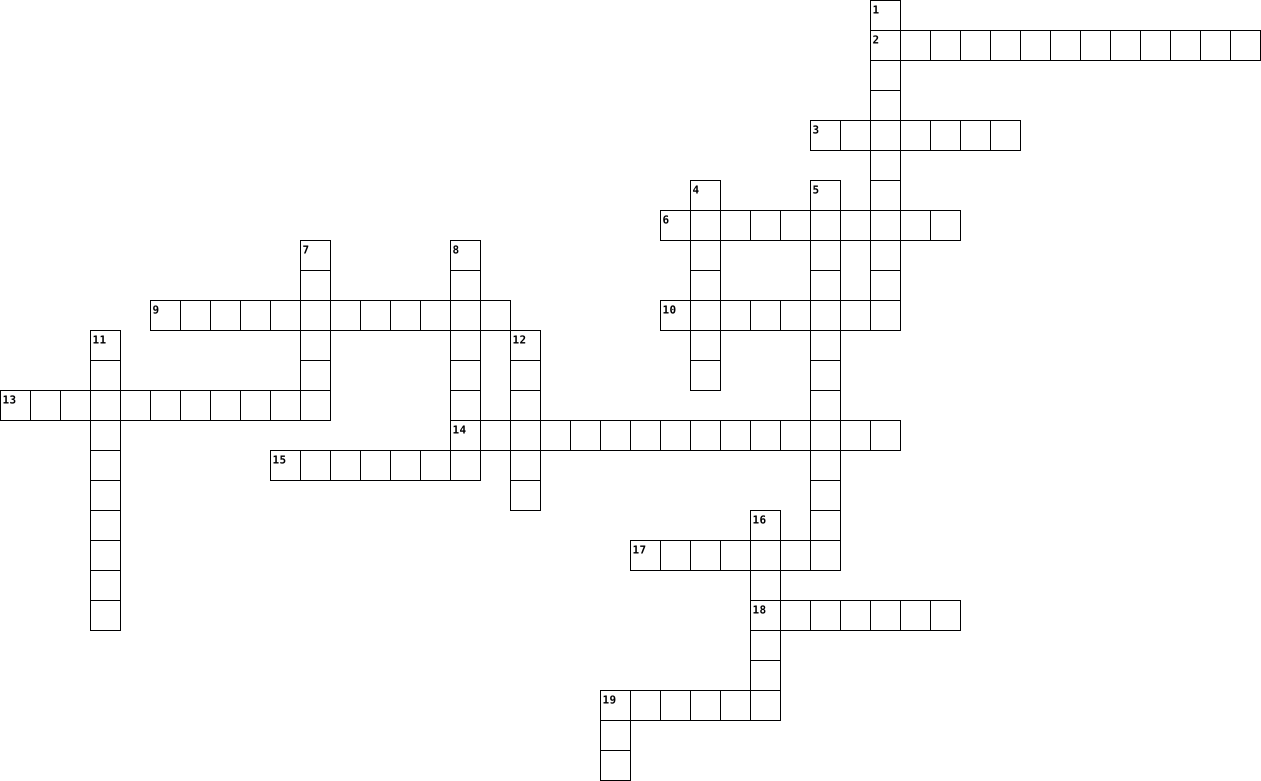
Across
- is a common phenomenon that can be explained classically by the superposition of waves.
- inventor of mirror
- (farsightedness)
- refers to various phenomena that occur when a wave encounters an obstacle or opening.
- smooth, shiny surfaces that reflect light and allows us to see an image, or reflection on their surface.
- The ten lettered property of electromagnetic waves. This length is usually specified in meters (m), centimeters (cm) or millimeters (mm).
- radiation, the fluctuations of electric field and magnetic fields
- has a reflecting surface that is curved outward.
- is a mirror with a curved reflecting surface.
- law, another word for law of refraction that states that the ratio of the angles of incidence and transmission is equal to the ration of the refractive index of the materials at interface.
- an electromagnetic radiation/electromagnetic wave that can be detected by the human eye.
Down
- The separation of visible light into its different colors
- (Nearsightedness)
- (also polarisation) is a property applying to transverse waves that specify the geometrical orientation of the oscillations.
- is a mirror with a flat (planar) reflective surface.
- has a reflecting surface that is curved inward.
- The nine lettered property of electromagnetic waves. the number of occurrences of a repeating event per unit of time
- can be thought of as the rate at which an object covers distance.
- are curved pieces of glass or transparent materials that refracts light.
- of reflection, states that the angle of reflection is equal to the angle of incidence.
20 Clues: (farsightedness) • (Nearsightedness) • inventor of mirror • is a mirror with a curved reflecting surface. • has a reflecting surface that is curved inward. • has a reflecting surface that is curved outward. • is a mirror with a flat (planar) reflective surface. • The separation of visible light into its different colors • ...
physics crossword 2021-05-18

Across
- energy an object has because of its position in a gravity field
- overall effect of a force acting over time
- having a surface that curves inward
- emission of energy as electromagnetic waves
- time taken to give a reaction
- a sloped surface joining two different levels
- energy cannot be created nor destroyed
- the point on a wave with the greatest value upward
- a disturbance that travels through a medium from one place to another
- number of occurrences of a repeating event in a certain time
- wane not capable of transmitting its energy through a vacuum
- waves being deflected in passing obliquely through one medium to another
- a ray that represents light reflected by a surface
- something a wave travels through
- measure of energy transfer that occurs when a object is moved a distance
- waves created as a result of vibrations between electric and magnetic fields
- a vector field that describes magnetic influence of moving electric charges
- the path of a thrown object
- the amount of energy transferred over time
- a system which does not allow the transfer of matter in or out
- energy not in motion
- the rate of change of position to a frame of reference
- measure of change in a single period
- collision in which there is no net loss in kinetic energy
- the resistance of any object to any change in velocity
- strength or energy exerted
- collision where there is loss in kinetic energy
- an object allowing the flow of an electric charge
- a collection of focus points made of converging rays
- subatomic particle that orbits the nucleus of an atom
- total amount of movement
- distance from a starting point
- the distance from the center of a lens to the focus
- abrupt change in direction of a wave that strikes the boundary between mediums
- the rate which something moves
- collection of focus points made by extensions of rays
Down
- the speed at which an object is launched
- force that acts on a body in a circular path and directed toward the center
- when something is dropped and is only affected by gravity
- momentum is neither created nor destroyed
- si unit of frequency
- energy that is in motion
- open plane curve
- a wave which the oscillations are perpendicular to the direction of the wave
- characteristic of matter that expresses how many protons or electrons it has
- waves in which displacement of the medium is the same direction as the wave
- having a surface that curves outward
- the angle between the reflected ray and the normal ray
- an object which has been thrown in a direction
- the magnitude of electrostatic force of attraction between two points is proportional to the product
- a specific location or timing of a point in a wave
- the force needed to stretch or press a spring
- in the nucleus of an atom without a charge
- one object striking another
- reflective surface
- the place an object is at a certain time
- lowest point on a wave
- a single disturbance that moves through a medium
- when an object changes position over time
- the electric force per unit charge
- a measure of force that can cause an object to rotate an axis
- energy possessed by an object due to motion
- the angle between the incident ray and the normal ray
- a ray that is incident at 90 degrees to a surface
- the distance between identical points on a wave
- ray of light falling on the surface separating two mediums
- when a object charges without touching it to another object
- how quickly something speeds up in a certain time
- does not allow the flow of an electric charge
- point where light rays originating from a point on an object converge
- force that resists the movement of an object
- a system which cannot exchange energy or matter in or out
- in the nucleus of an atom has a positive charge
73 Clues: open plane curve • reflective surface • si unit of frequency • energy not in motion • lowest point on a wave • energy that is in motion • total amount of movement • strength or energy exerted • one object striking another • the path of a thrown object • time taken to give a reaction • distance from a starting point • the rate which something moves • something a wave travels through • ...
Physics Terms 2021-05-24

Across
- the standard unit of measure for force
- A quantity with magnitude but not direction
- the force of attraction that moves or tends to move bodies towards the center of a celestial body, such as the earth or moon
- the standard unit of measure for pressure
- the number of times that a periodic function or vibration repeats itself in a specified time, often 1 second. It is usually measured in hertz
- a measure of the rate of motion of a body expressed as the rate of change of its position in a particular direction with time. It is measured in meters per second, miles per hour, etc
- a unit for comparing two currents, voltages, or power levels
- The mass divided by the volume of an object
- the product of a body's mass and its velocity
- the rate of increase of speed or change in velocity
- the tendency of a body to preserve its state of rest or uniform motion unless acted upon by an external force
- a quantity that has both a magnitude and a direction
- The amount of matter in an object
- the force over a given area
Down
- A physical property of materials which return to their original shape after they are deformed
- the distance, measured in the direction of propagation, between two points of the same phase in consecutive cycles of a wave
- a form of energy, which makes a body hot or cold
- the maximum displacement of any particle from its equilibrium position
- a resistance encountered when one body moves relative to another body with which it is in contact
- a force that tends to produce an elongation of a body or structure
- the standard unit of measure for energy and work
- When two or more forces are balanced
- a dynamic influence that changes a body from a state of rest to one of motion or changes its rate of motion
- the force per unit cross-sectional area when equal opposing forces act on a body
24 Clues: the force over a given area • The amount of matter in an object • When two or more forces are balanced • the standard unit of measure for force • the standard unit of measure for pressure • A quantity with magnitude but not direction • The mass divided by the volume of an object • the product of a body's mass and its velocity • ...
Physics Crossword 2021-10-25

Across
- It is a straight line perpendicular to the refracted surface
- Meter, The unit of moment of a force
- An upward force exerted by a fluid
- It denoted shrillness or flatness of a sound
- Splitting of light into various components
- Image, Image which can be obtained on a screen
- The Device used for measuring atmospheric pressure
- Rate at which work is done or transmitted
- It occurs when the partial pressure of vapour is lesser than the equilibrium vapour pressure
- Materials which absorb the sound vibrations falling on them and prevent echoes
- The capacity to do work
- Mass per unit volume
- The point at which the principal axis touches the mirror surface
Down
- Objects which produce lights of their own
- It is rapid process
- expansion, Increase in length due to thermal expansion
- It is a device based on principle of floatation to read the relative density of the liquid
- It is formed due to refraction of sunlight by water droplets in the atmosphere
- It refers to a sound which has single frequency and does not vary
- Force per unit area
- An activity involving a force and movement in the direction of force
- Dryer, A device which uses hot air to dry vegetables and grains
- , The hot and glowing state of matter
- SI unit of frequency
24 Clues: It is rapid process • Force per unit area • SI unit of frequency • Mass per unit volume • The capacity to do work • An upward force exerted by a fluid • Meter, The unit of moment of a force • , The hot and glowing state of matter • Objects which produce lights of their own • Rate at which work is done or transmitted • Splitting of light into various components • ...
Physics Vocab 2021-10-14

Across
- what do you do to find force given mass and acceleration?
- force is ____ proportional to acceleration
- push or pull
- unit for mass
- unit for time
- when force increases the acceleration will...
- A general statement about the relationship of natural quantities that has been tested over and over again and has not been proven wrong.
- property of a body to resist change to its state of motion
- unit for force
- change in velocity per unit time
Down
- unit for acceleration is meters per second...
- meters per second is the unit for...
- is about the nature of basic things such as motion, force, energy, matter, heat, sound, light, and the composition of atoms.
- mass is ____ proportional to acceleration
- when mass increases the acceleration will...
- the quantity of matter or a measure of inertia
- law of motion that is also called the law of inertia
- magnitude with no direction
- what do you do to find acceleration given force and mass?
- magnitude and direction
20 Clues: push or pull • unit for mass • unit for time • unit for force • magnitude and direction • magnitude with no direction • change in velocity per unit time • meters per second is the unit for... • mass is ____ proportional to acceleration • force is ____ proportional to acceleration • when mass increases the acceleration will... • unit for acceleration is meters per second... • ...
Physics crosss 2021-11-01

Across
- the result of two waves interfering with one another
- common way for electrical systems to store energy
- any form of matter
- an optical illusion caused by the refraction of light
- small device used in electric circuits to provide resistance
- this only can occur only when light is trying to enter a material with a lower index of refraction
- wave oscillate parallel to the direction of propagation
- measures the amount of disorder in a system
- it relates the strength of the electrostatic force between point charges to the magnitude of the charges and the distance between them.
- electrically charged objects set up a force field around them.
- unit of electric potensial
- lowest point on wave
Down
- formed when electric charge flows from one place to another
- the maximum displacement from equilibrium
- change in direction due to a change in speed
- amount of sound energy passing through a given area in given time
- vector force field that surrounds any magnetic material
- device for measuring resistance
- a filter that transmits light waves with only one direction of polarization
- wave oscillate at right angle to the direction the wave travels
20 Clues: any form of matter • lowest point on wave • unit of electric potensial • device for measuring resistance • the maximum displacement from equilibrium • measures the amount of disorder in a system • change in direction due to a change in speed • common way for electrical systems to store energy • the result of two waves interfering with one another • ...
Physics Review 2021-11-19

Across
- losing a
- breakable
- forcesfluid places on a moving object in the opposite direction
- ratio of the drag on a body moving through air
- speed up F/M
- velocity in time
- number specific to amount of fric
- law of inertia
- opposing force
- diagrams representing movement
- problem looking for weight M(9.8)
- strait line
Down
- acceleration happens when force acts on a mass
- not moving relative to each other
- 1/2 gravity x the square of the time falling
- velocity going up
- risistance by rolling
- strait diagnonal up
- strength or energy, movement m(a)
- opposing forces are balanced
- diagonal up
- Fs = -kx
- pressed or pulled but returns to former shape
- F=\mu A {\frac {u}{y}}
- a force that acts between moving surfaces.
- m(g)
- positin going up
- -b + √(b² - 4ac)]/2a,
- contant max speed object meets
- picure
- a tendency to do nothing or to not change
- strechy
- the law of action and reaction.
33 Clues: m(g) • picure • strechy • losing a • Fs = -kx • breakable • diagonal up • strait line • speed up F/M • law of inertia • opposing force • velocity in time • positin going up • velocity going up • strait diagnonal up • risistance by rolling • -b + √(b² - 4ac)]/2a, • F=\mu A {\frac {u}{y}} • opposing forces are balanced • contant max speed object meets • diagrams representing movement • ...
Physics 8 2022-04-05

Across
- Fizikāls lielums, kas raksturo ķermeņu mijiedarbību
- Mehāniskas svārstības, kuru frekvence zemāka par 16 Hz
- Svārstības, kuras iespējams dzirdēt
- Metode objekta atrašanās vietas noteikšanai ar ultraskaņas palīdzību
- Muzikālā toņa svārstību sastāvu raksturo
- Dažāda augstuma un skaļuma skaņu kopums
- Pētījuma metode, ar kuras palīdzību pierāda cēloņsakarības starp parādībām, piemēram, pārbauda hipotēzes patiesumu vai nepatiesumu
- Vienas tilpuma vienības masa
- Veiktais ceļš laika vienībā
Down
- Maksimālā svārstībā esošas daļiņas novirze no līdzsvara stāvokļa
- Mehāniskas svārstības, kuru frekvence augstāka par 20 kHz
- Spēks, kas darbojas uz ķermeni šķidrumā vai gāzē
- Dabaszinātne, kas pēta dabas vispārīgās likumsakarības, īpašības, kustības un mijiedarbības likumus
- Fizikāls lielums, kas raksturo vielas daudzumu ķermenī un tā inerci
- Skaņas atstarošanās vienā noteiktā virzienā
- Svārstību skaits vienā sekundē
- Ķermeņa iesvārstīšana svārstību rezultātā, kuru frekvence ir tuva ķermeņa pašsvārstību frekvencei
- Ātruma izmaiņa laika vienībā
- Kustības trajektorijas garums
- Fizikāls lielums, kas raksturo norises ilgumu
- Spēks uz laukuma vienību
21 Clues: Spēks uz laukuma vienību • Veiktais ceļš laika vienībā • Ātruma izmaiņa laika vienībā • Vienas tilpuma vienības masa • Kustības trajektorijas garums • Svārstību skaits vienā sekundē • Svārstības, kuras iespējams dzirdēt • Dažāda augstuma un skaļuma skaņu kopums • Muzikālā toņa svārstību sastāvu raksturo • Skaņas atstarošanās vienā noteiktā virzienā • ...
Crossword Physics 2022-03-23

Across
- A frequent or regular female companion in a romantic or sexual relationship.
- Any of various devices for producing light or sometimes heat
- Substance composed of the chemical elements hydrogen and oxygen and existing in gaseous, liquid, and solid states.
- Basic state of matter.
- Alteration in shape or size of a body under the influence of mechanical forces.
- Theory in biology postulating that the various types of plants, animals, and other living things on Earth have their origin in other preexisting types and that the distinguishable differences are due to modifications in successive generations.
- Change of a solid into a liquid when heat is applied.
- Ability of a deformed material body to return to its original shape and size when the forces causing the deformation are removed.
- One of the three principal states of matter, intermediate between gas and crystalline solid.
- A covering for the foot, typically made of leather, having a sturdy sole and not reaching above the ankle.
- The one that discover the law of elasticity
- In physical sciences and engineering, number that describes relative deformation or change in shape and size of elastic, plastic, and fluid materials under applied forces.
Down
- The branch of mathematics concerned with the shape of individual objects, spatial relationships among various objects, and the properties of surrounding space.
- Measure of hotness or coldness expressed in terms of any of several arbitrary scales and indicating the direction in which heat energy will spontaneously flow
- One of the three fundamental states of matter, with distinctly different properties from the liquid and solid states.
- Any of a class of substances characterized by high electrical and thermal conductivity as well as by malleability, ductility, and high reflectivity of light.
- The perpendicular force per unit area, or the stress at a point within a confined fluid.
- The principal strengthening and nutrient-conducting tissue of trees and other plants and one of the most abundant and versatile natural materials.
- In mechanics, distance moved by a particle or body in a specific direction.
- Region in which each point has a physical quantity associated with it.
- Electromagnetic radiation that can be detected by the human eye.
- An ornament for the ear and especially the earlobe.
- Tool that astronomers use to see faraway objects.
- Maximum stress or force per unit area within a solid material that can arise before the onset of permanent deformation.
24 Clues: Basic state of matter. • The one that discover the law of elasticity • Tool that astronomers use to see faraway objects. • An ornament for the ear and especially the earlobe. • Change of a solid into a liquid when heat is applied. • Any of various devices for producing light or sometimes heat • Electromagnetic radiation that can be detected by the human eye. • ...
PHYSICS 10 2022-07-21

Across
- the study of the movement of objects
- mass x velocity
- an increase in size by tension force
- an upwards force caused by the fluid pressure
- the slope of a line or surface
- object thrown or fired through air
- a means for transfering energy via oscillations
- the rate of change of distance
- the rate of change of velocity
- mass per unit volume
- containing or using only one colour
Down
- a change in wave speed when the wave move
- any substance that can flow
- the number of complete wave cycles per seconds
- the energy by position
- quantity that must have magnitude and direction
- the energy by motion
- waves reflect back into the same medium
- waves which must have the same frequency/phase
- regions on a stationary waves where amplitude zero
- the rate of change of displacement
- the rate of energy transfer
- a fluid moves with uniform lines
- a force acting within a material/extend materials
24 Clues: mass x velocity • the energy by motion • mass per unit volume • the energy by position • any substance that can flow • the rate of energy transfer • the slope of a line or surface • the rate of change of distance • the rate of change of velocity • a fluid moves with uniform lines • object thrown or fired through air • the rate of change of displacement • ...
Physics Crossword 2022-06-02

Across
- energy of motion/movement
- potential energy based on the height of an object
- force times distance
- movement energy
- using force to move masses
- rate of change in velocity over a period of time
- rate of motion
- force that obstructs motion between two objects
- total amount of force
- equal forces, do not cause change in motion
- unit of measurement for force
- ability to do work
- distance over time plus direction
- force = mass times acceleration
- energy of radiation
- lowet point of a transverse wave
- x-axis of graphs
Down
- inertia
- transfer of kinetic energy from one object to another
- speed that does not change
- energy is not created or destroyed, only changed
- energy stored in the nucleus of an atom
- will cause a change in motion [1st law]
- unit of measurement for energy
- change in the identity of a substance
- energy of heat
- mass times gravity times height
- highest point of a transverse wave
- rate of work being done
- energy energy that is stored
- energy stored in chemical bonds of molecules
- ½ times mass times velocity squared
- final velocity minus initial velocity, divided by time
- work divided by time
- range of radiant energy
- reactants ______ products in a chemical equation
- energy in electricity
- distance over time
- the basic unit of matter
- unit of measurement for power
- energy stored due to being stretched or compressed
41 Clues: inertia • energy of heat • rate of motion • movement energy • x-axis of graphs • ability to do work • distance over time • energy of radiation • force times distance • work divided by time • total amount of force • energy in electricity • rate of work being done • range of radiant energy • the basic unit of matter • energy of motion/movement • speed that does not change • using force to move masses • ...
Physics Vocab 2022-06-21

Across
- впитывать
- гравитация
- кипеть
- конденсироваться
- расширять(ся)
- освобождать(ся)
- таять
- отталкивать, отгонять
- магнит
- пронизывать, протыкать
- испарять(ся)
Down
- взрываться, лопаться
- сталкиваться
- активировать
- отражать(ся)
- растворять(ся)
- привлекать
- разбавлять
- твердый, плотный
- вращать(ся)
- взрываться
21 Clues: таять • кипеть • магнит • впитывать • гравитация • привлекать • разбавлять • взрываться • вращать(ся) • сталкиваться • активировать • отражать(ся) • испарять(ся) • расширять(ся) • растворять(ся) • освобождать(ся) • конденсироваться • твердый, плотный • взрываться, лопаться • отталкивать, отгонять • пронизывать, протыкать
Physics Crossword 2022-05-26

Across
- The law of F=-kx
- a quantity without direction
- The gravitational force
- The energy obtained by position
- The force resisting relative motion
- Energy of electromagnetic radiation
- the electric potential difference
- The amount of matter in an object
- The length of which traveled.
- The rate of change in velocity
- Contact force perpendicular to the surface
- mass per volume
- The energy obtained by motion
- quantity of inertia
- The change in position
- The time of one cycle of a wave
Down
- A push or pull
- The rate of change in position
- opposition to current flow
- Sum of potential and kinetic energy
- a quantity with direction
- The type of energy due to chemical bonds.
- The maximum change within a period
- The energy of gravitational fields
- net rate of flow of electric particles
- the absolute value regardless of a direction
- the amount of space an object takes up
- Transfer of hear through waves
- The rotational force
- mass times velocity
- The number of waves per second
- Physicist famous for his 3 laws
- Energy of movement of charged particles
- The change in kinetic energy
- Energy generated by heat
- Transfer of heat of fluid movement
- The type of energy in the nucleus
- Transfer of heat through contact
- The rate something is moving.
- the change of momentum
40 Clues: A push or pull • mass per volume • The law of F=-kx • mass times velocity • quantity of inertia • The rotational force • The change in position • the change of momentum • The gravitational force • Energy generated by heat • a quantity with direction • opposition to current flow • a quantity without direction • The change in kinetic energy • The length of which traveled. • ...
Physics Terms 2022-09-02

Across
- Unit of heat, now largely replaced by the joule for scientific purposes
- Property of a system enabling it to store electric charge
- Electronic device used to increase the strength of the signal fed into it
- Warm air rises, cools and forms clouds, with compensatory downward movements of cooler air
- Unit of length equal to 10-10 meter, used principally to express wavelengths of electromagnetic radiations
- Flow of electric charge through a conductor
- Substance, body, or system that conducts electricity, heat, energy etc
- Basic ai unit of electric current
- Continuous electric current flowing in one direction only, without substantial variation in magnitude
Down
- Derived SI unit of radioactivity equal to one disintegration per second
- A resistance encountered when one body moves relative to another body with which it is in contact
- Principle that the pressure of a gas varies inversely with its volume at constant temperature
- Negatively charged ion, attracted to the anode during electrolysis
- Derived SI unit of electric charge
- Form of matter composed of antiparticles, consisting of antiprotons and positrons
- Derived SI unit of electric capacitance
- Any phenomenon associated with stationary or moving electrons, ions, or other charged particles
- A source of nuclear energy, comprises all matter
- Any of a class of elementary particles having a mass greater than or equal to that of a proton, participate in strong interactions
- Connection between an electrical circuit or device and the earth, which is at zero potential
20 Clues: Basic ai unit of electric current • Derived SI unit of electric charge • Derived SI unit of electric capacitance • Flow of electric charge through a conductor • A source of nuclear energy, comprises all matter • Property of a system enabling it to store electric charge • Negatively charged ion, attracted to the anode during electrolysis • ...
Physics Crossword 2022-08-30

Across
- the point through which the resultant of the gravitational forces on a body always acts
- this entity as a source of nuclear energy
- the property of a system that enables it to store electric charge
- a negatively charged ion; an ion that is attracted to the anode during electrolysis
- a unit of heat, equal to 4.1868 joules
- the derived SI unit of radioactivity equal to one disintegration per second
- a unit for comparing two currents, voltages, or power levels, equal to one tenth of a bel
- random movement of microscopic particles suspended in a fluid, caused by bombardment of the particles by molecules of the fluid.
- a fictitious force that can be thought of as acting outwards on any body that rotates or moves along a curved path
- energy that heat generates
Down
- a form of matter composed of antiparticles, such as antihydrogen
- measurement of magnitude
- the principle that the pressure of a gas varies inversely with its volume at constant temperature
- a unit of length equal to 10–10 metre, used principally to express the wavelengths of electromagnetic radiations. It is equivalent to 0.1 nanometre
- a substance, body, or system that conducts electricity, heat, etc
- a continuous electric current that periodically reverses direction, usually sinusoidally
- an electronic device used to increase the strength of the signal fed into it
- any of a class of elementary particles that have a mass greater than or equal to that of the proton, participate in strong interactions, and have a spin of . either nucleons or hyperons.
- unit used to measure electrical
- a flow of electric charge through a conductor
20 Clues: measurement of magnitude • energy that heat generates • unit used to measure electrical • a unit of heat, equal to 4.1868 joules • this entity as a source of nuclear energy • a flow of electric charge through a conductor • a form of matter composed of antiparticles, such as antihydrogen • the property of a system that enables it to store electric charge • ...
Physics Terms 2022-08-31

Across
- Energy transfer measurement when an object moves
- The change in an object's position
- The push or pull measurement of an object
- How mass in motion is measured
- When two objects collide
- Measurement of medium and direction of movement of magnitude
- Attraction force between objects, bodies, and masses in the universe
- Rate and direction of motion measurement
- Unit used to measure electrical energy
- Motion resistance from object's rubbing against each other
- Measurement of magnitude
- Change in momentum
Down
- A body's tendency to resist motion
- Measurement of mass of an object
- How fast something is moving
- How change in velocity is measured
- An electronic device used to increase the strength of the signal fed into it
- Potential energy of an object in a higher position to the ground on earth
- Type of energy that comes from electrical charge
- Type of energy heat generates
20 Clues: Change in momentum • When two objects collide • Measurement of magnitude • How fast something is moving • Type of energy heat generates • How mass in motion is measured • Measurement of mass of an object • A body's tendency to resist motion • The change in an object's position • How change in velocity is measured • Unit used to measure electrical energy • ...
Physics Terms 2022-08-31

Across
- the push or pull measurement of an object
- attraction force between objects, bodies, and masses in the universe
- region of space that doesn’t allow anything, including light, to escape because of its powerful gravitational pull
- The principal unit of energy
- The ability to accomplish work
- The visible frequency on the electromagnetic spectrum
- an electromagnetic wave of high energy and short wavelength, able to pass through many materials opaque to light
- energy, thant an object possesses by virtue of it's motion
- Energy of an object due to its position
Down
- Internal Thermal energy that flows from one body of matter to another
- rate and direction of motion measurement
- rate or measurement at which work is done
- measurement of mass of an object
- energy transfer measurement when an object moves
- zero theoretical lowest temperature
- measurement describing the randomness of a system
- how mass in motion is measured
- how force is measured
- motion resistance from objects rubbing against each other
- Electromagnetic radiation of any wavelength, whether visible or not
20 Clues: how force is measured • The principal unit of energy • The ability to accomplish work • how mass in motion is measured • measurement of mass of an object • zero theoretical lowest temperature • Energy of an object due to its position • rate and direction of motion measurement • the push or pull measurement of an object • rate or measurement at which work is done • ...
Physics P1 2022-01-31

Across
- positively charged particle with a mass of 1
- negatively charged particle with negligible mass
- when energy is transferred by electric currents
- when energy is transferred by faster particles colliding with slower particles, changing the temperature
- particle with a mass of 1 and no charge
- when energy is transferred by waves
- energy stored within a system due to its height
- state in which particles are far apart and move independently of each other
- when current always flows the same way
- the difference in electric potential energy between two points in a circuit
- energy stored within the chemicals of a system
- energy in a system due to it moving
Down
- energy within a system due to it being deformed
- energy within a system due to it being hot
- when current keeps changing direction
- when energy is transferred by forces
- the rate at which charged particles move in a circuit
- the rate at which energy is transferred
- nuclear radiation that is an electron
- state in which particles are closely packed in a repeating arrangement
- nuclear radiation made of 2 protons and 2 neutrons
- how close together particles are in a material.
- how much a component can slow down the flow of charged particles
- nuclear radiation that is an electromagnetic wave
- state in which particles are closely packed but in a random arrangement
25 Clues: when energy is transferred by waves • energy in a system due to it moving • when energy is transferred by forces • when current keeps changing direction • nuclear radiation that is an electron • when current always flows the same way • the rate at which energy is transferred • particle with a mass of 1 and no charge • energy within a system due to it being hot • ...
physics vocab 2022-02-01

Across
- gas particles moving inside the walls of a balloon
- K1+U1=K2+U2
- a ball hitting another ball on a billiard table
- a property of matter by which it continues in its existing state of rest or uniform motion in a straight line, unless that state is changed by an external force.
- everything stays in range
- a car driving 55 mph
- law of action and reaction
- U=mgh
- contact force
- large mass/high velocity. small mass/high velocity
- law of inertia
- K.E.= 1/2m v^2
- power*time
- a system that cannot exchange either energy or matter outside the boundaries of the system
Down
- a system that is completely isolated from its environment
- U+K
- a ball dropping and cannot rebound to its original height
- quatative description of the changes that a force can produce on the motion of a body
- work=newtons*meters
- P=W/\Delta t
- a ball bouncing back after being dropped
- the energy transferred to or from an object via the application of force along a displacement
- F=m*a
- (W)
- a table, a dog, a tree, anything
- a system that has flows of information, energy, and/or matter between the system and its environment
26 Clues: U+K • (W) • U=mgh • F=m*a • power*time • K1+U1=K2+U2 • P=W/\Delta t • contact force • law of inertia • K.E.= 1/2m v^2 • work=newtons*meters • a car driving 55 mph • everything stays in range • law of action and reaction • a table, a dog, a tree, anything • a ball bouncing back after being dropped • a ball hitting another ball on a billiard table • gas particles moving inside the walls of a balloon • ...
Physics Crossword 2022-10-05

Across
- When one force is greater than another the forces are not balanced.
- The universal of attraction acting between all matter.
- An arrangement of electrical components such that a current flows along two or more paths.
- You may have left some of the products unmeasured.
- The circular movement of an object around a central axis.
- To put forth the force is exerted sideways.
- No two particles in an atom or molecules can have the same set of quantum numbers.
- A direction or plane passing by a given point and is said to be vertical if it contains the local gravity direction.
- The resistance that one surface or object encounters when moving over another.
- A projectile motion in a horizontal plane.
- Has no acceleration and can either go up or deceleration.
- A number or quantity that when multiplied with another produces a given number or expression.
- Imply a representation of an object or seen by colors or lines.
- To distinct lines intersecting each other at 90 degrees.
- A contact force.
Down
- Used with a number as a measure of wind strength on the Beaufort scale.
- Two forces act upon each other in opposite. directions most concerned with horizontal motion.
- A graphical illustration used to visualize the applied forces.
- The vector sum of all the forces that act upon an object.
- A measure of the opposition to current flow in an electrical circuit.
- A tilted surface.
- The rate of Change of velocity for unit of time.
- A tendency to do nothing or remain unchanged.
- A quantity or phenomenon that has two independent properties or magnitude and direction.
- The pulling force transmitted actually by the means of a string or cable or chain or a similar object.
- Quantitative measure inertia, a fundamental property of all matter.
- The perpendicular distance from the fulcrum of the lever to the line of action.
- As the force of gravity on the object.
- A measure of the force that can cause an object to rotate about an axis.
29 Clues: A contact force. • A tilted surface. • As the force of gravity on the object. • A projectile motion in a horizontal plane. • To put forth the force is exerted sideways. • A tendency to do nothing or remain unchanged. • The rate of Change of velocity for unit of time. • You may have left some of the products unmeasured. • ...
physics crossword 2022-11-24

Across
- the rate at which is done or happens
- Newtons 3rd law of motion/cause and effect
- when something is always going at the same speed
- unit of measurement
- a force that has the same amount of force from all sides of the person or object
- when something happens in the past future or present
- formula for time
- the rate at which velocity changes over time
- newtons 2nd law of motion which tells you how much force there is in an object
- push or pull
Down
- formula of speed
- how far something is/the space between objects
- a branch of science that talks about motion, matter, mass, energy, etc.
- when an object does NOT have the same force and all sides
- the tendency of an object to resist a change in motion
- a machine that is in a straight and slanted surface (a ramp)
- the speed of something in a specific direction
- on object when its not moving
- the movement of an objects
- the unit of measurement for force
20 Clues: push or pull • formula of speed • formula for time • unit of measurement • the movement of an objects • on object when its not moving • the unit of measurement for force • the rate at which is done or happens • Newtons 3rd law of motion/cause and effect • the rate at which velocity changes over time • how far something is/the space between objects • ...
Physics Club 2022-11-30

Across
- Alat ukur suhu
- Energi listrik diubah menjadi gerak
- Planet tempat kita tinggal
- yang menemukan Hukum Newton
- Satuan dari waktu
- Muatan Atom yang Negatif
- Energi panas
- Transfer energi melalui gaya
- Benda yang menghantarkan panas yang kurang baik
- Bagian benda yang tidak bisa dibagi-bagi lagi
Down
- Alat ukur waktu
- Alat bantu untuk melihat
- Energi listrik diubah menjadi cahaya
- Salah satu skala suhu
- Muatan Atom yang Positif
- Alat Ukur Panjang
- Benda yang dapat menarik benda lain
- Satuan dari energi
- Benda yang dapat menghantarkan panas yang baik
- Besaran yang Menggunakan Alat Ukur Neraca
20 Clues: Energi panas • Alat ukur suhu • Alat ukur waktu • Alat Ukur Panjang • Satuan dari energi • Satuan dari waktu • Salah satu skala suhu • Alat bantu untuk melihat • Muatan Atom yang Positif • Muatan Atom yang Negatif • Planet tempat kita tinggal • yang menemukan Hukum Newton • Transfer energi melalui gaya • Benda yang dapat menarik benda lain • Energi listrik diubah menjadi gerak • ...
physics/Easter 2021-03-31

Across
- what time Easter is
- used to color eggs
- SI unit for speed
- a hen makes these
- measure of distance over time
- formula for acceleration
- change in
- a hens baby
- measure how far an object has traveled
- we decorate eggs to make them...
- visual representation of data
- change in position
Down
- name of the bunny in loony tunes
- change in velocity
- study of motion and energy
- SI unit of distance
- formula for speed
- vertical line on a graph
- slowing down
- horizontal line on a graph
- looking for eggs
- SI unit for acceleration
22 Clues: change in • a hens baby • slowing down • looking for eggs • SI unit for speed • a hen makes these • formula for speed • change in velocity • used to color eggs • change in position • what time Easter is • SI unit of distance • vertical line on a graph • formula for acceleration • SI unit for acceleration • study of motion and energy • horizontal line on a graph • measure of distance over time • ...
Chemistry & Physics 2021-06-22

Across
- The 'H' in pH.
- Strongest penetration level.
- Element group that reacts well with alkali metals.
- Neutral pH number.
- A popular style for electron configuration.
- A bunch of atoms bonded together.
- The process of dividing elements.
- Unstable atoms.
- A result of oxidation.
- An element with the symbol of Ca.
- The scale electronegativity is measured with.
- Strongest element.
- The last part of a chemical equation.
Down
- Energy with radioactive waste.
- Opposite of acidic.
- Most dangerous element.
- The process of combining elements.
- A bond in which electrons are shared.
- The element we breathe.
- The first part of a chemical equation.
- Weakest element.
- Weakest penetration level.
- A negatively charged atom.
- A neutral subatomic particle found in the nucleus.
- A bond in which electrons are transferred.
25 Clues: The 'H' in pH. • Unstable atoms. • Weakest element. • Neutral pH number. • Strongest element. • Opposite of acidic. • A result of oxidation. • Most dangerous element. • The element we breathe. • Weakest penetration level. • A negatively charged atom. • Strongest penetration level. • Energy with radioactive waste. • A bunch of atoms bonded together. • The process of dividing elements. • ...
Physics Crossword 2021-04-27

Across
- increased kVp has an effect on your image __
- type of scatter radiation that has the same wavelength as the incident photon
- when an electron drops from one shell to another to stabilize an atom is called characteristic __
- Differential absorption vs atomic # have a ___ relationship
- interaction of slowing electrons at the target
- how the quality of the beam is measured
- Man's best friend
- the x-ray from the tube to the patient is called __ radiation
- electrons travel from ___ to anode
- a change in ___ with shift the x axis of the graph along with an increase in quantity
- photons that do not interact with the subject
- the distance from one crest to another
- interaction of outer shell electron
- considered as seconday radiation
- an increase in ___ will change the emission spectrum to higher average energy with decrease in quantity
- filter most often used in radiology
Down
- attenuation and ___ in tissue that results in the image formation on the IR
- the process of keeping the electrons together is achieved through the use of the ____ cup.
- the number of wavelengths that pass a point per time
- increase in filtration will effect
- how is mAs and quantity related
- has a discrete graph
- the production of electrons at the filament is called ____ emissions
- image brightness is a function of ____ function
- which factor effects the quantity and quality of the beam
- quantity of the beam is referred to as
- the type of graph that shows the heterogeneous beam
- the type of emissions graph that has exact values
- reduction in the intensity of the x-ray beam
- the movement of electrons is called ___ energy
- where the electrons are converted to heat and photons
- what is considered a negative contrast
- x-rays that pass through the patient and interact with the IR
- effects the quantity of the beam
34 Clues: Man's best friend • has a discrete graph • how is mAs and quantity related • considered as seconday radiation • effects the quantity of the beam • increase in filtration will effect • electrons travel from ___ to anode • interaction of outer shell electron • filter most often used in radiology • quantity of the beam is referred to as • what is considered a negative contrast • ...
Physics Crossword 2021-05-10

Across
- The faster you go the more of this you have.
- Every action has an equal and opposite reaction.
- Slows you down so you can stop.
- A quantity that has both size and direction.
- Cant change the motion of an object.
- The basis of physics.
- Push or pull on an object.
- The sum of all forces.
- The object is moving in a straight line.
Down
- The resistance of an object.
- An object that is being pushed or pulled by a force either stays still or keeps moving.
- How fast they are moving at one time.
- Will always be a positive value.
- Can change the motion of an object.
- When the speed stays the same.
- The lighter the object the greater the motion.
- Change in position.
- Any change in velocity.
- Describing where a point on a graph is.
- Force of attraction between things.
20 Clues: Change in position. • The basis of physics. • The sum of all forces. • Any change in velocity. • Push or pull on an object. • The resistance of an object. • When the speed stays the same. • Slows you down so you can stop. • Will always be a positive value. • Can change the motion of an object. • Force of attraction between things. • Cant change the motion of an object. • ...
Conceptual Physics 2023-12-15

Across
- SumOfForces
- ForceTimesTime
- MagnitudeDirection
- AristotlesView
- bouncy
- Einstein
- combinedForces
- NewtonsFirstName
- ChangeInVelocity
- EqualAndOpposite
- EarthsAttraction
Down
- CopernicanView
- KgM/S^2
- ASquaredPlusBSquaredIsCSquared
- crumple
- MassTimesVelocity
- jump
- QuantityofMatter
- ChangeInPosition
- MaximumFallingSpeed
- MeasuredInNewtons
- PropertyOfAllMatter
22 Clues: jump • bouncy • KgM/S^2 • crumple • Einstein • SumOfForces • CopernicanView • ForceTimesTime • AristotlesView • combinedForces • QuantityofMatter • ChangeInPosition • NewtonsFirstName • ChangeInVelocity • EqualAndOpposite • EarthsAttraction • MassTimesVelocity • MeasuredInNewtons • MagnitudeDirection • MaximumFallingSpeed • PropertyOfAllMatter • ASquaredPlusBSquaredIsCSquared
physics one 2024-01-16
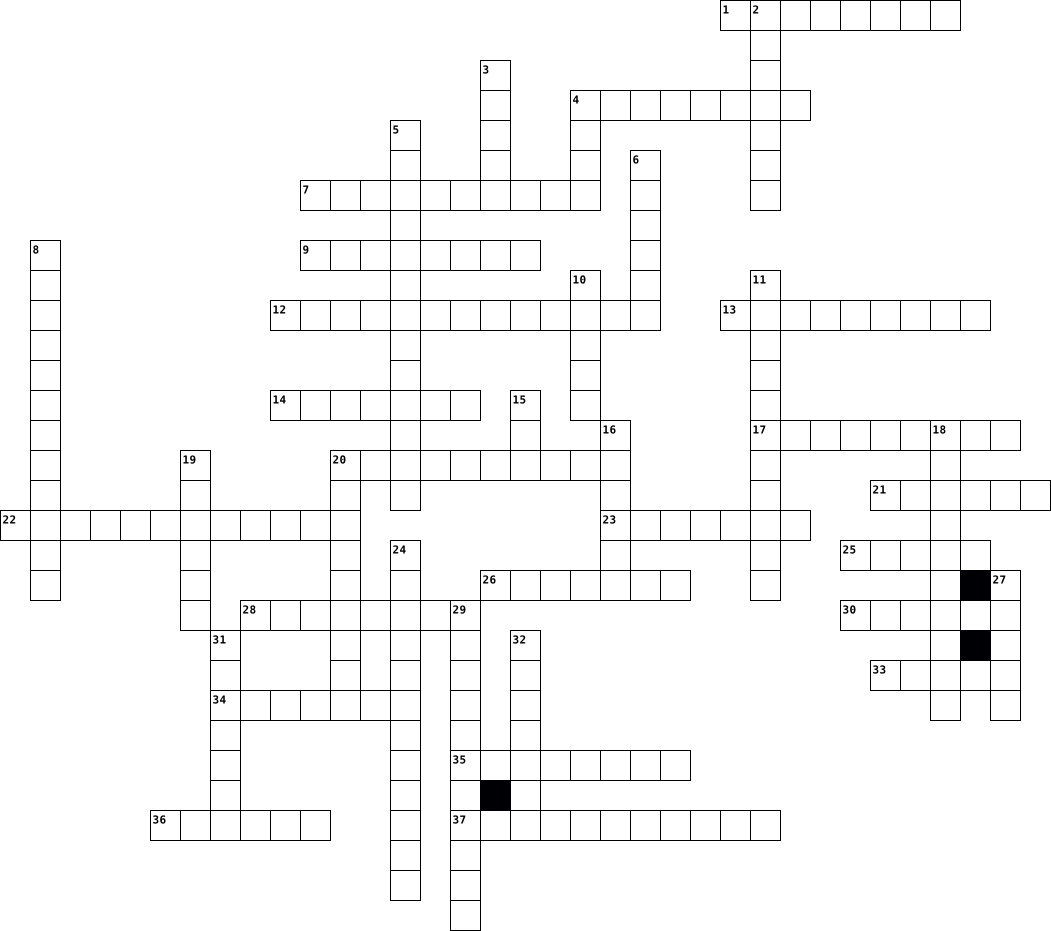
Across
- (kg) Unit of mass.
- Product of an object's mass and velocity.
- The individual vectors, often perpendicular, whose sum is the resultant
- Speed in a given direction.
- Force Force of gravity between two masses.
- Vector Vector obtained by the vector addition of two or more vectors.
- Energy Energy due to motion.
- Collision Collision where kinetic energy is not conserved.
- Motion Motion of an object thrown into the air.
- Quantity with only magnitude.
- Change in position of an object.
- Force of attraction between objects.
- (m) Unit of length.
- Collision Collision conserving kinetic energy.
- Laws of Motion Three laws describing the relationship between motion and force.
- Quantity with both magnitude and direction.
- Push or pull on an object.
- Velocity Rate of rotation.
- Force resisting motion.
- (s) Unit of time.
- Acceleration Acceleration towards the center of circular motion.
Down
- Change in momentum.
- Horizontal distance traveled by a projectile.
- Amount of matter in an object.
- Rough calculation.
- Force Force exerted perpendicular to a surface.
- Rate of change of velocity.
- of Projection Angle at which a projectile is launched.
- Force Force directing an object towards the center of its circular path.
- Force Total force acting on an object.
- Force due to gravity acting on an object.
- Path followed by a projectile.
- Addition Process of combining vectors to find their sum.
- Energy Stored energy based on position.
- of Momentum Total momentum remains constant in a closed system.
- of Magnitude Approximate size or scale of a value.
- Figures Digits in a number that contribute to its precision.
- Energy Energy stored in a compressed or stretched object.
- Force transmitted through a string, rope, or similar object.
39 Clues: (s) Unit of time. • (kg) Unit of mass. • Rough calculation. • Change in momentum. • (m) Unit of length. • Force resisting motion. • Push or pull on an object. • Velocity Rate of rotation. • Rate of change of velocity. • Speed in a given direction. • Energy Energy due to motion. • Quantity with only magnitude. • Amount of matter in an object. • Path followed by a projectile. • ...
Physics crossword. 2024-01-17

Across
- How does a ball roll?
- It's the reason you don't float away.
- How much matter is in an object.
- A quantity that has magnitude and direction.
- The quantity of motion of a moving body, measured as a product of its mass and velocity.
- Your set of judgments of an object.
- The way you measure how fast an object is moving.
- I feel dizzy.
- How fast an object gets up to speed.
- Newton's second law.
- The speed of something in a given direction.
Down
- The way objects move on their own.
- Splash splash.
- The thing that keeps you from sliding around.
- It keeps stuff from moving.
- Newton's first law.
- Newton's 3rd law.
- Skydivers love it.
- Fully described by magnitude.
- The point you look at something from.
- How far away something is from something else.
- This one's pretty heavy.
- An object in ______.
23 Clues: I feel dizzy. • Splash splash. • Newton's 3rd law. • Skydivers love it. • Newton's first law. • An object in ______. • Newton's second law. • How does a ball roll? • This one's pretty heavy. • It keeps stuff from moving. • Fully described by magnitude. • How much matter is in an object. • The way objects move on their own. • Your set of judgments of an object. • ...
physics 4th 2024-01-19

Across
- The product of the component of a force along the direction of displacement and the magnitude of the displacement
- A vector that represents the sum of two or more vectors
- A quantity that measures the ability of a force to rotate an object around some axis
- A description of how close a measurement is to correct or accepted value of the quantity measured
- The tendency of an object to resist being moved
- The mutual force of attraction between particles of matter
- The motion of a body when only the force of gravity is acting on the body
- A quantity as the product of the mass and velocity of an object
- An explanation that is based on prior scientific research or observations and that can be tested
Down
- The energy associated with an object because of the position, shape, or condition of the object
- The energy of an object that is due to the object’s motion
- The total displacement divided by the time interval during which the displacement occurred
- Force A force that acts on a surface in a direction perpendicular to the surface
- Vector sum of all forces acting on an object
- The perpendicular distance from the axis of rotation to a line drawn along the direction of the force
- The energy of a substance due to the random motions of its particles
- An action exerted on an object which may change the object’s state of rest or motion
- The product of the force and the time over which the force acts on the object
- The acceleration directed toward the center of a circular path
- The concentration of matter of an object, measured as the mass per unit volume of a substance
20 Clues: Vector sum of all forces acting on an object • The tendency of an object to resist being moved • A vector that represents the sum of two or more vectors • The energy of an object that is due to the object’s motion • The mutual force of attraction between particles of matter • The acceleration directed toward the center of a circular path • ...
Physics Crossword 2023-10-01

Across
- / highly penetrative radiation of cosmic origin; a common astronomical image artifact
- / rarely interact, trillions pass through your body each second
- / quantum particle in a _; sits or slides on a ramp in intro physics problems
- / type of integral extending integration to a wider class of functions; L^p
- / Maxwell famously modified his equation; unit of charge flow
- / famous equations governing fluid flow; one of the seven Millennium problems
- / the strong interaction acts on
- / remnant of most dead stars, center of a planetary nebula
- / hard to spell equation important to quantum mechanics
- / particle of integer spin
- / a key spectral line in astronomy emitted by hydrogen
- / effect central to the function of CCDs, solar panels
Down
- / as far as we know, there are no magnetic _
- / amount of air along the observer’s line of sight; related to zenith angle
- / in astronomy, any element that isn’t hydrogen or helium
- / electrical resistance vanishes below a critical temperature
- / proportion of incident radiation reflected by a surface
- / tendency of a conductor to oppose a change in electric current
- / I prefer strawberry; in physics, refers to the species of an elementary particle: 6 for quarks and 6 for leptons
- / prefix for certain vectors, values, functions, and spaces
- / weakly interacting, particles hypothesized to be an explanation for dark matter
- / Doppler shift towards longer wavelengths
22 Clues: / particle of integer spin • / the strong interaction acts on • / Doppler shift towards longer wavelengths • / as far as we know, there are no magnetic _ • / a key spectral line in astronomy emitted by hydrogen • / effect central to the function of CCDs, solar panels • / hard to spell equation important to quantum mechanics • ...
9 Physics 2023-11-02

Across
- the "colour" of light that can be split into the rainbow
- the type of mirror that curves outward
- when light "bounces off" an object
- how many waves occur every second
- when light "goes through" an object
- transfer of heat through emission of infrared waves
- the amount of energy transferred due to a temperature difference
- how long it takes for a wave to complete one full motion
- a material that does not allow for the flow of heat/electricity through it
- transfer of heat through currents in fluids
- the units for resistance
- when two light bulbs are placed in a circuit one after the other
- materials that allow all light to pass through
- movement of electrons through a wire
- the units for current
- when electrons can travel on multiple paths in a circuit
Down
- materials that allow some light to pass through
- materials that allow no light to pass through
- a measure of the energy given to moving electrons in a circuit
- transfer of heat through objects in contact
- a measure of how difficult it is for electrons to move through a circuit
- when light "stays in" an object
- a material that allows for the flow of heat/electricity through it
- the distance between the crests of waves
- the name given to the light ray going into a mirror/object
- the type of mirror that curves inward
- what an x in a circle represents on a circuit diagram
- this can be open or closed
- a measure of the average kinetic energy of particles
- the type of energy related to movement
- how you find resistance when graphing current and voltage
- the units for voltage
32 Clues: the units for current • the units for voltage • the units for resistance • this can be open or closed • when light "stays in" an object • how many waves occur every second • when light "bounces off" an object • when light "goes through" an object • movement of electrons through a wire • the type of mirror that curves inward • the type of mirror that curves outward • ...
Physics Terms 2024-01-29

Across
- Electronic conductors that allow electricity to flow in one direction by using semiconductors
- The ability of the brain to extrapolate light rays back and subconsciously coordinate information from the left and right eye
- Light produced as a result of high temperatures; ex) heating a metal coil until it glows
- Let light pass through easily; you can see objects clearly that are behind them; ex) glass
- When light rays collect and meet at a point; phenomenon that allows the brain to form an image at this point
- Occurs when the incident light ray is reflected back into the first medium because it refracts more than 90o from the normal
- The line that is perpendicular (90o) to the reflective surface; drawn where the incident light ray strikes the surface
- Where objects absorb UV light and immediately re-emit it
- The original incoming ray from a luminous source, or reflected off a non-luminous object; the first ray
- Light caused by electric current flowing through a gas
- Do not allow light to pass through; all incident light is either absorbed or reflected; ex) steel
- Where objects are covered in phosphors that absorb UV light and re-emit it when the lights are off; glow in the dark
- Communicates the density of a medium; derived from how much slower light moves within the medium as compared to a vacuum
- Angle between the incident ray and the normal
- Angle between the refracted ray and the normal
Down
- Light produced due to friction of crystals being scratched or rubbed together
- The ray that bounces off an object or mirror; the second ray
- Diverging mirror; curved mirror which aims outward and does not focus the light rays, but the diverging rays in front of the mirror are extrapolated back to create a virtual image behind the mirror
- A system used to classify waves of light based on its wavelength.
- An object that can only be seen by reflecting light
- Angle at which the light ray will not refract out of the first medium, but will bend more than 90o from the normal and remain within the first medium; all angles of incidence larger than this will result in TIR
- Chemiluminescence occurring in living animals
- An object that produces its own light
- A form of energy emitted from the nuclear reactions on the Sun’s surface
- Light produced as a product of a chemical reaction; cold light
- Flat reflective surface
- The bending or changing direction of a light ray as it moves from one medium into another with a different index of refraction
27 Clues: Flat reflective surface • An object that produces its own light • Chemiluminescence occurring in living animals • Angle between the incident ray and the normal • Angle between the refracted ray and the normal • An object that can only be seen by reflecting light • Light caused by electric current flowing through a gas • ...
Particle Physics 2023-10-14

Across
- - Theoretical one-dimensional object.
- - Particle made of three quarks.
- - Mediates the strong force.
- - Opposite of a particle.
- - Meson particle.
- - Unseen, unexplained matter in the universe.
- - Property of quarks in the strong interaction.
- - Theoretical extension of particle physics.
- - Counterpart to normal matter.
- - Lack of symmetry in particle properties.
- - Principle in particle physics.
- - Subatomic particle in atomic nuclei.
- - Nearly massless subatomic particle.
Down
- - Particle associated with the Higgs field.
- - Force-carrying particle.
- - Handedness of particle spin.
- - Force binding quarks together.
- - European particle physics laboratory.
- - Particle name that sounds like a street.
- - Hypothetical extension of the Standard Model.
- - Fundamental force of attraction.
- - Short-lived particle state.
- - World of the very small.
- - Elementary particle in protons and neutrons.
- - Unit of magnetic moment.
- - Family of lightweight subatomic particles.
- - Subatomic particle in atomic nuclei.
- - Particle made of a quark and antiquark.
- - Particles with half-integer spins.
- - Force responsible for some types of radioactive decay.
30 Clues: - Meson particle. • - Opposite of a particle. • - Force-carrying particle. • - World of the very small. • - Unit of magnetic moment. • - Mediates the strong force. • - Short-lived particle state. • - Handedness of particle spin. • - Counterpart to normal matter. • - Force binding quarks together. • - Particle made of three quarks. • - Principle in particle physics. • ...
Physics Review 2024-02-22

Across
- a disk shaped object attached to a rod that rotates together
- a push or a pull, measured in newtons
- the sum of all forces acting on an object
- the tendency of an object to resist a change in motion
- This type of energy exists in a moving object.
- This type of energy is released by fission or fusion of atomic nuclei.
- a rigid bar that rotates around a fulcrum
- the ability to do work, measured in Joules
- an inclined plane wrapped around a cylinder
Down
- the rate of change of velocity
- This is a triangular shaped object used to split objects apart.
- the amount of matter in an object
- This type of force is when the net force is zero and there is no change to an objects motion.
- speed and direction of an object
- This is the stored energy of an object.
- This is a force that opposes the motion of objects that rub together.
- the force of gravity acting on an object
- This is the SI unit of mass.
- The mechanical advantage of this machine is found by counting the number of rope segments.
- A ramp is an example of this simple machine.
20 Clues: This is the SI unit of mass. • the rate of change of velocity • speed and direction of an object • the amount of matter in an object • a push or a pull, measured in newtons • This is the stored energy of an object. • the force of gravity acting on an object • the sum of all forces acting on an object • a rigid bar that rotates around a fulcrum • ...
Physics Vocabulary 2024-02-29

Across
- the rate of change in an object’s movement
- stored energy in an object
- ability to do work
- acceleration is produced when a force acts on a mass
- energy of moving objects
- the study of the interactions of matter, motion, energy, and force
- force that is caused by electric charges in matter
- for every action, there is an equal and opposite reaction
- labeled indication of the strength and direction of a force on an object
- potential energy an object with mass due to gravity
- conversion of one form of energy into another or movement of energy from one place to another
- forces that are equal in strength and acting on the same object in opposite directions
- act together or towards others or with others
Down
- forces that are not equal in strength, but act on the same object in opposite directions
- the force between any two objects or a surface that are in touch with each other
- used to show the relative magnitude and direction of all the forces acting on an object in a given situationNewton the unit force is measured in (N)
- fields of force associated with electric currents and magnets
- speed and direction of movement
- smaller parts that all work together
- a push or pull acting on an object as a result of its interaction with another object
- a common force that is felt when a surface pushes against an object that is placed on that surface
- force due to the resistance of motion when objects are in direct contact
- an object in motion stays in motion and an object at rest stays at rest until acted on by an outside force
- the total amount of force applied to an object
- the strength of a force
- the force with which an object’s mass attracts another object
- the distance an object travels in a given amount of time
- the force between any two objects that are not in contact with each other
28 Clues: ability to do work • the strength of a force • energy of moving objects • stored energy in an object • speed and direction of movement • smaller parts that all work together • the rate of change in an object’s movement • act together or towards others or with others • the total amount of force applied to an object • force that is caused by electric charges in matter • ...
Physics genius 2020-06-04

Across
- the strength needed for physical or mental activity
- the action of one surface rubbing on another
- the results of something added together and divided by how many total
- an amount of space between two things
- energy something has from motion
- when one thing increases the other decreases
- the product of force and displacement
- having only magnitude and no direction
- the opposite of something balanced
- something not changing the same
- the amount of space something was moved
Down
- increase in the rate or speed of something
- the basic unit of length
- the speed of something in a certain direction
- the amount of energy transferred or converted per unit time
- place where someone or something is or placed
- an influence that changes the motion of something
- the gravitational force acting on an object
- taking measure of exactly what you want
- a quantity have direction and magnitude
- an even distribution of something
- motion where only gravity is acting on
- standard measure of quantity
- the force tht atracts things to center of earth.
- how fast something is moving
25 Clues: the basic unit of length • standard measure of quantity • how fast something is moving • something not changing the same • energy something has from motion • an even distribution of something • the opposite of something balanced • an amount of space between two things • the product of force and displacement • motion where only gravity is acting on • ...
Physics D 2020-05-03

Across
- radiation stopped by paper
- radiation stopped by aluminium
- contains neutrons and electrons
- different forms of the same element
- time taken to lose half of its radioactivity
- constant low level environmental radiation
- discovered electrons
- person exposed to radiation
- unwanted presence of radiation
- negative charge
Down
- discovered neutrons in the nucleus
- said alpha particles deflected
- unit measuring radiation
- no charge
- large, unstable nucleus that makes 2 smaller nuclei
- same number of electrons and protons
- 2 small nuclei join to make one large nucleus
- radiation stopped by thick lead
- positive charge
- unequal number of electrons and protons
20 Clues: no charge • positive charge • negative charge • discovered electrons • unit measuring radiation • radiation stopped by paper • person exposed to radiation • said alpha particles deflected • radiation stopped by aluminium • unwanted presence of radiation • contains neutrons and electrons • radiation stopped by thick lead • discovered neutrons in the nucleus • ...
Physics Crossword 2016-04-19

Across
- type of collision in which kinetic energy is conserved
- distance between the center of a lens or curved mirror and its focus
- current current consisting of charges that flow in only one direction
- how fast an object is traveling
- any change in magnetic environment of a coil wire will cause a voltage to be induced in the coil
- can conduct electrical energy very easily
- units of power
- length measured from the light source to the lens
- type of collision in which kinetic energy is not conserved
- this type of lens is an example of a magnifying glass
- force divided by area
- a materials opposition to flow of electric current
- device used to measure current in a circuit
- time needed for one complete cycle of vibration to pass a given point
- product of a force and the timer interval during which the force is exerted
- another name for voltage
- Electric field region around a charged particle or object within which a force would be exerted on other charged particles
- SI unit of energy
- kinetic or potential energy associated with the motion of position of an object
- device used to measure voltage or electrical potential energy difference
- the law of _____ of energy states that energy is not created nor destroyed
- the SI unit of frequency, equal to one cycle per second
- the rate at which an object changes its velocity
- measure of how well something uses energy
Down
- transfer from a solid to a liquid or gaseous phase
- the thickness of lens <<< focal length
- If s is – the image is ________
- If current runs ________ we get attraction
- the sum of all the forces acting on an object
- energy of electrically charged particles moving from one place to another
- nearly impossible for this to conduct an electrical current
- device that increases or decreases voltage
- an object is moving if its position relative to a fixed point is changing
- pivot point
- the index of __________ is defined as the speed of light in vacuum divided by the speed of light in the medium
- when a force (like throwing) is exerted on an object, it is now a ______
- the height of a specific wave from the x axis
- If current runs _________ we get repulsion
- law that states that resistance is equal to voltage divided by current
- electric discharge resulting from accumulation of electric charges on an insulated body
- length measured from lens to focused image
- 400nm-750nm
- the interference of waves
- the number and kind of atoms that make up an object
- If s is + the image is _______
45 Clues: pivot point • 400nm-750nm • units of power • SI unit of energy • force divided by area • another name for voltage • the interference of waves • If s is + the image is _______ • If s is – the image is ________ • how fast an object is traveling • the thickness of lens <<< focal length • can conduct electrical energy very easily • measure of how well something uses energy • ...
Physics terms 2019-10-24

Across
- another word meaning balance
- a machine that moves a load through a great distance with little effort is a ______ multplier
- the ability to do work
- output/input x100
- a grooved wheel on an axle
- unit of electricity
- the distance between the effort and the fulcrum
- the object being moved
- in the middle of a first class lever
- in the middle of a third class lever
- unit of energy
Down
- there are three classes of this simple machine
- a force ______ moves a large load with little effort
- a simple machine with no moving parts
- a pulley that rises and falls as the load moves
- a push or a pull
- effort applied to a machine
- another term that means heat energy
- the distance between the load and fulcrum
- the product of effort over a distance
- a pulley that does not rise and fall as the load moves
- number of movements in a simple machine
22 Clues: unit of energy • a push or a pull • output/input x100 • unit of electricity • the ability to do work • the object being moved • a grooved wheel on an axle • effort applied to a machine • another word meaning balance • another term that means heat energy • in the middle of a first class lever • in the middle of a third class lever • a simple machine with no moving parts • ...
Physics Bonus 2020-01-23

Across
- - The product of acceleration due to gravity and mass
- - Energy stored in stretchy materials as the result of their stretching or compressing
- - Unit of Distance, 1000 Millimeters.
- - Unit of Time, 24 of these in a day
- - The total length an object travels
- (energy) - Energy that is created by
- - 2 objects that hit each other
- - the shortest distance between points.
- - How much stuff something has
- - Unit of Mass, 1000 grams.
- (energy) - Energy that is created by an object’s position
- - Strength of a movement
- - Unit of Time, 60 seconds.
Down
- - The capacity of power to do work
- - Unit of Time, very common for short lengths of time, 60 of them makes up a minute.
- - Change in momentum
- - The product of force and displacement
- - the science of motion
- - displacement over time
- - the change in velocity
- - Distance over time, how fast something is moving.
- - Universal concept developed by humans to measure the progress of existence.
- - The force that attracts mass to other mass
- - The quantity of motion in a moving body
24 Clues: - Change in momentum • - the science of motion • - displacement over time • - the change in velocity • - Strength of a movement • - Unit of Mass, 1000 grams. • - Unit of Time, 60 seconds. • - How much stuff something has • - 2 objects that hit each other • - The capacity of power to do work • - Unit of Time, 24 of these in a day • - The total length an object travels • ...
Physics terms 2020-01-24

Across
- First four letters of a state
- A crash between objects
- Coffee makes you feel more of this
- The pattern of stressed an unstressed syllables in a poem
- An object's overall change in position
- Change in momentum
- 1/24th of a day
- Energy with movement
- Energy that might happen
- A push or pull against an object
Down
- Energy when something is temporarily compressed
- Acceleration due to _______
- The science of the motion of objects
- You gain this when you bike down a hill
- After first
- Homophone of wait
- How far an object has gone
- The change in speed
- Speed + direction
- A unit of mass
- Velocity - direction
- 55 of these make up a normal class period
- A job; change in energy
- The duration of a period
24 Clues: After first • A unit of mass • 1/24th of a day • Homophone of wait • Speed + direction • Change in momentum • The change in speed • Velocity - direction • Energy with movement • A crash between objects • A job; change in energy • Energy that might happen • The duration of a period • How far an object has gone • Acceleration due to _______ • First four letters of a state • ...
PHYSICS AAAA 2020-10-07

Across
- y_components
- angle
- vertical_displacement
- trajectory
- final_y_velocity
- projectile_motion
- height
- initial_x_velocity
Down
- initial_y_velocity
- final_x_velocity
- resultant_vector
- x_components
- vertical_acceleration
- vertical_velocity
- trigonometry
- horizontal_displacement
- parabola
- range
- horizontal_velocity
- horizontal_acceleration
20 Clues: angle • range • height • parabola • trajectory • y_components • x_components • trigonometry • final_x_velocity • resultant_vector • final_y_velocity • vertical_velocity • projectile_motion • initial_y_velocity • initial_x_velocity • horizontal_velocity • vertical_displacement • vertical_acceleration • horizontal_displacement • horizontal_acceleration
PHYSICS AAAA 2020-10-07

Across
- final_x_velocity
- resultant_vector
- vertical_acceleration
- projectile_motion
- angle
- height
- horizontal_velocity
- parabola
- final_y_velocity
- range
Down
- horizontal_acceleration
- initial_y_velocity
- vertical_displacement
- trigonometry
- trajectory
- x_components
- y_components
- initial_x_velocity
- vertical_velocity
- horizontal_displacement
20 Clues: angle • range • height • parabola • trajectory • trigonometry • x_components • y_components • final_x_velocity • resultant_vector • final_y_velocity • projectile_motion • vertical_velocity • initial_y_velocity • initial_x_velocity • horizontal_velocity • vertical_displacement • vertical_acceleration • horizontal_acceleration • horizontal_displacement
PHYSICS AAAA 2020-10-07

Across
- initial_vy
- final_vy
- projectile_motion
- x_components
- x_displacement
- parabola
- resultant_vector
- y_acceleration
- angle
- y_components
Down
- x_acceleration
- final_vx
- y_displacement
- horizontal_velocity
- range
- vertical_velocity
- trigonometry
- initial_vx
- trajectory
- height
20 Clues: range • angle • height • final_vx • final_vy • parabola • initial_vy • initial_vx • trajectory • x_components • trigonometry • y_components • x_acceleration • y_displacement • x_displacement • y_acceleration • resultant_vector • projectile_motion • vertical_velocity • horizontal_velocity
Physics crossword 2020-05-26

Across
- /unit of measurement for forces
- /when two forces are equal
- /described by a numeric value alone
- /give weight to object on Earth
- /how fast an object is moving
- /the way all forms of energy is measured
- /energy put into something
- /unit of measurement for power
- /steepness and direction of a line
- /anything that can be measured or counted
- /described by both a magnitude and a direction
- /a change in speed
- /inertia in motion
- /a force that occurs when an object is being pulled by a rope
- /how far away an object is from something
- /an object is in motion and is capable of doing work
Down
- /a force that occurs when an object is in contact with any surface
- /when two forces are not equal, causing a change in motion
- /property that must be present in order for an object to do work
- /the difference in distance between two objects
- /A rate at which an object changes its position
- /where something is
- /when an object moves in the direction of a force
- /is measured in newtons and changes depending on where it is
- /unit of measurement for length
- /the middle or typical value of a data set
- /the difference between the lowest and highest value
- /continuing at the same rate
- /a fixed way of expressing measurements
- /a force that acts when materials touch and moving past each other
- /an objects ability to resist a change in motion
31 Clues: /a change in speed • /inertia in motion • /where something is • /when two forces are equal • /energy put into something • /continuing at the same rate • /how fast an object is moving • /unit of measurement for power • /unit of measurement for forces • /give weight to object on Earth • /unit of measurement for length • /steepness and direction of a line • ...
Engineering Physics 2020-11-30

Across
- _________ indexed fibre have uniform core refractive index
- Probability of finding an electron below fermi level at 0K is _____
- Optical fibre works on the principle of _____
- _____level lies between valence band and conduction band
- ________indexed fibre have non uniform core refractive index
- Angle at which light propagates inside the fibre
- ______ is the laser element for Ruby laser
- ________loss occurs when light gets scattered in an optical fibre
- ______material is commonly used for making optical fibres
- _____laser is the cheapest one
- one of the laser property
Down
- _______function provides the probability of finding an electron in a particular energy level
- _______ has to be achieved for laser action to take place
- ______ decides the type of laser
- _____mode fibre allows only one signal to pass through it
- ______mode fibre allows more number of signals to pass through it
- ______ is used as pump source for He-Ne laser
- ______aperture is a number which defines the acceptance of light propagating inside a fibre.
- semiconductor at 0K behaves like a _______
- core refractive index should be _______ than cladding refractive index
- _______loss takes place due to the presence of impurity in the optical fibre
- Probability of finding an electron above fermi level at 0K is _____
- ______ is generated when a current carrying conductor is placed in magnetic field
23 Clues: one of the laser property • _____laser is the cheapest one • ______ decides the type of laser • semiconductor at 0K behaves like a _______ • ______ is the laser element for Ruby laser • Optical fibre works on the principle of _____ • ______ is used as pump source for He-Ne laser • Angle at which light propagates inside the fibre • ...
Sonography Physics 2020-09-15

Across
- Electricity from crystals
- time of compression and refraction
- Type of wave that requires a medium
- Cylical transfer of energy
- Electricity into sound
- Creates a rectangular image
- Determined by returning echo strength
- Used in cardiac imaging, pie shape
- Sound into Electricity
- occurrences per time, cycles/second
- units of propagation velocity
Down
- Particle motion that is 'along'
- Period and Frequency are_______?
- Sound travels fastest in what medium?
- measure of wave strength
- how depth of structure is determined
- Propagation velocity of 1540m/sec
- physical distance between compressions
- Mass per volume
- Wavelength is measured in ________?
- image determined by returning dots
- Unit for frequency
- Number of sonography scanning formats
- Combined Linear and sector array
- waves reach the same place, same time
25 Clues: Mass per volume • Unit for frequency • Electricity into sound • Sound into Electricity • measure of wave strength • Electricity from crystals • Cylical transfer of energy • Creates a rectangular image • units of propagation velocity • Particle motion that is 'along' • Period and Frequency are_______? • Combined Linear and sector array • Propagation velocity of 1540m/sec • ...
Physics Crossword 2020-10-02

Across
- density : It is the ability of a medium to reflect light
- focus : Parallel rays of lights are reflected by a concave mirror to a point called
- : The bouncing back of light after striking a surface
- : All the distances are measured from the...... of a spherical mirror
- inversion : Phenomenon in which the right side of an object appears to be the left side of the image
- ray : It is parallel to the direction of incident ray in case of a rectangular glass slab
- of lens : It is the ability of a lens to converge or diverge light rays
- : Its speed is different in different media
- : The speed of light is different in different
- : The S.I unit of power of a lens
Down
- : The power of a convex lens
- : A type of line in which light travels
- : Mirror used in motor cars
- : It is produced in the ratio of height of the image to the height of the object
- : Mirror required for obtaining a virtual image
- medium : In this medium the speed of light is higher
- : Mirror used by dentist
- : Phenomenon of change in the direction of light
- length : It is the distance between the Pole and the principal focus of a spherical mirror
- index : It is the ratio of speed of speed of light in vacuum to that in the medium of transparent medium
20 Clues: : Mirror used by dentist • : Mirror used in motor cars • : The power of a convex lens • : The S.I unit of power of a lens • : A type of line in which light travels • : Its speed is different in different media • : The speed of light is different in different • : Mirror required for obtaining a virtual image • : Phenomenon of change in the direction of light • ...
Physics Crossword 2024-05-20

Across
- steam of geysers is used to spin turbines with generate electricity
- the difference in electric potential energy between two points
- energy stored in chemical bonds
- this state of matter has definite volume and definite shape
- this type of chance a new substance is created and requires the breaking of bonds
- turbines that are placed in the path of a river to generate electricity
- the Greek word meaning natural
- the force of postively and negatively charged particles that attract or repel each other
- resources that are limited and cannot be replaced by natural means within a lifetime
- the movement of thermal energy
- this Law of physics states that energy cannot be created nor destroyed
- this type of change may affect texture, shape, size and state of matter
- energy carried by sound waves
- resources that are inexhaustible and can be replaced by natural means
- these are nonrewable resources
- a complete one of these consists of an energy source, pathway, and load
- electricity generated by wind turbines
Down
- father of modern physics
- the energy of motion
- this type of energy is composed of kinetic and potential energies
- the amount of space ocupied by an object or substance
- the force exerted on mass by gravity
- the flow of electrical current that produces a magnetic field, discovered by Oersted
- this occurs when a force causes the displacement of an object
- heat energy
- a Greek mathematician, physicist, and inventor
- this is measured in amperes
- energy stored in an object because of its state
- how much matter an object contains
- this state of matter has no definite volume and no definite shape
- the force opposite of gravity in Archimedes principle
- electricity derived from the sun's light
- this law states that voltage is the product of current and resistance
- the science of matter and its energy
- the amount of mass per volume
- the ability to do work
- energy carried by light particles and vibrations
- this state of matter has definite volume but no definite shape
38 Clues: heat energy • the energy of motion • the ability to do work • father of modern physics • this is measured in amperes • energy carried by sound waves • the amount of mass per volume • the Greek word meaning natural • the movement of thermal energy • these are nonrewable resources • energy stored in chemical bonds • how much matter an object contains • ...
Physics 8th 2024-04-07

Across
- A push or a pull
- Newton's first law is known as the Law of __
- Measurement of a mass in motion (mv)
- Force exerted by a surface
- Stored energy
- SI unit for force
- SI unit for mass
- Unit for work and energy
- SI unit for time
- Force that opposes motion
- An object is at __ when it is not changing position
Down
- Rate of change of velocity over time
- All vectors have magnitude and ___
- Force that attracts a body towards the center of the Earth
- Work done in a unit of time
- For every reaction there is an equal and __ reaction
- Energy related to motion
- Energy transferred from a force causing an object to move
- SI unit for distance
- Change of displacement in a given time
20 Clues: Stored energy • A push or a pull • SI unit for mass • SI unit for time • SI unit for force • SI unit for distance • Energy related to motion • Unit for work and energy • Force that opposes motion • Force exerted by a surface • Work done in a unit of time • All vectors have magnitude and ___ • Rate of change of velocity over time • Measurement of a mass in motion (mv) • ...
IGCSE Physics 2024-08-21

Across
- maximum displacement of wave from equilibrium position
- region in a longitudinal wave where the particles are apart from each other
- force per unit area
- mass x velocity
- mass per unit volume
- wave with direction of vibration perpendicular to the direction of travel of the wave
- wave with direction of vibration of particles of the transmitting medium parallel to the direction of travel of the wave
- an image which can be formed on a screen
- flow of thermal energy through a fluid from places of higher temperature to lower temperature by movement of the fluid
- bending of light when changing medium
Down
- highest point of a wave
- distance between successive crests of a wave
- an image which cannot be formed on a real screen
- flow of thermal energy through matter from places of higher temperature to places of lower temperature without movement of the matter as a whole
- number of complete waves generated per second
- region in a longitudinal wave where the particles are closest together
- angle of incidence which produces an angle of refraction of 90°
- when light bounces back off a surface
- lowest point of a wave
- transfer of thermal energy from one place to another by electromagnetic waves
20 Clues: mass x velocity • force per unit area • mass per unit volume • lowest point of a wave • highest point of a wave • when light bounces back off a surface • bending of light when changing medium • an image which can be formed on a screen • distance between successive crests of a wave • number of complete waves generated per second • an image which cannot be formed on a real screen • ...
Physics - Electricity 2024-06-27

Across
- The Greek symbol Omega Ω
- cell A type of electric battery, commonly used for portable electrical devices. Dry cells use an electrolyte in the form of a paste, and are thus less susceptible to leakage
- A form of energy resulting from the existence of charged particles (such as electrons) either as static or as a current
- A two-terminal electronic component that conducts current primarily in one direction; it has low resistance in one direction, and high resistance in the other
- The unit of Voltage
- Unit of Energy
- A device that converts motive power into electric power for use in an external circuit
- The specific amount of electricity available in a circuit. The voltage is the difference in electric potential between two points
- cell A device capable of either generating electrical energy from chemical reactions or using electrical energy to cause chemical reactions
- cell An electrical device that converts the energy of light directly into electricity by the photovoltaic effect
- circuit A circuit that has only one path through which current can flow
- A machine for producing continuous power in which a wheel or rotor, typically fitted with vanes, is made to revolve by a fast-moving flow of water, steam, gas, air, or other fluid
- Energy Energy from a source that is not depleted when used
- The unit of electrical Resistance
- The unit of Power
- Useful power output divided by the total electrical power consumed, typically denoted by the Greek small letter eta
- A rotating machine that transforms electrical energy into mechanical energy
- circuit A circuit that comprises of branches so that the current divides and only part of it flows through any branch
- A unit of energy equal to one kilowatt of power sustained for one hour and is commonly used as a measure of electrical energy. One kilowatt-hour is equal to 3600 kilojoules
Down
- A device contained within an electric circuit
- A form of diesel fuel derived from plants or animals
- cell The original type of rechargeable battery. The battery contains a liquid electrolyte such as sulfuric acid
- An instrument designed to measure electric resistance
- An instrument designed to measure electric current, voltage, and usually resistance, typically over several ranges of values
- 1000 Watts
- 1000 Joules
- Relating to production of electricity by waterpower constructed a hydroelectric power plant at the dam site
- Energy A natural resource that cannot be readily replaced by natural means at a pace quick enough to keep up with consumption
- The seventh Greek letter used as the symbol for Electrical Efficiency (H)
- The unit of Current
- The rate, per unit time, at which electrical energy is transferred by an electric circuit
- A flow of electrically charged particles in a circuit
- A safety device consisting of a strip of wire that melts and breaks an electric circuit if the current exceeds a safe level
- An instrument designed to measure electric voltage
- An electrical connector is a device used to join electrical conductors
- A container consisting of one or more electrical cells, in which chemical energy is changed into electricity and used as a source of power
- rain A form of precipitation that is unusually acidic
- An instrument designed to measure electric current
- A measure of the opposition to current flow in an electrical circuit
39 Clues: 1000 Watts • 1000 Joules • Unit of Energy • The unit of Power • The unit of Voltage • The unit of Current • The Greek symbol Omega Ω • The unit of electrical Resistance • A device contained within an electric circuit • An instrument designed to measure electric voltage • An instrument designed to measure electric current • A form of diesel fuel derived from plants or animals • ...
Physics Review 2023-01-23

Across
- a scalar quantity that represents how much particles make up an object
- a quantity that has magnitude only
- a vector that represents a push or a pull
- the unit for time
- unit for acceleration
- an object's resistance to changes in motion that depends on mass only
- the value or general quantity of something
- the force that attracts objects towards the Earth
- an object in this state can be at rest or moving at constant velocity
- the force that opposes motion
- how fast an object moves
- the force of gravity is also known as this
- the unit for force
- a quantity that has magnitude and direction
- when the forces on an object do not add up to 0
Down
- a scalar quantity representing the length between two points
- the unit for mass
- a vector quantity represent how fast an object moves and its direction
- every action force results in this type of force
- not moving
- another word for total
- the unit for distance or displacement
- a vector quantity that represents how far from the starting point something is
- a scalar quantity that represents how long something takes to occur
- the rate of change of an object's velocity
- unit for speed and velocity
- the force that holds an object up
27 Clues: not moving • the unit for mass • the unit for time • the unit for force • unit for acceleration • another word for total • how fast an object moves • unit for speed and velocity • the force that opposes motion • the force that holds an object up • a quantity that has magnitude only • the unit for distance or displacement • a vector that represents a push or a pull • ...
Nuclear Physics 2023-05-31

Across
- Electromagnetic radiation usually produced in transitions of the inner electrons of atoms
- Unit of energy, equivalent to the work done in lifting a one-newton weight a distance of one meter
- Electromagnetic radiation with wavelength intermediate between radio wave and infrared radiation
- the ratio of the strength with which electromagnetism (for example, sunlight) affects charged particles, like electrons or protons
- the release of energy from the decay of the nuclei of certain kinds of atoms and isotopes.
- A particle with zero charge found in the nucleus
- force that occurs between electrically charged particles
- the branch of physics that studies atomic nuclei and their constituents and interactions the branch of physics that studies atomic nuclei and their constituents and interactions
- Unit of temperature equal in size to the Celsius degree, but with the zero set by the absolute zero of temperature
- one of the very small parts of matter (as a molecule, atom, or electron)
- The process by which an atom nucleus is split releasing energy
Down
- the small, dense region consisting of protons and neutrons at the center of an atom
- two light nuclei merge to form a single heavier nucleus
- amount of energy required to separate a particle from a system of particles or to disperse all the particles of the system
- a quantity or phenomenon that has two independent properties: magnitude and direction
- The change of one radioactive nuclide into a different nuclide by the spontaneous emission of radiation such as alpha, beta, or gamma rays, or by electron capture
- discovered the atomic nucleus, using a "scattering" experiment
- number represents the total number of protons and neutrons in a atomic nucleus
- Device used to increase the energy of particles, which then collide with other particles
- a stable subatomic particle occurring in all atomic nuclei, with a positive electric charge equal in magnitude to that of an electron, but of opposite sign.
- Any species of atom that exists for a measurable length of time
- a penetrating form of electromagnetic radiation arising from the radioactive decay of atomic nuclei, It consists of the shortest wavelength electromagnetic waves, typically shorter than those of X-rays
- the minimum amount of any physical entity (physical property) involved in an interaction
- was the first military target of a nuclear weapon in human history
- An atomic particle that is electrically charged, either negatively or positively
- a tiny particle that comprises waves of electromagnetic radiation
- Two or more atoms of an element that have the same number of protons but different number of neutrons in their nuclei
27 Clues: A particle with zero charge found in the nucleus • two light nuclei merge to form a single heavier nucleus • force that occurs between electrically charged particles • discovered the atomic nucleus, using a "scattering" experiment • The process by which an atom nucleus is split releasing energy • Any species of atom that exists for a measurable length of time • ...