
physics Crossword Puzzles
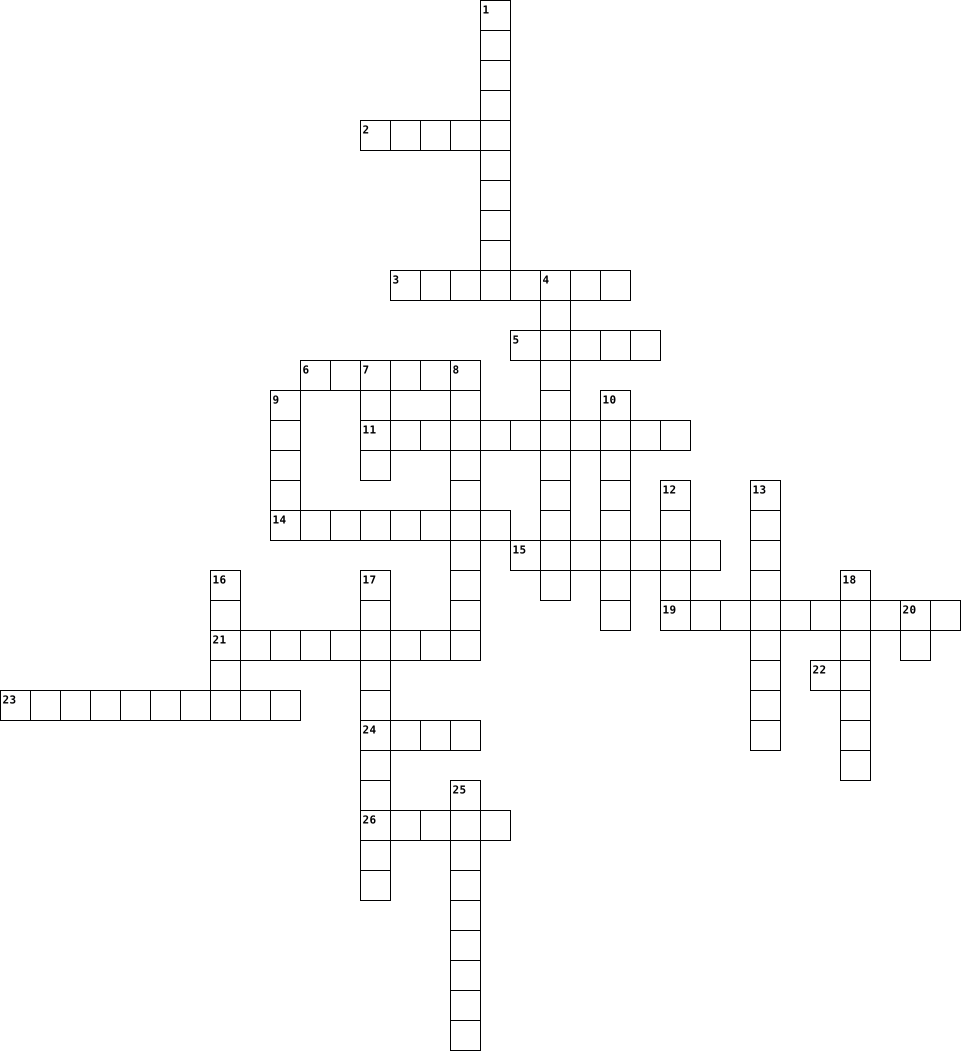
Physics Crossword 2023-05-18

Across
- A wave that does not appear to travel, Produced when two identical waves interact as they travel in opposite directions
- The wide range of electromagnetic wavelengths
- a subatomic particle of about the same mass as a proton but without an electric charge, present in all atomic nuclei except those of ordinary hydrogen.
- Electricity in between two points showing
- the highest point above the rest position.
- a force that squeezes something together
- The apparent change in frequency caused by either the source of the waves moving, the observer moving, or both moving at different velocities
- The time it takes for a particle or physical quantity to move through one cycle of oscillation in a wave
- A measure of light power per unit area
- a physical property of matter that causes it to experience an electric force
- The process by which an object heats another object through electromagnetic waves
- the amount of kinetic energy an electron would gain if it traveled across a capacitor
- carry electricity with essentially zero electrical resistance, but they also possess the strange ability known as the Meissner effect
- a material in which electrons cannot move easily through
Down
- a mathematical representation of the magnitude of electrical force between two charged objects;
- the unit of electric current in the International System of Units
- periodic back-and-forth motion of the particles of an elastic body or medium
- the angle made by a reflected ray with a perpendicular to the reflecting surface.
- a measure of the opposition to current flow in an electrical circuit
- A particle of electromagnetic radiation or quantum of light
- the redistribution of electric charge in an object by the influence of a nearby charge
- wave from the portion of the electromagnetic spectrum at lower frequencies than microwaves
- The principal that rock layers form one on top another, with the youngest layers towards the top
- a solid substance that has a conductivity between that of an insulator and that of most metals.
- a material, such as a metal, that allows electric charges to easily move through it
- propagation of disturbances from place to place in a regular and organized way
- a unit of frequency (of change in state or cycle in a sound wave, alternating current, or other cyclical waveform) of one cycle per second.
- the proportional relation of current and field
- direct current power source and alternates the direction of the current through a coil of wire using a set of electrically conductive brushes
- The Maximum Distance a particle moves from its starting point in a wave
30 Clues: A measure of light power per unit area • a force that squeezes something together • Electricity in between two points showing • the highest point above the rest position. • The wide range of electromagnetic wavelengths • the proportional relation of current and field • a material in which electrons cannot move easily through • ...
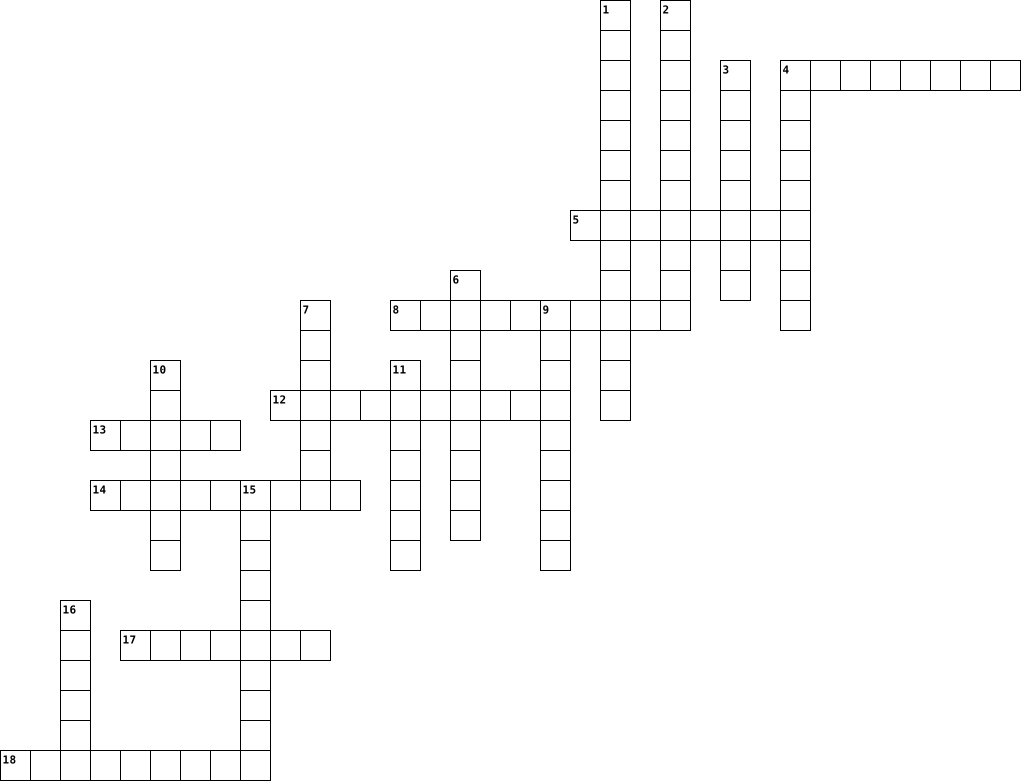
Physics Puzzle 2023-06-12

Across
- Force exerted per unit area
- Capacity to do work or produce heat
- EFFECT Change in frequency of waves due to motion
- Electromagnetic radiation that is visible to the human eye
- Rate at which an object moves
- Unit of energy
- HOLE Region of space with intense gravitational pull
- Tiny, discrete units of energy
- Amount of matter in an object
- Rate of change of velocity
- Path for electric current to flow
- Speed in a given direction
- Principle that certain properties remain constant in a system
- STRENGTH Maximum stress a material can withstand without permanent deformation
- Push or pull on an object
- Bending of waves around obstacles or openings
Down
- MODEL Model of the atom with electrons in specific energy levels
- All of space, matter, and energy
- Force that attracts objects toward each other
- Study of light and its properties
- Measure of the average kinetic energy of particles
- Electromagnetic radiation with high energy
- Resistance to change in motion
- Relating to atomic nuclei or nuclear reactions
- Relating to atoms or atomic structure
- Disturbance that transfers energy through a medium
- Transfer of thermal energy between objects
- ENERGY Energy of motion
- Opposition to the flow of electric current
- GRAVITY Absence of gravitational forces
30 Clues: Unit of energy • ENERGY Energy of motion • Push or pull on an object • Rate of change of velocity • Speed in a given direction • Force exerted per unit area • Rate at which an object moves • Amount of matter in an object • Resistance to change in motion • Tiny, discrete units of energy • All of space, matter, and energy • Study of light and its properties • ...
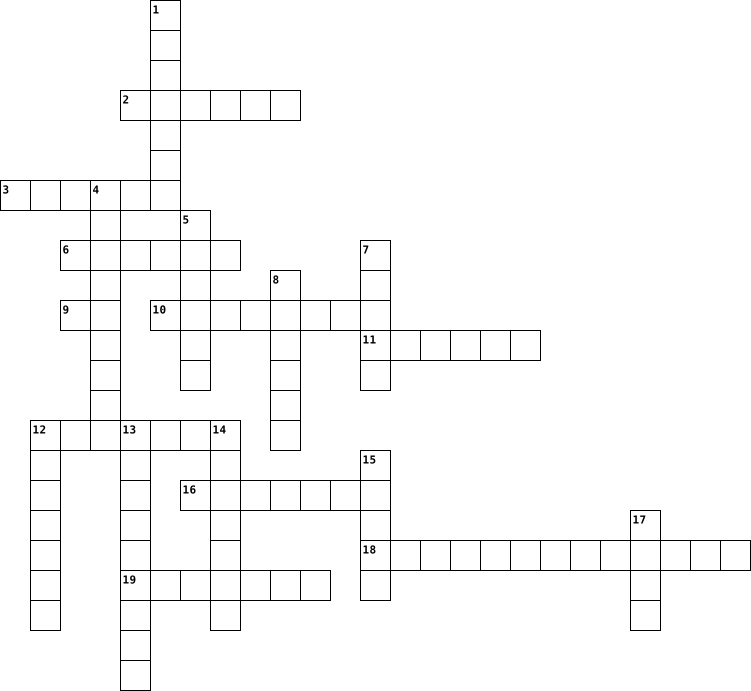
PHYSICS & ELECTRICAL 2023-04-24
Across
- law - It states that the current through a conductor between two points is directly proportional to the voltage across the two points.
- - It is a coil of wire that produces a magnetic field when an electric current flows through it.
- - It is an electrical device that switches on or off a circuit by opening or closing contacts.
- - It is a material or object that produces a magnetic field.
- - a unit of electromotive force
- Dipole - It is a pair of equal and opposite charges separated by a distance.
- - It is an electrical device that stores chemical energy and converts it into electrical energy.
- Circuit - It is a system of interconnected components that allows the flow of electric current.
- - It is an electrical device that converts mechanical energy into electrical energy by producing direct current.
- - It current flows in one direction.
- - It is an electrical device that converts mechanical energy into electrical energy by producing alternating current.
- - It is an electrical safety device that protects an electric circuit from overloading by melting and breaking the circuit.
- - It is an electrical device that converts electrical energy into mechanical energy.
Down
- - It is the measure of how much a material opposes the flow of electric current through it.
- Amplifier - It is a high-gain electronic amplifier that can amplify signals with very little distortion.
- (Ground Fault Circuit Interrupter) - It is an electrical safety device that quickly shuts off the power to a circuit if it detects a ground fault or leakage of current.
- - It is a semiconductor device that can amplify or switch electric signals.
- - It is a semiconductor device that allows electric current to flow in only one direction.
- - It is a coil of wire that stores energy in a magnetic field when electric current flows through it.
- Protector - It is an electrical device that protects electronic devices from voltage spikes and surges.
- - It is an electronic component that stores electric charge.
- - the required overhead service drop clearance over a driveway
- - It is an electrical device that transfers electrical energy from one circuit to another through electromagnetic induction.
- Breaker - It is an automatic switch that interrupts the flow of electric current in a circuit if the current exceeds a certain limit.
- - It current changes direction periodically
- law - It states that the force between two electric charges is proportional to the product of the charges and inversely proportional to the square of the distance between them.
26 Clues: - a unit of electromotive force • - It current flows in one direction. • - It current changes direction periodically • - It is a material or object that produces a magnetic field. • - It is an electronic component that stores electric charge. • - the required overhead service drop clearance over a driveway • ...
Physics 2 2023-04-26

Across
- The lowest point of a wave.
- unit of electrical resistance in the metre-kilogram-second system, named in honour of the 19th-century German physicist Georg Simon Ohm.
- The bending of a wave as it hits a barrier with openings or obstacle.
- Tbe highest point of a wave.
- It is the negatively charged particle.
- The particles are displaced parallel to the direction of propagation of the wave.
- Waves that pass given point per unit of time.
- It is the positively charged particle.
- The bending of a wave as it travels along media of different densities.
- It is a natural source of light.
- Who proposed the Corpuscular Theory of a Wave?
Down
- The man behind the discovery of Ohm's Law.
- describes how long the wave is.
- Studies the behavior of lights.
- device used to measure small amount of voltage in a circuit.
- Who proposed the Wave Theory?
- It is a bending of wave forms as they pass through slit and obstacles.
- circuit is composed of two or more paths for the electrons to follow.
- device used to measure either alternating or direct current.
- periodic back-and-forth motion of the particles of an elastic body or medium
- It is the disturbance that travels through a medium from one location to another.
- When echo has been repeated for several times, it is called as
- the number of occurrences of a repeating event per unit of time.
- a measure of the opposition to current flow in an electrical circuit.
24 Clues: The lowest point of a wave. • Tbe highest point of a wave. • Who proposed the Wave Theory? • describes how long the wave is. • Studies the behavior of lights. • It is a natural source of light. • It is the negatively charged particle. • It is the positively charged particle. • The man behind the discovery of Ohm's Law. • Waves that pass given point per unit of time. • ...
Physics Crossword 2022-12-15

Across
- Speed with a direction
- The second half of Newton's 3rd Law
- Distance over Time
- A change in momentum
- The horizontal distance a projectile travels
- Inertia in motion
- The force due to gravity
- The unit of force
- The unit of mass
- The net force = 0 when an object is in _____
- ______ velocity is air resistance = weight
- A push or pull
Down
- Inertia applies at rest or in ______ velocity
- Increasing this will lessen the force of impact
- Horizontal and vertical motions are ________ of each other
- A tendency to resist change
- Speed up, slow down, or change direction
- A acceleration approximately = 10m/s/s
- Everything is _________
- ______ force is the sum of all forces on a object
- The force that resists motion
- The measure of an object's inertia
22 Clues: A push or pull • The unit of mass • Inertia in motion • The unit of force • Distance over Time • A change in momentum • Speed with a direction • Everything is _________ • The force due to gravity • A tendency to resist change • The force that resists motion • The measure of an object's inertia • The second half of Newton's 3rd Law • A acceleration approximately = 10m/s/s • ...
Physics ARTS: 2025-03-11

Across
- Amount of matter
- Energy of motion
- Forces are balanced
- Mass in motion
- Rotational force
- Change in position
- Stored energy
- Ability to do work
- Resistance force in machine
- Resistance to motion change
- Device that makes work easier
- Speed with direction
- Unit of power
- Ongoing sequence of events
- Force per unit area
- Force applied over time
- Rate of doing work
Down
- Unit of energy
- Rate of velocity change
- Push or pull on object
- Mass per unit volume
- Unit of force
- How far something moves
- Force resisting motion
- Pull between two objects
- Gravity force on object
- Basic type of machine
- Force moves an object
- Force applied to a machine
- Distance per time
30 Clues: Unit of force • Stored energy • Unit of power • Unit of energy • Mass in motion • Amount of matter • Energy of motion • Rotational force • Distance per time • Change in position • Ability to do work • Rate of doing work • Forces are balanced • Force per unit area • Mass per unit volume • Speed with direction • Basic type of machine • Force moves an object • Push or pull on object • Force resisting motion • ...
PHYSICS CROSSWORD 2025-06-10

Across
- what scalar quantity is defined as the total distance traveled divided by the total time taken, used to describe how fast an object is moving?
- What term describes a complete and closed path through which electric current flows?
- What vector quantity represents a push or pull resulting from an interaction between objects?
- Who was the scientist that formulated the three laws of motion and the universal law of gravitation?
- what type of energy is directly associated with an object’s motion and depends on both its mass and velocity?
- What theory proposed by Einstein revolutionized physics by describing how time and space are linked for objects moving at constant speeds?
- What natural phenomenon is described by a law that explains the attractive force between all masses in the universe?
- what is defined as the physical quantity with magnitude and no direction.
- What principle in physics asserts that certain physical quantities (such as energy or momentum) remain constant in a closed system?
- What property of waves measures how many complete cycles pass a given point in one second, measured in hertz?
- What is the SI unit used to measure the strength of electric current, named after a French physicist?
- What is the unit of measurement for electrical resistance, fundamental to Ohm’s Law?
- What is the bending of a wave, such as light or sound, as it passes at an angle from one medium to another with a different density?
- what is the physical property that resists changes in an object’s state of motion, forming the foundation of Newton’s First Law of Motion?
- What wave phenomenon occurs when two or more waves overlap and combine to form a new wave pattern?
Down
- term describes the total energy of a system that includes both kinetic and potential energy?
- What is the SI unit of work or energy, equivalent to the energy transferred when a force of one newton moves an object one meter?
- What process occurs when waves bounce back after hitting a barrier they cannot pass through?
- What branch of physics deals with heat, temperature, and the conversion of energy from one form to another?
- What vector quantity use the equation is F = ma
- What wave behavior involves the bending and spreading of waves around obstacles or through small openings?
- what is the superposition of waves, causing an increase or decrease in the amplitude of the resulting wave
- What vector quantity includes both magnitude and direction, and measures how quickly and in what direction an object is moving?
- what is defined as the change in position of an object.
- What term refers to any physical quantity that has both magnitude and direction, such as force or velocity?
- What type of energy results from the motion of particles in matter and is closely related to the concept of temperature?
- What physical concept describes the rate at which an object’s velocity changes over time, including changes in speed or direction?
- What electrical component temporarily stores electric charge and is used in circuits to control energy flow?
- What major branch of physics is concerned with the behavior of physical bodies when subjected to forces or displacements?
- What term describes an object that moves through the air solely under the influence of gravity after being launched?
- What physical quantity represents the amount of matter in an object and remains constant regardless of its location in the universe?
31 Clues: What vector quantity use the equation is F = ma • what is defined as the change in position of an object. • what is defined as the physical quantity with magnitude and no direction. • What term describes a complete and closed path through which electric current flows? • What is the unit of measurement for electrical resistance, fundamental to Ohm’s Law? • ...
HS Physics 2025-05-07

Across
- a unit of current
- electrical energy transformed to mechanical energy
- the reason for a differenced in the perceived frequency and the actual frequency
- always conserved in a collision
- a force based on the mass of an object and the gravitational field
- the potential energy per unit charge
- the geographic pole of our south magnetic pole
- a quantity with magnitude and direction
- when the sum of all forces and torques is equal to zero
- the amount of matter an object has
- the frequency of light that is absorbed by our oceans
- when a force is applied parallel to the displacement of the object
- a value of change in velocity per unit time
- a force between two charged objects
- known for his three laws of motion
- any object solely accelerated by gravity
- when an object is set into vibration due to its natural frequency
Down
- a quantity of magnitude
- a value of distance covered per unit time
- a force applied perpendicularly to a lever arm
- the vertical velocity of a projectile at the top of its path
- energy of moving objects
- the type of wave sound travels as
- center seeking
- mechanical energy transformed to electrical energy
- a unit of electrical resistance
- when a wave changes from one medium to another
- the frequency of light that is scattered by our atmosphetere
- a force of attraction between two masses
- the measurements due to an observer's status
- the type of wave light travels as
- equals the net force acting on an object divided by the mass
- a value of speed and direction
- energy that is stored
- weighs differently depending on who you ask
35 Clues: center seeking • a unit of current • energy that is stored • a quantity of magnitude • energy of moving objects • a value of speed and direction • always conserved in a collision • a unit of electrical resistance • the type of wave sound travels as • the type of wave light travels as • the amount of matter an object has • known for his three laws of motion • ...
Physics Keywords 2025-04-17

Across
- oval-shaped
- a perpendicular line drawn to a surface
- made by winding a coil around a magnetic material
- not moving
- spread out through the surrounding
- having lost a magnetic field
- to hit on something
- paths of light
- a secondary colour of combination of blue and green
- a metal object that will attract magnetic objects
Down
- the weather condition over a long period of time
- when light is not being absorbed
- turning effect of force
- the substance which the light travel
- the conditions in a particular place
- separating white light into its component colour
- a 3D shape with a cross-section
- the object in the middle of the coil
- to show the direction of a magnetic field
- rocky objects, smaller than planets
20 Clues: not moving • oval-shaped • paths of light • to hit on something • turning effect of force • having lost a magnetic field • a 3D shape with a cross-section • when light is not being absorbed • spread out through the surrounding • rocky objects, smaller than planets • the substance which the light travel • the conditions in a particular place • the object in the middle of the coil • ...
GCSE Physics 2025-06-27

Across
- The type of current in mains electricity
- A machine in the national grid that steps up or down voltage
- The % of energy usefully transferred
- A type of energy linked with heat and is normally wasted
- Energy / Time or Energy per second
- A type of energy linked with food, fuel and batteries
- Voltage / Current =
- Breaking down a power plant
- Another word for potential difference
- A renewable resource used in dams and falling water
- A type of potential energy of objects stored up high
- One of the fossil fuels
Down
- A renewable resource linked with burning wood or crops
- Energy sources that will never run out
- The other non-renewable fuel that is not fossil fuels
- A type of energy linked with moving things
- Colour of the neutral wire
- A type of circuit with only one loop
- Only allows electricity one way
- The unit for activity or count rate
- A temperature-dependent resistor
- A device used to measure current
- An energy source using hot rocks from underground
- The unit for charge flow
24 Clues: Voltage / Current = • One of the fossil fuels • The unit for charge flow • Colour of the neutral wire • Breaking down a power plant • Only allows electricity one way • A temperature-dependent resistor • A device used to measure current • Energy / Time or Energy per second • The unit for activity or count rate • A type of circuit with only one loop • ...
Physics Phun 2025-07-03

Across
- – Rate of change of velocity
- – Force of attraction between two masses
- Joining of two light nuclei to form a heavier nucleus
- – Device used to measure current
- – Size or quantity, without direction
- Rate at which energy is transferred or converted
- A type of weapon and power station and current
- – Force between stationary electric charges
- Spontaneous process where an unstable nucleus loses energy
- Type of energy that holds the nucleus together
- Type of particle that is not made of smaller parts
- Not quite Hobbes’ friend
- Electrical potential difference between two points
Down
- Emission of energy as electromagnetic waves or particles
- Having the same value or function in a different form
- This is often futile
- Type of circuit where components have the same voltage
- – Measure of average kinetic energy of particles
- – Speed in a given direction
- Type of reaction involving the atomic nucleus
- Force between like electric charges
- Chips
- Property of matter that causes it to experience electric force
23 Clues: Chips • This is often futile • Not quite Hobbes’ friend • – Rate of change of velocity • – Speed in a given direction • – Device used to measure current • Force between like electric charges • – Size or quantity, without direction • – Force of attraction between two masses • – Force between stationary electric charges • Type of reaction involving the atomic nucleus • ...
Physics Revision 2025-07-14

Across
- The distance between two peaks on a wavefront diagram
- Describes the pitch of a sound
- The process of liquid turning into gas (that happens at a fixed temperature)
- State of matter that can flow but still has a fixed volume
- The type of energy that moving objects have
- The process of liquid turning into gas (that happens at all temperatures)
- The process of a solid turning into a liquid
- The transfer of heat energy by the vibration of particles in contact with each other
Down
- The only thermal energy transfer that can occur in a vacuum
- The process of a liquid turning into a solid
- The type of energy that hot objects have
- The peak of a wave
- The amount of force applied over a specific area (Unit: Pascal)
- The process of a gas turning into a liquid
- The lowest point of a wave
- Mass/Volume
- State of matter that has no fixed volume or shape, particles randomly collide
- Describes how loud a sound is
- State of matter that has a fixed volume and shape
- The method of heat transfer that we use to cool rooms with an aircon
20 Clues: Mass/Volume • The peak of a wave • The lowest point of a wave • Describes how loud a sound is • Describes the pitch of a sound • The type of energy that hot objects have • The process of a gas turning into a liquid • The type of energy that moving objects have • The process of a liquid turning into a solid • The process of a solid turning into a liquid • ...
Physics Crossword 2023-03-23

Across
- The basic measurement for force.
- Your favorite class.
- The basic measurement for time.
- The conductive metal most associated with wires.
- The other course that Mr. Johnson teaches right now.
- A special resistor that creates visible electromagnetic radiation.
- Forces always come in pairs where one is equal in magnitude but opposite in direction of the other.
- Speed with direction added to it.
- Who said, "You don't lose if you get knocked down; you lose if you stay down."
- Distance divided by time.
- How far an object is from its starting location.
- According to the poster, Einstein said, "Education is not the learning of facts but the training of the mind to _______."
- The basic measurement for mass.
Down
- An object in motion stays in motion and an object at rest stays at rest.
- Change in velocity over time.
- Net force equals an object's mass multiplied by acceleration.
- The town Mr. Johnson went to college in. Check the scarves.
- Word Under Exit
- How far an object travels in a given amount of time.
- The basic measurement for distance.
- Your favorite teacher.
21 Clues: Word Under Exit • Your favorite class. • Your favorite teacher. • Distance divided by time. • Change in velocity over time. • The basic measurement for time. • The basic measurement for mass. • The basic measurement for force. • Speed with direction added to it. • The basic measurement for distance. • The conductive metal most associated with wires. • ...
Physics Crossword 2025-02-12

Across
- tendency of an object to resist a change in its motion
- the scientist who revolutionized the study of black holes (last name)
- the force of gravity on a mass
- devised a set of 3 laws to describe the motion of macro bodies (last name)
- net force on an object with a weight of 340 N being held up by an air resistance force of 340 N
- the distance an object travels when 240 J of work is done with a force of 120N
- Mrs. Thomas' favorite movie about a father sent to save Earth for the sake of his children (starring Matthew McConaughey)
- an object's displacement over time (vector)
- which of Newton's laws states that the direction of force and acceleration are the same (F=ma)
- SI unit for force
- Work = __dcos0
- the unit for energy
Down
- Work is ___ if the force and displacement are in the same direction
- the value for acceleration due to gravity (the number spelled out -4 words)
- when 2 forces are equal but opposite, the forces are ____
- the amount of work done when 10 joules moves a box 2 meters
- your favorite class of the day
- quantity that has both magnitude and direction
- when you have an object on a ramp, use Fgsin0 to find the ______ component of Fg
- SI unit for distance
- quantity that has magnitude only
- Work is ___ if the force is applied opposite an object's displacement
22 Clues: Work = __dcos0 • SI unit for force • the unit for energy • SI unit for distance • your favorite class of the day • the force of gravity on a mass • quantity that has magnitude only • an object's displacement over time (vector) • quantity that has both magnitude and direction • tendency of an object to resist a change in its motion • ...
IGCSE Physics 2024-10-31

Across
- A poor conductor is considered an ...........
- A north pole of a magnet will .......... a south pole
- Points to the north pole of a magnetic field
- Resistor that depends on heat
- A sub0atomic particle found in the nucleus of an atom
- Planet closest to the sun
- The unit of potential difference
Down
- Measured by an ammeter
- When resistors are connected in series, the current ...........
- A safety device used to prevent a surge of current
- Collection of billions of stars
- Positively charged sub-atomic particle
- The furthest planet from the sun
- The absence of matter in empty space
- A charged particle
- Same number of protons, with different number of neutrons
- The galaxy Earth belongs to
- A magnetic material
- Most abundant element in the sun
- Contains almost all the mass of an atom
20 Clues: A charged particle • A magnetic material • Measured by an ammeter • Planet closest to the sun • The galaxy Earth belongs to • Resistor that depends on heat • Collection of billions of stars • The furthest planet from the sun • Most abundant element in the sun • The unit of potential difference • The absence of matter in empty space • Positively charged sub-atomic particle • ...
Physics crossword 2024-11-13

Across
- What is the product of an objects mass and its velocity?
- What is the law of motion that says that mass times acceleration equals force?
- What force pulls objects towards the center of the earth?
- Which law of motion states that objects in rest stay at rest and objects in motion stay in motion unless it is acted upon by a force?
- What is an object in when its net force is 0?
- What does change in speed divided by change in time equal?
- What system of measurement uses kg and m/s?
- What is the first and last name of the person that made the laws of physics?
- How many Newtons of force does a 30 kg car have if it is going 3 m/s?
Down
- What is calculated the same way as speed but with additional direction information?
- What kind of quantity includes magnitude and direction?
- If a car is going at a constant speed to thew right with a force of 50 Newtons, how many Newtons of force are opposing the car?
- Which law of motion states that forces exert equal and opposite reactions on to each other?
- What is Newton's second law simplified as an equation?
- If a train speeds up from a speed of 0 m/s to a speed of 30 m/s in 5 seconds, what is the acceleration of the train in m/s²?
- What is the force stopping things with more mass from moving?
- If a ball has a mass of 1 kg and its velocity is 5 m/s what is its momentum?
- What force opposes gravity and keeps things from being pulled to the center of the Earth?
- What measurement is equal to the force needed to push a 1 kg object 1 meter at the speed of 1 m/s?
- What is the product of an objects mass times the pull of gravity?
20 Clues: What system of measurement uses kg and m/s? • What is an object in when its net force is 0? • What is Newton's second law simplified as an equation? • What kind of quantity includes magnitude and direction? • What is the product of an objects mass and its velocity? • What force pulls objects towards the center of the earth? • ...
Physics crossword 2024-11-26

Across
- A quantity containing both magnitude and direction
- The only force accelerating a projectile
- In the SI system this means ten raised to the negative two
- This initial velocity is zero for a horizontal projectile
- A quantity with only magnitude
- A way to remember the definitions of sine, cosine and tangent.
- Displacement divided by time
- The total path length of travel
- We calculate this to find displacement on a velocity vs time graph
- The path of a projectile
- The unit of time in the SI system
Down
- The variable used to denote angle
- The unit of mass in the SI system
- The study of motion
- Distance divided by time
- We calculate this to find acceleration on a velocity vs time graph
- The change in velocity
- The shortest distance between two points
- The vertical velocity at the top of a projectile
- The time it takes a projectile to reach its maximum height.
20 Clues: The study of motion • The change in velocity • Distance divided by time • The path of a projectile • Displacement divided by time • A quantity with only magnitude • The total path length of travel • The variable used to denote angle • The unit of mass in the SI system • The unit of time in the SI system • The only force accelerating a projectile • ...
Physics Crossword 2024-11-20

Across
- Application of LIDAR
- In He-Ne laser what is Ne?
- Which tube is a component of He-Ne laser?
- Lasers are used in barcode scanners in?
- What is the nature of stimulated photons?
- Which cavity is required for multiplication of stimulated photons?
- Application of Diode LASER
- Which type of pumping is used in He-Ne laser?
- Which is one of the most popular type of LASER?
- Which flash lamp is used as energy source in ND-YAg LASER?
Down
- Application of ND-YAG LASER
- Which energy is released during non radiative transition?
- A type of classification of LASER
- Which mechanism is used for population inversion?
- What is an accurate distance measurement technique?
- What is acronym for Light Amplification by Stimulated Emission of Radiation?
- Low Intensity Lasers have which applications?
- Laser radiation is efficient is controlling what?
- What depends on energy values of lasing levels of active medium?
- A method of pumping
20 Clues: A method of pumping • Application of LIDAR • In He-Ne laser what is Ne? • Application of Diode LASER • Application of ND-YAG LASER • A type of classification of LASER • Lasers are used in barcode scanners in? • Which tube is a component of He-Ne laser? • What is the nature of stimulated photons? • Low Intensity Lasers have which applications? • ...
Physics 2026 2026-02-12

Across
- The force the air exerts on an object to resist motion
- The abbreviation for the box used to showcase all of the forces acting on an object
- Adjacent divided by the Hypotenuse of a right triangle
- A property of matter that determines the resistance of an object to change in motion
- How much matter is in an object
- A variable changed by a scientist in an experiment
- A push or pull on an object.
- Amount of matter per unit volume
- The name of the greek symbol that is used to showcase angles
- Formula used to calculate velocity on a position vs time graph
- The force that is applied by a surface
- A quantity that cares about both magnitude and direction
- This force is what ropes and chains exert on an object
- A force that pulls objects towards the center of Earth
- A quantity that only cares about magnitude
- The SI Unit of Mass
- Total difference between the starting point and the ending point, a vector
Down
- The SI unit of force.
- A variable measured by a scientist in an experiment
- A scalar quantity that measures how fast something moves.
- A force that opposes sliding motion
- Opposite divided by the Hypotenuse of a right triangle
- Speed with direction
- The rate at which velocity changes over time.
- Two Words: The Process of converting one unit to another
- Total meters walked or traveled, a scalar
- Number of meters displaced if you walk from your house to school back to your house
- The unit of measurement used to measure angles
28 Clues: The SI Unit of Mass • Speed with direction • The SI unit of force. • A push or pull on an object. • How much matter is in an object • Amount of matter per unit volume • A force that opposes sliding motion • The force that is applied by a surface • Total meters walked or traveled, a scalar • A quantity that only cares about magnitude • ...
Thermal Physics 2025-10-01

Across
- The energy required to raise 1kg of a substance by 1 degree celsius
- When a substance is heated, the substance's ________ _______ store increases
- At constant ___________, pressure and temperature are directly proportional
- The latent heat of vaporisation is often much _______ than the latent heat of fusion
- Unit for pressure
- The sum of the randomly distributed kinetic and potential energies of atoms in a substance
- Particles of a gas occupy a ___________ volume compared with the volume of the gas
- When increasing the temperature, the Maxwell-Boltzmann distribution will appear _________
- Because there are a large _______ of particles in a gas, we can assume that the mean square velocity is the same in all directions
- The ______ mass of a substance is the mass of one mole of that substance
- The ______ of collisions between particles is negligible compared to the time between the collisions
- The latent heat of ________ is energy required to turn a liquid to a gas
- The amount of energy required to change state per unit mass at a constant temperature
- The y axis for Maxwell-Boltzmann distribution is the ______ of particles
- The observation that air/water particles constantly hit smoke/pollen grains in random movements
- What substance has a specific heat capacity of around 4200 J/kg/deg celsius
Down
- At a change of state, a substances _________ ________ increases
- The ___________ forces between particles are negligible except during collisions
- At constant temperature, pressure and volume are ________ proportional
- For particles in a gas, the most probably speed is ______ than the root mean square speed
- Electrostatic potential energy is ________ in a gas
- The number of particles in a mole is __________ constant
- The temperature at which particles have no kinetic energy
- When taking the temperature of a liquid, Physicists must _____ the liquid before taking a measurement
- In a solid, particles ________ around a fixed position
- Gas particles move very quickly in _________ directions
- The __________ constant has a value of 1.38 x 10^-23 J/K
- The _________ of particles with each other and the container walls are perfectly elastic
- The latent heat of ________ is energy required to turn a solid to a liquid
- The _____ ______ constant is equal to 8.31 J/K/mol
- The value of electrostatic potential energy in a gas
31 Clues: Unit for pressure • The _____ ______ constant is equal to 8.31 J/K/mol • Electrostatic potential energy is ________ in a gas • The value of electrostatic potential energy in a gas • In a solid, particles ________ around a fixed position • Gas particles move very quickly in _________ directions • The number of particles in a mole is __________ constant • ...
Physics Terms 2026-02-03

Across
- A well-tested explanation of how or why something works
- The way something is pointing or moving
- A quantity with size only and no direction
- How quickly one thing changes compared to another
- The person or reference point measuring motion
- How close a measurement is to the true value
- The standard used to measure something
- The type of physical quantity like length or time
- How long events take or when they happen
- Where something is located
- How far something ends up from where it started in a specific direction
Down
- An object moving through the air after being thrown or launched
- A quantity with both size and direction
- How fast velocity changes over time
- The total amount divided by the number of values
- The study of motion without considering forces
- How consistent repeated measurements are
- A difference between expected and actual results
- The size or strength of something
- Speed with direction
- The total path traveled with no direction
- How much matter an object has
- The value at one exact moment in time
23 Clues: Speed with direction • Where something is located • How much matter an object has • The size or strength of something • How fast velocity changes over time • The value at one exact moment in time • The standard used to measure something • A quantity with both size and direction • The way something is pointing or moving • How consistent repeated measurements are • ...
Physics Review 2025-09-07

Across
- A neutrally charged subatomic particle.
- The number of complete cycles of a wave passing a fixed point of time.
- _____ describes the force of gravity working on an object.
- Pressure is ______ proportional to temperature.
- A continuous physical force exerted on or against an object by something in contact with it.
- A small dense region at the center of an atom.
- The maximum displacement or distance moved by a point on a wave.
- A fundamental force of nature that causes attraction between objects with mass.
- The symbol used to define wavelength.
- Force is equal to mass * _______.
Down
- Pressure is ______ proportional to volume.
- Newton's third law says for every action there is an equal and _____ reaction.
- A fundamental property of matter that describes how objects interact with electric and magnetic fields. It can be positive or negative.
- When two objects push away from each other.
- When two objects move towards each other.
- A positively charged subatomic particle.
- Newton's first law discusses this.
- The distance between two successive crests of a wave.
- A negatively charged subatomic particle.
- The change in distance travelled in a given time.
- The amount of matter in something.
21 Clues: Force is equal to mass * _______. • Newton's first law discusses this. • The amount of matter in something. • The symbol used to define wavelength. • A neutrally charged subatomic particle. • A positively charged subatomic particle. • A negatively charged subatomic particle. • When two objects move towards each other. • Pressure is ______ proportional to volume. • ...
Physics Energy 2025-10-14

Across
- type of energy due to motion
- principle that energy cannot be created or destroyed
- potential energy stored in stretched or compressed objects
- a push or pull on an object
- the ability to do work
- a type of energy resource that is naturally replenished
- the process of changing energy from one form to another
- energy related to heat and temperature
- SI unit of power
Down
- a type of energy resource that cannot be replaced quickly
- the rate at which work is done
- energy due to motion or position
- the ratio of useful energy output to total energy input
- a group of interacting parts considered together in physics
- SI unit of work or energy
- stored energy due to position
- energy stored in bonds of molecules
- energy stored in the nucleus of atoms
- force applied over a distance
- energy transferred due to temperature difference
20 Clues: SI unit of power • the ability to do work • SI unit of work or energy • a push or pull on an object • type of energy due to motion • stored energy due to position • force applied over a distance • the rate at which work is done • energy due to motion or position • energy stored in bonds of molecules • energy stored in the nucleus of atoms • energy related to heat and temperature • ...
Physics Review 2025-12-01

Across
- Total force after combining all forces
- Force opposing motion
- Perpendicular contact force from a surface
- Type of Friction while sliding
- Type of Friction preventing motion
- Change in position
- Energy related to motion (=1/2mv^2)
- Total work done by all forces
- Speed with direction
Down
- Sketch showing all forces on an object
- Quantity with magnitude and direction
- Unit of force
- A push or pull
- Zero net force, zero acceleration
- Unit for work and energy
- Force of gravity on an object
- Measure of inertia
- Rate of change of velocity
- Quantity with magnitude only
- Resistance to changes in motion
- Force times displacement in direction of motion (=Fd)
- How fast something moves
22 Clues: Unit of force • A push or pull • Measure of inertia • Change in position • Speed with direction • Force opposing motion • Unit for work and energy • How fast something moves • Rate of change of velocity • Quantity with magnitude only • Force of gravity on an object • Total work done by all forces • Type of Friction while sliding • Resistance to changes in motion • ...
Medical Physics 2026-03-27

Across
- reduction of xray intensity
- single‑line ultrasound measurement
- amplifies light signal
- metastable gamma emitter
- contrast for intestines
- high‑frequency sound waves
- detects gamma photons
- coupling medium for ultrasound
- positron emitter used in PET
- rotating xray slices for 3D image
- photon creates electron positron
- parallel photon selector
- radioactive substance for imaging
- specific energy xray emission
- ultrasound bounce at boundary
Down
- full absorption of photon
- electron acceleration to metal target
- frequency shift from motion
- exponential drop in intensity
- scatter with ejected electron
- spectrum from electron deceleration
- velocity from doppler shift
- 2D ultrasound image
- resistance to sound in medium
- produces voltage when stressed
- high‑Z absorber for imaging
- reducing reflection between media
- converts gamma to light
- generates and detects ultrasound
- contrast for blood vessels
- positron annihilation imaging
31 Clues: 2D ultrasound image • detects gamma photons • amplifies light signal • contrast for intestines • converts gamma to light • metastable gamma emitter • parallel photon selector • full absorption of photon • high‑frequency sound waves • contrast for blood vessels • frequency shift from motion • reduction of xray intensity • velocity from doppler shift • high‑Z absorber for imaging • ...
Thermal Physics 2026-03-05

Across
- form of matter state
- with almost no matter
- per unit volume
- of space occupied
- with direction
- of matter with fixed volume
- Rate of change across distance
- transfer by force through distance
- of average kinetic energy
- state of matter
- of bonded atoms
- Unit of heat energy
- Rapid vaporization in liquid
- Common temperature scale unit
- Decrease in volume under pressure
- piece of matter
- Change from liquid to solid
- of motion
- unit of ordinary matter
- charged particle
- Heat transfer by fluid motion
- Increase in size or volume
- core of atom
- Material resisting heat flow
- Energy emitted as waves or particles
Down
- exerted per unit area
- Solid changing directly to gas
- of matter with no fixed shape
- transferred by temperature difference
- of light energy
- Heat transfer through contact
- of energy transfer
- particle in nucleus
- Spreading of particles in fluid
- of disorder in a system
- Force resisting motion between surfaces
- Material allowing heat flow
- to do work
- of matter with fixed shape
- Body storing thermal energy
- Change from solid to liquid
- charged particle
- Absolute temperature scale unit
- or pull on an object
- of matter in an object
- heat content of a system
- Impact between particles
- Slow vaporization at surface
- Gas changing to liquid
- Balance of opposing processes
50 Clues: of motion • to do work • core of atom • with direction • of light energy • per unit volume • state of matter • of bonded atoms • piece of matter • charged particle • charged particle • of space occupied • of energy transfer • particle in nucleus • Unit of heat energy • form of matter state • or pull on an object • exerted per unit area • with almost no matter • of matter in an object • ...
Thermal Physics 2026-03-05

Across
- form of matter state
- with almost no matter
- per unit volume
- of space occupied
- with direction
- of matter with fixed volume
- Rate of change across distance
- transfer by force through distance
- of average kinetic energy
- state of matter
- of bonded atoms
- Unit of heat energy
- Rapid vaporization in liquid
- Common temperature scale unit
- Decrease in volume under pressure
- piece of matter
- Change from liquid to solid
- of motion
- unit of ordinary matter
- charged particle
- Heat transfer by fluid motion
- Increase in size or volume
- core of atom
- Material resisting heat flow
- Energy emitted as waves or particles
Down
- exerted per unit area
- Solid changing directly to gas
- of matter with no fixed shape
- transferred by temperature difference
- of light energy
- Heat transfer through contact
- of energy transfer
- particle in nucleus
- Spreading of particles in fluid
- of disorder in a system
- Force resisting motion between surfaces
- Material allowing heat flow
- to do work
- of matter with fixed shape
- Body storing thermal energy
- Change from solid to liquid
- charged particle
- Absolute temperature scale unit
- or pull on an object
- of matter in an object
- heat content of a system
- Impact between particles
- Slow vaporization at surface
- Gas changing to liquid
- Balance of opposing processes
50 Clues: of motion • to do work • core of atom • with direction • of light energy • per unit volume • state of matter • of bonded atoms • piece of matter • charged particle • charged particle • of space occupied • of energy transfer • particle in nucleus • Unit of heat energy • form of matter state • or pull on an object • exerted per unit area • with almost no matter • of matter in an object • ...
Physics Vocabulary 2026-04-01

Across
- Three principles that explain the relationship between an object's motion and the forces applied to it;at least two laws always apply
- forces acting on an object that cancel each other out causing a net force of zero and causing no change in movement.
- Speed in a given direction
- Any push or pull between two objects,measured in Newtons (N)
- Stored energy of an object due to position, condition, or composition.
- Newton's second law of motion states that the acceleration of an object depends on its mass and the amount of force applied where F=ma, objects accelerate in the direction of the unbalanced force.
- The sum of all forces action on an object within a system, includes both magnitude (strength) and direction.
- A force acting directly in contact with an object
- change in an object's position or location.
- Net force greater than zeros that cause changes in motion of an object in the direction of the greater force
- Group of items interacting to form a unified whole
- energy of objects in motion
Down
- Newton's third law states that all forces occur in contact pairs where every action force has a reaction force that is equal in strength and opposite in direction.
- The rate of change at which an object moves a distance over time.
- Gravity is the pull toward another object based on its mass. Gravity is always moving objects down at 9.8m/s2
- A force that is opposite of motion between two surfaces that are touching causing it to slow down.
- The tendency of all objects to resist change in motion dependent on mass, to keep doing what they are already doing.
- Support force of a surface an object is in contact with preventing it from falling.
- unit of measurement of force (N)
- The rate at which velocity changes (speed or direction) over time as a result of unbalanced forces and mass of the object.
- Newton's First Law states that an object's motion will not change unless an unbalanced force acts on it.
- The amount of matter in an object measured in grams or kilograms
- Speed that is steady or unchanging
- Total distance traveled divided by the total amount of time taken.
24 Clues: Speed in a given direction • energy of objects in motion • unit of measurement of force (N) • Speed that is steady or unchanging • change in an object's position or location. • A force acting directly in contact with an object • Group of items interacting to form a unified whole • Any push or pull between two objects,measured in Newtons (N) • ...
Physics, Advanced 2026-04-06

Across
- A unit that represents the loudness and intensity of vibrations and sound
- One of four fundamental forces in the universe that represent the force of attraction of objects with mass
- Represents the number of unique ways that a system can be physically represented in space
- Quantifies the amount of force acting on a surface per unit area
- Represents the shortest path between two objects in curved geometry
- A very hypothetical form of particles that have a minimum speed that exceeds the speed of light, referenced in Umamusume
- A conserved quantity that relates to a fundamental intrinsic property of atoms in an electromagnetic field
- A unit that represents the luminous intensity of light per solid unit angle by a light source
- Quantifies how hot or cold an object is
- A form of matter which has the same mass as regular, ordinary matter but has the opposite charge. Interaction with normal matter results in total annihilation and conversion of both into pure energy
- A fundamental particle that acts as the carrier for the electromagnetic force.
- Represents how much motion is present in an object
Down
- The property of a system or object that remains constant or unchanged regardless of mathematical transformations
- Represents the change of position of an object
- Measures the rate of change of position of an object
- One of the most important principle in physics, ensures that the physical laws of the universe retain the same mathematical form as it's transformed variant
- A dimension that relates to how much change has occurred over the past, present and future
- Measures the difference in electric potential
- Measures the interaction and acceleration of bodies
- The fundamental and universal currency of work
- Quantifies how much matter is present in an object and it’s resistance to changes in motion
- Represents a scalar quantity that relates to the change in kinetic and potential energy of objects along it's path and trajectory through space. All objects travel through paths that minimize this quantity.
- A quantity that represents the disorder of a system and dissipation of energy
23 Clues: Quantifies how hot or cold an object is • Represents the change of position of an object • Measures the difference in electric potential • Represents how much motion is present in an object • Measures the interaction and acceleration of bodies • The fundamental and universal currency of work • ...
HL Physics 2026-04-13

Across
- → Beta particles were emitted with a range of different energies, providing evidence for the existence of __________
- → Model of hydrogen atom with quantized energy levels.
- → Real processes are ___________
- → Depends on the distribution of mass of an extended body about an axis of rotation
- → Additional particle produced in β⁻ decay
- → Process in which there is no exchange of heat with the surroundings.
- → Law stating that the direction of induced current opposes the change producing it.
- → An object, moving in the same direction as its length, appears shorter than when it is stationary.
- → Non-accelerating frame in which the laws of Physics are the same.
- → Minimum energy needed by an electron at the surface of the metal to escape from the metal.
- → Law stating that the induced EMF equals the rate of change of flux linkage.
- → Frequency below which no electrons are emitted.
- → Effect where one photon causes one electron to be emitted from the surface of a metal.
Down
- → Wavelength = h/p for matter behaving like a wave
- → Degree of disorder of the particles in a system.
- → Contains many equally spaced parallel slits.
- → Occurs when resultant force and resultant torque are zero.
- → Angular __________ remains constant unless the body is acted on by a resultant torque.
- → Force acting between nucleons that explains deviations from Rutherford scattering for alpha particles at high energies.
- → Minimum voltage needed to reduce the photoelectron current to zero
- → Postulate 2: The speed of light is...
- → Time recorded by an observer who is stationary relative to the clock
- → Lines or surfaces joining points of equal potential.
- → Effect: another experiment, light scattering by electrons, which provides evidence that light can behave as a particle.
- → Q = ΔU + W is the first law of
- → Eₚ is __________ at the Earth's surface
- → Slit that modulates the double slit interference pattern
- → Theoretical cycle that sets a limit for the efficiency of a heat engine.
- → Electric potential is a __________ quantity
- → Gravitational __________ is work done per unit mass to move a small object from infinity to that point
30 Clues: → Real processes are ___________ • → Q = ΔU + W is the first law of • → Postulate 2: The speed of light is... • → Eₚ is __________ at the Earth's surface • → Additional particle produced in β⁻ decay • → Electric potential is a __________ quantity • → Contains many equally spaced parallel slits. • → Frequency below which no electrons are emitted. • ...
Science Physics 2026-05-15

Across
- Ancient biological matter-based fuel
- -A push or pull acting on an object
- Relating to nucleus
- cycle Water’s movement through environment
- Group of the same species
- Instrument for viewing tiny objects
- -Energy emitted as waves or particles
- Long-term weather pattern shifts
- Sudden Earth crust movement
- Positive subatomic particle
- Motion principles
- Electromagnetic radiation visible to eyes
- -Newton
- table Element organization chart
- Gravity’s force on an object
- -The basic unit of matter
- Genetic information transfer
Down
- – Two or more atoms bonded together
- -Energy possessed by an object due to its motion
- – Anything that has mass and occupies space
- -The resistance that one surface or object encounters when moving over another
- Group of atoms bonded together
- Lightest chemical element
- All of space and everything in it
- Attraction or repulsion forces
- Related to atoms
- Sun and its planetary system
- Study of heredity
- Energy form causing temperature rise
- Naturally occurring
- Distance between wave peaks
- -The force that attracts objects toward one another
- – The speed of an object in a specific direction
- Path around a celestial body
- Genetic material
- Vibrations perceived as noise
36 Clues: -Newton • Related to atoms • Genetic material • Study of heredity • Motion principles • Relating to nucleus • Naturally occurring • Lightest chemical element • Group of the same species • -The basic unit of matter • Distance between wave peaks • Sudden Earth crust movement • Positive subatomic particle • Sun and its planetary system • Path around a celestial body • ...
AP Physics 2026-05-14

Across
- The degree of confidence in the exactness of a measurement
- The slope of a velocity versus time graph
- Units of both work and energy
- The law that predicts the interference patterns of waves
- This force converts kinetic energy to thermal energy
- Shorthand for a coefficient of friction
- Quantities with both magnitude and direction
- Balances the force of gravity at terminal velocity
- An object's resistance to acceleration
- Forces that do not affect the energy or momentum of a system
- A collision where momentum is conserved, but some kinetic energy is lost
- A force defined by it being perpendicular to a surface
- This is revealed by the slope of a position versus time graph
- The unit of frequency
- Measured in Amperes
- The component of gravity balanced by the normal force
- Also known as electromotive force
- Forces transferred through rope or string
- This is Newton's Law describing equal forces in opposite directions.
- The energy stored in food and fuel
Down
- Equal to the area under a velocity versus time graph
- This type of potential energy is stored in springs
- Circuits with multiple pathways
- A quantity that has magnitude but ignores direction
- The force determined by the displacement of a fluid
- The product of an object's mass and velocity
- The method of adding vectors
- The result of balanced forces
- The namesake of the Law that describes spring forces
- A machine designed to demonstrate Newton's Laws
- The type of waves formed in musical instruments
- The unit of power
- Locations of total destructive interference in a wave
- Earth's gravitational attraction to an object
- Is determined by a calculation of percentage error
- Measured in standard units of cubic meters
- The sum of vectors
- The rate at which one does work or transforms energy
- The process by which energy is transformed
- The sum of potential and kinetic energy
- The nature of measuring quantities in comparison to others
- The inverse of period
- The amount of matter in a substance
43 Clues: The unit of power • The sum of vectors • Measured in Amperes • The unit of frequency • The inverse of period • The method of adding vectors • Units of both work and energy • The result of balanced forces • Circuits with multiple pathways • Also known as electromotive force • The energy stored in food and fuel • The amount of matter in a substance • ...
Space Physics 2026-05-18

Across
- The astronomer which found that the galaxies are become further away from each other
- The imaginary line that cross the Earth from North Pole to South Pole
- The movement of Earth which causes day and night
- The movement of Earth orbiting the Sun
- Imaginary line which divide Earth into Northern hemisphere and Southern hemisphere
- Happens around July in Northern Hemisphere because of the hemisphere is near to the Sun
- Take the initial of the planet, arranged from the nearest to the Sun and combine them
- The astronomer who invented telescope and found that Earth is orbiting the Sun
- The rocks found between Mars and Jupiter
- Universe is always ..., starting from a dot when Big Bang to nowadays size
- Made from ice and dust
Down
- When rock from outer space successfully pass the atmosphere and hit the Earth
- The theory which explains that the sun is the center of solar system
- Contains sun, planets and satellites around it
- Unmanned spacecraft used to observe outer space and gather data
- Name of our galaxy
- The instrument used to observe outer space object
- The position of Earth in the space which is not upright
- The natural satellite of Earth
- The collections of solar systems
20 Clues: Name of our galaxy • Made from ice and dust • The natural satellite of Earth • The collections of solar systems • The movement of Earth orbiting the Sun • The rocks found between Mars and Jupiter • Contains sun, planets and satellites around it • The movement of Earth which causes day and night • The instrument used to observe outer space object • ...
Dr.V.Sasikala Physics 2026-06-11

Across
- Species of atom characterized by its nuclear composition
- Quantity released in nuclear reactions
- Energy emitted from radioactive substances
- Splitting of a heavy atomic nucleus into smaller nuclei
- Positively charged particle in the nucleus
- are suitable as crossword answers, with the corresponding clues listed in the second column.
- Spontaneous transformation of an unstable nucleus
- Time required for half of a radioactive sample to decay
- Device used to control nuclear chain reactions
- Radioactive element commonly used as nuclear fuel
Down
- Self-sustaining series of nuclear fission events
- Combining of light nuclei to form a heavier nucleus
- Artificial radioactive element used in reactors and weapons
- Spontaneous emission of particles or energy from unstable nuclei
- Negatively charged particle surrounding the nucleus
- High-energy electromagnetic radiation from the nucleus
- Neutral particle found in the nucleus
- Radiation involving high-speed electrons or positrons
- Central core of an atom containing protons and neutrons
- Type of radiation consisting of helium nuclei
- Atoms of the same element with different numbers of neutrons
21 Clues: Neutral particle found in the nucleus • Quantity released in nuclear reactions • Energy emitted from radioactive substances • Positively charged particle in the nucleus • Type of radiation consisting of helium nuclei • Device used to control nuclear chain reactions • Self-sustaining series of nuclear fission events • Spontaneous transformation of an unstable nucleus • ...
Physics Concepts 2026-06-14

Across
- When a projectile reaches its maximum height, the vertical velocity is ____
- A force’s ability to cause an object to rotate
- Type of quantity that speed is, only specifies direction
- How far something travels from its initial position
- Type of friction that opposes relative motion
- Transfer of energy when a force causes an object to move through a displacement
- Velocity The number of rotations something completes in an amount of time, rad/s
- A mathematical operation that represents the rate of change of a function with respect to a variable
- The rate of change of position, derivative of position
- Projectiles have a _______ horizontal velocity
- The integral of velocity
- Acronym for periodic, cyclical motion that is driven by a linear restoring force
- The mathematical process of finding the antiderivative
Down
- Type of force that does retrievable work
- Quantities that represent both magnitude and direction
- Normal force is always ____________ to the surface
- Potential Type of energy stored in a stretched or compressed spring
- The rate of change of velocity, derivative of velocity
- Resistance to a change in a rotational state
- The number of cycles an object completes in a unit of time
- of Mass The point in a system where the entire mass can be considered to be concentrated for the purposes of analyzing motion and forces
- Time required for a repeating cycle of motion to complete one of its cycles
- Type of energy that occurs when an object is moving
- Type of collision where both momentum and kinetic energy is conserved
- Axis that friction acts upon when calculating forces on an incline
25 Clues: The integral of velocity • Type of force that does retrievable work • Resistance to a change in a rotational state • Type of friction that opposes relative motion • A force’s ability to cause an object to rotate • Projectiles have a _______ horizontal velocity • Normal force is always ____________ to the surface • How far something travels from its initial position • ...
Unit 12 grade 8 2023-04-03

Across
- dent
- olemasolu, eksistents
- sikutama jerk
- mustard
- seiklushimuline
- mocking
Down
- beef
- jõud, tugevus
- row
- liialdus
- okkaline
- physics
- curse
- wound
- appearance
- katse, proov, üritama
- vastu panema, tõrkuma
- taguma, peksma
- grin
19 Clues: row • beef • dent • grin • curse • wound • physics • mustard • mocking • liialdus • okkaline • appearance • jõud, tugevus • sikutama jerk • taguma, peksma • seiklushimuline • olemasolu, eksistents • katse, proov, üritama • vastu panema, tõrkuma
Przedmioty szkolne 2021-12-09

Across
- plan lekcji
- muzyka
- język angielski
- języki obce nowożytne
- matematyka
- chemia
- wychowanie fizyczne
- technika
- język francuski
- historia
Down
- literatura
- geografia
- przyroda
- informatyka
- biologia
- wiedza o społeczeństwie
- fizyka
- zajęcia teatralne
- plastyka
19 Clues: muzyka • fizyka • chemia • przyroda • technika • plastyka • historia • geografia • biologia • matematyka • literatura • informatyka • plan lekcji • język angielski • język francuski • zajęcia teatralne • wychowanie fizyczne • języki obce nowożytne • wiedza o społeczeństwie
Spanish Vocab Choice Board 2024-03-29

Across
- to pass a test
- raise hand
- gym
- physics
- library
- computer lab
- literature
- cafeteria
- geography
Down
- cafeteria
- lab
- hallway
- history
- biology
- principal's office
- classroom
- math
- chemistry
- bathrooms
- take an exam
20 Clues: lab • gym • math • hallway • history • biology • physics • library • cafeteria • classroom • chemistry • bathrooms • cafeteria • geography • raise hand • literature • take an exam • computer lab • to pass a test • principal's office
School Stuff 2020-11-11

Across
- Fisika
- Kursi
- Gorden
- Meja tulis
- Meja
- Matematika
- Pintu
- Selasar
- Jendela
Down
- GOR
- IPA
- Ruang kelas
- Jantin
- Mata pelajaran
- Olahraga
- sekolah
16 Clues: GOR • IPA • Meja • Kursi • Pintu • Fisika • Jantin • Gorden • sekolah • Selasar • Jendela • Olahraga • Meja tulis • Matematika • Ruang kelas • Mata pelajaran
Français 1 - Les Matières Scolaires 2026-01-09

Across
- Social Studies
- World Languages
- P.E.
- English
- History
- Physics
- French
- Geography
Down
- Art
- Mathematics
- Spanish
- Music
- Civics
- Chemistry
- Biology
- Class/Course
16 Clues: Art • P.E. • Music • Civics • French • Spanish • English • Biology • History • Physics • Chemistry • Geography • Mathematics • Class/Course • Social Studies • World Languages
Les matières scolaires 2024-06-13

Across
- music
- French
- Spanish
- biology
- IT
- chemistry
- art
- sciences
Down
- geography
- physics
- history
- English
- German
- religous studies
- PE
15 Clues: IT • PE • art • music • French • German • physics • history • English • Spanish • biology • sciences • geography • chemistry • religous studies
SCIENCE 2022-02-01
Across
- the phrasal verb of perform experiments
- the science of how characteristics are passed through generations
- people who volunteer so drugs can be tested on them
- a scientist of astronomy
- to confirm a theory
- a scientist of zoology
- a scientist of chemistry
- a scientist of physics
Down
- a company that produces drugs
- unwanted reaction from drugs
- a scientist of botany
- The science of how solids, liquids and gases react
- a scientist of biology
- The science of forces, heat, light, sound etc
- the science of the moon and other plants
- the science of people animals and plants
- the science of animals and their behaviour
- a scientist of genetics
- the science of plants and their structures
19 Clues: to confirm a theory • a scientist of botany • a scientist of biology • a scientist of zoology • a scientist of physics • a scientist of genetics • a scientist of astronomy • a scientist of chemistry • unwanted reaction from drugs • a company that produces drugs • the phrasal verb of perform experiments • the science of the moon and other plants • ...
CROSSWORD WITH PHYSICS 2021-01-21

Across
- Father of Quantum Physics
- he developed the theory of relativity
- he created the planetary model of the atom
- he discovered the neutron
- he created his law of universal gravitation
Down
- Father of modern physics
- Father of atomic physics
- he discovered the electron
8 Clues: Father of modern physics • Father of atomic physics • Father of Quantum Physics • he discovered the neutron • he discovered the electron • he developed the theory of relativity • he created the planetary model of the atom • he created his law of universal gravitation
My So Called Haunting 2014-02-05

Across
- Where Did Skye Move From
- The Place Skyes Mum went.
- Skyes Age
- What Are her Family
- Author
Down
- What Can Skye See
- Who is The Boy Ghost Footballer
- What Is the Ghost Witch Giving Her?
- Where do physics help ghosts move on to their next life
- Main Character
- Skye's Crush
11 Clues: Author • Skyes Age • Skye's Crush • Main Character • What Can Skye See • What Are her Family • Where Did Skye Move From • The Place Skyes Mum went. • Who is The Boy Ghost Footballer • What Is the Ghost Witch Giving Her? • Where do physics help ghosts move on to their next life
science vocabulary 2023-09-14

Across
- It occurs when certain chemicals are brought together.
- A source of salt.
- An oxide of iron produced by the action of water.
- A unit of electrical resistance.
- A common heavy metal
- Very small unit of living matter.
- Functional part of a living body
- Energy, force
- Liquid necessary for most forms of life.
- Men whose field of work is physics.
Down
- Unit of electrical power.
- Scientific work in new fields.
- Carbon monoxide.
- The profession in which we find doctors and nurses, and adjective.
- Where many scientists do their work.
- Do this to extinguish a candle or a small flame
- A new exercise carried out by a scientist.
- Without it, things remain theories.
- Unwanted matter.
- Mr. Nobel created one for physics.
20 Clues: Energy, force • Carbon monoxide. • Unwanted matter. • A source of salt. • A common heavy metal • Unit of electrical power. • Scientific work in new fields. • A unit of electrical resistance. • Functional part of a living body • Very small unit of living matter. • Mr. Nobel created one for physics. • Without it, things remain theories. • Men whose field of work is physics. • ...
Angelo Perez's High School Teachers 2022-12-06
Across
- Spanish II
- Transitional English
- IB Math: Application & Interpretations I
- Physics assistant
- English III assistant no. 1
- Human Geography assistant
- Civics (from August 2021 to March 2022)
- Biology assistant
- Earth and Space Science
- Civics assistant
- Geometry assistant (main teacher throughout the 2022–2023 year)
- Sociology
- Chemistry
- Algebra I assistant
- Exploring Computer Science
- English I + II assistant
- Art I
Down
- English II
- Algebra I
- Physical Education I + II
- Human Geography
- IB Math: Application & Interpretations II
- Physics
- Psychology
- English III
- Biology
- Seminar IV
- Seminar I
- Physical Education: Competitive Team Sports
- U.S. History
- English I
- Spanish I
- English III assistant no. 2
- Physical Education: Senior Leaders
- Music I
35 Clues: Art I • Physics • Biology • Music I • Algebra I • Seminar I • Sociology • Chemistry • English I • Spanish I • English II • Spanish II • Psychology • Seminar IV • English III • U.S. History • Human Geography • Civics assistant • Physics assistant • Biology assistant • Algebra I assistant • Transitional English • Earth and Space Science • English I + II assistant • Physical Education I + II • Human Geography assistant • ...
Atomic Physics 2020-12-13

Across
- a fast-moving electron
- the units when you divide the energy in joules by 1.6x10⁻¹⁹
- represented by lambda in decay calculations
- if it has an unstable ratio or protons and neutrons
- the effect of a material emitting electrons when exposed to light
- particle which has a relative mass of 1 and a relative charge of +1
- when electrons lose energy and fall to lower shells
- most penetrating radioactive emission
- scientist who first showed the atom was made of smaller things
- scientist who first showed the nucleus had a concentrated mass and charge
- used to test the integrity of pipeline welds
Down
- a fundamental particle with a relative mass of 0.0005u
- the fundamental particles that make up protons & neutrons
- radioisotope found in smoke detectors
- the length of a wave
- name of the constant which links E with f
- least penetrating radioactive emission
- your physics teacher's first name
- most used radioisotope in diagnostic imaging
- time required for a quantity to reduce to half of its initial value
20 Clues: the length of a wave • a fast-moving electron • your physics teacher's first name • radioisotope found in smoke detectors • most penetrating radioactive emission • least penetrating radioactive emission • name of the constant which links E with f • represented by lambda in decay calculations • most used radioisotope in diagnostic imaging • ...
Physics Final 2021-05-24

Across
- any physical quantity that is defined by size and direction
- process by which a magnetized or electrically charged object produces magnetism, an electric charge, or an electric voltage in another object without being in contact with it created energy without being in contact
- the more force in an object, the more it accelerates
- the speed and direction of motion
- wave goes through an object but changes direction
- quantity of matter
- two bodies attract each other with the force proportional to the product of the bodies' mass
- transfer of energy through a medium or vacuum caused by a disturbance
- quantity of motion
- the force that resists motion of one object rubbing against another
- a force pulling outward from the center of rotation
- a flat surface which has a slope
- distance, when an object travels in the opposite direction of the beginning of path
- when the acceleration of an object is non-changing
- material that resists electron flow
- states that the ratio of potential difference to current is constant relationship between voltage and current
- the tendency of objects to resist changes in speed or direction of motion
- a force that acts from one part of a system on another part of the same system
- fall an object is free-falling when only gravity is the force pulling it down
- the complete path that an electric current travels along the path energy goes through
- every action has an equal and opposite reaction
- an object with unchanging speed
- Kirchhoff's rule that the algebraic sum of the currents at any branch point or junction in a circuit is zero the sum of currents in a circuit is zero
- a force pulling inward toward the center of rotation
- the electrons only have one path to follow through the current is the same at every point in the circuit; there is only one path for the energy to follow
- refers to size of a vector
Down
- an object initially propelled by a force outside itself and keeps moving
- motion, motion which a nonmoving person sees, but the moving person does not see
- a nuclear reaction in which atomic nuclei of low atomic number fuse to form a heavier nucleus with the release of energy
- a constant pull of gravity
- an attractive force between two objects in the universe
- a quantity that has a size or magnitude only
- friction which keeps things still
- Kirchhoff's states that the sum of the emf values in any closed loop is equal to the sum of the potential drops in that loop the amount of a closed loop is that of the same as the potential droops in the loop
- the time needed for 1 wavelength to pass
- near the surface of the earth, all objects fall with constant acceleration
- a nuclear reaction in which a heavy nucleus splits spontaneously or on impact with another particle, with the release of energy.
- an object moving back along the direction of space
- measure of how fast velocity is changing; time rate of change
- the force of friction when two objects are rubbing against each other in motion
- Inertia-objects at rest tend to stay at rest and objects in motion tend to stay in motion
- when two objects bounce apart with no loss of kinetic energy ; if kinetic energy is conserved
- no force of gravity on an object
- when two or more objects come into contact
- a physical quantity of work
- the energy an object has by virtue of its position in a force field like gravity (stored energy)
- a force that acts on a system from the outside
- when speed and motion remain the same
- Push or pull
- the energy of an object by virtue of its motion
- the basic unit of a chemical element
- force times distance; work is energy
52 Clues: Push or pull • quantity of matter • quantity of motion • a constant pull of gravity • refers to size of a vector • a physical quantity of work • an object with unchanging speed • no force of gravity on an object • a flat surface which has a slope • friction which keeps things still • the speed and direction of motion • material that resists electron flow • ...
Physics Crossword 2021-05-20

Across
- time it takes to complete one oscillation
- the rate at which work is done
- number of events per unit of time
- Tendency of an object to remain in motion
- A push or pull on an object
- ratio of force to area
- distance between adjacent parts of a wave
- power per unit area
- quantity that has magnitude and direction
- Change in velocity over time
- SI unit of power
- study of motion
Down
- the ability to do work
- SI unit of work and energy
- the turning effectiveness of a force
- force between surfaces that opposes
- a unit of angle measurement
- the volume of a substance or object
- ratio of the change to the original length
- disturbance that moves and carries energy
- transfer of energy due to temp change
- speed in a given direction
- energy transferred by electromagnetic waves
- transfer of energy by a force
- liquids and gases
25 Clues: study of motion • SI unit of power • liquids and gases • power per unit area • the ability to do work • ratio of force to area • SI unit of work and energy • speed in a given direction • a unit of angle measurement • A push or pull on an object • Change in velocity over time • transfer of energy by a force • the rate at which work is done • number of events per unit of time • ...
physics project 2021-05-20

Across
- force that resists the sliding or rolling of one solid object
- an instrument that uses a free-rotating magnetic needle to show direction
- the path followed by a projectile
- the change in direction of a wave passing from another
- the rate of change in velocity
- curving outward
- process by which an electric or magnetic effect is produced
- amount of energy transferred or converted per unit time.
- force that causes an object to move in a cycle
- energy of an object is the energy that it has due to motion
- images are those where light actually converges,
- upright or inverted magnified
- study of how motion occurs, including distance, displacement
- graphical representation of an electrical circuit.
- branch of physics is relationships between heat
- force that pulls objects towards each other
- quantities that are fully described by a magnitude
- object that is projected by a force and continues to move by its inertia
- change in position in a particular direction
- reflective surface that light does not pass
- the length of a path (scalar)
- measure of a system's thermal energy
Down
- A virtual image is right side up
- point where light rays originating from a point meet
- he ratio of the voltage applied to the electric current which flows through it
- Transfer of heat or electricity through physical contact
- measure of energy transfer that occurs when object moves
- reflection, or regular reflection, is the mirror-like reflection of waves, such as light,
- locations from where light appears to have converged.
- the production of an image by or as if by a mirror
- to pull toward each other
- state in which one objects distance from another is changing
- electric circuits is taken as the direction of positive charge flow,
- quantity of magnitude and direction such as velocity
- the capacity for doing work
- condition of a system when neither its state of motion
- power source
- A material that insulates, like a non-conductor
- states that the current through a conductor between two points is proportional
- the value of a quantity at a particular instant of time
- the rate of distance travelled per unit time
- curving inward
- image occurs when light rays actually intersect at the image
- property of certain kinds of materials that causes them to attract iron or steel
- make smaller or less in amount, degree, or size.
- An inclined plane
- A set of wire or other conductive material that allows the flow of electricity.
- law of elasticity discovered by the English scientist
- a relationship between the path taken by a ray of light
- object that allows the flow of electricity
50 Clues: power source • curving inward • curving outward • An inclined plane • to pull toward each other • the capacity for doing work • upright or inverted magnified • the length of a path (scalar) • the rate of change in velocity • A virtual image is right side up • the path followed by a projectile • measure of a system's thermal energy • object that allows the flow of electricity • ...
Physics crossword 2021-05-20

Across
- position over time
- applied force over elapsed time
- when speed of object is changing
- the higher frequency the _ wavelength
- stored energy
- amount of matter in object
- strength exerted
- final transfer of energy to a surface
- used in radar, communications, food
- strongest gravity
- measure of force
- lowest temp possible
- rate of change of its position
- angle between impact and solid surface
- motion of energy
- made of protons, neutrons, & electrons
- lower the frequency the _ wavelength
- longest wavelength
- radiant energy invisible to human eyes
- resistance of any object to velocity
- distance or quantity
- beam of light spread out
- object wont change unless force acts
- release of heat
- transmission of energy in waves
- vector whose length is shortest
Down
- _ notation
- change in rotation over time
- acts outward on body moving in circle
- cars racing by
- SI base unit of electric current
- force that attracts objects with mass
- SI unit-hertz
- two atoms with different # nuclei
- __ spectrum
- N(t)=1/2
- force acts on body moving in circle
- Ex-light bulbs
- current does not flow freely
- capacity to gain speed within x time
- distributing light
- acceleration due to gravity
- doctors use it to see broken bones
- mistake
- heat transmitted through surface
- absorption of heat
- allows flow of charge
- smallest wavelength
48 Clues: mistake • N(t)=1/2 • _ notation • __ spectrum • SI unit-hertz • stored energy • cars racing by • Ex-light bulbs • release of heat • strength exerted • measure of force • motion of energy • strongest gravity • position over time • distributing light • longest wavelength • absorption of heat • smallest wavelength • lowest temp possible • distance or quantity • allows flow of charge • beam of light spread out • ...
Physics Puzzle 2022-08-30

Across
- measurement of magnitude
- measurement describing randomness of a system
- four fundamental forces that act between objects
- when an object emits ionizing radiation
- rays particle traveling through space with a highly energetic atomic nucleus
- unit used to measure electrical energy
- measurement of mass of an object
- energy that heat generates
- rate or measurement at which work done
- the change in an object’s position
Down
- a body's tendency to resist motion
- wave height from the center of the wave
- theoretical lowest temperature
- change in momentum
- when two objects collide
- the push or pull measurement of an object
- study of sound waves
- how change in velocity is measured
- energytransfer measurement when object moves
- rate and direction of motion measurement
20 Clues: change in momentum • study of sound waves • measurement of magnitude • when two objects collide • energy that heat generates • theoretical lowest temperature • measurement of mass of an object • a body's tendency to resist motion • how change in velocity is measured • the change in an object’s position • unit used to measure electrical energy • ...
Physics Terms 2022-08-31

Across
- how fast something is moving
- change in momentum
- a body's tendency to resist motion
- the rate of speed
- push or pull
- the rate and direction of motion measurement
- zero the theoretical lowest temperature
- motion resistance from objects rubbing against each other
- the change in an object's position
Down
- the energy of an object in motion
- the energy stored in an object
- the attraction force between objects, bodies, and masses in the universe
- the measurement of magnitude
- chaos
- a force pushing on an object
- the unit used to measure electrical energy
- heat-generated energy
- how mass in motion is measured
- the measurement of an object's mass
- how force is measured
20 Clues: chaos • push or pull • the rate of speed • change in momentum • heat-generated energy • how force is measured • how fast something is moving • the measurement of magnitude • a force pushing on an object • the energy stored in an object • how mass in motion is measured • the energy of an object in motion • a body's tendency to resist motion • the change in an object's position • ...
Physics Terms ! 2022-08-31

Across
- The push and or pull of object
- What is the change of an object's position called?
- The motion of resistance caused usually by rubbing
- what do you call how fast an object is moving?
- What is the measurement for the rate and direction of motion
- wave height from the center of a wave
- whats the unit electrical energy
- What's the attraction force between objects and the universe masses?
- whats the study of sound waves
- gravity countrting
- the planets, stars, and other celestial bodies held together by one gravitational force
Down
- Whats the measurement for change of velocity?
- What is the mass in motion measured in?
- When two objects collide its __.
- energy that comes from electric charge
- energy in an object in motion
- energy that heat is generated
- The change in momentum is called __.
- whats the name of the theoratical explaination for the universe
- measurement of magnitude
20 Clues: gravity countrting • measurement of magnitude • energy in an object in motion • energy that heat is generated • The push and or pull of object • whats the study of sound waves • When two objects collide its __. • whats the unit electrical energy • The change in momentum is called __. • wave height from the center of a wave • energy that comes from electric charge • ...
Physics Terms 2022-09-02

Across
- Unit of heat, now largely replaced by the joule for scientific purposes
- Property of a system enabling it to store electric charge
- Electronic device used to increase the strength of the signal fed into it
- Warm air rises, cools and forms clouds, with compensatory downward movements of cooler air
- Unit of length equal to 10-10 meter, used principally to express wavelengths of electromagnetic radiations
- Flow of electric charge through a conductor
- Substance, body, or system that conducts electricity, heat, energy etc
- Basic ai unit of electric current
- Continuous electric current flowing in one direction only, without substantial variation in magnitude
Down
- Derived SI unit of radioactivity equal to one disintegration per second
- A resistance encountered when one body moves relative to another body with which it is in contact
- Principle that the pressure of a gas varies inversely with its volume at constant temperature
- Negatively charged ion, attracted to the anode during electrolysis
- Derived SI unit of electric charge
- Form of matter composed of antiparticles, consisting of antiprotons and positrons
- Derived SI unit of electric capacitance
- Any phenomenon associated with stationary or moving electrons, ions, or other charged particles
- A source of nuclear energy, comprises all matter
- Any of a class of elementary particles having a mass greater than or equal to that of a proton, participate in strong interactions
- Connection between an electrical circuit or device and the earth, which is at zero potential
20 Clues: Basic ai unit of electric current • Derived SI unit of electric charge • Derived SI unit of electric capacitance • Flow of electric charge through a conductor • A source of nuclear energy, comprises all matter • Property of a system enabling it to store electric charge • Negatively charged ion, attracted to the anode during electrolysis • ...
Physics Crossword 2022-06-01

Across
- the speed at which the kinetic energy and the gravitational potential energy of an object is zero. Likewise, the escape velocity is the speed required to "break free" from a gravitational field without further propulsion
- lowest theoretical temperature
- It is the property of solid material that deform into wires
- The propensity of dissimilar particles or surfaces to adhere or cling to one another
- sensed in the form of heat
- energy in the form of heat
- inertia
- allows us to see
- The process of transfer of heat by the actual transfer of matter
- The point on a wave with the maximum value
- It is a mechanism that converts rotational motion to linear motion
- 3 laws of motion
- more energy than radiowaves, less energy than infrared
- energy in the form of nuclear reactions
- highest frequency of the em spectrum
- unit measuring electromotive force
- penetrates all tissues except bone
- Property of a solid to be pounded into sheets
- causes sunburns
- Basic unit of mass for atoms
- energy in the form of radiation
- energy of motion
Down
- force = mass*acceleration
- every action has an equal and opposite reaction
- A transitional phase of a substance from a liquid to a solid.
- It is the tendency of an object to resist any change in its motion
- SI unit of length
- longest wavelength in the em spectrum
- It is physical property of materials which return to their original shape once they are deformed.
- SI unit of volume
- energy that has the potential to turn into kinetic energy
- SI unit of force
- unit measuring electrical current
- energy in the form of electricity
- Any motion of a body where its weight is the only force acting upon it
- energy stored in molecular bonds
- unit of energy
- A typical magnet in which the magnetic field is produced by passing the electric current
- SI unit of mass
- It is height of a wave, which is measured from its center position
- it is a process of transformation in which solid directly changed to gas without passing through an intermediate liquid phase
41 Clues: inertia • unit of energy • SI unit of mass • causes sunburns • allows us to see • SI unit of force • 3 laws of motion • energy of motion • SI unit of length • SI unit of volume • force = mass*acceleration • sensed in the form of heat • energy in the form of heat • Basic unit of mass for atoms • lowest theoretical temperature • energy in the form of radiation • energy stored in molecular bonds • ...
Physics Vocab 2022-12-05

Across
- rise over run
- the motion of an object where the object travels in a straight line and the velocity remains constant along that line as it covers equal distances in equal intervals of time
- The ratio of change in velocity during a given time interval such that the time interval goes to zero.
- represents position, velocity, and acceleration of an object
- shows the changing velocity of any moving person or object.
- the center of the axis at (0,0)
- Acceleration (a) is the change in velocity (Δv) over the change in time (Δt) represented by the equation a = Δv/Δt.
- a physical quantity that is completely described by its magnitude.
- the change of position of an object
- the velocity of an object is not constant: the object speeds up or slows down during its motion, or changes direction.
Down
- a change in velocity that does not vary over time.
- direction and magnitude
- sustained speed and direction
- distance divided by time
- When a body moves exclusively under the influence of the Earth's gravity
- the total length of the path traveled
- used to describe the position of an object in space
- speed with direction
- the rate of change in velocity
- a force that exists among all material objects in the universe.
- the location of an object at any given time
- Velocity is shown on this motion map
22 Clues: rise over run • speed with direction • direction and magnitude • distance divided by time • sustained speed and direction • the rate of change in velocity • the center of the axis at (0,0) • the change of position of an object • Velocity is shown on this motion map • the total length of the path traveled • the location of an object at any given time • ...
Physics Vocabulary 2022-12-09

Across
- information collected for analysis
- circular graph used in statistics
- simplifying a number
- value intermediate between extreme numbers of a set
- scale of temperature, absolute zero is zero
- how much space and object/substance takes up, liter
- scale of temperature based on two points
- scale of temperature, water freezes and 0* boils at 100*
- set of points plotted on a horizontal & vertical axis
- series of points representing values connected by a straight line
Down
- testable statement
- system of weights & measure that includes: pounds, ounces, feets, yards, miles, etc
- variable that will be tested(y axis)
- numbers of important single digits
- variable that will be changed(x axis)
- pH scale anything below 7 is acidic everything above 7 is alkaline
- measure of the amount of matter in an object, grams
- a pictoral rendition of statistical data
- measured distance from the longest side of an object, meter
- international decimal system of weights and measures based on meter as a length & kilogram as mass
20 Clues: testable statement • simplifying a number • circular graph used in statistics • information collected for analysis • numbers of important single digits • variable that will be tested(y axis) • variable that will be changed(x axis) • a pictoral rendition of statistical data • scale of temperature based on two points • scale of temperature, absolute zero is zero • ...
Engineering Physics 2022-12-08

Across
- / combination of two or more molecules
- / study of liquid in motion
- / Zero charge
- / the study of liquid at rest
- / candela
- / kelvin
- tension / liquid resistance
- / 9.8 ms^-2
- Engineer / designs building structure
Down
- / Archimedes principle
- / negative charge
- / most abundant gas in the atmosphere
- / a push or pull
- / has four phases
- / building blocks of matter
- / study of matter and energy
- current / curves caused by friction
- / SI for mass
- Engineer / designs roads
- / made up of five main components
20 Clues: / kelvin • / candela • / 9.8 ms^-2 • / Zero charge • / SI for mass • / a push or pull • / has four phases • / negative charge • / Archimedes principle • Engineer / designs roads • / study of liquid in motion • / building blocks of matter • / study of matter and energy • / the study of liquid at rest • tension / liquid resistance • / made up of five main components • ...
Physics Concepts 2022-12-30

Across
- distance from the center to the edge of a circle.
- (2 wds) velocity in the backward direction
- (2 wds) vx
- (2 wds) Acts perpendicular to two surfaces in contact
- The rate at which work is done/energy is used
- Rate of change of velocity
- change in position from start to finish; vector
- Side next to an angle
- (2 wds) a² + b² = c²
- (2 wds) Energy of motion
- Mass X Velocity; AKA "collision strength"
- (3 wds) Ratio of force opposing motion and force pushing surfaces together.
- Longest side of right triangle; opposite of 90 degree angle.
- Bending of a wave's path as it goes from one medium to another due to changing speed
- Side facing the angle in question
- Newton's Law that says F=ma
- Sum of all paths separating start and end; scalar
- adjacent/hypotenuse
- Newton's Law that says "An object in motion...etc."
- Amount of matter (stuff) in an object
- Quantity expressed in terms of magnitude only
- (2 wds) c² = a² + b² − 2ab cos(C)
- Throwing back energy without absorbing it.
- (3 wds) Total mass before = total mass after change.
- Force transmitted through a rope, string or wire
- change in y/change in x; rise/run
- a missile designed to be fired from a rocket or gun
- Distance around the perimeter of a circle
- (2 wds) Rate of change displacement in the y direction
- Rate of change of displacement; vector
- (2 wds) Not moving
- (2 wds) downward movement under the force of gravity only.
- Occurs when waves bend around an obstacle and/or spread out after moving through a small space.
Down
- (2 wds) external contact force on object
- (2 wds) SineA/a=SineB/b=SineC/c
- (2 wds) velocity for object as it starts moving
- Distance from one side of a circle to the other, going through the center.
- (3 wds) energy not created or destroyed
- m𝚫v=f𝚫t; change in momentum
- Vertical distance
- 360 of these in a circle.
- Force opposing motion between objects in contact
- opposite/hypotenuse
- gravitational force on an object; =mg
- Stored energy
- Mean of initial and final velocity
- Separation between two intersecting lines; in degrees or radians
- rate of change of distance; scalar
- A push or pull exerted on matter
- (2 wds) Rate of change of position at the end
- 2𝜫 of them in a complete circle.
- Quantity requiring both magnitude and direction
- (2 wds) push or pull keeping object on curved path.
- At an angle of 90°
- (2 wds) Total force from adding up all forces
- Force times distance; what energy allows us to do
- Horizontal distance flown by a projectile
- Newton's Law that says "For every action, etc."
- Length X Width
- opposite/adjacent
- The indefinite continued progress of existence and events in the past, present, and future regarded as a whole.
61 Clues: (2 wds) vx • Stored energy • Length X Width • Vertical distance • opposite/adjacent • At an angle of 90° • (2 wds) Not moving • opposite/hypotenuse • adjacent/hypotenuse • (2 wds) a² + b² = c² • Side next to an angle • (2 wds) Energy of motion • 360 of these in a circle. • Rate of change of velocity • m𝚫v=f𝚫t; change in momentum • Newton's Law that says F=ma • (2 wds) SineA/a=SineB/b=SineC/c • ...
physics !! :D 2023-01-11

Across
- an object in motion will stay in motion unless acted upon by a force.
- F = kx
- the ability to do work.
- the push or pull of an object that causes change in velocity.
- energy cannot be created nor destroyed, only transferred.
- when an object is under the influence of gravity only.
- how compact something is.
Down
- a quantity with direction.
- quantifies the force acting on an object.
- how far an object has traveled.
- distance from start to finish (+ direction).
- attraction between objects.
- the force that squeezes and shortens an object.
- gravity's effect on mass
- the force that resists motion.
- the unit of energy.
- change in velocity over change in time.
- force x distance.
- moving at a changing speed.
- rate of doing work.
20 Clues: F = kx • force x distance. • the unit of energy. • rate of doing work. • the ability to do work. • gravity's effect on mass • how compact something is. • a quantity with direction. • attraction between objects. • moving at a changing speed. • the force that resists motion. • how far an object has traveled. • change in velocity over change in time. • ...
Physics project 2020-06-04

Across
- a measurment of electricty
- how much gravity is pulling down on you
- to move one place to another in the fastest way possible
- mass in motion
- the central number in data
- the rate something is increasing speed at
- a quantity in which something can be measured
- steepness of a line
- magnitude of something including direction
- the force of motion
- a unit of measurment
- magnitude of something excluding direction
- location of something
- the capacity to do work
Down
- how far something is
- how far an object is from its original position
- unit of force
- the opposite of something
- something that doesn't change
- to move downward with gravity as the only force
- the force that pulls down on you
- something that is thrown
- how much of something
- the speed of something in a certain direction
- how fast something is going
- change in motion of an object
- the force an object pushes up against gravity with
- the force moving against you
- force causing the movement of an object
29 Clues: unit of force • mass in motion • steepness of a line • the force of motion • how far something is • a unit of measurment • how much of something • location of something • the capacity to do work • something that is thrown • the opposite of something • a measurment of electricty • the central number in data • how fast something is going • the force moving against you • ...
Physics Hw 2020-06-09

Across
- a number expressing a central value in a data set
- the location of an object
- opposite or contrary
- the amount of distance between an object and it’s starting point
- the exertion of force
- only having magnitude, no direction
- a unit of measurement (~3 feet)
- a strained state resulting in forces acting in opposition
- a property of matter that continues in a straight line, unless that state is changed by an external force
- occurring continuously over time
- the amount of space between two objects
- mass*acceleration due to gravity
- downward movement affected by gravity alone
- having both magnitude and direction
- an object with equal forces on all sides
- the rate at which something moves
Down
- the variation between upper and lower limits on a scale
- a quantity of an object
- the speed of something in a given direction
- without intervening factors
- a unit of force
- an influence that changes the motion of an object
- power derived from physical or chemical resources
- an increase in amount of speed
- an object that can be thrown or shot
25 Clues: a unit of force • opposite or contrary • the exertion of force • a quantity of an object • the location of an object • without intervening factors • an increase in amount of speed • a unit of measurement (~3 feet) • occurring continuously over time • mass*acceleration due to gravity • the rate at which something moves • only having magnitude, no direction • ...
Physics Bonus 2020-01-23

Across
- - The product of acceleration due to gravity and mass
- - Energy stored in stretchy materials as the result of their stretching or compressing
- - Unit of Distance, 1000 Millimeters.
- - Unit of Time, 24 of these in a day
- - The total length an object travels
- - Energy that is created by
- - 2 objects that hit each other
- - the shortest distance between points.
- - How much stuff something has
- - Unit of Mass, 1000 grams.
- - Energy that is created by an object’s position
- - Strength of a movement
- - Unit of Time, 60 seconds.
Down
- - The capacity of power to do work
- - Unit of Time, very common for short lengths of time, 60 of them makes up a minute.
- - Change in momentum
- - The product of force and displacement
- - the science of motion
- - displacement over time
- - the change in velocity
- - Distance over time, how fast something is moving.
- - Universal concept developed by humans to measure the progress of existence.
- - The force that attracts mass to other mass
- - The quantity of motion in a moving body
24 Clues: - Change in momentum • - the science of motion • - displacement over time • - the change in velocity • - Strength of a movement • - Energy that is created by • - Unit of Mass, 1000 grams. • - Unit of Time, 60 seconds. • - How much stuff something has • - 2 objects that hit each other • - The capacity of power to do work • - Unit of Time, 24 of these in a day • ...
Physics Terms 2020-01-24

Across
- the force of gravity on an object
- potential energy based on a spring or compression
- the base unit of distance
- 60 minutes,another unit of time
- the line of an objects motion
- (energy) the energy of an object based on motion
- when 2 objects exert force on each other
- the shortest distance between an object's starting and ending point
- the amount of matter in an object
- the base unit of mass
- (energy) the stored energy of an object based on height
- a push of pull caused by physical effort
- 60 seconds, another unit of time
Down
- product needed to do work
- the base unit of time
- the change of momentum in an object
- result of a displacement caused by a force
- the science describing the motion of objects
- the rate at which displacement changes over time
- the rate at which velocity changes
- how fast an object goes
- the constant progress of existence
- the constant force caused by earth's mass
- the quantity of motion in a moving object
24 Clues: the base unit of time • the base unit of mass • how fast an object goes • product needed to do work • the base unit of distance • the line of an objects motion • 60 minutes,another unit of time • 60 seconds, another unit of time • the force of gravity on an object • the amount of matter in an object • the rate at which velocity changes • the constant progress of existence • ...
Modern Physics 2019-05-06

Across
- number of neutrons in a Carbon-14 isotope
- units of frequency
- electron emission
- product of Al-27 being bombarded by an alpha particle, resulting in a neutron emission
- visible light with an effective energy of 1.91eV
- Visible light with an effective energy of 2.26eV
- Converting one atom into a different atom. (Pb to Au)
- same number of protons, just a different amount of neutrons
- lowest form of EM radiation
- visible light is considered to be 400-700 _____
- E=mc^2 __________ defect
- number of neutrons in a Cl-35 isotope
- E=mc^2 _______ Energy
- photon torpedo being released during a fireworks display
Down
- amount of activity of a 240 decay per second sample after 3 half lives
- nuclear reaction of the SUN
- neutral subatomic particle
- Helium Nucleus bombardment
- positive subatomic particle
- amount of energy required to remove a electron from an element
- highest form of EM radiation
- splitting of large atoms into smaller ones
- number of protons in a Cl-33 isotope
- _________ yields products
24 Clues: electron emission • units of frequency • E=mc^2 _______ Energy • E=mc^2 __________ defect • _________ yields products • neutral subatomic particle • Helium Nucleus bombardment • nuclear reaction of the SUN • positive subatomic particle • lowest form of EM radiation • highest form of EM radiation • number of protons in a Cl-33 isotope • number of neutrons in a Cl-35 isotope • ...
Physics: Electricity 2019-10-13

Across
- atoms, planets, stars, and even electrons have them
- A,amps,I
- the difficulty of passing a current through a wire
- the current transformers work on
- measured in coulombs,c
- designed to transfer energy from a power supply
- any system that uses a low power input signal to control a higher power output
- when each light is connected directly to the power supply it is called a?
- north and south
- where the energy is delivered
Down
- the currents "choice" of going through two or more paths
- electrical energy in, mechanical energy out
- only has two charges + and -
- when a current goes through one device and then another
- equal and opposite charges
- how many electrons per second is called?
- named after Volta, early worker with electricity
- ideally, should have no resistance and measures current
- my teacher calls himself
- atoms have a good hold on all of their electrons and nothing can move
- the rate of energy amount per time period
21 Clues: A,amps,I • north and south • measured in coulombs,c • my teacher calls himself • equal and opposite charges • only has two charges + and - • where the energy is delivered • the current transformers work on • how many electrons per second is called? • the rate of energy amount per time period • electrical energy in, mechanical energy out • ...
Physics: Electricity 2019-10-13

Across
- atoms, planets, stars, and even electrons have them
- A,amps,I
- the difficulty of passing a current through a wire
- the current transformers work on
- measured in coulombs,c
- designed to transfer energy from a power supply
- any system that uses a low power input signal to control a higher power output
- when each light is connected directly to the power supply it is called a?
- north and south
- where the energy is delivered
Down
- the currents "choice" of going through two or more paths
- electrical energy in, mechanical energy out
- only has two charges + and -
- when a current goes through one device and then another
- equal and opposite charges
- how many electrons per second is called?
- named after Volta, early worker with electricity
- ideally, should have no resistance and measures current
- my teacher calls himself
- atoms have a good hold on all of their electrons and nothing can move
- the rate of energy amount per time period
21 Clues: A,amps,I • north and south • measured in coulombs,c • my teacher calls himself • equal and opposite charges • only has two charges + and - • where the energy is delivered • the current transformers work on • how many electrons per second is called? • the rate of energy amount per time period • electrical energy in, mechanical energy out • ...
PHYSICS AAAA 2020-10-07

Across
- 13
- 9
- 12
- 10
- the
- 15
- something
- 7
Down
- 18
- 11
- 5
- 4
- 17
- 6
- 3
- 19
- 20
- 14
- 8
- 16
20 Clues: 5 • 4 • 6 • 9 • 3 • 8 • 7 • 18 • 13 • 11 • 17 • 19 • 12 • 20 • 10 • 14 • 15 • 16 • the • something
PHYSICS AAAA 2020-10-07

Across
- final_y_velocity
- vertical_displacement
- vertical_velocity
- projectile_motion
- vertical_acceleration
- height
- horizontal_displacement
- range
- horizontal_velocity
- initial_y_velocity
- resultant_vector
Down
- y_components
- initial_x_velocity
- horizontal_acceleration
- trajectory
- x_components
- angle
- trigonometry
- parabola
- final_x_velocity
20 Clues: angle • range • height • parabola • trajectory • y_components • x_components • trigonometry • final_y_velocity • final_x_velocity • resultant_vector • vertical_velocity • projectile_motion • initial_x_velocity • initial_y_velocity • horizontal_velocity • vertical_displacement • vertical_acceleration • horizontal_acceleration • horizontal_displacement
Physics Vocabulary 2021-09-14

Across
- The force (a push or pull) that acts between magnets (including the Earth) and magnetic objects
- The charge on an atom or object with more electrons than protons
- The constant speed reached by a falling body.
- A magnet that stays magnetic only while it touches a permanent magnet, or one that is magnetic for a very short time
- A mixture of a metal with a non-metal or another metal
- The charge on an atom or object with fewer electrons than protons.
- A map of lines showing the size and direction of a magnetic force.
- A measure of the amount of material in an object of substance
- A force that acts only between objects that are touching
- The force of air pushing on an object as the object moves through the air.
- Substance with large particles that can slide easily over each other.
- A very small particle that makes up all things.
- The force of attraction that exists between any two bodies in the universe that have mass.
- A force that acts between objects even though the objects are not touching
- Tiny, but heavy, particles found in the nucleus of an atom.
Down
- Very light, negatively charged particles inside an atom.
- A non-contact force of electric charges at rest.
- A force that acts against the movement of an object.
- An opposing force
- To push, pull or twist
- The ‘firmness’ of the surface of a liquid created by the attraction between particles at the surface.
- A push, pull or twist. Forces are measured in newtons
- A force that acts against the movement of an object.
- A magnet that retains its magnetic effect for many years
- Tiny, but heavy, particle found in the nucleus of an atom.
- A substance that flows and has no fixed shape.
- The unit for measuring forces
- A measure of the size of the gravity force pulling an object towards the centre of a massive body, such as the Earth.
- A force which keeps objects floating
- The force at the Earth’s surface is the pull on objects near its surface towards the centre of the Earth
- Shaped so that drag through a fluid is minimised
- A roundish structure inside cells that acts as the control centre for the cell.
32 Clues: An opposing force • To push, pull or twist • The unit for measuring forces • A force which keeps objects floating • The constant speed reached by a falling body. • A substance that flows and has no fixed shape. • A very small particle that makes up all things. • A non-contact force of electric charges at rest. • Shaped so that drag through a fluid is minimised • ...
Physics Words 2021-04-14

Across
- a unit of force that will accelerate one kilogram of mass one meter per second squared
- phenomenon in which an object changes its position over time
- used in different forms and is conserved quantity
- measurement of how much matter is in an object; measure of the inertia
- something measured vertically whether high or low
- energy, stored energy
- defined as a force causing the movement; calculated as the force times the distance
- the force exerted on a body by gravity
- acceleration, energy an object possesses because of its position in a gravitational field
- the action of dividing or splitting something into two or more parts
Down
- a measure of how fast something moves in a particular direction
- a type of energy source that uses water
- the tendency of a body to resist a change in motion or rest
- is a push or pull upon an object resulting from the object's interaction with another object
- the process of combining two or more things together into one
- energy, energy of an object due to its motion or position
- an invisible force that pulls objects toward each other
- energy, form of energy that an object or a particle has by reason of its motion
- power, a type of energy source that uses wind
- the rate of change of velocity; the speed is changing, but not always
20 Clues: energy, stored energy • the force exerted on a body by gravity • a type of energy source that uses water • power, a type of energy source that uses wind • used in different forms and is conserved quantity • something measured vertically whether high or low • an invisible force that pulls objects toward each other • ...
Physics Crossword 2021-10-14

Across
- change in speed
- true change in position
- quantity that only has magnitude
- quantity that has magnitude and direction
- measurement of energy
- energy that is being exerted
Down
- speed
- a measurement taken at the very start
- rise over run
- energy used to move an object
- how far and object has traveled
- when gravity is the only force acting on an object
- where an object is in space
- no change
- energy that is being stored
- how much and object weights
- downward force
- how long an event takes to happen
- displays the median value
- where and object moves
20 Clues: speed • no change • rise over run • downward force • change in speed • measurement of energy • where and object moves • true change in position • displays the median value • where an object is in space • energy that is being stored • how much and object weights • energy that is being exerted • energy used to move an object • how far and object has traveled • quantity that only has magnitude • ...
Physics Vocab 2021-10-14

Across
- what do you do to find force given mass and acceleration?
- force is ____ proportional to acceleration
- push or pull
- unit for mass
- unit for time
- when force increases the acceleration will...
- A general statement about the relationship of natural quantities that has been tested over and over again and has not been proven wrong.
- property of a body to resist change to its state of motion
- unit for force
- change in velocity per unit time
Down
- unit for acceleration is meters per second...
- meters per second is the unit for...
- is about the nature of basic things such as motion, force, energy, matter, heat, sound, light, and the composition of atoms.
- mass is ____ proportional to acceleration
- when mass increases the acceleration will...
- the quantity of matter or a measure of inertia
- law of motion that is also called the law of inertia
- magnitude with no direction
- what do you do to find acceleration given force and mass?
- magnitude and direction
20 Clues: push or pull • unit for mass • unit for time • unit for force • magnitude and direction • magnitude with no direction • change in velocity per unit time • meters per second is the unit for... • mass is ____ proportional to acceleration • force is ____ proportional to acceleration • when mass increases the acceleration will... • unit for acceleration is meters per second... • ...
Physics puzzle 2021-07-28

Across
- You toss a coin in the train and the coin falls behind you. This means the train has _______.
- It is possible for something to change acceleration but not change its speed if it moves in a ........ path
- The measure of the inertia of a body
- Kg meter per second square
- SI Unit of Mass
- A trolley moving with a constant speed is experiencing ..... force.
- Object A changes direction at least once. The ratio of displacement to the distance of Object A is _________ than 1.
- Kind of force which leads to the motion of the object
- The speedometer of a car measures its…… speed.
- When there is no change in ............., the magnitude of displacement= distance
Down
- Speed is a .......... quantity
- A free-falling body experiences motion with uniform ............
- Force is the rate of change of what?
- Force and mass are....... proportional
- the area below the velocity-time graph is a measure of what?
- Rest and motion are ...... terms
- Force is a ............ quantity
- Displacement cannot be ...........
- If acceleration is negative then retardation is ..............
- an object will continue accelerating till the resultant force is .....
20 Clues: SI Unit of Mass • Kg meter per second square • Speed is a .......... quantity • Rest and motion are ...... terms • Force is a ............ quantity • Displacement cannot be ........... • Force is the rate of change of what? • The measure of the inertia of a body • Force and mass are....... proportional • The speedometer of a car measures its…… speed. • ...
Physics Review 2021-11-19

Across
- losing a
- breakable
- forcesfluid places on a moving object in the opposite direction
- ratio of the drag on a body moving through air
- speed up F/M
- velocity in time
- number specific to amount of fric
- law of inertia
- opposing force
- diagrams representing movement
- problem looking for weight M(9.8)
- strait line
Down
- acceleration happens when force acts on a mass
- not moving relative to each other
- 1/2 gravity x the square of the time falling
- velocity going up
- risistance by rolling
- strait diagnonal up
- strength or energy, movement m(a)
- opposing forces are balanced
- diagonal up
- Fs = -kx
- pressed or pulled but returns to former shape
- F=\mu A {\frac {u}{y}}
- a force that acts between moving surfaces.
- m(g)
- positin going up
- -b + √(b² - 4ac)]/2a,
- contant max speed object meets
- picure
- a tendency to do nothing or to not change
- strechy
- the law of action and reaction.
33 Clues: m(g) • picure • strechy • losing a • Fs = -kx • breakable • diagonal up • strait line • speed up F/M • law of inertia • opposing force • velocity in time • positin going up • velocity going up • strait diagnonal up • risistance by rolling • -b + √(b² - 4ac)]/2a, • F=\mu A {\frac {u}{y}} • opposing forces are balanced • contant max speed object meets • diagrams representing movement • ...
Physics Puzzle 2023-01-19

Across
- movement along the circumfrence of a circle along a circular path
- linear component of speed which is moving in a circular path
- state of quality of being efficient
- rate of which tangential velocity varies in the motion of an object
- straight line thorugh all fixed points
- distance from axis to the line of action on a force
- straight line from the center of a circle
- side by side with the same distance between
- force acting outward while rotating
- gravity pulling an object toward another
Down
- point representing postition of mass
- a force surrounding a body
- an apparent force that acts outwards while moving along the circumference of a circle
- acceleration while traversing a circular path
- a course along which something moves
- measure of force which an object rotates along an axis
- size or extent of something
- motion of an object in a circle at a constant speed
- angle of 90 degrees
- mass measured by interaction with gravity
20 Clues: angle of 90 degrees • a force surrounding a body • size or extent of something • state of quality of being efficient • force acting outward while rotating • point representing postition of mass • a course along which something moves • straight line thorugh all fixed points • gravity pulling an object toward another • straight line from the center of a circle • ...
Physics Vocab 2023-03-17

Across
- A coil that has a soft iron core and that acts as a magnet when an electric current is in the coil
- Any region in which a physical force has an effect
- Electric charge at rest; generally produced by friction and induction
- The combination of all forces acting on an object
- Any material that attracts iron or materials containing iron
- the energy associated with the motion and position of everyday objects
- a device that converts electrical energy into mechanical energy
- A force parallel to the velocity of the flow; it opposes the direction of an aircraft and, in combination with thrust, determines the speed of the aircraft
- a coil of wire with an electric current in it
- The force that resists the start of sliding motion between two surfaces that are in contact and at rest
- a device that increases or decreases voltage
- The path that a body follows as it travels around another body in space
- a device that converts mechanical energy into electrical energy
- A region where a magnetic force can be detected
Down
- the energy an object has due to its motion
- the process of creating a current in a circuit by changing a magnetic field
- A fundamental property that leads to the electromagnetic interactions among particles that make up matter
- One of two points, such as the ends of a magnet, that have opposing magnetic qualities
- A force of attraction between objects that is due to their masses
- The interaction between electricity and magnetism
- A material in which charges cannot move freely
- The tendency of an object to resist a change in motion unless an outside force acts on the object
- The energy of an object that is due to the object's motion
- The force of attraction or repulsion generated by moving or spinning electric charges
- A push or pull exerted on an object in order to change the motion of the object; force has size and direction
- An element or compound that conducts electric current better than an insulator does but not as well as a conductor does.
- Energy that is stored and held in readiness
- The motion of a body when only the force of gravity is acting on the body
28 Clues: the energy an object has due to its motion • Energy that is stored and held in readiness • a device that increases or decreases voltage • a coil of wire with an electric current in it • A material in which charges cannot move freely • A region where a magnetic force can be detected • The combination of all forces acting on an object • ...
Physics Vocabulary 2023-03-17

Across
- A fundamental property that leads to the electromagnetic interaction between particles that make up matter.
- A region where a magnetic force can be detected.
- A push or pull exerted on an object in order to change the motion of the object.
- An electric charge at rest.
- The energy of an object that is due to its motion
- A force that resists the tart of sliding motion between two surfaces that are contact and rest
- The combination of all the forces acting upon an object.
- A coil that has a soft iron core and that acts as a magnet when an electric current is in the coil.
- The motion of a body when the only force of gravity is forcing on the body.
- A material in which charges cannot move freely.
- The energy that an object has because of the position, condition, or chemical composition of the object
- The path that a body follows as it travels around another body in space.
- A force that opposes the movement of two surfaces that are in contact and and are moving over one another.
- A force of attraction between objects due to their masses.
- A force parallel to the velocity of the flow.
- An element or compound that conducts electrical current better than an insulator does but not as well as a conductor.
- Any region in which a physical force has an effect.
- The sum of an object's energy due to gravity or elastic deformation.
Down
- Any material that attracts iron or materials containing iron.
- The force of attraction or repulsion generated by moving or spinning electrical charges.
- The tendency of an object to resist a change in motion unless an outside force acts upon it.
- A device that converts mechanical energy into electrical energy
- A material in which charges can move freely.
- The process of creating a current by changing that magnetic field
- The interaction between electricity and magnetism.
- A device that converts electrical energy to mechanical energy
- A coil of wire that has an electric current in it
- One of two points, such as the end of a magnet, that have opposing magnetic attraction
- A device that increases or decreases the voltage of a alternating current.
29 Clues: An electric charge at rest. • A material in which charges can move freely. • A force parallel to the velocity of the flow. • A material in which charges cannot move freely. • A region where a magnetic force can be detected. • The energy of an object that is due to its motion • A coil of wire that has an electric current in it • ...
Science physics 2023-03-24

Across
- Predator
- The person who discovered gravity.
- Another (and the second) element that makes up water.
- The total amount of force that is emitted (Including cancelling out forces.)
- An element that makes things glow.
- 1 of the elements that makes up water.
- Types of invertebrates with joint legs and with bodies in sections and which has hard outer covering.
- An element that makes you explode when you eat it. An element that looks like silvery metal things. Something that explodes in water.
- The fifth element.
- Every action force has an equal and opposite reaction force.
- Something that if you eat you died because it turns into acid when you eat it and something that is used in pools and they are green gases (A type of acid)
Down
- The name in the food chain for something that eats producers.
- The number of protons in the nucleus of an atom.
- If there's no force on an object, it won't move.
- The common centre of gravity of [a number of] bodies does not change its state of rest or motion by reason of the mutual actions of the bodies
- What silver is called on the element table
- What platinum is called on the periodic table.
- Push, Pull, or twist.
- What gold is called on the periodic table.
- An insect that can clone itself.
20 Clues: Predator • The fifth element. • Push, Pull, or twist. • An insect that can clone itself. • The person who discovered gravity. • An element that makes things glow. • 1 of the elements that makes up water. • What silver is called on the element table • What gold is called on the periodic table. • What platinum is called on the periodic table. • ...
Physics crossword 2023-03-21

Across
- The smallest unit of measurement in which space and time do not fall apart
- The unit for measuring pressure
- Space in which there is no matter
- An elementary subatomic particle with no electric charge, very little mass, and 1/2 unit of spin
- A unit of frequency
- A certain amount of force you apply for a certain amount of time to cause a change in momentum
- A hypothetical particle that always travels faster than light
- A hypothetical structure connecting disparate points in spacetime
- Sounds below a frequency of 20 Hz
- A mathematical model that combines the three dimensions of space and one dimension of time into a single four-dimensional manifold
- The antimatter counterpart of the electron
- A powerful and luminous explosion of a star
- A sound that is repeated because the sound waves are reflected back
- The temporary random change in the amount of energy in a point in space
Down
- A place that is infinitely dense and with 0 volume
- The unit of the magnifying power of a lens
- The ability of a quantum system to be in multiple states at the same time until it is measured
- The fundamental particle of light
- A force on a surface which is in the opposite direction to its motion
- The smallest building block of the universe
- The study of the motion of air when it is affected by solid objects
- A measure of disorder and affects all aspects of our daily lives
- A particle thought to be the carrier of the gravitational field
- The distance between the resting position and the maximum displacement of the wave
- Unit for measuring the relative loudness of sounds
25 Clues: A unit of frequency • The unit for measuring pressure • The fundamental particle of light • Space in which there is no matter • Sounds below a frequency of 20 Hz • The unit of the magnifying power of a lens • The antimatter counterpart of the electron • The smallest building block of the universe • A powerful and luminous explosion of a star • ...
PHYSICS 2 2023-04-27

Across
- SOFTENING Strain softening is defined as the region in which the stress in the material is decreasing with an increase in strain.
- POINT The point at which material can withstand maximum load and ultimate strength with maximum elongation.
- Restoring force per unit area
- LEAD It is melted and cast into anodes.
- RUPTURE The stress which makes the material failure or Break.
- LIMIT It is the point up to which hooks law is applicable i.e.,stress is directly proportional to strain.
- Ratio of change in dimension to original dimension
- MODULUS It is the ratio of total normal stress per volume strain.
- LIMIT It is defined as the maximum stress that can be applied to the substance before it becomes permanently deformed and does not return to its initial length.
- STRAIN It is the increase per unit length per unit tension along the force
- REFINING It is a technology developed by Aqua Metals that provides a clean way to recycle lead-acid batteries.
- It is the property of body by the virtue of which it deforms permanently and never regain original shape after removal of deforming force.
- STRAIN It is the lateral contraction per unit length per unit tension perpendicular to force.
Down
- POINT Beyond this point neck forms where the local cross-sectional area becomes significantly smaller than original.
- ROOF Sometimes called skylight roofing panels, fiberglass roof panels
- CONDUCTOR Materials which transport electric charge without resistance1 and with the display of associated macroscopic quantum phenomena such as persistent electrical currents and magnetic flux quantization.
- RING It is the world’s first smart ring with contactless payment technology.
- MODULUS It is the ratio of longitudinal stress to linear strain.
- IDENTIFICATION It is highly desirable in applications such as security monitoring, authentication, etc.
- Newton’s first law states that if a body is at rest or moving at a constant speed in a straight line, it will remain at rest or keep moving in a straight line at constant speed unless it is acted upon by a force.
- The force that attracts a body toward the center of the earth, or toward any other physical body having mass.
- Is an exclusive right granted for an invention.
- The law states that the acceleration of an object depends on the mass of the object and the amount of force applied.
- POINT The stress beyond which material becomes plastic.
- Application of deforming force and returns original shape after removal of deforming force.
25 Clues: Restoring force per unit area • LEAD It is melted and cast into anodes. • Is an exclusive right granted for an invention. • Ratio of change in dimension to original dimension • POINT The stress beyond which material becomes plastic. • RUPTURE The stress which makes the material failure or Break. • MODULUS It is the ratio of longitudinal stress to linear strain. • ...
PHYSICS 2 2023-04-25

Across
- circuit comprises branches so that the current divides and only part of it flows through any branch.
- an instrument used to measure the properties of electrical
- positively charged automatic particles
- an act or instance of resisting
- it measures a small amount of current
- states that the current through a conductor between two points
- the SI unit of potential difference
- movement of an object
- The center portion of an atom.
- movement of electrons invisible force
- a negatively charged subatomic particle
- Smallest piece of an element containing all of the properties of that element.
- It is a wave narrow normal to the wave and pointing in the direction of propagation.
Down
- it measures a small amount of voltage
- the highest point in the wave train
- a disturbance in a medium that carries energy without a net movement of particles.
- It attracts metallic objects such as metal paper clip and iron nails.
- It is the Electricity in motion.
- the flow of electric charge
- law the electric force for charges at rest has the following properties
- is the pressure from an electrical circuit's power source
- it is reflected sound
- uncharged automatic particles
- A circuit that contains only one path for current flow
- it is the power supply or power source
25 Clues: it is reflected sound • movement of an object • the flow of electric charge • uncharged automatic particles • The center portion of an atom. • an act or instance of resisting • It is the Electricity in motion. • the highest point in the wave train • the SI unit of potential difference • it measures a small amount of voltage • it measures a small amount of current • ...
PHYSICS 2 2023-04-25

Across
- circuit comprises branches so that the current divides and only part of it flows through any branch.
- an instrument used to measure the properties of electrical
- positively charged automatic particles
- an act or instance of resisting
- it measures a small amount of current
- states that the current through a conductor between two points
- the SI unit of potential difference
- - movement of an object
- The center portion of an atom.
- movement of electrons invisible force
- a negatively charged subatomic particle
- Smallest piece of an element containing all of the properties of that element.
- It is a wave narrow normal to the wave and pointing in the direction of propagation.
Down
- it measures a small amount of voltage
- the highest point in the wave train
- a disturbance in a medium that carries energy without a net movement of particles.
- It attracts metallic objects such as metal paper clip and iron nails.
- It is the Electricity in motion.
- the flow of electric charge
- law the electric force for charges at rest has the following properties
- is the pressure from an electrical circuit's power source
- it is reflected sound
- uncharged automatic particles
- A circuit that contains only one path for current flow
- it is the power supply or power source
25 Clues: it is reflected sound • - movement of an object • the flow of electric charge • uncharged automatic particles • The center portion of an atom. • an act or instance of resisting • It is the Electricity in motion. • the highest point in the wave train • the SI unit of potential difference • it measures a small amount of voltage • it measures a small amount of current • ...
Physics Crossword 2023-05-11

Across
- -Scientific study of the Earth's climate and its changes
- -Property of a lens that causes light to bend
- -Dutch astronomer who formulated three laws of planetary motion
- -Oscillating device used to measure time
- -Process of estimating quantities using rough calculations and logical reasoning
- -Scientific study of light and its behavior
- -Theory of space and time developed by Einstein
- -Unit of electrical potential difference
- -Force that attracts any two objects with mass
- -Basic particles that carry electrical charge
- -The study of the flow of electric charge
- -The measure of disorder or randomness in a system
- -Unit of power
- -The time it takes for one complete cycle of a periodic motion
- - Physical quantity associated with twisting or turning force
- -form of energy that is related to the position and motion of an object.
- -The change in frequency of a wave due to the motion of the source or observer
Down
- -Law stating that the total energy of an isolated system remains constant over time
- -the bending of a wave as it passes around an obstacle
- -Unit of electrical charge
- -Study of the motion of objects under the influence of gravitational force
- - Law stating that the force between two charged objects is directly proportional to the product of their charges and inversely
- -The energy of motion
- -Italian physicist known for his work on estimating physical quantities
- -Law stating that the angle of reflection is equal to the angle of incidence
- -Bending of light as it passes from one medium to another
- -Branch of physics dealing with the behavior of light
- -Device used to refract light and form images
- -Wave phenomenon that occurs when two waves meet
29 Clues: -Unit of power • -The energy of motion • -Unit of electrical charge • -Oscillating device used to measure time • -Unit of electrical potential difference • -The study of the flow of electric charge • -Scientific study of light and its behavior • -Property of a lens that causes light to bend • -Basic particles that carry electrical charge • ...
Physics Vocab 2023-05-18

Across
- The top of the wave
- An electromagnetic force
- The rate a vibration occurs
- A device used to store electrical charge
- is the production and discharge of something, especially gas or radiation
- A sub-atomic particle without charge
- The unit of frequency
- The matter that is responsible for an electrical phenomenon
- The magnitude of sound
- The measurable amount of brightness
- A material that conducts or transfers heat, sound, and electricity
- The unit of a electromotive force
- Moving extra electricity to the ground
- A stable sub-atomic particle with a positive charge
- The SI unit of restraint
Down
- Half Conductor, half Insulator
- Half way between two extremes
- The Si unit of electric current
- A sub-atomic particle with a negative charge
- An interval time between electromagnetic waves
- A particle representing quantom light
- The quantity of sound governedby the rate of vibrations
- The act of being compressed
- A component whose frequency is a multiple of the fundamental frequency
- Highest point in frequency
- The extent of a vibration
- A system where waves are spread out
- A method to create static electricity in a materialVolt
- The study of charges
- A material that doesn't allow the passage of heat, sound, and electricity
30 Clues: The top of the wave • The study of charges • The unit of frequency • The magnitude of sound • An electromagnetic force • The SI unit of restraint • The extent of a vibration • Highest point in frequency • The rate a vibration occurs • The act of being compressed • Half way between two extremes • Half Conductor, half Insulator • The Si unit of electric current • ...
Physics Overview 2023-05-24

Across
- The change of one form of energy to another.
- Speed plus direction
- Communication technology that allows faster access to information.
- Force that slows down and causes objects to lose energy.
- Health technology that kills off bacteria.
- Energy of position or stored.
- Discipline that helps Physics and is used for modeling observations and to make better predictions.
- System that has the Sun as its main star.
- A downward pull. Responsible for a planet's shape.
- Health technology that prevents diseases.
- Communication technology developed in the Middle Ages.
- Scientist that described planetary motion
- A group of people living in the same space usually with its own government and/or economy.
- Transportation technology made thanks to the application of magnetism.
- SI for distance
- Type of property that includes flammability and toxicity
- Famous for describing force as an interaction between mass and space.
- SI unit for energy.
- Adaptation of the metric system and used mainly by scientists.
- SI for time
- Energy that will run out.
- Transportation technology developed in ancient times.
- Any skill, process, and/or thing developed using applied math and science.
Down
- Change of position in time
- The change of velocity
- Anything that has mass and occupies space.
- Branch of science that has to do mostly with nonliving things.
- Energy of motion.
- Includes living and nonliving things.
- Scalar quantity that is related to distance and time.
- Type of property that includes shape, color, magnetism, temperature, etc.
- Force caused by the spinning of electrons in the same direction around the nucleus
- Characteristic or quality
- First person to correctly describe gravity as a universal force.
- Last recognized region in our solar system.
- Energy obtained from natural resources.
- Form of energy that is originated by the movement of electrons.
- Region in the solar system composed mainly of asteroids.
- A push or a pull. In complex situations, an interaction.
- SI unit of force
- The ability to do work.
41 Clues: SI for time • SI for distance • SI unit of force • Energy of motion. • SI unit for energy. • Speed plus direction • The change of velocity • The ability to do work. • Characteristic or quality • Energy that will run out. • Change of position in time • Energy of position or stored. • Includes living and nonliving things. • Energy obtained from natural resources. • ...
Physics Review! 2023-05-30

Across
- The number of digits important to determine the accuracy and precision of measurement (two words)
- The unit of electric potential
- Type of energy when the object is already in motion
- Discovered the theory of universal gravitation, had an apple fall on his head
- A device that detects an electric charge does not detect positive or negative only and unequal charge
- A type of an element with the same amount of protons, but different amounts of neutrons
- Any motion where gravity is the only force acting
- Which right hand rule finds the direction of the magnetic force on a positive moving charge _____?
- Contact Force that opposes the direction of motion
- A particle that consists of a nucleus of protons and neutrons
- State in which opposing forces are balanced
- Every atom has its own electric _____
- K is what in F=½kx2. (two words)
- The effect that proves that light is a particle
- When a beam of lights waves spreads out as a result of passing through a narrow aperture
- Measures the opposition of current flow
- F=kx (hint: it's a law,two words)
- Type of acceleration in circular motion
Down
- Change in direction of a wavefront at an interface between two media
- Inverse of the period (T)
- Relationship between mass and velocity, in terms of momentum
- The force between two point charges, that’s inversely proportional to the square of their distance apart (hint:its a law,two words)
- If an object's velocity is increasing at a constant rate it is in _____. (two words)
- Change in direction of waves passing through one medium to another
- Momentum is always _______
- Variable J represents?
- Type of light that can be seen with human eyes
- Object or type of matter that allows the flow of charge in one or more directions
- Type of wave that move parallel to the direction motion
- Multiple waves interacting with each other causing either constructive or destructive _________
- Every action has an equal and opposite ______
- The voltage is the same in this type of circuit
- The gravitational force acting on the object
- V=IR (hint: it's a law,two words)
34 Clues: Variable J represents? • Inverse of the period (T) • Momentum is always _______ • The unit of electric potential • K is what in F=½kx2. (two words) • F=kx (hint: it's a law,two words) • V=IR (hint: it's a law,two words) • Every atom has its own electric _____ • Measures the opposition of current flow • Type of acceleration in circular motion • ...
Modern physics 2023-05-22

Across
- Was a lady's man
- The unit for frequency
- Bending of waves around the corners of an obstacle
- The rate at which something occurs
- Minimum thermodynamic work needed to remove an electron from a solid
- The ability to do work
- Division into two sharply contrasting groups
- The unit we use for wavelength
- An object in motion to do work
- A form of electromagnetic radiation
- An elementary particle with 0 charge
- Hypothetical object that absorbs all incident electromagnetic radiation
- Particles in an atom with a negative charge
- An increase (or decrease) in the frequency of sound, light, or other waves
- Albert Einstein created this formula
- A type of particle that is also known as fundamental particles
- The Theory that explains why electron orbits don't collapse
- Was a gifted musician
- Electrons which are produced when an energetic photon of radiation strikes a molecule
- The type of wavelength that is shorter than visible light
Down
- A particle less complex than an atom
- A quantum of radiant energy
- 6.626 x 10^-34
- The emission of electrons from a surface by the action of light
- prediction of classical electromagnetism that the intensity of the radiation emitted by an ideal black body at thermal equilibrium goes to infinity as wavelength decreases
- The combination of two or more electromagnetic waveforms to form a resultant wave in which the displacement is either reinforced or canceled.
- The act of emitting radiation spontaneously
- This and neutrons are found in the nucleus
- Any of a number of subatomic particles carrying a fractional electric charge
- A unit of energy equal to the work done on an electron
- The type of wavelength that is longer than visible light
- Has the most energy in the electromagnetic spectrum
- The smallest waves in the electromagnetic spectrum
- The distance between two crests
- The unit of work or energy
- When X-rays are scattered on some materials
- All motion must be defined relative to a frame of reference and that space and time
- Made up of protons, neutrons, and electrons
- 3 x 10^8
- The longest waves in the electromagnetic spectrum
- One of the very small parts of matter
41 Clues: 3 x 10^8 • 6.626 x 10^-34 • Was a lady's man • Was a gifted musician • The unit for frequency • The ability to do work • The unit of work or energy • A quantum of radiant energy • The unit we use for wavelength • An object in motion to do work • The distance between two crests • The rate at which something occurs • A form of electromagnetic radiation • ...
AS Physics 2012-12-04

Across
- has magnitude but no direction
- energy stored in an extended or compressed material
- the rate of change of an object's velocity
- the product of the force and the distance moved by the force in the direction of travel
- has both magnitude and direction
- the net force acting on an object
- using a drawing often to scale to find the resultant vector
- force x perpendicualar distance from the pivot point to line of action of the force
- the point where rge ebtire weight of an object appears to act
- the ratio of useful output energy to the total input energy of a device
Down
- the total distance travelled by an object divided by the time taken
- energy of an object due to its motion
- the product of one of teh forces of a couple and the perpendicular distance between them
- and object in equilibrium is either at rest or travelling with a constant velocity because the net force on it is zero
- the rate of change of the distance moved by an object
- the force that will give a 1kg mass and acceleration of one metre per second
- the energy stored by and object by virtue if its position in the Earth's gravitational field
- the force on an object cause by the gravitational field acting on it's mass
- the distance moved by an object in a particular direction, measured from a fixed start point
- the rate of change of the displacement of an object
20 Clues: has magnitude but no direction • has both magnitude and direction • the net force acting on an object • energy of an object due to its motion • the rate of change of an object's velocity • energy stored in an extended or compressed material • the rate of change of the displacement of an object • the rate of change of the distance moved by an object • ...
Phreshman Physics 2012-12-18

Across
- Ability to do work
- Rate of change in displacement in a particular direction
- This type of energy is due to an obect's position
- Rate of change in displacement regardless of direction
- This type of measurement has both magnitude and direction
- The unit for energy or work
- These change the direction or amount of force required to do a certain amount of work (2 words)
- The unit for force
- This type measurement has only magnitude (general term)
- F=Gm1m2/d2 (5 words)
- The unit for mass
- The unit for distance
- Rate of change in velocity
Down
- This law applied to our roller coaster projects (4 words)
- Rate of energy usage
- F=ma (4 words)
- This type of energy is due to the object's motion
- The measure of inertia
- An object's resistance to change in motion
- The unit for time
20 Clues: F=ma (4 words) • The unit for mass • The unit for time • Ability to do work • The unit for force • Rate of energy usage • F=Gm1m2/d2 (5 words) • The unit for distance • The measure of inertia • Rate of change in velocity • The unit for energy or work • An object's resistance to change in motion • This type of energy is due to an obect's position • ...
general physics 2013-04-25

Across
- vector quantity which denotes the time rate and the direction of a linear motion.
- characteristic of metals that permits plastic deformation in compression without fracture.
- force or load that produces elongation.
- can neither be created nor destroyed, but can be transferred from one form to another
- The coating of metal with another by an electrolytic process
- in m/s.
- resistance found at the duct and piping walls
- lower than atmospheric pressure.
- smallest complete particle of an element
- action on a body which tends to change its relative condition as to rest or motion
Down
- attraction exerted by the earth’s mass on objects at its surface.
- of energy which acts on substances to raise their temperature
- of hotness or coldness as measured by a thermometer
- pounds per square inch.
- change of state from liquid to vapor
- positively charged ion
- visible corrosion product
- normal force exerted by liquid or gas, per unit of area
- joule per second in SI units.
- ability of a liquid to conduct an electrical current
- unit of force
- general term that includes gas, vapor or liquid
- unit used to measure heat, work, and energy in the metric system.
- difference in potential between two unlike charges in an electrical circuit
24 Clues: in m/s. • unit of force • positively charged ion • pounds per square inch. • visible corrosion product • joule per second in SI units. • lower than atmospheric pressure. • change of state from liquid to vapor • force or load that produces elongation. • smallest complete particle of an element • resistance found at the duct and piping walls • ...
Physics Crossword 2013-04-16

Across
- on the y-axis of a position-time graph
- ________ acceleration is when the velocity of an object does not experience change
- the force of attraction between two bodies, is approximately -9.81m/s^2 on earth
- on the x-axis of a position-time graph
- an objects total change in position, includes a direction
- a measurement that includes a direction
- speeding up forward and backwards
- time ________ is a section of time
Down
- ________ motion is when an object travels an equal displacement in equal time intervals
- ________ acceleration when the object slows down
- ________ acceleration is when something speeds up going forward, or going backward
- rise/run
- slowing down
- the __ of acceleration is m/s^2
- ________ describes the rate of change of an object's position, including the direction
- a measurement that only includes a number
- ________ curve is the line that shows the average of your data
- shows an object's distance/time
- ________ velocity is the velocity at which air resistance is equal to gravity
- the triangle that symbolizes a change in quantity
20 Clues: rise/run • slowing down • the __ of acceleration is m/s^2 • shows an object's distance/time • speeding up forward and backwards • time ________ is a section of time • on the y-axis of a position-time graph • on the x-axis of a position-time graph • a measurement that includes a direction • a measurement that only includes a number • ...
Physics revision 2013-10-08

Across
- what colour is the live wire
- strongest most penerative wave
- what is measured in ohms
- measure of activity per second
- when an object either gains or loses electric charge in the form of electrons
- compression rare refraction are included in these
- time it takes for the activitiy to decrease by half
- weakest radiation
- gravity is the universal force of attraction between
- when a material which is charged come near something which isnt charged it becomes
- a tiny piece of electricity with hardly any mass
- middle strengh radiation
- a tiny particle smaller than an atom
Down
- thicker in the middle than it is at the edges
- happens at the boundary between two substances
- have a high enough frequency to pass through the Earth’s atmosphere to reach geostationary satellites
- bulb and battery are inculced in one of these
- light rays can be reflected when travelling from glass into air. Beyond a certain angle, called the .... all the waves refract back into the glass
- cause of a particle loosing or gaining elecrtons
- the name given to sound waves that have higher frequencies than 20,000Hz
- causes a rainbow
- neutral wire is this colour
- stop electricity current if any faults occur
- A subatomic particle of about the same mass as a proton but without an electric charge
24 Clues: causes a rainbow • weakest radiation • what is measured in ohms • middle strengh radiation • neutral wire is this colour • what colour is the live wire • strongest most penerative wave • measure of activity per second • a tiny particle smaller than an atom • stop electricity current if any faults occur • thicker in the middle than it is at the edges • ...
PHYSICS CROSSWORD 2013-12-04

Across
- subatomic particle made of 3 quarks
- name of a number
- use your left hand
- causes objects to float
- instrument to measure height
- it does not change
- 745.7 watts
- towards the centre
- depends on the square of the amplitude
- balanced forces
- base units
- output to input
- ten to the nine
- for measuring air pressure
- unit of radioactivity
- suspension of particles of liquid in a gas
- detects small electric currents
- it has similar atoms
- a charged atom
- heat is taken in
- without an echo
- kelvin minus 273
- flow of charge
- ask Newton
Down
- unit of luminosity
- unit of charge
- an isotope of hydrogen
- number of waves per second
- splitting of an atom
- force times time
- liquid to gas below the boiling point
- positive terminal of a cell
- overtone
- rate of change of velocity
- two waves together
- unit of sound intensity
- spreading out of waves
- science of sound
- the ability to do work
- moving part of an electric motor
- electromotive force
- attraction between different substances
- breakdown through radioactivity
- stores electric charge
- earth-moon-sun
45 Clues: overtone • base units • ask Newton • 745.7 watts • unit of charge • a charged atom • earth-moon-sun • flow of charge • balanced forces • output to input • ten to the nine • without an echo • name of a number • force times time • science of sound • heat is taken in • kelvin minus 273 • unit of luminosity • use your left hand • it does not change • towards the centre • two waves together • electromotive force • ...
Physics Crossword 2014-01-09

Across
- inertia in motion
- the state of a body which no net force acts
- any quantity in physics that does not change
- the rate that velocity changes
- SI unit of power
- change in momentum
- motion of an obj. turning around an axis outside
- when two values change in opposite directions
- the product of force on an obj. and the distance it moved
Down
- the spinning motion when an obj. rotates about an axis inside the obj.
- kilometer
- a device for changing the direction of a force
- a body's resistance to its state of motion
- any obj. that is only affected by gravity and moves through air and space
- colliding objects generate heat and.or become distorted
- a mutual action between objects
- objects collide without external force
- the percentage of the work input that is converted to work output
- anything that flows
- the force that resists relative motion
20 Clues: kilometer • SI unit of power • inertia in motion • change in momentum • anything that flows • the rate that velocity changes • a mutual action between objects • objects collide without external force • the force that resists relative motion • a body's resistance to its state of motion • the state of a body which no net force acts • any quantity in physics that does not change • ...
Physics Terms 2014-05-17

Across
- The (blank) was how fast the marshmallow was going at a specific point.
- Which of Newtons three laws applies to this; if the marshmallow was not launched it would of stayed there, if there was no gravity the marshmallow would of kept going.
- When escalated to fire the the slingshot had a (blank).
- The marshmallow (blank) fast after it left the slingshot.
- The total distance divided by the total time it took for the marshmallow to travel.
- Which of Newtons three laws applies to this;the force of what the marshmallow was released with equals the mass of the marshmallow times its' acceleration.
- energy was when the rubber bands were being pulled back then released to make kinetic energy.
- The slingshot used (blank) to move the marshmallow forward.
- The amount of (blank) it takes for the marshmallow to travel.
- The (blank) of the launch equaled the distance the marshmallow traveled times the amount of force it took to launch it.
Down
- energy was when the slingshot was firing the marshmallow.
- The marshmallow had a bit of (blank) to get into the air.
- The slingshot had a better (blank) when it had more than two rubber bands.
- energy was when the sling shot was being pulled back.
- The trigger system had a (blank) like machine.
- is when the slingshot put force against the marshmallow to make it fly.
- The air resistance caused (blank) which made the marshmallow go slower.
- Gravity caused (blank) which caused the marshmallow to fall to the ground.
- (Answer) =the distance the marshmallow traveled/ the time it took for it to travel.
- Which of Newtons three laws applies to this; the action of the slingshot moving the marshmallow caused a reaction of the marshmallow to push back on the sling shot.
- The amount of (blank) it took for the marshmallow to travel.
21 Clues: The trigger system had a (blank) like machine. • energy was when the sling shot was being pulled back. • When escalated to fire the the slingshot had a (blank). • energy was when the slingshot was firing the marshmallow. • The marshmallow had a bit of (blank) to get into the air. • The marshmallow (blank) fast after it left the slingshot. • ...
Physics Puzzle 2014-02-23

Across
- /Group of atoms bonded together
- /Lots lighter than quarks and nuclei.
- /Anything orbiting anything
- /Basic unit of a chemical element
- /A subatomic particle of about the same mass as a proton but without an electric charge
- /Other combinations of Quarks make up?
- /Rocks in orbits like planets
- /Consists of everything observable
- /Gravity of the invisible
- /Come from a huge spherical cloud far outside of the Kuiper Belt called the Oort Cloud.
- /Our sun is a
Down
- /FO (Divided by Area) FI
- /Generic name for electrons and their relatives mu and tau, and the associated neutrinos.
- /Can never be “proved”
- /The Earth
- /Small solid object orbiting a sun
- /Held together by gluons.
- /If it goes around a planet it is
- /Groups of millions to billions of stars held together by their mutual gravity
- /Force (divided by) Area
20 Clues: /The Earth • /Our sun is a • /Can never be “proved” • /FO (Divided by Area) FI • /Force (divided by) Area • /Held together by gluons. • /Gravity of the invisible • /Anything orbiting anything • /Rocks in orbits like planets • /Group of atoms bonded together • /Basic unit of a chemical element • /If it goes around a planet it is • /Small solid object orbiting a sun • ...
Physics Crossword 2014-02-27

Across
- A change in motion.
- Energy of motion.
- Measure of work.
- An interaction between 2 or more objects.
- All energy is lost.
- A theorem which states when an impulse is applied to an object, there will be an equal change in momentum.
- Total energy remains constant.
- The rate at which energy is transferred.
- Force applied over some time interval.
- Little to no energy loss.
- Energy due to the height of an object.
- Measure of power.
Down
- Absolutely no energy loss.
- Distance/change in time.
- How much an object gains or loses energy.
- In a closed system, total momentum remains constant.
- Energy is lost.
- The ability at which energy is transferred.
- The ability to resist a change in motion.
- When work is done, there is an _____ change in energy.
20 Clues: Energy is lost. • Measure of work. • Energy of motion. • Measure of power. • A change in motion. • All energy is lost. • Distance/change in time. • Little to no energy loss. • Absolutely no energy loss. • Total energy remains constant. • Force applied over some time interval. • Energy due to the height of an object. • The rate at which energy is transferred. • ...
Physics Terms 2014-12-14

Across
- a parameter that is a measure of a spring resistance to being compressed or stretched
- a reasonable explanation for observations, one that can be tested
- the force that opposes the movement of two surfaces that are in contact and sliding over each other
- the tendency of an object to resist being moved
- a pattern, plan, designed to show the structure of an system, concept, or object
- a description of how close a measurement is to the contact of the quantity ,measured
- a physical quantity that has magnitude but no direction
- an experiment that tests only one factor at a time by using comparison of a control group with an explanation group
- is a change in position
- the energy associated with an object because of the position of the object
- the product of the component of a force along the direction of displacement and the magnitude of the displacement
- the ratio of the magnitude of the force of friction b/t two objects in contact to the magnitude of the normal force
- horizontal and vertical parts that add up to give tourist's actual displacement
- the energy available for use which is deformed elastic object returns to its original configuration
- a set particle components considered to be a distinct physical entity for the purpose of study
- a physical quantity that has both magnitude and direction
- motion of a body when only the force due to gravity is acting on the4 body
- ability of a force to rotate an object around some axis measured by a quantity
- the sum of kinetic energy and all forms of potential energy
- the standard measurement system for science
- the perpendicular distance from the axis of rotation to a line drawn along the direction of the force
- the energy of an object that is due to the object's motion
- the product of the force and the time over which the force acts on an object
- SI unit of force
- path of a projectile is curved
- who created the three laws that described the motion of the planets
Down
- the velocity of an object at some instant or specific point in the object's path
- that state in which the net force on an object is zero
- the degree of exactness of a measurement
- the net work done by all the forces acting in an object is equals to the change in the objects kinetic energy
- a quantity defined as the product of the mass and the velocity of an object
- is a measure of inertia
- the acceleration directed toward the center of a circular path
- curved path that an object follows when thrown
- directed towards the center of a circular path
- the quantity that describes the rate of change of velocity in a given time interval
- mutual force of attraction between particles of matter
- depends on initial velocity, acceleration, and displacement
- a measure of the gravitational force exerted on an object
- a vector that represents the sum of two or more vectors
- the digits in a measurement that are known wit certainty plus the first digit that is uncertain
- collision a collision in which two objects stick together after colliding
- a force that acts on a surface in a direction perpendicular to the surface
- the total displacement divided by the time interval during which the displacement occurred
- energy the potential energy stored in the gravitational fields of interacting bonds'
- the force that resists the initiation of sliding motion b/t two surfaces that are in contact and at rest
- a system for specifying the precise location of objects in space and time
- describe relationships
- a single force whose external effects on a rigid body are the same as the effects of several actual forces on the body
- a quantity that measures the rate at which work is done
50 Clues: SI unit of force • describe relationships • is a measure of inertia • is a change in position • path of a projectile is curved • the degree of exactness of a measurement • the standard measurement system for science • curved path that an object follows when thrown • directed towards the center of a circular path • the tendency of an object to resist being moved • ...