
physics Crossword Puzzles
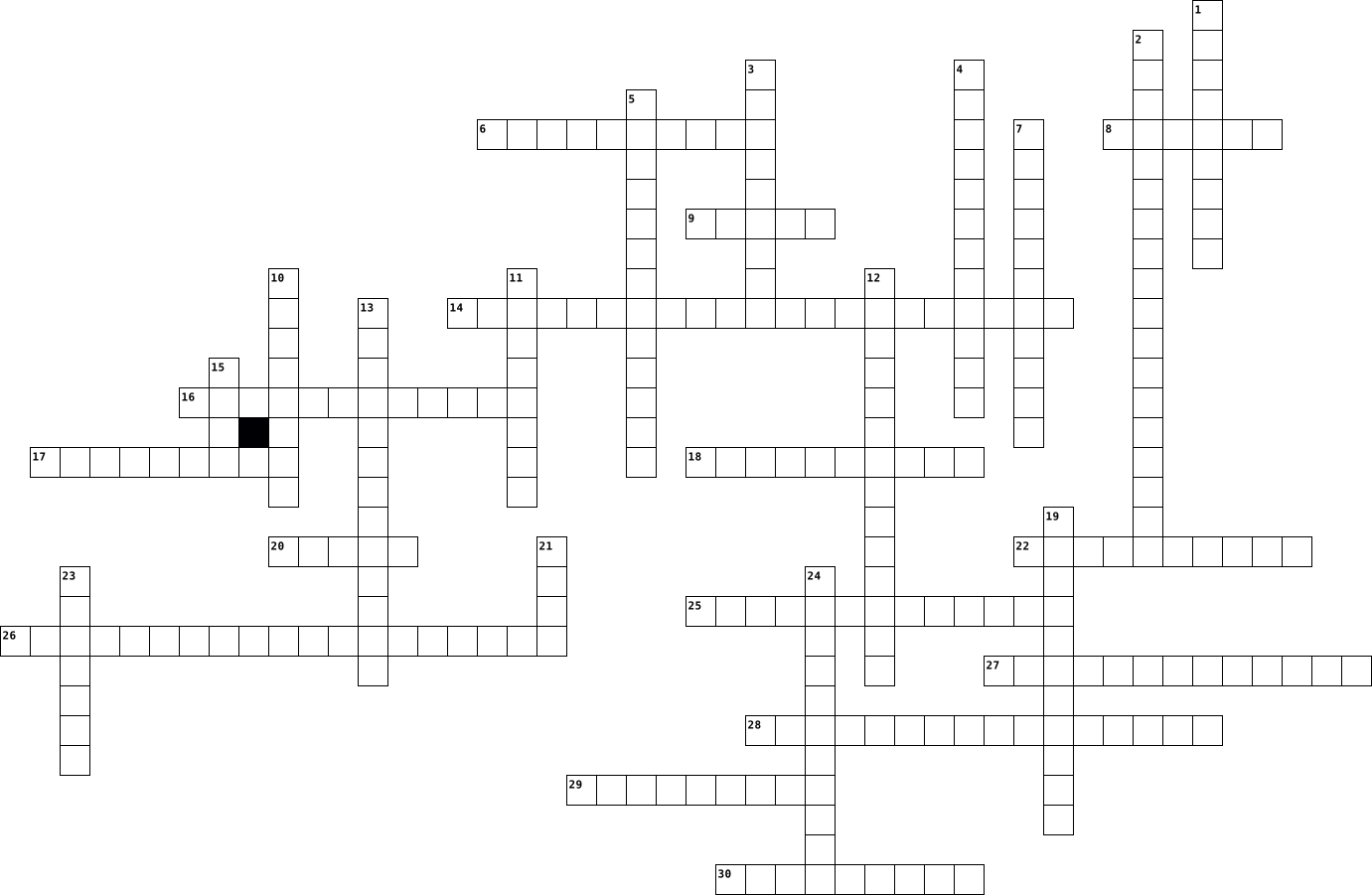
Radiation Physics 2015-03-16

Across
- refers to the electrons liberated by ionization
- SI unit of rem
- the distance from one crest to another.
- The time required for the activity of radioactive material to decay to 1/2 of its original value
- Carries the missing energy of the reaction
- A decay that occurs in nuclei with too many neutrons over protons ratio.
- The work performed when an electron moves through an electric potential
- The quantity of matter described by its energy equivalent
- the emission of particles and energy by atoms to become stable
- The process of removing an orbital electron.
- ______ decay is the mirror image of beta decay
- the area of the anode struck by the electrons form the cathode
- Energy consists of an electric field and magnetic field.
- oscillations per second or cycle per second.
- structures that attenuate x-rays
- Particle emitted by radon
- Protons and neutrons
- atoms that have different Z, different A, and same N.
- The force exerted on a body under the influence of gravity
Down
- Old unit of radioactivity
- The only difference between x-rays and gamma rays.
- Anything that occupies space and has mass
- involves matter in motion
- _________ energy is the energy contained in nucleus of an atom
- incident x-ray is totally absorbed
- One-half the range from crest to valley over which the sine wave varies.
- atoms that have different Z, same A, and different N
- SI unit of rad
- a charged particle
- The largest source of man-made ionizing radiation
- structures that absorb x-rays
- The force that keeps the electron in orbit.
- Atoms with same Z,different A,and different N.
- The largest source of natural environmental radiation
- Old unit of exposure
- ________ atom is the best way too picture the atom
- Identical elements except energy level.
- A free electron emitted during internal conversion
- The ejected electron during internal conversion is known as _______ electron.
- The x-ray _____ decreases with the square of the distance from the source.
- The only difference between proton and electron.
- Electon shell with 50 electrons
42 Clues: SI unit of rem • SI unit of rad • a charged particle • Old unit of exposure • Protons and neutrons • Old unit of radioactivity • involves matter in motion • Particle emitted by radon • structures that absorb x-rays • Electon shell with 50 electrons • structures that attenuate x-rays • incident x-ray is totally absorbed • the distance from one crest to another. • ...
Nuclear Physics 2015-06-15

Across
- to become decomposed
- what is the name of the energy that when protons and neutrons go together to form the nucleus.
- what is the energy used when proton and electron come flying of at a high speed
- rapidity of motion or operation
- One way to increase the number of fissions without increasing the amount of uranium.
- Extra neutrons will increase the possibility to grow
- any of two or more forms of a chemical element, having the same number of protons in the nucleus
- a chain reacting pile
- a positively charged elementary particle
Down
- When you shoot the neutron into the nucleus
- the act of cleaving or splitting into parts
- a proton or neutron, especially when considered as a component of a nucleus
- matter composed only of antiparticles, especially antiprotons, antineutrons.
- the phenomenon, exhibited by and being a property of certain elements
- the principle where neutrons or protons count as different quantum numbers; now there are five quantum numbers.
- any of the massless or nearly massless electrically neutral leptons
- The things that we can find in Nuclei are Protons and ______
- Things we should get as many as possible to fission, before the bomb goes off mechinally
- force The difference between a nucleon and other types of particles is that they have a new kind of force called:
- a unit charge equal to the charge on one electron
- strongly interacting particle other than a baryon.
21 Clues: to become decomposed • a chain reacting pile • rapidity of motion or operation • a positively charged elementary particle • When you shoot the neutron into the nucleus • the act of cleaving or splitting into parts • a unit charge equal to the charge on one electron • strongly interacting particle other than a baryon. • Extra neutrons will increase the possibility to grow • ...
PHYSICS REVISION 2015-10-18

Across
- a substance that flows freely but is of constant volume
- the particles that carry charge through wires in a circuit are mobile electrons
- the degree or intensity of heat present in a substance or object
- dull and flat
- a material or device that conducts or transmits heat or electricity
- move from a lower position to a higher one
- the emission of energy as electromagnetic waves or as moving subatomic particles
- the action of insulating something.
- move continuously and rapidly to and fro.
Down
- the amount of space that a substance or object occupies
- produce and discharge
- the movement caused within a fluid by the tendency of hotter and therefore less dense material to rise
- a stable subatomic particle with a charge of negative electricity
- the process by which heat or electricity is directly transmitted through the material
- Evaporation is defined as the process of a liquid changing into a gas
- the quantity of mass per unit volume of a substance
- firm and stable in shape
- an air-like fluid substance which expands freely to fill any space available
- measure of heat loss
- take in or soak up
- of a smooth surface reflecting light
21 Clues: dull and flat • take in or soak up • measure of heat loss • produce and discharge • firm and stable in shape • the action of insulating something. • of a smooth surface reflecting light • move continuously and rapidly to and fro. • move from a lower position to a higher one • the quantity of mass per unit volume of a substance • ...
Nuclear Physics 2016-07-30

Across
- / makes use of gravity to sustain fusion
- / when protons and neutrons form the nucleus
- / when nucleons are forced together
- / consequence of fusion occuring at very high temperatures
- / anti-particle of an electron
- / identifying isotopes from their characteristic half lives, decay particles and energy by applying neutrons
- / my teacher calls himself
- / 100 times as strong as an electrical force
- / should be called a nuclear bomb
- / high number of nucleons to a low number
Down
- / two nucleons can't do the same thing at the same time
- / replacing atoms with a radioisotope to unveil it's origins
- / dating old objects by counting the number of electrons in an excited state
- / their half-life is only 18 minutes because they are unstable by themselves
- / radioactive debri
- / low number of nucleons to a high number
- / just a form of a given element with a different number of neutrons
- / most useful for dating anything that has been alive
- / all of them have one proton
- / tends to be lean with no radioactive isotopes
- / collective name of protons and neutrons
21 Clues: / radioactive debri • / my teacher calls himself • / all of them have one proton • / anti-particle of an electron • / should be called a nuclear bomb • / when nucleons are forced together • / makes use of gravity to sustain fusion • / low number of nucleons to a high number • / collective name of protons and neutrons • / high number of nucleons to a low number • ...
AS PHYSICS 2016-05-22

Across
- What is the exchange particle involved in weak interaction (the other is Z)?
- Cause readings to be spread about the true value, due to results varying in an unpredictable way from one measurement to the next?
- Values in a set of results which are judged not to be part of the variation caused by random uncertainty?
- A particle and its corresponding antiparticle have opposite?
- What classification do particles and antiparticles that can interact through the strong interaction belong to?
- What classification do particles and antiparticles that cannot interact through the strong interaction belong to?
- Which constant is equal to 6.63x10^(-34)Js?
- Percentage uncertainty for a _________ measurement can be calculated using(uncertainty/mean value) x 100%.
- When a gamma photon changes into a particle and an antiparticle?
- Which prefix has the value x10^(12)?
- In addition to energy, what else is conserved in annihilation?
- What is m/s a unit of?
- What is work measured in?
- What is the lowest energy state of an atom?
- Which prefix has the value x10^(-15)?
- A conclusion supported by valid data, obtained from an appropriate experimental design and based on sound reasoning?
- What is the exchange particle involved in electromagnetic interaction?
- What is measured in volts?
- Which unit is equivalent to kg m^(2)s^(-3)A^(-1)?
- The number of protons in a nucleus, Z?
- A zero error may result in a _________ uncertainty?
- What unit is 1.6x10(-19)J equivalent to?
- Interactions between hadrons and leptons are carried by?
- What is the minimum amount of energy needed by an electron to escape from a metal surface called?
- Physical, chemical or biological quantities or characteristics?
- Which prefix has the value x10^(-9)?
- The maximum and minimum values of the independent or dependent variables; important in ensuring that any pattern is detected?
- Which prefix has the value x10^(-12)?
- Which prefix has the value x10^(-6)?
- A measurement is __________ if the original experimenter repeats the investigation using same method and equipment and obtains the same results.
- Measurements which there is very little spread about the mean value?
- What consists of an electric and a magnetic wave which travel together and vibrate at right angles to each other and to the direction in which they are travelling, and in phase with each other?
- In the photoelectric effect, a photon interacts with ___ electron on the plate.
- Which particle has a charge of 0C and mass 1.67x10^(-27)kg?
- Neutrinos and antineutrinos have no charge, are hard to detect and ____________?
- Which prefix has the value x10^(-2)?
- Total lepton number is ________ conserved in a particle interaction.
- Which force force acts between all charged particles and has an infinite range?
- Which type of EM radiation has the shortest wavelength and highest frequency?
- Which quark has a strangeness of -1?
- In pair production, if the incident photon has more energy than needed, what does the excess energy appear as?
- Sources of systematic error can include the environment, methods of observation or _________ used.
- A proposal intended to explain certain facts or observations?
- What is the exchange particle involved in strong interaction?
- Which prefix has the value x10^(6)?
- Glow of light from a substance exposed to ultraviolet radiation; the atoms de-excite in stages and emit visible photons in the process?
- What category does a hadron consisting of three quarks belong to?
- A type of categoric variable where there is no ordering of categories?
- Which prefix has the value x10^(-1)?
- A measurement is ____________ if the investigation is repeated by another person, or by using different equipment or techniques, and the same results are obtained.
- In the photoelectric effect, the number of photoelectrons emitted per second depends on the _________ of incident radiation.
- A statement suggesting what will happen in the future, based on observation, experience or a hypothesis?
- Which force acts between all particles with mass and has an infinite range?
- The value that would be obtained in an ideal measurement?
- Which quark has a +2/3 charge?
- What are hadrons composed of?
- What category does a hadron consisting of a quark and antiquark belong to?
- Marking a scale on a measuring instrument, that involves establishing the relationship between indications of a measuring instrument and standard or reference quantity values, which must be applied?
- What is a 'packet' of energy referred to as?
- A ____ test is one in which only the independent variable has been allowed to affect the dependent variable.
- Particles and antiparticles have the ____ rest mass and equal, opposite charge.
- When a particle and its antiparticle meet, they destroy each other and become radiation- this is what?
- Which particle has a charge of -1.6x10^(-19)C and mass 9.11x10^(-31)kg?]
- Variables can have values (called a quantity) that can be given a magnitude either by counting or by measurement?
- Total charge is ________ conserved in a particle interaction.
- Which prefix has the value x10^(-3)?
Down
- Percentage uncertainty for a _________ can be calculated using([best gradient-worst gradient]/best gradient) x 100%.
- What is the joint name for protons and neutrons?
- What is the minimum potential that needs to be applied to a metal plate to attract all the photoelectrons emitted from its surface back to the surface called?
- What is the exchange particle involved in gravitational interaction?
- Which force is responsible for radioactive decay and the change in quark flavour? It acts between all particles an has a range of about x10^(-3)fm.
- Atom of same element with same number of protons and different number of neutrons?
- What has the units Ckg^(-1)?
- Errors that can be dealt with by simple repeats and calculating a new mean value?
- Which type of EM radiation has the longest wavelength and lowest frequency?
- Cause readings to differ from the true value by a consistent amount each time a measurement is made?
- Percentage uncertainty for a _________ can be calculated using([best y-intercept - worst y-intercept]/best y-intercept) x 100%.
- What is minimum frequency of light that can cause photoelectric effect?
- Any indication that a measuring system gives a false reading when the true value of a measured quantity is zero?
- What is an atom which has gained or lost electrons called?
- The quantity between reading?
- The variable of which the value is measured for each and every change in the independent variable?
- Which force acts between particles in the nucleus and is responsible for the stability of the nucleus?
- What additional particle is produce in Beta- decay to satisfy conservation laws?
- Information, either qualitative or quantitative, that has been collected?
- What is the unit of charge?
- The total number of neutrons and protons in a nucleus, A?
- What is calculated using (uncertainty/value) x 100%?
- A line graph, not necessarily on a grid, that shows the general shape of the relationship between two variables?
- The interval within which the true value can be expected to lie, with a given level of confidence or probability?
- What is the maximum displacement of a vibrating particle?
- What is calculated using nhf, where n is the number of photons in the beam passing a fixed point each second?
- The difference between a measured value and the true value?
- In the nucleus, the strong nuclear force is _________ from 0.5fm to 3fm.
- What is the process of creating ions?
- Which force has a 3-4fm range?
- What is the emission of electrons from a metal surface when the surface is illuminated by light of frequency greater than a minimum value known as the threshold frequency referred to as?
- The variable for which values are changed or selected by the investigator?
- A measurement that is obtained using accurately calibrated instruments correctly is said to be ----?
- What is the unit of current?
- Specific charge is equal to charge divided by what?
- Variables which have values that are labels?
- What is calculated using hf?
- The smallest change in the quantity being measured (input) of a measuring instrument that gives a perceptible change in the reading?
- Suitability of the investigative procedure to answer the question being asked?
- What is change in velocity per unit time?
- A Hadron consists of three what?
- What additional particle is produce in Beta+ decay to satisfy conservation laws?
- In the nucleus, the strong nuclear force is _________ under 0.5fm?
- A particle and its corresponding antiparticle have an equal?
- Data which has been shown to be valid?
- Which prefix has the value x10^(3)?
- Which particle has a charge of +1.6x10^(-19)C and mass 1.67x10^(-27)kg?
- Particles consisting of two protons and two neutrons?
- A variable which may, in addition to the independent variable, affect the outcome of the investigation and therefore has to be kept constant or at least monitored?
- Strangeness is conserved in which particle interactions?
- Which unit is equivalent to kg ms^(-2)?
- Which meson has a strangeness?
- Which prefix has the value x10^(9)?
119 Clues: What is m/s a unit of? • What is work measured in? • What is measured in volts? • What is the unit of charge? • What has the units Ckg^(-1)? • What is the unit of current? • What is calculated using hf? • The quantity between reading? • What are hadrons composed of? • Which force has a 3-4fm range? • Which quark has a +2/3 charge? • Which meson has a strangeness? • ...
Physics - Electromagnetism 2016-03-27

Across
- a measuring instrument used to measure the current in a circuit.
- the difference of electrical potential between two points.
- a characteristic of a unit of matter that expresses the extent to which it has more or fewer electrons than protons.
- the magnetic effect of electric currents and magnetic materials
- attraction or repulsion that arises between electrically charged particles because of their motion
- A complex of structures, machinery, and associated equipment for generating electric energy from another source of energy, such as nuclear reactions or a hydroelectric dam
- an attractive or repulsive force between two charged objects
- a closed circuit in which the current divides into two or more paths before recombining to complete the circuit
- a system of electrical conductors and components forming a complete and closed path.
- relating the voltage difference between two points, the electric current flowing between them, and the resistance of the path of the current
- an electromotive force or potential difference expressed in volts.
- an object or type of material that allow the flow of electrical current in one or more directions
- a quantity representing the rate of flow of electric charge, usually measured in amperes.
- an instrument designed to measure electric current, voltage, and usually resistance, typically over several ranges of value.
Down
- an instrument used for measuring electrical potential difference between two points in an electric circuit
- a stationary electric charge, typically produced by friction, that causes sparks or crackling or the attraction of dust or hair.
- a combination of two or more cell electrically connected to work together to produce electric energy
- a closed circuit in which the current follows one path
- a stable subatomic particle occurring in all atomic nuclei, with a positive electric charge equal in magnitude to that of an electron, but of opposite sign.
- a form of energy resulting from the existence of charged particles (such as electrons or protons), either statically as an accumulation of charge or dynamically as a current.
- a device having a designed resistance to the passage of an electric current.
- an atom or molecule with a net electric charge due to the loss or gain of one or more electrons.
- the degree to which a substance or device opposes the passage of an electric current, causing energy dissipation. Ohm's law resistance (measured in ohms) is equal to the voltage divided by the current.
- an apparatus for reducing or increasing the voltage of an alternating current.
- a material of such low conductivity that the flow of electric current through it is negligible.
- a physical phenomenon produced by the motion of electric charge, resulting in attractive and repulsive forces between objects.
- a stable subatomic particle with a charge of negative electricity, found in all atoms and acting as the primary carrier of electricity in solids.
27 Clues: a closed circuit in which the current follows one path • the difference of electrical potential between two points. • an attractive or repulsive force between two charged objects • the magnetic effect of electric currents and magnetic materials • a measuring instrument used to measure the current in a circuit. • ...
Medical Physics 2017-03-15

Across
- sound above 20 kHz
- effect of a frequency change of a wave from a moving object
- electrons emitted by photon absorption
- you are put in this for a CAT scan
- radioisotope combined with other elements
- absorbs X-rays
- converts a photon into an electrical pulse
- process producing photons in a PET scan
- detects radiation from injected radioisotopes
- a cathode producing electrons
- Technetium-99m and Fluorine-18 are one of these
Down
- doesn't absorb X-rays much
- describes a temporary high energy state radioisotope
- computerised ___ ____ uses X-rays for 3-D imaging
- improves visibility of X-rays
- needed to 'see' X-rays
- Compton scattering is one of these
- when 2 materials have similar impedance values
- emits pulses of high frequency sound
- reversible effect in crystals converting strain into an emf
- converts gamma photons into light photons
- decrease in intensity of radiation passing through matter
- product of density times speed of sound in a material
23 Clues: absorbs X-rays • sound above 20 kHz • needed to 'see' X-rays • doesn't absorb X-rays much • improves visibility of X-rays • a cathode producing electrons • Compton scattering is one of these • you are put in this for a CAT scan • emits pulses of high frequency sound • electrons emitted by photon absorption • process producing photons in a PET scan • ...
medical physics 2017-03-14

Across
- sound above 20 kHz
- doesn't absorb X-rays much
- converts gamma photons into light photons
- you are put in this for a CAT scan
- decrease in intensity of radiation passing through matter
- and Fluorine-18 are one of these
- absorbs X-rays
- electrons emitted by photon absorption
- radioisotope combined with other elements
- reversible effect in crystals converting strain into an emf
- detects radiation from injected radioisotopes
Down
- process producing photons in a PET scan
- improves visibility of X-rays
- describes a temporary high energy state radioisotope
- product of density times speed of sound in a material
- needed to 'see' X-rays
- a cathode producing electrons
- computerised ___ ____ uses X-rays for 3-D imaging
- effect of a frequency change of a wave from a moving object
- when 2 materials have similar impedance values
- Compton scattering is one of these
- converts a photon into an electrical pulse
- emits pulses of high frequency sound
23 Clues: absorbs X-rays • sound above 20 kHz • needed to 'see' X-rays • doesn't absorb X-rays much • improves visibility of X-rays • a cathode producing electrons • and Fluorine-18 are one of these • you are put in this for a CAT scan • Compton scattering is one of these • emits pulses of high frequency sound • electrons emitted by photon absorption • ...
Physics Crossword 2017-12-30

Across
- A dimensionless quantity representing the amount of matter in a particle or object
- A quantity that has both magnitude and direction
- plane A ramp fortnight with the ground any angle but a right angle
- error The ratio of the absolute error of a measurement to the measurement being taken
- The moment of a force or system of forces tending to cause rotation
- body Solid body in which deformation is zero or so small it can be neglected
- An instrument which measures the power output of an engine
- The definite magnitude of a quantity
- The action-reaction pair of forces acting at each end of said elements.
- The instrument for measuring thicknesses and internal or external diameters
- The time that a pendulum takes to complete one cycle (a left swing and a right swing)
Down
- The length of the opposite side divided by the length of the hypotenuse in a right-angled triangle
- The length of the adjacent side divided by the length of the hypotenuse in a right-angled triangle
- The point against which a lever is placed to get a purchase, or on which it turns or is supported
- notation The method in mathematics that allows the representation of numbers in shorter form
- The resistance that one surface or object encounters when moving over another
- The force that gravitation exerts upon a body, equal to the mass of the body times the local acceleration of gravity
- Accuracy of a measurement instrument
- A quantity having only magnitude (not direction)
- The rigid bar that pivots about one point and that is used to move an object at a second point by a force applied at a third.
20 Clues: Accuracy of a measurement instrument • The definite magnitude of a quantity • A quantity that has both magnitude and direction • A quantity having only magnitude (not direction) • An instrument which measures the power output of an engine • plane A ramp fortnight with the ground any angle but a right angle • ...
Physics Crossword 2018-01-15

Across
- Acronym for the system which prevents cars from tilting due to over or under steering.
- The material with which tires are made.
- Newton's _____ law, which shows that the force exerted by a runner on the ground is equal to the force exerted by the ground on the runner.
- The acronym for slide resistant breaking.
- When your car tires lose contact with the road in wet conditions.
- The difference between race car tires and normal tires.
- Bottom tread of a running shoe.
- _____ control
- What air bags are made of.
Down
- _____ bearings that use energy but negate friction.
- Reduces friction and increase efficiency in wheels, motors etc.
- Friction causes _____ in mechanical devices.
- Tread depths of new tires, in millimeters.
- The Pentagon's research division.
- What a pretensioner pulls on.
- Grips increase ______ between the club and the golfer's hands.
- Material with coefficient of friction of 0.04.
- Crash test ______.
- Crumple _____.
- ____-Rubber compound with a high coefficient of friction.
20 Clues: _____ control • Crumple _____. • Crash test ______. • What air bags are made of. • What a pretensioner pulls on. • Bottom tread of a running shoe. • The Pentagon's research division. • The material with which tires are made. • The acronym for slide resistant breaking. • Tread depths of new tires, in millimeters. • Friction causes _____ in mechanical devices. • ...
Physics Crossword 2018-04-15

Across
- A soft metal core made into a magnet by the passage of electric current through a coil surrounding it.
- Having a high susceptibility to magnetization, the strength of which depends on that of the applied magnetizing field, and that may persist after removal of the applied field.
- If the thumb, the forefinger, and the middle finger of the right hand are bent at right angles to one another with the thumb pointed in the direction of motion of a conductor relative to a magnetic field and the forefinger in the direction of the field, then the middle finger will point in the direction of the induced electromotive force
- 96,485.34 Coulombs
- The formation of new areas of oceanic crust, which occurs through the upwelling of magma at mid ocean ridges and its subsequent outward movement on either side.
- The magnetic field of a current has always ________ ______, in contrast to the electrostatic field lines, which start on positive charges (sources) and end on negative charges
- A device that converts motive power into electrical power for use in an external circuit.
- An instrument containing a magnetized pointer that shows the direction of magnetic north and bearings from it.
- Region in which the magnetic fields of atoms are grouped together and aligned.
- A cylindrical coil of wire acting as a magnet when carrying electric current.
- A ferrimagnetic rock mineral and one of the main iron ores
- Led the largest ships in the world on seven voyages of exploration to the lands around the Indian Ocean, demonstrating Chinese excellence at shipbuilding and navigation.
- A force is any interaction that, when unopposed, will change the motion of an object
- Any of a class of rotary electrical machines that converts direct current electrical energy into mechanical energy
Down
- An electric motor driven by an alternating current.
- Drive or force (an attack or attacker) back or away.
- Each of the points near the extremities of the axis of rotation of the earth or another celestial body where a magnetic needle dips vertically.
- Changes in direction or orientation of the magnetic field of the Earth that have occurred from time to time.
- An instrument for detecting and measuring small electric currents.
- A flow of electric charge
- Danish physicist and chemist who discovered that electric currents create magnetic fields, which was the first connection found between electricity and magnetism
- Cause to come to a place or participate in a venture by offering something of interest, favorable conditions, or opportunities.
- The production of an electric or magnetic state by the proximity of an electrified or magnetized body.
- A silicate mineral or igneous rock that is rich in magnesium and iron
- The surface integral of the normal component of the magnetic field B passing through that surface
- The rotating coil or coils of a dynamo or electric motor.
26 Clues: 96,485.34 Coulombs • A flow of electric charge • An electric motor driven by an alternating current. • Drive or force (an attack or attacker) back or away. • The rotating coil or coils of a dynamo or electric motor. • A ferrimagnetic rock mineral and one of the main iron ores • An instrument for detecting and measuring small electric currents. • ...
Physics Crossword 2018-03-21

Across
- measure of energy transfer that occurs when an object is moved over a distance by an external force at least part of which is applied in the direction of the displacement.
- the quantity of matter in a body regardless of its volume or of any forces acting on it.
- Energy, in physics, the capacity for doing work. It may exist in potential, kinetic, thermal, electrical, chemical, nuclear, or other various forms.
- a scalar quantity, is the rate at which an object covers distance.
- ircular motion can be described as the motion of an object in a circle at a constant speed.
- the study of motion distance, velocity, speed and mass expressed as quantities
- is a scalar quantity that refers to "how much ground an object has covered" during its motion.
- is the branch of classical mechanics that is concerned with the relationship between motion and its causes, specifically, forces and torques.
- is the change of momentum of an object when the object is acted upon by a force for an interval of time.
- is the opposite of acceleration.
- speed of an object is defined as the distance traveled divided by the time elapsed.
- quantity that is unknown but assumed to have a fixed value in a specified mathematical context.
- sometimes refers to electromagnetic radiation of any wavelength, whether visible or not. In this sense, gamma rays, X-rays, microwaves and radio waves
- a metric unit of measurement equal to 1,000 meters
- is a subdiscipline of chemistry and physics that investigates physicochemical phenomena using techniques from atomic and molecular physics and condensed matter physics
- make or become different.
- is the velocity of the object before acceleration causes a change.
- is a physics term; it refers to the quantity of motion that an object has.
- something that causes a change in the motion of an object.
- a charged object is brought near but not touched to a neutral conducting object.
- he action of measuring something.
- is a characteristic of a unit of matter that expresses the extent to which it has more or fewer electrons than protons.
- is the International System of Units (SI) unit of displacement or length.
- on Earth all bodies have a weight, or downward force of gravity, proportional to their mass
- is a systematized body of knowledge based on nature and facts of life
- are standards for measurement of physical quantities that need clear definitions to be useful.
Down
- is also equivalent to one watt-second.
- is a unit of energy equivalent to one watt
- what a clock reads
- are quantities that are fully described by both a magnitude and a direction.
- The unit of time
- is the branch of applied mathematics (specifically classical mechanics) concerned with the study of forces and torques and their effect on motion,
- is a circular movement of an object around a center
- the branch of science concerned with the nature and properties of matter and energy.
- represent energy per unit time.
- An object moving downward within the gravitational field would lose gravitational potential energy.
- is the rate of change of velocity of an object with respect to time.
- that can be measured, thus a physical property that can be quantified.
- is a form of energy that can be transferred from one object to another or even created at the expense of the loss of other forms of energy.
- is a scalar quantity that refers to "how much ground an object has covered" during its motion.
- are quantities that are fully described by a magnitude
- is the branch of Physics dealing with the study of motion
- is the motion by which a body shifts from one point in space to another.
- the rate of doing work, the amount of energy transferred per unit time. Having no direction, it is a scalar quantity.
- is a physical vector quantity; both magnitude and direction are needed to define it.
- is the combined study of thermodynamics, statistical mechanics, and kinetic theory.
- periodic back-and-forth motion of the particles of an elastic body or medium
- is a substance that has inertia and occupies physical space.
- is a change in position of an object over time.
- 60 seconds
- It is a form of energy that can travel through space.
51 Clues: 60 seconds • The unit of time • what a clock reads • make or become different. • represent energy per unit time. • is the opposite of acceleration. • he action of measuring something. • is also equivalent to one watt-second. • is a unit of energy equivalent to one watt • is a change in position of an object over time. • a metric unit of measurement equal to 1,000 meters • ...
Physics Waves 2022-04-06

Across
- moves from one place to another
- back and forth
- propagate
- sound produces
- valley of the wave
- needs something to travel through
- frequency of sound, light, or other waves
- displacement of
- "peak" of a wave
- where the propagation is parallel to the medium
- cancel parts
Down
- builds up wave energy
- time
- distance of the wave crest or trough
- add together
- overlap in space
- where the propagation is periductular to the oscillation
- amount of waves
- equilibrium
- wave that travels
20 Clues: time • propagate • equilibrium • add together • cancel parts • back and forth • sound produces • amount of waves • displacement of • overlap in space • "peak" of a wave • wave that travels • valley of the wave • builds up wave energy • moves from one place to another • needs something to travel through • distance of the wave crest or trough • frequency of sound, light, or other waves • ...
physics defs 2022-04-06

Across
- / a wave whose oscillations are perpendicular to the direction of the eaves advance
- / a distance between crest of a wave
- / the time it takes for two crest to pass a specific point
- / the point on the medium that exhibits the max amount of positive or upward displacement
- / increased amplitudes when the frequency of a periodically applied force is equal or close to a natural frequency of the system on which it acts
- / the interference of two or more waves of equal frequency and phase resulting in their mutual reinforcement and producing a single amplitude equal to the sum of the amplitude of the waves
- / the sensation of a frequency
- / the number of waves that pass a fixed point in a given time
- / movement back and forth at regular speed
- / transfers the energy or light from one to another
- / when two or more waves overlap in space
Down
- / TBA
- / wave movement
- / a body of water curling into an arched form
- /occurs when the max of two waves are out of phase
- / an increase in frequency of sound, light or other waves a
- / the max displacement or distance moved by a point on a vibrating body or wave measured from its equilibrium position
- / a wave that is an oscillation of matter that transfers energy through a medium
- / a point along a standing wave where the wave has minimum amplitude
- / the point on the medium that exhibits the max amount of negative displacement
- / a wave vibrating in the direction of propagation
21 Clues: / TBA • / wave movement • / the sensation of a frequency • / a distance between crest of a wave • / movement back and forth at regular speed • / when two or more waves overlap in space • / a body of water curling into an arched form • /occurs when the max of two waves are out of phase • / a wave vibrating in the direction of propagation • ...
physics defs 2022-04-07

Across
- / wave movement
- / a wave whose oscillations are perpendicular to the direction of the eaves advance
- / transfers the energy or light from one to another
- / a wave vibrating in the direction of propagation
- / a distance between crest of a wave
- / an increase in frequency of sound, light or other waves a
- /occurs when the max of two waves are out of phase
- / when two or more waves overlap in space
- / a wave that is an oscillation of matter that transfers energy through a medium
- / a body of water curling into an arched form
Down
- / TBA
- / movement back and forth at regular speed
- / the number of waves that pass a fixed point in a given time
- / the max displacement or distance moved by a point on a vibrating body or wave measured from its equilibrium position
- / the interference of two or more waves of equal frequency and phase resulting in their mutual reinforcement and producing a single amplitude equal to the sum of the amplitude of the waves
- / the point on the medium that exhibits the max amount of positive or upward displacement
- / the point on the medium that exhibits the max amount of negative displacement
- / a point along a standing wave where the wave has minimum amplitude
- / the sensation of a frequency
- / increased amplitudes when the frequency of a periodically applied force is equal or close to a natural frequency of the system on which it acts
- / the time it takes for two crest to pass a specific point
21 Clues: / TBA • / wave movement • / the sensation of a frequency • / a distance between crest of a wave • / movement back and forth at regular speed • / when two or more waves overlap in space • / a body of water curling into an arched form • / a wave vibrating in the direction of propagation • /occurs when the max of two waves are out of phase • ...
Physics Crossword 2021-12-15

Across
- A push or pull on an object.
- Motion of object when it has a net force = 0 on it.
- The amount of this measures an object's tendency to resist a change in motion.
- Sum of 2 or more vectors.
- Path taken by projectile.
- A measure of an object's inertia.
- Invented to describe what we feel when turning. It does not exist.
- Measurement without direction.
- The force of gravity on an object.
- Sum of all forces acting on object.
Down
- Object launched or thrown into air.
- Sliding friction.
- Measures rate of change of direction.
- A measure of the smoothness of surfaces in contact.
- Net force towards the center of curvature for an object turning.
- Rate of change of velocity.
- Change in position.
- Force from solid surface acting perpendicular to another surface.
- Measurement with direction.
- Rate of change of displacement.
20 Clues: Sliding friction. • Change in position. • Sum of 2 or more vectors. • Path taken by projectile. • Rate of change of velocity. • Measurement with direction. • A push or pull on an object. • Measurement without direction. • Rate of change of displacement. • A measure of an object's inertia. • The force of gravity on an object. • Object launched or thrown into air. • ...
Physics CB 2022-01-04
Across
- What you think about something
- L Times W Times H
- an assertion of the truth of something
- relationship between two variables when their product equals to a constant value
- boiling point and freezing point
- to see how much pressure there is
- movement of heat into an item
- example of something but not the real one
- It happens in a circle motion
- The quality or state of something
- something you can (control)
- watch
- What the idea of what you're trying to find out
- temperature that comes off something
- after evidence
Down
- the spreading of something more widely
- pressure from the atmosphere
- prevent the flow of energy
- corresponding in size or amount to something else
- energy contained within a system
- How hot/cold something is
- to push down on
- before reasoning
- guess
- coldest possible temperature that can exist
- it rises
- can Happen multiple time
- Volume times Density
- weight
- can happen without humans
30 Clues: guess • watch • weight • it rises • after evidence • to push down on • before reasoning • L Times W Times H • Volume times Density • can Happen multiple time • How hot/cold something is • can happen without humans • prevent the flow of energy • something you can (control) • pressure from the atmosphere • movement of heat into an item • It happens in a circle motion • What you think about something • ...
Physics Vocabulary 2022-02-24

Across
- Unit for mass
- Newton's __ Law: Inertia
- Push or Pull
- measured by seconds
- Sir ___ Newton, Father of Physics
- Fast or Slow
- tendency to stay the same
- All Forces together
- stored energy
- similar to weight
- Force that causes movement
Down
- Energy of movement
- Little/no resistance to force
- Resistance to force
- Newton's __ Law: Action and Reaction
- Unit for force
- Newton's __ Law: FMA
- change in speed or direction
- Unit for distance
- Pull toward the ground
- Force doesn't cause movement
21 Clues: Push or Pull • Fast or Slow • Unit for mass • stored energy • Unit for force • similar to weight • Unit for distance • Energy of movement • Resistance to force • measured by seconds • All Forces together • Newton's __ Law: FMA • Pull toward the ground • Newton's __ Law: Inertia • tendency to stay the same • Force that causes movement • change in speed or direction • Force doesn't cause movement • ...
Physics crossword 2022-02-25

Across
- 9 across vary in magnitude or position in a regular manner around a central point
- 10 down the change in direction of a wave passing from one medium to another caused by its change in speed
- 13 down the apparent difference between the frequency at which sound or light waves leave a source and that at which they reach an observer
- 9 across the level of volume we can hear
- 4 down can be thought of as a disturbance or oscillation that travels through space-time, accompanied by a transfer of energy
- 10 across the distance traveled by a given point on the wave (such as a crest) in a given interval of time
- 17 across are waves in which the vibration of the medium is parallel ("along") to the direction the wave travels
- 5 across this is the form a wave length makes
- 5 down technique for detecting and determining the distance and direction of underwater objects by acoustic means
Down
- 12 across property of certain electromagnetic radiations in which the direction and magnitude of the vibrating electric field are related in a specified way
- 6 down the time that it takes to do something
- 15 down motion in which all points on a wave oscillate along paths at right angles to the direction of the wave's advance.
- 9 the maximum amount of displacement of a particle on the medium from its rest position
- 20 down are waves that are created as a result of vibrations between an electric field and a magnetic field
- 15 across a wave that is not capable of transmitting its energy through a vacuum
- 9 occurs widely in nature, and is exploited in many devices
- 12 across the net effect of the combination of two or more wave trains moving on intersecting or coincident paths
- 10 down this is what we have been learning
- 11 down the spreading of waves around obstacles
- 6 this is the bottom of the crest
20 Clues: 6 this is the bottom of the crest • 9 across the level of volume we can hear • 10 down this is what we have been learning • 6 down the time that it takes to do something • 5 across this is the form a wave length makes • 11 down the spreading of waves around obstacles • 9 occurs widely in nature, and is exploited in many devices • ...
Physics vocabulary 2022-01-03

Across
- the mass of an object or collection of objects never changes, no matter how the parts are rearranged.
- the way in which a substance, typically a liquid, holds together; thickness or viscosity.
- the process by which heat or electricity is directly transmitted through a substance when there is a difference of temperature or of electrical potential between adjoining regions, without movement of the material.
- the amount of space that a substance or object occupies, or that is enclosed within a container, especially when great.
- an instrument measuring atmospheric pressure, used especially in forecasting the weather and determining altitude.
- any factor that is controlled or held constant in an experiment
- a question that a research project sets out to answer
- the movement caused within a fluid by the tendency of hotter and therefore less dense material to rise, and colder, denser material to sink under the influence of gravity, which consequently results in transfer of heat.
- the quality of being hot; high temperature.
- the available body of facts or information indicating whether a belief or proposition is true or valid.
- the amount of energy a body stored due to its being at a higher temperature than its surroundings
- a supposition or proposed explanation made on the basis of limited evidence as a starting point for further investigation.
- able to be noticed or perceived; discernible.
- the lowest limit of the thermodynamic temperature scale, a state at which the enthalpy and entropy of a cooled ideal gas reach their minimum value, taken as zero kelvins
Down
- the pressure exerted by the weight of the atmosphere, which at sea level has a mean value of 101,325 pascals (roughly 14.6959 pounds per square inch).Also called barometric pressure.
- the intermingling of substances by the natural movement of their particles.
- the quantity of matter in a physical body
- a system or thing used as an example to follow or imitate.
- corresponding in size or amount to something else
- if one variable increases the other will decrease, and if one variable decreases the other will increase
- the quality or state of being natural.
- done without confidence; hesitant.
- the emission of energy as electromagnetic waves or as moving subatomic particles, especially high-energy particles which cause ionization
- the scale of temperature in which water freezes at 0° and boils at 100° under standard conditions.
- the degree of compactness of a substance.
- the degree or intensity of heat present in a substance or object, especially as expressed according to a comparative scale and shown by a thermometer or perceived by touch.
- continuous physical force exerted on or against an object by something in contact with it.
- the fact of always behaving or occurring in the way expected.
- a substance which does not readily allow the passage of heat or sound.
- the action of thinking about something in a logical, sensible way.
- state or assert that something is the case, typically without providing evidence or proof.
31 Clues: done without confidence; hesitant. • the quality or state of being natural. • the quantity of matter in a physical body • the degree of compactness of a substance. • the quality of being hot; high temperature. • able to be noticed or perceived; discernible. • corresponding in size or amount to something else • a question that a research project sets out to answer • ...
Physics Vocab 2022-01-21

Across
- when two or more objects come into contact
- measure of how fast velocity is changing; time rate of change
- the science of matter and energy and their interactions
- a course along which someone or something moves
- the force that resists motion of one object rubbing against another
- quantity of matter
- an attractive force between two objects in the universe
- any physical quantity that is defined by size and direction
- 0 velocity; not moving
- relating to the motion of material bodies and their forces
- close to the real value
- an educated guess
Down
- the speed and direction of motion
- an object initially propelled by a force outside itself and keeps moving
- a quantity that has a size or magnitude only
- shortest distance from point A to point B
- push or pull
- he tendency of objects to resist changes in speed or direction of motion
- a linear interval of space
- force times distance; work is energy
- a physical quantity of work
21 Clues: push or pull • an educated guess • quantity of matter • 0 velocity; not moving • close to the real value • a linear interval of space • a physical quantity of work • the speed and direction of motion • force times distance; work is energy • shortest distance from point A to point B • when two or more objects come into contact • a quantity that has a size or magnitude only • ...
FUN & PHYSICS 2022-03-21

Across
- 14
- 1
- 25
- 24
- 18
- 8
- 21
- 3
- 23
- 15
- 7
- 16
- 19
Down
- 5
- 2
- 9
- 6
- 20
- 4
- 12
- 22
- 13
- 17
- 26
- 10
- 11
26 Clues: 5 • 2 • 1 • 9 • 6 • 4 • 8 • 3 • 7 • 14 • 25 • 20 • 24 • 12 • 18 • 22 • 13 • 17 • 21 • 26 • 23 • 10 • 15 • 16 • 19 • 11
Nuclear Physics 2023-10-14

Across
- - Splitting of an atomic nucleus.
- - Emission of energy as particles or waves.
- - Type of radiation involving high-speed electrons.
- - Nearly massless subatomic particle.
- - Material capable of undergoing fission.
- - Type of radiation consisting of helium nuclei.
- - The minimum amount of fissile material.
- - Atoms with the same number of protons but different neutrons.
- - Isotope used for dating artifacts.
- - Neutrally charged subatomic particle.
- - Interaction between atomic nuclei.
- - Particles passing through energy barriers.
- - Emitting radiation due to unstable nuclei.
- - Time for half of a substance to decay.
- - Radiation with sufficient energy to remove electrons.
- - Process of nuclear fusion in stars.
- - Process in which nuclei fragment.
Down
- - Substances capable of sustaining a chain reaction.
- - A self-sustaining nuclear process.
- - Central core of an atom.
- - Attractive force between nucleons.
- - Energy holding atomic nuclei together.
- - Process of a nucleus transforming over time.
- - Combining of atomic nuclei.
- - Resulting nuclei from nuclear fission.
- - Type of radioactive decay.
- - Positively charged subatomic particle.
- - Counterpart to the neutrino.
- - Creates more fissile material than it consumes.
- - High-energy electromagnetic radiation.
30 Clues: - Central core of an atom. • - Type of radioactive decay. • - Combining of atomic nuclei. • - Counterpart to the neutrino. • - Splitting of an atomic nucleus. • - Process in which nuclei fragment. • - A self-sustaining nuclear process. • - Attractive force between nucleons. • - Isotope used for dating artifacts. • - Interaction between atomic nuclei. • ...
Physics Crossword 2023-11-30

Across
- When one is doubled the other is reduced to half, changing in opposite direction
- The push or pull on an object from the interacting with another
- The speed an object reaches through free falling
- The vector sum of all forces that act upon an object
- Drag force due to gravity on moving objects
- When the individual forces exerted upon an object are balanced
- The upward force that balances the weight of an object on a surface
- Liquid or gas that flows
- Force acting on a moving object is the product of mass & acceleration
- The gravitational force of Earth attracted masses towards its center
Down
- A quantity representing the amount of matter in a particle or object
- Show relative magnitude and direction of all forces acting on an object
- Collison of objects on air molecules; slowing
- Unit of mass in the metric system
- An object will not change its motion, unless acted on by an unbalanced force
- Force that stops objects from moving through each other
- One force against another over a surface
- The force that resists the sliding or rolling of one object over another
- Pressure applied on a point of a liquid, equal in all directions
- Unit of measure of force
- The tendency of an object to stay at rest
21 Clues: Unit of measure of force • Liquid or gas that flows • Unit of mass in the metric system • One force against another over a surface • The tendency of an object to stay at rest • Drag force due to gravity on moving objects • Collison of objects on air molecules; slowing • The speed an object reaches through free falling • The vector sum of all forces that act upon an object • ...
physics vocabulary 2023-11-23

Across
- The bending of light as it passes through different mediums.
- A measure of the amount of matter in an object.
- The force that acts on a mass due to gravity.
- The process of a substance changing from a gas to a liquid.
- The resistance of an object to changes in its state of motion.
- the discrete quantity of energy proportional in magnitude to the frequency of the radiation it represents.
- The fundamental force that holds atomic nuclei together
- The unit of electrical resistance.
- The SI unit of energy.
Down
- The bending of a wave around obstacles and the spreading of waves as they pass through openings.
- The study of motion and its causes.
- energy The energy an object possesses due to its motion.
- The speed of an object in a particular direction.
- The SI unit of force.
- The force of attraction between any two masses in the universe.
- This particle has a negative charge and orbits the nucleus.
- The point in an object where its mass can be considered to be concentrated.
- The rate of doing work or transferring energy
- The force that opposes the motion of objects through air.
- The fundamental particle that makes up all matter.
20 Clues: The SI unit of force. • The SI unit of energy. • The unit of electrical resistance. • The study of motion and its causes. • The force that acts on a mass due to gravity. • The rate of doing work or transferring energy • A measure of the amount of matter in an object. • The speed of an object in a particular direction. • The fundamental particle that makes up all matter. • ...
Physics Homework 2023-11-07

Across
- ultrasound is reflected by _____ between soft tissue or bone
- _____ is called as breaking sound barrier
- ship have _____ that produce ultrasound
- _____ is one of skydiver that travel faster than Mach 1
- you will see the light of thunderstorm before the sound because it takes time for the sound to travel from the storm _____ to your ears
- echo is _____ reflection of sound waves
- distinctive sound that instrument make
- example of a string instruments
- starting pistols have electronic signal that connected to a microphone that ______ signal to loudspeakers
- loudspeakers are more important in _____ races
Down
- we see the fetus by taking _____
- echoes can be _____ in concert halls
- echolocation is used by dolphin when dolphin make a series of _____
- the return of echo in ship are detected by _____
- _____ walls are covered by soft materials
- _____ is a process of muddying sound
- waves can be produced when there is a box _____ the string
- rope with weight in the end called _____
- _____ reflects fetus and transmits ultrasound
- when there is echo,sound _____ surfaces
20 Clues: example of a string instruments • we see the fetus by taking _____ • echoes can be _____ in concert halls • _____ is a process of muddying sound • distinctive sound that instrument make • ship have _____ that produce ultrasound • when there is echo,sound _____ surfaces • echo is _____ reflection of sound waves • rope with weight in the end called _____ • ...
Physics Final 2024-02-21

Across
- the change in an objects distance and direction and position from the start
- unit of measure that equals the force to accelerate 1kg at 1m/s
- 2(pi)r is equal to (blank)
- a type of fluid friction that occurs as an object moves through the air
- a part or element of a larger whole
- friction that occurs when an object moves through fluid
- method used for adding vectors
- both direction and magnitude
- mass and weight are the same
- variable that is measurable
- the effect of gravity on you
- the acceleration on the mass
- the law that is the relationship between mass and acceleration that gives us force
- force transferred through touch
- the force resistance between 2 objects
- distance traveled per unit time
- variable that is manipulated
- quantity that has magnitude but no direction
- change in velocity over the time it takes for it to occur
- a squared plus b squared equals c squared
Down
- a way of writing numbers in decimal form between 1 and 10,multiplied by the power of 10
- friction that occurs when an object rolls over a surface
- newtons first law
- total distance over total time
- if the net force of an object isn't 0, the object will (blank)
- a measure of the amount of matter in an object
- forces that produce a non zero net force
- newtons (blank) law that states that every action has an equal and opposite reaction
- anytime we curvetowards the center of a circular path
- speed of an object at one instant of a time
- the overall force on an object
- how far an object moves
- force needed to reach equilibrium
- friction that occurs when one solid surface slides over another
- the speed of an object in a certain direction
- distance is measured in
- vectors can be shown/represented by?
- a kind of force that acts around an object
- a push or a pull
- friction that acts on objects that are not in motion
- forces that create a net force of 0
41 Clues: a push or a pull • newtons first law • how far an object moves • distance is measured in • 2(pi)r is equal to (blank) • variable that is measurable • both direction and magnitude • mass and weight are the same • the effect of gravity on you • the acceleration on the mass • variable that is manipulated • total distance over total time • method used for adding vectors • ...
Physics CrossWord 2023-12-11

Across
- simply the difference in the position of the two marks and is independent of the path taken
- the ratio of the change in the y-axis to the change in the x-axis
- the rate at which the velocity changes
- the universal force of attraction acting between all matter
- The type of motion in which the object travels with a varied speed
- represents the position, velocity, and acceleration of an object at various clock readings
- System used to describe the position of an object in space
- is the rate at which the position changes
- measures the length between objects or points without regard for direction
- depicts motion by plotting position relative to the starting point on the y-axis and time on the x-axis
Down
- that velocity changes at a constant rate
- an object that is falling under the sole influence of gravity
- the location of an object at any given time
- when both the magnitude and direction of the rate at which such an object is changing its position remain constant
- a scalar quantity that refers to "how fast an object is moving."
- a quantity that has both magnitude and direction
- are quantities that are fully described by a magnitude (or numerical value) alone
- the acceleration of the object at some discrete instant in time
- A point from which a body or an object starts moving
- a horizontal (flat) line indicates the object is travelling at a constant speed\
- defined as the rate at which an object changes its velocity
- The type of motion in which the object travels in a straight line with uniform speed
22 Clues: the rate at which the velocity changes • that velocity changes at a constant rate • is the rate at which the position changes • the location of an object at any given time • a quantity that has both magnitude and direction • A point from which a body or an object starts moving • System used to describe the position of an object in space • ...
Physics Final 2023-12-15

Across
- Numerical data
- A force that opposes motion between any surfaces that are touching
- Descriptive data
- How fast an object is moving
- Quantities that are fully describes by magnitude alone
- A push or pull acting on an object
- The process where the velocity changes
- Step three to scientific reasoning
- The amount of force needed to change the objects motion in a given amount of time
- An unbalanced force required to change the motion of an object
Down
- How fast an object is moving and the direction its moving in
- Step two to scientific reasoning
- Quantities that are fully described by both magnitude and direction
- Inertia causes a resting object to remain at rest and a moving object to remain in motion unless acted upon by an [ ] force
- The measure of the amount of matter that an object contains
- The measure of force that is even to the gravitational pull of an object
- The tendency of an object to resist a change in its motion
- The science that deals with matter and energy
- What Newtons law is also called the Law of Inertia
- Step one to scientific reasoning
20 Clues: Numerical data • Descriptive data • How fast an object is moving • Step two to scientific reasoning • Step one to scientific reasoning • A push or pull acting on an object • Step three to scientific reasoning • The process where the velocity changes • The science that deals with matter and energy • What Newtons law is also called the Law of Inertia • ...
Physics crossword 2023-12-12

Across
- neutrons- a free neutron with a kinetic energy of about 0.025 eV (about 4.0×10⁻²¹ J or 2.4 MJ/kg, hence a speed of 2.19 km/s)
- power station- also called combustion power plants, they operate with energy produced by a steam boiler fueled by coal, natural gas, heating oil, as well as by biomass.
- energy - advantages and disadvantages- An energy source that is both renewable and inexhaustible by definition. High upfront cost.
- energy- energy per unit mass.
- rods- used to control the power of a nuclear reactor
- not able to be renewed.
- energy - advantages and disadvantages- While nuclear energy may be clean and its production emission-free, experts highlight a hidden danger of this power: nuclear waste.
- The minimum amount of electric power delivered or required over a given period of time at a steady rate.
- - advantages and disadvantages- It is clean and sustainable., the impact it can have on the environment.
- vibrations- can behave like particles or waves
- diagram- a visualization used to depict a flow from one set of values to another.
- an arbitrator or mediator.
Down
- storage system- a configuration of two water reservoirs at different elevations that can generate power as water moves down from one to the other (discharge), passing through a turbine
- conduction- the diffusion of thermal energy (heat) within one material or between materials in contact.
- heating panel- Active solar heating systems use solar energy to heat a fluid -- either liquid or air -- and then transfer the solar heat directly to the interior space or to a storage system for later use.
- cells- a nonmechanical device that converts sunlight directly into electricity.
- capable of being renewed.
- fuels- made from decomposing plants and animals.
- source (energy)- produced by converting primary sources of energy such as coal, natural gas, nuclear energy, solar energy, and wind energy
- exchanger- a device which transfers heat from one medium to another,
- density- the amount of energy stored in a given system or region of space per unit volume.
- source (energy)- fossil fuels (petroleum, natural gas, and coal), nuclear energy, and renewable sources of energy.
- energy- thermal energy that is released into the surrounding environment after any process.
- energy - advantages and disadvantages-wind is a clean, renewable energy source and is one of the most cost-effective sources of electricity.
- having had the proportion of the isotope U-235 it contains increased in order to make it suitable for use in a nuclear reactor or weapon.
25 Clues: not able to be renewed. • capable of being renewed. • an arbitrator or mediator. • energy- energy per unit mass. • vibrations- can behave like particles or waves • fuels- made from decomposing plants and animals. • rods- used to control the power of a nuclear reactor • exchanger- a device which transfers heat from one medium to another, • ...
physics vocab 2023-12-12

Across
- The region of space surrounding a body in which another body experiences a force of gravitational attraction
- A material that allows electrons to flow freely from particle to particle
- The flow of an electric charge through an object or medium
- A physical condition existing in space that causes particles placed within the space to experience a force
- The production of electric potential difference across a conductor as the conductor moves through a magnetic field
- The area around a magnet or moving electric charge that can exert a magnetic force
- An electric current flowing in only one direction
- An interaction between an object and another object or a field that acts to change the motion of the object
- An electric current that reverses its direction many times a second at regular intervals
- The SI unit of measurement for electric current
- The SI unit for electromotive force, or the difference in potential that would drive one amp of current against one ohm of resistance
- A law describing the electrostatic force of interaction between charged particles based on the strength of the charges and the distance between the particles
Down
- A region around a charged particle or object within which a force would be exerted on other charged particles or objects
- A physical phenomenon associated with the presence and movement of electric charge
- The force that acts between bodies of like electric charge or magnetic polarity, tending to separate them
- A closed loop of conductors through which an electric current can flow
- An attraction related to the relative charge of an object
- Energy in the form of oscillating electric and magnetic fields that is released in electromagnetic processes; characterized based on the frequency and wavelength of the oscillations as radio waves, microwaves, infrared radiation, visible light, ultraviolet radiation, X-rays, and gamma rays
- The physical interaction between charged particles; one of the four fundamental interactions in nature
- Forces that act over a distance, such as gravity
- A force that acts to move objects closer together
- The difference in electric potential between two points
- The SI unit of electric charge, equal to the quantity of electricity conveyed in one second by a current of one ampere
23 Clues: The SI unit of measurement for electric current • Forces that act over a distance, such as gravity • An electric current flowing in only one direction • A force that acts to move objects closer together • The difference in electric potential between two points • An attraction related to the relative charge of an object • ...
atomic physics 2024-01-24

Across
- the second [F] of [A]s going left to right.
- a set of [A]s with similar properties.
- an [C] with more [D]s than [E]s.
- a set of [A]s that are semiconductive.
- a charged atom.
- the first [F] of [A]s going left to right.
- a subatomic particle with a negative charge.
- the third to last [F] of [A]s going left to right.
- the total # of [B]s and [E]s in an atom.
- a ___ is a set of [A]s with the same number of orbits.
Down
- the second to last [F] of [A]s going left to right.
- a set of [A]s that are insulative.
- an [C] with less [D]s than [E]s.
- two atoms are of the same ___ if they are the same [A] and have the same number of [B]s.
- a set of 14 [A]s with 6 orbits and 3 [D]s that is isolated from the rest of it's [G].
- most [A]s are ___.
- what the atomic number is counting.
- all atoms with the same atomic number are of the same ____.
- a set of 14 [A]s with 7 orbits and 3 [D]s that is isolated from the rest of it's [G].
- a nuclear particle with no charge.
20 Clues: a charged atom. • most [A]s are ___. • an [C] with less [D]s than [E]s. • an [C] with more [D]s than [E]s. • a set of [A]s that are insulative. • a nuclear particle with no charge. • what the atomic number is counting. • a set of [A]s with similar properties. • a set of [A]s that are semiconductive. • the total # of [B]s and [E]s in an atom. • ...
PHYSICS CROSSWROD 2023-09-18

Across
- The first Indian satellite?
- A pull or a push applied or exerted on an object is _______.
- What is the physical state of water at 12°C?
- What remains constant in isothermal process?
- Charge carried by a proton?
- Newton's First law gives the concept of ______.
- Who invented of telescope?
- The phenomenon where a sound produced is heard again due to reflection is called ___________.
- The _______ lens is thick at the middle and thin at the edges.
- SI unit of Young's Modulus?
- The filament of an electric bulb is made of?
- A _______ vector is a type of vector that has zero magnitudes and is directionless.
- Rainbow is the natural phenomenon of?
- Atom bomb is based on the principle of Nuclear ________.
- Hertz is the unit of _______.
- Moment of inertia is a _______ quantity.
- Who has stated the Right hand Thumb Rule?
Down
- The path through which an electric current flows is called electric ________.
- The principle behind steam engine is?
- Which sound waves are used in echocardiography (ECG)?
- To and fro motion of an object is called ________.
- The energy possessed by a body due to the change in its shape/position is called ______ energy.
- SI unit of temperature?
- The slope of the velocity time graph shows ________.
- The pressure exerted by air around us is known as __________ pressure.
- The capacitance measured in ______.
- The weakest force in nature is _________ force.
- Ohm’s law states that the ___________ across a conductor is directly proportional to the current flowing through it.
- The movement of the Earth around the Sun in a fixed path is called?
- Copper is a ________ conductor of electricity.
- The sound waves doesn't travel through which medium?
31 Clues: SI unit of temperature? • Who invented of telescope? • The first Indian satellite? • Charge carried by a proton? • SI unit of Young's Modulus? • Hertz is the unit of _______. • The capacitance measured in ______. • The principle behind steam engine is? • Rainbow is the natural phenomenon of? • Moment of inertia is a _______ quantity. • Who has stated the Right hand Thumb Rule? • ...
Physics 101 2025-02-03

Across
- pair, The action force and the reaction force that occur in an interaction
- Fake science that pretends to be real science.
- fall, falling under the influence of gravity alone—falling without air resistance.
- resistance, The force of friction acting on an object due to its motion in air.
- speed, The speed at which the acceleration of a falling object terminates when air resistance balances its weight
- Any object that moves through the air or through space under the influence of gravity.
- time, The time that one’s feet are off the ground during a vertical jump.
- The oval path followed by a satellite. The sum of the distances from any point on the path to two points called foci is a constant. When the foci are together at one-point, the ellipse is a circle. As the foci get farther apart, the ellipse becomes more eccentric
- Likes to chase mice
- of energy, Energy cannot be created or destroyed; it may be transformed from one form into another, but the total amount of energy never changes.
- The quantity of matter in an object. More specifically, a measure of the inertia (or sluggishness) that an object
- Flying mammal
- Large marsupial
- collision, A collision in which colliding objects rebound without lasting deformation or the generation of heat.
- force, The combination of all forces that act on an object
- A projectile or small celestial body that orbits a larger celestial body
- The quantity of space an object occupies.
- Mutual action between objects during which each object exerts an equal and opposite force on the other.
- Man's best friend
- Simply stated, a push or a pull.
Down
- being without a support force, as in free fall.
- Has a trunk
- The speed of an object and specification of its direction of motion.
- The percentage of the work put into a machine that is converted into useful work output.
- velocity, terminal speed in a given direction, often downward.
- The scientific unit of force.
- The rate at which velocity changes with time; the change in velocity may be in magnitude or direction or both, and it is usually measured in units of m/s2
- A general hypothesis or statement about the relation-ship of natural quantities that has been tested over and over again and has not been contradicted; also known ASA principle
- Distance traveled per unit time
- An educated guess; a reasonable explanation of an observation or experimental result that is not fully accepted as factual until tested over and over again by experiment.
- The curved path followed by a projectile under the influence of constant gravity only.
- force, The force that supports an object against gravity, often called the normal force
- The resistive force that opposes the motion or attempted motion of an object past another object with which it is in contact, or through a fluid.
- An arrow that represents the magnitude and direction of a quantity.
- A synthesis of a large body of information that encompasses well-tested and verified hypotheses about certain aspects of the natural world
- The force that an object exerts on a supporting surface (or, if suspended, on a supporting string), which is often, but not always, due to the force of gravity
- The unit of mass. One kilogram (kg) is the mass of 1 liter (L) of water at 4°C
- The property by which objects resist changes in motion.
38 Clues: Has a trunk • Flying mammal • Large marsupial • Man's best friend • Likes to chase mice • The scientific unit of force. • Distance traveled per unit time • Simply stated, a push or a pull. • The quantity of space an object occupies. • Fake science that pretends to be real science. • being without a support force, as in free fall. • ...
Physics Terminology 2025-09-11

Across
- This is one of the acoustic variables. Any mechanical system produces heat, as the wave propagates it losses energy to the surrounding medium.
- Sound will travel through this in a medium when the line segments are farther apart, meaning the molecules are farther apart.
- This can be described as a longitudinal mechanical wave.
- Sound travels through this in a medium, specifically when there is a high particle density, such as in muscle.
- The molecules move in the same direction as the wave.
- This can be defined as the maximum variation of a variable from its mean value.
- This type of wave will propagate in a medium, or a vacuum.
- This type of wave requires a medium to propagate.
- As this wave characteristic increases, frequency decreases and vice versa.
Down
- This wave measurement depends on the physical properties of the medium and is not dependant on the frequency of the sound wave
- Frequency and time can be characterized as ___________ of each other.
- The length of space that one cycle takes up.
- This is one of the acoustic variables that is defined as a concentration of force, or force per area, in the compression phase of propagation this increases, and in rarefaction this decreases
- This can be defined as the time it takes for the wave to transition from compression through rarefaction and back to compression.
- Water, sound, light, x-rays, and radio signals all travel in the form of ________.
- This wave characteristic is measured in (Hertz/Hz)
- Amplitude is determined by measuring the difference between this and the maximum.
- The formula for this measurement is mass/volume.
- The material through which the sound wave is travelling.
- This type of wave propagates by particle motion that is perpendicular or otherwise known as _________ to the wave propagation direction.
- In this type of drawing, the measurement of time and of distance appear as the same characteristic in the drawing.
21 Clues: The length of space that one cycle takes up. • The formula for this measurement is mass/volume. • This type of wave requires a medium to propagate. • This wave characteristic is measured in (Hertz/Hz) • The molecules move in the same direction as the wave. • This can be described as a longitudinal mechanical wave. • ...
12TH PHYSICS 2025-05-23

Across
- The law that describes the force between two point charges.
- The principle used to find the net force on a charge due to multiple other charges.
- Electric field lines never do this to each other.
- A substance that allows electric current to pass through easily.
- The force between two stationary charges.
- A material that does not allow electricity to pass through easily.
- The SI unit of electric charge.
- The property of charge that it exists in discrete packets.
- The SI unit of electric potential.
- The electric field inside a conductor in electrostatic equilibrium.
Down
- The scientist who named positive and negative charges.
- The vector quantity that measures the strength of a dipole.
- The force between two like charges.
- The SI unit of electric flux (use letters and symbols, no spaces).
- Charging a body without touching it, by bringing it near a charged body.
- The law relating electric flux through a closed surface to the enclosed charge.
- The direction of electric field lines from a positive charge.
- The process of charging a body by rubbing it with another body.
- Two equal and opposite charges separated by a distance form this.
- The force between two charges is inversely proportional to this of the distance between them.
20 Clues: The SI unit of electric charge. • The SI unit of electric potential. • The force between two like charges. • The force between two stationary charges. • Electric field lines never do this to each other. • The scientist who named positive and negative charges. • The property of charge that it exists in discrete packets. • ...
physics quest 2025-06-10

Across
- What natural phenomenon is described by a law that explains the attractive force between all masses in the universe?
- What physical quantity represents the amount of matter in an object and remains constant regardless of its location in the universe?
- What vector quantity includes both magnitude and direction, and measures how quickly and in what direction an object is moving?
- What wave phenomenon occurs when two or more waves overlap and combine to form a new wave pattern?
- What physical concept describes the rate at which an object’s velocity changes over time?
- What is the SI unit of work or energy, equivalent to the energy transferred when a force of one newton moves an object one meter?
- What scalar quantity is defined as the total distance traveled divided by the total time taken?
- What is the physical property that resists changes in an object’s state of motion, forming the foundation of Newton’s First Law?
- What type of energy is directly associated with an object’s motion and depends on both its mass and velocity?
- What is defined as the change in position of an object?
- What wave behavior involves the bending and spreading of waves around obstacles or through small openings?
- What term describes an object that moves through the air solely under the influence of gravity after being launched?
- What principle in physics asserts that certain physical quantities (such as energy or momentum) remain constant in a closed system?
- What is defined as the physical quantity with magnitude and no direction?
- What is the SI unit used to measure the strength of electric current, named after a French physicist?
- What property of waves measures how many complete cycles pass a given point in one second, measured in hertz?
- Who was the scientist that formulated the three laws of motion and the universal law of gravitation?
Down
- What term describes the total energy of a system that includes both kinetic and potential energy?
- What branch of physics deals with heat, temperature, and the conversion of energy from one form to another?
- What term describes a complete and closed path through which electric current flows?
- What vector quantity uses the equation F = ma?
- What is the superposition of waves, causing an increase or decrease in the amplitude of the resulting wave?
- What process occurs when waves bounce back after hitting a barrier they cannot pass through?
- What term refers to any physical quantity that has both magnitude and direction, such as force or velocity?
- What type of energy results from the motion of particles in matter and is closely related to the concept of temperature?
- What is the unit of measurement for electrical resistance, fundamental to Ohm’s Law?
- What electrical component temporarily stores electric charge and is used in circuits to control energy flow?
- What theory proposed by Einstein revolutionized physics by describing how time and space are linked for objects moving at constant speeds?
- What is the bending of a wave, such as light or sound, as it passes at an angle from one medium to another with a different density?
- What major branch of physics is concerned with the behavior of physical bodies when subjected to forces or displacements?
30 Clues: What vector quantity uses the equation F = ma? • What is defined as the change in position of an object? • What is defined as the physical quantity with magnitude and no direction? • What term describes a complete and closed path through which electric current flows? • What is the unit of measurement for electrical resistance, fundamental to Ohm’s Law? • ...
Physics Crossword 2025-06-08

Across
- : The third derivative of position with respect to time; rate of change of acceleration
- : A meson involved in the strong nuclear force
- : A measure of how a material allows magnetic fields to pass through it
- : Mathematician known for algebra used in vector spaces and exterior algebra
- : Coordinates used to describe uniformly accelerated frames in relativity
- : The rate of change of velocity over time
- : Tensor used in general relativity to describe spacetime curvature
- : A vast cloud of gas and dust in space; often a star-forming region
- : A type of transformation preserving lines and parallelism
- : Transformation equations fundamental to special relativity
- : A particle that carries force and follows Bose-Einstein statistics
- : Physicist who contributed to quantum mechanics and probability interpretation
- : A point where a wave function has zero amplitude
Down
- : A mathematical object used to describe physical quantities in relativity
- : The movement of solvent molecules through a semipermeable membrane
- : Astrophysicist known for the mass limit of white dwarfs
- : A type of transformation that preserves angles but not necessarily lengths
- : A fundamental particle not affected by strong interactions (e.g., electron)
- : A process where a function calls itself in programming or mathematics
- : A numerical integration rule named after an 18th-century mathematician
- : A differential operator used in physics, named after a French mathematician
- : A self-similar geometric figure with fractional dimension
- : An elementary particle and fundamental constituent of matter
- : A composite particle made of three quarks (e.g., protons and neutrons)
- : A neutral, nearly massless subatomic particle that interacts weakly
- : A topological space that locally resembles Euclidean space
26 Clues: : The rate of change of velocity over time • : A meson involved in the strong nuclear force • : A point where a wave function has zero amplitude • : Astrophysicist known for the mass limit of white dwarfs • : A self-similar geometric figure with fractional dimension • : A type of transformation preserving lines and parallelism • ...
Physics Crossword 2026-03-09

Across
- 0.02 second
- The SI Unit for luminous intensity
- The consistency of a measurement when repeated
- The closeness of a measurement to the actual or true value
- The physical quantity that determines the amount of inertia an object has
- The SI unit for thermodynamic temperature
- The rate of change of velocity
- An object has decreasing velocity
- An error caused by the eye of the observer not being perpendicular to the scale
- The rate of change of displacement
- Prefixes used to represent very small or very large values
- The total length of the path traveled by an object
- A physical quantity that has both magnitude and direction
- Which Newtons Law of Motion that state remain at rest and continue its motion in uniform velocity unless acted upon by an external force
- The SI Unit for Length
Down
- The SI unit for mass
- The physical quantity that has magnitude only
- A process of finding the value of a physical quantity using a scientific instrument
- The SI Unit for the amount of substance
- The slope of a graph
- The SI unit for time
- Systematic errors that occur when an instrument does not read exactly zero when nothing is being measured
- The shortest distance between the starting point and the ending point in a specific direction
- Quantities that are derived from base quantities through multiplication or division
- The variable that is kept constant in an experiment
- Physical quantities that cannot be defined in terms of other physical quantities
- A study of the relationship between physical quantities to find a pattern or law
- length x length
- The SI unit for electric current
- The tendency of an object to resist a change in its state of motion
30 Clues: 0.02 second • length x length • The SI unit for mass • The slope of a graph • The SI unit for time • The SI Unit for Length • The rate of change of velocity • The SI unit for electric current • An object has decreasing velocity • The SI Unit for luminous intensity • The rate of change of displacement • The SI Unit for the amount of substance • ...
Physics&Astronomy 2024-05-30

Across
- This process either concludes in a neutron star or a black hole and stars with high mass go through this process.
- Change in speed÷Change in time
- A hypothetical region of spacetime and singularity (a point at which a function takes an infinite value. For space value, a point within which has the property of infinite density and gravity Example: The centre of a black hole) that cannot be entered from the outside. (The theoretical other end of the black hole)
- A physical form of something.
- No speed.
- Stars become after they exhaust their nuclear fuel (An example representation is the Sun).
- A course along where someone or somewhere moves.
- Earth has a north and south of this invisible force poles.
- Premature Protostar (Gravity causes this to condense into a protostar)
- The very outer particle of an atom.
- A theoretical steller remanent (compact object), respectively, a white dwarf that has cooled sufficiently to no longer emit light or significant heat.
- Plural of Nebulae
- The very inside particle that cycles around an atom.
- Speed that constantly goes in a non-changing state.
Down
- A series of types to which most stars belong, represented on a Hertzsprung–Russell diagram as a continuous band extending from the upper left (hot, bright stars) to the lower right (cool, dim stars).
- This unit is measured in kg.
- Birth of A Star
- Stars with small and medium masses turn into this.
- Can be drawn as simple arrows
- ubatomic particles found inside the nucleus of every atom
- The very beginning of a star.
- The planet that we live in.
- Speed÷Movement
- When a star begins to ruPlanetaryfuel and grows larger.
- ?=Vector Quantities, This means they have magnitude(size) and direction.
- This measure of force is named after a famous physicist.
- When speed changes.
27 Clues: No speed. • Speed÷Movement • Birth of A Star • Plural of Nebulae • When speed changes. • The planet that we live in. • This unit is measured in kg. • Can be drawn as simple arrows • The very beginning of a star. • A physical form of something. • Change in speed÷Change in time • The very outer particle of an atom. • A course along where someone or somewhere moves. • ...
Physics riddles 2024-05-23

Across
- I’m the time it takes for half to decay, A measure in physics that won’t sway. Used in dating ancient remains, What am I, with my constant gains? (4,4)
- I'm the rate of work, the pace of flow, In watts or horsepower, my values show. From generators to engines, I'm the call, What am I, that drives them all? (5)
- In circuits I act against the flow, Electrons struggle, and heat will show. Ohm's law defines me, as you might know, What am I, where currents slow? (10)
- I bend the path of light or sound, In glass and water I am found. My index shows how fast they go, What am I, causing the wave to slow? (10)
- I flow in circuits, through wires I race, Electrons moving at a rapid pace. Coulomb is my unit, as you might surmise, What am I, in electric guise? (6)
- I’m the reason why helium can soar, While lead sinks low, heavy and more. Mass per unit volume, I'm the key, What am I, in physics' decree? (7)
- I resist the change, whether fast or slow, Newton's First declares it's so. Objects at rest or in motion's flow, What am I, that keeps this status quo? (7)
- When you lift a box or climb a hill, I measure the effort, the strength, the will. Force times distance is my name, In joules or calories, I'm always the same. (4,4)
- I am the push or pull, strong or weak, Behind every motion, I'm what you seek. Newton described me in his famous laws, What am I, the hidden cause? (5)
Down
- I’m the wave's height from peak to the middle, Energy measured, so answer my riddle. The taller I am, the stronger the wave, What am I, that surfers crave? (9)
- I am the measure of matter's span, Inertia depends on me, understand? Kilograms or grams, will quantify, on a balance, and that's no lie (4)
- I'm the energy of motion, dynamic and fleet, When objects move, I'm what they greet. From speeding cars to winds that blow, What am I, in motion's flow? (7)
- I'm the displacement divided by time, With units like meters per second to rhyme. Speed is my partner, yet different we are, What am I, moving near and far? (8)
- At rest or in motion, I'm force's kin, a potential to move is where I begin. Once in motion, kinetic I become, What am I, in physics' hum? (6)
- I curve space-time and make you fall, Holding planets, big and small. Newton then Einstein told my tale, What am I, where masses prevail? (7)
- When objects collide and then they split, I measure how they transfer hit. Mass and velocity are my friends, In closed systems, my total never ends. (8)
- How do we measure velocity's climb? For changes in motion, I'm the prime. Meters per second squared, I portray, What am I, in swift display? (12)
- I'm the charge's flow, the lively parade, Through wires and circuits, I'm relayed. Ampere is my unit, the electric flow, What am I then, surely you know? (7)
- I’m the time it takes for one complete round, A cycle in motion, in waves I’m found. From crest to crest or trough to trough, What am I, is that so tough? (6)
- I'm the measure of effectiveness, the task's true score, In percentage or decimal, I show what's more. Useful Output by input, I calculate, If you want to save money then I am your mate (10)
20 Clues: I am the measure of matter's span, Inertia depends on me, understand? Kilograms or grams, will quantify, on a balance, and that's no lie (4) • I bend the path of light or sound, In glass and water I am found. My index shows how fast they go, What am I, causing the wave to slow? (10) • ...
Physics Vocabulary 2024-06-13

Across
- a type of stress created by rocks pushing against each other
- a trace of an ancient organism preserved within a layer or rock
- the height of a transverse wave from the midpoint to the crest or trough
- a cloud in space made of gas and dust
- a device that slows the flow of current in a circuit
- the SI unit of resistance
- fog or haze combined with smoke and other pollutants in the atmosphere
- the SI unit of frequency
- the highest point on a wave
- the SI unit for electric charge
- the bouncing of a wave after it hits an object
- the smallest packet of electromagnetic energy
- the use of force to move an object
- the material or substance a wave moves through
Down
- the top layer of soil
- the SI unit of electric current
- the SI unit of power
- the lowest point on a wave
- the downward movement of one of Earth’s plates beneath another plate
- the place on Earth’s surface directly over the focus of an earthquake
- a type of stress created by rocks pulling away from each other
- the SI unit of work
- the rate at which work is done
- a fold in rock caused by compression that bends upward in an arch
- the SI unit for magnetic field strength
25 Clues: the SI unit of work • the SI unit of power • the top layer of soil • the SI unit of frequency • the SI unit of resistance • the lowest point on a wave • the highest point on a wave • the rate at which work is done • the SI unit of electric current • the SI unit for electric charge • the use of force to move an object • a cloud in space made of gas and dust • ...
Physics Crossword 2024-11-18

Across
- The rate at which an object covers distance, without considering direction
- The tendency of an object to maintain its current state of motion.
- A quantity that has both magnitude and direction, like velocity or force.
- A vector quantity indicating an object’s speed and direction of motion.
- The measure of the amount of matter in an object.
- The initial force in an interaction, paired with an equal and opposite reaction.
- The state where the net force acting on an object is zero.
- Force The total force acting on an object, determining its acceleration.
- The attractive force that pulls objects toward one another, especially toward Earth.
- A push or pull that can cause an object to accelerate.
- The force resisting the relative motion between two surfaces in contact.
- The product of an object’s mass and velocity, a conserved quantity.
- States that F = ma , where force is the product of mass and acceleration.
Down
- Fall The motion of an object under the influence of gravity alone, without air resistance.
- States that an object at rest stays at rest, and an object in motion stays in motion unless acted upon by a net force.
- A vector quantity representing the shortest distance between two points.
- A pulling force transmitted through a string, rope, or cable.
- The force described by Newton’s Third Law, equal and opposite to the action force.
- The rate of change of velocity with time, measured in m/s².
- The physicist who formulated the three laws of motion and the law of gravitation.
20 Clues: The measure of the amount of matter in an object. • A push or pull that can cause an object to accelerate. • The state where the net force acting on an object is zero. • The rate of change of velocity with time, measured in m/s². • A pulling force transmitted through a string, rope, or cable. • The tendency of an object to maintain its current state of motion. • ...
AP Physics 2024-04-24

Across
- working over time
- time there and back
- energy that could move, but it won't, yet
- perfectly balanced, as all things should be
- slowing down
- compressible, force dependent on position
- force, but it makes things spin
- moving energy
- quantity of moving, or could move
Down
- inconstant velocity
- moving away from motion detector
- gravitational ____
- ___ and gravity determine period of pendulum
- force applied over time
- higher mass/velocity, more of this
- forces are combined to give one
- centripetal force direction
- collisions that bounce off
- distance from center
- magnitude and direction
20 Clues: slowing down • moving energy • working over time • gravitational ____ • inconstant velocity • time there and back • distance from center • force applied over time • magnitude and direction • collisions that bounce off • centripetal force direction • forces are combined to give one • force, but it makes things spin • moving away from motion detector • quantity of moving, or could move • ...
Physics Review 2024-04-23

Across
- a ratio between how much water vapor is in the air and the maximum amount of water vapor that could be in the air at the same temperature
- a disturbance that is transmitted progressively from one place to the next with no actual transport of matter
- a substance that energy passes through
- total shadow
- regarded in relation or comparison to something else
- any push or pull
- the distance covered per unit of time
- speed in a given direction (directed speed)
- hydrogen and oxygen gas are compressed as electrodes to produce water and electric current (electricity)
- the return of a wave back to its original medium
- the angle between the incident ray and the normal
- the amount of force per unit of area
- regular geometric shapes whose particles are arranged in an orderly, repeating pattern
- the apparent loss of weight of objects when submerged in a liquid
- a measure of how much matter occupies a given space
- the ratio of the mass (or weight) of a substance to the mass (or weight) of an equal volume of water
- a collision in which the colliding objects become distorted and generate heat during the collision
- transfer of energy through direct contact
- the smooth paths, or trajectories, of the bits of fluid
- the friction acting on something moving through the air
- the product of the net force on an object and the distance through which the object is moved
- the desire to observe things as they are, without personal opinions or feelings influencing the observation
- a repeating back-and forth motion about an equilibrium position
- the transfer of energy through the movement of particles (occurs in ALL fluids)
- allowing charges to move off (or onto) a conductor by touching it
- the rate at which work is done
Down
- the upward force created by the difference between the air pressure above and below the wing
- the phenomenon of melting under pressure and freezing again when pressure is reduced
- partial shadow
- an observation centered on a person’s own mind and perspectives
- a device used to multiply forces or simply change direction of forces
- the term used to quantify the effect of a force acting for a period of time
- a change of phase from liquid to gas that takes place at the surface of a liquid
- the bending of a wave as it crosses the boundary between two media at an angle
- the property of an object or system that enables it to do work
- the changing of a gas to a liquid
- the study of how size affects the relationship between weight, strength, and surface area
- an instrument used for measuring the pressure of the atmosphere
- the change of phase from a liquid to a gas beneath a liquid’s surface
- the rate at which the velocity is changing
- highest color of light one can see
- a combination of all the colors
- inertia in motion
- energy in the form of waves being emitted from a source
- the SI unit of charge
- lowest visible color of light one can see
- the change in phase from liquid to a solid
- caused by the refraction of light in Earth’s atmosphere
48 Clues: total shadow • partial shadow • any push or pull • inertia in motion • the SI unit of charge • the rate at which work is done • a combination of all the colors • the changing of a gas to a liquid • highest color of light one can see • the amount of force per unit of area • the distance covered per unit of time • a substance that energy passes through • ...
Physics Puzzle 2025-02-09

Across
- the opposition of motion between two surfaces in contact
- the study of fluids (liquids and gases) in motion
- the force exerted per unit area
- a famous Greek scientist who discovered the principle of buoyancy
- the study of charged particles and ionized gases
- the energy possessed by an object due to its motion
- the energy stored in an object due to its position
- a fundamental force responsible for holding atomic nuclei together
- a principle stating that fluid speed increases, pressure decreases
- the distance between two points
- the measure of the amount of light emitted by a source
- the study of the relationship between electricity and magnetism
- a method for writing very large or very small numbers
- the study of air and gases in motion
- a state of smooth fluid flow in parallel layers
- the study of heat transfer and its effects on matter
- the amount of matter in an object
- a physical quantity that does not depend on other quantities
- measure of a fluid's resistance to deformation
- the study of the motion of objects without considering forces
- the amount of work done when a force moves an object
Down
- a measure of how hot or cold something is
- the study of the Earth's physical properties using physics
- the force that pulls objects toward the center of the Earth
- the study of subatomic particles and their interactions
- the measure of how fast velocity changes over time
- a famous physicist known for his contributions to relativity
- the upward force exerted by a fluid on a submerged object
- the study of forces and their effects on motion
- a system used for measuring physical quantities
- a principle stating that a change in pressure in an enclosed fluid is transmitted equally
- the study of liquids in motion
- the amount of substance measured in terms of Avogadro’s number
- a type of fluid flow characterized by chaotic movement
- the resistance of a fluid to flow
- a unit of power equivalent to one joule per second
- the measure of an object’s resistance to acceleration
- the study of matter and energy at a microscopic level
- the speed of an object in a given direction
- a measurement system commonly used worldwide
- the branch of physics concerned with light and vision
- the study of wave behavior and sound
- the transformation of mathematical formulas to solve for different variables
- the fundamental unit for measuring time
- the amount of work done per unit of time
- the opposition to the flow of electric current
- the branch of science that studies matter, energy, and forces
- a unit used to measure electric current
48 Clues: the study of liquids in motion • the force exerted per unit area • the distance between two points • the resistance of a fluid to flow • the amount of matter in an object • the study of air and gases in motion • the study of wave behavior and sound • the fundamental unit for measuring time • a unit used to measure electric current • the amount of work done per unit of time • ...
GENERAL PHYSICS 2025-02-25

Across
- - a neutral particle that can be found in nucleus.
- -A negatively charged particle that orbits around the nucleus in energy levels or shells.
- -can happen when you rub two objects with unequal electron affinity.
- -permit electricity to be transmitted from long distances.
- -The study of stationary charges
- -charge assigned to the electron.
- - Aside from charging by friction and by conduction, an object can also be charged if they are not in contact
- -Charges (positive & negative) are measured in?
Down
- -is generally defined as the amount of something as it passes through a particular region or area.
- -are materials that permit the electric charge to move easily from one region of the material to another.
- -refers to the relationship between electricity and magnetism.
- - positively charged particle found in the nucleus of an atom
- -refers to a generator that transforms mechanical energy into electricity.
- -discovered the presence of electrons.
- -A force that pushes objects away from each other, occurring between like electric charges and similar magnetic poles.
- -the smallest unit of matter that retains the properties of an element.
- -Materials that resist or block the flow of electricity or heat because their electrons are tightly bound and do not move freely.
- -A force that pulls objects toward each other.
- -The mathematical operation used to calculate the total electric flux
- -charge assigned to the proton.
- -converts heat, mechanical, or chemical energy into electrical energy.
21 Clues: -charge assigned to the proton. • -The study of stationary charges • -charge assigned to the electron. • -discovered the presence of electrons. • -A force that pulls objects toward each other. • -Charges (positive & negative) are measured in? • - a neutral particle that can be found in nucleus. • -permit electricity to be transmitted from long distances. • ...
Physics Crossword 2025-03-24

Across
- The bending of light rays caused by the change of speed as light rays move from one medium to another
- Thermodynamic property that represents the total heat content of a system
- Heat, measured in Joules or calories
- The scent or smell that a substance gives off
- The transfer of heat through the movement of fluids, such as liquids or gases, when warmer fluid rises and cooler fluid sinks
- Stored energy
- The unit amplitude is measured in
- Type of energy that is carried by electromagnetic waves and can travel through space
- The appearance and feel of an object (smooth, rough, bumpy, soft, etc)
- The ability of a substance to dissolve in a solvent
Down
- Light bouncing off a surface
- An object's radiance or shine
- Energy of motion
- The change in pitch of a sound as the source moves
- The ability to do work or cause change
- The transfer of heat through a material by direct contact
- The unit in which sound frequency is measured
- E=mc^2
- The force exerted by gravity on an object, measured in newtons(N)
- State of matter that doesn't have a definite volume or shape and is composed of free-moving electrons and ions
20 Clues: E=mc^2 • Stored energy • Energy of motion • Light bouncing off a surface • An object's radiance or shine • The unit amplitude is measured in • Heat, measured in Joules or calories • The ability to do work or cause change • The scent or smell that a substance gives off • The unit in which sound frequency is measured • The change in pitch of a sound as the source moves • ...
Physics Facts 2025-04-22

Across
- Current flow from positive to negative.
- Same number of protons; different number of neutrons
- Straight line through 0 0 (8 12)
- How energy is released in stars
- Splitting of atoms in a nuclear power station
- Number of complete waves passing a point per second.
- Type of resistor who’s resistance can be changed.
- 13.8 Billion years is the age of the …
- Energy cannot be created or destroyed; we say it is...
- Part of the electromagnetic spectrum with longest wavelength.
- Radiation around us all the time
- A beta particle is a high speed ... from the nucleus
- 100 000 light years is the diameter of the … (5 3)
- Rate of transfer of energy or rate of doing work
- Method of heat transfer in solids
- Energy is transferred … when a force moves through a distance
- Most energetic particles leave the surface of a liquid causing cooling.
- Area under a velocity time graph
- Region in which an electric charge experiences a force(8 5)
- Useful energy output divided by total energy input
- Helium nucleus
- Transmitting electricity at a high voltage and low current reduces energy lost as …
- A voltage is ... when a conductor moves through a magnetic field.
- Wire which melts when too much current flows
- electrical work done by a source in moving a unit charge around a complete circuit (13 5)
- -273°C (8 4)
- A danger of this type of radiation is damage to surface cells and eyes.
- Neither conduction or convection can occur in a vacuum because it has no ...
- Star that forms at the end of a large mass stars lifecycle.
- Good insulators often contain pockets of ... (7 3)
- Easily magnetised and demagnetised (4 4)
- Field with parallel and evenly spaced field lines.
Down
- Vibration of particles is parallel to the direction of propagation of the wave
- Point through which all the weight of an object appears to act (6 2 7)
- work done by a unit charge passing between two points in a circuit(9 10)
- Change in speed and direction of wave when it travels from one medium into another.
- 3×10⁸ is the speed of an … wave in a vacuum.
- Range of human hearing is from ... Hz to 20 000Hz
- Also produced by low mass stars when white dwarfs are formed.(9 7)
- Energy stored in a moving object.
- This occurs if the angle of incidence is greater than the critical angle. (5 8 10)
- Maximum displacement of a particle (in a wave) from the rest position
- Gravitational force on an object that has mass.
- Commutator on a motor (5 4)
- Current where electrons flow constantly changes direction
- Time taken for half the nuclei of that isotope in any sample to decay
- Only allows current to flow in one direction
- Vibration of particles is perpendicular to the direction of propagation of the wave.
- Method of heat transfer by electromagnetic waves
- unpredictable
- Theory that the Universe expanded from a single point of high density and temperature.
- Gradient of a velocity time graph
- Part of the electromagnetic spectrum with highest frequency.
- Method of heat transfer in liquids and gases
- Killing bacterial in food.
- Force that opposes motion
- Charge passing a point per unit time
- Measure of the quantity of mass in an object
- Quantity that has size and direction
- Wire attached to the metal casing of an appliance.
60 Clues: -273°C (8 4) • unpredictable • Helium nucleus • Force that opposes motion • Killing bacterial in food. • Commutator on a motor (5 4) • How energy is released in stars • Straight line through 0 0 (8 12) • Radiation around us all the time • Area under a velocity time graph • Energy stored in a moving object. • Method of heat transfer in solids • Gradient of a velocity time graph • ...
Physics Crossword 2024-10-07

Across
- - Opposition to the flow of current.
- - Resistance to change in motion.
- - Height of a wave.
- - Bending of light as it passes through a material.
- - Force that resists motion.
- - Force of attraction or repulsion of magnetic materials.
- - Bouncing of light off a surface.
- - Distance traveled over time.
- - Stored energy based on position.
- - Rate of doing work.
- - Ability to do work.
- - Speed with direction.
- - Number of cycles per second.
- - Energy of motion.
Down
- - Mass times velocity.
- - Electrical potential energy difference.
- - Spreading of waves around obstacles.
- - Amount of matter in an object.
- - Distance between wave crests.
- - Flow of electric charge.
- - Force that pulls objects toward Earth.
- - Disturbance that transfers energy.
- - Force of gravity on an object.
- - Pathway for electric current.
- - Force applied over a distance.
- - Laws that describe motion.
- - Total length of the path traveled.
- - Rate of change of velocity.
- - Push or pull acting on an object.
- - Change in position of an object.
30 Clues: - Height of a wave. • - Energy of motion. • - Rate of doing work. • - Ability to do work. • - Mass times velocity. • - Speed with direction. • - Flow of electric charge. • - Laws that describe motion. • - Force that resists motion. • - Rate of change of velocity. • - Distance traveled over time. • - Number of cycles per second. • - Distance between wave crests. • ...
TRIVIA PHYSICS 2024-07-18

Across
- can bend the space and time
- ustazah ... lives in wonoayu
- the name of our natural satellite
- ... is where we gather the sunlight to change the energy
- ustaz ... is the vice principal of curriculum
- the rings of saturn are mostly made of ...
- ustazah ... likes to travel
- ustazah ... is the school's creative team
- ustaz Yogi is a vice principle of ...
- one of the most famous scientist of physics
Down
- ustazah Khalif is a ...
- ustazah ... likes to draw manga
- National Aeronautics and Space Administration
- the layers protecting earth from The Sun's radiation
- ustazah ... likes to buy coffee
- the name of our galaxy
- can give us the light and heat energy
- ustaz ... likes cats so much
- ustazah ... is very cheerful
- it is 99,9% empty space
20 Clues: the name of our galaxy • ustazah Khalif is a ... • it is 99,9% empty space • can bend the space and time • ustazah ... likes to travel • ustazah ... lives in wonoayu • ustaz ... likes cats so much • ustazah ... is very cheerful • ustazah ... likes to draw manga • ustazah ... likes to buy coffee • the name of our natural satellite • can give us the light and heat energy • ...
Physics Crossword 2024-06-06

Across
- ____ is measured in Joules
- Nickname for the 5 equations that can give you info on a projectile's motion
- Name of a object's path after being launched
- Graph that displays an object's speed in a specific direction, over a period of time
- The system including meters, liters and grams, among others
- The speed traveled in a specific direction
- The three rules Newton established to describe an objects motion
- The acceleration an object experiences while traveling in a circular motion
- Negatively charged subatomic particle
- The part of a car designed to protect the driver in an emergency
Down
- A drawing of the forces acting on an object, informally FBD
- Type of energy stored in an object, changed by action on the object
- The value assigned to earth's downward acceleration, natural
- Force times radius times sin theta is equal to _____.
- The product of a mass and velocity of an object
- Neutrally charged subatomic particle
- Direction and Magnitude
- Positively charged subatomic particle
- The three rules Kepler established to describe a planets motion (sun centered solar system)
- A ____ collision is one in which there is no kinetic energy lost
20 Clues: Direction and Magnitude • ____ is measured in Joules • Neutrally charged subatomic particle • Positively charged subatomic particle • Negatively charged subatomic particle • The speed traveled in a specific direction • Name of a object's path after being launched • The product of a mass and velocity of an object • Force times radius times sin theta is equal to _____. • ...
Physics Vocab 2024-11-06

Across
- Newton's _____ law: every action has an equal and opposite reaction
- distance divided by time
- Newton's _____ law: F = ma
- position where an object starts
- a number
- change in a variable
- a scientific procedure undertaken to make a discovery, test a hypothesis, or demonstrate a known fact.
- data that describes qualities or characteristics, expressed in non-numerical terms
- exerted on an object to cause motion
- study of motion
- the sum of two vectors
- position vs time graph showing constant velocity
- Newton's _____ law: an object at rest will remain at rest, an object in motion will remain in motion (unless acted upon by an outside force)
- displacement divided by time
- frame of __________
- ONLY magnitude (or a number)
Down
- a specific moment in time
- an observable fact or event
- difference between final and initial position
- data that can be measured and expressed as numbers, focusing on quantities or amounts
- statistics gathered during experimentation
- position vs time graph showing changing velocity
- total path traveled
- given, unknown, equation, substitute, solve
- dimension
- magnitude AND direction
- velocity divided by time
- the tendency of an object to stay in motion
- the branch of science
- unit for position
30 Clues: a number • dimension • study of motion • unit for position • total path traveled • frame of __________ • change in a variable • the branch of science • the sum of two vectors • magnitude AND direction • distance divided by time • velocity divided by time • a specific moment in time • Newton's _____ law: F = ma • an observable fact or event • displacement divided by time • ...
Thermal physics 2024-10-26

Across
- A temperature scale based on absolute zero and increments of the Celsius degree.
- The change in heat content in a chemical reaction at constant pressure.
- A transformation from one state of matter to another, such as solid to liquid.
- The property of a material to conduct heat.
- Energy possessed by a body due to the motion of particles within it.
- The movement of thermal energy from a hotter object to a cooler one.
- A gas that perfectly follows the ideal gas law under all conditions.
- A gas law stating that equal volumes of gases contain equal numbers of particles under identical conditions.
- The lowest possible temperature where particles have minimal thermal motion.
- The heat required to raise the temperature of a unit mass of a substance by one degree.
- A process occurring at constant temperature.
- The increase in volume of a material as its temperature rises.
- A gas that does not behave according to the ideal gas laws at high pressure or low temperature.
- A gas law stating that at constant temperature, the pressure and volume of a gas are inversely proportional.
- The temperature at which a liquid turns into a solid.
Down
- The temperature above which a gas cannot be liquefied, regardless of pressure.
- A process occurring without heat transfer between a system and its surroundings.
- A gas law stating that at constant pressure, the volume of a gas is directly proportional to its temperature.
- Variables that define the state of a system, such as pressure, volume, and temperature.
- The temperature at which a liquid's vapor pressure equals the surrounding pressure.
- The temperature at which a solid becomes a liquid.
- An early theory that heat is a material substance called caloric.
- The point at which a liquid cannot absorb more of a given solute.
- The heat absorbed or released during a phase change without a change in temperature.
- The pressure exerted by a vapor in equilibrium with its liquid or solid phase.
- The rate at which a liquid transitions into a vapor.
- The amount of heat required to change a substance's temperature by a specific amount.
- The volume occupied by one mole of gas at standard temperature and pressure.
- The state at which two objects in contact do not exchange heat.
- The laws governing the behavior of gases in response to pressure, volume, and temperature.
30 Clues: The property of a material to conduct heat. • A process occurring at constant temperature. • The temperature at which a solid becomes a liquid. • The rate at which a liquid transitions into a vapor. • The temperature at which a liquid turns into a solid. • The increase in volume of a material as its temperature rises. • ...
Physics Crossword 2024-11-12

Across
- How fast an object is going
- The law when a ball is rolling down a hill and someone stops it.
- Form of energy that an object or a particle has by reason of its motion
- Quantitive measure of inertia
- The mass of an object
- The force that slows things down on the ground
- Every action has an opposite and equal reaction
- Changes in Motion
- the force that attracts a body toward the center of the earth, or toward any other physical body having mass
- The gravitational force of Earth
- Mass times Velocity
Down
- Sudden forceful coming together in direct contact of two bodies
- Newon's Second Law
- The force of an object from gravity
- The guy the Newton is named after
- Mass times Acceleration
- Stored energy that depends upon the relative position of various parts of a system
- The upward force exerted by a fluid on an object submerged in it
- Tendency of matter to resist change in velocity
- Combined effect of all forces
20 Clues: Changes in Motion • Newon's Second Law • Mass times Velocity • The mass of an object • Mass times Acceleration • How fast an object is going • Quantitive measure of inertia • Combined effect of all forces • The gravitational force of Earth • The guy the Newton is named after • The force of an object from gravity • The force that slows things down on the ground • ...
Nuclear physics 2024-11-04

Across
- Fusion reactions that are managed to release energy in a controlled manner.
- High-energy electromagnetic radiation emitted from nuclear reactions.
- A type of nuclear reactor that creates more fissile material than it consumes.
- The release of neutrons from a nucleus during certain types of nuclear reactions.
- A process in which an inner atomic electron is captured by the nucleus.
- Water containing a higher proportion of the deuterium isotope, used in certain types of nuclear reactors.
- A device that increases the kinetic energy of charged particles.
- A reaction or process that continues on its own once initiated.
- Referring to elements or isotopes with a very high atomic number.
- Pertaining to radiation or waste with low radioactivity.
- Relating to the emission of electrons when light shines on a material.
- Relating to particles or radiation with a high level of kinetic energy, such as gamma rays or fast-moving particles.
- The power produced by nuclear fusion reactions.
- Referring to substances that emit radiation as they decay.
- A neutron with low kinetic energy, moving at speeds similar to particles at room temperature.
Down
- The energy required to split a nucleus into its constituent protons and neutrons.
- A measure of the probability of a nuclear reaction occurring, often expressed in barns.
- The process of combining isotopes to achieve a desired nuclear reaction or property.
- The process of transferring energy from one particle to another.
- The time required for half of the nuclei in a sample of a radioactive substance to undergo decay.
- The minimum amount of fissile material needed to sustain a nuclear chain reaction.
- A constant that describes the rate of radioactive decay.
- A sequence of nuclear fissions where the products of each reaction initiate further reactions.
- A nuclear reaction where a neutron is absorbed by a nucleus.
- The production of energy, especially from nuclear sources.
- A positively charged particle consisting of two protons and two neutrons, emitted from certain radioactive nuclei.
- Material used to produce energy in nuclear reactors.
- The difference between the mass of an atomic nucleus and the sum of its individual nucleons.
- A barrier used to protect from harmful radiation.
- A type of radioactive decay involving the emission of a beta particle.
30 Clues: The power produced by nuclear fusion reactions. • A barrier used to protect from harmful radiation. • Material used to produce energy in nuclear reactors. • A constant that describes the rate of radioactive decay. • Pertaining to radiation or waste with low radioactivity. • The production of energy, especially from nuclear sources. • ...
Physics Mechanics 2025-11-19

Across
- force that opposes motion
- distance per unit time
- Unit for mass
- Type of friction when an object is not moving
- Quantity with only magnitude
- This component of weight on an incline is calculated using cosine
- change in velocity per unit time
- Force due to gravity
- This scale is used to measure weight
- Quantity with magnitude and direction
Down
- Type of friction when an object is moving
- length from start to finish
- Force that holds two surfaces together
- Unit for time
- total length traveled
- Push or Pull
- This component of weight on an incline is calculated using sine
- Unit for force
- The vector sum of two or more vectors
- Tendency of an object to resist a change in motion
- Displacement per unit time
21 Clues: Push or Pull • Unit for time • Unit for mass • Unit for force • Force due to gravity • total length traveled • distance per unit time • force that opposes motion • Displacement per unit time • length from start to finish • Quantity with only magnitude • change in velocity per unit time • This scale is used to measure weight • The vector sum of two or more vectors • ...
physics topics 2025-08-28

Across
- When objects collide and stay together
- These are the smallest parts of everything that exists, like invisible Lego pieces.
- When something spins on its axis
- When objects collide and separate
- This is the force that magnets have to attract metal objects.
- When things want to stay still if they are still
- The branch of physics that studies how things move
- How many times something repeats itself in one second
- This is the energy obtained from the movement of water, like in a dam.
Down
- When you push something and it pushes back with the same force
- The repetitive motion of a pendulum
- When something changes location or position
- This is the energy we feel when something is hot, like the sun or fire.
- An idea or riddle we make to try to explain something
- The total force that pushes or pulls an object
- This is the spark that appears when you rub a balloon and it sticks to your hair.
- Motion, like ocean waves or sound
- The force that keeps us on Earth
- This is when something has very little heat energy and feels freezing, like ice.
- Figures like the shape of an egg
20 Clues: When something spins on its axis • The force that keeps us on Earth • Figures like the shape of an egg • When objects collide and separate • Motion, like ocean waves or sound • The repetitive motion of a pendulum • When objects collide and stay together • When something changes location or position • The total force that pushes or pulls an object • ...
Physics Vocab 2026-04-01

Across
- The amount of matter in an object
- Newton's first law; Objects in motion will stay in motion unless acted upon by an outside force.
- Newton's Third law; Every force has an equal and opposite reaction
- Support force of a surface to prevent an object from falling.
- Net Force more than 0
- Any push or pull applied to an object
- Total distance traveled divided by total time
- Tendency for an object to resist change in motion
- A unit of measurement for the amount of force
- Gravity pulling objects towards another
Down
- A force acting directly with an object
- Forces that cancel out
- Force that causes objects touching another to slow down.
- Sum of all forces on an object
- Newton's second law; Acceleration depends on mass and the force.
- Stored energy of objects
- Three laws that explain how motion works
- Energy of objects in motion
- A speed that is unchanging
- speed in a direction
- how much an object moves over a period of time
- group of items interacting to make a whole
- Rate of change in velocity
- a change in an objects position
24 Clues: speed in a direction • Net Force more than 0 • Forces that cancel out • Stored energy of objects • A speed that is unchanging • Rate of change in velocity • Energy of objects in motion • Sum of all forces on an object • a change in an objects position • The amount of matter in an object • Any push or pull applied to an object • A force acting directly with an object • ...
physics puzzle 2026-04-08

Across
- two or more waves aligning from trough to trough and crest to crest
- effect the change in the frequency
- high or low sound
- two or more waves overlapping
- sound higher than human hearing
- sound waves interfering
- speed exceeding mach 5
- sound below human hearing
Down
- point of max amps within a wave
- superposition principle regarding waves overlapping
- periodic pulsating viibrations
- phenomenon where system oscillates with high amps
- reduction in volume
- unit to measure sound
- ultrasound speed
- a constant frequency
- frequency rate where an object oscillates or vibrates
- wave pattern formed by intefernece
- oscillation of an object
- reduction of items density
- point along standing wave where medium is at rest
21 Clues: ultrasound speed • high or low sound • reduction in volume • a constant frequency • unit to measure sound • speed exceeding mach 5 • sound waves interfering • oscillation of an object • sound below human hearing • reduction of items density • two or more waves overlapping • periodic pulsating viibrations • point of max amps within a wave • sound higher than human hearing • ...
Physics Final 2026-05-20

Across
- THE NAME OF THE SNAKE
- WHOSE NUMBER I HAVE ON SPEED DIAL
- THE CLASS YOU ARE TAKING THIS FINAL FOR
- THE BEST TEACHER EVER
- UNIT 6'S NAME
- GRACIES SHIRT
- UNIT 7'S NAME
- THE NAME OF THE FISH, RIP
Down
- UNIT 4'S NAME
- THE NAME OF THE LAB WE DID WITH CDS AND DVDS
- THE GUY WHO TOLD YOU COULD TAKE THIS EARLY
- UNIT 5'S NAME
- ALL I DO IS
- THE NAME OF THE LAB WE DID AT THE END OF SEMESTER 1
- WHAT I AM OVER
- THE NAME OF THE TURTLE
- THE MOST BASIC MIDDLE NAME EVER
- DEAD SCIENTIST #1
- DEAD SCIENTIST #2
- ELEMENT 67
- THE CURRENT MONTH
- WHERE YOU ARE GOING WHEN YOU LEAVE HERE
22 Clues: ELEMENT 67 • ALL I DO IS • UNIT 4'S NAME • UNIT 5'S NAME • UNIT 6'S NAME • GRACIES SHIRT • UNIT 7'S NAME • WHAT I AM OVER • DEAD SCIENTIST #1 • DEAD SCIENTIST #2 • THE CURRENT MONTH • THE NAME OF THE SNAKE • THE BEST TEACHER EVER • THE NAME OF THE TURTLE • THE NAME OF THE FISH, RIP • THE MOST BASIC MIDDLE NAME EVER • WHOSE NUMBER I HAVE ON SPEED DIAL • THE CLASS YOU ARE TAKING THIS FINAL FOR • ...
PHYSICS REVIEW 2026-05-05

Across
- Standard unit of mass
- Had 3 laws of motion
- Standard unit of distance
- Resistance to a change in motion
- Causes everything to accelerate at 9.8
- the force times distance Ft
- Causes an object to accelerate
- The "Total" energy of an object, found by adding PE and KE.
- Newton’s Law that applies to objects at rest or moving at a constant velocity.
- The quantity that describes an object's tendency to resist a change in motion.
- How fast something is moving
- The acceleration of an object moving at a constant speed in a straight line.
Down
- A term used in physics to describe an object "at rest."
- The product of an object's mass and its velocity.
- The rate at which an object changes its velocity.
- The motion of an object where gravity is the only force acting upon it.
- The type of energy an object has due to its motion.
- Energy stored in an object due to its vertical position or height.
- The state of individual forces when an object has zero acceleration.
- Calculated by multiplying the force exerted on an object by the time of contact.
20 Clues: Had 3 laws of motion • Standard unit of mass • Standard unit of distance • the force times distance Ft • How fast something is moving • Causes an object to accelerate • Resistance to a change in motion • Causes everything to accelerate at 9.8 • The product of an object's mass and its velocity. • The rate at which an object changes its velocity. • ...
F3 Physics 2026-06-25

Across
- The amount of thermal energy required to raise the temperature of 1 kg of a substance by 1°C.
- A measure of a spring's stiffness, represented as k in the equation F = kx.
- The rate at which work is done or energy is transferred per unit of time.
- A material or surface that takes in incident thermal radiation rather than reflecting it.
- The single overall force obtained by combining all the individual forces acting on an object.
- The force per unit mass exerted by a gravitational field, represented as g.
- The phase transition in which a solid absorbs thermal energy and turns into a liquid at a constant temperature.
- A shiny or light-colored surface that bounces incident thermal radiation away rather than absorbing it.
- The tendency of matter to change its shape, area, and volume in response to an increase in temperature.
- The unique point through which the entire weight of an object can be considered to act.
- A fundamental measure of the amount of matter in an object, which also dictates its resistance to acceleration.
- The pressure that increases linearly with depth due to the weight of the fluid column above it.
- The total energy stored within a system, encompassing both the microscopic kinetic and potential energies of its particles.
- The transfer of thermal energy via electromagnetic waves (specifically infrared), which requires no physical medium to travel through.
- The gradual phase transition from liquid to gas occurring only at the surface of the liquid, happening at any temperature below the boiling point.
- The random, erratic zigzag movement of microscopic particles suspended in a fluid, caused by collisions with fast-moving atoms or molecules.
- The form of energy an object possesses due to its motion.
- The turning effect of a force about a specific pivot or fulcrum.
- The ratio of an object's mass to its volume, indicating how tightly packed its matter is.
- The ratio of useful energy output to the total energy input, often expressed as a percentage.
- The principle stating that the extension of a spring is directly proportional to the load applied, provided it doesn't exceed its elastic limit.
- The thermal energy required to change the state of 1 kg of a substance without altering its temperature.
- The transfer of thermal energy through a medium via atomic vibrations and particle collisions, without any bulk movement of the material itself.
- A scalar quantity representing the rate at which an object covers distance.
- The rate of change of displacement; effectively, speed in a specified direction.
- The model stating that all matter is made up of tiny, constantly moving particles.
- The amount of energy transferred when a force moves an object over a distance in the direction of the force.
Down
- The fundamental law stating that energy cannot be created or destroyed, only transformed from one stored form to another.
- The principle stating that the total momentum of a closed system remains constant before and after a collision.
- Highly mobile valence electrons in metals that allow for rapid electrical and thermal conduction.
- A circulating loop in a fluid driven by thermal differences, where hot, less dense fluid rises and cold, denser fluid sinks.
- The theoretical lowest possible temperature (0 K or -273.15°C), where all molecular kinetic energy ceases.
- The frictional force or drag exerted by air molecules against a moving object.
- The pressure exerted by the weight of the Earth's surrounding air blanket.
- The gravitational force acting on an object's mass.
- Materials that poorly conduct heat due to a lack of free-moving electrons or mobile structures.
- The product of the average force applied to an object and the time interval over which it acts, resulting in a change in momentum.
- The specific point beyond which a material no longer obeys Hooke's Law and extension is no longer linear.
- The constant maximum speed achieved by a falling object when the upward drag force equals the downward force of gravity.
- The energy stored in an object due to its vertical position or height in a gravitational field.
- The net perpendicular force required to keep an object moving in a circular path, directed toward the center.
- The phase transition in which a gas cools down and changes back into a liquid state.
- The downward motion of an object acting solely under the influence of gravity, with no air resistance.
- Quantities that fully describe magnitude only, completely ignoring direction.
- The phase transition in which a liquid releases thermal energy and solidifies into a solid.
- The resistive force exerted by a fluid (liquid or gas) opposing the motion of an object passing through it.
- The attractive or repulsive forces that act between neighboring molecules.
- The force exerted perpendicularly per unit area on a surface.
- The straight-line distance measured from an object's starting point to its final position, including direction.
- The transfer of thermal energy in fluids caused by the bulk movement of the heated fluid itself.
- The resistive force that opposes the relative motion or tendency of motion between two touching surfaces.
- A high-precision instrument used to measure incredibly small diameters or thicknesses, typically down to 0.01 mm.
- An object or surface that releases or gives off thermal radiation into its surroundings.
- A negative acceleration, describing an object that is slowing down.
- The total length of the actual path traveled by an object, regardless of the direction taken.
- The rate at which an object changes its velocity over time.
- The rapid phase transition from liquid to gas occurring throughout the entire volume of the liquid at a specific fixed temperature.
- Physical quantities, like force or velocity, that demand both a magnitude and a specific direction.
- A state in which an object experiences both zero resultant force and zero resultant moment, remaining at rest or in uniform motion.
- The product of an object's mass and its velocity; essentially "mass in motion."
60 Clues: The gravitational force acting on an object's mass. • The form of energy an object possesses due to its motion. • The rate at which an object changes its velocity over time. • The force exerted perpendicularly per unit area on a surface. • The turning effect of a force about a specific pivot or fulcrum. • ...
Education 2020-09-27

Across
- legge / diritto
- studente
- fisica
- diploma / laurea
- appunti
- insegnante
- intervallo
- aula
- diplomarsi / laurearsi
Down
- bidello
- materia
- mensa
- educazione fisica
- asilo
- preside
- frequentare
16 Clues: aula • mensa • asilo • fisica • bidello • materia • appunti • preside • studente • insegnante • intervallo • frequentare • legge / diritto • diploma / laurea • educazione fisica • diplomarsi / laurearsi
we 2020-08-27

Across
- такой же
- провалить экзамен
- все еще
- информатика
- физкультура
- математика
- экзамен
- физика
Down
- курс
- успешно сдать экзамен
- литература
- в точности
- химия
- история
- носитель языка
- встреча выпускников
- география
- языки
- биология
19 Clues: курс • химия • языки • физика • история • все еще • экзамен • такой же • биология • география • литература • в точности • математика • информатика • физкультура • носитель языка • провалить экзамен • встреча выпускников • успешно сдать экзамен
Dr.Ahmed H.Zewail Crossword puzzle 2014-06-04

Across
- Hes a _____ and scientist.
- He was born in ____.
- He was made the fist ________ chair in chemical physics.
- He intended the ____ technique.
- He really injoys and loves his _____ and job.
- He hade a really big interest in _______.
- He made a lot of ________.
- He never gave up on what he _______ in.
- He became a _______ citizen in 1982.
- He hade to work with differnt kinds of ____.
- He was really ____ in his work.
Down
- He was a _____ human in our society.
- get got his Ph.d at the university of ____.
- He won this in 1999.
- he was ____ himself during his school years.
- He was known for _______.
- He had one really important ____.
- he had some really big _____ in life.
- He was raised in ____.
- He was born ______ 26,1946
20 Clues: He was born in ____. • He won this in 1999. • He was raised in ____. • He was known for _______. • Hes a _____ and scientist. • He made a lot of ________. • He was born ______ 26,1946 • He intended the ____ technique. • He was really ____ in his work. • He had one really important ____. • He was a _____ human in our society. • He became a _______ citizen in 1982. • ...
Intersections 2022-11-22

Across
- riparian
- feline fashion accessory
- best vegetable
- what you don't want from climbing
- father of physics
- intersection of living things and environment
- particles deposited by running water
- beasts that run around Durham
- what weddings are
- how to make racing really hard
- forces at work
- kitchen essential and key to a happy marriage
- memorable first dinner date
Down
- second home while courting
- tippy's job title
- place to experiment
- party animal
- feature of moving particles
- intersection of physical earth and change
- blissful food
- essential activity, like eat and sleep
- common learning institution
- awesome dog
- study of physical earth and human activity
- next address
- their motto is for and with others
- serious budget line item
- diva and fashion icon
28 Clues: riparian • awesome dog • party animal • next address • blissful food • best vegetable • forces at work • tippy's job title • father of physics • what weddings are • place to experiment • diva and fashion icon • feline fashion accessory • serious budget line item • second home while courting • feature of moving particles • common learning institution • memorable first dinner date • ...
around the school 2023-06-05

Across
- he feeds you
- sport practiced at school
- the lady pupils wish to see when sick
- the job of a teacher
- the head of the school
- where pupils put their pens
- too difficult for many French pupils
- subject in which French students are terrible
- Einstein was an expert in this subject
- what many pupils don't do
Down
- the language pupils do not choose to learn
- an object used in Maths an physics
- important persons at school
- piece of plastic
- once in the morning once in the afternoon
- useful to travel
- a language and a nationality
- many pupils want to go there
- a place where pupils can read quietly
- mushy peas and fries
- what happens after many written submissions
- language close to French
22 Clues: he feeds you • piece of plastic • useful to travel • the job of a teacher • mushy peas and fries • the head of the school • language close to French • sport practiced at school • what many pupils don't do • important persons at school • where pupils put their pens • a language and a nationality • many pupils want to go there • an object used in Maths an physics • ...
Module 3a 2021-11-02

Across
- астрономия
- физика
- экономика
- история
- политика
- психология
- инженерное дело
- биология
Down
- лингвистика
- информатика
- наука о Земле
- химия
- антропология
- социология
- география
- экология
16 Clues: химия • физика • история • политика • экология • биология • экономика • география • астрономия • социология • психология • лингвистика • информатика • антропология • наука о Земле • инженерное дело
1-90 2023-01-03

Across
- 살금살금 하는 사람
- 위성
- 느낌
- 예측
- 건축학
- 원동력
Down
- 고마움
- 영양
- 기술
- 실험
- 성격
- 증오심
- 유체
- 여자 조카
- 물리학
- 비율
16 Clues: 영양 • 위성 • 기술 • 실험 • 성격 • 느낌 • 예측 • 유체 • 비율 • 고마움 • 증오심 • 물리학 • 건축학 • 원동력 • 여자 조카 • 살금살금 하는 사람
Les Cours- HenryW 2023-01-13

Across
- History
- Biology
- Geometry
- Physics
- English
- Band
- MiddleSchool
- Business
- Chorus
- Classes
- SchoolClasses
- P.E.
- Schedule
- ComputerScience
Down
- Orchestra
- Science
- ElementarySchool
- Art
- Library
- Cafeteria
- HighSchool
- Homework
- Algebra
- Math
- French
25 Clues: Art • Band • Math • P.E. • Chorus • French • Science • History • Biology • Library • Physics • Algebra • English • Classes • Geometry • Homework • Business • Schedule • Orchestra • Cafeteria • HighSchool • MiddleSchool • SchoolClasses • ComputerScience • ElementarySchool
classes and school supplies 2021-04-14
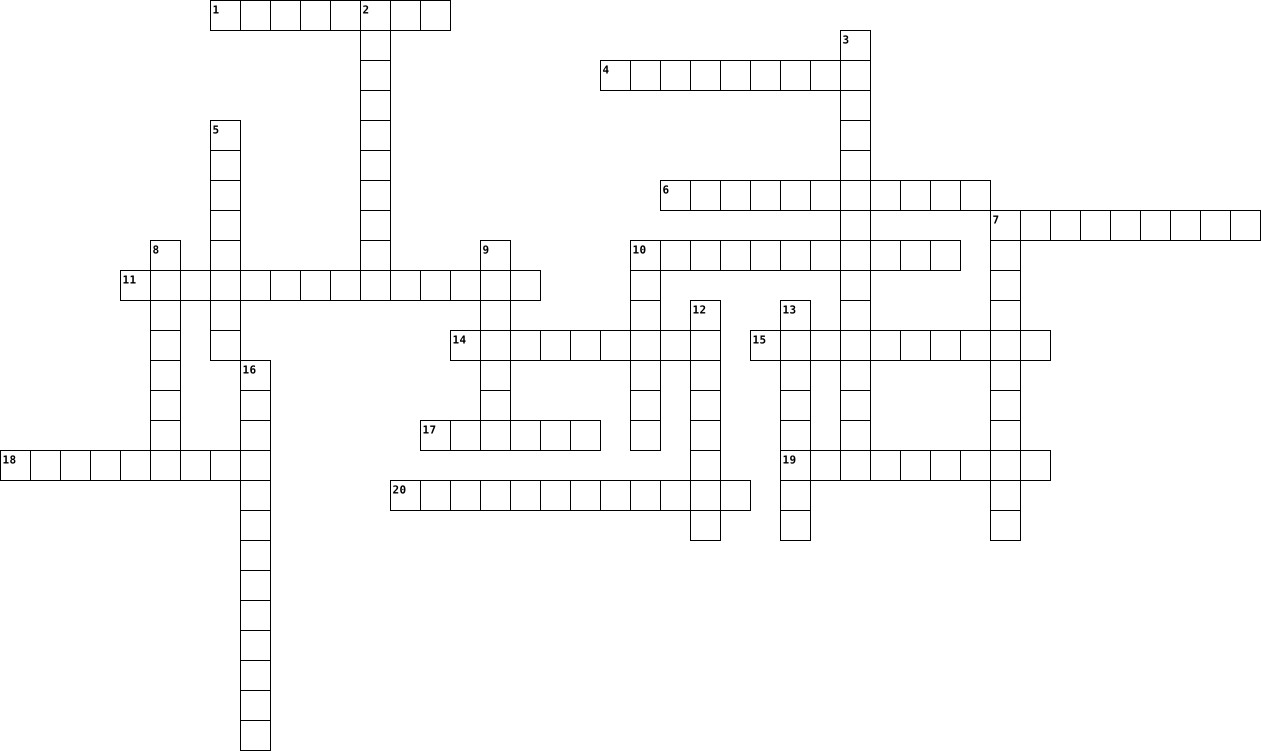
Across
- english
- spanish
- female teacher
- window
- desk
- math
- backpack
- history
- art
- schedule
- stadium
- library
Down
- biology
- female\male student
- test
- science
- music
- homework
- book
- physics
- test\quiz
- computer science
22 Clues: art • test • desk • book • math • music • window • english • biology • spanish • science • physics • history • stadium • library • homework • backpack • schedule • test\quiz • female teacher • computer science • female\male student
Vocabulary 2023-03-14

Across
- Escritorio
- Enseñar
- Biblioteca
- Estante
- El campo
- Matemáticas
- Recordar
- Física
- Estudiar
- Historia
- Borrador
- Geografía
Down
- Estomago
- Practicar
- Deberes
- Trabajo
- La batería
- Afortunado
- Diccionario
- Música
- Pizarra
- Conductor
- Biología
- Aprender
24 Clues: Música • Física • Enseñar • Deberes • Trabajo • Estante • Pizarra • Estomago • El campo • Recordar • Estudiar • Biología • Historia • Aprender • Borrador • Practicar • Conductor • Geografía • Escritorio • Biblioteca • La batería • Afortunado • Matemáticas • Diccionario
School Courses 2013-11-16
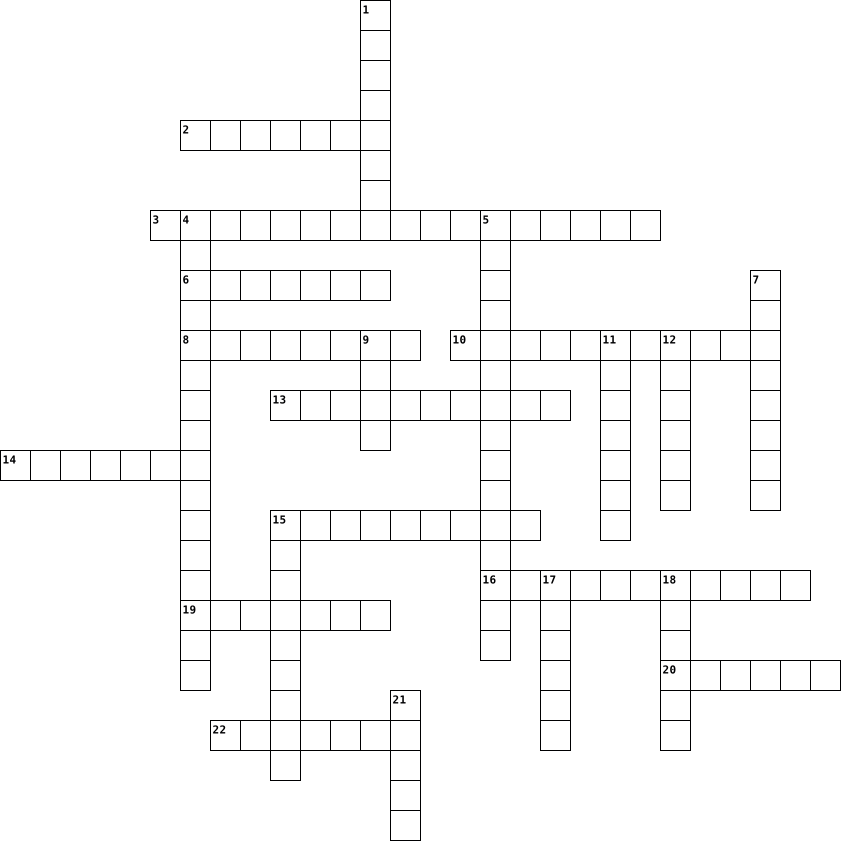
Across
- Calculus
- FCS
- Spanish
- The Sciences
- Mathematics
- Arithmetic
- French
- Geometry
- Computer Science
- The languages
- Music
- Chemistry
Down
- Biology
- Social Studies
- Physical Education
- History
- Art
- Algebra
- English
- Geography
- Physics
- German
- Latin
23 Clues: FCS • Art • Music • Latin • French • German • Biology • Spanish • History • Algebra • English • Physics • Calculus • Geometry • Geography • Chemistry • Arithmetic • Mathematics • The Sciences • The languages • Social Studies • Computer Science • Physical Education
School Courses 2013-11-16
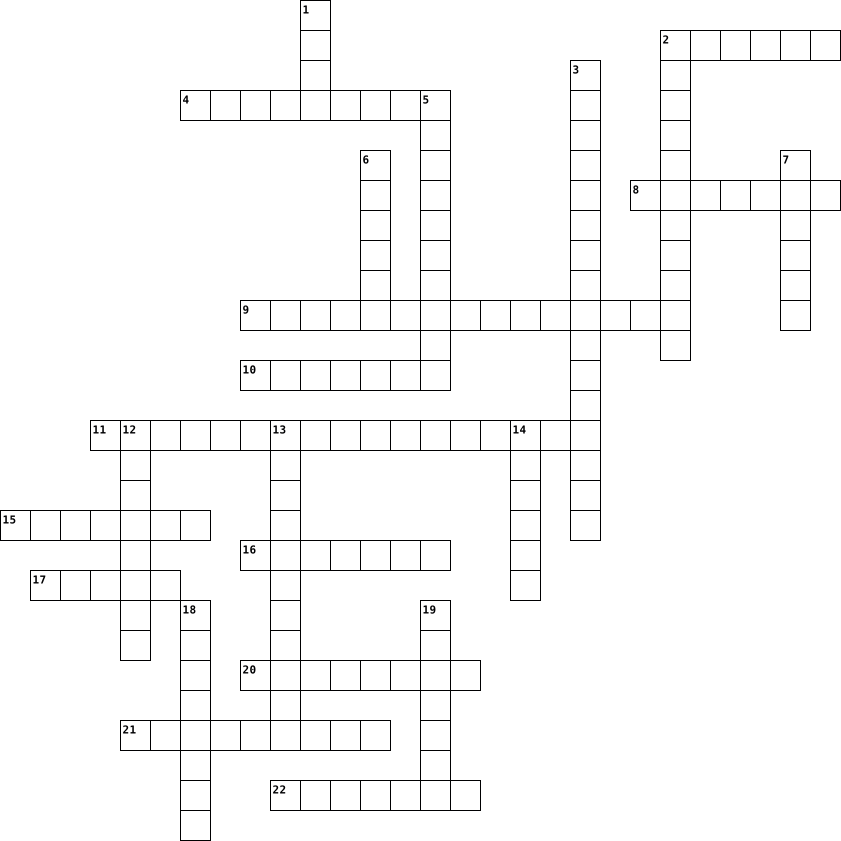
Across
- Music
- Geometry
- Calculus
- Physical Education
- Algebra
- FCS
- Spanish
- French
- Latin
- History
- Geography
- The languages
Down
- Art
- Mathematics
- Social Studies
- Arithmetic
- Physics
- German
- The Sciences
- Computer Science
- English
- Biology
- Chemistry
23 Clues: Art • FCS • Music • Latin • German • French • Physics • Algebra • English • Spanish • Biology • History • Geometry • Calculus • Chemistry • Geography • Arithmetic • Mathematics • The Sciences • The languages • Social Studies • Computer Science • Physical Education
Vocabulario Practica 2023-09-21

Across
- psicologia
- cena
- english
- derecho
- libreria
- mathematics
- historia
- biology
- llegar
- demas
- which
Down
- ones a qual
- porque
- ciencias
- fisica
- economy
- to? a donde
- chemistry
- aqua
- biblioteca
- negocio
- Izquierda
- porque
- desayuno
24 Clues: cena • aqua • demas • which • porque • fisica • porque • llegar • economy • english • derecho • negocio • biology • ciencias • libreria • historia • desayuno • chemistry • Izquierda • psicologia • biblioteca • mathematics • ones a qual • to? a donde
German 4-1 2025-10-15

Across
- to-have
- time
- gym
- school
- computer-science/IT
- lunch
- Spanish
- English
- French
- physics
- when
Down
- chemistry
- German
- math
- biology
- geography
- subject
- history
- Latin
- Chorus/choir
- Art
21 Clues: gym • Art • math • time • when • lunch • Latin • German • school • French • to-have • biology • subject • history • Spanish • English • physics • chemistry • geography • Chorus/choir • computer-science/IT
French Crossword Puzzle 2025-05-18

Across
- server
- algebra
- fork
- napkin
- spoon
- geometry
- biology
- Tuesday
- spanish
- math
- tablecloth
Down
- summer
- science
- vegetable
- french
- physics
- trigonometry
- english
- cheese
- Monday
- chemestry
- chorus
- bread
- salt
- pepper
25 Clues: fork • salt • math • spoon • bread • summer • french • server • cheese • napkin • Monday • chorus • pepper • science • algebra • physics • english • biology • Tuesday • spanish • geometry • vegetable • chemestry • tablecloth • trigonometry
24 2025-07-15

Across
- Law
- Spanish
- Italian
- Science
- Arabic
- Greek
- Physics
- Art
- French
- Chinese
- Chemistry
- Literature
- Politics
Down
- Latin language
- Japanese
- Economy
- History
- Biology
- Philosophy
- Russian
- Geography
- Math
- English
- Music
- German
25 Clues: Law • Art • Math • Greek • Music • Arabic • French • German • Economy • Spanish • History • Biology • Italian • Science • Russian • Physics • English • Chinese • Japanese • Politics • Geography • Chemistry • Philosophy • Literature • Latin language
en la clase 2025-11-06

Across
- biology
- bookstore
- art
- cafeteria
- semester
- stadium
- test
- geography
- class
- university
- course
- spanish
Down
- library
- accounting
- trimester
- physics
- laboratory
- school
- homework
- schedule
- music
- sciences
- house
- chalk
- exam
25 Clues: art • test • exam • music • class • house • chalk • school • course • library • biology • physics • stadium • spanish • semester • homework • schedule • sciences • trimester • bookstore • cafeteria • geography • accounting • laboratory • university
unit 3 2025-11-19

Across
- - gumka do ścierania
- - kalkulator
- - zakreślacz
- - korytarz
- - plastyka
- - fizyka
- - taśma klejąca
- - matematyka
- - przyroda
- - laboratorium
- - linijka
Down
- - chemia
- - biologia
- - muzyka
- - biblioteka
- - francuski
- - geografia
- - siłownia
- - teczka
- - historia
- - angielski
- - piórnik
- - stołówka
- - klej
24 Clues: - klej • - chemia • - muzyka • - teczka • - fizyka • - piórnik • - linijka • - biologia • - siłownia • - korytarz • - historia • - plastyka • - przyroda • - stołówka • - francuski • - geografia • - angielski • - kalkulator • - biblioteka • - zakreślacz • - matematyka • - laboratorium • - taśma klejąca • - gumka do ścierania
English unit 1-20 2026-06-01

Across
- Käekott
- Kannatus
- Täisnurkne
- Luba
- Katuseala
- Ära tundma
- Katastroof
- Haridus
- Kodumaine
- Postskriptum
- Varjama
Down
- Ilme
- Piinlikus,Häbi
- Füüsika
- Pass
- Kohaselt,Sobivalt
- Hämmastav,Imeline
- Põlvkond,Generatsioon
- Küttepuud
- Kreek
- Turvalisus
- Soine
22 Clues: Ilme • Pass • Luba • Kreek • Soine • Käekott • Füüsika • Haridus • Varjama • Kannatus • Katuseala • Küttepuud • Kodumaine • Täisnurkne • Ära tundma • Katastroof • Turvalisus • Postskriptum • Piinlikus,Häbi • Kohaselt,Sobivalt • Hämmastav,Imeline • Põlvkond,Generatsioon
Classes and School Supplies 2021-04-15
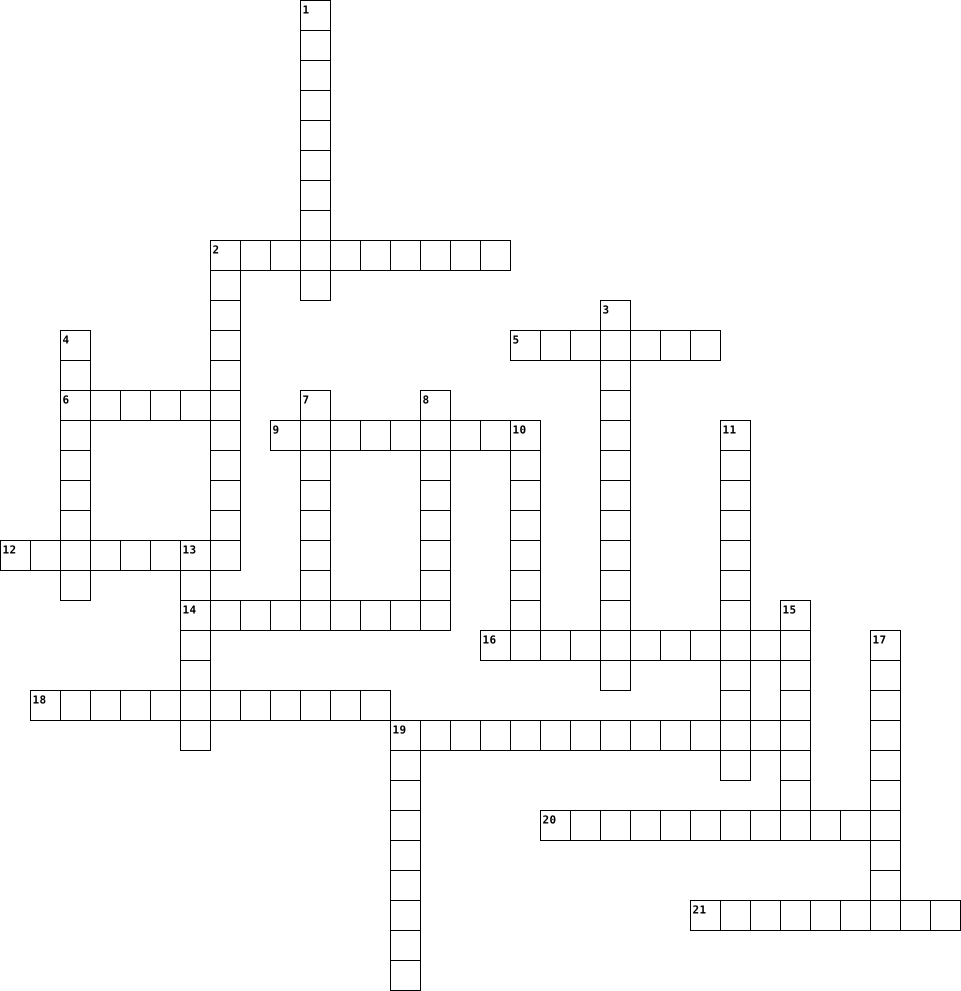
Across
- biology
- homework
- art
- spanish
- english
- window
- female teacher
- desk
- math
- male student
- schedule
Down
- history
- science
- computer science
- stadium
- test
- test;quiz
- physics
- library
- book
- music
- male teacher
- backpack
23 Clues: art • test • book • desk • math • music • window • history • biology • science • stadium • spanish • physics • library • english • homework • backpack • schedule • test;quiz • male teacher • male student • female teacher • computer science
20 spanish words 2021-04-15
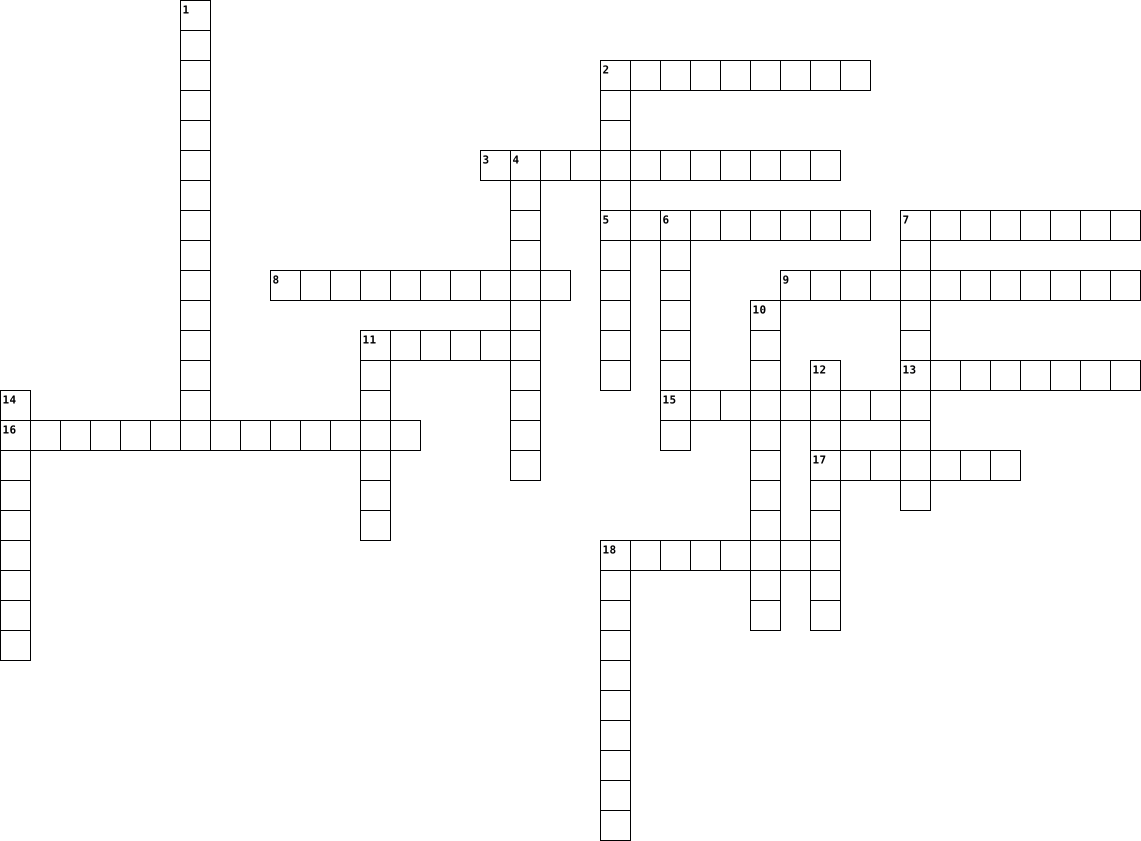
Across
- backpack
- desk
- Spanish
- music
- male teacher
- library
- art
- test; quiz
- schedule
- math
- book
- physics
Down
- male/female student
- science
- female teacher
- test
- biology
- Computer Science
- homework
- window
- stadium
- history
22 Clues: art • desk • test • math • book • music • window • science • Spanish • biology • library • stadium • physics • history • backpack • homework • schedule • test; quiz • male teacher • female teacher • Computer Science • male/female student
classes and school supplies 2021-04-14
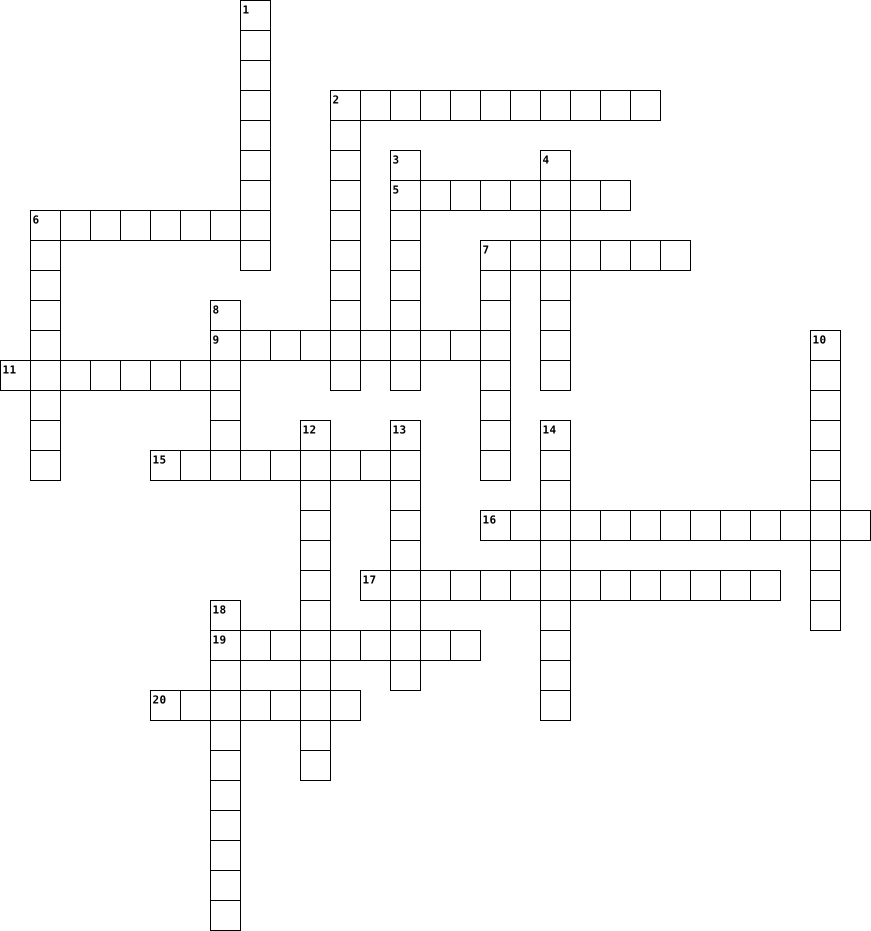
Across
- desk
- physics
- test
- book
- female teacher
- music
- spanish
- computer science
- math
- backpack
- home work
Down
- window
- professor
- english
- biology
- stadium
- test;quiz
- art
- history
- library
- schedule
- science
- student
23 Clues: art • desk • test • book • math • music • window • english • biology • physics • stadium • history • library • science • spanish • student • schedule • backpack • professor • test;quiz • home work • female teacher • computer science
classes and school supplies 2021-04-14

Across
- backpack
- biology
- window
- schedule
- test
- art
- physics
- library
- book
Down
- science
- music
- desk
- maleteacher
- femaleteacher
- male/female student
- homework
- history
- stadium
- math
- computerscience
- Spanish
- test;quiz
- English
23 Clues: art • desk • math • test • book • music • window • science • biology • history • stadium • Spanish • physics • library • English • backpack • homework • schedule • test;quiz • maleteacher • femaleteacher • computerscience • male/female student
Module 3a 2013-11-12

Across
- проектирование,_инженерное_дело
- психология
- валеология
- почвоведение
- исследовать
- научный
- управляемый_людьми
- менеджмент
- область_изучения
- экономика
- социология
- человеческий
Down
- лингвистика
- информатика
- прикладной_(прикладная_наука)
- физика
- феномен
- антропология
- применение
- вывод,_заключение
- выполнять,_ставить(эксперимент)
- астрономия
- образование
23 Clues: физика • феномен • научный • экономика • психология • валеология • применение • менеджмент • астрономия • социология • лингвистика • информатика • исследовать • образование • антропология • почвоведение • человеческий • область_изучения • вывод,_заключение • управляемый_людьми • прикладной_(прикладная_наука) • проектирование,_инженерное_дело • выполнять,_ставить(эксперимент)
Year 9, Unit 4 2014-10-30

Across
- juhataja, esimees
- sünnis
- nõudmised riietusele
- eeskuju
- vastuvõetamatu
- füüsika
- kapuutsiga dressipluus
- aluspesu
- sügava väljalõikega
Down
- plätu
- pühendama
- paljas
- võistlema
- välimus
- hirm; kartma
- end (väliselt) korda seadma
- anonüümne
- kohustus; vastutus
- mõjutama
- pühkima
20 Clues: plätu • paljas • sünnis • välimus • eeskuju • füüsika • pühkima • aluspesu • mõjutama • pühendama • võistlema • anonüümne • hirm; kartma • vastuvõetamatu • juhataja, esimees • kohustus; vastutus • sügava väljalõikega • nõudmised riietusele • kapuutsiga dressipluus • end (väliselt) korda seadma
SCHOOL DAYS 2014-04-03

Across
- MUZYKA
- PSYCHOLOGIA
- CHEMIA
- KLASA
- JĘZYKI
- LITERATURA
- SŁOWNIK
- NAUCZYCIEL
- DZIECIŃSTWO
- UCZEŃ
- MATEMATYKA
- ZESZYT
Down
- FIZYKA
- BIOLOGIA
- NAUKA, PRZEDMIOTY ŚCISŁE
- WYCHOWANIE FIZYCZNIE
- TABLICA
- GEOGRAFIA
- POLITYKA
- SZTUKA
- OCENA
- PRZERWA
- HISTORIA
- PRZEDMIOT
24 Clues: KLASA • OCENA • UCZEŃ • FIZYKA • MUZYKA • CHEMIA • JĘZYKI • SZTUKA • ZESZYT • TABLICA • SŁOWNIK • PRZERWA • BIOLOGIA • POLITYKA • HISTORIA • GEOGRAFIA • PRZEDMIOT • LITERATURA • NAUCZYCIEL • MATEMATYKA • PSYCHOLOGIA • DZIECIŃSTWO • WYCHOWANIE FIZYCZNIE • NAUKA, PRZEDMIOTY ŚCISŁE
School 2023-12-17
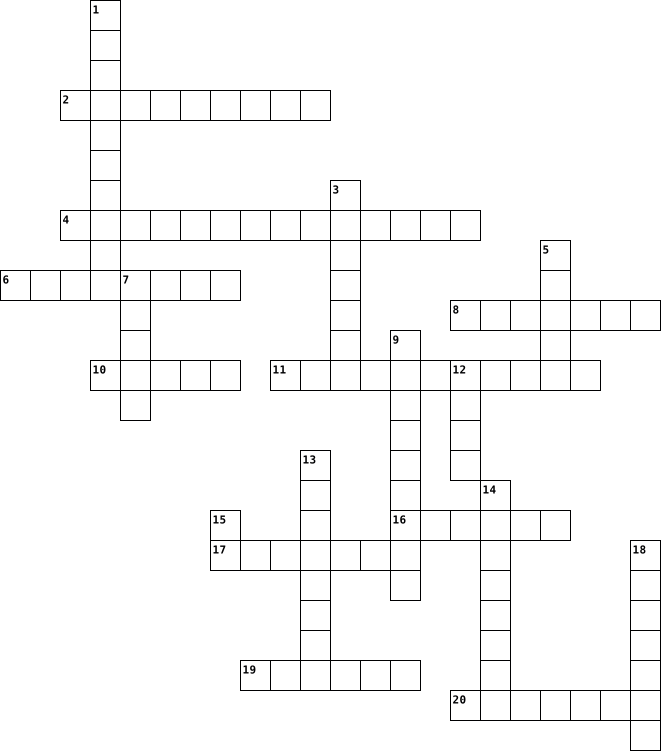
Across
- chimie
- sciences sociales
- un cahier
- physique
- theâtre
- maths
- crayon de bois
- anglais
- français
- un professeur
Down
- informatique
- une matière
- musique
- tableau
- geographie
- arts plastiques
- biologie
- emploi du temps
- EPS
- histoire
20 Clues: EPS • maths • chimie • musique • tableau • theâtre • anglais • physique • biologie • histoire • français • un cahier • geographie • une matière • informatique • un professeur • crayon de bois • arts plastiques • emploi du temps • sciences sociales
Unit 5 Achieve - English Plus 2 sec ed - Form 5 2026-02-18

Across
- lihas
- keskmine
- mõõtma
- kaaluma
- leiutaja
- maailmameister
- treeninguga tegelema
- teadlane
- tark
- veresooned
- aastatuhat
Down
- veerand
- füüsika
- parandama
- meeter
- matemaatik
- lisandid
- tuemus
- rakud
- pool
- aastakümme
- sisaldama
- avastama
- helilooja
- sajand
25 Clues: pool • tark • lihas • rakud • meeter • mõõtma • tuemus • sajand • veerand • füüsika • kaaluma • keskmine • lisandid • leiutaja • avastama • teadlane • parandama • sisaldama • helilooja • matemaatik • aastakümme • veresooned • aastatuhat • maailmameister • treeninguga tegelema
Kapitel 4 2020-05-08

Across
- chair
- male teacher
- geography
- bus
- Physics
- long
- never
- grade
Down
- class
- hard
- Ruler
- Breakfast
- Bavaria
- calendar
- pencil
15 Clues: bus • hard • long • class • chair • Ruler • never • grade • pencil • Bavaria • Physics • calendar • Breakfast • geography • male teacher
Tattoos: Too cool for school or looking like a fool? 2023-03-02

Across
- SKÄMT
- SURR
- FYSIK
- KÖN
- TROLIGT
- NYCKELBEN
- SIGNUM/STÄMPEL
Down
- RYKTE
- LITE
- FÖRKLÄDD
- FÖRDOM
- SPÄND
- HUD
- SYNLIGT
- GENOMSNITT
- SKÄMT
16 Clues: KÖN • HUD • LITE • SURR • RYKTE • SKÄMT • FYSIK • SPÄND • SKÄMT • FÖRDOM • SYNLIGT • TROLIGT • FÖRKLÄDD • NYCKELBEN • GENOMSNITT • SIGNUM/STÄMPEL
school subjects 2024-11-09

Across
- business
- geography
- grade
- French
- World languages
- Spanish
- physics
- chemistry
Down
- science
- humanities
- history
- scholarship
- cafeteria
- art
- English
15 Clues: art • grade • French • science • history • English • Spanish • physics • business • geography • cafeteria • chemistry • humanities • scholarship • World languages
Die Schulfächer - Cyrus Lesser-Brunori 2025-05-08

Across
- ethics
- social studies
- algebra
- chorus
- PE
- history
- latin
- art
Down
- physics
- chemistry
- geometry
- philosophy
- music
- german
- english
15 Clues: PE • art • music • latin • ethics • german • chorus • physics • algebra • history • english • geometry • chemistry • philosophy • social studies
Las clases 2026-02-05

Across
- Physics
- English
- PE
- Art
- History
- Health
Down
- Chemistry
- Geography
- French
- Science
- Mathematics
- Geometry
- Biology
- Computer Class
- Music
15 Clues: PE • Art • Music • French • Health • Science • Physics • Biology • English • History • Geometry • Chemistry • Geography • Mathematics • Computer Class
subjects 2025-10-01

Across
- наука
- биология
- драм.искусство
- практиковать
- музыка
- education физра
Down
- учить
- физика
- география
- английский
- история
- дизайн
- рисование
- математика
- химия
15 Clues: учить • наука • химия • физика • дизайн • музыка • история • биология • география • рисование • английский • математика • практиковать • драм.искусство • education физра
Schulfächer 2019-10-17
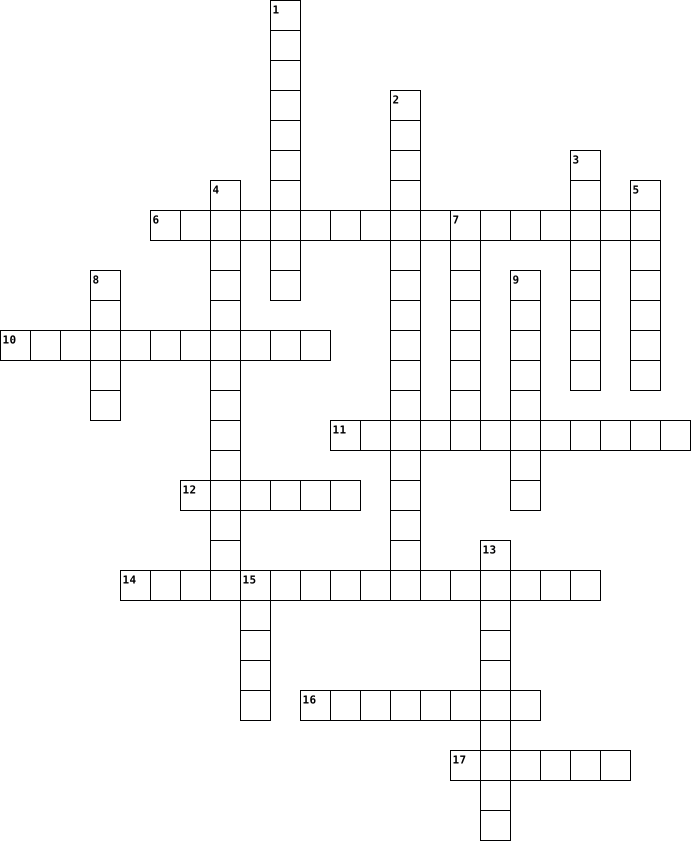
Across
- civics
- French
- science
- chemistry
- economics
- biology
- physics
Down
- computer technology
- environmental science
- wood/workshop
- home economics/cooking
- German
- geography
- art
- English
- history
- PE
17 Clues: PE • art • German • civics • French • English • science • history • biology • physics • geography • chemistry • economics • wood/workshop • computer technology • environmental science • home economics/cooking
School 2023-01-18
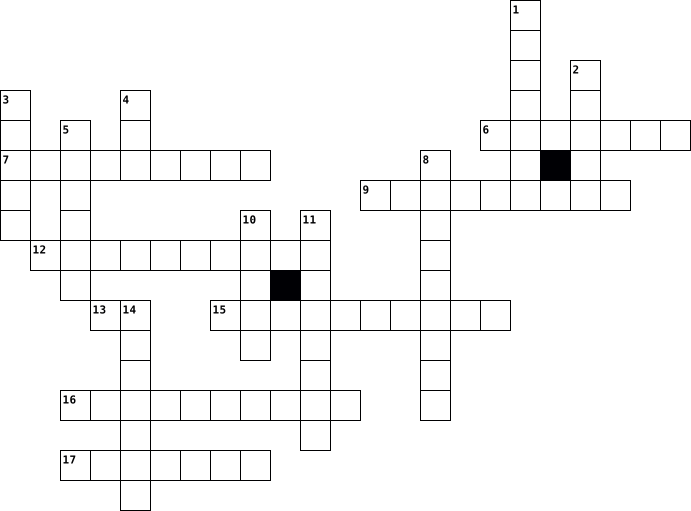
Across
- bioloģija
- sporta soma
- ķīmija
- penālis
- sports
- baltā tāfele
- kalkulators
- vēsture
Down
- fizika
- lineāls
- mūzika
- vizuālā māksla
- plakāts
- ģeogrāfija
- matemātika
- mācību grāmata
- angļu valoda
17 Clues: fizika • mūzika • ķīmija • sports • lineāls • plakāts • penālis • vēsture • bioloģija • ģeogrāfija • matemātika • sporta soma • kalkulators • angļu valoda • baltā tāfele • vizuālā māksla • mācību grāmata
physics homework 2018-04-15

Across
- permanent magnets on the outside and a spinning armature on the inside
- a revolving structure in an electric motor or generator
- any device for converting mechanical energy into electrical energy
- A current-carrying coil of wire that acts like a magnet when a current passes through it
- iron, cobalt and nickel
- cannot produce torque near synchronous speed
- 3 jewelled eunich
- magnetic force is perpendicular to this
- something that causes a change in the motion
- 96,494 coulombs per mole
- the act or process by which an electric or magnetic effect is produced
- change in magnetic field
- Either of the two ends of a magnet
- electric fields cant form
- magnetic field strength equal to the intensity of a magnetic field in a vacuum in which a unit magnetic pole experiences a mechanical force of one dyne in the direction of the field
Down
- new oceanic crust is formed by the convective upwelling of magma at mid-ocean ridges
- brown to black mineral that is strongly magnetic
- happen every 4 or 5 million years
- a region within a magnetic material in which the magnetization is in a uniform direction
- established the standard orientation of vector quantities normal to a plane
- to draw by a physical force
- A device consisting of a coil of insulated wire wrapped around an iron core that becomes magnetized when an electric current flows through the wire
- An instrument used to detect, measure, and determine the direction of small electric currents by means of mechanical effects produced by a current-carrying coil in a magnetic field
- an instrument for determining directions
- rich in magnesium and iron
- to force that pushes something away
26 Clues: 3 jewelled eunich • iron, cobalt and nickel • 96,494 coulombs per mole • change in magnetic field • electric fields cant form • rich in magnesium and iron • to draw by a physical force • happen every 4 or 5 million years • Either of the two ends of a magnet • to force that pushes something away • magnetic force is perpendicular to this • an instrument for determining directions • ...