
planets Crossword Puzzles
Enlightenment and Scientific Revolution 2019-12-03

Across
- made adnaves in astonomy by mapping the orbits of planets. Discovered they mad elliptical orbits
- power of the mind to think and understand...use logic
- used the telescope to prove a heliocentric universe
- separation of church and state
- believe that all people are born with rights that cannot be taken
- sudden change in government or worldviews.
- agreement between members of a society and their government
- french philosopher that spoke about the freedom of speech and the separation of church and state.
- Argued "Natural Rights" all people have life, liberty and property.
- a ruler has no restrictions on their power or actions
- English advocate for women's rights during the enlightenment.
- intellectual movement in which reason and individualism were emphasized
- invented by Francis Bacon to have a step by step procedure to find truth in experiments
- philosopher who was a fan of unlimited government. Thought the king had rule of the people. Strong fan of government.
- the idea that the planets and sun revolve around earth
Down
- a person who is a leaned academic who gives theories as to what life is about.
- the idea that all the planets revolve around the sun
- having power in the government broken down and given to different groups
- French philosopher, proposed the idea of the social contract.
- means the people hold the power of the state
- theory that opinions should be based on reason and knowledge
- discovered the laws of gravity and created the three laws of motion
- french philosopher, believed strongly in the separation of powers.
23 Clues: separation of church and state • sudden change in government or worldviews. • means the people hold the power of the state • used the telescope to prove a heliocentric universe • the idea that all the planets revolve around the sun • power of the mind to think and understand...use logic • a ruler has no restrictions on their power or actions • ...
Our Solar System 2021-11-01

Across
- the planet that is often called Earth's twin.
- An imaginary straight line that runs from the North Pole to the South Pole.
- the smallest planet in our solar system.
- the planet known as the Red Planet.
- the planet that is almost the same size as Uranus.
- The spin of a body on its axis.
- the only planet in the solar system that has the combination of factors needed to support life.
- The motion of a body that travels around another body in space; one complete trip along an orbit.
- The average distance between Earth and the sun.
- a flattened circle in the solar system is also called an ________________.
Down
- the planetary ring that circles this planet's equator is its most spectacular feature.
- The sun and all of the planets and other bodies that travel around it.
- A force of attraction between objects that is due to their masses.
- A disk of matter that encircles a planet that consists of numerous particles in orbit, which range in size from dust grains up to objects tens of meters across.
- the atmosphere of this planet is composed mostly of hydrogen and helium.
- The highly dense planets nearest to the sun; Mercury, Venus, Earth, and Mars.
- A mixture of gases that surrounds a planet, moon, or other celestial body.
- The path that a body follows as it travels around another body in space.
- The planets that have deep, massive atmosphere, such as Jupiter, Saturn, Uranus, and Neptune.
- the planet that has the most moons orbiting around it.
20 Clues: The spin of a body on its axis. • the planet known as the Red Planet. • the smallest planet in our solar system. • the planet that is often called Earth's twin. • The average distance between Earth and the sun. • the planet that is almost the same size as Uranus. • the planet that has the most moons orbiting around it. • ...
Astronomy 2014-05-28

Across
- Composition of the inner planets as compared to the outer planets.
- Causes the perceived rising and setting of the sun.
- Motion of the moon that changes the lunar phases.
- Planet, other than Earth, with polar ice caps.
- Star with average brightness and temperature.
- Date when the Southern Hemisphere is tilted toward the sun.
- The dark side of the moon is caused by the moon's ________ and_______ being the same.
- Measurement that explains why the sun doesn't have more effect on tides.
- Shortest day of the year in the Northern Hemisphere.
- Darkest part of the shadow during an eclipse.
- The asteroid belt is located after Mars and before_____.
- Star's energy comes from the _______ of hydrogen to helium.
- Which phase occurs immediately after a full moon?
- Northern Hemisphere is tilted toward the sun, not a date.
- Moon is between the sun and earth.
Down
- Two elements composing the outer planets, no and.
- Two characteristics of Earth that cause seasons, no and.
- Hubble's Law show that a majority of the Universe is _____ shifted.
- Our sun will eventually stop undergoing fusion and become a _____ _______.
- Warm date when the sun is directly overhead at the equator.
- Theorized to have produced oxygen on Earth.
- Only two lunar phases that occur during eclipses.
- Planet with over active Greenhouse Effect.
- Blue planet, lots of water on the surface.
- Waning phases identified with the light being on the ____ side of the moon.
- One of Jupiter's moons that may hold liquid water.
26 Clues: Moon is between the sun and earth. • Planet with over active Greenhouse Effect. • Blue planet, lots of water on the surface. • Theorized to have produced oxygen on Earth. • Star with average brightness and temperature. • Darkest part of the shadow during an eclipse. • Planet, other than Earth, with polar ice caps. • Two elements composing the outer planets, no and. • ...
The Solar system 2014-10-19
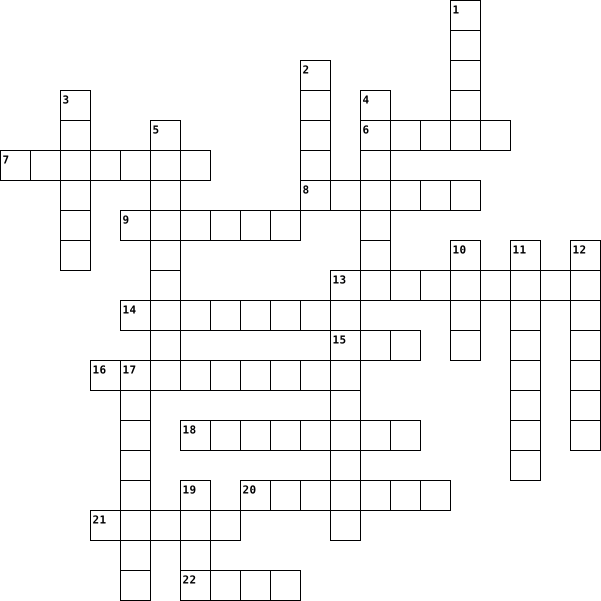
Across
- the only planet that has an atmosphere containing 21 percent oxygen
- occurs when the Moon is between the Sun and the Earth.
- The second largest planet in the solar system
- The seventh planet from the sun
- meteoroid that survives falling through the Earth’s atmosphere and colliding with the Earth’ surface
- the largest moon in the Solar System
- sun over 300000 times larger than earth
- an artificial object that is deliberately sent into orbit in space
- made up of everything that exists, including planets, stars, galaxies and all forms of matter and energy
- First planet of the gas planets
- system includes the Sun and all the objects that orbit around it due to its gravity
- sphere of very hot gas called plasma which is held together by its own gravity
Down
- a relatively small solar system body that orbits the Sun
- The brightest planet in the solar system
- a massive group of stars, star clusters, interstellar gas and dust, and dark matter which is all gravitationally bound together
- cannot be seen without a large telescope and was first seen in 1846 from the observatory in Berlin
- a person trained by a spaceflight program to lead, pilot or be a crew member of an expedition to space on a spacecraft
- orbits the Earth every 27.3 days
- spiral galaxy where our Solar System and Earth are located
- The planet closest to the sun
- a small rock or particle of debris in our solar system
- also known as planetoids or minor planets
- The red planet
23 Clues: The red planet • The planet closest to the sun • The seventh planet from the sun • First planet of the gas planets • orbits the Earth every 27.3 days • the largest moon in the Solar System • sun over 300000 times larger than earth • The brightest planet in the solar system • also known as planetoids or minor planets • The second largest planet in the solar system • ...
vocab choice board 2022-03-17

Across
- - a collection of gas, dust, stars, and solar systems that are held together by gravity
- - the circular movement of an object around its center (like a top spinning)
- - all of space and its contents (including planets, stars, galaxies, and all other forms of energy and matter)
- - The moment that the moon orbits directly between the sun and the Earth
- - the sun, the planets that orbit the sun, and other objects that orbit the sun
- - the force by which all things with mass or energy (including planets, stars, galaxies, and light) are brought towards one another
- - a moon outside our solar system
- - to shine light on an object and make it visible
- - the border between light and dark on the Moon
- - something we observe to be similar over and over again
Down
- - when the moon is completely dark
- - the tendency of an object to remain at rest or unchanged
- - the four parts of the year where weather, ecology, and number of daylight hours change as a result of Earth’s orbit around the sun
- - the star that is the main source of light at the center of our solar system
- - a moon phase that looks like less than half a circle from Earth
- - the amount of time it takes for a planet to complete one orbit around a star or stars
- - a planet outside our solar system
- - the relative size of things
- - a rocky sphere that travels around a planet
- - the nearly circular path a smaller object (like the Moon) travels around a larger object like Earth)
20 Clues: - the relative size of things • - a moon outside our solar system • - when the moon is completely dark • - a planet outside our solar system • - a rocky sphere that travels around a planet • - the border between light and dark on the Moon • - to shine light on an object and make it visible • - something we observe to be similar over and over again • ...
astronomy vocab 2024-01-26

Across
- The addition of matter to a body
- The plume of gas and dust from a comet
- A white band in a Jovian's planet atmosphere, encircling the planet
- Cliffs formed where a planet or moon's crust has shifted
- Regions in the asteroid belt with less than the average number of asteroids
- A planet not orbiting our sun
- The small, solid bodies moving within the Solar System
- The closest that two bodies in space can get before one or both of them are ripped apart by their mutual attraction
- Like a small planet but isn't really a planet
- The planets nearest the sun (Mercury-Mars)
- Occurs when a gas cools and it forms a liquid or solid
- The solid remains of a meteor that falls to Earth
- A meteorite lacking chondrules
- The outflow of low-density, hot gas from the Sun's upper atmosphere
- A vibrating object causing another object to vibrate a higher amplitude
Down
- A region where most most of the solar system's asteroids are located
- The breaking apart of a molecule by intense radiation
- The Sun, planets, their moons, etc that orbit the Sun
- Numerous small, icy objects orbiting beyond Neptune
- A small spherical grain embedded in a meteorite
- A reddish colored region in Jupiter's atmosphere, larger than Earth
- A dark band in a Jovian planet's atmosphere, encircling the planet
- The planets farthest from the sun (Venus-Neptune)
- An asteroid with an orbit that crosses Earth's orbit or comes close to it
- A meteorite containing small spherical grains
25 Clues: A planet not orbiting our sun • A meteorite lacking chondrules • The addition of matter to a body • The plume of gas and dust from a comet • The planets nearest the sun (Mercury-Mars) • Like a small planet but isn't really a planet • A meteorite containing small spherical grains • A small spherical grain embedded in a meteorite • ...
Astronomy Quest 2025-01-12

Across
- It takes the Earth 365 days to do this
- Large rock that enters Earth's atmosphere
- A robotic hand on the ISS
- A term given to the outer 4 planets
- Type of eclipse occurs when the Earth casts a shadow on the moon
- The distance between Earth and the Sun
- Stars are this colour tend to be the coolest
- Ursa Major is an example of this
- Name of our galaxy
- Ice moving through space
- This accounts for all the unseen gravitational forces
- Astronomical event when the Earth is either most tilted towards or away from the Sun
- How bright a star appears from Earth
- Planets,stars,and moons are all examples of what?
Down
- The largest planet in our solar system
- This type of spectrum indicates which wavelengths of light are being released
- Earth-centred model
- The distance light travels in one year
- These are found between Mars and Jupiter
- Larger stars can either turn into a neutron star or a ____ ______
- In nuclear fusion, this element is the first element that fuses to form helium
- What season is marked by the vernal equinox?
- As our Sun starts to run out of fuel, it will turn into this
- What stars start out as
- An area on the Sun where the gas is cooler than the surrounding gasses
- Absolute magnitude depends on the distance of the star and _____
- Made up of stars, planets, gas, and dust
- Pluto is this type of planet
28 Clues: Name of our galaxy • Earth-centred model • What stars start out as • Ice moving through space • A robotic hand on the ISS • Pluto is this type of planet • Ursa Major is an example of this • A term given to the outer 4 planets • How bright a star appears from Earth • The largest planet in our solar system • It takes the Earth 365 days to do this • ...
Observing The Skies 2016-06-10

Across
- Greatest scholar in muslim history, born in the region of Khwarizm.
- similar to a globe,shows a map of stars.
- was used as calculator
- A huge library/observatory
- Was famous both as an astronomer and as a mathematician, also worked at the Ismaili fort of Almaut.
- The science of studying the stars, planets and other celestial bodies.
Down
- used for telling time by sun.
- Group of stars.
- first space telescope.
- special place to observe skies.
- First people to study astronomy
- Proposed a model of universe
- used to measure the position of star or planets in degree.
13 Clues: Group of stars. • first space telescope. • was used as calculator • A huge library/observatory • Proposed a model of universe • used for telling time by sun. • special place to observe skies. • First people to study astronomy • similar to a globe,shows a map of stars. • used to measure the position of star or planets in degree. • ...
1.2 space 2021-06-14

Across
- (n) the sun and all the planets around it
- (v) extend; open out
- (adj) impressive, unbelievable
- (phr) a huge planet made up of a substance that burns easily
- (n) liquid used to wash your hair without using water to clean it
- (n) a planet’s layer of air/gases around it
- (v) influence
- (phr) without the help of a telescope
Down
- (phr) center made up of rock
- (n) people who work on a spacecraft / ship
- (n) condition where the force of gravity is absent (weightlessness)
- (n) area where stars and other planets are
- (v) indicate
13 Clues: (v) indicate • (v) influence • (v) extend; open out • (phr) center made up of rock • (adj) impressive, unbelievable • (phr) without the help of a telescope • (n) the sun and all the planets around it • (n) people who work on a spacecraft / ship • (n) area where stars and other planets are • (n) a planet’s layer of air/gases around it • ...
All About Planets! 2023-04-13

Across
- Neptune is an ___ giant
- Mercury has the shortest year of all the planets of ________ days
- Mars is a ____ planet thats been altered by volcanoes, impacts, winds, crustal movement and chemical reactions
- Venus is the ____ explored by a spacecraft
- Hottest planet in our solar system
- Mercury has ____ moons
- Sixth planet from our sun
- Neptunes moons are named after sea gods and nymphs in ____ mythology
- Earth has ____ rings
Down
- ____ is sometimes closer to the sun than Neptune is
- Smallest planet in our solar system
- _____ earths could fit across Jupiter equator
- A planet deemed as perfect living conditions
- Venus is shrouded in thick, toxic ____ of sulfuric acid
- Uranus is ____ times wider than earth
- Jupiter takes ______ earth years to complete one orbit of the sun
16 Clues: Earth has ____ rings • Mercury has ____ moons • Neptune is an ___ giant • Sixth planet from our sun • Hottest planet in our solar system • Smallest planet in our solar system • Uranus is ____ times wider than earth • Venus is the ____ explored by a spacecraft • A planet deemed as perfect living conditions • _____ earths could fit across Jupiter equator • ...
Life on Planets 2018-05-08

Across
- a cloud of gas and dust in outer space, visible in the night sky either as an indistinct bright patch or as a dark silhouette against other luminous matter.
- a contracting mass of gas that represents an early stage in the formation of a star, before nucleosynthesis has begun.
- the process whereby organisms better adapted to their environment tend to survive and produce more offspring. The theory of its action was first fully expounded by Charles Darwin and is now believed to be the main process that brings about evolution.
- an organism consisting of a cell or cells in which the genetic material is DNA in the form of chromosomes contained within a distinct nucleus. Eukaryotes include all living organisms other than the eubacteria and archaebacteria.
- deoxyribonucleic acid, a self-replicating material present in nearly all living organisms as the main constituent of chromosomes. It is the carrier of genetic information.
Down
- a threadlike structure of nucleic acids and protein found in the nucleus of most living cells, carrying genetic information in the form of genes.
- resulting from or showing the effect of the mutation.
- a supernova that is classified as having hydrogen lines in its spectra that are made by the explosion of a very large star.
- an explosion that results from the collapse of a white dwarf.
- any of a class of nitrogenous organic compounds that consist of large molecules composed of one or more long chains of amino acids and are an essential part of all living organisms, especially as structural components of body tissues such as muscle, hair, collagen, etc., and as enzymes and antibodies.
- a planet that orbits a star outside the solar system.
- a microscopic single-celled organism that has neither a distinct nucleus with a membrane nor other specialized organelles. Prokaryotes include the bacteria and cyanobacteria.
- a simple organic compound containing both a carboxyl (—COOH) and an amino (—NH2) group.
- a unit of heredity that is transferred from a parent to offspring and is held to determine some characteristic of the offspring.
- ribonucleic acid, a nucleic acid present in all living cells. Its principal role is to act as a messenger carrying instructions from DNA for controlling the synthesis of proteins, although in some viruses RNA rather than DNA carries the genetic information.
15 Clues: resulting from or showing the effect of the mutation. • a planet that orbits a star outside the solar system. • an explosion that results from the collapse of a white dwarf. • a simple organic compound containing both a carboxyl (—COOH) and an amino (—NH2) group. • ...
Stars and Planets 2021-11-29

Across
- constellation that includes the north star
- this planet's year last 165 earth years
- Planet with the longest day
- the only planet that spins on its side
- cosmic snowball
- planet with the most moons
- the smallest planet
- distance that light can travel in one year
- planet with the tallest mountain
Down
- nickname for a shooting star
- dwarf planet that was once the 9th planet
- planet with the great red spot
- Third planet from the sun
- galaxy that includes Earth
- closest star to Earth
15 Clues: cosmic snowball • the smallest planet • closest star to Earth • Third planet from the sun • galaxy that includes Earth • planet with the most moons • Planet with the longest day • nickname for a shooting star • planet with the great red spot • planet with the tallest mountain • the only planet that spins on its side • this planet's year last 165 earth years • ...
The Dwarf Planets 2025-02-19

Across
- Largest dwarf planet in the Solar System
- Ceres is the largest object in the asteroid belt between Mars and __________.
- Ceres is the _______ dwarf planet to the Sun.
- Dwarf planet that is the second brightest object in the Kuiper Belt.
- Pluto is ____________ in shape.
- Makemake's surface is covered in _______, ethane and possibly nitrogen ice.
- Makemake is located in the _______ ____ beyond Nepture.
- Pluto is found in the Kuiper Belt beyond ________.
Down
- Haumea is classified as a dwarf planet due to its size and ______.
- Pluto ___________ around the sun.
- Haumea is one of the ___________ rotating large objects in our Solar System
- Dwarf planet known for its elongated shape due to rapid rotation.
- The only dwarf planet located in the asteroid belt.
- Haumea is elongated in shape due to its rapid ____________.
- This dwarf planet is found in the scattered disc region of the outer solar system.
15 Clues: Pluto is ____________ in shape. • Pluto ___________ around the sun. • Largest dwarf planet in the Solar System • Ceres is the _______ dwarf planet to the Sun. • Pluto is found in the Kuiper Belt beyond ________. • The only dwarf planet located in the asteroid belt. • Makemake is located in the _______ ____ beyond Nepture. • ...
Saturn - Check your knowledge crossword 2020-11-02

Across
- titan has lakes made of this (7)
- Saturn is named after this Roman God of (11)
- This person discovered Saturn's rings (7)
- Saturn is the least _______ of all the planets (5)
- Saturn has more than sixty of these (5)
- Saturn has really bright _______ (5)
Down
- If Saturn was placed in water it would_____(5)
- The shape of the planets(9)
- Saturn is mostly made of _________ and helium (8)
- Saturn is a ___ giant (3)
- Saturn's largest moon (5)
- Saturn is what numbered planet from the sun? (5)
- The second largest planet of the solar system (6)
13 Clues: Saturn is a ___ giant (3) • Saturn's largest moon (5) • The shape of the planets(9) • titan has lakes made of this (7) • Saturn has really bright _______ (5) • Saturn has more than sixty of these (5) • This person discovered Saturn's rings (7) • Saturn is named after this Roman God of (11) • If Saturn was placed in water it would_____(5) • ...
Elise's Saturn Crossword 2020-11-02

Across
- Titan has lakes made of this (7)
- Saturn is named after the Roman God of (11)
- This person discovered Saturn's rings (7)
- Saturn is the least _______ of all the planets (5)
- Saturn has more than eighty of these (5)
- Saturn has really bright _______ (5)
Down
- If Saturn was placed in water it would_____(5)
- The shape of the planets(9)
- Saturn is mostly made of _________ and helium (8)
- Saturn is a ___ giant (3)
- Saturn's largest moon (5)
- Saturn is what numbered planet from the sun? (5)
- The second largest planet of the solar system (6)
13 Clues: Saturn is a ___ giant (3) • Saturn's largest moon (5) • The shape of the planets(9) • Titan has lakes made of this (7) • Saturn has really bright _______ (5) • Saturn has more than eighty of these (5) • This person discovered Saturn's rings (7) • Saturn is named after the Roman God of (11) • If Saturn was placed in water it would_____(5) • ...
Planet review 2021-04-11

Across
- 1 day= 1 rotation= 243 Earth days
- known as the red planet
- Only planet covered with 75 % water
- Large gas planets furthest from the Sun
- Planet that appears blue due to methane in the atmosphere
- Planet with massive hurricane
- Planet spinning once on its axis; causes day and night
- Planet with extreme hot and cold temperatures
- Furthest planet from the Sun
Down
- Planet with hottest temperatures due to carbon dioxide in its atmosphere
- Small rocky planets closest to the Sun
- 365 days= 1 revolution for this planet
- units Used to measure distances in space
- Orbiting the Sun once; Earth takes 365 days
- planet known for its rings
- 1 day=1 rotation= 58.7 Earth days
16 Clues: known as the red planet • planet known for its rings • Furthest planet from the Sun • Planet with massive hurricane • 1 day= 1 rotation= 243 Earth days • 1 day=1 rotation= 58.7 Earth days • Only planet covered with 75 % water • Small rocky planets closest to the Sun • 365 days= 1 revolution for this planet • Large gas planets furthest from the Sun • ...
Space 2024-05-09

Across
- the kind of star the sun is
- the number of dwarf planets in the solar system
- Largest object in the Asteroid Belt
- Largest star in the universe (so far)
- Closest galaxy to the Milky Way
- planet with a great red spot
- Used to be the ninth planet
Down
- this planet is light enough to float on water
- the number of planets in the solar system
- constellation that looks like a hunter with a bow
- when the moon passes in front of the sun
- coldest planet in the solar system
- This moon is larger than Mercury
13 Clues: the kind of star the sun is • Used to be the ninth planet • planet with a great red spot • Closest galaxy to the Milky Way • This moon is larger than Mercury • coldest planet in the solar system • Largest object in the Asteroid Belt • Largest star in the universe (so far) • when the moon passes in front of the sun • the number of planets in the solar system • ...
Ultimate Space Crossword Puzzle 2025-02-18

Across
- This is the planet that we live on!
- There are _______ planets in our solar system.
- All of our planets and our Sun are called the _________.
- A space cloud is called a ___________.
- The study of space is called ______.
- This is the biggest planet in our solar system.
- This is the hottest planet in our solar system!
Down
- People that go to space are called _________.
- Everything that we know of is called the ______.
- People that study space are called ________.
- This is the closest planet to the Sun.
- This is the name of the moon.
- This is the name of the Sun.
13 Clues: This is the name of the Sun. • This is the name of the moon. • This is the planet that we live on! • The study of space is called ______. • This is the closest planet to the Sun. • A space cloud is called a ___________. • People that study space are called ________. • People that go to space are called _________. • There are _______ planets in our solar system. • ...
9th-List 3 2023-05-23

Across
- sense
- vampires need it to live
- shoes
- cook
- mail it
- six seven
- anime
- paper
- dance
- think about it
- a fib
- too much talking
- opinion
- veggies
Down
- taco
- location
- experiments
- skinny
- TV
- go into
- solar system
- dot
- no school
- opposite of thin
- lottery winner
25 Clues: TV • dot • taco • cook • sense • shoes • anime • paper • dance • a fib • skinny • mail it • go into • opinion • veggies • location • six seven • no school • experiments • solar system • think about it • lottery winner • too much talking • opposite of thin • vampires need it to live
Sort 39 Crossword - 8th 2017-09-08

Across
- to remove water or moisture from
- operated, moved or brought by means of water
- a morbid fear of water
- an instrument for determining the weight or density of gases
- the scientific study of the physical and chemical properties and structures of stars, planets and other objects in outer space
- the features of the surface of a piece of land
- operating under the surface of the earth
- a container used for keeping plants or small animals indoors
- a container that dispenses a substance as a spray
- a science dealing with the building and flying of aircraft
- a substance that is rich in energy and made of carbon, hydrogen and oxygen
- a geographical area belonging to or under the rule of a government
- something that happens suddenly and causes much suffering or loss
- the study of the supposed influence of the stars and planets on people’s lives
Down
- a system of exercises often done by a group of people
- a raised piece of land with the top leveled
- to supply or to cause to be filled with air
- a reddish clay that is used for pottery and tiles
- the earth’s atmosphere and the space beyond
- relating to the making of electricity by waterpower
- extremely or unbelievably large
- the scientific study of stars, planets and other objects in outer space
- a symbol used in printing or writing to refer a reader to a note
- a colorless, odorless, and tasteless gas that is the lightest of the chemical elements
24 Clues: a morbid fear of water • extremely or unbelievably large • to remove water or moisture from • operating under the surface of the earth • a raised piece of land with the top leveled • to supply or to cause to be filled with air • the earth’s atmosphere and the space beyond • operated, moved or brought by means of water • the features of the surface of a piece of land • ...
MP4 Nine Weeks Review Vocabulary 2022-05-17

Across
- a group of billion of stars
- the third planet in our solar system
- the path a satellite follows as it revolves
- the ecology levels are Organism, Population, _____ and Ecosystem.
- living things ex. plants and animals
- a force of attraction between any two objects example: the Sun and Earth
- a large number of asteroids in orbit between Mars and Jupiter
- a rocky object smaller than a planet that orbits the sun
- the movement of one object in its orbit around another object in space
- the Sun _____ on its axis
- used to explore other planets
- all the galaxies together form this
- first American woman in space
- this Kingdom is autotrophic
- a cloud of gas and dust in space
- the Sun is a large _____ in our galaxy
- the planet with the most moons
- we know this as a shooting star
Down
- this domain has a nucleus
- this includes Jupiter, Saturn, Uranus and Neptune
- was the first space probe sent to Mars in 1976
- nonliving things ex. water, soil, and temperature
- Mercury, Venus, Earth and Mars are called
- a ball of ice, rock, frozen gases, and dust that orbits the sun
- large bodies in space that orbit the sun
- supported the theory that the sun is the center of the solar system
- largest object in our solar system
- composed of at least one cell
- first American in space
- an envelope of gas surrounding a body in space
- this includes the sun, planets and stars
31 Clues: first American in space • this domain has a nucleus • the Sun _____ on its axis • a group of billion of stars • this Kingdom is autotrophic • composed of at least one cell • used to explore other planets • first American woman in space • the planet with the most moons • we know this as a shooting star • a cloud of gas and dust in space • largest object in our solar system • ...
The Planets 2012-06-18

Across
- Has four seasons
- In the middle of the solar system
- The yellow planet
Down
- The number of planets in our solar system
- Has four seasons
- Very hot during the day, freezing cold at night
- planets The first four planets; also called rocky planets
7 Clues: Has four seasons • Has four seasons • The yellow planet • In the middle of the solar system • The number of planets in our solar system • Very hot during the day, freezing cold at night • planets The first four planets; also called rocky planets
Summer crossword RE 2023-01-07

Across
- sea bird
- beach head
- signals to boats
- Sun protection
- boats moor here
- crustacean
- Sun protection structure
- undulating
Down
- place to swim
- planets revolve around
- catch waves on
- lifesaver activity
- dry with
- frozen dessert
- sea
- beach game
- season
17 Clues: sea • season • sea bird • dry with • beach head • beach game • crustacean • undulating • place to swim • catch waves on • frozen dessert • Sun protection • boats moor here • signals to boats • lifesaver activity • planets revolve around • Sun protection structure
Space 2021-11-18

Across
- A spacecraft designed to transport people and support human life in outer space
- a small reddish planet that is the 4th from the sun
- A person trained to travel in a spacecraft
- A spacecraft designed to carry a crew into interstellar space
- A configuration of stars as seen from the earth
- Earth's satellite
- Path of a planet
Down
- Mars and Jupiter
- The third planet from the sun
- A craft capable of traveling in outer space
- The positions of the planets and sun and moon
- The second nearest planet to the sun
- Things wished upon
13 Clues: Mars and Jupiter • Path of a planet • Earth's satellite • Things wished upon • The third planet from the sun • The second nearest planet to the sun • A person trained to travel in a spacecraft • A craft capable of traveling in outer space • The positions of the planets and sun and moon • A configuration of stars as seen from the earth • ...
Space by: Emily 2012-06-18

Across
- is the seventh closest planet to the sun
- is the closest planet to the sun
- is the fifth closest planet to the sun
- the outer solar system consists if planets
- is the fourth closest planet to the sun
- is the third closest planet to the sun
Down
- The belt is in between mars and jupiter
- is the second closest planet to the sun
- the inner solar system consists of planets
- is the farthest planet from the sun
- four.six billion years ago was born
- A meteorite light
- The is just one of the many stars
13 Clues: A meteorite light • is the closest planet to the sun • is the farthest planet from the sun • is the fifth closest planet to the sun • The is just one of the many stars • is the third closest planet to the sun • is the second closest planet to the sun • is the fourth closest planet to the sun • is the seventh closest planet to the sun • ...
Earth's Place in the Universe 2025-10-09

Across
- Earth's most common gas
- "Helio" and "Solar" both mean relating to the _______
- The third planet from the sun
- Planets that have a rocky crust
- To move in a circle like fashion around the sun
- An astronomer who disagreed with the Geocentric Model of Earth
- Our home galaxy
Down
- An image created by stars in the night sky
- Jupiter, Saturn, Neptune, Uranus are all...
- Asteroids, comets, planets and moons are all considered...
- An imaginary line around which an object spins
- For a planet to spin on it's axis
- This is located at the center of the galaxy
13 Clues: Our home galaxy • Earth's most common gas • The third planet from the sun • Planets that have a rocky crust • For a planet to spin on it's axis • An image created by stars in the night sky • Jupiter, Saturn, Neptune, Uranus are all... • This is located at the center of the galaxy • An imaginary line around which an object spins • ...
Astronomy Key Terms 2015-04-22

Across
- the totality of all matter, energy and space.
- an object so dense that even light cannot escape from its surface because of the object's intense gravitational field.
- the distance to a star when the star exhibits a parallax of one second of arc, where 1 second of arc is defined to be 1/3600 of 1°, this distance is equal to 3.26 light-years or 206 265 astronomical units.
- ..... planets, a new class of planets including Pluto, Ceres, Eris, Haumea, and Makemake.
- imaginary lines encircling the Earth parallel to the plane of the equator.
- Sun's outer solar atmosphere, can be seen as a halo extending beyond the solar disk, especially during solar eclipse
- large and small chunks of matter that orbit the Sun (usually between Mars and Jupiter within "asteroid belt"), sometimes called minor planets.
- the blocking of light of one celestial body by another.
- prominent groups of stars appearing as patterns in each section of the night sky.
- ........ coordinate system, a two-dimensional coordinate system in which two number lines (x,y) are drawn perpendicular to each other and the origin is assigned at the point of intersection, a third dimension may be taken in the z direction, perpendicular to x and y.
- the apparent sphere of the sky on which all the stars seems to appear.
- a relatively small object that is composed of dust and ice and that revolves about the Sun in a highly elliptical orbit.
- layer of the Sun surface above the photosphere.
- the movement of one object around another.
- an imaginary line on the Earth's surface equidistant from the North Pole and South Pole, dividing the Earth into the Northern Hemisphere and Southern Hemisphere.
Down
- unit of length used informally to express astronomical distances; it is approximately 10 trillion km (6 trillion miles); it is distance that light travels in vacuum in one Julian year; 1 light-year = 9.461 trillion km = 5.878 trillion miles = 63 241 au
- an exploding star.
- theory of the beginning of the universe that states that the known universe was smaller, hotter and denser in the past, and that it began rapidly expanding 13.7 billion years ago.
- a doughnut-shaped ring of space around the Sun beyond the orbit of Neptune and that extends to well beyond the orbit of Pluto and Eris, containing many short-period comets.
- the fraction of incident sunlight reflected by a celestial object.
- an extremely large collection of stars bound together by mutual gravitational attraction, have a spiral, elliptical or irregular structures.
- ..... planets, the four outer planets of the solar system - Jupiter, Saturn, Uranus and Neptune, all have charcteristics resembling those of Jupiter, having gaseous outer layers.
- ..... planets, the four inner planets of the solar system - Mercury, Venus, Earth, and Mars, all are similar to the Earth in general chemical and physical properties.
- the average distance between the Earth and the Sun, which is 1.5 x 10⁸ km (93 million miles).
- model, the old false theory of the solar system, which placed the Earth as its center.
- angular measurement, in degrees, east or west of the reference meridian, known as the Greenwich (prime) meridian for a point on the surface of the Earth.
- angular measurement in degrees north or south of the equator for a point on the surface of the Earth.
- model, the model of the solar system that places the Sun as its center.
- a large mass that forms by contraction out of the gas of a giant molecular cloud in the interstellar medium, an early stage in the process of star formation.
- the bright, visible "surface" of the Sun.
- imaginary lines drawn along the surface of the Earth running from the geographic North Pole to the geographic South Pole perpendicular to equator.
- the turning (spinning) of an object about an internal axis.
- small, interplanetary metallic and stony objects in space before they encounter the Earth.
33 Clues: an exploding star. • the bright, visible "surface" of the Sun. • the movement of one object around another. • the totality of all matter, energy and space. • layer of the Sun surface above the photosphere. • the blocking of light of one celestial body by another. • the turning (spinning) of an object about an internal axis. • ...
Sort 39 Crossword - 8th 2017-09-08

Across
- a colorless, odorless, and tasteless gas that is the lightest of the chemical elements
- the scientific study of the physical and chemical properties and structures of stars, planets and other objects in outer space
- a reddish clay that is used for pottery and tiles
- a morbid fear of water
- a science dealing with the building and flying of aircraft
- operating under the surface of the earth
- a geographical area belonging to or under the rule of a government
- relating to the making of electricity by waterpower
- something that happens suddenly and causes much suffering or loss
- the study of the supposed influence of the stars and planets on people’s lives
- a system of exercises often done by a group of people
- a container that dispenses a substance as a spray
- the features of the surface of a piece of land
Down
- to remove water or moisture from
- extremely or unbelievably large
- a substance that is rich in energy and made of carbon, hydrogen and oxygen
- to supply or to cause to be filled with air
- a symbol used in printing or writing to refer a reader to a note
- the earth’s atmosphere and the space beyond
- the scientific study of stars, planets and other objects in outer space
- an instrument for determining the weight or density of gases
- operated, moved or brought by means of water
- a raised piece of land with the top leveled
- a container used for keeping plants or small animals indoors
24 Clues: a morbid fear of water • extremely or unbelievably large • to remove water or moisture from • operating under the surface of the earth • to supply or to cause to be filled with air • the earth’s atmosphere and the space beyond • a raised piece of land with the top leveled • operated, moved or brought by means of water • the features of the surface of a piece of land • ...
Space and More Crossword 2022-01-30

Across
- an object that orbits one or more stars
- Earth’s _______ around its axis is 24h
- the theory that describes how stars and planets form from contracting, spinning disks of gas and dust
- a group of planets that circle one or more stars
- the phenomenon in which the full Moon passes into Earth’s shadow
- a unit of measurement for the mass of stars and galaxies
- the galaxy that includes the solar system; appears as a hazy white band in the night sky
- a celestial body made of hot gases
- energy that is directly converted from the energy of the Sun into electricity
- the hard part of Earth’s surface
- the star around which the earth orbits.
Down
- a piece of rock moving through space
- the surface layer of the Sun
- a star’s total energy output per second; its power in joules per second (J/s)
- a meteoroid that hits Earth’s atmosphere and burns up
- a huge collection of stars, planets,gas, and dust that is held together by gravity
- a type of neutron star that sends pulses of radiation toward Earth
- the time it takes for an object to orbit another object
- the phenomenon in which the shadow of the Moon falls on Earth’s
- the monthly progression of changes in the appearance of the Moon that result from different portions of the Moon’s sunlit side being visible from Earth
- the large round object that circles the Earth and that shines at night by reflecting light from the sun.
21 Clues: the surface layer of the Sun • the hard part of Earth’s surface • a celestial body made of hot gases • a piece of rock moving through space • Earth’s _______ around its axis is 24h • an object that orbits one or more stars • the star around which the earth orbits. • a group of planets that circle one or more stars • a meteoroid that hits Earth’s atmosphere and burns up • ...
Earth and Space Crossword 2024-01-17

Across
- Cycle The time period when the Moon orbits Earth one time and goes through all of its phases. Takes about 29 days.
- The driving force of water cycle and is the center of our solar system
- Happens in the West (PM)
- When water fills every available pore space in soil. New rain has no where to go and flooding is very likely.
- The spinning of Earth on its axis.
- The movement of one object around another object. Orbit
- Has a rocky surface and has a very THIN atmosphere
- The evaporation of water from the leaves of a plant into the atmosphere.
- Water that falls to Earth as rain, snow, hail, or sleet.
- Has a rocky surface and has an atmosphere
- The time it takes Earth to revolve around the sun
Down
- Water collecting in rivers, oceans, and streams
- The flow of water through soil and porous or cracked rock
- belt Separates the inner and outer planets.
- The time it takes Earth to rotate once on its axis
- Causes the rise and fall of ocean tides
- Caused by the tilt of Earth on its axis and Earth's revolution around the Sun
- ...planets: Mercury, Venus, Earth, Mars.
- water that flows over the ground surface rather than soaking into the ground
- Happens in the East (AM)
- ...planets: Jupiter, Saturn, Uranus, Neptune.
- average weather conditions in an area over a long period of time. (What you can expect)
- The condition of Earth's atmosphere at a particular time and place. Changes day-to-day. (What you get)
23 Clues: Happens in the West (PM) • Happens in the East (AM) • The spinning of Earth on its axis. • Causes the rise and fall of ocean tides • ...planets: Mercury, Venus, Earth, Mars. • Has a rocky surface and has an atmosphere • belt Separates the inner and outer planets. • ...planets: Jupiter, Saturn, Uranus, Neptune. • Water collecting in rivers, oceans, and streams • ...
Earth Science Final Review 2024 Part 2 2024-05-13

Across
- What type of star is our Sun?
- The type of galaxy that our solar system is
- The name of our galaxy _______ Way
- The 4 inner planets, ______, Venus, Earth, and Mars
- Stars are classified by this mostly
- New stars form in clouds of gas and dust, called ________
- Cooler, darker areas of the Sun
- The nearest star to Earth, _______ Centauri (not including our Sun)
- Explosion of a star
- When a light source moves away from us, the consequent stretching out of wavelengths is called ______
- The lowest temperature star
- Grouping of stars in organized patterns
- The clouds are made mostly of carbon dioxide
- The hottest color of star
Down
- These have so much gravity that no light can escape them. (2 words)
- This law states that the farther away a galaxy is, the faster it is moving away from us
- How many stars does our solar system have?
- A group of stars, gas, and dust that is bound together by gravity
- 2 light atomic nuclei combine to form a single heavier one.
- Who proved that planets move in elliptical orbits, with the Sun at one focus
- It includes all matter, space, and time
- Last of the gas planets, farthest from the Sun
- A type of galaxy
- Giant balls of high temperature glowing gas
- The largest planet in size.
- After the _____ happened hydrogen nuclei collided and fused into helium nuclei (2 words)
- Average distance from the Earth to the Sun, ______units.
- The study of the universe
- The asteroid belt is located between ______ and Jupiter
- The nearest gas giant to the Sun
30 Clues: A type of galaxy • Explosion of a star • The study of the universe • The hottest color of star • The largest planet in size. • The lowest temperature star • What type of star is our Sun? • Cooler, darker areas of the Sun • The nearest gas giant to the Sun • The name of our galaxy _______ Way • Stars are classified by this mostly • It includes all matter, space, and time • ...
Science Review 3 2025-11-18

Across
- The earth continuously spins or rotates on its...
- largest planet; has the Great Red Spot
- The moon reflects the light of the...
- The... is a natural satellite of Earth
- The sun and all the heavenly bodies that orbit it.
- Scientists in space can live and work in a ...
- Things God created to stay the same are...
- Planets orbit the sun because of the sun's ...
- Something natural or man-made that orbits Earth
- A continual path around the sun
- When North America is tilted toward the sun, it is ... in North America.
- Planet that takes the longest to orbit the sun.
- The sun is at the ... of our solar system.
- The tilt of the earth gives us our...
- the only planet that is habitable
- A small piece of space rock traveling in space
Down
- Word that means "suitable for life"
- When all of the moon is visible
- Planet tipped on its side
- Earth's ... in the solar system is intentional for us to be able to live on Earth
- The right ... atmosphere on Earth was needed for us to be able to live on Earth.
- Group of stars that make a picture
- brightest, planet; Earth's twin
- A hole on the surface of the moon or other planet is called a ...
- Largest planet with rings.
- smallest planet
- The moon's gravity affects the oceans'...
- The four planets farthest from the sun are the ... planets.
- The star that is closest to the Earth
- Red Planet
- star always almost right above the ...
- Our solar system is part of the ... Galaxy.
32 Clues: Red Planet • smallest planet • Planet tipped on its side • Largest planet with rings. • When all of the moon is visible • brightest, planet; Earth's twin • A continual path around the sun • the only planet that is habitable • Group of stars that make a picture • Word that means "suitable for life" • The moon reflects the light of the... • The star that is closest to the Earth • ...
P1- Topic 1: Key Words 2015-06-04

Across
- This is when waves bounce off of a surface.
- Complete this equation: Wave Speed = __________/ Times.
- When a wave crosses the interface (boundary) between two different materials its speed changes. This is called _________.
- Planets in our Solar System actually orbit the Sun. This is known as a _____________ model.
- This is the type of lens that is wider in the middle than at the edges.
- In a reflecting telescope there is one lens and two _________.
- Waves transfer information and _________ without transferring matter.
Down
- Most of our information about our Solar System, the Milky Way and the Universe comes in the form of _______.
- Astronomers can use this to compare and monitor how planets and stars move over long periods of time.
- These waves move at right angles to the direction of the wave. An example is light waves.
- Complete this equation: Wave Speed = __________ x wavelength.
- Galileo observed the moons of this planet and it supported the new model of the solar system.
- These waves move parallel with the direction of the wave. An example of these is sound waves.
- The early astronomers thought that the Sun, Moon and planets moved in orbits around the Earth.__________ Model.
- This lens in a telescope magnifies the image.
- This lens in a refractive telescope, converges the waves to form an image.
- The _________ length of a lens is the distance between the lens and where the image is focused.
17 Clues: This is when waves bounce off of a surface. • This lens in a telescope magnifies the image. • Complete this equation: Wave Speed = __________/ Times. • Complete this equation: Wave Speed = __________ x wavelength. • In a reflecting telescope there is one lens and two _________. • Waves transfer information and _________ without transferring matter. • ...
Earth in Space 2024-11-07

Across
- a push or pull that acts on an object, changing its speed, direction, or shape
- the rate at which an object covers distance in a period of time
- the measurement of an object's mass multiplied by its speed
- the changing appearance of the moon (as seen from Earth) as it orbits Earth
- a large cluster of stars held together by gravity
- the relationship between things, as to size, quantity, or number
- to travel in a circle around an object
- the four gas planets of the outer solar system (Jupiter, Saturn, Uranus, and Neptune)
- the wide-open space that holds all matter and energy known to exist
Down
- the four rocky planets of the inner solar system (Mercury, Venus, Earth, and Mars)
- a body that orbits the sun, is massive enough for its own gravity to make it round, and has cleared out smaller objects around its orbit
- occurs when one object in the solar system moves into the shadow of another object
- a collection of planets and other objects that orbit a sun
- the attractive force between all matter
- a period of time characterized by specific weather patterns and by the length of day and night
- a gravitational force exerted on an object by a planet or moon; measured in newtons (N)
- a star at the center of a solar system
17 Clues: to travel in a circle around an object • a star at the center of a solar system • the attractive force between all matter • a large cluster of stars held together by gravity • a collection of planets and other objects that orbit a sun • the measurement of an object's mass multiplied by its speed • the rate at which an object covers distance in a period of time • ...
Exchange of Ideas 2025-12-18

Across
- System of observation, experimentation, and evidence used by scientists.
- Italian scientist and astronomer who supported the heliocentric theory.
- Renaissance technique that made art appear three-dimensional.
- Invention that allowed ideas to spread quickly across Europe.
- Renaissance political thinker who wrote The Prince.
Down
- Instrument that Galileo improved to study the stars and planets.
- Polish astronomer who proposed that the Earth and other planets orbit the sun.
- German astronomer who discovered that planets move in elliptical orbits.
8 Clues: Renaissance political thinker who wrote The Prince. • Renaissance technique that made art appear three-dimensional. • Invention that allowed ideas to spread quickly across Europe. • Instrument that Galileo improved to study the stars and planets. • Italian scientist and astronomer who supported the heliocentric theory. • ...
Space and planets 2021-01-06

Across
- A former planet
- The hottest planet in our solar system
- Something we can not confirm if it is real
- A rock from space that is in the Earth's atmosphere
- The closest planet to our sun
- It's nickname is the "Red Planet"
- The only planet that contains life as far as we know
- there is no return point as far as we know of.
- Our solar system is in it
Down
- The biggest planet in our solar system
- The biggest thing in our solar system
- The closest major galaxy to our galaxy.
- Has the biggest rings around it in our solar system
- The farthest planet from the sun in our solar system.
- When you look at pictures, it looks like it has no detail.
15 Clues: A former planet • Our solar system is in it • The closest planet to our sun • It's nickname is the "Red Planet" • The biggest thing in our solar system • The biggest planet in our solar system • The hottest planet in our solar system • The closest major galaxy to our galaxy. • Something we can not confirm if it is real • there is no return point as far as we know of. • ...
Know your planets! 2020-04-27

Across
- Mercury, Venus, Earth and Mars are all this kind of planet
- This planet has no moons, no rings, and isn't the hottest...
- All the planets in our solar system go round this star
- 70% of this planet is covered in water
- Galileo Galilei saw four of these going round Jupiter
- The biggest planet
- This ringed planet would float if you had a bath big enough!
- The hottest planet
Down
- Earth has lots of these but they're mostly under the sea!
- Two _______ are on Mars right now!
- Six spacecraft are in orbit around this planet
- Was there ever ____ on Mars?
- The planet that spins on its side
- Uranus looks bluey-green because the methane in its atmosphere absorbs the ____ light and reflects the rest
- Standing on Venus would feel like being on Earth but ___ mile under the sea!
15 Clues: The biggest planet • The hottest planet • Was there ever ____ on Mars? • The planet that spins on its side • Two _______ are on Mars right now! • 70% of this planet is covered in water • Six spacecraft are in orbit around this planet • Galileo Galilei saw four of these going round Jupiter • All the planets in our solar system go round this star • ...
The outer planets 2024-05-09

Across
- Saturn has __ moons
- the biggest planet
- Neptune was located using __
- Uranus has a tilt that makes it look like it spins __
- Uranus doesn't have a __
- This planet has rings
- The asteroid belt separates the inner planets from the __
- Jupiter is made of __
Down
- Made of lots of space rocks
- Neptune is a __
- The asteroid belt orbits the sun in a __ shape
- Saturns rings are made of __
- The 8th planet
- Jupiter is the __ planet
- The 7th planet
15 Clues: The 8th planet • The 7th planet • Neptune is a __ • the biggest planet • Saturn has __ moons • This planet has rings • Jupiter is made of __ • Uranus doesn't have a __ • Jupiter is the __ planet • Made of lots of space rocks • Neptune was located using __ • Saturns rings are made of __ • The asteroid belt orbits the sun in a __ shape • ...
Space & Planets 🚀 2025-02-20

Across
- A rocky body orbiting the Sun. 🪨
- A person who travels to space. 👨🚀
- A device used to see space objects. 🔭
- The red planet. 🔴
- Once a planet, now a dwarf planet. ❄️
- The coldest and farthest planet. 🔵
Down
- A space rock with a glowing tail. ☄️
- The closest planet to the Sun. ☀️
- The largest planet in our solar system. 🪐
- A large system of stars, planets, and dust. 🌌
- The hottest planet in the solar system. 🔥
- The planet with the biggest rings. 💍
- Earth's natural satellite. 🌙
- The planet we live on. 🌍
- The star at the center of our solar system. ☀️
15 Clues: The red planet. 🔴 • The planet we live on. 🌍 • Earth's natural satellite. 🌙 • A rocky body orbiting the Sun. 🪨 • The closest planet to the Sun. ☀️ • A person who travels to space. 👨🚀 • The coldest and farthest planet. 🔵 • A space rock with a glowing tail. ☄️ • The planet with the biggest rings. 💍 • A device used to see space objects. 🔭 • Once a planet, now a dwarf planet. ❄️ • ...
Stars & Planets Crossword 2026-02-10

Across
- A group of stars that form a pattern in the sky.
- the area where people can see the Ursa Major all year long.
- the second largest planet in our solar system.
- the fourth planet from the Sun, and the seventh largest planet.
- It’s the largest planet in our solar system.
- The Earth is doing this so you can see stars and planets in different positions at different times.
Down
- The tool that is used to find stars and constellations.
- It’s the pattern that the Orion resembles.
- The only star in the solar system
- Home planet of living things in the solar system.
- I am the nearest to the Sun, and the smallest planet in our solar system.
- second planet from the Sun, and the sixth largest planet.
- I am one of the two gases the stars are made of.
- Only people in the northern hemisphere can see me all year long.
- The largest constellation.
15 Clues: The largest constellation. • The only star in the solar system • It’s the pattern that the Orion resembles. • It’s the largest planet in our solar system. • the second largest planet in our solar system. • A group of stars that form a pattern in the sky. • I am one of the two gases the stars are made of. • Home planet of living things in the solar system. • ...
THE SOLAR SYSTEM 2019-09-09

Across
- Are planets are massive planets usually with a primary composition of gases or ice instead of solid matter such as rocks.
- Star composed of 92.1% hydrogen atoms and 7.8% helium atoms, around which the planets gravitate; represents more than 99.8% of the solar system’s total mass.
- Earth’s only natural satellite; devoid of water and atmosphere, it displays a highly uneven surface.
- A planet known most for its rings and has numerous moons.
- is a rock that falls to Earth from space. The vast majority of it are pieces of asteroids.
- Are objects that enter Earth’s atmosphere from space. But these are typically pieces of comet dust no larger than a grain of rice—burn up before reaching the ground.
- Are planets made up primarily of metals or silicate rocks which constitute most of Earth’s crust, asteroids, and rocky moons.
- A sphere of gas massive enough to generate light and heat through nuclear reactions that transform hydrogen into helium in its core.
- The closest planet to the sun and is only a bit larger than Earth's moon.
- Grouping of stars and interstellar matter linked together by gravitation; each comprises an average of 100 billion stars.
- A planet that is terribly hot, even hotter than Mercury. The atmosphere is toxic and the pressure at the surface would crush and kill you. Scientists describe the planet's situation as a runaway greenhouse effect.
Down
- It is unlike other planets in many respects. It is smaller than Earth's moon. Its orbit carries it inside the orbit of Neptune and then way out beyond that orbit.
- It is a layer or a set of layers of gases surrounding a planet or other material body, that is held in place by the gravity of that body.
- It's huge and is the most massive planet in our solar system. It’s a mostly gaseous world, mostly hydrogen and helium. Its swirling clouds are colorful due to different types of trace gases.
- it's the name that we use to describe the collection of all the things that exist in space. It is made of many millions of millions of stars and planets and enormous clouds of gas.
- it's an astronomical body orbiting a star or stellar remnant that is massive enough to be rounded by its own gravity, is not massive enough to cause thermonuclear fusion, and has cleared its neighboring region of planetesimals.
- A rocky objects smaller than planets that are left over from the formation of our solar system.
- It is a path of a body revolving around an attracting center of mass, as a planet around the Sun or a satellite around it.
- It is a cold, dusty planet. The dust, an iron oxide, gives the planet its reddish cast. Scientists think it was once wet and warm, though today it’s cold and desert-like.
- It is a water world, with two-thirds of the planet covered by ocean. It’s the only world known to harbor life, its atmosphere is rich in life-sustaining nitrogen and oxygen.
- Formed at farther distances from the Sun, beyond what we call the frost or snow line and past the orbits of Mars and Jupiter, where temperatures were low enough for water to freeze.
- it's the galaxy that contains the Solar System, with the name describing the galaxy's appearance from Earth: a hazy band of light seen in the night sky formed from stars that cannot be individually distinguished by the naked eye.
- It is known for strong winds — sometimes faster than the speed of sound. it's far out and cold. The planet is more than 30 times as far from the sun as Earth and it has a rocky core.
- It's an oddball. The only giant planet whose equator is nearly at right angles to its orbit — it basically orbits on its side. Methane in its atmosphere gives a blue-green tint. It has numerous moons and faint rings.
24 Clues: A planet known most for its rings and has numerous moons. • The closest planet to the sun and is only a bit larger than Earth's moon. • is a rock that falls to Earth from space. The vast majority of it are pieces of asteroids. • A rocky objects smaller than planets that are left over from the formation of our solar system. • ...
Space 2020-12-01

Across
- Planet that is mostly water
- Area Between the planets
- Our Solar system
- Force of attraction between two masses
- curved trajectory of the planets on the Milky Way
Down
- Closest planet to the sun
- Collection of billion of stars
- Largest star in our universe
- The bigger the mass the stronger the...
9 Clues: Our Solar system • Area Between the planets • Closest planet to the sun • Planet that is mostly water • Largest star in our universe • Collection of billion of stars • Force of attraction between two masses • The bigger the mass the stronger the... • curved trajectory of the planets on the Milky Way
Solar system 2024-01-17

Across
- Small,Rocky objects that orbit the sun
- Planet nearest to the sun
- We form different patterns and shapes in the sky
- Dwarf planet
- First planet to be discovered
Down
- Second largest planet in the solar system
- Path on which planets revolve around the sun
- We live here
- Planets revolve around it
9 Clues: We live here • Dwarf planet • Planet nearest to the sun • Planets revolve around it • First planet to be discovered • Small,Rocky objects that orbit the sun • Second largest planet in the solar system • Path on which planets revolve around the sun • We form different patterns and shapes in the sky
Science Review 3 2025-11-21

Across
- Star always almost right above the North Pole
- The moon's gravity affects the oceans' ...
- Our solar system is part of the ... Galaxy.
- Planet tipped on its side
- Largest planet with rings.
- Smallest planet
- The only planet that is habitable
- When "all" of the moon is visible
- The tilt of the earth gives us our...
- Planet that takes the longest to orbit the sun.
- Scientists in space can live and work in a ...
- The earth continuously spins or rotates on its...
- Group of stars that make a picture
Down
- brightest planet; Earth's twin
- Word that means "suitable for life"
- The largest planet; has the Great Red Spot.
- The sun and all the heavenly bodies that orbit it.
- The ... is a natural satellite of Earth.
- The right ... on the earth helps to make Earth perfect for life.
- The four planets farthest from the sun are the ... planets.
- Things God created to stay the same are...
- A hole on the surface of the moon or other planet is called a...
- Planets orbit the sun because of the sun's ...
- The star that is closest to Earth
- When North America is tilted toward the sun, it is ... in North America.
- A continual path around the sun.
- A small piece of space rock traveling in space
- Something natural or man-made that orbits Earth
- The moon reflects the light of the ...
- Red Planet
- The ... of the earth in the solar system helps make Earth designed for life.
- The sun is at the ... of our solar system.
32 Clues: Red Planet • Smallest planet • Planet tipped on its side • Largest planet with rings. • brightest planet; Earth's twin • A continual path around the sun. • The only planet that is habitable • When "all" of the moon is visible • The star that is closest to Earth • Group of stars that make a picture • Word that means "suitable for life" • The tilt of the earth gives us our... • ...
Baker, Energy, 4 2024-05-06

Across
- anything moving
- water
- stored in bonds
- movement
- heat
- stored energy
- moving air
- song LYRICs
- not created or destroyed
- moving water
Down
- lightning
- use more than once
- movement of protons
- waste of living things
- electromagnetic waves
- planets temp
- fission
- use only once
- ability to do work
- light
20 Clues: heat • water • light • fission • movement • lightning • moving air • song LYRICs • planets temp • moving water • use only once • stored energy • anything moving • stored in bonds • use more than once • ability to do work • movement of protons • electromagnetic waves • waste of living things • not created or destroyed
E.5.3 Solar System 2021-10-31

Across
- is the fourth planet from the Sun.
- is one complete trip of a planet around the sun.
- is the turning of an object on it's axis.
Down
- is a rocky or metallic object that orbits the Sun and is much smaller than a planet.
- is a natural object that orbits a planet.
- is the sixth planet from the Sun.
- is an object that is made of rock, ice, dust, and gas that revolves around the Sun
- planet are gassy planets whose orbits lie past the asteroid belt.
- planets are rocky planets whose orbits lie before the asteroid belt.
9 Clues: is the sixth planet from the Sun. • is the fourth planet from the Sun. • is a natural object that orbits a planet. • is the turning of an object on it's axis. • is one complete trip of a planet around the sun. • planet are gassy planets whose orbits lie past the asteroid belt. • planets are rocky planets whose orbits lie before the asteroid belt. • ...
The Sun and The Solar System 2014-01-07

Across
- Electronically charged particles sent out from the corona
- When the chunk of rock burns up in the planet's atmosphere. (AKA Shooting Star)
- Huge, looping eruptions of gas that arch out from the photosphere and into the outer layers of the Sun's atmosphere
- Small, icy, and rocky objects that are left over from the formation of the universe
- A region in the solar system in which asteroids are found. Between Mars and Jupiter
- Planets that have a naturally rocky surface
- The outer layer of the Sun's atmosphere
- Areas of gas on the sun that are cooler than its surrounding gasses
Down
- Irregular shaped rocky bodies that usually orbit the Sun in a region called the Asteroid Belt
- The most prominent layer of the sun's atmosphere
- Most have rocky surfaces and are studied in relation to the planets that they orbit
- Planets that are made up of thick atmospheres of gas that surround a core
- Chunks of rock that randomly move around the solar system. They have no fixed orbit
- Caused by the increased number of particles in solar wind due to solar flares and prominences
- Explosions of hot gas that shoot from the Sun's surface, releasing tremendous amounts of energy into space
- The glowing of the sky caused by charged particles coming in contact with the Earth's atmosphere
- When the chunk of rock strikes the surface of a planet or moon
17 Clues: The outer layer of the Sun's atmosphere • Planets that have a naturally rocky surface • The most prominent layer of the sun's atmosphere • Electronically charged particles sent out from the corona • When the chunk of rock strikes the surface of a planet or moon • Areas of gas on the sun that are cooler than its surrounding gasses • ...
Space Fun 2016-04-27

Across
- Planets whose orbit lies outside the asteroid belt.
- When near the sun, a “tail” of gas and dust particles appears.
- All the waters on the earth's surface
- An artificial body placed in orbit around the earth or moon or another planet in order to collect information or for communication.
- The branch of science that deals with celestial objects, space, and the physical universe as a whole.
- A planet that is composed primarily of silicate rocks or metals.
- A large planet of relatively low density consisting predominantly of hydrogen and helium
Down
- Cycle of the shape of the illuminated (sunlit) portion of the Moon.
- Found most predominantly in the _____ Belt.
- The trapping of the sun's warmth in a planet's lower atmosphere due to the greater transparency of the atmosphere to visible radiation from the sun than to infrared radiation emitted from the planet's surface.
- Planets whose orbit lies within the asteroid belt.
- The process of growth or increase.
- The collection of eight planets and their moons in orbit around the sun, together with smaller bodies in the form of asteroids, meteoroids, and comets.
- A cloud of gas and dust in outer space.
- The star around which the earth orbits.
- A celestial body moving in an elliptical orbit around a star.
- The solid portion of the earth (distinguished from atmosphere, hydrosphere ).
17 Clues: The process of growth or increase. • All the waters on the earth's surface • A cloud of gas and dust in outer space. • The star around which the earth orbits. • Found most predominantly in the _____ Belt. • Planets whose orbit lies within the asteroid belt. • Planets whose orbit lies outside the asteroid belt. • ...
25.1 & 25.2 Crossword Pg 790-801 2023-03-17

Across
- A low flat plain formed by ancient lunar lave flows.
- In this model, Earth is stationary while objects in the sky move around it.
- A ___ is a relatively small natural body in space that revolves around a planet.
- One _________ unit equals the average distance from Earth to the sun.
- This plane of imaginary tabletop containing Earth's orbit.
- _____ and inertia combine to keep the planets in orbit around the sun.
- Occurs when the shadow of one body in space, such as a planet or moon, falls on another.
- The first person to set foot on the moon.
- The regular rise and fall of ocean waters.
- A space ______ is an unpiloted vehicle that carries scientific instruments into space and transmits information back to earth.
Down
- The darkest part of the moon's shadow.
- Our solar system consists of the sun, the planets, their moons, and a variety of smaller objects that mostly revolve in the same plane around the ____.
- The lack of an _________ allows the moon's surface temperature to vary tremendously.
- In this model, Earth and the other planets revolve around the sun.
- A round depression in the surface of the moon caused by the impact of high-speed meteoroids.
- The different shapes of the moon visible from Earth.
- A region of shadow that is less dark than the umbra.
17 Clues: The darkest part of the moon's shadow. • The first person to set foot on the moon. • The regular rise and fall of ocean waters. • A low flat plain formed by ancient lunar lave flows. • The different shapes of the moon visible from Earth. • A region of shadow that is less dark than the umbra. • This plane of imaginary tabletop containing Earth's orbit. • ...
My Interests and Intentions 2021-10-25

Across
- pirámide
- Fútbol (England)
- árbitro
- cometa
- satélite
Down
- faraón
- galaxia
- planetas
- templo
- (Equipo)
- gol
11 Clues: gol • faraón • templo • cometa • galaxia • árbitro • pirámide • planetas • (Equipo) • satélite • Fútbol (England)
Components of Universe 2023-03-03

Across
- Magnitude
- number of waves
- Earth
- Colors
- Spiral
- Hot Star
- All the planets and galaxies
- Where are galaxy is located
- Temp of stars
- Cool Star
- Ceres
- Magnitude
Down
- Milky Way
- Hundreds of them
- Diagram
- Featureless
- brightness
- Stars
- Dinosaurs Gone
- White lights in sky
- Big Star
21 Clues: Earth • Stars • Ceres • Colors • Spiral • Diagram • Hot Star • Big Star • Milky Way • Magnitude • Cool Star • Magnitude • brightness • Featureless • Temp of stars • Dinosaurs Gone • number of waves • Hundreds of them • White lights in sky • Where are galaxy is located • All the planets and galaxies
plannets 2025-05-14

Across
- contains the milky way
- hot planets
- cold planets
- planets closer to the sun
- bright twinkling balls of fire
Down
- between mars and jupiter
- the only star in our galaxy
- planets far away from to sun
- orbits the earth
- the planet we live on
10 Clues: hot planets • cold planets • orbits the earth • the planet we live on • contains the milky way • between mars and jupiter • planets closer to the sun • the only star in our galaxy • planets far away from to sun • bright twinkling balls of fire
Universe 2023-11-07

Across
- system it is built by eight planets and the sun
- a long thing, wich flies in space
- it is a star and it is shining
- the power that pulls things towards the centre of the earth
- you can see planets with it
Down
- Aliens travel in it
- stars
- Beings that live in space
- a planet next to the sun
- year the distance that light can travel in one year
- the first planet that was visited by humans
11 Clues: stars • Aliens travel in it • a planet next to the sun • Beings that live in space • you can see planets with it • it is a star and it is shining • a long thing, wich flies in space • the first planet that was visited by humans • system it is built by eight planets and the sun • year the distance that light can travel in one year • ...
The planets 2019-02-27

Across
- What is the largest planet in the solar system?
- What planets in the solar system is farthest from the sun?
- What planets is nicknamed the 'red planet'?
- What the sixth planet form the sun feather an extensive ring system?
Down
- What is the smallest planet in the solar system?
- The chemical element uranium was named after what planets?
- What is the hottest planet in the solar system?
- What is the third planet from the sun?
8 Clues: What is the third planet from the sun? • What planets is nicknamed the 'red planet'? • What is the largest planet in the solar system? • What is the hottest planet in the solar system? • What is the smallest planet in the solar system? • The chemical element uranium was named after what planets? • What planets in the solar system is farthest from the sun? • ...
Outer Planets 2023-04-17

Across
- Which planet is the 6th planet?
- Which planet is furthest from the sun?
- Saturn's biggest moon.
- The outer planets have _____ cores.
- Which is the windiest planet?
Down
- Made of gas.
- Which planet spins on its side?
- What is the biggest planet?
- The inner and outer planets are separated by the _____ belt.
- What makes Neptune blue?
10 Clues: Made of gas. • Saturn's biggest moon. • What makes Neptune blue? • What is the biggest planet? • Which is the windiest planet? • Which planet spins on its side? • Which planet is the 6th planet? • The outer planets have _____ cores. • Which planet is furthest from the sun? • The inner and outer planets are separated by the _____ belt.
The Moon 2024-03-21

Across
- A Group of Stars Forming a Recognizable Pattern
- Different Moon...
- The Collection of Eight Planets and Their Moons in Orbit Around the Sun
Down
- The Third Planet From the Sun
- The Rotation of Planets
- Orbits Earth
- The Moon's Orbiting Shape
- Causes Seasons
- Any Massive Self-luminous Celestial Body of Gas
9 Clues: Orbits Earth • Causes Seasons • Different Moon... • The Rotation of Planets • The Moon's Orbiting Shape • The Third Planet From the Sun • A Group of Stars Forming a Recognizable Pattern • Any Massive Self-luminous Celestial Body of Gas • The Collection of Eight Planets and Their Moons in Orbit Around the Sun
The Moon 2024-03-21

Across
- A Group of Stars Forming a Recognizable Pattern
- Different Moon...
- The Collection of Eight Planets and Their Moons in Orbit Around the Sun
Down
- The Third Planet From the Sun
- The Rotation of Planets
- Orbits Earth
- The Moon's Orbiting Shape
- Causes Seasons
- Any Massive Self-luminous Celestial Body of Gas
9 Clues: Orbits Earth • Causes Seasons • Different Moon... • The Rotation of Planets • The Moon's Orbiting Shape • The Third Planet From the Sun • A Group of Stars Forming a Recognizable Pattern • Any Massive Self-luminous Celestial Body of Gas • The Collection of Eight Planets and Their Moons in Orbit Around the Sun
Solar Eclipse Words 2024-04-03

Across
- shines at night
- the moon throws this onto the earth in a solar eclipse
- someone who cannot see
- the world
- sun, earth, and planets
- shines in the day
Down
- when the moon comes between the earth and the sun
- we can see these at night
- Jupiter, Mars, and Venus
9 Clues: the world • shines at night • shines in the day • someone who cannot see • sun, earth, and planets • Jupiter, Mars, and Venus • we can see these at night • when the moon comes between the earth and the sun • the moon throws this onto the earth in a solar eclipse
Planets 2020-02-24

Across
- It is the coldest planet.
- Which planet do we live on.
- It is the hottest planet.
Down
- It is the 7th planet from the sun.
- It is the biggest planet.
- It is also called the morning and evening star.
6 Clues: It is the biggest planet. • It is the coldest planet. • It is the hottest planet. • Which planet do we live on. • It is the 7th planet from the sun. • It is also called the morning and evening star.
Planets 2021-02-12

Across
- MS Excel allows you to define the for the data.
- a allows you to sort and arrange data in numerical and text form.
Down
- The MS Excel interface appears when you create a new
- The bar displays the name of the workbook.
- In a spreadsheet you can use values available to perform different to perform different mathametical
- In MS Excel 2013, you can see your data as a File.
6 Clues: The bar displays the name of the workbook. • MS Excel allows you to define the for the data. • In MS Excel 2013, you can see your data as a File. • The MS Excel interface appears when you create a new • a allows you to sort and arrange data in numerical and text form. • ...
Planets 2021-02-01

Across
- The Morning Star
- The Smallest Planet
- The Blue Planet
Down
- The planet with Ring
- The Largest Planet
- The Red Planet
6 Clues: The Red Planet • The Blue Planet • The Morning Star • The Largest Planet • The Smallest Planet • The planet with Ring
planets 2019-03-21

Across
- Takes approximately 365 days to rotate around the sun
- Closest planet to the sun
Down
- No longer a officially considered a planet
- Famous for its rings
- The farthest planet from the sun
- Known as the "Red Planet"
6 Clues: Famous for its rings • Closest planet to the sun • Known as the "Red Planet" • The farthest planet from the sun • No longer a officially considered a planet • Takes approximately 365 days to rotate around the sun
Planets 2024-08-03

Across
- Man's best friend
- sustainable for life
- Likes to chase mice
- Flying mammal
Down
- Large marsupial
- Has a trunk
6 Clues: Has a trunk • Flying mammal • Large marsupial • Man's best friend • Likes to chase mice • sustainable for life
Planets 2023-03-31

Across
- Planet we live in
- center of our galaxy
- closest planet to sun
Down
- women are from here
- not a planet anymore
- last planet of our solar system
6 Clues: Planet we live in • women are from here • not a planet anymore • center of our galaxy • closest planet to sun • last planet of our solar system
Planets 2022-03-30

Across
- The hottest planet
- The first planet
- The planet known for having rings
Down
- The largest gas giant
- The blue planet
- The red planet
6 Clues: The red planet • The blue planet • The first planet • The hottest planet • The largest gas giant • The planet known for having rings
Planets 2023-10-17

Across
- We live on this planet.
- The planet is red.
- This planet is blue.
Down
- Mercury and __________ are hot planets.
- The planet is very hot.
- It has got a ring.
6 Clues: The planet is red. • It has got a ring. • This planet is blue. • We live on this planet. • The planet is very hot. • Mercury and __________ are hot planets.
Planets 2024-01-15

Across
- adsf
- dasf
- afds
- adfs
Down
- adsf
- adsf
- adsf
- dafs
- fdas
9 Clues: adsf • adsf • adsf • adsf • dasf • dafs • afds • fdas • adfs
Planets 2022-08-17

Across
- is the fifth planet from our Sun
- covers with 71% of water
- is the second planet of solar system
Down
- planets in our Solar System
- is the closest planet of the Sun
- coldest planet of solar system
6 Clues: covers with 71% of water • planets in our Solar System • coldest planet of solar system • is the closest planet of the Sun • is the fifth planet from our Sun • is the second planet of solar system
planets 2022-05-10

Across
- a yellow and orange planet
- a silver and gold planet
- a yellow and blue planet
Down
- a red planet
- a brown and red and yellow planet
- a blue planet
6 Clues: a red planet • a blue planet • a silver and gold planet • a yellow and blue planet • a yellow and orange planet • a brown and red and yellow planet
planets 2022-05-10

Across
- a brown and red and yellow planet
- a blue planet
Down
- a silver and gold
- a yellow and blue planet
- a red planet
- a yellow and orange planet
6 Clues: a red planet • a blue planet • a silver and gold • a yellow and blue planet • a yellow and orange planet • a brown and red and yellow planet
Planets 2022-05-04

Across
- Everyone wants to go there
- Planet
Down
- Our calendars will fail us
- We would all die without it
- Where we live
- The u Planet
6 Clues: Planet • The u Planet • Where we live • Everyone wants to go there • Our calendars will fail us • We would all die without it
Planets 2022-08-04

Across
- planet with 82 moons
- third planet from the sun
- known as the dwarf planet
Down
- does not have any moon
- biggest giant in the solar system
- this planet has super sonic winds
6 Clues: planet with 82 moons • does not have any moon • third planet from the sun • known as the dwarf planet • biggest giant in the solar system • this planet has super sonic winds
Planets 2022-12-13

Across
- is the world's smallest planet
- is a very hot planet
- is a gas giant
Down
- is a very cold planet
- has gigantic rings formed around it
- is known for having massive amounts of steam
6 Clues: is a gas giant • is a very hot planet • is a very cold planet • is the world's smallest planet • has gigantic rings formed around it • is known for having massive amounts of steam
Planets 2026-08-15

Across
- The biggest planet.
- A blue planet far from the Sun.
- The red planet.
Down
- The planet famous for its rings.
- A very hot planet.
- The planet where we live.
6 Clues: The red planet. • A very hot planet. • The biggest planet. • The planet where we live. • A blue planet far from the Sun. • The planet famous for its rings.
Homework 15 2023-03-15

Across
- the force of attraction between two objects
- a cloud of gas and dust in outer space, visible in the night sky either as an indistinct bright patch or as a dark silhouette against other luminous matter.
- a huge region beyond the gas giant planets, made up of different-sized icy chunks of matter
- one of the four small, rocky planets closest to the Sun. These are Mercury, Venus, Earth, and Mars.
Down
- a band of orbiting rubble that separates the gas giant planets from the terrestrial planets
- a small, solid object that orbits the Sun
- a mass of ice, rock, and gas orbiting the Sun
- a push or pull that can change the speed and direction of a moving object
8 Clues: a small, solid object that orbits the Sun • the force of attraction between two objects • a mass of ice, rock, and gas orbiting the Sun • a push or pull that can change the speed and direction of a moving object • a band of orbiting rubble that separates the gas giant planets from the terrestrial planets • ...
Chapter 7 & 8 crossword 2019-01-29

Across
- what event occurred 15 billion years ago
- enclosed some seas are- isolated from other sections of ocean
- what is it called when the stars blow up
- tides Single moon provides for
- some seas are enclosed lakes such as
- out of the six major continental lands which is the first area
- Hubble who discovered the redshift
- What year did stanley miller experiment
- what's the deepest color you can go to in the ocean
- which ocean is the second and youngest ocean
- ice covers what percent of earth's total surface
- what percent of the ocean's surface is covered
- the Indian ocean has the - trade route between Africa and Asia
- some seas are
Down
- theory a - theory is how stars and planets were formed
- planets are formed through what
- a cloud of cold dust and gas within a galaxy is called
- stars,dust, and gas are held together by
- north america includes u.s, mexico and
- inner material concentrated into a - and outer material formed outer planets
- which ocean covers one third of earth's surface
- how do the stars shine
- what is it called when iron sunk to the middle of the planet
- which ocean is the smallest and includes water from north
- gas massive spheres are called
- in - the united nations established the boundaries of the ocean and continents
- skater a solar nebula is like a
- what percent of the land masses are covered
- which planet is a typical
- way the galaxy is spiraled by
30 Clues: some seas are • how do the stars shine • which planet is a typical • way the galaxy is spiraled by • tides Single moon provides for • gas massive spheres are called • planets are formed through what • skater a solar nebula is like a • Hubble who discovered the redshift • some seas are enclosed lakes such as • north america includes u.s, mexico and • ...
Chapter 8 Crossword 2019-01-25

Across
- Core of an star collapsing in an explosion.
- The name of small early planets.
- Planets formed through this process.
- What shrinks under it's own weak gravity and also where stars form?
- Formed by outer material.
- Most known theory for the start of the universe.
- What rocks determine the age of the crust?
- What type of elements sank toward Earth's center?
- A planet believed to once have had an magnetic field that disappeared as the planet cooled.
- Water collected in these to create the oceans.
- Release of volatile substances and water vapor.
- Outgassing occurred and caused these to form in the upper atmosphere.
- A star swelling up due to energy output rising.
- Our galaxy.
Down
- Discovery that stars and galaxies are receding.
- Inner materials made.
- Oldest fossils look like this.
- Shape of our galaxy.
- Protects us from UV.
- Suggested heat energy from thermal vents in the sea.
- Iron sinking to the middle.
- Early steps of organism forming from organic building blocks.
- All chemical elements that made up planets, stars, oceans, and organisms.
- Earth was heated by this type of energy.
- This was done to clouds which in turn caused heavy rains to fall.
- Who made an Experiment in 1953 about origins of life.
- This fell for 10 million years and aided in the process of creating the ocean.
- The force that keeps us from not floating around.
- The magnetic field protects Earth against what?
- What the Milky Way is.
30 Clues: Our galaxy. • Shape of our galaxy. • Protects us from UV. • Inner materials made. • What the Milky Way is. • Formed by outer material. • Iron sinking to the middle. • Oldest fossils look like this. • The name of small early planets. • Planets formed through this process. • Earth was heated by this type of energy. • What rocks determine the age of the crust? • ...
morven crossword 2024-01-29

Across
- the telescope for observing the night skyaurora borealis
- is any of the systems of stars and interstellar matter that make up the universespiral
- tospace, usually to low Earth orbit
- a streak of light in the skystars
- tridimensional system, in that it defines units of length, mass and time.
- second planet from the Sun, mercury
- cosmic snowballs of frozen gases, rock, and dust that orbit the Sun
- mostly old stars, and do not have much gas and dust.
- universe
- way a huge collection of stars, dust and gasneptune
- a measure of the total amount of energy radiated by a star or other celestial object per second.satellite
- used to carry a spacecraft from Earth's
- fourth planet from the Sunearth
Down
- extremely luminous galactic cores where gas and dust falling into a supermassive black hole
- an object that orbits the sundwarf
- path that one object in space takes around another onesolar
- hot stars
- small, rocky objects that orbit the Sun.moon
- one of two ice giants in the outer solar system
- three-dimensional continuum containing positions
- complete or partial obscuring of a celestial body by another
- Although asteroids orbit the Sun like planets, they are much smaller than planets.
- hole a place in space where gravity pulls so much that even light can not get out.
- 6th planet from the Sun jupiter
- gases surrounding the Earth or any astronomical body"astronomer
- path of a body revolving around an attracting centre of mass,universe
26 Clues: universe • hot stars • 6th planet from the Sun jupiter • fourth planet from the Sunearth • a streak of light in the skystars • an object that orbits the sundwarf • tospace, usually to low Earth orbit • second planet from the Sun, mercury • used to carry a spacecraft from Earth's • small, rocky objects that orbit the Sun.moon • one of two ice giants in the outer solar system • ...
Astronomy Crossword 2025-12-02

Across
- Galaxy our solar system is found in
- Phase in which the side of the Moon facing Earth is dark
- First person to step foot on the Moon
- Most distintive feature on the Moon's surface
- Phase in which we see the right half of the Moon
- Missions that took humans to the Moon
- Space station currently in orbit around the Earth
- Eclipse when the Earth is between the Moon and Sun
- Eclipse when the Moon is between the Earth and Sun
- First instrument used to observe space
- Theory that could help explain the formation of the universe
- Phase in which the side of the Moon facing Earth is illuminated
- Group of planets closest to the Sun with rocky surfaces and thin atmospheres
- Lowest high tides and highest low tides
- Shape of planetary orbits
Down
- Was part of the original nine planets, and was reclassified as a dwarf in 2006
- When we have the least daylight hours; December 21-22
- Reason we have seasons
- When we have to most daylight hours; June 21-22
- Cloud of dust and gas that birth stars
- Phase in which we see the left half of the Moon
- Cool stars
- Objects in space that are moving away from us
- The center of our solar system
- Group of planets furthest from the Sun made mostly of gas
- Reusable vessel to travel into space
- Highest high tides and lowest low tides
- First person to look through a telescope
- Hot stars
29 Clues: Hot stars • Cool stars • Reason we have seasons • Shape of planetary orbits • The center of our solar system • Galaxy our solar system is found in • Reusable vessel to travel into space • First person to step foot on the Moon • Missions that took humans to the Moon • Cloud of dust and gas that birth stars • First instrument used to observe space • ...
Astronomy 2025-03-18

Across
- _______ belt, beyond the outer planets
- waxing _______ moon, occurs just before a full moon
- how much space something takes up
- the force that pulls any two things with mass together
- an object in motion will stay in motion unless acted upon by another force
- the strength of gravity depends on how far apart the objects are, and their ________
- _______ eclipse, where the moon passes through Earth's shadow
- summer ______, longest day of the year
- _______ tide, when there is not much of a difference between high tide and low tide
- day of equal daylight and darkness
- ______ quarter moon, when the left half of the moon is lit from our perspective
- ________ the two week stretch when the moon appears to be getting smaller/thinner
Down
- to spin on an axis
- _________ First Law of Motion, inertia
- ______ moon, the moon phase whenever there is a lunar eclipse
- the number of planets in our solar system
- the smallest planet in our solar system, also the planet closest to the sun
- the inner planet smaller than Earth but has more moons
- _______ moon, the moon phase whenever there is a solar eclipse
- _________ belt, between the inner and outer planets
- _______ eclipse, when the moon blocks our view of the sun
- the planet in our solar system closest in size to Earth
- _______ moon, the name of the second full moon of a month
- ________ tide, when high tides are extra high and low tides are extra low
- ______ crescent moon, occurs just after a new moon
25 Clues: to spin on an axis • how much space something takes up • day of equal daylight and darkness • _______ belt, beyond the outer planets • _________ First Law of Motion, inertia • summer ______, longest day of the year • the number of planets in our solar system • ______ crescent moon, occurs just after a new moon • waxing _______ moon, occurs just before a full moon • ...
Physics-Orbital Motion 2025-01-25

Across
- a bright object in the night sky made up of bright plasma
- the force that attracts a body towards another body
- the curved path of a celestial object
- the motion of one object around another
- a quantity having both direction and magnitude.
- strength or energy as an attribute of physical action or movement
- a collection of matter that can be considered a singular unit for scientific studies
- the interval of time between successive occurrences of the same state in an oscillatory or cyclic phenomenon, such as a mechanical vibration, an alternating current, a variable star, or an electromagnetic wave.
- the average distance between the earth and the sun
- a celestial body moving around a star
- Oval shape,sum of its distances from two other points (the foci) is constant,
- the force acting on an object moving in a circular path towards the middle of the point the object is moving around
- deviation of a curve or orbital from circularity
- distance from object to the object its orbiting
Down
- each planet's orbit about the Sun is an ellipse
- the squares of the orbital periods of the planets are directly proportional to the cubes of the semi-major axes of their orbits.
- the points on the ellipse of a planets orbit
- the imaginary line joining a planet and the Sun sweeps equal areas of space during equal time intervals as the planet orbits.
- the speed of something in a given direction
- acceleration of a object in a circular path or motion
20 Clues: the curved path of a celestial object • a celestial body moving around a star • the motion of one object around another • the speed of something in a given direction • the points on the ellipse of a planets orbit • each planet's orbit about the Sun is an ellipse • a quantity having both direction and magnitude. • distance from object to the object its orbiting • ...
Solar System Review 2026-05-12

Across
- model of the solar system with the sun in the center
- exploration technique that takes far away objects and makes them appear closer
- widest point of an ellipse
- planet with the shortest revolution
- the __________ space station
- planet with the longest rotation
- the amount of atoms an object is made of
- focus two represents
- an eccentricity closer to ________ means the shape is more flat
- rotations occur when an object spins around its ______
- an eccentricity closer to _______ means the shape is more round
- cloud of dust and gas
- planet with the longest revolution
- _____% of the dust pulls towards the center of the nebula
- when dust collides it forms small rocky bodies called __________
- model of the solar system with the earth in the center
- there are 8 of these in our solar system
Down
- pluto is classified as this
- shape of an orbit
- the dust and gas of the nebula begins to flatten and thin forming an...
- when distance increases, gravity ________
- robots sent to other planets to collect data
- ratio of focal length and major axis
- the moon is an example of this
- Earth's rotation is equal to one _____
- the force that draws objects towards the center
- when mass increases, gravity _______
- step before planets in the nebular theory
- an object going around another object
- the idea behind the formation of the solar system
- gaseous outer giants
- gravitational pull on mass
- Earth's revolution is equal to one _____
- rocky inner planets
- planet with the shortest rotation
35 Clues: shape of an orbit • rocky inner planets • focus two represents • gaseous outer giants • cloud of dust and gas • widest point of an ellipse • gravitational pull on mass • pluto is classified as this • the __________ space station • the moon is an example of this • planet with the longest rotation • planet with the shortest rotation • planet with the longest revolution • ...
E.5.3 Solar System 2021-10-31

Across
- is the fourth planet from the Sun.
- is one complete trip of a planet around the sun.
- is the turning of an object on it's axis.
Down
- is a rocky or metallic object that orbits the Sun and is much smaller than a planet.
- is a natural object that orbits a planet.
- is the sixth planet from the Sun.
- is an object that is made of rock, ice, dust, and gas that revolves around the Sun
- Planet are gassy planets whose orbits lie past the asteroid belt.
- planets are rocky planets whose orbits lie before the asteroid belt.
9 Clues: is the sixth planet from the Sun. • is the fourth planet from the Sun. • is a natural object that orbits a planet. • is the turning of an object on it's axis. • is one complete trip of a planet around the sun. • Planet are gassy planets whose orbits lie past the asteroid belt. • planets are rocky planets whose orbits lie before the asteroid belt. • ...
Solar System 2025-11-21

Across
- A gas giant larger and denser further from the sun
- icy body that releases gas and dust, forming a tail when near the Sun
- a piece of rock or metal that burns up in a planet's atmosphere
- a really rocky planets smaller and denser and normally closer to the sun
Down
- small, rocky bodies that primarily orbit between Mars and Jupiter
- a sphere surrounding the solar system with orbiting rocks and ice
- a region beyond Neptune filled with small icy bodies
- smaller planets not classified as an actual planets
- a natural satellite of a planet, dwarf planet, or other small body
9 Clues: A gas giant larger and denser further from the sun • smaller planets not classified as an actual planets • a region beyond Neptune filled with small icy bodies • a piece of rock or metal that burns up in a planet's atmosphere • small, rocky bodies that primarily orbit between Mars and Jupiter • a sphere surrounding the solar system with orbiting rocks and ice • ...
space 2020-09-15

Across
- The name of our solar system.
- How many dwarf planets are in our solar system?
- A group of a galaxy.
- It's a HUGE region of space beyond Neptune.
- A dwarf planet that was a ninth planet a long time ago.
Down
- Another name of the solar system.
- How many planets are in our solar system?
- The belt between Mars and Jupiter.
- Icy and small Solar System body.
- The center of our solar system.
- The planet that supports our life.
- What is the fifth planet in our solar system?
12 Clues: A group of a galaxy. • The name of our solar system. • The center of our solar system. • Icy and small Solar System body. • Another name of the solar system. • The belt between Mars and Jupiter. • The planet that supports our life. • How many planets are in our solar system? • It's a HUGE region of space beyond Neptune. • What is the fifth planet in our solar system? • ...
galaxy vocab 2021-10-14

Across
- has a nucleus of bright stars and two or more arms.
- fastest speed
- a collection of stars,gases,dust and planets.
- shift in light tward the red
- existing matter+space considered as a whole
- curved mirrors that reflect light and form an image
Down
- has many different shapes and are smaller than most galxies.
- our galaxy
- theroy that the universe exanded from a hot dense.
- a device that measures the spectrum of light.
- when planets and moons revolve around a star.
- telescope that uses a glass lens to collect light
12 Clues: our galaxy • fastest speed • shift in light tward the red • existing matter+space considered as a whole • a device that measures the spectrum of light. • a collection of stars,gases,dust and planets. • when planets and moons revolve around a star. • telescope that uses a glass lens to collect light • theroy that the universe exanded from a hot dense. • ...
space 2023-05-12

Across
- what do people use to go to space?
- what is the red planets name?
- what company made it to the moon 1st?
- what company wants to go to mars?
- what type of people go to space?
- what is space also called?
Down
- what is the biggest planet in our solar system?
- what is the name of our solar system?
- what planet can have life?
- what are the names of the outer planets?
- what is the name of the star in the center of our solar system?
- people want to explore the?
12 Clues: what planet can have life? • what is space also called? • people want to explore the? • what is the red planets name? • what type of people go to space? • what company wants to go to mars? • what do people use to go to space? • what is the name of our solar system? • what company made it to the moon 1st? • what are the names of the outer planets? • ...
Solar System by Jeffrey 2012-06-18

Across
- What job studies planets
- This is the biggest planet
- This is located between saturn and venus
- This is the only planet without gases
- What planet is inbetween saturn and neptune
- This is the only planet with visible rings
Down
- This is how long it takes the moon to orbit around the earth
- This planet takes the longets time to rotate
- Which planets have their own moons
- What is called when something is in a path around a planet
- This planet has the most powerfull storms
- This is a big ball of gas
12 Clues: What job studies planets • This is a big ball of gas • This is the biggest planet • Which planets have their own moons • This is the only planet without gases • This is located between saturn and venus • This planet has the most powerfull storms • This is the only planet with visible rings • What planet is inbetween saturn and neptune • ...
Radin crossword planet 2023-12-12

Across
- this planet has a big red spot
- this is a divider between rocky and gas planets
- this is the first place humans landed on in space
- This is the most habitable planet
- all planets orbit around this gas giant
Down
- This planet is the hottest of them all
- This planet has The most visible rings
- This planet is the coldest of them all
- this planet is the closest to the sun
- this belt is further than neptune
- this planet rains diamonds
- humans have been trying to colonise this planet
12 Clues: this planet rains diamonds • this planet has a big red spot • this belt is further than neptune • This is the most habitable planet • this planet is the closest to the sun • This planet is the hottest of them all • This planet has The most visible rings • This planet is the coldest of them all • all planets orbit around this gas giant • ...
The solar system 2024-10-07

Across
- Fifth planet of the solar system
- The Earth's only natural satellite
- Group of stars, planets, gas, and dust
- Celestial body that orbits around a planet
- The coldest planet in the solar system
- Path of a celestial body around the Sun
Down
- Name of the galaxy that our solar system is part of
- The most distant planet from the Sun
- Movement of a planet rotating on its own axis
- Also called the red planet
- The planets that are not rocky are...
- Most important star in the solar system
12 Clues: Also called the red planet • Fifth planet of the solar system • The Earth's only natural satellite • The most distant planet from the Sun • The planets that are not rocky are... • Group of stars, planets, gas, and dust • The coldest planet in the solar system • Most important star in the solar system • Path of a celestial body around the Sun • ...
Unit 1 Part 1 Patterns of the Earth and Sky Vocabulary 2024-08-15

Across
- a group of stars that make a pattern in the sky
- observations or measurements recorded in an investigation
- system the sun, planets that orbit the sun
- make a picture in your mind
- scientist who studies stars, planets
- to move in a regular path around something
Down
- the planet we live on
- an illustration that shows how something works
- an attempt to find out about something
- a unit of measurement that is equal the distance light travels
- a ball-shaped object
- the distance across a circle or sphere
12 Clues: a ball-shaped object • the planet we live on • make a picture in your mind • scientist who studies stars, planets • an attempt to find out about something • the distance across a circle or sphere • system the sun, planets that orbit the sun • to move in a regular path around something • an illustration that shows how something works • ...
Space 2024-11-04

Across
- The planet that represents women
- The human who travels to space
- Rocks that fall from the space
Down
- Where you see planets
- Our planet
- The planet that represents men
- People from other planets
- Natural satellite
8 Clues: Our planet • Natural satellite • Where you see planets • People from other planets • The planet that represents men • The human who travels to space • Rocks that fall from the space • The planet that represents women
Motion in the Universe 2025-06-25

Across
- Movement of galaxies
- Sun at centre of solar system
- Movement of Earth causing seasons
Down
- Path planets follow
- Universe's accelerating motion
- Earth's movement around the Sun
- Force keeping planets in orbit
- Earth's rotation causes
- Galaxy containing our solar system
9 Clues: Path planets follow • Movement of galaxies • Earth's rotation causes • Sun at centre of solar system • Universe's accelerating motion • Force keeping planets in orbit • Earth's movement around the Sun • Movement of Earth causing seasons • Galaxy containing our solar system
Earth Vocabulary 2025-11-19

Across
- the outside layer of something
- how much
- how hot or cold something is
- represents the Earth
Down
- the sun and planets that move around it
- provide for
- study of the Sun, Moon, stars, and planets
- heat
8 Clues: heat • how much • provide for • represents the Earth • how hot or cold something is • the outside layer of something • the sun and planets that move around it • study of the Sun, Moon, stars, and planets
Ee M.3A 2021-03-03

Across
- thing that orbit around earth
- is the largest planet in the solar system
- Planet that could float on water
- stuff that orbit around the sun
- sun,planets,and all the other objects that revolve around the sun
- the hottest planet
- Two and a half times as massive as all other planets,moon,asteroids combined
Down
- the planet farthest from the sun
- a huge ball of hot glowing gas
- the 6th planet
- The smallest planet
- Planet which human lived on
12 Clues: the 6th planet • the hottest planet • The smallest planet • Planet which human lived on • thing that orbit around earth • a huge ball of hot glowing gas • stuff that orbit around the sun • the planet farthest from the sun • Planet that could float on water • is the largest planet in the solar system • sun,planets,and all the other objects that revolve around the sun • ...
Universe 2022-05-12

Across
- Where are heavier atoms created
- Who observed the universe expanding
- Where did the universe from
- What creates celestial bodies
- what comes before a planet
- How many billion years old is the universe
- What element was first created in the big bang
Down
- What are the inner planets
- what forms first in a solar system
- What happened to energy when it slowed down
- What happens to the distance between planets as you get farther from the sun
11 Clues: What are the inner planets • what comes before a planet • Where did the universe from • What creates celestial bodies • Where are heavier atoms created • what forms first in a solar system • Who observed the universe expanding • How many billion years old is the universe • What happened to energy when it slowed down • What element was first created in the big bang • ...
Astrobiology 2026-05-06

Across
- The force stopping the stars radiation from stripping a planets atmosphere
- Single-stranded
- Organism capable of surviving harsh environments
- Slab of Earth's rock
- Technology used to discover exoplanets by using the light of stars
- Composed of hydrogen & carbon; sign of life
- Outside the solar system
Down
- Distance from the sun where surface temperature is bearable
- Region where temperature from star is not too hot nor cold
- Reference for habitable planets
- Created an important astrobiology equation
11 Clues: Single-stranded • Slab of Earth's rock • Outside the solar system • Reference for habitable planets • Created an important astrobiology equation • Composed of hydrogen & carbon; sign of life • Organism capable of surviving harsh environments • Region where temperature from star is not too hot nor cold • Distance from the sun where surface temperature is bearable • ...
dwarf planets 2024-12-11

Across
- what is the oldest dwarf planet?
- what is the biggest moon that orbits pluto?
- what stops dwarf planets from orbit?
- what dwarf planet was once classified as a planet?
Down
- what dwarf planet was once thought to have no moon?
- how many dwarf planets are there?
- what dwarf planet is in the asteroid belt?
- how many dwarf planets are habitable?
8 Clues: what is the oldest dwarf planet? • how many dwarf planets are there? • what stops dwarf planets from orbit? • how many dwarf planets are habitable? • what dwarf planet is in the asteroid belt? • what is the biggest moon that orbits pluto? • what dwarf planet was once classified as a planet? • what dwarf planet was once thought to have no moon?
Space and Planets 2022-01-26

Across
- The seventh planet
- Often called a "Shooting Star"
- The planet closest to the sun.
- To go around another object
- So called the "Red Planet" because of its iron oxide in The farthest planet away from the sun
- To spin on an axis
- Earth's "Sister"
Down
- The only star in our Solar System
- Famous for its big beautiful rings of ice, rock, etc.
- A rock that is usually found in the main asteroid belt
- A space rock that flies through earth's atmosphere
- The largest planet in our Solar System
- The "Goldilocks" Planet
- A big, fiery, burning ball of gas
- its soil
15 Clues: its soil • Earth's "Sister" • The seventh planet • To spin on an axis • The "Goldilocks" Planet • To go around another object • Often called a "Shooting Star" • The planet closest to the sun. • The only star in our Solar System • A big, fiery, burning ball of gas • The largest planet in our Solar System • A space rock that flies through earth's atmosphere • ...
Space and Planets 2017-04-19

Across
- This planet is known for its huge ring system, discovered by Galileo Galilei.
- A part of space where the gravitational field is so intense, nothing is able to escape.
- This planet orbits the Sun every 84 Earth years, and was the first planet to be discovered by using a telescope.
- Planets that are mostly made up of gasses, such as helium and hydrogen.
- The closest planet to the Sun, which only takes 88 days to orbit.
- The 'red' planet, which is half the size of Earth and takes 1.9 years to orbit the Sun.
- This planet orbits the Sun once every 11.8 Earth years and has the most moons (67).
- The repeated course of a celestial object, around a star or planet.
Down
- The only planet that contains life, and was previously believed to be the centre of the universe.
- A system of billions of stars, including dust and gas, held together by gravity.
- The type of planets that are mostly composed of rocks and metals.
- This planet does not have any moons or rings, and is the hottest planet in the solar system.
- Includes all existing matter, a vast number of galaxies and is always expanding.
- The centre of our galaxy, in which each planet orbits around.
- This planet was once known as the ninth planet, but is now known as the largest dwarf planet.
15 Clues: The centre of our galaxy, in which each planet orbits around. • The type of planets that are mostly composed of rocks and metals. • The closest planet to the Sun, which only takes 88 days to orbit. • The repeated course of a celestial object, around a star or planet. • Planets that are mostly made up of gasses, such as helium and hydrogen. • ...