
planets Crossword Puzzles
Carbon Cycle 2024-02-06

Across
- natural process that keeps the planets temperature at a level that life can exist
- the process of taking CO2 out of the air
- increase in the planets temperature
Down
- non-renewable sources formed in the past from remains of living things
- CO2, CFCs, N2O, H2O vapor, CH4, O3
- areas that absorb and store CO2
6 Clues: areas that absorb and store CO2 • CO2, CFCs, N2O, H2O vapor, CH4, O3 • increase in the planets temperature • the process of taking CO2 out of the air • non-renewable sources formed in the past from remains of living things • natural process that keeps the planets temperature at a level that life can exist
Galilieo 2023-04-18

Across
- A World-changing scientist and engineer
- The theory that the planets revolve around the earth
- Belief in reason and logic as the primary paths of knowledge
Down
- Uses glass lenses to make distant objects seem closer
- The Christian scriptures, consisting of the Old and New Testaments.
- The theory that planets go around the sun.
6 Clues: A World-changing scientist and engineer • The theory that planets go around the sun. • The theory that the planets revolve around the earth • Uses glass lenses to make distant objects seem closer • Belief in reason and logic as the primary paths of knowledge • The Christian scriptures, consisting of the Old and New Testaments.
Crossword 2018-01-15

Across
- A place to swim
- To go down quickly
- The opposite of Intentionally
- Short trousers for summer
- The thing you use to cut
- The opposite of quiet
- By the sea (Adjective)
- Musical instrument that you hit
- A long phrase
- The opposite of calm, relaxed
- To give to charity
Down
- Water vehicle
- Round objects like Earth, Mars, Jupiter etc.
- The opposite of never
- What your teeth do to food
- Beautiful (Masculine)
- International
- Something that you hear
- A beautiful plant
- Not cold, not too hot
- The room you sleep in
- Ill
22 Clues: Ill • Water vehicle • International • A long phrase • A place to swim • A beautiful plant • To go down quickly • To give to charity • The opposite of never • Beautiful (Masculine) • Not cold, not too hot • The opposite of quiet • The room you sleep in • By the sea (Adjective) • Something that you hear • The thing you use to cut • Short trousers for summer • What your teeth do to food • ...
Countries 2020-09-14
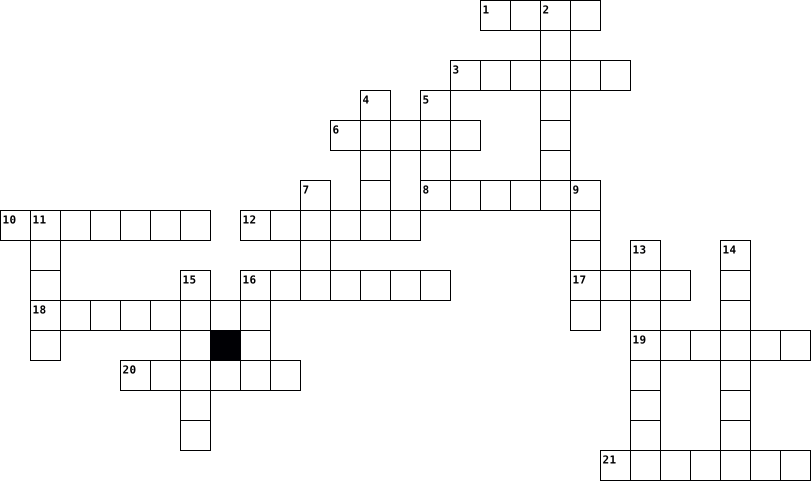
Across
- The Capital of Norway.
- The Capital of Portugal.
- The Capital of France.
- Greece's capital.
- One of the planets.
- The Capital of Poland.
- The Capital of Thailand.
- The Capital of Baghdad.
- Where the bulls are let loose!
- The capital of England.
- The Capital of Spain.
- The Capital of Wales.
Down
- The Country of Cedars.
- Small Mediterranean Island.
- The Capital of Peru.
- Tehran the capital of...
- Damascus is it's Capital.
- Cairo is there.
- The Capital of Malta.
- The Capital of India.
- Israel's main river.
- Denpasar is the capital of...
22 Clues: Cairo is there. • Greece's capital. • One of the planets. • The Capital of Peru. • Israel's main river. • The Capital of Malta. • The Capital of India. • The Capital of Spain. • The Capital of Wales. • The Capital of Norway. • The Country of Cedars. • The Capital of France. • The Capital of Poland. • The Capital of Baghdad. • The capital of England. • The Capital of Portugal. • ...
Cross the Space Word 2014-10-28

Across
- Gives us Light at Night Time
- Earths Neighbour
- The First Planet
- The Biggest Planet
- Astronauts Travel in This
- People that Travel into Space
- The Planets do this Around the Sun
- The Only Planet with Rings
- Big Dints in the Moon
Down
- Earth is the _____ Planet from the Sun
- Twinkle Twinkle Little...
- Eighth Planet from the Sun
- Astronaunts Wear These
- Our Galaxy
- The Bottom Planet
- Our Planet
- All of Space
- A ________ Star Flys Accross the Sky
- Biggest Star in the Sky
- These Move Around the Sun
20 Clues: Our Galaxy • Our Planet • All of Space • Earths Neighbour • The First Planet • The Bottom Planet • The Biggest Planet • Big Dints in the Moon • Astronaunts Wear These • Biggest Star in the Sky • Twinkle Twinkle Little... • Astronauts Travel in This • These Move Around the Sun • Eighth Planet from the Sun • The Only Planet with Rings • Gives us Light at Night Time • People that Travel into Space • ...
I PUT A HEX ON BEX 2020-10-20

Across
- 1.5 Ounces
- Canadian Cinnamon
- McClane's Nickname
- 108 Stitches
- Outermost Layer of Planets
- The Original Ninth Month
- Treat Others as You Want to be Treated
- Cubs Pub
- 27 Championships
Down
- LA Consumes the Most in the Country
- Ireland Believed to be Birthplace of This Holiday
- Yale and Princeton Played on This Day in 1876
- Super Bowl, Halloween, and NYE Food
- Cubby
- Tiger; German
- Dog, Amusement, National
- Libra, Scorpio, Pizza
- 50 Billion Gallons Consumed Annually on Earth
- Formerly Beverwijck, A Fur Trading Post
- Aykroyd is Co-Founder
- Suite
21 Clues: Cubby • Suite • Cubs Pub • 1.5 Ounces • 108 Stitches • Tiger; German • 27 Championships • Canadian Cinnamon • McClane's Nickname • Libra, Scorpio, Pizza • Aykroyd is Co-Founder • Dog, Amusement, National • The Original Ninth Month • Outermost Layer of Planets • LA Consumes the Most in the Country • Super Bowl, Halloween, and NYE Food • Treat Others as You Want to be Treated • ...
Pre- and suffixes 2021-04-19

Across
- Acting without a care for danger.
- When you are too confident.
- Comes paired with progress.
- Keeping something safe.
- All alone.
- Without taste.
- You do this at the gate after a flight.
- How something or someone looks.
- With number ten.
Down
- Not written correctly.
- Someone with which you work.
- Lacking a sense of responsibility.
- After the end of the world.
- Between planets.
- Across the big pond.
- Perfect
- Very good.
- When not a lot of people think about something it is...
- The ... between point A and B.
- Another word for temperature.
20 Clues: Perfect • Very good. • All alone. • Without taste. • Between planets. • With number ten. • Across the big pond. • Not written correctly. • Keeping something safe. • After the end of the world. • When you are too confident. • Comes paired with progress. • Someone with which you work. • Another word for temperature. • The ... between point A and B. • How something or someone looks. • ...
assessment 2021-08-27

Across
- not push very hard
- dislike or act against something
- very strong
- the study of the stars and planets
- parts of a food dish
- make it less than it was before
- good enough
- needs help right away
- hurt someone or something on purpose
- 1,000,000,000
- worry and fearful
Down
- capable of being but not yet happened
- have luck
- cause problems, stop things happening
- really good
- know something will happen
- have enough money to pay
- like to give things to people
- certain amount of thing
- the first thing
20 Clues: have luck • really good • very strong • good enough • 1,000,000,000 • the first thing • worry and fearful • not push very hard • parts of a food dish • needs help right away • certain amount of thing • have enough money to pay • know something will happen • like to give things to people • make it less than it was before • dislike or act against something • the study of the stars and planets • ...
Mathias CrosWord 2021-06-25

Across
- P_e_id_nt_ (social studies)
- _ p_ _ t _ (English)
- H _ _ t _ r _ (social studies)
- _ u _ b _ _ s (Math)
- T_a_n_n_ (Physical education)
- _ou_tr_ (social studies)
- L_ t t _ _ s (Language and literature)
- V _ l _ e _ (integral human development)
- Da_c_ (Physical education)
- C_ _ o _ s (Artistic cultural education)
Down
- _y_na_ti_s (Physical education)
- M_l_i_l_i_a_i_n_ (Math)
- _r_f_s (Artistic cultural education)
- H_ _ l _ h _ (English)
- D _ _ i _ _ o _ s (Math)
- _ l _ n _ s (natural Sciences)
- _ n _ v _ _ s _ (natural Sciences)
- W_ _ d _ (Language and literature)
- _ _a_ _ _ s (natural Sciences)
- _ e _ e _ d (Language and literature)
20 Clues: _ p_ _ t _ (English) • _ u _ b _ _ s (Math) • H_ _ l _ h _ (English) • M_l_i_l_i_a_i_n_ (Math) • D _ _ i _ _ o _ s (Math) • _ou_tr_ (social studies) • Da_c_ (Physical education) • P_e_id_nt_ (social studies) • T_a_n_n_ (Physical education) • H _ _ t _ r _ (social studies) • _ l _ n _ s (natural Sciences) • _y_na_ti_s (Physical education) • _ _a_ _ _ s (natural Sciences) • ...
Unit 3 Vocabulary Crossword page 76 2019-07-18

Across
- to be quick
- where the moon, stars and other planets are
- causing worry and tension
- to move smoothly
- to like
- related to a country
- for sure
- right now
- famous
Down
- to not participate in something
- all of something
- average; normal
- to make something
- things that someone does regularly
- to have enough money to buy something
- for a short time
- different from others; separate
- a person cared for by a doctor or nurse
- where someone is going
- a place for physical exercise or sports practice
20 Clues: famous • to like • for sure • right now • to be quick • average; normal • all of something • for a short time • to move smoothly • to make something • related to a country • where someone is going • causing worry and tension • to not participate in something • different from others; separate • things that someone does regularly • to have enough money to buy something • ...
CROSSTELLATION 2024-03-04

Across
- Form at the end of some stars' lives
- A ring planet
- Can be bright and can be dim
- Profession
- Dwarf planet
- Our solar system belongs to
- To move around a line
- An observatory
- Astronomical event - temporarily
- Not visible to the naked eye
- Ninth largest celestial body
- Small icy dirt balls
Down
- A group of visible star
- The study of everything in the universe
- Between the inner and outer planets
- Natural satellite
- A strange creature
- A force
- To magnify the image of celestial body
- Above us
20 Clues: A force • Above us • Profession • Dwarf planet • A ring planet • An observatory • Natural satellite • A strange creature • Small icy dirt balls • To move around a line • A group of visible star • Our solar system belongs to • Can be bright and can be dim • Not visible to the naked eye • Ninth largest celestial body • Astronomical event - temporarily • Between the inner and outer planets • ...
Subjects 2026-02-10

Across
- Designing and planning buildings
- Study of rocks and Earth
- Numbers and Calculations
- Study of fossils and ancient life
- Study of Zodiac Signs
- Exploring Earth's Features
- Study Of Living Organism
- Study of Past Events And Human Civillizations
- Study of Planets and Stars
- Study of the Natural World
- trade and Commerc
Down
- Study of the Origin And Structure of the Universe
- Study of Climate and Longterm Weather
- Study of animals
- Study/practice of flying aircraft
- Study of Matter and Energy
- Study of Languages
- Engineering for Machines
- Creative Expression
- Art of Arranging Sounds Using Rhythm
20 Clues: Study of animals • trade and Commerc • Study of Languages • Creative Expression • Study of Zodiac Signs • Study of rocks and Earth • Numbers and Calculations • Engineering for Machines • Study Of Living Organism • Study of Matter and Energy • Exploring Earth's Features • Study of Planets and Stars • Study of the Natural World • Designing and planning buildings • ...
Subjects 2026-02-10

Across
- Study of the Natural World
- Art of Arranging Sounds Using Rhythm
- Study/practice of flying aircraft
- Creative Expression
- Designing and planning buildings
- Exploring Earth's Features
- Study of Zodiac Signs
- Study Of Living Organism
- Study of Languages
- Study of fossils and ancient life
Down
- Study of the Origin And Structure of the Universe
- Engineering for Machines
- Study of Climate and Longterm Weather
- Study of Planets and Stars
- Study of Past Events And Human Civillizations
- Numbers and Calculations
- Study of rocks and Earth
- trade and Commerc
- Study of Matter and Energy
- Study of animals
20 Clues: Study of animals • trade and Commerc • Study of Languages • Creative Expression • Study of Zodiac Signs • Engineering for Machines • Numbers and Calculations • Study of rocks and Earth • Study Of Living Organism • Study of the Natural World • Study of Planets and Stars • Exploring Earth's Features • Study of Matter and Energy • Designing and planning buildings • ...
categories and functions 2022-01-24

Across
- what are knives for?
- pig,horse,chicken,cow,duck
- what is a shovel for?
- what is a cup for?
Down
- what are books for?
- orange juice, water, milk
- snow, sun, rain, wind
- what are pens for?
- Jupiter, Saturn, Mars, Earth
- what is a bathing suit for?
- brain, stomach, heart
11 Clues: what are pens for? • what is a cup for? • what are books for? • what are knives for? • snow, sun, rain, wind • what is a shovel for? • brain, stomach, heart • orange juice, water, milk • pig,horse,chicken,cow,duck • what is a bathing suit for? • Jupiter, Saturn, Mars, Earth
Earth and Space 2016-09-10

Across
- isaac newton's law
- closest planet to sun
- when the sun is shadowed by the moon
- low tide
- planet known for its rings
- earth rotates
Down
- when the moon is shadowed
- a large tide
- 365 days revolving
- when day and night are equal
- the 7 spheres in our solar system
11 Clues: low tide • a large tide • earth rotates • isaac newton's law • 365 days revolving • closest planet to sun • when the moon is shadowed • planet known for its rings • when day and night are equal • the 7 spheres in our solar system • when the sun is shadowed by the moon
Solar System Crossword Puzzle 2023-08-04

Across
- known as the icy planet
- closest planet to Sun
- planet that spins on its side
- Earth's twin
Down
- orbits around Earth
- all planets revolve around it
- has 7 rings
- planet humans live on
- known as the Red Planet
- largest planet in solar system
- is a dwarf planet
11 Clues: has 7 rings • Earth's twin • is a dwarf planet • orbits around Earth • planet humans live on • closest planet to Sun • known as the icy planet • known as the Red Planet • all planets revolve around it • planet that spins on its side • largest planet in solar system
TOUGH Doll Hidden Message 2024-11-21

Across
- connection to a spirit
- Divination Tool
- Something people watch on YouTube
- Six gifts
- Synonym for doing things together
- It's not easy
Down
- A gift that's unseen
- People's favorite day of the week
- Creepy crawler glows under uv light!
- Children like these
- Look at the stars and planets
11 Clues: Six gifts • It's not easy • Divination Tool • Children like these • A gift that's unseen • connection to a spirit • Look at the stars and planets • People's favorite day of the week • Something people watch on YouTube • Synonym for doing things together • Creepy crawler glows under uv light!
Outer Space 2025-05-30

Across
- Balls of hot gas
- Constellation with a belt
- Floating rocks in space
- There are eight of them in our solar system
- The dwarf planet
Down
- It circles the earth
- _______ ship
- The path planets take around the sun
- Our planet
- It's the largest planet
- The center of our solar system
11 Clues: Our planet • _______ ship • Balls of hot gas • The dwarf planet • It circles the earth • It's the largest planet • Floating rocks in space • Constellation with a belt • The center of our solar system • The path planets take around the sun • There are eight of them in our solar system
SPACE crossword! 2026-05-13

Across
- galaxy we live in
- the planet we live on
- natural satelite
- gas giants
- the year the moon was visited for thew first time
- balls of burning gas
- closest star to earth
Down
- person who explores space
- ring less planets
- the first trip to the moon's name
- what astrologists study
11 Clues: gas giants • natural satelite • galaxy we live in • ring less planets • balls of burning gas • the planet we live on • closest star to earth • what astrologists study • person who explores space • the first trip to the moon's name • the year the moon was visited for thew first time
Space Keywords 2023-03-15

Across
- Consists of the Sun and everything that orbits, or travels around, the Sun. This includes the eight planets and their moons, dwarf planets, and countless asteroids, comets, and other small, icy objects.
- Planet that orbits a star outside our solar system.
- Path taken by a satellite, planet or star moving around a larger body. Earth completes one orbit of the Sun every year.
Down
- The distance light travels in a year (over 9 million, million kilometres).
- Collection of stars held together by gravity. Our galaxy is called the Milky Way.
- Bodies which give out light, and which may have a solar system of planets.
6 Clues: Planet that orbits a star outside our solar system. • The distance light travels in a year (over 9 million, million kilometres). • Bodies which give out light, and which may have a solar system of planets. • Collection of stars held together by gravity. Our galaxy is called the Milky Way. • ...
Space 2021-07-26

Across
- A dark spot on the sun's surface
- Gives us light
- Earth is one.
- Eight planets, sun
- Something that enters the earth's atmosphere
- Debris from a comet
Down
- The distance light travels in a year
- A small rocky body orbiting the sun
- The milky way is a______
- Something put in space to collect information
- Rats backwards
- It orbits around us
- To circle around
- temoc backwards
14 Clues: Earth is one. • Gives us light • Rats backwards • temoc backwards • To circle around • Eight planets, sun • It orbits around us • Debris from a comet • The milky way is a______ • A dark spot on the sun's surface • A small rocky body orbiting the sun • The distance light travels in a year • Something that enters the earth's atmosphere • Something put in space to collect information
Astronomy Crossword Puzzle 2022-05-12

Across
- comprised of gaseous material
- cloud of dust, ice, and gas
- start of everything
- first element to form
- smallest planet
- matter condenses into
- mass is moving away from each other
- forms in the center of a nebula
Down
- attach to protons to form atoms
- clumps combine into
- gas giant
- energy times the speed of light squared equals
- comprised of rocky material
- force that pulls matter together
14 Clues: gas giant • smallest planet • clumps combine into • start of everything • first element to form • matter condenses into • cloud of dust, ice, and gas • comprised of rocky material • comprised of gaseous material • attach to protons to form atoms • forms in the center of a nebula • force that pulls matter together • mass is moving away from each other • ...
Earth - Sun - Moon Vocabulary 2022-09-06

Across
- system the sun with all the planets and all the bodies that revolve around it
- a cluster of stars, dust, and gasses that are held together by gravity
- the conditions of the atmosphere at a certain time and place
- half a sphere; the earth is split into two hemispheres - North and South
- a measure of the relative distance north or south of the equator
- object in space made up of gasses such as hydrogen and helium that produce light and energy.
- all of space and everything in it including the solar system, moon, planets, stars, etc.
- the imaginary straight line on which the Earth spins, giving us night and day
- an object that revolves around a planet and reflects light from the sun
Down
- pattern of weather over time in a specific location
- an inner planet
- Earth revolves around the sun; one revolution around the sun is one year
- the conditions of the atmosphere at a certain time and place
- a body or object in space that revolves around a star and has spherical shape
- a latitudinal line that is equal distance from the north and south poles
- divisions of the year that have different weather patterns due to the Earth’s changing position
16 Clues: an inner planet • pattern of weather over time in a specific location • the conditions of the atmosphere at a certain time and place • the conditions of the atmosphere at a certain time and place • a measure of the relative distance north or south of the equator • a cluster of stars, dust, and gasses that are held together by gravity • ...
Chapter 10 Crossword puzzle 2017-03-07

Across
- the system of the universe were the earth and planets revolve around the sun
- known for the theory that the planets move around the sun
- a system of planetary motion that places earth at the center of the universe
- known for the three laws of gravity
- a systematic procedure for collecting and analyzing evidence that was crucial to the evolution of science in the modern world
- known for the discovery of the four largest satellites of Jupiter
Down
- known for the idea that mind and matter were completely seperate
- Someone who studies wisdom
- came up with that the sun is the center of the universe
- a period when philosophers believed that they could apply the scientific method and use reason to explain human nature logically
- known for developing the scientific method
- argued that people had adopted laws and government in order to preserve their private property
- was a child protege and composed for the first time at age 6
- a system of thought expounded by Rene Descartes based on the belief that reason is the chief source of knowledge
- argued that everybody was born with a black mind
15 Clues: Someone who studies wisdom • known for the three laws of gravity • known for developing the scientific method • argued that everybody was born with a black mind • came up with that the sun is the center of the universe • known for the theory that the planets move around the sun • was a child protege and composed for the first time at age 6 • ...
Astronomy 2023-09-12

Across
- System A system consisting of a star and the planets and other objects that orbit it.
- A vast system of stars, gas, and dust bound together by gravity.
- An object that orbits a planet, moon, or star, such as a natural moon or an artificial satellite.
- Everything that exists, including all galaxies, stars, and planets.
- The partial or total obscuring of one celestial body by another, like a solar or lunar eclipse.
- A group of stars that form a recognizable pattern in the night sky.
- A celestial object composed of ice, dust, and gas that orbits the sun.
- A massive, luminous sphere of plasma that emits light and heat.
- A celestial body that orbits a star, like Earth or Mars.
Down
- The path that a celestial body follows as it moves around another body in space.
- The scientific study of celestial objects and the universe.
- A small, rocky object that orbits the sun, often found in the asteroid belt.
- An optical instrument used to observe distant objects in space.
- A small celestial body that enters the Earth's atmosphere and burns up, creating a meteoroid.
- The force that attracts two objects with mass toward each other.
15 Clues: A celestial body that orbits a star, like Earth or Mars. • The scientific study of celestial objects and the universe. • An optical instrument used to observe distant objects in space. • A massive, luminous sphere of plasma that emits light and heat. • A vast system of stars, gas, and dust bound together by gravity. • ...
solar system 2024-06-14

Across
- a fixed luminous point in the night sky which is a large
- a celestial body distinguished from the fixed stars by having an apparent motion of its own
- system of millions or billions of stars, together with gas and dust, held together by gravitational attraction
- the natural satellite of the earth, visible (chiefly at night) by reflected light from the sun.
- Neptune is the eighth and farthest known planet from the Sun
- The fourth planet from the Sun and the second smallest in the solar system, with a diameter about half that of Earth.
- the planet on which we live
- The seventh planet from the Sun and the third largest, with a diameter about four times that of Earth
Down
- a path described by one body in its revolution about another
- the collection of eight planets and their moons in orbit around the sun
- ice cap. a mass of ice and snow that permanently covers a large area of land
- a gas giant made up mostly of hydrogen and helium
- the smallest planet in the solar system
- the sixth planet from the Sun
- the second planet from the Sun, and the sixth largest planet
15 Clues: the planet on which we live • the sixth planet from the Sun • the smallest planet in the solar system • a gas giant made up mostly of hydrogen and helium • a fixed luminous point in the night sky which is a large • a path described by one body in its revolution about another • Neptune is the eighth and farthest known planet from the Sun • ...
SCIENTIFIC REVOLUTION 2018-04-12

Across
- -physicist found that only part of the air is used in respiration and is helped discover oxygen
- of "On the Motion of Animals" and studied mechanics of bodies
- of metals through purification
Down
- used to state that earth is simply one of several planets to orbit around the sun
- the idea of universal gravitation
- of stars on human behavior
- Creator of Laws of Planetary Motion: (Planets move elliptical, not uniformly)
7 Clues: of stars on human behavior • of metals through purification • the idea of universal gravitation • of "On the Motion of Animals" and studied mechanics of bodies • Creator of Laws of Planetary Motion: (Planets move elliptical, not uniformly) • used to state that earth is simply one of several planets to orbit around the sun • ...
mutations 2025-11-26

Across
- stars and planets
- color combo
- shiny and blue
- chinese mutations
- volcanic
Down
- rich color
- acid mutations
7 Clues: volcanic • rich color • color combo • acid mutations • shiny and blue • stars and planets • chinese mutations
Crossword Puzzle 2021-11-05

Across
- the force used to pull bodys down to earth
- planets gas giants
- last planet
- 72% water
Down
- mostly rock
- large rings
- red planet
- biggest planet
8 Clues: 72% water • red planet • mostly rock • large rings • last planet • biggest planet • planets gas giants • the force used to pull bodys down to earth
The Solar System 2014-05-11

Across
- People would not believe his theory and he developed his model centered with the sun.
- A _______ is a natural satellite.
- The shape of the planets' orbit.
- The model where Galileo provided evidence to.
Down
- ________ units are used to measure distances in the solar system.
- Where Earth is the center of revolving planets and stars.
6 Clues: The shape of the planets' orbit. • A _______ is a natural satellite. • The model where Galileo provided evidence to. • Where Earth is the center of revolving planets and stars. • ________ units are used to measure distances in the solar system. • People would not believe his theory and he developed his model centered with the sun.
Science crossword year 7 2022-12-16

Across
- our planet
- burning ball of gas
- a dwarf planet
- nothing is here
- Everything!
- the center of the solar system.
- ice in space
- a planet we could live one!
Down
- biggest planet in the solar system
- a group of planets and stars
- metal in space
- a rock or gas ball that orbits a sun.
12 Clues: our planet • Everything! • ice in space • metal in space • a dwarf planet • nothing is here • burning ball of gas • a planet we could live one! • a group of planets and stars • the center of the solar system. • biggest planet in the solar system • a rock or gas ball that orbits a sun.
El Portal crossword 2023-05-02

Across
- A 4-dimensional cube
- The model of the planets created a _______
- Carmen, Samuel, and Alejandra move to _______
- Carmen's son
- Alejandra's job
- Carmen, Samuel, and Alejandra live in _______
- Carmen time traveled to the _______
Down
- Carmen's job
- In the past, Carmen meets her _______
- Who steals the model?
- Alejandra goes to Colombia to meet with Dr. _______
- Carmen's husband
12 Clues: Carmen's job • Carmen's son • Alejandra's job • Carmen's husband • A 4-dimensional cube • Who steals the model? • Carmen time traveled to the _______ • In the past, Carmen meets her _______ • The model of the planets created a _______ • Carmen, Samuel, and Alejandra move to _______ • Carmen, Samuel, and Alejandra live in _______ • ...
Solar System Crossword 2017-05-18

Across
- The largest planet
- What you wake up to in the morning
- Closest to the sun
- There are 9 of them
- The planet we live on
- Spins on its side
Down
- There are hundreds of them
- Well known for its rings
- Comes out at night
- Aliens fly in them
- Now a dwarf planet
- Chocolate bar
12 Clues: Chocolate bar • Spins on its side • Comes out at night • Aliens fly in them • The largest planet • Closest to the sun • Now a dwarf planet • There are 9 of them • The planet we live on • Well known for its rings • There are hundreds of them • What you wake up to in the morning
Games & Space 2022-03-26

Across
- A puzzle you are doing right now
- Building
- A thing in space we only have 1 of
Down
- fighting
- A place with our planets 8 planets
5 Clues: fighting • Building • A puzzle you are doing right now • A place with our planets 8 planets • A thing in space we only have 1 of
Solar System Facts 2021-01-21

Across
- this gas gives Uranus and Neptune a bluish color
- the name of the giant, swirling storm in Jupiter's atmosphere that is twice the size of Earth
- gas giant planets are made primarily of hydrogen and ________
- Pluto's orbit is shared with thousands of other objects in the ______ Belt
- Mars has an atmosphere and ice caps made of frozen ______ _______
- Olympus ______ is the largest volcano in the solar system, located on Mars
- Saturn has 7 main _____; they are made of ice and possibly came from a shattered moon
Down
- this planet's 4 largest moons were discovered by Galileo
- term that describes the inner planets made of solid rock and metal
- this planet rotates backwards (east to west) and so slowly that a day here is longer than a year
- Earth is an average distance of 1.00 ____ from the Sun
- the largest moon of Saturn and the only moon in the solar system with a dense atmosphere
- temperatures can range from 450°C to -170°C on this planet because it doesn't have an atmosphere
- this planet's orbit is tilted 90° so it appears to "roll" around the Sun
- Because of it's composition and tilted, crowded orbit, Pluto was reclassified as a _________ planet in 2006
15 Clues: this gas gives Uranus and Neptune a bluish color • Earth is an average distance of 1.00 ____ from the Sun • this planet's 4 largest moons were discovered by Galileo • gas giant planets are made primarily of hydrogen and ________ • Mars has an atmosphere and ice caps made of frozen ______ _______ • term that describes the inner planets made of solid rock and metal • ...
Chapter 10 Enlightenment 2017-03-06

Across
- Defined the three laws of motion and used the universal laws of gravitation for arguments.
- Music prodigy who wrote many symphonies.
- Claimed that the sun was at the center of the universe.
- Believed that reason is the chief source of knowlege
- A German mathematician who destroyed the Ptolemaic system and his observations confirmed the Heliocentric universe idea.
- Wrote the Essay Concerning Human Understanding which is about tabula rasa which means everyone is born with a blank mind
Down
- Philosopher who created the scientific method.
- Wrote The Social Contract
- A system of planetary motion that places Earth at the center with the sun, moon and other planets revolving around it.
- Someone who studies wisdom.
- A systematic procedure for collecting and analyzing evidence.
- A period when philosophers believed that they could apply the scientific method and use reason to explain human nature logically.
- He was the first european to make regular observations of the heavens using a telescope.
- A system of thought expounded by René Descartes based on the belief that reason is the chief source of knowledge.
- A system of the universe proposed by Nicolaus Copernicus who argued that the planets revolve around the sun.
15 Clues: Wrote The Social Contract • Someone who studies wisdom. • Music prodigy who wrote many symphonies. • Philosopher who created the scientific method. • Believed that reason is the chief source of knowlege • Claimed that the sun was at the center of the universe. • A systematic procedure for collecting and analyzing evidence. • ...
Astrology Take 1 2021-11-03

Across
- the rising of a celestial object above the ecliptic, equator, or horizon.
- the part of the zodiac in which a planet’s influence is thought to be least.
- the part of the zodiac in which a planet is thought to exert its strongest influence.
- The configuration of stars that determines one’s fate in life.
- a horoscope calculated at the time of taking one’s sickbed
Down
- arrangement of 4 planets in which each is in opposition to one other planet and square to the other two, forming a cross.
- a forecast of a person’s future
- A particular position of a planet or other celestial body relative to another.
- arrangement of 3 planets in which each planet is in trine with the other two, forming an equilateral triangle.
- the initial point of an astrological sign or house.
- A belt of the heavens that is divided into twelve equal divisions or signs.
- The passage of a celestial body across the face of the sun, or of the moon.
- the casting of a horoscope
- A group of stars that form a pattern.
- the angular distance of a point north or south of the celestial equator.
15 Clues: the casting of a horoscope • a forecast of a person’s future • A group of stars that form a pattern. • the initial point of an astrological sign or house. • a horoscope calculated at the time of taking one’s sickbed • The configuration of stars that determines one’s fate in life. • the angular distance of a point north or south of the celestial equator. • ...
Space 2025-03-21

Across
- – The force that pulls objects toward one another, keeping planets in orbit.
- – A tool that helps us see objects far away in space.
- – The star at the center of our solar system that provides heat and light.
- – A small space rock that burns up as it enters Earth’s atmosphere, often called a shooting star.
- – The fourth planet from the Sun, also called the Red Planet.
- – A gas giant known for its spectacular rings.
- – A cloud of gas and dust in space where stars are born.
- – A large celestial body that orbits a star, like Earth, Mars, or Jupiter.
Down
- – The path an object takes around another object, like Earth orbiting the Sun.
- – Huge balls of glowing gas that produce heat and light, like the Sun.
- – A natural satellite that orbits a planet, like Earth’s Moon.
- – A space object made of ice, dust, and gas that develops a bright tail when close to the Sun.
- – A person trained to travel and work in space.
- – The third planet from the Sun and the only known planet with life.
- – A massive system of stars, planets, gas, and dust, held together by gravity. Our galaxy is the Milky Way.
15 Clues: – A gas giant known for its spectacular rings. • – A person trained to travel and work in space. • – A tool that helps us see objects far away in space. • – A cloud of gas and dust in space where stars are born. • – The fourth planet from the Sun, also called the Red Planet. • – A natural satellite that orbits a planet, like Earth’s Moon. • ...
THE DAWN OF THE AGE OF DISCOVERY 2026-08-06

Across
- a period of new learning, discovery and exploration in European history from the 1400s to the 1600s ce.
- to defeat usually in war or battle.
- a person that studies the natural world by making observations and doing experiments
- the first medical book used to train doctors in many different parts of the world
- a dark blue die obtained from plants.
- a group of families and relatives who have the same language customs and beliefs
- a building used for making observations of the stars and planets.
Down
- first developed by mathematicians in the middle east this form of calculation comes from the Arabic ál-jbar'which means 'reunion of broken parts'
- an instrument that made it possible to work out direction and location while traveling
- the use of science technology and maths to workout the best way to create new things or improve a product
- a book or a document that is written by hand
- a new process or object that did not previously exist.
- the scientific study of stars, planets and other objects in space
- a person who is highly educated
- to find or see something for the first time.
15 Clues: a person who is highly educated • to defeat usually in war or battle. • a dark blue die obtained from plants. • a book or a document that is written by hand • to find or see something for the first time. • a new process or object that did not previously exist. • the scientific study of stars, planets and other objects in space • ...
mutations 2025-11-26

Across
- stars and planets
- color combo
- shiny and blue
- chinese mutations
- volcanic
Down
- rich color
- acid mutations
7 Clues: volcanic • rich color • color combo • acid mutations • shiny and blue • stars and planets • chinese mutations
What Else is in Our Solar System 2021-07-29

Across
- system we live in it
- gas ball in center of solar system
- combined gases
- metal/rock that has hit earth
- body of matter (earth, mars, venus)
- small rock in orbit
Down
- a satellite for planets
- patch on the sun
- year how far light travels in a year
- orbits and collects information
- celestial planet
- turns into a meteorite
- gravitational pull (earth _____ the sun)
- many stars
14 Clues: many stars • combined gases • patch on the sun • celestial planet • small rock in orbit • system we live in it • turns into a meteorite • a satellite for planets • metal/rock that has hit earth • orbits and collects information • gas ball in center of solar system • body of matter (earth, mars, venus) • year how far light travels in a year • gravitational pull (earth _____ the sun)
Laine 2020-09-12

Across
- Number of baseball players in the field
- New Jersey capital
- First grade teacher
- A book has many
- Number of planets
- Favorite book
- State north of Texas
Down
- You go there to borrow a book
- Color of your neighbor's house
- Month Dad was born
- What color is your school bus
- Your age plus Lauren's age plus Logan's age
- Donut store near home
- Houston's big airport
14 Clues: Favorite book • A book has many • Number of planets • Month Dad was born • New Jersey capital • First grade teacher • State north of Texas • Donut store near home • Houston's big airport • You go there to borrow a book • What color is your school bus • Color of your neighbor's house • Number of baseball players in the field • Your age plus Lauren's age plus Logan's age
GALACTIC GRIDLINES 2024-12-05

Across
- Orbital intersection points
- Measures North-South position
- Map framework for navigation
- Celestial coordinate, like longitude
- Closest orbital point to Earth
- Apparent boundary of the sky
- Measures East-West position
Down
- Imaginary midline of a planet
- Line dividing East and West
- Farthest orbital point from Earth
- Celestial coordinate, like latitude
- Path of the Sun in the sky
- Line planets rotate around
- Point directly overhead
14 Clues: Point directly overhead • Path of the Sun in the sky • Line planets rotate around • Orbital intersection points • Line dividing East and West • Measures East-West position • Map framework for navigation • Apparent boundary of the sky • Imaginary midline of a planet • Measures North-South position • Closest orbital point to Earth • Farthest orbital point from Earth • ...
Tito kryžežodis 2021-02-01

Across
- cocoa beans snack
- free time from scool
- members of the solar system
- knife's best friend
- comes after night
- place where cars refule
Down
- the day you came to this world
- every adult it to make money
- farmers'best friend
- place wheher children studying
- think that helps to fly to another country
- thing you need every day
12 Clues: cocoa beans snack • comes after night • farmers'best friend • knife's best friend • free time from scool • place where cars refule • thing you need every day • members of the solar system • every adult it to make money • the day you came to this world • place wheher children studying • think that helps to fly to another country
Astronomy Made Easy 2025-05-30

Across
- Falling star that enters Earth's atmosphere
- Tool to see stars closer
- Force that keeps planets orbiting
- Space agency of the USA
- Stellar nursery observed by Webb
Down
- Space travelers
- Earth's closest natural satellite
- International cooperation hub
- Vehicle for space travel
- Collection of billions of stars
- Saturn's moon with liquid lakes
- Color of Earth from space
12 Clues: Space travelers • Space agency of the USA • Vehicle for space travel • Tool to see stars closer • Color of Earth from space • International cooperation hub • Collection of billions of stars • Saturn's moon with liquid lakes • Stellar nursery observed by Webb • Earth's closest natural satellite • Force that keeps planets orbiting • Falling star that enters Earth's atmosphere
Criss Crossing Being Underestimated 2026-02-05

Across
- but
- an ocean hog
- planets
- zero gravity indicators
- most of us need a little __________ when things become overwhelming
- (2) scared of heights
- Opal is the protagonist of
Down
- (2) a “go to” website for Papi
- (2) Papi’s oxygen
- Chase is Alex’s ______________
- mami’s favourite word
- no one wants to be ______________ except when you have done something wrong
12 Clues: but • planets • an ocean hog • (2) Papi’s oxygen • mami’s favourite word • (2) scared of heights • zero gravity indicators • Opal is the protagonist of • (2) a “go to” website for Papi • Chase is Alex’s ______________ • most of us need a little __________ when things become overwhelming • no one wants to be ______________ except when you have done something wrong
Solar system 🪐 2023-02-27

Across
- The largest planet in the solar system.
- wich is known as Red Planet.
- It’s the hottest planet in our solar system,it spins the opposite direction of Earth and most other planets.
Down
- The sixth planet from the sun and the second largest planet in our solar system.
- The second smallest of the planets, it’s dry and hot
- It is a huge, spinning, glowing sphere of hot gas.
- Our home planet , is a world unlike any other.
7 Clues: wich is known as Red Planet. • The largest planet in the solar system. • Our home planet , is a world unlike any other. • It is a huge, spinning, glowing sphere of hot gas. • The second smallest of the planets, it’s dry and hot • The sixth planet from the sun and the second largest planet in our solar system. • ...
scientific revolution 2023-01-12

Across
- Mathematician who concluded that certain mathematical laws govern planetary motion. One of these laws showed that the planets revolve around the sun in elliptical orbits instead of circle. Kepler’s laws showed that Copernicus’s basic ideas were true
- the idea that people should use reason, or logical thought to understand the world
- Italian scientist, Galileo built on the new theories about astronomy. Using a telescope, he supported Copernicus’s heliocentric theory, and came under persecution from the Catholic Church.
- Italian astronomer and mathematician who first used the telescope to study stars
- a belief that earth rotates daily on an axis and planets revolve in orbits around the sun
- Developed the heliocentric theory that the stars, Earth, and other planets revolved around the sun.
Down
- a German mathematician, astronomer, and astrologer
- having the sun as the center of the universe
- the combining of elements to form a pleasing whole
- the theory that earth is at the center of the universe
- a physicist and mathematician, key figure in the Scientific Revolution
11 Clues: having the sun as the center of the universe • a German mathematician, astronomer, and astrologer • the combining of elements to form a pleasing whole • the theory that earth is at the center of the universe • a physicist and mathematician, key figure in the Scientific Revolution • Italian astronomer and mathematician who first used the telescope to study stars • ...
INNER PLANET STATIONS 2021-04-21

Across
- An inner planet, the second planet away from the Sun, the hottest planet in our solar system
- An inner planet, the fourth planet away from the Sun, named after the Roman god of war
- The four planets, being Mercury, Venus, Earth, and Mars that are closest to the Sun and are terrestrial
- A celestial object that is moving in an orbit around a star
- An inner planet, the planet in which we live in
Down
- Being Earth-like
- A layer that surrounds a planet or moon that is made up of gases
- To move around repeatedly
- A celestial object that orbits a planet
- An inner planet, the closest planet to the Sun, it has the shortest revolution out of all of the planets in our solar system
10 Clues: Being Earth-like • To move around repeatedly • A celestial object that orbits a planet • An inner planet, the planet in which we live in • A celestial object that is moving in an orbit around a star • A layer that surrounds a planet or moon that is made up of gases • An inner planet, the fourth planet away from the Sun, named after the Roman god of war • ...
Chapter 21 Lesson 1-2 Crossword Puzzle 2017-04-19

Across
- What are small, rocky objects that orbit between Mars?
- What occurs when a planet's atmosphere traps solar energy and causes the face temperature to change?
- What is the unit to find the average distance from Earth to the Sun?
- What is a spherical object that doesn't have more mass then the objects around it and orbits the Sun?
- What are the planets that are the most further away from the Sun?
Down
- What is the time it takes an object to travel around the Sun?
- What is made of dust,gas, and ice moves around the Sun?
- What is the time it takes an object to complete one rotation?
- What are the planets closest to the Sun?
- What is an object that orbits the sun and has a nearly spherical shape?
10 Clues: What are the planets closest to the Sun? • What are small, rocky objects that orbit between Mars? • What is made of dust,gas, and ice moves around the Sun? • What is the time it takes an object to travel around the Sun? • What is the time it takes an object to complete one rotation? • What are the planets that are the most further away from the Sun? • ...
SCIENCE 5 2022-04-20

Across
- _____ is the separation of an insoluble solid from a liquid by pouring away the liquid and leaving behind the solid.
- The frictional force acting on objects as they move through water is called water _____.
- _____ force is a force of attraction between things and the Earth.
- The _____ of an object is different on the Earth, the Moon, and other planets.
- The _____ of an object is the same on the Earth, the Moon, and other planets.
Down
- _____ is the change of state of water from a gas to a liquid.
- Baking a cake is an example of a _____ change.
- _____ force can slow down and stop moving objects
- When ice reaches its _____ point, it changes to the liquid state.
- When liquid water reaches its _____ point, it changes to the solid state.
10 Clues: Baking a cake is an example of a _____ change. • _____ force can slow down and stop moving objects • _____ is the change of state of water from a gas to a liquid. • When ice reaches its _____ point, it changes to the liquid state. • _____ force is a force of attraction between things and the Earth. • ...
Scientiific revolution by stef!! 2023-12-12

Across
- Italian astronomer and physicist used a telescope to study the stars and supported the heliocentric theory
- who developed precise thermometers filled with mercury to measure temperature
- French philosopher and mathematician who believed that scientists needed to reject old assumptions
Down
- Danish astronomer who developed the Tychonic Systems- planets
- The Sun is at the center of the universe, with all the planets and stars revolving around it in circular orbits
- who believed that a better understanding of the natural world would produce practical knowledge that could improve people’s lives
- whose face is featured in the center of the US 100 dollar bill.
- Who Disproved many of Galen’s hypotheses (worked with apes and dogs in the 2nd century)
- who developed the heliocentric system
- German astronomer and mathematician; assistant to Brahe
10 Clues: who developed the heliocentric system • German astronomer and mathematician; assistant to Brahe • Danish astronomer who developed the Tychonic Systems- planets • whose face is featured in the center of the US 100 dollar bill. • who developed precise thermometers filled with mercury to measure temperature • ...
Astronomy Unit 8 2024-06-11

Across
- An outer planet of our solar system iconic for its many rings.
- When the moon perfectly blocks the sun casting a shadow on earth.
- These are also called "Shooting stars" or "Falling stars".
- It's a famous comet appearing around every 75 years
- The only planet in the solar system that has life.
Down
- The extinction event that killed over 90% of the ocean species and 70% of land species.
- An area in space that's far beyond Neptune that contains comets, asteroids, and other space bodies.
- It's the way the sun produces energy and heat, proton-proton chain reaction is a part of it.
- An area that seperates the inner planets from the outer planets and contains many asteroids.
- The flaming ball of plasma that's in our sky providing life.
10 Clues: The only planet in the solar system that has life. • It's a famous comet appearing around every 75 years • These are also called "Shooting stars" or "Falling stars". • The flaming ball of plasma that's in our sky providing life. • An outer planet of our solar system iconic for its many rings. • When the moon perfectly blocks the sun casting a shadow on earth. • ...
comet astroide meteor cross word 2025-11-14

Across
- the envelope of gases surrounding the earth or another planet.
- meteors that make it threw the atmosphere and hits earth
- small irregularly shaped chunks of rock that orbit the sun and are much too small to be considered planets
- is typically called a shooting start but it's actually a
- oval-shaped path an object takes around another, with the central body at one of the two foci
- donut shaped region of icy bodies and comets in the outer solar system
Down
- orbits around the sun like other planets
- are hundred of thousand of asteroids in a disk shape region between mars and Jupiteris called a
- small objects that orbit the sun
- theorized, giant, spherical shell of icy bodies surrounding the solar system, believed to be the source of long-period comets
10 Clues: small objects that orbit the sun • orbits around the sun like other planets • meteors that make it threw the atmosphere and hits earth • is typically called a shooting start but it's actually a • the envelope of gases surrounding the earth or another planet. • donut shaped region of icy bodies and comets in the outer solar system • ...
Crossword Puzzle 2021-11-05

Across
- the force used to pull bodys down to earth
- planets gas giants
- last planet
- 72% water
Down
- mostly rock
- large rings
- red planet
- biggest planet
8 Clues: 72% water • red planet • mostly rock • large rings • last planet • biggest planet • planets gas giants • the force used to pull bodys down to earth
general 72 2023-05-14

Across
- wife of a king
- medicine for headaches
- source of flash light power
- amusement park ride
- insect that eats wood
- fortified walled building surrounded by moat
- five x twelve
Down
- minnesota nfl team
- largest of our solar system planets
- country with canal of same name
- river that is part of u.s.-mexico border
- rock group, also bugs
- one of water's elements
- boston nhl team
- document defining national government
- hooting animal
- sport called football by rest of world
- country inside spain
18 Clues: five x twelve • wife of a king • hooting animal • boston nhl team • minnesota nfl team • amusement park ride • country inside spain • rock group, also bugs • insect that eats wood • medicine for headaches • one of water's elements • source of flash light power • country with canal of same name • largest of our solar system planets • document defining national government • ...
LS: Intro to Physics 2023-06-04

Across
- food is a form of this energy
- both a wave and particle
- father of modern physics
- hidden force between surface & object
- takes up space
- light splits into these 7 colours
- tendency to do nothing
- name for thermal energy
- type of energy from movement
- Newton's First Name
- Force = mass x _____
Down
- force by which planets pull objects to itself
- word for randomness/disorder
- sun produces this energy
- he discovered gravity
- for every action there is an equal & opposite ___
- energy can be neither created nor destroyed
- most efficient lightbulb
- the units of mass
19 Clues: takes up space • the units of mass • Newton's First Name • Force = mass x _____ • he discovered gravity • tendency to do nothing • name for thermal energy • sun produces this energy • both a wave and particle • father of modern physics • most efficient lightbulb • word for randomness/disorder • type of energy from movement • food is a form of this energy • light splits into these 7 colours • ...
escape from earth crossword puzzle 2023-10-25

Across
- tower by the ocean
- greene who wrote the book
- car Car which police use
- gate bridge famous bride in san francisco
- Salt water with living creatures
- where is daryl from
- places with lots of stores
- nicks friend
- reyes town in california
- Place where students go to learn usually age 19-23
Down
- plant where nicks dad works
- from earth name of the book
- nicks friend
- college rooms
- from earth book title
- nicks friend
- people with guns
- daryls friend
- things from other planets
- hallow cylinder
- francisco city in california
21 Clues: nicks friend • nicks friend • nicks friend • college rooms • daryls friend • hallow cylinder • people with guns • tower by the ocean • where is daryl from • from earth book title • things from other planets • places with lots of stores • plant where nicks dad works • reyes town in california • greene who wrote the book • francisco city in california • ...
The suffix "-ology" 2026-05-18

Across
- Dinosaur
- All about immunity
- Blood
- What pops up in your mind.
- Whatever this is about, it can make you sick
- You hear stuff
- Everything based on life.
- Stars and planets (Plus much more)
- About explanations not yet proven
- The Greeks made some of this
Down
- The title is based on this
- Interactions in environments.
- Your doctor knows this
- All about why people go to jail
- Planet Earth.
- Happiness is based on this
- The weather
- Something that makes you ill
18 Clues: Blood • Dinosaur • The weather • Planet Earth. • You hear stuff • All about immunity • Your doctor knows this • Everything based on life. • The title is based on this • Happiness is based on this • What pops up in your mind. • Something that makes you ill • The Greeks made some of this • Interactions in environments. • All about why people go to jail • About explanations not yet proven • ...
Universe terms 2022-08-22

Across
- Small body of rock that orbits around our sun.
- A space that does not allow anything to escape from inside it.
- A very small star.
- A large mass of gas and dust in between stars.
- A big body of mass that orbits the sun.
- The action of the centre of a star becomes too dense and collapses. The star then explodes
- all the planets orbiting the sun.
- A gas that is visible at night.
- The opposite of matter, when the two meet they destroy each other
- A large planet that is mostly gas, usually with low density and either helium and hydrogen.
- a planet that orbits a star in another galaxy
- a big area that consists of stars, solar systems, and planets.
- Similar to asteroids, they are bodies of ice and dust that orbit the sun.
Down
- A quasar is a region that creates a lot of radiation
- Similar to a normal planet but is smaller in size. Therefore, it can’t be classified as a planet.
- The earth's natural satellite.
- it orbits around just a larger body, the earth.
- A very large group of stars.
- It has gravity and makes up 95% of the universe along with dark energy.
- A small body of matter that enters our solar system.
- A rotating neutron star.
- When a white dwarf explodes.
- A galaxy that our planet is located in.
23 Clues: A very small star. • A rotating neutron star. • A very large group of stars. • When a white dwarf explodes. • The earth's natural satellite. • A gas that is visible at night. • all the planets orbiting the sun. • A big body of mass that orbits the sun. • A galaxy that our planet is located in. • a planet that orbits a star in another galaxy • ...
Maya Vocab Words ALL 2022-06-09

Across
- A special chamber for burying the dead
- The scientific study of stars, planets, and other objects in space.
- A thin flat bread made from maize flour.
- A powerful group in Mayan society who helped the king to run the city state.
- A group of people who all have a similar level of wealth, influence and status
- A written character that represents a letter, number or whole word.
- To write about events so people will know about them in the future.
- A city and the area of land around it
- Woven or knitted cloth
- A flat area cut into hillsides for growing crops.
- The period of rule of a king or queen.
- A large organized group of people who live and work together in the same region
Down
- A system of writing that uses pictures to represent words, sounds and objects
- A building with triangular sides, used by the Maya as a tomb for dead kings and public ceremonies.
- Things needed by people, plants and animals to help them grow.
- A place or building used for making observations of the stars and planets
- What something is made of…
- A type of farming that uses steps built into the side of a mountain or hill. Crops are planted on each level.
- A ancient manuscript in book form.
- A large group of people who live in an organized way
- Exchanging goods without using money.
21 Clues: Woven or knitted cloth • What something is made of… • A ancient manuscript in book form. • A city and the area of land around it • Exchanging goods without using money. • A special chamber for burying the dead • The period of rule of a king or queen. • A thin flat bread made from maize flour. • A flat area cut into hillsides for growing crops. • ...
Sun and Space Crossword 2019-01-03

Across
- The closest planet to the sun.
- _ can block the sun from view.
- The name we call the planet we live on.
- The hottest planet.
- The pattern of a smaller object going around a bigger space object.
- The shape of the sun.
- _ make up the sun, so its surface never stays the same.
- The sun is really _ even when it's cold on earth.
- The Milky Way _ is the home for our solar system.
- Column of light.
- Our _ makes Vitamin D when sun shines directly on it.
- Sunlight makes you feel _.
- Really bright sun in your _ will make you squint.
- The sun's _ is a form of energy.
- Used to be the smallest, ninth planet.
- The sun sets in the _.
Down
- Keeps our feet on the ground and the planets going around the sun.
- The moon doesn't make light of its own, it _ the light of the sun.
- Sunlight can _ your skin even when it's not hot.
- _ energy is a sustainable way to power things on earth.
- The sun is so _ that you can't stare at it.
- The sun is a _ that anchors our solar system.
- 365 is the number of _ it takes Earth to orbit the sun.
- The object that blocks the sun in a solar eclipse.
- The area between objects in space.
- The number of planets that orbit our sun.
- A planet follows an orbital _ around the sun.
27 Clues: Column of light. • The hottest planet. • The shape of the sun. • The sun sets in the _. • Sunlight makes you feel _. • The closest planet to the sun. • _ can block the sun from view. • The sun's _ is a form of energy. • The area between objects in space. • Used to be the smallest, ninth planet. • The name we call the planet we live on. • The number of planets that orbit our sun. • ...
Sun and Space Crossword 2019-01-03

Across
- The closest planet to the sun.
- The sun's _ is a form of energy.
- Sunlight makes you feel _.
- The sun is so _ that you can't stare at it.
- The sun sets in the _.
- The shape of the sun.
- _ can block the sun from view.
- _ energy is a sustainable way to power things on earth.
- _ make up the sun, so its surface never stays the same.
- The sun is a _ that anchors our solar system.
- The pattern of a smaller object going around a bigger space object.
- Column of light.
- Really bright sun in your _ will make you squint.
- A planet follows an orbital _ around the sun.
Down
- Keeps our feet on the ground and the planets going around the sun.
- The moon doesn't make light of its own, it _ the light of the sun.
- The sun is really _ even when it's cold on earth.
- Sunlight can _ your skin even when it's not hot.
- The hottest planet.
- The Milky Way _ is the home for our solar system.
- The object that blocks the sun in a solar eclipse.
- Used to be the smallest, ninth planet.
- The number of planets that orbit our sun.
- 365 is the number of _ it takes Earth to orbit the sun.
- The area between objects in space.
- The name we call the planet we live on.
- Our _ makes Vitamin D when sun shines directly on it.
27 Clues: Column of light. • The hottest planet. • The shape of the sun. • The sun sets in the _. • Sunlight makes you feel _. • The closest planet to the sun. • _ can block the sun from view. • The sun's _ is a form of energy. • The area between objects in space. • Used to be the smallest, ninth planet. • The name we call the planet we live on. • The number of planets that orbit our sun. • ...
Sun and Space Crossword 2019-01-03

Across
- Our _ makes Vitamin D when sun shines directly on it.
- The object that blocks the sun in a solar eclipse.
- The area between objects in space.
- Used to be the smallest, ninth planet.
- The sun is so _ that you can't stare at it.
- The sun sets in the _.
- The hottest planet.
- Column of light.
- The number of planets that orbit our sun.
- The moon doesn't make light of its own, it _ the light of the sun.
- Keeps our feet on the ground and the planets going around the sun.
- 365 is the number of _ it takes Earth to orbit the sun.
- The sun is really _ even when it's cold on earth.
- A planet follows an orbital _ around the sun.
Down
- Sunlight can _ your skin even when it's not hot.
- The sun is a _ that anchors our solar system.
- The pattern of a smaller object going around a bigger space object.
- The shape of the sun.
- _ can block the sun from view.
- _ energy is a sustainable way to power things on earth.
- Sunlight makes you feel _.
- The closest planet to the sun.
- Really bright sun in your _ will make you squint.
- _ make up the sun, so its surface never stays the same.
- The name we call the planet we live on.
- The sun's _ is a form of energy.
- The Milky Way _ is the home for our solar system.
27 Clues: Column of light. • The hottest planet. • The shape of the sun. • The sun sets in the _. • Sunlight makes you feel _. • _ can block the sun from view. • The closest planet to the sun. • The sun's _ is a form of energy. • The area between objects in space. • Used to be the smallest, ninth planet. • The name we call the planet we live on. • The number of planets that orbit our sun. • ...
Chapter 8 Crossword 2019-01-25

Across
- collected in (stores and releases water)
- (left)
- (right)
- primary reference line (Earths zero longitude)
- so sun can penetrate (gases surrounding the Earth)
- Earth and Ocean are an indirect result of (explosion)
- Iron sunk to the middle of the planet (cold dense water)
- A typical star (main star that gives off light to Earth)
- 2nd largest Oceans (located in the middle of a map)
- smallest Ocean (connects to south and north pole)
- Where Earth and other planets in our solar system reside (it's our galaxy)
- The Earth ____ (moves)
Down
- material concentrated into a proto sun and outer material formed (distant planets)
- (down)
- is a primary reference line ( an imaginary line drawn around the Earth)
- early atmosphere (colorless, odorless flammable gas)
- immediately right or left of the date line are ( whole day)
- Protects us from the UV (layer in Earths stratosphere) Ozone layer
- shape is the Earth (sphere)
- is the equator ( in between -1 and 1)
- What's the largest ocean( West on a map)
- atmosphere included (gaseous phase of water)
- and Nucleotides could be formed. (focused)
- 6 billion years from now the sun will turn into (enormous)
- Early steps of organisms forming (production of complex molecules)
- Had a magnetic field (close to Earth)
- 3rd Largest Ocean (it's a country in South Asia)
- contains the south pole (ice)
- star dust, and grass our held together (a strong force)
29 Clues: (down) • (left) • (right) • The Earth ____ (moves) • shape is the Earth (sphere) • contains the south pole (ice) • is the equator ( in between -1 and 1) • Had a magnetic field (close to Earth) • collected in (stores and releases water) • What's the largest ocean( West on a map) • and Nucleotides could be formed. (focused) • atmosphere included (gaseous phase of water) • ...
Science Vocab 8th grade semester 1 2020-12-16

Across
- wide, flat disc containing ice and rock particles that orbit a planet
- energy a big object has in relation to another big object due to gravity
- energy due to the flow of electrical charges
- planets outside the asteroid belt
- energy stored in the chemical bonds of atoms
- known as the red planet
- planet farthest from the sun
- a type of wave that carries energy through space where there is almost no matter
- rate at which work is done
- part of total internal energy that can be
- ability to do work
- the energy stored in the nucleus of an atom
- unit to measure force
- force that pulls you down to earth
- energy stored by an object due to its state or position
Down
- the turning or circling of an object
- energy associated with electromagnetic waves
- how fast an object goes
- liquified by heat
- standard unit of measure for energy and work
- the movement of an object around the center of another object
- disturbance that carries energy from one place to another through matter and space
- the energy of an object due to its potential energy and kinetic energy
- measurement of how much an object weighs
- energy in abject due to its motion
- rate of change in the position of an object
- planets inside the asteroid belt
- existing as a gas
- only planet with water
- push or pull
- measurement of change in objects velocity
31 Clues: push or pull • liquified by heat • existing as a gas • ability to do work • unit to measure force • only planet with water • how fast an object goes • known as the red planet • rate at which work is done • planet farthest from the sun • planets inside the asteroid belt • planets outside the asteroid belt • energy in abject due to its motion • force that pulls you down to earth • ...
Cosmology Test Review 2023-04-24

Across
- substance possible because of Earth's position in space
- known as red planet
- converting hydrogen to helium
- natural satellite of Earth
- eclipse is Sun-Moon-Earth
- is different on different planets
- north pole is in total daylight (date)
- when Earth travels through the remains of a ______ you will see spectacular meteor showers
- galaxy organized with arm like sections in oval
- of Earth causes day and night
- diagram that shows star lifecycle
- main element in star
- most dense layer of sun
- distance light travels in one year
- eclipse is Sun-Earth-Moon
- light-year measures
- study of how universe formed
- measures distance from Earth
- moon with no visible light
- north star is stationary on horizon
Down
- first stage in star lifecycle
- earth's twin planet
- spins on its side
- tide when high is higher during new and full moon
- Universe Model that said Earth was the center of the Universe
- planets with rocky surfaces
- gas that makes life possible on Earth
- solar wind causes the tail of this space object to point away
- nothing can escape this location in space
- move from wind on mars
- light increasing each night on moon
- spiral shaped galaxy, ours!
- third rock from the Sun
- twelve hours light twelve hours darkness
- effect of waves coming and going away from you
- first manned mission to moon
- are moving away from each other
- explosion of massive star
38 Clues: spins on its side • earth's twin planet • known as red planet • light-year measures • main element in star • move from wind on mars • third rock from the Sun • most dense layer of sun • eclipse is Sun-Moon-Earth • eclipse is Sun-Earth-Moon • explosion of massive star • natural satellite of Earth • moon with no visible light • planets with rocky surfaces • spiral shaped galaxy, ours! • ...
Science Crossword 2013-02-19

Across
- an icy small system body , this belongs to the asteroid and meteor family
- a pattern the stars make
- a synonym for this word is backdrop
- this contains all of the planets and the sun galaxies and stars
- small solar system bodies,this belongs to the meteor and comet family
- galaxy , it is a candy that mostly everyone likes
- how earth started , a random explosion that made earth and everything else start its existance
- an exploding star
- term for size or length , brightness of a star
- solid debris from asteroids or comets
- difference in the apparent position , the word starts with a P
Down
- this also known as a shooting star
- an enormous cloud of gas
- very similar looking to a wavelength and a frequency wave , it is the only word that has two word combined to make the one word
- the "object" earth we live on
- an object that gives off its own light
- a bomb or nuclear explosion can give this off , if people are exposed to this they will get really sick and possibly die
- a gravitational pull where no light at all can escape
- a specific type of this would be the milkeyway
- unit of length , he was the space toy in toy story the movie
- an example of this word is a rainbow
- it will enter a planets atmosphere it is similar to a meteor
- a galactic nucleus , the word starts with the letter Q
23 Clues: an exploding star • an enormous cloud of gas • a pattern the stars make • the "object" earth we live on • this also known as a shooting star • a synonym for this word is backdrop • an example of this word is a rainbow • solid debris from asteroids or comets • an object that gives off its own light • a specific type of this would be the milkeyway • ...
Final Crossword Puzzle 2021-12-09

Across
- The motion of an object can often be described differently depending on the ___ frame.
- Unbalanced forces cause an object to ___ in the direction of the net force.
- Newton's second law of motion explains the ___ among force, mass, and acceleration.
- Within our solar system are ___ major planets, grouped by proximity to the Sun.
- A ___ is a push or pull that is exerted on an object.
- ___ energy is energy in the form of motion.
- The reason why we have seasons is because the Earth is ___.
- Newton's third law states that for every action, there is an equal and opposite ___.
- Eclipses only occur when all three celestial bodies line up in the same ___.
- During a ___ cycle, we can observe different phases of the moon.
- An __ is an imaginary line about which each planet or moon spins.
Down
- Gravity is always a ___, never a push.
- The planets' orbits are ___, or oval shaped.
- Between Mars and Jupiter lies the ___ belt.
- Before the ____ model, people used to believe in the heliocentric model.
- The two things that affect the strength of the gravitational force between two objects are ____ and distance.
- If all the forces acting on a particular object are balanced, then the net force is ___.
- ___ energy is stored energy.
- ___is a force that pulls every object toward every other object.
- The law of ___ states that energy can be neither created nor destroyed, only transferred from one form or object to another.
20 Clues: ___ energy is stored energy. • Gravity is always a ___, never a push. • Between Mars and Jupiter lies the ___ belt. • ___ energy is energy in the form of motion. • The planets' orbits are ___, or oval shaped. • A ___ is a push or pull that is exerted on an object. • The reason why we have seasons is because the Earth is ___. • ...
Ms. Shimp's Random 5th Grade Crossword 2024-03-13

Across
- "I'm STARVING, can I please have my ________?"
- There are ___________ planets in our solar system.
- _________ is the narrator in Front Desk
- A figurative saying like "it's raining cats and dogs!"
- A popular online reading website
- The first subject of the day on Tuesdays and Fridays
- Our class is talented at making paper _________
- The month of Ms. Shimp's birthday
- All of the planets in our solar system revolve around the...
- We are currently studying the __________ genre in reading.
- Our special on Thursdays
- We go here every Monday
- How we end our week together (hopefully)
- Part of speech that means an action or state of being
- Ms. Shimp wishes we would find more time to _________ after school :)
Down
- On Tuesdays and Wednesdays, this is where our class goes
- A time in history where the United States moved west
- A story always has a ____________ and a solution
- A dwarf planet that got kicked out of the planet club :(
- He used to teach PE, but now he is our principal!
- You find the _______ ________ when you decide what the text is mostly about.
- Part of speech that means a person, place, thing, or idea
- If you want to read something with facts and information, you should get a ____________ book
- Any type of polygon with four sides
- Part of speech that describes a noun
- This is the WHERE and WHEN a story takes place
26 Clues: We go here every Monday • Our special on Thursdays • A popular online reading website • The month of Ms. Shimp's birthday • Any type of polygon with four sides • Part of speech that describes a noun • _________ is the narrator in Front Desk • How we end our week together (hopefully) • "I'm STARVING, can I please have my ________?" • ...
Teens level 9 2025-10-07

Across
- – Very thin, close-fitting leg coverings, often worn with a skirt.
- – A person who travels into space.
- – With lines of different colors.
- – Fake hair that people wear on their heads.
- – A strong blue cotton fabric used to make jeans.
- – Stylish or popular at the moment.
- – A place where you can watch shows about stars and space.
- – The planet we live on.
- – To use materials again instead of throwing them away
- – Extra pieces of hair added to make it longer.
- animals – Animals that might disappear forever.
- – Long rubber boots for rainy days.
- – A warm top with a hood.
- – Too many cars and buses on the road.
Down
- – A tool used to look at stars and planets far away.
- – The path something takes around a planet or star.
- – Untidy or messy in appearance.
- – What comes from fire or pollution.
- – Simple, with no patterns or decorations.
- hair – Hair that has been colored to look different.
- – A large group of stars and planets, like the Milky Way.
- – A ball of ice and rock that travels around the sun and has a tail.
- – Small brown spots on your skin, often from the sun.
- – Another word for thin or slender.
- – Rubbish left on the ground in public places.
- – A small hole in your ear, nose, or body for jewelry.
- – A vehicle made for traveling in space.
- nails – When you put nail polish on your fingers.
- – Comfortable clothes for sports or exercise.
29 Clues: – The planet we live on. • – A warm top with a hood. • – Untidy or messy in appearance. • – With lines of different colors. • – A person who travels into space. • – Stylish or popular at the moment. • – Another word for thin or slender. • – Long rubber boots for rainy days. • – What comes from fire or pollution. • – Too many cars and buses on the road. • ...
Chemistry escape room 2025-11-10

Across
- Found in bones
- Conductive metal used in wires
- (Blank)2O
- Used in batteries
- [Ar] 4s² 3d¹⁰
- Strongest reaction when in contact with water
- Used in nuclear weapons
Down
- Found in all organic molecules
- Group 17 gas used in pools
- Same name as one of the planets in our solar system
- Needed for fire
- Valuable yellow metal
- Used at birthday parties
- The element with the symbol Fe
14 Clues: (Blank)2O • [Ar] 4s² 3d¹⁰ • Found in bones • Needed for fire • Used in batteries • Valuable yellow metal • Used in nuclear weapons • Used at birthday parties • Group 17 gas used in pools • Found in all organic molecules • Conductive metal used in wires • The element with the symbol Fe • Strongest reaction when in contact with water • Same name as one of the planets in our solar system
Spelling pattern review! 2025-12-15

Across
- milky and smooth
- a person who hopes for things
- water vapor
- what the planets do around the sun
- to amuse people
- to use your hand to gesture to something
Down
- shooting with a bow and arrow
- housework
- to make something unusable
- what is left
- a place to grow flowers and food
- a friendly ten
- the last day of the week
- a root vegetable
14 Clues: housework • water vapor • what is left • a friendly ten • to amuse people • milky and smooth • a root vegetable • the last day of the week • to make something unusable • shooting with a bow and arrow • a person who hopes for things • a place to grow flowers and food • what the planets do around the sun • to use your hand to gesture to something
Vocab 28.1 2020-11-11

Across
- colliding particles in the solar system form this
- an overall shape that is centered on two points instead of a single point as in a circle
- the backward movement of a planet
Down
- earths average distance to the sun is 1.496*10^8km = too
- the point where an orbit is closest to the sun
- the shape of planets elliptical orbit
- the point in a planets orbit at which it is furthest from the sun
7 Clues: the backward movement of a planet • the shape of planets elliptical orbit • the point where an orbit is closest to the sun • colliding particles in the solar system form this • earths average distance to the sun is 1.496*10^8km = too • the point in a planets orbit at which it is furthest from the sun • ...
Physics 7.1 Planetary motion 2026-01-13

Across
- used a telescope to observe other planets
- states the paths of planets are ellipses with the sun at one focus
- model made by Copernicus showing the sun as the center
Down
- realized the charts of time didn't predict astronomical events
- states an imaginary line from the sun to a planet sweeps out equal areas in equal time
- states (Ta/Tb)squared = (Ra/Rb)cubed
- model made by Ptolemy using earth as the center of the center
7 Clues: states (Ta/Tb)squared = (Ra/Rb)cubed • used a telescope to observe other planets • model made by Copernicus showing the sun as the center • model made by Ptolemy using earth as the center of the center • realized the charts of time didn't predict astronomical events • states the paths of planets are ellipses with the sun at one focus • ...
Museum 2023-09-06

Across
- Very, very old, like things from a long time ago.
- A person who takes care of the objects in a museum and decides what to show.
- The study of ancient people and their cultures by digging up and studying their remains.
- Displays or collections of items in a museum that teach you about something.
- A type of art made by carving or shaping materials like wood, stone, or clay.
- A type of prehistoric reptile that lived millions of years ago.
- A room or space in a museum where art or special objects are displayed.
Down
- The study of stars, planets, and other objects in space.
- A place where you can learn about stars, planets, and space through shows and exhibits.
- The stories of the past, including how people lived, what they did, and what happened.
- Old and interesting objects that are kept in museums for people to see.
- Pictures made by artists using paints and brushes on canvas or other surfaces.
- The remains or impressions of ancient plants and animals preserved in rock.
- The study of the natural world, including things like space, animals, and chemicals.
- Something you can touch, play with, or use to learn more about a topic.
15 Clues: Very, very old, like things from a long time ago. • The study of stars, planets, and other objects in space. • A type of prehistoric reptile that lived millions of years ago. • Old and interesting objects that are kept in museums for people to see. • Something you can touch, play with, or use to learn more about a topic. • ...
Space and Stars 2023-09-18

Across
- A large celestial body that orbits a star, like Earth or Mars.
- A scientist who studies and observes objects in the universe.
- A rocky object in space, smaller than a planet, that orbits the sun.
- The vast expanse of space that includes galaxies, stars, planets, and more.
- A group of stars that form a recognizable pattern in the night sky.
- System Our sun and all the celestial bodies that orbit it, including planets and moons.
- A meteor that survives its journey through Earth's atmosphere and reaches the surface.
Down
- A small rock or metal fragment from space that burns up upon entering Earth's atmosphere.
- A massive system of stars, gas, dust, and dark matter held together by gravity.
- A burning ball of gas in space that shines brightly due to nuclear reactions.
- A vehicle designed for travel or operation in outer space.
- A cosmic object made of ice, dust, and gas that travels through space.
- A cloud of gas and dust in space, often where new stars are born.
- An instrument that magnifies and enhances the view of distant objects in space.
- Hole A region in space where gravity is so strong that nothing, not even light, can escape.
15 Clues: A vehicle designed for travel or operation in outer space. • A scientist who studies and observes objects in the universe. • A large celestial body that orbits a star, like Earth or Mars. • A cloud of gas and dust in space, often where new stars are born. • A group of stars that form a recognizable pattern in the night sky. • ...
Solar System 2023-09-11

Across
- A large celestial body that orbits the Sun, such as Earth or Mars.
- A scientist who studies celestial objects like stars, planets, and galaxies.
- The force that pulls objects with mass toward each other.
- The star at the center of our solar system that provides light and heat.
- A pattern of stars in the sky that forms a recognizable shape or figure.
- A celestial object composed of ice, dust, and gas that has a bright tail.
- A small object from space that burns up upon entering Earth's atmosphere.
Down
- A vast system of stars, gas, dust, and dark matter, like the Milky Way.
- The movement of one object around another, like Earth's orbit around the Sun.
- An instrument used for viewing distant celestial objects.
- The blocking of one celestial object by another, like a solar eclipse.
- Exploration The act of sending spacecraft and humans into space to learn about it.
- A small rocky object that orbits the Sun, usually found in the asteroid belt.
- System The Sun and all the objects that orbit it, including planets and moons.
- The path an object takes as it moves around another object in space.
15 Clues: An instrument used for viewing distant celestial objects. • The force that pulls objects with mass toward each other. • A large celestial body that orbits the Sun, such as Earth or Mars. • The path an object takes as it moves around another object in space. • The blocking of one celestial object by another, like a solar eclipse. • ...
Chapter 5 crossword 2021-05-04

Across
- To point something out
- The study of stars and planets
- To stand up to
- To purify
- To engrave letters on a surface
- To tremble
Down
- A long adventure
- A long loose outer garment
- Someone who behaves oddly
- To agree to an idea
10 Clues: To purify • To tremble • To stand up to • A long adventure • To agree to an idea • To point something out • Someone who behaves oddly • A long loose outer garment • The study of stars and planets • To engrave letters on a surface
Vocabulary 2023-01-12

Across
- we are always _________
- where we live
- a group of stars dust and solarsystems
- big balls of fire
- what orbits us
Down
- how everything started
- everything
- A place where we live with other planets
- where we are located
- our source of light
10 Clues: everything • where we live • what orbits us • big balls of fire • our source of light • where we are located • how everything started • we are always _________ • a group of stars dust and solarsystems • A place where we live with other planets
Singular and Plural 2021-02-01

Across
- singular form of foxes
- singular form of brushes
- plural form of paper
- plural form of box
- singular form of watches
Down
- plural form of book
- plural form of ruler
- plural form of pencil
- singular form of stories
- singular form of planets
10 Clues: plural form of box • plural form of book • plural form of ruler • plural form of paper • plural form of pencil • singular form of foxes • singular form of brushes • singular form of stories • singular form of planets • singular form of watches
Space Puzzle 2023-02-01

Across
- The blue planet
- Has 50 moons
- Known for its rings
- On its side
- Named after the God of war
Down
- Called the morning star
- Closest to the Sun
- The closest planet to the Sun
- The bigger planets
- Only planet with life
10 Clues: On its side • Has 50 moons • The blue planet • Closest to the Sun • The bigger planets • Known for its rings • Only planet with life • Called the morning star • Named after the God of war • The closest planet to the Sun
Vocabulary Development Lessons 1&2 ***** 2014-11-24

Across
- a dependent person, company, or state
- a group of well-known people
- global; moving in an orbit; referring to a planet or planets
- serene; undisturbed
Down
- rate of speed
- kind; sympathetic
- tactful
- a being who will eventually die
- horrid; ghostlike
- a foreigner
10 Clues: tactful • a foreigner • rate of speed • kind; sympathetic • horrid; ghostlike • serene; undisturbed • a group of well-known people • a being who will eventually die • a dependent person, company, or state • global; moving in an orbit; referring to a planet or planets
3 2024-05-09

Across
- Protected or concealed.
- Quick
- Grasp or grip.
- Move with one foot in front of the other.
- 1 + 4
- More than a few, but not many.
Down
- __ and roll
- In the direction of.
- Referring to a male person.
- where the planets are
10 Clues: Quick • 1 + 4 • __ and roll • Grasp or grip. • In the direction of. • where the planets are • Protected or concealed. • Referring to a male person. • More than a few, but not many. • Move with one foot in front of the other.
Sun & Other Stars 2025-10-14

Across
- used to show visiblity for stars
- high energy radiation causing interference
- 9th brightest star
- 186,000 mps
Down
- used to search for other planets
- area around star
- one of the largest known stars
- brightest star
- ball of gas
- 864 light years away
10 Clues: ball of gas • 186,000 mps • brightest star • area around star • 9th brightest star • 864 light years away • one of the largest known stars • used to search for other planets • used to show visiblity for stars • high energy radiation causing interference
mutations 2025-11-26

Across
- stars and planets
- color combo
- shiny and blue
- chinese mutations
- volcanic
Down
- rich color
- acid mutations
7 Clues: volcanic • rich color • color combo • acid mutations • shiny and blue • stars and planets • chinese mutations
The Scientific Revolution 2021-02-05

Across
- The theory that the earth is the center of the universe and that the sun and the other 7 planets revolve around it
- The 3rd planet from the sun and the only known planet to have life.
- The first to come up with the heliocentric theory.
- An Italian astronomer who was the first to use the telescope to study the stars
- The study of the stars
- A celestial body made of either rock or gas that orbits a star.
- A subject that many astronomers used to help discover more about our solar system (Isasc Newton invented a type of it)
Down
- A plan for collecting, organizing, and communicating data.
- The theory that the planets revolve around the sun
- The invisible force that pulls everything to the surface of the earth
10 Clues: The study of the stars • The theory that the planets revolve around the sun • The first to come up with the heliocentric theory. • A plan for collecting, organizing, and communicating data. • A celestial body made of either rock or gas that orbits a star. • The 3rd planet from the sun and the only known planet to have life. • ...
Chapter 21 Lesson 1-2 Crossword Puzzle 2017-04-19

Across
- What is a spherical object that doesn't have more mass then the objects around it and orbits the Sun?
- What is the time it takes an object to travel around the Sun?
- What are small, rocky objects that orbit between Mars?
- What is an object that orbits the sun and has a nearly spherical shape?
- What is the time it takes an object to complete one rotation?
- What is made of dust,gas, and ice moves around the Sun?
Down
- What are the planets closest to the Sun?
- What is the unit to find the average distance from Earth to the Sun?
- What are the planets that are the most further away from the Sun?
- What occurs when a planet's atmosphere traps solar energy and causes the face temperature to change?
10 Clues: What are the planets closest to the Sun? • What are small, rocky objects that orbit between Mars? • What is made of dust,gas, and ice moves around the Sun? • What is the time it takes an object to travel around the Sun? • What is the time it takes an object to complete one rotation? • What are the planets that are the most further away from the Sun? • ...
Science Revolution 2023-12-14

Across
- Rejected the traditional theory that all matter was composed of four elements (earth, fire, water, air) in The Sceptical Chymist
- American public official, scientist, inventor, and writer
- Considered the father of modern anatomy
- Wrote The Mathematical Principles of Natural Philosophy or Principia
- His last name is Bacon
Down
- Believed that scientists needed to reject old assumptions
- Used Brahe’s data to formulate laws to describe planetary motion.
- Developed the heliocentric system (the Sun is at the center of the universe, with all the planets and stars revolving around it in circular orbits)
- Developed the Tychonic System – planets revolved around the Sun, while the Sun revolved around the Earth
- The scale associated with this thermometer is called the Fahrenheit scale; 32°F was the temperature for freezing water; 212°F was the boiling point
10 Clues: His last name is Bacon • Considered the father of modern anatomy • Believed that scientists needed to reject old assumptions • American public official, scientist, inventor, and writer • Used Brahe’s data to formulate laws to describe planetary motion. • Wrote The Mathematical Principles of Natural Philosophy or Principia • ...
Big Bang Theory 2024-01-15

Across
- the simplest and lightest chemical element
- second lightest element in periodic table that is a colourless, odourless, and tasteless gas
- when light from a distant galaxy appears to shift colours when it is moving toward us
- famous scientist that is responsible for the theory of relativity
Down
- a massive system of stars , stellar remnants, interstellar gas, dust, dark matter, planets bound together by gravity
- space, time, matter, galaxies, stars, planets and cosmic structures
- influential scientist that discovered that galaxies are moving away from each other
- when light from a distant galaxy appears to shift colours when it is moving away from us
- acronym for a faint radiation left everywhere in the visible universe from the Big Bang
- a celestial object composed mostly of hydrogen and helium that emits heat and light
10 Clues: the simplest and lightest chemical element • famous scientist that is responsible for the theory of relativity • space, time, matter, galaxies, stars, planets and cosmic structures • influential scientist that discovered that galaxies are moving away from each other • a celestial object composed mostly of hydrogen and helium that emits heat and light • ...
Astronomy crossword 2022-11-15

Across
- Unit of measurement used to measure the distance to stars and galaxies in space.
- The spiral galaxy in which you live on
- Studied in relation to the planet they orbit
- may have either a terrestrial/rocky surface or a gaseous surface
Down
- made up of gas, dust, and billions of stars and have different shapes
- Belt between Mars and Jupiter
- Made up of the planets, moon, asteroids, comets, dust and gas that orbit the sun
- A star in the Milky Way galaxy located in a spiral arm about two-thirds of the way from the center of the galaxy
- Most are rocky bodies that orbit in a region in the solar system know as the
9 Clues: Belt between Mars and Jupiter • The spiral galaxy in which you live on • Studied in relation to the planet they orbit • may have either a terrestrial/rocky surface or a gaseous surface • made up of gas, dust, and billions of stars and have different shapes • Most are rocky bodies that orbit in a region in the solar system know as the • ...
Spelling list week 8 2015-08-30

Across
- it's a something to meet you
- something directon
- something that reflects from you
- something you sit on
Down
- I something around
- something that goes around the planets
- taken with a camera
- something that makes you fit
- you can cut paper
- I can ...... have fun
- a female that rides on a broom stick
- you something
12 Clues: you something • you can cut paper • I something around • something directon • taken with a camera • something you sit on • I can ...... have fun • it's a something to meet you • something that makes you fit • something that reflects from you • a female that rides on a broom stick • something that goes around the planets
Spanish Numbers 0-30 2022-02-22

Across
- 20 +8
- 3 + 6
- 3 x 5
- Even number greater than 8 less than 12
- Greater than 16 less than 20
- 1 + 2
- _____ upon a time
Down
- Number of planets in our solar system
- Multiple of 5 greater than 20 less than 30
- 30 - 6
- Even number less than 2
- 6 x 2
12 Clues: 20 +8 • 3 + 6 • 3 x 5 • 6 x 2 • 1 + 2 • 30 - 6 • _____ upon a time • Even number less than 2 • Greater than 16 less than 20 • Number of planets in our solar system • Even number greater than 8 less than 12 • Multiple of 5 greater than 20 less than 30
What's the Theme? 2020-05-05

Across
- coffee, tea, milk, Bubble-tea
- shirts, pants, skirts, blouse
- addition, subtraction, multiplication, division
- Iron Man, Captain America, Thor, Black Widow
- tennis, swimming, cycling, rock-climbing
- cats, dogs, hamster, terrapin
- January, March, May, November
Down
- Jupiter, Saturn, Venus, Neptune
- sneakers, pumps, sandals, flip-flops
- summer, spring, autumn, winter
- Ford, Mercedes, Hyundai, Toyota
- daisies, lilies, tulips, carnations
12 Clues: coffee, tea, milk, Bubble-tea • shirts, pants, skirts, blouse • cats, dogs, hamster, terrapin • January, March, May, November • summer, spring, autumn, winter • Jupiter, Saturn, Venus, Neptune • Ford, Mercedes, Hyundai, Toyota • daisies, lilies, tulips, carnations • sneakers, pumps, sandals, flip-flops • tennis, swimming, cycling, rock-climbing • ...
Crossword 2023-02-21

Across
- One of the eight planets
- An Ice-cream flavour
- A reward or prize of victory or success
- The youth of a hawk
- A mythical Creature
- A material to stick things together
Down
- To not take your eyes off
- Something related to acting
- A subject
- A famous English Poet
- Something you wear to sleep
- A popular Sport
12 Clues: A subject • A popular Sport • The youth of a hawk • A mythical Creature • An Ice-cream flavour • A famous English Poet • One of the eight planets • To not take your eyes off • Something related to acting • Something you wear to sleep • A material to stick things together • A reward or prize of victory or success
Life cycle of a star 2025-05-14

Across
- being flat and circular in shape
- Bigger than galaxy
- much larger and bigger stars
- among the largest brightest stars
- Where we live
- A classification of star
- next stage of whitedwarf
Down
- vast cosmic systems of stars and planets
- joining two things
- brightness of an object
- hot remnant of star
- interaction between 2 nuclear particles
12 Clues: Where we live • joining two things • Bigger than galaxy • hot remnant of star • brightness of an object • A classification of star • next stage of whitedwarf • much larger and bigger stars • being flat and circular in shape • among the largest brightest stars • interaction between 2 nuclear particles • vast cosmic systems of stars and planets
Vocab Unit #8 2024-12-09

Across
- anything that's related to twilight
- highest point
- angels, spirits, stars and planets
- An imaginary line around Earth
- A great circle
- wintry cold freezing or frozen
Down
- arrangement of stars
- Given at birth
- The sun is at its greatest distance away
- Active during the night
- The lowest part of anything
- When lights are band
12 Clues: highest point • Given at birth • A great circle • arrangement of stars • When lights are band • Active during the night • The lowest part of anything • An imaginary line around Earth • wintry cold freezing or frozen • angels, spirits, stars and planets • anything that's related to twilight • The sun is at its greatest distance away
NASA rover driver 2026-01-15

Across
- on the ground for moving and traction
- the rover drivers job
- where we send rovers
- moving
- gives the tires power
- used for space exploration
Down
- the type of power that a rover uses
- where the rover driver codes the rover
- where astronauts work on Earth
- the red planet
- turning the robot
- used to move the robot
12 Clues: moving • the red planet • turning the robot • where we send rovers • the rover drivers job • gives the tires power • used to move the robot • used for space exploration • where astronauts work on Earth • the type of power that a rover uses • on the ground for moving and traction • where the rover driver codes the rover
The world of space(: 2020-01-15

Across
- A _______ is a star that suddenly increases greatly in brightness because of a catastrophic explosion that ejects most of its mass
- A ________ is a meteor that survives its passage through the earths atmosphere
- The sun is ___________ miles away from the earth
- The ________ has 8 planets and 1 star
- A large collection of stars is called a ________
- A _______ is a cloud of gas and dust in outer space
- You look through a _________ to see stars
- ________ makes things fall towards the earth
- A _________ is a solid piece of debris from an object such as a comet asteroid or meteoroid
- The galaxy that we live in is called the ________
- _______ is a moon of jupiter,the first two letters are eu
- A __________ is a rock that orbits the sun
Down
- _________ is a branch in space science,it explains the birth,life and death of stars,planets,galaxies,and other objects in the universe
- A _______ is where you can go and see images stars in a domed shaped ceiling
- A _________ is a biological community of interacting organisms and their physical environment
- _________ is the meaning to figure out something
- An _________ is an expert on astronomy
- _________ is were you train to be an Astronaut
- The ________ is how the universe started
- A _______ is consisting of ice and dust,and when near the sun a tail of gas is behind it
- A ________ is a region of space having a gravitational field so intense that nothing can escape
- _________ is 75% mass of the universe and it starts with the letter h
22 Clues: The ________ has 8 planets and 1 star • An _________ is an expert on astronomy • The ________ is how the universe started • You look through a _________ to see stars • A __________ is a rock that orbits the sun • ________ makes things fall towards the earth • _________ is were you train to be an Astronaut • _________ is the meaning to figure out something • ...
2019 Scientific Revolution and Age of Absolutism 2019-01-07

Across
- the quaint "hunting cabin" of Louis XIV and the Bourbon kings of France
- this English scientist is credited with a modern, systematic method of approaching scientific study (scientific method)
- the Catholic Habsburg absolute monarch of Spain at its height
- the Earth revolves AROUND the sun
- this "great" Russian czarina expanded Russian territory to Alaska, fights Ottomans, divides Poland
- all absolute monarchs would agree with powerful, _______ authority
- the "religion" of some of the "elite" thinkers of the period...God as the Great Clock-maker
- the French Bourbon monarch that said..."I AM the state."
- Englishman, natural laws, gravity, Calculus
Down
- the Hohenzollern principality of north Germany...a military power house under Frederick the Great
- the family dynasty of Peter the Great...ends with Nicholas II and Anastasia...
- discovered the functioning of the human circulatory system (blood flow and heart relationship)
- the "great" Westernizer of Russia...beard hater...
- similar to the Mandate of Heaven was the idea of Rule by ____ ____
- French "father of rationalism," all of the universe can be explained mathematically
- the most powerful family in Central Europe...rulers of the HRE and Spain...very Catholic
- Polish astronomer that theorized the Earth and planets revolved around the sun
- the nickname of Louis XIV...because all of France revolves around him
- the Protestant Queen of England...said "No" to Philip...defeated Armada
- discovered that planets moved in elliptical orbits around the sun...supporting the heliocentric theory (planetary motion)
- PROVED the Heliocentric Theory with a telescope
21 Clues: the Earth revolves AROUND the sun • Englishman, natural laws, gravity, Calculus • PROVED the Heliocentric Theory with a telescope • the "great" Westernizer of Russia...beard hater... • the French Bourbon monarch that said..."I AM the state." • the Catholic Habsburg absolute monarch of Spain at its height • ...