
plate tectonics Crossword Puzzles
E&E Science - Plates and schist 2022-10-27

Across
- formed from ‘more liquid-y’ lava that flows further away from the eruption before it hardens; because of this, it has sides with a shallow, broad profile - you know, kinda like a shield
- -true or false- the sciences are by far the most interesting subjects you get to study in school
- process of one plate being smooshed up under another plate, and results in the oceanic crust of the bottom plate being recycled back down into the earth’s mantle
- theory explaining how lithospheric plates move around and smoosh into/under/away from each other and form the geologic features we see (such as mountains, sea trenches, volcanoes, continents and oceans)
- plate boundary where two plates are moving against each other
- this type of crust exists over the entire planet, including under continents, but we mainly think of it as the type of crust underneath oceans
- plate boundary where two plates are smooshing up against each other (i.e., the plates are converging)
- often formed at convergent boundaries where both plates have continental crust, and the two converging portions of continental crust push up against each other
Down
- a cone shaped volcano made up of layers of hardened lava, and the most common type of volcano
- plate boundary where two plates are moving away from each other (i.e., the plates are diverging)
- caused by the sudden release of energy in the earth’s crust, and occur most frequently at plate boundaries
- occurs at divergent plate boundaries; results in an oceanic ridge where new oceanic crust is formed
- kind of like the opposite of an oceanic ridge (or ‘mid-ocean ridge’), it forms at convergent plate boundaries where oceanic crust is subducted back down into the mantle
- formed at weak spots in the earth’s crust, where magma is pushed up and out onto the earth’s surface
- outermost layer of the earth’s crust, it forms the continents and continental shelves and is less dense than oceanic crust
- dome shaped structure that builds up because thick lava flows out slow and hardens relatively quickly after it emerges, they are particularly common at convergent plate boundaries
- -true or false- the earth’s crust has varying thickness, ranging from approximately 10 km thick on the ocean floor, up to 70 km thick at Mount Everest
- a break or crack in the earth’s crust, often formed due to two plates smooshing against each other
18 Clues: plate boundary where two plates are moving against each other • a cone shaped volcano made up of layers of hardened lava, and the most common type of volcano • plate boundary where two plates are moving away from each other (i.e., the plates are diverging) • -true or false- the sciences are by far the most interesting subjects you get to study in school • ...
Disorders of the Nails 2024-03-18

Across
- Nail will appear pitted and/or have roughness on the surface
- Forward growth of living skin that adheres to the surface of the nail plate
- Nail plate develops an abnormal thickening in width, not length
- Variety of colors
- Whitish discoloration of the nails
- Abnormal brittleness of the nail plate
- Ingrown nail
- Nail slowly deteriorates, nail gets smaller and falls off
- A small, hard flesh-colored or red lump under or beside the nail
Down
- Complete shedding of the nail plate, starting with a groove at the base of the nail
- Split cuticle around the nail
- Brown or black 'splinters' under the nail plate
- Bitten nails
- Dark purplish discoloration under nail
14 Clues: Bitten nails • Ingrown nail • Variety of colors • Split cuticle around the nail • Whitish discoloration of the nails • Dark purplish discoloration under nail • Abnormal brittleness of the nail plate • Brown or black 'splinters' under the nail plate • Nail slowly deteriorates, nail gets smaller and falls off • Nail will appear pitted and/or have roughness on the surface • ...
Volcanoes/Earthqaukes Crossword puzzle 2022-01-14

Across
- The process that creates new sea floor as plates move away from each other at the mid-ocean ridges
- A weak spot in the middle of a tectonic plate where magma surfaces; forms a volcano (ex: Hawaii & Yellowstone)
- A plate boundary where two plates move past each other in opposite directions
- the theory that the lithosphere is broken up into large plates that move and then rejoin; considered the unifying theory of geology
- a series of volcanoes formed at a subduction zone
- region where oceanic plates sink down into the asthenosphere
- A long trough bounded by two or more faults
- An earthquake that occurs after a larger earthquake in the same area
- a break in the earths crust
- A plate boundary where two plates move toward each other.
- rising of regions of the Earth's crust to higher elevations
Down
- A tectonic process thatresults when plates converge and one plate forces the other down into Earth's mantle. As a result, the subducted plate eventually undergoes partial melting
- a point on the Earth's surface directly above an earthquake
- a hole for the escape of gas, air, or liquid
- Sections of the Earth's crust that move due to convection currents.
- The idea is that continents have moved and are still moving slowly across the Earth's surface.
- the region where two tectonic plates are in contact
- The shaking that results from the movement of rock beneath Earth's surface
- A deep valley that forms where two plates move apart
- Large movable segments of the lithosphere
- A plate boundary where two plates move away from each other.
21 Clues: a break in the earths crust • Large movable segments of the lithosphere • A long trough bounded by two or more faults • a hole for the escape of gas, air, or liquid • a series of volcanoes formed at a subduction zone • the region where two tectonic plates are in contact • A deep valley that forms where two plates move apart • ...
Volcano facts crossword puzzle 2025-02-14

Across
- a powdery residue left after the burning of a substance
- fire-born
- a long horseshoe-shaped seismically active belt of earthquake epicenters, volcanoes, and tectonic plate boundaries that fringes the Pacific basin
- a specific area where two tectonic plates meet
- a special class of mountains
- a large hole of hot magma rising from deep within the Earth
- Molten rock that is below the earth's surface
- a relatively thin part of the earth's crust which underlies the ocean basins
- a large volcano that erupted on the seafloor & emerged above sea level, occurring in ocean basins or ocean ridges
- a destructive mudflow on the slopes of a volcano
- the rigid outer part of the earth that is found in the crust & upper mantle of earth
- a vent in the earth's crust were lava, ash & gases escape
Down
- an oceanic tectonic plate that lies beneath the Pacific Ocean
- when an oceanic plate runs into a continental plate & slides beneath it
- the upper layer of the earth's mantle that is below the lithosphere
- a destructive dense mass of very hot ash, lava fragments & gases that are ejected explosively from a volcano & flow downslope of great speed
- a thick part of the earth's crust that forms large landmasses its way older & more complex than the oceanic crust
- when plates move towards each other & collide
- a sudden motion or trembling in the earth caused by the release of slowly accumulated energy
- a hot molten or semifluid rock erupted from a volcano
20 Clues: fire-born • a special class of mountains • Molten rock that is below the earth's surface • when plates move towards each other & collide • a specific area where two tectonic plates meet • a destructive mudflow on the slopes of a volcano • a hot molten or semifluid rock erupted from a volcano • a powdery residue left after the burning of a substance • ...
Marine Science Crossword 2026-06-09

Across
- The movement of heat within the mantle that drives plate motion
- The rigid outer layer of Earth made of the crust and upper mantle
- A plate boundary where two plates move apart
- The semi-molten layer beneath the lithosphere that allows plates to move
- A flat, deep area of the ocean floor
- A plate boundary where two plates move towards each other
- A plate boundary where two plates slide past each other
- An underwater mountain that does not reach the surface
- An underwater mountain chain where new ocean floor forms
- A sudden shaking of the Earth's surface caused by plate movement
- A layer where ocean temperature changes quickly with depth
- A layer where ocean salinity changes quickly with depth
Down
- An opening on the seafloor that releases hot, mineral-rich water
- The steep edge leading from the continental shelf to the deep ocean
- A gentle slope made of sediments at the base of the continental slope
- A large moving piece of Earth’s crust
- The shallow underwater edge of a continent
- When one tectonic plate sinks beneath another
- The process where new ocean crust forms at mid-ocean ridges
- A very deep valley in the ocean floor
- The thick layer of Earth beneath the crust
- The thin outer layer of Earth
- An opening in Earth's crust where magma, ash and gases escape
- Molten rock found beneath Earth's surface
- The solid centre of Earth
- The liquid layer surrounding the inner core
26 Clues: The solid centre of Earth • The thin outer layer of Earth • A flat, deep area of the ocean floor • A large moving piece of Earth’s crust • A very deep valley in the ocean floor • Molten rock found beneath Earth's surface • The shallow underwater edge of a continent • The thick layer of Earth beneath the crust • The liquid layer surrounding the inner core • ...
American English 2024-08-25

Across
- football
- lorry
- chips
- tin
- holiday
- wardrobe
- petrol
- motorway
- lift
- biscuit
- curtain
- pavement
- rubbish
Down
- film
- taxi
- toilet
- torch
- crisps
- cooker
- trousers
- post
- garden
- rubber
- sweet
- queue
- -floor = first floor
- jumper
- underground
- -plate = number plate
- autumn
30 Clues: tin • film • taxi • post • lift • torch • lorry • chips • sweet • queue • toilet • crisps • cooker • garden • rubber • petrol • jumper • autumn • holiday • biscuit • curtain • rubbish • football • trousers • wardrobe • motorway • pavement • underground • -floor = first floor • -plate = number plate
Final Exam Revision Crossword 2022-05-31

Across
- la cereza
- cangrejo
- the plate ____ pie and chips
- freír
- hervir
- el pelador
- atún
- el rallador
- congelador
- fish and chips is ______ mushy peas
Down
- pollo
- horno
- hornear
- a la parilla
- cortar
- al vapor
- sartén
- la fresa
- the plate ____ of fish and chips
- bacalao
- lavabo
- anguila
22 Clues: atún • pollo • horno • freír • cortar • sartén • hervir • lavabo • hornear • bacalao • anguila • cangrejo • al vapor • la fresa • la cereza • el pelador • congelador • el rallador • a la parilla • the plate ____ pie and chips • the plate ____ of fish and chips • fish and chips is ______ mushy peas
Collagraph Printing: Useful Terms 2016-05-10

Across
- the actual picture made from the printmaking process
- the feel or appearance of a surface
- a device that applies pressure to a a sheet of paper and an inked printing plate
- ink is forced into lines on a plate and wiped from the flat surface. The lines are printed.
- a varnish used to seal a plate
- when lines are cut into a plate
- colouring material composed of a pigment, a binder and a vehicle
Down
- the process of designing and producing prints
- a printing plate built up by different materials and textures
- a raised design on a flat surface is printed onto paper
- the number of a print in an edition
- a flat material with a design on its surface, used to make prints
- making art by sticking materials to a surface
- a set of identical prints, numbered and signed
14 Clues: a varnish used to seal a plate • when lines are cut into a plate • the number of a print in an edition • the feel or appearance of a surface • the process of designing and producing prints • making art by sticking materials to a surface • a set of identical prints, numbered and signed • the actual picture made from the printmaking process • ...
What a disaster! 2020-11-13

Across
- Second layer of the earth, molten rock.
- The edge of plates, where you tend to get earthquakes and volcanoes.
- machine for monitoring earth movements.
- Plate boundary where fold mountains like the Himalayas are formed.
- Type of volcano that is 'sleeping' but may erupt again in the future.
- Scale on which the strength of an earthquake is placed.
- Plate boundary where plates move away from each other.
- Machine for monitoring volcanoes.
- the inner core is made of this.
- Plate boundary where plates move alongside each other.
- type of volcano with gentle sides, that erupts with runny lava.
- Someone who studies volcanoes.
- abbreviation for countries that are not as well off.
Down
- Disease spread in water.
- Capital city of Haiti.
- World's largest concentration of earthquakes along the edge of the Pacific plate.
- Point beneath the earth's surface where the plates actually move in an earthquake.
- Type of crust which is permanent, older and less dense.
- Huge type of volcano beneath the ground that if it erupts, could cover up to 1000km away.
- Word that describes the strength of the earthquake.
- Point on the earth's surface where shockwaves are strongest and damage is worst.
- Includes things like toilets, clean running water etc.
- Plate boundary where you find mid-ocean trenches
- Name for the world when it was believed to be one large land mass.
- Smaller quakes after the main quake.
- large section of the earth's crust that floats on the mantle.
- Circular motions in the mantle that move the plates.
27 Clues: Capital city of Haiti. • Disease spread in water. • Someone who studies volcanoes. • the inner core is made of this. • Machine for monitoring volcanoes. • Smaller quakes after the main quake. • Second layer of the earth, molten rock. • machine for monitoring earth movements. • Plate boundary where you find mid-ocean trenches • ...
Volcano Vocab Crossword 2026-01-13

Across
- Molten rock located beneath Earth’s surface.
- The process by which crystals form as molten material cools and solidifies.
- Volcano A volcano where lava erupts from long cracks in Earth’s crust instead of a single opening.
- A tall, steep-sided volcano made of alternating layers of lava and ash; eruptions are often explosive.
- A large bowl-shaped depression formed when a volcano collapses after a massive eruption.
- Plate A tectonic plate made of thicker, less dense rock that forms continents.
- Plate A large piece of Earth’s lithosphere that moves slowly over the mantle.
- The thick layer of hot, semi-solid rock beneath the crust.
- Volcano A wide, gently sloping volcano formed by many flows of thin, runny lava.
- The release of magma (lava), ash, gas, and rock from a volcano onto Earth’s surface.
Down
- Ridge A boundary where tectonic plates move apart and new crust forms as magma rises.
- The process where solid rock becomes molten due to heat.
- A number that measures the amount of energy released by an earthquake.
- A state in which rock is melted due to high temperature.
- Earth’s thin, outermost layer where continents and oceans are located.
- Period The length of time a volcano actively erupts.
- Spot A fixed area of unusually hot mantle that melts through the crust and forms volcanoes.
- Plate A tectonic plate made of dense basalt rock that forms the ocean floor.
- A solid material whose particles are arranged in a repeating, organized pattern.
- Magma that has reached Earth’s surface.
- Zone A boundary where one tectonic plate sinks beneath another into the mantle.
21 Clues: Magma that has reached Earth’s surface. • Molten rock located beneath Earth’s surface. • Period The length of time a volcano actively erupts. • The process where solid rock becomes molten due to heat. • A state in which rock is melted due to high temperature. • The thick layer of hot, semi-solid rock beneath the crust. • ...
Unit 1 Vocabulary 2025-09-26

Across
- remains or impression of a prehistoric organism preserved in petrified form or as a mold cast in rock
- of cultural or historical interest made by people in the past
- four hemispheres are the Northern and Southern, divided by the equator, and the Eastern and Western hemispheres, divided by the prime meridian
- distance east or west of the prime meridian
- bridge- a narrow connection between two otherwise unconnected large land masses
- imaginary line drawn around Earth equally distant from both poles, dividing Earth into Northern and Southern hemispheres and forming the 0o latitude line
- tectonics-a theory that proposes that Earth’s outer layer is made up of a series of plates that are continually moving
Down
- of Earth
- movement pf people from one place to another with the intentions of permanently settling in a new location
- period of time before written records
- scientific study of early humans through the analysis of ancient fossils, artifacts, monuments, etc.
- distance north or south of the equator
- to a particular place
- drift-the gradual movement of the continents across Earth’s surface through time
- meridian-an imaginary line drawn from the North to South pole, passing through Greenwich, England, dividing the Earth into Eastern and Western hemispheres and forming the 0o longitude line
- of people and territory ruled by another country/ government
16 Clues: of Earth • to a particular place • period of time before written records • distance north or south of the equator • distance east or west of the prime meridian • of people and territory ruled by another country/ government • of cultural or historical interest made by people in the past • bridge- a narrow connection between two otherwise unconnected large land masses • ...
Plate Motion CrossWordPuzzle 2023-10-23

Across
- Evidence of life from the past, such as fossilized bones, footprints, or leaf prints.
- This is the Hard solid/Soft solid rock underneath a plate boundary.
- A long deep indentation in the ocean floor formed when two plates move together.
- An under water mountain range formed when two plates move apart.
- The outside or top layer of something.
- A diagram that shows what the inside of something looks like.
- Something we observe to be similar over and over again.
- Any of Earth’s main continuous areas of land, such as Africa, Asia, and North America.
- This Plate boundary happens when rock gets added on the edges of two plate.
- This plate boundary happens when One plate sinks under the other.
- The place where two plates meet.
Down
- Any of the many processes (such as eruptions and lava flows) which gas and lava are pushed out on the surface of Earth.
- One of the very large sections of hard solid rock that make up Earths outer layer.
- An extinct reptile that lived about 300 million years ago
- Earths outermost layer of hard, solid rock that is underneath the soil vegetation outer and water layer.
- The sudden pushing out of something. Such as lava from a volcano.
- A sudden shake on earths surface.
- Hot liquid rock on the surface of earth.
18 Clues: The place where two plates meet. • A sudden shake on earths surface. • The outside or top layer of something. • Hot liquid rock on the surface of earth. • Something we observe to be similar over and over again. • An extinct reptile that lived about 300 million years ago • A diagram that shows what the inside of something looks like. • ...
Plate Motion CrossWordPuzzle 2023-10-18

Across
- Evidence of life from the past, such as fossilized bones, footprints, or leaf prints.
- The place where two plates meet.
- Earths outermost layer of hard, solid rock that is underneath the soil vegetation outer and water layer.
- The sudden pushing out of something. Such as lava from a volcano.
- A diagram that shows what the inside of something looks like.
- A sudden shake on earths surface.
- Hot liquid rock on the surface of earth.
- This Plate boundary happens when rock gets added on the edges of two plate.
- The outside or top layer of something.
- Any of Earth’s main continuous areas of land, such as Africa, Asia, and North America.
- This is the Hard solid/Soft solid rock underneath a plate boundary.
Down
- An under water mountain range formed when two plates move apart.
- Any of the many processes (such as eruptions and lava flows) which gas and lava are pushed out on the surface of Earth.
- A long deep indentation in the ocean floor formed when two plates move together.
- An extinct reptile that lived about 300 million years ago.
- Something we observe to be similar over and over again.
- This plate boundary happens when One plate sinks under the other.
- One of the very large sections of hard solid rock that make up Earths outer layer.
18 Clues: The place where two plates meet. • A sudden shake on earths surface. • The outside or top layer of something. • Hot liquid rock on the surface of earth. • Something we observe to be similar over and over again. • An extinct reptile that lived about 300 million years ago. • A diagram that shows what the inside of something looks like. • ...
Marcus Earth Dynamic vocabulary test 2026-02-03

Across
- when two plates move away from each other
- when one plate slides over the other plate
- The outside layer of the earth
- The earth layers that are stack upon each other
- When earth changes it magnetic field
- very slowly moving plates of solid rock
- It is more dense than Continental crust
- A chain of island formed due to volcanos
- This is created when two ocean plate are separated
- a rock that is dark and fined
- The bottom of the seafloor stretching out on both sides
Down
- It is less dense than Oceanic crust
- A shaking of the earth plates
- When Oceanic and Continental plates collide
- Hot melted rock
- The section and pieces of the Earth crust
- The third layer of earth atmosphere
- When two plates slide past each other
- This layer forms Earth's outer layer
- created a theory on continental drift
- This layer is below the Lithosphere
- When one plate slides under the other plate
- A bunch of volcanos in a curved line
- A layer of hot rock
- The inside layer of the earth
- This is the Earth's magnetic polarity study
- A device that is used to measure sound waves
- A crack in the Earth's surface
- When all the continents join together
29 Clues: Hot melted rock • A layer of hot rock • A shaking of the earth plates • The inside layer of the earth • a rock that is dark and fined • The outside layer of the earth • A crack in the Earth's surface • It is less dense than Oceanic crust • The third layer of earth atmosphere • This layer is below the Lithosphere • When earth changes it magnetic field • ...
Volcanoes 2024-09-24

Across
- fast-moving mudflow
- formed where two oceanic plates diverge
- collapsed volcanic chamber
- liquid's resistance to flow
- belt of volcanoes along edge of Pacific Plate
Down
- magma that flow onto Earth's surface
- wide, flat volcanoes
- zone where oceanic plate is forced below continental plate
- a mix of liquid rock, gas , and water formed in mantle
- boundary where plates move apart
- boundary where plates slide past one another
- boundary where plates collide
- valley form where two continental plate diverge
- small cone-shaped volcano made of ash and debris
- most common type of volcano
15 Clues: fast-moving mudflow • wide, flat volcanoes • collapsed volcanic chamber • most common type of volcano • liquid's resistance to flow • boundary where plates collide • boundary where plates move apart • magma that flow onto Earth's surface • formed where two oceanic plates diverge • boundary where plates slide past one another • belt of volcanoes along edge of Pacific Plate • ...
The Restless Earth 2014-01-26

Across
- Sleeping volcano that can still erupt
- Type of volcano that forms at hot spots
- When the oceanic plate is forced beneath the continental plate into the mantle
- Plate margin where two plates move parallel to one another
- Landform that always forms above a subduction zone when magma from a melting plate rises
- Molten rock when it is underground
- A volcano that frequently erupts
- Magma when it reaches the earth's surface
Down
- Large pieces of the Earth's crust
- Plate margin where plates move apart
- The innermost part of the earth
- Trench Forms above a subduction zone where the plates converge
- The outermost part of the earth
- Earth's layer where convection currents occur
14 Clues: The innermost part of the earth • The outermost part of the earth • A volcano that frequently erupts • Large pieces of the Earth's crust • Molten rock when it is underground • Plate margin where plates move apart • Sleeping volcano that can still erupt • Type of volcano that forms at hot spots • Magma when it reaches the earth's surface • ...
The Restless Earth 2014-01-26

Across
- Large pieces of the Earth's crust
- Forms above a subduction zone where the plates converge
- Molten rock when it is underground
- Landform that always forms above a subduction zone when magma from a melting plate rises
- Plate margin where two plates move parallel to one another
Down
- When the oceanic plate is forced beneath the continental plate into the mantle
- Plate margin where plates move apart
- The innermost part of the earth
- Type of volcano that forms at hot spots
- Sleeping volcano that can still erupt
- Magma when it reaches the earth's surface
- A volcano that frequently erupts
- Earth's layer where convection currents occur
- The outermost part of the earth
14 Clues: The innermost part of the earth • The outermost part of the earth • A volcano that frequently erupts • Large pieces of the Earth's crust • Molten rock when it is underground • Plate margin where plates move apart • Sleeping volcano that can still erupt • Type of volcano that forms at hot spots • Magma when it reaches the earth's surface • ...
The Earth's Structure - Geography 2025-04-08

Across
- A massive wave caused by an earthquake.
- Outermost layer of the Earth - the surface.
- A large slab of the Earth's crust.
- PLate boundary when two plates slide by one another.
- When magma rises to the surface of the Earth through an opening in the crust.
- Circular movements in the mantle that move the plates.
- Shaking of the Earth's crust.
Down
- Molten/Semi-molten rock found in the mantle.
- When one plate sinks beneath another into the mantle.
- Plate boundary when two plates separate.
- What magma is called when it reaches the Earth's surface.
- Layer of molten rock found beneath the crust.
- Plate boundary when two plates collide.
- The centre of the Earth.
14 Clues: The centre of the Earth. • Shaking of the Earth's crust. • A large slab of the Earth's crust. • A massive wave caused by an earthquake. • Plate boundary when two plates collide. • Plate boundary when two plates separate. • Outermost layer of the Earth - the surface. • Molten/Semi-molten rock found in the mantle. • Layer of molten rock found beneath the crust. • ...
plate tectonic 2021-06-17

Across
- sideways or downward movement of tectonic plates
- rigid, outermost shell of a terrestrial-type planet
- a person who studies the properties of the earth
- A microscopic single-celled plan
- An instrument that detects Earth motions.
- a common type of carbonate sedimentary rock
- a natural science about the earth
- A vertical section of water from the surface to the bottom of a body of water.
- A measure of the strength of an earthquake.
- sample of sediment
- period during which thick ice sheets cover vast areas of land
- An extremely fine-grained sedimentary rock
- seven massive plates
- fine-grained extrusive igneous rock
- Said of sediments disturbed by organisms.
- scientist that formulates the theory of tectonic plates
Down
- outer layer of the earth
- coarse-grained igneous rock
- device that measures the speed and direction of ocean currents.
- An apparatus used to take sections of sediment from the seafloor
- liquid layer of the earth
- solidified lava
- mostly-solid bulk of Earth's interior
- hot liquid
- Aquatic animals, mostly microscopic, that have a planktonic lifestyle.
- the system to measure the strength of an earthquake
- A gravitational sea wave
- a supercontinent that incorporated almost all the landmasses on Earth
- process in which plants make organic compounds from carbon dioxide and water using the energy of sunlight
- The horizontal or vertical flow of water
- solid layer of the earth
31 Clues: hot liquid • solidified lava • sample of sediment • seven massive plates • outer layer of the earth • A gravitational sea wave • solid layer of the earth • liquid layer of the earth • coarse-grained igneous rock • A microscopic single-celled plan • a natural science about the earth • fine-grained extrusive igneous rock • mostly-solid bulk of Earth's interior • ...
Plate Tectonic 2022-10-11

Across
- makes minerals.
- Something that is big
- Earths ____ separates sometimes.
- things that changeover are ___.
- how many major plates are there?
- Area shakes in certain place.
- Most are at the bottom of the oceans.
- Storie that not everyone agrees with.
- If you are outside find shade.
- plotting the locations of earthquakes.
Down
- created by humans.
- The cracks will get bigger.
- Make force.
- Study’s and finds important information.
- Shifts throughout the time.
- Have life to live in.
- A place
- solid that turns into liquid.
- Outer most shell.
- Moves a lot.
20 Clues: A place • Make force. • Moves a lot. • makes minerals. • Outer most shell. • created by humans. • Something that is big • Have life to live in. • The cracks will get bigger. • Shifts throughout the time. • Area shakes in certain place. • solid that turns into liquid. • If you are outside find shade. • things that changeover are ___. • Earths ____ separates sometimes. • ...
plate motion 2022-11-17

Across
- drift:the movement of continents resulting from the motion of tectonic plates
- type of fault in which two tectonic plates slide past one another.
- extremely hot center of Earth, another planet, or a star
- on the surface of the Earth that is directly above the underground point (called the focus) where fault rupture commences, producing an earthquake.
- release of energy through the earth's crust in the form of seismic waves.
- where two plates move away from each other
- a measurement of earthquakes.
- boundary: A tectonic boundary where two plates are moving toward each other.
- mostly-solid bulk of Earth's interior.
- the place inside Earth's crust where an earthquake originates.
- an oceanic plate runs into a continental plate and slides beneath it.
Down
- used to record the motion of the ground during an earthquake.
- view or drawing that shows what the inside of something looks like after a cut has been made across it.
- all the Earth.
- large continuous mass of land conventionally regarded as a collective region.
- the study of the structure of the earth's crust and mantle with reference to the theory that the earth's lithosphere is divided into large rigid blocks.
- measure of the size of an earthquake based on observation of the effects of the shock at the earth's surface.
- tectonic boundary where two plates are moving toward each other.
- or zone of fractures between two blocks of rock.
- plate:massive slab of solid rock made up of Earth's lithosphere (crust and upper mantle)
- outermost shell of a terrestrial planet.
- super massive wave
- wave:shock waves in solid rock generated by earthquakes or underground explosions.
23 Clues: all the Earth. • super massive wave • a measurement of earthquakes. • mostly-solid bulk of Earth's interior. • outermost shell of a terrestrial planet. • where two plates move away from each other • or zone of fractures between two blocks of rock. • extremely hot center of Earth, another planet, or a star • used to record the motion of the ground during an earthquake. • ...
My Plate 2023-02-17

Across
- Kidney ___
- Known as greens
- Some people have a ___ allergy and can’t consume it
- Opposite of vegetables
- smaller section
- Used in making wraps
- Helps maintain healthy bones and teeth
- This helps carry oxygen throughout your body
- Idaho mainly grows them
- maintain healthy blood sugar
- Your body needs these to thrive
Down
- Swiss is a kind of ___
- Smaller types of beans and starts with L
- referred to as “the sunshine vitamin”
- Have hard shells on the outside
- have many variations popular is Granny smith
- One way that people with dairy allergies get their nutrients
- Chickens lay these
- Mostly meat contains this
- Keeps eyes and skin healthy
- Orange vegetable that is crunchy
- Heals cuts and wounds
- Orange with hard shell
- Small green vegetables in a pod
- Cows produce this
25 Clues: Kidney ___ • Known as greens • smaller section • Cows produce this • Chickens lay these • Used in making wraps • Heals cuts and wounds • Swiss is a kind of ___ • Opposite of vegetables • Orange with hard shell • Idaho mainly grows them • Mostly meat contains this • Keeps eyes and skin healthy • maintain healthy blood sugar • Have hard shells on the outside • Small green vegetables in a pod • ...
Plate Techtonics 2012-12-17

Across
- rock that changes shape
- layer of very hot rock
- stress that pushes rock in two different directions
- heat through two objects that are touching
- good tested concept
- who first discovered Continental Drift
- breaks the Earth’s crust where the rocks has slipped past each other
- a supercontinent discover by Wagener
Down
- force that pulls on crust
- metals like iron and nickel
- energy that travels through space
- ocean crust plunging below continental crust
- a thing that bounces waves off of under water objects
- a ball of solid metal Crust earths outer skin
- force that squeezes rock together
- layer of molten metal
- any trace of something in preserved rock
- occurs at deep valleys shaped like a V
- caused from the heat from the core
- like an egg shell that is broken into different parts
20 Clues: good tested concept • layer of molten metal • layer of very hot rock • rock that changes shape • force that pulls on crust • metals like iron and nickel • energy that travels through space • force that squeezes rock together • caused from the heat from the core • a supercontinent discover by Wagener • occurs at deep valleys shaped like a V • who first discovered Continental Drift • ...
plate tectonic 2013-03-03

Across
- magma once it has erupted onto the earths surface.
- a vent in the surface of earth through which nagma erupts.
- a weak point in the earths crust.
- used to measure the strength of an earthquake.
- a region in which earthquakes.
- the place where two or more plates in the earth crust meet.
- the maximum height of a wave crest or depth of a trough.
- an isstrument that records the motions of the earth.
- earthquake activity.
- the opening of the earth.
Down
- a measure of the strength of an earthquake.
- the innermost layers of the earth.
- a scientist who studies earthquakes.
- huge sea waves caused by earthquake.
- huge section which makes up the earths crust.
- movement of soil and rock downhill
- the point on the earths surface.
- shaking of the earth.
- volcanic rock.
- the thin outer layer of the earths surface.
20 Clues: volcanic rock. • earthquake activity. • shaking of the earth. • the opening of the earth. • a region in which earthquakes. • the point on the earths surface. • a weak point in the earths crust. • the innermost layers of the earth. • movement of soil and rock downhill • a scientist who studies earthquakes. • huge sea waves caused by earthquake. • ...
Plate Tectonic 2013-04-10

Across
- Valley when continental crust begins to separate, the stretched crust forms a long narrow depression
- Boundary two tectonic plates are moving toward each other
- Boundary a region where two plates slide horizontally past each other, crust is neither destroyed nor formed
- basalt rock of sea floor records changing of earth’s magnetic field
- He knew that the continents moved but, did not show how they continents moved.
- the study of the alignment of magnetic minerals in rock, specifically relating to the reversals of Earth's magnetic poles
- Boundary regions where two tectonic plates are moving apart. Most are found along the seafloor in rift valleys
- the outer layer of the Earth
- Spreading the theory that explains how new ocean crust is formed at ocean ridges and destroyed at deep-sea trenches
Down
- an imaginary line on a map that shows points that have the same age
- Arc as oceanic crust of the sinking plate melts, magma rises through the top plate, over time the flows build up a series of islands
- Drift continents can move away from each other and have done so in the past.
- The zone of the mantle beneath the lithosphere that consists of slowly flowing solid rock
- Reversal process in which Earth's north and south magnetic poles have switched places many times throughout Earth's history
- Push the process when the older portion of the seafloor sinks and the weight of the uplifted ridge is thought to push the oceanic plate toward the trench formed at the subduction zone
- the solid part of the earth consisting of the crust and outer mantle
- All lands named for super continent.
- the process when two plates collide and the denser plate, eventually descends below the other, less-dense plate, three types are oceanic-oceanic, oceanic-continental and continental-continental
- long, narrow ditch.
- Pull the weight of a subducting plate pulls the trailing slab into the subduction zone much like a table cloth slipping off the table can pull articles off with it
20 Clues: long, narrow ditch. • the outer layer of the Earth • All lands named for super continent. • Boundary two tectonic plates are moving toward each other • an imaginary line on a map that shows points that have the same age • basalt rock of sea floor records changing of earth’s magnetic field • the solid part of the earth consisting of the crust and outer mantle • ...
Plate Tetonics 2014-02-28

Across
- any trace of an ancient organism that has been preserved in rock
- layer of rock that forms Earth's outer skin
- when magma reaches the surface
- a fold in rock that bends upward into an arch
- the process by which molten material adds new oceanic crust to the ocean floor
- stress that stretches rock so that it becomes thinner in the middle
- is a rock that usually is a light color and has a coarse texture
- stress that squeezes rock until it folds or breaks
- a device that records ground movement caused by seismic waves as they move through earth
- a large area of flat land elevated high above sea level
Down
- a fold in rock that bends downward to form a valley
- the molten mixture of rock-forming substances, gases, and water from the mantle
- a weak spot in the crust where molten material, or magma, comes o the surface
- an undersea mountain chain where new ocean floor is produced
- a giant wave usually caused by an earthquake beneath the ocean floor
- a fountain of water and steam the erupts from the ground
- stress that pushes masses of rock in opposite directions
- a huge hole left by the collapse of a volcanic mountain
- a layer of hot rock in the earth's interior
- supercontinent
20 Clues: supercontinent • when magma reaches the surface • layer of rock that forms Earth's outer skin • a layer of hot rock in the earth's interior • a fold in rock that bends upward into an arch • stress that squeezes rock until it folds or breaks • a fold in rock that bends downward to form a valley • a huge hole left by the collapse of a volcanic mountain • ...
Plate Tectonic 2015-01-26

Across
- where crust is neither produced nor destroyed as the plates slide horizontally past each other.
- It is a layer at the top of the Earth's surface.
- where new crust is generated as the plates pull away from each other.
- The weight of a subducting plate helps pull the trailing lithosphere into subduction zone.
- Study of Earth's magnetic record using data gathered from iron-bearing minerals in rocks.
- a series of vibration induced in the Earth's cru
- The weight of the uplifted ridge is thought to push an oceanic plate toward the trench formed at the subduction zone.
- Hess's theory that new ocean crust is formed at mid-ocean ridges and destroyed at deep-sea trenches
- It is the rigid, outermost shell of a rocky planet
- process by which one tectonic plate slips beneath another tectonic plate.
Down
- Changes in Earth's magnetic field over geologic time.
- a vent in the earth's crust through which lava, steam, ashes, etc., are expelled
- States that Earth's crust and upper mantle are broken into plates.
- It is a layer under the crust.
- Wegener's hypothesis that Earth's continents were joined as a single land mass about 200 million years ago.
- Line on a map that connects points of the same age.
- Device used to map the ocean floor that detects small changes in magnetic fields.
- A person who introduced a plate tectonic theory.
- Ancient landmass made up of all the continents that began to break apart about 200 million years ago.
- It is hot regions of Earth's mantle where high-temperature plumes of mantle material rise toward the surface.
20 Clues: It is a layer under the crust. • It is a layer at the top of the Earth's surface. • A person who introduced a plate tectonic theory. • a series of vibration induced in the Earth's cru • It is the rigid, outermost shell of a rocky planet • Line on a map that connects points of the same age. • Changes in Earth's magnetic field over geologic time. • ...
Plate tectonicts 2016-01-04

Across
- the outer most layer of the earth it's what we live on
- a plastic like layer that is weak
- the second layer of the earth and the biggest
- what is made of basalt
- a ridged layer made up of the uppermost mantel and crust
- plates moving away
- what happens when two plates collide
- What continental plates are made of
- breaks in the crust
- the scientist that got the idea of continental dift
Down
- the outer layer of the center of the earth
- what can come from any plate boundary
- what is made of granite
- what happens when theres subduction
- what happens when oceanic plates and continental plates collide
- what oceanic plates are made of
- What is the center of the earth
- what happens when two plates slide past each other
- a ring that is bordered with volcanos
- what is a super continent called
20 Clues: plates moving away • breaks in the crust • what is made of basalt • what is made of granite • what oceanic plates are made of • What is the center of the earth • what is a super continent called • a plastic like layer that is weak • what happens when theres subduction • What continental plates are made of • what happens when two plates collide • ...
Plate Tetonics 2016-05-24

Across
- when oceanic plates diverge and magma rises through the crust and forms new crust
- A deep valley along the ocean floor
- the theory that the continents have drifted away from each other
- the original super continent
- the process in which 2 plates are diverging forming new crust along the Mid Atlantic ridge
- plates situated throughout the lithosphere
- Molten rock
- when 2 continental plates slide horizontally past each other
- Soft layer of the mantle
- when 2 continental plates collide with each other
Down
- Outermost, rigid layer of the Earth
- The longest mid ocean ridge on the planet
- Usually near tectonic plates a tremor in the Earths surface
- when 2 plates collide with each other
- Came up with the theory of Continental Drift
- fractures in the earths crust
- formed when 2 continental plates diverge
- Line of volcanic islands formed by plates colliding and one plate sliding under the other
- when 2 plates diverge from each other
- when an oceanic plate slides under a continental plate
20 Clues: Molten rock • Soft layer of the mantle • the original super continent • fractures in the earths crust • Outermost, rigid layer of the Earth • A deep valley along the ocean floor • when 2 plates collide with each other • when 2 plates diverge from each other • formed when 2 continental plates diverge • The longest mid ocean ridge on the planet • ...
plate tectionces 2017-10-17

Across
- mostly iron
- system mesurement
- the crust and upper mantle
- a type of rock
- to strech
- oceanic trench
- geologic faults
- soild ball of hot iron and nickel
- geologic process
- bad jugement
Down
- scientist
- interdepent elements
- is more then two thousand miles thick
- move across the eaths surface
- supercontint
- comboined with three types of rocks
- is usually mass
- a rock
- doing something active
- dark color rock
20 Clues: a rock • scientist • to strech • mostly iron • supercontint • bad jugement • a type of rock • oceanic trench • is usually mass • geologic faults • dark color rock • geologic process • system mesurement • interdepent elements • doing something active • the crust and upper mantle • move across the eaths surface • soild ball of hot iron and nickel • comboined with three types of rocks • ...
plate tect 2017-10-18

Across
- supercontinent
- geologic faults
- is usually mass
- combined with three types of rocks
- interdependent elements
- system measurement
- oceanic trench
- doing something active
Down
- dark color rock
- move across the earth's surface
- the crust and upper mantle
- bad judgement
- a type of rock
- a rock
- to stretch
- geologic process
- is more than two thousand miles thick
- solid ball of hot iron and nickel
- mostly iron
- scientist
20 Clues: a rock • scientist • to stretch • mostly iron • bad judgement • supercontinent • a type of rock • oceanic trench • dark color rock • geologic faults • is usually mass • geologic process • system measurement • doing something active • interdependent elements • the crust and upper mantle • move across the earth's surface • solid ball of hot iron and nickel • combined with three types of rocks • ...
Plate Techonics 2023-11-20

Across
- A major belt of volcanoes that rims the Pacific Ocean.
- A plate boundary where two plates move away from each other.
- The molten mixture of rock-forming substances, gasses, and water from the mantle.
- The hypotheies that the continents slowly move arcoss Eaths surface.
- The process by which molten material adds new oceanic crust to the ocean floor.
- A section of the lithosphere that slowly moves over the astenosphere, carrying pieces of continental and oceanic crust.
- The process by which oceanic crust sinks beneath a deepocean trench and back intp the mantle at a conveergent plate boundary.
- A deep valley that forms where two plates move apart.
- A plate boundary where two plates move past each other in opposite directions.
- The transfer of thermal energy by the movement of a fluid.
Down
- An undersea mountain chain where new oean floor is produced; a divergent plate boundary under th ocean.
- A deep valley along the ocean floor beneath which oceanic crust slowly sinks toward the mantle.
- The prreserved remains or traces of an organism that lives in the past.
- The movement of a fluid, caused by differences in temperature, that transfers heat from one part of the fluid to another.
- A plate boundary where two plates move toward each other.
- A weak spot in the crust where magma has come to the surface.
- A string of volcanoes that form as the result of subduction of one oceanic plate beneath a second oceanic plate.
- A break in Eaths crust along which rocks move.
- The transfer of energy by electromagnetic waves.
- An area where magma from deep within the mantle melts through the crust above it.
- The measurement of how much mass of a substance is containce in a given volume.
- The theory that pieces of Earths lithosphere are in constant motion, driven by convection currents in the mantle.
- The name of the single landmass that began to break apart 200 millon years ago and gave rise to today's continents.
- Stress that squeezes rock until it folds or breaks.
24 Clues: A break in Eaths crust along which rocks move. • The transfer of energy by electromagnetic waves. • Stress that squeezes rock until it folds or breaks. • A deep valley that forms where two plates move apart. • A major belt of volcanoes that rims the Pacific Ocean. • A plate boundary where two plates move toward each other. • ...
Plate Motion 2023-11-10

Across
- layer: Earth’s outermost layer of hard, solid rock that is underneath the soil, vegetation,
- a natural spring that sends hot water and steam suddenly into the air from a hole in the ground
- or easier to see
- any of Earth’s main continuous areas of land, such as Africa, Asia, and North America
- the slow pulling apart of land that is caused by plate movement
- something we observe to be similar over and over again
- the outside or top layer of something
- ash are pushed out on the surface of Earth
- an extinct reptile that lived about 300 million years ago
- moving toward the same place
- an object, diagram, or computer program that helps us understand something by making it
Down
- evidence of life from the past, such as fossilized bones, footprints, or leaf prints
- moving apart in different directions
- how often or fast something happens
- boundary: the place where two plates meet
- ridge: an underwater mountain range formed when two plates move apart
- one of the very large sections of hard, solid rock that make up Earth’s outer layer
- a sudden shaking of Earth’s surface
- hot liquid rock below the surface of Earth
- hot liquid rock on the surface of Earth
- to examine in detail for a purpose
- section: a diagram that shows what the inside of something looks like
- a feature that forms on the surface of a planet, such as a mountain, channel, or sand dune
- activity: any of the many processes (such as eruptions and lava flows) in which gas, lava,
- a set of interacting parts forming a complex whole
- the layer of soft, solid rock underneath Earth’s plates
- the sudden pushing out of something, such as lava from a volcano
- a long, deep indentation in the ocean floor formed when two plates move together
- water
29 Clues: water • or easier to see • moving toward the same place • to examine in detail for a purpose • how often or fast something happens • a sudden shaking of Earth’s surface • moving apart in different directions • the outside or top layer of something • hot liquid rock on the surface of Earth • boundary: the place where two plates meet • hot liquid rock below the surface of Earth • ...
Plate Teutonic 2023-11-15

Across
- A place where two plates slip past each other, moving in opposite directions, is known as a
- a measure of how much mass there is in a given volume of a substance
- the shaking and trembling that results from movement in rock below earths surface
- A transfer of heat is occurring in Earth's mantle. Which of the following would best describe this process?
- japan and New Zealand are examples of strings of volcanic islands know as___
- seismic waves that move side to side
- Tectonic plate movements are generally measured in ___ per year
- The transfer of energy that is carried in rays
- reaches the surface
Down
- Heat transfer between materials that are touching are called ___
- On the ocean floor, rocks are youngest near a
- A volcano is a(n) ___ that forms in Earths crust when molten
- the area between below earths surface where rock that was under stress begins to break or move
- Yellowstone National Park marks the location of a huge ____
- the point on the surface directly above the focus
- volcanoes form along the mid-ocean ridges where two plates move ___
- Earth’s magnetic field results from movement of the material in the
- seismic waves that compress and expand ground
- waves move more slowly than S and P waves
- Old oceanic crust is denser than new oceanic crust because it is
20 Clues: reaches the surface • seismic waves that move side to side • waves move more slowly than S and P waves • On the ocean floor, rocks are youngest near a • seismic waves that compress and expand ground • The transfer of energy that is carried in rays • the point on the surface directly above the focus • Yellowstone National Park marks the location of a huge ____ • ...
Plate Teutonic 2023-11-15

Across
- A place where two plates slip past each other, moving in opposite directions, is known as a
- a measure of how much mass there is in a given volume of a substance
- the shaking and trembling that results from movement in rock below earths surface
- A transfer of heat is occurring in Earth's mantle. Which of the following would best describe this process?
- japan and New Zealand are examples of strings of volcanic islands know as___
- seismic waves that move side to side
- Tectonic plate movements are generally measured in ___ per year
- The transfer of energy that is carried in rays
- reaches the surface
Down
- Heat transfer between materials that are touching are called ___
- On the ocean floor, rocks are youngest near a
- A volcano is a(n) ___ that forms in Earths crust when molten
- the area between below earths surface where rock that was under stress begins to break or move
- Yellowstone National Park marks the location of a huge ____
- the point on the surface directly above the focus
- volcanoes form along the mid-ocean ridges where two plates move ___
- Earth’s magnetic field results from movement of the material in the
- seismic waves that compress and expand ground
- waves move more slowly than S and P waves
- Old oceanic crust is denser than new oceanic crust because it is
20 Clues: reaches the surface • seismic waves that move side to side • waves move more slowly than S and P waves • On the ocean floor, rocks are youngest near a • seismic waves that compress and expand ground • The transfer of energy that is carried in rays • the point on the surface directly above the focus • Yellowstone National Park marks the location of a huge ____ • ...
Plate Techtonics 2025-01-17

Across
- The layer that contains Earth’s plates.
- Any trace of an ancient organism that has been preserved in rock.
- Where seafloor spreading begins.
- When 2 plates slip past each other.
- A fernlike plant that lived 250 million years ago.
- A German scientist who hypothesized that the continents were once together.
- Changes in _______ affects the ocean floor.
- When 2 plates move away from each other.
- Where the convection current drive Earth’s plates.
Down
- Breaks in Earth’s crust where rocks have slipped past each other.
- Adds more crust to the ocean floor and older stripes of rock move outward from either side of the ridge.
- Forms when to convergent continental crust collide.
- When 2 plates come together.
- Where pieces of Earth’s crust diverge on land.
- Oceanic crust is made up of mostly.
- What scientist use to discover the ocean floor.
- 2 plates come together.
- A supercontinent about 300 million years ago.
- Occurs when plates slip along the boundary that they form.
- The process by which the ocean floor sinks beneath a deep ocean trench and back into the mantle again.
20 Clues: 2 plates come together. • When 2 plates come together. • Where seafloor spreading begins. • When 2 plates slip past each other. • Oceanic crust is made up of mostly. • The layer that contains Earth’s plates. • When 2 plates move away from each other. • Changes in _______ affects the ocean floor. • A supercontinent about 300 million years ago. • ...
Plate Motion 2025-10-01

Across
- Earth’s outermost layer of hard, solid rock that is underneath the soil, vegetation, and water
- a diagram that shows what the inside of something looks like
- the layer of soft, solid rock underneath Earth's plates
- how often or fast something happens
- a long, deep indentation in the ocean floor formed when two plates move together
- any of Earth's main continuous areas of land, such as Africa, Asia, and North America
- the slow pulling apart of land that is caused by plate movement
- the place where two plates meet
- hot liquid rock below the surface of Earth
Down
- the sudden pushing out of something, such as lava from a volcano
- evidence of life from the past, such as fossilized bones, footprints, or leaf prints
- a natural spring that sends hot water and steam suddenly into the air from a hole in the ground
- any of the many processes (such as eruptions and lava flows) in which gas, lava, and ash are pushed out on the surface of Earth
- moving apart in different directions
- moving toward the same place
- hot liquid rock on the surface of Earth
- a sudden shaking of Earth's surface
- something we observe to be similar over and over again
- an extinct reptile that lived about 300 million years ago
- to examine in detail for a purpose
- an underwater mountain range formed when two plates move apart
- a feature that forms on the surface of a planet, such as a mountain, channel, or sand dune
- one of the very large sections of hard, solid rock that make up Earth’s outer layer
23 Clues: moving toward the same place • the place where two plates meet • to examine in detail for a purpose • how often or fast something happens • a sudden shaking of Earth's surface • moving apart in different directions • hot liquid rock on the surface of Earth • hot liquid rock below the surface of Earth • something we observe to be similar over and over again • ...
Plate motion 2025-10-23

Across
- A set of interacting parts creating a complex whole
- earths outer most layer of hard soild rock
- to examine in detail for a purpose
- something we observe to be similar over and over again
- any of the many eruptions in which gas lava and ash comes out of the earth
- moves away from each other
- divergent makes this
- the place where to plates meet
- a sudden shaking of the earths surface
Down
- The slow polling apart of an land that is caused by place motion
- The outside or top layer of something
- a diagram that shows what the inside of something looks like
- an instinct reptile that live 300 million years ago
- hot liquid rock below the surface of earth
- the layer of soft,soild rock underneath earths plates
- convergent makes this
- moves into each other
- how often or fast something happens
- all the continents
- earths outer layer is divided into sections called
20 Clues: all the continents • divergent makes this • convergent makes this • moves into each other • moves away from each other • the place where to plates meet • to examine in detail for a purpose • how often or fast something happens • The outside or top layer of something • a sudden shaking of the earths surface • hot liquid rock below the surface of earth • ...
Plate Techtonics 2023-10-02

Across
- a hot area in the mantle below the crust
- Hot fluid below the earths crust
- came up with the continental drift theory
- a mass of glacial ice
- formed from pieces or techtonic plates that move slowly over time
- The outermost layer
- two or more plates collide.
- long cracks in the crust
- formed by subuction
- When two plates crash
Down
- happens when plates are colliding
- molten caused by heat
- a famous fault
- a theory in geology
- Areas where plates meet
- continents have moved
- A space between to rocks
- Volcanoes are active and earthquakes are common
- Mountain or hill with lava
- plates move away from each other.
20 Clues: a famous fault • a theory in geology • The outermost layer • formed by subuction • molten caused by heat • continents have moved • a mass of glacial ice • When two plates crash • Areas where plates meet • A space between to rocks • long cracks in the crust • Mountain or hill with lava • two or more plates collide. • Hot fluid below the earths crust • happens when plates are colliding • ...
Plate Motion 2024-10-03

Across
- the slow pulling apart of land that is caused by plate movement
- a natural spring that sends hot water and steam suddenly into the air from a hole in the ground
- the outside or top layer of something
- something we observe to be similar over and over again
- any of Earth’s main continuous areas of land, such as Africa, Asia, and North America
- a feature that forms on the surface of a planet, such as a mountain, channel, or sand dune
- any of the many processes (such as eruptions and lava flows) in which gas,
- a long, deep indentation in the ocean floor formed when two plates move together
- evidence of life from the past, such as fossilized bones, footprints, or leaf prints
- a sudden shaking of Earth’s surface
- how often or fast something happens
- and ash are pushed out on the surface of Earth
- the place where two plates meet
- Earth’s outermost layer of hard, solid rock that is underneath the soil, vegetation, and water
- an object, diagram, or computer program that helps us understand something by making it simpler or easier to see
Down
- moving apart in different directions
- a diagram that shows what the inside of something looks like
- a set of interacting parts forming a complex whole
- an extinct reptile that lived about 300 million years ago
- hot liquid rock below the surface of Earth
- hot liquid rock on the surface of Earth
- an underwater mountain range formed when two plates move apart
- the layer of soft, solid rock underneath Earth’s plates
- one of the very large sections of hard, solid rock that make up Earth’s outer layer
- the sudden pushing out of something, such as lava from a volcano
- to examine in detail for a purpose
- moving toward the same place
27 Clues: moving toward the same place • the place where two plates meet • to examine in detail for a purpose • a sudden shaking of Earth’s surface • how often or fast something happens • moving apart in different directions • the outside or top layer of something • hot liquid rock on the surface of Earth • hot liquid rock below the surface of Earth • ...
Plate Motion 2024-09-18

Across
- an object, diagram, or computer program that helps us understand
- an extinct reptile that lived about 300 million years ago
- hot liquid rock on the surface of Earth
- one of the very large sections of hard, solid rock that make up Earth’s outer layer
- to examine in detail for a purpose
- the slow pulling apart of land that is caused by plate movement
- moving apart in different directions
- any of Earth’s main continuous areas of land, such as Africa, Asia, and North America
- evidence of life from the past, such as fossilized bones, footprints, or leaf prints
- the layer of soft, solid rock underneath Earth’s plates
- an underwater mountain range formed when two plates move apart
Down
- the place where two plates meet
- a natural spring that sends hot water and steam suddenly into the air from a hole in the
- moving toward the same place
- the sudden pushing out of something, such as lava from a volcano
- is a feature that forms on the surface of a planet, such as a mountain, channel, or sand
- something we observe to be similar over and over again
- a diagram that shows what the inside of something looks like
- a sudden shaking of Earth’s surface
- hot liquid rock below the surface of Earth
- how often or fast something happens
21 Clues: moving toward the same place • the place where two plates meet • to examine in detail for a purpose • a sudden shaking of Earth’s surface • how often or fast something happens • moving apart in different directions • hot liquid rock on the surface of Earth • hot liquid rock below the surface of Earth • something we observe to be similar over and over again • ...
Plate motion 2024-10-22

Across
- hot liquid rock below the surface of Earth
- made of hard solid rock
- a feature that forms on the surface of a planet, such as a mountain, channel, or sand dune
- the outside or top layer of something
- moving toward the same plate
- a diagram that shows what inside of something looks like
- a natural spring that sends hot water and steam suddenly into the air from a hole in the ground
- evidence of life from the past, such as fossilized bones, footprints, or leaf prints
- A long deep indentation in the ocean floor
- the slow pulling apart of land that is caused by plate movement
- to examine in detail for a purpose
Down
- a shaking of earths surface
- The layer of soft, solid rock underneath earths plates
- any of the many processes in which lava gas and ash are pushed out on the surface of earth
- The place where two plates meet
- A large section of hard solid rock that make up earths outer layer
- when do water mountain range formed when two plates move apart
- observed to be over and over again
- moving apart in different directions
- the sudden pushing out of something, such as lava from a volcano
20 Clues: made of hard solid rock • a shaking of earths surface • moving toward the same plate • The place where two plates meet • observed to be over and over again • to examine in detail for a purpose • moving apart in different directions • the outside or top layer of something • hot liquid rock below the surface of Earth • A long deep indentation in the ocean floor • ...
Plate motion 2024-10-22

Across
- the slow pulling apart of land that is caused by plate movement
- The layer of soft, solid rock underneath earths plates
- to examine in detail for a purpose
- A long deep indentation in the ocean floor
- evidence of life from the past, such as fossilized bones, footprints, or leaf prints
- moving apart in different directions
- a shaking of earths surface
- made of hard solid rock
- any of the many processes in which lava gas and ash are pushed out on the surface of earth
- the sudden pushing out of something, such as lava from a volcano
Down
- observed to be over and over again
- the outside or top layer of something
- a natural spring that sends hot water and steam suddenly into the air from a hole in the ground
- when do water mountain range formed when two plates move apart
- The place where two plates meet
- moving toward the same plate
- a diagram that shows what inside of something looks like
- A large section of hard solid rock that make up earths outer layer
- a feature that forms on the surface of a planet, such as a mountain, channel, or sand dune
- hot liquid rock below the surface of Earth
20 Clues: made of hard solid rock • a shaking of earths surface • moving toward the same plate • The place where two plates meet • observed to be over and over again • to examine in detail for a purpose • moving apart in different directions • the outside or top layer of something • A long deep indentation in the ocean floor • hot liquid rock below the surface of Earth • ...
Mātes plate 2025-09-23

Across
- : Mazāka izmēra atmiņas modulis portatīvajiem datoriem.
- : Komponents, kas stabilizē elektrību mātesplatē.
- : Galvenā operatīvā atmiņa, kas ievietojama mātesplatē.
- : Programma, kas iedarbina datoru un sagatavo to operētājsistēmai.
- : Mikroshēmu komplekts, kas vada saziņu starp komponentēm.
- : Standarta izmēra mātesplates forma.
- : Galvenā datora shēmas plate, kas savieno visas komponentes.
- : Standarta atmiņas modulis galddatoriem.
- : Barošanas ķēde, kas nodrošina procesoru ar stabilu spriegumu.
- : Mūsdienīgs paplašinājuma slots grafikas un citām kartēm.
- : Ļoti kompakta mātesplates forma.
Down
- : Ligzda, kurā ievieto procesoru.
- : Ievietojuma vieta RAM vai papildu kartēm.
- : Universāls ports, kas bieži atrodas uz mātesplates.
- : Savienojumi priekšējām pogām un USB datorā.
- : Savienojums, caur kuru plate saņem strāvu no PSU.
- : Angļu vārds, kas apzīmē mikroshēmu uz plates.
- : Mazāka izmēra mātesplates forma.
- : Mūsdienīga BIOS aizstājēja sistēma ar grafisku saskarni.
- : Paplašinājuma slots vecāka tipa kartēm.
20 Clues: : Ligzda, kurā ievieto procesoru. • : Mazāka izmēra mātesplates forma. • : Ļoti kompakta mātesplates forma. • : Standarta izmēra mātesplates forma. • : Standarta atmiņas modulis galddatoriem. • : Paplašinājuma slots vecāka tipa kartēm. • : Ievietojuma vieta RAM vai papildu kartēm. • : Savienojumi priekšējām pogām un USB datorā. • ...
Plate techtonics 2025-11-20

Across
- Large body of saltwater separating continents
- Earth’s thin outer layer that we live on
- Heat transfer through waves, not direct contact
- The science that studies Earth’s materials and processes
- A boundary where plates slide past each other
- Heat transfer when two things touch
- The planet we live on
- Thick layer of hot rock below Earth’s crust
- Melted rock
- When plates pull apart
- The line where two tectonic plates meet
Down
- Earth’s center, made of very hot metal
- Type of crust that forms the continents
- Movement of heat in the mantle that makes plates move
- A place where two tectonic plates move away from each other
- Deep valleys in the ocean where one plate sinks under another
- Soft, partly melted layer the plates slide on
- A mountain that can erupt lava
- High landforms created when plates push together
- The inside layers of Earth
20 Clues: Melted rock • The planet we live on • When plates pull apart • The inside layers of Earth • A mountain that can erupt lava • Heat transfer when two things touch • Earth’s center, made of very hot metal • Type of crust that forms the continents • The line where two tectonic plates meet • Earth’s thin outer layer that we live on • Thick layer of hot rock below Earth’s crust • ...
Tectonic Plate 2025-09-02

Across
- volcano: A broad, gently sloping volcano built up by many layers of runny lava, common in places like Hawaii.
- Molten rock found beneath the Earth's surface that can erupt through volcanoes.
- A large landform that rises prominently above its surroundings, usually formed by tectonic forces or volcanism.
- core: The solid, dense, iron-rich center of Earth, surrounded by the liquid outer core.
- The force that squeezes or presses rocks together, often leading to folding and faulting.
- An area of flat, elevated land that stands above the surrounding terrain.
- Type of plate boundary where plates move towards each other, often causing subduction and volcanic activity.
- The soft, semi-molten layer of the upper mantle beneath tectonic plates where convection currents help move the plates.
- The process where two tectonic plates move toward and smash into each other, causing mountains to form.
- A type of plate boundary where two tectonic plates slide past each other horizontally.
- The third planet from the Sun and the only known planet to support life.
Down
- A giant sea wave caused by earthquakes, underwater volcanic eruptions, or landslides.
- The rigid, outermost layer of the Earth, composed of the crust and the uppermost mantle, which is broken into tectonic plates.
- A scientist who studies rocks, minerals, and the processes that shape the Earth.
- A common, coarse-grained igneous rock found in continental crust.
- The thin, outermost layer of the Earth that forms the continents and ocean floors.
- Vibrations that travel through the Earth after a sudden release of energy, such as from an earthquake.
- A repeated sequence of events, like the rock or water cycle, that returns to the starting point.
- The preserved remains or traces of ancient plants or animals, typically found in sedimentary rock.
- The wearing away of rocks and soil by wind, water, or ice.
20 Clues: The wearing away of rocks and soil by wind, water, or ice. • A common, coarse-grained igneous rock found in continental crust. • The third planet from the Sun and the only known planet to support life. • An area of flat, elevated land that stands above the surrounding terrain. • Molten rock found beneath the Earth's surface that can erupt through volcanoes. • ...
Chapter 10 Vocabulary 2022-01-25

Across
- abnormal condition that occurs hen the skin is stretched by the nail plate
- living tissue surrounding the nail plate splits or tears
- hemorrhage caused by trauma of injury to the nail bed that damages the capillaries and allow small amounts of blood flow
- whitish discolorations of the nails, usually caused by injury to the matrix area
- blood clot forms under the nail plate, usually due to injuries to the nail bed
Down
- noticeably thin, white nail plates that are more flexible than normal and can curve over free edge
- visible depressions running across the width of the natural nail plate
- split of brittle nails that have a series of lengthwise ridges giving a rough appearance to the surface of the nail
- increased crosswise curvature throughout the nail plate caused by an increased curvature of the matrix
- vertical depressions running across the nail plate
- shallower than beau's lines
- darkening of the fingernails or toenails
- a type of highly curved nail, usually caused by injury to the matrix
- result of a habit of chewing the nails or chewing the hardened skin surrounding the nail plate
14 Clues: shallower than beau's lines • darkening of the fingernails or toenails • vertical depressions running across the nail plate • living tissue surrounding the nail plate splits or tears • a type of highly curved nail, usually caused by injury to the matrix • visible depressions running across the width of the natural nail plate • ...
Nail Structure 2022-01-27

Across
- The natural nail is composed of this
- Hardened keratin plate that sit on the nail bed
- The name for the natural nail
- Dead, colorless tissue attached to the natural nail plate
- A tough band of fibrous tissue that connects bands or holds an organ in place
- A thin layer of tissue that connects the nail bed to the nail plate
Down
- Part of the nail that extends over the tip
- Portion of living skin that supports the nail plate
- The area where the nail plate cells are formed
- Living skin at the base of the natural nail plate
- Whitish, half-moon shape underneath the nail base
- Slightly thickened layer under the nail between fingertip and free-edge
12 Clues: The name for the natural nail • The natural nail is composed of this • Part of the nail that extends over the tip • The area where the nail plate cells are formed • Hardened keratin plate that sit on the nail bed • Living skin at the base of the natural nail plate • Whitish, half-moon shape underneath the nail base • Portion of living skin that supports the nail plate • ...
GRAER S Vocab Menu Project 2024-03-08

Across
- A plate boundary that has two plates sliding parallel to each other
- A land form caused by two oceanic plates at a divergent boundary
- The process of nature breaking land forms into sediment
- The heavier type of tectonic plate
- The lighter type of tectonic plate
- The process of nature moving sediment
Down
- A land form caused by two continental plates at a convergent boundary
- A plate boundary that has two plates sliding towards each other
- A process in which one tectonic plate slides under another
- The process of nature dropping sediment into new areas
- A plate boundary that has two plates sliding away from each other
- A deep ocean land form caused by a convergent boundary between a continental and an oceanic plate
12 Clues: The heavier type of tectonic plate • The lighter type of tectonic plate • The process of nature moving sediment • The process of nature dropping sediment into new areas • The process of nature breaking land forms into sediment • A process in which one tectonic plate slides under another • A plate boundary that has two plates sliding towards each other • ...
Tectonic Plates and Plate Boundaries 2015-01-13

Across
- Violent trembling that occurs a lot at conservative plate margins
- The type of mountain created at a destructive plate margin, when two continental plates collide into each other and buckle
- The type of plate boundary/margin where plates slide along each other
- The type of crust on which most land is situated on
- The circular currents that occur below the Earth, which move the plates
Down
- The process by which the heavier oceanic plate sinks below a continental plate
- The type of plate boundary/margin where plates move away from each other
- Britain sits on this tectonic plate
- The layer of the Earth in which convection currents occur
- One of the secondary effects of an earthquake that occurs at sea
- The area where two or more plates meet; also known as a 'plate margin'
- The inner-most layer of the Earth
12 Clues: The inner-most layer of the Earth • Britain sits on this tectonic plate • The type of crust on which most land is situated on • The layer of the Earth in which convection currents occur • One of the secondary effects of an earthquake that occurs at sea • Violent trembling that occurs a lot at conservative plate margins • ...
Chapter 7 2021-10-13

Across
- ridge The mountain ranges in the middle of the oceans are called mid-ocean ridges.
- spreading Seafloor spreading is the process by which new oceanic crust forms along a mid-ocean and older oceanic crust moves away from the ridge.
- tectonics states that earths surface is made of rigid slabs of rock or plants that move with respect to each other.
- polarity-a state in which magnetized objects would reverse direction and orient themselves to point south.
Down
- drift Wegener proposed the hypothesis of continental drift, which suggested that continents are in constant motion on the surface of earth.
- polarity normal polarity- a state in which magnetized objects, such as compass needles, will orient themselves to point north.
- He proposed that all the continents were once part of a supercontinent called Pangaea.
- reversal occurs and the magnetic field reverses direction
8 Clues: reversal occurs and the magnetic field reverses direction • ridge The mountain ranges in the middle of the oceans are called mid-ocean ridges. • He proposed that all the continents were once part of a supercontinent called Pangaea. • polarity-a state in which magnetized objects would reverse direction and orient themselves to point south. • ...
Plate Techtonics 2016-03-24

Across
- the layer just below the crust in the earths atmosphere
- when two plates come together and collide
- fault that runs along California
- result of a convergent boundary
- lift up something; to raise
- the layer in the center of the earth
- a mountain that pours lava from the mantle
- a result of plate movement
- the two-sub layers of the earths crust that move, float, and sometimes fracture and whose interaction causes continental drift, earthquakes, volcanoes, mountains, and oceanic trenches
- the earth was created during __________ times
- top, thin-layer of the earth
Down
- where two techtonic plates slide alongside one another
- scientist who studies techtonics
- large scale process affecting the structure of earths crust
- the formation of new areas of oceanic crust
- the lines where earths different pieces meet
- this layer of the earth is made up of iron and nickel
- the science that deals with earths history, structure, and processes
- when two plates move away from each other
- a line on a rock surface or the ground that traces a geological fault
20 Clues: a result of plate movement • lift up something; to raise • top, thin-layer of the earth • result of a convergent boundary • scientist who studies techtonics • fault that runs along California • the layer in the center of the earth • when two plates come together and collide • when two plates move away from each other • a mountain that pours lava from the mantle • ...
Plate techtonics 2013-01-03
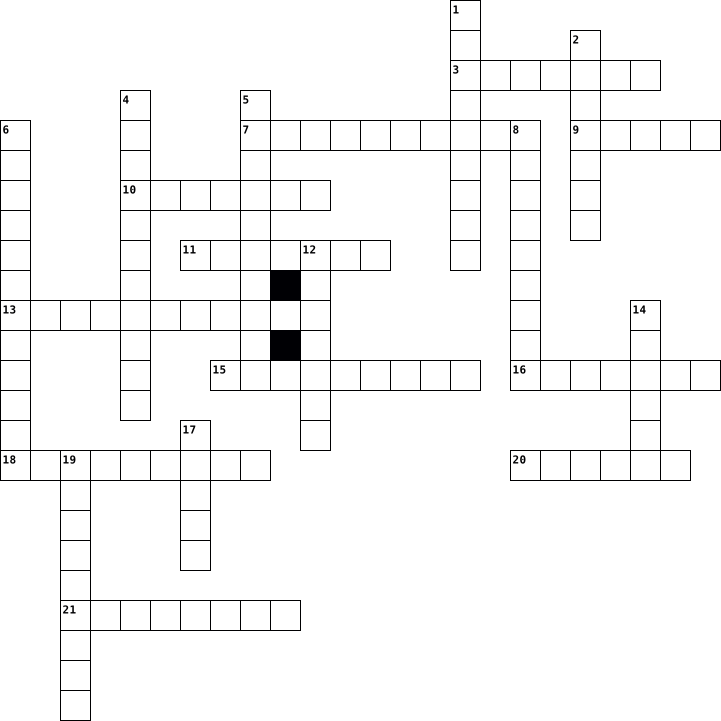
Across
- One of the ways on how to do deformation
- Vibrations caused by seismic waves
- Center of the earthquake
- one type of seismic waves
- the last type of deformation
- the other type of stress
- One type of fold
- where the foot wall and the hanging wall switch places
- another type of seismic waves
- One of the three types of volcanoes
- The other type of fold
Down
- another type of deformation
- The most powerful type of seismic waves
- The fault that earthquakes occur on
- another way plates move
- Vibrations that cause earthquakes
- Above the center of the earthquake
- One of the two types of stress
- Where you have the hanging wall and the foot wall
- has three types of things normal reverse and slip-strike
- one of three way plates move
21 Clues: One type of fold • The other type of fold • another way plates move • Center of the earthquake • the other type of stress • one type of seismic waves • another type of deformation • the last type of deformation • one of three way plates move • another type of seismic waves • One of the two types of stress • Vibrations that cause earthquakes • Vibrations caused by seismic waves • ...
Plate Tectonic 2013-12-02

Across
- What we live on
- Inside volcanoes
- A wave that travels through the inner earth
- An area in the middle of a lithospheric plate.
- A theory created by Alfred Wegener.
- Formed from melted rock that has cooled.
- Earthquake following larger earthquake
- Measure of strength of earthquake.
- A large, hollow mountain that contains lava
- A danger or risk.
- A measure of the effects of an earthquake at a particular place on humans, structures and the land.
- Thin outer layer of earths surface
Down
- A natural disaster when the ground shakes
- What we walk on
- The types of plates that cause natural disasters
- Tectonic ______
- Week point in the earths crust.
- Disasters caused by mother nature and mostly tectonic plates.
- The inner layers of the earth
- Lava Fragments
20 Clues: Lava Fragments • What we live on • What we walk on • Tectonic ______ • Inside volcanoes • A danger or risk. • The inner layers of the earth • Week point in the earths crust. • Measure of strength of earthquake. • Thin outer layer of earths surface • A theory created by Alfred Wegener. • Earthquake following larger earthquake • Formed from melted rock that has cooled. • ...
Plate tectonic 2022-03-09

Across
- located close to Europe
- magma inside
- located close to Antarctica
- moves away from ridge
- two plates move apart
- located close to North America
- located close to Australia
- two plates come together
Down
- pulls plates
- located close to Africa
- located close to South America
- top layer of earth
- located close to the pacific ocean
- The _____ explains that the world is made of 7 tp
- san Andreas
- formed from convergent plates
- two plates slide past each other
- in crust and mantle
- under crust
- formed by divergent plates
20 Clues: san Andreas • under crust • pulls plates • magma inside • top layer of earth • in crust and mantle • moves away from ridge • two plates move apart • located close to Africa • located close to Europe • two plates come together • formed by divergent plates • located close to Australia • located close to Antarctica • formed from convergent plates • located close to South America • ...
tech plate 2022-04-21

Across
- a boundary occurs where two landmasses on plates are pushed
- This dense layer of the earth is made of hot semisolid rock
- The process that forms new ocean floor and oceanic crust
- mountains
- The distance from the center of a circle to any point on its circumference
- ‐ The name given to the supercontinent that existed more than 225 million years ago
- A convergent plate boundary where continents are colliding together and
- plates moving together
- plates moving away
Down
- The type of crust lying under the oceans of the world It is only 4 to 6 miles
- A raised area or mountain range under the oceans formed when magma fills the space
- A layer of the earth's crust that lies under the seven continents
- The place where one plate is getting bent and pulled under
- The point of origin of an earthquake
- an area where two or more tectonic plates meet
- The place where a collision between two continental plates
- plates going side to side
- A crack or fracture in Earth's crust where two tectonic plates grind past each other
- a straight line of travel where data is being collected.
- The border between two tectonic plates.
- ‐A dropped zone where two tectonic plates are pulling apart
21 Clues: mountains • plates moving away • plates moving together • plates going side to side • The point of origin of an earthquake • The border between two tectonic plates. • an area where two or more tectonic plates meet • The process that forms new ocean floor and oceanic crust • a straight line of travel where data is being collected. • ...
Plate Motion 2022-09-12

Across
- evidence of life from the past, such as fossilized bones, footprints, or leaf prints
- hot liquid rock on the surface of Earth
- an underwater mountain range formed when two plates move apart
- a sudden shaking of Earth's surface
- moving toward the same place
- the outside or top layer of something
- gas, lava, and ash are pushed to the surface
- water
- a natural spring that sends hot water and steam suddenly into the air from a hole in the ground
- a diagram that shows what the inside of something looks like
- any of Earth’s main continuous areas of land
Down
- to examine in detail for a purpose
- moving apart in different directions
- the place where two plates meet
- how often or fast something happens
- Earth’s outermost layer of hard, solid rock that is underneath the soil, vegetation,
- a long, deep indentation in the ocean floor formed when two plates move together
- the layer of soft, solid rock underneath Earth’s plates
- the slow pulling apart of land that is caused by plate movement
- an extinct reptile that lived about 300 million years ago
- the sudden pushing out of something, such as lava from a volcano
- one of the very large sections of hard, solid rock that make up Earth’s outer layer
22 Clues: water • moving toward the same place • the place where two plates meet • to examine in detail for a purpose • how often or fast something happens • a sudden shaking of Earth's surface • moving apart in different directions • the outside or top layer of something • hot liquid rock on the surface of Earth • gas, lava, and ash are pushed to the surface • ...
Plate Motion 2022-09-12

Across
- moving toward the same place
- an extinct reptile that lived about 300 million years ago
- hot liquid rock on the surface of Earth
- the place where two plates meet
- water
- the layer of soft, solid rock underneath Earth’s plates
- the sudden pushing out of something, such as lava from a volcano
- Earth’s outermost layer of hard, solid rock that is underneath the soil, vegetation,
- the outside or top layer of something
- moving apart in different directions
- the slow pulling apart of land that is caused by plate movement
- one of the very large sections of hard, solid rock that make up Earth’s outer layer
Down
- evidence of life from the past, such as fossilized bones, footprints, or leaf prints
- any of Earth’s main continuous areas of land
- a natural spring that sends hot water and steam suddenly into the air from a hole in the ground
- to examine in detail for a purpose
- an underwater mountain range formed when two plates move apart
- gas, lava, and ash are pushed to the surface
- a sudden shaking of Earth's surface
- a diagram that shows what the inside of something looks like
- a long, deep indentation in the ocean floor formed when two plates move together
- how often or fast something happens
22 Clues: water • moving toward the same place • the place where two plates meet • to examine in detail for a purpose • a sudden shaking of Earth's surface • how often or fast something happens • moving apart in different directions • the outside or top layer of something • hot liquid rock on the surface of Earth • any of Earth’s main continuous areas of land • ...
Plate Tectonic 2022-01-14

Across
- At a subduction zone, a sequence of volcanoes erupted.
- Underground movement along a fault plane caused by volcanic activity causes tremors and vibrations at the earth's surface.
- A plate boundary is formed when two plates move in opposite directions past one other.
- A volcano arises when magma surfaces at a weak area in the midst of a tectonic plate (ex: Hawaii & Yellowstone)
- A crack in the earth's Surface
- The concept that continents have migrated and continue to move slowly across the globe.
- Subduction is going place beneath the seafloor in a deep linear depression.
- Sections of the Earth's crust sliding to lower heights
- Convection and plastic flow are thought to occur in the upper layer of the earth's mantle, below the lithosphere, where there is relatively low resistance to plastic flow.
- The downward displacement of a block of the earth's surface between nearly parallel faults or fault systems creates a vast elongated depression with steep sides.
- Two plates collide, come together, or crash into one other at a tectonic plate boundary.
Down
- The line that separates two tectonic plates that are drifting apart.
- As plates move apart from one other along mid-ocean ridges, a new sea floor is created.
- Rock is compressed until it folds or breaks as a result of the stress.
- The point at which oceanic plates collide with the asthenosphere.
- The idea that the lithosphere is divided up into enormous plates that travel about before reuniting.
- a bending of rock strata, often caused by plate movement
- On top of the asthenosphere, a section of the lithosphere that travels about.
- the point where two plates collide
- The ascent of parts of the Earth's crust to greater heights
20 Clues: A crack in the earth's Surface • the point where two plates collide • At a subduction zone, a sequence of volcanoes erupted. • Sections of the Earth's crust sliding to lower heights • a bending of rock strata, often caused by plate movement • The ascent of parts of the Earth's crust to greater heights • ...
Plate motion 2022-10-19

Across
- under the plates
- an extinct animal that got separated when plates drifted
- right below the lower mantle
- moving apart in different directions
- something that got trapped in sediment
- hot molten rock
- when the earth shakes
- section a diagram that shows what the inside of something looks like
- it’s the main thing for moving
Down
- the whole continents together
- it can help volcanoes be more deadly
- Above the outer core
- what happens when two plates go up forming a mountain
- what people tried to drill through
- any of earths main continuous areas of land such as Africa asia and North America
- when something erupts it’s this
- blank of the earth
- you can eat on it
- moving toward the same place
- a piece of land but a fancier name
- hot water shooting out of the earth
21 Clues: hot molten rock • under the plates • you can eat on it • blank of the earth • Above the outer core • when the earth shakes • right below the lower mantle • moving toward the same place • the whole continents together • it’s the main thing for moving • when something erupts it’s this • what people tried to drill through • a piece of land but a fancier name • ...
Plate motion 2022-10-27

Across
- An animal that kind of looked like a dragon and died out.
- When plates bump together and the ground vibrates.
- Molten rock below ground.
- Convergent and divergent are examples.
- A group of different things working together.
- Molten rock above ground.
- Big masses of land.
- What is it called when plates move apart?
- What is it called when a tectonic plate splits apart?
- The supercontinent.
Down
- A vent that pushes out water and steam.
- What is it called when plates move together?
- When plates move and lava flows up.
- A way to show the Earth's layers.
- What is the east side of Pangaea called?
- A slab of rock.
- The area between the Earth's crust and outer core.
- Bones of creatures that got preserved.
- A feature of the Earth's surface.
- When plates move apart in the ocean.
20 Clues: A slab of rock. • Big masses of land. • The supercontinent. • Molten rock below ground. • Molten rock above ground. • A way to show the Earth's layers. • A feature of the Earth's surface. • When plates move and lava flows up. • When plates move apart in the ocean. • Bones of creatures that got preserved. • Convergent and divergent are examples. • ...
Plate Motion 2023-12-10

Across
- a natural spring that sends hot water and steam suddenly into the air from a hole in the ground
- how often or fast something happens
- the place where two plates meet
- the layer of soft, solid rock underneath Earth’s plates
- a sudden shaking of Earth’s surface
- an extinct reptile that lived about 300 million years ago
- hot liquid rock on the surface of Earth
- hot liquid rock below the surface of Earth
- moving apart in different directions
- a diagram that shows what the inside of something looks like
- an object, diagram, or computer program that helps us understand something by making it simpler or easier to see
Down
- Earth’s outermost layer of hard, solid rock that is underneath the soil, vegetation, and water
- a set of interacting parts forming a complex whole
- a long, deep indentation in the ocean floor formed when two plates move together
- something we observe to be similar over and over again
- one of the very large sections of hard, solid rock that make up Earth’s outer layer
- the sudden pushing out of something, such as lava from a volcano
- the outside or top layer of something
- to examine in detail for a purpose
- a feature that forms on the surface of a planet, such as a mountain, channel, or sand dune
- any of the many processes (such as eruptions and lava flows) in which gas, lava, and ash are pushed out on the surface of Earth
- the slow pulling apart of land that is caused by plate movement
- any of Earth’s main continuous areas of land, such as Africa, Asia, and North America
- moving toward the same place
- evidence of life from the past, such as fossilized bones, footprints, or leaf prints
- an underwater mountain range formed when two plates move apart
26 Clues: moving toward the same place • the place where two plates meet • to examine in detail for a purpose • how often or fast something happens • a sudden shaking of Earth’s surface • moving apart in different directions • the outside or top layer of something • hot liquid rock on the surface of Earth • hot liquid rock below the surface of Earth • ...
Plate Motion 2023-03-31

Across
- the layer of soft, solid rock underneath Earth's plates
- one of the very large sections of hard, solid rock that make up Earth's outer layer
- how often or fast something happens
- to examine in detail for a purpose
- a feature that forms on the surface of a planet, such as a mountain, channel, or sand dune
- the outside or top layer of something
- moving toward the same place
- evidence of life from the past, such as fossilized bones, footprints, or leaf prints
- an extinct reptile that lived about 300 million years ago
- hot liquid rock below the surface of the Earth
- something we observe to be similar over and over again
- moving apart in different directions
- Earth's outermost layer of hard, solid rock that is underneath the soil, vegetation, and water
Down
- a sudden shaking of earth's surface
- a natural spring that sends hot water and steam suddenly into the air from a hole in the ground
- the place where two plates meet
- hot liquid rock on the surface of the Earth
- an underwater mountain range formed when two plates move apart
- a diagram that shows what the inside of something looks like
- the sudden pushing out of something, such as lava from a volcano
- any of Earth's main continuous areas of land, such as Africa, Asia, and North America
- any of the many processes (such as eruptions and lava flows) in which gas, lava, and ash are pushed out on the surface of Earth
- an object, diagram, or computer program that helps us understand something by making it simpler or easier to see
- a long, deep indentation in the ocean floor formed when two plates move together
24 Clues: moving toward the same place • the place where two plates meet • to examine in detail for a purpose • a sudden shaking of earth's surface • how often or fast something happens • moving apart in different directions • the outside or top layer of something • hot liquid rock on the surface of the Earth • hot liquid rock below the surface of the Earth • ...
Plate Motion 2024-10-18

Across
- to examine in detail for a purpose
- the place where two plates meet
- a long, deep indentation in the ocean floor formed when two plates move together
- the sudden pushing out of something, such as lava from a volcano
- Earth's outermost layer of hard, solid rock that is underneath the soil, vegetation, and water
- moving toward the same place
- a diagram that shows what the inside of something looks like
- any of the many processes (such as eruptions and lava flows) in which gas, lava, and ash are pushed out on the surface of Earth
- hot liquid rock on the surface of Earth
Down
- moving apart in different directions
- an extinct reptile that lived about 300 million years ago
- a sudden shaking of Earth's surface
- one of the very large sections of hard, solid rock that make up Earth's outer layer
- something we observe to be similar over and over again
- a feature that forms on the surface of a planet, such as a mountain, channel, or sand dune
- an underwater mountain range formed when two plates move apart
- a natural spring that sends hot water and steam suddenly into the air from a hole in the ground
- the layer of soft, solid rock underneath Earth's plates
- a measure of how often or fast something happens
- evidence of life from the past, such as fossilized bones, footprints, or leaf prints
- any of Earth's main continuous areas of land, such as Africa, Asia, and North America
- hot liquid rock below the surface of Earth
- an object, diagram, or computer program that helps us understand something by making it simpler or easier to see
23 Clues: moving toward the same place • the place where two plates meet • to examine in detail for a purpose • a sudden shaking of Earth's surface • moving apart in different directions • hot liquid rock on the surface of Earth • hot liquid rock below the surface of Earth • a measure of how often or fast something happens • something we observe to be similar over and over again • ...
Plate motion 2024-10-16

Across
- the landform that is formed by convergent plates
- plate Moving toward each other
- Earths crust is made of
- these plates move sideways
- A sudden shaking of the earth caused by plates
- This is under the earths crust
- the ring of fire is located here
- the ocean floor going under the land
- 75%of all earthquakes in the u.s are here
- this is the biggest plate on earth
- The place where 2 plates meet
Down
- The movement of earths plates is called
- plates moving away from each other
- 90% of all earthquakes are here
- What makes blocky lava flow
- The mantle is made of
- This is the outermost layer of the earth
- the landform that is formed by divergent plates
- This country has a plate named after it
- Another word for crust is
20 Clues: The mantle is made of • Earths crust is made of • Another word for crust is • these plates move sideways • What makes blocky lava flow • The place where 2 plates meet • plate Moving toward each other • This is under the earths crust • 90% of all earthquakes are here • the ring of fire is located here • plates moving away from each other • this is the biggest plate on earth • ...
Plate motion 2024-10-25

Across
- evidence of life from the past, such as fossilized bones, footprints, or leaf prints.
- the sudden pushing out of something, such as lava from a volcano.
- how often or fast something happens.
- an underwater mountain range formed when two plates move apart.
- the layer of soft, solid rock underneath earths plates.
- something we observe to be similar over and over again.
- moving apart in different directions.
- hot liquid rock below the surface of earth.
- earths outermost layer of hard, solid rock that is underneath the soil, vegetation, and water.
- one of the very large sections of hard, solid rock that make up earths outer layer.
- the outside or top layer of something.
- a diagram that shows what the inside of something looks like.
Down
- any of the many processes in which has, lava, and ash are pushed out on the surface of earth.
- a hole in the earth that shoots hot water and steam into the air.
- a word for the USA and Asia and Africa and more.
- the place where two plates meet.
- moving toward the same place.
- to examine in detail for a purpose.
- an object, diagram, or computer program that helps us understand something by making it simpler or easier to see.
- a sudden shaking of earths surface.
- hot liquid rock on the surface of earth.
- a long, deep indentation in the ocean floor formed when two plates move together.
- a feature that forms on the surface of a planet, such as a mountain, channel, or sand dune.
23 Clues: moving toward the same place. • the place where two plates meet. • to examine in detail for a purpose. • a sudden shaking of earths surface. • how often or fast something happens. • moving apart in different directions. • the outside or top layer of something. • hot liquid rock on the surface of earth. • hot liquid rock below the surface of earth. • ...
Mātes plate 2025-09-23

Across
- : Mazāka izmēra atmiņas modulis portatīvajiem datoriem.
- : Komponents, kas stabilizē elektrību mātesplatē.
- : Galvenā operatīvā atmiņa, kas ievietojama mātesplatē.
- : Programma, kas iedarbina datoru un sagatavo to operētājsistēmai.
- : Mikroshēmu komplekts, kas vada saziņu starp komponentēm.
- : Standarta izmēra mātesplates forma.
- : Galvenā datora shēmas plate, kas savieno visas komponentes.
- : Standarta atmiņas modulis galddatoriem.
- : Barošanas ķēde, kas nodrošina procesoru ar stabilu spriegumu.
- : Mūsdienīgs paplašinājuma slots grafikas un citām kartēm.
- : Ļoti kompakta mātesplates forma.
Down
- : Ligzda, kurā ievieto procesoru.
- : Ievietojuma vieta RAM vai papildu kartēm.
- : Universāls ports, kas bieži atrodas uz mātesplates.
- : Savienojumi priekšējām pogām un USB datorā.
- : Savienojums, caur kuru plate saņem strāvu no PSU.
- : Angļu vārds, kas apzīmē mikroshēmu uz plates.
- : Mazāka izmēra mātesplates forma.
- : Mūsdienīga BIOS aizstājēja sistēma ar grafisku saskarni.
- : Paplašinājuma slots vecāka tipa kartēm.
20 Clues: : Ligzda, kurā ievieto procesoru. • : Mazāka izmēra mātesplates forma. • : Ļoti kompakta mātesplates forma. • : Standarta izmēra mātesplates forma. • : Standarta atmiņas modulis galddatoriem. • : Paplašinājuma slots vecāka tipa kartēm. • : Ievietojuma vieta RAM vai papildu kartēm. • : Savienojumi priekšējām pogām un USB datorā. • ...
Plate Motion 2025-09-19

Across
- moving toward the same place
- a natural spring that sends hot water and steam suddenly into the air from a hole in the ground
- the place where two plates meet
- hot liquid rock below the surface of Earth
- something we observe to be similar over and over again
- an object, diagram, or computer program that helps us understand something by making it simpler or easier to see
- how often or fast something happens
- the outside or top layer of something
- any of the many processes (such as eruptions and lava flows) in which gas, lava, and ash are pushed out on the surface of Earth
- any of Earth's main continuous areas of land, such as Africa, Asia, and North America
- an underwater mountain range formed when two plates move apart
Down
- a feature that forms on the surface of a planet, such as a mountain, channel, or sand dune
- moving apart in different directions
- one of the very large sections of hard, solid rock that make up Earth’s outer layer
- evidence of life from the past, such as fossilized bones, footprints, or leaf prints
- a set of interacting parts forming a complex whole
- hot liquid rock on the surface of Earth
- a sudden shaking of Earth's surface
- the layer of soft, solid rock underneath Earth's plates
- Earth’s outermost layer of hard, solid rock that is underneath the soil, vegetation, and water
- an extinct reptile that lived about 300 million years ago
- the sudden pushing out of something, such as lava from a volcano
- a long, deep indentation in the ocean floor formed when two plates move together
- a diagram that shows what the inside of something looks like
- to examine in detail for a purpose
- the slow pulling apart of land that is caused by plate movement
26 Clues: moving toward the same place • the place where two plates meet • to examine in detail for a purpose • a sudden shaking of Earth's surface • how often or fast something happens • moving apart in different directions • the outside or top layer of something • hot liquid rock on the surface of Earth • hot liquid rock below the surface of Earth • ...
Plate Motion 2025-10-31

Across
- Hot liquid rock on the surface of Earth
- An object or diagram that helps to show something we can not easily see on Earth
- The sudden shaking of Earth's surface
- A diagram that shows what the inside of something looks like
- The outside or top layer of something
- The slow pulling apart of land caused by plate movement
- Hot liquid rock below the surface of Earth
- A long, deep indentation in the ocean floor formed when two plates move together
- A set of interacting parts that form a complex whole
- The layer of soft, solid rock below Earth's surface
- Any of Earth's continuous areas of land, such as Africa, Asia, and North America
- The sudden pushing out of something, such as lava from a volcano
- A landform that appears when two plates move apart
- Something we observe over and over again
- A natural spring that sends hot water shooting out into the air
- Evidence of past life, such as bones, leaves, etc.
- Moving toward the same place
Down
- Any of the many processes that involve gas, lava, and ash being pushed to the surface of Earth
- The place where two plates meet
- Moving apart in different directions
- How often or fast something happens
- A feature that forms the surface of a planet, such as mountains, channels, and sand dunes
- To examine in detail for a purpose
- A reptile that lived in Africa and South America about 300 million years ago
- One of the very large sections of hard, solid rock that makes up Earth's outer layer
- The hard, solid layer of Earth that contains soil, vegetation, and water
26 Clues: Moving toward the same place • The place where two plates meet • To examine in detail for a purpose • How often or fast something happens • Moving apart in different directions • The sudden shaking of Earth's surface • The outside or top layer of something • Hot liquid rock on the surface of Earth • Something we observe over and over again • ...
Hazards 2023-03-17

Across
- boundary of two plates moving past each other
- force created as plates move alongside each other
- the thicker, lighter type of plate
- cause of tectonic plate movement
- collision of an oceanic and continental plate
Down
- earthquake zone in california
- point at which two tectonic plates meet
- plate boundary of two plates moving apart
- point on the earths surface that an earthquake begins
- scale used to measure earthquakes
- volcano found at a destructive boundary
- volcano created at a constructive boundary
- large wave caused by an underwater earthquake
- the original one continent
- violent shaking of the ground
15 Clues: the original one continent • earthquake zone in california • violent shaking of the ground • cause of tectonic plate movement • scale used to measure earthquakes • the thicker, lighter type of plate • point at which two tectonic plates meet • volcano found at a destructive boundary • plate boundary of two plates moving apart • volcano created at a constructive boundary • ...
Geoscience:Plate Tectonics Crossword Puzzle 2015-02-22

Across
- An area along a fault where relatively few earthquakes have occurred recently but where strong earthquakes have occurred in the past.
- The sudden return of elastically deformed rock to its undeformed shape
- The layer underneath the lithosphere
- A measure of the strength of an earthquake
- In Earth science, the amount of damage caused by an earthquake
Down
- The location within Earth along a fault at which the first motion of an earthquake occurs
- A wave of energy that travels through the Earth and away from an earthquake in all directions
- Scientists suggest that in this cycle, differences in density cause hot, plastic like rock to be forced upward toward the surface, cool, and sink.
- A scientific theory that describes the large-scale motion of Earth's lithosphere
- The crust and upper mantle of the earth
- A break in a body of rock along which one block slides relative to another
- A movement or trembling of the ground that is caused by a sudden release of energy when rocks along a fault move
- The point on Earth’s surface directly above an earthquake’s starting point or focus
- A giant ocean wave that forms after a volcanic eruption, submarine earthquake, or landslide
14 Clues: The layer underneath the lithosphere • The crust and upper mantle of the earth • A measure of the strength of an earthquake • In Earth science, the amount of damage caused by an earthquake • The sudden return of elastically deformed rock to its undeformed shape • A break in a body of rock along which one block slides relative to another • ...
wyatt v&e 2023-02-14

Across
- Waves A wave of energy that travels through the Earth, away from an earthquake in all directions.
- A tracing of earthquake motion that is created by a
- A vent or fissure in the Earth’s surface through which magma and gases are expelled
- Eruption A geologic hazard in which molten rock- called magma or lava- gases, ash, and other material are released onto Earth’s surface and into the atmosphere.
- A geologic hazard in which molten rock- called magma or lava- gases, ash, and other material are released onto Earth’s surface and into the atmosphere.
- Tectonics The theory that explains how large pieces of Earth’s outermost layer called tectonic plates move and change shape.
- tectonics The theory that explains how large pieces of Earth’s outermost layer called tectonic plates move and change shape.
- An opening at the surface of the Earth through which volcanic material passes.
- Molten rock BELOW the Earth’s surface
Down
- The point along a fault at which the first motion of an earthquake occurs
- The study of Earthquakes
- Chamber The body of molten rock that feeds a volcano.
- An instrument that records vibrations in the ground and determines the location and strength of an earthquake.
- Movement of the Earth’s crust that occurs when rocks suddenly break and release stored energy.
- The point on Earth’s surface directly above an earthquake’s starting point, focus
- molten rock/magma that reaches the earth's surface
16 Clues: The study of Earthquakes • Molten rock BELOW the Earth’s surface • molten rock/magma that reaches the earth's surface • A tracing of earthquake motion that is created by a • Chamber The body of molten rock that feeds a volcano. • The point along a fault at which the first motion of an earthquake occurs • ...
Earth's Interior 2017-04-07

Across
- the lithosphere that slowly moves over the asthenosphere
- layer of rock that forms earth's outer surface
- hot solid material between earth's crust and core
- pieces of earth's lithosphere are in constant motion
- a layer of molten iron and nickel
- trace of an ancient organism
- plate boundary where two plates move from each other
- transfer of heat from one particle of matter to another
Down
- wave of energy that travels
- plate boundary where two plates move to each other
- transfer of heat by movement
- rigid layer
- dense sphere of solid iron and nickel
- plate boundary where two plates move past each other
- the continents slowly move across earth's surface
- single landmass that broke apart 200 million years ago and gave rise to today's continents
- soft layer
- break in earth's crust
18 Clues: soft layer • rigid layer • break in earth's crust • wave of energy that travels • transfer of heat by movement • trace of an ancient organism • a layer of molten iron and nickel • dense sphere of solid iron and nickel • layer of rock that forms earth's outer surface • hot solid material between earth's crust and core • the continents slowly move across earth's surface • ...
Plate Motion CrossWordPuzzle 2023-10-18

Across
- This is the Hard solid/Soft solid rock underneath a plate boundary.
- A long deep indentation in the ocean floor formed when two plates move together.
- This plate boundary happens when One plate sinks under the other.
- An under water mountain range formed when two plates move apart.
- The place where two plates meet.
- Evidence of life from the past, such as fossilized bones, footprints, or leaf prints.
- A sudden shake on earths surface.
- Earths outermost layer of hard, solid rock that is underneath the soil vegetation outer and water layer.
- The sudden pushing out of something. Such as lava from a volcano.
Down
- A diagram that shows what the inside of something looks like.
- Any of the many processes (such as eruptions and lava flows) which gas and lava are pushed out on the surface of Earth.
- Hot liquid rock on the surface of earth.
- The outside or top layer of something.
- One of the very large sections of hard solid rock that make up Earths outer layer.
- Any of Earth’s main continuous areas of land, such as Africa, Asia, and North America.
- This Plate boundary happens when rock gets added on the edges of two plate.
- Something we observe to be similar over and over again.
17 Clues: The place where two plates meet. • A sudden shake on earths surface. • The outside or top layer of something. • Hot liquid rock on the surface of earth. • Something we observe to be similar over and over again. • A diagram that shows what the inside of something looks like. • An under water mountain range formed when two plates move apart. • ...
Tectonic plates and the geosphere 2024-01-09

Across
- gooey melted rock that is under the lithosphere
- heat transfer in the asthenosphere through the movement of either liquid or gas.
- an opening in which material removal forms a narrow opening in the ground.
- Boundaries the border between two plates
- consequences of plate movement
- a line that is a volcano (a crack in the earth that lava comes out of.
- a mountain that lava spews out of.
- 2 plate boundaries moving side to side and scraping against each other
- innermost layer of the earth
- plates that move towards each other
Down
- a particular hot spot that liquifies the lithosphere and makes a volcano
- a break in the earth's crust and where 2 plates meet
- plates that move away from each other
- The solid top most layer of earth. It includes the crust and the upper mantle. it is the ______ sphere
- a continental and oceanic plate collide and the oceanic plate goes under the other
- solid outermost layer of the earth. the crust is subdivided into the continental crust (dry land) and the oceanic crust (the wet crust)
- 2 plates smooshing together
- tectonic plates shaking
- mantle the thin uppermost part of the mantle. It is solid.
- liquid metal and rock (iron and nickel)
20 Clues: tectonic plates shaking • 2 plates smooshing together • innermost layer of the earth • consequences of plate movement • a mountain that lava spews out of. • plates that move towards each other • plates that move away from each other • liquid metal and rock (iron and nickel) • Boundaries the border between two plates • gooey melted rock that is under the lithosphere • ...
Plate Tectontics / Faults Crossword Puzzle by Mollie Garris 2024-09-28

Across
- Secondary waves cannot move through _______________.
- A theory stating that the earth's surface is _______ into plates that move.
- _________ _________occurs when rocks push together until they force a section of rock upward.
- Scientist believe that the Earth is made up of _______ that float on the partly melted rock of Earth's mantle.
- The ________ where two tectonic plates are in contact is a plate boundary.
- Reverse plate boundaries push __________ forcing rock upward.
- _______ _________occurs when rocks move apart, a section of rock may fall between the separating rocks.
- Faults are __________ in the earth's surface along which rock can move.
- Breaks in the earth's surface along which _______ can move.
- Primary waves can move through both __________ and liquids.
Down
- _________ ____________move quickly.
- A _________________ is used to detect, time, and measure the movements of the earth.
- another name for a reverse fault.
- Strike-slip plate boundaries move ________ past each other.
- Primary waves travel in a _________ path.
- Large pieces that float on the partly melted rock in the earth's mantle.
- ________ _ _______ ________ occurs as rocks move horizontally past each other.
- ___________ wave moves slowly.
- Normal plate boundaries move apart forming a ________.
- The crust and the top part of the mantle are broken into giant pieces of rock called __________ __________.
- Secondary waves travel in a up and ________ zigzag motion.
21 Clues: ___________ wave moves slowly. • another name for a reverse fault. • _________ ____________move quickly. • Primary waves travel in a _________ path. • Secondary waves cannot move through _______________. • Normal plate boundaries move apart forming a ________. • Secondary waves travel in a up and ________ zigzag motion. • ...
Hibok-Hibok crossword 2025-02-14

Across
- Rock formed form cooled molten magma or lava.
- A landform that erupts built-up magma.
- A dense, destructive mass of very hot ash, lava fragments, and gases ejected explosively.
- The Earth's crust that is found under the oceans.
- A spot in the asthenosphere that is very hot.
- A mountain that is formed from a continental-oceanic convergent plate boundary.
- Melted rock below ground.
- The upper layer of the earth's mantle, below the lithosphere, in which there is flow convection currents.
- A sudden shaking of the ground, as a result of movements within the earth's crust.
Down
- An island with a volcano origan.
- A plate boundary where the plates are crashing into each other.
- The downward movement of a tectonic plate into the mantle.
- A place in the lithosphere where two tectonic plates meet.
- The Earth's crust that makes up the planet's continents.
- The Pacific plate is the tectonic plate that covers most of the Pacific Ocean and is moving northwest.
- Mixtures of water, volcanic ash, tephra, rock fragments, and chunks of ice that can flow.
- The powdery residue left after the burning of a substance.
- A path along the Pacific Ocean characterized by active volcanoes and frequent earthquakes.
- The hard rocky layer of the earth's crust.
- Melted rock above ground.
20 Clues: Melted rock below ground. • Melted rock above ground. • An island with a volcano origan. • A landform that erupts built-up magma. • The hard rocky layer of the earth's crust. • Rock formed form cooled molten magma or lava. • A spot in the asthenosphere that is very hot. • The Earth's crust that is found under the oceans. • ...
Plate tectonic 2024-08-30

Across
- - The solid outer layer of the Earth that consists of the crust and the rigid upper part of the mantle
- - The thin and solid outermost layer of the Earth, above the mantle
- Boundary - The boundary between tectonic plates that are sliding past each other horizontally.
- _ stress that occurs when forces act to stretch and object
- tectonics - The theory that explains how the tectonic plates move and change shape.
- - A break in a body of rock along which one block slides relative to another
- - The layer of rock between the Earth's crust and core
- - The bending of rock layers due to stress
- - The soft layer of the mantle on which the tectonic plates move
- - The rising of regions of the Earth's crust to higher elevations
Down
- Boundary - The boundary formed by the collision of two lithospheric plates.
- Drift - The hypothesis that states that the continents once formed a single landmass, broke up, and drifted to their present locations
- Boundary - The boundary between two tectonic plates that are moving away from each other
- - The stress that occurs when forces act to squeeze an object
- - The strong lower part of the mantle between the Asthenosphere and the outer core
- plates - A block of lithosphere that consists of the crust and the Ridgid outermost part of the mantle
- - The central part of the Earth below the mantle
- floor spreading -The process by which new oceanic lithosphere form as magma rises toward the surface and solidifies
18 Clues: - The bending of rock layers due to stress • - The central part of the Earth below the mantle • - The layer of rock between the Earth's crust and core • _ stress that occurs when forces act to stretch and object • - The stress that occurs when forces act to squeeze an object • - The soft layer of the mantle on which the tectonic plates move • ...
Forces of Change 2022-10-26

Across
- core, The layer of the Earth which is liquid and thought to generate Earth’s magnetic field
- drift, The theory that continents were once connected but have drifted apart
- Scale, The common scale of earthquake measurement that describes the magnitude of an earthquake according to the amount of energy released, as recorded by seismographs
- weathering, Involves rock being broken into smaller pieces
- The layer of the Earth which is the middle section of the mantle that is a tar-like semi-liquid layer
- the rigid lower part of the mantle
- A scientist that studies the surface of the Earth and what it is made of
- plate boundary, The type of plate boundary in which plates remain side by side and slide past each other
- waves, Scientists use these to determine what the Earth’s interior looks like
- plate boundary, The type of plate boundary formed when plates collide
- Magnitude Scale, The favored method of measuring or an earthquake and produces a more accurate accounting of the total energy released by an earthquake
- plate boundary, The type of plate boundary in which plates move away from each other
Down
- Wegener, Developed the theory of continental drift after he noticed how Earth’s continents resembled pieces of a jigsaw puzzle
- waves, These seismic waves are the slowest and most damaging seismic waves
- arc, This is the result when two oceanic plates collide and form a curved line of islands
- weathering, When rock composition does change, as elements (e.g. acid rain) are either added or removed
- This is how an earthquakes strength is measured by the amount of energy it releases
- The layer of the Earth which includes the crust and mantle and is made up of rigid rock plates that “float” on the layers below it
- An instrument which measures and records the seismic waves which travel through the Earth during an earthquake
- waves, These are fast moving seismic waves
- The transporting of weathered material
- This is formed when an oceanic plate and a continental plate slide towards each other, the oceanic plate sinks below the continental plate
- This is the point at which an earthquake begins
- spreading, The process by which new seafloor is created by magma, from the asthenosphere, filling empty space when oceanic plates separate
- There are ___________ major landmasses
- The breaking down of rocks by water, ice, mild acids, plants, and temperature changes
- zone, The process that occurs when two tectonic plates meet at convergent boundaries, and one of the plates moves under the other one
- waves, These seismic waves arrive after primary waves, because they only travel through solid material
- core, The layer of the Earth which is solid, made of nickel and iron, and its dense center is under pressure
- This is the point on Earth’s surface above the focus
30 Clues: the rigid lower part of the mantle • The transporting of weathered material • There are ___________ major landmasses • waves, These are fast moving seismic waves • This is the point at which an earthquake begins • This is the point on Earth’s surface above the focus • weathering, Involves rock being broken into smaller pieces • ...
Tectonics Crossword 2013-09-26

Across
- Boundaries with plates that move apart.
- The heaviest type of plate.
- The lightest type of plate.
- The first continent that was all continents put together.
- The smallest layer of the Earth.
- Earthquakes can cause these tidal effects.
- The largest layer of the Earth.
- Crystals that are large have cooled...
Down
- This material is formed from slow cooling rock.
- Crystals that are small have cooled...
- These explosive features are created by convergent and divergent plate boundaries.
- Boundaries with plates that push into one another.
- Plates moving cause these vibrations.
- Plates that slide side by side.
- Magma above the ground.
- What is the crust split up into.
- This material is formed from fast cooling rock.
17 Clues: Magma above the ground. • The heaviest type of plate. • The lightest type of plate. • Plates that slide side by side. • The largest layer of the Earth. • What is the crust split up into. • The smallest layer of the Earth. • Plates moving cause these vibrations. • Crystals that are small have cooled... • Crystals that are large have cooled... • ...
Forces of Change 2022-10-26

Across
- Wegener, Developed the theory of continental drift after he noticed how Earth’s continents resembled pieces of a jigsaw puzzle
- weathering, When rock composition does change, as elements (e.g. acid rain) are either added or removed
- weathering, Involves rock being broken into smaller pieces
- The breaking down of rocks by water, ice, mild acids, plants, and temperature changes
- The layer of the Earth which includes the crust and mantle and is made up of rigid rock plates that “float” on the layers below it
- Magnitude Scale, The favored method of measuring or an earthquake and produces a more accurate accounting of the total energy released by an earthquake
- An instrument which measures and records the seismic waves which travel through the Earth during an earthquake
- waves, These are fast moving seismic waves
- the rigid lower part of the mantle
- plate boundary, The type of plate boundary in which plates remain side by side and slide past each other
- This is the point at which an earthquake begins
- There are ___________ major landmasses
- This is the point on Earth’s surface above the focus
- zone, The process that occurs when two tectonic plates meet at convergent boundaries, and one of the plates moves under the other one
Down
- waves, Scientists use these to determine what the Earth’s interior looks like
- waves, These seismic waves are the slowest and most damaging seismic waves
- plate boundary, The type of plate boundary formed when plates collide
- arc, This is the result when two oceanic plates collide and form a curved line of islands
- core, The layer of the Earth which is solid, made of nickel and iron, and its dense center is under pressure
- plate boundary, The type of plate boundary in which plates move away from each other
- This is how an earthquakes strength is measured by the amount of energy it releases
- Scale, The common scale of earthquake measurement that describes the magnitude of an earthquake according to the amount of energy released, as recorded by seismographs
- The layer of the Earth which is the middle section of the mantle that is a tar-like semi-liquid layer
- This is formed when an oceanic plate and a continental plate slide towards each other, the oceanic plate sinks below the continental plate
- spreading, The process by which new seafloor is created by magma, from the asthenosphere, filling empty space when oceanic plates separate
- The transporting of weathered material
- drift, The theory that continents were once connected but have drifted apart
- A scientist that studies the surface of the Earth and what it is made of
- core, The layer of the Earth which is liquid and thought to generate Earth’s magnetic field
- waves, These seismic waves arrive after primary waves, because they only travel through solid material
30 Clues: the rigid lower part of the mantle • The transporting of weathered material • There are ___________ major landmasses • waves, These are fast moving seismic waves • This is the point at which an earthquake begins • This is the point on Earth’s surface above the focus • weathering, Involves rock being broken into smaller pieces • ...
Science Vocabulary Crossword Puzzle 2013-05-27

Across
- A break in a body of rock along which one block slides relative to another
- The process by which cells use oxygen to produce energy from food
- The point on the earth's surface directly above an earthquake's starting point, or focus
- The point along a fault at which the first motion of an earthquake occurs
- Blocks of lithosphere that consists of the crust and the rigid, outermost part of the mantle
- The boundary between two tectonic plates that are moving away from each other
- Openings in a leaf or stem of a plant that enable gas exchange to occur
Down
- The boundary between tectonic plates that are sliding past each other horizontally
- A green pigment that captures light energy for photosynthesis
- The process by which new oceanic lithosphere forms as magma rises toward the surface and solidifies
- The process by which plants release water vapor into the air through stomata also the release of water vapor into the air by other organisms
- Waves of energy that travels through the earth and away from an earthquake in all directions
- The boundary formed by the collision of 2 lithospheric plates
- Tectonics The theory that explains how large pieces of the earth's outermost layer, called tectonic plates, move and change shape
14 Clues: A green pigment that captures light energy for photosynthesis • The boundary formed by the collision of 2 lithospheric plates • The process by which cells use oxygen to produce energy from food • Openings in a leaf or stem of a plant that enable gas exchange to occur • The point along a fault at which the first motion of an earthquake occurs • ...
Intro to the History of Earth and Plate Tectonics 2025-01-04

Across
- Spreading The process by which new oceanic lithosphere forms as magma rises to Earth's surface and solidifies at a mid-ocean ridge.
- The study of the alignment of magnetic minerals in rock, specifically as it relates to the reversal of Earth's magnetic poles.
- Boundary The boundary between tectonic plates that are moving away from each other.
- The boundary between tectonic plates that are colliding.
- The solid outer layer of Earth that consists of the crust and the rigid upper part of the mantle.
- The scientific study of the origin, history, and structure of Earth
- Drift The hypothesis that states that the continents once formed a single landmass, broke up, and drifted to their present locations.
Down
- Ridges Undersea mountain ranges through the center of which run steep, narrow valleys.
- Boundary Boundary between tectonic plates that are sliding past each other.
- Wegener German scientist who proposed the continental drift hypothesis in 1912.
- The solid, plastic layer of the mantle beneath the lithosphere, that is made of mantle rock that flows very slowly allowing tectonic plates to move on top of it.
- A crack in the Earth's crust.
- Tectonics The theory that explains how large pieces of the lithosphere, called plates, move and change shape.
- The layer of rock between Earth's crust and core
14 Clues: A crack in the Earth's crust. • The layer of rock between Earth's crust and core • The boundary between tectonic plates that are colliding. • The scientific study of the origin, history, and structure of Earth • Boundary Boundary between tectonic plates that are sliding past each other. • ...
Semester 1 Review 2025-12-11

Across
- EXCHANGE : Exchange of plants, animals, people, and diseases between the Old World and New World after 1492.
- TECTONICS : Movement of Earth's plates that creates mountains, earthquakes, and volcanoes.
- : Movement of rock and soil by water, wind, ice, or gravity.
- : Landform created where a river drops sediment as it enters another body of water.
- SHADOW : Dry area on the leeward side of a mountain where little rain falls because moisture dropped on the windward side.
- : Flat, treeless climate region with permanently frozen ground (permafrost).
- REGION : Region based on people's ideas or feelings, like "the American Southwest."
- ECONOMY : Economic system based on customs, traditions, and family roles, often in rural farming or herding communities.
Down
- ECONOMY : Economic system where supply and demand set prices and most businesses are privately owned.
- : Breaking rock into smaller pieces by physical or chemical processes.
- ECONOMY : Economic system where the government decides what is produced, how, and for whom.
- : Computer system that stores, analyzes, and displays geographic data in layers to show patterns.
- DIFFUSION : Spread and mixing of cultural traits from one region or group to another.
- REGION : Region with clear, official borders, such as a state or country.
- NINO : Periodic warming of Pacific Ocean waters that causes severe weather changes around the world.
- : Climate region that is always hot with almost daily rainfall.
16 Clues: : Movement of rock and soil by water, wind, ice, or gravity. • : Climate region that is always hot with almost daily rainfall. • : Breaking rock into smaller pieces by physical or chemical processes. • REGION : Region with clear, official borders, such as a state or country. • : Flat, treeless climate region with permanently frozen ground (permafrost). • ...
Plate tectonics quiz Crossword vocab review 2023-10-18

Across
- The process by which oceanic crust sinks beneath a deep-ocean trench and back into the mantle at a convergent boundary.
- the single land mass that was once considered a super continent millions of years ago
- The idea that the continents were once joined together to form a single large continent, which over time broke up and slowly moved great distances apart.
- A deep valley along the ocean floor beneath which oceanic crust slowly sinks toward the mantle.
- The molten mixture of rock-forming substances, gasses, and water from the mantle.
- A section of the lithosphere that slowly moves over the asthenosphere, carrying pieces of continental and oceanic crust.
Down
- plate boundary where two plates move past each other in opposite directions.
- A plate boundary where two plates move away from each other
- An undersea mountain chain where new ocean floor is produced; a divergent plate boundary.
- A plate boundary where two plates move toward each other.
- The theory that pieces of Earth's lithosphere are in constant motion, driven by convection currents in the mantle
11 Clues: A plate boundary where two plates move toward each other. • A plate boundary where two plates move away from each other • plate boundary where two plates move past each other in opposite directions. • The molten mixture of rock-forming substances, gasses, and water from the mantle. • ...
Forces of Change 2022-10-26

Across
- core, The layer of the Earth which is liquid and thought to generate Earth’s magnetic field
- drift, The theory that continents were once connected but have drifted apart
- Scale, The common scale of earthquake measurement that describes the magnitude of an earthquake according to the amount of energy released, as recorded by seismographs
- weathering, Involves rock being broken into smaller pieces
- The layer of the Earth which is the middle section of the mantle that is a tar-like semi-liquid layer
- the rigid lower part of the mantle
- A scientist that studies the surface of the Earth and what it is made of
- plate boundary, The type of plate boundary in which plates remain side by side and slide past each other
- waves, Scientists use these to determine what the Earth’s interior looks like
- plate boundary, The type of plate boundary formed when plates collide
- Magnitude Scale, The favored method of measuring or an earthquake and produces a more accurate accounting of the total energy released by an earthquake
- plate boundary, The type of plate boundary in which plates move away from each other
Down
- Wegener, Developed the theory of continental drift after he noticed how Earth’s continents resembled pieces of a jigsaw puzzle
- waves, These seismic waves are the slowest and most damaging seismic waves
- arc, This is the result when two oceanic plates collide and form a curved line of islands
- weathering, When rock composition does change, as elements (e.g. acid rain) are either added or removed
- This is how an earthquakes strength is measured by the amount of energy it releases
- The layer of the Earth which includes the crust and mantle and is made up of rigid rock plates that “float” on the layers below it
- An instrument which measures and records the seismic waves which travel through the Earth during an earthquake
- waves, These are fast moving seismic waves
- The transporting of weathered material
- This is formed when an oceanic plate and a continental plate slide towards each other, the oceanic plate sinks below the continental plate
- This is the point at which an earthquake begins
- spreading, The process by which new seafloor is created by magma, from the asthenosphere, filling empty space when oceanic plates separate
- There are ___________ major landmasses
- The breaking down of rocks by water, ice, mild acids, plants, and temperature changes
- zone, The process that occurs when two tectonic plates meet at convergent boundaries, and one of the plates moves under the other one
- waves, These seismic waves arrive after primary waves, because they only travel through solid material
- core, The layer of the Earth which is solid, made of nickel and iron, and its dense center is under pressure
- This is the point on Earth’s surface above the focus
30 Clues: the rigid lower part of the mantle • The transporting of weathered material • There are ___________ major landmasses • waves, These are fast moving seismic waves • This is the point at which an earthquake begins • This is the point on Earth’s surface above the focus • weathering, Involves rock being broken into smaller pieces • ...
Tectonic Plates 2021-04-20

Across
- piece of land poking above the ocean
- layer upon which tectonic plates move
- the layer below the crust
- shaking of the ground that occurs when plates move
- magma from melted plates produces these
- plate boundary that pushes together
Down
- plate boundary that scrapes past each other
- uppermost layer of earth
- layer that includes the crust and very upper mantle
- plate boundary that pulls apart
- deep points in the ocean where plates push down
- light crust that makes up land masses
- system of broken crust pieces moving
- process of a plate being pushed under another and melting
- molten rock from melting plates
- dense crust under the ocean
16 Clues: uppermost layer of earth • the layer below the crust • dense crust under the ocean • plate boundary that pulls apart • molten rock from melting plates • plate boundary that pushes together • piece of land poking above the ocean • system of broken crust pieces moving • light crust that makes up land masses • layer upon which tectonic plates move • ...
nail diseases and disorders 2013-10-17

Across
- any deformity or disease of the nail
- blood clots form under the nail plate due to injury
- positioned lengthwise in direction of growth
- lifting of nail plate from bed without shedding
- also known as athletes foot
- fungal infection of the nail plate
Down
- inflammation of the nail matrix followed by shedding
- depressions running across the width of the nail
- ingrown nail
- skin bacterium that can grow out of control
- another perm for hangnail
- parasites that can cause infections to hands or feet
- also called plicatured nail
- thin white nail plate more flexible than normal
- bitten nails
- signs of redness pain and swelling are signs of
16 Clues: ingrown nail • bitten nails • another perm for hangnail • also called plicatured nail • also known as athletes foot • fungal infection of the nail plate • any deformity or disease of the nail • skin bacterium that can grow out of control • positioned lengthwise in direction of growth • thin white nail plate more flexible than normal • ...
Tectonics 2025-04-14

Across
- – Type of boundary where plates slide past one another
- – Process where one plate moves beneath another
- – The outermost solid layer of Earth
- – A sudden shaking of the ground caused by moving plates
- – Hot, flowing layer under the plates
- – Place where new crust forms under the ocean
Down
- – Heat movement that causes plates to move
- – Earth's inner, solid, hottest layer
- – Scientist tool used to measure earthquakes
- – Large pieces of Earth's crust
10 Clues: – Large pieces of Earth's crust • – The outermost solid layer of Earth • – Earth's inner, solid, hottest layer • – Hot, flowing layer under the plates • – Heat movement that causes plates to move • – Scientist tool used to measure earthquakes • – Place where new crust forms under the ocean • – Process where one plate moves beneath another • ...
Layers of the Earth & Plate Tectonics 2023-10-12

Across
- a warm layer that is cooler at the top, where convection currents occur
- when two plates move away from eachother
- the liquid metallic layer of the core
- layer that the crust floats on
- when two plates collide
Down
- moves hot magma from outer core to lithosphere
- the solid innermost layer of the earth with the most pressure
- cool, hard exterior layer of the earth
- layer of earth that includes the crust and upper part of the mantle
- when two plates slide past one another
- the motion of continental and oceanic plates
11 Clues: when two plates collide • layer that the crust floats on • the liquid metallic layer of the core • cool, hard exterior layer of the earth • when two plates slide past one another • when two plates move away from eachother • the motion of continental and oceanic plates • moves hot magma from outer core to lithosphere • ...
Earth Science 2022-10-14

Across
- when gravitational forces of moon/Sun are perpendicular
- material deposited from 1 area to another
- made from molten rock
- rocks are made of 1+ _______
- 2 plates slide past one another
- tilt + rotation of Earth makes wind and water move
- crust collides with another oceanic plate or continental plate
- belt of active faults/volcanoes in Pacific Ocean
- has dry air components, dry gas, water vapor, solid particles (dust from soil, etc.)
Down
- oil, coal, gas
- compaction, compress sediments
- Sun is farthest from Earth's equitorial plane
- theory that explains the: movement of the continents and changes in Earth's crust caused by internal forces
- oceanic plate, dense, slides under continental plate
- 2 plates move away from each other
- new & diff minerals b/c of chemical reactions with heated water/dissolved minerals
- rocks are broken down into smaller rocks, no
- when Earth, Sun, moon are in line
- Alps, Himalayas, Appalachian Mts.
- rigid blocks of crust and upper mantle
- how Pangaea was broken
21 Clues: oil, coal, gas • made from molten rock • how Pangaea was broken • rocks are made of 1+ _______ • compaction, compress sediments • 2 plates slide past one another • when Earth, Sun, moon are in line • Alps, Himalayas, Appalachian Mts. • 2 plates move away from each other • rigid blocks of crust and upper mantle • material deposited from 1 area to another • ...
Earth Quakes 2026-06-12

Across
- A plate boundary where plates slide past each other
- The outermost layer of the Earth
- The ancient supercontinent that once joined all continents
- Relating to the movement of Earth's plates
- Relating to earthquakes or vibrations in the Earth
- A scale used to measure earthquake magnitude
- The thick layer of Earth located beneath the crust
- The edge where two tectonic plates meet
- A smaller earthquake following the main quake
Down
- The process where one tectonic plate moves under another
- A giant ocean wave caused by underwater earthquakes
- Large sections of Earth's crust that move slowly
- An opening in Earth's crust where lava erupts
- The point on Earth's surface directly above an earthquake
- A plate boundary where plates move apart
- Molten rock found beneath the Earth's surface
- A small earthquake or shaking movement
- Molten rock that reaches Earth's surface
- A crack in the Earth's crust where movement occurs
- A plate boundary where plates move toward each other
20 Clues: The outermost layer of the Earth • A small earthquake or shaking movement • The edge where two tectonic plates meet • A plate boundary where plates move apart • Molten rock that reaches Earth's surface • Relating to the movement of Earth's plates • A scale used to measure earthquake magnitude • An opening in Earth's crust where lava erupts • ...
Food, drinks and containers 2023-04-04

Across
- bowl
- glass
- cup
- bottle
- salad
- bag
- tea
- noodles
- milkshake
Down
- bag
- lemonade
- cereal
- plate
- sandwich
- crisps
15 Clues: bag • cup • bag • tea • bowl • glass • plate • salad • cereal • bottle • crisps • noodles • lemonade • sandwich • milkshake
RMS CHanging earth 2 2025-11-27

Across
- Deep, narrow valleys on the ocean floor
- Earth’s thin, outermost layer
- Large landforms created by uplift or collisions
- Rock changed by heat and pressure
- Sudden shaking of Earth’s crust
- volcano A volcano formed over a plume of hot mantle
- The breaking down of rocks into smaller pieces
- Openings in Earth where lava, ash, and gases erupt
- Rock formed from cooled magma or lava
- A break or crack in Earth’s crust
- A plate boundary where two plates slide past each other
Down
- Rock formed from compacted layers of sediments
- A large ocean wave caused by underwater earthquakes
- A plate boundary where two plates move toward each other
- A naturally occurring solid made of minerals
- The dropping or settling of sediments
- A supercontinent that existed long ago before breaking apart
- A plate boundary where two plates move away from each other
- The movement of rock pieces by wind, water, or ice
- Rapid downhill movement of rock and soil
- Where one plate sinks beneath another
21 Clues: Earth’s thin, outermost layer • Sudden shaking of Earth’s crust • Rock changed by heat and pressure • A break or crack in Earth’s crust • The dropping or settling of sediments • Where one plate sinks beneath another • Rock formed from cooled magma or lava • Deep, narrow valleys on the ocean floor • Rapid downhill movement of rock and soil • ...
Ceiling Joist & Roof Framing 2023-08-23

Across
- extends from the inside corner of the top plate to the ridge along the lines where two roofs intersect
- when cutting a bird's mouth, a ___________ should be used for the finishing cuts
- trusses must be ______________ braced until the roof sheathing is in place
- # of joists required for an 8ft X 10ft tool shed when joists are spaced 16" on center
- the part of a rafter that rest squarely on the top plate
- The angle or degree of slope of the roof in relation to the span.
- the barge rafter is connected to the common rafter using _________
- sometimes required to ensure the proper load-carrying capacity
- The horizontal distance from the outside of one exterior wall to the outside of the opposing exterior wall
- tool used to transfer the layout from the floor to the roof
- framed structure that projects out from a sloped roof.
- does not extend the entire distance from the ridge to the top plate of a wall
- a hip roof has ___ sloping sides
- L-shaped members that run the length of the roof
- these are fastened to the structural steel by welding
- The total height of the rafter from the top of the plate to the top of the ridge
- extends from the top plate to the ridge in a direction perpendicular to the wall plate and ridge
- provides additional strength to the structure as well as a base for the roofing material
Down
- 2x6 ties installed at every second rafter
- type of sheathing that should be installed if the roof finish is composition shingles
- Ceiling joists and rafters are laid out and cut by carpenters on-site and the frame is constructed one framing member at a time
- type of framing square that is calibrated to show the length per foot of run for each type of rafter
- extends diagonally from the outside corner of the top plate to the ridge
- combination tool consisting of a protractor and a miter square; super square; quick square
- long section
- a gable roof has ___ sloping sides
- The inclination of the roof surface expressed as the relationship of rise to run
- heel
- short section of a rafter square
- helps align the rafters & tie them together at the upper end
- trusses that carry other trusses or a large area of roof framing
- 2x4 diagonal braces notched into the purlins
- The roof framework (consisting of both ceiling joists and roof rafters) is prefabricated off-site
- used for longer spans of ceiling joists to prevent twisting & bowing
- The horizontal distance from the outside of the top plate to the center line of the ridgeboard
- horizontal roof support member parallel to the plate & installed between the plate and the ridgeboard
36 Clues: heel • long section • short section of a rafter square • a hip roof has ___ sloping sides • a gable roof has ___ sloping sides • 2x6 ties installed at every second rafter • 2x4 diagonal braces notched into the purlins • L-shaped members that run the length of the roof • these are fastened to the structural steel by welding • ...
REVISION 2016-01-13

Across
- shark
- purse
- washingmachine
- keys
- plate
- cave
Down
- ruler
- cupboard
- armchair
- insects
- whale
- stick
- mosquito
- glue
14 Clues: keys • glue • cave • shark • ruler • whale • purse • stick • plate • insects • cupboard • armchair • mosquito • washingmachine
My home 2024-05-21

Across
- painting
- plate
- glass
- coffeetable
- fork
- rug
- knife
- vase
Down
- jug
- spoon
- fireplace
- armchair
- shelf
- curtains
14 Clues: jug • rug • fork • vase • spoon • plate • glass • shelf • knife • painting • armchair • curtains • fireplace • coffeetable
VOCABULARY UNIT 2 2021-11-21

Across
- comb
- lamp
- spoon
- fork
- mirror
- plate
- toothbrush
Down
- blanket
- bowl
- pillow
- scissors
- hairbrush
- knife
- cup
14 Clues: cup • comb • bowl • lamp • fork • spoon • knife • plate • pillow • mirror • blanket • scissors • hairbrush • toothbrush
Year 1 Spelling Crossword 2024-03-19

Across
- Dent
- Brush
- Make
- Spells
- Speak
- Yells
Down
- Wells
- Bottom
- Tell
- Bells
- Plate
- Sixty
- Ready
- Plus
14 Clues: Dent • Tell • Make • Plus • Wells • Brush • Bells • Plate • Sixty • Ready • Speak • Yells • Bottom • Spells
The Science Brain Game 2014-11-14

Across
- solid,rigid part of the earth's crust and the upper mantle
- a small extremely hot region within the mantle
- large underground pools of molten magma
- slow moving currents of magma within the mantle
- the thickest layer of the earth
- proposed the theory of continental drift
- no longer active or erupting, but capable of erupting one day
- where two plates slide past one another
- where oceanic plates converge and the older, more dense plate is subducted
- fractures that form where the crust is stretched apart
- waves that earthquakes produce
- valley that forms where continental crust is stretched and becomes thin
- name of a large landmass
Down
- where two plates move away from each other
- pliable, dense, upper part of the mantle
- layer of earth that is a solid and has extreme pressure
- where two plates collide
- the process of an older oceanic plate being pulled under another plate
- underwater mountain range produced by a divergent plate boundary
- proposed the theory of seafloor spreading
20 Clues: where two plates collide • name of a large landmass • waves that earthquakes produce • the thickest layer of the earth • large underground pools of molten magma • where two plates slide past one another • pliable, dense, upper part of the mantle • proposed the theory of continental drift • proposed the theory of seafloor spreading • where two plates move away from each other • ...