
radiation biology Crossword Puzzles
Biology 2025-03-04

Across
- CO2
- Detects changes in body
- How plants transform light into energy
- Control center in cells
- An effector in the negative feedback loop, involving insulin
- H2O
- Site of photosynthesis
- Brings blood glucose levels down
- A disease caused involving blood glucose levels
Down
- Maintaining a stable internal environment
- A jelly which fills the cell
- Powerhouse of the cell
- Does the opposite to what your body is feeling to maintain homeostasis
- Sends messages throughout your body
- A network that controls and regulates bodily functions
- tough outer shell of plant cells
16 Clues: CO2 • H2O • Powerhouse of the cell • Site of photosynthesis • Detects changes in body • Control center in cells • A jelly which fills the cell • tough outer shell of plant cells • Brings blood glucose levels down • Sends messages throughout your body • How plants transform light into energy • Maintaining a stable internal environment • A disease caused involving blood glucose levels • ...
biology 2025-04-01

Across
- The molecule that carries genetic information in living organisms, consisting of two strands that form a double helix.
- The protein structures that help move chromosomes during cell division by pulling them toward opposite ends of the cell.
- A thread-like structure composed of DNA and proteins that carry genetic information in the form of genes.
- The series of events that take place in a cell leading to its division and duplication, including interphase and mitosis.
- A cylindrical structure found in animal cells that helps organize the spindle fibers during cell division
- The phase of the cell cycle in which the cell grows, replicates its DNA, and prepares for mitosis. It consists of G1, S, and G2 phases.
- The stage of mitosis where chromosomes align along the center of the cell before being separated
- The region of a chromosome where two sister chromatids are joined and where spindle fibers attach during mitosis.
Down
- The final stage of cell division, where the cytoplasm divides and two daughter cells are formed.
- The phase of mitosis when sister chromatids are pulled apart toward opposite poles of the cell.
- The process of cell division that results in two genetically identical daughter cells.
- The first stage of mitosis when chromatin condenses into visible chromosomes, and the nuclear membrane begins to break down.
- The uncondensed form of DNA and proteins found in the nucleus of a cell during interphase, before it condenses into chromosomes.
- The stage of mitosis when the chromosomes reach opposite poles, and the nuclear envelope reforms around them.
- The structure that forms in plant cells during cytokinesis, dividing the two daughter cells.
- The two identical halves of a chromosome formed after DNA replication, connected by a centromere.
16 Clues: The process of cell division that results in two genetically identical daughter cells. • The structure that forms in plant cells during cytokinesis, dividing the two daughter cells. • The phase of mitosis when sister chromatids are pulled apart toward opposite poles of the cell. • ...
Biology 2025-04-10

Across
- a method of reproduction where offspring are produced from a single parent
- complex molecule formed by smaller monomers
- a process by which plants convert light energy into chemical energy
- plant that lives in the air, gets moisture from air and rain
- temporary foot-like extension of a cell membrance
- substance that repels water, nonpolar or insoluble
- an organism that obtains nutrientsfrom dead of decaying matter, decomposer
- a type of organelle in plants that synthesizes and stores pigment to give plants color
Down
- carbohydrate formed from double sugar
- rigid external covering for the body
- an organism the relies on external source to regulate body temperature
- study of living organisms
- an animal that only consumes the flesh of other animals
- cell is destroyed or ruptured; releases contents
- a fertilized egg from two gametes
- green pigment found in plants
16 Clues: study of living organisms • green pigment found in plants • a fertilized egg from two gametes • rigid external covering for the body • carbohydrate formed from double sugar • complex molecule formed by smaller monomers • cell is destroyed or ruptured; releases contents • temporary foot-like extension of a cell membrance • substance that repels water, nonpolar or insoluble • ...
biology 2025-04-28

Across
- The study of similarities and differences in the body structures of different organisms.
- The study of where species live on Earth and how they got there.
- Evidence of an organism's activity, like footprints, burrows, or feces, rather than the organism itself.
- The time it takes for half of a radioactive substance to decay.
- A division of geological time that is shorter than a period and marked by significant events in Earth's history.
- A trait that helps an organism survive and reproduce in its environment.
- The study of embryos and their development, often used to find evolutionary connections.
- A group of similar organisms that can breed and produce fertile offspring.
- The process by which different species develop and change over long periods of time through natural selection and other mechanisms.
Down
- Rock formed by layers of sediment (like sand, mud, or small rocks) that have been compressed over time.
- Layers of sedimentary rock, often used to study Earth's history and the age of fossils.
- The process by which living things become fossils, preserving their remains in rock.
- The evolutionary history and relationships among species or groups of species.
- A branching diagram showing the evolutionary relationships between species based on shared traits.
- When two or more species that share a common ancestor become more different over time, usually because they adapt to different environments.
- dating – A method of determining the exact age of rocks, fossils, or artifacts using techniques like radiometric dating.
16 Clues: The time it takes for half of a radioactive substance to decay. • The study of where species live on Earth and how they got there. • A trait that helps an organism survive and reproduce in its environment. • A group of similar organisms that can breed and produce fertile offspring. • ...
Biology 2025-10-03

Across
- Living things that eat other organisms.
- Animals that eat meat.
- Born from an egg laid outside the mother.
- Animals that eat plants.
- Hard structures in the mouth used for eating.
- Autotrophs that make food through photosynthesis.
- Born from the mother’s body.
- Flat teeth used to grind food.
Down
- Teeth used to cutting.
- Animals that eat both plants and meat.
- Organisms that break down dead organic matter.
- Teeth used to tear food.
- Organisms that make their own food.
- Born from an egg inside the mother’s body.
- Organisms that get food from others.
- Making new living beings.
16 Clues: Teeth used to cutting. • Animals that eat meat. • Teeth used to tear food. • Animals that eat plants. • Making new living beings. • Born from the mother’s body. • Flat teeth used to grind food. • Organisms that make their own food. • Organisms that get food from others. • Animals that eat both plants and meat. • Living things that eat other organisms. • ...
Light Words Jayden Lund 2021-11-17

Across
- light that has longer wavelengths than red light.
- does not let light pass through.
- materials that transmits light but not do not let light travel through.
- waves a kind of EM radiation with wavelengths longer than infrared radiation.
- the distance of which each wave shape repeats.
- the transfer of energy in EM waves.
- a disturbance that carries energy.
Down
- matter that transmits light.
- the number of occurrences in a repeating unit of time.
- the distance a wave travels from the original rest position.
- the energy transfer to matter.
- waves em radiation shorter than visible light.
- light bouncing of a surface.
- light waves more visible to the human eye.
- rays EM waves that are very powerful and penetrating.
15 Clues: matter that transmits light. • light bouncing of a surface. • the energy transfer to matter. • does not let light pass through. • a disturbance that carries energy. • the transfer of energy in EM waves. • light waves more visible to the human eye. • waves em radiation shorter than visible light. • the distance of which each wave shape repeats. • ...
elecromagnetic waves 2024-10-13

Across
- A measure of how much a material reduces the speed of light passing through it.
- Electromagnetic radiation with wavelengths longer than visible light but shorter than microwaves.
- Electromagnetic radiation that is visible to the human eye.
- The release of energy as electromagnetic waves or subatomic particles.
- A particle representing a quantum of light or other electromagnetic radiation.
- The process by which electromagnetic waves bounce off a surface.
- An optical illusion caused by atmospheric conditions where light is bent or reflected.
- Technology using thin strands of glass or plastic to transmit signals as light pulses.
- The range of frequencies of electromagnetic radiation.
Down
- The separation of electromagnetic waves into two perpendicular planes of polarization.
- The number of complete wavelengths that pass a point in a given time.
- The interaction between electric currents and magnetic fields.
- The complete reflection of light back into a medium when it hits the boundary at a certain angle.
- A type of mirage where objects appear inverted and floating above the horizon due to atmospheric conditions.
- The distance between successive crests of a wave.
- The bending of waves as they pass from one medium to another.
- The process of transferring energy through space or a medium via electromagnetic waves.
- The process of waves being taken in or swallowed up.
- A repeated back-and-forth movement of particles, electric fields, or magnetic fields.
- The outer layer of a fiber optic cable that reflects light back into the core.
20 Clues: The distance between successive crests of a wave. • The process of waves being taken in or swallowed up. • The range of frequencies of electromagnetic radiation. • Electromagnetic radiation that is visible to the human eye. • The bending of waves as they pass from one medium to another. • The interaction between electric currents and magnetic fields. • ...
dental radiology 2024-10-16

Across
- What x-ray is used to detect interproximal caries?
- After exposure dental x-ray films are placed where?
- Number of shades of gray visible in an image
- Image produced by traditional film, continuous spectrum of gray/black/white
- The central beam that comes from the x-ray tube head is _________ radiation.
- A film not exposed to radiation results in...
- Who discovered x-rays?
- What is the most radiopaque part of a tooth?
- one of the most widely used image receptors in dental digital radiology
- Radiography allows the dentist and/or dental assistant to take x-rays and then display the image on a computer monitor.
Down
- Movement by the patient's head or the tubehead results in
- When mounting films, the term used when placing the dot towards the operator is called
- what is the dark (black/grey) areas on a radiograph described as?
- The form of radiation that escapes in all directions from the tube head is _________ radiation.
- What determines the amount or quantity of radiation?
- Who took the first intraoral radiograph?
- Who is responsible for developing the paralleling technique?
- The radiograph used to assess the patient's skeletal profile and structure is
- Convert an x-ray film image to a digital image that can be processed by a computer
- Dental X-rays are reviewed by the....
- Which dental specialist would be the most likely to ask for vertical bitewings?
- Lead aprons should be stored laying or hanging flat to prevent?
22 Clues: Who discovered x-rays? • Dental X-rays are reviewed by the.... • Who took the first intraoral radiograph? • Number of shades of gray visible in an image • What is the most radiopaque part of a tooth? • A film not exposed to radiation results in... • What x-ray is used to detect interproximal caries? • After exposure dental x-ray films are placed where? • ...
Big Bang Theory Vocab 2026-04-21

Across
- The first element in the universe
- Branch of science dealing with celestial objects, space, and the physical universe
- He proved that the universe is expanding
- Helped Arno Penzias discover Cosmic Microwave Background Radiation
- Faint remains of the big bang
- System containing billions of celestial objects
- The second element to ever be created
- Developed the theories of the universe's expansion
Down
- Helped Robert Wilson discover Cosmic Microwave Background Radiation
- He named the Big Bang
- Full range of radiation
- Entirety of space, time, matter, and energy
- Portion of the electromagnetic spectrum that humans can see
- Model describing how the universe began from an extremely hot, dense point
- Instrument used to break light into colors to study what objects are made of
- The ability to do work or cause change in a system
- Indicates that objects are moving away from us
- Indicates that objects are moving toward us
18 Clues: He named the Big Bang • Full range of radiation • Faint remains of the big bang • The first element in the universe • The second element to ever be created • He proved that the universe is expanding • Entirety of space, time, matter, and energy • Indicates that objects are moving toward us • Indicates that objects are moving away from us • ...
Physics D 2020-06-14

Across
- sub atomic particle with no charge
- an element that is likely to react with another element
- atoms of the same element with a different number of neutrons
- the unit of which activity is measured in
- process of exposing an object to a source of radiation
- when a substance has another mixed or disposed within it
- most penetrating for of radiation
- group 0 elements
Down
- sub-atomic particle with a negative charge
- household appliance that uses radiation
- the cause an atom to become charged by gaining or losing an electron
- the charge of an atom
- sub-atomic particle with a positive charge
- the most ionising type of radiation
- number of counts from a sample per second
15 Clues: group 0 elements • the charge of an atom • most penetrating for of radiation • sub atomic particle with no charge • the most ionising type of radiation • household appliance that uses radiation • the unit of which activity is measured in • number of counts from a sample per second • sub-atomic particle with a negative charge • sub-atomic particle with a positive charge • ...
Light Words Jayden Lund 2021-11-17

Across
- rays EM waves that are very powerful and penetrating.
- waves em radiation shorter than visible light.
- the transfer of energy in EM waves.
- matter that transmits light.
- light bouncing of a surface.
- light that has longer wavelengths than red light.
Down
- the distance a wave travels from the original rest position.
- light waves more visible to the human eye.
- the distance of which each wave shape repeats.
- waves a kind of EM radiation with wavelengths longer than infrared radiation.
- the energy transfer to matter.
- materials that transmits light but not do not let light travel through.
- does not let light pass through.
- the number of occurrences in a repeating unit of time.
- a disturbance that carries energy.
15 Clues: matter that transmits light. • light bouncing of a surface. • the energy transfer to matter. • does not let light pass through. • a disturbance that carries energy. • the transfer of energy in EM waves. • light waves more visible to the human eye. • the distance of which each wave shape repeats. • waves em radiation shorter than visible light. • ...
Biology 2020-09-07

Across
- It breakdown unwanted structures with hydrolytic enzymes
- It carries the photosynthesis
- Its function remains a mystery.
- It is in charge of the synthesis of lipids and production of ATP
- Type of cell that have nucleus
- It has DNA in the form of chromosomes
- It takes protein from ribosomes and modifieds it
- It participate in the movement of vesicles and organelles
- Partially permeable and controls exchange between the cell and its environment
Down
- It lacks ribosomes and makes lipids and steroids
- Type of cell with organelles like centrioles and nucleus
- It is in hcarge of protein synthesis
- It collects, processes and sorts molecules and release them in vesicles
- This particle don't have a cell stucture so it can not be classify in eukaryotic or prokaryotic
- Type of cell with nucleus, cell wall and chloroplasts
- Type of cell that don't hace nucleus
16 Clues: It carries the photosynthesis • Type of cell that have nucleus • Its function remains a mystery. • It is in hcarge of protein synthesis • Type of cell that don't hace nucleus • It has DNA in the form of chromosomes • It lacks ribosomes and makes lipids and steroids • It takes protein from ribosomes and modifieds it • Type of cell with nucleus, cell wall and chloroplasts • ...
Biology 2012-11-09

Across
- the end of a reaction
- sugars starches
- A molecule that can combine with others to form a polymer
- single neulcaic acid form
- the thing that starts a chemical reaction
- the energy needed to activate a chemical reaction
- fats
Down
- A substance participating in a chemical reaction, especially a directly reacting substance present at the initiation of the reaction.
- chain, longer than ones
- a substance changes chemically
- a single sugar
- dna
- causes a reaction
- building blocks
- a block from protein
- a substance that forms things
16 Clues: dna • fats • a single sugar • sugars starches • building blocks • causes a reaction • a block from protein • the end of a reaction • chain, longer than ones • single neulcaic acid form • a substance that forms things • a substance changes chemically • the thing that starts a chemical reaction • the energy needed to activate a chemical reaction • ...
Biology 2012-11-09

Across
- the end of a reaction
- sugars starches
- A molecule that can combine with others to form a polymer
- single neulcaic acid form
- the thing that starts a chemical reaction
- the energy needed to activate a chemical reaction
- fats
Down
- A substance participating in a chemical reaction, especially a directly reacting substance present at the initiation of the reaction.
- chain, longer than ones
- a substance changes chemically
- a single sugar
- dna
- causes a reaction
- building blocks
- a block from protein
- a substance that forms things
16 Clues: dna • fats • a single sugar • sugars starches • building blocks • causes a reaction • a block from protein • the end of a reaction • chain, longer than ones • single neulcaic acid form • a substance that forms things • a substance changes chemically • the thing that starts a chemical reaction • the energy needed to activate a chemical reaction • ...
Biology 2013-01-24

Across
- A mixture of gasoline and ethanol used as an alternative fuel
- When a gene is masked by another gene it is said to be
- Used to ferment sugar in bread and beer making
- The alleles an organism has which create its phenotype
- Released at the end of respiration
- An organism has two different alleles of a gene
- The variety of life in the world or in a particular habitat or ecosystem
- What happens when a plant cell is placed in a hypertonic solution
- A molecule which releases energy when it is broken down
- The first stage of respiration
Down
- Movement of water molecules through a semi permeable membrane
- Gets produced during anaerobic respiration and causes muscle fatigue
- Many genes influence one phenotypic trait.
- A biological community of interacting organisms and their physical environment
- Plants make their own food by...
- Pores in leaves which are used for gas exchange in leaves
16 Clues: The first stage of respiration • Plants make their own food by... • Released at the end of respiration • Many genes influence one phenotypic trait. • Used to ferment sugar in bread and beer making • An organism has two different alleles of a gene • When a gene is masked by another gene it is said to be • The alleles an organism has which create its phenotype • ...
biology 2015-06-11

Across
- The passing of traits from parents to offspring.
- An organism that has two different alleles for a trait.
- The offspring of many generations that have the same traits.
- Having two different alleles for a trait.
- The scientific study of heredity.
- An organism's physical appearance or visible traits.
- A characteristic that an organism can pass to offspring through genes.
Down
- Square A chart that shows the possible combinations of alleles that result from a genetic cross.
- The set of information that controls a trait; code in the DNA.
- An allele whose trait always shows up in the organism when it is present.
- The different forms of a gene.
- An allele that is masked when a dominant allele is present.
- A number that describes how likely it is that an event will occur.
- A condition in which the two alleles of a gene are neither dominant nor recessive.
- Having two identical alleles for a trait.
- An organism's genetic makeup or allele combinations.
16 Clues: The different forms of a gene. • The scientific study of heredity. • Having two different alleles for a trait. • Having two identical alleles for a trait. • The passing of traits from parents to offspring. • An organism's genetic makeup or allele combinations. • An organism's physical appearance or visible traits. • ...
Biology 2022-09-27

Across
- a substance that takes part in and changes a reaction
- energy needed to function
- the movement of water across a semipermeable membrane
- any coloured material found in a plant or animal cell
- plants and other organisms to convert light energy into chemical energy that
- the space inside the mitochondria where the Krebs cycle happens
- a coenzyme that works with enzymes
- the main source of energy for cells and an important part of aerobic respiration
Down
- bounded by pigmented membranes on which the light reactions of photosynthesis take place
- a plastid that contains chlorophyll and in which photosynthesis takes place.
- a substance produced by a living organism which acts as a catalyst
- where the ATP energy molecules are made
- the breakdown of glucose by enzymes
- intermingling of substances by the natural movement of their particles
- living organisms involving the production of energy
- requires oxygen
16 Clues: requires oxygen • energy needed to function • a coenzyme that works with enzymes • the breakdown of glucose by enzymes • where the ATP energy molecules are made • living organisms involving the production of energy • a substance that takes part in and changes a reaction • the movement of water across a semipermeable membrane • ...
Biology 2023-04-26

Across
- when an organism is restrained by another
- when a habitat is cut up into sections
- different conditions along the bounaries
- organsims ability to procreate
- when an organism ceases to be
Down
- things that degrades a ecosystem
- having a large variety of species
- ability to continue
- layer in the atmosphere that protects us from uv
- biome with the most diversity
- resources that are found everywhere in the world
- study of life
- smallest unit of life
- the trashing of an ecosystem
- type of precipitation that is destructive
- concept of protecting the environment
16 Clues: study of life • ability to continue • smallest unit of life • the trashing of an ecosystem • biome with the most diversity • when an organism ceases to be • organsims ability to procreate • things that degrades a ecosystem • having a large variety of species • concept of protecting the environment • when a habitat is cut up into sections • different conditions along the bounaries • ...
Biology 2021-08-13

Across
- A nucleus is a membrane-bound organelle that contains the cell's chromosomes.
- The increases in cell size and number that take place during the life history of an organism.
- Process of programmed cell death. It is used during early development to eliminate unwanted cells.
- cancer spreads to a different body part from where it started.
- A space within a cell hat that is empty of cytoplasm, lined with a membrane, and filled with fluid.
- Section of DNA that contain the information for making a specific protein and is the functional and physical unit of heredity.
- the order in which subunits appear in a chain, such as nucleotide bases in a DNA or RNA molecule.
- observable physical properties of an organism; these include the organism's appearance, development, and behavior.
Down
- A blood clot that forms on the wall of a blood vessel when blood platelets, proteins, and cells stick together.
- built of proteins folded into complicated shapes; they are present throughout the body
- A group of signs and symptoms that occur together and characterize a particular abnormality or condition.
- The process by which a species becomes fitted to its environment.
- A property that allows the maintenance and regulation of the stability and constancy needed to function properly.
- Is an organic compound and substance, which means that it contains carbon.
- Any of the alternative forms of a gene that may occur at a given locus.
- defined as a biological preparation formulated to provide acquired immunity for a particular disease.
16 Clues: cancer spreads to a different body part from where it started. • The process by which a species becomes fitted to its environment. • Any of the alternative forms of a gene that may occur at a given locus. • Is an organic compound and substance, which means that it contains carbon. • A nucleus is a membrane-bound organelle that contains the cell's chromosomes. • ...
Biology 2022-08-17

Across
- - a representation of a person of a proposed structure
- - a method of procedure that has built up natural science.
- - concern about and action targeted at protecting the environment.
- - the act of observing something carefully
- - to look thoroughly and something
- - a particular philosophy of life
- - a system of ideas intended to explain something based on an idea
- - The mandate that was given by God to Adam and Eve.
Down
- - the act of preventing wasteful use of a resource.
- - the ethics of biological research
- - to explain the definition of something
- - the exploitation of biological processes for industrial and other purposes.
- - the system of rules which that a particular country recognizes as adjusting the disciplinary actions of it's members
- - a supposition explained based on the very little evidence.
- - the study of living organisms divided into many fields that cover their physiology
- - a concept and theological doctrine in Christianity
16 Clues: - a particular philosophy of life • - to look thoroughly and something • - the ethics of biological research • - to explain the definition of something • - the act of observing something carefully • - the act of preventing wasteful use of a resource. • - a concept and theological doctrine in Christianity • - The mandate that was given by God to Adam and Eve. • ...
biology 2019-05-06

Across
- control center of the cell
- senses sunlight single celled organism
- single celled covered with cilia
- how a flower forms
- stores materials is cell organelle
- in plants photosynthesis occurs
- functions with cells very tiny
- is made out of a single cell
- unicellular organism makes its own shape
Down
- green algae forms with cells
- has chloroplasts found in saltwater
- powerhouse of cells
- organism made from more than one cell
- extends from cell makes its own food
- long whip like tail
- has hair extends from plasma
16 Clues: how a flower forms • powerhouse of cells • long whip like tail • control center of the cell • green algae forms with cells • has hair extends from plasma • is made out of a single cell • functions with cells very tiny • in plants photosynthesis occurs • single celled covered with cilia • stores materials is cell organelle • has chloroplasts found in saltwater • ...
biology 2019-05-06

Across
- green algae forms with cells
- single celled covered with cilia
- senses sunlight single celled organism
- has chloroplasts found in saltwater
- control center of the cell
- how a flower forms
- extends from cell makes its own food
- stores materials is cell organelle
- long whip like tail
- has hair extends from plasma
- unicellular organism makes its own shape
Down
- functions with cells very tiny
- powerhouse of cells
- in plants photosynthesis occurs
- organism made from more than one cell
- is made out of a single cell
16 Clues: how a flower forms • powerhouse of cells • long whip like tail • control center of the cell • green algae forms with cells • is made out of a single cell • has hair extends from plasma • functions with cells very tiny • in plants photosynthesis occurs • single celled covered with cilia • stores materials is cell organelle • has chloroplasts found in saltwater • ...
biology 2019-05-06

Across
- stores materials is cell organelle
- functions with cells very tiny
- how a flower forms
- has hair extends from plasma
- green algae forms with cells
- in plants photosynthesis occurs
- has chloroplasts found in saltwater
- single celled covered with cilia
- powerhouse of cells
- control center of the cell
Down
- extends from cell makes its own food
- unicellular organism makes its own shape
- organism made from more than one cell
- is made out of a single cell
- senses sunlight single celled organism
- long whip like tail
16 Clues: how a flower forms • long whip like tail • powerhouse of cells • control center of the cell • is made out of a single cell • has hair extends from plasma • green algae forms with cells • functions with cells very tiny • in plants photosynthesis occurs • single celled covered with cilia • stores materials is cell organelle • has chloroplasts found in saltwater • ...
Biology 2024-01-25

Across
- water fearing
- long term energy and insulation
- actively moving out of cell
- doesn't require energy
- solution where molecules move at equal rates
- solution that expands cell
- make up the cell membrane
- actively moving into cell
Down
- made up of monosaccharides
- associated with genetic information
- water loving
- solution that shrinks cell
- large organic compounds in living cells
- transport of water
- made up of amino acids
- requires energy
16 Clues: water loving • water fearing • requires energy • transport of water • made up of amino acids • doesn't require energy • make up the cell membrane • actively moving into cell • made up of monosaccharides • solution that shrinks cell • solution that expands cell • actively moving out of cell • long term energy and insulation • associated with genetic information • ...
Biology 2023-10-09

Across
- ______RNA delivers amino acids to the ribosome during the translation process
- Acid produced during anaerobic respiration which produces 4ATP
- Where Aerobic respiration is carried out in organisms
- Catalisation which breaks down substrates
- A type of membrane which only allows certain substances to pass through it
- A trait present in an individual as a result of gene expression and the environment
- A type of transportation which requires energy
- A gene which will express itself in a individual if paired with a recessive gene
Down
- A process that all living organisms rely on in order to produce energy(ATP) and carry out cellular life processes
- An enzyme that adds free-nucleotides to the mRNA strand during transcription
- Groups (which come in 3's) of nucleotides found on mRNA
- A type of tranportation which requires no energy
- A biological catalyst and globular protein
- A populations number heavily decrease due to a catatrosphic event or human interference
- Catalisation which joins substrates
- A chain of amino acids held together by peptide bonds with a unique shape due to repulsion and attraction between the amino acids it consists of.
16 Clues: Catalisation which joins substrates • Catalisation which breaks down substrates • A biological catalyst and globular protein • A type of transportation which requires energy • A type of tranportation which requires no energy • Where Aerobic respiration is carried out in organisms • Groups (which come in 3's) of nucleotides found on mRNA • ...
Biology 2025-04-28

Across
- Study of embryos and their development.
- A group of organisms that can interbreed and produce fertile offspring.
- Study of the geographic distribution of species over time.
- A subdivision of geological time marked by significant events.
- Method to determine the exact age of a fossil or rock using radioactive decay.
- Gradual change in species over generations.
- Evolutionary history and relationships among species.
- Process of preserving remains or traces of organisms.
Down
- Study of body structures across species to understand evolutionary links.
- Time taken for half of a radioactive substance to decay.
- Layers of rock or soil with consistent characteristics.
- Rock formed from compressed layers of sediment, often containing fossils.
- A branching diagram showing evolutionary relationships.
- A trait that improves an organism’s chance of survival and reproduction.
- Process where related species evolve different traits.
- Fossilized evidence of an organism’s activity, like footprints or burrows.
16 Clues: Study of embryos and their development. • Gradual change in species over generations. • Evolutionary history and relationships among species. • Process of preserving remains or traces of organisms. • Process where related species evolve different traits. • Layers of rock or soil with consistent characteristics. • ...
biology 2026-06-04

Across
- ribose nucleic acid
- consumers head of food chain
- stores dna in the cell
- level. stages in a food chain
- water going back into the atmosphere
- letters that represent genes
Down
- turning light energy into food
- breaks down dead stuff
- 46 each.
- graph of genes
- regulation of body
- power house of the cell
- deoxyribose nucleic acid
- basic unit of life
- respiration turning oxygen to carbon
- highest energy of food chain
16 Clues: 46 each. • graph of genes • regulation of body • basic unit of life • ribose nucleic acid • breaks down dead stuff • stores dna in the cell • power house of the cell • deoxyribose nucleic acid • consumers head of food chain • highest energy of food chain • letters that represent genes • level. stages in a food chain • turning light energy into food • respiration turning oxygen to carbon • ...
RADIOACTIVITY 2023-01-12

Across
- a particle of 2 protons and two neutrons emitted by an atomic nucleus during radioactive decay
- A tool to measure the count rate of a radiation
- ___________ radiation is the low levels radiation from the environment to which we are exposed all the time
- an electron emitted by a nucleus during radioactive decay
- the radioactive material used in a smoke detector
Down
- energy spreading out from a source carried by particles or waves
- the number of decaying radioactive atoms detected eac second
- ___________ substance is a substance that decays by emitting radiation from its atomic nuclei
- one kind of natural radiation source that is received the most by people
- the average time taken for half the atoms in a sample of a radioacive material to decay
- type of radiation that can penetrate really far
11 Clues: A tool to measure the count rate of a radiation • type of radiation that can penetrate really far • the radioactive material used in a smoke detector • an electron emitted by a nucleus during radioactive decay • the number of decaying radioactive atoms detected eac second • energy spreading out from a source carried by particles or waves • ...
July is UV Safety Month 2024-07-10

Across
- UV radiation that affects the skin’s surface (epidermis)
- A condition that occurs when the body loses too much water and other fluids that it needs to work normally
- UV radiation that goes deeper into the skin (dermis)
- Occurs when the body cannot get rid of excess heat.
- Measures the amount of UVB absorption in the sunscreen
- Change in the appearance of skin colour due to UVA radiation
Down
- UV radiation that is filtered out by the ozone layer
- Invisible rays that are part of the energy that comes from the sun
- Blocks both UVA and UVB Radiation
- Glasses tinted to protect the eyes from sunlight
- Product available to help block ultraviolet light
- Reddening and peeling of the skin caused by overexposure to the ultraviolet rays of the sun
- Also know as dihydrogen oxide
- The abnormal growth of skin cells most often develops on skin exposed to the sun.
14 Clues: Also know as dihydrogen oxide • Blocks both UVA and UVB Radiation • Glasses tinted to protect the eyes from sunlight • Product available to help block ultraviolet light • Occurs when the body cannot get rid of excess heat. • UV radiation that is filtered out by the ozone layer • UV radiation that goes deeper into the skin (dermis) • ...
unit3 2019-07-08

Across
- Front to back ratio in yagi-uda antenna
- Reflector and directors in yagi-uda antenna are used to increase the ¬¬¬¬¬________
- Nature of current distribution over the small dipoles
- Driven element of yagi-uda antenna is usually a __________
- Radiation characteristic of a dipole antenna
- Two opposite charges separated by a small distance
Down
- Dipole antenna is _________ in nature
- Radiation pattern of Yagi-Uda antenna
- Antenna having 73 ohm resistance
- Shape of the radiation pattern of short electric dipole
- Antenna used earlier for TV signal reception
- Antenna having length of at least one wavelength
- Dipole antennas are ________
- Waveform that determines the radiation pattern of the dipole/wire antennas
- Dipole ends are at equal potentials with respect to _______ point
15 Clues: Dipole antennas are ________ • Antenna having 73 ohm resistance • Dipole antenna is _________ in nature • Radiation pattern of Yagi-Uda antenna • Front to back ratio in yagi-uda antenna • Antenna used earlier for TV signal reception • Radiation characteristic of a dipole antenna • Antenna having length of at least one wavelength • ...
Earth 2023-02-13

Across
- theory of how magnetic fields are made
- greenhouse gases
- a surfaces ability to reflect sunlight
- what we breath
- makes up the ozone layer
- tropic of cancer is here
- closest star to earth
- used in aerosol spray
- made from internal activity
- building block of every thing we need
- movement of earths axis
Down
- Big wave
- area around a planet made up of a planets magneticfield
- atom gives off radiation in the form of energy
- point of orbit that is closest to the sun
- protects from suns radiation
- region of Earth's stratosphere that absorbs most of the Sun's ultraviolet radiation
- angle between the 2 norths
- 1 day
- positive particle of a atom
- brightest star in the north
- always points north
- 24 hours
23 Clues: 1 day • Big wave • 24 hours • what we breath • greenhouse gases • always points north • closest star to earth • used in aerosol spray • makes up the ozone layer • tropic of cancer is here • movement of earths axis • angle between the 2 norths • positive particle of a atom • brightest star in the north • made from internal activity • protects from suns radiation • ...
Chapter 1 Science vocabulary 2024-11-06

Across
- Cycle: Process of carbon movement through Earth's systems.
- Fog combined with smoke or pollutants.
- Radiation: Type of energy from the sun.
- Mass per unit volume.
- Pollution: Harmful substances in the atmosphere.
- Third layer of the atmosphere.
- Heat transfer through fluid movement.
- Heat transfer through direct contact.
- Atmospheric layer with high temperatures.
Down
- Energy transfer through space.
- Molecule composed of three oxygen atoms.
- Cycle: Continuous movement of water on, above, and below Earth's surface.
- Radiation: Heat energy emitted by objects.
- Lowest layer of Earth's atmosphere.
- Effect: Warming of Earth due to trapped heat.
- Day-to-day atmospheric conditions.
- Atmospheric layer above the troposphere.
- Cycle: Circulation of nitrogen among the atmosphere, soil, and organisms.
- Gasses: Gases that contribute to the greenhouse effect.
- Fuel: Energy source from ancient organic matter.
- Height above sea level.
21 Clues: Mass per unit volume. • Height above sea level. • Energy transfer through space. • Third layer of the atmosphere. • Day-to-day atmospheric conditions. • Lowest layer of Earth's atmosphere. • Heat transfer through fluid movement. • Heat transfer through direct contact. • Fog combined with smoke or pollutants. • Radiation: Type of energy from the sun. • ...
Atomic Physics Google Play www.pkseripros.com Nuclear Physics 2023-12-17

Across
- Besides death, ___________ is a very serious effect of very high levels of radiation exposure.
- _____________ -131 is the most common type of radioisotope therapy.
- A supersaturated vapor of water or alcohol chamber used for visualizing the passage of ionizing radiation.
- Natural or artificial ionizing radiation in an environment, not due to deliberate introduction.
- Material used to minimize exposure to radioactive materials in hospitals and nuclear plants.
- The time take for half of the unstable nuclei of a sample of radioactive material to decay.
- T1/2 = 0.693/λ: what does the symbol mean?
Down
- To determine the age of a fossil from the carboniferous period, use __________ .
- The SI unit of activity is the___________.
- Spontaneous and random means that is ________ to predict when a particular nucleus will decay, but it is possible to estimate the probability of decay if the half-life is known.
- Device that produces visual and audible signals when ionizing radiation is detected.
- A hollow tune for detection of nuclear radiation.
- Spontaneous disintegration of the atomic nuclei leading to the emission of ionizing radiation or particles.
- A substance, microorganism, virus, prion or toxin that poses a threat to humans and other living organisms.
- Most common radioactive substance that can enter basements of homes in the USA through cracks and crevices becoming a health hazard.
- Which of the three types of radioactive emissions is not a particle?
16 Clues: The SI unit of activity is the___________. • T1/2 = 0.693/λ: what does the symbol mean? • A hollow tune for detection of nuclear radiation. • _____________ -131 is the most common type of radioisotope therapy. • Which of the three types of radioactive emissions is not a particle? • To determine the age of a fossil from the carboniferous period, use __________ . • ...
biology chapter - 1 PUZZLE 2026-04-20

Across
- : father of medicine
- : raising crops and livestock
- : the study of plants
- : the study of animals
- : the study of viruses
- : father of biology
- : the study of fungi
- : the study of origin and descent of organisms
Down
- : the study of diseases of plants and animals
- the study of bacteria
- : the study of algae
- the study of birds
- : the study of insects
- : father of botany
- : the study of fishes
- : the technique of growing fish
- : the study of reptiles
- biology : study of life in the sea
18 Clues: the study of birds • : father of botany • : father of medicine • : the study of algae • : father of biology • : the study of fungi • the study of bacteria • : the study of plants • : the study of fishes • : the study of insects • : the study of animals • : the study of viruses • : the study of reptiles • : raising crops and livestock • : the technique of growing fish • ...
ologie 2026-05-13

Across
- study of matter and energy
- biology study of life in the ocean
- study of mammals
- study of all types of animals
- study of nerves
- study of all aspects of diseases
- study of plants
- study of viruses
- study of properties of matter
Down
- study of heredity
- study of fish
- study of earthquakes
- study of insects
- study of water on earth
- structure and function of living things
15 Clues: study of fish • study of nerves • study of plants • study of insects • study of mammals • study of viruses • study of heredity • study of earthquakes • study of water on earth • study of matter and energy • study of all types of animals • study of properties of matter • study of all aspects of diseases • biology study of life in the ocean • structure and function of living things
Sofia Rodriguez-Chapter 10 2021-03-05

Across
- this radiation carries positive electric charge
- have high-energy particles and high frequency electromagnetic radiation
- this radiation carries negative electric charge
- results from radioactive decay
- rate of decay of a radioactive isotope
- radiation that originates in earth and space
Down
- has an imbalance of neutrons and protons
- this radiation carries no charge
- decay at a rate characteristic of each isotope; rates are given in half-lives
- high-frequency electromagnetic radiation
10 Clues: results from radioactive decay • this radiation carries no charge • rate of decay of a radioactive isotope • has an imbalance of neutrons and protons • high-frequency electromagnetic radiation • radiation that originates in earth and space • this radiation carries positive electric charge • this radiation carries negative electric charge • ...
big bang theory 2021-10-20

Across
- visible to the human eye
- celestial objects
- space studies
- flammable+gas
- genius
- needed
- radiation
- found small amount of something
- galaxies
- length of radiation
Down
- measure light
- stars and matter
- how light shifts
- space and time
- theater
- how our universe started
- inert-gas
17 Clues: genius • needed • theater • galaxies • radiation • inert-gas • measure light • space studies • flammable+gas • space and time • stars and matter • how light shifts • celestial objects • length of radiation • visible to the human eye • how our universe started • found small amount of something
Waves Crossword 2026-04-01

Across
- the height of a wave measured from rest(middle) to the top of the crest or bottom of the trough of the wave;often used to describe volume of sound or intensity of light.
- waves- a type of wave in which the particles oscillate(move) perpendicular to the direction in which the energy travels
- measurable quantity that describes how much change can occur within a system
- sterilization- disinfects surfaces by exposure to UV radiation wavelength by damaging genetic material of germs such as bacteria, virus, fungi
- wave- EM radiation with longest wavelength and lowest energy used for communication like cell phones, wifi, TV, radio, and GPS
- substance that a wave travels through such as solid liquid or gas, but not allow aves need a medium and can pass through a vacuum
- the number of waves that pass a given point in a specified amount of time;the pitch of a sound or the color of light
- top or highest point of wave
- bottom or lowest point of wave
Down
- a disturbance or variation that transfers energy
- a form of EM radiation with relatively short wavelength used by remote controls and its thermal effect for night vision equipment
- wave- form of EM radiation with shortest wavelength, low energy used for cooking, Doppler weather forecasting, and radar
- optic- internet technology that sends information by transmitting light through a glass or plastic fiber
- wave- radiation energy propagated(caused) by variations in electric and magnetic field intensity.
- distance between two waves from crest to crest or trough to trough
- technology- communicate by sending data from transmitter to receiver, like wifi,air pods, cell phones using radio and infrared wavelengths
- form of EM radiation with shorter wavelength whose energy can pass through most objects to show image of what's inside like for dental or bone x- rays
- light- only part of EM spectrum that the human eye can see, all other wavelengths are either to short or to long for us to see
- therapy- cancer treatment that used gamma waves to kill or slow the growth of cancer cells
19 Clues: top or highest point of wave • bottom or lowest point of wave • a disturbance or variation that transfers energy • distance between two waves from crest to crest or trough to trough • measurable quantity that describes how much change can occur within a system • therapy- cancer treatment that used gamma waves to kill or slow the growth of cancer cells • ...
Unit 9: Life, Light, Love 2024-04-17

Across
- My __________ is that you must always treat others with respect.
- a wealthy person who gives money and time to help make life better for other people
- a science that deals with things that are alive.
- the story of a real person's life written by someone other than that person
Down
- Most paper good are ___________ and can be broken down by living things called decomposers.
- The translation of _____________ is "the city of brotherly love"
- It is pretty evident from my huge library that I am a bibliophile.
- the process by which a green plant turns water and carbon dioxide into food when the plant is exposed to light.
- Before digital cameras, ___________ required artists to develop their prints in dark rooms.
- A tiny particle of light or electromagnetic radiation
10 Clues: a science that deals with things that are alive. • A tiny particle of light or electromagnetic radiation • The translation of _____________ is "the city of brotherly love" • My __________ is that you must always treat others with respect. • It is pretty evident from my huge library that I am a bibliophile. • ...
21 Types of Engineers 2024-09-12

Across
- These engineers dig into the ground for metals and natural gas
- This type of engineer builds roads, tunnels and sewage systems
- These engineers build human like equipment or devices that able to perform jobs too dangerous for humans to do.
- This type of engineer builds airplanes and spacecrafts
- This type of engineer finds ways of eliminating wastefulness in production processes.
Down
- These type of engineers create new medical equipment and prosthetic limbs.
- These engineers build with the smallest components of science.
- This engineer uses the principles of soil science, biology, and chemistry to develop solutions in our world.
- This type of engineer would work with plants and be in danger of radiation poisoning.
- This type of engineer would build test and repair offshore platforms and drilling equipment.
10 Clues: This type of engineer builds airplanes and spacecrafts • These engineers build with the smallest components of science. • These engineers dig into the ground for metals and natural gas • This type of engineer builds roads, tunnels and sewage systems • These type of engineers create new medical equipment and prosthetic limbs. • ...
CP6 2026-04-26

Across
- A particle made of two protons and two neutrons, emitted as ionising radiation from some radioactive isotopes.
- A particle of radiation emitted from the nucleus of a radioactive atom when it decays. It is an electron.
- Charged particles with a high energy that come from stars, neutron stars, black holes and supernovae.
- A tiny particle with a negative charge and very little mass.
- The number of protons in an atomic nucleus. Another term for atomic number.
- Something has been _____________ if it has been exposed to ionising radiation.
- A particle found in the nucleus (neutron or proton).
- The number of alpha or beta particles or gamma rays detected by a Geiger–Müller tube in a certain time.
- A set of wavelengths of light or other electromagnetic radiation showing which wavelengths have been given out (emitted) by a substance.
- The total number of protons and neutrons in the nucleus of an atom. It is also known as the nucleon number.
- A change to the DNA instructions in a cell.
- A simple substance made up of only one type of atom.
- Radiation that can cause charged particles (ions) to be formed. It can cause tissue damage and DNA mutations.
- particle A particle made of two protons and two neutrons, emitted as ionising radiation from some radioactive isotopes.
- The mass of something compared to the mass of something else which is often given the mass of 1.
- Atoms of an element with the same number of protons (atomic number) but different mass numbers due to different numbers of neutrons.
- A particle that is smaller than an atom, such as a proton, neutron or electron.
- The number of protons in the nucleus of an atom. It is also known as the proton number.
- The distance between a point on one wave and the same point on the next wave.
Down
- A high-frequency electromagnetic wave emitted from the nucleus of a radioactive atom.
- Ionising radiation that is around us all the time from a number of sources.
- Another term for mass number.
- A particle found in the nucleus of an atom, having a positive charge and the same mass as a neutron.
- A particle found in the nucleus of an atom having zero charge and mass of 1 (relative to a proton).
- An unwanted addition that makes something unsuitable or impure, e.g. a person may be ____________by getting a radioactive substance on their skin or inside their body.
- A spectrum of light (or other electromagnetic radiation) that includes black lines. These are caused by some wavelengths being absorbed by the materials that the light (or radiation) passes through.
- The model that explains the properties of different states of matter in terms of the movement of particles.
- The smallest neutral part of an element that can take part in chemical reactions.
- An atom or group of atoms with an electrical charge due to the gain or loss of electrons.
- The central part of an atom or ion.
- The average time taken for half of the radioactive nuclei in a sample of radioactive material to have decayed. It is also the time taken for the activity of a source to fall to half its value.
- The number of emissions of ionising radiation from a sample in a given time.
- Area around a nucleus that can be occupied by electrons. Shells are usually drawn as circles. Also called an electron energy level or an orbit.
- An _________nucleus in an atom is one that will decay and give out ionising radiation.
34 Clues: Another term for mass number. • The central part of an atom or ion. • A change to the DNA instructions in a cell. • A particle found in the nucleus (neutron or proton). • A simple substance made up of only one type of atom. • A tiny particle with a negative charge and very little mass. • Ionising radiation that is around us all the time from a number of sources. • ...
Radiation Quantities & Units 2025-01-30

Across
- ________ reactions to irradiation that occur within minutes, hours, days, or weeks
- SI unit for absorbed dose and air kerma
- amount of energy transferred by incident radiation to an object per unit length of travel
- measures amount of energy absorbed by an object
- the first American fatality due to irradiation in 1904
- measurement of biologic effects taking into account of type of radiation and the type of tissue irradiated
Down
- A modifying factor used in calculating dose equivalence that denotes the specific ability of a dose of radiation to cause biologic damage
- measurement of the sum of the air kerma over the exposed area of the patient's surface
- _________ reactions to irradiation that occur months or years after irradiation
- measurement of biologic effects taking into account the type of radiation
- SI unit for equivalent and effective dose
- this quantity of radiation measures ionization of atoms in the air and is measured in C/kg
- A high-LET radiation has a ________ quality factor
13 Clues: SI unit for absorbed dose and air kerma • SI unit for equivalent and effective dose • measures amount of energy absorbed by an object • A high-LET radiation has a ________ quality factor • the first American fatality due to irradiation in 1904 • measurement of biologic effects taking into account the type of radiation • ...
Nuclear Energy 2025-05-05

Across
- ability to emit nuclear radiation
- life
- going way
- radiation.release
- fuel
- the posvite
- carbon emmissions
Down
- gamma
- energydensity
- together
- energy
- hydrogen fuels the
- of some atoms.
- power
- free energy
15 Clues: life • fuel • gamma • power • energy • together • going way • free energy • the posvite • energydensity • of some atoms. • radiation.release • carbon emmissions • hydrogen fuels the • ability to emit nuclear radiation
Chapter 5 Radiation Biology Key Terms 2025-10-16

Across
- Higher ___ increases the energy of x-ray photons, this results in lower image contrast
- is the max voltage or peak of an alternating current
- is the overall darkness or blackness of an image
- refers to how sharply dark and light areas are differentiated or separated on an image
Down
- or wavelength and energy, of the x-ray beam is controlled by the kilovoltage
- defined as the product of the quantity (number of x-ray photons) and quality (energy of each photon) per unit of area per unit of time exposure
- (V) the unit of measurement used to describe the potential that drives an electrical current through a circuit
- ___ controls the number of electrons flowing through the x-ray tube per second.
- determines the number of electrons passing through the cathode filament
9 Clues: is the overall darkness or blackness of an image • is the max voltage or peak of an alternating current • determines the number of electrons passing through the cathode filament • or wavelength and energy, of the x-ray beam is controlled by the kilovoltage • ___ controls the number of electrons flowing through the x-ray tube per second. • ...
Environmental Scientists 2025-11-10

Across
- study of hazards to humans
- Freshwater science
- Study of plants
- study of how life interacts
- study of where things are
- study of animal biology
- Swimming with the fishes and studying them too
- Study of animals habitats and behaviors
Down
- study of minerals
- study of how safe water is
- Louisiana excels at this above all else
- study of weather
- Study of mushrooms
- study of earth's processes
- study of life
- Growing science
16 Clues: study of life • Study of plants • Growing science • study of weather • study of minerals • Freshwater science • Study of mushrooms • study of animal biology • study of where things are • study of how safe water is • study of hazards to humans • study of earth's processes • study of how life interacts • Louisiana excels at this above all else • Study of animals habitats and behaviors • ...
Heat Transfer 2025-02-03

Across
- Material that reduces heat transfer.
- Ideal emitter/absorber of radiation.
- Difference in temperature over a distance.
- Heat needed to change temperature.
- Governs conduction heat transfer.
- Heat transfer via electromagnetic waves.
- Heat transfer through fluid movement.
- Heat required for phase change.
- Rate of heat energy transfer per unit area.
Down
- A material's ability to conduct heat.
- Heat transfer through direct contact.
- Opposition to heat flow.
- Measure of heat dispersal or disorder.
- Relates radiation to temperature.
- Describes convective heat loss.
15 Clues: Opposition to heat flow. • Describes convective heat loss. • Heat required for phase change. • Governs conduction heat transfer. • Relates radiation to temperature. • Heat needed to change temperature. • Material that reduces heat transfer. • Ideal emitter/absorber of radiation. • A material's ability to conduct heat. • Heat transfer through direct contact. • ...
GOODLUCK 2025-10-28

Across
- Functional MRI measures this signal
- The front line.. or front desk
- Sound Frequency range above human hearing
- Discovered x-rays in 1895
- In the neck, thyroid is anterior to this structure
- Structure in RUQ often scanned for stones
- Inflammation of the pancreas
- I'm under every patient
Down
- CT ‘ground-glass’ pattern is found in this organ
- Without them, we will literally get no where
- Natural Background radiation source
- Radiation unit named after this scientist
- I'm always here for support
- EFFECT, Effect describing frequency shift due to motion
- Lead Apron thickness measured in ___
- Shattered bone pattern
- Use me sparingly
- I'll get rid of all the blood - don't worry
18 Clues: Use me sparingly • Shattered bone pattern • I'm under every patient • Discovered x-rays in 1895 • I'm always here for support • Inflammation of the pancreas • The front line.. or front desk • Functional MRI measures this signal • Natural Background radiation source • Lead Apron thickness measured in ___ • Radiation unit named after this scientist • ...
The Big Bang Theory 2026-04-21

Across
- A chemical element that is the simplest and lightest of all chemical elements and is normally found alone as a colorless odorless highly flammable gas having two atoms per molecule
- The scientific study of celestial objects, space, and the physical universe beyond Earth's atmosphere
- An American astronomer who fundamentally transformed cosmology by proving that "nebulae" were actually separate galaxies beyond the Milky Way and establishing that the universe is expanding
- (born 1936), the American radio astronomer who shared the 1978 Nobel Prize in Physics for co-discovering the Cosmic Microwave Background (CMB) radiation, providing crucial evidence for the Big Bang theory, or Robert R. Wilson (1914–2000), the physicist who designed Fermilab and proposed using proton beams for cancer therapy
- Electromagnetic radiation—the cooled, relic "afterglow" of the Big Bang—that fills the entire universe, present from all directions
- A massive, gravitationally bound system consisting of stars, stellar remnants, interstellar gas, dust, and dark matter
- A colorless, odorless, tasteless, and non-toxic noble gas with atomic number 2
- A German-born theoretical physicist
Down
- Cosmic Microwave Background (CMB) radiation
- Prominent British astrophysicist and cosmologist
- The entire range of all possible frequencies, wavelengths, and photon energies of electromagnetic radiation, extending from low-energy radio waves to high-energy gamma rays
- Includes all of space, and all the matter and energy that space contains
- The narrow segment of the electromagnetic spectrum ranging from roughly 380 to 750 nanometers (nm) that the human eye can detect, creating color perception
- The prevailing cosmological model explaining that the universe began approximately 13.8 billion years ago from an extremely hot, dense singularity
- A scientific instrument that splits electromagnetic radiation (light) into its component wavelengths (a spectrum) and records this data simultaneously using a multi-channel detector, such as a camera or CCD
- The capacity to do work, cause change, or move matter, measured in joules
- The phenomenon where light (or other electromagnetic radiation) from an object is stretched to longer, redder wavelengths because the source is moving away from the observer or because space itself is expanding
- A scientific phenomenon where electromagnetic radiation (light) from an object decreases in wavelength, shifting towards the blue end of the spectrum, as the object approaches the observer
18 Clues: A German-born theoretical physicist • Cosmic Microwave Background (CMB) radiation • Prominent British astrophysicist and cosmologist • Includes all of space, and all the matter and energy that space contains • The capacity to do work, cause change, or move matter, measured in joules • A colorless, odorless, tasteless, and non-toxic noble gas with atomic number 2 • ...
RTG 223 Radiation protection 2019-01-29

Across
- The effects that occur by chance and which may occur without a threshold level of dose, whose probability is proportional to the dose and whose severity is independent of the dose.
- occur below a certain threshold value.
- The personal dose monitoring.
- The amount of ionization in air due to gamma and x-ray.
- We called positive electron, positively charged.
- The dose representation the total body could receive and could be assessed the potential for long-term effects that might occur in the future.
- Material shielding for gamma ray.
- The equivalent dose of RT for which organ should have the dose limit are 500 mSv per year.
- The part of an atom with a negative electrical charge, which moves around the atom's nucleus.
- The energy that comes from a source and travels through space and may be able to penetrate various materials
- The abbreviation of tenth value layer.
- The disease is abnormal redness and inflammation of the skin caused by deterministic effect.
- The abbreviation of disintegration per second.
- The particle that be absorbed by aluminum.
- The disease which is inducing of stochastic effect.
Down
- We can call gamma ray and x-ray ray in the other name.
- Neutron shielding material.
- The elements with the same atomic number but different mass numbers.
- The energy deposited in a small volume of matter
- The SI unit of radioactivity.
- The spontaneous emission of energy from unstable atom.
- The SI unit of equivalent dose.
- The radioactive element, mam-made or from natural sources, with a specific atomic weight.
- The effect that occur with dose-dependent severity. These effects generally do
- The inverse square law is a technique of external radiation protection.
- The non SI unit of absorbed dose.
- The abbreviation of International Commission on Radiation Units and Measurements.
- The unit of exposure.
- The non SI unit of effective dose .
- The particle is a helium NUCLEUS.
- The SI unit of absorbed dose.
31 Clues: The unit of exposure. • Neutron shielding material. • The SI unit of radioactivity. • The personal dose monitoring. • The SI unit of absorbed dose. • The SI unit of equivalent dose. • The non SI unit of absorbed dose. • Material shielding for gamma ray. • The particle is a helium NUCLEUS. • The non SI unit of effective dose . • occur below a certain threshold value. • ...
RTG 223 Radiation protection 2019-01-29

Across
- The abbreviation of disintegration per second.
- We can call gamma ray and x-ray ray in the other name.
- The particle is a helium NUCLEUS.
- occur below a certain threshold value.
- The SI unit of absorbed dose.
- The spontaneous emission of energy from unstable atom.
- The energy that comes from a source and travels through space and may be able to penetrate various materials
- The SI unit of equivalent dose.
- The dose representation the total body could receive and could be assessed the potential for long-term effects that might occur in the future.
- The disease is abnormal redness and inflammation of the skin caused by deterministic effect.
- The abbreviation of International Commission on Radiation Units and Measurements.
- The amount of ionization in air due to gamma and x-ray.
- Material shielding for gamma ray.
- The abbreviation of tenth value layer.
- The elements with the same atomic number but different mass numbers.
- The non SI unit of absorbed dose.
- The SI unit of radioactivity.
- The particle that be absorbed by aluminum.
- We called positive electron, positively charged.
Down
- The effects that occur by chance and which may occur without a threshold level of dose, whose probability is proportional to the dose and whose severity is independent of the dose.
- The effect that occur with dose-dependent severity. These effects generally do
- The unit of exposure.
- The inverse square law is a technique of external radiation protection.
- The radioactive element, mam-made or from natural sources, with a specific atomic weight.
- The energy deposited in a small volume of matter
- The non SI unit of effective dose .
- The disease which is inducing of stochastic effect.
- The personal dose monitoring.
- Neutron shielding material.
- The part of an atom with a negative electrical charge, which moves around the atom's nucleus.
- The equivalent dose of RT for which organ should have the dose limit are 500 mSv per year.
31 Clues: The unit of exposure. • Neutron shielding material. • The SI unit of absorbed dose. • The personal dose monitoring. • The SI unit of radioactivity. • The SI unit of equivalent dose. • The particle is a helium NUCLEUS. • Material shielding for gamma ray. • The non SI unit of absorbed dose. • The non SI unit of effective dose . • occur below a certain threshold value. • ...
RTG 223 Radiation protection 2019-01-29

Across
- Neutron shielding material.
- The particle is a helium NUCLEUS.
- The elements with the same atomic number but different mass numbers.
- The effect that occur by chance and which may occur without a threshold level of dose, whose probability is proportional to the dose and whose severity is independent of the dose.
- We can call gamma ray and x-ray ray in the other name.
- The non SI unit of effective dose .
- The energy deposited in a small volume of matter
- The amount of ionization in air due to gamma and x-ray.
- The radioactive element, mam-made or from natural sources, with a specific atomic weight.
- The disease is abnormal redness and inflammation of the skin caused by deterministic effect.
- The dose representation the total body could receive and could be assessed the potential for long-term effects that might occur in the future.
- The disease which is inducing of stochastic effect.
- The abbreviation of tenth value layer.
Down
- The SI unit of absorbed dose.
- The energy that comes from a source and travels through space and may be able to penetrate various materials
- The abbreviation of disintegration per second.
- We called positive electron, positively charged.
- The spontaneous emission of energy from unstable atom.
- The SI unit of equivalent dose.
- The personal dose monitoring.
- The unit of exposure.
- The effect that occur with dose-dependent severity. These effects generally do not occur below a certain threshold value.
- The inverse square law is a technique of external radiation protection.
- The abbreviation of International Commission on Radiation Units and Measurements.
- The equivalent dose of RT for which organ should have the dose limit are 500 mSv per year.
- The part of an atom with a negative electrical charge, which moves around the atom's nucleus.
- Material shielding for gamma ray.
- The non SI unit of absorbed dose.
- The SI unit of radioactivity.
- The particle that be absorbed by aluminum.
30 Clues: The unit of exposure. • Neutron shielding material. • The SI unit of absorbed dose. • The personal dose monitoring. • The SI unit of radioactivity. • The SI unit of equivalent dose. • The particle is a helium NUCLEUS. • Material shielding for gamma ray. • The non SI unit of absorbed dose. • The non SI unit of effective dose . • The abbreviation of tenth value layer. • ...
RTG 223 Radiation protection 2019-01-29

Across
- The SI unit of absorbed dose.
- We can call gamma ray and x-ray ray in the other name.
- The SI unit of equivalent dose.
- The amount of ionization in air due to gamma and x-ray.
- The disease which is inducing of stochastic effect.
- The equivalent dose of RT for which organ should have the dose limit are 500 mSv per year.
- The particle that be absorbed by aluminum.
- The energy that comes from a source and travels through space and may be able to penetrate various materials
- The unit of exposure.
- The disease is abnormal redness and inflammation of the skin caused by deterministic effect.
- The non SI unit of absorbed dose.
- The effect that occur with dose-dependent severity. These effects generally do not occur below a certain threshold value.
- The SI unit of radioactivity.
- The energy deposited in a small volume of matter
- The personal dose monitoring.
Down
- The particle is a helium NUCLEUS.
- The elements with the same atomic number but different mass numbers.
- The abbreviation of International Commission on Radiation Units and Measurements.
- The part of an atom with a negative electrical charge, which moves around the atom's nucleus.
- The spontaneous emission of energy from unstable atom.
- The radioactive element, mam-made or from natural sources, with a specific atomic weight.
- The abbreviation of disintegration per second.
- Neutron shielding material.
- The non SI unit of effective dose.
- The inverse square law is a technique of external radiation protection.
- The dose representation the total body could receive and could be assessed the potential for long-term effects that might occur in the future.
- Material shielding for gamma ray.
- The effect that occur by chance and which may occur without a threshold level of dose, whose probability is proportional to the dose and whose severity is independent of the dose.
- We called positive electron, positively charged.
- The abbreviation of tenth value layer.
30 Clues: The unit of exposure. • Neutron shielding material. • The SI unit of absorbed dose. • The SI unit of radioactivity. • The personal dose monitoring. • The SI unit of equivalent dose. • The particle is a helium NUCLEUS. • Material shielding for gamma ray. • The non SI unit of absorbed dose. • The non SI unit of effective dose. • The abbreviation of tenth value layer. • ...
RTG 223 Radiation protection 2019-01-29

Across
- The unit of exposure.
- The SI unit of equivalent dose.
- The abbreviation of disintegration per second.
- The part of an atom with a negative electrical charge, which moves around the atom's nucleus.
- The energy that comes from a source and travels through space and may be able to penetrate various materials
- The disease which is inducing of stochastic effect.
- The SI unit of absorbed dose.
- The dose representation the total body could receive and could be assessed the potential for long-term effects that might occur in the future.
- The SI unit of radioactivity.
- A radionuclide is a radioactive element, mam-made or from natural sources, with a specific atomic weight.
- The effects that occur by chance and which may occur without a threshold level of dose, whose probability is proportional to the dose and whose severity is independent of the dose.
- We can call gamma ray and x-ray ray in the other name.
- The particle is a helium NUCLEUS.
Down
- The inverse square law is a technique of external radiation protection.
- The non SI unit of effective dose .
- The non SI unit of absorbed dose.
- The amount of ionization in air due to gamma and x-ray.
- Material shielding for gamma ray.
- We called positive electron, positively charged.
- The spontaneous emission of energy from unstable atom.
- The energy deposited in a small volume of matter
- Neutron shielding material.
- The effect that occur with dose-dependent severity. These effects generally do
- The equivalent dose of RT for which organ should have the dose limit are 20 mSv per year.
- The particle that be absorbed by aluminum.
- The disease is abnormal redness and inflammation of the skin caused by deterministic effect.
- occur below a certain threshold value.
- The elements with the same atomic number but different mass numbers.
- The abbreviation of International Commission on Radiation Units and Measurements.
- The personal dose monitoring.
- The abbreviation of tenth value layer.
31 Clues: The unit of exposure. • Neutron shielding material. • The SI unit of absorbed dose. • The SI unit of radioactivity. • The personal dose monitoring. • The SI unit of equivalent dose. • The non SI unit of absorbed dose. • Material shielding for gamma ray. • The particle is a helium NUCLEUS. • The non SI unit of effective dose . • occur below a certain threshold value. • ...
RTG 223 Radiation protection 2019-01-29

Across
- The disease which is inducing of stochastic effect.
- The energy that comes from a source and travels through space and may be able to penetrate various materials
- We can call gamma ray and x-ray ray in the other name.
- Neutron shielding material.
- The particle that be absorbed by aluminum.
- The amount of ionization in air due to gamma and x-ray.
- The effects that occur by chance and which may occur without a threshold level of dose, whose probability is proportional to the dose and whose severity is independent of the dose.
- The effect that occur with dose-dependent severity. These effects generally do
- The personal dose monitoring.
- The SI unit of absorbed dose.
- The unit of exposure.
- The disease is abnormal redness and inflammation of the skin caused by deterministic effect.
- The equivalent dose of RT for which organ should have the dose limit are 20 mSv per year.
- The inverse square law is a technique of external radiation protection.
- We called positive electron, positively charged.
- Material shielding for gamma ray.
Down
- The particle is a helium NUCLEUS.
- The part of an atom with a negative electrical charge, which moves around the atom's nucleus.
- A radionuclide is a radioactive element, mam-made or from natural sources, with a specific atomic weight.
- The SI unit of equivalent dose.
- The dose representation the total body could receive and could be assessed the potential for long-term effects that might occur in the future.
- The SI unit of radioactivity.
- The elements with the same atomic number but different mass numbers.
- The spontaneous emission of energy from unstable atom.
- The energy deposited in a small volume of matter
- The abbreviation of tenth value layer.
- occur below a certain threshold value.
- The non SI unit of effective dose .
- The non SI unit of absorbed dose.
- The abbreviation of International Commission on Radiation Units and Measurements.
- The abbreviation of disintegration per second.
31 Clues: The unit of exposure. • Neutron shielding material. • The SI unit of radioactivity. • The personal dose monitoring. • The SI unit of absorbed dose. • The SI unit of equivalent dose. • The particle is a helium NUCLEUS. • The non SI unit of absorbed dose. • Material shielding for gamma ray. • The non SI unit of effective dose . • The abbreviation of tenth value layer. • ...
RTG 223 Radiation protection 2019-01-29

Across
- The SI unit of equivalent dose.
- occur below a certain threshold value.
- We can call gamma ray and x-ray ray in the other name.
- The inverse square law is a technique of external radiation protection.
- The personal dose monitoring.
- The spontaneous emission of energy from unstable atom.
- The energy deposited in a small volume of matter
- The unit of exposure.
- The amount of ionization in air due to gamma and x-ray.
- The equivalent dose of RT for which organ should have the dose limit are 20 mSv per year.
- The particle is a helium NUCLEUS.
- The dose representation the total body could receive and could be assessed the potential for long-term effects that might occur in the future.
- The non SI unit of effective dose .
- The disease which is inducing of stochastic effect.
- The part of an atom with a negative electrical charge, which moves around the atom's nucleus.
- The abbreviation of tenth value layer.
Down
- The particle that be absorbed by aluminum.
- The disease is abnormal redness and inflammation of the skin caused by deterministic effect.
- The non SI unit of absorbed dose.
- The abbreviation of disintegration per second.
- Neutron shielding material.
- The elements with the same atomic number but different mass numbers.
- We called positive electron, positively charged.
- The abbreviation of International Commission on Radiation Units and Measurements.
- A radionuclide is a radioactive element, mam-made or from natural sources, with a specific atomic weight.
- The effect that occur with dose-dependent severity. These effects generally do
- The effects that occur by chance and which may occur without a threshold level of dose, whose probability is proportional to the dose and whose severity is independent of the dose.
- The energy that comes from a source and travels through space and may be able to penetrate various materials
- The SI unit of radioactivity.
- The SI unit of absorbed dose.
- Material shielding for gamma ray.
31 Clues: The unit of exposure. • Neutron shielding material. • The personal dose monitoring. • The SI unit of radioactivity. • The SI unit of absorbed dose. • The SI unit of equivalent dose. • The non SI unit of absorbed dose. • The particle is a helium NUCLEUS. • Material shielding for gamma ray. • The non SI unit of effective dose . • occur below a certain threshold value. • ...
RTG 223 Radiation protection 2019-01-29

Across
- Material shielding for gamma ray.
- The elements with the same atomic number but different mass numbers.
- The abbreviation of disintegration per second.
- A radionuclide is a radioactive element, mam-made or from natural sources, with a specific atomic weight.
- The effect that occur with dose-dependent severity. These effects generally do
- We can call gamma ray and x-ray ray in the other name.
- The spontaneous emission of energy from unstable atom.
- The energy deposited in a small volume of matter
- The effects that occur by chance and which may occur without a threshold level of dose, whose probability is proportional to the dose and whose severity is independent of the dose.
- The abbreviation of tenth value layer.
- The part of an atom with a negative electrical charge, which moves around the atom's nucleus.
- The particle is a helium NUCLEUS.
- The non SI unit of effective dose .
- The unit of exposure.
Down
- The particle that be absorbed by aluminum.
- The inverse square law is a technique of external radiation protection.
- The personal dose monitoring.
- We called positive electron, positively charged.
- The dose representation the total body could receive and could be assessed the potential for long-term effects that might occur in the future.
- The energy that comes from a source and travels through space and may be able to penetrate various materials
- The non SI unit of absorbed dose.
- The SI unit of equivalent dose.
- The SI unit of absorbed dose.
- The SI unit of radioactivity.
- The equivalent dose of RT for which organ should have the dose limit are 20 mSv per year.
- The amount of ionization in air due to gamma and x-ray.
- occur below a certain threshold value.
- The disease which is inducing of stochastic effect.
- Neutron shielding material.
- The disease is abnormal redness and inflammation of the skin caused by deterministic effect.
- The abbreviation of International Commission on Radiation Units and Measurements.
31 Clues: The unit of exposure. • Neutron shielding material. • The personal dose monitoring. • The SI unit of absorbed dose. • The SI unit of radioactivity. • The SI unit of equivalent dose. • Material shielding for gamma ray. • The non SI unit of absorbed dose. • The particle is a helium NUCLEUS. • The non SI unit of effective dose . • The abbreviation of tenth value layer. • ...
RTG 223 Radiation protection 2022-07-20

Across
- The abbreviation of International Commission on Radiation Units and Measurements.
- The SI unit of equivalent dose.
- The SI unit of absorbed dose.
- Material shielding for gamma ray.
- The particle is a helium NUCLEUS.
- The energy deposited in a small volume of matter
- We can call gamma ray and x-ray ray in the other name.
- The radioactive element, mam-made or from natural sources, with a specific atomic weight.
- The elements with the same atomic number but different mass numbers.
- The abbreviation of tenth value layer.
- The equivalent dose of RT for which organ should have the dose limit are 500 mSv per year.
- We called positive electron, positively charged.
- The particle that be absorbed by aluminum.
- The dose representation the total body could receive and could be assessed the potential for long-term effects that might occur in the future.
- The unit of exposure.
Down
- The SI unit of radioactivity.
- The inverse square law is a technique of external radiation protection.
- The non SI unit of effective dose.
- The energy that comes from a source and travels through space and may be able to penetrate various materials
- The spontaneous emission of energy from unstable atom.
- The disease which is inducing of stochastic effect.
- The amount of ionization in air due to gamma and x-ray.
- The non SI unit of absorbed dose.
- The part of an atom with a negative electrical charge, which moves around the atom's nucleus.
- The effect that occur with dose-dependent severity. These effects generally do not occur below a certain threshold value.
- The personal dose monitoring.
- The effect that occur by chance and which may occur without a threshold level of dose, whose probability is proportional to the dose and whose severity is independent of the dose.
- The abbreviation of disintegration per second.
- The disease is abnormal redness and inflammation of the skin caused by deterministic effect.
- Neutron shielding material.
30 Clues: The unit of exposure. • Neutron shielding material. • The SI unit of radioactivity. • The SI unit of absorbed dose. • The personal dose monitoring. • The SI unit of equivalent dose. • Material shielding for gamma ray. • The particle is a helium NUCLEUS. • The non SI unit of absorbed dose. • The non SI unit of effective dose. • The abbreviation of tenth value layer. • ...
Ionizing Radiation Health Physics 2025-05-11

Across
- increasing ___ gives stronger x-rays
- ___ and X-ray photons have no mass, no charge, and travel at the speed of light and skin cannot protect against it
- The combined effect of the RAM decaying and the biological clearing of the material,
- The activity of a radioisotope is based on the number of____of RAM per a unit of time.
- decay mode of Cesium-137 and H-3
- area of the target bombarded by the electrons at any moment in time, the exact point where the X-rays begin
- Stage of ARS in which when body system effects start to appear
- has delegated regulatory authority to the AF for the RAMs in its inventory through the USAF Master Materials License (MML).
- Type of energy removal that involves the complete removal of orbital electrons
- Type of energy removal where the electron merely jumps to a lower atomic energy level, to one of higher energy
- ___has a benefit of reducing scatter radiation and improving the radiographic image
- Process in which a nucleus emits radiation and transforms the unstable atom into a different nuclide to become stable.
- Alpha particles are the ___penetrating of the radiations
- increasing __ gives more x-rays
- decay mode of Th-230, U-234/235/238, and Am-241
- Radioactive ____is the amount of time needed for half of the “activity” to decay away.
- Type of energy removal where arelatively fast-moving particle nears a nucleus and the attractive force alters its trajectory, causing it to slow down
Down
- Stage of ARS in which the body outwardly expresses initial symptoms of exposure
- Elements that are in an unstable state and trying to achieve ___.
- Type of decay in which an atom’s nucleus sheds an alpha particle, changing it from one element to another.
- Type of decay in which the splitting of a nucleus into at least two other nuclei that releases a large amount of energy
- negatively charged filament that emits electrons when heated sufficiently
- Type of beta decay in which a neutron in an atom’s nucleus turns into a proton, an electron, and an antineutrino
- How many modes of decay are there?
- Type of beta decay in which a proton in an atom’s nucleus turns into a neutron, a positron and a neutrino.
- positively charged; attracts the electrons from the cathode and usually has a rotating disc that acts as a target for the electrons
- elements that have unstable isotopes are___.
- unstable combinations of isotopes are ____.
- The predicable rate of RAM clearing the body
- Stage of ARS in which the patient is relatively symptom free
30 Clues: increasing __ gives more x-rays • decay mode of Cesium-137 and H-3 • How many modes of decay are there? • increasing ___ gives stronger x-rays • unstable combinations of isotopes are ____. • elements that have unstable isotopes are___. • The predicable rate of RAM clearing the body • decay mode of Th-230, U-234/235/238, and Am-241 • ...
Chapter 2: Radiation Physics 2025-10-16

Across
- binding force of an electron
- when matter is altered
- the ejected electron resulting from photoelectric effect
- an atom that gains or loses an electron and becomes electrically unbalanced
- type of electrical circuit; uses 65,000-100,000V, provides the high voltage required to accelerate electrons and to generate x-rays in the x-ray tube, and is controlled by the kilovoltage settings.
- the conversion of alternating current to direct current
- the energy propagated is accompanied by oscillating electric and magnetic fields positioned at right angles to one another
- substances made up of only one type of atom
- weightless bundles of energy (photons) without an electrical charge that travel in waves with a specific frequency at the speed of light
- refers to the total transfer of energy from the x-ray phton to the atoms of matter through which the x-ray beam passes
- anything that occupies space and has mass
- the number of protons inside the nucleus equals the number of electrons outside the nucleus
- refers to the speed of the wave
- two or more atoms joined by chemical bondsNeutral atom: contains an equal number of protons and electrons
- type of radiation that refers to x-radiation that is created when the primary beam interacts with matter; less penetrating that primary radiation
- tiny, negatively charged particles that have very little mass; weighs approximately 1/1800 as much as a proton or neutron
- characterizes electromagnetic radiations as discrete bundles of energy called photons or quanta
- type of frequency from electromagnetic radiations that have a long wavelength and less energy
- type of scatter that involves an x-ray photon that has its path altered by matter; occurs when a low energy x-ray photon interacts with an outer shell electron
- the production of ions, or the process of converting an atom into ions
- carry positive electrical charges (found inside the nucleus)
- tiny particles of matter that possess mass and travel in straight lines and at high speeds; transmit kinetic energy by means of their extremely fast-moving, small massesElectromagnetic radiation: the propagation of wavelike energy (without mass) through space or matter
- type of radiation produced when a high speed electron dislodges an inner shell electron from the tungsten atom and causes ionization of that atom
- electrical energy that consists of a flow of electrons through a conductor
- type of electrical current when the electrons flow in one direction through the conductor
Down
- type of electical circuit; uses 3-5V, regulates the flow of electrical current to the filament of the x-ray tube, and is controlled by the milliamperage settings
- the distance between the crest of one wave and the crest of the next; determines the energy and penetrating power of the radiation; the shorter the distance between the crests, the shorter is the wavelength and the higher is the energy and ability to penetrate matter
- type of effect; an x-ray photon collides with a tightly bound, inner shell electron and gives up all its energy to eject the electron from its orbit
- radiation that can produce ions by removing or adding an electron to an atom. Can be classified into two groups: particulate radiation and electromagnetic radiation
- the emission and propagation of energy through space or a substance in the form of waves or particles
- type frequency from electromagnetic radiations have a short wavelength and more energy
- characterizes electromagnetic radiations as waves and focuses on the properties of velocity, wavelength and frequency
- a high energy, ionizing electromagnetic radiation
- type of electrical current that describes an electrical current in which the electrons flow in two, opposite directions
- electrons travel around the nucleus in these well defined paths
- type of radiation that refers to the penetrating x-ray beam that is produced at the target of the anode and that exits the tubehead
- electromagnetic radiations are arranged according to their energies; only high energy radiation (cosmic rays, gamma rays, and x-rays) are capable of ionization
- a form of secondary radiation and is the resilt of an x-ray that has been deflected from its path by the interaction with matter; deflected in all directions by the patient’s tissues and travels to all parts of the patient’s body and to all areas of the dental operatory; detrimental to both the patient and the radiographer
- the fundamental unit of matter
- the number of protons and neutrons in the nucleus of an atom
- dense core of the atom is composed of particles known as protons and neutrons
- carry no electrical charge (found inside the nucleus)
- type of radiation where speeding electrons slow down because of their interactions with the tungsten target in the anode; many electrons that interact with the tungsten atoms undergo not one but many interactions within the target
- the energy used to make xrays
- when an electron is removed from an atom in the ionization process
- the process by which certain unstable atoms or elements undergo spontaneous disintegration, or decay, to attain a more balanced nuclear state
- type of scatter that involves an x-ray photon collides with a loosely bound, outer shell electron and gives up part of its energy to eject the electron from its orbit; the xray photon loses energy and continues in a different direction at a lower energy level
- attraction between the positive nucleus and the negative electrons
- a path of electrical current
- the binding energies of orbital electrons are measured in this
- the number of wavelengths that pass a given point in a certain amount of time
51 Clues: when matter is altered • binding force of an electron • a path of electrical current • the energy used to make xrays • the fundamental unit of matter • refers to the speed of the wave • anything that occupies space and has mass • substances made up of only one type of atom • a high energy, ionizing electromagnetic radiation • ...
Untidled 2023-09-28

Across
- not a solid or a liquid
- the milky way is a
- cancer killing radiation
- 2 atoms slam together to make a heavier one
- our galaxy
- revolving completed
- the tilt on the planet
- 1 full circle around something
- gas planet with the most rings
- the side of a planet facing its star
- the Sun and everything in its gravity
- object in space circles around another one
- the dark side of a planet
Down
- 13.7 billion years ago
- alpha beta and gamma
- everything in space
- what the sun is
- largest gas planet
- made 3 planetary laws
- Isaac Newton discovered it
- the small ex planet
- a rock in space
- our star
- only planet with liquid water
- type of electric radiation
25 Clues: our star • our galaxy • what the sun is • a rock in space • the milky way is a • largest gas planet • everything in space • the small ex planet • revolving completed • alpha beta and gamma • made 3 planetary laws • 13.7 billion years ago • the tilt on the planet • not a solid or a liquid • cancer killing radiation • the dark side of a planet • Isaac Newton discovered it • type of electric radiation • ...
Radioactive Crossword! 2026-05-07

Across
- type of radiation that is the nucleus of helium without electrons
- the energy emitted from a source in the form of waves or particles
- the process by which radioactive particles strip electrons from other atoms
- type of radiation that can be stopped by a sheet of aluminum foil
- the thin material that can block the slowest radiation
Down
- a heavy metal used to block the strongest radiation
- the tiny building block of the world
- An unstable atom is also called _____________.
- type of radiation that travels at the speed of light
- the center of the atom where radioactive decay begins
- one fruit that contains a tiny amount of radioactive material
11 Clues: the tiny building block of the world • An unstable atom is also called _____________. • a heavy metal used to block the strongest radiation • type of radiation that travels at the speed of light • the center of the atom where radioactive decay begins • the thin material that can block the slowest radiation • ...
Key Radioactivity Terminology Crossword 2019-04-29

Across
- Radiation which can pass through most materials and is weakly ionising, can be blocked by thick lead or concrete (5)
- Naturally occurring radiation which surrounds us all the time (10)
- The first type of radioactive decay observed, stopped by a piece of paper, highly ionising (5)
- very small, negatively charged particle which is not involved in nuclear physics (8)
- Two elements are ____________ of each other if they have the same number of protons and different numbers of neutrons (8)
- the activity of a radioactive sample is the number of decays per ____________ (6)
Down
- This fluid is good at absorbing neutron radiation as it contains lots of hydrogen (5)
- The ___________-Muller tube is used to detect radiation
- The time taken for half the atoms in the sample to decay (4,4)
- Changes to DNA which can be brought about by radioactive particles causing chemical reactions inside our cells. Can lead to cancer (9)
- The thing at the centre of an atom (7)
- Radiation which can be stopped by a few mm of Aluminium, moderately ionising (4)
- Uncharged particle in the centre of an atom (7)
- This nucleus has two protons and two neutrons and is emitted in one type of radiation (6)
- Every atom of the same element has the same number of ___________ in it’s nucleus (6)
15 Clues: The thing at the centre of an atom (7) • Uncharged particle in the centre of an atom (7) • The ___________-Muller tube is used to detect radiation • The time taken for half the atoms in the sample to decay (4,4) • Naturally occurring radiation which surrounds us all the time (10) • Radiation which can be stopped by a few mm of Aluminium, moderately ionising (4) • ...
Module 3 crossword 2022-09-26

Across
- particle identical to nucleus
- the lightest stable subatomic particle
- elements with the same number of protons but not neurtons
- spontaneous transformation or a nucleus
- high-speed electrons
- products that are part of radioactive decay
- the nucleus of one isotope
- stable subatomic particle with a positive charge
- mass of atoms expressed by units
Down
- when nucleus becomes too unstable
- the building blocks of matter
- subatomic particle found in the nucleus
- spontaneous releasing of radiation
- shortest wave length of electromagnetic radiation
- high-speed electrons released from vacuum tube
- splitting or joining of a nucleus
- high energy electron emitted with radioactive decay
- energy source traveling through space
- numbers are arranged in order of increasing number of protons
- the amount of water in one atom
20 Clues: high-speed electrons • the nucleus of one isotope • the building blocks of matter • particle identical to nucleus • the amount of water in one atom • mass of atoms expressed by units • when nucleus becomes too unstable • splitting or joining of a nucleus • spontaneous releasing of radiation • energy source traveling through space • the lightest stable subatomic particle • ...
Introducing Biology 2026-04-18

Across
- The study of plants
- Biology Interpreting biological events by molecules
- Interpretation of structure
- Practice of growing fruits
- The study of metabolism of organisms
- The study of tissues
- The study of algae
- The study of fossils
- Father of Medicine
Down
- The study of fishes
- Study of life in space
- Father of Biology/Zoology
- The study of birds
- The study of geographical distribution of life
- The study of animals
- Father of Botany
- The study of reptiles
- The study of diseases
- It is the entire DNA sequence of an organism
19 Clues: Father of Botany • The study of birds • The study of algae • Father of Medicine • The study of fishes • The study of plants • The study of animals • The study of tissues • The study of fossils • The study of reptiles • The study of diseases • Study of life in space • Father of Biology/Zoology • Practice of growing fruits • Interpretation of structure • The study of metabolism of organisms • ...
Vocab 2023-09-26

Across
- of wavelengths or
- =
- Spectrum =
- radiation"
- Ray =
Down
- = (of electromagnetic radiation) having a wavelength shorter than that of the violet end of the visible spectrum but longer than that of X-rays.
- light=the segment of the electromagnetic spectrum that the human eye can view
- electromagnetic radiation of a kind arising from the radioactive decay of atomic nuclei.
- electromagnetic radiation) having a wavelength just greater than that of the red end of the visible light spectrum but less than that of microwaves. Infrared radiation has a wavelength from about 800 nm to 1 mm, and is emitted particularly by heated objects.
- over which electromagnetic radiation extends.
- electromagnetic wave with a wavelength in the range 0.001–0.3 m, shorter than that of a normal radio wave but longer than those of infrared radiation. Microwaves are used in radar, in communications, and for heating in microwave ovens and in various industrial processes.
- wave =an electromagnetic wave of a frequency between about 104 and 1011 or 1012 Hz, as used for long-distance communication.
- electromagnetic wave of high energy and very short wavelength, which is able to pass through many materials opaque to light.
13 Clues: = • Ray = • Spectrum = • radiation" • of wavelengths or • over which electromagnetic radiation extends. • light=the segment of the electromagnetic spectrum that the human eye can view • electromagnetic radiation of a kind arising from the radioactive decay of atomic nuclei. • ...
Factors affecting Earth's Climate 2025-06-18

Across
- The earth's temperature is determined by the balance between energy input and _____
- acronym for reporting atmospheric concentrations of greenhouse gases
- About 34% of solar radiation is ______ into space
- The majority of CO2 emissions are caused by the combustion of ________ _______
- The _____ effect is the fraction of solar energy reflected from earth into space
- Human produced greenhouse gas ______ ______
- A greenhouse gas produced from agricultural activity
- CO2 _____ have been increasing sharply since the industrial revolution
Down
- Absorbs most of the ultraviolet radiation
- _______ radiation is reradiated by earth
- the most significant greenhouse gas is _____ _____
- Also known as the oceanic conveyor belt
- Carbon dioxide is important in maintaining the ______ greenhouse effect
- Oceanic ______ affects delivery of nutrients in marine ecosystems
- Solar ______ is the 11 year cycle between solar maximums and minimums
- Most of incoming solar radiation is ______ to the human eye
16 Clues: Also known as the oceanic conveyor belt • _______ radiation is reradiated by earth • Absorbs most of the ultraviolet radiation • Human produced greenhouse gas ______ ______ • About 34% of solar radiation is ______ into space • the most significant greenhouse gas is _____ _____ • A greenhouse gas produced from agricultural activity • ...
ONCOTRIBES CROSSWORD 035 2023-01-15

Across
- The classic urographic findings of an upper tract TCC are a meniscus-shaped ureteral filling defect known as the "goblet" or __ sign
- Dosage of dostarlimab is 500 mg every 3 weeks for 4 doses, followed by 1,000 mg every __ weeks for dose 5 and beyond
- Ratio of doses of a known type of low-LET radiation to that of a higher-LET radiation to yield the same biological endpoint is called __ (abbreviation)
- __ is a tyrosine kinase receptor for hepatocyte growth factor
- The cerebrovascular syndrome occurs for total body radiation doses in excess of __ Gy
- Most common site of spinal meningiomas is __ region
- During interaction of ionizing radiation with biological materials, energy deposited in ≤ 100 eV packets is referred to as __
- This subtype of seminoma does not stain for PLAP on immunohistochemical testing
- 'Crank-case oil' appearance of fluid in the cysts is a feature of this brain tumor
- In gastric cancer, N3b is metastases in __ or more regional lymph nodes
- Anemia, erythrocytosis, hepatic dysfunction are paraneoplastic manifestation of this cancer
Down
- Effective radiation dose of CT scan for liver lesion evaluation is approximately __ mSv which is comparable to five years of natural background radiation
- As per ESMO-ESGOESTRO Consensus Conference, Stage II-III EEC with no residual disease falls under __ risk group of endometrial cancer
- CTLA-4 blocking human IgG2 monoclonal antibody used in liver cancer
- __ ependymomas arise almost exclusively in the conus medullaris and filum terminale of the spinal cord
- CPS+EG score is based on clinical, pathological stage, receptor status and __
- T1 pathological stage is not found in this cancer
- Scandinavian sarcoma XVIII trial is related to high risk __
- Peri-orbital ecchymosis caused by Neuroblastoma gives the clinical presentation of __ eyes
- Free-to-total PSA of less than __ % was highly suggestive of malignancy of prostate.
- Hereditary Breast and Ovarian Syndrome Testing Criteria includes a personal history of breast cancer diagnosed at age __ years or younger
21 Clues: T1 pathological stage is not found in this cancer • Most common site of spinal meningiomas is __ region • Scandinavian sarcoma XVIII trial is related to high risk __ • __ is a tyrosine kinase receptor for hepatocyte growth factor • CTLA-4 blocking human IgG2 monoclonal antibody used in liver cancer • ...
Unit 1 CW Earth Science 2021-02-12

Across
- the first telescopes that use lenses to bring visible light to a focus.
- measures the intensity of visible light.
- an unknown substance that does not give off light or radiation
- the distance between peeks of a wave
- separates light into different wavelengths and colors
- cluster of galaxies that range from 5-30 millions light years wide
- collects electromagnetic radiation from distant objects so an image of the object can be recorded.
- early stage of a star and it beginning to rotate
- powers the stars by the combination of two hydrogen atoms to create a helium atom
- the release of energy in the form of waves of particles
- explosion of stars do the collapse of matter and leads to a black hole or neutron star
- pre star stage, a collection of gas and dust, a star nursery
- small group of galaxies that are about 2 million light years long.
Down
- left over dense core from a burnt out star
- Radiation in from distant bodies throughout the universe
- a graph that shows the relationship between a stars age, brightness, and temperature.
- pull towards the center of an object
- sent directly to foreign bodies to make close up observations.
- displays different wavelengths of radiation
- the number of waves that pass through a given point
- bring visible light to a focus using mirrors
- largest group of galaxies with the diameter of 100 million light years or more!
- an extremely dense and small star that is very very heavy
- Later stage of a star where it expands and is running out of hydrogen for fusion.
- the densest thing that we know exist and its gravity is so strong that light cannot escape.
- a collection of dust, stars, and gasses held together by gravity
- ball of gas that gives off a massive amount of electromagnetic radiation through nuclear fusion
- Late stage of a MASSIVE star (similar to red giant but bigger)
28 Clues: pull towards the center of an object • the distance between peeks of a wave • measures the intensity of visible light. • left over dense core from a burnt out star • displays different wavelengths of radiation • bring visible light to a focus using mirrors • early stage of a star and it beginning to rotate • the number of waves that pass through a given point • ...
Maddie Korzenko 2023-09-25

Across
- the shell or orbital in which the electron is located relative to the atom's nucleus
- a kind of radiation including visible light, radio waves, gamma rays, and X-rays
- a positively charged ion, i.e. one that would be attracted to the cathode in electrolysis.
- a negatively charged ion, i.e. one that would be attracted to the anode in electrolysis.
- an energy level defined by quantum theory
- the distance between successive crests of a wave, especially points in a sound wave or electromagnetic wave.
- diagrams that represent the valence electrons of atoms within a molecule
- a single electron or one of two or more electrons in the outer shell of an atom that is responsible for the chemical properties
- The emission of energy as electromagnetic waves or as moving subatomic particles
- a particle representing a quantum of light or other electromagnetic radiation
- penetrating electromagnetic radiation of a kind arising from the radioactive decay of atomic nuclei
- the tendency of atoms to prefer to have eight electrons in the valence shell
Down
- equivalent to electrons but arise from radioactive decay of unstable atoms
- the arrangement of electrons in orbitals around an atomic nucleus
- A helium nucleus emitted by some radioactive substances
- the lowest energy state of an atom or other particle.
- The emission of ionizing radiation or particles caused by the spontaneous disintegration of atomic nuclei.
- a discrete quantity of energy proportional in magnitude to the frequency of the radiation it represents.
- consists of all the radiations emitted by atoms or molecules
- the rate at which something occurs or is repeated over a particular period of time
- the reactants and products in radioactive decay, nuclear fission, or nuclear fusion
- an atom or molecule with a net electric charge due to the loss or gain of one or more electrons.
22 Clues: an energy level defined by quantum theory • the lowest energy state of an atom or other particle. • A helium nucleus emitted by some radioactive substances • consists of all the radiations emitted by atoms or molecules • the arrangement of electrons in orbitals around an atomic nucleus • diagrams that represent the valence electrons of atoms within a molecule • ...
Chapter 4 review 2024-02-21

Across
- partial absorption of energy
- is characterized by the energy contained in the photon. X-ray photon has more E than that of a light or RF photon.
- Responsible for producing images.
- Smallest bundle of energy traveling through space at the speed of light
- in a straight line.
- soft tissue ~allows transmission of x-rays with decreased intensity, some change in direction.
- describes radio waves in terms of frequency, such as television or radio stations. RF has low energy and long wavelengths. Very short wavelength RF is microwave radiation
- - Energy radiated through space accompanied by electrical and magnetic fields.
- no mass.
- and magnetic fields are 90-degrees to each other.
- intensity is INVERSELY related to the square of the distance from the source
Down
- Number of cycles passing any given point
- half of the range from crest to valley
- - The smallest amount of energy that can be emitted or absorbed in the from of electromagnetic radiation is known as quantum .
- No light passes through
- square law- Relates beam intensity to distance from the source (focal spot source of x-rays)
- from one crest to another
- ray- come from inside the nucleus of a radioactive atom, and they are emitted spontaneously from radioactive material.
- -bone ~ absorbs x-rays.
- Is a phenomenon when wavelength increases, energy behaves more wave like
- energy of the radiation absorbed or emitted is directly proportional to the frequency of the radiation.
- occupies the smallest segment of the electromagnetic spectrum, but the only portion we can sense directly
- Smallest quantity of any type of electromagnetic radiation
- photons, travel @ the speed of light and either exist with a velocity of speed of light or do not exist at all.
- opposite is true for x-rays: behave more like particles than waves.
- of varying degrees of absorption of the useful x-ray beam as it passes through the tissues of the body.
26 Clues: no mass. • in a straight line. • No light passes through • -bone ~ absorbs x-rays. • from one crest to another • partial absorption of energy • Responsible for producing images. • half of the range from crest to valley • Number of cycles passing any given point • and magnetic fields are 90-degrees to each other. • Smallest quantity of any type of electromagnetic radiation • ...
Week 10 2024-02-09

Across
- Radiation treatment delivery using conventional X-ray or electron beams rated as simple, intermediate, or complex based on the complexity of treatment fields, blocking, and wedges. electron
- Interventional procedures coded based on selective or nonselective catheterization, with codes reflecting the complexity and location of the procedure. Vascular
- Radiation therapy consisting of high-dose radiation treatment delivered using a linear accelerator or a cobalt 60 unit, aims for precise and controlled delivery of radiation. Stereotactic
- Hyperthermia involves raising the temperature of part of the body using heat sources like microwave or ultrasound, aiming to increase cell metabolism and kill malignant cells without involving numeric values.malignant
- Tomography Imaging uses a computer with a rotating X-ray device to obtain cross-sectional images of body tissues, bones, and organs. Computed
- Treatment management includes review of port images, dosimetry, dose delivery, and treatment parameters without involving calculation of numbers. Radiation
- Brachytherapy isodose calculation services involving generating plans for accurate distribution of radiation over the treatment area or volume and adjacent normal tissues without specifying numerical values.Isodose
- Beam treatment, a radiation treatment method using protons instead of more conventional photon radiation and is reported based on delivery complexity. Proton
- Medicine imaging also called radionuclide scintigraphy. Nuclear
- Guidelines that includes an introduction to radiology, supervision and interpretation, and details on various imaging modalities. Introductory
- Mammography involves imaging to detect unsuspected neoplasm in asymptomatic women. Screening
- Type of brachytherapy often used for treatment of gynecologic malignancies, such as carcinoma of the cervix or endometrium. Intracavitary
- Radiology encompasses various imaging techniques such as X-ray imaging, CT scans, MRI, fluoroscopy, and imaging-guided procedures. Diagnostic
Down
- Ultrasound advances allow evaluation of fetal characteristics and organ systems in much greater detail. Obstetric
- Codes used when a catheter is placed in the aorta or vena cava or if the punctured vessel is not moved or manipulated further. Nonselective
- Management during radiation therapy typically including medical evaluation of the patient, review of imaging and/or laboratory test results, and coordination of care without specifying quantities. Treatment
- A process that defines relevant areas to be treated and obtains necessary images and data, does not involve delivery of treatment. Simulation
- Mammography involving imaging the breast to obtain anatomical information for a patient with a significant clinical or mammographic breast history. Diagnostic
- Studies useful for viewing internal structures of the body, such as soft tissue, brain, spinal cord, abdomen, and joints. MRI
- Type of radiation oncology that is a highly complex medical specialty in which the therapy for individuals with cancer is customized based on the disease characteristics. Clinical
- Required to allow reporting of multiple radiology codes or to indicate the use of the professional or technical component. Modifiers
- Under the Radiology Section, categorizes procedures by organ or anatomical site, including head and neck, chest, spine and pelvis, heart, vascular, and other anatomical sites. Subsections
- Scanner that accurately detects, measures, and displays the sugar metabolism of nearby tissues such as the heart and brain and many types of tumors. PET
- Treatments involve using heat to raise the temperature of part of the body to increase cell metabolism and kill malignant cells without relying on numerical values. Hyperthermia
- Material used to enhance visualization and evaluation of body structures or organs in certain radiological procedures. Contrast
- Used to obtain real-time images of internal structures, often used in interventional radiology procedures. Fluoroscopy
- Simulation for brachytherapy involves a complex, two- or three-dimensional process to define treatment areas and obtain necessary images and data without involving actual treatment delivery. Brachytherapy
- May involve the use of permanent or temporary radioelements, such as tubes, capsules, seeds, or ribbons. Brachytherapy
- catheterization follows a vascular family concept similar to arterial procedures.Venous
- catheterizations involving additional movement or manipulation of the catheter. Selective
30 Clues: Medicine imaging also called radionuclide scintigraphy. Nuclear • catheterization follows a vascular family concept similar to arterial procedures.Venous • catheterizations involving additional movement or manipulation of the catheter. Selective • Mammography involves imaging to detect unsuspected neoplasm in asymptomatic women. Screening • ...
Life, Light, and Love 2023-08-28

Across
- the art, process, or job of taking pictures with a camera
- a tiny particle of light or electromagnetic radiation
- a science that deal with things that are alive
- the story of a real person's life written by someone other than that person
- a US city founded by William Penn, a Quaker who believed in peace
Down
- the study of ideas about knowledge, truth, the nature and meaning of life
- a wealthy person who gives money and time to help make life better for other people
- a person who loves or collects books
- the process by which a green plant turns water and carbon dioxide into food when the plant is exposed to light
- capable of being slowly destroyed and broken down into very small parts by natural processes, bacteria, ect
10 Clues: a person who loves or collects books • a science that deal with things that are alive • a tiny particle of light or electromagnetic radiation • the art, process, or job of taking pictures with a camera • a US city founded by William Penn, a Quaker who believed in peace • the study of ideas about knowledge, truth, the nature and meaning of life • ...
Science <3 2020-06-15

Across
- described as a PUSH or PULL on an object
- measure of how much matter is in gravity
- living things
- energy transferred through contact
- eat plants and meat
- this refers to a pushing or pulling in a particular
- uses expanding contracting of a liquid
- liquid to gas
- liquid to solid
- two parallel forces going in opposite direction
- study of living things
- gas to solid
- S.A.S. A stands for...
- thermal energy is transferred throughout an object
- often liquids and solids or gas and solid
- eats plants
- non-living things
- is the measure of the force of a substance acting on an object
- is a pulling or stretching force
Down
- eats meat
- uses of electric currents and circuits to measure temperature
- very small portion of matter
- solid to gas
- the third year of earth's atmosphere
- this is a measure of how strong the force is
- gas to liquid
- is a twisting force caused by opposite rotational forces
- is transmitted in wave form one object to another
- fourth level of interaction
- second level of interaction
- is a pushing or squeezing force
- environment by the cycling of particles
- two solids, or different sizes or densities
33 Clues: eats meat • eats plants • solid to gas • gas to solid • gas to liquid • living things • liquid to gas • liquid to solid • non-living things • eat plants and meat • study of living things • S.A.S. A stands for... • fourth level of interaction • second level of interaction • very small portion of matter • is a pushing or squeezing force • is a pulling or stretching force • ...
G & L Roots 9-10 2022-03-23

Across
- a great number of things or people
- a person who gives money and time to help make life better for other people
- the form of a word that refers to more than one
- the process by which a green plant turns water, light, and carbon dioxide into food
- an area that includes several large cities
- a tiny particle of light or electromagnetic radiation
- describing a belief that there is more than one god
- a US city founded by William Penn
- the art, process, or job of taking pictures with a camera
- a two-dimensional shape that has three or more sides and angles
- a large, meat-eating dinosaur
- involving two or more subjects
Down
- a person who loves or collects books
- using or involving several forms of communication or expression
- to increase greatly in number or amount
- a science that deals with things that are alive
- capable of being slowly destroyed and broken down into small parts by nature
- the study of ideas about knowledge, truth, the nature and meaning of life
- the story of a real person's life written by someone else
- a situation where people of different social classes, religions, races, etc. are together in a society
20 Clues: a large, meat-eating dinosaur • involving two or more subjects • a US city founded by William Penn • a great number of things or people • a person who loves or collects books • to increase greatly in number or amount • an area that includes several large cities • the form of a word that refers to more than one • a science that deals with things that are alive • ...
Earth Day Crossword 2024-04-24

Across
- - Reuse in such a way as to create a product of higher quality or value than the original!
- - A layer in the earth’s stratosphere that absorbs most of the sun's harmful ultraviolet radiation!
- - A place where waste is buried under layers of earth!
- - Energy derived from the sun's rays!
- - Gases released into the air, often from vehicles or factories!
- - Related to or derived from living matter!
- - The natural world, including the air, water, and land in which we live!
- - When a species has no living members left!
- - To maintain something in its original or existing state!
- - Don't drop this on the ground; dispose of it properly!
Down
- - To contaminate, especially the natural environment, with harmful substances!
- - The branch of biology that deals with the relations of organisms to one another and to their physical surroundings!
- - Decomposed organic material that enriches the soil!
- - A community of living organisms and their environment working together!
- - To protect from wasteful loss, or use resources wisely!
- - Practices that meet current needs without compromising future generations'!
- - To convert waste into reusable material!
- - The natural home or environment of an animal, plant, or other organism!
- - The layer of gases surrounding our planet!
- - A source of energy that is not depleted when used, like wind or hydro power!
20 Clues: - Energy derived from the sun's rays! • - To convert waste into reusable material! • - Related to or derived from living matter! • - The layer of gases surrounding our planet! • - When a species has no living members left! • - Decomposed organic material that enriches the soil! • - A place where waste is buried under layers of earth! • ...
Key Radioactivity Terminology Crossword 2019-04-29

Across
- Radiation which can pass through most materials and is weakly ionising, can be blocked by thick lead or concrete (5)
- Radiation which can be stopped by a few mm of Aluminium, moderately ionising (4)
- Naturally occurring radiation which surrounds us all the time (10)
- The time taken for half the atoms in the sample to decay (4,4)
- Uncharged particle in the centre of an atom (7)
- the activity of a radioactive sample is the number of decays per ____________ (6)
- The ___________-Muller tube is used to detect radiation
- Two elements are ____________ of each other if they have the same number of protons and different numbers of neutrons (8)
Down
- This fluid is good at absorbing neutron radiation as it contains lots of hydrogen (5)
- Changes to DNA which can be brought about by radioactive particles causing chemical reactions inside our cells. Can lead to cancer (9)
- Every atom of the same element has the same number of ___________ in it’s nucleus (6)
- The first type of radioactive decay observed, stopped by a piece of paper, highly ionising (5)
- This nucleus has two protons and two neutrons and is emitted in one type of radiation (6)
- very small, negatively charged particle which is not involved in nuclear physics (8)
- The thing at the centre of an atom (7)
15 Clues: The thing at the centre of an atom (7) • Uncharged particle in the centre of an atom (7) • The ___________-Muller tube is used to detect radiation • The time taken for half the atoms in the sample to decay (4,4) • Naturally occurring radiation which surrounds us all the time (10) • Radiation which can be stopped by a few mm of Aluminium, moderately ionising (4) • ...
Branches of Science 2024-01-23

Across
- It is the science and technology of producing and using plants by agriculture
- It is a branch of earth science that studies the ocean
- It is the study of the relationships between the structure and properties of a material and how it is made
- It is a branch of biology that studies the structure, function, and behavior of cells
- It is a branch of zoology that concerns the study of birds
- It is the application of science to the legal process and criminal investigations
- It is the branch of biology concerned with the study of fungi
- It is the study of humanity
- It explores living things and their functions
Down
- It centers on the earth and its physical components
- It is the study of substances (elements and compounds)
- It is the study of the origins, early evolution, distribution, and future of life in the universe
- It is the study of chemical processes within and relating to living organisms
- It involves in the study, design, and manufacturing of aircraft and rockets that operate in the air
- It is the study of other objects outside the Earth's atmosphere including moons, stars, and other planets.
- It is the study of mind and behavior
- It is a branch of biology that deals with interactions among organisms and their biophysical environment
- It is the science of matter, motion, and energy
18 Clues: It is the study of humanity • It is the study of mind and behavior • It explores living things and their functions • It is the science of matter, motion, and energy • It centers on the earth and its physical components • It is the study of substances (elements and compounds) • It is a branch of earth science that studies the ocean • ...
Heat 2021-01-01

Across
- celsius
- temperature
- conduction
- kelvin
- freeze
- boiling
- evaporating
Down
- melt
- heat
- condense
- convection
- radiation
12 Clues: melt • heat • kelvin • freeze • celsius • boiling • condense • radiation • conduction • convection • temperature • evaporating
Science <3 2020-06-15

Across
- two parallel forces going in opposite direction
- energy transferred through contact
- is a twisting force caused by opposite rotational forces
- very small portion of matter
- measure of how much matter is in gravity
- of the force of a substance acting on an object
- the third year of earth's atmosphere
- is transmitted in wave form one object to another
- living things
- eats plants
- two solids, or different sizes or densities
- is a pulling or stretching force
- solid to gas
- gas to solid
- this refers to a pushing or pulling in a particular
- liquid to gas
- non-living things
- thermal energy is transferred throughout an object or environment by the cycling of particles
Down
- uses expanding contracting of a liquid
- uses of electric currents and circuits to measure temperature
- described as a PUSH or PULL on an object or structure
- fourth level of interaction
- eat plants and meat
- is a pushing or squeezing force
- eats meat
- S.A.S. A stands for...
- second level of interaction
- gas to liquid
- liquid to solid
- this is a measure of how strong the force is
- often liquids and solids or gas and solid
- study of living things
32 Clues: eats meat • eats plants • solid to gas • gas to solid • gas to liquid • living things • liquid to gas • liquid to solid • non-living things • eat plants and meat • S.A.S. A stands for... • study of living things • fourth level of interaction • second level of interaction • very small portion of matter • is a pushing or squeezing force • is a pulling or stretching force • ...
Science <3 2020-06-15

Across
- measure of how much matter is in gravity
- energy transferred through contact
- uses expanding contracting of a liquid
- fourth level of interaction
- non-living things
- study of living things
- eat plants and meat
- second level of interaction
- eats plants
- two parallel forces going in opposite direction
- is a twisting force caused by opposite rotational forces
- is transmitted in wave form one object to another
- often liquids and solids or gas and solid
- this is a measure of how strong the force is
- gas to solid
- this refers to a pushing or pulling in a particular
- S.A.S. A stands for...
- described as a PUSH or PULL on an object
Down
- eats meat
- solid to gas
- thermal energy is transferred throughout an object
- the third year of earth's atmosphere
- is the measure of the force of a substance acting on an object
- living things
- uses of electric currents and circuits to measure temperature
- liquid to solid
- is a pushing or squeezing force
- liquid to gas
- environment by the cycling of particles
- two solids, or different sizes or densities
- gas to liquid
- is a pulling or stretching force
- very small portion of matter
33 Clues: eats meat • eats plants • solid to gas • gas to solid • living things • liquid to gas • gas to liquid • liquid to solid • non-living things • eat plants and meat • study of living things • S.A.S. A stands for... • fourth level of interaction • second level of interaction • very small portion of matter • is a pushing or squeezing force • is a pulling or stretching force • ...
Earth Day Project 2022-05-03

Across
- maintain something in its original or existing state
- a colorless unstable toxic gas with a pungent odor and powerful oxidizing properties, formed from oxygen by electrical discharges or ultraviolet light. It differs from normal oxygen (O2) in having three atoms in its molecule
- no longer in existence
- contaminate (water, air, or a place) with harmful or poisonous substances
- decayed organic material used as plant fertilizer
- protect something from harm or danger
- the conditions in which a human, plant, or animal lives/operates
- the production and discharge of something, especially gas or radiation
- relating to or derived from living matter
- able to be renewed
- the branch of biology that deals with the relations of organisms to one another and to their physical surroundings
- trash thrown into a public or open space
Down
- envelope of gases that surrounds the earth
- a biological community of interacting organisms
- reuse
- a place to dispose of refuse and other waste material by burying it and covering it over with soil, especially as a method of filling in or extending usable land
- the natural home or environment of an animal, plant, or other organism
- able to be maintained at a certain rate or level
- convert (waste) into reusable material
- something related to the sun
20 Clues: reuse • able to be renewed • no longer in existence • something related to the sun • protect something from harm or danger • convert (waste) into reusable material • trash thrown into a public or open space • relating to or derived from living matter • envelope of gases that surrounds the earth • a biological community of interacting organisms • ...
Rosalind Franklin 2024-10-03

Across
- It's a deadly illness.
- Optical instrument that allows us to see objects invisible to the naked eye.
- Scientist who studies chemistry.
- First person to explore a new field.
- Someone out of the ordinary.
- Helix-shaped.
- Person belonging to the Hebrew people
- British University.
- prize
- it's a metal with a low melting point.
- Something or someone that introduces new ideas, methods, or products, bringing about changes or improvements.
- To be able to understand quickly and solve problems.
- It is the inhabitants of the United Kingdom.
- It is a person who is enthusiastic about something.
- Her name
- It's a high-frequency electromagnetic radiation.
- The act of finding something new or unknown.
Down
- A person who works with others in a professional setting, contributing together to a project or common tasks.
- Her surname
- It's a scientist who studies the physical and chemical properties of substances.
- To be free and not depend on others to make decisions or take action.
- A person who specializes in a science.
- It is a molecule that contains the genetic information of an organism.
- It's a person who combat, strugle for the cause, an idea...
- It's a adult girl
- Biology specialist.
- Act or decision contrary to justice
- Act of observing
28 Clues: prize • Her name • Her surname • Helix-shaped. • Act of observing • It's a adult girl • British University. • Biology specialist. • It's a deadly illness. • Someone out of the ordinary. • Scientist who studies chemistry. • Act or decision contrary to justice • First person to explore a new field. • Person belonging to the Hebrew people • A person who specializes in a science. • ...
Scientific Discoveries and Inventions 12 2024-11-03

Across
- "A technique used to measure the mass-to-charge ratio of ions."
- "The use of radiation, especially for cancer treatment."
- "The use of organisms to remove contaminants from the environment."
- "Materials with structures on the nanoscale, used in advanced technology."
- "The integration of biology, mechanics, and electronics in prosthetics."
- "A method for separating molecules based on size and charge."
- "The study of chromosomes and their relation to cell behavior."
- "The technology of converting sunlight directly into electricity."
- "The use of natural catalysts, like enzymes, in chemical reactions."
- "A process used to etch or print patterns on a nanoscale."
- "The use of plants to clean up soil, air, or water pollutants."
- "The study of how genes affect a person's response to drugs."
Down
- "The study of chemical processes that cause electrons to move."
- "Chemicals that transmit signals across a synapse in the brain."
- "The process by which organisms maintain their body temperature."
- "The study of genetic material recovered directly from environmental samples."
- "A type of computing that uses quantum-mechanical phenomena."
- "The scientific study of life that existed in prehistoric times."
- "The use of computer technology to analyze biological data."
- "The number and appearance of chromosomes in the nucleus of a cell."
20 Clues: "The use of radiation, especially for cancer treatment." • "A process used to etch or print patterns on a nanoscale." • "The use of computer technology to analyze biological data." • "A type of computing that uses quantum-mechanical phenomena." • "A method for separating molecules based on size and charge." • ...
Radiology Terms 2023-03-01

Across
- Radiation that spreads out in different directions from a radiation beam when the beam interacts with a substance, such as body tissue
- ______________ screens purpose is to reduce radiation
- Radiation, Beam emitted from the x-ray source
- This effect happens due to post-exposure and can be noticed short term
- These waves in radiology have a high point and a low point, with time being a constant that runs through the middle
- A guide developed to work with a specific system (film or screen) in a specific radiography room
- Negatively charged electrode by which electrons enter an electrical device
- This effect occurs by chance and may occur without threshold level dose
Down
- Unit representing the amount of current passed through the x-ray tube
- Named according to the direction in which the central beam anatomically enters the body part, followed by the area of exit
- Outside edge or shadow where the film has been imperfectly collimated
- Serves the function of creating x-ray photons from electric energy supplied by the x-ray generator
- Device for producing a small parallel beam of rays or radiation
- Peak potential applied to the x-ray tube in which electrons from the cathode to the anode
- An equation for determining an approximate amount of kVp for a given anatomic area on the basis of measurement and the grid being used
- Positively charged electrode by which the electrons leave a device
- The Anode ________ Effect is when the radiation intensity varies along the anode-cathode axis of the x-ray tube, decreasing towards the anode
- Portion of an x-ray image that is sharp and clearly collimated
- The number of waves passing at a given point per given unit of time
- Added to the names of those projections in which the central ray passes parallel to one of the three major directional axes through the body part
20 Clues: Radiation, Beam emitted from the x-ray source • ______________ screens purpose is to reduce radiation • Portion of an x-ray image that is sharp and clearly collimated • Device for producing a small parallel beam of rays or radiation • Positively charged electrode by which the electrons leave a device • ...
Surgical Imaging 2025-11-11

Across
- Two key radiation rules—stand back and keep exposure short.
- Zoom feature that gives a closer image but increases radiation.
- Small metal pins used to hold bone pieces in place.
- Space between patient and instrument table that only sterile staff can enter.
- Clear divider between sterile and non-sterile areas.
- Keeping the surgical area completely free from germs.
- A high-dose fluoroscopy setting on the C-arm that gives a brighter image when more detail is needed, but increases radiation exposure.
- Safety feature on mobile X-ray units that stops the machine instantly when the control handle is released.
- Extra radiation that bounces off the patient and can reach staff.
- Limiting the X-ray beam to a smaller area for less exposure.
- Mobile X-ray unit used in surgery for live imaging.
- Computer system that helps guide the surgeon using imaging.
- Metal rod put inside a long bone to fix a fracture.
- Fluoro setting that gives short bursts of X-rays to lower dose.
Down
- Movable lead wall that protects workers from scatter radiation.
- Device that makes X-ray images brighter on the monitor.
- Doctor who gives anesthesia and monitors the patient.
- Non-sterile nurse who brings supplies and helps outside the sterile field.
- Digital sensor used instead of an image intensifier on new C-arms.
- X-ray of the bile ducts taken during gallbladder surgery.
- Clean cover placed over the patient or C-arm to stay sterile.
- Surgery where the hip joint is replaced with an artificial one.
- Surgery that removes part of a vertebra to relieve pressure on the spine.
- Sterile team member who helps the surgeon and keeps tools clean.
- Surgical path through the nose to reach the pituitary gland.
- Rule to keep radiation As Low As Reasonably Achievable.
- Fluoro image with contrast that helps guide tools in blood vessels.
27 Clues: Small metal pins used to hold bone pieces in place. • Mobile X-ray unit used in surgery for live imaging. • Metal rod put inside a long bone to fix a fracture. • Clear divider between sterile and non-sterile areas. • Doctor who gives anesthesia and monitors the patient. • Keeping the surgical area completely free from germs. • ...
Chernobyl Fungus Pop Quiz 2025-11-23

Across
- Preference for growth near a radiation source
- What do radiotropes convert radiation energy into?
- What skincare brand uses extremophiles to protect against radiation?
- Where was the Chernobyl Fungus found?
- The derivative of Bacillus Pumilus used in skincare
Down
- What organisms flourish only in extreme environments?
- What type of organism adapts to high levels of ionizing radiation?
- The last name of the teacher who was kind enough to invite us all to her house for thanksgiving
- Where was this fungus studied?
- What type of fungus did we study?
- How much radiation do we want?
- What is the most common name in our group?
12 Clues: Where was this fungus studied? • How much radiation do we want? • What type of fungus did we study? • Where was the Chernobyl Fungus found? • What is the most common name in our group? • Preference for growth near a radiation source • What do radiotropes convert radiation energy into? • The derivative of Bacillus Pumilus used in skincare • ...
unit 3.01 2023-03-02

Across
- the branch of science that deals with both plant and animal organisms and life processes
- A plant rest or grows very little
- a plant that completes its life cycle in one year
- retains (keeps) leaves and remains green year-round
- the part of biology that deals with plants
- a plant that completes its life cyclein two years
- plant is limp because it does not have enough moisture
Down
- loses leaves during the dormant season
- horticulture forestry ect.
- zinnia grow best in this season
- Pansies grow best this season
- a plant that lives more than two years
- the part of biology that deals with animals
- plant is swollen or filled with moisture
14 Clues: horticulture forestry ect. • Pansies grow best this season • zinnia grow best in this season • A plant rest or grows very little • loses leaves during the dormant season • a plant that lives more than two years • plant is swollen or filled with moisture • the part of biology that deals with plants • the part of biology that deals with animals • ...
Types of engineers 2021-10-18
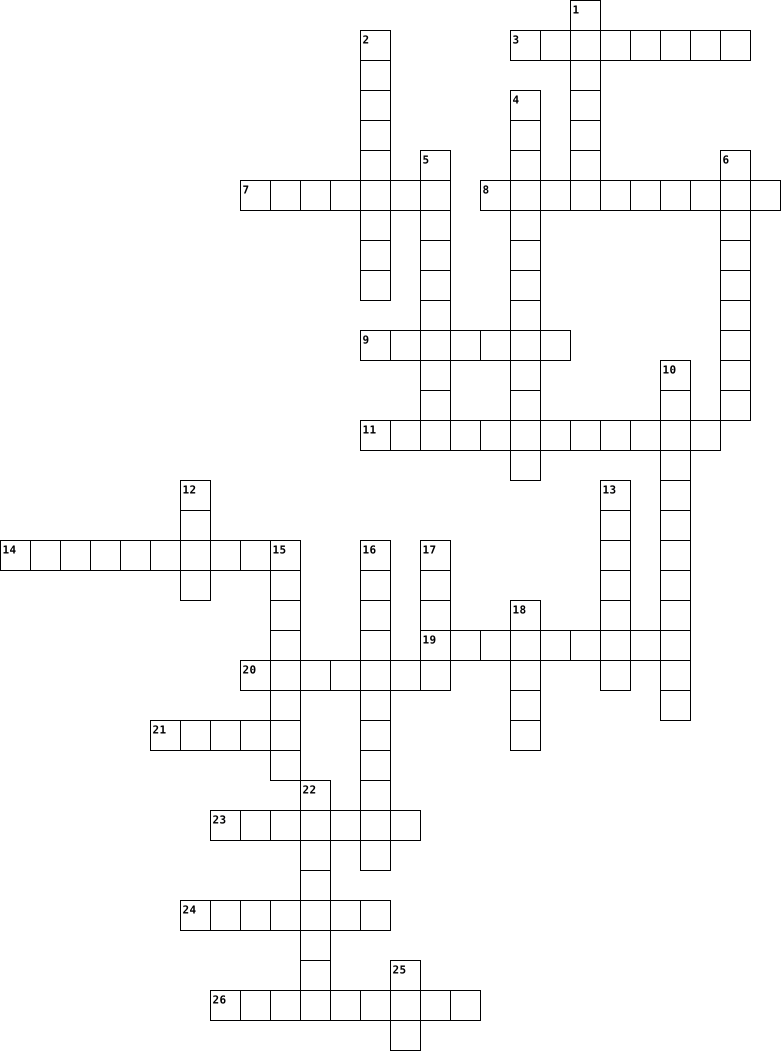
Across
- alternative light photograph
- pressurized water reactor
- motors
- microscopes
- wind turbines
- pipeline tracking
- autopilot
- 3D printing
- solar power
- pulley
- quality documentation
- animal habitats
Down
- traffic forecasting
- computer systems
- utility damage program
- improved manufacturing
- radiation for medicine
- organize construction
- locomotive schedule
- 3D models
- carbon-arc lamp
- movement-activated air conditioning
- x-rays
- solar paint
- vaccines
- prosthesis
26 Clues: motors • x-rays • pulley • vaccines • 3D models • autopilot • prosthesis • microscopes • solar paint • 3D printing • solar power • wind turbines • carbon-arc lamp • animal habitats • computer systems • pipeline tracking • traffic forecasting • locomotive schedule • organize construction • quality documentation • utility damage program • improved manufacturing • radiation for medicine • pressurized water reactor • ...
Diagnostic Imaging 2026-04-10

Across
- Right angles
- Something abnormal on x-ray
- Abbreviation
- Short term radiation effects
- discovered x ray
- has tungsten target
- Dose equivalent
- has 2 filaments
- Time, shielding and
Down
- controls size of x-ray beam
- Absorbed dose
- Off Center
- photons of pure energy
- What PPE is made of
- Ball of energy
- Radiation occurring by chance
- Measures patient
- radiography
- Lung collapse
- heat resistant metal
20 Clues: Off Center • radiography • Right angles • Abbreviation • Absorbed dose • Lung collapse • Ball of energy • Dose equivalent • has 2 filaments • Measures patient • discovered x ray • What PPE is made of • has tungsten target • Time, shielding and • heat resistant metal • photons of pure energy • controls size of x-ray beam • Something abnormal on x-ray • Short term radiation effects • ...
Types of Engineers 2022-08-10

Across
- These engineers work around the smallest, most amazing fragments of science
- Someone who is responsible for the development of new chemical products that can be used by companies and individuals
- These engineers design aircraft, spacecrafts, satellites, missiles and system defenses
- Computer systems engineers develop, test and evaluate _____________
Down
- engineers use engineering principles to create software
- Someone who uses the principles of engineering, soil science, biology and chemistry to solve problems
- Engineers who design and supervise construction projects including roads, bridges, water systems, etc
- These engineers research and develop the processes, instruments and systems used to get benefits from __________ energy and radiation
- This type of engineers designs and develops new electrical equipment, solves problems and tests equipment
9 Clues: engineers use engineering principles to create software • Computer systems engineers develop, test and evaluate _____________ • These engineers work around the smallest, most amazing fragments of science • These engineers design aircraft, spacecrafts, satellites, missiles and system defenses • ...
unit 3.01 2023-03-02

Across
- the branch of science that deals with both plant and animal organisms and life processes
- A plant rest or grows very little
- a plant that completes its life cycle in one year
- retains (keeps) leaves and remains green year-round
- the part of biology that deals with plants
- a plant that completes its life cyclein two years
- plant is limp because it does not have enough moisture
Down
- loses leaves during the dormant season
- horticulture forestry ect.
- zinnia grow best in this season
- Pansies grow best this season
- a plant that lives more than two years
- the part of biology that deals with animals
- plant is swollen or filled with moisture
14 Clues: horticulture forestry ect. • Pansies grow best this season • zinnia grow best in this season • A plant rest or grows very little • loses leaves during the dormant season • a plant that lives more than two years • plant is swollen or filled with moisture • the part of biology that deals with plants • the part of biology that deals with animals • ...
Chapter 7 Review 2020-05-08

Across
- duplicating films are used only in a _______ and is not exposed to x-radiation
- Thin, transparent coating which is placed over the emulsion. It protects the emulsion from manipulation
- these screens intensify the effect of x-rays on the film, and less radiation is required. A smooth plastic sheet coated with tiny fluorescent crystals
- BW's used to examine the maxillary crown on a single film. Useful in diagnosing interproximal caries and bone level
- Absorb radiation during x-ray exposure and store energy from the radiation
- Unexposed and unprocessed film must be stored in a cool, _____ place (50-70 degrees F)
- "end of a tooth"
- means existing but not yet developed; hidden, concealed; something present but not yet visible
- The stored energy within the silver halide crystals form a pattern and creates an invisible image on the emulsion. It remains invisible until the film is processed
- Provides support for the emulsion and strength. Can withstand heat, moisture, and chemical exposure. Transparent exhibiting a slight blue tint which is necessary for image quality (think about the color of the film in Rad Lab)
- are used to examine the teeth and supporting structures
- Found behind the film shielding the film from scatter radiation which results in film fog
- Produces identical copy of either an intraoral or extraoral radiograph used to send to insurance companies, referrals to specialists and for teaching aids.
- A coating attached to both sides of the film base by the adhesive layer. Allows for greater film sensitivity to x-radiation
- a client's mouth ______ should be considered when choosing a film size
- which film choice is best used to determine delayed eruption in a child who has mixed dentition (ages 6-12)?
- Evenly suspends silver halide crystals over the film base. Absorbs processing solutions allowing for the chemicals to react with crystals
- Used to hold extraoral films and intensifying screens
- the larger the crystals the ______ the film speed
- Require a screen for exposure. Placed between two special intensifying screen in a cassette. Less radiation is required to expose the film
Down
- Do not require intensifying screens for exposure. Exposed directly to x-rays. The emulsion on the film is sensitive to x-ray exposure rather than fluorescent light
- A small bump found on the corner of the plastic film packet which aids in the identification of the patient’s right and left side; used for correct mounting
- chemical compound sensitive to radiation or light
- Has a flap used to open the film packet to remove the film before processing. Must always face the patients tongue
- A thin layer of adhesive material covering both sides of the film base. Its like the glue for the emulsion
- Amount of radiation required to produce a radiograph. Determines how much radiation and exposure time is necessary to produce an image on a film. Determined by: size of silver halide crystals, thickness of the emulsion and radiosensitive dyes
- Found behind the film shielding the film from scatter radiation which results in film fog
- Solid white and has identification dot (ID). - Must always face the teeth and x-ray tubehead.
- "around"
- classified as the standard film size which is generally used for posterior PA exposures on adult dentition
- used in anterior BW
- the larger the crystals the ______ the film speed
- Something that responds to a stimulus
- the (___same word__) the number, the (___same word__) the size of the film
- a fast speed film requires _________ radiation exposure
- Emulsion found on both sides of the film packet. May contain one film or two films (two for duplication)
- Surrounds the film and helps protect the film from the light
- Largest intraoral film. Used to examine the maxillary and mandibular arch
- ______ storage containers prevent film-fogging
- film size used when taking a BW of posteriors in adults when 8's are present
- Refers to a picture of an object (tooth)
41 Clues: "around" • "end of a tooth" • used in anterior BW • Something that responds to a stimulus • Refers to a picture of an object (tooth) • ______ storage containers prevent film-fogging • chemical compound sensitive to radiation or light • the larger the crystals the ______ the film speed • the larger the crystals the ______ the film speed • ...
Nuclear Reactions Vocabulary 2025-03-25

Across
- a technique used to determine how old a rock is by analyzing the amounts of a radioactive isotope and its decay products in the rock
- a positively charged particle that is identical to the helium atom nucleus, with two protons and two neutrons, and is emitted from the radioactive decay of a nucleus
- the unstable condition of a nucleus that causes it to emit particles and lose energy
- the type of radioactive decay in which the nucleus of an atom is at too high an energy, resulting in a reduction of energy state and the emission of a high-energy photon
- a nuclear reaction in which two lighter nuclei combine to form a single, heavier nucleus, and some of the original mass is converted to energy
- ionizing electromagnetic radiation of very high frequency and energy that is emitted from the radioactive decay of a nucleus
- the property of a nucleus to emit radiation and decay, or to not; a stable nucleus does not emit any radiation, while an unstable nucleus will always emit radiation.
- a negatively charged electron that is emitted from the radioactive decay of a nucleus
Down
- a nuclear reaction in which a heavy nucleus breaks into two lighter nuclei, releasing energy
- energy in the form of oscillating electric and magnetic fields that is released in electromagnetic processes; characterized based on the frequency and wavelength of the oscillations as radio waves, microwaves, infrared radiation, visible light, ultraviolet radiation, X-rays, and gamma rays
- radioactive decay in which an atomic nucleus emits an alpha particle, reducing the mass number by four and the atomic number by two
- the time required for half the nuclei in a sample of a specific isotopic species to undergo radioactive decay
- the type of radioactive decay in which the neutron-to-proton ratio in the nucleus is too great and causes instability, resulting in a neutron being transformed into a proton and an electron
- natural or artificial conversion of an atom of one element into an atom of another element by the emission of radiation from an unstable nucleus
- the spontaneous emission of radiation by an unstable nucleus
- the emission or transmission of energy as particles or waves
16 Clues: the spontaneous emission of radiation by an unstable nucleus • the emission or transmission of energy as particles or waves • the unstable condition of a nucleus that causes it to emit particles and lose energy • a negatively charged electron that is emitted from the radioactive decay of a nucleus • ...
Types of Engineers 2022-08-10

Across
- These engineers work around the smallest, most amazing fragments of science
- Someone who is responsible for the development of new chemical products that can be used by companies and individuals
- These engineers design aircraft, spacecrafts, satellites, missiles and system defenses
- Computer systems engineers develop, test and evaluate _____________
Down
- engineers use engineering principles to create software
- Someone who uses the principles of engineering, soil science, biology and chemistry to solve problems
- Engineers who design and supervise construction projects including roads, bridges, water systems, etc
- These engineers research and develop the processes, instruments and systems used to get benefits from __________ energy and radiation
- This type of engineers designs and develops new electrical equipment, solves problems and tests equipment
9 Clues: engineers use engineering principles to create software • Computer systems engineers develop, test and evaluate _____________ • These engineers work around the smallest, most amazing fragments of science • These engineers design aircraft, spacecrafts, satellites, missiles and system defenses • ...
Spellings 26th February 2024-02-18

Across
- training people to obey rules
- perfume or odour
- apart from
- King Charles does this
- a shape like less than half a moon
- lovely countryside
- going upward
- you find it very interesting
Down
- cutting tool
- not forgetting
- someone who is good at physics, chemistry and biology
- a group of words punctuated with a full stop.
- physics, chemistry and biology
- different from what is usual
- going downward
15 Clues: apart from • cutting tool • going upward • not forgetting • going downward • perfume or odour • lovely countryside • King Charles does this • different from what is usual • you find it very interesting • training people to obey rules • physics, chemistry and biology • a shape like less than half a moon • a group of words punctuated with a full stop. • ...
Earth Day Project 2022-05-03

Across
- contaminate (water, air, or a place) with harmful or poisonous substances
- no longer in existence
- convert (waste) into reusable material
- relating to or derived from living matter
- the production and discharge of something, especially gas or radiation
- something related to the sun
- protect something from harm or danger
- able to be maintained at a certain rate or level
- a colorless unstable toxic gas with a pungent odor and powerful oxidizing properties, formed from oxygen by electrical discharges or ultraviolet light. It differs from normal oxygen (O2) in having three atoms in its molecule
- able to be renewed
Down
- the branch of biology that deals with the relations of organisms to one another and to their physical surroundings
- maintain something in its original or existing state
- reuse
- trash thrown into a public or open space
- the natural home or environment of an animal, plant, or other organism
- decayed organic material used as plant fertilizer
- a biological community of interacting organisms
- the conditions in which a human, plant, or animal lives/operates
- envelope of gases that surrounds the earth
- a place to dispose of refuse and other waste material by burying it and covering it over with soil, especially as a method of filling in or extending usable land
20 Clues: reuse • able to be renewed • no longer in existence • something related to the sun • protect something from harm or danger • convert (waste) into reusable material • trash thrown into a public or open space • relating to or derived from living matter • envelope of gases that surrounds the earth • a biological community of interacting organisms • ...
Science <3 2020-06-15

Across
- uses of electric currents and circuits to measure temperature
- is a pulling or stretching force
- described as a PUSH or PULL on an object
- gas to liquid
- S.A.S. A stands for...
- often liquids and solids or gas and solid
- non-living things
- is the measure of the force of a substance acting on an object
- fourth level of interaction
- living things
- eats plants
- is transmitted in wave form one object to another
- gas to solid
- energy transferred through contact
- two solids, or different sizes or densities
Down
- uses expanding contracting of a liquid
- is a twisting force caused by opposite rotational forces
- thermal energy is transferred throughout an object or environment by the cycling of particles
- solid to gas
- eats meat
- very small portion of matter
- second level of interaction
- eat plants and meat
- the third year of earth's atmosphere
- this refers to a pushing or pulling in a particular
- liquid to gas
- is a pushing or squeezing force
- two parallel forces going in opposite direction
- measure of how much matter is in gravity
- study of living things
- liquid to solid
- this is a measure of how strong the force is
32 Clues: eats meat • eats plants • solid to gas • gas to solid • gas to liquid • liquid to gas • living things • liquid to solid • non-living things • eat plants and meat • S.A.S. A stands for... • study of living things • second level of interaction • fourth level of interaction • very small portion of matter • is a pushing or squeezing force • is a pulling or stretching force • ...
Science <3 2020-06-15

Across
- non-living things
- is a pushing or squeezing force
- eat plants and meat
- this is a measure of how strong the force is
- an object
- liquid to solid
- eats meat
- the third year of earth's atmosphere
- is a pulling or stretching force
- measure of how much matter is in gravity
- is the measure of the force of a substance acting
- very small portion of matter
- second level of interaction
- is a twisting force caused by opposite rotational forces
- fourth level of interaction
- this refers to a pushing or pulling in a particular
- is transmitted in wave form one object to another
Down
- energy transferred through contact
- solid to gas
- study of living things
- gas to liquid
- uses of electric currents and circuits to measure temperature
- environment by the cycling of particles
- two parallel forces going in opposite direction
- gas to solid
- liquid to gas
- two solids, or different sizes or densities
- described as a PUSH or PULL on an object
- S.A.S. A stands for...
- eats plants
- often liquids and solids or gas and solid
- thermal energy is transferred throughout an object
- uses expanding contracting of a liquid
- living things
34 Clues: an object • eats meat • eats plants • solid to gas • gas to solid • gas to liquid • liquid to gas • living things • liquid to solid • non-living things • eat plants and meat • study of living things • S.A.S. A stands for... • second level of interaction • fourth level of interaction • very small portion of matter • is a pushing or squeezing force • is a pulling or stretching force • ...
Scientific Discoveries and Inventions 11 2024-11-03

Across
- "The use of computer technology to analyze biological data."
- "The use of plants to clean up soil, air, or water pollutants."
- "Chemicals that transmit signals across a synapse in the brain."
- "The process by which organisms maintain their body temperature."
- "The technology of converting sunlight directly into electricity."
- "The use of natural catalysts, like enzymes, in chemical reactions."
- "The study of chromosomes and their relation to cell behavior."
- "A type of computing that uses quantum-mechanical phenomena."
- "The study of how genes affect a person's response to drugs."
Down
- "The study of genetic material recovered directly from environmental samples."
- "The use of radiation, especially for cancer treatment."
- "A process used to etch or print patterns on a nanoscale."
- "A method for separating molecules based on size and charge."
- "The scientific study of life that existed in prehistoric times."
- "The study of chemical processes that cause electrons to move."
- "The integration of biology, mechanics, and electronics in prosthetics."
- "Materials with structures on the nanoscale, used in advanced technology."
- "The use of organisms to remove contaminants from the environment."
- "The number and appearance of chromosomes in the nucleus of a cell."
- "A technique used to measure the mass-to-charge ratio of ions."
20 Clues: "The use of radiation, especially for cancer treatment." • "A process used to etch or print patterns on a nanoscale." • "The use of computer technology to analyze biological data." • "A method for separating molecules based on size and charge." • "A type of computing that uses quantum-mechanical phenomena." • ...
Science <3 2020-06-15

Across
- this refers to a pushing or pulling in a particular
- non-living things
- is a pushing or squeezing force
- fourth level of interaction
- eats plants
- very small portion of matter
- gas to solid
- is a twisting force caused by opposite rotational forces
- liquid to solid
- gas to liquid
- is a pulling or stretching force
- this is a measure of how strong the force is
- living things
- uses expanding contracting of a liquid
- two parallel forces going in opposite direction
- solid to gas
Down
- eats meat
- often liquids and solids or gas and solid
- two solids, or different sizes or densities
- thermal energy is transferred throughout an object or environment by the cycling of particles
- study of living things
- second level of interaction
- the third year of earth's atmosphere
- of the force of a substance acting on an object
- is transmitted in wave form one object to another
- energy transferred through contact
- uses of electric currents and circuits to measure temperature
- liquid to gas
- described as a PUSH or PULL on an object or structure
- S.A.S. A stands for...
- eat plants and meat
- measure of how much matter is in gravity
32 Clues: eats meat • eats plants • gas to solid • solid to gas • liquid to gas • gas to liquid • living things • liquid to solid • non-living things • eat plants and meat • study of living things • S.A.S. A stands for... • second level of interaction • fourth level of interaction • very small portion of matter • is a pushing or squeezing force • is a pulling or stretching force • ...