
renaissance Crossword Puzzles
The Renaissance 2023-05-29

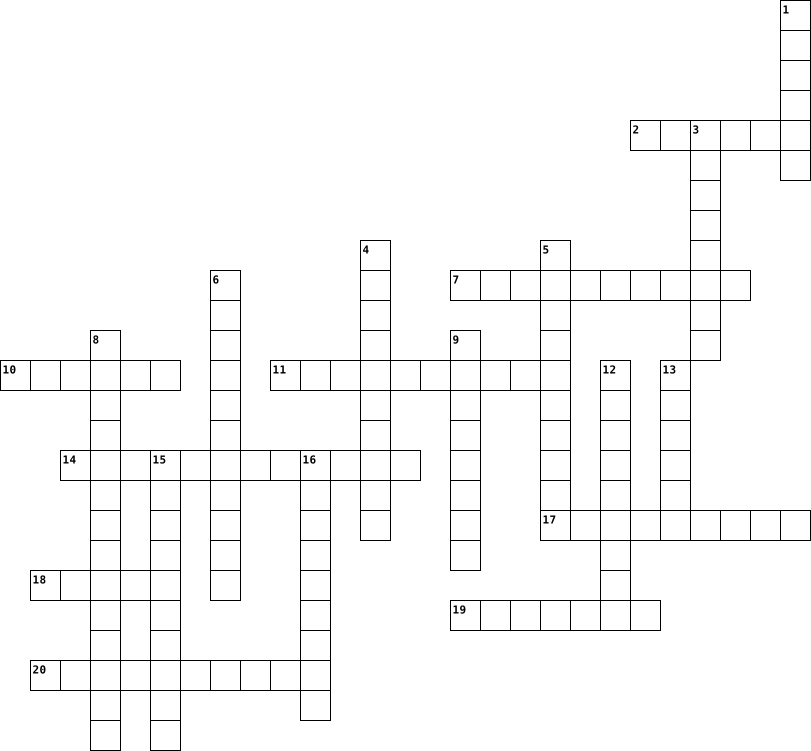
Across
- Siya ay isang Italyano na pintor ng Early Renaissance na kilala sa kanyang mga painting na "The Birth of Venus" at "Primavera."
- Siya ay isang makatang Italyano na kilala sa kanyang epikong tula na "The Divine Comedy."
- Siya ay isang Espanyol na manunulat na kilala sa kanyang nobelang "Don Quixote".
- Siya ay isang Italyano na artista, imbentor, at polymath na ipinanganak noong Abril 15, 1452.
- Siya ay isang Italyano na pintor at arkitekto ng High Renaissance period.
- Siya ay isang Italyano na diplomat, pilosopo, at manunulat na kilala sa kanyang aklat na “The Prince” na nagbabalangkas ng mga prinsipyo sa pamamahala.
- Siya ay isang Polish na astronomo na nagmungkahi ng teorya na ang araw, sa halip na ang lupa, ang sentro ng uniberso.
- Siya ay isang Italyano na manunulat at makata na kilala sa kanyang akda na "The Decameron."
- Siya ay isang Pranses na pilosopo, matematiko, at siyentipiko na kilala sa kanyang pariralang "Sa tingin ko, samakatuwid ako ay" at ang kanyang mga kontribusyon sa algebra at analytic geometry.
- Siya ay isang German mathematician, astronomer, at astrologo na kilala sa kanyang mga batas ng planetary motion.
- Siya ay isang Ingles na may-akda, makata, at pilosopo na pinakakilala sa kanyang akda na "The Canterbury Tales".
Down
- Siya ay isang English playwright at makata na malawak na itinuturing bilang isa sa mga pinakadakilang manunulat sa wikang Ingles.
- Siya ay isang English physicist, mathematician, at astronomer na kilala sa kanyang mga batas ng paggalaw at unibersal na grabitasyon.
- Siya ay isang German humanist scholar at pilosopo na nabuhay noong panahon ng Renaissance.
- Siya ay isang Italyano na estadista at pinuno ng Florentine Republic sa panahon ng Italian Renaissance.
- Siya ay isang Italyano na pisiko at astronomo na gumanap ng malaking papel sa Rebolusyong Siyentipiko.
- Siya ay isang English na makata at polemicist na kilala sa kanyang epikong tula na "Paradise Lost".
- Siya ay isang English lawyer, social philosopher, at Renaissance humanist na kilala sa kanyang aklat na "Utopia."
- Siya ay isang Italyano na iskolar at makata na nabuhay noong ika-14 na siglo.
- Siya ay isang Dutch na pilosopo, teologo, at manunulat na kilala sa kanyang aklat na "The Praise of Folly."
20 Clues: Siya ay isang Italyano na pintor at arkitekto ng High Renaissance period. • Siya ay isang Italyano na iskolar at makata na nabuhay noong ika-14 na siglo. • Siya ay isang Espanyol na manunulat na kilala sa kanyang nobelang "Don Quixote". • Siya ay isang makatang Italyano na kilala sa kanyang epikong tula na "The Divine Comedy." • ...
Renaissance Era 2022-11-02

Across
- An architectural feature from Ancient Greece that became popular during the Renaissance
- Defined the rights in the Social Contract Theory
- opposite of down
- People who paid for art
- studied how the planets move
- guy who started calvinism
- Where the Renaissance started
- Artist who created the Mona Lisa
- Wrote the book "The Social Contract"
- Ms.Hayes's new cat's name
- An intellectual movement centered around an interest in individual human qualities
- frozen water
- Henry VIII divorced his first wife because she wouldn't give birth to a ____
- Artist who created The School of Athens
- Your world studies teacher's last name
Down
- Wrote the first encyclopedia
- What Enlightenment thinkers valued in decision-making
- guy who backed up Copernicus but was convicted of heresy
- Wrote the 95 Theses
- The sale of these were what Martin Luther was upset about
- The Period of Ancient Greece and Rome
- guy who created the Social Contract Theory
- guy who created the scientific method
- created the laws of motion
- Invented the printing press
- The hierarchal class system with Kings at top
- center of the heliocentric solar system
- place to discuss ideas during the enlightenment
28 Clues: frozen water • opposite of down • Wrote the 95 Theses • People who paid for art • guy who started calvinism • Ms.Hayes's new cat's name • created the laws of motion • Invented the printing press • Wrote the first encyclopedia • studied how the planets move • Where the Renaissance started • Artist who created the Mona Lisa • Wrote the book "The Social Contract" • ...
Renaissance Vocabulary 2022-09-14

Across
- A wealthy person who supports an artist.
- Having to do with worldly, rather than religious matters.
- A system of government in which the voters elect officials to make laws & run the government.
- Form of Christianity that is mixed with both Protestantism & Roman Catholicism.
- Intellectual movement which revived (brought to life) the idea of viewing life through reason & recognizing human nature & experience.
- Christian place of worship, which is usually a cross shaped building.
- To give up one’s views or beliefs.
- The belief that money would absolve (get rid of) someone’s sins and get them into heaven.
Down
- A person who agrees to live with and work for another person in return that they are taught a skill or trade.
- Everyday use of speech by the people.
- An art technique that allows the artist to show objects appearing at various distances (close & far away).
- A government ruled by religious leaders who claim God's authority.
- Religious belief that does not match the official teachings of the Church.
- Period of great creativity and change in Europe from the 1300s through the 1600s.
- The ideally perfect state where everyone is happy and in harmony.
- The art of using words effectively in speaking or writing.
- A person who studies and speaks or writes about a specific subject in great detail.
- Someone who represents a government in its relationships with other governments.
- Branch of Christianity that follows the teachings of Martin Luther.
- State, A region that is independently ruled by a major city.
20 Clues: To give up one’s views or beliefs. • Everyday use of speech by the people. • A wealthy person who supports an artist. • Having to do with worldly, rather than religious matters. • The art of using words effectively in speaking or writing. • State, A region that is independently ruled by a major city. • ...
Renaissance Vocabulary 2022-09-14

Across
- A wealthy person who supports an artist.
- Having to do with worldly, rather than religious matters.
- A system of government in which the voters elect officials to make laws & run the government.
- Form of Christianity that is mixed with both Protestantism & Roman Catholicism.
- Intellectual movement which revived (brought to life) the idea of viewing life through reason & recognizing human nature & experience.
- Christian place of worship, which is usually a cross shaped building.
- To give up one’s views or beliefs.
- The belief that money would absolve (get rid of) someone’s sins and get them into heaven.
Down
- A person who agrees to live with and work for another person in return that they are taught a skill or trade.
- Everyday use of speech by the people.
- An art technique that allows the artist to show objects appearing at various distances (close & far away).
- A government ruled by religious leaders who claim God's authority.
- Religious belief that does not match the official teachings of the Church.
- Period of great creativity and change in Europe from the 1300s through the 1600s.
- The ideally perfect state where everyone is happy and in harmony.
- The art of using words effectively in speaking or writing.
- A person who studies and speaks or writes about a specific subject in great detail.
- Someone who represents a government in its relationships with other governments.
- Branch of Christianity that follows the teachings of Martin Luther.
- State, A region that is independently ruled by a major city.
20 Clues: To give up one’s views or beliefs. • Everyday use of speech by the people. • A wealthy person who supports an artist. • Having to do with worldly, rather than religious matters. • The art of using words effectively in speaking or writing. • State, A region that is independently ruled by a major city. • ...
Renaissance crossword 2023-09-11

Across
- sculptor that made realistic sculptures
- known for using realism in his paintings
- painter, sculpture, inventor, and scientists
- emphasis on a person instead of a group
- death illness that killed tons of people
- belief that the sun is the center of the universe
- means worldly rather than spiritually and concerned with the here and now
- idea that god long ago determined who will gain salvation
- a member of a christian church
- everyday language of people in a region or country
Down
- painter who painted the ceiling in the Sistine chapel
- imaginary land
- European history time period
- the center of the Italian renaissance
- polish astronomer who proposed the sun-centered model of the universe
- religious teachings based on the ideas of the former reformer john Calvin
- religious belief that is contrary to the official teachings of the church
- when wealthy people give money to artists
- a pardon releasing someone from the punishments due for a sin
- astronomer who supported the heliocentric theory
- government ruled by religious leader
- movement that focuses on human achievement
- members of the society of jesus
- to cancel or set aside
- artist technique that makes flat surfaces look 3d
- to reform
- A Humanist writer who wrote sonnets about a mysterious woman named Laura who was his ideal
- place where a king or queen has central power
- give up one’s views or beliefs
- He was a Christian Humanist who wrote the book "Utopia", the book was about an imaginary land where greed, corruption and war have been weeded out
30 Clues: to reform • imaginary land • to cancel or set aside • European history time period • a member of a christian church • give up one’s views or beliefs • members of the society of jesus • government ruled by religious leader • the center of the Italian renaissance • sculptor that made realistic sculptures • emphasis on a person instead of a group • ...
The Renaissance 2023-08-28

Across
- "no place"
- a split in the Catholic Church where a new type of Christianity called Protestantism was born
- humanist and poet
- used a realistic style when depicting the human body
- develops printing press
- a way to show 3D on a canvas
- a rediscovery of learning that produced many great works of art and literature
- excels in many fields: the classics, art, politics, combat
- classical form in sculpture
- woman writer with great influence
- crusades spur trade
- banking family, the Medici, controls Florence
- European society was revitalized
- an explosion of creativity, in art, writing, and thought
- author of political guidebook
Down
- intellectual movement focused on human achievements
- upper-class, educated in classics, charming
- in 1143, Rome became a self-governing city with a republican constitution
- famous for his use of perspective
- a financial support of artists
- renaissance society was secular
- often regarded as the greatest
- Italy remained politically fragmated
- rebirth of the art, architecture, and literature of Classical antiquity
- independent city-states until the 1130's
- grew into international powerhouse
- best know for the Decameron
- western Europeans learn how to make paper
- became a center of manufacturing
- wordly
30 Clues: wordly • "no place" • humanist and poet • crusades spur trade • develops printing press • classical form in sculpture • best know for the Decameron • a way to show 3D on a canvas • author of political guidebook • a financial support of artists • often regarded as the greatest • renaissance society was secular • European society was revitalized • became a center of manufacturing • ...
The Renaissance 2023-08-28

Across
- A 16th century movement leading to the founding of Christian churches that rejected the popes authority
- Started in the 14th century and ended in the 17th
- know classics and be charming but not seek fame or make art but inspire it
- Promoting human accomplishment over religion accomplishment
- a smooth bore rifle that was a bigger version of the harquebus
- Member of a Christian Church founded on the principals of reformation
- used to observe objects that are far away
- A major financial and maritime power
- Invented the printing press and mass produced books
- painted "The School of Athens"
- an expert in many fields, like poetry, arts, dancing, and fighting.
- Member of the Protestant Church founded on the teachings of Martin Luther
Down
- Wrote plays including Romeo and Juliet, Hamelet, and King Lear
- an art technique that shows a 3d space on a 2d painting
- allowed books and texts to be made fast and accurately
- Famous for using perspective in his paintings, he covered the walls of Pope Julius II's Library with paintings
- A government ruled by a religious leader
- One of Europe's economic and political powers due to it's rich agriculture
- Wrote "The Prince"
- Italian City state that dominated the trading industry
- supported and commissioned artists.
- Sculptor, Painter, and architect, painted the Sistine Chapel
- used to observe objects that are small
- Emphasis on a person as an individual rather than part of a group
- More focused on the physical world over religion
- Famous for painting paintings that were almost photographic in detail
- Skill full at portraying large numbers of people in a realistic manner
- Painter, sculptor, architect, theorist, and engineer
- Christian Humanist who wrote the book "Utopia"
- an imaginary land described by Thomas More as the ideal place
- famous for making sculptors realistic, made the statue of David
31 Clues: Wrote "The Prince" • painted "The School of Athens" • supported and commissioned artists. • A major financial and maritime power • used to observe objects that are small • A government ruled by a religious leader • used to observe objects that are far away • Christian Humanist who wrote the book "Utopia" • More focused on the physical world over religion • ...
Harlem Renaissance 2025-02-06

Across
- African-American Poet and Activist known for the poem, "I, Too"
- William Edward Burghardt __ ____ was an American sociologist, socialist, historian, and civil rights activist
- Name for the mass movement of African-Americans moving to the North from the South
- African American entertainer, activist, and World War II spy who is often regarded as the first Black superstar
- Civil Rights organization that works to ensure the rights of African Americans
- This time were full of cultural revival, and dang it was roaring!
- French word that means, "Rebirth"
- African-American professional boxer that was the first black man to become the heavyweight champion
- Jamaican Activist and founder of the UNIA
- African-American Trumpeter and Vocalist known for singing "What A Wonderful World"
- Named after a harbor city in South Carolina
- African-American visual artist famous for his colorful chronicling of the African-American experience in Chicago
Down
- 20th Century Dance that was used for Ragtime songs
- Association that was used to improve African-Americans rights
- 20th Century Night-Club in New York City
- Neighborhood in New York that many African-Americans moved to
- African-American blues and jazz singer known as the, "Empress of the Blues"
- This was used by African-Americans to travel up north without hassle
- African-American painter and illustrator that was known for art that addressed social issues around race and segregation
- African-American pianist and composer known for the song, "Take the A Train"
- Laws set to put African-Americans down, named after a character
- African-American Photographer known for their pictures of black New Yorkers
- Style of music that was usually done by African-Americans
- Approximate number of African-Americans moving up north for a better life
- African-American track and field athlete who won four gold medals at the 1936 olympics
- African-American sculptor that fought poverty, racism and sexism and ran a studio that she taught at
- This war triggered a mass movement of African-Americans moving North
27 Clues: French word that means, "Rebirth" • 20th Century Night-Club in New York City • Jamaican Activist and founder of the UNIA • Named after a harbor city in South Carolina • 20th Century Dance that was used for Ragtime songs • Style of music that was usually done by African-Americans • Association that was used to improve African-Americans rights • ...
Harlem Renaissance 2024-10-05

Across
- past form of "think"
- past form of "can't"
- "pendant" in English
- well-known, that many people know
- alors que
- opposite of "for"
- "qui" pour choses
- separation of Black and white people
- synonym of workers
- a thinker
- be ______ of Manhattan
- a job ___
- _____ jobs : petits boulots
- opposite of "agree"
- past form of "bring"
- ______ were: il y avait (pluriel)
- with no education, illiterate
- _________ as intellectuals
Down
- à cause de
- clothes worn by men
- not enough, absence of
- a type of book
- with no job
- Harlem is one in Manhattan
- past form of "leave"
- Black people _______ in Harlem
- emeute in English
- person who fights for a cause
- past form of "wear"
- past form of "write"
- Langston Hughes wrote it
- appear, develop
- ________ a living: gagner sa vie
- _____ to: devoir
- past plural form of "be" in the past
- assez, suffisamment
36 Clues: alors que • a thinker • a job ___ • à cause de • with no job • a type of book • appear, develop • _____ to: devoir • emeute in English • opposite of "for" • "qui" pour choses • synonym of workers • clothes worn by men • past form of "wear" • opposite of "agree" • assez, suffisamment • past form of "think" • past form of "can't" • "pendant" in English • past form of "leave" • past form of "write" • ...
Renaissance Vocabulary 2025-01-13

Across
- Art which is realistic
- Head of Catholic Church
- The conflict where there were rival Popes
- System where people got land by people of higher ranks in return for labor
- Belief that the Pope has supreme authority
- Round roof
- Governing the hierarchy and administration of Church
- laborer
- Person who gives financial support
- Emphasizes the individual and social potential
Down
- Machine which text and images are printed with
- Importance of oneself
- Religious movement
- Infection that killed many Europeans
- Allow themselves to enjoy something
- Revival of art and literature
- Dictates no official religion of a state
- To banish someone from their Church
- Large house
- Person with high social class or political status
20 Clues: laborer • Round roof • Large house • Religious movement • Importance of oneself • Art which is realistic • Head of Catholic Church • Revival of art and literature • Person who gives financial support • Allow themselves to enjoy something • To banish someone from their Church • Infection that killed many Europeans • Dictates no official religion of a state • ...
Renaissance Art 2024-12-12

Across
- Religious image.
- Art city.
- Person's likeness.
- Virgin Mary.
- Artist's board.
- Art show.
- Tile artwork.
- Mona Lisa.
- Art repair.
- Preliminary drawing.
- Painter's tool.
- Art style.
Down
- Three-dimensional art.
- Sculptor.
- Venice art.
- Sistine Chapel.
- Focus on humans.
- Representing ideas.
- Art supporter.
- School of Athens.
- Light and shadow.
- Painting surface.
- Wall painting.
- Depth technique.
24 Clues: Sculptor. • Art city. • Art show. • Mona Lisa. • Art style. • Venice art. • Art repair. • Virgin Mary. • Tile artwork. • Art supporter. • Wall painting. • Sistine Chapel. • Artist's board. • Painter's tool. • Focus on humans. • Religious image. • Depth technique. • School of Athens. • Light and shadow. • Painting surface. • Person's likeness. • Representing ideas. • Preliminary drawing. • Three-dimensional art.
Renaissance Exploration 2025-01-26

Across
- - Tawag sa paggalugad ng mga Europeo sa mga bagong lupain.
- - Lupang sinakop at pinamunuan ng isang dayuhang bansa.
- - Sasakyang pandagat na ginamit sa panahon ng eksplorasyon.
- MAGELLAN - Manlalakbay na unang nakaikot sa mundo.
- - Mahalagang produkto mula sa Asya na ginagamit sa pagluluto at pagpepreserba ng pagkain.
- - Pangunahing motibasyon ng eksplorasyon—paghahanap ng ginto at pilak.
- - Ginamit ng mga manlalayag upang matukoy ang direksyon.
- - Relihiyong nais ipalaganap ng mga Europeo sa mga bagong lupain.
- - Kasanayan sa paglalayag at pagtukoy ng direksyon sa karagatan.
- - Proseso ng mas malawak na ugnayan ng mga bansa sa buong mundo.
- - Palitan ng produkto at yaman sa pagitan ng mga bansa.
Down
- ROAD - Ruta ng kalakalan sa pagitan ng Asya at Europa.
- - Tawag sa mga Espanyol na sumakop sa mga lupain sa America.
- - Bansang nanguna sa eksplorasyon sa ilalim ni Prince Henry the Navigator.
- - Panahon ng muling pagsilang ng sining, agham, at kaalaman sa Europa.
- - Matibay na bakal na ginagamit upang ipirmi ang barko sa isang lugar.
- POLO - Isang Venetian na naglakbay sa Asya at nag-ulat tungkol sa China.
- - Instrumentong ginamit sa paglalayag upang malaman ang latitude.
- - Bansang sumuporta sa paglalayag ni Ferdinand Magellan.
- - Sasakyang pandagat na ginamit ng mga Portuges at Espanyol sa eksplorasyon.
20 Clues: MAGELLAN - Manlalakbay na unang nakaikot sa mundo. • ROAD - Ruta ng kalakalan sa pagitan ng Asya at Europa. • - Lupang sinakop at pinamunuan ng isang dayuhang bansa. • - Palitan ng produkto at yaman sa pagitan ng mga bansa. • - Ginamit ng mga manlalayag upang matukoy ang direksyon. • - Bansang sumuporta sa paglalayag ni Ferdinand Magellan. • ...
Reformation & Renaissance 2024-12-18

Across
- The Act of Supremacy made the _____, not the Pope, head of the Church of England.
- A major city in the Papal States
- Michelangelo created this
- This nation or empire had areas that were Calvinist, Lutheran, and Catholic.
- This was when the Catholic Church made laws like giving the Bible and Pope equal authority, banning indulgences, and burning offensive books
- The term for a non-Catholic Christian. Includes,
- The author of the Prince; gave advice to Italian rulers on maintaining power
- This queen turned England back to Protestantism
- The Catholic nation that started the Inquisition
- This was promoted by Calvin. It is when
- Queen Elizabeth I was an example; someone who sponsors artists, musicians, etc
- Something that you can pay for to get your sins forgiven. Basically the idea that you can pay your way into heaven
- Focused on understanding the human potential, promoted equality, wanted reforms
- A major city in England
Down
- Not able to read or write
- The person who started the Anglican Church
- The ______ Reformation was a response to the Protestant Reformation. It wanted to reform the Church to keep Catholics loyal.
- The title of Thomas More's book that looked to describe the perfect world
- This allowed for the local princes of the Holy Roman Empire to decide which religion the state would follow
- This is the opposite of a very religious person
- A time of religious reform
- Very religious or holy
- Leonardo da Vinci painted this
- A major Calvinist city; inspired John Knox to bring Calvinism to Scotland
- This invention led to the increase in literacy as well as the spread of Luther's ideas
- The person who wrote the Institute of the Christian Religion, which was a Protestant religious book
- This is considered the common language
- The only entirely Anglican nation
28 Clues: Very religious or holy • A major city in England • Not able to read or write • Michelangelo created this • A time of religious reform • Leonardo da Vinci painted this • A major city in the Papal States • The only entirely Anglican nation • This is considered the common language • This was promoted by Calvin. It is when • The person who started the Anglican Church • ...
The Renaissance 2025-09-02

Across
- n
- t n
- c r
- q s t n
- a r y
- t a
- e o
- P o
- a
- p n c
- i i
- r c l
- o c
- e b c
- e o c
- Press r t g r s
- n s n
- m s
- y
Down
- n r m
- r y
- r e
- h e n
- s l
- I y t e
- f m n
- r s c e
- u d
- e t c
- r h e
30 Clues: n • a • y • t n • r y • c r • t a • e o • P o • u d • i i • o c • m s • r e • s l • n r m • h e n • f m n • e t c • p n c • r c l • e b c • r h e • e o c • n s n • a r y • q s t n • r s c e • I y t e • Press r t g r s
the renaissance 2025-09-11

Across
- greatest playwright
- used realistic style when depicting the human body
- allows quick and cheap book production
- a center of manufacturing
- their native language
- worldly
- humanist, poet
- painter, sculpter, inventor,scientist
- upper class, educated in classics, charming
- famous for his use of perspective
Down
- developed the printing press
- best known for the decameron
- intellectual movement focused on human ahcievemtns
- one of the first woman writers
- an explosion of creativity in art,writing and thought
- excels in many fields
- "no place" in greek
- flourishing independent city state until the 1130s
- a way to show three dimensions in canvas
- a financial supporter of artists
- grew into a national powerhouse
- questioned everything
22 Clues: worldly • humanist, poet • greatest playwright • "no place" in greek • excels in many fields • their native language • questioned everything • a center of manufacturing • developed the printing press • best known for the decameron • one of the first woman writers • grew into a national powerhouse • a financial supporter of artists • famous for his use of perspective • ...
Renaissance crossword 2025-09-04

Across
- Groups of craftsmen that women were often excluded from.
- A type of painting showing a person.
- A person who represents their country to another country.
- A source of inspiration for a creative person.
- The last name of the famous writer Veronica.
- The customs, arts, and social institutions of a nation.
- The ability to recover quickly from difficulties.
- Scholars who focused on human potential.
- A group of people living together in a community.
- The intelligence or understanding of a person.
- A person who is knowledgeable about many different subjects.
- A word used to describe the women's courage in the essay.
- The works of art, music, and literature.
- A society where men hold the most power.
- People who create paintings and sculptures.
Down
- The last name of the famous writer and scholar Vittoria.
- A famous painter who was a friend of Isabella d'Este.
- A famous artist and inventor who created the Mona Lisa.
- An art form creating a three-dimensional figure.
- The country where the Renaissance began.
- A time of cultural rebirth in Europe.
- Learned people who study a lot.
- The name of the famous painting by Leonardo da Vinci.
- The last name of the famous artist Sofonisba.
- The city known as the birthplace of the Renaissance.
- The activities of governments or leaders.
- The Italian city where Isabella d'Este was a ruler.
- A powerful family in Florence who were famous patrons.
- The support an artist or writer receives from a wealthy person.
- The first name of the Marchesa of Mantua.
30 Clues: Learned people who study a lot. • A type of painting showing a person. • A time of cultural rebirth in Europe. • The country where the Renaissance began. • Scholars who focused on human potential. • The works of art, music, and literature. • A society where men hold the most power. • The activities of governments or leaders. • The first name of the Marchesa of Mantua. • ...
Renaissance Crossword 2026-03-12

Across
- A good that was transferred from the New World to the Old World.
- Heir to the England throne, daughter of King HenryVIII.
- Rational thought over faith.
- Famous painter of "The Last Supper" and the "Mona Lisa".
- Proved that the Earth revolves around the sun in "The Starry Messenger", and was condemned by the Catholic Church and eventually placed on house arrest
- The first European king to be tried and executed by his own people.
- Explained the three laws of motion, used these laws to explain gravity, and created Calculus.
- An Englishman assigned to move barrels of gunpowder during the Gunpowder Treason,but was caught.
- A good that was common in the Americas that led to the Spanish developing wealth.
- A disease that was spread to the new world by explorers.
- One of the main reasons English settlers went to the Americas.
Down
- An American who wrote the Declaration Of Independence.
- A six week trip taken by a slave ship across the Atlantic where millions of Africans died.
- The idea that one ruler has unrestricted power.
- A master sculptor who also painted the Sistine Chapel.
- A shift in thought after the middle ages that focused on things such as secular life, the arts, and scientific inquiry.
- An Italian explorer who voyaged to the New World for the Spanish Government.
- Invented by John Gutenberg and led to books becoming more widely available.
- What the Europeans referred to North and South America as.
- He had several problems with the catholic church and eventually broke away from them.
20 Clues: Rational thought over faith. • The idea that one ruler has unrestricted power. • An American who wrote the Declaration Of Independence. • A master sculptor who also painted the Sistine Chapel. • Heir to the England throne, daughter of King HenryVIII. • Famous painter of "The Last Supper" and the "Mona Lisa". • A disease that was spread to the new world by explorers. • ...
The Renaissance 2025-10-30

Across
- My dad's ghost told me to kill my uncle, so yeah, it's complicated.
- Girl whose beauty "teaches the torches to burn bright"
- Her good name nearly ruined by a bad rumor
- Instantly regrets hiding behind the curtain
- See-thru ruler of Denmark
- Final address after which all is mended
- They stirred up trouble, and a cauldron
- Windmills are no match for me!
- His "school" had no desks-only philosophers
- The teen whose hasty decisions lead to tragedy in Verona
- Inventor who made words travel faster than horses
- Thinker who advised rulers to be feared, not loved
Down
- queen of peer pressure
- Sculptor who saw "David" inside the marble
- Artist who painted a lady with a secret smile
- He comes back from the dead and is ready for a seat at dinner
- Bachelor who fell for a fake-news story
- I know the sun is the center of the universe!
- Queen who drinks one cup too many
- Brunelleschi's magnificent, massive masterpiece
- His "I do" was more of an "I don't."
- Brother whose only joy is others' misery
- Short-fused Capulet with a very sharp blade
- He's the reason Literature class is so dramatic
24 Clues: queen of peer pressure • See-thru ruler of Denmark • Windmills are no match for me! • Queen who drinks one cup too many • His "I do" was more of an "I don't." • Bachelor who fell for a fake-news story • Final address after which all is mended • They stirred up trouble, and a cauldron • Brother whose only joy is others' misery • Sculptor who saw "David" inside the marble • ...
Italian Renaissance 2025-10-27

Across
- A painting technique of high contrast with deep, dark shadows and bright highlights
- A painting technique which blends colours but uses more vibrant, brighter colours e.g. Raphael
- Italian painter, engineer, musician, and scientist. The most versatile genius of the Renaissance, he filled notebooks with engineering and scientific observations. Creator of some of the most well known artworks in history
- Rich businessmen who financially supported artists, scientists and inventors
- Renaissance painting by Leonardo da Vinci famous for its mysterious smile
- Devised a model of the universe with the Sun at the centre, instead of the Earth
- A sense of balance and proportion in art and architecture
- An anatomically correct sketch of the human body by Leonardo da Vinci
- A painting created on fresh plaster; an example is 'The Last Supper'
- Florentine patron who supported many artists
- A religious movement which challenged the power of the Catholic Church
- system The belief that the Earth and all other planets revolve around the Sun
- A 'rebirth' of European society, art and science during the 15th and 16th centuries
- German who developed the first printing press to use moveable type
- The act of banishing a member of the Catholic Church for their contrary beliefs or sinful behaviour
- An opinion on religious doctrine which opposes the official version
- German monk who challenged the Catholic Church, leading to the Reformation
Down
- A painting technique allowing tones and colors to blend gradually into one another, producing a soft, hazy effect e.g. Leonardo da Vinci
- Italian sculptor, painter, poet, engineer, and architect, his famous works include the Sistine Chapel Ceiling and the sculptures of David and the Pieta
- The literature of ancient Greece and Rome
- Renaissance painting by Botticelli focusing on botany and Greek mythology
- A painting technique which uses changes in hues and colours to depict shadows and highlights e.g. Michelangelo
- An artistic technique that creates the appearance of three dimensions on a flat surface
- Someone who excels in many areas, including art, science, poetry, athletics and combat
- 15th century invention which revolutionized the ability to print information which in turn affected the speed of the spread of information
- An association of people engaged in a particular trade or craft for the mutual benefit of its members
- Italian city known as 'the serene republic'
- The great Cathedral of Florence most famous for its large dome designed by Brunelleschi
- Italian astronomer and mathematician who was the first to use a telescope to study the stars
- Sometimes called 'the cradle of the Renaissance' because of its importance to the spread of ideas and wealth throughout Italy
- The study of human beings using reason and objectivity to understand the world
31 Clues: The literature of ancient Greece and Rome • Italian city known as 'the serene republic' • Florentine patron who supported many artists • A sense of balance and proportion in art and architecture • German who developed the first printing press to use moveable type • An opinion on religious doctrine which opposes the official version • ...
Renaissance Test 2026-04-15

Across
- In 1455, he created a movable-type printing press that could mass-produce writings easily. This led to the Gutenberg Bible being the first major book printed using movable type.
- 14-line poem written in Iambic pentameter
- The Italian city that led to the start of the Renaissance
- An intellectual movement that focused on a rebirth of classical Roman and Greek art, architecture, and literature.
- Discovered what we now call gravity and established several laws of motion that are still used in physics today.
- English humanist who wrote a book known as Utopia, which discussed a perfect society _________________________________________
- School of Athens artist
- Sir Francis Bacon helped establish the __________________________________ which helps with scientists organizing their data and testing their theories.
- Confirmed Copernicus was right about his heliocentric theory and acknowledged that the planets do not orbit in circles, but ellipses
- Discovered all things fall at the same rate of speed and invented the first modern telescope which help him discover Jupiter’s moons and the planet Venus ________________________________
- This book is separated in three parts known as the Paradisio, Purgatorio, and Inferno
- Earth is the center of the universe
Down
- Dutch humanist who believed the Bible should be translated to a common language for people to have easy access to it
- The Catholic Church viewed scientists people who committed _________ because they questioned the Catholic Church
- Mona Lisa and Last Supper artist
- Books were copied this way before the Renaissance
- A new wave of scientists that changed how humans viewed the world in the renaissance was called…..
- Wrote The Divine Comedy which demonstrated a love story between the author and His loving God
- A thought system that put more emphasis on the self/individual rather than God ________________________________________
- English poet during the Elizabethan Era. Known for plays like Romeo and Juliet and MacBeth
- the sun is the center of the universe
- Father of humanism
- Sistine Chapel artist
23 Clues: Father of humanism • Sistine Chapel artist • School of Athens artist • Mona Lisa and Last Supper artist • Earth is the center of the universe • the sun is the center of the universe • 14-line poem written in Iambic pentameter • Books were copied this way before the Renaissance • The Italian city that led to the start of the Renaissance • ...
Harlem Renaissance Era 2024-01-13

Across
- Famous dance
- renaissance New era for African-american entertain
- blues Old soul music
- Ellington Jazz pianist
- Hanging
- interracial American organization
Down
- Johnson Writer and civil rights activist
- Roosevelt President
- Club Famous night club in 1920s
- York Harlem renaissance location
- dress Women fashion
- Toomer only white Poet and novelist
12 Clues: Hanging • Famous dance • Roosevelt President • Ellington Jazz pianist • dress Women fashion • blues Old soul music • interracial American organization • Club Famous night club in 1920s • York Harlem renaissance location • Toomer only white Poet and novelist • Johnson Writer and civil rights activist • ...
Revolutions 2021-10-13

Across
- This word is closely tied to the Renaissance
- The Renaissance took place where?
- Who did Martin Luther get mad out for selling indulgences. (No spaces)
- Reformation split the Catholic Church?
Down
- who created the Printing Press?
- What invention during this time period is known for spreading cultural diffusion? (No Spaces)
- who is known as Mr. Renaissance?(No Spaces)
- Who wrote the 95 theses?(No spaces)
- The protestant reformation and the Renaissance, are examples of what?
9 Clues: who created the Printing Press? • The Renaissance took place where? • Who wrote the 95 theses?(No spaces) • Reformation split the Catholic Church? • who is known as Mr. Renaissance?(No Spaces) • This word is closely tied to the Renaissance • The protestant reformation and the Renaissance, are examples of what? • ...
Humanismus, Renaissance, Reformation 2012-12-18

Across
- Epoche, die den Humanisten als Vorbild galt
- Entdecker Amerikas
- Begriff für "Wiedergeburt der Antike"
- Wichtiges Werk, das Luther ins Deutsche übersetzte
- Bildungseinrichtung, die die Humanisten gründeten
- Bekannter ital. Renaissance-Künstler
- anderes Wort für menschlich
- wichtige Erfindung, aus Pergament hergestellt
- Erfinder des Buchdrucks
Down
- Kirchliches "Geschäft", das Luther kritisierte
- "ad fontes" bedeutet zurück zu den ...
- Politische Bewegung, die Luthers Lehre instrumentalisierte
- Antiker Fabeldichter
- Ein humanistisches Prinzip
- Wer stand im Mittelpunkt der Betrachtung?
- Gründer der Reformationsbewegung
16 Clues: Entdecker Amerikas • Antiker Fabeldichter • Erfinder des Buchdrucks • Ein humanistisches Prinzip • anderes Wort für menschlich • Gründer der Reformationsbewegung • Bekannter ital. Renaissance-Künstler • Begriff für "Wiedergeburt der Antike" • "ad fontes" bedeutet zurück zu den ... • Wer stand im Mittelpunkt der Betrachtung? • Epoche, die den Humanisten als Vorbild galt • ...
Renaissance and Middle Ages key words 2021-10-27

Across
- During the Renaissance, great advances occurred in geography, astronomy, chemistry, physics, mathematics, anatomy and engineering; which are branches of ...
- was a fervent period of European cultural, artistic, political and economic “rebirth” following the Middle Ages. Generally described as taking place from the 14th century to the 17th century, it promoted the rediscovery of classical philosophy, literature and art.
- the study of the fundamental nature of knowledge, reality, and existence, especially when considered as an academic discipline.
- the expression or application of human creative skill and imagination, typically in a visual form such as painting or sculpture, producing works to be appreciated primarily for their beauty or emotional power.
- not connected with religious or spiritual matters.
- lasted from the end of the Middle Ages to the middle of the 20th century
- a rationalist outlook or system of thought attaching prime importance to human rather than divine or supernatural matters.
- a European country with a long Mediterranean coastline, has left a powerful mark on Western culture and cuisine. Its capital, Rome, is home to the Vatican as well as landmark art and ancient ruins. Other major cities include Florence, with Renaissance masterpieces such as Michelangelo’s "David" and Brunelleschi's Duomo; Venice, the city of canals; and Milan.
- was a civilization that dominated much of the Mediterranean thousands of years ago. It formed the foundation of much of Western culture today. Everything from government, philosophy, science, mathematics, art, literature, and even sports was impacted by them.
- was the set of European artifacts and inventions which spread through the Renaissance period, roughly the 14th century through the 16th century.
- a 16th-century movement for the reform of abuses in the Roman Church ending in the establishment of the Reformed and Protestant Churches.
- a city in central Italy, on the River Arno in Tuscany: became an independent republic in the 14th century; under Austrian and other rule intermittently from 1737 to 1859; capital of Italy 1865–70. It was the major cultural and artistic centre of the Renaissance and is still one of the world's chief art centres.
Down
- a philosophical movement that dominated in Europe during the 18th century, was centered around the idea that reason is the primary source of authority and legitimacy, and advocated such ideals as liberty, progress, tolerance, fraternity, constitutional government, and separation of church and state.
- the study of the nature of God and religious belief.
- was an artist and engineer who is best known for his paintings, notably the Mona Lisa (c. 1503–19) and the Last Supper (1495–98).
- was the period in European history from the collapse of Roman civilization in the 5th century CE to the period of the Renaissance
- a building used for public Christian worship.
- continent in which the renaissance took place
- a civilization from the founding of the Italian city of Rome in the 8th century BC to the collapse of the Western Roman Empire in the 5th century AD
- the belief in and worship of a superhuman controlling power, especially a personal God or gods.
20 Clues: a building used for public Christian worship. • continent in which the renaissance took place • not connected with religious or spiritual matters. • the study of the nature of God and religious belief. • lasted from the end of the Middle Ages to the middle of the 20th century • ...
The Renaissance 2024-11-25

Across
- - the combination of humanism and religious ideas
- - German Printer, he developed a printing press that used moveable type
- - Italian trader, he traveled to China and later wrote about his trip. His time in China, he served as a government official in Kublai Khan's court
- - a method of showing a three dimensional scene on a flat surface so it looks real
Down
- - English Renaissance writer and play wright. He is considered by many to be the greatest English writer of all time
- - Early Italian Renaissance scholar, he wrote about the importance of knowing history
- - the period of 'rebirth' and creativity that followed Europe's middle ages
- - Genius of the Renaissance, he was a painter, sculptor, inventor, engineer, town planner, and mapmaker
- - study of history, literature, public speaking, art that led to a new way of thinking in Europe in the late 1300's
- - Italian Renaissance artist, he designed buildings, wrote poetry, and created sculptures and paintings
- - Italian writer and politician, he wrote The prince in which he advised leaders on how to rule
11 Clues: - the combination of humanism and religious ideas • - German Printer, he developed a printing press that used moveable type • - the period of 'rebirth' and creativity that followed Europe's middle ages • - a method of showing a three dimensional scene on a flat surface so it looks real • ...
Renaissance Crossword 2024-01-17

Across
- capital of Italy’s Tuscany region, is home to many masterpieces of Renaissance art and architecture.
- any piece of graphic artwork that is painted or applied directly to a wall, ceiling, or other permanent substrate.
- an Italian sculptor of the Renaissance period. Born in Florence, he studied classical sculpture and used his knowledge to develop an Early Renaissance style of sculpture.
- a theory that relates the scientific method to philosophy by affirming that all beings and events in the universe are natural.
- lines are used in a particular way to create depth and perspective on a flat surface to portray a three-dimensional scene.
- the habit or principle of being independent and self-reliant.
- the art of making three-dimensional representative or abstract forms, especially by carving stone or wood or by casting metal or plaster.
- a 16th-century movement for the reform of abuses in the Roman Catholic Church
- drawing solid objects on a two-dimensional surface gives the right impression of their height, width, depth, and position concerning each other when viewed from a particular point.
- a painting done rapidly in watercolor on wet plaster on a wall or ceiling, so that the colors penetrate the plaster and become fixed as it dries.
- a Christian place of prayer and worship that is usually relatively small.
- an outlook or system of thought attaching prime importance to humans rather than divine or supernatural matters.
- architecture concerned with domestic and functional rather than public or monumental buildings.
- a viscous liquid derived from petroleum, especially for use as a fuel or lubricant.
- sculptural relief in which the projection from the surrounding surface is slight and no part of the modeled form is undercut
Down
- an Italian sculptor, painter, architect, and poet of the High Renaissance. Born in the Republic of Florence, his work was inspired by models from classical antiquity and had a lasting influence on Western art.
- the support given by a patron.
- the fine shading that produces soft, imperceptible transitions between colors and tones.
- an Italian polymath of the High Renaissance who was active as a painter, draughtsman, engineer, scientist, theorist, sculptor, and architect.
- the following of ancient Greek or Roman principles and style in art and literature, generally associated with harmony, restraint, and adherence to recognized standards of form and craftsmanship, especially from the Renaissance to the 18th century.
- an Italian painter and architect of the High Renaissance. His work is admired for its clarity of form, ease of composition, and visual achievement of the Neoplatonic ideal of human grandeur.
- a person who gives financial or other support to a person, organization, cause, or activity.
- German craftsman and inventor who originated a method of printing from movable type.
- the treatment of light and shade in drawing and painting.
- what different Christian denominations conceive of as being the true body of Christians or the original institution established by Jesus.
- not subject to or bound by religious rule; not belonging to or living in a monastic or other order.
26 Clues: the support given by a patron. • the treatment of light and shade in drawing and painting. • the habit or principle of being independent and self-reliant. • a Christian place of prayer and worship that is usually relatively small. • a 16th-century movement for the reform of abuses in the Roman Catholic Church • ...
The Renaissance 2018-05-21
Across
- ^say that one no longer holds an opinion or belief, especially one considered heretical.
- ^a proposition made as a basis for reasoning, without any assumption of its truth.
- ^a person who gives financial or other support to a person, organization, cause, or activity.
- ^the language or dialect spoken by the ordinary people in a particular country or region.
- ^having or representing the sun as the center, as in the accepted astronomical model of the solar system.
- ^a print made from an engraved plate, block, or other surface.
- ^declare invalid (an official agreement, decision, or result).
- ^the force that attracts a body toward the center of the earth, or toward any other physical body having mass. For most purposes Newton's laws of gravity apply, with minor modifications to take the general theory of relativity into account.
- method ^a method of procedure that has characterized natural science since the 17th century, consisting in systematic observation, measurement, and experiment, and the formulation, testing, and modification of hypotheses.
Down
- ^a part of a city, especially a slum area, occupied by a minority group or groups.
- ^officially declare (a dead person) to be a saint.
- ^study of humanity
- ^an agreement or a settlement of a dispute that is reached by each side making concessions.
- ^the art of drawing solid objects on a two-dimensional surface so as to give the right impression of their height, width, depth, and position in relation to each other when viewed from a particular point.
- ^the divine foreordaining of all that will happen, especially with regard to the salvation of some and not others.
- ^an outlook or system of thought attaching prime importance to human rather than divine or supernatural matters.
- ^a person who is blamed for the wrongdoings, mistakes, or faults of others, especially for reasons of expediency.
- ^an imagined place or state of things in which everything is perfect.
- ^the action or fact of indulging.
- ^a system of government in which priests rule in the name of God or a god.
20 Clues: ^study of humanity • ^the action or fact of indulging. • ^officially declare (a dead person) to be a saint. • ^a print made from an engraved plate, block, or other surface. • ^declare invalid (an official agreement, decision, or result). • ^an imagined place or state of things in which everything is perfect. • ...
Renaissance Crossword 2021-12-02

Across
- Chi ha inventato la macchina da stampa?
- La famiglia ________ governò Firenze per i successivi 200 anni fino al 1737.
- dove è nato Leonardo Da Vinci?
- Introdotta la teoria eliocentrica
- drammaturgo inglese?
- Quale figura biblica è oggetto delle sculture di Michelangelo e Donatello?
- Chi dipinse la Cappella Sistina?
- Per cosa era famosa Venezia?
- Chi ha scritto il romanzo "Il principe" nel 1532
- In che periodo vissero Michelangelo e Leonardo Da Vinci?
- Artisti e architetti hanno studiato romani e _____ per trovare ispirazione?
Down
- Chi ha scoperto le lune di Giove?
- Brunelleschi era famoso per aver progettato la cupola della Cattedrale di _______
- Chi ha scolpito la "Statua equestre del Gattamelata?"
- Chi ha dipinto "la Gioconda?"
- Dove è nato Raffaello?
- Per cosa era famosa Milano?
- Il paese in cui iniziò il Rinascimento?
- Famoso per il dipinto "La scuola di Atene"
- Leonardo da Vinci è famoso per il suo dipinto di Gesù in l'____ _____
20 Clues: drammaturgo inglese? • Dove è nato Raffaello? • Per cosa era famosa Milano? • Per cosa era famosa Venezia? • Chi ha dipinto "la Gioconda?" • dove è nato Leonardo Da Vinci? • Chi dipinse la Cappella Sistina? • Chi ha scoperto le lune di Giove? • Introdotta la teoria eliocentrica • Chi ha inventato la macchina da stampa? • Il paese in cui iniziò il Rinascimento? • ...
The Renaissance 2022-02-18
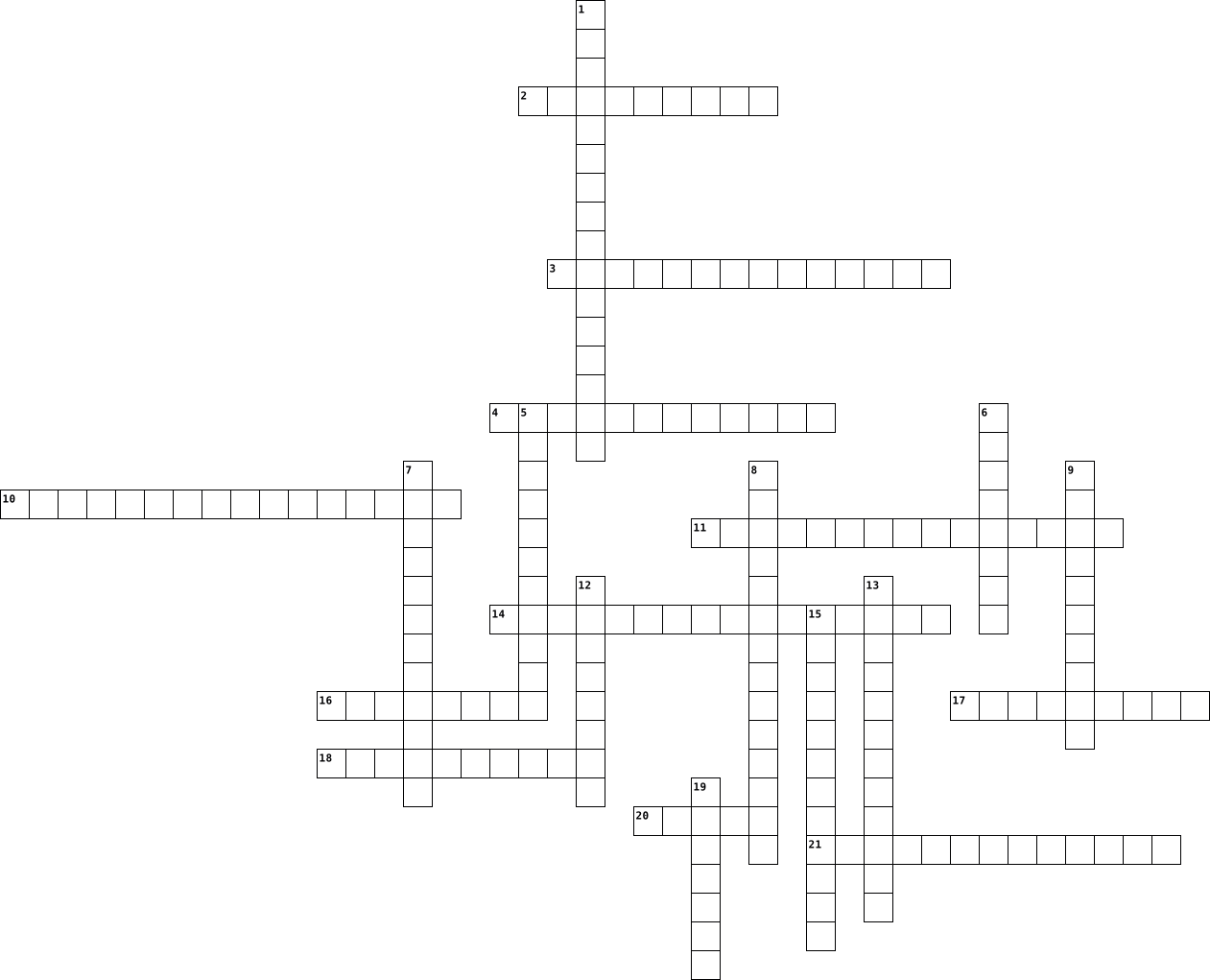
Across
- Machiavelli has shown a realistic approach to the principals of government and statesmanship in this compendium
- William Shakespeare is known for this romantic play since this time
- 'the father of modern science'
- written by Jonathan swift
- wealthiest family in Europe
- was stated by sir issac newton in his book.
- One of the chief centers of art in the renaissance
- scholars of renaissance
- his opinion was that the sun is static.
- mother mary mourning over the death of her child jesus
- the final meal that Jesus ate with his gospels captured in a plural painting
Down
- inventor of the printing press
- means rebirth or revival
- wars between the Christians and the Muslims
- discovered the process of blood circulation which was a boon to the modern medical science
- a painting made by Michelangelo which is a part of the ceiling of the Sistine chapel
- a great singer and musician who composed new songs
- a painting made by Leonardo da Vinci for Francesco del giocondo
- the first notable creation by Dante in Italian
- something greatly influenced by the style and pattern of ancient Greece and Rome.
- a great scientist who discovered 'carbon dioxide'
21 Clues: scholars of renaissance • means rebirth or revival • written by Jonathan swift • wealthiest family in Europe • inventor of the printing press • 'the father of modern science' • his opinion was that the sun is static. • wars between the Christians and the Muslims • was stated by sir issac newton in his book. • the first notable creation by Dante in Italian • ...
Renaissance Review 2022-02-07

Across
- The Arena Chapel was commissioned by Scrovengi to expiate the sin of _____________, which his family had committed.
- In Raphael’s School of Athens, the two central figures are ____________ and Aristotle.
- What is the last name of the person who “started” the Protestant Reformation?
- Gesu What is the name (two words) of the mother church of the Jesuits in Rome?
- What Italian artist was enormously popular in Northern Europe, even though he never traveled there?
- New technologies in ____________ made artists internationally popular, and more courted than ever before.
- Who was Botticelli’s teacher?
- Titian’s Venus of Urbino is significant in that it helped establish the tradition of the reclining nude, which became the given for the rest of _________ history.
- Altarpieces in northern Europe during the Renaissance were different from their Italian counterparts in that the northern works fold closed as if they were _____________.
- The prosperous commercial and _________ interests in the affluent trading towns of Flanders stimulated interest in the arts.
- What technique helped emphasize the sensuality and soft glowing flesh in Titian’s Venus of Urbino?
- In the north, religious art was deemphasized and still life, ________, landscape, and portraiture increased in popularity.
- The Entombment of Christ, by Jacopo da Pontormo, departs from High Renaissance painting in that it has exaggerated and _____________ figures.
- Northern European paintings had a fondness for depicting________ unknown in Italian art.
- During the Renaissance in Northern European paintings, typically figures are encased in the rooms they occupy, rather than being ___________ to their surroundings.
- _____ paint produces exceptionally rich colors, preserves well in wet climates, and is not quick-drying, thereby allowing artists to make changes.
- Botticelli’s Birth of Venus, the name for the west wind (which carries Chloris the nymph) is called ___________
- Mannerist architecture is known for its more playful style and ____________________ rhythms.
- Art from which area in the early 14th century had a MORE decorative look with thin, elegant figures, and drapery that flowed in ripples? (Siena or Florence)
- The word Renaissance means _____________.
- The Arena Chapel is innovative in the artist’s affinity for human __________ in Christian subject matter.
- The 3 most vital centers of Italian art during the Renaissance were Florence, Rome, and ___________.
- In da Vinci’s Last Supper, the curved pediment above the head of Christ could represent a __________.
- Mori What is the Latin term (two words) for an artistic or symbolic trope acting as a reminder of the inevitability of death
- The Palazzo Rucellai was designed by __________.
Down
- Fra Filippo Lippi’s Madonna and Child with Two Angels reflects the Renaissance’s attitude toward a more __________ and approachable interpretation of heavenly figures.
- Michelangelo’s sculpture, _______________, was commissioned to be placed in Old Saint Peter’s.
- Which word best describes Botticelli’s Birth of Venus? (Curvilinear, asymmetrical, or volumetric)
- What shape was a favorite of High Renaissance painters to layout their composition in?
- In Northern European Renaissance paintings, ground lines tilt up dramatically, as do table tops and virtually any flat surface. High __________ are the norm.
- In the Holy Trinity fresco, who kneels towards the bottom corners?
- What artist differed from his predecessors and contemporaries in that he mistrusted the application of mathematical methods as a guarantee of beauty, instead choosing to believe that the artist’s inspired judgment could identify other pleasing proportions?
- What is the term for a method of painting in gray monochrome, typically to imitate sculpture but can also be used as an underpainting?
- Which artist’s work contains the MOST elements/influence of the “Italo-Byzantine”? (Masaccio, Giotto, or Cimabue)
- Michelangelo’s Pieta was critiqued partly for how _________. and beautiful Mary looked.
- The Reformation caused a split within the Christian faith. Germany, Scandinavia, and the Netherlands became ________________.
- Which artist is considered to have launched the Italian Renaissance by painting people who truly appear more 3-dimensional rather than flat?
- In the Last Judgment of the Sistine Chapel, which Saint holds his own skin, a symbol of his martyrdom, and whose skin’s face is also a self-portrait of Michelangelo?
- Andrea Mantegna is noted for skills in creating trompe l’oeil illusions and extreme
- With a Protestant wave of anti-Catholic feeling came an _________ movement attacking paintings and sculptures of holy figures, which only a short while before were considered sacred.
- The first stock exchange was established in __________ in 1460.
- The development of linear perspective is generally credited to ___________?
- Greca What is the Italian term (two words) that refers to a style of painting based on Byzantine models that were popular in Italy in the twelfth and thirteenth centuries.
- Da Vinci is known for his technique of _______________ which results in shading that has a hazy look to it.
- Northern European artists were heavily influenced by __________ Gothic painting, a courtly elegant art form, begun by Italian artists such as Simone Martini in the fourteenth century.
- Although __________ can be seen in virtually any work of art in any historical period, it seems to be particularly a part of the fabric of Northern European painting.
46 Clues: Who was Botticelli’s teacher? • The word Renaissance means _____________. • The Palazzo Rucellai was designed by __________. • The first stock exchange was established in __________ in 1460. • In the Holy Trinity fresco, who kneels towards the bottom corners? • The development of linear perspective is generally credited to ___________? • ...
The renaissance 2013-10-06

Across
- focusing on human potential
- the everyday language of people in a region or country
- author of "The Prince"
- dutch humanist who wrote the praise of folly
- a political guidebook written by Machiavelli
- painter who painted the mona lisa and the last supper
- Italian poet who wrote poem and love letters
- considered one of the greatest English playwrights
- painted the school of Athens
- considered german Leonardo painted everyday life
Down
- created the famous sculpture David and painted Sistine chapel
- artistic technique that appears 3-D
- most powerful and wealthy family of patrons
- English author of utopia (last name)
- first movable type
- another name for bubonic plague
- cultural rebirth that started in Italy
- Spanish author of don Quixote
- worldly rather than spiritual matters
- person who supports the arts financially
20 Clues: first movable type • author of "The Prince" • focusing on human potential • painted the school of Athens • Spanish author of don Quixote • another name for bubonic plague • artistic technique that appears 3-D • English author of utopia (last name) • worldly rather than spiritual matters • cultural rebirth that started in Italy • person who supports the arts financially • ...
The Renaissance 2014-04-22

Across
- Venice had this type of government
- Painted the Sistine Chapel
- Said Sun was center of our planet system
- French word meaning "rebirth"
- The Medici family were this to artists
- Government by a few powerful people
- Appearance of distance on flat surface
- City with own government and forces
- Tells you what distances are on a map
- A true Renaissance Man
- Banking family in Florence
Down
- German invention that copies books
- Italy was the heartland for this empire
- Said that it's better to be feared than loved
- Important land features
- Solider for hire
- How banks make money
- The first reformer of the Church?
- Concern with the goals of human beings
- Internet meme or supreme ruler for life
20 Clues: Solider for hire • How banks make money • A true Renaissance Man • Important land features • Painted the Sistine Chapel • Banking family in Florence • French word meaning "rebirth" • The first reformer of the Church? • Venice had this type of government • German invention that copies books • Government by a few powerful people • City with own government and forces • ...
Renaissance Crossword 2013-02-19

Across
- The Pope and the government of the Roman Catholic Church.
- Means rebirth.
- Local languages.
- A government policy encouraging territorial or economic expansion into other territories.
- A person's first language.
- Focusing on collecting and using wealth, material goods and products.
- An artistic technique that uses a horizon line and a vanishing point to create the illusion of three dimensions.
- The nobility or people who have inherited titles (lord, lady, barroness...)
- A society with an economic system that depends on private investment and profit. Supply and Demand.
- The sense of safety, comfort, security, health and happiness that a person has in his or her life.
- The movement of population away from the country to the city.
- The leader of the Roman Catholic Church.
- A state where the power is held by the people or their representatives.
Down
- A member of any of the western Christian churches that are not Roman Catholic.
- A city that governs itself and the surrounding country side. Venice, Florence and Genoa are examples.
- A movement to reform the practices of the Roman Catholic Church. Lead by Martin Luther.
- A way of thinking focusing on the potential and worth of the human being.
- Also known as the black death.
- The bottom of the feudal heirarchy in Renaissance Europe.
- A policy of a nation to extend it's dominance by political, economic or military means.
- A network of trade routes extending from Europe to as far as China or Japan.
- The Christian belief that God consists of three parts. The father, son and the holy spirit.
- The eastern part of the Roman Empire in existence from the 4th to 15th centuries.
- An opinion against the beliefs of a given religion.
24 Clues: Means rebirth. • Local languages. • A person's first language. • Also known as the black death. • The leader of the Roman Catholic Church. • An opinion against the beliefs of a given religion. • The Pope and the government of the Roman Catholic Church. • The bottom of the feudal heirarchy in Renaissance Europe. • ...
The Renaissance 2015-04-23

Across
- Do what works
- Ordinary non-religious affairs are important
- poetry celebrating perfect chivalrous love
- Governments loved using the printing press for this
- A person is important for him-/ herself
- Patron who paid Michelangelo to paint his ceiling
- Humans and not only divine creatures are worth talking about
- Peter Lombard explained away all contradictions with his
- the Medicis were good ones
- churches as fortresses
- Cathedrals with stained glass Goths never saw
- His Christian Prince was more moral than pragmatic
Down
- The sum, or total, collection of knowledge on a topic
- A flying ____ braces a thin wall
- He told Princes how to rule
- EC: result of sharing a common enemy
- Means "Nowhere", not "Perfect Place"
- Not yet assumed to include skin and hair color
- Rebirth
- Germans' inventor of the printing press
- Used logic and reason to enhance faith
- Brunelleschi fought for the right to build
- starts to replace land as the basis of wealth
- black ones were considered pretty
- intermarried with Africans, and later explored Africa
- The Debate about Women today would be called ____
26 Clues: Rebirth • Do what works • churches as fortresses • the Medicis were good ones • He told Princes how to rule • A flying ____ braces a thin wall • black ones were considered pretty • EC: result of sharing a common enemy • Means "Nowhere", not "Perfect Place" • Used logic and reason to enhance faith • Germans' inventor of the printing press • A person is important for him-/ herself • ...
Renaissance Inventions 2015-04-19

Across
- A famous inventor who created the water thermometer.
- Galileo invented this type of thermometer.
- He invented the first parachute.
- This was made in 1300 and told time.
- This was made in 1400 and was used for a sport.
- Thomas Savery made this.
- Gutenberg invented this.
- Galileo's last name.
- These were made in 1487 and had something to do with bells.
- This uses pressure and was invented by Denis Papin in 1697.
- An idea or innovation someone comes up with.
- He made the first calculating machine.
- This was made for near-sighted people by Nicholas of Cusa.
Down
- He invented the compound microscope.
- He invented the first submarine.
- This invention was a new way to paint.
- The cuckoo clock was made here.
- Galileo was born here.
- A lot of inventions were made in this era.
- Bottled beer was made here.
- This was the name of the first piano.
21 Clues: Galileo's last name. • Galileo was born here. • Thomas Savery made this. • Gutenberg invented this. • Bottled beer was made here. • The cuckoo clock was made here. • He invented the first parachute. • He invented the first submarine. • He invented the compound microscope. • This was made in 1300 and told time. • This was the name of the first piano. • ...
The Renaissance 2015-11-19

Across
- English poet
- He had many jobs one being a theologian
- Archbishop of Canterbury
- She was the only child of Henry VIII
- First name Baldassare
- Dies at the age of 37
- Was a German blacksmith
- Was a U.S. foundering father
- King of England from 1509 until 1547
- Was an Italian polymath
- Was a queen
Down
- Was a ruler of the Spanish Empire from 1516
- often called the "Father of Humanism"
- A printmaker and theorist of the German Renaissance
- formulated the laws of motion as well as universal gravitation
- Was known as a English lawyer
- Was an Italian sculptor
- John
- A mathematician who played a major role in the scientific revolution
- Some called him the founder of modern political science
20 Clues: John • Was a queen • English poet • First name Baldassare • Dies at the age of 37 • Was an Italian sculptor • Was a German blacksmith • Was an Italian polymath • Archbishop of Canterbury • Was a U.S. foundering father • Was known as a English lawyer • She was the only child of Henry VIII • King of England from 1509 until 1547 • often called the "Father of Humanism" • ...
Renaissance Vocabulary 2016-11-23

Across
- The writer of the 95 theses
- Inventor of the printing press
- Different people living together in a community
- group of people that is brought together by the pursuit of a common goal
- How protestants became a religion out of the Catholic church
- The native language of a specific region
- A religion that muslim people follow
- Point of view that differ from people
- Conflict and war between different religions
- A religion based on the person or teaching of jesus
- Personal faith, trust or confidence about an idea. My ___ is in the catholic religion
- Author of the tragedy of Romeo and Juliet that changed the english language
- Gutenberg's famous invention
- A dictator that uses cruel or oppressive ways
- Women that wrote poetry and multiples books with advice for women
- A religion that jewish people follow
Down
- The idea of humans having values, needs, and responsibilities.
- Theory believed by the church, opposite theory of the heliocentric theory.
- Italian that invented a telescope and revolutionized the world of astronomy
- Princess of France that supported new and different ideas impacting the renaissance.
- A certificate that people would buy from the catholic church that would apparently make sure, you go to heaven.
- Created the theory that all planets revolve around the sun
- Also known as the Copernican theory
- Founder of the political science with humanism.
- death, especially on a large scale
- what defines Zodiac signs and the study of the movements of celestial bodies
- A social process when population move from a rural society to a city society.
- Artist of the Mona Lisa, that impacted the renaissance
- Scale were people were ranked depending on their family and the power they had.
- Belief or opinion that contradicts the Catholic religion.
- A person who journeys to a sacred place for religious reasons
31 Clues: The writer of the 95 theses • Gutenberg's famous invention • Inventor of the printing press • death, especially on a large scale • Also known as the Copernican theory • A religion that muslim people follow • A religion that jewish people follow • Point of view that differ from people • The native language of a specific region • Conflict and war between different religions • ...
Renaissance Vocab 2016-11-24

Across
- Important philosopher that paved the way for the age of enlightenment
- A popular way of speaking that became popular by gutenberg and martin luther
- A way of living used to try and combat the bubonic plague
- Controlled all of the kings and queens of europe
- Mass produced a vernacular bible
- An act or belief thought to have been punishable by the church
- Modernized english and theater throughout europe
- Nonreligious activities
- A french medieval author that wrote literature based on romance
- A technique first used in architecture but later implemented into art to create depth
- Used as a way to explain events based on the stars and planets
- Medieval model of government
- The main contributor that led to urbanization and the downfall of feudalism in europe
- Reformed a type of christianity based on the roman catholic church
- The model of the universe the church followed during the renaissance
- Type of treatment of people that cared about their “feelings” or something like that
Down
- Ages The time period before the renaissance
- Came up with the heliocentric theory
- A religiously influenced battle
- A way of forgiving sins opposed by the protestants
- Used to mass produce the Gutenberg bible (venicular bible)
- Wrote about a new perspective that influenced modern politics
- Opposed the geocentric system during the renaissance
- the religious victims of the spanish inquisition in 1480
- A way of life practiced through tradition or through prayer
- Had a big role in advancing religion by bringing in french perspective
- A way of painting used in famous pieces like “The last supper”
- Painted the most famous painting in the world
- The rebirth of the roman catholic church
- A system of government used in venice similar to democracy
- Long and distinctive period of time
31 Clues: Nonreligious activities • Medieval model of government • A religiously influenced battle • Mass produced a vernacular bible • Long and distinctive period of time • Came up with the heliocentric theory • The rebirth of the roman catholic church • Ages The time period before the renaissance • Painted the most famous painting in the world • ...
Renaissance Vocabulary 2016-11-24

Across
- She was an educated woman, very uncommon at the time. She wrote for a living and helped empower women.
- Come along with me, let’s go stake our claim to Jerusalem. It’s pretty much a suicide mission though.
- Invented by people in the islamic empire, this device helps people measure distances between stars and planets.
- He helped to prove the theory of heliocentricity, and his name is repeatedly screamed in bohemian rhapsody
- The black plague was one of these, killing ⅔ of the european population.
- A person who forcibly rules a nation, like Savonarola
- More people move out of the countryside and into Florence, Naples, Rome and other cities.
- A planetary system that orbits around the sun.
- He was a play writer and he was patronized by the medici family
- To be or not to be, that is the question.
- Step right up, step right up! Do you have any sins but still want to go to heaven? Get the Church’s guarantee today. Only 3 marks!
- Not christianity, these people sometimes controlled banks because they could charge interest. They had different holidays such as Purim, Rosh Hashanah, and Hanukkah.
- The way of ruling that would happen if savonarola's way of leading was mixed with the medicis way of ruling. Ruling forcibly.
- A person who pays you do make art.
Down
- The Queen of Navarre, she brought many great inventors, artists and thinkers into the court. She also protected them. The Prime Minister of the Poor, they called her.
- Moral beliefs, what you do based on these things that are important to you.
- He was the first man to come up with the theory of heliocentricity
- The base of the Feudal system was based of lots of peasants and these people. That is, until the black plague killed a bunch of them.
- Martin Luther was one of the biggest things that caused the ___________ of the protestant christian church
- Re-birth of art, architecture, literature and knowledge. What the time period is called.
- The church had ___________ over the people up until, and somewhat during the renaissance
- The man who remade the entire idea around religion. He had 95 theses.
- Movable metal type onto metal plates go onto this machine to print materials that spread knowledge throughout Europe.
- You know, the artist who took the world apart to see how it worked? Bonus clue: he created the Vitruvian man.
- German person who helped bring knowledge and understandable bibles to people everywhere with his invention.
- Painting and art to reflect people as they actually were. No more monster people. They actually looked real and could now interact with each other in the art.
- A planetary system that the church was certain about. Obviously, the universe orbits around earth!
- A system of government that was in power before the renaissance during the middle ages. A select few people were in charge.
- The time that was before the renaissance. The lack of art, literature and knowledge was fairly depressing.
- Gutenberg published many books in these native languages.
- A form of painting that hit its peak during the renaissance that uses watercolour on wet plaster. Fun fact: it didn't work well in venice because it was too damp
- Year 0 would be the first year in this. Before this time, we write things as BC or BCE.
32 Clues: A person who pays you do make art. • To be or not to be, that is the question. • A planetary system that orbits around the sun. • A person who forcibly rules a nation, like Savonarola • Gutenberg published many books in these native languages. • He was a play writer and he was patronized by the medici family • ...
Renaissance Vocabulary 2016-11-23

Across
- Ages The time that was before the renaissance. The lack of art, literature and knowledge was fairly depressing.
- martin luther was one of the biggest things that caused the ___________ of the protestant christian church
- Vinci You know, the artist who took the world apart to see how it worked? Bonus clue: he created the Vitruvian man.
- A planetary system that orbits around the sun.
- christianity, these people sometimes controlled banks because they could charge interest. They had different holidays such as Purim, Rosh Hashanah, and Hanukkah.
- Navarre The Queen of Navarre, she brought many great inventors, artists and thinkers into the court. She also protected them. The Prime Minister of the Poor.
- To be or not to be, that is the question.
- the church had ___________ over the people up until, and somewhat during the renaissance
- he was the first man to come up with the theory of heliocentricity
- he helped to prove the theory of heliocentricity, and his name is repeatedly screamed in bohemian rhapsody
- More people move out of the countryside and into Florence, Naples, Rome and other cities.
- he was a play writer and he was patronized by the medici family
- a person who pays you do make art, a great target for a scam artist
- Painting and art to reflect people as they actually were. No more monster people. They actually looked real and could now interact with each other in the art.
- Come along with me, let’s go stake our claim to Jerusalem. It’s pretty much a suicide mission though.
- The base of the Feudal system was based of lots of peasants and these people. That is, until the black plague killed a bunch of them.
Down
- the man who remade the entire idea around religion. He had 95 theses.
- Step right up, step right up! Do you have any sins but still want to go to heaven? Get the Church’s guarantee today. Only 3 marks!
- the way of ruling that would happen if savonarola's way of leading was mixed with the medicis way of ruling
- Year 0 would be the first year in this. Before this time, we write things as BC or BCE.
- The black plague was one of these, killing ⅔ of the european population.
- Re-birth of art, architecture, literature and knowledge. What the time period is called.
- A planetary system that the church was certain about. Obviously, the universe orbits around earth!
- German person who helped bring knowledge and understandable bibles to people everywhere with his invention.
- a system of government that was in power before the renaissance during the middle ages. A select few people were in charge.
- Gutenberg published many books in these native languages.
- a religion that has a holiday at the same time as christmas called hanukkah. A dictator once killed 6 million of them
- Moral beliefs, what you do based on these things that are important to you.
- Invented by people in the islamic empire, this device helps people measure distances between stars and planets.
- press Movable metal type onto metal plates go onto this machine to print materials that spread knowledge throughout Europe.
- A person who forcibly rules a nation, like Savonarola
- a form of painting that hit its peak during the renaissance that uses watercolour on wet plaster. Fun fact: it didn't work in venice because it was to damp
32 Clues: To be or not to be, that is the question. • A planetary system that orbits around the sun. • A person who forcibly rules a nation, like Savonarola • Gutenberg published many books in these native languages. • he was a play writer and he was patronized by the medici family • he was the first man to come up with the theory of heliocentricity • ...
Renaissance Vocabulary 2023-03-24

Across
- had 6 wives
- taking control over another country, occupying it with settlers, using it for economic gain
- dispute in which Ferdinand V wanted to end Protestantism
- Western Christian churches after the Reformation
- the enlightenment period during which there was a revival of art and literature from the 14th-16th centuries
- famous Renaissance sculptor and Ninja Turtle
- invented the printing press
- the focus of people from hardship to enjoying life
- Henry VIII created his own church because he wanted one of these.
- Name of church Henry VIII started
- country that supported Christopher Columbus' voyage to the New World
Down
- His discovery began an era of exploration and expansion of European powers throughout the Americas and the world.
- painted the ceiling on the Sistine Chapel and Ninja Turtle
- a person who gives money to support an organization or activity
- relating to the Latin church after the Reformation
- caused the Reformation and a new type of Christianity called Protestantism.
- Often called the true "Renaissance Man", he was an artist, scientist, sculptor, and architect
- The Protestant _____________ a religious reform movement that swept through Europe in the 1500s
- Separation of the state from religious institutions
- a machine for printing text or pictures from type or plates
- the language or dialect spoken by the ordinary people in a particular country or region.
- the action of officially excluding someone from participation in the sacraments and services of the Christian Church
22 Clues: had 6 wives • invented the printing press • Name of church Henry VIII started • famous Renaissance sculptor and Ninja Turtle • Western Christian churches after the Reformation • relating to the Latin church after the Reformation • the focus of people from hardship to enjoying life • Separation of the state from religious institutions • ...
Renaissance Crossword 2022-11-30

Across
- The historical period that inspired the Humanists.
- The holiest book in Christianity.
- The bankers of Florence.
- Belief in human progress through science and reflection.
- The Earth revolves around this.
- Wrote the 95 theses
- A set of arguments or complaints
- Painter of the Mona Lisa
- A person who buys art.
- Theory that the Earth revolves around the Sun.
- The old word for "scientist"
- The study of space.
Down
- He questioned the Pope's knowledge of the heavens.
- A court for convicting heretics.
- The art and science of building.
- A person of exceptional intelligence or ability.
- A person who opposes the teaching of the Bible.
- Another word for "point of view"
- A Christian revolutionary
- Another word for "not religious"
- Gutenberg invented the printing ________.
- The head of the Catholic Church.
22 Clues: Wrote the 95 theses • The study of space. • A person who buys art. • The bankers of Florence. • Painter of the Mona Lisa • A Christian revolutionary • The old word for "scientist" • The Earth revolves around this. • A court for convicting heretics. • The art and science of building. • Another word for "point of view" • A set of arguments or complaints • ...
Renaissance & Reformation 2023-01-18

Across
- "universal genius" studied many sciences, inventor and painter.
- imaginary grid of lines that help describe places on Earth.
- list and explanation of symbols on a map.
- wrote "The Prince," a great work in Political Science.
- French Protestants.
- the chief author of the Augsburg Confession.
- ideology that celebrates man as the ultimate creation can be God centered (Psalm 8) or man centered (Romans 1)
- first European to see the St. Lawrence River.
- Dutch priest who wanted to reform the Catholic Church, but not split from it.
- poem of 14 lines in iambic pentameter.
Down
- native empire of Mexico.
- Spanish explorer of Central America.
- Roman Catholic priest who led the Spanish Inquisition.
- religious movement that led to Protestantism.
- translated the Bible into English (he was burned at the stake.)
- type of art where pigment is mixed with plaster.
- father of the Italian renaissance.
- describes the Righteousness of Christ being "credited" to the believer.
- commander of the Nina.
- "rebirth" cultural movement classical Roman and Greek culture.
- an equal area map projection.
- belief that salvation is predestined.
- of the church where Luther posted his 95 Theses.
23 Clues: French Protestants. • commander of the Nina. • native empire of Mexico. • an equal area map projection. • father of the Italian renaissance. • Spanish explorer of Central America. • belief that salvation is predestined. • poem of 14 lines in iambic pentameter. • list and explanation of symbols on a map. • the chief author of the Augsburg Confession. • ...
Renaissance & Humanismus 2017-09-18

Across
- In welchem Land hat die Renaissance ihren Ursprung?
- Wer oder was rückte in der Frühen Neuzeit ins Zentrum der Betrachtung?
- Welche Gestalt nahmen die Gelehrten des Mittelalters für die Erde an?
- Wer erfand den Buchdruck?
- Die größtmögliche Kenntnis der ... eigneten sich viele Künstler durch das Sezieren von Leichen an.
- Welches Werk konnte mithilfe der Erfindung des Buchdrucks rasch vervielfältigt werden?
- Von diesem Künstler der Frühen Neuzeit stammt eines der berühmtesten Bilder der Welt, wie heißt es?
- Durch welche chinesische Erfindung erlebte die Kriegsindustrie einen Aufschwung?
- Was bedeutet das französische Wort Renaissance?
- In welcher Stadt wurde der Buchdruck erfunden?
- Diese chinesische Erfindung revolutionierte die Schiffsfahrt, welche war das?
Down
- Nenne den Nachnamen des italienischen Universalgenies.
- Wie heißt die Erfindung mit der man identische und einzelne Letter ausgießen konnte?
- Wer schuf die Fresken der Sixtinischen Kapelle?
- Die "Hauptstadt" der Renaissance war ...?
- Welcher Bildhauer erschuf die Skulptur des David?
- Wie nennt man die neuen Gelehrten?
- Welcher Gelehrte musste vor das Inquisitionsgericht in Rom weil er sich gegen das geozentrische Weltbild ausgesprochen hatte.
- Dieser Gelehrte verwarf das geozentrische Weltbild.
- Die Entdeckungsfahrten führten dazu, dass immer mehr sogenannte "Erdäpfel" hergestellt wurden - heute als ... bezeichnet.
- Sie galt bis zur Frühen Neuzeit als "Königin der Wissenschaft".
21 Clues: Wer erfand den Buchdruck? • Wie nennt man die neuen Gelehrten? • Die "Hauptstadt" der Renaissance war ...? • In welcher Stadt wurde der Buchdruck erfunden? • Wer schuf die Fresken der Sixtinischen Kapelle? • Was bedeutet das französische Wort Renaissance? • Welcher Bildhauer erschuf die Skulptur des David? • In welchem Land hat die Renaissance ihren Ursprung? • ...
The Renaissance 2017-09-20

Across
- the first _____ coexistence of Lutheranism and Catholicism
- of worms, the ________ was a decree, banning Luther’s writing
- reformation, Luther’s teachings fragmented the catholic church beginning the _________
- Luther hung the 95 theses on church____
- Humanism brought the idea of _______ to wester civilization
- Machiavelli taught to learn to let your conscience _____
- one of the most influential city stated due to the Medici families love of the arts
- Italy also became the starting point of the renaissance because it was abundant in ______ who looked into Greek and Roman Text
- Machiavelli also taught to use ____ over love
- de’ Medici, first Medici Ruler of Florence
- many artisans and _____ were guided by humanism or hired by humanism enthusiasts
- father of humanism
- press, the 95 theses was successful in part to the use of the ___________, which made it more widely publicized
- prince, a famous book written by Niccolo Machiavelli
- The renaissance was a time when people began looking into a more _____ type of world
- The _____ family were the ruling merchants over Florence
- the church developed by Luther’s followers
- questions the catholic church
- de’ Medici, one Medici forced into exile
Down
- Petrarch wrote many ____ and was considered one of the best in all of Italy
- of Augsburg, the law saying Lutherans and Catholics can worship as they will
- The preferred language to write in for Petrarch
- the Medici family gained its power due to their immense _______
- literature education architecture, The Renaissance brought trade that financed these (four words-must be in correct order)
- Italy was caught between the _____ with the European and Asian people
- The rebirth of ideas of the romans and Greeks
- Luther believed that it was not the ____ that saved people but by Gods divine grace
- the these was also successful also to the ______ tone vs the harsh aggressive
- the peace of Augsburg ____ the empire from multiple conflicts for over 50 years
- de’ Medici, grandson of Cosimo
- and Roman, Petrarch recovered many ____ __ ____ manuscripts
- The lack of _____ allowed merchant families to gain power over different city states
- Lorenzo hired lots of_____ like Leonardo de Vinci, Michelangelo, Botticelli
- the edict of worms _______ the authority of the pope
- Luther vowed to become a monk if he survived a ______
- the basis of Machiavelli teachings was on how to be and ______ leader
- Cosimo sought to make Florence one of the most _____ city states in the country
- Luther also translated the ______ making available to the entire public
- The Medici family produce ______ popes
- Luther wrote the 95 theses that said that salvation came from_____ and divine grace
- A way of thinking that the human race was the center of the universe and had great potential-focused on individual worth
- the Edict of Worms labeled Luther as a ____ and enemy of the state
42 Clues: father of humanism • questions the catholic church • de’ Medici, grandson of Cosimo • The Medici family produce ______ popes • Luther hung the 95 theses on church____ • de’ Medici, one Medici forced into exile • de’ Medici, first Medici Ruler of Florence • the church developed by Luther’s followers • The rebirth of ideas of the romans and Greeks • ...
The Renaissance 2020-11-02

Across
- he created the printing press allowing commoners to have access to books for the first time in almost 1000 years
- translations of the __ texts into Latin by Byzantine scholars allowed the explosion of learning and art during the Renaissance
- English humanist whose Utopia depicted an imaginary place without war and corruption
- sculptor, poet, architect, and painter who made Saint Peter's Basilica, the State of David, and painted the Sistine Chapel ceiling. Particularly good at showing the human body as it really was.
- known for pioneering oil-based painting, developing new techniques to add subtlety to colors
- The Italian ___ and the church sponsored great works of art.
- the development of __ which came to Europe from Asia made writing books and printing in larger quantities possible
- writer whose Decameron described realistic characters through tragic and comedic stories
- painter known for his use of perspective; often used the Madonna and child as a subject; painted the School of Athens
- known for woodcuts and engravings portraying religious subjects, classical myths, and realistic landscapes
- __ returned to much of the continent after centuries of war allowing trade and ideas to flow freely
- questioning everything, because you trust nothing to be fully credible
- the "rebirth" of classical, Greek and Roman, knowledge and culture
- woman poet who exchanged sonnets with Michelangelo and helped Castiglione publish The Courtier
Down
- a way of showing three dimensions on a flat surface
- an intellectual movement, based on the study of Greek and Roman texts, that emphasized individualism and human achievement
- English playwright who drew upon the classics for stories and inspiration; writings showed humanity in its glory and flaws
- painter, scientist, inventor, and sculptor who was known as a true "Renaissance Man", made the Mona Lisa and The Last Supper
- first woman to achieve an international reputation; known for her portraits of royalty
- writer whose The Prince offered realistic, but not moral, advice to rulers on how to get and keep political power
- written language in your native language (what is spoken locally); allowed more people to have access to knowledge
- worldly rather than spiritual, and concerned with the here and now
- increased __ with the Middle East allowed Italian Merchants to become wealthy enough to pay for great works of art
- Bankers and other merchants like the Medici family paid for artists to make secular works of art
- Artists used perspective, oil based paints, and other techniques to make their subjects look ___, unlike Middle Ages artists which were more symbolic
- early and influential humanist who wrote sonnets, poems, in Italian vernacular and Latin
26 Clues: a way of showing three dimensions on a flat surface • The Italian ___ and the church sponsored great works of art. • worldly rather than spiritual, and concerned with the here and now • the "rebirth" of classical, Greek and Roman, knowledge and culture • questioning everything, because you trust nothing to be fully credible • ...
Renaissance crossword 2020-10-09

Across
- an artist's importance is measured in...
- it's linked to light
- the start of the renaissance
- a particular method for scientific studies
- a way of leading a country
- a belief that your life shouldn't be too dedicated to God
- supporting the arts by funding them
- he made a clock
- a man named Vesalius did this
Down
- how humans work
- religion should be separate from the gouverment
- another art technique that was revolutionary
- Newtons's most imporant find
- Copernicus invented this theory
- Ptolemy came up with it
- an art technique
- a theory that you control your life
- the highest point in the renaissance
- the look of a specific part of something
- a type of poetry
20 Clues: how humans work • he made a clock • an art technique • a type of poetry • it's linked to light • Ptolemy came up with it • a way of leading a country • Newtons's most imporant find • the start of the renaissance • a man named Vesalius did this • Copernicus invented this theory • a theory that you control your life • supporting the arts by funding them • ...
Northern Renaissance 2021-03-07

Across
- known for his woodblock prints
- donquixote mocking middle ages
- gargantua mocking middle ages
- sun is center of universe
- painted commoners in everyday life
- Built a printing press
- proved Copernicus was correct
- new type of paint begun by van Eyck
- combination of religion and humanism
- planets orbited in elliptical shape
- said the sun was the center of the universe
Down
- english playwrite and poet
- earth is center of universe
- a reason the Renaissance spread north
- painted famous portraits
- scientists studied them to learn more
- humanist wrote about Church reforms
- scientific method
- painting technique in Italy
- Increased thanks to the printing press
- gravity and laws of motion
21 Clues: scientific method • Built a printing press • painted famous portraits • sun is center of universe • english playwrite and poet • gravity and laws of motion • earth is center of universe • painting technique in Italy • gargantua mocking middle ages • proved Copernicus was correct • known for his woodblock prints • donquixote mocking middle ages • painted commoners in everyday life • ...
Renaissance/Reformation 2021-09-14

Across
- Excuses; false reasons
- Intellectual movement emphasizing the individual
- Settlement reached with each side giving up
- Property or inheritance
- Group of people with similar religious beliefs
- Declaration of a deceased person to be a saint
- System of government in which priests rule
- Financial supporter
- Give up or take back
- Drawing solid objects on a 2d surface
- The everyday language of a group of people
Down
- Dominant social system in medieval Europe
- Formally excluding someone from a Church
- hostility towards a person/group
- Descriptive of an ideal society
- Remission of sins by payment or service.
- Art style consisting of realistic representation
- far-reaching or thorough
- Divine foreordination
- Separation of the state from religion
20 Clues: Financial supporter • Give up or take back • Divine foreordination • Excuses; false reasons • Property or inheritance • far-reaching or thorough • Descriptive of an ideal society • hostility towards a person/group • Separation of the state from religion • Drawing solid objects on a 2d surface • Formally excluding someone from a Church • Remission of sins by payment or service. • ...
Renaissance Vocabulary 2022-10-27

Across
- skilled craftworker
- adverse or hostile reaction against change
- a portion of crops or percentage of earnings paid to the church
- the system of political organization during the Middle Ages
- a person who adopts a system of thought that centres on humans and their values, capacities, and worth; concern with the interests, needs, and welfare of humans
- a religious movement to change or reform the Roman Catholic Church that resulted in the establishment of some other Christian religions, such as the Lutheran church
- travel completely around something, as in circumnavigating the globe
- one who studies the truth and principles underlying human conduct and knowledge and nature of the universe
- a politically independent city and the rural area or hinterland around it
- peasants who worked the land for the lord and were not allowed to leave the manor without the lord's permission
- relating to citizenship or civic affairs
- certificates that reduced the time people would be punished for their sins after they died
- a person who has learned a trade and joined a guild
- a disease that spreads rapidly and affects many individuals at the same time
- to spread information
- a person who is willing to die for their beliefs
Down
- the practice of charging interest when loaning money to someone
- a crafty person who seeks and holds power by any means possible
- official exclusion from the Catholic church
- laws that controlled consumption or how people spent their money
- adopting the culture and ideas of the western world
- a social system in which status is ranked and power is concentrated in the higher ranks
- a person who draws maps
- the extension of power over a territory, including its resources and people
- a type of prejudice
- loyalty
- the actions and attitudes of a state or country whose goal is to expand its power and territory
- opposing church teachings
- building and lands in which monks lived and carried out their religious duties
- the language commonly spoken by the people who live in that region
30 Clues: loyalty • skilled craftworker • a type of prejudice • to spread information • a person who draws maps • opposing church teachings • relating to citizenship or civic affairs • adverse or hostile reaction against change • official exclusion from the Catholic church • a person who is willing to die for their beliefs • adopting the culture and ideas of the western world • ...
Renaissance Crossword 2016-11-29

Across
- court writer and medieval author
- Authority of the Pope
- Princess of france
- Flying machines
- The Vitruvian Man
- Mass producing literature
- Started heliocentrism
- Invented the Printing Press
- Godfathers of the ___________
- Galileo was Under House Arrest for ______
- Dialect of a country
- Discovered Jupiter's biggest moons.
- Wrote the second “the art of war’
- Non-Religious idea
- A Building for Worshipping
- Centered Around the earth
- Navigational Disk
- An investor
Down
- Expedition to recover The Holy Land
- A Man Journeying for the Holy Land
- Higher Class in the Feudal System
- The rule of the merchant class
- A Tyrant
- Centered around the sun
- Luther's Protestant ___________
- A fatal epidemic
- Romeo and Juliet
- Wrote 95 theses
- Not Immortal
- A group of merchants is known as a _____
- Michelangelo's Ceiling paintings.
31 Clues: A Tyrant • An investor • Not Immortal • Flying machines • Wrote 95 theses • A fatal epidemic • Romeo and Juliet • The Vitruvian Man • Navigational Disk • Princess of france • Non-Religious idea • Dialect of a country • Authority of the Pope • Started heliocentrism • Centered around the sun • Mass producing literature • Centered Around the earth • A Building for Worshipping • ...
Renaissance crossword 2016-11-28

Across
- power held by people/representatives
- the way things are commonly done
- The printing press
- Who a person is
- A common culture
- Founder of modern political science
- something a person can’t compromise
- 4th - 14th century
- the making of new cities
- to be or not to be
- Gutenberg's invention
- The guy who died before he proved anything
- Something a person believes in
- recreated Christianity
- Princess of France
- Italian french author
Down
- thoughts and values of humans
- A fake piece of paper that gets you into heaven
- a theory proved wrong by Copernicus
- Language
- A theory proved by Copernicus
- A Rebirth
- The process of recreating a practice
- Different views on different things
- the study of space
- an astronomer
- a recovery of land for religious values
- A renaissance man who invented many useful things
- a religion spread by the prophet Muhammad
29 Clues: Language • A Rebirth • an astronomer • Who a person is • A common culture • The printing press • 4th - 14th century • to be or not to be • the study of space • Princess of France • Gutenberg's invention • Italian french author • recreated Christianity • the making of new cities • thoughts and values of humans • A theory proved by Copernicus • Something a person believes in • ...
Renaissance crossword 2016-11-28

Across
- thoughts and values of humans
- The printing press
- Language
- A renaissance man who invented many useful things
- to be or not to be
- something a person can’t compromise
- 4th - 14th century
- a religion spread by the prophet Muhammad
- the study of space
- A common culture
- A theory proved by Copernicus
- Italian french author
- an astronomer
- The process of recreating a practice
- The guy who died before he proved anything
- Princess of France
- power held by people/representatives
Down
- the way things are commonly done
- a recovery of land for religious values
- A Rebirth
- A fake piece of paper that gets you into heaven
- Who a person is
- a theory proved wrong by Copernicus
- the making of new cities
- Something a person believes in
- Gutenberg's invention
- Different views on different things
- Founder of modern political science
- recreated Christianity
29 Clues: Language • A Rebirth • an astronomer • Who a person is • A common culture • The printing press • to be or not to be • 4th - 14th century • the study of space • Princess of France • Gutenberg's invention • Italian french author • recreated Christianity • the making of new cities • thoughts and values of humans • A theory proved by Copernicus • Something a person believes in • ...
Renaissance crossword 2016-11-28

Across
- the study of space
- something a person can’t compromise
- The process of recreating a practice
- Who a person is
- 4th - 14th century
- A theory proved by Copernicus
- A Rebirth
- recreated Christianity
- Founder of modern political science
- Language
- an astronomer
- a theory proved wrong by Copernicus
- to be or not to be
- Princess of France
- A common culture
- power held by people/representatives
- a recovery of land for religious values
Down
- The guy who died before he proved anything
- the making of new cities
- thoughts and values of humans
- A fake piece of paper that gets you into heaven
- Different views on different things
- Gutenberg's invention
- Something a person believes in
- The printing press
- Italian french author
- A renaissance man who invented many useful things
- the way things are commonly done
- a religion spread by the prophet Muhammad
29 Clues: Language • A Rebirth • an astronomer • Who a person is • A common culture • the study of space • 4th - 14th century • The printing press • to be or not to be • Princess of France • Gutenberg's invention • Italian french author • recreated Christianity • the making of new cities • thoughts and values of humans • A theory proved by Copernicus • Something a person believes in • ...
Renaissance Crossword 2016-11-28

Across
- Investing in someone
- Centered Around the earth
- Navigational Disk
- Romeo and Juliet
- Mass producing literature
- Dialect of a country
- A Building for Worshipping
- Princess of france
- Higher Class in the Feudal System
- Invented the Printing Press
- Flying machines
- The Vitruvian Man
- A group of merchants is known as a _____
- Wrote 95 theses
- A Class of Wealthy Merchants
Down
- Expedition to recover The Holy Land
- Discovered Jupiter's biggest moons.
- Godfathers of the ___________
- A Tyrant
- Galileo was Under House Arrest for ______
- The Ceiling of the Sistine Chapel
- Centered around the sun
- Luther's Protestant ___________
- Started heliocentrism
- A fatal epidemic
- Not Immortal
- Authority of the Pope
- court writer and medieval author
- Non-Religious idea
- A Man Journeying for the Holy Land
30 Clues: A Tyrant • Not Immortal • Flying machines • Wrote 95 theses • Romeo and Juliet • A fatal epidemic • Navigational Disk • The Vitruvian Man • Princess of france • Non-Religious idea • Investing in someone • Dialect of a country • Started heliocentrism • Authority of the Pope • Centered around the sun • Centered Around the earth • Mass producing literature • A Building for Worshipping • ...
Renaissance Crossword 2016-11-28

Across
- Princess of france
- Navigational Disk
- The Vitruvian Man
- A group of merchants is known as a _____
- Luther's Protestant ___________
- Centered around the sun
- Dialect of a country
- Expedition to recover The Holy Land
- Galileo was Under House Arrest for ______
- Authority of the Pope
- A fatal epidemic
- Higher Class in the Feudal System
- A Man Journeying for the Holy Land
- A Building for Worshipping
- court writer and medieval author
Down
- Centered Around the earth
- Godfathers of the ___________
- The Ceiling of the Sistine Chapel
- Started heliocentrism
- A Class of Wealthy Merchants
- Not Immortal
- Mass producing literature
- Wrote 95 theses
- Romeo and Juliet
- Discovered Jupiter's biggest moons.
- Invented the Printing Press
- Investing in someone
- A Tyrant
- Non-Religious idea
- Flying machines
30 Clues: A Tyrant • Not Immortal • Wrote 95 theses • Flying machines • Romeo and Juliet • A fatal epidemic • Navigational Disk • The Vitruvian Man • Princess of france • Non-Religious idea • Dialect of a country • Investing in someone • Started heliocentrism • Authority of the Pope • Centered around the sun • Centered Around the earth • Mass producing literature • A Building for Worshipping • ...
Renaissance Crossword 2016-11-28

Across
- Centered Around the earth
- Flying machines
- Started heliocentrism
- Investing in someone
- Expedition to recover The Holy Land
- Centered around the sun
- Navigational Disk
- Wrote 95 theses
- A group of merchants is known as a _____
- Godfathers of the ___________
- Invented the Printing Press
- Higher Class in the Feudal System
- Non-Religious idea
- Galileo was Under House Arrest for ______
Down
- A Tyrant
- The Vitruvian Man
- The Ceiling of the Sistine Chapel
- A fatal epidemic
- Discovered Jupiter's biggest moons.
- Authority of the Pope
- Not Immortal
- Mass producing literature
- court writer and medieval author
- A Man Journeying for the Holy Land
- Romeo and Juliet
- Luther's Protestant ___________
- Princess of france
- A Class of Wealthy Merchants
- Dialect of a country
- A Building for Worshipping
30 Clues: A Tyrant • Not Immortal • Flying machines • Wrote 95 theses • A fatal epidemic • Romeo and Juliet • The Vitruvian Man • Navigational Disk • Princess of france • Non-Religious idea • Investing in someone • Dialect of a country • Authority of the Pope • Started heliocentrism • Centered around the sun • Centered Around the earth • Mass producing literature • A Building for Worshipping • ...
Renaissance Crossword 2016-11-28

Across
- Discovered Jupiter's biggest moons.
- Started heliocentrism
- Investing in someone
- Centered Around the earth
- Dialect of a country
- Godfathers of the ___________
- Authority of the Pope
- Navigational Disk
- Not Immortal
- Centered around the sun
- A fatal epidemic
- A Class of Wealthy Merchants
- court writer and medieval author
Down
- Galileo was Under House Arrest for ______
- A group of merchants is known as a _____
- Invented the Printing Press
- The Ceiling of the Sistine Chapel
- Higher Class in the Feudal System
- The Vitruvian Man
- Flying machines
- A Man Journeying for the Holy Land
- Non-Religious idea
- A Tyrant
- Luther's Protestant ___________
- Mass producing literature
- Romeo and Juliet
- Expedition to recover The Holy Land
- Wrote 95 theses
- A Building for Worshipping
- Princess of france
30 Clues: A Tyrant • Not Immortal • Flying machines • Wrote 95 theses • Romeo and Juliet • A fatal epidemic • The Vitruvian Man • Navigational Disk • Non-Religious idea • Princess of france • Investing in someone • Dialect of a country • Started heliocentrism • Authority of the Pope • Centered around the sun • Centered Around the earth • Mass producing literature • A Building for Worshipping • ...
Renaissance Crossword 2016-11-28

Across
- Creator of “Romeo and Juliet”.
- This happened after Luther nailed the 95 theses to churches.
- Canada’s nation is ______
- People being ranked above one another.
- Someone who believed that faith in god would get you to heaven, not good works on earth.
- When a society moves into a city
- Navarre Believed that the bible should be translated into French.
- Something you think is the truth
- A receipt to heaven.
- The Medici are “godfathers” of this.
- The theory that the sun revolves around the earth.
- Power is held by the individual or their representative.
- Vinci Created the painting called “The Last Supper” and the “Mona Lisa”.
- A country's native language
- A group of people linked by common activities or interests
- An expedition/campaign for a cause
Down
- Pizan First woman in the west that made a living by writing.
- The theory that the earth revolves around the sun.
- Another word for your moral standard or principle
- A political philosopher that was a part of the famous and talented of Firenza.
- Invented the printing press.
- Nobles, Kings, and Peasants are a part of this government ranking which the merchants destroyed
- Someone who makes journeys to a holy place.
- The middle ages are this so is the renaissance and the Roman Empire.
- The growth of this idea power of monarchs in northern Europe led to competition with the church.
- Filippo Brunelleschi was the first person to use this concept
- A person who provides financial support.
- He “created” the telescope and studied the universe
- Created the Heliocentric theory.
- press After creation people didn't have to hand copy books.
- Some medical doctors believed that health was linked to this.
31 Clues: A receipt to heaven. • Canada’s nation is ______ • A country's native language • Invented the printing press. • Creator of “Romeo and Juliet”. • When a society moves into a city • Something you think is the truth • Created the Heliocentric theory. • An expedition/campaign for a cause • The Medici are “godfathers” of this. • People being ranked above one another. • ...
Renaissance Crossword 2016-11-28

Across
- A receipt to heaven.
- Nobles, Kings, and Peasants are a part of this government ranking which the merchants destroyed
- Something you think is the truth
- People being ranked above one another.
- Pizan First woman in the west that made a living by writing.
- Invented the printing press.
- This happened after Luther nailed the 95 theses to churches.
- The Medici are “godfathers” of this.
- The theory that the earth revolves around the sun.
- press After creation people didn't have to hand copy books.
- Someone who believed that faith in god would get you to heaven, not good works on earth.
- Vinci Created the painting called “The Last Supper” and the “Mona Lisa”.
- A group of people linked by common activities or interests
- Someone who makes journeys to a holy place.
Down
- Created the Heliocentric theory.
- He “created” the telescope and studied the universe
- Filippo Brunelleschi was the first person to use this concept
- A political philosopher that was a part of the famous and talented of Firenza.
- Power is held by the individual or their representative.
- Canada’s nation is ______
- Creator of “Romeo and Juliet”.
- Another word for your moral standard or principle
- The theory that the sun revolves around the earth.
- When a society moves into a city
- A person who provides financial support.
- Navarre Believed that the bible should be translated into French.
- Some medical doctors believed that health was linked to this.
- A country's native language
- An expedition/campaign for a cause
- The growth of this idea power of monarchs in northern Europe led to competition with the church.
- The middle ages are this so is the renaissance and the Roman Empire.
31 Clues: A receipt to heaven. • Canada’s nation is ______ • A country's native language • Invented the printing press. • Creator of “Romeo and Juliet”. • Created the Heliocentric theory. • When a society moves into a city • Something you think is the truth • An expedition/campaign for a cause • The Medici are “godfathers” of this. • People being ranked above one another. • ...
Renaissance Review 2018-01-21

Across
- Bamberg ______, name of equestrian statue in Bamberg Cathedral.
- Relief sculpture on Strasbourg Cathedral: Death of the ______.
- Name of chapel with paintings by Giotto.
- Cathedral with Eckhart and Uta.
- First painting to use correct perspective.
- Dome designer.
- Painted The Annunciation with a solid gold background.
- City central to the "re-birth" of art and architecture.
Down
- Sculpted first full nude since ancient Roman times.
- Cathedral on which a sculpture of the Virgin Mary is done with contrapposto.
- Invented as a way to draw perfectly accurate sketches of the Pantheon.
- In the trio of friends that began the Renaissance he was the painter.
- Name of artistic style which continued Byzantine characteristics through the 14th century.
- Giotto's teacher.
- Building on which the various guilds displayed sculptures of their patron saints.
- Devout student of the works of Archimedes.
- Sculpted St. George for the armorer's guild.
- Iconic symbol of the Renaissance: Vitruvian ____
- Painting in which a dead tree symbolizes the cross: The __________ of Christ.
- Italian town in which Pisano sculpted his famous Baptistery art.
- "Well of Moses" sculptor.
21 Clues: Dome designer. • Giotto's teacher. • "Well of Moses" sculptor. • Cathedral with Eckhart and Uta. • Name of chapel with paintings by Giotto. • Devout student of the works of Archimedes. • First painting to use correct perspective. • Sculpted St. George for the armorer's guild. • Iconic symbol of the Renaissance: Vitruvian ____ • ...
Renaissance Review 2018-01-21

Across
- Giotto's teacher.
- Sculpted first full nude since ancient Roman times.
- Sculpted St. George for the armorer's guild.
- City central to the "re-birth" of art and architecture.
- First painting to use correct perspective.
- Painted The Annunciation with a solid gold background.
- Building on which the various guilds displayed sculptures of their patron saints.
- Dome designer.
- Italian town in which Pisano sculpted his famous Baptistery art.
- Relief sculpture on Strasbourg Cathedral: Death of the ______.
Down
- Iconic symbol of the Renaissance: Vitruvian ____
- Invented as a way to draw perfectly accurate sketches of the Pantheon.
- Name of artistic style which continued Byzantine characteristics through the 14th century.
- Painting in which a dead tree symbolizes the cross: The __________ of Christ.
- "Well of Moses" sculptor.
- Cathedral with Eckhart and Uta.
- Name of chapel with paintings by Giotto.
- In the trio of friends that began the Renaissance he was the painter.
- Devout student of the works of Archimedes.
- Cathedral on which a sculpture of the Virgin Mary is done with contrapposto.
- Bamberg ______, name of equestrian statue in Bamberg Cathedral.
21 Clues: Dome designer. • Giotto's teacher. • "Well of Moses" sculptor. • Cathedral with Eckhart and Uta. • Name of chapel with paintings by Giotto. • First painting to use correct perspective. • Devout student of the works of Archimedes. • Sculpted St. George for the armorer's guild. • Iconic symbol of the Renaissance: Vitruvian ____ • ...
Renaissance Crossword 2023-05-11

Across
- technique of showing objects in space on a flat surface. Perspective produces the impression of distance and size
- large roof or ceiling in the fronts of a hemisphere. The architectural device was developed by the Romans and further referred during the Italian Renaissance
- prints taken from an engraved hard surface such as metal, mood, or sphene
- study of body structure. Renaissance artist began to look closely at the way bones and muscles indicate movement and variation
- painting or drawing or sculpture of a person sometimes the head and shoulders only, sometimes the entire body. Shows a revival of the individuals worth
- art concerned with religion
- paints paints made from ground pigments that are mixed together with linseed oil. Oil painting makes possible extremely subtle differences
- a large painting on the wall
- painting technique: no harsh lines or edges, areas blend into each other
- pouring molten metal into a mold
- make the second qualification)
- in fine art, refers to a full scale preparatory drawing on heavy paper
- an artist who is known as a teacher or is though of the best
- someone who gives an artist money to live on while the artists creates
- "light/dark" use of light and shadow to define form, lighter parts seem to emerge from darker areas; produces three dimensional effect
Down
- natural substances used for making colors pigments come from earth, insects, flowers
- a way of printing directly unto plastered walls. Pilgrims are absorbed into one wall. The picture is also called a recco. In Italian, "fresh"
- art style in which the real appearance of things is faithfully shown
- student who lives, works, and studies with a master to become an an artist by trade and career
- any material with which the artist works
- the way forms are arranged on a surface
- painting made with pigments mixed with egg yolk or water
- platform structure built to reach high places
- relating to the ancient Greeks and Romans
- type of metal made of tin and copper
- art form that is three dimensional and may be carved, molded, constructed, or casted
- figure standing with weight tilted to one leg. Makes the figure seem more natural
27 Clues: art concerned with religion • a large painting on the wall • make the second qualification) • pouring molten metal into a mold • type of metal made of tin and copper • the way forms are arranged on a surface • any material with which the artist works • relating to the ancient Greeks and Romans • platform structure built to reach high places • ...
The Renaissance 2023-05-29

Across
- de Cervantes
- Milton
- da Vinci
- Kepler
- Alighieri
- Copernicus
- Erasmus
- More
- Bocaccio
Down
- Machiavelli
- de' Medici
- Petrarca
- Santi
- Shakespeare
- Descartes
- Botticelli
- Agricola
- Isaac Newton
- Chauser
- Galilei
20 Clues: More • Santi • Milton • Kepler • Erasmus • Chauser • Galilei • Petrarca • da Vinci • Agricola • Bocaccio • Descartes • Alighieri • de' Medici • Botticelli • Copernicus • Machiavelli • Shakespeare • de Cervantes • Isaac Newton
The Renaissance 2023-05-29

Across
- Siya ay isang Italyano na pintor at arkitekto ng High Renaissance period.
- Siya ay isang English na makata at polemicist na kilala sa kanyang epikong tula na "Paradise Lost".
- Siya ay isang makatang Italyano na kilala sa kanyang epikong tula na "The Divine Comedy."
- Siya ay isang Ingles na may-akda, makata, at pilosopo na pinakakilala sa kanyang akda na "The Canterbury Tales".
- Siya ay isang Italyano na estadista at pinuno ng Florentine Republic sa panahon ng Italian Renaissance.
- Siya ay isang German humanist scholar at pilosopo na nabuhay noong panahon ng Renaissance.
- Siya ay isang Dutch na pilosopo, teologo, at manunulat na kilala sa kanyang aklat na "The Praise of Folly."
- Siya ay isang Italyano na artista, imbentor, at polymath na ipinanganak noong Abril 15, 1452.
- Siya ay isang English physicist, mathematician, at astronomer na kilala sa kanyang mga batas ng paggalaw at unibersal na grabitasyon.
- Siya ay isang Polish na astronomo na nagmungkahi ng teorya na ang araw, sa halip na ang lupa, ang sentro ng uniberso.
- Siya ay isang Italyano na pintor ng Early Renaissance na kilala sa kanyang mga painting na "The Birth of Venus" at "Primavera."
Down
- Siya ay isang English playwright at makata na malawak na itinuturing bilang isa sa mga pinakadakilang manunulat sa wikang Ingles.
- Siya ay isang Italyano na diplomat, pilosopo, at manunulat na kilala sa kanyang aklat na “The Prince” na nagbabalangkas ng mga prinsipyo sa pamamahala.
- Siya ay isang Italyano na iskolar at makata na nabuhay noong ika-14 na siglo.
- Siya ay isang English lawyer, social philosopher, at Renaissance humanist na kilala sa kanyang aklat na "Utopia."
- Siya ay isang Pranses na pilosopo, matematiko, at siyentipiko na kilala sa kanyang pariralang "Sa tingin ko, samakatuwid ako ay" at ang kanyang mga kontribusyon sa algebra at analytic geometry.
- Siya ay isang Italyano na manunulat at makata na kilala sa kanyang akda na "The Decameron."
- Siya ay isang Italyano na pisiko at astronomo na gumanap ng malaking papel sa Rebolusyong Siyentipiko.
- Siya ay isang German mathematician, astronomer, at astrologo na kilala sa kanyang mga batas ng planetary motion.
- Siya ay isang Espanyol na manunulat na kilala sa kanyang nobelang "Don Quixote".
20 Clues: Siya ay isang Italyano na pintor at arkitekto ng High Renaissance period. • Siya ay isang Italyano na iskolar at makata na nabuhay noong ika-14 na siglo. • Siya ay isang Espanyol na manunulat na kilala sa kanyang nobelang "Don Quixote". • Siya ay isang makatang Italyano na kilala sa kanyang epikong tula na "The Divine Comedy." • ...
Renaissance Vocab 2024-01-18

Across
- belief that science and evidence should be used to understand the world
- allowed people to be forgiven of sins when they paid the church money
- set of beliefs
- the measurable size of something
- (two words) printing type made up of individual pieces each with its on letter
- not religious
- the importance of uniqueness of an individual
- (two words) a number that when multiplied by itself gives you that given value
- a person who gives support
- christian church that is the home of a bishop
- accurate depictions of life and its problems
Down
- everyday language including slang
- government by god
- the way you see something
- period of time from the 14th to the 17th century in Europe
- a person who has done advanced study in a special field
- Press a machine that uses ink to transfer words and images to paper
- (two words)the study of structures of living things
- (three words) someone who shows their appreciation by donating money to art organizations
- (two words) from 1558 to 1603 and is considered the golden age of England
20 Clues: not religious • set of beliefs • government by god • the way you see something • a person who gives support • the measurable size of something • everyday language including slang • accurate depictions of life and its problems • the importance of uniqueness of an individual • christian church that is the home of a bishop • (two words)the study of structures of living things • ...
Renaissance vocabulary 2024-01-17

Across
- painted on wet plaster
- no religious basis
- a small building for Christian worship
- capital city of Italy
- religious revolution
- orange teenage mutant turtles
- belief that all beings on earth are natural
- a person who gives support to a person/organization
- blue teenage mutant turtles
- rational way of solving human problems
- work of art on a wall
- how you see things
- greasy substance in liquid form
- lightly carving a design into a surface
Down
- treatment of light or shade
- a carving made out of stone or wood
- in a straight line
- fine shading
- a building used for worship
- someone helping another
- the language spoken by people in a particular area
- red teenage mutant turtles
- practice of being self reliant
- German craftsman and inventor
- purple teenage mutant turtles
- following ancient Greek/Roman principals and style
26 Clues: fine shading • no religious basis • in a straight line • how you see things • religious revolution • capital city of Italy • work of art on a wall • painted on wet plaster • someone helping another • red teenage mutant turtles • treatment of light or shade • a building used for worship • blue teenage mutant turtles • orange teenage mutant turtles • German craftsman and inventor • ...
renaissance vocabulary 2024-01-17

Across
- a viscous liquid derived from petroleum, especially for use as a fuel or art.
- arranged in or extending along a straight or nearly straight line.
- an outlook or system of thought attaching prime importance to human rather than divine or supernatural matters. Humanist beliefs stress the potential value and goodness of human beings, emphasize common human needs, and seek solely rational ways of solving human problems.
- city, capital of Firenze provincia (province) and Toscana (Tuscany) regione (region), central Italy. The city,
- made the mona lisa
- a style and theory of representation based on the accurate depiction of detail.
- sculptural relief in which the projection from the surrounding surface is slight and no part of the modeled form is undercut;
- a building used for public Christian worship.
- was one of greatest Italian Renaissance artists, noted especially for his sculptures in marble, bronze, and wood.
- a small building for Christian worship, typically one attached to an institution or private house.
- the following of ancient Greek or Roman principles and style in art and literature, generally associated with harmony, restraint, and adherence to recognized standards of form and craftsmanship, especially from the Renaissance to the 18th century.
- the art of making three-dimensional representative or abstract forms, especially by carving stone or wood or by casting metal or plaster.
- the support given by a patron.
- a person who gives financial or other support to a person, organization, cause, or activity.
Down
- the habit or principle of being independent and self-reliant.
- denoting attitudes, activities, or other things that have no religious or spiritual basis.
- a particular attitude toward or way of regarding something; a point of view.
- a painting or other work of art executed directly on a wall.
- The frescoes on the ceiling of the Sistine Chapel (1508–12) in the Vatican, which include the iconic depiction of the creation of Adam interpreted from Genesis made by
- the language or dialect spoken by the ordinary people in a particular country or region
- is known for having designed and built the first known mechanized printing press in Europe
- city that sounds like freedo
- he action or process of reforming an institution or practice.
- was an Italian painter and architect of the High Renaissance.
- the treatment of light and shade in drawing and painting.
- the technique of allowing tones and colors to shade gradually into one another, producing softened outlines or hazy forms.
26 Clues: made the mona lisa • city that sounds like freedo • the support given by a patron. • a building used for public Christian worship. • the treatment of light and shade in drawing and painting. • a painting or other work of art executed directly on a wall. • the habit or principle of being independent and self-reliant. • ...
Renaissance crossword 2023-12-01

Across
- Combining two or more independent melodies to make an intricate polyphonic texture
- A split in the Christian church where some people called Protestants left the Catholic Church to begin their own church.
- polyphonic material as a "motto" theme to start each Mass movement.
- A painting that shows natural scenery such as mountains, the ocean, and forests.
- A snug-fitting buttoned jacket worn by men during the Renaissa
- In the Renaissance, this is a sacred polyphonic choral setting with a Latin text, sometimes in imitative
- A work of art that was placed behind the altar in a church or cathedral
- A common musical/poetic genre of folk songs in Spain and Portugal, sung with or without instrumental
- A small stringed instrument with a round back that is plucked or strummed like a guitar.
- A sacred polyphonic vocal work with an English text, used in the liturgy of the Anglican church.
- polyphonic, imitative, etc.).
Down
- An association of craftsmen or merchants. They controlled the quality of the work and provided training to new craftsmen.
- The number of musical lines in a composition and their interrelationship to each other (monophonic,
- Songs can be love-related or devotional in nature.
- Painting or drawing such that the picture has three dimensions and creating the illusion that some objects are closer than others.
- A technique used to paint walls using wet plaster. When the plaster dried, the paint would be absorbed into the plaster.
- A type of dance with flowing steps and poses developed during the Renaissance.
- a polyphonic section of a motet or chanson) as some of its main melodic material. This often includes using this
- A snug-fitting buttoned jacket worn by men during the Renaissance.
- A piece of art painted on three panels that folded together.
- Mass During the 1500s, this is a Mass that uses multiple voice parts from another pre-existing work (such
- An order to produce a piece of artwork where the artist would get paid for the work by a patron.
22 Clues: polyphonic, imitative, etc.). • Songs can be love-related or devotional in nature. • A piece of art painted on three panels that folded together. • A snug-fitting buttoned jacket worn by men during the Renaissa • A snug-fitting buttoned jacket worn by men during the Renaissance. • polyphonic material as a "motto" theme to start each Mass movement. • ...
Renaissance Crossword 2023-11-29

Across
- His sketches for flying machines and undersea boats resembled the later inventions of airplanes and submarines.
- study of subjects such as grammar, rhetoric, poetry, and history that were taught in ancient Greece and Rome
- His famous paintings include one of the Madonna, the mother of Jesus, and School of Athens
- A painter, draftsman, and writer, his greatest artistic impact was in engraving.
- artistic technique used to give paintings and drawings a three-dimensional effect
- He wrote Utopia , describing an ideal society.
- a city in the Tuscany region of northern Italy that was the center of the Italian Renaissance
- His most famous work was a guide for rulers on how to gain and keep power.
- Around 1455, he printed the first complete edition of the Christian Bible using his press.
- He assembled a library of Greek and Roman manuscripts helping to preserve these classic works
Down
- idealistic or visionary, usually used to describe a perfect society
- His handbook, The Book of the Courtier , was widely read for its advice on the manners, skills, learning, and virtues that court members should display.
- painted biblically themed ceiling murals for the Sistine Chapel in Rome.
- a person who provides financial support for the arts
- a Dutch priest, writer, and scholar who promoted humanism.
- an intellectual movement at the heart of the Renaissance that focused on education and the classics
- everyday language of ordinary people
- Between 1590 and 1613, he wrote 37 plays that are still performed around the world.
- an important industrial and financial center in northern Europe during the Renaissance
- art form in which an artist etches a design on a metal plate with acid and then uses the plate to make multiple prints
20 Clues: everyday language of ordinary people • He wrote Utopia , describing an ideal society. • a person who provides financial support for the arts • a Dutch priest, writer, and scholar who promoted humanism. • idealistic or visionary, usually used to describe a perfect society • painted biblically themed ceiling murals for the Sistine Chapel in Rome. • ...
The Renaissance 2024-04-15

Across
- The country where the Renaissance began
- Invented the printing press
- Artist and sculptor who made David
- The Last ______, by da Vinci
- The Italian city states had a lot of _____ with other lands.
- The study of the human body is called...
- ____ and Juliet
- Paintings looked more 3D because they had ____
- A painting on wet plaster
- This man discovered that the earth revolves around the sun.
- A new technique of blurring and shading
- Artists had ___, who sponsored them
- One of da Vinci's most famous paintings
Down
- Vesalius discovered this organ pumps blood around the body
- William _____, playwright
- This man improved the telescope.
- Artist born in Vinci, near Florence
- The ____ Church had some issues with new discoveries.
- "Renaissance" is the French word for...
- Statue of Mary holding Jesus
- The ceiling of the ____ Chapel was painted by M
21 Clues: ____ and Juliet • William _____, playwright • A painting on wet plaster • Invented the printing press • The Last ______, by da Vinci • Statue of Mary holding Jesus • This man improved the telescope. • Artist and sculptor who made David • Artist born in Vinci, near Florence • Artists had ___, who sponsored them • The country where the Renaissance began • ...
Renaissance Literature 2024-03-20

Across
- England's "ablest" monarch since William the Conqueror.
- The English dynasty that opened a new era beginning in 1485.
- One of the four main Elizabethan classes; lowest class that had no money, food, or shelter.
- A fabric that was used in lower class fashion.
- Queen Elizabeth's Catholic cousin who tried to steal the English throne numerous times and was ultimately beheaded in 1587.
- A fabric that was used in upper class fashion.
- One of the four main Elizabethan classes; knights, squires, gentlemen, and gentlewomen.
- What men's collars and cuffs were made out of in Renaissance fashion.
- The new literary art form that was mastered by Sir Phillip Sydney, Edmund Spencer, and William Shakespeare.
- What Henry VIII tried to obtain from the Pope in order to marry Anne Boleyn. This led to the separation of the English monarchy from the Catholic church.
- One of the four main Elizabethan classes; the "middle class."
- Successor to Queen Elizabeth and the reason Puritans began to migrate to America.
Down
- The age that women were expected to be married by.
- One of the four main Elizabethan classes; rich and powerful.
- Sonnets were written with this; e.g. abab cdcd efef gg
- Literary form mastered by Shakespeare.
- The amount of times Henry VIII married.
- The age that men were considered "mature" enough for marriage.
- The first country that the Renaissance blossomed.
- The denomination that resulted from Martin Luther nailing a list to the church door.
- The nickname of Mary I; she ordered the execution of about 300 Protestants.
- the mathematician and astronomer who argued that the Sun was at the center of the galaxy.
- The concentration on all things human; curiosity about humankind.
23 Clues: Literary form mastered by Shakespeare. • The amount of times Henry VIII married. • A fabric that was used in lower class fashion. • A fabric that was used in upper class fashion. • The first country that the Renaissance blossomed. • The age that women were expected to be married by. • Sonnets were written with this; e.g. abab cdcd efef gg • ...
Renaissance solko 2024-09-18

Across
- author of political guidebook, The Prince
- is the artistic center of northern Europe
- Woman writer with great influence
- best known for the Decameron, a series of stories
- fused classical with Romanesque style
- humanist and poet; woman named Laura is his muse
- develops printing press
- wrote influential book with rules and plans for buildings
- revived classical form in sculpture
- often regarded as the greatest playwright
- created merchants, bankers, and tradespeople
- The Last Supper
- School of Athens
- used a realistic style when depicting the human body
- “no place” in Greek; has come to mean an ideal place
- paints strong, heroic women
- an explosion of creativity in art, writing, and thought
- Period after Queen Elizabeth I
- their native language
Down
- of England creates a model society in his book Utopia
- painter, sculptor, inventor, scientist
- the Younger paints portraits, often of English royalty
- woodcuts and engravings emphasize realism
- captures scenes of peasant life with realistic details
- a way to show three dimensions on a canvas
- pioneer in oil-based painting, uses layers of paint
- famous for his use of perspective
- best known-portraits in the world
- first woman artist to gain world renown
- one of the first women writers
- the Madonna and child
31 Clues: The Last Supper • School of Athens • the Madonna and child • their native language • develops printing press • paints strong, heroic women • one of the first women writers • Period after Queen Elizabeth I • Woman writer with great influence • famous for his use of perspective • best known-portraits in the world • revived classical form in sculpture • ...
The Renaissance 2025-02-12

Across
- a popular painting by Albrecht Durer that shows a man and woman
- created David, the Sistine Chapel, and La Pieta
- a book about the perfect society written by Thomas Moore
- perspective a way to make a flat, 2-D surface appear 3-D
- focus on worldy affairs and de-emphasis of religion
- created the School of Athens and Transfiguration
- wrote "In Praise of Folly" (last name only)
- the location the renaissance took place
- using math to understand the universe
- a very popular poet who wrote 27 plays, including Hamlet (last name only)
- created The Birth of Venus and Primavera (last name only)
- an emphasis on education and developing one's abilities
Down
- a focus on human potential and self expression
- a major city in Italy where the renaissance took place
- 24 stories about a group of pilgrims traveling from London to Canterberry, written by Geoffrey Chaucer
- focus on realistic human behavior and emotions
- a focus on ancient Greek and Roman Culture
- the renaissance marks the period from the ________, to the early modern era
- famous artist who created the Mona Lisa and Last Supper
- a book written by Niccolo Machiavelli about how rulers should mantain power
20 Clues: using math to understand the universe • the location the renaissance took place • a focus on ancient Greek and Roman Culture • wrote "In Praise of Folly" (last name only) • a focus on human potential and self expression • focus on realistic human behavior and emotions • created David, the Sistine Chapel, and La Pieta • created the School of Athens and Transfiguration • ...
Renaissance Vocabulary 2025-01-13

Across
- Art which is realistic
- Head of Catholic Church
- The conflict where there were rival Popes
- System where people got land by people of higher ranks in return for labor
- Belief that the Pope has supreme authority
- Round roof
- Governing the hierarchy and administration of Church
- laborer
- Person who gives financial support
- Emphasizes the individual and social potential
Down
- Machine which text and images are printed with
- Importance of oneself
- Religious movement
- Infection that killed many Europeans
- Allow themselves to enjoy something
- Revival of art and literature
- Dictates no official religion of a state
- To banish someone from their Church
- Large house
- Person with high social class or political status
20 Clues: laborer • Round roof • Large house • Religious movement • Importance of oneself • Art which is realistic • Head of Catholic Church • Revival of art and literature • Person who gives financial support • Allow themselves to enjoy something • To banish someone from their Church • Infection that killed many Europeans • Dictates no official religion of a state • ...
Renaissance Vocabulary 2025-01-13

Across
- Art which is realistic
- Head of Catholic Church
- The conflict where there were rival Popes
- System where people got land by people of higher ranks in return for labor
- Belief that the Pope has supreme authority
- Round roof
- Governing the hierarchy and administration of Church
- laborer
- Person who gives financial support
- Emphasizes the individual and social potential
Down
- Machine which text and images are printed with
- Importance of oneself
- Religious movement
- Infection that killed many Europeans
- Allow themselves to enjoy something
- Revival of art and literature
- Dictates no official religion of a state
- To banish someone from their Church
- Large house
- Person with high social class or political status
20 Clues: laborer • Round roof • Large house • Religious movement • Importance of oneself • Art which is realistic • Head of Catholic Church • Revival of art and literature • Person who gives financial support • Allow themselves to enjoy something • To banish someone from their Church • Infection that killed many Europeans • Dictates no official religion of a state • ...
Harlem Renaissance 2025-02-05

Across
- Soulful music genre expressing sorrow and struggle
- Mass movement from the rural South to Northern cities.
- Shared traditions, arts, and customs of a community.
- Expressive verse form central to Harlem Renaissance writing
- A period of cultural rebirth and artistic flourishing
- The process of making or enacting laws
- Extra-judicial killing by a mob, historically targeting African Americans
- Civil rights organization fighting racial discrimination
- Legally enforced racial separation
- Creating music on the spot without a written plan
Down
- Division from the mainstream society to preserve identity
- Strong sense of self-worth and cultural identity
- Activities involving governance and public power.
- Unfair treatment that spurred activism
- Bold resistance against oppression and injustice
- Entertainment venue where 1920s music thrived despite Prohibition
- Strong loyalty and pride in one’s cultural or ethnic group
- NYC neighborhood famous for its cultural explosion in the 1920s
- Artistic works composed in written form
- Syncopated music style featuring spontaneous solos
20 Clues: Legally enforced racial separation • Unfair treatment that spurred activism • The process of making or enacting laws • Artistic works composed in written form • Strong sense of self-worth and cultural identity • Bold resistance against oppression and injustice • Activities involving governance and public power. • Creating music on the spot without a written plan • ...
Harlem Renaissance 2025-02-05

Across
- Dubbed “Empress of the Blues”
- Famous actor starring in Shuffle Along, Show Boat, and Emperor Jones
- The migration of ~6m Black people from Southern to Northern states
- First important writer of the Harlem Renaissance
- American sociologist,historian,socialist, and African rights activist
- Music genre influenced by choir hymns, soul, and Christian media
- American jazz pianist, composer, and leader of the jazz movement
- First musical written, produced, & performed by African Americans
- Music genre influenced by spirituals, field hollers, chants, and ballads
- Europe’s center for jazz
Down
- First African American representative in Congress
- Most famous nightclub in Harlem
- Author, activist, and educator- a central figure in the Harlem Renaissance
- Social activist known for founding UNIA and black nationalism
- Music genre influenced by Dixieland and ragtime
- American writer and social activist
- A black nationalist organization founded by Marcus Gavey
- American civil rights organization fighting for African Americans
- Afro-centric city in NYC
- Music genre influenced by gospel music and rhythm/blues
20 Clues: Afro-centric city in NYC • Europe’s center for jazz • Dubbed “Empress of the Blues” • Most famous nightclub in Harlem • American writer and social activist • Music genre influenced by Dixieland and ragtime • First important writer of the Harlem Renaissance • First African American representative in Congress • Music genre influenced by gospel music and rhythm/blues • ...
Renaissance puzzle 2025-09-11

Across
- A friendly relationship.
- To ask someone urgently and fervently to do something; implore.
- Before.
- A temporary stay.
- To go quickly.
- Gladly, or with pleasure.
- To think deeply about something; meditate.
- To protect and care for someone or something lovingly.
- A young unmarried woman.
- Neat and trim in dress or appearance.
- An archaic possessive form of "you," used before a vowel sound.
- To stay longer than intended; delay leaving a place.
- An archaic form of the verb "to say."
- Having or showing a feeling of vague or regretful longing.
- Indeed (often used ironically).
- To cause surprise or confusion in someone, especially by acting against their expectations.
Down
- For what reason; why.
- Anything.
- Swiftness of movement.
- From this time; as a consequence.
- To charm or enchant someone, sometimes in a deceptive way.
- Bitterness or resentfulness, especially when long-standing.
- Listen.
- To scold or rebuke.
- An archaic third-person singular present tense of the verb "do."
- The following day.
- An exclamation used to draw attention to something.
- Perhaps.
- The act of washing oneself.
- In low spirits from loss of hope or courage.
30 Clues: Before. • Listen. • Perhaps. • Anything. • To go quickly. • A temporary stay. • The following day. • To scold or rebuke. • For what reason; why. • Swiftness of movement. • A friendly relationship. • A young unmarried woman. • Gladly, or with pleasure. • The act of washing oneself. • Indeed (often used ironically). • From this time; as a consequence. • Neat and trim in dress or appearance. • ...
The Renaissance 2025-08-28

Across
- Humanist and poet
- made colums and domes
- good in classical, art, politics
- Financial supporters of artists
- Mind movement that's focused on achievements
- 1st women artist too gain world renown
- This was provided in most towns for children
- author political guidebook "The Prince"
- someone who wrote a book with rules and plans for bulidings
- fused classical with Roman style
- Center of manufacturing, frequent warfare
- explosion of art, wiring and thought
- independent city-state until 1130's
- Someone who creates art
- The first place with a period of place
- the name of Francesco's muse
Down
- way to show 3 dimensions on a canvas
- Painted the Mona Lisa
- Medici family controlled this city
- the first place that learned to make paper
- these people buy art to beautify
- supposed to inspire not create art
- Paints strong heroic women
- these people fled to italy
- International powerhouse
- he is known as decarmeron
- merchants, bankers, tradespeople
- this places text was preserved in the library of the imlaic empire
- This person made a famous painting called "School Of Athens"
- lady writer with great influence
30 Clues: Humanist and poet • Painted the Mona Lisa • made colums and domes • Someone who creates art • International powerhouse • he is known as decarmeron • Paints strong heroic women • these people fled to italy • the name of Francesco's muse • Financial supporters of artists • these people buy art to beautify • good in classical, art, politics • merchants, bankers, tradespeople • ...
The Renaissance 2025-09-05

Across
- This writer had a muse named Laura
- Wrote influential book with rules and plans for building
- Author of political guide book, The Prince
- This artists is famous for use of perspective
- The first book printed
- In 1143 this city-state became a self-governing city
- Invented the Printing Press
- Shows three dimensions on a canvas
- This city-state grew into an international powerhouse
- Independent city-state until the 1130's
- An explosion of creativity in art, writing, and thought
- Good at the classics, art, politics, and combat
- This city-state became the center of manufacturing
- Author of model society, Utopia
- This woman writer wrote with great influence
- A financial supporter of artists
Down
- Upper-class, educated in classics, charming
- Helps make quick,cheap books
- Considered the greatest playwright
- This Christian humanist wrote The Praise of Folly
- Medici family dictated this city-state
- Artist that paints portraits of English royalty
- This artist used a realistic style with the human body
- Write in their native language
- Artist that captures peasant life
- One of the first woman writers
- This writer is best known for the Decameron
- Has comes to mean an ideal place
- This artist is the pioneer of oil-painting
- This word means worldly
30 Clues: The first book printed • This word means worldly • Invented the Printing Press • Helps make quick,cheap books • Write in their native language • One of the first woman writers • Author of model society, Utopia • Has comes to mean an ideal place • A financial supporter of artists • Artist that captures peasant life • This writer had a muse named Laura • ...
The Renaissance 2025-09-10

Across
- A type of pharmacist or druggist.
- Man: An ideal figure who was skilled in many fields, including art, science, and literature.
- and groups
- The astronomical model in which the Earth and planets revolve around the Sun, popularized by Copernicus.
- The anatomical study of a body, a practice revived during the Renaissance to improve medical understanding.
- A person who writes plays, such as William Shakespeare.
- A pardon that released a sinner from the penalty for their sins, sold by the Catholic Church.
- A person who works for a master craftsman to learn a trade.
- and architecture
- Meaning "rebirth" in French, this period marked a revival of classical art, learning, and culture in Europe.
- A powerful and wealthy banking family in Florence who were major patrons of the arts.
- A painting technique, famously used by Leonardo da Vinci, for soft, hazy transitions between colors and tones.
- The science and practice of drawing maps.
- An intellectual movement focused on human potential and achievements, emphasizing reason and individualism over religious doctrine.
- A close-fitting, buttoned jacket worn by men during the period.
- and science
- A work of art, often an altarpiece, that is painted on three panels.
Down
- A painting technique done on fresh, wet plaster with watercolor pigments.
- A small, highly maneuverable sailing ship developed by the Portuguese, crucial for exploration.
- A religious work of art placed behind the altar in a church.
- An official representing a government in its relations with other countries.
- The scientific study of celestial objects and phenomena, which saw major advances during this time.
- An artistic technique used to create the illusion of three-dimensional space on a flat surface.
- A person who attends the royal or papal court, with knowledge of etiquette and culture.
- A Greek term meaning "no place," used to describe an ideal or perfect society.
- Concerned with worldly, rather than spiritual or religious, matters.
- An artistic technique using strong contrasts between light and dark to create dramatic effects.
- A large Christian church, typically built in the shape of a cross.
- and daily life
- A person who financially supports artists, writers, and other creators.
- An independent state consisting of a city and its surrounding territory, such as Florence.
- A religious movement that led to the split in the Christian church, resulting in Protestantism.
- The common, everyday language of a region, as opposed to Latin.
- of Exploration: The period when European explorers sailed to and mapped much of the world.
34 Clues: and groups • and science • and daily life • and architecture • A type of pharmacist or druggist. • The science and practice of drawing maps. • A person who writes plays, such as William Shakespeare. • A person who works for a master craftsman to learn a trade. • A religious work of art placed behind the altar in a church. • ...
The Renaissance 2025-09-10

Across
- A type of pharmacist or druggist.
- Man: An ideal figure who was skilled in many fields, including art, science, and literature.
- and groups
- The astronomical model in which the Earth and planets revolve around the Sun, popularized by Copernicus.
- The anatomical study of a body, a practice revived during the Renaissance to improve medical understanding.
- A person who writes plays, such as William Shakespeare.
- A pardon that released a sinner from the penalty for their sins, sold by the Catholic Church.
- A person who works for a master craftsman to learn a trade.
- and architecture
- Meaning "rebirth" in French, this period marked a revival of classical art, learning, and culture in Europe.
- A powerful and wealthy banking family in Florence who were major patrons of the arts.
- A painting technique, famously used by Leonardo da Vinci, for soft, hazy transitions between colors and tones.
- The science and practice of drawing maps.
- An intellectual movement focused on human potential and achievements, emphasizing reason and individualism over religious doctrine.
- A close-fitting, buttoned jacket worn by men during the period.
- and science
- A work of art, often an altarpiece, that is painted on three panels.
Down
- A painting technique done on fresh, wet plaster with watercolor pigments.
- A small, highly maneuverable sailing ship developed by the Portuguese, crucial for exploration.
- A religious work of art placed behind the altar in a church.
- An official representing a government in its relations with other countries.
- The scientific study of celestial objects and phenomena, which saw major advances during this time.
- An artistic technique used to create the illusion of three-dimensional space on a flat surface.
- A person who attends the royal or papal court, with knowledge of etiquette and culture.
- A Greek term meaning "no place," used to describe an ideal or perfect society.
- Concerned with worldly, rather than spiritual or religious, matters.
- An artistic technique using strong contrasts between light and dark to create dramatic effects.
- A large Christian church, typically built in the shape of a cross.
- and daily life
- A person who financially supports artists, writers, and other creators.
- An independent state consisting of a city and its surrounding territory, such as Florence.
- A religious movement that led to the split in the Christian church, resulting in Protestantism.
- The common, everyday language of a region, as opposed to Latin.
- of Exploration: The period when European explorers sailed to and mapped much of the world.
34 Clues: and groups • and science • and daily life • and architecture • A type of pharmacist or druggist. • The science and practice of drawing maps. • A person who writes plays, such as William Shakespeare. • A person who works for a master craftsman to learn a trade. • A religious work of art placed behind the altar in a church. • ...
#1 Renaissance (People) 2024-04-22

Across
- A great Italian author of the Renaissance who wrote The Divine Comedy.
- A German inventor who, in about 1450, developed the first printing press with movable type in Europe.
- A Renaissance statesman and historian who wrote The Prince.
Down
- A famous Renaissance artist, scientist, and inventor.
- A Renaissance artist, renowned for his painting and sculp
- A Florentine sculptor who was on fo the first to use a realistic, lifelike style.
- An English Renaissance poet and playwright whose plays show a deep understanding of human behavior.
- A Spanish Renaissance author of the masterpiece Don Quixote.
8 Clues: A famous Renaissance artist, scientist, and inventor. • A Renaissance artist, renowned for his painting and sculp • A Renaissance statesman and historian who wrote The Prince. • A Spanish Renaissance author of the masterpiece Don Quixote. • A great Italian author of the Renaissance who wrote The Divine Comedy. • ...
Renaissance people. 2024-04-22

Across
- a Renaissance statesman and historian who wrote The Prince
- a great Italian author of the Renaissance who wrote The Divine Comedy
- the Spanish Renaissance author of the masterpiece Don Quixote
- a famous Renaissance artist, scientist, and inventor
Down
- a German inventor who, in about 1450, developed the first printing press with movable type in Europe
- an English Renaissance poet and playwright whose plays show a deep understanding of human behavior
- a Florentine scuptor who was one of the first to use a realistic, lifelike style
- a Renaissance artist, renowned for his painting and sculpture
8 Clues: a famous Renaissance artist, scientist, and inventor • a Renaissance statesman and historian who wrote The Prince • a Renaissance artist, renowned for his painting and sculpture • the Spanish Renaissance author of the masterpiece Don Quixote • a great Italian author of the Renaissance who wrote The Divine Comedy • ...
Renaissance people 2024-04-22

Across
- A Renaissance statesman and historian who wrote The Prince
- A famous Renaissance artist, scientist, and inventor
- A great Italian author of the Renaissance who wrote The Divine Comedy
- A German inventor who, in about 1450, developed the first printing press with movable type in Europe
- A Florentine sculptor who was on for the first to use a realistic, lifelike style
- An English Renaissance poet and playwright whose plays show a deep understanding of human behavior
Down
- A Spanish Renaissance author of the masterpiece Don Quixote
- A Renaissance artist, renowned for his painting and sculpture
8 Clues: A famous Renaissance artist, scientist, and inventor • A Renaissance statesman and historian who wrote The Prince • A Spanish Renaissance author of the masterpiece Don Quixote • A Renaissance artist, renowned for his painting and sculpture • A great Italian author of the Renaissance who wrote The Divine Comedy • ...
Key People Renaissance 2024-04-22

Across
- A famous Renaissance artist, scientist, and inventor.
- A Renaissance statesman and historian who wrote The Prince.
- A German inventor who, in about 1450, developed the first printing press with movable type in Europe.
- A Renaissance artist, renowned for his painting and sculpture.
- A Spanish Renaissance author of the masterpiece Don Quixote.
Down
- A great Italian author of the Renaissance who wrote The Divine Comedy.
- A Florentine sculptor who was known for the first to use a realistic, lifelike style.
- An English Renaissance poet and playwright whose plays show a deep understanding of human behavior.
8 Clues: A famous Renaissance artist, scientist, and inventor. • A Renaissance statesman and historian who wrote The Prince. • A Spanish Renaissance author of the masterpiece Don Quixote. • A Renaissance artist, renowned for his painting and sculpture. • A great Italian author of the Renaissance who wrote The Divine Comedy. • ...
Renaissance 2024-04-22

Across
- A great Italian author of the Renaissance who wrote The Divine Comedy.
- A Renaissance statesman and historian who wrote The Prince.
- A German inventor who, in about 1450, developed the first printing press with movable type in Europe.
Down
- A Spanish Renaissance author of the masterpiece Don Quixote.
- An English Renaissance poet and playwright whose plays show a deep understanding of human behavior.
- A famous Renaissance artist, scientist, and inventor.
- A Florentine sculptor who was on fo the first to use a realistic, lifelike style.
- A Renaissance artist, renowned for his painting and sculpture.
8 Clues: A famous Renaissance artist, scientist, and inventor. • A Renaissance statesman and historian who wrote The Prince. • A Spanish Renaissance author of the masterpiece Don Quixote. • A Renaissance artist, renowned for his painting and sculpture. • A great Italian author of the Renaissance who wrote The Divine Comedy. • ...
early europe 2023-05-23

Across
- a cosmological model in which the Sun is assumed to lie at or near a central point (e.g., of the solar system or of the universe) while the Earth and other bodies revolve around it.
- bringing back inventions and ideas from his travels.
- The change of perspective help change art.
- ruled the city of Florence throughout the Renaissance.
- beginning in the 14th century while the it did not reach England until the sixteenth century
- Johann Gutenberg's invention of movable-type printing quickened the spread of knowledge, discoveries, and literacy in Renaissance Europe.
- used by rich to trade many things like spices.
Down
- detailed and accurate,anatomy, and nature.
- Time of classic period was 1400-1600
- support someone and there achievements.
- one of the greatest artists of the Renaissance
- the person or group of people paying for the image
12 Clues: Time of classic period was 1400-1600 • support someone and there achievements. • detailed and accurate,anatomy, and nature. • The change of perspective help change art. • one of the greatest artists of the Renaissance • used by rich to trade many things like spices. • the person or group of people paying for the image • ...
Jerad Verdure 1 2020-12-17

Across
- an Italian Renaissance diplomat, philosopher and writer, best known for The Prince
- painted mona lisa
- the language or dialect spoken by the ordinary people in a particular country or region.
- was an Italian sculptor, painter, architect and poet of the High Renaissance born in the Republic of Florence, who exerted an unparalleled influence on the development of Western art.
- a German goldsmith, inventor, printer, and publisher who introduced printing to Europe
Down
- an Italian painter and architect of the High Renaissance. His work is admired for its clarity of form, ease of composition, and visual achievement of the Neoplatonic ideal of human grandeur
- denoting attitudes, activities, or other things that have no religious or spiritual basis.
- an English playwright, poet, and actor, widely regarded as the greatest writer in the English language and the world's greatest dramatist
- means a rebirth of learning
- an Italian painter of the Early Renaissance
- was an Italian poet, writer and philosopher His Divine Comedy, originally called Comedìa
11 Clues: painted mona lisa • means a rebirth of learning • an Italian painter of the Early Renaissance • an Italian Renaissance diplomat, philosopher and writer, best known for The Prince • a German goldsmith, inventor, printer, and publisher who introduced printing to Europe • the language or dialect spoken by the ordinary people in a particular country or region. • ...
Renaissance Crossword 2016-11-28

Across
- All the people of florence in the renaissance were part of a ___.
- People often strive for a good ___, so they are fulfilled when they die.
- A society that has more than one race and religion
- “The earth revolves around the sun”
- The Medici’s broke the ___ system in their time
- Luther converted the bible to Germanys _____ language
- The office of the pope.
- ___ started the protestant reformation
- ___’s pieces are still studied today, even performed in famous plays such as Hamlet.
- The movement of people from the countryside to a more populated area.
- ___ created one of the most recognizable pieces of art today, and worked for the Medici’s for a period of time.
- All humans in the Renaissance had ___, so they eventually died of some cause.
- People who receive wealth and high status from inheritance
- “The sun revolves around the earth”
Down
- What you believe as important.
- Navarre One of the most influential woman of her time
- The theory of Heliocentrism was proven by ___
- Pieces of paper payed for by citizens that could supposedly guarantee a man’s entrance to heaven
- Gutenberg's finest invention.
- A system of thought that centered on humans and their values, potentials and worth.
- This person made a device that was able to expand people's understanding and was able to translate languages.
- Luther had important beliefs about ___, and expressed them in 95 theses.
- How Brunelleschi saw the world was different. His art was from his ___.
- Your ___ is who you see yourself as.
- The creator of the theory heliocentrism, disliked by the church.
- ___ was a famous political philosopher in the Italian Renaissance.
- The system of government Italy had in the 15th century.
- The Protestant ___ was started by Martin Luther because he didn’t believe what the church was doing was right.
- Being a ___ was a way to show power in the Renaissance, as your name was on the artist’s final product.
- A time period, often known by a significant event such as the Renaissance.
30 Clues: The office of the pope. • Gutenberg's finest invention. • What you believe as important. • “The earth revolves around the sun” • “The sun revolves around the earth” • Your ___ is who you see yourself as. • ___ started the protestant reformation • The theory of Heliocentrism was proven by ___ • The Medici’s broke the ___ system in their time • ...
Renaissance Crossword 2016-11-28

Across
- A system of thought that centered on humans and their values, potentials and worth.
- Your ___ is who you see yourself as.
- The office of the pope.
- The Protestant ___ was started by Martin Luther because he didn’t believe what the church was doing was right.
- press Gutenberg's finest invention.
- The Medicis broke the ___ system in their time
- “The earth revolves around the sun”
- Luther converted the bible to Germany's _____ language
- ___’s pieces are still studied today, even performed in famous plays such as Hamlet.
- People often strive for a good ___, so they are fulfilled when they die.
- What you believe as important.
- The movement of people from the countryside to a more populated area.
- A time period, often known by a significant event such as the Renaissance.
- This person made a device that was able to expand people's understanding and was able to translate languages.
- ___ started the protestant reformation
- The creator of the theory heliocentrism, disliked by the church.
Down
- All the people of Florence in the renaissance were part of a ___.
- ___ was a famous political philosopher in the Italian Renaissance.
- All humans in the Renaissance had ___, so they eventually died of some cause.
- “The sun revolves around the earth”
- ___ created one of the most recognisable pieces of art today, and worked for the Medicis for a period of time.
- Pieces of paper payed for by citizens that could supposedly guarantee a man’s entrance to heaven
- People who receive wealth and high status from inheritance
- How Brunelleschi saw the world was different. His art was from his ___.
- Luther had important beliefs about ___ and expressed them in 95 theses.
- One of the most influential woman of her time
- The system of government Italy had in the 15th century.
- A society that has more than one race and religion
- The theory of Heliocentrism was proven by ___
- ___ made revolutionary works about women
- Being a ___ was a way to show power in the Renaissance, as your name was on the artist’s final product.
31 Clues: The office of the pope. • What you believe as important. • “The sun revolves around the earth” • press Gutenberg's finest invention. • “The earth revolves around the sun” • Your ___ is who you see yourself as. • ___ started the protestant reformation • ___ made revolutionary works about women • One of the most influential woman of her time • ...
Renaissance Crossword 2016-11-28

Across
- ___ started the protestant reformation
- The office of the pope.
- ___’s pieces are still studied today, even performed in famous plays such as Hamlet.
- The creator of the theory heliocentrism, disliked by the church.
- Being a ___ was a way to show power in the Renaissance, as your name was on the artist’s final product.
- This person made a device that was able to expand people's understanding and was able to translate languages.
- People often strive for a good ___, so they are fulfilled when they die.
- ___ made revolutionary works about women
- Luther had important beliefs about ___, and expressed them in 95 theses.
- Luther converted the bible to Germanys _____ language
- All humans in the Renaissance had ___, so they eventually died of some cause.
- The Protestant ___ was started by Martin Luther because he didn’t believe what the church was doing was right.
- Pieces of paper payed for by citizens that could supposedly guarantee a man’s entrance to heaven
- A system of thought that centered on humans and their values, potentials and worth.
Down
- One of the most influential woman of her time
- ___ created one of the most recognizable pieces of art today, and worked for the Medici’s for a period of time.
- How Brunelleschi saw the world was different. His art was from his ___.
- A time period, often known by a significant event such as the Renaissance.
- What you believe as important.
- People who receive wealth and high status from inheritance
- Gutenberg's finest invention.
- “The earth revolves around the sun”
- The movement of people from the countryside to a more populated area.
- The theory of Heliocentrism was proven by ___
- A society that has more than one race and religion
- ___ was a famous political philosopher in the Italian Renaissance.
- “The sun revolves around the earth”
- The Medici’s broke the ___ system in their time
- The system of government Italy had in the 15th century.
- Your ___ is who you see yourself as.
- All the people of florence in the renaissance were part of a ___.
31 Clues: The office of the pope. • Gutenberg's finest invention. • What you believe as important. • “The earth revolves around the sun” • “The sun revolves around the earth” • Your ___ is who you see yourself as. • ___ started the protestant reformation • ___ made revolutionary works about women • One of the most influential woman of her time • ...
Science + Medicine during the Renaissance 2024-10-16

Across
- What was used to treat syphilis
- What result of surgery caused more deaths than the original wounds that were operated on
- The one "magical cure-all" that physicians believed in
- What was initially thought to be a cure-all when it first arrived in Europe from America
- Which area of science experienced many great scientific discoveries during the Renaissance
- What kind of treatment did Sydenham use to treat smallpox and fevers
- What was commonly used as a painkiller and fever reducer
- Which invention created in the Renaissance helped to spread new scientific discoveries during this period
- Besides the Black Death, what other epidemic were Europeans faced with during the Renaissance period
- Which disease did Edward Jenner try to prevent by injecting a boy with pus from the sores of a woman with cowpox
Down
- Which time-related invention was created during the Early Renaissance
- Which chemical compound found in cinchona bark prevented malaria-causing parasites from reproducing
- What was used to induce vomiting
- What was allowed to be done to humans during this period that resulted in advancements in anatomy
- From what tree was the bark used to treat malaria
- Which treatment had terrible side effects that caused neuropathies, kidney failure, severe mouth ulcers resulting in the loss of teeth, and death
- Which physician ridiculed the use of guaiacum and instead promoted mercury
- Which doctor believed that the only way to ensure a proper diagnosis was to visit the patient
18 Clues: What was used to treat syphilis • What was used to induce vomiting • From what tree was the bark used to treat malaria • The one "magical cure-all" that physicians believed in • What was commonly used as a painkiller and fever reducer • What kind of treatment did Sydenham use to treat smallpox and fevers • ...
ERW9: Harlem Renaissance 2026-03-30

Across
- The act of causing something (a noun)
- Describes a character who changes
- A sense of beauty or style
- To clearly explain or outline
- A regional way of speaking
- Historical term for Black Americans
- A way of thinking
- Guidance from an experienced person
- To prove something false
Down
- Something that sparks change
- Causing strong reactions
- Well-known or important
- Harlem Renaissance poet's first name
- A central connection point
- Movement of people to a new place
- A cultural rebirth
- A lively music style linked to the H.R
- To scold or criticize
- Adj. describing rights of equal treatment
19 Clues: A way of thinking • A cultural rebirth • To scold or criticize • Well-known or important • Causing strong reactions • To prove something false • A central connection point • A sense of beauty or style • A regional way of speaking • Something that sparks change • To clearly explain or outline • Describes a character who changes • Movement of people to a new place • ...
Die Kultur der Renaissance 2017-02-28

Across
- In welchem Land wurde Raffael da Urbino geboren?
- Wichtiger Philosoph?
- Wie schützte sich da Vinci vor Ketzerei?
- Nenne ein Merkmal was die Renaissance beeinflusste.
- Wie stellten Bildhauer Menschen häufig dar?
- Für was stand die Renaissance?
Down
- Name des berühmtesten Werkes von Leonardo da Vinci.
- Vervollständige den Satz. Philosophie in der Renaissance stand für ... zur Weisheit.
- Nenne ein Ziel der Malerei.
- In welcher Stadt begann die Frührenaissance?
- Vervollständige den Satz. Bildhauer orientierten sich an antiken ...
11 Clues: Wichtiger Philosoph? • Nenne ein Ziel der Malerei. • Für was stand die Renaissance? • Wie schützte sich da Vinci vor Ketzerei? • Wie stellten Bildhauer Menschen häufig dar? • In welcher Stadt begann die Frührenaissance? • In welchem Land wurde Raffael da Urbino geboren? • Name des berühmtesten Werkes von Leonardo da Vinci. • ...
Renaissance 2022-04-13

Across
- The city of the Medici
- A city that produced glass and has canals
- a famous sculptor who made David
- the country where the renaissance started
Down
- subjects concerning the history of humans such as latin, greece, history
- means rebirth
- the cities the renaissance was modeled after
- a city it Italy
- A family in Florence who tried to assassinate the Medici family
- the chief family who ruled in Florence
- a city that made wool into cloth
11 Clues: means rebirth • a city it Italy • The city of the Medici • a city that made wool into cloth • a famous sculptor who made David • the chief family who ruled in Florence • A city that produced glass and has canals • the country where the renaissance started • the cities the renaissance was modeled after • A family in Florence who tried to assassinate the Medici family • ...
The Italian Renaissance 2014-03-27

Across
- : a form of government in which power is held by the people.
- : Is the system of printing and typography that uses movable components to reproduce the elements of a document (usually individual letters or punctuation).
- : a group of institutions within the judicial system of the Roman Catholic Church whose aim was to combat heresy.
- : Refers to the burning of objects that are deemed to be occasions of sin. The most infamous one took place on 7 February 1497, when supporters of the Dominican priest Girolamo Savonarola collected and publicly burned thousands of objects like cosmetics, art, and books in Florence, Italy, on the Mardi Gras festival.
- : Was an Italian Renaissance polymath: painter, sculptor, architect, musician, mathematician, engineer, inventor, anatomist, geologist, cartographer, botanist, and writer. His genius, perhaps more than that of any other figure, epitomized the Renaissance humanist ideal.
- and writer based in Florence during the Renaissance.
- : a city in northeastern Italy sited on a group of 118 small islands.
- : Contributes to literature, philosophy, science, the arts, and letters that are still relevant today.
- : he was an Italian historian, politician, diplomat, philosopher,
- : Produced four Popes of the Catholic Church—Pope Leo X (1513–1521), Pope Clement VII (1523–1534), Pope Pius IV (1559–1565), and Pope Leo XI (1605);[1] two regent queens of France—Catherine de' Medici (1547–1559) and Marie de' Medici (1600–1610); and, in 1531, the family became hereditary Dukes of Florence.
- : Is the land or district behind a coast or the shoreline of a river.
- : Is a collection of intellectual Greek and Roman teachings, undertaken by scholars, writers, and civic leaders.
- : Is a central principle of architectural theory. It is the visual effect of the relationships of the shapes and sizes of the various objects and spaces that make up a structure.
- : is the support, encouragement, privilege, or financial aid that an organization or individual bestows to another. In the history of art, it refers to the support that kings, popes and the wealthy have provided to artists such as musicians, painters, and sculptors.
- : capital city of the Italian region of Tuscany.
- : German printer who was the first in Europe to print using movable type and the first to use a press (1400-1468)
Down
- : Is an independent or autonomous entity, not administered as a part of another local government, whose territory consists of a city and possibly its surrounding territory.
- : The way in which objects appear to the eye.
- : the astronomical model in which the Earth and planets revolve around a relatively stationary Sun at the center of the Solar System. The word comes from the Greek (helios "sun" and kentron "center").
- : Was an Italian sculptor, painter, architect, poet, and engineer of the High Renaissance who exerted an unparalleled influence on the development of Western art. Also was considered the greatest living artist in his lifetime, and ever since then he has been held to be one of the greatest artists of all time.
- : a body of techniques for investigating phenomena, acquiring new knowledge, or correcting and integrating previous knowledge.
- : a proposed explanation for a phenomenon.
- : A person whose expertise spans a significant number of different subject areas, referring to the renaissance time period. Very well rounded.
- : This painting technique has been employed since antiquity and is closely associated with Italian Renaissance painting.
- : an Italian physicist, mathematician, astronomer, and philosopher who played a major role in the scientific revolution.
- : Italian scholar and poet in Renaissance Italy.
- : Italian religious and political reformer; a Dominican friar in Florence who preached against sin and corruption and gained a large following; he expelled the Medici from Florence but was later excommunicated and executed for criticizing the Pope (1452-1498)
- : The power of the mind to think, understand, and form judgments by a process of logic.
- : he was a Renaissance mathematician and astronomer who formulated a heliocentric model of the universe which placed the Sun, rather than the Earth, at the center.
- : Is the transfer of parental property to a daughter as her inheritance at her marriage.
- : A leading German painter and engraver of the Renaissance (1471-1528)
31 Clues: : a proposed explanation for a phenomenon. • : The way in which objects appear to the eye. • : Italian scholar and poet in Renaissance Italy. • : capital city of the Italian region of Tuscany. • and writer based in Florence during the Renaissance. • : a form of government in which power is held by the people. • ...
The Italian Renaissance 2014-03-27

Across
- : he was an Italian historian, politician, diplomat, philosopher,
- : German printer who was the first in Europe to print using movable type and the first to use a press (1400-1468)
- : Is the land or district behind a coast or the shoreline of a river.
- : a group of institutions within the judicial system of the Roman Catholic Church whose aim was to combat heresy.
- : capital city of the Italian region of Tuscany.
- : Is the transfer of parental property to a daughter as her inheritance at her marriage.
- : the astronomical model in which the Earth and planets revolve around a relatively stationary Sun at the center of the Solar System. The word comes from the Greek (helios "sun" and kentron "center").
- : Is an independent or autonomous entity, not administered as a part of another local government, whose territory consists of a city and possibly its surrounding territory.
- : A person whose expertise spans a significant number of different subject areas, referring to the renaissance time period. Very well rounded.
- : a proposed explanation for a phenomenon.
- : A leading German painter and engraver of the Renaissance (1471-1528)
- : Produced four Popes of the Catholic Church—Pope Leo X (1513–1521), Pope Clement VII (1523–1534), Pope Pius IV (1559–1565), and Pope Leo XI (1605);[1] two regent queens of France—Catherine de' Medici (1547–1559) and Marie de' Medici (1600–1610); and, in 1531, the family became hereditary Dukes of Florence.
- : Is the system of printing and typography that uses movable components to reproduce the elements of a document (usually individual letters or punctuation).
- : This painting technique has been employed since antiquity and is closely associated with Italian Renaissance painting.
Down
- : is the support, encouragement, privilege, or financial aid that an organization or individual bestows to another. In the history of art, it refers to the support that kings, popes and the wealthy have provided to artists such as musicians, painters, and sculptors.
- : Was an Italian Renaissance polymath: painter, sculptor, architect, musician, mathematician, engineer, inventor, anatomist, geologist, cartographer, botanist, and writer. His genius, perhaps more than that of any other figure, epitomized the Renaissance humanist ideal.
- : Is a central principle of architectural theory. It is the visual effect of the relationships of the shapes and sizes of the various objects and spaces that make up a structure.
- : Italian religious and political reformer; a Dominican friar in Florence who preached against sin and corruption and gained a large following; he expelled the Medici from Florence but was later excommunicated and executed for criticizing the Pope (1452-1498)
- : he was a Renaissance mathematician and astronomer who formulated a heliocentric model of the universe which placed the Sun, rather than the Earth, at the center.
- : Refers to the burning of objects that are deemed to be occasions of sin. The most infamous one took place on 7 February 1497, when supporters of the Dominican priest Girolamo Savonarola collected and publicly burned thousands of objects like cosmetics, art, and books in Florence, Italy, on the Mardi Gras festival.
- : a body of techniques for investigating phenomena, acquiring new knowledge, or correcting and integrating previous knowledge.
- : a form of government in which power is held by the people.
- : Is a collection of intellectual Greek and Roman teachings, undertaken by scholars, writers, and civic leaders.
- : The way in which objects appear to the eye.
- and writer based in Florence during the Renaissance.
- : Contributes to literature, philosophy, science, the arts, and letters that are still relevant today.
- : Was an Italian sculptor, painter, architect, poet, and engineer of the High Renaissance who exerted an unparalleled influence on the development of Western art. Also was considered the greatest living artist in his lifetime, and ever since then he has been held to be one of the greatest artists of all time.
- : The power of the mind to think, understand, and form judgments by a process of logic.
- : an Italian physicist, mathematician, astronomer, and philosopher who played a major role in the scientific revolution.
- : a city in northeastern Italy sited on a group of 118 small islands.
- : Italian scholar and poet in Renaissance Italy.
31 Clues: : a proposed explanation for a phenomenon. • : The way in which objects appear to the eye. • : capital city of the Italian region of Tuscany. • : Italian scholar and poet in Renaissance Italy. • and writer based in Florence during the Renaissance. • : a form of government in which power is held by the people. • ...
renaissance period puzzle 2015-06-01

Across
- the primary keyboard instraments at this time were keyboard and
- pope the composer of marcellus mas
- francis drake and william shakespere the two famous composers of the sacred motets were
- disepez composer of ave maria
- what did sacred music develop from church music and
- ages the simple two line polyphony of the late
- the most impotent instrament of the renaissance was the
- keyboard instraments ere used for purposes and rarly to accompany vocal polyphony
- what were the two most common instraments were recorters and
Down
- new protestant churchs sang hymns writen in style
- the time was between 1400 and 1600
- songs for small groups of vocies
- line staff in the renaissance the most importent sacred vocal form was the
- shaped the lute has a body
- and weddings madrigles usally sing at s and s
15 Clues: disepez composer of ave maria • shaped the lute has a body • songs for small groups of vocies • the time was between 1400 and 1600 • pope the composer of marcellus mas • and weddings madrigles usally sing at s and s • ages the simple two line polyphony of the late • new protestant churchs sang hymns writen in style • ...