
solar system Crossword Puzzles
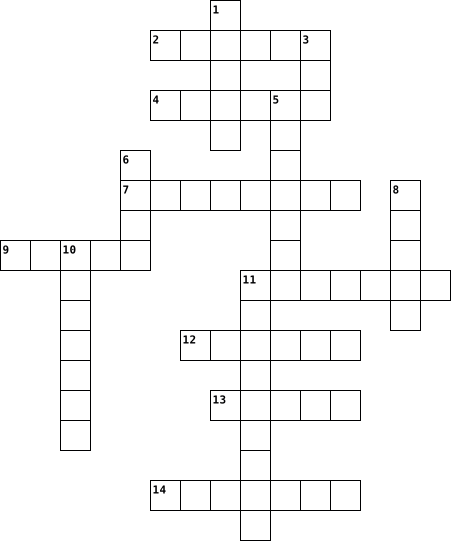
Venus 2022-02-15

Across
- Venus spins on its axis ___
- Venus has no ___
- Venus is Earth's ___ planet
- Venus' surface is covered in ___
- Venus has the thickest ___ in our solar system
Down
- In terms of temperature, Venus is the ___ planet in our solar system
- Venus has a ___ greenhouse effect
- in terms of light, Venus is the ___ planet in the night sky
- Venus is the ___ planet from the Sun
- Venus is named after the roman goddess of ___
10 Clues: Venus has no ___ • Venus spins on its axis ___ • Venus is Earth's ___ planet • Venus' surface is covered in ___ • Venus has a ___ greenhouse effect • Venus is the ___ planet from the Sun • Venus is named after the roman goddess of ___ • Venus has the thickest ___ in our solar system • in terms of light, Venus is the ___ planet in the night sky • ...
CLIL CROSSWORD MARIA JOSE 2022-06-28

Across
- They process in which an animal or person changes its body.
- It is the fifth planet in the solar system and the largest.
- animals that have no bones.
- Planet they call red.
- It is the eighth planet in distance from the Sun and the farthest in the solar system.
Down
- Animals that eat meat.
- Vertebrate animals that have brachia.
- Stores life.
- animals that have bones.
- they count her as one more star.
10 Clues: Stores life. • Planet they call red. • Animals that eat meat. • animals that have bones. • animals that have no bones. • they count her as one more star. • Vertebrate animals that have brachia. • They process in which an animal or person changes its body. • It is the fifth planet in the solar system and the largest. • ...
FEBRUARU 2026-03-01

Across
- The roman leader who make a new calendar
- A year that includes February 29
- The start at the center of our solar system
- A system used to organize days, months and years
Down
- The second month of the year with 28 days
- A special year when February has 29 days
- Very old, from long ago
- Related to the moon
- The ancient civilization that created the early calendar
- Related to the sun
10 Clues: Related to the sun • Related to the moon • Very old, from long ago • A year that includes February 29 • The roman leader who make a new calendar • A special year when February has 29 days • The second month of the year with 28 days • The start at the center of our solar system • A system used to organize days, months and years • ...
Project in Science 2018-08-24

Across
- Is a natural science that studies of celestial objects.
- States that our planets and moons were wandering around in space and were captured by the gravity of our sun, and the moon were captured by the planets.
- Rocks that form from the magma that rises and cooled in the surface of earth.
- Proposes that the universe could collapse to the state where it began and then initiate another big bang.
- Sediments is transported from its place of origin by running water,wind, and glaciers.
- It is a continental building process.
- Second planet in the solar system.
- Study of rocks, their classification and their history.
- All processes that move, elevate, or build up portions of the earth’s crust came under to it.
- It is the building blocks of the rocks.
- Formed as a result of repeated flooding and evaporation.
- According to it the sun and its planets supposedly condensed out of swirling eddies of cold, dark, interstellar clouds of gas and dust.
- It is the hottest solid layer of the earth.
- Rocks that form from the cooling and solidification of magma or lava.
- The internal and external forces causing stresses and chemical action on earth materials and bringing about changes in the configuration of the surface of the earth.
- Any rock that subjected to more intense pressure or heat and as a result underwent a complete change.
- Processes depend on some applied forces.
- Rocks that form when a magma cools within earth’s crust.
- This model asserts that the general character of the universe is not changing over time.
- It is the fourth planet in the solar system.
- States that the universe began as an incredibly hot, dense point roughly 15 billion years ago.
Down
- It is the one that protects us from solar winds.
- Cause by the very hot material at the deepest part of the mantle rising, then cooling, sinking again and then heating, rising and repeating the cycle over and over.
- Theorizes that our world is said to have collided with small planet, which threw off rocks that formed our moon.
- It is not solid, it is not liquid but it moves very slowly.
- Occurs when a rock came in contact with a heat source (usually a magma body).
- Branch of astronomy involving the scientific study of the large scale properties of the universe as a whole.
- Rocks that form from the compaction and cementation of sediments.
- Processes derive their energy from atmosphere determined by the ultimate energy from the sun and also the gradients created by tectonic factors.
- It is so hot that the metals in it are all in liquid state.
- Caused by several biological activities like growth or movements of organisms.
- Composed of clasts on little pieces of broken-up rock which are joined together as a result of compaction and cementation.
- If it is present to a planet life is possible.
- Rocks that formed from organic materials.
- Occurs when a rock undergo increased temperatures and pressures.
- Breaking down of rocks.
- Geological processes that occur beneath the surface of the earth.
- Says that our sun burst one day, and all our planets came from it.
- The origin of our entire solar system suggests that our planets, moon, and the sun all spun off from a collision between stars.
- It includes the weathering, mass movements, erosion, and transportation.
- Movement of molten rock (magma) toward the earth’s surface.
- Can be due to solution, carbonation, hydration, or oxidation/reduction.
- It is the third planet in the solar system.
- Clastic sediments are deposited when the velocity of the tranporting medium drops.
- It is the center of our solar system.
- Thickest layer of the earth.
- It is the galaxy where our solar system is located.
- Thinnest layer of the earth.
- It is the planet next to the sun.
- It is a mountain building process.
50 Clues: Breaking down of rocks. • Thickest layer of the earth. • Thinnest layer of the earth. • It is the planet next to the sun. • Second planet in the solar system. • It is a mountain building process. • It is a continental building process. • It is the center of our solar system. • It is the building blocks of the rocks. • Processes depend on some applied forces. • ...
Astronomy Key Terms 2015-04-22

Across
- the totality of all matter, energy and space.
- an object so dense that even light cannot escape from its surface because of the object's intense gravitational field.
- the distance to a star when the star exhibits a parallax of one second of arc, where 1 second of arc is defined to be 1/3600 of 1°, this distance is equal to 3.26 light-years or 206 265 astronomical units.
- ..... planets, a new class of planets including Pluto, Ceres, Eris, Haumea, and Makemake.
- imaginary lines encircling the Earth parallel to the plane of the equator.
- Sun's outer solar atmosphere, can be seen as a halo extending beyond the solar disk, especially during solar eclipse
- large and small chunks of matter that orbit the Sun (usually between Mars and Jupiter within "asteroid belt"), sometimes called minor planets.
- the blocking of light of one celestial body by another.
- prominent groups of stars appearing as patterns in each section of the night sky.
- ........ coordinate system, a two-dimensional coordinate system in which two number lines (x,y) are drawn perpendicular to each other and the origin is assigned at the point of intersection, a third dimension may be taken in the z direction, perpendicular to x and y.
- the apparent sphere of the sky on which all the stars seems to appear.
- a relatively small object that is composed of dust and ice and that revolves about the Sun in a highly elliptical orbit.
- layer of the Sun surface above the photosphere.
- the movement of one object around another.
- an imaginary line on the Earth's surface equidistant from the North Pole and South Pole, dividing the Earth into the Northern Hemisphere and Southern Hemisphere.
Down
- unit of length used informally to express astronomical distances; it is approximately 10 trillion km (6 trillion miles); it is distance that light travels in vacuum in one Julian year; 1 light-year = 9.461 trillion km = 5.878 trillion miles = 63 241 au
- an exploding star.
- theory of the beginning of the universe that states that the known universe was smaller, hotter and denser in the past, and that it began rapidly expanding 13.7 billion years ago.
- a doughnut-shaped ring of space around the Sun beyond the orbit of Neptune and that extends to well beyond the orbit of Pluto and Eris, containing many short-period comets.
- the fraction of incident sunlight reflected by a celestial object.
- an extremely large collection of stars bound together by mutual gravitational attraction, have a spiral, elliptical or irregular structures.
- ..... planets, the four outer planets of the solar system - Jupiter, Saturn, Uranus and Neptune, all have charcteristics resembling those of Jupiter, having gaseous outer layers.
- ..... planets, the four inner planets of the solar system - Mercury, Venus, Earth, and Mars, all are similar to the Earth in general chemical and physical properties.
- the average distance between the Earth and the Sun, which is 1.5 x 10⁸ km (93 million miles).
- model, the old false theory of the solar system, which placed the Earth as its center.
- angular measurement, in degrees, east or west of the reference meridian, known as the Greenwich (prime) meridian for a point on the surface of the Earth.
- angular measurement in degrees north or south of the equator for a point on the surface of the Earth.
- model, the model of the solar system that places the Sun as its center.
- a large mass that forms by contraction out of the gas of a giant molecular cloud in the interstellar medium, an early stage in the process of star formation.
- the bright, visible "surface" of the Sun.
- imaginary lines drawn along the surface of the Earth running from the geographic North Pole to the geographic South Pole perpendicular to equator.
- the turning (spinning) of an object about an internal axis.
- small, interplanetary metallic and stony objects in space before they encounter the Earth.
33 Clues: an exploding star. • the bright, visible "surface" of the Sun. • the movement of one object around another. • the totality of all matter, energy and space. • layer of the Sun surface above the photosphere. • the blocking of light of one celestial body by another. • the turning (spinning) of an object about an internal axis. • ...
Earth Science 2019-07-23

Across
- Leptons and Antileptons were born.
- Is the way the mineral's color displays in finely powdered form.
- Is a theory described which involves the capture of material from a light diffuse star which passed close to the Sun.
- Is the sixth planet from the Sun and the second largest planet in our Solar
- Is the building blocks of rocks
- Is an epoch where the stars where formed.
- Is the theory where two stars collide.
- A criteria that a mineral must have its Specific ________ Composition.
- Is the smallest and innermost planet in the Solar System.
- Unification Is the epoch where the force of gravity separates from the other fundamental forces.
- Rocks where formed when magma reaches the Earth's surface a volcano and cools quickly.
- The theory where the universe came from a singularity.
- In this epoch the atoms were formed.
- Is the way of identifying a mineral by being scratched by another mineral.
- A criteria that a mineral must be ________ Occurring.
- A criteria that a mineral must be in a solid state.
- Is an epoch where the galaxies were formed.
- A theory of the universe where there is a collision of planets.
- Rocks that are formed from the solidification of molten rock material.
- Rocks are formed when sediment is deposited out of air, ice, wind, gravity, or water flows carrying the particles in suspension.
- In this era there was a dominance of radiation.
- A criteria that a mineral is not made by an organism.
- Is a type of metamorphism where rock minerals and texture are changed, mainly by heat, due to contact with magma.
- Is the most observable way to identify a mineral but not reliable.
- A criteria that a mineral's subtance must be arranged in an _______ Structure.
Down
- Creation of protons and neutrons
- The temperature of the universe cooled down.
- Is the epoch where no matter exist.
- Is the second planet from the Sun.
- Is the fourth planet from the Sun and the second-smallest planet in the Solar System.
- Is the seventh planet from the Sun. It has the third-largest planetary radius and fourth-largest planetary mass in the Solar System.
- Is the eighth and farthest known planet from the Sun in the Solar System.
- Is the fifth planet from the Sun and the largest in the Solar System.
- Refers to the break along curved surfaces without a definite shape.
- Is the third planet from the Sun and the only astronomical object known to harbor life.
- Is the theory where the universe were born from clouds of interstellar gas and dust.
- Is the theory where gas clouds were captured by our sun, which then mysteriously formed themselves at a distance into planets and moons.
- Is an era that has 3 stages.
- Epoch where the 1st element was born.
- Is a type of metamorphism where rock minerals were formed due to the collision of the tectonic plates.
- Is the star at the center of the Solar System.
- Is the epoch where the universe undergoes an extremely rapid exponential expansion.
- Refers to how some minerals break predictably along flat planes when exposed to stress, such as being hit with a hammer.
- Rocks formed when magma cools slowly below the Earth's surface.
- The study of the origin and development of the universe.
- Is the epoch where the Electromagnetic and Weak nuclear force seperated.
- Rocks arise from the transformation of existing rock types, in a process called metamorphism.
- A theory that is based in the Bible.
- Is the theory for the ultimate fate of the universe.
- Is the way light interacts with the surface of a crystal, rock, or mineral.
- the branch of science which deals with celestial objects, space, and the physical universe as a whole.
51 Clues: Is an era that has 3 stages. • Is the building blocks of rocks • Creation of protons and neutrons • Is the second planet from the Sun. • Leptons and Antileptons were born. • Is the epoch where no matter exist. • In this epoch the atoms were formed. • A theory that is based in the Bible. • Epoch where the 1st element was born. • Is the theory where two stars collide. • ...
planets 2022-12-02

Across
- elon musk is trying to colonize this planet
- closest planet to the sun
- rains diamonds
- the biggest planet in the solar system
Down
- this planet has rings
- 7th planet from the sun
- hottest planet in the solar system
- the planet we live on
8 Clues: rains diamonds • this planet has rings • the planet we live on • 7th planet from the sun • closest planet to the sun • hottest planet in the solar system • the biggest planet in the solar system • elon musk is trying to colonize this planet
scientific crossword 2012-07-10

Across
- knows the answer how many animals live in africa
- where we are right now
- black and white stripey animal
- things in the solar system
Down
- majoris the biggest star in the solar system
- man's best friend
- big grey heavy animal
- flying mammal
8 Clues: flying mammal • man's best friend • big grey heavy animal • where we are right now • things in the solar system • black and white stripey animal • majoris the biggest star in the solar system • knows the answer how many animals live in africa
The Solar System 2024-01-28

Across
- the largest planet in the solar system
- the seventh planet from the sun
- the smallest planet
- the twin planet of Earth
Down
- the planet where we live
- the blue planet made up of methane
- the center of the solar system
- the red planet
8 Clues: the red planet • the smallest planet • the planet where we live • the twin planet of Earth • the center of the solar system • the seventh planet from the sun • the blue planet made up of methane • the largest planet in the solar system
Space 2024-04-22

Across
- The name of Uranus' finder
- The study of celestial objects
- (plural) The widely known title given to extraterrestrial life
Down
- The shape of our moon
- 'Father' of the solar system
- Our home
- The heart of our solar system
- The closest planet to the sun
8 Clues: Our home • The shape of our moon • The name of Uranus' finder • 'Father' of the solar system • The heart of our solar system • The closest planet to the sun • The study of celestial objects • (plural) The widely known title given to extraterrestrial life
Bonus: Astronomy Vocab Review 2022-03-21

Across
- vocab term that means "adding" light to the moon
- massive ball of plasma that emits light throughout the universe
- a planet that orbits around a star outside of our solar system
- the layer of the sun that emits a reddish glow
- the eclipse where the Earth is between the Sun and the Moon
- the layer of the sun that is known as the outermost layer of the solar interior
Down
- prominences that erupt quickly and only last several minutes to a few hours
- the theory of the Moon formation where Earth collided with a unknown planet sized body
- the dark spots on the surface of the Sun that are higher in temperature
- the gas that composes the majority of the sun
- the type of tide where the lowest part of the wave reaches the coast
- the planet that doesn't meet the three requirements to be a major planet in our solar system
- the planets that are made of gases and have a lower density
- the shape of the moon's orbit
- rocky asteroid that revolves around the sun but too small to be considered a planet
15 Clues: the shape of the moon's orbit • the gas that composes the majority of the sun • the layer of the sun that emits a reddish glow • vocab term that means "adding" light to the moon • the planets that are made of gases and have a lower density • the eclipse where the Earth is between the Sun and the Moon • a planet that orbits around a star outside of our solar system • ...
Cells and body System Crossword 2015-01-13

Across
- the storage rooms
- an individual unit of life
- a controllable gateway
- pumps blood to your body
- covered in Cilia
- the system that deliver the nutrients to each cells
- diffusion of water through a selectively permeable membrane
- the system that gives oxygen to your body
- common unicellular organisms that live in water
- produces urea
- Cells that helps stop bleeding
- a group of specialized cells
Down
- produce by the liver
- a command centre
- the kitchen
- the solar panels
- hair-like structures
- the power houses
- the system that respond to the stimuli
- the system that produces a number of wastes
- the system that breaks down the food
- filters to the blood and produces urine
- a group of tissues that perform a special function
- foot-like projections to move around
- the frame
25 Clues: the frame • the kitchen • produces urea • a command centre • the solar panels • the power houses • covered in Cilia • the storage rooms • produce by the liver • hair-like structures • a controllable gateway • pumps blood to your body • an individual unit of life • a group of specialized cells • Cells that helps stop bleeding • the system that breaks down the food • ...
Mars 2023-05-08

Across
- NASA
- carbon dioxide
- Perseverance
- Atmosphere
- craters
- iron
- Spacecraft
Down
- solar system
- habitable
- toxic
10 Clues: NASA • iron • toxic • craters • habitable • Atmosphere • Spacecraft • solar system • Perseverance • carbon dioxide
The Solar System P. 2020-11-19

Across
- What's the name of our Galaxy?
- The way the planet is moving?
- What's the satellite of the Earth?
- The place where is no air to breathe?
- An icy, small Solar System?
- How do we call a sphere of superheated gas?
Down
- What does have the highest speed in the world?
- The closest Galaxy to Milky Way?
- There is a planet with rings around it?
- What's in the center of the Solar System?
10 Clues: An icy, small Solar System? • The way the planet is moving? • What's the name of our Galaxy? • The closest Galaxy to Milky Way? • What's the satellite of the Earth? • The place where is no air to breathe? • There is a planet with rings around it? • What's in the center of the Solar System? • How do we call a sphere of superheated gas? • ...
Gravity crossword 2021-10-26

Across
- the amount of gravity exerted on an object
- one factor that acts on gravity
- the dust + gas that made our solar system
- what the planets orbit because of gravity
- The force that governs the solar system
Down
- the scientist who discovered gravity
- Dust and gases compressed together
- the scientist who tested gravity
- the law that states objects in motion will stay in motion in a line
- the amount of matter in an object
10 Clues: one factor that acts on gravity • the scientist who tested gravity • the amount of matter in an object • Dust and gases compressed together • the scientist who discovered gravity • The force that governs the solar system • the dust + gas that made our solar system • what the planets orbit because of gravity • the amount of gravity exerted on an object • ...
outer planets 2023-04-27

Across
- Saturn has the most_.
- Uranus has _ largest diameter in solar system.
- Jupiter has 9.93 _.
- Its made of a thick soup of water,_ and methane over.
- Saturn could float in water _.
- Its more than 30 _ as far from the earth is.
Down
- The moon is the _ largest satellite in the solar system.
- The belt is estimated to contain between 1.1 and 1.9 million_.
- Uranus is the _ plant from the sun.
- Jupiter has 80_.
10 Clues: Jupiter has 80_. • Jupiter has 9.93 _. • Saturn has the most_. • Saturn could float in water _. • Uranus is the _ plant from the sun. • Its more than 30 _ as far from the earth is. • Uranus has _ largest diameter in solar system. • Its made of a thick soup of water,_ and methane over. • The moon is the _ largest satellite in the solar system. • ...
outer planets 2023-04-27

Across
- Saturn has the most_.
- Uranus has _ largest diameter in solar system.
- Jupiter has 9.93 _.
- Its made of a thick soup of water,_ and methane over.
- Saturn could float in water _.
- Its more than 30 _ as far from the earth is.
Down
- The moon is the _ largest satellite in the solar system.
- The belt is estimated to contain between 1.1 and 1.9 million_.
- Uranus is the _ plant from the sun.
- Jupiter has 80_.
10 Clues: Jupiter has 80_. • Jupiter has 9.93 _. • Saturn has the most_. • Saturn could float in water _. • Uranus is the _ plant from the sun. • Its more than 30 _ as far from the earth is. • Uranus has _ largest diameter in solar system. • Its made of a thick soup of water,_ and methane over. • The moon is the _ largest satellite in the solar system. • ...
Chapter 28 + 29 Crossword Addison Kiefer 2022-05-18

Across
- how many inner planets
- volcanically active and is a very harsh place.
- third planet from the Sun
- Sun centered solar system
- thin atmosphere—95% carbon dioxide and 0.15% oxygen.
- closest planet to sun
Down
- Earth-centered solar system
- nearest star to earth
- is a Hypothetical form of energy that exerts a negative, repulsive pressure, behaving like the opposite of gravity.
- the Sun and planets formed together from a cloud of gas and dust nebula
10 Clues: nearest star to earth • closest planet to sun • how many inner planets • third planet from the Sun • Sun centered solar system • Earth-centered solar system • volcanically active and is a very harsh place. • thin atmosphere—95% carbon dioxide and 0.15% oxygen. • the Sun and planets formed together from a cloud of gas and dust nebula • ...
our solar system 2024-02-22

Across
- The second closest planet to the sun
- An astronomical unit with a long tail.
- The red planet
- the galaxy of which the milky way is a part
- the seventh farthest planet
- The number of planets in the solar system
Down
- the planet closest to the sun
- A mass of rock that moves in space especially between jupiter and mars
- The satellite of planet earth
- The largest planet in the solar system
10 Clues: The red planet • the seventh farthest planet • the planet closest to the sun • The satellite of planet earth • The second closest planet to the sun • An astronomical unit with a long tail. • The largest planet in the solar system • The number of planets in the solar system • the galaxy of which the milky way is a part • ...
The Outer Solar System 2024-03-20

Across
- discovered Uranus by chance
- dusty pieces of gas and rock
- the second largest planet in our solar system
- Saturn's moon that is larger than Mercury
- what kind of planets are Jupiter, Saturn, Uranus and Neptune
Down
- the largest planet in our Solar System
- planet discovered by chance
- the largest storm on Jupiter
- Jupiter's moon that has a salt-water ocean
- a disk made of very small particles of rock and ice
10 Clues: planet discovered by chance • discovered Uranus by chance • the largest storm on Jupiter • dusty pieces of gas and rock • the largest planet in our Solar System • Saturn's moon that is larger than Mercury • Jupiter's moon that has a salt-water ocean • the second largest planet in our solar system • a disk made of very small particles of rock and ice • ...
SPACE CROSSWORD - GEOGRAPHY - Miss Andrea 2025-10-22

Across
- Model with the Earth in the center
- Said the sun is the center of the Universe
- Planet with rings and many moons
- Star at the center of the Solar System
- Fundamental force of attraction between two bodies with mass
Down
- Smallest planet in the solar system
- Known as the red planet
- A large body orbiting a star
- Used a telescope to see the moons of Jupiter
- The planet we live on
10 Clues: The planet we live on • Known as the red planet • A large body orbiting a star • Planet with rings and many moons • Model with the Earth in the center • Smallest planet in the solar system • Star at the center of the Solar System • Said the sun is the center of the Universe • Used a telescope to see the moons of Jupiter • ...
The Outer Planets and Their Moons 2026-02-24

Across
- planet that rotates on its side at a 98% tilt
- largest moon of neptune
- biggest moon of jupiter
- outer planet with the strongest winds in the solar system
- outer planet famous for its bright rings of ice and rock
Down
- largest planet in the Solar System
- saturn's largest moon
- jupiter's moon known for extreme volcanic activity
- four biggest moons of jupiter were discovered by this astronomer
- saturn's moon with water-ice geysers
10 Clues: saturn's largest moon • largest moon of neptune • biggest moon of jupiter • largest planet in the Solar System • saturn's moon with water-ice geysers • planet that rotates on its side at a 98% tilt • jupiter's moon known for extreme volcanic activity • outer planet famous for its bright rings of ice and rock • outer planet with the strongest winds in the solar system • ...
Space Vocab 2026-05-12

Across
- The only planet that supports life
- The closest planet to the sun
- The closest star to Earth
- A planet know as a "gas giant"
- This planet was once a planet but now a dwarf
- A planet known as "Earths twin"
Down
- A planet that is known as the "red planet"
- The largest planet in the Solar System
- A planet known as a "ice giant"
- The last planet in the Solar system
10 Clues: The closest star to Earth • The closest planet to the sun • A planet know as a "gas giant" • A planet known as a "ice giant" • A planet known as "Earths twin" • The only planet that supports life • The last planet in the Solar system • The largest planet in the Solar System • A planet that is known as the "red planet" • This planet was once a planet but now a dwarf
The solar system 2020-06-12

Across
- A planet that goes after Saturn
- the planet we live
- Little balls smaller than the sun
- The planet closest to the sun
- A planet that has rings made of dust
Down
- The same size of earth but spins the opposite way
- The biggest planet
- the coldest planet
- The biggest star
- A red planet that goes after the earth
10 Clues: The biggest star • The biggest planet • the coldest planet • the planet we live • The planet closest to the sun • A planet that goes after Saturn • Little balls smaller than the sun • A planet that has rings made of dust • A red planet that goes after the earth • The same size of earth but spins the opposite way
Solar System Crossword 2017-04-10

Across
- The universe is made up of these
- The red planet
- Scientists who study the stars
- The planet we live on
- Planet closest to the sun
- The biggest planet
Down
- How many planets are in our Solar System
- instrument used for seeing stars and planets clearly
- Planet with rings
- Furthest planet from the sun
10 Clues: The red planet • Planet with rings • The biggest planet • The planet we live on • Planet closest to the sun • Furthest planet from the sun • Scientists who study the stars • The universe is made up of these • How many planets are in our Solar System • instrument used for seeing stars and planets clearly
Our Solar System! 2017-05-13

Across
- There is a large ring surrounding me
- I am sometimes called the 'red planet'
- 1 of my years equals to 165 earth years
- Humans are able to live on me
Down
- I am the brightest planet in our sky
- I am the 7th planet from the sun
- I am the biggest planet
- I take 88 days to circle the sun
- All the planets orbit me
- I am a dwarf planet
10 Clues: I am a dwarf planet • I am the biggest planet • All the planets orbit me • Humans are able to live on me • I am the 7th planet from the sun • I take 88 days to circle the sun • I am the brightest planet in our sky • There is a large ring surrounding me • I am sometimes called the 'red planet' • 1 of my years equals to 165 earth years
The Solar System 2020-09-03

Across
- earth moves between the sun and moon
- path a planet takes around the sun
- largest planet
- planet most similar to earth in size
- smallest planet
Down
- huge ball of glowing gas
- moon moves between the earth and the sun
- all of the gases that surround a planet
- number of planets in the solar system
- big piece of rock moving towards earth
10 Clues: largest planet • smallest planet • huge ball of glowing gas • path a planet takes around the sun • earth moves between the sun and moon • planet most similar to earth in size • number of planets in the solar system • big piece of rock moving towards earth • all of the gases that surround a planet • moon moves between the earth and the sun
The Solar System 2020-11-20

Across
- oval shaped orbit
- "shooting star"
- when the earth goes around the sun
- bits of a meteor
- small "planet"
Down
- The opposite of geocentric
- a small rock that is irregular in space
- "half" of a lunar eclipse not full
- "dirty snowball"
- lives up in the sky for direction and maps
10 Clues: small "planet" • "shooting star" • "dirty snowball" • bits of a meteor • oval shaped orbit • The opposite of geocentric • "half" of a lunar eclipse not full • when the earth goes around the sun • a small rock that is irregular in space • lives up in the sky for direction and maps
The Solar System 2021-01-19

Across
- No longer officially considered a planet
- The furthest planet from the Sun
- The hottest planet
- Closest planet to the Sun
- The coldest planet
Down
- The largest planet
- Not a planet, it's a star
- We live on this planet
- This planet has rings
- Also known as the "Red planet"
10 Clues: The largest planet • The hottest planet • The coldest planet • This planet has rings • We live on this planet • Not a planet, it's a star • Closest planet to the Sun • Also known as the "Red planet" • The furthest planet from the Sun • No longer officially considered a planet
Our Solar System 2021-09-06

Across
- the closest planet to Earth
- an easy way to say hello
- the planet we are TRYING to live on
- uranus's temperature
Down
- the creator's full name
- the planet we live on
- our only dwarf planet
- the planet with 82 moons
- the planet closest to pluto
- what is around saturn
10 Clues: uranus's temperature • the planet we live on • our only dwarf planet • what is around saturn • the creator's full name • an easy way to say hello • the planet with 82 moons • the closest planet to Earth • the planet closest to pluto • the planet we are TRYING to live on
Solar System Crossword 2021-08-09

Across
- has two moons and is the last of the terrestrial planets along with Mercury, Venus, and Earth.
- One year here is equal to 165 years on Earth.
- orbit around the Sun is every 29.4 Earth years
- has the lowest temperature of all the planets, with a minimum atmospheric temperature of -224°C.
Down
- The Great Red Spot visible there is a storm that has been going on for at least 350 years. It is massive enough to fit three Earth-sized planets in it.
- is no longer considered a planet since 2006.
- This is the first planet closest to the Sun and the smallest in our solar system.
- Was once believed to be the center of the universe until it was debunked by Galileo Galilei.
- One day here is longer than one day on Earth.
- The center of our solar system
10 Clues: The center of our solar system • is no longer considered a planet since 2006. • One year here is equal to 165 years on Earth. • One day here is longer than one day on Earth. • orbit around the Sun is every 29.4 Earth years • This is the first planet closest to the Sun and the smallest in our solar system. • ...
Our Solar System 2021-03-30

Across
- Jupiter is the ___ planet from the sun.
- where our planets (and star) are. {two words}
- planet Pluto is a... {two words}
- what is the last planet in our solar system.
Down
- we lost a ________ awhile ago. {two words}
- the planet with the big red spot is...
- what can't travel through space.
- the giant star in the center of our solar system.
- saturn is the ___ planet from the sun.
- there is a dwarf planet that looks like an...
10 Clues: what can't travel through space. • planet Pluto is a... {two words} • the planet with the big red spot is... • saturn is the ___ planet from the sun. • Jupiter is the ___ planet from the sun. • we lost a ________ awhile ago. {two words} • what is the last planet in our solar system. • where our planets (and star) are. {two words} • ...
solar system puzzle 2021-10-21

Across
- cycling
- representing the sun
- A small object in space
- A ball of ice and dust
- A small planet pluto is a dwarf planet
Down
- ellipsis
- Something that helps u learn about space
- A small body of matter
- space rocks
- shaded region
10 Clues: cycling • ellipsis • space rocks • shaded region • representing the sun • A small body of matter • A ball of ice and dust • A small object in space • A small planet pluto is a dwarf planet • Something that helps u learn about space
Our Solar System 2021-04-24

Across
- this planet contains life
- the only planet named after a Greek god
- this is the biggest planet
- this object has the biggest mass in our solar system
- the hottest planet
Down
- this planet is a dwarf planet
- this planet is closest to the sun
- the planet named for the god of sowing or seed
- the most windiest planet
- this planet might have water.
10 Clues: the hottest planet • this planet contains life • the most windiest planet • this is the biggest planet • this planet is a dwarf planet • this planet might have water. • this planet is closest to the sun • the only planet named after a Greek god • the planet named for the god of sowing or seed • this object has the biggest mass in our solar system
The Solar System 2023-01-30

Across
- THE PLANET CLOSEST TO SUN
- THE MOVEMENT OF EARTH AROUND THE SUN
- THE "RED PLANET'
- THE SPINNING OF THE EARTH ON ITS AXIS
- THE SCIENTIST WHO STUDIES STARS AND PLANETS
Down
- THE STAR MUCH LARGER THAN OUR SUN
- THE NAME OF OUR GALAXY
- THE PLANET CLOSEST TO EARTH
- THE PLANET WITH RINGS
- A VERY SMALL STAR
10 Clues: THE "RED PLANET' • A VERY SMALL STAR • THE PLANET WITH RINGS • THE NAME OF OUR GALAXY • THE PLANET CLOSEST TO SUN • THE PLANET CLOSEST TO EARTH • THE STAR MUCH LARGER THAN OUR SUN • THE MOVEMENT OF EARTH AROUND THE SUN • THE SPINNING OF THE EARTH ON ITS AXIS • THE SCIENTIST WHO STUDIES STARS AND PLANETS
The Solar System 2023-01-19

Across
- is the same size as pluto
- we live in this galaxy
- is the biggest planet
- is the second largest planet
- is in the asteroid belt
Down
- is the coldest planet
- was discovered in 1781
- is the biggest dwarf planet
- closest planet to the sun
- is the reddest planet
10 Clues: is the coldest planet • is the reddest planet • is the biggest planet • was discovered in 1781 • we live in this galaxy • is in the asteroid belt • is the same size as pluto • closest planet to the sun • is the biggest dwarf planet • is the second largest planet
the solar system 2023-02-26

Across
- smallest planet
- biggest planet
- closest to the sun
- color is red
- has 7 rings
- is super big and hot
Down
- color is blue
- the hottest planet
- has a funny name
- where we are
10 Clues: has 7 rings • where we are • color is red • color is blue • biggest planet • smallest planet • has a funny name • the hottest planet • closest to the sun • is super big and hot
solar system crossword 2023-02-15

Across
- smallest planet
- coldest planet
- large rock which makes a belt and sepeate inner and outer planets
- brightest planet
- second largest planet
- red planet
- largest planet
Down
- coldest planet
- dwarf planet
- hottest planet
- third planet
- sun and everything revolves around
12 Clues: red planet • dwarf planet • third planet • coldest planet • hottest planet • coldest planet • largest planet • smallest planet • brightest planet • second largest planet • sun and everything revolves around • large rock which makes a belt and sepeate inner and outer planets
our solar system 2023-03-29

Across
- This planet has no atmosphere.
- These stars are the hottest star is our solar system.
- This planet is the hottest.
- This planet has a giant red spot on it.
- This planets clouds make it look a blueish green color.
Down
- This planet is called the red planet because of the rust.
- This is the coldest planet.
- This is a dwarf planet that used to be a planet.
- This is the 6th planet from the sun.
- This planet is the only planet that is known to support life.
10 Clues: This is the coldest planet. • This planet is the hottest. • This planet has no atmosphere. • This is the 6th planet from the sun. • This planet has a giant red spot on it. • This is a dwarf planet that used to be a planet. • These stars are the hottest star is our solar system. • This planets clouds make it look a blueish green color. • ...
The Solar System 2012-06-16

Across
- made up of ice of rocks
- we live on this planet
- closest to the sun
- its big and yellow
- called the ringed planet
Down
- closest to earth
- fifth largest of all nine planets
- has fewer rings than saturn
- looks red
- farthest from the sun
10 Clues: looks red • closest to earth • closest to the sun • its big and yellow • farthest from the sun • we live on this planet • made up of ice of rocks • called the ringed planet • has fewer rings than saturn • fifth largest of all nine planets
The Solar System 2012-08-17

Across
- Has 2 rings of mostly ice.
- Is made of of 9 planets.
- Is the god of war and is a reddish colour.
- Is blue and mainly consists of ice.
Down
- The largest planet in the solar system
- The first planet discovered in modern times.
- Gives earth light.
- Is the closest planet to the Sun and the second smallest.
- Is the goddess of love and beauty.
- The planet that we live on.
10 Clues: Gives earth light. • Is made of of 9 planets. • Has 2 rings of mostly ice. • The planet that we live on. • Is the goddess of love and beauty. • Is blue and mainly consists of ice. • The largest planet in the solar system • Is the god of war and is a reddish colour. • The first planet discovered in modern times. • Is the closest planet to the Sun and the second smallest.
The Solar System 2012-08-17

Across
- This object is no longer considered to be a planet.
- Jupiter is composed mostly of _________.
- When air in the atmosphere is warmed, air pressure ____.
- The temperature in Earth's _________ is estimated to be as high as 7500 K.
- This object is at the center of the Solar System
Down
- Uranus' blue color is a result of this gas in the atmosphere.
- Earth is the only planet known to support _________.
- Lumps of rocks circling in a broad band between the orbits of Mars and Jupiter.
- The atmosphere of Venus is mostly carbon _________.
- A meteor that is burning up in the Earth's atmosphere is called a __________ star.
10 Clues: Jupiter is composed mostly of _________. • This object is at the center of the Solar System • This object is no longer considered to be a planet. • The atmosphere of Venus is mostly carbon _________. • Earth is the only planet known to support _________. • When air in the atmosphere is warmed, air pressure ____. • ...
The Solar System 2013-11-12

Across
- A planet whose temperature exceeds 400 degrees. Mars/A planet which scientists think it contains water or ice.
- The only planet known to support life.
- A large ringed planet.
- The first planet from the sun.
- The largest planet in the solar system.
- The star in our solar system.
Down
- A planet named after the Sea God.
- Earth's only natural satellite.
- Belt A ring of asteroid separating Mars from Jupiter.
- The seventh planet from the sun.
10 Clues: A large ringed planet. • The star in our solar system. • The first planet from the sun. • Earth's only natural satellite. • The seventh planet from the sun. • A planet named after the Sea God. • The only planet known to support life. • The largest planet in the solar system. • Belt A ring of asteroid separating Mars from Jupiter. • ...
The Solar System 2013-11-12

Across
- The only planet known to support life.
- The first planet from the sun.
- The star in our solar system.
- A planet named after the Sea God.
- A planet whose temperature exceeds 400 degrees. Mars/A planet which scientists think it contains water or ice.
Down
- The largest planet in the solar system.
- Belt A ring of asteroid separating Mars from Jupiter.
- Earth's only natural satellite.
- The seventh planet from the sun.
- A large ringed planet.
10 Clues: A large ringed planet. • The star in our solar system. • The first planet from the sun. • Earth's only natural satellite. • The seventh planet from the sun. • A planet named after the Sea God. • The only planet known to support life. • The largest planet in the solar system. • Belt A ring of asteroid separating Mars from Jupiter. • ...
solar system traslation 2013-10-10

Across
- urano
- venus
- Plutón
- Neptuno
- mercurio
- sol
Down
- tierra
- Saturno
- jupiter
- marte
10 Clues: sol • urano • venus • marte • tierra • Plutón • Saturno • jupiter • Neptuno • mercurio
Solar System Review 2014-03-20

Across
- The sun is a large ball of this.
- They give off heat and light.
- The curved path of a planet around the sun.
- The solar system is made up of the sun and nine __________.
- All the planets are held in orbit by this force.
- The force of gravity between the Earth and the moon causes these.
Down
- Ursa Major is an example of this.
- The imaginary line that goes through the Earth.
- Different views of the moon are called this.
- A small object in orbit around a planet.
10 Clues: They give off heat and light. • The sun is a large ball of this. • Ursa Major is an example of this. • A small object in orbit around a planet. • The curved path of a planet around the sun. • Different views of the moon are called this. • The imaginary line that goes through the Earth. • All the planets are held in orbit by this force. • ...
Solar System Vocob 2014-03-04

Across
- an imaginary straight line on which an object rotates
- dense, small, rocky planets close to the sun
- something that revolves around a larger object
- a small body of rock, ice, and dust with a tail of gas and dust
Down
- a rock that orbits the Sun
- a big bright ball of gas
- gases surrounding a planet
- spinning on an axis
- a large sphere with a clear orbit around a star
- path around another object due to gravity
10 Clues: spinning on an axis • a big bright ball of gas • a rock that orbits the Sun • gases surrounding a planet • path around another object due to gravity • dense, small, rocky planets close to the sun • something that revolves around a larger object • a large sphere with a clear orbit around a star • an imaginary straight line on which an object rotates • ...
Solar System Conundrum 2015-05-17

Across
- They can't decide if this ones a planet or not
- This planet is sometimes called Earth's sister!
- The only planet with a ring!
- This planet is closest to the star the planets orbit
- The name of the Galaxy our solar system is in!
Down
- The largest planet of them all!
- This thing orbits the 3rd planet!
- What is the name of the star the planets orbit?
- There's a belt of these after mars!
- What is the name of the 3rd planet?
10 Clues: The only planet with a ring! • The largest planet of them all! • This thing orbits the 3rd planet! • There's a belt of these after mars! • What is the name of the 3rd planet? • They can't decide if this ones a planet or not • The name of the Galaxy our solar system is in! • What is the name of the star the planets orbit? • This planet is sometimes called Earth's sister! • ...
Our Solar System 2017-04-27

Across
- It orbits our planet
- the coldest plant and often called an ice giant
- It takes 88 earth days to circle the sun
- It has the shortest day of all the planets and a big red spot
- Its known as the red planet and ist dust storms can last months
Down
- Its the hottest planet in our solar system
- It has around 150 moons and has rings around the planet
- Its the centre of our solar system and responsible for earths climate and weather
- Its the furtherest planet from the sun
- It was formed 5 billion years ago and currently supports life
10 Clues: It orbits our planet • Its the furtherest planet from the sun • It takes 88 earth days to circle the sun • Its the hottest planet in our solar system • the coldest plant and often called an ice giant • It has around 150 moons and has rings around the planet • It has the shortest day of all the planets and a big red spot • ...
The Solar System 2018-04-20

Across
- the second coldest planet
- the red planet
- the planet we live in
- the biggest planet
- a ball of fire
Down
- the hottest planet
- the planet which is not considered a planet anymore
- the furthest planet from the sun
- the planet with rings
- the closest planet to the sun
10 Clues: the red planet • a ball of fire • the hottest planet • the biggest planet • the planet with rings • the planet we live in • the second coldest planet • the closest planet to the sun • the furthest planet from the sun • the planet which is not considered a planet anymore
Solar System 2 2018-10-28

Across
- 3rd closest planet to the sun
- closest planet to the sun
- 5th closest planet to the sun
- 6th closest planet to the sun
- 4th closest planet to the sun
Down
- 9th closest to the sun
- a belt of these exists between Mars and Jupiter
- 8th closest planet to the sun
- 7th closest planet to the sun
- 2nd closest planet to the sun
10 Clues: 9th closest to the sun • closest planet to the sun • 8th closest planet to the sun • 3rd closest planet to the sun • 5th closest planet to the sun • 7th closest planet to the sun • 2nd closest planet to the sun • 6th closest planet to the sun • 4th closest planet to the sun • a belt of these exists between Mars and Jupiter
Science Solar system 2022-03-21

Across
- revolves around the sun
- red rocky planet
- fixed path of planets
- nearest star on earth
- coldest planet
Down
- largest planet
- nearest planet to the sun
- planet with a ring around it
- brightest and hottest planet
- third planet from the sun
10 Clues: largest planet • coldest planet • red rocky planet • fixed path of planets • nearest star on earth • revolves around the sun • nearest planet to the sun • third planet from the sun • planet with a ring around it • brightest and hottest planet
Solar System crossword 2021-12-14

Across
- Hottest planet
- Declared it was not a planet
- The closest planet to the Sun
- 3rd planet from the Sun
- Coldest planet
- Natural Satellite
Down
- Famous for its rings
- Biggest planet in the Solar System
- Farthest planet from the Sun
- The "red planet"
10 Clues: Hottest planet • Coldest planet • The "red planet" • Natural Satellite • Famous for its rings • 3rd planet from the Sun • Declared it was not a planet • Farthest planet from the Sun • The closest planet to the Sun • Biggest planet in the Solar System
Solar System crossword 2021-12-14

Across
- Hottest planet
- Declared it was not a planet
- The closest planet to the Sun
- 3rd planet from the Sun
- Coldest planet
- Natural Satellite
Down
- Famous for its rings
- Biggest planet in the Solar System
- Farthest planet from the Sun
- The "red planet"
10 Clues: Hottest planet • Coldest planet • The "red planet" • Natural Satellite • Famous for its rings • 3rd planet from the Sun • Declared it was not a planet • Farthest planet from the Sun • The closest planet to the Sun • Biggest planet in the Solar System
Our solar system 2022-02-28

Across
- The 2nd planet
- The 4th planet
- The star in the center of the solar system
- The 7th planet
- The 1st planet
- The 3rd planet
Down
- The place where Earth is
- The 5th planet
- The 6th planet
- The 8th planet
10 Clues: The 2nd planet • The 4th planet • The 5th planet • The 6th planet • The 8th planet • The 7th planet • The 1st planet • The 3rd planet • The place where Earth is • The star in the center of the solar system
The Solar System 2022-01-11

Across
- Our galaxy (two words)
- To keep practising
- The biggest challenge is getting the telescope to _____
- Helps us gaze up into the heavens
- The Japanese style in which the telescope is folded
Down
- The risks are high but the rewards could be higher
- James Webb telescope's predecessor
- Where the James Webb telescope was built
- Science that deals with space the the physical universe
- The size of the first stars
10 Clues: To keep practising • Our galaxy (two words) • The size of the first stars • Helps us gaze up into the heavens • James Webb telescope's predecessor • Where the James Webb telescope was built • The risks are high but the rewards could be higher • The Japanese style in which the telescope is folded • The biggest challenge is getting the telescope to _____ • ...
The Solar system 2023-07-14

Across
- Earth's twin
- Dwarf planet
- huge system of billions of stars,clouds of dust and gases
- eighth planet of solarsystem
- Twinkling celestial body
Down
- Natural satellite of the Earth
- Blue planet
- centre of the solar system
- Other name for North star
- Shape of the Earth
10 Clues: Blue planet • Earth's twin • Dwarf planet • Shape of the Earth • Twinkling celestial body • Other name for North star • centre of the solar system • eighth planet of solarsystem • Natural satellite of the Earth • huge system of billions of stars,clouds of dust and gases
Our Solar System 2023-07-19

Across
- the largest planet in the Solar System
- the hottest planet in the Solar System
- it is known as the 'Red Planet'
- all the planets orbit around it
- the closest planet to the Sun
- the furthest planet from the Sun
Down
- it has beautiful rings made of rocks,ice and dust
- the only planet with people, animals and plants living on it
- a place full of planets, moons, asteroids and comets
- it is covered in blue-green fog
10 Clues: the closest planet to the Sun • it is known as the 'Red Planet' • all the planets orbit around it • it is covered in blue-green fog • the furthest planet from the Sun • the largest planet in the Solar System • the hottest planet in the Solar System • it has beautiful rings made of rocks,ice and dust • a place full of planets, moons, asteroids and comets • ...
Solar System Bodies 2023-10-16

Across
- small bodies believed to be leftover remains of the formation of the solar system
- planets orbiting sun
- what we use to measure in space
- biggest planet
- planets orbiting Earth
- pieces of rock floating through space
Down
- smaller than a planet but big enough for its own gravity
- group of stars forming a pattern
- orbiting companions
- composed of ice, rock and gas
10 Clues: biggest planet • orbiting companions • planets orbiting sun • planets orbiting Earth • composed of ice, rock and gas • what we use to measure in space • group of stars forming a pattern • pieces of rock floating through space • smaller than a planet but big enough for its own gravity • small bodies believed to be leftover remains of the formation of the solar system
Solar System Crossword 2023-10-16

Across
- planet small Planet with it's own gravity.
- North Star.
- "dirty snowball"
- Leo the lion
- Heliocentric belifes
Down
- Big dipper
- Neil Armstrong landed here
- remains from the formation of the solar system
- A burning floating rock, moving through space
- Geocentric beliefs
10 Clues: Big dipper • North Star. • Leo the lion • "dirty snowball" • Geocentric beliefs • Heliocentric belifes • Neil Armstrong landed here • planet small Planet with it's own gravity. • A burning floating rock, moving through space • remains from the formation of the solar system
Solar System Crossword 2023-10-16

Across
- small Planet with its own gravity.
- Geocentric beliefs
- "dirty snowball"
- Heliocentric beliefs
- Big dipper
Down
- Leo the lion
- North Star.
- Neil Armstrong landed here
- remains from the formation of the solar system
- A burning floating rock, moving through space
10 Clues: Big dipper • North Star. • Leo the lion • "dirty snowball" • Geocentric beliefs • Heliocentric beliefs • Neil Armstrong landed here • small Planet with its own gravity. • A burning floating rock, moving through space • remains from the formation of the solar system
The Solar System 2024-03-19

Across
- Without the sun we would not have this!
- A false science that claims to tell a person's future by studying the heavenly bodies
- The "star" at the center of our solar system.
- Any of the very small planets revolving around the sun
- No longer living
- This was the lesser light God made and has no air, water or life.
Down
- The natural force that causes objects to move toward each other.
- Our year is measured by this movement of the earth.
- The earth rotates on this once ever 24 hours.
- An object in space which becomes a meteor when it enters the earth's atmosphere
10 Clues: No longer living • Without the sun we would not have this! • The "star" at the center of our solar system. • The earth rotates on this once ever 24 hours. • Our year is measured by this movement of the earth. • Any of the very small planets revolving around the sun • The natural force that causes objects to move toward each other. • ...
SOLAR SYSTEM NIKEN 2025-01-27

Across
- Mercury is the .... planet to the sun
- What planet is known as the Red Planet
- what planet is the third planet in the solar system
- what planet is made out of ice and rocks
- what is the largest moon in jupiter
Down
- Earth is the only planet in the ... that is home to life
- earth is the .. largest planet in the solar system
- how many moons does mars have
- neptune is blue because of
- what is the largest moon in saturn
10 Clues: neptune is blue because of • how many moons does mars have • what is the largest moon in saturn • what is the largest moon in jupiter • Mercury is the .... planet to the sun • What planet is known as the Red Planet • what planet is made out of ice and rocks • earth is the .. largest planet in the solar system • what planet is the third planet in the solar system • ...
Solar system - Azhima 2025-01-27

Across
- Which planet is the closest to the Sun?
- Which planet has giant rings?
- What planet in our solar system has the most gravity?
- what planet is the furthest away
- what planet is hottest
Down
- what color is the surface of mars
- what is the coldest planet
- mercury is covered with what
- how many planets is neptune
- why is Neptune blue
10 Clues: why is Neptune blue • what planet is hottest • what is the coldest planet • mercury is covered with what • how many planets is neptune • Which planet has giant rings? • what planet is the furthest away • what color is the surface of mars • Which planet is the closest to the Sun? • What planet in our solar system has the most gravity?
The Solar System 2025-10-08

Across
- I am a celestial body smaller than a planet
- I am the largest planet.
- I am the coldest planet.
- I am a smaller picture inside of a constellation.
- I am a "natural satellite" or orbiting companion.
Down
- I am the hottest planet.
- I am also known as a "shooting star".
- I am leftover remains from the formation of the solar system.
- I am a group of stars that form a visible pattern.
- I am a "dirty snowball", made of ice, rock, and gas.
10 Clues: I am the hottest planet. • I am the largest planet. • I am the coldest planet. • I am also known as a "shooting star". • I am a celestial body smaller than a planet • I am a smaller picture inside of a constellation. • I am a "natural satellite" or orbiting companion. • I am a group of stars that form a visible pattern. • ...
The Solar System 2025-06-04

Across
- The "red planet." Has a thin atmosphere.
- A very cold planet. Looks blue because of its atmosphere.
- The center of our solar system.
- Known for its visible rings
Down
- The largest planet. Has enormous storms.
- Rotates on its side. A cold planet.
- Revolves around the Earth in about 27 days.
- The smallest planet. Has a lot of craters.
- The hottest planet. Also known as "Earth's Twin" due to its similiarities.
- The only planet we know of that can support life.
10 Clues: Known for its visible rings • The center of our solar system. • Rotates on its side. A cold planet. • The largest planet. Has enormous storms. • The "red planet." Has a thin atmosphere. • The smallest planet. Has a lot of craters. • Revolves around the Earth in about 27 days. • The only planet we know of that can support life. • ...
Solar System II 2024-12-11

Across
- It and its moon, Charon, are tipped on its side.
- Landed in July 1997
- It’s fast spin makes it look like a football.
- Blackhole’s surface.
Down
- Outside the Solar System.
- Biggest explosion seen by humans.
- Neil Armstrong went in it.
- Unofficial code name was Easterbunny.
- First dwarf planet to be explored by a spacecraft.
- Was nicknamed Xena after a television series.
10 Clues: Landed in July 1997 • Blackhole’s surface. • Outside the Solar System. • Neil Armstrong went in it. • Biggest explosion seen by humans. • Unofficial code name was Easterbunny. • It’s fast spin makes it look like a football. • Was nicknamed Xena after a television series. • It and its moon, Charon, are tipped on its side. • First dwarf planet to be explored by a spacecraft.
Solar system words 2024-12-11

Across
- Force: The force of attraction between two objects due to their mass; the strength varies with distance and mass.
- Measure of the amount of matter in an object; remains constant regardless of location.
- The rate of change of velocity; in gravitational context, it describes how quickly an object speeds up due to gravity.
Down
- A condition in which an object experiences no net force acting upon it due to free fall, creating the sensation of zero weight.
- A fundamental force of attraction between masses; causes objects to fall toward Earth.
- Newton: Influential physicist and mathematician; formulated laws of motion and universal gravitation.
- of Universal Gravitation: Newton's principle stating that every mass attracts every other mass with a force proportional to the product of their masses and inversely proportional to the square of the distance between them.
- Force exerted on an object due to gravity; depends on both mass and gravitational acceleration.
- Fall: The motion of an object falling solely under the influence of gravity, with no other forces acting on it.
- The path an object follows around another due to gravitational forces; can be elliptical or circular, depending on the velocity and distance.
10 Clues: A fundamental force of attraction between masses; causes objects to fall toward Earth. • Measure of the amount of matter in an object; remains constant regardless of location. • Force exerted on an object due to gravity; depends on both mass and gravitational acceleration. • ...
The Solar System 2025-04-24

Across
- / A gas giant known for its beautiful ring system.
- / The star at the center of our solar system.
- / The third planet from the Sun and our home.
- / A small rocky object that orbits the Sun, mostly found in the belt between Mars and Jupiter.
- / The farthest planet from the Sun, known for its deep blue color and storms.
Down
- / The largest planet in our solar system with a giant red spot.
- / The red planet known for its dusty surface and possible signs of water.
- / The second planet from the Sun, known for its thick, toxic atmosphere.
- / A planet that rotates on its side and has a bluish color.
- / The closest planet to the Sun.
10 Clues: / The closest planet to the Sun. • / The star at the center of our solar system. • / The third planet from the Sun and our home. • / A gas giant known for its beautiful ring system. • / A planet that rotates on its side and has a bluish color. • / The largest planet in our solar system with a giant red spot. • ...
The Solar System 2025-04-05

Across
- A small, rocky object orbiting the Sun, mainly found between Mars and Jupiter
- Planet with the fastest rotation speed
- The force that acts as centripetal force in planetary orbits
- Planet known for its beautiful rings
- The outermost planet in our solar system
Down
- The path a planet follows around the Sun
- A small icy object with a glowing tail
- The shape of a planet’s orbit
- Natural satellite of Earth
- Second planet from the Sun
10 Clues: Natural satellite of Earth • Second planet from the Sun • The shape of a planet’s orbit • Planet known for its beautiful rings • A small icy object with a glowing tail • Planet with the fastest rotation speed • The path a planet follows around the Sun • The outermost planet in our solar system • The force that acts as centripetal force in planetary orbits • ...
THE SOLAR SYSTEM 2024-09-12

Across
- The biggest planet
- Our home planet
- The "Red Planet"
- The farthest planet
- Famous of its icy rings
Down
- No longer considered planet
- This planet is so light, it could float in the water
- The hottest planet
- The Closest planet to the sun
- The brightest object in the sky.
10 Clues: Our home planet • The "Red Planet" • The biggest planet • The hottest planet • The farthest planet • Famous of its icy rings • No longer considered planet • The Closest planet to the sun • The brightest object in the sky. • This planet is so light, it could float in the water
Solar system test 2024-11-13

Across
- we live in the Milky Way…
- scientists think we can live there.
- It’s the reason we have heat
- contains 100-200 billon galaxies
- we have on gigantic one
Down
- our space neighborhood
- its the fastest planet
- At its nearest to Earth,____is about 24 million (about 38 million kilometers) away
- it circles around our solar system but its as thick as mars length from the sun
- It’s perfect
10 Clues: It’s perfect • our space neighborhood • its the fastest planet • we have on gigantic one • we live in the Milky Way… • It’s the reason we have heat • contains 100-200 billon galaxies • scientists think we can live there. • it circles around our solar system but its as thick as mars length from the sun • ...
Solar System Crossword 2025-10-10

Across
- I am known as a "dirty snowball"?
- I am known as the "W"Shape?
- I am known as a "shooting star"?
- Planets I am a celestial body orbiting the sun?
- I am the first to believe in Heliocentric?
Down
- I am known as the Ursa major?
- Most of the time I am between Mars and Jupiter?
- All planets have me except Mercury and Venus?
- I am something that reaches earth's surface?
- I am chunks of rocks?
10 Clues: I am chunks of rocks? • I am known as the "W"Shape? • I am known as the Ursa major? • I am known as a "shooting star"? • I am known as a "dirty snowball"? • I am the first to believe in Heliocentric? • I am something that reaches earth's surface? • All planets have me except Mercury and Venus? • Most of the time I am between Mars and Jupiter? • ...
The Solar System 2025-09-01

Across
- Bodies of frozen gas, rock, and dust which orbit the Sun.
- This happens when our moon passes between the Earth and the Sun.
- The eight main objects orbiting the Sun.
- Force that keeps orbiting objects from flying off into space.
Down
- Light travels from the Sun to Earth in eight __.
- Natural objects which orbit most of the planets.
- Storms on the Sun's surface which creates cooler, darker areas.
- The object at the center of our solar system.
- A chunk of rock which burns up as it falls through a planet's atmosphere.
- Our solar system is part of this galaxy.
10 Clues: Our solar system is part of this galaxy. • The eight main objects orbiting the Sun. • The object at the center of our solar system. • Light travels from the Sun to Earth in eight __. • Natural objects which orbit most of the planets. • Bodies of frozen gas, rock, and dust which orbit the Sun. • Force that keeps orbiting objects from flying off into space. • ...
Astronomy Puzzle #1 2012-05-24

Across
- The outermost part of the sun's atmosphere
- Large number of stars with their interstellar gas and dust
- Remnants of the meteoroid that has been eroded in passage through earth's atmosphere before hitting surface
- Glowing trail in the uppermost atmosphere which moves fast
- A group of stars that seem to suggest the shape of an object
- Noncircular orbit around the sun
- Older name for minor planet
Down
- Small body in the solar system
- Point in where an object orbits around earth
- The sun at the center
- An object moving around a star
- Two days each year when the sun is above and below horizon for equal time
- Blocking of light from one body by another
- Large rock moving in an orbit in the solar system
- Object with non-stellar appearance
15 Clues: The sun at the center • Older name for minor planet • Small body in the solar system • An object moving around a star • Noncircular orbit around the sun • Object with non-stellar appearance • The outermost part of the sun's atmosphere • Blocking of light from one body by another • Point in where an object orbits around earth • ...
Facts about the Earth, Sun, and Moon 2015-12-06

Across
- The first man to walk on the Moon
- The only planet known to have life
- The Moon uses this to affect the tides of the ocean
- The Earth, Sun, and Moon live here
- Our Sun is this kind of star
- This does not exist on the Moon
- Transmits data to Earth
Down
- The moon does this around the Earth every 29 days
- Occurs when the Moon is between the Sun and Earth
- The moon has 1/6th of this compared to the Earth
- Occurs when Earth is between the Sun and Moon
- The sun is one of these
- The center of the solar system
- Earth is the _______ planet from the Sun
- Our solar system is found in this part of the universe
15 Clues: The sun is one of these • Transmits data to Earth • Our Sun is this kind of star • The center of the solar system • This does not exist on the Moon • The first man to walk on the Moon • The only planet known to have life • The Earth, Sun, and Moon live here • Earth is the _______ planet from the Sun • Occurs when Earth is between the Sun and Moon • ...
Space 2020-09-21

Across
- giant and shiny balls
- that goes through the atmosphere and hits Earth's surface.
- sun, planets, and all the other objects that revolve around the sun
- the largest planet
- something that orbits planet
- continuous area or expanse which is free, available
- the center of solar systemA meteoroid
Down
- An object that orbits the sun and is spherical, but has not cleared the area of its orbit.
- another name of Mercury, Venus, Earth and Mars
- Jupiter, Saturn, Neptune and Uranus
- the planet we live on.
- a small rock that orbits the sun
- something that looks like shooting stars.
- a system of millions or billions of stars, together with gas and dust together by gravity
- A mixture of gases that surrounds a planet or moon
15 Clues: the largest planet • giant and shiny balls • the planet we live on. • something that orbits planet • a small rock that orbits the sun • Jupiter, Saturn, Neptune and Uranus • the center of solar systemA meteoroid • something that looks like shooting stars. • another name of Mercury, Venus, Earth and Mars • A mixture of gases that surrounds a planet or moon • ...
Space 2020-09-21

Across
- sun, planets, and all the other objects that revolve around the sun
- something that orbits planet
- A planet that rotates on its side like a ball.
- the planet we live on.
- An object that orbits the sun and is spherical, but has not cleared the area of its orbit.
- that goes through the atmosphere and hits Earth's surface.
- the largest planet
Down
- Jupiter, Saturn, Neptune and Uranus
- giant and shiny balls
- A mixture of gases that surrounds a planet or moon
- the center of solar systemA meteoroid
- something that looks like shooting stars.
- continuous area or expanse which is free, available
- a system of millions or billions of stars, together with gas and dust together by gravity
- a small rock that orbits the sun
15 Clues: the largest planet • giant and shiny balls • the planet we live on. • something that orbits planet • a small rock that orbits the sun • Jupiter, Saturn, Neptune and Uranus • the center of solar systemA meteoroid • something that looks like shooting stars. • A planet that rotates on its side like a ball. • A mixture of gases that surrounds a planet or moon • ...
Solar Planets 2023-11-14

Across
- The star that is composed of helium gas and hydrogen, also the the center of solar system.
- The inner planet that supports life.
- Colored by Red Dust which has iron in it.
- Coldest outer planet, which has stormy wind.
- The closest to the sun.
- Also the part of Mars's Moon, its name is considered "dread" in mythology.
- The part of Mars's Moon, its name considered "fear" in mythology.
- Not part of the planet, farthest one in the Sun.
- the hottest planet, with a strong greenhouse effect.
- Uranus moon
Down
- A planet that prevents asteroids from hitting Earth.
- Outer planet with 8 rings.
- divides the solar system into inner and outer
- Outer planet filled with storms and clouds.
- Celestial body with hot gases.
15 Clues: Uranus moon • The closest to the sun. • Outer planet with 8 rings. • Celestial body with hot gases. • The inner planet that supports life. • Colored by Red Dust which has iron in it. • Outer planet filled with storms and clouds. • Coldest outer planet, which has stormy wind. • divides the solar system into inner and outer • Not part of the planet, farthest one in the Sun. • ...
Planets! 2021-09-14
Across
- The only planet lying on it's side
- The planet known for it's rings
- Objects of rock, metal, and ice
- About the same size as Earth and second in order from the sun
- The closest planet to the sun
- The term used when an object spins in a circle at the same point
- A mixture of frozen gases and dust particles
- The largest planet in our solar system
Down
- The planet that has life and liquid water
- The center of our solar system
- The term used when an object moves in a circle around another object
- The planet known as the "Red Planet"
- Pluto is known as a ______ planet
- The eighth planet from the sun
- Becomes a meteor if it enters the Earth's atmosphere
15 Clues: The closest planet to the sun • The center of our solar system • The eighth planet from the sun • The planet known for it's rings • Objects of rock, metal, and ice • Pluto is known as a ______ planet • The only planet lying on it's side • The planet known as the "Red Planet" • The largest planet in our solar system • The planet that has life and liquid water • ...
Year 3. Geography 2023-11-07

Across
- The biggest continent.
- The capital of Thailand.
- What is in 24 hours?
- How many continents are there in the world?
- It is a living thing that grows in the earth and has a stem, leaves, and roots.
- Body of water that flows downhill from the force of gravity.
- It is a huge body of salt water that covers about 71 percent of Earth's surface.
- 3rd planet in Solar System
Down
- It is a star at the center of our Solar System.
- It is a large natural rise of the Earth's surface that usually has a "peak"
- The smallest continent.
- The Driest place in the world covered by sand.
- The capital of Russia.
- What is in 365 days?
- Drops of water falling from the sky.
15 Clues: What is in 24 hours? • What is in 365 days? • The biggest continent. • The capital of Russia. • The smallest continent. • The capital of Thailand. • 3rd planet in Solar System • Drops of water falling from the sky. • How many continents are there in the world? • The Driest place in the world covered by sand. • It is a star at the center of our Solar System. • ...
General Knowledge Crossword 2024-07-11

Across
- A large body of saltwater that covers most of the Earth
- The process by which plants make their own food
- The organ in the human body that pumps blood
- The capital of France
- The natural satellite of the Earth
- The molten rock expelled by a volcano during an eruption
- A shape with four equal sides and four right angles
- The largest planet in our solar system
Down
- The force that attracts objects toward one another
- A liquid necessary for all known forms of life
- The star at the center of our solar system
- A polygon with three sides and three angles
- The smallest unit of a chemical element
- A mammal known for its ability to echolocate
- The branch of science that deals with celestial objects
15 Clues: The capital of France • The natural satellite of the Earth • The largest planet in our solar system • The smallest unit of a chemical element • The star at the center of our solar system • A polygon with three sides and three angles • The organ in the human body that pumps blood • A mammal known for its ability to echolocate • ...
Space 2024-09-13

Across
- belt A region of space between Mars and Jupiter
- ships- what people use to go into space
- what keeps us warm during the day
- Named after the Roman God of the sea
- Fourth planet in order of distance from the sun
- someone who travels through space
- the seventh planet closest to the sun
Down
- the second largest planet in our solar system
- little planets that look shiny and really far from our planet
- A strike of light that is caused by Metroids crashing through Earth's atmosphere
- the only planet with water and living beings
- The planet named after the chief Roman God
- star A rock that flies across the sky
- A company that studies the solar system by going to space
- the rock we see at night
15 Clues: the rock we see at night • what keeps us warm during the day • someone who travels through space • Named after the Roman God of the sea • the seventh planet closest to the sun • ships- what people use to go into space • The planet named after the chief Roman God • star A rock that flies across the sky • the only planet with water and living beings • ...
Space 2017-05-15

Across
- - the planet that has a chocolate bar named after it.
- - i am a bright blue planet.
- - the sixth planet in our solar system.
- - the planet closet to the sun.
- - i am a large light blue planet often referred to as a private part.
- - the name given to the specific group of planets we live in/near.
- - the planet we live on.
Down
- - all planet have them, they are like tiny planets.
- - the name of the big star that all our planets revolve around.
- - the planet between Earth and mercury.
- - the biggest planet in our solar system.
- - their common name is shooting stars
- - our __________ is the milky way
- - the twinkling lights you see at night in the sky
- - the galaxy we live in.
15 Clues: - the galaxy we live in. • - the planet we live on. • - i am a bright blue planet. • - the planet closet to the sun. • - our __________ is the milky way • - their common name is shooting stars • - the planet between Earth and mercury. • - the sixth planet in our solar system. • - the biggest planet in our solar system. • - the twinkling lights you see at night in the sky • ...
Quarter 1 Review 2023-09-18

Across
- the type of government the United States has
- when one business owns all similar businesses
- the travel of people, goods, and ideas
- describes the physical and human characteristics of any location on earth
- the sun is the center of the solar system
- part of a map legend
Down
- a government in which a king or queen is in charge
- the earth is the center of the solar system
- the amount of something that is available
- measures the distance north and south of the equator
- Enlightenment philosopher who claimed natural rights
- the number of consumers who want a product
- life, liberty, and
- measures the distance east and west of the equator
- a government in which a small group of people is in charge
15 Clues: life, liberty, and • part of a map legend • the travel of people, goods, and ideas • the amount of something that is available • the sun is the center of the solar system • the number of consumers who want a product • the earth is the center of the solar system • the type of government the United States has • when one business owns all similar businesses • ...
Space Crossword 2013-08-26

Across
- the largest planet.
- as the Red Planet.
- planet in the solar system.
- is the name of the 2nd biggest planet in our solar system?
Down
- for its rings.
- the planet Neptune bigger than Earth?
- planet to the sun.
- farthest planet from the sun.
8 Clues: for its rings. • planet to the sun. • as the Red Planet. • the largest planet. • planet in the solar system. • farthest planet from the sun. • the planet Neptune bigger than Earth? • is the name of the 2nd biggest planet in our solar system?
The Planets 2022-01-26

Across
- Farthest planet from the sun
- Known for its red color
- The coldest planet in our solar system
- The biggest planet in our solar system
Down
- Our closest planet to the sun
- The hottest planet
- Known for its rings
- Only planet that supports life
8 Clues: The hottest planet • Known for its rings • Known for its red color • Farthest planet from the sun • Our closest planet to the sun • Only planet that supports life • The coldest planet in our solar system • The biggest planet in our solar system
Crossword 2024-01-09

Across
- is the hottest planet in the solar system
- is the giant planet of the solar system
- no moon means
- identify the picture
Down
- protects us from many diseases
- is the gaseous form of water
- air is a mixture of
- strong wind is called
8 Clues: no moon means • air is a mixture of • identify the picture • strong wind is called • is the gaseous form of water • protects us from many diseases • is the giant planet of the solar system • is the hottest planet in the solar system
Outside our World 2020-10-28

Across
- The coldest planet in our solar system
- Known as the red planet
- Has 27 moons
- Largest planet in our solar system
Down
- The closest planet to the sun
- The hottest planet
- The planet with the rings
- The planet known as the goldilocks planet
8 Clues: Has 27 moons • The hottest planet • Known as the red planet • The planet with the rings • The closest planet to the sun • Largest planet in our solar system • The coldest planet in our solar system • The planet known as the goldilocks planet
VORG: F13 Crossword 2024-04-20

Across
- Marvin, famously
- James _ Kirk
- George, Jane, Judy, Elroy
- Visible during another answer
- April 8, 2024
- Circling
Down
- Solar
- Cape
- Jimmy
- A moon of Saturn
- Our Alien Friend
- New Telescope
- Dwarf
- Help him get home
- Cloud in space
15 Clues: Cape • Solar • Jimmy • Dwarf • Circling • James _ Kirk • New Telescope • April 8, 2024 • Cloud in space • A moon of Saturn • Marvin, famously • Our Alien Friend • Help him get home • George, Jane, Judy, Elroy • Visible during another answer
Word Study Activity: Long u Pattern Words 2025-10-17

Across
- I sometimes do this
- violent person
- to go after a goal
- pink pokemon
- try to hire
- evil witch
- promise
- fun flavored gum
- colour or shade
Down
- street
- silent
- after high school
- solar system
- long bench
- ripe peach
15 Clues: street • silent • promise • long bench • evil witch • ripe peach • try to hire • solar system • pink pokemon • violent person • colour or shade • fun flavored gum • after high school • to go after a goal • I sometimes do this
Word Study Activity: Long u Pattern Words 2025-10-17

Across
- promise
- solar system
- silent
- street
- violent person
- after high school
Down
- to go after a goal
- try to hire
- colour or shade
- fun flavored gum
- I sometimes do this
- pink pokemon
- long bench
- evil witch
- ripe peach
15 Clues: silent • street • promise • long bench • evil witch • ripe peach • try to hire • solar system • pink pokemon • violent person • colour or shade • fun flavored gum • after high school • to go after a goal • I sometimes do this
Reading Vocabulary Review 2017-09-04

Across
- The planet that is farthest from the sun is_____.
- The force that makes things fall to the ground is_____.
- You can look through this to see the planets.
- The sun gives heat and ______.
- The_____is in the middle of the solar system.
Down
- The largest planet is_____.
- One of Jupiter's moons is called ______.
- There are nine_____in the solar system.
- The planet we live is_____.
- The moon's shape can be compared to this fruit.
10 Clues: The largest planet is_____. • The planet we live is_____. • The sun gives heat and ______. • There are nine_____in the solar system. • One of Jupiter's moons is called ______. • You can look through this to see the planets. • The_____is in the middle of the solar system. • The moon's shape can be compared to this fruit. • The planet that is farthest from the sun is_____. • ...
Galileo crossword 2013-05-17

Across
- galileo's last name
- galileo drew pictures of these one the sun
- galileo created a 30 power what?
- what was stolen from galileo after he died?
- disagreed with this model of the solar system
Down
- galileo was charged with this
- galileo supported this model of the solar system
- proved that his theory about falling objects was wrong
- collage galileo went to
- what did galileo think the surface of the moon was like
10 Clues: galileo's last name • collage galileo went to • galileo was charged with this • galileo created a 30 power what? • galileo drew pictures of these one the sun • what was stolen from galileo after he died? • disagreed with this model of the solar system • galileo supported this model of the solar system • proved that his theory about falling objects was wrong • ...
Practice 1 2021-01-23

Across
- The only planet that is not named after a Greek/ Roman God
- Earth is covered with 70%______
- The brightest planet in the night sky
- Northern Lights
- The chemical element uranium was named after _____ planet
Down
- The earth's atmosphere is made up of 78% ______
- planet in the solar system that is farthest from the Sun
- Earth is the _____ planet in the solar system.
- Planet nicknamed as the ‘Red Planet’
- Planet closest to the sun
10 Clues: Northern Lights • Planet closest to the sun • Earth is covered with 70%______ • Planet nicknamed as the ‘Red Planet’ • The brightest planet in the night sky • Earth is the _____ planet in the solar system. • The earth's atmosphere is made up of 78% ______ • planet in the solar system that is farthest from the Sun • The chemical element uranium was named after _____ planet • ...
Scientific Revolution WordSearch 2023-01-13

Across
- any theory of the structure of the solar system
- discovered Gravity
- the first widely accepted idea that the sun was the center of the solar system
- Harvey the first person to correctly describe circulation
- the traditional view of the world
- a powerful offices set up within the catholic church to root out and punish heresy.
Down
- a Natural philosopher,astronomer,and mathematician.
- a mathematician and astronomer.
- force between two objects
- used to magnify images
10 Clues: discovered Gravity • used to magnify images • force between two objects • a mathematician and astronomer. • the traditional view of the world • any theory of the structure of the solar system • a Natural philosopher,astronomer,and mathematician. • Harvey the first person to correctly describe circulation • ...
Gravity and Planet Formation 2024-05-02

Across
- force that pulls things towards each other
- Path that the Earth takes around the Sun
- stage before a planet is formed
- Like a magnet pulling things together
- by which planetesimals collide and stick together due to gravity
- System/Made up of eight planets that travel around the Sun in their paths
- hottest planet
Down
- planet in our solar system
- or a pull that can make things move or change direction
- huge collection of stars, dust, and gas held together by gravity
- star
- gas giant apart from Jupiter
- It includes all the stars, planets, galaxies, and other objects in space
- Composed of gas and dust
- look like big round balls orbiting around the sun
15 Clues: star • hottest planet • Composed of gas and dust • planet in our solar system • gas giant apart from Jupiter • stage before a planet is formed • Like a magnet pulling things together • Path that the Earth takes around the Sun • force that pulls things towards each other • look like big round balls orbiting around the sun • or a pull that can make things move or change direction • ...
SCIENCE CROSSWORD 2024-11-15

Across
- The math operation to find the total of groups of the same size.
- To split into equal parts or groups.
- the center of our solar system
- measure of how hot or cold something is
- A unit of time equal to 60 minutes.
- A shape with three sides and three angles.
- A repeating arrangement, like stripes or a sequence of numbers.
Down
- astronauts wear to survive in space
- A small creature with six legs, like an ant or a butterfly.
- The largest planet in our solar system
- ____known as the "Red Planet"
- the planet we live on
- scientists use to look at stars and planets far away
- The organ in your body that pumps blood.
- A small object from which a plant grows.
15 Clues: the planet we live on • ____known as the "Red Planet" • the center of our solar system • astronauts wear to survive in space • A unit of time equal to 60 minutes. • To split into equal parts or groups. • The largest planet in our solar system • measure of how hot or cold something is • The organ in your body that pumps blood. • A small object from which a plant grows. • ...
BNOCL Solar Crossword Puzzle 2023-04-21

Across
- What connects the solar modules
- What are solar cells made of
- What is used to power our devices
- What is charged with electricity to use later
- What goes on the roof for a solar system
Down
- Solar energy is ______ energy
- What travels from the sun to earth
- The company you are visiting
8 Clues: What are solar cells made of • The company you are visiting • Solar energy is ______ energy • What connects the solar modules • What is used to power our devices • What travels from the sun to earth • What goes on the roof for a solar system • What is charged with electricity to use later
are you smarter than a sixth/second/seventh grader 2024-04-29

Across
- the square root of 16 has how many solutions
- How many planets are there in our solar system
- Harriet _______ saved many people from slavery.
- The Sun is 93 ______ miles away from Earth.
- Uranus is unique because of it’s ________ Axis.
- How many people did King Henry marry?
- Jupiter’s Giant Red Spot is rapidly _________.
- How many dwarf planets are in the solar system
- Adolf Hitler ______ the people of Germany for losing the war right before he committed suicide.
Down
- The sun’s core is __ million degrees Fahrenheit.
- Who was the president of Britain during the end of World War 2?
- the riangle shirt waist fire took lace in 19__
- King Henry wanted a ____.
- What is the fourth planet from the sun
- World War 2 lasted _______ years
- What is the name of Saturn’s biggest moon
16 Clues: King Henry wanted a ____. • World War 2 lasted _______ years • How many people did King Henry marry? • What is the fourth planet from the sun • What is the name of Saturn’s biggest moon • The Sun is 93 ______ miles away from Earth. • the square root of 16 has how many solutions • How many planets are there in our solar system • ...