
solar system Crossword Puzzles
UNIT 1 REVIEW 2024-05-28

Across
- A celestial body that orbits around a star,
- planets move in elliptical orbits
- The amount of matter in an object
- Sun is the center of the universe
- the Earth is the center of the universe
- force of attraction between two objects
Down
- collection of planets and other solar objects
- energy from the sun
- imaginary line around which a celestial body rotates
- space, time, matter, and energy
10 Clues: energy from the sun • space, time, matter, and energy • planets move in elliptical orbits • The amount of matter in an object • Sun is the center of the universe • the Earth is the center of the universe • force of attraction between two objects • A celestial body that orbits around a star, • collection of planets and other solar objects • ...
Patterns in the Universe 2025-02-05

Across
- North,South,East,West
- A measurement of how bright the stars would appear if they were all the same distance from Earth
- The dark area formed when an object blocks rays of light
- A powerful collapse and an explosion of a star
- A huge sphere of hot glowing gas that produces its own light
- A group of stars that appear to form an image that has been given a name
- The curved path of an object around a star,planet, or moon
Down
- When too much light from streetlights, buildings, and other city lights shine up into the sky at night
- Information that supports a claim
- system The system of planets, including Earth, that orbit the Sun
- A measurement of how bright stars appear from Earth
- Something that is repeated over and over
- The star at the center of our solar system
- The act of turning on a fixed point
14 Clues: North,South,East,West • Information that supports a claim • The act of turning on a fixed point • Something that is repeated over and over • The star at the center of our solar system • A powerful collapse and an explosion of a star • A measurement of how bright stars appear from Earth • The dark area formed when an object blocks rays of light • ...
Book Project Crossword 2016-05-12

Across
- It is a star
- A piece of rock in space
- They are somebody that lives in another planet and is maybe fake
- System The Earth is part of it and plus the other 6 planets and the sun.
- Our Solar System is in a
- The Earth is a
Down
- It is the 4th planet away from the Sun and is the largest planet.
- It is launched into space to study space
- It is a Planet made out of gas Like Jupiter
- We live on this planet
- The Sun is a
11 Clues: It is a star • The Sun is a • The Earth is a • We live on this planet • A piece of rock in space • Our Solar System is in a • It is launched into space to study space • It is a Planet made out of gas Like Jupiter • They are somebody that lives in another planet and is maybe fake • It is the 4th planet away from the Sun and is the largest planet. • ...
SPACE 2016-10-15

Across
- Closest planet to earth
- The total sum of all matter and energy
- A group of stars that create a pattern in the sky
Down
- Cosmic snowballs made up of frozen gases
- Made up of mainly hydrogen and helium
- The largest moon in the solar system
- Solid rocky and metal bodies found throughout the solar system
- Its rotation is approximately 27 days
- Has a temperature of about -212°C
- Large balls of hot gas
- Average size star that appears yellow when viewed from Earth but is white when viewed from space.
11 Clues: Large balls of hot gas • Closest planet to earth • Has a temperature of about -212°C • The largest moon in the solar system • Made up of mainly hydrogen and helium • Its rotation is approximately 27 days • The total sum of all matter and energy • Cosmic snowballs made up of frozen gases • A group of stars that create a pattern in the sky • ...
Space 2016-10-04

Across
- The distance light travels in a year through in a vacuum
- A rock from space that fell on Earth
- A burning hot sphere of gases
- blah
- Referred to as "Earth's Sister"
- The closest planet to the sun
Down
- The largest planet in our solar system
- Plane-like rockets used to send astronauts to space and back
- Computers sent in Earth's orbit for things like Television broadcasting
- A dense point of gravity in which not even light can escape
- The only planet in our solar system with life
11 Clues: blah • A burning hot sphere of gases • The closest planet to the sun • Referred to as "Earth's Sister" • A rock from space that fell on Earth • The largest planet in our solar system • The only planet in our solar system with life • The distance light travels in a year through in a vacuum • A dense point of gravity in which not even light can escape • ...
Space 2025-05-08

Across
- an icy, small Solar System body that warms and begins to release gases when passing close to the Sun
- everything. It includes all of space, and all the water and energy that space contains
- the way astronomers explain the universe began
- a dying star
- small particles of matter floating through space that are believed to make up all matter in universe
- a regular, repeating path that one object in space takes around another one
- a large body of matter in orbit around the sun or a star and thought to be developing into a planet
- hard, dark, grey metal
Down
- the natural satellite of the earth
- an enormous cloud of dust where new stars are born
- ancient planet in the early solar system that collided with the earth 4.5 billion years ago
- the force that attracts a body towards the centre of the earth, or towards any other physical body having mass
- a small rocky body orbiting the sun
- a huge collection of gas, dust, and billion of stars and their solar systems, all held together by gravity
- a natural luminous body visible in the night sky
- any large sphere shaped bodies that orbit around a sun
16 Clues: a dying star • hard, dark, grey metal • the natural satellite of the earth • a small rocky body orbiting the sun • the way astronomers explain the universe began • a natural luminous body visible in the night sky • an enormous cloud of dust where new stars are born • any large sphere shaped bodies that orbit around a sun • ...
Topic 6- The Planets 2025-01-30

Across
- belt shaped disc that separates inner planets from outer planets
- known as the red planet
- most distant planet from the sun
Down
- planet known for its many rings
- largest planet in the solar system
- largest of the inner planets and has atmosphere to support life
- chunks of ice and dust or rock that have stretched out orbits around the sun
- smallest of the inner planets
- chunks of rock that measure in size from a meter to several kilometers
- hottest planet in the solar system
- a planet that orbits the sun on its side
11 Clues: known as the red planet • smallest of the inner planets • planet known for its many rings • most distant planet from the sun • largest planet in the solar system • hottest planet in the solar system • a planet that orbits the sun on its side • largest of the inner planets and has atmosphere to support life • belt shaped disc that separates inner planets from outer planets • ...
vocab words EMS 2025-03-10

Across
- the shape of the illuminated [art of the moon as it appears from earth
- a moon outside our solar system
- a moon phase that looks like less than half a circle from earth
- when the moon is completely dark
- the shine light on an object and make it visible
- the amount of time it takes for a planet to complete one orbit around a star or stars
- an object,diagram, or computer program that helps us understand something by making it simpler or easier to see
- the sun,the planets that orbit the sun,and other objects that orbit the sun
- a moon phase in which the moon is not visible from earth
Down
- the border between light and dark on the moon
- a rocky sphere that travels around a planet
- a planet outside our solar system
- a moon phase that looks like half-circle from earth
- a moon phase that looks like a full circle from earth
- a moon phase that looks like more than half a circle from earth
- something we observe to be similar over and over again
- the nearly circular path a small object (like the moon) travels around a larger object (like earth)
- the relative size of things
- the star that is the main source of light at the center of our solar sytem
19 Clues: the relative size of things • a moon outside our solar system • when the moon is completely dark • a planet outside our solar system • a rocky sphere that travels around a planet • the border between light and dark on the moon • the shine light on an object and make it visible • a moon phase that looks like half-circle from earth • ...
Michigan Herald's easy crossword! 2024-02-08

Across
- Women's voting rights
- Tree
- Jump
- Michigan Herald's editor
- Home of meatballs
- Winged animal
- and
Down
- Is Earth flat?
- For sale
- Trying to control
- Man looking for
- Action
- Amount of Planets in solar system
- Jackson
- Odd science word
- pet that is not a dog
16 Clues: and • Tree • Jump • Action • Jackson • For sale • Winged animal • Is Earth flat? • Man looking for • Odd science word • Trying to control • Home of meatballs • Women's voting rights • pet that is not a dog • Michigan Herald's editor • Amount of Planets in solar system
Michigan Herald's easy crossword! 2024-02-08

Across
- Women's voting rights
- Tree
- Jump
- Michigan Herald's editor
- Home of meatballs
- Winged animal
- and
Down
- Is Earth flat?
- For sale
- Trying to control
- Man looking for
- Action
- Amount of Planets in solar system
- Jackson
- Odd science word
- pet that is not a dog
16 Clues: and • Tree • Jump • Action • Jackson • For sale • Winged animal • Is Earth flat? • Man looking for • Odd science word • Trying to control • Home of meatballs • Women's voting rights • pet that is not a dog • Michigan Herald's editor • Amount of Planets in solar system
Michigan Herald's easy crossword! 2024-02-08

Across
- Women's voting rights
- Tree
- Jump
- Michigan Herald's editor
- Home of meatballs
- Winged animal
- and
Down
- Is Earth flat?
- For sale
- Trying to control
- Man looking for
- Action
- Amount of Planets in solar system
- Jackson
- Odd science word
- pet that is not a dog
16 Clues: and • Tree • Jump • Action • Jackson • For sale • Winged animal • Is Earth flat? • Man looking for • Odd science word • Trying to control • Home of meatballs • Women's voting rights • pet that is not a dog • Michigan Herald's editor • Amount of Planets in solar system
Space Crossword 2014-05-29

Across
- Brightest star in our galaxy, also shares a name with a character in Harry Potter.
- Our galaxy is called the ________ and stretches across 100,000ly.
- A Solar _____ occurs when the moon blocks the sun light from Earth.
- Wind speeds at the equator of this planet get up to 1800km/h.
- Contains 100-100,000 stars in a small region of space.
- Our ______ contains eight planets and a medium massed star.
- Planet that's tilted 90° on its axis, making it appear to roll.
- Two weeks into the Moon's cycle, when no light from the moon is illuminated to the Earth.
- There are 100 billion stars in a ______.
- An ______ unit is used to measure the distance in our Solar System.
- A complete spin of Earth on it's axis.
- A Canadian Commander for the International Space Station.
- The _____ System is about 4.3ly away from our Solar System.
- A layer of the Sun that can only been seen during a Solar Eclipse.
- Contains 100,000s of stars, pulled together in a sphere shape by gravity.
- A _____ is equivalent to 63,000AU.
- First person to walk on the moon.
- A radiation given off by the sun, also gives us sun burns.
- A medium mass star in our Solar System.
- Radius of the planet is 71,oookm, and is larger than twice the mass of all the planets combined.
- Called the 'red' planet because of its rust colour on the surface.
- Gives of 3x more energy than it receives from the Sun.
Down
- A planet with 90x the pressure of Earth.
- 10% of all of space is filled with billions of celestial objects. The rest is filled with ________.
- Most stars are a _____ System.
- Theory that the Earth collided with another planet and the debris created the Moon.
- Theory that the Moon was once part of Earth until it was cast out by the rotation.
- _____ has a rocky surface like the moon, but also has some smooth areas because of lava flow.
- Large explosions on the surface of the sun.
- Cool spots on the Sun's surface that can be larger than Earth.
- Water covers up to 70% of the planet and exists in all three states.
- Contains 100s-1000s of stars together in a region of space.
- Caused because of two galaxies colliding with each other.
- Different coloured lights in the sky appearing in the North and South of the Earth.
- One of his conclusions was that almost all the galaxies are moving away from each other.
- Scientists believe these are at the center of all galaxies
- A layer of the Sun that oozes Plasma towards the surface.
- The debris and matter from a ______ can form another celestial object.
- Where fusion takes place in the sun, and temperatures are over 15 million °C
- A complete orbit of the Earth around the Sun.
- The largest of galaxies and contains little dust.
- As old arms disappear in a _____ galaxy, new ones appear.
- Large cloud of dust and gas, also called a 'Star Nursery.'
43 Clues: Most stars are a _____ System. • First person to walk on the moon. • A _____ is equivalent to 63,000AU. • A complete spin of Earth on it's axis. • A medium mass star in our Solar System. • A planet with 90x the pressure of Earth. • There are 100 billion stars in a ______. • Large explosions on the surface of the sun. • A complete orbit of the Earth around the Sun. • ...
Science Game 2024-02-02

Across
- The shape of the illuminated part of the moon as it appears from earth
- A moon outside our solar planet
- A moon phase that looks like less than half a circle from earth
- When the moon is completely dark
- To shine light on an object and make it visible
- The amount of time it takes for a planet to complete one orbit around a star or stars
- An object, diagram, or computer program that helps us understand something by making it simpler or easier to see
- The sun, the planets that orbit the sun, and other objects that orbit the sun
- A moon phase in which the moon is not visible from earth
Down
- The border between light and dark on the moon
- A rocky sphere that travels around a planet
- A planet outside our solar system
- A moon phase that looks like a half-circle from earth
- A moon phase that looks like a full circle from earth
- A moon phase that looks like more than half a circle from earth
- Something we observe to be similar over and over again
- The nearly circular path of a smaller object (like the moon) travels around a larger object (like earth)
- The relative size of things
- The star that is the main source of light at the center of our solar system
19 Clues: The relative size of things • A moon outside our solar planet • When the moon is completely dark • A planet outside our solar system • A rocky sphere that travels around a planet • The border between light and dark on the moon • To shine light on an object and make it visible • A moon phase that looks like a half-circle from earth • ...
CROSSWORD OF MY SUBJECTS 2021-06-23
Across
- _e__ (language)
- v_d__ (eca)
- rea_i__ (language)
- _l_n_t_ (natural ciences)
- p_a_t_ (natural sciences)
- s_n__ng ( physical education)
- m_l__p_i__t_o_ (matematics)
- s_n__ (english)
- t_e_t_r (language)
- _a_ (social studies)
- b__di__r__ty (social studies)
Down
- _t_r_e_ (integral human development)
- d__c_e (physical education)
- language n__ l_ngu_g_ (english)
- pro__c__t_on (language)
- p_e_i__nt (social studies)
- c_l_r_ (art-ACE)
- system s_l__ sy_tem (natural sciences)
- m_th (math)
- b_b_e_ (religion)
20 Clues: m_th (math) • s_n__ (english) • b_b_e_ (religion) • v_d__ (eca) • rea_i__ (language) • c_l_r_ (art-ACE) • t_e_t_r (language) • _e__ (language) • _a_ (social studies) • pro__c__t_on (language) • _l_n_t_ (natural ciences) • p_e_i__nt (social studies) • m_l__p_i__t_o_ (matematics) • d__c_e (physical education) • p_a_t_ (natural sciences) • ...
CROSSWORD OF MY SUBJECTS 2021-06-23
Across
- _e__ (language)
- v_d__ (eca)
- rea_i__ (language)
- _l_n_t_ (natural ciences)
- p_a_t_ (natural sciences)
- s_n__ng ( physical education)
- m_l__p_i__t_o_ (matematics)
- s_n__ (english)
- t_e_t_r (language)
- _a_ (social studies)
- b__di__r__ty (social studies)
Down
- _t_r_e_ (integral human development)
- d__c_e (physical education)
- language n__ l_ngu_g_ (english)
- pro__c__t_on (language)
- p_e_i__nt (social studies)
- c_l_r_ (art-ACE)
- system s_l__ sy_tem (natural sciences)
- m_th (math)
- b_b_e_ (religion)
20 Clues: m_th (math) • s_n__ (english) • b_b_e_ (religion) • v_d__ (eca) • rea_i__ (language) • c_l_r_ (art-ACE) • t_e_t_r (language) • _e__ (language) • _a_ (social studies) • pro__c__t_on (language) • _l_n_t_ (natural ciences) • p_e_i__nt (social studies) • m_l__p_i__t_o_ (matematics) • d__c_e (physical education) • p_a_t_ (natural sciences) • ...
space 2022-09-22
Across
- the system that includes all our planets and the sun
- this planet heats up to 1400 degrees
- we have labeled jupiter and saturn this because of how the terrain is
- organisms that we believe live in space and that they are green and short
- it has 14 moons and is known for being super blue
- this spaceship brought Neil armstrong to the moon
- the biggest planet in our solar system made of gas
- the largest moon of saturn
Down
- a region of spacetime where gravity is so strong that nothing can escape from getting sucked into it
- we sent these to the moon and mars to explore the rocky terrain
- this planet has rings and is a gas planet
- floating pieces of rock that travel through space
- a day in this planet is a year on earth and it is the 2nd planet to the sun
- the planet we are trying to live on
- the galaxy that our solar system is in
- humans have landed on this and it is considered a satellite for earth
- it is no longer considered a planet
- the energy source of all planets
- is the home to 7 billion organisms
- known for its funny name and it has small rings
20 Clues: the largest moon of saturn • the energy source of all planets • is the home to 7 billion organisms • the planet we are trying to live on • it is no longer considered a planet • this planet heats up to 1400 degrees • the galaxy that our solar system is in • this planet has rings and is a gas planet • known for its funny name and it has small rings • ...
Astronomy 2026-03-12

Across
- — Region between Mars and Jupiter with many asteroids
- — Explosive death of a massive star
- — Giant cloud of gas where stars form
- — Rocky object orbiting the sun
- — Closest planet to the sun
- — Farthest planet from the sun
- — Region where gravity is so strong light cannot escape
- — Stream of charged particles from the sun
- — Extremely bright object powered by a black hole
- — Icy object with a glowing tail when near the sun
- — Study of the origin and structure of the universe
- — Distance light travels in one year
- — Study of the physical properties of celestial objects
Down
- — Rapidly spinning neutron star that emits radiation
- — Ice giant that rotates on its side
- — Event when one celestial body blocks another
- — Meteor that reaches Earth's surface
- — Path one object takes around another
- — Force that pulls objects together
- — Largest planet in the solar system
- — Planet known for its thick, hot atmosphere
- — Planet famous for its rings
- — Distant spherical cloud of comets around the solar system
- — Area of icy objects beyond Neptune
- — Instrument used to observe distant objects in space
- — The only known planet with life
- — Streak of light from a space rock burning in the atmosphere
- — Massive system of stars, gas, and dust
- — The “red planet”
29 Clues: — The “red planet” • — Closest planet to the sun • — Planet famous for its rings • — Farthest planet from the sun • — Rocky object orbiting the sun • — The only known planet with life • — Explosive death of a massive star • — Force that pulls objects together • — Ice giant that rotates on its side • — Largest planet in the solar system • — Area of icy objects beyond Neptune • ...
Sofia Rodriguez-Chapter 28-29 2021-05-25

Across
- it atmosphere is mainly hydrogen and helium
- has a thin atmosphere-95 percent carbon dioxid and 0.15 percent oxygen
- A red star is cooler than this star
- earth centered solar system
- the sun and planets formed together from a cloud of dust
Down
- groups of stars that have regularly recognized positions
- sun centered solar system
- gaseous, low-density worlds
- the brightness as it appears to us
- the intrinsic brightness, independent of how bright it appears
- has a very dense atmosphere, made up of mostly carbon dioxide
11 Clues: sun centered solar system • gaseous, low-density worlds • earth centered solar system • the brightness as it appears to us • A red star is cooler than this star • it atmosphere is mainly hydrogen and helium • groups of stars that have regularly recognized positions • the sun and planets formed together from a cloud of dust • ...
SCS Outer Space Crossword Puzzle 2021-01-08

Across
- On Jupiter and Saturn it rains ______
- He discovered the laws of planetary motion
- The the smallest planet in our solar system is __
- He is known as the “Father of Observational Astronomy”
- This constellation is named after a great Greek hunter
Down
- This planet is covered by clouds of sulphuric acid
- The visible part of the Sun is called the___
- The largest moon in our solar system is
- Saturn's largest moon is ______
- In space, a natural satellite is called a ____
- Name of the dog on board the Sputnik 2 in November 1957
11 Clues: Saturn's largest moon is ______ • On Jupiter and Saturn it rains ______ • The largest moon in our solar system is • He discovered the laws of planetary motion • The visible part of the Sun is called the___ • In space, a natural satellite is called a ____ • The the smallest planet in our solar system is __ • This planet is covered by clouds of sulphuric acid • ...
Topic 13 vocabulary 2025-03-18

Across
- a member of the Russian nobility
- people who supported parliament during the civil war
- a model of our solar system where celestial objects orbit the earth
- enforcer of civil obedience, usually at the cost of personal freedom
- when prices rise at a steady pace
- someone who defies religion
Down
- a graceful art style that emphasizes peace
- a model of our solar system where celestial objects orbit the sun
- people who supported king Charles I during the civil war
- Russian term for "Caesar"
- a fleet of warships
11 Clues: a fleet of warships • Russian term for "Caesar" • someone who defies religion • a member of the Russian nobility • when prices rise at a steady pace • a graceful art style that emphasizes peace • people who supported parliament during the civil war • people who supported king Charles I during the civil war • ...
Space Crossword 2014-05-29

Across
- A Solar _____ occurs when the moon blocks the sun light from Earth.
- Theory that the Earth collided with another planet and the debris created the Moon.
- First person to walk on the moon.
- Where fusion takes place in the sun, and temperatures are over 15 million °C
- Contains 100,000s of stars, pulled together in a sphere shape by gravity.
- Called the 'red' planet because of its rust colour on the surface.
- Contains 100-100,000 stars in a small region of space.
- A layer of the Sun that can only been seen during a Solar Eclipse.
- A Canadian Commander for the International Space Station.
- Most stars are a _____ System.
- Our ______ contains eight planets and a medium massed star.
- A medium mass star in our Solar System.
- Large cloud of dust and gas, also called a 'Star Nursery.'
- The _____ System is about 4.3ly away from our Solar System.
- A radiation given off by the sun, also gives us sun burns.
- A complete orbit of the Earth around the Sun.
- Cool spots on the Sun's surface that can be larger than Earth.
- Water covers up to 70% of the planet and exists in all three states.
- Brightest star in our galaxy, also shares a name with a character in Harry Potter.
Down
- A planet with 90x the pressure of Earth.
- Gives of 3x more energy than it receives from the Sun.
- The largest of galaxies and contains little dust.
- Caused because of two galaxies colliding with each other.
- There are 100 billion stars in a ______.
- Different coloured lights in the sky appearing in the North and South of the Earth.
- _____ has a rocky surface like the moon, but also has some smooth areas because of lava flow.
- Theory that the Moon was once part of Earth until it was cast out by the rotation.
- An ______ unit is used to measure the distance in our Solar System.
- Contains 100s-1000s of stars together in a region of space.
- One of his conclusions was that almost all the galaxies are moving away from each other.
- 10% of all of space is filled with billions of celestial objects. The rest is filled with ________.
- Scientists believe these are at the center of all galaxies
- A layer of the Sun that oozes Plasma towards the surface.
- Two weeks into the Moon's cycle, when no light from the moon is illuminated to the Earth.
- Large explosions on the surface of the sun.
- The debris and matter from a ______ can form another celestial object.
- A _____ is equivalent to 63,000AU.
- Our galaxy is called the ________ and stretches across 100,000ly.
- Radius of the planet is 71,oookm, and is larger than twice the mass of all the planets combined.
- A complete spin of Earth on it's axis.
- Planet that's tilted 90° on its axis, making it appear to roll.
- Wind speeds at the equator of this planet get up to 1800km/h.
- As old arms disappear in a _____ galaxy, new ones appear.
43 Clues: Most stars are a _____ System. • First person to walk on the moon. • A _____ is equivalent to 63,000AU. • A complete spin of Earth on it's axis. • A medium mass star in our Solar System. • A planet with 90x the pressure of Earth. • There are 100 billion stars in a ______. • Large explosions on the surface of the sun. • A complete orbit of the Earth around the Sun. • ...
Chapter 28 2026-01-13

Across
- a high-pressure form of hydrogen believed to exist inside Jupiter and Saturn that conducts electricity and contributes to strong magnetic fields.
- a large planet composed mainly of water, ammonia, and methane ices.
- a belt of asteroids located between the orbits of Mars and Jupiter.
- an event that occurs when Earth passes through a stream of debris left by a comet, causing many meteors to appear in the sky.
- an imaginary line through the center of a planet around which it rotates.
- the four large planets farthest from the Sun: Jupiter, Saturn, Uranus, and Neptune.
- a measure of how much an orbit deviates from a perfect circle.
- a steep slope or cliff formed by faulting or erosion, sometimes observed on planetary surfaces.
- a small rocky or metallic object moving through space.
- the curved path an object follows as it revolves around another object in space.
- a small icy body that orbits the Sun and forms a glowing coma and tail when heated near the Sun.
- the apparent backward movement of a planet across the sky as Earth passes it in its orbit.
- the force of attraction between objects due to their mass; it keeps planets in orbit around the Sun.
- a small solid object formed from dust and gas in the early solar system that collided and combined with others to form planets.
- a body that orbits the Sun and is nearly round but has not cleared its orbital path of other objects.
Down
- the four rocky planets closest to the Sun: Mercury, Venus, Earth, and Mars.
- an oval-shaped path followed by planets as they orbit the Sun.
- the spinning of an object on its axis.
- Belt a belt beyond Neptune containing icy objects and the source of many short-period comets.
- a small rocky body that orbits the Sun, most commonly found between Mars and Jupiter.
- the Sun and all objects that revolve around it due to gravity, including planets, moons, asteroids, and comets.
- the movement of one object around another, such as a planet orbiting the Sun.
- a natural satellite that orbits a planet.
- a small, dense, rocky planet with a solid surface.
- a meteoroid that survives passage through Earth’s atmosphere and strikes the ground.
- a region of the solar system containing a large number of similar objects, such as the asteroid belt or Kuiper Belt.
- the average distance between Earth and the Sun, about 150 million kilometers, used to measure distances within the solar system.
- a very large planet composed mostly of hydrogen and helium, with no solid surface.
- a large body that orbits a star, is nearly round due to gravity, and has cleared its orbital path of other objects.
- a distant spherical zone surrounding the solar system that is thought to be the source of long-period comets.
- a region of a planet or the solar system that has distinct characteristics, such as temperature or composition.
- the streak of light produced when a meteoroid burns up in Earth’s atmosphere.
32 Clues: the spinning of an object on its axis. • a natural satellite that orbits a planet. • a small, dense, rocky planet with a solid surface. • a small rocky or metallic object moving through space. • an oval-shaped path followed by planets as they orbit the Sun. • a measure of how much an orbit deviates from a perfect circle. • ...
Michigan Herald's easy crossword! 2024-02-08

Across
- Women's voting rights
- Tree
- Jump
- Michigan Herald's editor
- Home of meatballs
- Winged animal
- and
Down
- Is Earth flat?
- For sale
- Trying to control
- Man looking for
- Action
- Amount of Planets in solar system
- Jackson
- Odd science word
- pet that is not a dog
16 Clues: and • Tree • Jump • Action • Jackson • For sale • Winged animal • Is Earth flat? • Man looking for • Odd science word • Trying to control • Home of meatballs • Women's voting rights • pet that is not a dog • Michigan Herald's editor • Amount of Planets in solar system
Michigan Herald's easy crossword! 2024-02-08

Across
- Women's voting rights
- Tree
- Jump
- Michigan Herald's editor
- Home of meatballs
- Winged animal
- and
Down
- Is Earth flat?
- For sale
- Trying to control
- Man looking for
- Action
- Amount of Planets in solar system
- Jackson
- Odd science word
- pet that is not a dog
16 Clues: and • Tree • Jump • Action • Jackson • For sale • Winged animal • Is Earth flat? • Man looking for • Odd science word • Trying to control • Home of meatballs • Women's voting rights • pet that is not a dog • Michigan Herald's editor • Amount of Planets in solar system
Space Study Guide. 2022-10-25

Across
- ____ eclipse, when the earth blocks part of the suns light from hitting the moon
- ____ eclipse, when the moon blocks a part of the suns light from hitting the earth
- Orbits the sun, made of ice
- has a red giant storm in it, biggest planet
- a rocky object that orbits a planet, planets may not have any.
- roman god of war
- name means soil
- sideways rings, has 27 moons
Down
- no moons, orbits the sun every 88 days
- Was once a planet, is not anymore
- The largest thing in our solar system, everything revolves around me
- Thousands of me burn up in the atmosphere everyday, the chance of getting hit by one is very small
- coldest planet
- rocks that orbit the sun
- solar systems hottest plant
- 2nd largest planet, visible rings
16 Clues: coldest planet • name means soil • roman god of war • rocks that orbit the sun • Orbits the sun, made of ice • solar systems hottest plant • sideways rings, has 27 moons • Was once a planet, is not anymore • 2nd largest planet, visible rings • no moons, orbits the sun every 88 days • has a red giant storm in it, biggest planet • ...
𝕊𝕔𝕚𝕖𝕟𝕔𝕖 ℂ𝕣𝕠𝕤𝕤𝕨𝕠𝕣𝕕 𝟜/𝟚𝟙 ℍ𝕒𝕟𝕟𝕒𝕙 𝕂𝕒𝕚𝕤𝕖𝕣 2023-04-21

Across
- A space probe launched by NASA on September 5, 1977
- A disc in the outer Solar System
- Asteroids are rocky, airless worlds that orbit our Sun
- What palnet do e live on?
- An artificial object we sent out ot orbit space
- A group of stars making a recognizable pattern
- The patht that the planets take to circle the sun
- We say the ISS
- A word to define 9.46 trillion kilometers
- A small planet
- The amount of matter that an object contains
- A part of space where gravity is so strong that nothing can escape it
Down
- The ISS orbits earth every _____________
- The North Star
- A cloud of gas and cosmic dust
- The closest star system
- what we orbit around
- An obbjects resistance to motion
- The first thing on the periodic table
- OUR SOLAR SYSTEM IS CALLED
- A space telescope that was launched 1990
- A galaxy also known as Messier 31
- cosmic snowballs of frozen gases, rock, and dust that orbit the Sun
- what we see at night that orbits aorund us
- Twinkle Twinkle Little ____
- The universe is made up of a bunch of small
- The force that attracts us to the center of the earth
27 Clues: The North Star • We say the ISS • A small planet • what we orbit around • The closest star system • What palnet do e live on? • OUR SOLAR SYSTEM IS CALLED • Twinkle Twinkle Little ____ • A cloud of gas and cosmic dust • A disc in the outer Solar System • An obbjects resistance to motion • A galaxy also known as Messier 31 • The first thing on the periodic table • ...
Outer Space 2023-06-13

Across
- - The largest planet in our solar system, known for its size and stormy atmosphere.
- - A vehicle designed for space travel.
- - The closest planet to the Sun, known for its extreme temperatures.
- - The star at the center of our solar system.
- - A vehicle designed to propel objects or people into space.
- - A luminous celestial body made of gas that emits light and heat.
- - A celestial object composed of ice and dust that orbits the Sun.
- - The path followed by an object around another object in space.
- - Relating to the moon.
- - A small rocky or metallic object that enters Earth's atmosphere and burns up.
- - The sixth planet from the Sun, known for its prominent rings.
- - The force that attracts objects toward each other.
Down
- - The second planet from the Sun, often referred to as Earth's "sister planet."
- - A large system of stars, gas, and dust held together by gravity.
- - The fourth planet from the Sun, often called the "Red Planet."
- - A person who travels and works in space.
- - An instrument used to observe distant objects in space.
- - A cloud of gas and dust in outer space, where stars are born.
- - Referring to life or objects originating outside of Earth.
- - Earth's natural satellite that orbits around it.
20 Clues: - Relating to the moon. • - A vehicle designed for space travel. • - A person who travels and works in space. • - The star at the center of our solar system. • - Earth's natural satellite that orbits around it. • - The force that attracts objects toward each other. • - An instrument used to observe distant objects in space. • ...
General knowledge 2 2025-12-31

Across
- The hardest natural material
- A dwarf planet in our solar system
- An animal that carries its baby in a pouch
- A global network connecting computers
- A dry place with little or no rain
- The gas essential for human breathing
- A drink made from roasted beans
- The author of “Romeo and Juliet”
- A flash of electricity in the sky
- The largest rainforest in the world
- A global sports competition held every four years
- The molecule that carries genetic information
- An arc of colors seen after rain
Down
- A mountain that can erupt with lava
- The force that pulls things toward Earth
- A musical instrument with keys
- A tool used to see very small objects
- A large white bear that lives in the Arctic
- The capital city of the United Kingdom
- The highest mountain on Earth
- A huge system of stars and planets
- A book of maps
- A tool used to clean teeth
- The biggest planet in our solar system
- A device that stores electrical energy
- A yellow metal used for jewelry
- Ancient triangular structure in Egypt
- The scientist who discovered gravity
- A device used to take photos
- The country with the Great Wall
30 Clues: A book of maps • A tool used to clean teeth • The hardest natural material • A device used to take photos • The highest mountain on Earth • A musical instrument with keys • A drink made from roasted beans • A yellow metal used for jewelry • The country with the Great Wall • The author of “Romeo and Juliet” • An arc of colors seen after rain • A flash of electricity in the sky • ...
Energy and Heat Transfer 2022-09-02

Across
- the energy transferred from one object to another because of a difference in the object temp
- type of solar energy that is felt as heat but cannot be seen
- energy is bounced away without being absorbed or transformed
- the ability to work
- energy in the form of waves or particles
- energy is the energy of an object or a system particles in motion
- energy stored in objects when they are under temporary strain such as being stretched or squashed
- solar energy that is taken in by the earth
Down
- stored energy in any object or system by virtue of its position or arrangement of parts
- energy the potential energy of a massive object has relation
- is a measure of the average kinetic energy of the individual atoms or malecules in a substance
- state of balance in a system
- energy energy stored in the bonds of chemical compounds
- energy energy released during nuclear fission or fusion
- energy is diffused or scattered into different wavelength
15 Clues: the ability to work • state of balance in a system • energy in the form of waves or particles • solar energy that is taken in by the earth • energy energy stored in the bonds of chemical compounds • energy energy released during nuclear fission or fusion • energy is diffused or scattered into different wavelength • ...
Physics 2018-06-05

Across
- The largest planet in the solar system (page 103)
- A circle with a cross in it (page 96)
- Where the current has no choice of routes through the circuit (page 97)
- When two forces don't produce a change in speed or direction (page 79)
- Shapes that slip through air or water easily without resistance (page 80)
- The star at the centre of the solar system (page 103)
- When two forces are not equal and opposite (page 79)
- The resistance of a circuit if the current is 2 A and the potential difference in 16 V (page 95)
Down
- A circle with a V in it (page 96)
- Where the current has a choice of routes through the circuit (page 97)
- The change of a solid into a gas (page 74)
- The planet with a large system of rings (page 103)
- The word describing the motion of particles in a liquid or gas (page 75)
- When several cells are combied (page 96)
- Our planet (page 103)
15 Clues: Our planet (page 103) • A circle with a V in it (page 96) • A circle with a cross in it (page 96) • When several cells are combied (page 96) • The change of a solid into a gas (page 74) • The largest planet in the solar system (page 103) • The planet with a large system of rings (page 103) • When two forces are not equal and opposite (page 79) • ...
Space - Vocabulary 2021-06-27

Across
- The star at the centre of our Solar System.
- The eight planets and their moons in orbit round the sun, together with asteroids, meteoroids, and comets.
- The natural satellite of the Earth.
- An optical instrument used to observe space.
- A piece of rock or metal that has fallen to the earth's surface from outer space.
- A hollowed-out area produced by the impact of a meteorite.
Down
- All existing matter and space considered as a whole; the cosmos.
- A spherical celestial body made of hot gas that produces radiant energy.
- A system of millions or billions of stars, together with gas and dust.
- A small rocky body orbiting the Sun.
- A person who is trained to travel in a spacecraft.
- A vehicle used for travelling in space.
- A person who observes celestial phenomena.
- A celestial object consisting of a nucleus of ice and dust.
- A room or building housing an astronomical telescope or other scientific equipment for the study of natural phenomena.
15 Clues: The natural satellite of the Earth. • A small rocky body orbiting the Sun. • A vehicle used for travelling in space. • A person who observes celestial phenomena. • The star at the centre of our Solar System. • An optical instrument used to observe space. • A person who is trained to travel in a spacecraft. • A hollowed-out area produced by the impact of a meteorite. • ...
Astronomy 2023-11-27

Across
- A group of stars forming a recognizable pattern in the sky.
- The path an object takes around another object in space.
- A stellar explosion that releases an enormous amount of energy.
- A celestial object with a bright coma and tail, often visible from Earth.
- An optical instrument that gathers and magnifies distant light.
- Pertaining to the sky or heavens.
- A vast system of stars, gas, and dust bound together by gravity.
Down
- The study of celestial bodies' positions to predict earthly events.
- A high-energy astronomical object with a powerful and active nucleus.
- A planet that orbits a star outside our solar system.
- matter Invisible and undetectable matter that does not emit light.
- hole A region of spacetime exhibiting gravitational attraction so strong that nothing can escape from it.
- A cloud of gas and dust in space, often where stars are born.
- The distance light travels in one year, used as a unit of astronomical measurement.
- system The collection of planets and other celestial bodies orbiting the sun.
15 Clues: Pertaining to the sky or heavens. • A planet that orbits a star outside our solar system. • The path an object takes around another object in space. • A group of stars forming a recognizable pattern in the sky. • A cloud of gas and dust in space, often where stars are born. • A stellar explosion that releases an enormous amount of energy. • ...
enlightenment 2021-09-23
Across
- scientist that is considered the founder of modern chemistry
- theory that the earth is the center of the solar system
- scientist who invented the smallpox vaccine
- a style of art characterized by soft lines and colors
- philosophe who believed in seperation of powers; branches of government
- scientist that discovered planets revolve around the sun in eliptical orbits
- the people who presented new ways of thinking during the enlightenment
- scientist that discovered analytical geometry
- philosophe who imposed order and demand obedience; absolute monarchy
- parties where people met to discuss new ideas
- philosophe who believed in womens equality
- francis bacon encoranged this method
- scientist who discovered heliocentric theory
- theory that the sun is the center of the solar system
Down
- scientist that discovered the laws of motion and gravity
- philisophe who belived in a justice system
- someone who rules with absolute power is called a
- a style of art characterized by dull colors and strong lines
- philosophe who believed in individual freedom
- rousseau wrote this book
- scientist that used microscopes to examine red blood cells
- philosophe who believes in natural rights; life, liberty, property
- philosophe who believed freedom of thought and expression
- scientist that encouraged the scientific method
- scientist that perfected the telescope
25 Clues: rousseau wrote this book • francis bacon encoranged this method • scientist that perfected the telescope • philisophe who belived in a justice system • philosophe who believed in womens equality • scientist who invented the smallpox vaccine • scientist who discovered heliocentric theory • philosophe who believed in individual freedom • ...
Space 2022-01-20

Across
- I am the same as the sun but farther away.
- I am the smallest plant and has a oval orbit.
- I study space from Earth.
- I am the Red Planet.
- I have been traveled to by Humans many times.
- When a planet goes around the sun.
- I surround planets to trap in the suns heat.
- I am the center of the Universe.
- I can fly through the night sky.
- I am the biggest planet in the Solar system.
- I am the same size as Earth but Warmer.
- I hold life.
- I carry people to the moon and back.
Down
- There isn't any light in me and I have a gravitational field.
- There is 8 of us in the Solar System.
- I am tilted on my side.
- I contain all planets in the system.
- I go around the Earth and people live on me.
- I am the closes planet to the Sun.
- I have rings made of rocks and Ice.
- I study planets and have sent people to space and back.
- I go to space to study it.
- I help you see things far into space.
- There isn't any in space.
- I am blue and contain Ice storms.
25 Clues: I hold life. • I am the Red Planet. • I am tilted on my side. • I study space from Earth. • There isn't any in space. • I go to space to study it. • I am the center of the Universe. • I can fly through the night sky. • I am blue and contain Ice storms. • I am the closes planet to the Sun. • When a planet goes around the sun. • I have rings made of rocks and Ice. • ...
P3: Energy 2025-03-27

Across
- Energy from the sun.
- The energy that comes out of a system.
- How well energy is used without being wasted.
- Stored energy that something has because of its position or condition.
- The part of energy we want in a system.
- Heat moving through a solid.
- Energy stored when something is stretched or squashed.
- Another word for heat energy.
- Heat that travels through space without needing particles.
- A type of energy that will run out one day, like coal or gas.
- The type of energy something has when it's high up.
Down
- The energy of movement.
- The energy that isn't useful and usually lost as heat or sound.
- The type of energy released from atoms in power stations or the sun.
- A special type of diagram that shows energy flow.
- Material that helps keep heat in or out.
- Energy from the nucleus of an atom.
- Energy from moving air.
- Heat moving in liquids and gases in a circular motion.
- A type of energy that won’t run out, like wind or solar.
- The energy that goes into a system.
- Energy from the rise and fall of the ocean.
- Energy stored in food and fuel.
- Energy from the movement of the sea.
24 Clues: Energy from the sun. • The energy of movement. • Energy from moving air. • Heat moving through a solid. • Another word for heat energy. • Energy stored in food and fuel. • Energy from the nucleus of an atom. • The energy that goes into a system. • Energy from the movement of the sea. • The energy that comes out of a system. • The part of energy we want in a system. • ...
Challenge it words 2021-03-12

Across
- galaxy: no shape
- traces of other elements
- all existing matter
- galaxy: football shaped
Down
- : gravitationally bound system
- force
- astronomical object
- a clump
- galaxy: has arms
- way: galaxy that contains our Solar System
10 Clues: force • a clump • galaxy: no shape • galaxy: has arms • astronomical object • all existing matter • galaxy: football shaped • traces of other elements • : gravitationally bound system • way: galaxy that contains our Solar System
CROSSWORD OF MY SUBJECTS 2021-06-23
Across
- b_b_e_ (religion)
- v_d__ (eca)
- m_l__p_i__t_o_ (matematics)
- c_l_r_ (art-ACE)
- t_e_t_r (language)
- p_e_i__nt (social studies)
- rea_i__ (language)
- p_a_t_ (natural sciences)
- pro__c__t_on (language)
Down
- n__ l_ngu_g_ (english)
- b__di__r__ty (social studies)
- _a_ (social studies)
- d__c_e (physical education)
- _t_r_e_ (integral human development)
- m_th (math)
- s_n__ (english)
- s_n__ng ( physical education)
- _e__ (language)
- _l_n_t_ (natural ciences)
- system s_l__ sy_tem (natural sciences)
20 Clues: m_th (math) • b_b_e_ (religion) • s_n__ (english) • v_d__ (eca) • c_l_r_ (art-ACE) • rea_i__ (language) • t_e_t_r (language) • _a_ (social studies) • _e__ (language) • n__ l_ngu_g_ (english) • pro__c__t_on (language) • _l_n_t_ (natural ciences) • m_l__p_i__t_o_ (matematics) • p_e_i__nt (social studies) • d__c_e (physical education) • p_a_t_ (natural sciences) • ...
Fill in the blanks! two 2026-02-20

Across
- _______ Hills
- Bohemian ________
- ________ star
- Sea ______
- Super ____
- ______ Rodrigo
- ___ Navy
- _______ cookie
- Bermuda ________
- *Why was ___ afraid of _____?
- Forbidden _____
- The _____ Is Right
- Shot in the ____
- Abbey ____
- Cherry _______
- Hocus _____
- _____ Canyon
Down
- _____-3
- Wicked: ___ ____
- _______ Cup
- _____ system
- Flying ______
- *Because _____ ate ____!
- Big _______
- Silver ______
- ____ of Missing Out
- Taste ____
- Final ___________
- ___ flag
- Rice ________
- _____ syrup
31 Clues: _____-3 • ___ Navy • ___ flag • Sea ______ • Super ____ • Taste ____ • Abbey ____ • _______ Cup • Big _______ • _____ syrup • Hocus _____ • _____ system • _____ Canyon • _______ Hills • ________ star • Flying ______ • Silver ______ • Rice ________ • ______ Rodrigo • _______ cookie • Cherry _______ • Forbidden _____ • Wicked: ___ ____ • Bermuda ________ • Shot in the ____ • Bohemian ________ • Final ___________ • ...
ASTRONOMICAL OBJECTS 2024-12-10

Across
- Rotating star.
- Orbits a star.
- Celestial body.
- Space rock.
- Ringed planet.
- Celestial event.
- Star nursery.
- Closest to sun.
- Moon-related.
- Red planet.
Down
- Gravity well.
- Shooting star.
- Blue planet.
- Bright core.
- Earth's satellite.
- Gas giant.
- Icy visitor.
- Star system.
- Bright morning star.
- Sun-related.
- Tilted planet.
- Our star.
- Northern lights.
23 Clues: Our star. • Gas giant. • Space rock. • Red planet. • Blue planet. • Bright core. • Icy visitor. • Star system. • Sun-related. • Gravity well. • Star nursery. • Moon-related. • Rotating star. • Shooting star. • Orbits a star. • Ringed planet. • Tilted planet. • Celestial body. • Closest to sun. • Celestial event. • Northern lights. • Earth's satellite. • Bright morning star.
Spelling words D-3 2025-09-18

Across
- a saying
- well known
- sixth, seventh, _____
- possible harm
- someone controlling something
- someone who paints
- full of hurt
- make different
- meaty dinner
- how heavy something is
Down
- patrols the parks
- music plays on the ______
- our solar system is in ____
- keep up
- the way something looks
- lightly colored
- outlines a photo
- rhymes with pain
- normal
- yummy
- wild
21 Clues: wild • yummy • normal • keep up • a saying • well known • full of hurt • meaty dinner • possible harm • make different • lightly colored • outlines a photo • rhymes with pain • patrols the parks • someone who paints • sixth, seventh, _____ • how heavy something is • the way something looks • music plays on the ______ • our solar system is in ____ • someone controlling something
outer space 2026-03-23

Across
- Uranus
- rocket
- Mercury
- to shine
- Mars
- universe
- to fly
- planet
- Earth
- Venus
- outer space
- gravity
- solar system
- Jupiter
- galaxy
- black hole
Down
- spaceship
- comet
- to float
- star
- alien
- to launch
- to take off
- Neptune
- Saturn
- space
- the sun
- to rotate
- telescope
- to breathe
- moon
31 Clues: star • Mars • moon • comet • alien • space • Earth • Venus • Uranus • rocket • Saturn • to fly • planet • galaxy • Mercury • Neptune • the sun • gravity • Jupiter • to float • to shine • universe • spaceship • to launch • to rotate • telescope • to breathe • black hole • to take off • outer space • solar system
The Space Around Us 2023-09-29

Across
- What planet has a Great Red Spot?
- Which planet is known as the "Red Planet?"
- How many stars make up the "Big Dipper"?
- What planet is known for its beautiful rings?
- Way What is the name of our Galaxy?
- How many planets are in the Solar System?
- The moon, called Titan, orbits which planet?
Down
- What is the nearest planet to Earth?
- What is the natural satellite of Earth?
- What was the first artificial satellite launched into space?
- What planet is known as "Morning Star" or "Evening Star"?
- What is the name of the planet, not named after a God?
- Which planet is the smallest planet in Solar System?
13 Clues: What planet has a Great Red Spot? • Way What is the name of our Galaxy? • What is the nearest planet to Earth? • What is the natural satellite of Earth? • How many stars make up the "Big Dipper"? • How many planets are in the Solar System? • Which planet is known as the "Red Planet?" • The moon, called Titan, orbits which planet? • ...
misson crossword 2026-02-23

Across
- A huge collection of stars, gas, and dust held together by gravity
- Path an object takes around another in space
- Way The galaxy that contains our solar system
- A huge explosion that marks the death of a massive star
- The star at the center of our solar system
- The boundary marking the beginning of outer space above Earth
Down
- The force that keeps planets in orbit around the sun
- A large, bright object in space made mostly of hydrogen and helium
- Earth’s natural satellite
- A space traveler
- the red planet
11 Clues: the red planet • A space traveler • Earth’s natural satellite • The star at the center of our solar system • Path an object takes around another in space • Way The galaxy that contains our solar system • The force that keeps planets in orbit around the sun • A huge explosion that marks the death of a massive star • ...
Starry Starry Night 2026-04-29

Across
- Constellation with Antares
- The type of eclipse where the moon is blocked by the Earth's shadow
- An icy ball of rock that grows a tail when it travels close to the sun
- The largest moon in the solar system
- The shape of Mercury's orbit
- The largest planet in our solar system
Down
- What Uranus does on its axis
- What is happening in the sun's core
- What comes after a red supergiant
- The second full moon in the same month
- The point in the orbit of the moon closest to Earth
11 Clues: Constellation with Antares • What Uranus does on its axis • The shape of Mercury's orbit • What comes after a red supergiant • What is happening in the sun's core • The largest moon in the solar system • The second full moon in the same month • The largest planet in our solar system • The point in the orbit of the moon closest to Earth • ...
Metabolism Vocab 2022-02-23

Across
- body system that takes food, breaks it
- building blocs of protiens
- answer to a question about the natural world
- category of large molecules
- making evidence of how to support your claim
- process which atoms rearrange
- chemical between oxygen and glucose
- group of atom joined together in a certain way
Down
- body system that takes in oxygen and releases carbon dioxide
- body system that transports molecules
- information to support or no support as claim
- a molecule made of arbon and oxygen atoms
- energy made of many glucose molecules
- set of interacting parts forming a complex whole
- a claim supported by evidence
- bodys use of molecules for energy and growth
- molecule that get from the air or water
- molecules that release energy
- solar, wind, nuclear, sound
19 Clues: building blocs of protiens • category of large molecules • solar, wind, nuclear, sound • a claim supported by evidence • process which atoms rearrange • molecules that release energy • chemical between oxygen and glucose • body system that transports molecules • energy made of many glucose molecules • body system that takes food, breaks it • ...
Metabolism Vocab 2022-02-23

Across
- group of atom joined together in a certain way
- answer to a question about the natural world
- building blocs of protiens
- set of interacting parts forming a complex whole
- molecule that get from the air or water
- making evidence of how to support your claim
- a claim supported by evidence
- energy made of many glucose molecules
- bodys use of molecules for energy and growth
Down
- body system that takes food, breaks it
- a molecule made of arbon and oxygen atoms
- chemical between oxygen and glucose
- body system that takes in oxygen and releases carbon dioxide
- process which atoms rearrange
- molecules that release energy
- solar, wind, nuclear, sound
- body system that transports molecules
- category of large molecules
- information to support or no support as claim
19 Clues: building blocs of protiens • solar, wind, nuclear, sound • category of large molecules • process which atoms rearrange • molecules that release energy • a claim supported by evidence • chemical between oxygen and glucose • body system that transports molecules • energy made of many glucose molecules • body system that takes food, breaks it • ...
space 2022-09-22
Across
- the system that includes all our planets and the sun
- this planet heats up to 1400 degrees
- we have labeled jupiter and saturn this because of how the terrain is
- organisms that we believe live in space and that they are green and short
- it has 14 moons and is known for being super blue
- this spaceship brought Neil armstrong to the moon
- the biggest planet in our solar system made of gas
- the largest moon of saturn
Down
- a region of spacetime where gravity is so strong that nothing can escape from getting sucked into it
- we sent these to the moon and mars to explore the rocky terrain
- this planet has rings and is a gas planet
- floating pieces of rock that travel through space
- a day in this planet is a year on earth and it is the 2nd planet to the sun
- the planet we are trying to live on
- the galaxy that our solar system is in
- humans have landed on this and it is considered a satellite for earth
- it is no longer considered a planet
- the energy source of all planets
- is the home to 7 billion organisms
- known for its funny name and it has small rings
20 Clues: the largest moon of saturn • the energy source of all planets • is the home to 7 billion organisms • the planet we are trying to live on • it is no longer considered a planet • this planet heats up to 1400 degrees • the galaxy that our solar system is in • this planet has rings and is a gas planet • known for its funny name and it has small rings • ...
Teacher 2024-11-27

Across
- – A person who travels to space.
- – A large object that orbits a star.
- – The brightest planet in the night sky.
- – The force that keeps us on the ground.
- – The largest planet in our solar system.
- – A tool used to see stars and planets.
- – The star at the center of our solar system.
- – A shooting star that burns up in Earth’s atmosphere.
- – A rocky object that orbits the Sun, mostly found between Mars and Jupiter.
- – Everything that exists in space.
Down
- – The path a planet takes around the Sun.
- – A giant system of stars, like the Milky Way.
- – It orbits around Earth and lights up the night sky.
- – The vast area beyond Earth's atmosphere.
- – This planet is famous for its beautiful rings.
- – The planet we live on.
- – A machine in space that sends signals to Earth.
- – Known as the "Red Planet."
- – The farthest planet from the Sun.
- – A big ball of burning gas in space.
- – Once called a planet, now a "dwarf planet."
- – A ball of ice and dust that orbits the Sun.
- – When the Sun, Moon, and Earth line up in space.
- – A vehicle used to travel to space.
- – The smallest planet and closest to the Sun.
25 Clues: – The planet we live on. • – Known as the "Red Planet." • – A person who travels to space. • – Everything that exists in space. • – The farthest planet from the Sun. • – A large object that orbits a star. • – A vehicle used to travel to space. • – A big ball of burning gas in space. • – A tool used to see stars and planets. • – The brightest planet in the night sky. • ...
chapter 18/ solar energy 2023-05-01

Across
- a measure of 1,000 watts of electrical power
- a material which has an electrical conductivity value falling between that of a conductor
- a system that converts energy from the Sun - in the form of sunlight - into electricity that can be used by people by using a large scale solar setup
- the output of light energy from the entire disk of the Sun, measured at the Earth
- the sum of the current produced by the modules connected in a row
- a panel designed to absorb the sun's rays as a source of energy for generating electricity or heating
- convert sunlight into electrical energy
- the maximum amount that something can contain or the amount that something can produce
- a billing mechanism that credits solar energy system owners for the electricity they add to the grid
Down
- converts the DC output from your solar panels into a frequency that can be fed into a power grid
- the conversion efficiency of a photovoltaic
- one kilowatt of power for one hour
- heating water by sunlight, using a solar thermal collector
- an apparatus containing a movable or driven mirror, used to reflect sunlight in a fixed direction
- the SI unit of power, equivalent to one joule per second, corresponding to the power in an electric circuit in which the potential difference is one volt and the current one ampere
15 Clues: one kilowatt of power for one hour • convert sunlight into electrical energy • the conversion efficiency of a photovoltaic • a measure of 1,000 watts of electrical power • heating water by sunlight, using a solar thermal collector • the sum of the current produced by the modules connected in a row • ...
Energy and Heat Transfer 2022-09-02

Across
- the energy transferred from one object to another because of a difference in the object temp
- type of solar energy that is felt as heat but cannot be seen
- energy is bounced away without being absorbed or transformed
- the ability to work
- energy in the form of waves or particles
- energy is the energy of an object or a system particles in motion
- energy stored in objects when they are under temporary strain such as being stretched or squashed
- solar energy that is taken in by the earth
Down
- stored energy in any object or system by virtue of its position or arrangement of parts
- energy the potential energy of a massive object has relation
- is a measure of the average kinetic energy of the individual atoms or malecules in a substance
- state of balance in a system
- energy energy stored in the bonds of chemical compounds
- energy energy released during nuclear fission or fusion
- energy is diffused or scattered into different wavelength
15 Clues: the ability to work • state of balance in a system • energy in the form of waves or particles • solar energy that is taken in by the earth • energy energy stored in the bonds of chemical compounds • energy energy released during nuclear fission or fusion • energy is diffused or scattered into different wavelength • ...
Science Fair Crossword Puzzle! 2024-02-23

Across
- This force is always acting upon us...
- A system of the environment and its organisms
- Atomic mass of 108
- From solid to liquid
- Organ of the digestive system that produces enzymes
- Measurement of the length of a wave
- Low on the pH scale
- An apple fell on his head
- Negative charges in an atom
- Atomic number of 20
Down
- The process of cell division
- Unit of measurement for temperature (SI)
- The powerhouse of the cell!
- What happens when too equal charges get near each other
- Coldest planet in the solar system
- The ability to reflect sunlight
- Device to measure current in a circuit
- Living organisms
- The unit of energy
19 Clues: Living organisms • Atomic mass of 108 • The unit of energy • Low on the pH scale • Atomic number of 20 • From solid to liquid • An apple fell on his head • The powerhouse of the cell! • Negative charges in an atom • The process of cell division • The ability to reflect sunlight • Coldest planet in the solar system • Measurement of the length of a wave • ...
CROSSWORD OF MY SUBJECTS 2021-06-23
Across
- _e__ (language)
- v_d__ (eca)
- rea_i__ (language)
- _l_n_t_ (natural ciences)
- p_a_t_ (natural sciences)
- s_n__ng ( physical education)
- m_l__p_i__t_o_ (matematics)
- s_n__ (english)
- t_e_t_r (language)
- _a_ (social studies)
- b__di__r__ty (social studies)
Down
- _t_r_e_ (integral human development)
- d__c_e (physical education)
- language n__ l_ngu_g_ (english)
- pro__c__t_on (language)
- p_e_i__nt (social studies)
- c_l_r_ (art-ACE)
- system s_l__ sy_tem (natural sciences)
- m_th (math)
- b_b_e_ (religion)
20 Clues: m_th (math) • s_n__ (english) • b_b_e_ (religion) • v_d__ (eca) • rea_i__ (language) • c_l_r_ (art-ACE) • t_e_t_r (language) • _e__ (language) • _a_ (social studies) • pro__c__t_on (language) • _l_n_t_ (natural ciences) • p_e_i__nt (social studies) • m_l__p_i__t_o_ (matematics) • d__c_e (physical education) • p_a_t_ (natural sciences) • ...
21.06.2024 eng 2024-06-21

Across
- Amphibian
- Writing instrument
- Furniture with a flat top
- Our planet
- Place to live
- Writing fluid
- Red or green fruit
- Mesh for catching
- Flying vehicle
- Common pet
- Object for play
Down
- Star at the center of our solar system
- Aquatic animal
- Large mammal
- Small domesticated animal
- Tall plant
- Celestial body
- Ice house
- Oval-shaped food
- Bird's home
20 Clues: Amphibian • Ice house • Tall plant • Our planet • Common pet • Bird's home • Large mammal • Place to live • Writing fluid • Aquatic animal • Celestial body • Flying vehicle • Object for play • Oval-shaped food • Mesh for catching • Writing instrument • Red or green fruit • Small domesticated animal • Furniture with a flat top • Star at the center of our solar system
space 2022-09-22
Across
- the system that includes all our planets and the sun
- this planet heats up to 1400 degrees
- we have labeled jupiter and saturn this because of how the terrain is
- organisms that we believe live in space and that they are green and short
- it has 14 moons and is known for being super blue
- this spaceship brought Neil armstrong to the moon
- the biggest planet in our solar system made of gas
- the largest moon of saturn
Down
- a region of spacetime where gravity is so strong that nothing can escape from getting sucked into it
- we sent these to the moon and mars to explore the rocky terrain
- this planet has rings and is a gas planet
- floating pieces of rock that travel through space
- a day in this planet is a year on earth and it is the 2nd planet to the sun
- the planet we are trying to live on
- the galaxy that our solar system is in
- humans have landed on this and it is considered a satellite for earth
- it is no longer considered a planet
- the energy source of all planets
- is the home to 7 billion organisms
- known for its funny name and it has small rings
20 Clues: the largest moon of saturn • the energy source of all planets • is the home to 7 billion organisms • the planet we are trying to live on • it is no longer considered a planet • this planet heats up to 1400 degrees • the galaxy that our solar system is in • this planet has rings and is a gas planet • known for its funny name and it has small rings • ...
Space 2022-01-19
Across
- I am tilted on my side.
- I have rings made of rocks and Ice.
- I contain all planets in the system.
- I study space from Earth.
- I study planets and have sent people to space and back.
- I am the biggest planet in the Solar system.
- There is 8 of us in the Solar System.
- I am the closes planet to the Sun.
- There isn't any light in me and I have a gravitational field.
- I am the smallest plant and has a oval orbit.
- I hold life.
- I carry people to the moon and back.
Down
- I am the same as the sun but farther away.
- I go to space to study it.
- I go around the Earth and people live on me.
- I surround planets to trap in the suns heat.
- I can fly through the night sky.
- There isn't any in space.
- I help you see things far into space.
- I am the Red Planet.
- I am the same size as Earth but Warmer.
- I am the center of the Universe.
- I am blue and contain Ice storms.
- I have been traveled to by Humans many times.
- When a planet goes around the sun.
25 Clues: I hold life. • I am the Red Planet. • I am tilted on my side. • I study space from Earth. • There isn't any in space. • I go to space to study it. • I can fly through the night sky. • I am the center of the Universe. • I am blue and contain Ice storms. • I am the closes planet to the Sun. • When a planet goes around the sun. • I have rings made of rocks and Ice. • ...
Space Systems 2020-05-05

Across
- The curved path of a celestial object
- A modification of the Julian Calendar
- The range of wavelengths or frequencies
- A celestial body that resembles a small planet but lacks certain criteria that are required for it to be classed as such.
- A large system of dust, gas, stars, and other celestial bodies that have a particular shape.
- An instrument designed to make distant objects appear nearer
- A celestial body moving in an elliptical orbit around a star
- An imaginary line that runs through the middle of an object
- The collection of 8 planets and their moons in orbit around the sun.
Down
- Astronomical model in which the Earth and planets revolve around the Sun at the center of the Solar System
- An object that has been intentionally placed into orbit
- A region of the solar system beyond the orbit of Neptune
- Visible at night by reflected light from the sun
- A fixed luminous point in the night sky
- A celestial object consisting of a nucleus of ice and dust
- Large body of matter with no definite shape
- A number which scales or multiplies a quantity
- A unit of astronomical distance
- All existing matter and space considered as a whole
- Branch of science that studies planets, stars, and other objects in space
20 Clues: A unit of astronomical distance • The curved path of a celestial object • A modification of the Julian Calendar • A fixed luminous point in the night sky • The range of wavelengths or frequencies • Large body of matter with no definite shape • A number which scales or multiplies a quantity • Visible at night by reflected light from the sun • ...
Review 2025-06-05

Across
- a dirty snowball in space
- the only known planet with life
- the hottest planet in the solar system
- a dwarf planet that was once considered a planet
- the roman god of the ocean
- the largest type of storm on earth
- an organism that eats plants
- the organ system that includes the lungs
- the celestial body that is in the sky at night
- the most popular dinosaur
- the physical expression of a gene
- the fastest type of storm on earth
- the rocky layer of earth
Down
- the genetic coding of a gene
- a meat eating organism
- when the alleles are the same
- the largest planet in the solar system
- a large sheet of ice that moves over land
- an organism that makes its food from the sun
- a single living thing
- an organism that breaks down material and returns it to the soil
- an attractional force that holds everything together
- when the alleles are different
- organisms that went extinct from a meteor
- the celestial body that produces energy
- the stronger gene that is always expressed
- the layer of earth that has the gasses in it
- the weaker gene that needs to be homozygous
- a giant cloud of gas, dust, and ice in space
29 Clues: a single living thing • a meat eating organism • the rocky layer of earth • a dirty snowball in space • the most popular dinosaur • the roman god of the ocean • the genetic coding of a gene • an organism that eats plants • when the alleles are the same • when the alleles are different • the only known planet with life • the physical expression of a gene • ...
Total Solar Eclipse 2024-03-19

Across
- A solar eclipse where the Moon is large enough to completely cover the Sun
- The maximum phase of a total solar eclipse, during which the Moon’s disk completely covers the Sun's bright face.
- The star at the center of the Solar System
- Not occurring very often
- The only natural satellite of the Earth
- The time between second and third contact during a total or annular solar eclipse.
- positioned in or relating to the sky; relating to heaven
Down
- National Aeronautical and Space Administration
- Special-purpose solar filters used for looking at the sun. NOT sunglasses
- The Sun’s upper atmosphere, visible as a pearly glow around the eclipsed Sun during totality.
10 Clues: Not occurring very often • The only natural satellite of the Earth • The star at the center of the Solar System • National Aeronautical and Space Administration • positioned in or relating to the sky; relating to heaven • Special-purpose solar filters used for looking at the sun. NOT sunglasses • ...
General Puzzle 2022-11-18
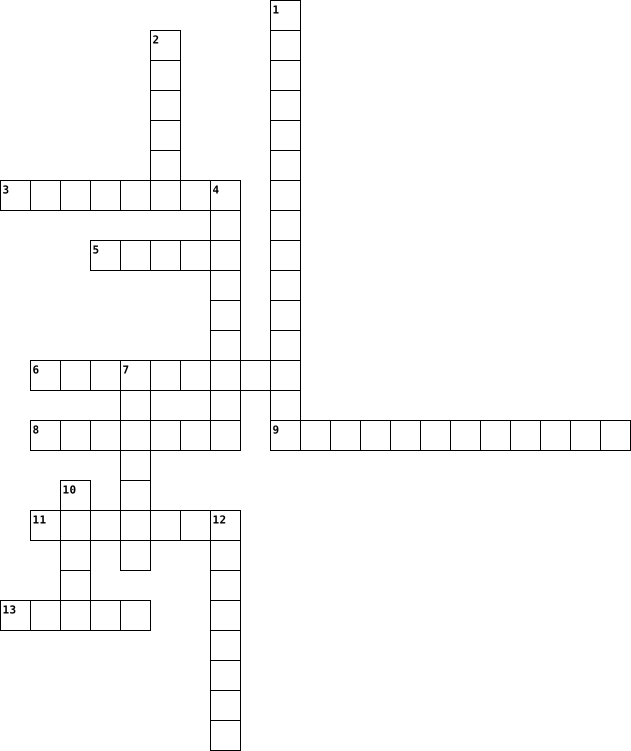
Across
- Human system that makes you move fast
- Company of Minecraft
- Marvel Mineral
- Singer Mercury
- Car Racing Game by EA
- Popular Halloween Monster
- Known as the best football player in the World
Down
- Black Panther
- One of the solar system planets
- Orange Clone
- red nose
- Popular spicy candy
- Name for the Substances of Life
13 Clues: red nose • Orange Clone • Black Panther • Marvel Mineral • Singer Mercury • Popular spicy candy • Company of Minecraft • Car Racing Game by EA • Popular Halloween Monster • One of the solar system planets • Name for the Substances of Life • Human system that makes you move fast • Known as the best football player in the World
Physics Revision Crassword 2025-10-13

Across
- a cloud of dust and gas in space
- found around any object with mass; causes weight and a force of attraction on other masses.
- the planet we live on.
- The farthest planet from the Sun in our Solar System
- an imaginary line through the middle of a planet, about which the planet spins
- the unit of measurement for mass.
- an equipment to measure the weight
Down
- the largest object in the Solar System
- the quantity of matter in an object, measured in kilograms (kg).
- the force of gravity on an object, measured in newtons (N).
- the unit of measurement for force (symbol: N).
- to be on same flat surface
- an equipment to measure the mass
13 Clues: the planet we live on. • to be on same flat surface • a cloud of dust and gas in space • an equipment to measure the mass • the unit of measurement for mass. • an equipment to measure the weight • the largest object in the Solar System • the unit of measurement for force (symbol: N). • The farthest planet from the Sun in our Solar System • ...
Solar Panel Crossword 2024-05-21

Across
- When does a solar panel work best?
- What is the main material used in solar panel production
- What does a solar panel use to make energy.
- What type of energy is solar energy
- What shortens a solar panels lifespan?
- The average solar panel generates 1.5 () a day
- Thermophotovoltaics shortened is...
Down
- Solar panels that bend
- What percentage of the world's solar panels are made from crystalline silicon
- Solar panels are %100 effiencient (true or false)
- Who discovered a new power cell for 2024 solar panels
- Acronym for Copper indium gallium selenide
- Solar panels reduce () bills
- During what time of the day do solar panels NOT work?
- An average solar panel contains () Solar cells
- A solar panels average life span is between () and Thirty years
16 Clues: Solar panels that bend • Solar panels reduce () bills • When does a solar panel work best? • What type of energy is solar energy • Thermophotovoltaics shortened is... • What shortens a solar panels lifespan? • Acronym for Copper indium gallium selenide • What does a solar panel use to make energy. • An average solar panel contains () Solar cells • ...
Space Science Puzzle 2021-04-28

Across
- The unit that weight is measured in
- The force that brings everything down on Earth
- Gas that makes up Venus's atmosphere
- A name given to a ball of burning gas
- Name given to whole of detected space
- The word used to describe how much matter makes up an object(it never changes no matter what planet you are on and measured in kg)
Down
- Category given to pluto
- The unit that mass is measured in
- The biggest gas planet in our solar system
- The force that is exerted on a planet (measured in N)
- Fourth planet from the sun
- The hottest planet in our solar system
- The process that traps heat in the atmosphere
13 Clues: Category given to pluto • Fourth planet from the sun • The unit that mass is measured in • The unit that weight is measured in • Gas that makes up Venus's atmosphere • A name given to a ball of burning gas • Name given to whole of detected space • The hottest planet in our solar system • The biggest gas planet in our solar system • ...
Voyager Video Crossword Puzzle 2023-05-04

Across
- The voyager sent ___ things.
- What is the coldest planet in the solar system
- the sun's magnetic fields spin in ____ directions
- highway the sun's magnetic field lines are connected to interstellar magnetic field lines, allowing particles from inside the heliosphere to zip away and particles
- Where are the two spacecraft located?
- the _____ will die in 2025
- Uranus is tipped on its side because of _____ fields and its tail
Down
- on one of Jupiter's moons there was an_______ volcano
- who found things that people would never except.
- mercury, Gemini, and Apollo proved we could put _____ in space
- Uranus is blue because of methane
- is the most bizarre thing in our solar system
- Neptune has three new rings made out of___
- December 19, 1972, marked the end of the ____ age.
14 Clues: the _____ will die in 2025 • The voyager sent ___ things. • Uranus is blue because of methane • Where are the two spacecraft located? • Neptune has three new rings made out of___ • is the most bizarre thing in our solar system • What is the coldest planet in the solar system • who found things that people would never except. • ...
The Center of Our Solar System 2025-09-16

Across
- Star at the center of our solar system
- Italian Astronomer who confirmed heliocentrism with a telescope
- Formed from clumps of dust and gas orbiting the sun
- The Sun is about this far through its supply of hydrogen
- Astronomer who described the laws of planetary motion
- Polish Astronomer who supported heliocentrism
- This part of the sun is about 27 million degrees Farenheit
- Scientist who described the law of gravity
- The shape of each planet's orbit
Down
- Process that powers the sun and other stars
- The Sun accounts for 98% of this in the solar system
- Belief that the sun is the center of the universe
- Tool Galileo used to observe the skies
13 Clues: The shape of each planet's orbit • Star at the center of our solar system • Tool Galileo used to observe the skies • Scientist who described the law of gravity • Process that powers the sun and other stars • Polish Astronomer who supported heliocentrism • Belief that the sun is the center of the universe • Formed from clumps of dust and gas orbiting the sun • ...
Space - Our Solar System 2016-08-29

Across
- The name of our galaxy is _____ Way.
- Natural debris.
- The planets that is home to humans.
- Cosmic snowballs made up of frozen gases, water ice, rock, dust.
- The planets with a blue-green color from methane gas in the atmosphere.
- Which planet has a longer day than year.
Down
- The closest planet to the sun and fastest moving.
- The Earth's _______ makes the sun seem to move.
- Which planets days last about 16 hours?
- The largest planet in our solar system.
- The sun appears ____ when viewed from space.
- The planet that has rings around it.
- A dwarf planet.
- The red planet.
14 Clues: Natural debris. • A dwarf planet. • The red planet. • The planets that is home to humans. • The name of our galaxy is _____ Way. • The planet that has rings around it. • Which planets days last about 16 hours? • The largest planet in our solar system. • Which planet has a longer day than year. • The sun appears ____ when viewed from space. • ...
Solar System and Beyond 2023-02-09

Across
- a natural object that orbits a planet
- a group of billions of stars, the objects that orbit the stars, gas, and dust
- one of the shapes the moon seems to have as it orbits Earth
- The motion of one object around another object
- a nearly round body, slightly smaller than a planet, whose orbit crosses the orbit of another body
- An object made of rock, ice, dust, and gas that revolves around the Sun.
- An object that is found in the solar system, orbits the Sun, and is much smaller than a planet.
Down
- the turning of an object on its axis
- A large body in space that orbits a star and does not produce light of its own
- a pattern of stars that forms an imaginary picture or design in the sky
- A system of planets and other bodies that orbits a star.
- the study of objects in space and their properties
- A large object in space that is made of gas and produces its own light.
- everything that exists, including galaxies and everything in them.
14 Clues: the turning of an object on its axis • a natural object that orbits a planet • The motion of one object around another object • the study of objects in space and their properties • A system of planets and other bodies that orbits a star. • one of the shapes the moon seems to have as it orbits Earth • everything that exists, including galaxies and everything in them. • ...
Solar System - Will Russell 2021-07-26

Across
- a system with millions and billions of stars together
- the collection of 8 planets and there moons around the sun
- the curved path of a celestial object round the a star or planet
- comet that burns up entering earths atmosphere
- something that orbits around the earth
- a large ball with hot matter in it
Down
- the distance the speed of light takes to travel in one year
- is in an orbit around the sun
- a small rock in space that orbits the sun
- a small rock that orbits the sun
- something that orbits the sun or stars to gather and collect information
- a patch that appears from suns surface from time to time
- a piece of rock that has fallen to earths atmosphere
- the star that earth orbits
14 Clues: the star that earth orbits • is in an orbit around the sun • a small rock that orbits the sun • a large ball with hot matter in it • something that orbits around the earth • a small rock in space that orbits the sun • comet that burns up entering earths atmosphere • a piece of rock that has fallen to earths atmosphere • ...
Planets and Solar System 2021-07-26

Across
- A curved path of a celestial object round a planet, star, moon
- A celestial object consisting of ice and dust.
- The star which planets orbit.
- a system filled with stars, gas and dust, gravity
- A fixed luminous point in the night sky.
- An artificial body programmed to orbit planets to collect information.
- a small rocky body orbiting the sun.
- a piece of rock or metal that has fallen to earths surface.
- A spot or patch that appears on the sun's surface.
Down
- A unit of astromical distance
- A natural satellite of a planet visible by reflecting the sun's light.
- 8 planets that orbit the sun with stars, asteroids and more.
- a small body of matter from outer space entering earths atmosphere.
- A celestial body moving in an elliptical orbit round a star.
14 Clues: A unit of astromical distance • The star which planets orbit. • a small rocky body orbiting the sun. • A fixed luminous point in the night sky. • A celestial object consisting of ice and dust. • a system filled with stars, gas and dust, gravity • A spot or patch that appears on the sun's surface. • a piece of rock or metal that has fallen to earths surface. • ...
Solar System Related Vocabulary 2023-06-09

Across
- an electronic device that is sent into space and moves around the earth or another planet
- the relationship between two groups or amounts that expresses how much bigger one is than the other
- denoting something, especially an animal or plant, that is much smaller than the usual size for its type or species.
- the smallest possible packets of electromagnetic energy
- the physical universe beyond the earth's atmosphere.
- a device that changes energy of movement into electrical energy
- lose consciousness for a short time because of a temporarily insufficient supply of oxygen
- a form of matter in which many of the electrons wander around freely among the nuclei of the atoms
Down
- a straight line passing from side to side through the center of a body or figure
- the relation between the real size of something and its size on a map, model, or diagram
- an aggregation of matter in the universe (such as a planet, star, or nebula)
- the process by which green plants and some other organisms use sunlight to synthesize foods from carbon dioxide and water
- a system of stars, stellar remnants, interstellar gas, dust, and dark matter bound together by gravity
- the radiant energy per unit time which is emitted, transmitted, reflected or received by an object
14 Clues: the physical universe beyond the earth's atmosphere. • the smallest possible packets of electromagnetic energy • a device that changes energy of movement into electrical energy • an aggregation of matter in the universe (such as a planet, star, or nebula) • a straight line passing from side to side through the center of a body or figure • ...
Solar System Crossword Puzzle 2023-09-20

Across
- the hottest planet
- the only planet that has a 90 degrees tilt on its axis
- a streak of light in the sky produced by the burning of a meteoroid burning in earths atmosphere
- the planet with the highest winds
- balls of ice and dust that leave a trail
- the only planet that can support life the most moons and rings
Down
- natural satellites that get caught in gravitational pulls of the planets the planet with the highest winds
- another word for outer planets
- the planet with the most moons
- another word for outer planets
- gives off light and energy to all the planets
- the largest planet in the solar system
- the smallest planet and closest to the sun
- a planet that became a dwarf planet in 2006
- considered the "red planet"
15 Clues: the hottest planet • considered the "red planet" • another word for outer planets • the planet with the most moons • another word for outer planets • the planet with the highest winds • the largest planet in the solar system • balls of ice and dust that leave a trail • the smallest planet and closest to the sun • a planet that became a dwarf planet in 2006 • ...
Earth and Space 2017-08-20

Across
- , Distances in space are sometimes measured using __________ years.
- , A pattern in the stars.
- , There are eight of these in the Solar System.
- , The planet we live on.
- , you can see lots of these on a clear night.
Down
- , The name of our galaxy.
- , When the Moon looks like a complete bright circle of light it is a __________________ Moon.
- , The Earth is part of the ____________ System.
- , small lumps of rock orbiting the Sun.
- , The length of time it takes for the Earth to go around the Sun once.
- , The Moon looks different at different times of the month. The different shapes are called _________________ of the Moon.
- , Our nearest star.
- , A __________ year has 366 days.
13 Clues: , Our nearest star. • , The planet we live on. • , The name of our galaxy. • , A pattern in the stars. • , A __________ year has 366 days. • , small lumps of rock orbiting the Sun. • , you can see lots of these on a clear night. • , The Earth is part of the ____________ System. • , There are eight of these in the Solar System. • ...
The Sun and Star life cycles 2024-03-19

Across
- , a star bigger than our Sun
- , The star that all the planets in the Solar System revolve around
- , the amount of time it takes to make one rotation around the Sun
- , Only planet containing life in the Solar System
- , the explosion of a star
- , an element or gas the Sun is composed of
- , the name of the supernova remnant
- , the amount of time it takes Earth to spin around once on its axis
Down
- , a type of star like our Sun
- , a star way bigger than our sun
- , how the Sun releases energy
- , the instrument that allows us to see light
- , an element or gas the Sun is composed of
13 Clues: , how the Sun releases energy • , the explosion of a star • , a star bigger than our Sun • , a type of star like our Sun • , a star way bigger than our sun • , the name of the supernova remnant • , an element or gas the Sun is composed of • , an element or gas the Sun is composed of • , the instrument that allows us to see light • ...
Physics Revision Crassword 2025-10-13

Across
- a cloud of dust and gas in space
- found around any object with mass; causes weight and a force of attraction on other masses.
- the planet we live on.
- The farthest planet from the Sun in our Solar System
- an imaginary line through the middle of a planet, about which the planet spins
- the unit of measurement for mass.
- an equipment to measure the weight
Down
- the largest object in the Solar System
- the quantity of matter in an object, measured in kilograms (kg).
- the force of gravity on an object, measured in newtons (N).
- the unit of measurement for force (symbol: N).
- to be on same flat surface
- an equipment to measure the mass
13 Clues: the planet we live on. • to be on same flat surface • a cloud of dust and gas in space • an equipment to measure the mass • the unit of measurement for mass. • an equipment to measure the weight • the largest object in the Solar System • the unit of measurement for force (symbol: N). • The farthest planet from the Sun in our Solar System • ...
Space 2021-03-11

Across
- Our galaxy
- farthest from the sun
- home of all life
Down
- no longer in the solar system
- most like earth
- biggest planet in the solar system
- closest to the sun
7 Clues: Our galaxy • most like earth • home of all life • closest to the sun • farthest from the sun • no longer in the solar system • biggest planet in the solar system
Inner planets 2022-09-30

Across
- the second planet from the Sun and is Earth's closest planetary neighbor.
- the third planet from the Sun and the fifth largest planet in the solar system in terms of size and mass.
- the smallest planet in our solar system. It's a little bigger than Earth's Moon
- The things most inner planets are made from
Down
- a planet that is composed primarily of silicate rocks or metals
- the natural satellite of the earth, visible (chiefly at night) by reflected light from the sun.
- the collection of eight planets and their moons in orbit around the sun, together with smaller bodies in the form of asteroids, meteoroids, and comets.
- a planet whose orbit lies within the asteroid belt
- the thing that all planets orbit
- the fourth planet from the Sun and the second-smallest planet in the Solar System
10 Clues: the thing that all planets orbit • The things most inner planets are made from • a planet whose orbit lies within the asteroid belt • a planet that is composed primarily of silicate rocks or metals • the second planet from the Sun and is Earth's closest planetary neighbor. • the smallest planet in our solar system. It's a little bigger than Earth's Moon • ...
Scientific Revolution 2025-11-13

Across
- an Italian mathematician and astronomer who had the idea of an infinite universe and was burnt on the stake
- a place where scholars were brought together to debate, discover, and learn
- a Greek astronomer who believed the geocentric model of the universe was correct
- the idea of having the sun at the center of our solar system
Down
- someone who went against the church's teachings
- the idea of having the earth at the center of the universe
- an English physicist who discovered inertia and had the idea of universal gravitation
- a polish mathematician and astronomer who had the idea of a heliocentric model of the solar system
- a German astronomer and mathematician who established the three planetary laws
- an Italian astronomer and physicist who caused controversy due to believing in a heliocentric model of the solar system
10 Clues: someone who went against the church's teachings • the idea of having the earth at the center of the universe • the idea of having the sun at the center of our solar system • a place where scholars were brought together to debate, discover, and learn • a German astronomer and mathematician who established the three planetary laws • ...
Chapters 28 and 29 Astronomy Lydia Gleckler 2022-05-12

Across
- _____________ is a well-known constellation. The pairs of stars at the end of its bowl point to Polaris, the North Star.
- the planets closest to the sun in our solar system
- Nearest start to earth mostly made out of hydrogen in the plasma state
- cools for eons until it is too cold to emit light. is part of a binary star, it pulls matter from its partner, which can lead to a nuclear blast (nova).
- groups of stars that have regularly recognized positions.
Down
- the intrinsic brightness, independent of how bright it appears
- the brightness as it appears to us
- the Sun and planets formed together from a cloud of gas and dust What a star begins as
- this person's Geocentric model was known as the Earth centered solar system
- this person's heliocentric model was known as the sun centered solar system
10 Clues: the brightness as it appears to us • the planets closest to the sun in our solar system • groups of stars that have regularly recognized positions. • the intrinsic brightness, independent of how bright it appears • Nearest start to earth mostly made out of hydrogen in the plasma state • this person's Geocentric model was known as the Earth centered solar system • ...
Gravity crossword 2021-10-26

Across
- the amount of gravity exerted on an object
- one factor that acts on gravity
- the dust + gas that made our solar system
- the force that governs the solar system
- the amount of matter in an object
Down
- the scientist who discovered gravity
- the law that stats objects in motion will stay in motion in a line
- Dust and Gravity: what the earth is made of
- what the planets orbit because of gravity
- the scientist who tested gravity
10 Clues: one factor that acts on gravity • the scientist who tested gravity • the amount of matter in an object • the scientist who discovered gravity • the force that governs the solar system • what the planets orbit because of gravity • the dust + gas that made our solar system • the amount of gravity exerted on an object • Dust and Gravity: what the earth is made of • ...
Nevaeh's crossword 2016-11-21

Across
- Only planet with rings around it.
- astronomers developed a new category called.
- hundreds of small, irregular, rocky objects orbit the sun.
- largest planet in our solar system.
- One of the most dramatic objects you can see in the night sky.
Down
- is called the "red planet".
- smallest planet in our solar system.
- chunks of rock or dust smaller than asteroids are called.
- astronomers have discovered this planet has at least 13 moons.
- we can live easily on it.
10 Clues: we can live easily on it. • is called the "red planet". • Only planet with rings around it. • largest planet in our solar system. • smallest planet in our solar system. • astronomers developed a new category called. • chunks of rock or dust smaller than asteroids are called. • hundreds of small, irregular, rocky objects orbit the sun. • ...
sun, moon and earth 2021-03-05

Across
- the outermost layer of earth
- a satellite launched in India to moon
- the planet on which we live on huge ball
- craters are huge ditches that were formed when huge pieces of rock
- how many planet our in the solar system
Down
- the innermost layer of earth
- the middle layer of earth
- a small object that revolves around a planet
- the natural satellite around the earth
- the star in the center of the solar system
10 Clues: the middle layer of earth • the outermost layer of earth • the innermost layer of earth • a satellite launched in India to moon • the natural satellite around the earth • how many planet our in the solar system • the planet on which we live on huge ball • the star in the center of the solar system • a small object that revolves around a planet • ...
Chapter 28 & 29- Emily Fischer 2021-05-24

Across
- a huge assemblage of stars, interstellar galaxies, and dust
- masses of water, methane, and ice
- when chemical elements are heated, they too produce spectra
- sun centered the solar system
- consists of the sun, planets, asteroids, comets, and moons
Down
- hypothetical form of energy that exerts a negative, repulsive pressure
- earth centered the solar system
- small rocky bodies that orbit the sun
- relatively small piece of debris chipped off asteroids or comets
- the unit from earth to the sun
10 Clues: sun centered the solar system • the unit from earth to the sun • earth centered the solar system • masses of water, methane, and ice • small rocky bodies that orbit the sun • consists of the sun, planets, asteroids, comets, and moons • a huge assemblage of stars, interstellar galaxies, and dust • when chemical elements are heated, they too produce spectra • ...
Thursday Homework 2016-09-15

Across
- Turning of a body on its axis
- An oval shape orbit around the sun
- Change in the amount that the moon appeares lit
- Motion of a body through a path in space
- Slight movement of a body's axis
Down
- The Earth is the center of the Solar System
- The moon is the farthest from Earth
- The science that studies the universe
- The sun is the center of the Solar System
- The moon is the closest to Earth
10 Clues: Turning of a body on its axis • The moon is the closest to Earth • Slight movement of a body's axis • An oval shape orbit around the sun • The moon is the farthest from Earth • The science that studies the universe • Motion of a body through a path in space • The sun is the center of the Solar System • The Earth is the center of the Solar System • ...
Space 2016-09-07

Across
- When looking up at the night sky we can see the stars and the ________
- Planets and stars can be seen through a _________
- Astronauts float in space because there is no __________
- The planet we call home ________
- The closest planet to the sun ______
Down
- What is the biggest star in our galaxy ________
- Our solar system is called the __________
- The largest planet in our solar system is _________
- Planet that has the most rings surrounding it is __________
- What is the red planet ____
10 Clues: What is the red planet ____ • The planet we call home ________ • The closest planet to the sun ______ • Our solar system is called the __________ • What is the biggest star in our galaxy ________ • Planets and stars can be seen through a _________ • The largest planet in our solar system is _________ • Astronauts float in space because there is no __________ • ...
Solar System Crossword Puzzle 2023-12-10

Across
- The planet with the moons Phobos and Deimos.
- The 8th and furthest planet from the Sun
- One turn around the Sun that equals 365 days is called?
- Covers 70% of the Earth's surface
Down
- What is the Sun?
- A small, icy object that orbits the sun and has a long "tail" of gas
- The center of our solar system.
- The number of planets in our solar system
- This is Earth's satellite.
- No longer officially considered a planet
10 Clues: What is the Sun? • This is Earth's satellite. • The center of our solar system. • Covers 70% of the Earth's surface • The 8th and furthest planet from the Sun • No longer officially considered a planet • The number of planets in our solar system • The planet with the moons Phobos and Deimos. • One turn around the Sun that equals 365 days is called? • ...
Venus 2024-11-13

Across
- Venus's sky
- Venus is this to life
- The second planet from the sun
- Venus is the _______ planet in our solar system
Down
- Even though Venus is the 6th largest planet, it is still _______ than earth by just a little bit
- Venus is the only planet named after a Roman _______
- Venus atmosphere
- What object Venus is in our solar system
- Venus is known to be earth's evil ____
- Venus is known to be this planet's evil twin
10 Clues: Venus's sky • Venus atmosphere • Venus is this to life • The second planet from the sun • Venus is known to be earth's evil ____ • What object Venus is in our solar system • Venus is known to be this planet's evil twin • Venus is the _______ planet in our solar system • Venus is the only planet named after a Roman _______ • ...
Inner Planets 2026-06-04

Across
- a celestial object that orbits a planet
- contains water and oxygen to support life
- moves around in a circle repeatedly
- earth-like
- the layer around a planet that is made up of gases that vary in thickness and composition
Down
- the 4 planets in our solar system farthest from the Sun
- the 4 planets in our solar system closest to the sun
- Earth's sister planet
- has the shortest orbit around the Sun
- known to be the Red planet
10 Clues: earth-like • Earth's sister planet • known to be the Red planet • moves around in a circle repeatedly • has the shortest orbit around the Sun • a celestial object that orbits a planet • contains water and oxygen to support life • the 4 planets in our solar system closest to the sun • the 4 planets in our solar system farthest from the Sun • ...
Inner Planets 2026-06-04

Across
- a celestial object that orbits a planet
- contains water and oxygen to support life
- moves around in a circle repeatedly
- earth-like
- the layer around a planet that is made up of gases that vary in thickness and composition
Down
- 4 planets in our solar system farthest from the Sun
- 4 planets in our solar system closest to the sun
- Earth's sister planet
- has the shortest orbit around the Sun
- known to be the Red planet
10 Clues: earth-like • Earth's sister planet • known to be the Red planet • moves around in a circle repeatedly • has the shortest orbit around the Sun • a celestial object that orbits a planet • contains water and oxygen to support life • 4 planets in our solar system closest to the sun • 4 planets in our solar system farthest from the Sun • ...
planets 2015-01-27

Across
- smallest planet in the our solar system.
- A space group.
Down
- The planet that is believed to be tipped on its side.
- Biggest planet in the solar system.
- our galaxy.
- Biggest thing in the solar system.
6 Clues: our galaxy. • A space group. • Biggest thing in the solar system. • Biggest planet in the solar system. • smallest planet in the our solar system. • The planet that is believed to be tipped on its side.
Gravity crossword 2021-10-26

Across
- Galilei: the scientist who tested gravity
- Dust and Gravity: what the earth is made of
- one factor that acts on gravity
- what the planets orbit because of gravity
- the force that governs the solar system
Down
- the amount of matter in an object
- the scientist who discovered gravity
- law that statsobjects in motion will stay in motion in a line
- the dust + gas that made our solar system
- the amount of gravity exerted on an object
10 Clues: one factor that acts on gravity • the amount of matter in an object • the scientist who discovered gravity • the force that governs the solar system • Galilei: the scientist who tested gravity • the dust + gas that made our solar system • what the planets orbit because of gravity • the amount of gravity exerted on an object • Dust and Gravity: what the earth is made of • ...
Gravity crossword 2021-10-26

Across
- the amount of gravity exerted on an object
- one factor that acts on gravity
- the dust + gas that made our solar system
- the force that governs the solar system
- the amount of matter in an object
Down
- the scientist who discovered gravity
- the law that states objects in motion will stay in motion in a line
- Dust and Gravity: what the earth is made of
- what the planets orbit because of gravity
- the scientist who tested gravity
10 Clues: one factor that acts on gravity • the scientist who tested gravity • the amount of matter in an object • the scientist who discovered gravity • the force that governs the solar system • what the planets orbit because of gravity • the dust + gas that made our solar system • the amount of gravity exerted on an object • Dust and Gravity: what the earth is made of • ...
space 2021-10-20

Across
- earth in the center of our solar system
- space technology gives your tv connection
- a space rock,wiped out the dinosaurs
- a planet not big enough to be a planet
Down
- a ball of ice heating up,tail of light
- something going around something
- a rock in space not in the atmosphere
- the light part of the shadow of a eclipse
- sun in the center of the solar system
- a rock in our atmosphere heating,shooting star
10 Clues: something going around something • a space rock,wiped out the dinosaurs • a rock in space not in the atmosphere • sun in the center of the solar system • a ball of ice heating up,tail of light • a planet not big enough to be a planet • earth in the center of our solar system • space technology gives your tv connection • the light part of the shadow of a eclipse • ...
Week 2 Vocabulary 2024-01-25

Across
- rocky leftovers from formation of solar system
- planet farthest from sun
- gas and ice giant planets
- cloud of gas and dust that was the start of the solar system
- these are moving away from us at increasing speed, according to Hubble
Down
- nuclear ___________ describes combining two Hydrogen atoms creating light and heat energy
- planet closest to sun
- natural satellite that orbits a planet
- terrestrial, or earthlike planets
- one theory of its creation is the Big Bang
10 Clues: planet closest to sun • planet farthest from sun • gas and ice giant planets • terrestrial, or earthlike planets • natural satellite that orbits a planet • one theory of its creation is the Big Bang • rocky leftovers from formation of solar system • cloud of gas and dust that was the start of the solar system • ...
Astronomy 2022-07-26

Across
- An acronym for the International Space Station
- The study off all things beyond Earth's atmosphere
- The largest planet in the solar system
- To travel around an object in space
- The hottest planet in the solar system
Down
- A collection of stars and planets held together by gravity
- The distance it takes light to travel in a year
- The planet farthest from the Sun
- The force that keeps everything in the universe organized
- The planet closest to the Sun
10 Clues: The planet closest to the Sun • The planet farthest from the Sun • To travel around an object in space • The largest planet in the solar system • The hottest planet in the solar system • An acronym for the International Space Station • The distance it takes light to travel in a year • The study off all things beyond Earth's atmosphere • ...
Alien infographics 2023-05-08

Across
- a continuous area of expanse past our atmosphere
- system a group of planets that orbit their coordinating star
- something not from that place or area
- a large chunk of rock that is massive
- a cluster of galaxies, black holes, and stars
Down
- a group of dust, planets, and stars
- something relating to is stating the earth
- a large ball of gasses that run and power a solar system
- something foreign
- a group of universes which is massive
10 Clues: something foreign • a group of dust, planets, and stars • a group of universes which is massive • something not from that place or area • a large chunk of rock that is massive • something relating to is stating the earth • a cluster of galaxies, black holes, and stars • a continuous area of expanse past our atmosphere • ...
Biodiversity 2022-07-08

Across
- is not a pyramid
- the one and only planet in the solar system that has an atmosphere capable of supporting life
- the layer nearest to the surface of earth
- small, single-celled organisms without nucleus and includes archaea bacteria, cyanobacteria and mycoplasma.
- the highest and thinnest layer
Down
- elements of biodiversity
- thinnest layer
- the solar system was a cloud of dust and gas
- are formed from polymers that were formed grouped together
- solid with liquid properties
10 Clues: thinnest layer • is not a pyramid • elements of biodiversity • solid with liquid properties • the highest and thinnest layer • the layer nearest to the surface of earth • the solar system was a cloud of dust and gas • are formed from polymers that were formed grouped together • the one and only planet in the solar system that has an atmosphere capable of supporting life • ...
Planets and orbits 2022-09-28

Across
- The smallest and nearest planet to the Sun
- The planet farthest from the Sun
- The only known planet to support life
- The planet famous for its rings
- The fourth planet from the Sun
Down
- The largest planet in the solar system
- Number of planets in the solar system
- The path a planet takes around the Sun
- Once called a planet, now known as a dwarf planet
- The second planet from the Sun. It has poisonous clouds
10 Clues: The fourth planet from the Sun • The planet famous for its rings • The planet farthest from the Sun • Number of planets in the solar system • The only known planet to support life • The largest planet in the solar system • The path a planet takes around the Sun • The smallest and nearest planet to the Sun • Once called a planet, now known as a dwarf planet • ...
Gravity Exploration Crossword 2022-05-16

Across
- star created the solar system
- measure of gravitational pull on that object from the Earth.
- planets have a stronger gravitational than smaller planets
- First scientist to begin studying gravity
- how much matter the object is made of.
- has a smaller gravitational pull than earth
Down
- The force of the earth that pulls everything to its core.
- and gravity created the earth
- from the earth balances out the sun's gravity
- is the center of our solar system
10 Clues: and gravity created the earth • star created the solar system • is the center of our solar system • how much matter the object is made of. • First scientist to begin studying gravity • has a smaller gravitational pull than earth • from the earth balances out the sun's gravity • The force of the earth that pulls everything to its core. • ...
planet Saturn 2015-10-07

Across
- this planet has the second shortest____ of any other planet11
- this planet is the fifth _________ object in the solar system
- this planet is called Cronus to the __________
- this pant is full of this
- this planet is the ___________ away from the sun
Down
- this planet was recorded by these people
- this planet has 62 of these
- this planet is the __________ planet in the solar system
- this planet has 30+ of these
- this planet orbits the sun every 29.4 ______ years
10 Clues: this pant is full of this • this planet has 62 of these • this planet has 30+ of these • this planet was recorded by these people • this planet is called Cronus to the __________ • this planet is the ___________ away from the sun • this planet orbits the sun every 29.4 ______ years • this planet is the __________ planet in the solar system • ...
Space 2021-05-20

Across
- The earth ______ on it's axis.
- smallest planet
- planets circle the earth
- largest planet
- The shortened name of the international space station
Down
- The further away from the sun, the _______ it takes to orbit the sun.
- scientist who used a telescope to support the heliocentric model
- planets circle the sun
- the only planet in the solar system on which life is known to exist
- the star at the center of our solar system that all planets rotate around
10 Clues: largest planet • smallest planet • planets circle the sun • planets circle the earth • The earth ______ on it's axis. • The shortened name of the international space station • scientist who used a telescope to support the heliocentric model • the only planet in the solar system on which life is known to exist • ...
M4 Sci U2: Solar system crossword 2024-06-12

Across
- the largest planet in the solar system
- a planet with no atmosphere
- the hottest planet in the solar system
- the four planets closest to the sun are the ______ planets
- The spinning motion of the Earth
- the shape of the Earth
- The path a body travels in space around another object
Down
- Mercury's low gravity means it has no ______
- planets made of rock are called ______ planets
- the time it takes to travel around the earth is the period of __________
10 Clues: the shape of the Earth • a planet with no atmosphere • The spinning motion of the Earth • the largest planet in the solar system • the hottest planet in the solar system • Mercury's low gravity means it has no ______ • planets made of rock are called ______ planets • The path a body travels in space around another object • ...