
solar system Crossword Puzzles
Space 2023-03-27

Across
- I am called the red planet.
- I used to be a planet but now I'm a Dwarf planet
- I am the biggest planet in our solar system.
- The farthest planet from the sun.
- I am a outer planet with a visible ring.
- The hottest planet in our solar system.
Down
- The closest planet to the sun.
- I am in between Mars and Jupiter.
- Mars has __ moons.
- I have a odd tilt and I rotate on my side.
10 Clues: Mars has __ moons. • I am called the red planet. • The closest planet to the sun. • I am in between Mars and Jupiter. • The farthest planet from the sun. • The hottest planet in our solar system. • I am a outer planet with a visible ring. • I have a odd tilt and I rotate on my side. • I am the biggest planet in our solar system. • ...
Gravity crossword 2021-10-26

Across
- Galilei: the scientist who tested gravity
- Dust and Gravity: what the earth is made of
- one factor that acts on gravity
- what the planets orbit because of gravity
- the force that governs the solar system
Down
- the amount of matter in an object
- the scientist who discovered gravity
- law that statsobjects in motion will stay in motion in a line
- the dust + gas that made our solar system
- the amount of gravity exerted on an object
10 Clues: one factor that acts on gravity • the amount of matter in an object • the scientist who discovered gravity • the force that governs the solar system • Galilei: the scientist who tested gravity • the dust + gas that made our solar system • what the planets orbit because of gravity • the amount of gravity exerted on an object • Dust and Gravity: what the earth is made of • ...
Gravity crossword 2021-10-26

Across
- Galilei: the scientist who tested gravity
- Dust and Gravity: what the earth is made of
- one factor that acts on gravity
- what the planets orbit because of gravity
- the force that governs the solar system
Down
- the amount of matter in an object
- the scientist who discovered gravity
- law that statsobjects in motion will stay in motion in a line
- the dust + gas that made our solar system
- the amount of gravity exerted on an object
10 Clues: one factor that acts on gravity • the amount of matter in an object • the scientist who discovered gravity • the force that governs the solar system • Galilei: the scientist who tested gravity • the dust + gas that made our solar system • what the planets orbit because of gravity • the amount of gravity exerted on an object • Dust and Gravity: what the earth is made of • ...
Gravity crossword 2021-10-26

Across
- the amount of gravity exerted on an object
- one factor that acts on gravity
- the dust + gas that made our solar system
- the force that governs the solar system
- the amount of matter in an object
Down
- the scientist who discovered gravity
- the law that states objects in motion will stay in motion in a line
- Dust and Gravity: what the earth is made of
- what the planets orbit because of gravity
- the scientist who tested gravity
10 Clues: one factor that acts on gravity • the scientist who tested gravity • the amount of matter in an object • the scientist who discovered gravity • the force that governs the solar system • what the planets orbit because of gravity • the dust + gas that made our solar system • the amount of gravity exerted on an object • Dust and Gravity: what the earth is made of • ...
Science crossword puzzle 2022-05-16

Across
- The biggest planet in the solar system
- Positively charged ______ attached to negative electrons to form the first atoms
- First atom formed after the big bang
- Number of planets in the solar system
Down
- Second atom formed after the big bang
- Farthest planet from the sun
- 3rd planet from the sun
- Form that energy was released from attachment of positive protons and negative electrons
- Once it slowed down it turned to matter after
- Planet with the most moons
10 Clues: 3rd planet from the sun • Planet with the most moons • Farthest planet from the sun • First atom formed after the big bang • Second atom formed after the big bang • Number of planets in the solar system • The biggest planet in the solar system • Once it slowed down it turned to matter after • Positively charged ______ attached to negative electrons to form the first atoms • ...
SOLAR SYSTEM FANES SUKA bannes 2025-01-27

Across
- What is the fifth planet from the sun?
- What is the smallest planet in solar system?
- what is the closest planet?
- What is the third planet of Solar system?
- The...planet closest to the sun is
- Mars is known as the planet?
Down
- What is the seventh planet from the sun?
- what is planet has two moons which are Phobos and Deimos?
- What planet it takes the longest time to orbit?
- what is the second largest planet?
10 Clues: what is the closest planet? • Mars is known as the planet? • The...planet closest to the sun is • what is the second largest planet? • What is the fifth planet from the sun? • What is the seventh planet from the sun? • What is the third planet of Solar system? • What is the smallest planet in solar system? • What planet it takes the longest time to orbit? • ...
the Earth, Moon, and Sun system 2025-04-24

Across
- A force that pulls objects to another object
- There is at least 1 that orbits around most planets.
- The force that keeps Planets from going into the sun.
- The only planet with living things in the solar system.
- The largest star visible on Earth.
Down
- The first scientist to discuss gravity.
- How a planet revolves around the sun.
- How much an object weighs.
- The amount of matter an object has.
- 2nd planet in the solar system.
10 Clues: How much an object weighs. • 2nd planet in the solar system. • The largest star visible on Earth. • The amount of matter an object has. • How a planet revolves around the sun. • The first scientist to discuss gravity. • A force that pulls objects to another object • There is at least 1 that orbits around most planets. • ...
The Sun 2022-02-08

Across
- Stars can be different sizes and _______.
- At night, our side of the earth faces _______ from the sun.
- _______ stars are hotter than red stars.
- The sun gives us _______ and heat.
- The earth _______ around the sun.
Down
- The sun is the _______ of our Solar System.
- The sun is the closest _______ to Earth.
- Over one _______ Earths could fit inside of the sun.
- The sun is the _______ object in the Solar System.
- People, _______, and animals cannot survive without the sun.
10 Clues: The earth _______ around the sun. • The sun gives us _______ and heat. • The sun is the closest _______ to Earth. • _______ stars are hotter than red stars. • Stars can be different sizes and _______. • The sun is the _______ of our Solar System. • The sun is the _______ object in the Solar System. • Over one _______ Earths could fit inside of the sun. • ...
Law of Universal Gravitation 2023-03-09

Across
- Theory of how the universe began
- Gives light and heat to space objects that orbit around it
- Gravity ____ objects toward each other
- ___ ___ ___ was drawn together by gravity to form the solar system
- Where everything exists.
- Planets ___ around the Sun due to the Sun´s gravity
- Governs the solar system
- Gravity is affected by what two factors.
Down
- The greater the mass, the ____ the gravity
- Gravitational attraction of the Sun is responsible for the ___ ___ of the planets
- What is responsible for planet and star formation (giving them their round shape)
- The further the distance, the _____ the gravity
- If gravity disappeared, planets would stop orbiting and shoot off in a ___ line.
13 Clues: Where everything exists. • Governs the solar system • Theory of how the universe began • Gravity ____ objects toward each other • Gravity is affected by what two factors. • The greater the mass, the ____ the gravity • The further the distance, the _____ the gravity • Planets ___ around the Sun due to the Sun´s gravity • ...
Famous Astronomers 2024-12-09

Across
- Believed in the Geocentric model and Epicycles
- The Webb and Hubble are ______ telescopes
- Was the first to come up with the heliocentric model.
- Explained that the force that moved the planets was gravity.
- The _____ disagreed with Galileo and placed him under house arrest.
- Copernicus delivered his Heliocentric model right before he _____.
- This telescope is made up of lenses.
- Put an end to the Geocentric model using his telescope.
Down
- Model that puts the Earth at the center of the Solar System.
- With Galileo's improved telescope he first viewed the ___.
- The study of space.
- Model that puts the Sun at the center of the Solar System.
- This telescope is made up of Mirrors.
13 Clues: The study of space. • This telescope is made up of lenses. • This telescope is made up of Mirrors. • The Webb and Hubble are ______ telescopes • Believed in the Geocentric model and Epicycles • Was the first to come up with the heliocentric model. • Put an end to the Geocentric model using his telescope. • With Galileo's improved telescope he first viewed the ___. • ...
pace beyond the stars 2026-02-24

Across
- Which planet is called a dwarf planet?
- What is the path a planet follows around a star?
- coldes plnet in the solar system?
- what is the biggest planet in our gallaxy?
- what is in the sky at night?
- what planet is considered the red planet?
- What is the only planet known to support life?
Down
- what is the biggest star i the gallaxy?
- What do people get up into space with a space?
- which planet is closest to the sun?
- Which planet is the hottest in our solar system?
- What do we call a person who travels into the space?
- What was the name of the first dog in space?
13 Clues: what is in the sky at night? • coldes plnet in the solar system? • which planet is closest to the sun? • Which planet is called a dwarf planet? • what is the biggest star i the gallaxy? • what planet is considered the red planet? • what is the biggest planet in our gallaxy? • What was the name of the first dog in space? • What do people get up into space with a space? • ...
Astronomy and Space 2023-06-16

Across
- The powerful explosion that occurs at the end of a massive star's life, releasing a tremendous amount of energy and producing heavy elements
- Bang Theory The prevailing scientific explanation for the origin of the universe, suggesting it began from a singularity and has been expanding ever since
- A celestial object composed of ice, dust, and rocky particles that orbits the Sun and develops a glowing coma and tail as it approaches
- A vast cloud of gas and dust in space, often considered as the birthplaces of stars
- Nebula A glowing shell of gas and dust ejected by a dying star, forming intricate and colorful structures in space
- A natural light display in the Earth's sky, predominantly seen in polar regions, caused by the interaction of solar particles with the atmosphere
- The force that attracts objects toward one another, responsible for holding planets, stars, and galaxies together
- Unit A unit of measurement equal to the average distance between the Earth and the Sun, approximately 93 million miles
- Hole A region of spacetime exhibiting extreme gravitational effects, from which nothing, including light, can escape
Down
- A planet that orbits a star outside our Solar System
- Space Telescope A space telescope launched into orbit around the Earth, providing stunning images and valuable data about the universe
- A group of stars that appear to form a recognizable pattern or shape in the night sky
- Rover A robotic vehicle sent to Mars by NASA to explore the planet's surface and gather scientific data
- System The collection of planets, moons, asteroids, comets, and other celestial objects that orbit around the Sun
- Giant A large, relatively cool star that has exhausted its core hydrogen fuel and expanded in size
- Eclipse When the Earth comes between the Sun and the Moon, causing the Moon to temporarily darken
- Way The galaxy that contains our Solar System, appearing as a band of stars in the night sky
17 Clues: A planet that orbits a star outside our Solar System • A vast cloud of gas and dust in space, often considered as the birthplaces of stars • A group of stars that appear to form a recognizable pattern or shape in the night sky • Way The galaxy that contains our Solar System, appearing as a band of stars in the night sky • ...
Solar Eclipse Key terms 2024-04-17

Across
- The approximately 11-year cycle of sunspot activity.
- The moment during a solar eclipse when the Moon last touches the Sun's edge.
- The outermost layer of the Sun's atmosphere, seen during a total solar eclipse as a pearly-white halo.
- Someone passionate about experiencing total solar eclipses.
- The fraction of the Sun's diameter covered by the Moon during a solar eclipse.
- The state of being annular, forming a ring-like shape.
- Bright, gaseous features extending from the Sun's surface, visible during a total solar eclipse.
- The lunar phase when the Moon is between the Earth and the Sun.
- An 18-year, 11-day, and 8-hour cycle after which similar eclipses occur.
- A period when solar and lunar eclipses can occur, happening twice a year.
- The period during a total solar eclipse when the Sun is fully covered.
- (C1) The start of a solar eclipse, when the Moon touches the Sun's edge.
- Wavy lines seen on the ground just before and after a total solar eclipse.
Down
- A solar eclipse where the Sun is completely obscured by the Moon.
- The moment during a total solar eclipse when a single bead of sunlight remains visible.
- A solar eclipse where the Moon covers the center of the Sun, leaving a ring of sunlight visible
- A solar eclipse where the Moon only partially covers the Sun.
- The central, darkest part of a shadow.
- (C4) The end of a solar eclipse, when the Moon leaves the Sun's edge.
- The moment during a solar eclipse when the Moon first touches the Sun's edge.
- The effect during a total solar eclipse when beads of sunlight shine through lunar valleys.
- The Sun's apparent path across the sky, along which eclipses occur.
- An eclipse appearing as both total and annular depending on the observer's location.
- The outer region of a shadow with partial blocking of the light source.
- The Sun's outer atmosphere layer, visible during a solar eclipse as reddish gases.
- The shadow region beyond the umbra, where partial blocking of the light source occurs.
- The fraction of the Sun's area covered by the Moon during a solar eclipse.
- The Sun's visible surface emitting light.
- Dark areas on the Sun's surface caused by magnetic activity.
- Shadows cast by the Moon during a solar eclipse.
30 Clues: The central, darkest part of a shadow. • The Sun's visible surface emitting light. • Shadows cast by the Moon during a solar eclipse. • The approximately 11-year cycle of sunspot activity. • The state of being annular, forming a ring-like shape. • Someone passionate about experiencing total solar eclipses. • ...
Solar Eclipse Key terms 2024-04-17

Across
- The approximately 11-year cycle of sunspot activity.
- The moment during a solar eclipse when the Moon last touches the Sun's edge.
- The outermost layer of the Sun's atmosphere, seen during a total solar eclipse as a pearly-white halo.
- Someone passionate about experiencing total solar eclipses.
- The fraction of the Sun's diameter covered by the Moon during a solar eclipse.
- The state of being annular, forming a ring-like shape.
- Bright, gaseous features extending from the Sun's surface, visible during a total solar eclipse.
- The lunar phase when the Moon is between the Earth and the Sun.
- An 18-year, 11-day, and 8-hour cycle after which similar eclipses occur.
- A period when solar and lunar eclipses can occur, happening twice a year.
- The period during a total solar eclipse when the Sun is fully covered.
- (C1) The start of a solar eclipse, when the Moon touches the Sun's edge.
- Wavy lines seen on the ground just before and after a total solar eclipse.
Down
- A solar eclipse where the Sun is completely obscured by the Moon.
- The moment during a total solar eclipse when a single bead of sunlight remains visible.
- A solar eclipse where the Moon covers the center of the Sun, leaving a ring of sunlight visible
- A solar eclipse where the Moon only partially covers the Sun.
- The central, darkest part of a shadow.
- (C4) The end of a solar eclipse, when the Moon leaves the Sun's edge.
- The moment during a solar eclipse when the Moon first touches the Sun's edge.
- The effect during a total solar eclipse when beads of sunlight shine through lunar valleys.
- The Sun's apparent path across the sky, along which eclipses occur.
- An eclipse appearing as both total and annular depending on the observer's location.
- The outer region of a shadow with partial blocking of the light source.
- The Sun's outer atmosphere layer, visible during a solar eclipse as reddish gases.
- The shadow region beyond the umbra, where partial blocking of the light source occurs.
- The fraction of the Sun's area covered by the Moon during a solar eclipse.
- The Sun's visible surface emitting light.
- Dark areas on the Sun's surface caused by magnetic activity.
- Shadows cast by the Moon during a solar eclipse.
30 Clues: The central, darkest part of a shadow. • The Sun's visible surface emitting light. • Shadows cast by the Moon during a solar eclipse. • The approximately 11-year cycle of sunspot activity. • The state of being annular, forming a ring-like shape. • Someone passionate about experiencing total solar eclipses. • ...
Planets 2022-08-17

Across
- is the fifth planet from our Sun
- covers with 71% of water
- is the second planet of solar system
Down
- planets in our Solar System
- is the closest planet of the Sun
- coldest planet of solar system
6 Clues: covers with 71% of water • planets in our Solar System • coldest planet of solar system • is the closest planet of the Sun • is the fifth planet from our Sun • is the second planet of solar system
Greek and Latin root 2024-10-03

Across
- the bottom of something
- something outside of our solar system
- colors
- to speak or say
- something wet
- life
- opposing to something
Down
- something you read
- a human
- something in the middle
- against something
- teeth
- master
- to hear
- good
15 Clues: life • good • teeth • colors • master • a human • to hear • something wet • to speak or say • against something • something you read • opposing to something • the bottom of something • something in the middle • something outside of our solar system
vocab crossword 2026-03-24

Across
- - The second largest planet in our solar system, known for its rings.
- - A cloud of gas and dust that forms around stars; the basis of the nebular hypothesis.
- - Referring to the sun; related to the solar system.
- - Large celestial bodies that orbit stars; includes terrestrial and Jovian types.
- - Type of planets characterized by their gas composition and distance from the sun (e.g., Jupiter, Saturn).
- - Referring to dwarf planets like Pluto, which do not clear their orbits of other objects.
- - Small icy bodies that develop tails when close to the sun.
Down
- - Earth-like planets including Mercury, Venus, Earth, and Mars.
- - A system of millions or billions of stars, together with gas and dust, held together by gravitational attraction.
- - Small rocky bodies that orbit the sun, mostly found in the asteroid belt between Mars and Jupiter.
10 Clues: - Referring to the sun; related to the solar system. • - Small icy bodies that develop tails when close to the sun. • - Earth-like planets including Mercury, Venus, Earth, and Mars. • - The second largest planet in our solar system, known for its rings. • - Large celestial bodies that orbit stars; includes terrestrial and Jovian types. • ...
Spanish One 21-30 Space Vocabulary 2024-05-13

Across
- space
- to exist
- dust
- to land
- wave
Down
- solar system
- helmet
- to explore
- investigar
- astronauta
10 Clues: dust • wave • space • helmet • to land • to exist • to explore • investigar • astronauta • solar system
sun, moon and earth 2021-03-05

Across
- a satellite launched in India to moon
- craters are huge ditches that were formed when huge pieces of rock
- the planet on which we live on huge ball
- the middle layer of earth
- the innermost layer of earth
Down
- the star in the center of the solar system
- the outermost layer of earth
- the natural satellite around the earth
- a small object that revolves around a planet
- how many planet our in the solar system
10 Clues: the middle layer of earth • the outermost layer of earth • the innermost layer of earth • a satellite launched in India to moon • the natural satellite around the earth • how many planet our in the solar system • the planet on which we live on huge ball • the star in the center of the solar system • a small object that revolves around a planet • ...
Gravity crossword 2021-10-26

Across
- the amount of gravity exerted on an object
- one factor that acts on gravity
- the dust + gas that made our solar system
- the force that governs the solar system
- the amount of matter in an object
Down
- the scientist who discovered gravity
- the law that states objects in motion will stay in motion in a line
- Dust and Gravity: what the earth is made of
- what the planets orbit because of gravity
- the scientist who tested gravity
10 Clues: one factor that acts on gravity • the scientist who tested gravity • the amount of matter in an object • the scientist who discovered gravity • the force that governs the solar system • what the planets orbit because of gravity • the dust + gas that made our solar system • the amount of gravity exerted on an object • Dust and Gravity: what the earth is made of • ...
Gravity crossword 2021-10-26

Across
- the amount of gravity exerted on an object
- one factor that acts on gravity
- the dust + gas that made our solar system
- the force that governs the solar system
- the amount of matter in an object
Down
- the scientist who discovered gravity
- the law that states objects in motion will stay in motion in a line
- Dust and Gravity: what the earth is made of
- what the planets orbit because of gravity
- the scientist who tested gravity
10 Clues: one factor that acts on gravity • the scientist who tested gravity • the amount of matter in an object • the scientist who discovered gravity • the force that governs the solar system • what the planets orbit because of gravity • the dust + gas that made our solar system • the amount of gravity exerted on an object • Dust and Gravity: what the earth is made of • ...
Gravity & More 2023-03-10

Across
- the sun's magnetic field
- when a star's hydrogen atoms fuse, this is formed
- the attraction of every object in the universe
- what pulls gases together to form a star
- this affects how much gravity between 2 objects
- this affects how much gravity an object has
Down
- when matter is ____, it heats up
- model that says Earth is at the center of our solar system
- model that says the sun is the center of our solar system
- atoms and molecules
- the gas stars are made of
- the amount of matter an object contains
12 Clues: atoms and molecules • the sun's magnetic field • the gas stars are made of • when matter is ____, it heats up • the amount of matter an object contains • what pulls gases together to form a star • this affects how much gravity an object has • the attraction of every object in the universe • this affects how much gravity between 2 objects • ...
The Planets 2015-05-28

Across
- Named after the Roman God of the Sea for its blue colour
- Planet famous for it's rings
- Rock planet covered in craters and closest to the sun
- The only planet to have life and liquid water
- The iron oxide on the surface makes this planet red
- The dwarf planet
Down
- The star in our solar system
- The largest planet and has 64 moons
- The hottest planet in the solar system
- Gas planet made of Hydrogen and Helium
10 Clues: The dwarf planet • The star in our solar system • Planet famous for it's rings • The largest planet and has 64 moons • The hottest planet in the solar system • Gas planet made of Hydrogen and Helium • The only planet to have life and liquid water • The iron oxide on the surface makes this planet red • Rock planet covered in craters and closest to the sun • ...
Gravity Exploration Crossword 2022-05-16

Across
- The force of the earth that pulls everything to its core.
- First scientist to begin studying gravity
- and gravity created the earth
- star created the solar system
- is the center of our solar system
Down
- measure of gravitational pull on that object from the Earth.
- planets have a stronger gravitational than smaller planets
- from the earth balances out the sun's gravity
- has a smaller gravitational pull than earth
- how much matter the object is made of.
10 Clues: and gravity created the earth • star created the solar system • is the center of our solar system • how much matter the object is made of. • First scientist to begin studying gravity • has a smaller gravitational pull than earth • from the earth balances out the sun's gravity • The force of the earth that pulls everything to its core. • ...
ASTRONOMY 2024-01-30

Across
- A phase of the moon when it is completely illuminated
- The phenomenon where the moon partially or completely covers the sun
- A celestial body that orbits a planet
- The closest star to Earth
- The galaxy that contains our solar system
- Our planet
Down
- A measure of the brightness of a star
- The fourth planet from the sun
- A group if stars that form a pattern in the sky
- The largest planet in our solar system
10 Clues: Our planet • The closest star to Earth • The fourth planet from the sun • A measure of the brightness of a star • A celestial body that orbits a planet • The largest planet in our solar system • The galaxy that contains our solar system • A group if stars that form a pattern in the sky • A phase of the moon when it is completely illuminated • ...
astroligi 2024-09-05

Across
- what is the hottest planet
- what is the name of our galixy
- what is the name of the black hole in the middle of our galixy
- what is the fastest thing in the universe
- how old is the universe
- what is the thing in the univers with the most gravity
Down
- what holds the solar system to gether
- what is the biggest planet in the solar system
- what is the biggest nown star
- what is the red planet
10 Clues: what is the red planet • how old is the universe • what is the hottest planet • what is the biggest nown star • what is the name of our galixy • what holds the solar system to gether • what is the fastest thing in the universe • what is the biggest planet in the solar system • what is the thing in the univers with the most gravity • ...
Week 3 Vocabulary 2023-09-25

Across
- shape
- plant or animal
- shows
- fish
- story
Down
- stuff
- gift
- ex: solar
- 100 years
- middle
10 Clues: gift • fish • stuff • shape • shows • story • middle • ex: solar • 100 years • plant or animal
Solar Space 2020-06-25

Across
- -I am the hottest planet.
- I am the coldest planet.
- I have most moons in the system.
- I have life on me.
Down
- I have possibly of life on me like my neighbour.
- I am in the Solar System I have prominent rings.
- I am not a planet anymore but once I was.
- I am closest to the central star in the solar system.
8 Clues: I have life on me. • I am the coldest planet. • -I am the hottest planet. • I have most moons in the system. • I am not a planet anymore but once I was. • I have possibly of life on me like my neighbour. • I am in the Solar System I have prominent rings. • I am closest to the central star in the solar system.
Astronomy cross word 2025-10-08

Across
- A person who travels to space
- A ball of ice and dust that orbits the Sun
- The largest planet in our solar system
- The star at the center of our solar system
Down
- Earth’s natural satellite that causes tides
- A massive system of stars, like the Milky Way
- The planet famous for its rings
- The red planet, known as Earth’s neighbor
8 Clues: A person who travels to space • The planet famous for its rings • The largest planet in our solar system • The red planet, known as Earth’s neighbor • A ball of ice and dust that orbits the Sun • The star at the center of our solar system • Earth’s natural satellite that causes tides • A massive system of stars, like the Milky Way
Space Science 2025-06-25

Across
- Only planet in solar system having life
- telescope placed in space station
- abandoned planet of solar system
Down
- Human trying to reach this planet in future
- hottest planet in the solar system
- appears once in 76 years
6 Clues: appears once in 76 years • abandoned planet of solar system • telescope placed in space station • hottest planet in the solar system • Only planet in solar system having life • Human trying to reach this planet in future
Space 2022-11-09

Across
- an invisible force that keeps us from floating
- protective clothing that astronauts wear
- rocks from outer space
- biggest planet in the solar system
Down
- a creature that is not from earth
- used to send signals to our tv
- to study something scientifically
- the centre of our solar system
8 Clues: rocks from outer space • used to send signals to our tv • the centre of our solar system • a creature that is not from earth • to study something scientifically • biggest planet in the solar system • protective clothing that astronauts wear • an invisible force that keeps us from floating
The Planets 2023-11-08

Across
- The coldest planet
- The only planet to have life
- The smallest planet in the Solar System
- This planet is the farthest from the sun
Down
- Known as "The Red Planet"
- This planet has rings
- The largest planet in our Solar System
- The planet closest in size to Earth
8 Clues: The coldest planet • This planet has rings • Known as "The Red Planet" • The only planet to have life • The planet closest in size to Earth • The largest planet in our Solar System • The smallest planet in the Solar System • This planet is the farthest from the sun
Planets 2024-01-26

Across
- the windiest planet
- known as the red planet
- an "ice giant" that spins on its inside
- the largest planet in our solar system
Down
- the smallest planet in our solar system
- the hottest planet
- have seven rings and at least 60 moons
- the planet where we live
8 Clues: the hottest planet • the windiest planet • known as the red planet • the planet where we live • have seven rings and at least 60 moons • the largest planet in our solar system • the smallest planet in our solar system • an "ice giant" that spins on its inside
PLANETS 2024-05-29

Across
- A dwarf planet beyond Neptune.
- Number of planets in the solar system.
- Nearest planet from the sun.
Down
- Farthest planet from the sun.
- The Milky Way is a ______.
- A planet with a ring around it.
- A planet where humans live.
- The brightest star in our solar system.
8 Clues: The Milky Way is a ______. • A planet where humans live. • Nearest planet from the sun. • Farthest planet from the sun. • A dwarf planet beyond Neptune. • A planet with a ring around it. • Number of planets in the solar system. • The brightest star in our solar system.
Physics 2025-06-25

Across
- Type of Insulation used for houses?
- Measurement used for distances in our Solar System?
- Measurement for the universe (Outside Solar System)
Down
- Energy Due to movement
- Example of a Good conductor
- Units of Electricity
- Renewable Energy That uses wind
- What is the Diagram for measuring energy efficency
8 Clues: Units of Electricity • Energy Due to movement • Example of a Good conductor • Renewable Energy That uses wind • Type of Insulation used for houses? • What is the Diagram for measuring energy efficency • Measurement used for distances in our Solar System? • Measurement for the universe (Outside Solar System)
SOLAR SUMMER 2021-10-31

Across
- A combustible black rock, used as fuel
- A star. A hot ball of glowing gases at the heart of our planet's solar system
- The flow of electrical power or charge
- (9,6) Solar power is a source of this...
Down
- (6,7) The main greenhouse gas
- (5,5) The conversion of energy from sunlight into electricity
- cells in solar panels that help convert the sun's energy into electricity
- (3,4) When there is no local power / grid to draw power from? You are ...
- (6,5) Fuel made from decomposing plants and animals
- (5,6) Installed on your roof, or on the ground, these devices turn the sun's energy into electricity
- Rock oil or oil from the earth
- What do solar panels get from the sun?
12 Clues: (6,7) The main greenhouse gas • Rock oil or oil from the earth • A combustible black rock, used as fuel • The flow of electrical power or charge • What do solar panels get from the sun? • (9,6) Solar power is a source of this... • (6,5) Fuel made from decomposing plants and animals • (5,5) The conversion of energy from sunlight into electricity • ...
Inner planets 2022-09-30

Across
- the second planet from the Sun and is Earth's closest planetary neighbor.
- the third planet from the Sun and the fifth largest planet in the solar system in terms of size and mass.
- the natural satellite of the earth, visible (chiefly at night) by reflected light from the sun.
- the smallest planet in our solar system. It's a little bigger than Earth's Moon
- The things most inner planets are made from
- Planets a planet whose orbit lies within the asteroid belt
Down
- the collection of eight planets and their moons in orbit around the sun, together with smaller bodies in the form of asteroids, meteoroids, and comets.
- planets a planet that is composed primarily of silicate rocks or metals
- the thing that all planets orbit
- the fourth planet from the Sun and the second-smallest planet in the Solar System
10 Clues: the thing that all planets orbit • The things most inner planets are made from • Planets a planet whose orbit lies within the asteroid belt • planets a planet that is composed primarily of silicate rocks or metals • the second planet from the Sun and is Earth's closest planetary neighbor. • ...
The Planets 2020-06-27

Across
- The third planet from the Earth.
- The hottest planet in the solar system.
- The largest planet in the solar system.
- The chemical element uranium was named after this planet.
Down
- The red planet.
- Smallest planet.
- The farthest planet from the sun.
- The planet with an extensive ring.
8 Clues: The red planet. • Smallest planet. • The third planet from the Earth. • The farthest planet from the sun. • The planet with an extensive ring. • The hottest planet in the solar system. • The largest planet in the solar system. • The chemical element uranium was named after this planet.
year 7 astronomy 2019-08-06

Across
- it makes it pluto wobble
- a made up type of space ship
- its controlled by the moon
- one orbits earth
Down
- earths satellite
- what keeps us for no fly into space
- the biggest gas giant in our solar system
- its in the center of our the solar system
8 Clues: earths satellite • one orbits earth • it makes it pluto wobble • its controlled by the moon • a made up type of space ship • what keeps us for no fly into space • the biggest gas giant in our solar system • its in the center of our the solar system
Crossword_Bhupendra 2014-09-28

Across
- The highest sand dunes are found in this desert
- The very important oceanic phenomenon that refers to the child of Christ
- An instrument used to measure humidity
- The largest natural satellite in the Solar System
- The name of the large supercontinent that existed 200 million years ago when all of the continents were together
- This sea has the highest average salinity
- An structural modification of oxygen which is an air pollutant in the lower atmosphere but beneficial in the upper atmosphere
- The largest of all major tectonic plates of Earth
- This instrument is used to find and identify objects in water using sound waves
- The researcher who discovered the laws of planetary motion
Down
- The densest planet in the Solar System
- The nuclear reaction which releases enormous amounts of energy inside the Sun
- The planetary waves that are generated due to the change in Coriolis force with latitude
- The circulation that distributes thermal energy from the equatorial oceans to the polar regions
- The winds near the equatorial region are better known as
- The driest place on Earth
- The Himalayan mountain system belongs to this category of mountain formations
- The fourth space agency to reach Mars recently
18 Clues: The driest place on Earth • The densest planet in the Solar System • An instrument used to measure humidity • This sea has the highest average salinity • The fourth space agency to reach Mars recently • The highest sand dunes are found in this desert • The largest natural satellite in the Solar System • The largest of all major tectonic plates of Earth • ...
space quiz for cool people maybe 2024-02-09

Across
- a small bright heavenly body that develops a cloudy tail as it moves in an orbit around the sun
- Small, rocky objects that orbit the Sun
- The fifth planet from the Sun
- A group of stars that form a pattern.
- a large natural satellite that revolves around a star
- is the difference between astronomy and astrology
- something related to the moon
- someone who studies the origin and structure of the universe, including its planets, stars, galaxies and black holes
- star A system of two stars where one revolves around the other or both revolve around a common centre
Down
- a person trained to travel and work in a spacecraft
- a heavenly body that emits light
- Basic units of matter that every solid, liquid, gas and plasma is composed of.
- a large natural satellite that revolves around a planet
- body a natural object outside of the Earth's atmosphere.
- the smallest planet in the solar system, called a dwarf planet
- the planet that is eighth in order of distance from the sun
- is the branch of science that studies everything outside of Earth's atmosphere
- the star in our solar system whos light creates out day and night
18 Clues: The fifth planet from the Sun • something related to the moon • a heavenly body that emits light • A group of stars that form a pattern. • Small, rocky objects that orbit the Sun • is the difference between astronomy and astrology • a person trained to travel and work in a spacecraft • a large natural satellite that revolves around a star • ...
the things of space 2025-05-16

Across
- A measurement that can effect the force of gravity
- A probe sent into space by NASA in 1977 that we call the most distant human-made object
- The third planet in our solar system from the sun
- An object/occurrence that happens/forms in space when gravity is super intense
- A sphere that orbits the sun
- something that we see in the night sky that emits light and is made of hot gasses
- The time it takes LEO to complete one orbit
- A force that keeps us in orbit with the sun
- The Galaxy that our solar system is in
- The birth place for stars
Down
- A tool/object that we send into space to transmit signals to electronics
- Something that the stars can form in the night sky
- What we call the north star
- A triple star system about four light years away from earth
- A measurement of time we use to calculate the distance from Earth to the sun
- What the planets do when they circle the sun
- One of three main elements that makes a star
- What the milky way is
18 Clues: What the milky way is • The birth place for stars • What we call the north star • A sphere that orbits the sun • The Galaxy that our solar system is in • The time it takes LEO to complete one orbit • A force that keeps us in orbit with the sun • What the planets do when they circle the sun • One of three main elements that makes a star • ...
Activity B 2022-06-01

Across
- electricity that is generated by combustion of biomass
- energy movement of tidal water to generate electricity
- turbines a device that converts wind to electricity
- solar power a technology that uses mirrors to focus on sunlight
- energy energy that is produced from this material
- cells hydrogen gas used to produce electricity
- uses kinetic energy of water to turn turbines and generate electricity
- solar collector consists of a black, heat absorbing metal plate in a flat box
- solar heating uses technology to collect, move, and store heat derived from the sun
- solar heating designing a building to collect, store, and distribute the sun's energy naturally
Down
- source heat pump a heating/cooling system for buildings to transfer heat
- energy high pressure combined with the breakdown of radioactive elements
- thermal energy conversion; converts thermal in ocean water to energy people can use
- farms a group of wind turbines
- liquid fuels from biomass sources
- water molecules are broken down into oxygen and hydrogen gas
16 Clues: farms a group of wind turbines • liquid fuels from biomass sources • cells hydrogen gas used to produce electricity • energy energy that is produced from this material • turbines a device that converts wind to electricity • electricity that is generated by combustion of biomass • energy movement of tidal water to generate electricity • ...
Solar Fuel Term Puzzle - How much do you know? 2025-10-14

Across
- The system of money, jobs, and industries in a country.
- Meeting today’s needs without harming future generations.
- A chemical that speeds up a reaction when light shines on it.
- Scientific study or experimentation to discover new information.
- The main energy source that powers solar gas production.
- The branch of science studying matter and its reactions.
- Harmful substances released into the environment.
Down
- A new or improved idea, method, or technology.
- The natural process plants use to make food from sunlight, water, and carbon Carbon Dioxide A greenhouse gas turned into fuel in solar gas reactions.
- A substance that helps a reaction happen faster without being used up.
- One of the main reactants used to make solar gas.
- Change The long-term change in Earth’s temperature due to human activities.
- A clean gas produced during solar gas reactions that can be used as fuel.
- A type of energy that comes from sources that don’t run out, like sunlight.
- The process where substances combine or change to form new substances.
15 Clues: A new or improved idea, method, or technology. • One of the main reactants used to make solar gas. • Harmful substances released into the environment. • The system of money, jobs, and industries in a country. • The main energy source that powers solar gas production. • The branch of science studying matter and its reactions. • ...
Spanish One 21-30 Space Vocabulary 2024-05-08

Across
- helmet
- space
- to exist
- to explore
- astronauta
- investigar
Down
- dust
- solar system
- wave
- to land
10 Clues: dust • wave • space • helmet • to land • to exist • to explore • astronauta • investigar • solar system
The Known Universe 2013-08-20

Across
- belt /a ring of space junk halfway through our solar system
- /A star which suddenly flares up to many times its original brightness before fading again.
- / a mass object orbiting earth
- /"invisible" planet
- /When our view of one object in the sky is blocked by either another object or the Earth's shadow.
Down
- /planet closely related to earth
- /word for unknown beings
- /the amount of planets in our solar system
- /surrounds planets
- /what our sun is
10 Clues: /what our sun is • /surrounds planets • /"invisible" planet • /word for unknown beings • / a mass object orbiting earth • /planet closely related to earth • /the amount of planets in our solar system • belt /a ring of space junk halfway through our solar system • /A star which suddenly flares up to many times its original brightness before fading again. • ...
Gravity crossword 2021-10-26

Across
- the amount of gravity exerted on an object
- one factor that acts on gravity
- the dust + gas that made our solar system
- the force that governs the solar system
- the amount of matter in an object
Down
- the scientist who discovered gravity
- the law that states objects in motion will stay in motion in a line
- Dust and Gravity: what the earth is made of
- what the planets orbit because of gravity
- the scientist who tested gravity
10 Clues: one factor that acts on gravity • the scientist who tested gravity • the amount of matter in an object • the scientist who discovered gravity • the force that governs the solar system • what the planets orbit because of gravity • the dust + gas that made our solar system • the amount of gravity exerted on an object • Dust and Gravity: what the earth is made of • ...
Solar System Crossword Puzzle 2023-12-10

Across
- The planet with the moons Phobos and Deimos.
- The 8th and furthest planet from the Sun
- One turn around the Sun that equals 365 days is called?
- Covers 70% of the Earth's surface
Down
- What is the Sun?
- A small, icy object that orbits the sun and has a long "tail" of gas
- The center of our solar system.
- The number of planets in our solar system
- This is Earth's satellite.
- No longer officially considered a planet
10 Clues: What is the Sun? • This is Earth's satellite. • The center of our solar system. • Covers 70% of the Earth's surface • The 8th and furthest planet from the Sun • No longer officially considered a planet • The number of planets in our solar system • The planet with the moons Phobos and Deimos. • One turn around the Sun that equals 365 days is called? • ...
space crossword 2023-10-16

Across
- only known to have water in three phases
- a small body of matter from outer space that enters earth atmosphere
- planets smallest planets in our solar sustem
- the brightest and largest object in the night sky
- third biggest planet
Down
- a small rocky body orbiting the sun
- largest planet in the solar system
- easily identified by its elaborate system of rings
- large objects made of dust and ice that orbit the sun
- travels at 18,000 miles per hour
10 Clues: third biggest planet • travels at 18,000 miles per hour • largest planet in the solar system • a small rocky body orbiting the sun • only known to have water in three phases • planets smallest planets in our solar sustem • the brightest and largest object in the night sky • easily identified by its elaborate system of rings • ...
set4 2024-03-20

Across
- group of stars forming a pattern
- largest planet in the solar system
- time of year when day and night are of equal duration
- a star that has collapsed into a super-dense object
- closest galaxy to the Milky Way galaxy
Down
- hottest planet in the solar system
- study of celestial bodies
- SI unit of energy
- Earth's natural satellite
- supercontinent that existed millions of years ago and later broke apart to form the continents we have today
10 Clues: SI unit of energy • study of celestial bodies • Earth's natural satellite • group of stars forming a pattern • hottest planet in the solar system • largest planet in the solar system • closest galaxy to the Milky Way galaxy • a star that has collapsed into a super-dense object • time of year when day and night are of equal duration • ...
Inner Planets 2024-06-14

Across
- Closest planet to the sun, named after roman mitology
- Often "The Red Planet"
- A object that orbits around a bigger celestial object
- Biggest mountain on the solar system
- When an celestial object repeatedly around another
Down
- Hottest planet in the solar system,named after roman mitology
- A layer that keeps the gases from getting away, also protects from radiations and rays
- Another name for Inner Planets
- An object from space
- The only planet know to have life
10 Clues: An object from space • Often "The Red Planet" • Another name for Inner Planets • The only planet know to have life • Biggest mountain on the solar system • When an celestial object repeatedly around another • A object that orbits around a bigger celestial object • Closest planet to the sun, named after roman mitology • ...
Space 2024-06-11

Across
- - The second planet from the Sun, often called Earth's twin.
- - The tail of this object always points away from the Sun.
- - A rocky object that burns up in Earth's atmosphere.
- - The largest planet in our solar system.
- - The process that powers the Sun.
Down
- - The smallest planet in our solar system.
- - Small celestial bodies made of rock and metal.
- - The planet closest to the Sun.
- - The planet known for its rings.
- - A natural satellite of Earth.
10 Clues: - A natural satellite of Earth. • - The planet closest to the Sun. • - The planet known for its rings. • - The process that powers the Sun. • - The largest planet in our solar system. • - The smallest planet in our solar system. • - Small celestial bodies made of rock and metal. • - A rocky object that burns up in Earth's atmosphere. • ...
Astronomy 2024-10-01

Across
- (The fourth planet from the Sun)
- (The closest star to Earth)
- (A celestial body that orbits a planet)
- (The phase of the moon when it’s fully illuminated)
- (The study of celestial objects and phenomena)
Down
- (The phenomenon of a star's light being bent by gravity)
- (The largest planet in our Solar System)
- (A belt of asteroids located between Mars and Jupiter)
- WAY (The galaxy that contains our Solar System)
- (The ultimate source of energy for Earth)
10 Clues: (The closest star to Earth) • (The fourth planet from the Sun) • (A celestial body that orbits a planet) • (The largest planet in our Solar System) • (The ultimate source of energy for Earth) • (The study of celestial objects and phenomena) • WAY (The galaxy that contains our Solar System) • (The phase of the moon when it’s fully illuminated) • ...
Moons 2022-12-19

Across
- Name of the largest moon in the solar system
- Phenomenon that causes the same side of the Moon to always be facing Earth (two words)
- Planet with the largest moon in the solar system
- Outermost planet that has no moons
Down
- Name of NASA spacecraft that orbited Saturn
- Name of NASA spacecraft currently orbiting Jupiter
- Innermost planet that has no moons
- Mars' moon named after "fear"
- Name of Neptune's largest moon
- Mars' moon named after "dread"
10 Clues: Mars' moon named after "fear" • Name of Neptune's largest moon • Mars' moon named after "dread" • Innermost planet that has no moons • Outermost planet that has no moons • Name of NASA spacecraft that orbited Saturn • Name of the largest moon in the solar system • Planet with the largest moon in the solar system • Name of NASA spacecraft currently orbiting Jupiter • ...
Asteroids, Comets, and Meteors 2023-01-18

Across
- both orbit the sun
- a meteoroid or meteor that made it through earths atmosphere
- something that revolves around an other object
- found in a belt placed between the inner and outer planets
- tiny rocks that float around the solar system (normally broken off from comets, asteroids, and meteors)
Down
- donut-shaped
- found between mars and Jupiter
- Collection of icy objects farther away from everything else in the solar system
- orbits earths atmosphere
- has a nucleus, coma, and tail
10 Clues: donut-shaped • both orbit the sun • orbits earths atmosphere • has a nucleus, coma, and tail • found between mars and Jupiter • something that revolves around an other object • found in a belt placed between the inner and outer planets • a meteoroid or meteor that made it through earths atmosphere • ...
Outer Space 2024-10-30

Across
- - A colorful cloud of gas and dust in space
- - All of space and everything within it
- - Tiny particles left behind by stars
- - A streak of light from a rock entering Earth’s atmosphere
- - A vehicle used for space exploration
Down
- - A person trained to travel in space
- - The force that pulls objects toward one another
- - A massive system of stars and planets
- - Related to the sun, as in the solar system
- - A small rocky body orbiting the sun
10 Clues: - A person trained to travel in space • - Tiny particles left behind by stars • - A small rocky body orbiting the sun • - A vehicle used for space exploration • - A massive system of stars and planets • - All of space and everything within it • - A colorful cloud of gas and dust in space • - Related to the sun, as in the solar system • ...
Countries and Capitals Crossword 2025-10-20

Across
- Smallest planet, closest to the Sun
- Second planet from the Sun, known as Earth’s twin
- Small rocky body orbiting the Sun, mostly found in the asteroid belt
- Icy celestial body that develops a tail when near the Sun
- Largest planet in the solar system
- Star at the center of our solar system
Down
- Natural satellite of Earth
- Planet known for its rings
- Our home planet, third from the Sun
- The red planet, fourth from the Sun
10 Clues: Natural satellite of Earth • Planet known for its rings • Largest planet in the solar system • Smallest planet, closest to the Sun • Our home planet, third from the Sun • The red planet, fourth from the Sun • Star at the center of our solar system • Second planet from the Sun, known as Earth’s twin • Icy celestial body that develops a tail when near the Sun • ...
year 7 astronomy 2019-08-06

Across
- it makes it pluto wobble
- a made up type of space ship
- its controlled by the moon
- one orbits earth
Down
- earths satellite
- what keeps us for no fly into space
- the biggest gas giant in our solar system
- its in the center of our the solar system
8 Clues: earths satellite • one orbits earth • it makes it pluto wobble • its controlled by the moon • a made up type of space ship • what keeps us for no fly into space • the biggest gas giant in our solar system • its in the center of our the solar system
RENAISSANCE Crossword. 2025-02-14

Across
- thesis that the sun is the center of the solar system
- man who knows all the talents
- rebirth
- what did Gutenberg invent
- humans are important
Down
- What Martin Luther posted on the door
- paying of your sins
- thesis that the earth is the center of the solar system
8 Clues: rebirth • paying of your sins • humans are important • what did Gutenberg invent • man who knows all the talents • What Martin Luther posted on the door • thesis that the sun is the center of the solar system • thesis that the earth is the center of the solar system
Gravity and Space 2022-11-03

Across
- A system containing billions of stars.
- A small, rocky object that heats up when entering Earth's atmosphere.
- a small, rocky object that orbits the Sun
- The measurement used for stuff inside the solar system.
- a ball shaped gas celestial body of great mass that shines by its own light.
- a piece of stone or metal that travels in space
- Turning on an axis
Down
- a celestial body orbiting the sun in an elliptical orbit around a star.
- all of space and time and their contents including galaxies, stars, planets, and other forms of matter or energy.
- any fragments from space that survive their trip through the atmosphere and land on Earth.
- large body of ice and rock that travels around the Sun in an elliptical orbit.
- A force that pulls rocks and other materials and attracts objects together
- a star with a group of bodies that revolve around it.
- One object going around another
- The amount of matter in an object.
- The gravitational pull on an object.
- Years The way scientists measure distances outside our solar system
- The path of an object that revolves around another object in space.
18 Clues: Turning on an axis • One object going around another • The amount of matter in an object. • The gravitational pull on an object. • A system containing billions of stars. • a small, rocky object that orbits the Sun • a piece of stone or metal that travels in space • a star with a group of bodies that revolve around it. • ...
Unit 7 Vocab Crossword 2024-01-24

Across
- Rebirth of classical culture in the Early Modern Period (see EarlyModernEra question on this crossword)
- Era from 1450-1750, incuded Renaissance, Reformation, Age of Exploration, Connecting Hemispheres, Scientific Revolution, and Enlightenment
- A major part of the Early Modern Era is that it was an Age of ________, meaning that Europeans discovered new places around the world
- scientist who first proposed the heliocentric theory of the solar system
- the Sun is in the center of the solar system (scientific theory of Copernicus and Galileo)
- idea that the king is in charge because God said so; attacked by Locke
- Montesquieu's idea of splitting up the government so no one person gains all the power
- scientific study of the stars and planets; used by Maya and Inca to create calendars
- Movement in European history to Reform the Church; started by Martin Luther
Down
- Musician who included Enlightenment ideas in his opera "The Magic Flute"
- a belief not based in evidence
- the Earth is in the middle of the solar system
- Another name for the Early Modern Era that emphasizes the Columbian Exchange's connection between East and West
- the power of the human mind to discover truth
- Mathematician and philosopher who influenced the Scientific Revolution
- Agreement among people to give up some freedom to make a gov that protects rights
- period where European philosophy emphasized the power of human reason to discover natural laws about how to run a government, etc.
- period marked by ideas and efforts of Copernicus, Galileo, and Newton
- method of figuring out the truth that relies on making a hypothesis from specific clues
19 Clues: a belief not based in evidence • the power of the human mind to discover truth • the Earth is in the middle of the solar system • period marked by ideas and efforts of Copernicus, Galileo, and Newton • Mathematician and philosopher who influenced the Scientific Revolution • idea that the king is in charge because God said so; attacked by Locke • ...
Components of the Solar System 2025-12-19

Across
- this planet has an extreme tilt so it rotates on its side and opposite of other plants
- an object that orbits a star and is spherical in shape
- an object that travels once around another object; orbit
- the largest planet known for the "Great Red Spot" which is a massive storm on the planet
- a medium sized yellow star in the center of our solar system that the planets revolve
- the smallest planet with extreme temperature swings
- the only known planet that is covered by 71% liquid water and an atmosphere capable of supporting life.
- a spherical shell of icy bodies that surrounds our solar system at its outer edge
- known as the Red Planet and for its giant volcano "Olympus Mons".
Down
- Belt, a distance, donut-shaped ring of icy bodies orbiting the Sun beyond Neptune.
- the time it takes a object the complete one full spin on an axis
- an invisible force that pulls all object with mass towards each other.
- a region in the solar system between Mars and Jupiter where the majority of asteroids orbit the Sun.
- Known for its stunning icy rings and has the most moons of any other planet.
- farthest planet with the fastest winds and deep blue color from Methane
- a celestial object that consists of a nucleus made of ice, dust and rock material and shows a gas tail as it gets closer to the Sun
- Hottest Planet due to thick Carbon Dioxide Atmosphere and is known as the "sister planet" to Earth
- a natural satellite that revolves around a planet
- celestial bodies that are held together by its gravitational attraction of the Sun and revolve around it.
19 Clues: a natural satellite that revolves around a planet • the smallest planet with extreme temperature swings • an object that orbits a star and is spherical in shape • an object that travels once around another object; orbit • the time it takes a object the complete one full spin on an axis • known as the Red Planet and for its giant volcano "Olympus Mons". • ...
tech 2024-05-21

Across
- (makes up 90% of worlds of worlds solar panels)
- (maximum temp for solar panels)
- (What type of solar panel is most efficient?)
- (panels last up to)
- solar cells (newest type of solar panels)
- ( source of energy that costs less and provides abundant energy)
- (what type of frequency works best?)
- (solar panel country of invention)
Down
- (cheaper and better than standard electric photovoltaic solar cells)
- (solar panel colour)
- (are solar panels good?)
- (what does P stand for in the solar world)
- year)
- (how many types of solar panels are there?)
- (what sort of energy source is solar?)
- (what does Kw stand for?)
16 Clues: year) • (panels last up to) • (solar panel colour) • (are solar panels good?) • (what does Kw stand for?) • (maximum temp for solar panels) • (solar panel country of invention) • (what type of frequency works best?) • (what sort of energy source is solar?) • solar cells (newest type of solar panels) • (what does P stand for in the solar world) • ...
7.1.3.2.Crossword 2026-05-28

Across
- any planet with a solid surface, such as Earth or Mars
- a feature that forms on the surface of a planet, such as a mountain, channel, or sand dune
- information about the natural world that is used to support or go against (refute) a claim
- a set of interacting parts forming a complex whole
- all the liquid water and solid water (ice) on a planet
- Liquid version of rock
- an object, diagram, or computer program that helps us understand something by making it simpler or easier to see
- the mixture of gases surrounding a planet
- an event or series of events that causes changes in the geosphere, such as flowing water or flowing lava
- the process of making clear how your evidence supports your claim
Down
- to notice how two or more things are alike or different
- a proposed answer to a question about the natural world
- a scientist who studies the geospheres of planets in our solar system
- a long, narrow groove that forms where water, lava, or other liquid flows
- liquid version of the molecule H2O
- having the conditions necessary to support life
- all the liquid water and solid water (ice) on a planet
- all the living things on a planet
- the center of our solar system
19 Clues: Liquid version of rock • the center of our solar system • all the living things on a planet • liquid version of the molecule H2O • the mixture of gases surrounding a planet • having the conditions necessary to support life • a set of interacting parts forming a complex whole • any planet with a solid surface, such as Earth or Mars • ...
Solar Energy crossword puzzle 2023-04-18

Across
- A short term for Electromagnetic Radiation released by the sun.
- A big star at the center of the solar system that the earth orbits.
- How much of solar radiation covers an area.
- A big field with solar panels.
- Traps energy that comes from mostly the sun.
- The radiation from the sun producing heat or making electricity.
Down
- The rays that come down when the sun shines.
- Makes electricity from energy from sunlight.
- Generating electricity or heat from panels that absorb the suns rays.
- The light you get from the sun.
- Making power by trapping wind inside a turbine.
- Power that comes from Physical and/or Chemical resources.
- Replenishes or has unlimited supply.
- Energy finishing from the existence of charged particles.
- The time of day when the sun is shining.
15 Clues: A big field with solar panels. • The light you get from the sun. • Replenishes or has unlimited supply. • The time of day when the sun is shining. • How much of solar radiation covers an area. • The rays that come down when the sun shines. • Makes electricity from energy from sunlight. • Traps energy that comes from mostly the sun. • ...
Spacey stuff 2024-03-18

Across
- thing
- earth,moon
- eclipse
- in our solar system
Down
- Way
- eclipses
- phases
7 Clues: Way • thing • phases • eclipse • eclipses • earth,moon • in our solar system
Solar System - Will Russell 2021-07-26

Across
- a system with millions and billions of stars together
- the collection of 8 planets and there moons around the sun
- the curved path of a celestial object round the a star or planet
- comet that burns up entering earths atmosphere
- something that orbits around the earth
- a large ball with hot matter in it
Down
- the distance the speed of light takes to travel in one year
- is in an orbit around the sun
- a small rock in space that orbits the sun
- a small rock that orbits the sun
- something that orbits the sun or stars to gather and collect information
- a patch that appears from suns surface from time to time
- a piece of rock that has fallen to earths atmosphere
- the star that earth orbits
14 Clues: the star that earth orbits • is in an orbit around the sun • a small rock that orbits the sun • a large ball with hot matter in it • something that orbits around the earth • a small rock in space that orbits the sun • comet that burns up entering earths atmosphere • a piece of rock that has fallen to earths atmosphere • ...
Solar System - Will Russell 2021-07-29

Across
- the natural satellite of the earth, visible (chiefly at night) by reflected light from the sun
- an artificial body placed in orbit round the earth or moon or another planet in order to collect information or for communication.
- the amount of time light can travle in a year
- any of the dark spots that appear at times on the sun's surface and are usually visible only through a telescope.
- a celestial object consisting of a nucleus of ice and dust and, when near the sun, a ‘tail’ of gas and dust particles pointing away from the sun.
- an area of activity, interest, or influence.
- a celestial body moving in an elliptical orbit round a star.
- the star round which the earth orbits.
Down
- a fixed luminous point in the night sky which is a large, remote incandescent body like the sun.
- a small body of matter from outer space that enters the earth's atmosphere, becoming incandescent as a result of friction and appearing as a streak of light.
- A galaxy is a huge collection of gas, dust, and billions of stars and their solar systems, all held together by gravity
- a piece of rock or metal that has fallen to the earth's surface from outer space as a meteor. Over 90 per cent of meteorites are of rock while the remainder consist wholly or partly of iron and nickel.
- a small rocky body orbiting the sun. Large numbers of these, ranging enormously in size, are found between the orbits of Mars and Jupiter.
- the collection of eight planets and their moons in orbit round the sun
14 Clues: the star round which the earth orbits. • an area of activity, interest, or influence. • the amount of time light can travle in a year • a celestial body moving in an elliptical orbit round a star. • the collection of eight planets and their moons in orbit round the sun • ...
Solar System & Space Exploration 2021-05-06

Across
- In the Space Program, Project _______ was focused on getting a man into space and bringing him home alive.(C)
- People practiced working and living in space during project ________. (C)
- The force of _______ keeps planets orbiting the sun and moons orbiting the planets. (A)
- The sun is made mostly of _______.(A)
- By sending rovers, such as Opportunity and Curiosity to ____, we have been able to study the Red Planet. (B)
- A planet orbiting the sun - the definition of a year. (A)
- America's moon landing occurred during Project ______ in 1969. (C)
Down
- During the 1980s and 90s, Americans used the ______________ to send crewed missions into space. (B)
- The light visible when a meteoroid hits Earth's atmosphere. (A)
- The __________Space Station allows scientists from different countries to study space. (B)
- A planet spinning on its axis creating day and night. (A)
- A ______ is an unmanned wheeled vehicle used to explore Mars. (B)
- Comets are unique because they have extremely ______ orbits around the sun.(A)
- The only star in our solar system (A)
14 Clues: The sun is made mostly of _______.(A) • The only star in our solar system (A) • A planet spinning on its axis creating day and night. (A) • A planet orbiting the sun - the definition of a year. (A) • The light visible when a meteoroid hits Earth's atmosphere. (A) • A ______ is an unmanned wheeled vehicle used to explore Mars. (B) • ...
Absolutism, the Enlightenment and Revolution 2025-03-18

Across
- ____ rights are rights which people are born with
- sovereignty the full right and power of a nation to govern itself
- solar system in which the earth is at the center
- French Protestants influenced by John Calvin
- Argued that the sun is at the center of the universe, not eart (last name)
Down
- solar system in which the sun is at the center
- a person who opposes to established religious teachings (vocab word)
- system in which the monarch is in total control
- Creator of gravitational theory (last name)
- a religious symbol, a cross with a figure of Jesus Christ on it
10 Clues: Creator of gravitational theory (last name) • French Protestants influenced by John Calvin • solar system in which the sun is at the center • system in which the monarch is in total control • solar system in which the earth is at the center • ____ rights are rights which people are born with • a religious symbol, a cross with a figure of Jesus Christ on it • ...
The Solar System and More 2014-02-05

Across
- Group of stars and gas
- How much matter an object has
- Planet named after the Roman god of the sea
- When the moon passes in front of the Sun
- A planet that has no atmosphere
- The movement of a planet around the Sun
- A natural satellite
- The spinning of a planet on its axis
Down
- Its color is cause by rusted iron on its soil
- A small object orbiting the Sun and often glows with a long tail
- An imaginary line that goes through the North and South poles
- Also called a star
- The gas giant with a red spot
- The gaseous area surrounding a planet or other body
- A shooting star
- Usually made of icy objects or dust flying around a planet
- The path the planets follow across the sky
- We live on this planet
- A band of rocks between Mars and Jupiter
- A planet the spins backwards
20 Clues: A shooting star • Also called a star • A natural satellite • Group of stars and gas • We live on this planet • A planet the spins backwards • How much matter an object has • The gas giant with a red spot • A planet that has no atmosphere • The spinning of a planet on its axis • The movement of a planet around the Sun • When the moon passes in front of the Sun • ...
SOLAR SYSTEM LESSON4-5-6 2020-12-13

Across
- When the earth crosses the tail of comet,swarms of meteors are seen.
- are stony meteorites which do not
- The body that reaches the earth is called.
- meteorites, as their name suggests,
- Which appear after nearly every 76 year. It was seen in 1986.
- They are believed to have condensed directly out of the solar nebula, making them the most ‘pristine’ material in the Solar System.
- is the fireball seen in the sky when a meteoroid collides with the Earth’s atmosphere.
- He predicted that the Sun released a steady stream of charged particles with speeds of a few 100 km/s.
- man-made satellite
- is a piece of rocky space debris orbiting the Sun at typically 20 - 40 km/s,some of which are on a collision course with the Earth.
- are composed of about 50% silicates and 50% iron, and make up only about 1% the of meteorite falls.
Down
- are small Solar System bodies.
- is the remnant of a meteoroid which has survived the fireball to impact on the Earth’s surface.
- lead to suggest in the early 1600s that cometary tails were effected by the pressure of sunlight.
- an explosion was felt hundreds of kilometers away and felled trees over an area of 2000 square kilometers.
- are small spherical pebbles, generally 0.1 mm to 10 mm in size, found in the primitive chondrites.
- As comets burn out*, dust and rock fragments form a compact which for many years continues to circle the Sun in the orbit of the parent comet.
- make up the remaining 95% of meteorite falls, and are divided into three types: chondrites, achondrites & carbonaceous.
- chondrules or volatiles and have far less iron than chondrites.
- it is generally known as "shooting star" or "falling star".
- a stream of ionised gas emanating from the Sun, was discovered ten years later in 1962.
- There is large gap in between the orbit of Mars & Jupiter.
- Crater would have had a diameter between 50 and 100 meters.
- bodies that have been chemically sorted.
- some larger meteoroids can actually explode in the air before they hit the ground.
- are composed of silicate rock & rounded bits of glassy rock.
- trace amounts of gas that resembles the atmosphere of Mars, which is trapped within microscopic pockets of the rocks.
- tails of comets, point in a slightly different direction though still away from the Sun.
- meteorites are extremely rare - less that 0.1% of all meteorites are of lunar origin.
- carbon and some complex organic material. They can also contain as much as 20% water and other volatile compounds.
- Earth are typically 10-20 times as large as the diameter of the meteorite which causes it.
- formed when large meteorites strike
- meteors are dust particles from the Temple-Tuttle comet.
- meteorites are composed of about 90% iron and 10% nickel. They make up about 4% of the Earth’s meteorites.
34 Clues: man-made satellite • are small Solar System bodies. • are stony meteorites which do not • meteorites, as their name suggests, • formed when large meteorites strike • bodies that have been chemically sorted. • The body that reaches the earth is called. • meteors are dust particles from the Temple-Tuttle comet. • There is large gap in between the orbit of Mars & Jupiter. • ...
Chapter 3 - The Solar System 2021-04-16

Across
- the solid inner core of a comet
- a donut-shaped region that stretches from around Pluto’s orbit to about 100 times Earth’s distance from the sun
- further developed the geocentric theory - he also said that the planets move on small circles that move on bigger circles
- called the father of systematic astronomy, and used math to determine longitude and latitudes of the Earth
- the name given to the first four outer planets (Jovian planets)
- the region of the solar system between the orbits of Mars and Jupiter, where many asteroids are found
- astronomer that studied under Plato
- the fuzzy outer layer of a comet
- the middle layer of the sun’s atmosphere
- first to measure the distance around the Earth
- wrote the three laws about the movement of planets (and studied under Brahe)
- a thin disk of small ice and rock particles surrounding a planet
- the outer layer of the sun’s atmosphere
- a meteoroid that passes through the atmosphere and hits Earth’s surface
- the study of the moon, stars, and other objects in space
- a loose collection of ice, dust, and small rocky particles, typically with a long, narrow orbit
- the inner layer of the sun’s atmosphere that gives off its visible light
- the model of the universe where the Earth is at the center
- a dark area of gas on the sun’s surface that is cooler than surrounding gases
Down
- the process by which hydrogen atoms join together in the sun’s core to form helium
- the first astronomer to say that the sun is the center of the universe in 1514
- a region of very tightly packed gas in the sun’s interior where energy is transferred mainly in the form of light
- the name given to the first four, inner planets
- discovered the planet that would eventually be called Uranus
- a stream of electrically charged particles that emanate from the sun’s corona
- he used his telescope to prove the heliocentric theory, and discovered the phases of Venus
- a huge, reddish loop of gas that protrudes from the sun’s surface, linking parts of sunspot regions
- first astronomer to discover a super nova in 1572
- the central region of the sun, where nuclear fusion takes place
- a chunk of rock or dust in space
- an eruption of gas from the sun’s surface that occurs when the loops in sunspot regions suddenly connect
- the trapping of heat by a planet’s atmosphere
- the model of the solar system in which the Earth and other planets revolve around the sun
- the outermost layer of the sun’s interior
- an oval shape, which may be elongated or nearly circular; the shape of the planets’ orbits
- a spherical region of comets that surrounds the solar system
- a streak of light in the sky produced by the burning of a meteoroid in Earth’s atmosphere
- rocky objects revolving around the sun that are too small and numerous to be considered planets
38 Clues: the solid inner core of a comet • the fuzzy outer layer of a comet • a chunk of rock or dust in space • astronomer that studied under Plato • the outer layer of the sun’s atmosphere • the middle layer of the sun’s atmosphere • the outermost layer of the sun’s interior • the trapping of heat by a planet’s atmosphere • first to measure the distance around the Earth • ...
Chapter 3 - The Solar System 2021-04-16

Across
- the solid inner core of a comet
- a donut-shaped region that stretches from around Pluto’s orbit to about 100 times Earth’s distance from the sun
- further developed the geocentric theory - he also said that the planets move on small circles that move on bigger circles
- called the father of systematic astronomy, and used math to determine longitude and latitudes of the Earth
- the name given to the first four outer planets (Jovian planets)
- the region of the solar system between the orbits of Mars and Jupiter, where many asteroids are found
- astronomer that studied under Plato
- the fuzzy outer layer of a comet
- the middle layer of the sun’s atmosphere
- first to measure the distance around the Earth
- wrote the three laws about the movement of planets (and studied under Brahe)
- a thin disk of small ice and rock particles surrounding a planet
- the outer layer of the sun’s atmosphere
- a meteoroid that passes through the atmosphere and hits Earth’s surface
- the study of the moon, stars, and other objects in space
- a loose collection of ice, dust, and small rocky particles, typically with a long, narrow orbit
- the inner layer of the sun’s atmosphere that gives off its visible light
- the model of the universe where the Earth is at the center
- a dark area of gas on the sun’s surface that is cooler than surrounding gases
Down
- the process by which hydrogen atoms join together in the sun’s core to form helium
- the first astronomer to say that the sun is the center of the universe in 1514
- a region of very tightly packed gas in the sun’s interior where energy is transferred mainly in the form of light
- the name given to the first four, inner planets
- discovered the planet that would eventually be called Uranus
- a stream of electrically charged particles that emanate from the sun’s corona
- he used his telescope to prove the heliocentric theory, and discovered the phases of Venus
- a huge, reddish loop of gas that protrudes from the sun’s surface, linking parts of sunspot regions
- first astronomer to discover a super nova in 1572
- the central region of the sun, where nuclear fusion takes place
- a chunk of rock or dust in space
- an eruption of gas from the sun’s surface that occurs when the loops in sunspot regions suddenly connect
- the trapping of heat by a planet’s atmosphere
- the model of the solar system in which the Earth and other planets revolve around the sun
- the outermost layer of the sun’s interior
- an oval shape, which may be elongated or nearly circular; the shape of the planets’ orbits
- a spherical region of comets that surrounds the solar system
- a streak of light in the sky produced by the burning of a meteoroid in Earth’s atmosphere
- rocky objects revolving around the sun that are too small and numerous to be considered planets
38 Clues: the solid inner core of a comet • the fuzzy outer layer of a comet • a chunk of rock or dust in space • astronomer that studied under Plato • the outer layer of the sun’s atmosphere • the middle layer of the sun’s atmosphere • the outermost layer of the sun’s interior • the trapping of heat by a planet’s atmosphere • first to measure the distance around the Earth • ...
Solar System Camp Lesson 3 2021-07-17

Across
- To travel around something.
- This is a dwarf planet.
- The planet closest to the sun.
- We live on this planet.
- Narrated the story "Comet Meets the Solar Family".
- Someone who travels into space.
- This planet has rings.
- The only planet to rotate on its side.
- The hottest planet.
- To spin around, and around, and around......
Down
- Haley's Comet orbits in this direction.
- The largest planet.
- To go overtop of something else.
- This planet has many large volcanoes.
- A mountain that shoots fire and smoke.
- When you do not follow the rules.
- A very windy planet.
- Something that is much smaller than normal.
- A space rock.
- The assigned spot.
20 Clues: A space rock. • The assigned spot. • The largest planet. • The hottest planet. • A very windy planet. • This planet has rings. • This is a dwarf planet. • We live on this planet. • To travel around something. • The planet closest to the sun. • Someone who travels into space. • To go overtop of something else. • When you do not follow the rules. • This planet has many large volcanoes. • ...
Leila Travis - Solar System Crossword 2024-01-30

Across
- a cloud of gas
- the seemingly empty regions in the asteroid belt
- can also produce twists and knots as they interact gravitationally with ring particles
- Jupiter, Saturn, Uranus, and Neptune
- a block of ice and gases that have frozen in the extreme cold of the outer solar system
- the largest part of a comet
- where meteoroids seem to diverge from a common point
- consists of a tail, coma, and nucleus
- meteorites that have a lumpy structure
- an object that orbits the sun and massive enough for gravity to compress into sphere (ex. Pluto)
- beyond Neptune, extending to perhaps 50 AU from the sun
- small, planet-like bodies
Down
- smaller objects, beyond Neptune
- rocky or metallic bodies
- made of the debris from a comet
- escaped gases in a comet emitting light of their own
- sunlight striking dust grains imparts a tiny force to them
- located on Jupiter, can be seen in many photos
- to pass in front of
- a swarm of trillions of icy bodies that lie far beyond the orbit of Neptune
- solar system originated from a rotating cloud
- reappear at time intervals less than 200 years
- solid body, while in space and before it reaches the atmosphere
- stony meteorites that have no chondrules
- glowing trail of hot gas and vaporized debris left by a solid object heated by friction as it moves through Earth's atmosphere at extremely high speed
25 Clues: a cloud of gas • to pass in front of • rocky or metallic bodies • small, planet-like bodies • the largest part of a comet • smaller objects, beyond Neptune • made of the debris from a comet • Jupiter, Saturn, Uranus, and Neptune • consists of a tail, coma, and nucleus • meteorites that have a lumpy structure • stony meteorites that have no chondrules • ...
Universe and the Solar System 2024-07-30

Across
- Explains how universe developed from very tiny, dense “singularity”.
- If stars move toward Earth, light becomes brighter.
- It includes all of space, and all the matter and energy that space contains.
- Low temp waves indicating explosion occurred.
- ____________ increases = Frequency decreases.
- Equal _________ are swept out in equal amount of time.
- Proposed that the Universe is expanding.
- A large cluster of galaxies.
- Stars are moving away from Earth and their light becomes dimmer.
- Change in frequency of waves moving relative to its source.
Down
- Responsible for movement of dust clouds to form planets and stars.
- Galaxies that often appear reddish because they contain many old stars.
- Planets move ________ when closest to Sun and slowest when farthest from Sun.
- Galaxies that often appear bluish because they contain many young stars.
- Solar System formed from huge, rotating cloud disk of dust and gases.
- Proposed the three Laws of Planetary Motion.
- Is a system of stars, stellar remnants, interstellar gas, dust, and dark matter bound together by gravity.
- A star with the group of heavenly bodies that revolve around it.
- Orbit of every planet is an _________ with Sun at one foci (focus).
- The brightest object in our sky (besides the sun and the moon) is ________.
20 Clues: A large cluster of galaxies. • Proposed that the Universe is expanding. • Proposed the three Laws of Planetary Motion. • Low temp waves indicating explosion occurred. • ____________ increases = Frequency decreases. • If stars move toward Earth, light becomes brighter. • Equal _________ are swept out in equal amount of time. • ...
Topic #10 Solar System Objects 2024-03-04

Across
- asteroid with a moon
- loose balls of ice and rock that usually have very long, narrow orbits
- the most common element in the sun
- small mostly rocky objects often found between Mars and Jupiter
- round, large objects orbiting the sun in clear paths
- 4 inner planets are called ________
- outer layer of the sun's atmosphere that looks like a white halo and extends into space for millions of km
- the star at the center of our solar system
- Chunks of rock or dust smaller than an asteroid
- hottest planet
- eruption of plasma into space caused when prominences connect
- icy gas planet with twind speeds about 2,000 Kph
- red planet with largest volcano in the solar system
- 4 outer planets are called ______ _________
- the average distance measured from the center of the sun to the center of Earth
- central region of the sun
Down
- area of the sun outside the core where most of the heat flows out in the form of EMR
- dark region of the sun's surface that have cooler temps
- huge loops of plasma that connect sun spots
- outermost layer of the sun's interior where hot plasma rises to the surface
- inner layer of the sun's atmosphere that is visible
- natural satellite
- planet that rotates on it's side
- smallest planet
- dwarf planet that was onmce considered the 9th planet
- very hot gas-like gas consisting of electrically charged particles
- the sun, the planets, their moons, and a variety of smaller objects
- large gas giant with distinctive rings
- the type of nuclear reactions taking place in the sun
- largest planet with giant red spot
- blue planet with 70% of it's surface covered by water
31 Clues: hottest planet • smallest planet • natural satellite • asteroid with a moon • central region of the sun • planet that rotates on it's side • the most common element in the sun • largest planet with giant red spot • 4 inner planets are called ________ • large gas giant with distinctive rings • the star at the center of our solar system • huge loops of plasma that connect sun spots • ...
week 8 spelling words 2013-09-03

Across
- departing from a literal use of words
- a region of the solar system beyond the orbit of Neptune, believed to contain many comets, asteroids, and other small bodies made largely of ice.
- certain to happen,unavoidable
- things in the sky that take photos of earth
- economic and political system in which a country's trade and industry are controlled by private owners for profit
- a distant planet of the solar system, seventh in order from the sun
- most known dwarf planet
Down
- a person who eats other humans
- the first asteroid to be discovered
- the principles and practices of the Puritans
10 Clues: most known dwarf planet • certain to happen,unavoidable • a person who eats other humans • the first asteroid to be discovered • departing from a literal use of words • things in the sky that take photos of earth • the principles and practices of the Puritans • a distant planet of the solar system, seventh in order from the sun • ...
Largest Planet 2023-12-18

Across
- Second planet from the Sun, known for its bright appearance.
- Closest planet to the Sun, with extreme temperature variations.
- Exoplanet in another star system, discovered by the Kepler Space Telescope.
- Seventh planet from the Sun, characterized by its unique tilt.
- Eighth and farthest planet from the Sun, with a blue hue.
- Dwarf planet formerly considered the ninth planet in our solar system.
Down
- Second-largest planet, famous for its stunning rings.
- Largest planet in our solar system, known for its massive size.
- Fourth planet from the Sun, often called the "Red Planet."
- Home planet, known for its diverse ecosystems and life.
10 Clues: Second-largest planet, famous for its stunning rings. • Home planet, known for its diverse ecosystems and life. • Eighth and farthest planet from the Sun, with a blue hue. • Fourth planet from the Sun, often called the "Red Planet." • Second planet from the Sun, known for its bright appearance. • Seventh planet from the Sun, characterized by its unique tilt. • ...
Space 2024-04-15

Across
- Chunks of rock and metal left over from when our Solar System formed.
- A group of stars that form a pattern
- The natural satellite of the earth
- The force that attracts a body toward the center of the earth
- The science of the origin and development of the universe
Down
- The curved path of a celestial object or spacecraft around a star, planet, or moon.
- A celestial object consisting of a nucleus of ice and dust
- The main star in our Solar System
- A celestial body moving in an elliptical orbit around a star.
- A system of millions or billions of stars
10 Clues: The main star in our Solar System • The natural satellite of the earth • A group of stars that form a pattern • A system of millions or billions of stars • The science of the origin and development of the universe • A celestial object consisting of a nucleus of ice and dust • A celestial body moving in an elliptical orbit around a star. • ...
Gravity stations 2024-05-02

Across
- the cloud of dust and gas where our solar system originated
- the object that all planets in the solar system orbit
- a measure of gravitational pull on an object
- a celestial body that is made of ice,dust and other frozen materials
- a famous scientist who thought about why objects fell
- a measure which is measured by how much matter an object is made of
Down
- the material that the earth is created from
- a force that pulls objects towards each other
- the planet we live on
- the system where all the planets orbit in
10 Clues: the planet we live on • the system where all the planets orbit in • the material that the earth is created from • a measure of gravitational pull on an object • a force that pulls objects towards each other • the object that all planets in the solar system orbit • a famous scientist who thought about why objects fell • ...
Planets 2023-08-10

Across
- Large system of stars, planets, and other celestial objects.
- Third planet from the sun, known for its diverse ecosystems.
- Largest planet in our solar system, with distinct bands of clouds.
- Sixth planet from the sun, recognized by its prominent rings.
- Second planet from the sun, known for its bright appearance.
Down
- Former ninth planet, now considered a dwarf planet.
- Smallest planet and closest to the sun in our solar system.
- Fourth planet from the sun, often called the "Red Planet."
- Eighth planet from the sun, characterized by its deep blue color.
- Seventh planet from the sun, known for its unique rotation.
10 Clues: Former ninth planet, now considered a dwarf planet. • Fourth planet from the sun, often called the "Red Planet." • Smallest planet and closest to the sun in our solar system. • Seventh planet from the sun, known for its unique rotation. • Large system of stars, planets, and other celestial objects. • Third planet from the sun, known for its diverse ecosystems. • ...
General knowledge 2022-11-05

Across
- are you alone? I need to get to the bookstore. could you give me a ___ ?
- past participle of falsify.
- what is the hottest planet in the Solar System?
- an organ usually affected by Tuberculosis.
- a disease caused by the bite of an infected dog, and which affects the central nervous system.
- the chemical element uranium was named after what planet?
Down
- I needed to ___ my shirt in to my trousers.
- these may readily grow in your hair, if you do not wash regularly.
- what planet in the solar system is farthest from the sun?
- past participle of bind.
10 Clues: past participle of bind. • past participle of falsify. • an organ usually affected by Tuberculosis. • I needed to ___ my shirt in to my trousers. • what is the hottest planet in the Solar System? • what planet in the solar system is farthest from the sun? • the chemical element uranium was named after what planet? • ...
Solar System & Space Exploration 2021-05-06

Across
- In the Space Program, Project _______ was focused on getting a man into space and bringing him home alive.(C)
- The __________Space Station allows scientists from different countries to study space. (B)
- A planet spinning on its axis creating day and night. (A)
- The force of _______ keeps planets orbiting the sun and moons orbiting the planets. (A)
- The only star in our solar system (A)
- By sending rovers, such as Opportunity and Curiosity to ____, we have been able to study the Red Planet. (B)
- Comets are unique because they have extremely ______ orbits around the sun.(A)
Down
- A planet orbiting the sun - the definition of a year. (A)
- The sun is made mostly of _______.(A)
- People practiced working and living in space during project ________. (C)
- During the 1980s and 90s, Americans used the ______________ to send crewed missions into space. (B)
- A ______ is an unmanned wheeled vehicle used to explore Mars. (B)
- The light visible when a meteoroid hits Earth's atmosphere. (A)
- America's moon landing occurred during Project ______ in 1969. (C)
14 Clues: The sun is made mostly of _______.(A) • The only star in our solar system (A) • A planet orbiting the sun - the definition of a year. (A) • A planet spinning on its axis creating day and night. (A) • The light visible when a meteoroid hits Earth's atmosphere. (A) • A ______ is an unmanned wheeled vehicle used to explore Mars. (B) • ...
Small Solar System Object 2016-11-21

Across
- Belt Beyond Neptune's orbit
- Clouds of Gas and dust form a fuzzy outer layer
- Loose collection of ice.dust and small rocky particle
- Showers Occurs when Earth passes through an area with many meteoroids
- rocky object
- A dwarf planet that orbits beyond Neptune
- cloud Beyond the Kuiper Belt
Down
- Planet Was developed in 2006 as a new category
- Has two moons
- Chunks of Rock or dust smaller than asteroids
- tho solid inner core of a comet
- belt a region of the solar system between Mars and Jupiter
- One Moon
- Has three Moons
14 Clues: One Moon • rocky object • Has two moons • Has three Moons • Belt Beyond Neptune's orbit • cloud Beyond the Kuiper Belt • tho solid inner core of a comet • A dwarf planet that orbits beyond Neptune • Chunks of Rock or dust smaller than asteroids • Planet Was developed in 2006 as a new category • Clouds of Gas and dust form a fuzzy outer layer • ...
Largest Planet 2023-12-17

Across
- Dwarf planet formerly considered the ninth planet in our solar system.
- Eighth and farthest planet from the Sun, with a blue hue.
- Exoplanet in another star system, discovered by the Kepler Space
- Seventh planet from the Sun, characterized by its unique tilt.
- Fourth planet from the Sun, often called the "Red Planet."
Down
- Second-largest planet, famous for its stunning rings.
- Largest planet in our solar system, known for its massive size.
- Second planet from the Sun, known for its bright appearance.
- Home planet, known for its diverse ecosystems and life.
- Closest planet to the Sun, with extreme temperature variations.
10 Clues: Second-largest planet, famous for its stunning rings. • Home planet, known for its diverse ecosystems and life. • Eighth and farthest planet from the Sun, with a blue hue. • Fourth planet from the Sun, often called the "Red Planet." • Second planet from the Sun, known for its bright appearance. • Seventh planet from the Sun, characterized by its unique tilt. • ...
Finn Pinchen G6 Science crossword puzzle 2023-06-01

Across
- A rock in space coated in ice
- A valuable mineral that is always translucent
- An organism (usually a plant) that uses photosynthesis to make food
- An area in space containing Galaxies
- An area in space containing solar systems
- the burning of fossil fuels can cause this
- In our solar system these are all named after gods
Down
- This is lava while it is Sub-terranian
- These cause holes in the ozone layer
- This is a renewable energy source collected by solar panels
- A volcano does this to spew lava
- a rock formed in volcanic eruption
12 Clues: A rock in space coated in ice • A volcano does this to spew lava • a rock formed in volcanic eruption • These cause holes in the ozone layer • An area in space containing Galaxies • This is lava while it is Sub-terranian • An area in space containing solar systems • the burning of fossil fuels can cause this • A valuable mineral that is always translucent • ...
Exploring our solar system 2014-04-24

Across
- _______ hole An object that is so massive not even light can escape
- Time in minutes it takes for light to reach Earth from the Sun
- 9460000000000000 metres
- Nearest star to Earth
- 5th planet from the Sun
- Someone who observes space and sky
- An object orbiting a star that has a tail pointing away from the star
Down
- Name of our galaxy: _______ Way
- Name of force that keeps planets in orbit
- Cluster of millions of stars held together by gravity
- A light emitting mass of gas
- An object orbiting a star with relatively large mass
- Name of Earth's natural satellite
- Scientific name for a shooting star
14 Clues: Nearest star to Earth • 9460000000000000 metres • 5th planet from the Sun • A light emitting mass of gas • Name of our galaxy: _______ Way • Name of Earth's natural satellite • Someone who observes space and sky • Scientific name for a shooting star • Name of force that keeps planets in orbit • An object orbiting a star with relatively large mass • ...
Earth and Solar System 2015-03-03

Across
- A imaginary line.
- When Earth turns around its axis.
- When an object revels around a celestial body.
- The falling and rising movement of the sea.
- A curve path that goes around a celestial body.
- An artificial object that orbits a celestial body.
- Four natural times of the year.
Down
- The force between to objects.
- Period:The time it takes to make one full spin around an axis.
- Two times during the year when there is equal amount of day and night.
- Eclipse: When the Moon's orbit passes through the Earth's shadow.
- Way Galaxy: Home to over 200 billion stars.
- Two time during the year when one side of Earth is experiencing the longest day and the other side is experiencing the shortes.
- Eclipse: When the Moon travels between the Earth and the Sun, blocking some or all of the Sun's light.
14 Clues: A imaginary line. • The force between to objects. • Four natural times of the year. • When Earth turns around its axis. • The falling and rising movement of the sea. • Way Galaxy: Home to over 200 billion stars. • When an object revels around a celestial body. • A curve path that goes around a celestial body. • An artificial object that orbits a celestial body. • ...
The Solar System II 2024-12-11

Across
- what makes a black hole black
- the second brightest thing in the Kuiper belt
- the name of one of the eclipses
- was launched on April 24th, 1990
- likely to have a tail
- the first one became the first manmade object to leave the solar system
Down
- is created when a star dies
- a lot of them are on the moon
- its largest moon is named charon
- was the rover on the pathfinder mission
- the program that landed a man on the moon
- caused the dinosaurs to go extinct
- oval shaped and looks like a football
- the largest object in the asteroid belt
14 Clues: likely to have a tail • is created when a star dies • a lot of them are on the moon • what makes a black hole black • the name of one of the eclipses • its largest moon is named charon • was launched on April 24th, 1990 • caused the dinosaurs to go extinct • oval shaped and looks like a football • was the rover on the pathfinder mission • the largest object in the asteroid belt • ...
The Solar System Crossword 2026-01-15

Across
- Which planet rotates on its side?
- What keeps us on Earth?
- Which planet is the hottest?
- Which planet is the biggest?
- Which group of planets are made of rocky material?
- Which planet is the world of water?
Down
- Which planet is the smallest?
- Which group of planets have multiple moons and are very big?
- Who discovered gravity?
- Which planet is the coldest?
- What fruit was involved in the discovery of gravity?
- Name the planet on which some people think there was life at one point.
- Which planet has lots of rings?
- How many planets are in our Solar System?
14 Clues: Who discovered gravity? • What keeps us on Earth? • Which planet is the hottest? • Which planet is the coldest? • Which planet is the biggest? • Which planet is the smallest? • Which planet has lots of rings? • Which planet rotates on its side? • Which planet is the world of water? • How many planets are in our Solar System? • Which group of planets are made of rocky material? • ...
Solar System - Estella Budd 2026-01-22

Across
- The path something takes as it revolves around another object in space.
- The third planet from the sun.
- Made of frozen rock, gasses, and dust they orbit the sun.
- any object that orbits a larger object in space.
- A large celestial body that revolves around the sun.
- The Sun is the only ___ in our solar system.
- We live in the __________ Galaxy.
Down
- separates the inner and outer planet.
- A natural satellite that orbits planets.
- The four planets farthest from the sun, they are the coldest and made of gas.
- The four planets closest to the sun, they are the hottest and made of rock.
- Large pieces of rock left over from when our solar system was formed.
- The sun and a group of planets that revolve around it.
- The sun's ___ pulls the planets into orbit around it.
14 Clues: The third planet from the sun. • We live in the __________ Galaxy. • separates the inner and outer planet. • A natural satellite that orbits planets. • The Sun is the only ___ in our solar system. • any object that orbits a larger object in space. • A large celestial body that revolves around the sun. • The sun's ___ pulls the planets into orbit around it. • ...
Space 2023-05-18
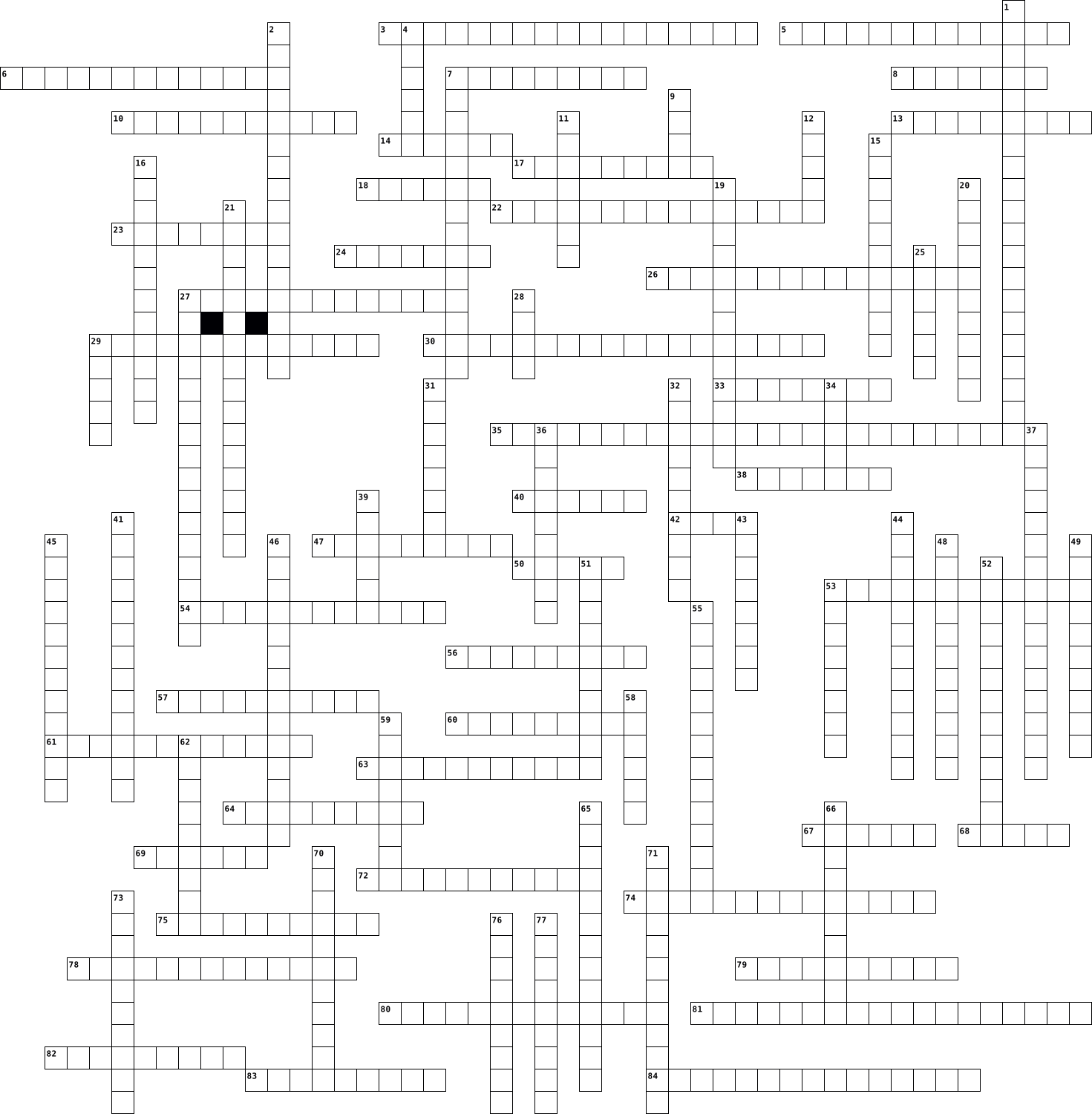
Across
- Permanent settlement in space
- Illness impacting astronauts
- Points in a two body system
- Sight from space
- Force that pulls objects
- Not large enough to orbit the sun
- Person trained for spaceflight
- Large collection of stars
- Debris in orbit
- Propels into space
- Imaginary sphere around Earth
- All matter and energy
- Reusable spacecraft
- Wide, flat volcano
- Between galaxies
- Twinkling of stars
- Returning to Earth's atmosphere
- Small rocky object
- Radiation left over from Big Bang
- Returning to Earth's atmosphere
- Cloud of gas and dust
- Massive luminous sphere
- Clothing for space travel
- Body of ice and dust
- Habitable artificial satellite
- Conditions in outer space that affect Earth
- Natural or artificial object
- Part of Earth's upper atmosphere
- Extreme gravitational force
- Between stars
- Settlement on the moon
- Location for launching spacecraft
- Natural light display
- Neptunian object Objects beyond Neptune
- Absence of matter
- Propulsion system that uses ions
- Between planets
- Brightness due to gas and dust
- Using gravity for acceleration
- Small dense star
- Group of stars
- Sparse matter between stars
- Region of icy objects
- Increase in frequency due to motion
- Stable location in space
Down
- Fundamental principles of physics
- Not from Earth
- Ionized gas
- Minimum speed to exit gravitational pull
- Earth's natural satellite
- Depressions on a surface
- Unmanned space vehicle
- Boundary where solar wind meets interstellar matter
- Boundary around a black hole
- Hypothetical transportation system
- Layer of gas around a planet
- Study of motion in space
- 12 constellations
- Particle found between stars
- Fine particles of matter
- Relating to the sun
- Dark spots on the sun's surface
- Spacecraft powered by rocket engines
- Path of an object in space
- Explosion of a star
- Strategies to reduce space debris
- Orbits a star
- Magnetic field around a planet
- Large star in later stages
- Small spacecraft
- Travel for recreational purposes
- Multiple telescopes
- Astronomical facility
- Vehicle for moon exploration
- Study of life outside Earth
- Group of galaxies
- Room with sun exposure
- Telescope that detects radio waves
- A streak of light in the sky
- Subatomic particle with low mass
- Optical instrument
- Process of forming a star
- Region of icy objects beyond Neptune
- Bubble created by solar winds
- Radiation belt around Earth
- System of two stars
- Activity outside spacecraft
- Planet outside our solar system
88 Clues: Ionized gas • Orbits a star • Between stars • Not from Earth • Group of stars • Debris in orbit • Between planets • Sight from space • Between galaxies • Small spacecraft • Small dense star • 12 constellations • Group of galaxies • Absence of matter • Propels into space • Wide, flat volcano • Twinkling of stars • Small rocky object • Optical instrument • Reusable spacecraft • Relating to the sun • ...
Space 2023-05-18
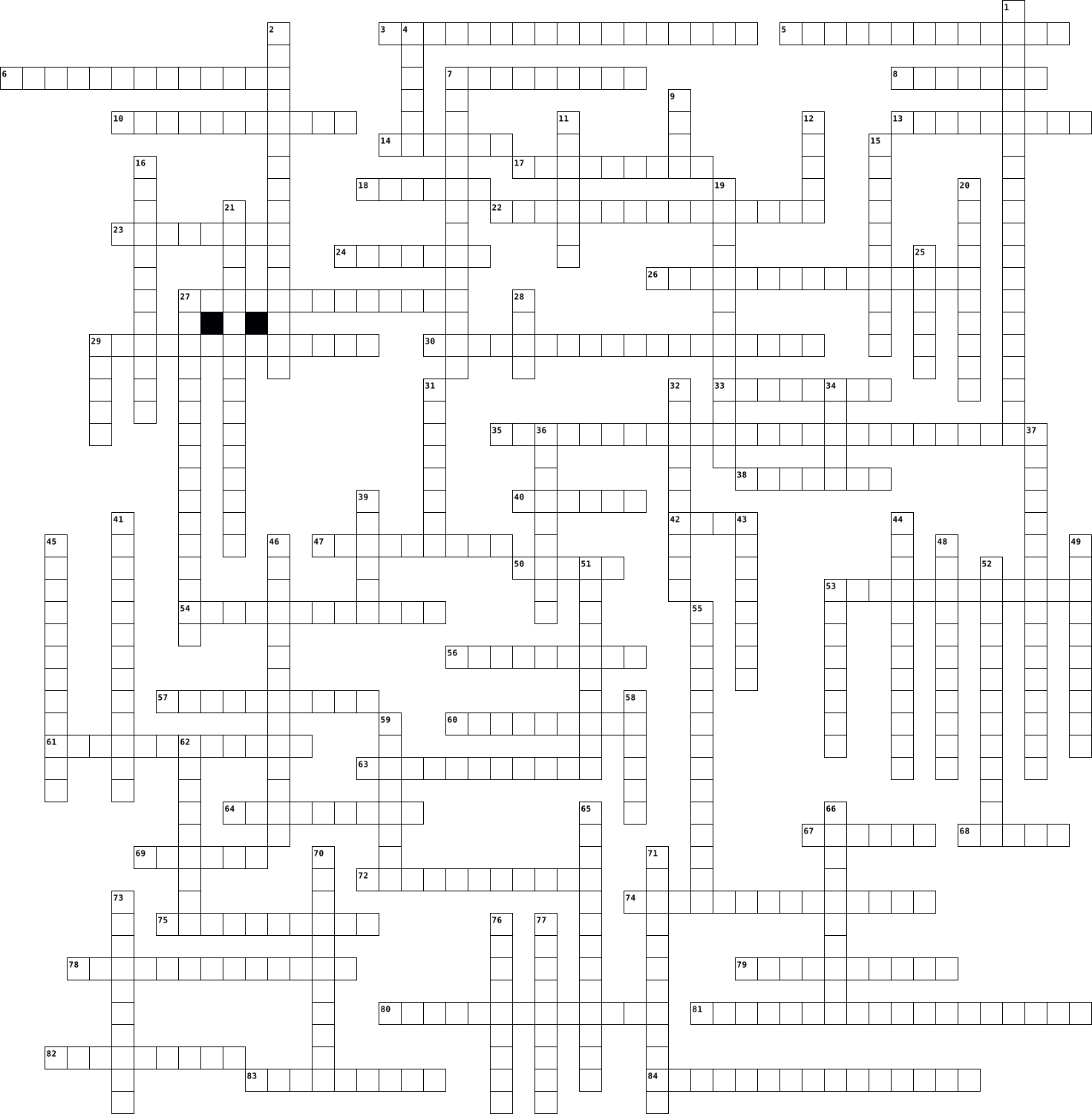
Across
- Permanent settlement in space
- Illness impacting astronauts
- Points in a two body system
- Sight from space
- Force that pulls objects
- Not large enough to orbit the sun
- Person trained for spaceflight
- Large collection of stars
- Debris in orbit
- Propels into space
- Imaginary sphere around Earth
- All matter and energy
- Reusable spacecraft
- Wide, flat volcano
- Between galaxies
- Twinkling of stars
- Returning to Earth's atmosphere
- Small rocky object
- Radiation left over from Big Bang
- Returning to Earth's atmosphere
- Cloud of gas and dust
- Massive luminous sphere
- Clothing for space travel
- Body of ice and dust
- Habitable artificial satellite
- Conditions in outer space that affect Earth
- Natural or artificial object
- Part of Earth's upper atmosphere
- Extreme gravitational force
- Between stars
- Settlement on the moon
- Location for launching spacecraft
- Natural light display
- Neptunian object Objects beyond Neptune
- Absence of matter
- Propulsion system that uses ions
- Between planets
- Brightness due to gas and dust
- Using gravity for acceleration
- Small dense star
- Group of stars
- Sparse matter between stars
- Region of icy objects
- Increase in frequency due to motion
- Stable location in space
Down
- Fundamental principles of physics
- Not from Earth
- Ionized gas
- Minimum speed to exit gravitational pull
- Earth's natural satellite
- Depressions on a surface
- Unmanned space vehicle
- Boundary where solar wind meets interstellar matter
- Boundary around a black hole
- Hypothetical transportation system
- Layer of gas around a planet
- Study of motion in space
- 12 constellations
- Particle found between stars
- Fine particles of matter
- Relating to the sun
- Dark spots on the sun's surface
- Spacecraft powered by rocket engines
- Path of an object in space
- Explosion of a star
- Strategies to reduce space debris
- Orbits a star
- Magnetic field around a planet
- Large star in later stages
- Small spacecraft
- Travel for recreational purposes
- Multiple telescopes
- Astronomical facility
- Vehicle for moon exploration
- Study of life outside Earth
- Group of galaxies
- Room with sun exposure
- Telescope that detects radio waves
- A streak of light in the sky
- Subatomic particle with low mass
- Optical instrument
- Process of forming a star
- Region of icy objects beyond Neptune
- Bubble created by solar winds
- Radiation belt around Earth
- System of two stars
- Activity outside spacecraft
- Planet outside our solar system
88 Clues: Ionized gas • Orbits a star • Between stars • Not from Earth • Group of stars • Debris in orbit • Between planets • Sight from space • Between galaxies • Small spacecraft • Small dense star • 12 constellations • Group of galaxies • Absence of matter • Propels into space • Wide, flat volcano • Twinkling of stars • Small rocky object • Optical instrument • Reusable spacecraft • Relating to the sun • ...
Earth's Rotation and Seasons 2025-11-15

Across
- A sequence of events that repeats itself.
- The slant of Earth’s axis, which is 23.5 degrees from vertical compared to Earth’s orbital plane around the Sun; results in the North Pole always pointing toward the North Star.
- The third planet from the Sun and the only planet in the solar system where life exists.
- Angled or spread out.
- A curved path followed by a satellite as it revolves around an object.
- A dark area made by blocking light from reaching a part of the surface.
- The outline of something.
Down
- Half of a sphere; Earth and the celestial sphere can be divided into northern and southern or eastern and western hemispheres.
- The star at the center of the solar system that supplies heat and light to Earth; its enormous gravity keeps the solar system in orbit.
- Making a complete spin on an axis.
- In the shortest unbroken line.
- The movement of one object around a center or another object.
- The four natural divisions of the year based on changes in temperature due to varying amounts of sunlight received (both intensity and number of daylight hours vary); caused by the tilt of Earth during its revolution.
- The imaginary line through Earth that extends from the North Pole to the South Pole and is the center of Earth’s rotation.
14 Clues: Angled or spread out. • The outline of something. • In the shortest unbroken line. • Making a complete spin on an axis. • A sequence of events that repeats itself. • The movement of one object around a center or another object. • A curved path followed by a satellite as it revolves around an object. • ...
. 2023-04-18

Across
- Earth's Natural Satellite
- Blue planet
- Our Galaxy
Down
- Source of all the energy in the Solar System
- Smallest planet in solar system
- Red planet
- Distance travelled by light in a year
7 Clues: Red planet • Our Galaxy • Blue planet • Earth's Natural Satellite • Smallest planet in solar system • Distance travelled by light in a year • Source of all the energy in the Solar System
Heat and Temperature sec 3.2 2025-01-09

Across
- Help to maintain consistent temperatures in indoor environments
- connected solar pannels
- Two metal pieces joined together in a thermostat
- A disadvantage of solar energy
- Indicates a material's ability to limit heat transfer
- Water running through copper tubing gets heated here
Down
- An example of a local heating system
- Provides heat to various rooms in a building
- A material's ability to transfer heat by conduction
- Maintain cold temperatures in refrigerators and freezers
- The most common place for heat loss in a building
- This provides heat for a single room
12 Clues: connected solar pannels • A disadvantage of solar energy • An example of a local heating system • This provides heat for a single room • Provides heat to various rooms in a building • Two metal pieces joined together in a thermostat • The most common place for heat loss in a building • A material's ability to transfer heat by conduction • ...
Other Members of the Solar System 2021-06-15

Across
- comes from collisions between asteroids, comets, meteoroids, and Kuiper belt objects.
- a short-period comet visible from Earth every 75–76 years
- a circumstellar disc in the outer Solar System, extending from the orbit of Neptune at 30 astronomical units to approximately
- composed of an icy, rocky core that has two tails that point away from the Sun.
- a torus-shaped region in the Solar System, located roughly between the orbits of the planets Jupiter and Mars.
- "dirty snowballs"
- first described in 1950 by Dutch astronomer Jan Oort, is a theoretical concept of a cloud of predominantly icy planetesimals
- An ion tail made of gases always points away from the Sun
Down
- A small, rocky object from space that is heated up as it enters the Earth’s atmosphere.
- larger meteoroids may strike the Earth’s surface to create a ??
- consists of cosmic dust (small particles floating in outer space) that pervades the space between planets within planetary systems, such as the Solar System
- more than half of the interplanetary dust particles in our solar system come from
- a celestial body that lies mostly between Mars and Jupiter.
- objects that orbit the Sun at a farther distance than Neptune.
- any object whose orbit crosses Earth’s can collide with Earth
15 Clues: "dirty snowballs" • a short-period comet visible from Earth every 75–76 years • An ion tail made of gases always points away from the Sun • any object whose orbit crosses Earth’s can collide with Earth • larger meteoroids may strike the Earth’s surface to create a ?? • a celestial body that lies mostly between Mars and Jupiter. • ...
science 2018-12-05

Across
- smallest and closest planet to the Sun.
- Sun-centered model of the solar system.
- Sand to boulder sized rocky object orbiting the sun.
- rocky object formed from material similar to that of the planets, orbiting the Sun.
- Fifth planet from the sun; the largest with continuous, swirling, high- pressure gas storms.
Down
- Nearly- spherical object in orbit around the sun that is not a satellite, and has not cleared debris in its orbit.
- fourth planet from the sun; called the red planet because of high concentrations of iron oxide.
- planets in orbit around another star.
- Earth-centric model of the solar system.
- second planet from the sun; has a dense atmosphere of mostly carbon dioxide and very high surface temperatures.
- third planet from the sun; the only planet in the solar system known to have life, and where water exists as a solid, a liquid, a gas.
- Eighth planet from the sun; has storms similar Jupiter’s and is blue due to methane in the atmosphere
- object in elliptical orbit around the Sun composed of dust and particles, frozen water, methane and ammonia; vaporized due to heat from Sun, producing a coma and tail.
13 Clues: planets in orbit around another star. • smallest and closest planet to the Sun. • Sun-centered model of the solar system. • Earth-centric model of the solar system. • Sand to boulder sized rocky object orbiting the sun. • rocky object formed from material similar to that of the planets, orbiting the Sun. • ...