
solar system Crossword Puzzles
Planet 2023-06-20

Across
- The largest planet in our solar system, famous for its colorful stripes and swirling storms, such as the Great Red Spot. It has many moons, including the four Galilean moons.
- Once considered the ninth planet, Pluto is now classified as a dwarf planet. It has a frozen surface and is located in the distant region called the Kuiper Belt.
- A planet with a vivid blue color, also known as the "Windiest Planet" due to its strong winds. Neptune has dark spots, similar to Jupiter's storms, and it has many moons.
- A beautiful planet with prominent rings made of icy particles. It has a unique feature—a hexagonal-shaped storm at its north pole. Saturn also has many moons, including Titan.
- The "Red Planet" known for its rusty-colored surface. It has polar ice caps, canyons, and volcanoes. Scientists are curious about the possibility of life on Mars.
- A dwarf planet that is smaller than Pluto, named after the creation deity of the Rapa Nui people of Easter Island. It has a reddish color and orbits in the Kuiper Belt.
- One of Jupiter's largest moons, known for its active volcanoes that erupt with plumes of lava. It is the most volcanically active object in our solar system.
- A planet similar in size to Earth, often called Earth's "sister planet." It has a thick atmosphere that traps heat, making it the hottest planet.
Down
- The largest object in the asteroid belt between Mars and Jupiter. Ceres is a dwarf planet and is the only one located in the inner solar system.
- A planet that appears blue-green in color due to its methane-rich atmosphere. Uranus is known for its sideways rotation and rings that encircle the planet.
- Our home planet, where we live! It has a diverse range of landscapes, including oceans, mountains, forests, and deserts. Earth is the only known planet to have life.
- Saturn's largest moon, known for its thick atmosphere and hydrocarbon lakes. It is the only moon in our solar system with a significant atmosphere.
- A unique dwarf planet that has a stretched, ellipsoidal shape, resembling a flattened football. It spins rapidly and is located in the Kuiper Belt.
- The smallest planet in our solar system, known for its extreme temperatures and rocky surface. It is located closest to the Sun and has no moons.
- A dwarf planet located in the Kuiper Belt, similar in size to Pluto. It sparked a debate about what constitutes a planet when it was discovered in 2005.
15 Clues: The largest object in the asteroid belt between Mars and Jupiter. Ceres is a dwarf planet and is the only one located in the inner solar system. • The smallest planet in our solar system, known for its extreme temperatures and rocky surface. It is located closest to the Sun and has no moons. • ...
Crossword in Space 2022-05-03

Across
- an astronomical phenomenon where the Earth is placed between the Sun and the Moon.
- the first Hungarian astronaut
- space research center of USA
- Albert Einstein's best-known theory
- person who performing spaceflight
- The void space between the celestial bodies of the universe.
- the central star of the solar system
- part of the earth's crust
- famous constellation, the larger one.
Down
- the first human who walked on the Moon.
- Location of St. Andrew's fault line
- it covers 70% of the Earth
- nothing can get out of it
- the closest Planet to the Earth.
- the smallest particle of chemical elements
- the largest known planet.
- the speed of light propagation
- last fired spacecraft
18 Clues: last fired spacecraft • nothing can get out of it • the largest known planet. • part of the earth's crust • it covers 70% of the Earth • space research center of USA • the first Hungarian astronaut • the speed of light propagation • the closest Planet to the Earth. • person who performing spaceflight • Location of St. Andrew's fault line • Albert Einstein's best-known theory • ...
HW10 2026-01-29

Across
- khám phá
- bệnh
- tác động, ảnh hưởng
- gây ra
- system hệ mặt trời
- bệnh nhân
- kết quả
Down
- lý thuyết
- cuộc thí nghiệm
- tinh thần
- sao Hỏa
- cảm xúc
- giống loài
- brain bộ não con người
14 Clues: bệnh • gây ra • sao Hỏa • cảm xúc • kết quả • khám phá • lý thuyết • tinh thần • bệnh nhân • giống loài • cuộc thí nghiệm • system hệ mặt trời • tác động, ảnh hưởng • brain bộ não con người
SAMPARK group 3 2025-06-11

Across
- Plywood
- Organic Harbal Ayurvedic Products
- Hardware
- & Cookies
- Solar & System
- Conservation Park
- Automobile
Down
- SIGNS ( INTERIORS & BRANDING)
- Furnishing
- Glasses Pvt Ltd
- Hospital
11 Clues: Plywood • Hospital • Hardware • & Cookies • Furnishing • Automobile • Solar & System • Glasses Pvt Ltd • Conservation Park • SIGNS ( INTERIORS & BRANDING) • Organic Harbal Ayurvedic Products
solar system crossword puzzle 2023-12-12

Across
- large natural object that orbits, or travels around, Earth
- the only planet that spins on its side.
- basic building block for all matter in the universe.
- it's getting gradually smaller.
- place in space where gravity pulls so much that even light cannot get out.
- how fast light can travel in one year
- the hottest planet in our solar system.
- one object in space, like a planet or moon, passes through the shadow of another object in space.
Down
- an object that moves around a larger object.
- substance that is in a gaseous, or vaporous, state of matter.
- are the largest objects in the solar system after the Sun
- consists of the Sun and everything that orbits, or travels around, the Sun.
- invisible force that pulls objects toward each other.
- vast, unknown cosmos is brought into order, the earth having its proper place in the center.
14 Clues: it's getting gradually smaller. • how fast light can travel in one year • the only planet that spins on its side. • the hottest planet in our solar system. • an object that moves around a larger object. • basic building block for all matter in the universe. • invisible force that pulls objects toward each other. • ...
Space 2024-05-03

Across
- Can be up to 27 million degrees Fahrenheit. It keeps all planets in orbit.
- 30 astronomical units from the sun. Has 16 moons, and was the first planet discovered with math.
- Giants space snowballs made frozen gases, rock, and dust. Given nicknames like "Halley's____" and "Great ____ of 1811."
- Donut-shaped area of ice-like celestial bodies, similar to asteroid belt.
- 53% smaller than Earth. Also known as the "Red Planet" because of its majority of iron and soil.
- Smallest planet in our solar system. The closest one to the sun.
Down
- Rains sulfuric acid, sometimes called "Earth's Evil Twin". One day on this planet is equal to 243 Earth days.
- A chunk of rock that can become a planet. Has the ability to travel 25 km per second.
- Is the largest planet in our solar system. Could fit 1000 Earths if it was hollow.
- 71% of this planet is water. It is the only planet in our solar system that can sustain life.
- Happens when meteoroid burns up in the atmosphere.
- It is the sixth planet from the sun. Known for its rings.
12 Clues: Happens when meteoroid burns up in the atmosphere. • It is the sixth planet from the sun. Known for its rings. • Smallest planet in our solar system. The closest one to the sun. • Donut-shaped area of ice-like celestial bodies, similar to asteroid belt. • Can be up to 27 million degrees Fahrenheit. It keeps all planets in orbit. • ...
How much do you know about the solar system? 2024-05-07

Across
- the closest planet to the Sun, and the smallest planet in our solar system.
- Your home. Our Mission.
- the fourth planet from the Sun, and the seventh largest. It’s the only planet we know of inhabited entirely by robots.
- machines are launched into space and orbit Earth or another body in space.
- the eighth, and most distant planet from the Sun. It’s the first planet discovered with math.
- the second planet from the Sun, and the sixth largest planet. It’s the hottest planet in our solar system.
Down
- the fifth planet from the Sun, and the largest in the solar system – more than twice as massive as the other planets combined.
- They’re all related to the flashes of light called “shooting stars” sometimes seen streaking across the sky.
- the seventh planet from the Sun, and it appears to spin sideways.
- the sixth planet from the Sun, and it’s surrounded by beautiful rings.
- large objects made of dust and ice that orbit the Sun
- a massive, hot ball of plasma, inflated and heated by energy produced by nuclear fusion reactions at its core.
12 Clues: Your home. Our Mission. • large objects made of dust and ice that orbit the Sun • the seventh planet from the Sun, and it appears to spin sideways. • the sixth planet from the Sun, and it’s surrounded by beautiful rings. • machines are launched into space and orbit Earth or another body in space. • ...
ENERGY GLOSSARY 2020-11-13

Across
- fuel from organic things
- panel attached to rooftops to collect energy from sun
- name of a energy drink
- beavers build these
- this can be found from swamps
Down
- reactor this exploded in Tsernobyl
- dioxide when you breath out this comes out
- energy that comes from sun
- cars run with ___
- moment or a break when electricity goes down
- system that pumps oil from ocean
- combines two things
- cows produce this when they fart
13 Clues: cars run with ___ • combines two things • beavers build these • name of a energy drink • fuel from organic things • energy that comes from sun • this can be found from swamps • system that pumps oil from ocean • cows produce this when they fart • reactor this exploded in Tsernobyl • dioxide when you breath out this comes out • moment or a break when electricity goes down • ...
ENERGY GLOSSARY 2020-11-13

Across
- fuel from organic things
- panel attached to rooftops to collect energy from sun
- name of a energy drink
- beavers build these
- this can be found from swamps
Down
- reactor this exploded in Tsernobyl
- dioxide when you breath out this comes out
- energy that comes from sun
- cars run with ___
- moment or a break when electricity goes down
- system that pumps oil from ocean
- combines two things
- cows produce this when they fart
13 Clues: cars run with ___ • combines two things • beavers build these • name of a energy drink • fuel from organic things • energy that comes from sun • this can be found from swamps • system that pumps oil from ocean • cows produce this when they fart • reactor this exploded in Tsernobyl • dioxide when you breath out this comes out • moment or a break when electricity goes down • ...
Chapter 7 Vocab: 2021-02-12

Across
- the 2nd planet to the sun
- made of gas, dust, and ice and moves around the sun in an oval shape
- this is what the outer planets are known as
- When a planet's atmosphere traps in solar energy
- the four largest moons around Jupiter
- known for its ring system
- the average distance from the Earth to the Sun
- a meteoroid that that strikes a planet or moon
- the four planets closest to the sun
- the largest planet in the solar system
Down
- orbits the sun in the asteroid belt
- the time it takes an object to complete one rotation
- a round depression formed on the surface of a planet, moon, or space object
- the time it takes an object to travel once around the sun
- small rocky particle that moves through space
- closest planet to the sun
- a meteoroid that has entered the Earth's atmosphere
- the 4th planet from the sun
18 Clues: the 2nd planet to the sun • closest planet to the sun • known for its ring system • the 4th planet from the sun • orbits the sun in the asteroid belt • the four planets closest to the sun • the four largest moons around Jupiter • the largest planet in the solar system • this is what the outer planets are known as • small rocky particle that moves through space • ...
WORLD HISTORY 2025-12-16

Across
- A famous execution device during the French revolution
- Atlantic slave/crop trade route
- Enlightenment documents of rights
- Astronomer with sun centered theory
- Sun centered solar system
- church Luther protested
- explorers treasure (pepper,cinnamon)
- Enlightenment thinker "social contract"
Down
- private ownership economic system
- Exchange of plants/animals across the Atlantic
- Luther protested document
- the "Sun king" of France
- protestant reformation leader
- germs exchanged across oceans
- relating to cities
- famous Leonardo de Vinci painting
- Renaissance art depth technique
- a over priced food during this time
18 Clues: relating to cities • church Luther protested • the "Sun king" of France • Luther protested document • Sun centered solar system • protestant reformation leader • germs exchanged across oceans • Atlantic slave/crop trade route • Renaissance art depth technique • private ownership economic system • Enlightenment documents of rights • famous Leonardo de Vinci painting • ...
Jazmin's Science Crossword Puzzle 2022-01-25

Across
- biggest planet in our solar system
- large spiral system consisting of several hundred billion stars
- small rocky body orbiting the sun (not a planet)
- cloud of gas and dust in outer space
- the collection of eight planets and their moons in orbit around the sun
Down
- A dirty snowball
- the only planet found to have life on it
- objects that look like spiral shaped clouds which later were found to be galaxies themselves lying outside our milky-way galaxy
- between the orbits of Mars and Jupiter in which most asteroids are found.
- A planet that has a volcano on it
- gives off heat planets orbit it and it's the only star in our solar system
11 Clues: A dirty snowball • A planet that has a volcano on it • biggest planet in our solar system • cloud of gas and dust in outer space • the only planet found to have life on it • small rocky body orbiting the sun (not a planet) • large spiral system consisting of several hundred billion stars • the collection of eight planets and their moons in orbit around the sun • ...
Earth and the Sun 2022-03-25

Across
- Spring and _____ tides
- one of the components of the Earth/Sun system
- when the north pole is tilted towards the sun
- solar radiation that reaches Earth
- dark spots on the Sun's surface
- Earth rotates on its ______
- hydrogen and ______ primarily make up the Sun
- gases trapped in the atmosphere
Down
- cycles of glacial/interglacial periods
- solar energy traveling through space
- when the axis rotates
- Earth's atmosphere is ______
- Earth's axis is not tilted away or towards
13 Clues: when the axis rotates • Spring and _____ tides • Earth rotates on its ______ • Earth's atmosphere is ______ • dark spots on the Sun's surface • gases trapped in the atmosphere • solar radiation that reaches Earth • solar energy traveling through space • cycles of glacial/interglacial periods • Earth's axis is not tilted away or towards • ...
Stars and the Universe 2024-09-26

Across
- Object consisting of a nucleus of ice and dust.
- a glowing circle of light around an object.
- a unit of astronomical distance.
- Galaxy that includes the solar system.
- a cloud of gas and dust in outer space, visible in the night sky.
Down
- a plant that orbits a star outside the solar system.
- a system of billions of stars, together with gas and dust.
- collection of eight planets and their moons in orbit around the sun.
- theory for how the universe began
9 Clues: a unit of astronomical distance. • theory for how the universe began • Galaxy that includes the solar system. • a glowing circle of light around an object. • Object consisting of a nucleus of ice and dust. • a plant that orbits a star outside the solar system. • a system of billions of stars, together with gas and dust. • ...
Chapter 7 Vocab: 2021-02-11

Across
- the four largest moons around Jupiter
- the planets closest to the sun
- the time it takes an object to travel once around the sun
- the 4th planet from the sun
- When a planet's atmosphere traps in solar energy
- an object that orbits the sun, has enough mass and gravity to make is spherical, but has other things in its orbit
- small rocky particle that moves through space
- a meteoroid that strikes the Earth's surface
- the average distance fro the Earth to the Sun
- the largest planet in the solar system
Down
- a small, rocky object that orbits the sun
- a small rocky and icy object that orbits the sun
- the time it takes an object to complete one rotation
- a round depression formed on the surface of a planet, moon, or space object
- Known for its impressive ring system
- the second planet from the sun
- a meteorite that has entered Earth's atmosphere
- the closest planet to the sun
18 Clues: the 4th planet from the sun • the closest planet to the sun • the planets closest to the sun • the second planet from the sun • Known for its impressive ring system • the four largest moons around Jupiter • the largest planet in the solar system • a small, rocky object that orbits the sun • a meteoroid that strikes the Earth's surface • ...
Planet 2023-07-31

Across
- The second closest planet to the Sun, known as the bright and shining "Evening Star" or "Morning Star."
- The closest planet to the Sun, small and hot.
- The largest and heaviest planet in our solar system.
- The central star of our solar system, providing light and heat to all the planets.
- Our home planet, where life exists, and the only known planet with life.
Down
- The farthest planet from the Sun, characterized by its dark blue color.
- Famous for its beautiful ring system surrounding the planet.
- The path that planets and satellites take as they revolve around a central object, like the Sun.
- Also known as the "Red Planet," with similar features to Earth and a reddish appearance.
- The natural satellite that orbits Earth, lighting up the night sky.
- A distant and cool planet located far away from the Sun.
- A vast system of stars, planets, and other celestial bodies bound together by gravity.
12 Clues: The closest planet to the Sun, small and hot. • The largest and heaviest planet in our solar system. • A distant and cool planet located far away from the Sun. • Famous for its beautiful ring system surrounding the planet. • The natural satellite that orbits Earth, lighting up the night sky. • ...
ALL ABOUT SCIENCE!!!!!!!mariomario 2025-06-09

Across
- The largest planet in our solar system and a gas giant
- The word for when the date on when the sun crosses the earth
- A variable where this variable doesn't rely on another
- Heat moving in a circular motion
- It is a system that is made up of a bunch of stars
- The four regions of the atmosphere
Down
- it is half of a sphere when you cut any circular fruit in half
- Its a region in our outer solar system made up of asteroids
- These are bones from dinosaurs what are they called?
- The word for how much space an object takes up
- The seasons change because the earth has an
11 Clues: Heat moving in a circular motion • The four regions of the atmosphere • The seasons change because the earth has an • The word for how much space an object takes up • It is a system that is made up of a bunch of stars • These are bones from dinosaurs what are they called? • The largest planet in our solar system and a gas giant • ...
Into the universe 2022-08-22

Across
- A large object with large amounts of energy, powered by a black hole
- A hole where radiation can escape in space
- The galaxy in which the solar system holds earth, planets, etc.
- A star that is the size of a planet when the low mass has used up all its fuel.
- A rock that orbits the sun
- A planet that orbits a star
- system A star system of suns, stars, and planets
- A theory of how the universe began
- A cloud of gas and dust that nurses new stars
- A body of matter that enters the earth's atmosphere
- A large, round body/ball that orbits around the sun
- A ball of gases, dust, and rocks that orbit the sun
- A large planet consisting of helium and hydrogen
- a luminous body of light naturally produced and visible in dark/at night
Down
- A system of gas, dust, stars, energy, and gravity
- A celestial body that orbits around planets
- A Group of stars that form a pattern, which is configured at birth
- a natural satellite that reflects light from the sun at night
- A star that shows brightness increasing over a course of months
- Particles that are composed and not reactive in reflecting, absorbing, or emitting any light.
- A matter that contains particles
- A star that increases its brightness when explosions occur
- A small planet
- A magnetized star that produces electromagnetic radiation
24 Clues: A small planet • A rock that orbits the sun • A planet that orbits a star • A matter that contains particles • A theory of how the universe began • A hole where radiation can escape in space • A celestial body that orbits around planets • A cloud of gas and dust that nurses new stars • system A star system of suns, stars, and planets • ...
Vocab part 2 2025-02-18

Across
- When the moon moves between Earth and the Sun, blocking sunlight for a short time. This makes the sky darker like early evening even during the day.
- A rocky object that orbits the sun. They are mostly found in the asteroid belt between Mars and Jupiter
- When Earth moves between the sun and the moon blocking sunlight from reaching the moon. This makes the moon look darker or even red.
- When the moon is completely covered by earth's shadow. The moon looks red because Earth's atmosphere bends sunlight and only red light reaches the moon. This is called a blood moon.
- The outer layer of the Sun's atmosphere. It looks like a glowing halo around the Sun during a total solar eclipse
- The path an object takes around another object in space. Earth orbits the Sun and the Moon orbits Earth.
- The darkest part of a shadow during an eclipse. If you stand in the umbra during a solar eclipse, you will see a total eclipse
- When the Moon completely blocks the sun. The sky becomes dark, and only the sun's outer layer is visible. People wear special glasses to watch it safely.
Down
- The force that pulls objects toward each other. It keeps planets in orbit and makes things fall to the ground when you drop them
- When the moon blocks only part of the sun. The sun looks like a crescent and the sky is not completely dark.
- Large objects that orbits a star like the Sun. Earth is a planet where humans, animals and plants live.
- The lighter part of the shadow during an eclipse. If you are in the penumbra you will only see a partial eclipse.
- When only part of the moon moves into Earth's shadow.It looks like a dark bite has been taken out of the moon.
- Includes the sun, eight planets, moons, asteroids,and comets that orbit the sun, earth is the third planet from the sun
- The center of our solar system. It gives us light and heat helping plants grow and keeping Earth warm.
15 Clues: The center of our solar system. It gives us light and heat helping plants grow and keeping Earth warm. • A rocky object that orbits the sun. They are mostly found in the asteroid belt between Mars and Jupiter • Large objects that orbits a star like the Sun. Earth is a planet where humans, animals and plants live. • ...
Animals & Planets 2021-06-20

Across
- The NASA is discovering if we can live in it
- it lives in the ice & it's a bear
- it's in the movie of Flora & Ulises & it climbs trees
- it's very big it has big ears & a trunk
- we live in it & it has meny more contrys
- it lives with people and says woof
- it lives the ice & it's a bird that can't fly
- it's blue and it's next tu Saturn
- it's the king of the amazonas and it has spots
Down
- it's the bigest planet in the solar system
- it's next to the Sun
- it has a long neck
- it lives with people and says meow
- it has a ring and it's very famous
- it's the last planet & it's very cold
- it has a mane & it's the king of the savannah
- it has white, black & orange stripes & it's the king of the jungle
- it's the hottest planet in the solar system
18 Clues: it has a long neck • it's next to the Sun • it lives in the ice & it's a bear • it's blue and it's next tu Saturn • it lives with people and says meow • it has a ring and it's very famous • it lives with people and says woof • it's the last planet & it's very cold • it's very big it has big ears & a trunk • we live in it & it has meny more contrys • ...
Telescopes, Planets, and Moons p.442-449 2024-09-24

Across
- This is the category of man made satellites
- This natural satellite revolves around the Earth
- The largest moon in our solar system
- A star and the objects that orbit around it
- An instrument that makes distant objects seem farther and nearer
- The _____________ space telescope was placed into orbit in 1990
- The 3rd planet from the Sun
- A large object that orbits a star
Down
- This is the storm happening on Jupiter right now and it's twice the size of Earth
- It was a planet up until 2006 now it's a dwarf planet
- This planet is tipped over on its side.
- Anything that orbits around something else in space
- This is a bowl-shaped hole caused by an impact
- Mercury, Venus, Earth, and Mars are in this group of planets
- It is nicknamed "The Red Planet". We currently have rovers on it now.
- This is the last of the gas planets in our solar system
- Jupiter, Saturn, Uranus, and Neptune
- Venus is covered in rivers of ___________.
18 Clues: The 3rd planet from the Sun • A large object that orbits a star • The largest moon in our solar system • Jupiter, Saturn, Uranus, and Neptune • This planet is tipped over on its side. • Venus is covered in rivers of ___________. • This is the category of man made satellites • A star and the objects that orbit around it • This is a bowl-shaped hole caused by an impact • ...
Stars and The Solar System 2015-12-25

Across
- Famous star in ursa minor
- The ringed planet
- Galaxy with diameter of 100000 light years
- A small body thet revolves around a bigger body
- Constellation visible from northern hempisphere
- The star which gives us light
- A moon of jupiter starting with 'g'
- All bodies ind the space collectively
- First name of founder of pluto
- Also called the great bear
Down
- First artifical satellite sent to space
- objects smaller than comets
- A group of seven stars
- Found between mars and jupiter
- Group of stars forming a recognizabe pattern
- India's first satellite sent to space
- A dwarf planet starting with 'c'
- Looks like a hunter with a bow
- The north pole star
- Known as morning or evening star
20 Clues: The ringed planet • The north pole star • A group of seven stars • Famous star in ursa minor • Also called the great bear • objects smaller than comets • The star which gives us light • Found between mars and jupiter • Looks like a hunter with a bow • First name of founder of pluto • A dwarf planet starting with 'c' • Known as morning or evening star • ...
Things In Our Solar System 2014-08-31

Across
- Known as the red planet
- The path that planets take around the sun
- A dwarf planet
- Our galaxy we live in
- An icy rock that has bright tail when it comes close to the sun.
- A big blue planet, furthest away from the sun
- What we use to view planets and stars
- Second closest planet to the sun
- The planet with big rings around it
- When you look at the sky in the dark you see these
- Is a black hole empty?
Down
- Closest planet to the sun
- How old is the moon
- How many planets is there in our galaxy
- The largest gas giant planet
- One of the rocks in a belt between mars & jupiter
- Earth has one of these
- The planet that has life on it
- The 7th planet away from the sun
- The largest star in the galaxy
20 Clues: A dwarf planet • How old is the moon • Our galaxy we live in • Earth has one of these • Is a black hole empty? • Known as the red planet • Closest planet to the sun • The largest gas giant planet • The planet that has life on it • The largest star in the galaxy • Second closest planet to the sun • The 7th planet away from the sun • The planet with big rings around it • ...
Planets and the Solar System 2021-01-11

Across
- The band of rocks that are found after the last planet.
- The red planet.
- The eighth planet from the sun.
- The collection of the planets their moons and the sun is called the ___________ System?
- One of the first men on the moon was called Neil ____________.
- The planets ____________ the sun.
- The number of planets around our Sun.
- The band of rocks that are found between the 4th and 5th planets.
- The galaxy that contains our Solar System is called the ___________ way?
- 71% of this planets surface is covered in water.
- Gas necessary for all life on Earth
- Closest planet to the sun.
- The sun is a very close one of these
- It produces heat and light.
Down
- The most famous dwarf planet.
- How many moons does the Earth have?
- The thin layer of gasses that surround some planets, especially this one.
- Known for the rings that surround it.
- The largest planet.
- The force responsible for causing the Earth and other planets to orbit the sun.
- A word for spin on it's axis.
- Second planet from the sun.
- The sun orbits the Earth 365 days a ____________.
- Seventh planet from the sun.
24 Clues: The red planet. • The largest planet. • Closest planet to the sun. • Second planet from the sun. • It produces heat and light. • Seventh planet from the sun. • The most famous dwarf planet. • A word for spin on it's axis. • The eighth planet from the sun. • The planets ____________ the sun. • How many moons does the Earth have? • Gas necessary for all life on Earth • ...
Planets of the Solar System 2021-04-21

Across
- a squashed circle with two focus points or foci, planets orbit in an elliptical path
- an imaginary line drawn around the earth equally distant from both poles, dividing the earth into northern and southern hemispheres
- a small planet but lacking certain technical criteria to become a planet
- the force of attraction between all masses in the universe
- the mean distance from the center of the earth to the center of the sun.
- a group of stars forming a recognizable pattern that is traditionally named after its apparent form or identified with a mythological figure.
- transfer of heat through fluid
- a small rocky body orbiting the sun
- the shadow cast by the earth or moon over an area experiencing a partial eclipse.
- the star around which the earth orbits
- have a progressively smaller part of its visible surface illuminated, so that it appears to decrease in size
- The natural satellite of the earth
- Comets are cosmic snowballs of frozen gases, rock and dust that orbit the Sun
- the point in the orbit of a planet, asteroid, or comet at which it is furthest from the sun.
- a meteor that survives its passage through the earth's atmosphere such that part of it strikes the ground
- the fully shaded inner region of a shadow cast by an opaque object
- each of the four divisions of the year marked by particular weather patterns and daylight hours
- a small body moving in the solar system that would become a meteor if it entered the earth's atmosphere
- relating to or belonging to a planet or planets
- an optical instrument designed to make distant objects appear nearer
- the point in the orbit of a planet, asteroid, or comet at which it is closest to the sun.
- A large body of matter in orbit around the sun or a star and thought to be developing into a planet
- one that is getting larger each nigh
- object's orbital motion around another object
- the angular distance of a point north or south of the celestial equator.
Down
- A celestial body moving in an elliptical orbit around a star
- a small body of matter from outer space that enters the earth's atmosphere
- A theory of the structure of the solar system in which Earth is at the center.
- the action of rotating around an axis or center.
- the angle between the plane of the earth's equator and the plumb line at a given point on the earth's surface
- the collection of eight planets and their moons in orbit around the sun
- the time or date at which the sun crosses the celestial equator
- the point in the orbit of a planet, asteroid, or comet at which it is furthest from the sun.
- an eclipse in which the sun is obscured by the moon
- A theory in which the sun is at the center of the solar system.
- the angular distance of a place east or west of the meridian
- the alternate rising and falling of the sea
- a fixed luminous point in the night sky which is a large, remote incandescent body like the sun.
- a tide just after a new or full moon, when there is the greatest difference between high and low water
- a robotic spacecraft that explores outer space
- refers to a period of moderate tides when the sun and moon are at right angles to each other
- The action or process of moving or being moved
- It occurs when three celestial objects become aligned.
- A force by which a planet or other body draws objects toward its center
- the range of wavelengths or frequencies over which electromagnetic radiation extends.
45 Clues: transfer of heat through fluid • The natural satellite of the earth • a small rocky body orbiting the sun • one that is getting larger each nigh • the star around which the earth orbits • the alternate rising and falling of the sea • object's orbital motion around another object • a robotic spacecraft that explores outer space • ...
Planets of the Solar System 2021-05-10

Across
- Regular oval shape
- Group of stars
- Difference between high/low tide
- Meteor surviving atmosphere
- Less dark outer part of sunspot
- Atmospheric phenomenon
- Force of attraction between masses
- Small planet lacking criteria
- Star which earth orbits
- Small body moving in solar system
- Instance of revolving
- Large body of matter in orbit
- Unit of measurement
- After new/full moon
- Earth as center
- Sun as center
- Rotating around axis
- Point in orbit where far from sun
- Has nucleus of ice and dust
- Rising and falling of sea
- Angular distance of place north/south
Down
- Electric/magnetic field travel waves
- Tide after new/full moon
- Dark central part of sunspot
- Four divisions of year
- Sun obscured by moon
- Act of rising
- Smaller part of visible surface
- Explore or examine with tool
- Time sun crosses celestial equator
- Instrument where far turns close
- Three laws
- Force attracting body towards earth
- Natural satellite of earth
- Sun with celestial bodies surrounding
- Luminous point in sky
- Celestial body in elliptical orbit
- Angular distance of celestial equator
- Point in orbit when close to sun
- Passing into shadow of celestial body
- Imaginary line dividing earth
- Movement where warmer parts move up
- Angular distance of place east/west
- Optical instrument
- Small rocky body orbiting sun
45 Clues: Three laws • Act of rising • Sun as center • Group of stars • Earth as center • Regular oval shape • Optical instrument • Unit of measurement • After new/full moon • Sun obscured by moon • Rotating around axis • Luminous point in sky • Instance of revolving • Four divisions of year • Atmospheric phenomenon • Star which earth orbits • Tide after new/full moon • Rising and falling of sea • ...
Ellipses and Our Solar System 2024-01-31

Across
- When Earth is farthest from the Sun.
- Earth is tilted on this.
- name of the moon phase when the moon is mostly lit.
- The tendency for an object to stay in motion in a straight line, unless changed by an external force.
- When the Earth is between the Moon and the Sun and casting its shadow on the Moon.
- name of the moon phase where the light is "shrinking".
- The measure of how elliptical an orbit is.
- name of the moon phase when only the dark side of the moon is facing Earth.
- The path planets take around its star in an oval pattern.
- Two points within an ellipse
Down
- A natural phenomenon where all things with energy are brought toward one another.
- When Earth is closest to the Sun.
- name of the moon phase where only a sliver of the moon is lit up.
- When the Moon is between the Earth and the Sun and casting its shadow onto Earth.
- Earth's spin on its axis, also equal to 1 day.
- name of the moon phase when the whole moon is lit up by the Sun.
- A regular repeating path that one object in space takes around another.
- name of the moon phase where the light is "growing".
- The star that is at the center of our Solar System.
- Earth and other planets going around the Sun, also equal to 365.25 days.
- half of our Earth.
21 Clues: half of our Earth. • Earth is tilted on this. • Two points within an ellipse • When Earth is closest to the Sun. • When Earth is farthest from the Sun. • The measure of how elliptical an orbit is. • Earth's spin on its axis, also equal to 1 day. • name of the moon phase when the moon is mostly lit. • The star that is at the center of our Solar System. • ...
The Sun and Solar System 2023-04-25

Across
- main regions where solar wind escapes
- small bodies of grains/ice that orbit the sun and can swing out past Pluto
- jupiter, saturn, neptune and uranus are all _________ planets
- the basis for the Astronomical Unit is the __________ from the sun to earth
- caused by solar activity energizing layers of our atmosphere
- the amount of energy from the sun that reaches the outer edge of earth's atmosphere is roughy the same as this many 100 watt light bulbs per square meter
- if the sun were about the size of a golf ball then this planet would be a sprinkle from a cosmic brownie
- the corona is a layer in the sun's ____________
- 11 year period of change in the sun's magnetic field due to differential rotation
- the main element that makes up the sun
Down
- the layer of the sun that we actually see
- the matter concentrated at the center of the accretion disk becomes a _________
- the early stage of planets forming through accretion
- it takes light 170,000 years for light energy to make its way through this zone in the sun
- the rising and falling of hot/cool gas
- what we call a 'shooting star'
- the coolest locations on the sun
- except for earth, the planets are named after greek and ________ gods
- a large cloud of gas and dust
- these are too small to be considered planets but they still orbit the sun
20 Clues: a large cloud of gas and dust • what we call a 'shooting star' • the coolest locations on the sun • main regions where solar wind escapes • the rising and falling of hot/cool gas • the main element that makes up the sun • the layer of the sun that we actually see • the corona is a layer in the sun's ____________ • the early stage of planets forming through accretion • ...
Hemphill Solar System at MALC 2023-11-29

Across
- Great dark spot
- small body of matter from outer space that enter Earth's atmosphere
- the "Red Planet"
- shape of a comet's orbit
- planets mostly made up up gas
- center of the solar system and causes planets to orbit
- the envelope of gases surrounding the Earth or another planet
- hottest planet
- natural body outside Earth's atmosphere
- celestial body moving in an elliptical orbit around a star
- the spinning of a planet on its axis
- region beyond the planet system containing comets, asteroids, and other small bodies of
- the largest planet
- four largest mostly visible moons of Jupiter; Io, Europa, Ganymede and Callisto
- action of one object coming forcibly into contact with another
- the elliptical path of the planets
Down
- period of time it takes a planet to go around the sun
- meteor that survives Earth's atmosphere and lands on the ground
- resistance an object encounters when moving over another
- a large, bowl shaped cavity in the ground or surface caused by a meteorite
- sperical shell of cometary bodies surrounding the sun the Sun beyond the outermost planets
- of or from outside the Earth
- also called terrestrial planets
- natural force of attraction exerted by one object on an another object
- small, rapidly moving meteor burning up in Earth's atmosphere
- another word for a moon orbiting a planet
- 2/3 surface covered by water
- gas planet with visible rings
- made up of a nucleus of ice and dust
- Axis tilted on its side
- closest planet to the sun
31 Clues: hottest planet • Great dark spot • the "Red Planet" • the largest planet • Axis tilted on its side • shape of a comet's orbit • closest planet to the sun • of or from outside the Earth • 2/3 surface covered by water • planets mostly made up up gas • gas planet with visible rings • also called terrestrial planets • the elliptical path of the planets • made up of a nucleus of ice and dust • ...
Asher's space crossword puzzle 2024-02-29

Across
- - A person trained to travel in a spacecraft.
- - Small, rocky objects that orbit the Sun.
- an area that is empty or available like the void.
- a large round object in space that moves around a star.
- belt - The region between Mars and Jupiter that contains the largest population of asteroids in our solar system.
- eclipse A phenomenon that occurs when the
Down
- A natural or artificial body in orbit around a planet.
- system of millions or billions of stars, together with gas and dust, held together by gravitational attraction.
- A tiny particle of rock or dust that burns away in the earth's atmosphere.
- It radiates light and heat, or solar energy, which makes it possible for life to exist on Earth. Plants.
- ground, soil, dirt, country” and “the abode of man and women.
- is a smaller version of the sun and the are a lot in space.
12 Clues: eclipse A phenomenon that occurs when the • - Small, rocky objects that orbit the Sun. • - A person trained to travel in a spacecraft. • an area that is empty or available like the void. • A natural or artificial body in orbit around a planet. • a large round object in space that moves around a star. • is a smaller version of the sun and the are a lot in space. • ...
Universe 2023-05-11

Across
- Large round object that circles the Earth and that shines at night by reflecting light from the sun.
- Third planet from the Sun and the only place known in the universe where life has originated and found habitability.
- Celestial body that (a) is in orbit around the Sun, (b) has sufficient mass.
- Sixth planet from the Sun.
- Cosmic snowballs of frozen gases, rock, and dust that orbit the Sun.
- Occurs when one heavenly body such as a moon or planet moves into the shadow of another heavenly body.
- Brightest star in the constellation of Lepus.
- Distance light travels in one year.
- Hot glowing ball of hydrogen and helium at the center of our solar system.
- Galaxy that includes the Solar System.
Down
- All existing matter and space considered as a whole.
- A celestial body resembling a small planet but lacking certain technical criteria that are required for it to be classed as such.
- Are lumps of rock or iron that orbit the sun
- Luminous ball of gas, mostly hydrogen and helium, held together by its own gravity.
- Giant cloud of dust and gas in space.
- Regular, repeating path that one object in space takes around another one.
- Huge collection of gas, dust, and billions of stars and their solar systems, all held together by gravity.
17 Clues: Sixth planet from the Sun. • Distance light travels in one year. • Giant cloud of dust and gas in space. • Galaxy that includes the Solar System. • Are lumps of rock or iron that orbit the sun • Brightest star in the constellation of Lepus. • All existing matter and space considered as a whole. • Cosmic snowballs of frozen gases, rock, and dust that orbit the Sun. • ...
Tatyana's Solar System Crossword Puzzle 2020-05-28

Across
- Bonus: The painter of Starry Night
- This is the direction that the stars appear to move across the celestial sphere in, due to an illusion.
- Make a wish! Also known as a meteor, they are pieces of rock/dust burning through space at 10-70km/second.
- The colour of a comet’s ion tail (also known as the ice tail).
- Zoom Zoom! The amount of times that you could travel around the earth in one second at the speed of light.
- Bonus: The singer of Starry Starry Night
- Just like the show star search! You use this chart to find constellations.
- Twice a year, the Sun’s rays are furthest from the equator, due to the tilt of the Earth. It is celebrated in the winter.
- This planet, which is named after the Roman God of the Sea, is the farthest from the sun and has the fastest wind speeds of all the planets in our solar system.
- This constellation’s English translation in stuffed form will bring comfort to a baby.
- The Earth is tilted on its ____ at 23.5 degrees.
- Buckle Up! This area between Mars and Jupiter is where almost all asteroids are found.
- When the Earth’s axis does not tilt toward or away from the Sun and the rays shine directly onto the equator twice a year.
- During this event, the moon is directly in between the Sun and Earth, and the sun’s light becomes totally or partially blocked.
- The sun is like a celebrity in the sense that they are both _____.
- Not only the number of keys on a piano, but also the number of constellations in the night sky.
- Bonus: He was the first man on the moon in 1969.
- We live on an itsy bitsy marble floating through space! At this distance from earth, our home planet begins to look small (in km).
- This large ball of ice, which has been reclassified as a dwarf planet and rotates around its axis in 6 ⅓ Earth days is also the name of Mickey’s pal.
- Welcome to the dark side! We never see the dark side of the moon because it is always ______ from us.
- This planet, which is also the title of Bananarama’s smash hit song, is one of the two planets to rotate east to west, the opposite from the other six.
- May the force be with you! The planets move in a circular pattern (orbit) because of this force.
- If you observe the movement of this planet for multiple nights, it will appear to move backwards for a bit before returning to moving forward. Also the name of a chocolate bar.
Down
- Everything that exists is a part of the ______.
- Bonus: This is the name of the leading explanation of how the universe began and also the name of a popular TV sitcom.
- Bonus:He is a Rocketman.
- There is no atmosphere on the moon because less gravity allows for all of the _____ to escape.
- In Greek mythology, the person that this constellation represents was a hunter. His constellation was placed right next to the constellations representing his dogs, and far away from Scorpius, the animal that caused his death.
- Find your Swiffer! It’s time to clean up the atoms and fragments of atoms that make up one of the two masses that galaxies contain.
- Bonus: He is a super-villain first appearing in the comic Green Lantern #21.
- During a solar eclipse, the sun’s ____ becomes visible, as the moon blocks out the sunlight.
- All objects that orbit the sun make up the ____.
- Look up! Do you see groups of stars that form a pattern? What are they called?
- Shhhh be quiet, people are sleeping! The moon’s seas are the Sea of Rains, Sea of Clouds, Sea of Serenity, and the Sea of _____.
- Follow that star! This star is famously used for navigation by sailors.
- Bonus: It is a trend on TikTok to show what this telescope saw on your birthday, images that are found on the NASA website.
- What’s your sign? There are 13 _____ constellations, constellations that cross the path of the ecliptic.
- The speed of the orbit becomes ____ as you move away from the Sun.
- Sometimes, the outer planets are referred to as the _____ planets.
- The distance between the sun and earth is measured in _______, a distance that was made up by astronomers.
- Look at that! These constellations are constantly visible in Canada.
- The Beatles say you want a ______, a 1-year journey that is a complete orbit of the Earth around the sun.
- Not to be confused with a solar eclipse, this occurs when the Earth is directly between the Sun and Moon. You can look at this one without special goggles.
- Wow! This is the only planet where H2O exists in all three states.
- The cows are really thriving! Our home galaxy is the _____.
- Howl! This is the fifth phase of the moon.
- This is the direction in which the Earth rotates.
- Bonus: A fictional astronaut referred to in multiple David Bowie songs.
48 Clues: Bonus:He is a Rocketman. • Bonus: The painter of Starry Night • Bonus: The singer of Starry Starry Night • Howl! This is the fifth phase of the moon. • Everything that exists is a part of the ______. • All objects that orbit the sun make up the ____. • The Earth is tilted on its ____ at 23.5 degrees. • Bonus: He was the first man on the moon in 1969. • ...
Planets of the Solar System 2021-04-21

Across
- the fully shaded inner region of a shadow cast by an opaque object, especially the area on the earth or moon experiencing the total phase of an eclipse.
- is the lighter outer part of a shadow.
- the act of rising to an important position or a higher level.
- the action or process of moving or being moved.
- are small rocky objects that orbit the Sun.
- an optical instrument designed to make distant objects appear nearer, containing an arrangement of lenses, or of curved mirrors and lenses, by which rays of light are collected and focused and the resulting image magnified.
- tide of maximal range, near the time of new and full moon when the Sun and Moon are in syzygy—i.e., aligned with the Earth.
- are cosmic snowballs of frozen gases, rock and dust that orbit the Sun.
- the process of removing unwanted hair from a part of the body by applying wax and peeling off the wax and hairs together.
- having or representing the sun as the center, as in the accepted astronomical model of the solar system.
- an optical instrument designed to make distant objects appear nearer, containing an arrangement of lenses, or of curved mirrors and lenses, by which rays of light are collected and focused and the resulting image magnified
- the star around which the earth orbits.
- the natural satellite of the earth, visible (chiefly at night) by reflected light from the sun.
- a large body of matter in orbit around the sun or a star and thought to be developing into a planet.
- a small body of matter from outer space that enters the earth's atmosphere, becoming incandescent as a result of friction and appearing as a streak of light.
- the universal force of attraction acting between all matter.
- having or representing the earth as the center, as in former astronomical systems.
- each of the four divisions of the year (spring, summer, autumn, and winter) marked by particular weather patterns and daylight hours, resulting from the earth's changing position with regard to the sun.
- a unit of measurement equal to 149.6 million kilometers, the mean distance from the center of the earth to the center of the sun.
- the collection of eight planets and their moons in orbit around the sun, together with smaller bodies in the form of asteroids, meteoroids, and comets. The planets of the solar system are (in order of distance from the sun) Mercury, Venus, Earth, Mars, Jupiter, Saturn, Uranus, and Neptune.
- is a fragment of spatial matter that falls to the surface of a planet.
- is the measurement east or west of the prime meridian.
- the angular distance of a point north or south of the celestial equator.
Down
- a celestial body resembling a small planet but lacking certain technical criteria that are required for it to be classed as such.
- a group of stars forming a recognizable pattern that is traditionally named after its apparent form or identified with a mythological figure. Modern astronomers divide the sky into eighty-eight constellations with defined boundaries.
- the action of rotating around an axis or center.
- refers to a period of moderate tides when the sun and moon are at right angles to each other.
- (of the moon) have a progressively smaller part of its visible surface illuminated, so that it appears to decrease in size.
- he point in the orbit of a planet, asteroid, or comet at which it is furthest from the sun.
- a kind of radiation including visible light, radio waves, gamma rays, and X-rays, in which electric and magnetic fields vary simultaneously.
- the movement caused within a fluid by the tendency of hotter and therefore less dense material to rise, and colder, denser material to sink under the influence of gravity, which consequently results in transfer of heat.
- the alternate rising and falling of the sea, usually twice in each lunar day at a particular place, due to the attraction of the moon and sun.
- relating to or belonging to a planet or planets.
- is the movement of the Earth around the Sun.
- is an imaginary line around the middle of a planet or other celestial body.
- a celestial body moving in an elliptical orbit around a star.
- a fixed luminous point in the night sky which is a large, remote incandescent body like the sun.
- he point nearest to the sun in the path of an orbiting celestial body (such as a planet) — compare aphelion.
- is the measurement of distance north or south of the Equator.
- occurs when a portion of the Earth is engulfed in a shadow cast by the Moon which fully or partially blocks sunlight.
- an obscuring of the light from one celestial body by the passage of another between it and the observer or between it and its source of illumination.
- s a closed-plane curve that results from the intersection of a plane cutting through a cone.
- the force that attracts a body toward the center of the earth, or toward any other physical body having mass.
- is a spacecraft that travels through space to collect science information.
- any of the small bodies, often remnants of comets, traveling through space.
- is an event in which a planet's subsolar point passes through its Equator.
46 Clues: is the lighter outer part of a shadow. • the star around which the earth orbits. • are small rocky objects that orbit the Sun. • is the movement of the Earth around the Sun. • the action or process of moving or being moved. • the action of rotating around an axis or center. • relating to or belonging to a planet or planets. • ...
Planets of the Solar System 2021-05-10

Across
- Regular oval shape
- Group of stars
- Difference between high/low tide
- Meteor surviving atmosphere
- Less dark outer part of sunspot
- Atmospheric phenomenon
- Force of attraction between masses
- Small planet lacking criteria
- Star which earth orbits
- Small body moving in solar system
- Instance of revolving
- Large body of matter in orbit
- Unit of measurement
- After new/full moon
- Earth as center
- Sun as center
- Rotating around axis
- Point in orbit where far from sun
- Has nucleus of ice and dust
- Rising and falling of sea
- Angular distance of place north/south
Down
- Electric/magnetic field travel waves
- Tide after new/full moon
- Dark central part of sunspot
- Four divisions of year
- Sun obscured by moon
- Act of rising
- Smaller part of visible surface
- Explore or examine with tool
- Time sun crosses celestial equator
- Instrument where far turns close
- Three laws
- Force attracting body towards earth
- Natural satellite of earth
- Sun with celestial bodies surrounding
- Luminous point in sky
- Celestial body in elliptical orbit
- Angular distance of celestial equator
- Point in orbit when close to sun
- Passing into shadow of celestial body
- Imaginary line dividing earth
- Movement where warmer parts move up
- Angular distance of place east/west
- Optical instrument
- Small rocky body orbiting sun
45 Clues: Three laws • Act of rising • Sun as center • Group of stars • Earth as center • Regular oval shape • Optical instrument • Unit of measurement • After new/full moon • Sun obscured by moon • Rotating around axis • Luminous point in sky • Instance of revolving • Four divisions of year • Atmospheric phenomenon • Star which earth orbits • Tide after new/full moon • Rising and falling of sea • ...
Solar System and Planet Earth 2019-08-23

Across
- Established that the planet revolve around the sun.
- Force that pulls everything toward Earth's center.
- The hemisphere that tilt towards the sun during the March to September equinox
- Part of the earth filled with oceans and lakes
- Father of Geology
- Moon's path around the earth.
- How many planets are there in the solar system?
- What causes swasons
- Pattern the earth rotates.
- Third planet in the solar system.
- Volcanoes erupt rarely
Down
- Percentage of water on earth.
- The core has a __ outer core
- Where the earth lies
- Part of the earth that contains dust and water vapor.
- First primary motion of the earth
- established how gravity affects planetary movement
- Movements generate the Earth's magnetic field
- also known as obliquity
- Difference of the Earth orbital shape from a perfect circle
- Spiral galaxy
- Earth"s layer is made of?
- Waves used by geophysicists to learn about the interior
- Below the mantle is the
- Imaginary line that an object, usually a planet, rotates around
25 Clues: Spiral galaxy • Father of Geology • What causes swasons • Where the earth lies • Volcanoes erupt rarely • also known as obliquity • Below the mantle is the • Earth"s layer is made of? • Pattern the earth rotates. • The core has a __ outer core • Percentage of water on earth. • Moon's path around the earth. • First primary motion of the earth • Third planet in the solar system. • ...
BEYONG EARTH: THE SOLAR SYSTEM 2015-02-19

Across
- fifth biggest satellite
- first space station of USA
- planet of oceans
- biggest satellite in the solar system
- exploding stars
- the most abundant element in the universe
- biggest satellite of the dwarf planet Pluto
- nearest Star on Earth next to sun
- phobos and Deimos are its satellite
- the coldest planet
- fastest spinning planet
Down
- hottest planet
- it is a Latin term for "clouds"
- located between Mars and Jupiter
- nearest galaxy to Milky Way
- name of the first animal sent into the space
- the fastest revolving planet around the sun
- a belt of Constellations
- planet known for its "great dark spot"
- latin name for sun
20 Clues: hottest planet • exploding stars • planet of oceans • the coldest planet • latin name for sun • fifth biggest satellite • fastest spinning planet • a belt of Constellations • first space station of USA • nearest galaxy to Milky Way • it is a Latin term for "clouds" • located between Mars and Jupiter • nearest Star on Earth next to sun • phobos and Deimos are its satellite • ...
Motions in our Solar System 2014-04-21

Across
- The earth tilts directly away or toward the sun
- Responsible for day and night
- The wobble of the earth
- Reason for the seasons
- As the moon heads towards its New Moon phase
- When day and night are the same length
- When the moon appears to be getting more full
- Direct shadow
- Explained by Ptolemy's epicycles, better explained by Kepler(2 words)
- Tides are caused by the moon's __________ as well as inertia
- The tide caused when the sun is in line with the moon on either side of the earth
Down
- Orbital shape
- Orbital Radius is measured in ____________ (2 words)
- The imaginary line that the Earth rotates around
- The area of the Earth that sees a partial lunar eclipse is within this type of shadow cast by the moon
- The type of eclipse caused by the shadow of the earth
- When the Moon is perpendicular to the Sun, this tide occurs
- Responsible for the time of year
- The future north star
- The type of eclipse caused by the shadow of the moon
- The current north star
21 Clues: Orbital shape • Direct shadow • The future north star • Reason for the seasons • The current north star • The wobble of the earth • Responsible for day and night • Responsible for the time of year • When day and night are the same length • As the moon heads towards its New Moon phase • When the moon appears to be getting more full • The earth tilts directly away or toward the sun • ...
Stars and The Solar System 2015-12-25

Across
- Famous star in ursa minor
- The ringed planet
- Galaxy with diameter of 100000 light years
- A small body thet revolves around a bigger body
- Constellation visible from northern hempisphere
- The star which gives us light
- A moon of jupiter starting with 'g'
- All bodies ind the space collectively
- First name of founder of pluto
- Also called the great bear
Down
- First artifical satellite sent to space
- objects smaller than comets
- A group of seven stars
- Found between mars and jupiter
- Group of stars forming a recognizabe pattern
- India's first satellite sent to space
- A dwarf planet starting with 'c'
- Looks like a hunter with a bow
- The north pole star
- Known as morning or evening star
20 Clues: The ringed planet • The north pole star • A group of seven stars • Famous star in ursa minor • Also called the great bear • objects smaller than comets • The star which gives us light • Found between mars and jupiter • Looks like a hunter with a bow • First name of founder of pluto • A dwarf planet starting with 'c' • Known as morning or evening star • ...
Solar system crossword By Lemar.H 2024-01-26

Across
- the gaseous atmosphere surrounding the head of a comet.
- Italian astronomer and mathematician who was the first to use a telescope to study the stars;
- flow narrow columns of high-speed gas ejected by a protostar in two opposite directions.
- an optical instrument designed to make distant objects appear nearer
- the plume of gas and dust from a comet.
- a planet not orbiting our Sun.
- the location of the “boundary” of a black hole. An outside observer cannot see in past the event horizon.
- planet a rocky planet similar to Earth in size and structure.
- cloud a vast region in which comet nuclei orbit.
- giant a planet that grew largely by gravitationally attracting gas
- the formation of elements, generally by the fusion of lighter elements into heavier ones.
- the branch of science that deals with celestial objects, space
Down
- velocity the velocity of a body along the line of sight.
- star a star whose luminosity changes over time.
- the lowred giant a cool, luminous star whose radius is much larger than the Sun’s.
- an object whose gravitational attraction is so strong that its escape velocity equals the speed of light, preventing light or any radiation or material body from leaving its “surface.”
- tail a stream of ionized particles evaporated from a comet
- a small body in orbit around the Sun, consisting of a tiny, icy
- a dark band in a Jovian planet’s atmosphere, encircling the planet
- part of the Sun’s outer atmosphere
- the force exerted by a substance such as a gas on an area divided by that area.
- a dark, cooler region on the Sun’s visible surface
- dissociation the breaking apart of a molecule by intense radiation.
23 Clues: a planet not orbiting our Sun. • part of the Sun’s outer atmosphere • the plume of gas and dust from a comet. • star a star whose luminosity changes over time. • cloud a vast region in which comet nuclei orbit. • a dark, cooler region on the Sun’s visible surface • the gaseous atmosphere surrounding the head of a comet. • ...
Solar System and Outer Space 2024-03-15

Across
- 8th planet from the sun.
- the force that causes the earth to orbit the sun.
- small piece that broke off of an asteroid or comet and burns up in our atmosphere
- The earth does this around the sun once a year. Another word for it is revolves.
- largest planet and 5th planet from the sun.
- Last 4 planets (planets 5-8) which are bigger, colder, made of gas, have more moons,rings and take longer to go around the sun.
- Sphere shaped, orbits the sun only but does not clear orbital path
- small pieces that broke off of an asteroid or comet and stays in space.
- 7th planet from the sun.
- made of rock and metal and found between mars and jupiter.
- 4th planet from the sun and has a red color because of the iron in its soil.
- 1st 4 planets from the sun. They are hotter, smaller, go around sun faster, have less moons and mostly solid.
- A group of stars that appear to form an image from our view on earth.
Down
- The 1st planet from the sun also the smallest planet.
- small piece that broke off of an asteroid or comet and lands on the earth's surface
- Made of ice dust and frozen gasses has a tail made of vapor when it gets close to the sun.
- 6th planet from the sun has big rings.
- The earth does this every 24 hours and is why we have day and night.
- Sphere Shaped,made of gas,creates its own light and heat,found at the center of a solar system.
- Orbits a planet.
- The 2nd planet from the sun and hottest because of its thick atmosphere.
- the name of the galaxy our solar system is in.
- Sphere shaped, orbits the sun only, and clears orbital path.
- 3rd planet from the sun 70% of surface is water.
- The star at the center of our solar system.
25 Clues: Orbits a planet. • 8th planet from the sun. • 7th planet from the sun. • 6th planet from the sun has big rings. • largest planet and 5th planet from the sun. • The star at the center of our solar system. • the name of the galaxy our solar system is in. • 3rd planet from the sun 70% of surface is water. • the force that causes the earth to orbit the sun. • ...
Objects in The Solar System 2024-09-18

Across
- The largest moon of Uranus
- Our Star
- Has a water-ice crust
- MW12
- WR106
- Dark and light
- Named after Νησώ
- The Brightest Asteroid
- A moon roughly as big as Mercury
- Half as big as Pluto
- The Biggest Planet
- A very dense atmosphere, even denser than Earths
- Once a Dwarf Planet, Now a Asteroid
- The Ellipse of Dwarf Planets
- The outermost most major moon of Uranus
- The Smallest Planet
- Mini Mars
- Ceres Twin
- The well known Dwarf Planet
- An extreme seasonal cycle
- Beautiful Rings
- The smallest out of Mars Moons
- The most Massive Dwarf Planet
- A substantial magnetic field for a moon
- Our star
- Might have a ocean under its surface
Down
- Our Moon
- KX76
- Rhymes with the largest moon of Jupiter.
- The largest moon of Neptune
- Named after Σαώ
- A tidally locked moon around Saturn
- The Red Planet
- As cold as -230 Celsius
- 1% of the Asteroid Belt
- Likely a remnant of a protoplanet
- Rolling in Space
- Its trailing hemisphere is marked with chasmatas
- Life’s Haven
- Moon of Pizza
- A density of 0.98g/cm^3
- The biggest out of Mars Moons
- UK126
- An ice moon
- Highly Reflective
- Earths Twin
- The Actual Blue Planet
- SB60
- OR10
- Has the most eccentric orbit out of all the moons in the solar system.
- Discovered by “McDonalds”
- Uranus II
52 Clues: KX76 • MW12 • SB60 • OR10 • WR106 • UK126 • Our Moon • Our Star • Our star • Mini Mars • Uranus II • Ceres Twin • An ice moon • Earths Twin • Life’s Haven • Moon of Pizza • The Red Planet • Dark and light • Named after Σαώ • Beautiful Rings • Rolling in Space • Named after Νησώ • Highly Reflective • The Biggest Planet • The Smallest Planet • Half as big as Pluto • Has a water-ice crust • The Brightest Asteroid • ...
Chapter 6 The Solar System 2024-10-21

Across
- The outer layer, which looks like a white halo around the Sun
- rocky objects
- Meteoroids that pass through the atmosphere and are found on Earth's surface
- Streams of electrically charged particles
- The eruptions caused by gas on the Sun being heated to millions of degrees Celsius
- Loose collections of ice, dust, and small rocky particles
- A region beyond Neptune's orbit
- The inner layer of the Sun's atmosphere
- The inner planets
- Huge loops of gas
- A region between mars and Jupiter
- A fuzzy outer layer formed by clouds of gas and dust
- A region of very tightly packed gas where energy moves mainly in the form of electromagnetic radiation
- Sun-centered model
- The outer planets
- trapping of heat by the atmosphere
- The middle layer of the Sun's atmosphere
Down
- Areas of gas on the Sun's surface that are cooler than the gases around them
- Small bodies formed by rock and ice
- system Consists of the Sun, the planets, their moons and a variety of smaller objects
- Chunks of rock and dust smaller than asteroids
- the solid inner core of a comet
- oval shape
- The process in which H atoms join to form He atoms
- Beyond the Kuiper Belt, stretches more than 1,000 times the distance between the Sun and Neptune
- A streak of light caused when a meteoroid enters Earth's atmosphere
- the average distance between Earth and the Sun
- Must be round, orbit the Sun, and have cleared its orbit around the Sun
- Earth-centered model
- the outermost layer of the Sun's interior
- Orbits the Sun and is rounded, but has not cleared its path around the Sun
- central region
- thin disk of small particles of ice and rock
33 Clues: oval shape • rocky objects • central region • The inner planets • Huge loops of gas • The outer planets • Sun-centered model • Earth-centered model • the solid inner core of a comet • A region beyond Neptune's orbit • A region between mars and Jupiter • trapping of heat by the atmosphere • Small bodies formed by rock and ice • The inner layer of the Sun's atmosphere • ...
Earth and the solar system 2022-06-22

Across
- Planets orbit around it
- Coldest continent
- Smallest continent
- producer of maple syrup
- Independence day
- planet farther from the sun
- Number of continents
- Largest continent
- Planet closest to the sun
- Who created the world
Down
- Hottest planet
- Before continents broke apart
- Number of planets
- where we live on
- Coldest planet
- Whats on the canada flag
- Largest planet
- Covers seventy percent of the earth
- torus-shaped region
- A dwarf planet
20 Clues: Hottest planet • Coldest planet • Largest planet • A dwarf planet • where we live on • Independence day • Number of planets • Coldest continent • Largest continent • Smallest continent • torus-shaped region • Number of continents • Who created the world • Planets orbit around it • producer of maple syrup • Whats on the canada flag • Planet closest to the sun • planet farther from the sun • ...
Bodies in our Solar System 2022-05-21

Across
- one of the reasons pluto was demoted and has only one moon called MK2
- 1000 of this would fit in the sun
- this trans-Neptunian object has one moon called weywot (look it up)
- mars' bigger moon
- has a moon so comprable to this body's size, they actually orbit each other
- the smallest planet in our solar system
- this moon is under consideration for terraforming
- the outermost dust of our solar system and where comets are formed
- this seperates the rocky planets from the gas giants
- a Galilean moon with a liquid ocean under its crust
- this planet is covered in iron
- the largest dwarf planet
- the dwarf planet farthest away from the sun
- home of the great blue spot
- the only moon of pluto
Down
- the only known habitable planet
- roughly the same size as Earth, but spins the opposite way
- was hit by an asteroid while developing
- a Galilean moon and the first moon to be discovered after our own
- Mark Twain was born and died when this passed
- the brightest object in the sky
- mars' smaller moon
- seperates the planets from the dwarf planets
- the largest of the Galilean moons
- known for having an unexplainable white dot
- a Galilean moon the size of Mercury
- is elliptical in shape since it spins so fast
- has at least seven layers of rings
- the scientific name for our moon
29 Clues: mars' bigger moon • mars' smaller moon • the only moon of pluto • the largest dwarf planet • home of the great blue spot • this planet is covered in iron • the only known habitable planet • the brightest object in the sky • the scientific name for our moon • 1000 of this would fit in the sun • the largest of the Galilean moons • has at least seven layers of rings • ...
Topic 1 - Solar System Review 2024-09-27

Across
- There are more than 2 _____________ galaxies in the observable universe.
- The force that keeps planets orbiting around the sun.
- This planet is a similar size to Earth.
- A solar system is smaller than the system it lives in called a ________.
- The amount of Earth's that can fit into the sun (2 words, no spaces)
- The way something seems.
- The surface on mars contains _______ rich material.
- Comets orbit beyond this planet.
- This consists of a star, planets that orbit around it, dwarf planets, moons, asteroids, comets, and other smaller celestial bodies, all held together by the star's gravity (2 words, no spaces)
- This is found between the inner and outer planets.(2 words, no spaces)
- This grouping of planets have thick atmospheres, and low densities.(2 words, no spaces)
- Moons orbit these celestial bodies.
- Galaxies are made of stars, dust, objects orbiting the stars, and _______.
- The closest planet to the sun.
- Scientists use these to observe objects in space.
- Another term for inner, rocky planets.
- The celestial objects that are most easily detected by the human eye.
- The outer planets are also known as the __________ planets.
- The 3 types of galaxies are spiral, ______________, and elliptical.
Down
- Which of these planets have a small solid core: Neptune, Jupiter, Venus, Saturn
- This gas gives Neptune & Uranus their blue color.
- This grouping of planets has large solid cores (2 words, no spaces)
- Stars have apparent size and __________________.
- What type of scientific investigation can be used to describe how things work
- Comets have more elongated orbits than these space rocks.
- The shape of elliptical galaxies.
- The celestial body that has a trail of gas and dust.
- True or False: The Milky Way Galaxy can be seen as a bright band of light in the night sky.
- All planets rotate on an __________.
- Saturn has the most visible of these, but all outer planets have them.
- The largest planet in the solar system.
- A meteorite is a meteor that has reached Earth's __________.
- A space rock that has entered Earth's atmosphere.
- The natural satellite of Earth.
- A space rock that breaks off from an asteroid.
- Old stars are found in this part of a galaxy.
- True or False: Some galaxies can be seen without a telescope.
- Inner planets have ____________ orbits than outer planets.
- This star is closest to Earth.
- The largest of the inner planets.
- Many planets are named after __________ gods.
41 Clues: The way something seems. • The closest planet to the sun. • This star is closest to Earth. • The natural satellite of Earth. • Comets orbit beyond this planet. • The shape of elliptical galaxies. • The largest of the inner planets. • Moons orbit these celestial bodies. • All planets rotate on an __________. • Another term for inner, rocky planets. • ...
Members of the Solar System 2026-05-04

Across
- System – The Sun and everything that orbits it
- Comet – Comet that orbits the Sun in less than 200 years
- Belt – Region beyond Neptune filled with icy objects
- Tail – Gas tail of a comet that points away from the Sun
- – The path an object takes around another object
- Orbit – An oval-shaped path around the Sun
- – Icy object that forms a glowing tail when near the Sun
- – A streak of light seen when space debris burns in Earth’s atmosphere
- – A small piece of rock traveling through space
- Tail – Tail made of small solid particles
Down
- Comet – Comet that takes more than 200 years to orbit
- – The solid center of a comet
- – Force that pulls objects toward each other
- – A meteoroid that reaches Earth’s surface
- Cloud – Distant spherical cloud where long-period comets come from
- Object – Asteroid or comet that passes close to Earth
- – Rocky object mostly found between Mars and Jupiter
- – Leftover material from space collisions
- Crater – Bowl-shaped hole formed by a collision
- – The glowing trail of gas and dust from a comet
20 Clues: – The solid center of a comet • – Leftover material from space collisions • Tail – Tail made of small solid particles • – A meteoroid that reaches Earth’s surface • Orbit – An oval-shaped path around the Sun • – Force that pulls objects toward each other • System – The Sun and everything that orbits it • Crater – Bowl-shaped hole formed by a collision • ...
GALAXIES AND LIGHTS 2021-08-27

Across
- Galaxy with no form
- Galaxy with arms
- way: Earth's galaxy
- group: Neighborhood of other galaxies
- stars, gas, dust and solar systems
Down
- 100 billion in the milky way
- Causes you to stay on Earth’s surface
- Football shaped galaxy
- system: planets, asteroids, and moons
- What planets orbit around of
10 Clues: Galaxy with arms • Galaxy with no form • Football shaped galaxy • way: Earth's galaxy • 100 billion in the milky way • What planets orbit around of • stars, gas, dust and solar systems • Causes you to stay on Earth’s surface • system: planets, asteroids, and moons • group: Neighborhood of other galaxies
Formation of the Solar Systems 2021-01-20

Across
- The rocky planets are made of chunks of rock and M_____.
- Which planet do scientists think formed first? J_________.
- Objects which were captured by planets and now orbit around them are called M_____.
- What are the large pieces / the building blocks of planets called? P___________.
- Which planet was knocked onto its side by an impact? U_______.
- Our Sun formed from a huge cloud of material which was pulled together and planets are kept in orbit around the Sun. Which force is responsible for both of these things. G_______.
Down
- What are the rocky leftover pieces of rock in the Solar System called? A________.
- What do we call planets which orbit other stars? E__________.
- There are two ice giant planets. Uranus is one, which is the other? N________.
- Scientists think that perhaps water was brought to the Earth by C______.
- Our Solar system is thought to be about 4.5 B_____ years old.
- Just like humans and animals which may move from one place to another, planets moved closer and further from the sun in their early lifetime - we call this m__________.
- Jupiter swallowed up lots of material around it - which planet is smaller in size than expected as a result. M_____.
- Which planet is spinning in the opposite direction to all the others? V______.
- Which object was the first to form in the Solar System? S___.
15 Clues: The rocky planets are made of chunks of rock and M_____. • Which planet do scientists think formed first? J_________. • What do we call planets which orbit other stars? E__________. • Our Solar system is thought to be about 4.5 B_____ years old. • Which object was the first to form in the Solar System? S___. • ...
Space Crossword puzzle 2024-01-17

Across
- Takes us to space
- Something you wish on
- It is a dwarf planet
- The biggest planet in the solar system
- Closet planet to the sun
Down
- Pulls in everything
- The planet we live on
- Power from the sun
- Pulls us down with weight
- Has rings around it
10 Clues: Takes us to space • Power from the sun • Pulls in everything • Has rings around it • It is a dwarf planet • The planet we live on • Something you wish on • Closet planet to the sun • Pulls us down with weight • The biggest planet in the solar system
Power Crossword 2025-08-14

Across
- Where waffle gatherings happen
- Essential resource we managE
- Division that keeps the lights on
- Popular Wednesday visitor
Down
- Singapore's energy ___ (FUTURE)
- Innovation starts with this
- Our mission to ___ the impossible
- Essential skill for future-ready workforce
- Type of energy we're growing (SOLAR)
- What powers our growth (LEARNING)
10 Clues: Popular Wednesday visitor • Innovation starts with this • Essential resource we managE • Where waffle gatherings happen • Singapore's energy ___ (FUTURE) • Our mission to ___ the impossible • Division that keeps the lights on • What powers our growth (LEARNING) • Type of energy we're growing (SOLAR) • Essential skill for future-ready workforce
Space 2023-01-09

Across
- What orbits earth
- Every planet moves around the sun
- How much matter an object has
- Collection of solar systems
- Gravitational pull on an object
Down
- A collection of planets and moons
- A planet we live on
- What keeps things together
- Big Star That Gives Light
- Scientist That Discovered Gravity
10 Clues: What orbits earth • A planet we live on • Big Star That Gives Light • What keeps things together • Collection of solar systems • How much matter an object has • Gravitational pull on an object • A collection of planets and moons • Every planet moves around the sun • Scientist That Discovered Gravity
Chapter 10 2017-03-06

Across
- someone who studies wisdom
- a period when philosophers believed that they could apply the scientific method and use reason to explain human nature logically
- he came up with the scientific method
- he came up with the heliocentric model for the solar system
- said that everybody is born with a blank mind; thought that people were made by their experiences
- first European to make regular observations of the heavens with a telescope. he discovered mountains on Earth's moon, four moons orbiting Jupiter, and sunspots
- he used detailed data to come up with his laws of planetary motion that stated the orbits of the planets were elliptical
- wrote the Principia, which introduces his three laws of motion and his law of universal gravitation
Down
- model of the solar system that put the sun at the center with everything orbiting around it
- a famous musician
- most famous philosophe, he presented his concept of a social contract, which means an entire society would agree to be governed by its general will
- belief that reasoning is the chief source of knowledge
- systematic procedure for collecting and analying evidence
- came up with the idea of rationalism and emphasized reasoning and his own mind, saying, "I think, therefore I am"
- model of the solar system that put the earth at the center with everything orbiting around it
15 Clues: a famous musician • someone who studies wisdom • he came up with the scientific method • belief that reasoning is the chief source of knowledge • systematic procedure for collecting and analying evidence • he came up with the heliocentric model for the solar system • model of the solar system that put the sun at the center with everything orbiting around it • ...
Solar system and natural treasures 2017-12-17

Across
- луна
- шёлк
- солнце
- ледяная шапка
- жемчуг
- хлопок
- солнечная система
- янтарь
- какао
- земля
- дерево
- резина
Down
- шерсть
- звезда
- космический зонд
- меркурий
- газ
- вулкан
- поверхность
- экватор
- золото
- марс
- нефть
23 Clues: газ • луна • шёлк • марс • какао • земля • нефть • шерсть • звезда • солнце • жемчуг • хлопок • вулкан • янтарь • золото • дерево • резина • экватор • меркурий • поверхность • ледяная шапка • космический зонд • солнечная система
planets of the solar system 2021-06-10

Across
- each of the four divisions of the year
- imaginary line drawn around the earth equally distant from both poles
- force that pulls a body toward earth
- angular distance of a body's hour circle east of the vernal equinox
- a large body of matter in orbit around the sun or a star
- the sun, earth,and moon in alignment
- the action of rotating around an axis or center
- the point in the orbit of a planet
- angular distance of a place east or west
- distance from the earth to the sun
- celestial body of going round in an orbit or elliptical course
- the action or process of moving or being moved
- angular distance of a place north or south of the earth's equator
- the force of attraction between all masses in the universe
- space of partial illumination
- meteor that survives its passage through the earth's atmosphere
- a small rocky body orbiting the sun
- relating to or belonging to a planet or planets
- large round object that circles the Earth
- action or process of conveying
- optical instrument designed to make distant objects appear nearer
- Earth and other planets revolve around Sun
- frozen gases, rock and dust
Down
- kind of radiation including different wave lengths
- time of new and full moon when the Sun and Moon are in syzygy
- center of the earth
- the time or date (twice each year) at which the sun crosses the celestial equator
- the point in the orbit of a planet
- smaller than a regular planet
- fixed luminous point in the night sky which is a large
- moon during the lunar cycle between the new moon and the full moon
- celestial body moving in an elliptical orbit around a star
- an atmospheric phenomenon
- moon gets between Earth and the sun
- phase between a new moon and a full moon
- angular distance of a body north or south of the celestial equator
- the star around which the earth orbits
- conspicuous configurations of objects or creatures in the sky
- period of moderate tides when the sun and moon are at right angles to each other
- part of a shadow in which all light from a given source
- single-stranded sequence of DNA or RNA
- a small body moving in the solar system that would become a meteor
- eight planets and their moons in orbit around the sun
- alternate rising and falling of the sea
- squashed circle with two focus points
45 Clues: center of the earth • an atmospheric phenomenon • frozen gases, rock and dust • smaller than a regular planet • space of partial illumination • action or process of conveying • the point in the orbit of a planet • the point in the orbit of a planet • distance from the earth to the sun • moon gets between Earth and the sun • a small rocky body orbiting the sun • ...
EARTH,SOLAR SYSTEM AND FOLKTAKES 2023-11-27

Across
- GUNUNG
- BULAN
- LEMBAH
- GUA
- SAMUDRA
- AIR TERJUN
- BINTANG
- BUMI
- BANJIR
- DANAU
- PELANGI
- GEMPA BUMI
- SUNGAI
- PENGEMIS
- TANAH LONGSOR
- PENYIHIR
Down
- RATU
- TATA SURYA
- GURUN
- GUNUNG MELETUS
- PERAMPOK
- TAMPAN
- BADAI
- PAHLAWAN
- LANGIT
25 Clues: GUA • RATU • BUMI • GURUN • BULAN • DANAU • BADAI • GUNUNG • LEMBAH • TAMPAN • BANJIR • SUNGAI • LANGIT • SAMUDRA • BINTANG • PELANGI • PERAMPOK • PENGEMIS • PAHLAWAN • PENYIHIR • TATA SURYA • AIR TERJUN • GEMPA BUMI • TANAH LONGSOR • GUNUNG MELETUS
Solar System + Gravity Crossword Puzzle 2024-05-16

Across
- The middle layer of the sun's atmosphere.
- A celestial object consisting of a nucleus of ice, rock and dust; when near the sun, a "tail" of gas and dust particles form pointing away from the sun.
- A unit of measurement used to describe distances between celestial objects, equal to 3.26 light years.
- A small, blue-white hot core of a dim star that is the leftover center of an old star.
- A naturally occurring physical entity, association, or structure that exists outside of Earth's atmosphere that can be found in the observable universe; i.e. planets, moon, stars, asteroids, comets, etc.
- Distance greater than 35,785 km above sea level in which some artificial satellites orbit Earth.
- A natural phenomenon by which all things with mass or energy, including planets, stars, galaxies and even light, are attracted to (or gravitate toward) one another.
- A dark area of gas on the sun's surface that is cooler than surrounding gases.
- The scientific law that states that every object in the universe attracts every other object.
- A flattened rotating disk of gas and dust grains surrounding a newly formed protostar or star in which, over time, collisions within the disk tends to lead to planet formation.
- The distance that light travels in one year; about 9.5 trillion km or 5.8 trillion miles.
- A huge cloud of gas that is created when the outer layers of a red giant star drift out into space.
- A meteoroid that has entered Earth's atmosphere and produces a streak of light in the sky as it burns.
- An object that is thrown, propelled, or launched and the only force acting upon it is gravity.
- A satellite that orbits in the same direction around Earth and whose speed is equal to Earth's rotational period of 23 hours and 56 minutes.
- An object that orbits a star, is large enough to have become rounded by its own gravity, and is large enough to dominate or impact those within its orbit.
- The apparent change in position of an object when you look at it from different locations.
- A sudden eruption of intense high-energy radiation from the sun's surface associated with magnetic disturbances on the sun's surface.
- A reaction that occurs when lighter nuclei are forced together to produce heavier nuclei; typically occurs within stars.
- A geosynchronous (rotational rate 23 hours and 56 minutes) high earth orbit (35,785 km) satellite whose rotational rate and height allows it to remain above the same spot on Earth's surface.
Down
- Distance between 160 ‐ 2,000 km above sea level in which some artificial satellites orbit Earth.
- The inner layer of the sun's atmosphere.
- When there are no net flows of matter or energy to or away from a system and no net changes in the matter and energy in that system; in regards to stars it is the balance between gravity collapsing the star and nuclear fusion within the star holding it up.
- Any object, natural or artificial, that orbits around another object in space.
- A form of matter that does not give off electromagnetic radiation nor emits light at any known wavelength and is believed to make up 90 percent of the matter in the universe.
- The outer layer of the sun's atmosphere.
- The average distance between Earth and the Sun, about 150 million km often used in Solar System distance calculations.
- Any of numerous small solid celestial bodies composed of rock and metal that move around the Sun (mainly between the orbits of Mars and Jupiter).
- A very large star of high luminosity and low surface temperature; red giants are thought to occur in the latter stage of a star's life when no hydrogen remains in the core to fuel nuclear fusion.
- Planets composed made mostly of rocks and metals, have solid surfaces, with atmospheres that range from very thick (on Venus) to very thin (on Mercury); the four smaller inner planets in the solar system-Mercury, Venus, Earth, and Mars.
- A huge group of single stars, star systems, star clusters, dust, and gas bound together by gravitational attraction.
- A meteoroid that impacts or reaches the Earth's surface without burning up completely.
- A large cloud of dust and gas in space from which solar systems are formed.
- The remnants of a comet, asteroid or planet that has broken free and is floating around at extremely high speeds in space.
- A large planet that consists mostly of gases hydrogen and helium in a dense form; the four large outer planets in the solar system- Jupiter, Saturn, Uranus, and Neptune.
35 Clues: The inner layer of the sun's atmosphere. • The outer layer of the sun's atmosphere. • The middle layer of the sun's atmosphere. • A large cloud of dust and gas in space from which solar systems are formed. • Any object, natural or artificial, that orbits around another object in space. • ...
Planets of the solar system 2021-04-23

Across
- orbits of planets around the Sun
- representing the earth as the center(former)
- during full or new moon, the Sun, the Moon and Earth are all aligned
- body of matter in orbit around the sun or a star and thought to be a planet
- fading or becoming less strong or powerful
- distance in degrees North and South of the equator.
- a small fragment of an orbiting body that has fallen to Earth, generating heat
- transfer of thermal energy
- imaginary line that lies at 0 degrees latitude
- tool that astronomers use to see faraway object
- fixed luminous point in the night sky which is a large
- a gradual decrease in magnitude or extent
- force a force that attracts any two objects with mass.
- rising position
- the star around which the earth orbits
- natural satellite of the earth
- a space of partial illumination
- the collection of eight planets and their moons in orbit around the sun
- periodic rise and fall of sea level
- has not cleared the area of its orbit of smaller debris
- attracts a body toward the center of the earth
- a kind of radiation including visible light
Down
- time of year during which Earth’s axis is at a 90 degree angle to the Sun
- obscuring of the light from one celestial body
- distance in degrees East and West of the prime meridian.
- point of orbit of a planet closest to the sun
- body made of rock and ice
- when the Moon passes between Earth and the Sun and the Moon casts a shadow on Earth, blocking Earth’s view of the Sun
- spacecraft that travels through space to collect science
- tide that occurs during the first- or third-quarter Moon, when the Sun, the Moon, and Earth form a right angle
- celestial body moving in an elliptical orbit
- optical instrument designed to make distant objects appear nearer
- point of orbit is further from the sun
- the angular distance of a point north or south of the celestial equator.
- short-term periods with specific weather conditions
- representing the sun as the center(current)
- metallic object
- the dark central part of a sunspot
- group of stars that form a pattern
- he time taken by a celestial body to make a complete round in its orbit.
- piece of interplanetary material that falls toward Earth and enters its
- action of rotating
42 Clues: rising position • metallic object • action of rotating • body made of rock and ice • transfer of thermal energy • natural satellite of the earth • a space of partial illumination • orbits of planets around the Sun • the dark central part of a sunspot • group of stars that form a pattern • periodic rise and fall of sea level • point of orbit is further from the sun • ...
Solar System and Space Exploration 2022-10-24

Across
- Natural or artificial body in orbit
- Streak of light from meteoroid as it enters Earth's atmosphere
- Instrument used for viewing distant objects
- A person training to be part of a space crew
- First name of the first man on the moon
- A meteoroid that hits Earth's surface
- All planets orbit the ________
- First animal in space
- First American woman in space
- American agency dedicated to space exploration
Down
- Rocky or metallic objects in space
- Another word for revolution
- The name of the competition between US & Russia
- Gravity pulls objects towards the _____ of Earth.
- 4th planet from the Sun
- Located between Mars and Jupiter
- Small objects mostly made of ice
- Larget planet in our solar system
- Pluto is classified as a ________ planet
- The name of our galaxy
20 Clues: First animal in space • The name of our galaxy • 4th planet from the Sun • Another word for revolution • First American woman in space • All planets orbit the ________ • Located between Mars and Jupiter • Small objects mostly made of ice • Larget planet in our solar system • Rocky or metallic objects in space • Natural or artificial body in orbit • ...
Earth and the solar system 2022-06-22

Across
- Planets orbit around it
- Coldest continent
- Smallest continent
- producer of maple syrup
- Independence day
- planet farther from the sun
- Number of continents
- Largest continent
- Planet closest to the sun
- Who created the world
Down
- Hottest planet
- Before continents broke apart
- Number of planets
- where we live on
- Coldest planet
- Whats on the canada flag
- Largest planet
- Covers seventy percent of the earth
- torus-shaped region
- A dwarf planet
20 Clues: Hottest planet • Coldest planet • Largest planet • A dwarf planet • where we live on • Independence day • Number of planets • Coldest continent • Largest continent • Smallest continent • torus-shaped region • Number of continents • Who created the world • Planets orbit around it • producer of maple syrup • Whats on the canada flag • Planet closest to the sun • planet farther from the sun • ...
The Sun and Solar System 2025-09-04

Across
- A small planet-like body such as Pluto
- The planet with the most famous ring system
- The amount of matter in an object
- A giant ball of gas producing light and heat by fusion
- The farthest planet from the Sun
- The largest planet in the Solar System
- The name for the small rocky planets close to the sun
- A natural satellite that orbits a planet
- The force that keeps planets in orbit.
- An inward force in circular motion
Down
- The name for the gas and ice giants
- The planet that rotates on its side
- The path a planet takes around the sun
- The closest planet to the Sun
- A famous dwarf planet, once classed as the ninth planet
- The third planet from the Sun
- The region where most asteroids are found
- Known as the red planet
- A large body that orbits a star
- A rocky body found between Mars and Jupiter
20 Clues: Known as the red planet • The closest planet to the Sun • The third planet from the Sun • A large body that orbits a star • The farthest planet from the Sun • The amount of matter in an object • An inward force in circular motion • The name for the gas and ice giants • The planet that rotates on its side • A small planet-like body such as Pluto • ...
Members of the Solar System 2026-04-11

Across
- Comets are made of dust, rock, and frozen _______.
- Small rock moving through space before it enters Earth's atmosphere.
- A distant, spherical region beyond the Kuiper Belt, believed to be the home of long-period comets.
- Unlike comets, asteroids are generally rocky and ____.
- The solid, icy, and dusty center of a comet.
- Comets have this feature pointing away from the sun due to solar wind.
- A crater is formed by this kind of event.
- What occurs when Earth passes through a cometary debris field, creating a meteor _______.
- Often called a "dirty snowball," it develops a tail near the sun.
- Common name for a meteor burning in the atmosphere.
- Its gravity affects the main asteroid belt.
- A dwarf planet larger than Pluto located in the Kuiper Belt.
- The main component of a comet that melts near the sun.
Down
- The region between Mars and Jupiter populated by rocky remnants.
- The glowing head of a comet, formed of gas and dust when heated.
- Another name for asteroids (minor __________).
- An exceptionally bright fireball that often explodes in the atmosphere.
- Asteroids _____ in size and shape.
- The largest asteroid in the main belt, also classified as a dwarf planet.
- A common metal found in many asteroids.
- A rocky or metallic space object that survives passage through Earth's atmosphere and hits the ground.
- Pluto and Eris are classified as _______ planets.
- Type of belt beyond Neptune containing icy bodies and Pluto.
23 Clues: Asteroids _____ in size and shape. • A common metal found in many asteroids. • A crater is formed by this kind of event. • Its gravity affects the main asteroid belt. • The solid, icy, and dusty center of a comet. • Another name for asteroids (minor __________). • Pluto and Eris are classified as _______ planets. • Comets are made of dust, rock, and frozen _______. • ...
Planets 2020-10-13

Across
- a huge system of many stars, gases and dust
- the smallest and innermost planet
- no longer considered a main planet
- furthest planet
- star at a center of a solar system
- large object that revolves around the sun
- fifth planet from the sun
- hottest planet
Down
- device use to observe distant objects in space
- planet with beautiful ring system
- a ball of rock, ice and frozen gases
- any natural body revolving around the planet
- a huge ball of superheated voices
- seventh planet with the coldest temperature
- planet which we live
15 Clues: hottest planet • furthest planet • planet which we live • fifth planet from the sun • planet with beautiful ring system • the smallest and innermost planet • a huge ball of superheated voices • no longer considered a main planet • star at a center of a solar system • a ball of rock, ice and frozen gases • large object that revolves around the sun • ...
The Sun 2012-09-13

Across
- The Sun is a ____.
- If the sun stopped shining, all living organisms in the Earth would ______ to death.
- The Sun is the _______ star to earth.
- There's no _____ surface on the Sun.
- The Sun is made of ________ and helium.
- Different parts of the sun rotates at different ______.
- The Sun creates _____.
- All planets orbit the sun in the same _________, anticlockwise.
- The Sun is the closest star to earth.
- The Sun also _______.
- The sun contains 99.85% of the ____ in the solar system.
- The Sun orbits around the center of our Milky Way ____ every 240 million years.
Down
- The Sun has circled the Milky Way galaxy ______ times since it's formation.
- Each ______ the Sun loses 5 million tons of material.
- The sun's surface is called the ___________.
- the sun has used up about ____ of the hydrogen in its core.
- The Sun's ________ field is twice as strong as the Earth's
- The Sun is the _______ object in the solar system.
- The sun is a ______ middle-sized star.
- The Sun’s core is made of hot & _____ gasses.
20 Clues: The Sun is a ____. • The Sun also _______. • The Sun creates _____. • There's no _____ surface on the Sun. • The Sun is the _______ star to earth. • The Sun is the closest star to earth. • The sun is a ______ middle-sized star. • The Sun is made of ________ and helium. • The sun's surface is called the ___________. • The Sun’s core is made of hot & _____ gasses. • ...
School 2013-06-03
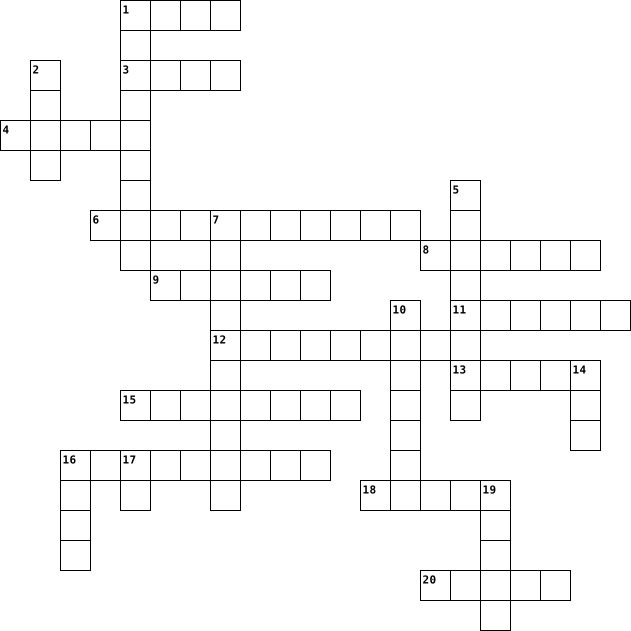
Across
- What is the square root of sixteen?
- How many foreign language is it in 1ST?
- How many students is ts in 1st?
- How much is 45 +39?
- What color do you get if you mix blue and red?
- What is "Naturfag" in English?
- How many students is it in 1STA?
- What is the name of 1STAs gym teacher?
- How many planets are there in our solar system?
- In which city is the United Nations headquarters?
- What is the name of 1STAs Norwegianteacher?
- What is the sixth planet in the solar system?
- What do you get if you mix yellow and blue?
Down
- What is seven times eight?
- What's the largest continent?
- How many subjects is it in 1st?
- How many letters is is in the English alfabeth?
- What is the Ebglish word for "Høyskole"?
- How many types of math is it in 1ST?
- What is the name of 1STAs English teacher?
- Is there as many male teachers as femal?
- How many colors are there in the rainbow?
22 Clues: How much is 45 +39? • What is seven times eight? • What's the largest continent? • What is "Naturfag" in English? • How many students is ts in 1st? • How many subjects is it in 1st? • How many students is it in 1STA? • What is the square root of sixteen? • How many types of math is it in 1ST? • What is the name of 1STAs gym teacher? • How many foreign language is it in 1ST? • ...
Puzzle 1 2020-10-16

Across
- only moon in solar system with substantial atmosphere
- rotation axis to most celestial bodies is
- Device that does not work on moon
- a black hole of mass of earth would be of size of a
- Horsehead nebula is
- bright star in constellation Ursa major
- the dragon
- the hunter
- suggested that hydrogen atoms in the sun fused or combined to form helium atoms
- brightest star in southern constellation of carina
- natural disasters happen on moon
- asteroid type of heavenly body
- galaxy home to solar system
- pulsar is actually a
Down
- cool areas on sun
- first rover to explore mars
- star closest to sun
- class name that andromeda galaxy belongs to
- two bright spots of light on opposite sides of a halo around the sun
- astronomical event that made headlines in 1986
- unit measurement used to describe the expansion of universe
- type of visible star is coolest
- only moon with active volcanoes
- great red spot located at
- Saturn's moon has distinctive equatorial ridge
- magellanic cloud is a
- largest volcano
27 Clues: the dragon • the hunter • largest volcano • cool areas on sun • star closest to sun • Horsehead nebula is • pulsar is actually a • magellanic cloud is a • great red spot located at • first rover to explore mars • galaxy home to solar system • asteroid type of heavenly body • type of visible star is coolest • only moon with active volcanoes • natural disasters happen on moon • ...
Astronomy Science crosswords 2023-02-17

Across
- a giant cloud of dust and gas
- used in a scale to signify something is going farther to something
- what is our planet earth?
- magnitude of how an object appears from the sky on earth
- a diagram of absolute magnitudes
- is the state of being luminous
- groups stars are classified in
- a small rock orbiting the sun
- all of space and time including planets
- galaxies that have no structure
- a big bright light in a shape of a sphere in space
- a circular-shaped galaxy
Down
- the range of all types of EM radiation
- the galaxy that includes our solar system
- an icy,small solar system body that warms and begins to release gases when nearing the sun
- the number of occurrences or repeating things of time
- the big star that people oon earth see in the sky
- used to signify that something is coming closer to something
- a non-normal galaxy
- the magnitude of an object with a standard distance of 10 parsecs
20 Clues: a non-normal galaxy • a circular-shaped galaxy • what is our planet earth? • a giant cloud of dust and gas • a small rock orbiting the sun • is the state of being luminous • groups stars are classified in • galaxies that have no structure • a diagram of absolute magnitudes • the range of all types of EM radiation • all of space and time including planets • ...
hehe 2023-04-21

Across
- shuttle that is the farthest out into space
- man-made satellite that humans occupy
- measured in kilograms
- first element on the periodic table
- third planet in the solar system
- space cloud
- space x program
- newtons first law
- has lots of mass packed into a tiny space, and sucks up anything that enters its event horizon
- on earth it's 9.8m/s
- distance that takes one year for light to traverse
Down
- how long does it take for the ISS to orbit earth?
- collection of stars that seem to make a shape in the sky
- outer belt of asteroids
- nearest galaxy to the milky way
- is one of the man-made satellites of Earth and is a telescope
- some kind of object that orbits another object in space
- the galaxy in which Earth resides
- nearest star to the solar system other than the sun
- what the moon does to the earth
- large collection of mass in a concentrated space
- large space sphere object that isn't a star or black hole
- the sun
23 Clues: the sun • space cloud • space x program • newtons first law • on earth it's 9.8m/s • measured in kilograms • outer belt of asteroids • nearest galaxy to the milky way • what the moon does to the earth • third planet in the solar system • the galaxy in which Earth resides • first element on the periodic table • man-made satellite that humans occupy • ...
Heather Space Crossword 2023-04-21

Across
- probe that explores beyond out solar system
- elon musks is the owner of the star link which is a train of ____ orbiting the earth
- greek princess constellation
- said to represent a "cup bearer" or "water bearer
- our planet is part of a ____ along with several others
- what is earth?
- where all the astronauts live when in space
- a large telescope in space
- objects resistance to change in motion
- solar systems beyond orbit
- keeps us on the ground
- twinkle, twinkle, little _____
- our source of heat and light
- its a candy bar
- our home planet
- an amount of matter in an object
Down
- the ISS orbits the earth in this amount of time
- buzz
- a pole star
- the first element on the periodic table
- space dust
- depicted as a centaur holding a bow and arrow
- represents both the goddess of justice and the goddess of the harvest
- closest star system to us
- going around and around a planet
- stars that make a picture
- planet eater
- constellation that represents a bull
28 Clues: buzz • space dust • a pole star • planet eater • what is earth? • its a candy bar • our home planet • keeps us on the ground • closest star system to us • stars that make a picture • a large telescope in space • solar systems beyond orbit • greek princess constellation • our source of heat and light • twinkle, twinkle, little _____ • going around and around a planet • ...
Enlightenment and Revolutions 2021-09-24

Across
- time of mass execution in France
- philosopher that believed in natural rights
- military general in Revolutionary War
- leader of Reign of Terror
- volunteer soldiers
- slow loading weapon
- philosophical movement of ideas in 1700s
- machine for beheading
- rule by few
- solar system with Earth as the center
- philosopher for women's rights
- rule by none
- placed tax on sugar
- rule by one
- former king that was executed
- writer of Dec. of Independence
Down
- freedoms born with that can't be taken away
- solar system with sun as the center
- scientist that put forth heliocentric model
- rule by many
- philosopher for religious freedom
- discovered moons of Jupiter
- discovered Laws of Motion and Gravity
- brotherhood
- placed tax on paper
- crowned himself king
- colonists dumped tea into the harbor
- give up some freedoms for social order
- philosopher for 3 branches of government
- hit-and-run military tactic
- philosopher that believed people are selfish
- the 3 social classes in France
32 Clues: brotherhood • rule by few • rule by one • rule by many • rule by none • volunteer soldiers • placed tax on paper • slow loading weapon • placed tax on sugar • crowned himself king • machine for beheading • leader of Reign of Terror • discovered moons of Jupiter • hit-and-run military tactic • former king that was executed • philosopher for women's rights • the 3 social classes in France • ...
RACE TO SPACE CROSSWORDS 2023-10-12

Across
- The first A in NASA.
- The last name of the first man on the Moon.
- The futuristic vehicle to travel across space.
- Add 11 and it's the mission to send men on the Moon.
- The fifth planet of the Solar System.
- The last name of the first man in space.
- The first author ever to contemplate a trip to the Moon.
- An astronomer who proved the Earth moves around the Sun.
- The physical force that makes objects fall down.
- Plants or animals that may live on another planet.
- The number of planets in the Solar System.
Down
- The name of the first satellite ever.
- The French astronaut working for the EU, Canada and Russia.
- The 4 letters of the Soviet union.
- The city where NASA employees are interviewed.
- Elon Musk is the CEO of it.
- The conflict between the USA and the Soviet union from 1945 to 1991.
- The space company of Amazon's CEO.
- The American president who ordered the mission to the Moon.
- The vehicle used to go to space.
20 Clues: The first A in NASA. • Elon Musk is the CEO of it. • The vehicle used to go to space. • The 4 letters of the Soviet union. • The space company of Amazon's CEO. • The name of the first satellite ever. • The fifth planet of the Solar System. • The last name of the first man in space. • The number of planets in the Solar System. • The last name of the first man on the Moon. • ...
RACE TO SPACE CROSSWORDS 2023-10-12

Across
- The first A in NASA.
- The last name of the first man on the Moon.
- The futuristic vehicle to travel across space.
- Add 11 and it's the mission to send men on the Moon.
- The fifth planet of the Solar System.
- The last name of the first man in space.
- The first author ever to contemplate a trip to the Moon.
- An astronomer who proved the Earth moves around the Sun.
- The physical force that makes objects fall down.
- Plants or animals that may live on another planet.
- The number of planets in the Solar System.
Down
- The name of the first satellite ever.
- The French astronaut working for the EU, Canada and Russia.
- The 4 letters of the Soviet union.
- The city where NASA employees are interviewed.
- Elon Musk is the CEO of it.
- The conflict between the USA and the Soviet union from 1945 to 1991.
- The space company of Amazon's CEO.
- The American president who ordered the mission to the Moon.
- The vehicle used to go to space.
20 Clues: The first A in NASA. • Elon Musk is the CEO of it. • The vehicle used to go to space. • The 4 letters of the Soviet union. • The space company of Amazon's CEO. • The name of the first satellite ever. • The fifth planet of the Solar System. • The last name of the first man in space. • The number of planets in the Solar System. • The last name of the first man on the Moon. • ...
STEM Crossword V 2024-10-04

Across
- An animal that is active at night (8 letters)
- A scientist who studies plants (10 letters)
- The force that pulls objects toward Earth (7 letters)
- The natural satellite of Earth (4 letters)
- The layer of air around Earth (9 letters)
- The process plants use to make food using sunlight (14 letters)
- The part of the plant that grows underground (4 letters)
- A solid form of water (3 letters)
- A scientist who studies stars and planets (11 letters)
Down
- A scientist who studies rocks (9 letters)
- The largest planet in our solar system (7 letters)
- A change of state from liquid to gas (10 letters)
- The gas we breathe in (6 letters)
- The star at the center of our solar system (3 letters)
- A tool used to see tiny objects (9 letters)
- An animal that hunts other animals for food (7 letters)
- An animal that eats plants (9 letters)
- The basic unit of life (4 letters)
- The planet known as the Red Planet (4 letters)
- A large body of saltwater (5 letters)
20 Clues: The gas we breathe in (6 letters) • A solid form of water (3 letters) • The basic unit of life (4 letters) • A large body of saltwater (5 letters) • An animal that eats plants (9 letters) • A scientist who studies rocks (9 letters) • The layer of air around Earth (9 letters) • The natural satellite of Earth (4 letters) • A scientist who studies plants (10 letters) • ...
Unit 2 Chapter 6 Level D 2025-05-12

Across
- appears as a circle
- force between two objects
- telescope which uses radio waves
- appears like an eyelash
- person who travels in space
- blue planet with 8 moons
- the closest four planets to our sun
- spin
- our sun and all that circles it
- second planet from the sun
- instrument which makes far away objects look closer
- holes in the ground
- people who study stars and other objects in space
- second largest planet in our solar system
- largest planet in our solar system
- icy object orbiting the sun
- time it takes Earth to travel around the sun one time
- fourth planet from the sun
Down
- smallest planet (recently demoted)
- shooting stars
- natural object circling another in space
- meteoroid that hits Earth
- air around a planet
- blue-green planet with rings and 18 moons
- object sent into space to explore
- broken pieces of asteroids or comets
- travel in a circle around an object
- third planet from the sun
- planet closest to the sun
29 Clues: spin • shooting stars • appears as a circle • air around a planet • holes in the ground • appears like an eyelash • blue planet with 8 moons • force between two objects • meteoroid that hits Earth • third planet from the sun • planet closest to the sun • second planet from the sun • fourth planet from the sun • person who travels in space • icy object orbiting the sun • ...
Our Earth and it’s neighbours: Comparatives/superlatives 2022-09-06

Across
- _____ is the largest planet in our solar system.
- The _____ is the largest desert in the world.
- If the earth goes between the moon and the sun, we have an _____ .
- The Nile is the _____ River in Africa.
- The cheetah is the _____ animal in the world.
- The earth is _____ to the sun, than Uranus.
- Gravity on the moon is _____ than on earth.
- Gravity is much _____ on the earth than on moon.
- The ostrich is the _____ bird in the world.
- _____ has the worst earthquakes in the world.
- The sun is _____ than the earth.
Down
- Blue whales are _____ animals in the world.
- The moon is our_____ neighbour.
- Blood is _____ than water.
- The largest country in the world is _____ .
- The giraffe is _____ animal in the world.
- _____ is the most populated country in the world.
- The smallest planet in our solar system is _____ .
- Silver is than gold.
- Gold is _____ than silver.
- Pluto is _____ from the sun than earth.
- Mount Kilimanjaro is the _____ mountain in Africa.
- Neil Armstrong was the first man on the _____ .
- _____ are the largest animals on land.
- Pluto is _____ than earth.
25 Clues: Silver is than gold. • Blood is _____ than water. • Gold is _____ than silver. • Pluto is _____ than earth. • The moon is our_____ neighbour. • The sun is _____ than the earth. • The Nile is the _____ River in Africa. • _____ are the largest animals on land. • Pluto is _____ from the sun than earth. • The giraffe is _____ animal in the world. • ...
Chapters 7.1 - 7.3 Space Crossword 2022-04-04

Across
- An important telescope in orbit of earth
- The largest planet in our solar system
- The distance that a beam of light can travel through space for 1 year
- A region of rocky debris that forms a ring all the way around the Sun
- A certain type of galaxy with a bar across them
- A concentration of stars in a small region of space
- The galaxy that we live in
- The average distance between the Sun and Earth
- Center of our solar system
- A large cloud of dust and gas
- A star exploding
Down
- A galaxy without a regular shape
- a galaxy shaped like a flattened sphere
- Hot ball of gas
- The process in which nuclei fuse together and form larger atoms
- 300 000 km/s
- Matter that is invisible
- A group of three stars that orbit each other
- The formation of the universe
- A part of the electromagnetic spectrum that we can see
- A region of space where gravity is so strong that nothing can escape
21 Clues: 300 000 km/s • Hot ball of gas • A star exploding • Matter that is invisible • The galaxy that we live in • Center of our solar system • The formation of the universe • A large cloud of dust and gas • A galaxy without a regular shape • The largest planet in our solar system • a galaxy shaped like a flattened sphere • An important telescope in orbit of earth • ...
Treasure Hunt 2025-10-31

Across
- if you are crossing the guy who is running second, who are you behind now
- the only thing which when stolen makes you happy (translate it to Hindi for better understanding)
- Device used to measure temperature
- one of the five sense organs which helps you balancing
- smooth n soft vs _____ n tough
- if you smoke cigarettes yours are definitely gonna turn black
- Planet in a thermometer
- solid carbon dioxide is called Dry ___
- Largest habitat on earth
Down
- The Indian women team will be facing them in the Finals of Women's World Cup Finals tonight
- Helps in walking and keeps you grounded
- sold at shops in carats but not gold
- Enables vision and photosynthesis
- recently discovered planet GJ251c is located 20 lightyears away from us is compared to which planet of solar system
- It controls everything in your body
- Dalton JJ Thompson Neil Bohr
- known to lay the biggest eggs but is not extinct yet
- carries electrical impulse in the body
- the hottest body in our solar system
- used with alkali to perform neutralization reaction
20 Clues: Planet in a thermometer • Largest habitat on earth • Dalton JJ Thompson Neil Bohr • smooth n soft vs _____ n tough • Enables vision and photosynthesis • Device used to measure temperature • It controls everything in your body • sold at shops in carats but not gold • the hottest body in our solar system • carries electrical impulse in the body • ...
predicting Earthquake 2025-10-23

Across
- – Comet’s surrounding gas cloud.
- comet – Bright comet of 1997.
- – December meteor shower.
- waves – Fastest seismic waves.
- winds – Steady winds near equator.
- scale – Earthquake intensity scale.
- floods – Sudden, rapid flooding.
- cloud – Distant icy bodies around solar system.
- – Locating earthquake epicenter.
- tail – Comet tail of ionized gas.
- – August meteor shower.
- – Earth’s outer layer.
- – Largest asteroid belt object.
- – Atlantic tropical storm.
- – Lowest atmospheric layer.
- tail – Comet tail made of dust.
Down
- – Earth’s middle line.
- waves – Slower, shaking waves.
- – Small space rocks.
- plates – Large moving Earth sections.
- – Sudden ground shaking.
- system – Sun and orbiting bodies.
- belt – Region beyond Neptune with icy bodies.
- – Orbit farthest from Sun.
- – Orbit closest to Sun.
- Comet – Famous periodic comet.
- – Large sea wave.
- shower – Many meteors in sky.
- – Earthquake-recording instrument.
- – November meteor shower.
- – Solid center of a comet.
- – Space rock reaching Earth.
- – Icy bodies orbiting the Sun.
- force – Earth’s rotation effect on motion.
- cyclone – Rotating storm with strong winds.
35 Clues: – Large sea wave. • – Small space rocks. • – Earth’s middle line. • – Earth’s outer layer. • – Orbit closest to Sun. • – August meteor shower. • – Sudden ground shaking. • – December meteor shower. • – November meteor shower. • – Orbit farthest from Sun. • – Solid center of a comet. • – Atlantic tropical storm. • – Lowest atmospheric layer. • – Space rock reaching Earth. • ...
Space 2017-03-18

Across
- Any natural body that revolves around a planet
- Low, bowl-shaped area on the surface of a planet or moon
- Everything that exists stars, planets, dust, gases, energy
- Occurs when one body in space blocks light from reaching another body in space
- Gas, dust, and a group of stars, including objects orbiting the stars
- A pattern of stars named after a religious or mythical object or animal
Down
- system Made up of a star, planets, and other objects that revolve around that star
- Travels in a path around the sun
- Star at the center of our solar system
- Path earth takes as it revolves
- Bending of light
- Imaginary line that passes through the North and South pole
- An imaginary line going around the Earth halfway between poles
- Body that revolves around a star
- Spin on an axis
- Huge ball of very hot gases in space
16 Clues: Spin on an axis • Bending of light • Path earth takes as it revolves • Travels in a path around the sun • Body that revolves around a star • Huge ball of very hot gases in space • Star at the center of our solar system • Any natural body that revolves around a planet • Low, bowl-shaped area on the surface of a planet or moon • ...
Kepler's 3 Laws 2025-02-27

Across
- Distance from Focal point to center of an elliptical orbit
- The ration of T^2/A^3 is equal to this
- the point where a satellite has the most kinetic energy
- Kepler's Law stating planets orbit in an elliptical fashion
- The combined Kinetic and Potential Energy of an orbit remains this
- Model of the Solar System where planets orbit the Earth
- Shape of the orbits according to Kepler
- Shape of the orbits according to Copernicus
- The kind of unit used for measuring planetary distances
- Kepler's Law relating Orbital Period to Semi-Major Axis
Down
- Model of the Solar System where the planets orbit around the sun
- the point where a satellite has the most potential energy
- Ms. Madrid's name for her students
- Kepler's Law of Equal Areas
- The ratio that measures how flat an orbit is
- Period, the time for a satellite to complete an orbit
16 Clues: Kepler's Law of Equal Areas • Ms. Madrid's name for her students • The ration of T^2/A^3 is equal to this • Shape of the orbits according to Kepler • Shape of the orbits according to Copernicus • The ratio that measures how flat an orbit is • Period, the time for a satellite to complete an orbit • the point where a satellite has the most kinetic energy • ...
Astronomer 2025-07-03

Across
- The giant, dark place where all the planets and stars are.
- A big round object that orbits a star like the Sun.
- A tool that helps you see faraway stars and planets.
- This planet has big, beautiful rings.
- The biggest planet in our solar system.
- The planet we live on.
- The path a planet or moon takes around something.
- A giant ball of hot gas that shines in the sky.
Down
- It orbits Earth and lights up the night.
- A person who travels into space.
- A huge group of stars, planets, and dust in space.
- A rock from space that burns up in Earth’s sky.
- A machine that orbits Earth and helps us send signals.
- The star at the center of our solar system.
- A space rock with a glowing tail that zooms through space.
- A vehicle that blasts off into space.
16 Clues: The planet we live on. • A person who travels into space. • This planet has big, beautiful rings. • A vehicle that blasts off into space. • The biggest planet in our solar system. • It orbits Earth and lights up the night. • The star at the center of our solar system. • A rock from space that burns up in Earth’s sky. • A giant ball of hot gas that shines in the sky. • ...
Science Junior Cert 2013-01-23

Across
- Type of blue paper used in an acid test.
- Science studying the life and living organisms.
- A three legged stand (a piece of lab equipment).
- The unit of temperature used in the USA.
- A device that measures temperature.
- Speed times Time is equal to ________.
- The release of energy from food.
- These connect muscle to bone.
- It's chemical formula is CO2.
- The smallest particle of an element.
- Science studying matter and its motion.
- The most common gas found in air.
- Their function is to clot the blood.
Down
- The unit of measurement for temperature in Ireland.
- The biggest planet in our Solar System.
- These connect bone to bone.
- It's chemical formula is H2O.
- Lab equipment that produces a gas flame.
- One of the five major food nutrients.
- Your _____ pumps blood around your body.
- These blood cells transport oxygen.
- These blood cells fight disease.
- The smallest planet in our Solar System.
- The ________ table of chemical properties.
- A lab instrument used to view small objects.
- Science studying materials.
- Density times Volume is equal to ____.
27 Clues: These connect bone to bone. • Science studying materials. • It's chemical formula is H2O. • These connect muscle to bone. • It's chemical formula is CO2. • These blood cells fight disease. • The release of energy from food. • The most common gas found in air. • A device that measures temperature. • These blood cells transport oxygen. • The smallest particle of an element. • ...
RACE TO SPACE CROSSWORDS 2023-10-12

Across
- Add 11 and it's the mission to send men on the Moon.
- The conflict between the USA and the Soviet union from 1945 to 1991.
- The futuristic vehicle to travel across space.
- The last name of the first man in space.
- The vehicle used to go to space.
- The last name of the first man on the Moon.
- Plants or animals that may live on another planet.
- The first author ever to contemplate a trip to the Moon.
- The fifth planet of the Solar System.
- The American president who ordered the mission to the Moon.
Down
- The first A in NASA.
- The 4 letters of the Soviet union.
- The name of the first satellite ever.
- The city where NASA employees are interviewed.
- Elon Musk is the CEO of it.
- The physical force that makes objects fall down.
- The space company of Amazon's CEO.
- An astronomer who proved the Earth moves around the Sun.
- The French astronaut working for the EU, Canada and Russia.
- The number of planets in the Solar System.
20 Clues: The first A in NASA. • Elon Musk is the CEO of it. • The vehicle used to go to space. • The 4 letters of the Soviet union. • The space company of Amazon's CEO. • The name of the first satellite ever. • The fifth planet of the Solar System. • The last name of the first man in space. • The number of planets in the Solar System. • The last name of the first man on the Moon. • ...
6th Grade Science 2023-11-15

Across
- one of the most abundant elements
- one of the most abundant elements
- hottest planet
- the force that pulls things towards the earth
- only planet with water in all 3 states of matter
- has the most moons
- coldest planet
- this variable never changes
- this variable is what you change
- a cloud of dust
- the purest substance on earth
- largest planet
- Mercury, Venus, Earth, Mars
- this contains EVERYTHING
- Pluto isn't a planet because it doesn't ___ its orbit
Down
- this variable is what you measure, it is the outcome
- particle outside the nucleus that has a negative charge
- smallest planet
- The nebula started to heat up, contract, and ____.
- Neptune's twin
- Jupiter, Saturn, Uranus, Neptune
- particle in the nucleus that has no charge
- this tells you the number of protons
- Earth is this many AUs from the sun
- Pluto is this type of planet
- measures things outside of our solar system
- particle in the nucleus that has a positive charge
- an atom of hydrogen has this many neutrons
- this contains our solar system plus lots of other stars and planets
29 Clues: hottest planet • Neptune's twin • coldest planet • largest planet • smallest planet • a cloud of dust • has the most moons • this contains EVERYTHING • this variable never changes • Mercury, Venus, Earth, Mars • Pluto is this type of planet • the purest substance on earth • Jupiter, Saturn, Uranus, Neptune • this variable is what you change • one of the most abundant elements • ...
Trivia 2023-12-30

Across
- Which ancient city was destroyed by the eruption of Mount Vesuvius in 79 AD?
- How many stars are in the European Union flag?
- What is the largest planet in our solar system?
- What is the oldest country in the world?
- What is the world’s largest island?
- Which American state is the largest(in area)?
- Which country was the birthplace of the Renaissance?
- What is the largest organ in the human body?
- What’s the ruling of Dynasty of Monaco?
- Which country has the largest army?
Down
- What is the study of earthquakes called?
- What are people who suffer from Alektorophobia?
- What are baby kangaroos called?
- What is the process by which plants convert sunlight into energy called?
- Mount Kilimanjaro is located in which country?
- Which European country is home to the fjords?
- Which planet in our solar system is named after the Roman goddess of love and beauty?
- Which country has the most fresh water?
- In Swedish, a skvader is a rabbit with what unusual feature?
- What is the smallest unit of matter?
20 Clues: What are baby kangaroos called? • What is the world’s largest island? • Which country has the largest army? • What is the smallest unit of matter? • Which country has the most fresh water? • What’s the ruling of Dynasty of Monaco? • What is the study of earthquakes called? • What is the oldest country in the world? • What is the largest organ in the human body? • ...
General Knowledge 2024-07-19

Across
- The first man to fly into space
- The Greek poet who authored the Iliad
- The American president who abolished slavery
- The chemical formula for table salt
- The inventor of the telephone
- The number of states in the United States
- The main material of the Eiffel Tower
- House The famous opera house in Sydney
- The first book printed by Gutenberg
- The planet known for its rings
- The birthplace of William Shakespeare
- The lightest metal
- Gogh The painter of "Starry Night"
- The capital of Australia
- The smallest country in the world
- The author of "The Divine Comedy"
Down
- The painter famous for the Sistine Chapel
- The longest river in Europe
- The number of planets in the solar system
- The composer of the Ninth Symphony
- The nation hosting the 2008 Olympics
- The city where the Parthenon is located
- The chemical element symbol Fe
- The highest mountain in Japan
- The official language of Brazil
- The river that flows through London
- The second planet in the solar system
- The largest ocean in the world
28 Clues: The lightest metal • The capital of Australia • The longest river in Europe • The inventor of the telephone • The highest mountain in Japan • The chemical element symbol Fe • The planet known for its rings • The largest ocean in the world • The first man to fly into space • The official language of Brazil • The smallest country in the world • The author of "The Divine Comedy" • ...
L11 Sunita in space 2022-01-24

Across
- Red planet
- First Indian man to go in space.
- Shape of earth
- coldest planet
- The path around a spacial body in which other one revolves .
- Force exerted by Earth on all objects
- Movement of earth on its own axis
- Hottest planet in the solar system
- largest planet
- Another name for force of gravity.
- group of astar
- Number of planets in solar system
- A celestial body which is called a dwarf planet.
Down
- No moon night.
- It has its own light
- The sky, stars, sun and moon are all in ................ .
- First person to walk on moon.
- Indian space research organisation
- Moving around another object
- Model of the earth
- A meteorite which catches fire when it enters the earth's atmosphere.
- is used for the TV, telephones and weather reports
- Night when moon it appears perfectly round in the sky.
- Organisation for which Sunita Williams works
- First Indian woman to go in space.
- Our planet
- A vehicle designed to travel in space
- Natural satellite of Earth
- An object that revolves around SUN
29 Clues: Red planet • Our planet • No moon night. • Shape of earth • coldest planet • largest planet • group of astar • Model of the earth • It has its own light • Natural satellite of Earth • Moving around another object • First person to walk on moon. • First Indian man to go in space. • Movement of earth on its own axis • Number of planets in solar system • Indian space research organisation • ...
Astronomy Crossword Puzzle 2025-03-12

Across
- red planet next to the asteroid belt
- Mostly full moon phase
- the force that keeps us in orbit around our sun
- blue star also loacted in the Ursa Major constellation
- Tool we use to see stars
- blue star located in the Ursa Major constellation
- Earth's sister planet
- provides Earth with energy and heat
- closest planet to the sun
- stretched, circular orbit
- Earth's satellite
- speed with direction
- Mark watney grew them on Mars in The Martian
- only planet in our solar system with a vertical ring
- red supergiant that lies in the Scorpius constellation
- Dwarf planet in the asteroid belt
- farthest planet from the sun
Down
- people that travel in space
- largest planet in the solar system
- blue star formerly named Naos
- planet with visible rings
- the color of the coldest star
- the color of the hottest star
- smallest visible Moon phase
- Completely visible moon phase
- dwarf planet that used to be a planet
- smaller star
- the planet we live on
- an object that rotates around another mass
29 Clues: smaller star • Earth's satellite • speed with direction • Earth's sister planet • the planet we live on • Mostly full moon phase • Tool we use to see stars • planet with visible rings • closest planet to the sun • stretched, circular orbit • people that travel in space • smallest visible Moon phase • farthest planet from the sun • blue star formerly named Naos • ...
1a text 2025-04-05

Across
- Something that we don’t fully understand.
- Machines or tools that help people do things.
- Maybe; something that could be true but is not certain.
- Someone or something that comes from another place.
- A thing that can be seen or touched.
- The sun and everything that moves around it, like planets and asteroids.
- The part of the solar system closer to the sun, including planets like Mercury, Venus, Earth, and Mars.
- The distance that light travels in one year.
- An idea that explains something, based on facts and studies.
- Unusual or unexpected.
- A long trip from one place to another.
Down
- A group of stars and planets that are connected by gravity.
- The speed at which sound travels through air.
- Coming from outside our solar system.
- To find something that was not known before.
- In a way that is unusual or unexpected.
- A rock that moves through space.
- The fastest speed something can reach.
- A vehicle made for traveling in space.
- A scientist who studies objects in space.
- To travel to a new place to learn about it.
21 Clues: Unusual or unexpected. • A rock that moves through space. • A thing that can be seen or touched. • Coming from outside our solar system. • The fastest speed something can reach. • A vehicle made for traveling in space. • A long trip from one place to another. • In a way that is unusual or unexpected. • Something that we don’t fully understand. • ...
Little Bit of Everything 2024-10-01

Across
- This state of matter makes up most of the universe.
- Our school's mascot.
- This Nevada city is wall to wall casinos. (2 words)
- California's capital.
- This season's time is from March to June.
- In one word, your weight has to do with this force.
- Month Valentine's Day is celebrated.
- Your science teacher. (2 words)
- The only star in our solar system.
- The step by step procedure we use in science.
- Month we celebrate Father's Day.
Down
- This amusement park is located in Buena Park (3 words)
- Largest planet in the solar system.
- The instrument Mr. Winters plays in his band.
- Marvel military superhero (2 words).
- Day of the week Thanksgiving always lands on.
- Tool we used in class to measure mass.
- State where the Grand Canyon is located.
- 70% of the earth is covered with this.
- It's celebrated on Oct 31st every year.
- State where Disney World is located.
- This "Queen Bee" is married to JayZ.
- Official mascot of Disneyland (2 words).
- Number of months in a calendar year.
24 Clues: Our school's mascot. • California's capital. • Your science teacher. (2 words) • Month we celebrate Father's Day. • The only star in our solar system. • Largest planet in the solar system. • Marvel military superhero (2 words). • Month Valentine's Day is celebrated. • State where Disney World is located. • This "Queen Bee" is married to JayZ. • ...
Science Midterm Chapter 1 2025-01-02

Across
- The location in the galaxy that is not too close to the inner core or outer arm
- The calendar we use today that fixed the number of leap years
- When there is an equal amount of daylight and nighttime
- The model where Sun is in the center of the solar system
- The lunar calendar that added an extra month so the holidays do not occur 11 days earlier each year
- The model where Earth is in the center of the solar system
- Equinox in March
- When the Earth is tilted towards or away from the Sun
- The two types of solstices
- The calendar that has 12 months with 30 or 31 days, but has too many leap years
- The shape of Earth's orbit
Down
- All life on Earth
- Planets made mostly or entirely of gas
- The location around the Sun that is warm enough to support life
- Layer of gases around Earth
- Part of Earth made of water
- The lunar calendar whose holidays occur 11 days earlier each year
- Equinox in September
- Upper layer of Earth's crust
- planets Earthlike planets
20 Clues: Equinox in March • All life on Earth • Equinox in September • planets Earthlike planets • The two types of solstices • The shape of Earth's orbit • Layer of gases around Earth • Part of Earth made of water • Upper layer of Earth's crust • Planets made mostly or entirely of gas • When the Earth is tilted towards or away from the Sun • ...
IA Marking Period Two Terms and Concepts 2025-01-05

Across
- a liquid mixture
- what Earth rotates on
- causes objects to attract or repel
- matter with no shape or volume
- substances combine making new things
- vision of a star on Earth
- the amount of something
- ball of gas in space
- smaller representation of something
- what supports an idea
- the push a/o pull on an object
- smallest part of a substance
- celestial body orbiting a star
- tool used to view things bigger
- a complete spin on the axis
- star at the heart of our solar system
- the heaviness of something
Down
- the amount of space matter takes up
- cannot be turned around
- has mass and takes up space
- man made orbital
- a combination of two or more substances
- spread out evenly in a liquid
- third planet in our solar system
- order of planetary bodies
- to turn the other way around
- natural satellite orbiting Earth
- physical & chemical characteristics
- the hotness or coldness of something
- matter that is the same throughout
- using our senses to examine something
31 Clues: a liquid mixture • man made orbital • ball of gas in space • what Earth rotates on • what supports an idea • cannot be turned around • the amount of something • vision of a star on Earth • order of planetary bodies • the heaviness of something • has mass and takes up space • a complete spin on the axis • to turn the other way around • smallest part of a substance • ...
Aran and Rians hard quiz 2025-10-24

Across
- 1666 had the Great ..... Of London
- a computer you can carry around
- shoes used for sports
- a sport played with a shuttlecock and rackets
- a colour in the rainbow
- the money used in America
- a planet in the solar system
- a house with only one floor
- water when it is a gas
- when air comes quickly out of your nose
- the break in the middle of a football match
- a colouring stick made from wax
Down
- the biggest planet in the solar system
- you mix iron and carbon to make this metal
- Cumberland and Chorizo and Lincolnshire are types of...
- the 26th of December
- crisps that come in a tube
- the name for forks knives and spoons
- french word for hello
- the country next to Norway
- move backwards in a car
- a tool used for hitting nails
- a shape with eight sides
- The ingredient that makes bread rise
- you stick these to an envelope when you post a letter
- yellow gloopy dessert
26 Clues: the 26th of December • french word for hello • shoes used for sports • yellow gloopy dessert • water when it is a gas • a colour in the rainbow • move backwards in a car • a shape with eight sides • the money used in America • crisps that come in a tube • the country next to Norway • a house with only one floor • a planet in the solar system • a tool used for hitting nails • ...
Solve Me! General Knowledge Science 2026-01-06

Across
- The closest planet to the sun
- They make honey
- A force that keeps us on the land
- Earth takes 24 hours to do this
- The biggest planet in the solar system
- Earth takes 365-6 days to do this
- The overflow water on the land
- Bee, butterfly, small birds, helper of plants
- A unit measurement for mass
- A change from liquid to solid
- Absorb nutrient from the soil
- When the land is shaking
- The change of gas to liquid
- An insectivora plant
- Someone who works in space
- The biggest mammal on the Earth
- The biggest energy resources on Earth
Down
- Expert in science
- Large marsupial
- Flying mammal
- I walk on two legs
- Fungi, bacteria in food chain
- A state of matter
- I have antlers
- The change of liquid to gas
- Another word for plants in food chain
- Has a trunk
- A tool to measure temperature
- Solar system is part of it
- A unit measurement for temperature
30 Clues: Has a trunk • Flying mammal • I have antlers • Large marsupial • They make honey • Expert in science • A state of matter • I walk on two legs • An insectivora plant • When the land is shaking • Solar system is part of it • Someone who works in space • The change of liquid to gas • A unit measurement for mass • The change of gas to liquid • The closest planet to the sun • ...
Cassie:Solar System 2020-01-21

Across
- Blue is the hottest temperature of these celestial beings
- 1 million earths could fit inside this
- you would weigh about 38 percent of what you do on this planet
- Clouds of gas and dust
- This belt has at least three dwarf planets in it
- This planet takes 84 earth years to orbit the sun
- Moon named after the greek god of fear
- this is the fastest spinning object in our solar system
Down
- this planet is named after the roman god of war
- This is the most distant planet that can be seen without a telescope
- this is the seconf brightest object in our solar system
- many of these make up a belt
- Sometimes referred to as dirty snowballs
- This planet has a great spot, much like jupiter
- Moon named after greek god of panic
- Named after the roman god of the underworld
16 Clues: Clouds of gas and dust • many of these make up a belt • Moon named after greek god of panic • 1 million earths could fit inside this • Moon named after the greek god of fear • Sometimes referred to as dirty snowballs • Named after the roman god of the underworld • this planet is named after the roman god of war • This planet has a great spot, much like jupiter • ...
Q1 Reflection 2024-10-28

Across
- When the Moon is fully illuminated to our view
- When the Moon is fully dark to our view
- A fossil used to define and identify geologic periods
- The planets in the Solar System ________ around the Sun
- The force that attracts any two objects with mass
- If a rock layer is at the top, then it is what(age)
- When the Moon falls into the Earth's shadow, making it appear reddish
- Earth spins on its _______
- Gravity holds the Moon in _____ around the Earth
- Matter that settles at the bottom of a liquid
- Half of a planet(northern and southern)
Down
- When the Moon is in between the Earth and the Sun, blocking its light
- Larger, gaseous, and colder planets
- Smaller, rocky, and warmer planets
- All the planets in the Solar System do this on their axis
- If a rock layer is at the bottom, then it is what(age)
16 Clues: Earth spins on its _______ • Smaller, rocky, and warmer planets • Larger, gaseous, and colder planets • When the Moon is fully dark to our view • Half of a planet(northern and southern) • Matter that settles at the bottom of a liquid • When the Moon is fully illuminated to our view • Gravity holds the Moon in _____ around the Earth • ...
PES - Science Crossword 2025-11-25

Across
- An attempt to find out about something.
- Something we observe to be similar over and over again.
- Something scientists make to answer questions about the real world.
- Observations or measurements recorded in an investigation.
- It takes the Earth 24 hours to complete one full _________.
- To make a picture in your mind using information from different sources.
- Careful and orderly.
Down
- The Earth takes 365 days to ______ the sun.
- An arrangement of stars seen from Earth.
- A description of how something works or why something happens.
- System, The sun, the planets that orbit the sun, and other objects that orbit the sun.
- The pull between Earth and other objects, which acts even without touching.
- A period of time that is 24 hours long and includes daytime and nighttime.
- The only star in our solar system.
- A scientist that studies the stars, planets, moons, and galaxies.
- Information that supports an answer to a question.
16 Clues: Careful and orderly. • The only star in our solar system. • An attempt to find out about something. • An arrangement of stars seen from Earth. • The Earth takes 365 days to ______ the sun. • Information that supports an answer to a question. • Something we observe to be similar over and over again. • Observations or measurements recorded in an investigation. • ...
Primary 6 2015-05-11

Across
- / A year with additional of one day in February
- / A planet that does not exists anymore
- / One _______ of the Earth takes about 24 hours
- / Are space rocks that orbit around the Sun in between Mars and Jupiter
- / The direction where the Sun rises
- / A cycle that happens when we say the Earth revolves around the Sun once a year
- / There are ______ phases of the Moon
Down
- / One _______ of the Moon takes about 28 days
- / A cycle that happens when the earth rotates or spins about its axis
- / It is our main source of heat and light energy
- / Large lumps of ice and dust that orbit the Sun
- / The hottest planet in the solar system
- / The imaginary line that exists in the solar system
- / The direction where the Sun sets
- / The curved path of the Earth round the Sun
- / It is a planet where human being lives
16 Clues: / The direction where the Sun sets • / The direction where the Sun rises • / There are ______ phases of the Moon • / A planet that does not exists anymore • / The hottest planet in the solar system • / It is a planet where human being lives • / The curved path of the Earth round the Sun • / One _______ of the Moon takes about 28 days • ...
THE MILKY WAY 2022-04-26

Across
- planet famous for its rings made of dust and icy chunks
- hottest and brightest planet in our Solar System
- have the highest mountain in our Solar System, known as the "Red Planet"
- a very large group of stars held together in the universe
- object sent into space to collect information
- the force that makes objects fall to the ground or that pulls objects towards a planet
- pattern of stars
- smallest and closest planet to the Sun
Down
- planet covered in clouds, biggest planet
- the name of our galaxy
- the Sun and 8 planets that travel around it
- known as the "Icy Planet", the coldest one
- a vehicle that travels in space
- a person who travels in space
- third planet from the Sun, the only planet with organic life
- blue planet with too many storms in its atmosphere
16 Clues: pattern of stars • the name of our galaxy • a person who travels in space • a vehicle that travels in space • smallest and closest planet to the Sun • planet covered in clouds, biggest planet • known as the "Icy Planet", the coldest one • the Sun and 8 planets that travel around it • object sent into space to collect information • ...
Topic 7 Space Quiz Review Crossword 2025-05-11

Across
- Meteoroids that enter Earth's atmosphere
- A body that orbits a planet
- Small rocks with no orbit
- A group of stars that make a pattern
- Fill in the blank: Objects with more ________ will have a stronger gravitational attraction.
- Small rocks that orbit the sun
- Large celestial bodies that orbit the sun
- The Sun is in the center of the solar system
Down
- When an object spins on its axis (this determines day and night)
- The Earth is in the center of the solar system
- When one object moves around another object in space (this determines the time of year and the constellations you can see from Earth)
- The force that attracts objects with mass toward each other
- Meteors that hit the Earth's surface
- Fill in the blank: It takes Earth, 365 ______ to orbit the sun.
- Giant bodies of hot plasma
- The imaginary line that runs through Earth's north pole, center, and south pole
16 Clues: Small rocks with no orbit • Giant bodies of hot plasma • A body that orbits a planet • Small rocks that orbit the sun • A group of stars that make a pattern • Meteors that hit the Earth's surface • Meteoroids that enter Earth's atmosphere • Large celestial bodies that orbit the sun • The Sun is in the center of the solar system • ...
Astronomy 2020-06-30

Across
- My last name, including the hyphen
- Galaxy containing our solar system
- An instrument used to collect information on stars, like what they are made of ect
- An artificial body placed in orbit to collect information
- Relatively small star with low luminosity
- Name of an icy dwarf planet in our solar system
- Moving in a circular orbit around the equator and appears to be fixed in place
- Time or date when the sun crosses the celestial equator
Down
- Fragment of rock or iron from space
- A space entirely devoid of matter
- Region of space where gravity is so strong not even light can escape
- Group of constellations divided into twelve (12) signs
- Group of stars
- On or relating to Earth
- A sudden or rapid variation in brightness
- A universe as a whole
- Path of a planet, star, spaceship or moon around a planet, star or moon
- Obscuring of light from a celestial body to another
- Distance required to complete one (1) osculation
- Measure of resistance when the state of motion is changed
20 Clues: Group of stars • A universe as a whole • On or relating to Earth • A space entirely devoid of matter • My last name, including the hyphen • Galaxy containing our solar system • Fragment of rock or iron from space • A sudden or rapid variation in brightness • Relatively small star with low luminosity • Name of an icy dwarf planet in our solar system • ...