
solar Crossword Puzzles
Rolla's Crossword 2020-05-24

Across
- if I were you, I …… tell the truth
- it holds objects and planets to the sun
- if I …… the answer, I would tell it to you
- you would have …… if you had worked harder
- crossroad,junction
- if I had more money, I …… buy you a neckless
- that prevents infections
- disappearing, lessening
- if I ……. you, I would stop smoking
Down
- the name of the Galaxy of our solar sistem
- brief wavering light
- if ypu …… the lottery, you might win
- if she arrived on time at school, the principal …… tell her off
- if you study everyday you …… more
- pause, don't know what to say
- if they …… their house they would be rich
- blocks harmful solar radiation
- it will collaps and become smaller than the earth
- they would evaporate if the earth was closer to the sun
19 Clues: crossroad,junction • brief wavering light • disappearing, lessening • that prevents infections • pause, don't know what to say • blocks harmful solar radiation • if you study everyday you …… more • if I were you, I …… tell the truth • if I ……. you, I would stop smoking • if ypu …… the lottery, you might win • it holds objects and planets to the sun • ...
The Planets 2013-12-11

Across
- The planet with lowest density
- The name of Mars' "largest in the solar system" object
- telescopes that use lenses and/or mirrors are of this type
- a man-made place in orbit around the Earth
- Temperatures at the surface of Venus are hot enough to melt _____
- a small probe that moves along the surface on wheels
- you could say this planet has East and West poles
- the hottest planet
Down
- the length of a Jovian day
- Mercury, Venus, Earth, Mars
- the planet with the red spot
- the smallest planet
- the red planet
- the largest component of the Venetian atmosphere
- the coldest surface in the known solar system
- this type of telescope uses invisible radiation like x-rays
- This planet has the fastest winds
- Jupiter, Saturn, Uranus, Neptune
- Saturn's rings are mostly made of this
19 Clues: the red planet • the hottest planet • the smallest planet • the length of a Jovian day • Mercury, Venus, Earth, Mars • the planet with the red spot • The planet with lowest density • Jupiter, Saturn, Uranus, Neptune • This planet has the fastest winds • Saturn's rings are mostly made of this • a man-made place in orbit around the Earth • ...
Enlightenment 2022-02-23
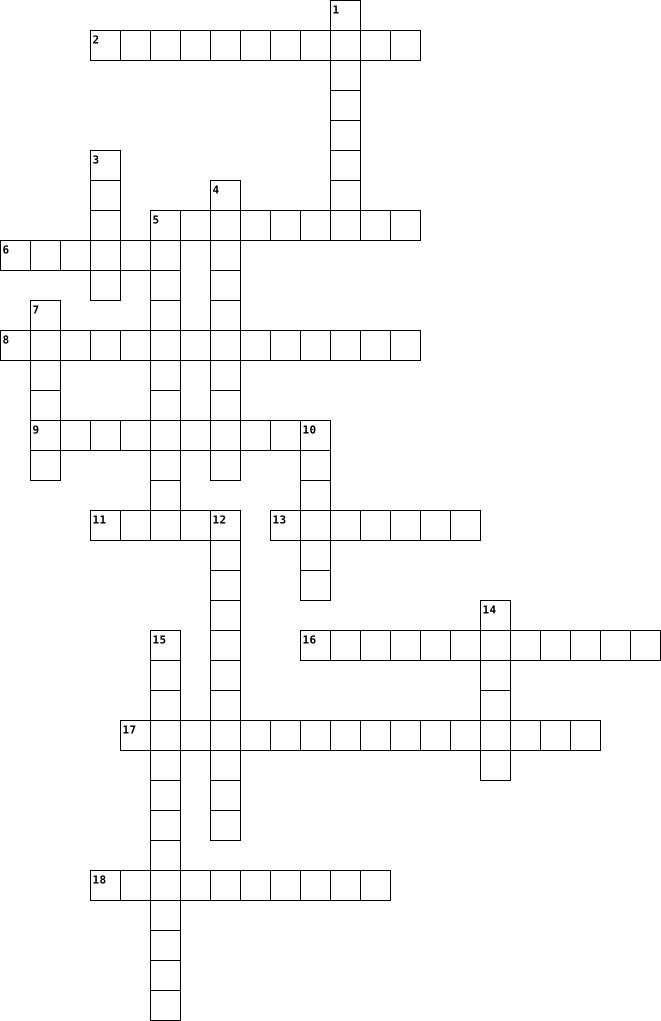
Across
- immediate result of the enlightenment
- a change to the constitution
- proved planets move in elliptical orbits
- fought for education for women
- founded the heliocentric theory
- founder of modern chemistry challenged Artistotle's ideas.
- a value held highly by voltaire
- the belief that the sun is the center of the solar system
- a method that uses experiments and questions to prove theories
- people who presented new ways of thinking during the enlightenment
Down
- believed in freedom of speech and religion
- a book written by Jean-Jaques Rousseau
- the belief that the earth is the center of the solar system
- french nobles
- a style of art with light colors and soft lines
- parties where people discuss new ideas
- to know something you did not before
- people who believed in science and God
- art with dull colors and strong lines
19 Clues: french nobles • a change to the constitution • fought for education for women • founded the heliocentric theory • a value held highly by voltaire • to know something you did not before • immediate result of the enlightenment • art with dull colors and strong lines • a book written by Jean-Jaques Rousseau • parties where people discuss new ideas • ...
The Sun (and other stars) 2024-09-30

Across
- The unit for energy
- The visible and innermost layer of the Sun
- Solar winds turn into this when meeting Earth's atmosphere
- Two Hydrogens fuse to become this element
- Flares from the corona
- Combines two atoms' nuclei together
- This is how energy is transferred from the core
- Light lines on the spectrum from gases giving off energy
- This is how the rainbow spectrum is arranged
- This is only visible during solar eclipses
Down
- Spots where the magnetic field goes through the photosphere
- Where fusion happens
- This layer is not very visible due to its low light emissions
- Arcs of gases escaping the chromosphere
- Dark lines on the spectrum from gases soaking up energy
- Contains all wavelengths of light in a range
16 Clues: The unit for energy • Where fusion happens • Flares from the corona • Combines two atoms' nuclei together • Arcs of gases escaping the chromosphere • Two Hydrogens fuse to become this element • The visible and innermost layer of the Sun • This is only visible during solar eclipses • Contains all wavelengths of light in a range • This is how the rainbow spectrum is arranged • ...
SamP's Sun crossword 2024-10-15

Across
- Two hydrogen molecules combine to form a molecule of helium
- particles from nuclear fusion, are very bright
- dark spots on the photosphere
- where light is emitted
- zone between the core and convection zone
- center of the sun
- a jet of dense gas from the chromosphere
Down
- the light when the photosphere is blocked
- Where energy is transported in gases to the photosphere
- radiation from nuclear fusion, warms the earth
- Eruptions of particles and radiation from the sun
- Solar wind and earth's atmosphere combined to make the northern lights
- radio waves from nuclear fusion
- Arc of gas ejected from the chromosphere
- gas flowing out the corona
- only visible light during a total solar eclipse
16 Clues: center of the sun • where light is emitted • gas flowing out the corona • dark spots on the photosphere • radio waves from nuclear fusion • Arc of gas ejected from the chromosphere • a jet of dense gas from the chromosphere • the light when the photosphere is blocked • zone between the core and convection zone • particles from nuclear fusion, are very bright • ...
Stars 2025-02-19

Across
- Fusion ... travels out of the star to make heat and light.
- Giant Outer layer swells into.
- What is the most common type of star?
- What star is in our solar system?
- Where do stars make there energy?
- Which type of stars live the longest?
- Where our planet is located?
- What is the biggest star?
- How old is the sun?
Down
- How far away is Sirius from our sun?
- What do stars do?
- How is the color of the star determined?
- Where is our sun located in our Solar system?
- All of our planets and our sun and moons create our own...
- You see them glowing at night.
- How many earths fit in the sun?
16 Clues: What do stars do? • How old is the sun? • What is the biggest star? • Where our planet is located? • Giant Outer layer swells into. • You see them glowing at night. • How many earths fit in the sun? • What star is in our solar system? • Where do stars make there energy? • How far away is Sirius from our sun? • What is the most common type of star? • ...
Earth 2024-11-26

Across
- a large object in outer space that moves around the sun or another star.
- the sixth largest planet in the solar system and second in distance from the sun.
- the third largest planet in the solar system and seventh in distance from the sun.
- a group of things or parts that work together as a whole.
Down
- a heavy, silver-white metal that is one of the chemical elements
- the god of the sea in Roman mythology. Neptune had control of the tides.
- the seventh largest planet in the solar system and fourth in distance from the sun.
- having to do with or coming from the sun.
8 Clues: having to do with or coming from the sun. • a group of things or parts that work together as a whole. • a heavy, silver-white metal that is one of the chemical elements • a large object in outer space that moves around the sun or another star. • the god of the sea in Roman mythology. Neptune had control of the tides. • ...
chap 18 vocab 2021-12-06

Across
- plant or animal material used as fuel to produce electricity or heat.
- in passive solar building design, windows, walls, and floors are made to collect, store, reflect, and distribute solar energy, in the form of heat in the winter and reject solar heat in the summer.
- an electrochemical cell that converts the chemical energy of a fuel and an oxidizing agent into electricity through a pair of redox reactions.
- Hydroelectricity, or hydroelectric power, is electricity produced from hydropower.
- energy that is collected from renewable resources that are naturally replenished on a human timescale.
- using less energy to perform the same task
- systems that use solar energy to heat a fluid
Down
- thermal energy in the Earth's crust which originates from the formation of the planet and from radioactive decay of materials in currently uncertain but possibly roughly equal proportions.
- energy that is collected from renewable resources that are naturally replenished on a human timescale
- the effort made to reduce the consumption of energy by using less of an energy service.
10 Clues: using less energy to perform the same task • systems that use solar energy to heat a fluid • plant or animal material used as fuel to produce electricity or heat. • Hydroelectricity, or hydroelectric power, is electricity produced from hydropower. • the effort made to reduce the consumption of energy by using less of an energy service. • ...
Black Hole Types Crossword Puzzle 2023-12-14

Across
- Black holes that are born from 20 solar mass + stars
- Surface/Border of a black hole
- A celestial object, thought to be a rapidly rotating neutron star,
- Center of a Black Hole
- a neutron stars with an extremely strong magnetic field
- Black hole that is not stellar and of massive size, likely formed from a supermassive star
- Stars with 8 solar mass
Down
- Gas and dust surrounding a black hole or neutron star, pulled by their gravitational force
- A white dwarf is formed when a low-mass star has exhausted all its central nuclear fuel and lost its outer layers as a planetary nebula.
- Mass of the Sun in our solar system
- Occurs on a Neutron star when the temperature and density in the accreted layer becomes hot enough to allow the star to break out from the cycle of hydrogen and helium formation.
- Collection of galaxies and their celestial bodies
- Stars with less than 8 s High-densityonStar High density neutron filled star
- Black holes are born from dense and hot material
14 Clues: Center of a Black Hole • Stars with 8 solar mass • Surface/Border of a black hole • Mass of the Sun in our solar system • Black holes are born from dense and hot material • Collection of galaxies and their celestial bodies • Black holes that are born from 20 solar mass + stars • a neutron stars with an extremely strong magnetic field • ...
Renewable Energy 2016-04-08

Across
- a group of wind turbines in the same location used to produce electricity
- a fuel derived directly from living matter
- energy made by heat inside the Earth's crust
- form of hydropower that converts the energy obtained from tides into useful forms of power
- windows, walls, and floors are made to collect, store, and distribute solar energy
- hydroelectric power
- the total mass of organisms in a given area or volume
Down
- turbine having a large vaned wheel rotated by the wind to generate electricity.
- generate solar power by using mirrors or lenses to concentrate a large area of sunlight, or solar thermal energy, onto a small area
- an electrical device that converts the energy of light directly into electricity
- electrochemical device that combines hydrogen and oxygen to produce electricity
- Flat plate collectors are usually placed on the roof or ground in the sunlight.
- central heating and/or cooling system that transfers heat to or from the ground
- a technique that uses a direct electric current (DC) to drive an otherwise non-spontaneous chemical reaction
14 Clues: hydroelectric power • a fuel derived directly from living matter • energy made by heat inside the Earth's crust • the total mass of organisms in a given area or volume • a group of wind turbines in the same location used to produce electricity • turbine having a large vaned wheel rotated by the wind to generate electricity. • ...
mon A space trip 2022-11-21

Across
- bucatar profesionist
- nava spatiala
- oglinda
- brutar
- pilot
- luna
- extraterestru
- sistem solar
Down
- zarzavagiu
- astronaut
- mecanic
- planeta
12 Clues: luna • pilot • brutar • oglinda • mecanic • planeta • astronaut • zarzavagiu • sistem solar • nava spatiala • extraterestru • bucatar profesionist
Space Life 2017-02-15

Across
- discovered the law of gravity
- two bodies with equal masses under the influence of their mutual gravity
- force of gravity
- earth ray at center of universe
- 4 moons of Jupiter
- Italian philosopher created the telescope
- discovered the aberration of starlight
- considered a dwarf planet in our solar system
- drawn using string,pencil and two thumbtacks
Down
- earth is not the center of the universe
- also called Tycho he studied astrology, alchemy, and medicine
- total amount of matter
- a tendency to do nothing or to remain unchanged
- semimajor axis of earth's orbit around the sun
- sun's inward pull of gravity on a planet
15 Clues: force of gravity • 4 moons of Jupiter • total amount of matter • discovered the law of gravity • earth ray at center of universe • discovered the aberration of starlight • earth is not the center of the universe • sun's inward pull of gravity on a planet • Italian philosopher created the telescope • drawn using string,pencil and two thumbtacks • ...
Physics Revision 2013-05-14

Across
- What is the name given to a circular object in our solar system e.g. Earth
- Name the 4th planet closest to the sun
- Elastic Is a ……
- There are lunar and solar …..
- Wood is a …
- Metal is a ….
- There are 365 ….. In a year
Down
- A magnet is …..
- We celebrate Christmas every ….
- What is the apparatus used to measure current
- Waning Gibbous ….. , full….., are all phases of the…..
- What powers a toaster
- What is the force when two materials rub together.
- Length x width x height = …..
- You times the height times the length times the width and then divide it by the mass of the object to work out the
15 Clues: Wood is a … • Metal is a …. • A magnet is ….. • Elastic Is a …… • What powers a toaster • There are 365 ….. In a year • There are lunar and solar ….. • Length x width x height = ….. • We celebrate Christmas every …. • Name the 4th planet closest to the sun • What is the apparatus used to measure current • What is the force when two materials rub together. • ...
History vocabulary 2022-01-07

Across
- the tax collected by the church
- a thory that the earth is the center of the solar system
- an area under control fo another county
- a method of procedure that has characterized natural science since the 17th century
- Rebirth
- theory the solar system revolves around sun
- conqueror from spain
- Mid night dream
Down
- was an italian explor and navagator who completed four voages across the Alantic ocean
- the first European to round the tip of Africa
- a territory subject to a form of foreign rule
- the basic sprit
- a multilateral system to be able to transport to other places
- created the first vaccine
- an imagined place or state of things
15 Clues: Rebirth • the basic sprit • Mid night dream • conqueror from spain • created the first vaccine • the tax collected by the church • an imagined place or state of things • an area under control fo another county • theory the solar system revolves around sun • the first European to round the tip of Africa • a territory subject to a form of foreign rule • ...
world history review 2022-01-07

Across
- another name of the Emporer of Russia
- one of the greatest play writers in history
- a theory that states the sun is at the center of the solar system
- another word for rebirth
- also known as Charles the Great
- the system knights followed
- conquerer from spain
Down
- the tax collected by the church
- known as the Renaissance man
- a thoery that the earth is the center of the solar system
- the creater of the rule called inertia
- the language spoke by the natives of a land
- the fist European to round the tip of Africa
- the man who created the smallpox vaccine
- an area under control of another country
15 Clues: conquerer from spain • another word for rebirth • the system knights followed • known as the Renaissance man • the tax collected by the church • also known as Charles the Great • another name of the Emporer of Russia • the creater of the rule called inertia • the man who created the smallpox vaccine • an area under control of another country • ...
Sources and Sinks 2021-12-01

Across
- energy Convention currents district
- Circulation is more vigorous near
- Convection cells circulate air, moisture, and heat around the.
- solar energy is absorbed by
- cells We call the equatorial cells
- each gram of evaporating water absorbs 580
- of energy as it transforms from _____ to gas
- dense Warmed air expands, becomes _____ than the cooler air above it
Down
- moving water vapor, later heat can warm and accelerate rising air currents in
- We call the mid-latitude and polar cells _____
- Convection cells expand and shift how often
- What happens when cells meet
- Solar energy absorbed by the ground eventually re-radiates as long waves infrared energy or ____.
- where does the sunshine directly overhead
- Warm air
15 Clues: Warm air • solar energy is absorbed by • What happens when cells meet • Circulation is more vigorous near • cells We call the equatorial cells • energy Convention currents district • where does the sunshine directly overhead • each gram of evaporating water absorbs 580 • Convection cells expand and shift how often • of energy as it transforms from _____ to gas • ...
ENVIRONMENT 2022-11-09
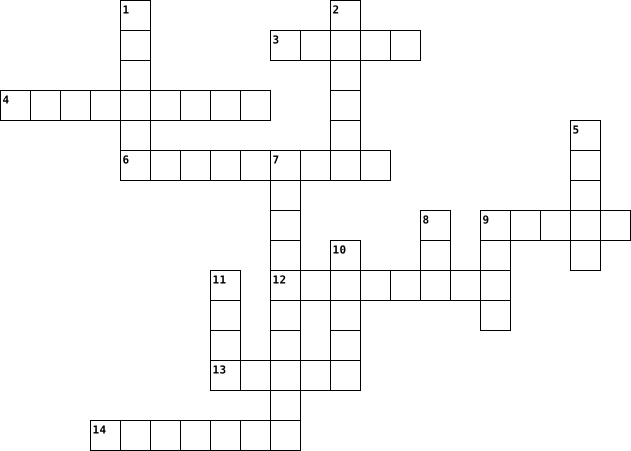
Across
- The burning of ... fuel is the main source of air pollution.
- The transformation of garbage into new products.
- Energy that can be replenished; windmills, solar energy.
- The energy we get from the Sun.
- Air pollution with sulfur dioxide can lead to the appearance of ... acid
- About 1% of the water on Earth
- Average meteorological measurements over a long period of time
Down
- Air pollution can cause... lung damage.
- ...warming.
- About 1 billion people do not have such drinking water
- The place where air pollution occurs.
- Cars, fires, volcanoes and power plants cause
- pollution
- This transparent material can be recycled again and again.
- A place where garbage is dumped.
15 Clues: pollution • ...warming. • About 1% of the water on Earth • The energy we get from the Sun. • A place where garbage is dumped. • The place where air pollution occurs. • Air pollution can cause... lung damage. • Cars, fires, volcanoes and power plants cause • The transformation of garbage into new products. • About 1 billion people do not have such drinking water • ...
pensando em ciências 7 ano 2021-08-01

Across
- teoria que explica a origem do universo
- principal organela das células vegetais
- conjunto de reações químicas que ocorrem no organismo
- último planeta rochoso do sistema solar
- material genético dos seres vivos
- corpo celeste que possui iluminação própria
- capacidade de reagir a estímulos
Down
- corpo celeste que colidiu com a terra primitiva e originou a lua
- maior planeta do sistema solar
- envoltório do material genético em células animais
- teoria que afirma que um ser vivo é originado de um ser pré-existente
- capacidade de perpetuar a espécie
- a partir de 2009 foi rebaixado para categoria de planeta anão
- unidade morfofuncional da vida
- pesquisador que defende a biogênese
15 Clues: maior planeta do sistema solar • unidade morfofuncional da vida • capacidade de reagir a estímulos • capacidade de perpetuar a espécie • material genético dos seres vivos • pesquisador que defende a biogênese • teoria que explica a origem do universo • principal organela das células vegetais • último planeta rochoso do sistema solar • ...
Space Crossword puzzle. 2024-04-26

Across
- The big and little dipper.
- star-like chunks of rock of medal traveling through space
- gravity is so strong that not even light can escape it.
- object that light up the night sky.
- The moon passing between the earth and sun obstructing the view of the sun.
- the smallest planet.
Down
- The milkway
- The earth goes between the sun and the moon making the moon dark.
- The largest planet.
- Force that pulls objects toward each other.
- The hottest planet.
- system The sun and the planets that orbit it.
- the fourth planet from the sun.
- Massive hot star in the center of the solar system.
- The only planet that has living creatures.
15 Clues: The milkway • The largest planet. • The hottest planet. • the smallest planet. • The big and little dipper. • the fourth planet from the sun. • object that light up the night sky. • The only planet that has living creatures. • Force that pulls objects toward each other. • system The sun and the planets that orbit it. • Massive hot star in the center of the solar system. • ...
Solar Pond & Heat Transfer 2026-03-29

Across
- The top zone at atmospheric temperature.
- The hot salt solution withdrawn from the pond.
- Liquid often mixed with water for heat transfer.
- The most common gas used as transfer fluid.
- The bottom salty zone of a solar pond.
- Acronym for the Upper Convective Zone.
- Acronym for the Lower Convective Zone.
- Fashion in which heat exchanger pipes are laid.
- Distance between tubes on an absorber plate.
Down
- Adjective describing the water in a solar pond.
- Method of attaching tubes to absorber plates.
- Acronym for the Normal Convective Zone.
- Substance (liquid or gas) that transfers heat.
- The middle zone acting as an insulator.
- Another method of attaching collector tubes.
15 Clues: The bottom salty zone of a solar pond. • Acronym for the Upper Convective Zone. • Acronym for the Lower Convective Zone. • Acronym for the Normal Convective Zone. • The middle zone acting as an insulator. • The top zone at atmospheric temperature. • The most common gas used as transfer fluid. • Another method of attaching collector tubes. • ...
Wordly Wise Lesson 15 Book 6 2024-10-18

Across
- to join
- speed
- to circle around
- cover
- remarkable
- write music
- circle
Down
- anxious
- to climb
- same place/time
- only
- sun related
- to be real
- small amounts
- an examination
15 Clues: only • speed • cover • circle • anxious • to join • to climb • to be real • remarkable • sun related • write music • small amounts • an examination • same place/time • to circle around
Solar energy 2022-05-23

Across
- Other word for nonrenewable
- The ability to be maintained at a certain rate or level
- Energy stocked by the body
- Particule creating electricity in the solar panel
Down
- Effect discovered by Becquerel
- First use of solar energy
- Solar panels use sunlight to generate this
7 Clues: First use of solar energy • Energy stocked by the body • Other word for nonrenewable • Effect discovered by Becquerel • Solar panels use sunlight to generate this • Particule creating electricity in the solar panel • The ability to be maintained at a certain rate or level
Space Crossword 2013-05-12

Across
- Biggest star known to man
- Smallest planet in our solar system
- What belt is located between Mars and Jupiter
- Hottest planet in the solar system
Down
- Biggest moon in our solar system
- 5th planet from the sun
- What is the name of our planet
7 Clues: 5th planet from the sun • Biggest star known to man • What is the name of our planet • Biggest moon in our solar system • Hottest planet in the solar system • Smallest planet in our solar system • What belt is located between Mars and Jupiter
q 2013-05-05

Across
- this is a dwarf planet
- there are a bunch of these in front of jupiter
- all the planets do this to the sun
- this is the only known planet to contain life
- this is our star
- this planet is known for beautiful
- the red planet rovers have only been sent here
- tbhis is a huge storm on Jupiter
- these sometimes crash into the earth
- this is a ball of hot glowing gases
Down
- the largest planet in the solar system
- there are nine of these in our solar system
- this planet has a rocky terrain
- this is one of Saturns moon
- this flies around space with its tail
- this has space junk in it and 9 planets
- this is one of the coldest planets
- thjis planets axis is where our eqatour is
- this planet has clouds of acid
19 Clues: this is our star • this is a dwarf planet • this is one of Saturns moon • this planet has clouds of acid • this planet has a rocky terrain • tbhis is a huge storm on Jupiter • all the planets do this to the sun • this planet is known for beautiful • this is one of the coldest planets • this is a ball of hot glowing gases • these sometimes crash into the earth • ...
The Planets 2014-10-05

Across
- What do you call someone who travels into space?
- Which planet is known as the "red planet"?
- What number planet away from the sun is earth?
- What is the name of our galaxy?
- The only planet to rotate on its side
- Planet Furthest Away from the sun
- What is the name of a large rock in space?
- Smallest planet
- Planet with the visible rings around it
- Which planet do we live on?
Down
- How many planets are in the solar system?
- What is the second planet away from the sun?
- Largest planet
- What is the name of the first space shuttle to land on the moon?
- How many moons does Earth have?
- The first name of the first person to walk on the moon?
- Biggest Star in our Solar System
- What used to be a planet but is now a dwarf planet?
- Which country is NASA located?
19 Clues: Largest planet • Smallest planet • Which planet do we live on? • Which country is NASA located? • What is the name of our galaxy? • How many moons does Earth have? • Biggest Star in our Solar System • Planet Furthest Away from the sun • The only planet to rotate on its side • Planet with the visible rings around it • How many planets are in the solar system? • ...
The Planets 2014-10-05

Across
- What do you call someone who travels into space?
- Planet with the visible rings around it
- What is the name of our galaxy?
- Planet closest to the sun
- What used to be a planet but is now a dwarf planet?
- The first name of the first person to walk on the moon?
- How many planets are in the solar system?
- Which country is NASA located?
- How many moons does Earth have?
- Planet Furthest Away from the sun
- What number planet away from the sun is earth?
- The only planet to rotate on its side
Down
- What is the second planet away from the sun?
- Smallest planet
- What is the name of a large rock in space?
- What is the name of the first space shuttle to land on the moon?
- Which planet is known as the "red planet"?
- Largest planet
- Which planet do we live on?
- Biggest Star in our Solar System
20 Clues: Largest planet • Smallest planet • Planet closest to the sun • Which planet do we live on? • Which country is NASA located? • What is the name of our galaxy? • How many moons does Earth have? • Biggest Star in our Solar System • Planet Furthest Away from the sun • The only planet to rotate on its side • Planet with the visible rings around it • ...
SPACE 2023-03-30

Across
- Famous dwarf planet that is mistaken as a planet
- Closest planet to the Sun
- Transport used to travel in space?
- Physicist who discovered gravity
- What is the name of a place that uses telescopes and other scientific equipment to research space and astronomy?
- What do the planets revolve around?
- Our natural satellite
- What planet is famous for the rings that surround it?
- Name of the first man to set foot on the moon
Down
- Galaxy that the Earth is located in?
- What planet is famous for the big red spot on it?
- What is the name of the force holding us to the Earth?
- Person who travels into Space?
- Coldest planet in our Solar System
- Impact that caused the extinction of the Dinosaurs
- Piece of debris that survives passage through the Earths Atmosphere
- Item used for looking into Space?
- Hottest planet in our Solar System
- Possible life in space
19 Clues: Our natural satellite • Possible life in space • Closest planet to the Sun • Person who travels into Space? • Physicist who discovered gravity • Item used for looking into Space? • Coldest planet in our Solar System • Transport used to travel in space? • Hottest planet in our Solar System • What do the planets revolve around? • Galaxy that the Earth is located in? • ...
Renewable Energy 2025-03-22

Across
- Organic material used as fuel
- Renewable energy source harnessed from ocean tides
- A benefit: reduces dependence on fossil fuels
- Type of energy that can be replenished naturally over short periods
- Electricity produced by moving water
- A challenge: energy storage for use during non-productive periods
- Renewable energy source that utilizes Earth's underground reservoirs
- A drawback of solar and wind energy: depends on weather conditions
- A benefit of renewable energy: emits no greenhouse gases during operation
- Power generated by wind turbines
Down
- The process of converting sunlight directly into electricity
- A renewable resource that requires large land areas for deployment
- Energy obtained from plant and animal waste
- A disadvantage: can impact aquatic ecosystems
- Renewable energy source that uses wind to generate electricity
- A benefit: abundant and sustainable energy supply
- Energy derived from Earth's internal heat
- Energy captured from the natural flow of rivers
- Energy harnessed from the sun's radiation
- A disadvantage: high initial installation costs
20 Clues: Organic material used as fuel • Power generated by wind turbines • Electricity produced by moving water • Energy derived from Earth's internal heat • Energy harnessed from the sun's radiation • Energy obtained from plant and animal waste • A disadvantage: can impact aquatic ecosystems • A benefit: reduces dependence on fossil fuels • ...
Planetary Motion and Astronomy Vocabulary 2023-11-24

Across
- a force that keeps the planets in orbit around the sun and you onto the planet earth
- the completion of one planetary orbit around the sun
- a process in which large quantities of gas/matter leave the star in a bright explosion
- the process of nucleus of atoms combining to form more complex and heavy elements
- Keplers law that states the planets in our solar system orbit the sun
- the fourth state of matter in which a substance is electrified
- Keplers law that states that the planets have different sized orbits based on their planetary mass
Down
- The type of energy which is limited like coal
- The type of energy whose source is unlimited like the sun
- the idea that the sun is the center of our collar system
- a cloud of dust and gas that is the foundation of the solar system and universe
- the early formation of a star, before nuclear fusion starts
- Keplers law that states that the planets in out solar system have different velocities/speeds
- the shape of the planet’s orbit around the sun
14 Clues: The type of energy which is limited like coal • the shape of the planet’s orbit around the sun • the completion of one planetary orbit around the sun • the idea that the sun is the center of our collar system • The type of energy whose source is unlimited like the sun • the early formation of a star, before nuclear fusion starts • ...
History vocabulary 2022-01-07

Across
- the tax collected by the church
- a thory that the earth is the center of the solar system
- an area under control fo another county
- a method of procedure that has characterized natural science since the 17th century
- Rebirth
- theory the solar system revolves around sun
- conqueror from spain
- Mid night dream
Down
- was an italian explor and navagator who completed four voages across the Alantic ocean
- the first European to round the tip of Africa
- a territory subject to a form of foreign rule
- the basic sprit
- a multilateral system to be able to transport to other places
- created the first vaccine
- an imagined place or state of things
15 Clues: Rebirth • the basic sprit • Mid night dream • conqueror from spain • created the first vaccine • the tax collected by the church • an imagined place or state of things • an area under control fo another county • theory the solar system revolves around sun • the first European to round the tip of Africa • a territory subject to a form of foreign rule • ...
univerise Vocab heather baird 4th period 2014-10-08

Across
- a hot gas ball in the middle of our solar system
- all space and the matter space contains
- areas of star that spread out
- our solar system
- waves provide us with visible light
- the location of star formation
- big ball of hot gas millions of miles away from earth
- waves that are between radio and infrared
- shift the changes in wavelength that lets us know if something is comeing or moveing tord us
Down
- the death of a star by explosion
- distance between any two corresponding
- a small model of something big
- transfer of energy through matter or space
- a large grouping of stars in space
- waves waves with long low frequencies
15 Clues: our solar system • areas of star that spread out • a small model of something big • the location of star formation • the death of a star by explosion • a large grouping of stars in space • waves provide us with visible light • waves waves with long low frequencies • distance between any two corresponding • all space and the matter space contains • ...
space 2021-05-26

Across
- The planet right after Earth.
- A free satellite orbiting the Earth.
- A little star in space.
- It is a large space structure built in Earth's orbit, where people live semi-permanently and conduct space experiments or space observations.
- An infinite amount of space visible above the horizon or horizon.
- Theories of the Universe
- The eight spheres of the solar system.
- Earth revolving around the sun.
Down
- Stone objects in space.
- The action of the Earth revolving around its axis.
- A group of eight planets.
- A self-illuminating object.
- The star at the center of the solar system.
- The rotation of the earth in a regular cycle.
- Named after the stars in the sky.
15 Clues: Stone objects in space. • A little star in space. • Theories of the Universe • A group of eight planets. • A self-illuminating object. • The planet right after Earth. • Earth revolving around the sun. • Named after the stars in the sky. • A free satellite orbiting the Earth. • The eight spheres of the solar system. • The star at the center of the solar system. • ...
Science 10-Unit D 2021-10-06

Across
- The day to day temperature.
- The transfer of energy through direct contact of particles.
- the change of an organisms structure or functioning to adapt to its enviroment.
- Some of the radiant energy absorbed by the Earths surface is re-emitted into the atmosphere.
- electromagnetic
- emitted by the sun.
Down
- shortest day.
- The emission of energy waves or particles.
- all life depends on.
- The transfer of thermal energy through the movement of particles from one location to another.
- hydrosphere is made up of.
- The geographical area filled with specific plants and animals.
- atmosphere is made up of.
- longest day.
- The overall general averages of light,temperature and precipitation.
- The main greenhouse gas.
16 Clues: longest day. • shortest day. • electromagnetic • emitted by the sun. • all life depends on. • The main greenhouse gas. • atmosphere is made up of. • hydrosphere is made up of. • The day to day temperature. • The emission of energy waves or particles. • The transfer of energy through direct contact of particles. • The geographical area filled with specific plants and animals. • ...
Astronomy Crossword 2021-10-15

Across
- Sucks in everything that's too slow to escape it
- There are 8 of these in our solar system
- Space rock that manages to hit the Earth
- Opposite to black holes, these theoretical objects repel matter
- Closest planet to Earth
- Seemingly the largest object in the night sky
Down
- Lost it's planetary status in 2006
- Biggest planet in our solar system
- Leaves a trail of gas and dust
- Gives off essential but deadly rays
- The Kuiper Belt is full of these
- Our sun is a...
- A moon of Jupiter that is thought to possibly sustain life
- Closest planet to the sun
- The explosion of a massive dying star
15 Clues: Our sun is a... • Closest planet to Earth • Closest planet to the sun • Leaves a trail of gas and dust • The Kuiper Belt is full of these • Lost it's planetary status in 2006 • Biggest planet in our solar system • Gives off essential but deadly rays • The explosion of a massive dying star • There are 8 of these in our solar system • Space rock that manages to hit the Earth • ...
Space Life 2017-02-15

Across
- total amount of matter
- drawn using string,pencil and two thumbtacks
- a tendency to do nothing or to remain unchanged
- sun's inward pull of gravity on a planet
- 4 moons of Jupiter
- two bodies with equal masses under the influence of their mutual gravity
- considered a dwarf planet in our solar system
- earth is not the center of the universe
Down
- discovered the aberration of starlight
- semimajor axis of earth's orbit around the sun
- also called Tycho he studied astrology, alchemy, and medicine
- force of gravity
- discovered the law of gravity
- Italian philosopher created the telescope
- earth ray at center of universe
15 Clues: force of gravity • 4 moons of Jupiter • total amount of matter • discovered the law of gravity • earth ray at center of universe • discovered the aberration of starlight • earth is not the center of the universe • sun's inward pull of gravity on a planet • Italian philosopher created the telescope • drawn using string,pencil and two thumbtacks • ...
SATURN 2024-03-04

Across
- Saturn is mostly made up of hydrogen and ____
- Saturn, compared to the other planets, is not very ____
- Was the first person to observe Saturn with a telescope
- Name of Saturn's giant moon (starts with a T)
- Name of the spacecraft flying to Saturn
- Saturn is famous for its _____
- One _____ is 10.7 hours
- (More or less) dense than water
Down
- The atmosphere is _____ hundred km thick
- One _____ around the sun takes 29. 4 years
- Rotates in a ______ motion
- Sixth planet from the sun
- Saturn has the _____ day in the solar system
- This force pulled elements together in the early solar system to form Saturn
- What are Saturn's rings mostly made of?
15 Clues: One _____ is 10.7 hours • Sixth planet from the sun • Rotates in a ______ motion • Saturn is famous for its _____ • (More or less) dense than water • Name of the spacecraft flying to Saturn • What are Saturn's rings mostly made of? • The atmosphere is _____ hundred km thick • One _____ around the sun takes 29. 4 years • Saturn has the _____ day in the solar system • ...
Space Crossword puzzle. 2024-04-26

Across
- The big and little dipper.
- star-like chunks of rock of medal traveling through space
- gravity is so strong that not even light can escape it.
- object that light up the night sky.
- The moon passing between the earth and sun obstructing the view of the sun.
- the smallest planet.
Down
- The milkway
- The earth goes between the sun and the moon making the moon dark.
- The largest planet.
- Force that pulls objects toward each other.
- The hottest planet.
- system The sun and the planets that orbit it.
- the fourth planet from the sun.
- Massive hot star in the center of the solar system.
- The only planet that has living creatures.
15 Clues: The milkway • The largest planet. • The hottest planet. • the smallest planet. • The big and little dipper. • the fourth planet from the sun. • object that light up the night sky. • The only planet that has living creatures. • Force that pulls objects toward each other. • system The sun and the planets that orbit it. • Massive hot star in the center of the solar system. • ...
Space 2025-10-22

Across
- A large ball of rock or gas that orbits the sun.
- you do this to learn new things.
- To have a home somewhere.
- To go from one place to another.
- A person who travels in space.
- The planet we live on.
- To push a rocket into the air.
- A machine that goes into space.
Down
- To not sink in water or space.
- A machine that orbits Earth or other planets.
- One of the biggest planets in our solar system.
- We ___ air to stay alive.
- The place beyond the Earth where rockets go.
- The star at the center of our solar system.
- something people do to earn money.
15 Clues: The planet we live on. • To have a home somewhere. • We ___ air to stay alive. • To not sink in water or space. • A person who travels in space. • To push a rocket into the air. • A machine that goes into space. • you do this to learn new things. • To go from one place to another. • something people do to earn money. • The star at the center of our solar system. • ...
puzzle september 2021-09-29

Across
- largest planet in the solar system
- Likes to chase mice
- third planet from sun
- Man's best friend
Down
- smallest planet in the solar system
- Flying mammal
- Has a trunk
- Large marsupial
8 Clues: Has a trunk • Flying mammal • Large marsupial • Man's best friend • Likes to chase mice • third planet from sun • largest planet in the solar system • smallest planet in the solar system
Our Planet 2022-09-19

Across
- planet home of living beings
- life animals, plants and organisms in the sea
- necessary to stay alive
- trash
Down
- non-domestic life
- change consequences of pollution
- Dioxide Co2
- environment what surrounds us
- power solar radiation
9 Clues: trash • Dioxide Co2 • non-domestic life • power solar radiation • necessary to stay alive • planet home of living beings • environment what surrounds us • change consequences of pollution • life animals, plants and organisms in the sea
Eco-helpers 2022-04-13

Across
- кислород
- перерабатывать
- токсичные газы
- очищать
- солнечная энергия
- кислотный дождь
- почва
Down
- уничтожить
- электростанция
- доброволец,волонтер
- собираться
- жечь,гореть
- присоединиться
- отравлять
- испускать,выделять
15 Clues: почва • очищать • кислород • отравлять • уничтожить • собираться • жечь,гореть • электростанция • перерабатывать • токсичные газы • присоединиться • кислотный дождь • солнечная энергия • испускать,выделять • доброволец,волонтер
The Planets 2014-10-05

Across
- Which country is NASA located?
- How many planets are in the solar system?
- What is the name of the first space shuttle to land on the moon?
- What number planet away from the sun is earth?
- Largest planet
- What used to be a planet but is now a dwarf planet?
- What is the name of a large rock in space?
- Planet with the visible rings around it
- How many moons does Earth have?
Down
- The first name of the first person to walk on the moon?
- Which planet is known as the "red planet"?
- Planet Furthest Away from the sun
- Which planet do we live on?
- Smallest planet
- What is the second planet away from the sun?
- Planet closest to the sun
- What do you call someone who travels into space?
- Biggest Star in our Solar System
- What is the name of our galaxy?
- The only planet to rotate on its side
20 Clues: Largest planet • Smallest planet • Planet closest to the sun • Which planet do we live on? • Which country is NASA located? • What is the name of our galaxy? • How many moons does Earth have? • Biggest Star in our Solar System • Planet Furthest Away from the sun • The only planet to rotate on its side • Planet with the visible rings around it • ...
The Planets 2014-09-03

Across
- Our planet is called (5)
- I am the closest to the sun (7)
- I am a red planet (4)
- A small rock body orbiting the sun (8)
- The planets are apart of a ..... system (5)
- Earth, Venus and Mars are all (7)
- I am a gas giant (7)
- Way Our galaxy is called..(8)
- I am the second planet from the sun (5)
- An object of ice and dust in space (5)
- The planets revolve around me (3)
Down
- I am the seventh planet from the sun (6)
- You need to look through me to see into space (9)
- Outer..... (5)
- I shine in the night sky (5)
- I am the largest planet in the solar system (7)
- The subject involving planets (7)
- I am often not considered a main planet (5)
- You see me most at night (4)
19 Clues: Outer..... (5) • I am a gas giant (7) • I am a red planet (4) • Our planet is called (5) • I shine in the night sky (5) • You see me most at night (4) • Way Our galaxy is called..(8) • I am the closest to the sun (7) • Earth, Venus and Mars are all (7) • The subject involving planets (7) • The planets revolve around me (3) • A small rock body orbiting the sun (8) • ...
Modern Texas 2023-04-27

Across
- a method of releasing hard to get oil and natural gas
- grid, a system of power plants, stations and cables
- the intersection of medicine and the natural sciences
- Guard, the part-time military forces organized by the states
- a person who revolts against civil authority
- a person who uses violence to advance a political cause
- party, an organized political group that is neither Republican or Democrat
- Recession, a severe economic slowdown that began in 2007
- a group that forms temporarily
Down
- the science and technology of robot design, manufacture, and use
- of mass destruction, biological, chemical and nuclear weapons
- farm, a large installation of solar panels
- a proposed law
- a new company
- a fuel made directly from recently living matter
- relating to genes
- American Free Trade Agreement, an agreement between the United States, Canada and Mexico
- Party, a conservative political movement
- a machine that produces power by spinning
19 Clues: a new company • a proposed law • relating to genes • a group that forms temporarily • Party, a conservative political movement • a machine that produces power by spinning • farm, a large installation of solar panels • a person who revolts against civil authority • a fuel made directly from recently living matter • grid, a system of power plants, stations and cables • ...
Unit 5 Review 2026-03-30

Across
- Philosopher who argued for freedom of speech
- leader of French Revolution, executed thousands by guillotine
- growth of cities
- Earth-centered solar system
- Idea that we give up some rights & freedoms in exchange for peace and security
- French King who was executed by guillotine
- Wrote the Leviathan, argued that life was "nasty, brutish, and short"
- Discovered gravity, invented calculus
Down
- Leader of Haitian Revolution
- Argued for Individual Rights
- Proved Heliocentric Theory through telescope, published book about it
- Venezuelan general who liberated several South American nations from Spanish control
- Sun-centered solar system
- to produce a large amount
- Argued for Separation of Powers & Checks and Balances
- French Queen who was executed by guillotine
- Argued for 3 Natural Rights (life, liberty, property)
- French Emperor who attempted to rebuild the French Empire before being exiled
- Created the Heliocentric Theory
19 Clues: growth of cities • Sun-centered solar system • to produce a large amount • Earth-centered solar system • Leader of Haitian Revolution • Argued for Individual Rights • Created the Heliocentric Theory • Discovered gravity, invented calculus • French King who was executed by guillotine • French Queen who was executed by guillotine • Philosopher who argued for freedom of speech • ...
Our Universe and the Planets 2023-01-30

Across
- smallest planet in our Solar System
- This satellite has no air or atmosphere and takes 28 days to revolve around its planet
- 2nd largest planet in our Solar System
- This is a star
Down
- Seventh planet of the universe
- this planet contains presence of iron oxides in the soil
- hottest planet in our Solar System
- eclipse that occurs when the Earth comes in between the Sun and the Moon
8 Clues: This is a star • Seventh planet of the universe • hottest planet in our Solar System • smallest planet in our Solar System • 2nd largest planet in our Solar System • this planet contains presence of iron oxides in the soil • eclipse that occurs when the Earth comes in between the Sun and the Moon • ...
Famous solar orbiters 2022-03-18

Across
- our solar system’s more than 150 known moons, is this is the only one with a substantial atmosphere. And of all the places in the solar system, this is the only place besides Earth known to have liquids in the form of rivers, lakes and seas on its surface.
- this is a bit larger satellite than its "younger sibling", and orbits only 3,700 miles (6,000 kilometers) above the Martian surface
- this is the largest of Pluto's five moons, it was discovered 40 years ago in June 1978 by James Christy and Robert Harrington at the U.S. Naval Observatory in Flagstaff, Arizona―only about six miles from where Pluto itself was discovered at Lowell Observatory. They weren't even looking for moons. They were trying to refine Pluto's orbit around the Sun.
- a Jupiter's orb that may be the most promising place in our solar system to find present-day environments suitable for some form of life beyond Earth
- the gravitational attraction that masses have for one another decreases inversely with the square of the distance of those masses from each other. As a result, Moon the slightly greater attraction that this satellite has for the side of Earth closest to it, as compared to the part of the Earth opposite it, results in tidal forces. Tidal forces affect both the Earth's crust and oceans.
- A handful of worlds are thought to have liquid water oceans beneath their frozen shell, but this one sprays its ocean out into space where a spacecraft can sample it.
- this Jupiter's satellite is the most volcanically active world in the Solar System
Down
- are unique in being named for Shakespearean characters, along with a couple of the moons being named for characters from the works of Alexander Pope.
- We don't know with what beverage William Lassell may have celebrated his discovery of this Neptune moon, but beer made it possible. Lassell was one of 19th century England's grand amateur astronomers, using the fortune he made in the brewery business to finance his telescopes. He spotted This one on Oct. 10, 1846―just 17 days after a Berlin observatory discovered Neptune.
- its name means dread, and it is the sibling of Phobos.
- this is Jupiter’s second largest moon and the third largest moon in our solar system. Its surface is the most heavily cratered of any object in our solar system.
- this Jupiter’s icy moon is the largest moon in our solar system, even bigger than the planet Mercury, and the dwarf planet Pluto
12 Clues: its name means dread, and it is the sibling of Phobos. • this Jupiter's satellite is the most volcanically active world in the Solar System • this Jupiter’s icy moon is the largest moon in our solar system, even bigger than the planet Mercury, and the dwarf planet Pluto • ...
Choice Board 2022-04-25

Across
- Unstable atoms
- Drilling
- Infinite
- Use less of
- Plants
- Sun energy
- Oil
Down
- Dams
- toxic chemicals
- Protecting something
- Finite
- Turbines
- Use again
13 Clues: Oil • Dams • Finite • Plants • Drilling • Infinite • Turbines • Use again • Sun energy • Use less of • Unstable atoms • toxic chemicals • Protecting something
Astronomy and Space 2023-06-16

Across
- The powerful explosion that occurs at the end of a massive star's life, releasing a tremendous amount of energy and producing heavy elements
- Bang Theory The prevailing scientific explanation for the origin of the universe, suggesting it began from a singularity and has been expanding ever since
- A celestial object composed of ice, dust, and rocky particles that orbits the Sun and develops a glowing coma and tail as it approaches
- A vast cloud of gas and dust in space, often considered as the birthplaces of stars
- Nebula A glowing shell of gas and dust ejected by a dying star, forming intricate and colorful structures in space
- A natural light display in the Earth's sky, predominantly seen in polar regions, caused by the interaction of solar particles with the atmosphere
- The force that attracts objects toward one another, responsible for holding planets, stars, and galaxies together
- Unit A unit of measurement equal to the average distance between the Earth and the Sun, approximately 93 million miles
- Hole A region of spacetime exhibiting extreme gravitational effects, from which nothing, including light, can escape
Down
- A planet that orbits a star outside our Solar System
- Space Telescope A space telescope launched into orbit around the Earth, providing stunning images and valuable data about the universe
- A group of stars that appear to form a recognizable pattern or shape in the night sky
- Rover A robotic vehicle sent to Mars by NASA to explore the planet's surface and gather scientific data
- System The collection of planets, moons, asteroids, comets, and other celestial objects that orbit around the Sun
- Giant A large, relatively cool star that has exhausted its core hydrogen fuel and expanded in size
- Eclipse When the Earth comes between the Sun and the Moon, causing the Moon to temporarily darken
- Way The galaxy that contains our Solar System, appearing as a band of stars in the night sky
17 Clues: A planet that orbits a star outside our Solar System • A vast cloud of gas and dust in space, often considered as the birthplaces of stars • A group of stars that appear to form a recognizable pattern or shape in the night sky • Way The galaxy that contains our Solar System, appearing as a band of stars in the night sky • ...
Solar System 2013-04-25

Across
- A large ball of rock and gas that revolves around a star
- A huge ball of glowing gas at the center of a solar system
- A large group of asteroids that separate the solid planets from the gas-giant planets
- spins
Down
- A group of solar systems
- Everything in creation including all the galaxies
- Our solar system includes the Sun and all the objects that revolve around it
- travels around a star
8 Clues: spins • travels around a star • A group of solar systems • Everything in creation including all the galaxies • A large ball of rock and gas that revolves around a star • A huge ball of glowing gas at the center of a solar system • Our solar system includes the Sun and all the objects that revolve around it • ...
Space Crossword 2017-05-18

Across
- the red planet
- a body which orbits around a star
- a force which pulls two objects together
- a gas giant planet with rings
- the largest star in our solar system
Down
- the rotation around an object caused by gravity
- orbits the earth and can be seen at night
- the largest planet in our solar system
- the closest planet to the sun
- the third planet from the sun
- the hottest planet
11 Clues: the red planet • the hottest planet • the closest planet to the sun • the third planet from the sun • a gas giant planet with rings • a body which orbits around a star • the largest star in our solar system • the largest planet in our solar system • a force which pulls two objects together • orbits the earth and can be seen at night • ...
Space 2013-01-11

Across
- The name of our planet.
- The biggest planet in our solar system.
- The red planet.
- If you want to travel i space, you'll need a...
- Europe is the name of one.
Down
- The planets...around the sun.
- In our solar system there are eight...
- Without this we can't survive.
- They are all suns, very far from earth.
- There are about 1000 ..... stars in the Milky Way
- Ours is called The Milky Way
11 Clues: The red planet. • The name of our planet. • Europe is the name of one. • Ours is called The Milky Way • The planets...around the sun. • Without this we can't survive. • In our solar system there are eight... • The biggest planet in our solar system. • They are all suns, very far from earth. • If you want to travel i space, you'll need a... • ...
skibidi 2024-12-11

Across
- One Mars day
- the biggest explosion that humans have ever seen.
- A mission that put the first man on the moon
- Sometimes called shooting stars
- Used to be the ninth planet from the sun
Down
- has an event horizon
- When an object crashes into a larger solid object
- First spacecraft to leave the solar system
- relating to the moon
- Surrounds the solar system
- These are made of ice and have tails
11 Clues: One Mars day • has an event horizon • relating to the moon • Surrounds the solar system • Sometimes called shooting stars • These are made of ice and have tails • Used to be the ninth planet from the sun • First spacecraft to leave the solar system • A mission that put the first man on the moon • When an object crashes into a larger solid object • ...
Outer Space 2025-08-25

Across
- it looks kind of like a meteor and has a tail
- the smallest planet in the solar system
- these twinkle in the nighttime sky
- these are people who go to outer space
- the biggest planet in the solar system
- orbits Earth
Down
- what the Milky Way is
- a meteor that has crashed onto a planet
- the big, bright star that gives us heat and light
- the planet we live on
- planet with rings
11 Clues: orbits Earth • planet with rings • what the Milky Way is • the planet we live on • these twinkle in the nighttime sky • these are people who go to outer space • the biggest planet in the solar system • a meteor that has crashed onto a planet • the smallest planet in the solar system • it looks kind of like a meteor and has a tail • ...
Study Guide unit 5 2025-11-19

Across
- the curved path that an object takes as it moves around another, larger object in space.
- a celestial body of frozen gases, rock, and dust that orbits the Sun, often developing a long, fuzzy tail as it approaches.
- a small, rocky or icy body that existed in the early solar system and served as a building block for planets.
- a natural satellite that orbits a planet
- the star at the center of our solar system, a massive ball of hot gas that provides Earth with light and heat
- the widely accepted model for how the solar system formed from a giant, spinning cloud of gas and dust called a nebula
- Planets defined as objects that orbit the Sun, and are nearly round, but have not been able to clear their orbit of debris.
- a large, early-stage planetary body that forms from the collision and accretion of dust, gas, and smaller objects in a protoplanetary disk
Down
- the four giant planets in the Solar System, specifically Jupiter, Saturn, Uranus, and Neptune
- fine, dry particles of earth, organic matter, or other substances, found on surfaces or floating in the air.
- the process of growth by gradual accumulation, where smaller particles or materials are added to a larger body, primarily due to gravity.
- a celestial body that orbits a star, is large enough to be rounded by its own gravity, and has cleared the neighborhood around its orbit
- the Sun and everything that orbits it, including the eight planets, their moons, dwarf planets, asteroids, and comets
- a small, rocky body that orbits the sun, often found in the main belt between Mars and Jupiter
- n the four rocky planets closest to the sun: Mercury, Venus, Earth, and Mars.
- a small piece of rock or debris in space, ranging from the size of a grain of sand to about a meter wide.
- the force of attraction between any two objects with mass or energy.
17 Clues: a natural satellite that orbits a planet • the force of attraction between any two objects with mass or energy. • n the four rocky planets closest to the sun: Mercury, Venus, Earth, and Mars. • the curved path that an object takes as it moves around another, larger object in space. • ...
Astronomy Crossword 2017-09-28

Across
- A Small Body of Matter that enters the Earth's Atmosphere
- Fancy term for Direction
- A Small Rock-like Object orbiting the Sun
- An imaginary line which an object rotates on
- An object with a nucleus made of ice and dust
- Closest Star to Earth
- A Cloud of Gas in Outer Space
- Previously recognized model of Solar System
Down
- Circular Path around a Planet/Moon/Star
- To spin on an Axis
- Currently recognized model of Solar System
- An instrument used to measure the Altitude of an Object above Ground
- A natural Satellite
- Measure of how high something is in the Sky
14 Clues: To spin on an Axis • A natural Satellite • Closest Star to Earth • Fancy term for Direction • A Cloud of Gas in Outer Space • Circular Path around a Planet/Moon/Star • A Small Rock-like Object orbiting the Sun • Currently recognized model of Solar System • Measure of how high something is in the Sky • Previously recognized model of Solar System • ...
Kpl 1: Koll på sommarläger 2018-09-10

Across
- ystävä
- reilu
- ottaa aurinkoa
- laulaa
- iltaisin=på____________
Down
- näyttää
- mökki
- erityisesti
- ottaa rennosti
- liten, litet, _____
- tuolla=_____ borta
- Det var ______ sen.
- keittiö
13 Clues: reilu • mökki • ystävä • laulaa • näyttää • keittiö • erityisesti • ottaa aurinkoa • ottaa rennosti • tuolla=_____ borta • liten, litet, _____ • Det var ______ sen. • iltaisin=på____________
INNER AND OUTER PLANETS 2021-02-04

Across
- 5.The ____________ is the 3rd planet from the Sun.
- 2. There are eight ____________ in the Solar System.
- system 8. The __________ is located in the Milky Way galaxy.
Down
- 6.____________ is the nearest planet to the Sun.
- 4. ____________ is the 8th planet from the sun.
- 1._________is the largest planet in the Solar System.
- 3.____________ is the second nearest planet to the sun
- 7. ____________ is often called the red planet.
8 Clues: 4. ____________ is the 8th planet from the sun. • 7. ____________ is often called the red planet. • 6.____________ is the nearest planet to the Sun. • 5.The ____________ is the 3rd planet from the Sun. • 2. There are eight ____________ in the Solar System. • 1._________is the largest planet in the Solar System. • ...
PERSONAL HYGIENE 2026-02-09

Across
- jabón
- crema de manos
- perfume
- cepillo de dientes
- bloqueador solar
- cepillo
Down
- espejo de mano
- cortauñas
- crema de dientes
- desodorante
- champú
- peinilla
- pañuelos
- pañitos húmedos
14 Clues: jabón • champú • perfume • cepillo • peinilla • pañuelos • cortauñas • desodorante • espejo de mano • crema de manos • pañitos húmedos • crema de dientes • bloqueador solar • cepillo de dientes
Space Crossword 2016-10-23

Across
- The only dwarf planet to have confirmed atmosphere.
- An astronomer who first believed that the Earth and the other planets revolved around the sun.
- The planet that is known to be juust right for life.
- First believed Earth-centered solar system model.
- The planet commonly known as the Red Planet, due to it's red rocks and soil.
- Blue-green ice giant that spins on its side.
- An astronomer who was the first to use a telescope to find distinct features of the planets, moon and sun.
- The largest planet that features the Giant Red Spot.
- Well-known space administration that were the first to send men to the moon.
Down
- A group of stars that form patterns in the night sky.
- Gas giant that is known for its spectacular ring system.
- The hottest planet in our solar system, that is closest to Earth.
- Research organisation that manage Australia's leading facilities for radio astronomy and spacecraft tracking.
- The fastest moving planet in our solar system, that is the closest to the sun.
- Sister ice giant that is mostly made of water,ammonia, and methane and produces supersonic winds.
15 Clues: Blue-green ice giant that spins on its side. • First believed Earth-centered solar system model. • The only dwarf planet to have confirmed atmosphere. • The planet that is known to be juust right for life. • The largest planet that features the Giant Red Spot. • A group of stars that form patterns in the night sky. • ...
Black Holes 2023-12-07

Across
- Also known as the "point of no return" where nothing, including light, cannot escape; the outer perimeter of a black hole.
- Protons and neutrons make up an object's _________, the amount of matter an object has.
- A tunnel through spacetime to another point in spacetime.
- The measurement of measuring periods between past, present, and future.
- Black holes that have a mass of 5- several 10's of solar masses.
- Black holes that have a mass of 10-100's of millions of solar masses.
- Black holes have the greatest force of ___________.
- A point or area in space that gives off no light radiation
Down
- The difference in elapsed time measured by two observers.
- The fundamental theory of physics that describes how atoms and subatomic particles behave.
- __________ mass is equal to the mass of our Sun.
- The radius an object has to have for it to become a black hole.
- The very center of a black hole where gravity becomes infinite.
- A type of black hole that is extremely luminous and is also known as a quasi-stellar radio source..
- The process of material being torn apart by a black hole like water swirling down a drain.
15 Clues: __________ mass is equal to the mass of our Sun. • Black holes have the greatest force of ___________. • The difference in elapsed time measured by two observers. • A tunnel through spacetime to another point in spacetime. • A point or area in space that gives off no light radiation • The radius an object has to have for it to become a black hole. • ...
Waves 2024-05-02

Across
- another form of electromagnetic radiation that can go through your skin to take a picture of your bones
- a star where other planets and earth revolve around
- the outermost region of the Suns atmosphere
- waves- a type of electromagnetic wave that you cannot see even though they are all around us
- Radiation: a type of wave that transfers energy and moves through earth at a fast pace
- the visible surface of the sun that we can see
Down
- a dark or irregular spot made by the sun
- the total strength and ability to do work
- Rays- a type of electromagnetic radiation
- when heat moves from object to object just by the sense of touch
- the process where heat is transferred through the air and liquids
- Flares: high radiation from the sun
- Winds: flow of small particles that come from the sun (travels through the whole solar system)
- Waves- electromagnetic waves that are made from magnetic fields and electric waves come together
- Rays- undetected rays that have energy that comes from the sun
15 Clues: Flares: high radiation from the sun • a dark or irregular spot made by the sun • the total strength and ability to do work • Rays- a type of electromagnetic radiation • the outermost region of the Suns atmosphere • the visible surface of the sun that we can see • a star where other planets and earth revolve around • ...
View from the Earth 2023-06-17

Across
- The apparent path of the Sun on the celestial sphere. (Ecliptic)
- The Sun's position traces this figure-eight path in the sky throughout the year. (Analemma)
- Super moon occurs when the moon is closest to Earth. (Perigee)
- The reason why we don't have eclipse every month is because the Moon's is inclined by __________ degrees to the Earth's orbit around the Sun. (five)
- The lesser known the 13th zodiac is the __________. (Ophiuchus)
- Summer solstice is when the Sun is at its __________ altitude. (highest)
- Total solar eclipse is possible because the __________ size is nearly equal. (angular)
- The Moon rotates on its axis with a period that is the same as its orbital period is called __________ rotation. (synchronous)
Down
- Coordinate system that uses latitudes & longitudes. (Terrestrial)
- Solar eclipse is when the moon is in __________ of the Sun and the earth (conjunction)
- Altitude of 90 degrees from horizon is called __________. (Zenith)
- Vernal equinox also known as the first point of __________. (Aries)
- The imaginary line that divides the Earth into Northern and Southern Hemispheres. (Equator)
- Coordinate system that uses azimuths & altitudes. (Horizon)
- Total solar eclipse can only be seen at the __________. (umbra)
15 Clues: Coordinate system that uses azimuths & altitudes. (Horizon) • Super moon occurs when the moon is closest to Earth. (Perigee) • The lesser known the 13th zodiac is the __________. (Ophiuchus) • Total solar eclipse can only be seen at the __________. (umbra) • The apparent path of the Sun on the celestial sphere. (Ecliptic) • ...
8.4 Force of Gravity In Solar Systems 2026-01-04

Across
- The size and distance of one object relative to another.
- The force that attracts objects to the center of Earth or to the center of any other physical object with mass such as the Sun.
- The motion pathway of a solar system object through space in a curved shape around another object.
- Rocky bodies orbiting the Sun, mostly between Mars and Jupiter.
- An attractive force between two objects.
- The forces caused by one surface or object rubbing against another as they move past each other.
- Small piece of rock in the solar system
Down
- Friction forces that air particles apply against a moving object.
- A very spread out collection of cloud, gas, and dust in outer space.
- A property of matter that causes objects to continue in a state of motion or rest unless changed by a force.
- The motion pathway determined by the forces of gravity of objects in space.
- A system of solar systems, stars, gas, dust, and other matter.
- The lack of any air particles in a volume.
- A push or a pull on an object.
- Small icy object orbiting the Sun that may have a long “tail” or halo when closer to the Sun.
15 Clues: A push or a pull on an object. • Small piece of rock in the solar system • An attractive force between two objects. • The lack of any air particles in a volume. • The size and distance of one object relative to another. • A system of solar systems, stars, gas, dust, and other matter. • Rocky bodies orbiting the Sun, mostly between Mars and Jupiter. • ...
The Solar System 2013-11-12

Across
- The seventh planet from the sun.
- The only planet known to support life.
- The star in our solar system.
- A ring of asteroid separating Mars from Jupiter.
- The first planet from the sun.
Down
- A planet which scientists think it contains water or ice.
- The largest planet in the solar system.
- A planet whose temperature exceeds 400 degrees.
- A planet named after the Sea God.
- A large ringed planet.
- Earth's only natural satellite.
11 Clues: A large ringed planet. • The star in our solar system. • The first planet from the sun. • Earth's only natural satellite. • The seventh planet from the sun. • A planet named after the Sea God. • The only planet known to support life. • The largest planet in the solar system. • A planet whose temperature exceeds 400 degrees. • A ring of asteroid separating Mars from Jupiter. • ...
Space 2023-06-07

Across
- The Roman god of the sea
- The fourth planet from the sun
- The largest planet in our solar system
- A liquid used in thermometers
- The United States landed here in 1969
Down
- Second planet closet to the sun
- Planet with rings
- The star at the center of our solar system
- The collection of planets and moons circling a star
- This planet's surface is 71% covered in water
- This planet has 27 moons
11 Clues: Planet with rings • The Roman god of the sea • This planet has 27 moons • A liquid used in thermometers • The fourth planet from the sun • Second planet closet to the sun • The United States landed here in 1969 • The largest planet in our solar system • The star at the center of our solar system • This planet's surface is 71% covered in water • ...
Space 2023-08-29

Across
- Fourth planet from the sun
- Once a planet, now just a dwarf planet
- The explosion at the start of the universe
- Pattern of stars in the sky
- A collection of stars
Down
- Largest planet in the solar system
- Venus, Mercury and Saturn are all one
- A really big star explosion
- Closest planet to the sun
- NASA's moon missions are all named after this God
- The star in the centre of our solar system
11 Clues: A collection of stars • Closest planet to the sun • Fourth planet from the sun • A really big star explosion • Pattern of stars in the sky • Largest planet in the solar system • Venus, Mercury and Saturn are all one • Once a planet, now just a dwarf planet • The explosion at the start of the universe • The star in the centre of our solar system • ...
ASTRONOMY PUZZLE 2025-06-19

Across
- planet is closest to the sun
- 7th planet from the sun
- Planet named after the Roman god of war
- Planet is covered by clouds of sulphuric acid
- Season after autumn
Down
- the name of the force which keeps the planets in orbit around the sun
- 6th planet from the sun
- planet has a day which lasts eight months
- The biggest star in the universe
- a natural satellite
- eclipse When moon blocks the sun
- Total planets in Solar system
12 Clues: a natural satellite • Season after autumn • 6th planet from the sun • 7th planet from the sun • planet is closest to the sun • Total planets in Solar system • The biggest star in the universe • eclipse When moon blocks the sun • Planet named after the Roman god of war • planet has a day which lasts eight months • Planet is covered by clouds of sulphuric acid • ...
SSA review 4 2017-04-27

Across
- spread pollen around so the plant can reproduce
- has no back bone
- filters the blood and helps with digestion
- an hard protective layer on the outside of arthropods
- caused by the Earth's tilt
- where photosynthesis happens in a plant
Down
- system one star and all the things that orbit that star
- a waste product humans breath out but plants breathe in
- the earth makes one of these every 24 hours
- because of this you need to wear a seat belt
- has a back bone
- helps with digestion and regulates body sugar
- the main part of the plant involved in reproduction
- made of solar systems
14 Clues: has a back bone • has no back bone • made of solar systems • caused by the Earth's tilt • where photosynthesis happens in a plant • filters the blood and helps with digestion • the earth makes one of these every 24 hours • because of this you need to wear a seat belt • helps with digestion and regulates body sugar • spread pollen around so the plant can reproduce • ...
Night Skies (Rigby Reader) 2023-02-12

Across
- A small, rocky celestial body
- Half of the Earth
- burns up upon entering the Earth's atmosphere, shooting stars
- system A star and all its planets and other celestial objects
- Able to be seen
- A huge collection of stars, gas, and dust
- An instrument used to observe distant objects
Down
- A sudden burst of light
- To watch, see, or notice something
- To resemble or be similar in appearance
- A group of stars that form a recognizable pattern
- A small, icy, solar system body that can release gas or dust
- Moving in a circular path around a planet
- To turn or rotate around a central point
14 Clues: Able to be seen • Half of the Earth • A sudden burst of light • A small, rocky celestial body • To watch, see, or notice something • To resemble or be similar in appearance • To turn or rotate around a central point • Moving in a circular path around a planet • A huge collection of stars, gas, and dust • An instrument used to observe distant objects • ...
Space 2023-04-25

Across
- which planet has a ring
- how many rockets have been in space (hundret)
- Known as the "Red Planet"
- A job in space
- What was the name of the first dog in the space
- Which planet has rings around
- How many planets are in the solar system
Down
- What is the biggest planet in our solar system
- Who was the first man on the moon(surname)
- Which planet is the closest planet to the sun
- Name of the 2nd biggest Planet in our solar System
- What is the sun
- WHO is the CEO of the biggest privatly space company
- How many astronauts have walked on the moon
- What is around the world
- What is the biggest privatly space company in the World
16 Clues: A job in space • What is the sun • which planet has a ring • What is around the world • Known as the "Red Planet" • Which planet has rings around • How many planets are in the solar system • Who was the first man on the moon(surname) • How many astronauts have walked on the moon • Which planet is the closest planet to the sun • how many rockets have been in space (hundret) • ...
Space and the solar system 2026-03-26

Across
- The natural satellite of Earth
- A person who travels in space
- A vehicle that travels into space
- The path a planet follows around the Sun
- A rocky object that burns in Earth’s atmosphere
- A large group of stars, dust, and gas
- The closest planet to the Sun
- The star at the center of our solar system
Down
- Frozen rock and dust that forms a tail near the Sun
- The planet known for its rings
- The biggest planet in our solar system
- The force that keeps planets in orbit
- The planet famous for its red color
- The blue planet (our home)
- The red planet
15 Clues: The red planet • The blue planet (our home) • A vehicle that travels into space • The natural satellite of Earth • The planet known for its rings • A person who travels in space • The closest planet to the Sun • The force that keeps planets in orbit • The planet famous for its red color • The biggest planet in our solar system • ...
Unit 8 2024-11-05

Across
- reserve
- power
- recources
- friendly
- energy
Down
- footprint
- fuels
- species
- warming
- gases
- dioxide
- change
12 Clues: fuels • power • gases • change • energy • species • warming • reserve • dioxide • friendly • footprint • recources
The Solar System 2013-11-12

Across
- Earth's only natural satellite.
- The seventh planet from the sun.
- The star in our solar system.
- A planet named after the Sea God.
- The largest planet in the solar system.
Down
- A planet whose temperature exceeds 400 degrees.
- A planet which scientists think it contains water or ice.
- A large ringed planet.
- The first planet from the sun.
- A ring of asteroid separating Mars from Jupiter.
- The only planet known to support life.
11 Clues: A large ringed planet. • The star in our solar system. • The first planet from the sun. • Earth's only natural satellite. • The seventh planet from the sun. • A planet named after the Sea God. • The only planet known to support life. • The largest planet in the solar system. • A planet whose temperature exceeds 400 degrees. • A ring of asteroid separating Mars from Jupiter. • ...
Our Solar System 2022-03-16

Across
- the largest planet in the solar system
- this planet is rotated 98 degrees
- the center of our solar system
- ring of rocks orbiting the sun between mars and jupiter
- earth's sister planet
Down
- sphere of icy objects beyond the orbit of neptune
- this planet is named after the Roman god of the sea
- this planet has prominent rings
- only planet with water
- the red planet
- closest planet to the sun
11 Clues: the red planet • earth's sister planet • only planet with water • closest planet to the sun • the center of our solar system • this planet has prominent rings • this planet is rotated 98 degrees • the largest planet in the solar system • sphere of icy objects beyond the orbit of neptune • this planet is named after the Roman god of the sea • ...
Leah's crossword puzzle!💖💖 2023-08-24

Across
- the smallest planet
- also known as the red planet
- "king" of the planets
- dwarf planet______ is the best known out of all the dwarf planets
- the blue planet______ is lighter then the next planet
- has rings of debris
- we live on this planet
Down
- earths "twin" sister
- a burning ball of fire in our solar system
- there are a lot of them including ceres
- the last planet in the solar system
11 Clues: the smallest planet • has rings of debris • earths "twin" sister • "king" of the planets • we live on this planet • also known as the red planet • the last planet in the solar system • there are a lot of them including ceres • a burning ball of fire in our solar system • the blue planet______ is lighter then the next planet • ...
Galileo Galilei 2022-11-22

Across
- Large object that orbits planets and asteroids
- Tool used to see objects from afar
- Huge objects that orbit or travel
- law stating objects in motion stay in motion unless acted upon an unbalanced force
- A path of motion where on object moves around another
- Process of learning the world using observation and experimentation
- Person who studies astronomy
- Study of space
Down
- Access or process of observing
- Largest object in the solar system and 5th planet from the sun
- Huge star where planets orbit around
- Largest moon in the solar system
- 6th planet from the sun and contains rings surrounding it
- move in a circle
14 Clues: Study of space • move in a circle • Person who studies astronomy • Access or process of observing • Largest moon in the solar system • Huge objects that orbit or travel • Tool used to see objects from afar • Huge star where planets orbit around • Large object that orbits planets and asteroids • A path of motion where on object moves around another • ...
Eva meza-space review 2019-02-21

Across
- what is the extremely hot,dense mass of gases
- smaller than than the planets
- rocky object moving through space smaller than an asteroid
- sun centered (modern view of the solar system
- Jupiter,Saturn,Uranus,Neptune
- a measure of the force of gravity on an object
- rocky objects that orbit the sun
Down
- what is the amount of matter in an abject
- small mass of dust and ice that orbits
- moons and manmade satellites orbit planets
- Mercury,Venus,Earth,Mars rocky planets
- what it the moon made of
- earth centered (old view of the solar system
- a trail of dust and gas that stretches behind the comet
14 Clues: what it the moon made of • smaller than than the planets • Jupiter,Saturn,Uranus,Neptune • rocky objects that orbit the sun • small mass of dust and ice that orbits • Mercury,Venus,Earth,Mars rocky planets • what is the amount of matter in an abject • moons and manmade satellites orbit planets • earth centered (old view of the solar system • ...
The 8 planets & studying the stars 2021-10-19

Across
- A well known constellation.
- Who invented the first telescope?
- The hottest planets atmosphere is made from this gas.
- The planet with the fastest wind speed.
- Astronomers study stars from ______________.
- The name of the nearest star after the Sun.
- The name of South Africa's largest telescope.
- Saturn has 82 ________.
- All the planets can fit inside this planet.
Down
- The light and heat of a star are produced by these:
- The name given for groups of stars.
- What gives Uranus its green-blue appearance?
- Mons The name of the tallest volcano in the solar system.
- The planet that does not have a solar system.
14 Clues: Saturn has 82 ________. • A well known constellation. • Who invented the first telescope? • The name given for groups of stars. • The planet with the fastest wind speed. • The name of the nearest star after the Sun. • All the planets can fit inside this planet. • What gives Uranus its green-blue appearance? • Astronomers study stars from ______________. • ...
Valeria.Chairez- Energy puzzle 2017-04-26

Across
- solar energy is heat and light energy from the sun
- movement of electrons.
- stored in the bonds of atoms and molecules.
- of substance from one place to another.
- heat transfer through currents;liquids and gases
- Energy stored in the nucleus of an atom,the energy that holds the nucleus together
- energy and energy of position
- transfer of heat particles cooling
Down
- transfer- movement of heat from one substance to another
- vibration of movement of atoms and molecules.
- Movement of energy through substance .
- of waves,electrons.
- of place or position higher more gravitational energy.
- electromagnetic energy that travels in waves
14 Clues: of waves,electrons. • movement of electrons. • energy and energy of position • transfer of heat particles cooling • Movement of energy through substance . • of substance from one place to another. • stored in the bonds of atoms and molecules. • electromagnetic energy that travels in waves • vibration of movement of atoms and molecules. • ...
Random 2023-11-07

Across
- A warm beverage made from roasted beans
- A musical instrument with six strings
- A flying insect that produces honey
- A small, shiny celestial body that orbits the Sun
- A type of reptile often kept as a pet
- A word that means the opposite of another word
- A four-legged, furry animal that barks
Down
- A large body of saltwater
- A device used for communication over long distances
- A large, ferocious cat found in Africa and Asia
- The hottest planet in our solar system
- The largest planet in our solar system
- The capital city of France
- A celestial body that orbits the Earth
14 Clues: A large body of saltwater • The capital city of France • A flying insect that produces honey • A musical instrument with six strings • A type of reptile often kept as a pet • The hottest planet in our solar system • The largest planet in our solar system • A celestial body that orbits the Earth • A four-legged, furry animal that barks • ...
space crossword hard 2026-02-23

Across
- the star in our solar system.
- a thing so heavy not even light can escape.
- what are stars made of?
- what was the first animal in space
- The force that keeps planets in orbit around the Sun
- the so called ice planet.
- the planet longest from the sun.
- the blue planet
Down
- a big rock traveling with high speed.
- Large cloud of gas and dust where stars are born
- what planet has a lot of volcanos.
- the people the go to space.
- what lacks in space, witch makes it possible to breath?
- the hottest planet in our solar system
14 Clues: the blue planet • what are stars made of? • the so called ice planet. • the people the go to space. • the star in our solar system. • the planet longest from the sun. • what planet has a lot of volcanos. • what was the first animal in space • a big rock traveling with high speed. • the hottest planet in our solar system • a thing so heavy not even light can escape. • ...
Sustainability & Green Logistics Crossword Puzzle 2024-11-01

Across
- Regular evaluation to identify and reduce carbon emission
- Organization tracking greenhouse gas emissions
- Reducing distance in supply chains by sourcing locally
- Green transportation alternative using wind and solar power
- Essential resource recycled in sustainable logistics
- Transport of goods over water with less environmental impact
- International standard for environmental management systems
- Waste process that turns organic matter into compost
Down
- Reducing environmental harm through careful resource management
- Eco-friendly material made from plants or recycled products
- Major greenhouse gas contributing to global warming
- Act of reducing energy usage through optimized processes
- Energy source that doesn’t deplete, like wind or solar
- System of sharing transportation to reduce pollution
14 Clues: Organization tracking greenhouse gas emissions • Major greenhouse gas contributing to global warming • System of sharing transportation to reduce pollution • Essential resource recycled in sustainable logistics • Waste process that turns organic matter into compost • Energy source that doesn’t deplete, like wind or solar • ...
Solar and Lunar Eclipses 2020-03-15

Across
- Occurs at beginning and end of solar eclipse, where it looks like a ring
- Beads of sunlight that shine through during a solar eclipse due to the rugged topography of the moon
- Partially shaded outer region of the shadow cast by an opaque object
- When the Earth's shadow blocks the sun's light
- An eclipse of the sun where the edge of the sun remains visible around the moon
- Curved path of a celestial object around a star, planet or moon
Down
- When the moon passes directly behind the earth and into its shadow
- an alignment of three celestial objects
- When the moon passes through the outer part of the shadow of the earth
- When Earth's moon is in a total lunar eclipse, it looks red
- A rare type of solar eclipse that changes its appearance as the moons shadow moves across the Earth's surface
- An eclipse of a celestial body in which only part of the luminary is obscured or darkened
- The track of the moon's shadow across the Earth's surface
- An eclipse in which the whole of the disk of the sun or moon is obscured
- Shaded inner region of a shadow cast by an opaque object
15 Clues: an alignment of three celestial objects • When the Earth's shadow blocks the sun's light • Shaded inner region of a shadow cast by an opaque object • The track of the moon's shadow across the Earth's surface • When Earth's moon is in a total lunar eclipse, it looks red • Curved path of a celestial object around a star, planet or moon • ...
Science Crossword puzzle 2024-04-29

Across
- one of two ice giants in the outer solar system
- someone who travels in space
- a white or colored circle or set of concentric circles of light seen around a luminous body, especially around the sun or moon.
- the fourth planet from the Sun
- The smallest part of a substance that cannot be broken down chemically
- a scientist who studies the stars, planets, and other natural objects in space.
- an object that orbits a planet or something else that is not a star
Down
- a massive ball made mostly of hydrogen and helium
- the smallest planet in our solar system
- dwarf planet located in a distant region of our solar system beyond Neptune known as the Kuiper Belt.
- objects made of dust and ice that orbit the Sun
- a gas giant and so lacks an Earth-like surface
- small, rocky objects that orbit the Sun
- An easily recognized group of stars that appear to be located close together in the sky and that form a picture if lines connecting them are imagined
- a bowl-shaped depression, or hollowed-out area, produced by the impact of a meteorite, volcanic activity, or an explosion
15 Clues: someone who travels in space • the fourth planet from the Sun • the smallest planet in our solar system • small, rocky objects that orbit the Sun • a gas giant and so lacks an Earth-like surface • one of two ice giants in the outer solar system • objects made of dust and ice that orbit the Sun • a massive ball made mostly of hydrogen and helium • ...
able and ible 2024-05-09

Across
- feeling withdrawn
- awkwardly cute
- can do
- solar system
- make sense
- scary
Down
- with effort
- fun
- good to eat
- herd
- can learn
- deleted
- results
- extremely bad
14 Clues: fun • herd • scary • can do • deleted • results • can learn • make sense • with effort • good to eat • solar system • extremely bad • awkwardly cute • feeling withdrawn
Say What?! 2024-08-22

Across
- flagship
- brand
- corporation
- differentiator
- electricity
- commitment
Down
- hard
- preservative
- functional
- good
- certified
11 Clues: hard • good • brand • flagship • certified • functional • commitment • corporation • electricity • preservative • differentiator
sfdsd 2022-04-07

Across
- - the relative size of things
- - the four parts of the year where weather, ecology, and number of daylight hours change as a result of Earth’s orbit around the sun
- - a planet outside our solar system
- Moon - a moon phase that looks like a full circle from Earth
- - something we observe to be similar over and over again
- - to shine light on an object and make it visible
- Pull - the force that pulls two objects together due to their mass
- Moon - a moon phase where the Moon is not visible from the Earth
- - a collection of gas, dust, stars, and solar systems that are held together by gravity
- - a rocky sphere that travels around a planet
Down
- - the tendency of an object to remain at rest or unchanged
- Moon - a moon phase that looks like half a circle from Earth
- Moon - a moon phase that looks like less than half a circle from Earth
- - the nearly circular path a smaller object (like the Moon) travels around a larger object like Earth)
- - a moon outside our solar system
- - the force by which all things with mass or energy (including planets, stars, galaxies, and light) are brought towards one another
- Eclipse - when the moon is completely dark
- Phase - the shape of the illuminated part of the Moon as it appears from Earth
- - the circular movement of an object around its center (like a top spinning)
- Moon - a moon phase that looks like more than a half circle from Earth
20 Clues: - the relative size of things • - a moon outside our solar system • - a planet outside our solar system • Eclipse - when the moon is completely dark • - a rocky sphere that travels around a planet • - to shine light on an object and make it visible • - something we observe to be similar over and over again • - the tendency of an object to remain at rest or unchanged • ...
space puzzle 2022-04-13

Across
- Moon - a moon phase where the Moon is not visible from the Earth
- - the force by which all things with mass or energy (including planets, stars, galaxies, and light) are brought towards one another
- - the nearly circular path a smaller object (like the Moon) travels around a larger object like Earth)
- - to shine light on an object and make it visible
- - a rocky sphere that travels around a planet
- - something we observe to be similar over and over again
- Moon - a moon phase that looks like a full circle from Earth
- Moon - a moon phase that looks like more than a half circle from Earth
- Pull - the force that pulls two objects together due to their mass
- Moon - a moon phase that looks like half a circle from Earth
Down
- - a collection of gas, dust, stars, and solar systems that are held together by gravity
- Moon - a moon phase that looks like less than half a circle from Earth
- - the four parts of the year where weather, ecology, and number of daylight hours change as a result of Earth’s orbit around the sun
- - the circular movement of an object around its center (like a top spinning)
- Phase - the shape of the illuminated part of the Moon as it appears from Earth
- - a planet outside our solar system
- - the tendency of an object to remain at rest or unchanged
- - a moon outside our solar system
- - the relative size of things
- Eclipse - when the moon is completely dark
20 Clues: - the relative size of things • - a moon outside our solar system • - a planet outside our solar system • Eclipse - when the moon is completely dark • - a rocky sphere that travels around a planet • - to shine light on an object and make it visible • - something we observe to be similar over and over again • - the tendency of an object to remain at rest or unchanged • ...
Ciencias de la Tierra 2020-10-23

Across
- Un cuerpo celeste que está en órbita alrededor del sol.
- Planeta interior, ubicado antes de la Tierra.
- El sistema solar está ubicado en una galaxia espiral llamada la ____________.
- Modelo de Nicolás Copérnico.
- En la teoría de las _________ un choque con el sol produjo una gran marea en la superficie solar. El material que quedó se dividió en secciones y esos eran los planetas.
- Planetas pequeños, tienen una composición rocosa.
- Los planetas tienen suficiente masa para que su propia gravedad supera las fuerzas de cuerpo rígido de manera que adquiera un equilibrio _________.
- La teoría de la Nube de Polvo fue desarrollada por Gerald _________ en 1952.
Down
- Modelo de Aristóteles y Tolomeo.
- Los planetas más grandes, juntos ocupan el 90% de la masa de orbita alrededor del sol.
- En la Teoría Planetaria, los planetas se formaron por los materiales restantes que quedaron cuando una ________ se acercó al sol y chocó.
- Los planetas exteriores están compuestos por hidrógeno y ___________.
- El modelo Heliocéntrico fue sustentado por Galileo Galilei con la creación del _________.
- El 99% de toda la materia del sistema solar.
- En el modelo Geocéntrico,la ________ era el centro del universo. Los astros, planetas y el sol giraban alrededor de esta.
15 Clues: Modelo de Nicolás Copérnico. • Modelo de Aristóteles y Tolomeo. • El 99% de toda la materia del sistema solar. • Planeta interior, ubicado antes de la Tierra. • Planetas pequeños, tienen una composición rocosa. • Un cuerpo celeste que está en órbita alrededor del sol. • Los planetas exteriores están compuestos por hidrógeno y ___________. • ...
22. Outer Space 2025-07-06

Across
- System A group of worlds, moons, and other objects that all travel around one central star.
- A natural object that orbits a planet.
- The curved path one object takes around another in space.
- Way The spiral-shaped collection of billions of stars where our solar system lives.
- A vehicle that uses powerful thrust to travel into a vast emptiness.
- The star at the center of our solar system that gives us light and warmth.
- A person trained to travel and work beyond a world's atmosphere.
- A small, rocky object that orbits a star, usually found in a belt.
- A small, icy body that orbits a star and develops a bright tail when it gets close.
Down
- A huge group of stars, gas, and dust held together by gravity.
- A streak of light seen when a space rock burns up in a world's air.
- A large, round object that orbits a sun.
- A huge ball of burning gas that gives off light and heat.
- Everything that exists, including all the space, matter, and energy.
- A tool that makes distant objects in the sky appear closer and bigger.
15 Clues: A natural object that orbits a planet. • A large, round object that orbits a sun. • The curved path one object takes around another in space. • A huge ball of burning gas that gives off light and heat. • A huge group of stars, gas, and dust held together by gravity. • A person trained to travel and work beyond a world's atmosphere. • ...
SPACE 2020-05-20

Across
- largest moon of Jupiter
- only planet which has life
- smallest planet in the solar system
- planet known for rotating on its sides
Down
- belt between Mars and Jupiter
- first person to set foot on moon
- largest planet in the solar system
- a dwarf planet
- Earth's twin
9 Clues: Earth's twin • a dwarf planet • largest moon of Jupiter • only planet which has life • belt between Mars and Jupiter • first person to set foot on moon • largest planet in the solar system • smallest planet in the solar system • planet known for rotating on its sides
Galaxy's 2023-01-10

Across
- endless darkness.
- we live on a _______.
- sorted into 3 groups.
- our solar system.
Down
- galaxy shaped like a football.
- galaxy with no shape.
- galaxy with arms.
- center of our solar system.
8 Clues: galaxy with arms. • endless darkness. • our solar system. • galaxy with no shape. • we live on a _______. • sorted into 3 groups. • center of our solar system. • galaxy shaped like a football.
universe vocab 2025-01-24

Across
- what everything is made of
- from earth to the solar system to the milky way to the _________
- ______ jets of gas
- similar to density
- makes up molecules
Down
- A huge cosmic explosion
- gases, liquids, and solids have different amounts of these
- hottest planet in the solar system
- endless
9 Clues: endless • ______ jets of gas • similar to density • makes up molecules • A huge cosmic explosion • what everything is made of • hottest planet in the solar system • gases, liquids, and solids have different amounts of these • from earth to the solar system to the milky way to the _________
Sun vocab words 2025-09-30

Across
- sunlight provides energy for plants
- sun's primary component and fuel
- variable measured and observed
- educated prediction
- variable kept constant throughout
Down
- variable changed to observe effect on another variable
- hottest and central region
- star at the center of solar system
- eclipse casts a shadow on Earth
9 Clues: educated prediction • hottest and central region • variable measured and observed • eclipse casts a shadow on Earth • sun's primary component and fuel • variable kept constant throughout • star at the center of solar system • sunlight provides energy for plants • variable changed to observe effect on another variable
SISTEMA SOLAR 2021-01-10

Across
- Planeta rojo, el segundo más pequeño del sistema solar.
- Planeta con anillos.
- Séptimo planeta del sistema solar.
Down
- Primer planeta del sistema solar.
- Planeta gaseoso, azul y uno de los más fríos del sistema solar.
- Tierra Nuestro planeta.
6 Clues: Planeta con anillos. • Tierra Nuestro planeta. • Primer planeta del sistema solar. • Séptimo planeta del sistema solar. • Planeta rojo, el segundo más pequeño del sistema solar. • Planeta gaseoso, azul y uno de los más fríos del sistema solar.
JINX -2 2021-10-20

Across
- Which metal is used to make the air conditioner condenser for better efficiency?
- The energy which is stored as latent heat is called as _______ energy
- THE CAPACITY OF A CAR BATTERY IS EXPRESSED IN TERMS OF
- Which is the least efficient bulb and with what metal is the filament is made up of
- The source of energy used for satellites is
Down
- What is the commercial unit of energy?
- From the sun the solar energy is radiated in the form of ___________ waves
- Which metal is used to connect solar cells to solar panels?
- A fuel cells converts .........energy into electrical energy
- What is the most energy efficient type of light bulbs
10 Clues: What is the commercial unit of energy? • The source of energy used for satellites is • What is the most energy efficient type of light bulbs • THE CAPACITY OF A CAR BATTERY IS EXPRESSED IN TERMS OF • Which metal is used to connect solar cells to solar panels? • A fuel cells converts .........energy into electrical energy • ...
The World Beyond Us 2023-03-21

Across
- The moon appears bright at night because it _____ light from the Sun.
- The Sun is the centre of the _____ system.
- The planet that we live on, Earth, has several _____ features.
- _____ can now predict when the next solar eclipse will take place.
- When the moon casts a shadow on the surface of Earth, it causes an _____.
- Each planet moves along an egg-shaped path known as an _____.
Down
- The outer space is an _____ huge place with trillions of stars.
- In Singapore, many people gathered to watch the partial solar eclipse using a special _____.
- Planets, asteroids and _____ are some objects that regularly travel around the Sun.
- Planets do not _____ in a perfect circle.
10 Clues: Planets do not _____ in a perfect circle. • The Sun is the centre of the _____ system. • Each planet moves along an egg-shaped path known as an _____. • The planet that we live on, Earth, has several _____ features. • The outer space is an _____ huge place with trillions of stars. • _____ can now predict when the next solar eclipse will take place. • ...
Energy Assisgnment 2024-03-21

Across
- A clean renewable energy source that is harvested from the wind
- making smart choices about the consumption of energy
- Energy generated with the heat of the earth
- Consists of remains of plants and animals that were once living
- is located on top of a solar power tower that concentrates reflective sunlight into receiving on a fluid
Down
- A large windmill used to turn wind energy into electricity
- A fuel made from living matter, including ethanol and biodiesel
- turn sunlight directly into electricity
- use of falling or fast-running water to produce electricity or to power
- A clean renewable energy resource that is harvested from the sun's energy
10 Clues: turn sunlight directly into electricity • Energy generated with the heat of the earth • making smart choices about the consumption of energy • A large windmill used to turn wind energy into electricity • A clean renewable energy source that is harvested from the wind • A fuel made from living matter, including ethanol and biodiesel • ...
Energy Assisgnment 2024-03-21

Across
- A clean renewable energy source that is harvested from the wind
- making smart choices about the consumption of energy
- Energy generated with the heat of the earth
- Consists of remains of plants and animals that were once living
- is located on top of a solar power tower that concentrates reflective sunlight into receiving on a fluid
Down
- A large windmill used to turn wind energy into electricity
- A fuel made from living matter, including ethanol and biodiesel
- turn sunlight directly into electricity
- use of falling or fast-running water to produce electricity or to power
- A clean renewable energy resource that is harvested from the sun's energy
10 Clues: turn sunlight directly into electricity • Energy generated with the heat of the earth • making smart choices about the consumption of energy • A large windmill used to turn wind energy into electricity • A clean renewable energy source that is harvested from the wind • A fuel made from living matter, including ethanol and biodiesel • ...