
space Crossword Puzzles
Space Crossword Puzzle 2025-05-16

Across
- A region in space located beyond the orbit of neptune
- The planet we live on
- What the Earth does around the sun
- The galaxy we currently are in
- The amount of matter in an object
- The tendency of an object to resist changes in its motion
- What the Earth is
- Telescope that starts with H
- A cloud of gas or dust in space
- A star system with 3 stars that is the closest stellar to us
- A huge hot ball in space
- A thing put in space to orbit Earth to send and receive information
- A clump of stars that makes an image
- Furthest man made object
Down
- Largest space station build
- Nearest major galaxy to ours
- A program trying to make advancements in spaceflight
- A area in space where gravity is so high that nothing can escape it
- A force that attracts a body towards the center of Earth
- Atomic number 1 in the periodic table
- 1 Hour and 30 Minutes
- The distance light travels in one year
- A system of millions of stars
23 Clues: What the Earth is • The planet we live on • 1 Hour and 30 Minutes • A huge hot ball in space • Furthest man made object • Largest space station build • Nearest major galaxy to ours • Telescope that starts with H • A system of millions of stars • The galaxy we currently are in • A cloud of gas or dust in space • The amount of matter in an object • What the Earth does around the sun • ...
Remi's space crossword 2025-05-16

Across
- It takes pictures of earth from space
- Its on toy story
- Our sun is this
- Its a space ____________ (inss) clue
- A workspace
- Its a space craft
- Milky way etc
- Property of matter
- It goes Jupiter etc etc its a huge circle
- It keeps us on earth so we do float on earth but if your in space you will float
- It can be a snowmobiles
Down
- Its a Galaxy
- Humans live on it
- It orbits stars
- A triple star system
- The earth ______ the sun
- Property of matter
- The simplest element
- How long something takes to orbit
- Cloud of dust
- TV series
- Leo the lion etc
- It has yellow orange and black on it
23 Clues: TV series • A workspace • Its a Galaxy • Cloud of dust • Milky way etc • It orbits stars • Our sun is this • Its on toy story • Leo the lion etc • Humans live on it • Its a space craft • Property of matter • Property of matter • A triple star system • The simplest element • It can be a snowmobiles • The earth ______ the sun • How long something takes to orbit • Its a space ____________ (inss) clue • ...
Year 7 Space 2025-06-11

Across
- the main source of mass in our solar system
- a ball of ice and dust with a glowing tail
- the distance light travels in one year
- the force that pulls things towards each other
- a vehicle used to travel into space
- a space rock that burns up in Earth’s atmosphere
- when one object blocks light from another
- a natural satellite orbiting earth
- a huge group of stars, like the Milky Way
- the hottest planet in the solar system
- a person trained to travel into space
- a large object that orbits a star
- the largest moon in our solar system
Down
- the belt of asteroids that go beyond Neptune
- a giant cloud of dust and gas where stars are born
- a tool used to see things far away in space
- a bowl-shaped hole made by a space rock hitting a surface
- the closest planet to the Sun
- a planet that orbits a star outside our solar system
- known as the red planet
- the path one object takes around another
- a planet known for its rings
- when a planet spins on its axis
23 Clues: known as the red planet • a planet known for its rings • the closest planet to the Sun • when a planet spins on its axis • a large object that orbits a star • a natural satellite orbiting earth • a vehicle used to travel into space • the largest moon in our solar system • a person trained to travel into space • the distance light travels in one year • ...
Flight and Space 2025-09-04

Across
- The curvature of the airfoil.
- A gas or liquid that tends to take the shape of its container.
- An aircraft similar to an airplane that has no engine
- Up and down motion of the wings of the aircraft.
- The force that makes it difficult for one object to slide along the surface of another or to move through a liquid or gas.
- A streamlined surface designed in such a way that air flowing around it produces useful motion.
- A side-to-side motion of the nose of the aircraft.
- A systematic, problem-solving strategy that designers follow to come up with a solution to a problem.
- The main body of an aircraft.
- The hinged part of the stabilizer on an aircraft that is used to deflect the tail of the plane up and down.
Down
- Forces that are directed opposite each other and are not equal in magnitude.
- Small moving section at the rear of the stabilizer that helps to control the yawing motion of the aircraft.
- A push or pull on an object.
- The rate at which an object speeds up, slows down, or changes direction.
- The method of determining one’s position and planning and following a route.
- A working model used to test a design concept by making observations and necessary adjustments.
- The part on an airplane that raises and lowers the wings, causing the aircraft to roll.
- The amount of matter in an object. Not to be confused with weight, which is the amount of force that gravity exerts on an object.
- The up or down motion of the nose of the aircraft.
- A person who operates the flying controls of an aircraft.
- The force that attracts a body toward the center of the earth or toward any other physical body having mass.
21 Clues: A push or pull on an object. • The curvature of the airfoil. • The main body of an aircraft. • Up and down motion of the wings of the aircraft. • A side-to-side motion of the nose of the aircraft. • The up or down motion of the nose of the aircraft. • An aircraft similar to an airplane that has no engine • A person who operates the flying controls of an aircraft. • ...
Space Crossword #1 2025-08-28

Across
- In roughly 600 million years the moon will no longer be close enough to Earth to cause this.
- A mass, song, or piece of music honoring someone who has died.
- Galaxy closest to the edge of the known universe humans have discovered so far.
- A planet that maintains a temperature over 900 degrees Celsius with a thick atmosphere and rotates backwards compared to most others.
- The closest star to our Solar System.
- Biggest known star.
- A vehicle or device that moves by expelling gas or exhaust at high speed.
- Answer to a yes or no question.
- One of the largest known planets in the Universe.
- A planet with 4 main moons and about 76 other ones.
- Ancient device to tell time that only worked during the day.
- The ability to do work or cause change.
- Theoretical opposite to a black hole that pushes all matter away and out.
- Fits many definitions although as humans on Earth we are biased towards a specific type.
- Oval-shaped dwarf planet with two moons.
- Theory about earth that has been disproven that some people still believe.
- One of Saturn’s moons known to consistently and constantly shoot out organic matter into space.
- When two or more objects crash into each other.
- A dwarf planet with a bright icecap and fastest rotation of any dwarf planet.
- Famous ringed planet.
- G-type main-sequence star of our Solar System.
Down
- The largest moon in the Solar System with its own magnetic field.
- A planet that is not part of any star system/solar system.
- A massive explosion of a star at the end of its life cycle.
- Planet tilted sideways with rings.
- A black hole, one of the largest known ones in the Universe.
- Planet with the fastest winds in the solar system.
- The planet humans currently inhabit.
- Closest planet to the sun.
- The decision or judgement reached by a jury or judge in a legal case.
- The planet with the largest mountain and crater in the Solar System.
- The sun converts hydrogen into this.
- Closest Galaxy to the Milky Way.
- A unit of distance that measures how far light travels in one year.
- The primary fuel for stars.
- Old theory that suggests there’s a second Earth on the other side of the Sun that we never see to keep balance.
- Max amount of years a human can live naturally without intervention.
- False information told as the truth.
- One of Jupiter’s moons, the second most interesting one to scientists.
- Serious of stages something goes through from beginning to end.
- Dwarf planet previously a planet.
- A layer of gases that surrounds a planet, moon, or other celestial body.
- Any object that orbits around a larger object in Space.
- A device used to see parts of space that are not visible to the naked eye.
- Scientific more logical then religious theory about how everything in the known universe was first created.
- The feeling of something that comes from discovering something that isn’t as good, true, or ideal as you thought.
- 1 and 2 have left the Solar System.
47 Clues: Biggest known star. • Famous ringed planet. • Closest planet to the sun. • The primary fuel for stars. • Answer to a yes or no question. • Closest Galaxy to the Milky Way. • Dwarf planet previously a planet. • Planet tilted sideways with rings. • 1 and 2 have left the Solar System. • The planet humans currently inhabit. • The sun converts hydrogen into this. • ...
Earth in Space 2025-10-15

Across
- one complete orbit around the Sun
- different shapes of the Moon as seen from Earth
- a meteoroid that enters Earth’s atmosphere, usually creating a bright streak across the sky as it burns up; a shooting star
- path a planet takes around a star, or a moon or artificial satellite takes around a planet
- the total or partial obscuring of one celestial body by another
- a meteor big enough for part of it to hit the ground
- full, dark shadow of an eclipse
- model, model of the universe with the Sun at its centre
- the time a planet takes to rotate once completely on its own axis
- system, the Sun and all the planets, satellites, asteroids, comets and other bodies revolving around it
- object in orbit around another larger object
- Way, the galaxy in which our solar system is located
- on Earth, summer, autumn, winter, spring; caused by the tilt of a planet’s axis
- model, model of the universe with Earth at its centre
- Earth-like, rocky. The terrestrial planets are Mercury, Venus, Earth and Mars
- oval shape
- an irregular rocky object in orbit around the Sun between the orbits of Mars and Jupiter
- belt, a group of rocks that orbit the Sun in a band between Mars and Jupiter
- a ball of ice, dust and rock that orbits the Sun in a highly elliptical orbit
Down
- eclipse, when the Earth blocks sunlight from reaching the Moon
- force field, invisible field that causes masses to be attracted to each other
- roughly spherical ball of rock or gas that orbits (moves around) the Sun. They do not generate their own light.
- a small particle or body of rock that orbits the Sun near Earth’s orbit
- satellites, satellites placed into orbit by humans
- less dense shadow of an eclipse
- a scientist who studies the stars, planets and other celestial objects
- planet, a small celestial body that is in orbit around the Sun and is nearly round in shape but with insufficient gravity to sweep its orbit clear of other bodies (which is a criterion of being called a planet)
- the time a planet takes to revolve once around the Sun
- motion, apparent loop-like motion of the planets as seen from Earth
- the line connecting the North Pole with the South Pole. Earth rotates around this axis.
- relating to the sky or to space
- month, the time the Moon takes to complete one orbit of Earth (27.3 days)
- giants, the large planets of the outer solar system: Jupiter, Saturn, Uranus, Neptune
- eclipse, when the Moon blocks sunlight from reaching Earth
- a group of stars which form a recognisable pattern in the night sky
35 Clues: oval shape • less dense shadow of an eclipse • full, dark shadow of an eclipse • relating to the sky or to space • one complete orbit around the Sun • object in orbit around another larger object • different shapes of the Moon as seen from Earth • satellites, satellites placed into orbit by humans • a meteor big enough for part of it to hit the ground • ...
Getting to Space 2025-11-03

Across
- The state of shining by reflecting light; glitter, sparkle, sheen, or gloss
- Made up from two or more types of atoms joined together by chemical bond.
- Substances that are made up of only one kind of particle. It could have compounds or just elements
- A force that pushes an object from itself
- Opposite forces are not the same size, do not cancel.
- Found in the nucleus, have no charge (neural)
- The number on the periodic table that tells us the number of protons (and hence electrons)
- Found in the nucleus, positively charged
- The number on the periodic table that tells us then number of protons + neutrons found in the nucleus
- Substances that are only made up of one type of atom. They cannot be broken down into anything smaller.
- A change where the substance remains the same, but the arrangement of particles may change.
- A measure of how much heat a material can conduct
- A force that opposes motion, in air is called drag (or air resistance)
- A measure of how much electricity a material can conduct
- The state change from liquid to solid
Down
- The central positively charged core of an atom that contains almost all of its mass
- A measure of how compact a substance is (more dense = more heavy)
- The state change from liquid to gas
- The state change from solid to liquid
- A combination of two or more substances in any proportion. It could have compounds and/or elements
- Found orbiting the nucleus, negatively charged
- An upwards force on an object in contact with another
- The downwards force pulling objects towards the centre of the Earth, due to gravity
- The state change from gas to liquid
- The ability of a material to bend without breaking
- Opposite forces are the same size and cancel out.
- The beginning “ingredients” of a chemical reaction
- The state change from solid to gas
- The end result of a chemical reaction
- A measure of how much force a material can withstand before it breaks
- A push or a pull. It is measured using a unit called Newton (N).
- A change where a reaction occurs and a new substance is formed.
32 Clues: The state change from solid to gas • The state change from liquid to gas • The state change from gas to liquid • The state change from solid to liquid • The end result of a chemical reaction • The state change from liquid to solid • Found in the nucleus, positively charged • A force that pushes an object from itself • Found in the nucleus, have no charge (neural) • ...
Space Opera Crossword 2026-01-16

Across
- A space city with docking ports and drama
- In charge when plans go right… or explode
- The edge of the map where legends start
- When space bends so your ship can cheat the speed limit
- A gorgeous cloud that usually hides trouble
- A chunk of space with its own rules (and rumors)
- Parallel parking, but one mistake means fireworks
- A call for help that basically means “we’re doomed”
- A space snowball with a dramatic hair-trail
- A lonely base where the coffee is always questionable
- A message from deep space that’s never “good news”
- The boss of the ships with the fanciest jacket
- A government with big flags and bigger ego
- A whole neighborhood of stars with way too many “neighbors”
- First contact: excitement, fear, and awkward handshakes
Down
- The human GPS who really hopes they’re right
- A space rock with major “plot twist” energy
- A government that insists it’s organized (even when it’s not)
- When rivals shake hands because the threat is worse
- A fleet so huge it needs its own zip code
- Going around something like you forgot where you were going
- A meeting where people debate while danger approaches
- The “skip the traffic” lane of the universe
- The one holding the steering wheel of destiny
- Talking so you don’t have to start a space war (yet)
- The line you cross right before everything goes wrong
- A group of ships traveling together like a space caravan
- The road trip vehicle where the road is literally space
- A new home far away… with the same old problems
- The one who reads the rules and says “no thanks”
30 Clues: The edge of the map where legends start • A space city with docking ports and drama • In charge when plans go right… or explode • A fleet so huge it needs its own zip code • A government with big flags and bigger ego • A space rock with major “plot twist” energy • A gorgeous cloud that usually hides trouble • The “skip the traffic” lane of the universe • ...
Space Exploration Crossword 2026-01-21

Across
- the horizontal angle used to describe an object’s direction in the sky
- a model of the solar system with the Sun at the centre
- a spacecraft propulsion method using radiation pressure from sunlight
- the apparent shift in position of a nearby object due to viewpoint
- the day with the longest amount of daylight in the year
- a technique that combines signals from multiple telescopes
- a cloud of gas and dust where stars may form
- the day with the shortest amount of daylight in the year
- a condition of very weak gravity, often experienced in orbit
- an unmanned spacecraft sent to explore space
- the point in the sky directly overhead an observer
- an extremely dense remnant left after a supernova
Down
- a space rock that reaches Earth’s surface
- a small rocky object moving through space
- to bounce light or waves off a surface
- a recognized pattern of stars in the sky
- a star that is fusing hydrogen into helium
- an object that orbits a planet or other body
- a model of the universe with the Earth at the centre
- the explosive death of a massive star
- an instrument that detects radio waves from space
- a time of year when day and night are nearly equal in length
- a massive system of billions of stars, gas, and dust
- a large spacecraft where astronauts live and work in orbit
- to bend light as it passes through different materials
- the distance light travels in one year
- an orbit where a satellite’s period matches Earth’s rotation
- the change in wavelength or frequency caused by motion
- the first artificial satellite, launched by the Soviet Union
29 Clues: the explosive death of a massive star • to bounce light or waves off a surface • the distance light travels in one year • a recognized pattern of stars in the sky • a space rock that reaches Earth’s surface • a small rocky object moving through space • a star that is fusing hydrogen into helium • an object that orbits a planet or other body • ...
SpAcE ACE Rat 2026-05-13

Across
- The big star in the sky
- Seventh planet in our solar systum
- Has a tail made out of ice
- The planet you live in
- The first American rocket to the moon (1969)
- Made out of rock, orbits the sun
- First planet from the sun
- Last planet from the sun
- The spherical objects that orbit the sun
- Second planet from the sun
- What is Pluto classified as
- First Soviet capsule that took a human to space (1961)
Down
- What does an astronomer study
- Sixth planet in our solar systum
- The galaxy you live in
- The first planet in the outer planets
- Forth planet from the sun
- The planets that are closest to the sun and end a the asteroid belt
- The planets after the asteroid belt
- The glowy lights, in the sky, you see at night
- The big rock that orbits around earth
21 Clues: The galaxy you live in • The planet you live in • The big star in the sky • Last planet from the sun • Forth planet from the sun • First planet from the sun • Has a tail made out of ice • Second planet from the sun • What is Pluto classified as • What does an astronomer study • Sixth planet in our solar systum • Made out of rock, orbits the sun • Seventh planet in our solar systum • ...
Earth Space Science 2026-05-18

Across
- Alternate energy sources produced from the fission, or splitting
- electricity generated from running water flowing over dams
- Energy obtained from hot magma or dry, hot rocks inside Earth
- Trees are cut down for lumber, fuel and paper.
- gaseous hydrocarbon that often forms with oil, but forms above it since gas is a lighter molecule
- deposits of useful minerals; metals from ore, deposits in which minerals exist in quantities large enough to extract, which used energy
- Highways, parking lots, building infrastructures.
- To feed people, farmers grow crops.
- uses large number of windmills to generate electricity
- flowing water used to generate electricity
Down
- come from natural processes that have been happening for thousands of years and will continue to occur
- differences between high and low tides can be used to turn turbines to create electricity
- Something from Earth that living things use to meet their needs.
- Any material not used as fuels or as sources of metals
- energy produced by burning organic matter, such as wood, food scraps and alcohol.
- Oil, natural gas, and coal formed from the remains of plants and animals that were buried and chemically changed thousands of years ago.
- most abundant fossil fuel, a rock that contains at least 50% plant remains
- thick, black liquid hydrocarbon (sometimes called petroleum)
- energy from the sun
- Areas where garbage is deposited and covered with soil.
20 Clues: energy from the sun • To feed people, farmers grow crops. • flowing water used to generate electricity • Trees are cut down for lumber, fuel and paper. • Highways, parking lots, building infrastructures. • Any material not used as fuels or as sources of metals • uses large number of windmills to generate electricity • ...
Amazing Space & Astronomy 2026-06-04

Across
- Curved path followed by a celestial body
- Event where one celestial body blocks another
- Person trained for space travel
- Luminous celestial body powered by nuclear fusion
- Force that attracts objects toward one another
- Farthest major planet from the Sun
- Planet often called the Red Planet
- Scientific study of space and celestial objects
- Planet famous for its prominent rings
- Cloud of gas and dust in space
- Planet known to support life
- Recognizable pattern of stars in the night sky
- Galaxy containing our solar system
- Hottest planet in the solar system
- Closest planet to the Sun
- Icy object that develops a glowing tail near the Sun
- The Sun and all objects orbiting it
Down
- Ice giant that rotates on its side
- Streak of light caused by a space rock entering the atmosphere
- Largest planet in the solar system
- Powerful explosion of a dying star
- Star at the center of our solar system
- Instrument used to observe distant objects in space
- Rocky object orbiting the Sun
- Natural satellite orbiting Earth
- Object placed in orbit around a planet
- The universe viewed as an ordered system
- Massive system of stars, gas, and dust
- Region of space with extremely strong gravity
- Vehicle used to travel into space
30 Clues: Closest planet to the Sun • Planet known to support life • Rocky object orbiting the Sun • Cloud of gas and dust in space • Person trained for space travel • Natural satellite orbiting Earth • Vehicle used to travel into space • Ice giant that rotates on its side • Largest planet in the solar system • Powerful explosion of a dying star • Farthest major planet from the Sun • ...
Space GCSE Revision 2026-06-18

Across
- Nuclear reaction that forms helium from hydrogen
- Heaviest element formed in a supernova
- A near spherical body that orbits a star
- Largest planet in our solar system
- Element that contains only 1 proton in its nucleus
- The surface temperature of a star determines its ....
- The further away a galaxy is the faster it is moving away from us. What does this suggest the Universe is doing?
- CMBR can be detected in all directions and is left over from the Big Bang. What does the "M" stand for
- A star is this it the inward gravitational forces are balance by the outward forces due to nuclear fusion
- Spherical ball made mostly of hydrogen that will eventually become a main sequence star
- A star much bigger than our sun will become a red _ _ _ _ _ _ _ _ _ _
- A natural satellite that orbits a planet
- The Milky Way is the name of the _ _ _ _ _ _ that our solar system is in.
Down
- After the main sequence stage of our sun's life it will become a red _ _ _ _ _
- Force that keeps an object in a circular orbit
- A _ _ _ _ _ _ _ star is a very dense core remnant left over after a supernova
- Huge explosion of a red supergiant
- A white _ _ _ _ _ is formed as a red giant collapses
- Increase in received wavelength of light caused by the light emitter (star) and receiver (you) moving apart
- Produced by the fusion of hydrogen in a star's core
- Our sun is about 5 _ _ _ _ _ _ _ years old
- Effect where there is a change in pitch as a sound source moves towards or away from you
- Heaviest element formed by nuclear fusion in a star's core
- Force that pulls masses together
- A spectrum which has dark lines which are specific to different electron transitions in elements
- If light from a galaxy has a bigger red-shift it is moving _ _ _ _ _ _ away from you
26 Clues: Force that pulls masses together • Huge explosion of a red supergiant • Largest planet in our solar system • Heaviest element formed in a supernova • A near spherical body that orbits a star • A natural satellite that orbits a planet • Our sun is about 5 _ _ _ _ _ _ _ years old • Force that keeps an object in a circular orbit • ...
Unit E Space 2026-09-20

Across
- Small pieces of rock flying through space ranging in size from sand grains to cars
- STAR The extremely dense remnant left behind after a supernova explosion
- The apparent path that the Sun moves along in the sky
- Optical telescope that uses curved mirrors to gather and focus light
- Unofficially recognized star patterns within or between constellations such as the Big Dipper
- A catastrophic stellar explosion caused by the sudden core collapse of a massive star
- An Earth-centered model of the universe proposed by Aristotle
- The process inside a star core where hydrogen transforms into helium
- The highest point in the sky directly overhead
- The cargo carried by a rocket including crew cabin food water and equipment
- The oval-shaped orbital paths that planets follow around the Sun
- Small rocky or metallic bodies traveling through space
- The two times of year when day and night are equal in length occurring in spring and fall
- The apparent shift in position of an object when viewed from two different locations
- An orbit where a satellite moves at the exact same speed as Earth rotation
- HOLE A leftover stellar core with gravity so powerful that not even light can escape
- Compass direction of a celestial object measured in degrees clockwise starting from north
- YEAR The distance that light travels through space in one full year
- A piece of space rock that enters Earth atmosphere and glows due to friction
- Robotic arm developed by Canada and used on space shuttle missions
- Outer planets that are large gaseous and located far from the Sun
Down
- Technique of combining multiple telescopes together for greater clarity and resolution
- The height of a celestial object in the sky measured in degrees above the horizon
- A Sun-centered model of the solar system suggested by Copernicus
- The two times of year when the Sun reaches its highest or lowest point in the sky marking summer and winter
- A meteor that survives its journey through Earth atmosphere and strikes the ground
- Geometry method used to calculate unknown distances by measuring angles along a baseline
- Inner planets that are smaller rockier and closer to the Sun
- Massive accumulations of gas and dust in space where new stars are born
- Natural or human-made objects that orbit around a larger body in space
- Instrument used to analyze star light and determine the elemental composition of stars
- Massive collections of millions or billions of stars gas and dust held together by gravity
- UNIT The average distance from the center of the Earth to the center of the Sun
- GIANT The expanded stage of a sun-like star as its helium core heats up
- A tightly compressed cloud of gas and dust that glows before nuclear fusion begins
- Optical telescope that uses glass lenses to gather and focus starlight
- A hot glowing ball of hydrogen gas that produces light energy
- Officially recognized groupings or patterns of stars in the night sky
- DWARF The small dense collapsing core leftover after a sun-like star stops fusion
- The condition of weak gravitational force experienced by objects and humans in orbit
- SUPERGIANT The expanded stage of a massive star when its fuel begins to run out
- Bodies made of dust and ice that release gas tails when traveling near the Sun
42 Clues: The highest point in the sky directly overhead • The apparent path that the Sun moves along in the sky • Small rocky or metallic bodies traveling through space • Inner planets that are smaller rockier and closer to the Sun • An Earth-centered model of the universe proposed by Aristotle • A hot glowing ball of hydrogen gas that produces light energy • ...
Space and Stuff 2026-09-15

Across
- AKA a "shooting star"
- Closest planet to the Sun
- The farthest man-made structure from Earth
- The name of our galaxy
- The colorful clashing of solar winds and Earth's magnetic field
- A dwarf planet that is no longer considered a planet within our solar system
- The Roman God of War and third planet from the Sun
- The hottest planet in our solar system
- A gas giant with the most amount of moons in our solar system
- An event that occurs when Earth plows through a trail of debris left behind by a comet
- An eclipse that happens at night
Down
- Name of the robotic craft designed to "touch the sun" and fly through the corona of the sun
- The mixture of gasses that surround Earth that protect us from space
- The largest planet in our solar system and without any solid mass
- The most abundant gas in our atmosphere
- One of the most successful and revolutionary telescopes ever built
- A region of space where gravity is so intense that nothing can escape its pull
- A planet comprised mostly of ice
- The most famous comet in history
- This planet rotates sideways
- The closest visitor to examine Neptune up-close
- How many planets are in our solar system
- The number of moons that orbit Mercury and Venus
- Where we live
- An Eclipse that happens during the daytime
- The name of the first dog sent into space
26 Clues: Where we live • AKA a "shooting star" • The name of our galaxy • Closest planet to the Sun • This planet rotates sideways • A planet comprised mostly of ice • The most famous comet in history • An eclipse that happens at night • The hottest planet in our solar system • The most abundant gas in our atmosphere • How many planets are in our solar system • ...
19. Rooms in a House 2025-02-05

Across
- A space where cars, bicycles, and tools are kept.
- Room A place where meals are eaten, usually with a table and chairs.
- A small room or space where food and kitchen supplies are stored.
- Room A space where families relax, watch TV, and spend time together.
- A space designed for children to have fun and keep their toys.
- A lower level of a house, often used for storage or extra living space.
- A room with a sink, toilet, and sometimes a shower or bathtub.
Down
- Room A place where clothes are washed and dried.
- A place where meals are prepared and food is cooked.
- A long, narrow space that connects different parts of a home.
- A quiet space used for working, studying, or using a computer.
- A small storage space for clothes, shoes, and other items.
- A small outdoor space connected to an upper floor of a house.
- A personal space where people sleep and keep their belongings.
- A space at the top of a house, usually used for storage.
15 Clues: Room A place where clothes are washed and dried. • A space where cars, bicycles, and tools are kept. • A place where meals are prepared and food is cooked. • A space at the top of a house, usually used for storage. • A small storage space for clothes, shoes, and other items. • A long, narrow space that connects different parts of a home. • ...
STEMtoSpace 2022-10-14

Across
- a device for working with information
- everything in the universe beyond the top of the Earth's atmosphere
- The National Aeronautics and Space Administration
- the path of an object around a particular point in space
- knowledge and skills
- the practical application of principles or processes
- builder
Down
- the atmosphere and outer space
- coder
- military branch that conducts operations in space
- online realm
- a small object that orbits, or revolves around, a larger object in space
- Global Positioning System
- a space vehicle
- a means of improving our knowledge and understanding of the universe
15 Clues: coder • builder • online realm • a space vehicle • knowledge and skills • Global Positioning System • the atmosphere and outer space • a device for working with information • military branch that conducts operations in space • The National Aeronautics and Space Administration • the practical application of principles or processes • ...
Universe Crossword 2025-11-26

Across
- A huge group of stars
- system A star and all objects orbiting it
- A space object with a tail
- A hot glowing body in space
- The path an object takes around a star
- Orbits around a star
- Everything that exists in time and space
- A device to observe stars
- A rocky object in space
Down
- An object that orbits a planet
- A vehicle for traveling to space
- The layer of gases around a planet
- hole An object with extremely strong gravity
- A person who travels in space
- A space object that falls to Earth
15 Clues: Orbits around a star • A huge group of stars • A rocky object in space • A device to observe stars • A space object with a tail • A hot glowing body in space • A person who travels in space • An object that orbits a planet • A vehicle for traveling to space • The layer of gases around a planet • A space object that falls to Earth • The path an object takes around a star • ...
Concepts in Steel Processing and Analysis 2025-10-27

Across
- Parallel lines seen in HRTEM that correspond to atomic planes. (Space as -)
- Metal processed at room temperature by pulling through a die. Increases strength by work-hardening. (Space as -)
- Regions of periodic atomic plane layering. (Space as -)
- Heat treatment of rapid cooling to and holding at a set temperature. (Space as -)
- Mathematical transform that converts an image to frequency/reciprocal space (used in TEM or NMR). Abbreviation.
- Lamellar steel of ferrite and cementite formed on slow cooling of austenite.
- Hard iron carbide phase (Fe3C) found in steels.
- Energy per unit area at the boundary between phases/grains.
- TEM imaging mode formed by a diffracted, scattered beam. (Space as -)
- Distance between successive ferrite/cementite layers in pearlite. (Space as -)
Down
- Metal formed by processing above recrystallization temperature. Easier to shape and ductile. (Space as -)
- Movement of faults along slip planes that produces plastic deformation. (Space as -)
- Heating steel until it becomes face-centered cubic to uniformly dissolve carbon.
- Minimum shear stress needed to incite dislocation motion. Determines yield strength.
- TEM imaging mode formed with an unscattered, transmitted beam. (Space as -)
- Interfaces (grain/phase boundaries) that hold dislocations or vacancies. (Space as -)
16 Clues: Hard iron carbide phase (Fe3C) found in steels. • Regions of periodic atomic plane layering. (Space as -) • Energy per unit area at the boundary between phases/grains. • TEM imaging mode formed by a diffracted, scattered beam. (Space as -) • Parallel lines seen in HRTEM that correspond to atomic planes. (Space as -) • ...
Outer-Space Crossword Puzzle: By Arjun 2022-08-16

Across
- Largest planet in our solar system
- A planet with rings (in the solar system)
- A space explorer
- Famous space agency in the US
- Downward pulling force
- A dwarf planet in our solar system (farthest away from the sun)
- The study of space
- Appears in the night sky when the sun is down
- A group of stars forming a recognisable shape
Down
- Sent into space by humans
- Unidentified flying object
- Life outside Earth
- large rocks that travel through space
- Used to view space from earth
- Shines bright in the night sky
- You can see it during the day; provides heat and light
- The planet we live on
17 Clues: A space explorer • Life outside Earth • The study of space • The planet we live on • Downward pulling force • Sent into space by humans • Unidentified flying object • Famous space agency in the US • Used to view space from earth • Shines bright in the night sky • Largest planet in our solar system • large rocks that travel through space • A planet with rings (in the solar system) • ...
Space Travelers #14 2023-06-04

Across
- (SpaceX founder)
- (Aviation pioneer)
- (First artificial satellite)
- (Apollo 13 astronaut)
- (Apollo 11 astronaut)
- (Apollo 11 command module pilot)
- (First human in space)
- (First person to walk in space)
Down
- (First American in space)
- (Canadian astronaut)
- (Saturn probe)
- (First American to orbit Earth)
- (First moonwalker)
- (First American woman in space)
- (Space telescope)
15 Clues: (Saturn probe) • (SpaceX founder) • (Space telescope) • (Aviation pioneer) • (First moonwalker) • (Canadian astronaut) • (Apollo 13 astronaut) • (Apollo 11 astronaut) • (First human in space) • (First American in space) • (First artificial satellite) • (First American to orbit Earth) • (First American woman in space) • (First person to walk in space) • (Apollo 11 command module pilot)
Nurs 111 Final pt2 2024-11-26

Across
- Eye Exam check
- 2nd intercostal space left side
- inflammation, high pitch whistling
- carbon dioxide are exchanged between the lungs and the blood
- fifth left intercostal space medial to the midclavicular line (apex)
- low pitch grinding
- confusion, restlessness, chest wall draw in, anxiety (Hypoxemia)
- drug with C that reduce inflammation
- soft, low pitch *blockage*, snoring
- Cyanosis= clubbing nails
- decreased lvl O2 in blood
- relax smooth muscles in lungs
- crackles that have high pithc popping
Down
- medium pitch, emulation in exhalation
- decrease mucous by relaxing smooth muscle(COPD)
- Gas exchange
- a physical examination using hands to feel the body
- loud, high pitch, longer on exhalation
- 2nd intercostal space on right side
- 5th intercostal space, apical pulse
- Pulling the bottom of the heel to check for
- 3rd intercostal space left side
- fourth intercostal space to the left of the sternum
- coarse, lower pitch
- popping noise
25 Clues: Gas exchange • popping noise • Eye Exam check • low pitch grinding • coarse, lower pitch • Cyanosis= clubbing nails • decreased lvl O2 in blood • relax smooth muscles in lungs • 2nd intercostal space left side • 3rd intercostal space left side • inflammation, high pitch whistling • 2nd intercostal space on right side • 5th intercostal space, apical pulse • ...
All Right Unit 2, Lesson 4 2024-10-06

Across
- It's a small __________ down from the last tread.
- is this space craft ______, or un-_________?
- Oxygen is an essential _____ for a space shuttle.
- I've heard that the ________ of the moon is quite rocky.
- The moon is quite an ___________ place.
- This mission might turn into a ____________.
- The space ship's ______ as it takes off is quite amazing!
- On a space mission you need to _______ food and water.
- You need to wear a space suit to _____ you from dangerous rays.
- How long did it take to ________ contact with earth?
Down
- How did you _____ him to come along?
- Apollo....is this an _____________?
- The _________ is unimaginably large!
- Can you _____ oxygen into water?
- I forgot my wallet. _____ I can't treat you to coffee.
- It takes _____________ 3 days to fly to the moon.
- _______ can make you sick.
- ____________ can only happen during a full moon.
- How do you ________ someone's health in space?
- Be careful when you _______ the stairs.
- How big is our ____________ of candy bars?
21 Clues: _______ can make you sick. • Can you _____ oxygen into water? • Apollo....is this an _____________? • How did you _____ him to come along? • The _________ is unimaginably large! • The moon is quite an ___________ place. • Be careful when you _______ the stairs. • How big is our ____________ of candy bars? • is this space craft ______, or un-_________? • ...
Week 24 Vocabulary 2026-02-24

Across
- Any object that orbits a planet, either natural like a moon or human-made.
- race Cold War competition between the U.S. and USSR to achieve milestones in space.
- U.S. civilian agency created in 1958 to run the nation’s space program.
- V Giant rocket that launched Apollo spacecraft toward the Moon.
- of Tranquility Flat area on the Moon where Apollo 11 landed.
- Term used by the Soviet Union for a person trained to travel in space.
- A small Soviet satellite launched in 1957, first human-made object to orbit Earth.
- 11 1969 mission that carried the first astronauts to walk on the Moon.
- U.S. missions practicing longer flights, spacewalks, and docking in orbit.
- NASA program designed to land astronauts on the Moon and return them safely.
- The moment a rocket leaves the launchpad and begins to rise.
Down
- Walking on the Moon’s surface in a spacesuit with reduced gravity.
- module Small spacecraft used to land on the Moon and then lift off again.
- First U.S. crewed space program, testing if humans could survive spaceflight.
- Term used by the United States for a person trained to travel in space.
- The Soviet spacecraft design that carried Yuri Gagarin into orbit.
- control Ground center where flight controllers monitor and guide a space mission.
- Platform where a rocket stands and is fired into space.
- War Period of tension and rivalry between the United States and Soviet Union after World War II.
- The curved path one object follows as it moves around another in space.
20 Clues: Platform where a rocket stands and is fired into space. • of Tranquility Flat area on the Moon where Apollo 11 landed. • The moment a rocket leaves the launchpad and begins to rise. • V Giant rocket that launched Apollo spacecraft toward the Moon. • Walking on the Moon’s surface in a spacesuit with reduced gravity. • ...
Grade 6 Science Review 2021-06-09

Across
- reproduces with spores
- space snowball with two tails
- put into groups with the same traits
- a falling star
- scientist studying space
- prediction for an experiment
- has gone to space
- plane part to keep all other parts together
- planet with a very dense atmosphere
Down
- use your sense to collect this data
- many different kinds of life
- a relationship to benefit both organisms
- large space rock between Mars and Jupiter
- brothers who made the first flight
- organism reproduces by splitting in two
- the force that slows things down
- the weather associated with low pressure
- a vehicle to drive on another planet
- air takes up _______
19 Clues: a falling star • has gone to space • air takes up _______ • reproduces with spores • scientist studying space • many different kinds of life • prediction for an experiment • space snowball with two tails • the force that slows things down • brothers who made the first flight • use your sense to collect this data • planet with a very dense atmosphere • ...
Astronomy 2025-03-05

Across
- In 1801, this asteroid belt was discovered
- Was discovered in 1919
- Fedrick ___ successfully uses stellar parallax
- In 1919 the ___ planet was discovered
- Construction on ____ began in 1998
- The first person to walk on the moon was Neil ____
- Neil Armstrong was part of ____ 11
- On August 25, 2012 _____ 1 entered interstellar space
- Became the first person to orbit Earth
- In 2012 astronomers received the first visual proof of a ___ hole
- automated vehicle launched onto Mars in 2003
- Using ____ fuel, the first rocket was launched
- Launched to map the surface of Venus
- automated vehicle launched onto Mars in 2011
Down
- William Hershel discovered this planet
- The first space shuttle launched in the 80s
- The brightest star from Earth's point of view
- The branch of science that deals with celestial objects, space, and the physical universe as a whole.
- The flagship of NASA's Earth observing system
- NASA launched _____ 1 into space on 10/11/1958
- The Hubble space ____ launched in the 90s
- automated vehicle launched onto Mars in 2004
- The first space station in the United States
- Constellation named after a hunter in Greek mythology
- Sputnik 1 was launched into space by the ___
25 Clues: Was discovered in 1919 • Construction on ____ began in 1998 • Neil Armstrong was part of ____ 11 • Launched to map the surface of Venus • In 1919 the ___ planet was discovered • William Hershel discovered this planet • Became the first person to orbit Earth • The Hubble space ____ launched in the 90s • In 1801, this asteroid belt was discovered • ...
Unit 2: Out of this world. 2025-02-11

Across
- A force that pull things to the center of the earth.
- The group of planets where earth is.
- A layer of gases around earth.
- A tipe of space ship. Cant transport people.
- A very big man-made satellite where astronauts can live.
- People who are encharge of lead a mission.
- Someone that goes to the space.
- A part of a spacecraft.
- A sphere of mass that orbits around a planet. They can be man-made.
- What a spacecraft do when it "fly" around the moon/planet.
- Come back to earth from the space.
Down
- A explotion produced by a die star.
- A person who studies the stars.
- Cross the atmosphere earth.
- A group of stars.
- A vehicle used for going to the space.
- Investigate the space and all the work behind.
- A holes that the moon have.
- A big sphere of mass that orbits around a star.
- When the spacecraft arive to the moon/planet and touch land.
- Something that is not created by nature.
- The space.
- A group of people that work on an space mission.
23 Clues: The space. • A group of stars. • A part of a spacecraft. • Cross the atmosphere earth. • A holes that the moon have. • A layer of gases around earth. • A person who studies the stars. • Someone that goes to the space. • Come back to earth from the space. • A explotion produced by a die star. • The group of planets where earth is. • A vehicle used for going to the space. • ...
Architecture & Urban Design Vocabulary Crossword 2025-10-29

Across
- | the location where a building or project is placed
- | what can be seen from the building to the outside
- | lively, active, full of energy
- | main idea behind a design
- | ability to see and feel safe in a space
- | size of something compared to surroundings or people
- | environment and surroundings of a site
- | ability of all people to easily enter and use a space
- | friendly, welcoming space that makes people want to stay
- | sunlight entering the interior space
Down
- | limitations affecting the design
- | space along the edge of a river, lake, or sea
- | trees, plants, landscape vegetation
- | designing spaces that feel comfortable for people
- | long-term care and maintenance of a place
- | seating that can be rearranged by users
- | movement of people through a building or space
- | area open and accessible to everyone
- | relationship of sizes between elements
- | group of people who use or live around the space
- | overall shape and volume of the building
- | regulations that control how land can be used
- | useful features such as restrooms, benches, Wi-Fi
- | highly recognizable and meaningful place in a city
24 Clues: | main idea behind a design • | lively, active, full of energy • | limitations affecting the design • | trees, plants, landscape vegetation • | area open and accessible to everyone • | sunlight entering the interior space • | relationship of sizes between elements • | environment and surroundings of a site • | seating that can be rearranged by users • ...
Fahmi's Crossword Puzzle 2025-05-09

Across
- What telescope was launched in 1990 to observe deep space?
- What was the first artificial object to orbit Earth?
- What is the name of the U.S. space agency?
- Which country had the first international space crew in 1978?
- Why did the U.S. and USSR first begin to collaborate in space?
- What device allows people worldwide to access the internet wirelessly?
- How did genetic engineering impact agriculture?
- What material revolutionized the size and power of computers?
Down
- What module delivered in 2010 helped astronauts live and work in space longer?
- Why is the Tranquility Module important to long-term space travel?
- How do satellites affect global communications?
- Why did the green revolution not help small farmers?
- What U.S. project landed humans on the moon in 1969?
- What revolution increased global crop yields in the 1960s?
- What were the robotic vehicles sent to Mars in 2004?
- How has the Internet changed the workplace?
- Where is the International Space Station located?
- Which continent had the most internet users in 2015?
- What is the term for creating identical copies of DNA?
19 Clues: What is the name of the U.S. space agency? • How has the Internet changed the workplace? • How do satellites affect global communications? • How did genetic engineering impact agriculture? • Where is the International Space Station located? • Why did the green revolution not help small farmers? • What was the first artificial object to orbit Earth? • ...
Cosmos Crossword 2021-09-08

Across
- Our planet
- An alien spaceship
- It can be solar or lunar
- An object in orbit around a planet
- Closest planet to the Sun
- A person who travels into space
- The first black woman to travel into space
- The telescope launched into space in 1990
- The red planet
Down
- First dog in space
- Largest planet in our solar system
- Our galaxy
- A hole in space-time from which nothing can escape
- An attractive force
- The star at the centre of our solar system
- A cloud of dust and gas in space
16 Clues: Our planet • Our galaxy • The red planet • First dog in space • An alien spaceship • An attractive force • It can be solar or lunar • Closest planet to the Sun • A person who travels into space • A cloud of dust and gas in space • Largest planet in our solar system • An object in orbit around a planet • The telescope launched into space in 1990 • ...
Tenses Excercise 2023-11-15

Across
- _____ is the v1 of the word "wrung".
- ______ is described with present simple.
- _____ is synonymous with the word "two times".
- ____ Perfect is used to describe A situation happening before another situation in the past.
- ____ is the v2 of the word "bleed".
- She has ________ finished the painting. What is the word that is suitable for the blank space.
- By the time Sam came, Ann had _______ left the house. What is the word that is suitable for the blank space.
- The mechanics will have (finish) ________ all the work by the time she arrive at home. What is the word that is suitable for the blank space.
- I had (know) _____ about it for a while. What is the word that is suitable for the blank space.
- ______ is the past participle form of the word "get".
- Sara has ____ finished her homework. What is the word that is suitable for the blank space.
- By the time I see you, I will ____ graduated. What is the word that is suitable for the blank space.
- _____ is the v3 of the word "abide".
- He ____ from the second floor. What is the word that is suitable for the blank space.
- _____ is the v1 of the word "Brought".
Down
- The sun (rise) _____ in the east. What is the word that is suitable for the blank space.
- _____ present tense is used when an action is happening right now, or when it happens regularly.
- The wind __ screaming in my ear. What is the word that is suitable for the blank space.
- Mrs. Oh ___ been a teacher since 2002. What is the word that is suitable for the blank space.
- ____ is used to talk about the future or predictions.
- _______ Perfect is used to describe An action happening from the past up to the present.
- ____ is the v3 of the word "bend".
- One robber killed another one while he ___ disconnecting the bank alarm. What is the word that is suitable for the blank space.
- ___ is used before past participle in Past Perfect Tense.
- An ______ is a word or an expression that modifies or describes other words.
- ____ is the v2 of the word "bear".
- ______ Perfect is used to describe An activity completed before another activity in the future.
- He had ____ finished doing his chores. What is the word that is suitable for the blank space.
- A man broke a window and ____ shot his weapon. What is the word that is suitable for the blank space.
- I've known her ___ 6 years. What is the word that is suitable for the blank space.
30 Clues: ____ is the v3 of the word "bend". • ____ is the v2 of the word "bear". • ____ is the v2 of the word "bleed". • _____ is the v1 of the word "wrung". • _____ is the v3 of the word "abide". • _____ is the v1 of the word "Brought". • ______ is described with present simple. • _____ is synonymous with the word "two times". • ...
Solar System 2023-03-07

Across
- Gives off light in the sky.
- What we can use to look at space from Earth.
- takes people between space and Earth.
- The closest planet to the sun.
- The solar system's star.
- Someone that studies science.
- Someone that travels space.
- The Red Planet.
- We can see it at night in the sky.
- The Icy Giant planet.
- The only planet that has life.
- What keeps us on the ground and not floating into space.
- Word meaning small.
Down
- The word for when we find something new.
- The planet that has the Red Spot.
- The path that the planets take around the sun.
- A group of stars that is found throughout space.
- There are 8 of these in our solar system.
- The 8th planet closest to the sun.
- The second planet.
- Robot that is sent to take pictures of planets.
- Hot or cold.
- The area beyond the Earth's sky.
- The planet that is known for its rings.
24 Clues: Hot or cold. • The Red Planet. • The second planet. • Word meaning small. • The Icy Giant planet. • The solar system's star. • Gives off light in the sky. • Someone that travels space. • Someone that studies science. • The closest planet to the sun. • The only planet that has life. • The area beyond the Earth's sky. • The planet that has the Red Spot. • ...
Jackson's crossword puzzle 2022-04-28

Across
- The study of space
- An object that orbits something another object
- Something that helps us see farther into space from Earth.
- Space and everything within it.
- Having to do with the moon
- When light from the sun is cut off by the moon
- A man made spacecraft humans used to travel to space.
- An imaginary line which a body rotates around.
- A small body of matter that enters the Earth's atmosphere
- The action of rotating around an axis or center
Down
- A small body made up of ice and dust
- A star formation
- The act of movement or being moved
- Positioned or related to the skies or space
- Having to do with the sun
- The circular course of an object around another object
- The Milky Way is one of these
- a measurement of the distance in space.
- Small, rocky bodies that orbit the sun
- the curved path of a celestial object around another object
20 Clues: A star formation • The study of space • Having to do with the sun • Having to do with the moon • The Milky Way is one of these • Space and everything within it. • The act of movement or being moved • A small body made up of ice and dust • Small, rocky bodies that orbit the sun • a measurement of the distance in space. • Positioned or related to the skies or space • ...
LET´S EXPLORE THE SPACE 2026-05-06

Across
- The number 1,000.
- A tool that helps us see things that are very far away, like stars.
- The big star that gives us light and heat during the day.
- A very big ball of hot light in space.
- An object that moves around a planet (like the Moon or a machine in space).
- A vehicle that flies into space.
- The Sun and all the planets and objects that move around it.
- The number 100.
- The number 100,000.
- The number 1,000,000.
Down
- The number 500.
- A space object made of ice and dust with a bright tail.
- Special clothes astronauts wear in space to stay safe.
- A place in space where astronauts live and work.
- A big round object that moves around a star.
- The round object that moves around the Earth and shines at night.
- The number 50,000.
- The number 10,000.
- The number 5,000.
- The planet where we live.
20 Clues: The number 500. • The number 100. • The number 1,000. • The number 5,000. • The number 50,000. • The number 10,000. • The number 100,000. • The number 1,000,000. • The planet where we live. • A vehicle that flies into space. • A very big ball of hot light in space. • A big round object that moves around a star. • A place in space where astronauts live and work. • ...
Christmas Songs Crossword Puzzle 2023-12-15

Across
- The most famous reindeer of all
- With a ________ pipe and a button nose and two eyes made out of coal
- Christmas Eve will find me where the ________ gleams
- _______ __________ I gave you my heart (no space)
- __________ roasting on an open fire
- Hark the __________ Angels Sing
- Jolly old _________ __________ (no space)
- You're a three-decker sauerkraut and toadstool sandwich, with _______ sauce
- Spanish Christmas song (no space)
Down
- Oh, the fire is slowly dying. And, my dear, were still ______-___
- There’ll be parties for hosting, __________ for toasting
- Walking in a ______ ___________ (no space)
- Justin Beiber's Christmas song
- Elvis Presley. I'll have a _______ ________ without you (no space)
- All I want for Christmas is you! Last Name
- is Hawaii's way to say Merry Christmas to you (no space)
- __________ carols being sung by a choir
- I saw mommy __________ Santa Claus
- Only a __________ will do, No crocodiles, or rhinoceroses
19 Clues: Justin Beiber's Christmas song • The most famous reindeer of all • Hark the __________ Angels Sing • Spanish Christmas song (no space) • I saw mommy __________ Santa Claus • __________ roasting on an open fire • __________ carols being sung by a choir • Jolly old _________ __________ (no space) • Walking in a ______ ___________ (no space) • ...
Week 24 Vocabulary Puzzle 2026-02-24

Across
- Any object that orbits a planet, either natural like a moon or human-made.
- race Cold War competition between the U.S. and USSR to achieve milestones in space.
- U.S. civilian agency created in 1958 to run the nation’s space program.
- V Giant rocket that launched Apollo spacecraft toward the Moon.
- of Tranquility Flat area on the Moon where Apollo 11 landed.
- Term used by the Soviet Union for a person trained to travel in space.
- A small Soviet satellite launched in 1957, first human-made object to orbit Earth.
- 11 1969 mission that carried the first astronauts to walk on the Moon.
- U.S. missions practicing longer flights, spacewalks, and docking in orbit.
- NASA program designed to land astronauts on the Moon and return them safely.
- The moment a rocket leaves the launchpad and begins to rise.
Down
- Walking on the Moon’s surface in a spacesuit with reduced gravity.
- module Small spacecraft used to land on the Moon and then lift off again.
- First U.S. crewed space program, testing if humans could survive spaceflight.
- Term used by the United States for a person trained to travel in space.
- The Soviet spacecraft design that carried Yuri Gagarin into orbit.
- control Ground center where flight controllers monitor and guide a space mission.
- Platform where a rocket stands and is fired into space.
- War Period of tension and rivalry between the United States and Soviet Union after World War II.
- The curved path one object follows as it moves around another in space.
20 Clues: Platform where a rocket stands and is fired into space. • of Tranquility Flat area on the Moon where Apollo 11 landed. • The moment a rocket leaves the launchpad and begins to rise. • V Giant rocket that launched Apollo spacecraft toward the Moon. • Walking on the Moon’s surface in a spacesuit with reduced gravity. • ...
THE SPACE RACE 2013-11-20

Across
- exploration/Served as an are in the cold war
- _________ was set backin January1967, 3 astronauts were killed after a space craft was caught in a fire
- Technology / Each side fought to prove the__________________they were in control of.
- U.S and Soviet mission
- States/ Who won the space race?
- times/ Soviets failed all___________that they attempted a Lunar landing
- Nasa's Budget__________
- The month the united states first attempted at a lunar landing
- Korolyov/ Chief engineer of the Soviet Space program who had passed away.
- The launch of apollo8 was in which month?
- Shepard/ First american into space, but did not complete a full orbit
Down
- Mercury/ U.S efforts to send a man into space
- as figures to the public.
- Two/first space probe to hit the moon
- Gagarin/ First person to orbit earth
- Nasa's final test with the chimpanzees was in the month of?
- Glenn/First american to orbit
- Armstrong/ First man to land on the moon.
18 Clues: U.S and Soviet mission • Nasa's Budget__________ • as figures to the public. • Glenn/First american to orbit • States/ Who won the space race? • Gagarin/ First person to orbit earth • Two/first space probe to hit the moon • Armstrong/ First man to land on the moon. • The launch of apollo8 was in which month? • exploration/Served as an are in the cold war • ...
Spatial 2023-06-13

Across
- The form or outline of an object
- The angular distance of a place north or south of the earth's equator
- The ratio of the size of an object to its representation
- The path or course along which something moves
- The relationship between different parts of an object
- The amount of space an object occupies
- The extent or measurement of a surface
- The location of an object in space
- The way in which objects appear in relation to one another
Down
- The space between two intersecting lines or surfaces
- The amount of matter in an object
- The amount of matter in a certain amount of space
- The relative amount of space an object occupies
- The line where the earth's surface and the sky appear to meet
- The angular distance of a place east or west of the prime meridian
- The amount of space between two points
- The area or expanse that exists beyond any object
- The position or alignment of an object in relation to another
18 Clues: The form or outline of an object • The amount of matter in an object • The location of an object in space • The amount of space between two points • The amount of space an object occupies • The extent or measurement of a surface • The path or course along which something moves • The relative amount of space an object occupies • ...
Space and Hollywood movies 2024-05-14

Across
- first man who walked on the moon
- (in 2 words) director of the film "The Martian"
- person who travels to space
- French director who made the first movie about space
- machine they invented to film "2001 A Space Odyssey"
- (in 2 words) competition to be the first country to explore other planets
- reason why private companies try to go to space today
- technology used to create the illusion of space with big screens
- enemy of the US in the first race to the moon
Down
- quality of Matt Damon in "The Martian"
- type of special effects made with computers
- (in 2 words) African-American woman who solved the equations to help men orbit the earth
- US president who delivered a famous speech about space exploration
- an extraterrestrial (and also the title of a movie)
- american institution that organises space travel
- space movie with Sandra Bullock and George Clooney
16 Clues: person who travels to space • first man who walked on the moon • quality of Matt Damon in "The Martian" • type of special effects made with computers • enemy of the US in the first race to the moon • (in 2 words) director of the film "The Martian" • american institution that organises space travel • space movie with Sandra Bullock and George Clooney • ...
Unit 8: Life Out There 2025-08-04

Across
- – a long trip
- – to look for something
- – a fast vehicle that flies into space
- – a huge group of stars and planets
- – from another planet
- – to share information
- – a person who travels in space
Down
- – the area outside Earth
- – everything in space
- – a vehicle used in space
- – a bright object that moves in space
- – a round object in space
- system – the sun and the planets around it
- station – a place in space where people can live and work
- – to move around a planet or star
15 Clues: – a long trip • – everything in space • – from another planet • – to share information • – to look for something • – the area outside Earth • – a vehicle used in space • – a round object in space • – a person who travels in space • – to move around a planet or star • – a huge group of stars and planets • – a bright object that moves in space • – a fast vehicle that flies into space • ...
COM2206-Interpersonal Communication- CH4 2022-08-02

Across
- (Two words-no space) A model that describes the relationship between self-disclosure and self-awareness.
- (Two words-no space) A mirroring of the judgments of other people; part of how the self-concept develops.
- (Two words-no space) Evaluating oneself in terms of or by comparison to others.
- (Two words-no space) Groups against which we compare ourselves, thereby influencing our self-concept and self-esteem.
- (Two words-no space) The image a person presents to others. It may be identical to or different from the perceived and desired selves.
- (Three words-no space) A model that describes relationships in terms of their breadth and depth.
- (Two words-no space) The person we believe ourselves to be in moments of candor. It may be identical to or different from the presenting and desired selves.
Down
- (Two words-no space) The communication strategies people use to influence how others view them.
- A statement that is not false but cleverly avoids an unpleasant truth.
- The relatively stable set of perceptions each individual holds of herself or himself.
- (Two words-no space) The causal relationship that occurs when a person's expectations of an event and her or his subsequent behavior based on those expectations make the outcome more likely to occur than would otherwise have been true.
- Actions people take to preserve their own and others' presenting images.
- Evaluations of self-worth; how one feels about one's self-concept.
- (Two words-no space) A person whose opinion is important enough to affect one's self-concept strongly.
- The process of deliberately revealing information about oneself that is significant and that would not normally be known by others.
- (Two words-no space)A lie that is not considered malicious by the person who tells it.
- (Two words-no space) The choices people make to reveal or conceal information about themselves.
- The image an individual wants to project to the world.
- A deliberate attempt to hide or misrepresent the truth.
19 Clues: The image an individual wants to project to the world. • A deliberate attempt to hide or misrepresent the truth. • Evaluations of self-worth; how one feels about one's self-concept. • A statement that is not false but cleverly avoids an unpleasant truth. • Actions people take to preserve their own and others' presenting images. • ...
GTA 5 / GTA 5 Online 2 2024-02-16

Across
- whats losantos based off of?
- how much does the oppressor mk2 cost? (this uses / as a space)
- whats the island called?
- who dies in the car and michael throws him out the car? (this uses / as a space)
- what funny thing does trevor say sometimes when hes near a NPC (this uses ? in it)
- were does Trevor live? (this uses / as a space)
- when will gta 6 release (don't google it)
- how long was michael "supposedly" dead for? (this uses / as a space)
- what was Rockstar's first gta game?
- how does franklin kill michael? (this uses / as a space)
- whats the mountain called in gta 5?
- what state is trevor's RV in? (this uses / as a space)
- what is the last app on the phone in gta online?
- in gta 5 online how much time passes before gta 5 story mode takes place?
- who is the computer genius?
- why did rockstar nerf the mk2
- whats the submersible called on warstock cache and carry.
- what year did the north yankton heist take place? (this uses / as a space)
- what option do you kill the two people that want trevor or michael dead? (this uses / as a space)
Down
- whats the military base called?
- this crossword uses / for spaces the answer is slash
- what two things cost 10 million? (this uses & symbol)(this uses / as a space)
- whats the fastest vehicle in game (this uses / as a space)
- what "protection" does michael have?
- how does franklin kill trevor? (this uses / as a space)
- what is the epsilon programs greeting?
- when was gta online released (this uses numbers)
- what heist involves the diamond casino
- who is the first main character we get to control in gta 5? (cutscenes don't count)
- does rockstar put real life vehicle names on there cars for example the ignus does it have the name lambo?
- how many main characters in story mode?
- what is the city called? (this uses / as a space)
- who has a lab rat that gives him daily doses in gta 5
33 Clues: whats the island called? • who is the computer genius? • whats losantos based off of? • why did rockstar nerf the mk2 • whats the military base called? • what was Rockstar's first gta game? • whats the mountain called in gta 5? • what "protection" does michael have? • what is the epsilon programs greeting? • what heist involves the diamond casino • ...
Sip & Solve 2024-11-29

Across
- Stephanie’s eye color
- Month that Tyler proposed
- Town where Tyler & Stephanie met
- Stephanie's favorite music artist (2 words, no space)
- Favorite NFL team
- Tyler & Stephanie's newest kitten
- Tyler's middle name
- Stephanie’s occupation
- The honeymoon location
- Town where Tyler proposed
- Their favorite bar in Asheville (2 words, no space)
- Stephanie’s favorite cocktail (2 words, no space)
- First European Country Tyler & Stephanie visited together
- Stephanie's favorite hobby
- City where Tyler & Stephanie keep coming back to
- Stephanie's new last name!
Down
- Stephanie's middle name
- Stephanie's birth month
- Their favorite winter activity
- Their favorite card game
- Tyler's favorite hobby
- Tyler & Stephanie's beta fish
- Their first concert together (2 words, no space)
- Tyler's birth month
- Tyler’s eye color
- Tyler & Stephanie's first cat
- State where Tyler was born
- Their Wedding cake flavor (2 words, no space)
- Tyler's favorite music artist (2 words, no space)
- State where Stephanie was born
30 Clues: Favorite NFL team • Tyler’s eye color • Tyler's birth month • Tyler's middle name • Stephanie’s eye color • Tyler's favorite hobby • Stephanie’s occupation • The honeymoon location • Stephanie's middle name • Stephanie's birth month • Their favorite card game • Month that Tyler proposed • Town where Tyler proposed • State where Tyler was born • Stephanie's favorite hobby • ...
MFS 2026-03-21

Across
- area 51
- something you didn't buy bidding
- type of butterfly you would be
- rhymes with breezy
- your cat likes this (not weird) (2 word no space)
- check___
- your cat likes this (weird)
- something you majored in i think
- what would make the building complete (2 words no space)
- a lady's name
- clothing item you won't buy us
- something you climb to prove to kids you're cool
- something you need
Down
- a type of tire
- something people don't read on the response tv (2 words no space)
- season then a rhyming word (2words no space)
- your favorite person
- best animal on earth
- cat type
- weather related, too bulky and I'd like a new one (2 words no space)
- favorite team
21 Clues: area 51 • cat type • check___ • a lady's name • favorite team • a type of tire • rhymes with breezy • something you need • your favorite person • best animal on earth • your cat likes this (weird) • type of butterfly you would be • clothing item you won't buy us • something you didn't buy bidding • something you majored in i think • season then a rhyming word (2words no space) • ...
Ben & Laura's Wedding 2024-04-19

Across
- Bride's profession
- Groom's eye colour
- Month Ben and Laura moved in together
- Laura's favourite flower
- First artist the couple saw live (2 words, no space)
- Couple's first dance song (2 words, no space)
- House number the couple live at (2 words, no space)
- Ben's zodiac sign
- Ben's biggest fear
- Bride's shoe size
Down
- Month Ben and Laura got engaged
- Groom's favourite sport (2 words, no space)
- Couple's favourite coffee shop
- Who was the first to say "I love you"?
- In March 2023, Ben and Laura went to see______ (2 words, no space)
- Laura's zodiac sign
- Who is older?
- Food Ben loves but Laura hates
- Ben and Laura's dog's name
- Bride's favourite dessert
- Go to date spot
- Maid of Honour's name
22 Clues: Who is older? • Go to date spot • Ben's zodiac sign • Bride's shoe size • Bride's profession • Groom's eye colour • Ben's biggest fear • Laura's zodiac sign • Maid of Honour's name • Laura's favourite flower • Bride's favourite dessert • Ben and Laura's dog's name • Couple's favourite coffee shop • Food Ben loves but Laura hates • Month Ben and Laura got engaged • ...
Solar System Exploration 2023-08-07

Across
- A journey or voyage undertaken for a specific purpose, often in space exploration.
- A vehicle designed for travel or operation in outer space.
- A robotic spacecraft designed to explore the surface of a planet or moon.
- An unmanned spacecraft designed to explore distant planets or celestial bodies.
- A specific task or operation, often related to space exploration.
- The United States' space agency responsible for space exploration.
- A garment designed to protect astronauts in the vacuum of space.
- A person trained to travel and work in space.
- A spacecraft that lands on the surface of a planet or moon.
Down
- An optical instrument used to observe distant objects in space.
- Relating to travel or exploration between planets.
- An artificial object that orbits a celestial body, often used for communication or observation.
- A spacecraft that orbits a celestial body, gathering data and images.
- Relating to or located in space or the universe.
- The act of sending a spacecraft into space.
15 Clues: The act of sending a spacecraft into space. • A person trained to travel and work in space. • Relating to or located in space or the universe. • Relating to travel or exploration between planets. • A vehicle designed for travel or operation in outer space. • A spacecraft that lands on the surface of a planet or moon. • ...
Space race scramble 2024-04-30

Across
- Soviet satellite launched in 1957
- American astronaut who commanded the Apollo 13 mission. Jim ___
- The Soviet spacecraft that carried the first animals, a dog named Laika, into space in 1957.
- American astronaut who famously said, "That's one small step for man, one giant leap for mankind". Neil ___
- Soviet cosmonaut who became the first woman in space. Valentina ____
- First living creature to orbit the Earth. (the dog)
- The Soviet spacecraft that carried the first woman, Valentina Tereshkova, into space.
Down
- American astronaut who became the first American woman to walk in space. Kathy ____
- The Soviet spacecraft series that carried out the first successful unmanned moon landing in 1959.
- Soviet spacecraft that carried the first human, Yuri Gagarin, into space.
- Soviet space probe that reached Venus.
- First American space station
- US space agency that sent astronauts to the moon
- The first American satellite launched into space in 1958, in response to Sputnik.
- American space program that aimed to land humans on the moon.
15 Clues: First American space station • Soviet satellite launched in 1957 • Soviet space probe that reached Venus. • US space agency that sent astronauts to the moon • First living creature to orbit the Earth. (the dog) • American space program that aimed to land humans on the moon. • American astronaut who commanded the Apollo 13 mission. Jim ___ • ...
chapter 2 terms 2021-11-09

Across
- raw materials and new markets to supply their factories and sell their goods
- one country is extending the rule of authority of their country to other countries or territories
- hand to achieve its goal, terrorist organization support violent action
- making one country's army powerful and allowing a political situation in which military interests dominate government policy
- just getting to wear the other side down to outlast them not a decisive victory in the first three years of war (2 space are shown as *)
- France, Russia, and Britain were agreed to support each other through a less formal group of arrangements (1 space is shown as *)
- for winning the war, all the resources of a nation are organized (1 space is shown as *)
- when there is movement in enemy's territory, soldiers fired rifles and machine guns across no man's land (2 space are shown as *)
- a close association of nations for the achievement of common objectives, or a group of countries united for the purpose of joint military protection
- standard war tactic which was 400 meters apart that offers protection against enemy fire, but soldiers remained vulnerable to artillery attacks (1 space is shown as *)
Down
- Germany, Austria-Hungary, Italy and later Ottoman Empire agreed in supporting each other when they got attack (1 space is shown as *)
- the official British policy that is by navy (1 space is shown as *)
- when they go over the top of the trench and cross no man's land, they are fully exposed to enemy fire (2 space are shown as *)
- idea promoting the unification of Slavic people living in Balkans
- plan's name when Germany attack France through the neutral country of Belgium (1 space is shown as *)
- warning that one must meet certain conditions of face dire consequences
- even Austria-Hungary is going to war, Germany is supporting them (1 space is shown as *)
- war that country must fight on two distinct fronts (battleground)(1 space is shown as *)
- having a strong feeling of patriotism and pride in one's country
- competing a nest equipped militaries between two or more countries (1 space is shown as *)
20 Clues: having a strong feeling of patriotism and pride in one's country • idea promoting the unification of Slavic people living in Balkans • the official British policy that is by navy (1 space is shown as *) • hand to achieve its goal, terrorist organization support violent action • warning that one must meet certain conditions of face dire consequences • ...
Space & Astronomy – Planets, stars, and cosmic wonders. 2025-03-10

Across
- A planet that rotates on its side
- A planet outside our solar system
- Known as the Red Planet
- A force that pulls objects together
- Existing between the stars
- A massive system of stars and planets
- A private space company founded by Elon Musk
- A Russian space traveler
- The farthest planet from the Sun
- The center of our solar system
- Part of the name of the space station
- A dark, cooler area on the Sun's surface
- A body that orbits a planet
- A rapidly spinning neutron star
- A planet famous for its rings
- A dwarf planet in the Kuiper Belt
- A mysterious substance that makes up most of the universe’s mass
- An icy body with a glowing tail
- The dense remnant of a collapsed star
- The galaxy that contains our solar system
- A famous space telescope
- A luminous sphere of gas held by gravity
- The four-dimensional continuum of space and time
- A vehicle that propels itself into space
- A region where gravity is too strong for light to escape
- The point of no return around a black hole
Down
- The event that started the universe
- The universe as a whole
- A bright, energetic galaxy core
- A space rock burning in Earth's atmosphere
- U.S. space agency
- A distant cloud of icy objects
- A vehicle designed for space travel
- A device to observe distant objects
- The largest planet in the solar system
- A force that keeps planets in orbit
- A neutron star with an extremely strong magnetic field
- A celestial body orbiting a star
- A region beyond Neptune with icy bodies
- When one celestial body blocks another
- A cloud of gas and dust in space
- The distance light travels in a year
- A person trained for space travel
- The nearest major galaxy to the Milky Way
- The hottest planet in the solar system
- The path of a celestial body
- Related to the Sun
- A massive star's explosive death
- A small rocky body in space
- Relating to Earth's moon
- Earth’s only natural satellite
51 Clues: U.S. space agency • Related to the Sun • The universe as a whole • Known as the Red Planet • A Russian space traveler • A famous space telescope • Relating to Earth's moon • Existing between the stars • A body that orbits a planet • A small rocky body in space • The path of a celestial body • A planet famous for its rings • A distant cloud of icy objects • The center of our solar system • ...
Space & Astronomy – Planets, stars, and cosmic wonders. 2025-03-10

Across
- A body that orbits a planet
- A Russian space traveler
- The path of a celestial body
- A force that pulls objects together
- Part of the name of the space station
- A dwarf planet in the Kuiper Belt
- The four-dimensional continuum of space and time
- A distant cloud of icy objects
- Relating to Earth's moon
- The dense remnant of a collapsed star
- Existing between the stars
- A small rocky body in space
- A planet that rotates on its side
- A famous space telescope
- A cloud of gas and dust in space
- A luminous sphere of gas held by gravity
- A space rock burning in Earth's atmosphere
- The center of our solar system
- The hottest planet in the solar system
- A force that keeps planets in orbit
- The universe as a whole
- A vehicle that propels itself into space
- A private space company founded by Elon Musk
- A planet famous for its rings
- An icy body with a glowing tail
- A mysterious substance that makes up most of the universe’s mass
- Related to the Sun
Down
- A region beyond Neptune with icy bodies
- A person trained for space travel
- The galaxy that contains our solar system
- A region where gravity is too strong for light to escape
- Earth’s only natural satellite
- A rapidly spinning neutron star
- A massive system of stars and planets
- A bright, energetic galaxy core
- When one celestial body blocks another
- Known as the Red Planet
- The nearest major galaxy to the Milky Way
- U.S. space agency
- A neutron star with an extremely strong magnetic field
- The farthest planet from the Sun
- The event that started the universe
- A celestial body orbiting a star
- A device to observe distant objects
- A massive star's explosive death
- A dark, cooler area on the Sun's surface
- The distance light travels in a year
- A planet outside our solar system
- The point of no return around a black hole
- A vehicle designed for space travel
- The largest planet in the solar system
51 Clues: U.S. space agency • Related to the Sun • Known as the Red Planet • The universe as a whole • A Russian space traveler • Relating to Earth's moon • A famous space telescope • Existing between the stars • A body that orbits a planet • A small rocky body in space • The path of a celestial body • A planet famous for its rings • Earth’s only natural satellite • A distant cloud of icy objects • ...
Spinning In Space! 2015-11-12

Across
- Named by the roman goddess of love
- all existing matter and space considered as a whole
- It is our home planet
- pictures we see made of stars
- First planet to the sun
- the biggest gas giant in our Solar System
- Our home galaxy
- Has rings made by ice crystals
- The rocket _____ into space
- Has different phases during the month
- a humongous ball of burning gas, held together by gravity
Down
- Brings us light while it is night
- A tech device used to see things in space, made by Galileo Galilei
- Used to be a planet, but now a dwarf planet
- A person who studies Astrology and sometimes goes to space to research
- a system of millions or billions of stars, together with gas and dust, held together by gravitational attraction.
- He theorised that the Earth was in the centre of the universe
- Where Curiosity is currently at
- the dimensions of height, depth, and width within which all things exist and move.
- Seventh planet from the sun
20 Clues: Our home galaxy • It is our home planet • First planet to the sun • Seventh planet from the sun • The rocket _____ into space • pictures we see made of stars • Has rings made by ice crystals • Where Curiosity is currently at • Brings us light while it is night • Named by the roman goddess of love • Has different phases during the month • the biggest gas giant in our Solar System • ...
Farewell Space Cadet 2018-09-08

Across
- Museum display
- Diurnal
- Collection
- Memory makers
- Surrender
- Minion
- Condition of occurring
- Strategy game
- Dull fans?
- Cause
Down
- Proof
- Early
- Involved
- Moist
- Sign of life
- Typical family
- Consequential
- Discovery
- Throughput
- Profits from pickleball
20 Clues: Proof • Early • Moist • Cause • Minion • Diurnal • Involved • Surrender • Discovery • Collection • Dull fans? • Throughput • Sign of life • Memory makers • Consequential • Strategy game • Museum display • Typical family • Condition of occurring • Profits from pickleball
Space crossword puzzle 2012-05-22

Across
- occurs in march gets the same amount of sunlight
- right side almost all the way shaded
- the right side that is almost all the way shaded
- half the way shaded on the left side
- earth blocks sunlight from reaching the moon
- Dark, flat areas
- the southern hemisphere is tilted towards the sun
- the daily rise and fall of earths waters
- right side of the moon half shaded
- when the moons shawdow is casted on earth
- earths path around the sun
- movement of an object spinning on its axis
Down
- the moon that has a little sliver of a shaded spot on the right side
- the force of attraction between two objects
- left side almost all the way shaded
- the moon that is completly shaded
- the part of the shawdow surrounding the darkest part
- the northern hemisphere is tilted towards the sun
- the moon and sun are lined up to make a high tide
- the sun and moon pull at right angles,producing low tides
- darkest part of the shawdow during an eclipse
- occurs in Sept. gets the same amount of sunlight
- the imaginary line that goes through the earth
- movement of an object around another object
- the moon that is all the way lit up
25 Clues: Dark, flat areas • earths path around the sun • the moon that is completly shaded • right side of the moon half shaded • left side almost all the way shaded • the moon that is all the way lit up • right side almost all the way shaded • half the way shaded on the left side • the daily rise and fall of earths waters • when the moons shawdow is casted on earth • ...
Earth Space Science 2012-12-06

Across
- Giant landmass that existed about 250 million years ago
- Hot ash mixed with the snow and ice on the mountain to form a fast-moving mudflow
- Blocks of land tilt and move downhill along a surface that curves into the slope
- Ridge a long chain of volcanic mountains on the ocean floor with a deep central valley
- all living things on the planet compose the _______
- Soils Soils from transported materials
- Neck Outer layers of the volcano have been eroded away, leaving behind a more resistant plug of igneous rock
- Trench An important feature on a subduction boundary and is a long, deep trench that forms along the boundary
- Energy A much smaller part of the energy budget (0.013 %) originates as heat from within Earth
- Gravity The ratio of its mass to the mass of an equal volume of water
- Magma beneath a volcano is released after the top of the volcano collapses, forming a large crater-shaped basin
- Crust and uppermost portion of the mantle together
- Time Zones 24 worldwide __________ were developed, each 15* of longitude wide
- Core Surrounding inner core and is composed of liquid iron and nickel
- Boundary Boundary between two plates that are moving toward each other, or converging
- Thinner, and more fluid, containing large amounts of iron and magnesium and much lower amounts of silica, Mother
- Rocks that are formed from cooling and the hardening of hot, molten rock
- Weathering Disintegration, takes place when rock is split or broken into smaller pieces
- The movement of Earth in its orbit around the sun
- _______ of a mineral is the way the mineral shines in light
- Valleys Deep valleys at the center of a mid-ocean ridge
- System energy, such as sunlight, may enter, but matter doesn't leave
- The arrangement of physical layers
- _______ of a mineral is the color of its powder
- Spot refer to areas of volcanic activity that result from plumes of hot solid material that have risen from deep within Earth's mantle
- the study of minerals and their properties
- Rough jagged edges
- Soil of A-horizon and is generally gray to black in color
- Energy Energy that comes from the sun
- Energy The third and smallest part of the energy budget (0.002 %)
- More rigid material of the lithosphere floats upon a thin, slushlike layer of the mantle
- Minerals that are compounds including silicon and oxygen
- Date Line represents the longitude at which the date changes
- A positively charged atom
- Rocks are formed by the compaction and cementing of layers
- System Science The new view of Earth
- Material Material from which the soil is formed
- Occurs naturally, it is solid, it has definite chemical composition, its atoms are arranged in an orderly pattern, and it is inorganic (was never alive)
- Process by which a rock's structure is changed by pressure, heat, and moisture
- a mineral made of negatively charged _______ ions bonded to positive metal ions
- are materials such as rock fragments, plant animal remains, and minerals
- the remains, impression, or any other evidence of a plant of animal preserved in rock
- Volcanoes Develop when layers of materials from successive explosive eruptions accumulate around a vent
- When minerals fill the spaces between sand grains, pebbles, or other rock particles, they bind the fragments together
- Atoms of an element that have different masses
- Drift Continents that have moved, or drifted, from one place to another
- a sequence of events that repeat
- B-horizon and is generally red or brown in color
- Upward expansion of rocks that are formed deep underground may result in a mechanical weathering process
- Number number of protons in the nucleus is the atom's ________ and is equal to the number of electrons in the atom's electron cloud
- a representation of an object, a process, or a phenomenon
- a large block of lithospheric plate that has been moved, often over a distance of thousands of kilometers
- Two or more atoms held together by covalent bonds
- Apparent shift in position of the stars
- a mineral consisting of a metal element combined with sulfide
- Push A force on spreading lithospheric plates that could help drive movements
- rock mass that forms when magma cools inside Earth's interior
- Spinning of the Earth around its axis
- when minerals break into directions other than along cleavage surfaces
- Cones Simplest type of volcano, forms when molten lava is thrown into the air from a vent
- is a term commonly used for the movement of a mass of bedrock or loose soil and rock down the slope of a hill, mountain, or cliff
- Refer to rock fragments that have been weathered from a cliff and pulled down by gravity
- Lava Lava that forms under water and looks like a pillow but doesn't feel like one
- Equinox Occurs on or around March 21
Down
- Soil Bedrock beneath the soil
- Tectonics a theory that describes the formation, movements, and interactions of these plates
- Wedging Or ice wedging, and is common in places where the temperature varies from below the freezing point of water
- Solstice Occurs on June 21 each year and is the point at which this daily increase stops
- rocks are formed by the effect of heat and pressure on other rocks
- System The system and its surroundings freely exchange both energy and matter
- Cycle Movement of energy into and out of the Earth system
- Largest of all plutons, form the cores of many of Earth's mountain ranges
- Principal ingredient in all magmas, determines a magma's __________
- Rain Rainwater that contains unusually high amounts of acids that can be traced to these pollutants
- Meridian Starting point of standard time zones is an arbitrary longitude line
- A mass of weathered material that has been saturated with water flows downhill
- Cycle the continuous circulation of water through the hydrosphere
- Field The movement of the fluid in the outer core
- Lava with smooth, ropelike surfaces
- Hot molten rock, lava
- Cycle A biogeochemical cycle involving the element carbon
- Minerals Other minerals that make up most of the rocks in Earth's crust
- Moving sand, pebbles, and larger rocks grind and scrape against one another, these rock materials are soon worn away
- Boundary When an oceanic plate plunges beneath another plate, the oceanic plate is said to be SUBDUCTING beneath the overriding plate
- a mineral consisting of a metal element combined with oxygen
- Cycling of water vapor into the atmosphere by evaporation and transpiration
- Movement Refers to the downward transportation of weathered materials by gravity
- Refers both to the opening in the Earth's crust through which molten rock, gases, and ash erupt
- a kind of model
- Chemical weathering by reaction of water with other substances
- Boundary When two continents collide and are welded into a single, larger continent
- Brown or red in color of some exposed rocks may be the result of this process
- Depletion Occurs when the soil gradually becomes so lacking or depleted in nutrients that it can no longer grow a usable crop
- contains all water in the Earth system
- Plateau Lava pouring from fissure spreads across the land
- Equinox on or near September 22
- Boundary Boundary between two lithospheric plates that are moving apart
- Tendency to split along definite planes
- Meridian Each standard time zone is roughly centered on a lone of longitude exactly divisible by 15*
- Flow A dense, superheated cloud that travels downhill with amazing speed
- is a substance that contains atoms of two or more elements that are chemically combined
- The soil contains so much mineral matter from the evaporated irrigation water that the soil can no longer sustain crop growth
- Convection Heat from Earth's inner and outer cores through the mantle by a process called ________________
- A gaseous envelope around the earth
- Core Earth's center and is composed of solid iron and nickel
- Weathering Decomposition, takes place when the rock's minerals are changed into different substances
- Rapid movement of water that contains large amounts of suspended clay and silt
- Thick magma that is slow-moving, high amount of silica, Father
- The breakup of rocks due to exposure to processes that occur at Earth's surface
- Slow, imperceptible movement of soil down a slope
- Volcanoes broad based and gently sloping sides
- Regular geometric solid with smooth surfaces called crystal faces
- Gains electrons easily to form a negative ion is classified as a __________
- the rocks, the mountains, the beaches, and all the other physical features of the planet except water
- A substance that cannot be broken into simpler substances by ordinary chemical means
- Boundary Boundary between two plates that are sliding past each other
- of hydrosphere consists of fresh water
- The core of each continent is an expanse of ancient rock
- Is am element that loses electrons easily to form positive ions
- Is the removal and transport of materials by natural agents such as wind and running water
- molten forces its way up through cracks, or _______
- Cycle the repeated series of events by which rock gradually and continually changes from one type to another
- Tetrahedron Basic building block of a silicate
- Solstice Occurs on December 21 and is the shortest day of the year
- Masses move, heat from the friction, stress, and pressure cause the rock to change shape
- Surrounding the mantle is a thin, rigid layer of lighter rocks that includes Earth's surface
- Pull Force that the sinking edge of the plate exerts on the rest of the plate
127 Clues: a kind of model • Rough jagged edges • Hot molten rock, lava • A positively charged atom • Soil Bedrock beneath the soil • a sequence of events that repeat • Equinox on or near September 22 • The arrangement of physical layers • Lava with smooth, ropelike surfaces • A gaseous envelope around the earth • Spinning of the Earth around its axis • ...
Daniella's Space Crossword 2013-06-04

Across
- A large bowl shaped dent in a surface caused by an impact
- The curved path of a celestial object around a star, planet, or moon.
- Comes after the full moon!
- We live on it.
- A very bright meteor
- One of Jupiters moons, the 6th closest to Jupiter.
- The height of something in relation to sea level.
- The spin of a body around it's axis
- Disk-shaped region outside the orbit of Neptune.
- The force that holds us to earth
Down
- The sun is a ___
- atmosphere melts away, removes the surface of a meteorite
- the part of the Sun's atmosphere just above the surface
- Brightest star
- Pluto isn't considered a planet it's considered a _______
- one of these are equal to 0.987 atmospheres
- We've landed here
- An American space probe to Jupiter launched in 1989
- a small rocky body orbiting the sun.
- An obscuring of the light from one celestial body to another.
- Ours is the milky way!
21 Clues: Brightest star • We live on it. • The sun is a ___ • We've landed here • A very bright meteor • Ours is the milky way! • Comes after the full moon! • The force that holds us to earth • The spin of a body around it's axis • a small rocky body orbiting the sun. • one of these are equal to 0.987 atmospheres • Disk-shaped region outside the orbit of Neptune. • ...
vocabulary in space 2013-07-22

Across
- a way of dealing with something
- allowing liquids or gases to pass through
- of or relating to work performed in space outside of spacecraft
- anxiety or fear that something bad or unpleasant will happen
- just\only
- respect and admiration felt for someone or something on the basis of their achievements or quality
- throw or drop(something) from an aircraft or ship
- a gift or payment to a common fund or collection
- enough or more than enough
- more suddenly and powerfully forward or upward
- a Russian astronaut
- a phrase or opinion that is overused and betrays a lack o original though
Down
- a defect in the eye or in a lens
- unwittingly
- the ability to do something successfully or efficiently
- an introduction to something more substantial
- involving or denoting a speed greater than that of sound
- skill in performing tasks
- the process of corroding metal, stone,or other materials
- extreme tiredness
20 Clues: just\only • unwittingly • extreme tiredness • a Russian astronaut • skill in performing tasks • enough or more than enough • a way of dealing with something • a defect in the eye or in a lens • allowing liquids or gases to pass through • an introduction to something more substantial • more suddenly and powerfully forward or upward • a gift or payment to a common fund or collection • ...
Space Review Crossword 2013-06-12

Across
- An object that travels around a planet or a dwarf planet
- The name of the first gas planet after the asteroid belt
- The process through which the Sun generates heat and light
- Gases and charged particles expelled above an active sunspot
- A star begins as a __________
- Another name for a shooting star
- The planet between Venus and Mars
- Piece of rock or metal in the solar system smaller than an asteroid
- What a small to medium size star will become when it runs out of fuel
- The Northen Hemisphere is point _______ from the Sun during the winter
Down
- Large chunks of ice, dust and rock that orbit the sun
- What a star becomes after it is a Red Giant
- The unit used to measure distances beyond our Solar System
- ___________ can cause astronauts to experience bone loss, stroke symptoms and changes in blood cell shape
- that the Universe began in an incredibly hot, dense expansion about 13.7 billion years ago
- What separates the inner and outer solar system
- A big star that explodes might form a ______________
- The term used to describe the longest or shortest days of the year
- The name of our Galaxy
- Astronauts in space lose about ____ percent of their bone mass each month they are in space
20 Clues: The name of our Galaxy • A star begins as a __________ • Another name for a shooting star • The planet between Venus and Mars • What a star becomes after it is a Red Giant • What separates the inner and outer solar system • A big star that explodes might form a ______________ • Large chunks of ice, dust and rock that orbit the sun • ...
vocabulary in space 2013-08-02

Across
- A phrase or opinion that is overused and betrays a lack of original thought
- allowing liquids or gases to pass through
- The process of corroding metal, stone, or other materials
- extreme tiredness
- involving or denoting a speed greater than that of sound.
- Of or relating to work performed in space outside a spacecraft
- An introduction to something more substantial
- A way of dealing with something
- Move suddenly and powerfully forward or upward
Down
- The ability to do something successfully or efficiently
- A Russian astronaut.
- Respect and admiration felt for someone or something on the basis of their achievements or quality
- a gift or payment to a common fund or collection
- enough or more than enough
- skill in performing tasks
- Throw or drop (something) from an aircraft or ship
- just\only
- Anxiety or fear that something bad or unpleasant will happen
- unwittingly
- A defect in the eye or in a lens
20 Clues: just\only • unwittingly • extreme tiredness • A Russian astronaut. • skill in performing tasks • enough or more than enough • A way of dealing with something • A defect in the eye or in a lens • allowing liquids or gases to pass through • An introduction to something more substantial • Move suddenly and powerfully forward or upward • ...
Think Of Space 2013-10-31

Across
- The natural glow of the night sky due to reactions that take place in the Earth's upper atmosphere.
- The path one object takes around another.
- A shooting star, observed when a particle of dust enters into the Earth's atmosphere.
- The bright surface of the Sun.
- Way Our Galaxy. (The word "Galaxy" actually means milky way in Greek).
- A star which suddenly flares up to many times its original brightness before fading again.
- A small object orbiting a larger one.
- The distance from the Earth to the Sun. Usually written AU.
- A rock, or Minor Planet orbiting the Sun.
- A region of space around a very small and extremely massive object within which the gravitational field is so strong that not even light can escape.
- The system of planets and other objects orbiting the star Sol, which happens to be our Sun.
- The distance which a ray of light would travel in one year.
- The compactness of matter.
Down
- The smallest particle of any element.
- The gaseous area surrounding a planet or other body.
- A light in the atmosphere caused by a meteor falling towards the Earth.
- An object moving around a star.
- When our view of one object in the sky is blocked by either another object or the Earth's shadow.
- A grouping of stars which have been given names by ancient astronomers because of the way they look.
- Shaped like or forming a ring.
- Any small object in Outer Space, such as dust or a rock.
- A small, frozen mass of dust and gas revolving around the sun.
- An object from Outer Space, such as a rock, that falls into the Earth and lands on its surface.
- A group of stars, gas and dust held together by gravity.
- Substance which cannot be broken down any further. There are 92 known elements.
25 Clues: The compactness of matter. • The bright surface of the Sun. • Shaped like or forming a ring. • An object moving around a star. • The smallest particle of any element. • A small object orbiting a larger one. • The path one object takes around another. • A rock, or Minor Planet orbiting the Sun. • The gaseous area surrounding a planet or other body. • ...
Earth & Space Crossword! 2014-05-21

Across
- mass extinction of about 90% of marine species and 70% of terrestrial species
- the result of a force applied to a surface
- appearance of first flowering plants
- a layer filled with sedimentary rock from the same age
- presence of numerous marine algae species
- appearance of 1st dinosaurs
- appearance of first amphibians and insects
- a solid inorganic substance
- preserved remains of an organism
Down
- extinction of a large number of species
- person who studies the ancient life
- a star, main source of light and heat in the solar system
- multiplication of reptile and insect species
- Also known as "The Age Of The Dinosaurs"
- formed by compressed sediments
- when the remains of an organism harden
- to adjust to its surroundings
- wind, water or other natural agents
- a long period of history with occurring events
- hard pieces that form the frame of each human
- group of organisms that can reproduce
21 Clues: appearance of 1st dinosaurs • a solid inorganic substance • to adjust to its surroundings • formed by compressed sediments • preserved remains of an organism • person who studies the ancient life • wind, water or other natural agents • appearance of first flowering plants • group of organisms that can reproduce • when the remains of an organism harden • ...
Space Crossword Puzzle 2014-10-26

Across
- any object that orbits around another object in space
- the spinning motion of a planet on its axis
- the force that pulls objects toward each other
- a device expels gas in one direction to move in the opposite direction
- Zone the outermost layer of the sun's interior
- Fusion the process by which hydrogen atoms join together in the sun's core to form helium
- the inner layer of the sun's atmosphere that gives off its visible light
- a meteoroid that passes through the atmosphere and hit Earth's surface
- the partial or total blocking one object in space by another
- a chunk of rock or dust in space
- the outer layer of the sun's atmosphere
- Zone a region of very tightly packed gas in the sun's interior where energy is transferred mainly in the form of light
- a dark area of gas on the sun's surface that is cooler than surrounding gases
- an oval shape, which may be elongated or nearly circular
- Cloud a spherical region of comets that surrounds the solar system
Down
- the study of stars, moons, and other space objects
- the tendency of an object to resist any change in its motion
- the movement of an object around another object
- the middle layer of the sun's atmosphere
- the central region of the sun, nuclear fusion takes place
- Belt the region of the solar system between the orbits of Mars and Jupiter, where many asteroids are found
- Belt a doughnut-shaped region that stretches from beyond Neptune's orbit to about 100 times Earth's distance from the sun
- rocky objects revolving around the sun that are too small and numerous to be considered planets
- Effect the trapping of heat by the planet's atmosphere
- a huge, reddish loop of gas that protrudes from the sun's surface, linking parts of sunspot regions
- a streak of light in the sky produced by the burning of a meteoroid in Earth's atmosphere
- a loose collection of ice, dust, and small rocky particles, typically with long, narrow orbit
- the path of an object as it revolves around another object in space
- Flare an eruption of gas from the sun's surface that occurs when the loops in sunspot regions suddenly connect
29 Clues: a chunk of rock or dust in space • the outer layer of the sun's atmosphere • the middle layer of the sun's atmosphere • the spinning motion of a planet on its axis • the force that pulls objects toward each other • Zone the outermost layer of the sun's interior • the movement of an object around another object • the study of stars, moons, and other space objects • ...
Planets and Space 2014-10-28

Across
- solid piece of debris that survives impact with the earth
- surname of the first person on the moon
- our galaxy is called the ?
- a person who travels into space
- Uranus can not be seen without a ?
- the sun is a very large ?
- a stellar explosion of stars
- asteroids are mostly made of air and ?
- the only celestial body humans have set foot on other than earth
- known as the red planet
Down
- how many planets are there? (do not count pluto).
- a dwarf planet
- groups of stars that form patterns in the night sky
- the largest planet
- the moon is covered in ?
- each star in the sky is a glowing ball of ?
- astronauts travel by ?
- the planet humans live
- Mercury is the closest planet to the ?
- Saturn is surrounded by ?
20 Clues: a dwarf planet • the largest planet • astronauts travel by ? • the planet humans live • known as the red planet • the moon is covered in ? • the sun is a very large ? • Saturn is surrounded by ? • our galaxy is called the ? • a stellar explosion of stars • a person who travels into space • Uranus can not be seen without a ? • Mercury is the closest planet to the ? • ...
Satellites and space 2015-03-10

Across
- A satellite that has not been made by humans
- Millions of stars grouped together
- A large object orbiting a star, like the Earth.
- A satellite used to take pictures of the Earth - for instance to help forecast the weather.
- All the galaxies and the space between them
- The family of waves that includes light, infrared, microwaves and radio waves
- An orbit where a satellite is over the equator and takes exactly 24 hours to circle the Earth, so it always stays over the same part of the Earth.
- A star with planets and other objects orbiting it
- A space probe that goes into orbit around a planet or moon.
- The unit of force
- A space probe that lands on a planet or moon.
Down
- A huge ball of gas that gives out heat and light energy
- A satellite made by humans
- An unmanned spacecraft that has cameras and other equipment to find out about other planets.
- The path that a planet takes around a star, or the path that a moon or satellite takes around a planet.
- A satellite used to transmit TV programmes or telephone calls
- Anything that orbits a planet or a moon
- Oval shaped. The shape of a planet's orbit around the Sun.
- Another name for heat energy that travels by radiation. It can travel through transparent things and a vacuum (empty space)
- The force of attraction between any two objects
20 Clues: The unit of force • A satellite made by humans • Millions of stars grouped together • Anything that orbits a planet or a moon • All the galaxies and the space between them • A satellite that has not been made by humans • A space probe that lands on a planet or moon. • A large object orbiting a star, like the Earth. • The force of attraction between any two objects • ...
Sadie's Space Crossword 2021-10-06

Across
- the planet we live on
- the universe seen as a well-ordered whole.
- a small rocky body orbiting the sun
- a fixed luminous point in the night sky which is a large, remote incandescent body like the sun.
- the time or date, twice each year when the sun crosses the celestial equator, from which day and night are almost equal
- a celestial body moving in an elliptical orbit around a star.
- a region of space having a gravitational field so intense that no matter can escape.
- measure of the brightness of a star or other celestial body
- the force that attracts a body toward the center of the earth, or toward any other physical body having mass.
- a group of stars forming a recognizable pattern .
Down
- a cloud of gas and dust in outer space, visible in the night sky either as an indistinct bright
- a small body of matter from outer space that enters the earth's atmosphere and appearing as a streak of light.
- designed to travel through space or to launch a spacecraft.
- icy, small Solar System body heats when passes the sun. This produces a visible atmosphere and sometimes also a tail.
- an obscuring of the light from one celestial body by the passage of another
- an instrument designed to make distant objects appear nearer
- the star which the earth orbits
- the branch of science which deals with space
- the curved path of a celestial object or spacecraft around a star, planet, or moon.
- determined by, or resembling the moon.
- all existing matter and space considered as a whole
- the natural satellite of the earth, visible at night
- the amount of matter in an object
23 Clues: the planet we live on • the star which the earth orbits • the amount of matter in an object • a small rocky body orbiting the sun • determined by, or resembling the moon. • the universe seen as a well-ordered whole. • the branch of science which deals with space • a group of stars forming a recognizable pattern . • all existing matter and space considered as a whole • ...
Space Terms Crossword 2021-11-13
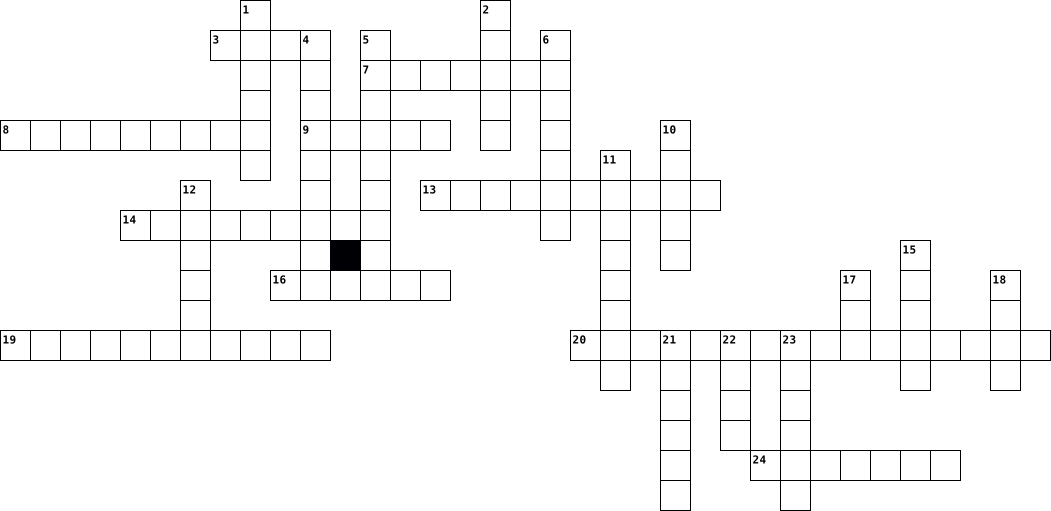
Across
- The red planet; contains ferricoxide which is a mineral that makes it look very red
- Smallest gas giant; surface gravity almost Earth-like
- 3 times as long as the Grand Canyon; once called "Easter Bunny"; dwarf planet
- Only known planet that can obtain life
- A very large star brighter than a giant star
- When a supernova dies down and collapses
- A body in the universe that contains millions or billions of stars
- The core of a supernova/supergian star
- A star that fuses hydrogen atoms to form helium atoms in its core
- Largest planet in a solar system with around sixty moons
Down
- Shaped like an egg, named after Hawaiian goddess; dwarf planet
- Considered both a planet and a dwarf planet
- When a star explodes MASSIVELY
- A galaxy that neighbors the Milky way
- The closest planet to the sun
- Hottest planet in our solar system
- A galaxy that contains the solar system
- The planet with the most rings in our solar system
- The only dwarf planet located in the inner solar system
- A main sequence star located in our Solar System; all the planets orbit around it
- A spheroid (ball) made out of hydrogen, helium and plasma
- A body of interstellar stars
- The most massive, second largest dwarf planet in the solar system
- The only planet in our solar system that orbits on its side; the least dense planet
24 Clues: A body of interstellar stars • The closest planet to the sun • When a star explodes MASSIVELY • Hottest planet in our solar system • A galaxy that neighbors the Milky way • Only known planet that can obtain life • The core of a supernova/supergian star • A galaxy that contains the solar system • When a supernova dies down and collapses • ...
Space Crossword Puzzle 2022-03-02

Across
- the amount by which a propagating wave is bent/bending a ray of light
- a magnifier of images of distant objects
- the branch of astrophysics that studies the origin and evolution and structure of the universe
- optical telescope that has a large convex lens that produces an image that is viewed through the eyepiece
- elongated, closed curve that describes Earth's yearlong orbit around the Sun
- high-frequency radiation very high energy levels harmful to plants and animals
- the entire frequency range of electromagnetic waves
- 186,000 mi/s
- the study of the universe beyond Earth, including the sun, moon, planets, and stars
- path described by one celestial body in its revolution about another
- large ball of superheated gas that gives off all the energy a planet needs
- when a planet turns on its axis
- a large group of stars, dust, and gas that is held together by gravity and can be elliptical, spiral, or irregular
Down
- when an object orbits around a star
- shape of a planet's orbit with 2 foci
- the "ovalness" of an orbit
- the distance light can travel in one year
- a large ball of rock that rotates mainly in the asteroid belt between Mars and Jupiter
- telescope consisting of a large concave mirror that produces an image that is magnified by the eyepiece
- the cosmic explosion that is hypothesized to have marked the origin of the universe
- the galaxy also a candy bar
- is a group of stars that form a pattern in the sky
- a ball of ice with no orbit that generates a "tail" because of solar wind
- made up of the Sun and all planets, moons, comets, and asteroids
- either of the two celestial points at which the celestial equator intersects the ecliptic, either of two times of the year when the sun crosses the plane of the earth's equator and day and night are of equal length
25 Clues: 186,000 mi/s • the "ovalness" of an orbit • the galaxy also a candy bar • when a planet turns on its axis • when an object orbits around a star • shape of a planet's orbit with 2 foci • a magnifier of images of distant objects • the distance light can travel in one year • is a group of stars that form a pattern in the sky • the entire frequency range of electromagnetic waves • ...
Outer Space Crossword 2022-02-21

Across
- a small rock or rocky grain that strikes Earth’s surface
- an irregularly shaped rocky object in space
- A system used to rate the hazard level of an object moving toward Earth
- a body that moves in a clockwise direction of rotation
- hottest planet
- largest planet in the solar system
- sometimes called a “Shooting Star”
- natural or artificial bodies that revolve around larger bodies such as planets
- occurs when Earth passes through the tail or debris of a comet
- region of the solar system beyond the orbit of Neptune
- closest planet to the sun
Down
- storm system more than 400 years old
- farthest planet from the Sun
- what a meteorite is called while in space
- a body that moves in a counterclockwise direction of rotation
- divides the Inner Planets from the Outer Planets
- instrument helped early scientists discover more bodies in the solar system
- blue-green in color because the gases absorb the red part of sunlight strongly
- bodies in space made up of ice, dust, small gritty particles
- dwarf planet
- fourth planet from the sun
- largest planetary rings
22 Clues: dwarf planet • hottest planet • largest planetary rings • closest planet to the sun • fourth planet from the sun • farthest planet from the Sun • largest planet in the solar system • sometimes called a “Shooting Star” • storm system more than 400 years old • what a meteorite is called while in space • an irregularly shaped rocky object in space • ...
Space Unit Review 2022-04-14

Across
- Planets that have a relatively small, dense core and are surrounded by massive layers of gas
- Galaxies farther from us are moving away at a faster rate
- The measure of how bright a star appears when viewed from a dark-viewing site on Earth
- A magnetic storm on the surface of the Sun during which streams of charged particles are ejected into space
- The measure of how bright a star would be if observed at a distance of 32.6 light years
- A giant cloud of dust and gas in space
- Used to determine the composition of a star by analyzing the spectrum and spectral lines of the star
- Collection of objects that orbits the Sun
- A collection of 100,000 to a million stars, found around the centre of the Milky Way
- Launched into space to orbit a planet or a moon
- Uses a lens to collect light from an object
Down
- Uses a mirror to collect light from an object
- A collection of stars, planets, gas, and dust held together by gravity
- A body that could/will come together with many others under gravitation to form a planet
- The widely accepted theory of the formation of the universe
- Satellites that take 24 hours to complete one orbit
- A star’s total energy output per second
- Instruments used to detect electromagnetic radiation
- Stars that are smaller in mass than the Sun and consume their hydrogen over 100 billion years
- Galaxies that contain some of the oldest stars in the universe
- Occurs when the light from a celestial body is blocked by the shadow of another object
21 Clues: A giant cloud of dust and gas in space • A star’s total energy output per second • Collection of objects that orbits the Sun • Uses a lens to collect light from an object • Uses a mirror to collect light from an object • Launched into space to orbit a planet or a moon • Satellites that take 24 hours to complete one orbit • ...
anime, avengers, space, 2022-04-21

Across
- who is the "god of thunder"?
- swimming anime?
- basketball anime?
- the planet farthest from the sun?
- how many moons does mars have?
- how big is the multiverse?
- the characters goals are to catch animal like elemental creature?
- skateboarding anime?
- this girl moves in with a bunch of guys who are possessed by chinese zodiac animals?
- the man who assemble the avengers?
- the plutos twin?
Down
- how many moons does saturn have?
- children in an orphanage are trying to escape the demise of being eaten by demons?
- who is the keeper of the time stone?
- what planet has bigger rings than saturn
- the hottest planet?
- students have learn to hone their chakra and jutsu abilities?
- who quotes "i am groot"?
- america the 1st avengers?
- who is the king of wakanda?
- what planet has rings?
- a human boy is attacked and become part ghoul
- iceskating anime?
- how many planet are there?
- planet is known as the red planet?
- how many dwarf planets are there?
26 Clues: swimming anime? • the plutos twin? • basketball anime? • iceskating anime? • the hottest planet? • skateboarding anime? • what planet has rings? • who quotes "i am groot"? • america the 1st avengers? • how big is the multiverse? • how many planet are there? • who is the king of wakanda? • who is the "god of thunder"? • how many moons does mars have? • how many moons does saturn have? • ...
Kaelyn's Space Puzzle 2022-04-29

Across
- Earth, space, and all things in it.
- Having to do with the moon.
- An object you use to look at planets and space.
- The Milky Way.
- The turning of Earth.
- Having to do with the sun.
- A rocket that used to be used to travel into space
- The blocking by another celestial body and occurs when light from the sun is cut off.
- Relating to the heavens or skies.
- The path a planet travels around the sun.
- Shooting stars.
- A measure of distance in space.
Down
- Rotation, single turn.
- A man-made object that orbits Earth.
- A mass of material that travels around the sun.
- They are small objects between Mars and Jupiter.
- A star formation.
- The study of part of the universe.
- The straight line around which Earth turns.
- The same thing as movement.
20 Clues: The Milky Way. • Shooting stars. • A star formation. • The turning of Earth. • Rotation, single turn. • Having to do with the sun. • Having to do with the moon. • The same thing as movement. • A measure of distance in space. • Relating to the heavens or skies. • The study of part of the universe. • Earth, space, and all things in it. • A man-made object that orbits Earth. • ...
Space Crossword Puzzle 2022-05-02

Across
- hemisphere
- The time required for Earth to rotate once on its axis
- A loop of relatively cool, incandescent gas that extends above the photosphere
- A measure of how bright a star would be if it were seen from a standard distance
- A small body that gives off gas and dust as it passes close to the sun
- A bright streak of light that results when a meteoroid burns up in Earth's atmosphere
- Growing bigger (moon Phases)
- Describes something that uses Earth as the reference point
- The brightness of a star as seen from Earth
- The different appearances of the moon from Earth throughout the month
- One of the highly dense rocky planets nearest to the sun
- A natural or artificial body that revolves around a planet
- The path that a body follows as it travels around another body in space
Down
- A force of attraction between objects that is due to their masses and distance
- The darkest part of a shadow
- A celestial body that orbits the sun, is round because of its own gravity, but has not cleared its orbital path
- The distance that light travels in one year
- A dark area of the photosphere of the sun that is cooler than the surrounding areas and that has a strong magnetic field
- The moment when the sunlight is at a maximum on one hemisphere and a minimum on
- A relatively small, rocky body that travels through space
- The time required for Earth to revolve once around the sun
- The moment when the sunlight hits both hemispheres of the Earth equally
- An explosive release of energy that comes from the sun and that is associated with magnetic disturbances on the sun's surface
- A large irregular shaped rocky body that orbits the sun
- A planet that has a deep, massive atmosphere and is further from the sun
- The outer part of a shadow
- An event in which the shadow of one celestial body falls on another
- The sun and all of the planets and other bodies that travel around it
- Growing smaller (Moon Phases)
- A collection of stars, dust, and gas bound together by gravity
- Space and all the matter and energy in it
- The spin of a body on its axis
- A meteoroid that reaches Earth's surface without burning up completely
- Sun-centered
- A large celestial body that is composed of gas and emits light
35 Clues: hemisphere • Sun-centered • The outer part of a shadow • The darkest part of a shadow • Growing bigger (moon Phases) • Growing smaller (Moon Phases) • The spin of a body on its axis • Space and all the matter and energy in it • The distance that light travels in one year • The brightness of a star as seen from Earth • The time required for Earth to rotate once on its axis • ...
Earth/Space Science 2022-05-02

Across
- rock that forms when magma cools and hardens
- explosive release of energy from the sun
- daily changes in the level of ocean water
- Jupiter, Saturn, Uranus, and Neptune
- mixture of mostly invisible gases that surrounds Earth
- all the liquid water on Earth
- mostly solid, rocky part of Earth
- dark areas that form on the surface of the sun
- cycle of warm air rising and cool air sinking
- solid outer layer of Earth
- rock that forms from sediment
- plate boundary where plates slide past each other
- A large group of stars and nebulae
- A small, body of ice, rock, and cosmic dust
Down
- plate boundary where plates move away
- plate boundary where plates collide
- all living things on Earth
- process by which sediment is moved around
- Small, rocky bodies that revolve around the sun
- theory that explains Earth's moving plates
- all frozen water on Earth
- Mercury, Venus, Earth, and Mars
- rock that forms from pressure and heat
23 Clues: all frozen water on Earth • all living things on Earth • solid outer layer of Earth • all the liquid water on Earth • rock that forms from sediment • Mercury, Venus, Earth, and Mars • mostly solid, rocky part of Earth • A large group of stars and nebulae • plate boundary where plates collide • Jupiter, Saturn, Uranus, and Neptune • plate boundary where plates move away • ...
Flight and Space 2022-09-02

Across
- A powered heavier-than-air aircraft with fixed wings from which the aircraft derives most of its lift.
- Robotic aircraft, used extensively by the military.
- Aerospace Vehicle A powered, aerial vehicle that does not carry a human operator, uses aerodynamic forces to provide vehicle lift, can fly autonomously or be piloted remotely, can be expendable or recoverable, and can carry a lethal or nonlethal payload.
- Engineer Design machines that fly.
- A glider designed for sustained flight.
- A type of aircraft deriving both lift and propulsion from one or two sets of horizontally revolving rotors.
- The art and science of designing, building, and operating manned or unmanned space objects.
- The study of forces and the resulting motion of objects through the air.
- A short, easily-remembered slogan, verse, or tune.
- Air Balloon A large bag filled with hot air or gas to make it rise in the air, with a basket for passengers hanging from it.
Down
- A vehicle, missile, or aircraft which obtains thrust by the reaction to the ejection of fast moving exhaust from within a rocket engine.
- Branch of technology and industry concerned with aviation and space flight.
- The study or practice of travel through the air.
- The written text of a play, film, or broadcast
- An aircraft with floats or skis instead of wheels, designed to land on and take off from water.
- An advertising film which promotes a product in an informative and supposedly objective style.
- Shuttle A rocket-launched spacecraft able to land like an unpowered aircraft, used for journeys between earth and craft orbiting the earth.
- A sequence of drawings representing the shots planned for a film or television production.
- To set or thrust in motion.
- A power-driven aircraft kept buoyant by a body of gas (usually helium) which is lighter than air.
- A short, memorable phrase used in advertising or associated with a political party or group.
21 Clues: To set or thrust in motion. • Engineer Design machines that fly. • A glider designed for sustained flight. • The written text of a play, film, or broadcast • The study or practice of travel through the air. • A short, easily-remembered slogan, verse, or tune. • Robotic aircraft, used extensively by the military. • ...
Space Unit Review 2022-06-15

Across
- When the Earth blocks out the sun and casts a shadow on the Moon.
- The basic element that makes up all stars.
- Pluto is an example.
- The space-telescope that has discovered hundreds of planets outside our solar system.
- Earth has a northern one and a southern one.
- when the earth, sun and moon form a straight line, and produce extreme high and low tides.
- Where stars are "born".
- The unit we use to measure distances between stars.
- The most common type of star in the universe.
- The unit we use to measure distances in the solar system.
- The curved path an object takes around a planet or star.
Down
- A small space rock that has fallen to Earth.
- When the moon blocks out the sun and casts a shadow on the Earth.
- Created by the collapse of very big stars; a point of infinite gravity/density.
- The tilt of the earth produces these.
- The small, hot, dense "skeleton" of a star.
- the type of wave energy we use to communicate in space.
- The force that pulls objects with mass together.
- The large type of star our Sun will turn into when it reaches the end of its life.
- The planet with the most moons in the solar system.
- A powerful burst of energy from the Sun.
21 Clues: Pluto is an example. • Where stars are "born". • The tilt of the earth produces these. • A powerful burst of energy from the Sun. • The basic element that makes up all stars. • The small, hot, dense "skeleton" of a star. • A small space rock that has fallen to Earth. • Earth has a northern one and a southern one. • The most common type of star in the universe. • ...
Facts About Space 2022-02-10

Across
- In the late evening shadows point toward the ____.
- Shadows are _____ in the winter than the summer.
- When the Southern Hemisphere has summer, the Northern Hemisphere has ______.
- Earth's gravity pulls toward the _____ of the Earth.
- The Earth stays in orbit around the Sun because of the Suns' ______ gravitational pull.
- Every object has its own _____.
- The Sun only projects light onto one ____ of the Earth at a time.
- The third phase of the Moon.
- Scientists think that a big object ______ with Earth a long time ago.
- How long it takes the Earth to rotate on its axis one time.
- The sun is a _____ sized star.
Down
- In the morning shadows point toward the ______.
- Shadows are _____ in the summer than the winter.
- What causes shadows?
- The sixth phase of the Moon.
- Groton-Dunstable's mascot.
- Earth's _____ causes seasons.
- The seventh phase of the Moon.
- ____ stars are the hottest.
- The fifth phase of the Moon.
- ____ stars are the coolest.
- It takes the Moon about _____ to complete its full cycle.
- Earth's axis is tilted at a _____ ° angle.
23 Clues: What causes shadows? • Groton-Dunstable's mascot. • ____ stars are the hottest. • ____ stars are the coolest. • The sixth phase of the Moon. • The third phase of the Moon. • The fifth phase of the Moon. • Earth's _____ causes seasons. • The seventh phase of the Moon. • The sun is a _____ sized star. • Every object has its own _____. • Earth's axis is tilted at a _____ ° angle. • ...
All About Space 2022-01-11

Across
- 1st USA space station that crashed in Australia. (after years operation. Intentionally brought down)
- It was a planet when I was a kid. Not anymore.
- The planet that Spock comes from. The only fictional answer on this list.
- 1st American in space. It is not Glenn.
- 1st man made object in space from USSR
- There was #1 and #2. Both Probes have now left the solar system and are still sending back data. They were launched in the 1970's with the gold record.
- The twins would like this NASA program that was before the Apollo program.
- The rocket that pushed Apollo missions into space. (use the Roman Numeral)
- It has a big red spot
- Landing Site of Apollo 11. Sea of ______
- 1st woman in space
Down
- Cape _____. Before it was renamed Canaveral.
- A month in 1969 in which man 1st walked on the moon
- 2nd shuttle to blow up
- 1st shuttle to blow up
- "____ we've had a problem"
- The drink of the astronauts
- "That's one small step for a man. One giant leap for _____"
- 2nd rock from the sun
- 3rd rock from the sun
20 Clues: 1st woman in space • 2nd rock from the sun • It has a big red spot • 3rd rock from the sun • 2nd shuttle to blow up • 1st shuttle to blow up • "____ we've had a problem" • The drink of the astronauts • 1st man made object in space from USSR • 1st American in space. It is not Glenn. • Landing Site of Apollo 11. Sea of ______ • Cape _____. Before it was renamed Canaveral. • ...
space and stuff 2022-11-21

Across
- a bright spot at night
- they do astronomy and physics
- egg
- chocolate bar
- there is nothing
- nothing can escape it
- its a rotating black hole
- arcs of plasma around the sun
- what is the universe doing
Down
- the closest star to us
- discovered that galaxies are moving away
- how long a star has after it makes iron
- bringing everyone together
- the fasted bit of time measurement
- it makes up approximately 85% of matter
- bright, colourful and going out with a bang
- a curved path of a celestial object
- what stars create
- where the big bang happened
- bazinga
20 Clues: egg • bazinga • chocolate bar • there is nothing • what stars create • nothing can escape it • the closest star to us • a bright spot at night • its a rotating black hole • bringing everyone together • what is the universe doing • where the big bang happened • they do astronomy and physics • arcs of plasma around the sun • the fasted bit of time measurement • ...
space and stuff 2022-11-21

Across
- a bright spot at night
- they do astronomy and physics
- egg
- chocolate bar
- there is nothing
- nothing can escape it
- its a rotating black hole
- arcs of plasma around the sun
- what is the universe doing
Down
- the closest star to us
- discovered that galaxies are moving away
- how long a star has after it makes iron
- bringing everyone together
- the fasted bit of time measurement
- it makes up approximately 85% of matter
- bright, colourful and going out with a bang
- a curved path of a celestial object
- what stars create
- where the big bang happened
- bazinga
20 Clues: egg • bazinga • chocolate bar • there is nothing • what stars create • nothing can escape it • the closest star to us • a bright spot at night • its a rotating black hole • bringing everyone together • what is the universe doing • where the big bang happened • they do astronomy and physics • arcs of plasma around the sun • the fasted bit of time measurement • ...
Earth in Space 2022-11-30

Across
- The reason why we orbit the sun
- lasts 365 and 1/4 days
- the view of the Moon seen from Earth when the whole of its near side is in sunlight
- reaching a place on Earth
- Changes on thewater level along the coastlines
- the time period between the appearance of one new moon to the next
- the change in the Moon’s appearance between a new moon and the following full moon
- the sun rises from the...
- all of space and the matter and energy contained in it
- The result of the extra 1/4 in a year
- ...experiences summer when the Southern hemisphere is tilted towards the sun
- occurs when the Moon moves between the Earth and the Sun so that all of the Sun’s light to a place on Earth is blocked by the Moon
- the turning of an object about its own axis (between the North and South poles)
- very high tide that occurs when there is a new or full moon
- The sun sets in the...
- brightest object in the night sky
- occurs when the Earth moves between the Sun and the Moon so that some or all of the Moon’s
- The way the Earth orbits around the sun
Down
- occurs when the Moon moves between the Sun and the Earth
- ...the shortest day of the year
- the change in the Moon’s appearance between a full moon and the following new moon
- There is no... on the moon so the surface does not change
- a body such as a moon that orbits another celestial body of a larger size and mass
- number of phases of the moon
- ...holds the longest daylight hours
- The direction which the Earth rotates
- an attractive force between two objects which have mass
- Star at the center of the Solar system
- occurs when the Moon moves between the Earth and the Sun and prevents some of the
- the result of the Earth's tilt
- ...experiences summer when the Northern hemisphere is tilted towards the sun
- does not receive light from the Sun and cannot be seen
- When the Earth spins it creates a bulge at the equator which causes... at the side opposite the moon
- An imaginary line
- days with the same number of daylight hours as night hours
- occurs when the Moon moves between the Earth and the Sun and prevents some or all of the sunlight reaching a place on Earth
- the regular rise and fall of water level
- Third planet from the sun
38 Clues: An imaginary line • lasts 365 and 1/4 days • The sun sets in the... • reaching a place on Earth • the sun rises from the... • Third planet from the sun • number of phases of the moon • the result of the Earth's tilt • ...the shortest day of the year • The reason why we orbit the sun • brightest object in the night sky • ...holds the longest daylight hours • ...
Living in Space 2021-08-02

Across
- this is caused by the tilted axis of the earth
- a celestial object that enters our atmosphere
- a meteor
- a phase of the moon that is getting bigger
- a type of telescope that uses lenses
- the 4 inner planets closest to the sun
- a celestial object made or rock, dust, ice and gas
- the apparent shifting of position of an object
- a celestial object made of rock found
- when no moon can be seen
- Earth-centred view of our solar system
- a phase of the moon that is getting smaller
Down
- like an asteroid
- a meteor that lands on Earth
- when the moon is blocked by being in a shadow
- sun-centred view of our solar system
- a type of telescope that uses mirrors
- when the whole moon can be seen
- the name of our galaxy
- the 4 outer planets
20 Clues: a meteor • like an asteroid • the 4 outer planets • the name of our galaxy • when no moon can be seen • a meteor that lands on Earth • when the whole moon can be seen • sun-centred view of our solar system • a type of telescope that uses lenses • a type of telescope that uses mirrors • a celestial object made of rock found • the 4 inner planets closest to the sun • ...
Sky and space 2021-07-12

Across
- which planet takes 165 years to revolve around the sun
- which is the red planet
- which is the huge glowing sphere of hot gas
- The people who actually go into space, conduct experiments on space stations
- mass of water drops or ice crystals suspended in the atmosphere
- station which is home where crews of astronauts and cosmonauts live
- storm which storm from the sun affects the mobile signals on the Earth
- strange lights and objects flying through the sky
- which object from the space is believed to have killed the dinosaurus and other living objects in the Earth
- The outermost region of a planet's atmosphere.
- which planet takes 88 days to complete one revolution
- way the name of our galaxy is
- The layer which burns meteors and asteriods & protects the Earth
- an icy body in space which develops a tail when passing near the sun
- bang which explosion caused the planets to be formed
- The layer which has ions formation in the atmosphere
- any low pressure area with winds spiralling inwards that causes heavy rain when crossing the land from sea
Down
- rays Rays emitted from the sun
- natural satellite of the earth
- which planet can float on water because it is mostly made of gases
- which planet has 27 moons
- a machine that is launched into space and moves around Earth or another body in space
- Ozone is present in which layer of the atmosphere
- system sun and the planets together are called as
- which vehicle is used for launch satellite into space
- which is the only planet that spins clockwise
- small body that comes into the earth from the space and appears as a streak of light for a short time
- which is the fastest spinning planet in the solar system
- Which layer is site of all-weather on Earth
- which is the only planet not named after God
30 Clues: which is the red planet • which planet has 27 moons • natural satellite of the earth • rays Rays emitted from the sun • way the name of our galaxy is • Which layer is site of all-weather on Earth • which is the huge glowing sphere of hot gas • which is the only planet not named after God • which is the only planet that spins clockwise • ...
SOL Review - Space 2021-05-07

Across
- Two factors that affect the gravitational attraction between objects are mass & ___.
- Planets ___ around the sun.
- A force that keeps the planets in motion around the sun.
- Earth's surface is ___ and partly covered with large oceans.
- The outer, " ___" planets are very large.
- The greek astronomer who developed a model of the universe with Earth at the center.
- Second planet from the sun
- The atmosphere and the ___ ___ help shield Earth's surface from harmful solar radiation.
- Earth's atmosphere consists mostly of oxygen and ___ .
- The ___ ___ separates the inner planets from the outer planets.
- Third planet from the sun
- What season do we experience when the Northern Hemisphere is tilted towards the sun?
Down
- The gravitational pull of the moon causes the ____.
- The sun, moon,Earth, other planets and their moons, meteors, asteroids, and comets make up the ___ ___.
- Farthest planet from the sun
- The ___ of Earth on its axis as it revolves around the sun causes the seasons.
- Astronomer whose model of the universe placed the Sun rather than the Earth at the center.
- His invention of the telescope provided more evidence that the planets circled the sun.
- A planet ___ upon an axis.
- Pluto is a ___ planet because it cannot move other objects away from its orbital neighborhood.
- Largest planet
- The ____ of the moon are caused by its position relative to Earth and the sun.
- The phase of the moon that occurs when the Earth is between the Sun & the Moon.
- ___ is the smallest planet and the closet planet to the sun.
- The four ____ planets are comparatively small and rocky.
25 Clues: Largest planet • Third planet from the sun • A planet ___ upon an axis. • Second planet from the sun • Planets ___ around the sun. • Farthest planet from the sun • The outer, " ___" planets are very large. • The gravitational pull of the moon causes the ____. • Earth's atmosphere consists mostly of oxygen and ___ . • A force that keeps the planets in motion around the sun. • ...
SPACE🌚🌝 2021-04-22

Across
- act of rising to an important position or a higher level
- distance of a place east or west
- tide- seven days after a spring tide
- eclipse-moon gets between Earth and the sun,
- an optical instrument designed to make distant objects appear nearer
- the point in the orbit of a planet, asteroid, or comet at which it is furthest from the sun:
- system-consists of our star, the Sun, and everything bound to it by gravity — the planets Mercury, Venus, Earth, Mars, Jupiter, Saturn, Uranus and Neptune,
- a celestial object consisting of a nucleus of ice and
- the point in the orbit of a planet, asteroid, or comet at which it is closest to the sun
- a celestial body moving in an elliptical orbit around a star.
- massive self-luminous celestial body
- - is a large planetary embryo
- the shadow cast by the earth or moon
- planet - a celestial body resembling a small planet but lacking certain technical criteria that are required for it to be classed as such.
- motion- Kepler's three laws of..
- a group of stars forming a recognizable pattern
- a small body of matter from outer space that enters the earth's atmosphere,
- the star around which the earth orbits
- distance of a place north or south
- a small body moving in the solar system that would become a meteor
- representing the sun as the center, as in the accepted astronomical model of the solar system.
- tide- tide during new and full moon.
- Physics the force that attracts a body toward the center of the earth, or toward any other physical body having mass.
- n imaginary line drawn around the
Down
- meteor that survives its passage through the earth's atmosphere
- force- the force of attraction between all masses in the universe
- which the sun crosses the celestial equator
- a small rocky body orbiting the su
- object's orbital motion around another object
- having or representing the earth as the center, as in former astronomical systems.
- the natural satellite of the earth
- period of the year that is distinguished by special climate conditions
- the action of rotating around an axis or center
- regular oval shape
- of a celestial body obscure the light from or to another celestial body
- rising and falling of the
- getting larger each night.
- unit - distance from the center of the earth to the center of the sun.
- smaller part of its visible surface illuminated
- radiation- the name given to a pair of electric and magnetic fields that propagate together at the speed of light.
- angular distance of a point north or south of the celestial equator
- robotic spacecraft that explores farther into outer space
- the shadow of a celestial body excluding all light from the primary source
43 Clues: regular oval shape • rising and falling of the • getting larger each night. • - is a large planetary embryo • distance of a place east or west • motion- Kepler's three laws of.. • n imaginary line drawn around the • a small rocky body orbiting the su • the natural satellite of the earth • distance of a place north or south • tide- seven days after a spring tide • ...
Stranded in Space 2023-12-04

Across
- Where the team of NASA staff oversaw Apollo 13
- What pangolins use to grip branches
- Means to write
- The outermost layer of the Earth
- These were made from deer antlers
- The other discharge that Iguanas sneeze
- underwater vehicles with robotic arms
- What they do at the Phanom Center
- My grandfather was an avid collector, key hooks
- Last name of Poet
- insects that eat wood
- The number of Pangolin species at risk of extinction
- Where Cambodia is located
- an early form of radio communication
Down
- What Germans wish after a sneeze
- Where the Command Module touched down
- Giant cracks from Alaska's coast
- What Lola's gum was made from
- earthquake scientist
- One popular flavor of gum
- A sneeze launches this and mucus
- Where the Titanic sank
- One ingredient in gum besides plastic
- Reason why people flocked to Alaska
- The capital of Denmark
- another name for the Command Module
26 Clues: Means to write • Last name of Poet • earthquake scientist • insects that eat wood • Where the Titanic sank • The capital of Denmark • One popular flavor of gum • Where Cambodia is located • What Lola's gum was made from • What Germans wish after a sneeze • Giant cracks from Alaska's coast • The outermost layer of the Earth • A sneeze launches this and mucus • ...
AKP: Space Race 2023-09-17

Across
- The largest object in the solar system
- Sun and the planets around it
- Famous space telescope that provided us with awesome images of the universe for decades
- the only planet of the solar system that spins opposite of others
- The biggest moon of Saturn
- NASA mission that took astronauts to moon
- The space probes that are traveling farthest from earth
- Everything that exists!
- Galaxy closest to us
- First human to fly in space
- An icy object with a tail that goes around Sun in long orbits
- fastest spinning planet in the solar system
- First human to walk on the moon
- Planet where dinosaurs lived
- a Russian national who travels to space
- It is the rocky planet farthest from sun
- an Indian astronaut
- American space organization
- largest volcano of the solar system
- This planet turns sideways
- Space rock whose impact destroyed dinosaurs
- The biggest moon of Jupiter
Down
- related to sun
- a star that has run out of energy, explodes and then collapses before it dies
- The name of India's moon mission
- title of the famous book by Carl Sagan
- the first Indian satellite
- a streak of light in the night sky
- Explosion that started the universe
- Cassini space mission visited this planet
- Jupiter's moon with a two letter name
- NASA mission that will take astronauts back to moon in few years
- Planet that goes quickest around Sun
- The 'sleepy musical' planet
- Second largest moon of Jupiter
- Time that earth takes to go around Sun
- Chandrayan-3 lunar rover
- Jupiter's moon whose name is similar to name of a continent
- One day on Venus is almost 8 _____ on Earth.
- Chandrayan-3 lander
- an American person who travels to space
- Name of India's space organization
- How many moons does Mars has?
- Number of Jupiter's Galilean moons
- Time that earth takes to complete a turn around its axis
- The hottest planet
- One _____ Earths could fit inside the sun!
- related to Earth's moon
- Our home galaxy
- Space telescope with many hexagonal mirrors which is installed about a million miles from earth
- 17th century astronomer that discovered Jupiter's four big moons
51 Clues: related to sun • Our home galaxy • The hottest planet • Chandrayan-3 lander • an Indian astronaut • Galaxy closest to us • Everything that exists! • related to Earth's moon • Chandrayan-3 lunar rover • the first Indian satellite • The biggest moon of Saturn • This planet turns sideways • The 'sleepy musical' planet • First human to fly in space • American space organization • ...
Ryleigh's Space crossword 2023-10-30

Across
- The hottest planet in the solar system (5)
- The moons of Uranus were named after characters created by Alexander Pope and who else?
- term for when the Moon's shadow falls upon Earth, which we see as the Moon blocking the Sun
- Venus and what other planet have no moons?
- Name of the skunk in popular animated movie, Space Jam (4,2,3)
- Planet with the largest ocean
- The largest known ______ is 965 km wide
- Author responsible for writing the book that inspired Hollywood blockbuster 2001: A space Odyssey
- Which Hollywood movie focuses on three African-American women who were essential to the success of early spaceflight?
- constellation that represents a hunter and weapons
- The biggest natural satellite which orbits Jupiter
- Which planet has a hexagonal-shaped storm?
Down
- number of stars that make up the big dipper
- This famous comet is expected to orbit past earth again in 2061
- Galaxies are either spiral, irregular or what other shape?
- What do scientists call the disk that encircles a black hole?
- One of the 5 officially recognised dwarf planets in our solar system
- Theory describing how the universe started (3,4)
- The sun is made up of 3/4 hydrogen and 1/4 what other substance?
- The substance thought to be in abundance on the rocky planet located 40 light years away, called 55 Cancri e
20 Clues: Planet with the largest ocean • The largest known ______ is 965 km wide • The hottest planet in the solar system (5) • Venus and what other planet have no moons? • Which planet has a hexagonal-shaped storm? • number of stars that make up the big dipper • Theory describing how the universe started (3,4) • constellation that represents a hunter and weapons • ...
Studies of Space 2024-01-26

Across
- a comet tail containing dust (2 words)
- The bending of light from a distant object to form an image (2 words)
- The core of an atom electrons orbit
- a bright trail of light made by small solid object entering earth's atmosphere (a shooting star)
- A planet not orbiting our sun
- The breaking of a molecule by intense radiation (2 words)
- A rocky planet similar to earth in size and structure (2 words)
- A large planet made up of gas (2 words)
- A dark band in Jovian’s planet atmosphere (a dark circle around the planet)
- A planet orbiting in the inner part of the solar system (2 words)
- an event where many meteors occur in a short space of time (2 words)
- Cliffs formed where the crust has shifted that run for hundreds of kilometers across a planet’s or moon’s surface
Down
- A cloud of gas and dust in between the stars (2 words)
- The force exerted by a substance (starts with a p)
- The gaseous atmosphere surrounding the head of a comet
- The visible surface of the sun
- The small remains of a meteor that falls to earth
- a cloud of hot gas in the sun’s outer atmosphere
- A hot thin column of gas in the sun’s chromosphere
- A dark cooler spot on the sun’s visible surface
- A sudden increase in brightness of a small area on the sun
- The lower part of the sun’s outer atmosphere that lies directly above the sun’s visible surface (photosphere)
- A tiny planet (2 words)
- The distance from an astronomical body at which its gravitational force can pull apart another astronomical body (2 words)
- A small rock solid body
25 Clues: A tiny planet (2 words) • A small rock solid body • A planet not orbiting our sun • The visible surface of the sun • The core of an atom electrons orbit • a comet tail containing dust (2 words) • A large planet made up of gas (2 words) • A dark cooler spot on the sun’s visible surface • a cloud of hot gas in the sun’s outer atmosphere • ...
Space by McCarthy 2024-02-24

Across
- The Bulls-Eye Planet.
- A ball of shining gas.
- A rock that floats around in space.
- Has 146 large objects orbiting it.
- Gases held by gravity around an object.
- Widely considered the greatest Astronomer in history.
- Round objects that orbit the sun but are smaller than our Moon.
- Region of icy objects beyond the orbit of Neptune.
- A burst of electromagnetic radiation from the Sun.
- Reclassified as a Dwarf-Planet in 2006.
- Official name for the satellite orbiting Earth.
- The Swift Planet.
- All Space & Time, Everything in existence ever everywhere.
- A device used to view objects within space.
- The nearest Large Galaxy to the ours.
- Official name for the star in our system.
Down
- An icy rock that lets off gas and dust.
- The Gas Giant.
- Closest star outside of our Solar system.
- Nickname for the star in our system.
- The explosion made when a star dies.
- Collection of dust or gas found in-between star systems.
- Official name for a large object orbiting another object.
- Name of the Comet which passes by Earth every 75+ years.
- Active Galactic Nucleus that emits luminous radiation from a Black Hole.
- Equivalent to 5,878,499,810,000 miles.
- The Galaxy that Earth is located in.
- The "3rd Rock From The Sun".
- Region where gravity is so strong that even light cannot escape.
- A planet that exists outside of our Solar System.
- Space program using spacecraft to explore our system and deep space.
- Nickname for the satellite orbiting Earth.
- First planet located using math instead of sight.
- The collection of objects in-between Earth & Mars.
- The largest satellite orbiting Pluto.
- Atmosphere rains down acid so strong it melts metal.
- The Red Planet.
37 Clues: The Gas Giant. • The Red Planet. • The Swift Planet. • The Bulls-Eye Planet. • A ball of shining gas. • The "3rd Rock From The Sun". • Has 146 large objects orbiting it. • A rock that floats around in space. • Nickname for the star in our system. • The explosion made when a star dies. • The Galaxy that Earth is located in. • The largest satellite orbiting Pluto. • ...
Living Space Vocab 2019-07-26

Across
- This is a piece of carpet that makes a floor more comfortable and beautiful.
- This is a large, long piece of furniture that more than one person can sit on.
- If you want to take your time and relax while getting clean, you can use this.
- You can eat food off of this thing, but it's not good for holding soup.
- This is a piece of furniture that only one person can sit on.
- You can use this to cook food very fast.
- You can put your clean dishes and glasses in this furniture
- You can put books and other things on this furniture.
- This is the place you can go to wash yourself.
- You can spend time relaxing with family or friends in this central area.
- This appliance is used to bake things like cake, brownies, or pizza.
- This sharp utensil (tool) is used to pick up food before you eat it.
- You can use this thin paper for cleaning or drying many things.
- This is a flat area connected to a wall that is used to prepare food.
- This is furniture that you can sit next to and eat or work on things.
- This is a home you can buy in a big building and it might also have a pool or gym.
- You can use this to wash your hair.
- You can keep your clothes in this furniture (and sometimes it's a room).
- You can wash your hands in this thing.
- This furniture is used for writing or working on a computer.
- This is good for holding ice cream or soup.
- This sharp utensil (tool) is used to cut food.
Down
- You can drink water out of this thing.
- This room is used for working and usually has a computer in it.
- This is the place that you sleep and keep most of your things.
- You use this to look at yourself.
- You can use this thing to dry yourself after getting clean.
- This is the main place where you eat breakfast, lunch, and dinner at home.
- This home can be big or small, but it usually has more than two rooms and it might be expensive.
- You can rent this home (pay every month) from a bigger building.
- This is something you can put on a wall to make it more beautiful.
- You use this appliance to keep your food cold.
- This is the thing you can use to clean your body quickly.
- Usually people cook or prepare food in this room.
- You can use this thing on your bed to stay warm and comfortable.
- This dull, round utensil (tool) is used to pick up food before you eat it.
- You keep this soft thing on your bed and lay your head on it.
- This furniture has drawers that you can open and close and it holds clothes.
- This is a light that sits on a table or hangs from the ceiling.
- You can hang this thing on a wall to show the time.
- You can use this appliance to cook fried rice or to boil noodles.
- This is used to wash your hands or your whole body.
42 Clues: You use this to look at yourself. • You can use this to wash your hair. • You can drink water out of this thing. • You can wash your hands in this thing. • You can use this to cook food very fast. • This is good for holding ice cream or soup. • You use this appliance to keep your food cold. • This is the place you can go to wash yourself. • ...
Space Systems Vocabulary 2020-05-15

Across
- The region of interplanetary space between the orbits of Mars and Jupiter in which most asteroids are found.
- A gravitationally bound system of stars, stellar remnants, interstellar gas, dust, and dark matter.
- A scale factor is a number which scales, or multiplies, some quantity.
- The leading theory in which the universe originated billions of years ago in a rapid expansion from a single point of nearly infinite energy density.
- A galaxy in which the stars and gas clouds are concentrated mainly in one or more spiral arms.
- An imaginary line about which a body rotates.
- The natural satellite of a planet.
Down
- The collection of planets and their moons in orbit around a star, together with smaller bodies in the form of asteroids, meteoroids, and comets.
- The quantity of matter which a body contains, as measured by its acceleration under a given force or by the force exerted on it by a gravitational field.
- The curved path of a celestial object or spacecraft around a star, planet, or moon, especially a periodic elliptical revolution.
- A galaxy that does not have a distinct regular shape.
- A self-luminous gaseous spheroidal celestial body of great mass which produces energy by means of nuclear fusion reactions.
- A region of the solar system beyond the orbit of Neptune, believed to contain many comets, asteroids, and other small bodies made largely of ice.
- A celestial body moving in an elliptical orbit around a star.
- A type of galaxy with an approximately ellipsoidal shape and a smooth, nearly featureless image.
- A unit of astronomical distance equivalent to the distance that light travels in one year, which is 9.4607 × 10¹² km (nearly 6 trillion miles).
- a celestial object consisting of a nucleus of ice and dust and, when near the sun, a “tail” of gas and dust particles pointing away from the sun.
- An optical instrument designed to make distant objects appear nearer, containing an arrangement of lenses, or of curved mirrors and lenses, by which rays of light are collected and focused and the resulting image magnified.
- The branch of science which deals with celestial objects, space,and the physical universe as a whole.
- All of space and time and their contents, including planets, stars, galaxies, and all other forms of matter and energy.
20 Clues: The natural satellite of a planet. • An imaginary line about which a body rotates. • A galaxy that does not have a distinct regular shape. • A celestial body moving in an elliptical orbit around a star. • A scale factor is a number which scales, or multiplies, some quantity. • ...
Nature and Space 2020-11-28

Across
- I have mercy like a god, but if I get angry I could destroy cities like Pompei
- I am tired to run alone around the universe. I want to be part of a belt
- Place where Mahoma goes if the place doesn't goes to Mahoma
- It's a dry dessert withou one 's'
- Jesus, in the Bible, was baptized in there, where the water runs.
- Pluto, get out! you are not like us.
- don't worry, it could be deeper than your soul but the water is warm near to Cartagena
- place where the water falls but the people could get hurt if they fall down here.
- some people think I'm like heaven but I am more blue
Down
- Sometimes bigger, sometimes as a half, but I will always be in your nights
- it is dark here and some batman friends live with me
- In an imaginary place, rest a little piece of water where lost people want to lay down
- you could get lost here, but you could see trees, nests and bird singing in the height
- A homeless man told to Axl Rose: "Welcome to the..."
- Somewhere, in the space, my light shines, but you will see you later
- if I light off you would had light for eight more minutes
- I will see you, mate, with my bear, while we are sleeping over a white blanket
- A chocolate bar has my name, but we are all a family
- You can rest here, in my eye and beaches
- It is a risk to get here looking for an adventure but it has an amazing look
20 Clues: It's a dry dessert withou one 's' • Pluto, get out! you are not like us. • You can rest here, in my eye and beaches • it is dark here and some batman friends live with me • A homeless man told to Axl Rose: "Welcome to the..." • A chocolate bar has my name, but we are all a family • some people think I'm like heaven but I am more blue • ...
Space and Rockets 2024-03-26

Across
- holds all internal part in rocket
- body frame
- navigation parts to guide around space
- stops engine sliding at ejection.
- air resistance
- Push force
- flame-proof paper
- stabilises rocket to move in a safe trajectory.
- external part that reduces aerodynamic drag
- MASS x ACCELERATION
Down
- contains engine inside the rocket.
- engine produce the thrust
- helps rocket return to ground safely
- holds the rocket on launchpad
- keeps the small rocket parts all together.
- mass
- place of storage in a rocket
- the resistance of the atmosphere impacting the rocket’s motion.
- weight mass of storage place and body frame
- a glued on ring that stops the engine from sliding.
- How things work.
- groups of parts with the same function
- the force that brings up the rocket from the ground
23 Clues: mass • body frame • Push force • air resistance • How things work. • flame-proof paper • MASS x ACCELERATION • engine produce the thrust • place of storage in a rocket • holds the rocket on launchpad • holds all internal part in rocket • stops engine sliding at ejection. • contains engine inside the rocket. • helps rocket return to ground safely • navigation parts to guide around space • ...
Space 3 Review 2024-03-21

Across
- if the North Pole is tilted toward the sun, days are ____
- is day we add extra every four years in February
- one hemisphere has more daylight than another
- the ____ of the earth is 23.5 degrees
- when tides are lower than average sea level
- is the difference between high and low tide
- eclipse in which the earth moves between the sun and moon
- when tides are higher than average sea level
- tides change about every ____ hours
- more than half the moon showing
- are characterized by a pattern of temperature and other weather patterns
Down
- What force affects earth’s tides most?
- one full ______= 365.25 days
- the moon appears to be getting bigger
- when one object orbits another body in space
- the ____ of earth &_____ of suns rays causes the earth to have seasons
- both hemispheres have same amount of daylight
- the moon appears to be getting smaller
- the different appearances of the moon as seen from earth
- eclipse in which the moon moves between earth and sun
- when one object in space casts a shadow on another
- there are about _____ tidal changes in a day
22 Clues: one full ______= 365.25 days • more than half the moon showing • tides change about every ____ hours • the moon appears to be getting bigger • the ____ of the earth is 23.5 degrees • What force affects earth’s tides most? • the moon appears to be getting smaller • when tides are lower than average sea level • is the difference between high and low tide • ...
Space and Astronomy 2024-08-16

Across
- Event where one celestial body passes in front of another
- Planet that orbits a star outside our solar system
- Explosive death of a massive star
- Galaxy closest to the Milky Way
- Small rocky body orbiting the sun
- Fourth planet from the Sun, known as the Red Planet
- Streak of light produced by a meteoroid entering Earth's atmosphere
- Galaxy that contains our solar system
- Extremely bright and distant object powered by a supermassive black hole
- Cloud of gas and dust in space
Down
- Icy body that releases gas and dust, forming a glowing tail
- Region in space where gravity is so strong not even light can escape
- Large, luminous star in a late stage of its evolution
- Dwarf planet in the Kuiper Belt
- Force that attracts objects towards each other
- Highly magnetized rotating neutron star emitting beams of radiation
- System of stars, gas, and dust held together by gravity
- Object that orbits a planet or star
- Space telescope that has captured detailed images of distant galaxies
- Path of a celestial body around another body
20 Clues: Cloud of gas and dust in space • Dwarf planet in the Kuiper Belt • Galaxy closest to the Milky Way • Explosive death of a massive star • Small rocky body orbiting the sun • Object that orbits a planet or star • Galaxy that contains our solar system • Path of a celestial body around another body • Force that attracts objects towards each other • ...
Crossword 009 - Space 2024-09-28

Across
- Massive ball of gas that generates light through nuclear fusion.
- A system of stars, gas, and dust bound together by gravity.
- Either of the two times in the year when the sun is at its greatest distance from the celestial equator. Xena gave Gabrielle a toy sheep during this holiday.
- A star with a mass at least ten times that of the sun.
- Ur girlfriend. Affect tides.
- First artificial satellite launched into orbit by the Soviet Union.
- A planet that orbits a star outside our solar system.
- Rotating neutron star that emits beams of radiation.
- A spherical shell of icy objects surrounding our solar system.
- A group of stars forming a recognizable pattern in the sky.
- A region in space where gravity is so strong that not even light can escape.
- A shooting star that burns up upon entering Earth's atmosphere.
- Small rocky body orbiting the sun, mostly found in a belt between Mars and Jupiter.
- A cloud of gas and dust in space; some form from exploded stars.
- A person trained to travel in space.
- A celestial body orbiting a star, not emitting its own light.
- The universe as a whole. Also a cult in Assassin’s Creed Odyssey (although, spelled differently).
- A unit of astronomical distance equal to about 5.88 trillion miles.
Down
- A vehicle used for travel in outer space.
- An instrument that aids in observing distant objects in space.
- An unmanned spacecraft designed to collect data about its surroundings.
- An artificial object placed into orbit. Used for communication.
- The scientific study of celestial objects and the universe.
- Famous astronomer who made groundbreaking observations of space. Featured in a song from Queen.
- Extremely luminous and active galactic nucleus.
- Russian equivalent of a person who travels to space.
- A vehicle used to propel spacecraft into orbit.
- A star showing a sudden increase in brightness and then slowly fading.
- Nearest major galaxy to the Milky Way.
- An icy celestial body with a glowing tail when near the sun.
- The rapid expansion of matter marking the origin of the universe.
- When one celestial body obscures another.
- When day and night are approximately equal in length. March and September.
- A planet and Gaga song.
- Pertaining to the sun. Often seen in conjunction with 'system.'
- Light display caused by solar wind interacting with Earth's magnetic field. Top 5 favorite names of mine.
- The force that attracts a body toward the center of the earth or any other physical body.
- Path taken by a planet or satellite around another body.
- Line at which the earth's surface and the sky appear to meet.
- Red Planet.
40 Clues: Red Planet. • A planet and Gaga song. • Ur girlfriend. Affect tides. • A person trained to travel in space. • Nearest major galaxy to the Milky Way. • A vehicle used for travel in outer space. • When one celestial body obscures another. • Extremely luminous and active galactic nucleus. • A vehicle used to propel spacecraft into orbit. • ...
BRAM'S SPACE CROSSWORD 2023-02-10

Across
- The coldest planet in our solar system
- The first satellite in space
- The planet with 83 moons
- Where a meteorite hit earth
- The biggest dwarf planet
- The explosion of a star
- The number of people that can fit in a Gemini spaceship
- A lunar body
- The length of time for the moon to orbit earth
- The smallest planet in our solar system
- What was the country to first send something in space
- A huge system of stars
- A huge system of stars
Down
- The biggest planet in our solar system
- The number of Apollo missions
- The name of our galaxy
- The first name of the first person in space
- What you look into space with
- The planet with acid rain
- The number of the Apollo mission that failed
- The name of the new mission NASA is starting
- The first animal in space
- The third planet from the sun
- A huge cloud of dust
- The planet with 2 moons
- Things around Saturn
26 Clues: A lunar body • A huge cloud of dust • Things around Saturn • The name of our galaxy • A huge system of stars • A huge system of stars • The explosion of a star • The planet with 2 moons • The planet with 83 moons • The biggest dwarf planet • The planet with acid rain • The first animal in space • Where a meteorite hit earth • The first satellite in space • The number of Apollo missions • ...
Space and Astronomy 2023-06-05

Across
- - Artificial object placed in orbit around a planet or celestial body
- - Relating to the Sun
- - Group of stars forming a pattern in the sky
- - Person who travels to and works in space
- - Optical instrument for viewing distant objects in space
- - Celestial object consisting of ice, dust, and gas
- - Small rocky or metallic object that enters Earth's atmosphere
- - Planet that orbits a star outside our solar system
- - Branch of astronomy that deals with the physics of celestial objects
Down
- - Region of space with extremely strong gravitational pull
- - Rocky object that orbits the Sun, mostly found in the asteroid belt
- - Vast system of stars, gas, and dust held together by gravity
- - The Sun together with the planets and other celestial objects that orbit around it
- - Relating to the universe as a whole
- - Powerful explosion at the end of a star's life cycle
- - Meteoroid that survives its passage through Earth's atmosphere and lands on the surface
- - Natural satellite that orbits a planet
- - Interstellar cloud of gas and dust
- - Celestial event in which one object moves into the shadow of another
- - Celestial body that orbits a star
20 Clues: - Relating to the Sun • - Celestial body that orbits a star • - Interstellar cloud of gas and dust • - Relating to the universe as a whole • - Natural satellite that orbits a planet • - Person who travels to and works in space • - Group of stars forming a pattern in the sky • - Celestial object consisting of ice, dust, and gas • ...
Space Vocab. 1 2023-04-18

Across
- An eclipse in which the moon appears darkened as it passes into the earth's shadow.
- A small body of matter from outer space that enters the earth's atmosphere, appearing as a streak of light
- An eclipse in which the sun is obscured by the moon.
- The path that an object follows as it revolves around another object in space.
- A celestial object consisting of a luminous spheroid of plasma held together by its own gravity.
- The shape of the illuminated portion of the moon or a planet as seen from earth.
- A small rocky body orbiting the sun, usually found in the asteroid belt between Mars and Jupiter.
Down
- All of space and everything in it.
- The alternate rising and falling of the sea, usually twice in each lunar day at a particular place, due to the attraction of the moon and sun.
- A system of millions or billions of stars, together with gas and dust, held together by gravitational attraction.
- The phase of the moon in which its whole disk is illuminated.
- The shape of the illuminated portion of the moon or a planet that is less than half but more than a quarter.
- The phase of the moon when it is in conjunction with the sun and not visible from earth.
- The force that attracts a body toward the center of the earth, or toward any other physical body having mass.
- The shape of the illuminated portion of the moon or a planet that is greater than half but less than fully illuminated.
- A celestial object consisting of a nucleus of ice and dust, which is surrounded by a coma (a fuzzy atmosphere) and one or more tails.
- The sun together with all the planets and other bodies that revolve around it.
- The moon is said to be waning during the period between a full moon and a new moon.
- A celestial body that orbits the sun, is spherical in shape, and has cleared its orbit of other debris.
- The moon is said to be waxing during the period between a new moon and a full moon.
20 Clues: All of space and everything in it. • An eclipse in which the sun is obscured by the moon. • The phase of the moon in which its whole disk is illuminated. • The path that an object follows as it revolves around another object in space. • The sun together with all the planets and other bodies that revolve around it. • ...
M.Lea space crossword 2023-04-24

Across
- It helps with our internet and its in space
- water is made of 1 oxygen and 2 ______
- an hour and a half is equal to _____
- you get sucked in it when your in space
- a telescope
- The character in toy story is call buzz ______
- The north star
- it has people on it
- NASA
- what keeps us on the ground
Down
- A disk in the outer solar system
- Mar's Earth Jupiter are an example of ________
- The big dipper
- remain unchanged
- Its a type of satilight
- great spiral galaxy
- can either be a planetary or a stellar of this __
- The name of the closet star besides the sun
- we all ____ around the sun
- Twinkle Twinkle little ________
- We are in the milky-way
- we are in the ______ galaxy
- no matter where you go _______ will always be the same
23 Clues: NASA • a telescope • The big dipper • The north star • remain unchanged • great spiral galaxy • it has people on it • Its a type of satilight • We are in the milky-way • we all ____ around the sun • we are in the ______ galaxy • what keeps us on the ground • Twinkle Twinkle little ________ • A disk in the outer solar system • an hour and a half is equal to _____ • ...
Call Space Crossword 2023-04-21

Across
- natural gas
- amount of matter
- things in the sky for signals
- wishing star
- nasa
- earth is a ____
- an objects resistance to change
- the planet we see at night in the sky
- triple star constilation
- donut shaped ring of icey objects
- where the light comes from
- the candy of space
Down
- space telescope that is really good at picture taking
- a barred spiral galaxy
- a type of ranger
- the planet with rings
- main star of the big dipper
- the force to keep all of the planets together
- farthest man-made thing away from earth
- what we live on
- big boy of gas
- star shapes
- 1.5 hours
- Buzz _____
- hole big scary dark thing in the sky
- guardians and the ____
- around and around and around the planets go
- twinkle twinkle little ____
28 Clues: nasa • 1.5 hours • Buzz _____ • natural gas • star shapes • wishing star • big boy of gas • what we live on • earth is a ____ • a type of ranger • amount of matter • the candy of space • the planet with rings • a barred spiral galaxy • guardians and the ____ • triple star constilation • where the light comes from • main star of the big dipper • twinkle twinkle little ____ • things in the sky for signals • ...